Test Bank for Fundamentals of Python: First
Programs, 2nd Edition, Kenneth A. Lambert,
ISBN-10: 133756009X, ISBN-13: 9781337560092
download
https://testbankmall.com/product/test-bank-for-fundamentals-of-
python-first-programs-2nd-edition-kenneth-a-lambert-
isbn-10-133756009x-isbn-13-9781337560092/
Visit testbankmall.com today to download the complete set of
test bank or solution manual
Here are some recommended products for you. Click the link to
download, or explore more at testbankmall.com
Solution Manual for Fundamentals of Python: First
Programs, 2nd Edition Kenneth A. Lambert
https://testbankmall.com/product/solution-manual-for-fundamentals-of-
python-first-programs-2nd-edition-kenneth-a-lambert/
Test Bank for Fundamentals of Python: Data Structures 2nd
Edition Kenneth Lambert
https://testbankmall.com/product/test-bank-for-fundamentals-of-python-
data-structures-2nd-edition-kenneth-lambert/
Test Bank for Fundamentals of Python First Programs, 1st
Edition
https://testbankmall.com/product/test-bank-for-fundamentals-of-python-
first-programs-1st-edition/
Test Bank for Foundations of Nursing, 3rd Edition: Lois
White
https://testbankmall.com/product/test-bank-for-foundations-of-
nursing-3rd-edition-lois-white/
Test Bank for Medical Surgical Nursing An Integrated
Approach, 3rd Edition: White
https://testbankmall.com/product/test-bank-for-medical-surgical-
nursing-an-integrated-approach-3rd-edition-white/
Religion in Sociological Perspective 6th Edition Roberts
Test Bank
https://testbankmall.com/product/religion-in-sociological-
perspective-6th-edition-roberts-test-bank/
Test Bank for Nutrition Therapy and Pathophysiology 4th
Edition Nelms
https://testbankmall.com/product/test-bank-for-nutrition-therapy-and-
pathophysiology-4th-edition-nelms/
Solution Manual for Financial Accounting Theory and
Analysis: Text and Cases, 12th Edition, Richard G.
Schroeder, Myrtle W. Clark Jack M. Cathey
https://testbankmall.com/product/solution-manual-for-financial-
accounting-theory-and-analysis-text-and-cases-12th-edition-richard-g-
schroeder-myrtle-w-clark-jack-m-cathey/
Test Bank for Organic Chemistry Principles and Mechanisms,
2nd edition Joel Karty
https://testbankmall.com/product/test-bank-for-organic-chemistry-
principles-and-mechanisms-2nd-edition-joel-karty/
Solution Manual for Accounting, 26th Edition
https://testbankmall.com/product/solution-manual-for-accounting-26th-
edition/
Name: Class: Date:
Chapter 01: Introduction
Copyright Cengage Learning. Powered by Cognero. Page 2
8. When using a computer, human users primarily interact with the memory.
a. True
b. False
ANSWER: False
9. Information is stored as patterns of bytes (1s and 0s).
a. True
b. False
ANSWER: False
10. The part of a computer that is responsible for processing data is the central processing unit (CPU).
a. True
b. False
ANSWER: True
11. Magnetic storage media, such as tapes and hard disks, allow bit patterns to be stored as patterns on a
magnetic field.
a. True
b. False
ANSWER: True
12. A program stored in computer memory must be represented in binary digits, which is also known as ASCII
code.
a. True
b. False
ANSWER: False
13. The most important example of system software is a computer's operating system.
a. True
b. False
ANSWER: True
14. An important part of any operating system is its file system, which allows human users to organize their
data and programs in permanent storage.
a. True
b. False
ANSWER: True
15. A programmer typically starts by writing high-level language statements in a text editor.
a. True
b. False
ANSWER: True
Name: Class: Date:
Chapter 01: Introduction
Copyright Cengage Learning. Powered by Cognero. Page 3
16. Ancient mathematicians developed the first algorithms.
a. True
b. False
ANSWER: True
17. In the 1930s, the mathematician Blaise Pascal explored the theoretical foundations and limits of algorithms
and computation.
a. True
b. False
ANSWER: False
18. The first electronic digital computers, sometimes called mainframe computers, consisted of vacuum tubes,
wires, and plugs, and filled entire rooms.
a. True
b. False
ANSWER: True
19. In the early 1940s, computer scientists realized that a symbolic notation could be used instead of machine
code, and the first assembly languages appeared.
a. True
b. False
ANSWER: False
20. The development of the transistor in the early 1960s allowed computer engineers to build ever smaller,
faster, and less expensive computer hardware components.
a. True
b. False
ANSWER: False
21. Moore's Law states that the processing speed and storage capacity of hardware will increase and its cost will
decrease by approximately a factor of 3 every 18 months.
a. True
b. False
ANSWER: False
22. In the 1960s, batch processing sometimes caused a programmer to wait days for results, including error
messages.
a. True
b. False
ANSWER: True
Name: Class: Date:
Chapter 01: Introduction
Copyright Cengage Learning. Powered by Cognero. Page 4
23. In 1984, Apple Computer brought forth the Macintosh, the first successful mass-produced personal
computer with a graphical user interface.
a. True
b. False
ANSWER: True
24. By the mid 1980s, the ARPANET had grown into what we now call the Internet, connecting computers
owned by large institutions, small organizations, and individuals all over the world.
a. True
b. False
ANSWER: True
25. In Python, the programmer can force the output of a value by using the cout statement.
a. True
b. False
ANSWER: False
26. How is data stored within a computer's memory?
a. It is stored as hexadecimal data.
b. It is stored as octal data.
c. It is stored as binary data.
d. It is stored in plain text data.
ANSWER: c
27. In a computer, what component is known as the "processor"?
a. RAM
b. CPU
c. basic input/output devices
d. motherboard
ANSWER: b
28. A flash memory stick is an example of what type of storage media?
a. magnetic storage media
b. optical storage media
c. electrical storage media
d. semiconductor storage media
ANSWER: d
29. What program is used by a programmer to convert high-level code into executable code?
a. translator
b. run-time system
c. interpreter
Name: Class: Date:
Chapter 01: Introduction
Copyright Cengage Learning. Powered by Cognero. Page 5
d. text editor
ANSWER: a
30. What problem was the Atanasoff-Berry Computer designed to solve?
a. The automatic creation of ballistics tables for the U.S. military.
b. The coded transmissions used by Germany in WWII.
c. The solving of systems of simultaneous linear equations.
d. The calculation of maritime navigation routes for the U.S. Navy.
ANSWER: c
31. Who is credited as having created the World Wide Web in 1992?
a. Steve Jobs
b. Albert Gore
c. Tim Berners-Lee
d. Paul Allen
ANSWER: c
32. What kind of programming language is Python?
a. An interpreted language.
b. A compiled language.
c. A interpolated language.
d. A manufactured language.
ANSWER: a
33. What is the name used for the integrated program development environment that comes with a Python
installation?
a. Eclipse
b. IDLE
c. PyShell
d. PyDDL
ANSWER: b
34. While viewing a screen displaying an active IDLE session, what does green text mean?
a. The text is the result of output, or is the name of a function.
b. The text represents a string.
c. The text is a built-in function name.
d. The text indicates a variable's name.
ANSWER: b
35. What built-in function should you use in Python to prompt a user for data input?
a. input
b. cin
Name: Class: Date:
Chapter 01: Introduction
Copyright Cengage Learning. Powered by Cognero. Page 6
c. prompt
d. get
ANSWER: a
36. What would be the output if you were to print the variable named value as declared by this statement: value
= "2" + "2"?
a. The number "4".
b. A floating point value of 4.0.
c. The string "22".
d. A type error, as integers cannot be concatenated.
ANSWER: c
37. When a Python interpreter runs a script, what is the script translated into?
a. assembly code
b. byte code
c. interpolated language code
d. ELF-formatted binary
ANSWER: b
38. What component of Python is responsible for the execution of Python byte code?
a. IDLE
b. Python interpreter
c. Python virtual machine (PVM)
d. Python Script Engine (PSE)
ANSWER: c
39. At what point in the interpretation of a Python program are syntax error messages generated?
a. After the conversion of the code into byte code.
b. Before execution of the program, when it is passed through the translator.
c. During execution of the program by the Python virtual machine.
d. After user input defined by the program is collected.
ANSWER: b
40. When using IDLE for Python programming, what color is used to distinguish built-in function names?
a. blue
b. green
c. purple
d. red
ANSWER: c
41. What language, created by Tim Berners-Lee, allows browsers to structure the information to be displayed
on Web pages?
Name: Class: Date:
Chapter 01: Introduction
Copyright Cengage Learning. Powered by Cognero. Page 7
a. Python
b. HTML
c. HTTP
d. Java
ANSWER: b
42. What processor was contained in the first mass-produced personal computer?
a. Intel 8080
b. AMD486
c. NEC V20
d. Motorola 88000
ANSWER: a
43. What type of processing occurs when processes run for a slice of time, then yield access to the CPU to
another process, cycling through processes repeatedly?
a. coalescent processing
b. cooperative processing
c. concurrent processing
d. divisive processing
ANSWER: c
44. What is NOT one of the initial four locations connected by the ARPANET in the 1970s?
a. Stanford Research Institute
b. University of California at Los Angeles
c. UC Santa Barbara
d. Massachusetts Institute of Technology
ANSWER: d
45. Regardless of whether print is passed a single or multiple expressions, what does output always end with by
default?
a. A carriage return.
b. A null terminator.
c. A newline.
d. An EOL.
ANSWER: c
46. In order to change the print function to output on the same line as the previous one, without printing a
newline, what expression can be added?
a. terminator = ""
b. end = ""
c. eol = ""
Name: Class: Date:
Chapter 01: Introduction
Copyright Cengage Learning. Powered by Cognero. Page 8
d. newline = 0
ANSWER: b
47. What language was designed based on a theory of recursive functions and is considered to be an ideal
language for solving difficult or complex problems?
a. COBOL
b. FORTRAN
c. LISP
d. Assembler
ANSWER: c
48. What technology replaced the vacuum tube as the mechanism for implementing electronic switches in
computer hardware?
a. transistor
b. resistor
c. fully programmable gate array
d. microprocessor
ANSWER: a
49. When reading the syntax for the print command, what does the ellipsis between expressions indicate?
a. They indicate that all expressions are required to be included.
b. They indicate that the program has a minimum number of expressions that must be included.
c. They indicate that you must pass a value of specific type to the expression.
d. They indicate that you could include multiple expressions after the first one.
ANSWER: d
50. What was the first PC-based operating system called?
a. Microsoft Disk Operating System (MS-DOS)
b. UNIX
c. Linux
d. Control Program for Microcomputers (CP/M)
ANSWER: d
Other documents randomly have
different content
When the long-suffering foreman of the printing office discovered
I was in earnest he undertook my education, taught me the
vocabulary—the only galley I had heard of up to that time was a war
vessel of the Middle Ages—suggested dummies, and offered a
model. He installed a proper respect for the dates on which copy
was to be in, and forms closed: showed me the importance of clean
copy by compelling me to see with my own eyes the time it took to
make a correction, trained me until I could stand over the closing of
the last form and direct the necessary changes to be made in order
to make room for a three-line advertisement which had just arrived,
and which, such was the need of The Chautauquan for advertising,
must under no consideration be thrown out. When I could do that
nonchalantly I felt as if I had arrived. And this training I owed to as
fine a craftsman as there was in the trade at the time; as well, he
was a courteous and patient gentleman—Adrian McCoy, long the
head of the pressroom where The Chautauquan was printed.
My willingness to take on loose ends soon brought to my desk
much of the routine office correspondence—letters to be answered
by a more or less set form, signed with Dr. Flood’s name and mailed
without troubling him to read them.
In this grist were many letters from readers, women chiefly, who
laid their troubles and hopes on our shoulders, confident of
understanding and counsel. Dr. Flood’s answers to such
communications were courteous but formal. Probably he appreciated
as I did not that there lay safety. I felt strongly that such an appeal
or confidence should have a personal, sympathetic letter, and I
began producing them, pouring out counsel and pity. I shudder now
to think of the ignorant sentiment I probably spilled. But my career
as a professional counselor was checked suddenly by the
unexpected result of a series of letters to a contributor. This
gentleman, a foreign lecturer and teacher, had been chilled by the
lack of understanding by Americans of his ideals. And all of this he
was expressing in letters to the office after our acceptance of one or
two of his articles. I was deeply touched by his outpourings and
answered in kind—of course signing my editor’s name. Then one day
Dr. Flood received a letter saying that on such a day the gentleman
would be in Meadville. He must see the one who so understood him.
And come he did. Poor Dr. Flood did not know what it was all about.
“But these letters,” the visitor exclaimed. “Oh,” Dr. Flood said,
“Miss Tarbell wrote those. We’ll speak to her.”
And so he was presented—letters in hand—Dr. Flood looking
sternly at me and leaving me to my fate.
“Did you write these letters?” the bewildered and disappointed
stranger asked.
All I could say was, “Yes, I wrote them.”
“And Dr. Flood never saw them?”
“No,” I said, “he never does.”
“I might have known it was a woman,” he groaned, and fled. And
that was the last we ever saw or heard of him. But it made a vast
difference in my editorial correspondence.
I was not satisfied, however, with setting things to rights and
counseling the unhappy. Having convinced my editor-in-chief that I
could keep his house in better order than he had been interested in
doing, I became ambitious to contribute to its furnishing, to extend
its field beyond matters purely Chautauquan. I began by offering
contributions to what was called the Editor’s Table—the Editor’s Note
Book. I began to write articles, even went off on trips to gather
information on subjects which seemed to me to be fitting.
The first and most ambitious of these undertakings was an
investigation made in the Patent Office in Washington of the amount
of inventing the records showed women to have done. I had been
disturbed for some time by what seemed to me the calculated
belittling of the past achievements of women by many active in the
campaign for suffrage. They agreed with their opponents that
women had shown little or no creative power. That, they argued,
was because man had purposely and jealously excluded her from his
field of action. The argument was intended, of course, to arouse
women’s indignation, stir them to action. It seemed to me rather to
throw doubt on her creative capacity. Power to create breaks all
barriers. Women had demonstrated this, I believed, again and again
while carrying on what I as an observer of society was coming to
regard as the most delicate, complex, and essential of all creative
tasks—the making of a home. There was the field of invention. At
the moment it was being said in print and on the platform that, in all
the history of the Patent Office, women had taken out only some
three hundred patents.
I had seen so much of woman’s ingenuity on the farm and in the
kitchen that I questioned the figures; and so I went to see, feeling
very important if scared at my rashness in daring to penetrate a
Government department and interview its head. I was able to put
my finger at once on over two thousand patents, enough to
convince me that, man-made world or not, if a woman had a good
idea and the gumption to seek a patent she had the same chance as
a man to get one. This was confirmed by correspondence with two
or three women who at the time were taking out patents regularly.
These dashes into journalism, timid and factual as were the
results, gave my position more and more body, began slowly to
arouse my rudimentary capacity for self-expression. At the same
time my position was enriched by a novel feature of our undertaking,
one that any editor of a monthly journal can appreciate. We
published but ten issues, suspending in July and August in order to
get out on the grounds at Chautauqua an eight-page newspaper—
the Chautauqua Assembly Daily Herald. This meant moving our
Meadville staff bodily to the Lake late in June.
I was soon contributing two columns of editorials a day to the
Herald, comments on the daily doings of the Assembly, and making
many stimulating acquaintances in doing it. Among them I valued
particularly Dr. Herbert B. Adams and Dr. Richard T. Ely of Johns
Hopkins University, men who were stirring youth and shocking the
elders by liberal interpretations of history and economics. We felt
rather proud of ourselves at Chautauqua that we were liberal
enough to engage Dr. Adams and Dr. Ely as regular lecturers and
teachers, and that our constituency accepted them, if with
occasional misgivings.
It was not only the faculty of Johns Hopkins which was adding to
my friends. One who remains today among those I most value came
from its student body—Dr. John H. Finley. Dr. Finley gave several
summers to the Assembly Herald, reading its copy and its proofs
among other things. It was he who read my two columns and, no
doubt, kept me out of much trouble; but once there did slip by him a
misquotation over which he still chuckles when we talk of
Chautauqua days. I made it a practice to head my first column with
a digest of the day’s happenings—a line to an event and, as a starter
for the paragraph, a quotation. I had been rather pleased one day to
select a line from James Thomson:
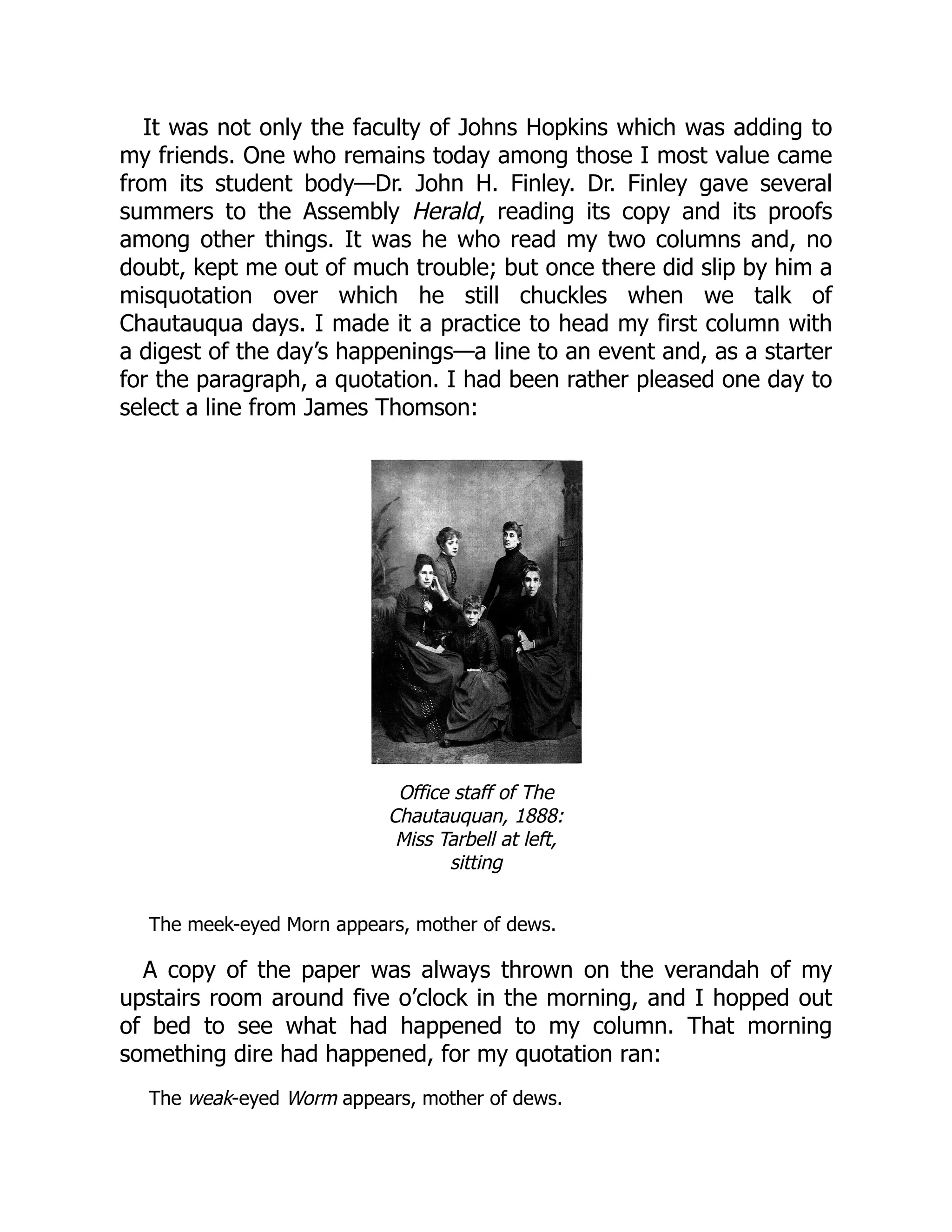
Office staff of The
Chautauquan, 1888:
Miss Tarbell at left,
sitting
The meek-eyed Morn appears, mother of dews.
A copy of the paper was always thrown on the verandah of my
upstairs room around five o’clock in the morning, and I hopped out
of bed to see what had happened to my column. That morning
something dire had happened, for my quotation ran:
The weak-eyed Worm appears, mother of dews.
Eminence came from across the water annually and gave color
and importance, so we thought, to our doings. A foreign visitor with
whom I had a pleasant acquaintance running over some years was
Dr. J. P. Mahaffy of the University of Dublin. Dr. Mahaffy had
contributed a series of delightful articles to the required readings in
The Chautauquan—“Gossip About Greece”—and in the summer of
1889 he came over for two or three courses of lectures at the
Assembly. A distinguished figure, he was, and such a contrast in his
tweeds, his free movements, his spirited wide-ranging talk to most
of us.
My acquaintance grew out of our mutual interest in the flora of
any spot where we happened to be. One day as I came in from a
botanizing expedition outside the grounds carrying stocks of the
lovely field lilies common in the region, Dr. Mahaffy seized my arm:
“You care for flowers and plants? I thought American women had no
interest in them.” A libel I quickly hooted. In defense of my
sisterhood I went diligently to work to show him our summer flora.
But he cared for nothing as much as our summer lilies, begged me
after the flowering was over to send him bulbs, which I proudly did.
In exchange I received from his Dublin garden seeds of a white
poppy which, he wrote me, he had originally gathered in the shadow
of the statue of Memnon in Egypt. Those poppies have always gone
with me; they flourished in my mother’s garden in Titusville—now
they flourish in my Connecticut garden.
My life was busy, varied, unfolding pleasantly in many ways, but it
also after six years was increasingly unsatisfactory, so unsatisfactory
that I was secretly, very secretly, meditating a change.
I was scared by what The Chautauquan seemed to be doing to the
plan I had worked out for the development of my mind. I had grown
up with a stout determination to follow one course of study to the
end, to develop a specialty. The work I was doing demanded a
scattering of mind which I began to fear would unfit me for ever
thinking anything through. I realized that an editor of value must
have made up his mind about more things than had I, feel himself
ready to fight for those things if necessary. I had no program in
which The Chautauquan was interested. Moreover, I did not want to
be an editor.
But to break with The Chautauquan meant sacrificing security. I
had always had a vision of myself settled somewhere in a secure
corner, simple, not too large. I never had wanted things; I always
had a dislike of impedimenta, but I wanted something cheerful and
warm and enduring. There I could work over that which interested
me, day in and day out, with no alarm for my keep. Now The
Chautauquan was a secure berth; so far as I could figure, it would
last through my time at least. To give it up meant complete
economic insecurity. I probably should not have been willing to
sacrifice what I think I had honestly earned if there had not been
growing upon me a conviction of the sterility of security. All about
me were people who at least believed themselves materially secure.
They lived comfortably within their means, they were busy keeping
things as they were, preserving what they had. They were the most
respectable people in town, but secretly I was beginning to suspect
their respectability.
One day, listening to a fine elderly Scotch Presbyterian minister
who had in his congregation a large group of these stable, secure,
best citizens, I was startled when he leaned over his pulpit and,
shaking his fist at us, shouted, “You’re dyin’ of respectability.” Was
that what was happening to me? I saw with increasing clearness
that I could not go beyond a certain point on The Chautauquan,
mentally, socially, spiritually. If I remained, it was to accept a variety
of limitations, and my whole nature was against the acceptance of
limitations. It was contrary to the nature of things as I saw them; to
be happy, I must go on with fresh attempts, fresh adventuring. The
thing that frightened me earlier in my youth came to the top now:
that thing that made me determine I would never marry because it
meant giving up freedom, was a trap. It was clear enough that I was
trapped—comfortably, most pleasantly, most securely, but trapped.
As time went on I realized that this security to which people so
clung could not always be counted on. They might think so, but had
I not seen beautiful homes sold under the hammer in Titusville,
homes of those whom the town had looked on as impregnable
financially? In my years on The Chautauquan in Meadville I had
been a shocked observer of one of the many dramatic political
failures of the eighties, the defeat of the Republican candidate for
Governor of Pennsylvania at a critical moment—a Meadville banker,
Wallace Delamater. I was too much of a mugwump to sympathize
with the Republican platform, but I liked Wallace Delamater. I
believed him, as I think the records show, to be a tool of a past
master of machine politics—Matthew Quay. Taken up by Quay, the
resources of the Delamater bank and of allied banks in Meadville at
the call of his party, he made a campaign which was called brilliant.
There was no doubt of the result in Meadville.
I went to bed early, the night of the election, expecting to be
aroused by the ringing of bells, the blowing of whistles, for there
was to be a celebration. When I awakened with a start it was broad
daylight. Had I slept through the celebration? A sense of doom hung
over me; I dressed hurriedly, went down to get the paper. Wallace
Delamater was defeated. Promptly the Delamater bank closed and,
one after another, four banks of the town followed. There was a
heavy run on the one remaining, the one where I had my little
deposit. The panic in the town was desperate; everything was going.
I don’t think I have ever been more ashamed of anything in my life
connected with money than I was when I took my bank book and
went to my bank to ask for my deposit. It was all the money I had in
the world—times were bad. But I have always continued to be a
little ashamed that I yielded to the panic, the more because my bank
didn’t fail!
No, the security men flattered themselves they had achieved was
never certain. Moreover, my security was costing more in certain
precious things than I was willing to pay. Take the matter of making
something professionally sound, useful, justifiable, out of myself,
which is the only one of these “precious things” that I am talking
about! I could do no more towards it where I was. To begin with, I
at last knew what I wanted to do. It was no longer to seek truth
with a microscope. My early absorption in rocks and plants had
veered to as intense an interest in human beings. I was feeling the
same passion to understand men and women, the same eagerness
to collect and to classify information about them. I find the proofs of
this slow and unconscious change of allegiance in an accumulation
of tattered notebooks tucked away for years, forgotten and only
brought out after I had set myself this curious task of tracing the
road I have traveled through my eighty years, trying to find out why
I did this thing and not that, getting acquainted with my own
working life.
I seem to have begun to enter observations on human beings
soon after I had settled down to learn how to put a magazine
together in an orderly fashion. I applied the same method that I had
used for so many years in collecting and classifying natural objects
which excited my curiosity. Take leaves, on which I was always keen.
I started out in high school to collect them from all the flora in my
territory, classifying them by shapes, veins, stalks, color. Rarely do I
take up a family book of those early years that there do not fall out
from between the pages leaves of one thing or another that I had
pressed to help me carry on my scheme of classification. I suspect
that I did not get much beyond a glib naming of parts.
Something analogous happened when I recognized that men and
women were as well worth notes as leaves, that there was a science
of society as well as of botany.
What had happened was undoubtedly that the tumults, the
challenges of my day had finally penetrated my aloofness, and that I
was feeling more and more the need of taking a part in them. The
decade I spent in Poland and on The Chautauquan had a
background not so unlike that of the present decade. At its
beginning we were only fifteen years from a civil war which had left
behind not only a vast devastated region with the problem of its
reconstruction, but the problem of a newly freed people. It had left
bitterness which in intensity and endurance no war but a civil war
ever leaves. We had had our inflation, a devastating boom followed
by seven years of depression, outbreaks of all the various forms of
radical philosophy the world then knew. Youth talks glibly of
communism today as if it had just appeared in the country; but
Marxian Communists transferred the headquarters of the
International to New York City in the seventies. More conspicuous
than the Communists were the Anarchists. Every city in the United
States had its little group, preaching and every now and then
practicing direct action. Indeed, they were a factor in all the violent
labor disturbances of the period.
In 1879 prosperity had come back with a whoop, and, as she
usually does after a long absence, had quickly exhausted herself by
fantastic economic excesses. By the time I undertook to annotate
the Chautauqua Literary and Scientific Circle’s readings the country
had begun to suffer again from its wanton speculation and reckless
overbuilding of railroads. Factories and mines and mills shut down;
and when work stopped disorder began, particularly on the railroads
of the Southwest, the awful massacre of Chinese in Wyoming—more
awful, the Haymarket riot in Chicago followed as it was by the
execution of four men, all counselors of violence to be sure, but no
one of them found guilty either of making or of throwing the bomb.
The eighties dripped with blood, and men struggled to get at
causes, to find corrections, to humanize and socialize the country;
for then as now there were those who dreamed of a good world
although at times it seemed to them to be going mad.
The Chautauquan interested itself in all of this turbulent and
confused life. Indeed, it rapidly became my particular editorial
concern. We noted and discussed practically every item of the social
program which has been so steadily developing in the last fifty
years, the items which have crystallized into the Square Deal, the
New Freedom, the New Deal.
The present argument for high wages, we made in the eighties.
We called it “the new economic coefficient in our industrial life.” “It is
the well-paid workman,” said The Chautauquan, “who is a relatively
large consumer. We are built upon a foundation of which this well-
paid workman is an important part.”
As for hours and conditions, we were ardent supporters of the
eight-hour day, organized labor’s chief aim in the eighties, and we
were for contracts between labor and capital, each being held
responsible for his side of the bargain. We were for education,
arbitration, legislation, the program of the Knights of Labor rather
than the program of force which the growing American Federation of
Labor was adopting. We discussed interminably the growing problem
of the slums, were particularly strong for cooperative housing,
laundries and bakeshops; we supported the popular Town and
Country Club, seeking to keep a healthy balance between the two;
we were advocates of temperance but shied at prohibition—largely, I
think, because it had become a political issue, and we did not like to
see our idealists going into politics, as Bellamy and Henry George
and the leaders of many causes were doing.
That is, in the decade of the eighties we were discussing and
thinking about the same fundamentals that we are today.
My realization of the stress of the period began at home. Titusville
and all the Oil Region of Pennsylvania were struggling to loosen the
hold of the mighty monopoly which, since its first attack on the
business in 1872, had grown in power and extent until it owned and
controlled over 90 per cent of the oil industry outside of the
production of the raw crude. The region was divided into two hostile
camps—the Independent Producers and Refiners, and the Standard
Oil Company. Their maneuvers and strategy kept town and country
in a constant state of excitement, of suspicion, of hope, and of
despair.
There was a steady weakening of independent ranks both by the
men worn out or ruined by the struggle, and those who saw peace
and security for themselves only in settling and gave up the fight.
In those days I looked with more contempt on the man who had
gone over to the Standard than on the one who had been in jail. I
felt pity for the latter man, but none for the deserters from the ranks
of the fighting independents. Those were the days when the freeing
of transportation, the privilege which had more to do with the
making of the monopoly than anything else, more even than the
great ability of its management, was the aim of all reformers. For
years the Independents had worked for an interstate commerce law
which would make rate discrimination a crime. To me such a law had
come to have a kind of sanctity. It was the new freedom, and when
it was passed in 1887 I felt an uplift such as nothing in public life,
unless I except Mr. Cleveland’s tariff message of the year before, had
ever given me.
But it was not the economic feature of the struggle in the Oil
Region which deeply disturbed or interested me. It was what it was
doing to people themselves, to the people I knew, to my father and
mother and their friends. It was the divided town, the suspicion and
greed and bitterness and defeats and surrenders. Here was a
product meant to be a blessing to men—so I believed; and it was
proving a curse to the very ones who had discovered it, developed
it.
I began to fill pages with notes of things seen and heard, and
finally I decided I should write a novel about it. Very secretly indeed,
I went at it, assembling a cast, outlining a plot, writing two or three
chapters. Poor stuff. Luckily I soon found out I was beyond my depth
and gave it up.
From my notebooks I judge that I abandoned my novel the more
readily because I had conceived what I called “a more fundamental
research”! This was nothing less than a Science of Society to be
illustrated by my own observations on men and women. Looking
over it now, I see that the framework came from reading the
voluminous discussions of the nature of society then flooding the
public. I took my framework where I found it, but I filled it in with
observations, gathered on all sides, of people I knew, heard about,
particularly read about in the newspaper.
But this ambitious work soon met the same fate as the novel. It
broke off at the end of the third chapter because I had concluded I
could not construct society as it was until I knew more about
woman. I suspected she had played a larger part in shaping society
than she realized or perhaps was willing to admit. I was questioning
the argument that this is entirely a man-made world. I had found
too many woman-made parts in it to accept the characterization at
its face value. My science of society would not be honest, I
concluded, if the only part woman was allowed to play in it was that
of doormat, toy, and tool. I was troubled, too, by the argument that
women must be given suffrage if society was to be improved. Man
had made a mess of the world, I was told; woman must take his
tools and straighten things up. I did not feel the confidence of my
courageous friends. “Why should we expect them to do better with
the vote than men have done?” I asked. “Because they are women,”
I was told. But they were human beings, like men, and they were
human beings with no experience of the tools they wanted to use;
and I had enough sense of the past to believe that experience
counted, and that it would be wise for all men and women to consult
it when they tried new ventures.
There had been women in public life in the past. What had they
done? I had to satisfy myself before I went further with my science
of society or joined the suffragists. It was humiliating not to be able
to make up my mind quickly about the matter, as most of the
women I knew did. What was the matter with me, I asked myself,
that I could not be quickly sure? Why must I persist in the slow,
tiresome practice of knowing more about things before I had an
opinion? Suppose everybody did that. What chance for intuition,
vision, emotion, action?
My notebooks show that I began my plodding by making out a list
of women who seemed to offer food for reflection. The group that
excited me most were the women of the French Revolution. I made
little studies of several, wrote little pieces about them, and these
little pieces I submitted to the editor of The Chautauquan; he
published several of them—a study of Madame de Staël, of Marie
Antoinette, of Madame Roland. But soon I became heartily ashamed
of my sketches, written as they were from so meager an equipment.
I felt this particularly about Madame Roland. I made up my mind
that I was going to know more about this woman, that she probably
would teach me what sort of contribution might be expected from a
woman in public life.
That meant research. How was I to carry it on? Whatever studying
I did depended on my ability to support myself while doing it;
whatever studying I did while on The Chautauquan must be turned
into something available for the magazine. My time and strength
belonged to it. Obviously, I could not do sufficient research and
continue my position; it was as impossible as it had been to act as
preceptress of the Poland Union Seminary and at the same time
carry on my study with the microscope. Where was I to carry on this
research? There was but one place—Paris. And how was I to finance
myself in Paris—a strange country and a strange tongue—long
enough to write a book? I did not consider the possibility of getting
a regular job: I did not want one. I wanted freedom, and I had an
idea that there was no freedom in belonging to things, no freedom
in security. It took time to convince myself that I dared go on my
own. But finally I succeeded.
Coming to a decision has a loosening, tonic effect on a mind which
has been floundering in uncertainty. Liberated, it rushes gaily,
hopefully, to the charting of a new course. I had no sooner resolved
to strike out on my own than my mind was bubbling with plans. I
forgot that I was thirty-three years old and, according to the code of
my time and my society, too old for new ventures; I forgot that
outside of my very limited experience on The Chautauquan I knew
nothing of the writing and publishing world, had literally no
acquaintance among editors; I forgot that I was afraid of people,
believed them all so much greater and more important than they
often turned out to be that it cost me nervous chills to venture with
a request into a stranger’s presence.
Dismissing all these real handicaps, I plunged gaily into planning
for a career in journalism, self-directed, free-lance journalism. Surely
I could find subjects enough in Paris to write about, subjects that
would interest American newspapers. We were in the thick of a great
agitation over the condition and the conduct of American cities. The
Chautauquan had touched it occasionally. How did Paris keep house?
I planned a syndicate of my own which would answer all questions.
Out of my newspaper work might not articles grow for magazines? I
thought so, and books, beginning of course with my study of
Madame Roland. So long as I told nobody about my plans, they
worked beautifully, carried me upward and onward into a new and
happier, more profitable, more satisfying world. But when I
announced my decision, laid out what I proposed to do, all the glow
and confidence went out of me, all the weaknesses in my venture
came again to the top. There were friends who said none too
politely: “Remember you are past thirty. Women don’t make new
places for themselves after thirty.” There were friends who resented
my decision as a reflection on themselves. A woman whose
friendship I valued said bluntly: “You are one of us. Aren’t we good
enough for you?” My act was treason in her eyes. The whole force of
the respectable circles to which I belonged, that respectable circle
which knew as I did not the value of security won, the slender
chance of replacing it if lost or abandoned, was against me and so
out of friendliness.
When I told my editor-in-chief I was leaving, going to Paris to
study, he was shocked. “How will you support yourself?” he asked,
really anxious, knowing that I must depend on my own efforts.
“By writing,” I said.
“You’re not a writer,” he said. “You’ll starve.”
He had touched the weakest point in my venture: I was not a
writer, and I knew it. I knew I never should be one in the high sense
which I then and still more now give to that word. I had neither the
endowment nor the passion nor the ambition to be a writer. I was
rather a student, wanting to understand things quite regardless of
how I could use that understanding if I reached it. There was much
selfishness in my wanting to know for the sake of knowing, much of
a dead scholar in me; and that dead scholar has always hung, more
or less a weight, about my neck.
But if I was not a writer I had certain qualifications for the practice
of the modest kind of journalism on which I had decided. I counted
no little on my habit of planning in advance what I was going to do,
and I had a strong conviction that a plan of my own was worth more
than any plan which was made for me. Again, if I could not write, I
did have a certain sense of what mattered in a subject and a strong
conviction that it was my sense of what mattered, and not
somebody else’s, that would give my work freshness and strength if
it was to have any.
Then there was my habit of steady, painstaking work—that ought
to count for something. And perhaps I could learn to write. If I were
to do so, could I do better than soak myself in French prose? I had
read French steadily from my school days; I had done not a little
translating of articles from the big reviews for The Chautauquan. If I
could live with the language, might I not master something of what
seemed to me its essential qualities, those which gave it both body
and charm? These qualities were the soundness of structure, the
way it held together, and the beautiful clarity of expression. At least
I could try for them.
But when I tried to explain all this to my critical friends they
continued frankly skeptical, indignant. It was my father and mother
who backed me up, though I think they were both puzzled and
fearful. “I don’t know what you can do, Ida,” my father said, “that’s
for you. If you think you can do it, try it.” But in the end it took all
the grit I had to go ahead.
Breaking up established relations is not easy. You begin by pulling
up deeply rooted things, rooted in your heart; you abandon once
cherished purposes. When I left The Chautauquan I was no longer
the eager and confident young woman who ten years before had
started out for herself in Poland, Ohio; I was ten years older, and I
was keenly conscious that I had in those ten years accumulated a
fairly complete collection of shattered idols. That I could forget them
as quickly and as completely as I did, I owe to the Paris of the
nineties. I had scarcely passed her gates before I had fallen under
her spell. At once I was experiencing all the amazing rejuvenation
that comes from falling in love, whatever the object. It was not to be
“See Paris and die,” as more than one friend had jeered. I knew with
certainty it was to be “See Paris and live.”
6
I FALL IN LOVE
Falling in love with Paris at first sight—a coup de feu, it was—in no
way dimmed the energy and the care with which on the day of my
arrival I began to put into operation the cautious and laborious Plan
for self-support I had brought along. It rather intensified it. As I
must begin at the bottom to build up contacts with strangers on the
other side of the ocean, and as there was but $150 in my pocket,
there was no time to waste.
In the ten years I had been trying to support myself I had learned
that the art of spending money is quite as important in a sound
financial program as the art of earning it. I had been going on the
theory, as I still am—practice is another story—that what I earned
must cover my expenses and leave a surplus for emergencies and
expansion. I had applied my principles to my small salary on The
Chautauquan—never over $100 a month—well enough to get myself
to Paris and have this little reserve to care for myself while I was
proving or disproving that I could convince a few American editors
whom I had never seen that my goods were worth buying.
The first step, obviously, in carrying out my program was cheap
living. Luckily for me, two of my associates on The Chautauquan,
excited by my undertaking, had decided to join me. One, Josephine
Henderson, was a friend of Titusville days and like myself a graduate
of Allegheny College. Jo, as we called her, was a handsome woman
with a humorous look on life—healthy for me. I have never had a
friend who judged my balloons more shrewdly or pricked them so
painlessly. With us was a beautiful girl, Mary Henry, the daughter of
one of the militant W.C.T.U. workers of that day, a neighbor and a
friend as well as a co-worker of the great temperance leader Frances
Willard. At the steamer a friend of Mary’s appeared, announcing that
she, too, was going along. This meant four of us to share rent and
food.
Back in Titusville I had picked on the Latin Quarter as at once the
cheapest and the most practical place in Paris for one to live who
must go on the cheap. Then, too, the University was in the Latin
Quarter, and we were all planning to take lectures. I was even
flirting with the idea that I might find time to take a degree.
So on arrival, putting our bags in the little room of the cheap hotel
on the Right Bank to which we had gone, we headed at once for the
Latin Quarter. I had picked on the neighborhood where I wanted to
settle, near the Musée de Cluny. Not that I knew a thing about the
Musée or what was in it; simply Cluny was one of the words that
had always pulled me. This magic was largely responsible for our
settling in the Rue du Sommerard almost next door to the spot in
the city which save one was to have the greatest fascination as well
as the deepest consolation for me.
But finding these quarters was no easy task. My friends gulped as
I did at the stuffiness, the dinginess, the primitive sanitation, the
obvious fleas, and the suspicion of other unmentionable pests in the
places at which we looked. But settle I would, and so with groans
they consented finally to the taking of two tiny bedrooms, a salon,
along with the use of a kitchenette in one of the four apartments
controlled by a Madame Bonnet. Our selection was not as unwise as
it looked at the moment. Indeed, as it turned out, Madame Bonnet
remained my landlady throughout the coming three years.
As quickly as we had found our lodging we established relations
with the little shops in the neighborhood where one could for a few
sous buy all the makings of a meal. You bought exactly what you
needed and no more—a single egg, one roll or croissant, a gill of
milk, two cups apiece of café au lait, never having a drop left in the
pot. Brought up as we had all been at loaded tables, the close
calculation shocked us at first as something mean, stingy. “Why, the
very scraps from a meal at home would feed us here.” And that was
true—more shame to our bringing up. But we learned to buy as our
thrifty neighbors did and to like it, and we learned how to order at
the cheap and orderly little restaurants of the Quarter so as to get a
sufficient meal of really excellent food for a franc (then nineteen
cents or, as we carelessly reckoned it, twenty-one hundred centimes
to a franc). Only on grand occasions did we allow ourselves two
francs.
The pleasantest and most profitable part of the experience was
the acquaintances we made with the women who kept the little
shops, the little restaurants. As soon as they were convinced of our
financial responsibility and our social seriousness, they became
friendly—a friendliness not based on the few sous we were spending
so carefully but on interest and curiosity. We were new types to
them; but, once convinced we were what we pretended to be, they
treated us with a deference quite different from the noisy greetings
they gave the people of the neighborhood or their rather
contemptuous familiarity with the occasional cocotte who strayed in.
That is, we were very soon placed by the shopkeepers of the vicinity.
It was my first lesson in the skill, almost artistry with which all
classes of the French people classify those with whom they are
thrown in contact, notably foreigners. Later I was to observe this in
the more highly developed classes where I established professional
relationship.
I was a stranger seeking information—an American journalist, a
student, so I told them. But what kind of person was I? What was
there in me they could tie to, depend upon?
Obviously I was not rich. If I had been, there would have been
quickly gathered around me a group to offer entertainment as well
as treasures to buy; but it was clear I had little money, so that was
out of the question. There are other things by which the French label
you, a woman particularly—charm, beauty, chic, l’esprit, seriousness,
capacity to work, intelligence, bonté. Those with whom I had
dealings for any length of time hit perfectly on my chief asset. I was
a worker. “A femme travailleuse,” they said to one another, and if
they passed me to an acquaintance that was the recommendation.
No people believe more than the French in the value and dignity in
hard work. I was treated with respect because of my working
quality. It was not saying that I should not have gone farther and
faster if I had been a beauty, if I had had what they call charm and
the fine secret of using it, but they were willing to take me for what
I had. Being a worker, the chances were I was serious. I might or
might not prove intelligent, but here they gave me the benefit of the
doubt and waited for a final answer. That which they were slowest in
making up their minds about was goodness—bonté. They were not
willing to accept anything but natural unconscious goodness, and it
takes time to make sure about that.
While we were finding our way about, I was at work. If I did not
have the documents to prove it I would not believe today that just a
week after arriving, and in spite of the excitement and fatigue of
settling, I had written and mailed two newspaper articles.
Enamored as I was of the city, no work could have been more
satisfying than that I had laid out for myself. My little self-directed
syndicate concerned itself with the practical everyday life of the city.
One is always keen to know all the common things about the thing
or person one loves. How did Paris keep herself so clean? What did
she eat and drink, and where did she get it? How much did it cost
her? Where did she go for fun? How did she manage it that even her
very poor seemed to know how to amuse themselves, that her
beggars were a recognized institution? There were a multitude of
things I thirsted to know about her. And if I could get my bread and
butter in finding out, what luck! What luck!
At once I became an omnivorous reader of the newspapers, and I
found to my joy that many of them felt as I did about the Parisian
scene. They carried paragraphs as captivating as those that our New
Yorker unearths for its fascinating editorial department on the city to
which it belongs. Another discovery which surprised me was that my
best source for illustration was the illustrated catalogues of the
French Salons of recent years. I wanted pictures of markets, of
rivers, of beggars, of marriages, of all the things that people were
doing as they went about their business. And what rejoiced me was
that many French artists seemed to love the streets and what went
on there in much the same way that I did. They loved to see Paris at
her daily toil, meeting her daily problems, and every year they
turned out pictures showing her at it.
Later I was to discover that this daily life of the Parisians of
different classes has always been material for able artists. The best
illustrations I found for my Madame Roland in her youth were those
of Chardin in the Louvre.
My manner of living, the contacts and circumstances attending the
gathering of my material for my newspaper articles brought me for
the first time in my life into daily relations with that greatest
segment of every country’s population—those whom we call the
poor, and of whom if we are well-to-do or if we are rich we are so
curiously unconscious. I had belonged all my conscious life to the
well-to-do, those who spent a dollar without seriously weighing it.
Society had seemed to me to be chiefly made up of such people. Of
course there were the rich, but they were so few in number as to be
negligible—at least they had never counted in my life; nor had the
poor counted as a permanent class. I had the American notion that
the chief economic duty of the poor was to become well-to-do. The
laborer, the clerk, the man who worked for others should save his
money, put it into the business, or start out for himself, no matter
how hard, how meager the return. Dignity and success lay in being
your own master, owning your own home—I am sure my father
would rather have grubbed corn meal and bacon from a piece of
stony land which was his own than have had all the luxuries on a
salary. One of his complaints against the great oil trust was that it
was turning the men of the Oil Region into hired men—mighty
prosperous hired men, some of them, but nevertheless taking
orders, even orders as to what to say, for whom to vote.
To his way of thinking this was failure for an American. I suspect
his philosophy working in me was at least partially responsible for
my revolt against the kind of security I had achieved on The
Chautauquan. I was a hired girl.
But in the society where I found myself in Paris there was no such
contempt for the fixed job. On the contrary, it was something for
which you were responsible, to which you owed an obligation.
Serious workers in Paris seemed to me to give to the job the same
kind of loyalty that serious men and women in America gave to the
businesses they owned. You respected yourself and were respected
in proportion to your fidelity to it. You might be advanced, but more
probably not. Opportunity did not grow on every bush as at home,
and if it came a Frenchman’s way he weighed it—at home you seized
it, trusting to luck. Here luck seemed to me to have little or no
standing in a business enterprise, big as it counted in the lotteries in
which everybody took part. To my surprise I found these people,
working so busily and constantly, were not restless like the
Americans; nor were they generally envious. I had a feeling that my
concierge, who never had been across the Seine to the Right Bank,
who lived in a room almost filled by her huge bed and its great
feather puffs, who must have looked long at a sou before she spent
it, would not have changed places with anybody in Paris. Were not
the lodgers on whom she kept so strict a watch kind, generous, and
regular with fees? Had she not friends in the street? Might she not
win a slice of a fortune one day from the fraction of a lottery ticket
which she annually found a way to buy? And who had so
magnificent a cat? The pride of the House. What more could she
ask?
Certainly there was more interest in the tasks, less restlessness,
less envy, than in the same class in America. Was it my father’s
philosophy which made the difference? Was it your duty if you were
poor to struggle to be well-to-do, and if well-to-do struggle to be
rich? It meant you were always trying to be somebody else. If it was
your duty to be discontented, could you escape envy? Was it not
necessary, if you were to keep yourself up to the effort, to feed
yourself on envy as in war men must be fed on hate if they are to
kill with vigor and gusto?
It was too much to believe that the content, the fidelity to the job
were universal. Nevertheless, it was sufficient to cement the
laborious poor into a powerful and recognized class, a class with
traditions, customs, recognized relations to other classes, having its
own manner of homes, amusements, worship; a class self-
respecting, jealous of its prerogatives, and able in need to protect
itself.
But the multitude of hard-working and fairly satisfied men and
women were not all the poor with whom I came close. There were
those who could find no work; there were many of them, for the
long world depression of the nineties was on its way. The winter of
’91 and ’92 was a cruel one, and the museums, libraries, lecture
rooms, churches where I went about my daily duties were swarmed
with poor souls trying to deceive the guardians into thinking that
they had come to study pictures, read books, listen to lectures, to
confess their sins or listen to mass. The guardians only saw them
when they became a crowd or attempted to camp for the day. Most
pathetic to me were their efforts to make furtive toilets, taking a
comb from a pocket to smooth tangled hair, scissors to cut the fringe
from a frayed cuff.
There were soup kitchens to keep them from starving, though
many a one starved or froze or ended his misery in the Seine that
winter. At one of these kitchens I officiated for a brief time. It was
run by the McAll Mission in the Faubourg Saint-Antoine. I was not
there as a Samaritan but as a reporter looking for copy. What could I
do for them but tell Americans what a few Americans were doing in
Paris to ease the vast misery? It might bring a few sous for soup. I
believe it did.
But they pulled less strongly on my sympathy than a class of the
poor which I found to be in our Quarter—men and women no longer
young, past the employing age, who lived alone on tiny incomes,
sometimes the fruit of their own past thrift, sometimes an
inheritance, again the gift of a friend. I watched and speculated
about how they did it, the more seriously because I asked myself if
the day might be coming when I should belong to this class. If I
ever did, I hoped I could carry it off with as much dignity as the one
called the Countess on our street. She lived sous les toits in a high
house opposite me, a tall, erect, white-haired woman in a gown and
cape of faded and patched silk which still showed its quality as did
its wearer. More than once I watched her stop late at night at the
garbage can on the sidewalk opposite, turning over its contents.
Many of the tradespeople seemed to feel that she honored them
when she came in to buy an occasional egg or apple. She was so
gracious, so completely grande dame. One day I heard the woman
from whom I bought my café au lait say: “Will not Madame honor
me by trying my coffee? It is still hot.” She was pouring out a cup as
she said it, and the Countess with a benignant smile said, “If that
will give you pleasure, my good Marie.” She needed it. Marie knew
that, but Marie was more than paid by that smile. “It is a great
honor,” she told me lest, being a foreigner, I did not understand the
Countess, “to have so great a lady come into one’s shop.” There it
was again, another standard than money, the standard of class,
breeding, cultivation, the grand manner.
The more I saw of the gallant poor of Paris, the more convinced I
was if they could get on so could I, learning to live on what I could
make. And I was going to make something. My doubt about that
was set at rest some six weeks after my arrival when I received a
check for my first syndicate article—$5.00. It was quickly followed by
checks from two more of the six papers to which I had submitted my
syndicate proposition—50 per cent was not a bad percentage and
they were good papers, the Pittsburgh Dispatch, the Cincinnati
Times-Star and the Chicago Tribune. These three papers remained
faithful to me until the election of 1892 compelled them to give all
their space to politics, so they explained. I believed them, for they
had all written me kind letters about my stuff and the Times-Star,
unsolicited, raised my pay to $7.50!
Then the unbelievable happened. In December, a little less than
three months after my arrival in Paris, Scribner’s Magazine accepted
a story—a grand Christmas present indeed, that news. Fiction was
not in the Plan, but one of the first pieces of work that I did after
arriving in Paris was a story born of a delightful relationship with an
old French dyer of Titusville, Monsieur Claude. As soon as I had
finally determined that I would burn all bridges and go to Paris for
study, I had set about my preparation in thorough fashion. There
was the language. I had read it fluently for years—but speak it? No.
Could I master enough in the few months I had before sailing to find
my way about? If so, I must have some one to talk with. The best
the town afforded was Monsieur Claude and his mouselike wife.
They were flattered by my request. Three times a week I went, and
we talked and studied until they both were sure I could make myself
understood in common matters. In this delightful association I
discovered that the passion of Monsieur Claude, the longing of his
heart, was to see France before he died. He had insisted that I learn
and almost daily repeat Béranger’s “France Adorée.” Once in Paris, I
understood him, wrote his story, sent it—a trial balloon—to
Scribner’s Magazine.
The selection was made on a principle which young writers too
rarely consider when they attempt to place their wares, and that is
understanding of the tastes and prejudices and hobbies of
periodicals. Useless in 1890 to send a story on “France Adorée” to a
magazine which was interested purely and simply in realistic
literature; but the inexperienced writer frequently does not realize
that. Naturally I had learned in my work on The Chautauquan
something of the pet interests of the leading publishing houses. I
knew that Scribner’s enjoyed French cultivation, French character,
French history. I hoped my sentimental title “France Adorée” would
not antagonize the editor of Scribner’s Magazine.
But I had expected nothing from it, being in that state of mind
where I had ceased to expect, only to accept. So that when I
received a friendly letter from Mr. Burlingame, the editor of the
magazine, saying that he liked the story, that he accepted it, I felt as
one must who suddenly draws a fortune in the sweepstakes.
In due time a check for $100 arrived. What excitement in our little
salon when I showed my companions that check! “Now,” declared
our beautiful Mary, “we can move to the Champs Elysées.” And she
would have done it, for she was one of those who always see spring
in a single sparrow. We stayed where we were, I requiring a whole
flock of sparrows to convince me that it was spring.
The influence of the story on my fortunes was all out of proportion
to its value. Most important was the courage it gave me. If I, a
stranger, could do something that a great editor of a great magazine
thought good enough to accept, why, after all, I might work it out.
That which moved me most deeply, gave me joy that made me
weep, was that now I should have something to show to my family. I
had felt a deserter. Times were hard in the Titusville household in
these early nineties. My father’s and brother’s experiences in the oil
business—of which I want to speak later—were more than
discouraging; they were alarming. My sister was ill and in the
hospital; my mother’s letters were saturated with anxiety. And here
was I—the eldest child in the family, a woman of years and of some
experience, who had been given an education, whose social
philosophy demanded that she do her part in working out family
problems—here was I across the ocean writing picayune pieces at a
fourth of a cent a word while they struggled there. I felt guilty, and
the only way I had kept myself up to what I had undertaken was the
hope that I could eventually make a substantial return. If any one of
the family felt that I should have been at home there never was a
hint of it. From them I had unwavering sympathy and
encouragement.
But if in three months’ time I could do what I had done, and I
made the most of it in my letters home, why, then they would see
some hope for the future. Not only would the story help them to
believe in me, it would give something more imposing to show to
inquiring friends than the newspaper articles which had been their
only exhibit.
When the story appeared in the following spring the
reverberations in my Paris circle were encouraging and useful. I even
heard of it from “the other side,” as we called the Right Bank, for
Theodore Stanton (at that time the head of the Associated Press in
Paris) came with Mrs. Stanton to call on me and tell me he liked the
story.
The most important fruit was that Mr. Burlingame looked me up
when he made his annual spring visit to Europe. Here was my
chance to tell him about Madame Roland, to ask if he thought his
house would be interested in such a biography if it turned out to be
a good piece of work. “The suggestion would have to be considered
in New York,” he replied. But he promised me it would be
considered. And it was, for not long afterwards he wrote me that the
house was interested in my project, certainly wanted to see the
manuscript.
This was enough to settle finally a struggle that had tormented me
for many weeks. I had come to Paris determined to fit myself for
magazine work along historical and biographical lines; but once close
to the world of the scholar, surrounded by men and a few women
who lived stern, self-denying lives in order to master a field however
small I was seized with an ambition to be a scholar. It was a
throwback to my old passion for the microscope. I would specialize
in the French Revolution—I would become a professor.
But Mr. Burlingame’s answer to my inquiry as to whether the
Scribner company would be friendly to a biographical study of my
lady settled the matter; which shows, I take it, how shallow my
scholarly ambitions really were.
The Scribner connection was not the only one putting heart into
me. Among my early trial balloons was one marked for McClure’s
Syndicate, New York City. It carried an article of two thousand words
with a catchy title—“The King of Paris”—cribbed from a French
newspaper. It was the story of Jean Alphand and his services to the
city. The balloon reached its destination. The article was promptly
accepted with a promise of $10 when it was published, also a
suggestion that they would be glad to consider other subjects if I
had them to offer—which I did. Indeed, I gave them no time to
forget me; not that they took all I hustled across the Atlantic, but
they took enough to make me feel that this might be a stable and
prosperous market for short and timely articles. When suggestions
finally began to come from them I felt the ground firmer on my feet.
One of these suggestions led me into an especially attractive new
field, and in the long run had important bearing on my major
interest, Madame Roland. It was that I try a series of sketches of
French women writers. There was a respectable group of them, and
I asked nothing better than to look them up.
I began with a woman who at that time was introducing leading
contemporary English and American writers to the French through
the Revue des deux Mondes—Madame Blanc, her pen name
Théodore Bentzon, a person of rare distinction and of gallant soul.
She had been a lady in waiting at Napoleon III’s court, had made an
unfortunate marriage, was now living on a small income and what
she could earn by writing. In her salon there was a portrait taken in
her young womanhood which charmed me, but when I spoke of it
she shook her head as if she did not want to remember it. “Une
femme qui n’existe plus,” she said.
Hard worker as Madame Blanc was, she found time to start me on
my rounds among the French women writers. I doubt if there was
an American writer of our day who would have had both the
kindness of heart and the sureness of herself to take so much
trouble for an unknown woman. She started me off, and I turned out
ten or a dozen little pieces before I was through. With one of my
subjects I had an amusing flirtation—I think I may call it a flirtation.
This was Madame Dieulafoy who with her husband had done
eminent work in archaeology, and who had a roomful of exhibits in
the Louvre to her credit—a very great person indeed. Madame
Dieulafoy was the only woman I had ever seen at that time who
wore men’s clothes. It had been found necessary to put her into
trousers for excavating work, and she liked them so well and
Monsieur Dieulafoy loved her so in them that they had obtained
permission from the French Government for her to wear them in
Paris. From more than one source I heard of the sensation she
created among servants when she came to call. They abandoned
their duties to peep from dark places at the woman in men’s clothes.
Madame Dieulafoy and I grew friendly over the history of the
exploits of women in the world, and it took no time at all for me to
decide to write the history of women from Eve up, as if I had not
already enough on my hands. She applauded my idea, gave me
many suggestions, but it never went any further than my few visits,
which as I say were more or less flirtations. She was such a pretty
little man, so immaculate (the best tailors in Paris did her, I was
told), that I could not keep admiring eyes off her. She used her eyes,
too, and loved to pat me on the knee, partly I suppose because I
always blushed when she did it. It was an amusing acquaintance
and a profitable one to me, for she was as interested in my plans for
articles as if I had been one of her own.
Another woman who interested me greatly was Judith Gautier. My
interest was stirred by my indignation that her name had been left
off the list of living women distinguished in French literature sent to
the Chicago Exposition of 1893. There was much speculation among
my friends as to how it happened. My own conclusion was that it
was because of her long and impassioned devotion to the music of
Richard Wagner.
The first Wagner opera to be given in Paris was “Tannhäuser.” This
was in the early sixties, when Judith Gautier was about fourteen
years old. She went to the opera with her father—Théophile Gautier
—and was enthusiastic although the house received it coldly. As they
were walking home a little fellow with hollow cheeks, eagle nose,
and very bright eyes joined them. He rejoiced with cheerful violence
over the failure of the opera. The girl, angered, forgot her manners
and blurted out, “It is clear, sir, that you know you have heard a
masterpiece, and that you are talking of a rival.”
“Do you know who that was, saucebox?” her delighted father
asked as they passed on.
“No, who?”
“Hector Berlioz.”
It was the beginning of a lifelong devotion. Wagner was to her not
only the master musician but a species of divinity. In 1882 she
published a volume on him—valuable for its reminiscences.
Early in the winter of 1892 “Lohengrin” was announced for the
season of Grand Opera. I was amazed at the loud and bitter
protests. Among the few lovers of Wagner who had courage to come
to the defense of the master was Judith Gautier. She was abused for
it. As this was my first realization that political hatred ever influences
the judgment in matters of art, I took the incident very much to
heart. I could understand why people might dislike Wagnerian
music, but that the soldiers should be called out to protect the Opera
House when one of his greatest works was to be given shocked me.
You could then so hate an enemy that beauty herself was outraged!
It was easy for me to conclude that Judith Gautier’s name had
been left off the list of writing women sent to the Chicago Exposition
because the committee wanted to punish her for defending the
works of a great artist in whom she profoundly believed.
The opening up of opportunities so much more quickly than I had
dared dream spurred me to longer and harder hours at work. There
were few mornings that I was not at my desk at eight o’clock; there
were few nights that I went to bed before midnight, and there was
real drudgery in making legible copy after my article was written. It
was all done by longhand—careful and painstaking handwriting, it
was. I was to find later that Mr. McClure’s partner in the Syndicate,
Mr. J. S. Phillips, trying to estimate the possibilities in this
correspondent bombarding them with articles and suggestions, set
me down from my handwriting as a middle-aged New England
schoolteacher.
But if life was hard and life was meager, and if down at the bottom
of my heart it was continuously in question to which class of the
poor I would finally belong, life to my surprise was taking on a
varied pattern very different from the drab existence of hard work
and self-denial that I had planned and was prepared to endure to
the end. It began at the Rue du Sommerard, where at the outset we
stumbled on what turned out to be the most colorful, unusual, and
frequently perplexing association that had ever come the way of any
one of us.
When we took our rooms from Madame Bonnet she had told us
that one room in the apartment was reserved for an Egyptian Prince
who came only for the week ends. He was bien comme il faut, très
riche, très everything desirable. He would not disturb us, we might
never see him. Upon inquiry we discovered that all Madame Bonnet’s
rooms save those we were taking were occupied by Egyptian
students of law or medicine or diplomacy. The Prince, himself, a
cousin of the Khedive, was in the military school at Saint-Cyr. He
kept a room at Madame Bonnet’s to spend an occasional holiday or
Sunday with his compatriots, all of his age and all of the upper
classes.
We all shared the American flutter over titles, and when we
caught a first glimpse of the Prince and his friends we were still
more excited. They were quite the most elegant-looking male
specimens so far as manners and clothes went that any one of us
had ever seen. Here was more in the way of flavor than we had
bargained for. We had come to study the French and had dropped
into an Egyptian colony.
We soon discovered that they were as curious about us as we
were about them, for hardly were we settled when Madame Bonnet
came to say that the messieurs were all in her salon. Wouldn’t we
come in and make their acquaintance? Of course we went. They
wanted us to dance. Now it was Sunday, and we had all been
brought up under the Methodist discipline. Sunday was a day of rest
and worship and no play, no amusement of any kind. In my
household at least I was supposed to play only hymns on the piano
as we were supposed to read only religious books. My mother and I
compromised at last on Gottschalk’s “Last Hope”; she, being moved
by the story of its composition, thought that it must be religious, but
“Martha” and “Poet and Peasant,” my two other show pieces, were
forbidden.
Indeed, when I was forty years old my father, catching me reading
a volume of a certain Congressional trust investigation on a Sunday
afternoon, reproved me in his gentle way. “You shouldn’t read that
on Sunday, Ida.” I quickly exchanged it for “Pilgrim’s Progress,”
which is not without suggestion for a student of the trust.
My young companions were particularly shocked at the Egyptians’
invitation to dance. I think it had never occurred to them that all
Welcome to our website – the perfect destination for book lovers and
knowledge seekers. We believe that every book holds a new world,
offering opportunities for learning, discovery, and personal growth.
That’s why we are dedicated to bringing you a diverse collection of
books, ranging from classic literature and specialized publications to
self-development guides and children's books.
More than just a book-buying platform, we strive to be a bridge
connecting you with timeless cultural and intellectual values. With an
elegant, user-friendly interface and a smart search system, you can
quickly find the books that best suit your interests. Additionally,
our special promotions and home delivery services help you save time
and fully enjoy the joy of reading.
Join us on a journey of knowledge exploration, passion nurturing, and
personal growth every day!
testbankmall.com

Test Bank for Fundamentals of Python: First Programs, 2nd Edition, Kenneth A. Lambert, ISBN-10: 133756009X, ISBN-13: 9781337560092


  • 1.
    Test Bank forFundamentals of Python: First Programs, 2nd Edition, Kenneth A. Lambert, ISBN-10: 133756009X, ISBN-13: 9781337560092 download https://testbankmall.com/product/test-bank-for-fundamentals-of- python-first-programs-2nd-edition-kenneth-a-lambert- isbn-10-133756009x-isbn-13-9781337560092/ Visit testbankmall.com today to download the complete set of test bank or solution manual

  • 2.
    Here are somerecommended products for you. Click the link to download, or explore more at testbankmall.com Solution Manual for Fundamentals of Python: First Programs, 2nd Edition Kenneth A. Lambert https://testbankmall.com/product/solution-manual-for-fundamentals-of- python-first-programs-2nd-edition-kenneth-a-lambert/ Test Bank for Fundamentals of Python: Data Structures 2nd Edition Kenneth Lambert https://testbankmall.com/product/test-bank-for-fundamentals-of-python- data-structures-2nd-edition-kenneth-lambert/ Test Bank for Fundamentals of Python First Programs, 1st Edition https://testbankmall.com/product/test-bank-for-fundamentals-of-python- first-programs-1st-edition/ Test Bank for Foundations of Nursing, 3rd Edition: Lois White https://testbankmall.com/product/test-bank-for-foundations-of- nursing-3rd-edition-lois-white/
  • 3.
    Test Bank forMedical Surgical Nursing An Integrated Approach, 3rd Edition: White https://testbankmall.com/product/test-bank-for-medical-surgical- nursing-an-integrated-approach-3rd-edition-white/ Religion in Sociological Perspective 6th Edition Roberts Test Bank https://testbankmall.com/product/religion-in-sociological- perspective-6th-edition-roberts-test-bank/ Test Bank for Nutrition Therapy and Pathophysiology 4th Edition Nelms https://testbankmall.com/product/test-bank-for-nutrition-therapy-and- pathophysiology-4th-edition-nelms/ Solution Manual for Financial Accounting Theory and Analysis: Text and Cases, 12th Edition, Richard G. Schroeder, Myrtle W. Clark Jack M. Cathey https://testbankmall.com/product/solution-manual-for-financial- accounting-theory-and-analysis-text-and-cases-12th-edition-richard-g- schroeder-myrtle-w-clark-jack-m-cathey/ Test Bank for Organic Chemistry Principles and Mechanisms, 2nd edition Joel Karty https://testbankmall.com/product/test-bank-for-organic-chemistry- principles-and-mechanisms-2nd-edition-joel-karty/
  • 4.
    Solution Manual forAccounting, 26th Edition https://testbankmall.com/product/solution-manual-for-accounting-26th- edition/
  • 5.
    Name: Class: Date: Chapter01: Introduction Copyright Cengage Learning. Powered by Cognero. Page 2 8. When using a computer, human users primarily interact with the memory. a. True b. False ANSWER: False 9. Information is stored as patterns of bytes (1s and 0s). a. True b. False ANSWER: False 10. The part of a computer that is responsible for processing data is the central processing unit (CPU). a. True b. False ANSWER: True 11. Magnetic storage media, such as tapes and hard disks, allow bit patterns to be stored as patterns on a magnetic field. a. True b. False ANSWER: True 12. A program stored in computer memory must be represented in binary digits, which is also known as ASCII code. a. True b. False ANSWER: False 13. The most important example of system software is a computer's operating system. a. True b. False ANSWER: True 14. An important part of any operating system is its file system, which allows human users to organize their data and programs in permanent storage. a. True b. False ANSWER: True 15. A programmer typically starts by writing high-level language statements in a text editor. a. True b. False ANSWER: True
  • 6.
    Name: Class: Date: Chapter01: Introduction Copyright Cengage Learning. Powered by Cognero. Page 3 16. Ancient mathematicians developed the first algorithms. a. True b. False ANSWER: True 17. In the 1930s, the mathematician Blaise Pascal explored the theoretical foundations and limits of algorithms and computation. a. True b. False ANSWER: False 18. The first electronic digital computers, sometimes called mainframe computers, consisted of vacuum tubes, wires, and plugs, and filled entire rooms. a. True b. False ANSWER: True 19. In the early 1940s, computer scientists realized that a symbolic notation could be used instead of machine code, and the first assembly languages appeared. a. True b. False ANSWER: False 20. The development of the transistor in the early 1960s allowed computer engineers to build ever smaller, faster, and less expensive computer hardware components. a. True b. False ANSWER: False 21. Moore's Law states that the processing speed and storage capacity of hardware will increase and its cost will decrease by approximately a factor of 3 every 18 months. a. True b. False ANSWER: False 22. In the 1960s, batch processing sometimes caused a programmer to wait days for results, including error messages. a. True b. False ANSWER: True
  • 7.
    Name: Class: Date: Chapter01: Introduction Copyright Cengage Learning. Powered by Cognero. Page 4 23. In 1984, Apple Computer brought forth the Macintosh, the first successful mass-produced personal computer with a graphical user interface. a. True b. False ANSWER: True 24. By the mid 1980s, the ARPANET had grown into what we now call the Internet, connecting computers owned by large institutions, small organizations, and individuals all over the world. a. True b. False ANSWER: True 25. In Python, the programmer can force the output of a value by using the cout statement. a. True b. False ANSWER: False 26. How is data stored within a computer's memory? a. It is stored as hexadecimal data. b. It is stored as octal data. c. It is stored as binary data. d. It is stored in plain text data. ANSWER: c 27. In a computer, what component is known as the "processor"? a. RAM b. CPU c. basic input/output devices d. motherboard ANSWER: b 28. A flash memory stick is an example of what type of storage media? a. magnetic storage media b. optical storage media c. electrical storage media d. semiconductor storage media ANSWER: d 29. What program is used by a programmer to convert high-level code into executable code? a. translator b. run-time system c. interpreter
  • 8.
    Name: Class: Date: Chapter01: Introduction Copyright Cengage Learning. Powered by Cognero. Page 5 d. text editor ANSWER: a 30. What problem was the Atanasoff-Berry Computer designed to solve? a. The automatic creation of ballistics tables for the U.S. military. b. The coded transmissions used by Germany in WWII. c. The solving of systems of simultaneous linear equations. d. The calculation of maritime navigation routes for the U.S. Navy. ANSWER: c 31. Who is credited as having created the World Wide Web in 1992? a. Steve Jobs b. Albert Gore c. Tim Berners-Lee d. Paul Allen ANSWER: c 32. What kind of programming language is Python? a. An interpreted language. b. A compiled language. c. A interpolated language. d. A manufactured language. ANSWER: a 33. What is the name used for the integrated program development environment that comes with a Python installation? a. Eclipse b. IDLE c. PyShell d. PyDDL ANSWER: b 34. While viewing a screen displaying an active IDLE session, what does green text mean? a. The text is the result of output, or is the name of a function. b. The text represents a string. c. The text is a built-in function name. d. The text indicates a variable's name. ANSWER: b 35. What built-in function should you use in Python to prompt a user for data input? a. input b. cin
  • 9.
    Name: Class: Date: Chapter01: Introduction Copyright Cengage Learning. Powered by Cognero. Page 6 c. prompt d. get ANSWER: a 36. What would be the output if you were to print the variable named value as declared by this statement: value = "2" + "2"? a. The number "4". b. A floating point value of 4.0. c. The string "22". d. A type error, as integers cannot be concatenated. ANSWER: c 37. When a Python interpreter runs a script, what is the script translated into? a. assembly code b. byte code c. interpolated language code d. ELF-formatted binary ANSWER: b 38. What component of Python is responsible for the execution of Python byte code? a. IDLE b. Python interpreter c. Python virtual machine (PVM) d. Python Script Engine (PSE) ANSWER: c 39. At what point in the interpretation of a Python program are syntax error messages generated? a. After the conversion of the code into byte code. b. Before execution of the program, when it is passed through the translator. c. During execution of the program by the Python virtual machine. d. After user input defined by the program is collected. ANSWER: b 40. When using IDLE for Python programming, what color is used to distinguish built-in function names? a. blue b. green c. purple d. red ANSWER: c 41. What language, created by Tim Berners-Lee, allows browsers to structure the information to be displayed on Web pages?
  • 10.
    Name: Class: Date: Chapter01: Introduction Copyright Cengage Learning. Powered by Cognero. Page 7 a. Python b. HTML c. HTTP d. Java ANSWER: b 42. What processor was contained in the first mass-produced personal computer? a. Intel 8080 b. AMD486 c. NEC V20 d. Motorola 88000 ANSWER: a 43. What type of processing occurs when processes run for a slice of time, then yield access to the CPU to another process, cycling through processes repeatedly? a. coalescent processing b. cooperative processing c. concurrent processing d. divisive processing ANSWER: c 44. What is NOT one of the initial four locations connected by the ARPANET in the 1970s? a. Stanford Research Institute b. University of California at Los Angeles c. UC Santa Barbara d. Massachusetts Institute of Technology ANSWER: d 45. Regardless of whether print is passed a single or multiple expressions, what does output always end with by default? a. A carriage return. b. A null terminator. c. A newline. d. An EOL. ANSWER: c 46. In order to change the print function to output on the same line as the previous one, without printing a newline, what expression can be added? a. terminator = "" b. end = "" c. eol = ""
  • 11.
    Name: Class: Date: Chapter01: Introduction Copyright Cengage Learning. Powered by Cognero. Page 8 d. newline = 0 ANSWER: b 47. What language was designed based on a theory of recursive functions and is considered to be an ideal language for solving difficult or complex problems? a. COBOL b. FORTRAN c. LISP d. Assembler ANSWER: c 48. What technology replaced the vacuum tube as the mechanism for implementing electronic switches in computer hardware? a. transistor b. resistor c. fully programmable gate array d. microprocessor ANSWER: a 49. When reading the syntax for the print command, what does the ellipsis between expressions indicate? a. They indicate that all expressions are required to be included. b. They indicate that the program has a minimum number of expressions that must be included. c. They indicate that you must pass a value of specific type to the expression. d. They indicate that you could include multiple expressions after the first one. ANSWER: d 50. What was the first PC-based operating system called? a. Microsoft Disk Operating System (MS-DOS) b. UNIX c. Linux d. Control Program for Microcomputers (CP/M) ANSWER: d
  • 12.
    Other documents randomlyhave different content
  • 13.
    When the long-sufferingforeman of the printing office discovered I was in earnest he undertook my education, taught me the vocabulary—the only galley I had heard of up to that time was a war vessel of the Middle Ages—suggested dummies, and offered a model. He installed a proper respect for the dates on which copy was to be in, and forms closed: showed me the importance of clean copy by compelling me to see with my own eyes the time it took to make a correction, trained me until I could stand over the closing of the last form and direct the necessary changes to be made in order to make room for a three-line advertisement which had just arrived, and which, such was the need of The Chautauquan for advertising, must under no consideration be thrown out. When I could do that nonchalantly I felt as if I had arrived. And this training I owed to as fine a craftsman as there was in the trade at the time; as well, he was a courteous and patient gentleman—Adrian McCoy, long the head of the pressroom where The Chautauquan was printed. My willingness to take on loose ends soon brought to my desk much of the routine office correspondence—letters to be answered by a more or less set form, signed with Dr. Flood’s name and mailed without troubling him to read them. In this grist were many letters from readers, women chiefly, who laid their troubles and hopes on our shoulders, confident of understanding and counsel. Dr. Flood’s answers to such communications were courteous but formal. Probably he appreciated as I did not that there lay safety. I felt strongly that such an appeal or confidence should have a personal, sympathetic letter, and I began producing them, pouring out counsel and pity. I shudder now to think of the ignorant sentiment I probably spilled. But my career as a professional counselor was checked suddenly by the unexpected result of a series of letters to a contributor. This gentleman, a foreign lecturer and teacher, had been chilled by the lack of understanding by Americans of his ideals. And all of this he was expressing in letters to the office after our acceptance of one or two of his articles. I was deeply touched by his outpourings and answered in kind—of course signing my editor’s name. Then one day
  • 14.
    Dr. Flood receiveda letter saying that on such a day the gentleman would be in Meadville. He must see the one who so understood him. And come he did. Poor Dr. Flood did not know what it was all about. “But these letters,” the visitor exclaimed. “Oh,” Dr. Flood said, “Miss Tarbell wrote those. We’ll speak to her.” And so he was presented—letters in hand—Dr. Flood looking sternly at me and leaving me to my fate. “Did you write these letters?” the bewildered and disappointed stranger asked. All I could say was, “Yes, I wrote them.” “And Dr. Flood never saw them?” “No,” I said, “he never does.” “I might have known it was a woman,” he groaned, and fled. And that was the last we ever saw or heard of him. But it made a vast difference in my editorial correspondence. I was not satisfied, however, with setting things to rights and counseling the unhappy. Having convinced my editor-in-chief that I could keep his house in better order than he had been interested in doing, I became ambitious to contribute to its furnishing, to extend its field beyond matters purely Chautauquan. I began by offering contributions to what was called the Editor’s Table—the Editor’s Note Book. I began to write articles, even went off on trips to gather information on subjects which seemed to me to be fitting. The first and most ambitious of these undertakings was an investigation made in the Patent Office in Washington of the amount of inventing the records showed women to have done. I had been disturbed for some time by what seemed to me the calculated belittling of the past achievements of women by many active in the campaign for suffrage. They agreed with their opponents that women had shown little or no creative power. That, they argued, was because man had purposely and jealously excluded her from his field of action. The argument was intended, of course, to arouse women’s indignation, stir them to action. It seemed to me rather to throw doubt on her creative capacity. Power to create breaks all
  • 15.
    barriers. Women haddemonstrated this, I believed, again and again while carrying on what I as an observer of society was coming to regard as the most delicate, complex, and essential of all creative tasks—the making of a home. There was the field of invention. At the moment it was being said in print and on the platform that, in all the history of the Patent Office, women had taken out only some three hundred patents. I had seen so much of woman’s ingenuity on the farm and in the kitchen that I questioned the figures; and so I went to see, feeling very important if scared at my rashness in daring to penetrate a Government department and interview its head. I was able to put my finger at once on over two thousand patents, enough to convince me that, man-made world or not, if a woman had a good idea and the gumption to seek a patent she had the same chance as a man to get one. This was confirmed by correspondence with two or three women who at the time were taking out patents regularly. These dashes into journalism, timid and factual as were the results, gave my position more and more body, began slowly to arouse my rudimentary capacity for self-expression. At the same time my position was enriched by a novel feature of our undertaking, one that any editor of a monthly journal can appreciate. We published but ten issues, suspending in July and August in order to get out on the grounds at Chautauqua an eight-page newspaper— the Chautauqua Assembly Daily Herald. This meant moving our Meadville staff bodily to the Lake late in June. I was soon contributing two columns of editorials a day to the Herald, comments on the daily doings of the Assembly, and making many stimulating acquaintances in doing it. Among them I valued particularly Dr. Herbert B. Adams and Dr. Richard T. Ely of Johns Hopkins University, men who were stirring youth and shocking the elders by liberal interpretations of history and economics. We felt rather proud of ourselves at Chautauqua that we were liberal enough to engage Dr. Adams and Dr. Ely as regular lecturers and teachers, and that our constituency accepted them, if with occasional misgivings.
  • 16.
    It was notonly the faculty of Johns Hopkins which was adding to my friends. One who remains today among those I most value came from its student body—Dr. John H. Finley. Dr. Finley gave several summers to the Assembly Herald, reading its copy and its proofs among other things. It was he who read my two columns and, no doubt, kept me out of much trouble; but once there did slip by him a misquotation over which he still chuckles when we talk of Chautauqua days. I made it a practice to head my first column with a digest of the day’s happenings—a line to an event and, as a starter for the paragraph, a quotation. I had been rather pleased one day to select a line from James Thomson: Office staff of The Chautauquan, 1888: Miss Tarbell at left, sitting The meek-eyed Morn appears, mother of dews. A copy of the paper was always thrown on the verandah of my upstairs room around five o’clock in the morning, and I hopped out of bed to see what had happened to my column. That morning something dire had happened, for my quotation ran: The weak-eyed Worm appears, mother of dews.
  • 17.
    Eminence came fromacross the water annually and gave color and importance, so we thought, to our doings. A foreign visitor with whom I had a pleasant acquaintance running over some years was Dr. J. P. Mahaffy of the University of Dublin. Dr. Mahaffy had contributed a series of delightful articles to the required readings in The Chautauquan—“Gossip About Greece”—and in the summer of 1889 he came over for two or three courses of lectures at the Assembly. A distinguished figure, he was, and such a contrast in his tweeds, his free movements, his spirited wide-ranging talk to most of us. My acquaintance grew out of our mutual interest in the flora of any spot where we happened to be. One day as I came in from a botanizing expedition outside the grounds carrying stocks of the lovely field lilies common in the region, Dr. Mahaffy seized my arm: “You care for flowers and plants? I thought American women had no interest in them.” A libel I quickly hooted. In defense of my sisterhood I went diligently to work to show him our summer flora. But he cared for nothing as much as our summer lilies, begged me after the flowering was over to send him bulbs, which I proudly did. In exchange I received from his Dublin garden seeds of a white poppy which, he wrote me, he had originally gathered in the shadow of the statue of Memnon in Egypt. Those poppies have always gone with me; they flourished in my mother’s garden in Titusville—now they flourish in my Connecticut garden. My life was busy, varied, unfolding pleasantly in many ways, but it also after six years was increasingly unsatisfactory, so unsatisfactory that I was secretly, very secretly, meditating a change. I was scared by what The Chautauquan seemed to be doing to the plan I had worked out for the development of my mind. I had grown up with a stout determination to follow one course of study to the end, to develop a specialty. The work I was doing demanded a scattering of mind which I began to fear would unfit me for ever thinking anything through. I realized that an editor of value must have made up his mind about more things than had I, feel himself ready to fight for those things if necessary. I had no program in
  • 18.
    which The Chautauquanwas interested. Moreover, I did not want to be an editor. But to break with The Chautauquan meant sacrificing security. I had always had a vision of myself settled somewhere in a secure corner, simple, not too large. I never had wanted things; I always had a dislike of impedimenta, but I wanted something cheerful and warm and enduring. There I could work over that which interested me, day in and day out, with no alarm for my keep. Now The Chautauquan was a secure berth; so far as I could figure, it would last through my time at least. To give it up meant complete economic insecurity. I probably should not have been willing to sacrifice what I think I had honestly earned if there had not been growing upon me a conviction of the sterility of security. All about me were people who at least believed themselves materially secure. They lived comfortably within their means, they were busy keeping things as they were, preserving what they had. They were the most respectable people in town, but secretly I was beginning to suspect their respectability. One day, listening to a fine elderly Scotch Presbyterian minister who had in his congregation a large group of these stable, secure, best citizens, I was startled when he leaned over his pulpit and, shaking his fist at us, shouted, “You’re dyin’ of respectability.” Was that what was happening to me? I saw with increasing clearness that I could not go beyond a certain point on The Chautauquan, mentally, socially, spiritually. If I remained, it was to accept a variety of limitations, and my whole nature was against the acceptance of limitations. It was contrary to the nature of things as I saw them; to be happy, I must go on with fresh attempts, fresh adventuring. The thing that frightened me earlier in my youth came to the top now: that thing that made me determine I would never marry because it meant giving up freedom, was a trap. It was clear enough that I was trapped—comfortably, most pleasantly, most securely, but trapped. As time went on I realized that this security to which people so clung could not always be counted on. They might think so, but had I not seen beautiful homes sold under the hammer in Titusville,
  • 19.
    homes of thosewhom the town had looked on as impregnable financially? In my years on The Chautauquan in Meadville I had been a shocked observer of one of the many dramatic political failures of the eighties, the defeat of the Republican candidate for Governor of Pennsylvania at a critical moment—a Meadville banker, Wallace Delamater. I was too much of a mugwump to sympathize with the Republican platform, but I liked Wallace Delamater. I believed him, as I think the records show, to be a tool of a past master of machine politics—Matthew Quay. Taken up by Quay, the resources of the Delamater bank and of allied banks in Meadville at the call of his party, he made a campaign which was called brilliant. There was no doubt of the result in Meadville. I went to bed early, the night of the election, expecting to be aroused by the ringing of bells, the blowing of whistles, for there was to be a celebration. When I awakened with a start it was broad daylight. Had I slept through the celebration? A sense of doom hung over me; I dressed hurriedly, went down to get the paper. Wallace Delamater was defeated. Promptly the Delamater bank closed and, one after another, four banks of the town followed. There was a heavy run on the one remaining, the one where I had my little deposit. The panic in the town was desperate; everything was going. I don’t think I have ever been more ashamed of anything in my life connected with money than I was when I took my bank book and went to my bank to ask for my deposit. It was all the money I had in the world—times were bad. But I have always continued to be a little ashamed that I yielded to the panic, the more because my bank didn’t fail! No, the security men flattered themselves they had achieved was never certain. Moreover, my security was costing more in certain precious things than I was willing to pay. Take the matter of making something professionally sound, useful, justifiable, out of myself, which is the only one of these “precious things” that I am talking about! I could do no more towards it where I was. To begin with, I at last knew what I wanted to do. It was no longer to seek truth with a microscope. My early absorption in rocks and plants had
  • 20.
    veered to asintense an interest in human beings. I was feeling the same passion to understand men and women, the same eagerness to collect and to classify information about them. I find the proofs of this slow and unconscious change of allegiance in an accumulation of tattered notebooks tucked away for years, forgotten and only brought out after I had set myself this curious task of tracing the road I have traveled through my eighty years, trying to find out why I did this thing and not that, getting acquainted with my own working life. I seem to have begun to enter observations on human beings soon after I had settled down to learn how to put a magazine together in an orderly fashion. I applied the same method that I had used for so many years in collecting and classifying natural objects which excited my curiosity. Take leaves, on which I was always keen. I started out in high school to collect them from all the flora in my territory, classifying them by shapes, veins, stalks, color. Rarely do I take up a family book of those early years that there do not fall out from between the pages leaves of one thing or another that I had pressed to help me carry on my scheme of classification. I suspect that I did not get much beyond a glib naming of parts. Something analogous happened when I recognized that men and women were as well worth notes as leaves, that there was a science of society as well as of botany. What had happened was undoubtedly that the tumults, the challenges of my day had finally penetrated my aloofness, and that I was feeling more and more the need of taking a part in them. The decade I spent in Poland and on The Chautauquan had a background not so unlike that of the present decade. At its beginning we were only fifteen years from a civil war which had left behind not only a vast devastated region with the problem of its reconstruction, but the problem of a newly freed people. It had left bitterness which in intensity and endurance no war but a civil war ever leaves. We had had our inflation, a devastating boom followed by seven years of depression, outbreaks of all the various forms of radical philosophy the world then knew. Youth talks glibly of
  • 21.
    communism today asif it had just appeared in the country; but Marxian Communists transferred the headquarters of the International to New York City in the seventies. More conspicuous than the Communists were the Anarchists. Every city in the United States had its little group, preaching and every now and then practicing direct action. Indeed, they were a factor in all the violent labor disturbances of the period. In 1879 prosperity had come back with a whoop, and, as she usually does after a long absence, had quickly exhausted herself by fantastic economic excesses. By the time I undertook to annotate the Chautauqua Literary and Scientific Circle’s readings the country had begun to suffer again from its wanton speculation and reckless overbuilding of railroads. Factories and mines and mills shut down; and when work stopped disorder began, particularly on the railroads of the Southwest, the awful massacre of Chinese in Wyoming—more awful, the Haymarket riot in Chicago followed as it was by the execution of four men, all counselors of violence to be sure, but no one of them found guilty either of making or of throwing the bomb. The eighties dripped with blood, and men struggled to get at causes, to find corrections, to humanize and socialize the country; for then as now there were those who dreamed of a good world although at times it seemed to them to be going mad. The Chautauquan interested itself in all of this turbulent and confused life. Indeed, it rapidly became my particular editorial concern. We noted and discussed practically every item of the social program which has been so steadily developing in the last fifty years, the items which have crystallized into the Square Deal, the New Freedom, the New Deal. The present argument for high wages, we made in the eighties. We called it “the new economic coefficient in our industrial life.” “It is the well-paid workman,” said The Chautauquan, “who is a relatively large consumer. We are built upon a foundation of which this well- paid workman is an important part.”
  • 22.
    As for hoursand conditions, we were ardent supporters of the eight-hour day, organized labor’s chief aim in the eighties, and we were for contracts between labor and capital, each being held responsible for his side of the bargain. We were for education, arbitration, legislation, the program of the Knights of Labor rather than the program of force which the growing American Federation of Labor was adopting. We discussed interminably the growing problem of the slums, were particularly strong for cooperative housing, laundries and bakeshops; we supported the popular Town and Country Club, seeking to keep a healthy balance between the two; we were advocates of temperance but shied at prohibition—largely, I think, because it had become a political issue, and we did not like to see our idealists going into politics, as Bellamy and Henry George and the leaders of many causes were doing. That is, in the decade of the eighties we were discussing and thinking about the same fundamentals that we are today. My realization of the stress of the period began at home. Titusville and all the Oil Region of Pennsylvania were struggling to loosen the hold of the mighty monopoly which, since its first attack on the business in 1872, had grown in power and extent until it owned and controlled over 90 per cent of the oil industry outside of the production of the raw crude. The region was divided into two hostile camps—the Independent Producers and Refiners, and the Standard Oil Company. Their maneuvers and strategy kept town and country in a constant state of excitement, of suspicion, of hope, and of despair. There was a steady weakening of independent ranks both by the men worn out or ruined by the struggle, and those who saw peace and security for themselves only in settling and gave up the fight. In those days I looked with more contempt on the man who had gone over to the Standard than on the one who had been in jail. I felt pity for the latter man, but none for the deserters from the ranks of the fighting independents. Those were the days when the freeing of transportation, the privilege which had more to do with the making of the monopoly than anything else, more even than the
  • 23.
    great ability ofits management, was the aim of all reformers. For years the Independents had worked for an interstate commerce law which would make rate discrimination a crime. To me such a law had come to have a kind of sanctity. It was the new freedom, and when it was passed in 1887 I felt an uplift such as nothing in public life, unless I except Mr. Cleveland’s tariff message of the year before, had ever given me. But it was not the economic feature of the struggle in the Oil Region which deeply disturbed or interested me. It was what it was doing to people themselves, to the people I knew, to my father and mother and their friends. It was the divided town, the suspicion and greed and bitterness and defeats and surrenders. Here was a product meant to be a blessing to men—so I believed; and it was proving a curse to the very ones who had discovered it, developed it. I began to fill pages with notes of things seen and heard, and finally I decided I should write a novel about it. Very secretly indeed, I went at it, assembling a cast, outlining a plot, writing two or three chapters. Poor stuff. Luckily I soon found out I was beyond my depth and gave it up. From my notebooks I judge that I abandoned my novel the more readily because I had conceived what I called “a more fundamental research”! This was nothing less than a Science of Society to be illustrated by my own observations on men and women. Looking over it now, I see that the framework came from reading the voluminous discussions of the nature of society then flooding the public. I took my framework where I found it, but I filled it in with observations, gathered on all sides, of people I knew, heard about, particularly read about in the newspaper. But this ambitious work soon met the same fate as the novel. It broke off at the end of the third chapter because I had concluded I could not construct society as it was until I knew more about woman. I suspected she had played a larger part in shaping society than she realized or perhaps was willing to admit. I was questioning the argument that this is entirely a man-made world. I had found
  • 24.
    too many woman-madeparts in it to accept the characterization at its face value. My science of society would not be honest, I concluded, if the only part woman was allowed to play in it was that of doormat, toy, and tool. I was troubled, too, by the argument that women must be given suffrage if society was to be improved. Man had made a mess of the world, I was told; woman must take his tools and straighten things up. I did not feel the confidence of my courageous friends. “Why should we expect them to do better with the vote than men have done?” I asked. “Because they are women,” I was told. But they were human beings, like men, and they were human beings with no experience of the tools they wanted to use; and I had enough sense of the past to believe that experience counted, and that it would be wise for all men and women to consult it when they tried new ventures. There had been women in public life in the past. What had they done? I had to satisfy myself before I went further with my science of society or joined the suffragists. It was humiliating not to be able to make up my mind quickly about the matter, as most of the women I knew did. What was the matter with me, I asked myself, that I could not be quickly sure? Why must I persist in the slow, tiresome practice of knowing more about things before I had an opinion? Suppose everybody did that. What chance for intuition, vision, emotion, action? My notebooks show that I began my plodding by making out a list of women who seemed to offer food for reflection. The group that excited me most were the women of the French Revolution. I made little studies of several, wrote little pieces about them, and these little pieces I submitted to the editor of The Chautauquan; he published several of them—a study of Madame de Staël, of Marie Antoinette, of Madame Roland. But soon I became heartily ashamed of my sketches, written as they were from so meager an equipment. I felt this particularly about Madame Roland. I made up my mind that I was going to know more about this woman, that she probably would teach me what sort of contribution might be expected from a woman in public life.
  • 25.
    That meant research.How was I to carry it on? Whatever studying I did depended on my ability to support myself while doing it; whatever studying I did while on The Chautauquan must be turned into something available for the magazine. My time and strength belonged to it. Obviously, I could not do sufficient research and continue my position; it was as impossible as it had been to act as preceptress of the Poland Union Seminary and at the same time carry on my study with the microscope. Where was I to carry on this research? There was but one place—Paris. And how was I to finance myself in Paris—a strange country and a strange tongue—long enough to write a book? I did not consider the possibility of getting a regular job: I did not want one. I wanted freedom, and I had an idea that there was no freedom in belonging to things, no freedom in security. It took time to convince myself that I dared go on my own. But finally I succeeded. Coming to a decision has a loosening, tonic effect on a mind which has been floundering in uncertainty. Liberated, it rushes gaily, hopefully, to the charting of a new course. I had no sooner resolved to strike out on my own than my mind was bubbling with plans. I forgot that I was thirty-three years old and, according to the code of my time and my society, too old for new ventures; I forgot that outside of my very limited experience on The Chautauquan I knew nothing of the writing and publishing world, had literally no acquaintance among editors; I forgot that I was afraid of people, believed them all so much greater and more important than they often turned out to be that it cost me nervous chills to venture with a request into a stranger’s presence. Dismissing all these real handicaps, I plunged gaily into planning for a career in journalism, self-directed, free-lance journalism. Surely I could find subjects enough in Paris to write about, subjects that would interest American newspapers. We were in the thick of a great agitation over the condition and the conduct of American cities. The Chautauquan had touched it occasionally. How did Paris keep house? I planned a syndicate of my own which would answer all questions. Out of my newspaper work might not articles grow for magazines? I
  • 26.
    thought so, andbooks, beginning of course with my study of Madame Roland. So long as I told nobody about my plans, they worked beautifully, carried me upward and onward into a new and happier, more profitable, more satisfying world. But when I announced my decision, laid out what I proposed to do, all the glow and confidence went out of me, all the weaknesses in my venture came again to the top. There were friends who said none too politely: “Remember you are past thirty. Women don’t make new places for themselves after thirty.” There were friends who resented my decision as a reflection on themselves. A woman whose friendship I valued said bluntly: “You are one of us. Aren’t we good enough for you?” My act was treason in her eyes. The whole force of the respectable circles to which I belonged, that respectable circle which knew as I did not the value of security won, the slender chance of replacing it if lost or abandoned, was against me and so out of friendliness. When I told my editor-in-chief I was leaving, going to Paris to study, he was shocked. “How will you support yourself?” he asked, really anxious, knowing that I must depend on my own efforts. “By writing,” I said. “You’re not a writer,” he said. “You’ll starve.” He had touched the weakest point in my venture: I was not a writer, and I knew it. I knew I never should be one in the high sense which I then and still more now give to that word. I had neither the endowment nor the passion nor the ambition to be a writer. I was rather a student, wanting to understand things quite regardless of how I could use that understanding if I reached it. There was much selfishness in my wanting to know for the sake of knowing, much of a dead scholar in me; and that dead scholar has always hung, more or less a weight, about my neck. But if I was not a writer I had certain qualifications for the practice of the modest kind of journalism on which I had decided. I counted no little on my habit of planning in advance what I was going to do, and I had a strong conviction that a plan of my own was worth more
  • 27.
    than any planwhich was made for me. Again, if I could not write, I did have a certain sense of what mattered in a subject and a strong conviction that it was my sense of what mattered, and not somebody else’s, that would give my work freshness and strength if it was to have any. Then there was my habit of steady, painstaking work—that ought to count for something. And perhaps I could learn to write. If I were to do so, could I do better than soak myself in French prose? I had read French steadily from my school days; I had done not a little translating of articles from the big reviews for The Chautauquan. If I could live with the language, might I not master something of what seemed to me its essential qualities, those which gave it both body and charm? These qualities were the soundness of structure, the way it held together, and the beautiful clarity of expression. At least I could try for them. But when I tried to explain all this to my critical friends they continued frankly skeptical, indignant. It was my father and mother who backed me up, though I think they were both puzzled and fearful. “I don’t know what you can do, Ida,” my father said, “that’s for you. If you think you can do it, try it.” But in the end it took all the grit I had to go ahead. Breaking up established relations is not easy. You begin by pulling up deeply rooted things, rooted in your heart; you abandon once cherished purposes. When I left The Chautauquan I was no longer the eager and confident young woman who ten years before had started out for herself in Poland, Ohio; I was ten years older, and I was keenly conscious that I had in those ten years accumulated a fairly complete collection of shattered idols. That I could forget them as quickly and as completely as I did, I owe to the Paris of the nineties. I had scarcely passed her gates before I had fallen under her spell. At once I was experiencing all the amazing rejuvenation that comes from falling in love, whatever the object. It was not to be “See Paris and die,” as more than one friend had jeered. I knew with certainty it was to be “See Paris and live.”
  • 28.
    6 I FALL INLOVE Falling in love with Paris at first sight—a coup de feu, it was—in no way dimmed the energy and the care with which on the day of my arrival I began to put into operation the cautious and laborious Plan for self-support I had brought along. It rather intensified it. As I must begin at the bottom to build up contacts with strangers on the other side of the ocean, and as there was but $150 in my pocket, there was no time to waste. In the ten years I had been trying to support myself I had learned that the art of spending money is quite as important in a sound financial program as the art of earning it. I had been going on the theory, as I still am—practice is another story—that what I earned must cover my expenses and leave a surplus for emergencies and expansion. I had applied my principles to my small salary on The Chautauquan—never over $100 a month—well enough to get myself to Paris and have this little reserve to care for myself while I was proving or disproving that I could convince a few American editors whom I had never seen that my goods were worth buying. The first step, obviously, in carrying out my program was cheap living. Luckily for me, two of my associates on The Chautauquan, excited by my undertaking, had decided to join me. One, Josephine Henderson, was a friend of Titusville days and like myself a graduate of Allegheny College. Jo, as we called her, was a handsome woman with a humorous look on life—healthy for me. I have never had a friend who judged my balloons more shrewdly or pricked them so painlessly. With us was a beautiful girl, Mary Henry, the daughter of
  • 29.
    one of themilitant W.C.T.U. workers of that day, a neighbor and a friend as well as a co-worker of the great temperance leader Frances Willard. At the steamer a friend of Mary’s appeared, announcing that she, too, was going along. This meant four of us to share rent and food. Back in Titusville I had picked on the Latin Quarter as at once the cheapest and the most practical place in Paris for one to live who must go on the cheap. Then, too, the University was in the Latin Quarter, and we were all planning to take lectures. I was even flirting with the idea that I might find time to take a degree. So on arrival, putting our bags in the little room of the cheap hotel on the Right Bank to which we had gone, we headed at once for the Latin Quarter. I had picked on the neighborhood where I wanted to settle, near the Musée de Cluny. Not that I knew a thing about the Musée or what was in it; simply Cluny was one of the words that had always pulled me. This magic was largely responsible for our settling in the Rue du Sommerard almost next door to the spot in the city which save one was to have the greatest fascination as well as the deepest consolation for me. But finding these quarters was no easy task. My friends gulped as I did at the stuffiness, the dinginess, the primitive sanitation, the obvious fleas, and the suspicion of other unmentionable pests in the places at which we looked. But settle I would, and so with groans they consented finally to the taking of two tiny bedrooms, a salon, along with the use of a kitchenette in one of the four apartments controlled by a Madame Bonnet. Our selection was not as unwise as it looked at the moment. Indeed, as it turned out, Madame Bonnet remained my landlady throughout the coming three years. As quickly as we had found our lodging we established relations with the little shops in the neighborhood where one could for a few sous buy all the makings of a meal. You bought exactly what you needed and no more—a single egg, one roll or croissant, a gill of milk, two cups apiece of café au lait, never having a drop left in the pot. Brought up as we had all been at loaded tables, the close calculation shocked us at first as something mean, stingy. “Why, the
  • 30.
    very scraps froma meal at home would feed us here.” And that was true—more shame to our bringing up. But we learned to buy as our thrifty neighbors did and to like it, and we learned how to order at the cheap and orderly little restaurants of the Quarter so as to get a sufficient meal of really excellent food for a franc (then nineteen cents or, as we carelessly reckoned it, twenty-one hundred centimes to a franc). Only on grand occasions did we allow ourselves two francs. The pleasantest and most profitable part of the experience was the acquaintances we made with the women who kept the little shops, the little restaurants. As soon as they were convinced of our financial responsibility and our social seriousness, they became friendly—a friendliness not based on the few sous we were spending so carefully but on interest and curiosity. We were new types to them; but, once convinced we were what we pretended to be, they treated us with a deference quite different from the noisy greetings they gave the people of the neighborhood or their rather contemptuous familiarity with the occasional cocotte who strayed in. That is, we were very soon placed by the shopkeepers of the vicinity. It was my first lesson in the skill, almost artistry with which all classes of the French people classify those with whom they are thrown in contact, notably foreigners. Later I was to observe this in the more highly developed classes where I established professional relationship. I was a stranger seeking information—an American journalist, a student, so I told them. But what kind of person was I? What was there in me they could tie to, depend upon? Obviously I was not rich. If I had been, there would have been quickly gathered around me a group to offer entertainment as well as treasures to buy; but it was clear I had little money, so that was out of the question. There are other things by which the French label you, a woman particularly—charm, beauty, chic, l’esprit, seriousness, capacity to work, intelligence, bonté. Those with whom I had dealings for any length of time hit perfectly on my chief asset. I was a worker. “A femme travailleuse,” they said to one another, and if
  • 31.
    they passed meto an acquaintance that was the recommendation. No people believe more than the French in the value and dignity in hard work. I was treated with respect because of my working quality. It was not saying that I should not have gone farther and faster if I had been a beauty, if I had had what they call charm and the fine secret of using it, but they were willing to take me for what I had. Being a worker, the chances were I was serious. I might or might not prove intelligent, but here they gave me the benefit of the doubt and waited for a final answer. That which they were slowest in making up their minds about was goodness—bonté. They were not willing to accept anything but natural unconscious goodness, and it takes time to make sure about that. While we were finding our way about, I was at work. If I did not have the documents to prove it I would not believe today that just a week after arriving, and in spite of the excitement and fatigue of settling, I had written and mailed two newspaper articles. Enamored as I was of the city, no work could have been more satisfying than that I had laid out for myself. My little self-directed syndicate concerned itself with the practical everyday life of the city. One is always keen to know all the common things about the thing or person one loves. How did Paris keep herself so clean? What did she eat and drink, and where did she get it? How much did it cost her? Where did she go for fun? How did she manage it that even her very poor seemed to know how to amuse themselves, that her beggars were a recognized institution? There were a multitude of things I thirsted to know about her. And if I could get my bread and butter in finding out, what luck! What luck! At once I became an omnivorous reader of the newspapers, and I found to my joy that many of them felt as I did about the Parisian scene. They carried paragraphs as captivating as those that our New Yorker unearths for its fascinating editorial department on the city to which it belongs. Another discovery which surprised me was that my best source for illustration was the illustrated catalogues of the French Salons of recent years. I wanted pictures of markets, of rivers, of beggars, of marriages, of all the things that people were
  • 32.
    doing as theywent about their business. And what rejoiced me was that many French artists seemed to love the streets and what went on there in much the same way that I did. They loved to see Paris at her daily toil, meeting her daily problems, and every year they turned out pictures showing her at it. Later I was to discover that this daily life of the Parisians of different classes has always been material for able artists. The best illustrations I found for my Madame Roland in her youth were those of Chardin in the Louvre. My manner of living, the contacts and circumstances attending the gathering of my material for my newspaper articles brought me for the first time in my life into daily relations with that greatest segment of every country’s population—those whom we call the poor, and of whom if we are well-to-do or if we are rich we are so curiously unconscious. I had belonged all my conscious life to the well-to-do, those who spent a dollar without seriously weighing it. Society had seemed to me to be chiefly made up of such people. Of course there were the rich, but they were so few in number as to be negligible—at least they had never counted in my life; nor had the poor counted as a permanent class. I had the American notion that the chief economic duty of the poor was to become well-to-do. The laborer, the clerk, the man who worked for others should save his money, put it into the business, or start out for himself, no matter how hard, how meager the return. Dignity and success lay in being your own master, owning your own home—I am sure my father would rather have grubbed corn meal and bacon from a piece of stony land which was his own than have had all the luxuries on a salary. One of his complaints against the great oil trust was that it was turning the men of the Oil Region into hired men—mighty prosperous hired men, some of them, but nevertheless taking orders, even orders as to what to say, for whom to vote. To his way of thinking this was failure for an American. I suspect his philosophy working in me was at least partially responsible for my revolt against the kind of security I had achieved on The Chautauquan. I was a hired girl.
  • 33.
    But in thesociety where I found myself in Paris there was no such contempt for the fixed job. On the contrary, it was something for which you were responsible, to which you owed an obligation. Serious workers in Paris seemed to me to give to the job the same kind of loyalty that serious men and women in America gave to the businesses they owned. You respected yourself and were respected in proportion to your fidelity to it. You might be advanced, but more probably not. Opportunity did not grow on every bush as at home, and if it came a Frenchman’s way he weighed it—at home you seized it, trusting to luck. Here luck seemed to me to have little or no standing in a business enterprise, big as it counted in the lotteries in which everybody took part. To my surprise I found these people, working so busily and constantly, were not restless like the Americans; nor were they generally envious. I had a feeling that my concierge, who never had been across the Seine to the Right Bank, who lived in a room almost filled by her huge bed and its great feather puffs, who must have looked long at a sou before she spent it, would not have changed places with anybody in Paris. Were not the lodgers on whom she kept so strict a watch kind, generous, and regular with fees? Had she not friends in the street? Might she not win a slice of a fortune one day from the fraction of a lottery ticket which she annually found a way to buy? And who had so magnificent a cat? The pride of the House. What more could she ask? Certainly there was more interest in the tasks, less restlessness, less envy, than in the same class in America. Was it my father’s philosophy which made the difference? Was it your duty if you were poor to struggle to be well-to-do, and if well-to-do struggle to be rich? It meant you were always trying to be somebody else. If it was your duty to be discontented, could you escape envy? Was it not necessary, if you were to keep yourself up to the effort, to feed yourself on envy as in war men must be fed on hate if they are to kill with vigor and gusto? It was too much to believe that the content, the fidelity to the job were universal. Nevertheless, it was sufficient to cement the
  • 34.
    laborious poor intoa powerful and recognized class, a class with traditions, customs, recognized relations to other classes, having its own manner of homes, amusements, worship; a class self- respecting, jealous of its prerogatives, and able in need to protect itself. But the multitude of hard-working and fairly satisfied men and women were not all the poor with whom I came close. There were those who could find no work; there were many of them, for the long world depression of the nineties was on its way. The winter of ’91 and ’92 was a cruel one, and the museums, libraries, lecture rooms, churches where I went about my daily duties were swarmed with poor souls trying to deceive the guardians into thinking that they had come to study pictures, read books, listen to lectures, to confess their sins or listen to mass. The guardians only saw them when they became a crowd or attempted to camp for the day. Most pathetic to me were their efforts to make furtive toilets, taking a comb from a pocket to smooth tangled hair, scissors to cut the fringe from a frayed cuff. There were soup kitchens to keep them from starving, though many a one starved or froze or ended his misery in the Seine that winter. At one of these kitchens I officiated for a brief time. It was run by the McAll Mission in the Faubourg Saint-Antoine. I was not there as a Samaritan but as a reporter looking for copy. What could I do for them but tell Americans what a few Americans were doing in Paris to ease the vast misery? It might bring a few sous for soup. I believe it did. But they pulled less strongly on my sympathy than a class of the poor which I found to be in our Quarter—men and women no longer young, past the employing age, who lived alone on tiny incomes, sometimes the fruit of their own past thrift, sometimes an inheritance, again the gift of a friend. I watched and speculated about how they did it, the more seriously because I asked myself if the day might be coming when I should belong to this class. If I ever did, I hoped I could carry it off with as much dignity as the one called the Countess on our street. She lived sous les toits in a high
  • 35.
    house opposite me,a tall, erect, white-haired woman in a gown and cape of faded and patched silk which still showed its quality as did its wearer. More than once I watched her stop late at night at the garbage can on the sidewalk opposite, turning over its contents. Many of the tradespeople seemed to feel that she honored them when she came in to buy an occasional egg or apple. She was so gracious, so completely grande dame. One day I heard the woman from whom I bought my café au lait say: “Will not Madame honor me by trying my coffee? It is still hot.” She was pouring out a cup as she said it, and the Countess with a benignant smile said, “If that will give you pleasure, my good Marie.” She needed it. Marie knew that, but Marie was more than paid by that smile. “It is a great honor,” she told me lest, being a foreigner, I did not understand the Countess, “to have so great a lady come into one’s shop.” There it was again, another standard than money, the standard of class, breeding, cultivation, the grand manner. The more I saw of the gallant poor of Paris, the more convinced I was if they could get on so could I, learning to live on what I could make. And I was going to make something. My doubt about that was set at rest some six weeks after my arrival when I received a check for my first syndicate article—$5.00. It was quickly followed by checks from two more of the six papers to which I had submitted my syndicate proposition—50 per cent was not a bad percentage and they were good papers, the Pittsburgh Dispatch, the Cincinnati Times-Star and the Chicago Tribune. These three papers remained faithful to me until the election of 1892 compelled them to give all their space to politics, so they explained. I believed them, for they had all written me kind letters about my stuff and the Times-Star, unsolicited, raised my pay to $7.50! Then the unbelievable happened. In December, a little less than three months after my arrival in Paris, Scribner’s Magazine accepted a story—a grand Christmas present indeed, that news. Fiction was not in the Plan, but one of the first pieces of work that I did after arriving in Paris was a story born of a delightful relationship with an old French dyer of Titusville, Monsieur Claude. As soon as I had
  • 36.
    finally determined thatI would burn all bridges and go to Paris for study, I had set about my preparation in thorough fashion. There was the language. I had read it fluently for years—but speak it? No. Could I master enough in the few months I had before sailing to find my way about? If so, I must have some one to talk with. The best the town afforded was Monsieur Claude and his mouselike wife. They were flattered by my request. Three times a week I went, and we talked and studied until they both were sure I could make myself understood in common matters. In this delightful association I discovered that the passion of Monsieur Claude, the longing of his heart, was to see France before he died. He had insisted that I learn and almost daily repeat Béranger’s “France Adorée.” Once in Paris, I understood him, wrote his story, sent it—a trial balloon—to Scribner’s Magazine. The selection was made on a principle which young writers too rarely consider when they attempt to place their wares, and that is understanding of the tastes and prejudices and hobbies of periodicals. Useless in 1890 to send a story on “France Adorée” to a magazine which was interested purely and simply in realistic literature; but the inexperienced writer frequently does not realize that. Naturally I had learned in my work on The Chautauquan something of the pet interests of the leading publishing houses. I knew that Scribner’s enjoyed French cultivation, French character, French history. I hoped my sentimental title “France Adorée” would not antagonize the editor of Scribner’s Magazine. But I had expected nothing from it, being in that state of mind where I had ceased to expect, only to accept. So that when I received a friendly letter from Mr. Burlingame, the editor of the magazine, saying that he liked the story, that he accepted it, I felt as one must who suddenly draws a fortune in the sweepstakes. In due time a check for $100 arrived. What excitement in our little salon when I showed my companions that check! “Now,” declared our beautiful Mary, “we can move to the Champs Elysées.” And she would have done it, for she was one of those who always see spring
  • 37.
    in a singlesparrow. We stayed where we were, I requiring a whole flock of sparrows to convince me that it was spring. The influence of the story on my fortunes was all out of proportion to its value. Most important was the courage it gave me. If I, a stranger, could do something that a great editor of a great magazine thought good enough to accept, why, after all, I might work it out. That which moved me most deeply, gave me joy that made me weep, was that now I should have something to show to my family. I had felt a deserter. Times were hard in the Titusville household in these early nineties. My father’s and brother’s experiences in the oil business—of which I want to speak later—were more than discouraging; they were alarming. My sister was ill and in the hospital; my mother’s letters were saturated with anxiety. And here was I—the eldest child in the family, a woman of years and of some experience, who had been given an education, whose social philosophy demanded that she do her part in working out family problems—here was I across the ocean writing picayune pieces at a fourth of a cent a word while they struggled there. I felt guilty, and the only way I had kept myself up to what I had undertaken was the hope that I could eventually make a substantial return. If any one of the family felt that I should have been at home there never was a hint of it. From them I had unwavering sympathy and encouragement. But if in three months’ time I could do what I had done, and I made the most of it in my letters home, why, then they would see some hope for the future. Not only would the story help them to believe in me, it would give something more imposing to show to inquiring friends than the newspaper articles which had been their only exhibit. When the story appeared in the following spring the reverberations in my Paris circle were encouraging and useful. I even heard of it from “the other side,” as we called the Right Bank, for Theodore Stanton (at that time the head of the Associated Press in Paris) came with Mrs. Stanton to call on me and tell me he liked the story.
  • 38.
    The most importantfruit was that Mr. Burlingame looked me up when he made his annual spring visit to Europe. Here was my chance to tell him about Madame Roland, to ask if he thought his house would be interested in such a biography if it turned out to be a good piece of work. “The suggestion would have to be considered in New York,” he replied. But he promised me it would be considered. And it was, for not long afterwards he wrote me that the house was interested in my project, certainly wanted to see the manuscript. This was enough to settle finally a struggle that had tormented me for many weeks. I had come to Paris determined to fit myself for magazine work along historical and biographical lines; but once close to the world of the scholar, surrounded by men and a few women who lived stern, self-denying lives in order to master a field however small I was seized with an ambition to be a scholar. It was a throwback to my old passion for the microscope. I would specialize in the French Revolution—I would become a professor. But Mr. Burlingame’s answer to my inquiry as to whether the Scribner company would be friendly to a biographical study of my lady settled the matter; which shows, I take it, how shallow my scholarly ambitions really were. The Scribner connection was not the only one putting heart into me. Among my early trial balloons was one marked for McClure’s Syndicate, New York City. It carried an article of two thousand words with a catchy title—“The King of Paris”—cribbed from a French newspaper. It was the story of Jean Alphand and his services to the city. The balloon reached its destination. The article was promptly accepted with a promise of $10 when it was published, also a suggestion that they would be glad to consider other subjects if I had them to offer—which I did. Indeed, I gave them no time to forget me; not that they took all I hustled across the Atlantic, but they took enough to make me feel that this might be a stable and prosperous market for short and timely articles. When suggestions finally began to come from them I felt the ground firmer on my feet. One of these suggestions led me into an especially attractive new
  • 39.
    field, and inthe long run had important bearing on my major interest, Madame Roland. It was that I try a series of sketches of French women writers. There was a respectable group of them, and I asked nothing better than to look them up. I began with a woman who at that time was introducing leading contemporary English and American writers to the French through the Revue des deux Mondes—Madame Blanc, her pen name Théodore Bentzon, a person of rare distinction and of gallant soul. She had been a lady in waiting at Napoleon III’s court, had made an unfortunate marriage, was now living on a small income and what she could earn by writing. In her salon there was a portrait taken in her young womanhood which charmed me, but when I spoke of it she shook her head as if she did not want to remember it. “Une femme qui n’existe plus,” she said. Hard worker as Madame Blanc was, she found time to start me on my rounds among the French women writers. I doubt if there was an American writer of our day who would have had both the kindness of heart and the sureness of herself to take so much trouble for an unknown woman. She started me off, and I turned out ten or a dozen little pieces before I was through. With one of my subjects I had an amusing flirtation—I think I may call it a flirtation. This was Madame Dieulafoy who with her husband had done eminent work in archaeology, and who had a roomful of exhibits in the Louvre to her credit—a very great person indeed. Madame Dieulafoy was the only woman I had ever seen at that time who wore men’s clothes. It had been found necessary to put her into trousers for excavating work, and she liked them so well and Monsieur Dieulafoy loved her so in them that they had obtained permission from the French Government for her to wear them in Paris. From more than one source I heard of the sensation she created among servants when she came to call. They abandoned their duties to peep from dark places at the woman in men’s clothes. Madame Dieulafoy and I grew friendly over the history of the exploits of women in the world, and it took no time at all for me to decide to write the history of women from Eve up, as if I had not
  • 40.
    already enough onmy hands. She applauded my idea, gave me many suggestions, but it never went any further than my few visits, which as I say were more or less flirtations. She was such a pretty little man, so immaculate (the best tailors in Paris did her, I was told), that I could not keep admiring eyes off her. She used her eyes, too, and loved to pat me on the knee, partly I suppose because I always blushed when she did it. It was an amusing acquaintance and a profitable one to me, for she was as interested in my plans for articles as if I had been one of her own. Another woman who interested me greatly was Judith Gautier. My interest was stirred by my indignation that her name had been left off the list of living women distinguished in French literature sent to the Chicago Exposition of 1893. There was much speculation among my friends as to how it happened. My own conclusion was that it was because of her long and impassioned devotion to the music of Richard Wagner. The first Wagner opera to be given in Paris was “Tannhäuser.” This was in the early sixties, when Judith Gautier was about fourteen years old. She went to the opera with her father—Théophile Gautier —and was enthusiastic although the house received it coldly. As they were walking home a little fellow with hollow cheeks, eagle nose, and very bright eyes joined them. He rejoiced with cheerful violence over the failure of the opera. The girl, angered, forgot her manners and blurted out, “It is clear, sir, that you know you have heard a masterpiece, and that you are talking of a rival.” “Do you know who that was, saucebox?” her delighted father asked as they passed on. “No, who?” “Hector Berlioz.” It was the beginning of a lifelong devotion. Wagner was to her not only the master musician but a species of divinity. In 1882 she published a volume on him—valuable for its reminiscences. Early in the winter of 1892 “Lohengrin” was announced for the season of Grand Opera. I was amazed at the loud and bitter
  • 41.
    protests. Among thefew lovers of Wagner who had courage to come to the defense of the master was Judith Gautier. She was abused for it. As this was my first realization that political hatred ever influences the judgment in matters of art, I took the incident very much to heart. I could understand why people might dislike Wagnerian music, but that the soldiers should be called out to protect the Opera House when one of his greatest works was to be given shocked me. You could then so hate an enemy that beauty herself was outraged! It was easy for me to conclude that Judith Gautier’s name had been left off the list of writing women sent to the Chicago Exposition because the committee wanted to punish her for defending the works of a great artist in whom she profoundly believed. The opening up of opportunities so much more quickly than I had dared dream spurred me to longer and harder hours at work. There were few mornings that I was not at my desk at eight o’clock; there were few nights that I went to bed before midnight, and there was real drudgery in making legible copy after my article was written. It was all done by longhand—careful and painstaking handwriting, it was. I was to find later that Mr. McClure’s partner in the Syndicate, Mr. J. S. Phillips, trying to estimate the possibilities in this correspondent bombarding them with articles and suggestions, set me down from my handwriting as a middle-aged New England schoolteacher. But if life was hard and life was meager, and if down at the bottom of my heart it was continuously in question to which class of the poor I would finally belong, life to my surprise was taking on a varied pattern very different from the drab existence of hard work and self-denial that I had planned and was prepared to endure to the end. It began at the Rue du Sommerard, where at the outset we stumbled on what turned out to be the most colorful, unusual, and frequently perplexing association that had ever come the way of any one of us. When we took our rooms from Madame Bonnet she had told us that one room in the apartment was reserved for an Egyptian Prince who came only for the week ends. He was bien comme il faut, très
  • 42.
    riche, très everythingdesirable. He would not disturb us, we might never see him. Upon inquiry we discovered that all Madame Bonnet’s rooms save those we were taking were occupied by Egyptian students of law or medicine or diplomacy. The Prince, himself, a cousin of the Khedive, was in the military school at Saint-Cyr. He kept a room at Madame Bonnet’s to spend an occasional holiday or Sunday with his compatriots, all of his age and all of the upper classes. We all shared the American flutter over titles, and when we caught a first glimpse of the Prince and his friends we were still more excited. They were quite the most elegant-looking male specimens so far as manners and clothes went that any one of us had ever seen. Here was more in the way of flavor than we had bargained for. We had come to study the French and had dropped into an Egyptian colony. We soon discovered that they were as curious about us as we were about them, for hardly were we settled when Madame Bonnet came to say that the messieurs were all in her salon. Wouldn’t we come in and make their acquaintance? Of course we went. They wanted us to dance. Now it was Sunday, and we had all been brought up under the Methodist discipline. Sunday was a day of rest and worship and no play, no amusement of any kind. In my household at least I was supposed to play only hymns on the piano as we were supposed to read only religious books. My mother and I compromised at last on Gottschalk’s “Last Hope”; she, being moved by the story of its composition, thought that it must be religious, but “Martha” and “Poet and Peasant,” my two other show pieces, were forbidden. Indeed, when I was forty years old my father, catching me reading a volume of a certain Congressional trust investigation on a Sunday afternoon, reproved me in his gentle way. “You shouldn’t read that on Sunday, Ida.” I quickly exchanged it for “Pilgrim’s Progress,” which is not without suggestion for a student of the trust. My young companions were particularly shocked at the Egyptians’ invitation to dance. I think it had never occurred to them that all
  • 43.
    Welcome to ourwebsite – the perfect destination for book lovers and knowledge seekers. We believe that every book holds a new world, offering opportunities for learning, discovery, and personal growth. That’s why we are dedicated to bringing you a diverse collection of books, ranging from classic literature and specialized publications to self-development guides and children's books. More than just a book-buying platform, we strive to be a bridge connecting you with timeless cultural and intellectual values. With an elegant, user-friendly interface and a smart search system, you can quickly find the books that best suit your interests. Additionally, our special promotions and home delivery services help you save time and fully enjoy the joy of reading. Join us on a journey of knowledge exploration, passion nurturing, and personal growth every day! testbankmall.com