1.7 Shifts in employment due to technological advancement
• Technology is a growing thing.
• Analyzing the growth of technology, it has always affected the lifestyle and
employment of people.
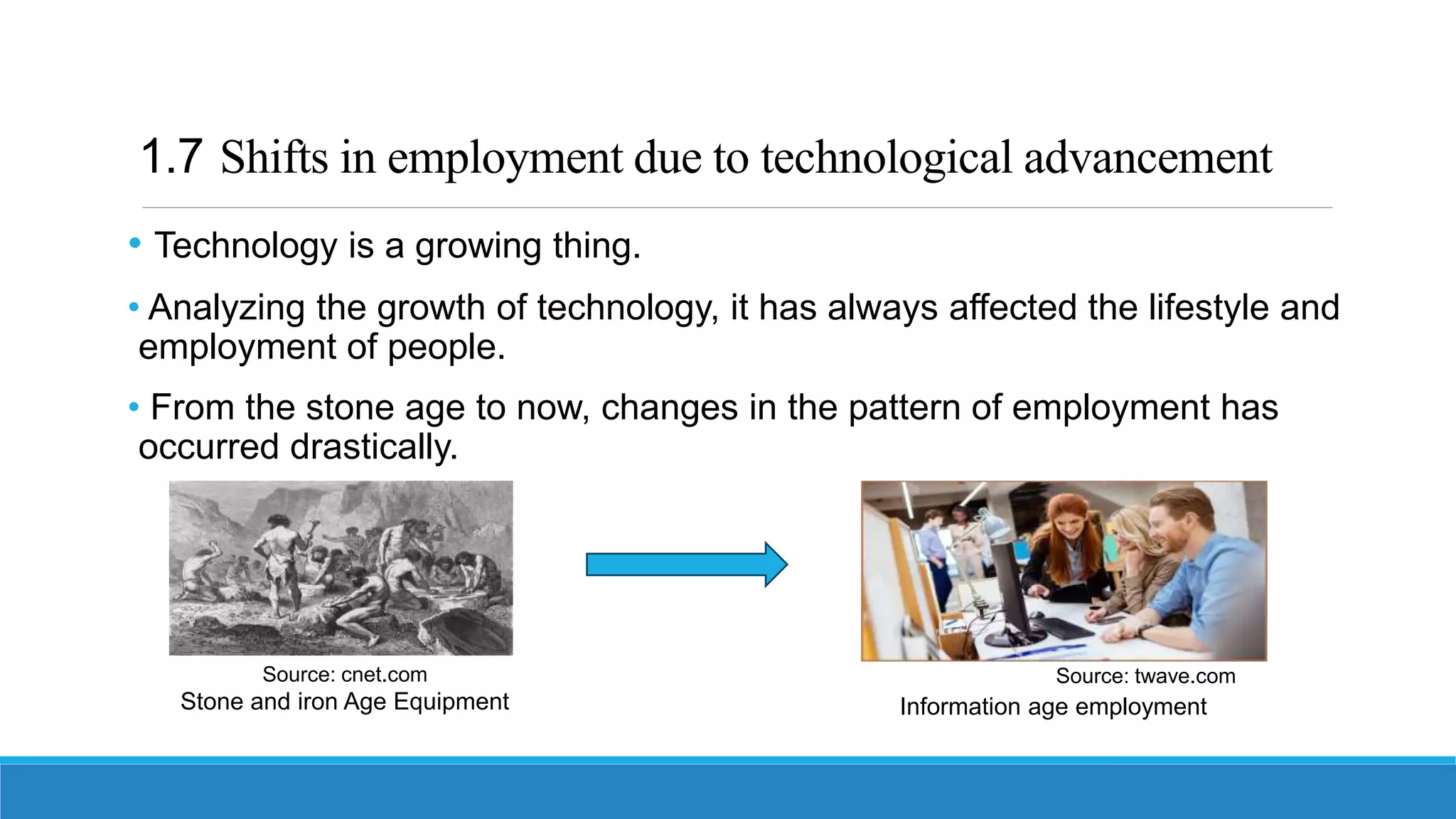
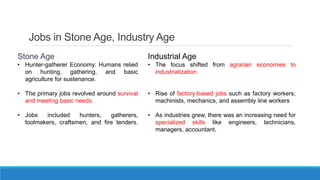
• From the stone age to now, changes in the pattern of employment has
occurred drastically.
Information age employment
Stone and iron Age Equipment
Source: cnet.com Source: twave.com
Jobs in Stone Age, Industry Age
Stone Age
• Hunter-gatherer Economy: Humans relied
on hunting, gathering, and basic
agriculture for sustenance.
• The primary jobs revolved around survival
and meeting basic needs.
• Jobs included hunters, gatherers,
toolmakers, craftsmen, and fire tenders.
Industrial Age
• The focus shifted from agrarian economies to
industrialization.
• Rise of factory-based jobs such as factory workers,
machinists, mechanics, and assembly line workers
• As industries grew, there was an increasing need for
specialized skills like engineers, technicians,
managers, accountant.
Jobs in Information Age
• Characterized by rapid advancement of technology, digitization, and the
widespread availability of information.
• With the rise of computers, the internet, and digital technologies, jobs
related to information technology (IT), software development, data
analysis, cybersecurity, and digital marketing emerged.
• As the economy became more information-driven, there was a greater
demand for knowledge workers
• The Information Age also witnessed the growth of remote work and the
gig economy. Freelancers, consultants, and remote workers leveraged
technology to work independently or on-demand
 The beginning of civilization which is called agricultural age, employment of people was as an agricultural
worker.
 With technological advancement, employment of people shifted from agricultural worker to factory worker
in industrial age.
 With further advancement in technology, the employment of people shifted to as a knowledge worker in
information age.
 The Shift in employment is mainly due to advancement in technology.
Source: pikwizard.com Source: pikwizard.com Source: pikwizard.com
Summary
Major Technological Advancements:
•Internet and IOT.
•Automation
•Artificial Intelligence (AI)
•Robotics
•Machine Learning
•Social Media
These advancements in the Information Age have shaped the way we access information,
communicate, conduct business, and interact with technology.
 They continue to drive innovation, reshape industries, and provide opportunities for further
development in a digitally connected world.
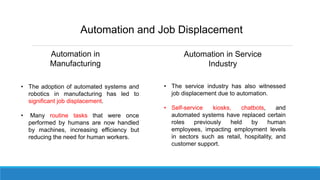
Automation and Job Displacement
Automation in
Manufacturing
• The adoption of automated systems and
robotics in manufacturing has led to
significant job displacement.
• Many routine tasks that were once
performed by humans are now handled
by machines, increasing efficiency but
reducing the need for human workers.
Automation in Service
Industry
• The service industry has also witnessed
job displacement due to automation.
• Self-service kiosks, chatbots, and
automated systems have replaced certain
roles previously held by human
employees, impacting employment levels
in sectors such as retail, hospitality, and
customer support.
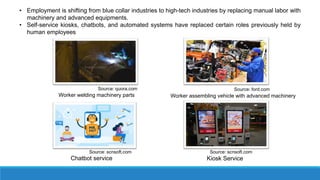
• Employment is shifting from blue collar industries to high-tech industries by replacing manual labor with
machinery and advanced equipments.
• Self-service kiosks, chatbots, and automated systems have replaced certain roles previously held by
human employees
Source: quora.com Source: ford.com
Worker welding machinery parts Worker assembling vehicle with advanced machinery
Source: scnsoft.com
Source: scnsoft.com
Chatbot service Kiosk Service
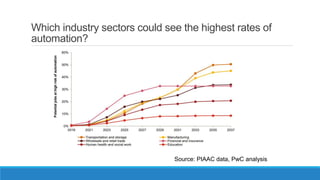
Which industry sectors could see the highest rates of
automation?
Source: PIAAC data, PwC analysis
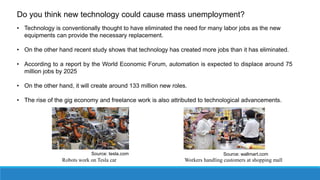
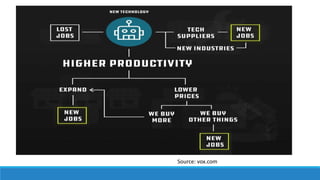
• Technology is conventionally thought to have eliminated the need for many labor jobs as the new
equipments can provide the necessary replacement.
• On the other hand recent study shows that technology has created more jobs than it has eliminated.
• According to a report by the World Economic Forum, automation is expected to displace around 75
million jobs by 2025
• On the other hand, it will create around 133 million new roles.
• The rise of the gig economy and freelance work is also attributed to technological advancements.
Robots work on Tesla car Workers handling customers at shopping mall
Source: tesla.com Source: wallmart.com
Do you think new technology could cause mass unemployment?
Source: vox.com
Conclusion
Technological advancements are reshaping the employment landscape, bringing both challenges
and opportunities.
While automation may lead to job loss in some areas, it also creates new job opportunities and
and the long term net effect should be positive for the economy as a whole.
The workforce needs to adapt and acquire new skills to thrive in an increasingly technology-
driven world.
Business and government need to work together to ensure that as many people as possible
share in the benefits from these new technologies.
Thank you for listening!

tes 1.7.pptx

  • 1.
    1.7 Shifts inemployment due to technological advancement • Technology is a growing thing. • Analyzing the growth of technology, it has always affected the lifestyle and employment of people. • From the stone age to now, changes in the pattern of employment has occurred drastically. Information age employment Stone and iron Age Equipment Source: cnet.com Source: twave.com
  • 2.
    Jobs in StoneAge, Industry Age Stone Age • Hunter-gatherer Economy: Humans relied on hunting, gathering, and basic agriculture for sustenance. • The primary jobs revolved around survival and meeting basic needs. • Jobs included hunters, gatherers, toolmakers, craftsmen, and fire tenders. Industrial Age • The focus shifted from agrarian economies to industrialization. • Rise of factory-based jobs such as factory workers, machinists, mechanics, and assembly line workers • As industries grew, there was an increasing need for specialized skills like engineers, technicians, managers, accountant.
  • 3.
    Jobs in InformationAge • Characterized by rapid advancement of technology, digitization, and the widespread availability of information. • With the rise of computers, the internet, and digital technologies, jobs related to information technology (IT), software development, data analysis, cybersecurity, and digital marketing emerged. • As the economy became more information-driven, there was a greater demand for knowledge workers • The Information Age also witnessed the growth of remote work and the gig economy. Freelancers, consultants, and remote workers leveraged technology to work independently or on-demand
  • 4.
     The beginningof civilization which is called agricultural age, employment of people was as an agricultural worker.  With technological advancement, employment of people shifted from agricultural worker to factory worker in industrial age.  With further advancement in technology, the employment of people shifted to as a knowledge worker in information age.  The Shift in employment is mainly due to advancement in technology. Source: pikwizard.com Source: pikwizard.com Source: pikwizard.com Summary
  • 5.
    Major Technological Advancements: •Internetand IOT. •Automation •Artificial Intelligence (AI) •Robotics •Machine Learning •Social Media These advancements in the Information Age have shaped the way we access information, communicate, conduct business, and interact with technology.  They continue to drive innovation, reshape industries, and provide opportunities for further development in a digitally connected world.
  • 6.
    Automation and JobDisplacement Automation in Manufacturing • The adoption of automated systems and robotics in manufacturing has led to significant job displacement. • Many routine tasks that were once performed by humans are now handled by machines, increasing efficiency but reducing the need for human workers. Automation in Service Industry • The service industry has also witnessed job displacement due to automation. • Self-service kiosks, chatbots, and automated systems have replaced certain roles previously held by human employees, impacting employment levels in sectors such as retail, hospitality, and customer support.
  • 7.
    • Employment isshifting from blue collar industries to high-tech industries by replacing manual labor with machinery and advanced equipments. • Self-service kiosks, chatbots, and automated systems have replaced certain roles previously held by human employees Source: quora.com Source: ford.com Worker welding machinery parts Worker assembling vehicle with advanced machinery Source: scnsoft.com Source: scnsoft.com Chatbot service Kiosk Service
  • 8.
    Which industry sectorscould see the highest rates of automation? Source: PIAAC data, PwC analysis
  • 9.
    • Technology isconventionally thought to have eliminated the need for many labor jobs as the new equipments can provide the necessary replacement. • On the other hand recent study shows that technology has created more jobs than it has eliminated. • According to a report by the World Economic Forum, automation is expected to displace around 75 million jobs by 2025 • On the other hand, it will create around 133 million new roles. • The rise of the gig economy and freelance work is also attributed to technological advancements. Robots work on Tesla car Workers handling customers at shopping mall Source: tesla.com Source: wallmart.com Do you think new technology could cause mass unemployment?
  • 10.
  • 11.
    Conclusion Technological advancements arereshaping the employment landscape, bringing both challenges and opportunities. While automation may lead to job loss in some areas, it also creates new job opportunities and and the long term net effect should be positive for the economy as a whole. The workforce needs to adapt and acquire new skills to thrive in an increasingly technology- driven world. Business and government need to work together to ensure that as many people as possible share in the benefits from these new technologies.
  • 12.
    Thank you forlistening!