Force Convection
Internal Flow
Hanim Z. Amanah
Forced convection
internal flows
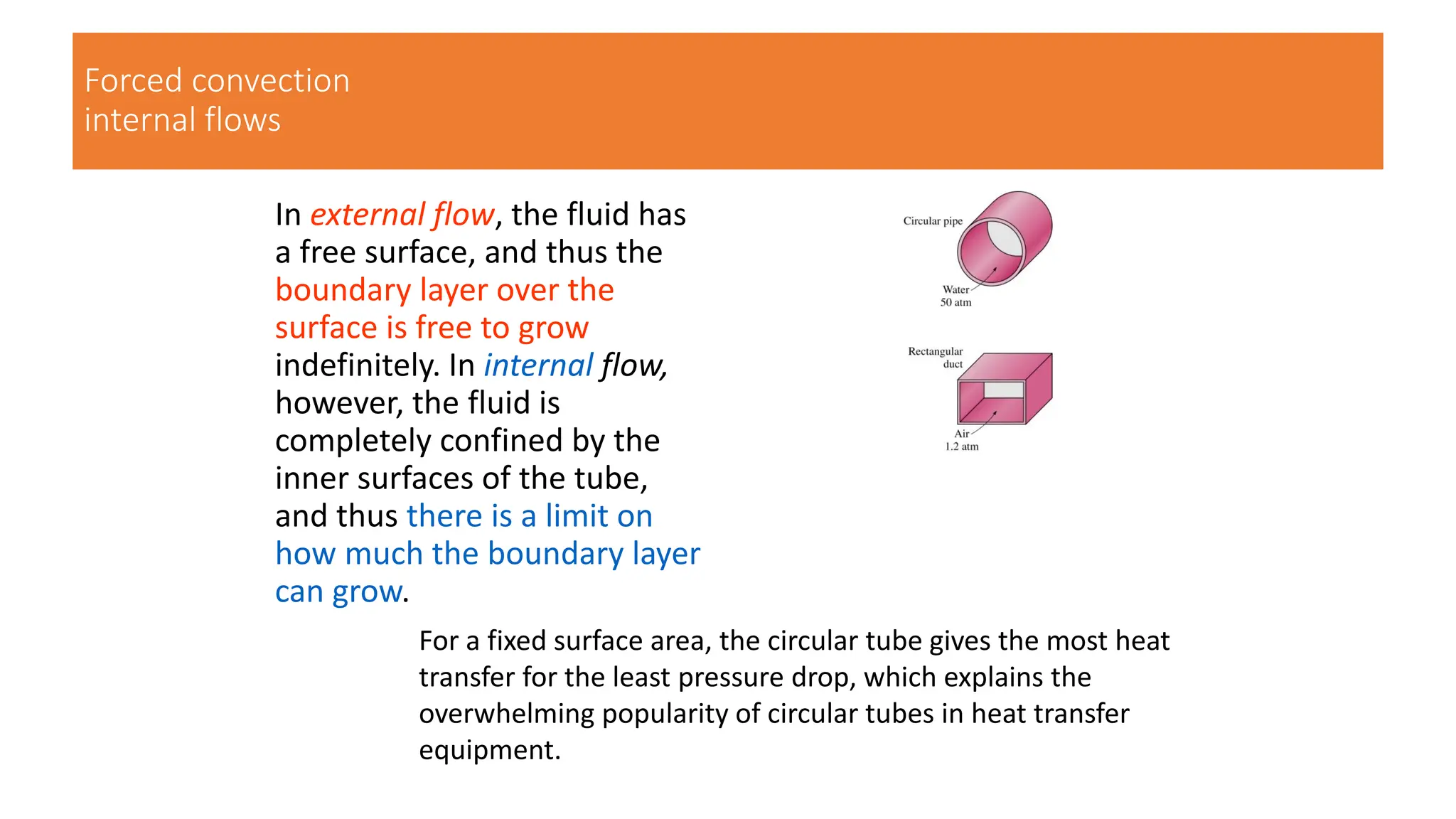
In external flow, the fluid has
a free surface, and thus the
boundary layer over the
surface is free to grow
indefinitely. In internal flow,
however, the fluid is
completely confined by the
inner surfaces of the tube,
and thus there is a limit on
how much the boundary layer
can grow.
For a fixed surface area, the circular tube gives the most heat
transfer for the least pressure drop, which explains the
overwhelming popularity of circular tubes in heat transfer
equipment.
Velocity profile & temperature profile
Laminar and turbulent flows in tubes
• Hydraulic diameter
• D: Hydraulic diameter
• A: Cross section area
• P: Perimeter
Entrance region
velocity & temperature
Entrance region
velocity & temperature
Note that the temperature profile in the
thermally fully developed region may vary
with x in the flow direction. That is, unlike
the velocity profile, the temperature profile
can be different at different cross sections
of the tube in the developed region, and it
usually is. However, the dimensionless
temperature profile defined above remains
unchanged in the thermally developed
region when the temperature or heat flux at
the tube surface remains constant.
Variation of the heat transfer coefficient
in the entrance region
General thermal analysis
Constant surface heat flux
Temperature profile
In fully developed flow in a tube subjected to constant
surface heat flux, the temperature gradient is independent of
x and thus the shape of the temperature profile does not
change along the tube.
Constant surface temperature
Arithmetic mean temperature difference
Logarithmic mean temperature difference
Number of transfer units
For NTU > 5, the exit
temperature of the fluid becomes
almost equal to the surface
temperature, Te ≈ Ts. Noting that
the fluid temperature can
approach the surface
temperature but cannot cross it,
an NTU of about 5 indicates that
the limit is reached for heat
transfer, and the heat transfer will
not increase no matter how much
we extend the length of the tube.
Example 19-6
Nu for circular tube
(laminar flow)
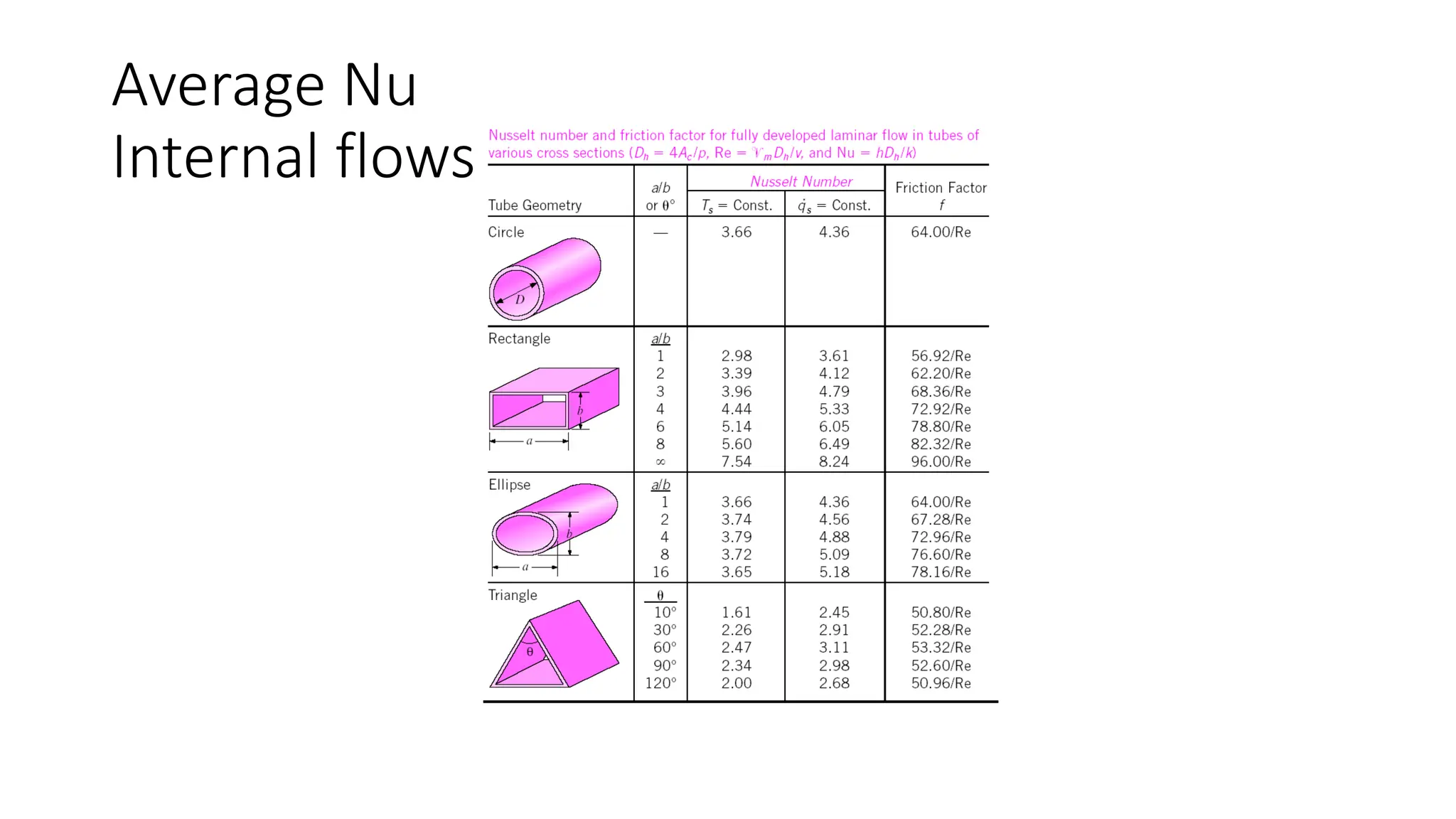
Average Nu
Internal flows
Nu for internal flows
(turbulent flow)
N=0.4 for heating & 0.3 for cooling
The Dittus-Boelter equation(1930) (error up to 25%)
Gnielinski (1976)
Outline for convection calculations
• Draw the geometry of the system (tube, plate, internal flow, external flow)
• Calculate the bulk temperature
• Calculate velocity and pressure loss
• Calculate Reynolds number and decide if it is laminar or turbulent flow
• Choose the right Nu –number equation
• Calculate Nu-number and heat transfer coefficient.
• Calculate the heat transfer or heat tranfer area

Teori dan contoh perpindahan panas konveksi_internal flow.pdf

  • 1.
  • 2.
    Forced convection internal flows Inexternal flow, the fluid has a free surface, and thus the boundary layer over the surface is free to grow indefinitely. In internal flow, however, the fluid is completely confined by the inner surfaces of the tube, and thus there is a limit on how much the boundary layer can grow. For a fixed surface area, the circular tube gives the most heat transfer for the least pressure drop, which explains the overwhelming popularity of circular tubes in heat transfer equipment.
  • 3.
    Velocity profile &temperature profile
  • 4.
    Laminar and turbulentflows in tubes • Hydraulic diameter • D: Hydraulic diameter • A: Cross section area • P: Perimeter
  • 5.
  • 6.
    Entrance region velocity &temperature Note that the temperature profile in the thermally fully developed region may vary with x in the flow direction. That is, unlike the velocity profile, the temperature profile can be different at different cross sections of the tube in the developed region, and it usually is. However, the dimensionless temperature profile defined above remains unchanged in the thermally developed region when the temperature or heat flux at the tube surface remains constant.
  • 7.
    Variation of theheat transfer coefficient in the entrance region
  • 8.
  • 9.
  • 10.
    Temperature profile In fullydeveloped flow in a tube subjected to constant surface heat flux, the temperature gradient is independent of x and thus the shape of the temperature profile does not change along the tube.
  • 11.
    Constant surface temperature Arithmeticmean temperature difference Logarithmic mean temperature difference
  • 12.
    Number of transferunits For NTU > 5, the exit temperature of the fluid becomes almost equal to the surface temperature, Te ≈ Ts. Noting that the fluid temperature can approach the surface temperature but cannot cross it, an NTU of about 5 indicates that the limit is reached for heat transfer, and the heat transfer will not increase no matter how much we extend the length of the tube.
  • 13.
  • 14.
    Nu for circulartube (laminar flow)
  • 15.
  • 16.
    Nu for internalflows (turbulent flow) N=0.4 for heating & 0.3 for cooling The Dittus-Boelter equation(1930) (error up to 25%) Gnielinski (1976)
  • 17.
    Outline for convectioncalculations • Draw the geometry of the system (tube, plate, internal flow, external flow) • Calculate the bulk temperature • Calculate velocity and pressure loss • Calculate Reynolds number and decide if it is laminar or turbulent flow • Choose the right Nu –number equation • Calculate Nu-number and heat transfer coefficient. • Calculate the heat transfer or heat tranfer area