Three Common Tenses Used
in Academic Writing
An Overview
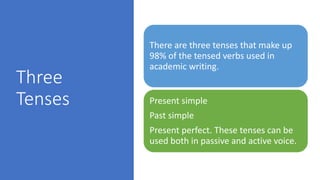
Three
Tenses
There are three tenses that make up
98% of the tensed verbs used in
academic writing.
Present simple
Past simple
Present perfect. These tenses can be
used both in passive and active voice.
Three Tenses
• These tenses can be used both
in passive and active voice.
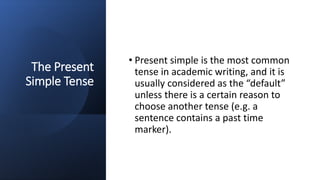
The Present
Simple Tense
• Present simple is the most common
tense in academic writing, and it is
usually considered as the “default”
unless there is a certain reason to
choose another tense (e.g. a
sentence contains a past time
marker).
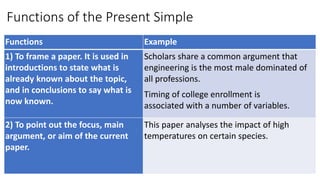
Functions of the Present Simple
Functions Example
1) To frame a paper. It is used in
introductions to state what is
already known about the topic,
and in conclusions to say what is
now known.
Scholars share a common argument that
engineering is the most male dominated of
all professions.
Timing of college enrollment is
associated with a number of variables.
2) To point out the focus, main
argument, or aim of the current
paper.
This paper analyses the impact of high
temperatures on certain species.
Functions of the Present Simple
Functions Example
3) To make general statements,
conclusions, and interpretations about
findings of current or previous research.
It focuses on what is known now.
Graduate school is regarded as crucial for starting
an engineering career because failure at this
stage closes the door to professional engineering
careers, and later career trajectory change is more
difficult the longer it is delayed.
4) To refer to findings from previous
studies without mentioning the author’s
name.
Children ingest roughly 50-200 mg soil/day [2,3].
Functions of the Present Simple
Functions Example
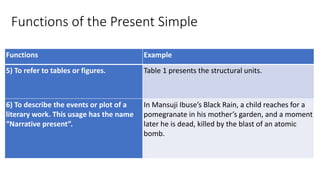
5) To refer to tables or figures. Table 1 presents the structural units.
6) To describe the events or plot of a
literary work. This usage has the name
“Narrative present”.
In Mansuji Ibuse’s Black Rain, a child reaches for a
pomegranate in his mother’s garden, and a moment
later he is dead, killed by the blast of an atomic
bomb.
The Past Simple
Tense • Generally, past simple is
used to refer to actions
completed in the past.
Functions of the Past Tense
Functions Example
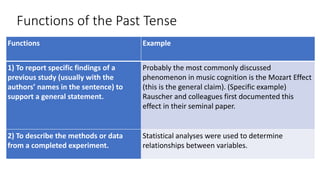
1) To report specific findings of a
previous study (usually with the
authors’ names in the sentence) to
support a general statement.
Probably the most commonly discussed
phenomenon in music cognition is the Mozart Effect
(this is the general claim). (Specific example)
Rauscher and colleagues first documented this
effect in their seminal paper.
2) To describe the methods or data
from a completed experiment.
Statistical analyses were used to determine
relationships between variables.
Functions of the Past Tense
Functions Example
3) To report results of the current
empirical study.
The L1-English writers utilized mostly NP- and
PP-based bundles (78.3% of types and 77.1% of
tokens).
3) After any past time marker. After the war, Germany had to face strong
reparations from the allied nations.
The Present Perfect
Tense
Present perfect is usually used
when referring to previous
research, and since it is a present
tense, it indicates that the
findings are relevant today.
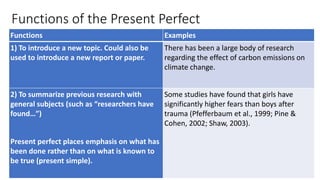
Functions of the Present Perfect
Functions Examples
1) To introduce a new topic. Could also be
used to introduce a new report or paper.
There has been a large body of research
regarding the effect of carbon emissions on
climate change.
2) To summarize previous research with
general subjects (such as “researchers have
found…”)
Present perfect places emphasis on what has
been done rather than on what is known to
be true (present simple).
Some studies have found that girls have
significantly higher fears than boys after
trauma (Pfefferbaum et al., 1999; Pine &
Cohen, 2002; Shaw, 2003).
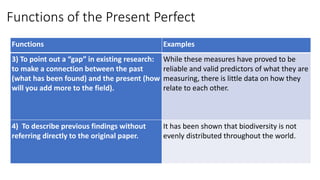
Functions of the Present Perfect
Functions Examples
3) To point out a “gap” in existing research:
to make a connection between the past
(what has been found) and the present (how
will you add more to the field).
While these measures have proved to be
reliable and valid predictors of what they are
measuring, there is little data on how they
relate to each other.
4) To describe previous findings without
referring directly to the original paper.
It has been shown that biodiversity is not
evenly distributed throughout the world.
Reference
• How to organize a paper: The IMRaD format. Available at:
https://bit.ly/3gVpk92

Tenses-in-Academic-Writing.pptx

  • 1.
    Three Common TensesUsed in Academic Writing An Overview
  • 2.
    Three Tenses There are threetenses that make up 98% of the tensed verbs used in academic writing. Present simple Past simple Present perfect. These tenses can be used both in passive and active voice.
  • 3.
    Three Tenses • Thesetenses can be used both in passive and active voice.
  • 4.
    The Present Simple Tense •Present simple is the most common tense in academic writing, and it is usually considered as the “default” unless there is a certain reason to choose another tense (e.g. a sentence contains a past time marker).
  • 5.
    Functions of thePresent Simple Functions Example 1) To frame a paper. It is used in introductions to state what is already known about the topic, and in conclusions to say what is now known. Scholars share a common argument that engineering is the most male dominated of all professions. Timing of college enrollment is associated with a number of variables. 2) To point out the focus, main argument, or aim of the current paper. This paper analyses the impact of high temperatures on certain species.
  • 6.
    Functions of thePresent Simple Functions Example 3) To make general statements, conclusions, and interpretations about findings of current or previous research. It focuses on what is known now. Graduate school is regarded as crucial for starting an engineering career because failure at this stage closes the door to professional engineering careers, and later career trajectory change is more difficult the longer it is delayed. 4) To refer to findings from previous studies without mentioning the author’s name. Children ingest roughly 50-200 mg soil/day [2,3].
  • 7.
    Functions of thePresent Simple Functions Example 5) To refer to tables or figures. Table 1 presents the structural units. 6) To describe the events or plot of a literary work. This usage has the name “Narrative present”. In Mansuji Ibuse’s Black Rain, a child reaches for a pomegranate in his mother’s garden, and a moment later he is dead, killed by the blast of an atomic bomb.
  • 8.
    The Past Simple Tense• Generally, past simple is used to refer to actions completed in the past.
  • 9.
    Functions of thePast Tense Functions Example 1) To report specific findings of a previous study (usually with the authors’ names in the sentence) to support a general statement. Probably the most commonly discussed phenomenon in music cognition is the Mozart Effect (this is the general claim). (Specific example) Rauscher and colleagues first documented this effect in their seminal paper. 2) To describe the methods or data from a completed experiment. Statistical analyses were used to determine relationships between variables.
  • 10.
    Functions of thePast Tense Functions Example 3) To report results of the current empirical study. The L1-English writers utilized mostly NP- and PP-based bundles (78.3% of types and 77.1% of tokens). 3) After any past time marker. After the war, Germany had to face strong reparations from the allied nations.
  • 11.
    The Present Perfect Tense Presentperfect is usually used when referring to previous research, and since it is a present tense, it indicates that the findings are relevant today.
  • 12.
    Functions of thePresent Perfect Functions Examples 1) To introduce a new topic. Could also be used to introduce a new report or paper. There has been a large body of research regarding the effect of carbon emissions on climate change. 2) To summarize previous research with general subjects (such as “researchers have found…”) Present perfect places emphasis on what has been done rather than on what is known to be true (present simple). Some studies have found that girls have significantly higher fears than boys after trauma (Pfefferbaum et al., 1999; Pine & Cohen, 2002; Shaw, 2003).
  • 13.
    Functions of thePresent Perfect Functions Examples 3) To point out a “gap” in existing research: to make a connection between the past (what has been found) and the present (how will you add more to the field). While these measures have proved to be reliable and valid predictors of what they are measuring, there is little data on how they relate to each other. 4) To describe previous findings without referring directly to the original paper. It has been shown that biodiversity is not evenly distributed throughout the world.
  • 14.
    Reference • How toorganize a paper: The IMRaD format. Available at: https://bit.ly/3gVpk92