Blogs, communities and relationships: how adolescents use blogs Stephanie Booth Lausanne, CH http://climbtothestars.org Cartigny Workshop 22-24 June 06 «  Sexual Health of Adolescents in the Internet Age »
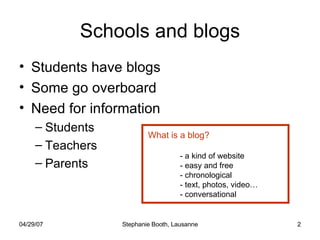
Schools and blogs Students have blogs Some go overboard Need for information Students Teachers Parents What is a blog? - a kind of website - easy and free - chronological - text, photos, video… - conversational
What I have witnessed Past 18 months: regularly called in by schools with « blog problems » As a teacher, been confronted to some problems of my own As a blogger of 6 years, insider understanding of the medium
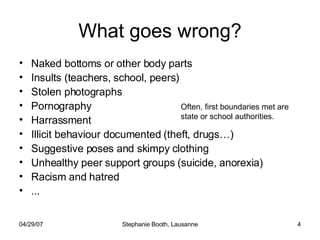
What goes wrong? Naked bottoms or other body parts Insults (teachers, school, peers) Stolen photographs Pornography Harrassment  Illicit behaviour documented (theft, drugs…) Suggestive poses and skimpy clothing Unhealthy peer support groups (suicide, anorexia) Racism and hatred ... Often, first boundaries met are state or school authorities.
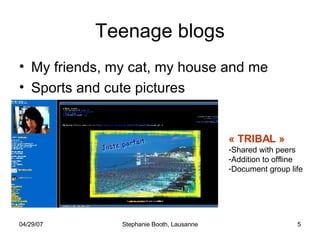
Teenage blogs My friends, my cat, my house and me Sports and cute pictures Most blogs don’t get noticed « TRIBAL » Shared with peers Addition to offline Document group life
Social Internet Divide Teachers, parents: « Library » Internet A place to search for  information Information one consumes Google Teenagers, geeks: Social Internet A place to build and nurture relationships A place to express oneself A whole world to participate in A whole world of  people  to meet, the living web Networking MSN, MySpace, Skyblog, Second Life… It is urgent that « carers » discover the Internet young people live in. Media mix. Multifunctional devices.
What gets teenagers in trouble Blogs are not perceived as being public, although on the Internet (world of peers without adults) Anonymity overestimated (they can’t find me; « privacy by obscurity ») No educated adults in this new media to provide education (teenagers left to themselves) Parents often don’t know their children have blogs! (cf. mini-survey)
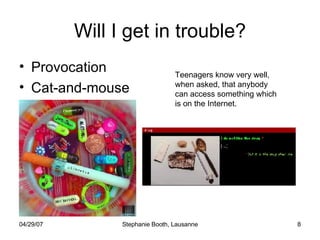
Will I get in trouble? Provocation Cat-and-mouse Teenagers know very well, when asked, that anybody can access something which is on the Internet.
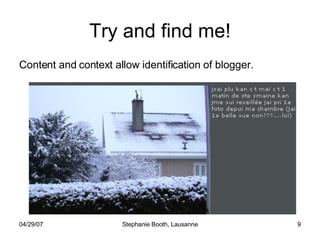
Try and find me! Content and context allow identification of blogger.
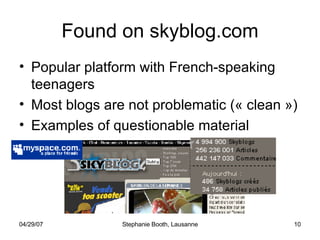
Found on skyblog.com Popular platform with French-speaking teenagers Most blogs are not problematic (« clean ») Examples of questionable material
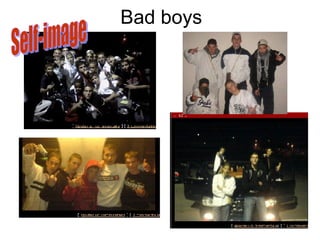
Bad boys Self-image
Bad boys II
Do ya think I’m sexy?
Do ya think I’m sexy? (2)
Like my bathing suit? Positive comments!
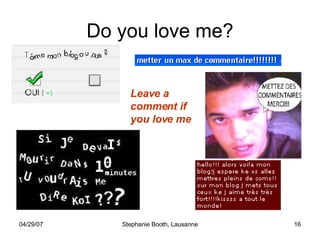
Do you love me? Leave a comment if you love me
I love you
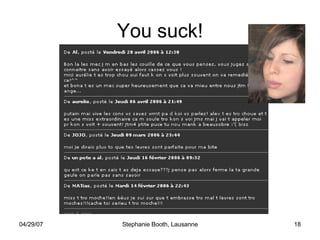
You suck!
Value judgements « Black or white » appreciations Lots of photographs and requests for comments Lots of judgements on appearance Is it healthy? Cool Uncool
Party!
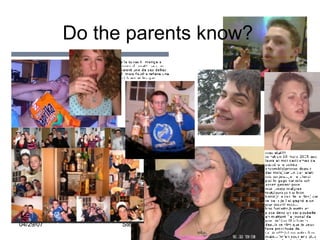
Do the parents know?
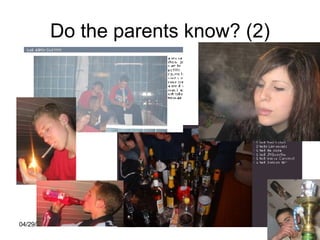
Do the parents know? (2)
My blog is private! Many teenage bloggers would be mortified if their parents found their blog Strong defensive reactions when school interferes Think their blog is hidden (« privacy by obscurity ») No awareness of possible future discomfort present content may bring (permanence of digital media)
Not porn Bedroom walls!
Dark…
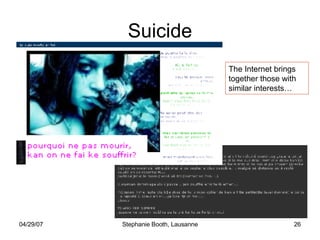
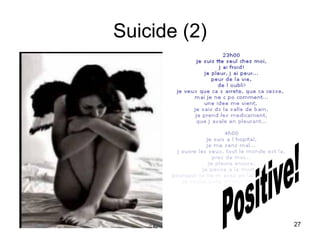
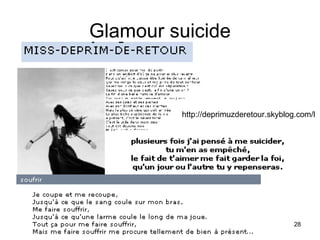
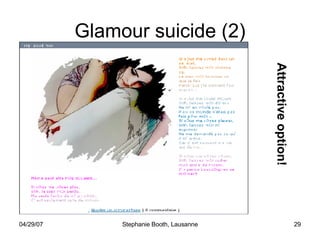
Suicide The Internet brings together those with similar interests…
Suicide (2) Positive!
Glamour suicide http://deprimuzderetour.skyblog.com/l
Glamour suicide (2) Attractive option!
Suicide, anorexia, etc. A lot of talk makes such preoccupations seems commonplace (« everybody feels suicidal ») Description of experience and positive after-effects (« after I cut myself, everybody was so nice to me ») « Feeling understood » is not necessarily effective support
Where is this bringing us? A lot of what used to happen in private is now happening in public: visibility (harrassment, name-calling, insults…) Technological control is not possible anymore (moblogging) All digital media (photos, video) run the risk of ending up on the Internet Media education needed
Online relationships Online relationships are documented (useful in research) Decreases social anxiety (no physical presence): what is the impact on developing social skills? Online is just another way of interacting or meeting people (no online/offline fracture) Teenagers meet new people online and bring the relationship offline; they have a social life online
Wrap-up Teenagers use the Internet as a medium to communicate amongst themselves and are heavy users They expose a lot of their lives and themselves online, not always realising how public they make it Parents and educators are unfamiliar with this usage of the Internet or see it as marginal Teenagers online often have little awareness of boundaries (legal, moral, safety) which also exist there
Discussion Thanks for your attention – discussion is open!
Ads

Teenagers and Blogs

  • 1.
    Blogs, communities andrelationships: how adolescents use blogs Stephanie Booth Lausanne, CH http://climbtothestars.org Cartigny Workshop 22-24 June 06 «  Sexual Health of Adolescents in the Internet Age »
  • 2.
    Schools and blogsStudents have blogs Some go overboard Need for information Students Teachers Parents What is a blog? - a kind of website - easy and free - chronological - text, photos, video… - conversational
  • 3.
    What I havewitnessed Past 18 months: regularly called in by schools with « blog problems » As a teacher, been confronted to some problems of my own As a blogger of 6 years, insider understanding of the medium
  • 4.
    What goes wrong?Naked bottoms or other body parts Insults (teachers, school, peers) Stolen photographs Pornography Harrassment Illicit behaviour documented (theft, drugs…) Suggestive poses and skimpy clothing Unhealthy peer support groups (suicide, anorexia) Racism and hatred ... Often, first boundaries met are state or school authorities.
  • 5.
    Teenage blogs Myfriends, my cat, my house and me Sports and cute pictures Most blogs don’t get noticed « TRIBAL » Shared with peers Addition to offline Document group life
  • 6.
    Social Internet DivideTeachers, parents: « Library » Internet A place to search for information Information one consumes Google Teenagers, geeks: Social Internet A place to build and nurture relationships A place to express oneself A whole world to participate in A whole world of people to meet, the living web Networking MSN, MySpace, Skyblog, Second Life… It is urgent that « carers » discover the Internet young people live in. Media mix. Multifunctional devices.
  • 7.
    What gets teenagersin trouble Blogs are not perceived as being public, although on the Internet (world of peers without adults) Anonymity overestimated (they can’t find me; « privacy by obscurity ») No educated adults in this new media to provide education (teenagers left to themselves) Parents often don’t know their children have blogs! (cf. mini-survey)
  • 8.
    Will I getin trouble? Provocation Cat-and-mouse Teenagers know very well, when asked, that anybody can access something which is on the Internet.
  • 9.
    Try and findme! Content and context allow identification of blogger.
  • 10.
    Found on skyblog.comPopular platform with French-speaking teenagers Most blogs are not problematic (« clean ») Examples of questionable material
  • 11.
  • 12.
  • 13.
    Do ya thinkI’m sexy?
  • 14.
    Do ya thinkI’m sexy? (2)
  • 15.
    Like my bathingsuit? Positive comments!
  • 16.
    Do you loveme? Leave a comment if you love me
  • 17.
  • 18.
  • 19.
    Value judgements « Blackor white » appreciations Lots of photographs and requests for comments Lots of judgements on appearance Is it healthy? Cool Uncool
  • 20.
  • 21.
  • 22.
    Do the parentsknow? (2)
  • 23.
    My blog isprivate! Many teenage bloggers would be mortified if their parents found their blog Strong defensive reactions when school interferes Think their blog is hidden (« privacy by obscurity ») No awareness of possible future discomfort present content may bring (permanence of digital media)
  • 24.
  • 25.
  • 26.
    Suicide The Internetbrings together those with similar interests…
  • 27.
  • 28.
  • 29.
    Glamour suicide (2)Attractive option!
  • 30.
    Suicide, anorexia, etc.A lot of talk makes such preoccupations seems commonplace (« everybody feels suicidal ») Description of experience and positive after-effects (« after I cut myself, everybody was so nice to me ») « Feeling understood » is not necessarily effective support
  • 31.
    Where is thisbringing us? A lot of what used to happen in private is now happening in public: visibility (harrassment, name-calling, insults…) Technological control is not possible anymore (moblogging) All digital media (photos, video) run the risk of ending up on the Internet Media education needed
  • 32.
    Online relationships Onlinerelationships are documented (useful in research) Decreases social anxiety (no physical presence): what is the impact on developing social skills? Online is just another way of interacting or meeting people (no online/offline fracture) Teenagers meet new people online and bring the relationship offline; they have a social life online
  • 33.
    Wrap-up Teenagers usethe Internet as a medium to communicate amongst themselves and are heavy users They expose a lot of their lives and themselves online, not always realising how public they make it Parents and educators are unfamiliar with this usage of the Internet or see it as marginal Teenagers online often have little awareness of boundaries (legal, moral, safety) which also exist there
  • 34.
    Discussion Thanks foryour attention – discussion is open!
  • 35.