VOL. L No. 207 MUMBAI, FRIDAY, OCTOBER 07, 2016 PRICE: Rs. 5.00
TheONLYTextileDailyNewspaper
Phone: 66978535 Fax: 022-28793022 Email: tecoya@vsnl.com
TECOYATREND
For all your requirement
in Linen/Flax Fibres, Tops
and Yarns Cottonised flax
fibers for cotton spinning
in natural and bleached
from Wester Europe
origin:
Nv Jos Vanneste Belgium
Contact:
Eve Fabrics Pvt. Ltd.
ckmody@evefabrics.com
www.jos-vanneste.com
We Offer Speciality
Technical Fibers
Meta Aramid
Anti Static Staple and Filaments
Inherent FR Viscose Filaments
Homopolymer Acyrlic
PA66 HT and Bi-Component Fibers
Mono Filaments in PA, PVDF,
PEEK, PP, PES
Contact:
info@stutiexports.comsdf
...Technical Fibers&SpecialityYarns!
For all your
requirement in
Specialty Fibers,
Tops & Filaments
Yarn for Worsted /
cotton spinning/
Construction in PVA
( Water Soluble)
Japan, China
Contact:
Eve Fabrics Pvt. Ltd.
ckmody@evefabrics.com
www.evefabrics.com
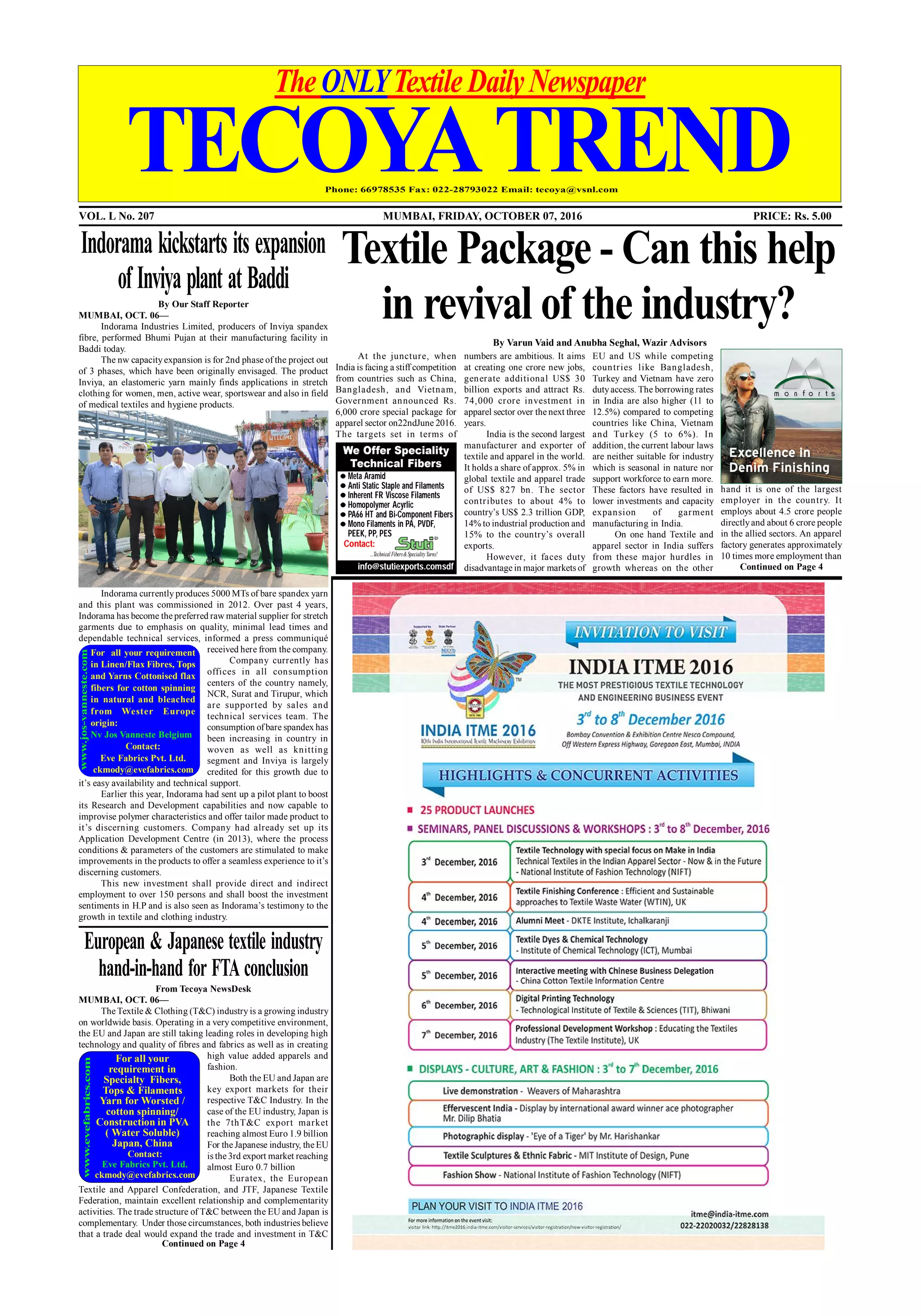
Indorama kickstarts its expansion
of Inviya plant at Baddi
By Our Staff Reporter
MUMBAI, OCT. 06—
Indorama Industries Limited, producers of Inviya spandex
fibre, performed Bhumi Pujan at their manufacturing facility in
Baddi today.
The nw capacityexpansion is for 2nd phase of the project out
of 3 phases, which have been originally envisaged. The product
Inviya, an elastomeric yarn mainly finds applications in stretch
clothing for women, men, active wear, sportswear and also in field
of medical textiles and hygiene products.
Indorama currently produces 5000 MTs of bare spandex yarn
and this plant was commissioned in 2012. Over past 4 years,
Indorama has become the preferred raw material supplier for stretch
garments due to emphasis on quality, minimal lead times and
dependable technical services, informed a press communiqué
received here from the company.
Company currently has
offices in all consumption
centers of the country namely,
NCR, Surat and Tirupur, which
are supported by sales and
technical services team. The
consumption ofbare spandex has
been increasing in country in
woven as well as knitting
segment and Inviya is largely
credited for this growth due to
it’s easy availability and technical support.
Earlier this year, Indorama had sent up a pilot plant to boost
its Research and Development capabilities and now capable to
improvise polymer characteristics and offer tailor made product to
it’s discerning customers. Company had already set up its
Application Development Centre (in 2013), where the process
conditions & parameters of the customers are stimulated to make
improvements in the products to offer a seamless experience to it’s
discerning customers.
This new investment shall provide direct and indirect
employment to over 150 persons and shall boost the investment
sentiments in H.P and is also seen as Indorama’s testimony to the
growth in textile and clothing industry.
Textile Package - Can this help
in revival of the industry?
By Varun Vaid and Anubha Seghal, Wazir Advisors
At the juncture, when
India is facing a stiff competition
from countries such as China,
Bangladesh, and Vietnam,
Government announced Rs.
6,000 crore special package for
apparel sector on22ndJune 2016.
The targets set in terms of
numbers are ambitious. It aims
at creating one crore new jobs,
generate additional US$ 30
billion exports and attract Rs.
74,000 crore investment in
apparel sector over the next three
years.
India is the second largest
manufacturer and exporter of
textile and apparel in the world.
It holds a share of approx. 5% in
global textile and apparel trade
of US$ 827 bn. The sector
contributes to about 4% to
country’s US$ 2.3 trillion GDP,
14% to industrial production and
15% to the country’s overall
exports.
However, it faces duty
disadvantage in major markets of
EU and US while competing
countries like Bangladesh,
Turkey and Vietnam have zero
dutyaccess. The borrowing rates
in India are also higher (11 to
12.5%) compared to competing
countries like China, Vietnam
and Turkey (5 to 6%). In
addition, the current labour laws
are neither suitable for industry
which is seasonal in nature nor
support workforce to earn more.
These factors have resulted in
lower investments and capacity
expansion of garment
manufacturing in India.
On one hand Textile and
apparel sector in India suffers
from these major hurdles in
growth whereas on the other
hand it is one of the largest
employer in the country. It
employs about 4.5 crore people
directlyand about 6 crore people
in the allied sectors. An apparel
factory generates approximately
10 times more employment than
Continued on Page 4
European & Japanese textile industry
hand-in-hand for FTA conclusion
From Tecoya NewsDesk
MUMBAI, OCT. 06—
The Textile & Clothing (T&C) industry is a growing industry
on worldwide basis. Operating in a very competitive environment,
the EU and Japan are still taking leading roles in developing high
technology and quality of fibres and fabrics as well as in creating
high value added apparels and
fashion.
Both the EU and Japan are
key export markets for their
respective T&C Industry. In the
case of the EU industry, Japan is
the 7thT&C export market
reaching almost Euro 1.9 billion
For the Japanese industry, the EU
is the 3rd export market reaching
almost Euro 0.7 billion
Euratex, the European
Textile and Apparel Confederation, and JTF, Japanese Textile
Federation, maintain excellent relationship and complementarity
activities. The trade structure of T&C between the EU and Japan is
complementary. Under those circumstances, both industries believe
that a trade deal would expand the trade and investment in T&C
Continued on Page 4
PAGE 4. TECOYA TREND, FRIDAY, OCTOBER 07, 2016.
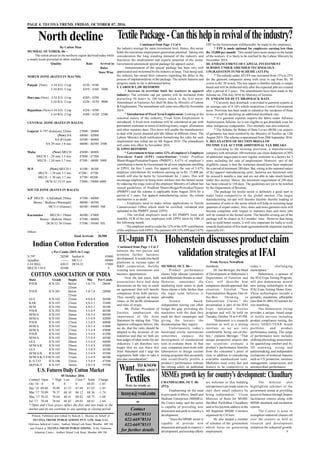
North decline
By Cotton Man
MUMBAI, OCTOBER, 06—
The cotton prices in the northern region declined todaywhile
a steady trend prevailed at other markets.
Quality Rate Arrival in
Bales
State Wise
NORTH ZONE (RATES IN MAUND)
Punjab (New) J-34 S/G Crop 4330 / 4340
  J-34 R/G Crop   4350 / 4360 5000
Haryana (New) J-34 S/G Crop 4280 / 4290
  J-34 R/G Crop   4320 / 4330 9000
Rajasthan (New) J-34 S/G Crop 4250 / 4290
  J-34 R/G Crop   4380 / 4320 2500
CENTRAL ZONE (RATES IN BALES)      
Gujarat V-797 (Kalayan) 22mm 27000 / 28000
(New) S/6 44000 / 45000
S/6 B Grade 44500 / 46000
S/6 29 mm 3.8 mic 46000 / 46500 4500
Maha (New) MECH 45000 / 46000
MECH 1 - 29 mm 3.5 mic 47000 / 47500
MECH - 1 30 mm 3.7 mic 47500 / 48000 3000
M.P. (New) MECH-1 45300 / 46300
MECH - 1 29 mm 3.5 mic 47200 / 47700 
MECH - 1 30 mm 3.7 mic 47700 / 48200 
DCH-32 33-35 mm 57000 / 59000 4000
SOUTH ZONE (RATES IN BALES)      
A.P MECH - 1(Adilabad) 29mm 47500 / 48000
  Bunny / Brahma (Warangal)  48000 / 48500  
  MCU-5 (Guntur)  48500 / 49000 500
Karnataka MECH-1 29mm  46500 / 47000
Bunny / Brahma 30mm  47500 / 48000  
  DCH-32 34-35mm 57500 / 59500 NIL
Others - - -
Total Arrivals 28,500
Printed, Published and Edited by Rakesh L. Sharma on behalf of
TECOYA TREND PUBLICATIONS PVT. LTD. from D-66,
Oshiwara Industrial Centre, Andheri Malad Link Road, Mumbai 400 104
and Printed at TECOYA TREND PUBLICATIONS, D-66, Oshiwara
Industrial Centre, Andheri Malad Link Road, Mumbai 400 104
Indian Cotton Federation
( Per Candy-2015-16 Crop)
State Grade Staple Mic Per Candy
P/H/R ICS-101 Below 5.0-7.0 28600
22mm
P/H/R ICS-201 Below 5.0-7.0 28900
22mm
GUJ ICS-102 22mm 4.0-6.0 26500
KAR ICS-103 23mm 4.0-5.5 32400
M/M ICS-104 24mm 4.0-5.5 36500
P/H/R ICS-202 26mm 3.5-4.9 40300
M/M/A ICS-105 26mm 3.0-3.4 40500
M/M/A ICS-105 26mm 3.5-4.9 42000
P/H/R ICS-105 27mm 3.5-4.9 40900
M/M/A ICS-105 27mm 3.0-3.4 41000
M/M/A ICS-105 27mm 3.5-4.9 43000
P/H/R ICS-105 28mm 3.5-4.9 41200
M/M/A ICS-105 28mm 3.5-4.9 44500
GUJ ICS-105 28mm 3.5-4.9 44000
M/M/A/K ICS-105 29mm 3.5-4.9 45000
GUJ ICS-105 29mm 3.5-4.9 44500
M/M/A/K ICS-105 30mm 3.5-4.9 45500
M/M/A/K/T/OICS-105 31mm 3.5-4.9 46500
K/A/T/O ICS-106 32mm 3.5-4.9 47500
M(P)/K/T ICS-107 34mm 3.0-3.8 55500
U.S. Futures Daily Cotton Market
05 October 2016
Contract Open * High Low Close * Settle Change
Oct '16 0 0 0 0 68.03 -1.85
Dec '16 69.66 70.00 67.53 67.69 67.82 -1.85
Mar '17 70.09 70.37 68.10 68.12 68.36 -1.74
May '17 70.43 70.64 68.41 68.62 68.75 -1.68
Jul '17 70.44 70.64 68.65 69.03 68.81 -1.64
* Open and Close prices reflect the first and last trade in the
market and do not correlate to any opening or closing period
COTTON ASSOCIATION OF INDIA
V-797 28200
Jayadhar -------
J-34 (RG) 42015
MECH-1/H-4 45500
Sankar-6 45000
MCU-5 49000
DCH-32 57000
#
the industry average for same investment level. Hence, this sector
holds the maximum employment generation potential. Taking into
consideration the long standing demand of the industry and
maximize the employment and exports potential of the sector,
Government announced special package for apparel sector.
Announcement of the special package has been very well
appreciated and welcomed bythe industry at large. That being said,
the industry has raised their concerns regarding the delay in the
process of implementation of the package. The salient features and
progress made so far is delineated below:
I. LABOUR LAW REFORMS
* Increase in overtime limit for workers in apparel
industry: The overtime cap per quarter will be increased from
prevailing 50 hours to 100 hours which is the ILO norm.
Amendment in Factories Act shall be done by Ministry of Labour
& Employment. The amendment will come into effect byNovember
2016.
* Introduction of Fixed Term Employment: Looking at the
seasonal nature of the industry, Fixed Term Employment is
introduced. A fixed term workman will be considered at par with
permanent workman in terms of working hours, wages, allowances
and other statutory dues. This move will enable the manufacturers
to deal with excess demand and idle labour at different times. The
Labour Ministry draft notification formalizing the rules for such
employment was rolled out on 4th August 2016. The amendment
will come into effect by November 2016.
II. EPFO REFORMS
* Government to bear entire 12% of employer’s Employee
Provident Fund (EPF) contribution: Under Pradhan
MantriRojgarProtsahanYojana (PMRPY), 8.67% of employer’s
contribution is borne byGovernment for all new employees enrolling
in EPFO, for first 3 years. For apparel units, the rest of 3.67%
employer contribution for workmen earning up to Rs. 15,000 per
month will also be borne by Government for 3 years. This will
encourage employers to bring more workers into the formal sector
by reducing the wage costs of the employer.Ministry of Labour has
issued guidelines of Pradhan MantriRojgarProtsahanYojana
(PMRPY) and the scheme is applicable from August 2016 for a
period of 3 years. For apparel manufacturing sector, the refund
mechanism is as under:
- Employers need to make online applications to Textile
Commissioner Office which shall be certified, validated and
uploaded to the PMRPY portal/ EPFO.
- The verified employers need to fill PMRPY form and
monthly ECR of the new employees with EPFO latest by 10th of
the following month.
- The employer need to credit the 12% of the EPF contribution
ofthe employees with EPFO. The payment of 8.33% EPS and 3.67%
TextilePackage-Canthishelpinrevivaloftheindustry?
Continued from Page 1 Col 6 EPF by the Government willthereafter be made to the employers.
* EPF is made optional for employees earning less than
Rs. 15,000 per month: This would leave more moneyin the hands
of the workers. It is likely to be notified by the Labour Ministry by
November 2016.
III. ENHANCEMENT OF CAPITAL INVESTMENT
SUBSIDY UNDER AMENDED TECHNOLOGY
UPGRADATION FUND SCHEME (ATUFS)
* The subsidy under ATUFS was increased from 15% to 25%
for the garment companies along with raise in cap from Rs. 30
crores to Rs. 50 crores. The key aspect is thatthis subsidy is output
based and will be disbursed only after the expected jobs are created
after a period of 3 years. The amendments have been made in the
Scheme on 25th July 2016 by Ministry of Textiles.
IV. ENHANCED DUTY DRAWBACK RATE
* Currently duty drawback is provided to garment exports at
an average rate of 8.16% which neutralizes Central Government
taxes. Provision has been made to subsidize the incidence of State
levies as well by declaring an additional drawback rate.
* If a garment exporter imports the fabric under Advance
Authorization Scheme, he is not eligible to get drawback even for
other indigenous components. This anomaly was also removed.
* The Scheme for Rebate of State Levies (ROSL) on exports
of garments has been notified by the Ministry of Textiles on 12th
August 2016. The scheme is operational from 20th September 2016.
V. RELAXATION OF SECTION 80JJAA OF
INCOME TAX ACT FOR ADDITIONAL TAX BREAKS
According to the existing provision, a manufacturing
company with minimum 100 workmen can claim deduction of 30%
of additional wages paid to new regular workmen in a factory for 3
years including the year of employment. However, one of the
eligibility clause is that the workman should have been employed
for a period of minimum 240 days. But, owing tothe seasonal nature
of the apparel manufacturing units, factories are functional only
for around 6 months a year and are not able to take much benefit
under this section. Hence, the minimum requirement of 240 days
has been relaxed to 150 days. The guidelines are yet to be notified
by the Department of Revenue.
The package for textile sector is definitely a good start to
make India competitive in the global market. The larger
manufacturing set-ups will become feasible thereby leading to
economies of scale in the sector which will help in executing large
quantum of export orders. Also, more and more garment units will
become compliant with respect to statutory dues and more jobs
will be created in the formal sector. The benefits arising out of the
package will be clearer in 4-5 months’ time. However that being
said, to yield better results, it will very important for India to work
towards finalization offree trade agreementswith important markets
especially EU.
between the two parties and
promote further business
development. It would also build
platforms in various types of
R&D cooperation, thereby
creating new innovations and
business opportunities.
Over the last years, both
associations have had deep
discussions on the way to reach
an agreement that will benefit
companies from both parties.
They recently agreed on major
issues, as for tariffs elimination
and rules of origin.
Mr. Piolat, President of
Euratex, emphasized the
importance of the Joint
Statement by stating that: “Our
Japanese colleagues believe, like
we do, that the rules should be
adapted to the structure of our
industries and that we both are
best judges of what works for our
industries. I am therefore very
happy that we can share this
Joint Statement and I urge the
negotiators both sides to take it
into due consideration”.
EU-Japan FTA
Continued from Page 1 Col 2
tecoya@vsnl.com
WantMORE ABOUT
Textiles
TO KNOW
Write for details at:
Contact
022-66978533
022-66978534
022-66978535
for further details
or
Hohensteindiscussesproductclaim
validationstrategies at IFAI
From Tecoya NewsDesk
MUMBAI, OCT. 06—
Product performance
claims help educate consumers
and differentiate brands at retail.
However, sometimes the
marketing team wants to push
those claims a little farther than
the legal team believes is
advisable.
Science based,
independent testing can often
bridge the gap, providing the
marketers with the data they
need for their campaigns and
giving the lawyers the
documentation they require.
Unfortunately, today’s
functional textile innovations
sometimes outpace the
development of standardized
tests to evaluate them. In that
case, companies must work with
laboratories to design custom
testing programs that accurately
and scientifically profile a
product’s performance without
the relying solely on published
standards.
Dr. Jan Beringer, the Head
of Development at Hohenstein’s
Department of Function and
Care, will describe how
companies should approach that
situation. Entitled “New
Functionalities Require Out-of-
the-Box Thinking to
Substantiate Claims,” the
presentation is part of the IFAI
Expo Advanced Textiles
program and will be held on
Tuesday, October 18 at 4:45 PM.
“Hohenstein is a research
institute as well as a testing
institute so we are very
comfortable being out-of-the-
box,” explains Beringer. “That
unique perspective ensures that
our scientists evaluate a
product’s performance benefits
from the consumer’s point of
view in addition to considering
available standardized tests.
Marketers need every fact and
feature to be competitive in
today’s challenging
marketplace.”
Hohenstein, a sponsor of
the IFAI Expo Testing Program,
will also demonstrate several
new testing technologies in the
IFAI Expo Testing Demo Zone.
These technologies include a
portable, standalone, affordable
(less than $1,000) 3D scanner for
size matching.
The Hohenstein Group
provides a unique, broad range
of textile services including
product compliance testing, the
entire OEKO-TEX® brand
portfolio, and product
performance testing. The range
of performance tests includes
clothing physiology assessments
for quantifying comfort and fit,
3D scanning, sizing and
patternmaking, and independent
evaluations of technical features
such as UV protection, moisture
management, compression, and
antimicrobial performance.
MSMEs growth key for country’s development: Chaudhary
CHANDIAGRH, OCT. 06-
(PTI)
Emphasising on the need
to give push to Micro, Small and
Medium Enterprises (MSMEs),
the Centre today said the sector
is capable of providing new
dimension and push to country’s
development.
“Since the MSME sector is
capable of provide new
dimension and push to country’s
development, partnership efforts
are welcome so that budding
entrepreneurs are made aware to
start their small industry by
being independent,” Union
Minister of State for MSME
Haribhai Parthibhai Chaudhary
said in his keynote address at the
4th Regional MSME Conclave
organised by CII here.
He also lauded a number
of schemes of the government
which focus on generating
employment.
The minister also
highlighted schemes of the
government aimed at providing
access tofinance through finance
facilitation centres along with
MSME databank and incubation
centres.
The Centre is keen to
strengthen industrial clusters all
over the country as well as
research and development
initiatives for industrial growth.
#

Tecoya Trends

  • 1.
    VOL. L No.207 MUMBAI, FRIDAY, OCTOBER 07, 2016 PRICE: Rs. 5.00 TheONLYTextileDailyNewspaper Phone: 66978535 Fax: 022-28793022 Email: tecoya@vsnl.com TECOYATREND For all your requirement in Linen/Flax Fibres, Tops and Yarns Cottonised flax fibers for cotton spinning in natural and bleached from Wester Europe origin: Nv Jos Vanneste Belgium Contact: Eve Fabrics Pvt. Ltd. ckmody@evefabrics.com www.jos-vanneste.com We Offer Speciality Technical Fibers Meta Aramid Anti Static Staple and Filaments Inherent FR Viscose Filaments Homopolymer Acyrlic PA66 HT and Bi-Component Fibers Mono Filaments in PA, PVDF, PEEK, PP, PES Contact: info@stutiexports.comsdf ...Technical Fibers&SpecialityYarns! For all your requirement in Specialty Fibers, Tops & Filaments Yarn for Worsted / cotton spinning/ Construction in PVA ( Water Soluble) Japan, China Contact: Eve Fabrics Pvt. Ltd. ckmody@evefabrics.com www.evefabrics.com Indorama kickstarts its expansion of Inviya plant at Baddi By Our Staff Reporter MUMBAI, OCT. 06— Indorama Industries Limited, producers of Inviya spandex fibre, performed Bhumi Pujan at their manufacturing facility in Baddi today. The nw capacityexpansion is for 2nd phase of the project out of 3 phases, which have been originally envisaged. The product Inviya, an elastomeric yarn mainly finds applications in stretch clothing for women, men, active wear, sportswear and also in field of medical textiles and hygiene products. Indorama currently produces 5000 MTs of bare spandex yarn and this plant was commissioned in 2012. Over past 4 years, Indorama has become the preferred raw material supplier for stretch garments due to emphasis on quality, minimal lead times and dependable technical services, informed a press communiqué received here from the company. Company currently has offices in all consumption centers of the country namely, NCR, Surat and Tirupur, which are supported by sales and technical services team. The consumption ofbare spandex has been increasing in country in woven as well as knitting segment and Inviya is largely credited for this growth due to it’s easy availability and technical support. Earlier this year, Indorama had sent up a pilot plant to boost its Research and Development capabilities and now capable to improvise polymer characteristics and offer tailor made product to it’s discerning customers. Company had already set up its Application Development Centre (in 2013), where the process conditions & parameters of the customers are stimulated to make improvements in the products to offer a seamless experience to it’s discerning customers. This new investment shall provide direct and indirect employment to over 150 persons and shall boost the investment sentiments in H.P and is also seen as Indorama’s testimony to the growth in textile and clothing industry. Textile Package - Can this help in revival of the industry? By Varun Vaid and Anubha Seghal, Wazir Advisors At the juncture, when India is facing a stiff competition from countries such as China, Bangladesh, and Vietnam, Government announced Rs. 6,000 crore special package for apparel sector on22ndJune 2016. The targets set in terms of numbers are ambitious. It aims at creating one crore new jobs, generate additional US$ 30 billion exports and attract Rs. 74,000 crore investment in apparel sector over the next three years. India is the second largest manufacturer and exporter of textile and apparel in the world. It holds a share of approx. 5% in global textile and apparel trade of US$ 827 bn. The sector contributes to about 4% to country’s US$ 2.3 trillion GDP, 14% to industrial production and 15% to the country’s overall exports. However, it faces duty disadvantage in major markets of EU and US while competing countries like Bangladesh, Turkey and Vietnam have zero dutyaccess. The borrowing rates in India are also higher (11 to 12.5%) compared to competing countries like China, Vietnam and Turkey (5 to 6%). In addition, the current labour laws are neither suitable for industry which is seasonal in nature nor support workforce to earn more. These factors have resulted in lower investments and capacity expansion of garment manufacturing in India. On one hand Textile and apparel sector in India suffers from these major hurdles in growth whereas on the other hand it is one of the largest employer in the country. It employs about 4.5 crore people directlyand about 6 crore people in the allied sectors. An apparel factory generates approximately 10 times more employment than Continued on Page 4 European & Japanese textile industry hand-in-hand for FTA conclusion From Tecoya NewsDesk MUMBAI, OCT. 06— The Textile & Clothing (T&C) industry is a growing industry on worldwide basis. Operating in a very competitive environment, the EU and Japan are still taking leading roles in developing high technology and quality of fibres and fabrics as well as in creating high value added apparels and fashion. Both the EU and Japan are key export markets for their respective T&C Industry. In the case of the EU industry, Japan is the 7thT&C export market reaching almost Euro 1.9 billion For the Japanese industry, the EU is the 3rd export market reaching almost Euro 0.7 billion Euratex, the European Textile and Apparel Confederation, and JTF, Japanese Textile Federation, maintain excellent relationship and complementarity activities. The trade structure of T&C between the EU and Japan is complementary. Under those circumstances, both industries believe that a trade deal would expand the trade and investment in T&C Continued on Page 4
  • 2.
    PAGE 4. TECOYATREND, FRIDAY, OCTOBER 07, 2016. North decline By Cotton Man MUMBAI, OCTOBER, 06— The cotton prices in the northern region declined todaywhile a steady trend prevailed at other markets. Quality Rate Arrival in Bales State Wise NORTH ZONE (RATES IN MAUND) Punjab (New) J-34 S/G Crop 4330 / 4340   J-34 R/G Crop   4350 / 4360 5000 Haryana (New) J-34 S/G Crop 4280 / 4290   J-34 R/G Crop   4320 / 4330 9000 Rajasthan (New) J-34 S/G Crop 4250 / 4290   J-34 R/G Crop   4380 / 4320 2500 CENTRAL ZONE (RATES IN BALES)       Gujarat V-797 (Kalayan) 22mm 27000 / 28000 (New) S/6 44000 / 45000 S/6 B Grade 44500 / 46000 S/6 29 mm 3.8 mic 46000 / 46500 4500 Maha (New) MECH 45000 / 46000 MECH 1 - 29 mm 3.5 mic 47000 / 47500 MECH - 1 30 mm 3.7 mic 47500 / 48000 3000 M.P. (New) MECH-1 45300 / 46300 MECH - 1 29 mm 3.5 mic 47200 / 47700  MECH - 1 30 mm 3.7 mic 47700 / 48200  DCH-32 33-35 mm 57000 / 59000 4000 SOUTH ZONE (RATES IN BALES)       A.P MECH - 1(Adilabad) 29mm 47500 / 48000   Bunny / Brahma (Warangal)  48000 / 48500     MCU-5 (Guntur)  48500 / 49000 500 Karnataka MECH-1 29mm  46500 / 47000 Bunny / Brahma 30mm  47500 / 48000     DCH-32 34-35mm 57500 / 59500 NIL Others - - - Total Arrivals 28,500 Printed, Published and Edited by Rakesh L. Sharma on behalf of TECOYA TREND PUBLICATIONS PVT. LTD. from D-66, Oshiwara Industrial Centre, Andheri Malad Link Road, Mumbai 400 104 and Printed at TECOYA TREND PUBLICATIONS, D-66, Oshiwara Industrial Centre, Andheri Malad Link Road, Mumbai 400 104 Indian Cotton Federation ( Per Candy-2015-16 Crop) State Grade Staple Mic Per Candy P/H/R ICS-101 Below 5.0-7.0 28600 22mm P/H/R ICS-201 Below 5.0-7.0 28900 22mm GUJ ICS-102 22mm 4.0-6.0 26500 KAR ICS-103 23mm 4.0-5.5 32400 M/M ICS-104 24mm 4.0-5.5 36500 P/H/R ICS-202 26mm 3.5-4.9 40300 M/M/A ICS-105 26mm 3.0-3.4 40500 M/M/A ICS-105 26mm 3.5-4.9 42000 P/H/R ICS-105 27mm 3.5-4.9 40900 M/M/A ICS-105 27mm 3.0-3.4 41000 M/M/A ICS-105 27mm 3.5-4.9 43000 P/H/R ICS-105 28mm 3.5-4.9 41200 M/M/A ICS-105 28mm 3.5-4.9 44500 GUJ ICS-105 28mm 3.5-4.9 44000 M/M/A/K ICS-105 29mm 3.5-4.9 45000 GUJ ICS-105 29mm 3.5-4.9 44500 M/M/A/K ICS-105 30mm 3.5-4.9 45500 M/M/A/K/T/OICS-105 31mm 3.5-4.9 46500 K/A/T/O ICS-106 32mm 3.5-4.9 47500 M(P)/K/T ICS-107 34mm 3.0-3.8 55500 U.S. Futures Daily Cotton Market 05 October 2016 Contract Open * High Low Close * Settle Change Oct '16 0 0 0 0 68.03 -1.85 Dec '16 69.66 70.00 67.53 67.69 67.82 -1.85 Mar '17 70.09 70.37 68.10 68.12 68.36 -1.74 May '17 70.43 70.64 68.41 68.62 68.75 -1.68 Jul '17 70.44 70.64 68.65 69.03 68.81 -1.64 * Open and Close prices reflect the first and last trade in the market and do not correlate to any opening or closing period COTTON ASSOCIATION OF INDIA V-797 28200 Jayadhar ------- J-34 (RG) 42015 MECH-1/H-4 45500 Sankar-6 45000 MCU-5 49000 DCH-32 57000 # the industry average for same investment level. Hence, this sector holds the maximum employment generation potential. Taking into consideration the long standing demand of the industry and maximize the employment and exports potential of the sector, Government announced special package for apparel sector. Announcement of the special package has been very well appreciated and welcomed bythe industry at large. That being said, the industry has raised their concerns regarding the delay in the process of implementation of the package. The salient features and progress made so far is delineated below: I. LABOUR LAW REFORMS * Increase in overtime limit for workers in apparel industry: The overtime cap per quarter will be increased from prevailing 50 hours to 100 hours which is the ILO norm. Amendment in Factories Act shall be done by Ministry of Labour & Employment. The amendment will come into effect byNovember 2016. * Introduction of Fixed Term Employment: Looking at the seasonal nature of the industry, Fixed Term Employment is introduced. A fixed term workman will be considered at par with permanent workman in terms of working hours, wages, allowances and other statutory dues. This move will enable the manufacturers to deal with excess demand and idle labour at different times. The Labour Ministry draft notification formalizing the rules for such employment was rolled out on 4th August 2016. The amendment will come into effect by November 2016. II. EPFO REFORMS * Government to bear entire 12% of employer’s Employee Provident Fund (EPF) contribution: Under Pradhan MantriRojgarProtsahanYojana (PMRPY), 8.67% of employer’s contribution is borne byGovernment for all new employees enrolling in EPFO, for first 3 years. For apparel units, the rest of 3.67% employer contribution for workmen earning up to Rs. 15,000 per month will also be borne by Government for 3 years. This will encourage employers to bring more workers into the formal sector by reducing the wage costs of the employer.Ministry of Labour has issued guidelines of Pradhan MantriRojgarProtsahanYojana (PMRPY) and the scheme is applicable from August 2016 for a period of 3 years. For apparel manufacturing sector, the refund mechanism is as under: - Employers need to make online applications to Textile Commissioner Office which shall be certified, validated and uploaded to the PMRPY portal/ EPFO. - The verified employers need to fill PMRPY form and monthly ECR of the new employees with EPFO latest by 10th of the following month. - The employer need to credit the 12% of the EPF contribution ofthe employees with EPFO. The payment of 8.33% EPS and 3.67% TextilePackage-Canthishelpinrevivaloftheindustry? Continued from Page 1 Col 6 EPF by the Government willthereafter be made to the employers. * EPF is made optional for employees earning less than Rs. 15,000 per month: This would leave more moneyin the hands of the workers. It is likely to be notified by the Labour Ministry by November 2016. III. ENHANCEMENT OF CAPITAL INVESTMENT SUBSIDY UNDER AMENDED TECHNOLOGY UPGRADATION FUND SCHEME (ATUFS) * The subsidy under ATUFS was increased from 15% to 25% for the garment companies along with raise in cap from Rs. 30 crores to Rs. 50 crores. The key aspect is thatthis subsidy is output based and will be disbursed only after the expected jobs are created after a period of 3 years. The amendments have been made in the Scheme on 25th July 2016 by Ministry of Textiles. IV. ENHANCED DUTY DRAWBACK RATE * Currently duty drawback is provided to garment exports at an average rate of 8.16% which neutralizes Central Government taxes. Provision has been made to subsidize the incidence of State levies as well by declaring an additional drawback rate. * If a garment exporter imports the fabric under Advance Authorization Scheme, he is not eligible to get drawback even for other indigenous components. This anomaly was also removed. * The Scheme for Rebate of State Levies (ROSL) on exports of garments has been notified by the Ministry of Textiles on 12th August 2016. The scheme is operational from 20th September 2016. V. RELAXATION OF SECTION 80JJAA OF INCOME TAX ACT FOR ADDITIONAL TAX BREAKS According to the existing provision, a manufacturing company with minimum 100 workmen can claim deduction of 30% of additional wages paid to new regular workmen in a factory for 3 years including the year of employment. However, one of the eligibility clause is that the workman should have been employed for a period of minimum 240 days. But, owing tothe seasonal nature of the apparel manufacturing units, factories are functional only for around 6 months a year and are not able to take much benefit under this section. Hence, the minimum requirement of 240 days has been relaxed to 150 days. The guidelines are yet to be notified by the Department of Revenue. The package for textile sector is definitely a good start to make India competitive in the global market. The larger manufacturing set-ups will become feasible thereby leading to economies of scale in the sector which will help in executing large quantum of export orders. Also, more and more garment units will become compliant with respect to statutory dues and more jobs will be created in the formal sector. The benefits arising out of the package will be clearer in 4-5 months’ time. However that being said, to yield better results, it will very important for India to work towards finalization offree trade agreementswith important markets especially EU. between the two parties and promote further business development. It would also build platforms in various types of R&D cooperation, thereby creating new innovations and business opportunities. Over the last years, both associations have had deep discussions on the way to reach an agreement that will benefit companies from both parties. They recently agreed on major issues, as for tariffs elimination and rules of origin. Mr. Piolat, President of Euratex, emphasized the importance of the Joint Statement by stating that: “Our Japanese colleagues believe, like we do, that the rules should be adapted to the structure of our industries and that we both are best judges of what works for our industries. I am therefore very happy that we can share this Joint Statement and I urge the negotiators both sides to take it into due consideration”. EU-Japan FTA Continued from Page 1 Col 2 tecoya@vsnl.com WantMORE ABOUT Textiles TO KNOW Write for details at: Contact 022-66978533 022-66978534 022-66978535 for further details or Hohensteindiscussesproductclaim validationstrategies at IFAI From Tecoya NewsDesk MUMBAI, OCT. 06— Product performance claims help educate consumers and differentiate brands at retail. However, sometimes the marketing team wants to push those claims a little farther than the legal team believes is advisable. Science based, independent testing can often bridge the gap, providing the marketers with the data they need for their campaigns and giving the lawyers the documentation they require. Unfortunately, today’s functional textile innovations sometimes outpace the development of standardized tests to evaluate them. In that case, companies must work with laboratories to design custom testing programs that accurately and scientifically profile a product’s performance without the relying solely on published standards. Dr. Jan Beringer, the Head of Development at Hohenstein’s Department of Function and Care, will describe how companies should approach that situation. Entitled “New Functionalities Require Out-of- the-Box Thinking to Substantiate Claims,” the presentation is part of the IFAI Expo Advanced Textiles program and will be held on Tuesday, October 18 at 4:45 PM. “Hohenstein is a research institute as well as a testing institute so we are very comfortable being out-of-the- box,” explains Beringer. “That unique perspective ensures that our scientists evaluate a product’s performance benefits from the consumer’s point of view in addition to considering available standardized tests. Marketers need every fact and feature to be competitive in today’s challenging marketplace.” Hohenstein, a sponsor of the IFAI Expo Testing Program, will also demonstrate several new testing technologies in the IFAI Expo Testing Demo Zone. These technologies include a portable, standalone, affordable (less than $1,000) 3D scanner for size matching. The Hohenstein Group provides a unique, broad range of textile services including product compliance testing, the entire OEKO-TEX® brand portfolio, and product performance testing. The range of performance tests includes clothing physiology assessments for quantifying comfort and fit, 3D scanning, sizing and patternmaking, and independent evaluations of technical features such as UV protection, moisture management, compression, and antimicrobial performance. MSMEs growth key for country’s development: Chaudhary CHANDIAGRH, OCT. 06- (PTI) Emphasising on the need to give push to Micro, Small and Medium Enterprises (MSMEs), the Centre today said the sector is capable of providing new dimension and push to country’s development. “Since the MSME sector is capable of provide new dimension and push to country’s development, partnership efforts are welcome so that budding entrepreneurs are made aware to start their small industry by being independent,” Union Minister of State for MSME Haribhai Parthibhai Chaudhary said in his keynote address at the 4th Regional MSME Conclave organised by CII here. He also lauded a number of schemes of the government which focus on generating employment. The minister also highlighted schemes of the government aimed at providing access tofinance through finance facilitation centres along with MSME databank and incubation centres. The Centre is keen to strengthen industrial clusters all over the country as well as research and development initiatives for industrial growth. #