Understanding and
Applying the Equator
Principle
March 2021
Presentedby:
• OLOPADEHakeem(Snr.FinancialAdvisor)
Presentation Outline
1. The Equator Principles - Basic Concepts and Application
2. The Nigerian Context to Equator Principles
3. Infrastructure Financing and linkages to the Equator Principles
4. Conclusions and Take-outs
2
1. To understand basic principles of Equator Principles and application;
2. When and how to assure compliance within the Nigerian infrastructure delivery landscape; and
3. To understand implementation modalities.
Learning Objectives
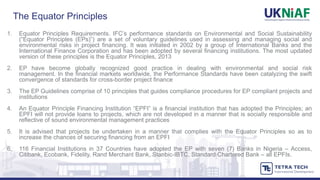
1. Equator Principles Requirements. IFC’s performance standards on Environmental and Social Sustainability
(“Equator Principles (EPs)”) are a set of voluntary guidelines used in assessing and managing social and
environmental risks in project financing. It was initiated in 2002 by a group of International Banks and the
International Finance Corporation and has been adopted by several financing institutions. The most updated
version of these principles is the Equator Principles, 2013
2. EP have become globally recognized good practice in dealing with environmental and social risk
management. In the financial markets worldwide, the Performance Standards have been catalyzing the swift
convergence of standards for cross-border project finance
3. The EP Guidelines comprise of 10 principles that guides compliance procedures for EP compliant projects and
institutions
4. An Equator Principle Financing Institution “EPFI” is a financial institution that has adopted the Principles; an
EPFI will not provide loans to projects, which are not developed in a manner that is socially responsible and
reflective of sound environmental management practices
5. It is advised that projects be undertaken in a manner that complies with the Equator Principles so as to
increase the chances of securing financing from an EPFI
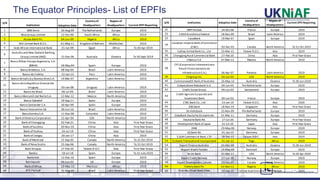
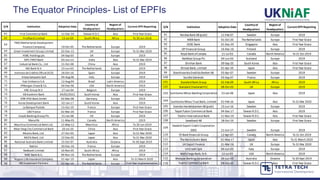
6. 116 Financial Institutions in 37 Countries have adopted the EP with seven (7) Banks in Nigeria – Access,
Citibank, Ecobank, Fidelity, Rand Merchant Bank, Stanbic-IBTC, Standard Chartered Bank – all EPFIs.
The Equator Principles
The Equator Principles- List of EPFIs
S/N
Institution Adoption Date
Country of
Headquarters
Region of
Headquarters Current EPFI Reporting
1 ABN Amro 03-Aug-09 TheNetherlands Europe 2019
2 Absa Group Limited 22-Oct-09 South Africa Africa 2019
3 Access Bank Plc 04-Jun-09 Nigeria Africa 2019
4 Ahli United Bank B.S.C. 01-May-11 Kingdom of Bahrain MiddleEast 2019
5 Arab African International Bank 25-Jan-09 Egypt Africa To 30 Apr 2019
6
Australia and New Zealand Banking
Group Limited (ANZ) 15-Dec-06 Australia Oceania To 30 Sept 2019
7
Banco Bilbao Vizcaya Argentaria, S.A.
(BBVA) 18-May-04 Spain Europe 2019
8 Banco Bradesco, S.A. 08-Sep-04 Brazil Latin America 2019
9 Banco deCrédito 22-Jan-13 Peru Latin America 2019
10 Banco deGalicia y Buenos Aires S.A. 19-Mar-07 Argentina Latin America 2019
11
Banco dela República Oriental del
Uruguay 03-Jan-08 Uruguay Latin America 2019
12 Banco do Brasil 06-Jul-06 Brazil Latin America 2019
13 Banco Mercantil del NorteS.A. 12-Mar-12 Mexico North America 2019
14 Banco Sabadell 29-Sep-11 Spain Europe 2019
15 Banco Santander S.A. 30-Apr-09 Spain Europe 2019
16 Banco Votorantim SA 30-Jun-16 Brazil Latin America 2019
17 Bancolombia S.A. 11-Dec-08 Colombia Latin America 2019
18 Bank ofAmerica Corporation 15-Apr-04 USA North America 2019
19 Bank of Chongqing 02-Feb-21 China Asia First Year Grace
20 Bank of Guizhou 30-Nov-20 China Asia First Year Grace
21 Bank ofHuzhou 24-Jul-19 China Asia First Year Grace
22 Bank of Jiangsu 20-Jan-17 China Asia 2019
23 Bank of Montreal 15-Sep-05 Canada North America To 31 Oct 2019
24 Bank ofNova Scotia 25-Sep-06 Canada North America To 31 Oct 2019
25 Bank Sinopac 27-Feb-20 Taiwan R.O.C. Asia First Year Grace
26 Bankia 18-Jul-18 Spain Europe To 31 July 2020
27 Bankinter 12-Dec-16 Spain Europe 2019
28 Barclays plc 04-Jun-03 UK Europe 2019
29 Bank of Africa 10-May-10 Morocco Africa 2019
30 BTG Pactual 31-Aug-20 Brazil Latin America First Year Grace
S/N Institution Adoption Date
Country of
Headquarters
Region of
Headquarters
Current EPFI Reporting
31 BNP Paribas 24-Oct-08 France Europe 2019
32 CAIXA Econômica Federal 18-Nov-09 Brazil Latin America 2019
33 CaixaBank 19-Mar-07 Spain Europe 2019
34
Canadian Imperial Bank of Commerce
(CIBC) 03-Dec-03 Canada North America To 31 Oct 2019
35 Cathay United Bank Co., Ltd 23-Mar-15 Taiwan R.O.C. Asia 2019
36 Chongqing Rural Commercial Bank 27-Feb-20 China Asia First Year Grace
37 CIBanco S.A. 07-Mar-12 Mexico North America 2019
38
CIFI (Corporacion Interamericana
Para El Financiamiento de
Infraestructura S.A.) 06-Apr-07 Panama Latin America 2019
39 Citigroup Inc. 04-Jun-03 USA North America 2019
40 Commonwealth Bank of Australia 26-May-14 Australia Oceania To 30 Jun 2020
41 CoöperatieveRabobank U.A. 04-Jun-03 TheNetherlands Europe 2019
42 Credit SuisseGroup 04-Jun-03 Switzerland Europe 2019
43
Crédit AgricoleCorporateand
Investment Bank 04-Jun-03 France Europe 2019
44 CTBC Bank Co., Ltd 23-Jan-19 Taiwan R.O.C. Asia 2020
45 DBS Bank 18-Nov-19 Singapore Asia First Year Grace
46 DeVolksbank 25-Nov-09 TheNetherlands Europe 2019
47 DekaBank DeutscheGirozentrale 01-Mar-11 Germany Europe 2019
48 DeutscheBank AG 27-Jul-20 Germany Europe First Year Grace
49 Development Bank of Japan 01-Jul-20 Japan Asia First Year Grace
50 DNB 29-May-08 Norway Europe 2019
51 DZ Bank AG 01-Jan-13 Germany Europe 2019
52 E.SUN Commercial Bank, LTD 28-Dec-15 Taiwan R.O.C. Asia 2019
53 Ecobank Transnational Incorporated 01-Jan-12 Togo Africa 2019
54 Export FinanceAustralia 03-Mar-09 Australia Oceania To 30 Jun 2018
55 Eksport Kredit Fonden 14-May-04 Denmark Europe 2019
56 Ex-Im Bank 31-Mar-11 USA North America To 30 Apr 2020
57 Export Credit Norway 27-Jun-14 Norway Europe 2019
58 Export Development Canada 25-Oct-07 Canada North America 2019
59 Fidelity Bank Plc 01-Nov-12 Nigeria Africa 2019
60 First Abu Dhabi Bank (FAB) 20-Sep-15 United Arab Emirates MiddleEast 2019
S/N Institution Adoption Date
Country of
Headquarters
Region of
Headquarters
Current EPFI Reporting
61 First Commercial Bank 21-Dec-20 Taiwan R.O.C. Asia First Year Grace
62 FirstRand Limited 13-Jul-09 South Africa Africa To 30 Jun 2018
63
FMO (Netherlands Development
FinanceCompany) 19-Oct-05 TheNetherlands Europe 2019
64 Green Investment Group Limited 02-Dec-13 UK Europe To 31 Mar 2020
65 HSBC Holdings plc 04-Sep-03 UK Europe 2019
66 IDFC FIRST Bank 03-Jun-13 India Asia To 31 Mar 2019
67 Industrial Bank Co., Ltd 31-Oct-08 China Asia 2019
68 ING Bank N.V. 23-Jun-03 TheNetherlands Europe 2019
69 Instituto deCrédito Oficial (ICO) 26-Oct-16 Spain Europe 2019
70 Intesa Sanpaolo SpA 04-Aug-06 Italy Europe 2019
71 Itaú Unibanco S.A. 12-Aug-04 Brazil Latin America 2019
72 JPMorgan Chase& Co. 04-Dec-06 USA North America 2019
73 KBC Group N.V. 27-Jan-04 Belgium Europe 2019
74 KB Kookmin Bank 04/02/2021 South Korea Asia First Year Grace
75 KfW IPEX-Bank GmbH 03-Mar-08 Germany Europe 2019
76 Korea Development Bank 02-Jan-17 South Korea Asia 2019
77 La BanquePostale 15-Oct-19 France Europe First Year Grace
78 LBO France 02-Mar-20 France Europe First Year Grace
79 Lloyds Banking Group Plc 31-Jan-08 UK Europe 2019
80 Manulife 11-May-05 Canada North America 2019
81 Mauritius Commercial Bank Ltd. 15-May-12 Mauritius Africa To 30 Jun 2019
82 Mian Yang City Commercial Bank 20-Jul-20 China Asia First Year Grace
83 Mizuho Bank, Ltd. 27-Oct-03 Japan Asia To 31 Mar 2020
84 MUFG Bank, Ltd 22-Dec-05 Japan Asia To 31 Mar 2020
85 National Australia Bank Limited 25-Oct-07 Australia Oceania To 30 Sept 2019
86 Natixis 30-Dec-10 France Europe 2019
87 Nedbank Limited 10-Nov-05 South Africa Africa 2019
88 NIBC Bank N.V. 09-Nov-10 TheNetherlands Europe 2019
89 Nippon LifeInsuranceCompany 01-Apr-19 Japan Asia To 31 March 2020
90 NN Investment Partners 02-Apr-19 TheNetherlands Europe First Year Implementation
S/N Institution Adoption Date
Country of
Headquarters
Region of
Headquarters
Current EPFI Reporting
91 NordeaBank AB (publ) 21-Feb-07 Sweden Europe 2019
92 NWB Bank 01-Oct-20 TheNetherlands Europe First Year Grace
93 OCBC Bank 01-Dec-20 Singapore Asia First Year Grace
94 OP Financial Group 16-Dec-16 Finland Europe 2019
95 Royal Bank ofCanada 21-Jul-03 Canada North America To 31 Oct 2019
96 NatWest Group Plc 04-Jun-03 Scotland Europe 2019
97 Shinhan Bank 09-Sep-20 South Korea Asia First Year Grace
98 Shinsei Bank, Limited 01-Apr-20 Japan Asia First Year Grace
99 SkandinaviskaEnskildaBanken AB 03-Apr-07 Sweden Europe 2019
100 SociétéGénérale 03-Sep-07 France Europe 2019
101 Standard Bank Group 02-Feb-09 South Africa Africa 2019
102 Standard Chartered PLC 08-Oct-03 UK Europe 2019
103 Sumitomo Mitsui BankingCorporation 23-Jan-06 Japan Asia 2019
104 Sumitomo Mitsui Trust Bank, Limited 01-Feb-16 Japan Asia To 31 Mar 2020
105 SvenskaHandelsbanken AB (publ) 23-Jun-16 Sweden Europe 2019
106 Taipei Fubon Commercial Bank 04-Dec-17 Taiwan R.O.C. Asia 2019
107 Taishin International Bank 11-Nov-19 Taiwan R.O.C. Asia First Year Grace
108 Swedbank AB 28-Oct-19 Sweden Europe First Year Grace
109
Swedish Export Credit Corporation
(SEK) 21-Jun-17 Sweden Europe 2019
110 TD Bank Financial Group 12-Apr-07 Canada North America To 31 Oct 2019
111 TheNorinchukin Bank 01-May-17 Japan Asia To 31 March 2020
112 UK Export Finance 31-Mar-16 UK Europe To 31 Mar 2020
113 UniCredit SpA 04-Jun-03 Italy Europe 2019
114 WellsFargo Bank, N.A. 12-Jul-05 USA North America 2019
115 Westpac Banking Corporation 04-Jun-03 Australia Oceania To 30 Sept 2019
116 YuantaCommercial Bank 08-Oct-20 Taiwan R.O.C. Asia First Year Grace
The Equator Principles- List of EPFIs
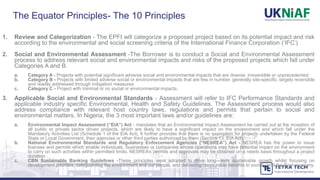
1. Review and Categorization - The EPFI will categorize a proposed project based on its potential impact and risk
according to the environmental and social screening criteria of the International Finance Corporation (‘IFC’)
2. Social and Environmental Assessment -The Borrower is to conduct a Social and Environmental Assessment
process to address relevant social and environmental impacts and risks of the proposed projects which fall under
Categories A and B.
a. Category A - Projects with potential significant adverse social and environmental impacts that are diverse, irreversible or unprecedented
b. Category B - Projects with limited adverse social or environmental impacts that are few in number, generally site-specific, largely reversible
and readily addressed through mitigation measures
c. Category C - Project with minimal or no social or environmental impacts.
3. Applicable Social and Environmental Standards - Assessment will refer to IFC Performance Standards and
applicable industry specific Environmental, Health and Safety Guidelines. The Assessment process would also
address compliance with relevant host country laws, regulations and permits that pertain to social and
environmental matters. In Nigeria, the 3 most important laws and/or guidelines are:
a. Environmental Impact Assessment (“EIA”) Act - mandates that an Environmental Impact Assessment be carried out at the inception of
all public or private sector driven projects, which are likely to have a significant impact on the environment and which fall under the
Mandatory Activities List (Schedule 1 of the EIA Act). It further provides that there is no exemption for projects undertaken by the Federal
State or Local Government, their agencies or other third parties authorized by them (Section 13, EIA Act).
b. National Environmental Standards and Regulatory Enforcement Agencies (“NESREA”) Act - NESREA has the power to issue
licenses and permits which enable individuals, businesses or companies whose operations may have potential impact on the environment
to carry on such activities within permitted limits. NESREA’s permits and approvals may be obtained on a needs basis throughout a project
duration
c. CBN Sustainable Banking Guidelines -These principles were adopted to drive long--‐term sustainable growth whilst focusing on
development priorities, safeguarding the environment and our people, and delivering measurable benefits to society and the Real economy.
The Equator Principles- The 10 Principles
4. Environmental and Social Management System and Equator Principles Action Plan - The EPFI will categorize an
Action Plan – The borrower is required to prepare an Environmental and Social Management System and
Equator Principles Action Plan which addresses findings in the Assessment and addresses the
management of the impacts, risks and corrective actions required to comply with applicable host country social
and environmental laws and regulations, applicable Performance Standards and EHS guidelines as defined in
the Action Plan
5. Stakeholder Engagement - The Government, borrower or third party expert is required to consult with project-
affected communities in a structured and culturally appropriate manner
6. Grievance Mechanism - The borrower will establish a grievance mechanism as part of the management system which
will allow the borrower receive and facilitate resolution of concerns about the project’s performance raised by
individuals and groups from project-affected communities
7. Independent Review - An independent social or environmental expert not associated with the borrower will review the
Assessment, Action Plan and consultation process documentation to assess EPFI’s due diligence and assess Equator
Principles compliance. This will be done with particular reference to Project Finance and Project –Related Corporate
Loans – For all Category A projects only, and as appropriate for Category B projects.
8. Convenants - The Borrower, in its financing documentation will be required to agree to comply with relevant host
country social and environmental laws, regulations and permits; comply with the Action Plan during construction
and operation of project; provide periodic reports in a format agreed with EPFIs that document compliance with
the Action Plan and provide proof of compliance with relevant local, state and host country laws and regulations;
decommission facilities in accordance with agreed decommissioning plan.
The Equator Principles -The 10 Principles
9. Independent Monitoring and Reporting - An independent environmental/social expert will be
appointed by the EPFI to verify monitoring information, which would be shared with EPFIs. For
all Category A projects only, and as appropriate for Category B projects.
10. Reporting and Transparency - Each EPFI adopting the Equator Principles commits to publicly
report annually its implementation process and experience subject to confidentiality
considerations. For all Category A projects only, and as appropriate for Category B projects.
The Equator Principles- The 10 Principles
• EIA Act. This law sets out the general principles, procedures and methods of environmental impact
assessment in various sectors.
• The EIA Act mandates that an Environmental Impact Assessment (EIA) be carried out at the inception of all
public or private sector driven projects, which are likely to have a significant impact on the environment and
which fall under the Mandatory Activities List.
• The EIA Act further provides that there is no exemption for projects undertaken by the Federal, State or Local
government, their agencies or other third parties authorized by them. Any project that falls within the
Mandatory Activities List requires certification by the Federal Ministry of Environment. This approval may be
granted with or without conditions. Where approval is granted with conditions, they must be fulfilled before
the Project commences. An EIA Report should be prepared for the Project and approved by the Federal
Ministry of the Environment.
• Projects under the Mandatory Activities list are in Agriculture, Airports, Drainage and Irrigation, Land
reclamation, Fisheries, Forestry, Housing, Industry, Infrastructure, Ports, Mining, Petroleum, Power
generation and transmission, Quarries, Railways, Transportation, Resort and recreational development,
Waste treatment and disposal, and Water Supply.
Nigerian Context to Equator Principles-
Application and Implementation - EIA Act
Source: EIA Act
• NESREA Act – (consistent National Environmental Standards Regulations and Enforcement Agency
(Establishment) Act 2007 (NESREAA) and the 33 Regulations made by the Minister of Environment under
section 34 of the Act). This statute was created under the 1999 Constitution of the Federal Republic of
Nigeria (section 20) and repealed the Federal Environmental Protection Act 1988. The NESREA, the major
federal body responsible for protecting Nigeria’s environment is responsible for enforcing all environmental
laws, regulations, guidelines, and standards. This includes enforcing environmental conventions, treaties and
protocols to which Nigeria is a signatory.
• The NESREA Act establishes the National Environmental Standards and Regulations Enforcement Agency, the
federal body charged with the protection and development of the environment, biodiversity conservation,
and sustainable development of Nigeria’s natural resources as well as environmental technology.
• NESREA has the power to issue licenses and permits, which enable individuals, businesses or companies
whose operations may have potential impact on the environment to carry on such activities within permitted
limits. Such licenses and permits are to be obtained on a needs basis throughout the project duration and
include:
1. air quality permit relating to noise, atmospheric emissions and vehicular emissions;
2. waste and toxic substance permit relating to waste generation, restricted chemicals and effluent discharge; and
3. bio-diversity conservation permit relating to access to genetic resources and used electrical and electronic
equipment permit.
Nigerian Context to Equator Principles
Application and Implementation - NESREA Act
Source: NESREA Act
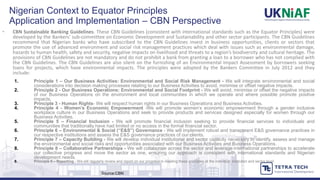
• CBN Sustainable Banking Guidelines. These CBN Guidelines (consistent with international standards such as the Equator Principles) were
developed by the Bankers’ sub-committee on Economic Development and Sustainability and other sector participants. The CBN Guidelines
recommend that Nigerian banks who have subscribed to the CBN Guidelines invest in business opportunities, clients or sectors that
promote the use of advanced environment and social risk management practices which deal with issues such as environmental damage,
hazards to human health, safety and security, negative impacts on livelihood and threats to a region’s biodiversity and cultural heritage. The
provisions of CBN Guidelines are not mandatory and do not prohibit a bank from granting a loan to a borrower who has not complied with
the CBN Guidelines. The CBN Guidelines are also silent on the furnishing of an Environmental Impact Assessment by borrowers seeking
loans for projects, which have environmental impacts. The principles were adopted by the Bankers Committee in July 2012 and they
include:
1. Principle 1 – Our Business Activities: Environmental and Social Risk Management - We will integrate environmental and social
considerations into decision making processes relating to our Business Activities to avoid, minimise or offset negative impacts.
2. Principle 2 - Our Business Operations: Environmental and Social Footprint - We will avoid, minimise or offset the negative impacts
of our Business Operations on the environment and local communities in which we operate and where possible promote positive
impacts.
3. Principle 3 - Human Rights- We will respect human rights in our Business Operations and Business Activities.
4. Principle 4 - Women’s Economic Empowerment -We will promote women’s economic empowerment through a gender inclusive
workplace culture in our Business Operations and seek to provide products and services designed especially for women through our
Business Activities.
5. Principle 5 – Financial Inclusion - We will promote financial inclusion seeking to provide financial services to individuals and
communities that traditionally have had limited or no access in the formal financial sector.
6. Principle 6 – Environmental & Social (“E&S”) Governance - We will implement robust and transparent E&S governance practices in
our respective institutions and assess the E&S governance practices of our clients.
7. Principle 7 – Capacity Building - We will develop individual institutional and sector capacity necessary to identify, assess and manage
the environmental and social risks and opportunities associated with our Business Activities and Business Operations.
8. Principle 8 – Collaborative Partnerships - We will collaborate across the sector and leverage international partnerships to accelerate
our collective progress and move the sector as one, ensuring our approach is consistent with international standards and Nigerian
development needs.
9. Principle 9 – Reporting - We will regularly review and report on our progress in meeting these principles at the individual institution and sector level.
Nigerian Context to Equator Principles
Application and Implementation – CBN Perspective
Source:CBN
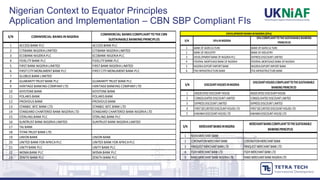
S/N COMMERCIAL BANKS IN NIGERIA
COMMERCIAL BANKS COMPLIANTTOTHECBN
SUSTAINABLEBANKING PRINCIPLES
1 ACCESS BANK PLC ACCESS BANK PLC
2 CITIBANK NIGERIALIMITED CITIBANK NIGERIALIMITED
3 ECOBANK NIGERIAPLC ECOBANK NIGERIAPLC
4 FIDELITYBANK PLC FIDELITYBANK PLC
5 FIRSTBANK NIGERIALIMITED FIRSTBANK NIGERIALIMITED
6 FIRSTCITYMONUMENTBANK PLC FIRSTCITYMONUMENTBANK PLC
7 GLOBUS BANK LIMITED
8 GUARANTYTRUSTBANK PLC GUARANTYTRUSTBANK PLC
9 HERITAGEBANKING COMPANYLTD HERITAGEBANKING COMPANYLTD
10 KEYSTONEBANK KEYSTONEBANK
11 POLARIS BANK POLARIS BANK
12 PROVIDUS BANK PROVIDUS BANK
13 STANBIC IBTC BANK LTD STANBIC IBTC BANK LTD
14 STANDARD CHARTERED BANK NIGERIALTD STANDARD CHARTERED BANK NIGERIALTD
15 STERLING BANK PLC STERLING BANK PLC
16 SUNTRUSTBANK NIGERIALIMITED SUNTRUSTBANK NIGERIALIMITED
17 TAJ BANK
18 TITAN TRUSTBANK LTD
19 UNION BANK UNION BANK
20 UNITED BANK FOR AFRICAPLC UNITED BANK FOR AFRICAPLC
21 UNITYBANK PLC UNITYBANK PLC
22 WEMABANK PLC WEMABANK PLC
23 ZENITH BANK PLC ZENITH BANK PLC
S/N DFIsINNIGERIA
DFIsCOMPLIANTTOTHESUSTAINABLEBANKING
PRINCIPLES
1 BANK OFAGRICULTURE BANK OF AGRICULTURE
2 BANK OFINDUSTRY BANK OF INDUSTRY
3 DEVELOPMENTBANK OFNIGERIAPLC EXPRESSDISCOUNTLIMITED
4 FEDERAL MORTGAGEBANK OFNIGERIA FEDERAL MORTGAGEBANK OFNIGERIA
5 NIGERIAEXPORTIMPORTBANK NIGERIAEXPORTIMPORTBANK
6 THEINFRASTRUCTUREBANK THEINFRASTRUCTUREBANK
DEVELOPMENTBANKSINNIGERIA (DFIs)
S/N DISCOUNTHOUSESINNIGERIA
DISCOUNTHOUSESCOMPLIANTTOTHESUSTAINABLE
BANKINGPRINCIPLES
1 ASSOCIATED DISCOUNTHOUSE ASSOCIATED DISCOUNTHOUSE
2 CONSOLIDATED DISCOUNTLIMITED CONSOLIDATED DISCOUNTLIMITED
3 EXPRESSDISCOUNTLIMITED EXPRESSDISCOUNTLIMITED
4 FIRSTSECURITIESDISCOUNTHOUSELTD FIRSTSECURITIESDISCOUNTHOUSELTD
5 KAKAWADISCOUNTHOUSELTD KAKAWADISCOUNTHOUSELTD
S/N MERCHANTBANKSINNIGERIA
MERCHANTBANKSCOMPLIANTTOTHESUSTAINABLE
BANKINGPRINCIPLES
1 NOVAMERCHANTBANK
2 CORONATIONMERCHANTBANK CORONATIONMERCHANTBANK
3 FBNQUESTMERCHANTBANKLTD FBNQUESTMERCHANTBANK LTD
4 FSDHMERCHANTBANK LTD FSDHMERCHANTBANK LTD
5 RANDMERCHANTBANKNIGERIALTD RANDMERCHANTBANK NIGERIALTD
Nigerian Context to Equator Principles
Application and Implementation – CBN SBP Compliant FIs
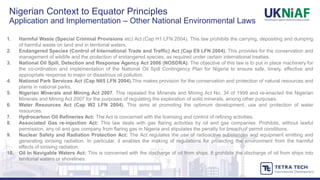
1. Harmful Waste (Special Criminal Provisions etc) Act (Cap H1 LFN 2004). This law prohibits the carrying, depositing and dumping
of harmful waste on land and in territorial waters.
2. Endangered Species (Control of International Trade and Traffic) Act (Cap E9 LFN 2004). This provides for the conservation and
management of wildlife and the protection of endangered species, as required under certain international treaties.
3. National Oil Spill, Detection and Response Agency Act 2006 (NOSDRA). The objective of this law is to put in place machinery for
the co-ordination and implementation of the National Oil Spill Contingency Plan for Nigeria to ensure safe, timely, effective and
appropriate response to major or disastrous oil pollution.
4. National Park Services Act (Cap N65 LFN 2004).This makes provision for the conservation and protection of natural resources and
plants in national parks.
5. Nigerian Minerals and Mining Act 2007. This repealed the Minerals and Mining Act No. 34 of 1999 and re-enacted the Nigerian
Minerals and Mining Act 2007 for the purposes of regulating the exploration of solid minerals, among other purposes.
6. Water Resources Act (Cap W2 LFN 2004). This aims at promoting the optimum development, use and protection of water
resources.
7. Hydrocarbon Oil Refineries Act: The Act is concerned with the licensing and control of refining activities.
8. Associated Gas re-injection Act: This law deals with gas flaring activities by oil and gas companies. Prohibits, without lawful
permission, any oil and gas company from flaring gas in Nigeria and stipulates the penalty for breach of permit conditions.
9. Nuclear Safety and Radiation Protection Act: The Act regulates the use of radioactive substances and equipment emitting and
generating ionising radiation. In particular, it enables the making of regulations for protecting the environment from the harmful
effects of ionising radiation.
10. Oil In Navigable Waters Act: This is concerned with the discharge of oil from ships. It prohibits the discharge of oil from ships into
territorial waters or shorelines.
Nigerian Context to Equator Principles
Application and Implementation – Other National Environmental Laws
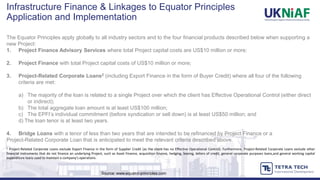
The Equator Principles apply globally to all industry sectors and to the four financial products described below when supporting a
new Project:
1. Project Finance Advisory Services where total Project capital costs are US$10 million or more;
2. Project Finance with total Project capital costs of US$10 million or more;
3. Project-Related Corporate Loans2 (including Export Finance in the form of Buyer Credit) where all four of the following
criteria are met:
a) The majority of the loan is related to a single Project over which the client has Effective Operational Control (either direct
or indirect);
b) The total aggregate loan amount is at least US$100 million;
c) The EPFI’s individual commitment (before syndication or sell down) is at least US$50 million; and
d) The loan tenor is at least two years.
4. Bridge Loans with a tenor of less than two years that are intended to be refinanced by Project Finance or a
Project-Related Corporate Loan that is anticipated to meet the relevant criteria described above.
2 Project-Related Corporate Loans exclude Export Finance in the form of Supplier Credit (as the client has no Effective Operational Control). Furthermore, Project-Related Corporate Loans exclude other
financial instruments that do not finance an underlying Project, such as Asset Finance, acquisition finance, hedging, leasing, letters of credit, general corporate purposes loans,and general working capital
expenditure loans used to maintain a company’s operations.
Source: www.equator-principles.com
Infrastructure Finance & Linkages to Equator Principles
Application and Implementation
Infrastructure Finance & Linkages to Equator Principles
Application and Implementation
• The Equator Principles is primarily intended to provide a minimum standard for due diligence and monitoring to
support responsible risk decision making. The World Bank Group regards the Equator Principles as a credit risk
management framework for determining, assessing and managing environmental and social risk for transactions
requiring project finance.
• The Equator Principles are adopted voluntarily by financial institutions and are applied where total project capital
costs exceed Ten Million United States Dollars (US$10, 000, 000). They are primarily intended to provide a bare
minimum standard for due diligence to support responsible risk decision- making.
• The EPFIs, which include some of Nigeria’s leading financial institutions, commit to the non-provision of
financing to projects where the prospective borrower will not or is unable to comply with its respective social and
environmental policies and procedures that implement the Equator Principles. The effect of this is that even
where almost everything is done properly, non-compliance with the Equator Principles may render a project
sponsor, promoter, concessionaire, private sector party, etc, ineligible to access funds for acquisition, expansion
and such other laudable activities. Thus, where it is confirmed that a project or transaction are non-compliant
with the applicable environmental laws, same may affect the bankability of the project or transaction and the
project sponsor, promoter, concessionaire, private sector party, etc, will be unable to access funds to implement
the Project.
Source: www.equator-principles.com
• The Equator Principle is a risk management tool adopted globally by financial institutions
• All infrastructure projects above US$10million with financing from EPFI must be EP Compliant
• Categorisation of projects into Category A and B, will determine the extent of further activities
to be undertaken for EP Compliance, such as Environmental and social management systems
and plans, Mitigation plans for project interested and affected party, Independent review,
monitoring and report.
• Most infrastructure projects in Nigeria that comply with the EIA Act, NESREA Act, CBN SBG, and
industry specific HSE policies, are close to being EP Compliant
• There are seven (7) EPFI operating in Nigeria.
Source: www.equator-principles.com
Conclusions and Take-outs
18
Resources
19
Thank you
for
your attention

Tech-Session-5c-Applying-Equator-Principles.pptx

  • 1.
    Understanding and Applying theEquator Principle March 2021 Presentedby: • OLOPADEHakeem(Snr.FinancialAdvisor)
  • 2.
    Presentation Outline 1. TheEquator Principles - Basic Concepts and Application 2. The Nigerian Context to Equator Principles 3. Infrastructure Financing and linkages to the Equator Principles 4. Conclusions and Take-outs 2
  • 3.
    1. To understandbasic principles of Equator Principles and application; 2. When and how to assure compliance within the Nigerian infrastructure delivery landscape; and 3. To understand implementation modalities. Learning Objectives
  • 4.
    1. Equator PrinciplesRequirements. IFC’s performance standards on Environmental and Social Sustainability (“Equator Principles (EPs)”) are a set of voluntary guidelines used in assessing and managing social and environmental risks in project financing. It was initiated in 2002 by a group of International Banks and the International Finance Corporation and has been adopted by several financing institutions. The most updated version of these principles is the Equator Principles, 2013 2. EP have become globally recognized good practice in dealing with environmental and social risk management. In the financial markets worldwide, the Performance Standards have been catalyzing the swift convergence of standards for cross-border project finance 3. The EP Guidelines comprise of 10 principles that guides compliance procedures for EP compliant projects and institutions 4. An Equator Principle Financing Institution “EPFI” is a financial institution that has adopted the Principles; an EPFI will not provide loans to projects, which are not developed in a manner that is socially responsible and reflective of sound environmental management practices 5. It is advised that projects be undertaken in a manner that complies with the Equator Principles so as to increase the chances of securing financing from an EPFI 6. 116 Financial Institutions in 37 Countries have adopted the EP with seven (7) Banks in Nigeria – Access, Citibank, Ecobank, Fidelity, Rand Merchant Bank, Stanbic-IBTC, Standard Chartered Bank – all EPFIs. The Equator Principles
  • 5.
    The Equator Principles-List of EPFIs S/N Institution Adoption Date Country of Headquarters Region of Headquarters Current EPFI Reporting 1 ABN Amro 03-Aug-09 TheNetherlands Europe 2019 2 Absa Group Limited 22-Oct-09 South Africa Africa 2019 3 Access Bank Plc 04-Jun-09 Nigeria Africa 2019 4 Ahli United Bank B.S.C. 01-May-11 Kingdom of Bahrain MiddleEast 2019 5 Arab African International Bank 25-Jan-09 Egypt Africa To 30 Apr 2019 6 Australia and New Zealand Banking Group Limited (ANZ) 15-Dec-06 Australia Oceania To 30 Sept 2019 7 Banco Bilbao Vizcaya Argentaria, S.A. (BBVA) 18-May-04 Spain Europe 2019 8 Banco Bradesco, S.A. 08-Sep-04 Brazil Latin America 2019 9 Banco deCrédito 22-Jan-13 Peru Latin America 2019 10 Banco deGalicia y Buenos Aires S.A. 19-Mar-07 Argentina Latin America 2019 11 Banco dela República Oriental del Uruguay 03-Jan-08 Uruguay Latin America 2019 12 Banco do Brasil 06-Jul-06 Brazil Latin America 2019 13 Banco Mercantil del NorteS.A. 12-Mar-12 Mexico North America 2019 14 Banco Sabadell 29-Sep-11 Spain Europe 2019 15 Banco Santander S.A. 30-Apr-09 Spain Europe 2019 16 Banco Votorantim SA 30-Jun-16 Brazil Latin America 2019 17 Bancolombia S.A. 11-Dec-08 Colombia Latin America 2019 18 Bank ofAmerica Corporation 15-Apr-04 USA North America 2019 19 Bank of Chongqing 02-Feb-21 China Asia First Year Grace 20 Bank of Guizhou 30-Nov-20 China Asia First Year Grace 21 Bank ofHuzhou 24-Jul-19 China Asia First Year Grace 22 Bank of Jiangsu 20-Jan-17 China Asia 2019 23 Bank of Montreal 15-Sep-05 Canada North America To 31 Oct 2019 24 Bank ofNova Scotia 25-Sep-06 Canada North America To 31 Oct 2019 25 Bank Sinopac 27-Feb-20 Taiwan R.O.C. Asia First Year Grace 26 Bankia 18-Jul-18 Spain Europe To 31 July 2020 27 Bankinter 12-Dec-16 Spain Europe 2019 28 Barclays plc 04-Jun-03 UK Europe 2019 29 Bank of Africa 10-May-10 Morocco Africa 2019 30 BTG Pactual 31-Aug-20 Brazil Latin America First Year Grace S/N Institution Adoption Date Country of Headquarters Region of Headquarters Current EPFI Reporting 31 BNP Paribas 24-Oct-08 France Europe 2019 32 CAIXA Econômica Federal 18-Nov-09 Brazil Latin America 2019 33 CaixaBank 19-Mar-07 Spain Europe 2019 34 Canadian Imperial Bank of Commerce (CIBC) 03-Dec-03 Canada North America To 31 Oct 2019 35 Cathay United Bank Co., Ltd 23-Mar-15 Taiwan R.O.C. Asia 2019 36 Chongqing Rural Commercial Bank 27-Feb-20 China Asia First Year Grace 37 CIBanco S.A. 07-Mar-12 Mexico North America 2019 38 CIFI (Corporacion Interamericana Para El Financiamiento de Infraestructura S.A.) 06-Apr-07 Panama Latin America 2019 39 Citigroup Inc. 04-Jun-03 USA North America 2019 40 Commonwealth Bank of Australia 26-May-14 Australia Oceania To 30 Jun 2020 41 CoöperatieveRabobank U.A. 04-Jun-03 TheNetherlands Europe 2019 42 Credit SuisseGroup 04-Jun-03 Switzerland Europe 2019 43 Crédit AgricoleCorporateand Investment Bank 04-Jun-03 France Europe 2019 44 CTBC Bank Co., Ltd 23-Jan-19 Taiwan R.O.C. Asia 2020 45 DBS Bank 18-Nov-19 Singapore Asia First Year Grace 46 DeVolksbank 25-Nov-09 TheNetherlands Europe 2019 47 DekaBank DeutscheGirozentrale 01-Mar-11 Germany Europe 2019 48 DeutscheBank AG 27-Jul-20 Germany Europe First Year Grace 49 Development Bank of Japan 01-Jul-20 Japan Asia First Year Grace 50 DNB 29-May-08 Norway Europe 2019 51 DZ Bank AG 01-Jan-13 Germany Europe 2019 52 E.SUN Commercial Bank, LTD 28-Dec-15 Taiwan R.O.C. Asia 2019 53 Ecobank Transnational Incorporated 01-Jan-12 Togo Africa 2019 54 Export FinanceAustralia 03-Mar-09 Australia Oceania To 30 Jun 2018 55 Eksport Kredit Fonden 14-May-04 Denmark Europe 2019 56 Ex-Im Bank 31-Mar-11 USA North America To 30 Apr 2020 57 Export Credit Norway 27-Jun-14 Norway Europe 2019 58 Export Development Canada 25-Oct-07 Canada North America 2019 59 Fidelity Bank Plc 01-Nov-12 Nigeria Africa 2019 60 First Abu Dhabi Bank (FAB) 20-Sep-15 United Arab Emirates MiddleEast 2019
  • 6.
    S/N Institution AdoptionDate Country of Headquarters Region of Headquarters Current EPFI Reporting 61 First Commercial Bank 21-Dec-20 Taiwan R.O.C. Asia First Year Grace 62 FirstRand Limited 13-Jul-09 South Africa Africa To 30 Jun 2018 63 FMO (Netherlands Development FinanceCompany) 19-Oct-05 TheNetherlands Europe 2019 64 Green Investment Group Limited 02-Dec-13 UK Europe To 31 Mar 2020 65 HSBC Holdings plc 04-Sep-03 UK Europe 2019 66 IDFC FIRST Bank 03-Jun-13 India Asia To 31 Mar 2019 67 Industrial Bank Co., Ltd 31-Oct-08 China Asia 2019 68 ING Bank N.V. 23-Jun-03 TheNetherlands Europe 2019 69 Instituto deCrédito Oficial (ICO) 26-Oct-16 Spain Europe 2019 70 Intesa Sanpaolo SpA 04-Aug-06 Italy Europe 2019 71 Itaú Unibanco S.A. 12-Aug-04 Brazil Latin America 2019 72 JPMorgan Chase& Co. 04-Dec-06 USA North America 2019 73 KBC Group N.V. 27-Jan-04 Belgium Europe 2019 74 KB Kookmin Bank 04/02/2021 South Korea Asia First Year Grace 75 KfW IPEX-Bank GmbH 03-Mar-08 Germany Europe 2019 76 Korea Development Bank 02-Jan-17 South Korea Asia 2019 77 La BanquePostale 15-Oct-19 France Europe First Year Grace 78 LBO France 02-Mar-20 France Europe First Year Grace 79 Lloyds Banking Group Plc 31-Jan-08 UK Europe 2019 80 Manulife 11-May-05 Canada North America 2019 81 Mauritius Commercial Bank Ltd. 15-May-12 Mauritius Africa To 30 Jun 2019 82 Mian Yang City Commercial Bank 20-Jul-20 China Asia First Year Grace 83 Mizuho Bank, Ltd. 27-Oct-03 Japan Asia To 31 Mar 2020 84 MUFG Bank, Ltd 22-Dec-05 Japan Asia To 31 Mar 2020 85 National Australia Bank Limited 25-Oct-07 Australia Oceania To 30 Sept 2019 86 Natixis 30-Dec-10 France Europe 2019 87 Nedbank Limited 10-Nov-05 South Africa Africa 2019 88 NIBC Bank N.V. 09-Nov-10 TheNetherlands Europe 2019 89 Nippon LifeInsuranceCompany 01-Apr-19 Japan Asia To 31 March 2020 90 NN Investment Partners 02-Apr-19 TheNetherlands Europe First Year Implementation S/N Institution Adoption Date Country of Headquarters Region of Headquarters Current EPFI Reporting 91 NordeaBank AB (publ) 21-Feb-07 Sweden Europe 2019 92 NWB Bank 01-Oct-20 TheNetherlands Europe First Year Grace 93 OCBC Bank 01-Dec-20 Singapore Asia First Year Grace 94 OP Financial Group 16-Dec-16 Finland Europe 2019 95 Royal Bank ofCanada 21-Jul-03 Canada North America To 31 Oct 2019 96 NatWest Group Plc 04-Jun-03 Scotland Europe 2019 97 Shinhan Bank 09-Sep-20 South Korea Asia First Year Grace 98 Shinsei Bank, Limited 01-Apr-20 Japan Asia First Year Grace 99 SkandinaviskaEnskildaBanken AB 03-Apr-07 Sweden Europe 2019 100 SociétéGénérale 03-Sep-07 France Europe 2019 101 Standard Bank Group 02-Feb-09 South Africa Africa 2019 102 Standard Chartered PLC 08-Oct-03 UK Europe 2019 103 Sumitomo Mitsui BankingCorporation 23-Jan-06 Japan Asia 2019 104 Sumitomo Mitsui Trust Bank, Limited 01-Feb-16 Japan Asia To 31 Mar 2020 105 SvenskaHandelsbanken AB (publ) 23-Jun-16 Sweden Europe 2019 106 Taipei Fubon Commercial Bank 04-Dec-17 Taiwan R.O.C. Asia 2019 107 Taishin International Bank 11-Nov-19 Taiwan R.O.C. Asia First Year Grace 108 Swedbank AB 28-Oct-19 Sweden Europe First Year Grace 109 Swedish Export Credit Corporation (SEK) 21-Jun-17 Sweden Europe 2019 110 TD Bank Financial Group 12-Apr-07 Canada North America To 31 Oct 2019 111 TheNorinchukin Bank 01-May-17 Japan Asia To 31 March 2020 112 UK Export Finance 31-Mar-16 UK Europe To 31 Mar 2020 113 UniCredit SpA 04-Jun-03 Italy Europe 2019 114 WellsFargo Bank, N.A. 12-Jul-05 USA North America 2019 115 Westpac Banking Corporation 04-Jun-03 Australia Oceania To 30 Sept 2019 116 YuantaCommercial Bank 08-Oct-20 Taiwan R.O.C. Asia First Year Grace The Equator Principles- List of EPFIs
  • 7.
    1. Review andCategorization - The EPFI will categorize a proposed project based on its potential impact and risk according to the environmental and social screening criteria of the International Finance Corporation (‘IFC’) 2. Social and Environmental Assessment -The Borrower is to conduct a Social and Environmental Assessment process to address relevant social and environmental impacts and risks of the proposed projects which fall under Categories A and B. a. Category A - Projects with potential significant adverse social and environmental impacts that are diverse, irreversible or unprecedented b. Category B - Projects with limited adverse social or environmental impacts that are few in number, generally site-specific, largely reversible and readily addressed through mitigation measures c. Category C - Project with minimal or no social or environmental impacts. 3. Applicable Social and Environmental Standards - Assessment will refer to IFC Performance Standards and applicable industry specific Environmental, Health and Safety Guidelines. The Assessment process would also address compliance with relevant host country laws, regulations and permits that pertain to social and environmental matters. In Nigeria, the 3 most important laws and/or guidelines are: a. Environmental Impact Assessment (“EIA”) Act - mandates that an Environmental Impact Assessment be carried out at the inception of all public or private sector driven projects, which are likely to have a significant impact on the environment and which fall under the Mandatory Activities List (Schedule 1 of the EIA Act). It further provides that there is no exemption for projects undertaken by the Federal State or Local Government, their agencies or other third parties authorized by them (Section 13, EIA Act). b. National Environmental Standards and Regulatory Enforcement Agencies (“NESREA”) Act - NESREA has the power to issue licenses and permits which enable individuals, businesses or companies whose operations may have potential impact on the environment to carry on such activities within permitted limits. NESREA’s permits and approvals may be obtained on a needs basis throughout a project duration c. CBN Sustainable Banking Guidelines -These principles were adopted to drive long--‐term sustainable growth whilst focusing on development priorities, safeguarding the environment and our people, and delivering measurable benefits to society and the Real economy. The Equator Principles- The 10 Principles
  • 8.
    4. Environmental andSocial Management System and Equator Principles Action Plan - The EPFI will categorize an Action Plan – The borrower is required to prepare an Environmental and Social Management System and Equator Principles Action Plan which addresses findings in the Assessment and addresses the management of the impacts, risks and corrective actions required to comply with applicable host country social and environmental laws and regulations, applicable Performance Standards and EHS guidelines as defined in the Action Plan 5. Stakeholder Engagement - The Government, borrower or third party expert is required to consult with project- affected communities in a structured and culturally appropriate manner 6. Grievance Mechanism - The borrower will establish a grievance mechanism as part of the management system which will allow the borrower receive and facilitate resolution of concerns about the project’s performance raised by individuals and groups from project-affected communities 7. Independent Review - An independent social or environmental expert not associated with the borrower will review the Assessment, Action Plan and consultation process documentation to assess EPFI’s due diligence and assess Equator Principles compliance. This will be done with particular reference to Project Finance and Project –Related Corporate Loans – For all Category A projects only, and as appropriate for Category B projects. 8. Convenants - The Borrower, in its financing documentation will be required to agree to comply with relevant host country social and environmental laws, regulations and permits; comply with the Action Plan during construction and operation of project; provide periodic reports in a format agreed with EPFIs that document compliance with the Action Plan and provide proof of compliance with relevant local, state and host country laws and regulations; decommission facilities in accordance with agreed decommissioning plan. The Equator Principles -The 10 Principles
  • 9.
    9. Independent Monitoringand Reporting - An independent environmental/social expert will be appointed by the EPFI to verify monitoring information, which would be shared with EPFIs. For all Category A projects only, and as appropriate for Category B projects. 10. Reporting and Transparency - Each EPFI adopting the Equator Principles commits to publicly report annually its implementation process and experience subject to confidentiality considerations. For all Category A projects only, and as appropriate for Category B projects. The Equator Principles- The 10 Principles
  • 10.
    • EIA Act.This law sets out the general principles, procedures and methods of environmental impact assessment in various sectors. • The EIA Act mandates that an Environmental Impact Assessment (EIA) be carried out at the inception of all public or private sector driven projects, which are likely to have a significant impact on the environment and which fall under the Mandatory Activities List. • The EIA Act further provides that there is no exemption for projects undertaken by the Federal, State or Local government, their agencies or other third parties authorized by them. Any project that falls within the Mandatory Activities List requires certification by the Federal Ministry of Environment. This approval may be granted with or without conditions. Where approval is granted with conditions, they must be fulfilled before the Project commences. An EIA Report should be prepared for the Project and approved by the Federal Ministry of the Environment. • Projects under the Mandatory Activities list are in Agriculture, Airports, Drainage and Irrigation, Land reclamation, Fisheries, Forestry, Housing, Industry, Infrastructure, Ports, Mining, Petroleum, Power generation and transmission, Quarries, Railways, Transportation, Resort and recreational development, Waste treatment and disposal, and Water Supply. Nigerian Context to Equator Principles- Application and Implementation - EIA Act Source: EIA Act
  • 11.
    • NESREA Act– (consistent National Environmental Standards Regulations and Enforcement Agency (Establishment) Act 2007 (NESREAA) and the 33 Regulations made by the Minister of Environment under section 34 of the Act). This statute was created under the 1999 Constitution of the Federal Republic of Nigeria (section 20) and repealed the Federal Environmental Protection Act 1988. The NESREA, the major federal body responsible for protecting Nigeria’s environment is responsible for enforcing all environmental laws, regulations, guidelines, and standards. This includes enforcing environmental conventions, treaties and protocols to which Nigeria is a signatory. • The NESREA Act establishes the National Environmental Standards and Regulations Enforcement Agency, the federal body charged with the protection and development of the environment, biodiversity conservation, and sustainable development of Nigeria’s natural resources as well as environmental technology. • NESREA has the power to issue licenses and permits, which enable individuals, businesses or companies whose operations may have potential impact on the environment to carry on such activities within permitted limits. Such licenses and permits are to be obtained on a needs basis throughout the project duration and include: 1. air quality permit relating to noise, atmospheric emissions and vehicular emissions; 2. waste and toxic substance permit relating to waste generation, restricted chemicals and effluent discharge; and 3. bio-diversity conservation permit relating to access to genetic resources and used electrical and electronic equipment permit. Nigerian Context to Equator Principles Application and Implementation - NESREA Act Source: NESREA Act
  • 12.
    • CBN SustainableBanking Guidelines. These CBN Guidelines (consistent with international standards such as the Equator Principles) were developed by the Bankers’ sub-committee on Economic Development and Sustainability and other sector participants. The CBN Guidelines recommend that Nigerian banks who have subscribed to the CBN Guidelines invest in business opportunities, clients or sectors that promote the use of advanced environment and social risk management practices which deal with issues such as environmental damage, hazards to human health, safety and security, negative impacts on livelihood and threats to a region’s biodiversity and cultural heritage. The provisions of CBN Guidelines are not mandatory and do not prohibit a bank from granting a loan to a borrower who has not complied with the CBN Guidelines. The CBN Guidelines are also silent on the furnishing of an Environmental Impact Assessment by borrowers seeking loans for projects, which have environmental impacts. The principles were adopted by the Bankers Committee in July 2012 and they include: 1. Principle 1 – Our Business Activities: Environmental and Social Risk Management - We will integrate environmental and social considerations into decision making processes relating to our Business Activities to avoid, minimise or offset negative impacts. 2. Principle 2 - Our Business Operations: Environmental and Social Footprint - We will avoid, minimise or offset the negative impacts of our Business Operations on the environment and local communities in which we operate and where possible promote positive impacts. 3. Principle 3 - Human Rights- We will respect human rights in our Business Operations and Business Activities. 4. Principle 4 - Women’s Economic Empowerment -We will promote women’s economic empowerment through a gender inclusive workplace culture in our Business Operations and seek to provide products and services designed especially for women through our Business Activities. 5. Principle 5 – Financial Inclusion - We will promote financial inclusion seeking to provide financial services to individuals and communities that traditionally have had limited or no access in the formal financial sector. 6. Principle 6 – Environmental & Social (“E&S”) Governance - We will implement robust and transparent E&S governance practices in our respective institutions and assess the E&S governance practices of our clients. 7. Principle 7 – Capacity Building - We will develop individual institutional and sector capacity necessary to identify, assess and manage the environmental and social risks and opportunities associated with our Business Activities and Business Operations. 8. Principle 8 – Collaborative Partnerships - We will collaborate across the sector and leverage international partnerships to accelerate our collective progress and move the sector as one, ensuring our approach is consistent with international standards and Nigerian development needs. 9. Principle 9 – Reporting - We will regularly review and report on our progress in meeting these principles at the individual institution and sector level. Nigerian Context to Equator Principles Application and Implementation – CBN Perspective Source:CBN
  • 13.
    S/N COMMERCIAL BANKSIN NIGERIA COMMERCIAL BANKS COMPLIANTTOTHECBN SUSTAINABLEBANKING PRINCIPLES 1 ACCESS BANK PLC ACCESS BANK PLC 2 CITIBANK NIGERIALIMITED CITIBANK NIGERIALIMITED 3 ECOBANK NIGERIAPLC ECOBANK NIGERIAPLC 4 FIDELITYBANK PLC FIDELITYBANK PLC 5 FIRSTBANK NIGERIALIMITED FIRSTBANK NIGERIALIMITED 6 FIRSTCITYMONUMENTBANK PLC FIRSTCITYMONUMENTBANK PLC 7 GLOBUS BANK LIMITED 8 GUARANTYTRUSTBANK PLC GUARANTYTRUSTBANK PLC 9 HERITAGEBANKING COMPANYLTD HERITAGEBANKING COMPANYLTD 10 KEYSTONEBANK KEYSTONEBANK 11 POLARIS BANK POLARIS BANK 12 PROVIDUS BANK PROVIDUS BANK 13 STANBIC IBTC BANK LTD STANBIC IBTC BANK LTD 14 STANDARD CHARTERED BANK NIGERIALTD STANDARD CHARTERED BANK NIGERIALTD 15 STERLING BANK PLC STERLING BANK PLC 16 SUNTRUSTBANK NIGERIALIMITED SUNTRUSTBANK NIGERIALIMITED 17 TAJ BANK 18 TITAN TRUSTBANK LTD 19 UNION BANK UNION BANK 20 UNITED BANK FOR AFRICAPLC UNITED BANK FOR AFRICAPLC 21 UNITYBANK PLC UNITYBANK PLC 22 WEMABANK PLC WEMABANK PLC 23 ZENITH BANK PLC ZENITH BANK PLC S/N DFIsINNIGERIA DFIsCOMPLIANTTOTHESUSTAINABLEBANKING PRINCIPLES 1 BANK OFAGRICULTURE BANK OF AGRICULTURE 2 BANK OFINDUSTRY BANK OF INDUSTRY 3 DEVELOPMENTBANK OFNIGERIAPLC EXPRESSDISCOUNTLIMITED 4 FEDERAL MORTGAGEBANK OFNIGERIA FEDERAL MORTGAGEBANK OFNIGERIA 5 NIGERIAEXPORTIMPORTBANK NIGERIAEXPORTIMPORTBANK 6 THEINFRASTRUCTUREBANK THEINFRASTRUCTUREBANK DEVELOPMENTBANKSINNIGERIA (DFIs) S/N DISCOUNTHOUSESINNIGERIA DISCOUNTHOUSESCOMPLIANTTOTHESUSTAINABLE BANKINGPRINCIPLES 1 ASSOCIATED DISCOUNTHOUSE ASSOCIATED DISCOUNTHOUSE 2 CONSOLIDATED DISCOUNTLIMITED CONSOLIDATED DISCOUNTLIMITED 3 EXPRESSDISCOUNTLIMITED EXPRESSDISCOUNTLIMITED 4 FIRSTSECURITIESDISCOUNTHOUSELTD FIRSTSECURITIESDISCOUNTHOUSELTD 5 KAKAWADISCOUNTHOUSELTD KAKAWADISCOUNTHOUSELTD S/N MERCHANTBANKSINNIGERIA MERCHANTBANKSCOMPLIANTTOTHESUSTAINABLE BANKINGPRINCIPLES 1 NOVAMERCHANTBANK 2 CORONATIONMERCHANTBANK CORONATIONMERCHANTBANK 3 FBNQUESTMERCHANTBANKLTD FBNQUESTMERCHANTBANK LTD 4 FSDHMERCHANTBANK LTD FSDHMERCHANTBANK LTD 5 RANDMERCHANTBANKNIGERIALTD RANDMERCHANTBANK NIGERIALTD Nigerian Context to Equator Principles Application and Implementation – CBN SBP Compliant FIs
  • 14.
    1. Harmful Waste(Special Criminal Provisions etc) Act (Cap H1 LFN 2004). This law prohibits the carrying, depositing and dumping of harmful waste on land and in territorial waters. 2. Endangered Species (Control of International Trade and Traffic) Act (Cap E9 LFN 2004). This provides for the conservation and management of wildlife and the protection of endangered species, as required under certain international treaties. 3. National Oil Spill, Detection and Response Agency Act 2006 (NOSDRA). The objective of this law is to put in place machinery for the co-ordination and implementation of the National Oil Spill Contingency Plan for Nigeria to ensure safe, timely, effective and appropriate response to major or disastrous oil pollution. 4. National Park Services Act (Cap N65 LFN 2004).This makes provision for the conservation and protection of natural resources and plants in national parks. 5. Nigerian Minerals and Mining Act 2007. This repealed the Minerals and Mining Act No. 34 of 1999 and re-enacted the Nigerian Minerals and Mining Act 2007 for the purposes of regulating the exploration of solid minerals, among other purposes. 6. Water Resources Act (Cap W2 LFN 2004). This aims at promoting the optimum development, use and protection of water resources. 7. Hydrocarbon Oil Refineries Act: The Act is concerned with the licensing and control of refining activities. 8. Associated Gas re-injection Act: This law deals with gas flaring activities by oil and gas companies. Prohibits, without lawful permission, any oil and gas company from flaring gas in Nigeria and stipulates the penalty for breach of permit conditions. 9. Nuclear Safety and Radiation Protection Act: The Act regulates the use of radioactive substances and equipment emitting and generating ionising radiation. In particular, it enables the making of regulations for protecting the environment from the harmful effects of ionising radiation. 10. Oil In Navigable Waters Act: This is concerned with the discharge of oil from ships. It prohibits the discharge of oil from ships into territorial waters or shorelines. Nigerian Context to Equator Principles Application and Implementation – Other National Environmental Laws
  • 15.
    The Equator Principlesapply globally to all industry sectors and to the four financial products described below when supporting a new Project: 1. Project Finance Advisory Services where total Project capital costs are US$10 million or more; 2. Project Finance with total Project capital costs of US$10 million or more; 3. Project-Related Corporate Loans2 (including Export Finance in the form of Buyer Credit) where all four of the following criteria are met: a) The majority of the loan is related to a single Project over which the client has Effective Operational Control (either direct or indirect); b) The total aggregate loan amount is at least US$100 million; c) The EPFI’s individual commitment (before syndication or sell down) is at least US$50 million; and d) The loan tenor is at least two years. 4. Bridge Loans with a tenor of less than two years that are intended to be refinanced by Project Finance or a Project-Related Corporate Loan that is anticipated to meet the relevant criteria described above. 2 Project-Related Corporate Loans exclude Export Finance in the form of Supplier Credit (as the client has no Effective Operational Control). Furthermore, Project-Related Corporate Loans exclude other financial instruments that do not finance an underlying Project, such as Asset Finance, acquisition finance, hedging, leasing, letters of credit, general corporate purposes loans,and general working capital expenditure loans used to maintain a company’s operations. Source: www.equator-principles.com Infrastructure Finance & Linkages to Equator Principles Application and Implementation
  • 16.
    Infrastructure Finance &Linkages to Equator Principles Application and Implementation • The Equator Principles is primarily intended to provide a minimum standard for due diligence and monitoring to support responsible risk decision making. The World Bank Group regards the Equator Principles as a credit risk management framework for determining, assessing and managing environmental and social risk for transactions requiring project finance. • The Equator Principles are adopted voluntarily by financial institutions and are applied where total project capital costs exceed Ten Million United States Dollars (US$10, 000, 000). They are primarily intended to provide a bare minimum standard for due diligence to support responsible risk decision- making. • The EPFIs, which include some of Nigeria’s leading financial institutions, commit to the non-provision of financing to projects where the prospective borrower will not or is unable to comply with its respective social and environmental policies and procedures that implement the Equator Principles. The effect of this is that even where almost everything is done properly, non-compliance with the Equator Principles may render a project sponsor, promoter, concessionaire, private sector party, etc, ineligible to access funds for acquisition, expansion and such other laudable activities. Thus, where it is confirmed that a project or transaction are non-compliant with the applicable environmental laws, same may affect the bankability of the project or transaction and the project sponsor, promoter, concessionaire, private sector party, etc, will be unable to access funds to implement the Project. Source: www.equator-principles.com
  • 17.
    • The EquatorPrinciple is a risk management tool adopted globally by financial institutions • All infrastructure projects above US$10million with financing from EPFI must be EP Compliant • Categorisation of projects into Category A and B, will determine the extent of further activities to be undertaken for EP Compliance, such as Environmental and social management systems and plans, Mitigation plans for project interested and affected party, Independent review, monitoring and report. • Most infrastructure projects in Nigeria that comply with the EIA Act, NESREA Act, CBN SBG, and industry specific HSE policies, are close to being EP Compliant • There are seven (7) EPFI operating in Nigeria. Source: www.equator-principles.com Conclusions and Take-outs
  • 18.
  • 19.