GCSE MATHEMATICS
HOW TO IMPROVE YOUR GRADE
AND EXAM TECHNIQUE
EQUIPMENT:
Most students bring all the correct equipment
(Pens, Pencils, Ruler, Protractor, Compasses and
Calculator)
However there is a lot of evidence which shows they
simply don’t use it!
DIAGRAMS:
Almost all diagrams are NOT drawn to scale.
Many students ignore this fact.
They simply measure angles and lines without
calculating them and consequently get no marks.
READ THE QUESTION:
It is recommended that you read the question TWICE.
There is plenty of time.
You can underline the important parts of a question if
you wish to.
Once you think you have answered a question - read it
again and check you have answered the question
asked.
CALCULATORS
Make sure you can read a display that is in Standard
Form.
No credit is given for writing an answer as 1.6306.
Make sure your calculator is set in the DEG mode
FAMILIARISE YOURSELF WITH YOUR OWN
CALCULATOR
BRING IT TO SCHOOL EVERY DAY
DON’T RELY ON THE SCHOOLS CALCULATOR
WHICH MAY HAVE A DIFFERENT LOGIC SYSTEM TO
YOURS.
METHODS:
Working out MUST be shown.
There are a lot of method marks available and it is
recommended that all relevant stages of working are
shown.
Incorrect answer and no working gains no marks
If correct working is shown and a careless error results
in an incorrect answer you could gain 4 out of 5 marks
available
Exam Tips
• Crossed out work is marked if:
• It can be read
• It has not been replaced
• Overwriting or crossing through decimal
points is penalised; the examiner cannot
guess the response
• Credit is given for a correct algebra
substitution
Know the examination paper:
How is it marked?
Know the examination paper:
How is it marked?
• Errors are only penalised once so:
• If part (a) is incorrect, part (b) should still
be attempted
• Follow through marks will be awarded
whenever possible
Know the examination paper:
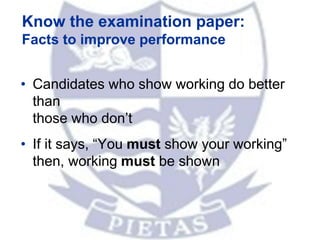
Facts to improve performance
• Candidates who show working do better
than
those who don’t
• If it says, “You must show your working”
then, working must be shown
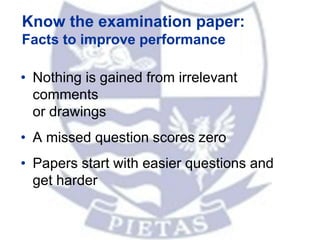
Know the examination paper:
Facts to improve performance
• Nothing is gained from irrelevant
comments
or drawings
• A missed question scores zero
• Papers start with easier questions and
get harder
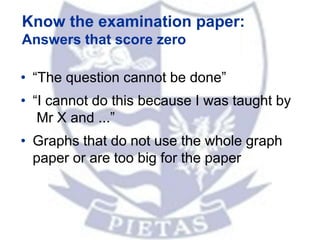
Know the examination paper:
Answers that score zero
• “The question cannot be done”
• “I cannot do this because I was taught by
Mr X and ...”
• Graphs that do not use the whole graph
paper or are too big for the paper
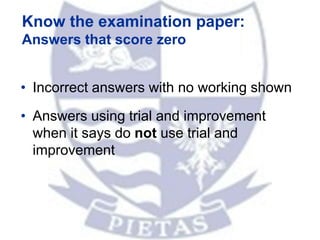
Know the examination paper:
Answers that score zero
• Incorrect answers with no working shown
• Answers using trial and improvement
when it says do not use trial and
improvement
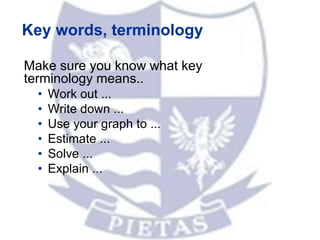
Key words, terminology
Make sure you know what key
terminology means..
• Work out ...
• Write down ...
• Use your graph to ...
• Estimate ...
• Solve ...
• Explain ...
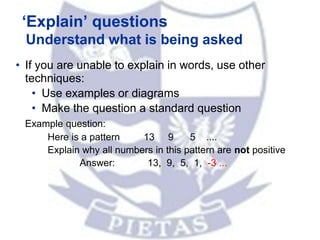
‘Explain’ questions
Understand what is being asked
• If you are unable to explain in words, use other
techniques:
• Use examples or diagrams
• Make the question a standard question
Example question:
Here is a pattern 13 9 5 ....
Explain why all numbers in this pattern are not positive
Answer: 13, 9, 5, 1, -3 ...
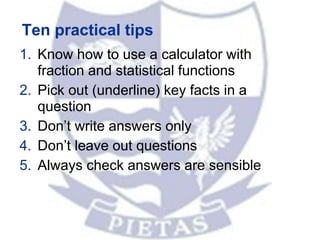
Ten practical tips
1. Know how to use a calculator with
fraction and statistical functions
2. Pick out (underline) key facts in a
question
3. Don’t write answers only
4. Don’t leave out questions
5. Always check answers are sensible
Ten practical tips
6. Don’t leave out questions with the
intention of revisiting - people usually
forget
7. Always write down key facts / formulae at
the beginning of the examination
8. Don’t use Tippex or scribble out
9. Remember we can’t teach the paper –
you must be able to think through a
problem
10.Remember to read questions carefully
MATHS SPECIFIC ERRORS
PROBABILITY
A very large number of answers are still given as
1 in 2 or 5 out of 10. These are incorrect.
Answers should be decimals, fractions or
percentages.
As a general rule if the question uses fractions then
give your answer as a fraction.
Reminder:
A probability answer cannot be greater than 1!
UNITS
You will have to give your own units for at least one
question. Units of length, volume and area are
frequently mixed up by students. Learn them.
Learn common Metric to Imperial conversions.
e g 1 kg = 2.2 lbs, 5 miles = 8 Km.
1 Gallon = 4.55 Litres etc.
Reminder:
• There are 52 weeks in a year (many students use
50).
• 60 minutes in an hour etc NB 1.4 hours does
NOT mean 1 hour 40 min (it means 1 hour 24
min)
UNITS
Even if not asked to, always write down units
at the end of a question
If a question contains different units e.g. mm and
cm or minutes and seconds. It is a good idea to
convert all to the same before starting the
calculations
ACCURACY
Do not round answers off until the very last line of
working.
Use the calculator memory function and notation
such as 16.534…..
This is especially important in trigonometry
questions.
(There is a significant difference between 23x1.66
and 23x1.66666666)
If you are asked to measure a line and it measures
9.1cm use 9.1cm.
Do not assume that the line is supposed to be 9cm
long.
TRIAL AND IMPROVEMENT
Usually there will be a table for you to write your
attempts in.
You do not need to fill in all the rows .
You must have at least one trial above and one trial
below the correct answer.
Always remember to do the middle value test so you
know which value the answer is closest to.
ANSWERS
If the question asks you to give the answer to 1dp,
2sf or in Standard form you will lose at least one
mark every time you fail to do so.
PERCENTAGE CHANGE
When asked for a sale price many students work out
the reduction correctly but then fail to take it away
from the original price losing at least 1 mark
FORMULA SHEETS
Make sure you know what is going to be given you
on a formula sheet.
Make sure you can use the formulas and have
learnt any formulas not given.
Tips to get the
grade
HOW TO GET GRADE C
You need around 70% in the Foundation GCSE Maths
exam paper to get a Maths GCSE grade C.
Don't just concentrate on the C grade questions.
Just as important are the earlier (and easier) questions on
the exam paper.
Make sure you have revised thoroughly these
easier graded questions.
These are worth 85% of the Foundation GCSE Maths
marks.
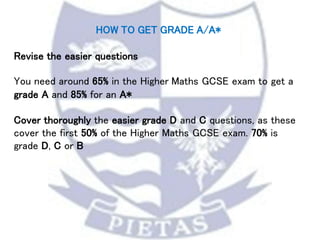
HOW TO GET GRADE A/A*
Revise the easier questions
You need around 65% in the Higher Maths GCSE exam to get a
grade A and 85% for an A*
Cover thoroughly the easier grade D and C questions, as these
cover the first 50% of the Higher Maths GCSE exam. 70% is
grade D, C or B
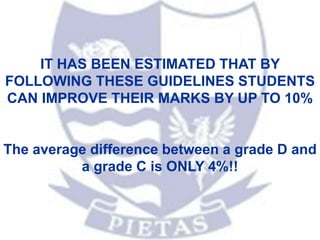
IT HAS BEEN ESTIMATED THAT BY
FOLLOWING THESE GUIDELINES STUDENTS
CAN IMPROVE THEIR MARKS BY UP TO 10%
The average difference between a grade D and
a grade C is ONLY 4%!!

Maths exam tips updated_new tips really workppt

  • 1.
    GCSE MATHEMATICS HOW TOIMPROVE YOUR GRADE AND EXAM TECHNIQUE
  • 2.
    EQUIPMENT: Most students bringall the correct equipment (Pens, Pencils, Ruler, Protractor, Compasses and Calculator) However there is a lot of evidence which shows they simply don’t use it! DIAGRAMS: Almost all diagrams are NOT drawn to scale. Many students ignore this fact. They simply measure angles and lines without calculating them and consequently get no marks.
  • 3.
    READ THE QUESTION: Itis recommended that you read the question TWICE. There is plenty of time. You can underline the important parts of a question if you wish to. Once you think you have answered a question - read it again and check you have answered the question asked.
  • 4.
    CALCULATORS Make sure youcan read a display that is in Standard Form. No credit is given for writing an answer as 1.6306. Make sure your calculator is set in the DEG mode
  • 5.
    FAMILIARISE YOURSELF WITHYOUR OWN CALCULATOR BRING IT TO SCHOOL EVERY DAY DON’T RELY ON THE SCHOOLS CALCULATOR WHICH MAY HAVE A DIFFERENT LOGIC SYSTEM TO YOURS.
  • 6.
    METHODS: Working out MUSTbe shown. There are a lot of method marks available and it is recommended that all relevant stages of working are shown. Incorrect answer and no working gains no marks If correct working is shown and a careless error results in an incorrect answer you could gain 4 out of 5 marks available
  • 7.
  • 8.
    • Crossed outwork is marked if: • It can be read • It has not been replaced • Overwriting or crossing through decimal points is penalised; the examiner cannot guess the response • Credit is given for a correct algebra substitution Know the examination paper: How is it marked?
  • 9.
    Know the examinationpaper: How is it marked? • Errors are only penalised once so: • If part (a) is incorrect, part (b) should still be attempted • Follow through marks will be awarded whenever possible
  • 10.
    Know the examinationpaper: Facts to improve performance • Candidates who show working do better than those who don’t • If it says, “You must show your working” then, working must be shown
  • 11.
    Know the examinationpaper: Facts to improve performance • Nothing is gained from irrelevant comments or drawings • A missed question scores zero • Papers start with easier questions and get harder
  • 12.
    Know the examinationpaper: Answers that score zero • “The question cannot be done” • “I cannot do this because I was taught by Mr X and ...” • Graphs that do not use the whole graph paper or are too big for the paper
  • 13.
    Know the examinationpaper: Answers that score zero • Incorrect answers with no working shown • Answers using trial and improvement when it says do not use trial and improvement
  • 14.
    Key words, terminology Makesure you know what key terminology means.. • Work out ... • Write down ... • Use your graph to ... • Estimate ... • Solve ... • Explain ...
  • 15.
    ‘Explain’ questions Understand whatis being asked • If you are unable to explain in words, use other techniques: • Use examples or diagrams • Make the question a standard question Example question: Here is a pattern 13 9 5 .... Explain why all numbers in this pattern are not positive Answer: 13, 9, 5, 1, -3 ...
  • 16.
    Ten practical tips 1.Know how to use a calculator with fraction and statistical functions 2. Pick out (underline) key facts in a question 3. Don’t write answers only 4. Don’t leave out questions 5. Always check answers are sensible
  • 17.
    Ten practical tips 6.Don’t leave out questions with the intention of revisiting - people usually forget 7. Always write down key facts / formulae at the beginning of the examination 8. Don’t use Tippex or scribble out 9. Remember we can’t teach the paper – you must be able to think through a problem 10.Remember to read questions carefully
  • 18.
  • 19.
    PROBABILITY A very largenumber of answers are still given as 1 in 2 or 5 out of 10. These are incorrect. Answers should be decimals, fractions or percentages. As a general rule if the question uses fractions then give your answer as a fraction. Reminder: A probability answer cannot be greater than 1!
  • 20.
    UNITS You will haveto give your own units for at least one question. Units of length, volume and area are frequently mixed up by students. Learn them. Learn common Metric to Imperial conversions. e g 1 kg = 2.2 lbs, 5 miles = 8 Km. 1 Gallon = 4.55 Litres etc. Reminder: • There are 52 weeks in a year (many students use 50). • 60 minutes in an hour etc NB 1.4 hours does NOT mean 1 hour 40 min (it means 1 hour 24 min)
  • 21.
    UNITS Even if notasked to, always write down units at the end of a question If a question contains different units e.g. mm and cm or minutes and seconds. It is a good idea to convert all to the same before starting the calculations
  • 22.
    ACCURACY Do not roundanswers off until the very last line of working. Use the calculator memory function and notation such as 16.534….. This is especially important in trigonometry questions. (There is a significant difference between 23x1.66 and 23x1.66666666) If you are asked to measure a line and it measures 9.1cm use 9.1cm. Do not assume that the line is supposed to be 9cm long.
  • 23.
    TRIAL AND IMPROVEMENT Usuallythere will be a table for you to write your attempts in. You do not need to fill in all the rows . You must have at least one trial above and one trial below the correct answer. Always remember to do the middle value test so you know which value the answer is closest to.
  • 24.
    ANSWERS If the questionasks you to give the answer to 1dp, 2sf or in Standard form you will lose at least one mark every time you fail to do so.
  • 25.
    PERCENTAGE CHANGE When askedfor a sale price many students work out the reduction correctly but then fail to take it away from the original price losing at least 1 mark
  • 26.
    FORMULA SHEETS Make sureyou know what is going to be given you on a formula sheet. Make sure you can use the formulas and have learnt any formulas not given.
  • 27.
    Tips to getthe grade
  • 28.
    HOW TO GETGRADE C You need around 70% in the Foundation GCSE Maths exam paper to get a Maths GCSE grade C. Don't just concentrate on the C grade questions. Just as important are the earlier (and easier) questions on the exam paper. Make sure you have revised thoroughly these easier graded questions. These are worth 85% of the Foundation GCSE Maths marks.
  • 29.
    HOW TO GETGRADE A/A* Revise the easier questions You need around 65% in the Higher Maths GCSE exam to get a grade A and 85% for an A* Cover thoroughly the easier grade D and C questions, as these cover the first 50% of the Higher Maths GCSE exam. 70% is grade D, C or B
  • 30.
    IT HAS BEENESTIMATED THAT BY FOLLOWING THESE GUIDELINES STUDENTS CAN IMPROVE THEIR MARKS BY UP TO 10% The average difference between a grade D and a grade C is ONLY 4%!!