ABOUT US
"Rise" isa professional development firm
that offers state of the art quality training
solutions, tailored business coaching
sessions, HR consultation as well as
Executive recruitment.
Headquartered in Dubai, "Rise" focuses
on the professional needs of the MENA
region through world class global
standards and a pioneer mindset.
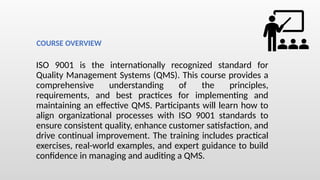
ISO 9001 isthe internationally recognized standard for
Quality Management Systems (QMS). This course provides a
comprehensive understanding of the principles,
requirements, and best practices for implementing and
maintaining an effective QMS. Participants will learn how to
align organizational processes with ISO 9001 standards to
ensure consistent quality, enhance customer satisfaction, and
drive continual improvement. The training includes practical
exercises, real-world examples, and expert guidance to build
confidence in managing and auditing a QMS.
COURSE OVERVIEW
11.
Quality Managers andOfficersISO 9001
Implementation Team MembersInternal
and External AuditorsSupervisors and
Team Leaders involved in quality
managementProfessionals responsible
for customer satisfaction and process
improvementConsultants supporting ISO
9001 implementation
•Power point presentation
•Videos
•Games
•Live Simulations
WHO SHOULD ATTEND
COURSE METHODOLOGY
LEARNING OUTCOMES
After Completing This Course Participants Will Have Learned
to:
1.Understand the structure, purpose, and requirements of ISO
9001.
2.Learn how to develop, implement, and maintain a QMS.
3.Identify and manage risks and opportunities related to
quality.
4.Understand the importance of customer focus and process-
based approaches.
5.Gain skills to conduct internal audits and prepare for
certification.
6.Foster continual improvement within the organization.
12.
Day 1: Introductionto ISO 9001 and QMS Fundamentals
Overview of ISO 9001 and its significance in quality management.
Purpose of ISO 9001: Establishes a framework for consistent quality management.
Global Relevance: Applicable to organizations of all sizes and industries.
Key Benefits:
Enhances customer satisfaction and trust.
Improves operational efficiency and reduces waste.
Ensures compliance with regulatory and customer requirements.
Drives continual improvement and competitive advantage.
WORKSHOP OUTLINE
13.
Day 1: Introductionto ISO 9001 and QMS Fundamentals
Key concepts and principles of ISO 9001: Customer focus, leadership, process approach, and improvement.
• Customer Focus: Delivering products and services that meet or exceed customer expectations.
• Leadership: Commitment from top management to promote a quality culture and allocate resources.
• Process Approach: Managing activities and resources as interrelated processes for better outcomes.
• Improvement: Continuously enhancing processes, products, and services to meet evolving needs.
• Engagement of People: Involving employees at all levels to maximize their potential.
• Evidence-Based Decision Making: Using data and analysis to guide decisions.
• Relationship Management: Building strong partnerships with suppliers and other stakeholders.
WORKSHOP OUTLINE
14.
Day 1: Introductionto ISO 9001 and QMS Fundamentals
Structure of ISO 9001
High-Level Structure (HLS): Standardized format for ISO management systems for easy integration.
Key Clauses:
1. Context of the Organization
2. Leadership
3. Planning
4. Support
5. Operation
6. Performance
7. Evaluation
8. Improvement
Focuses on flexibility and adaptability to various organizational needs.
WORKSHOP OUTLINE
15.
Day 1: Introductionto ISO 9001 and QMS Fundamentals
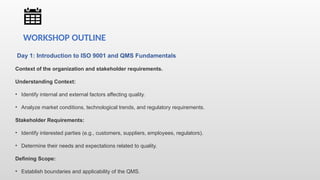
Context of the organization and stakeholder requirements.
Understanding Context:
• Identify internal and external factors affecting quality.
• Analyze market conditions, technological trends, and regulatory requirements.
Stakeholder Requirements:
• Identify interested parties (e.g., customers, suppliers, employees, regulators).
• Determine their needs and expectations related to quality.
Defining Scope:
• Establish boundaries and applicability of the QMS.
WORKSHOP OUTLINE
16.
Day 1: Introductionto ISO 9001 and QMS Fundamentals
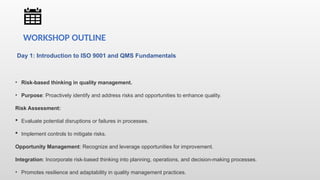
• Risk-based thinking in quality management.
• Purpose: Proactively identify and address risks and opportunities to enhance quality.
Risk Assessment:
Evaluate potential disruptions or failures in processes.
Implement controls to mitigate risks.
Opportunity Management: Recognize and leverage opportunities for improvement.
Integration: Incorporate risk-based thinking into planning, operations, and decision-making processes.
• Promotes resilience and adaptability in quality management practices.
WORKSHOP OUTLINE
17.
Day 2: Implementation,Auditing, and Continual Improvement
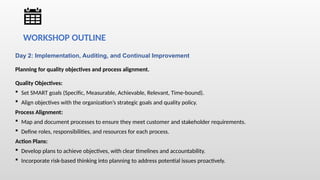
Planning for quality objectives and process alignment.
Quality Objectives:
Set SMART goals (Specific, Measurable, Achievable, Relevant, Time-bound).
Align objectives with the organization’s strategic goals and quality policy.
Process Alignment:
Map and document processes to ensure they meet customer and stakeholder requirements.
Define roles, responsibilities, and resources for each process.
Action Plans:
Develop plans to achieve objectives, with clear timelines and accountability.
Incorporate risk-based thinking into planning to address potential issues proactively.
WORKSHOP OUTLINE
18.
Day 2: Implementation,Auditing, and Continual Improvement
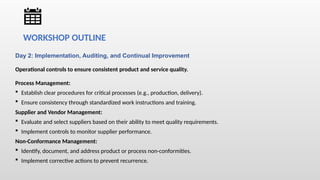
Operational controls to ensure consistent product and service quality.
Process Management:
Establish clear procedures for critical processes (e.g., production, delivery).
Ensure consistency through standardized work instructions and training.
Supplier and Vendor Management:
Evaluate and select suppliers based on their ability to meet quality requirements.
Implement controls to monitor supplier performance.
Non-Conformance Management:
Identify, document, and address product or process non-conformities.
Implement corrective actions to prevent recurrence.
WORKSHOP OUTLINE
19.
Day 2: Implementation,Auditing, and Continual Improvement
Monitoring, measurement, and performance evaluation.
Key Performance Indicators (KPIs):
• Define measurable criteria for monitoring quality objectives and process performance.
Data Collection and Analysis:
• Use tools such as control charts and statistical analysis to track trends and identify issues.
Customer Feedback:
• Collect and analyze customer feedback to evaluate satisfaction and identify improvement opportunities.
Management Review:
• Conduct periodic reviews to assess the effectiveness of the QMS and guide strategic decisions.
WORKSHOP OUTLINE
20.
Day 2: Implementation,Auditing, and Continual Improvement
Internal auditing processes: Planning, conducting, and reporting.
Audit Planning:
• Develop an audit schedule based on process importance and past performance.
• Define audit scope, objectives, and criteria.
Conducting Audits:
• Use evidence-based techniques to evaluate process conformity and effectiveness.
• Engage auditees and document observations.
Reporting:
• Highlight non-conformities, strengths, and improvement opportunities.
• Provide actionable recommendations and assign responsibilities for corrective actions.
WORKSHOP OUTLINE
21.
Day 2: Implementation,Auditing, and Continual Improvement
Certification process and maintaining compliance.
Steps to Certification:
• Stage 1: Document review to ensure QMS readiness.
• Stage 2: On-site audit to evaluate implementation and effectiveness.
Maintaining Certification:
• Conduct regular internal audits and management reviews.
• Address non-conformities and implement corrective actions promptly.
• Participate in periodic surveillance audits conducted by the certification body.
Continuous Improvement:
• Integrate lessons learned from audits, customer feedback, and performance evaluations to enhance the QMS.
WORKSHOP OUTLINE
22.
Your Trainer
Dr. MohamedEl Nagdy
Quality Consultant creates effective quality management systems , set up quality assurance strategies and processes
, Expert at identifying deficiencies and initiating innovative solutions to problems according to its root causes,
holds a Doctor of Business administration, PMP, MQM, CFA (level 2 candidate), many other professional and
technical certifications with long experience in industrial, professional training and consultation.
• Doctorate in Business Administration, Ain Shams University.
• Master's in Total Quality Management, Arab Academy for Science, Technology, and Maritime Transport.
• Certified Project Management Professional (PMP).
• Lead Auditor ISO 9001.
• Lead Auditor ISO 14001.
• Lead Auditor ISO 45001.
• Lead Auditor ISO 27001.
• Successfully Completed: Awareness Course on ISO 37120 Requirements.
• Completed Level 1 of the Chartered Financial Analyst (CFA) certification.
• ICDL Certification accredited by UNESCO.
• Diploma in Satellite Communication.
• Bachelor is Degree in Wireless Communication Engineering, Military Technical College.
23.
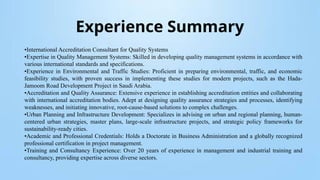
Experience Summary
•International AccreditationConsultant for Quality Systems
•Expertise in Quality Management Systems: Skilled in developing quality management systems in accordance with
various international standards and specifications.
•Experience in Environmental and Traffic Studies: Proficient in preparing environmental, traffic, and economic
feasibility studies, with proven success in implementing these studies for modern projects, such as the Hada-
Jamoom Road Development Project in Saudi Arabia.
•Accreditation and Quality Assurance: Extensive experience in establishing accreditation entities and collaborating
with international accreditation bodies. Adept at designing quality assurance strategies and processes, identifying
weaknesses, and initiating innovative, root-cause-based solutions to complex challenges.
•Urban Planning and Infrastructure Development: Specializes in advising on urban and regional planning, human-
centered urban strategies, master plans, large-scale infrastructure projects, and strategic policy frameworks for
sustainability-ready cities.
•Academic and Professional Credentials: Holds a Doctorate in Business Administration and a globally recognized
professional certification in project management.
•Training and Consultancy Experience: Over 20 years of experience in management and industrial training and
consultancy, providing expertise across diverse sectors.
24.
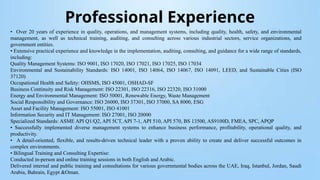
Professional Experience
• Over20 years of experience in quality, operations, and management systems, including quality, health, safety, and environmental
management, as well as technical training, auditing, and consulting across various industrial sectors, service organizations, and
government entities.
• Extensive practical experience and knowledge in the implementation, auditing, consulting, and guidance for a wide range of standards,
including:
Quality Management Systems: ISO 9001, ISO 17020, ISO 17021, ISO 17025, ISO 17034
Environmental and Sustainability Standards: ISO 14001, ISO 14064, ISO 14067, ISO 14091, LEED, and Sustainable Cities (ISO
37120)
Occupational Health and Safety: OHSMS, ISO 45001, OSHAD-SF
Business Continuity and Risk Management: ISO 22301, ISO 22316, ISO 22320, ISO 31000
Energy and Environmental Management: ISO 50001, Renewable Energy, Waste Management
Social Responsibility and Governance: ISO 26000, ISO 37301, ISO 37000, SA 8000, ESG
Asset and Facility Management: ISO 55001, ISO 41001
Information Security and IT Management: ISO 27001, ISO 20000
Specialized Standards: ASME API Q1/Q2, API 5CT, API 7-1, API 510, API 570, BS 13500, AS9100D, FMEA, SPC, APQP
• Successfully implemented diverse management systems to enhance business performance, profitability, operational quality, and
productivity.
• A detail-oriented, flexible, and results-driven technical leader with a proven ability to create and deliver successful outcomes in
complex environments.
• Bilingual Training and Consulting Expertise:
Conducted in-person and online training sessions in both English and Arabic.
Delivered internal and public training and consultations for various governmental bodies across the UAE, Iraq, Istanbul, Jordan, Saudi
Arabia, Bahrain, Egypt &Oman.
25.
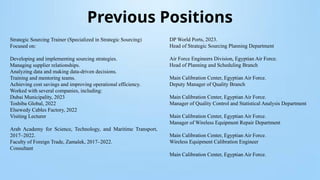
Previous Positions
Strategic SourcingTrainer (Specialized in Strategic Sourcing)
Focused on:
Developing and implementing sourcing strategies.
Managing supplier relationships.
Analyzing data and making data-driven decisions.
Training and mentoring teams.
Achieving cost savings and improving operational efficiency.
Worked with several companies, including:
Dubai Municipality, 2023
Toshiba Global, 2022
Elsewedy Cables Factory, 2022
Visiting Lecturer
Arab Academy for Science, Technology, and Maritime Transport,
2017–2022.
Faculty of Foreign Trade, Zamalek, 2017–2022.
Consultant
DP World Ports, 2023.
Head of Strategic Sourcing Planning Department
Air Force Engineers Division, Egyptian Air Force.
Head of Planning and Scheduling Branch
Main Calibration Center, Egyptian Air Force.
Deputy Manager of Quality Branch
Main Calibration Center, Egyptian Air Force.
Manager of Quality Control and Statistical Analysis Department
Main Calibration Center, Egyptian Air Force.
Manager of Wireless Equipment Repair Department
Main Calibration Center, Egyptian Air Force.
Wireless Equipment Calibration Engineer
Main Calibration Center, Egyptian Air Force.
26.
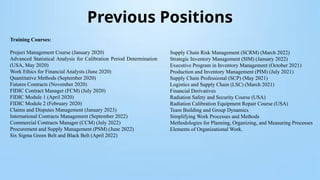
Previous Positions
Training Courses:
ProjectManagement Course (January 2020)
Advanced Statistical Analysis for Calibration Period Determination
(USA, May 2020)
Work Ethics for Financial Analysts (June 2020)
Quantitative Methods (September 2020)
Futures Contracts (November 2020)
FIDIC Contract Manager (FCM) (July 2020)
FIDIC Module 1 (April 2020)
FIDIC Module 2 (February 2020)
Claims and Disputes Management (January 2023)
International Contracts Management (September 2022)
Commercial Contracts Manager (CCM) (July 2022)
Procurement and Supply Management (PSM) (June 2022)
Six Sigma Green Belt and Black Belt (April 2022)
Supply Chain Risk Management (SCRM) (March 2022)
Strategic Inventory Management (SIM) (January 2022)
Executive Program in Inventory Management (October 2021)
Production and Inventory Management (PIM) (July 2021)
Supply Chain Professional (SCP) (May 2021)
Logistics and Supply Chain (LSC) (March 2021)
Financial Derivatives
Radiation Safety and Security Course (USA)
Radiation Calibration Equipment Repair Course (USA)
Team Building and Group Dynamics
Simplifying Work Processes and Methods
Methodologies for Planning, Organizing, and Measuring Processes
Elements of Organizational Work.
27.
Previous Positions
Training Courses:
Fundamentalsof Total Quality Management
Organizational Excellence
Global Quality Standards
Awareness of ISO 9001 Requirements
Awareness of ISO 14001 Requirements
Awareness of ISO 45001 Requirements
Awareness of ISO 17025 Requirements
Internal Auditor for ISO 9001 Requirements
Internal Auditor for ISO 17025 Requirements
Seven-Step Strategic Sourcing Methodology
Ensured mastery and goal achievement by trainees at:
• Dubai Municipality
• Elsewedy Cables Factory
• Toshiba Global Factories
• Advanced Statistical Analysis using SPSS
• Department of Economic Development, Sharjah
• Teamwork Skills
• Social Services Department, Sharjah
• Ideal Employee
• Department of Economic Development, Ajman
• FIDIC Standard Contracts
• Smart Village
• Supply Chain Governance
• Elsewedy Cables Factory
28.
Previous Positions
Quality Manager
•Toshiba Arab Factory
• Credit Analysis
• Financial and Management Institute (FMI)
• Project Management Professional (PMP)
• Arab Academy for Science, Technology, and Maritime
Transport
• Statistical Quality Control
• Arab Academy for Science, Technology, and Maritime
Transport
• Business Continuity Management (ISO 22301)
• Arab Academy for Science, Technology, and Maritime
Transport
• Financial Risk Assessment
• Financial and Management Institute (FMI)
• Chartered Financial Analyst (CFA)
• Baker Tilly, Kuwait Capital Markets Authority
• CFA Coach
• Total Quality Management
• Quality Control Department, Egyptian Armed Forces
29.
Previous Positions
Previous ConsultingProjects:
•Feasibility Study for the Strategic Traffic Accident Center
Riyadh Municipality, Saudi Arabia
•Study on the Implementation of Hazardous Materials Transportation Agreement
Eastern Province Municipality, Saudi Arabia
•Restructuring the Street Lighting Maintenance Contract System
Eastern Province Municipality, Saudi Arabia
•Implementation of an Integrated Quality Management System
Aligned with ISO 9001, 14001, and 45001, DP World Ports, Egypt
•Feasibility Study for Jummum Road
Makkah Municipality, Saudi Arabia
•Development of Strategic Data Display System (BI System)
Egypt
•Implementation of E-Governance System
Egypt
•Establishing an ISO Certification Entity
Quality Control Department, Egyptian Armed Forces, Egypt
•Developing a Customer Feedback Survey System
Main Calibration Center, Egyptian Air Force, Egypt
•Developing Wireless Equipment Repair Data System
Main Calibration Center, Egyptian Air Force, Egypt
30.
Training programs offeredby the
lecturer:
Advanced statistical analysis.
• Fundamentals of Statistical Analysis.
• Statistical control of quality.
• Decision-making using statistical methods.
• Optimization
• Operational research.
• Production planning using quantitative methods.
• Methods of scientific decision-making
• Fundamentals of Excel
• Advanced skills for Excel
• Statistical analysis using SPSS software
31.
Training programs offeredby the
lecturer:
Fundamentals of Total Quality.
• Institutional differentiation.
• Global Quality Standards.
• Awareness of the requirements of ISO 9001.
• Awareness of the requirements of ISO 14001.
• Awareness of the requirements of ISO 45001.
• Awareness of the requirements of ISO 17025.
• Internal references to requirements for ISO 9001.
• Internal references to requirements for ISO 17025.
• Simplify work procedures and methods.
32.
Training programs offeredby the
lecturer:
Financial & Economic:
• Credit analysis.
• All courses of the first level of the Certified Financial Analyst Certificate . CFA
• All second level courses of CFA Certified Financial Analyst Certificate
• Fundamentals of statistical analysis.
• Statistical analysis of financial decisions.
• Financial ratios.
• Analysis of budgets and income statements.
• Management accounting
• Financial derivatives.
• The future contracts.
• CFA Certified Financial Analyst Ethics.
• Making investment decisions using statistical methods.
• Optimization
• Operational research.
• Production planning using quantitative methods.
33.
Training programs offeredby the
lecturer:
Management:
• Creativity, innovation and how to develop working methods
• Difference in customer service
• Managing time and work pressure
• Innovating and looking forward to the future
• Development and self-development
• Solving problems and making decisions
• Prepare and build effective teams
• Marketing and sales
• Skills in dealing with bosses and subordinates.
• Building and preparing second-row leaders.
• Effective communication skills
• Brainstorming and developing work.
• Preparation and writing of reports
• Develop innovation support plans for organizations
• Effective management of meetings
• Skills to deal with others
34.
Training programs offeredby the
lecturer:
Specialized Management:
• Principles of Economics
• Islamic Economics between concepts and Application
• Management of sales
• Management of supply chains.
• Effective negotiation skills
• The process of continuous improvement Kaize
35.
Training programs offeredby the
lecturer:
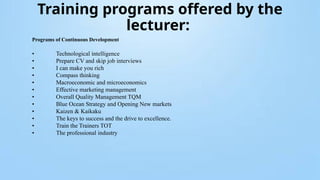
Programs of Continuous Development
• Technological intelligence
• Prepare CV and skip job interviews
• I can make you rich
• Compass thinking
• Macroeconomic and microeconomics
• Effective marketing management
• Overall Quality Management TQM
• Blue Ocean Strategy and Opening New markets
• Kaizen & Kaikaku
• The keys to success and the drive to excellence.
• Train the Trainers TOT
• The professional industry
36.
Training programs offeredby the
lecturer:
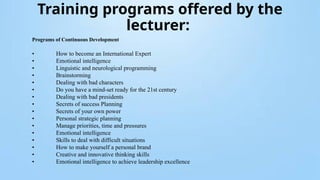
Programs of Continuous Development
• How to become an International Expert
• Emotional intelligence
• Linguistic and neurological programming
• Brainstorming
• Dealing with bad characters
• Do you have a mind-set ready for the 21st century
• Dealing with bad presidents
• Secrets of success Planning
• Secrets of your own power
• Personal strategic planning
• Manage priorities, time and pressures
• Emotional intelligence
• Skills to deal with difficult situations
• How to make yourself a personal brand
• Creative and innovative thinking skills
• Emotional intelligence to achieve leadership excellence
37.
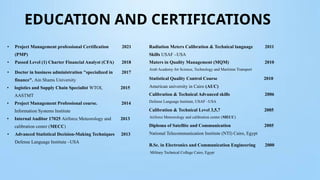
EDUCATION AND CERTIFICATIONS
•Project Management professional Certification
(PMP)
2021
• Passed Level (1) Charter Financial Analyst (CFA) 2018
• Doctor in business administration "specialized in
finance". Ain Shams University
2017
• logistics and Supply Chain Specialist WTOI,
AASTMT
2015
• Project Management Professional course.
Information Systems Institute
2014
• Internal Auditor 17025 Airforce Meteorology and
calibration center (MECC)
2013
• Advanced Statistical Decision-Making Techniques
Defense Language Institute –USA
2013
Radiation Meters Calibration & Technical language
Skills USAF –USA
2011
Maters in Quality Management (MQM) 2010
Arab Academy for Science, Technology and Maritime Transport
Statistical Quality Control Course 2010
American university in Cairo (AUC)
Calibration & Technical Advanced skills 2006
Defense Language Institute, USAF –USA
Calibration & Technical Level 3,5,7 2005
Airforce Meteorology and calibration center (MECC)
Diploma of Satellite and Communication 2005
National Telecommunication Institute (NTI) Cairo, Egypt
B.Sc. in Electronics and Communication Engineering 2000
Military Technical College Cairo, Egypt
38.
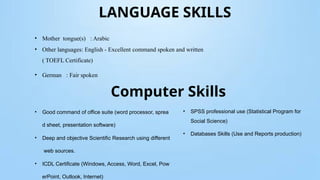
LANGUAGE SKILLS
• Mothertongue(s) : Arabic
• Other languages: English - Excellent command spoken and written
( TOEFL Certificate)
• German : Fair spoken
Computer Skills
• Good command of office suite (word processor, sprea
d sheet, presentation software)
• Deep and objective Scientific Research using different
web sources.
• ICDL Certificate (Windows, Access, Word, Excel, Pow
erPoint, Outlook, Internet)
• SPSS professional use (Statistical Program for
Social Science)
• Databases Skills (Use and Reports production)
39.
Other skills
• Professionalprojects and programs management.
• Thorough and meticulous financial researcher.
• Very focused and objective oriented.
• Ability to lead big groups of employees through contempora
ry techniques of group dynamics using various management
styles.
• Ability to design Organizations’ Restructuring and dealing
with accompanied Resistance to change.
• Ability to teach students and professionals from various soci
al and cultural backgrounds.
• Ability to design new courses and materials creatively in both
English and Arabic.
• Excellent written, verbal, and non-verbal communication.
• Excellent presentation skills in both English and Arabic.
• Extra ordinary problem solving skills using Root Cause
Analysis techniques through Statistical and Investigat onal
methodology.
• Proven track record of successful consultations.
• Highly focused with creative and organized planning abilities.
References are available upon request.