2011
TECHNICAL SKILLS ASSESSMENT
TEST REVIEW
There are 4 phenomena that stirred interest in the criminal justice
system and led to its prominence as one of the most examined and
criticized aspects of the government.
The Civil Rights Movement
The Vietnam War
The rising crime rate and the public’s increased awareness of it
The Terrorist Attacks of September 11, 2001
In many respects, these four influences were interrelated and cumulative in their effect on the criminal
justice system.
MAJOR EVENTS IN US
HISTORY THAT HELPED
SHAPE THE CRIMINAL
JUSTICE SYSTEM AS WE
KNOW IT TODAY
The Civil Rights Act of 1964
Protests against institutional racism and U.S. involvement in the Vietnam War
posed major challenges to the criminal justice system. Prior to the Civil Rights
Act of 1964, businesses, hotels, restaurants, and public transportation could and
did refuse service with impunity to Black citizens.
Autherine Lucy – University of Alabama, 1956
Civil rights leader Martin Luther King Jr. promoted the tactic of civil
disobedience, which also challenged the criminal justice system. One of the
most well-known examples of civil disobedience occurred in 1955 when Rosa
Parks refused to move to the rear of the bus, as required by law, and was
arrested. Although King advocated non-violence, there were many who rioted.
The Vietnam War
Political protests against U.S. involvement in the Vietnam War also generated
acrimonious conflict in which the police often were captured on film engaged in
brutality against the protesters.
Kent State University – 1970
During this period, the crime rate continued to climb to the point that, according to
a 1965 Gallup poll, American’s viewed crime as the most serious problem in the
country.
In 1968 31 percent of Gallup survey respondents said they were afraid to walk in
their own neighborhoods at night. By the end of 1972, the number had risen to
42%. Most citizens thought that the police were part of the cause, not the
solution, to the rising crime rate. The President’s Commission on Law
Enforcement and Administration of Justice concluded that most people had
lost confidence in the ability of the police to maintain law and order.
The criminal justice system appeared to be failing. To counter the
attack of crime and social disorder, on July 25, 1965, President
Lyndon Johnson declared a War on Crime. He authorized a
series of federal presidential commissions to study crime and
justice in the United States and to recommend suggested reforms
to restore public confidence.
The findings of the President’s Crime Commission concluded
that fear of crime had eroded the basic quality of life for many
Americans. It also recognized the importance of crime
prevention, as opposed to crime fighting, and the necessity of
eliminating injustices in the criminal justice system.
THE WAR ON CRIME
In response to recommendations of the PCC and demands from
the public, substantial resources were added to the criminal justice
system.
To attract better-qualified personnel, police departments had to increase salaries;
as a result, policing costs skyrocketed in major cities like Kansas City.
To help defray these costs, local and state governments sought assistance from
the federal government, whose response was to pass the Omnibus Crime
Control and Safe Streets Act of 1968.
This Act created the Law Enforcement Assistance Administration
(LEAA)and the Law Enforcement Educational Program (LEEP).
The LEAA acted as a conduit for the transfer of federal funds to state and local
law enforcement agencies. However, these funds were not without “strings”.
OMNIBUS CRIME
CONTROL AND SAFE
STREETS ACT OF 1968
The LEAA appointed the National Commission on Criminal Justice Standards
and Goals, which had the purpose of formulation specific standards and goals
for police, courts, corrections, juvenile justice, and crime prevention. To receive
the generous funds available from the federal government, local and state
agencies had to show that they had implemented the commission’s standards and
goals. May of the advances made within law enforcement agencies were a result
of compliance with standards and goals necessary to qualify for federal funds.
The Law Enforcement Educational Program (LEEP) was a branch of the
LEAA> The goal of LEEP was to promote education among criminal justice
personnel.
After massive amounts of federal assistance, numerous reform efforts, and the
adoption of innovative strategies by police, courts, and corrections, public
confidence in the criminal justice system was restored and the crime rate
dropped. Residents of large cities reported that they felt safe using public
transportation. Violent crime rates for nearly all categories dropped. Things
were looking up for public confidence in the criminal justice system until
September 11th, 2001.
The biggest crisis in the twenty-
first century was caused by a
foreign attack on the United
States. Just as President Johnson
had declared a war on
crime, President Bush declared a
War on Terrorism.
Criminal Law/Control Versus Liberty
After breaking away from England, the American colonists rejected
both the Church and the king as supreme authorities and declared
that the United States is founded on the superiority of the rule of
law. The rule of law declares that the standards of behavior and
privilege are established not by kings or religious leaders, but by rules
and procedures that define and prohibit certain behaviors as illegal or
criminal and prescribe punishments for those behaviors. All
people, regardless of rank, title, position, status, or wealth, are
accorded the same rights and privileges under the law. Three major
categories of law are civil law, administrative law, and criminal law.
The Making of Law
Why do governments – local, state, and federal – create criminal
laws? The American Law Institute, a private, voluntary association
of distinguished judges, lawyers, and law teachers, give five reasons
for the establishment of laws:
1. to forbid and prevent conduct that unjustifiably and
inexcusably inflicts or threatens substantial harm to individual or
public interests
2. to subject to public control persons whose conduct
indicate that they are disposed to commit crimes
3. to safeguard conduct that is without fault from
condemnation as criminal
4. to give fair warning of the nature of the conduct
declared to constitute an offense
5. to differentiate on reasonable grounds between serious
and minor offenses.
Mala in se
Specific Laws might be passed because they
prohibit actions that are thought to be harmful to
society. For example, Prohibitions against
murder, rape, robbery, and arson are seen as
serving all people in society. Such acts are
prohibited because they are considered harmful in
themselves, or mala en se.
Mala Prohibita
Other laws might be passed because some people
feel that there is a need to regulate certain actions;
thus for example, there are parking regulations,
minimum drinking-age limits, and various licensing
regulations. Acts that violate such regulations are
mala prohibita- prohibited only because of the
law and not because they are necessarily harmful
or inherently evil.
Seven benchmarks are used to assess the legality of criminal laws.
Principal of Legality
Ex Post Facto Laws
Due Process
Void for Vagueness
Right to Privacy
Void for Overbreadth
Cruel and Unusual Punishment
THE LIMITS OF THE LAW
#1: Principal of Legality
The government cannot punish citizens for specific conduct if no specific
laws exist forewarning them that the conduct is prohibited or required. The
principal of legality, which has its roots in the Roman Empire, requires that
laws must be made public before they can be enforced.
THE LIMITS OF THE LAW
2. Ex Post Facto Laws
Ex post facto (“after the fact”) laws are related to the principle of legality. The
ex post facto principle declares that persons cannot be punished for actions
committed before the law prohibiting the behavior was passed.
The principle of ex post facto also prohibits the government from increasing
the punishment for a specific crime after the crime has been committed.
THE LIMITS OF THE LAW
#3. Due Process
There are two types of due process rights: substantive and procedural.
Substantive due process limits the power of government to create crimes
unless there is a compelling and substantial public interest in regulating or
prohibiting a certain type of conduct.
THE LIMITS OF THE LAW
Due process, continued……
Procedural due process requires the government to follow established
procedures and to treat defendants equally. Procedural laws regulate the
conduct of the police, the courts, and the criminal justice system in general.
These laws, called rules of evidence, define, for example what is fair
treatment, what order of events must be followed, what types of evidence can
be admitted at a trial, and the rights of the defendants.
THE LIMITS OF THE LAW
Procedural due process, continued….
Because of procedural due process, case law precedents play a significant role
in adjudication in the U. S. system of justice. Attorneys can argue that the
court must allow similar evidence or testimony as was admitted in the past in
similar cases. This system of case law is called stare decisis.
THE LIMITS OF THE LAW
#4: Void for Vagueness
The law must say what it means and mean what it says. Laws that do not
provide reasonable guidelines that define the specific prohibited behaviors are
void for vagueness.
Laws must use wording that clearly specifies what behavior or act is unlawful.
Vague wording subject to different interpretations, such as immoral,
indecent, too close, and interfere with, does not provide the average person
with sufficient information to determine whether his or her behavior is in
violation of the law.
THE LIMITS OF THE LAW
#5: Right to Privacy
Laws that violate reasonable personal privacy may be declared void. The
right to privacy is not clearly delineated in the U. S. Constitution, but it is
a constructed right, inferred from the provisions of the
First, Third, Fourth and Ninth amendments. Some state constitutions
such as Alaska, Florida and Hawaii, have explicit rights to privacy.
Child Pornography The Supreme Court has upheld state statutes making
it a crime to possess child pornography. Thus, privacy is not an
overarching right that permits otherwise harmful or prohibited behaviors
merely because they are performed in one’s own home.
THE LIMITS OF THE LAW
#6: Void for Overbreadth
Laws that have been declared void for overbreadth are laws that have gone too
far; that is , in an attempt to prevent a specific conduct, the law not only
makes that conduct illegal, but it also prohibit other behaviors that are legally
protected.
A law that is void for overbreadth is not vague in what it prohibits; rather it
simply prohibits legal activities as well as illegal activities.
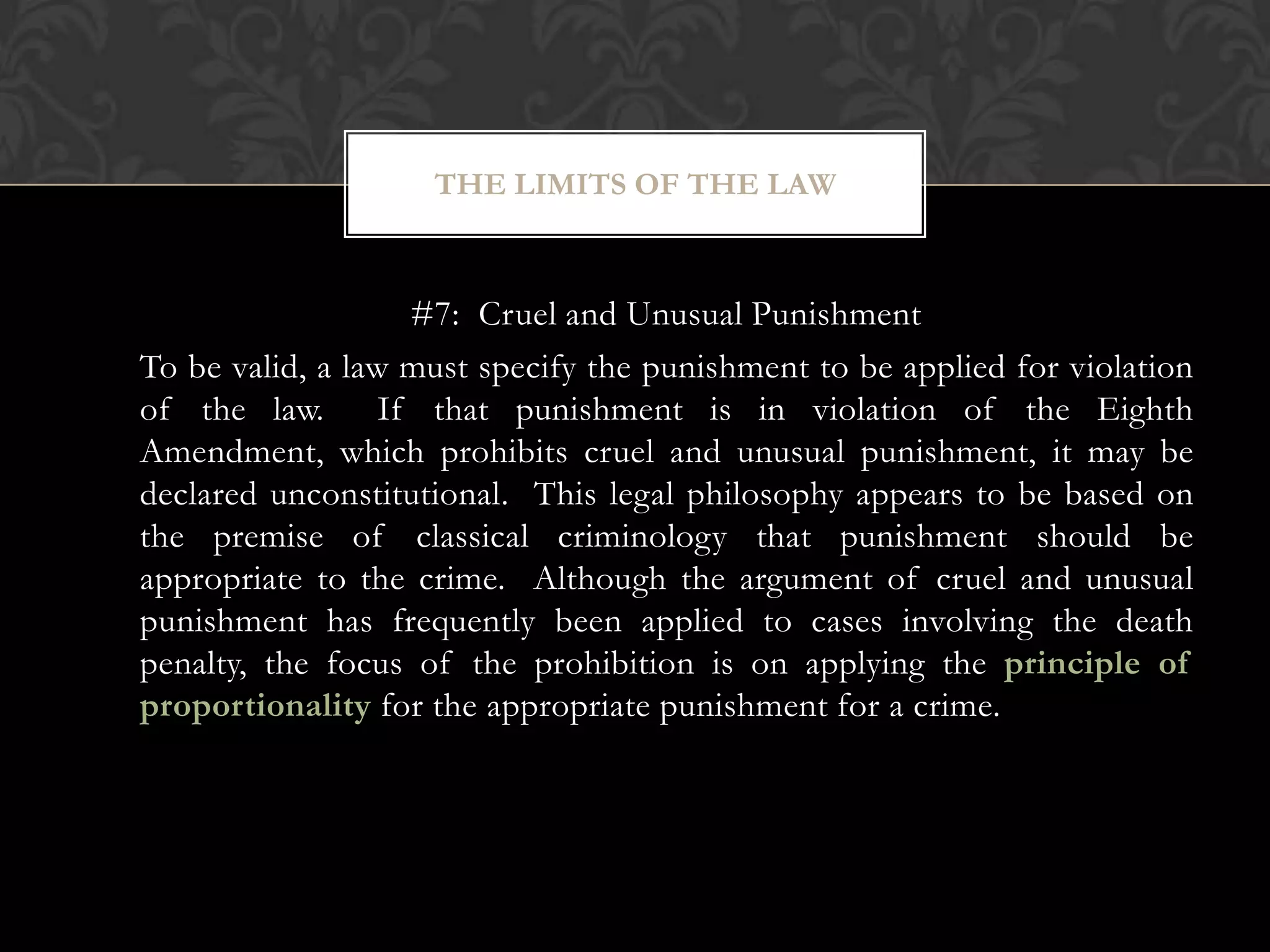
THE LIMITS OF THE LAW
#7: Cruel and Unusual Punishment
To be valid, a law must specify the punishment to be applied for violation
of the law. If that punishment is in violation of the Eighth
Amendment, which prohibits cruel and unusual punishment, it may be
declared unconstitutional. This legal philosophy appears to be based on
the premise of classical criminology that punishment should be
appropriate to the crime. Although the argument of cruel and unusual
punishment has frequently been applied to cases involving the death
penalty, the focus of the prohibition is on applying the principle of
proportionality for the appropriate punishment for a crime.
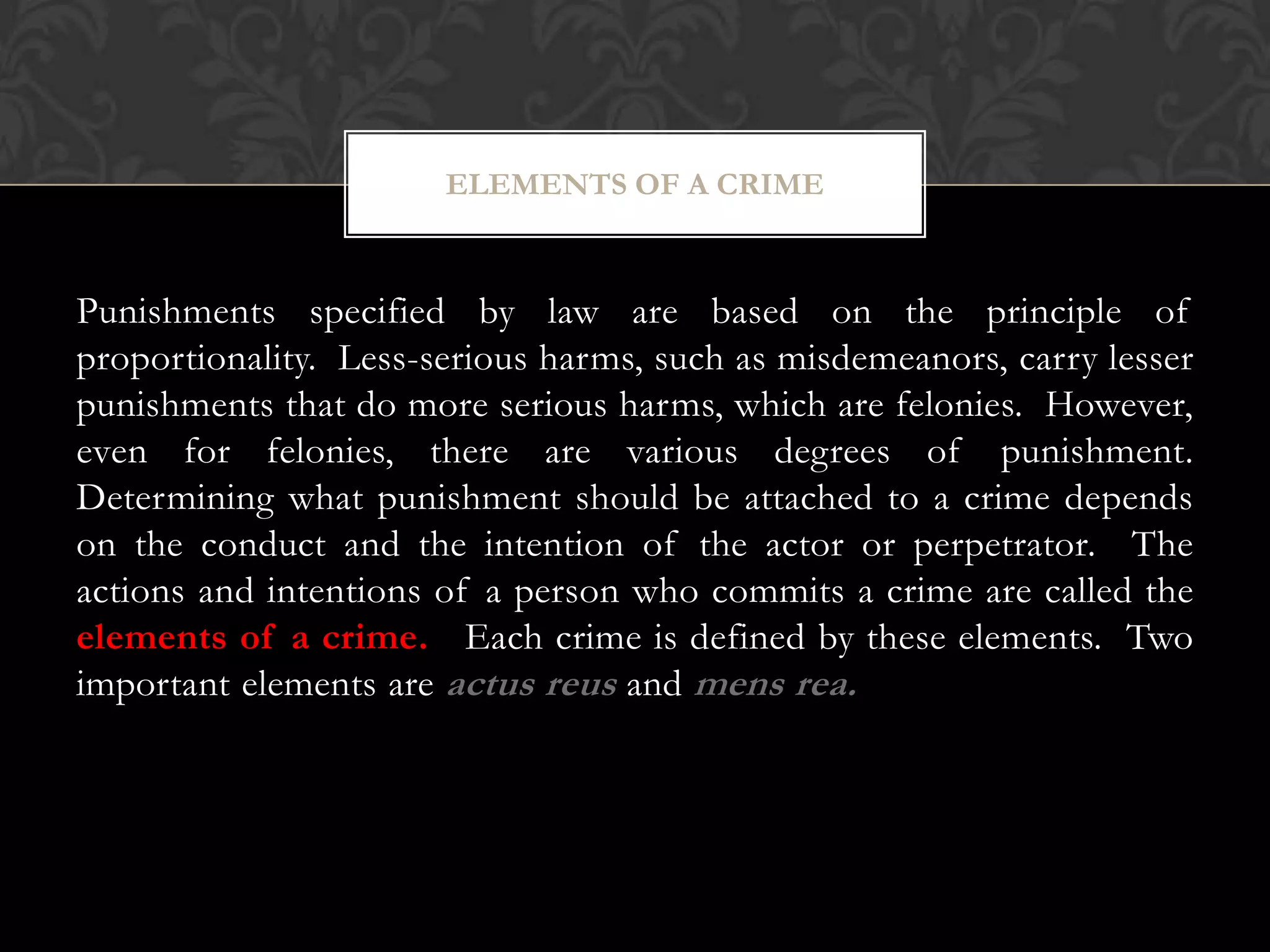
THE LIMITS OF THE LAW
Punishments specified by law are based on the principle of
proportionality. Less-serious harms, such as misdemeanors, carry lesser
punishments that do more serious harms, which are felonies. However,
even for felonies, there are various degrees of punishment.
Determining what punishment should be attached to a crime depends
on the conduct and the intention of the actor or perpetrator. The
actions and intentions of a person who commits a crime are called the
elements of a crime. Each crime is defined by these elements. Two
important elements are actus reus and mens rea.
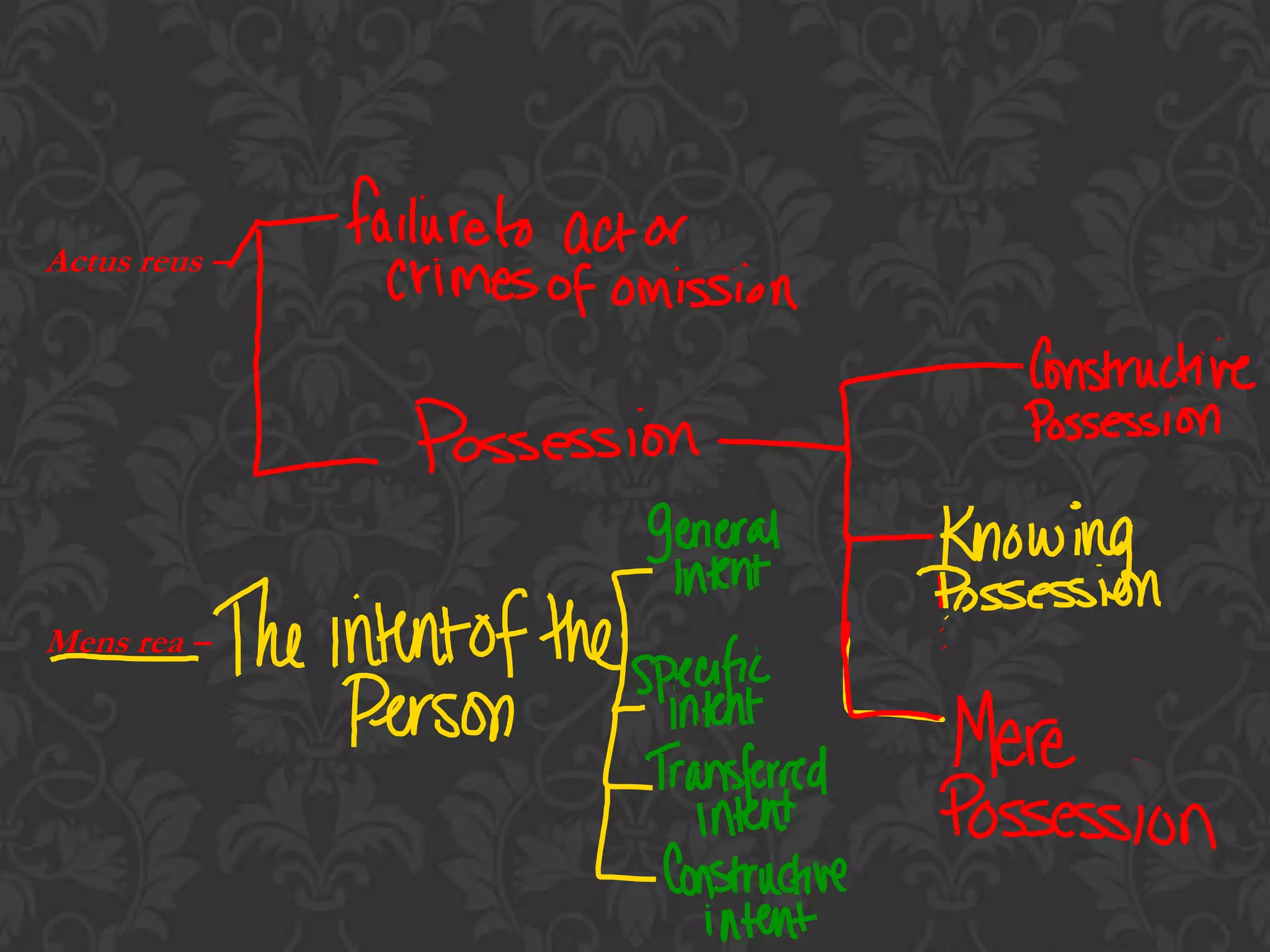
ELEMENTS OF A CRIME
Actus reus –
Mens rea –
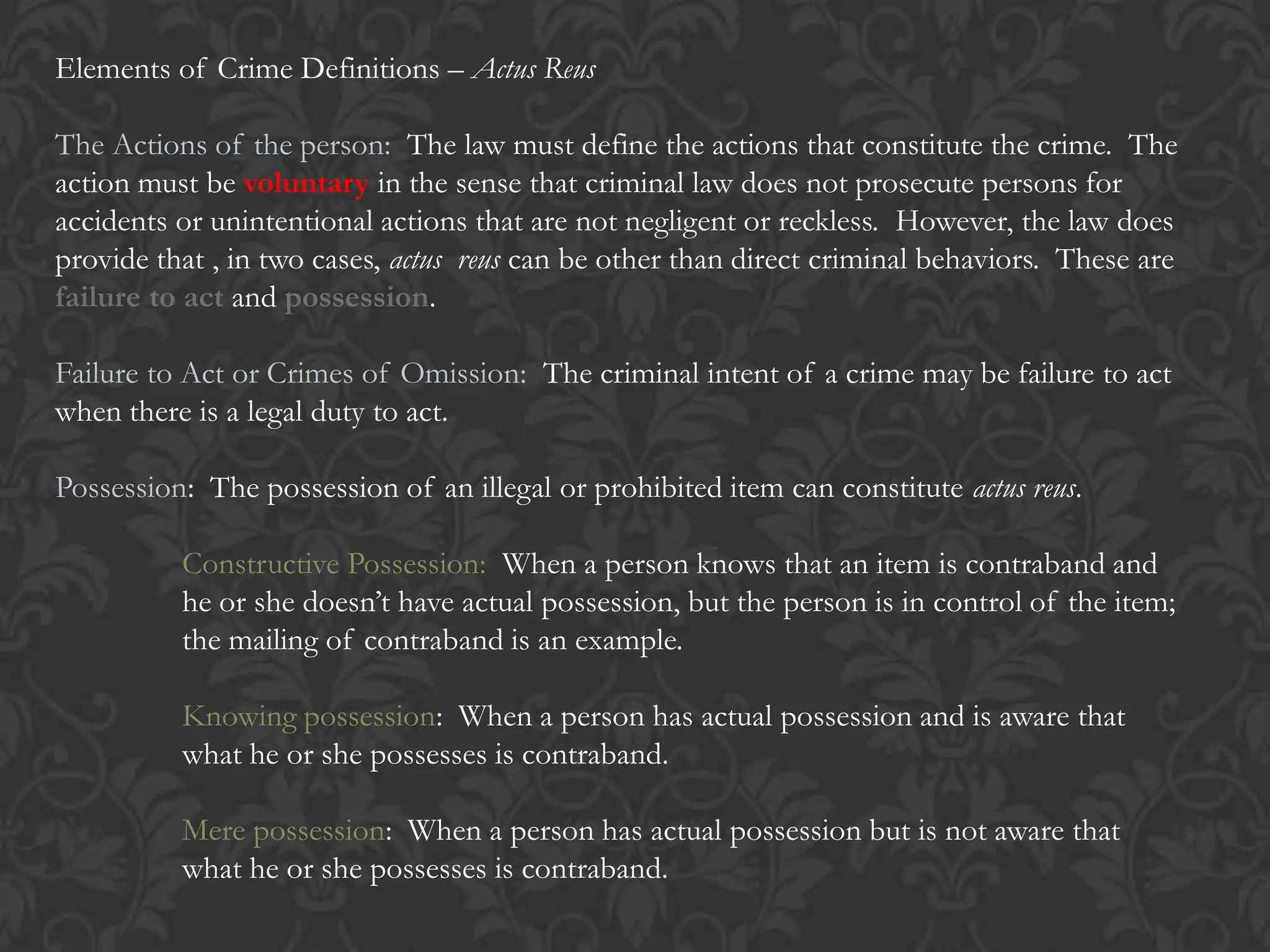
Elements of Crime Definitions – Actus Reus
The Actions of the person: The law must define the actions that constitute the crime. The
action must be voluntary in the sense that criminal law does not prosecute persons for
accidents or unintentional actions that are not negligent or reckless. However, the law does
provide that , in two cases, actus reus can be other than direct criminal behaviors. These are
failure to act and possession.
Failure to Act or Crimes of Omission: The criminal intent of a crime may be failure to act
when there is a legal duty to act.
Possession: The possession of an illegal or prohibited item can constitute actus reus.
Constructive Possession: When a person knows that an item is contraband and
he or she doesn’t have actual possession, but the person is in control of the item;
the mailing of contraband is an example.
Knowing possession: When a person has actual possession and is aware that
what he or she possesses is contraband.
Mere possession: When a person has actual possession but is not aware that
what he or she possesses is contraband.
Element of a Crime Definitions – Mens rea
The intent of the person: The person must have criminal intent or “a guilty mind.” The action
must intend harm. The only direct evidence of mens rea is the defendant’s confession. Otherwise,
in criminal law, mens rea is determined primarily be circumstantial or indirect evidence. There are
four types of criminal intent:
General intent: This refers to the commonsense understanding that an action may
cause harm. The law infers what commonsense suggests, even if the defendant
denies the intent.
Specific intent: This refers to the actions taken to knowingly commit a crime; for
instance, larceny requires taking property with the intent to permanently deprive the
owner of that property.
Transferred intent: This covers incidences in which a person injures another put did
not intend to harm that person. This includes a case in which a person is intending to
hurt someone, but misses and an innocent third party is injured.
Constructive Intent: This refers to a situation in which a person does not intend to
harm anyone but should have know that his or her actions created a risk.
Shooting a gun into the air on New Year’s Even is an example of this.
The Model Penal Code distinguishes four types of intent:
Purposely
Knowingly
Recklessly
Negligently
Each has a lesser degree of criminal intent, and will have a
lesser punishment assigned. For instance, a person who
purposely causes the death of another is guilty of
murder, whereas someone who causes the death recklessly is
guilty of manslaughter.
The Broken Window Theory:
The underlying theme of community policing is a partnership between the police
and the community. In this partnership, the police become problem
identifiers, dispute resolvers, and managers of relations rather than crime
fighters, law enforcers, and the “thin blue line”.
Underlying this strategy of public order is “the broken window theory”. It is an
interesting experiment – an automobile was parked in a neighborhood and left. It
was discovered that the automobile was more quickly vandalized if a window on
the parked vehicle was broken than if the automobile was left undamaged. The
message sent by the broken window was, “Nobody cares – other acts of vandalism
are ok.”
When applied to a neighborhood, the broken window theory means that if vacant
buildings are left untended, if graffiti is tolerated, and if public order violations
such as public drinking, disruptive behavior by youths, and vandalism are
permitted, these will be signals to people that nobody cares about the
community, leading to more serious disorder and crime.
Zero-tolerance strategy
Police Officers and the Law
Even for serious felonies such as murder, rape, and child sex
offenses, failure to provide the accused the rights guaranteed
to them or to follow required procedural law can result in their
release from the criminal justice system. The police are
responsible for the detection and investigation of crimes and
for the arrest of the alleged offender. However, as they
perform these responsibilities they are required to do so
without violating the rights of the accused.
Procedural law is a body of laws for how things should be
done at each stage of the criminal justice process.
Rules of Evidence
The police have the primary responsibility for detecting and
investigating crime, gathering evidence to present in court, and arresting
suspects. However, they do not have unrestricted powers in fulfilling
these responsibilities and must perform these duties within prescribed
limits set by legislation, judicial oversight, and the Constitution. One of
the most influential criminal justice agencies regulating police behavior
is the U.S. Supreme Court. The Supreme Court has the power to
review cases to determine whether the constitutional rights of the
accused have been preserved. It also has the power to establish the
rules by which courts operate. Rules that relate to the presentation of
evidence in a trial are called the rules of evidence.
Rules of Evidence stipulate the requirements for
introducing evidence and define the qualifications of an expert
witness and the nature of the testimony he or she may give.
According to the rules, the prosecutor must show the defense the
evidence he or she has gathered against the defendant.
Rules of evidence affect police officers’ conduct because collecting
evidence is part of their job. If evidence is not collected properly, it
can be declared inadmissible, in which case it cannot be used against
a defendant.
For example, If a defendant is on trial for the illegal possession of
drugs and the drugs that he or she is accused of possessing are
declared inadmissible as evidence, the prosecutor cannot present this
evidence to the jury. The prosecutor has no case.
The Exclusionary Rule
Evidence can be declared inadmissible under the exclusionary rule, which
prohibits the use of evidence or testimony obtained in violation of civil liberties
and rights protected by the U. S. Constitution. The exclusionary rule originated
with the 1914 Supreme Court case Weeks v. United States. In the Weeks
case, the U.S. Supreme Court ruled that evidence against Weeks that had been
obtained without a warrant was in violation of his protections under the Fourth
Amendment.
Initially, the exclusionary rule applied only to federal courts. The rights
guaranteed by the First Amendment (Freedom of Speech and Freedom of
Association), the Fourth Amendment (Privacy and Search and Seizure), the
Fifth Amendment (Self incrimination and double jeopardy) and the Sixth
Amendment (the right to confront witnesses) did not apply to the actions of
local police or state courts. Until 1949, state courts were free to write their own
rules of evidence.
Fruit of the Poisoned Tree Doctrine
At first, the exclusionary rule established in the Weeks case applied only to primary
(directly obtained) evidence, but not to secondary evidence. For example, if federal
agents obtained the business books of a company by unconstitutional means, those books
could not be used as evidence to incriminate the defendant, but a copy of the information
could. Also, inadmissible evidence could lead to other evidence, which then could be
introduced in court. Thus, if an unconstitutional search produced a map indicating where
a defendant had buried the body of the person her or she was accused of murdering, the
map could not be introduced as evidence. However, using the knowledge obtained from
the map, police officers could find the body and introduce it as evidence.
Four years after the Weeks decision, the Supreme Court reconsidered the exclusionary
rule and added another rule of evidence, known as the fruit of the poisoned tree
doctrine. The name of the doctrine comes from the analogy that if the tree is
“poisoned”, then the “fruit” of the tree will also be poisoned. In Silverthorne Lumber
Co. v. United States (1918), the Supreme Court declared that the rules of evidence applied
not only to evidence directly obtained by illegal means but also to any other evidence
obtained indirectly. Under this rule, the business books and the body found through the
aid of the map are not admissible as evidence.
Application to State Courts: Mapp v. Ohio
Historically, the Supreme Court did not interfere with state courts. With the incorporation of
the exclusionary rule, this practice started to change. Without any “punishment” for gathering
evidence and obtaining confessions contrary to constitutional protections, local and state law
enforcement officers paid little attention to the federal constitutional rights of citizens. It was
common practice for police to search without a warrant or probable cause, obtain confessions
by the use of force, and in general ignore the constitutional rights of suspects. Then, in 1961,
in Mapp v. Ohio, the U.S. Supreme Court reversed itself and required state courts to use the
exclusionary rule.
Dolree Mapp’s case…………………
Search incident to arrest………………….
Plain view searches……………………..

Techmical skills assessment review

  • 1.
  • 2.
    There are 4phenomena that stirred interest in the criminal justice system and led to its prominence as one of the most examined and criticized aspects of the government. The Civil Rights Movement The Vietnam War The rising crime rate and the public’s increased awareness of it The Terrorist Attacks of September 11, 2001 In many respects, these four influences were interrelated and cumulative in their effect on the criminal justice system. MAJOR EVENTS IN US HISTORY THAT HELPED SHAPE THE CRIMINAL JUSTICE SYSTEM AS WE KNOW IT TODAY
  • 3.
    The Civil RightsAct of 1964 Protests against institutional racism and U.S. involvement in the Vietnam War posed major challenges to the criminal justice system. Prior to the Civil Rights Act of 1964, businesses, hotels, restaurants, and public transportation could and did refuse service with impunity to Black citizens. Autherine Lucy – University of Alabama, 1956 Civil rights leader Martin Luther King Jr. promoted the tactic of civil disobedience, which also challenged the criminal justice system. One of the most well-known examples of civil disobedience occurred in 1955 when Rosa Parks refused to move to the rear of the bus, as required by law, and was arrested. Although King advocated non-violence, there were many who rioted.
  • 4.
    The Vietnam War Politicalprotests against U.S. involvement in the Vietnam War also generated acrimonious conflict in which the police often were captured on film engaged in brutality against the protesters. Kent State University – 1970 During this period, the crime rate continued to climb to the point that, according to a 1965 Gallup poll, American’s viewed crime as the most serious problem in the country. In 1968 31 percent of Gallup survey respondents said they were afraid to walk in their own neighborhoods at night. By the end of 1972, the number had risen to 42%. Most citizens thought that the police were part of the cause, not the solution, to the rising crime rate. The President’s Commission on Law Enforcement and Administration of Justice concluded that most people had lost confidence in the ability of the police to maintain law and order.
  • 5.
    The criminal justicesystem appeared to be failing. To counter the attack of crime and social disorder, on July 25, 1965, President Lyndon Johnson declared a War on Crime. He authorized a series of federal presidential commissions to study crime and justice in the United States and to recommend suggested reforms to restore public confidence. The findings of the President’s Crime Commission concluded that fear of crime had eroded the basic quality of life for many Americans. It also recognized the importance of crime prevention, as opposed to crime fighting, and the necessity of eliminating injustices in the criminal justice system. THE WAR ON CRIME
  • 6.
    In response torecommendations of the PCC and demands from the public, substantial resources were added to the criminal justice system. To attract better-qualified personnel, police departments had to increase salaries; as a result, policing costs skyrocketed in major cities like Kansas City. To help defray these costs, local and state governments sought assistance from the federal government, whose response was to pass the Omnibus Crime Control and Safe Streets Act of 1968. This Act created the Law Enforcement Assistance Administration (LEAA)and the Law Enforcement Educational Program (LEEP). The LEAA acted as a conduit for the transfer of federal funds to state and local law enforcement agencies. However, these funds were not without “strings”. OMNIBUS CRIME CONTROL AND SAFE STREETS ACT OF 1968
  • 7.
    The LEAA appointedthe National Commission on Criminal Justice Standards and Goals, which had the purpose of formulation specific standards and goals for police, courts, corrections, juvenile justice, and crime prevention. To receive the generous funds available from the federal government, local and state agencies had to show that they had implemented the commission’s standards and goals. May of the advances made within law enforcement agencies were a result of compliance with standards and goals necessary to qualify for federal funds. The Law Enforcement Educational Program (LEEP) was a branch of the LEAA> The goal of LEEP was to promote education among criminal justice personnel. After massive amounts of federal assistance, numerous reform efforts, and the adoption of innovative strategies by police, courts, and corrections, public confidence in the criminal justice system was restored and the crime rate dropped. Residents of large cities reported that they felt safe using public transportation. Violent crime rates for nearly all categories dropped. Things were looking up for public confidence in the criminal justice system until September 11th, 2001.
  • 8.
    The biggest crisisin the twenty- first century was caused by a foreign attack on the United States. Just as President Johnson had declared a war on crime, President Bush declared a War on Terrorism.
  • 9.
    Criminal Law/Control VersusLiberty After breaking away from England, the American colonists rejected both the Church and the king as supreme authorities and declared that the United States is founded on the superiority of the rule of law. The rule of law declares that the standards of behavior and privilege are established not by kings or religious leaders, but by rules and procedures that define and prohibit certain behaviors as illegal or criminal and prescribe punishments for those behaviors. All people, regardless of rank, title, position, status, or wealth, are accorded the same rights and privileges under the law. Three major categories of law are civil law, administrative law, and criminal law.
  • 10.
    The Making ofLaw Why do governments – local, state, and federal – create criminal laws? The American Law Institute, a private, voluntary association of distinguished judges, lawyers, and law teachers, give five reasons for the establishment of laws: 1. to forbid and prevent conduct that unjustifiably and inexcusably inflicts or threatens substantial harm to individual or public interests 2. to subject to public control persons whose conduct indicate that they are disposed to commit crimes 3. to safeguard conduct that is without fault from condemnation as criminal 4. to give fair warning of the nature of the conduct declared to constitute an offense 5. to differentiate on reasonable grounds between serious and minor offenses.
  • 11.
    Mala in se SpecificLaws might be passed because they prohibit actions that are thought to be harmful to society. For example, Prohibitions against murder, rape, robbery, and arson are seen as serving all people in society. Such acts are prohibited because they are considered harmful in themselves, or mala en se.
  • 12.
    Mala Prohibita Other lawsmight be passed because some people feel that there is a need to regulate certain actions; thus for example, there are parking regulations, minimum drinking-age limits, and various licensing regulations. Acts that violate such regulations are mala prohibita- prohibited only because of the law and not because they are necessarily harmful or inherently evil.
  • 13.
    Seven benchmarks areused to assess the legality of criminal laws. Principal of Legality Ex Post Facto Laws Due Process Void for Vagueness Right to Privacy Void for Overbreadth Cruel and Unusual Punishment THE LIMITS OF THE LAW
  • 14.
    #1: Principal ofLegality The government cannot punish citizens for specific conduct if no specific laws exist forewarning them that the conduct is prohibited or required. The principal of legality, which has its roots in the Roman Empire, requires that laws must be made public before they can be enforced. THE LIMITS OF THE LAW
  • 15.
    2. Ex PostFacto Laws Ex post facto (“after the fact”) laws are related to the principle of legality. The ex post facto principle declares that persons cannot be punished for actions committed before the law prohibiting the behavior was passed. The principle of ex post facto also prohibits the government from increasing the punishment for a specific crime after the crime has been committed. THE LIMITS OF THE LAW
  • 16.
    #3. Due Process Thereare two types of due process rights: substantive and procedural. Substantive due process limits the power of government to create crimes unless there is a compelling and substantial public interest in regulating or prohibiting a certain type of conduct. THE LIMITS OF THE LAW
  • 17.
    Due process, continued…… Proceduraldue process requires the government to follow established procedures and to treat defendants equally. Procedural laws regulate the conduct of the police, the courts, and the criminal justice system in general. These laws, called rules of evidence, define, for example what is fair treatment, what order of events must be followed, what types of evidence can be admitted at a trial, and the rights of the defendants. THE LIMITS OF THE LAW
  • 18.
    Procedural due process,continued…. Because of procedural due process, case law precedents play a significant role in adjudication in the U. S. system of justice. Attorneys can argue that the court must allow similar evidence or testimony as was admitted in the past in similar cases. This system of case law is called stare decisis. THE LIMITS OF THE LAW
  • 19.
    #4: Void forVagueness The law must say what it means and mean what it says. Laws that do not provide reasonable guidelines that define the specific prohibited behaviors are void for vagueness. Laws must use wording that clearly specifies what behavior or act is unlawful. Vague wording subject to different interpretations, such as immoral, indecent, too close, and interfere with, does not provide the average person with sufficient information to determine whether his or her behavior is in violation of the law. THE LIMITS OF THE LAW
  • 20.
    #5: Right toPrivacy Laws that violate reasonable personal privacy may be declared void. The right to privacy is not clearly delineated in the U. S. Constitution, but it is a constructed right, inferred from the provisions of the First, Third, Fourth and Ninth amendments. Some state constitutions such as Alaska, Florida and Hawaii, have explicit rights to privacy. Child Pornography The Supreme Court has upheld state statutes making it a crime to possess child pornography. Thus, privacy is not an overarching right that permits otherwise harmful or prohibited behaviors merely because they are performed in one’s own home. THE LIMITS OF THE LAW
  • 21.
    #6: Void forOverbreadth Laws that have been declared void for overbreadth are laws that have gone too far; that is , in an attempt to prevent a specific conduct, the law not only makes that conduct illegal, but it also prohibit other behaviors that are legally protected. A law that is void for overbreadth is not vague in what it prohibits; rather it simply prohibits legal activities as well as illegal activities. THE LIMITS OF THE LAW
  • 22.
    #7: Cruel andUnusual Punishment To be valid, a law must specify the punishment to be applied for violation of the law. If that punishment is in violation of the Eighth Amendment, which prohibits cruel and unusual punishment, it may be declared unconstitutional. This legal philosophy appears to be based on the premise of classical criminology that punishment should be appropriate to the crime. Although the argument of cruel and unusual punishment has frequently been applied to cases involving the death penalty, the focus of the prohibition is on applying the principle of proportionality for the appropriate punishment for a crime. THE LIMITS OF THE LAW
  • 23.
    Punishments specified bylaw are based on the principle of proportionality. Less-serious harms, such as misdemeanors, carry lesser punishments that do more serious harms, which are felonies. However, even for felonies, there are various degrees of punishment. Determining what punishment should be attached to a crime depends on the conduct and the intention of the actor or perpetrator. The actions and intentions of a person who commits a crime are called the elements of a crime. Each crime is defined by these elements. Two important elements are actus reus and mens rea. ELEMENTS OF A CRIME
  • 24.
  • 25.
    Elements of CrimeDefinitions – Actus Reus The Actions of the person: The law must define the actions that constitute the crime. The action must be voluntary in the sense that criminal law does not prosecute persons for accidents or unintentional actions that are not negligent or reckless. However, the law does provide that , in two cases, actus reus can be other than direct criminal behaviors. These are failure to act and possession. Failure to Act or Crimes of Omission: The criminal intent of a crime may be failure to act when there is a legal duty to act. Possession: The possession of an illegal or prohibited item can constitute actus reus. Constructive Possession: When a person knows that an item is contraband and he or she doesn’t have actual possession, but the person is in control of the item; the mailing of contraband is an example. Knowing possession: When a person has actual possession and is aware that what he or she possesses is contraband. Mere possession: When a person has actual possession but is not aware that what he or she possesses is contraband.
  • 26.
    Element of aCrime Definitions – Mens rea The intent of the person: The person must have criminal intent or “a guilty mind.” The action must intend harm. The only direct evidence of mens rea is the defendant’s confession. Otherwise, in criminal law, mens rea is determined primarily be circumstantial or indirect evidence. There are four types of criminal intent: General intent: This refers to the commonsense understanding that an action may cause harm. The law infers what commonsense suggests, even if the defendant denies the intent. Specific intent: This refers to the actions taken to knowingly commit a crime; for instance, larceny requires taking property with the intent to permanently deprive the owner of that property. Transferred intent: This covers incidences in which a person injures another put did not intend to harm that person. This includes a case in which a person is intending to hurt someone, but misses and an innocent third party is injured. Constructive Intent: This refers to a situation in which a person does not intend to harm anyone but should have know that his or her actions created a risk. Shooting a gun into the air on New Year’s Even is an example of this.
  • 27.
    The Model PenalCode distinguishes four types of intent: Purposely Knowingly Recklessly Negligently Each has a lesser degree of criminal intent, and will have a lesser punishment assigned. For instance, a person who purposely causes the death of another is guilty of murder, whereas someone who causes the death recklessly is guilty of manslaughter.
  • 28.
    The Broken WindowTheory: The underlying theme of community policing is a partnership between the police and the community. In this partnership, the police become problem identifiers, dispute resolvers, and managers of relations rather than crime fighters, law enforcers, and the “thin blue line”. Underlying this strategy of public order is “the broken window theory”. It is an interesting experiment – an automobile was parked in a neighborhood and left. It was discovered that the automobile was more quickly vandalized if a window on the parked vehicle was broken than if the automobile was left undamaged. The message sent by the broken window was, “Nobody cares – other acts of vandalism are ok.” When applied to a neighborhood, the broken window theory means that if vacant buildings are left untended, if graffiti is tolerated, and if public order violations such as public drinking, disruptive behavior by youths, and vandalism are permitted, these will be signals to people that nobody cares about the community, leading to more serious disorder and crime. Zero-tolerance strategy
  • 29.
    Police Officers andthe Law Even for serious felonies such as murder, rape, and child sex offenses, failure to provide the accused the rights guaranteed to them or to follow required procedural law can result in their release from the criminal justice system. The police are responsible for the detection and investigation of crimes and for the arrest of the alleged offender. However, as they perform these responsibilities they are required to do so without violating the rights of the accused. Procedural law is a body of laws for how things should be done at each stage of the criminal justice process.
  • 30.
    Rules of Evidence Thepolice have the primary responsibility for detecting and investigating crime, gathering evidence to present in court, and arresting suspects. However, they do not have unrestricted powers in fulfilling these responsibilities and must perform these duties within prescribed limits set by legislation, judicial oversight, and the Constitution. One of the most influential criminal justice agencies regulating police behavior is the U.S. Supreme Court. The Supreme Court has the power to review cases to determine whether the constitutional rights of the accused have been preserved. It also has the power to establish the rules by which courts operate. Rules that relate to the presentation of evidence in a trial are called the rules of evidence.
  • 31.
    Rules of Evidencestipulate the requirements for introducing evidence and define the qualifications of an expert witness and the nature of the testimony he or she may give. According to the rules, the prosecutor must show the defense the evidence he or she has gathered against the defendant. Rules of evidence affect police officers’ conduct because collecting evidence is part of their job. If evidence is not collected properly, it can be declared inadmissible, in which case it cannot be used against a defendant. For example, If a defendant is on trial for the illegal possession of drugs and the drugs that he or she is accused of possessing are declared inadmissible as evidence, the prosecutor cannot present this evidence to the jury. The prosecutor has no case.
  • 32.
    The Exclusionary Rule Evidencecan be declared inadmissible under the exclusionary rule, which prohibits the use of evidence or testimony obtained in violation of civil liberties and rights protected by the U. S. Constitution. The exclusionary rule originated with the 1914 Supreme Court case Weeks v. United States. In the Weeks case, the U.S. Supreme Court ruled that evidence against Weeks that had been obtained without a warrant was in violation of his protections under the Fourth Amendment. Initially, the exclusionary rule applied only to federal courts. The rights guaranteed by the First Amendment (Freedom of Speech and Freedom of Association), the Fourth Amendment (Privacy and Search and Seizure), the Fifth Amendment (Self incrimination and double jeopardy) and the Sixth Amendment (the right to confront witnesses) did not apply to the actions of local police or state courts. Until 1949, state courts were free to write their own rules of evidence.
  • 33.
    Fruit of thePoisoned Tree Doctrine At first, the exclusionary rule established in the Weeks case applied only to primary (directly obtained) evidence, but not to secondary evidence. For example, if federal agents obtained the business books of a company by unconstitutional means, those books could not be used as evidence to incriminate the defendant, but a copy of the information could. Also, inadmissible evidence could lead to other evidence, which then could be introduced in court. Thus, if an unconstitutional search produced a map indicating where a defendant had buried the body of the person her or she was accused of murdering, the map could not be introduced as evidence. However, using the knowledge obtained from the map, police officers could find the body and introduce it as evidence. Four years after the Weeks decision, the Supreme Court reconsidered the exclusionary rule and added another rule of evidence, known as the fruit of the poisoned tree doctrine. The name of the doctrine comes from the analogy that if the tree is “poisoned”, then the “fruit” of the tree will also be poisoned. In Silverthorne Lumber Co. v. United States (1918), the Supreme Court declared that the rules of evidence applied not only to evidence directly obtained by illegal means but also to any other evidence obtained indirectly. Under this rule, the business books and the body found through the aid of the map are not admissible as evidence.
  • 34.
    Application to StateCourts: Mapp v. Ohio Historically, the Supreme Court did not interfere with state courts. With the incorporation of the exclusionary rule, this practice started to change. Without any “punishment” for gathering evidence and obtaining confessions contrary to constitutional protections, local and state law enforcement officers paid little attention to the federal constitutional rights of citizens. It was common practice for police to search without a warrant or probable cause, obtain confessions by the use of force, and in general ignore the constitutional rights of suspects. Then, in 1961, in Mapp v. Ohio, the U.S. Supreme Court reversed itself and required state courts to use the exclusionary rule. Dolree Mapp’s case…………………
  • 35.
    Search incident toarrest…………………. Plain view searches……………………..