TITLE PAGE
SMART INDIA HACKATHON 2024
• Problem Statement ID – SIH1638
• Problem Statement Title- AI-Driven Crop Disease Prediction
• Theme- Agriculture, FoodTech & Rural Development
• PS Category- Software
• Team ID -
• Team Name – TECH TYRANTS
and Management System.
AI-Driven Crop Disease Management System
Proposed Solution
• Solution Overview:
2
@SIH Idea submission- Template
TECH
TYRANTS
Data Collection: Uses high-resolution crop images and real-time environmental data (temperature, humidity, etc.) through mobile and web apps.
Image Analysis: Employs Convolutional Neural Networks (CNNs) to identify and classify crop diseases from images.
Predictive Analytics: Assesses disease risk and forecasts outbreaks based on combined image and environmental data.
Recommendations: Provides tailored treatment suggestions and preventive measures.
Early Detection: Identifies
diseases early to minimize
damage.
Timely Intervention: Offers
actionable insights and
treatment
recommendations.
Data-Driven Decisions:
Empowers farmers with
informed, data-based
decisions.
Accessibility: Mobile and
web apps make it user-
friendly and accessible.
•Addressing the Problem:
•Innovation:
 Integrated Approach: Combines image analysis with environmental data.
 Advanced AI: Utilizes state-of-the-art machine learning for accurate predictions.
 Real-Time Feedback: Instant insights and alerts on disease risks.
 User-Centric: Designed for ease of use on mobile and web platforms.
TECHNICALAPPROACH
3
@SIH Idea submission- Template
TECH
TYRANTS
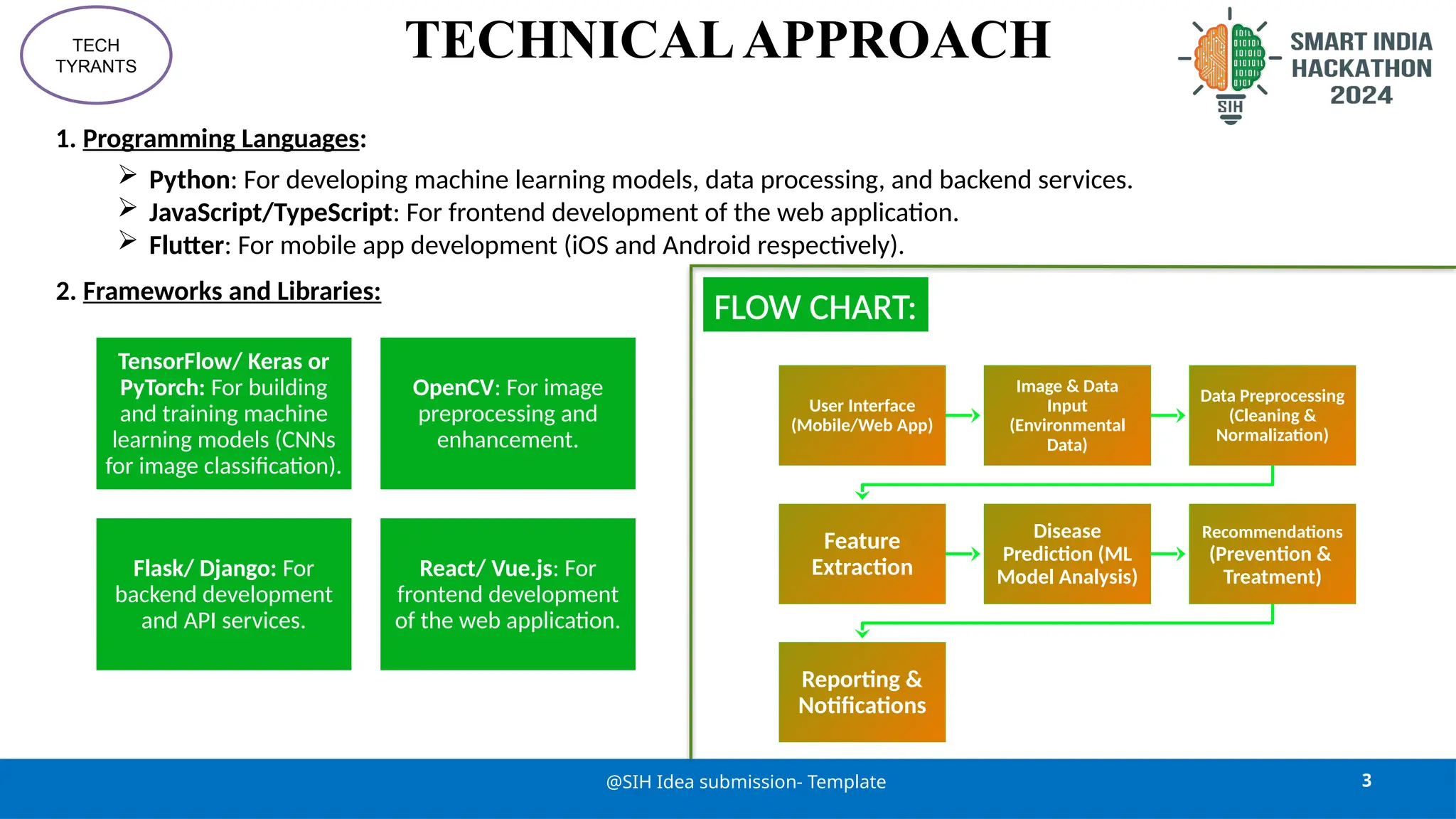
1. Programming Languages:
 Python: For developing machine learning models, data processing, and backend services.
 JavaScript/TypeScript: For frontend development of the web application.
 Flutter: For mobile app development (iOS and Android respectively).
2. Frameworks and Libraries:
TensorFlow/ Keras or
PyTorch: For building
and training machine
learning models (CNNs
for image classification).
OpenCV: For image
preprocessing and
enhancement.
Flask/ Django: For
backend development
and API services.
React/ Vue.js: For
frontend development
of the web application.
FLOW CHART:
User Interface
(Mobile/Web App)
Image & Data
Input
(Environmental
Data)
Data Preprocessing
(Cleaning &
Normalization)
Feature
Extraction
Disease
Prediction (ML
Model Analysis)
Recommendations
(Prevention &
Treatment)
Reporting &
Notifications
FEASIBILITY
4
@SIH Idea submission- Template
TECH
TYRANTS
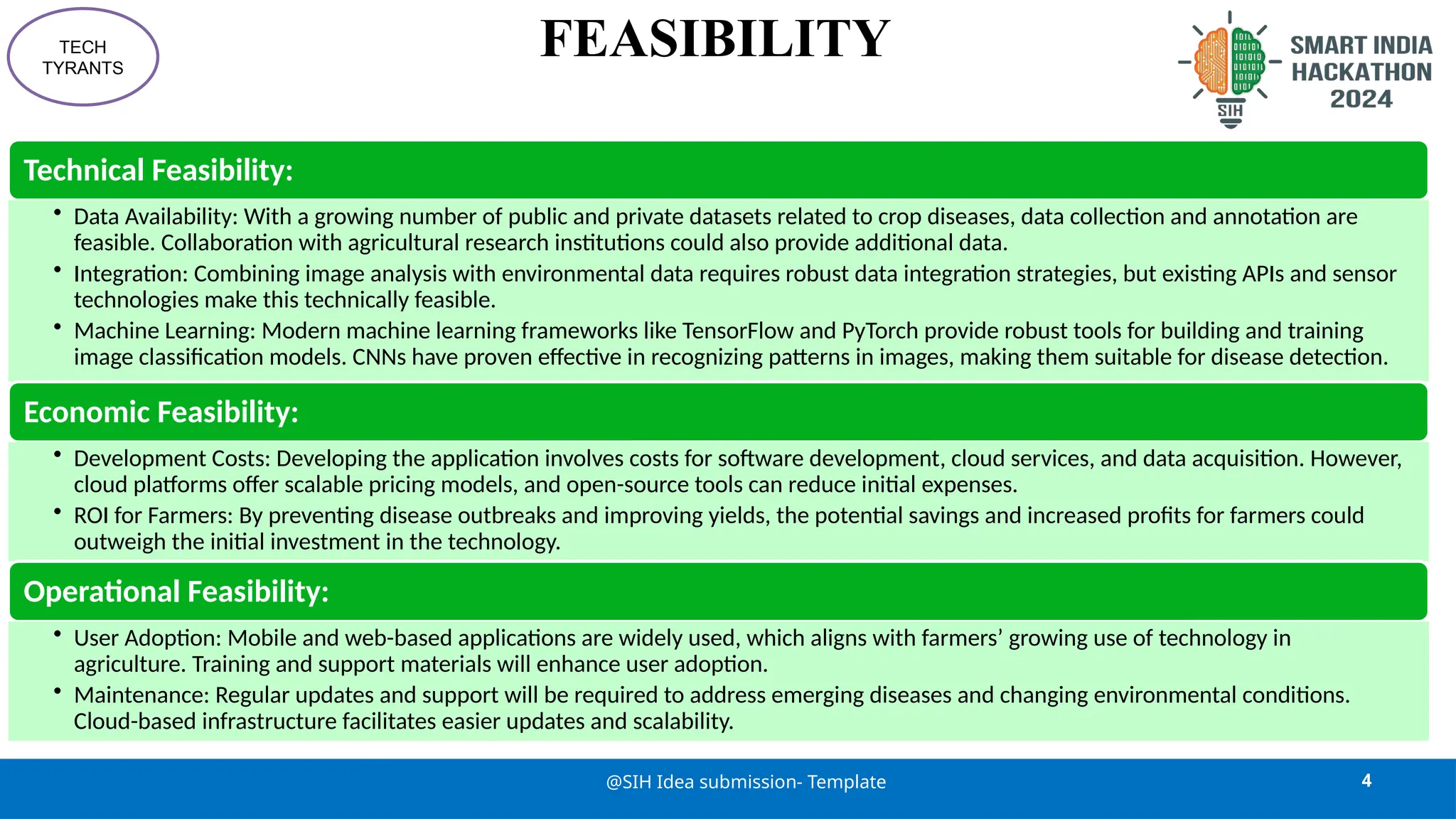
Technical Feasibility:
• Data Availability: With a growing number of public and private datasets related to crop diseases, data collection and annotation are
feasible. Collaboration with agricultural research institutions could also provide additional data.
• Integration: Combining image analysis with environmental data requires robust data integration strategies, but existing APIs and sensor
technologies make this technically feasible.
• Machine Learning: Modern machine learning frameworks like TensorFlow and PyTorch provide robust tools for building and training
image classification models. CNNs have proven effective in recognizing patterns in images, making them suitable for disease detection.
Economic Feasibility:
• Development Costs: Developing the application involves costs for software development, cloud services, and data acquisition. However,
cloud platforms offer scalable pricing models, and open-source tools can reduce initial expenses.
• ROI for Farmers: By preventing disease outbreaks and improving yields, the potential savings and increased profits for farmers could
outweigh the initial investment in the technology.
Operational Feasibility:
• User Adoption: Mobile and web-based applications are widely used, which aligns with farmers’ growing use of technology in
agriculture. Training and support materials will enhance user adoption.
• Maintenance: Regular updates and support will be required to address emerging diseases and changing environmental conditions.
Cloud-based infrastructure facilitates easier updates and scalability.
IMPACT AND BENEFITS
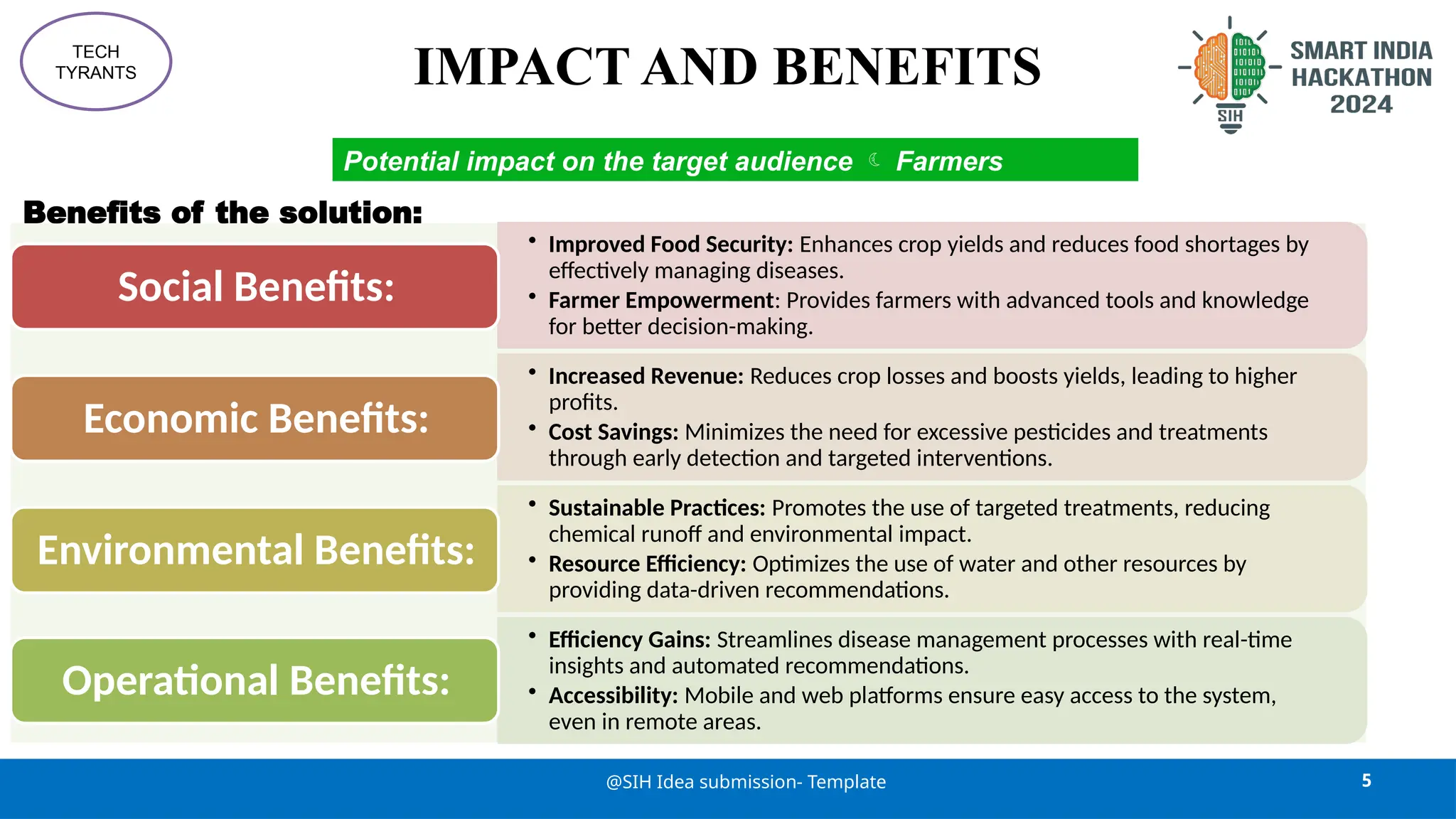
Benefits of the solution:
5
@SIH Idea submission- Template
TECH
TYRANTS
Potential impact on the target audience  Farmers
• Improved Food Security: Enhances crop yields and reduces food shortages by
effectively managing diseases.
• Farmer Empowerment: Provides farmers with advanced tools and knowledge
for better decision-making.
Social Benefits:
• Increased Revenue: Reduces crop losses and boosts yields, leading to higher
profits.
• Cost Savings: Minimizes the need for excessive pesticides and treatments
through early detection and targeted interventions.
Economic Benefits:
• Sustainable Practices: Promotes the use of targeted treatments, reducing
chemical runoff and environmental impact.
• Resource Efficiency: Optimizes the use of water and other resources by
providing data-driven recommendations.
Environmental Benefits:
• Efficiency Gains: Streamlines disease management processes with real-time
insights and automated recommendations.
• Accessibility: Mobile and web platforms ensure easy access to the system,
even in remote areas.
Operational Benefits:
RESEARCH AND REFERENCES
6
@SIH Idea submission- Template
TECH
TYRANTS
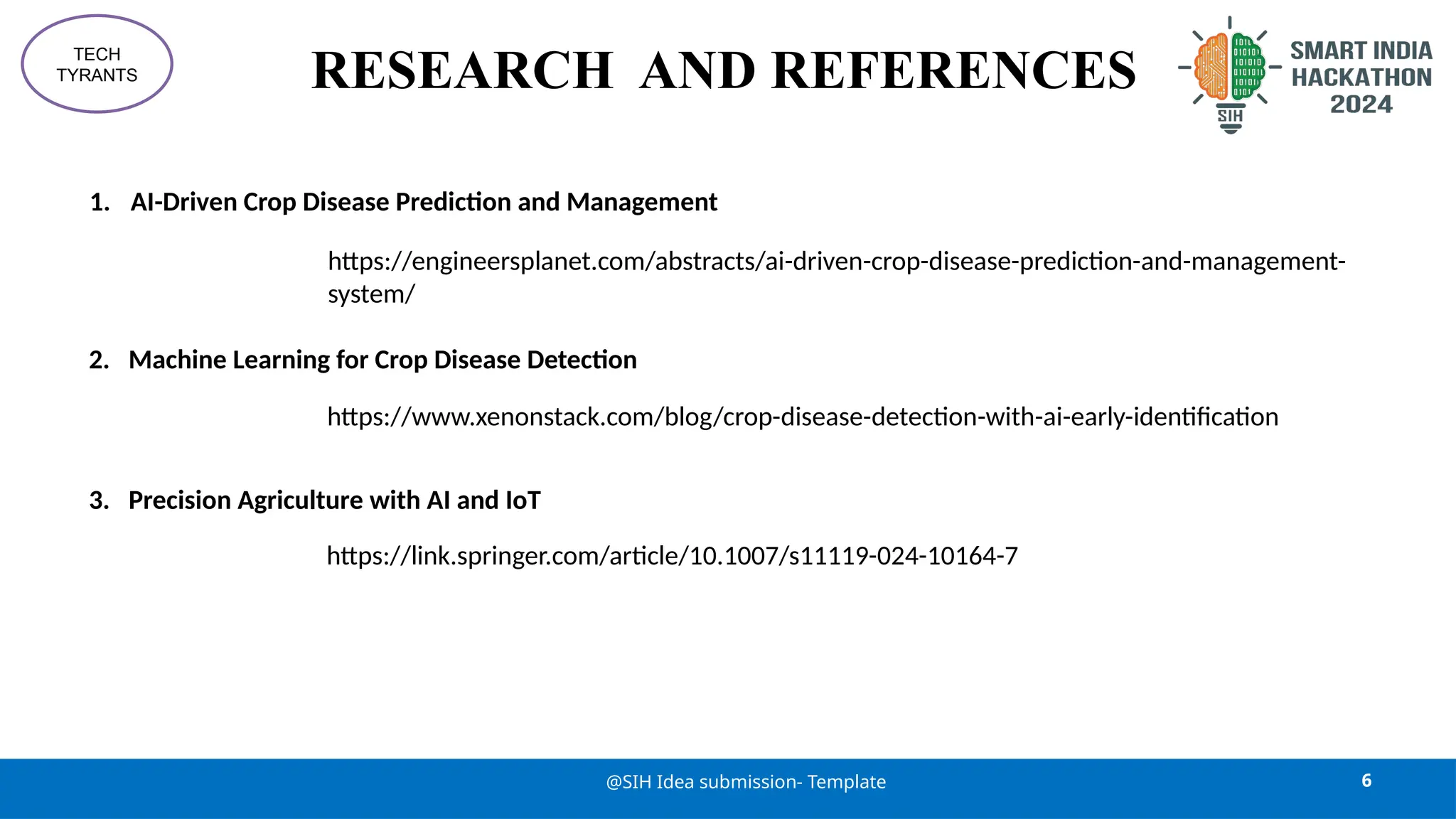
1. AI-Driven Crop Disease Prediction and Management
https://engineersplanet.com/abstracts/ai-driven-crop-disease-prediction-and-management-
system/
2. Machine Learning for Crop Disease Detection
https://www.xenonstack.com/blog/crop-disease-detection-with-ai-early-identification
3. Precision Agriculture with AI and IoT
https://link.springer.com/article/10.1007/s11119-024-10164-7
7
@SIH Idea submission- Template
1. Kindly keep the maximum slides limit up to six (6). ( Including the title slide)
2. Try to avoid paragraphs and post your idea in points /diagrams / Infographics /pictures
3. Keep your explanation precise and easy to understand
4. Idea should be unique and novel.
5. You can only use provided template for making the PPT without changing the idea details pointers
(mentioned in previous slides).
6. You need to save the file in PDF and upload the same on portal. No PPT, Word Doc or any other
format will be supported.
Note - You can delete this slide (Important Pointers) when you upload the details of your idea on SIH
portal.
IMPORTANT INSTRUCTIONS
Please ensure below pointers are met while submitting the Idea PPT:
tech tyrants (1) AI-DRIVEN CROP DISEASE PREDICTION

  • 1.
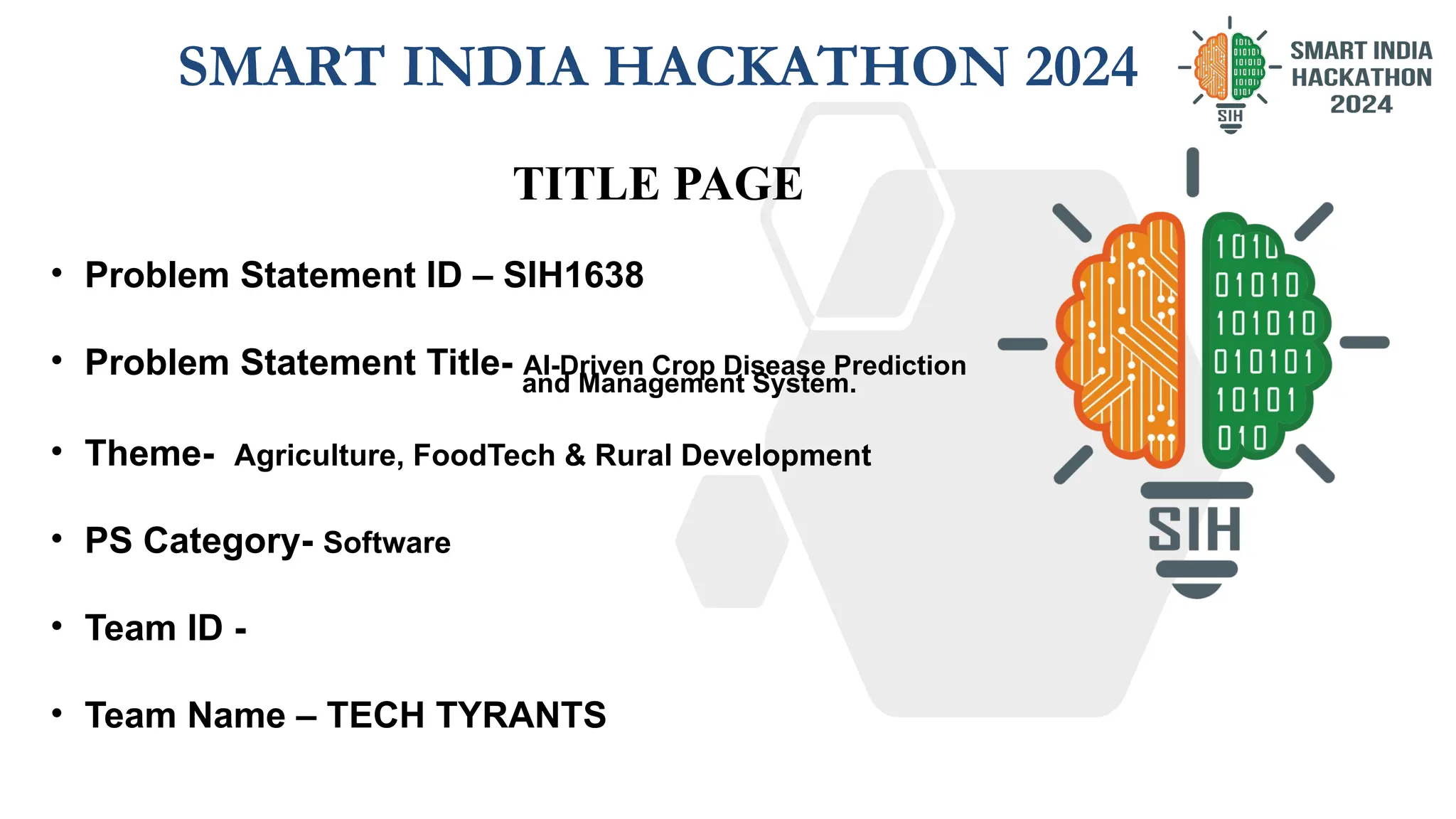
    TITLE PAGE SMART INDIAHACKATHON 2024 • Problem Statement ID – SIH1638 • Problem Statement Title- AI-Driven Crop Disease Prediction • Theme- Agriculture, FoodTech & Rural Development • PS Category- Software • Team ID - • Team Name – TECH TYRANTS and Management System.
  • 2.
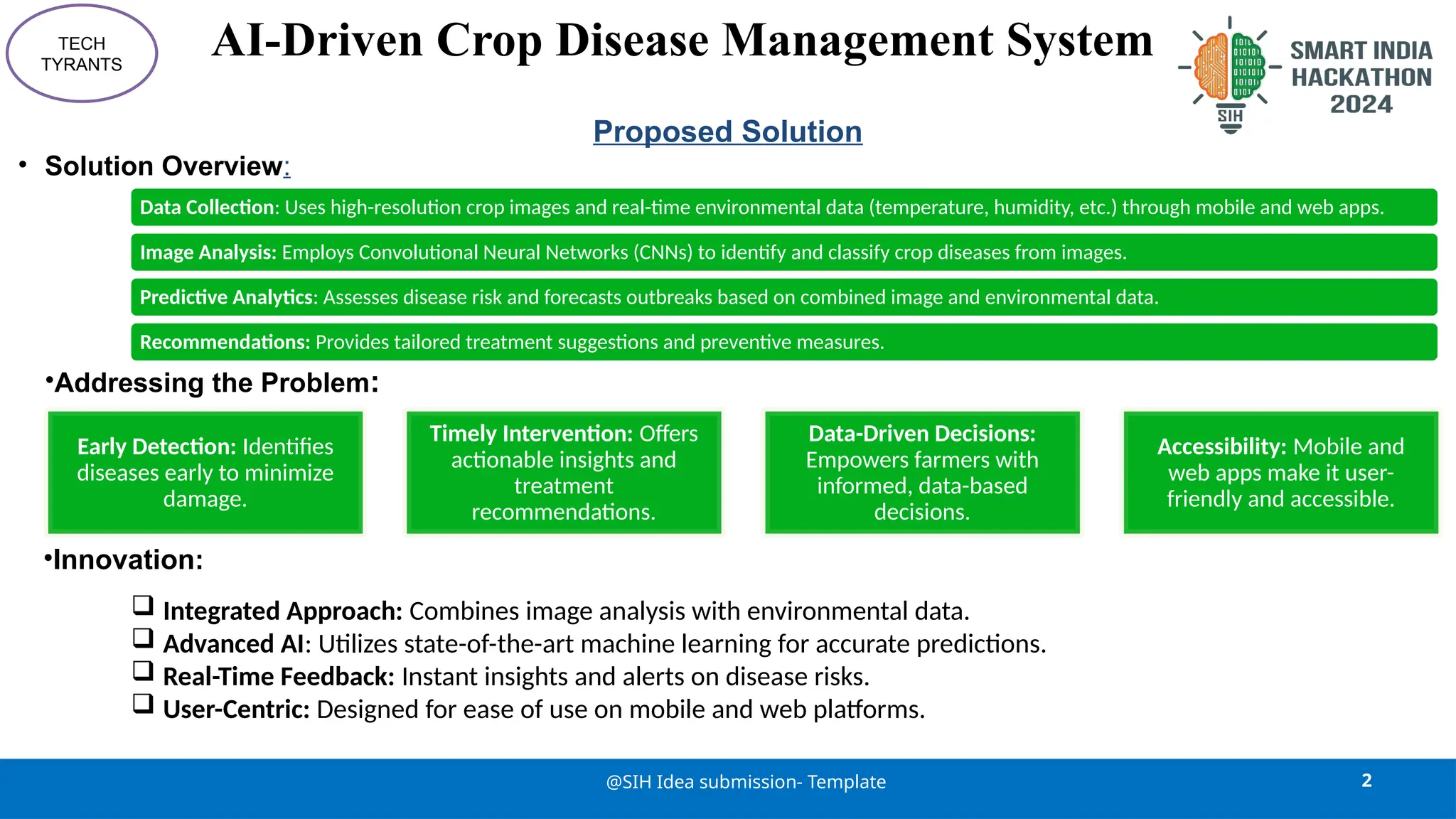
    AI-Driven Crop DiseaseManagement System Proposed Solution • Solution Overview: 2 @SIH Idea submission- Template TECH TYRANTS Data Collection: Uses high-resolution crop images and real-time environmental data (temperature, humidity, etc.) through mobile and web apps. Image Analysis: Employs Convolutional Neural Networks (CNNs) to identify and classify crop diseases from images. Predictive Analytics: Assesses disease risk and forecasts outbreaks based on combined image and environmental data. Recommendations: Provides tailored treatment suggestions and preventive measures. Early Detection: Identifies diseases early to minimize damage. Timely Intervention: Offers actionable insights and treatment recommendations. Data-Driven Decisions: Empowers farmers with informed, data-based decisions. Accessibility: Mobile and web apps make it user- friendly and accessible. •Addressing the Problem: •Innovation:  Integrated Approach: Combines image analysis with environmental data.  Advanced AI: Utilizes state-of-the-art machine learning for accurate predictions.  Real-Time Feedback: Instant insights and alerts on disease risks.  User-Centric: Designed for ease of use on mobile and web platforms.
  • 3.
    TECHNICALAPPROACH 3 @SIH Idea submission-Template TECH TYRANTS 1. Programming Languages:  Python: For developing machine learning models, data processing, and backend services.  JavaScript/TypeScript: For frontend development of the web application.  Flutter: For mobile app development (iOS and Android respectively). 2. Frameworks and Libraries: TensorFlow/ Keras or PyTorch: For building and training machine learning models (CNNs for image classification). OpenCV: For image preprocessing and enhancement. Flask/ Django: For backend development and API services. React/ Vue.js: For frontend development of the web application. FLOW CHART: User Interface (Mobile/Web App) Image & Data Input (Environmental Data) Data Preprocessing (Cleaning & Normalization) Feature Extraction Disease Prediction (ML Model Analysis) Recommendations (Prevention & Treatment) Reporting & Notifications
  • 4.
    FEASIBILITY 4 @SIH Idea submission-Template TECH TYRANTS Technical Feasibility: • Data Availability: With a growing number of public and private datasets related to crop diseases, data collection and annotation are feasible. Collaboration with agricultural research institutions could also provide additional data. • Integration: Combining image analysis with environmental data requires robust data integration strategies, but existing APIs and sensor technologies make this technically feasible. • Machine Learning: Modern machine learning frameworks like TensorFlow and PyTorch provide robust tools for building and training image classification models. CNNs have proven effective in recognizing patterns in images, making them suitable for disease detection. Economic Feasibility: • Development Costs: Developing the application involves costs for software development, cloud services, and data acquisition. However, cloud platforms offer scalable pricing models, and open-source tools can reduce initial expenses. • ROI for Farmers: By preventing disease outbreaks and improving yields, the potential savings and increased profits for farmers could outweigh the initial investment in the technology. Operational Feasibility: • User Adoption: Mobile and web-based applications are widely used, which aligns with farmers’ growing use of technology in agriculture. Training and support materials will enhance user adoption. • Maintenance: Regular updates and support will be required to address emerging diseases and changing environmental conditions. Cloud-based infrastructure facilitates easier updates and scalability.
  • 5.
    IMPACT AND BENEFITS Benefitsof the solution: 5 @SIH Idea submission- Template TECH TYRANTS Potential impact on the target audience  Farmers • Improved Food Security: Enhances crop yields and reduces food shortages by effectively managing diseases. • Farmer Empowerment: Provides farmers with advanced tools and knowledge for better decision-making. Social Benefits: • Increased Revenue: Reduces crop losses and boosts yields, leading to higher profits. • Cost Savings: Minimizes the need for excessive pesticides and treatments through early detection and targeted interventions. Economic Benefits: • Sustainable Practices: Promotes the use of targeted treatments, reducing chemical runoff and environmental impact. • Resource Efficiency: Optimizes the use of water and other resources by providing data-driven recommendations. Environmental Benefits: • Efficiency Gains: Streamlines disease management processes with real-time insights and automated recommendations. • Accessibility: Mobile and web platforms ensure easy access to the system, even in remote areas. Operational Benefits:
  • 6.
    RESEARCH AND REFERENCES 6 @SIHIdea submission- Template TECH TYRANTS 1. AI-Driven Crop Disease Prediction and Management https://engineersplanet.com/abstracts/ai-driven-crop-disease-prediction-and-management- system/ 2. Machine Learning for Crop Disease Detection https://www.xenonstack.com/blog/crop-disease-detection-with-ai-early-identification 3. Precision Agriculture with AI and IoT https://link.springer.com/article/10.1007/s11119-024-10164-7
  • 7.
    7 @SIH Idea submission-Template 1. Kindly keep the maximum slides limit up to six (6). ( Including the title slide) 2. Try to avoid paragraphs and post your idea in points /diagrams / Infographics /pictures 3. Keep your explanation precise and easy to understand 4. Idea should be unique and novel. 5. You can only use provided template for making the PPT without changing the idea details pointers (mentioned in previous slides). 6. You need to save the file in PDF and upload the same on portal. No PPT, Word Doc or any other format will be supported. Note - You can delete this slide (Important Pointers) when you upload the details of your idea on SIH portal. IMPORTANT INSTRUCTIONS Please ensure below pointers are met while submitting the Idea PPT: