1
Dr Sri.Sri.Sri. Shivakumara Mahaswamy College of
Engineering
Dept. of Computer Science and Engineering
Project(18CSP77) Phase-1 presentation on
“TECH KRISHI-KRISHI”
Presented By :
Under Guidance of :
Mr. Vijayanand B.E. M.Tech
Assistant Professor
CHANDAN SL (1CC19CS011)
GURU PRASAD H (1CC19CS019)
H CHETHAN KUMAR (1CC19CS020)
HEMA R (ICC19CS021)
DISCUSSION ON
 INTRODUCTION
 PROBLEM STATEMENT
 LITERATURE SURVEY
 HARDWARE AND SOFTWARE REQUIREMENTS
 EXISTING SYSTEM AND DRAWBACKS
 PROPOSED SYSTEM ADVANTAGES
 METHODOLOGY
 REFERENCES
2
INTRODUCTION:
Agriculture is the backbone of our Indian economy, which plays an important role in increasing our country's economic
development. The main focus of this web application is on the agricultural society because the farmers have the highest
contribution to our country's GDP.
This application provides this information to the farmer in real time and introduce farmers to the most to suitable
crops to be sown along with fertilizer recommendation and plant disease detection, thereby helping them to achieve
greater productivity with reduced loss.
• Renting Tools :At present, farmers need to travel to a place to borrow all the essential needs, which is a tiresome and not
a cost effective work. So a smart digital farming is listed as the highest ranking technology opportunity in the latest
Global Opportunity report in terms of its expected positive impact on society
• Climate: Small changes in temperature and rainfall have significant effects on the quality of crops. This application helps
in detecting suitable weather for particular crop.
• Expert Assistance : This includes contacts and feedbacks
3
PROBLEM STATEMENT
To design and develop a system using deep learning to
support farmers in early identification of plant diseases and to
recommend suitable crops & fertilizers for cultivation.
4
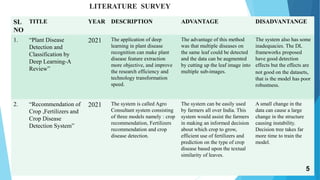
LITERATURE SURVEY
SL
NO
TITLE YEAR DESCRIPTION ADVANTAGE DISADVANTANGE
1. “Plant Disease
Detection and
Classification by
Deep Learning-A
Review”
2021 The application of deep
learning in plant disease
recognition can make plant
disease feature extraction
more objective, and improve
the research efficiency and
technology transformation
speed.
The advantage of this method
was that multiple diseases on
the same leaf could be detected
and the data can be augmented
by cutting up the leaf image into
multiple sub-images.
The system also has some
inadequacies. The DL
frameworks proposed
have good detection
effects but the effects are
not good on the datasets,
that is the model has poor
robustness.
2. “Recommendation of
Crop ,Fertilizers and
Crop Disease
Detection System”
2021 The system is called Agro
Consultant system consisting
of three models namely : crop
recommendation, Fertilizers
recommendation and crop
disease detection.
The system can be easily used
by farmers all over India. This
system would assist the farmers
in making an informed decision
about which crop to grow,
efficient use of fertilizers and
prediction on the type of crop
disease based upon the textual
similarity of leaves.
A small change in the
data can cause a large
change in the structure
causing instability.
Decision tree takes far
more time to train the
model.
5
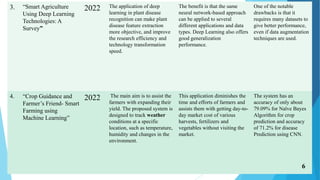
3. “Smart Agriculture
Using Deep Learning
Technologies: A
Survey”
2022 The application of deep
learning in plant disease
recognition can make plant
disease feature extraction
more objective, and improve
the research efficiency and
technology transformation
speed.
The benefit is that the same
neural network-based approach
can be applied to several
different applications and data
types. Deep Learning also offers
good generalization
performance.
One of the notable
drawbacks is that it
requires many datasets to
give better performance,
even if data augmentation
techniques are used.
4. “Crop Guidance and
Farmer’s Friend- Smart
Farming using
Machine Learning”
2022 The main aim is to assist the
farmers with expanding their
yield. The proposed system is
designed to track weather
conditions at a specific
location, such as temperature,
humidity and changes in the
environment.
This application diminishes the
time and efforts of farmers and
assists them with getting day-to-
day market cost of various
harvests, fertilizers and
vegetables without visiting the
market.
The system has an
accuracy of only about
79.09% for Naïve Bayes
Algorithm for crop
prediction and accuracy
of 71.2% for disease
Prediction using CNN.
6
7
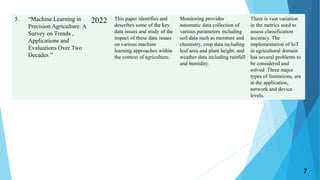
5. “Machine Learning in
Precision Agriculture: A
Survey on Trends ,
Applications and
Evaluations Over Two
Decades ”
2022 This paper identifies and
describes some of the key
data issues and study of the
impact of these data issues
on various machine
learning approaches within
the context of agriculture.
Monitoring provides
automatic data collection of
various parameters including
soil data such as moisture and
chemistry, crop data including
leaf area and plant height, and
weather data including rainfall
and humidity.
There is vast variation
in the metrics used to
assess classification
accuracy. The
implementation of IoT
in agricultural domain
has several problems to
be considered and
solved .Three major
types of limitations, are
at the application,
network and device
levels.
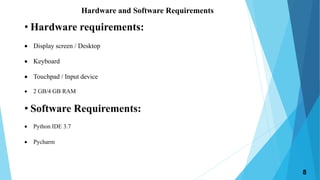
Hardware and Software Requirements
8
• Hardware requirements:
 Display screen / Desktop
 Keyboard
 Touchpad / Input device
 2 GB/4 GB RAM
• Software Requirements:
 Python IDE 3.7
 Pycharm
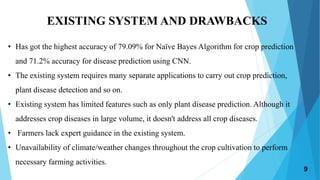
EXISTING SYSTEM AND DRAWBACKS
• Has got the highest accuracy of 79.09% for Naïve Bayes Algorithm for crop prediction
and 71.2% accuracy for disease prediction using CNN.
• The existing system requires many separate applications to carry out crop prediction,
plant disease detection and so on.
• Existing system has limited features such as only plant disease prediction. Although it
addresses crop diseases in large volume, it doesn't address all crop diseases.
• Farmers lack expert guidance in the existing system.
• Unavailability of climate/weather changes throughout the crop cultivation to perform
necessary farming activities.
9
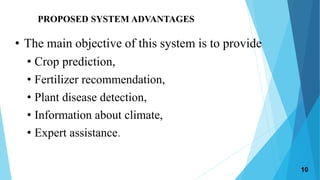
PROPOSED SYSTEM ADVANTAGES
• The main objective of this system is to provide
• Crop prediction,
• Fertilizer recommendation,
• Plant disease detection,
• Information about climate,
• Expert assistance.
10
METHODOLOGY
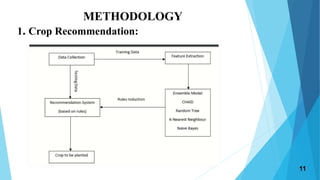
1. Crop Recommendation:
11
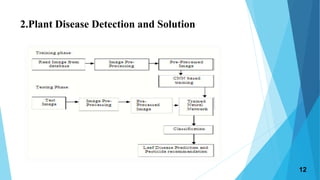
2.Plant Disease Detection and Solution
12
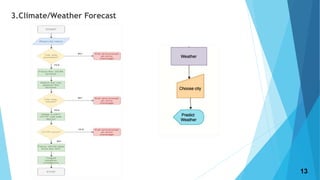
3.Climate/Weather Forecast
13
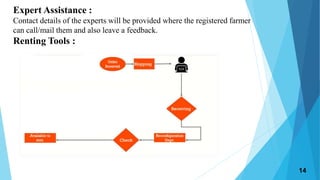
Expert Assistance :
Contact details of the experts will be provided where the registered farmer
can call/mail them and also leave a feedback.
Renting Tools :
14
REFERENCES
1. LILI LI, Shujuan Zhang, and Bin Wang, Plant disease detection and classification by
deep learning –A review,IEEE-2021
2. S. N. Uke1 , Prafulla Mahajan2 , Swapnali Chougule3 , Vaishnavi Palekar4 , Kaivalya
Kashikar, IJRASET,-2021
3. Altalak, M.; Ammad uddin, M.; Alajmi, A.; Rizg, A. Smart Agriculture Applications
Using Deep Learning Technologies: A Survey. Appl.Sci.2022.
4. Tanvi Daware, Pratiksha Ramteke, Uzma Shaikh, and Smita Bharne, Crop Guidance and
Farmer’s Friend – Smart Farming using Machine Learning, ITM Web of Conferences 44,
03021 (2022) ICACC-2022
5. Sarah Condram, Michael Bewong, MD Zahidul islam, Lancelot Maphosa, and Lihong
Zheng, Machine learning in precision agriculture: A survey on trends , applications and
evaluations over two decades, IEEE-2022.
15
Thank You
16

Krishi.pptx

  • 1.
    1 Dr Sri.Sri.Sri. ShivakumaraMahaswamy College of Engineering Dept. of Computer Science and Engineering Project(18CSP77) Phase-1 presentation on “TECH KRISHI-KRISHI” Presented By : Under Guidance of : Mr. Vijayanand B.E. M.Tech Assistant Professor CHANDAN SL (1CC19CS011) GURU PRASAD H (1CC19CS019) H CHETHAN KUMAR (1CC19CS020) HEMA R (ICC19CS021)
  • 2.
    DISCUSSION ON  INTRODUCTION PROBLEM STATEMENT  LITERATURE SURVEY  HARDWARE AND SOFTWARE REQUIREMENTS  EXISTING SYSTEM AND DRAWBACKS  PROPOSED SYSTEM ADVANTAGES  METHODOLOGY  REFERENCES 2
  • 3.
    INTRODUCTION: Agriculture is thebackbone of our Indian economy, which plays an important role in increasing our country's economic development. The main focus of this web application is on the agricultural society because the farmers have the highest contribution to our country's GDP. This application provides this information to the farmer in real time and introduce farmers to the most to suitable crops to be sown along with fertilizer recommendation and plant disease detection, thereby helping them to achieve greater productivity with reduced loss. • Renting Tools :At present, farmers need to travel to a place to borrow all the essential needs, which is a tiresome and not a cost effective work. So a smart digital farming is listed as the highest ranking technology opportunity in the latest Global Opportunity report in terms of its expected positive impact on society • Climate: Small changes in temperature and rainfall have significant effects on the quality of crops. This application helps in detecting suitable weather for particular crop. • Expert Assistance : This includes contacts and feedbacks 3
  • 4.
    PROBLEM STATEMENT To designand develop a system using deep learning to support farmers in early identification of plant diseases and to recommend suitable crops & fertilizers for cultivation. 4
  • 5.
    LITERATURE SURVEY SL NO TITLE YEARDESCRIPTION ADVANTAGE DISADVANTANGE 1. “Plant Disease Detection and Classification by Deep Learning-A Review” 2021 The application of deep learning in plant disease recognition can make plant disease feature extraction more objective, and improve the research efficiency and technology transformation speed. The advantage of this method was that multiple diseases on the same leaf could be detected and the data can be augmented by cutting up the leaf image into multiple sub-images. The system also has some inadequacies. The DL frameworks proposed have good detection effects but the effects are not good on the datasets, that is the model has poor robustness. 2. “Recommendation of Crop ,Fertilizers and Crop Disease Detection System” 2021 The system is called Agro Consultant system consisting of three models namely : crop recommendation, Fertilizers recommendation and crop disease detection. The system can be easily used by farmers all over India. This system would assist the farmers in making an informed decision about which crop to grow, efficient use of fertilizers and prediction on the type of crop disease based upon the textual similarity of leaves. A small change in the data can cause a large change in the structure causing instability. Decision tree takes far more time to train the model. 5
  • 6.
    3. “Smart Agriculture UsingDeep Learning Technologies: A Survey” 2022 The application of deep learning in plant disease recognition can make plant disease feature extraction more objective, and improve the research efficiency and technology transformation speed. The benefit is that the same neural network-based approach can be applied to several different applications and data types. Deep Learning also offers good generalization performance. One of the notable drawbacks is that it requires many datasets to give better performance, even if data augmentation techniques are used. 4. “Crop Guidance and Farmer’s Friend- Smart Farming using Machine Learning” 2022 The main aim is to assist the farmers with expanding their yield. The proposed system is designed to track weather conditions at a specific location, such as temperature, humidity and changes in the environment. This application diminishes the time and efforts of farmers and assists them with getting day-to- day market cost of various harvests, fertilizers and vegetables without visiting the market. The system has an accuracy of only about 79.09% for Naïve Bayes Algorithm for crop prediction and accuracy of 71.2% for disease Prediction using CNN. 6
  • 7.
    7 5. “Machine Learningin Precision Agriculture: A Survey on Trends , Applications and Evaluations Over Two Decades ” 2022 This paper identifies and describes some of the key data issues and study of the impact of these data issues on various machine learning approaches within the context of agriculture. Monitoring provides automatic data collection of various parameters including soil data such as moisture and chemistry, crop data including leaf area and plant height, and weather data including rainfall and humidity. There is vast variation in the metrics used to assess classification accuracy. The implementation of IoT in agricultural domain has several problems to be considered and solved .Three major types of limitations, are at the application, network and device levels.
  • 8.
    Hardware and SoftwareRequirements 8 • Hardware requirements:  Display screen / Desktop  Keyboard  Touchpad / Input device  2 GB/4 GB RAM • Software Requirements:  Python IDE 3.7  Pycharm
  • 9.
    EXISTING SYSTEM ANDDRAWBACKS • Has got the highest accuracy of 79.09% for Naïve Bayes Algorithm for crop prediction and 71.2% accuracy for disease prediction using CNN. • The existing system requires many separate applications to carry out crop prediction, plant disease detection and so on. • Existing system has limited features such as only plant disease prediction. Although it addresses crop diseases in large volume, it doesn't address all crop diseases. • Farmers lack expert guidance in the existing system. • Unavailability of climate/weather changes throughout the crop cultivation to perform necessary farming activities. 9
  • 10.
    PROPOSED SYSTEM ADVANTAGES •The main objective of this system is to provide • Crop prediction, • Fertilizer recommendation, • Plant disease detection, • Information about climate, • Expert assistance. 10
  • 11.
  • 12.
  • 13.
  • 14.
    Expert Assistance : Contactdetails of the experts will be provided where the registered farmer can call/mail them and also leave a feedback. Renting Tools : 14
  • 15.
    REFERENCES 1. LILI LI,Shujuan Zhang, and Bin Wang, Plant disease detection and classification by deep learning –A review,IEEE-2021 2. S. N. Uke1 , Prafulla Mahajan2 , Swapnali Chougule3 , Vaishnavi Palekar4 , Kaivalya Kashikar, IJRASET,-2021 3. Altalak, M.; Ammad uddin, M.; Alajmi, A.; Rizg, A. Smart Agriculture Applications Using Deep Learning Technologies: A Survey. Appl.Sci.2022. 4. Tanvi Daware, Pratiksha Ramteke, Uzma Shaikh, and Smita Bharne, Crop Guidance and Farmer’s Friend – Smart Farming using Machine Learning, ITM Web of Conferences 44, 03021 (2022) ICACC-2022 5. Sarah Condram, Michael Bewong, MD Zahidul islam, Lancelot Maphosa, and Lihong Zheng, Machine learning in precision agriculture: A survey on trends , applications and evaluations over two decades, IEEE-2022. 15
  • 16.