Project
presentation
Presented by: Pranjay Saxena
Mohd. Afzal
Plant Disease
Detection
System
Origin of the
creative idea
• Advanced Plant Disease Detection System:
Uses image processing and machine learning
algorithms.
• User-Friendly: Designed for farmers,
agronomists, and researchers with an intuitive
interface.
• Quick & Accurate: Provides reliable diagnoses
from uploaded plant images.
• High Accuracy: Reduces errors and improves
disease management.
• Benefits: Enhances crop protection, boosts
productivity, and enables faster responses to
plant health issues.
Project
Vision
Project
Mission
• Develop and deploy a state-of-the-art Plant
Disease Detection System.
• Leverage cutting-edge technologies such as
image processing and machine learning.
• Enable rapid, accurate, and reliable diagnoses of
plant diseases.
• Contribute to healthier crops and reduced
losses.
• Promote more effective disease management in
agriculture.
• Revolutionize plant health monitoring.
• Provide an advanced, easy-to-use, and
highly accurate system.
• Empower farmers, agronomists, and
researchers to detect and manage plant
diseases efficiently.
• Ensure sustainable agricultural practices.
• Enhance crop productivity.
• Rising agricultural challenges, including plant diseases, climate change, and pests,
reducing crop yields and sustainability.
• Technological advancements, particularly in image processing and machine learning,
to address complex agricultural issues with precision.
• The need for global food security, aiming to enhance food production for a growing
global population while promoting sustainable practices.
• The success of precision agriculture and the increasing use of data-driven solutions
to improve farming efficiency and productivity.
• Innovative disease detection by combining AI and Deep Learning for early plant
disease diagnosis through images, making it accessible for all users.
• User-centric design with an intuitive, easy-to-use interface for farmers to upload
images and get instant diagnoses without needing specialized knowledge.
• Customization to work with diverse crops and regions, adapting to various plant
diseases and environmental conditions.
• Real-time data analysis, enabling immediate disease management and minimizing
Inspiration :
Creativity :
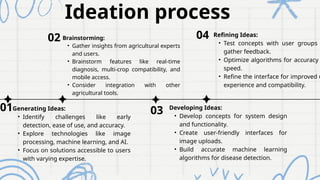
Ideation process
01
02
03
04
Generating Ideas:
• Identify challenges like early
detection, ease of use, and accuracy.
• Explore technologies like image
processing, machine learning, and AI.
• Focus on solutions accessible to users
with varying expertise.
Brainstorming:
• Gather insights from agricultural experts
and users.
• Brainstorm features like real-time
diagnosis, multi-crop compatibility, and
mobile access.
• Consider integration with other
agricultural tools.
Developing Ideas:
• Develop concepts for system design
and functionality.
• Create user-friendly interfaces for
image uploads.
• Build accurate machine learning
algorithms for disease detection.
Refining Ideas:
• Test concepts with user groups
gather feedback.
• Optimize algorithms for accuracy
speed.
• Refine the interface for improved u
experience and compatibility.
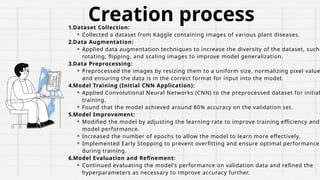
Creation process
1.Dataset Collection:
⚬ Collected a dataset from Kaggle containing images of various plant diseases.
2.Data Augmentation:
⚬ Applied data augmentation techniques to increase the diversity of the dataset, such
rotating, flipping, and scaling images to improve model generalization.
3.Data Preprocessing:
⚬ Preprocessed the images by resizing them to a uniform size, normalizing pixel value
and ensuring the data is in the correct format for input into the model.
4.Model Training (Initial CNN Application):
⚬ Applied Convolutional Neural Networks (CNN) to the preprocessed dataset for initial
training.
⚬ Found that the model achieved around 80% accuracy on the validation set.
5.Model Improvement:
⚬ Modified the model by adjusting the learning rate to improve training efficiency and
model performance.
⚬ Increased the number of epochs to allow the model to learn more effectively.
⚬ Implemented Early Stopping to prevent overfitting and ensure optimal performance
during training.
6.Model Evaluation and Refinement:
⚬ Continued evaluating the model's performance on validation data and refined the
hyperparameters as necessary to improve accuracy further.
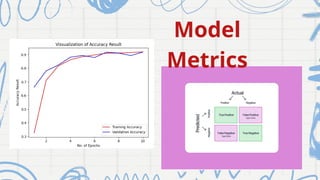
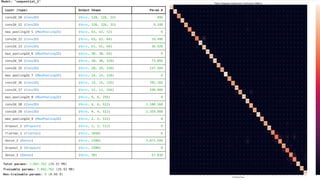
Model
Metrics
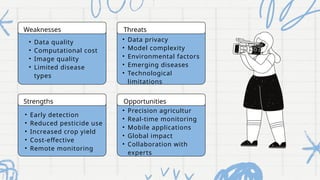
Weaknesses Threats
Strengths Opportunities
• Data quality
• Computational cost
• Image quality
• Limited disease
types
• Data privacy
• Model complexity
• Environmental factors
• Emerging diseases
• Technological
limitations
• Precision agricultur
• Real-time monitoring
• Mobile applications
• Global impact
• Collaboration with
experts
• Early detection
• Reduced pesticide use
• Increased crop yield
• Cost-effective
• Remote monitoring
Final reflections:
• Model Performance: Evaluate model's accuracy, precision, recall, and
F1-score.
• Computational Efficiency: Optimize model for faster inference time.
• Data Quality and Quantity: Prioritize high-quality and diverse training
data.
• User Interface: Develop user-friendly interface for easy image input and
diagnosis.
• Explore advanced CNN architectures for better performance.
• Develop a mobile app for farmer accessibility.
• Collaborate with experts for refined recommendations.
• Incorporate environmental factors for comprehensive analysis.
• Implement robust data privacy measures.
• Gather user feedback for continuous improvement.
• Stay updated with latest advancements in deep learning.
• Promote technology adoption through community engagement.
Future
Steps:
Thank you
very much!

Non Text Magic Studio Magic Design for Presentations L&P.pptx

  • 1.
    Project presentation Presented by: PranjaySaxena Mohd. Afzal Plant Disease Detection System
  • 2.
    Origin of the creativeidea • Advanced Plant Disease Detection System: Uses image processing and machine learning algorithms. • User-Friendly: Designed for farmers, agronomists, and researchers with an intuitive interface. • Quick & Accurate: Provides reliable diagnoses from uploaded plant images. • High Accuracy: Reduces errors and improves disease management. • Benefits: Enhances crop protection, boosts productivity, and enables faster responses to plant health issues.
  • 3.
    Project Vision Project Mission • Develop anddeploy a state-of-the-art Plant Disease Detection System. • Leverage cutting-edge technologies such as image processing and machine learning. • Enable rapid, accurate, and reliable diagnoses of plant diseases. • Contribute to healthier crops and reduced losses. • Promote more effective disease management in agriculture. • Revolutionize plant health monitoring. • Provide an advanced, easy-to-use, and highly accurate system. • Empower farmers, agronomists, and researchers to detect and manage plant diseases efficiently. • Ensure sustainable agricultural practices. • Enhance crop productivity.
  • 4.
    • Rising agriculturalchallenges, including plant diseases, climate change, and pests, reducing crop yields and sustainability. • Technological advancements, particularly in image processing and machine learning, to address complex agricultural issues with precision. • The need for global food security, aiming to enhance food production for a growing global population while promoting sustainable practices. • The success of precision agriculture and the increasing use of data-driven solutions to improve farming efficiency and productivity. • Innovative disease detection by combining AI and Deep Learning for early plant disease diagnosis through images, making it accessible for all users. • User-centric design with an intuitive, easy-to-use interface for farmers to upload images and get instant diagnoses without needing specialized knowledge. • Customization to work with diverse crops and regions, adapting to various plant diseases and environmental conditions. • Real-time data analysis, enabling immediate disease management and minimizing Inspiration : Creativity :
  • 5.
    Ideation process 01 02 03 04 Generating Ideas: •Identify challenges like early detection, ease of use, and accuracy. • Explore technologies like image processing, machine learning, and AI. • Focus on solutions accessible to users with varying expertise. Brainstorming: • Gather insights from agricultural experts and users. • Brainstorm features like real-time diagnosis, multi-crop compatibility, and mobile access. • Consider integration with other agricultural tools. Developing Ideas: • Develop concepts for system design and functionality. • Create user-friendly interfaces for image uploads. • Build accurate machine learning algorithms for disease detection. Refining Ideas: • Test concepts with user groups gather feedback. • Optimize algorithms for accuracy speed. • Refine the interface for improved u experience and compatibility.
  • 6.
    Creation process 1.Dataset Collection: ⚬Collected a dataset from Kaggle containing images of various plant diseases. 2.Data Augmentation: ⚬ Applied data augmentation techniques to increase the diversity of the dataset, such rotating, flipping, and scaling images to improve model generalization. 3.Data Preprocessing: ⚬ Preprocessed the images by resizing them to a uniform size, normalizing pixel value and ensuring the data is in the correct format for input into the model. 4.Model Training (Initial CNN Application): ⚬ Applied Convolutional Neural Networks (CNN) to the preprocessed dataset for initial training. ⚬ Found that the model achieved around 80% accuracy on the validation set. 5.Model Improvement: ⚬ Modified the model by adjusting the learning rate to improve training efficiency and model performance. ⚬ Increased the number of epochs to allow the model to learn more effectively. ⚬ Implemented Early Stopping to prevent overfitting and ensure optimal performance during training. 6.Model Evaluation and Refinement: ⚬ Continued evaluating the model's performance on validation data and refined the hyperparameters as necessary to improve accuracy further.
  • 7.
  • 9.
    Weaknesses Threats Strengths Opportunities •Data quality • Computational cost • Image quality • Limited disease types • Data privacy • Model complexity • Environmental factors • Emerging diseases • Technological limitations • Precision agricultur • Real-time monitoring • Mobile applications • Global impact • Collaboration with experts • Early detection • Reduced pesticide use • Increased crop yield • Cost-effective • Remote monitoring
  • 10.
    Final reflections: • ModelPerformance: Evaluate model's accuracy, precision, recall, and F1-score. • Computational Efficiency: Optimize model for faster inference time. • Data Quality and Quantity: Prioritize high-quality and diverse training data. • User Interface: Develop user-friendly interface for easy image input and diagnosis. • Explore advanced CNN architectures for better performance. • Develop a mobile app for farmer accessibility. • Collaborate with experts for refined recommendations. • Incorporate environmental factors for comprehensive analysis. • Implement robust data privacy measures. • Gather user feedback for continuous improvement. • Stay updated with latest advancements in deep learning. • Promote technology adoption through community engagement. Future Steps:
  • 11.