Proper Procedures and Practices  in Handling  Private & Confidential Data 23 May 2008 Wilson LEE Legal Counsel Office of the Privacy Commissioner for Personal Data
Proper Procedures and Practices  in Handling Private & Confidential Data The Law Personal Data (Privacy) Ordinance, Cap. 486 Data Protection Principles – Data user cannot contravene (s.4) Major aspects governed (1) Collection (2) Accuracy and Retention (3) Use (4) Security (5) Access
Contravention (1) Enforcement Notice (2) Criminal Prosecution – 2 years’ imprisonment  and fine $25,001-50,000. (3) Civil Claim Proper Procedures and Practices  in Handling Private & Confidential Data
DPP4 – Security of personal data Not guarantee All  reasonably practicable  steps to ensure the personal data are protected against  unauthorized  or  accidental  access, processing, erasure or other use having particular regard to :– (1) The  kind of data  and the harm that could result if  any of those things should occur; Proper Procedures and Practices  in Handling Private & Confidential Data
(2) The  physical location  where the data are stored; (3) Any  security measures  incorporated (whether by  automated means or otherwise) into any  equipment  in which the data are stored; (4) Any  measures  taken for ensuring the integrity,  prudence and competence of  persons  having  access to the data; and (5) Any  measures  taken for ensuring the secure  transmission of the data. Proper Procedures and Practices  in Handling Private & Confidential Data
What kinds of data are stored? Sensitive? Confidential?  –  HKID No., heath condition, fingerprints…  Classifying the data. Degree of harm? Proper Procedures and Practices  in Handling Private & Confidential Data
Where are the data stored? A server, a disk, a USB? – Control by data user. Terminal in common area? Locked room. Proper Procedures and Practices  in Handling Private & Confidential Data
Security measures incorporated into the storing equipment? System security. Encryption Downloading/copying allowed? – Absolutely  necessary? Remote access – Absolutely necessary?  USB? Login record System testing Proper Procedures and Practices  in Handling Private & Confidential Data
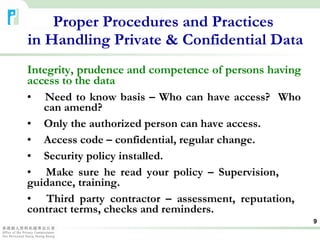
Integrity, prudence and competence of persons having access to the data Need to know basis – Who can have access?  Who  can amend? Only the authorized person can have access. Access code – confidential, regular change. Security policy installed. Make sure he read your policy – Supervision,  guidance, training. Third party contractor – assessment, reputation,  contract terms, checks and reminders. Proper Procedures and Practices  in Handling Private & Confidential Data
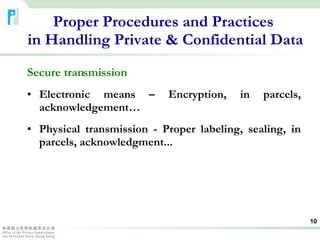
Secure transmission Electronic means – Encryption, in parcels, acknowledgement… Physical transmission - Proper labeling, sealing, in parcels, acknowledgment... Proper Procedures and Practices  in Handling Private & Confidential Data
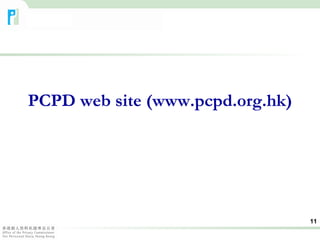
PCPD web site (www.pcpd.org.hk)
~ END ~

Tech Matrix 20080523

  • 1.
    Proper Procedures andPractices in Handling Private & Confidential Data 23 May 2008 Wilson LEE Legal Counsel Office of the Privacy Commissioner for Personal Data
  • 2.
    Proper Procedures andPractices in Handling Private & Confidential Data The Law Personal Data (Privacy) Ordinance, Cap. 486 Data Protection Principles – Data user cannot contravene (s.4) Major aspects governed (1) Collection (2) Accuracy and Retention (3) Use (4) Security (5) Access
  • 3.
    Contravention (1) EnforcementNotice (2) Criminal Prosecution – 2 years’ imprisonment and fine $25,001-50,000. (3) Civil Claim Proper Procedures and Practices in Handling Private & Confidential Data
  • 4.
    DPP4 – Securityof personal data Not guarantee All reasonably practicable steps to ensure the personal data are protected against unauthorized or accidental access, processing, erasure or other use having particular regard to :– (1) The kind of data and the harm that could result if any of those things should occur; Proper Procedures and Practices in Handling Private & Confidential Data
  • 5.
    (2) The physical location where the data are stored; (3) Any security measures incorporated (whether by automated means or otherwise) into any equipment in which the data are stored; (4) Any measures taken for ensuring the integrity, prudence and competence of persons having access to the data; and (5) Any measures taken for ensuring the secure transmission of the data. Proper Procedures and Practices in Handling Private & Confidential Data
  • 6.
    What kinds ofdata are stored? Sensitive? Confidential? – HKID No., heath condition, fingerprints… Classifying the data. Degree of harm? Proper Procedures and Practices in Handling Private & Confidential Data
  • 7.
    Where are thedata stored? A server, a disk, a USB? – Control by data user. Terminal in common area? Locked room. Proper Procedures and Practices in Handling Private & Confidential Data
  • 8.
    Security measures incorporatedinto the storing equipment? System security. Encryption Downloading/copying allowed? – Absolutely necessary? Remote access – Absolutely necessary? USB? Login record System testing Proper Procedures and Practices in Handling Private & Confidential Data
  • 9.
    Integrity, prudence andcompetence of persons having access to the data Need to know basis – Who can have access? Who can amend? Only the authorized person can have access. Access code – confidential, regular change. Security policy installed. Make sure he read your policy – Supervision, guidance, training. Third party contractor – assessment, reputation, contract terms, checks and reminders. Proper Procedures and Practices in Handling Private & Confidential Data
  • 10.
    Secure transmission Electronicmeans – Encryption, in parcels, acknowledgement… Physical transmission - Proper labeling, sealing, in parcels, acknowledgment... Proper Procedures and Practices in Handling Private & Confidential Data
  • 11.
    PCPD web site(www.pcpd.org.hk)
  • 12.