z
Teaching
Mathematics in the
Intermediate Grades
Lesson 1: Mathematics in the
Intermediate Grades
Lesson 2: Mathematics Curriculum in the
Intermediate Grades
Lesson 3: Constructivist Theory in Teaching
Mathematics in the Intermediate
Grades
z
Lesson 1: Mathematics in the Intermediate Grades
Objective: To understand the purpose of learning Mathematics in the
intermediate grades
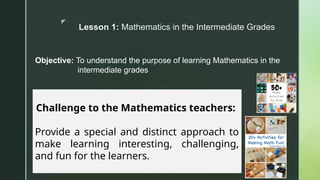
Challenge to the Mathematics teachers:
Provide a special and distinct approach to
make learning interesting, challenging,
and fun for the learners.
z Lesson 1: Mathematics in the Intermediate Grades
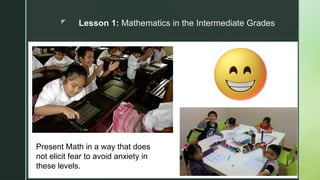
Present Math in a way that does
not elicit fear to avoid anxiety in
these levels.
z
F
Lesson 1: Mathematics in the Intermediate Grades
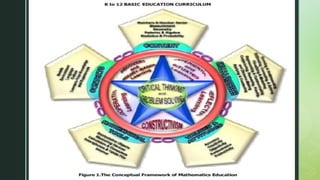
Five content areas:
1. Numbers and Number Sense
2. Geometry
3. Patterns and Algebra
4. Measurement
5. Statistics and Probability
z
F
Lesson 1: Mathematics in the Intermediate Grades
 These comprises learning standards that are opt to
follow as part of the whole Mathematics education
program
 They are necessary prerequisites to higher level of
Mathematics
 They aim to achieve the
goals of Mathematics education
z
F
Lesson 1: Mathematics in the Intermediate Grades
Main Goal of Mathematics Education:
To develop lifelong skills so that learners will be ready
to interact with the real world
-Analytical Thinking
-Critical Thinking
-Problem-Solving
z
The following notions may be avoided:
 “I am no good at Math.”
 “I fear attending my Math class.”
 There is an upcoming Math test, I am stressed out!’
If these mind-set toward Mathematics be addressed
in the elementary levels.
z
ACTIVITY
 Think-Pair-Share: Do Page 4
(Assess & Challenge)
z
Assignment:
 Do Pages 5 & 6 (Harness)
z
Lesson 2: Mathematics Curriculum in the Intermediate
Grades
Objective: To understand the features of the Philippine Mathematics
curriculum and the learning standards for Grades 4 to 6
 Main Goals of the teaching &
learning process:
 Develop critical thinking &
problem-solving skills
z
z
Lesson 2: Mathematics Curriculum in the
Intermediate Grades
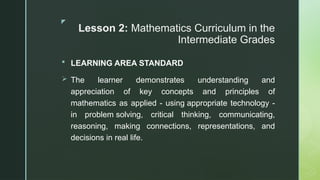
 LEARNING AREA STANDARD
 The learner demonstrates understanding and
appreciation of key concepts and principles of
mathematics as applied - using appropriate technology -
in problem solving, critical thinking, communicating,
reasoning, making connections, representations, and
decisions in real life.
z
Lesson 2: Mathematics Curriculum in the
Intermediate Grades
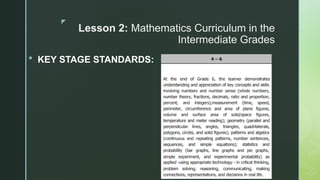
 KEY STAGE STANDARDS:
z
Lesson 2: Mathematics Curriculum in
the Intermediate Grades
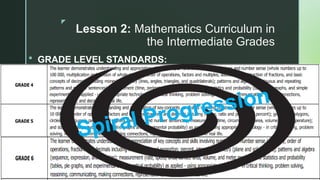
 GRADE LEVEL STANDARDS:
Spiral Progression
z
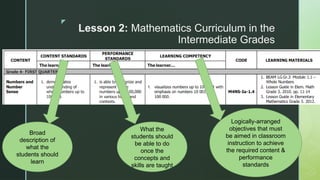
Lesson 2: Mathematics Curriculum in the
Intermediate Grades
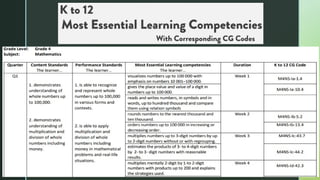
Broad
description of
what the
students should
learn
What the
students should
be able to do
once the
concepts and
skills are taught
Logically-arranged
objectives that must
be aimed in classroom
instruction to achieve
the required content &
performance
standards
z
z
ACTIVITY
 Think-Pair-Share: Do Page 10
(Assess & Challenge)
z
Assignment:
 Do Page 11 (Harness)

Teaching Mathematics in the Intermediate (L1-L2).pptx

  • 1.
    z Teaching Mathematics in the IntermediateGrades Lesson 1: Mathematics in the Intermediate Grades Lesson 2: Mathematics Curriculum in the Intermediate Grades Lesson 3: Constructivist Theory in Teaching Mathematics in the Intermediate Grades
  • 2.
    z Lesson 1: Mathematicsin the Intermediate Grades Objective: To understand the purpose of learning Mathematics in the intermediate grades Challenge to the Mathematics teachers: Provide a special and distinct approach to make learning interesting, challenging, and fun for the learners.
  • 3.
    z Lesson 1:Mathematics in the Intermediate Grades Present Math in a way that does not elicit fear to avoid anxiety in these levels.
  • 4.
    z F Lesson 1: Mathematicsin the Intermediate Grades Five content areas: 1. Numbers and Number Sense 2. Geometry 3. Patterns and Algebra 4. Measurement 5. Statistics and Probability
  • 5.
    z F Lesson 1: Mathematicsin the Intermediate Grades  These comprises learning standards that are opt to follow as part of the whole Mathematics education program  They are necessary prerequisites to higher level of Mathematics  They aim to achieve the goals of Mathematics education
  • 6.
    z F Lesson 1: Mathematicsin the Intermediate Grades Main Goal of Mathematics Education: To develop lifelong skills so that learners will be ready to interact with the real world -Analytical Thinking -Critical Thinking -Problem-Solving
  • 7.
    z The following notionsmay be avoided:  “I am no good at Math.”  “I fear attending my Math class.”  There is an upcoming Math test, I am stressed out!’ If these mind-set toward Mathematics be addressed in the elementary levels.
  • 8.
    z ACTIVITY  Think-Pair-Share: DoPage 4 (Assess & Challenge)
  • 9.
  • 10.
    z Lesson 2: MathematicsCurriculum in the Intermediate Grades Objective: To understand the features of the Philippine Mathematics curriculum and the learning standards for Grades 4 to 6  Main Goals of the teaching & learning process:  Develop critical thinking & problem-solving skills
  • 11.
  • 12.
    z Lesson 2: MathematicsCurriculum in the Intermediate Grades  LEARNING AREA STANDARD  The learner demonstrates understanding and appreciation of key concepts and principles of mathematics as applied - using appropriate technology - in problem solving, critical thinking, communicating, reasoning, making connections, representations, and decisions in real life.
  • 13.
    z Lesson 2: MathematicsCurriculum in the Intermediate Grades  KEY STAGE STANDARDS:
  • 14.
    z Lesson 2: MathematicsCurriculum in the Intermediate Grades  GRADE LEVEL STANDARDS: Spiral Progression
  • 15.
    z Lesson 2: MathematicsCurriculum in the Intermediate Grades Broad description of what the students should learn What the students should be able to do once the concepts and skills are taught Logically-arranged objectives that must be aimed in classroom instruction to achieve the required content & performance standards
  • 16.
  • 17.
    z ACTIVITY  Think-Pair-Share: DoPage 10 (Assess & Challenge)
  • 18.