TDMA & CDMA
SYSTEM
Mr.P.Balasubrimani
Understanding TDMA Systems
• Introduction to TDMA: Time Division Multiple
Access (TDMA) is a fundamental concept in modern
telecommunications and wireless communication
systems.
• Purpose of Presentation: In this presentation, we
will explore TDMA systems, their principles,
applications, and advantages.
• Importance of TDMA: TDMA plays a crucial role in
optimizing wireless communication by efficiently
allocating time slots to multiple users on the same
frequency channel.
What is TDMA?
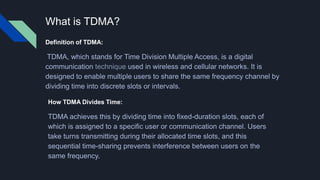
Definition of TDMA:
TDMA, which stands for Time Division Multiple Access, is a digital
communication technique used in wireless and cellular networks. It is
designed to enable multiple users to share the same frequency channel by
dividing time into discrete slots or intervals.
How TDMA Divides Time:
TDMA achieves this by dividing time into fixed-duration slots, each of
which is assigned to a specific user or communication channel. Users
take turns transmitting during their allocated time slots, and this
sequential time-sharing prevents interference between users on the
same frequency.
.
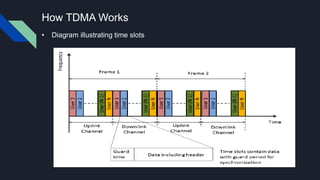
How TDMA Works
• Diagram illustrating time slots
How multiple users share the same frequency by
using time slots
• In TDMA (Time Division Multiple Access) systems, multiple users
efficiently share the same frequency by dividing time into discrete slots or
intervals.
• Each user is allocated a specific time slot within a frame, and these time
slots are organized in a repeating pattern.
• Users take turns transmitting during their assigned time slots. When one
user's time slot ends, the next user begins, and this sequential time-
sharing continues.
Advantages of TDMA
• Efficient Spectrum Utilization
• Reduced Interference
• Support for Bursty Data Traffic
• Simplified Synchronization
• Improved Battery Life
Introduction to CDMA
CDMA (Code Division Multiple Access)
• CDMA stands for Code Division Multiple Access, a digital wireless
communication technology.
• It is a method of transmitting multiple signals simultaneously over the
same frequency band by assigning a unique code to each user or
communication channel.
Significance in Wireless Communication
• CDMA is a crucial technology in wireless communication systems.
• It significantly enhances the efficiency and capacity of wireless
Key Principles of CDMA
Fundamental Principles of CDMA
● Unique Codes
● Spread Spectrum
Unique Codes for Distinguishing Users
In CDMA, each user's data is modulated with a unique code, often called a
spreading code or pseudo-noise (PN) code.
Signal Spread Across Frequency Band
CDMA in Cellular Networks
Implementation in Cellular Networks:
CDMA (Code Division Multiple Access) is a fundamental
technology used in cellular networks.
•It allows multiple users to simultaneously communicate
over the same frequency band by assigning unique codes
to each user or communication channel.
. Role in 3G and 4G Networks:
•In 3G networks, CDMA was the basis for technologies like
CDMA2000, providing high-speed data and voice services.
•In 4G networks, CDMA principles were used in the
development of Long-Term Evolution (LTE) technology,
which enhanced data speeds and network efficiency.
Benefits of CDMA
Increased Capacity:
• CDMA significantly enhances the capacity of wireless networks.
• Unlike older technologies like FDMA and TDMA, CDMA allows multiple
users to share the same frequency band simultaneously
• .
Improved Call Quality:
• CDMA systems offer improved call quality and reliability.
• Interference and noise are effectively managed, leading to clearer voice
calls and reduced call drops.
Resistance to Eavesdropping:
Challenges and Future of CDMA
Challenges Faced by CDMA
• Spectrum Allocation
• Legacy Systems
• Interoperability
Evolution Beyond CDMA
• 5G Technology
• Phased Transition
Future Applications and Influence:
• IoT and M2M Communication

TDMA & CDMA.pptx

  • 1.
  • 2.
    Understanding TDMA Systems •Introduction to TDMA: Time Division Multiple Access (TDMA) is a fundamental concept in modern telecommunications and wireless communication systems. • Purpose of Presentation: In this presentation, we will explore TDMA systems, their principles, applications, and advantages. • Importance of TDMA: TDMA plays a crucial role in optimizing wireless communication by efficiently allocating time slots to multiple users on the same frequency channel.
  • 3.
    What is TDMA? Definitionof TDMA: TDMA, which stands for Time Division Multiple Access, is a digital communication technique used in wireless and cellular networks. It is designed to enable multiple users to share the same frequency channel by dividing time into discrete slots or intervals. How TDMA Divides Time: TDMA achieves this by dividing time into fixed-duration slots, each of which is assigned to a specific user or communication channel. Users take turns transmitting during their allocated time slots, and this sequential time-sharing prevents interference between users on the same frequency. .
  • 4.
    How TDMA Works •Diagram illustrating time slots
  • 5.
    How multiple usersshare the same frequency by using time slots • In TDMA (Time Division Multiple Access) systems, multiple users efficiently share the same frequency by dividing time into discrete slots or intervals. • Each user is allocated a specific time slot within a frame, and these time slots are organized in a repeating pattern. • Users take turns transmitting during their assigned time slots. When one user's time slot ends, the next user begins, and this sequential time- sharing continues.
  • 6.
    Advantages of TDMA •Efficient Spectrum Utilization • Reduced Interference • Support for Bursty Data Traffic • Simplified Synchronization • Improved Battery Life
  • 7.
    Introduction to CDMA CDMA(Code Division Multiple Access) • CDMA stands for Code Division Multiple Access, a digital wireless communication technology. • It is a method of transmitting multiple signals simultaneously over the same frequency band by assigning a unique code to each user or communication channel. Significance in Wireless Communication • CDMA is a crucial technology in wireless communication systems. • It significantly enhances the efficiency and capacity of wireless
  • 8.
    Key Principles ofCDMA Fundamental Principles of CDMA ● Unique Codes ● Spread Spectrum Unique Codes for Distinguishing Users In CDMA, each user's data is modulated with a unique code, often called a spreading code or pseudo-noise (PN) code. Signal Spread Across Frequency Band
  • 9.
    CDMA in CellularNetworks Implementation in Cellular Networks: CDMA (Code Division Multiple Access) is a fundamental technology used in cellular networks. •It allows multiple users to simultaneously communicate over the same frequency band by assigning unique codes to each user or communication channel. . Role in 3G and 4G Networks: •In 3G networks, CDMA was the basis for technologies like CDMA2000, providing high-speed data and voice services. •In 4G networks, CDMA principles were used in the development of Long-Term Evolution (LTE) technology, which enhanced data speeds and network efficiency.
  • 10.
    Benefits of CDMA IncreasedCapacity: • CDMA significantly enhances the capacity of wireless networks. • Unlike older technologies like FDMA and TDMA, CDMA allows multiple users to share the same frequency band simultaneously • . Improved Call Quality: • CDMA systems offer improved call quality and reliability. • Interference and noise are effectively managed, leading to clearer voice calls and reduced call drops. Resistance to Eavesdropping:
  • 11.
    Challenges and Futureof CDMA Challenges Faced by CDMA • Spectrum Allocation • Legacy Systems • Interoperability Evolution Beyond CDMA • 5G Technology • Phased Transition Future Applications and Influence: • IoT and M2M Communication