Scared of TCPA
Fines?
TCPA Compliance
Webinar Series
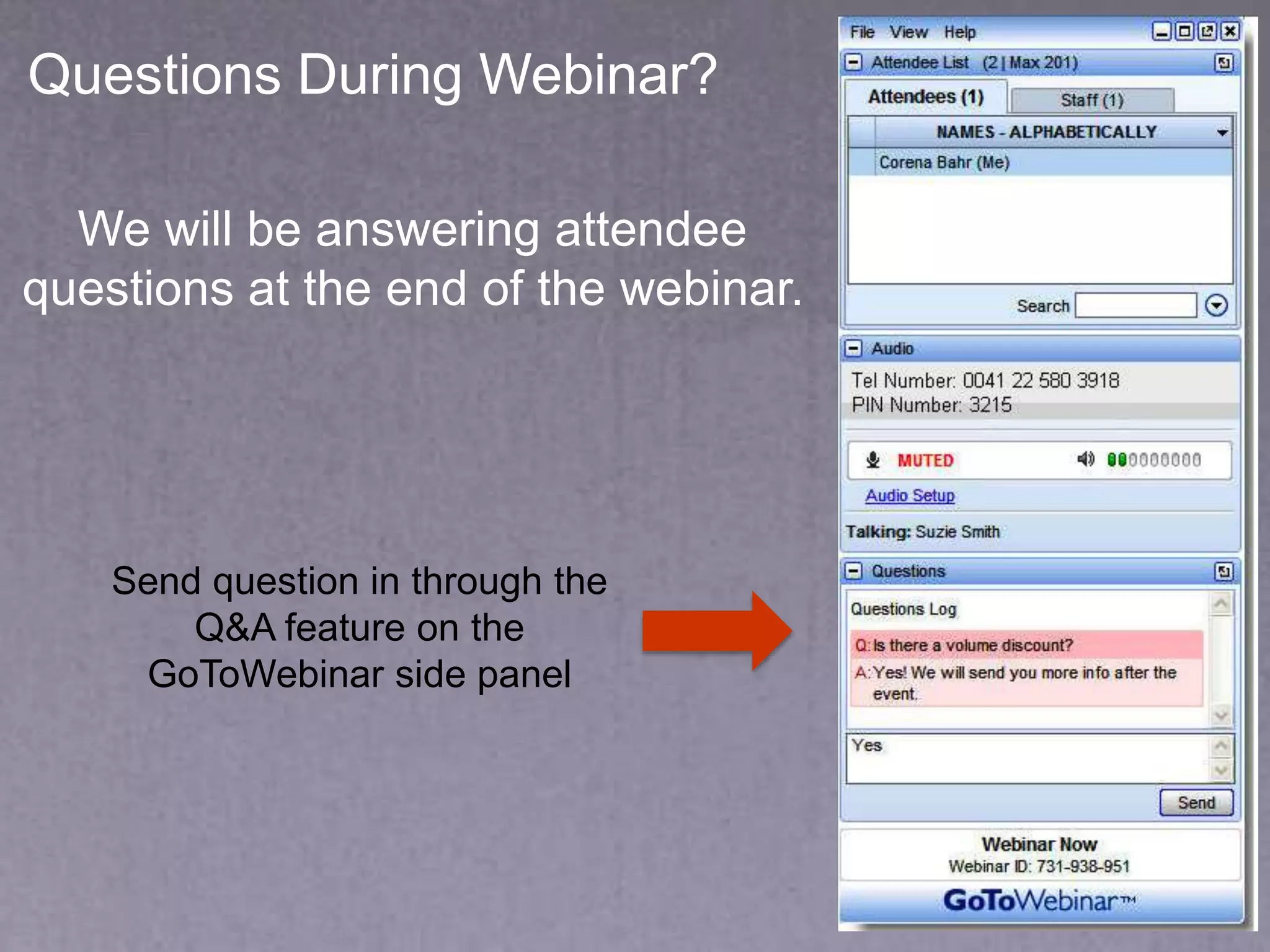
Questions During Webinar?
We will be answering attendee
questions at the end of the webinar.
Send question in through the
Q&A feature on the
GoToWebinar side panel
Sponsored By:
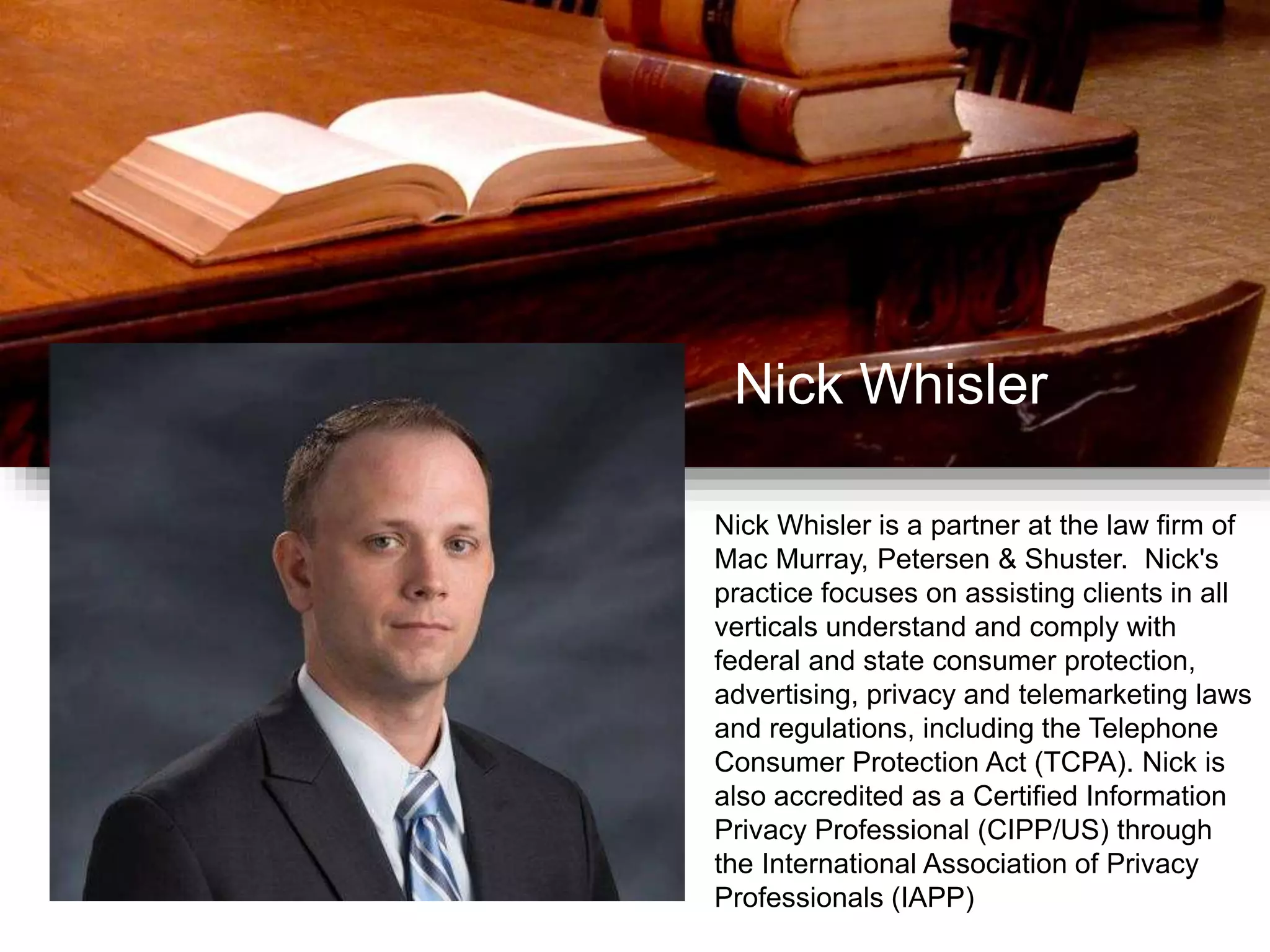
Nick Whisler
Nick Whisler is a partner at the law firm of
Mac Murray, Petersen & Shuster. Nick's
practice focuses on assisting clients in all
verticals understand and comply with
federal and state consumer protection,
advertising, privacy and telemarketing laws
and regulations, including the Telephone
Consumer Protection Act (TCPA). Nick is
also accredited as a Certified Information
Privacy Professional (CIPP/US) through
the International Association of Privacy
Professionals (IAPP)
Ryan Thurman
Ryan Thurman is the sales and
marketing director with Contact Center
Compliance with over 15 years of
experience in the Contact Center
Industry. Ryan is recognized as a
compliance industry expert with a
focus on State and Federal marketing
and privacy regulations including
TCPA, FTC, State and global
compliance regulations. He also
serves as the Regulatory Chair of the
West Coast Chapter of PACE.
Geoff Mina
Geoff Mina leads the company’s
strategic direction and is also the
primary architect of the Connect First
platform. He has taken the product
through four generations in a desire
to develop the most feature rich,
highly scalable, fault tolerant, and
secure Cloud Based Contact Center
Solution on the market. Geoff has
over 15 years of experience in the
cloud telecommunications space.
Agenda
TCPA Update
Nick Whisler
TCPA Data Compliance Tips
Ryan Thurman
TCPA Safe Mode
Geoff Mina
Q&A
Compliance: FCC TCPA
2015 Declaratory Ruling
Nick Whisler
Mac Murray, Petersen &
Shuster, LLP
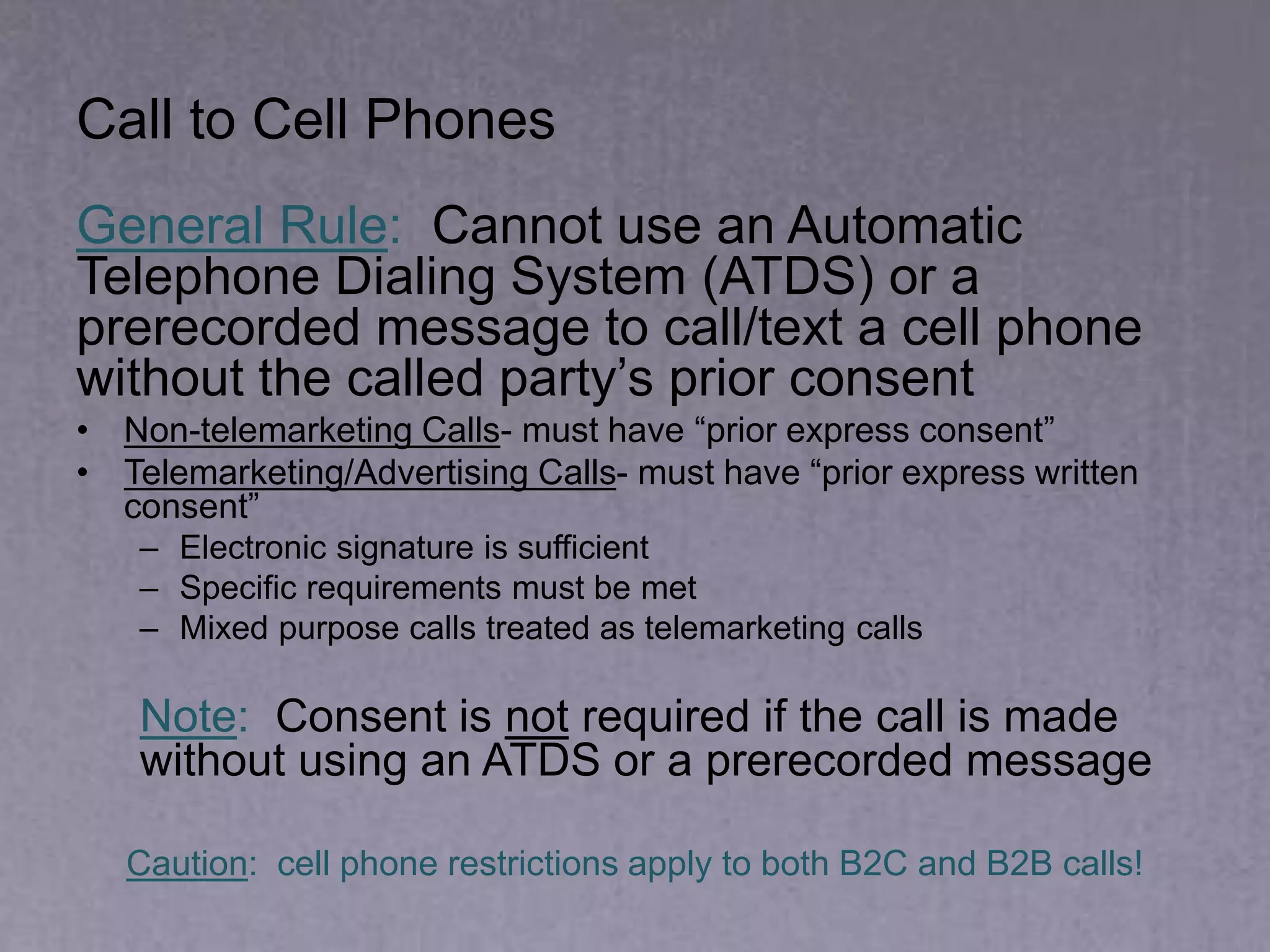
Call to Cell Phones
General Rule: Cannot use an Automatic
Telephone Dialing System (ATDS) or a
prerecorded message to call/text a cell phone
without the called party’s prior consent
• Non-telemarketing Calls- must have “prior express consent”
• Telemarketing/Advertising Calls- must have “prior express written
consent”
– Electronic signature is sufficient
– Specific requirements must be met
– Mixed purpose calls treated as telemarketing calls
Note: Consent is not required if the call is made
without using an ATDS or a prerecorded message
Caution: cell phone restrictions apply to both B2C and B2B calls!
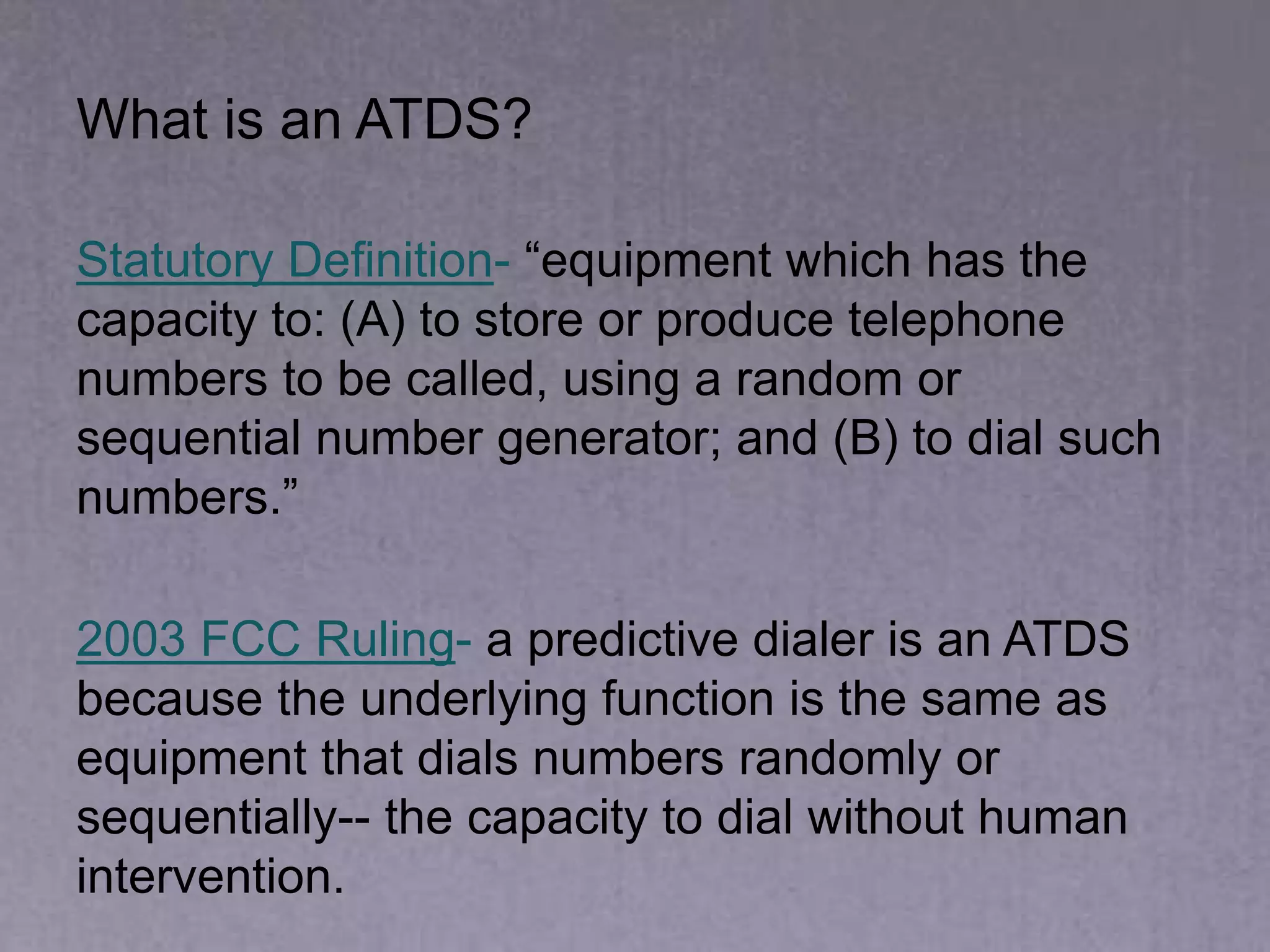
What is an ATDS?
Statutory Definition- “equipment which has the
capacity to: (A) to store or produce telephone
numbers to be called, using a random or
sequential number generator; and (B) to dial such
numbers.”
2003 FCC Ruling- a predictive dialer is an ATDS
because the underlying function is the same as
equipment that dials numbers randomly or
sequentially-- the capacity to dial without human
intervention.
2015 FCC Ruling - ATDS
Equipment can be an ATDS if it has the "potential
capacity" to function as an ATDS
– Rejects “present capacity” standard.
– Equipment can have the requisite capacity even if it.
requires additional software to function as an ATDS.
“Theoretical capacity” not sufficient
– Rotary phone is not an ATDS.
– Stadium that can hold 70,000 people does not have
capacity to hold 100,000 just because it could
theoretically be renovated to hold more people.
ATDS Case Law Post FCC Ruling
Luna v. Shac (N.D. CA Aug 19, 2015)
• System must have capacity to dial without human
intervention to be an ATDS.
• References FCC’s 2015 Ruling but no discussion of
“potential capacity.”
• Did not address whether Ruling could be applied
retroactively.
ATDS Case Law Post FCC Ruling
Derby v. AOL, Inc. (N.D. CA Sept 11, 2015)
• FCC Ruling merely held that a system requiring
modification may fall within the scope of the TCPA
• “[Ruling] does not suggest that a system that never
operates without human intervention constitutes an
ATDS under the statute.”
• Ruling did not negate prior court opinions that focused
on systems’ capacity to dial without human
intervention
What is Prior Express Consent?
TCPA / FCC Regulations- Do not define this term
FCC Ruling- Subject to certain limitations, a
consumer provides prior express consent for non-
telemarketing calls by providing his/her cell phone
number to a business
What is Prior Express Consent?
Case Law
• Overwhelming majority of courts have deferred to the FCC.
• Mais vs. Gulf Coast Collection (S.D. Florida 2013)- held that
the FCC Ruling is invalid; however, opinion was overturned.
• Kolinek v. Walgreens (N.D. Ill. July 2014)- scope of consent
depends on the context and the purpose for which it is
given; consent for one purpose does not equate to consent
for all purposes.
• FCC Amicus Brief (June 2014)
• Nigro v. Mercantile Adjustment Bureau.
• Scope of consent depends on the facts of each situation.
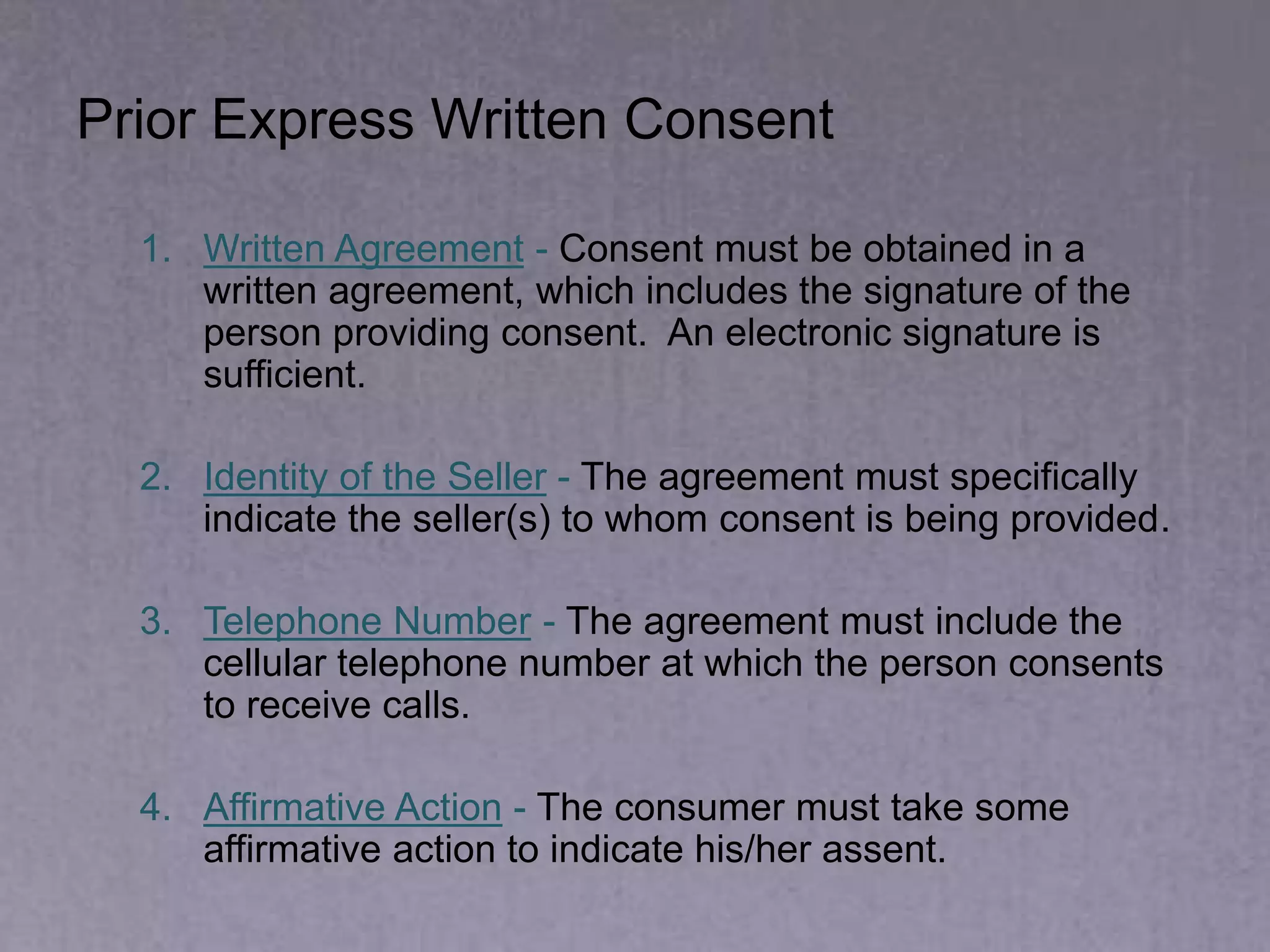
Prior Express Written Consent
1. Written Agreement - Consent must be obtained in a
written agreement, which includes the signature of the
person providing consent. An electronic signature is
sufficient.
2. Identity of the Seller - The agreement must specifically
indicate the seller(s) to whom consent is being provided.
3. Telephone Number - The agreement must include the
cellular telephone number at which the person consents
to receive calls.
4. Affirmative Action - The consumer must take some
affirmative action to indicate his/her assent.
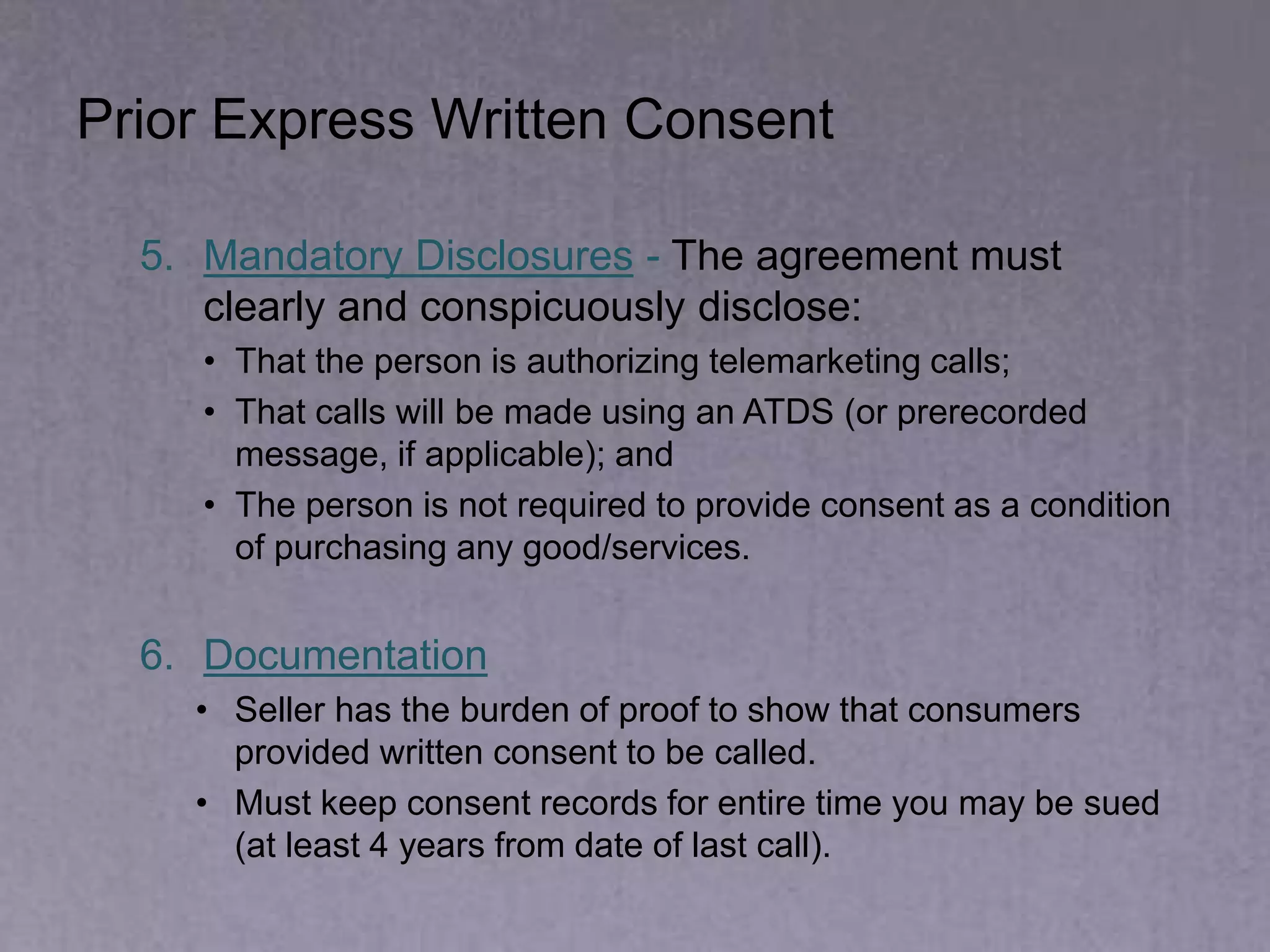
Prior Express Written Consent
5. Mandatory Disclosures - The agreement must
clearly and conspicuously disclose:
• That the person is authorizing telemarketing calls;
• That calls will be made using an ATDS (or prerecorded
message, if applicable); and
• The person is not required to provide consent as a condition
of purchasing any good/services.
6. Documentation
• Seller has the burden of proof to show that consumers
provided written consent to be called.
• Must keep consent records for entire time you may be sued
(at least 4 years from date of last call).
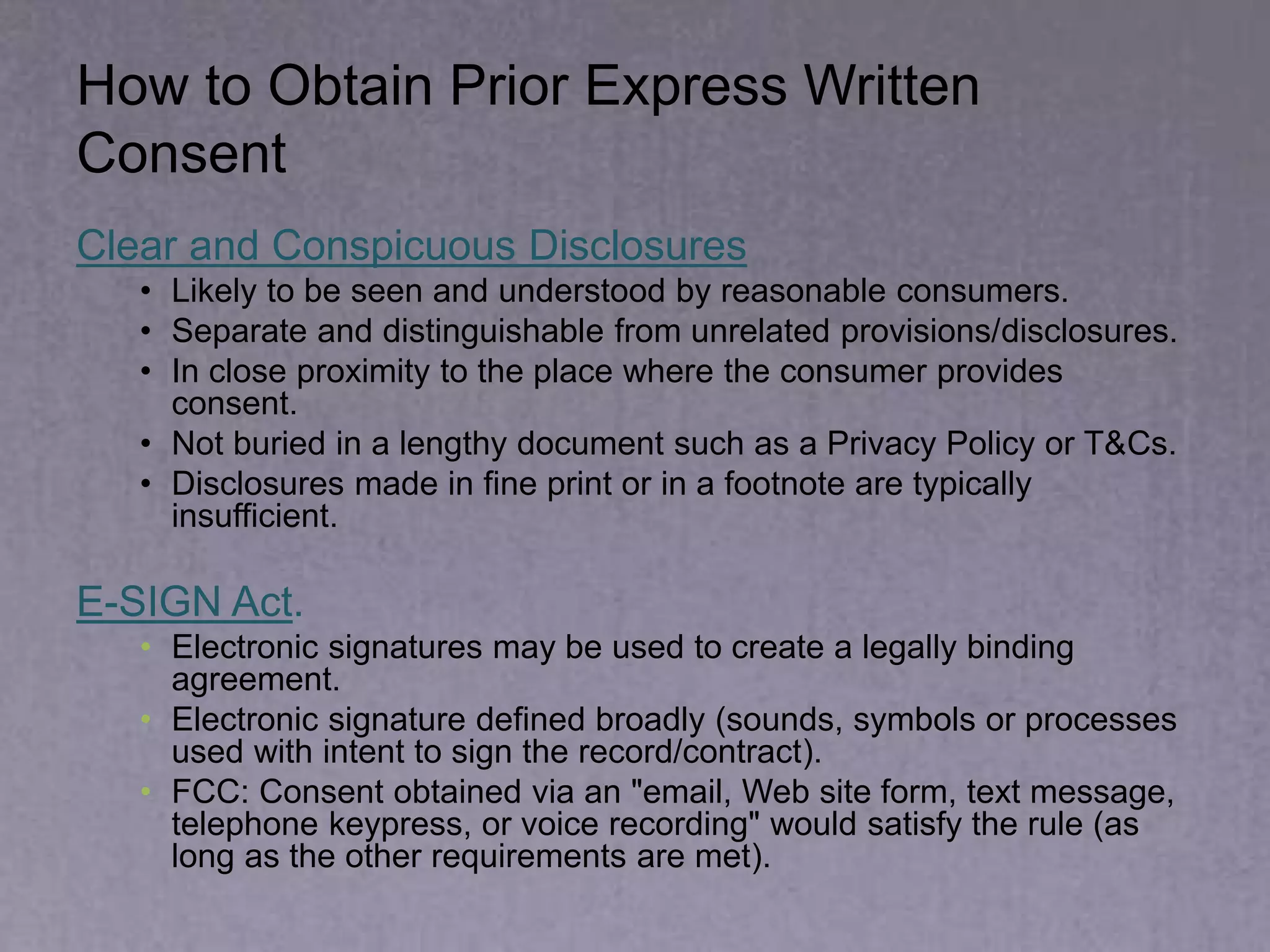
How to Obtain Prior Express Written
Consent
Clear and Conspicuous Disclosures
• Likely to be seen and understood by reasonable consumers.
• Separate and distinguishable from unrelated provisions/disclosures.
• In close proximity to the place where the consumer provides
consent.
• Not buried in a lengthy document such as a Privacy Policy or T&Cs.
• Disclosures made in fine print or in a footnote are typically
insufficient.
E-SIGN Act.
• Electronic signatures may be used to create a legally binding
agreement.
• Electronic signature defined broadly (sounds, symbols or processes
used with intent to sign the record/contract).
• FCC: Consent obtained via an "email, Web site form, text message,
telephone keypress, or voice recording" would satisfy the rule (as
long as the other requirements are met).
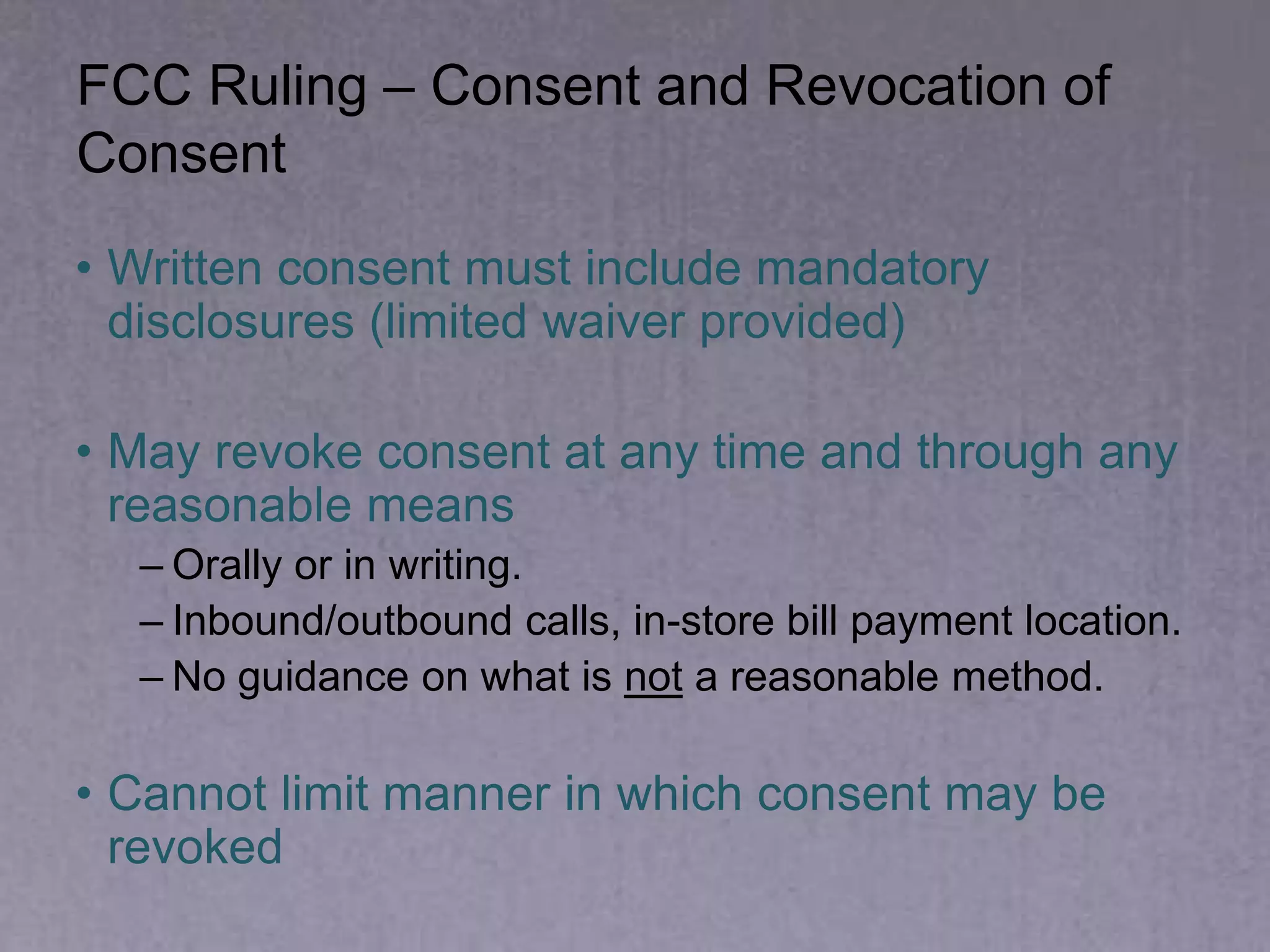
FCC Ruling – Consent and Revocation of
Consent
• Written consent must include mandatory
disclosures (limited waiver provided)
• May revoke consent at any time and through any
reasonable means
– Orally or in writing.
– Inbound/outbound calls, in-store bill payment location.
– No guidance on what is not a reasonable method.
• Cannot limit manner in which consent may be
revoked
Practical Tips for TCPA
Compliance
Ryan Thurman
Contact Center Compliance
Sales and Marketing
Director
Consent Best Practices
Get it in Writing!
If your call requires some form of consent:
Consent Best Practices
• Gather and track opt-ins.
• Get consent at the outset of the consumer relationship, or during if
necessary.
• Make sure the disclosures are clear and conspicuous.
• Make sure the consent is clear and unequivocal.
• Require consumers to take affirmative action to demonstrate their
consent.
• Be specific in your disclosures, where possible.
How to Effectively Obtain Consent
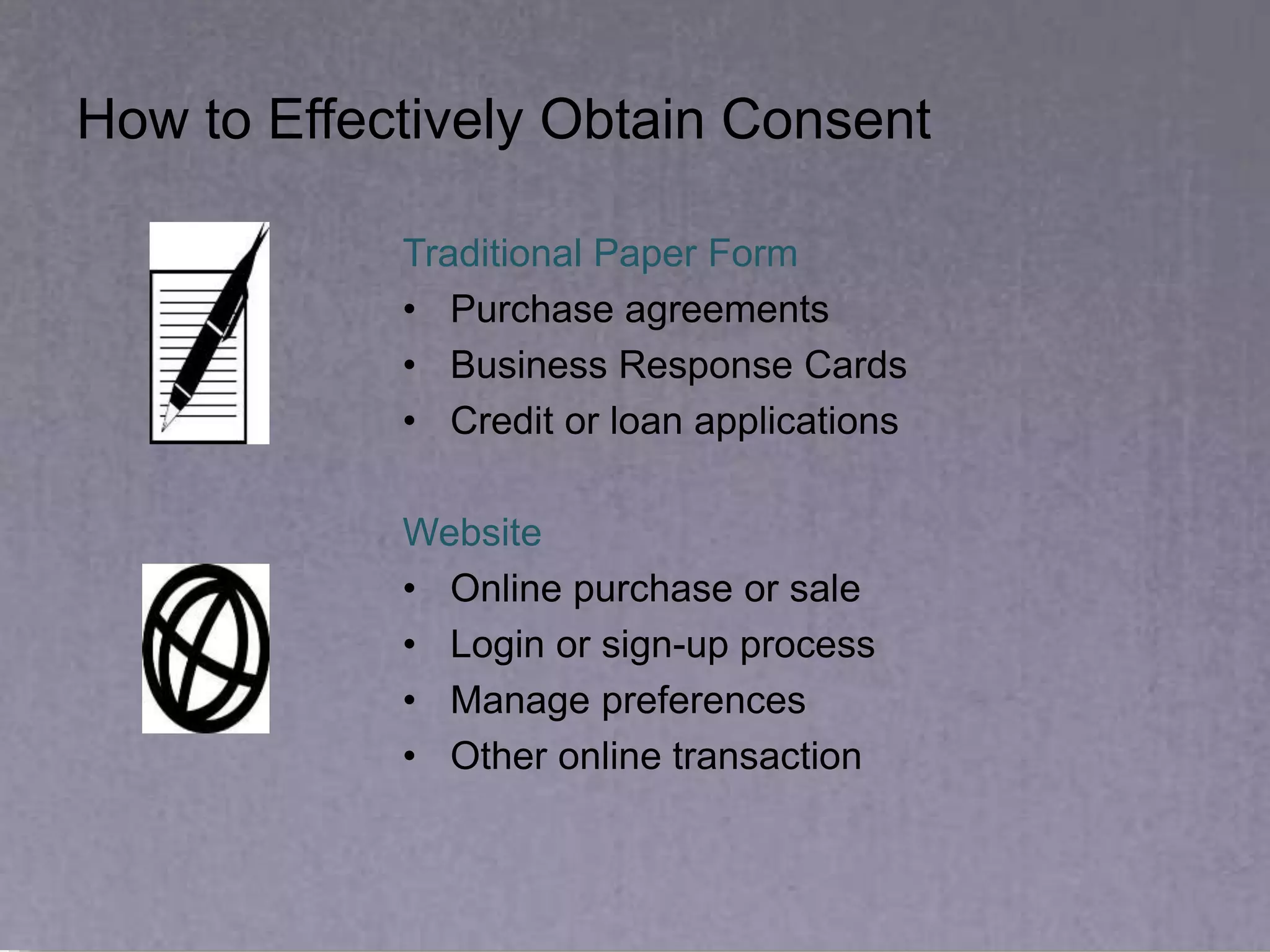
Traditional Paper Form
• Purchase agreements
• Business Response Cards
• Credit or loan applications
Website
• Online purchase or sale
• Login or sign-up process
• Manage preferences
• Other online transaction
How to Effectively Obtain Consent
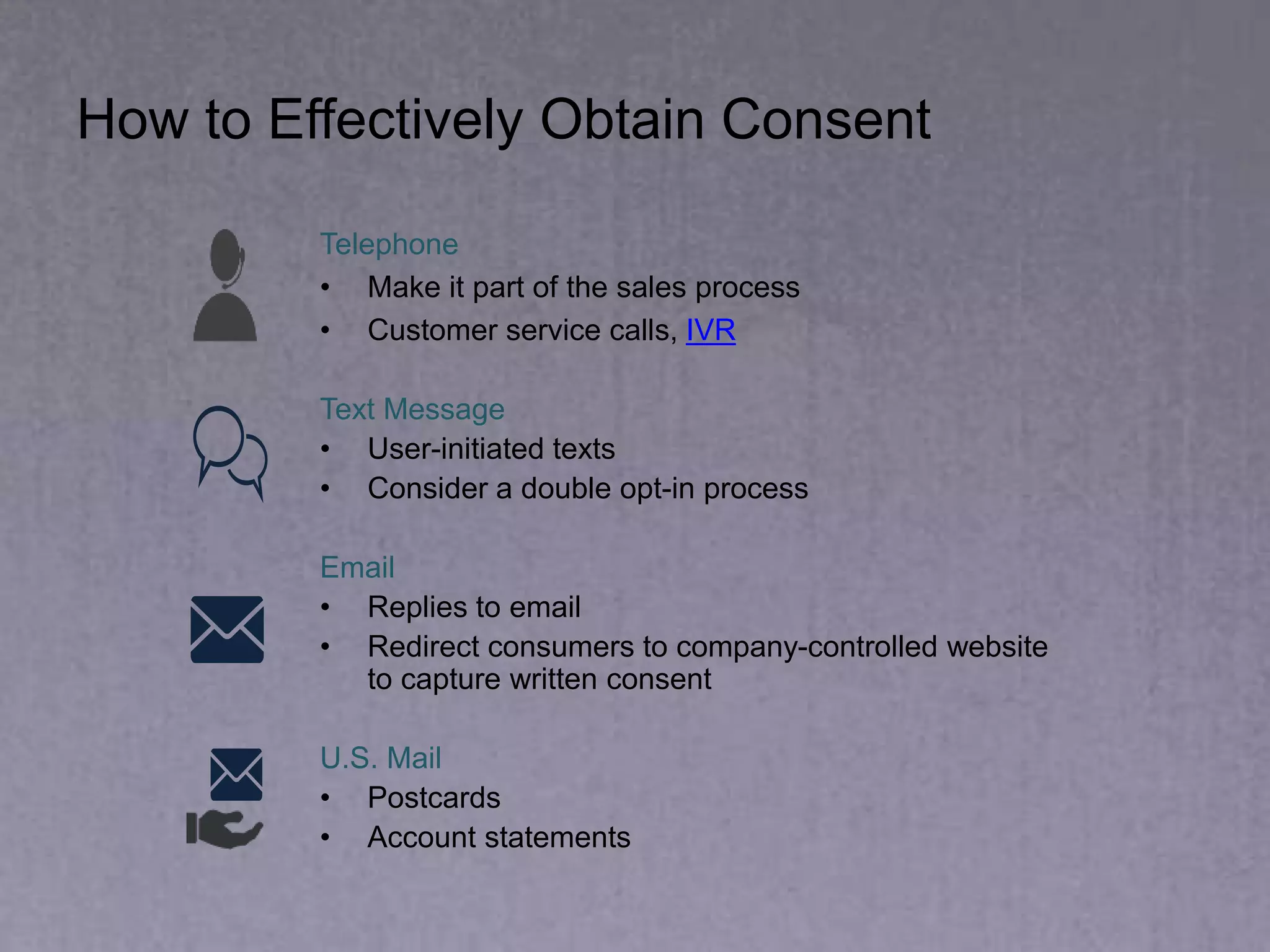
Telephone
• Make it part of the sales process
• Customer service calls, IVR
Text Message
• User-initiated texts
• Consider a double opt-in process
Email
• Replies to email
• Redirect consumers to company-controlled website
to capture written consent
U.S. Mail
• Postcards
• Account statements
How to Effectively Obtain Consent
Written consent can be obtained in compliance with the E-SIGN Act,
including:
• Email
• Website form
• Text message
• Telephone keypress
• Voice recording
Example of Consent
Website Sign-Up
Consent: By checking this box and clicking the “I agree” button below, I
verify that is my mobile number and consent to receive text messages via
automated technology to this number regarding product offers by or on behalf
of [name of seller(s)]. I understand that consent is not required to make a
purchase. I also agree to the Terms and Conditions and the privacy Policy.
Message and Data rates may apply.
Example of Consent
Website Sign-Up
Welcome back valued customer! We noticed that we do not have a mobile phone
number on file for you. Stay up-to-date on your account by signing up for mobile
notifications!
• Yes I agree to receive phone calls and text messages from [name of company],
relating to my account to my mobile number below. I understand calls may be
autodialed or made with artificial voices or prerecorded messages and may related to
the handling, servicing, or billing of my account. Messages and data rates may apply.
Please see our complete Terms & Conditions and our Privacy Policy (_-_-
_)(_-_-_)(_-_-_-_)
• No, I am not interested in signing up for mobile notifications at this time.
Example of Consent
Telephone Script
Mr. Smith, in order to provide you with the best customer service possible, [name
of company] would like permission to contact you about your account of your
mobile phone [using automated technology], [including sending txt messages].
Do we have your consent to contact you on your mobile phone? [yes/no]
What mobile number do you give us permission to contact? [confirm telephone
number]
Thank you.
Example of Consent
Signage
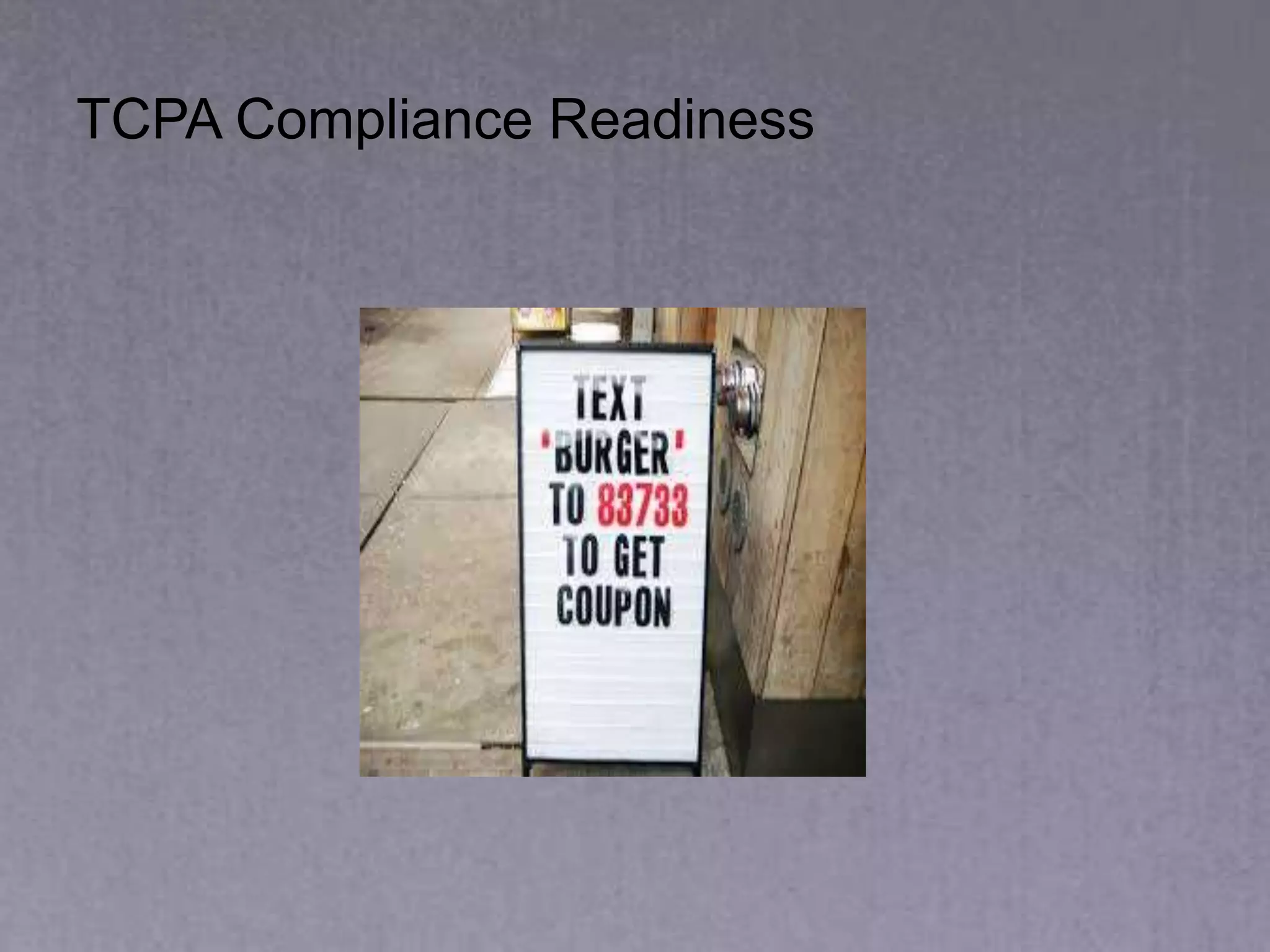
SIGN UP FOR OFFERS! Interested in receiving special offers via text message to your
mobile phone? Text “Join” to 78391 to sign up today! By texting “Join” from your mobile
number, you agree to receive marketing messages generated by an automated dialer from
ABC Company to your mobile number. Consent not required to make a purchase. Limit 5
txt/month. Message and Data rates may apply.
Text Message
[Company Name]: You are signing up for mobile offers via automates technology. Reply Yes
to confirm, No to stop.
Confirmatory Text Message
[Company Name]: Congrats! You are now signed up for mobile text offers! Reply STOP to
cancel, reply HELP for help.
Email
Interested in receiving up-to-date information and calls relating to your
account on your mobile phone? Get instant access to account updates! Calls
may relate to the handling, servicing, and billing of your account and may be
autodialed and/or use artificial voices or prerecorded messages. Calls will be
made by [name of company], its agents or assigns. Includes SMS text
messages. Limit 8 text messages per month. Messages and Data rates may
apply. Click here to sign up now!
http://www.signmeupformobile.com
Example of Consent
TCPA for Your Business
Compliance Readiness
Contractual Considerations
Insurance and Risk
Management
Compliance Readiness Program
• Understand the law as applied to your business
• Prepare appropriate policies and procedures
• Train your employees
• Create a consumer complaint “feedback loop”
• Maintain good records
• Monitor and test your policies
• Watch out for State rules
• Attend Compliance Webinars & Summits
– San Diego (Carlsbad). October 22
– Clearwater, Florida. December 3
TCPA for Your Business
1. Understand the law applicable to consumer communications as it
applies to your company.
TCPA Compliance Readiness
2. Prepare appropriate policies and procedures
TCPA Compliance Readiness
3. Prepare appropriate policies and procedures
■ Calling Lists: Use lists of phone numbers obtained directly from
consumers and be wary of purchasing brokered calling lists. Once you
buy and use it, the list effectively becomes yours.
■ Suppression Policy: Have a suppression policy and procedure in
place, which includes immediately blacklisting and/or blocking phone
numbers that complain about the receipt of unauthorized calls.
■ DNC: Have a DNC policy, which includes regularly scrubbing phone
numbers against the federal DNC, state and internal DNC lists.
■ Wireless Compliance: Identify and scrub against wireless carrier &
ported.
■ Litigators: Mitigate TCPA risk with Litigator Scrub
4. Prepare appropriate policies and procedures (cont.)
Consider using user-initiated text campaigns, where possible.
– Require a “double opt-in” process, if possible.
– Specify how many text messages a consumer will receive.
– Do NOT send more text messages than stated.
– Be clear on possible fees or charges that may be incurred.
– Provide a clear and easy method to opt-out.
TCPA Compliance Readiness
5. Train your employees on TCPA procedures
• Create training and testing materials
• Document completion of training and/or retraining
• Makes changes to telephone scripts
TCPA Compliance Readiness
6. Create a consumer complaint “feedback loop”
■ Routinely monitor consumer complaints from all available sources,
including social media websites, BBB, consumer complaint
boards, etc.
■ Analyze the data obtained and identify patterns
■ Respond to complaints in a timely manner
■ Revise procedures in response to ineffective or unresolved issues
TCPA Compliance Readiness
7. Recordkeeping
■ Maintain consent records for 4 years
■ Carefully document the date and substance of changes, such as
changes to any registration or opt-in process
■ Maintain organized and detailed records so you can easily access,
search, and retrieve relevant data
■ Document the process and technology used to send text
messages and/or make calls
■ Create snapshots of information at static points in time
■ Use Camtasia to record registration or opt-in processes
■ Use templates to populate various data
TCPA Compliance Readiness
8. Testing
■ Regularly test your policies, procedures, and systems
■ Keep a company score card
■ Document your testing efforts
■ Make changes as necessary
■ Hire a compliance officer
Contractual Considerations
– Mandatory arbitration clauses
– Indemnification
– Terms & Conditions
Contractual Considerations
You agree to allow creditor, its agents, assigns, etc. to call you at any
number, whether expressly provided or obtained through other means,
including any future residential or mobile telephone numbers.
You agree to notify creditor if the telephone number(s) associated with
your account changes and to provide any new telephone number(s).
Insurance and Risk Management
Insurance coverage for TCPA claims?
Geoff Mina
Connect First
CEO
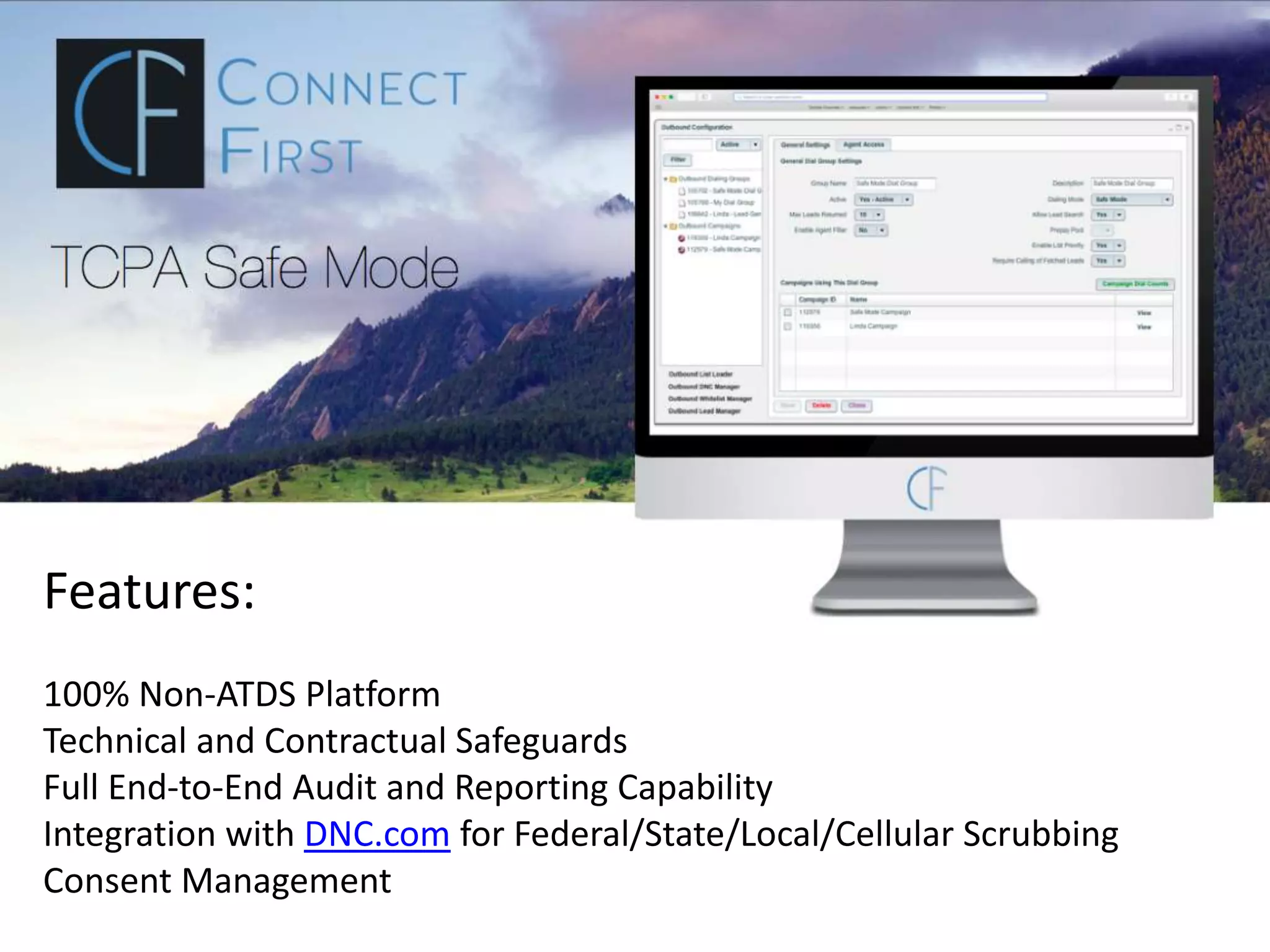
Features:
100% Non-ATDS Platform
Technical and Contractual Safeguards
Full End-to-End Audit and Reporting Capability
Integration with DNC.com for Federal/State/Local/Cellular Scrubbing
Consent Management
Questions?
TCPA Compliance
Webinar Series

TCPA Compliance Webinar Series | Connect First

  • 1.
    Scared of TCPA Fines? TCPACompliance Webinar Series
  • 2.
    Questions During Webinar? Wewill be answering attendee questions at the end of the webinar. Send question in through the Q&A feature on the GoToWebinar side panel
  • 3.
  • 4.
    Nick Whisler Nick Whisleris a partner at the law firm of Mac Murray, Petersen & Shuster. Nick's practice focuses on assisting clients in all verticals understand and comply with federal and state consumer protection, advertising, privacy and telemarketing laws and regulations, including the Telephone Consumer Protection Act (TCPA). Nick is also accredited as a Certified Information Privacy Professional (CIPP/US) through the International Association of Privacy Professionals (IAPP)
  • 5.
    Ryan Thurman Ryan Thurmanis the sales and marketing director with Contact Center Compliance with over 15 years of experience in the Contact Center Industry. Ryan is recognized as a compliance industry expert with a focus on State and Federal marketing and privacy regulations including TCPA, FTC, State and global compliance regulations. He also serves as the Regulatory Chair of the West Coast Chapter of PACE.
  • 6.
    Geoff Mina Geoff Minaleads the company’s strategic direction and is also the primary architect of the Connect First platform. He has taken the product through four generations in a desire to develop the most feature rich, highly scalable, fault tolerant, and secure Cloud Based Contact Center Solution on the market. Geoff has over 15 years of experience in the cloud telecommunications space.
  • 7.
    Agenda TCPA Update Nick Whisler TCPAData Compliance Tips Ryan Thurman TCPA Safe Mode Geoff Mina Q&A
  • 8.
    Compliance: FCC TCPA 2015Declaratory Ruling Nick Whisler Mac Murray, Petersen & Shuster, LLP
  • 9.
    Call to CellPhones General Rule: Cannot use an Automatic Telephone Dialing System (ATDS) or a prerecorded message to call/text a cell phone without the called party’s prior consent • Non-telemarketing Calls- must have “prior express consent” • Telemarketing/Advertising Calls- must have “prior express written consent” – Electronic signature is sufficient – Specific requirements must be met – Mixed purpose calls treated as telemarketing calls Note: Consent is not required if the call is made without using an ATDS or a prerecorded message Caution: cell phone restrictions apply to both B2C and B2B calls!
  • 10.
    What is anATDS? Statutory Definition- “equipment which has the capacity to: (A) to store or produce telephone numbers to be called, using a random or sequential number generator; and (B) to dial such numbers.” 2003 FCC Ruling- a predictive dialer is an ATDS because the underlying function is the same as equipment that dials numbers randomly or sequentially-- the capacity to dial without human intervention.
  • 11.
    2015 FCC Ruling- ATDS Equipment can be an ATDS if it has the "potential capacity" to function as an ATDS – Rejects “present capacity” standard. – Equipment can have the requisite capacity even if it. requires additional software to function as an ATDS. “Theoretical capacity” not sufficient – Rotary phone is not an ATDS. – Stadium that can hold 70,000 people does not have capacity to hold 100,000 just because it could theoretically be renovated to hold more people.
  • 12.
    ATDS Case LawPost FCC Ruling Luna v. Shac (N.D. CA Aug 19, 2015) • System must have capacity to dial without human intervention to be an ATDS. • References FCC’s 2015 Ruling but no discussion of “potential capacity.” • Did not address whether Ruling could be applied retroactively.
  • 13.
    ATDS Case LawPost FCC Ruling Derby v. AOL, Inc. (N.D. CA Sept 11, 2015) • FCC Ruling merely held that a system requiring modification may fall within the scope of the TCPA • “[Ruling] does not suggest that a system that never operates without human intervention constitutes an ATDS under the statute.” • Ruling did not negate prior court opinions that focused on systems’ capacity to dial without human intervention
  • 14.
    What is PriorExpress Consent? TCPA / FCC Regulations- Do not define this term FCC Ruling- Subject to certain limitations, a consumer provides prior express consent for non- telemarketing calls by providing his/her cell phone number to a business
  • 15.
    What is PriorExpress Consent? Case Law • Overwhelming majority of courts have deferred to the FCC. • Mais vs. Gulf Coast Collection (S.D. Florida 2013)- held that the FCC Ruling is invalid; however, opinion was overturned. • Kolinek v. Walgreens (N.D. Ill. July 2014)- scope of consent depends on the context and the purpose for which it is given; consent for one purpose does not equate to consent for all purposes. • FCC Amicus Brief (June 2014) • Nigro v. Mercantile Adjustment Bureau. • Scope of consent depends on the facts of each situation.
  • 16.
    Prior Express WrittenConsent 1. Written Agreement - Consent must be obtained in a written agreement, which includes the signature of the person providing consent. An electronic signature is sufficient. 2. Identity of the Seller - The agreement must specifically indicate the seller(s) to whom consent is being provided. 3. Telephone Number - The agreement must include the cellular telephone number at which the person consents to receive calls. 4. Affirmative Action - The consumer must take some affirmative action to indicate his/her assent.
  • 17.
    Prior Express WrittenConsent 5. Mandatory Disclosures - The agreement must clearly and conspicuously disclose: • That the person is authorizing telemarketing calls; • That calls will be made using an ATDS (or prerecorded message, if applicable); and • The person is not required to provide consent as a condition of purchasing any good/services. 6. Documentation • Seller has the burden of proof to show that consumers provided written consent to be called. • Must keep consent records for entire time you may be sued (at least 4 years from date of last call).
  • 18.
    How to ObtainPrior Express Written Consent Clear and Conspicuous Disclosures • Likely to be seen and understood by reasonable consumers. • Separate and distinguishable from unrelated provisions/disclosures. • In close proximity to the place where the consumer provides consent. • Not buried in a lengthy document such as a Privacy Policy or T&Cs. • Disclosures made in fine print or in a footnote are typically insufficient. E-SIGN Act. • Electronic signatures may be used to create a legally binding agreement. • Electronic signature defined broadly (sounds, symbols or processes used with intent to sign the record/contract). • FCC: Consent obtained via an "email, Web site form, text message, telephone keypress, or voice recording" would satisfy the rule (as long as the other requirements are met).
  • 19.
    FCC Ruling –Consent and Revocation of Consent • Written consent must include mandatory disclosures (limited waiver provided) • May revoke consent at any time and through any reasonable means – Orally or in writing. – Inbound/outbound calls, in-store bill payment location. – No guidance on what is not a reasonable method. • Cannot limit manner in which consent may be revoked
  • 20.
    Practical Tips forTCPA Compliance Ryan Thurman Contact Center Compliance Sales and Marketing Director
  • 21.
    Consent Best Practices Getit in Writing! If your call requires some form of consent:
  • 22.
    Consent Best Practices •Gather and track opt-ins. • Get consent at the outset of the consumer relationship, or during if necessary. • Make sure the disclosures are clear and conspicuous. • Make sure the consent is clear and unequivocal. • Require consumers to take affirmative action to demonstrate their consent. • Be specific in your disclosures, where possible.
  • 23.
    How to EffectivelyObtain Consent Traditional Paper Form • Purchase agreements • Business Response Cards • Credit or loan applications Website • Online purchase or sale • Login or sign-up process • Manage preferences • Other online transaction
  • 24.
    How to EffectivelyObtain Consent Telephone • Make it part of the sales process • Customer service calls, IVR Text Message • User-initiated texts • Consider a double opt-in process Email • Replies to email • Redirect consumers to company-controlled website to capture written consent U.S. Mail • Postcards • Account statements
  • 25.
    How to EffectivelyObtain Consent Written consent can be obtained in compliance with the E-SIGN Act, including: • Email • Website form • Text message • Telephone keypress • Voice recording
  • 26.
    Example of Consent WebsiteSign-Up Consent: By checking this box and clicking the “I agree” button below, I verify that is my mobile number and consent to receive text messages via automated technology to this number regarding product offers by or on behalf of [name of seller(s)]. I understand that consent is not required to make a purchase. I also agree to the Terms and Conditions and the privacy Policy. Message and Data rates may apply.
  • 27.
    Example of Consent WebsiteSign-Up Welcome back valued customer! We noticed that we do not have a mobile phone number on file for you. Stay up-to-date on your account by signing up for mobile notifications! • Yes I agree to receive phone calls and text messages from [name of company], relating to my account to my mobile number below. I understand calls may be autodialed or made with artificial voices or prerecorded messages and may related to the handling, servicing, or billing of my account. Messages and data rates may apply. Please see our complete Terms & Conditions and our Privacy Policy (_-_- _)(_-_-_)(_-_-_-_) • No, I am not interested in signing up for mobile notifications at this time.
  • 28.
    Example of Consent TelephoneScript Mr. Smith, in order to provide you with the best customer service possible, [name of company] would like permission to contact you about your account of your mobile phone [using automated technology], [including sending txt messages]. Do we have your consent to contact you on your mobile phone? [yes/no] What mobile number do you give us permission to contact? [confirm telephone number] Thank you.
  • 29.
    Example of Consent Signage SIGNUP FOR OFFERS! Interested in receiving special offers via text message to your mobile phone? Text “Join” to 78391 to sign up today! By texting “Join” from your mobile number, you agree to receive marketing messages generated by an automated dialer from ABC Company to your mobile number. Consent not required to make a purchase. Limit 5 txt/month. Message and Data rates may apply. Text Message [Company Name]: You are signing up for mobile offers via automates technology. Reply Yes to confirm, No to stop. Confirmatory Text Message [Company Name]: Congrats! You are now signed up for mobile text offers! Reply STOP to cancel, reply HELP for help.
  • 30.
    Email Interested in receivingup-to-date information and calls relating to your account on your mobile phone? Get instant access to account updates! Calls may relate to the handling, servicing, and billing of your account and may be autodialed and/or use artificial voices or prerecorded messages. Calls will be made by [name of company], its agents or assigns. Includes SMS text messages. Limit 8 text messages per month. Messages and Data rates may apply. Click here to sign up now! http://www.signmeupformobile.com Example of Consent
  • 31.
    TCPA for YourBusiness Compliance Readiness Contractual Considerations Insurance and Risk Management
  • 32.
    Compliance Readiness Program •Understand the law as applied to your business • Prepare appropriate policies and procedures • Train your employees • Create a consumer complaint “feedback loop” • Maintain good records • Monitor and test your policies • Watch out for State rules • Attend Compliance Webinars & Summits – San Diego (Carlsbad). October 22 – Clearwater, Florida. December 3 TCPA for Your Business
  • 33.
    1. Understand thelaw applicable to consumer communications as it applies to your company. TCPA Compliance Readiness
  • 34.
    2. Prepare appropriatepolicies and procedures TCPA Compliance Readiness
  • 35.
    TCPA Compliance Readiness 3.Prepare appropriate policies and procedures ■ Calling Lists: Use lists of phone numbers obtained directly from consumers and be wary of purchasing brokered calling lists. Once you buy and use it, the list effectively becomes yours. ■ Suppression Policy: Have a suppression policy and procedure in place, which includes immediately blacklisting and/or blocking phone numbers that complain about the receipt of unauthorized calls. ■ DNC: Have a DNC policy, which includes regularly scrubbing phone numbers against the federal DNC, state and internal DNC lists. ■ Wireless Compliance: Identify and scrub against wireless carrier & ported. ■ Litigators: Mitigate TCPA risk with Litigator Scrub
  • 36.
    4. Prepare appropriatepolicies and procedures (cont.) Consider using user-initiated text campaigns, where possible. – Require a “double opt-in” process, if possible. – Specify how many text messages a consumer will receive. – Do NOT send more text messages than stated. – Be clear on possible fees or charges that may be incurred. – Provide a clear and easy method to opt-out. TCPA Compliance Readiness
  • 37.
  • 38.
    TCPA Compliance Readiness 5.Train your employees on TCPA procedures • Create training and testing materials • Document completion of training and/or retraining • Makes changes to telephone scripts
  • 39.
    TCPA Compliance Readiness 6.Create a consumer complaint “feedback loop” ■ Routinely monitor consumer complaints from all available sources, including social media websites, BBB, consumer complaint boards, etc. ■ Analyze the data obtained and identify patterns ■ Respond to complaints in a timely manner ■ Revise procedures in response to ineffective or unresolved issues
  • 40.
    TCPA Compliance Readiness 7.Recordkeeping ■ Maintain consent records for 4 years ■ Carefully document the date and substance of changes, such as changes to any registration or opt-in process ■ Maintain organized and detailed records so you can easily access, search, and retrieve relevant data ■ Document the process and technology used to send text messages and/or make calls ■ Create snapshots of information at static points in time ■ Use Camtasia to record registration or opt-in processes ■ Use templates to populate various data
  • 41.
    TCPA Compliance Readiness 8.Testing ■ Regularly test your policies, procedures, and systems ■ Keep a company score card ■ Document your testing efforts ■ Make changes as necessary ■ Hire a compliance officer
  • 42.
    Contractual Considerations – Mandatoryarbitration clauses – Indemnification – Terms & Conditions
  • 43.
    Contractual Considerations You agreeto allow creditor, its agents, assigns, etc. to call you at any number, whether expressly provided or obtained through other means, including any future residential or mobile telephone numbers. You agree to notify creditor if the telephone number(s) associated with your account changes and to provide any new telephone number(s).
  • 44.
    Insurance and RiskManagement Insurance coverage for TCPA claims?
  • 45.
  • 46.
    Features: 100% Non-ATDS Platform Technicaland Contractual Safeguards Full End-to-End Audit and Reporting Capability Integration with DNC.com for Federal/State/Local/Cellular Scrubbing Consent Management
  • 48.