SALMAN ZAFAR
EMBA ROLL #27
Judiciary
 The system of courts that interprets and
applies the law in the name of the State
 Doctrine of the separation of powers
 The judiciary generally does not make law
or enforce law but rather interprets law
and applies it to the facts of each case
Court System in Pakistan
Court system of Pakistan is made up of many
courts differing in levels of legal superiority
and separated by jurisdiction. Some of the
courts are federal in nature while others are
provincial
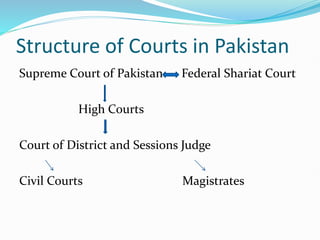
Structure of Courts in Pakistan
Supreme Court of Pakistan Federal Shariat Court
High Courts
Court of District and Sessions Judge
Civil Courts Magistrates
The Supreme Court of Pakistan
 Constitutional Court – Art. 175 of the Constitution
 The apex court in Pakistan's judicial hierarchy
 A permanent seat in Islamabad
 Branch Registries in the provincial capitals of Lahore,
Peshawer, Quetta and Karachi
 Jurisdiction
 Original
 Appellate
 Advisory
Federal Shariat Court
 Constitutional Court – Art. 203 (8th Amendment,
1980)
 Not more than 8 Muslim Judges including the C.J
 Power to examine and determine as to whether or not a
certain provision of law is repugnant to the injunctions
of Islam
 Appeal against its decisions lie to the Shariat Appellate
Bench of the Supreme Court, consisting of 3 Muslim
judges of the Supreme Court and 2 Ulema, appointed
by the President
High Courts
 Constitutional Courts – Art. 175
 Islamabad High Court - through 18th Amendment, 2010
 Jurisdiction
 Original
 Writ Jurisdiction
 Mandamus
 Prohibition
 Habeas Corpus
 Certiorari
 Appellate
Appointment of Judges
 19th Amendment, 2010
 Judicial Commission and Parliamentary Committee were
established for appointments. The Judicial Commission
consists of a total of 9 members: the Chief Justice of
Pakistan, 4 senior judges of the Supreme Court, a former
Chief Justice or judge of the Supreme Court nominated by
the serving Chief Justice in consultation with the 4 serving
judges of the Supreme Court aforementioned, the Attorney
General of Pakistan, the Federal Minister for Law and
Justice and, 1 senior advocate nominated by the Pakistan
Bar Council
Lower Courts
 STATUTORY COURTS
 Powers and Jurisdiction
 Court of District & Sessions Judge
 Civil Courts
 Magistrates
Special Courts/ Tribunals
Special Courts/Tribunals include:
 Family Courts (Family Courts Act, 1964)
 Juvenile Courts
 Banking Courts
 Custom Courts
 Drug Courts
 Income Tax Tribunals
 Anti Narcotics Courts
 Labor Court
 Consumer Courts
Appointment of the Judges of
Lower Courts
 Court of District & Sessions Judge
 Powers and Jurisdiction
 Additional District & Sessions Judges are appointed by
the Provincial High Courts from a pool of Lawyers and
subordinate judges
 To be eligible for appointment, Lawyers must have 10
years' experience as an advocate with good standing in
the respective jurisdiction. They must also pass an
examination conducted by the High Courts.
Subordinate judges are promoted from senior civil
judges on a seniority basis
Appointment of Civil Judges/Magistrates
 Appointed by the Provincial High Courts on the
recommendation of provincial Public Service
Commissions. These Commissions hold open
competitive exams annually, which are advertised in
national newspapers
 The basic qualifications required are an LL.B from any
recognized university and 2 years' experience as an
advocate

taxation presentation regarding judicial system

  • 1.
  • 2.
    Judiciary  The systemof courts that interprets and applies the law in the name of the State  Doctrine of the separation of powers  The judiciary generally does not make law or enforce law but rather interprets law and applies it to the facts of each case
  • 3.
    Court System inPakistan Court system of Pakistan is made up of many courts differing in levels of legal superiority and separated by jurisdiction. Some of the courts are federal in nature while others are provincial
  • 4.
    Structure of Courtsin Pakistan Supreme Court of Pakistan Federal Shariat Court High Courts Court of District and Sessions Judge Civil Courts Magistrates
  • 5.
    The Supreme Courtof Pakistan  Constitutional Court – Art. 175 of the Constitution  The apex court in Pakistan's judicial hierarchy  A permanent seat in Islamabad  Branch Registries in the provincial capitals of Lahore, Peshawer, Quetta and Karachi  Jurisdiction  Original  Appellate  Advisory
  • 6.
    Federal Shariat Court Constitutional Court – Art. 203 (8th Amendment, 1980)  Not more than 8 Muslim Judges including the C.J  Power to examine and determine as to whether or not a certain provision of law is repugnant to the injunctions of Islam  Appeal against its decisions lie to the Shariat Appellate Bench of the Supreme Court, consisting of 3 Muslim judges of the Supreme Court and 2 Ulema, appointed by the President
  • 7.
    High Courts  ConstitutionalCourts – Art. 175  Islamabad High Court - through 18th Amendment, 2010  Jurisdiction  Original  Writ Jurisdiction  Mandamus  Prohibition  Habeas Corpus  Certiorari  Appellate
  • 8.
    Appointment of Judges 19th Amendment, 2010  Judicial Commission and Parliamentary Committee were established for appointments. The Judicial Commission consists of a total of 9 members: the Chief Justice of Pakistan, 4 senior judges of the Supreme Court, a former Chief Justice or judge of the Supreme Court nominated by the serving Chief Justice in consultation with the 4 serving judges of the Supreme Court aforementioned, the Attorney General of Pakistan, the Federal Minister for Law and Justice and, 1 senior advocate nominated by the Pakistan Bar Council
  • 9.
    Lower Courts  STATUTORYCOURTS  Powers and Jurisdiction  Court of District & Sessions Judge  Civil Courts  Magistrates
  • 10.
    Special Courts/ Tribunals SpecialCourts/Tribunals include:  Family Courts (Family Courts Act, 1964)  Juvenile Courts  Banking Courts  Custom Courts  Drug Courts  Income Tax Tribunals  Anti Narcotics Courts  Labor Court  Consumer Courts
  • 11.
    Appointment of theJudges of Lower Courts  Court of District & Sessions Judge  Powers and Jurisdiction  Additional District & Sessions Judges are appointed by the Provincial High Courts from a pool of Lawyers and subordinate judges  To be eligible for appointment, Lawyers must have 10 years' experience as an advocate with good standing in the respective jurisdiction. They must also pass an examination conducted by the High Courts. Subordinate judges are promoted from senior civil judges on a seniority basis
  • 12.
    Appointment of CivilJudges/Magistrates  Appointed by the Provincial High Courts on the recommendation of provincial Public Service Commissions. These Commissions hold open competitive exams annually, which are advertised in national newspapers  The basic qualifications required are an LL.B from any recognized university and 2 years' experience as an advocate