JUDICIARY STRUCTURE
IN PAKISTAN
Public administration of Pakistan
Introduction
As we Know that that Pakistan have 3 organs of government which are as follows
Legislature -> law making body
Executive -> Implement the law made by legislation
Judiciary -> Interpret the laws made by legislature
Judiciary structure in Pakistan
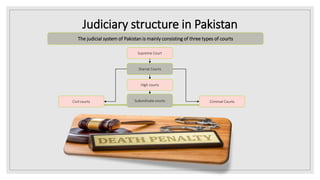
The judicial system of Pakistan is mainly consisting of three types of courts
Supreme Court
Shariat Courts
High courts
Subordinate courts Criminal Courts
Civil courts
Judiciary structure of Pakistan Diagram
Supreme Court
(Islamabad)
Federal Shariat
Islamabad )
High Court
(KPK)
High Court
(Baluchistan)
High Court
(Punjab)
High Court
(Islamabad)
Civil Court
(1962)
Also Called
District Court
Criminal Court
(2898)
Also called
Session Court
High Court
(Sindh)
Supreme Court
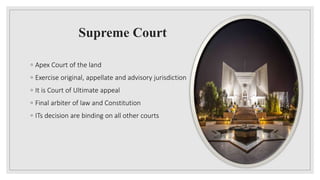
◦ Apex Court of the land
◦ Exercise original, appellate and advisory jurisdiction
◦ It is Court of Ultimate appeal
◦ Final arbiter of law and Constitution
◦ ITs decision are binding on all other courts
Composition of Supreme Court
◦ IT consist of 17 judges in which 1 is chief justice and 16 more judges
Eligibility
◦ 5year experience as a judge of high court
◦ 15 years experience as Advocate of high court
Functions
◦ Exercise original jurisdiction
◦ Setting inter-governmental disputes
◦ Has appellate jurisdiction in civil and criminal matters
◦ Advisory jurisdiction to the Got on the question of Law
◦ Enforcement of the fundamental rights, For which human rights veil is established in
the court
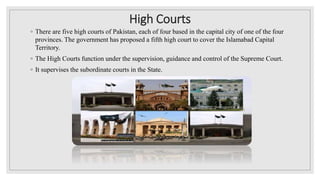
High Courts
◦ There are five high courts of Pakistan, each of four based in the capital city of one of the four
provinces. The government has proposed a fifth high court to cover the Islamabad Capital
Territory.
◦ The High Courts function under the supervision, guidance and control of the Supreme Court.
◦ It supervises the subordinate courts in the State.
Composition of high courts in each provinces
◦ Lahore high court is composed of 60 judges
◦ Sindh high Court composed of $0 judges
◦ Peshawar High Court 20 judges
◦ Balochistan High court !! judges
◦ Islamabad high court composed of 7 judges
Eligibility
◦ 10 years experience as aducate of high courts
◦ 10 years experience of civil servant
◦ 3 years experience as district judge
◦ 10 years in judicial office
Function Of high courts
◦ exercises original jurisdiction(issuing writ for enforcement of Fundamental Rights)
◦ Supervise and control the subordinate courts
◦ Appeals made against order/judgments of special courts
◦ While other functions are replica of supreme court
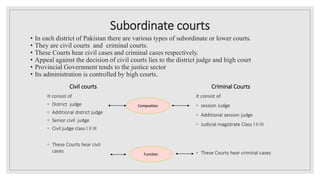
Subordinate courts
Civil courts
It consist of
◦ District judge
◦ Additional district judge
◦ Senior civil judge
◦ Civil judge class I II III
◦ These Courts hear civil
cases
Criminal Courts
It consist of
◦ session Judge
◦ Additional session judge
◦ Judicial magistrate Class I II III
◦ These Courts hear criminal cases
• In each district of Pakistan there are various types of subordinate or lower courts.
• They are civil courts and criminal courts.
• These Courts hear civil cases and criminal cases respectively.
• Appeal against the decision of civil courts lies to the district judge and high court
• Provincial Government tends to the justice sector
• Its administration is controlled by high courts.
Composition
Function
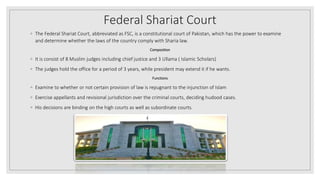
Federal Shariat Court
◦ The Federal Shariat Court, abbreviated as FSC, is a constitutional court of Pakistan, which has the power to examine
and determine whether the laws of the country comply with Sharia law.
Composition
◦ It is consist of 8 Muslim judges including chief justice and 3 Ullama ( Islamic Scholars)
◦ The judges hold the office for a period of 3 years, while president may extend it if he wants.
Functions
◦ Examine to whether or not certain provision of law is repugnant to the injunction of Islam
◦ Exercise appellants and revisional jurisdiction over the criminal courts, deciding hudood cases.
◦ His decisions are binding on the high courts as well as subordinate courts.
Appointment of Judges
Judicial commission
◦ The Judicial Commission of Pakistan
consists of a total of nine members
which are as follows
◦ Chief justice who is the head or
chairman
◦ 5 senior judges of the Supreme court
◦ 1 former chief justice of supreme
court
◦ The attorney general of Pakistan
◦ Federal minister for law and justice
◦ A senior advocate
Parliamentary committee
◦ -It is consist of 8 members
◦ -these 8 members are consist of 4 members of
national assembly and 4 members from senate
which are equally chosen from treasury and
opposition benches
Composition
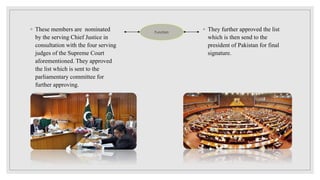
◦ These members are nominated
by the serving Chief Justice in
consultation with the four serving
judges of the Supreme Court
aforementioned. They approved
the list which is sent to the
parliamentary committee for
further approving.
◦ They further approved the list
which is then send to the
president of Pakistan for final
signature.
Function
Removal of judges
◦ Supreme Judicial council is responsible for the removal of judge by President Reference or by
Suo Moto Action.
◦ It consist of the following
◦ Chief Justice of Pakistan who is the chairman of that council
◦ 2 Most senior judges of the supreme court
◦ 2 senior most chief justice of high courts
◦ The registrar of Supreme court acts as its secretary
But These members can only remove the judges on the following conditions
◦ Misconduct
◦ Physical or mental incapability
Judiciary_structure_in_Pakistan.pptx

Judiciary_structure_in_Pakistan.pptx

  • 1.
    JUDICIARY STRUCTURE IN PAKISTAN Publicadministration of Pakistan
  • 2.
    Introduction As we Knowthat that Pakistan have 3 organs of government which are as follows Legislature -> law making body Executive -> Implement the law made by legislation Judiciary -> Interpret the laws made by legislature
  • 3.
    Judiciary structure inPakistan The judicial system of Pakistan is mainly consisting of three types of courts Supreme Court Shariat Courts High courts Subordinate courts Criminal Courts Civil courts
  • 4.
    Judiciary structure ofPakistan Diagram Supreme Court (Islamabad) Federal Shariat Islamabad ) High Court (KPK) High Court (Baluchistan) High Court (Punjab) High Court (Islamabad) Civil Court (1962) Also Called District Court Criminal Court (2898) Also called Session Court High Court (Sindh)
  • 5.
    Supreme Court ◦ ApexCourt of the land ◦ Exercise original, appellate and advisory jurisdiction ◦ It is Court of Ultimate appeal ◦ Final arbiter of law and Constitution ◦ ITs decision are binding on all other courts
  • 6.
    Composition of SupremeCourt ◦ IT consist of 17 judges in which 1 is chief justice and 16 more judges Eligibility ◦ 5year experience as a judge of high court ◦ 15 years experience as Advocate of high court Functions ◦ Exercise original jurisdiction ◦ Setting inter-governmental disputes ◦ Has appellate jurisdiction in civil and criminal matters ◦ Advisory jurisdiction to the Got on the question of Law ◦ Enforcement of the fundamental rights, For which human rights veil is established in the court
  • 7.
    High Courts ◦ Thereare five high courts of Pakistan, each of four based in the capital city of one of the four provinces. The government has proposed a fifth high court to cover the Islamabad Capital Territory. ◦ The High Courts function under the supervision, guidance and control of the Supreme Court. ◦ It supervises the subordinate courts in the State.
  • 8.
    Composition of highcourts in each provinces ◦ Lahore high court is composed of 60 judges ◦ Sindh high Court composed of $0 judges ◦ Peshawar High Court 20 judges ◦ Balochistan High court !! judges ◦ Islamabad high court composed of 7 judges Eligibility ◦ 10 years experience as aducate of high courts ◦ 10 years experience of civil servant ◦ 3 years experience as district judge ◦ 10 years in judicial office Function Of high courts ◦ exercises original jurisdiction(issuing writ for enforcement of Fundamental Rights) ◦ Supervise and control the subordinate courts ◦ Appeals made against order/judgments of special courts ◦ While other functions are replica of supreme court
  • 9.
    Subordinate courts Civil courts Itconsist of ◦ District judge ◦ Additional district judge ◦ Senior civil judge ◦ Civil judge class I II III ◦ These Courts hear civil cases Criminal Courts It consist of ◦ session Judge ◦ Additional session judge ◦ Judicial magistrate Class I II III ◦ These Courts hear criminal cases • In each district of Pakistan there are various types of subordinate or lower courts. • They are civil courts and criminal courts. • These Courts hear civil cases and criminal cases respectively. • Appeal against the decision of civil courts lies to the district judge and high court • Provincial Government tends to the justice sector • Its administration is controlled by high courts. Composition Function
  • 10.
    Federal Shariat Court ◦The Federal Shariat Court, abbreviated as FSC, is a constitutional court of Pakistan, which has the power to examine and determine whether the laws of the country comply with Sharia law. Composition ◦ It is consist of 8 Muslim judges including chief justice and 3 Ullama ( Islamic Scholars) ◦ The judges hold the office for a period of 3 years, while president may extend it if he wants. Functions ◦ Examine to whether or not certain provision of law is repugnant to the injunction of Islam ◦ Exercise appellants and revisional jurisdiction over the criminal courts, deciding hudood cases. ◦ His decisions are binding on the high courts as well as subordinate courts.
  • 11.
    Appointment of Judges Judicialcommission ◦ The Judicial Commission of Pakistan consists of a total of nine members which are as follows ◦ Chief justice who is the head or chairman ◦ 5 senior judges of the Supreme court ◦ 1 former chief justice of supreme court ◦ The attorney general of Pakistan ◦ Federal minister for law and justice ◦ A senior advocate Parliamentary committee ◦ -It is consist of 8 members ◦ -these 8 members are consist of 4 members of national assembly and 4 members from senate which are equally chosen from treasury and opposition benches Composition
  • 12.
    ◦ These membersare nominated by the serving Chief Justice in consultation with the four serving judges of the Supreme Court aforementioned. They approved the list which is sent to the parliamentary committee for further approving. ◦ They further approved the list which is then send to the president of Pakistan for final signature. Function
  • 13.
    Removal of judges ◦Supreme Judicial council is responsible for the removal of judge by President Reference or by Suo Moto Action. ◦ It consist of the following ◦ Chief Justice of Pakistan who is the chairman of that council ◦ 2 Most senior judges of the supreme court ◦ 2 senior most chief justice of high courts ◦ The registrar of Supreme court acts as its secretary But These members can only remove the judges on the following conditions ◦ Misconduct ◦ Physical or mental incapability