DEDUCTION
KEY TOPICS
Introduction
Deduction
Examples
Tax Exemption V/S Tax Deduction
Benefits and Advantages of Tax Deduction
Case Law and Conclusion
2
INTRODUCTION
Deduction means an item or expense
that can reduce the taxes a person owes
in a given year. A deductible item is
subtracted from the total taxable income
which can substantially reduce taxes
owed by an individual or corporation.
Often charitable contributions, other
taxes, healthcare costs, capital losses,
and many business expenses can be
deducted, but what can be deducted and
how much varies based on the
jurisdiction and whether the tax is for an
individual or organization.
On the federal level, an alternative tax
minimum limits the amount many
individuals can deduct from their taxes
DEDUCTION - SECTIONS
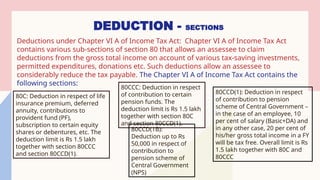
Deductions under Chapter VI A of Income Tax Act: Chapter VI A of Income Tax Act
contains various sub-sections of section 80 that allows an assessee to claim
deductions from the gross total income on account of various tax-saving investments,
permitted expenditures, donations etc. Such deductions allow an assessee to
considerably reduce the tax payable. The Chapter VI A of Income Tax Act contains the
following sections:
80C: Deduction in respect of life
insurance premium, deferred
annuity, contributions to
provident fund (PF),
subscription to certain equity
shares or debentures, etc. The
deduction limit is Rs 1.5 lakh
together with section 80CCC
and section 80CCD(1).
80CCC: Deduction in respect
of contribution to certain
pension funds. The
deduction limit is Rs 1.5 lakh
together with section 80C
and section 80CCD(1).
80CCD(1): Deduction in respect
of contribution to pension
scheme of Central Government –
in the case of an employee, 10
per cent of salary (Basic+DA) and
in any other case, 20 per cent of
his/her gross total income in a FY
will be tax free. Overall limit is Rs
1.5 lakh together with 80C and
80CCC
80CCD(1B):
Deduction up to Rs
50,000 in respect of
contribution to
pension scheme of
Central Government
(NPS)
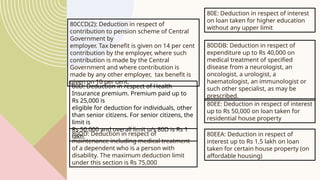
80CCD(2): Deduction in respect of
contribution to pension scheme of Central
Government by
employer. Tax benefit is given on 14 per cent
contribution by the employer, where such
contribution is made by the Central
Government and where contribution is
made by any other employer, tax benefit is
given on 10 per cent.
80D: Deduction in respect of Health
Insurance premium. Premium paid up to
Rs 25,000 is
eligible for deduction for individuals, other
than senior citizens. For senior citizens, the
limit is
Rs 50,000 and overall limit u/s 80D is Rs 1
lakh.
80DD: Deduction in respect of
maintenance including medical treatment
of a dependent who is a person with
disability. The maximum deduction limit
under this section is Rs 75,000
80DDB: Deduction in respect of
expenditure up to Rs 40,000 on
medical treatment of specified
disease from a neurologist, an
oncologist, a urologist, a
haematologist, an immunologist or
such other specialist, as may be
prescribed.
80E: Deduction in respect of interest
on loan taken for higher education
without any upper limit
80EE: Deduction in respect of interest
up to Rs 50,000 on loan taken for
residential house property
80EEA: Deduction in respect of
interest up to Rs 1.5 lakh on loan
taken for certain house property (on
affordable housing)
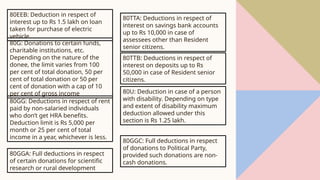
80EEB: Deduction in respect of
interest up to Rs 1.5 lakh on loan
taken for purchase of electric
vehicle.
80G: Donations to certain funds,
charitable institutions, etc.
Depending on the nature of the
donee, the limit varies from 100
per cent of total donation, 50 per
cent of total donation or 50 per
cent of donation with a cap of 10
per cent of gross income
80GG: Deductions in respect of rent
paid by non-salaried individuals
who don’t get HRA benefits.
Deduction limit is Rs 5,000 per
month or 25 per cent of total
income in a year, whichever is less.
80GGA: Full deductions in respect
of certain donations for scientific
research or rural development
80GGC: Full deductions in respect
of donations to Political Party,
provided such donations are non-
cash donations.
80TTA: Deductions in respect of
interest on savings bank accounts
up to Rs 10,000 in case of
assessees other than Resident
senior citizens.
80TTB: Deductions in respect of
interest on deposits up to Rs
50,000 in case of Resident senior
citizens.
80U: Deduction in case of a person
with disability. Depending on type
and extent of disability maximum
deduction allowed under this
section is Rs 1.25 lakh.
EXAMPLE OF DEDUCTION
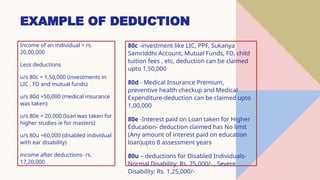
Income of an individual = rs.
20,00,000
Less deductions
u/s 80c = 1,50,000 (investments in
LIC , FD and mutual funds)
u/s 80d =50,000 (medical insurance
was taken)
u/s 80e = 20,000 (loan was taken for
higher studies ie for masters)
u/s 80u =60,000 (disabled individual
with ear disability)
income after deductions- rs.
17,20,000
80c -investment like LIC, PPF, Sukanya
Samriddhi Account, Mutual Funds, FD, child
tuition fees , etc, deduction can be claimed
upto 1,50,000
80d - Medical Insurance Premium,
preventive health checkup and Medical
Expenditure-deduction can be claimed upto
1,00,000
80e -Interest paid on Loan taken for Higher
Education- deduction claimed has No limit
(Any amount of interest paid on education
loan)upto 8 assessment years
80u – deductions for Disabled Individuals-
Normal Disability: Rs. 75,000/- , Severe
Disability: Rs. 1,25,000/-
TAX EXEMPTION VS TAX DEDUCTION
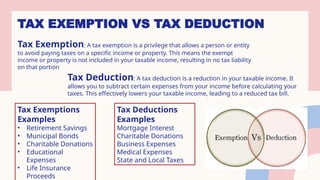
Tax Exemption: A tax exemption is a privilege that allows a person or entity
to avoid paying taxes on a specific income or property. This means the exempt
income or property is not included in your taxable income, resulting in no tax liability
on that portion
Tax Deduction: A tax deduction is a reduction in your taxable income. It
allows you to subtract certain expenses from your income before calculating your
taxes. This effectively lowers your taxable income, leading to a reduced tax bill.
Tax Exemptions
Examples
• Retirement Savings
• Municipal Bonds
• Charitable Donations
• Educational
Expenses
• Life Insurance
Proceeds
Tax Deductions
Examples
Mortgage Interest
Charitable Donations
Business Expenses
Medical Expenses
State and Local Taxes
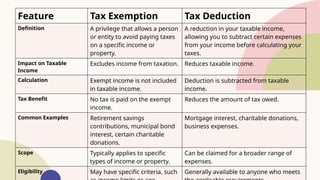
Feature Tax Exemption Tax Deduction
Definition A privilege that allows a person
or entity to avoid paying taxes
on a specific income or
property.
A reduction in your taxable income,
allowing you to subtract certain expenses
from your income before calculating your
taxes.
Impact on Taxable
Income
Excludes income from taxation. Reduces taxable income.
Calculation Exempt income is not included
in taxable income.
Deduction is subtracted from taxable
income.
Tax Benefit No tax is paid on the exempt
income.
Reduces the amount of tax owed.
Common Examples Retirement savings
contributions, municipal bond
interest, certain charitable
donations.
Mortgage interest, charitable donations,
business expenses.
Scope Typically applies to specific
types of income or property.
Can be claimed for a broader range of
expenses.
Eligibility May have specific criteria, such Generally available to anyone who meets
BENEFITS AND ADVANTAGES OF
TAX DEDUCTION
Tax deductions offer several advantages to individuals and businesses, as they help
reduce taxable income and, consequently, lower the overall tax burden. Here are some
key advantages:
• Reduced taxable income: A tax deduction lowers the amount of income that is
subject to taxation, potentially placing the taxpayer in a lower tax bracket and reducing
the total tax owed.
• Lower tax liability: By decreasing the taxable income, tax deductions directly
result in lower tax payments, allowing individuals and businesses to keep more of their
earnings.
• Encouragement of specific behaviors: Many tax deductions are designed to
encourage certain activities, such as charitable donations, investing in education, or
purchasing eco-friendly products, benefiting both the individual and society.
• Support for business expenses: For businesses, tax deductions on expenses
like office supplies, equipment, and travel reduce the cost of running the business,
improving profitability.
CASE LAW AND CONCLUSION
Sassoon J. David & Co. (P.)
Ltd. v. CIT 118 ITR 261 (SC)
The expression “wholly and
execlusively" used in section 10(2)
(xv) of the 1922 Act [corresponding
to Sec 37(1)of the 1961 Act] does
not mean necessarily. The fact that
somebody other than the assessee
is also benefited by the
expenditure should not come in
the way of an expenditure being
allowed by way of deduction if it
satisfies otherwise the tests laid
down by law.
CIT v. Woodward Governor India (P.)
Ltd. 312 ITR 254 (SC)
Section 37(1), read with section 145, of the Income-tax Act, 1961 -
Business expenditure - Allowability of Assessment year 1998-99 -
Whether expression “expenditure" as used in section 37 may, in
circumstances of a particular case, cover an amount which is really a
“loss", even though said amount has not gone out from pocket of
assessee - Held, yes Whether loss suffered by assesses on account
of foreign exchange difference as on date of balance sheet is an
item of expenditure under section 37(1) - Held, yes Whether an
enterprise has to report outstanding liability relating to import of
raw material using losing rate of foreign exchange and any
difference, loss or gain, arising on conversion of said liability at
enclosing rate should be recognized in profit and loss account
enclosing - Held, yes ll Section 43A of the Income-tax Act, 1961 -
Foreign currency, rate of exchange, change in - Assessment year
1998-99- Whether amendment to section 43A by Finance Act, 2002
w.e.f 1-4-2003 is amendatory and not clarificatory Held, yes Whether
under unamended section 43A,actual payment was not a condition
precedent for making necessary adjustment in carrying cost of fixed
asset acquired in foreign currency ⁃ Held, yes
THANK YOU

Tax deduction -- power point presentation

  • 1.
  • 2.
    KEY TOPICS Introduction Deduction Examples Tax ExemptionV/S Tax Deduction Benefits and Advantages of Tax Deduction Case Law and Conclusion 2
  • 3.
    INTRODUCTION Deduction means anitem or expense that can reduce the taxes a person owes in a given year. A deductible item is subtracted from the total taxable income which can substantially reduce taxes owed by an individual or corporation. Often charitable contributions, other taxes, healthcare costs, capital losses, and many business expenses can be deducted, but what can be deducted and how much varies based on the jurisdiction and whether the tax is for an individual or organization. On the federal level, an alternative tax minimum limits the amount many individuals can deduct from their taxes
  • 4.
    DEDUCTION - SECTIONS Deductionsunder Chapter VI A of Income Tax Act: Chapter VI A of Income Tax Act contains various sub-sections of section 80 that allows an assessee to claim deductions from the gross total income on account of various tax-saving investments, permitted expenditures, donations etc. Such deductions allow an assessee to considerably reduce the tax payable. The Chapter VI A of Income Tax Act contains the following sections: 80C: Deduction in respect of life insurance premium, deferred annuity, contributions to provident fund (PF), subscription to certain equity shares or debentures, etc. The deduction limit is Rs 1.5 lakh together with section 80CCC and section 80CCD(1). 80CCC: Deduction in respect of contribution to certain pension funds. The deduction limit is Rs 1.5 lakh together with section 80C and section 80CCD(1). 80CCD(1): Deduction in respect of contribution to pension scheme of Central Government – in the case of an employee, 10 per cent of salary (Basic+DA) and in any other case, 20 per cent of his/her gross total income in a FY will be tax free. Overall limit is Rs 1.5 lakh together with 80C and 80CCC 80CCD(1B): Deduction up to Rs 50,000 in respect of contribution to pension scheme of Central Government (NPS)
  • 5.
    80CCD(2): Deduction inrespect of contribution to pension scheme of Central Government by employer. Tax benefit is given on 14 per cent contribution by the employer, where such contribution is made by the Central Government and where contribution is made by any other employer, tax benefit is given on 10 per cent. 80D: Deduction in respect of Health Insurance premium. Premium paid up to Rs 25,000 is eligible for deduction for individuals, other than senior citizens. For senior citizens, the limit is Rs 50,000 and overall limit u/s 80D is Rs 1 lakh. 80DD: Deduction in respect of maintenance including medical treatment of a dependent who is a person with disability. The maximum deduction limit under this section is Rs 75,000 80DDB: Deduction in respect of expenditure up to Rs 40,000 on medical treatment of specified disease from a neurologist, an oncologist, a urologist, a haematologist, an immunologist or such other specialist, as may be prescribed. 80E: Deduction in respect of interest on loan taken for higher education without any upper limit 80EE: Deduction in respect of interest up to Rs 50,000 on loan taken for residential house property 80EEA: Deduction in respect of interest up to Rs 1.5 lakh on loan taken for certain house property (on affordable housing)
  • 6.
    80EEB: Deduction inrespect of interest up to Rs 1.5 lakh on loan taken for purchase of electric vehicle. 80G: Donations to certain funds, charitable institutions, etc. Depending on the nature of the donee, the limit varies from 100 per cent of total donation, 50 per cent of total donation or 50 per cent of donation with a cap of 10 per cent of gross income 80GG: Deductions in respect of rent paid by non-salaried individuals who don’t get HRA benefits. Deduction limit is Rs 5,000 per month or 25 per cent of total income in a year, whichever is less. 80GGA: Full deductions in respect of certain donations for scientific research or rural development 80GGC: Full deductions in respect of donations to Political Party, provided such donations are non- cash donations. 80TTA: Deductions in respect of interest on savings bank accounts up to Rs 10,000 in case of assessees other than Resident senior citizens. 80TTB: Deductions in respect of interest on deposits up to Rs 50,000 in case of Resident senior citizens. 80U: Deduction in case of a person with disability. Depending on type and extent of disability maximum deduction allowed under this section is Rs 1.25 lakh.
  • 7.
    EXAMPLE OF DEDUCTION Incomeof an individual = rs. 20,00,000 Less deductions u/s 80c = 1,50,000 (investments in LIC , FD and mutual funds) u/s 80d =50,000 (medical insurance was taken) u/s 80e = 20,000 (loan was taken for higher studies ie for masters) u/s 80u =60,000 (disabled individual with ear disability) income after deductions- rs. 17,20,000 80c -investment like LIC, PPF, Sukanya Samriddhi Account, Mutual Funds, FD, child tuition fees , etc, deduction can be claimed upto 1,50,000 80d - Medical Insurance Premium, preventive health checkup and Medical Expenditure-deduction can be claimed upto 1,00,000 80e -Interest paid on Loan taken for Higher Education- deduction claimed has No limit (Any amount of interest paid on education loan)upto 8 assessment years 80u – deductions for Disabled Individuals- Normal Disability: Rs. 75,000/- , Severe Disability: Rs. 1,25,000/-
  • 8.
    TAX EXEMPTION VSTAX DEDUCTION Tax Exemption: A tax exemption is a privilege that allows a person or entity to avoid paying taxes on a specific income or property. This means the exempt income or property is not included in your taxable income, resulting in no tax liability on that portion Tax Deduction: A tax deduction is a reduction in your taxable income. It allows you to subtract certain expenses from your income before calculating your taxes. This effectively lowers your taxable income, leading to a reduced tax bill. Tax Exemptions Examples • Retirement Savings • Municipal Bonds • Charitable Donations • Educational Expenses • Life Insurance Proceeds Tax Deductions Examples Mortgage Interest Charitable Donations Business Expenses Medical Expenses State and Local Taxes
  • 9.
    Feature Tax ExemptionTax Deduction Definition A privilege that allows a person or entity to avoid paying taxes on a specific income or property. A reduction in your taxable income, allowing you to subtract certain expenses from your income before calculating your taxes. Impact on Taxable Income Excludes income from taxation. Reduces taxable income. Calculation Exempt income is not included in taxable income. Deduction is subtracted from taxable income. Tax Benefit No tax is paid on the exempt income. Reduces the amount of tax owed. Common Examples Retirement savings contributions, municipal bond interest, certain charitable donations. Mortgage interest, charitable donations, business expenses. Scope Typically applies to specific types of income or property. Can be claimed for a broader range of expenses. Eligibility May have specific criteria, such Generally available to anyone who meets
  • 10.
    BENEFITS AND ADVANTAGESOF TAX DEDUCTION Tax deductions offer several advantages to individuals and businesses, as they help reduce taxable income and, consequently, lower the overall tax burden. Here are some key advantages: • Reduced taxable income: A tax deduction lowers the amount of income that is subject to taxation, potentially placing the taxpayer in a lower tax bracket and reducing the total tax owed. • Lower tax liability: By decreasing the taxable income, tax deductions directly result in lower tax payments, allowing individuals and businesses to keep more of their earnings. • Encouragement of specific behaviors: Many tax deductions are designed to encourage certain activities, such as charitable donations, investing in education, or purchasing eco-friendly products, benefiting both the individual and society. • Support for business expenses: For businesses, tax deductions on expenses like office supplies, equipment, and travel reduce the cost of running the business, improving profitability.
  • 11.
    CASE LAW ANDCONCLUSION Sassoon J. David & Co. (P.) Ltd. v. CIT 118 ITR 261 (SC) The expression “wholly and execlusively" used in section 10(2) (xv) of the 1922 Act [corresponding to Sec 37(1)of the 1961 Act] does not mean necessarily. The fact that somebody other than the assessee is also benefited by the expenditure should not come in the way of an expenditure being allowed by way of deduction if it satisfies otherwise the tests laid down by law. CIT v. Woodward Governor India (P.) Ltd. 312 ITR 254 (SC) Section 37(1), read with section 145, of the Income-tax Act, 1961 - Business expenditure - Allowability of Assessment year 1998-99 - Whether expression “expenditure" as used in section 37 may, in circumstances of a particular case, cover an amount which is really a “loss", even though said amount has not gone out from pocket of assessee - Held, yes Whether loss suffered by assesses on account of foreign exchange difference as on date of balance sheet is an item of expenditure under section 37(1) - Held, yes Whether an enterprise has to report outstanding liability relating to import of raw material using losing rate of foreign exchange and any difference, loss or gain, arising on conversion of said liability at enclosing rate should be recognized in profit and loss account enclosing - Held, yes ll Section 43A of the Income-tax Act, 1961 - Foreign currency, rate of exchange, change in - Assessment year 1998-99- Whether amendment to section 43A by Finance Act, 2002 w.e.f 1-4-2003 is amendatory and not clarificatory Held, yes Whether under unamended section 43A,actual payment was not a condition precedent for making necessary adjustment in carrying cost of fixed asset acquired in foreign currency ⁃ Held, yes
  • 12.