КИЇВ – 2016
КИЇВСЬКИЙНАЦІОНАЛЬНИЙ УНІВЕРСИТЕТ
ІМЕНІ ТАРАСА ШЕВЧЕНКА
ІНСТИТУТ МІЖНАРОДНИХ ВІДНОСИН
АКТУАЛЬНІ ПРОБЛЕМИ
МІЖНАРОДНИХ ВІДНОСИН
ВИПУСК 129
ACTUAL PROBLEMS OF INTERNATIONAL RELATIONS
Науковий часопис «Актуальні проблеми міжнародних відносин»
індексується в міжнародній наукометричній базі
Index Copernicus з 2015 року
2.
Редакційна колегія
Головний редактор:Копійка В. В., доктор політичних наук, професор, Інститут міжна-
родних відносин Київського національного університету імені Тараса Шевченка.
1-ий заступник головного редактора (науковий редактор): Дорошко М. С., доктор іс-
торичних наук, професор, Інститут міжнародних відносин Київського національного уні-
верситету імені Тараса Шевченка.
2-ий заступник головного редактора: Хмара М. П., кандидат економічних наук, Інсти-
тут міжнародних відносин Київського національного університету імені Тараса Шевченка.
Відповідальний редактор: Макеєнко Л. Ф., Інститут міжнародних відносин Київського
національного університету імені Тараса Шевченка.
Актуальні проблеми міжнародних відносин : Збірник наукових праць.
Випуск 129.
К. : Київський національний університет імені Тараса Шевченка.
Інститут міжнародних відносин, 2016. – 148 с.
У Збірнику розглянуто актуальні питання розвитку сучасних міжнародних відносин,
міжнародного права, міжнародних економічних відносин та міжнародної інформації.
Розраховано на викладачів, наукових співробітників, аспірантів та студентів.
Члени редакційної колегії
Арнольд Райнер, доктор юридичних наук, професор, Регенсбурзький університет (м. Регенсбург, Федера-
тивна Республіка Німеччина).
Балюк Валенти, доктор політичних наук, професор, Університет Марії Кюрі-Склодовської (м. Люблін, Рес-
публіка Польща).
Вергун В. А., доктор економічних наук, професор, Інститут міжнародних відносин Київського національ-
ного університету імені Тараса Шевченка.
Губерський Л. В., доктор філософських наук, академік НАН України, Київський національний університет
імені Тараса Шевченка.
Дайнеко В. В., кандидат філологічних наук, професор, Інститут міжнародних відносин Київського націо-
нального університету імені Тараса Шевченка.
Довгерт А. С., доктор юридичних наук, професор, Інститут міжнародних відносин Київського національ-
ного університету імені Тараса Шевченка.
Кисіль В. І., доктор юридичних наук, професор, Інститут міжнародних відносин Київського національного
університету імені Тараса Шевченка.
Коппель О. А., доктор історичних наук, професор, Інститут міжнародних відносин Київського національ-
ного університету імені Тараса Шевченка.
Крижанівський В. П., доктор історичних наук, професор.
Крушинський В. Ю., доктор політичних наук, професор, Інститут міжнародних відносин Київського на-
ціонального університету імені Тараса Шевченка.
Кремона Маріз, доктор юридичних наук, професор, Європейський академічний інститут (м. Флоренція, Іта-
лійська Республіка).
Лещенко Лариса, доктор політичних наук, професор, Вроцлавський університет (м. Вроцлав, Республіка
Польща).
Манжола В. А., доктор історичних наук, професор, Інститут міжнародних відносин Київського національ-
ного університету імені Тараса Шевченка.
Матвієнко В. М., доктор історичних наук, професор, Інститут міжнародних відносин Київського націо-
нального університету імені Тараса Шевченка.
Key words: CentralAsia, Kazakhstan, Turkmenistan, Uzbekistan, energy security, energy
policy, energy resources.
Анотація. Важливим компонентом забезпечення економічної безпеки держав Цент-
ральної Азії є енергетична безпека, адже енергетичні ресурси мають критично важливе
значення для поліпшення якості життя населення і розширення можливостей для всіх
держав регіону.
Казахстан, Туркменістан і Узбекистан є тими країни, де енергетичні ресурси є сфе-
рою глибокою зацікавленості позарегіональних сил. По суті, енергетична безпека є пріо-
ритетним напрямком зовнішньої політики усіх країн регіону, які намагаються отримати
максимальну вигоду від продажу власних запасів нафти і газу. Енергетичні ресурси Турк-
меністану і Казахстану сприяли розширенню співробітництва з такими країнами, як
Китай, Росія, США та багато інших. Автори аналізують особливості енергетичної по-
літики Казахстану, Туркменістану і Узбекистану, особливості співпраці із зовнішніми
партнерами, а також проблеми, що існують в енергетичному секторі.
Ключові слова: Центральна Азія, Казахстан, Туркменістан, Узбекистан, енерге-
тична безпека, енергетична політика, енергетичні ресурси.
Аннотация. Важным компонентом обеспечения экономической безопасности госу-
дарств Центральной Азии является энергетическая безопасность, поскольку энергети-
ческие ресурсы являются критически значимыми для повышения качества жизни и
расширения возможностей для всех стран в этом регионе. Казахстан, Туркменистан и
Узбекистан являются теми странами, где энергетические ресурсы являются сферой глу-
бокой заинтересованности внерегиональных сил. По сути, энергетическая безопасность
является приоритетным направлением внешней политики всех стран в регионе, кото-
рые пытаются получить максимальную выгоду от продажи собственных запасов нефти
и газа. Энергетические ресурсы Центральной Азии, в первую очередь, Туркменистана и
Казахстана, позволяют расширять сотрудничество с такими странами, как Китай,
Россия, США и многие другие. Авторы исследуют особенности энергетической поли-
тики Казахстана, Туркменистана и Узбекистана, особенности сотрудничества с внеш-
ними партнерами, а также проблемы, существующие в энергетическом секторе.
Ключевые слова: Центральная Азия, Казахстан, Туркменистан, Узбекистан, энер-
гетическая безопасность, энергетическая политика, энергетические ресурсы.
Current problems. The modern interpretation of the energy security involves not only the
stable supply of the hydrocarbon resources to the consumers but also includes the production,
transportation and the sales in the world of energy markets. That’s why not only the supplying
countries but also the transit states, the consumers and the transnational energy corporations,
namely, the representatives of all links in the energy chain must bear their share joint responsi-
bility for the energy security.
The whole Central Asian region is characterized by a high level of the energy resources.
However, in the region there are countries with a high level of energy security (Turkmenistan,
Kazakhstan and Uzbekistan) and the countries (Kyrgyzstan and Tajikistan) which are experi-
encing difficulties in energy sector.
The purpose of this article is to analyze the energy policy of Kazakhstan, Turkmenistan and
Uzbekistan, because this sector is the main for the economic development not only for Central
Asia, but also for the nearest regions.
Important research results. About half of the total energy accounts of this region is con-
nected with natural gas, the main reserves of which are concentrated in Turkmenistan, Uzbek-
5Актуальні проблеми міжнародних відносин. Випуск 129. 2016
6.
istan and Kazakhstan[1]. Of the total proved reserves of natural gas Turkmenistan has at its dis-
posal 2,252 trillion cubic meters; Kazakhstan – 1500; Uzbekistan – 1476 trillion cubic m [Ме-
горан, 2011:51]. Oil takes the second place in the structure of the energy states of the CAR, up
to 80% of its production accounts for Kazakhstan. According to the World Bank Kazakhstan
has the “lion’s" share of the region’s oil reserves – 1 100 million tons of the oil equivalent among
the proved 1264, 2 million tons [3]. For all that the Kazakhstan’s major oil and gas resources
are associated with the shelf of the Caspian Sea. So the proved reserves of hydrocarbons on the
land are 4 billion tons of oil but the potential of the shelf is 17 billion tons [1]. More than 20%
of the proved world reserves of uranium are situated in Kazakhstan and Uzbekistan [1]. The
share of the CA region in the structure of the global proved reserves of coal is about 2%. The
coal deposits of the CA are also located mainly in Kazakhstan (24 300 million tons among
28231).
In general Kazakhstan has 77.4% of fossil fuels of the region, Uzbekistan – 12.7; Turk-
menistan – 6.7 while the parts of Kyrgyzstan and Tajikistan are less than 2% [4]. By the way the
hydro potential of Tajikistan is 27.3 million tons per year but in Kyrgyzstan –14 million tons
among the total volume of 45,1million tons for the region as a whole [1]. This somewhat com-
pensates the lack of the energy reserves of the two previous countries. However, in the total fuel
and energy balance of the region the share of the hydroelectric power at this time is negligible
– about 2% [Петров, 2010:60].
Thus, the CA countries have the large and diversified resource base which is although un-
evenly distributed in the region. First of all by the increasing of the production of oil and natu-
ral gas from 2004 to 2012 the countries of the region increased their GDP on average in 4.5
times. The most marked growth is in the economy of Turkmenistan, the least – in Kyrgyzstan
and Tajikistan [Linn, 2012:98].
During the years of independence the exchange of energy between the CA countries was re-
duced. Kazakhstan supplied coal and gas to Kyrgyzstan. Uzbekistan both as consumes so pro-
duces a lot of oil, gas and electricity. However, only natural gas is an essential article of its
export. Uzbekistan replaced Turkmenistan as the main supplier of natural gas to the countries
in the region. Kazakhstan, Kyrgyzstan and Tajikistan are dependent on the Uzbek’s gas sup-
plies. From time to time the neighbor countries accuse Tashkent in using gas export for the po-
litical and economic press [Дадабаева, 2014:17].
The elites of Kazakhstan, Turkmenistan and Uzbekistan are seeking to convert the increased
attention of the west countries, Russia, China and other players to the energy sector in the more
favorable terms of the political and economic dialogue, to the supporting of their policy, the le-
gitimizing of their regimes, and the increasing of the investment, etc. Despite the large number
of the foreign activities the energy transportation projects have the key importance for the coun-
tries in the region: the creation of the new infrastructure (the pipelines and the port systems) for
the oil and gas exports from CA and the Caspian Sea. The "pipeline boom" observed since 2002-
2003 was the result of this tendency.
Resource-rich Kazakhstan and Turkmenistan extract much more oil and gas than they use
at present and they have sufficiently developed pipeline transport that makes them natural ex-
porters [4]. Being built in the years of the USSR the system of the transportation of hydrocar-
bons from CA was closed for the supplies to Europe and did not provide the other routes except
the transit through Russia. This situation continues to affect the export volumes of major oil and
gas from CAbut it does not satisfy the political leaderships of Turkmenistan and Kazakhstan who
are trying all possible ways to diversify their supplies. However, their policy to ensure their own
energy interests significantly differs from each other [Омаров, 2008:145].
6 Actual problems of international relations. Release 129. 2016
7.
Since gaining theindependence the Kazakhstan’s oil and gas industry has become the guar-
antor of its economic growth. The foreign policy of the country is aimed to meet the challenges
of the providing the stable and secure export routes for oil and gas as the Kazakhstan’s geopo-
litical situation necessitates the construction of the export pipeline’s network through the terri-
tories of the adjacent states [Бабак, 2009:105].
The development of the Kazakhstan’s economy cannot be viewed from the point of view of
the isolation of its cautious multi-vector foreign policy to the economic cooperation with the
maximum number of the external partners. Kazakhstan supports all the integrational initiatives
in the region which are often contradictory and the President Nazarbayev often acts as the ini-
tiator of such kinds of projects [Шайхутдинов, 2009:164-165].
In the oil and gas sector of Kazakhstan there is a great number of the largest energy com-
panies from the USA, Europe, Russia and China and this fact suggests the broad international
cooperation of the state in the energy sector.
In the 1990s Kazakhstan exported oil through the bulk pipeline "Atyrau – Samara". Russia
continued to be the main economic partner of Kazakhstan in the transportation of the energy re-
sources [Олкотт, 2000:72-80]. In 2001 the pipeline "Tengiz–Novorossiysk" was put into op-
eration. It was built by the Caspian Pipeline Consortium (CPC), the shareholders of which were
the governments of Russia, Kazakhstan, Oman and several multinational oil companies.
Kazakhstan uses the participation in the political and economic projects of Moscow on the
post-soviet territories of CIS, EurAsEC etc. for the improvement its own supplies of hydrocar-
bons, the economic support and the military-technical cooperation. The Russian company
"Gazprom" greatly influences the Kazakh – Russian relation and jealously guards its interests
in Kazakhstan [Томберг, 2012:19]. The Concern began the reconstruction of the gas pipeline
"Central Asia – Center" which would bring it’s capacity from 45 to 90 billion cubic m [13]. In
2002 the Russian–Kazakh company "KazRosGas" was created and it exported the Kazakh gas
to Russia which after the processing was partially returned to Kazakhstan and was partly re-ex-
ported. In October 2006 Russia and Kazakhstan reached an agreement to found the joint enter-
prise of the processing of the Kazakh gas on the basis of the Orenburg gas processing plant
[Петерсен, 2012:35].
The global economic crisis of 2008-2009 painfully stroke the economy of Kazakhstan and
forced the leaders of Kazakhstan to seek the support of Moscow. But they didn’t receive it. This
fact made Kazakhstan radically revise the relations with RF. Except the export to the European
markets using the pipelines through Russia and passing it (using trans-shipment) the going out
of Kazakhstan to the East Asian oil market has become promising. However, it should be noted
that Kazakhstan’s dependence on the oil transit through Russia is still high [Бабак, 2009:92-93].
An important role in the integration of Kazakhstan to the international energy infrastructure
in the 1990s is played by the US – Kazakh cooperation. At that time the commercial relations
with the US international oil companies (MNCs) were registered and very often it was done
with a considerable diplomatic support. The companies from the United States were the first
Kazakh oil and gas investors and the third part of the investments to the Kazakh economy mainly
in the oil and gas sector was American [15].
In 2003 the effort of Chine to buy 16% of stakes in the giant Kashagan consortium which
had developed the largest field on the Caspian shelf of Kazakhstan was broken down by the US
company "Ekson Mobil" which could intercept the contract [Султанов, 2009:32].
The US administration made great efforts to achieve the joining of Kazakhstan the oil
pipeline "Baku – Jeyhan" from Azerbaijan to Turkey through Georgia. It was built in 2005 with-
out the participation of Russia and was aimed at the eliminating its monopoly on the transport-
ing of the Caspian oil in the western direction [Казанцев, 2009:113].
7Актуальні проблеми міжнародних відносин. Випуск 129. 2016
8.
The Kazakhstan andthe US joint action plan on the energy cooperation signed on the 14th
of October 2011 was the confirmation of the closed energy cooperation [18]. However, after
2005 the share of the USA in the energy sector of Kazakhstan has started to decline and its place
in the terms of lending and participation in the energy projects was occupied by China. The
choice of the Chinese company to develop the Kashagan field despite a better offer from a com-
pany in India and a sharp increase of the overall share of Chinese companies in the oil and gas
sector was the proof of this fact [Кучук, 2009:52].
From the point of view of the safety of supplies the Kazakh oil is considered to be attrac-
tive in Beijing because it can be delivered to China by land and it will reduce the dependency
of China on the marine transport. Back in 1997 the Chineese National Petroleum Company
(СNNK) acquired the Kazakh companies "Aktobemunaygaz" and "Uzenmunaygaz" and in 2003
– the deposit called Northern Buzachi [Жуков, 2009:27].
In June 2003 during the state visit to Kazakhstan СNNK the Head of China Hu Tsintao
signed the agreement with the government of Kazakhstan about the construction of the Kazakh
– Chinese pipeline Atas – Alashankou for the smuggling of 400 thousand barrels of crude oil per
day [Жуков, 2009:34]. At the same time Kazakhstan could cover only 200 thousand barrels of
crude oil per day and that’s why in 2003 at the meeting with N. Nazarbayev Hu Tsintao raised
the possibility of the connecting of Russia to this project [Парамонов, 2010:45]. In 2004 СNNK
and KazMunaiGaz signed the agreement on the joint investment on the equal terms in the con-
struction of the pipeline Atas – Alashankou, the length of which is 962.2 km and the carrying
capacity – 10 mln. tons of oil a year. The joint venture – KazTransOil – was made with the equal
parts of both companies [Сыроежкин, 2010:47].
The cooperation of states in the field of nuclear energy is being done according to the agree-
ment on the mining and the processing of uranium signed on the 6-th of November 2004 in Bei-
jing between NAC "Kazatomprom" and the China National Nuclear Corporation (СNNС) for
the period up to 2020. The Chinese nuclear market is important for Kazakhstan in the terms of
guarantees of its uranium supplies [Кучук, 2009:50].
The beginning of the Kazakh–Chinese cooperation in the electricity sector began in July
2005 when the agreement on the mutually beneficial cooperation between the Kazakhstan JSC
Management Company in the electric networks (KEGOK) and the Chinese state electric grid
corporation StateGRID (Corporation of China) was signed. According to the part of this agree-
ment Kazakhstan and China agreed on a joint project in the electricity sector the price of which
was about 9,5-10 billion dollars [Жуков, 2009:55-56].
In 2005 the company “PetroKazakhstan which was the owner of the Kumkolskym deposit
was taken under the Chineese control. In 2005 the construction of the pipeline "Atas –
Alashankou" from Kazakhstan to the Chinese border with a carrying capacity of 10 million
tons was completed. Then in 2006 the Chinese state investment corporation "CITIC Group"
bought the Karazhanbas deposit in the west of Kazakhstan [Кучук, 2009:50].
InApril 2009 СNNK acquired 50% of stakes of the Kazakh company "Manhistaumunaygaz"
which produced about 5 million tons of oil a year on the 15 deposits. At the same time China
gave Kazakhstan which faced the financial difficulties the interest-free loan of $10 billion dol-
lars 5 billion of which were appointed to the national oil company "KazMunaiGas" and 5 bil-
lion- to the Bank of the development of Kazahstan [Турарбекова, 2010:20]. Following the talks
between the Prime Minister of Kazakhstan K. Masymov and the Prime Minister of China Li
Keqiang the agreements for 14 billion dollars were signed [24]. The terms of the agreements of
the sides were not disclosed. However, due to the role which the Chinese companies play in
Kazakhstan today we can assume that Astana received the financial assistance in exchange for
the MFN Chinese business in the energy sector of Kazakhstan.
8 Actual problems of international relations. Release 129. 2016
9.
In October 2009the second phase of the Kazakh – Chinese pipeline Kenkayak – Kumkol
came into operation. It was partly used for the deliveries to China the limited volumes of the
Russian oil but in December 2009 the Chinese side rejected the proposal of the Russian com-
pany "TNK– BP" to continue the practice. It is important to note that this pipeline is not on the
Russian territory and it is the first independent channel of the oil exports from Kazakhstan.
The large-scale project of the pipeline "Kazakhstan – Western China" can be considered to
be implemented. This project became a part of the Chinese energy corridor East – West and a
real example of the diversification of the Kazakh oil.
In 2010 the Kazakh KazMunaiGaz and the СNNK formed a joint venture with the build-
ing of the gas pipeline Beineu–Shymkent (Kazakhstan’s western regions) the carrying capacity
of which was 10 bln m3
per year for the connection to the gas pipeline Central Asia–China and
the provision with gas the southern areas of Kazakhstan. The construction of this unit began in
2010.
On the 7th
of September 2013 China and Kazakhstan signed an agreement under which
China bought a stake in the deposit "Kashagan. This fact allowed China to be ahead of India and
put an end the dominance of the Western countries on the Caspian Sea shelf [Petersen, 2013:39].
The cooperation with China was in the framework of the SCO too. N. Nazarbayev initiated
the creation of the energy agency and the energy exchange within SСO at the SCO summit in
Bishkek in August 2007 [Маркетос, 2012:59].
Such close relationship with China can be interpreted as the refusal from the multi-vector
foreign policy of Kazakhstan as it is indicated by some Kazakh analytics [Малашенко,
2012:102-103]. From the perspective of the economists we can agree with the following state-
ments. However, the political relations of Russia and Kazakhstan remain to be very close and
the multi-vector policy of Astana is not completed.
An importantly special role in the improving of the investment image of Kazakhstan is
played by the annual Eurasian forum Kazenergy which invites the representatives of the world’s
largest energy multinationals.
The Turkmenistan’s energy policy can not be viewed outside the context of its security
strategy related to the preservation of the official status of "the positive neutrality" and, there-
fore, the non-participation in the military blocs. This policy is considered as the most favorable
for contacts with all buyers of gas.
The features of the political regime in Turkmenistan do not allow to separate the political
and economic factors associated with the operation of its energy system. Under the President S.
Niyazov the revenues from the oil and gas exports were controlled personally by him and were
used primarily to strengthen the regime of his own power. The same purpose was in the export
policy in the field of energy. Its main objectives were connected with the maximum distance from
other states (through their support of the competition for the resources of Turkmenistan) and the
complete isolation of the country from all possible external influences. The last feature con-
tributed the president’s control over the situation in the country even more [Казанцев, 2008:13].
The technical state of the transit infrastructure and the monopoly position of Russia, which
continued to be the main buyer and the transporter of the Turkmen energy resources, dictated the
prices and the shipment prevented an active export policy of Turkmenistan in the early 1990s.
The differences between Turkmenistan and "Gazprom" repeatedly led to the complete cessation
of the gas supplies by the northern direction [Чуфрин, 2010:176].
In order to reduce the dependence on Russia and to bring the gas prices to the world levels
Turkmenistan’s attitude towards the economic integration projects on the post-soviet areas that
could create the limitations for the cooperation with the potential buyers of natural resources was
9Актуальні проблеми міжнародних відносин. Випуск 129. 2016
10.
very cautious. Thispolicy affected the refusal of the country’s participation in the EurAsEC,
CSTO, GUAM, CACO and other integration structures, the folding of the cooperation within the
CIS up to the going to the associated membership. Another way of the pressure on the Russian
side in the gas negotiations was the abolition of dual citizenship from the RT [Парамонов,
2008:64].
However, in April 2003 Russia and Turkmenistan signed a framework intergovernmental
agreement on the cooperation in the gas sector for a period of 25 years. This agreement included
the increase in the exports of the Turkmen gas to Russia from 5.6 billion m3
in 2004 to 60-70
billion in 2007 and 70-80 billion m3
in 2009-2028 m3
[Парамонов, 2008:179].
The export of gas from Turkmenistan arrived to the west direction through the old Soviet
pipeline systems "Central Asia – Center" and "Bukhara – Ural". While exporting gas Uzbekistan
and Kazakhstan are the transit countries for Turkmenistan. For this reason Turkmenistan an not
realize it’s own export potential: Uzbekistan and Kazakhstan are interested in the exporting of
its own gas but not in the pumping of the Turkmenistan’s gas [31]. To overcome the difficulties
in May 2007 the Presidents of Kazakhstan, Turkmenistan and Russia agreed on the construction
of the Caspian gas pipeline with a capacity of 30 billion m3
per a year. In 2008 Moscow and Ash-
gabat reached a preliminary agreement on the construction of the gas pipeline "East – West" in
Turkmenistan by “Gasprom”. It had to link the largest deposit Yolotan with the future Caspian
pipeline. However, Turkmenistan demanded to exclude from the draft agreement the clause that
provided it’s binding to the Caspian routes. In addition, Ashgabat insisted on the full funding of
the construction by the Russian side. The arrangements were disrupted and the construction of
the Caspian gas pipeline did not begin on time [32]. Thus, Turkmenistan evaded the obligation
to export through the Caspian route the resources of one of the largest deposits – Yolotan.
As in the case with Kazakhstan the model of the interaction of "Gazprom" and Turkmenistan
didn’t stand the test of the economic crisis of 2008-2009. In 2009 by the reducing of the volume
of gas purchased by Ukraine and the fall of the demand from other European consumers, the con-
ditions of the re-export of the Turkmen gas to "Gazprom" were unprofitable. In April 2009 on
the pipeline Dauletabad – Dariyalyk that was a part of the system "Central Asia – Center" there
was an explosion the cause of which according to the Turkmen side was the decline of pressure
in the pipe caused by a sharp reduction in the volume of gas which was taken by "Gazprom"
[Парамонов, 2010:65]. The Ministry of Foreign Affairs of Turkmenistan said that "Gazprom"
had acted without the consent with Ashgabat and accused the Russian side in the violating of the
contract [Богатуров, 2010:82-88]. The problem that seemed purely technical demonstrated the
existence of the significant differences in the Russian–Turkmen energy cooperation.
With the change of the political leadership in the country the energy policy of Turkmenistan
began to be more active in the concept of the diversification of the supply and the finding the
new markets for hydrocarbons. In 2012 the share of Russia which until 2000 was the only buyer
of Turkmen gas was less than half of all gas exports of Turkmenistan [1].
Back inApril 2006 Turkmenistan signed a deal with China about natural gas exports amount-
ing to 30 billion m3 per year since 2009. The agreement envisaged the construction of a gas
pipeline from the deposits of Turkmenistan to Shanhay. In addition, China pledged to consult in-
dependently about the construction of the pipeline on the territory of the transit countries –
Uzbekistan and Kazakhstan. At the same time as China signed an agreement on the purchase of
gas to Kazakhstan there was a need to build a gas pipeline along the pipeline "Atas – Alashan-
kou".
In July 2007 during the state visit of the President of Turkmenistan H. Berdymuhamedov
to China СNNK signed an agreement with the State Concern “Turkmengas” on the buying – sale
10 Actual problems of international relations. Release 129. 2016
11.
of natural gas,a production sharing agreement and using of the hydrocarbon resources with the
State Agency on management under the President of Turkmenistan. The arrangements pro-
vided the full-scale work on the exploration and the production of natural gas on the field of
Bahtyyarlyk on the right bank of the Amudarya [Жуков, 2009:33] and in August 2007 Turk-
menistan conveyed СNNK the license. In December 2009 the first stage of the pipeline Turk-
menistan – Uzbekistan – Kazakhstan – China with a capacity of 13 billion m3
per a year was put
into the operation [Султанов, 2010:136].
On the 3-d of September, 2013 China and Turkmenistan signed an agreement on the fi-
nancing of the second stage of the development of the gas field "Galkin" and the construction
of the fourth gas pipeline Turkmenistan–China through Uzbekistan. By the volume of natural gas
the deposit "Galkin" takes the second place in the world [35]. It is noteworthy that for a long time
the countries of the European Union negotiated with Turkmenistan on the development of this
deposit.
Except Russia and China, Turkmenistan and Kazakhstan have the possibilities of the coop-
eration with IRI for a potential widening of the seller’s markets. In 1997 the pipeline "Kor-
pedzhe – Kurt – Cui" combined Turkmenistan and Iran. As its capacity is small it does not
completely solve the problem of the diversification of the Turkmen gas exports. In addition, the
project of the supply of the Turkmen gas to Virmeniya through the Iranian territory was worked
out. But as Iran itself is a gas exporter and competes with Turkmenistan for the markets of the
Transcaucasian states, the cooperation between states is more experimental [Казанцев,
2008:194-198].
As for the cooperation in the oil industry in the early 2000s Kazakhstan and Turkmenistan
established the export of oil through the Iranian territory by the method of "substitution". The
oil was delivered to the Iranian ports on the Caspian Sea by the tankers for the internal needs
of the North of Iran. Instead the Iranian companies shipped the equivalent amount of oil from
its deposits on the shores of the Persian Gulf to those consumers of the Kazakh and Turkmen oil
who had concluded the appropriated contracts with Kazakhstan and Turkmenistan. In 2003 Iran
completed the construction of the oil pipeline from the Caspian port of Neka to Tehran which
opened an additional opportunity to export Central Asian oil through Iran [Жуков, 2014:95-
103]. However, these projects encountered the resistance of the United States which were the ini-
tiators of the imposing of the economic sanctions on Iran and opposed the participation of this
country in any schemes of the exporting of oil from CA for a long time. Thus, for example, the
American companies in Kazakhstan and Turkmenistan were not allowed to work with the Iran-
ian corporations [37]. Out of the country from the economic isolation suggests the high proba-
bility of the intensifying of the cooperation of Central Asian republics with Iran and the
construction of the new energy corridors in the western direction.
The maximizing of the export potential became very important for Turkmenistan in the
field of foreign policy. Official Ashgabat established the relations with Iran and Afghanistan
(including the "Taliban" until 2001) [Лаумулин, 2011:128], Russia and the Transcaucasian re-
publics. However, China was the most important partner in the energy sector for the country. It
became not only the main market of selling of Turkmen natural resources but also it received the
preferential concessions for the extraction and the supply of large volumes of Turkmen gas via
the gas pipeline complex Central Asia–China.
The energy policy of Uzbekistan is connected with the feature of it’s adoption of the eco-
nomic model and the specific political system. Tashkent has made a conscious choice in favor
of the maintaining of the state control over enterprises pursuing actively the export policy
[Жуков, 2014 : 76]. As the country hasn’t such number of surpluses of oil and gas as the neigh-
boring Kazakhstan and Turkmenistan and at the same time it has a much larger population, the
11Актуальні проблеми міжнародних відносин. Випуск 129. 2016
12.
export potential ofUzbekistan is limited. In general the energy security of Uzbekistan is, with
no doubt, of such kind that the country completely provides itself with the energy resources [1].
It is being done by the extensive way, namely by the increasing of the volume of oil and gas. For
the gas production Uzbekistan ranks 3rd
in the CIS after Russia and Turkmenistan [1].
Uzbekistan’s foreign policy strategy in the energy sector involves attracting the largest
amount of foreign investment to modernize the energy industry while maintaining strong con-
trol of the state. Although foreign firms have shown interest in the business in this country, its
gas sector remains largely closed to all except Russia [Парамонов, 2009:130]. Uzbekneftegaz
signed an agreement on production sharing with the British company Trinity Energy, but broke
it in 2005, claiming that the other party does not fulfill its conditions contract [15]. This policy
was related to the cooling of relations of Uzbekistan with the West after the 2005. Russia, which
supported the Uzbek position on the Andijan events received real economic benefits – in Janu-
ary 2006, the Gazprom CEO Miller signed a contract with Uzbek President I. Karimov on trans-
fer the three largest gas fields in Uzbekistan – USU, and Akchalak Quan – "Gazprom", which
received a monopoly on the export of Uzbek gas [Парамонов, 2009:130]. Since Uzbekistan is
working closely with "Gazprom" signed an agreement on the annual supply to Russia 350 bil-
lion cubic meters of gas.
However, the rapprochement with Russia that by "Gazprom" has the opportunity to influ-
ence the political decisions of the Uzbek leadership, offset by active economic relations with
China. That line of Chinese foreign policy has become the most promising for Uzbekistan, es-
pecially after 2009-2010.
Back in April 2007 Uzbekistan and China signed an intergovernmental agreement on prin-
ciples of construction and operation of the pipeline length of 530 km and a capacity of 30 bln
m3
per year for the transit of Turkmen gas. The operator of the project area was Uzbek Uzbek–
Chinese joint venture AsiaTransGas, created national holding company and Uzbekneftegaz
CNNK [Жуков, 2009:72].
In June 2010 Uzbekistan and China have agreed on the construction by December 2011.
the second stage of the pipeline from Uzbekistan to China, in which China will receive Uzbek
gas at $10 billion m3
per year.
In April 2011 Tashkent and Beijing in the framework of the state visit of President of Uzbek-
istan I.Karimov in China signed an agreement on construction of the third stage, the capacity of
which will amount to 25 billion m3
per year.
Conclusions. Since the collapse of the Soviet Union in 1991 the energy potential of Cen-
tral Asia was an integral part of the geopolitical and geo-economic interest in the region of the
leading actors in world politics and international business. The privileged position of Russia,
which before the 2000 s. Maintained a virtual monopoly on the transportation of Central Asian
energy resources, the Kremlin used to determine the final consumers, categorically excluding di-
rect deliveries to Western markets. With the expansion of the circle of foreign partners in the en-
ergy sector of Central Asian countries Russia stopped to play a strategic importance for the
region, giving way to the east. An example of reducing the role of Russia in the energy sector
CA is the abandonment of implementation of the Caspian pipeline, a project that aimed to im-
plement the "Gazprom".
For the EU Central Asian region is to diversify sources of energy. In this context, the im-
portance of the project was Nabucco (Nabucco) – transportation of gas from Turkmenistan and
Azerbaijan in the long term from Russia, bypassing Russian territory. The project could com-
pete with the Russian South Stream and the end of June 2013 it was announced that a consor-
tium of companies involved in the development of gas fields in Azerbaijan, decided to transport
12 Actual problems of international relations. Release 129. 2016
13.
gas through theTrans Adriatic Pipeline (TAP). The failure of the Nabucco project is related to
the need of huge investment, and Central Asian states insisted that the financial obligations it
took on the European side. Another stumbling block was the uncertain status of the Caspian
Sea. Today, Europe is trying to update projects the transportation of Turkmen gas through Azer-
baydzhan.
Energy Strategy of the United States in the Central Asian region aims to reduce dependence
on Middle Eastern energy resources and therefore influence of Russia and China on the coun-
try’s Civil Aviation. In this connection the Caspian Central Asian states – Kazakhstan and Turk-
menistan official Washington views as a zone of vital interests USA. In the second half of the
1990s. US initiated the creation of "energy corridor East-West", which involved the construc-
tion of Trans Caspian oil and gas pipelines bottom of the Caspian Sea from Turkmenistan to
Azerbaijan and Kazakhstan. Also, the US and Kazakhstan December 26, 2001 signed a decla-
ration on strategic partnership in energy, transport and nuclear safety.
The active energy policy of China in Central Asia determine factors such as geographical
proximity to the region, the need for China in maintaining high economic growth and the need
to diversify energy sources, as half the country’s oil imports from the Middle East. China is also
interested in developing their northern provinces, primarily Xinjiang population traditionally
has strong ethnic and religious ties with the CA. Overall, China’s energy policy to attract Cen-
tral Asian hydrocarbon resources to serve its energy needs in the medium and long prospects.
Considerable interest in the hydrocarbon CA show also Turkey, Iran, Pakistan and India. Turkey,
with US support, seeks to become the main transit country for Uzbek, Kazakh and Turkmen en-
ergy resources to world markets.
References
1. The World Factbook, Central Intelligence Agency [Електронний ресурс]. – Режим до-
ступу: https://www.cia.gov/library/publications/the-world-factbook.
2. Мегоран Н. Центральная Азия: безопасность и опасности / Н. Мегоран, Дж. Хезершоу
// Центральная Азия и Кавказ Т. 14 В. 3. – 2011. – С. 7-21.
3. Центральная Азия. Исследование регионального потенциала экспорта электроэнер-
гии: основной отчет (русский) [Електронний ресурс]. – Режим доступу: http://docu-
ments.vsemirnyjbank.org/curated/ru/2004/12/6352791/central-asia-regional-electricity-exp
ort-potential-study-vol-1-2-main-report.
4. Алияров Б. К. Казахстан: Энергетическая безопасность, энергетическая независимость
и устойчивость развития энергетики. Состояние и перспективы [Електронний ресурс]
/ Алияров Б. К. – Режим доступу: http://www.clrma-teaction.kz/uploads/Профильэнер-
гетики_Казаxстан.pdf.
5. Петров В. Конфликт интересов между гидроэнергетикой и ирригацией в Централь-
ной Азии. Его причины и пути преодоления / В. Петров // Центральная Азия и Кав-
каз Т. 13 В. 3. – 2010. – С. 59-73.
6. Linn J. Central Asian Regional Integration and Cooperation: Reality or Mirage? [Елек-
тронний ресурс] / J. Linn // The economics of the post-soviet and Eurasian integration. –
Yearbook 2012. – Eurasian Development Bank. – P. 96-117. – Режим доступу: www.brook-
ings.edu/.../regional-integration-and-cooperation.
7. Дадабаева З. А. Процессы регионализации в Центральной Азии: проблемы и проти-
воречия: научный доклад / З. А. Дадабаева, Е. М. Кузьмина. – М. : Институт эконо-
мики РАН, 2014. – 55 с.
13Актуальні проблеми міжнародних відносин. Випуск 129. 2016
14.
8. Омаров Н.М. Государства Центральной Азии в эпоху глобализации: поиски страте-
гии развития / Н. М. Омаров. – Бишкек : Фонд им. Ф. Эберта, 2008. – 253 с.
9. Бабак В. Экономика Казахстана в тисках мирового финансового кризиса / В.Бабак //
Центральная Азия и Кавказ № 6 (66). – 2009. – С. 91-106.
10. Шайхутдинов М. Казахстан и стратегические интересы глобальных игроков в Цент-
ральной Азии / М. Шайхутдинов // Центральная Азия и Кавказ № 3 (63). – 2009. – С.
158-168.
11. Многомерные границы Центральной Азии / Под ред. М. Олкотт и А. Малашенко. –
М.: Гендальф, 2000. – 97 с.
12. Томберг И. Газ Центральной Азии в меняющемся геополитическом контексте / И.
Томберг // Центральная Азия и Кавказ Т. 15 В. 1. – 2012. – С.7-23.
13. Мироненков А. П. Дорожная карта создания механизма взаимодействия государств-
членов ЕврАзЭС в водно-энергетическом регулировании в Центральной Азии [Елек-
тронний ресурс] / А. П. Мироненков, Т. Т. Сарсембеков. – Режим доступу: http://www.
analitika.org/article.php?story=2007040101430997&mode=print.
14. Петерсен А. Россия, Китай и энергетическая геополитика в Центральной Азии / А.
Петерсен при участии К. Барыш. – М. : Центр европейских реформ; Моск. Центр Кар-
неги, 2012. – 90 с.
15. Коэн А. Энергетическая безопасность Центр. Азии и интересы США. Часть 1-я [Елек-
тронний ресурс]. – Режим доступу: http://www.centrasia.ru/newsA.php?st=1164272100.
16. Султанов Б. К. Центральная Азия в условиях геополитической трансформации и ми-
рового экономического кризиса / Б. К. Султанов. – Алматы : КИСИ при Президенте
РК, 2009. – 338 с.
17. Казанцев А. А. Политика стран Запада в Центральной Азии: ключевые характери-
стики, дилеммы и противоречия / А. А. Казанцев. – М. : МГИМО-Университет, 2009.
– 186 с.
18. Казахстан и США приняли план совместных действий по энергетическому сотруд-
ничеству [Електронний ресурс]. – Режим доступу: http://www.zakon.kz/4453409-kaza-
khstan-i-ssha-prinjali-plan.html.
19. Кучук З. Энергетическая политика Китая в Центральной Азии и роль Казахстана / З.
Кучук // Центральная Азия и Кавказ №3 (63). – 2009. – С. 36-53.
20. Жуков С. В. ЦА и Китай: экономическое взаимодействие в условиях глобализации /
С. В.Жуков, О. Б. Резникова. – М. : ИМЭМО РАН, 2009. – 180 с.
21. Парамонов В. Энергетические интересы и энергетическая политика Китая в Цент-
ральной Азии / В. Парамонов, А. Строков // Центральная Азия и Кавказ Т. 13 В. 3. –
2010. – С. 21-35.
22. Сыроежкин К. Л. Казахстан – Китай: от приграничной торговли к стратегическому
партнерству: монография. – В трех книгах. Книга 2. В формате стратегического парт-
нерства / К. Л. Сыроежкин. – Алматы : Казахстанский институт стратегических ис-
следований при Президенте РК, 2010. – 384 c.
23. Турарбекова Р. Политика Китая в отношении соседних стран Центральной Азии / Р.
Турарбекова, Т. Шибко // Международное право и международные отношения. – 2010
– № 5. – С.17-29.
24. Многовекторной политике» Казахстана пришёл конец? [Електронний ресурс]. – Ре-
жим доступу: http://www.szona.org/mnogovektornoj-politike-kazahstana-prishyol-konets/
#t20c.
25. Petersen A. Central Asia’s New Energy Giant: China. / A. Petersen // The Atlantic. – 2013.
– № 7. – P. 28-49.
14 Actual problems of international relations. Release 129. 2016
15.
26. Маркетос Т.Н. Стратегия Китая в отношении Центральной и Южной Азии: энерге-
тические интересы и безопасность / Т. Н. Маркетос // Центральная Азия и Кавказ Т.
15 В. 1. – 2012. – С. 47-60.
27. Малашенко А. Центральная Азия: на что рассчитывает Россия? / А. Малашенко. – М.:
Российская политическая энциклопедия (РОССПЭН), 2012. – 118 с.
28. Казанцев А. А. «Большая игра» с неизвестными правилами: мировая политика и Цент-
ральная Азия / А. А. Казанцев. – М. : Некоммерческий Фонд «Наследие Евразии»,
2008. – 248 с.
29. Чуфрин Г. И. Россия в Центральной Азии: монография / Г. И. Чуфрин. – Алматы : Ка-
захстанский институт стратегических исследований при Президенте РК, 2010. – 220
с.
30. Парамонов В. Россия и Китай в Центральной Азии: политика, экономика, безопас-
ность / В. Парамонов, А. Строков, О. Столповский. – Бишкек: Общественный Фонд
Александра Князева, 2008. – 199 с.
31. Международные подходы к управлению миграционными процессами / Мировой опыт
миграционной политики: ретроспектива и новейшие тенденции. – М. : МОМ. – 2004.
– 45 с.
32. В Москве не был подписан заявленный ранее контракт с российским «Газпромом»
на строительство газопровода «Восток-Запад» [Електронний ресурс]. – Режим до-
ступу: http://www.gundogar.org/?022500000000000000011062009060000.
33. Богатуров А. Д. Центральная Азия: «отложенный нейтралитет» и международные от-
ношения в 2000х годах. Очерки текущей политики. Выпуск 4 / А. Д. Богатуров, А. С.
Дундич, Е. Ф. Троицкий. – М. : НОФМО, 2010. – 104 с.
34. Центральная Азия: 1991-2009 г. : монография / Под ред. Б. К. Султанова. – Алматы :
Казахстанский институт стратегических исследований при Президенте Республики
Казахстан, 2010. – 300 с.
35. Панфилова В. Пекин взял Центральную Азию в газовое кольцо / В. Панфилова// Не-
зависимая газета. – 2013. – № 3.
36. Центральная Азия: роль в перестройке мировых рынков нефти и природного газа /
Под ред. С. В. Жукова. – М. : ИМЭМО РАН, 2014. – 104 с.
37. Механизм санкционного режима США в отношении Ирана [Електронний ресурс]. –
Режим доступу: https://ca-news.info/2005/05/12/24.
38. Лаумулин М. Центральная Азия и Pax Iranica: взаимодействие и взаимовлияние / М.
Лаумулин // Центральная Азия и Кавказ Т. 14 В. 2 – 2011. – С. 125-149.
39. Парамонов В. Внешняя политика России в Центральной Азии: взгляд из Узбекистана
/ В. Парамонов, А. Строков, О. Столповский // Центральная Азия и Кавказ № 3 (63).
– 2009. – С. 123-137.
15Актуальні проблеми міжнародних відносин. Випуск 129. 2016
Abstract. The articleinvestigates the role of international tourism in formation of the for-
eign policy interaction priorities of the Republic of Cuba. The author has carried out retro-
spective analysis of the dynamics and spatial structure of tourist flow into the country in the
second half of the XX – early XXI century as well as has found significant variations in the time
series and defined their correlation with changes in the foreign policy strategy of Cuba.
It has been established that during the term of the US embargo against Cuba, the United
States failed to isolate the country from the global network of tourist flows with relevant eco-
nomic and geopolitical impact. The author has established that the tourist factor contributed
both to the introduction of market economy elements and the preservation of the Castro regime,
influenced the transformation of the socio-economic structure of Cuban society and forced Ha-
vana to intensify foreign policy contacts with the USA.
The paper characterizes the current phase of foreign policy interaction of Cuba with the
USA, which has marked the liberalization of economic life and another notable surge of tourist
visits to the country. The article reveals the constructive role of tourism in Cuba as the practice
of social interaction that helps to restore trust between peoples even despite the political posi-
tion of each party. This objectively existing reality opens space for the complete abolition of em-
bargo and deepening dialogue with the USA.
The author claims that international tourism in Cuba has played an effective role in the
transformation of state foreign policy vector, has become an important component of global-
ization practice that contributed to the support of foreign economic and foreign policy relations.
It has been concluded that in the context of globalization the given growing impact of interna-
tional tourism in the resolution of world politics issues is an enduring trend associated with the
expansion of non-state international entities range.
Key words: Cuba, foreign policy, US-Cuba relations, embargo, international tourism,
tourist flows.
Аннотация. Статья посвящена исследованию роли международного туризма в фор-
мировании приоритетов внешнеполитического взаимодействия Республики Куба. Осу-
ществлен ретроспективный анализ динамики и пространственной структуры
туристических потоков в страну во второй половине XX – начале XXI вв., выявлены
значительные колебания временного ряда и установлена их корреляция с изменениями
внешнеполитической стратегии Кубы.
Установлено, что в течение действия американского эмбарго против Кубы США не
удалось изолировать страну от глобальной сети туристических потоков с соответ-
ствующими экономическими и геополитическими влияниями. Констатировано, что ту-
ристический фактор способствовал как внедрению элементов рыночной экономики, так
и сохранению режима Кастро, повлиял на трансформацию социально-экономической
структуры кубинского общества, заставил Гавану активизировать внешнеполитиче-
ские контакты с США.
Охарактеризован нынешний этап внешнеполитического взаимодействия Кубы с
США, что сопровождается либерализацией экономической жизни и очередным замет-
ным всплеском туристических визитов в страну. Раскрыта конструктивная роль ту-
ризма на Кубе как практики социального взаимодействия, способствующей восста-
новлению доверия между народами даже вопреки политической позиции каждой из сто-
рон. Эта объективно существующая реальность открывает простор для полной от-
мены эмбарго и углубления диалога со США.
Утверждается, что международный туризм на Кубе оказал эффективное влияние на
трансформацию внешнеполитического вектора государства, стал важным компонен-
17Актуальні проблеми міжнародних відносин. Випуск 129. 2016
18.
том практики глобализации,способствующим поддержке внешнеэкономических и внеш-
неполитических связей. Делается вывод, что в условиях глобализации приведенный при-
мер возрастания роли туризма в решении вопросов мировой политики является отра-
жением длительного тренда, связанного с расширением круга негосударственных субъ-
ектов международных отношений.
Ключевые слова: Куба, внешняя политика, американо-кубинские отношения, эм-
барго, международный туризм, туристические потоки.
Постановка проблеми. Міжнародний туризм є основним чинником соціально-еко-
номічного розвитку багатьох острівних країн Карибського басейну. Куба серед них ви-
різняється не тільки як одна з провідних туристичних дестинацій регіону, а й особ-
ливостями функціонування сфери туризму, якій довелося відіграти особливо роль в істо-
рії протистояння соціалізму та капіталізму, що розгорнулося навколо цієї острівної дер-
жави.
Варто зазначити, що у світовій політичній практиці туризм неодноразово використо-
вувався як інструмент політико-економічних трансформацій. Бойкотування країн з неба-
жаними політичними режимами, чимраз зростаючі терористичні атаки на світові
туристичні центри, активне використання туризму як засобу впливу публічної диплома-
тії та ін. – усе це стало поширеною практикою сучасної світової політики. Глобально-по-
літичні виміри туризму яскраво простежуються й на тлі понад півстолітнього американо-
кубинського конфлікту. Втім, зазначена тема не отримала належного висвітлення у віт-
чизняній науковій літературі.
У нинішній геополітичній ситуації, що позначилася відновленням протягом 2014-2016
рр. американо-кубинських дипломатичних відносин та частковим послабленням санк-
ційного режиму [3], який Білий дім запровадив по відношенню до Куби ще 1960 р., роз-
виток туристичної сфери «Острову Свободи» набув вибухового характеру та став
провідником ринкових перетворень. Чимраз зростаючі туристичні візити зі США безпо-
середньо сприяють подальшій лібералізації взаємин і можуть привести до повного зняття
обмежень на поїздки між обома країнами. Зважаючи на це, дослідження ролі міжнарод-
ного туризму як недержавного суб’єкта міжнародних відносин у змінах зовнішньополі-
тичних пріоритетів Республіки Куби набуває особливо важливого значення.
Мета статті – з’ясування ролі міжнародного туризму в трансформації зовнішньопо-
літичного вектору розвитку Республіки Куби, у тому числі, розкриття впливу туризму на
впровадження ринкових перетворень в країні та покращення американо-кубинських від-
носин.
Аналіз останніх досліджень та публікацій. У науковій літературі Куба неоднора-
зово привертала увагу дослідників здебільшого у контексті Карибської кризи або амери-
кано-кубинського протистояння. В українському міжнародно-політичному дискурсі
особливості суспільно-політичного розвитку Куби розкрито у фундаментальних країно-
знавчих виданнях В. І. Головченко [1], колективній праці за редакцією М. С. Дорошко [4],
книзі Т. В. Орлової [6]. Серед відносно новітніх монографічних видань вирізняється праця
Ю. О. Седляр (2013), у якій, окрім іншого, висвітлено американську політику економіч-
ного бойкоту Куби [7]. Значний інтерес являє ґрунтовна наукова розвідка П. М. Ігнатьєва
(2015), присвячена розвитку Куби після закінчення «холодної війни» [2], де підкрес-
люється роль туризму в економічному виживанні країни після розпаду СРСР.
У контексті даного дослідження заслуговують на увагу публікація Ч. Джаявардени (C.
Jayawardene, 2003), де охарактеризовано основні етапи розвитку туризму на Кубі в кон-
18 Actual problems of international relations. Release 129. 2016
19.
тексті політичних подійта впливу на економіку країни [12]. У публікації Ф. Сіксто (F. Ed-
uardo Sixto, 2006) підкреслюється відверто деструктивна роль туризму у фінансуванні
диктатури Ф. Кастро [18]. Можливості туризму в відновленні довіри між народами США
та Куби висвітлено у роботі С. Хрущева, Т. Хенторна та М. ЛаТура (Sergei Khrushchev,
Tony L. Henthorne, and Michael S. LaTour, 2007) [13]. Цікаві висновки щодо ролі туризму
в економічному розвитку та збережені соціалізму на Кубі містяться у публікації Г. Тейлор
та Л. Макглінн (Henry Louis Taylor Jr., and Linda McGlynn, 2009) [19]. Розділ монографії
Т. Хінча (Hinch Tom, 2011) присвячений з’ясуванню ролі туризму в історії американо-ку-
бинських політичних відносин [11]. Політико-економічна складова кубинського туризму
розкривається у праці Р. Родрігез та Е. Марсель (Rivera Rodriguez, Elba Marcell, 2011) [17].
На цьому тлі нинішнє зближення США та Куби, що позначилося першим за останні майже
90 років візитом глави Білого дому на «Острів свободи» та спрощенням туристичних по-
їздок, потребує додаткового вивчення.
Виклад основного матеріалу дослідження. У 2016 р., внаслідок послаблення сана-
ційного режиму, Куба потрапила до переліку найперспективніших туристичних напрям-
ків світу, здатних вплинути на трансформацію геопросторової структури туристичних
потоків в Карибському регіоні. Втім, як затребувана туристична дестинація країна сфор-
мувалася ще на початку XX ст. [14].
Довготривале іспанське панування (з XV ст. Куба була власністю Іспанської корони)
і боротьба за незалежність вплинули як на сировинний, відсталий характер кубинської
економіки, так і на революційний характер кубинського народу. З отриманням незалеж-
ності у 1902 р. Куба потрапила під вплив США, які своїм втручання у кубинську війну за
незалежність поставили остаточну крапку в розгром іспанських військ на Кубі. Подальші
майже 60 років Куба розвивається під економічним та політичним впливом, а фактично
протекторатом США.
Туристична залежність як чинник соціальної нерівності та формування антиамери-
канських настроїв
Колоніальне минуле негативно вплинуло на економічний розвиток Куби. Іспанський
уряд відмінив рабство на острові тільки у 1886 р., тоді як у США воно було скасовано ще
1865 р. Куба відчувала значну залежність від імпорту більшості товарів та продуктів хар-
чування, відсутність іноземних інвестицій. Виборовши незалежність, країна отримала
важкий колоніальний спадок в економіці, у якому була відсутня конкурентна промисло-
вість, а єдиними статтями експорту були тютюн та цукор, що було використано новою
метрополією. Кубинська економіка була монополізована американськими підприєм-
ствами. Притоку та гарантії інвестицій на острів сприяла так звана «поправка Платта»,
прийнята конгресом США у 1901 р. [17, p. 61]. Цей документ закріпив залежність країни
від Вашингтону та надав США право на інтервенцію та організацію морських баз на ост-
рові. В таких умовах рекреаційно-туристичний потенціал Куби став перспективним сек-
тором спрямування американських інвестицій.
Природні та історико-культурні ресурси острову та його економіко-географічне по-
ложення зумовили перетворення туризму на провідну галузь економіки у міжвоєнний пе-
ріод. За словами Ч. Джаявардени, напередодні Другої світової війни на частку Куби
припадало від 40% до 60% всього туристичного потоку країн Карибського басейну [12, p.
52]. Із запровадженням у США так званого «сухого закону» (1920-1933) Куба стає справж-
нім центром розважального туризму із відповідними романтичними та споживацькими
конотаціями: теплий пляжний відпочинок, веселощі, споживання рому, розквіт прости-
туції та азартних ігор. Динаміка туристичних прибуттів на острів знижується лише у роки
Великої депресії та Другої світової війни.
19Актуальні проблеми міжнародних відносин. Випуск 129. 2016
20.
У повоєнні рокикубинська економіка, що не зазнала істотних втрат порівняно з ін-
шими країнами, була привабливою для інвестицій і розвивалася швидкими темпами [12,
p. 52]. В роботі Р. Родрігез та Е. Марсель 1952-1958 рр. називаються «золотою ерою» [17,
p. 64] кубинського туризму, що припадає на час правління військового диктатора Ф. Ба-
тисти. Повернувшись до влади внаслідок військового перевороту, Ф. Батиста відкрив шлях
до значних американських грошових надходжень, у тому числі, у туристичну галузь. У за-
значений час Гавана перетворилася на столицю ігорного бізнесу Латинської Америки,
«латиноамериканський Лас-Вегас». Американська мафія фактично контролювала тури-
стичну індустрію Куби – готельний бізнес, азартні ігри, а також наркотики та проститу-
цію [17; 18; 19].
Напередодні революції туристична галузь стала основним джерелом валютних над-
ходжень та зайнятості кубинського населення. Протягом 1948-1957 рр. кількість тури-
стичних прибуттів на Кубу зросла на 94%, в’їзний туристичний потік досяг максимальних
значень у 1957 р. і становив 272 тис. осіб (рис. 1). При цьому в географічній структурі
в’їзного турпотоку 86% припадало на громадян Америки [12, p. 53]. Запальна кубинська
музика, ром та сигари користувалися нечуваною популярністю у США. Найкращі амери-
канські виконавці, серед яких Френк Сінатра та Марлен Дітріх, виступали в нічних клу-
бах Гавани.
Незважаючи на успіхи у розвитку туристичної галузі, «туризм та цукор наповнили
соціальний ландшафт Гавани стражданнями та біллю» [19, p. 1]. Станом на 1958 р. в місті
нараховувалося близько 5 тис. жебраків, багато з яких були жінки з дітьми. В суспільстві
набула поширення злочинність, особливо серед неповнолітніх [19, p. 1]. Зайнятість міс-
цевих мешканців у готельному та розважальному бізнесі продукувала поширення неква-
ліфікованої праці, девіантних форм поведінки, а також поляризацію інтересів різних груп
населення. Зокрема, нерівні можливості для працевлаштування для афро-кубинців та бі-
лого населення острова.
Ґенеза кубинської революції була зумовлена, у тому числі, наближеністю президента
Ф. Батисти до членів американської мафії – Меєра Ланскі, Чарльза Лучано, Санто Таффі-
канте. Так, будівництво чергового фешенебельного готелю «Рив’єра», який зводився пе-
20
Рис. 1. Динаміка міжнародних туристичних прибуттів на Кубу напередодні революції, 1945-1959 рр.
Джерело: авторська розробка за матеріалами [12].
Actual problems of international relations. Release 129. 2016
21.
реступним синдикатом МеєраЛанскі, частково фінансувалося кубинським урядом, на що
було витрачено 14 млн. дол. На тлі масового безробіття, що у 1958 р. сягнуло 40%, та зу-
божіння населення, будівництво викликало невдоволення кубинців [9, p. 69].
У 1959 р., після приходу до влади Фіделя Кастро, уряд націоналізував основні галузі
промисловості та провідні готелі країни. Фідель, як протягом вже майже 60 років нази-
вають кубинці свого ватажка, рішуче покінчив з азартними іграми, проституцією та не-
законним обертом наркотиків, що перетворили його країну на «вертеп гедонізму». Серед
першочергових заходів Ф. Кастро було створення Департаменту пляжів для людей. Тоді
ж було засновано Національний туристичний інститут, покликаний розвивати внутрішній
туризм та допомагати людям отримати знання про їх власну країну (показово, що очіль-
ником нової структури став сам Ф. Кастро) [19, p. 2].
Не зважаючи не те, що революційний уряд сприймав туризм як форму капіталістич-
ної експлуатації, джерело соціальної нерівності та расизму, Ф. Кастро на перших порах,
як показав у своїй роботі Ч. Джаявардена, не покидав надію перетворити острів на «най-
кращий та найважливіший туристичний центр світу» [12, p. 53-54]. Однак масштабна на-
ціоналізація американських підприємств та зближення з Радянським Союзом відвернули
симпатію міжнародної спільноти (передусім США) від кубинських революціонерів, на
яких попервах покладали великі надії у справі демократизації та покращення життя в
країні. У відповідь на подальшу радикалізацію революції (всього у декілька етапів було
націоналізовано майно близько 6 тис. американських громадян та підприємств), фактично
надання їй соціалістичного спрямування, за участю або підтримки США було організо-
вано низку диверсій з метою повалення революційного уряду. Оскільки такі дії не мали
успіху, то на кінець 1960 р. США повністю припинили торгівлю з Кубою та застосували
проти неї економічну блокаду, відмовившись постачати нафту та закупати цукор.
Допомога «Острову свободи» була надана соціалістичними країнами, передусім СРСР,
який був зацікавлений у створенні свого форпосту у Західній півкулі. 2 січня 1961 р. США
розірвали дипломатичні стосунки з Кубою. Як наслідок, в подальші роки Куба стає доволі
небезпечним місцем, де існувала загроза прямого військового зіткнення із застосуванням
ядерної зброї двох наддержав – СРСР та США. У надзвичайно напруженій міжнародно-
політичній ситуації, у якій опинилася Куба в 1960-х рр., Ф. Кастро швидко втратив енту-
зіазм з приводу можливостей розвитку міжнародного туризму.
У подальші десятиліття розвиток туризму на Кубі був унеможливлений економічною
блокадою та дипломатичною ізоляцією країни з боку США. Протягом 1961-1962 рр. фор-
мується нормативна база політики ембарго [7, с. 323], що виключала експортно-імпортні
операції з Кубою, американським громадянам було заборонено здійснювати поїздки на
Кубу. З ухваленням у 1962 р. Конгресом «Акту про іноземну допомогу», санкції набули
екстериторіального характеру, що дозволило США відмовляти у допомозі країнам, які у
будь-якій формі підтримують кубинський уряд. Згодом обмеження торкнулися фінансо-
вої діяльності кампаній, судна яких заходили у кубинські порти [7, c. 324].
Здійснювані Фіделем соціалістичні перетворення мали глобальні політико-економічні
наслідки для кубинської економіки та суспільства, перетворили колишню «перлину Ка-
рибського моря» на напівзакриту країну, зумовивши аберрантну залежність від СРСР і
радянського блоку. Протягом 1960-х – першої половини 1970-х рр. в’їзний туристичний
потік на Кубу падає до рекордно низьких значень – близько 3-4 тис. осіб, більша частина
яких були вихідцями з країн соціалістичного табору [11, p. 99]. Така ситуація була проти-
природною для Куби як з точки зору рекреаційного потенціалу, так і виходячи з особли-
востей економіко-географічного положення. Адже саме США були географічно та істо-
рично зумовленим партнером Куби, будучи основним постачальником торгівельних від-
21Актуальні проблеми міжнародних відносин. Випуск 129. 2016
22.
носин, фінансової допомоги,прямих інвестицій та технологій. У даному випадку рево-
люція і спричинені нею зміни у зовнішньополітичній та зовнішньоекономічній стратегії
Куби були у значній мірі, як зазначають Л. Тернер та Дж. Еш, «відповіддю на амери-
канський імперіалізм» в економіці країни. При цьому частина народної підтримки бо-
ротьби проти Ф. Батисти, продовжують автори, була зумовлена «відразою від ексцесів
індустрії туризму – цієї найновішої, набагато більш темної форми імперіалізму» [20, с.
103]. Очевидно, що зазначена відраза від «ексцесів туризму» набула на Кубі, яка напри-
кінці 1950-х рр. перетворилася на центр туристичного тяжіння громадян США, відверто
антиамериканського характеру та суттєво вплинула на модифікацію зовнішньополітич-
ного курсу.
«Туристична революція»: динаміка та перспективи зовнішньополітичної взаємодії
Не зважаючи на те, що туристичне відродження Куби зазвичай пов’язується із розпа-
дом Радянського Союзу, прагнення відновити свою частку туристичного ринку, перетво-
рити туризм на драйвер економічного росту спостерігається вже в середині 1970-х рр. [12,
p. 54]. Намагання уряду повернути міжнародний туристичний потік були зумовлені неза-
довільним станом економіки країни, що відчувала залежність від експорту цукру і дефі-
цит валютних надходжень. В свою чергу ці спроби зустрічали опір американської
адміністрації, яка через політику ембарго послідовно блокувала валютні надходження, у
тому числі, пов’язані із туризмом [13, p. 403]. В умовах, коли військове втручання уне-
можливлювалося загрозою відплати зі сторони радянського блоку, економічні санкції по-
винні були похитнути режим Ф. Кастро зсередини та якомога підвищити вартість
утримання СРСР свого сателіта [11, p. 102]. Однак, це не завадило розпочати будівництво
готелів та представити Кубу як відносно безпечне (після закінчення революції та Ка-
рибської кризи) та привабливе місце відпочинку на нових туристичних ринках. Окрім
країн соціалістичного табору, таким ринком стала Канада, де були запропоновані пакетні
тури, поширені згодом на європейський та південноамериканський регіони. Як наслідок,
протягом 1970-1980-х рр. спостерігається стрімке збільшення в’їзного туристичного по-
току на Кубу (рис. 2), кількість міжнародних туристів у 1989 р. зростає до 300 тис. чол. [12,
p. 55].
22
Рис. 2. Динаміка міжнародних туристичних прибуттів на Кубу, 1945-2015 роки.
Джерело: авторська розробка за матеріалами [11; 12; 18; 26].
Actual problems of international relations. Release 129. 2016
23.
Крах світової соціалістичноїсистеми на чолі з СРСР мав нищівні наслідники для ку-
бинської економіки, яка значною мірою залежала від матеріальної допомоги Москви.
Обсяг зовнішньої торгівлі, 85% якої було орієнтовано на Радянський Союз та країни Схід-
ного блоку, скоротився в 3 рази, зростання дефіциту бюджету сягнуло 30% ВВП, шале-
ними темпами зростала інфляція [6, с. 361].
Для подолання кризи у 1991 р. Ф. Кастро було ініційовано п’ятирічний «Особливий
період у мирний час» – програму заходів з нормування та розподілу ресурсів, що перед-
бачала режим жорсткої економії та пріоритетний розвиток прибуткових галузей госпо-
дарства, серед яких основною стала туристична сфера. Це супроводжувалося лібералі-
зацією фінансово-економічного життя та запровадженням окремих елементів ринкової
економіки: легалізовано обіг долара, створено сприятливі умови для іноземних інвести-
цій, громадянам дозволено займатися приватним підприємництвом, дозволено прийом
грошових переказів від чисельної кубинської діаспори зі США тощо.
Часткові ринкові перетворення позитивно вплинули на активізацію туристичного сек-
тору Куби, який на відміну від 1980-х рр. став не просто додатковим джерелом валютних
надходжень на тлі масштабної економічної підтримки з боку комуністичних країн, а стра-
тегічним пріоритетом, що забезпечив фактичне «виживання» [11, p. 100] країни.
Інновації в туристичній політиці Куби полягали у пріоритетному розвитку готельної
інфраструктури. Для цього кубинський уряд започаткував створення спільних підпри-
ємств з іноземними інвесторами Канади, Іспанії, Німеччини, Південної Америки, які вкла-
дали кошти у будівництво нових об’єктів готельного господарства. При цьому контроль-
ний пакет акцій нових підприємств залишався за державою. В результаті, протягом 1990-
2000 рр., кількість готельних номерів вдалося подвоїти з 18,565 до 37,178 од. [19, p. 2]. У
1994 р. на Кубі було створено Міністерство туризму, а Національний інститут туризму
(INTUR) відкрив свої офіси в Аргентині, Канаді, Франції, Німеччині, Італії, Мексиці та Іс-
панії [12, p. 54]. Внаслідок цілеспрямованого розвитку туристичного сектору економіки
вже до 1993 р. Куба отримала понад 600 тис. міжнародних туристичних прибуттів, що у
двічі перевищувало показники 1989 р. Прибутки від міжнародного туризму сягнули у 1995
р. 1 млрд. [17, p. 74], а у 2000 р. дорівнювали 1,756 млрд. дол. США (рис. 3) [26].
23
Рис. 3. Динаміка доходів Куби від міжнародних туристичних прибуттів, 1995-2014 рр.
Джерело: авторська розробка за матеріалами [17; 26].
Актуальні проблеми міжнародних відносин. Випуск 129. 2016
24.
Туристифікація економіки Кубисупроводжувалася відлунням «ексцесів туризму», що
мали місце в країні до революції 1959 р., передусім, видимим збільшенням проституції та
разючими соціальними контрастами між рівнем життя населення. Як зазначають Г. Тей-
лор та Л. Макглінн, створення туристичної інфраструктури у поєднанні з припливом ту-
ристів представляло «лобову атаку» [19, p. 6] на кубинську культуру. Міжнародні турис-
тичні потоки сприяли укоріненню споживацьких настроїв та спричинили асиметрію со-
ціально-економічної структури кубинського суспільства. Вибуховий розвиток туристич-
ної індустрії та поява можливостей для самозайнятості населення у сфері обслуговування
створили умови для формування нових соціально-економічних груп прямо або опосе-
редковано задіяних у даній галузі. Робота, пов’язана з туристичним обслуговуванням, зо-
крема, в готелях, ресторанах, музеях, сувенірних лавках, розважальних центрах, нічних
клубах, аеропортах тощо відкривала доступ до долара і була доволі бажаною на відміну
від роботи в державному секторі. Особи, які контактували з туристами, мали значні фі-
нансові переваги як над кваліфікованими працівниками, так і над промисловими та сіль-
ськогосподарськими робочими, які працювали на державних підприємствах. Це суттєво
послабило ретельно створювані умови зрівняльного розподілу доходів. До 1997 р. у сфері
туризму прямо або опосередковано були задіяні приблизно 130 тис. кубинців, станом на
2007 р. кількість робочих місць збільшилася до 587 тис., що становило 11% від загальної
чисельності працюючого населення [19, p. 4].
За словами М. Еспіно (M. D. Espino), уряд усвідомлював небезпеку, що надходила від
туристичної галузі, вдаючись до захисту революційних ідеалів та населення країни від
«туристичного вірусу» [9, p. 362]. Політика правлячої комуністичної партії зводилася до
обмеження туризму курортними анклавами і заборони контактів між кубинцями та іно-
земними відвідувачами, що запроваджувалося з метою «імунізації кубинського суспіль-
ства від зла міжнародного туризму» [19, p. 5]. Одночасно це дозволяло убезпечити турис-
тів від можливих злочинів. В народі такого роду обмежувальні заходи отримали назву
«туристичного апартеїду». Не зважаючи на те, що державна політика ізоляції кубинців
від міжнародного туризму, в цілому, не мала успіху [19, p. 5], оскільки чисельні формальні
та неформальні соціальні комунікації існували будь що, переслідування і арешти місце-
вого населення стануть помітним явищем суспільно життя країни. Остаточно політика
обмеження буде скасована лише урядом Рауля Кастро у березні 2008 р. [23].
Розвиток міжнародного туризму на Кубі супроводжувався не тільки вражаючим по-
глибленням соціальних контрастів як всередині кубинського суспільства, так і між міс-
цевим населенням та туристами. Прикметною рисою цього процесу стали руйнація
комуністичних ідеалів та утвердження гібридної (між вільним ринком та соціальними
структурами) економіки, яка не могла задовольнити зростаючі потреби населення та ви-
кликала напругу в суспільстві. Втім, головний парадокс економіки туризму полягав у кон-
сервації соціалізму за допомогою ринкового за визначення явища, яким є туризм. Як
влучно зазначив з цього приводу Брендан Долан (Brendan C. Dolan), «раптово долари, і усе
що приходить з ними, стало рятівниками соціалізму: туризм, доларова продукція, а також
підприємства самозайнятості» [8].
Попри те, що економічні реформи 1990-х рр. спричинили справжню «туристичну ре-
волюцію» [12, p. 55], Куба залишалася соціалістичною державою із відповідною панівною
ідеологією та державною монополією у найважливіших секторах економіки. На тлі роз-
паду СРСР та падіння комуністичних режимів в країнах Центральної та Східної Європи
це принципово не влаштовувало США, які послідовно, протягом одинадцяти президент-
ських адміністрацій підтримували та посилювали ембарго, вимагаючи проведення віль-
них і справедливих виборів та переходу до демократичного уряду.
24 Actual problems of international relations. Release 129. 2016
25.
Протягом 1990-х рр.відносини Куби зі США різко погіршилися. У 1992 р. Конгрес
ухвалив закон Торрічеллі, який відкрив можливість гуманітарної допомоги, але посилив
економічний тиск, заборонивши дочірнім підприємствам США здійснювати торгівельно-
економічні відносини з Кубою. Морським суднам після відвідин Куби заборонялося за-
ходити в порти США протягом шести місяців. Ці зміни мали негативні наслідки для
круїзного судноплавства та американських компаній індустрії гостинності, які обходили
ембарго через дочірні компанії за межами США. Закон Хелмса-Бертона (1996) ще більше
розширив санкційний режим за рахунок можливостей застосування обмежень проти іно-
земних компаній, надавши, таким чином, санкціям екстериторіального характеру. У роботі
Т. Хінча вказується, що закон мав на меті припинити тенденцію до створення на острові
спільних підприємств між Кубою та компаніями з інших суверенних держав, у тому числі
в туристичній сфері [11, p. 102]. Однак, як показав у своєму монографічному дослідженні
Ю. О. Седляр, документ не отримав політичної підтримки світової спільноти, а іноземні
компанії продовжили свою роботу на Кубі [7, с. 330].
Не зважаючи на усі обмежувальні заходи США проти режиму Ф. Кастро, які мали
місце і у подальших двосторонніх стосунках та завдали нищівного удару по кубинській
економіці, ізоляція острову не увінчалася успіхом. Значною мірою це стало можливим і
завдяки туристичній політиці країни, де індустрія туризму стала двигуном іноземних ін-
вестицій, а туристичні потоки визначили напрямки зовнішньоекономічної та зовнішнь-
ополітичної взаємодії. Як влучно зауважив Т. Хінч, у той час коли ембарго «ізолювало
американців з Куби, воно не ізолювало Кубу від туристів з інших частин світу» [11, pp.
102-103], про що свідчить просторова структура туристичних потоків (рис. 4).
Так, якщо до революції 1959 р. 86% в’їзного турпотоку становили громадяни США,
станом на 2000 р. найбільша частка туристів припадала на Канаду (17%) та країни Єв-
ропи (54%) [12, p. 57]. При цьому громадяни США, не зважаючи на заборону здійснювати
поїздки на Кубу, також продовжували відвідувати острів через інші країни (передусім, Ка-
наду та Ямайку). В абсолютних значеннях їхня кількість у 2000 р. дорівнювала 76,898
осіб [12, p. 57]. У цьому сенсі політиці Вашингтону не вдалося протидіяти зростаючій
мережі туристичних потоків з відповідними економічними, культурними та політичними
впливами, що вплинули та продовжують впливати на ринкову трансформацію кубинського
25
Рис. 4. Просторова структура міжнародних туристичних прибуттів на Кубу, 2000 р.
Джерело: авторська розробка за матеріалами [12].
Актуальні проблеми міжнародних відносин. Випуск 129. 2016
26.
суспільства, змушуючи, водночас,Кубу активізувати зовнішньополітичну взаємодію зі
США.
«Туристичне вторгнення» та «пивна криза» на Кубі
Покращення американо-кубинських дипломатичних відносин було зумовлено низкою
чинників, але значною мірою визначено подальшою лібералізацією економіки та сус-
пільного життя, ініційованих реформами нового очільника держави – Рауля Кастро. Після
набуття у 2008 р. владних повноважень, що відбувалося на тлі глобального економічного
спаду, Рауль Кастро почав реформувати економічну систему Куби. Передусім, пакет ре-
форм зменшували ступінь державного контролю економіки та особистих свобод громадян.
Зокрема, це торкалося:
• децентралізації сільськогосподарського сектору (мешканцям острову дозволено
орендувати земельні ділянки терміном на 10 років);
• послаблення обмежень для суб’єктів малого підприємництва («самозайнятість»
розширена до 178 видів робіт, що означало легалізацію малого бізнесу, де нині задіяно
496 тис. осіб., або 4,5% населення країни);
• лібералізації ринку нерухомості (дозволено торгувати нерухомістю);
• полегшення можливостей виїзду за кордон;
• розширення доступу до споживчих товарів (дозволено придбання персональних
комп’ютерів, купівлю-продаж потриманих автомобілів, держбанки почали видавати кре-
дити приватним особам) та ін. [5, 15].
Історичному візиту президента США на Кубу (березень 2016 р.), який політичні огля-
дачі порівняли з візитами Річарда Ніксона у 1972 р. в Китай та Рональда Рейгана у 1988
р. до СРСР [3], передувала підготовча робота. Ще у грудні 2014 р. Барак Обама з кабінету
Білого Дому оголосив про початок «нового підходу» в політиці США щодо Куби, ви-
знавши, що «ізоляція не спрацювала» та доручив повторне встановлення дипломатичних
відносин, а також економічних та туристичних зв’язків з комуністичним островом [14].
На відлигу у відносинах між США та Кубою миттєво відреагували іноземні туристи,
за підсумками 2015 р. острів отримав додаткових 1,5 млн. прибуттів. В цілому, обсяг в’їз-
ного туристичного потоку на Кубу в 2015 р. склав 3,5 млн. міжнародних туристичних ві-
зитів (рис. 2). Серед них помітно зросла кількість громадян США (рис. 5), втім левова
частка візитів як і раніше припадає на громадян Канади.
26
Рис. 5. Динаміка візитів громадян США на Кубу, 2009-2015 роки.
Джерело: авторська розробка за матеріалами [5; 10].
Actual problems of international relations. Release 129. 2016
27.
Серед європейських країнзначний туристичний потік на Кубу генерують: Німеччина,
Велика Британія, Франція, Італія, Іспанія (рис. 6) [10]. До нового туристичного «вторг-
нення» на Кубу виявилося не готовим спільне державне підприємство «Cerveceria Bu-
canero», яке не змогло задовольнити дефіцит пива на початку сезону 2016 р., що дало
можливість ЗМІ зробити яскраві заголовки на кшталт «пивна криза на Кубі» [22].
Підкреслимо, що заборона туристичних поїздок на Кубу для громадян США продов-
жує діяти. Поки що легально потрапити на острів громадяни Америки можуть, якщо їх
візит відповідає одній з 12 дозволених владою США цілей візиту (від освіти до підпри-
ємницької діяльності), хоча ця вимого останнім часом суворо не дотримується [10].
У нинішніх умовах туризм знов – найдинамічніший сектор економіки Куби, що від-
криває шлях зарубіжним інвестиціям. За оцінками Всесвітньої ради подорожей та туризму
(WTTC), кубинський туризм прямо та опосередковано сприяє формуванню 10,4% ВВП
[25]. Ще навесні 2014 р. кубинська влада ухвалила інвестиційні закони, що дають «зелене
світло» іноземним інвесторам через двократне скорочення податку на прибуток (до 15%)
та гарантують восьмирічні канікули для спільних з кубинськими партнерами венчурних
проектів. У 2015 р. обсяг інвестицій у туристичну сферу оцінювався 1,4 млрд. дол. США
(рис. 7), що становило близько 15% від загального обсягу інвестицій в країну, за прогно-
зами WTTC до 2025 ця частка має збільшитися до 19%, що в абсолютних показниках пе-
ревищить 2 млрд. дол. США [25].
В туристичному секторі Куби нині спостерігається значна інвестиційна активність.
Гавана уклала угоди і співпрацює з провідними міжнародними готельними мережами, бу-
дівельними та ін. кампаніями в реалізації багатомільйонних проектів з будівництва цілих
курортів, готелів, полів для гольфу, причалів для яхт та ін. об’єктів. Зокрема, зі швей-
царським оператор «Kempinski», сінгапурським «Banyan Tree», колумбійським операто-
ром «Excelencias», французьким відділенням американської мережі «Warwick International
Hotels». Вражають проекти китайських інвесторів, холдинг «Beijing Enterprises» підпи-
сав угоду на будівництво курортного комплексу в 462 млн. дол. США, компанія «Suntime»
27
Рис. 6. Просторова структура міжнародних туристичних прибуттів на Кубу, 2015 р.
Джерело: авторська розробка за матеріалами [10].
Актуальні проблеми міжнародних відносин. Випуск 129. 2016
28.
завершує проект вартістюв 150 млн. дол. США з будівництва «Хемінгуей-отелю» на 600
місць. Британський забудовник «London & Regional» реалізує угоду в 500 млн. дол. США
з будівництва туристичного комплексу в Варадеро [5; 27].
Напередодні візиту Б. Обами на кубинський ринок вийшли три великі, пов’язані з ту-
ризмом, американські компанії: «Starwood Hotels & Resorts Worldwide», «Marriott» та
«Airbnb». Показово, що під час візиту Барака Обами на Кубу його супроводжував гене-
ральний директор компанії «Marriott» [24], яка під цією маркою володіє 2800 готельними
підприємствами в 66 країнах світу. Це свідчить про значну зацікавленість американського
бізнесу та великі перспективи в розвитку туристичної інфраструктури Куби. Підкреслимо,
що при цьому туристична індустрія, у тому числі готельний бізнес, залишаються під конт-
ролем уряду. Іноземні компанії для ведення бізнесу мають співпрацювати з державними
підприємствами [24].
Очевидно, що Куба перетворюється на провідну туристичну дестинацію регіону. Кіль-
кість міжнародних туристичних прибуттів у найближчі роки матиме сталу тенденцію до
стрімкого збільшення. У 2016 р. влада США та Куби підписали угоду про відновлення
прямого авіасполучення, з можливістю здійснювати понад ста щоденних рейсів. Значний
потенціал для росту, пов’язаний з відновленням круїзного судноплавства. У травні 2016
р. вперше за останні понад 50 років Гавану відвідало круїзне судно «Adonia» відомої аме-
риканської компанії «Carnival» з 704 пасажирами на борту [10]. Показово, що в програмі
візиту значаться зустрічі з художниками, музикантами, приватними підприємцями, уроки
танців та екскурсії. У такий спосіб відвідувачі зі США обходять діючу заборону на тури-
стичні поїздки.
Водночас, інтенсифікація міжнародного туристичного потоку на Кубу виявила «хво-
роби росту», передусім, відчутну нестачу номерного фонду готельних підприємств. В
країні близько 63 тис. готельних номерів. Уряд розраховує збільшити їхню кількість на 13
тис. од. тільки у 2016 р., а протягом наступних 15 років довести обсяг номерного фонду
до 200 тис. од. [21].
28
Рис. 7. Динаміка та прогноз обсягу інвестицій в туристичну сферу Куби, 2005-2025 рр.
Джерело: авторська розробка за матеріалами [25].
Actual problems of international relations. Release 129. 2016
29.
Бажаючі відвідати Кубуусе частіше звертаються до оренди приватних квартир та бу-
динків. Нині у даному сегменті нараховується близько 14 тис. пропозицій. Значну допо-
могу у підборі місця проживання надає глобальний американський онлайн-сервіс з
розміщення та короткострокової оренди житла «Airbnb», який з «відлигою» у американо-
кубинських відносинах включив Кубу до простору своїх глобальних комунікацій (заре-
єстровано понад 4 тис. господарів) [10]. Сервіс працює за принципом економіки спільної
участі, що відкриває можливості простим кубинцям покращити матеріальне становище,
надаючи послуги розміщення. Окрім «Airbnb», кубинським ринком активно цікавляться
«Google», «Starwood», «Western Union», туристический сайт «Booking.com» та ін.
Щоправда повноцінному використанню сучасних технологій онлайн-бронювання пе-
решкоджає катастрофічно низький рівень покриття мережі Інтернет в країні, який зали-
шається малодоступним для переважної більшості громадян. Доступ до глобальної мережі
мають не більше 5% населення [10]. Протягом 2015 р. щоденно виходили в мережу
близько 150 тис. мешканців 11-мільйонної країни [5]. Широкі можливості підключення ви-
сокошвидкісного Інтернету та Wi-Fi з’явилися лише з приходом американських компа-
ній, готових інвестувати у телекомунікаційний сектор.
Не зважаючи на те, що Закон Хелмса-Бертона так і не було скасовано, на існування
значних бар’єрів та донині невирішені питань у американо-кубинських відносинах, рек-
реаційний потенціал Куби являє значний інтерес як для індустрії туризму та гостинності,
так і для звичайних туристів. Ця об’єктивно існуюча реальність відкриває простір для ко-
мунікацій між кубинським населенням та глобальними туристичними потоками, що
сприяє відновленню довіри між народами навіть мимоволі політичної позиції кожної зі
сторін.
Висновки. В політичній історії Куби XX – початку XXI ст. міжнародний туризм віді-
грав доволі помітну, а інколи вирішальну роль у формуванні її зовнішньополітичних пріо-
ритетів. Ретроспективний аналіз туристичних потоків дозволяє виокремити декілька
різких коливань часового ряду, кожне з яких супроводжувалося переформатуванням зов-
нішньополітичної взаємодії. Початковий період росту туристичних прибуттів на острів,
що спостерігається напередодні революції 1959 р., супроводжувався генеруванням ста-
лих туристичних потоків зі США та встановленням фактичної залежності від могутньої
сусідньої країни. Це відбувалося на тлі різкого соціального розшарування та формування
антиамериканських настроїв в кубинському суспільстві, що, зрештою, також вплинуло на
розрив американо-кубинських дипломатичних відносин. Антиамериканізм, підґрунтям
якого на Кубі стало сприйняття туризму як очевидної форми соціальної нерівності, був ак-
тивно використаний Радянським Союзом, в аберрантну залежність від якого Гавана по-
трапив на 30 років, втративши туристичний потік та залишившись в міжнародно-політич-
ній ізоляції.
Наступний період росту туристичних прибуттів на Кубу спостерігається з кінця 1980-
х – початку 1990-х рр. та характеризується диверсифікацією зовнішньоекономічних та
зовнішньополітичних зв’язків, а також просторової структури туристичних потоків, що
стає можливим навіть попри посилення санкцій з боку США. В 1990-ті роки в країні від-
бувається «туристична революція», коли для виживання без підтримки СРСР в тури-
стичний сектор спрямовуються інвестиційні потоки, а разом з туристичними потоками
проникають елементи ринкової економіки та капіталістичного укладу. З одного боку над-
ходження від міжнародного туризму консервують та рятують режим від неминучої руй-
нації, а з іншого – девальвують комуністичну ідеологію, диктують розуміння неминучості
ринкових перетворень в економіці та демократичних змін в політиці, змушують до від-
новлення діалогу зі США.
29Актуальні проблеми міжнародних відносин. Випуск 129. 2016
30.
Зближення американо-кубинських відносин,символом чого став візит Барака Обами
на Кубу, ознаменувало черговий сплеск туристичних потоків в країну. В умовах об’єк-
тивно існуючих понад двохмільйонних туристичних контактів, які мали місце на Кубі на
початку 2010-х рр., подальше збереження ембарго, вочевидь, не мало сенсу, що було ви-
знано й главою Білого Дому. В нинішніх умовах стрімко зростаюча динаміка туристичних
візитів відкриває значні можливості для соціальних комунікацій та політичної взаємодії,
результатом чого може стати повне скасування ембарго у середньостроковій перспективі.
Проведене дослідження дозволяє стверджувати, що міжнародний туризм на Кубі став
не просто лакмусовим папірцем зміни зовнішньополітичного вектору держави, а актив-
ним провідником ринкових перетворень, сприяв лібералізації суспільно-політичного
життя. Водночас, наведене зростання ваги міжнародного туризму в вирішенні питань сві-
тової політики є тривалим трендом, пов’язаним з розширенням кола недержавних суб’єк-
тів міжнародних відносин. Це вимагає ретельного дослідження ролі туризму в змінах, які
відбуваються на світовій арені.
Список використаних джерел
1. Головченко В. І. Регіонознавство: Азія, Африка й Латинська Америка : навчальний
посібник / В. І. Головченко. – Київ : Дипломатична акад. України, 2013. – 346 с.
2. Ігнатьєв П. Куба після закінчення «холодної війни» / П. Ігнатьєв // Зовнішні справи.
– 2015. – № 4. – С. 40-45. – Поч. Зак.: № 5.
3. Каспрук В. Чого чекає президент Барак Обама від візиту на Кубу? // Дзеркало тижня.
– 2016. – №7 (26 лютого).
4. Країнознавство: Підручник / М-во освіти і науки України, Київський нац. ун-т ім. Т.
Шевченка; [за ред. М. С. Дорошка]. – 2-ге вид., перероб. і доп. – К. : Знання, 2012. –
439 с.
5. Мархулия Е. Открывая Гавану: что ждет американских инвесторов на Кубе / Марху-
лия Е., Макаренко Г., Перемитин Г. – [Електронний ресурс] – Режим доступу:
http://www.rbc.ru/economics/22/03/2016/56efacb39a794716c7c299f2.
6. Орлова Т. В. Сучасна політична історія країн світу: навч. посіб. / Т. В. Орлова. – К. :
Знання, 2013 – 677 с.
7. Седляр Ю. О. Міжнародні санкції у світовій політиці: теорія і практика: [монографія]
/ Ю. О. Седляр. – Миколаїв : Вид-во ЧДУ ім. Петра Могили, 2013. – 412 с.
8. Brendan C. Dolan. Cubanonomics: Mixed Economy in Cuba during the Special Period /
Brendan C. Dolan – [Електронний ресурс] – Режим доступу: http://history.emory.edu/
home/documents/endeavors/volume1/Brendans.pdf.
9. Espino M. D. Cuban tourism during the special period / Espino M. D. // Cuba in Transition:
Volume 10. Papers and Proceedings of the Eleventh Annual Meeting of the Association for
the Study of the Cuban Economy. – 2000. – P. 360-375.
10. Gonzalez Elizabeth. Cuba’s Tourism Economy: The Boon and the Dilemma – [Електрон-
ний ресурс] – Режим доступу: http://www.as-coa.org/articles/cubas-tourism-economy-
boon-and-dilemma.
11. Hinch Tom. Tourism as an Instrument of Foreign Policy: the US Trade Embargo on Cuba /
Hinch T. // Tourism and Political Change / Edited by Butler, R., Suntikul, W. – Oxford:
Goodfellow Publishers: 2011. – P. 109-119.
12. Jayawardene C. Revolution to revolution: why is tourism booming in Cuba / Jayawardene
C. // International Journal of Contemporary Hospitality Management. – 2003. – Vol. 15 (1).
– P. 52-58.
30 Actual problems of international relations. Release 129. 2016
31.
13. Khrushchev, Sergei.Cuba at the Crossroads: The Role of the United States Hospitality In-
dustry / Khrushchev, Sergei, Tony L. Henthorne, and Michael S. LaTour // Cuban Tourism
Initiatives: Cornell Hotel and Restaurant Administration Quarterly. – 2007. – Vol. 4 (No-
vember). – P. 402-415.
14. Martosko David & Associated Press. Obama tries «new approach» on Cuba with normal-
ized trade relations and diplomacy between Washington and Havana for the first time in a
half-century // Daily Mail (London). – 2014. – 17 December.
15. Renwick, Danielle. U.S.-Cuban Relations / Renwick, Danielle, Briana Lee, James McBride
// Council on Foreign Affairs. – 2016. – 7 September.
16. Richter, L. K. The politics of tourism in Asia. Honolulu: University of Hawaii Press. – 1989.
– P. 1-263.
17. Rivera Rodriguez, Elba Marcell. A Generation of Isolation: Cuban Political Economic Poli-
cies / Rivera Rodriguez, Elba Marcell // The Hilltop Review. – 2011. – Vol. 5: Iss. 1, Arti-
cle 11. – P. 63-77.
18. Sixto, Felipe Eduardo. Cuban Trade and Tourism: Economic, Political and Social Concerns
/ Sixto, Felipe Eduardo // Cuba in Transition. – 2006. – № 16. – P. 316-324.
19. Taylor Jr, Henry Louis, and Linda McGlynn. International tourism in Cuba: Can capitalism
be used to save socialism? // Futures. – 2009. 41(6). – P. 405-413.
20. Turner, L. and Ash, J. The Golden Hordes: International Tourism and the Pleasure Periph-
ery. – London: Constable, 1975. – 319 p.
21. Venus Carrillo Ortega. Cuba as a Destination: Ready for the Tsunami? – [Електронний ре-
сурс] – Режим доступу: http://www.cubanews.acn.cu/cuba/3564-cuba-as-a-destination-
ready-for-the-tsunami.
22. Cuba is running out of beer as thirsty Americans drink the place dry – [Електронний ре-
сурс] – Режим доступу: http://www.news.com.au/travel/travel-ideas/cuba-is-running-out-
of-beer-as-thirsty-americans-drink-the-place-dry.
23. Cuba lifts ban that kept its citizens from staying in tourist hotels – [Електронний ресурс]
– Режим доступу: http://www.nydailynews.com/latino/cuba-lifts-ban-citizens-staying-
tourist-hotels-article-1.286863.
24. Cuba’s Q1 Hotel Pipeline – [Електронний ресурс] – Режим доступу: http://cubajour-
nal.co/cubas-q1-2016-hotel-pipeline.
25. Travel & Tourism. Economic Impact 2015. Cuba – [Електронний ресурс] – Режим до-
ступу: https://www.wttc.org/-/media/files/reports/economic%20impact%20research/coun-
tries%202015/cuba2015.pdf.
26. UNWTO Tourism Highlights, 2001-2016 Edition – [Електронний ресурс] – Режим до-
ступу: http://www.unwto.org.
27. Update for new projects for hotels and golf courses in Cuba – [Електронний ресурс] –
Режим доступу: http://havana-live.com/news/update-new-projects-hotels-golf-courses-
cuba.
References
1. Holovchenko V. I. (2013) Rehionoznavstvo: Aziya, Afryka y Latyns’ka Ameryka : nav-
chal’nyy posibnyk [Regional Studies: Asia, Africa and Latin America: Tutorial]. Kiev: Dy-
plomatychna akad. Ukrayiny.
2. Ihnat’yev P. (2016) Kuba pislya zakinchennya ‘kholodnoyi viyny’[Cuba after the end of the
‘Cold War’], Zovnishni spravy 4: 40-45. – Poch. Zak.: 5.
3. Kaspruk V. (2016) Choho chekaye prezydent Barak Obama vid vizytu na Kubu? [What
awaits President Barack Obama on his visit to Cuba], Dzerkalo tyzhnya, No. 7, 26 Febru-
ary.
31Актуальні проблеми міжнародних відносин. Випуск 129. 2016
32.
4. Krayinoznavstvo: Pidruchnyk(2012) [Country Study: Textbook], Doroshkо M. S. (eds.).
Kiev : Znannya.
5. Marhuliya E., Makarenko G., Peremitin G. (2016) ‘Otkryivaya Gavanu: chto zhdet
amerikanskih investorov na Kube’ [Discovering Hawaii: what is waiting for the American
investors on Cuba]. Available at: <http://www.rbc.ru/economics/22/03/2016/56efacb39a
794716c7c299f2>.
6. Orlova T. V. (2013) ‘Suchasna politychna istoriya krayin svitu: navch. Posib’ [Modern po-
litical history of world countries: Tutorial]. Kiev: Znannya.
7. Sedlyar Yu. O. (2013) ‘Mizhnarodni sanktsiyi u svitoviy politytsi: teoriya i praktyka’ [In-
ternational Sanctions in world politics: Theory and Practice]. Mykolayiv : Vyd-vo ChDU im.
Petra Mohyly.
8. Brendan C. Dolan. ‘Cubanonomics: Mixed Economy in Cuba during the Special Period’.
Available at: <http://history.emory.edu/home/documents/endeavors/volume1/Brendans.
pdf>.
9. Espino M. D. (2000) ‘Cuban tourism during the special period’, Cuba in Transition, Vol. 10:
360-375.
10. Gonzalez Elizabeth ‘Cuba’s Tourism Economy: The Boon and the Dilemma’. Available at:
<http://www.as-coa.org/articles/cubas-tourism-economy-boon-and-dilemma>.
11. Hinch Tom (2011) ‘Tourism as an Instrument of Foreign Policy: the US Trade Embargo on
Cuba’, in Butler, R., Suntikul W. (ed.) Tourism and Political Change, – Oxford: Goodfel-
low Publishers:109-119.
12. Jayawardene C. (2003) ‘Revolution to revolution: why is tourism booming in Cuba’, In-
ternational Journal of Contemporary Hospitality Management, Vol. 15 (1): 52-58.
13. Khrushchev, Sergei, Tony L. Henthorne, and Michael S. LaTour (2007) ‘Cuba at the Cross-
roads: The Role of the United States Hospitality Industry’, Cuban Tourism Initiatives: Cor-
nell Hotel and Restaurant Administration Quarterly, Vol. 4 (November): 402-415.
14. Martosko David & Associated Press (2014) ‘Obama tries «new approach» on Cuba with
normalized trade relations and diplomacy between Washington and Havana for the first
time in a half-century’, Daily Mail (London), 17 December.
15. Renwick, Danielle, Briana Lee, James McBride (2016) ‘U.S. – Cuban Relations’, Council
on Foreign Affairs, 7 September.
16. Richter, L. K. (1989) ‘The politics of tourism inAsia’. Honolulu: University of Hawaii Press.
17. Rivera Rodriguez, Elba Marcell (2011) ‘A Generation of Isolation: Cuban Political Eco-
nomic Policies’, The Hilltop Review, Vol. 5: Iss. 1, Article 11: 63-77.
18. Sixto, Felipe Eduardo (2006) ‘Cuban Trade and Tourism: Economic, Political and Social
Concerns’, Cuba in Transition, No. 16: 316-324.
19. Taylor Jr, Henry Louis, and Linda McGlynn (2009) ‘International tourism in Cuba: Can
capitalism be used to save socialism?’, Futures 41(6): 405-413.
20. Turner, L. and Ash, J. (1975) ‘The Golden Hordes: International Tourism and the Pleasure
Periphery’. – London : Constable.
21. Venus Carrillo Ortega (2015) ‘Cuba as a Destination: Ready for the Tsunami?’Available at:
<http://www.cubanews.acn.cu/cuba/3564-cuba-as-a-destination-ready-for-the-tsunami>.
22. Cuba is running out of beer as thirsty Americans drink the place dry. Available at: <http://
www.news.com.au/travel/travel-ideas/cuba-is-running-out-of-beer-as-thirsty-americans-
drink-the-place-dry>.
23. Cuba lifts ban that kept its citizens from staying in tourist hotels. Available at: <http://www.
nydailynews.com/latino/cuba-lifts-ban-citizens-staying-tourist-hotels-article-1.286863>.
32 Actual problems of international relations. Release 129. 2016
33.
24. Cuba’s Q1Hotel Pipeline. Available at: <http://cubajournal.co/cubas-q1-2016-hotel-
pipeline>.
25. Travel & Tourism. Economic Impact 2015. Cuba. Available at: <https://www.wttc.org/-
/media/files/reports/economic%20impact%20research/countries%202015/cuba2015.pdf>.
26. UNWTO Tourism Highlights, 2001-2016 Edition. Available at: <http://www.unwto.org>.
27. Update for new projects for hotels and golf courses in Cuba. Available at: <http://havana-
live.com/news/update-new-projects-hotels-golf-courses-cuba>.
33Актуальні проблеми міжнародних відносин. Випуск 129. 2016
носинах. Підкреслено актуальністьдослідження явища гегемонії з погляду теорії і прак-
тики міжнародних відносин.
Ключові слова: гегемонія, теорія міжнародних відносин, реалізм, лібералізм, марк-
сизм, конструктивізм.
Abstract. The article examines theoretical approaches of realism, liberalism, Marxism and
constructivism towards the investigation, analysis and understanding of the phenomenon of
hegemony in theory of international relations. It analyzes the fundamental claims of key repre-
sentatives of each of the suggested theoretical approaches regarding hegemony. The authors
emphasize the importance of theoretical works of representatives of each approach and demon-
strate their direct influence on the formation and development of the studied theory within the
science of international relations. In particular, the article provides an analysis of the theoreti-
cal views of such leading international relations scholars and theorists, as John Ikenberry,
Robert Gilpin, Charles Kindleberger, John Mearsheimer, John Ruggie, Alexander Wendt and
Christian Reus-Smit. In addition, the views of Antonio Gramsci, Robert Cox, Robert Keohane
and Joseph Nye, which formed the foundation of the theory of hegemony in international rela-
tions, were investigated. The authors emphasize on the fundamental impact of the investigated
approaches of realism, liberalism, marxism and constructivism towards the understanding of
the phenomenon of hegemony within the academia, as well as on the theoretical reasoning and
on the realization of this phenomenon in international relations. Concordantly, the relevance of
the study of the phenomenon of hegemony in terms of theory and practice of international rela-
tions is emphasized.
Key words: hegemony, theory of international relations, realism, liberalism, Marxism, con-
structivism.
Аннотация. В статье рассмотрены теоретические подходы реализма, либерализма,
марксизма и конструктивизма к исследованию, анализу и пониманию явления гегемонии
в науке о международных отношениях. Проанализированы основополагающие утвер-
ждения по гегемонии ключевых представителей каждого из предложенных теоретиче-
ских направлений. Подчеркнута важность теоретического наследия представителей
каждого направления и доказано их непосредственное влияние на формирование и раз-
витие соответствующей теории в рамках науки о международных отношениях. В част-
ности, анализируются теоретические взгляды таких ведущих в сфере международных
отношений ученых и теоретиков, как Джон Айкенберри, Роберт Гилпин, Чарльз Кинд-
лбергер, Джон Мирсхаймер, Джон Рагги, Александр Вендт и Кристиан Реус-Смит.
Кроме этого, были исследованы взгляды Антонио Грамши, Роберта Кокса, Роберта
Кеохейна и Джозефа Ная, которые легли в основу теории гегемонии в рамках междуна-
родных отношений. Отмечено основополагающее влияние теоретических подходов реа-
лизма, либерализма, марксизма и конструктивизма на понимание явления гегемонии в
научных кругах, а также на теоретическое обоснование и практическую реализацию
этого явления в международных отношениях. Таким образом, подчеркнуто актуаль-
ность исследования явления гегемонии с точки зрения теории и практики международ-
ных отношений.
Ключевые слова: гегемония, теория международных отношений, реализм, либера-
лизм, марксизм, конструктивизм.
Постановка проблеми. У сучасному взаємозалежному та взаємопов’язаному світі
ідеї та підходи, які генеруються державою-гегемоном, набувають світового значення, й
реалізація її політики не обмежується лише національним чи регіональним контекстом, а
35Актуальні проблеми міжнародних відносин. Випуск 129. 2016
36.
має глобальні наслідки.Тому для окремих міжнародних акторів у процесі реалізації їхніх
інтересів на міжнародному рівні важливо враховувати закономірності становлення, фор-
мування та утвердження гегемонії в міжнародних відносинах. Це актуалізує дослідження
явища гегемонії з погляду теорії і практики міжнародних відносин, особливо з огляду на
складну геополітичну ситуацію, в якій перебуває сучасна Україна.
На нашу думку, одним із найважливіших аспектів комплексного дослідження явища
гегемонії є аналіз підходів до цього явища у рамках різних теоретичних шкіл з міжна-
родних відносин. Звісно, погляди на гегемонію у представників різних напрямів та шкіл
істотно різняться, зокрема у площині нормативних висновків щодо «бажаного», «неми-
нучого» чи, навпаки, – «деструктивного» впливу гегемонії у міжнародних відносинах.
Водночас, множина підходів забезпечує необхідне розуміння явища гегемонії як у теоре-
тичній площині, так і вказує на можливості інструменталізації набутих знань при визна-
ченні параметрів зовнішньополітичної поведінки у міжнародному середовищі з боку
окремих акторів. З огляду на те, що представники реалізму, лібералізму, марксизму і кон-
структивізму неодноразово порушували у власних дослідженнях проблематику гегемо-
нії, їхні погляди та підходи заслуговують на ґрунтовне (пере)осмислення в контексті
розвитку української політичної науки та практики.
Мета статті – виокремлення та аналіз окремих теоретичних підходів до розуміння
гегемонії в теорії міжнародних відносин.
Аналіз останніх досліджень та публікацій. Явище гегемонії у міжнародних відно-
синах є малодослідженим, особливо у рамках вітчизняної політичної науки. Представ-
лена стаття спирається, здебільшого, на зарубіжні джерела, зокрема тематичні розробки
Дж. Айкенберрі, Р. Гилпіна, Ч. Кіндлбергера, Дж. Мірсхаймера, Дж. Раггі та К. Реус-Сміта.
Окрім цього, були опрацьовані погляди А. Грамші, Р. Кокса, Р. Кеохейна та Дж. Ная. З
огляду на те, що більшість із праць вказаних авторів датовані або минулим століттям, або
були написані щонайменше десять років тому, а також беручи до уваги складні процеси
сучасного міжнародно-політичного розвитку, проблематика функціонування гегемонії й
гегемонічних укладів у міжнародній системі набуває особливої актуальності.
Виклад основного матеріалу дослідження. У межах традиційних напрямів дослід-
ження міжнародних відносин поняття «гегемонія» спочатку зводилося до домінування
однієї держави в міжнародній системі. Таке тлумачення гегемонії слід розглядати як дещо
спрощений спосіб концептуалізації відносин між державами, адже більшість дослідників
все ж визнає, що гегемонія є набагато складнішим явищем.
Так, наприклад, представники марксистської традиції звертають увагу на так звану
«еволюцію транснаціонального капіталістичного класу», яка, на їхнє переконання, ви-
никла разом зі змінами в міжнародній економіці, що зростає й стає більш інтегрованою,
як невід’ємна складова структури гегемонії та її функціонування [3, c. 345–346; 28 c. 27].
Навіть ліберальні теоретики визнають, що американська гегемонія, особливо в епоху гло-
балізації, охоплює набагато більше, ніж «звичайне панування» США, як наддержави [13,
c. 49; 24, c. 142].
Проте найвагомішу традицію дослідження явища гегемонії у міжнародних відносинах
має політичний реалізм, підходи якого динамічно розвиваються і в сучасних умовах.
Останнє стосується не лише впливу ідей реалізму/неореалізму в наукових колах, але й
їхнього значення при концептуалізації зовнішньополітичної поведінки міжнародних ак-
торів. Зокрема, неможливо не помітити істотного місця реалізму у політиці сучасного ге-
гемона – Сполучених Штатів Америки – на міжнародній арені [33, c. 69–72]. Більше того,
сьогодні, коли проблеми безпеки набувають вирішального значення, – саме цей напрям за-
безпечує важливий експланаційний потенціал для пояснення зовнішньої політики США.
36 Actual problems of international relations. Release 129. 2016
37.
Згідно з підходамиреалізму (а згодом і неореалізму), могутність є ключовою змін-
ною, яка відповідає за формування міжнародної поведінки. Однак, саме поняття могут-
ності має багато тлумачень. У розумінні реалістів могутність означає здатність актора
змусити інших до певних дій чи бездіяльності у міжнародних відносинах.
У центрі неореалістичного підходу до трактування гегемонії є ті ж припущення, що
становлять основу реалізму загалом: унітарні держави є головними акторами в міжна-
родному середовищі, а їхнє виживання, з огляду на його анархічність, забезпечується шля-
хом боротьби за панування, причому стабільність досягається за рахунок балансу сил.
Суттєвою відмінністю підходів неореалізму щодо гегемонії від класичного реалізму,
є положення про провідну позицію окремих держав на визначених етапах історичного
розвитку, яка дозволяє їм «організовувати власні політичні, територіальні, і, особливо еко-
номічні відносини, керуючись міркуваннями власної безпеки та економічного інтересу»
[5, c. 144]. Емпіричним підтвердженням цього слугують позиції Великобританія (ХІХ ст.)
і США (починаючи з другої половини ХХ ст.) у міжнародній системі. Обидві країни по-
сіли гегемонічні позиції, насамперед, завдяки військовій та економічній могутності, яка
дала їм змогу або нав’язати власну волю слабшим акторам, або заохотила останні до роз-
витку у фарватері їхньої політики.
Враховуючи припущення реалістів щодо суперницького характеру поведінки міжна-
родних акторів у міжнародному середовищі, яку вони характеризують як «гру з нульовою
сумою», гегемонія має циклічний характер: одна держава гегемон змінюватиме іншу, ос-
кільки нерівномірне економічне зростання перманентно трансформуватиме співвідно-
шення могутності між акторами. Відповідні зміни в балансі сил, на думку неореалістів,
супроводжуються гегемонічними війнами, наслідком яких є формування нової міжна-
родної ієрархії навколо нової держави-гегемона. [6, c. 286]
Незважаючи на те, що окремі представники реалізму порушують питання щодо того,
чи може держава володіти достатнім потенціалом для досягнення світового панування,
все ж більшість адептів реалізму переконана: гегемонічні потуги, насамперед, як у ви-
падку США, мусять подолати опір суперників задля забезпечення стабільності міжна-
родної системи [23, c. 240–242].
Тематичні дослідження Ч. Кіндлбергера започаткували відродження зацікавленості
концепцією гегемонії на початку 1970-х років. Незважаючи на те, що окремі з його ідей
мали чітке «ліберальне забарвлення», Кіндлбергера зазвичай зараховують до представ-
ників неореалізму, насамперед, через його переконання у необхідності «встановлення
стандарту поведінки для інших країн» з боку провідної держави відповідної історичної
епохи. Це дало б змогу подолати як наслідки анархії, так і потенційно руйнівну тенден-
цію до звуження національних інтересів [9, c. 21]. На думку Кіндлбергера, саме неба-
жання США взяти на себе роль гегемона у міжнародних відносинах у міжвоєнний період
стало причиною економічної кризи 1930-х років. Характерною відмінністю поглядів мис-
лителя від підходів реалістів-традиціоналістів є його переконаність у тому, що наслідком
існування держави-гегемона у міжнародній системі може бути «гра з позитивною сумою»,
оскільки через розширення економічних й торговельних зв’язків можуть виграти усі за-
лучені актори [17, c. 28].
Класичні реалісти песимістичніше налаштовані щодо характеру міжнародних відно-
син. Вони, зокрема, вказують на можливість отримання відносної вигоди і стверджують,
що економічний розвиток інших країн викликатиме, радше, занепокоєння у решти акто-
рів, аніж стимулюватиме взаємне піднесення. Таким чином, економічна складова є най-
важливішим показником для визначення відносної могутності держави. Наприклад, еконо-
37Актуальні проблеми міжнародних відносин. Випуск 129. 2016
38.
мічне зростання Японії,на переконання С. Хантінгтона, було тим, що «надавало амери-
канцям усі підстави для хвилювання» [12, c. 72].
Нещодавно аналогічну стурбованість було висловлено і щодо піднесення Китаю. Зо-
крема, один із провідних представників реалізму – Джон Мірсхаймер – стверджував, що
«Сполучені Штати надзвичайно зацікавленні у сповільненні економічного зростання
Китаю протягом найближчих років» [23, c. 402]. Хоча таке твердження і вказує на ви-
знання важливості економічної могутності акторів на міжнародній арені, воно все ж іс-
тотно відрізняється від ліберальних поглядів на економічний розвиток та інтеграцію.
Водночас, не слід залишати поза увагою позиції представників реалізму щодо економіч-
ного розвитку, адже вони мають потенційний вплив на міжнародну політику. Наприклад,
тривале прагнення США до «стримування» Китаю виразно спирається на припущення
неореалізму щодо неминучості конфлікту через зміни у розподілі економічного впливу
та могутності на міжнародній арені.
Один із найвпливовіших теоретиків неореалізму – Р. Гилпін – значну увагу зосеред-
жував на економічних аспектах домінування й суперництва у міжнародних відносинах. На
його переконання, міжнародна система характеризується конкуренцією між провідними
державами визначеного історичного періоду, що спричинена їхніми прагненням до домі-
нування над суперниками і здатністю нав’язати власне бажане бачення міжнародного по-
рядку. Останнє, хоч і відображає національні інтереси конкретної держави, однак, може,
водночас, гарантувати стабільність, доки позиція гегемона не буде підважена новою вис-
хідною потугою [5, c. 150; 6, c. 228].
Таким чином, потенційні гегемони стають «жертвами» власного успіху: вони беруть
на себе функцію забезпечення суспільних благ, що приносить визначену користь не лише
для них, але й для їхніх конкурентів. У підсумку, це може призвести до перерозподілу мо-
гутності у міжнародних відносинах. Відповідно, міжнародна система характеризується
неминучою циклічністю та конкуренцією між акторами, яка є наслідком постійних пере-
творень матеріальної сили і контролю над ключовими передовими технологіями [7, c.
298].
Припущення реалістів щодо війни і управління потенційними конфліктами займають
важливе місце в теоретичних і прикладних аспектах функціонування гегемонії у міжна-
родних відносинах. Зокрема, ідеї Ч. Кіндлбергера не лише сприяли поверненню поняття
гегемонії у тогочасний mainstream науки про міжнародні відносини і започаткували роз-
виток теорії гегемонічної стабільності, але й істотно вплинули на динаміку післявоєнного
міжнародного порядку. Окрім цього, окремі аспекти теоретизувань Ч. Кіндлбергера були
розвинуті у працях ліберальних дослідників.
Розглядаючи підхід ліберальних теоретиків до трактування явища гегемонії, заува-
жимо, що у 1980-х роках більшість (нео)лібералів істотну увагу зосереджувала на про-
блематиці заохочення міжнародної співпраці «після завершення гегемонії» [16, c.
184–186]. Це було зумовлене дискусією щодо відносного економічного занепаду США і,
відповідно, необхідністю пошуку нових способів управління взаємодією міжнародних ак-
торів. Проте, після завершення холодної війни США зберегли власні гегемонічні позиції
в міжнародній системі. Відтак, дослідники акцентували на причинах невдач впливових
міжнародних акторів у їхньому намаганні протиставитися американській могутності та,
водночас, вказували на перспективи створення визначеного «балансу сил» у міжнарод-
них відносинах, згідно з вимогами реалізму [35, c. 18–19].
Незважаючи на існування істотних відмінностей між різними напрямами ліберальної
думки, особливо щодо економічних і політичних питань, для всіх представників лібера-
лізму незаперечним є припущення, що «ліберальні норми і інститути (…) покликані
38 Actual problems of international relations. Release 129. 2016
39.
сприяти досягненню благанародів усього світу» [27, c. 9]. Це твердження, що відображає
правомірність і універсальну привабливість ліберальних ідей, забезпечило потужний ім-
пульс у становленні світового порядку після закінчення Другої світової війни, коли США
посіли гегемонічні позиції на міжнародній арені. На думку лібералів, таке домінування ча-
стково засновувалося на привабливості американських цінностей і супутній здатності
США «формувати політичний порядок денний таким чином, щоб він впливав на форму-
вання іншими акторами власних преференцій» [24, c. 9].
Незаперечним фактом є те, що ідея «Америки» завжди була привабливою для багатьох
осіб за межами США, створюючи потенційно важливе джерело впливу («м’яка сила») для
американських політиків та економічних еліт. Впродовж більшої частини періоду холод-
ної війни ліберальні ідеї були нормативною і програмною основою зовнішньої політики
тогочасного гегемона – США. Постійне протистояння з Радянським Союзом вплинуло не
лише на характер інституціоналізації глобальної безпеки, тісно пов’язаної з ліберальним
економічним порядком, але й сформувало ідеологію Сполучених Штатів, як потенційного
гегемона [11, c. 381–382]. Іншими словами, припущення лібералів щодо особливого, ви-
соко-інституціалізованого характеру післявоєнного економічного і політичного порядку
не суперечить факту, що він був створений в умовах біполярної стратегічної та ідеоло-
гічної конфронтації. Водночас, упродовж останніх десятиліть ставлення до США у світі
зазнало змін, а вплив ліберальних ідей в американських політичних колах відчутно змен-
шився [10, c. 148–150; 32, c. 25].
У теоретичній площині найбільш вагомий внесок у розвиток ліберальних теорій ге-
гемонії здійснив Дж. Айкенберрі. Слід наголосити на двох аспектах запропонованого ним
розуміння явища гегемонії: по-перше, війни та їхні наслідки слугують ідеальною основою
для встановлення нового гегемонічного порядку і по-друге, матеріальна могутність може
бути обмежена та контрольована шляхом встановлення конституціоналізованго (узаконе-
ного) порядку [14, c. 29]. Якщо перше твердження загалом відповідає підходам неореа-
лізму (у своїх дослідженнях Айкенберрі неодноразово посилається на ідеї Гилпіна щодо
центральної ролі держави та циклічності міжнародної системи), то другий аспект є ви-
разно неоліберальним. Отож, держави зобов’язані дотримуватися «правил гри», які вста-
новлюватимуть законні обмеження. На переконання Айкенберрі, ці «правила» не лише
базуватимуться на «взаємній згоді», але й створюватимуть рамки для гегемонії, гаран-
туючи таким чином безпеку інших акторів [14, c. 31]. Більше того, інституціоналізова-
ний, регульований правилами міжнародний порядок сприятиме подоланню незмінно
«анархічного характеру міжнародного середовища», – можливість чого опонується реа-
лістами. Таким чином, забезпечуватимуться не лише функціонування стабільної міжна-
родної системи й пов’язані з її існуванням переваги, але й високий рівень взаємозалеж-
ності, які можуть бути знищеними лише у випадку масштабної кризи [13, c. 46].
На думку Айкенберрі, міжнародний порядок, як основна складова безпрецедентної
могутності США, характеризується високим ступенем інституціоналізації. Саме Бреттон-
Вудська система не лише дала змогу керувати й регулювати міжнародні економічні та по-
літичні відносини, але й створила ключові стимули та забезпечила економічні переваги
для всіх зацікавлених сторін. У той час, як ліберальний міжнародний порядок певним
чином відображав та сприяв поширенню інтересів США як гегемона, інші держави от-
римували істотні переваги від функціонування передбачуваної, відкритої, заснованої на
правилах економічного порядку, і найголовніше, – самообмеженої гегемонічної потуги: ге-
гемона, як і інших акторів, обмежували параметри системи, яку він сам створив [14, c.
132; 19, c. 32–34].
39Актуальні проблеми міжнародних відносин. Випуск 129. 2016
40.
Окремі науковці стверджують,що дискусія навколо явища гегемонії у марксизмі є
свого роду анахронізмом. Однак, представники цього напряму запропонували одні з най-
переконливіших тверджень щодо природи гегемонії, зокрема крізь призму функціону-
вання гегемонії США. З огляду на центральне місце історичного матеріалізму в марксизмі,
існує певна спорідненість цього напряму з реалізмом у площині розуміння проблематики
влади/могутності.
З погляду марксистів, фундаментальними рушійними силами світової політики є кла-
сова боротьба та нерівномірний розвиток. Для цього напряму дослідження міжнародних
відносин, теорія гегемонії має лише відносну цінність, оскільки вся світова історія, на
думку марксистів, заснована на протиріччях капіталістичних виробничих відносин. Тим
не менше, вони часто використовують поняття гегемонії, асоціюючи його з пануванням.
Марксисти, як і меркантилісти, виходять із припущення про взаємозалежність багат-
ства та влади. Як і реалісти, марксисти підкреслюють роль гегемонії США у створенні сві-
тового порядку після Другої світової війни і вказують на наслідки зниження впливу
американської могутності.
Значний вплив на обґрунтування явища гегемонії у межах марксизму здійснили до-
слідження Р. Кокса, якого вважають найбільш важливою постаттю серед представників
нео-грамшизму. Р. Кокс розвинув власне розуміння гегемонії під впливом поглядів марк-
систа А. Грамші, що фокусувало його увагу на історичній еволюції капіталізму й ідеоло-
гічних дискурсах, які виникли навколо неї. Його праці поєднують оригінальні
марксистські постулати щодо засобів виробництва, матеріальних умов і класового про-
тистояння з проблематикою ролі ідеології та ідей. Зокрема, в одній із своїх найвідоміших
статей, що була опублікована більш як чверть століття тому (1981 р.), Р. Кокс описав фор-
мування «складного обопільного та інтерактивного цілого», в якому інститути сприяють
закріпленню конкретного міжнародного порядку через матеріальні можливості, інститути
та ідеї [2, c. 126–138; 3, c. 24.]
На перший погляд, концептуальні рамки, у межах яких Р. Кокс формулює власні тверд-
ження, що відображають основоположні припущення про суперечливий характер класо-
вих суспільств та нерівномірність розподілу влади й життєвих можливостей, істотно
відрізняються від запропонованих Дж. Айкенберрі. Однак, аналіз його поглядів на геге-
монію все ж забезпечує потенціал для пошуку визначених аналогій з лібералізмом. На-
самперед, на переконання Р. Кокса, одним із ключових завдань капіталістичної держави є
створення ідеологічної підтримки для легітимації існуючого (несправедливого) порядку.
Отож, Кокс, як і Айкенберрі, визнає, що, принаймні для окремих класів-союзників у різ-
них частинах світу, потенційно існують значні переваги від співпраці з наявним гегемо-
ном [3, c. 7].
Окремий внесок марксизму у розуміння явища гегемонії полягає у подоланні держа-
воцентричного підходу, характерного для реалізму. З одного боку, марксизм поділяє по-
ложення реалізму щодо можливості використання могутності з метою забезпечення
власних інтересів потенційно корисливим шляхом. З іншого, – марксисти розглядають
міжнародну систему як таку, що формується процесами, безпосередньо пов’язаними з
глобалізацією. Передовсім, нео-грамшисти наголошують на транснаціоналізації суспіль-
них відносин і на вирішальній ролі «транснаціонального класу менеджерів» в управлінні
все більш інтегрованою глобальною політичною економією [3, c. 359].
Крім того, однією зі значних переваг окремих марксистських теорій гегемонії є їхня
здатність уникнути так званої «територіальної пастки», або ж надмірної уваги до геогра-
фічних чи політичних кордонів, а також до питань суверенітету, які є центральними як
для реалізму, так і лібералізму. Наприклад, ключове значення у рамках міжнародної по-
40 Actual problems of international relations. Release 129. 2016
41.
літичної економії маєнеоліберальна політика та практика, що виходить за межі націо-
нальних держав і не залежить від них [1, c. 142].
Представники нео-грамшизму, як і ліберали, визнають важливість ролі інститутів у за-
кріпленні конкретних ідей і практик, як частини узаконеного світового порядку [4, c. 29–
30]. Однак, їхні погляди відрізняються від ліберальних у площині трактування впливу
таких практик, оскільки розглядають їх як несправедливі й експлуататорські. Незважаючи
на суперечливість такої інтерпретації неолібералістичного впливу, марксистські вчення
стали вагомим внеском у дослідження міжнародної політичної економії, а також переваг,
які отримають США від встановлення нового світового порядку. Однак, вони не забезпе-
чують переконливого пояснення зв’язку між геоекономічними та геостратегічними чин-
никами.
Насамкінець, представники нео-грамшизму звертають увагу на багатогранний харак-
тер гегемонії на сучасному етапі та на спосіб, в який конкретні ідеї можуть стати панів-
ним світоглядом, суттєво обмежуючи можливості вибору як для окремих осіб, так і для
політиків [4, c. 36]. Отож, гегемонія може набувати більш інституціоналізованих форм і
виходити за межі політики окремої держави [1, c. 232].
Ще одним із напрямів, який мав значний вплив на дослідження явища гегемонії в тео-
рії міжнародних відносин, є конструктивізм. Він «зосереджується на людській свідомо-
сті та її ролі в міжнародному житті» [30, c. 856]. Попри певну спільність як з ліберальним,
так і з нео-грамшистським наголосом на ролі ідей, норм та цінностей у формуванні по-
ведінки держав та інших акторів на міжнародній арені, конструктивізм виводить важли-
вість ідей та ідеології на новий рівень. Згідно з поглядами А. Вендта – найбільш відомого
теоретика конструктивізму, «найважливіші зв’язки, які поєднують держави, формуються
з огляду на ідеї, а не матеріальні сили [25, c. 488]. Ідеї визначають значення і зміст влади
та стратегій, відповідно до яких держави переслідують власні інтереси, а також самі ін-
тереси» [34, c. 309]. Інтерпретація конструктивістами причинної обумовленості докорінно
відрізняється від запропонованої реалістами та марксистами, для яких ідеї, у підсумку, є
епіфеноменом, що відображає матеріальну і структурну силу.
Твердження про потенціал, яким володіють ідеї при визначенні інтересів та шляхів
їхньої реалізації, стало фундаментальним у роботах Дж. Раггі щодо характеру повоєнної
американської гегемонії. На думку Дж. Раггі, новий міжнародний порядок, який встано-
вила американська влада, став радше символом «знищення застарілих багатосторонніх
домовленостей, аніж глобальної гегемонії США» [29, c. 568]. Іншими словами, перева-
жаюча структурна сила США та їхні товарно-матеріальні цінності забезпечили представ-
ників влади цієї держави здатністю формувати новий повоєнний порядок. Більше того,
цей новий уклад відобразив саме американські ідеї та нормативні преференції щодо лі-
берального, інституціоналізованого та багатостороннього світового порядку.
Вплив конструктивізму на становлення американської зовнішньої політики є безза-
перечним. Особливо він був помітним за адміністрації Дж. Буша: вузьке коло впливових
неоконсервативних інтелектуалів фактично формували зовнішньополітичний та націо-
нальний порядок денний США [20].
Незважаючи на незначне зменшення цього впливу за останні декілька років, основні
ідеї неоконсерваторів широко застосовуються й надалі [22, c. 243]. Справді, закінчення
холодної війни і беззаперечне матеріальне домінування США створили простір, в якому
ідеї набули значно більшого значення, ніж будь-коли до того часу: звільнені від обмежень,
створених протистоянням наддержав, політичні еліти отримали можливість творити по-
літику, яка чіткіше відображала визначені «американські» інтереси. Це пояснює зростання
впливу гео-економіки, порівняно з геополітикою, впродовж 1990-х років» [21, c. 18–20].
41Актуальні проблеми міжнародних відносин. Випуск 129. 2016
42.
Втім, адміністрація Дж.Буша відрізняється від адміністрацій інших президентів США
останніх двох десятиліть, передовсім, через намагання односторонньо застосовувати аме-
риканську могутність, з огляду на «силу і бажання очолити однополярний світ, відкрито
встановлюючи правила світового порядку та готовність забезпечити їхнє дотримання»
[18, c. 33]. Відступ від багатосторонності і використання доктрини випередження можна
пояснити саме вищезгаданим ідеологічним зрушенням, яке передувало «війні з терориз-
мом».
До сьогодні запропоновано мало досліджень з питань еволюції американської зов-
нішньої політики після подій 11 вересня 2001 р., здійснених з позицій конструктивізму.
Певним винятком є праця «Американська сила і Світовий порядок» (2004) К. Реус-Сміта,
в якій він стверджує, що, задля стійкості американської гегемонії, вона повинна стати «со-
ціально вбудованою» [26, c. 6].
У певному сенсі погляди конструктивістів не надто відрізняються від переконань лі-
бералів і нео-грамшистів, які наголошують на важливості інституціоналізації й ідеоло-
гічної легітимізації для ефективного забезпечення визначеного міжнародного порядку [4,
c. 29]. Однак, характерною відмінною рисою конструктивістського трактування амери-
канської зовнішньої політики є уявлення щодо соціально сконструйованого характеру
ефективної та стабільної гегемонії, яке запропонував К. Реус-Сміт: «Гегемонію слід роз-
глядати як вид соціальної ієрархії, побудованої на основі статусу і визнання. Вона по-
винна базуватися на загальновизнаних процедурних і матеріально-правових нормах, а ці
норми мусять відображати узгодженість (або баланс) інтересів, а також індивідуальних
особливостей гегемона та інтересів і особливостей інших держав» [26, c. 102].
Більше того, гегемон повинен забезпечувати власні інтереси відповідно до встанов-
лених норм, інакше легітимність його керівництва буде швидко підважена. Розбудова ге-
гемонії такого зразка, особливо в сучасному складному світі, вимагає наявності високо-
кваліфікованих державних діячів та ефективного апарату. На думку К. Реус-Сміта, адмі-
ністрація Дж. Буша зовсім не відповідала цим вимогам [26, c. 102–104].
Очевидною є відмінність між сучасним та минулим гегемонічним статусом США. По-
літика адміністрації Дж. Буша сприяла зростанню анти-американізму у різних державах,
що актуалізувало питання про довговічність американської гегемонії [32, c. 42]. Кон-
структивізм підкреслює і пояснює очевидний парадокс американської влади: незважаючи
на матеріальне домінування у світі, американська одностороння діяльність, а також
пов’язане з цим зниження легітимності, спричиняє значне підвищення операційних вит-
рат, пов’язаних з досягненням зовнішньополітичних цілей США [8, c. 257; 24, c. 28–31].
Висновки. Підсумовуючи, наголосимо на існуванні суттєвих розбіжностей у погля-
дах представників кожного з розглянутих наукових напрямів та підходів, що мали безпо-
середній вплив на становлення і розвиток теорії гегемонії у рамках науки про міжнародні
відносини – реалістів, лібералів, марксистів та конструктивістів. Водночас, спільним для
усіх теоретиків є переконання про існування явища гегемонії у міжнародних відносинах
як складного явища, що має безпосередній вплив на характер міжнародної системи та по-
ведінку акторів в її межах.
Враховуючи характер сучасної міжнародної системи, що фактично була сформована
під гегемонічним впливом США, не можна недооцінювати ролі представників вказаних
теоретичних напрямів у формуванні ідеологічної основи для становлення американської
гегемонії. Адже теорія завжди націлена на практичні аспекти подальшого застосування і
забезпечує основи для реалізації політичних потреб окремих акторів.
Актуальний характер порушеної у статті проблеми, яка є малодослідженою у вітчиз-
няному науковому дискурсі, дає змогу розглядати вивчення явища гегемонії в контексті
42 Actual problems of international relations. Release 129. 2016
43.
становлення й еволюціїміжнародних систем як перспективний напрям розвитку укра-
їнської політичної теорії, що має безпосередній зв’язок із міжнародно-політичною прак-
тикою.
Список використаних джерел
1. Agnew J., Corbridge S. Mastering Space: Hegemony, Territory and International Political
Economy / J. Agnew / S. Corbridge // Routledge. – 1995. – 260 p.
2. Cox R. W. Social forces, states and world orders: beyond international relations theory / R.
W. Cox // Millennium. –1981. – № 10 (2). – P. 126–155.
3. Cox R. W. Production, Power, and World Order: Social Forces in the Making of History /
R. W. Cox // New York: Columbia University Press. – 1987. – 512 p.
4. Gill S. New constitutionalism, democratisation and global political economy / S. Gill //
Pacifica Review. – 1998. – № 10 (1). – P. 23–38.
5. Gilpin R. War and Change in World Politics / R. Gilpin // Cambridge: Cambridge Univer-
sity Press. – 1981. – 288 p.
6. Gilpin R. The Political Economy of International Relations / R. Gilpin // Princeton Uni-
versity Press. – 1987. – 472 p.
7. Goldstein J. Long Cycles: Prosperity and War in the Modern Age / J. Goldstein // New
Haven: Yale University Press. – 1988. – 384 p.
8. Gordon P. H., Shapiro J. Allies At War: America, Europe, and the Crisis Over Iraq / P. H.
Gordon / J. Shapiro // New York: McGraw-Hill. – 2004. – 274 p.
9. Hay C. PoliticalAnalysis:ACritical Introduction / C. Hay // Houndsmills: Palgrave Macmil-
lan. – 2002. – 336 p.
10. Higgott R. US Foreign Policy and the Securitization of Economic Globalization / R. Hig-
gott // International Politics. – 2004. – № 41 (2). – P. 147–175.
11. Hogan M. J. A Cross of Iron: Harry S. Truman and the Origins of the National Security
State 1945-1954 / M. J. Hogan // Cambridge: Cambridge University Press. – 2000. – 540
p.
12. Huntington S. P. Why international primacy matters / S.P. Huntington // International Se-
curity. – 1993. – № 17 (4). – P. 68–83.
13. Ikenberry G. J. Institutions, strategic restraint, and the persistence of the American postwar
order / G. J. Ikenberry // International Security. – 1998. – № 23 (3). – P. 43–78.
14. Ikenberry G. J. After Victory: Institutions, Strategic restraint, and the Rebuilding of Order
After Major Wars / G. J. Ikenberry // Princeton. NJ: Princeton University. – 2000. – 320 p.
15. Keohane R. O., Nye J. S. Power and Interdependence: World Politics in Transition / R. O.
Keohane / J. S. Nye // Boston: Little, Brown & Co. – 1977. – 273 p.
16. Keohane R. O. After Hegemony: Cooperation and Discord in the World Political Economy
/ R. O. Keohane // Princeton: Princeton University Press. – Author Edition. – 2005. – 320
p.
17. Kindleberger C. P. The World in Depression 1929–1939 / C. P. Kindleberger // University
of California Press. – 40th
Anniversary Edition. – 2013. – 344 p.
18. Krauthammer C. The unipolar moment / C. Krauthammer // Foreign Affairs. – 1990–1991.
– № 70 (1). – P. 23–33.
19. Latham R. The Liberal Moment: Modernity, Security, and the Making of Postwar Interna-
tional Order / R. Latham // New York : Columbia University Press. – 1997. – 296 p.
20. Lieven A. The push for war / A. Lieven // London Review of Books 24:19, on-line version.
– 2002. [Електронний ресурс]. – Режим доступу: http://www.lrb.co.uk/v24/n19/anatol-
lieven/the-push-for-war.
43Актуальні проблеми міжнародних відносин. Випуск 129. 2016
44.
21. Luttwak E.Turbo-Capitalism: Winners and Losers in the Global Economy / E. Luttwak //
Harper Perennial. – 2000. – 304 p.
22. Mann J. Rise of the Vulcans: The History of Bush’s War Cabinet / J. Mann // Penguin Books.
– 2004. – 464 p.
23. Mearsheimer J. J. The Tragedy of Great Power Politics / J.J. Mearsheimer // New York: W.
W. Norton. – Updated Edition. – 2014. – 592 p.
24. Nye J. S. The Paradox of American Power / J. S. Nye // Oxford : Oxford University Press.
– 2003. – 240 p.
25. Reus-Smit C. Imagining society: Constructivism and the English School / C. Reus-Smit //
British Journal of Politics and International Relations. – 2002. – № 4 (3). – Р. 487–509.
26. Reus-Smit C. American Power and World Order / C. Reus-Smit // Cambridge: Polity Press.
– 2004. – 200 p.
27. Richardson J. L. Contending Liberalisms in World Politics: Ideology and Power / J. L.
Richardson // Lynne Rienner. – 2001. – 239 p.
28. Robinson W. I., Harris J. Towards a global ruling class? Globalization and the transnational
capitalist class / W. I. Robinson / J. Harris // Science & Society. – 2000. – № 64 (1). – P. 11–
54.
29. Ruggie J. G. Multilateralism: the anatomy of an institution / J. G. Ruggie // International Or-
ganization. – 1993. – № 46 (3). – P. 561–598.
30. Ruggie J. G. What makes the world hang together? Neo-utilitarianism and the social con-
structivist challenge / J. G. Ruggie // International Organization. – 1998. – № 52 (4). – P.
855–885.
31. Russett B. M. Grasping the Democratic Peace : Principles for a post-Cold War World / B.
M. Russett // Lynne Rienner Publishers. – 2001. – 239 p.
32. Sardar Z., Wyn Davies M. Why Do People Hate America? / Z. Sardar / M. Wyn Davies //
Cambridge: Icon Books. – 2002. – 240 p.
33. Smith S. The United States and the discipline of international relations: Hegemonic coun-
try, hegemonic discipline / S. Smith // International Studies Review. – 2002. – № 4 (2). – P.
67–85.
34. Wendt A. Social Theory of International Politics / A. Wendt // Cambridge University Press.
– 1999. – 447 p.
35. Wohlforth W. C. The stability of a unipolar world / W. C. Wohlforth // International Secu-
rity. – 1999. – № 24 (1). – P. 5–41.
References
1. Agnew J., Corbridge S. Mastering Space: Hegemony, Territory and International Political
Economy / J. Agnew / S. Corbridge // Routledge. – 1995. – 260 p.
2. Cox R. W. ‘Social forces, states and world orders: beyond international relations theory’ /
R. W. Cox // Millennium. –1981. – № 10 (2). – P. 126–155.
3. Cox R. W. Production, Power, and World Order: Social Forces in the Making of History /
R. W. Cox // New York : Columbia University Press. – 1987. – 512 p.
4. Gill S. ‘New constitutionalism, democratisation and global political economy’ / S. Gill //
Pacifica Review. – 1998. – № 10 (1). – P. 23–38.
5. Gilpin R. War and Change in World Politics / R. Gilpin // Cambridge: Cambridge Univer-
sity Press. – 1981. – 288 p.
6. Gilpin R. The Political Economy of International Relations / R. Gilpin // Princeton Univer-
sity Press. – 1987. – 472 p.
44 Actual problems of international relations. Release 129. 2016
45.
7. Goldstein J.Long Cycles: Prosperity and War in the Modern Age / J. Goldstein // New
Haven : Yale University Press. – 1988. – 384 p.
8. Gordon P. H., Shapiro J. Allies At War: America, Europe, and the Crisis Over Iraq / P. H.
Gordon / J. Shapiro // New York : McGraw-Hill. – 2004. – 274 p.
9. Hay C. PoliticalAnalysis:ACritical Introduction / C. Hay // Houndsmills: Palgrave Macmil-
lan. – 2002. – 336 p.
10. Higgott R. ‘US Foreign Policy and the ‘Securitization’of Economic Globalization’/ R. Hig-
gott // International Politics. – 2004. – № 41 (2). – P. 147–175.
11. Hogan M. J. A Cross of Iron: Harry S. Truman and the Origins of the National Security
State 1945–1954 / M. J. Hogan // Cambridge : Cambridge University Press. – 2000. – 540
p.
12. Huntington S. P. ‘Why international primacy matters’ / S.P. Huntington // International Se-
curity. – 1993. – № 17 (4). – P. 68–83.
13. Ikenberry G. J. ‘Institutions, strategic restraint, and the persistence of the American post-
war order’ / G. J. Ikenberry // International Security. – 1998. – № 23 (3). – P. 43–78.
14. Ikenberry G. J. After Victory: Institutions, Strategic restraint, and the Rebuilding of Order
After Major Wars / G. J. Ikenberry // Princeton. NJ : Princeton University. – 2000. – 320 p.
15. Keohane R. O., Nye J. S. Power and Interdependence: World Politics in Transition / R. O.
Keohane / J. S. Nye // Boston : Little, Brown & Co. – 1977. – 273 p.
16. Keohane R. O. After Hegemony: Cooperation and Discord in the World Political Economy
/ R. O. Keohane // Princeton: Princeton University Press. – Author Edition. – 2005. – 320
p.
17. Kindleberger C. P. The World in Depression 1929-1939 / C. P. Kindleberger // University
of California Press. – 40th Anniversary Edition. – 2013. – 344 p.
18. Krauthammer C. ‘The unipolar moment’/ C. Krauthammer // Foreign Affairs. – 1990–1991.
– № 70 (1). – P. 23–33.
19. Latham R. The Liberal Moment: Modernity, Security, and the Making of Postwar Interna-
tional Order / R. Latham // New York: Columbia University Press. – 1997. – 296 p.
20. Lieven A. ‘The push for war’/ A. Lieven // London Review of Books 24:19, on-line version.
– 2002. – Available at: <http://www.lrb.co.uk/v24/n19/anatol-lieven/the-push-for-war>
21. Luttwak E. Turbo-Capitalism: Winners and Losers in the Global Economy / E. Luttwak //
Harper Perennial. – 2000. – 304 p.
22. Mann J. Rise of the Vulcans: The History of Bush’s War Cabinet / J. Mann // Penguin Books.
– 2004. – 464 p.
23. Mearsheimer J. J. The Tragedy of Great Power Politics / J.J. Mearsheimer // New York: W.
W. Norton. – Updated Edition. – 2014. – 592 p.
24. Nye J. S. The Paradox of American Power / J. S. Nye // Oxford: Oxford University Press.
– 2003. – 240 p.
25. Reus-Smit C. ‘Imagining society: Constructivism and the English School’/ C. Reus-Smit //
British Journal of Politics and International Relations. – 2002. – № 4 (3). – 487–509.
26. Reus-Smit C. American Power and World Order / C. Reus-Smit // Cambridge: Polity Press.
– 2004. – 200 p.
27. Richardson J. L. Contending Liberalisms in World Politics: Ideology and Power / J. L.
Richardson // Lynne Rienner. – 2001. – 239 p.
28. Robinson W. I., Harris J. ‘Towards a global ruling class? Globalization and the transnational
capitalist class’ / W. I. Robinson / J. Harris // Science & Society. – 2000. – № 64 (1). – P.
11–54.
45Актуальні проблеми міжнародних відносин. Випуск 129. 2016
46.
29. Ruggie J.G. ‘Multilateralism: the anatomy of an institution’ / J. G. Ruggie // International
Organization. – 1993. – № 46 (3). – P. 561–598.
30. Ruggie J. G. ‘What makes the world hang together? Neo-utilitarianism and the social con-
structivist challenge’ / J. G. Ruggie // International Organization. – 1998. – № 52 (4). – P.
855–885.
31. Russett B. M. Grasping the Democratic Peace : Principles for a post-Cold War World / B.
M. Russett // Lynne Rienner Publishers. – 2001. – 239 p.
32. Sardar Z., Wyn Davies M. Why Do People Hate America? / Z. Sardar / M. Wyn Davies //
Cambridge : Icon Books. – 2002. – 240 p.
33. Smith S. ‘The United States and the discipline of international relations: “Hegemonic coun-
try, hegemonic discipline” / S. Smith // International Studies Review. – 2002. – № 4 (2). –
P. 67–85.
34. Wendt A. Social Theory of International Politics / A. Wendt // Cambridge University Press.
– 1999. – 447 p.
35. Wohlforth W. C. ‘The stability of a unipolar world’ / W. C. Wohlforth // International Secu-
rity. – 1999. – № 24 (1). – P. 5–41.
46 Actual problems of international relations. Release 129. 2016
обвинувачень Росії; критикаідеї і процедури створення міжнародного трибуналу з роз-
слідування злочинів, пов'язаних із збиттям МH-17. Автор вказує на абсурдність, проти-
річчя, а також на необґрунтованість позицій російської влади та доктрини міжнарод-
ного права як з точки зору міжнародного права, так і з точки зору фактів. У свою чергу,
автор кваліфікує трагедію з точки зору міжнародного права на тлі загального кон-
тексту агресивної війни Російської Федерації проти України. Автор також наводить
аргументи на користь міжнародного кваліфікованого розслідування аварії та створення
міжнародного трибуналу для притягнення винуватців трагедії до відповідальності.
Ключові слова: MH-17, Україна, Росія, відповідальність, ІКАО, міжнародний три-
бунал.
Аннотация. Рассматриваются аргументы, которые использует Россия для обвине-
ния Украины в катастрофе малазийского Boeing 777, которая случилась 17 июля 2014 г.
В частности, в статье анализируются следующие линии аргументов представителей
российской власти и доктрины: утверждение, что государство, на территории кото-
рого было совершено преступление несет ответственность; дискредитация расследо-
вание инцидента, направленного на снятие подозрения и обвинения в адрес России; кри-
тика идеи и процедуры создания международного трибунала по расследованию пре-
ступлений, связанных с катастрофой МH17. Автор указывает на абсурдность, проти-
воречие, а также на их необоснованность позиций российской власти и доктрины меж-
дународного права, как с точки зрения международного права, так и с точки зрения фак-
тов. В свою очередь, автор приводит квалификацию аварии с точки зрения междуна-
родного права на фоне общего контекста агрессивной войны Российской Федерации
против Украины. Автор также приводит аргументы в пользу международного квали-
фицированного расследования аварии и создание международного трибунала для при-
влечения виноватых в трагедии к ответственности.
Ключевые слова: MH17, Украина, Россия, ответственность, ИКАО, международ-
ный трибунал.
Current problems. One of the most tragic events of the armed conflict in the Donetsk and
Luhansk Oblasts of Ukraine was the downing of a scheduled international passenger flight from
Amsterdam to Kuala Lumpur on 17 July 2014 [Borger, 2014]. All 298 persons on the board
were killed [Walker, 2014], among them there were 44 citizens of Malaysia, 27 citizens of Aus-
tralia, 12 – of Indonesia, 9 – of the Great Britain, 4 – of Germany, 4 – of Belgium, 3 – of Philip-
pines, by ones of Canada, New Zealand, USA and Hong Kong [43] (some persons had a double
citizenship) [Russell, 2014]. The international investigation of the accident continues. The crash
attracted a lot of attention not only on the part of politics but also international law scholars.
The aim of the article is to analyze Russia’s attempts to put the responsibility for the down-
ing of MH-17 on the shoulders of Ukraine.
Due to the fact that the aircraft was shot down and fell on the territory which at that moment
was occupied by the so-called “pro-Russian fighters” controlled by the the Russian Federation
authorities, the latter was in a very delicate situation. It is logical that from the moment of the
catastrophe, Russia, its representatives, doctrine, mass media covering the news all focused on
а) accusing Ukrainian authorities of downing the Boeingon the own initiative or with the assis-
tance of the West, primarily the USA; b) discrediting the investigation of the accident; c) criti-
cising the idea and procedures to establish an international tribunal with a view to prosecute
individuals responsible for the offense of 17 July 2014.
48 Actual problems of international relations. Release 129. 2016
49.
The accusations ofthe Boeing downing became the most crucial course of Russia’s ac-
tions: the point was to deflect suspicion from the Russian Federation, engaged in the hostilities
in Donetsk and Luhansk regions against the Armed Forces of Ukraine and volunteer battalions.
Russia is argued to conduct the aggressive war against Ukraine.
On 18 July 2014, Vladimir Putin made a special statement on the Boeing tragedy, although
the Russian Federation, according to assurances of the Russian leaders, was not and could not
have been involved in the accident: “Certainly the state in whose skies the catastrophe occurred
shall bear responsibility for this terrible tragedy… This catastrophe would not have happened if
there were peace on this land and the hostilities in the southeast of Ukraine did not resume… We
must do everything that depends on us to make the objective view of this event that would re-
ceive wide advertisement both in our country, Ukraine and worldwide” [51].
Other representatives of Russia upheld the above position repeatedly and consistently. Thus,
on 15 October 2014, Dmitry Medvedev stated: “Ukraine bears the whole responsibility for all
flight accidents that have occurred in its sky. In addition, if at one time or another Ukraine did
not control part of its territory, the Ukrainian authorities should recollect courage and confess
that they do not control this territory, the territory is a hot spot and request to change the air
maps. They haven’t done that and it is a gross violation under the international air law...
I am not an expert in the field of aircraft accidents investigation but I can say a few things:
the state shall bear responsibility for the accident in the sky over its territory simply on the basis
of international law” [69].
Envoy Extraordinary and Plenipotentiary, the member of International legal council of the
Russian Foreign Ministry, the UN International arbitrary of the law of the sea, doctor of law,
Vladimir Kotlyar expressed a more sincere opinion about this situation calling it “a provocation
with Malaysian aircraft on 17 July 2014 in the sky over the territory of Ukraine controlled by
Kyiv with almost 300 passengers on the board was unlikely to be shot down accidently at the
time when a number of the EU states opposed the USAdemands to slap sanctions on Russia must
be persuaded and subsequent shameless delay in dosclosing the results of the investigation by
the Netherlands” [Котляр, 2015].
On 14 October 2014, Deputy Head of Federal Air Transport Agency Oleh Storchevoy sub-
stantiated the accusation against Ukraine as following: “The fact that the Ukrainian authorities
using combat aircraft and heavy weapons in conflict area at the east of Ukraine failed to close
the sky for the passage of the civil aircraft became the fundamental and primary cause of the ac-
cident… The requirement of Article 9 of the Convention on International Civil Aviation that
State may reserve the right in exceptional circumstances or during a period of emergency, or in
the interest of public safety, temporarily restrict or prohibit flying over the whole or any part of
its territory, is not fulfilled [66].
The representatives of Russian international legal doctrine made an attempt to justify the
statements by Putin, Medvedev and other representatives of Russia that the blame for a crime
committed on the territory of a state is put on this state. In October 2015 at the meeting of work-
ing group of Head of the State Duma of Russia on legal analysis of legislative procedures and
acts adopted in Ukraine, the head of international law department of Moscow State Institute of
International Relations of Ministry of Foreign Affairs of Russia Aleksandr Vylegzhanin stated:
“We consider that the rule of international aircraft law from the standpoint of ICAO standards
(International Organization of Civil Aviation) provides for the responsibility for an aircraft ac-
cident to be imposed not on the person who shot it down but on the state who were responsible
for the route. I am referring to air communicators who set on the Malaysian Boeing altitude and
route, gave corresponding instructions... Russia should prepare its counter claims to show that
49Актуальні проблеми міжнародних відносин. Випуск 129. 2016
50.
the responsibility forthis accident irrespective of persons who shot down that Malaysian Boe-
ing shall be put on the territorially sovereign state represented in ICAO” [77].
The former Deputy Chairman of the Interstate Aviation Committee Aleksandr Knievel elab-
orated on this position: “The burden of responsibility lies, first of all, on Ukraine. The legal pil-
lar stone of modern air law is the Chicago Convention on International Civil Aviation, with
annexes and so-called “recommended practices”. Moreover, since 14 November 2013, Annex 19
“Safety management” applies.
The above-mentioned documents cover the cases of civil flights over the territory of hostil-
ities. The “Recommended practice” (Doc 9554-AN/932 first edition – 1990) has a “Manual
Concerning Safety Measures Relating to Military Activities Potentially Hazardous to Civil Air-
craft Operations”. ICAO adopted this document in 1988 after the US cruiser destroyed an Iran-
ian civilian aircraft by a missile. Unfortunately, not all states apply the documents written literally
in the blood, which brings about new tragedies.
On 4 October 2001, the Russian aircraft, Tu-154M was shot over the Black sea in the area
of responsibility of Ukrainian organization of air traffic control. Ukraine has not recognized its
responsibility for that accident. What’s surprising is that ICAO did not find Kyiv guilty in that
accident. The history repeats this time with the Malaysian Boeing-777 and passengers on its
board downed in the sky over Ukraine and once again ICAO “kept a discreet silence”.
There is no reaction from the International Aviation Committee. The IAC is obligated to
give explanations about the responsibility from the international legal point of view.
Few people know that on 24 September 1993 the Heads of Governments of the CIS adopted
the Council Decision “On ensuring the safety of civil aircraft operations in the zones of local mil-
itary conflicts”. It authorized the competent bodies of member states of Commonwealth and Re-
public of Georgia together with the IAC to take legal, military, organizational and technical
measures to prevent the civil aviation from the potential threat for the flights of civil aircraft in
the areas of local armed conflicts.
I will cite the key passages from ICAO documents. Try to grasp the meaning: ‘The respon-
sibility for taking measures to guarantee safety of international flights of civil aircraft shall be
imposed on states providing air traffic services in the airspace affected by the conflict. The state
responsible for providing traffic services should determine the geographic area of conflict, es-
timate the potential danger of flights of civil aircraft of international aviation and determine
whether should the area of conflict be avoided or the flights over this area may be permitted
subject to some conditions’.
The incorrect determination of flight risks over the area of armed conflict by Ukraine is the
main reason of the accident in the sky over this country. In accordance with international law,
the authorities of Ukraine and organization of air traffic control “Ukraerorukh” bear the whole
responsibility for the Malaysian Boeing crash. Blame is not to be put on fighters or the Kyiv au-
thorities label them, terrorists, in this case. Even if we suppose that the missile “surface-to-air”
was launched from the territory under their control. They are only the participants of regional
hostilities, whether they are lawful or not, is another question. Only Kyiv is responsible for the
safety of air traffic in the area of the conflict. Besides that the Euro control should also share the
responsibility because Ukraine is its member and it had agreed the flight route of Malaysian
Boeing before its departure from Amsterdam. After all, they closed the sky over Crimea in no
time, although there were no hostilities there” [Птичкин, 2014].
The member of the board of the World Flight Safety Foundation, the president of Consul-
tations and analytical agency “Safety of flights” shared the “strong feelings” and stated: “Since
early March 2014 there have been worrying developments taking place in the air of Ukraine
50 Actual problems of international relations. Release 129. 2016
51.
and it alsoassumes the area of Euro control responsibility. Why did Euro control prohibit the
flights of its member-states over Crimea on the basis that its airspace safety cannot be guaran-
teed, while expressing no objection to the flights over the territory where hostilities were con-
ducted? Only after the accident, the air space over Ukraine was closed.
Why did the Euro control fail to hold meetings with the Army Forces of the Russian Fed-
eration, Ukraerorukh, NATO, Ministries of defense of Ukraine and the Russian Federation as re-
quired by the ‘Manual Concerning Safety Measures Relating to Military Activities Potentially
Hazardous to Civil Aircraft Operations’?” [Ячменникова, 2014].
First of all, we should note the obvious absurdity of assertions that the state on whose ter-
ritory the crime was committed and not the offender allegedly should carry full responsibility
(one may observe that right after the МH17 tragedy Russia began to refer to the respective ter-
ritory as Donetsk region of Ukraine instead of “Donetsk People’s Republic” like it used to). The
actual (and the only) cause of the crash is not the incorrect flying control run, aircraft’s speed,
altitude and other variables, as Vylegzhanin states, not the incorrect determination of risks of
flights over the area of hostilities by Ukraine, as Storchevoy, Knievel, Shelkovnikov and others
consider, but the strike of Boeing by the missile. In fact, they confuse, whether Ukraine is to carry
‘full responsibility’ or ‘is primarily responsible’ because these are principally different ap-
proaches.
Second of all, even the rules cited by Knievel indicate “The responsibility for taking meas-
ures to guarantee safety of international flights of civil aircraft shall be imposed on states pro-
viding air traffic services in the airspace affected by the conflict”. It means that it is presumed
that we speak about the responsibility for taking measures to guarantee safety of international
flights of civil aircraft but not about responsibility for crimes committed in respect of aircraft.
Moreover, Knievel recognizes: when in case of the 4 October 2001 incident with the Russ-
ian aircraft, Tu-154M, which was shot over the Black sea in the area of responsibility of Ukrain-
ian organization of air traffic control, ICAO failed to put the responsibility on Kyiv. In fact,
ICAO acted in accordance with the rules of international law, which in no way imply the re-
sponsibility of the state in whose air the incident took place instead of the one whoc actually
stroke an aircraft.
Third, and yet another confirmation of the above statement, one should emphasize that the
allegation about the prohibition of civil aircraft flights over the conflict zone is false.
Convention on international civil aviation of 1944 referred to by Oleh Storchevoy (Article
9) in fact contains the provision on closing of air space. Article 9 (a) provides that Each con-
tracting State may, for reasons of areas military necessity or public safety, restrict or prohibit uni-
formly the aircraft of other States from flying over certain areas of its territory; and Article 9 (b)
provides that Each contracting State reserves also the right, in exceptional circumstances or dur-
ing a period of emergency, or in the interest of public safety, and with immediate effect, tem-
porarily to restrict or prohibit flying over the whole or any part of its territory.
However, the representative of Rosaviation misinterpreted these provisions because they
mean the “right” and “may-clause” but not the “obligation”, as Storchevoy points out. “May-
clause” is not laid down in any other provision of the 1944 Convention [3]. The state practice
does not back up his position as well.
The ICAO “Manual Concerning Safety Measures Relating to Military Activities Potentially
Hazardous to CivilAircraft Operations” of 1990, the main document Knievel refers to, states (Ar-
ticle 9 (3)) that“whenever possible, a flight level should be designated, at or above which civil
aircraft may continue to operate normally without any hazard [2]. Annex 19 “Safety manage-
ment” of 2013 to the Chicago convention on civil aviation contains no provisions on the closure
of air space over the armed conflict area” [9].
51Актуальні проблеми міжнародних відносин. Випуск 129. 2016
52.
The CIS CouncilDecision “On ensuring the safety of civil aircraft operations in the zones
of local military conflicts” of 1993, in fact, contains a provision on “immediate measures of the
competent bodies of member states of Commonwealth and Republic of Georgia together with
Interstate Aviation Committee to ensure the safe operation of civil aviation, that means the es-
tablishment of districts of potential danger for the flights of civil aircraft in the areas of local
armed conflicts and introduction in the prescribed manner of restrictions and bans in these areas,
as well as on the avoidance of such actions by the parties to the armed conflicts that endanger
civilian objects and persons not participating in hostilities”.
This provision corresponds to the above rules adopted within the framework of ICAO and
means “introduction in the prescribed manner of restrictions and bans of flights”. First of all, the
reference rule (the prescribed manner) is at stake; second, the absence of prescription of com-
plete closure of the air space for flights is mentioned.
Thus, by not completely closing its air space over the Donbas before the accident of MH17,
Ukraine did not violate the law. Neither Ukraine nor ICAO, or the representatives of foreign
states expected and could not have expected, in accordance with the principle of reasonability,
that the air defense systems may be used against civil aviation to down an aircraft at an altitude
of 10 thousand meters in the area of conflict [76]. Ukrainian military aircraft and helicopters both
before and after the accident of 17 July 2014 were shot down at much less altitude [Федченко,
2014; 48; 65; 53; 72; 11; 50], and the “rebels” had no aviation.
In fact, it was possible to shoot the Boeing at the latitude 10 km only using the powerful
means of air defense. The conventional irregular paramilitary groups, which the separatists al-
legedly represent, could not have possessed such weapons: such arms are available to regular
armies and states do not use them in local armed conflicts. Besides that, to use them properly
serious training is required and, therefore, the participation of military units is also required [Ка-
невський, 2014; 34]. These assumptions were fully confirmed by the world practice.
Thus, any accusations against Ukraine contravene the rules of international law and actual
circumstances. It should be noted, that Russia admits that “At the moment of an accident all the
space of south and east parts of Ukraine was declared closed at the altitude up to 7 thousand me-
ters” [Ячменникова, 2014]. That means that Ukraine adhered to ICAO recommendations and
restricted the flights of civil aviation over the area of conflict. President of Ukraine Petro
Poroshenko confirmed the above: “Ukraine strictly followed all the recommendations of Inter-
national civil aviation organization (ICAO). And when we closed our air space at the altitude of
9725 meters, we had no information bringing us to a conclusion to close it at that altitude” [71].
The contradiction of the Russian position is obvious. On the one hand, its representatives
state that the Russian military troops do not participate in the conflict in Donetsk and Luhansk
Oblasts and these are rebels who fight there (as Putin said in February 2015 we speak about
“yesterday’s miners and tractor drivers”) [56]. On the other hand, Ukraine is accused of failure
to close the air space for flights at the altitude of 10 thousand meters. However, is there any in-
ternational practice of such restrictions in connection with the actions of “miners and tractor
drivers” or other similar “formations”?
Fourthly, the air space over Crimea was closed not because of the hostilities but due to the
annexation of the peninsula by Russia and actual impossibility of Ukraine to fulfill its obliga-
tions in respect of flights of aircrafts [58].
As for the investigation, revealing the facts of the case, the report of Security Council of the
Netherlands was published on 13 October 2015. The investigation has shown that flight MH17
progressed normally up to the moment when the airplane was flying over the eastern part of
Ukraine. At 13.20 UTC (Coordinated Universal Time) a 9N314M warhead, launched by a Buk
52 Actual problems of international relations. Release 129. 2016
53.
surface-to-air missile systemfrom a 320-square-kilometre area in the eastern part of Ukraine,
detonated to the left and above the cockpit [1]. This coincides with the version of Ukraine (Boe-
ing was shot down by a missile fired by a Russian Buk surface-to-air missile system which was
operated by the Russian armed forces and separatists controlled by the Russian Federation from
the territory they occupy) [12]. The USA [Шинкарук, 2014], Bellingcat MH17 investigation
team both believe the same Buk was part of the Russian convoy [32; 33; 38; 67]; their respec-
tive reports so indicate [Borger, 2014; 34; 37; 42].
The Вellingcat team, for example, believe the same Buk was part of a convoy travelling
from the 53rd
Anti-Aircraft Missile Brigade in Kursk to near the Ukrainian border with elements
of the convoy separating from the main convoy at some point during that period, including the
Buk missile launcher and was filmed in Ukraine on July 17th
[33; Нехезин, 2016].
A significant number of versions of the events of 17 July 2014 put forward by Russia’s of-
ficials and state-controlled media with relevant factors that are constantly modified only point
to the involvement of the Russian Federation in the accident. To mention just a few: ” “the Span-
ish air traffic controller from airport Borispol” [41]; “Ukrainians were trying to shoot down
Putin’s plane flying from Warsaw” [46]; “extraordinary situation in training of air defence unit
of Ukrainian Armed Forces” [54]; “Confessions of Captain Voloshin of the Armed Forces of
Ukraine” [Варсегов, 2014]; an Armed Forces of Ukraine Buk” [68; Бойко, 2015; 39] (“the
downing by the rocket decommissioned by Russian army from the controlled by the Ukrainian
army”) [73]; “Joint Ukrainian attack (attack of aircraft) and Buk” [55], and the like allegations
and examples” [Бойко, 2015].
The report of the Security Council of the Netherlands provides a detailed analysis of Rus-
sia’s versions except those based on blatant fraud, such as “confessions of the Spanish air traf-
fic controller”. It was consistently denied that “the Ukrainian air traffic controllers reduced the
altitude of flight MH-17” (they did not give such instruction); “Ukrainian air traffic controllers
sent the Boeing outside the air corridor” (the pilots exited from the corridor on their own initia-
tive and Boeing was shot down after returning to the corridor); “other aircraft were noticed near
the Boeing(the nearest aircraft was at a distance of more than 33 km); Boeing was allegedly at-
tacked by rocket fire or “air-to-air” (traces of destruction do not meet these versions) [40; 57].
Other circumstances also point to the involvement of Russia. To mention Putin’s extraordi-
nary speech devoted to the downing of the Boeing in Ukraine, delivered immediately upon his
return which is not a typical behavior for a state which has nothing to with the incident [60]. Sec-
ondly, the Russian TV-channels immediately after the downing of “Boeing”, when the accident
had not been even reported yet, rushed to voice the message of Ihor Hirkin that they had shot
down the aircraft of the Armed Forces of Ukraine [64]. Thirdly, Ukrainian party made public the
negotiations of fighters and their curators from the authorities of the Russian Federation, both
before the launch of the missile (convoy of a Buk across the border) and the respective imple-
mentation [44; 61; 30; 59].
Fourth, Ukrainian army did not use anti-aircraft missile systems because the enemy did not
use the aviation. Fifth, an icing on the cake of Russia’s involvement could be considered a Russ-
ian media message that the aircraft MH17 could be shot down accidentally, which they repeat
starting from the early June 2016 [59; 62; 70; 75; 49].
The 17 July 2014 crimes could not be qualified in isolation from the general context of
the aggressive war of the Russian Federation against Ukraine. They were committed on the ter-
ritory of Donetsk region occupied by Russia during the war using the military equipment (the
Russian side sticks to this version as the most likely one [73]. Moreover, it is not the first crime
committed in the course of the aggressive war of Russia against Ukraine and the total number
of aircraft and helicopters of the Armed Forces of Ukraine downed varies to 20 [48]. Thus, there
53Актуальні проблеми міжнародних відносин. Випуск 129. 2016
54.
are no internationallegal grounds to consider it as the crime of international significance; the
killing of civilians during the armed conflict amount to the crime against humanity is at hand.
Proceeding from this, any statements that the crash Malaysia Airlines Flight 17 is not related
to international peace and security are groundless. Moreover, the possible inability of the inter-
national community to bring the perpetrators to justice may cause serious threat of repetition of
such crimes and, consequently, the increase of danger for the civil aviation and international
peace and security.
The second direction of the Russian Federation information activity is the discreditation of
the incident investigation, aimed to whitewash Russia and leave no room for the accusations
against it, making the investigation look falsified, politically motivated and legally groundless,
etc.
With this in mind, the criticism of everything connected with the investigation is Russia’s
main tool. For instance, already on 25 August 2014 Serhey Lavrov stated: “It seems that the rest
has lost any interest in the investigation. After the first blunt within an inch of hysterics accu-
sations of Russia and rebels, everybody has become silent as a grave… We are the only ones, in
fact, who keep the finger on the pulse of this serious problem” [63]. However, the process of in-
vestigation clearly points to the contrary.
On 7 July 2015, Оleh Storchevoy informed, “the experts of Rosaviation have a number of
significant comments to the document, to the offered arguments and even technical informa-
tion” [Воздвиженская, 2014]. On 3 September 2015, at her briefing Мariia Zakharova ex-
pressed the following critical opinion: “The massive information attacks against Russia accom-
panied by baseless accusations of its involvement in the accident are being carried out by the
West media. Thus, an extremely negative background is created in connection with the investi-
gation casting doubts on the independence and impartiality of the investigation. We believe this
is nothing else but pressure on the investigation” [10].
Earlier, on 16 July 2015, Serhey Lavrov stated: “When this terrible catastrophe occurred
nearly a year ago we were among those who initiated the adoption of the UN Security Council
resolution. Since then we called on the performance of the Resolution No.2166 in good faith. As
you remember, this resolution laid down undertaking a full, thorough and independent investi-
gation into the downed flight in complete compliance with this resolution and rules of ICAO.
In accordance with the resolution, the investigation shall be mainly carried out by ICAO. Un-
fortunately, both the above paragraph of the resolution along with some others have not been ex-
ercised; the investigation is carried out without ICAO playing the key role and under its auspices.
Instead, the investigation is based on bilateral agreements of some states with Ukraine. If my
memory does not fail me, these agreements have not been made public in full” [74].
On 1 April 2016, Serhey Lavrov commented on the situation as following: “We are still ex-
pecting the investigation to establish solid facts. They tell us that something must be done for
more than a year already to achieve results but there are no results. Meanwhile, they continue
faking they know everything. But there are still no credible official results and that, of course,
raises questions” [47].
Lavrov’s statement that subject to the resolution of the UN Security Council the investiga-
tion should be transferred to ICAO is false. First of all, the Resolution 2166 underlines the need
for a full, thorough and independent international investigation into the incident in accordance
with international civil aviation guidelines, noting in this regard the crucial role played by ICAO.
Secondly, it welcomes the decision of ICAO to dispatch a team to work in coordination with the
Ukrainian National Bureau of Incidents and Accidents Investigation of Civil Aircraft in this in-
vestigation, following a request for assistance by Ukraine to ICAO and others.
54 Actual problems of international relations. Release 129. 2016
55.
Thirdly, it expressesa serious concern that the armed formations in Ukraine have impeded
immediate, safe, secure and unrestricted access to the crash site and the surrounding area for the
forensic investigation team, the Organization for Security and Cooperation in Europe, Special
Monitoring Mission in Ukraine and representatives of other relevant international organizations
assisting the investigation in accordance with ICAO and other established procedures. The Res-
olution contains demands that the armed groups in control of the crash site and the surrounding
area refrain from any actions that may compromise the integrity of the crash site.
Finally, fourthly, it recognizes the efforts under way by Ukraine, working in coordination
with ICAO and other international experts and organizations, as well as states to institute an in-
ternational investigation of the incident, and calls on all states to provide any requested assis-
tance to civil and criminal investigations related to this incident [7].
As we see resolution does not provide for a transfer of investigation to ICAO.
Lavrov’s arguments about “a too significant role of Ukraine” are generally untenable, not
only in connection with the content of Resolution 2166. Under Article 26 “Investigation of ac-
cidents” of Convention on civil aviation of 1944 in the event of an accident to an aircraft of an
accident of a contracting state occurring in the territory of another contracting state, and in-
volving death or serious injury, or indicating serious technical defect in the aircraft or air navi-
gation facilities, the state in which the accident occurred will institute an inquiry into the
circumstances of the accident, In accordance, so far as its laws permit, with the procedure which
may be recommended by the International Civil Aviation Organization [3]. It is commonly
known that the accident of 17 July 2014 happened on the territory of Ukraine; Russia recognizes
this territory as part of Ukraine and refuses to recognize the so-called “DPR”.
Another universal international Convention for the suppression of unlawful acts against the
safety of civil aviation of 1971 (Article 5), provides that, Each Contracting State shall take such
measures as may be necessary to establish its jurisdiction over the offences in the following
cases: (a) when the offence is committed in the territory of that State; (b) when the offence is
committed against or on board an aircraft registered in that State; (c) when the aircraft on board
which the offence is committed lands in its territory with the alleged offender still on board; (d)
when the offence is committed against or on board an aircraft leased without crew to a lessee who
has his principal place of business or, if the lessee has no such place of business, his permanent
residence, in that State [8]. Subject to Article 5(a) Ukraine not only can but must take steps that
may be necessary to establish its jurisdiction over the offenses, connected with Boeing accident
of 17 July 2014. That is why the organizational format of investigation selected before the ap-
pearance of international tribunal idea completely corresponds to the rules of international law.
The Russian Federation has failed to substantiate its allegations of political nature, partial-
ity, political bias of investigation or predetermination of its results. Moreover, Russia itself con-
stantly tries to attach political nature to the respective problems, whips up tension concerning
investigation, which only speaks for its intention to go unpunished.
The third direction of information activity of the Russian Federation is criticizing the idea
and procedure of institution of an international tribunal on an investigation of crimes of 17
July 2014.
With its non-stop blaming Ukraine for Malaysian jet crash, Russia was on thin ice when in
July 2015 it vetoed the UN Security Council Resolution on establishment of the international tri-
bunal closing the door to resort to such an option for the international community. This intran-
sigence made Russia a key suspect for downing of the jet. To recall the Security Council
resolution No. 2166, adopted on 21 July 2014, condemns in the strongest terms the actions re-
sulting in the destruction of passengers airplane; demands that the armed groups in control of the
55Актуальні проблеми міжнародних відносин. Випуск 129. 2016
56.
crash site andthe surrounding area refrain from any actions that may compromise the integrity
of the crash site; demands that all military activities, including by armed groups, be immediately
ceased in the immediate area surrounding the crash site to allow for security and safety of the
international investigation; calls on all States and actors in the region to cooperate fully in rela-
tion to the international investigation of the incident [7]. All members of the Security Council
including Russia voted for this Resolution [36].
The draft resolution, proposed by Malaysia in July 2015, in its turn, contained a provision
on establishment of an international tribunal for the purpose to bring to justice persons respon-
sible for the downing of Malaysia Airlines flight MH-17 (annexed to the draft). It was underlined
(paragraph 6) in the draft resolution that the sole purpose of an international tribunal is prose-
cuting persons responsible for the crime.
In accordance with the UN Charter and the law enforcement practice in the field of inter-
national criminal law it was indicated that all states shall cooperate fully with the International
Tribunal and its organs; shall take any measures necessary under their domestic law to imple-
ment the provisions of the present resolution and the Statute, including the obligation of States
to comply with requests for assistance or orders issued in accordance with the Statute of the In-
ternational Tribunal: (paragraph 7).
It was stipulated that the International Tribunal shall be funded through voluntary contri-
butions and encouragements. In connection thereto it contained the calling for States and inter-
governmental and non-governmental organizations to contribute funds, equipment and services
to the International Tribunal, including the offer of expert personnel (paragraph 8).
Also, the draft resolution contained the provision that the work of the International Tribu-
nal shall be carried out without prejudice to the existing right of the families of victims to seek,
through appropriate means, compensation [6].
These and other provisions of the draft resolution do not give any preconditions for doubt
that it fully complies with the provisions of the UN Charter and other rules of international law.
However, on 30 July 2015, during the voting in the UN Security Council from among 15 mem-
bers of this body 11 members voted for adoption of this draft, 3 (China, Venezuela and Angola)
refrained and only Russia voted against using its veto power and blocking the adoption of the
resolution [Smith-Spark, 2015].
The Russian Federation seemed to be the most interested in the just and detailed investiga-
tion that would set aside all accusations of its involvement and confirm the guilt of the Ukrain-
ian side. The establishment of the international tribunal where Russia would directly participate
as a member-state of the UN Security Council could have provided such an investigation. How-
ever, the decision to block the establishment of a tribunal was taken instead. The Russian Fed-
eration position on the draft, in such a way, is directly the opposite to all previous and subsequent
statements made by its representatives on Russia’s “support for an early establishment of the
causes of flight MH17 crash and punishing of perpetrators”.
The representative of the Russian Federation in the UN Security Council Vitalii Churkin
explaining the state’s position stated that “intention to pass resolution through the UN Security
Council is an evident attempt to create one more center of confrontation that could have very far-
reaching consequences for international relations under conditions when there are so many prob-
lems in the world that need a comprehensive cooperation… We mean that they want the
international community, including Russia, to buy such a big pig in a poke. It would be unrea-
sonable. As for me it is a risky game for so many of us. Everyone who would like the interna-
tional relations to develop normally and step by step normalize the relations between the Russian
Federation and the West should not be interested in that” [52].
56 Actual problems of international relations. Release 129. 2016
57.
Churkin did notexplain why the establishment of tribunal where all the members of the UN
Security Council would participate is a big pig in a poke. Similar political rhetoric with no re-
lation to international legal arguments has been further developed in many statements of the
representatives of Russia.
The rare attempts to formulate the legal arguments (“tribunal must be established only after
the termination of investigations” [Гришин, 2015], “another tribunal showed its ineffective-
ness” [10], “the tribunal doesn’t seem to be international”) [31] do not stand up to criticism.
With regard to the first thesis, the practice of the UN Security Council testifies the opposite: in-
stitution of mechanisms of international criminal responsibility took place before the termina-
tion of the investigation [4]. In addition, Russia itself would receive all opportunities to
participate in the functioning of the tribunal as provided by the respective rules of international
law.
On 3 September 2015, official representative of the Ministry of Foreign Affairs of Russia
Mariia Zakharova voiced the most detailed arguments on ineffectiveness of international tri-
bunals at her briefing: “Raising the question of the establishment of the International Tribunal
for the MH17 crash subject to the UN Security Council resolution under Chapter VII of the UN
Charter by some Western states is clearly premature and counterproductive. The existing ex-
amples of international tribunals instituted under Chapter VII of the Statute, such as ICTY (for
the former Yugoslavia) and ITR (for Rwanda) proved to be ineffective, costly, partial, with pro-
tracted proceedings and political nature. Needless to say that any prosecution, carried out on the
basis of the investigation in bad faith, is committed to failure. We believe that now it is impor-
tant not to establish the international Tribunal for the MH17 and at any cost but to provide a qual-
itative investigation of the Boeing crash” [10].
Both Zakharova and other representatives of Russia have failed to elaborate on allegations
of “ineffectiveness”, “costly”, “protracted proceedings”, “political nature”, “partiality”, which
once again only underlines that these they suffer from factual and legal problems. However,
even if the first three “arguments contra” would be true it would not impede the possibility to
establish the tribunal on the crash of МН17 and punish the guilty in the death of hundreds of peo-
ple. It turns out that only such assessments as “political nature” and “impartiality” stay on the
way of establishment of a tribunal, which are, in fact, certain value judgment.
At the same time, naturally not completely flawless, both the ICTY and ICTR proved to be
effective and played their role in history. The Russian researchers agree with this. Thus, Мik-
heil Nakashidze pointed out that the International tribunals for the former Yugoslavia and
Rwanda became the new stage of establishment of bodies of international criminal justice, made
a significant contribution to the progressive development of international law. He considers that
the judicial practice of the tribunal, especially in The Hague, was strongly committed to inde-
pendence, in particular, on the issue of anonymous witnesses.
At the same time, procedural mistakes and shortcomings of the International Military Tri-
bunals at Nuremberg and Tokyo served as a constant reminder to those who drafted the Statute
and Rules of Procedure and Evidence of the International Tribunals for the former Yugoslavia
and Rwanda (the “Rules of Yugoslavia” and “Rwanda Rules”) and the Rome Statute of the In-
ternational Criminal Court.
The statements about political nature and partiality of the tribunals are groundless. Most of
the cases decided by the ICTY were on the alleged crimes committed by the Serbs and the Bosn-
ian Serbs, in connection with the actual circumstances and characteristics of the conflict; how-
ever, the Tribunal investigated and served charges to a significant number of persons from all
ethnic groups who participated in the conflict. Croats, the Bosnian Muslims, Kosovo Albanians
were convicted for crimes committed against the Serbs and other ethnic groups [5].
57Актуальні проблеми міжнародних відносин. Випуск 129. 2016
58.
Whatever negative evaluationsof the Tribunals are expressed by representatives of the Russ-
ian Federation, they could not but admit that any judicial bodies including (even to a greater ex-
tent) national courts have disadvantages but it is not an argument that could deny the necessity
of their existence. In the same way, the disadvantages of Nuremberg tribunal recognized by the
Russian researchers [Бондаренко, 2007] do not prevent the Russian Federation from constant
references to its decisions for a particular purpose.
These factors only strengthen the general puzzlement in connection with the position of the
Russian Federation permanently and actively criticizing the idea of the establishment of a tri-
bunal to investigate the crash of flight МН17 and generate doubts that Russia really has inten-
tion to find and punish the persons guilty in this crime. In its turn, by not putting forward any
constructive proposals to contribute to the achievement of these objectives the Russian side only
adds fuel to the fire of doubts that it is willing to establish the tribunal.
The actions of Russia may be explained by the legal obligation to cooperate with the tribu-
nal should it be established under the UN Security Council and, accordingly, the additional jus-
tification of involvement the Russian Federation in case of its failure of such cooperation.
Thus, the allegations that Ukraine is guilty and shall bear responsibility for the crash of
MH17 flight of 17 July 2014 as the state on whose territory the accident happened and is re-
sponsible for the regulation of flights over its airspace contravene the content of rules of inter-
national law and actual circumstances. Moreover, the data of both official and unofficial
investigations show that not only does the Russian Federation directly relate to the catastrophe
- the Russian military and Russia-controlled militia did shoot down Boeing on an international
flight МН17 launching the missile from the territory occupied by the Russian army.
The accusations of Russia that the investigation of the 17 July 2014 accident has a political
nature is aimed at accusing Russia without any grounds do not withstand any criticism. The crit-
icism of idea of the institution of an international tribunal to bring to justice those who are guilty
in crimes connected with the accident is not confirmed either by rules of international law, or ac-
tual circumstances, or the practice of other tribunals. The use of a veto power in the UN Secu-
rity Council, as well as other factors, speaks for the involvement of Russia in the crash of the
aircraft and its intention to escape the responsibility and the obligations to cooperate with such
a tribunal.
Conclusions. The Russian Federation accusations of Ukraine in the downing of Boeing be-
came the most important message to deflect suspicion from the Russian Federation, engaged in
hostilities in Donetsk and Luhansk regions against the Armed Forces of Ukraine and volunteer
battalions. The representatives of Russian international legal doctrine made an attempt to justify
Putin’s, Medvedev’s and other representatives of Russia statements that the state bears respon-
sibility for a crime committed on its territory and thus putting the blame on Ukraine. However,
Russia is not very good at substantiating its position, which is quite understandable because its
position is at odds with international law and common sense. The preliminary results of the in-
vestigation, reports of international organizations point to Russia’s involvement in the MH17
crash.
In addition, Russian unwillingness to support the idea of establishing an international tri-
bunal to investigate the tragedy where Russia could participate cast a serious doubt on this state’s
genuine interest not only in an international but a general investigation and punishment of guilty.
References
1. Dutch Safety Board, Report. Crash of Malaysia Airlines flight MH17 (Hrabove, Ukraine),
The Hague, October 2015, <https://ru.scribd.com/document/284750209/Report-Mh17-
Crash-En>
58 Actual problems of international relations. Release 129. 2016
59.
2. ICAO, ManualConcerning Safety Measures Relating to Military Activities Potentially Haz-
ardous to Civil Aircraft Operations, First edition, 1990, Doc 9554-AN/932,
<file:///D:/Users/pc/Downloads/Doc%209554%20-%20Manual%20Concerning%
20Safety%20Measures%20Relating%20to%20Military%20Activities%20Poten-
tially%20Hazardous%20to%20Civil%20Aircraft%20Operations.pdf >
3. ICAO, The Convention on International Civil Aviation 1944, Ninth edition, 2006, Doc
7300/9, <http://www.icao.int/publications/documents/7300_9ed.pdf>
4. Minister for Foreign Affairs of Australia, MH17 Tribunal: Statement after the vote. State-
ment, as delivered United Nations Security Council, 29 July 2015, <http://foreignminis-
ter.gov.au/speeches/Pages/2015/jb_sp_150729.aspx?w=tb1CaGpkPX%2FlS0K%2Bg9ZKE
g%3D%3D>
5. United Nations International Criminal Tribunal for the former Yugoslavia, About the ICTY,
<http://www.icty.org/en/about>
6. United Nations Meetings Coverage and Press Releases, Security Council Fails to Adopt
Resolution on Tribunal for Malaysia Airlines Crash in Ukraine, Amid Calls for Accounta-
bility, Justice for Victims, 29 July 2015, <http://www.un.org/press/en/2015/sc11990.doc.
htm>
7. United Nations Security Council, Resolution 2166 (2014). Adopted by the Security Coun-
cil at its 7221st
meeting, on 21 July 2014, <http://www.securitycouncilreport.org/atf/cf/
%7B65BFCF9B-6D27-4E9C-8CD3-CF6E4FF96FF9%7D/s_res_2166.pdf>
8. United Nations, Convention for the suppression of unlawful acts against the safety of civil
aviation (with Final Act of the International Conference on Air Law held under the aus-
pices of the International Civil Aviation Organization at Montreal in September 1971), 23
September 1971, <https://treaties.un.org/doc/Publication/UNTS/Volume%20974/volume-
974-I-14118-English.pdf>
9. ИКАО, Приложение 19 к Конвенции о международной гражданской авиации. Управ-
ление безопасностью полетов [Annex 19 to the Convention on International Civil Avia-
tion. The Safety Management], 25 февраля 2013 г., <http://www.aviasafety.ru/wp-content/
files/icao/an19_cons_ru.pdf>
10. Министерство иностранных дел Российской Федерации, Материалы брифинга офи-
циального представителя МИД России М. В. Захаровой 3 сентября 2015 года [Mate-
rials of the briefing by the Russian Foreign Ministry Spokesperson Maria Zakharova of 3
September 2015], <http://www.mid.ru/foreign_policy/news/-/asset_publisher/cKNonkJE0
2Bw/content/id/1731987>
11. Прес-служба Міністерства оборони України, Військово-транспортний літак Повіт-
ряних Сил Збройних Сил України ІЛ-76 при заході на посадку на аеродром Луганськ
був підбитий терористами [Military transport aircraft of the Air Force of the Armed
Forces of Ukraine IL-76 was hit by terrorists while landing at the airfield Luhansk], 14
червня 2014 р., <http://www.mil.gov.ua/news/2014/06/14/vijskovo-transportnij-litak-povit-
ryanih-sil-zbrojnih-sil-ukraini-il-76/>
12. Пресс-служба Президента Украины, Международный трибунал должен судить ви-
новных в трагедии малазийского самолета – Президент Порошенко [The international
tribunal The international tribunal must judge those responsible for the tragedy of the
Malaysian aircraft], 17 июля 2015 г., <http://www.president.gov.ua/ru/news/mizhnarodnij-
tribunal-maye-suditi-vinnih-u-tragediyi-malajzi-35665>
13. Borger J. (2014) ‘MH-17 destroyed in instant by ‘number of high-energy objects’, The
Guardian, 9 September, <https://www.theguardian.com/world/2014/sep/09/mh17-destro-
yed-instant-high-energy-objects-report>
59Актуальні проблеми міжнародних відносин. Випуск 129. 2016
60.
14. Borger J.,Topham G. (2014) ‘MH-17 destroyed in instant by ‘number of high-energy ob-
jects’, The Guardian, 9 September, <https://www.theguardian.com/world/2014/sep/09/
mh17-destroyed-instant-high-energy-objects-report>
15. Russell A. (2014) ‘Who are the victims of Malaysia Airlines Flight MH17?’, Global News,
20 July, <http://globalnews.ca/news/1459886/who-are-the-victims-of-malaysia-airlines-
flight-mh17/>
16. Smith-Spark L. (2015) ‘Russia vetoes U.N. tribunal to investigate MH17 crash in Ukraine’,
CNN, 30 July, <http://edition.cnn.com/2015/07/30/world/mh17-ukraine-un-tribunal/>
17. Walker S. (2014) ‘Malaysia Airlines flight MH17 crashes in east Ukraine’, The Guardian,
17 July, <https://www.theguardian.com/world/2014/jul/17/malaysia-airlines-plane-crash-
east-ukraine>
18. Бойко А. (2015) ‘Министерство обороны России: Падающий ‘Боинг’ сопровождали
украинский штурмовик и спутник-шпион США’ [The Ministry of Defence of the Russ-
ian Federation: Falling ‘Boeing’was accompanied by the Ukrainian attack plane and the spy
satellite of the USA], Комсомольская правда, 4 февраля, <http://www.kp.ru/daily/
26258.5/3137481/>
19. Бойко А., Полосатов С. ‘Выводы экспертизы ‘Алмаз-Антей’: ‘Боинг’ под Донбассом
был сбит ракетой, которой нет на вооружении России’ [‘Almaz-Antey’ examination
findings: ‘Boeing’ in the Donbas was hit by a missile which is not deployed with the Russ-
ian Armed Forces], Комсомольская правда, 13 октября 2015 г., <http://www.kp.ru/
daily/26444/3315557/>
20. Бондаренко А. (2007) ‘Юрий Жуков: “Пытаясь сохранить нейтралитет, мы ничем не
отличались от соседей” [Yurii Zhukov: “Having tried to stay neutral, we didn’t differ from
our neighbours’], Красная звезда, 21 марта 2007 г., <http://ruskline.ru/monitoring_smi/
2007/03/21/yurij_zhukov_pytayas_sohranit_nejtralitet_my_nichem_ne_otlichalis_ot_sosed
ej/>
21. Варсегов Н., Сунгоркин В., Стешин Д. ‘Малайзийский ‘Боинг’ сбил украинский лет-
чик – капитан Волошин’ [Malaysian ‘Boeing’ has brought down by the Ukrainian pilot –
Captain Voloshyn], Комсомольская правда, 22 декабря 2014 г., <http://www.kp.ru/daily/
26323.5/3204312/>
22. Воздвиженская А. (2014) ‘Россия усомнилась в выводах Нидерландов о крушении
Boeing’ [Russia questioned the Dutch findings on the Boeing crash], Российская газета,
2 июля 2015 г., <https://rg.ru/2015/07/02/doklad-site.html>
23. Гришин А. (2015) ‘Почему Россия выступила против создания трибунала по ‘Боингу’
[Why Russia opposed the establishment of the tribunal for Boeing], Комсомольская правда,
30 июля 2015 г., <http://www.kp.ru/daily/26413.4/3287333/>
24. Котляр В. (2015) ‘К вопросу о ‘гибридной войне’и о том, кто же ее ведет на Украине’
[Revisiting the issue on the ‘hybrid war’ and those who run it in Ukraine], Международ-
ная жизнь 8, <https://interaffairs.ru/jauthor/material/1350>
25. Нехезин В. ‘Bellingcat назвал номер сбившей ‘Боинг’установки ‘Бук’[Bellingcat named
the number of ‘Buk’ that shot down ‘Boeing’], ВВС Russian, 3 мая 2016 г., <http://www.
bbc.com/russian/international/2016/05/160503_bellingcat_buk_mh17_new>
26. Птичкин С. (2014) ‘Чье небо – тот и виноват’ [The one owing the sky is guilty], Рос-
сийская газета 6438 (166), 25 июля, <https://rg.ru/2014/07/24/boing.html>
27. Федченко А. (2014) ‘Украинские вертолеты сбили реактивной установкой ПЗРК’
[Ukrainian helicopters were shot down by the portable air defense missile system rocket
launcher], Комсомольская правда в Украине, 2 мая, <http://kp.ua/politics/450897-ukrayn-
skye-vertolety-sbyly-reaktyvnoi-ustanovkoi-pzrk>
60 Actual problems of international relations. Release 129. 2016
61.
28. Шинкарук Д.(2014) ‘Обама: имеем подтверждение, что самолёт сбили с территории,
контролируемой сепаратистами’ [Obama: We have the confirmation that the plane was
shot down from the territory to be controlled by the separatists], ИА ‘Украинские нацио-
нальные новости’, 18 июля, <http://www.unn.com.ua/ru/news/1366727-b-obama-may-
emo-pidtverdzhennya-scho-litak-zbili-z-teritoriyi-yaka-kontrolyuyetsya-separatistami>
29. Ячменникова Н. (2014) ‘Достучаться до небес’[Knocking on heaven’s door], Российская
газета 6434 (162), 22 июля, <https://rg.ru/2014/07/21/polety-site.html>
30. 112 Украина, Переговоры о сбитом самолете Боинг 777 боевиками на востоке
Украины. Доказательства СБУ [Negotiations on the downed Boeing 777 conducted by
the militants in the East of Ukraine. Evidence of the Security Service of Ukraine], 17 июля
2014 г., <https://www.youtube.com/watch?v=tjkk9m7_2qc>
31. Aviation Explorer. Содружество авиационных экспертов, МИД РФ: создание трибу-
нала по MH17 “преждевременно и нелогично” [The Commonwealth of Aviation Ex-
perts, the Ministry of Foreign Affairs of the Russian Federation: Establishment of the
tribunal for MH17 is “premature and illogical”], 8 июля 2015 г., <http://www.aex.ru/
news/2015/7/8/137341>
32. Bellingcat, Images show the Buk that downed flight MH17, inside Russia, controlled by
Russian troops, 8 September 2014, <https://bellingcat.com/news/uk-and-europe/2014/09/08/
images-show-thebuk-that-downed-flight-mh17-inside-russia-controlled-by-russian-troops/>
33. Bellingcat, MH17, 30 September 2016, <https://www.bellingcat.com/?s=MH17>
34. CORRECT!V, Рейс МН-17. В поисках правды [Flight MH-17: searching for the truth], 9
января 2015 г., <https://mh17.correctiv.org/mh17-hauptgeschichte-russian>
35. CORRECT!V. Recherchen für die Gesellschaft, Flight MH17: searching for the truth. In-
vestigation: Time to read: About 35 minutes, 9 January 2015, <https://mh17.correctiv.org/
english>
36. F. World, MH17: UNSC unanimously adopts resolution for intl probe, 22 July 2014, <http://
www.firstpost.com/world/mh17-unsc-unanimously-adopts-resolution-for-intl-probe-
1628605.html>
37. Huffington Post, British government joins US in blaming pro-Russian separatists for at-
tack on MH17, 18 July 2014, <http://www.huffingtonpost.co.uk/2014/07/18/british-gov-
ernment-joins-us-in-blaming-pro-russian-separatists-for-attack-on-mh17_n_5600442.html>
38. Meduza, Bellingcat передал Нидерландам список причастных к крушению ‘Боинга’под
Донецком [Bellingcat passed the list of parties to be involved in the collapse of Boeing near
Donetsk to the Netherlands], 4 января 2016 г., <https://meduza.io/news/2016/01/04/belling-
cat-peredal-niderlandam-spisok-prichastnyh-k-krusheniyu-boinga-pod-donetskom>
39. Meduza, Версии крушения ‘Боинга’. Основные предположения относительно причин
катастрофы на юго-востоке Украины [Versions of the collapse of ‘Boeing’. Main as-
sumptions on the causes of the disaster in the South-East of Ukraine], 13 октября 2015 г.,
<https://meduza.io/feature/2015/10/13/versii-krusheniya-boinga>
40. Openbaar Ministerie, MH17: Six aspects of the criminal investigation explained, <https://
www.om.nl/mh17-ezine-juni2016/e-zine-en.html>
41. Russia Today, Испанский диспетчер: Два украинских военных самолёта были рядом с
Boeing перед его исчезновением [Spanish dispatcher: Two Ukrainian military aircrafts
were near Boeing before its disappearance], 17 июля 2014 г., <https://russian.rt.com/arti-
cle/41346 >
42. Spiegel Online, Wer warum Schloss, <http://www.spiegel.de/static/happ/panorama/2015/
mh17/v0/pub/index.html#1>
61Актуальні проблеми міжнародних відносин. Випуск 129. 2016
62.
43. Wall StreetJournal, MH17 Passenger Manifest, <http://online.wsj.com/public/resources/
documents/MH17PassengerManifest.pdf>
44. YouTube, Опровержение версии о фальсификации переговоров сепаратистов [Refu-
tation of the version of falsification of the separatists’ talks], 19 июля 2014 г., <https://
www.youtube.com/watch?v=CVOeH2zju7A>
45. Аратта. Вікно в Україну, Експерти: Збити літак ракетою могли тільки професіонали
[Experts: Only professionals could shoot down the aircraft with a missile], 18 липня 2014
р., <http://m.aratta-ukraine.com/news_ua.php?id=23687>
46. Взгляд. Деловая газета, Источник: Атака на Boeing на Украине могла быть попыт-
кой сбить самолет Путина [The source: Attack on Boeing in Ukraine could be an at-
tempt to shot down Putin’s plane], 17 июля 2014 г., <http://www.vz.ru/news/2014/7/
17/696097.html>
47. Газета.ru, Лавров: внятных данных о расследовании крушения Boeing на Украине нет
[Lavrov: There are no distinct data on the investigation of the crash of Boeing in Ukraine],
1 апреля 2016 г., <https://www.gazeta.ru/politics/news/2016/04/01/n_8446751.shtml>
48. Главред, За время АТО на Донбассе боевики сбили 18 украинских вертолетов и само-
летов – СМИ [Fighters shot down 18 Ukrainian aircrafts and helicopters during the ATO
in the Donbas – Mass media], 22 августа 2014 г., <http://glavred.info/zhizn/za-vremya-
ato-na-donbasse-boeviki-sbili-18-ukrainskih-vertoletov-i-samoletov-smi-288185.html>
49. Известия, Следователи по делу о крушении MH17 признались в нехватке опыта [In-
vestigators on the case of the crash of MH17 admitted the lack of experience], 6 июня 2016
г., <http://izvestia.ru/news/616949>
50. Интерфакс, В Донецкой области сбит истребитель МиГ-29 [MiG-29 was shot down in
the Donetsk region], 7 августа 2014 г., <http://www.interfax.ru/world/390226>
51. Интерфакс, Путин возложил на Украину ответственность за крушение малазий-
ского лайнера [Putin imposed the responsibility of the crash of the Malaysian liner on
Ukraine], 18 июля 2014 г., <http://www.interfax.ru/world/386474>
52. Интерфакс, Россия заблокировала в СБ ООН резолюцию о трибунале по крушению
“Боинга” в Донбассе [Russia blocked the UN Security Council resolution on the tribunal
for the downfall of Boeing in the Donbas], 29 июля 2015 г., <http://www.interfax.ru/world/
456883>
53. Корреспондент, Пилоты сбитого самолета успели катапультироваться – СНБО [Pi-
lots of the downed aircraft managed to eject – the National Security Council of Ukraine],
21 августа 2014 г., <http://korrespondent.net/ukraine/3408627-pyloty-sbytoho-samoleta-
uspely-katapultyrovatsia-snbo>
54. Лента.ру, СМИ назвали новую версию авиакатастрофы под Донецком [Mass media
named a new version of the air crash near Donetsk], 25 июля 2014 г., <https://lenta.ru/
news/2014/07/25/version>
55. Московский комсомолец, Пугало в трибунале по Boeing: эксперт раскрыл темные
стороны расследования [Scarecrow in the tribunal for Boeing: Expert revealed the dark
sides of the investigation], 16 июля 2015 г., <http://www.mk.ru/politics/2015/07/16/pu-
galo-v-tribunale-po-boeing-ekspert-raskryl-temnye-storony-rassledovaniya.html>
56. Московский комсомолец, Путин в Венгрии – о Дебальцево: “Проигрывать вчерашним
шахтерам и трактористам неприятно” [Putin in Hungary – on Debaltsevo: “It is un-
pleasant to lose to the former miners and tractor drivers”], 17 февраля 2015 г.,
<http://www.mk.ru/politics/2015/02/17/putin-v-vengrii-o-debalcevo-proigryvat-vcherash-
nim-shakhteram-i-traktoristam-nepriyatno.html>
62 Actual problems of international relations. Release 129. 2016
63.
57. Новая газета,Рейс МН17. Продолжаем расследование [Flight MH17. The investigation
is being continued], 26 октября 2015 г., <https://www.novayagazeta.ru/articles/2015/10
/26/66125-reys-mn17>
58. Новости Крыма, Украина настаивает на полном закрытии неба над Крымом [Ukraine
insists on the complete closure of sky over Crimea], 10 декабря 2014 г., <http://news.all-
crimea.net/news/2014/12/10/ukraina-nastaivaet-na-polnom-zakrytii-neba-nad-krymom-
27167>
59. НТВ, Следствие назвало новую версию крушения Boeing на Украине [The investigation
has named a new version of the Boeing crash in Ukraine], 6 июня 2016 г., <http://www.ntv.
ru/novosti/1633837>
60. Первый канал, В. Путин выступил с обращением по поводу событий вокруг ‘Боинга’
[Putin made an appeal on the events concerning Boeing], 21 июля 2014 г., <https://www.
1tv.ru/news/2014/07/21/37690-v_putin_vystupil_s_obrascheniem_po_povodu_ sobytiy_
vokrug_boinga>
61. Редакция ЮА, СБУ перехватила переговоры террористов о сбитом Боинге-777 [The
Security Service of Ukraine caught terrorists’ talks on the downed Boeing 777], 17 июля
2014 г., <https://www.youtube.com/watch?v=DGZMz6FKLNY>
62. РИА ‘Новости’, Группа по расследованию крушения MH17 призналась в нехватке
опыта [The Group to investigate the MH17crash admitted the lack of experience], 6 июня
2016 г., <https://ria.ru/mh17/20160606/1443533524.html>
63. РИА ‘Новости’, Лавров: Все, кроме РФ, потеряли интерес к расследованию ЧП с
Boeing [Lavrov: All, except Russia, have lost interest in the Boeing crash investigation], 25
августа 2014 г., <https://ria.ru/mh17/20140825/1021325752.html>
64. РИА ‘Новости’, Транспортный Ан-26 сбит на востоке Украины, заявили очевидцы
[Transport An-26 shot down in the East of Ukraine, witnesses said], 17 июля 2014 г.,
<https://ria.ru/world/20140717/1016409306.html>
65. РИА ‘Новости’, Украина, СНБО: на востоке Украины сбиты два штурмовика Су-25
[The National Security Council of Ukraine: Two attack aircrafts Su-25 were shot down in
the East of Ukraine], 23 июля 2014 г., <http://rian.com.ua/incidents/20140723/355249779.
html>
66. Российская гaзета, Росавиация назвала причину крушения малайзийского Boeing
[Rosaviation named the reason of the Malaysian Boeing crash], 14 октября 2015 г.,
<https://rg.ru/2015/10/14/nebo-anons.html>
67. Русская служба ВВС, Bellingcat назвал подозреваемых в причастности к гибели MH-
17 [Bellingcat named suspects responsible for the MH-17 crash], 24 февраля 2016 г.,
<http://www.bbc.com/russian/international/2016/02/160224_bellingcat_buk_latest_report>
68. ТАСС. Информационное агентство России, В день катастрофы Минобороны РФ за-
фиксировало работу РЛС ПВО Украины в районе Донецка [On the day of the catastro-
phe, the Ministry of Defence of the Russian Federation recorded the work of the Ukrainian
air defence radar in the Donetsk region], 18 июля 2014 г., <http://tass.ru/proisshestviya/
1327288>
69. ТАСС. Информационное агентство России, Медведев: Украина несет всю ответ-
ственность за катастрофу Boeing [Medvedev: Ukraine bears the whole responsibility
for the Boeing accident], 15 октября 2014 г., <http://tass.ru/politika/1508590>
70. ТАСС. Информационное агентство России, Международные эксперты не исклю-
чают, что Boeing на Украине был сбит случайно [International experts do not exclude
that Boeing in Ukraine was shot down accidentally], 6 июня 2016 г., <http://tass.ru/mezh-
dunarodnaya-panorama/3342796>
63Актуальні проблеми міжнародних відносин. Випуск 129. 2016
64.
71. ТАСС. Информационноеагентство России, Порошенко не согласен с оценками СБН
по обеспечению безопасности полетов над Украиной [Poroshenko does not agree with
the assessments of the Dutch Security Council on the assurance of the flights security over
Ukraine], 18 октября 2015 г., <http://tass.ru/mezhdunarodnaya-panorama/2357014>
72. ТАСС. Информационное агентство России, Пресс-служба ЛНР: ополченцы сбили два
украинских самолета [Press service of the LPR: Militants shot down two Ukrainian air-
crafts], 14 июля 2014 г., <http://tass.ru/mezhdunarodnaya-panorama/1315823>
73. ТАСС. Информационное агентство России, Эксперимент ‘Алмаз-Антея’. Новая пре-
зентация концерна с наиболее вероятной версией крушения [‘Almaz-Antey’ experi-
ment. The new presentation of the group with the most probable version of the crash],
<http://tass.ru/eksperiment-almaz-anteya/vvodnaya-chast>
74. ТВЦ, Лавров: расследование крушения Boeing ведется в нарушение резолюции СБ
ООН [Lavrov: The Boeing crash is under investigation in violation of the UN Security
Council Resolution], 16 июля 2016 г., <http://www.tvc.ru/news/show/id/72655>
75. Телеканал ‘Звезда’, Малайзийский Boeing на Украине мог быть сбит ракетой слу-
чайно – следователи [The Malaysian Boeing in Ukraine could be accidentally hit by a
missile – investigators], 6 июня 2014 г., <http://tvzvezda.ru/news/vstrane_i_mire/con-
tent/201606061604-8ocp.htm>
76. Украинская правда, Климкин объяснил, почему Украина не закрыла небо над Донбас-
сом до крушения МН17 [Klimkin explained why Ukraine did not close the sky before the
MH17 crash], 14 октября 2015 г., <http://www.pravda.com.ua/rus/news/2015/10/14/
7084798>
77. УНИАН, В России готовят контрдокумент, которым хотят переложить всю от-
ветственность за катастрофу MH17 на Украину [Russia is preparing a counter-docu-
ment to shift all the responsibility for the MH17 crash on Ukraine], 9 октября 2015 г.,
<http://www.unian.net/society/1148062-v-rossii-gotovyat-kontrdokument-kotoryim-hotyat-
perelojit-vsyu-otvetstvennost-za-katastrofu-mh17-na-ukrainu.html>
64 Actual problems of international relations. Release 129. 2016
ріально-правових норм відносноцінних паперів, які знаходяться у володінні посередників
2009 року, та оцінюється рівень гармонізації українського законодавства про цінні папери
з міжнародними стандартами. Приділяється особлива увага концепції цінних паперів,
які знаходяться у володінні посередників; досліджується питання передачі та реаліза-
ції прав на цінні папери та прав за цінними паперами відповідно до зазначеного закону, а
також питання неспроможності посередників та її впливу на відносини між посеред-
никами та власниками цінних паперів. Приділяється увага регулюванню неттінгу в
Україні та основним змінам, запровадженим у законодавстві в цьому зв’язку. Підбива-
ються підсумки аналізу та робиться загальний висновок щодо ступеня завершеності
процесу гармонізації законодавства у сфері регулювання цінних паперів та регулювання
системи клірингу та розрахунків.
Ключові слова: цінні папери, які знаходяться у володінні посередників, посередники,
депозитарна система, система опосередкованого володіння, неттінг.
Аннотация. Раскрываются изменения в правовом регулировании системы клиринга
и расчетов по ценным бумагам в Украине, которые направлены на гармонизацию укра-
инского законодательства о ценных бумагах с европейскими и международными регуля-
торными стандартами. Уделяется внимание ключевым положениям Закона Украины «О
депозитарной системе Украины», которые стали одним из краеугольных камней зако-
нодательной базы регулирования рынка ценных бумаг. Эти положения сравниваются с
нормами Конвенции УНИДРУА о материально-правовых нормах касательно ценных бу-
маг, которые находятся во владении посредников 2009 года, и оценивается уровень гар-
монизации украинского законодательства о ценных бумагах с международными стандар-
тами. Уделяется особенное внимание концепции ценных бумаг, которые находятся во
владении посредников, исследуются вопросы передачи и реализации прав на ценные бу-
маги и прав по ценным бумагам в соответствии с указанным законом, а также вопрос
несостоятельности посредников и ее влияния на отношения между посредниками и вла-
дельцами ценных бумаг. Уделяется внимание регулированию неттинга в Украине и ос-
новным изменениям, внесенным в законодательство в этой связи. Подводятся итоги
анализа и делается общий вывод о степени завершенности процесса гармонизации зако-
нодательства в сфере регулирования ценных бумаг и регулирования системы клиринга и
расчетов.
Ключевые слова: ценные бумаги, которые находятся во владении посредников, по-
средники, депозитарная система, система опосредованного владения, неттинг.
General statement of problem. The Law of Ukraine On Depository System of Ukraine
(the “Law on Depository System”) [1] marked the remarkable step forward towards further har-
monization of the Ukrainian securities legislation with the best international practices. This leg-
islative act establishes the legal foundation for operation of the depository system and establishes
the procedure for registration and certification of corporate securities, as well as the settlement
under the corporate securities transactions in accordance with the global practices. It became ef-
fective on 11 October 2013 and replaced the outdated Law of Ukraine On National Depository
System and Specific Features of Electronic Circulation of Securities in Ukraine [2] which be-
came inoperative on 11 April 2014.
The Law on Depository System provided for the basic depository system infrastructure and
introduced sweeping changes to other legal acts governing securities and stock market, supple-
menting them with more extensive provisions on clearing activities, maintenance of securities
accounts, control over payment systems, as well as introducing the concept of netting into the
Ukrainian legislation.
66 Actual problems of international relations. Release 129. 2016
67.
Starting from October2013, the Ukrainian depository system has become centrally organ-
ized having the Central Securities Depository (the “CSD”) controlled by the National Bank of
Ukraine (the “NBU”). The CSD is responsible for maintenance of the securities depository sys-
tem and for accounting of securities. The depository infrastructure has also been supplemented
with the Settlement Center for Servicing Agreements on Financial Markets (the “Settlement
Center”). Its key function is to ensure smooth running of the securities settlements effected under
the delivery-versus-payment principle.
More importantly, under the Law on Depository System the corporate securities (including
traditional securities, such as shares and bonds) must be issued solely in the book-entry form in
Ukraine. This can be viewed as the final step in the process of dematerialization of corporate se-
curities with the previous stage launched by the Law of Ukraine On Joint Stock Companies [3]
which provided that the shares shall exist solely in the book-entry form.
The ambitious task of bringing the Ukrainian securities legislation entirely in line with the
international regulatory standards needs scrupulous assessment of the progress achieved. Such
evaluation should inevitably be performed against the framework set out by the UNIDROIT
Convention on Substantive Rules for Intermediated Securities adopted in Geneva on 9 October
2009 (the “Geneva Securities Convention”) [4].
Recent researches and publications. Unfortunately, to date the issues of harmonization of
the Ukrainian securities legislation to the international standards and the legal problems associ-
ated with this process were insufficiently considered by the Ukrainian academicians. The issues
of legal nature of intermediated securities and exercise of the rights attached to these securities
have been scrutinized by many foreign researchers such as Ch. W. Mooney, H. Kanda, M. Ooi
and others. Netting arrangements were the focus of in-depth analysis by Ph. R. Wood, O. Boger
and some others.
Purposes of article. This article discusses the main novelties introduced by the Law on De-
pository System in their comparison with the relevant provisions contained in the Geneva Se-
curities Convention. In particular, the paper considers the concepts of an ‘intermediary’ and
‘intermediated securities’as the cornerstones of indirect holding system within the context of the
regulatory framework established by the Law on Depository System, analyzes the issues of ex-
ercise of the rights attached to the securities under the new Law, and deals with the issues of in-
solvency of an intermediary under the Ukrainian legislation.
One of the major innovations introduced by the Law on Depository System into the securi-
ties legislation is the definition of netting as a part of the clearing procedure. It should be em-
phasized that no specific provision concerning netting has been available in Ukrainian legislation
so far. Therefore, the separate part of the article shall be dedicated specifically to recognition of
the netting arrangements in Ukraine prior to the enactment of the Law on Depository System and
consideration of the changes brought by the current legal reform. The final section shall conclude
our brief analysis.
Main research results. It is well-recognized that an efficient securities settlement system
can enhance the integrity of the market [5]. The level of its efficiency can be measured, inter alia,
by the degree of proximity to the legal framework established by the Geneva Securities Con-
vention, and in particular, its key concepts and underlying principles. The paramount concepts
which lie at the very root of the indirect holding systems are ‘intermediaries’and ‘intermediated
securities’, so the starting point of our analysis shall be consideration of whether these concepts
were effectively adopted by the Law on Depository System and, if so, in which particular form.
Revealing no significant departure from the existing terminological tradition in the Ukrain-
ian securities legislation, the new Law does not employ the term ‘intermediary’ at all. As it fol-
lows from the definition of a ‘securities account holder’, such an account can be opened by a
67Актуальні проблеми міжнародних відносин. Випуск 129. 2016
68.
professional participant ofthe Ukrainian depository system or the NBU (seeArt. 1 (1) of the Law
on Depository System). The category of such professional participants embraces the CSD and
depository institutions. The depository institutions refer to the legal entities established as joint-
stock companies or limited liability companies having valid license for carrying out depository
activity. Such activity can be conducted exclusively by the depository institutions and may not
be combined with other activities, except for those expressly stipulated by the Law (see Art. 14
(1) of the Law on Depository System). Consequently, the professional participants of the Ukrain-
ian depository system under the new Law represent a much more limited category of legal en-
tities as compared to the broad scope of intermediaries in international practice. However, in
the present article we shall use the term ‘intermediary’ for the reference to the Ukrainian legal
entities validly licensed to open and maintain the securities accounts for the benefit of their
clients.
The new Law establishes several types of the securities accounts, including the securities ac-
count for the depositor, for the depository institution, for the correspondent depository institu-
tion, for the issuer, the NBU, for the clearing establishment and the Settlement Center. The
securities account for the depositor may be opened by the depository institution in the name of
the securities owners, co-owners and notaries by virtue of the agreement on maintenance of the
securities account. The CSD may open the securities account in the name of a depository insti-
tution by virtue of the depository agreement. Such account is maintained for holding the secu-
rities owned by the depositors of such depository institution (see Art. 5 (1) and 5 (2) of the Law
on Depository System).
One of the significant drawbacks of the Law on Depository System is the absence of the con-
cept of intermediated securities which is the cornerstone of indirect holding system. The Geneva
Securities Convention consistently distinguishes between the ‘securities’ encompassing any
shares, bonds or other financial instruments or financial assets (other than cash) which are ca-
pable of being credited to a securities account and of being acquired and disposed of, and ‘in-
termediated securities’which mean securities credited to a securities account or rights or interests
in securities resulting from the credit of securities to a securities account (see Art. 1 (a) and 1 (b)
of the Geneva Securities Convention). By contrast, the Law on Depository System does not
make such distinction. It contains no definition of the intermediated securities or any similar
concept which would characterize them as the securities in book-entry form or interests com-
pletely distinct from such underlying securities. Instead, the legislator differentiates between
the rights in securities (including right of ownership and other property rights determined by
law) and the rights attached to securities arising out of the obligations of the issuer (including
the right to participate in the general meeting of shareholders, right to obtain dividends etc.). As
it follows from the definition contained in the Law on Depository System, not only securities,
but also the rights in securities and/or rights attached to securities can be freely transferred from
one securities account to another (see Art. 1 (12) of the Law on Depository System).
Such reluctance to introduce a new concept of intermediated securities into regulatory frame-
work may be explained by a long-term academic debate in the Ukrainian private law doctrine
concerning the legal nature of book-entry securities held in depository system. Heated discus-
sion over the essence of such securities (whether they should be regarded as res or merely as a
bundle of rights attested in such specific legal form) has not resulted in any adequate consensus
so far. Thus, the legislator intentionally rejected the idea of formulation of any specific concept
for those securities which are credited to and debited from the securities accounts.
Under the Law on Depository System, the rights in securities and rights attached to securi-
ties shall be acquired and terminated by making the relevant entry within the depository system
68 Actual problems of international relations. Release 129. 2016
69.
(see Art. 4(2) of the Law on Depository System). In case of credit of the securities to the secu-
rities account the account holder shall acquire all the rights in securities and rights attached to
securities held at the account. This provision implicitly corresponds with the Geneva Securities
Convention which stipulates that intermediated securities are acquired by an account holder by
the credit of securities to that account holder’s securities account, and no further step is neces-
sary to render the acquisition of intermediated securities effective against third parties (see Art.
11 (1) and 11 (2) of the Geneva Securities Convention). The new Law emphasizes that conclu-
sion of the agreement on maintenance of the securities account shall not entail transfer of such
rights to the depository institution (see Art. 18 (3) of the Law on Depository System). Rights in
securities and rights attached to book-entry securities, as well as any encumbrances to such
rights shall be evidenced by the record entry in the depositor’s securities account and statement
of such account (see Art. 8 (1) of the Law on Depository System).
The rights attached to the securities shall be exercised solely through the relevant deposi-
tory institution. For example, a joint-stock company wishing to pay dividends to its sharehold-
ers shall transfer dividends to the special account of the CSD opened at the Settlement Center
for their subsequent transfer to the accounts of the depository institutions which shall distribute
them among the account holders (see Art. 30 (5) of the Law of Ukraine “On Joint Stock Com-
panies”). It explicitly follows from this provision that such right may be adequately exercised
by the account holder only against the relevant intermediary. By contrast, the Geneva Securities
Convention envisages that the right to receive and exercise any rights attached to the securities,
including dividends, other distributions and voting rights may be exercised against the relevant
intermediary or the issuer of the securities, or both of them (see Art. 9 (2) (b) of the Geneva Se-
curities Convention).
It is well established that even clear and undisputed rights and interests in intermediated se-
curities are vulnerable in the absence of an effective means of enforcement and realization in an
intermediary’s insolvency proceeding [6, p. 78]. Issues of insolvency of an intermediary and its
effect on the relations with the account holder generally remained entirely beyond the scope of
the Law on Depository System. However, it contains some provisions which can be effectively
applied in this respect. The Law establishes that depository assets of the depository institution
(being the securities credited to the securities account maintained by such institution) may not
be attached by the creditors of the depository institution (see Art. 18 (2) of the Law on Deposi-
tory System). This provision correlates with the Law of Ukraine On Restoration of the Solvency
of a Debtor or its Recognition as Bankrupt, as amended [7] (the “Bankruptcy Law”), under
which the securities, funds and other property belonging to the clients1
of an intermediary2
shall
not be included to the estate of such entity. These securities are subject to return to the client, un-
less otherwise provided for by the agreement of the administrator or liquidator with the client.
During the recovery procedure the administrator may transfer these securities to another legal
entity licensed as an intermediary (see Art. 88 (6), 88 (7) and 88 (9) of the Bankruptcy Law).
Such approach is entirely in line with the conventional provisions stipulating that securities and
intermediated securities allocated to the rights of the account holder shall not form part of the
property of the intermediary available for distribution among or realization for the benefit of
the creditors of the intermediary (see Art. 25 (2) of the Geneva Securities Convention). By con-
trast, the securities owned by the intermediary are subject to sale at the securities exchange (in
69Актуальні проблеми міжнародних відносин. Випуск 129. 2016
1
For the purpose of intermediary insolvency regulation the term ‘client’ means a securities investor or issuer which
entered into the relevant agreement with the intermediary recognized as a debtor or bankrupt (see Art. 88 (1) of the
Bankruptcy Law).
2
The Bankruptcy Law uses the term ‘professional participant of securities market’ as more conventional for the
Ukrainian regulatory practice.
70.
case of listedsecurities) or through a securities broker (in case of non-listed securities) (see Art.
88 (10) of the Bankruptcy Law).
The Bankruptcy Law also addresses loss sharing issue in case of insolvency of an interme-
diary. If the aggregate claims of the clients for returning their bearer securities having the same
international identification number exceed the number of such securities held by the intermedi-
ary, they shall be returned pro rata to the claims of the clients. The outstanding claims shall be
deemed as monetary claims and shall be satisfied within the general order of priority established
by the Law (see Art. 88 (8) of the Bankruptcy Law).
Unfortunately, the Law on Depository System leaves beyond the scope of regulation the is-
sues related to innocent acquisition of securities, priority among competing interests, scope of
duties owed by the depository institutions to the account holders, availability of sufficient se-
curities by such institutions and other issues arising out of the insolvency of a depository insti-
tution, as well as it does not contain any specific provisions in relation to collateral transactions
with intermediated securities.
Another issue which should be considered in this article relates to netting. It is universally
accepted that many general insolvency rules are rather hostile to netting and/or close-out in a
post-insolvency context, and will recognize it under limited circumstances, if at all [8]. However,
at present many jurisdictions have enacted statutes which sanction set-off and netting in relation
to financial markets [9, p. 132]. In reality Ukraine does not belong to the group of ‘netting-
friendly’ jurisdictions. Prior to enactment of the Law on Depository System, the Ukrainian leg-
islation had no rules specifically addressing or defining netting in general or close-out netting,
in particular. However, the absence of statutory provisions regarding netting in insolvency pro-
ceedings did not mean that the Ukrainian court would eagerly enforce the parties’ netting
arrangements. Despite that there were no laws or regulations in Ukraine expressly imposing
prohibition on close-out netting or stating that it would not be enforceable within the insolvency
or bankruptcy proceedings, absence of clear provisions in this regard might fully negate the ad-
vantages of any parties’ arrangements to this effect.
In particular, the judicial practice reveals that the Ukrainian court may prevent the applica-
tion of close-out netting in an insolvency proceeding following, for example, the Ruling of the
Supreme Court of Ukraine dated 11 April 2006 No.4/797-7/73 [10] where it was held that the
provisions of the Bankruptcy Law do not allow individual satisfaction of the claims of a partic-
ular creditor at the cost of the debtor’s property within the bankruptcy proceedings, and thus, any
set-off of counterclaims shall be in contravention of the applicable laws and shall prejudice the
rights of other creditors having statutory priority. However, it should be noted that in another case
the Supreme Court of Ukraine held that set-off or netting shall be permitted if effected before
approval of the register of the creditors’claims (see the Ruling of the Supreme Court of Ukraine
dated 29 March 2005 No. 5/1436/536, unreported).
Individual acceleration of obligations at early stages of bankruptcy proceedings (i.e. upon
commencement of such proceedings, but prior to the date when the resolution on declaration of
a debtor as bankrupt and institution of the liquidation procedure is passed by the Ukrainian court)
shall be generally inconsistent with the applicable laws. The rules of the Bankruptcy Law ex-
plicitly stipulate that all the monetary obligations of a bankrupt shall become due, and accrual
of late penalty and other sanctions shall cease since the date of passing such resolution. Any
claim to the bankrupt debtor which has arisen during the bankruptcy proceedings may be filed
only within the liquidation procedure (see Art. 38 (1) of the Bankruptcy Law). Commencement
of the bankruptcy proceedings entails, inter alia, introduction of moratorium for satisfaction of
the creditors’ claims being effective till the date of termination of the bankruptcy proceedings.
70 Actual problems of international relations. Release 129. 2016
71.
No recovery ofdebts or penalties under the execution documents may be effected during the term
of such moratorium. Consequently, the ability of a party to terminate the obligations by set-off
or netting upon commencement of the bankruptcy proceedings in respect of the other party could
in fact prove more than dubious in the light of the above provisions.
The Bankruptcy Law also provides for the ‘cherry-picking rights’ of the insolvency admin-
istrator. In certain cases a debtor’s agreement (contract) may be invalidated by the commercial
court at the claim of the administrator or creditor if such an agreement has been entered into
within the ‘suspect period’constituting one year prior to the commencement of bankruptcy pro-
ceedings. The grounds for such invalidation include premature execution of the obligations by
the debtor or the debtor’s refusal of its own proprietary claims (see Art. 20 (1) of the Bankruptcy
Law). These options may also be seen as the legal obstacles to set-off or netting in the bankruptcy
proceedings as such mechanisms might be equated to the ‘premature execution’ of the contract
or ‘refusal of proprietary claims’, and contractual provisions on netting might be considered as
a preference provided to the solvent party.
Furthermore, the financial market participants might face the risk of re-characterization by
court of netting arrangement as set-off (which was previously the closest equivalent procedure
to netting) resulting in need for the parties to comply with the statutory restrictions for set-off
established by Articles 601 and 602 of the Civil Code of Ukraine [11]. In particular, only coun-
terclaims (mutual obligations3
) of the same kind which has already become due may be legiti-
mately set-off upon the statement of one of the parties. Thus, the Ukrainian court may render
invalid, for example, a parties’agreement to set-off monetary claims against in-kind obligations
or future claims without distinguishing set-off from netting.
Choice of law of a foreign jurisdiction with favorable attitude towards enforceability of
close-out netting may prove ineffective since the Ukrainian court might consider local public pol-
icy as overriding the parties’ choice of law for the respective contract.
Introduction of the netting provision to Ukrainian legislation by the Law on Depository Sys-
tem is inextricably connected with the overall reform process in securities depository system
regulation. The purposes of adoption of this Law do not embrace comprehensive regulation of
the netting issues in every respect. Rather, the netting provisions are introduced predominantly
for refinement of the clearing procedures regulation and are used mainly in this context. Suffice
to say, the term ‘netting’is mentioned only twice in the main text of the Law on Depository Sys-
tem.
As a matter of fact, the Law on Depository System by its clause 4 (16) of Section VI (“Final
and Transitional Provisions”) amends the Law of Ukraine On Securities and Stock Market [12]
by introducing, inter alia, definition of netting as “full or partial termination of obligations
under the transactions with securities and other financial instruments by means of set-off of
claims or in other manner. At the moment of netting the obligations to be netted shall be deemed
as due”. Consequently, it explicitly distinguishes between netting and set-off as the latter is seen
as one of the methods of netting (thus, eliminating the re-characterization risk), establishes no
restrictions for netting under particular circumstances (for example, in insolvency or bankruptcy
proceedings) and may be seen as a catch-all provision not only for netting under securities trans-
actions, but also under OTC derivatives transactions (due to indication to “other financial in-
struments”). Equally important, the obligations to be netted shall be considered as mature by
71Актуальні проблеми міжнародних відносин. Випуск 129. 2016
3
In Ukrainian legal practice the obligations are considered mutual if a creditor under one obligation is a debtor
under the other obligation and a debtor under the first obligation is the creditor under the other (the obligations sub-
ject to set-off are not required by law to stem from the same contractual relationship or from related contracts). If
this and other requirements are duly satisfied, then the obligations under single agreements concluded within the
Master Agreement may be legitimately set-off by the parties from the perspective of the Ukrainian law.
72.
operation of law,notwithstanding their actual contract terms (i.e. even future obligations can be
netted). This exhibits another significant statutory distinction between netting and set-off.
Unfortunately, the Law on Depository System has no provisions in respect of recognition and
enforcement of close-out netting in accordance with the terms of the parties’contract. It does not
establish the statutory mechanism of netting (e.g. procedure for estimation of a close-out value,
conversion of the values into single currency, determination of net balance of the calculated val-
ues etc.), nor presents legal basis for the netting agreements. Even provision establishing that “in-
validity of agreement, the obligations under which were terminated by netting, shall not result
in invalidity of the netting agreements and the results of netting” included to the first draft of this
Law was subsequently eliminated. Regrettably, no amendments are also expected to be intro-
duced in the near future to the bankruptcy laws of Ukraine in relation to close-out netting and
its enforceability against the insolvent party.
Conclusions. Recent developments in regulation of securities clearing and settlement sys-
tem in Ukraine reveal significant progress achieved in enhancement of legislative framework for
the securities market. Such progress includes improvement of Ukraine’s capital market infra-
structure by creation of CSD and Settlement Center, as well as enhancement of efficiency of the
settlement system due to dematerialization of all corporate securities. Unfortunately, the reform
process in this area cannot be regarded as complete. Comparison of the key provisions of new
Law with the Geneva Securities Convention, as well as considerable gaps in regulation make it
especially clear that adaptation of the Ukrainian securities legislation to the international stan-
dards and best practices remains the crucial task which has not yet been achieved. Further har-
monization efforts will definitely be needed to ensure availability of the transparent and
well-functioning national securities clearing and settlement system governed under the pivotal
principles of the Geneva Securities Convention.
Introduction of the netting provisions to the Ukrainian legislation within the framework of
the current reform process in depository system regulation definitely presents a positive move
towards ensuring greater legal certainty with netting arrangements in Ukraine. Statutory dis-
tinction between netting and set-off reduces the risk of re-characterization which may arise in
court proceedings. However, the current developments in this area cannot be considered as the
adaptation of Ukrainian legislation to the best legal practices adopted by the developed countries
in respect of netting. The scope of provisions of the Law on Depository System regarding net-
ting is limited to mere introduction of the legal definition of netting to another legal act. Thus,
one cannot confidently state that close-out netting of financial exposures would be safe enough
and unconditionally enforceable in Ukraine against the insolvent party upon enactment of the
Law on Depository System so as to provide for the legal certainty and comfort for international
investors on the Ukrainian financial market.
References
1. Law of Ukraine “On Depository System of Ukraine” dated 6 July 2012 No. 5178-VI (as
amended). The official text in Ukrainian is available at: http://zakon5.rada.gov.ua/laws/
main/5178-17.
2. Law of Ukraine “On National Depository System and Specific Features of Electronic Cir-
culation of Securities in Ukraine” dated 10 December 1997 No. 710/97-BP. The official
text in Ukrainian is available at: http://zakon5.rada.gov.ua/laws/show/710/97-%D0%B2%
D1%80.
3. Law of Ukraine “On Joint Stock Companies” dated 17 September 2008 No. 514-VI (as
amended). The official text in Ukrainian is available at: http://zakon5.rada.gov.ua/
laws/main/514-17.
72 Actual problems of international relations. Release 129. 2016
73.
4. UNIDROIT Conventionon Substantive Rules for Intermediated Securities, adopted at
Geneva on 9 October 2009. The official text is available at: http://www.unidroit.org/Eng-
lish/conventions/2009intermediatedsecurities/conference/conferencedocuments2009/conf11
-2-042-e.pdf.
5. Aigbekaen E. K. The Challenges of Establishing an Efficient Securities Settlement System
in an Emerging Market // Uniform Law Review/Revue de Droit Uniforme. – 2010 – Vol.
XV. – P. 649.
6. Mooney Ch. W., Kanda H. Core Issues under the UNIDROIT (Geneva) Convention on In-
termediated Securities: Views from the United States and Japan / Intermediated Securities:
Legal Problems and Practical Issues. – Oxford: Hart Publishing, 2010.
7. Law of Ukraine “On Restoration of the Solvency of a Debtor or its Recognition as Bank-
rupt” dated 14 May 1992 No. 2343-XII (as amended). The official text in Ukrainian is avail-
able at http://zakon2.rada.gov.ua/laws/show/2343-12.
8. Bossu W. Securities Holding Regimes and Bank Resolution Law: Cold War, Peaceful Co-
Existence or Friendly Alliance? // Uniform Law Review/Revue de Droit Uniforme. – 2010.
– Vol. XV. – P. 669.
9. Wood Ph. R. Set-Off and Netting, Derivatives, Clearing Systems. – London: Sweet &
Maxwell, 2007.
10. Ruling of the Supreme Court of Ukraine dated 11 April 2006 No.4/797-7/73. The text in
Ukrainian is available at: http://zakon2.rada.gov.ua/laws/show/v7_73700-06.
11. Civil Code of Ukraine dated 16 January 2003 (as amended). The official text in Ukrainian
is available at: http://zakon2.rada.gov.ua/laws/main/435-15.
12. Law of Ukraine “On Securities and Stock Market” dated 23 February 2006 No. 3480-IV (as
amended). The official text in Ukrainian is available at: http://zakon4.rada.gov.ua/laws/
show/3480-15/print1364651995612721.
73Актуальні проблеми міжнародних відносин. Випуск 129. 2016
must be overcomeonly by joint efforts. It is necessary to ensure the independence of anti-cor-
ruption bodies and prevent their political dependence on the governing bodies; establish effec-
tive work of the National Agency for Corruption Prevention, the National Anti-Corruption
Bureau, Anti-corruption Prosecutor's Office and the Agency for Investigation/return assets must;
inform the public on their performance; and to provide penalties for officials who committed cor-
ruption offenses.
Key words: legal system, anti-corruption policy, anti-corruption agencies, visa-free regime,
electronic declaration.
Анотація. Єдиною не реформованою складовою, яка залишається в рамках правової
системи України є система українських судів. Основними факторами, що негативно
впливають на діяльність судів в Україні є політична та економічна корупція. Якщо по-
рівнювати ступінь впливу на діяльність судів, то можна сказати, що діяльність КСУ
найбільше потерпає від політичної корупції, в той час, коли економічна корупція істотно
впливає на діяльність судів загальної юрисдикції.
Для реалізації правових актів у сфері боротьби з корупцією в Україні створено від-
повідну систему органів. Її складають: Національне антикорупційне бюро України (далі
– НАБУ),Спеціалізована антикорупційна прокуратура, Національне агентство з питань
запобігання корупції (далі – НАПЗК) та Агентство з розшуку/повернення активів.
У статті визначено, що серед невирішених проблем залишається питання запуску
Національним агенством із запобігання корупції системи електронного декларування, що
відбувся 15 серпня 2016. Запуск системи електронного декларування є останнім зобов’-
язанням України щодо запровадження Європейським Союзом безвізового режиму для
нашої держави. Остаточне рішення щодо виконання Україною всіх критеріїв Плану дій
з візової лібералізації було ухвалене Комісією ЄС 18 грудня 2015 р. У документі зазнача-
ється, що Україна виконала всі критерії, встановлені з чотирьох блоків ПДВЛ. Відпо-
відно на сьогодні очікується надання Євросоюзом безвізового режиму для України.
Загалом для ефективної реалізації антикорупційної політики в Україні необхідно за-
провадити системний підхід. Адже корупцію неможливо знищити і повністю викорінити
в якомусь конкретному публічному органі або за допомогою певних окремих установ.
Явище корупції є системним, відповідно і долати її потрібно лише спільними зусиллями.
Для цього необхідно забезпечити принцип незалежності роботи антикорупційних орга-
нів та унеможливити їх політичну залежність від правлячої влади; налагодити ефек-
тивну роботу Національного агентства з питань запобігання корупції, Національного
антикорупційного бюро, Спеціалізованої антикорупційної прокуратури та Агентства з
розшуку/повернення активів з обов’язковим інформуванням громадськості по результати
їх діяльності; забезпечити покарання для посадовців, що вчинили корупційні злочини, з
неможливістю подальшого зайняття посади державного службовця тощо.
Ключові слова: правова система, антикорупційна політика, антикорупційні органи,
безвізовий режим, електронне декларування.
Аннотация. Единственной не реформированной составляющей, которая остается
в рамках правовой системы Украины является система украинских судов. Основными
факторами, что негативно влияют на деятельность судов в Украине, является поли-
тическая и экономическая коррупция. Если сравнивать степень влияния на деятельность
судов, то можно сказать, что деятельность КСУ больше всего страдает от полити-
ческой коррупции, в то время, когда экономическая коррупция существенно влияет на
деятельность судов общей юрисдикции.
75Актуальні проблеми міжнародних відносин. Випуск 129. 2016
76.
Для реализации правовыхактов в сфере борьбы с коррупцией в Украине создана со-
ответствующая система органов. Ее составляют: Национальное антикоррупционное
бюро Украины (далее – НАБУ), Специализированная антикоррупционная прокуратура,
Национальное агентство по предупреждению коррупции (далее – НАПЗК) и Агентство
по розыску / возврату активов.
В статье определено, что среди нерешенных проблем остается вопрос запуска На-
циональным агентством по предупреждению коррупции системы электронного декла-
рирования, что состоялся 15 августа 2016. Запуск системы электронного декларирова-
ния является последним обязательствам Украины о введении Европейским Союзом без-
визового режима для нашего государства. Окончательное решение по выполнению Украи-
ной всех критериев Плана действий по визовой либерализации было принято Комиссией
ЕС 18 декабря 2015. В документе отмечается, что Украина выполнила все критерии,
установленные в четырех блоков ПДВЛ. Соответственно на сегодня ожидается предо-
ставление Евросоюзом безвизового режима для Украины.
В целом, для эффективной реализации антикоррупционной политики в Украине не-
обходимо ввести системный подход. Ведь коррупцию невозможно уничтожить и пол-
ностью искоренить в определенном общественном органе или с помощью определенных
отдельных учреждений. Явление коррупции является системным, соответственно и пре-
одолевать его нужно только совместными усилиями. Для этого необходимо обеспечить
принцип независимости работы антикоррупционных органов и исключить их политиче-
скую зависимость от правящей власти; наладить эффективную работу Национального
агентства по вопросам предотвращения коррупции, Национального антикоррупционного
бюро, Специализированной антикоррупционной прокуратуры и Агентства по розыску /
возврат активов с обязательным информированием общественности по результаты их
деятельности; обеспечить наказание для должностных лиц, совершивших коррупцион-
ные преступления, с невозможностью дальнейшего занятие должности государствен-
ного служащего и т. д.
Ключевые слова: правовая система, антикоррупционная политика, антикорруп-
ционные органы, безвизовый режим, электронное декларирование.
Current problems. Nowadays, the only unreformed component, which remains within the
legal system of Ukraine is the Ukrainian court system. The main factors that affect the activity
of the courts in Ukraine are both political and economic corruption. If we compare the degree
of influence on the courts, we can say that the activity of the CCU mostly suffers from political
corruption while the economic corruption significantly affects the activity of courts of general
jurisdiction.
The aim of the article is to define the consequences of judicial reform in Ukraine and to
analyze both the competence and activity of anti-corruption agencies in our state.
Important research results. The necessity to overcome the political and economic cor-
ruption led to judicial reform in Ukraine. Two weeks ago the amendments to the Constitution of
Ukraine and the Law of Ukraine "On the Judicial System and Status of Judges" entered into
force. They have become the response to the challenges of overcoming corruption in Ukraine.
These changes are key provisions of the judicial reform in Ukraine. The judicial reform has in-
troduced a set of new approaches, standard rules on the organization of the judicial system and
the administration of justice in Ukraine.
In Ukraine the judicial reform has been caused by several factors. In particular, according
to the conducted GFK-Ukraine, Democratic Initiatives Foundation named after Kucheriv and the
76 Actual problems of international relations. Release 129. 2016
77.
Razumkov Center ofSociological Studies, the trust and confidence within the national courts are
critical – only 5-10% [Закірова]. These figures are much more lower compared with trust and
confidence to the government, parliament and other public institutions. Such low level of con-
fidence is caused by few key issues.
Firstly, the corruption that hit the judicial system is characteristic not only for judges but also
for those who through the corruption has the ability to "solve" their problems in the courts, es-
pecially the oligarchs. The political dependency of judges is based on both the legal mecha-
nisms and the system of informal practices. Many of the judges are used to this system and only
see their role in serving the interests of political power, not in the protection of human rights and
encouraging the principle the rule of law.
Secondly, the dissemination of negative and adverse effects in the justice system deters for-
eign investors and therefore prevents the economic development in Ukraine. The business en-
vironment in many cases does not trust the integrity of the delivered judicial decisions. The
settlement of the commercial disputes in Ukraine is conducted by professional judges, while in
many European countries these disputes are resolved by involving of the authoritative experts
whom the business environment believes.
The essence of the ongoing judicial reform is determined by a number of innovations. One
of them is the establishment of separate Higher Anti-corruption Court, which will be formed
through open competition. He will examine the cases, untried by National Anti-Corruption Bu-
reau. The Higher Anti-corruption Court decisions should possible be appealed only in the
Supreme Court of Ukraine. Currently, this Court is not operating due to the lack of precise term
to be put into effect.
However, in Ukraine to prevent and combat corruption a complex organizational and legal
mechanism has been functioning. In particular, a big number of legal acts have been adopted and
relevant competent authorities have been operating in this field.
Dated to October 2016 the legal basis in the combating of corruption in Ukraine include the
following legal documents: Criminal Code of Ukraine 2001; Code of Ukraine on Administra-
tive Offences, 1984; The Law of Ukraine "On Prevention of Corruption", 2014; The Law of
Ukraine "On the National Anti-Corruption Bureau of Ukraine", 2014; The Law of Ukraine "On
principles of state anti-corruption policy in Ukraine (Anti-corruption Strategy) for 2014-2017
years" 2014; Decrees of the President of Ukraine "On establishment of the National Anti-Cor-
ruption Bureau of Ukraine" 2015 №17 and "On the National Council for Anti-Corruption Pol-
icy" 2014 № 808; Resolution of the Cabinet of Ministers "On approval of the official
investigation into the persons authorized to perform state functions or local government" 2000
№ 950 "On measures to improve the training of employees of state and local government on
fighting corruption» 2003 № 828 "On approving the state program on the implementation of state
anti-corruption policy in Ukraine (the Anti-corruption strategy) for 2015-2017 years" 2015
№265, «On establishment of the National agency for the prevention of corruption" 2015 №118;
The Code of Conduct of Workers responsible for the design and delivery of documents; Order
of the Department of Civil Service of Ukraine 2010. № 214 "On Approval of the General Rules
of conduct for public officials" and others.
In particular, the Code of Administrative Offences contains a Chapter 13-A "Administrative
offenses related to corruption" (Art. 172-4 Violation of restrictions on combining with other ac-
tivities; Art. 172-5 Violation of statutory restrictions on receiving gifts; Art. 172-6 Violation of
financial control; Art. 172-7 Violation on prevention and settlement of conflict of interest; Art.
172-8 Illegal usage of information that was known for persons with official authority; Art. 172
-9 Failure to combat corruption) [2].
77Актуальні проблеми міжнародних відносин. Випуск 129. 2016
78.
The Criminal Codeof Ukraine stipulates criminal responsibility for the crime of corruption
in Chapter XV «Crimes against the credibility of public authorities, local governments and as-
sociations" (Art. 356. Arbitrariness; Art. 357. Stealing, appropriation, extortion of documents,
stamps, seals acquired by fraud or malpractice or damage; Art. 358. Forgery of documents, seals,
stamps and forms, sale or use of forged documents, stamps, seals) and Chapter XVII Crimes in
service activities and professional activities related to the provisions of public services (Art. 364
Abuse of power or position; Art. 366 Forgery; Art. 366-1. Declaring of false information; Art.
367 Negligence, Art.368 Acceptance of offer, promise or receipt of improper benefits by offi-
cer; Art. 368-2 Illegal enrichment; Art. 368-4 Bribing a person who provides public services; Art.
369 Offer, promise or giving of an undue benefit to officers; Art. 369-2 Trading by influence;
Art. 370 Provocation of bribery) [3].
The Law of Ukraine "Principles of State Anti-Corruption Policy (Anti-corruption Strategy)
for 2014-2017 years" defines the vector of anti-corruption policy in the medium term. In fact, it
is a comprehensive document about national policy on the issue of fighting corruption, which
clearly describes the current situation of corruption within the state and its main factors. In its
turn, the Law of Ukraine "On Prevention of Corruption", that came into force on 26 October
2014 and was enacted on April 26, 2015, provides the establishment of the National Agency of
Corruption Prevention [5].
To implement such large range of legal instruments to combat corruption in Ukraine the ap-
propriate system of enforcement bodies has been implemented. It involves the NationalAnti-Cor-
ruption Bureau of Ukraine (hereinafter – NABU), Anti-corruption Prosecutor Office, the Natio-
nal Agency for the Corruption Prevention (hereinafter – NACP) and the Agency for Investiga-
tion / Return Assets.
Thus, according to the Law of Ukraine "On the National Anti-Corruption Bureau of Ukrai-
ne» № 1698-18, the National Anti-Corruption Bureau of Ukraine is a state law enforcement
agency that is responsible for the prevention, detection, suspension, investigation and disclo-
sure of corruption offenses within its jurisdiction and to prevent new offences. The objective of
NABU is to prevent criminal corruption offenses committed by senior officials authorized to per-
form state functionsor local authorities [4].
The monitoring for the National Bureau is carried out by the Verkhovna Rada Committee
on the combating with organized crime and corruption.
In December 2015 in our country the Anti-corruption Prosecutor's Office had been finally
established [9]. It is an independent pillar within the prosecution system link of Ukraine. The for-
mation of Anti-corruption Prosecutor's Office, determination of its structure and staff is con-
ducted by the Prosecutor General of Ukraine in coordination with the Director of the National
Anti-Corruption Bureau of Ukraine. The objectives of the Anti-corruption Prosecutor's Office
include: the observance of laws during operational activities of the preliminary investigation by
the National Anti-Corruption Bureau of Ukraine; maintenance of public prosecution in appro-
priate proceedings; representation of citizens or the state in court in cases provided by law and
related to corruption or corruption-related offenses.
Also the important role for the effective combating with corruption plays the activity of the
National Agency for the Corruption Prevention. It is the central executive body of Ukraine with
special status, which provides the development and implementation of the state anti-corruption
policy. Its functions also are stipulated under the Law of Ukraine "On Prevention of Corrup-
tion" 2014 [6].
The National Agency for the Corruption Prevention has a preventive function, in particular,
including checks of declarations of civil servants and their life style, the disclosure of any in-
formation about corruption or abuse of their position.
78 Actual problems of international relations. Release 129. 2016
79.
The functions ofNACP include: conducting of analysis of preventing and combating cor-
ruption in Ukraine, activities of public authorities; preparation of proposals for formation and
implementation of anti-corruption policy, drafting of regulations on these issues; monitoring
and enforcement of legislation on ethical behavior, prevention and settlement of conflict of in-
terest in the activities of persons authorized to perform state functions or local government and
similar entities; coordination of consultations to identify the public authorities; realization of
cooperation with persons who in good faith report on possible facts of corruption or corruption-
related offenses [6].
The official launch of the National Agency for the Corruption Prevention was held on Au-
gust 15, 2016.
Another institutional pillar whose existence is crucial for anti-corruption policy in Ukraine
is the National Agency of Ukraine for detection, investigation and management of assets de-
rived from corruption and other offenses (hereinafter - the Agency for Investigation /asset re-
covery) [7]. TheAgency is the central executive body of Ukraine with special status that provides
the development and implementation of state policy in the identification of assets which can be
seized in criminal proceedings and/or asset management that are seized or are confiscated in
criminal proceedings. Nowadays the Agency has not started its work yet.
Talking about the activity of the following bodies I could define some crucial and important
problems. Last year due to the pre-trial investigations carried out by NABU and SAP funds to-
tally amounting 411 million UAH, 75 mln. USD., 7 million euros and a number of movable and
immovable property of authorities involved in corruption crimes were arrested. During the pre-
vious year, the courts were handed materials of 24 criminal proceedings, 87 public servants were
accused in corruption and 34 acts were compiled of indictments.
Moreover, due to the activity results of NABU and the CAP Ukraine recovered 45 million
UAH. For instance, 10 million were returned to the account of "State Food and Grain Corpora-
tion" within the investigation of the facts of embezzlement of public funds by officials of the
company and 35 million – for "Zaporizhyaoblenergo" within the investigation proceedings on
the fact of misappropriation of funds by officials of the company. In the nearest future another
100 million gryvna will be return in favour of "Zaporizhzhyaoblenergo".
Nevertheless, the unresolved problem is the activity of NABU. In particular, during last year
NABU received 234 appeals and complaints against its employees, 10 officer investigations
were conducted, two operational-search cases were opened, about 6 criminal proceedings in re-
gard of Art. 368 of Criminal Code of Ukraine (receiving a bribe) were launched. Other words,
despite of the creation of a certain competent body combating the corruption the unsolved prob-
lem is still referred to the staff that is involved in the work of these bodies [3].
Another problem is the launch by the National Agency for the Prevention of Corruption of
the electronic declaration system to be held on 15 August 2016. The launch of e-declaration is
an essential condition for Ukraine to receive from IMF the financial assistance in amount of 3
billion dollars. Furthermore, the additional maintenance in amount of 1.2 billion euros from the
European Union, as well as significant financing from the World Bank and other international
institutions. Moreover, the launch of the electronic declaration is the final commitment of
Ukraine to obtain the free visa regime.
The final decision on the implementation by Ukraine of the criteria of the Action Plan on
Visa Liberalisation [1] was approved by the EU Commission on 18 December 2015. The doc-
ument stipulates that Ukraine fulfilled all the criteria set of four blocks of APVL. Nowadays
Ukraine is expecting to get the visa regime from the EU. From legal point of view this means
that the EU Commission should initiate a legislative proposal to the European Parliament and
the EU Council to amend Regulation (EC) № 539/2001 of 15 March 2001 on withdrawal of
79Актуальні проблеми міжнародних відносин. Випуск 129. 2016
80.
Ukraine from thelist of countries with visa regime of entry and inclusion of our country to the
list of countries whose citizens (holders of biometric passports) do not need visas for short-term
(90 days) to travel to Member States of the Schengen area. The document must be supported by
the European Parliament and the Council of EU. With the aforementioned positive endorsement
by the EU, the Council will finally announce the date of visa-free regime for Ukraine.
According to the Ukrainian legislation, the electronic declarations have the legal signifi-
cance only after the system receives a certificate of conformity from the State Agency for Spe-
cial Communications. But August 12, 2016 the State Agency for Special Communications
decided not to provide the certificate for the system of electronic declarations.
It means, that from legal point of view, if the system does not have such certificate, it can-
not be started and if it is launched in test mode, the declarations will not be accepted as adequate
testimony and evidence in courts and therefore (officials) cannot be held criminally responsible
for providing false information, including information related to the availability of their real es-
tate.
Also among the problems within Ukrainian judicial system is the existence of judicial cor-
poratism. The judicial corporatism in our country is very closed and consolidated. The judges
deliver to their colleagues unreasonably soft penalties for corruption offenses. Moreover, the
judges’ dynasties establish the relationships beforehand. This is common practice when chil-
dren of judges of high specialized courts begin their practice and work in the courts of first in-
stance.
Conclusions. Based on the abovementioned, we should conclude that for effective imple-
mentation of anti-corruption policy in Ukraine should be introduced a systematic approach. The
phenomenon of corruption is systemic, and accordingly it must be overcome only by joint ef-
forts. It is necessary to ensure the independence of anti-corruption bodies and prevent their po-
litical dependence on the governing bodies; establish effective work of the National Agency for
Corruption Prevention, the National Anti-Corruption Bureau, Anti-corruption Prosecutor's Of-
fice and the Agency for Investigation/return assets must; inform the public on their perform-
ance; and to provide penalties for officials who committed corruption offenses.
In addition, it is obvious to have the political will and the realization that it is necessary first
of all for Ukraine, and the rule of law should not just be a declaration, but actually operate at all
levels of state power in Ukraine.
References
1. План дій щодо лібералізації Європейським Союзом візового режиму для України від
22 листопада 2010 р. [Action Plan on Visa Liberalization for Ukraine, 22 November 2010],
<http://www.kmu.gov.ua/kmu/control/uk/publish/article?showHidden=1&art_id=24481327
3&cat_id=223280190&ctime=1324569897648>
2. Кодекс України про адміністративні правопорушення. Закон України № 8073-X від 7
грудня 1984 р. [Code of Ukraine on Administrative Offences. Law of Ukraine No. 8073-
X, 7 December 1984], <http://zakon2.rada.gov.ua/laws/show/80731-10>
3. Кримінальний кодекс України. Закон України № 2341-III від 5 квітня 2001 р. [Crimi-
nal Code of Ukraine. Law of Ukraine No. 2341-III, 5 April 2001], <http://zakon5.rada.
gov.ua/laws/show/2341-14>
4. Про запобігання корупції. Закон України № 1700-VII від 14 жовтня 2014 р. [On Pre-
vention of Corruption. Law of Ukraine No. 1700-VII, 14 October 2014], <http://zakon3.
rada.gov.ua/laws/show/1700-18>
80 Actual problems of international relations. Release 129. 2016
81.
5. Про засадидержавної антикорупційної політики в Україні (Антикорупційна стратегія)
на 2014-2017 роки. Закон України № 1699-VII від 14 жовтня 2014 р. [On the Principles
of State Anti-Corruption Policy in Ukraine (the Anti-Corruption Strategy) for 2014-2017.
Law of Ukraine No. 1699-VII, 14 October 2014], <http://zakon2.rada.gov.ua/laws/show/
1699-18>
6. Про утворення Національного агентства з питань запобігання корупції. Постанова
Кабінету Міністрів України № 118 від 18 березня 2015 р. [On the Establishment of the
National Agency for the Prevention of Corruption. Resolution of the Cabinet of Ministers
of Ukraine No. 118, 18 March 2015], <http://zakon3.rada.gov.ua/laws/show/118-2015-
%D0%BF>
7. Про утворення Національного агентства України з питань виявлення, розшуку та
управління активами, одержаними від корупційних та інших злочинів. Постанова Ка-
бінету Міністрів України № 104 від 24 лютого 2016 р. [On the National Agency of
Ukraine for Identification, Search and Management of Assets Gained from Corruption and
Other Crimes. Resolution of the Cabinet of Ministers of Ukraine No. 104, 24 February
2016], <http://zakon5.rada.gov.ua/laws/show/104-2016-%D0%BF>
8. Закірова С. ‘Система правосуддя в Україні: чергові кроки на шляху реформування’
[The system of justice in Ukraine: The next steps towards reforms], Центр досліджень со-
ціальних комунікацій, <http://nbuviap.gov.ua/index.php?option=com_content&view=ar-
ticle&id=1571:sistema-pravosuddya-v-ukrajini-chergovi-kroki-na-shlyakhu-reformuvannya
-2&catid=71&Itemid=382>
9. Віктор Шокін підписав наказ про утворення Спеціалізованої антикорупційної проку-
ратури [Victor Shokin signed the Decree on the establishment of the Specialized Anticor-
ruption Prosecutor’s Office], Прес-служба Генеральної прокуратури України, 22
вересня 2015 р., <http://www.gp.gov.ua/ua/news.html?_m=publications&_t=rec&id=
162533>
81Актуальні проблеми міжнародних відносин. Випуск 129. 2016
Key words: internationallabour migration, refugees, forced migration, labour market, un-
employment, migration policy.
Анотація. Аналізується вплив руху біженців на економічний розвиток приймаючих
країн, з урахуванням того, що близько двох третин від загальної кількості мігрантів в
світі проживають в 20 країнах. Визначено, що загальна кількість біженців в світі в 2014
р. становила 19,5 млн. осіб, що було найбільшим показником від завершення другої Сві-
тової війни. Наголошується, що на відміну від добровільної міграції, переважна біль-
шість біженців направляють до країн, що розвиваються. Вказується на те, що потоки
примусової міграції створюють вагомі негативні політичні та економічні наслідки для
світу в цілому. Зазначається, що вимушені мігранти мають тенденцію мігрувати до тих
регіонів, де не має значних можливостей для працевлаштування. Виявлено, що не знахо-
дить практичного підтвердження припущення про те, що отримання розвиненими краї-
нами значної кількості мігрантів може зменшити рівень заробітної плати або ж призво-
дить до значного зростання витрат державних фінансів через збільшення соціальних ви-
плат. Відзначається, що вимушена міграція, в тому разі, якщо вона не супроводжується
якісним міграційним менеджментом, як це спостерігається на поточному етапі, ство-
рює негативні екстерналії для сусідніх регіонів та для світу в цілому. Визначено, що існує
відчутна відмінність між примусовою та добровільною міграцією з точки зору еконо-
мічних та політичних наслідків, однак, з точки зору економічних перспектив різниця між
ними може зникнути з плином часу. Досліджено неспівпадіння попиту та пропозиції на
певні кваліфікації на ринках праці, що є значно більшою проблемою для країн, що розви-
ваються, оскільки саме вони отримують значні обсяги біженців відносно загального на-
селення їхніх країн і мають значно менше можливостей для вирівнювання дисбалансу в
економіці через залучення додаткової кількості капіталу.
Ключові слова: міжнародна трудова міграція, біженці,примусова міграція, ринок
праці, безробіття, міграційна політика.
Аннотация. Анализируется влияние миграции беженцев на экономическое развитие
принимающих стран, с учетом того, что около двух третей от общего числа мигрантов
в мире проживают в 20 странах. Определено, что общее число беженцев в мире в 2014
г. составило 19,5 млн. человек, что являлось наибольшим показателем от завершения
второй мировой войны. Отмечается, что в отличие от добровольной миграции, подав-
ляющее большинство беженцев направляются в развивающиеся страны. Указывается
на то, что потоки принудительной миграции создают значительные негативные поли-
тические и экономические последствия для мира в целом. Указывается на то, что вы-
нужденные мигранты имеют тенденцию мигрировать в те регионы, где нет значите-
льных возможностей для трудоустройства. Выявлено, что не находит практического
подтверждения предположение о том, что получение развитыми странами значитель-
ного количества мигрантов может уменьшить уровень заработной платы или приво-
дит к значительному росту расходов государственных финансов через увеличение социа-
льных выплат. Отмечается, что вынужденная миграция, в том случае, если она не со-
провождается качественным миграционным менеджментом, как это наблюдается на
текущем этапе, создает негативные экстерналии для соседних регионов и для мира в
целом. Определено, что существует ощутимая разница между принудительной и доб-
ровольной миграцией с точки зрения экономических и политических последствий, однако,
с точки зрения экономических перспектив разница между ними может исчезнуть с тече-
нием времени. Исследование спроса и предложения на определенные квалификации на
83Актуальні проблеми міжнародних відносин. Випуск 129. 2016
84.
рынке труда являетсязначительно большей проблемой для развивающихся стран, по-
скольку именно они получают значительные объемы беженцев относительно общего на-
селения их стран и имеют гораздо меньше возможностей для выравнивания дисбаланса
в экономике путем привлечения дополнительного количества капитала.
Ключевые слова: международная трудовая миграция, беженцы, принудительная
миграция, рынок труда, безработица, миграционная политика.
Сurrent problem. Economic processes around the world are closely interlinked, which is
reflected, in particular, in the international migration. The world economic space is converted to
a single field of business interaction, and the economic ups and downs acquire global scale
[Reznikova, 2016]. Modern possibilities of transportation make international movement a much
easier, quicker and cheaper process. Meanwhile, armed conflicts, poverty, inequality and lack of
decent work are the main factors that induce the process of international migration today. The
economic effects of forced migration is analysed by the broad list of scholars, among others can
be pointed out A. Razina, E. Sadkaa, P. Swagelb, H. Sinn, V. Chadwick, U. Dadush [Dadush,
2016; Razina; Sinn, 2004].
The aim of the article is to analyse the impact of refugee migration on economic develop-
ment of host countries.
Important research results. Number of international migrants in the world reached the
figure of 244 million in 2015 (72% of them are people of working age between 20 and 64 years),
while that figure was 222 million people in 2010 and 173 million people in 2000 respectively.
Growth in the number of migrants only by 10% during 2011-2015 suggests that the increase in
the number of migrants has a rather constant pace or even slightly slowed down compared to pre-
vious periods. However, the number of international migrants in the world is growing more rap-
idly than the observed increase in global population over 2000-2015. As a result, the share of
migrants in world population grew from 2.8% in 2000 to 3.3% in 2015 [21].
About two-thirds of all international migrants reside in 20 countries. These are primarily
the US (47 mln.), Germany and Russia (12 mln. each) and Saudi Arabia (10 mln.).
Total number of refugees in the world estimated at 19.5 million people in 2014. The largest
country hosting refugees was Turkey (1.6 mln.), followed by Pakistan (1.5 mln.), Lebanon (1.2
mln.) and Iran (1 mln.). More than a half of the total number of refugees in the world originated
from three countries: Syria (3.9 mln.), Afghanistan (2.6 mln.) and Somalia (1.1 mln.). In 2014
the number of refugees reached the highest level since World War II. Also refugee influx is the
largest migration in Europe since the World War II [Karakas]. It is expected that there will be 1
million refugees in 2015, 1.5 million in 2016 in EU and 0,5 million in 2017 [Chadwick, 2015].
The main trend in the debate on the current refugee’s influx is that destination countries
must spend costs to provide aid to refugees in the short period [Muysken, 2013: 4051]. Unlike
the voluntary migration, the vast majority of refugees head towards developing countries. De-
veloping regions receive 86% of displaced persons, with the least developed countries provid-
ing shelter to 3.6 mln. refugees (25% of the total in the world) [21].
International movement of refugees calls more and more economic effects into existance.
Although back in 2014 their number was only 8% of the total number of migrants in the world,
the intensification of armed conflicts in the world dramatically increases the importance of this
category of workers in the total international migration composition. Forced migration flows
generate significant negative political and economic consequences for the world as a whole. In
addition, given the localisation of large masses of refugees in several countries and regions an
applied research of economic benefits of migration of refugees in the key regions of their des-
tination becomes particularly crucial [Dadush, 2016].
84 Actual problems of international relations. Release 129. 2016
85.
The movement ofrefugees from Syria, Iraq, Afghanistan, Somalia and other countries
caused by a military conflict is the crisis of international scope that not only causes political in-
stability but also is a factor that may lead to the collapse of the existing visa regime within the
Schengen area, due to the abrupt immigration burden on host countries in Europe and the in-
ability to find an appropriate solution at the supranational EU level [Dadush, 2016].
Forced migrants tend to come to those regions where there are no significant employment
opportunities. Particularly this challenge is especially pressing for the poorest countries or re-
gions that accept refugees, while the richer regions, with some exceptions, have rather low ratio
of refugees to the total population. It is the poorest regions where the impact of the influx of
refugees on reduction the salaries of the local population, in particular of unskilled workers, is
particularly potent [Dadush, 2016].
The assumption that receiving a large number of migrants by developed countries may cause
unemployment or reduce wages or leads to a significant increase in the cost of public finances
due to the rise in social payments is largely unconfirmed [Dadush, 2016; Muysken, 2013]. In
most cases, the arrival of significant number of young motivated workforce into developed coun-
tries will lead to a proportional increase in investment and, consequently, the level of produc-
tion and may even have positive long-term effects on GDP growth of host countries and their
economic development [Boubtane, 2014]. That being the case, the global benefits of directing
forced migrants to the South is much lower compared to their settlements in the North, and ex-
cessive flows of refugees to certain regions of the South lead to net economic losses of the re-
gion [Dadush, 2016].
Forced migration being poorly guided, as it is an intrinsic feature of today's stage, creates
significant negative externalities to neighbouring regions and the world at large. There is a size-
able difference between forced and voluntary migration for their economic and political conse-
quences. Under a voluntary migration a migrant’s goal for movement is, in most cases, either of
economic nature or it manifests itself in the form of international labour migration, or is deter-
mined by the need to have a family reunification [16]. Thus, while a voluntary migrant inde-
pendently chooses the time and place of migration, a refugee under a forced migration is deprived
of such opportunity and, quite often, is sent to the nearest available safe area. Such migrants
may lose all their available assets, or they may end up where employment opportunities are ei-
ther rare or unavailable altogether. In addition, unlike under voluntary migration, forced mi-
grants rarely have the option to return home. Adaptation of refugees to a new location may take
longer and require more support from the host community, which ultimately puts additional eco-
nomic challenges to the effective inclusion of forced migrants into economic realities of the host
country or region that are much greater compared to those faced under a voluntary migration
[Dadush, 2016].
In terms of economic prospects, the difference between forced and voluntary migration
should disappear over time. Finding work is a necessity of life for the vast majority of refugees,
at that, in order to settle or find work these workers may go beyond the country of their first ar-
rival and move to countries or regions more favourable for them. Such behaviour makes the
motives and characteristics of forced migrants to the maximum extent close to the same steps
and motivation of international labour migrants, thus the same tools may be used to analyse the
economic effects of forced migration as in the case of voluntary migration [Dadush, 2016].
However, there are four unique cases that are specific to forced migration. They may be
grouped as ones of a predominantly short-term nature – primarily it is a mismatch between mar-
ket supply and demand for specific labour skills as well as an economic impact of the arrival of
large numbers of refugees to the first host country. The long-term forced migration challenges
include the issue associated with the region of permanent settlement of forced migrants, espe-
85Актуальні проблеми міжнародних відносин. Випуск 129. 2016
86.
cially it relatesto the countries of the South overwhelmed by the refugees, as well as problems
of international coordination of migration policy.
Since most countries receive only marginal part of migrants in relation to a country’s pop-
ulation, the effect of their arrival on the labour market of the host country is negligible. This sit-
uation is significantly adjusted in the event of intermittent influx of migrants, especially in the
case of poor developing countries. Mismatch of supply and demand for labour may be adjusted
either by reducing wages, or through growth investments in order to equalise the balance of the
capital and labour ratio to the level that existed before the influx of new labour. Such adjustment
may ensure the country’s GDP growth rate of 1 per cent, which will not be lower than the level
of increase in the number of human resources in the country. This option is more desirable for
a country than the reduction of wages that in turn may be limited or impossible due to a num-
ber of regulatory procedures in the labour market. However, new investment may take place too
slowly or be restrained by unfavourable investment climate in the host country, which may, in
turn, still be affected as a result of the unfavourable political situation that will be created, in-
cluding due to the rapid increase in the number of refugees to a country [Dadush, 2016].
As a result, the number of migrants that are refugees is not transformed into the quality of
the workforce; instead they become dependent on humanitarian aid. Some displaced workers
who have not gained an option of employment within a formal economy join the illegal labour
market in the informal sector while working for very low wages and being the object of abuse
and exploitation. In the recent decades, the majority of the refugees, mostly unskilled workers
who came to the developed countries without knowing the language, in some cases arriving il-
legally or even having entered the host country legally, had been waiting to get a work permit
for months or years. Despite having a certain professional level the refugees also face the prob-
lem of non-recognition of their skills and they have to take a lower qualification job or pass new
exams that also may take years [Dadush, 2016].
The World Bank study [Ianchovichina, 2014] shows that due to the flow of Syrian refugees
to Lebanon, the overall supply of labour in the country has increased from 30 to 50% majorly
affecting women, youth and unskilled workers. The overall level of unemployment and the share
of informal employment in total employment have risen by 10%. Another World Bank study on
the welfare of Syrian refugees [Verme] has revealed that if there is a high level of refugees among
forced migrants, access to the labour market is not a determining factor to overcome it, which
may be due to the fact that the work of refugees is paid for at significantly lower level com-
pared to the wages of local population.
The ILO study [Masri] on forced migration in Lebanon, where the number of refugees is
more than 20% of the local population, has found that among Syrians, many of which are eligi-
ble for official employment in Lebanon, the unemployment rate is around 30%, and their aver-
age monthly salary totals USD 277 while the legally established minimum wage in the country
equals USD 477. Inequality in payment for labour is especially manifested among vulnerable
workers, for example, Syrian women receive only about one-third of the minimum wage. A sim-
ilar ILO study on Syrian refugees in Jordan [Aljuni] indicates that wages of unskilled and semi-
skilled workers range from 4 to 10 Jordanian dinars, which is not sufficient to ensure adequate
quality of life.
Forced migration takes place mainly within a short-term period, while it may be accompa-
nied by significant flows of refugees contrasting with the case of voluntary migration when mi-
gration flows are more stable. Forced migration may produce a considerable demographic shock,
followed by a sharp imbalance in the demand and supply of public services, the availability of
places to stay in the host country [Zetter]. Expectations of business may have an additional neg-
ative impact on the economic situation in countries or regions where the investment climate is
86 Actual problems of international relations. Release 129. 2016
87.
unfavourable, and theinflux of foreigners could destroy the existing social and political balance
[18]. This can delay or stop private investment altogether, which in turn still will increase the
cost of housing and services. Tax obstacles may limit needed investments in the public sector,
while under the pessimistic scenario a BOP deficit may result into a devaluation of the currency
and make imports of food and fuel more expensive [Dadush, 2016].
The current ‘immigration crisis’of the EU at present is far from that of developing countries
in terms of receiving a significant flow of refugees compared with the main host countries of
forced migrants, as evidenced by Table 1.
The number of applications for asylum in 2015 unprecedented for Germany being at around
1 million people (1.2% of the population), which by the OECD definition [17] is characterised
as the largest figure for any of the OECD countries in the history of observations, even provided
there is a positive decision on asylum, brings the number of refugees per 1 thousand people in
Germany to the index of 3, which is about 1 or 2 orders lower than in Jordan and Lebanon. US
figure is less than 1 refugee per 1,000 people and migration policy of the country very strictly
limits their additional inflows.
The costs for supporting refugees in the OECD countries per refugee are bigger than simi-
lar rates in developing countries, but they are much smaller compared to the share of GDP. Thus,
budget costs for one refugee in Germany amount to EUR 10-12 thsd. per year, respectively, an
estimated number of 1 million refugees in 2015 required EUR 10-12 bln. In the most pessimistic
scenario the influx of refugees in the 2015-18 will require EUR 65 bln. during the said period,
partially to be covered by EUR 20 bln. of income received from increased production provided
by the inflow of new labour force into the country. Net expenses of EUR 45 bln. on refugees
within five years may be completely covered through the budget surplus without changing a tax
burden or increasing the public debt. Stability indicators for the Italian economy are much worse
than for the German one, including in terms of unemployment, and therefore Italy has fewer
opportunities for productive use of new labour force. However, as in the case of Germany, the
tax effects of receiving more migrants over the next five years is not a decisive or even a sig-
nificant factor affecting economic development [Dadush, 2016].
Refugees often have some limited resources at their disposal upon arrival to the country,
which in turn leads to increased demand for local goods and services, however, in order to main-
tain the level of effective demand, the option of possible inclusion of refugees into the local
87Актуальні проблеми міжнародних відносин. Випуск 129. 2016
Table 1
Ability to accept refugees by specific countries, 2014 [Dadush, 2016]
Germany Italy Jordan Lebanon
Population (mln. people) 80.889 61.336 6.607 4.547
GDP, USD bln. 3 853 301.000 89.000 10.000
Average level of GDP growth in 2010-14, % 1.960 -0.520 2.700 3.020
GDP per capita, USD/ person 47.633 34.955 5.449 10.116
Unemployment, % 5.300 12.200 12.600 6.500
Number of refugees in general, thsd 217.000 94.000 654.000 1154.000
Inflow of refugees in 2014, thsd 40.500 20.500 119.000 404.000
Expected average annual migration (2011-15), thsd 550.000 900.000 400.000 500.000
Ratio of refugees per 1 000 inhabitants 2.630 1.530 87.160 232.390
88.
labour market isof critical importance. The way of settling refugees is important as well. If
refugees live in special camps, the chances that they will find a job in the legal sector are lower.
In Europe, asylum seekers have an average of over 9 months of waiting for a work permit. This
period has been shortened to 5.5 months in Germany [15]. According to some estimates [20], if
forced migrants have to be quickly integrated into the labour markets, the influx of refugees
could lead to GDP growth in the EU by additional 0.2% due to the effect of demand in the short
and the effect of supply in the long term.
Conclusions. Mismatch of supply and demand for certain skills on the labour market is
much more of a challenge for developing countries because they receive large volumes of
refugees in relation to the total population of their countries and have far fewer opportunities to
levelling the imbalance in the economy by attracting additional amount of capital.
Regardless of whether the host country of refugees is a developed or developing one, the fis-
cal effects of forced migration primarily depend on the effectiveness of policy integration of
refugees into the legal labour market, and, accordingly, the possibility of creating tax revenues
by them.
Over time the economic impact of forced migration, provided there is a free access of such
migrants to the labour market of the host country, is drawing closer to the same influence of
voluntary migration on countries importing labour. Even if forced to migrate for non-economic
reasons, such as finding a high-paying job, most of the refugees fill in either formal or informal
labour market in the host country, as the case of Syrian refugees in Germany demonstrates. For
the countries of the North, the economic efficiency of permanent migration, both voluntary and
involuntary shall be determined by:
• impact on wages, especially those of unskilled workers,
• impact on unemployment,
• long-term fiscal effects of immigration
• impact on overall economic growth, its efficiency being closely connected with the in-
volvement of an additional amount of capital and, most importantly, the labour productivity.
References
1. UN General Assembly, The United Nations Convention Relating to the Status of Refugees,
28 July 1951, United Nations Treaty Series 189:137.
2. Aljuni S., Kawar M. ‘The impact of the Syrian refugee crisis on the labour market in Jor-
dan: A preliminary analysis’, International Labour Organization, <http://www.ilo.org/
wcmsp5/groups/public/arabstates/robeirut/documents/ publication/wcms_242021.pdf>
3. Boubtane E., Dumont J., Rault. C. (2014) ‘Immigration and economic growth in the OECD
countries, 1986-2006’, Institute for the Study of Labor, Discussion Paper No. 8681, No-
vember, <http://ftp.iza.org/dp8681.pdf>
4. Chadwick V., Von der Burchard H. (2015) ‘EU expecting 3 million more migrants by 2017’,
Politico, 6 November, <http://www.politico.eu/article/migrant-crisis-eu-3-million-migrants-
news-2017-finance/>
5. Dadush U., Niebuhr M. (2016) ‘The economic impact of forced migration’, Carnegie En-
dowment for International Peace, 22 April, <http://carnegieendowment.org/2016/04/22/eco-
nomic-impact-of-forced-migration-pub-63421>
6. Ianchovichina E., Ivanic M. (2014) ‘Economic effects of the Syrian war and the spread of
the Islamic State on the Levant’, World Bank Policy Research Working Paper No. 7135, 1
December, <http://papers.ssrn.com/sol3/papers.cfm?abstract_id=2535615>
88 Actual problems of international relations. Release 129. 2016
89.
7. Karakas C.‘Economic challenges and prospects of the refugee influx’, European Parlia-
mentary Research Service, <http://www.europarl.europa.eu/ RegData/etudes/BRIE/2015/
572809/EPRS_BRI(2015)572809_EN.pdf>
8. Masri S., Srour I. ‘Assessment of the impact of Syrian refugees in Lebanon and their em-
ployment profile’, International Labour Organization, <http://www.ilo.org/wcmsp5/
groups/public/arabstates/ro-beirut/ documents/publication/wcms_240134.pdf>
9. Muysken J., Ziesemer T. (2013) ‘A permanent effect of temporary immigration on economic
growth’, Applied Economics 45/28: 4050-4059.
10. Razina A., Sadkaa E., Swagelb P. ‘Tax burden and migration: A political economy theory
and evidence’, NBER Working Paper, <http://www.nber.org/ papers/w6734>
11. Reznikova N., Vidiakina M. (2016) ‘Developing countries as actors of neo-dependency: The
role of foreign direct investment in the global dominance’, Scientific Journal ‘Economics
and Finance’: Economics, Management, Law: Innovation Strategy. Collection of scientific
articles, Zhengzhou: Henan Science and Technology Press, pp. 76-81, <http://conf.at.ua/
28.03.2016_kitaj.pdf#page=76>
12. Sinn H.-W. (2004) ‘Migration and social replacement incomes: How to protect low-income
workers in the industrialized countries against the forces of globalization and market inte-
gration’, NBER Working Paper No. 10798, September, <http://www. nber.org/papers/
w10798>
13. Verme P. ‘How poor are refugees?’, UNHCR, <http://cmimarseille.org/sites/ default/files/
newsite/library/files/en/How%20Poor%20Are%20RefugeesMorningLastVersion.pdf>
14. Zetter R. ‘Are refugees an economic burden or benefit?’, FMR 41: 50-52, <http://www.fm-
review.org/sites/fmr/files/FMRdownloads/en/preventing/zetter.pdf>
15. OECD, Economic Outlook 2015, OECD Publishing, Paris, <http://discovery.ucl.ac.uk/
93372/>
16. OECD/European Union (2015), Indicators of immigrant integration 2015: Settling in,
OECD Publishing, Paris, 2015 <http://www.oecd.org/els/mig/Indicators-of-Immigrant-In-
tegration-2015.pdf>
17. OECD, International Migration Outlook 2015, OECD Publishing, Paris, <http://ifuturo.org/
documentacion/InternationalMigrationOutlook.pdf>
18. OECD, Is immigration good for the economy?, Migration Policy Debates, May 2014,
<https://www.oecd.org/migration/mig/OECD%20Migration%20Policy%20Debates%20Nu
mero%202.pdf>
19. The fiscal impact of immigration in OECD countries, OECD International Migration Out-
look 2013, Р. 125-189, <http://www.globalmigrationgroup.org/sites/default/files/Liebig_
and_Mo_2013.pdf>
20. Transcript of World Bank Group President Jim Yong Kim’s opening press conference,
WBG/IMF Spring Meetings, Washington DC, United States, 14 April 2016, <http://www.
worldbank.org/en/news/speech/2016/04/14/transcript-world-bank-group-president-jim-
yong-kim-opening-press-conference>
21. United Nations, International Migration Report 2015 [highlights] (ST/ESA/SER.A/375),
Department of Economic and Social Affairs of the United Nations: New York, 2016,
<http://www.un.org/en/development/desa/population/migration/publications/migrationre-
port/docs/MigrationReport2015_Highlights.pdf>
89Актуальні проблеми міжнародних відносин. Випуск 129. 2016
try’s situation inrelation to Global Sustainable Development Goals. The approach of each coun-
try in realising these goals will be highlighted and a comparative link designed to find out dif-
ferences and similarities in their approaches.
Overall objectives of the Sustainable Development is to focus on the three dimensions
equally, “economics, social and Environmental (Figure 1). Unfortunately many developing
countries are incapable or lack the political will to tackle all three at the same time. The second
part of this study will focus on the role of the three governments in meeting the Millennium De-
velopment Goals (MDGs), and the challenges to growth and sustainability will be highlighted.
The overall objective of this comparative study is to find out the role of governments and their
efforts at reaching sustainable development goals.
Key words: Sustainable Development, Hungary, Nigeria, Iraq, Economic Growth.
Анотація. Ця стаття є порівняльним дослідженням трьох країн – Угорщини, Ніге-
рії та Іраку. Ці країни належать до трьох різних регіонів світу: Угорщина до Цент-
ральної Європи, Нігерія – до Африки, Ірак – до Середнього Сходу. Сталий розвиток (СР)
означає різні підходи до вирішення проблем в даних країнах. Парадигма СР охоплює еко-
номічні, соціальні та екологічні зобов’язання країн. Економічне зростання є першочерго-
вою політичною ціллю для більшості країн, де такі фактори як навколишнє середовище
та «парадокс соціальної рівності» майже не приймаються до уваги. У цьому дослід-
женні, автори оцінюють становище у цих трьох країнах по відношенню до глобальних
цілей сталого розвитку. Описується та порівнюється підхід кожної країни до реалізації
цих цілей з метою знайти схожості та відмінності у підходах.
Цілями сталого розвитку є однакове охоплення трьох вимірів – економічного, соці-
ального та екологічного (рис.1). На жаль, багато країн, що розвиваються, є неспро-
можними або в них відсутня політична воля вирішити всі три цілі. Друга частина
дослідження сконцентрована на ролі урядів трьох країн щодо реалізації Цілей розвитку
у новому тисячолітті, при цьому зображуються виклики щодо зростання та сталого
розвитку. Головним завданням цього дослідження є встановлення ролі уряду щодо досяг-
нення цілей сталого розвитку.
Ключові слова: сталий розвиток, Угорщина, Нігерія, Ірак, економічне зростання.
Аннотация. Эта статья – это сравнительное исследование трех стран – Венгрии,
Нигерии и Ирака. Эти страны принадлежат к трем разным регионам мира – Венгрия к
Центральной Европе, Нигерия к Африке, Ирак – к Среднему Востоку. Устойчивое разви-
тие (УР) означает разные подходы к решению проблем в данных странах. Парадигма УР
охватывает экономические, социальные и экологические обязанности стран. Экономи-
ческий рост является первоочередной целью для большинства стран, в которых эколо-
гия (охрана окружающей среды) и «парадокс социального равенства» пренебрегаются.
В этом исследовании авторы оценивают состоянии в этих стран относительно гло-
бальных целей устойчивого развития. Оценивается и сравнивается подход каждой
страны к реализации этих целей, чтобы найти схожести и отличия в данных подходах.
Целями устойчивого развития является одинаковый охват трех измерений – эконо-
мического, социального и экологического (рис.1). К сожалению, большинство стран не-
способны или у них отсутствует политическая воля решить эти три цели. Вторая часть
исследования сконцентрирована на роли правительств трех стран в реализации Целей
развития в новом тысячелетии, при этом подчеркиваются относительно роста и
устойчивого развития. Главным заданием этого исследования – установить роль пра-
вительства в реализации целей устойчивого развития.
91Актуальні проблеми міжнародних відносин. Випуск 129. 2016
92.
Ключевые слова: устойчивоеразвитие, Венгрия, Нигерия, Ирак, экономический
рост.
Introduction. The concept of sustainability dates back to almost a century when Bio-geol-
ogist Vladimir Vernadsky wrote about it in his book “the Biosphere” where he highlighted the
relationship between life and earth’s structure. In this regard the economic development and
sustainability of the resources that are used for development is to be taken very seriously, so as
to reduce the future scarcity of available natural resources, because resources have limitations.
Relatively, Rachel Carson in her book, “Silent Spring” focuses on the importance of the planet
and human actions, quoted from her words in chapter 8, “the early mornings are strangely silent
where once they were filled with the beauty of bird song. This sudden silencing of the song of
birds, this obliteration of the colour and beauty and interest they lend to our world have come
about swiftly, insidiously, and unnoticed by those whose communities are as yet unaffected”
[15, p. 60]. The countries that are not immediately affected by climate change are not thinking
about working on sustainable development but are more concerned about meeting today’s needs.
And foregoing working on appreciating the earth and environment. Paul Ehrlich’s The Popu-
lation Bomb published in 1968, in which he grimly declared that “the battle to feed all of hu-
manity is over [13]. In contrast the recent Report of the Club of Rome, 2052; a Global Forecast
for the Next Forty Years, by Jorgen Randers, stressed the importance of sustainability; he hy-
pothesized “we are on an unsustainable territory, will the world collapse, or will we land safely?”
In this crucial book the role of governance and decision making is considered [47]. Notably,
this is not the first report, the club of Rome's historical report on “Limits to growth”. Meadows
et al, (1972), avers of the notion of the exhaustion of the minerals and energy resources that
would make economic growth infeasible in the next century. Among the five basic elements
taken into account in the “Limits to growth” report, are population, food production, industrial-
ization, pollution and consumption of nonrenewable natural resources [34] (Figure 1).
The United Nations Sustainable Development Summit in September 2015, world leaders
adopted the 2030 Agenda for Sustainable Development, which includes a set of 17 Sustainable
Development Goals (SDGs) to end poverty, fight inequality and injustice, and tackle climate
change by 2030 (Figure 2).
92 Actual problems of international relations. Release 129. 2016
Figure 1. Diagram of Sustainable Development [54].
93.
Derived from theMillennium Development Goals (MDGs), the MDGs adopted in 2000,
aimed at tackling poverty, hunger, disease, gender inequality, access to water and sanitation [56].
The first goal was to “end poverty in all its forms everywhere.” Sustainable development has re-
ceived international attention, but less focus at the national level. The first goal of “ending
poverty” is what majority of countries are inclined to focus on, but challenges of population
growth and inadequate resources to meet the needs of populations has made poverty eradication
non feasible. The sustainable development goals’ implication for the three countries, in focus
“Iraq, Nigeria and Hungary” is to meet with immediate pressing developmental needs before
considerations are made on environment and ecology. According to Perdan (2004) “the current
development course is unsustainable, and it became clear that the economic development that
disregards environmental and social impacts can bring unintended and unwanted consequences”
[46, p. 4].
Growth in developing countries like Nigeria and Iraq is featured to be temporal and short-
term based, contradicting the proposal UNEP/WWF/IUCNNR, of 1980 which states that “for de-
velopment to be sustainable, it must take into account social and ecological factors, as well as
economic ones: of the living and non-living resource base; and of the long-term as well as the
short-term advantages and disadvantages of alternative actions“ [46, p. 5]. As a follow up to
this, the main thrust of Global Sustainable development is the Brundtland report of 1987 by the
World Commission on Environment and Development (WCED) on “our common future”, em-
phasised, the importance of sustainable development. WCED (1987) echoed “the earth is one,
but the world is not. We all depend on one biosphere for sustaining our lives. Yet each commu-
nity, each country, strives for survival and prosperity with little regards for its impacts on oth-
ers. Some consumes the Earth’s resources at a rate that would leave little for future generations
and this contradicts the policy thrust, which says that development should be able to meet with
today’s need without jeopardizing or compromising the chance of future generations to meet
their needs. Another irony of this policy thrust is that much of Africa Asia and parts of the Mid-
dle East are yet unable to meet with basic needs of today. The Brundtland sustainable develop-
ment definition is on how developmental strides with regards to industrialization especially by
the superpower developed nations and carbon emissions which is the result of industrialization
is hampering the environment. And, how emissions would need to be reduced by adopting re-
newable sources of energy like solar and nuclear energy. Industrialized economies like China had
argued they would take their chance at some pollution in order to meet present day develop-
93Актуальні проблеми міжнародних відносин. Випуск 129. 2016
Figure 2. Sustainable Development Goals [56].
94.
ment goals, justas other countries like the US had polluted in other to be as developed as they
are today. It is only in recent times that China along with the United States [60] joined in the fight
against climate change after experiencing pollutions resulting from industrialization [16]. With
municipalities like Shanghai receiving warnings that it will reach its emission peak by 2020.
Coal is one of China’s main energy sources and the coal sector is a major labour employer in
many provinces. China has introduced Change Strategy and International Cooperation to cap
coal consumption by 2020. As employment is a key for economic growth and stability, transi-
tion from coal in China is not going to be easy with the imminent fear the social consequences
that could come with massive coal sector layoffs. Majority of the countries face challenges of
meeting immediate and pressing needs for the eradication of hunger, squalor, disease, and low
life expectancy.” Indeed, the picture of sustainable development is only pictured globally,
whereas the regional and sub-regional importance is forgotten by many governments, accord-
ing to the 2030 Agenda for Sustainable Development paragraph 21 highlights: “the importance
of the regional and sub-regional dimensions, regional economic integration and interconnectiv-
ity in sustainable development. Regional and sub-regional frameworks can facilitate the effec-
tive translation of sustainable development policies into concrete action at national level” [38].
In line with this chapter 8 of Agenda 21 stipulates that countries are to adopt national strate-
gies for sustainable development that should build upon and harmonize the various sectorial eco-
nomic, social and environmental, social and environmental policies and plans that are operating
in the country” [38].
Clearly, the human world of nearly 8 billion have to make room for a finite environment for
the future generation, where this is impossible in some parts of our planet in which dramatic
growth and changes have destabilized the regional ecology. In this regard, in some parts of Latin
America, Asia, the Middle East, and Africa, environmental decline is becoming a source of po-
litical unrest and international tension.” Similarly, in the same regions military spending is in-
creasing and environmental protection is neglected, as referred to in “our Common Future: report
of the World Commission on Environment, (1987) that “the crisis in Africa is a picture of dis-
ruption of interactions between economics and ecology, which trips into disaster, that is trig-
gered by drought. The main challenge in part is in the national policies that gave too little
attentions, too late. Besides, the roots of some of these challenges are the global economic sys-
tem which takes more out of a poor continent than it puts in” [42]. What is needed now is a new
era of economic growth – growth that is forceful and at the same time socially and environ-
mentally sustainable” [14]. What are the central issues that restrict sustainable development goal
implication in the developing world regardless of being resource abundant countries? The fail-
ure of the governments in building the measurements for the same indicators, and implement-
ing and depending on the global indicators for sustainable development constrains tackling the
objectives, since the environment and government readiness in Iraq and Nigeria is quite differ-
ent from Hungary. According to Bent (2015), “a risk of using too many indicators is that this
would reduce the ability to grasp how a country is ranked compared to other countries in rela-
tion to the welfare” [23, p. 23]. There are no proper indicators to look into for Iraq and Nigeria
to compare them to Hungary, therefore in this study the global general indicators for sustainable
development is taken into consideration precisely. Besides, the performance of each country is
different due to the structure and content of the country, and the geographical location. There-
fore, governments are not able to balance the needs, including social, economic and environ-
mental, shedding a light on where we have started with the SDGs it worth referring first to the
Millennium Development Goals, (MDGs) [35], which were agreed by the governments in 2001
(Figure 3).
94 Actual problems of international relations. Release 129. 2016
95.
It is proposedthat there was a step from MDGs during 1990-2002 in which [61]: “Average
overall incomes increased by approximately 21 percent. The number of people in extreme poverty
declined by an estimated 130 million 1. Child mortality rates fell from 103 deaths per 1,000 live
births a year to 88. Life expectancy rose from 63 years to nearly 65 years. An additional 8 per-
cent of the developing world's people received access to water. And an additional 15 percent ac-
quired access to improved sanitation services” (Figure 4).
95Актуальні проблеми міжнародних відносин. Випуск 129. 2016
Figure 3. Millennium Development Goals [35].
Figure 4. Millennium Development Goals 1990 vs. 2015 [61].
96.
Apparently, at theUnited Nations Conference on Environment and Development, held in Rio
de Janeiro, in June 1992 during the meeting global environment was the core concern for the
world leaders, they aimed at creating a shared goal for all countries, the main principles were
27, with specific focus on the ‘human beings and nature’’, as “Human beings are at the centre
of concerns for sustainable development. They are entitled to a healthy and productive life in har-
mony with nature” [49]. Moreover, in the World Summit on Sustainable Development held in
Johannesburg, South Africa, from 26 August to 4 September 2002 made reference to the Stock-
holm agreement made, thirty years ago to respond and tackle the environmental deterioration.
The aim of the article is to find out the role of governments and their efforts at reaching
sustainable development goals.
Important research results. Here we focus on the role of welfare and its implementation
in the countries in focus in this research “Hungary, Nigeria and Iraq” Hungary can be catego-
rized as a welfare state, while Iraq and Nigeria are lagging behind? By focusing on some spe-
cific issues related to sustainable development and welfare states, we can reach a fruitful analysis
of the concept of sustainable development in relation to welfare. What welfare state means? The
concept is defined as the role of state since the Second World War in Education, Health, Hous-
ing, poverty relief, social insurance and other social services” [23, p. 30]. It is contended that the
term welfare state is yet to be argued, since there is no clear cut agreement about it. Initially, “the
welfare state implies a social contract with the citizenry, it has now been one of the chief or-
ganizing principles of the lives of several generations and, it represents a deeply institutional-
ized contract“ [2, p. 7]. In arguing a good state, considering the concept of ‘Utilitarianism’ is
needed, and how does it work? It is proposed that utilitarianism requires that given a choice
from among several alternatives, the selection is based on maximizing the sum total of utility
among all human beings.” apparently, Sen’s driven view from Rawls’s critique that people be-
hind a ‘veil of ignorance’ would not opt for a society that maximizes the sum total utility, opt-
ing instead for a more equitable distribution of utility [3, p. 160]. Hypothetically is there any link
between what Rawls mounted in the principle of justice as “maximize the minimum, over all per-
sons, of the bundle of primary goods” [3, p. 161]. A state is built to meet the needs of its citi-
zens. The challenges facing much of Africa and the Middle East is quite different especially in
the search for sustainability and growth. In the tragedy of Commons, the importance of Neces-
sity is highlighted as “the human population has increased; the commons has had to be aban-
doned in one aspect after another” [24]. The components of sustainability builds a welfare
system, on the one hand, “the long-term stability of the environment and the economy is the
foundation of the field of sustainable development,” this is the point that ensures sustainability
without risking the resource and capital of a country, enforcement of the right principles for fol-
lowed up. “This concept of conserving resources for future generations is one of the major fea-
tures that distinguish sustainable development policy from traditional environmental policy,
which also seeks to internalize the externalities of environmental degradation” [20] Moreover,
sustainable development requires the integration of economic, environmental, and social ob-
jectives across sectors, territories, and generations.” In the light of Rio Declaration “the notion
of common but differentiated responsibilities recognizes that each nation must play their part on
the issue of sustainable development” [49].
Similarly, President Obama in his speech at the 2030 Agenda for Sustainable Development
Goals, confirmed the importance of “good governance, rule of law, gender equality, education,
health, transparency, collaboration globally and regionally, to lift up the hope for sustainability,
commitment of developed countries to support and invest in the developing world for the suc-
cess of the next chapter of sustainable development”1
.
96 Actual problems of international relations. Release 129. 2016
1
President Obama’s speech at the 2030 Agenda for Sustainable Development Goals,
<https://www.youtube.com/watch?v=ZcIDkkEBYdQ>
97.
In respond tosustainable development, Natural Step categorized the framework for Strate-
gic Sustainable Development, in which working together is required for moving towards by un-
derstanding the importance of the tools of the system. To illustrate the concept of sustainable
development the Natural Step has chosen a very appropriate core concept the “Back-casting” ad-
dressed as “a way of planning in which a successful outcome is imagined in the future, followed
by the question: “what do we need to do today to reach that successful outcome?” This is more
effective than relying too much on forecasting, which tends to have the effect of presenting a
more limited range of options, hence stifling creativity, and more important, it projects the prob-
lems of today into the future [5].
Furthermore, the Backcasting is to analyse the context of sustainable development, in a way
to achieve a sustainable society, by in cooperating the scientific principles based on the scenar-
ios for sustainability (Figure 5).
A welfare system is parallel to sustainable development goals, “Sustainable Development
aims to bring about a long-term improvement in the quality of life of the majority of the human
race, who lives in poverty, and inhuman conditions.” In building a welfare society, and keeping
the focus on sustainable development, the idea of “sustainable society” is to be placed as a top
priority for the governments, championed in the words of Lester (1981), “Creating a sustainable
society will require fundamental economic and social changes, a wholesale, alteration of eco-
nomic priorities and population policies” [12, p. 42]. In addition to that “in acquiring a sustain-
able society, each threat to sustainable society is required with different policy response, in an
approach that can balance the economic and political activities without leaving negative effects
on the environment on the long-run, since “economic pressures and political instincts encour-
age a short-term focus, but pressures to wring too much out of the land in the short run can de-
stroy it over the long-run. In this regard many developing countries due to the urgent present
needs have neglected thinking of the future problems that might breakout as a result of pressur-
ing the entire system.
Functions of Welfare State
Welfare state overall fulfils three analytically distinctive functions: The ‘Robin Hood’func-
tion of redistributing in various ways from better-off members of society to those faced with
material or other deprivation or subject to higher social risks. Welfare states comprise institutions
97Актуальні проблеми міжнародних відносин. Випуск 129. 2016
Figure 5. The Backcasting Concept [5].
98.
and mechanisms designedto protect against these risks by delivering poverty relief, providing
social housing, redistributing income and reducing social exclusion. Labour market regulations
protect against unfair dismissal and ensure rights for temporary workers. Social risks have
evolved over time and now include aspects such as one-parent families and the isolation of old-
age pensioners from their families. The ‘piggy bank’ function through which the welfare state
enables citizens to insure themselves against social hardship and to spread their income more se-
curely over their lifetime, with pensions being the main element. The social investment function
that enables the state to invest in the nation’s human and (harder to define) social capital. This
includes kindergarten care, state education from primary level through university, out-of-work
training and various types of work-related tax benefits. In macroeconomic terms, state welfare
budgets serve as ‘automatic stabilizers’ against the effects of economic disruption at the indi-
vidual and national levels. More specifically, they address a number of policy priorities, in-
cluding those listed below.
Three Ideal Worlds of Welfare Capitalism
• Social Democratic World of Welfare Capitalism:
The essential characteristics of social democratic welfare states are that, they are compre-
hensive and inclusive, universalistic, providing basic and income security, redistributive, serv-
ice heavy, gender egalitarian, and labor mobilizing, examples can be Switzerland, Denmark,
Sweden, and other Nordic countries, as the best examples of welfare states [21, p. 277].
• Conservative World of Welfare Capitalism:
The conservative welfare state is characterized by generous occupational benefits, unem-
ployment and disability insurance schemes for employees. Such as; conservative welfare states
are sometimes referred to as corporatist welfare states. In the field of labor relations, collective
agreement often plays a central role. And social benefits are extended to Child benefit, long
pregnancy and parental leave. While the labor participation of both women and men is much
lower than Social-democratic state.
• Liberal World of Welfare Capitalism:
The social security system in the liberal world can be characterized as ‘residual’, the re-
placement rate of most benefits is relatively low and they have a limited duration. a social se-
curity benefit is in the later life which is a low flat-rate of pension, here the participation rate of
women and men is higher when compared to the corporatist world in the labor market. Tradi-
tional welfare economics tends to identify a person’s well-being with the person’s command
over goods and services. From an economic point of view income is the key factor which con-
tributes to the amount of good and service that he /she can consume [3, p. 154]. Capabilities ap-
proach; what is crucial here is the ability of a person defined by his capacity in function, and the
quality of life he has achieved. This approach used for empirically comparison to ascertain the
quality of life achieved by different societies [3, p. 155]. This capabilities approach correlates
with the concept of pursuing a good life, as it was argued by Aristotle, best political arrangement
is aimed at political planning which provide conditions for producing capabilities, that is the
possibilities of having a ‘flourishing life’” [3, p. 156].
• Sustainable Development Conditions Iraq-Hungary-Nigeria
The economic failure in Nigeria and Iraq has resulted in dire consequences for the day-to-
day life of the citizens.
• Iraqi Case:
Iraq is labelled as a resource abundant country. Its proven reserves of more than 115 million
barrels of oil are among the largest in the world,” [31] which has an important role for world en-
ergy markets, according to EIA (2015) “Iraq was the second-leading contributor to the growth
98 Actual problems of international relations. Release 129. 2016
99.
in global oilsupply in 2015, behind only the United States (Figure 6). Crude oil production in
Iraq, including fields in the Kurdistan Region of northern Iraq, averaged 4.0 million barrels per
day (b/d) in 2015, almost 700,000 b/d above the 2014 level” [30]. Additionally, Iraqi government
during 1970-1980 was successful in investing in developing the country properly, though that
was a short period of growth, which followed sharp decline and collapse of the financial system
in Iraq, the 8 years’war with Iran, Occupation of Kuwait, has had dire economic consequences.
These events severely damaged political and economic institutions and undid earlier economic
and social gains” [28] Since, 2003 the International Monetary Fund has commitment to support
Iraq into two ways:
- Macroeconomic stability is at the heart of the IMF programs and economic policy advice,
the macroeconomic situation of Iraq has improved substantially since 2003, despite extremely
difficult security circumstances and periods of political uncertainty.
- Policy advice focuses on the fiscal, monetary and financial policy areas. In the fiscal
area, major emphasis has been put on the adoption of policies that support the reconstruction of
Iraq and preserve social spending, while maintaining medium-term fiscal sustainability.
’’The government is facing the challenge of maintaining macroeconomic stability, under-
taking structural reforms to improve the delivery of public services, and reconstructing core
physical infrastructure in the areas liberated from the Islamic State of Iraq and Syria (ISIS).”
Since, the economy is tied with the price of oil and gas, thus volatility and fluctuation of oil
prices has direct effect on the Iraqi’s GDP per capita,” Iraq’s GDP per capita was estimated at
US$6,147 in 2014, putting Iraq in the category of upper-middle-income countries, while de-
clined to nearly US$5,000 in 2015.”
For close to four decades the Iraqi population has suffered from war, sanctions, embargos
and invasion, the resent security and domestic violence has led to the rise of the Islamic State
of Iraq and Syria, as a result of the war with ISIS since August-2014 many people are internally
displaced, many lost homes, jobs, and family members. As Paiman [45] argued that “Iraq was
Ironically Liberated, but as a post-conflict country the vacuum of rule of law facilitated insta-
bility and sectarian for long”.
99Актуальні проблеми міжнародних відносин. Випуск 129. 2016
Figure 6. Leaders in the global liquids supply growth in 2015 [30].
100.
The living standardsin most regions have deteriorated to levels not seen before. Government
attempts to deliver goods and service in Iraq is crippled by the ISIS terrorist group especially in
the middle of Iraq. In regard to the Sustainable development goals, Iraqi situation is critical, for
instance in the Global Competitive Report “the 12 Pillars of Competitiveness of Iraq” (Figure
7) as a rich country has no data at all.
The Special Inspector General for Iraq Reconstruction (SIGIR) Quarterly Report reflecting
on the failed reconstruction calculated the spending as “estimated amount spent in reconstruct-
ing Iraq in total was “$112.52 billion USD between April 2003 and March 31, 2008. This in-
cluded the following: $46 billion which was appropriated by the U.S. Congress as U.S. aid for
Iraq, $50.33 billion in Iraqi funds, and $15.89 billion in international support” [4]. Overall, all
programs supported by the United States, and international organizations in Iraq are unproduc-
tive and short-term programs, which are unsustainable.
The policies for economic growth and sustainability are not amended to match with the cur-
rent needs, the government’s adoption of the sustainable development goals is to be practical not
only paper based. Iraqi government until now has no effective measures in approaching sus-
tainability; the strategies to implement the goals are not met with the urgent needs to tackle them
properly. In the medium term, responding to the needs is an essential driver for accuracy of sus-
tainable development objectives, according to UNECE document, it is identified that the con-
cept of sustainable development should be extended to its other pillars “social and economics”
which means underlining all measures for sustainable development, because economic and so-
cial well-being cannot be improved with measures that destroy the environment.
100 Actual problems of international relations. Release 129. 2016
Figure 7. 12 Pillars of Competitiveness [64].
101.
In this way,“the political acceptability of sustainable development depends on its capacity
to respond to a country's persistent social problems” [55]. In fact, among the social problems
level of education of a community is to be taken into consideration while translating the sus-
tainable development goals, literacy reduction is a paper based plan by the government though
being rich country yet this data is not compatible with the level of energy production in Iraqi
case: according to the World Fact Book data, Hungary is leading in literacy reduction, and Iraq
comes the second while Nigerian data needs more focus to improve the national education level
of the public (Figure 8).
The importance of “a Grand Compromise” is a key success for sustainable development, as
a triangle that serves between those who are principally concerned with nature and environment,
those who value economic development, and those who are dedicated to improving the human
condition” [32].
At the national level, Iraq has no strategy for a grand compromise up to the data. Broadly
speaking, the Iraqi government’s mechanisms failed to adopt new policies and strategies that sup-
port sustainable development, a clue of the government’s failure is “the National Strategy for
Poverty Reduction (NSPRI) issued in 2009 at the same time as the National Development Plan
covers crucial points of the Millennium Development Goals (MDGs) aimed at promoting the
well-being of the Iraqi poor. By tackling these points: (1) achieving a higher income from work
for the poor, (2) improving the health standard of the poor, (3) dissemination and improving ed-
ucation of the poor, (4) achieving a better housing environment for the poor, (5) effective social
protection for the poor, and (6) less inequality between poor women and men” [53]. In essence,
poverty trap is discussed from different perspectives by scholars around the world, there is im-
plications for each countries, considering the words of Nelson (1957) stated that “the malady of
underdeveloped economies can be diagnosed as a stable equilibrium level of per capita income
at or close to subsistence requirements.
Only a small percentage, if any, of the economy's income is directed towards net invest-
ment. If the capital stock is accumulating at a rate equally fast; thus the amount of capital worker
is not increasing. If economic growth is defined as rising per capita income, these economies are
not growing. They are caught in a low level equilibrium trap” [39, p. 894]. Comparable, Tirole
(1996) highlighted how corruption and other unethical behaviours can be contagious and per-
sistent [58]. Indeed corruption is bane of Iraq and Nigeria. Corruption fuels the disappearance
of millions of dollars in accumulated energy revenues annually. Thus traps more people in
poverty in both countries. Iraq needs a “big push” forward to adopt sustainable development
101Актуальні проблеми міжнародних відносин. Випуск 129. 2016
Figure 8. Literacy Rate.
102.
goals, categorizing theroot of trap in a country depends on the country’s context, Malthusian
Trap defined the root of trap as “population increases with income decrease as source of IR:
preference for children decrease with income, Big push: rapid technical change” [11] engaging
directly with sustainable development goals will contribute highly to development and growth
in Iraq, in which it will transform economic welfare of citizens to the high standards of living,
as well it will be a kick-start progress in post-invasion era for Iraqis, in which a healthy com-
munity and better-educated labour force is predicted by this end. Achieving sustainable devel-
opment goals are to reconcile Iraqi with all endemic problems the country and people suffered
from especially Lack of peace and permanent wars, to convert the goals it is to enforce better
policy options and strategies that focus on development and sustainable growth. The most press-
ing needs which the Iraqi public need can be seen in the 2015 Human Development Report by
UNDP, in which Iraqi government and international community involved in improving life of
Iraqis failed (Figure 9).
According to the cycle of Human Development, “the focus is on the richness of human lives
rather than the richness of economics” on the other hand, Human Development confirms that
people must influence the process that shapes their lives” [62]. In this scope the capacities of Iraqi
people are not such where they are involved in the building process to ensure a better future. Ad-
ditionally, the 2015 Human Development Report argues a very essential linkage point between
“Sustainable Development Goals and Sustainable Work, since having a permanent work means
a secure life well-being source, sustainable work directed in 8goals including “promote sus-
tained, inclusive and sustainable economic growth, full and productive employment, and decent
work for all.” The question is, will Iraq like many other countries, be able to target those extra
goals? While, “Iraq faces a large-scale humanitarian crisis. Alarming development gaps and se-
curity risks affect 5 million people, of which nearly 2.5 million have fled their homes in the cen-
tral and northern regions, in addition to 245,000 Syrians seeking refuge in Kurdistan” [29].
• Where is Hungary in SD implementation!
Hungary outlook on sustainable development is different from both Iraq and Nigeria. Her
Sustainable Development strategy has led to the creation of the National Development office
(NDO). These activities were hitherto handled by the Ministry of Environment. The NDO cre-
ated National Development Concept ”NDC”, three main pillars of sustainability are recognized
102 Actual problems of international relations. Release 129. 2016
Figure 9. Dimensions of Human Development [62].
103.
in NDC, “EconomyPeople Environment” [36] moreover, the National Development Concept
”NDC“ has 9 strategic development objectives (Figure 10).
According to the Ministry of Foreign Affairs of the Republic of Hungary, Hungary’s ap-
proach is interlinked with OECD and EU principles and practice [26] which creates a better
platform for sustainable development adaptation in Hungary compare it to Iraq and Nigeria.
Since, Hungary is a member in the European Union therefore, Hungary is following the EU sus-
tainable Development Strategy (EU SDS), in which a set of objectives are to be considered for
tackling the following main challenges:
1. Climate change and clean energy: to limit climate change and its costs and negative ef-
fects to society and the environment.
2. Sustainable transport: to ensure that our transport systems meet society’s economic, so-
cial and environmental needs whilst minimising their undesirable impacts on the economy, so-
ciety and the environment.
3. Sustainable consumption & production: to promote sustainable consumption and pro-
duction patterns.
4. Conservation and management of natural resources: to improve management and avoid
overexploitation of natural resources, recognising the value of ecosystem services.
5. Public Health: to promote good public health on equal conditions and improve protection
against health threats.
6. Social inclusion, demography and migration: to create a socially inclusive society by tak-
ing into account solidarity between and within generations and to secure and increase the qual-
ity of life of citizens as a precondition for lasting individual well-being.
7. Global poverty and sustainable development challenges: to actively promote sustainable
development worldwide and ensure that the European Union’s internal and external policies are
consistent with global sustainable development and its international commitments [44]. In line
with this, ESDN Quarterly Report (2015), focused on the importance of governance for sus-
tainable development by embedding three key points are the ingredients for the process:
103Актуальні проблеми міжнародних відносин. Випуск 129. 2016
Figure 10. Strategic Development Objectives [57].
104.
Firstly, to conceptualizethe complexity of the situation and identify institutions and stake-
holders that is significant for a successful implementation of the SDGs (i.e. responsible actors
and their specific competencies and capacities). Second, to assess which actions could be most
effectively implemented at different governance levels, supported by coordinated actions of dif-
ferent institutional levels and stakeholder groups, and how they affect synergies between dif-
ferent SDGs (i.e. vertical policy integration). Third, we need to investigate if the effectiveness
of the modes of governance could be improved through the creation of coordinating institutional
structures and policy instruments (i.e. horizontal policy integration and policy coherence) [44].
In essence, Hungary is relatively working on adopting and enforcing the sustainable devel-
opment pillars, as it is defined in the Millennium Declaration of 2000, identified three inter-
connected and interdependent dimensions of sustainable development: economic, social and
environmental. Very crucially, in terms of sustainable development the role of natural resource
in the case of Hungary is observed in regard to sustainability, and preserving the well-being of
future generation. Additionally, protecting the natural resources by implementing right measures
in managing the resources for the long term sustainability, and achieving a better future. Figure
11 shows the performance of Hungary in competitiveness which is the base for sustainable de-
velopment. Defining sustainable development as a shared responsibility in Hungary is a differ-
ent factor compares it to Iraq and Nigeria, in which balancing the governmental, individual and
community responsibility is very significant.
This confirms the fact that “Governmental programmes reach their goals, if they are sup-
ported by the value system of the society, shaped not only by the citizens and their initiatives,
but also by political representatives and state officials” [37]. To this end, sustainable develop-
ment is a shared responsibility for protecting the resources, and avoiding depletion of the re-
source for the present and future generations. More precisely, all the European member states
are expected to follow the regulations and policies that are provided by the European Union
main treaties, including the Treaty of Lisbon, and the Treaty of the European Union. They both
104 Actual problems of international relations. Release 129. 2016
Figure 11. Hungary in Global Competitiveness Index [63].
105.
highlight sustainable developmentas the fundamental goal of the European Union: The Union
shall work for the sustainable development of Europe based on balanced economic growth and
price stability, a highly competitive social market economy, aimed at full employment and so-
cial progress and a high level of protection and improvement of the quality of the environment”.
Derived from the treaty three main key points are crucial in regard to sustainable development
including; social rights, environmental protection, and responsibility towards future generations.
The core targets and strategies for sustainable development in Hungary are sound, though
in regard to the challenges Hungarian government encounters yet achieving the sustainable de-
velopment goals is very complicated, in terms of the Human resource; Hungary has population
decline challenge due to aging and migration. Hungary in the context or Europe and the neigh-
bouring countries is not performing well. Hungary with 47% of its population living below
poverty line. The country has lost almost 90% of natural ecosystem. The economic situation of
Hungary is fragile with its dependence on foreign debt which means the country may suffer
from indebtedness in the coming future, if the government is not able to manage the economic
recovery. Government institutions and organizations support sustainability, including Hungar-
ian Academy of Science, the Balaton Group, and National University of Public Service. The
Balaton Group was founded by Donella and Dennis Meadows, the great authors of “the Limits
of Growth” in 1982, with a specific focus on sustainability, among the important activities, the
Balaton Group, Panel Discussion on sustainable development during 16 September 2014, the im-
portance of the discussion is given to sustainability by considering the objectives of the Mil-
lennium Development Goals and Sustainable Development Goals together to find the solutions
[7].
• Nigerian implementation of Sustainable Development Goals:
Nigeria should not be called a poor country in the real terms, but poor governance, corrup-
tion and political instability has left the country on the throes of poverty. With a teaming popu-
lation of over 166million and over half of this population living in poverty Nigeria like most
developing nations of the world would not mind indulging in a little more of that pollution in
exchange for some form of development much needed to meet basic needs of its citizens. One
concept in social and management sciences among many others that do not lend themselves to
universal definition is the concept of poverty Ighodalo (2012) [27]. He points to the controver-
sial nature of the concept as being responsible for this. But we add that the differences in the def-
inition are determined by regional perception with regards to level of development of each
society. Which suffice for the reason why sustainable development means different things to the
various states under comparison in this research? Also the multi-dimensional nature of poverty
is espoused from this research on how poor people define themselves from various regions in
the world [18]. Ighodalo (2012) and Sada (1988) [52] avers that the World Bank usage of the
level of per capital income to determine a society’s level of poverty can be regarded as an ab-
solute view of poverty, which is not an wholesome way of conceptualizing poverty. He submits
that this method by the World Bank cannot account for the non-quantitative aspect of the phe-
nomenon of poverty such as: life expectancy, literacy, health care delivery infrastructural de-
velopment among others. These are issues being confronted by majority of Nigerians. For
developed societies they have been able to achieve high human development by expanding ca-
pabilities which individuals can have to lead a long and healthy life, to have access to quality
education, to have access to resources needed for decent standard of living and participation in
decision making and its implementation. These processes translates to development which can
transform living conditions of majority of Nigerians.The Nigerian economy is primarily de-
pendent on crude oil production. The emphasis on sustainable development is to preserve finite
and infinite resources in the pursuit of development Ighodalo (2012) but with the case if Nige-
105Актуальні проблеми міжнародних відносин. Випуск 129. 2016
106.
ria has witnesseda consistent environmental degradation especially with oil exploration. There
has been continuous destruction of the mangrove forest in Nigeria since the exploration and ex-
ploitation of oil started in Nigeria Diop (1993). These have resulted in the destruction of tradi-
tional sources of livelihood like agriculture, fishing and wildlife in various regions in the
Niger-Delta of Nigeria. The level of environmental degradation means that much of the fertile
lands have been lost to environmental pollution, rivers as a source of portable drinking water has
been so polluted, that inhabitants of these areas have to travel several miles in search of water.
Aquatic habitat destroyed so that inhabitants have lost their professions as fishermen [10].Com-
ponents of development target productivity mismanagement has led to a degenerated environ-
ment, unfit for both man and the ecosystem at large. This situation is evident of the fact that
development is un-sustainable in the phase of recklessness to environmental conservation and
the concept of sustainable development becomes the operational frame-work.
The degradation is peculiar to all the oil producing areas in Nigeria and policy makers, man-
agement personals and oil exploration companies, has not made it an exigency to deal with this
issue of pollution of the environment. A clean-up that will take 25-30years of the affected part
of the Niger-Delta Ogoniland has been recommended by United Nations Environmental Pro-
gramme UNEP at the cost of 1billion US dollars from emerging reports taken from samples in
the Ogoniland region [6]. On the instance of the federal government of Nigeria. .Despite the
rape on the regions housing the economic mainstay of its revenue, Nigeria as a member of the
UN is among countries that keyed into the Millennium Development Goals by creating the Na-
tional Economic Empowerment Development Strategy (NEEDS) which is a policy thrust tar-
geted at eradicating poverty and creating sustainable development this gave birth to National
Poverty Eradication Program (NAPEP). This has had little or no effect on the situation of poverty
in Nigeria. Of the nine millennium development goals eradication of extreme poverty and hunger
is prioritised to be met in the stipulated year yet Nigeria is nowhere near eradication, majority
of citizens find it difficult to access basic needs like food, water and primary health care [9].
Corruption as Anti-Development
Public sector corruption described by Kauffman (1997) [33] as the major obstacle to eco-
nomic development is in its alarming form in Nigeria and has been identified as the main cause
of poverty. Resources are misappropriated when distinct public interest are subverted or com-
promised by private regarding (corrupt) conduct. Corruption takes place when individual inter-
est is placed over and above public interest [50, p. 505]. Other theories of corruption antithetical
to development is the public office centred corruption which Nye (1967) defines as behaviours
which deviate from formal duties of public role because of private regarding exercise of certain
types of private-regarding influence [41, p. 419]. Concept of development for theorist like Rod-
ney (1976) is the ability of a state to harness is natural resources and endowments for the bene-
fits of the citizenry [51]. Looking at this definition literarily means that what is at play in Nigeria
today anti-development because the natural resources in Nigeria has not benefited the common
man and corruption in low and high places has adverse imparted on the lives of the people. If
sustainable development means the ability of a country to meet with today’s needs and contin-
uously meeting it for tomorrow’s people then Nigeria is a long way away from sustainable de-
velopment because of the following reasons enumerated by Edoh (2003) [19]:
• lack of sound agricultural policy and protracted neglect of the sector;
• corruption and embezzlement;
• poor leadership;
• lack of comprehensive National Poverty Alleviation;
• lack of basic infrastructures;
106 Actual problems of international relations. Release 129. 2016
107.
• rapid populationgrowth;
• excessive internal and external debt burden.
Others especially with regards to infrastructure is the inability for these many of government
to provide a stable source of energy generation and distribution. This has hampered small a
medium scale enterprise SMEs which would have gone a long way in entrepreneurial develop-
ment that would have generated employment. The above reason is why all efforts at sustainable
development have not had any effect on the prevailing poverty level. NEEDS and NAPEP are
yet to impact positively on the poverty figures. Government and private [22] sector initiative
aimed at taking action for sustainable development is evident that the need for development on
a sustainable level is understood, but the problem with some of this government action is that
they are basically for the sake of public affairs [1]. This statement is a fact when viewed against
the backdrop of the cases where there are seeming action and no results and when confirmed cor-
rupt government load web pages of information with no data on results of achievements [40] or
only on paper not in reality.
Figure 12 shows Nigeria in Global Competitiveness Index, which explains the status of
Nigerian government in implementing the 12 pillars and its performance which is weak compare
to the capacity of Nigeria in being abundant natural resource country.
These three countries under focus Nigeria, Iraq and Hungary are classified as countries de-
pending on foreign aid. The difference among these countries is in how it is utilized. Global
Outlook 2014 on Aid concluding remarks says; the quantity of aid a country receives is not the
only factor that determines the impact of that aid. Other factors, such as aid quality and national
policies, will determine the impacts of aid on growth and development. Though, aid can be seen
as a short term support economically for countries in need to alleviate their poverty rate and
pursue economic growth. According to The World Atlas Data in the listing of countries that re-
107Актуальні проблеми міжнародних відносин. Випуск 129. 2016
Figure 12. Nigeria in Global Competitiveness Index [63].
108.
ceive the mostforeign Aid, Nigeria is placed in number 12, with ($2,529,480), while Iraq is
listed as number 18 with lower aid of ($1,541,400)” [17].
Endemic Challenges for Sustainability:
Sachs (2013) highlights the importance of foreign aid in reducing poverty rate in the de-
veloping countries that if the rich would committed $195 billion in foreign aid per year between
2005-2025, poverty could have been entirely eliminated by the end of the period [8, p. 3]. How-
ever the United Nations have acknowledged that the amount of remittances migrants living and
working in host developed nations are sending back to their home countries has more than dou-
bled the entire sum of aid from these developed nations to developing countries. As seen in the
World Bank estimates in 2011 remittances by migrants in the United Kingdom to India is 4bil-
lion USD compared to 450million USD aid to the country in that same year [48]. Lack of in-
vestment in sectors such as agriculture and environmental development [59].
• Lack of corporation both regionally and globally in the developing countries, Failure in
synchronizing initiatives between the local governments and communities.
• The discussion which is contradictory to the case of both Iraq and Nigeria debated be-
tween Sachs and Easterly, Easterly avers that poverty case is not permanent then a onetime in-
fusion of aid could make a huge difference to a person’s life, setting her on a new trajectory [8,
p.10]. Unfortunately poverty trap exist among population of the developing countries, due to per-
manent corruption and poor governance.
Poverty and The growth of the world population
• The state of the demographic transition in the various regions of the world? A question
is why developing countries like India and Bangladesh have increase in population? Does that
means their economic, social and environment is convenient? Ideally, population growth is a
risk factor for sustainability especially when the countries are not ready to handle the growth it
becomes antithetic to Henry Kissinger postulation in the World Food Conference in 1974 that
“within a decade no man, women or children will go to bed hungry’.
• There is no “one-size-fits all” model which can be implemented or followed by all coun-
tries. In accordance to this case the three selected countries will need their own pathways and
strategies for sustainable development and growth.
• Poverty and security are the Current challenges for developing countries including (Nige-
ria and Iraq with both having terrorists challenges), unemployment, lack of schooling, public
service.
• Weakness in translating the global goals into domestic and regional goals during the im-
plementation process in which unstable governance and improper transition machinery are main
obstacles.
• Failure of governments in providing the basic needs in most developing countries, which
stagnates the implementation of sustainable development in the first step.
• Corruption and poor governance are key challenges in “Iraq, Hungary and Nigeria”.
• The three countries, especially Nigeria and Iraq, as well relatively Hungary are stacked
in a conflict of prioritizing between the current interests and the future interests of sustainable
development.
• The failure of Iraq and Nigeria typically in focusing the Human well-being and the pro-
tection of environment equally, the state of human capital and environment is neglected in the
governmental policies.
• The conflict between poor and rich is not well defined. Both countries are considered as
wealthy countries in terms of natural resources and data from energy revenues; while on the real
ground the wealth is not accumulated for sustainable development.
108 Actual problems of international relations. Release 129. 2016
109.
• Synchronization oflocal and global needs is not taken into account in Nigeria and Iraq,
while Hungary via the European Union sustainable development goals fairs much better than
both Iraq and Nigeria, here sustainable development goals are categorized according to the coun-
try’s context locally, regionally and globally.
• Recommendations taken from Jaffrey Sachs’s talk on “Planet forward”
- Economic Growth that are environmentally irresponsible are to be stopped to decrease
negative effect on ecology.
- Identifying pathways for different regions, every region to follow a decent approach
which will be an answer for the needs of the region.
- Creating effective health system which is cost-effective and efficient by using high qual-
ity tech.
- Following low carbon energy for all.
- Agricultural development to contribute to productivity.
- Urban development sustainability, preparing for natural disasters as a result of rise in
the sea level.
- Designing equitable standards, shared legality and responsibility.
- Redefining cooperate governance, social responsibility, political accountability.
- Following “how to do method” by focusing on (good governance, security, poverty, en-
vironment, natural resource scarcity, etc).
- Governance for sustainable development “this point is in line with what “James Patter-
son defined on the website of World Economic Forum (2015) “3 challenges facing the UN’s
Sustainable Development Goals, in which “Strengthening Governance, Competing Interests,
Building Responsibility and Accountability” [43].
Conclusions. The overall goal of sustainable development (SD) is the long-term stability of
the economy and environment; this is only achievable through the integration and acknowl-
edgement of economic, environmental, and social concerns throughout the decision making
process [20]. The three countries in this study are still not able to achieve 50% of SD goals,
since none of these countries made it to the top list of leading countries in sustainable develop-
ment. We therefore conclude that commitment to sustainable development goals are driven by
the pressing needs of people as we have seen in these three states under our binoculars for this
discourse. In Nigeria for instance poverty, corruption, insecurity, political instability creating
lack of political will are impediments to implementing sustainable development goals. Chal-
lenges of protracted war and insecurity in Iraq and the undertones of corruption has made sure
that developing the right political will to focus on SD goals are lacking. The picture in Hungary
is less grim rather brighter being a member of the European Union which act as a watchdog to
its member states implementation of the SD goals. Also the relatively stable political climate in
Hungary gives it the right foundation to focus on SD goals. The country’s steps are more envi-
ronmentally responsible toward achieving Sustainable development goals. But overall top pri-
ority for all three countries is poverty eradication.
References
1. Adeyemo A.B., (2011). E-government implementation in Nigeria; An Assessment of Nige-
ria’s e-gov. Ranking, Journal of Internet and Information System Vol. 2(1), P. 11-19.
2. Andersen E. Gosta, Duncan Gallie, Anton Hemerijck, and John Mayles (2002).Why we
need a new welfare state, New York, The United States, Oxford University Press.
3. Arrow Kenneth, J., Amartya, Sen, and Kotaro, Suzumura (2011). Social Choice and Welfare,
Oxford, UK, North- Holland: Elsevier.
109Актуальні проблеми міжнародних відносин. Випуск 129. 2016
110.
4. Awotona, Adenrele(Ed.) (2008). Rebuilding Sustainable Communities in Iraq: Policies,
Programs and international perspectives. Cambridge Scholars Publishing, Newcastle upon
Tyne, United Kingdom, <http://www.cambridgescholars.com/download/sample/60156>
5. Backcasting Concept, The Natural Step, <http://www.naturalstep.ca/backcasting>
6. Background toEnvironmentalDegradationin Ogoniland. UNEP Environmental Assessment
of Ogoniland, UNEP, <http://postconflict.unep.ch/publications/OEA/02_ch02_UNEP_
OEA.pdf>
7. The Balaton Group Panel Discussion 720p, <https://www.youtube.com/watch?v=DlTYk80
MXGs>
8. Banerjee, Abhijit, V., and Esther Buflo (2011). Poor Economics: A Radical Rethinking of the
Way to Fight Global Poverty, New York, United States ofAmerica, BBS Publication, 1st edi-
tion.
9. Barnes Anger, (2010), Poverty Eradication,Millennium Development Goals and Sustain-
able Development Goal in Nigeria, Journal of Sustainable Development vol. 3 No. 4.
10. Bayode O. J. A., Adewunmi E. A., Oduwole S. (2011). Implication of Oil Exploration and
Exploitation in the Coastal Region of Ondo State Nigeria; A Regional Planning Appraisal.
Journal of Geography and Regional Planning. Vol. 4 (3), P.110-121.
11. Blattman, Chris. Overview of growth and development theories, Lecture, INAF U6164: Po-
litical Economy of Development: Africa and the World, <http://chrisblattman.com/files/
2013/02/2-Growth-and-development-theory-.pdf>
12. Brown, Lester, R. (1981). Building a Sustainable Society, 1rst Edition, Washington, the
United States of America, World Watch Institute, ERIC.
13. Bruce, Robert (2016). “$40 Oil and the Twilight of Scarcity Ideology”, National Review.
April, 2016, <http://www.nationalreview.com/article/434488/energy-oil-production-scar-
city-ideology-oversupply>
14. The Brundtland Report-20 years on, Framing sustainable development (2007). The United
Nations Commission on Sustainable development, <http://www.un.org/esa/sustdev/csd/
csd15/media/backgrounder_brundtland.pdf>
15. Carson, Rachel (1958). Silent Spring, Greenwich, USA, Crest Book, fawcett publications,
<http://library.uniteddiversity.coop/More_Books_and_Reports/Silent_Spring-Rachel_Car-
son-1962.pdf>
16. China Energy, Pollution, Environment facts & statistics,<http://www.china-mike.com/facts-
about-china/facts-pollution-environment-energy/>
17. Countries That Receive The Most Foreign Aid In The World, <http://www.worldatlas.com
/articles/countries-with-the-most-foreign-aid-in-the-world.html>
18. The Definitions of Poverty, World Bank Resources, <http://siteresources.worldbank.
org/INTPOVERTY/Resources/335642-1124115102975/1555199-1124115187705/ch2.pdf>
19. Edoh, T. (2003). “Poverty and the Survival of Democracy in Nigeria”,Nigerian Journal of
Political andAdministrative Studies.,Vol. 1, No. 4.
20. Emas, Rachel (2015). The Concept of Sustainable Development: Definition and Defining
Principles, Florida International University, <https://sustainabledevelopment.un.org/con-
tent/documents/5839GSDR%202015_SD_concept_definiton_rev.pdf>
21. Glyn, Andrew (2001). Social Democracy in Neoliberal Times, New York, the United States,
Oxford University Press.
22. Government of Nigeria, SDG Fund and Sahara Group to host workshop to promote SDGs
in Nigeria, Sustainable Development Goals Fund, <www.sdgfund.org/government-nigeria-
sdg-fund-and-sahara-group-host-workshop-promote-sdgs-nigeria>
110 Actual problems of international relations. Release 129. 2016
111.
23. Greve, Bent(2015). Welfare and the Welfare State, Present and Future, New York. – P. 23
24. Hardin, Garrett (1968).The Tragedy of Commons, American Association for the Advance-
ment of Science Stable, Science, New Series, Vol. 162, No. 3859, Dec. 13, <http://www.
jstor.org/stable/pdf/1724745.pdf?_=1467899581162>
25. Human Development Index and its components. United Nations Development Programme.
Human Development Reports, <http://hdr.undp.org/en/composite/HDI>
26. Hungary’s Report on the Millennium Development Goals, (2004) October Budapest, Hun-
gary, http://planipolis.iiep.unesco.org/upload/Hungary/Hungary_MDG_2010.pdf
27. Ighodalo A. (2012). Poverty and Sustainable Socio-economic Development in Africa: The
Nigerian Experience, European Scientific Journal, Vol.8 No 26
28. Iraq-Program Note, IMF, April 2013, <https://www.imf.org/external/np/country/notes/
iraq.htm>
29. Iraqi crisis response and resilience program, project summary, <http://www.iq.undp.org/con-
tent/iraq/en/home/operations/projects/crisis_prevention_and_recovery/ICRRP.html>
30. Iraqi is second-leading contributor to global liquids supply growth in 2015, EIA Independ-
ent Statistics & Analysis U.S. Energy Information Administration, February 2016 http://
www.eia.gov/todayinenergy/detail.cfm?id=25152.
31. Iraq's economy at a glance. Middle East Business Intelligence.<http://www.meed.com/coun-
tries/iraq/iraqs-economy-at-a-glance/3129611.fullarticle>
32. Kates, Robert W., Thomas M. Parris, and Anthony A. Leiserowitz (2005). What is sustain-
able development? Environment: Science and Policy for Sustainable Development, Vol-
ume 47, Number 3, pages 8–21, <https://www.hks.harvard.edu/sustsci/ists/docs/whatisSD_
env_kates_0504.pdf>
33. Kaufmann, D. (1997). Corruption: The facts. Foreign Policy, 107, pp. 114–131.
34. Meadows, Dennis, Meadows, Donella, Zahn, Erich and Milling, Peter (1972). The Limits
to Growth, New York: Universe Books.
35. The Millenium Development Goals, Millennium Project, <http://www.unmillenniumpro-
ject.org/goals>
36. National Council for Sustainable Development, <http://nfft.hu/en/the-sustainable-develop-
ment/the-concept-of-sustainable-development/national-council-for-sustainable-develop-
ment>
37. National Framework Strategy on Sustainable Development of Hungary, Resolution 18/2013.
(28th
March) of the Parliament, <http://www.stakeholderforum.org/fileadmin/files/National
%20Framework%20Strategy%20on%20Sustainable%20Development.pdf>
38. National Sustainable Development Strategies, Sustainable Development Knowledge Plat-
form, <https://sustainabledevelopment.un.org/topics/nationalsustainabledevelopmentstra-
tegies>
39. Nelson, R. (1956). ATheory of the Low Level Equilibrium Trap in Underdeveloped Econo-
mies, The American Economic Review, vol. 46, issue 5, P. 894-908.
40. Nigeria. Country. Implementationof Agenda 21: Reviewof Progress Made Sincethe United
Nations ConferenceonEnvironmentand Development, Chapter 11: Combating Deforesta-
tion, 1992, <http://www.un.org/esa/earthsummit/nigeriac.htm#chap11>
41. Nye, Joseph S. (1967) “Corruption and Political Development: A Cost-Benefit Analysis,”
American Political Science Review, Vol. 61, No. 2, P. 417-427
42. Our Common Future, Report of the World Commission on Environment and Development,
<http://www.un-documents.net/our-common-future.pdf>
111Актуальні проблеми міжнародних відносин. Випуск 129. 2016
112.
43. Patterson, James(2015). 3 challenges facing the UN’s sustainable development goals,
World Economic Forum, 4 August, <www.weforum.org/agenda/2015/08/3-challenges-fac-
ing-the-uns-sustainable-development-goals>
44. Pisano, Umberto, Lisa Lang, Gerald Berger, and Markus Hametner (2015). The Sustainable
Development Goals (SDGs) and their impact on the European SD governance framework,
ESDN Quarterly Report N35, January, <http://www.sd-network.eu/quarterly%20reports/
report%20files/pdf/2015-January-The_Sustainable_Development_Goals_(SDGs)_and_
their_impact_on_the_European_SD_governance_framework.pdf>
45. Paiman, Ramazan (2014). State building in regard to Iraqi case, Kurdistan Academics Jour-
nal, Third Round, part B, No. 4. June.
46. Perdan, Slobodan (2004). Sustainable development in practice: case studies for engineers
and scientists, Chichester, West Sussex, England, Wiley.
47. Randers, Jorgen, “2052: A Global forecast for the next forty years", University of Cam-
bridge: Programme for Sustainability Leadership, <http://www.2052.info/wp-content/up-
loads/2014/01/p120801-2052-A-global-forecast-15p-illustrated-CPSL.pdf>
48. Ratha, Dillip, and Sonia Plaza (2014). “Diaspora and Development: Critical Issues.” In
India Migration Report, Irudaya Rajan. S. (Ed), India and London: Routledge, <www.the-
guardian.com/global-development/2013/jan/30/migrants-billions-overshadow-aid>
49. Rio Declaration on Environment and Development, United Nations Development Pro-
gramme, <http://www.unep.org/documents.multilingual/default.asp?documentid=78&arti-
cleid=1163>
50. Roberts,William (1999). “New Concepts For Old”, Third World Quaterly, vol. 20, No. 3, pp.
503-513, <https://www.jstor.org/stable/3993318?seq=1#page_scan_tab_contents >
51. Rodney, W. (1976). How Europe Underdeveloped Africa. Washington: Howard University
Press.
52. Sada P. O. (1988). Development and Environment: A Conceptual Framework for Environ-
mental Management in Sada P. O. and Odemerho (eds) Environmental Issues of Manage-
ment in Nigeria’s Development. Ibadan Evans Brothers Nigeria Publishers Limited.
53. Schell, Bernhard (2012). Iraq: development on the backburner, <http://www.palestinechron-
icle.com/iraq-development-on-the-backburner/?print=print>
54. Sustainable Development, Venn-Diagram Examples for Problem Solving. Environmental
Social Science. Human Sustainability Confluence, <http://www.conceptdraw.com/exam-
ples/sustainability-venn-diagram>
55. Sustainable Development-Concept and action, The United Nations Economic Commission
for Europe (UNECE), <http://www.unece.org/oes/nutshell/2004-2005/focus_sustainable_
development.html>
56. Sustainable Development Goals, United Nations Development Programme, <http://www.
undp.org/content/undp/en/home/sdgoverview/post-2015-development-agenda.html>
57. Sustainable Development Strategy Hungary. Reviewing National Sustainable Development
Strategies. UN DESA expert group meeting, New York, October 2005 Sustainable Devel-
opment Strategy Hungary, <https://sustainabledevelopment.un.org/content/documents/ 3173
hungary.pdf>
58. Tirole, Jean (1996). A Theory of Collective Reputations (with Applications to the Persist-
ence of Corruption and to Firm Quality, The Review of Economic Studies, Vol. 63, No. 1,
Р. 1-22, <http://www.kellogg.northwestern.edu/faculty/baliga/htm/papers/tirole.pdf>
59. United Nations General Assembly,65th session, International Migration and Development,
Report of the Secretary-General, A/65/203, 2nd
August 2010.
112 Actual problems of international relations. Release 129. 2016
113.
60. U.S. –China Joint Announcement on Climate Change. The White House. Beijing. China.
November 2014,<https://www.whitehouse.gov/the-press-office/2014/11/11/us-china-joint-
announcement-climate-change>
61. Where we stand with only a decade to go, Millennium Project,<http://www.unmillenni-
umproject.org/reports/why6.htm>
62. Work for Human Development, Human Development Report 2015, UNDP, Washington
DC, USA,<http://www.iq.undp.org/content/dam/iraq/docs/HDR/WTegf0-2015_human_de-
velopment_report.pdf>
63. World Economic Forum. Reports, <http://reports.weforum.org/global-competitiveness-re-
port-2015-2016/economies/#economy=HUN>, <http://reports.weforum.org/global-com-
petitiveness-report-2015-2016/economies/#economy=NGA>
64. World Economic Forum. 12 Pillars of Competitiveness, <http://reports.weforum.org/global-
competitiveness-report-2014-2015/methodology/#view/fig-1>
113Актуальні проблеми міжнародних відносин. Випуск 129. 2016
Аннотация. В статьераскрываются характерные черты глобальных рынков высо-
ких и нанотехнологий. В частности определяются условия патентования нанотехноло-
гий и в мире, и в соответствующих агенствах США. Очерчиваются факторы публикаций
нано-статей в международных изданиях и их количество на миллион жителей в разных
странах мира. Ведущими станами – продуцентами нано-знаний являются США, Япо-
ния, Китай и Сингапур. Последний также является ведущим в сфере расходов на НИОКР
на душу населения и в сегменте имплементации данных в производственном секторе.
Участие НИОКР в наращивании ВВП является существенным для этой страны. Спе-
цифика научно-технической политики и поддержки научно-исследовательских организа-
ций – это факторы, которые могут быть использованы в украинских реалиях.
Ключевые слова: глобальные рынки, глобальные рынки нанотехнологий, нано-
статьи, патентирование, национальная политика в сфере НИОКР.
Постановка проблеми. Функціонування глобальних ринків високих технологій є за-
гальною проблемою міжнародних економічних відносин, оскільки ефективно діюча на-
ціональна економіка має покладатися на вихід на технологічні ринки провідних країн
світу. Для України функціонування таких ринків є об’єктивною обставиною, яку не-
обхідно враховувати для побудови та розвитку передових галузей промисловості. Харак-
теристика глобальних ринків високих та нанотехнологій є завданням важливим для питань
регулювання цих ринків на всесвітньому рівні та на рівні окремих держав.
Мета статті – визначити особливості формування глобальних ринків високих техно-
логій та нанотехнологій зокрема, охарактеризувати країни – основні постачальники нано-
ідей у міжнародному середовищі, такими країнами є промислово розвинуті держави,
серед яких провідне місце займає Сингапур. Тому стаття розкриває підходи та методи за-
гальної політики в галузі нанотехнологій саме цієї країни.
Аналіз останніх досліджень та публікацій. Зауважимо, що останні публікації є пуб-
лікаціями, які сформовані міжнародними економічними організаціями, такими, як ОЕСР,
Національна академічна преса, Каліфорнійська спільнота коледжів тощо. У своїх звітах
ці організації зупиняються на стратегічному розвиткові високих та нано-технологічних
досліджень, опису політики різних галузей промисловості, які залучають та розробляють
новітні нано-технологічні рішення. Крім того, надається оцінка перспективності інве-
стицій у провідні галузі промисловості, сільського господарства та сфери послуг, а також
фінансові та економічні важелі розвитку нанотехнологій у різних сферах життя окремої
людини. Провідні вчені, які присвятили свої праці нано-технологічній проблематиці такі:
Янг Лі (Jung Lee, 2008), М. С. Роко (M.C. Roco, 2004), А. Дунн (A.Dunn, 2005), М. Тредер
(M. Treder, 2004), T. Харпер (T. Harper, 2004-2005), М. Гальярді ( M. Gagliardi 2013), Аніш
Кумар (Aneesh Kumar 2014), Ананд Гіджар (Anand Gijare 2012), Шаліні Шахані Діуан
(Shalini Shahani Dewan 2014) Валентина Герасимова, Сергій Мокічев.
Виклад основного матеріалу дослідження. Дослідження глобальних ринків висо-
ких технологій передбачає виділення країн з найбільш оптимальними показниками роз-
робки та впровадження нанотехнологій. Дане дослідження спрямовується на визначення
рівня впливу нанотехнологій на зростання ВВП країни. Так приріст ВВП Сингапуру за-
лежить від впровадження таких технологій, політика у сфері нано-знань є також чинни-
ком, який визначає розвиток національної економіки цієї країни. І, як результат, ми можемо
використати практику Сингапуру щодо впровадження та підтримки нано-сфери у фор-
муванні національної нано-політики в Україні.
З метою дослідження розвитку глобальних ринків високих технологій почнемо ана-
ліз з оцінки глобальних ринків нанотехнологій, оскільки саме вони визначають передові
115Актуальні проблеми міжнародних відносин. Випуск 129. 2016
116.
позиції країн наглобальній арені щодо продукування та впровадження загалом високих
технологій.
Зупинимося на аналізі позицій різних країн щодо розробки та використання нано-
технологій підприємницькими структурами та науковими установами.
У табл. 1 наведено десять країн з найвищими показниками патентування нанотехно-
логій.
Основними постачальниками нанотехнологій у світовому економічному середовищі
є Сполучені Штати Америки. Так, у 2015 році науковці, інженери та підприємці цієї країни
запатентували 4365 нанотехнологій. Іншим регіоном світу, в якому розробляються та по-
ширюються нанотехнології є Східна Азія, зокрема Японія, Південна Корея, Тайвань Китай
та, у меншій мірі – Сингапур. Більшість з цих країн мають найбільші темпи зростання
патентування нанотехнологій, наприклад, Південна Корея наростила 41,25% випадків па-
тентування в USPTO, Сингапур – на 51,16%, а Японія – на 20,59%. Об’єднана Європа
також є одним з осередків винайдення нанотехнологій, з табл. 3.1 видно, що цій регіон
представлений Німеччиною, Францією, Нідерландами та Великобританією. Нідерланди
мають найбільші в Європі темпи зростання кількості патентів та їх реєстрації в USPTO,
а саме – 33,33%.
Ринок США є найбільш розвинутий щодо винайдення нанотехнологій та стосовно
реєстрації патентів на них. В Агенції патентів та торговельних марок США реєструється
найбільша кількість патентів у світі, крім того, підприємці цієї країни найбільш активно
імплементують нанотехнології у практику бізнесу та виробництва.
Також є статистика, яка засвідчує, країни – найбільших реєстраторів в USPTO в період
з 2010-2015 роки, такі дані наведено у табл. 2.
116 Actual problems of international relations. Release 129. 2016
№ Країна
Кількість
зареєстованих
Частка
зареєсто-
ваних
Зміна
по відно-
шенню
до 2014
року
Зростання
патентування
патентів
у USPTO1
патентів
у ЕРО2
патентів
у USPTO
у USPTO
до 2014
року
в ЕРО
до 2014
року
1 США 4365 421 10.37 - 1.70 16.62
2 Японія 902 131 6.89 - 20.59 -7.09
3 Південна Корея 839 52 16.13 - 41.25 -28.72
4 Тайвань 500 12 41.67 - -7.92 50.00
5 Китай 393 28 14.04 - 14.58 100.00
6 Німеччина 307 229 1.34 - 5.86 11.17
7 Франція 242 152 1.59 - 16.91 8.57
8 Нідерланди 156 43 3.63 - 9.00 0.00
9 Великобританія 109 45 2.42 1 9.00 0.00
9 Канада 109 14 7.79 - 3.54 0.00
10 Сингапур 65 2 10.34 3 51.16 -75.00
Таблиця 1
Десять країн з найвищими показниками патентування у USPTO нанотехнологій
у 2015 р.
Джерело: http://www.statnano.com/report/579.
1
USPTO – Агенція патентів і торговельних марок США.
2
ЕРО – Європейська агенція патентів.
117.
Як видно зтабл. 2, Україна не належить до провідних країн в цій царині і патентує в
USPTO лише кілька одиниць нанотехнологій. Країни-партнери нашої держави також не
відрізняються передовими позиціями реєстрації нано-патентів, але все ж в Польщі та Ро-
сійській Федерації патентується в 6-8 раз більше нанотехнологій. В цілому в USPTO у
2015 році зареєстрували патентів більше 150 країн світу, і загальна кількість нано-патен-
тів склала 8588 одиниць, що майже у двічі більше, ніж у 2010 році. Нанотехнології є тех-
нологіями майбутнього, коли продукти на їх основі використовуються не у практичних
речах, необхідних окремій людині, а у подальших дослідженнях. Сьогодні наука нових
матеріалів передбачає існування нано-матеріалів, які можуть біти розроблені практично,
але їх вартість не дозволяє впроваджувати їх у масове виробництво. Нанотехнології по-
ширюються у науковому середовищі, і лише після їх здешевлення вони зможуть стати та-
кими, що застосовуються у житті окремої людини.
Крім американської та європейської патентних агенцій, виділяється Німецький па-
тентний офіс (DPMA), де також патентуються нано-технології. Так, у 2015 році в DPMA
було зареєстровано 491 патент з різних країн світу. Відомий німецький підхід до справ
(пунктуальний та педантичний) визначає прихильність німців до всього нового на про-
дуктивного. У табл.3 наведено динаміку патентування нанотехнологій у DPMA протягом
2010-2015 років.
Очевидно, що ринок нано-патентування в Європі розвивається, але не такими тем-
пами, як ринок США, а патентні відомства в Азії не відрізняються активністю загалом.
США, як найбільш активна країна щодо винайдення провідних технологій, має сталу тра-
дицію щодо інноваційного пошуку. Коли формується така традиція, вона передбачає спад-
ковість винайдених технологічних рішень. Американські науковці мають значну підтри-
мку з боку уряду та приватних корпорацій, які проводять дослідження зокрема і в галузі
117Актуальні проблеми міжнародних відносин. Випуск 129. 2016
Джерело: http://www.statnano.com/report/579.
№ Кріїна 2010 2011 2012 2013 2014 2015
1 США 2564 2698 3041 3615 4053 4365
2 Японія 521 469 526 587 748 902
3 Південна Корея 391 448 430 501 594 839
4 Тайвань 271 308 407 425 543 500
5 Китай 98 136 225 270 343 393
6 Німеччина 200 203 205 248 290 307
7 Франція 108 142 140 176 207 242
8 Нідерланди 93 72 103 115 117 156
9 Канада 56 81 82 85 113 109
10 Великобританія 30 49 60 87 100 109
11 Сингапур 20 22 27 37 43 65
17 Італія 28 33 24 43 48 65
26 Польща 0 2 0 1 1 8
28 Російська Федерація 4 8 4 4 7 8
63 Україна 0 1 1 2 0 0
СВІТ 4476 4748 5342 6354 7392 8588
Таблиця 2
Кількість патентів з нанотехнологій у USPTO у 2010–2015 роках
118.
нанотехнологій. Фінансування нано-дослідженьдає можливість розробляти найбільш ней-
мовірні рішення.
118 Actual problems of international relations. Release 129. 2016
Таблиця 3
Кількість нано-технологічних патентів, зареєстрованих у DPMA
протягом 2010-2015 років
№ Країна 2010 2011 2012 2013 2014 2015
1 Німеччина 342 290 358 372 409 344
2 США 53 41 43 47 56 66
3 Японія 25 18 16 38 49 36
4 Тайвань 8 4 4 6 4 11
5 Австрія 4 5 6 15 5 9
6 Південна Корея 11 7 13 9 6 7
7 Швейцарія 12 4 7 8 9 7
8 Нідерладни 0 0 0 1 1 5
9 Китай 0 2 0 4 2 2
10 Швеція 0 2 1 3 1 2
СВІТ 450 379 456 515 542 491
Джерело: http://www.statnano.com/report/579.
Таблиця 4
Перелік основних країн, науковці яких
найбільше публікують нано-статті, 2015 рік
№ Країна
Кількість
нано-статей
1 Китай 44493
2 США 21750
3 Індія 9867
4 Південна Корея 8296
5 Німеччина 7602
6 Японія 6796
7 Іран 6160
8 Франція 5166
9 Великобританія 4424
10 Росія 3842
11 Іспанія 3786
12 Італія 3757
13 Австралія 3299
14 Канада 2999
15 Тайвань 2937
16 Сингапур 2266
17 Саудівська Аравія 2250
18 Польща 2077
19 Бразилія 1977
20 Туреччина 1734
ють статті щодо нанотехнологічної про-
блематики. Нано-публікації є основою
обміну науково-технічною інформацією
та показником наукового пошуку різних
науковців та інженерів.
Маючи достовірну інформацію про
певні етапи дослідження, можна ство-
рити таку технологію, яка стає основою
нової галузі, процесу чи виробничої лі-
нії. Нано-публікації стають форумом
обміну даними та провідниками ідей
щодо розвитку різних напрямів нано-
науки.
Одним з основних показників роз-
витку нано-науки є співвідношення на-
нотехнологічних патентів до кількості
нано-статей. Так, у табл. 5 наводиться
інформація щодо кількості патентів на
100 нано-статей.
Табл. 5 засвідчує, що найбільш про-
дуктивна наукова праця проявляється у
тому, що більшість з фундаментальних
та прикладних статей перетворюються
у винаходи, корисні моделі чи проми-
слові зразки, які потім патентуються.
Джерело: http://www.statnano.com/report/579.
З ринком нанотехнологій пов’язаний сегмент публікації наукових статей, присвячених
таким технологіям. У табл. 4 представлено країни, науковці яких найактивніше публіку-
119.
Найбільш активна динамікапроявляється у Люксембурзі: з 25,71 до 98,33 патентів на
100 нано-статей. Крім того, йдеться про можливість використовувати наукові дослідження
на практиці. Україна на сто статей має лише 1 зареєстрований патент. Визначається про-
блема, яка існує для таких країн, як наша держава, коли дослідження проводяться, але не
актуалізуються у вигляді прикладних нанотехнологій.
Світова тенденція визначає, що четвертина нано-статей закінчуються висновком у
вигляді нано-патенту.
Відносним показником активності нано-науки є кількість нано-статей на мільярд до-
ларів ВВП певної країни. Такі дані наведені у табл. 6.
Як засвідчує табл. 6, середній показник кількості нанотехнологій на мільярд доларів
ВВП знаходиться в межах 1,03 – 1,90. Провідними країнами за цим показником є Синга-
пур, Словенія, Південна Корея, Іран та Фінляндія. Країни з невеликим обсягом ВВП здій-
119Актуальні проблеми міжнародних відносин. Випуск 129. 2016
Таблиця 6
Кількість нано-статей на мільярд доларів від ВВП країни. 2009-2014 роки
Таблиця 5
Співвідношення нано-технологічних патентів до кількості нано-статей
(патентів на 100 статей)
№ Країна 2010 2011 2012 2013 2014 2015
1 Люксембург 25.71 43.18 72.22 40.91 86.54 98.33
2 США 87.48 77.68 79.21 79.02 90.04 84.76
3 Японія 51.98 49.84 52.91 58.45 55.65 63.24
4 Тайвань 23.43 26.26 33.96 36.63 37.79 45.72
5 Нідерланди 32.57 31.75 30.56 28.78 37.94 38.45
6 Швейцарія 27.94 19.87 18.61 31.57 31.21 30.09
7 Південна Корея 21.64 19.06 19.16 23.67 26.76 28.82
8 ОАЕ 5.87 29.17 28.57 43.75 47.62 28.57
9 Франція 15.01 15.09 12.96 17.81 18.41 19.84
10 Ірландія 11.56 9.42 9.86 7.89 13.86 19.68
57 Україна 1.07 0.74 1.15 0.84 0.39 27.01
СВІТ 29.91 26.69 26.68 26.61 27.29 26.44
Джерело: http://www.statnano.com/report/579.
№ Країна 2009 2010 2011 2012 2013 2014
1 Сингапур 5.03 5.31 5.71 6.07 5.09 5.09
2 Словенія 3.41 3.74 4.03 4.66 - 4.78
3 Південна Корея 3.48 3.75 4.28 4.49 4.54 4.76
4 Іран 1.68 2.41 3.01 3.69 3.81 4.31
5 Фінляндія 2.96 3.15 3.19 3.36 3.62 3.95
6 Сербія 2.66 2.15 2.58 3.35 3.38 3.61
7 Естонія 1.88 2.49 2.44 2.37 3.04 3.58
8 Швеція 2.39 2.64 2.93 3.11 3.31 3.54
9 Молдова 4.99 4.63 4.67 4.59 2.65 3.51
10 Данія 1.93 2.26 2.75 2.71 2.91 3.39
24 Україна 1.64 1.84 2.06 1.81 1.78 2.09
СВІТ 1.03 1.08 1.17 1.21 1.16 1.91
Джерело: http://www.statnano.com/report/579.
120.
снюють значні нано-дослідження.Особливої уваги заслуговує Молдова, показник якої
знаходиться на рівні 3,50 у 2014 році. В Україні видається майже дві статті на мільярд до-
ларів ВВП нашої країни. Це вище ніж середній показник по світу. Слід зазначити, що
якість ВВП визначається також даним показником. Так, наноорієнтованість ВВП є най-
більшою в країнах з активною науковою складовою (і фундаментальних і прикладних до-
сліджень), які мають відносно невеликий ВВП.
Зауважимо, що світ рухається в бік поширення нанотехнологічних рішень спочатку в
науці, а потім у житті окремої людини. Наступний відносний показник – це кількість нано-
статей на мільйон жителів. І ознайомлення населення з провідними досягненнями нано-
науки є також перспективним її напрямом. Поки що дифузія нанотехнологій відбувається
достатньо повільно, але поряд з навчанням дітей та дорослих та розповсюдженням нано-
інформації поступово створюється підґрунтя для майбутнього поширення.
Як видно з табл. 7, найбільшим поширенням серед населення нано-інформації ха-
рактеризуються невеликі країни, такі як Сингапур, Швейцарія та Ліхтенштейн, що по-
яснюється високою адаптивністю до провідних умов зміни навколишнього економічного
середовища. Сьогодні саме нанотехнології визначають формування наступного техноло-
гічного укладу та перехід виробництв-процесів на нанотехнології. Подібні перетворення
потребують значних засиль (і фінансових, і когнітивних, та ментальних) та об’єктивного
розуміння неминучості нано-перетворень у світі продуктів та технологій.
Середній показник по світу варіюється від 10,86 до 17,84 нано-статей на мільйон жи-
телів, як бачимо, у світовому співтоваристві не має особливого підґрунтя для публікації
нано-статей. Нове прокладає собі шлях через невизнання та проблемами з імплемента-
цією досліджень у реальні проекти інвестиційного та інноваційного характеру.
Україна, патентуючи лише 1-2 нанотехнології в рік, досить повільно поширює нано-
знання у своєму академічному та інноваційному середовищі. Напевно досвід Сингапуру
стане у нагоді при визначенні та формуванні нанотехнологічної національної політики,
про що буде йтися у наступних параграфах.
У табл. 8 зображено частку міжнародного співробітництва окремої країни у продуку-
ванні нано-наукових досліджень.
120 Actual problems of international relations. Release 129. 2016
Таблиця 7
Кількість нано-статей на мільйон жителів
№ Країна 2009 2010 2011 2012 2013 2014
1 Сингапур 255.83 308.89 348.41 374.97 396.36 421.23
2 Швейцарія 149.54 166.49 177.95 194.32 197.86 208.91
3 Південна Корея 93.61 108.62 127.44 137.81 150.52 163.69
4 Швеція 89.05 103.65 121.61 130.72 143.97 159.66
5 Фінляндія 105.08 113.55 119.71 128.36 138.43 157.22
6 Данія 73.69 91.75 112.74 112.33 124.52 149.31
7 Словенія 90.71 990.09 110.09 124.87 143.66 143.05
8 Ірландія 85.45 115.99 132.19 139.25 140.58 141.35
9 Ліхтенштейн 118.82 166.52 82.44 136.41 81.25 134.43
10 Австралія 70.38 76.11 94.52 100.38 119.28 130.48
47 Російська Федерація 17.76 19.12 19.91 20.16 22.57 24.68
50 Україна 10.41 12.27 14.83 13.41 15.63 17.11
СВІТ 10.86 11.93 13.65 14.55 16.54 17.84
Джерело: http://www.statnano.com/report/579.
121.
З табл. 8видно, що невеликі та не дуже розвинуті країни забезпечують свій нано-роз-
виток завдяки міжнародній співпраці в цій галузі. Ліхтенштейн, що є досить розвинутою
економічно країною, здійснює свої дослідження тільки в межах міжнародних проектів.
Ці всі країни забезпечують підґрунтя для подальшого дослідження нано-науки та поши-
рення нано-продуктів та території своїх країн. Але слід зазначити, що розвинуті країни до-
сить неохоче включаються до спільних наукових програм в царині нанотехнологій,
оскільки ці знання складають наукову безпеку щодо секретності досліджень. Проведене
дослідження впливу міжнародного обміну технологіями на конкурентоспроможність на-
ціональної економіки [9] зазначило, що на стадії створення знань промислово розвинуті
країни не досить активно поширюють інформацію про над-актуальні дослідження. І лише
коли технолога стає інноваційною, ці країни починають одержувати додатковий прибуток,
продаючи саме знання за кордон.
Середньосвітові показники міжнародної нано-співпраці також не не досить значними,
і засвідчують, що половина, і дещо більше, досліджень здійснюються в межах міжнарод-
них колективів дослідників. Статистика України акцентує увагу на тому, що половина
нано-досліджень здійснюється на міжнародному рівні. Але Україна зберігає автентич-
ність таких досліджень, створюючи їх в національних наукових та підприємницьких уста-
новах.
Значну кількість досліджень в нано-наукових галузях здійснюють приватні установи,
або установи, що знаходяться на самофінансуванні. Проте уряди деяких країни здійсню-
ють централізоване фінансування нано-досліджень. Так, першість за цим показником на-
лежить США. В табл. 9 наведено перелік країн, які забезпечують фінансування з держав-
них бюджетів нано-наукових досліджень.
Як видно з табл. 9, більшість країн, що забезпечують державне фінансування нано-
науки, є країнами Південно-Східної Азії. Та серед перерахованих держав чільне місце на-
лежить США, які підтримують власних дослідників виплатами з державного бюджету.
Як колись, Силіконова Долина в цій країні створила підґрунтя для розвитку інформацій-
них технологій, так США фінансують у найбільш перспективні технологічні дослідження
– нано-технології.
121Актуальні проблеми міжнародних відносин. Випуск 129. 2016
Таблиця 8
Частка міжнародної співпраці у продукуванні нано-наукових досліджень (%)
№ Країна 2010 2011 2012 2013 2014 2015
1 Албанія 100.0 100.0 100.0
2 Киргизстан 100.0 100.0 100.0
3 Болівія 100.0 0 100.0 100.0 100.0
4 Кенія 85.7 83.3 100 66.6 100.0 100.0
5 Ліхтенштейн 100.0 100.0 100 100.0 100.0 100.0
6 Панама 100.0 100.0 0 100.0 100.0 100.0
7 Ангола 100.0
8 Ямайка 100.0 83.3 100.0
9 Боснія 100.0 87.5 100.0
10 Катар 100.0 91.7 78.9 96.0 94.3 95.1
78 Україна 54.2 49.3 58.8 55.2 58.8 59.4
СВІТ 63.1 63.5 63.1 66.5 66.8 68.9
Джерело: http://www.statnano.com/report/579.
122.
Як видно зтабл. 9, більшість країн, що забезпечують державне фінансування нано-
науки, є країнами Південно-Східної Азії. Та серед перерахованих держав чільне місце на-
лежить США, які підтримують власних дослідників виплатами з державного бюджету.
Як колись, Силіконова Долина в цій країні створила підґрунтя для розвитку інформацій-
них технологій, так США фінансують у найбільш перспективні технологічні дослідження
– нано-технології.
Проте, статистика свідчить, що асигнування на ці напрями наукових пошуків зни-
жуються, що може бути пов’язане з насиченням фундаментальних знань, які у більшості
випадків фінансувалися з урядових коштів, і переходом у сферу прикладних досліджень
з винайденням технологій, що торкаються життєдіяльності людини (нано-електроніка,
нано-біологія, нано-медицина тощо). Такі прикладні нанотехнології розвиваються в різ-
них галузях промисловості, що зображується в таблиці 10.
З табл. 10 видно, що нано-продукти найбільше поширені у системі будівництва, елек-
троніки та виготовлення косметичних продуктів. Продукуванням таких виробів зай-
маються корпорації зокрема і США. Перехід у прикладну фазу досліджень передбачає,
що все більше агентів ринку будуть переходити на нано-технології. Слід зауважити, що
такі базові галузі промисловості, як нафтопереробка та текстильна промисловість, також
122 Actual problems of international relations. Release 129. 2016
Таблиця 9
Урядові інвестиції у нано-дослідження (млн. доларів)
№ Країна 2011 2012 2012 2014 2015 2020
1 Малайзія 428.0
2 Піденна Корея 370.0
3 Тайвань 98.5 95.2
4 США 1847.3 1857.3 1550.2 1537.5 1536.9
Джерело: http://www.statnano.com/report/579.
Таблиця 10
Данні про нано-технологічні продукти у 2015 році
АВТОМОБІЛЕ-
БУДУВАННЯ
БУДІВНИЦТВО КОСМЕТИЧНІ ВИРОБИ
Продукти 434
Компанії 63
Країни 21
Продукти 667
Компанії 149
Країни 28
Продукти 530
Компанії 74
Країни 18
ЕЛЕКТРОНІКА ПОБУТОВА ТЕХНІКА НАФТОПЕРЕРОБКА
Продукти 533
Компанії 14
Країни 6
Продукти 213
Компанії 128
Країни 12
Продукти 213
Компанії 47
Країни 15
СПОРТ ТА ФІТНЕС
ТЕКСТИЛЬНА
ПРОМИСЛОВІСТЬ
ВОДА
ТА ВОДОВІДВЕДЕННЯ
Продукти 386
Компанії 70
Країни 12
Продукти 362
Компанії 128
Країни 27
Продукти 259
Компанії 77
Країни 18
Джерело: http://www.statnano.com/report/579.
123.
поступово впроваджують нано-продукти.Перспективний напрям нано-досліджень – за-
безпечення життєдіяльності людини – також формується реалізацією фундаментальних
нано-знань у прикладних пошуках та прийнятті прикладних нано-рішень.
Зауважимо, що існує індекс цитування нано-статей та тез нано-досліджень, рейтинг
яких наведений у табл. 11. У цій табл. наведені основні установи, що здійснюють нано-
пошук і забезпечують поширення нано-знань у світі. Такими установами є, в основному,
університети.
Очевидно, що сьогодні цитується все більше статей щодо нанотехнологій, і найбільші
індекси цитування припадають на університети США та Європи. Слід зауважити, що якщо
у 2011 році середній індекс складав від 20 до 50 цитувань, то в 2014 році він знаходився
в амплітуді від 4 до 9. Це означає присутність дифузії знань та нововведень щодо вироб-
лення та впровадження нанотехнологій.
Слід зауважити, що однією з тих країн, що найчастіше згадуються у вищезазначених
зведених таблицях, є Сингапур. Так, Сингапур згадується у п’яти випадках з одинадцяти
таблиць. Можемо припустити, що в цій країні є найоптимальніші умови для розробки та
впровадження нанотехнологій.
Звернемося до аналізу макросередовища національної економіки цієї країни.
Так, валовий внутрішній продукт Сингапуру у 2015 році склав 402,457.9 млн. доларів
у внутрішніх цінах, а його зростання у порівнянні з 2014 роком склало 3,7%. ВВП у цінах
2010 року становило 391,348.5 млн. доларів. ВВП на душу населення у Сингапурі стано-
вило 72,711 тис. доларів США із зростанням цього показника на 2,5% у 2015 році у по-
рівнянні з 2014-м [http://www.singstat.gov.sg]. Ці показники засвідчують, що відбувається
поступове зростання економіки Сингапуру, коли показники у 3,7 і 2,5% є показниками
стабільності. Душові показники засвідчують, що країна є з високим рівнем доходів насе-
лення, що дає змогу урізноманітнити попит. І зокрема вільні кошти населення вкла-
даються у високотехнологічні проекти, зокрема університетів та НДІ, що досліджують
нано-технології.
Економіка Сингапуру є відкритою і інтегрованою у систему світо господарських зв’яз-
ків. Так, торговельний оборот (сума експорту та імпорту) склав 884.053,3 тисяч доларів
123Актуальні проблеми міжнародних відносин. Випуск 129. 2016
Таблиця 11
Середній індекс цитування нано-статей (цитування на статтю)
№ Організація 2011 2012 2013 2014
1 Kent State University 50.58 39.33 12.47 9.63
2 Florida International University 10.93 6.65
3 Howard Hughes Medical Unstitute 42.97 36.44 21.80 6.45
4 University of Mazandaran 6.24
5 Stenford University 50.28 29.04 17.31 5.84
6 Texas State University System 19.05 11.56 5.58
7 University of Oxford 25.88 18.10 15.01 5.50
8 University of Adelaide 22.73 12.61 5.28
9 University of California Reverside 24.72 23.42 10.34 5.25
10 Lawrence Berkeley National Laboratory 39.18 23.81 11.84 5.19
11 California Institute of Technology 41.08 20.06 11.30 5.11
17 Center for Nanophase Materials 20.32 16.45 9.80 4.73
Джерело: http://www.statnano.com/report/579.
124.
США у поточнихцінах, сума експортованої продукції та послуг становила 476,288,4 тис.
доларів США, а імпорт відбувся на суму 407,767,9 тис. дол. Очевидно, що в країні є по-
зитивне сальдо торговельного балансу, адже обсяги експорту більші за обсяги імпорту.
Проте, статистика засвідчує, що відбувається падіння експортно-імпортних потоків, коли
експорт знизився на 7,2%, а імпорт – на 12,1% [http://www.singstat.gov.sg]. Зменшення
приросту зовнішньоторговельних операцій засвідчує відповідність світогосподарським
процесам, коли останні роки світова економіка показує скорочення активності. Відбу-
ваються процеси активізації внутрішньої діяльності у більшості провідних країн світу.
Так, основним гравцем на світовій арені є країни – колишні так звані «азійські дракони»,
які перетворилися на країни з розвинутою економікою, до них належить і Сингапур. Ві-
домо, що позицію лідера на світовій арені можна залишити за собою, здійснюючи по-
стійний пошук, а саме інноваційний пошук. Так, інноваціям сприяють інвестиції, оскільки
без капіталовкладень важко здійснювати науково-технічні дослідження а зокрема і нано-
технологій.
Слід наголосити, що є статистичні данні щодо інвестиційної активності в Сингапурі.
Так, прямі іноземні інвестиції у 2014 році становили 1005427700 доларів США, а сінга-
пурські інвестиції за кордон – 604206000 доларів США. Приріст прямих іноземних інве-
стицій в Сингапурі склав 16,4% у порівнянні з 2013 роком, а сінгапурські інвестиції
закордон – зросли на 12,8% [http://www.singstat.gov.sg]. Починаючи з другої половини
1980-х років Сингапур залишається привабливою країною для іноземних інвесторів, які
активно вкладають кошти і в інноваційний сегмент сінгапурської економіки. Кошти роз-
поділяються в залежності від привабливості певних сегментів промисловості та сфери
послуг. На фоні скорочення зовнішньоторговельних операції зростання інвестицій вказує
на підвищення продуктивності національної економіки, відомо, що інвестиції є мульти-
плікатором економічного розвитку та підігрівачем економічних відносин в середині
країни. Крім того, економіка Сингапуру підігрівається і розробкою та впровадженням на-
нотехнологічних рішень. Маленька країна в Азії має потужний потенціал для розвитку
та для перетворення нано-науки та нано-продукти.
Країна з населенням 5 535 000 жителів має письменного населення на рівні 96,8%.
Кількість працівників університетів склала 153756, а лікарів на 10000 населення є 21.
Частка кримінальних елементів на 100000 жителів складає 607 [http://www.singstat.gov.sg].
Стабільна держава показує приклад розвитку громадянського суспільства та інновацій-
ної системи країни.
Так, сінгапурська статистика наводить дані про кількість організацій, що здійснюють
науково-технічні дослідження. У табл. 12 наведено кількість організацій, які відрізняються
активністю в галузі НДДКР.
124 Actual problems of international relations. Release 129. 2016
Таблиця 12
Кількість організацій, що здійснюють НДДКР за секторами
№ Сектори 1990 1995 2000 2009 2010 2011 2012 2013
1 Всього 292 470 582 912 859 864 758 873
2 Приватний сектор 266 440 539 854 799 804 699 812
3 Вища освіта 5 6 6 11 11 11 12 13
4 Уряд 14 14 24 27 29 29 28 29
5
Публічні дослідницькі
інститути
7 10 13 20 20 20 19 19
Джерело: http://www.singstat.gov.sg.
125.
З табл. 12видно, що левову частку науково-технічних досліджень здійснюють при-
ватні підприємства Сингапуру – за 23 роки їх кількість зросла у чотири рази. Зауважимо,
що і в Україні інновації розробляють та впроваджують саме установи приватного сектору.
Уряд також підтримує наукові дослідження і є другим за кількістю установ, які впровад-
жують і розробляють технології, зокрема і нано-продукти та нано-процеси.
До науково-технічного сектору залучені науковці та техніки з різним рівнем освіти,
така праця в Сингапурі є престижною та такою, що надає значну оплату. У табл. 13 зоб-
ражено, скільки осіб зайнято у секторі НДДКР в Сингапурі.
З табл. 13 видно, що в Сингапурі на кожні 117 жителів припадає по одному науковцю.
Більшість науковців є чоловіками, яких майже у двічі більше ніж жінок. Велику кількість
складають науковці зі ступенем та висококваліфіковані інженери, так, у 2013 році з 47273
осіб, зайнятих у сфері НДДКР, 31943 відносяться до цієї категорії. Данні свідчать, що
кількість аспірантів зростає і за тринадцять років їх кількість подвоїлася. Все більша кіль-
кість аспірантів здійснює свої дослідження в галузі нано-науки. І кількість технічного
персоналу також збільшується, це працівники, що дозволяють провести досліди та екс-
перименти на найвищому науковому рівні.
Іншим показником, що характеризує ефективність інноваційної системи країни є вит-
рати на НДДКР. Так, статистика Сингапуру засвідчує, що ці витрати зростають з року в
рік, що наведено в табл. 14.
З табл. 14 видно, що найбільша кількість досліджень в Сігнапурі сконцентрована у
сфері інжинірингу та високих технологій і у сфері біомедицини, особлива частка з таких
125Актуальні проблеми міжнародних відносин. Випуск 129. 2016
Таблиця 13
Кількість зайнятих у секторі НДДКР в Сінгапурі
№ Категорії зайнятих 1997 2000 2009 2010 2011 2012 2013
1 Всього 17219 25220 41383 43164 44855 45001 47275
2 Всього чоловіків - - 27862 28796 29942 29977 31608
3 Всього жінок - - 13528 14368 14913 15024 15667
4 Науковці та інженери 11302 14483 26608 28296 29482 30109 31943
5 Аспіранти стаціонару - 3819 5295 5760 5990 5924 6012
6 Досілдники без ступеня 2039 2498 2484 2505 2541 2399 2430
7 Техніки 2297 2267 3563 3101 3089 3022 3115
8 Обслуговуючий персонал 1581 2158 3438 4502 4753 3547 3775
Джерело: http://www.singstat.gov.sg.
Таблиця 14
Витрати на НДДКР в залежності від секторів національної економіки (млн. дол.)
№ 2000 2005 2009 2010 2011 2012 2013
Всього: 3009.5 4582.2 6042.8 6489 7448.5 7244.7 7565.8
1
Сільське госопдарство та про-
дукти харчування
29.7 52.2 92.9 111.6 155.2 200.0 210.3
2 Інжиніринг та технології 1543.8 2597.4 3699.3 3958.1 4875.1 4501.8 4614.4
3 Біомедицина 145.5 853.4 1243.6 1360.7 1372.8 1404.1 1367.7
4 Природничі науки 247.6 459.2 627.2 705.4 843.4 834.6 881.4
5 Енергія - - - - 81.0 101.8 108.1
6 Інші галузі 416.1 620.0 379.8 353.2 321.0 202.5 384.0
Джерело: http://www.singstat.gov.sg.
126.
досліджень припадає нанано-дослідження, статистика не виділяє нанотехнології як окре-
мий напрям, але досліджуючи економіку цієї країни, можна сказати, що нанотехнологіч-
ний напрям визначається як провідний.
Відомо, що рівень розвитку окремої національної економіки визначається інновацій-
ною активністю у галузях машинобудування. Так, саме інжиніринг та технології, як стаття
витрат, в Сингапурі є провідними галузями наукових і прикладних досліджень. Сингапур
характеризується також активністю у сфері біомедицини, коли людський фактор дослід-
жень виходить на передовий план. Вдосконалювати машини є перспективним, але й вдос-
коналювати умови життєдіяльності є провідною ланкою розвитку національної
наноекономіки. Людина стає основним елементом і метою інноваційного пошуку, як в
Сингапурі, так і в усьому світі.
Людина стає основним фактором і чинником розвитку НДДКР. Так, в Сингапурі ос-
новними витратами, що здійснюються у цій сфері є такі, що наведені у табл. 15.
Так, табл. 15 засвідчує, що основні витрати в сегменті НДКР в Сингапурі є витрати на
робочу силу, коли у 2013 році у цій царині витрачалося 3475,7 млн. доларів США. Слід за-
уважити, що науково-технічний персонал має достатню кількість оплати і мотивується на
найвищому рівні. Крім того, до дослідницької роботи інтенсивно залучаються студенти,
звісно завзяті та натхненні наукою.
Наголосимо також, що дослідницькі лабораторії також оснащені за останнім словом
техніки та науки, коли є достатня кількість приміщень та обладнання для проведення екс-
периментів.
Таку продуктивну систему досліджень в галузі високих технологій підтримує націо-
нальна програма Сингапуру, яка називається План Науки та Технологій 2010 (2005-2010р.)
[3]. Цей План мав сформувати нано-попит в країні та забезпечити його новітніми нано-
продуктами та нано-процесами в таких галузях, як: електроніка, хімія, продукти харчу-
вання, точне машинобудування, транспортне машинобудування, інженерна підтримка
балансу навколишнього середовища. На основі цього Плану у 2008 році був заснований
Fisionopolis як новий дослідницький центр. Цей Центр мав забезпечити впровадження
теоретичних та прикладних нано-досліджень (зокрема розробляти та впроваджувати на-
півпровідники останнього покоління). Також в Сингапурі створений нано-кластер на ос-
126 Actual problems of international relations. Release 129. 2016
Таблиця 15
Витрати на НДДКР за типами вартості (млн. дол. США)
№ Типи вартості 2000 2005 2009 2010 2011 2012 2013
Всього: 3009.5 4582.2 1642.8 6489.0 7448.5 7244.7 7565.8
1 Вартість капіталу: 562.9 798.0 1034 967.7 895.6 1141.3 1004.4
земля, будівлі 54.0 139.9 134.1 119.7 144.5 209.2 261.2
транспортні засоби,
обладнання
508.9 658.1 899.9 848.0 751.1 932.1 793.2
2 Вартість робочої сили: 1256.2 1937.5 2619.7 2860.4 3436.2 3308.1 3475.7
досілдники 1078.8 1647.0 2239.7 2463.6 2888.9 2868.8 3057.5
досілдники та інженери 957.7 1433.0 1979.1 2200.4 2331.8 2579.6 2754.6
аспіратни стаціонару 18.7 62.5 127.1 136.4 144.4 146.3 154.0
дослідники без ступеня 1012.4 151.5 139.5 126.9 412.7 143.9 148.7
техніки 69.3 109.1 174.4 170.2 198.2 160.4 165.2
3 Інші операційні витрати 1190.4 1846.8 2369.1 2661 3116.7 2795.4 3085.7
Джерело: http://www.singstat.gov.sg.
127.
нові нанотехнологічного консорціуму(SBIC), який фінансується The Agency for Science,
Technology and Research (A*STAR). Члени нано-кластеру – це представники різних уні-
верситетів та дослідних інститутів. A*STAR спрямовує свою діяльність на комерціаліза-
цію досліджень. Агенція співпрацює з приватними виробничими установами і за 10 років
(2005-2015р.) провела 250 дослідницьких проектів з цими компаніями, включаючи зару-
біжні підприємства.
В Сингапурі існують різні дослідні установи, які здійснюють пошук в галузі нано-
технологій. До них слід віднести [4]:
1. Агенція з Науки, Технологій та Досліджень (вже згадувана A*STAR) – здійснює
просування нанотехнологій та включає такі підрозділи:
1.1. Інститут Біоінжинірингу та Нанотехнологій (IBN) – розвиває міждисциплі-
нарні дослідження в комбінованих науках;
1.2. Інститут Дослідження Матеріалів та Інжинірингу (IMRS) – розробка високоя-
кісних та широко застосованих матеріалів, підтримка зростання нових галузей проми-
словості;
2. Національний Університет Сингапуру – має численні нано-відділення, зокрема:
2.1. Нано-механічна лабораторія – проводить міждисциплінарні дослідження в га-
лузі нано-медицини;
2.2. Нано-центр – створений Університетом Сингапуру, Центр має свій дослід-
ницький штат та залучає активно студентів до нано-досліджень;
2.3. Силіконова Лабораторія Нано-механізмів – основна діяльність у галузі елек-
троніки та комп’ютерної інженерії;
2.4. Нано-наукова та Нано-технологічна Ініціатива – факультет для навчання за цим
напрямом студентів та наукова робота для дослідників.
3. Сингапурський МІТ Альянс – пропонує магістерську програму навчання за фахом
Мікро- та Нано-системи.
4. Нано і Мікро-виробничий Центр – це частина Механіко-біологічного інституту, є
відповідна магістерська програма та залучення до досліджень найкращих студентів та
дослідників з науковим ступенем.
Дослідимо, як змінюється національний дохід (на прикладі Сингапуру) під впливом
чинника НТП, використаємо формулу темпів приросту кінцевого продукту:
py = λ + al pl + ak pk (12)
де py – темп приросту кінцевого продукту (національного доходу);
λ – темпи динаміки НТП;
al – параметр ступеня працеміскості;
pl – зростання продуктивності праці;
ak – параметр ступеня фондомісткості макротехнології;
pk – зростання фондовіддачі.
Так, за даними статистики Сингапуру дані показники є такими:
py – темп приросту кінцевого продукту (національного доходу), як результат до-
слідження, має визначити на скільки прирощується національний дохід від провадження
та розробки високих технoлогій;
λ – темпи динаміки НТП визначається приростом витрат на НДДКР в 2013 році у
порівнянні з 2012 роком. В Сингапурі це загальні витрати на НДДКР у 2012 році склали
7244,7, а у 2013 році – 7565,8. Розрахувавши темпи приросту – одержимо результат
127Актуальні проблеми міжнародних відносин. Випуск 129. 2016
128.
104,43%. Тобто у2013 році у порівнянні з попереднім роком витрати на НДДКР у Син-
гапурі зросли на 4,43%;
al – параметр ступеня працеміскості у сфері НДДКР Сингапуру становив
3475000,7/5275=658,76, де 3475000,7 – витрати на робочу силу, залучену до НДДКР, а
5275 [http://www.singstat.gov.sg] – кількість патентів, винайдених у 2013 році в цій країні;
pl – зростання продуктивності праці у сфері НДДКР Сингапуру – у 2013 році цей
показник 658,76, а у 2012 році 3308000,1/5129=644,96, де 5129 – кількість патентів у 2012
році [http://www.singstat.gov.sg], а показник зростання – 102,13. Тобто продуктивність
зросла на 2,13%;
ak – параметр ступеня фондомісткості макротехнології у сфері НДДКР Сингапуру
становив 1004000,4/5275=190,33, де 1004000,4 – вартість капіталу в системі НДДКР у
2013 році, а 5275 – кількість патентів у тому ж році;
pk – зростання фондовіддачі у сфері НДДКР Сингапуру – у 2013 році цей показ-
ник 190,33, а у 2012 – 1141000,3/5129=222,46, а показник зростання – 85,55. Тобто про-
дуктивність знизилася на 14,44%.
Підставляючи показники у формулу одержимо такий вираз:
Py = 4.43 + 6583.76 х 2.13 + 190.33 х (-14.44) = 4.43 + 14023.34 – 2748.36 = 11279.41
млн. долара США.
Таким чином, у 2013 році відбувся приріст національного продукту на 11279,41 млн.
дол. за рахунок збільшення активності в сфері НДДКР.
Висновки. Отже, глобальні ринки високих, та зокрема нанотехнологій, розвиваються
достатньо інтенсивно. Так, зростає кількість патентів на винаходи в галузі нанотехноло-
гій, збільшується цитування та дослідження в цій царині. Найбільш провідними країнами,
які здійснюють нано-дослідження є США, Японія, Китай та Сингапур. Наш аналіз пока-
зав, що саме Сингапур є одним з основних гравців на глобальних ринках високих та на-
нотехнологій. В цій країні відбувається постійне зростання ВВП та інших показників
розвитку економіки. В такому зростанні провідну роль відіграють нанотехнології, які не
лише розробляються провідними інститутами цієї країни, але й активно впроваджуються
у приватному виробничому секторі Сингапуру. Ця країна має програму розвитку цього
сегменту економіки і активізує діяльність провідних дослідницьких нано-інститутів. Кіль-
кісно та якісно економіка Сингапуру розвивається, практику чого можна використати в
Україні для позитивного входження нашої держави у наступний технологічний уклад на
подолання технологічного відставання у провідних галузях промисловості.
Список використаних джерел
1. http://www.statnano.com/report/579.
2. http://www.singstat.gov.sg.
3. Shin-ichi Kamei, Tohru Kobayashy. Strategy for new industry creation in the nanotechnol-
ogy field. [Електронний ресурс]. – Режим доступу: www.techmonitor.net/tm/images/e/
e4/12oct_doc_sf4.pdf.
4. Nanotechnology in Singapore: Market Report. [Електронний ресурс]. – Режим доступу:
www.azonano.com/article.aspx?ArticledID=3579.
5. Nano-technology. At-a-Glance. April 2006. Economics & Workforce Development through
the California Community Colleges. [Електронний ресурс]. – Режим доступу:
http://www.californiananoeconomy.org.
6. Valentine Gerasimova, Sergey Mokichev. Nano-economics in a National System of Inno-
vation. [Електронний ресурс]. – Режим доступу:http://www.sciencedirect.com/science/
article/pii/522.
128 Actual problems of international relations. Release 129. 2016
129.
7. Jung Lee.Impact of Nanotechnology Synthesis Report (OECD, NWI) [Електронний ре-
сурс]. – Режим доступу: http://www.oecd.org/sti/nano/Washington%20Sy.
8. Margreth Gagliardi. Global Markets and Technologies for Nanofibers. [Електронний ре-
сурс]. – Режим доступу: http://www.bccresearch.com/market-research/nanotechnology/
nanotechnology-environmental-applicstions-market-nan039c.html.
9. Aneesh Kumar. Nanotechnology in Environmental Applications. [Електронний ресурс]. –
Режим доступу: http://www.bccresearch.com/market-research/nanotechnology/nanotech-
nology-environmental-applicstions-market-nan039c.html.
10. Anand Gijare. Nanotechnology in Printing: Global Markets. [Електронний ресурс]. –
Режим доступу: http://www.bccresearch.com/market-research/nanotechnology/nanotech-
nology-environmental-applicstions-market-nan039c.html.
11. Shalini Shahani Dewan. Global Markets for Nanocomposits, Nanopertiches, Nanoclayse
and Nanotubes. [Електронний ресурс]. – Режим доступу: http://www.bccresearch.com/
market-research/nanotechnology/nanotechnology-environmental-applicstions-market-
nan039c.html.
12. Кочура Є. В., Косарєв В. М. Моделювання макроекономічної динаміки: Навчальний
посібник / Є. В. Кочура, В. М. Косарєв. – Київ: Центр навчальної літератури, 2003. –
236 с.
13. Остапенко Т. Г. Міжнародний обмін технологіями у формуванні конкурентних пере-
ваг національної економіки (на прикладі Італії): Монографія / Т. Г. Остапенко. – К. :
Зовнішня торгівля, 2012. – 188 с.
References
1. http://www.statnano.com/report/579.
2. http://www.singstat.gov.sg.
3. Shin-ichi Kamei, Tohru Kobayashy. Strategy for new industry creation in the nanotechnol-
ogy field. Available at: www.techmonitor.net/tm/images/e/e4/12oct_doc_sf4.pdf
4. Nanotechnology in Singapore: Market Report. Available at: www.azonano.com/article.
aspx?ArticledID=3579.
5. Nano-technology. At-a-Glance. April 2006. Economics & Workforce Development through
the California Community Colleges. Available at: http://www.californiananoeconomy.org
6. Valentine Gerasimova, Sergey Mokichev. Nano-economics in a National System of Innova-
tion. Available at: http://www.sciencedirect.com/science/article/pii/522
7. Jung Lee. Impact of Nanotechnology Synthesis Report (OECD, NWI). Available at: http://
www.oecd.org/sti/nano/Washington%20Sy
8. Margreth Gagliardi. Global Markets and Technologies for Nanofibers. Available at:
http://www.bccresearch.com/market-research/nanotechnology/nanotechnology-environ-
mental-applicstions-market-nan039c.html.
9. Aneesh Kumar. Nanotechnology in Environmental Applications. Available at: http://www.
bccresearch.com/market-research/nanotechnology/nanotechnology-environmental-applic-
stions-market-nan039c.html.
10. Anand Gijare. Nanotechnology in Printing: Global Markets. Available at: http://www.bc-
cresearch.com/market-research/nanotechnology/nanotechnology-environmental-applic-
stions-market-nan039c.html
11. Shalini Shahani Dewan. Global Markets for Nanocomposits, Nanopertiches, Nanoclayse
and Nanotubes. Available at: http://www.bccresearch.com/market-research/nanotechnol-
ogy/nanotechnology-environmental-applicstions-market-nan039c.html.
129Актуальні проблеми міжнародних відносин. Випуск 129. 2016
130.
12. Kochura Ie.V., Kosariev V. M. Modeliuvannia makroekonomichnoi dynamiky: Navchal-
nyi posibnyk / Ie. V. Kochura, V. M. Kosariev. – Kyiv : Tsentr navchalnoi literatury, 2003.
– 236 s.
13. Ostapenko T. H. Mizhnarodnyi obmin tekhnolohiiamy u formuvanni konkurentnykh pere-
vah natsionalnoi ekonomiky (na prykladi Italii): Monohrafiia / T. H. Ostapenko. – K. :
Zovnishnia torhivlia, 2012. – 188 s.
130 Actual problems of international relations. Release 129. 2016
Abstract. To improvethe competitiveness f state-owned enterprises on national and inter-
national markets it is extremely important to have access to financial resources. The basis for
effective implementation of the innovation strategy of the company (regardless of ownership),
which will help to reach a new level of competitiveness is the availability of sufficient financial
support. The main source of funding for corporations in leading industrial countries is their
profit. Mechanisms of traditional corporate financing for public corporations in Ukraine are lim-
ited due to their low profitability. Public corporations have to seek financing through capital
market mechanisms, as well as paying attention to hybrid forms of financing. The article pres-
ents innovative solutions to help public corporations to attract financial resources on favorable
terms and for different periods, depending on the goals that poses a corporation.
Key words: state-owned corporations, financial resources, equity, debt capital, public-pri-
vate partnership, SPV – special purpose vehicle, mezzanine finance, Guarantee schemes, Pool-
ing mechanisms, securitization.
Аннотация. Для повышения конкурентоспособности предприятий с государственной
формой собственности на национальном и международных рынках чрезвычайно важ-
ным вопросом является доступ к дешевым и быстрым формам мобилизации финансо-
вых ресурсов. Основой эффективной реализации инновационной стратегии компании
(независимо от формы собственности), что позволит выйти на новый уровень конку-
рентоспособности, является наличие достаточного объема финансового обеспечения.
Основным источником финансирования корпораций ведущих индустриальных стран мира
является их прибыль. Механизмы традиционного корпоративного финансирования для
государственных корпораций в Украине ограничены из-за их низкого уровня прибыльно-
сти и рентабельности. Государственные корпорации вынуждены искать финансирова-
ние через механизмы рынка капитала, а также обратить внимание на гибридные формы
финансирования. В статье представлены и собраны нестандартные решения, которые
помогут государственным корпорациям привлечь финансовые ресурсы на выгодных усло-
виях и на разные сроки, в зависимости от целей, которые ставит перед собой компания.
Ключевые слова: государственные корпорации, финансовые ресурсы, собственный
капитал, привлеченный капитал, государственно-частное партнерство, специальная
проектная компания, мезонинного финансирования, системы предоставления гарантий,
механизм объединения ресурсов, секьюритизация.
Постановка проблеми. У світі простежується чітка тенденція до перетворення ча-
стини державних підприємств, що працюють в конкурентному сегменті ринку, в конт-
рольовані державою акціонерні товариства. Головна мета таких трансформаційних проце-
сів – це підвищення ефективності управляння компаніями з державною формою власно-
сті.
Основною ціллю створення державної корпорації є надання суспільству окремих по-
слуг на таких умовах, на яких вони не можуть бути отримані від приватних підприємств.
Як показує практика зарубіжних країн, діяльність державних корпорацій є значно еконо-
мічно ефективнішою, ніж пряме втручання держави в ринкові механізми. У розвинутих
країнах під час створення такого роду інституцій дотримуються принципу, що необхідним
є досягнення суспільно корисних цілей, які також передбачають отримання доходів, що
покривають хоча б частково витрати корпорації. І звісно, що проблема залучення деше-
вих фінансових ресурсів для розвитку підприємств з державною формою власності також
стоїть гостро. Державні корпорації, так само як і приватний сектор, мають використову-
132 Actual problems of international relations. Release 129. 2016
133.
вати форми залученнякапіталу і інструменти розміщення вільної грошової ліквідності з
урахуванням сучасної волатильності ринків.
Мета статті – проаналізувати особливості форм, методів та інструментів мобілізації
фінансових ресурсів державними корпораціями розвинутих країн на сучасному етапі.
Аналіз останніх досліджень та публікацій. Проблеми, пов’язані з ефективністю мо-
білізації фінансових ресурсів державними корпораціями, знайшли відображення та на-
були подальшого розвитку завдяки працям таких видатних дослідників, як Дж. К.
Гелбрейт, Дж. М. Кейнс, Ф. Кене, Дж. Ст. Мілль, Дж. Стігліц П. Самуельсон, Б. Селігмен,
А. Сміт, Ф. фон Хайек, Р. Харрод, К. Шмерлер, С. Сангаре, С. Пахомов, В. Тітов, М. Клі-
нова, А. Радигін, Р. Ентов та інші.
Останні дослідження засвідчують, що корпорації країн з англо-американською рин-
ково орієнтованою фінансовою системою з розвинутими інституціональними інвесто-
рами (пенсійні фонди, пайові інвестиційні фонди, страхові фонди), таких країн, як США,
Великобританія, в основному залучають інвестиційні кошти шляхом випуску цінних па-
перів на фінансових ринках. У країнах, орієнтованих на банки (Японія, Німеччина, Фран-
ція та інші), корпорації звертаються в основному до банківських позик [1, с. 19].
Особливості залучення фінансових ресурсів у сучасних реаліях саме державними кор-
пораціями ще недостатньо висвітлені у науковій літературі, що обумовлює актуальність
даного дослідження.
Виклад основного матеріалу дослідження. При проведенні аналізу доцільно вио-
кремити внутрішні та зовнішні джерела залучення капіталу. До зовнішніх джерел відно-
симо іноземні інвестиції, кредити, позики. Серед внутрішніх джерел фінансування як
основні використовуються державні бюджетні і позабюджетні кошти, кредити банків,
кошти стратегічного партнера, власні кошти підприємства (компанії).
Фінансові ресурси об’єднують власний, запозичений та залучений капітал, який ви-
користовують державні корпорації для формування своїх активів та здійснення вироб-
ничо-господарської діяльності з метою отримання прибутку та виконання певних соці-
ально-економічних цілей, покладених на цю інституцію державою. В якості методів фі-
нансування можна виокремити інвестування тільки за рахунок власних коштів компанії,
залучення коштів за рахунок емісії акцій, кредитне фінансування, що об’єднує інвести-
ційні кредити банків та випуск облігацій. Важливим джерелом для державних корпорацій
звісно є бюджетне фінансування, змішане фінансування на основі різних комбінацій роз-
глянутих способів та проектне фінансування.
У сучасних умовах зростає значення фінансової діяльності державних корпорацій та
актуалізується пошук шляхів, форм і методів залучення ними ресурсів на міжнародних фі-
нансових ринках. Вибір того чи іншого джерела фінансування насамперед залежить від
цілей, для який залучається капітал – тимчасовий капітал чи перманентний капітал (за-
лучений на постійній основі – об’єднує власний капітал та довгострокові зобов’язання
суб’єкта господарювання). Великі приватні корпорації, відчуваючи нестачу у капіталі, не
обмежуються послугами лише національних банківських систем і, покладаючись на свій
високий кредитний рейтинг, залучають дешеві фінансові ресурси шляхом емісії цінних
паперів на міжнародних ринках. Останнім часом відбувається зменшення ролі банківсь-
кого сектора як механізму перерозподілу фінансових ресурсів на національному та між-
народному рівнях і до одночасного посилення інвестиційної та позичкової діяльності на
міжнародному ринку цінних паперів. Якщо мова йде про довгострокове залучення фі-
нансових ресурсів, які не потрібно повертати у визначений термін, як у випадку з борго-
вими інструментами, корпорація може випускати акції, проте у даному випадку залуча-
133Актуальні проблеми міжнародних відносин. Випуск 129. 2016
134.
ються нові акціонери.Звісно, що якщо мова йде про міноритаріїв, не відбувається втру-
чання в управління компанією, а рішення щодо виплати дивідендів приймається напри-
кінці року радою директорів, яких обирають мажоритарні акціонери. Зрозуміло, що
державні корпорації також мають активно використовувати потенціал міжнародних фі-
нансових ринків. Сучасні тенденції, які сформувалися внаслідок впливу останньої світо-
вої фінансової кризи, демонструють зміщення балансу в бік зростаючих ринків, IPO
перестає бути прерогативою розвинутих економік.
Залучення фінансових ресурсів на ринку боргових цінних паперів, головним інстру-
ментом на яких є облігації, є набагато вигіднішим, ніж просто залучити банківський кре-
дит, оскільки, по-перше, нижчими є відсотки, а, по-друге, не потрібне заставне майно, або
гарантії. Щодо виплат, то власники облігацій мають привілейовані права, порівняно з
власниками акції, бо спочатку повертаються кошти власникам облігації, і тільки потім
приймається рішення щодо виплати дивідендів акціонерам. У випадку банкрутства ком-
панії діє така ж послідовність. Ринок єврооблігацій – важливе джерело фінансування се-
редньо- і довгострокових інвестицій транснаціональних корпорацій. Держави використо-
вують єврооблігаційні позики для покриття дефіциту держбюджету і рефінансування ста-
рих позик. Офіційний статус єврооблігацій визначає Директива Комісії європейських
спільнот від 18 березня 1998 р. № 89/297/ЄЄС, що регламентує порядок пропозиції нових
емісій інвесторам на європейському ринку.
Звісно, що одним з найбільш поширених способів залучення капіталу є банківське
кредитування. Проте до недоліків простого банківського кредитування можна віднести
необхідність надання певного майна у заставу, або наявність поручителів чи банківських
гарантій. Також значним недоліком є терміни кредитування – зазвичай це середньо- чи ко-
роткострокові позики.
Цікавим також є досвід використання сучасних гібридних фінансових інструментів,
таких як привілейовані цінні папери зі щомісячними (MIPS – Monthly Income Preferred
Securities) та щоквартальними (QUIPS – Quarterly Income Preferred Securities) доходами,
які є борговими зобов’язаннями у формі привілейованих акцій, що випускаються до-
чірньою компанією. Поняття гібридного фінансового інструменту визначено ОЕСР як ін-
струменти, які по-різному кваліфікуються для цілей оподаткування в різних юрисдикціях:
в одній – як боргове зобов’язання, а в іншій – як акціонерний капітал. Боржник може змен-
шувати свій оподатковуваний дохід на суму відсотків, сплачених за борговим зобов’язан-
ням, а – кредитор скористатися правом на звільнення отриманих відсотків, квалі- фікуючи
їх як дивіденди від участі у статутному капіталі боржника.
Материнська компанія засновує філію зі 100% володінням, яка емітує MIPS та продає
індивідуальним інвесторам. Залучені фінансові ресурси, отримані від продажу MIPS, на-
даються материнській компанії у вигляді кредиту від дочірньої компанії. Кошти на ви-
плату дивідендів від MIPS виплачуються на останній день кожного календарного місяця
та надходять за рахунок виплати відсотків за кредитом, наданим материнській компанії,
тобто фактично надходять від материнської компанії. На сьогоднішній день на світовому
ринку цінних паперів 70% привілейованих цінних паперів складають саме MIPS, адже
вони мають дещо вищу дохідність у порівнянні зі звичайними привілейованими акціями.
У якості альтернативного джерела залучення фінансових ресурсів для державного
корпоративного сектору є публічно-приватне партнерство.
Публічно-приватне партнерство (ППП) – один із діючих механізмів, які дозволяють
розв’язати проблеми, які виникають під час пошуку фінансування для державних компа-
134 Actual problems of international relations. Release 129. 2016
135.
ній. До нихможна віднести неможливість задовольнити зростаючі потреби у фінансових
коштах за рахунок держбюджету і низьку ефективність витратності державних коштів [1].
Клинова М. В. виділяє найбільш значущі процеси в еволюції партнерства держави і
приватного капіталу на сучасному етапі, а саме – залучення приватного капіталу в дер-
жавні промислові підприємства з метою підвищення ефективності економіки; перетво-
рення обслуговуючих економіку великих держкомпаній в акціонерні товариства з їх
виходом на світові ринки; розвиток на довготривалій договірній основі об’єктів інфра-
структури переважно у формі концесій, наукомістких галузей обробної промисловості з
використанням ринкових засад в організації виробництва, наукових досліджень і розро-
бок (НДР); формування та збереження людського капіталу (наука, освіта, охорона здо-
ров’я) [2, с. 4].
У світовій практиці розроблений інструментарій дозволяє підприємствам, створеним
на партнерській публічно-приватній основі, залучати для реалізації великих інвестицій-
них програм різні фінансово-кредитні інститути шляхом складних схем фінансування,
внаслідок чого банки стають постачальниками боргового фінансування проектів ППП [1,
с. 141]. Серед основних форм фінансування у цьому контексті можна виділити державне
фінансування, приватне фінансування, корпоративне та проектне фінансування.
Державне фінансування здійснюється шляхом надання субсидій, грантів, державних
гарантій, або шляхом залучення державними інститутами позикових коштів за низькими
процентними ставками і, відповідно, кредитування цими коштами проекту (re-lending).
Приватне фінансування розглядається в основному як часткове акціонерне фінансу-
вання, яке передбачає участь у капіталі проектної компанії інвестиційних компаній, вен-
чурних фірм, банківських установ, будівельних компаній тощо. Тобто акціонери стають
власниками проектної компанії пропорційно їхній частці капіталу та розраховують на
прибутковість від інвестованого капіталу за рахунок дивідендів, які виплачуються вже
після кредитних зобов’язань [3, c. 52].
Корпоративне фінансування поєднує у собі різні форми зовнішнього фінансування
проекту, які вже було окреслено вище.
Проектне фінансування розглядають як пряме кредитування компанії, яка спеціально
створена під відповідний проект (спеціальної проектної компанії (SPV – special purpose ve-
hicle). У такому випадку зазвичай залучають кілька приватних інвесторів (консорціум)
при реалізації комплексу заходів фінансової підтримки з боку держави. Державне інве-
стування здійснюється або на принципах співфінансування з приватним капіталом, або
за допомогою об’єднання ресурсів у рамках створеної проектної компанії (вкладення у
статутний капітал спільного підприємства) [4, с. 36-37].
ОЕСР пропонує використання певних механізмів, що дозволяють залучити приват-
ний капітал у державні компанії, а саме – мезонінне фінансування (mezzanine finance), си-
стеми надання гарантій (Guarantee schemes) та механізм об’єднання ресурсів (Pooling
mechanisms) [5, c. 136].
Досить поширеним способом залучення ресурсів у західних країнах є мезонінне фі-
нансування (mezzanine finance), яке об’єднує у себе субординовані кредити (subordinated
loan), кредити з правом участі у прибутку компанії (profit participating loan) та пасивну
участь (silent participation) [6-8].
Суть механізму мезонінного фінансування полягає в тому, щоб дозволити компаніям
– ініціаторам проектів – здійснювати великі інвестиції, не володіючи при цьому значним
капіталом. Мезонінне фінансування є формою залучення капітальних активів в міжна-
родний інвестиційний бізнес-проект, за яким кредитор надає цілеспрямовано без вимоги
135Актуальні проблеми міжнародних відносин. Випуск 129. 2016
136.
застави майна обумовленусуму кредиту з правом субординованого погашення боргу не
першої черги та правом участі в прибутку інвестиційного проекту.
Мезонінний кредит (Mezzanine Loan) є гібридним інструментом і займає проміжне
положення між залученням банківського кредиту і прямими інвестиціями в компанію.
Важливою характеристикою є те, що інвестор, на відміну від звичайної форми кредиту-
вання, не має права вимагати заставу, проте, має право, а не зобов’язання в обумовлений
час в майбутньому за обумовленою ціною придбати або пакет акцій даної корпорації, що
реалізує проект, або певну кількість готового продукту чи майна, чи іншим чином стати
співвласником або управляючим проектом.
Тож, мезонінний кредит – це субординований незабезпечений кредит під заставу цін-
них паперів з погашенням основного боргу в кінці терміну позики з можливістю конвер-
тації суми заборгованості в акції позичальника (термін зазвичай не менше 3-5 років з
погашенням тіла кредиту в кінці терміну). До недоліків можна віднести, по-перше, те, що
мезонінне фінансування надається на юридичну особу (SPV – special purpose vehicle), за-
реєстровану в країні, де законодавство передбачає можливість субординації кредитів. По-
друге, в капіталі компанії з’являється фінансовий інвестор. По-третє, вартість такого
кредиту значно перевищує вартість звичайних банківських кредитів [9].
Тобто мезонінне фінансування являє собою форму фінансового забезпечення, що пе-
редбачає поєднання боргового фінансування та фінансування на умовах участі у власному
капіталі підприємства, адже інвестор не входить в капітал компанії, а надає ресурси для
її розвитку через боргові зобов’язання з одночасним придбанням опціону з правом при-
дбання акцій позичальника в майбутньому за певною заздалегідь визначеною ціною.
Даний спосіб фінансування здатний знизити ризики обох сторін: боргові зобов’язання
мають більш високий пріоритет, що вигідно венчурному фінансисту, а опціонна угода
дозволяє позичальникові в майбутньому розрахуватися з кредитором в зручній для нього
формі – виплата прибутку держателю опціону або розміщення в його користь акцій.
Як вже зазначалося, зазвичай мезонінне фінансування являє поєднання декількох фі-
нансових інструментів з різними рівнями ризику і прибутковості, таких як, наприклад,
субординований борг, сертифікати на участь в прибутку компанії, права або варанти на
акції компанії. Мезонінне фінансування часто застосовують у якості інструмента фінан-
сування інноваційних проектів.
Кредити з правом участі у прибутку компанії надають кредитору можливість участі в
прибутку компанії в обмін на надання капіталу, проте незважаючи на участь у прибутку,
не передбачається відносин власності. Надзвичайно розповсюдженою формою мезонін-
ного фінансування у європейських країнах, особливо у Німеччині, є пасивна участь. Тер-
мін дії такої співпраці зазвичай 5-15 років, при цьому методі фінансування інвестор бере
участь у комерційній діяльності підприємства шляхом надання капіталу і отримання права
участі в статутному капіталі та прибутку компанії [6-9]. У теорії мезонінне фінансування
відносять до інструментів середнього рівня ризику і доходу. У США до такої форми фі-
нансування часто вдаються організації, що не мають достатнього доступу до капіталу, що
може бути пов’язано з високим борговим навантаженням або ринковими умовами. Також
даний інструмент застосовують в тому випадку, коли акціонери компанії не хочуть «роз-
мивати» власні частки участі [10, с. 285]. При мезонінному фінансуванні головною метою
інвестора є повернення до первинних інвестицій та нарощення свого капіталу, а не за-
хоплення влади над компанією, що важливо, коли у проекті приймає участь державна кор-
порація.
Мезонінне кредитування передбачає створення спеціальної проектної компанії (SPV
– special purpose vehicle), яка набуває статусу «діючої» на всьому етапі життєвого циклу
136 Actual problems of international relations. Release 129. 2016
137.
проекту і відрізняєтьсяфінансовою, юридичною, організаційною самостійністю. Проте
варто зазначити, що не обов’язково така компанія має бути створена. SPV використову-
ється для залучення фінансових ресурсів в рамках структур власного і позикового капіталу
[11]. Мезонінні фонди, як правило, вибирають більш пасивну роль в управлінні і конт-
ролі за компанією SPV, в той час як традиційні інвестори, які набувають частку у власному
капіталі SPV, зазвичай шукають спосіб брати в управлінні активну роль.
Істотними факторами, які визначають відмінності між проектним фінансуванням та
мезонінним є те, що погашення в рамках проектного фінансування здійснюється за раху-
нок коштів, що генеруються проектом, а в рамках мезонінного фінансування – за допо-
могою засобів, виручених від реалізації активів або акцій компанії SPV. Такий механізм
активно використовується для реалізації великомасштабних будівельних проектів, ство-
рення нових компаній в галузях промисловості [12, c. 46].
Системи надання гарантій (Guarantee schemes). У міжнародній практиці гарантії при-
йнято розглядати, перш за все, як інструмент стимулювання соціально економічного роз-
витку з боку публічного сектора. Підтримка пріоритетних проектів розвитку шляхом
надання державних гарантій є інструментом державно-приватного партнерства (ДПП).
Проекти ДПП знижують фіскальне навантаження на державу, забезпечуючи можливість
реалізації великих проектів без значного збільшення податків і зборів.
Основний обсяг гарантій в рамках реалізації проектів розвитку видається в якості за-
безпечення інфраструктурних проектів, перш за все, проекти створення і модернізації
транспортної та комунальної інфраструктури. Прийнято вважати, що найбільш ефективні
гарантії в ДПП є у проектах в транспортному секторі, зокрема при будівництві платних
доріг. Приклад успішного використання схем гарантійного фінансування є механізм га-
рантування облігацій у Австрії, які випускаються з метою розвитку дорожньо-транс-
портної інфраструктури. Управління дорожньою системою здійснює державна компанія
ASFINAG, яка повністю належить уряду Австрії. Бюджет Австрії не субсидує діяльність
даної інституції, а для залучення коштів на розвиток транспортної системи починаючи з
2002 р ASFINAG розміщує облігаційні випуски на суму понад 1 млрд. Євро щорічно. На-
дання державних гарантій дозволило забезпечити найвищий кредитний рейтинг облігацій,
що знижує вартість залучення позикових коштів [13, c. 22].
Окремо варто згадати про можливості, які створюють Експортні кредитні агентства
(ЕКА) для державних компаній як у питаннях просування своєї продукції на зовнішні
ринки, так і у питаннях залучення фінансових ресурсів. Як відомо ЕКА створюються для
стимулювання експорту країни, проте можуть створити надзвичайно сприятливі умови
для залучення фінансових ресурсів на вигідних умовах і для державних корпорацій. ЕКА
є квазі урядовими інституціями, деякі є приватними інституціями з урядовою підтрим-
кою, що надають захист національним експортерам та інвесторам у формі прямого кре-
дитування, страхування та перестрахування ризиків експортних та інвестиційних
контрактів. ЕКА гарантують або страхують довгострокові інвестиційні кредити, що на-
даються національними (іноземними) банками по контрактах на купівлю національними
(українськими) імпортерами товарів чи послуг. Метою створення цих агентств є захист
експортерів від втрат, пов’язаних з різними видами ризиків, які ускладнюють їх участь у
зовнішньоекономічній діяльності, представлення гарантій виконання іноземними покуп-
цями зобов’язань за зовнішньоекономічними контрактами, надання організаційної та ін-
формаційно-аналітичної підтримки експортних операцій.
Гарантії ЕКА залучаються для фінансування імпорту обладнання, техніки, техноло-
гічних ліній, міні-заводів і супутніх послуг з інжинірингу тощо; будівельних проектів за
137Актуальні проблеми міжнародних відносин. Випуск 129. 2016
138.
участю зарубіжних генпідрядників;імпорту прав на інтелектуальну власність; імпорту
науково-дослідних і дослідно-конструкторських робіт; капітальних витрат по інвести-
ційним проектам, що здійснюються компаніями з іноземною участю, тощо.
Фінансування під гарантії національних експортних агентств є одним з найдешевших
за вартістю і довгих за терміном (зазвичай від п’яти до десяти років) видів фінансування.
Для порівняння: кредити за рахунок коштів, залучених на українському ринку, банки ви-
дають в середньому на термін до трьох років. Можливість отримати вигідний кредит (а
саме це дозволяє ЕКА) робить експортну продукцію країни, у якій і створено ЕКА, над-
звичайно привабливою та конкурентоспроможною на зовнішніх ринках. Для України поки
що цей інструмент недоступний, адже, по-перше, ЕКА ще не створено, по-друге, водно-
час виникає питання щодо доцільності ЕКА на сьогоднішній день, адже банківська си-
стема переживає не найкращі часи, а відсоткові ставки на кредити в Україні не є приваб-
ливими та вигідними для закордонних партнерів.
Якщо державній корпорації необхідно закупити обладнання, устаткування, машини,
тощо, звісно виникає питання, яким чином залучити фінансування необхідне для реалі-
зації цього проекту. Перспективи отримати гарантії іноземного ЕКА відкривають для дер-
жавної корпорації можливості отримати кошти на іноземному ринку під низьку відсоткову
ставку. Негативним моментом для державних українських корпорацій є той факт, що на
сьогоднішній день Україна знаходиться у групі країн з найвищим ризиком, запропонова-
ними Організацією з економічного співробітництва та розвитку (Organisation for Economic
Co-operation and Development, OECD). Цей факт робить даний спосіб залучення фінансу-
вання значно дорожчим, адже комісії ЕКА значно зростають, проте все одно надзвичайно
вигідним та перспективним для України. Нижче наведено детальну схему фінансування
під гарантії ЕКА.
де 1 – банк проводить попередній аналіз позичальника на стан його відповідності
принципам та умовам кредитування, прийнятим у банку;
2 – експортер та імпортер домовляються про умови поставки;
138 Actual problems of international relations. Release 129. 2016
( ) ( )6
2
4
8 5
8 11 5
1 3 7 913 14
10
12
15
16
Рис. 1. Схема отримання фінансування імпорту у рамках продукту «Довгострокове фінансування імпорту
під гарантії експортних кредитних агентств».
Джерело: авторська розробка.
139.
3 – позичальникподає заявку у банк;
4 – іноземний банк та банк імпортера узгоджують уморив фінансування у рамках Рам-
кової кредитної угоди1
(при необхідності підписують РКУ);
5 – постачальник / іноземний банк направляють заявку в ЕКА та отримують попе-
редню згоду на надання страхового покриття;
6 – експортер та імпортер підписують контракт на поставку;
7 – позичальник та його банк узгоджують умови фінансування;
8 – експортер та іноземний банк остаточно узгоджують отримання страхового екс-
портного покриття ЕКА;
9 – Банк-імпортера та позичальник заключають кредитну угоду, договір про випуск
акредитиву, договір забезпечення (забезпечення має передбачати забезпечення виконання
зобов’язань, що виникають як з кредитної угоди, так і з договору про випуск непокритого
акредитиву);
10 – банк та іноземний банк підписують ІКУ2
(індивідуальну кредитну угоду);
11 – міжнародне експортне агентство надає страхове покриття;
12 – банк імпортера випускає акредитив через іноземний банк на користь експортера;
13 – постачальник надає документи, які вказані по акредитиву;
14 – іноземний банк перевіряє документи, здійснює платіж по акредитиву на користь
експортера за рахунок кредитної лінії, відкритою банку-імпортера (ІКУ); в результаті ви-
никає заборгованість банку-імпортера перед іноземним банком та імпортера-позичаль-
ника перед його банком (банк видає транш позичальнику на основі світфт повідомлення
про виконання платежу на користь експортера і додаткової угоди на видачу траншу).
15 – кредит погашається банком-імпортера у відповідності до умов ІКУ;
16 – імпортер-позичальник погашає заборгованості у відповідності з умовами кре-
дитної угоди, яка заключна з його банком.
Даний механізм дозволяє знизити вартість фінансування в порівнянні з класичним
кредитуванням, також виникає можливість погашення частини боргу з коштів, що утво-
рюються в результаті реалізації проекту за рахунок тривалого терміну запозичення. Для
державної корпорації виникає можливість отримати кредит на велику суму на досить до-
вгий термін від закордонного банку за більш низькою відсотковою ставкою, ніж в Україні.
Механізм об’єднання ресурсів (Pooling mechanisms) за ОЕСР включає змішане креди-
тування, синдиційовані кредити та сек’юритизацію. Змішане кредитування (Blended loans)
є ефективним при фінансуванні проектів з низьким рівнем рентабельності, оскільки по-
єднує у собі гранти та субсидовані позики від держави з додатковим фінансуванням з
інших джерел, а саме ринку капіталу, що дозволяє залучити набагато більші ресурси у
порівнянні зі звичайною системою надання грантів. Близько 2 млрд євро, які надавалися
ЄС у вигляді грантів для підтримки понад 200 інвестиційних проектів протягом 2007-
2014 років, дозволили залучити понад 40 млрд євро інвестицій у важливі інфраструктурні
проекти [5, c. 137]. У грудні 2012 року у ЄС було створено спеціальну Платформу для
зростання ефективності змішаних проектів на теренах ЄС, яка направлена на посилення
співпраці з усіма регіонами у світі. Діяльність цієї інституції зосереджена на аналізі іс-
нуючих механізмів поєднання фінансових ресурсів з метою їх подальшого вдосконалення,
підвищенні якості технічного та фінансового аналізу проектів, розробці показників для ви-
139Актуальні проблеми міжнародних відносин. Випуск 129. 2016
1
Рамкова кредитна угода – кредитна угода між банком–імпортера та іноземним банком, що регламентує
загальні умови кредитування банку–імпортера, в тому числі ліміт кредитування.
2
Індивідуальна кредитна угода – кредитна угода, що заключна між банком–імпортера та іноземним бан-
ком, зазвичай у рамках рамкової кредитної угоди та регламентує отримання кредитних коштів для фінан-
сування відповідного імпортного контракту клієнта.
140.
мірювання результатів іоцінки потенціалу і ризиків приватного фінансування у таких
проектах [14].
Великі проекти державних корпорацій вимагають значних фінансових ресурсів, які
можна залучити за допомогою консорціумного кредитування, яке дозволяє розподілити
ризики між кредиторами та зібрати значну суму. Перевага у такій співпраці для фінансо-
вих інституцій полягає у тому, що вони отримують певний «податковий імунітет» та ста-
тус «привілейованого кредитора», який дозволяє отримувати переважний доступ до іно-
земної валюти в разі виникнення валютної кризи. Натомість державні корпорації отри-
мують фінансові ресурси на тривалий період, які можуть залучити у розбудову важливих
соціально-економічних проектів та інфраструктурних об’єктів. Проте мінусом такої
форми залучення фінансових ресурсів буде їх висока вартість та досить тривалий період
оформлення угоди, який займатиме мінімум пів року.
Основною метою сек’юритизації є зробити додатковий капітал доступним для пози-
чальників, які не можуть не в змозі отримати доступні банківські кредити. Сек’юритиза-
ція може залучити ісламські фінанси – зростаюче джерело фінансування для багатьох
країн, що розвиваються, адже ринок ісламського фінансування щороку зростає в серед-
ньому на 15% за даними агентства KFH Research. У сучасних умовах, коли відчувається
нестача у засобах для довгострокового фінансування великих інфраструктурних проектів,
доцільно звернутися до інструментів ісламських фінансів, таких як «сукук». І хоча за-
звичай термін цього фінансового інструменту це 3-5 років, останнім часом популярності
набувають 15 чи 30-річні сукук. Цей фінансовий інструмент широко відомий в країнах
ісламського світу та європейського банківського співтовариства, сукук дозволяє залучати
кошти ісламських інвесторів, які в силу релігійних переконань не можуть інвестувати за
допомогою класичних фінансових інструментів [15].
Сукук – це сертифікат, що засвідчуює право власності на частку активів підприєм-
ства, які були сформовані за рахунок отриманих від розміщення облігацій коштів, і право
участі в його прибутку, через зв’язок цінного паперу з активом, сукук також називають іс-
ламською сек’юритизацією. Ці інструменти також часто називають майновими сертифі-
катами, адже вони повинні бути забезпечені активами: матеріальними або нематеріаль-
ними. Забезпечені сукук (asset-backed) передбачають повний перехід права власності на
базові активи до інвестора з подальшою реєстрацією нового власника, актив більш не від-
бивається на балансі емітента, всі ризики несе інвестор. Незабезпечені сукук (asset based),
як правило, не передбачають державну реєстрацію переходу права власності, отже базо-
вий актив продовжує враховуватися на балансі ініціатора емісії, а незабезпечені сукук по
статусу прирівнюються до незабезпечених кредитів.
Тож cукук – це довгострокові і середньострокові цінні папери, забезпечені матері-
альними активами, випущені за законами Шаріату (іноді називаються «ісламськими облі-
гаціями»). Варто зазначити, що хоча деколи ці інструменти і називають ісламськими
облігаціями, вони на відміну від класичних облігацій не закріплюють боргові відносини
між емітентом облігацій та їх власником. Ісламська облігація – це інвестиційний серти-
фікат, який засвідчує право її власника на частку в праві власності на базовий актив (пул
активів), що пропорційне величині вкладених коштів [16]. Сукук передбачають інвести-
ції в реальні активи, а не в репутацію позичальника. Попит на сукук формується на кон-
курентній основі, цей інструмент виключає можливості для спекуляції та формування
«бульбашок». Згідно з дослідженням Standard and Poor’s у 2014 році у світі було випу-
щено сукук на суму 116,4 млрд. дол. США [16, c. 3]. У 2001 році першою інституцією,
140 Actual problems of international relations. Release 129. 2016
141.
пов’язану з державноюформою власності, яка здійснила випуск суку був Центральний
банк Бахрейну.
Сукук будуть надзвичайно привабливі для інвесторів, якщо ініціатором випуску іс-
ламських цінних паперів виступить велика державна корпорація в партнерстві з великими
банками, метою якої буде залучення фінансування наприклад під великий інфраструк-
турний проект. У 2005 році малазійська державна компанія Sarawak Development Corpo-
ration (SEDC) випустила сукук аль-іджара з використанням декількох SPV для рефінан-
сування власного боргу і фінансування проектів іншої державної компанії з виробництва
напівпровідників [17, с. 25]. Тож ініціатором емісії сукук може виступити певна державна
корпорація, яка планує розбудовувати важливий інфраструктурний об’єкт. Використання
цього інструменту державними корпораціями зростає кожного року.
На загал розрізняють 14 видів фінансових інструментів, які можна віднести до кате-
горії сукук. Розглянемо детально ті, які найбільш цікаві для державних корпорацій у про-
цесі залучення фінансових ресурсів. В залежності від базового активу, який лежить в
основі угоди, суку поділяють на так звані боргові інструменти, засновані на угоді «мура-
баха», що передбачає купівлю-продаж активу у розстрочку; інструменти пайової участі,
засновані на принципах «мудараба», що передбачає довірче управління, та «мушарака»,
що передбачає партнерство; та інструменти, що структуруються на основі купівлі-про-
дажу певного базового активу, з зобов’язанням про зворотну оренду [16].
Суку іджара широко використовується для залучення фінансових ресурсів з метою
проектного фінансування. Процес починається з того, що бенефіціар випуску (корпорація,
банк, або суверенна держава, у нашому випадку державна корпорація) створю компанію
спеціального призначення – SPV, яка буде діяти в якості емітента сукук. На наступному
етапі укладається контракт на продаж бенефіціаром своїх активів цій юридичній особі –
SPV, який купує цей актив на кошти, отримані від випуску сукук, наприклад на суму 3
млрд. дол. США, яка в свою чергу підписує контракт з бенефіціаром на передачу йому в
зворотний лізинг придбаних активів, наприклад, на 3 роки і стає лізингодавцем, а бене-
фіціар – лізингоодержувачем. Лізингові платежі повинні виплачуватися регулярно, і їх
вартість буде прив’язана до ставки LIBOR чи EIBOR, до якої буде додана певна премія в
залежності від кредитоспроможності бенефіціара. Саме бенефіціар отримує і використо-
вує кошти позики і забезпечує в результаті джерело коштів для виплати доходу за сукук
та їх погашення. Для оплати активів SPV випускає фінансовий інструмент – сукук – но-
мінальною вартістю в 3 млрд. дол., і розміщує їх уже як емітент серед інвесторів за номі-
нальною вартістю. Інвестори купують сукук за передплатою аналогічно процедурі
первинної підписки стандартного міжнародного випуску єврооблігацій. Потім кошти, от-
римані від розміщення, будуть переведені від SPV бенефіціару. Також варто зазначити,
що SPV буде отримувати від бенефіціара лізингові платежі і перераховувати їх інвесторам
в якості регулярного доходу і відповідно до кількості придбаних сукук. Власник паперу
сукук має частку власності в даному активі і має право на частину орендних платежів,
якщо цей актив здається в оренду. При настанні терміну погашення випуску даного фі-
нансового інструменту бенефіціар перераховує SPV останній платіж за угодою лізингу і
3 млрд дол. в оплату «викупу» своїх активів, «проданих» SPV при емісії сукук [16, 17].
Недоліком даного механізму залучення фінансових ресурсів є розмір залучених кош-
тів і купонних виплат, який строго обмежений вартістю активу, який купується SPV. Де-
тальна схема та механізм отримання фінансових ресурсів на основі сукук іджара наведено
на рис. 2.
141Актуальні проблеми міжнародних відносин. Випуск 129. 2016
142.
1. Створюється компаніяспеціального призначення (Special Purpose Vehicle – SPV)3
,
яка є емітентом сукук. SPV і «Позичальник» укладають договір купівлі-продажу майна.
Позичальник продає актив4
SPV, зазвичай мова йде про передачу прав власності на актив
у довірчу власність SPV. Для державної корпорації договір служить обґрунтуванням от-
римання фінансування, для SPV – документ, що підтверджує перехід права власності на
актив, що генерує дохід.
2. Укладається договір зворотної оренди цих активів, тобто «Позичальник» орендує
у SPV актив з правом викупу після закінчення терміну оренди. Для державної корпорації
цей договір дає право користування майном (активами), основна діяльність компанії не
змінюється в зв’язку з продажем активу. Для SPV – договір, в рамках якого генерується
дохід для розподілу інвесторам.
3. Випускаються трастові сертифікати (TCs) та відбувається продаж інвестиційних
паїв інвесторам. SPV зберігає бенефіціарне право власності на майно, що перебуває в до-
вірчому користуванні, а для інвесторів випускаються сукук з плаваючою ставкою дохід-
ності.
4. Отримання коштів від продажу сукук.
5. Виплата по суку від орендної платні, щорічна плаваюча ставка прибутковості за-
звичай встановлюється на підставі лондонських міжбанківських ставок LIBOR чи EIBOR
плюс певний відсоток.
6. Відбувається зворотний викуп активу після виплати зобов’язань держателям сукук.
142 Actual problems of international relations. Release 129. 2016
(« ») (SPV)
,
6
1
2
3 4 5
Рис. 2. Механізм випуску сукук іджара (Sukuk Al Ijara).
Джерело: авторська розробка на основі [15-18].
3
Для мобілізації ресурсів під будівництво певного інфраструктурного об’єкта створюється спеціальне
спільне підприємство з обмеженою відповідальністю виключно для даного проекту (компанія спеціального
призначення – SPV). Поширеною є практика заснування такої компанії у зоні зі сприятливим податковим
режимом.
4
Активами, які грають роль «зворотного оренди» можуть виступати існуючі інфраструктурні об’єкти, ж /
д магістралі, кораблі, літаки, об’єкти комерційної нерухомості, земля (можливо у разі внесення змін до
українського законодавства) тощо.
143.
Сукук тримає дужесильну позицію у структурі ісламських фінансів, дозволяє гене-
рувати значний транскордонний потік коштів. Це зручний інструмент для державних кор-
порацій, оскільки між інвестором і проектом існує трастова компанія: актив передається
в траст, а інвестор купує папери, які базуються на цьому активі. Державна корпорація в
будь-якому випадку це майно не втрачає, тому що воно тримається в трасті і може бути
потім викуплено або взято в лізинг, і в кінці кінців з виплатами це майно повертається
назад, тобто ніхто нічого не втрачає. Якщо під час реалізації проекту виникають якісь від-
хилення, то в інвестора є можливість, за рахунок того, що він тримає частину майна, більш
лояльно ставитися до проекту, і бути зацікавленим в його продовженні.
Сукук аль Мушарака. Схема партнерства наступна : оригінатор і SPV укладають парт-
нерство, при якому оригінатор вносить актив, а SPV – кошти, залучені за допомогою ви-
пуску сукук. Оригінатор призначається керуючим партнером і здійснює управління
активом, з тим щоб генерувати достатні прибутки, частина з яких дістається SPV, а ча-
стина самому оригінатору. Ця схема більш гнучка, оскільки дозволяє оптимально розпо-
ділити частки, що належать SPV і оригінатору. Тобто при сукук аль Мушарака SPV і
«Позичальник» стають учасниками партнерства, водночас інвестори мають можливість
брати участь в управлінні справами партнерства. Детальний механізм такої угоди зобра-
жено на рис. 3.
1. Ініціатором випуску сусук є державна корпорація («Позичальник»), якій потрібні
значні фінансові ресурси на розбудову певного проекту. На першому етапі угоди відбува-
ється передача активів до SPV на основі укладення Партренської Угоди між державною
корпорацією та спеціально створеною компанією. Для державної корпорації договір слу-
жить обґрунтуванням отримання фінансування, для SPV – документ підтверджує перехід
права власності на частину активів і частку в доході, що буде генерований даним активом.
Водночас підписується Договір про управління активом між державною корпорацією, яка
виступатиме у якості керуючого агента, та SPV (Партнер). Для державної корпорації цей
договір дає право користування майном (активами) відповідно до узгодженого бізнес-
плана. Для SPV – договір, в рамках якого SPV доручає державній корпорації управляти ак-
тивами.
143Актуальні проблеми міжнародних відносин. Випуск 129. 2016
SPV
1
55
5
4
2
3
6
Рис. 3. Механізм випуску Сукук аль Мушарака (Sukuk al-musharaka).
Джерело: авторська розробка [на основі 15-18].
144.
2. SPV виступаєемітентом сукук.
3. Надходження інвестиційних коштів від продажу сукук.
4. Державна корпорація отримує фінансові ресурси на реалізацію певного проекту.
5. Етап розподілу прибутку та повернення капіталу. Кошти вилучені від реалізації
проекту державною корпорацією направляються інвесторам.
6. Відповідно до Договору про зворотній викуп між державною корпорацією (гарант)
і SPV (що діє від імені інвесторів) відбувається викуп назад активів в дату погашення
сукук.
Сукук аль Мудараба – використовується для залучення коштів численних дрібних ін-
весторів, які за наданий капітал отримують деяку частку прибутку від проекту. Права ін-
весторів можна порівняти з правами власників пайових інвестиційних фондів. SPV і
«Позичальник» стають учасниками партнерства.
Висновки. Напрямок залучення коштів за допомогою нестандартних рішень із вико-
ристанням різних некласичних фінансових інструментів, чи то гібридних чи інструмен-
тів ісламських фінансів, надзвичайно перспективний. Адже дозволить залучити значні
фінансові ресурси на вигідних умовах, що особливо актуально на сьогоднішній день для
України в умовах, коли рівень надходження інвестицій надзвичайно низький. Проте впро-
вадження такої практики вимагає внесення певних змін до діючого законодавства.
Державні корпорації мають застосовувати всі сучасні джерела залучення капіталу для
ефективного управління та підвищення рівня конкурентоспроможності. Адже викори-
стання інноваційних та сучасних інструментів та методів мобілізації фінансових ресурсів
у поєднанні з використанням державного капіталу дасть можливість компаніям з дер-
жавною формою власності конкурувати з приватним сектором, де поряд з класичними
схемами використовуються всі нові інструменти для залучення фінансових ресурсів. Зро-
зуміло, що поліпшення інвестиційного процесу залежить від розвитку інституціональних
умов як на макрорівні, так і на макрорівні. Водночас нарощення інвестиційного потен-
ціалу можливе лише в разі забезпечення прозорості діяльності компанії, надання інве-
сторам реальних можливостей здійснювати ефективний контроль за діяльністю органів
управління акціонерних товариств, насамперед, щодо управління фінансовими потоками.
Список використаних джерел
1. Тищенко В. Ф. Проектне фінансування як форма публічно-приватного партнерства /
Вікторія Федорівна Тищенко, Вікторія Миколаївна Остапенко // Вісник Університету
банківської справи Національного банку України. – 2013. – № 1 (16). – C. 141-144.
2. Клинова М. В. Теория и практика партнерства государства и частноо капитала в ев-
ропейских странах : автореф. дис. на соискание уч. степени докт. экон. наук : cпец.
08.00.14 “Мировая экономика” / Клинова М. В. – Москва, 2014 – 48 с.
3. Варнавский В. Г. Концессии в транспортной инфраструктуре: теория, практика, пер-
спективы / В. Г. Варнавский. – М. : ИМЭМО РАН, 2002. – 189 с.
4. Овсянникова Я. О. Джерела фінансування проектів публічно-приватного партнерства
/ Я. О. Овсянникова // Фінанси, банки, інвестиції : наук. вісник. – 2012. – № 1. – С. 36-
40.
5. Mirabile M. Using financial instruments to mobilise private investment for development
[Електронний ресурс] / Mariana Mirabile, Cécile Sangaré and Claudia Schmerler // De-
velopment Coperation Report 2014: Mobilising Resources for Sustainable Development /
Development Co-operation Directorate, OECD. – Paris, 2014. – Part II, Chapter 11. – P.
135-144. – Available at: http://www.oecd-ilibrary.org/docserver/download/4314031ec015.
144 Actual problems of international relations. Release 129. 2016
145.
pdf?expires=1468933919&id=id&accname=guest&checksum=93D661502AC4A234A580
86BD293C0804.
6. Profit ParticipatingLoans [Електронний ресурс] – Режим доступу: http://www.mzs-
law.com/financial-professionals/financing-of-companies/profitparticipating-loans.html.
7. Mezzanine Finance. Final Report [Електронний ресурс] – Режим доступу: http://ec.eu-
ropa.eu/enterprise/newsroom/cf/_getdocument.cfm?doc_id=1065
8. Silent Participations [Електронний ресурс] – Режим доступу: http://www.mzs-law.com/fi-
nancial-professionals/financing-of-companies/silentparticipations.html.
9. Люта О. В. Мезонінний капітал як джерело фінансування інноваційного розвитку під-
приємства [Електронний ресурс] / Люта О. В., Пігуль Н. Г., Дехтяр Н. А. // Режим до-
ступу: http://dspace.uabs.edu.ua/jspui/bitstream/123456789/12508/2/Capital.pdf
10. Ованесова Ю. С. Мезонинное финансирование как новое направление для России /
Ованесова Ю. С. // Управленческий учет и финансы. – 2015. – № 04 (44). – С. 282-289.
11. Титов В. О. Проектное финансирование инновационных проектов : дис. канд. экон.
наук. : спец. 08.00.10 «Финансы, денежное обращение и кредит» / Титов Виктор Оле-
гович. – Санкт-Петербург, 2014. – 194 с.
12. Петрикова Е. М. Мезонинный кредит как альтернатива проектного финансирования
инвестиционных проектов / Е. М. Петрикова // Финансы и кредит. – 2013. – № 28
(556). – С. 39-47.
13. Государственные гарантии. Анализ наилучшей практики. – М. : ГБУ Мосфинагент-
ство, 2013. – 43 c.
14. EU Platform for Blending in External Co-operation [Електронний ресурс]. Режим до-
ступу: http://ec.europa.eu/transparency/regexpert/index.cfm?do=groupDetail.groupDetail
&groupID=2852.
15. Essia Ries A. Islamic Sukuk: Pricing mechanism and rating [Електронний ресурс] / Essia
Ries Ahmed, Md. Aminul Islam, Tariq Tawfeeq Yousif Alabdullah // Journal of Asian Sci-
entific Research. – 2014. – № 4 (11). – P. 640-648. – Режим доступу: http://www.aess-
web.com/pdf-files/JASR-17-2014-4(11)-640-648.pdf.
16. The Sukuk Handbook : A Guide To Structuring Sukuk. – Latham & Watkins, 2015. – 40 p.
17. Пахомов С. Проблемы и возможносмти использования исламского финансирования
[Елетронний ресурс] / Сергей Пахомов // Зарубежный опыт. – № 11 (181). – 2009. – С.
24-27. – Режим доступу: https://www.nsd.ru/common/img/uploaded/files/depo/81/24-
27_ndc_pahomov.pdf.
18. Якупов Л. Рынок исламских ценных бумаг (сукук) как способ финансирования госу-
дарственных проектов [Електронний ресурс] / Линар Якупов // IBFD Fund. – 2015. –
Режим доступу: http://iep.ru/files/Gaidarovskij_Forum2015/yakupov-15.01.15.pdf.
19. Aivazian Varouj Can Corporatization Improve the Performance of State-Owned Enterprises
Even without Privatization / Aivazian Varouj, Ying Ge, and Jiaping Qiu // Journal of Cor-
porate Finance.– 2005.– № 11. – Р. 791-808.
References
1. Ty’shhenko V. F. Proektne finansuvannya yak forma publichno-pry’vatnogo partnerstva /
Viktoriya Fedorivna Ty’shhenko, Viktoriya My’kolayivna Ostapenko // Visny’k Univer-
sy’tetu bankivs’koyi spravy’Nacional’nogo banku Ukrayiny’. – 2013. – № 1 (16). – S. 141-
144.
2. Klinova M. V. Teorija i praktika partnerstva gosudarstva i chastnoo kapitala v evropejskih
stranah : avtoref. dis. na soiskanie uch. stepeni dokt. jekon. nauk : cpec. 08.00.14 “Mirovaja
jekonomika” / Klinova M. V. – Moskva, 2014 – 48 s.
145Актуальні проблеми міжнародних відносин. Випуск 129. 2016
146.
3. Varnavskij V.G. Koncessii v transportnoj infrastrukture: teorija, praktika, perspektivy / V.
G. Varnavskij. – M. : IMJeMO RAN, 2002. – 189 s.
4. Ovsyanny’kova Ya. O. Dzherela finansuvannya proektiv publichno-pry’vatnogo partnerstva
/ Ya. O. Ovsyanny’kova // Finansy’, banky’, investy’ciyi : nauk. visny’k. – 2012. – № 1. –
S. 36-40.
5. Mirabile M. Using financial instruments to mobilise private investment for development
[Електронний ресурс] / Mariana Mirabile, Cécile Sangaré and Claudia Schmerler // De-
velopment Coperation Report 2014: Mobilising Resources for Sustainable Development /
Development Co-operation Directorate, OECD. – Paris, 2014. – Part II, Chapter 11. – P.
135–144. – Available at: http://www.oecd-ilibrary.org/docserver/download/4314031ec015.
pdf?expires=1468933919&id=id&accname=guest&checksum=93D661502AC4A234A580
86BD293C0804.
6. Profit Participating Loans [Електронний ресурс] – Режим доступу: http://www.mzs-
law.com/financial-professionals/financing-of-companies/profitparticipating-loans.html.
7. Mezzanine Finance. Final Report [Електронний ресурс] – Режим доступу: http://ec.eu-
ropa.eu/enterprise/newsroom/cf/_getdocument.cfm?doc_id=1065.
8. Silent Participations [Електронний ресурс] – Режим доступу: http://www.mzs-law.com/fi-
nancial-professionals/financing-of-companies/silentparticipations.html.
9. Lyuta O. V. Mezoninny’j kapital yak dzherelo finansuvannya innovacijnogo rozvy’tku pid-
pry’yemstva [Elektronny’j resurs] / Lyuta O.V., Pigul’N. G., Dextyar N. A. // Rezhy’m dos-
tupu: http://dspace.uabs.edu.ua/jspui/bitstream/123456789/12508/2/Capital.pdf.
10. Ovanesova Ju. S. Mezoninnoe finansirovanie kak novoe napravlenie dlja Rossii / Ovanesova
Ju.S. // Upravlencheskij uchet i finansy. – 2015. – № 04 (44). – S. 282-289.
11. Titov V. O. Proektnoe finansirovanie innovacionnyh proektov : dis. kand. jekon. nauk. :
spec. 08.00.10 «Finansy, denezhnoe obrashhenie i kredit» / Titov Viktor Olegovich. – Sankt-
Peterburg, 2014. – 194 s.
12. Petrikova E. M. Mezoninnyj kredit kak al’ternativa proektnogo finansirovanija investi-
cionnyh proektov / E. M. Petrikova // Finansy i kredit. – 2013. – № 28 (556). – S. 39-47.
13. Gosudarstvennye garantii. Analiz nailuchshej praktiki. – M. : GBU Mosfinagentstvo, 2013.
– 43c.
14. EU Platform for Blending in External Co-operation [Електронний ресурс]. Rezhy’m dos-
tupu: http://ec.europa.eu/transparency/regexpert/index.cfm?do=groupDetail.groupDetail&
groupID=2852.
15. Essia Ries A. Islamic Sukuk: Pricing mechanism and rating [Електронний ресурс] / Essia
Ries Ahmed, Md. Aminul Islam, Tariq Tawfeeq Yousif Alabdullah // Journal of Asian Sci-
entific Research. – 2014. – № 4 (11). – P. 640-648. – Rezhy’m dostupu: http://www.aess-
web.com/pdf-files/JASR-17-2014-4(11)-640-648.pdf.
16. The Sukuk Handbook : A Guide To Structuring Sukuk. – Latham & Watkins, 2015. – 40 p.
17. Pahomov S. Problemy i vozmozhnosmti ispol’zovanija islamskogo finansirovanija [Eletron-
nij resurs] / Sergej Pahomov // Zarubezhnyj opyt. – № 11 (181). – 2009. – S. 24-27. –
Rezhim dostupu: https://www.nsd.ru/common/img/uploaded/files/depo/81/24-27_ndc_pa-
homov.pdf.
18. Jakupov L. Rynok islamskih cennyh bumag (sukuk) kak sposob finansirovanija gosudarst-
vennyh proektov [Elektronnij resurs] / Linar Jakupov // IBFD Fund. – 2015. – Rezhim dos-
tupu: http://iep.ru/files/Gaidarovskij_Forum2015/yakupov-15. 01.15.pdf.
19. Aivazian Varouj Can Corporatization Improve the Performance of State-Owned Enterprises
Even without Privatization / Aivazian Varouj, Ying Ge, and Jiaping Qiu // Journal of Cor-
porate Finance.– 2005.– № 11. – Р. 791-808.
146 Actual problems of international relations. Release 129. 2016
147.
147
4
16
34
47
65
74
82
90
114
131
Doroshko M. S.,Voloshenko I. O.
The policy of the central Asian countries (Kazakhstan, Turkmenistan and Uzbekistan)
in the energy sector ............................................................................................................
Парфіненко А. Ю.
Міжнародний туризм у зовнішньополітичній стратегії Республіки Куби ................
Романюк Н. А., Пурій М. Р.
Еволюція підходів до розуміння гегемонії в теорії міжнародних відносин .............
Zadorozhnii O. V.
МН17 tragedy: Russia is not involved, really? .................................................................
Vygovskyy O. I.
Reform in the securities clearing and settlement system regulation in Ukraine ...............
Mushak N. B.
Fight against corruption in Ukraine as the precondition for introduction of visa-free
regime with the European Union ......................................................................................
Stakanov R. D.
Refugees as a factor of economic development in host countries of migration ...............
Báger G., Paiman R. А., Odorige C. E.
Sustainable development: theoretical and practical background ......................................
Остапенко Т. Г.
Характеристика глобальних ринків високих та нано- технологій .............................
Корнєєва Ю. В.
Форми, методи та інструменти мобілізації фінансових ресурсів державними кор-
пораціями: досвід розвинутих країн та уроки для України ........................................
ЗМІСТ
ПОЛІТИЧНІ ПРОБЛЕМИ МІЖНАРОДНИХ ВІДНОСИН
СУЧАСНА СИСТЕМА МІЖНАРОДНОГО ПРАВА
ОСОБЛИВОСТІ РОЗВИТКУ
СВІТОВОГО ГОСПОДАРСТВА ТА МЕВ
148.
АКТУАЛЬНІ ПРОБЛЕМИ
МІЖНАРОДНИХ ВІДНОСИН
Збірникнаукових праць
ВИПУСК 129
Заснований в 1996 році.
Засновник: Інститут міжнародних відносин
Київського національного університету імені Тараса Шевченка.
Свідоцтво про державну реєстрацію: К1 № 292 від 05.11.1998 р.
Науковий редактор: Дорошко М. С., доктор історичних наук, професор.
Рекомендовано до друку Вченою Радою Інституту міжнародних відносин
Київського національного університету імені Тараса Шевченка.
Протокол № 3 від 25 жовтня 2016 року.
Підписано до друку 28. 10. 2016 року.
Наклад 100 прим.
Інститут міжнародних відносин
Київського національного університету імені Тараса Шевченка
Тел. 044-483-11-25
Сайт: http://journals.iir.kiev.ua


![istan and Kazakhstan [1]. Of the total proved reserves of natural gas Turkmenistan has at its dis-
posal 2,252 trillion cubic meters; Kazakhstan – 1500; Uzbekistan – 1476 trillion cubic m [Ме-
горан, 2011:51]. Oil takes the second place in the structure of the energy states of the CAR, up
to 80% of its production accounts for Kazakhstan. According to the World Bank Kazakhstan
has the “lion’s" share of the region’s oil reserves – 1 100 million tons of the oil equivalent among
the proved 1264, 2 million tons [3]. For all that the Kazakhstan’s major oil and gas resources
are associated with the shelf of the Caspian Sea. So the proved reserves of hydrocarbons on the
land are 4 billion tons of oil but the potential of the shelf is 17 billion tons [1]. More than 20%
of the proved world reserves of uranium are situated in Kazakhstan and Uzbekistan [1]. The
share of the CA region in the structure of the global proved reserves of coal is about 2%. The
coal deposits of the CA are also located mainly in Kazakhstan (24 300 million tons among
28231).
In general Kazakhstan has 77.4% of fossil fuels of the region, Uzbekistan – 12.7; Turk-
menistan – 6.7 while the parts of Kyrgyzstan and Tajikistan are less than 2% [4]. By the way the
hydro potential of Tajikistan is 27.3 million tons per year but in Kyrgyzstan –14 million tons
among the total volume of 45,1million tons for the region as a whole [1]. This somewhat com-
pensates the lack of the energy reserves of the two previous countries. However, in the total fuel
and energy balance of the region the share of the hydroelectric power at this time is negligible
– about 2% [Петров, 2010:60].
Thus, the CA countries have the large and diversified resource base which is although un-
evenly distributed in the region. First of all by the increasing of the production of oil and natu-
ral gas from 2004 to 2012 the countries of the region increased their GDP on average in 4.5
times. The most marked growth is in the economy of Turkmenistan, the least – in Kyrgyzstan
and Tajikistan [Linn, 2012:98].
During the years of independence the exchange of energy between the CA countries was re-
duced. Kazakhstan supplied coal and gas to Kyrgyzstan. Uzbekistan both as consumes so pro-
duces a lot of oil, gas and electricity. However, only natural gas is an essential article of its
export. Uzbekistan replaced Turkmenistan as the main supplier of natural gas to the countries
in the region. Kazakhstan, Kyrgyzstan and Tajikistan are dependent on the Uzbek’s gas sup-
plies. From time to time the neighbor countries accuse Tashkent in using gas export for the po-
litical and economic press [Дадабаева, 2014:17].
The elites of Kazakhstan, Turkmenistan and Uzbekistan are seeking to convert the increased
attention of the west countries, Russia, China and other players to the energy sector in the more
favorable terms of the political and economic dialogue, to the supporting of their policy, the le-
gitimizing of their regimes, and the increasing of the investment, etc. Despite the large number
of the foreign activities the energy transportation projects have the key importance for the coun-
tries in the region: the creation of the new infrastructure (the pipelines and the port systems) for
the oil and gas exports from CA and the Caspian Sea. The "pipeline boom" observed since 2002-
2003 was the result of this tendency.
Resource-rich Kazakhstan and Turkmenistan extract much more oil and gas than they use
at present and they have sufficiently developed pipeline transport that makes them natural ex-
porters [4]. Being built in the years of the USSR the system of the transportation of hydrocar-
bons from CA was closed for the supplies to Europe and did not provide the other routes except
the transit through Russia. This situation continues to affect the export volumes of major oil and
gas from CAbut it does not satisfy the political leaderships of Turkmenistan and Kazakhstan who
are trying all possible ways to diversify their supplies. However, their policy to ensure their own
energy interests significantly differs from each other [Омаров, 2008:145].
6 Actual problems of international relations. Release 129. 2016](https://image.slidesharecdn.com/80d26b94-a727-4132-badb-313b9986d54d-170126230756/85/Taras-Journal-6-320.jpg)
![Since gaining the independence the Kazakhstan’s oil and gas industry has become the guar-
antor of its economic growth. The foreign policy of the country is aimed to meet the challenges
of the providing the stable and secure export routes for oil and gas as the Kazakhstan’s geopo-
litical situation necessitates the construction of the export pipeline’s network through the terri-
tories of the adjacent states [Бабак, 2009:105].
The development of the Kazakhstan’s economy cannot be viewed from the point of view of
the isolation of its cautious multi-vector foreign policy to the economic cooperation with the
maximum number of the external partners. Kazakhstan supports all the integrational initiatives
in the region which are often contradictory and the President Nazarbayev often acts as the ini-
tiator of such kinds of projects [Шайхутдинов, 2009:164-165].
In the oil and gas sector of Kazakhstan there is a great number of the largest energy com-
panies from the USA, Europe, Russia and China and this fact suggests the broad international
cooperation of the state in the energy sector.
In the 1990s Kazakhstan exported oil through the bulk pipeline "Atyrau – Samara". Russia
continued to be the main economic partner of Kazakhstan in the transportation of the energy re-
sources [Олкотт, 2000:72-80]. In 2001 the pipeline "Tengiz–Novorossiysk" was put into op-
eration. It was built by the Caspian Pipeline Consortium (CPC), the shareholders of which were
the governments of Russia, Kazakhstan, Oman and several multinational oil companies.
Kazakhstan uses the participation in the political and economic projects of Moscow on the
post-soviet territories of CIS, EurAsEC etc. for the improvement its own supplies of hydrocar-
bons, the economic support and the military-technical cooperation. The Russian company
"Gazprom" greatly influences the Kazakh – Russian relation and jealously guards its interests
in Kazakhstan [Томберг, 2012:19]. The Concern began the reconstruction of the gas pipeline
"Central Asia – Center" which would bring it’s capacity from 45 to 90 billion cubic m [13]. In
2002 the Russian–Kazakh company "KazRosGas" was created and it exported the Kazakh gas
to Russia which after the processing was partially returned to Kazakhstan and was partly re-ex-
ported. In October 2006 Russia and Kazakhstan reached an agreement to found the joint enter-
prise of the processing of the Kazakh gas on the basis of the Orenburg gas processing plant
[Петерсен, 2012:35].
The global economic crisis of 2008-2009 painfully stroke the economy of Kazakhstan and
forced the leaders of Kazakhstan to seek the support of Moscow. But they didn’t receive it. This
fact made Kazakhstan radically revise the relations with RF. Except the export to the European
markets using the pipelines through Russia and passing it (using trans-shipment) the going out
of Kazakhstan to the East Asian oil market has become promising. However, it should be noted
that Kazakhstan’s dependence on the oil transit through Russia is still high [Бабак, 2009:92-93].
An important role in the integration of Kazakhstan to the international energy infrastructure
in the 1990s is played by the US – Kazakh cooperation. At that time the commercial relations
with the US international oil companies (MNCs) were registered and very often it was done
with a considerable diplomatic support. The companies from the United States were the first
Kazakh oil and gas investors and the third part of the investments to the Kazakh economy mainly
in the oil and gas sector was American [15].
In 2003 the effort of Chine to buy 16% of stakes in the giant Kashagan consortium which
had developed the largest field on the Caspian shelf of Kazakhstan was broken down by the US
company "Ekson Mobil" which could intercept the contract [Султанов, 2009:32].
The US administration made great efforts to achieve the joining of Kazakhstan the oil
pipeline "Baku – Jeyhan" from Azerbaijan to Turkey through Georgia. It was built in 2005 with-
out the participation of Russia and was aimed at the eliminating its monopoly on the transport-
ing of the Caspian oil in the western direction [Казанцев, 2009:113].
7Актуальні проблеми міжнародних відносин. Випуск 129. 2016](https://image.slidesharecdn.com/80d26b94-a727-4132-badb-313b9986d54d-170126230756/85/Taras-Journal-7-320.jpg)
![The Kazakhstan and the US joint action plan on the energy cooperation signed on the 14th
of October 2011 was the confirmation of the closed energy cooperation [18]. However, after
2005 the share of the USA in the energy sector of Kazakhstan has started to decline and its place
in the terms of lending and participation in the energy projects was occupied by China. The
choice of the Chinese company to develop the Kashagan field despite a better offer from a com-
pany in India and a sharp increase of the overall share of Chinese companies in the oil and gas
sector was the proof of this fact [Кучук, 2009:52].
From the point of view of the safety of supplies the Kazakh oil is considered to be attrac-
tive in Beijing because it can be delivered to China by land and it will reduce the dependency
of China on the marine transport. Back in 1997 the Chineese National Petroleum Company
(СNNK) acquired the Kazakh companies "Aktobemunaygaz" and "Uzenmunaygaz" and in 2003
– the deposit called Northern Buzachi [Жуков, 2009:27].
In June 2003 during the state visit to Kazakhstan СNNK the Head of China Hu Tsintao
signed the agreement with the government of Kazakhstan about the construction of the Kazakh
– Chinese pipeline Atas – Alashankou for the smuggling of 400 thousand barrels of crude oil per
day [Жуков, 2009:34]. At the same time Kazakhstan could cover only 200 thousand barrels of
crude oil per day and that’s why in 2003 at the meeting with N. Nazarbayev Hu Tsintao raised
the possibility of the connecting of Russia to this project [Парамонов, 2010:45]. In 2004 СNNK
and KazMunaiGaz signed the agreement on the joint investment on the equal terms in the con-
struction of the pipeline Atas – Alashankou, the length of which is 962.2 km and the carrying
capacity – 10 mln. tons of oil a year. The joint venture – KazTransOil – was made with the equal
parts of both companies [Сыроежкин, 2010:47].
The cooperation of states in the field of nuclear energy is being done according to the agree-
ment on the mining and the processing of uranium signed on the 6-th of November 2004 in Bei-
jing between NAC "Kazatomprom" and the China National Nuclear Corporation (СNNС) for
the period up to 2020. The Chinese nuclear market is important for Kazakhstan in the terms of
guarantees of its uranium supplies [Кучук, 2009:50].
The beginning of the Kazakh–Chinese cooperation in the electricity sector began in July
2005 when the agreement on the mutually beneficial cooperation between the Kazakhstan JSC
Management Company in the electric networks (KEGOK) and the Chinese state electric grid
corporation StateGRID (Corporation of China) was signed. According to the part of this agree-
ment Kazakhstan and China agreed on a joint project in the electricity sector the price of which
was about 9,5-10 billion dollars [Жуков, 2009:55-56].
In 2005 the company “PetroKazakhstan which was the owner of the Kumkolskym deposit
was taken under the Chineese control. In 2005 the construction of the pipeline "Atas –
Alashankou" from Kazakhstan to the Chinese border with a carrying capacity of 10 million
tons was completed. Then in 2006 the Chinese state investment corporation "CITIC Group"
bought the Karazhanbas deposit in the west of Kazakhstan [Кучук, 2009:50].
InApril 2009 СNNK acquired 50% of stakes of the Kazakh company "Manhistaumunaygaz"
which produced about 5 million tons of oil a year on the 15 deposits. At the same time China
gave Kazakhstan which faced the financial difficulties the interest-free loan of $10 billion dol-
lars 5 billion of which were appointed to the national oil company "KazMunaiGas" and 5 bil-
lion- to the Bank of the development of Kazahstan [Турарбекова, 2010:20]. Following the talks
between the Prime Minister of Kazakhstan K. Masymov and the Prime Minister of China Li
Keqiang the agreements for 14 billion dollars were signed [24]. The terms of the agreements of
the sides were not disclosed. However, due to the role which the Chinese companies play in
Kazakhstan today we can assume that Astana received the financial assistance in exchange for
the MFN Chinese business in the energy sector of Kazakhstan.
8 Actual problems of international relations. Release 129. 2016](https://image.slidesharecdn.com/80d26b94-a727-4132-badb-313b9986d54d-170126230756/85/Taras-Journal-8-320.jpg)
![In October 2009 the second phase of the Kazakh – Chinese pipeline Kenkayak – Kumkol
came into operation. It was partly used for the deliveries to China the limited volumes of the
Russian oil but in December 2009 the Chinese side rejected the proposal of the Russian com-
pany "TNK– BP" to continue the practice. It is important to note that this pipeline is not on the
Russian territory and it is the first independent channel of the oil exports from Kazakhstan.
The large-scale project of the pipeline "Kazakhstan – Western China" can be considered to
be implemented. This project became a part of the Chinese energy corridor East – West and a
real example of the diversification of the Kazakh oil.
In 2010 the Kazakh KazMunaiGaz and the СNNK formed a joint venture with the build-
ing of the gas pipeline Beineu–Shymkent (Kazakhstan’s western regions) the carrying capacity
of which was 10 bln m3
per year for the connection to the gas pipeline Central Asia–China and
the provision with gas the southern areas of Kazakhstan. The construction of this unit began in
2010.
On the 7th
of September 2013 China and Kazakhstan signed an agreement under which
China bought a stake in the deposit "Kashagan. This fact allowed China to be ahead of India and
put an end the dominance of the Western countries on the Caspian Sea shelf [Petersen, 2013:39].
The cooperation with China was in the framework of the SCO too. N. Nazarbayev initiated
the creation of the energy agency and the energy exchange within SСO at the SCO summit in
Bishkek in August 2007 [Маркетос, 2012:59].
Such close relationship with China can be interpreted as the refusal from the multi-vector
foreign policy of Kazakhstan as it is indicated by some Kazakh analytics [Малашенко,
2012:102-103]. From the perspective of the economists we can agree with the following state-
ments. However, the political relations of Russia and Kazakhstan remain to be very close and
the multi-vector policy of Astana is not completed.
An importantly special role in the improving of the investment image of Kazakhstan is
played by the annual Eurasian forum Kazenergy which invites the representatives of the world’s
largest energy multinationals.
The Turkmenistan’s energy policy can not be viewed outside the context of its security
strategy related to the preservation of the official status of "the positive neutrality" and, there-
fore, the non-participation in the military blocs. This policy is considered as the most favorable
for contacts with all buyers of gas.
The features of the political regime in Turkmenistan do not allow to separate the political
and economic factors associated with the operation of its energy system. Under the President S.
Niyazov the revenues from the oil and gas exports were controlled personally by him and were
used primarily to strengthen the regime of his own power. The same purpose was in the export
policy in the field of energy. Its main objectives were connected with the maximum distance from
other states (through their support of the competition for the resources of Turkmenistan) and the
complete isolation of the country from all possible external influences. The last feature con-
tributed the president’s control over the situation in the country even more [Казанцев, 2008:13].
The technical state of the transit infrastructure and the monopoly position of Russia, which
continued to be the main buyer and the transporter of the Turkmen energy resources, dictated the
prices and the shipment prevented an active export policy of Turkmenistan in the early 1990s.
The differences between Turkmenistan and "Gazprom" repeatedly led to the complete cessation
of the gas supplies by the northern direction [Чуфрин, 2010:176].
In order to reduce the dependence on Russia and to bring the gas prices to the world levels
Turkmenistan’s attitude towards the economic integration projects on the post-soviet areas that
could create the limitations for the cooperation with the potential buyers of natural resources was
9Актуальні проблеми міжнародних відносин. Випуск 129. 2016](https://image.slidesharecdn.com/80d26b94-a727-4132-badb-313b9986d54d-170126230756/85/Taras-Journal-9-320.jpg)
![very cautious. This policy affected the refusal of the country’s participation in the EurAsEC,
CSTO, GUAM, CACO and other integration structures, the folding of the cooperation within the
CIS up to the going to the associated membership. Another way of the pressure on the Russian
side in the gas negotiations was the abolition of dual citizenship from the RT [Парамонов,
2008:64].
However, in April 2003 Russia and Turkmenistan signed a framework intergovernmental
agreement on the cooperation in the gas sector for a period of 25 years. This agreement included
the increase in the exports of the Turkmen gas to Russia from 5.6 billion m3
in 2004 to 60-70
billion in 2007 and 70-80 billion m3
in 2009-2028 m3
[Парамонов, 2008:179].
The export of gas from Turkmenistan arrived to the west direction through the old Soviet
pipeline systems "Central Asia – Center" and "Bukhara – Ural". While exporting gas Uzbekistan
and Kazakhstan are the transit countries for Turkmenistan. For this reason Turkmenistan an not
realize it’s own export potential: Uzbekistan and Kazakhstan are interested in the exporting of
its own gas but not in the pumping of the Turkmenistan’s gas [31]. To overcome the difficulties
in May 2007 the Presidents of Kazakhstan, Turkmenistan and Russia agreed on the construction
of the Caspian gas pipeline with a capacity of 30 billion m3
per a year. In 2008 Moscow and Ash-
gabat reached a preliminary agreement on the construction of the gas pipeline "East – West" in
Turkmenistan by “Gasprom”. It had to link the largest deposit Yolotan with the future Caspian
pipeline. However, Turkmenistan demanded to exclude from the draft agreement the clause that
provided it’s binding to the Caspian routes. In addition, Ashgabat insisted on the full funding of
the construction by the Russian side. The arrangements were disrupted and the construction of
the Caspian gas pipeline did not begin on time [32]. Thus, Turkmenistan evaded the obligation
to export through the Caspian route the resources of one of the largest deposits – Yolotan.
As in the case with Kazakhstan the model of the interaction of "Gazprom" and Turkmenistan
didn’t stand the test of the economic crisis of 2008-2009. In 2009 by the reducing of the volume
of gas purchased by Ukraine and the fall of the demand from other European consumers, the con-
ditions of the re-export of the Turkmen gas to "Gazprom" were unprofitable. In April 2009 on
the pipeline Dauletabad – Dariyalyk that was a part of the system "Central Asia – Center" there
was an explosion the cause of which according to the Turkmen side was the decline of pressure
in the pipe caused by a sharp reduction in the volume of gas which was taken by "Gazprom"
[Парамонов, 2010:65]. The Ministry of Foreign Affairs of Turkmenistan said that "Gazprom"
had acted without the consent with Ashgabat and accused the Russian side in the violating of the
contract [Богатуров, 2010:82-88]. The problem that seemed purely technical demonstrated the
existence of the significant differences in the Russian–Turkmen energy cooperation.
With the change of the political leadership in the country the energy policy of Turkmenistan
began to be more active in the concept of the diversification of the supply and the finding the
new markets for hydrocarbons. In 2012 the share of Russia which until 2000 was the only buyer
of Turkmen gas was less than half of all gas exports of Turkmenistan [1].
Back inApril 2006 Turkmenistan signed a deal with China about natural gas exports amount-
ing to 30 billion m3 per year since 2009. The agreement envisaged the construction of a gas
pipeline from the deposits of Turkmenistan to Shanhay. In addition, China pledged to consult in-
dependently about the construction of the pipeline on the territory of the transit countries –
Uzbekistan and Kazakhstan. At the same time as China signed an agreement on the purchase of
gas to Kazakhstan there was a need to build a gas pipeline along the pipeline "Atas – Alashan-
kou".
In July 2007 during the state visit of the President of Turkmenistan H. Berdymuhamedov
to China СNNK signed an agreement with the State Concern “Turkmengas” on the buying – sale
10 Actual problems of international relations. Release 129. 2016](https://image.slidesharecdn.com/80d26b94-a727-4132-badb-313b9986d54d-170126230756/85/Taras-Journal-10-320.jpg)
![of natural gas, a production sharing agreement and using of the hydrocarbon resources with the
State Agency on management under the President of Turkmenistan. The arrangements pro-
vided the full-scale work on the exploration and the production of natural gas on the field of
Bahtyyarlyk on the right bank of the Amudarya [Жуков, 2009:33] and in August 2007 Turk-
menistan conveyed СNNK the license. In December 2009 the first stage of the pipeline Turk-
menistan – Uzbekistan – Kazakhstan – China with a capacity of 13 billion m3
per a year was put
into the operation [Султанов, 2010:136].
On the 3-d of September, 2013 China and Turkmenistan signed an agreement on the fi-
nancing of the second stage of the development of the gas field "Galkin" and the construction
of the fourth gas pipeline Turkmenistan–China through Uzbekistan. By the volume of natural gas
the deposit "Galkin" takes the second place in the world [35]. It is noteworthy that for a long time
the countries of the European Union negotiated with Turkmenistan on the development of this
deposit.
Except Russia and China, Turkmenistan and Kazakhstan have the possibilities of the coop-
eration with IRI for a potential widening of the seller’s markets. In 1997 the pipeline "Kor-
pedzhe – Kurt – Cui" combined Turkmenistan and Iran. As its capacity is small it does not
completely solve the problem of the diversification of the Turkmen gas exports. In addition, the
project of the supply of the Turkmen gas to Virmeniya through the Iranian territory was worked
out. But as Iran itself is a gas exporter and competes with Turkmenistan for the markets of the
Transcaucasian states, the cooperation between states is more experimental [Казанцев,
2008:194-198].
As for the cooperation in the oil industry in the early 2000s Kazakhstan and Turkmenistan
established the export of oil through the Iranian territory by the method of "substitution". The
oil was delivered to the Iranian ports on the Caspian Sea by the tankers for the internal needs
of the North of Iran. Instead the Iranian companies shipped the equivalent amount of oil from
its deposits on the shores of the Persian Gulf to those consumers of the Kazakh and Turkmen oil
who had concluded the appropriated contracts with Kazakhstan and Turkmenistan. In 2003 Iran
completed the construction of the oil pipeline from the Caspian port of Neka to Tehran which
opened an additional opportunity to export Central Asian oil through Iran [Жуков, 2014:95-
103]. However, these projects encountered the resistance of the United States which were the ini-
tiators of the imposing of the economic sanctions on Iran and opposed the participation of this
country in any schemes of the exporting of oil from CA for a long time. Thus, for example, the
American companies in Kazakhstan and Turkmenistan were not allowed to work with the Iran-
ian corporations [37]. Out of the country from the economic isolation suggests the high proba-
bility of the intensifying of the cooperation of Central Asian republics with Iran and the
construction of the new energy corridors in the western direction.
The maximizing of the export potential became very important for Turkmenistan in the
field of foreign policy. Official Ashgabat established the relations with Iran and Afghanistan
(including the "Taliban" until 2001) [Лаумулин, 2011:128], Russia and the Transcaucasian re-
publics. However, China was the most important partner in the energy sector for the country. It
became not only the main market of selling of Turkmen natural resources but also it received the
preferential concessions for the extraction and the supply of large volumes of Turkmen gas via
the gas pipeline complex Central Asia–China.
The energy policy of Uzbekistan is connected with the feature of it’s adoption of the eco-
nomic model and the specific political system. Tashkent has made a conscious choice in favor
of the maintaining of the state control over enterprises pursuing actively the export policy
[Жуков, 2014 : 76]. As the country hasn’t such number of surpluses of oil and gas as the neigh-
boring Kazakhstan and Turkmenistan and at the same time it has a much larger population, the
11Актуальні проблеми міжнародних відносин. Випуск 129. 2016](https://image.slidesharecdn.com/80d26b94-a727-4132-badb-313b9986d54d-170126230756/85/Taras-Journal-11-320.jpg)
![export potential of Uzbekistan is limited. In general the energy security of Uzbekistan is, with
no doubt, of such kind that the country completely provides itself with the energy resources [1].
It is being done by the extensive way, namely by the increasing of the volume of oil and gas. For
the gas production Uzbekistan ranks 3rd
in the CIS after Russia and Turkmenistan [1].
Uzbekistan’s foreign policy strategy in the energy sector involves attracting the largest
amount of foreign investment to modernize the energy industry while maintaining strong con-
trol of the state. Although foreign firms have shown interest in the business in this country, its
gas sector remains largely closed to all except Russia [Парамонов, 2009:130]. Uzbekneftegaz
signed an agreement on production sharing with the British company Trinity Energy, but broke
it in 2005, claiming that the other party does not fulfill its conditions contract [15]. This policy
was related to the cooling of relations of Uzbekistan with the West after the 2005. Russia, which
supported the Uzbek position on the Andijan events received real economic benefits – in Janu-
ary 2006, the Gazprom CEO Miller signed a contract with Uzbek President I. Karimov on trans-
fer the three largest gas fields in Uzbekistan – USU, and Akchalak Quan – "Gazprom", which
received a monopoly on the export of Uzbek gas [Парамонов, 2009:130]. Since Uzbekistan is
working closely with "Gazprom" signed an agreement on the annual supply to Russia 350 bil-
lion cubic meters of gas.
However, the rapprochement with Russia that by "Gazprom" has the opportunity to influ-
ence the political decisions of the Uzbek leadership, offset by active economic relations with
China. That line of Chinese foreign policy has become the most promising for Uzbekistan, es-
pecially after 2009-2010.
Back in April 2007 Uzbekistan and China signed an intergovernmental agreement on prin-
ciples of construction and operation of the pipeline length of 530 km and a capacity of 30 bln
m3
per year for the transit of Turkmen gas. The operator of the project area was Uzbek Uzbek–
Chinese joint venture AsiaTransGas, created national holding company and Uzbekneftegaz
CNNK [Жуков, 2009:72].
In June 2010 Uzbekistan and China have agreed on the construction by December 2011.
the second stage of the pipeline from Uzbekistan to China, in which China will receive Uzbek
gas at $10 billion m3
per year.
In April 2011 Tashkent and Beijing in the framework of the state visit of President of Uzbek-
istan I.Karimov in China signed an agreement on construction of the third stage, the capacity of
which will amount to 25 billion m3
per year.
Conclusions. Since the collapse of the Soviet Union in 1991 the energy potential of Cen-
tral Asia was an integral part of the geopolitical and geo-economic interest in the region of the
leading actors in world politics and international business. The privileged position of Russia,
which before the 2000 s. Maintained a virtual monopoly on the transportation of Central Asian
energy resources, the Kremlin used to determine the final consumers, categorically excluding di-
rect deliveries to Western markets. With the expansion of the circle of foreign partners in the en-
ergy sector of Central Asian countries Russia stopped to play a strategic importance for the
region, giving way to the east. An example of reducing the role of Russia in the energy sector
CA is the abandonment of implementation of the Caspian pipeline, a project that aimed to im-
plement the "Gazprom".
For the EU Central Asian region is to diversify sources of energy. In this context, the im-
portance of the project was Nabucco (Nabucco) – transportation of gas from Turkmenistan and
Azerbaijan in the long term from Russia, bypassing Russian territory. The project could com-
pete with the Russian South Stream and the end of June 2013 it was announced that a consor-
tium of companies involved in the development of gas fields in Azerbaijan, decided to transport
12 Actual problems of international relations. Release 129. 2016](https://image.slidesharecdn.com/80d26b94-a727-4132-badb-313b9986d54d-170126230756/85/Taras-Journal-12-320.jpg)
![gas through the Trans Adriatic Pipeline (TAP). The failure of the Nabucco project is related to
the need of huge investment, and Central Asian states insisted that the financial obligations it
took on the European side. Another stumbling block was the uncertain status of the Caspian
Sea. Today, Europe is trying to update projects the transportation of Turkmen gas through Azer-
baydzhan.
Energy Strategy of the United States in the Central Asian region aims to reduce dependence
on Middle Eastern energy resources and therefore influence of Russia and China on the coun-
try’s Civil Aviation. In this connection the Caspian Central Asian states – Kazakhstan and Turk-
menistan official Washington views as a zone of vital interests USA. In the second half of the
1990s. US initiated the creation of "energy corridor East-West", which involved the construc-
tion of Trans Caspian oil and gas pipelines bottom of the Caspian Sea from Turkmenistan to
Azerbaijan and Kazakhstan. Also, the US and Kazakhstan December 26, 2001 signed a decla-
ration on strategic partnership in energy, transport and nuclear safety.
The active energy policy of China in Central Asia determine factors such as geographical
proximity to the region, the need for China in maintaining high economic growth and the need
to diversify energy sources, as half the country’s oil imports from the Middle East. China is also
interested in developing their northern provinces, primarily Xinjiang population traditionally
has strong ethnic and religious ties with the CA. Overall, China’s energy policy to attract Cen-
tral Asian hydrocarbon resources to serve its energy needs in the medium and long prospects.
Considerable interest in the hydrocarbon CA show also Turkey, Iran, Pakistan and India. Turkey,
with US support, seeks to become the main transit country for Uzbek, Kazakh and Turkmen en-
ergy resources to world markets.
References
1. The World Factbook, Central Intelligence Agency [Електронний ресурс]. – Режим до-
ступу: https://www.cia.gov/library/publications/the-world-factbook.
2. Мегоран Н. Центральная Азия: безопасность и опасности / Н. Мегоран, Дж. Хезершоу
// Центральная Азия и Кавказ Т. 14 В. 3. – 2011. – С. 7-21.
3. Центральная Азия. Исследование регионального потенциала экспорта электроэнер-
гии: основной отчет (русский) [Електронний ресурс]. – Режим доступу: http://docu-
ments.vsemirnyjbank.org/curated/ru/2004/12/6352791/central-asia-regional-electricity-exp
ort-potential-study-vol-1-2-main-report.
4. Алияров Б. К. Казахстан: Энергетическая безопасность, энергетическая независимость
и устойчивость развития энергетики. Состояние и перспективы [Електронний ресурс]
/ Алияров Б. К. – Режим доступу: http://www.clrma-teaction.kz/uploads/Профильэнер-
гетики_Казаxстан.pdf.
5. Петров В. Конфликт интересов между гидроэнергетикой и ирригацией в Централь-
ной Азии. Его причины и пути преодоления / В. Петров // Центральная Азия и Кав-
каз Т. 13 В. 3. – 2010. – С. 59-73.
6. Linn J. Central Asian Regional Integration and Cooperation: Reality or Mirage? [Елек-
тронний ресурс] / J. Linn // The economics of the post-soviet and Eurasian integration. –
Yearbook 2012. – Eurasian Development Bank. – P. 96-117. – Режим доступу: www.brook-
ings.edu/.../regional-integration-and-cooperation.
7. Дадабаева З. А. Процессы регионализации в Центральной Азии: проблемы и проти-
воречия: научный доклад / З. А. Дадабаева, Е. М. Кузьмина. – М. : Институт эконо-
мики РАН, 2014. – 55 с.
13Актуальні проблеми міжнародних відносин. Випуск 129. 2016](https://image.slidesharecdn.com/80d26b94-a727-4132-badb-313b9986d54d-170126230756/85/Taras-Journal-13-320.jpg)
![8. Омаров Н. М. Государства Центральной Азии в эпоху глобализации: поиски страте-
гии развития / Н. М. Омаров. – Бишкек : Фонд им. Ф. Эберта, 2008. – 253 с.
9. Бабак В. Экономика Казахстана в тисках мирового финансового кризиса / В.Бабак //
Центральная Азия и Кавказ № 6 (66). – 2009. – С. 91-106.
10. Шайхутдинов М. Казахстан и стратегические интересы глобальных игроков в Цент-
ральной Азии / М. Шайхутдинов // Центральная Азия и Кавказ № 3 (63). – 2009. – С.
158-168.
11. Многомерные границы Центральной Азии / Под ред. М. Олкотт и А. Малашенко. –
М.: Гендальф, 2000. – 97 с.
12. Томберг И. Газ Центральной Азии в меняющемся геополитическом контексте / И.
Томберг // Центральная Азия и Кавказ Т. 15 В. 1. – 2012. – С.7-23.
13. Мироненков А. П. Дорожная карта создания механизма взаимодействия государств-
членов ЕврАзЭС в водно-энергетическом регулировании в Центральной Азии [Елек-
тронний ресурс] / А. П. Мироненков, Т. Т. Сарсембеков. – Режим доступу: http://www.
analitika.org/article.php?story=2007040101430997&mode=print.
14. Петерсен А. Россия, Китай и энергетическая геополитика в Центральной Азии / А.
Петерсен при участии К. Барыш. – М. : Центр европейских реформ; Моск. Центр Кар-
неги, 2012. – 90 с.
15. Коэн А. Энергетическая безопасность Центр. Азии и интересы США. Часть 1-я [Елек-
тронний ресурс]. – Режим доступу: http://www.centrasia.ru/newsA.php?st=1164272100.
16. Султанов Б. К. Центральная Азия в условиях геополитической трансформации и ми-
рового экономического кризиса / Б. К. Султанов. – Алматы : КИСИ при Президенте
РК, 2009. – 338 с.
17. Казанцев А. А. Политика стран Запада в Центральной Азии: ключевые характери-
стики, дилеммы и противоречия / А. А. Казанцев. – М. : МГИМО-Университет, 2009.
– 186 с.
18. Казахстан и США приняли план совместных действий по энергетическому сотруд-
ничеству [Електронний ресурс]. – Режим доступу: http://www.zakon.kz/4453409-kaza-
khstan-i-ssha-prinjali-plan.html.
19. Кучук З. Энергетическая политика Китая в Центральной Азии и роль Казахстана / З.
Кучук // Центральная Азия и Кавказ №3 (63). – 2009. – С. 36-53.
20. Жуков С. В. ЦА и Китай: экономическое взаимодействие в условиях глобализации /
С. В.Жуков, О. Б. Резникова. – М. : ИМЭМО РАН, 2009. – 180 с.
21. Парамонов В. Энергетические интересы и энергетическая политика Китая в Цент-
ральной Азии / В. Парамонов, А. Строков // Центральная Азия и Кавказ Т. 13 В. 3. –
2010. – С. 21-35.
22. Сыроежкин К. Л. Казахстан – Китай: от приграничной торговли к стратегическому
партнерству: монография. – В трех книгах. Книга 2. В формате стратегического парт-
нерства / К. Л. Сыроежкин. – Алматы : Казахстанский институт стратегических ис-
следований при Президенте РК, 2010. – 384 c.
23. Турарбекова Р. Политика Китая в отношении соседних стран Центральной Азии / Р.
Турарбекова, Т. Шибко // Международное право и международные отношения. – 2010
– № 5. – С.17-29.
24. Многовекторной политике» Казахстана пришёл конец? [Електронний ресурс]. – Ре-
жим доступу: http://www.szona.org/mnogovektornoj-politike-kazahstana-prishyol-konets/
#t20c.
25. Petersen A. Central Asia’s New Energy Giant: China. / A. Petersen // The Atlantic. – 2013.
– № 7. – P. 28-49.
14 Actual problems of international relations. Release 129. 2016](https://image.slidesharecdn.com/80d26b94-a727-4132-badb-313b9986d54d-170126230756/85/Taras-Journal-14-320.jpg)
![26. Маркетос Т. Н. Стратегия Китая в отношении Центральной и Южной Азии: энерге-
тические интересы и безопасность / Т. Н. Маркетос // Центральная Азия и Кавказ Т.
15 В. 1. – 2012. – С. 47-60.
27. Малашенко А. Центральная Азия: на что рассчитывает Россия? / А. Малашенко. – М.:
Российская политическая энциклопедия (РОССПЭН), 2012. – 118 с.
28. Казанцев А. А. «Большая игра» с неизвестными правилами: мировая политика и Цент-
ральная Азия / А. А. Казанцев. – М. : Некоммерческий Фонд «Наследие Евразии»,
2008. – 248 с.
29. Чуфрин Г. И. Россия в Центральной Азии: монография / Г. И. Чуфрин. – Алматы : Ка-
захстанский институт стратегических исследований при Президенте РК, 2010. – 220
с.
30. Парамонов В. Россия и Китай в Центральной Азии: политика, экономика, безопас-
ность / В. Парамонов, А. Строков, О. Столповский. – Бишкек: Общественный Фонд
Александра Князева, 2008. – 199 с.
31. Международные подходы к управлению миграционными процессами / Мировой опыт
миграционной политики: ретроспектива и новейшие тенденции. – М. : МОМ. – 2004.
– 45 с.
32. В Москве не был подписан заявленный ранее контракт с российским «Газпромом»
на строительство газопровода «Восток-Запад» [Електронний ресурс]. – Режим до-
ступу: http://www.gundogar.org/?022500000000000000011062009060000.
33. Богатуров А. Д. Центральная Азия: «отложенный нейтралитет» и международные от-
ношения в 2000х годах. Очерки текущей политики. Выпуск 4 / А. Д. Богатуров, А. С.
Дундич, Е. Ф. Троицкий. – М. : НОФМО, 2010. – 104 с.
34. Центральная Азия: 1991-2009 г. : монография / Под ред. Б. К. Султанова. – Алматы :
Казахстанский институт стратегических исследований при Президенте Республики
Казахстан, 2010. – 300 с.
35. Панфилова В. Пекин взял Центральную Азию в газовое кольцо / В. Панфилова// Не-
зависимая газета. – 2013. – № 3.
36. Центральная Азия: роль в перестройке мировых рынков нефти и природного газа /
Под ред. С. В. Жукова. – М. : ИМЭМО РАН, 2014. – 104 с.
37. Механизм санкционного режима США в отношении Ирана [Електронний ресурс]. –
Режим доступу: https://ca-news.info/2005/05/12/24.
38. Лаумулин М. Центральная Азия и Pax Iranica: взаимодействие и взаимовлияние / М.
Лаумулин // Центральная Азия и Кавказ Т. 14 В. 2 – 2011. – С. 125-149.
39. Парамонов В. Внешняя политика России в Центральной Азии: взгляд из Узбекистана
/ В. Парамонов, А. Строков, О. Столповский // Центральная Азия и Кавказ № 3 (63).
– 2009. – С. 123-137.
15Актуальні проблеми міжнародних відносин. Випуск 129. 2016](https://image.slidesharecdn.com/80d26b94-a727-4132-badb-313b9986d54d-170126230756/85/Taras-Journal-15-320.jpg)

![том практики глобализации, способствующим поддержке внешнеэкономических и внеш-
неполитических связей. Делается вывод, что в условиях глобализации приведенный при-
мер возрастания роли туризма в решении вопросов мировой политики является отра-
жением длительного тренда, связанного с расширением круга негосударственных субъ-
ектов международных отношений.
Ключевые слова: Куба, внешняя политика, американо-кубинские отношения, эм-
барго, международный туризм, туристические потоки.
Постановка проблеми. Міжнародний туризм є основним чинником соціально-еко-
номічного розвитку багатьох острівних країн Карибського басейну. Куба серед них ви-
різняється не тільки як одна з провідних туристичних дестинацій регіону, а й особ-
ливостями функціонування сфери туризму, якій довелося відіграти особливо роль в істо-
рії протистояння соціалізму та капіталізму, що розгорнулося навколо цієї острівної дер-
жави.
Варто зазначити, що у світовій політичній практиці туризм неодноразово використо-
вувався як інструмент політико-економічних трансформацій. Бойкотування країн з неба-
жаними політичними режимами, чимраз зростаючі терористичні атаки на світові
туристичні центри, активне використання туризму як засобу впливу публічної диплома-
тії та ін. – усе це стало поширеною практикою сучасної світової політики. Глобально-по-
літичні виміри туризму яскраво простежуються й на тлі понад півстолітнього американо-
кубинського конфлікту. Втім, зазначена тема не отримала належного висвітлення у віт-
чизняній науковій літературі.
У нинішній геополітичній ситуації, що позначилася відновленням протягом 2014-2016
рр. американо-кубинських дипломатичних відносин та частковим послабленням санк-
ційного режиму [3], який Білий дім запровадив по відношенню до Куби ще 1960 р., роз-
виток туристичної сфери «Острову Свободи» набув вибухового характеру та став
провідником ринкових перетворень. Чимраз зростаючі туристичні візити зі США безпо-
середньо сприяють подальшій лібералізації взаємин і можуть привести до повного зняття
обмежень на поїздки між обома країнами. Зважаючи на це, дослідження ролі міжнарод-
ного туризму як недержавного суб’єкта міжнародних відносин у змінах зовнішньополі-
тичних пріоритетів Республіки Куби набуває особливо важливого значення.
Мета статті – з’ясування ролі міжнародного туризму в трансформації зовнішньопо-
літичного вектору розвитку Республіки Куби, у тому числі, розкриття впливу туризму на
впровадження ринкових перетворень в країні та покращення американо-кубинських від-
носин.
Аналіз останніх досліджень та публікацій. У науковій літературі Куба неоднора-
зово привертала увагу дослідників здебільшого у контексті Карибської кризи або амери-
кано-кубинського протистояння. В українському міжнародно-політичному дискурсі
особливості суспільно-політичного розвитку Куби розкрито у фундаментальних країно-
знавчих виданнях В. І. Головченко [1], колективній праці за редакцією М. С. Дорошко [4],
книзі Т. В. Орлової [6]. Серед відносно новітніх монографічних видань вирізняється праця
Ю. О. Седляр (2013), у якій, окрім іншого, висвітлено американську політику економіч-
ного бойкоту Куби [7]. Значний інтерес являє ґрунтовна наукова розвідка П. М. Ігнатьєва
(2015), присвячена розвитку Куби після закінчення «холодної війни» [2], де підкрес-
люється роль туризму в економічному виживанні країни після розпаду СРСР.
У контексті даного дослідження заслуговують на увагу публікація Ч. Джаявардени (C.
Jayawardene, 2003), де охарактеризовано основні етапи розвитку туризму на Кубі в кон-
18 Actual problems of international relations. Release 129. 2016](https://image.slidesharecdn.com/80d26b94-a727-4132-badb-313b9986d54d-170126230756/85/Taras-Journal-18-320.jpg)
![тексті політичних подій та впливу на економіку країни [12]. У публікації Ф. Сіксто (F. Ed-
uardo Sixto, 2006) підкреслюється відверто деструктивна роль туризму у фінансуванні
диктатури Ф. Кастро [18]. Можливості туризму в відновленні довіри між народами США
та Куби висвітлено у роботі С. Хрущева, Т. Хенторна та М. ЛаТура (Sergei Khrushchev,
Tony L. Henthorne, and Michael S. LaTour, 2007) [13]. Цікаві висновки щодо ролі туризму
в економічному розвитку та збережені соціалізму на Кубі містяться у публікації Г. Тейлор
та Л. Макглінн (Henry Louis Taylor Jr., and Linda McGlynn, 2009) [19]. Розділ монографії
Т. Хінча (Hinch Tom, 2011) присвячений з’ясуванню ролі туризму в історії американо-ку-
бинських політичних відносин [11]. Політико-економічна складова кубинського туризму
розкривається у праці Р. Родрігез та Е. Марсель (Rivera Rodriguez, Elba Marcell, 2011) [17].
На цьому тлі нинішнє зближення США та Куби, що позначилося першим за останні майже
90 років візитом глави Білого дому на «Острів свободи» та спрощенням туристичних по-
їздок, потребує додаткового вивчення.
Виклад основного матеріалу дослідження. У 2016 р., внаслідок послаблення сана-
ційного режиму, Куба потрапила до переліку найперспективніших туристичних напрям-
ків світу, здатних вплинути на трансформацію геопросторової структури туристичних
потоків в Карибському регіоні. Втім, як затребувана туристична дестинація країна сфор-
мувалася ще на початку XX ст. [14].
Довготривале іспанське панування (з XV ст. Куба була власністю Іспанської корони)
і боротьба за незалежність вплинули як на сировинний, відсталий характер кубинської
економіки, так і на революційний характер кубинського народу. З отриманням незалеж-
ності у 1902 р. Куба потрапила під вплив США, які своїм втручання у кубинську війну за
незалежність поставили остаточну крапку в розгром іспанських військ на Кубі. Подальші
майже 60 років Куба розвивається під економічним та політичним впливом, а фактично
протекторатом США.
Туристична залежність як чинник соціальної нерівності та формування антиамери-
канських настроїв
Колоніальне минуле негативно вплинуло на економічний розвиток Куби. Іспанський
уряд відмінив рабство на острові тільки у 1886 р., тоді як у США воно було скасовано ще
1865 р. Куба відчувала значну залежність від імпорту більшості товарів та продуктів хар-
чування, відсутність іноземних інвестицій. Виборовши незалежність, країна отримала
важкий колоніальний спадок в економіці, у якому була відсутня конкурентна промисло-
вість, а єдиними статтями експорту були тютюн та цукор, що було використано новою
метрополією. Кубинська економіка була монополізована американськими підприєм-
ствами. Притоку та гарантії інвестицій на острів сприяла так звана «поправка Платта»,
прийнята конгресом США у 1901 р. [17, p. 61]. Цей документ закріпив залежність країни
від Вашингтону та надав США право на інтервенцію та організацію морських баз на ост-
рові. В таких умовах рекреаційно-туристичний потенціал Куби став перспективним сек-
тором спрямування американських інвестицій.
Природні та історико-культурні ресурси острову та його економіко-географічне по-
ложення зумовили перетворення туризму на провідну галузь економіки у міжвоєнний пе-
ріод. За словами Ч. Джаявардени, напередодні Другої світової війни на частку Куби
припадало від 40% до 60% всього туристичного потоку країн Карибського басейну [12, p.
52]. Із запровадженням у США так званого «сухого закону» (1920-1933) Куба стає справж-
нім центром розважального туризму із відповідними романтичними та споживацькими
конотаціями: теплий пляжний відпочинок, веселощі, споживання рому, розквіт прости-
туції та азартних ігор. Динаміка туристичних прибуттів на острів знижується лише у роки
Великої депресії та Другої світової війни.
19Актуальні проблеми міжнародних відносин. Випуск 129. 2016](https://image.slidesharecdn.com/80d26b94-a727-4132-badb-313b9986d54d-170126230756/85/Taras-Journal-19-320.jpg)
![У повоєнні роки кубинська економіка, що не зазнала істотних втрат порівняно з ін-
шими країнами, була привабливою для інвестицій і розвивалася швидкими темпами [12,
p. 52]. В роботі Р. Родрігез та Е. Марсель 1952-1958 рр. називаються «золотою ерою» [17,
p. 64] кубинського туризму, що припадає на час правління військового диктатора Ф. Ба-
тисти. Повернувшись до влади внаслідок військового перевороту, Ф. Батиста відкрив шлях
до значних американських грошових надходжень, у тому числі, у туристичну галузь. У за-
значений час Гавана перетворилася на столицю ігорного бізнесу Латинської Америки,
«латиноамериканський Лас-Вегас». Американська мафія фактично контролювала тури-
стичну індустрію Куби – готельний бізнес, азартні ігри, а також наркотики та проститу-
цію [17; 18; 19].
Напередодні революції туристична галузь стала основним джерелом валютних над-
ходжень та зайнятості кубинського населення. Протягом 1948-1957 рр. кількість тури-
стичних прибуттів на Кубу зросла на 94%, в’їзний туристичний потік досяг максимальних
значень у 1957 р. і становив 272 тис. осіб (рис. 1). При цьому в географічній структурі
в’їзного турпотоку 86% припадало на громадян Америки [12, p. 53]. Запальна кубинська
музика, ром та сигари користувалися нечуваною популярністю у США. Найкращі амери-
канські виконавці, серед яких Френк Сінатра та Марлен Дітріх, виступали в нічних клу-
бах Гавани.
Незважаючи на успіхи у розвитку туристичної галузі, «туризм та цукор наповнили
соціальний ландшафт Гавани стражданнями та біллю» [19, p. 1]. Станом на 1958 р. в місті
нараховувалося близько 5 тис. жебраків, багато з яких були жінки з дітьми. В суспільстві
набула поширення злочинність, особливо серед неповнолітніх [19, p. 1]. Зайнятість міс-
цевих мешканців у готельному та розважальному бізнесі продукувала поширення неква-
ліфікованої праці, девіантних форм поведінки, а також поляризацію інтересів різних груп
населення. Зокрема, нерівні можливості для працевлаштування для афро-кубинців та бі-
лого населення острова.
Ґенеза кубинської революції була зумовлена, у тому числі, наближеністю президента
Ф. Батисти до членів американської мафії – Меєра Ланскі, Чарльза Лучано, Санто Таффі-
канте. Так, будівництво чергового фешенебельного готелю «Рив’єра», який зводився пе-
20
Рис. 1. Динаміка міжнародних туристичних прибуттів на Кубу напередодні революції, 1945-1959 рр.
Джерело: авторська розробка за матеріалами [12].
Actual problems of international relations. Release 129. 2016](https://image.slidesharecdn.com/80d26b94-a727-4132-badb-313b9986d54d-170126230756/85/Taras-Journal-20-320.jpg)
![реступним синдикатом Меєра Ланскі, частково фінансувалося кубинським урядом, на що
було витрачено 14 млн. дол. На тлі масового безробіття, що у 1958 р. сягнуло 40%, та зу-
божіння населення, будівництво викликало невдоволення кубинців [9, p. 69].
У 1959 р., після приходу до влади Фіделя Кастро, уряд націоналізував основні галузі
промисловості та провідні готелі країни. Фідель, як протягом вже майже 60 років нази-
вають кубинці свого ватажка, рішуче покінчив з азартними іграми, проституцією та не-
законним обертом наркотиків, що перетворили його країну на «вертеп гедонізму». Серед
першочергових заходів Ф. Кастро було створення Департаменту пляжів для людей. Тоді
ж було засновано Національний туристичний інститут, покликаний розвивати внутрішній
туризм та допомагати людям отримати знання про їх власну країну (показово, що очіль-
ником нової структури став сам Ф. Кастро) [19, p. 2].
Не зважаючи не те, що революційний уряд сприймав туризм як форму капіталістич-
ної експлуатації, джерело соціальної нерівності та расизму, Ф. Кастро на перших порах,
як показав у своїй роботі Ч. Джаявардена, не покидав надію перетворити острів на «най-
кращий та найважливіший туристичний центр світу» [12, p. 53-54]. Однак масштабна на-
ціоналізація американських підприємств та зближення з Радянським Союзом відвернули
симпатію міжнародної спільноти (передусім США) від кубинських революціонерів, на
яких попервах покладали великі надії у справі демократизації та покращення життя в
країні. У відповідь на подальшу радикалізацію революції (всього у декілька етапів було
націоналізовано майно близько 6 тис. американських громадян та підприємств), фактично
надання їй соціалістичного спрямування, за участю або підтримки США було організо-
вано низку диверсій з метою повалення революційного уряду. Оскільки такі дії не мали
успіху, то на кінець 1960 р. США повністю припинили торгівлю з Кубою та застосували
проти неї економічну блокаду, відмовившись постачати нафту та закупати цукор.
Допомога «Острову свободи» була надана соціалістичними країнами, передусім СРСР,
який був зацікавлений у створенні свого форпосту у Західній півкулі. 2 січня 1961 р. США
розірвали дипломатичні стосунки з Кубою. Як наслідок, в подальші роки Куба стає доволі
небезпечним місцем, де існувала загроза прямого військового зіткнення із застосуванням
ядерної зброї двох наддержав – СРСР та США. У надзвичайно напруженій міжнародно-
політичній ситуації, у якій опинилася Куба в 1960-х рр., Ф. Кастро швидко втратив енту-
зіазм з приводу можливостей розвитку міжнародного туризму.
У подальші десятиліття розвиток туризму на Кубі був унеможливлений економічною
блокадою та дипломатичною ізоляцією країни з боку США. Протягом 1961-1962 рр. фор-
мується нормативна база політики ембарго [7, с. 323], що виключала експортно-імпортні
операції з Кубою, американським громадянам було заборонено здійснювати поїздки на
Кубу. З ухваленням у 1962 р. Конгресом «Акту про іноземну допомогу», санкції набули
екстериторіального характеру, що дозволило США відмовляти у допомозі країнам, які у
будь-якій формі підтримують кубинський уряд. Згодом обмеження торкнулися фінансо-
вої діяльності кампаній, судна яких заходили у кубинські порти [7, c. 324].
Здійснювані Фіделем соціалістичні перетворення мали глобальні політико-економічні
наслідки для кубинської економіки та суспільства, перетворили колишню «перлину Ка-
рибського моря» на напівзакриту країну, зумовивши аберрантну залежність від СРСР і
радянського блоку. Протягом 1960-х – першої половини 1970-х рр. в’їзний туристичний
потік на Кубу падає до рекордно низьких значень – близько 3-4 тис. осіб, більша частина
яких були вихідцями з країн соціалістичного табору [11, p. 99]. Така ситуація була проти-
природною для Куби як з точки зору рекреаційного потенціалу, так і виходячи з особли-
востей економіко-географічного положення. Адже саме США були географічно та істо-
рично зумовленим партнером Куби, будучи основним постачальником торгівельних від-
21Актуальні проблеми міжнародних відносин. Випуск 129. 2016](https://image.slidesharecdn.com/80d26b94-a727-4132-badb-313b9986d54d-170126230756/85/Taras-Journal-21-320.jpg)
![носин, фінансової допомоги, прямих інвестицій та технологій. У даному випадку рево-
люція і спричинені нею зміни у зовнішньополітичній та зовнішньоекономічній стратегії
Куби були у значній мірі, як зазначають Л. Тернер та Дж. Еш, «відповіддю на амери-
канський імперіалізм» в економіці країни. При цьому частина народної підтримки бо-
ротьби проти Ф. Батисти, продовжують автори, була зумовлена «відразою від ексцесів
індустрії туризму – цієї найновішої, набагато більш темної форми імперіалізму» [20, с.
103]. Очевидно, що зазначена відраза від «ексцесів туризму» набула на Кубі, яка напри-
кінці 1950-х рр. перетворилася на центр туристичного тяжіння громадян США, відверто
антиамериканського характеру та суттєво вплинула на модифікацію зовнішньополітич-
ного курсу.
«Туристична революція»: динаміка та перспективи зовнішньополітичної взаємодії
Не зважаючи на те, що туристичне відродження Куби зазвичай пов’язується із розпа-
дом Радянського Союзу, прагнення відновити свою частку туристичного ринку, перетво-
рити туризм на драйвер економічного росту спостерігається вже в середині 1970-х рр. [12,
p. 54]. Намагання уряду повернути міжнародний туристичний потік були зумовлені неза-
довільним станом економіки країни, що відчувала залежність від експорту цукру і дефі-
цит валютних надходжень. В свою чергу ці спроби зустрічали опір американської
адміністрації, яка через політику ембарго послідовно блокувала валютні надходження, у
тому числі, пов’язані із туризмом [13, p. 403]. В умовах, коли військове втручання уне-
можливлювалося загрозою відплати зі сторони радянського блоку, економічні санкції по-
винні були похитнути режим Ф. Кастро зсередини та якомога підвищити вартість
утримання СРСР свого сателіта [11, p. 102]. Однак, це не завадило розпочати будівництво
готелів та представити Кубу як відносно безпечне (після закінчення революції та Ка-
рибської кризи) та привабливе місце відпочинку на нових туристичних ринках. Окрім
країн соціалістичного табору, таким ринком стала Канада, де були запропоновані пакетні
тури, поширені згодом на європейський та південноамериканський регіони. Як наслідок,
протягом 1970-1980-х рр. спостерігається стрімке збільшення в’їзного туристичного по-
току на Кубу (рис. 2), кількість міжнародних туристів у 1989 р. зростає до 300 тис. чол. [12,
p. 55].
22
Рис. 2. Динаміка міжнародних туристичних прибуттів на Кубу, 1945-2015 роки.
Джерело: авторська розробка за матеріалами [11; 12; 18; 26].
Actual problems of international relations. Release 129. 2016](https://image.slidesharecdn.com/80d26b94-a727-4132-badb-313b9986d54d-170126230756/85/Taras-Journal-22-320.jpg)
![Крах світової соціалістичної системи на чолі з СРСР мав нищівні наслідники для ку-
бинської економіки, яка значною мірою залежала від матеріальної допомоги Москви.
Обсяг зовнішньої торгівлі, 85% якої було орієнтовано на Радянський Союз та країни Схід-
ного блоку, скоротився в 3 рази, зростання дефіциту бюджету сягнуло 30% ВВП, шале-
ними темпами зростала інфляція [6, с. 361].
Для подолання кризи у 1991 р. Ф. Кастро було ініційовано п’ятирічний «Особливий
період у мирний час» – програму заходів з нормування та розподілу ресурсів, що перед-
бачала режим жорсткої економії та пріоритетний розвиток прибуткових галузей госпо-
дарства, серед яких основною стала туристична сфера. Це супроводжувалося лібералі-
зацією фінансово-економічного життя та запровадженням окремих елементів ринкової
економіки: легалізовано обіг долара, створено сприятливі умови для іноземних інвести-
цій, громадянам дозволено займатися приватним підприємництвом, дозволено прийом
грошових переказів від чисельної кубинської діаспори зі США тощо.
Часткові ринкові перетворення позитивно вплинули на активізацію туристичного сек-
тору Куби, який на відміну від 1980-х рр. став не просто додатковим джерелом валютних
надходжень на тлі масштабної економічної підтримки з боку комуністичних країн, а стра-
тегічним пріоритетом, що забезпечив фактичне «виживання» [11, p. 100] країни.
Інновації в туристичній політиці Куби полягали у пріоритетному розвитку готельної
інфраструктури. Для цього кубинський уряд започаткував створення спільних підпри-
ємств з іноземними інвесторами Канади, Іспанії, Німеччини, Південної Америки, які вкла-
дали кошти у будівництво нових об’єктів готельного господарства. При цьому контроль-
ний пакет акцій нових підприємств залишався за державою. В результаті, протягом 1990-
2000 рр., кількість готельних номерів вдалося подвоїти з 18,565 до 37,178 од. [19, p. 2]. У
1994 р. на Кубі було створено Міністерство туризму, а Національний інститут туризму
(INTUR) відкрив свої офіси в Аргентині, Канаді, Франції, Німеччині, Італії, Мексиці та Іс-
панії [12, p. 54]. Внаслідок цілеспрямованого розвитку туристичного сектору економіки
вже до 1993 р. Куба отримала понад 600 тис. міжнародних туристичних прибуттів, що у
двічі перевищувало показники 1989 р. Прибутки від міжнародного туризму сягнули у 1995
р. 1 млрд. [17, p. 74], а у 2000 р. дорівнювали 1,756 млрд. дол. США (рис. 3) [26].
23
Рис. 3. Динаміка доходів Куби від міжнародних туристичних прибуттів, 1995-2014 рр.
Джерело: авторська розробка за матеріалами [17; 26].
Актуальні проблеми міжнародних відносин. Випуск 129. 2016](https://image.slidesharecdn.com/80d26b94-a727-4132-badb-313b9986d54d-170126230756/85/Taras-Journal-23-320.jpg)
![Туристифікація економіки Куби супроводжувалася відлунням «ексцесів туризму», що
мали місце в країні до революції 1959 р., передусім, видимим збільшенням проституції та
разючими соціальними контрастами між рівнем життя населення. Як зазначають Г. Тей-
лор та Л. Макглінн, створення туристичної інфраструктури у поєднанні з припливом ту-
ристів представляло «лобову атаку» [19, p. 6] на кубинську культуру. Міжнародні турис-
тичні потоки сприяли укоріненню споживацьких настроїв та спричинили асиметрію со-
ціально-економічної структури кубинського суспільства. Вибуховий розвиток туристич-
ної індустрії та поява можливостей для самозайнятості населення у сфері обслуговування
створили умови для формування нових соціально-економічних груп прямо або опосе-
редковано задіяних у даній галузі. Робота, пов’язана з туристичним обслуговуванням, зо-
крема, в готелях, ресторанах, музеях, сувенірних лавках, розважальних центрах, нічних
клубах, аеропортах тощо відкривала доступ до долара і була доволі бажаною на відміну
від роботи в державному секторі. Особи, які контактували з туристами, мали значні фі-
нансові переваги як над кваліфікованими працівниками, так і над промисловими та сіль-
ськогосподарськими робочими, які працювали на державних підприємствах. Це суттєво
послабило ретельно створювані умови зрівняльного розподілу доходів. До 1997 р. у сфері
туризму прямо або опосередковано були задіяні приблизно 130 тис. кубинців, станом на
2007 р. кількість робочих місць збільшилася до 587 тис., що становило 11% від загальної
чисельності працюючого населення [19, p. 4].
За словами М. Еспіно (M. D. Espino), уряд усвідомлював небезпеку, що надходила від
туристичної галузі, вдаючись до захисту революційних ідеалів та населення країни від
«туристичного вірусу» [9, p. 362]. Політика правлячої комуністичної партії зводилася до
обмеження туризму курортними анклавами і заборони контактів між кубинцями та іно-
земними відвідувачами, що запроваджувалося з метою «імунізації кубинського суспіль-
ства від зла міжнародного туризму» [19, p. 5]. Одночасно це дозволяло убезпечити турис-
тів від можливих злочинів. В народі такого роду обмежувальні заходи отримали назву
«туристичного апартеїду». Не зважаючи на те, що державна політика ізоляції кубинців
від міжнародного туризму, в цілому, не мала успіху [19, p. 5], оскільки чисельні формальні
та неформальні соціальні комунікації існували будь що, переслідування і арешти місце-
вого населення стануть помітним явищем суспільно життя країни. Остаточно політика
обмеження буде скасована лише урядом Рауля Кастро у березні 2008 р. [23].
Розвиток міжнародного туризму на Кубі супроводжувався не тільки вражаючим по-
глибленням соціальних контрастів як всередині кубинського суспільства, так і між міс-
цевим населенням та туристами. Прикметною рисою цього процесу стали руйнація
комуністичних ідеалів та утвердження гібридної (між вільним ринком та соціальними
структурами) економіки, яка не могла задовольнити зростаючі потреби населення та ви-
кликала напругу в суспільстві. Втім, головний парадокс економіки туризму полягав у кон-
сервації соціалізму за допомогою ринкового за визначення явища, яким є туризм. Як
влучно зазначив з цього приводу Брендан Долан (Brendan C. Dolan), «раптово долари, і усе
що приходить з ними, стало рятівниками соціалізму: туризм, доларова продукція, а також
підприємства самозайнятості» [8].
Попри те, що економічні реформи 1990-х рр. спричинили справжню «туристичну ре-
волюцію» [12, p. 55], Куба залишалася соціалістичною державою із відповідною панівною
ідеологією та державною монополією у найважливіших секторах економіки. На тлі роз-
паду СРСР та падіння комуністичних режимів в країнах Центральної та Східної Європи
це принципово не влаштовувало США, які послідовно, протягом одинадцяти президент-
ських адміністрацій підтримували та посилювали ембарго, вимагаючи проведення віль-
них і справедливих виборів та переходу до демократичного уряду.
24 Actual problems of international relations. Release 129. 2016](https://image.slidesharecdn.com/80d26b94-a727-4132-badb-313b9986d54d-170126230756/85/Taras-Journal-24-320.jpg)
![Протягом 1990-х рр. відносини Куби зі США різко погіршилися. У 1992 р. Конгрес
ухвалив закон Торрічеллі, який відкрив можливість гуманітарної допомоги, але посилив
економічний тиск, заборонивши дочірнім підприємствам США здійснювати торгівельно-
економічні відносини з Кубою. Морським суднам після відвідин Куби заборонялося за-
ходити в порти США протягом шести місяців. Ці зміни мали негативні наслідки для
круїзного судноплавства та американських компаній індустрії гостинності, які обходили
ембарго через дочірні компанії за межами США. Закон Хелмса-Бертона (1996) ще більше
розширив санкційний режим за рахунок можливостей застосування обмежень проти іно-
земних компаній, надавши, таким чином, санкціям екстериторіального характеру. У роботі
Т. Хінча вказується, що закон мав на меті припинити тенденцію до створення на острові
спільних підприємств між Кубою та компаніями з інших суверенних держав, у тому числі
в туристичній сфері [11, p. 102]. Однак, як показав у своєму монографічному дослідженні
Ю. О. Седляр, документ не отримав політичної підтримки світової спільноти, а іноземні
компанії продовжили свою роботу на Кубі [7, с. 330].
Не зважаючи на усі обмежувальні заходи США проти режиму Ф. Кастро, які мали
місце і у подальших двосторонніх стосунках та завдали нищівного удару по кубинській
економіці, ізоляція острову не увінчалася успіхом. Значною мірою це стало можливим і
завдяки туристичній політиці країни, де індустрія туризму стала двигуном іноземних ін-
вестицій, а туристичні потоки визначили напрямки зовнішньоекономічної та зовнішнь-
ополітичної взаємодії. Як влучно зауважив Т. Хінч, у той час коли ембарго «ізолювало
американців з Куби, воно не ізолювало Кубу від туристів з інших частин світу» [11, pp.
102-103], про що свідчить просторова структура туристичних потоків (рис. 4).
Так, якщо до революції 1959 р. 86% в’їзного турпотоку становили громадяни США,
станом на 2000 р. найбільша частка туристів припадала на Канаду (17%) та країни Єв-
ропи (54%) [12, p. 57]. При цьому громадяни США, не зважаючи на заборону здійснювати
поїздки на Кубу, також продовжували відвідувати острів через інші країни (передусім, Ка-
наду та Ямайку). В абсолютних значеннях їхня кількість у 2000 р. дорівнювала 76,898
осіб [12, p. 57]. У цьому сенсі політиці Вашингтону не вдалося протидіяти зростаючій
мережі туристичних потоків з відповідними економічними, культурними та політичними
впливами, що вплинули та продовжують впливати на ринкову трансформацію кубинського
25
Рис. 4. Просторова структура міжнародних туристичних прибуттів на Кубу, 2000 р.
Джерело: авторська розробка за матеріалами [12].
Актуальні проблеми міжнародних відносин. Випуск 129. 2016](https://image.slidesharecdn.com/80d26b94-a727-4132-badb-313b9986d54d-170126230756/85/Taras-Journal-25-320.jpg)
![суспільства, змушуючи, водночас, Кубу активізувати зовнішньополітичну взаємодію зі
США.
«Туристичне вторгнення» та «пивна криза» на Кубі
Покращення американо-кубинських дипломатичних відносин було зумовлено низкою
чинників, але значною мірою визначено подальшою лібералізацією економіки та сус-
пільного життя, ініційованих реформами нового очільника держави – Рауля Кастро. Після
набуття у 2008 р. владних повноважень, що відбувалося на тлі глобального економічного
спаду, Рауль Кастро почав реформувати економічну систему Куби. Передусім, пакет ре-
форм зменшували ступінь державного контролю економіки та особистих свобод громадян.
Зокрема, це торкалося:
• децентралізації сільськогосподарського сектору (мешканцям острову дозволено
орендувати земельні ділянки терміном на 10 років);
• послаблення обмежень для суб’єктів малого підприємництва («самозайнятість»
розширена до 178 видів робіт, що означало легалізацію малого бізнесу, де нині задіяно
496 тис. осіб., або 4,5% населення країни);
• лібералізації ринку нерухомості (дозволено торгувати нерухомістю);
• полегшення можливостей виїзду за кордон;
• розширення доступу до споживчих товарів (дозволено придбання персональних
комп’ютерів, купівлю-продаж потриманих автомобілів, держбанки почали видавати кре-
дити приватним особам) та ін. [5, 15].
Історичному візиту президента США на Кубу (березень 2016 р.), який політичні огля-
дачі порівняли з візитами Річарда Ніксона у 1972 р. в Китай та Рональда Рейгана у 1988
р. до СРСР [3], передувала підготовча робота. Ще у грудні 2014 р. Барак Обама з кабінету
Білого Дому оголосив про початок «нового підходу» в політиці США щодо Куби, ви-
знавши, що «ізоляція не спрацювала» та доручив повторне встановлення дипломатичних
відносин, а також економічних та туристичних зв’язків з комуністичним островом [14].
На відлигу у відносинах між США та Кубою миттєво відреагували іноземні туристи,
за підсумками 2015 р. острів отримав додаткових 1,5 млн. прибуттів. В цілому, обсяг в’їз-
ного туристичного потоку на Кубу в 2015 р. склав 3,5 млн. міжнародних туристичних ві-
зитів (рис. 2). Серед них помітно зросла кількість громадян США (рис. 5), втім левова
частка візитів як і раніше припадає на громадян Канади.
26
Рис. 5. Динаміка візитів громадян США на Кубу, 2009-2015 роки.
Джерело: авторська розробка за матеріалами [5; 10].
Actual problems of international relations. Release 129. 2016](https://image.slidesharecdn.com/80d26b94-a727-4132-badb-313b9986d54d-170126230756/85/Taras-Journal-26-320.jpg)
![Серед європейських країн значний туристичний потік на Кубу генерують: Німеччина,
Велика Британія, Франція, Італія, Іспанія (рис. 6) [10]. До нового туристичного «вторг-
нення» на Кубу виявилося не готовим спільне державне підприємство «Cerveceria Bu-
canero», яке не змогло задовольнити дефіцит пива на початку сезону 2016 р., що дало
можливість ЗМІ зробити яскраві заголовки на кшталт «пивна криза на Кубі» [22].
Підкреслимо, що заборона туристичних поїздок на Кубу для громадян США продов-
жує діяти. Поки що легально потрапити на острів громадяни Америки можуть, якщо їх
візит відповідає одній з 12 дозволених владою США цілей візиту (від освіти до підпри-
ємницької діяльності), хоча ця вимого останнім часом суворо не дотримується [10].
У нинішніх умовах туризм знов – найдинамічніший сектор економіки Куби, що від-
криває шлях зарубіжним інвестиціям. За оцінками Всесвітньої ради подорожей та туризму
(WTTC), кубинський туризм прямо та опосередковано сприяє формуванню 10,4% ВВП
[25]. Ще навесні 2014 р. кубинська влада ухвалила інвестиційні закони, що дають «зелене
світло» іноземним інвесторам через двократне скорочення податку на прибуток (до 15%)
та гарантують восьмирічні канікули для спільних з кубинськими партнерами венчурних
проектів. У 2015 р. обсяг інвестицій у туристичну сферу оцінювався 1,4 млрд. дол. США
(рис. 7), що становило близько 15% від загального обсягу інвестицій в країну, за прогно-
зами WTTC до 2025 ця частка має збільшитися до 19%, що в абсолютних показниках пе-
ревищить 2 млрд. дол. США [25].
В туристичному секторі Куби нині спостерігається значна інвестиційна активність.
Гавана уклала угоди і співпрацює з провідними міжнародними готельними мережами, бу-
дівельними та ін. кампаніями в реалізації багатомільйонних проектів з будівництва цілих
курортів, готелів, полів для гольфу, причалів для яхт та ін. об’єктів. Зокрема, зі швей-
царським оператор «Kempinski», сінгапурським «Banyan Tree», колумбійським операто-
ром «Excelencias», французьким відділенням американської мережі «Warwick International
Hotels». Вражають проекти китайських інвесторів, холдинг «Beijing Enterprises» підпи-
сав угоду на будівництво курортного комплексу в 462 млн. дол. США, компанія «Suntime»
27
Рис. 6. Просторова структура міжнародних туристичних прибуттів на Кубу, 2015 р.
Джерело: авторська розробка за матеріалами [10].
Актуальні проблеми міжнародних відносин. Випуск 129. 2016](https://image.slidesharecdn.com/80d26b94-a727-4132-badb-313b9986d54d-170126230756/85/Taras-Journal-27-320.jpg)
![завершує проект вартістю в 150 млн. дол. США з будівництва «Хемінгуей-отелю» на 600
місць. Британський забудовник «London & Regional» реалізує угоду в 500 млн. дол. США
з будівництва туристичного комплексу в Варадеро [5; 27].
Напередодні візиту Б. Обами на кубинський ринок вийшли три великі, пов’язані з ту-
ризмом, американські компанії: «Starwood Hotels & Resorts Worldwide», «Marriott» та
«Airbnb». Показово, що під час візиту Барака Обами на Кубу його супроводжував гене-
ральний директор компанії «Marriott» [24], яка під цією маркою володіє 2800 готельними
підприємствами в 66 країнах світу. Це свідчить про значну зацікавленість американського
бізнесу та великі перспективи в розвитку туристичної інфраструктури Куби. Підкреслимо,
що при цьому туристична індустрія, у тому числі готельний бізнес, залишаються під конт-
ролем уряду. Іноземні компанії для ведення бізнесу мають співпрацювати з державними
підприємствами [24].
Очевидно, що Куба перетворюється на провідну туристичну дестинацію регіону. Кіль-
кість міжнародних туристичних прибуттів у найближчі роки матиме сталу тенденцію до
стрімкого збільшення. У 2016 р. влада США та Куби підписали угоду про відновлення
прямого авіасполучення, з можливістю здійснювати понад ста щоденних рейсів. Значний
потенціал для росту, пов’язаний з відновленням круїзного судноплавства. У травні 2016
р. вперше за останні понад 50 років Гавану відвідало круїзне судно «Adonia» відомої аме-
риканської компанії «Carnival» з 704 пасажирами на борту [10]. Показово, що в програмі
візиту значаться зустрічі з художниками, музикантами, приватними підприємцями, уроки
танців та екскурсії. У такий спосіб відвідувачі зі США обходять діючу заборону на тури-
стичні поїздки.
Водночас, інтенсифікація міжнародного туристичного потоку на Кубу виявила «хво-
роби росту», передусім, відчутну нестачу номерного фонду готельних підприємств. В
країні близько 63 тис. готельних номерів. Уряд розраховує збільшити їхню кількість на 13
тис. од. тільки у 2016 р., а протягом наступних 15 років довести обсяг номерного фонду
до 200 тис. од. [21].
28
Рис. 7. Динаміка та прогноз обсягу інвестицій в туристичну сферу Куби, 2005-2025 рр.
Джерело: авторська розробка за матеріалами [25].
Actual problems of international relations. Release 129. 2016](https://image.slidesharecdn.com/80d26b94-a727-4132-badb-313b9986d54d-170126230756/85/Taras-Journal-28-320.jpg)
![Бажаючі відвідати Кубу усе частіше звертаються до оренди приватних квартир та бу-
динків. Нині у даному сегменті нараховується близько 14 тис. пропозицій. Значну допо-
могу у підборі місця проживання надає глобальний американський онлайн-сервіс з
розміщення та короткострокової оренди житла «Airbnb», який з «відлигою» у американо-
кубинських відносинах включив Кубу до простору своїх глобальних комунікацій (заре-
єстровано понад 4 тис. господарів) [10]. Сервіс працює за принципом економіки спільної
участі, що відкриває можливості простим кубинцям покращити матеріальне становище,
надаючи послуги розміщення. Окрім «Airbnb», кубинським ринком активно цікавляться
«Google», «Starwood», «Western Union», туристический сайт «Booking.com» та ін.
Щоправда повноцінному використанню сучасних технологій онлайн-бронювання пе-
решкоджає катастрофічно низький рівень покриття мережі Інтернет в країні, який зали-
шається малодоступним для переважної більшості громадян. Доступ до глобальної мережі
мають не більше 5% населення [10]. Протягом 2015 р. щоденно виходили в мережу
близько 150 тис. мешканців 11-мільйонної країни [5]. Широкі можливості підключення ви-
сокошвидкісного Інтернету та Wi-Fi з’явилися лише з приходом американських компа-
ній, готових інвестувати у телекомунікаційний сектор.
Не зважаючи на те, що Закон Хелмса-Бертона так і не було скасовано, на існування
значних бар’єрів та донині невирішені питань у американо-кубинських відносинах, рек-
реаційний потенціал Куби являє значний інтерес як для індустрії туризму та гостинності,
так і для звичайних туристів. Ця об’єктивно існуюча реальність відкриває простір для ко-
мунікацій між кубинським населенням та глобальними туристичними потоками, що
сприяє відновленню довіри між народами навіть мимоволі політичної позиції кожної зі
сторін.
Висновки. В політичній історії Куби XX – початку XXI ст. міжнародний туризм віді-
грав доволі помітну, а інколи вирішальну роль у формуванні її зовнішньополітичних пріо-
ритетів. Ретроспективний аналіз туристичних потоків дозволяє виокремити декілька
різких коливань часового ряду, кожне з яких супроводжувалося переформатуванням зов-
нішньополітичної взаємодії. Початковий період росту туристичних прибуттів на острів,
що спостерігається напередодні революції 1959 р., супроводжувався генеруванням ста-
лих туристичних потоків зі США та встановленням фактичної залежності від могутньої
сусідньої країни. Це відбувалося на тлі різкого соціального розшарування та формування
антиамериканських настроїв в кубинському суспільстві, що, зрештою, також вплинуло на
розрив американо-кубинських дипломатичних відносин. Антиамериканізм, підґрунтям
якого на Кубі стало сприйняття туризму як очевидної форми соціальної нерівності, був ак-
тивно використаний Радянським Союзом, в аберрантну залежність від якого Гавана по-
трапив на 30 років, втративши туристичний потік та залишившись в міжнародно-політич-
ній ізоляції.
Наступний період росту туристичних прибуттів на Кубу спостерігається з кінця 1980-
х – початку 1990-х рр. та характеризується диверсифікацією зовнішньоекономічних та
зовнішньополітичних зв’язків, а також просторової структури туристичних потоків, що
стає можливим навіть попри посилення санкцій з боку США. В 1990-ті роки в країні від-
бувається «туристична революція», коли для виживання без підтримки СРСР в тури-
стичний сектор спрямовуються інвестиційні потоки, а разом з туристичними потоками
проникають елементи ринкової економіки та капіталістичного укладу. З одного боку над-
ходження від міжнародного туризму консервують та рятують режим від неминучої руй-
нації, а з іншого – девальвують комуністичну ідеологію, диктують розуміння неминучості
ринкових перетворень в економіці та демократичних змін в політиці, змушують до від-
новлення діалогу зі США.
29Актуальні проблеми міжнародних відносин. Випуск 129. 2016](https://image.slidesharecdn.com/80d26b94-a727-4132-badb-313b9986d54d-170126230756/85/Taras-Journal-29-320.jpg)
![Зближення американо-кубинських відносин, символом чого став візит Барака Обами
на Кубу, ознаменувало черговий сплеск туристичних потоків в країну. В умовах об’єк-
тивно існуючих понад двохмільйонних туристичних контактів, які мали місце на Кубі на
початку 2010-х рр., подальше збереження ембарго, вочевидь, не мало сенсу, що було ви-
знано й главою Білого Дому. В нинішніх умовах стрімко зростаюча динаміка туристичних
візитів відкриває значні можливості для соціальних комунікацій та політичної взаємодії,
результатом чого може стати повне скасування ембарго у середньостроковій перспективі.
Проведене дослідження дозволяє стверджувати, що міжнародний туризм на Кубі став
не просто лакмусовим папірцем зміни зовнішньополітичного вектору держави, а актив-
ним провідником ринкових перетворень, сприяв лібералізації суспільно-політичного
життя. Водночас, наведене зростання ваги міжнародного туризму в вирішенні питань сві-
тової політики є тривалим трендом, пов’язаним з розширенням кола недержавних суб’єк-
тів міжнародних відносин. Це вимагає ретельного дослідження ролі туризму в змінах, які
відбуваються на світовій арені.
Список використаних джерел
1. Головченко В. І. Регіонознавство: Азія, Африка й Латинська Америка : навчальний
посібник / В. І. Головченко. – Київ : Дипломатична акад. України, 2013. – 346 с.
2. Ігнатьєв П. Куба після закінчення «холодної війни» / П. Ігнатьєв // Зовнішні справи.
– 2015. – № 4. – С. 40-45. – Поч. Зак.: № 5.
3. Каспрук В. Чого чекає президент Барак Обама від візиту на Кубу? // Дзеркало тижня.
– 2016. – №7 (26 лютого).
4. Країнознавство: Підручник / М-во освіти і науки України, Київський нац. ун-т ім. Т.
Шевченка; [за ред. М. С. Дорошка]. – 2-ге вид., перероб. і доп. – К. : Знання, 2012. –
439 с.
5. Мархулия Е. Открывая Гавану: что ждет американских инвесторов на Кубе / Марху-
лия Е., Макаренко Г., Перемитин Г. – [Електронний ресурс] – Режим доступу:
http://www.rbc.ru/economics/22/03/2016/56efacb39a794716c7c299f2.
6. Орлова Т. В. Сучасна політична історія країн світу: навч. посіб. / Т. В. Орлова. – К. :
Знання, 2013 – 677 с.
7. Седляр Ю. О. Міжнародні санкції у світовій політиці: теорія і практика: [монографія]
/ Ю. О. Седляр. – Миколаїв : Вид-во ЧДУ ім. Петра Могили, 2013. – 412 с.
8. Brendan C. Dolan. Cubanonomics: Mixed Economy in Cuba during the Special Period /
Brendan C. Dolan – [Електронний ресурс] – Режим доступу: http://history.emory.edu/
home/documents/endeavors/volume1/Brendans.pdf.
9. Espino M. D. Cuban tourism during the special period / Espino M. D. // Cuba in Transition:
Volume 10. Papers and Proceedings of the Eleventh Annual Meeting of the Association for
the Study of the Cuban Economy. – 2000. – P. 360-375.
10. Gonzalez Elizabeth. Cuba’s Tourism Economy: The Boon and the Dilemma – [Електрон-
ний ресурс] – Режим доступу: http://www.as-coa.org/articles/cubas-tourism-economy-
boon-and-dilemma.
11. Hinch Tom. Tourism as an Instrument of Foreign Policy: the US Trade Embargo on Cuba /
Hinch T. // Tourism and Political Change / Edited by Butler, R., Suntikul, W. – Oxford:
Goodfellow Publishers: 2011. – P. 109-119.
12. Jayawardene C. Revolution to revolution: why is tourism booming in Cuba / Jayawardene
C. // International Journal of Contemporary Hospitality Management. – 2003. – Vol. 15 (1).
– P. 52-58.
30 Actual problems of international relations. Release 129. 2016](https://image.slidesharecdn.com/80d26b94-a727-4132-badb-313b9986d54d-170126230756/85/Taras-Journal-30-320.jpg)
![13. Khrushchev, Sergei. Cuba at the Crossroads: The Role of the United States Hospitality In-
dustry / Khrushchev, Sergei, Tony L. Henthorne, and Michael S. LaTour // Cuban Tourism
Initiatives: Cornell Hotel and Restaurant Administration Quarterly. – 2007. – Vol. 4 (No-
vember). – P. 402-415.
14. Martosko David & Associated Press. Obama tries «new approach» on Cuba with normal-
ized trade relations and diplomacy between Washington and Havana for the first time in a
half-century // Daily Mail (London). – 2014. – 17 December.
15. Renwick, Danielle. U.S.-Cuban Relations / Renwick, Danielle, Briana Lee, James McBride
// Council on Foreign Affairs. – 2016. – 7 September.
16. Richter, L. K. The politics of tourism in Asia. Honolulu: University of Hawaii Press. – 1989.
– P. 1-263.
17. Rivera Rodriguez, Elba Marcell. A Generation of Isolation: Cuban Political Economic Poli-
cies / Rivera Rodriguez, Elba Marcell // The Hilltop Review. – 2011. – Vol. 5: Iss. 1, Arti-
cle 11. – P. 63-77.
18. Sixto, Felipe Eduardo. Cuban Trade and Tourism: Economic, Political and Social Concerns
/ Sixto, Felipe Eduardo // Cuba in Transition. – 2006. – № 16. – P. 316-324.
19. Taylor Jr, Henry Louis, and Linda McGlynn. International tourism in Cuba: Can capitalism
be used to save socialism? // Futures. – 2009. 41(6). – P. 405-413.
20. Turner, L. and Ash, J. The Golden Hordes: International Tourism and the Pleasure Periph-
ery. – London: Constable, 1975. – 319 p.
21. Venus Carrillo Ortega. Cuba as a Destination: Ready for the Tsunami? – [Електронний ре-
сурс] – Режим доступу: http://www.cubanews.acn.cu/cuba/3564-cuba-as-a-destination-
ready-for-the-tsunami.
22. Cuba is running out of beer as thirsty Americans drink the place dry – [Електронний ре-
сурс] – Режим доступу: http://www.news.com.au/travel/travel-ideas/cuba-is-running-out-
of-beer-as-thirsty-americans-drink-the-place-dry.
23. Cuba lifts ban that kept its citizens from staying in tourist hotels – [Електронний ресурс]
– Режим доступу: http://www.nydailynews.com/latino/cuba-lifts-ban-citizens-staying-
tourist-hotels-article-1.286863.
24. Cuba’s Q1 Hotel Pipeline – [Електронний ресурс] – Режим доступу: http://cubajour-
nal.co/cubas-q1-2016-hotel-pipeline.
25. Travel & Tourism. Economic Impact 2015. Cuba – [Електронний ресурс] – Режим до-
ступу: https://www.wttc.org/-/media/files/reports/economic%20impact%20research/coun-
tries%202015/cuba2015.pdf.
26. UNWTO Tourism Highlights, 2001-2016 Edition – [Електронний ресурс] – Режим до-
ступу: http://www.unwto.org.
27. Update for new projects for hotels and golf courses in Cuba – [Електронний ресурс] –
Режим доступу: http://havana-live.com/news/update-new-projects-hotels-golf-courses-
cuba.
References
1. Holovchenko V. I. (2013) Rehionoznavstvo: Aziya, Afryka y Latyns’ka Ameryka : nav-
chal’nyy posibnyk [Regional Studies: Asia, Africa and Latin America: Tutorial]. Kiev: Dy-
plomatychna akad. Ukrayiny.
2. Ihnat’yev P. (2016) Kuba pislya zakinchennya ‘kholodnoyi viyny’[Cuba after the end of the
‘Cold War’], Zovnishni spravy 4: 40-45. – Poch. Zak.: 5.
3. Kaspruk V. (2016) Choho chekaye prezydent Barak Obama vid vizytu na Kubu? [What
awaits President Barack Obama on his visit to Cuba], Dzerkalo tyzhnya, No. 7, 26 Febru-
ary.
31Актуальні проблеми міжнародних відносин. Випуск 129. 2016](https://image.slidesharecdn.com/80d26b94-a727-4132-badb-313b9986d54d-170126230756/85/Taras-Journal-31-320.jpg)
![4. Krayinoznavstvo: Pidruchnyk (2012) [Country Study: Textbook], Doroshkо M. S. (eds.).
Kiev : Znannya.
5. Marhuliya E., Makarenko G., Peremitin G. (2016) ‘Otkryivaya Gavanu: chto zhdet
amerikanskih investorov na Kube’ [Discovering Hawaii: what is waiting for the American
investors on Cuba]. Available at: <http://www.rbc.ru/economics/22/03/2016/56efacb39a
794716c7c299f2>.
6. Orlova T. V. (2013) ‘Suchasna politychna istoriya krayin svitu: navch. Posib’ [Modern po-
litical history of world countries: Tutorial]. Kiev: Znannya.
7. Sedlyar Yu. O. (2013) ‘Mizhnarodni sanktsiyi u svitoviy politytsi: teoriya i praktyka’ [In-
ternational Sanctions in world politics: Theory and Practice]. Mykolayiv : Vyd-vo ChDU im.
Petra Mohyly.
8. Brendan C. Dolan. ‘Cubanonomics: Mixed Economy in Cuba during the Special Period’.
Available at: <http://history.emory.edu/home/documents/endeavors/volume1/Brendans.
pdf>.
9. Espino M. D. (2000) ‘Cuban tourism during the special period’, Cuba in Transition, Vol. 10:
360-375.
10. Gonzalez Elizabeth ‘Cuba’s Tourism Economy: The Boon and the Dilemma’. Available at:
<http://www.as-coa.org/articles/cubas-tourism-economy-boon-and-dilemma>.
11. Hinch Tom (2011) ‘Tourism as an Instrument of Foreign Policy: the US Trade Embargo on
Cuba’, in Butler, R., Suntikul W. (ed.) Tourism and Political Change, – Oxford: Goodfel-
low Publishers:109-119.
12. Jayawardene C. (2003) ‘Revolution to revolution: why is tourism booming in Cuba’, In-
ternational Journal of Contemporary Hospitality Management, Vol. 15 (1): 52-58.
13. Khrushchev, Sergei, Tony L. Henthorne, and Michael S. LaTour (2007) ‘Cuba at the Cross-
roads: The Role of the United States Hospitality Industry’, Cuban Tourism Initiatives: Cor-
nell Hotel and Restaurant Administration Quarterly, Vol. 4 (November): 402-415.
14. Martosko David & Associated Press (2014) ‘Obama tries «new approach» on Cuba with
normalized trade relations and diplomacy between Washington and Havana for the first
time in a half-century’, Daily Mail (London), 17 December.
15. Renwick, Danielle, Briana Lee, James McBride (2016) ‘U.S. – Cuban Relations’, Council
on Foreign Affairs, 7 September.
16. Richter, L. K. (1989) ‘The politics of tourism inAsia’. Honolulu: University of Hawaii Press.
17. Rivera Rodriguez, Elba Marcell (2011) ‘A Generation of Isolation: Cuban Political Eco-
nomic Policies’, The Hilltop Review, Vol. 5: Iss. 1, Article 11: 63-77.
18. Sixto, Felipe Eduardo (2006) ‘Cuban Trade and Tourism: Economic, Political and Social
Concerns’, Cuba in Transition, No. 16: 316-324.
19. Taylor Jr, Henry Louis, and Linda McGlynn (2009) ‘International tourism in Cuba: Can
capitalism be used to save socialism?’, Futures 41(6): 405-413.
20. Turner, L. and Ash, J. (1975) ‘The Golden Hordes: International Tourism and the Pleasure
Periphery’. – London : Constable.
21. Venus Carrillo Ortega (2015) ‘Cuba as a Destination: Ready for the Tsunami?’Available at:
<http://www.cubanews.acn.cu/cuba/3564-cuba-as-a-destination-ready-for-the-tsunami>.
22. Cuba is running out of beer as thirsty Americans drink the place dry. Available at: <http://
www.news.com.au/travel/travel-ideas/cuba-is-running-out-of-beer-as-thirsty-americans-
drink-the-place-dry>.
23. Cuba lifts ban that kept its citizens from staying in tourist hotels. Available at: <http://www.
nydailynews.com/latino/cuba-lifts-ban-citizens-staying-tourist-hotels-article-1.286863>.
32 Actual problems of international relations. Release 129. 2016](https://image.slidesharecdn.com/80d26b94-a727-4132-badb-313b9986d54d-170126230756/85/Taras-Journal-32-320.jpg)


![має глобальні наслідки. Тому для окремих міжнародних акторів у процесі реалізації їхніх
інтересів на міжнародному рівні важливо враховувати закономірності становлення, фор-
мування та утвердження гегемонії в міжнародних відносинах. Це актуалізує дослідження
явища гегемонії з погляду теорії і практики міжнародних відносин, особливо з огляду на
складну геополітичну ситуацію, в якій перебуває сучасна Україна.
На нашу думку, одним із найважливіших аспектів комплексного дослідження явища
гегемонії є аналіз підходів до цього явища у рамках різних теоретичних шкіл з міжна-
родних відносин. Звісно, погляди на гегемонію у представників різних напрямів та шкіл
істотно різняться, зокрема у площині нормативних висновків щодо «бажаного», «неми-
нучого» чи, навпаки, – «деструктивного» впливу гегемонії у міжнародних відносинах.
Водночас, множина підходів забезпечує необхідне розуміння явища гегемонії як у теоре-
тичній площині, так і вказує на можливості інструменталізації набутих знань при визна-
ченні параметрів зовнішньополітичної поведінки у міжнародному середовищі з боку
окремих акторів. З огляду на те, що представники реалізму, лібералізму, марксизму і кон-
структивізму неодноразово порушували у власних дослідженнях проблематику гегемо-
нії, їхні погляди та підходи заслуговують на ґрунтовне (пере)осмислення в контексті
розвитку української політичної науки та практики.
Мета статті – виокремлення та аналіз окремих теоретичних підходів до розуміння
гегемонії в теорії міжнародних відносин.
Аналіз останніх досліджень та публікацій. Явище гегемонії у міжнародних відно-
синах є малодослідженим, особливо у рамках вітчизняної політичної науки. Представ-
лена стаття спирається, здебільшого, на зарубіжні джерела, зокрема тематичні розробки
Дж. Айкенберрі, Р. Гилпіна, Ч. Кіндлбергера, Дж. Мірсхаймера, Дж. Раггі та К. Реус-Сміта.
Окрім цього, були опрацьовані погляди А. Грамші, Р. Кокса, Р. Кеохейна та Дж. Ная. З
огляду на те, що більшість із праць вказаних авторів датовані або минулим століттям, або
були написані щонайменше десять років тому, а також беручи до уваги складні процеси
сучасного міжнародно-політичного розвитку, проблематика функціонування гегемонії й
гегемонічних укладів у міжнародній системі набуває особливої актуальності.
Виклад основного матеріалу дослідження. У межах традиційних напрямів дослід-
ження міжнародних відносин поняття «гегемонія» спочатку зводилося до домінування
однієї держави в міжнародній системі. Таке тлумачення гегемонії слід розглядати як дещо
спрощений спосіб концептуалізації відносин між державами, адже більшість дослідників
все ж визнає, що гегемонія є набагато складнішим явищем.
Так, наприклад, представники марксистської традиції звертають увагу на так звану
«еволюцію транснаціонального капіталістичного класу», яка, на їхнє переконання, ви-
никла разом зі змінами в міжнародній економіці, що зростає й стає більш інтегрованою,
як невід’ємна складова структури гегемонії та її функціонування [3, c. 345–346; 28 c. 27].
Навіть ліберальні теоретики визнають, що американська гегемонія, особливо в епоху гло-
балізації, охоплює набагато більше, ніж «звичайне панування» США, як наддержави [13,
c. 49; 24, c. 142].
Проте найвагомішу традицію дослідження явища гегемонії у міжнародних відносинах
має політичний реалізм, підходи якого динамічно розвиваються і в сучасних умовах.
Останнє стосується не лише впливу ідей реалізму/неореалізму в наукових колах, але й
їхнього значення при концептуалізації зовнішньополітичної поведінки міжнародних ак-
торів. Зокрема, неможливо не помітити істотного місця реалізму у політиці сучасного ге-
гемона – Сполучених Штатів Америки – на міжнародній арені [33, c. 69–72]. Більше того,
сьогодні, коли проблеми безпеки набувають вирішального значення, – саме цей напрям за-
безпечує важливий експланаційний потенціал для пояснення зовнішньої політики США.
36 Actual problems of international relations. Release 129. 2016](https://image.slidesharecdn.com/80d26b94-a727-4132-badb-313b9986d54d-170126230756/85/Taras-Journal-36-320.jpg)
![Згідно з підходами реалізму (а згодом і неореалізму), могутність є ключовою змін-
ною, яка відповідає за формування міжнародної поведінки. Однак, саме поняття могут-
ності має багато тлумачень. У розумінні реалістів могутність означає здатність актора
змусити інших до певних дій чи бездіяльності у міжнародних відносинах.
У центрі неореалістичного підходу до трактування гегемонії є ті ж припущення, що
становлять основу реалізму загалом: унітарні держави є головними акторами в міжна-
родному середовищі, а їхнє виживання, з огляду на його анархічність, забезпечується шля-
хом боротьби за панування, причому стабільність досягається за рахунок балансу сил.
Суттєвою відмінністю підходів неореалізму щодо гегемонії від класичного реалізму,
є положення про провідну позицію окремих держав на визначених етапах історичного
розвитку, яка дозволяє їм «організовувати власні політичні, територіальні, і, особливо еко-
номічні відносини, керуючись міркуваннями власної безпеки та економічного інтересу»
[5, c. 144]. Емпіричним підтвердженням цього слугують позиції Великобританія (ХІХ ст.)
і США (починаючи з другої половини ХХ ст.) у міжнародній системі. Обидві країни по-
сіли гегемонічні позиції, насамперед, завдяки військовій та економічній могутності, яка
дала їм змогу або нав’язати власну волю слабшим акторам, або заохотила останні до роз-
витку у фарватері їхньої політики.
Враховуючи припущення реалістів щодо суперницького характеру поведінки міжна-
родних акторів у міжнародному середовищі, яку вони характеризують як «гру з нульовою
сумою», гегемонія має циклічний характер: одна держава гегемон змінюватиме іншу, ос-
кільки нерівномірне економічне зростання перманентно трансформуватиме співвідно-
шення могутності між акторами. Відповідні зміни в балансі сил, на думку неореалістів,
супроводжуються гегемонічними війнами, наслідком яких є формування нової міжна-
родної ієрархії навколо нової держави-гегемона. [6, c. 286]
Незважаючи на те, що окремі представники реалізму порушують питання щодо того,
чи може держава володіти достатнім потенціалом для досягнення світового панування,
все ж більшість адептів реалізму переконана: гегемонічні потуги, насамперед, як у ви-
падку США, мусять подолати опір суперників задля забезпечення стабільності міжна-
родної системи [23, c. 240–242].
Тематичні дослідження Ч. Кіндлбергера започаткували відродження зацікавленості
концепцією гегемонії на початку 1970-х років. Незважаючи на те, що окремі з його ідей
мали чітке «ліберальне забарвлення», Кіндлбергера зазвичай зараховують до представ-
ників неореалізму, насамперед, через його переконання у необхідності «встановлення
стандарту поведінки для інших країн» з боку провідної держави відповідної історичної
епохи. Це дало б змогу подолати як наслідки анархії, так і потенційно руйнівну тенден-
цію до звуження національних інтересів [9, c. 21]. На думку Кіндлбергера, саме неба-
жання США взяти на себе роль гегемона у міжнародних відносинах у міжвоєнний період
стало причиною економічної кризи 1930-х років. Характерною відмінністю поглядів мис-
лителя від підходів реалістів-традиціоналістів є його переконаність у тому, що наслідком
існування держави-гегемона у міжнародній системі може бути «гра з позитивною сумою»,
оскільки через розширення економічних й торговельних зв’язків можуть виграти усі за-
лучені актори [17, c. 28].
Класичні реалісти песимістичніше налаштовані щодо характеру міжнародних відно-
син. Вони, зокрема, вказують на можливість отримання відносної вигоди і стверджують,
що економічний розвиток інших країн викликатиме, радше, занепокоєння у решти акто-
рів, аніж стимулюватиме взаємне піднесення. Таким чином, економічна складова є най-
важливішим показником для визначення відносної могутності держави. Наприклад, еконо-
37Актуальні проблеми міжнародних відносин. Випуск 129. 2016](https://image.slidesharecdn.com/80d26b94-a727-4132-badb-313b9986d54d-170126230756/85/Taras-Journal-37-320.jpg)
![мічне зростання Японії, на переконання С. Хантінгтона, було тим, що «надавало амери-
канцям усі підстави для хвилювання» [12, c. 72].
Нещодавно аналогічну стурбованість було висловлено і щодо піднесення Китаю. Зо-
крема, один із провідних представників реалізму – Джон Мірсхаймер – стверджував, що
«Сполучені Штати надзвичайно зацікавленні у сповільненні економічного зростання
Китаю протягом найближчих років» [23, c. 402]. Хоча таке твердження і вказує на ви-
знання важливості економічної могутності акторів на міжнародній арені, воно все ж іс-
тотно відрізняється від ліберальних поглядів на економічний розвиток та інтеграцію.
Водночас, не слід залишати поза увагою позиції представників реалізму щодо економіч-
ного розвитку, адже вони мають потенційний вплив на міжнародну політику. Наприклад,
тривале прагнення США до «стримування» Китаю виразно спирається на припущення
неореалізму щодо неминучості конфлікту через зміни у розподілі економічного впливу
та могутності на міжнародній арені.
Один із найвпливовіших теоретиків неореалізму – Р. Гилпін – значну увагу зосеред-
жував на економічних аспектах домінування й суперництва у міжнародних відносинах. На
його переконання, міжнародна система характеризується конкуренцією між провідними
державами визначеного історичного періоду, що спричинена їхніми прагненням до домі-
нування над суперниками і здатністю нав’язати власне бажане бачення міжнародного по-
рядку. Останнє, хоч і відображає національні інтереси конкретної держави, однак, може,
водночас, гарантувати стабільність, доки позиція гегемона не буде підважена новою вис-
хідною потугою [5, c. 150; 6, c. 228].
Таким чином, потенційні гегемони стають «жертвами» власного успіху: вони беруть
на себе функцію забезпечення суспільних благ, що приносить визначену користь не лише
для них, але й для їхніх конкурентів. У підсумку, це може призвести до перерозподілу мо-
гутності у міжнародних відносинах. Відповідно, міжнародна система характеризується
неминучою циклічністю та конкуренцією між акторами, яка є наслідком постійних пере-
творень матеріальної сили і контролю над ключовими передовими технологіями [7, c.
298].
Припущення реалістів щодо війни і управління потенційними конфліктами займають
важливе місце в теоретичних і прикладних аспектах функціонування гегемонії у міжна-
родних відносинах. Зокрема, ідеї Ч. Кіндлбергера не лише сприяли поверненню поняття
гегемонії у тогочасний mainstream науки про міжнародні відносини і започаткували роз-
виток теорії гегемонічної стабільності, але й істотно вплинули на динаміку післявоєнного
міжнародного порядку. Окрім цього, окремі аспекти теоретизувань Ч. Кіндлбергера були
розвинуті у працях ліберальних дослідників.
Розглядаючи підхід ліберальних теоретиків до трактування явища гегемонії, заува-
жимо, що у 1980-х роках більшість (нео)лібералів істотну увагу зосереджувала на про-
блематиці заохочення міжнародної співпраці «після завершення гегемонії» [16, c.
184–186]. Це було зумовлене дискусією щодо відносного економічного занепаду США і,
відповідно, необхідністю пошуку нових способів управління взаємодією міжнародних ак-
торів. Проте, після завершення холодної війни США зберегли власні гегемонічні позиції
в міжнародній системі. Відтак, дослідники акцентували на причинах невдач впливових
міжнародних акторів у їхньому намаганні протиставитися американській могутності та,
водночас, вказували на перспективи створення визначеного «балансу сил» у міжнарод-
них відносинах, згідно з вимогами реалізму [35, c. 18–19].
Незважаючи на існування істотних відмінностей між різними напрямами ліберальної
думки, особливо щодо економічних і політичних питань, для всіх представників лібера-
лізму незаперечним є припущення, що «ліберальні норми і інститути (…) покликані
38 Actual problems of international relations. Release 129. 2016](https://image.slidesharecdn.com/80d26b94-a727-4132-badb-313b9986d54d-170126230756/85/Taras-Journal-38-320.jpg)
![сприяти досягненню блага народів усього світу» [27, c. 9]. Це твердження, що відображає
правомірність і універсальну привабливість ліберальних ідей, забезпечило потужний ім-
пульс у становленні світового порядку після закінчення Другої світової війни, коли США
посіли гегемонічні позиції на міжнародній арені. На думку лібералів, таке домінування ча-
стково засновувалося на привабливості американських цінностей і супутній здатності
США «формувати політичний порядок денний таким чином, щоб він впливав на форму-
вання іншими акторами власних преференцій» [24, c. 9].
Незаперечним фактом є те, що ідея «Америки» завжди була привабливою для багатьох
осіб за межами США, створюючи потенційно важливе джерело впливу («м’яка сила») для
американських політиків та економічних еліт. Впродовж більшої частини періоду холод-
ної війни ліберальні ідеї були нормативною і програмною основою зовнішньої політики
тогочасного гегемона – США. Постійне протистояння з Радянським Союзом вплинуло не
лише на характер інституціоналізації глобальної безпеки, тісно пов’язаної з ліберальним
економічним порядком, але й сформувало ідеологію Сполучених Штатів, як потенційного
гегемона [11, c. 381–382]. Іншими словами, припущення лібералів щодо особливого, ви-
соко-інституціалізованого характеру післявоєнного економічного і політичного порядку
не суперечить факту, що він був створений в умовах біполярної стратегічної та ідеоло-
гічної конфронтації. Водночас, упродовж останніх десятиліть ставлення до США у світі
зазнало змін, а вплив ліберальних ідей в американських політичних колах відчутно змен-
шився [10, c. 148–150; 32, c. 25].
У теоретичній площині найбільш вагомий внесок у розвиток ліберальних теорій ге-
гемонії здійснив Дж. Айкенберрі. Слід наголосити на двох аспектах запропонованого ним
розуміння явища гегемонії: по-перше, війни та їхні наслідки слугують ідеальною основою
для встановлення нового гегемонічного порядку і по-друге, матеріальна могутність може
бути обмежена та контрольована шляхом встановлення конституціоналізованго (узаконе-
ного) порядку [14, c. 29]. Якщо перше твердження загалом відповідає підходам неореа-
лізму (у своїх дослідженнях Айкенберрі неодноразово посилається на ідеї Гилпіна щодо
центральної ролі держави та циклічності міжнародної системи), то другий аспект є ви-
разно неоліберальним. Отож, держави зобов’язані дотримуватися «правил гри», які вста-
новлюватимуть законні обмеження. На переконання Айкенберрі, ці «правила» не лише
базуватимуться на «взаємній згоді», але й створюватимуть рамки для гегемонії, гаран-
туючи таким чином безпеку інших акторів [14, c. 31]. Більше того, інституціоналізова-
ний, регульований правилами міжнародний порядок сприятиме подоланню незмінно
«анархічного характеру міжнародного середовища», – можливість чого опонується реа-
лістами. Таким чином, забезпечуватимуться не лише функціонування стабільної міжна-
родної системи й пов’язані з її існуванням переваги, але й високий рівень взаємозалеж-
ності, які можуть бути знищеними лише у випадку масштабної кризи [13, c. 46].
На думку Айкенберрі, міжнародний порядок, як основна складова безпрецедентної
могутності США, характеризується високим ступенем інституціоналізації. Саме Бреттон-
Вудська система не лише дала змогу керувати й регулювати міжнародні економічні та по-
літичні відносини, але й створила ключові стимули та забезпечила економічні переваги
для всіх зацікавлених сторін. У той час, як ліберальний міжнародний порядок певним
чином відображав та сприяв поширенню інтересів США як гегемона, інші держави от-
римували істотні переваги від функціонування передбачуваної, відкритої, заснованої на
правилах економічного порядку, і найголовніше, – самообмеженої гегемонічної потуги: ге-
гемона, як і інших акторів, обмежували параметри системи, яку він сам створив [14, c.
132; 19, c. 32–34].
39Актуальні проблеми міжнародних відносин. Випуск 129. 2016](https://image.slidesharecdn.com/80d26b94-a727-4132-badb-313b9986d54d-170126230756/85/Taras-Journal-39-320.jpg)
![Окремі науковці стверджують, що дискусія навколо явища гегемонії у марксизмі є
свого роду анахронізмом. Однак, представники цього напряму запропонували одні з най-
переконливіших тверджень щодо природи гегемонії, зокрема крізь призму функціону-
вання гегемонії США. З огляду на центральне місце історичного матеріалізму в марксизмі,
існує певна спорідненість цього напряму з реалізмом у площині розуміння проблематики
влади/могутності.
З погляду марксистів, фундаментальними рушійними силами світової політики є кла-
сова боротьба та нерівномірний розвиток. Для цього напряму дослідження міжнародних
відносин, теорія гегемонії має лише відносну цінність, оскільки вся світова історія, на
думку марксистів, заснована на протиріччях капіталістичних виробничих відносин. Тим
не менше, вони часто використовують поняття гегемонії, асоціюючи його з пануванням.
Марксисти, як і меркантилісти, виходять із припущення про взаємозалежність багат-
ства та влади. Як і реалісти, марксисти підкреслюють роль гегемонії США у створенні сві-
тового порядку після Другої світової війни і вказують на наслідки зниження впливу
американської могутності.
Значний вплив на обґрунтування явища гегемонії у межах марксизму здійснили до-
слідження Р. Кокса, якого вважають найбільш важливою постаттю серед представників
нео-грамшизму. Р. Кокс розвинув власне розуміння гегемонії під впливом поглядів марк-
систа А. Грамші, що фокусувало його увагу на історичній еволюції капіталізму й ідеоло-
гічних дискурсах, які виникли навколо неї. Його праці поєднують оригінальні
марксистські постулати щодо засобів виробництва, матеріальних умов і класового про-
тистояння з проблематикою ролі ідеології та ідей. Зокрема, в одній із своїх найвідоміших
статей, що була опублікована більш як чверть століття тому (1981 р.), Р. Кокс описав фор-
мування «складного обопільного та інтерактивного цілого», в якому інститути сприяють
закріпленню конкретного міжнародного порядку через матеріальні можливості, інститути
та ідеї [2, c. 126–138; 3, c. 24.]
На перший погляд, концептуальні рамки, у межах яких Р. Кокс формулює власні тверд-
ження, що відображають основоположні припущення про суперечливий характер класо-
вих суспільств та нерівномірність розподілу влади й життєвих можливостей, істотно
відрізняються від запропонованих Дж. Айкенберрі. Однак, аналіз його поглядів на геге-
монію все ж забезпечує потенціал для пошуку визначених аналогій з лібералізмом. На-
самперед, на переконання Р. Кокса, одним із ключових завдань капіталістичної держави є
створення ідеологічної підтримки для легітимації існуючого (несправедливого) порядку.
Отож, Кокс, як і Айкенберрі, визнає, що, принаймні для окремих класів-союзників у різ-
них частинах світу, потенційно існують значні переваги від співпраці з наявним гегемо-
ном [3, c. 7].
Окремий внесок марксизму у розуміння явища гегемонії полягає у подоланні держа-
воцентричного підходу, характерного для реалізму. З одного боку, марксизм поділяє по-
ложення реалізму щодо можливості використання могутності з метою забезпечення
власних інтересів потенційно корисливим шляхом. З іншого, – марксисти розглядають
міжнародну систему як таку, що формується процесами, безпосередньо пов’язаними з
глобалізацією. Передовсім, нео-грамшисти наголошують на транснаціоналізації суспіль-
них відносин і на вирішальній ролі «транснаціонального класу менеджерів» в управлінні
все більш інтегрованою глобальною політичною економією [3, c. 359].
Крім того, однією зі значних переваг окремих марксистських теорій гегемонії є їхня
здатність уникнути так званої «територіальної пастки», або ж надмірної уваги до геогра-
фічних чи політичних кордонів, а також до питань суверенітету, які є центральними як
для реалізму, так і лібералізму. Наприклад, ключове значення у рамках міжнародної по-
40 Actual problems of international relations. Release 129. 2016](https://image.slidesharecdn.com/80d26b94-a727-4132-badb-313b9986d54d-170126230756/85/Taras-Journal-40-320.jpg)
![літичної економії має неоліберальна політика та практика, що виходить за межі націо-
нальних держав і не залежить від них [1, c. 142].
Представники нео-грамшизму, як і ліберали, визнають важливість ролі інститутів у за-
кріпленні конкретних ідей і практик, як частини узаконеного світового порядку [4, c. 29–
30]. Однак, їхні погляди відрізняються від ліберальних у площині трактування впливу
таких практик, оскільки розглядають їх як несправедливі й експлуататорські. Незважаючи
на суперечливість такої інтерпретації неолібералістичного впливу, марксистські вчення
стали вагомим внеском у дослідження міжнародної політичної економії, а також переваг,
які отримають США від встановлення нового світового порядку. Однак, вони не забезпе-
чують переконливого пояснення зв’язку між геоекономічними та геостратегічними чин-
никами.
Насамкінець, представники нео-грамшизму звертають увагу на багатогранний харак-
тер гегемонії на сучасному етапі та на спосіб, в який конкретні ідеї можуть стати панів-
ним світоглядом, суттєво обмежуючи можливості вибору як для окремих осіб, так і для
політиків [4, c. 36]. Отож, гегемонія може набувати більш інституціоналізованих форм і
виходити за межі політики окремої держави [1, c. 232].
Ще одним із напрямів, який мав значний вплив на дослідження явища гегемонії в тео-
рії міжнародних відносин, є конструктивізм. Він «зосереджується на людській свідомо-
сті та її ролі в міжнародному житті» [30, c. 856]. Попри певну спільність як з ліберальним,
так і з нео-грамшистським наголосом на ролі ідей, норм та цінностей у формуванні по-
ведінки держав та інших акторів на міжнародній арені, конструктивізм виводить важли-
вість ідей та ідеології на новий рівень. Згідно з поглядами А. Вендта – найбільш відомого
теоретика конструктивізму, «найважливіші зв’язки, які поєднують держави, формуються
з огляду на ідеї, а не матеріальні сили [25, c. 488]. Ідеї визначають значення і зміст влади
та стратегій, відповідно до яких держави переслідують власні інтереси, а також самі ін-
тереси» [34, c. 309]. Інтерпретація конструктивістами причинної обумовленості докорінно
відрізняється від запропонованої реалістами та марксистами, для яких ідеї, у підсумку, є
епіфеноменом, що відображає матеріальну і структурну силу.
Твердження про потенціал, яким володіють ідеї при визначенні інтересів та шляхів
їхньої реалізації, стало фундаментальним у роботах Дж. Раггі щодо характеру повоєнної
американської гегемонії. На думку Дж. Раггі, новий міжнародний порядок, який встано-
вила американська влада, став радше символом «знищення застарілих багатосторонніх
домовленостей, аніж глобальної гегемонії США» [29, c. 568]. Іншими словами, перева-
жаюча структурна сила США та їхні товарно-матеріальні цінності забезпечили представ-
ників влади цієї держави здатністю формувати новий повоєнний порядок. Більше того,
цей новий уклад відобразив саме американські ідеї та нормативні преференції щодо лі-
берального, інституціоналізованого та багатостороннього світового порядку.
Вплив конструктивізму на становлення американської зовнішньої політики є безза-
перечним. Особливо він був помітним за адміністрації Дж. Буша: вузьке коло впливових
неоконсервативних інтелектуалів фактично формували зовнішньополітичний та націо-
нальний порядок денний США [20].
Незважаючи на незначне зменшення цього впливу за останні декілька років, основні
ідеї неоконсерваторів широко застосовуються й надалі [22, c. 243]. Справді, закінчення
холодної війни і беззаперечне матеріальне домінування США створили простір, в якому
ідеї набули значно більшого значення, ніж будь-коли до того часу: звільнені від обмежень,
створених протистоянням наддержав, політичні еліти отримали можливість творити по-
літику, яка чіткіше відображала визначені «американські» інтереси. Це пояснює зростання
впливу гео-економіки, порівняно з геополітикою, впродовж 1990-х років» [21, c. 18–20].
41Актуальні проблеми міжнародних відносин. Випуск 129. 2016](https://image.slidesharecdn.com/80d26b94-a727-4132-badb-313b9986d54d-170126230756/85/Taras-Journal-41-320.jpg)
![Втім, адміністрація Дж. Буша відрізняється від адміністрацій інших президентів США
останніх двох десятиліть, передовсім, через намагання односторонньо застосовувати аме-
риканську могутність, з огляду на «силу і бажання очолити однополярний світ, відкрито
встановлюючи правила світового порядку та готовність забезпечити їхнє дотримання»
[18, c. 33]. Відступ від багатосторонності і використання доктрини випередження можна
пояснити саме вищезгаданим ідеологічним зрушенням, яке передувало «війні з терориз-
мом».
До сьогодні запропоновано мало досліджень з питань еволюції американської зов-
нішньої політики після подій 11 вересня 2001 р., здійснених з позицій конструктивізму.
Певним винятком є праця «Американська сила і Світовий порядок» (2004) К. Реус-Сміта,
в якій він стверджує, що, задля стійкості американської гегемонії, вона повинна стати «со-
ціально вбудованою» [26, c. 6].
У певному сенсі погляди конструктивістів не надто відрізняються від переконань лі-
бералів і нео-грамшистів, які наголошують на важливості інституціоналізації й ідеоло-
гічної легітимізації для ефективного забезпечення визначеного міжнародного порядку [4,
c. 29]. Однак, характерною відмінною рисою конструктивістського трактування амери-
канської зовнішньої політики є уявлення щодо соціально сконструйованого характеру
ефективної та стабільної гегемонії, яке запропонував К. Реус-Сміт: «Гегемонію слід роз-
глядати як вид соціальної ієрархії, побудованої на основі статусу і визнання. Вона по-
винна базуватися на загальновизнаних процедурних і матеріально-правових нормах, а ці
норми мусять відображати узгодженість (або баланс) інтересів, а також індивідуальних
особливостей гегемона та інтересів і особливостей інших держав» [26, c. 102].
Більше того, гегемон повинен забезпечувати власні інтереси відповідно до встанов-
лених норм, інакше легітимність його керівництва буде швидко підважена. Розбудова ге-
гемонії такого зразка, особливо в сучасному складному світі, вимагає наявності високо-
кваліфікованих державних діячів та ефективного апарату. На думку К. Реус-Сміта, адмі-
ністрація Дж. Буша зовсім не відповідала цим вимогам [26, c. 102–104].
Очевидною є відмінність між сучасним та минулим гегемонічним статусом США. По-
літика адміністрації Дж. Буша сприяла зростанню анти-американізму у різних державах,
що актуалізувало питання про довговічність американської гегемонії [32, c. 42]. Кон-
структивізм підкреслює і пояснює очевидний парадокс американської влади: незважаючи
на матеріальне домінування у світі, американська одностороння діяльність, а також
пов’язане з цим зниження легітимності, спричиняє значне підвищення операційних вит-
рат, пов’язаних з досягненням зовнішньополітичних цілей США [8, c. 257; 24, c. 28–31].
Висновки. Підсумовуючи, наголосимо на існуванні суттєвих розбіжностей у погля-
дах представників кожного з розглянутих наукових напрямів та підходів, що мали безпо-
середній вплив на становлення і розвиток теорії гегемонії у рамках науки про міжнародні
відносини – реалістів, лібералів, марксистів та конструктивістів. Водночас, спільним для
усіх теоретиків є переконання про існування явища гегемонії у міжнародних відносинах
як складного явища, що має безпосередній вплив на характер міжнародної системи та по-
ведінку акторів в її межах.
Враховуючи характер сучасної міжнародної системи, що фактично була сформована
під гегемонічним впливом США, не можна недооцінювати ролі представників вказаних
теоретичних напрямів у формуванні ідеологічної основи для становлення американської
гегемонії. Адже теорія завжди націлена на практичні аспекти подальшого застосування і
забезпечує основи для реалізації політичних потреб окремих акторів.
Актуальний характер порушеної у статті проблеми, яка є малодослідженою у вітчиз-
няному науковому дискурсі, дає змогу розглядати вивчення явища гегемонії в контексті
42 Actual problems of international relations. Release 129. 2016](https://image.slidesharecdn.com/80d26b94-a727-4132-badb-313b9986d54d-170126230756/85/Taras-Journal-42-320.jpg)
![становлення й еволюції міжнародних систем як перспективний напрям розвитку укра-
їнської політичної теорії, що має безпосередній зв’язок із міжнародно-політичною прак-
тикою.
Список використаних джерел
1. Agnew J., Corbridge S. Mastering Space: Hegemony, Territory and International Political
Economy / J. Agnew / S. Corbridge // Routledge. – 1995. – 260 p.
2. Cox R. W. Social forces, states and world orders: beyond international relations theory / R.
W. Cox // Millennium. –1981. – № 10 (2). – P. 126–155.
3. Cox R. W. Production, Power, and World Order: Social Forces in the Making of History /
R. W. Cox // New York: Columbia University Press. – 1987. – 512 p.
4. Gill S. New constitutionalism, democratisation and global political economy / S. Gill //
Pacifica Review. – 1998. – № 10 (1). – P. 23–38.
5. Gilpin R. War and Change in World Politics / R. Gilpin // Cambridge: Cambridge Univer-
sity Press. – 1981. – 288 p.
6. Gilpin R. The Political Economy of International Relations / R. Gilpin // Princeton Uni-
versity Press. – 1987. – 472 p.
7. Goldstein J. Long Cycles: Prosperity and War in the Modern Age / J. Goldstein // New
Haven: Yale University Press. – 1988. – 384 p.
8. Gordon P. H., Shapiro J. Allies At War: America, Europe, and the Crisis Over Iraq / P. H.
Gordon / J. Shapiro // New York: McGraw-Hill. – 2004. – 274 p.
9. Hay C. PoliticalAnalysis:ACritical Introduction / C. Hay // Houndsmills: Palgrave Macmil-
lan. – 2002. – 336 p.
10. Higgott R. US Foreign Policy and the Securitization of Economic Globalization / R. Hig-
gott // International Politics. – 2004. – № 41 (2). – P. 147–175.
11. Hogan M. J. A Cross of Iron: Harry S. Truman and the Origins of the National Security
State 1945-1954 / M. J. Hogan // Cambridge: Cambridge University Press. – 2000. – 540
p.
12. Huntington S. P. Why international primacy matters / S.P. Huntington // International Se-
curity. – 1993. – № 17 (4). – P. 68–83.
13. Ikenberry G. J. Institutions, strategic restraint, and the persistence of the American postwar
order / G. J. Ikenberry // International Security. – 1998. – № 23 (3). – P. 43–78.
14. Ikenberry G. J. After Victory: Institutions, Strategic restraint, and the Rebuilding of Order
After Major Wars / G. J. Ikenberry // Princeton. NJ: Princeton University. – 2000. – 320 p.
15. Keohane R. O., Nye J. S. Power and Interdependence: World Politics in Transition / R. O.
Keohane / J. S. Nye // Boston: Little, Brown & Co. – 1977. – 273 p.
16. Keohane R. O. After Hegemony: Cooperation and Discord in the World Political Economy
/ R. O. Keohane // Princeton: Princeton University Press. – Author Edition. – 2005. – 320
p.
17. Kindleberger C. P. The World in Depression 1929–1939 / C. P. Kindleberger // University
of California Press. – 40th
Anniversary Edition. – 2013. – 344 p.
18. Krauthammer C. The unipolar moment / C. Krauthammer // Foreign Affairs. – 1990–1991.
– № 70 (1). – P. 23–33.
19. Latham R. The Liberal Moment: Modernity, Security, and the Making of Postwar Interna-
tional Order / R. Latham // New York : Columbia University Press. – 1997. – 296 p.
20. Lieven A. The push for war / A. Lieven // London Review of Books 24:19, on-line version.
– 2002. [Електронний ресурс]. – Режим доступу: http://www.lrb.co.uk/v24/n19/anatol-
lieven/the-push-for-war.
43Актуальні проблеми міжнародних відносин. Випуск 129. 2016](https://image.slidesharecdn.com/80d26b94-a727-4132-badb-313b9986d54d-170126230756/85/Taras-Journal-43-320.jpg)


![обвинувачень Росії; критика ідеї і процедури створення міжнародного трибуналу з роз-
слідування злочинів, пов'язаних із збиттям МH-17. Автор вказує на абсурдність, проти-
річчя, а також на необґрунтованість позицій російської влади та доктрини міжнарод-
ного права як з точки зору міжнародного права, так і з точки зору фактів. У свою чергу,
автор кваліфікує трагедію з точки зору міжнародного права на тлі загального кон-
тексту агресивної війни Російської Федерації проти України. Автор також наводить
аргументи на користь міжнародного кваліфікованого розслідування аварії та створення
міжнародного трибуналу для притягнення винуватців трагедії до відповідальності.
Ключові слова: MH-17, Україна, Росія, відповідальність, ІКАО, міжнародний три-
бунал.
Аннотация. Рассматриваются аргументы, которые использует Россия для обвине-
ния Украины в катастрофе малазийского Boeing 777, которая случилась 17 июля 2014 г.
В частности, в статье анализируются следующие линии аргументов представителей
российской власти и доктрины: утверждение, что государство, на территории кото-
рого было совершено преступление несет ответственность; дискредитация расследо-
вание инцидента, направленного на снятие подозрения и обвинения в адрес России; кри-
тика идеи и процедуры создания международного трибунала по расследованию пре-
ступлений, связанных с катастрофой МH17. Автор указывает на абсурдность, проти-
воречие, а также на их необоснованность позиций российской власти и доктрины меж-
дународного права, как с точки зрения международного права, так и с точки зрения фак-
тов. В свою очередь, автор приводит квалификацию аварии с точки зрения междуна-
родного права на фоне общего контекста агрессивной войны Российской Федерации
против Украины. Автор также приводит аргументы в пользу международного квали-
фицированного расследования аварии и создание международного трибунала для при-
влечения виноватых в трагедии к ответственности.
Ключевые слова: MH17, Украина, Россия, ответственность, ИКАО, международ-
ный трибунал.
Current problems. One of the most tragic events of the armed conflict in the Donetsk and
Luhansk Oblasts of Ukraine was the downing of a scheduled international passenger flight from
Amsterdam to Kuala Lumpur on 17 July 2014 [Borger, 2014]. All 298 persons on the board
were killed [Walker, 2014], among them there were 44 citizens of Malaysia, 27 citizens of Aus-
tralia, 12 – of Indonesia, 9 – of the Great Britain, 4 – of Germany, 4 – of Belgium, 3 – of Philip-
pines, by ones of Canada, New Zealand, USA and Hong Kong [43] (some persons had a double
citizenship) [Russell, 2014]. The international investigation of the accident continues. The crash
attracted a lot of attention not only on the part of politics but also international law scholars.
The aim of the article is to analyze Russia’s attempts to put the responsibility for the down-
ing of MH-17 on the shoulders of Ukraine.
Due to the fact that the aircraft was shot down and fell on the territory which at that moment
was occupied by the so-called “pro-Russian fighters” controlled by the the Russian Federation
authorities, the latter was in a very delicate situation. It is logical that from the moment of the
catastrophe, Russia, its representatives, doctrine, mass media covering the news all focused on
а) accusing Ukrainian authorities of downing the Boeingon the own initiative or with the assis-
tance of the West, primarily the USA; b) discrediting the investigation of the accident; c) criti-
cising the idea and procedures to establish an international tribunal with a view to prosecute
individuals responsible for the offense of 17 July 2014.
48 Actual problems of international relations. Release 129. 2016](https://image.slidesharecdn.com/80d26b94-a727-4132-badb-313b9986d54d-170126230756/85/Taras-Journal-48-320.jpg)
![The accusations of the Boeing downing became the most crucial course of Russia’s ac-
tions: the point was to deflect suspicion from the Russian Federation, engaged in the hostilities
in Donetsk and Luhansk regions against the Armed Forces of Ukraine and volunteer battalions.
Russia is argued to conduct the aggressive war against Ukraine.
On 18 July 2014, Vladimir Putin made a special statement on the Boeing tragedy, although
the Russian Federation, according to assurances of the Russian leaders, was not and could not
have been involved in the accident: “Certainly the state in whose skies the catastrophe occurred
shall bear responsibility for this terrible tragedy… This catastrophe would not have happened if
there were peace on this land and the hostilities in the southeast of Ukraine did not resume… We
must do everything that depends on us to make the objective view of this event that would re-
ceive wide advertisement both in our country, Ukraine and worldwide” [51].
Other representatives of Russia upheld the above position repeatedly and consistently. Thus,
on 15 October 2014, Dmitry Medvedev stated: “Ukraine bears the whole responsibility for all
flight accidents that have occurred in its sky. In addition, if at one time or another Ukraine did
not control part of its territory, the Ukrainian authorities should recollect courage and confess
that they do not control this territory, the territory is a hot spot and request to change the air
maps. They haven’t done that and it is a gross violation under the international air law...
I am not an expert in the field of aircraft accidents investigation but I can say a few things:
the state shall bear responsibility for the accident in the sky over its territory simply on the basis
of international law” [69].
Envoy Extraordinary and Plenipotentiary, the member of International legal council of the
Russian Foreign Ministry, the UN International arbitrary of the law of the sea, doctor of law,
Vladimir Kotlyar expressed a more sincere opinion about this situation calling it “a provocation
with Malaysian aircraft on 17 July 2014 in the sky over the territory of Ukraine controlled by
Kyiv with almost 300 passengers on the board was unlikely to be shot down accidently at the
time when a number of the EU states opposed the USAdemands to slap sanctions on Russia must
be persuaded and subsequent shameless delay in dosclosing the results of the investigation by
the Netherlands” [Котляр, 2015].
On 14 October 2014, Deputy Head of Federal Air Transport Agency Oleh Storchevoy sub-
stantiated the accusation against Ukraine as following: “The fact that the Ukrainian authorities
using combat aircraft and heavy weapons in conflict area at the east of Ukraine failed to close
the sky for the passage of the civil aircraft became the fundamental and primary cause of the ac-
cident… The requirement of Article 9 of the Convention on International Civil Aviation that
State may reserve the right in exceptional circumstances or during a period of emergency, or in
the interest of public safety, temporarily restrict or prohibit flying over the whole or any part of
its territory, is not fulfilled [66].
The representatives of Russian international legal doctrine made an attempt to justify the
statements by Putin, Medvedev and other representatives of Russia that the blame for a crime
committed on the territory of a state is put on this state. In October 2015 at the meeting of work-
ing group of Head of the State Duma of Russia on legal analysis of legislative procedures and
acts adopted in Ukraine, the head of international law department of Moscow State Institute of
International Relations of Ministry of Foreign Affairs of Russia Aleksandr Vylegzhanin stated:
“We consider that the rule of international aircraft law from the standpoint of ICAO standards
(International Organization of Civil Aviation) provides for the responsibility for an aircraft ac-
cident to be imposed not on the person who shot it down but on the state who were responsible
for the route. I am referring to air communicators who set on the Malaysian Boeing altitude and
route, gave corresponding instructions... Russia should prepare its counter claims to show that
49Актуальні проблеми міжнародних відносин. Випуск 129. 2016](https://image.slidesharecdn.com/80d26b94-a727-4132-badb-313b9986d54d-170126230756/85/Taras-Journal-49-320.jpg)
![the responsibility for this accident irrespective of persons who shot down that Malaysian Boe-
ing shall be put on the territorially sovereign state represented in ICAO” [77].
The former Deputy Chairman of the Interstate Aviation Committee Aleksandr Knievel elab-
orated on this position: “The burden of responsibility lies, first of all, on Ukraine. The legal pil-
lar stone of modern air law is the Chicago Convention on International Civil Aviation, with
annexes and so-called “recommended practices”. Moreover, since 14 November 2013, Annex 19
“Safety management” applies.
The above-mentioned documents cover the cases of civil flights over the territory of hostil-
ities. The “Recommended practice” (Doc 9554-AN/932 first edition – 1990) has a “Manual
Concerning Safety Measures Relating to Military Activities Potentially Hazardous to Civil Air-
craft Operations”. ICAO adopted this document in 1988 after the US cruiser destroyed an Iran-
ian civilian aircraft by a missile. Unfortunately, not all states apply the documents written literally
in the blood, which brings about new tragedies.
On 4 October 2001, the Russian aircraft, Tu-154M was shot over the Black sea in the area
of responsibility of Ukrainian organization of air traffic control. Ukraine has not recognized its
responsibility for that accident. What’s surprising is that ICAO did not find Kyiv guilty in that
accident. The history repeats this time with the Malaysian Boeing-777 and passengers on its
board downed in the sky over Ukraine and once again ICAO “kept a discreet silence”.
There is no reaction from the International Aviation Committee. The IAC is obligated to
give explanations about the responsibility from the international legal point of view.
Few people know that on 24 September 1993 the Heads of Governments of the CIS adopted
the Council Decision “On ensuring the safety of civil aircraft operations in the zones of local mil-
itary conflicts”. It authorized the competent bodies of member states of Commonwealth and Re-
public of Georgia together with the IAC to take legal, military, organizational and technical
measures to prevent the civil aviation from the potential threat for the flights of civil aircraft in
the areas of local armed conflicts.
I will cite the key passages from ICAO documents. Try to grasp the meaning: ‘The respon-
sibility for taking measures to guarantee safety of international flights of civil aircraft shall be
imposed on states providing air traffic services in the airspace affected by the conflict. The state
responsible for providing traffic services should determine the geographic area of conflict, es-
timate the potential danger of flights of civil aircraft of international aviation and determine
whether should the area of conflict be avoided or the flights over this area may be permitted
subject to some conditions’.
The incorrect determination of flight risks over the area of armed conflict by Ukraine is the
main reason of the accident in the sky over this country. In accordance with international law,
the authorities of Ukraine and organization of air traffic control “Ukraerorukh” bear the whole
responsibility for the Malaysian Boeing crash. Blame is not to be put on fighters or the Kyiv au-
thorities label them, terrorists, in this case. Even if we suppose that the missile “surface-to-air”
was launched from the territory under their control. They are only the participants of regional
hostilities, whether they are lawful or not, is another question. Only Kyiv is responsible for the
safety of air traffic in the area of the conflict. Besides that the Euro control should also share the
responsibility because Ukraine is its member and it had agreed the flight route of Malaysian
Boeing before its departure from Amsterdam. After all, they closed the sky over Crimea in no
time, although there were no hostilities there” [Птичкин, 2014].
The member of the board of the World Flight Safety Foundation, the president of Consul-
tations and analytical agency “Safety of flights” shared the “strong feelings” and stated: “Since
early March 2014 there have been worrying developments taking place in the air of Ukraine
50 Actual problems of international relations. Release 129. 2016](https://image.slidesharecdn.com/80d26b94-a727-4132-badb-313b9986d54d-170126230756/85/Taras-Journal-50-320.jpg)
![and it also assumes the area of Euro control responsibility. Why did Euro control prohibit the
flights of its member-states over Crimea on the basis that its airspace safety cannot be guaran-
teed, while expressing no objection to the flights over the territory where hostilities were con-
ducted? Only after the accident, the air space over Ukraine was closed.
Why did the Euro control fail to hold meetings with the Army Forces of the Russian Fed-
eration, Ukraerorukh, NATO, Ministries of defense of Ukraine and the Russian Federation as re-
quired by the ‘Manual Concerning Safety Measures Relating to Military Activities Potentially
Hazardous to Civil Aircraft Operations’?” [Ячменникова, 2014].
First of all, we should note the obvious absurdity of assertions that the state on whose ter-
ritory the crime was committed and not the offender allegedly should carry full responsibility
(one may observe that right after the МH17 tragedy Russia began to refer to the respective ter-
ritory as Donetsk region of Ukraine instead of “Donetsk People’s Republic” like it used to). The
actual (and the only) cause of the crash is not the incorrect flying control run, aircraft’s speed,
altitude and other variables, as Vylegzhanin states, not the incorrect determination of risks of
flights over the area of hostilities by Ukraine, as Storchevoy, Knievel, Shelkovnikov and others
consider, but the strike of Boeing by the missile. In fact, they confuse, whether Ukraine is to carry
‘full responsibility’ or ‘is primarily responsible’ because these are principally different ap-
proaches.
Second of all, even the rules cited by Knievel indicate “The responsibility for taking meas-
ures to guarantee safety of international flights of civil aircraft shall be imposed on states pro-
viding air traffic services in the airspace affected by the conflict”. It means that it is presumed
that we speak about the responsibility for taking measures to guarantee safety of international
flights of civil aircraft but not about responsibility for crimes committed in respect of aircraft.
Moreover, Knievel recognizes: when in case of the 4 October 2001 incident with the Russ-
ian aircraft, Tu-154M, which was shot over the Black sea in the area of responsibility of Ukrain-
ian organization of air traffic control, ICAO failed to put the responsibility on Kyiv. In fact,
ICAO acted in accordance with the rules of international law, which in no way imply the re-
sponsibility of the state in whose air the incident took place instead of the one whoc actually
stroke an aircraft.
Third, and yet another confirmation of the above statement, one should emphasize that the
allegation about the prohibition of civil aircraft flights over the conflict zone is false.
Convention on international civil aviation of 1944 referred to by Oleh Storchevoy (Article
9) in fact contains the provision on closing of air space. Article 9 (a) provides that Each con-
tracting State may, for reasons of areas military necessity or public safety, restrict or prohibit uni-
formly the aircraft of other States from flying over certain areas of its territory; and Article 9 (b)
provides that Each contracting State reserves also the right, in exceptional circumstances or dur-
ing a period of emergency, or in the interest of public safety, and with immediate effect, tem-
porarily to restrict or prohibit flying over the whole or any part of its territory.
However, the representative of Rosaviation misinterpreted these provisions because they
mean the “right” and “may-clause” but not the “obligation”, as Storchevoy points out. “May-
clause” is not laid down in any other provision of the 1944 Convention [3]. The state practice
does not back up his position as well.
The ICAO “Manual Concerning Safety Measures Relating to Military Activities Potentially
Hazardous to CivilAircraft Operations” of 1990, the main document Knievel refers to, states (Ar-
ticle 9 (3)) that“whenever possible, a flight level should be designated, at or above which civil
aircraft may continue to operate normally without any hazard [2]. Annex 19 “Safety manage-
ment” of 2013 to the Chicago convention on civil aviation contains no provisions on the closure
of air space over the armed conflict area” [9].
51Актуальні проблеми міжнародних відносин. Випуск 129. 2016](https://image.slidesharecdn.com/80d26b94-a727-4132-badb-313b9986d54d-170126230756/85/Taras-Journal-51-320.jpg)
![The CIS Council Decision “On ensuring the safety of civil aircraft operations in the zones
of local military conflicts” of 1993, in fact, contains a provision on “immediate measures of the
competent bodies of member states of Commonwealth and Republic of Georgia together with
Interstate Aviation Committee to ensure the safe operation of civil aviation, that means the es-
tablishment of districts of potential danger for the flights of civil aircraft in the areas of local
armed conflicts and introduction in the prescribed manner of restrictions and bans in these areas,
as well as on the avoidance of such actions by the parties to the armed conflicts that endanger
civilian objects and persons not participating in hostilities”.
This provision corresponds to the above rules adopted within the framework of ICAO and
means “introduction in the prescribed manner of restrictions and bans of flights”. First of all, the
reference rule (the prescribed manner) is at stake; second, the absence of prescription of com-
plete closure of the air space for flights is mentioned.
Thus, by not completely closing its air space over the Donbas before the accident of MH17,
Ukraine did not violate the law. Neither Ukraine nor ICAO, or the representatives of foreign
states expected and could not have expected, in accordance with the principle of reasonability,
that the air defense systems may be used against civil aviation to down an aircraft at an altitude
of 10 thousand meters in the area of conflict [76]. Ukrainian military aircraft and helicopters both
before and after the accident of 17 July 2014 were shot down at much less altitude [Федченко,
2014; 48; 65; 53; 72; 11; 50], and the “rebels” had no aviation.
In fact, it was possible to shoot the Boeing at the latitude 10 km only using the powerful
means of air defense. The conventional irregular paramilitary groups, which the separatists al-
legedly represent, could not have possessed such weapons: such arms are available to regular
armies and states do not use them in local armed conflicts. Besides that, to use them properly
serious training is required and, therefore, the participation of military units is also required [Ка-
невський, 2014; 34]. These assumptions were fully confirmed by the world practice.
Thus, any accusations against Ukraine contravene the rules of international law and actual
circumstances. It should be noted, that Russia admits that “At the moment of an accident all the
space of south and east parts of Ukraine was declared closed at the altitude up to 7 thousand me-
ters” [Ячменникова, 2014]. That means that Ukraine adhered to ICAO recommendations and
restricted the flights of civil aviation over the area of conflict. President of Ukraine Petro
Poroshenko confirmed the above: “Ukraine strictly followed all the recommendations of Inter-
national civil aviation organization (ICAO). And when we closed our air space at the altitude of
9725 meters, we had no information bringing us to a conclusion to close it at that altitude” [71].
The contradiction of the Russian position is obvious. On the one hand, its representatives
state that the Russian military troops do not participate in the conflict in Donetsk and Luhansk
Oblasts and these are rebels who fight there (as Putin said in February 2015 we speak about
“yesterday’s miners and tractor drivers”) [56]. On the other hand, Ukraine is accused of failure
to close the air space for flights at the altitude of 10 thousand meters. However, is there any in-
ternational practice of such restrictions in connection with the actions of “miners and tractor
drivers” or other similar “formations”?
Fourthly, the air space over Crimea was closed not because of the hostilities but due to the
annexation of the peninsula by Russia and actual impossibility of Ukraine to fulfill its obliga-
tions in respect of flights of aircrafts [58].
As for the investigation, revealing the facts of the case, the report of Security Council of the
Netherlands was published on 13 October 2015. The investigation has shown that flight MH17
progressed normally up to the moment when the airplane was flying over the eastern part of
Ukraine. At 13.20 UTC (Coordinated Universal Time) a 9N314M warhead, launched by a Buk
52 Actual problems of international relations. Release 129. 2016](https://image.slidesharecdn.com/80d26b94-a727-4132-badb-313b9986d54d-170126230756/85/Taras-Journal-52-320.jpg)
![surface-to-air missile system from a 320-square-kilometre area in the eastern part of Ukraine,
detonated to the left and above the cockpit [1]. This coincides with the version of Ukraine (Boe-
ing was shot down by a missile fired by a Russian Buk surface-to-air missile system which was
operated by the Russian armed forces and separatists controlled by the Russian Federation from
the territory they occupy) [12]. The USA [Шинкарук, 2014], Bellingcat MH17 investigation
team both believe the same Buk was part of the Russian convoy [32; 33; 38; 67]; their respec-
tive reports so indicate [Borger, 2014; 34; 37; 42].
The Вellingcat team, for example, believe the same Buk was part of a convoy travelling
from the 53rd
Anti-Aircraft Missile Brigade in Kursk to near the Ukrainian border with elements
of the convoy separating from the main convoy at some point during that period, including the
Buk missile launcher and was filmed in Ukraine on July 17th
[33; Нехезин, 2016].
A significant number of versions of the events of 17 July 2014 put forward by Russia’s of-
ficials and state-controlled media with relevant factors that are constantly modified only point
to the involvement of the Russian Federation in the accident. To mention just a few: ” “the Span-
ish air traffic controller from airport Borispol” [41]; “Ukrainians were trying to shoot down
Putin’s plane flying from Warsaw” [46]; “extraordinary situation in training of air defence unit
of Ukrainian Armed Forces” [54]; “Confessions of Captain Voloshin of the Armed Forces of
Ukraine” [Варсегов, 2014]; an Armed Forces of Ukraine Buk” [68; Бойко, 2015; 39] (“the
downing by the rocket decommissioned by Russian army from the controlled by the Ukrainian
army”) [73]; “Joint Ukrainian attack (attack of aircraft) and Buk” [55], and the like allegations
and examples” [Бойко, 2015].
The report of the Security Council of the Netherlands provides a detailed analysis of Rus-
sia’s versions except those based on blatant fraud, such as “confessions of the Spanish air traf-
fic controller”. It was consistently denied that “the Ukrainian air traffic controllers reduced the
altitude of flight MH-17” (they did not give such instruction); “Ukrainian air traffic controllers
sent the Boeing outside the air corridor” (the pilots exited from the corridor on their own initia-
tive and Boeing was shot down after returning to the corridor); “other aircraft were noticed near
the Boeing(the nearest aircraft was at a distance of more than 33 km); Boeing was allegedly at-
tacked by rocket fire or “air-to-air” (traces of destruction do not meet these versions) [40; 57].
Other circumstances also point to the involvement of Russia. To mention Putin’s extraordi-
nary speech devoted to the downing of the Boeing in Ukraine, delivered immediately upon his
return which is not a typical behavior for a state which has nothing to with the incident [60]. Sec-
ondly, the Russian TV-channels immediately after the downing of “Boeing”, when the accident
had not been even reported yet, rushed to voice the message of Ihor Hirkin that they had shot
down the aircraft of the Armed Forces of Ukraine [64]. Thirdly, Ukrainian party made public the
negotiations of fighters and their curators from the authorities of the Russian Federation, both
before the launch of the missile (convoy of a Buk across the border) and the respective imple-
mentation [44; 61; 30; 59].
Fourth, Ukrainian army did not use anti-aircraft missile systems because the enemy did not
use the aviation. Fifth, an icing on the cake of Russia’s involvement could be considered a Russ-
ian media message that the aircraft MH17 could be shot down accidentally, which they repeat
starting from the early June 2016 [59; 62; 70; 75; 49].
The 17 July 2014 crimes could not be qualified in isolation from the general context of
the aggressive war of the Russian Federation against Ukraine. They were committed on the ter-
ritory of Donetsk region occupied by Russia during the war using the military equipment (the
Russian side sticks to this version as the most likely one [73]. Moreover, it is not the first crime
committed in the course of the aggressive war of Russia against Ukraine and the total number
of aircraft and helicopters of the Armed Forces of Ukraine downed varies to 20 [48]. Thus, there
53Актуальні проблеми міжнародних відносин. Випуск 129. 2016](https://image.slidesharecdn.com/80d26b94-a727-4132-badb-313b9986d54d-170126230756/85/Taras-Journal-53-320.jpg)
![are no international legal grounds to consider it as the crime of international significance; the
killing of civilians during the armed conflict amount to the crime against humanity is at hand.
Proceeding from this, any statements that the crash Malaysia Airlines Flight 17 is not related
to international peace and security are groundless. Moreover, the possible inability of the inter-
national community to bring the perpetrators to justice may cause serious threat of repetition of
such crimes and, consequently, the increase of danger for the civil aviation and international
peace and security.
The second direction of the Russian Federation information activity is the discreditation of
the incident investigation, aimed to whitewash Russia and leave no room for the accusations
against it, making the investigation look falsified, politically motivated and legally groundless,
etc.
With this in mind, the criticism of everything connected with the investigation is Russia’s
main tool. For instance, already on 25 August 2014 Serhey Lavrov stated: “It seems that the rest
has lost any interest in the investigation. After the first blunt within an inch of hysterics accu-
sations of Russia and rebels, everybody has become silent as a grave… We are the only ones, in
fact, who keep the finger on the pulse of this serious problem” [63]. However, the process of in-
vestigation clearly points to the contrary.
On 7 July 2015, Оleh Storchevoy informed, “the experts of Rosaviation have a number of
significant comments to the document, to the offered arguments and even technical informa-
tion” [Воздвиженская, 2014]. On 3 September 2015, at her briefing Мariia Zakharova ex-
pressed the following critical opinion: “The massive information attacks against Russia accom-
panied by baseless accusations of its involvement in the accident are being carried out by the
West media. Thus, an extremely negative background is created in connection with the investi-
gation casting doubts on the independence and impartiality of the investigation. We believe this
is nothing else but pressure on the investigation” [10].
Earlier, on 16 July 2015, Serhey Lavrov stated: “When this terrible catastrophe occurred
nearly a year ago we were among those who initiated the adoption of the UN Security Council
resolution. Since then we called on the performance of the Resolution No.2166 in good faith. As
you remember, this resolution laid down undertaking a full, thorough and independent investi-
gation into the downed flight in complete compliance with this resolution and rules of ICAO.
In accordance with the resolution, the investigation shall be mainly carried out by ICAO. Un-
fortunately, both the above paragraph of the resolution along with some others have not been ex-
ercised; the investigation is carried out without ICAO playing the key role and under its auspices.
Instead, the investigation is based on bilateral agreements of some states with Ukraine. If my
memory does not fail me, these agreements have not been made public in full” [74].
On 1 April 2016, Serhey Lavrov commented on the situation as following: “We are still ex-
pecting the investigation to establish solid facts. They tell us that something must be done for
more than a year already to achieve results but there are no results. Meanwhile, they continue
faking they know everything. But there are still no credible official results and that, of course,
raises questions” [47].
Lavrov’s statement that subject to the resolution of the UN Security Council the investiga-
tion should be transferred to ICAO is false. First of all, the Resolution 2166 underlines the need
for a full, thorough and independent international investigation into the incident in accordance
with international civil aviation guidelines, noting in this regard the crucial role played by ICAO.
Secondly, it welcomes the decision of ICAO to dispatch a team to work in coordination with the
Ukrainian National Bureau of Incidents and Accidents Investigation of Civil Aircraft in this in-
vestigation, following a request for assistance by Ukraine to ICAO and others.
54 Actual problems of international relations. Release 129. 2016](https://image.slidesharecdn.com/80d26b94-a727-4132-badb-313b9986d54d-170126230756/85/Taras-Journal-54-320.jpg)
![Thirdly, it expresses a serious concern that the armed formations in Ukraine have impeded
immediate, safe, secure and unrestricted access to the crash site and the surrounding area for the
forensic investigation team, the Organization for Security and Cooperation in Europe, Special
Monitoring Mission in Ukraine and representatives of other relevant international organizations
assisting the investigation in accordance with ICAO and other established procedures. The Res-
olution contains demands that the armed groups in control of the crash site and the surrounding
area refrain from any actions that may compromise the integrity of the crash site.
Finally, fourthly, it recognizes the efforts under way by Ukraine, working in coordination
with ICAO and other international experts and organizations, as well as states to institute an in-
ternational investigation of the incident, and calls on all states to provide any requested assis-
tance to civil and criminal investigations related to this incident [7].
As we see resolution does not provide for a transfer of investigation to ICAO.
Lavrov’s arguments about “a too significant role of Ukraine” are generally untenable, not
only in connection with the content of Resolution 2166. Under Article 26 “Investigation of ac-
cidents” of Convention on civil aviation of 1944 in the event of an accident to an aircraft of an
accident of a contracting state occurring in the territory of another contracting state, and in-
volving death or serious injury, or indicating serious technical defect in the aircraft or air navi-
gation facilities, the state in which the accident occurred will institute an inquiry into the
circumstances of the accident, In accordance, so far as its laws permit, with the procedure which
may be recommended by the International Civil Aviation Organization [3]. It is commonly
known that the accident of 17 July 2014 happened on the territory of Ukraine; Russia recognizes
this territory as part of Ukraine and refuses to recognize the so-called “DPR”.
Another universal international Convention for the suppression of unlawful acts against the
safety of civil aviation of 1971 (Article 5), provides that, Each Contracting State shall take such
measures as may be necessary to establish its jurisdiction over the offences in the following
cases: (a) when the offence is committed in the territory of that State; (b) when the offence is
committed against or on board an aircraft registered in that State; (c) when the aircraft on board
which the offence is committed lands in its territory with the alleged offender still on board; (d)
when the offence is committed against or on board an aircraft leased without crew to a lessee who
has his principal place of business or, if the lessee has no such place of business, his permanent
residence, in that State [8]. Subject to Article 5(a) Ukraine not only can but must take steps that
may be necessary to establish its jurisdiction over the offenses, connected with Boeing accident
of 17 July 2014. That is why the organizational format of investigation selected before the ap-
pearance of international tribunal idea completely corresponds to the rules of international law.
The Russian Federation has failed to substantiate its allegations of political nature, partial-
ity, political bias of investigation or predetermination of its results. Moreover, Russia itself con-
stantly tries to attach political nature to the respective problems, whips up tension concerning
investigation, which only speaks for its intention to go unpunished.
The third direction of information activity of the Russian Federation is criticizing the idea
and procedure of institution of an international tribunal on an investigation of crimes of 17
July 2014.
With its non-stop blaming Ukraine for Malaysian jet crash, Russia was on thin ice when in
July 2015 it vetoed the UN Security Council Resolution on establishment of the international tri-
bunal closing the door to resort to such an option for the international community. This intran-
sigence made Russia a key suspect for downing of the jet. To recall the Security Council
resolution No. 2166, adopted on 21 July 2014, condemns in the strongest terms the actions re-
sulting in the destruction of passengers airplane; demands that the armed groups in control of the
55Актуальні проблеми міжнародних відносин. Випуск 129. 2016](https://image.slidesharecdn.com/80d26b94-a727-4132-badb-313b9986d54d-170126230756/85/Taras-Journal-55-320.jpg)
![crash site and the surrounding area refrain from any actions that may compromise the integrity
of the crash site; demands that all military activities, including by armed groups, be immediately
ceased in the immediate area surrounding the crash site to allow for security and safety of the
international investigation; calls on all States and actors in the region to cooperate fully in rela-
tion to the international investigation of the incident [7]. All members of the Security Council
including Russia voted for this Resolution [36].
The draft resolution, proposed by Malaysia in July 2015, in its turn, contained a provision
on establishment of an international tribunal for the purpose to bring to justice persons respon-
sible for the downing of Malaysia Airlines flight MH-17 (annexed to the draft). It was underlined
(paragraph 6) in the draft resolution that the sole purpose of an international tribunal is prose-
cuting persons responsible for the crime.
In accordance with the UN Charter and the law enforcement practice in the field of inter-
national criminal law it was indicated that all states shall cooperate fully with the International
Tribunal and its organs; shall take any measures necessary under their domestic law to imple-
ment the provisions of the present resolution and the Statute, including the obligation of States
to comply with requests for assistance or orders issued in accordance with the Statute of the In-
ternational Tribunal: (paragraph 7).
It was stipulated that the International Tribunal shall be funded through voluntary contri-
butions and encouragements. In connection thereto it contained the calling for States and inter-
governmental and non-governmental organizations to contribute funds, equipment and services
to the International Tribunal, including the offer of expert personnel (paragraph 8).
Also, the draft resolution contained the provision that the work of the International Tribu-
nal shall be carried out without prejudice to the existing right of the families of victims to seek,
through appropriate means, compensation [6].
These and other provisions of the draft resolution do not give any preconditions for doubt
that it fully complies with the provisions of the UN Charter and other rules of international law.
However, on 30 July 2015, during the voting in the UN Security Council from among 15 mem-
bers of this body 11 members voted for adoption of this draft, 3 (China, Venezuela and Angola)
refrained and only Russia voted against using its veto power and blocking the adoption of the
resolution [Smith-Spark, 2015].
The Russian Federation seemed to be the most interested in the just and detailed investiga-
tion that would set aside all accusations of its involvement and confirm the guilt of the Ukrain-
ian side. The establishment of the international tribunal where Russia would directly participate
as a member-state of the UN Security Council could have provided such an investigation. How-
ever, the decision to block the establishment of a tribunal was taken instead. The Russian Fed-
eration position on the draft, in such a way, is directly the opposite to all previous and subsequent
statements made by its representatives on Russia’s “support for an early establishment of the
causes of flight MH17 crash and punishing of perpetrators”.
The representative of the Russian Federation in the UN Security Council Vitalii Churkin
explaining the state’s position stated that “intention to pass resolution through the UN Security
Council is an evident attempt to create one more center of confrontation that could have very far-
reaching consequences for international relations under conditions when there are so many prob-
lems in the world that need a comprehensive cooperation… We mean that they want the
international community, including Russia, to buy such a big pig in a poke. It would be unrea-
sonable. As for me it is a risky game for so many of us. Everyone who would like the interna-
tional relations to develop normally and step by step normalize the relations between the Russian
Federation and the West should not be interested in that” [52].
56 Actual problems of international relations. Release 129. 2016](https://image.slidesharecdn.com/80d26b94-a727-4132-badb-313b9986d54d-170126230756/85/Taras-Journal-56-320.jpg)
![Churkin did not explain why the establishment of tribunal where all the members of the UN
Security Council would participate is a big pig in a poke. Similar political rhetoric with no re-
lation to international legal arguments has been further developed in many statements of the
representatives of Russia.
The rare attempts to formulate the legal arguments (“tribunal must be established only after
the termination of investigations” [Гришин, 2015], “another tribunal showed its ineffective-
ness” [10], “the tribunal doesn’t seem to be international”) [31] do not stand up to criticism.
With regard to the first thesis, the practice of the UN Security Council testifies the opposite: in-
stitution of mechanisms of international criminal responsibility took place before the termina-
tion of the investigation [4]. In addition, Russia itself would receive all opportunities to
participate in the functioning of the tribunal as provided by the respective rules of international
law.
On 3 September 2015, official representative of the Ministry of Foreign Affairs of Russia
Mariia Zakharova voiced the most detailed arguments on ineffectiveness of international tri-
bunals at her briefing: “Raising the question of the establishment of the International Tribunal
for the MH17 crash subject to the UN Security Council resolution under Chapter VII of the UN
Charter by some Western states is clearly premature and counterproductive. The existing ex-
amples of international tribunals instituted under Chapter VII of the Statute, such as ICTY (for
the former Yugoslavia) and ITR (for Rwanda) proved to be ineffective, costly, partial, with pro-
tracted proceedings and political nature. Needless to say that any prosecution, carried out on the
basis of the investigation in bad faith, is committed to failure. We believe that now it is impor-
tant not to establish the international Tribunal for the MH17 and at any cost but to provide a qual-
itative investigation of the Boeing crash” [10].
Both Zakharova and other representatives of Russia have failed to elaborate on allegations
of “ineffectiveness”, “costly”, “protracted proceedings”, “political nature”, “partiality”, which
once again only underlines that these they suffer from factual and legal problems. However,
even if the first three “arguments contra” would be true it would not impede the possibility to
establish the tribunal on the crash of МН17 and punish the guilty in the death of hundreds of peo-
ple. It turns out that only such assessments as “political nature” and “impartiality” stay on the
way of establishment of a tribunal, which are, in fact, certain value judgment.
At the same time, naturally not completely flawless, both the ICTY and ICTR proved to be
effective and played their role in history. The Russian researchers agree with this. Thus, Мik-
heil Nakashidze pointed out that the International tribunals for the former Yugoslavia and
Rwanda became the new stage of establishment of bodies of international criminal justice, made
a significant contribution to the progressive development of international law. He considers that
the judicial practice of the tribunal, especially in The Hague, was strongly committed to inde-
pendence, in particular, on the issue of anonymous witnesses.
At the same time, procedural mistakes and shortcomings of the International Military Tri-
bunals at Nuremberg and Tokyo served as a constant reminder to those who drafted the Statute
and Rules of Procedure and Evidence of the International Tribunals for the former Yugoslavia
and Rwanda (the “Rules of Yugoslavia” and “Rwanda Rules”) and the Rome Statute of the In-
ternational Criminal Court.
The statements about political nature and partiality of the tribunals are groundless. Most of
the cases decided by the ICTY were on the alleged crimes committed by the Serbs and the Bosn-
ian Serbs, in connection with the actual circumstances and characteristics of the conflict; how-
ever, the Tribunal investigated and served charges to a significant number of persons from all
ethnic groups who participated in the conflict. Croats, the Bosnian Muslims, Kosovo Albanians
were convicted for crimes committed against the Serbs and other ethnic groups [5].
57Актуальні проблеми міжнародних відносин. Випуск 129. 2016](https://image.slidesharecdn.com/80d26b94-a727-4132-badb-313b9986d54d-170126230756/85/Taras-Journal-57-320.jpg)
![Whatever negative evaluations of the Tribunals are expressed by representatives of the Russ-
ian Federation, they could not but admit that any judicial bodies including (even to a greater ex-
tent) national courts have disadvantages but it is not an argument that could deny the necessity
of their existence. In the same way, the disadvantages of Nuremberg tribunal recognized by the
Russian researchers [Бондаренко, 2007] do not prevent the Russian Federation from constant
references to its decisions for a particular purpose.
These factors only strengthen the general puzzlement in connection with the position of the
Russian Federation permanently and actively criticizing the idea of the establishment of a tri-
bunal to investigate the crash of flight МН17 and generate doubts that Russia really has inten-
tion to find and punish the persons guilty in this crime. In its turn, by not putting forward any
constructive proposals to contribute to the achievement of these objectives the Russian side only
adds fuel to the fire of doubts that it is willing to establish the tribunal.
The actions of Russia may be explained by the legal obligation to cooperate with the tribu-
nal should it be established under the UN Security Council and, accordingly, the additional jus-
tification of involvement the Russian Federation in case of its failure of such cooperation.
Thus, the allegations that Ukraine is guilty and shall bear responsibility for the crash of
MH17 flight of 17 July 2014 as the state on whose territory the accident happened and is re-
sponsible for the regulation of flights over its airspace contravene the content of rules of inter-
national law and actual circumstances. Moreover, the data of both official and unofficial
investigations show that not only does the Russian Federation directly relate to the catastrophe
- the Russian military and Russia-controlled militia did shoot down Boeing on an international
flight МН17 launching the missile from the territory occupied by the Russian army.
The accusations of Russia that the investigation of the 17 July 2014 accident has a political
nature is aimed at accusing Russia without any grounds do not withstand any criticism. The crit-
icism of idea of the institution of an international tribunal to bring to justice those who are guilty
in crimes connected with the accident is not confirmed either by rules of international law, or ac-
tual circumstances, or the practice of other tribunals. The use of a veto power in the UN Secu-
rity Council, as well as other factors, speaks for the involvement of Russia in the crash of the
aircraft and its intention to escape the responsibility and the obligations to cooperate with such
a tribunal.
Conclusions. The Russian Federation accusations of Ukraine in the downing of Boeing be-
came the most important message to deflect suspicion from the Russian Federation, engaged in
hostilities in Donetsk and Luhansk regions against the Armed Forces of Ukraine and volunteer
battalions. The representatives of Russian international legal doctrine made an attempt to justify
Putin’s, Medvedev’s and other representatives of Russia statements that the state bears respon-
sibility for a crime committed on its territory and thus putting the blame on Ukraine. However,
Russia is not very good at substantiating its position, which is quite understandable because its
position is at odds with international law and common sense. The preliminary results of the in-
vestigation, reports of international organizations point to Russia’s involvement in the MH17
crash.
In addition, Russian unwillingness to support the idea of establishing an international tri-
bunal to investigate the tragedy where Russia could participate cast a serious doubt on this state’s
genuine interest not only in an international but a general investigation and punishment of guilty.
References
1. Dutch Safety Board, Report. Crash of Malaysia Airlines flight MH17 (Hrabove, Ukraine),
The Hague, October 2015, <https://ru.scribd.com/document/284750209/Report-Mh17-
Crash-En>
58 Actual problems of international relations. Release 129. 2016](https://image.slidesharecdn.com/80d26b94-a727-4132-badb-313b9986d54d-170126230756/85/Taras-Journal-58-320.jpg)
![2. ICAO, Manual Concerning Safety Measures Relating to Military Activities Potentially Haz-
ardous to Civil Aircraft Operations, First edition, 1990, Doc 9554-AN/932,
<file:///D:/Users/pc/Downloads/Doc%209554%20-%20Manual%20Concerning%
20Safety%20Measures%20Relating%20to%20Military%20Activities%20Poten-
tially%20Hazardous%20to%20Civil%20Aircraft%20Operations.pdf >
3. ICAO, The Convention on International Civil Aviation 1944, Ninth edition, 2006, Doc
7300/9, <http://www.icao.int/publications/documents/7300_9ed.pdf>
4. Minister for Foreign Affairs of Australia, MH17 Tribunal: Statement after the vote. State-
ment, as delivered United Nations Security Council, 29 July 2015, <http://foreignminis-
ter.gov.au/speeches/Pages/2015/jb_sp_150729.aspx?w=tb1CaGpkPX%2FlS0K%2Bg9ZKE
g%3D%3D>
5. United Nations International Criminal Tribunal for the former Yugoslavia, About the ICTY,
<http://www.icty.org/en/about>
6. United Nations Meetings Coverage and Press Releases, Security Council Fails to Adopt
Resolution on Tribunal for Malaysia Airlines Crash in Ukraine, Amid Calls for Accounta-
bility, Justice for Victims, 29 July 2015, <http://www.un.org/press/en/2015/sc11990.doc.
htm>
7. United Nations Security Council, Resolution 2166 (2014). Adopted by the Security Coun-
cil at its 7221st
meeting, on 21 July 2014, <http://www.securitycouncilreport.org/atf/cf/
%7B65BFCF9B-6D27-4E9C-8CD3-CF6E4FF96FF9%7D/s_res_2166.pdf>
8. United Nations, Convention for the suppression of unlawful acts against the safety of civil
aviation (with Final Act of the International Conference on Air Law held under the aus-
pices of the International Civil Aviation Organization at Montreal in September 1971), 23
September 1971, <https://treaties.un.org/doc/Publication/UNTS/Volume%20974/volume-
974-I-14118-English.pdf>
9. ИКАО, Приложение 19 к Конвенции о международной гражданской авиации. Управ-
ление безопасностью полетов [Annex 19 to the Convention on International Civil Avia-
tion. The Safety Management], 25 февраля 2013 г., <http://www.aviasafety.ru/wp-content/
files/icao/an19_cons_ru.pdf>
10. Министерство иностранных дел Российской Федерации, Материалы брифинга офи-
циального представителя МИД России М. В. Захаровой 3 сентября 2015 года [Mate-
rials of the briefing by the Russian Foreign Ministry Spokesperson Maria Zakharova of 3
September 2015], <http://www.mid.ru/foreign_policy/news/-/asset_publisher/cKNonkJE0
2Bw/content/id/1731987>
11. Прес-служба Міністерства оборони України, Військово-транспортний літак Повіт-
ряних Сил Збройних Сил України ІЛ-76 при заході на посадку на аеродром Луганськ
був підбитий терористами [Military transport aircraft of the Air Force of the Armed
Forces of Ukraine IL-76 was hit by terrorists while landing at the airfield Luhansk], 14
червня 2014 р., <http://www.mil.gov.ua/news/2014/06/14/vijskovo-transportnij-litak-povit-
ryanih-sil-zbrojnih-sil-ukraini-il-76/>
12. Пресс-служба Президента Украины, Международный трибунал должен судить ви-
новных в трагедии малазийского самолета – Президент Порошенко [The international
tribunal The international tribunal must judge those responsible for the tragedy of the
Malaysian aircraft], 17 июля 2015 г., <http://www.president.gov.ua/ru/news/mizhnarodnij-
tribunal-maye-suditi-vinnih-u-tragediyi-malajzi-35665>
13. Borger J. (2014) ‘MH-17 destroyed in instant by ‘number of high-energy objects’, The
Guardian, 9 September, <https://www.theguardian.com/world/2014/sep/09/mh17-destro-
yed-instant-high-energy-objects-report>
59Актуальні проблеми міжнародних відносин. Випуск 129. 2016](https://image.slidesharecdn.com/80d26b94-a727-4132-badb-313b9986d54d-170126230756/85/Taras-Journal-59-320.jpg)
![14. Borger J., Topham G. (2014) ‘MH-17 destroyed in instant by ‘number of high-energy ob-
jects’, The Guardian, 9 September, <https://www.theguardian.com/world/2014/sep/09/
mh17-destroyed-instant-high-energy-objects-report>
15. Russell A. (2014) ‘Who are the victims of Malaysia Airlines Flight MH17?’, Global News,
20 July, <http://globalnews.ca/news/1459886/who-are-the-victims-of-malaysia-airlines-
flight-mh17/>
16. Smith-Spark L. (2015) ‘Russia vetoes U.N. tribunal to investigate MH17 crash in Ukraine’,
CNN, 30 July, <http://edition.cnn.com/2015/07/30/world/mh17-ukraine-un-tribunal/>
17. Walker S. (2014) ‘Malaysia Airlines flight MH17 crashes in east Ukraine’, The Guardian,
17 July, <https://www.theguardian.com/world/2014/jul/17/malaysia-airlines-plane-crash-
east-ukraine>
18. Бойко А. (2015) ‘Министерство обороны России: Падающий ‘Боинг’ сопровождали
украинский штурмовик и спутник-шпион США’ [The Ministry of Defence of the Russ-
ian Federation: Falling ‘Boeing’was accompanied by the Ukrainian attack plane and the spy
satellite of the USA], Комсомольская правда, 4 февраля, <http://www.kp.ru/daily/
26258.5/3137481/>
19. Бойко А., Полосатов С. ‘Выводы экспертизы ‘Алмаз-Антей’: ‘Боинг’ под Донбассом
был сбит ракетой, которой нет на вооружении России’ [‘Almaz-Antey’ examination
findings: ‘Boeing’ in the Donbas was hit by a missile which is not deployed with the Russ-
ian Armed Forces], Комсомольская правда, 13 октября 2015 г., <http://www.kp.ru/
daily/26444/3315557/>
20. Бондаренко А. (2007) ‘Юрий Жуков: “Пытаясь сохранить нейтралитет, мы ничем не
отличались от соседей” [Yurii Zhukov: “Having tried to stay neutral, we didn’t differ from
our neighbours’], Красная звезда, 21 марта 2007 г., <http://ruskline.ru/monitoring_smi/
2007/03/21/yurij_zhukov_pytayas_sohranit_nejtralitet_my_nichem_ne_otlichalis_ot_sosed
ej/>
21. Варсегов Н., Сунгоркин В., Стешин Д. ‘Малайзийский ‘Боинг’ сбил украинский лет-
чик – капитан Волошин’ [Malaysian ‘Boeing’ has brought down by the Ukrainian pilot –
Captain Voloshyn], Комсомольская правда, 22 декабря 2014 г., <http://www.kp.ru/daily/
26323.5/3204312/>
22. Воздвиженская А. (2014) ‘Россия усомнилась в выводах Нидерландов о крушении
Boeing’ [Russia questioned the Dutch findings on the Boeing crash], Российская газета,
2 июля 2015 г., <https://rg.ru/2015/07/02/doklad-site.html>
23. Гришин А. (2015) ‘Почему Россия выступила против создания трибунала по ‘Боингу’
[Why Russia opposed the establishment of the tribunal for Boeing], Комсомольская правда,
30 июля 2015 г., <http://www.kp.ru/daily/26413.4/3287333/>
24. Котляр В. (2015) ‘К вопросу о ‘гибридной войне’и о том, кто же ее ведет на Украине’
[Revisiting the issue on the ‘hybrid war’ and those who run it in Ukraine], Международ-
ная жизнь 8, <https://interaffairs.ru/jauthor/material/1350>
25. Нехезин В. ‘Bellingcat назвал номер сбившей ‘Боинг’установки ‘Бук’[Bellingcat named
the number of ‘Buk’ that shot down ‘Boeing’], ВВС Russian, 3 мая 2016 г., <http://www.
bbc.com/russian/international/2016/05/160503_bellingcat_buk_mh17_new>
26. Птичкин С. (2014) ‘Чье небо – тот и виноват’ [The one owing the sky is guilty], Рос-
сийская газета 6438 (166), 25 июля, <https://rg.ru/2014/07/24/boing.html>
27. Федченко А. (2014) ‘Украинские вертолеты сбили реактивной установкой ПЗРК’
[Ukrainian helicopters were shot down by the portable air defense missile system rocket
launcher], Комсомольская правда в Украине, 2 мая, <http://kp.ua/politics/450897-ukrayn-
skye-vertolety-sbyly-reaktyvnoi-ustanovkoi-pzrk>
60 Actual problems of international relations. Release 129. 2016](https://image.slidesharecdn.com/80d26b94-a727-4132-badb-313b9986d54d-170126230756/85/Taras-Journal-60-320.jpg)
![28. Шинкарук Д. (2014) ‘Обама: имеем подтверждение, что самолёт сбили с территории,
контролируемой сепаратистами’ [Obama: We have the confirmation that the plane was
shot down from the territory to be controlled by the separatists], ИА ‘Украинские нацио-
нальные новости’, 18 июля, <http://www.unn.com.ua/ru/news/1366727-b-obama-may-
emo-pidtverdzhennya-scho-litak-zbili-z-teritoriyi-yaka-kontrolyuyetsya-separatistami>
29. Ячменникова Н. (2014) ‘Достучаться до небес’[Knocking on heaven’s door], Российская
газета 6434 (162), 22 июля, <https://rg.ru/2014/07/21/polety-site.html>
30. 112 Украина, Переговоры о сбитом самолете Боинг 777 боевиками на востоке
Украины. Доказательства СБУ [Negotiations on the downed Boeing 777 conducted by
the militants in the East of Ukraine. Evidence of the Security Service of Ukraine], 17 июля
2014 г., <https://www.youtube.com/watch?v=tjkk9m7_2qc>
31. Aviation Explorer. Содружество авиационных экспертов, МИД РФ: создание трибу-
нала по MH17 “преждевременно и нелогично” [The Commonwealth of Aviation Ex-
perts, the Ministry of Foreign Affairs of the Russian Federation: Establishment of the
tribunal for MH17 is “premature and illogical”], 8 июля 2015 г., <http://www.aex.ru/
news/2015/7/8/137341>
32. Bellingcat, Images show the Buk that downed flight MH17, inside Russia, controlled by
Russian troops, 8 September 2014, <https://bellingcat.com/news/uk-and-europe/2014/09/08/
images-show-thebuk-that-downed-flight-mh17-inside-russia-controlled-by-russian-troops/>
33. Bellingcat, MH17, 30 September 2016, <https://www.bellingcat.com/?s=MH17>
34. CORRECT!V, Рейс МН-17. В поисках правды [Flight MH-17: searching for the truth], 9
января 2015 г., <https://mh17.correctiv.org/mh17-hauptgeschichte-russian>
35. CORRECT!V. Recherchen für die Gesellschaft, Flight MH17: searching for the truth. In-
vestigation: Time to read: About 35 minutes, 9 January 2015, <https://mh17.correctiv.org/
english>
36. F. World, MH17: UNSC unanimously adopts resolution for intl probe, 22 July 2014, <http://
www.firstpost.com/world/mh17-unsc-unanimously-adopts-resolution-for-intl-probe-
1628605.html>
37. Huffington Post, British government joins US in blaming pro-Russian separatists for at-
tack on MH17, 18 July 2014, <http://www.huffingtonpost.co.uk/2014/07/18/british-gov-
ernment-joins-us-in-blaming-pro-russian-separatists-for-attack-on-mh17_n_5600442.html>
38. Meduza, Bellingcat передал Нидерландам список причастных к крушению ‘Боинга’под
Донецком [Bellingcat passed the list of parties to be involved in the collapse of Boeing near
Donetsk to the Netherlands], 4 января 2016 г., <https://meduza.io/news/2016/01/04/belling-
cat-peredal-niderlandam-spisok-prichastnyh-k-krusheniyu-boinga-pod-donetskom>
39. Meduza, Версии крушения ‘Боинга’. Основные предположения относительно причин
катастрофы на юго-востоке Украины [Versions of the collapse of ‘Boeing’. Main as-
sumptions on the causes of the disaster in the South-East of Ukraine], 13 октября 2015 г.,
<https://meduza.io/feature/2015/10/13/versii-krusheniya-boinga>
40. Openbaar Ministerie, MH17: Six aspects of the criminal investigation explained, <https://
www.om.nl/mh17-ezine-juni2016/e-zine-en.html>
41. Russia Today, Испанский диспетчер: Два украинских военных самолёта были рядом с
Boeing перед его исчезновением [Spanish dispatcher: Two Ukrainian military aircrafts
were near Boeing before its disappearance], 17 июля 2014 г., <https://russian.rt.com/arti-
cle/41346 >
42. Spiegel Online, Wer warum Schloss, <http://www.spiegel.de/static/happ/panorama/2015/
mh17/v0/pub/index.html#1>
61Актуальні проблеми міжнародних відносин. Випуск 129. 2016](https://image.slidesharecdn.com/80d26b94-a727-4132-badb-313b9986d54d-170126230756/85/Taras-Journal-61-320.jpg)
![43. Wall Street Journal, MH17 Passenger Manifest, <http://online.wsj.com/public/resources/
documents/MH17PassengerManifest.pdf>
44. YouTube, Опровержение версии о фальсификации переговоров сепаратистов [Refu-
tation of the version of falsification of the separatists’ talks], 19 июля 2014 г., <https://
www.youtube.com/watch?v=CVOeH2zju7A>
45. Аратта. Вікно в Україну, Експерти: Збити літак ракетою могли тільки професіонали
[Experts: Only professionals could shoot down the aircraft with a missile], 18 липня 2014
р., <http://m.aratta-ukraine.com/news_ua.php?id=23687>
46. Взгляд. Деловая газета, Источник: Атака на Boeing на Украине могла быть попыт-
кой сбить самолет Путина [The source: Attack on Boeing in Ukraine could be an at-
tempt to shot down Putin’s plane], 17 июля 2014 г., <http://www.vz.ru/news/2014/7/
17/696097.html>
47. Газета.ru, Лавров: внятных данных о расследовании крушения Boeing на Украине нет
[Lavrov: There are no distinct data on the investigation of the crash of Boeing in Ukraine],
1 апреля 2016 г., <https://www.gazeta.ru/politics/news/2016/04/01/n_8446751.shtml>
48. Главред, За время АТО на Донбассе боевики сбили 18 украинских вертолетов и само-
летов – СМИ [Fighters shot down 18 Ukrainian aircrafts and helicopters during the ATO
in the Donbas – Mass media], 22 августа 2014 г., <http://glavred.info/zhizn/za-vremya-
ato-na-donbasse-boeviki-sbili-18-ukrainskih-vertoletov-i-samoletov-smi-288185.html>
49. Известия, Следователи по делу о крушении MH17 признались в нехватке опыта [In-
vestigators on the case of the crash of MH17 admitted the lack of experience], 6 июня 2016
г., <http://izvestia.ru/news/616949>
50. Интерфакс, В Донецкой области сбит истребитель МиГ-29 [MiG-29 was shot down in
the Donetsk region], 7 августа 2014 г., <http://www.interfax.ru/world/390226>
51. Интерфакс, Путин возложил на Украину ответственность за крушение малазий-
ского лайнера [Putin imposed the responsibility of the crash of the Malaysian liner on
Ukraine], 18 июля 2014 г., <http://www.interfax.ru/world/386474>
52. Интерфакс, Россия заблокировала в СБ ООН резолюцию о трибунале по крушению
“Боинга” в Донбассе [Russia blocked the UN Security Council resolution on the tribunal
for the downfall of Boeing in the Donbas], 29 июля 2015 г., <http://www.interfax.ru/world/
456883>
53. Корреспондент, Пилоты сбитого самолета успели катапультироваться – СНБО [Pi-
lots of the downed aircraft managed to eject – the National Security Council of Ukraine],
21 августа 2014 г., <http://korrespondent.net/ukraine/3408627-pyloty-sbytoho-samoleta-
uspely-katapultyrovatsia-snbo>
54. Лента.ру, СМИ назвали новую версию авиакатастрофы под Донецком [Mass media
named a new version of the air crash near Donetsk], 25 июля 2014 г., <https://lenta.ru/
news/2014/07/25/version>
55. Московский комсомолец, Пугало в трибунале по Boeing: эксперт раскрыл темные
стороны расследования [Scarecrow in the tribunal for Boeing: Expert revealed the dark
sides of the investigation], 16 июля 2015 г., <http://www.mk.ru/politics/2015/07/16/pu-
galo-v-tribunale-po-boeing-ekspert-raskryl-temnye-storony-rassledovaniya.html>
56. Московский комсомолец, Путин в Венгрии – о Дебальцево: “Проигрывать вчерашним
шахтерам и трактористам неприятно” [Putin in Hungary – on Debaltsevo: “It is un-
pleasant to lose to the former miners and tractor drivers”], 17 февраля 2015 г.,
<http://www.mk.ru/politics/2015/02/17/putin-v-vengrii-o-debalcevo-proigryvat-vcherash-
nim-shakhteram-i-traktoristam-nepriyatno.html>
62 Actual problems of international relations. Release 129. 2016](https://image.slidesharecdn.com/80d26b94-a727-4132-badb-313b9986d54d-170126230756/85/Taras-Journal-62-320.jpg)
![57. Новая газета, Рейс МН17. Продолжаем расследование [Flight MH17. The investigation
is being continued], 26 октября 2015 г., <https://www.novayagazeta.ru/articles/2015/10
/26/66125-reys-mn17>
58. Новости Крыма, Украина настаивает на полном закрытии неба над Крымом [Ukraine
insists on the complete closure of sky over Crimea], 10 декабря 2014 г., <http://news.all-
crimea.net/news/2014/12/10/ukraina-nastaivaet-na-polnom-zakrytii-neba-nad-krymom-
27167>
59. НТВ, Следствие назвало новую версию крушения Boeing на Украине [The investigation
has named a new version of the Boeing crash in Ukraine], 6 июня 2016 г., <http://www.ntv.
ru/novosti/1633837>
60. Первый канал, В. Путин выступил с обращением по поводу событий вокруг ‘Боинга’
[Putin made an appeal on the events concerning Boeing], 21 июля 2014 г., <https://www.
1tv.ru/news/2014/07/21/37690-v_putin_vystupil_s_obrascheniem_po_povodu_ sobytiy_
vokrug_boinga>
61. Редакция ЮА, СБУ перехватила переговоры террористов о сбитом Боинге-777 [The
Security Service of Ukraine caught terrorists’ talks on the downed Boeing 777], 17 июля
2014 г., <https://www.youtube.com/watch?v=DGZMz6FKLNY>
62. РИА ‘Новости’, Группа по расследованию крушения MH17 призналась в нехватке
опыта [The Group to investigate the MH17crash admitted the lack of experience], 6 июня
2016 г., <https://ria.ru/mh17/20160606/1443533524.html>
63. РИА ‘Новости’, Лавров: Все, кроме РФ, потеряли интерес к расследованию ЧП с
Boeing [Lavrov: All, except Russia, have lost interest in the Boeing crash investigation], 25
августа 2014 г., <https://ria.ru/mh17/20140825/1021325752.html>
64. РИА ‘Новости’, Транспортный Ан-26 сбит на востоке Украины, заявили очевидцы
[Transport An-26 shot down in the East of Ukraine, witnesses said], 17 июля 2014 г.,
<https://ria.ru/world/20140717/1016409306.html>
65. РИА ‘Новости’, Украина, СНБО: на востоке Украины сбиты два штурмовика Су-25
[The National Security Council of Ukraine: Two attack aircrafts Su-25 were shot down in
the East of Ukraine], 23 июля 2014 г., <http://rian.com.ua/incidents/20140723/355249779.
html>
66. Российская гaзета, Росавиация назвала причину крушения малайзийского Boeing
[Rosaviation named the reason of the Malaysian Boeing crash], 14 октября 2015 г.,
<https://rg.ru/2015/10/14/nebo-anons.html>
67. Русская служба ВВС, Bellingcat назвал подозреваемых в причастности к гибели MH-
17 [Bellingcat named suspects responsible for the MH-17 crash], 24 февраля 2016 г.,
<http://www.bbc.com/russian/international/2016/02/160224_bellingcat_buk_latest_report>
68. ТАСС. Информационное агентство России, В день катастрофы Минобороны РФ за-
фиксировало работу РЛС ПВО Украины в районе Донецка [On the day of the catastro-
phe, the Ministry of Defence of the Russian Federation recorded the work of the Ukrainian
air defence radar in the Donetsk region], 18 июля 2014 г., <http://tass.ru/proisshestviya/
1327288>
69. ТАСС. Информационное агентство России, Медведев: Украина несет всю ответ-
ственность за катастрофу Boeing [Medvedev: Ukraine bears the whole responsibility
for the Boeing accident], 15 октября 2014 г., <http://tass.ru/politika/1508590>
70. ТАСС. Информационное агентство России, Международные эксперты не исклю-
чают, что Boeing на Украине был сбит случайно [International experts do not exclude
that Boeing in Ukraine was shot down accidentally], 6 июня 2016 г., <http://tass.ru/mezh-
dunarodnaya-panorama/3342796>
63Актуальні проблеми міжнародних відносин. Випуск 129. 2016](https://image.slidesharecdn.com/80d26b94-a727-4132-badb-313b9986d54d-170126230756/85/Taras-Journal-63-320.jpg)
![71. ТАСС. Информационное агентство России, Порошенко не согласен с оценками СБН
по обеспечению безопасности полетов над Украиной [Poroshenko does not agree with
the assessments of the Dutch Security Council on the assurance of the flights security over
Ukraine], 18 октября 2015 г., <http://tass.ru/mezhdunarodnaya-panorama/2357014>
72. ТАСС. Информационное агентство России, Пресс-служба ЛНР: ополченцы сбили два
украинских самолета [Press service of the LPR: Militants shot down two Ukrainian air-
crafts], 14 июля 2014 г., <http://tass.ru/mezhdunarodnaya-panorama/1315823>
73. ТАСС. Информационное агентство России, Эксперимент ‘Алмаз-Антея’. Новая пре-
зентация концерна с наиболее вероятной версией крушения [‘Almaz-Antey’ experi-
ment. The new presentation of the group with the most probable version of the crash],
<http://tass.ru/eksperiment-almaz-anteya/vvodnaya-chast>
74. ТВЦ, Лавров: расследование крушения Boeing ведется в нарушение резолюции СБ
ООН [Lavrov: The Boeing crash is under investigation in violation of the UN Security
Council Resolution], 16 июля 2016 г., <http://www.tvc.ru/news/show/id/72655>
75. Телеканал ‘Звезда’, Малайзийский Boeing на Украине мог быть сбит ракетой слу-
чайно – следователи [The Malaysian Boeing in Ukraine could be accidentally hit by a
missile – investigators], 6 июня 2014 г., <http://tvzvezda.ru/news/vstrane_i_mire/con-
tent/201606061604-8ocp.htm>
76. Украинская правда, Климкин объяснил, почему Украина не закрыла небо над Донбас-
сом до крушения МН17 [Klimkin explained why Ukraine did not close the sky before the
MH17 crash], 14 октября 2015 г., <http://www.pravda.com.ua/rus/news/2015/10/14/
7084798>
77. УНИАН, В России готовят контрдокумент, которым хотят переложить всю от-
ветственность за катастрофу MH17 на Украину [Russia is preparing a counter-docu-
ment to shift all the responsibility for the MH17 crash on Ukraine], 9 октября 2015 г.,
<http://www.unian.net/society/1148062-v-rossii-gotovyat-kontrdokument-kotoryim-hotyat-
perelojit-vsyu-otvetstvennost-za-katastrofu-mh17-na-ukrainu.html>
64 Actual problems of international relations. Release 129. 2016](https://image.slidesharecdn.com/80d26b94-a727-4132-badb-313b9986d54d-170126230756/85/Taras-Journal-64-320.jpg)

![ріально-правових норм відносно цінних паперів, які знаходяться у володінні посередників
2009 року, та оцінюється рівень гармонізації українського законодавства про цінні папери
з міжнародними стандартами. Приділяється особлива увага концепції цінних паперів,
які знаходяться у володінні посередників; досліджується питання передачі та реаліза-
ції прав на цінні папери та прав за цінними паперами відповідно до зазначеного закону, а
також питання неспроможності посередників та її впливу на відносини між посеред-
никами та власниками цінних паперів. Приділяється увага регулюванню неттінгу в
Україні та основним змінам, запровадженим у законодавстві в цьому зв’язку. Підбива-
ються підсумки аналізу та робиться загальний висновок щодо ступеня завершеності
процесу гармонізації законодавства у сфері регулювання цінних паперів та регулювання
системи клірингу та розрахунків.
Ключові слова: цінні папери, які знаходяться у володінні посередників, посередники,
депозитарна система, система опосередкованого володіння, неттінг.
Аннотация. Раскрываются изменения в правовом регулировании системы клиринга
и расчетов по ценным бумагам в Украине, которые направлены на гармонизацию укра-
инского законодательства о ценных бумагах с европейскими и международными регуля-
торными стандартами. Уделяется внимание ключевым положениям Закона Украины «О
депозитарной системе Украины», которые стали одним из краеугольных камней зако-
нодательной базы регулирования рынка ценных бумаг. Эти положения сравниваются с
нормами Конвенции УНИДРУА о материально-правовых нормах касательно ценных бу-
маг, которые находятся во владении посредников 2009 года, и оценивается уровень гар-
монизации украинского законодательства о ценных бумагах с международными стандар-
тами. Уделяется особенное внимание концепции ценных бумаг, которые находятся во
владении посредников, исследуются вопросы передачи и реализации прав на ценные бу-
маги и прав по ценным бумагам в соответствии с указанным законом, а также вопрос
несостоятельности посредников и ее влияния на отношения между посредниками и вла-
дельцами ценных бумаг. Уделяется внимание регулированию неттинга в Украине и ос-
новным изменениям, внесенным в законодательство в этой связи. Подводятся итоги
анализа и делается общий вывод о степени завершенности процесса гармонизации зако-
нодательства в сфере регулирования ценных бумаг и регулирования системы клиринга и
расчетов.
Ключевые слова: ценные бумаги, которые находятся во владении посредников, по-
средники, депозитарная система, система опосредованного владения, неттинг.
General statement of problem. The Law of Ukraine On Depository System of Ukraine
(the “Law on Depository System”) [1] marked the remarkable step forward towards further har-
monization of the Ukrainian securities legislation with the best international practices. This leg-
islative act establishes the legal foundation for operation of the depository system and establishes
the procedure for registration and certification of corporate securities, as well as the settlement
under the corporate securities transactions in accordance with the global practices. It became ef-
fective on 11 October 2013 and replaced the outdated Law of Ukraine On National Depository
System and Specific Features of Electronic Circulation of Securities in Ukraine [2] which be-
came inoperative on 11 April 2014.
The Law on Depository System provided for the basic depository system infrastructure and
introduced sweeping changes to other legal acts governing securities and stock market, supple-
menting them with more extensive provisions on clearing activities, maintenance of securities
accounts, control over payment systems, as well as introducing the concept of netting into the
Ukrainian legislation.
66 Actual problems of international relations. Release 129. 2016](https://image.slidesharecdn.com/80d26b94-a727-4132-badb-313b9986d54d-170126230756/85/Taras-Journal-66-320.jpg)
![Starting from October 2013, the Ukrainian depository system has become centrally organ-
ized having the Central Securities Depository (the “CSD”) controlled by the National Bank of
Ukraine (the “NBU”). The CSD is responsible for maintenance of the securities depository sys-
tem and for accounting of securities. The depository infrastructure has also been supplemented
with the Settlement Center for Servicing Agreements on Financial Markets (the “Settlement
Center”). Its key function is to ensure smooth running of the securities settlements effected under
the delivery-versus-payment principle.
More importantly, under the Law on Depository System the corporate securities (including
traditional securities, such as shares and bonds) must be issued solely in the book-entry form in
Ukraine. This can be viewed as the final step in the process of dematerialization of corporate se-
curities with the previous stage launched by the Law of Ukraine On Joint Stock Companies [3]
which provided that the shares shall exist solely in the book-entry form.
The ambitious task of bringing the Ukrainian securities legislation entirely in line with the
international regulatory standards needs scrupulous assessment of the progress achieved. Such
evaluation should inevitably be performed against the framework set out by the UNIDROIT
Convention on Substantive Rules for Intermediated Securities adopted in Geneva on 9 October
2009 (the “Geneva Securities Convention”) [4].
Recent researches and publications. Unfortunately, to date the issues of harmonization of
the Ukrainian securities legislation to the international standards and the legal problems associ-
ated with this process were insufficiently considered by the Ukrainian academicians. The issues
of legal nature of intermediated securities and exercise of the rights attached to these securities
have been scrutinized by many foreign researchers such as Ch. W. Mooney, H. Kanda, M. Ooi
and others. Netting arrangements were the focus of in-depth analysis by Ph. R. Wood, O. Boger
and some others.
Purposes of article. This article discusses the main novelties introduced by the Law on De-
pository System in their comparison with the relevant provisions contained in the Geneva Se-
curities Convention. In particular, the paper considers the concepts of an ‘intermediary’ and
‘intermediated securities’as the cornerstones of indirect holding system within the context of the
regulatory framework established by the Law on Depository System, analyzes the issues of ex-
ercise of the rights attached to the securities under the new Law, and deals with the issues of in-
solvency of an intermediary under the Ukrainian legislation.
One of the major innovations introduced by the Law on Depository System into the securi-
ties legislation is the definition of netting as a part of the clearing procedure. It should be em-
phasized that no specific provision concerning netting has been available in Ukrainian legislation
so far. Therefore, the separate part of the article shall be dedicated specifically to recognition of
the netting arrangements in Ukraine prior to the enactment of the Law on Depository System and
consideration of the changes brought by the current legal reform. The final section shall conclude
our brief analysis.
Main research results. It is well-recognized that an efficient securities settlement system
can enhance the integrity of the market [5]. The level of its efficiency can be measured, inter alia,
by the degree of proximity to the legal framework established by the Geneva Securities Con-
vention, and in particular, its key concepts and underlying principles. The paramount concepts
which lie at the very root of the indirect holding systems are ‘intermediaries’and ‘intermediated
securities’, so the starting point of our analysis shall be consideration of whether these concepts
were effectively adopted by the Law on Depository System and, if so, in which particular form.
Revealing no significant departure from the existing terminological tradition in the Ukrain-
ian securities legislation, the new Law does not employ the term ‘intermediary’ at all. As it fol-
lows from the definition of a ‘securities account holder’, such an account can be opened by a
67Актуальні проблеми міжнародних відносин. Випуск 129. 2016](https://image.slidesharecdn.com/80d26b94-a727-4132-badb-313b9986d54d-170126230756/85/Taras-Journal-67-320.jpg)

![(see Art. 4 (2) of the Law on Depository System). In case of credit of the securities to the secu-
rities account the account holder shall acquire all the rights in securities and rights attached to
securities held at the account. This provision implicitly corresponds with the Geneva Securities
Convention which stipulates that intermediated securities are acquired by an account holder by
the credit of securities to that account holder’s securities account, and no further step is neces-
sary to render the acquisition of intermediated securities effective against third parties (see Art.
11 (1) and 11 (2) of the Geneva Securities Convention). The new Law emphasizes that conclu-
sion of the agreement on maintenance of the securities account shall not entail transfer of such
rights to the depository institution (see Art. 18 (3) of the Law on Depository System). Rights in
securities and rights attached to book-entry securities, as well as any encumbrances to such
rights shall be evidenced by the record entry in the depositor’s securities account and statement
of such account (see Art. 8 (1) of the Law on Depository System).
The rights attached to the securities shall be exercised solely through the relevant deposi-
tory institution. For example, a joint-stock company wishing to pay dividends to its sharehold-
ers shall transfer dividends to the special account of the CSD opened at the Settlement Center
for their subsequent transfer to the accounts of the depository institutions which shall distribute
them among the account holders (see Art. 30 (5) of the Law of Ukraine “On Joint Stock Com-
panies”). It explicitly follows from this provision that such right may be adequately exercised
by the account holder only against the relevant intermediary. By contrast, the Geneva Securities
Convention envisages that the right to receive and exercise any rights attached to the securities,
including dividends, other distributions and voting rights may be exercised against the relevant
intermediary or the issuer of the securities, or both of them (see Art. 9 (2) (b) of the Geneva Se-
curities Convention).
It is well established that even clear and undisputed rights and interests in intermediated se-
curities are vulnerable in the absence of an effective means of enforcement and realization in an
intermediary’s insolvency proceeding [6, p. 78]. Issues of insolvency of an intermediary and its
effect on the relations with the account holder generally remained entirely beyond the scope of
the Law on Depository System. However, it contains some provisions which can be effectively
applied in this respect. The Law establishes that depository assets of the depository institution
(being the securities credited to the securities account maintained by such institution) may not
be attached by the creditors of the depository institution (see Art. 18 (2) of the Law on Deposi-
tory System). This provision correlates with the Law of Ukraine On Restoration of the Solvency
of a Debtor or its Recognition as Bankrupt, as amended [7] (the “Bankruptcy Law”), under
which the securities, funds and other property belonging to the clients1
of an intermediary2
shall
not be included to the estate of such entity. These securities are subject to return to the client, un-
less otherwise provided for by the agreement of the administrator or liquidator with the client.
During the recovery procedure the administrator may transfer these securities to another legal
entity licensed as an intermediary (see Art. 88 (6), 88 (7) and 88 (9) of the Bankruptcy Law).
Such approach is entirely in line with the conventional provisions stipulating that securities and
intermediated securities allocated to the rights of the account holder shall not form part of the
property of the intermediary available for distribution among or realization for the benefit of
the creditors of the intermediary (see Art. 25 (2) of the Geneva Securities Convention). By con-
trast, the securities owned by the intermediary are subject to sale at the securities exchange (in
69Актуальні проблеми міжнародних відносин. Випуск 129. 2016
1
For the purpose of intermediary insolvency regulation the term ‘client’ means a securities investor or issuer which
entered into the relevant agreement with the intermediary recognized as a debtor or bankrupt (see Art. 88 (1) of the
Bankruptcy Law).
2
The Bankruptcy Law uses the term ‘professional participant of securities market’ as more conventional for the
Ukrainian regulatory practice.](https://image.slidesharecdn.com/80d26b94-a727-4132-badb-313b9986d54d-170126230756/85/Taras-Journal-69-320.jpg)
![case of listed securities) or through a securities broker (in case of non-listed securities) (see Art.
88 (10) of the Bankruptcy Law).
The Bankruptcy Law also addresses loss sharing issue in case of insolvency of an interme-
diary. If the aggregate claims of the clients for returning their bearer securities having the same
international identification number exceed the number of such securities held by the intermedi-
ary, they shall be returned pro rata to the claims of the clients. The outstanding claims shall be
deemed as monetary claims and shall be satisfied within the general order of priority established
by the Law (see Art. 88 (8) of the Bankruptcy Law).
Unfortunately, the Law on Depository System leaves beyond the scope of regulation the is-
sues related to innocent acquisition of securities, priority among competing interests, scope of
duties owed by the depository institutions to the account holders, availability of sufficient se-
curities by such institutions and other issues arising out of the insolvency of a depository insti-
tution, as well as it does not contain any specific provisions in relation to collateral transactions
with intermediated securities.
Another issue which should be considered in this article relates to netting. It is universally
accepted that many general insolvency rules are rather hostile to netting and/or close-out in a
post-insolvency context, and will recognize it under limited circumstances, if at all [8]. However,
at present many jurisdictions have enacted statutes which sanction set-off and netting in relation
to financial markets [9, p. 132]. In reality Ukraine does not belong to the group of ‘netting-
friendly’ jurisdictions. Prior to enactment of the Law on Depository System, the Ukrainian leg-
islation had no rules specifically addressing or defining netting in general or close-out netting,
in particular. However, the absence of statutory provisions regarding netting in insolvency pro-
ceedings did not mean that the Ukrainian court would eagerly enforce the parties’ netting
arrangements. Despite that there were no laws or regulations in Ukraine expressly imposing
prohibition on close-out netting or stating that it would not be enforceable within the insolvency
or bankruptcy proceedings, absence of clear provisions in this regard might fully negate the ad-
vantages of any parties’ arrangements to this effect.
In particular, the judicial practice reveals that the Ukrainian court may prevent the applica-
tion of close-out netting in an insolvency proceeding following, for example, the Ruling of the
Supreme Court of Ukraine dated 11 April 2006 No.4/797-7/73 [10] where it was held that the
provisions of the Bankruptcy Law do not allow individual satisfaction of the claims of a partic-
ular creditor at the cost of the debtor’s property within the bankruptcy proceedings, and thus, any
set-off of counterclaims shall be in contravention of the applicable laws and shall prejudice the
rights of other creditors having statutory priority. However, it should be noted that in another case
the Supreme Court of Ukraine held that set-off or netting shall be permitted if effected before
approval of the register of the creditors’claims (see the Ruling of the Supreme Court of Ukraine
dated 29 March 2005 No. 5/1436/536, unreported).
Individual acceleration of obligations at early stages of bankruptcy proceedings (i.e. upon
commencement of such proceedings, but prior to the date when the resolution on declaration of
a debtor as bankrupt and institution of the liquidation procedure is passed by the Ukrainian court)
shall be generally inconsistent with the applicable laws. The rules of the Bankruptcy Law ex-
plicitly stipulate that all the monetary obligations of a bankrupt shall become due, and accrual
of late penalty and other sanctions shall cease since the date of passing such resolution. Any
claim to the bankrupt debtor which has arisen during the bankruptcy proceedings may be filed
only within the liquidation procedure (see Art. 38 (1) of the Bankruptcy Law). Commencement
of the bankruptcy proceedings entails, inter alia, introduction of moratorium for satisfaction of
the creditors’ claims being effective till the date of termination of the bankruptcy proceedings.
70 Actual problems of international relations. Release 129. 2016](https://image.slidesharecdn.com/80d26b94-a727-4132-badb-313b9986d54d-170126230756/85/Taras-Journal-70-320.jpg)
![No recovery of debts or penalties under the execution documents may be effected during the term
of such moratorium. Consequently, the ability of a party to terminate the obligations by set-off
or netting upon commencement of the bankruptcy proceedings in respect of the other party could
in fact prove more than dubious in the light of the above provisions.
The Bankruptcy Law also provides for the ‘cherry-picking rights’ of the insolvency admin-
istrator. In certain cases a debtor’s agreement (contract) may be invalidated by the commercial
court at the claim of the administrator or creditor if such an agreement has been entered into
within the ‘suspect period’constituting one year prior to the commencement of bankruptcy pro-
ceedings. The grounds for such invalidation include premature execution of the obligations by
the debtor or the debtor’s refusal of its own proprietary claims (see Art. 20 (1) of the Bankruptcy
Law). These options may also be seen as the legal obstacles to set-off or netting in the bankruptcy
proceedings as such mechanisms might be equated to the ‘premature execution’ of the contract
or ‘refusal of proprietary claims’, and contractual provisions on netting might be considered as
a preference provided to the solvent party.
Furthermore, the financial market participants might face the risk of re-characterization by
court of netting arrangement as set-off (which was previously the closest equivalent procedure
to netting) resulting in need for the parties to comply with the statutory restrictions for set-off
established by Articles 601 and 602 of the Civil Code of Ukraine [11]. In particular, only coun-
terclaims (mutual obligations3
) of the same kind which has already become due may be legiti-
mately set-off upon the statement of one of the parties. Thus, the Ukrainian court may render
invalid, for example, a parties’agreement to set-off monetary claims against in-kind obligations
or future claims without distinguishing set-off from netting.
Choice of law of a foreign jurisdiction with favorable attitude towards enforceability of
close-out netting may prove ineffective since the Ukrainian court might consider local public pol-
icy as overriding the parties’ choice of law for the respective contract.
Introduction of the netting provision to Ukrainian legislation by the Law on Depository Sys-
tem is inextricably connected with the overall reform process in securities depository system
regulation. The purposes of adoption of this Law do not embrace comprehensive regulation of
the netting issues in every respect. Rather, the netting provisions are introduced predominantly
for refinement of the clearing procedures regulation and are used mainly in this context. Suffice
to say, the term ‘netting’is mentioned only twice in the main text of the Law on Depository Sys-
tem.
As a matter of fact, the Law on Depository System by its clause 4 (16) of Section VI (“Final
and Transitional Provisions”) amends the Law of Ukraine On Securities and Stock Market [12]
by introducing, inter alia, definition of netting as “full or partial termination of obligations
under the transactions with securities and other financial instruments by means of set-off of
claims or in other manner. At the moment of netting the obligations to be netted shall be deemed
as due”. Consequently, it explicitly distinguishes between netting and set-off as the latter is seen
as one of the methods of netting (thus, eliminating the re-characterization risk), establishes no
restrictions for netting under particular circumstances (for example, in insolvency or bankruptcy
proceedings) and may be seen as a catch-all provision not only for netting under securities trans-
actions, but also under OTC derivatives transactions (due to indication to “other financial in-
struments”). Equally important, the obligations to be netted shall be considered as mature by
71Актуальні проблеми міжнародних відносин. Випуск 129. 2016
3
In Ukrainian legal practice the obligations are considered mutual if a creditor under one obligation is a debtor
under the other obligation and a debtor under the first obligation is the creditor under the other (the obligations sub-
ject to set-off are not required by law to stem from the same contractual relationship or from related contracts). If
this and other requirements are duly satisfied, then the obligations under single agreements concluded within the
Master Agreement may be legitimately set-off by the parties from the perspective of the Ukrainian law.](https://image.slidesharecdn.com/80d26b94-a727-4132-badb-313b9986d54d-170126230756/85/Taras-Journal-71-320.jpg)


![Razumkov Center of Sociological Studies, the trust and confidence within the national courts are
critical – only 5-10% [Закірова]. These figures are much more lower compared with trust and
confidence to the government, parliament and other public institutions. Such low level of con-
fidence is caused by few key issues.
Firstly, the corruption that hit the judicial system is characteristic not only for judges but also
for those who through the corruption has the ability to "solve" their problems in the courts, es-
pecially the oligarchs. The political dependency of judges is based on both the legal mecha-
nisms and the system of informal practices. Many of the judges are used to this system and only
see their role in serving the interests of political power, not in the protection of human rights and
encouraging the principle the rule of law.
Secondly, the dissemination of negative and adverse effects in the justice system deters for-
eign investors and therefore prevents the economic development in Ukraine. The business en-
vironment in many cases does not trust the integrity of the delivered judicial decisions. The
settlement of the commercial disputes in Ukraine is conducted by professional judges, while in
many European countries these disputes are resolved by involving of the authoritative experts
whom the business environment believes.
The essence of the ongoing judicial reform is determined by a number of innovations. One
of them is the establishment of separate Higher Anti-corruption Court, which will be formed
through open competition. He will examine the cases, untried by National Anti-Corruption Bu-
reau. The Higher Anti-corruption Court decisions should possible be appealed only in the
Supreme Court of Ukraine. Currently, this Court is not operating due to the lack of precise term
to be put into effect.
However, in Ukraine to prevent and combat corruption a complex organizational and legal
mechanism has been functioning. In particular, a big number of legal acts have been adopted and
relevant competent authorities have been operating in this field.
Dated to October 2016 the legal basis in the combating of corruption in Ukraine include the
following legal documents: Criminal Code of Ukraine 2001; Code of Ukraine on Administra-
tive Offences, 1984; The Law of Ukraine "On Prevention of Corruption", 2014; The Law of
Ukraine "On the National Anti-Corruption Bureau of Ukraine", 2014; The Law of Ukraine "On
principles of state anti-corruption policy in Ukraine (Anti-corruption Strategy) for 2014-2017
years" 2014; Decrees of the President of Ukraine "On establishment of the National Anti-Cor-
ruption Bureau of Ukraine" 2015 №17 and "On the National Council for Anti-Corruption Pol-
icy" 2014 № 808; Resolution of the Cabinet of Ministers "On approval of the official
investigation into the persons authorized to perform state functions or local government" 2000
№ 950 "On measures to improve the training of employees of state and local government on
fighting corruption» 2003 № 828 "On approving the state program on the implementation of state
anti-corruption policy in Ukraine (the Anti-corruption strategy) for 2015-2017 years" 2015
№265, «On establishment of the National agency for the prevention of corruption" 2015 №118;
The Code of Conduct of Workers responsible for the design and delivery of documents; Order
of the Department of Civil Service of Ukraine 2010. № 214 "On Approval of the General Rules
of conduct for public officials" and others.
In particular, the Code of Administrative Offences contains a Chapter 13-A "Administrative
offenses related to corruption" (Art. 172-4 Violation of restrictions on combining with other ac-
tivities; Art. 172-5 Violation of statutory restrictions on receiving gifts; Art. 172-6 Violation of
financial control; Art. 172-7 Violation on prevention and settlement of conflict of interest; Art.
172-8 Illegal usage of information that was known for persons with official authority; Art. 172
-9 Failure to combat corruption) [2].
77Актуальні проблеми міжнародних відносин. Випуск 129. 2016](https://image.slidesharecdn.com/80d26b94-a727-4132-badb-313b9986d54d-170126230756/85/Taras-Journal-77-320.jpg)
![The Criminal Code of Ukraine stipulates criminal responsibility for the crime of corruption
in Chapter XV «Crimes against the credibility of public authorities, local governments and as-
sociations" (Art. 356. Arbitrariness; Art. 357. Stealing, appropriation, extortion of documents,
stamps, seals acquired by fraud or malpractice or damage; Art. 358. Forgery of documents, seals,
stamps and forms, sale or use of forged documents, stamps, seals) and Chapter XVII Crimes in
service activities and professional activities related to the provisions of public services (Art. 364
Abuse of power or position; Art. 366 Forgery; Art. 366-1. Declaring of false information; Art.
367 Negligence, Art.368 Acceptance of offer, promise or receipt of improper benefits by offi-
cer; Art. 368-2 Illegal enrichment; Art. 368-4 Bribing a person who provides public services; Art.
369 Offer, promise or giving of an undue benefit to officers; Art. 369-2 Trading by influence;
Art. 370 Provocation of bribery) [3].
The Law of Ukraine "Principles of State Anti-Corruption Policy (Anti-corruption Strategy)
for 2014-2017 years" defines the vector of anti-corruption policy in the medium term. In fact, it
is a comprehensive document about national policy on the issue of fighting corruption, which
clearly describes the current situation of corruption within the state and its main factors. In its
turn, the Law of Ukraine "On Prevention of Corruption", that came into force on 26 October
2014 and was enacted on April 26, 2015, provides the establishment of the National Agency of
Corruption Prevention [5].
To implement such large range of legal instruments to combat corruption in Ukraine the ap-
propriate system of enforcement bodies has been implemented. It involves the NationalAnti-Cor-
ruption Bureau of Ukraine (hereinafter – NABU), Anti-corruption Prosecutor Office, the Natio-
nal Agency for the Corruption Prevention (hereinafter – NACP) and the Agency for Investiga-
tion / Return Assets.
Thus, according to the Law of Ukraine "On the National Anti-Corruption Bureau of Ukrai-
ne» № 1698-18, the National Anti-Corruption Bureau of Ukraine is a state law enforcement
agency that is responsible for the prevention, detection, suspension, investigation and disclo-
sure of corruption offenses within its jurisdiction and to prevent new offences. The objective of
NABU is to prevent criminal corruption offenses committed by senior officials authorized to per-
form state functionsor local authorities [4].
The monitoring for the National Bureau is carried out by the Verkhovna Rada Committee
on the combating with organized crime and corruption.
In December 2015 in our country the Anti-corruption Prosecutor's Office had been finally
established [9]. It is an independent pillar within the prosecution system link of Ukraine. The for-
mation of Anti-corruption Prosecutor's Office, determination of its structure and staff is con-
ducted by the Prosecutor General of Ukraine in coordination with the Director of the National
Anti-Corruption Bureau of Ukraine. The objectives of the Anti-corruption Prosecutor's Office
include: the observance of laws during operational activities of the preliminary investigation by
the National Anti-Corruption Bureau of Ukraine; maintenance of public prosecution in appro-
priate proceedings; representation of citizens or the state in court in cases provided by law and
related to corruption or corruption-related offenses.
Also the important role for the effective combating with corruption plays the activity of the
National Agency for the Corruption Prevention. It is the central executive body of Ukraine with
special status, which provides the development and implementation of the state anti-corruption
policy. Its functions also are stipulated under the Law of Ukraine "On Prevention of Corrup-
tion" 2014 [6].
The National Agency for the Corruption Prevention has a preventive function, in particular,
including checks of declarations of civil servants and their life style, the disclosure of any in-
formation about corruption or abuse of their position.
78 Actual problems of international relations. Release 129. 2016](https://image.slidesharecdn.com/80d26b94-a727-4132-badb-313b9986d54d-170126230756/85/Taras-Journal-78-320.jpg)
![The functions of NACP include: conducting of analysis of preventing and combating cor-
ruption in Ukraine, activities of public authorities; preparation of proposals for formation and
implementation of anti-corruption policy, drafting of regulations on these issues; monitoring
and enforcement of legislation on ethical behavior, prevention and settlement of conflict of in-
terest in the activities of persons authorized to perform state functions or local government and
similar entities; coordination of consultations to identify the public authorities; realization of
cooperation with persons who in good faith report on possible facts of corruption or corruption-
related offenses [6].
The official launch of the National Agency for the Corruption Prevention was held on Au-
gust 15, 2016.
Another institutional pillar whose existence is crucial for anti-corruption policy in Ukraine
is the National Agency of Ukraine for detection, investigation and management of assets de-
rived from corruption and other offenses (hereinafter - the Agency for Investigation /asset re-
covery) [7]. TheAgency is the central executive body of Ukraine with special status that provides
the development and implementation of state policy in the identification of assets which can be
seized in criminal proceedings and/or asset management that are seized or are confiscated in
criminal proceedings. Nowadays the Agency has not started its work yet.
Talking about the activity of the following bodies I could define some crucial and important
problems. Last year due to the pre-trial investigations carried out by NABU and SAP funds to-
tally amounting 411 million UAH, 75 mln. USD., 7 million euros and a number of movable and
immovable property of authorities involved in corruption crimes were arrested. During the pre-
vious year, the courts were handed materials of 24 criminal proceedings, 87 public servants were
accused in corruption and 34 acts were compiled of indictments.
Moreover, due to the activity results of NABU and the CAP Ukraine recovered 45 million
UAH. For instance, 10 million were returned to the account of "State Food and Grain Corpora-
tion" within the investigation of the facts of embezzlement of public funds by officials of the
company and 35 million – for "Zaporizhyaoblenergo" within the investigation proceedings on
the fact of misappropriation of funds by officials of the company. In the nearest future another
100 million gryvna will be return in favour of "Zaporizhzhyaoblenergo".
Nevertheless, the unresolved problem is the activity of NABU. In particular, during last year
NABU received 234 appeals and complaints against its employees, 10 officer investigations
were conducted, two operational-search cases were opened, about 6 criminal proceedings in re-
gard of Art. 368 of Criminal Code of Ukraine (receiving a bribe) were launched. Other words,
despite of the creation of a certain competent body combating the corruption the unsolved prob-
lem is still referred to the staff that is involved in the work of these bodies [3].
Another problem is the launch by the National Agency for the Prevention of Corruption of
the electronic declaration system to be held on 15 August 2016. The launch of e-declaration is
an essential condition for Ukraine to receive from IMF the financial assistance in amount of 3
billion dollars. Furthermore, the additional maintenance in amount of 1.2 billion euros from the
European Union, as well as significant financing from the World Bank and other international
institutions. Moreover, the launch of the electronic declaration is the final commitment of
Ukraine to obtain the free visa regime.
The final decision on the implementation by Ukraine of the criteria of the Action Plan on
Visa Liberalisation [1] was approved by the EU Commission on 18 December 2015. The doc-
ument stipulates that Ukraine fulfilled all the criteria set of four blocks of APVL. Nowadays
Ukraine is expecting to get the visa regime from the EU. From legal point of view this means
that the EU Commission should initiate a legislative proposal to the European Parliament and
the EU Council to amend Regulation (EC) № 539/2001 of 15 March 2001 on withdrawal of
79Актуальні проблеми міжнародних відносин. Випуск 129. 2016](https://image.slidesharecdn.com/80d26b94-a727-4132-badb-313b9986d54d-170126230756/85/Taras-Journal-79-320.jpg)
![Ukraine from the list of countries with visa regime of entry and inclusion of our country to the
list of countries whose citizens (holders of biometric passports) do not need visas for short-term
(90 days) to travel to Member States of the Schengen area. The document must be supported by
the European Parliament and the Council of EU. With the aforementioned positive endorsement
by the EU, the Council will finally announce the date of visa-free regime for Ukraine.
According to the Ukrainian legislation, the electronic declarations have the legal signifi-
cance only after the system receives a certificate of conformity from the State Agency for Spe-
cial Communications. But August 12, 2016 the State Agency for Special Communications
decided not to provide the certificate for the system of electronic declarations.
It means, that from legal point of view, if the system does not have such certificate, it can-
not be started and if it is launched in test mode, the declarations will not be accepted as adequate
testimony and evidence in courts and therefore (officials) cannot be held criminally responsible
for providing false information, including information related to the availability of their real es-
tate.
Also among the problems within Ukrainian judicial system is the existence of judicial cor-
poratism. The judicial corporatism in our country is very closed and consolidated. The judges
deliver to their colleagues unreasonably soft penalties for corruption offenses. Moreover, the
judges’ dynasties establish the relationships beforehand. This is common practice when chil-
dren of judges of high specialized courts begin their practice and work in the courts of first in-
stance.
Conclusions. Based on the abovementioned, we should conclude that for effective imple-
mentation of anti-corruption policy in Ukraine should be introduced a systematic approach. The
phenomenon of corruption is systemic, and accordingly it must be overcome only by joint ef-
forts. It is necessary to ensure the independence of anti-corruption bodies and prevent their po-
litical dependence on the governing bodies; establish effective work of the National Agency for
Corruption Prevention, the National Anti-Corruption Bureau, Anti-corruption Prosecutor's Of-
fice and the Agency for Investigation/return assets must; inform the public on their perform-
ance; and to provide penalties for officials who committed corruption offenses.
In addition, it is obvious to have the political will and the realization that it is necessary first
of all for Ukraine, and the rule of law should not just be a declaration, but actually operate at all
levels of state power in Ukraine.
References
1. План дій щодо лібералізації Європейським Союзом візового режиму для України від
22 листопада 2010 р. [Action Plan on Visa Liberalization for Ukraine, 22 November 2010],
<http://www.kmu.gov.ua/kmu/control/uk/publish/article?showHidden=1&art_id=24481327
3&cat_id=223280190&ctime=1324569897648>
2. Кодекс України про адміністративні правопорушення. Закон України № 8073-X від 7
грудня 1984 р. [Code of Ukraine on Administrative Offences. Law of Ukraine No. 8073-
X, 7 December 1984], <http://zakon2.rada.gov.ua/laws/show/80731-10>
3. Кримінальний кодекс України. Закон України № 2341-III від 5 квітня 2001 р. [Crimi-
nal Code of Ukraine. Law of Ukraine No. 2341-III, 5 April 2001], <http://zakon5.rada.
gov.ua/laws/show/2341-14>
4. Про запобігання корупції. Закон України № 1700-VII від 14 жовтня 2014 р. [On Pre-
vention of Corruption. Law of Ukraine No. 1700-VII, 14 October 2014], <http://zakon3.
rada.gov.ua/laws/show/1700-18>
80 Actual problems of international relations. Release 129. 2016](https://image.slidesharecdn.com/80d26b94-a727-4132-badb-313b9986d54d-170126230756/85/Taras-Journal-80-320.jpg)
![5. Про засади державної антикорупційної політики в Україні (Антикорупційна стратегія)
на 2014-2017 роки. Закон України № 1699-VII від 14 жовтня 2014 р. [On the Principles
of State Anti-Corruption Policy in Ukraine (the Anti-Corruption Strategy) for 2014-2017.
Law of Ukraine No. 1699-VII, 14 October 2014], <http://zakon2.rada.gov.ua/laws/show/
1699-18>
6. Про утворення Національного агентства з питань запобігання корупції. Постанова
Кабінету Міністрів України № 118 від 18 березня 2015 р. [On the Establishment of the
National Agency for the Prevention of Corruption. Resolution of the Cabinet of Ministers
of Ukraine No. 118, 18 March 2015], <http://zakon3.rada.gov.ua/laws/show/118-2015-
%D0%BF>
7. Про утворення Національного агентства України з питань виявлення, розшуку та
управління активами, одержаними від корупційних та інших злочинів. Постанова Ка-
бінету Міністрів України № 104 від 24 лютого 2016 р. [On the National Agency of
Ukraine for Identification, Search and Management of Assets Gained from Corruption and
Other Crimes. Resolution of the Cabinet of Ministers of Ukraine No. 104, 24 February
2016], <http://zakon5.rada.gov.ua/laws/show/104-2016-%D0%BF>
8. Закірова С. ‘Система правосуддя в Україні: чергові кроки на шляху реформування’
[The system of justice in Ukraine: The next steps towards reforms], Центр досліджень со-
ціальних комунікацій, <http://nbuviap.gov.ua/index.php?option=com_content&view=ar-
ticle&id=1571:sistema-pravosuddya-v-ukrajini-chergovi-kroki-na-shlyakhu-reformuvannya
-2&catid=71&Itemid=382>
9. Віктор Шокін підписав наказ про утворення Спеціалізованої антикорупційної проку-
ратури [Victor Shokin signed the Decree on the establishment of the Specialized Anticor-
ruption Prosecutor’s Office], Прес-служба Генеральної прокуратури України, 22
вересня 2015 р., <http://www.gp.gov.ua/ua/news.html?_m=publications&_t=rec&id=
162533>
81Актуальні проблеми міжнародних відносин. Випуск 129. 2016](https://image.slidesharecdn.com/80d26b94-a727-4132-badb-313b9986d54d-170126230756/85/Taras-Journal-81-320.jpg)


![рынке труда является значительно большей проблемой для развивающихся стран, по-
скольку именно они получают значительные объемы беженцев относительно общего на-
селения их стран и имеют гораздо меньше возможностей для выравнивания дисбаланса
в экономике путем привлечения дополнительного количества капитала.
Ключевые слова: международная трудовая миграция, беженцы, принудительная
миграция, рынок труда, безработица, миграционная политика.
Сurrent problem. Economic processes around the world are closely interlinked, which is
reflected, in particular, in the international migration. The world economic space is converted to
a single field of business interaction, and the economic ups and downs acquire global scale
[Reznikova, 2016]. Modern possibilities of transportation make international movement a much
easier, quicker and cheaper process. Meanwhile, armed conflicts, poverty, inequality and lack of
decent work are the main factors that induce the process of international migration today. The
economic effects of forced migration is analysed by the broad list of scholars, among others can
be pointed out A. Razina, E. Sadkaa, P. Swagelb, H. Sinn, V. Chadwick, U. Dadush [Dadush,
2016; Razina; Sinn, 2004].
The aim of the article is to analyse the impact of refugee migration on economic develop-
ment of host countries.
Important research results. Number of international migrants in the world reached the
figure of 244 million in 2015 (72% of them are people of working age between 20 and 64 years),
while that figure was 222 million people in 2010 and 173 million people in 2000 respectively.
Growth in the number of migrants only by 10% during 2011-2015 suggests that the increase in
the number of migrants has a rather constant pace or even slightly slowed down compared to pre-
vious periods. However, the number of international migrants in the world is growing more rap-
idly than the observed increase in global population over 2000-2015. As a result, the share of
migrants in world population grew from 2.8% in 2000 to 3.3% in 2015 [21].
About two-thirds of all international migrants reside in 20 countries. These are primarily
the US (47 mln.), Germany and Russia (12 mln. each) and Saudi Arabia (10 mln.).
Total number of refugees in the world estimated at 19.5 million people in 2014. The largest
country hosting refugees was Turkey (1.6 mln.), followed by Pakistan (1.5 mln.), Lebanon (1.2
mln.) and Iran (1 mln.). More than a half of the total number of refugees in the world originated
from three countries: Syria (3.9 mln.), Afghanistan (2.6 mln.) and Somalia (1.1 mln.). In 2014
the number of refugees reached the highest level since World War II. Also refugee influx is the
largest migration in Europe since the World War II [Karakas]. It is expected that there will be 1
million refugees in 2015, 1.5 million in 2016 in EU and 0,5 million in 2017 [Chadwick, 2015].
The main trend in the debate on the current refugee’s influx is that destination countries
must spend costs to provide aid to refugees in the short period [Muysken, 2013: 4051]. Unlike
the voluntary migration, the vast majority of refugees head towards developing countries. De-
veloping regions receive 86% of displaced persons, with the least developed countries provid-
ing shelter to 3.6 mln. refugees (25% of the total in the world) [21].
International movement of refugees calls more and more economic effects into existance.
Although back in 2014 their number was only 8% of the total number of migrants in the world,
the intensification of armed conflicts in the world dramatically increases the importance of this
category of workers in the total international migration composition. Forced migration flows
generate significant negative political and economic consequences for the world as a whole. In
addition, given the localisation of large masses of refugees in several countries and regions an
applied research of economic benefits of migration of refugees in the key regions of their des-
tination becomes particularly crucial [Dadush, 2016].
84 Actual problems of international relations. Release 129. 2016](https://image.slidesharecdn.com/80d26b94-a727-4132-badb-313b9986d54d-170126230756/85/Taras-Journal-84-320.jpg)
![The movement of refugees from Syria, Iraq, Afghanistan, Somalia and other countries
caused by a military conflict is the crisis of international scope that not only causes political in-
stability but also is a factor that may lead to the collapse of the existing visa regime within the
Schengen area, due to the abrupt immigration burden on host countries in Europe and the in-
ability to find an appropriate solution at the supranational EU level [Dadush, 2016].
Forced migrants tend to come to those regions where there are no significant employment
opportunities. Particularly this challenge is especially pressing for the poorest countries or re-
gions that accept refugees, while the richer regions, with some exceptions, have rather low ratio
of refugees to the total population. It is the poorest regions where the impact of the influx of
refugees on reduction the salaries of the local population, in particular of unskilled workers, is
particularly potent [Dadush, 2016].
The assumption that receiving a large number of migrants by developed countries may cause
unemployment or reduce wages or leads to a significant increase in the cost of public finances
due to the rise in social payments is largely unconfirmed [Dadush, 2016; Muysken, 2013]. In
most cases, the arrival of significant number of young motivated workforce into developed coun-
tries will lead to a proportional increase in investment and, consequently, the level of produc-
tion and may even have positive long-term effects on GDP growth of host countries and their
economic development [Boubtane, 2014]. That being the case, the global benefits of directing
forced migrants to the South is much lower compared to their settlements in the North, and ex-
cessive flows of refugees to certain regions of the South lead to net economic losses of the re-
gion [Dadush, 2016].
Forced migration being poorly guided, as it is an intrinsic feature of today's stage, creates
significant negative externalities to neighbouring regions and the world at large. There is a size-
able difference between forced and voluntary migration for their economic and political conse-
quences. Under a voluntary migration a migrant’s goal for movement is, in most cases, either of
economic nature or it manifests itself in the form of international labour migration, or is deter-
mined by the need to have a family reunification [16]. Thus, while a voluntary migrant inde-
pendently chooses the time and place of migration, a refugee under a forced migration is deprived
of such opportunity and, quite often, is sent to the nearest available safe area. Such migrants
may lose all their available assets, or they may end up where employment opportunities are ei-
ther rare or unavailable altogether. In addition, unlike under voluntary migration, forced mi-
grants rarely have the option to return home. Adaptation of refugees to a new location may take
longer and require more support from the host community, which ultimately puts additional eco-
nomic challenges to the effective inclusion of forced migrants into economic realities of the host
country or region that are much greater compared to those faced under a voluntary migration
[Dadush, 2016].
In terms of economic prospects, the difference between forced and voluntary migration
should disappear over time. Finding work is a necessity of life for the vast majority of refugees,
at that, in order to settle or find work these workers may go beyond the country of their first ar-
rival and move to countries or regions more favourable for them. Such behaviour makes the
motives and characteristics of forced migrants to the maximum extent close to the same steps
and motivation of international labour migrants, thus the same tools may be used to analyse the
economic effects of forced migration as in the case of voluntary migration [Dadush, 2016].
However, there are four unique cases that are specific to forced migration. They may be
grouped as ones of a predominantly short-term nature – primarily it is a mismatch between mar-
ket supply and demand for specific labour skills as well as an economic impact of the arrival of
large numbers of refugees to the first host country. The long-term forced migration challenges
include the issue associated with the region of permanent settlement of forced migrants, espe-
85Актуальні проблеми міжнародних відносин. Випуск 129. 2016](https://image.slidesharecdn.com/80d26b94-a727-4132-badb-313b9986d54d-170126230756/85/Taras-Journal-85-320.jpg)
![cially it relates to the countries of the South overwhelmed by the refugees, as well as problems
of international coordination of migration policy.
Since most countries receive only marginal part of migrants in relation to a country’s pop-
ulation, the effect of their arrival on the labour market of the host country is negligible. This sit-
uation is significantly adjusted in the event of intermittent influx of migrants, especially in the
case of poor developing countries. Mismatch of supply and demand for labour may be adjusted
either by reducing wages, or through growth investments in order to equalise the balance of the
capital and labour ratio to the level that existed before the influx of new labour. Such adjustment
may ensure the country’s GDP growth rate of 1 per cent, which will not be lower than the level
of increase in the number of human resources in the country. This option is more desirable for
a country than the reduction of wages that in turn may be limited or impossible due to a num-
ber of regulatory procedures in the labour market. However, new investment may take place too
slowly or be restrained by unfavourable investment climate in the host country, which may, in
turn, still be affected as a result of the unfavourable political situation that will be created, in-
cluding due to the rapid increase in the number of refugees to a country [Dadush, 2016].
As a result, the number of migrants that are refugees is not transformed into the quality of
the workforce; instead they become dependent on humanitarian aid. Some displaced workers
who have not gained an option of employment within a formal economy join the illegal labour
market in the informal sector while working for very low wages and being the object of abuse
and exploitation. In the recent decades, the majority of the refugees, mostly unskilled workers
who came to the developed countries without knowing the language, in some cases arriving il-
legally or even having entered the host country legally, had been waiting to get a work permit
for months or years. Despite having a certain professional level the refugees also face the prob-
lem of non-recognition of their skills and they have to take a lower qualification job or pass new
exams that also may take years [Dadush, 2016].
The World Bank study [Ianchovichina, 2014] shows that due to the flow of Syrian refugees
to Lebanon, the overall supply of labour in the country has increased from 30 to 50% majorly
affecting women, youth and unskilled workers. The overall level of unemployment and the share
of informal employment in total employment have risen by 10%. Another World Bank study on
the welfare of Syrian refugees [Verme] has revealed that if there is a high level of refugees among
forced migrants, access to the labour market is not a determining factor to overcome it, which
may be due to the fact that the work of refugees is paid for at significantly lower level com-
pared to the wages of local population.
The ILO study [Masri] on forced migration in Lebanon, where the number of refugees is
more than 20% of the local population, has found that among Syrians, many of which are eligi-
ble for official employment in Lebanon, the unemployment rate is around 30%, and their aver-
age monthly salary totals USD 277 while the legally established minimum wage in the country
equals USD 477. Inequality in payment for labour is especially manifested among vulnerable
workers, for example, Syrian women receive only about one-third of the minimum wage. A sim-
ilar ILO study on Syrian refugees in Jordan [Aljuni] indicates that wages of unskilled and semi-
skilled workers range from 4 to 10 Jordanian dinars, which is not sufficient to ensure adequate
quality of life.
Forced migration takes place mainly within a short-term period, while it may be accompa-
nied by significant flows of refugees contrasting with the case of voluntary migration when mi-
gration flows are more stable. Forced migration may produce a considerable demographic shock,
followed by a sharp imbalance in the demand and supply of public services, the availability of
places to stay in the host country [Zetter]. Expectations of business may have an additional neg-
ative impact on the economic situation in countries or regions where the investment climate is
86 Actual problems of international relations. Release 129. 2016](https://image.slidesharecdn.com/80d26b94-a727-4132-badb-313b9986d54d-170126230756/85/Taras-Journal-86-320.jpg)
![unfavourable, and the influx of foreigners could destroy the existing social and political balance
[18]. This can delay or stop private investment altogether, which in turn still will increase the
cost of housing and services. Tax obstacles may limit needed investments in the public sector,
while under the pessimistic scenario a BOP deficit may result into a devaluation of the currency
and make imports of food and fuel more expensive [Dadush, 2016].
The current ‘immigration crisis’of the EU at present is far from that of developing countries
in terms of receiving a significant flow of refugees compared with the main host countries of
forced migrants, as evidenced by Table 1.
The number of applications for asylum in 2015 unprecedented for Germany being at around
1 million people (1.2% of the population), which by the OECD definition [17] is characterised
as the largest figure for any of the OECD countries in the history of observations, even provided
there is a positive decision on asylum, brings the number of refugees per 1 thousand people in
Germany to the index of 3, which is about 1 or 2 orders lower than in Jordan and Lebanon. US
figure is less than 1 refugee per 1,000 people and migration policy of the country very strictly
limits their additional inflows.
The costs for supporting refugees in the OECD countries per refugee are bigger than simi-
lar rates in developing countries, but they are much smaller compared to the share of GDP. Thus,
budget costs for one refugee in Germany amount to EUR 10-12 thsd. per year, respectively, an
estimated number of 1 million refugees in 2015 required EUR 10-12 bln. In the most pessimistic
scenario the influx of refugees in the 2015-18 will require EUR 65 bln. during the said period,
partially to be covered by EUR 20 bln. of income received from increased production provided
by the inflow of new labour force into the country. Net expenses of EUR 45 bln. on refugees
within five years may be completely covered through the budget surplus without changing a tax
burden or increasing the public debt. Stability indicators for the Italian economy are much worse
than for the German one, including in terms of unemployment, and therefore Italy has fewer
opportunities for productive use of new labour force. However, as in the case of Germany, the
tax effects of receiving more migrants over the next five years is not a decisive or even a sig-
nificant factor affecting economic development [Dadush, 2016].
Refugees often have some limited resources at their disposal upon arrival to the country,
which in turn leads to increased demand for local goods and services, however, in order to main-
tain the level of effective demand, the option of possible inclusion of refugees into the local
87Актуальні проблеми міжнародних відносин. Випуск 129. 2016
Table 1
Ability to accept refugees by specific countries, 2014 [Dadush, 2016]
Germany Italy Jordan Lebanon
Population (mln. people) 80.889 61.336 6.607 4.547
GDP, USD bln. 3 853 301.000 89.000 10.000
Average level of GDP growth in 2010-14, % 1.960 -0.520 2.700 3.020
GDP per capita, USD/ person 47.633 34.955 5.449 10.116
Unemployment, % 5.300 12.200 12.600 6.500
Number of refugees in general, thsd 217.000 94.000 654.000 1154.000
Inflow of refugees in 2014, thsd 40.500 20.500 119.000 404.000
Expected average annual migration (2011-15), thsd 550.000 900.000 400.000 500.000
Ratio of refugees per 1 000 inhabitants 2.630 1.530 87.160 232.390](https://image.slidesharecdn.com/80d26b94-a727-4132-badb-313b9986d54d-170126230756/85/Taras-Journal-87-320.jpg)
![labour market is of critical importance. The way of settling refugees is important as well. If
refugees live in special camps, the chances that they will find a job in the legal sector are lower.
In Europe, asylum seekers have an average of over 9 months of waiting for a work permit. This
period has been shortened to 5.5 months in Germany [15]. According to some estimates [20], if
forced migrants have to be quickly integrated into the labour markets, the influx of refugees
could lead to GDP growth in the EU by additional 0.2% due to the effect of demand in the short
and the effect of supply in the long term.
Conclusions. Mismatch of supply and demand for certain skills on the labour market is
much more of a challenge for developing countries because they receive large volumes of
refugees in relation to the total population of their countries and have far fewer opportunities to
levelling the imbalance in the economy by attracting additional amount of capital.
Regardless of whether the host country of refugees is a developed or developing one, the fis-
cal effects of forced migration primarily depend on the effectiveness of policy integration of
refugees into the legal labour market, and, accordingly, the possibility of creating tax revenues
by them.
Over time the economic impact of forced migration, provided there is a free access of such
migrants to the labour market of the host country, is drawing closer to the same influence of
voluntary migration on countries importing labour. Even if forced to migrate for non-economic
reasons, such as finding a high-paying job, most of the refugees fill in either formal or informal
labour market in the host country, as the case of Syrian refugees in Germany demonstrates. For
the countries of the North, the economic efficiency of permanent migration, both voluntary and
involuntary shall be determined by:
• impact on wages, especially those of unskilled workers,
• impact on unemployment,
• long-term fiscal effects of immigration
• impact on overall economic growth, its efficiency being closely connected with the in-
volvement of an additional amount of capital and, most importantly, the labour productivity.
References
1. UN General Assembly, The United Nations Convention Relating to the Status of Refugees,
28 July 1951, United Nations Treaty Series 189:137.
2. Aljuni S., Kawar M. ‘The impact of the Syrian refugee crisis on the labour market in Jor-
dan: A preliminary analysis’, International Labour Organization, <http://www.ilo.org/
wcmsp5/groups/public/arabstates/robeirut/documents/ publication/wcms_242021.pdf>
3. Boubtane E., Dumont J., Rault. C. (2014) ‘Immigration and economic growth in the OECD
countries, 1986-2006’, Institute for the Study of Labor, Discussion Paper No. 8681, No-
vember, <http://ftp.iza.org/dp8681.pdf>
4. Chadwick V., Von der Burchard H. (2015) ‘EU expecting 3 million more migrants by 2017’,
Politico, 6 November, <http://www.politico.eu/article/migrant-crisis-eu-3-million-migrants-
news-2017-finance/>
5. Dadush U., Niebuhr M. (2016) ‘The economic impact of forced migration’, Carnegie En-
dowment for International Peace, 22 April, <http://carnegieendowment.org/2016/04/22/eco-
nomic-impact-of-forced-migration-pub-63421>
6. Ianchovichina E., Ivanic M. (2014) ‘Economic effects of the Syrian war and the spread of
the Islamic State on the Levant’, World Bank Policy Research Working Paper No. 7135, 1
December, <http://papers.ssrn.com/sol3/papers.cfm?abstract_id=2535615>
88 Actual problems of international relations. Release 129. 2016](https://image.slidesharecdn.com/80d26b94-a727-4132-badb-313b9986d54d-170126230756/85/Taras-Journal-88-320.jpg)
![7. Karakas C. ‘Economic challenges and prospects of the refugee influx’, European Parlia-
mentary Research Service, <http://www.europarl.europa.eu/ RegData/etudes/BRIE/2015/
572809/EPRS_BRI(2015)572809_EN.pdf>
8. Masri S., Srour I. ‘Assessment of the impact of Syrian refugees in Lebanon and their em-
ployment profile’, International Labour Organization, <http://www.ilo.org/wcmsp5/
groups/public/arabstates/ro-beirut/ documents/publication/wcms_240134.pdf>
9. Muysken J., Ziesemer T. (2013) ‘A permanent effect of temporary immigration on economic
growth’, Applied Economics 45/28: 4050-4059.
10. Razina A., Sadkaa E., Swagelb P. ‘Tax burden and migration: A political economy theory
and evidence’, NBER Working Paper, <http://www.nber.org/ papers/w6734>
11. Reznikova N., Vidiakina M. (2016) ‘Developing countries as actors of neo-dependency: The
role of foreign direct investment in the global dominance’, Scientific Journal ‘Economics
and Finance’: Economics, Management, Law: Innovation Strategy. Collection of scientific
articles, Zhengzhou: Henan Science and Technology Press, pp. 76-81, <http://conf.at.ua/
28.03.2016_kitaj.pdf#page=76>
12. Sinn H.-W. (2004) ‘Migration and social replacement incomes: How to protect low-income
workers in the industrialized countries against the forces of globalization and market inte-
gration’, NBER Working Paper No. 10798, September, <http://www. nber.org/papers/
w10798>
13. Verme P. ‘How poor are refugees?’, UNHCR, <http://cmimarseille.org/sites/ default/files/
newsite/library/files/en/How%20Poor%20Are%20RefugeesMorningLastVersion.pdf>
14. Zetter R. ‘Are refugees an economic burden or benefit?’, FMR 41: 50-52, <http://www.fm-
review.org/sites/fmr/files/FMRdownloads/en/preventing/zetter.pdf>
15. OECD, Economic Outlook 2015, OECD Publishing, Paris, <http://discovery.ucl.ac.uk/
93372/>
16. OECD/European Union (2015), Indicators of immigrant integration 2015: Settling in,
OECD Publishing, Paris, 2015 <http://www.oecd.org/els/mig/Indicators-of-Immigrant-In-
tegration-2015.pdf>
17. OECD, International Migration Outlook 2015, OECD Publishing, Paris, <http://ifuturo.org/
documentacion/InternationalMigrationOutlook.pdf>
18. OECD, Is immigration good for the economy?, Migration Policy Debates, May 2014,
<https://www.oecd.org/migration/mig/OECD%20Migration%20Policy%20Debates%20Nu
mero%202.pdf>
19. The fiscal impact of immigration in OECD countries, OECD International Migration Out-
look 2013, Р. 125-189, <http://www.globalmigrationgroup.org/sites/default/files/Liebig_
and_Mo_2013.pdf>
20. Transcript of World Bank Group President Jim Yong Kim’s opening press conference,
WBG/IMF Spring Meetings, Washington DC, United States, 14 April 2016, <http://www.
worldbank.org/en/news/speech/2016/04/14/transcript-world-bank-group-president-jim-
yong-kim-opening-press-conference>
21. United Nations, International Migration Report 2015 [highlights] (ST/ESA/SER.A/375),
Department of Economic and Social Affairs of the United Nations: New York, 2016,
<http://www.un.org/en/development/desa/population/migration/publications/migrationre-
port/docs/MigrationReport2015_Highlights.pdf>
89Актуальні проблеми міжнародних відносин. Випуск 129. 2016](https://image.slidesharecdn.com/80d26b94-a727-4132-badb-313b9986d54d-170126230756/85/Taras-Journal-89-320.jpg)

![Ключевые слова: устойчивое развитие, Венгрия, Нигерия, Ирак, экономический
рост.
Introduction. The concept of sustainability dates back to almost a century when Bio-geol-
ogist Vladimir Vernadsky wrote about it in his book “the Biosphere” where he highlighted the
relationship between life and earth’s structure. In this regard the economic development and
sustainability of the resources that are used for development is to be taken very seriously, so as
to reduce the future scarcity of available natural resources, because resources have limitations.
Relatively, Rachel Carson in her book, “Silent Spring” focuses on the importance of the planet
and human actions, quoted from her words in chapter 8, “the early mornings are strangely silent
where once they were filled with the beauty of bird song. This sudden silencing of the song of
birds, this obliteration of the colour and beauty and interest they lend to our world have come
about swiftly, insidiously, and unnoticed by those whose communities are as yet unaffected”
[15, p. 60]. The countries that are not immediately affected by climate change are not thinking
about working on sustainable development but are more concerned about meeting today’s needs.
And foregoing working on appreciating the earth and environment. Paul Ehrlich’s The Popu-
lation Bomb published in 1968, in which he grimly declared that “the battle to feed all of hu-
manity is over [13]. In contrast the recent Report of the Club of Rome, 2052; a Global Forecast
for the Next Forty Years, by Jorgen Randers, stressed the importance of sustainability; he hy-
pothesized “we are on an unsustainable territory, will the world collapse, or will we land safely?”
In this crucial book the role of governance and decision making is considered [47]. Notably,
this is not the first report, the club of Rome's historical report on “Limits to growth”. Meadows
et al, (1972), avers of the notion of the exhaustion of the minerals and energy resources that
would make economic growth infeasible in the next century. Among the five basic elements
taken into account in the “Limits to growth” report, are population, food production, industrial-
ization, pollution and consumption of nonrenewable natural resources [34] (Figure 1).
The United Nations Sustainable Development Summit in September 2015, world leaders
adopted the 2030 Agenda for Sustainable Development, which includes a set of 17 Sustainable
Development Goals (SDGs) to end poverty, fight inequality and injustice, and tackle climate
change by 2030 (Figure 2).
92 Actual problems of international relations. Release 129. 2016
Figure 1. Diagram of Sustainable Development [54].](https://image.slidesharecdn.com/80d26b94-a727-4132-badb-313b9986d54d-170126230756/85/Taras-Journal-92-320.jpg)
![Derived from the Millennium Development Goals (MDGs), the MDGs adopted in 2000,
aimed at tackling poverty, hunger, disease, gender inequality, access to water and sanitation [56].
The first goal was to “end poverty in all its forms everywhere.” Sustainable development has re-
ceived international attention, but less focus at the national level. The first goal of “ending
poverty” is what majority of countries are inclined to focus on, but challenges of population
growth and inadequate resources to meet the needs of populations has made poverty eradication
non feasible. The sustainable development goals’ implication for the three countries, in focus
“Iraq, Nigeria and Hungary” is to meet with immediate pressing developmental needs before
considerations are made on environment and ecology. According to Perdan (2004) “the current
development course is unsustainable, and it became clear that the economic development that
disregards environmental and social impacts can bring unintended and unwanted consequences”
[46, p. 4].
Growth in developing countries like Nigeria and Iraq is featured to be temporal and short-
term based, contradicting the proposal UNEP/WWF/IUCNNR, of 1980 which states that “for de-
velopment to be sustainable, it must take into account social and ecological factors, as well as
economic ones: of the living and non-living resource base; and of the long-term as well as the
short-term advantages and disadvantages of alternative actions“ [46, p. 5]. As a follow up to
this, the main thrust of Global Sustainable development is the Brundtland report of 1987 by the
World Commission on Environment and Development (WCED) on “our common future”, em-
phasised, the importance of sustainable development. WCED (1987) echoed “the earth is one,
but the world is not. We all depend on one biosphere for sustaining our lives. Yet each commu-
nity, each country, strives for survival and prosperity with little regards for its impacts on oth-
ers. Some consumes the Earth’s resources at a rate that would leave little for future generations
and this contradicts the policy thrust, which says that development should be able to meet with
today’s need without jeopardizing or compromising the chance of future generations to meet
their needs. Another irony of this policy thrust is that much of Africa Asia and parts of the Mid-
dle East are yet unable to meet with basic needs of today. The Brundtland sustainable develop-
ment definition is on how developmental strides with regards to industrialization especially by
the superpower developed nations and carbon emissions which is the result of industrialization
is hampering the environment. And, how emissions would need to be reduced by adopting re-
newable sources of energy like solar and nuclear energy. Industrialized economies like China had
argued they would take their chance at some pollution in order to meet present day develop-
93Актуальні проблеми міжнародних відносин. Випуск 129. 2016
Figure 2. Sustainable Development Goals [56].](https://image.slidesharecdn.com/80d26b94-a727-4132-badb-313b9986d54d-170126230756/85/Taras-Journal-93-320.jpg)
![ment goals, just as other countries like the US had polluted in other to be as developed as they
are today. It is only in recent times that China along with the United States [60] joined in the fight
against climate change after experiencing pollutions resulting from industrialization [16]. With
municipalities like Shanghai receiving warnings that it will reach its emission peak by 2020.
Coal is one of China’s main energy sources and the coal sector is a major labour employer in
many provinces. China has introduced Change Strategy and International Cooperation to cap
coal consumption by 2020. As employment is a key for economic growth and stability, transi-
tion from coal in China is not going to be easy with the imminent fear the social consequences
that could come with massive coal sector layoffs. Majority of the countries face challenges of
meeting immediate and pressing needs for the eradication of hunger, squalor, disease, and low
life expectancy.” Indeed, the picture of sustainable development is only pictured globally,
whereas the regional and sub-regional importance is forgotten by many governments, accord-
ing to the 2030 Agenda for Sustainable Development paragraph 21 highlights: “the importance
of the regional and sub-regional dimensions, regional economic integration and interconnectiv-
ity in sustainable development. Regional and sub-regional frameworks can facilitate the effec-
tive translation of sustainable development policies into concrete action at national level” [38].
In line with this chapter 8 of Agenda 21 stipulates that countries are to adopt national strate-
gies for sustainable development that should build upon and harmonize the various sectorial eco-
nomic, social and environmental, social and environmental policies and plans that are operating
in the country” [38].
Clearly, the human world of nearly 8 billion have to make room for a finite environment for
the future generation, where this is impossible in some parts of our planet in which dramatic
growth and changes have destabilized the regional ecology. In this regard, in some parts of Latin
America, Asia, the Middle East, and Africa, environmental decline is becoming a source of po-
litical unrest and international tension.” Similarly, in the same regions military spending is in-
creasing and environmental protection is neglected, as referred to in “our Common Future: report
of the World Commission on Environment, (1987) that “the crisis in Africa is a picture of dis-
ruption of interactions between economics and ecology, which trips into disaster, that is trig-
gered by drought. The main challenge in part is in the national policies that gave too little
attentions, too late. Besides, the roots of some of these challenges are the global economic sys-
tem which takes more out of a poor continent than it puts in” [42]. What is needed now is a new
era of economic growth – growth that is forceful and at the same time socially and environ-
mentally sustainable” [14]. What are the central issues that restrict sustainable development goal
implication in the developing world regardless of being resource abundant countries? The fail-
ure of the governments in building the measurements for the same indicators, and implement-
ing and depending on the global indicators for sustainable development constrains tackling the
objectives, since the environment and government readiness in Iraq and Nigeria is quite differ-
ent from Hungary. According to Bent (2015), “a risk of using too many indicators is that this
would reduce the ability to grasp how a country is ranked compared to other countries in rela-
tion to the welfare” [23, p. 23]. There are no proper indicators to look into for Iraq and Nigeria
to compare them to Hungary, therefore in this study the global general indicators for sustainable
development is taken into consideration precisely. Besides, the performance of each country is
different due to the structure and content of the country, and the geographical location. There-
fore, governments are not able to balance the needs, including social, economic and environ-
mental, shedding a light on where we have started with the SDGs it worth referring first to the
Millennium Development Goals, (MDGs) [35], which were agreed by the governments in 2001
(Figure 3).
94 Actual problems of international relations. Release 129. 2016](https://image.slidesharecdn.com/80d26b94-a727-4132-badb-313b9986d54d-170126230756/85/Taras-Journal-94-320.jpg)
![It is proposed that there was a step from MDGs during 1990-2002 in which [61]: “Average
overall incomes increased by approximately 21 percent. The number of people in extreme poverty
declined by an estimated 130 million 1. Child mortality rates fell from 103 deaths per 1,000 live
births a year to 88. Life expectancy rose from 63 years to nearly 65 years. An additional 8 per-
cent of the developing world's people received access to water. And an additional 15 percent ac-
quired access to improved sanitation services” (Figure 4).
95Актуальні проблеми міжнародних відносин. Випуск 129. 2016
Figure 3. Millennium Development Goals [35].
Figure 4. Millennium Development Goals 1990 vs. 2015 [61].](https://image.slidesharecdn.com/80d26b94-a727-4132-badb-313b9986d54d-170126230756/85/Taras-Journal-95-320.jpg)
![Apparently, at the United Nations Conference on Environment and Development, held in Rio
de Janeiro, in June 1992 during the meeting global environment was the core concern for the
world leaders, they aimed at creating a shared goal for all countries, the main principles were
27, with specific focus on the ‘human beings and nature’’, as “Human beings are at the centre
of concerns for sustainable development. They are entitled to a healthy and productive life in har-
mony with nature” [49]. Moreover, in the World Summit on Sustainable Development held in
Johannesburg, South Africa, from 26 August to 4 September 2002 made reference to the Stock-
holm agreement made, thirty years ago to respond and tackle the environmental deterioration.
The aim of the article is to find out the role of governments and their efforts at reaching
sustainable development goals.
Important research results. Here we focus on the role of welfare and its implementation
in the countries in focus in this research “Hungary, Nigeria and Iraq” Hungary can be catego-
rized as a welfare state, while Iraq and Nigeria are lagging behind? By focusing on some spe-
cific issues related to sustainable development and welfare states, we can reach a fruitful analysis
of the concept of sustainable development in relation to welfare. What welfare state means? The
concept is defined as the role of state since the Second World War in Education, Health, Hous-
ing, poverty relief, social insurance and other social services” [23, p. 30]. It is contended that the
term welfare state is yet to be argued, since there is no clear cut agreement about it. Initially, “the
welfare state implies a social contract with the citizenry, it has now been one of the chief or-
ganizing principles of the lives of several generations and, it represents a deeply institutional-
ized contract“ [2, p. 7]. In arguing a good state, considering the concept of ‘Utilitarianism’ is
needed, and how does it work? It is proposed that utilitarianism requires that given a choice
from among several alternatives, the selection is based on maximizing the sum total of utility
among all human beings.” apparently, Sen’s driven view from Rawls’s critique that people be-
hind a ‘veil of ignorance’ would not opt for a society that maximizes the sum total utility, opt-
ing instead for a more equitable distribution of utility [3, p. 160]. Hypothetically is there any link
between what Rawls mounted in the principle of justice as “maximize the minimum, over all per-
sons, of the bundle of primary goods” [3, p. 161]. A state is built to meet the needs of its citi-
zens. The challenges facing much of Africa and the Middle East is quite different especially in
the search for sustainability and growth. In the tragedy of Commons, the importance of Neces-
sity is highlighted as “the human population has increased; the commons has had to be aban-
doned in one aspect after another” [24]. The components of sustainability builds a welfare
system, on the one hand, “the long-term stability of the environment and the economy is the
foundation of the field of sustainable development,” this is the point that ensures sustainability
without risking the resource and capital of a country, enforcement of the right principles for fol-
lowed up. “This concept of conserving resources for future generations is one of the major fea-
tures that distinguish sustainable development policy from traditional environmental policy,
which also seeks to internalize the externalities of environmental degradation” [20] Moreover,
sustainable development requires the integration of economic, environmental, and social ob-
jectives across sectors, territories, and generations.” In the light of Rio Declaration “the notion
of common but differentiated responsibilities recognizes that each nation must play their part on
the issue of sustainable development” [49].
Similarly, President Obama in his speech at the 2030 Agenda for Sustainable Development
Goals, confirmed the importance of “good governance, rule of law, gender equality, education,
health, transparency, collaboration globally and regionally, to lift up the hope for sustainability,
commitment of developed countries to support and invest in the developing world for the suc-
cess of the next chapter of sustainable development”1
.
96 Actual problems of international relations. Release 129. 2016
1
President Obama’s speech at the 2030 Agenda for Sustainable Development Goals,
<https://www.youtube.com/watch?v=ZcIDkkEBYdQ>](https://image.slidesharecdn.com/80d26b94-a727-4132-badb-313b9986d54d-170126230756/85/Taras-Journal-96-320.jpg)
![In respond to sustainable development, Natural Step categorized the framework for Strate-
gic Sustainable Development, in which working together is required for moving towards by un-
derstanding the importance of the tools of the system. To illustrate the concept of sustainable
development the Natural Step has chosen a very appropriate core concept the “Back-casting” ad-
dressed as “a way of planning in which a successful outcome is imagined in the future, followed
by the question: “what do we need to do today to reach that successful outcome?” This is more
effective than relying too much on forecasting, which tends to have the effect of presenting a
more limited range of options, hence stifling creativity, and more important, it projects the prob-
lems of today into the future [5].
Furthermore, the Backcasting is to analyse the context of sustainable development, in a way
to achieve a sustainable society, by in cooperating the scientific principles based on the scenar-
ios for sustainability (Figure 5).
A welfare system is parallel to sustainable development goals, “Sustainable Development
aims to bring about a long-term improvement in the quality of life of the majority of the human
race, who lives in poverty, and inhuman conditions.” In building a welfare society, and keeping
the focus on sustainable development, the idea of “sustainable society” is to be placed as a top
priority for the governments, championed in the words of Lester (1981), “Creating a sustainable
society will require fundamental economic and social changes, a wholesale, alteration of eco-
nomic priorities and population policies” [12, p. 42]. In addition to that “in acquiring a sustain-
able society, each threat to sustainable society is required with different policy response, in an
approach that can balance the economic and political activities without leaving negative effects
on the environment on the long-run, since “economic pressures and political instincts encour-
age a short-term focus, but pressures to wring too much out of the land in the short run can de-
stroy it over the long-run. In this regard many developing countries due to the urgent present
needs have neglected thinking of the future problems that might breakout as a result of pressur-
ing the entire system.
Functions of Welfare State
Welfare state overall fulfils three analytically distinctive functions: The ‘Robin Hood’func-
tion of redistributing in various ways from better-off members of society to those faced with
material or other deprivation or subject to higher social risks. Welfare states comprise institutions
97Актуальні проблеми міжнародних відносин. Випуск 129. 2016
Figure 5. The Backcasting Concept [5].](https://image.slidesharecdn.com/80d26b94-a727-4132-badb-313b9986d54d-170126230756/85/Taras-Journal-97-320.jpg)
![and mechanisms designed to protect against these risks by delivering poverty relief, providing
social housing, redistributing income and reducing social exclusion. Labour market regulations
protect against unfair dismissal and ensure rights for temporary workers. Social risks have
evolved over time and now include aspects such as one-parent families and the isolation of old-
age pensioners from their families. The ‘piggy bank’ function through which the welfare state
enables citizens to insure themselves against social hardship and to spread their income more se-
curely over their lifetime, with pensions being the main element. The social investment function
that enables the state to invest in the nation’s human and (harder to define) social capital. This
includes kindergarten care, state education from primary level through university, out-of-work
training and various types of work-related tax benefits. In macroeconomic terms, state welfare
budgets serve as ‘automatic stabilizers’ against the effects of economic disruption at the indi-
vidual and national levels. More specifically, they address a number of policy priorities, in-
cluding those listed below.
Three Ideal Worlds of Welfare Capitalism
• Social Democratic World of Welfare Capitalism:
The essential characteristics of social democratic welfare states are that, they are compre-
hensive and inclusive, universalistic, providing basic and income security, redistributive, serv-
ice heavy, gender egalitarian, and labor mobilizing, examples can be Switzerland, Denmark,
Sweden, and other Nordic countries, as the best examples of welfare states [21, p. 277].
• Conservative World of Welfare Capitalism:
The conservative welfare state is characterized by generous occupational benefits, unem-
ployment and disability insurance schemes for employees. Such as; conservative welfare states
are sometimes referred to as corporatist welfare states. In the field of labor relations, collective
agreement often plays a central role. And social benefits are extended to Child benefit, long
pregnancy and parental leave. While the labor participation of both women and men is much
lower than Social-democratic state.
• Liberal World of Welfare Capitalism:
The social security system in the liberal world can be characterized as ‘residual’, the re-
placement rate of most benefits is relatively low and they have a limited duration. a social se-
curity benefit is in the later life which is a low flat-rate of pension, here the participation rate of
women and men is higher when compared to the corporatist world in the labor market. Tradi-
tional welfare economics tends to identify a person’s well-being with the person’s command
over goods and services. From an economic point of view income is the key factor which con-
tributes to the amount of good and service that he /she can consume [3, p. 154]. Capabilities ap-
proach; what is crucial here is the ability of a person defined by his capacity in function, and the
quality of life he has achieved. This approach used for empirically comparison to ascertain the
quality of life achieved by different societies [3, p. 155]. This capabilities approach correlates
with the concept of pursuing a good life, as it was argued by Aristotle, best political arrangement
is aimed at political planning which provide conditions for producing capabilities, that is the
possibilities of having a ‘flourishing life’” [3, p. 156].
• Sustainable Development Conditions Iraq-Hungary-Nigeria
The economic failure in Nigeria and Iraq has resulted in dire consequences for the day-to-
day life of the citizens.
• Iraqi Case:
Iraq is labelled as a resource abundant country. Its proven reserves of more than 115 million
barrels of oil are among the largest in the world,” [31] which has an important role for world en-
ergy markets, according to EIA (2015) “Iraq was the second-leading contributor to the growth
98 Actual problems of international relations. Release 129. 2016](https://image.slidesharecdn.com/80d26b94-a727-4132-badb-313b9986d54d-170126230756/85/Taras-Journal-98-320.jpg)
![in global oil supply in 2015, behind only the United States (Figure 6). Crude oil production in
Iraq, including fields in the Kurdistan Region of northern Iraq, averaged 4.0 million barrels per
day (b/d) in 2015, almost 700,000 b/d above the 2014 level” [30]. Additionally, Iraqi government
during 1970-1980 was successful in investing in developing the country properly, though that
was a short period of growth, which followed sharp decline and collapse of the financial system
in Iraq, the 8 years’war with Iran, Occupation of Kuwait, has had dire economic consequences.
These events severely damaged political and economic institutions and undid earlier economic
and social gains” [28] Since, 2003 the International Monetary Fund has commitment to support
Iraq into two ways:
- Macroeconomic stability is at the heart of the IMF programs and economic policy advice,
the macroeconomic situation of Iraq has improved substantially since 2003, despite extremely
difficult security circumstances and periods of political uncertainty.
- Policy advice focuses on the fiscal, monetary and financial policy areas. In the fiscal
area, major emphasis has been put on the adoption of policies that support the reconstruction of
Iraq and preserve social spending, while maintaining medium-term fiscal sustainability.
’’The government is facing the challenge of maintaining macroeconomic stability, under-
taking structural reforms to improve the delivery of public services, and reconstructing core
physical infrastructure in the areas liberated from the Islamic State of Iraq and Syria (ISIS).”
Since, the economy is tied with the price of oil and gas, thus volatility and fluctuation of oil
prices has direct effect on the Iraqi’s GDP per capita,” Iraq’s GDP per capita was estimated at
US$6,147 in 2014, putting Iraq in the category of upper-middle-income countries, while de-
clined to nearly US$5,000 in 2015.”
For close to four decades the Iraqi population has suffered from war, sanctions, embargos
and invasion, the resent security and domestic violence has led to the rise of the Islamic State
of Iraq and Syria, as a result of the war with ISIS since August-2014 many people are internally
displaced, many lost homes, jobs, and family members. As Paiman [45] argued that “Iraq was
Ironically Liberated, but as a post-conflict country the vacuum of rule of law facilitated insta-
bility and sectarian for long”.
99Актуальні проблеми міжнародних відносин. Випуск 129. 2016
Figure 6. Leaders in the global liquids supply growth in 2015 [30].](https://image.slidesharecdn.com/80d26b94-a727-4132-badb-313b9986d54d-170126230756/85/Taras-Journal-99-320.jpg)
![The living standards in most regions have deteriorated to levels not seen before. Government
attempts to deliver goods and service in Iraq is crippled by the ISIS terrorist group especially in
the middle of Iraq. In regard to the Sustainable development goals, Iraqi situation is critical, for
instance in the Global Competitive Report “the 12 Pillars of Competitiveness of Iraq” (Figure
7) as a rich country has no data at all.
The Special Inspector General for Iraq Reconstruction (SIGIR) Quarterly Report reflecting
on the failed reconstruction calculated the spending as “estimated amount spent in reconstruct-
ing Iraq in total was “$112.52 billion USD between April 2003 and March 31, 2008. This in-
cluded the following: $46 billion which was appropriated by the U.S. Congress as U.S. aid for
Iraq, $50.33 billion in Iraqi funds, and $15.89 billion in international support” [4]. Overall, all
programs supported by the United States, and international organizations in Iraq are unproduc-
tive and short-term programs, which are unsustainable.
The policies for economic growth and sustainability are not amended to match with the cur-
rent needs, the government’s adoption of the sustainable development goals is to be practical not
only paper based. Iraqi government until now has no effective measures in approaching sus-
tainability; the strategies to implement the goals are not met with the urgent needs to tackle them
properly. In the medium term, responding to the needs is an essential driver for accuracy of sus-
tainable development objectives, according to UNECE document, it is identified that the con-
cept of sustainable development should be extended to its other pillars “social and economics”
which means underlining all measures for sustainable development, because economic and so-
cial well-being cannot be improved with measures that destroy the environment.
100 Actual problems of international relations. Release 129. 2016
Figure 7. 12 Pillars of Competitiveness [64].](https://image.slidesharecdn.com/80d26b94-a727-4132-badb-313b9986d54d-170126230756/85/Taras-Journal-100-320.jpg)
![In this way, “the political acceptability of sustainable development depends on its capacity
to respond to a country's persistent social problems” [55]. In fact, among the social problems
level of education of a community is to be taken into consideration while translating the sus-
tainable development goals, literacy reduction is a paper based plan by the government though
being rich country yet this data is not compatible with the level of energy production in Iraqi
case: according to the World Fact Book data, Hungary is leading in literacy reduction, and Iraq
comes the second while Nigerian data needs more focus to improve the national education level
of the public (Figure 8).
The importance of “a Grand Compromise” is a key success for sustainable development, as
a triangle that serves between those who are principally concerned with nature and environment,
those who value economic development, and those who are dedicated to improving the human
condition” [32].
At the national level, Iraq has no strategy for a grand compromise up to the data. Broadly
speaking, the Iraqi government’s mechanisms failed to adopt new policies and strategies that sup-
port sustainable development, a clue of the government’s failure is “the National Strategy for
Poverty Reduction (NSPRI) issued in 2009 at the same time as the National Development Plan
covers crucial points of the Millennium Development Goals (MDGs) aimed at promoting the
well-being of the Iraqi poor. By tackling these points: (1) achieving a higher income from work
for the poor, (2) improving the health standard of the poor, (3) dissemination and improving ed-
ucation of the poor, (4) achieving a better housing environment for the poor, (5) effective social
protection for the poor, and (6) less inequality between poor women and men” [53]. In essence,
poverty trap is discussed from different perspectives by scholars around the world, there is im-
plications for each countries, considering the words of Nelson (1957) stated that “the malady of
underdeveloped economies can be diagnosed as a stable equilibrium level of per capita income
at or close to subsistence requirements.
Only a small percentage, if any, of the economy's income is directed towards net invest-
ment. If the capital stock is accumulating at a rate equally fast; thus the amount of capital worker
is not increasing. If economic growth is defined as rising per capita income, these economies are
not growing. They are caught in a low level equilibrium trap” [39, p. 894]. Comparable, Tirole
(1996) highlighted how corruption and other unethical behaviours can be contagious and per-
sistent [58]. Indeed corruption is bane of Iraq and Nigeria. Corruption fuels the disappearance
of millions of dollars in accumulated energy revenues annually. Thus traps more people in
poverty in both countries. Iraq needs a “big push” forward to adopt sustainable development
101Актуальні проблеми міжнародних відносин. Випуск 129. 2016
Figure 8. Literacy Rate.](https://image.slidesharecdn.com/80d26b94-a727-4132-badb-313b9986d54d-170126230756/85/Taras-Journal-101-320.jpg)
![goals, categorizing the root of trap in a country depends on the country’s context, Malthusian
Trap defined the root of trap as “population increases with income decrease as source of IR:
preference for children decrease with income, Big push: rapid technical change” [11] engaging
directly with sustainable development goals will contribute highly to development and growth
in Iraq, in which it will transform economic welfare of citizens to the high standards of living,
as well it will be a kick-start progress in post-invasion era for Iraqis, in which a healthy com-
munity and better-educated labour force is predicted by this end. Achieving sustainable devel-
opment goals are to reconcile Iraqi with all endemic problems the country and people suffered
from especially Lack of peace and permanent wars, to convert the goals it is to enforce better
policy options and strategies that focus on development and sustainable growth. The most press-
ing needs which the Iraqi public need can be seen in the 2015 Human Development Report by
UNDP, in which Iraqi government and international community involved in improving life of
Iraqis failed (Figure 9).
According to the cycle of Human Development, “the focus is on the richness of human lives
rather than the richness of economics” on the other hand, Human Development confirms that
people must influence the process that shapes their lives” [62]. In this scope the capacities of Iraqi
people are not such where they are involved in the building process to ensure a better future. Ad-
ditionally, the 2015 Human Development Report argues a very essential linkage point between
“Sustainable Development Goals and Sustainable Work, since having a permanent work means
a secure life well-being source, sustainable work directed in 8goals including “promote sus-
tained, inclusive and sustainable economic growth, full and productive employment, and decent
work for all.” The question is, will Iraq like many other countries, be able to target those extra
goals? While, “Iraq faces a large-scale humanitarian crisis. Alarming development gaps and se-
curity risks affect 5 million people, of which nearly 2.5 million have fled their homes in the cen-
tral and northern regions, in addition to 245,000 Syrians seeking refuge in Kurdistan” [29].
• Where is Hungary in SD implementation!
Hungary outlook on sustainable development is different from both Iraq and Nigeria. Her
Sustainable Development strategy has led to the creation of the National Development office
(NDO). These activities were hitherto handled by the Ministry of Environment. The NDO cre-
ated National Development Concept ”NDC”, three main pillars of sustainability are recognized
102 Actual problems of international relations. Release 129. 2016
Figure 9. Dimensions of Human Development [62].](https://image.slidesharecdn.com/80d26b94-a727-4132-badb-313b9986d54d-170126230756/85/Taras-Journal-102-320.jpg)
![in NDC, “Economy People Environment” [36] moreover, the National Development Concept
”NDC“ has 9 strategic development objectives (Figure 10).
According to the Ministry of Foreign Affairs of the Republic of Hungary, Hungary’s ap-
proach is interlinked with OECD and EU principles and practice [26] which creates a better
platform for sustainable development adaptation in Hungary compare it to Iraq and Nigeria.
Since, Hungary is a member in the European Union therefore, Hungary is following the EU sus-
tainable Development Strategy (EU SDS), in which a set of objectives are to be considered for
tackling the following main challenges:
1. Climate change and clean energy: to limit climate change and its costs and negative ef-
fects to society and the environment.
2. Sustainable transport: to ensure that our transport systems meet society’s economic, so-
cial and environmental needs whilst minimising their undesirable impacts on the economy, so-
ciety and the environment.
3. Sustainable consumption & production: to promote sustainable consumption and pro-
duction patterns.
4. Conservation and management of natural resources: to improve management and avoid
overexploitation of natural resources, recognising the value of ecosystem services.
5. Public Health: to promote good public health on equal conditions and improve protection
against health threats.
6. Social inclusion, demography and migration: to create a socially inclusive society by tak-
ing into account solidarity between and within generations and to secure and increase the qual-
ity of life of citizens as a precondition for lasting individual well-being.
7. Global poverty and sustainable development challenges: to actively promote sustainable
development worldwide and ensure that the European Union’s internal and external policies are
consistent with global sustainable development and its international commitments [44]. In line
with this, ESDN Quarterly Report (2015), focused on the importance of governance for sus-
tainable development by embedding three key points are the ingredients for the process:
103Актуальні проблеми міжнародних відносин. Випуск 129. 2016
Figure 10. Strategic Development Objectives [57].](https://image.slidesharecdn.com/80d26b94-a727-4132-badb-313b9986d54d-170126230756/85/Taras-Journal-103-320.jpg)
![Firstly, to conceptualize the complexity of the situation and identify institutions and stake-
holders that is significant for a successful implementation of the SDGs (i.e. responsible actors
and their specific competencies and capacities). Second, to assess which actions could be most
effectively implemented at different governance levels, supported by coordinated actions of dif-
ferent institutional levels and stakeholder groups, and how they affect synergies between dif-
ferent SDGs (i.e. vertical policy integration). Third, we need to investigate if the effectiveness
of the modes of governance could be improved through the creation of coordinating institutional
structures and policy instruments (i.e. horizontal policy integration and policy coherence) [44].
In essence, Hungary is relatively working on adopting and enforcing the sustainable devel-
opment pillars, as it is defined in the Millennium Declaration of 2000, identified three inter-
connected and interdependent dimensions of sustainable development: economic, social and
environmental. Very crucially, in terms of sustainable development the role of natural resource
in the case of Hungary is observed in regard to sustainability, and preserving the well-being of
future generation. Additionally, protecting the natural resources by implementing right measures
in managing the resources for the long term sustainability, and achieving a better future. Figure
11 shows the performance of Hungary in competitiveness which is the base for sustainable de-
velopment. Defining sustainable development as a shared responsibility in Hungary is a differ-
ent factor compares it to Iraq and Nigeria, in which balancing the governmental, individual and
community responsibility is very significant.
This confirms the fact that “Governmental programmes reach their goals, if they are sup-
ported by the value system of the society, shaped not only by the citizens and their initiatives,
but also by political representatives and state officials” [37]. To this end, sustainable develop-
ment is a shared responsibility for protecting the resources, and avoiding depletion of the re-
source for the present and future generations. More precisely, all the European member states
are expected to follow the regulations and policies that are provided by the European Union
main treaties, including the Treaty of Lisbon, and the Treaty of the European Union. They both
104 Actual problems of international relations. Release 129. 2016
Figure 11. Hungary in Global Competitiveness Index [63].](https://image.slidesharecdn.com/80d26b94-a727-4132-badb-313b9986d54d-170126230756/85/Taras-Journal-104-320.jpg)
![highlight sustainable development as the fundamental goal of the European Union: The Union
shall work for the sustainable development of Europe based on balanced economic growth and
price stability, a highly competitive social market economy, aimed at full employment and so-
cial progress and a high level of protection and improvement of the quality of the environment”.
Derived from the treaty three main key points are crucial in regard to sustainable development
including; social rights, environmental protection, and responsibility towards future generations.
The core targets and strategies for sustainable development in Hungary are sound, though
in regard to the challenges Hungarian government encounters yet achieving the sustainable de-
velopment goals is very complicated, in terms of the Human resource; Hungary has population
decline challenge due to aging and migration. Hungary in the context or Europe and the neigh-
bouring countries is not performing well. Hungary with 47% of its population living below
poverty line. The country has lost almost 90% of natural ecosystem. The economic situation of
Hungary is fragile with its dependence on foreign debt which means the country may suffer
from indebtedness in the coming future, if the government is not able to manage the economic
recovery. Government institutions and organizations support sustainability, including Hungar-
ian Academy of Science, the Balaton Group, and National University of Public Service. The
Balaton Group was founded by Donella and Dennis Meadows, the great authors of “the Limits
of Growth” in 1982, with a specific focus on sustainability, among the important activities, the
Balaton Group, Panel Discussion on sustainable development during 16 September 2014, the im-
portance of the discussion is given to sustainability by considering the objectives of the Mil-
lennium Development Goals and Sustainable Development Goals together to find the solutions
[7].
• Nigerian implementation of Sustainable Development Goals:
Nigeria should not be called a poor country in the real terms, but poor governance, corrup-
tion and political instability has left the country on the throes of poverty. With a teaming popu-
lation of over 166million and over half of this population living in poverty Nigeria like most
developing nations of the world would not mind indulging in a little more of that pollution in
exchange for some form of development much needed to meet basic needs of its citizens. One
concept in social and management sciences among many others that do not lend themselves to
universal definition is the concept of poverty Ighodalo (2012) [27]. He points to the controver-
sial nature of the concept as being responsible for this. But we add that the differences in the def-
inition are determined by regional perception with regards to level of development of each
society. Which suffice for the reason why sustainable development means different things to the
various states under comparison in this research? Also the multi-dimensional nature of poverty
is espoused from this research on how poor people define themselves from various regions in
the world [18]. Ighodalo (2012) and Sada (1988) [52] avers that the World Bank usage of the
level of per capital income to determine a society’s level of poverty can be regarded as an ab-
solute view of poverty, which is not an wholesome way of conceptualizing poverty. He submits
that this method by the World Bank cannot account for the non-quantitative aspect of the phe-
nomenon of poverty such as: life expectancy, literacy, health care delivery infrastructural de-
velopment among others. These are issues being confronted by majority of Nigerians. For
developed societies they have been able to achieve high human development by expanding ca-
pabilities which individuals can have to lead a long and healthy life, to have access to quality
education, to have access to resources needed for decent standard of living and participation in
decision making and its implementation. These processes translates to development which can
transform living conditions of majority of Nigerians.The Nigerian economy is primarily de-
pendent on crude oil production. The emphasis on sustainable development is to preserve finite
and infinite resources in the pursuit of development Ighodalo (2012) but with the case if Nige-
105Актуальні проблеми міжнародних відносин. Випуск 129. 2016](https://image.slidesharecdn.com/80d26b94-a727-4132-badb-313b9986d54d-170126230756/85/Taras-Journal-105-320.jpg)
![ria has witnessed a consistent environmental degradation especially with oil exploration. There
has been continuous destruction of the mangrove forest in Nigeria since the exploration and ex-
ploitation of oil started in Nigeria Diop (1993). These have resulted in the destruction of tradi-
tional sources of livelihood like agriculture, fishing and wildlife in various regions in the
Niger-Delta of Nigeria. The level of environmental degradation means that much of the fertile
lands have been lost to environmental pollution, rivers as a source of portable drinking water has
been so polluted, that inhabitants of these areas have to travel several miles in search of water.
Aquatic habitat destroyed so that inhabitants have lost their professions as fishermen [10].Com-
ponents of development target productivity mismanagement has led to a degenerated environ-
ment, unfit for both man and the ecosystem at large. This situation is evident of the fact that
development is un-sustainable in the phase of recklessness to environmental conservation and
the concept of sustainable development becomes the operational frame-work.
The degradation is peculiar to all the oil producing areas in Nigeria and policy makers, man-
agement personals and oil exploration companies, has not made it an exigency to deal with this
issue of pollution of the environment. A clean-up that will take 25-30years of the affected part
of the Niger-Delta Ogoniland has been recommended by United Nations Environmental Pro-
gramme UNEP at the cost of 1billion US dollars from emerging reports taken from samples in
the Ogoniland region [6]. On the instance of the federal government of Nigeria. .Despite the
rape on the regions housing the economic mainstay of its revenue, Nigeria as a member of the
UN is among countries that keyed into the Millennium Development Goals by creating the Na-
tional Economic Empowerment Development Strategy (NEEDS) which is a policy thrust tar-
geted at eradicating poverty and creating sustainable development this gave birth to National
Poverty Eradication Program (NAPEP). This has had little or no effect on the situation of poverty
in Nigeria. Of the nine millennium development goals eradication of extreme poverty and hunger
is prioritised to be met in the stipulated year yet Nigeria is nowhere near eradication, majority
of citizens find it difficult to access basic needs like food, water and primary health care [9].
Corruption as Anti-Development
Public sector corruption described by Kauffman (1997) [33] as the major obstacle to eco-
nomic development is in its alarming form in Nigeria and has been identified as the main cause
of poverty. Resources are misappropriated when distinct public interest are subverted or com-
promised by private regarding (corrupt) conduct. Corruption takes place when individual inter-
est is placed over and above public interest [50, p. 505]. Other theories of corruption antithetical
to development is the public office centred corruption which Nye (1967) defines as behaviours
which deviate from formal duties of public role because of private regarding exercise of certain
types of private-regarding influence [41, p. 419]. Concept of development for theorist like Rod-
ney (1976) is the ability of a state to harness is natural resources and endowments for the bene-
fits of the citizenry [51]. Looking at this definition literarily means that what is at play in Nigeria
today anti-development because the natural resources in Nigeria has not benefited the common
man and corruption in low and high places has adverse imparted on the lives of the people. If
sustainable development means the ability of a country to meet with today’s needs and contin-
uously meeting it for tomorrow’s people then Nigeria is a long way away from sustainable de-
velopment because of the following reasons enumerated by Edoh (2003) [19]:
• lack of sound agricultural policy and protracted neglect of the sector;
• corruption and embezzlement;
• poor leadership;
• lack of comprehensive National Poverty Alleviation;
• lack of basic infrastructures;
106 Actual problems of international relations. Release 129. 2016](https://image.slidesharecdn.com/80d26b94-a727-4132-badb-313b9986d54d-170126230756/85/Taras-Journal-106-320.jpg)
![• rapid population growth;
• excessive internal and external debt burden.
Others especially with regards to infrastructure is the inability for these many of government
to provide a stable source of energy generation and distribution. This has hampered small a
medium scale enterprise SMEs which would have gone a long way in entrepreneurial develop-
ment that would have generated employment. The above reason is why all efforts at sustainable
development have not had any effect on the prevailing poverty level. NEEDS and NAPEP are
yet to impact positively on the poverty figures. Government and private [22] sector initiative
aimed at taking action for sustainable development is evident that the need for development on
a sustainable level is understood, but the problem with some of this government action is that
they are basically for the sake of public affairs [1]. This statement is a fact when viewed against
the backdrop of the cases where there are seeming action and no results and when confirmed cor-
rupt government load web pages of information with no data on results of achievements [40] or
only on paper not in reality.
Figure 12 shows Nigeria in Global Competitiveness Index, which explains the status of
Nigerian government in implementing the 12 pillars and its performance which is weak compare
to the capacity of Nigeria in being abundant natural resource country.
These three countries under focus Nigeria, Iraq and Hungary are classified as countries de-
pending on foreign aid. The difference among these countries is in how it is utilized. Global
Outlook 2014 on Aid concluding remarks says; the quantity of aid a country receives is not the
only factor that determines the impact of that aid. Other factors, such as aid quality and national
policies, will determine the impacts of aid on growth and development. Though, aid can be seen
as a short term support economically for countries in need to alleviate their poverty rate and
pursue economic growth. According to The World Atlas Data in the listing of countries that re-
107Актуальні проблеми міжнародних відносин. Випуск 129. 2016
Figure 12. Nigeria in Global Competitiveness Index [63].](https://image.slidesharecdn.com/80d26b94-a727-4132-badb-313b9986d54d-170126230756/85/Taras-Journal-107-320.jpg)
![ceive the most foreign Aid, Nigeria is placed in number 12, with ($2,529,480), while Iraq is
listed as number 18 with lower aid of ($1,541,400)” [17].
Endemic Challenges for Sustainability:
Sachs (2013) highlights the importance of foreign aid in reducing poverty rate in the de-
veloping countries that if the rich would committed $195 billion in foreign aid per year between
2005-2025, poverty could have been entirely eliminated by the end of the period [8, p. 3]. How-
ever the United Nations have acknowledged that the amount of remittances migrants living and
working in host developed nations are sending back to their home countries has more than dou-
bled the entire sum of aid from these developed nations to developing countries. As seen in the
World Bank estimates in 2011 remittances by migrants in the United Kingdom to India is 4bil-
lion USD compared to 450million USD aid to the country in that same year [48]. Lack of in-
vestment in sectors such as agriculture and environmental development [59].
• Lack of corporation both regionally and globally in the developing countries, Failure in
synchronizing initiatives between the local governments and communities.
• The discussion which is contradictory to the case of both Iraq and Nigeria debated be-
tween Sachs and Easterly, Easterly avers that poverty case is not permanent then a onetime in-
fusion of aid could make a huge difference to a person’s life, setting her on a new trajectory [8,
p.10]. Unfortunately poverty trap exist among population of the developing countries, due to per-
manent corruption and poor governance.
Poverty and The growth of the world population
• The state of the demographic transition in the various regions of the world? A question
is why developing countries like India and Bangladesh have increase in population? Does that
means their economic, social and environment is convenient? Ideally, population growth is a
risk factor for sustainability especially when the countries are not ready to handle the growth it
becomes antithetic to Henry Kissinger postulation in the World Food Conference in 1974 that
“within a decade no man, women or children will go to bed hungry’.
• There is no “one-size-fits all” model which can be implemented or followed by all coun-
tries. In accordance to this case the three selected countries will need their own pathways and
strategies for sustainable development and growth.
• Poverty and security are the Current challenges for developing countries including (Nige-
ria and Iraq with both having terrorists challenges), unemployment, lack of schooling, public
service.
• Weakness in translating the global goals into domestic and regional goals during the im-
plementation process in which unstable governance and improper transition machinery are main
obstacles.
• Failure of governments in providing the basic needs in most developing countries, which
stagnates the implementation of sustainable development in the first step.
• Corruption and poor governance are key challenges in “Iraq, Hungary and Nigeria”.
• The three countries, especially Nigeria and Iraq, as well relatively Hungary are stacked
in a conflict of prioritizing between the current interests and the future interests of sustainable
development.
• The failure of Iraq and Nigeria typically in focusing the Human well-being and the pro-
tection of environment equally, the state of human capital and environment is neglected in the
governmental policies.
• The conflict between poor and rich is not well defined. Both countries are considered as
wealthy countries in terms of natural resources and data from energy revenues; while on the real
ground the wealth is not accumulated for sustainable development.
108 Actual problems of international relations. Release 129. 2016](https://image.slidesharecdn.com/80d26b94-a727-4132-badb-313b9986d54d-170126230756/85/Taras-Journal-108-320.jpg)
![• Synchronization of local and global needs is not taken into account in Nigeria and Iraq,
while Hungary via the European Union sustainable development goals fairs much better than
both Iraq and Nigeria, here sustainable development goals are categorized according to the coun-
try’s context locally, regionally and globally.
• Recommendations taken from Jaffrey Sachs’s talk on “Planet forward”
- Economic Growth that are environmentally irresponsible are to be stopped to decrease
negative effect on ecology.
- Identifying pathways for different regions, every region to follow a decent approach
which will be an answer for the needs of the region.
- Creating effective health system which is cost-effective and efficient by using high qual-
ity tech.
- Following low carbon energy for all.
- Agricultural development to contribute to productivity.
- Urban development sustainability, preparing for natural disasters as a result of rise in
the sea level.
- Designing equitable standards, shared legality and responsibility.
- Redefining cooperate governance, social responsibility, political accountability.
- Following “how to do method” by focusing on (good governance, security, poverty, en-
vironment, natural resource scarcity, etc).
- Governance for sustainable development “this point is in line with what “James Patter-
son defined on the website of World Economic Forum (2015) “3 challenges facing the UN’s
Sustainable Development Goals, in which “Strengthening Governance, Competing Interests,
Building Responsibility and Accountability” [43].
Conclusions. The overall goal of sustainable development (SD) is the long-term stability of
the economy and environment; this is only achievable through the integration and acknowl-
edgement of economic, environmental, and social concerns throughout the decision making
process [20]. The three countries in this study are still not able to achieve 50% of SD goals,
since none of these countries made it to the top list of leading countries in sustainable develop-
ment. We therefore conclude that commitment to sustainable development goals are driven by
the pressing needs of people as we have seen in these three states under our binoculars for this
discourse. In Nigeria for instance poverty, corruption, insecurity, political instability creating
lack of political will are impediments to implementing sustainable development goals. Chal-
lenges of protracted war and insecurity in Iraq and the undertones of corruption has made sure
that developing the right political will to focus on SD goals are lacking. The picture in Hungary
is less grim rather brighter being a member of the European Union which act as a watchdog to
its member states implementation of the SD goals. Also the relatively stable political climate in
Hungary gives it the right foundation to focus on SD goals. The country’s steps are more envi-
ronmentally responsible toward achieving Sustainable development goals. But overall top pri-
ority for all three countries is poverty eradication.
References
1. Adeyemo A.B., (2011). E-government implementation in Nigeria; An Assessment of Nige-
ria’s e-gov. Ranking, Journal of Internet and Information System Vol. 2(1), P. 11-19.
2. Andersen E. Gosta, Duncan Gallie, Anton Hemerijck, and John Mayles (2002).Why we
need a new welfare state, New York, The United States, Oxford University Press.
3. Arrow Kenneth, J., Amartya, Sen, and Kotaro, Suzumura (2011). Social Choice and Welfare,
Oxford, UK, North- Holland: Elsevier.
109Актуальні проблеми міжнародних відносин. Випуск 129. 2016](https://image.slidesharecdn.com/80d26b94-a727-4132-badb-313b9986d54d-170126230756/85/Taras-Journal-109-320.jpg)



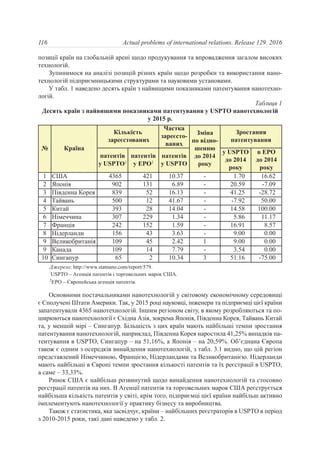
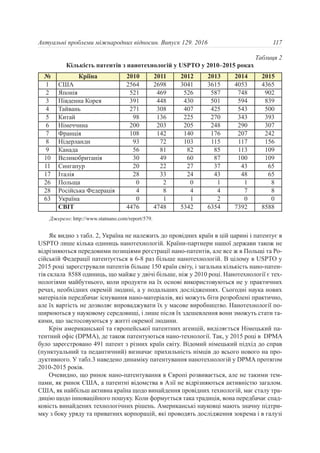


![З табл. 8 видно, що невеликі та не дуже розвинуті країни забезпечують свій нано-роз-
виток завдяки міжнародній співпраці в цій галузі. Ліхтенштейн, що є досить розвинутою
економічно країною, здійснює свої дослідження тільки в межах міжнародних проектів.
Ці всі країни забезпечують підґрунтя для подальшого дослідження нано-науки та поши-
рення нано-продуктів та території своїх країн. Але слід зазначити, що розвинуті країни до-
сить неохоче включаються до спільних наукових програм в царині нанотехнологій,
оскільки ці знання складають наукову безпеку щодо секретності досліджень. Проведене
дослідження впливу міжнародного обміну технологіями на конкурентоспроможність на-
ціональної економіки [9] зазначило, що на стадії створення знань промислово розвинуті
країни не досить активно поширюють інформацію про над-актуальні дослідження. І лише
коли технолога стає інноваційною, ці країни починають одержувати додатковий прибуток,
продаючи саме знання за кордон.
Середньосвітові показники міжнародної нано-співпраці також не не досить значними,
і засвідчують, що половина, і дещо більше, досліджень здійснюються в межах міжнарод-
них колективів дослідників. Статистика України акцентує увагу на тому, що половина
нано-досліджень здійснюється на міжнародному рівні. Але Україна зберігає автентич-
ність таких досліджень, створюючи їх в національних наукових та підприємницьких уста-
новах.
Значну кількість досліджень в нано-наукових галузях здійснюють приватні установи,
або установи, що знаходяться на самофінансуванні. Проте уряди деяких країни здійсню-
ють централізоване фінансування нано-досліджень. Так, першість за цим показником на-
лежить США. В табл. 9 наведено перелік країн, які забезпечують фінансування з держав-
них бюджетів нано-наукових досліджень.
Як видно з табл. 9, більшість країн, що забезпечують державне фінансування нано-
науки, є країнами Південно-Східної Азії. Та серед перерахованих держав чільне місце на-
лежить США, які підтримують власних дослідників виплатами з державного бюджету.
Як колись, Силіконова Долина в цій країні створила підґрунтя для розвитку інформацій-
них технологій, так США фінансують у найбільш перспективні технологічні дослідження
– нано-технології.
121Актуальні проблеми міжнародних відносин. Випуск 129. 2016
Таблиця 8
Частка міжнародної співпраці у продукуванні нано-наукових досліджень (%)
№ Країна 2010 2011 2012 2013 2014 2015
1 Албанія 100.0 100.0 100.0
2 Киргизстан 100.0 100.0 100.0
3 Болівія 100.0 0 100.0 100.0 100.0
4 Кенія 85.7 83.3 100 66.6 100.0 100.0
5 Ліхтенштейн 100.0 100.0 100 100.0 100.0 100.0
6 Панама 100.0 100.0 0 100.0 100.0 100.0
7 Ангола 100.0
8 Ямайка 100.0 83.3 100.0
9 Боснія 100.0 87.5 100.0
10 Катар 100.0 91.7 78.9 96.0 94.3 95.1
78 Україна 54.2 49.3 58.8 55.2 58.8 59.4
СВІТ 63.1 63.5 63.1 66.5 66.8 68.9
Джерело: http://www.statnano.com/report/579.](https://image.slidesharecdn.com/80d26b94-a727-4132-badb-313b9986d54d-170126230756/85/Taras-Journal-121-320.jpg)

![поступово впроваджують нано-продукти. Перспективний напрям нано-досліджень – за-
безпечення життєдіяльності людини – також формується реалізацією фундаментальних
нано-знань у прикладних пошуках та прийнятті прикладних нано-рішень.
Зауважимо, що існує індекс цитування нано-статей та тез нано-досліджень, рейтинг
яких наведений у табл. 11. У цій табл. наведені основні установи, що здійснюють нано-
пошук і забезпечують поширення нано-знань у світі. Такими установами є, в основному,
університети.
Очевидно, що сьогодні цитується все більше статей щодо нанотехнологій, і найбільші
індекси цитування припадають на університети США та Європи. Слід зауважити, що якщо
у 2011 році середній індекс складав від 20 до 50 цитувань, то в 2014 році він знаходився
в амплітуді від 4 до 9. Це означає присутність дифузії знань та нововведень щодо вироб-
лення та впровадження нанотехнологій.
Слід зауважити, що однією з тих країн, що найчастіше згадуються у вищезазначених
зведених таблицях, є Сингапур. Так, Сингапур згадується у п’яти випадках з одинадцяти
таблиць. Можемо припустити, що в цій країні є найоптимальніші умови для розробки та
впровадження нанотехнологій.
Звернемося до аналізу макросередовища національної економіки цієї країни.
Так, валовий внутрішній продукт Сингапуру у 2015 році склав 402,457.9 млн. доларів
у внутрішніх цінах, а його зростання у порівнянні з 2014 роком склало 3,7%. ВВП у цінах
2010 року становило 391,348.5 млн. доларів. ВВП на душу населення у Сингапурі стано-
вило 72,711 тис. доларів США із зростанням цього показника на 2,5% у 2015 році у по-
рівнянні з 2014-м [http://www.singstat.gov.sg]. Ці показники засвідчують, що відбувається
поступове зростання економіки Сингапуру, коли показники у 3,7 і 2,5% є показниками
стабільності. Душові показники засвідчують, що країна є з високим рівнем доходів насе-
лення, що дає змогу урізноманітнити попит. І зокрема вільні кошти населення вкла-
даються у високотехнологічні проекти, зокрема університетів та НДІ, що досліджують
нано-технології.
Економіка Сингапуру є відкритою і інтегрованою у систему світо господарських зв’яз-
ків. Так, торговельний оборот (сума експорту та імпорту) склав 884.053,3 тисяч доларів
123Актуальні проблеми міжнародних відносин. Випуск 129. 2016
Таблиця 11
Середній індекс цитування нано-статей (цитування на статтю)
№ Організація 2011 2012 2013 2014
1 Kent State University 50.58 39.33 12.47 9.63
2 Florida International University 10.93 6.65
3 Howard Hughes Medical Unstitute 42.97 36.44 21.80 6.45
4 University of Mazandaran 6.24
5 Stenford University 50.28 29.04 17.31 5.84
6 Texas State University System 19.05 11.56 5.58
7 University of Oxford 25.88 18.10 15.01 5.50
8 University of Adelaide 22.73 12.61 5.28
9 University of California Reverside 24.72 23.42 10.34 5.25
10 Lawrence Berkeley National Laboratory 39.18 23.81 11.84 5.19
11 California Institute of Technology 41.08 20.06 11.30 5.11
17 Center for Nanophase Materials 20.32 16.45 9.80 4.73
Джерело: http://www.statnano.com/report/579.](https://image.slidesharecdn.com/80d26b94-a727-4132-badb-313b9986d54d-170126230756/85/Taras-Journal-123-320.jpg)
![США у поточних цінах, сума експортованої продукції та послуг становила 476,288,4 тис.
доларів США, а імпорт відбувся на суму 407,767,9 тис. дол. Очевидно, що в країні є по-
зитивне сальдо торговельного балансу, адже обсяги експорту більші за обсяги імпорту.
Проте, статистика засвідчує, що відбувається падіння експортно-імпортних потоків, коли
експорт знизився на 7,2%, а імпорт – на 12,1% [http://www.singstat.gov.sg]. Зменшення
приросту зовнішньоторговельних операцій засвідчує відповідність світогосподарським
процесам, коли останні роки світова економіка показує скорочення активності. Відбу-
ваються процеси активізації внутрішньої діяльності у більшості провідних країн світу.
Так, основним гравцем на світовій арені є країни – колишні так звані «азійські дракони»,
які перетворилися на країни з розвинутою економікою, до них належить і Сингапур. Ві-
домо, що позицію лідера на світовій арені можна залишити за собою, здійснюючи по-
стійний пошук, а саме інноваційний пошук. Так, інноваціям сприяють інвестиції, оскільки
без капіталовкладень важко здійснювати науково-технічні дослідження а зокрема і нано-
технологій.
Слід наголосити, що є статистичні данні щодо інвестиційної активності в Сингапурі.
Так, прямі іноземні інвестиції у 2014 році становили 1005427700 доларів США, а сінга-
пурські інвестиції за кордон – 604206000 доларів США. Приріст прямих іноземних інве-
стицій в Сингапурі склав 16,4% у порівнянні з 2013 роком, а сінгапурські інвестиції
закордон – зросли на 12,8% [http://www.singstat.gov.sg]. Починаючи з другої половини
1980-х років Сингапур залишається привабливою країною для іноземних інвесторів, які
активно вкладають кошти і в інноваційний сегмент сінгапурської економіки. Кошти роз-
поділяються в залежності від привабливості певних сегментів промисловості та сфери
послуг. На фоні скорочення зовнішньоторговельних операції зростання інвестицій вказує
на підвищення продуктивності національної економіки, відомо, що інвестиції є мульти-
плікатором економічного розвитку та підігрівачем економічних відносин в середині
країни. Крім того, економіка Сингапуру підігрівається і розробкою та впровадженням на-
нотехнологічних рішень. Маленька країна в Азії має потужний потенціал для розвитку
та для перетворення нано-науки та нано-продукти.
Країна з населенням 5 535 000 жителів має письменного населення на рівні 96,8%.
Кількість працівників університетів склала 153756, а лікарів на 10000 населення є 21.
Частка кримінальних елементів на 100000 жителів складає 607 [http://www.singstat.gov.sg].
Стабільна держава показує приклад розвитку громадянського суспільства та інновацій-
ної системи країни.
Так, сінгапурська статистика наводить дані про кількість організацій, що здійснюють
науково-технічні дослідження. У табл. 12 наведено кількість організацій, які відрізняються
активністю в галузі НДДКР.
124 Actual problems of international relations. Release 129. 2016
Таблиця 12
Кількість організацій, що здійснюють НДДКР за секторами
№ Сектори 1990 1995 2000 2009 2010 2011 2012 2013
1 Всього 292 470 582 912 859 864 758 873
2 Приватний сектор 266 440 539 854 799 804 699 812
3 Вища освіта 5 6 6 11 11 11 12 13
4 Уряд 14 14 24 27 29 29 28 29
5
Публічні дослідницькі
інститути
7 10 13 20 20 20 19 19
Джерело: http://www.singstat.gov.sg.](https://image.slidesharecdn.com/80d26b94-a727-4132-badb-313b9986d54d-170126230756/85/Taras-Journal-124-320.jpg)
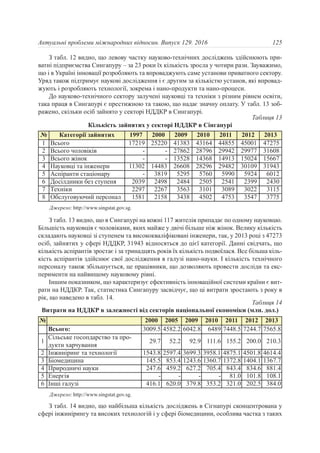
![досліджень припадає на нано-дослідження, статистика не виділяє нанотехнології як окре-
мий напрям, але досліджуючи економіку цієї країни, можна сказати, що нанотехнологіч-
ний напрям визначається як провідний.
Відомо, що рівень розвитку окремої національної економіки визначається інновацій-
ною активністю у галузях машинобудування. Так, саме інжиніринг та технології, як стаття
витрат, в Сингапурі є провідними галузями наукових і прикладних досліджень. Сингапур
характеризується також активністю у сфері біомедицини, коли людський фактор дослід-
жень виходить на передовий план. Вдосконалювати машини є перспективним, але й вдос-
коналювати умови життєдіяльності є провідною ланкою розвитку національної
наноекономіки. Людина стає основним елементом і метою інноваційного пошуку, як в
Сингапурі, так і в усьому світі.
Людина стає основним фактором і чинником розвитку НДДКР. Так, в Сингапурі ос-
новними витратами, що здійснюються у цій сфері є такі, що наведені у табл. 15.
Так, табл. 15 засвідчує, що основні витрати в сегменті НДКР в Сингапурі є витрати на
робочу силу, коли у 2013 році у цій царині витрачалося 3475,7 млн. доларів США. Слід за-
уважити, що науково-технічний персонал має достатню кількість оплати і мотивується на
найвищому рівні. Крім того, до дослідницької роботи інтенсивно залучаються студенти,
звісно завзяті та натхненні наукою.
Наголосимо також, що дослідницькі лабораторії також оснащені за останнім словом
техніки та науки, коли є достатня кількість приміщень та обладнання для проведення екс-
периментів.
Таку продуктивну систему досліджень в галузі високих технологій підтримує націо-
нальна програма Сингапуру, яка називається План Науки та Технологій 2010 (2005-2010р.)
[3]. Цей План мав сформувати нано-попит в країні та забезпечити його новітніми нано-
продуктами та нано-процесами в таких галузях, як: електроніка, хімія, продукти харчу-
вання, точне машинобудування, транспортне машинобудування, інженерна підтримка
балансу навколишнього середовища. На основі цього Плану у 2008 році був заснований
Fisionopolis як новий дослідницький центр. Цей Центр мав забезпечити впровадження
теоретичних та прикладних нано-досліджень (зокрема розробляти та впроваджувати на-
півпровідники останнього покоління). Також в Сингапурі створений нано-кластер на ос-
126 Actual problems of international relations. Release 129. 2016
Таблиця 15
Витрати на НДДКР за типами вартості (млн. дол. США)
№ Типи вартості 2000 2005 2009 2010 2011 2012 2013
Всього: 3009.5 4582.2 1642.8 6489.0 7448.5 7244.7 7565.8
1 Вартість капіталу: 562.9 798.0 1034 967.7 895.6 1141.3 1004.4
земля, будівлі 54.0 139.9 134.1 119.7 144.5 209.2 261.2
транспортні засоби,
обладнання
508.9 658.1 899.9 848.0 751.1 932.1 793.2
2 Вартість робочої сили: 1256.2 1937.5 2619.7 2860.4 3436.2 3308.1 3475.7
досілдники 1078.8 1647.0 2239.7 2463.6 2888.9 2868.8 3057.5
досілдники та інженери 957.7 1433.0 1979.1 2200.4 2331.8 2579.6 2754.6
аспіратни стаціонару 18.7 62.5 127.1 136.4 144.4 146.3 154.0
дослідники без ступеня 1012.4 151.5 139.5 126.9 412.7 143.9 148.7
техніки 69.3 109.1 174.4 170.2 198.2 160.4 165.2
3 Інші операційні витрати 1190.4 1846.8 2369.1 2661 3116.7 2795.4 3085.7
Джерело: http://www.singstat.gov.sg.](https://image.slidesharecdn.com/80d26b94-a727-4132-badb-313b9986d54d-170126230756/85/Taras-Journal-126-320.jpg)
![нові нанотехнологічного консорціуму (SBIC), який фінансується The Agency for Science,
Technology and Research (A*STAR). Члени нано-кластеру – це представники різних уні-
верситетів та дослідних інститутів. A*STAR спрямовує свою діяльність на комерціаліза-
цію досліджень. Агенція співпрацює з приватними виробничими установами і за 10 років
(2005-2015р.) провела 250 дослідницьких проектів з цими компаніями, включаючи зару-
біжні підприємства.
В Сингапурі існують різні дослідні установи, які здійснюють пошук в галузі нано-
технологій. До них слід віднести [4]:
1. Агенція з Науки, Технологій та Досліджень (вже згадувана A*STAR) – здійснює
просування нанотехнологій та включає такі підрозділи:
1.1. Інститут Біоінжинірингу та Нанотехнологій (IBN) – розвиває міждисциплі-
нарні дослідження в комбінованих науках;
1.2. Інститут Дослідження Матеріалів та Інжинірингу (IMRS) – розробка високоя-
кісних та широко застосованих матеріалів, підтримка зростання нових галузей проми-
словості;
2. Національний Університет Сингапуру – має численні нано-відділення, зокрема:
2.1. Нано-механічна лабораторія – проводить міждисциплінарні дослідження в га-
лузі нано-медицини;
2.2. Нано-центр – створений Університетом Сингапуру, Центр має свій дослід-
ницький штат та залучає активно студентів до нано-досліджень;
2.3. Силіконова Лабораторія Нано-механізмів – основна діяльність у галузі елек-
троніки та комп’ютерної інженерії;
2.4. Нано-наукова та Нано-технологічна Ініціатива – факультет для навчання за цим
напрямом студентів та наукова робота для дослідників.
3. Сингапурський МІТ Альянс – пропонує магістерську програму навчання за фахом
Мікро- та Нано-системи.
4. Нано і Мікро-виробничий Центр – це частина Механіко-біологічного інституту, є
відповідна магістерська програма та залучення до досліджень найкращих студентів та
дослідників з науковим ступенем.
Дослідимо, як змінюється національний дохід (на прикладі Сингапуру) під впливом
чинника НТП, використаємо формулу темпів приросту кінцевого продукту:
py = λ + al pl + ak pk (12)
де py – темп приросту кінцевого продукту (національного доходу);
λ – темпи динаміки НТП;
al – параметр ступеня працеміскості;
pl – зростання продуктивності праці;
ak – параметр ступеня фондомісткості макротехнології;
pk – зростання фондовіддачі.
Так, за даними статистики Сингапуру дані показники є такими:
py – темп приросту кінцевого продукту (національного доходу), як результат до-
слідження, має визначити на скільки прирощується національний дохід від провадження
та розробки високих технoлогій;
λ – темпи динаміки НТП визначається приростом витрат на НДДКР в 2013 році у
порівнянні з 2012 роком. В Сингапурі це загальні витрати на НДДКР у 2012 році склали
7244,7, а у 2013 році – 7565,8. Розрахувавши темпи приросту – одержимо результат
127Актуальні проблеми міжнародних відносин. Випуск 129. 2016](https://image.slidesharecdn.com/80d26b94-a727-4132-badb-313b9986d54d-170126230756/85/Taras-Journal-127-320.jpg)
![104,43%. Тобто у 2013 році у порівнянні з попереднім роком витрати на НДДКР у Син-
гапурі зросли на 4,43%;
al – параметр ступеня працеміскості у сфері НДДКР Сингапуру становив
3475000,7/5275=658,76, де 3475000,7 – витрати на робочу силу, залучену до НДДКР, а
5275 [http://www.singstat.gov.sg] – кількість патентів, винайдених у 2013 році в цій країні;
pl – зростання продуктивності праці у сфері НДДКР Сингапуру – у 2013 році цей
показник 658,76, а у 2012 році 3308000,1/5129=644,96, де 5129 – кількість патентів у 2012
році [http://www.singstat.gov.sg], а показник зростання – 102,13. Тобто продуктивність
зросла на 2,13%;
ak – параметр ступеня фондомісткості макротехнології у сфері НДДКР Сингапуру
становив 1004000,4/5275=190,33, де 1004000,4 – вартість капіталу в системі НДДКР у
2013 році, а 5275 – кількість патентів у тому ж році;
pk – зростання фондовіддачі у сфері НДДКР Сингапуру – у 2013 році цей показ-
ник 190,33, а у 2012 – 1141000,3/5129=222,46, а показник зростання – 85,55. Тобто про-
дуктивність знизилася на 14,44%.
Підставляючи показники у формулу одержимо такий вираз:
Py = 4.43 + 6583.76 х 2.13 + 190.33 х (-14.44) = 4.43 + 14023.34 – 2748.36 = 11279.41
млн. долара США.
Таким чином, у 2013 році відбувся приріст національного продукту на 11279,41 млн.
дол. за рахунок збільшення активності в сфері НДДКР.
Висновки. Отже, глобальні ринки високих, та зокрема нанотехнологій, розвиваються
достатньо інтенсивно. Так, зростає кількість патентів на винаходи в галузі нанотехноло-
гій, збільшується цитування та дослідження в цій царині. Найбільш провідними країнами,
які здійснюють нано-дослідження є США, Японія, Китай та Сингапур. Наш аналіз пока-
зав, що саме Сингапур є одним з основних гравців на глобальних ринках високих та на-
нотехнологій. В цій країні відбувається постійне зростання ВВП та інших показників
розвитку економіки. В такому зростанні провідну роль відіграють нанотехнології, які не
лише розробляються провідними інститутами цієї країни, але й активно впроваджуються
у приватному виробничому секторі Сингапуру. Ця країна має програму розвитку цього
сегменту економіки і активізує діяльність провідних дослідницьких нано-інститутів. Кіль-
кісно та якісно економіка Сингапуру розвивається, практику чого можна використати в
Україні для позитивного входження нашої держави у наступний технологічний уклад на
подолання технологічного відставання у провідних галузях промисловості.
Список використаних джерел
1. http://www.statnano.com/report/579.
2. http://www.singstat.gov.sg.
3. Shin-ichi Kamei, Tohru Kobayashy. Strategy for new industry creation in the nanotechnol-
ogy field. [Електронний ресурс]. – Режим доступу: www.techmonitor.net/tm/images/e/
e4/12oct_doc_sf4.pdf.
4. Nanotechnology in Singapore: Market Report. [Електронний ресурс]. – Режим доступу:
www.azonano.com/article.aspx?ArticledID=3579.
5. Nano-technology. At-a-Glance. April 2006. Economics & Workforce Development through
the California Community Colleges. [Електронний ресурс]. – Режим доступу:
http://www.californiananoeconomy.org.
6. Valentine Gerasimova, Sergey Mokichev. Nano-economics in a National System of Inno-
vation. [Електронний ресурс]. – Режим доступу:http://www.sciencedirect.com/science/
article/pii/522.
128 Actual problems of international relations. Release 129. 2016](https://image.slidesharecdn.com/80d26b94-a727-4132-badb-313b9986d54d-170126230756/85/Taras-Journal-128-320.jpg)
![7. Jung Lee. Impact of Nanotechnology Synthesis Report (OECD, NWI) [Електронний ре-
сурс]. – Режим доступу: http://www.oecd.org/sti/nano/Washington%20Sy.
8. Margreth Gagliardi. Global Markets and Technologies for Nanofibers. [Електронний ре-
сурс]. – Режим доступу: http://www.bccresearch.com/market-research/nanotechnology/
nanotechnology-environmental-applicstions-market-nan039c.html.
9. Aneesh Kumar. Nanotechnology in Environmental Applications. [Електронний ресурс]. –
Режим доступу: http://www.bccresearch.com/market-research/nanotechnology/nanotech-
nology-environmental-applicstions-market-nan039c.html.
10. Anand Gijare. Nanotechnology in Printing: Global Markets. [Електронний ресурс]. –
Режим доступу: http://www.bccresearch.com/market-research/nanotechnology/nanotech-
nology-environmental-applicstions-market-nan039c.html.
11. Shalini Shahani Dewan. Global Markets for Nanocomposits, Nanopertiches, Nanoclayse
and Nanotubes. [Електронний ресурс]. – Режим доступу: http://www.bccresearch.com/
market-research/nanotechnology/nanotechnology-environmental-applicstions-market-
nan039c.html.
12. Кочура Є. В., Косарєв В. М. Моделювання макроекономічної динаміки: Навчальний
посібник / Є. В. Кочура, В. М. Косарєв. – Київ: Центр навчальної літератури, 2003. –
236 с.
13. Остапенко Т. Г. Міжнародний обмін технологіями у формуванні конкурентних пере-
ваг національної економіки (на прикладі Італії): Монографія / Т. Г. Остапенко. – К. :
Зовнішня торгівля, 2012. – 188 с.
References
1. http://www.statnano.com/report/579.
2. http://www.singstat.gov.sg.
3. Shin-ichi Kamei, Tohru Kobayashy. Strategy for new industry creation in the nanotechnol-
ogy field. Available at: www.techmonitor.net/tm/images/e/e4/12oct_doc_sf4.pdf
4. Nanotechnology in Singapore: Market Report. Available at: www.azonano.com/article.
aspx?ArticledID=3579.
5. Nano-technology. At-a-Glance. April 2006. Economics & Workforce Development through
the California Community Colleges. Available at: http://www.californiananoeconomy.org
6. Valentine Gerasimova, Sergey Mokichev. Nano-economics in a National System of Innova-
tion. Available at: http://www.sciencedirect.com/science/article/pii/522
7. Jung Lee. Impact of Nanotechnology Synthesis Report (OECD, NWI). Available at: http://
www.oecd.org/sti/nano/Washington%20Sy
8. Margreth Gagliardi. Global Markets and Technologies for Nanofibers. Available at:
http://www.bccresearch.com/market-research/nanotechnology/nanotechnology-environ-
mental-applicstions-market-nan039c.html.
9. Aneesh Kumar. Nanotechnology in Environmental Applications. Available at: http://www.
bccresearch.com/market-research/nanotechnology/nanotechnology-environmental-applic-
stions-market-nan039c.html.
10. Anand Gijare. Nanotechnology in Printing: Global Markets. Available at: http://www.bc-
cresearch.com/market-research/nanotechnology/nanotechnology-environmental-applic-
stions-market-nan039c.html
11. Shalini Shahani Dewan. Global Markets for Nanocomposits, Nanopertiches, Nanoclayse
and Nanotubes. Available at: http://www.bccresearch.com/market-research/nanotechnol-
ogy/nanotechnology-environmental-applicstions-market-nan039c.html.
129Актуальні проблеми міжнародних відносин. Випуск 129. 2016](https://image.slidesharecdn.com/80d26b94-a727-4132-badb-313b9986d54d-170126230756/85/Taras-Journal-129-320.jpg)

![вати форми залучення капіталу і інструменти розміщення вільної грошової ліквідності з
урахуванням сучасної волатильності ринків.
Мета статті – проаналізувати особливості форм, методів та інструментів мобілізації
фінансових ресурсів державними корпораціями розвинутих країн на сучасному етапі.
Аналіз останніх досліджень та публікацій. Проблеми, пов’язані з ефективністю мо-
білізації фінансових ресурсів державними корпораціями, знайшли відображення та на-
були подальшого розвитку завдяки працям таких видатних дослідників, як Дж. К.
Гелбрейт, Дж. М. Кейнс, Ф. Кене, Дж. Ст. Мілль, Дж. Стігліц П. Самуельсон, Б. Селігмен,
А. Сміт, Ф. фон Хайек, Р. Харрод, К. Шмерлер, С. Сангаре, С. Пахомов, В. Тітов, М. Клі-
нова, А. Радигін, Р. Ентов та інші.
Останні дослідження засвідчують, що корпорації країн з англо-американською рин-
ково орієнтованою фінансовою системою з розвинутими інституціональними інвесто-
рами (пенсійні фонди, пайові інвестиційні фонди, страхові фонди), таких країн, як США,
Великобританія, в основному залучають інвестиційні кошти шляхом випуску цінних па-
перів на фінансових ринках. У країнах, орієнтованих на банки (Японія, Німеччина, Фран-
ція та інші), корпорації звертаються в основному до банківських позик [1, с. 19].
Особливості залучення фінансових ресурсів у сучасних реаліях саме державними кор-
пораціями ще недостатньо висвітлені у науковій літературі, що обумовлює актуальність
даного дослідження.
Виклад основного матеріалу дослідження. При проведенні аналізу доцільно вио-
кремити внутрішні та зовнішні джерела залучення капіталу. До зовнішніх джерел відно-
симо іноземні інвестиції, кредити, позики. Серед внутрішніх джерел фінансування як
основні використовуються державні бюджетні і позабюджетні кошти, кредити банків,
кошти стратегічного партнера, власні кошти підприємства (компанії).
Фінансові ресурси об’єднують власний, запозичений та залучений капітал, який ви-
користовують державні корпорації для формування своїх активів та здійснення вироб-
ничо-господарської діяльності з метою отримання прибутку та виконання певних соці-
ально-економічних цілей, покладених на цю інституцію державою. В якості методів фі-
нансування можна виокремити інвестування тільки за рахунок власних коштів компанії,
залучення коштів за рахунок емісії акцій, кредитне фінансування, що об’єднує інвести-
ційні кредити банків та випуск облігацій. Важливим джерелом для державних корпорацій
звісно є бюджетне фінансування, змішане фінансування на основі різних комбінацій роз-
глянутих способів та проектне фінансування.
У сучасних умовах зростає значення фінансової діяльності державних корпорацій та
актуалізується пошук шляхів, форм і методів залучення ними ресурсів на міжнародних фі-
нансових ринках. Вибір того чи іншого джерела фінансування насамперед залежить від
цілей, для який залучається капітал – тимчасовий капітал чи перманентний капітал (за-
лучений на постійній основі – об’єднує власний капітал та довгострокові зобов’язання
суб’єкта господарювання). Великі приватні корпорації, відчуваючи нестачу у капіталі, не
обмежуються послугами лише національних банківських систем і, покладаючись на свій
високий кредитний рейтинг, залучають дешеві фінансові ресурси шляхом емісії цінних
паперів на міжнародних ринках. Останнім часом відбувається зменшення ролі банківсь-
кого сектора як механізму перерозподілу фінансових ресурсів на національному та між-
народному рівнях і до одночасного посилення інвестиційної та позичкової діяльності на
міжнародному ринку цінних паперів. Якщо мова йде про довгострокове залучення фі-
нансових ресурсів, які не потрібно повертати у визначений термін, як у випадку з борго-
вими інструментами, корпорація може випускати акції, проте у даному випадку залуча-
133Актуальні проблеми міжнародних відносин. Випуск 129. 2016](https://image.slidesharecdn.com/80d26b94-a727-4132-badb-313b9986d54d-170126230756/85/Taras-Journal-133-320.jpg)

![ній. До них можна віднести неможливість задовольнити зростаючі потреби у фінансових
коштах за рахунок держбюджету і низьку ефективність витратності державних коштів [1].
Клинова М. В. виділяє найбільш значущі процеси в еволюції партнерства держави і
приватного капіталу на сучасному етапі, а саме – залучення приватного капіталу в дер-
жавні промислові підприємства з метою підвищення ефективності економіки; перетво-
рення обслуговуючих економіку великих держкомпаній в акціонерні товариства з їх
виходом на світові ринки; розвиток на довготривалій договірній основі об’єктів інфра-
структури переважно у формі концесій, наукомістких галузей обробної промисловості з
використанням ринкових засад в організації виробництва, наукових досліджень і розро-
бок (НДР); формування та збереження людського капіталу (наука, освіта, охорона здо-
ров’я) [2, с. 4].
У світовій практиці розроблений інструментарій дозволяє підприємствам, створеним
на партнерській публічно-приватній основі, залучати для реалізації великих інвестицій-
них програм різні фінансово-кредитні інститути шляхом складних схем фінансування,
внаслідок чого банки стають постачальниками боргового фінансування проектів ППП [1,
с. 141]. Серед основних форм фінансування у цьому контексті можна виділити державне
фінансування, приватне фінансування, корпоративне та проектне фінансування.
Державне фінансування здійснюється шляхом надання субсидій, грантів, державних
гарантій, або шляхом залучення державними інститутами позикових коштів за низькими
процентними ставками і, відповідно, кредитування цими коштами проекту (re-lending).
Приватне фінансування розглядається в основному як часткове акціонерне фінансу-
вання, яке передбачає участь у капіталі проектної компанії інвестиційних компаній, вен-
чурних фірм, банківських установ, будівельних компаній тощо. Тобто акціонери стають
власниками проектної компанії пропорційно їхній частці капіталу та розраховують на
прибутковість від інвестованого капіталу за рахунок дивідендів, які виплачуються вже
після кредитних зобов’язань [3, c. 52].
Корпоративне фінансування поєднує у собі різні форми зовнішнього фінансування
проекту, які вже було окреслено вище.
Проектне фінансування розглядають як пряме кредитування компанії, яка спеціально
створена під відповідний проект (спеціальної проектної компанії (SPV – special purpose ve-
hicle). У такому випадку зазвичай залучають кілька приватних інвесторів (консорціум)
при реалізації комплексу заходів фінансової підтримки з боку держави. Державне інве-
стування здійснюється або на принципах співфінансування з приватним капіталом, або
за допомогою об’єднання ресурсів у рамках створеної проектної компанії (вкладення у
статутний капітал спільного підприємства) [4, с. 36-37].
ОЕСР пропонує використання певних механізмів, що дозволяють залучити приват-
ний капітал у державні компанії, а саме – мезонінне фінансування (mezzanine finance), си-
стеми надання гарантій (Guarantee schemes) та механізм об’єднання ресурсів (Pooling
mechanisms) [5, c. 136].
Досить поширеним способом залучення ресурсів у західних країнах є мезонінне фі-
нансування (mezzanine finance), яке об’єднує у себе субординовані кредити (subordinated
loan), кредити з правом участі у прибутку компанії (profit participating loan) та пасивну
участь (silent participation) [6-8].
Суть механізму мезонінного фінансування полягає в тому, щоб дозволити компаніям
– ініціаторам проектів – здійснювати великі інвестиції, не володіючи при цьому значним
капіталом. Мезонінне фінансування є формою залучення капітальних активів в міжна-
родний інвестиційний бізнес-проект, за яким кредитор надає цілеспрямовано без вимоги
135Актуальні проблеми міжнародних відносин. Випуск 129. 2016](https://image.slidesharecdn.com/80d26b94-a727-4132-badb-313b9986d54d-170126230756/85/Taras-Journal-135-320.jpg)
![застави майна обумовлену суму кредиту з правом субординованого погашення боргу не
першої черги та правом участі в прибутку інвестиційного проекту.
Мезонінний кредит (Mezzanine Loan) є гібридним інструментом і займає проміжне
положення між залученням банківського кредиту і прямими інвестиціями в компанію.
Важливою характеристикою є те, що інвестор, на відміну від звичайної форми кредиту-
вання, не має права вимагати заставу, проте, має право, а не зобов’язання в обумовлений
час в майбутньому за обумовленою ціною придбати або пакет акцій даної корпорації, що
реалізує проект, або певну кількість готового продукту чи майна, чи іншим чином стати
співвласником або управляючим проектом.
Тож, мезонінний кредит – це субординований незабезпечений кредит під заставу цін-
них паперів з погашенням основного боргу в кінці терміну позики з можливістю конвер-
тації суми заборгованості в акції позичальника (термін зазвичай не менше 3-5 років з
погашенням тіла кредиту в кінці терміну). До недоліків можна віднести, по-перше, те, що
мезонінне фінансування надається на юридичну особу (SPV – special purpose vehicle), за-
реєстровану в країні, де законодавство передбачає можливість субординації кредитів. По-
друге, в капіталі компанії з’являється фінансовий інвестор. По-третє, вартість такого
кредиту значно перевищує вартість звичайних банківських кредитів [9].
Тобто мезонінне фінансування являє собою форму фінансового забезпечення, що пе-
редбачає поєднання боргового фінансування та фінансування на умовах участі у власному
капіталі підприємства, адже інвестор не входить в капітал компанії, а надає ресурси для
її розвитку через боргові зобов’язання з одночасним придбанням опціону з правом при-
дбання акцій позичальника в майбутньому за певною заздалегідь визначеною ціною.
Даний спосіб фінансування здатний знизити ризики обох сторін: боргові зобов’язання
мають більш високий пріоритет, що вигідно венчурному фінансисту, а опціонна угода
дозволяє позичальникові в майбутньому розрахуватися з кредитором в зручній для нього
формі – виплата прибутку держателю опціону або розміщення в його користь акцій.
Як вже зазначалося, зазвичай мезонінне фінансування являє поєднання декількох фі-
нансових інструментів з різними рівнями ризику і прибутковості, таких як, наприклад,
субординований борг, сертифікати на участь в прибутку компанії, права або варанти на
акції компанії. Мезонінне фінансування часто застосовують у якості інструмента фінан-
сування інноваційних проектів.
Кредити з правом участі у прибутку компанії надають кредитору можливість участі в
прибутку компанії в обмін на надання капіталу, проте незважаючи на участь у прибутку,
не передбачається відносин власності. Надзвичайно розповсюдженою формою мезонін-
ного фінансування у європейських країнах, особливо у Німеччині, є пасивна участь. Тер-
мін дії такої співпраці зазвичай 5-15 років, при цьому методі фінансування інвестор бере
участь у комерційній діяльності підприємства шляхом надання капіталу і отримання права
участі в статутному капіталі та прибутку компанії [6-9]. У теорії мезонінне фінансування
відносять до інструментів середнього рівня ризику і доходу. У США до такої форми фі-
нансування часто вдаються організації, що не мають достатнього доступу до капіталу, що
може бути пов’язано з високим борговим навантаженням або ринковими умовами. Також
даний інструмент застосовують в тому випадку, коли акціонери компанії не хочуть «роз-
мивати» власні частки участі [10, с. 285]. При мезонінному фінансуванні головною метою
інвестора є повернення до первинних інвестицій та нарощення свого капіталу, а не за-
хоплення влади над компанією, що важливо, коли у проекті приймає участь державна кор-
порація.
Мезонінне кредитування передбачає створення спеціальної проектної компанії (SPV
– special purpose vehicle), яка набуває статусу «діючої» на всьому етапі життєвого циклу
136 Actual problems of international relations. Release 129. 2016](https://image.slidesharecdn.com/80d26b94-a727-4132-badb-313b9986d54d-170126230756/85/Taras-Journal-136-320.jpg)
![проекту і відрізняється фінансовою, юридичною, організаційною самостійністю. Проте
варто зазначити, що не обов’язково така компанія має бути створена. SPV використову-
ється для залучення фінансових ресурсів в рамках структур власного і позикового капіталу
[11]. Мезонінні фонди, як правило, вибирають більш пасивну роль в управлінні і конт-
ролі за компанією SPV, в той час як традиційні інвестори, які набувають частку у власному
капіталі SPV, зазвичай шукають спосіб брати в управлінні активну роль.
Істотними факторами, які визначають відмінності між проектним фінансуванням та
мезонінним є те, що погашення в рамках проектного фінансування здійснюється за раху-
нок коштів, що генеруються проектом, а в рамках мезонінного фінансування – за допо-
могою засобів, виручених від реалізації активів або акцій компанії SPV. Такий механізм
активно використовується для реалізації великомасштабних будівельних проектів, ство-
рення нових компаній в галузях промисловості [12, c. 46].
Системи надання гарантій (Guarantee schemes). У міжнародній практиці гарантії при-
йнято розглядати, перш за все, як інструмент стимулювання соціально економічного роз-
витку з боку публічного сектора. Підтримка пріоритетних проектів розвитку шляхом
надання державних гарантій є інструментом державно-приватного партнерства (ДПП).
Проекти ДПП знижують фіскальне навантаження на державу, забезпечуючи можливість
реалізації великих проектів без значного збільшення податків і зборів.
Основний обсяг гарантій в рамках реалізації проектів розвитку видається в якості за-
безпечення інфраструктурних проектів, перш за все, проекти створення і модернізації
транспортної та комунальної інфраструктури. Прийнято вважати, що найбільш ефективні
гарантії в ДПП є у проектах в транспортному секторі, зокрема при будівництві платних
доріг. Приклад успішного використання схем гарантійного фінансування є механізм га-
рантування облігацій у Австрії, які випускаються з метою розвитку дорожньо-транс-
портної інфраструктури. Управління дорожньою системою здійснює державна компанія
ASFINAG, яка повністю належить уряду Австрії. Бюджет Австрії не субсидує діяльність
даної інституції, а для залучення коштів на розвиток транспортної системи починаючи з
2002 р ASFINAG розміщує облігаційні випуски на суму понад 1 млрд. Євро щорічно. На-
дання державних гарантій дозволило забезпечити найвищий кредитний рейтинг облігацій,
що знижує вартість залучення позикових коштів [13, c. 22].
Окремо варто згадати про можливості, які створюють Експортні кредитні агентства
(ЕКА) для державних компаній як у питаннях просування своєї продукції на зовнішні
ринки, так і у питаннях залучення фінансових ресурсів. Як відомо ЕКА створюються для
стимулювання експорту країни, проте можуть створити надзвичайно сприятливі умови
для залучення фінансових ресурсів на вигідних умовах і для державних корпорацій. ЕКА
є квазі урядовими інституціями, деякі є приватними інституціями з урядовою підтрим-
кою, що надають захист національним експортерам та інвесторам у формі прямого кре-
дитування, страхування та перестрахування ризиків експортних та інвестиційних
контрактів. ЕКА гарантують або страхують довгострокові інвестиційні кредити, що на-
даються національними (іноземними) банками по контрактах на купівлю національними
(українськими) імпортерами товарів чи послуг. Метою створення цих агентств є захист
експортерів від втрат, пов’язаних з різними видами ризиків, які ускладнюють їх участь у
зовнішньоекономічній діяльності, представлення гарантій виконання іноземними покуп-
цями зобов’язань за зовнішньоекономічними контрактами, надання організаційної та ін-
формаційно-аналітичної підтримки експортних операцій.
Гарантії ЕКА залучаються для фінансування імпорту обладнання, техніки, техноло-
гічних ліній, міні-заводів і супутніх послуг з інжинірингу тощо; будівельних проектів за
137Актуальні проблеми міжнародних відносин. Випуск 129. 2016](https://image.slidesharecdn.com/80d26b94-a727-4132-badb-313b9986d54d-170126230756/85/Taras-Journal-137-320.jpg)
![3 – позичальник подає заявку у банк;
4 – іноземний банк та банк імпортера узгоджують уморив фінансування у рамках Рам-
кової кредитної угоди1
(при необхідності підписують РКУ);
5 – постачальник / іноземний банк направляють заявку в ЕКА та отримують попе-
редню згоду на надання страхового покриття;
6 – експортер та імпортер підписують контракт на поставку;
7 – позичальник та його банк узгоджують умови фінансування;
8 – експортер та іноземний банк остаточно узгоджують отримання страхового екс-
портного покриття ЕКА;
9 – Банк-імпортера та позичальник заключають кредитну угоду, договір про випуск
акредитиву, договір забезпечення (забезпечення має передбачати забезпечення виконання
зобов’язань, що виникають як з кредитної угоди, так і з договору про випуск непокритого
акредитиву);
10 – банк та іноземний банк підписують ІКУ2
(індивідуальну кредитну угоду);
11 – міжнародне експортне агентство надає страхове покриття;
12 – банк імпортера випускає акредитив через іноземний банк на користь експортера;
13 – постачальник надає документи, які вказані по акредитиву;
14 – іноземний банк перевіряє документи, здійснює платіж по акредитиву на користь
експортера за рахунок кредитної лінії, відкритою банку-імпортера (ІКУ); в результаті ви-
никає заборгованість банку-імпортера перед іноземним банком та імпортера-позичаль-
ника перед його банком (банк видає транш позичальнику на основі світфт повідомлення
про виконання платежу на користь експортера і додаткової угоди на видачу траншу).
15 – кредит погашається банком-імпортера у відповідності до умов ІКУ;
16 – імпортер-позичальник погашає заборгованості у відповідності з умовами кре-
дитної угоди, яка заключна з його банком.
Даний механізм дозволяє знизити вартість фінансування в порівнянні з класичним
кредитуванням, також виникає можливість погашення частини боргу з коштів, що утво-
рюються в результаті реалізації проекту за рахунок тривалого терміну запозичення. Для
державної корпорації виникає можливість отримати кредит на велику суму на досить до-
вгий термін від закордонного банку за більш низькою відсотковою ставкою, ніж в Україні.
Механізм об’єднання ресурсів (Pooling mechanisms) за ОЕСР включає змішане креди-
тування, синдиційовані кредити та сек’юритизацію. Змішане кредитування (Blended loans)
є ефективним при фінансуванні проектів з низьким рівнем рентабельності, оскільки по-
єднує у собі гранти та субсидовані позики від держави з додатковим фінансуванням з
інших джерел, а саме ринку капіталу, що дозволяє залучити набагато більші ресурси у
порівнянні зі звичайною системою надання грантів. Близько 2 млрд євро, які надавалися
ЄС у вигляді грантів для підтримки понад 200 інвестиційних проектів протягом 2007-
2014 років, дозволили залучити понад 40 млрд євро інвестицій у важливі інфраструктурні
проекти [5, c. 137]. У грудні 2012 року у ЄС було створено спеціальну Платформу для
зростання ефективності змішаних проектів на теренах ЄС, яка направлена на посилення
співпраці з усіма регіонами у світі. Діяльність цієї інституції зосереджена на аналізі іс-
нуючих механізмів поєднання фінансових ресурсів з метою їх подальшого вдосконалення,
підвищенні якості технічного та фінансового аналізу проектів, розробці показників для ви-
139Актуальні проблеми міжнародних відносин. Випуск 129. 2016
1
Рамкова кредитна угода – кредитна угода між банком–імпортера та іноземним банком, що регламентує
загальні умови кредитування банку–імпортера, в тому числі ліміт кредитування.
2
Індивідуальна кредитна угода – кредитна угода, що заключна між банком–імпортера та іноземним бан-
ком, зазвичай у рамках рамкової кредитної угоди та регламентує отримання кредитних коштів для фінан-
сування відповідного імпортного контракту клієнта.](https://image.slidesharecdn.com/80d26b94-a727-4132-badb-313b9986d54d-170126230756/85/Taras-Journal-139-320.jpg)
![мірювання результатів і оцінки потенціалу і ризиків приватного фінансування у таких
проектах [14].
Великі проекти державних корпорацій вимагають значних фінансових ресурсів, які
можна залучити за допомогою консорціумного кредитування, яке дозволяє розподілити
ризики між кредиторами та зібрати значну суму. Перевага у такій співпраці для фінансо-
вих інституцій полягає у тому, що вони отримують певний «податковий імунітет» та ста-
тус «привілейованого кредитора», який дозволяє отримувати переважний доступ до іно-
земної валюти в разі виникнення валютної кризи. Натомість державні корпорації отри-
мують фінансові ресурси на тривалий період, які можуть залучити у розбудову важливих
соціально-економічних проектів та інфраструктурних об’єктів. Проте мінусом такої
форми залучення фінансових ресурсів буде їх висока вартість та досить тривалий період
оформлення угоди, який займатиме мінімум пів року.
Основною метою сек’юритизації є зробити додатковий капітал доступним для пози-
чальників, які не можуть не в змозі отримати доступні банківські кредити. Сек’юритиза-
ція може залучити ісламські фінанси – зростаюче джерело фінансування для багатьох
країн, що розвиваються, адже ринок ісламського фінансування щороку зростає в серед-
ньому на 15% за даними агентства KFH Research. У сучасних умовах, коли відчувається
нестача у засобах для довгострокового фінансування великих інфраструктурних проектів,
доцільно звернутися до інструментів ісламських фінансів, таких як «сукук». І хоча за-
звичай термін цього фінансового інструменту це 3-5 років, останнім часом популярності
набувають 15 чи 30-річні сукук. Цей фінансовий інструмент широко відомий в країнах
ісламського світу та європейського банківського співтовариства, сукук дозволяє залучати
кошти ісламських інвесторів, які в силу релігійних переконань не можуть інвестувати за
допомогою класичних фінансових інструментів [15].
Сукук – це сертифікат, що засвідчуює право власності на частку активів підприєм-
ства, які були сформовані за рахунок отриманих від розміщення облігацій коштів, і право
участі в його прибутку, через зв’язок цінного паперу з активом, сукук також називають іс-
ламською сек’юритизацією. Ці інструменти також часто називають майновими сертифі-
катами, адже вони повинні бути забезпечені активами: матеріальними або нематеріаль-
ними. Забезпечені сукук (asset-backed) передбачають повний перехід права власності на
базові активи до інвестора з подальшою реєстрацією нового власника, актив більш не від-
бивається на балансі емітента, всі ризики несе інвестор. Незабезпечені сукук (asset based),
як правило, не передбачають державну реєстрацію переходу права власності, отже базо-
вий актив продовжує враховуватися на балансі ініціатора емісії, а незабезпечені сукук по
статусу прирівнюються до незабезпечених кредитів.
Тож cукук – це довгострокові і середньострокові цінні папери, забезпечені матері-
альними активами, випущені за законами Шаріату (іноді називаються «ісламськими облі-
гаціями»). Варто зазначити, що хоча деколи ці інструменти і називають ісламськими
облігаціями, вони на відміну від класичних облігацій не закріплюють боргові відносини
між емітентом облігацій та їх власником. Ісламська облігація – це інвестиційний серти-
фікат, який засвідчує право її власника на частку в праві власності на базовий актив (пул
активів), що пропорційне величині вкладених коштів [16]. Сукук передбачають інвести-
ції в реальні активи, а не в репутацію позичальника. Попит на сукук формується на кон-
курентній основі, цей інструмент виключає можливості для спекуляції та формування
«бульбашок». Згідно з дослідженням Standard and Poor’s у 2014 році у світі було випу-
щено сукук на суму 116,4 млрд. дол. США [16, c. 3]. У 2001 році першою інституцією,
140 Actual problems of international relations. Release 129. 2016](https://image.slidesharecdn.com/80d26b94-a727-4132-badb-313b9986d54d-170126230756/85/Taras-Journal-140-320.jpg)
![пов’язану з державною формою власності, яка здійснила випуск суку був Центральний
банк Бахрейну.
Сукук будуть надзвичайно привабливі для інвесторів, якщо ініціатором випуску іс-
ламських цінних паперів виступить велика державна корпорація в партнерстві з великими
банками, метою якої буде залучення фінансування наприклад під великий інфраструк-
турний проект. У 2005 році малазійська державна компанія Sarawak Development Corpo-
ration (SEDC) випустила сукук аль-іджара з використанням декількох SPV для рефінан-
сування власного боргу і фінансування проектів іншої державної компанії з виробництва
напівпровідників [17, с. 25]. Тож ініціатором емісії сукук може виступити певна державна
корпорація, яка планує розбудовувати важливий інфраструктурний об’єкт. Використання
цього інструменту державними корпораціями зростає кожного року.
На загал розрізняють 14 видів фінансових інструментів, які можна віднести до кате-
горії сукук. Розглянемо детально ті, які найбільш цікаві для державних корпорацій у про-
цесі залучення фінансових ресурсів. В залежності від базового активу, який лежить в
основі угоди, суку поділяють на так звані боргові інструменти, засновані на угоді «мура-
баха», що передбачає купівлю-продаж активу у розстрочку; інструменти пайової участі,
засновані на принципах «мудараба», що передбачає довірче управління, та «мушарака»,
що передбачає партнерство; та інструменти, що структуруються на основі купівлі-про-
дажу певного базового активу, з зобов’язанням про зворотну оренду [16].
Суку іджара широко використовується для залучення фінансових ресурсів з метою
проектного фінансування. Процес починається з того, що бенефіціар випуску (корпорація,
банк, або суверенна держава, у нашому випадку державна корпорація) створю компанію
спеціального призначення – SPV, яка буде діяти в якості емітента сукук. На наступному
етапі укладається контракт на продаж бенефіціаром своїх активів цій юридичній особі –
SPV, який купує цей актив на кошти, отримані від випуску сукук, наприклад на суму 3
млрд. дол. США, яка в свою чергу підписує контракт з бенефіціаром на передачу йому в
зворотний лізинг придбаних активів, наприклад, на 3 роки і стає лізингодавцем, а бене-
фіціар – лізингоодержувачем. Лізингові платежі повинні виплачуватися регулярно, і їх
вартість буде прив’язана до ставки LIBOR чи EIBOR, до якої буде додана певна премія в
залежності від кредитоспроможності бенефіціара. Саме бенефіціар отримує і використо-
вує кошти позики і забезпечує в результаті джерело коштів для виплати доходу за сукук
та їх погашення. Для оплати активів SPV випускає фінансовий інструмент – сукук – но-
мінальною вартістю в 3 млрд. дол., і розміщує їх уже як емітент серед інвесторів за номі-
нальною вартістю. Інвестори купують сукук за передплатою аналогічно процедурі
первинної підписки стандартного міжнародного випуску єврооблігацій. Потім кошти, от-
римані від розміщення, будуть переведені від SPV бенефіціару. Також варто зазначити,
що SPV буде отримувати від бенефіціара лізингові платежі і перераховувати їх інвесторам
в якості регулярного доходу і відповідно до кількості придбаних сукук. Власник паперу
сукук має частку власності в даному активі і має право на частину орендних платежів,
якщо цей актив здається в оренду. При настанні терміну погашення випуску даного фі-
нансового інструменту бенефіціар перераховує SPV останній платіж за угодою лізингу і
3 млрд дол. в оплату «викупу» своїх активів, «проданих» SPV при емісії сукук [16, 17].
Недоліком даного механізму залучення фінансових ресурсів є розмір залучених кош-
тів і купонних виплат, який строго обмежений вартістю активу, який купується SPV. Де-
тальна схема та механізм отримання фінансових ресурсів на основі сукук іджара наведено
на рис. 2.
141Актуальні проблеми міжнародних відносин. Випуск 129. 2016](https://image.slidesharecdn.com/80d26b94-a727-4132-badb-313b9986d54d-170126230756/85/Taras-Journal-141-320.jpg)
![1. Створюється компанія спеціального призначення (Special Purpose Vehicle – SPV)3
,
яка є емітентом сукук. SPV і «Позичальник» укладають договір купівлі-продажу майна.
Позичальник продає актив4
SPV, зазвичай мова йде про передачу прав власності на актив
у довірчу власність SPV. Для державної корпорації договір служить обґрунтуванням от-
римання фінансування, для SPV – документ, що підтверджує перехід права власності на
актив, що генерує дохід.
2. Укладається договір зворотної оренди цих активів, тобто «Позичальник» орендує
у SPV актив з правом викупу після закінчення терміну оренди. Для державної корпорації
цей договір дає право користування майном (активами), основна діяльність компанії не
змінюється в зв’язку з продажем активу. Для SPV – договір, в рамках якого генерується
дохід для розподілу інвесторам.
3. Випускаються трастові сертифікати (TCs) та відбувається продаж інвестиційних
паїв інвесторам. SPV зберігає бенефіціарне право власності на майно, що перебуває в до-
вірчому користуванні, а для інвесторів випускаються сукук з плаваючою ставкою дохід-
ності.
4. Отримання коштів від продажу сукук.
5. Виплата по суку від орендної платні, щорічна плаваюча ставка прибутковості за-
звичай встановлюється на підставі лондонських міжбанківських ставок LIBOR чи EIBOR
плюс певний відсоток.
6. Відбувається зворотний викуп активу після виплати зобов’язань держателям сукук.
142 Actual problems of international relations. Release 129. 2016
(« ») (SPV)
,
6
1
2
3 4 5
Рис. 2. Механізм випуску сукук іджара (Sukuk Al Ijara).
Джерело: авторська розробка на основі [15-18].
3
Для мобілізації ресурсів під будівництво певного інфраструктурного об’єкта створюється спеціальне
спільне підприємство з обмеженою відповідальністю виключно для даного проекту (компанія спеціального
призначення – SPV). Поширеною є практика заснування такої компанії у зоні зі сприятливим податковим
режимом.
4
Активами, які грають роль «зворотного оренди» можуть виступати існуючі інфраструктурні об’єкти, ж /
д магістралі, кораблі, літаки, об’єкти комерційної нерухомості, земля (можливо у разі внесення змін до
українського законодавства) тощо.](https://image.slidesharecdn.com/80d26b94-a727-4132-badb-313b9986d54d-170126230756/85/Taras-Journal-142-320.jpg)
![Сукук тримає дуже сильну позицію у структурі ісламських фінансів, дозволяє гене-
рувати значний транскордонний потік коштів. Це зручний інструмент для державних кор-
порацій, оскільки між інвестором і проектом існує трастова компанія: актив передається
в траст, а інвестор купує папери, які базуються на цьому активі. Державна корпорація в
будь-якому випадку це майно не втрачає, тому що воно тримається в трасті і може бути
потім викуплено або взято в лізинг, і в кінці кінців з виплатами це майно повертається
назад, тобто ніхто нічого не втрачає. Якщо під час реалізації проекту виникають якісь від-
хилення, то в інвестора є можливість, за рахунок того, що він тримає частину майна, більш
лояльно ставитися до проекту, і бути зацікавленим в його продовженні.
Сукук аль Мушарака. Схема партнерства наступна : оригінатор і SPV укладають парт-
нерство, при якому оригінатор вносить актив, а SPV – кошти, залучені за допомогою ви-
пуску сукук. Оригінатор призначається керуючим партнером і здійснює управління
активом, з тим щоб генерувати достатні прибутки, частина з яких дістається SPV, а ча-
стина самому оригінатору. Ця схема більш гнучка, оскільки дозволяє оптимально розпо-
ділити частки, що належать SPV і оригінатору. Тобто при сукук аль Мушарака SPV і
«Позичальник» стають учасниками партнерства, водночас інвестори мають можливість
брати участь в управлінні справами партнерства. Детальний механізм такої угоди зобра-
жено на рис. 3.
1. Ініціатором випуску сусук є державна корпорація («Позичальник»), якій потрібні
значні фінансові ресурси на розбудову певного проекту. На першому етапі угоди відбува-
ється передача активів до SPV на основі укладення Партренської Угоди між державною
корпорацією та спеціально створеною компанією. Для державної корпорації договір слу-
жить обґрунтуванням отримання фінансування, для SPV – документ підтверджує перехід
права власності на частину активів і частку в доході, що буде генерований даним активом.
Водночас підписується Договір про управління активом між державною корпорацією, яка
виступатиме у якості керуючого агента, та SPV (Партнер). Для державної корпорації цей
договір дає право користування майном (активами) відповідно до узгодженого бізнес-
плана. Для SPV – договір, в рамках якого SPV доручає державній корпорації управляти ак-
тивами.
143Актуальні проблеми міжнародних відносин. Випуск 129. 2016
SPV
1
55
5
4
2
3
6
Рис. 3. Механізм випуску Сукук аль Мушарака (Sukuk al-musharaka).
Джерело: авторська розробка [на основі 15-18].](https://image.slidesharecdn.com/80d26b94-a727-4132-badb-313b9986d54d-170126230756/85/Taras-Journal-143-320.jpg)
![2. SPV виступає емітентом сукук.
3. Надходження інвестиційних коштів від продажу сукук.
4. Державна корпорація отримує фінансові ресурси на реалізацію певного проекту.
5. Етап розподілу прибутку та повернення капіталу. Кошти вилучені від реалізації
проекту державною корпорацією направляються інвесторам.
6. Відповідно до Договору про зворотній викуп між державною корпорацією (гарант)
і SPV (що діє від імені інвесторів) відбувається викуп назад активів в дату погашення
сукук.
Сукук аль Мудараба – використовується для залучення коштів численних дрібних ін-
весторів, які за наданий капітал отримують деяку частку прибутку від проекту. Права ін-
весторів можна порівняти з правами власників пайових інвестиційних фондів. SPV і
«Позичальник» стають учасниками партнерства.
Висновки. Напрямок залучення коштів за допомогою нестандартних рішень із вико-
ристанням різних некласичних фінансових інструментів, чи то гібридних чи інструмен-
тів ісламських фінансів, надзвичайно перспективний. Адже дозволить залучити значні
фінансові ресурси на вигідних умовах, що особливо актуально на сьогоднішній день для
України в умовах, коли рівень надходження інвестицій надзвичайно низький. Проте впро-
вадження такої практики вимагає внесення певних змін до діючого законодавства.
Державні корпорації мають застосовувати всі сучасні джерела залучення капіталу для
ефективного управління та підвищення рівня конкурентоспроможності. Адже викори-
стання інноваційних та сучасних інструментів та методів мобілізації фінансових ресурсів
у поєднанні з використанням державного капіталу дасть можливість компаніям з дер-
жавною формою власності конкурувати з приватним сектором, де поряд з класичними
схемами використовуються всі нові інструменти для залучення фінансових ресурсів. Зро-
зуміло, що поліпшення інвестиційного процесу залежить від розвитку інституціональних
умов як на макрорівні, так і на макрорівні. Водночас нарощення інвестиційного потен-
ціалу можливе лише в разі забезпечення прозорості діяльності компанії, надання інве-
сторам реальних можливостей здійснювати ефективний контроль за діяльністю органів
управління акціонерних товариств, насамперед, щодо управління фінансовими потоками.
Список використаних джерел
1. Тищенко В. Ф. Проектне фінансування як форма публічно-приватного партнерства /
Вікторія Федорівна Тищенко, Вікторія Миколаївна Остапенко // Вісник Університету
банківської справи Національного банку України. – 2013. – № 1 (16). – C. 141-144.
2. Клинова М. В. Теория и практика партнерства государства и частноо капитала в ев-
ропейских странах : автореф. дис. на соискание уч. степени докт. экон. наук : cпец.
08.00.14 “Мировая экономика” / Клинова М. В. – Москва, 2014 – 48 с.
3. Варнавский В. Г. Концессии в транспортной инфраструктуре: теория, практика, пер-
спективы / В. Г. Варнавский. – М. : ИМЭМО РАН, 2002. – 189 с.
4. Овсянникова Я. О. Джерела фінансування проектів публічно-приватного партнерства
/ Я. О. Овсянникова // Фінанси, банки, інвестиції : наук. вісник. – 2012. – № 1. – С. 36-
40.
5. Mirabile M. Using financial instruments to mobilise private investment for development
[Електронний ресурс] / Mariana Mirabile, Cécile Sangaré and Claudia Schmerler // De-
velopment Coperation Report 2014: Mobilising Resources for Sustainable Development /
Development Co-operation Directorate, OECD. – Paris, 2014. – Part II, Chapter 11. – P.
135-144. – Available at: http://www.oecd-ilibrary.org/docserver/download/4314031ec015.
144 Actual problems of international relations. Release 129. 2016](https://image.slidesharecdn.com/80d26b94-a727-4132-badb-313b9986d54d-170126230756/85/Taras-Journal-144-320.jpg)
![pdf?expires=1468933919&id=id&accname=guest&checksum=93D661502AC4A234A580
86BD293C0804.
6. Profit Participating Loans [Електронний ресурс] – Режим доступу: http://www.mzs-
law.com/financial-professionals/financing-of-companies/profitparticipating-loans.html.
7. Mezzanine Finance. Final Report [Електронний ресурс] – Режим доступу: http://ec.eu-
ropa.eu/enterprise/newsroom/cf/_getdocument.cfm?doc_id=1065
8. Silent Participations [Електронний ресурс] – Режим доступу: http://www.mzs-law.com/fi-
nancial-professionals/financing-of-companies/silentparticipations.html.
9. Люта О. В. Мезонінний капітал як джерело фінансування інноваційного розвитку під-
приємства [Електронний ресурс] / Люта О. В., Пігуль Н. Г., Дехтяр Н. А. // Режим до-
ступу: http://dspace.uabs.edu.ua/jspui/bitstream/123456789/12508/2/Capital.pdf
10. Ованесова Ю. С. Мезонинное финансирование как новое направление для России /
Ованесова Ю. С. // Управленческий учет и финансы. – 2015. – № 04 (44). – С. 282-289.
11. Титов В. О. Проектное финансирование инновационных проектов : дис. канд. экон.
наук. : спец. 08.00.10 «Финансы, денежное обращение и кредит» / Титов Виктор Оле-
гович. – Санкт-Петербург, 2014. – 194 с.
12. Петрикова Е. М. Мезонинный кредит как альтернатива проектного финансирования
инвестиционных проектов / Е. М. Петрикова // Финансы и кредит. – 2013. – № 28
(556). – С. 39-47.
13. Государственные гарантии. Анализ наилучшей практики. – М. : ГБУ Мосфинагент-
ство, 2013. – 43 c.
14. EU Platform for Blending in External Co-operation [Електронний ресурс]. Режим до-
ступу: http://ec.europa.eu/transparency/regexpert/index.cfm?do=groupDetail.groupDetail
&groupID=2852.
15. Essia Ries A. Islamic Sukuk: Pricing mechanism and rating [Електронний ресурс] / Essia
Ries Ahmed, Md. Aminul Islam, Tariq Tawfeeq Yousif Alabdullah // Journal of Asian Sci-
entific Research. – 2014. – № 4 (11). – P. 640-648. – Режим доступу: http://www.aess-
web.com/pdf-files/JASR-17-2014-4(11)-640-648.pdf.
16. The Sukuk Handbook : A Guide To Structuring Sukuk. – Latham & Watkins, 2015. – 40 p.
17. Пахомов С. Проблемы и возможносмти использования исламского финансирования
[Елетронний ресурс] / Сергей Пахомов // Зарубежный опыт. – № 11 (181). – 2009. – С.
24-27. – Режим доступу: https://www.nsd.ru/common/img/uploaded/files/depo/81/24-
27_ndc_pahomov.pdf.
18. Якупов Л. Рынок исламских ценных бумаг (сукук) как способ финансирования госу-
дарственных проектов [Електронний ресурс] / Линар Якупов // IBFD Fund. – 2015. –
Режим доступу: http://iep.ru/files/Gaidarovskij_Forum2015/yakupov-15.01.15.pdf.
19. Aivazian Varouj Can Corporatization Improve the Performance of State-Owned Enterprises
Even without Privatization / Aivazian Varouj, Ying Ge, and Jiaping Qiu // Journal of Cor-
porate Finance.– 2005.– № 11. – Р. 791-808.
References
1. Ty’shhenko V. F. Proektne finansuvannya yak forma publichno-pry’vatnogo partnerstva /
Viktoriya Fedorivna Ty’shhenko, Viktoriya My’kolayivna Ostapenko // Visny’k Univer-
sy’tetu bankivs’koyi spravy’Nacional’nogo banku Ukrayiny’. – 2013. – № 1 (16). – S. 141-
144.
2. Klinova M. V. Teorija i praktika partnerstva gosudarstva i chastnoo kapitala v evropejskih
stranah : avtoref. dis. na soiskanie uch. stepeni dokt. jekon. nauk : cpec. 08.00.14 “Mirovaja
jekonomika” / Klinova M. V. – Moskva, 2014 – 48 s.
145Актуальні проблеми міжнародних відносин. Випуск 129. 2016](https://image.slidesharecdn.com/80d26b94-a727-4132-badb-313b9986d54d-170126230756/85/Taras-Journal-145-320.jpg)
![3. Varnavskij V. G. Koncessii v transportnoj infrastrukture: teorija, praktika, perspektivy / V.
G. Varnavskij. – M. : IMJeMO RAN, 2002. – 189 s.
4. Ovsyanny’kova Ya. O. Dzherela finansuvannya proektiv publichno-pry’vatnogo partnerstva
/ Ya. O. Ovsyanny’kova // Finansy’, banky’, investy’ciyi : nauk. visny’k. – 2012. – № 1. –
S. 36-40.
5. Mirabile M. Using financial instruments to mobilise private investment for development
[Електронний ресурс] / Mariana Mirabile, Cécile Sangaré and Claudia Schmerler // De-
velopment Coperation Report 2014: Mobilising Resources for Sustainable Development /
Development Co-operation Directorate, OECD. – Paris, 2014. – Part II, Chapter 11. – P.
135–144. – Available at: http://www.oecd-ilibrary.org/docserver/download/4314031ec015.
pdf?expires=1468933919&id=id&accname=guest&checksum=93D661502AC4A234A580
86BD293C0804.
6. Profit Participating Loans [Електронний ресурс] – Режим доступу: http://www.mzs-
law.com/financial-professionals/financing-of-companies/profitparticipating-loans.html.
7. Mezzanine Finance. Final Report [Електронний ресурс] – Режим доступу: http://ec.eu-
ropa.eu/enterprise/newsroom/cf/_getdocument.cfm?doc_id=1065.
8. Silent Participations [Електронний ресурс] – Режим доступу: http://www.mzs-law.com/fi-
nancial-professionals/financing-of-companies/silentparticipations.html.
9. Lyuta O. V. Mezoninny’j kapital yak dzherelo finansuvannya innovacijnogo rozvy’tku pid-
pry’yemstva [Elektronny’j resurs] / Lyuta O.V., Pigul’N. G., Dextyar N. A. // Rezhy’m dos-
tupu: http://dspace.uabs.edu.ua/jspui/bitstream/123456789/12508/2/Capital.pdf.
10. Ovanesova Ju. S. Mezoninnoe finansirovanie kak novoe napravlenie dlja Rossii / Ovanesova
Ju.S. // Upravlencheskij uchet i finansy. – 2015. – № 04 (44). – S. 282-289.
11. Titov V. O. Proektnoe finansirovanie innovacionnyh proektov : dis. kand. jekon. nauk. :
spec. 08.00.10 «Finansy, denezhnoe obrashhenie i kredit» / Titov Viktor Olegovich. – Sankt-
Peterburg, 2014. – 194 s.
12. Petrikova E. M. Mezoninnyj kredit kak al’ternativa proektnogo finansirovanija investi-
cionnyh proektov / E. M. Petrikova // Finansy i kredit. – 2013. – № 28 (556). – S. 39-47.
13. Gosudarstvennye garantii. Analiz nailuchshej praktiki. – M. : GBU Mosfinagentstvo, 2013.
– 43c.
14. EU Platform for Blending in External Co-operation [Електронний ресурс]. Rezhy’m dos-
tupu: http://ec.europa.eu/transparency/regexpert/index.cfm?do=groupDetail.groupDetail&
groupID=2852.
15. Essia Ries A. Islamic Sukuk: Pricing mechanism and rating [Електронний ресурс] / Essia
Ries Ahmed, Md. Aminul Islam, Tariq Tawfeeq Yousif Alabdullah // Journal of Asian Sci-
entific Research. – 2014. – № 4 (11). – P. 640-648. – Rezhy’m dostupu: http://www.aess-
web.com/pdf-files/JASR-17-2014-4(11)-640-648.pdf.
16. The Sukuk Handbook : A Guide To Structuring Sukuk. – Latham & Watkins, 2015. – 40 p.
17. Pahomov S. Problemy i vozmozhnosmti ispol’zovanija islamskogo finansirovanija [Eletron-
nij resurs] / Sergej Pahomov // Zarubezhnyj opyt. – № 11 (181). – 2009. – S. 24-27. –
Rezhim dostupu: https://www.nsd.ru/common/img/uploaded/files/depo/81/24-27_ndc_pa-
homov.pdf.
18. Jakupov L. Rynok islamskih cennyh bumag (sukuk) kak sposob finansirovanija gosudarst-
vennyh proektov [Elektronnij resurs] / Linar Jakupov // IBFD Fund. – 2015. – Rezhim dos-
tupu: http://iep.ru/files/Gaidarovskij_Forum2015/yakupov-15. 01.15.pdf.
19. Aivazian Varouj Can Corporatization Improve the Performance of State-Owned Enterprises
Even without Privatization / Aivazian Varouj, Ying Ge, and Jiaping Qiu // Journal of Cor-
porate Finance.– 2005.– № 11. – Р. 791-808.
146 Actual problems of international relations. Release 129. 2016](https://image.slidesharecdn.com/80d26b94-a727-4132-badb-313b9986d54d-170126230756/85/Taras-Journal-146-320.jpg)


