Provenance for Data Mining
Boris Glavic1 Javed Siddique2 Periklis Andritsos3
Ren´ee J. Miller2
Illinois Institute of
Technology1
DBGroup
University of Toronto2
Miller Lab
University of Toronto3
iSchool
TaPP 2013, June 18, 2013
Outline
1 Motivation
2 Provenance for Data Mining
3 Frequent Itemset Provenance
4 Multidimensional Scaling Provenance
5 Conclusions
Data Mining / KDD
Goals
Extract useful information from data
Approach
1 Preprocessing
Cleaning
Feature Extraction
. . .
2 Apply algorithms to extract information
Clustering, Frequent Itemset Mining, Classification, . . .
Most approaches: Reduce size/Summarize data
Slide 1 of 18 Boris Glavic Datamining Provenance: Motivation
Provenance for Data Mining?
Dilemmas
Purpose of data mining necessitates summarization
“Needle in the haystack”
Loss of information
Makes interpreting “raw” results harder
User point of view: DM algorithm is black box
Slide 2 of 18 Boris Glavic Datamining Provenance: Motivation
Provenance for Data Mining?
How to solve Dilemmas?
Selective access to input data result is based on
Inputs to mining algorithm
Inputs to preprocessing
Contextual information
Understand importance of inputs for results
Input data
Parameter settings
Understand how data mining algorithm generates result from inputs
Understand missing results
Slide 2 of 18 Boris Glavic Datamining Provenance: Motivation
Provenance for Data Mining?
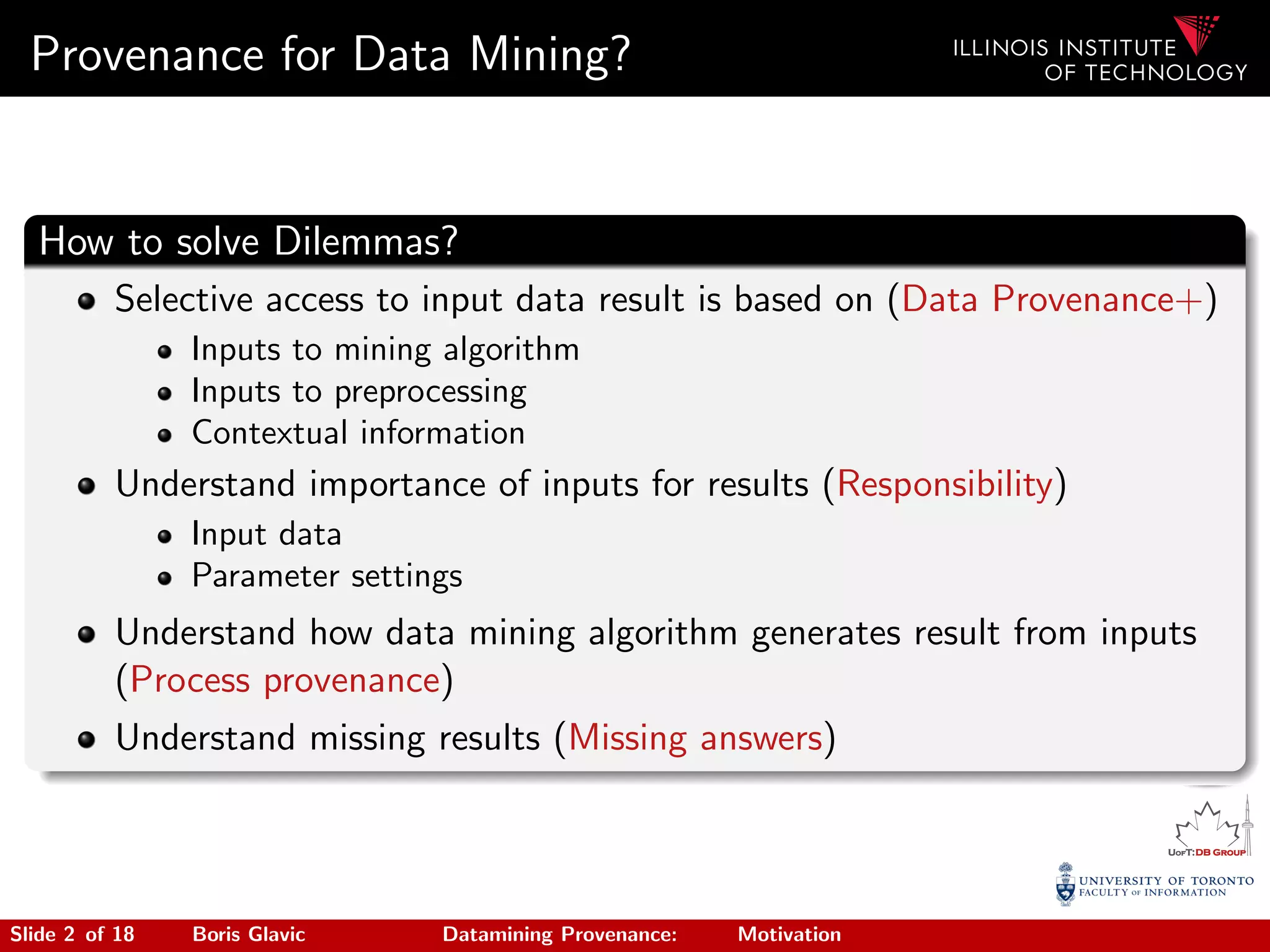
How to solve Dilemmas?
Selective access to input data result is based on (Data Provenance+)
Inputs to mining algorithm
Inputs to preprocessing
Contextual information
Understand importance of inputs for results (Responsibility)
Input data
Parameter settings
Understand how data mining algorithm generates result from inputs
(Process provenance)
Understand missing results (Missing answers)
Slide 2 of 18 Boris Glavic Datamining Provenance: Motivation
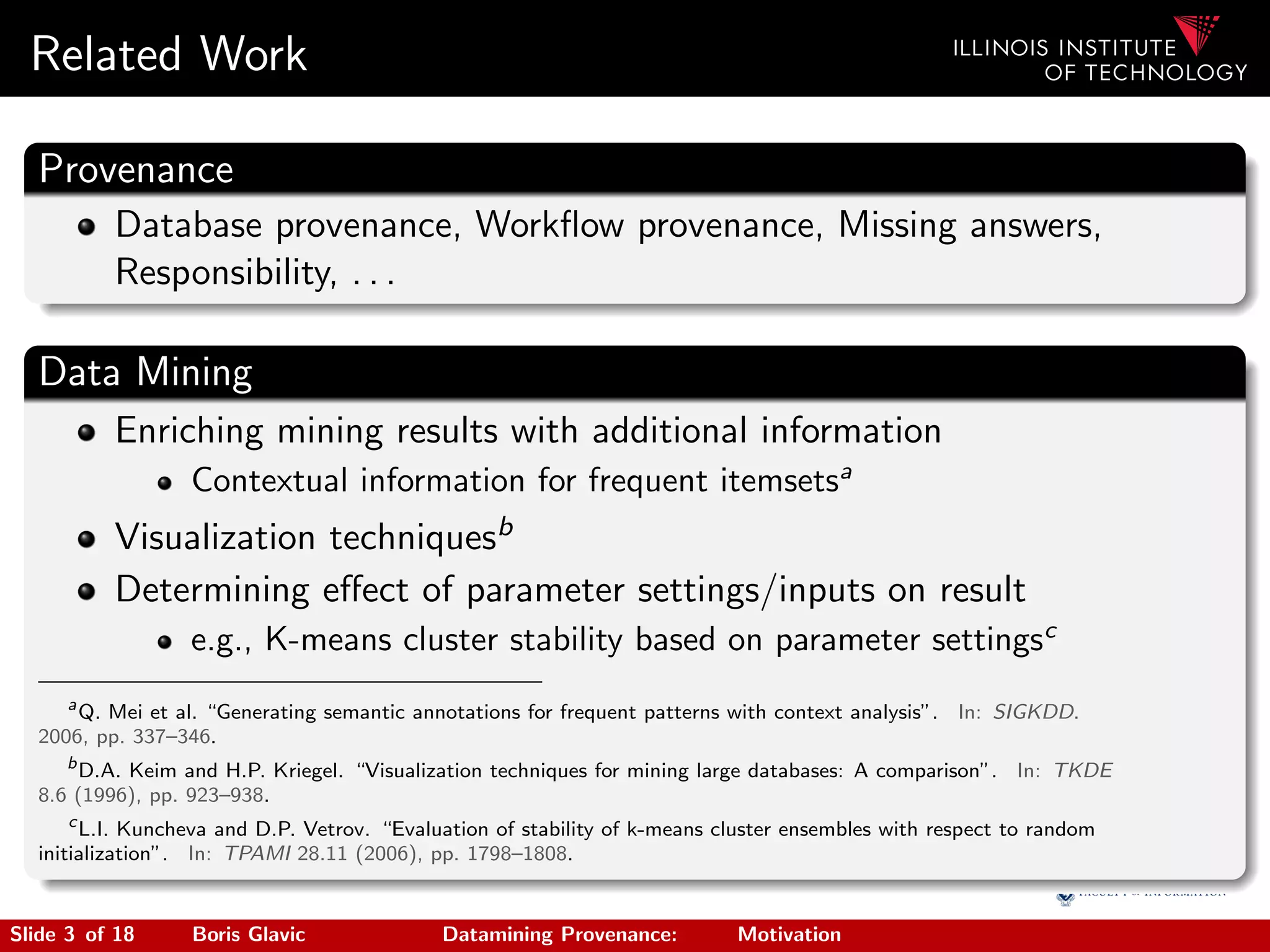
Related Work
Provenance
Database provenance, Workflow provenance, Missing answers,
Responsibility, . . .
Data Mining
Enriching mining results with additional information
Contextual information for frequent itemsetsa
Visualization techniquesb
Determining effect of parameter settings/inputs on result
e.g., K-means cluster stability based on parameter settingsc
a
Q. Mei et al. “Generating semantic annotations for frequent patterns with context analysis”. In: SIGKDD.
2006, pp. 337–346.
b
D.A. Keim and H.P. Kriegel. “Visualization techniques for mining large databases: A comparison”. In: TKDE
8.6 (1996), pp. 923–938.
c
L.I. Kuncheva and D.P. Vetrov. “Evaluation of stability of k-means cluster ensembles with respect to random
initialization”. In: TPAMI 28.11 (2006), pp. 1798–1808.
Slide 3 of 18 Boris Glavic Datamining Provenance: Motivation
Contributions
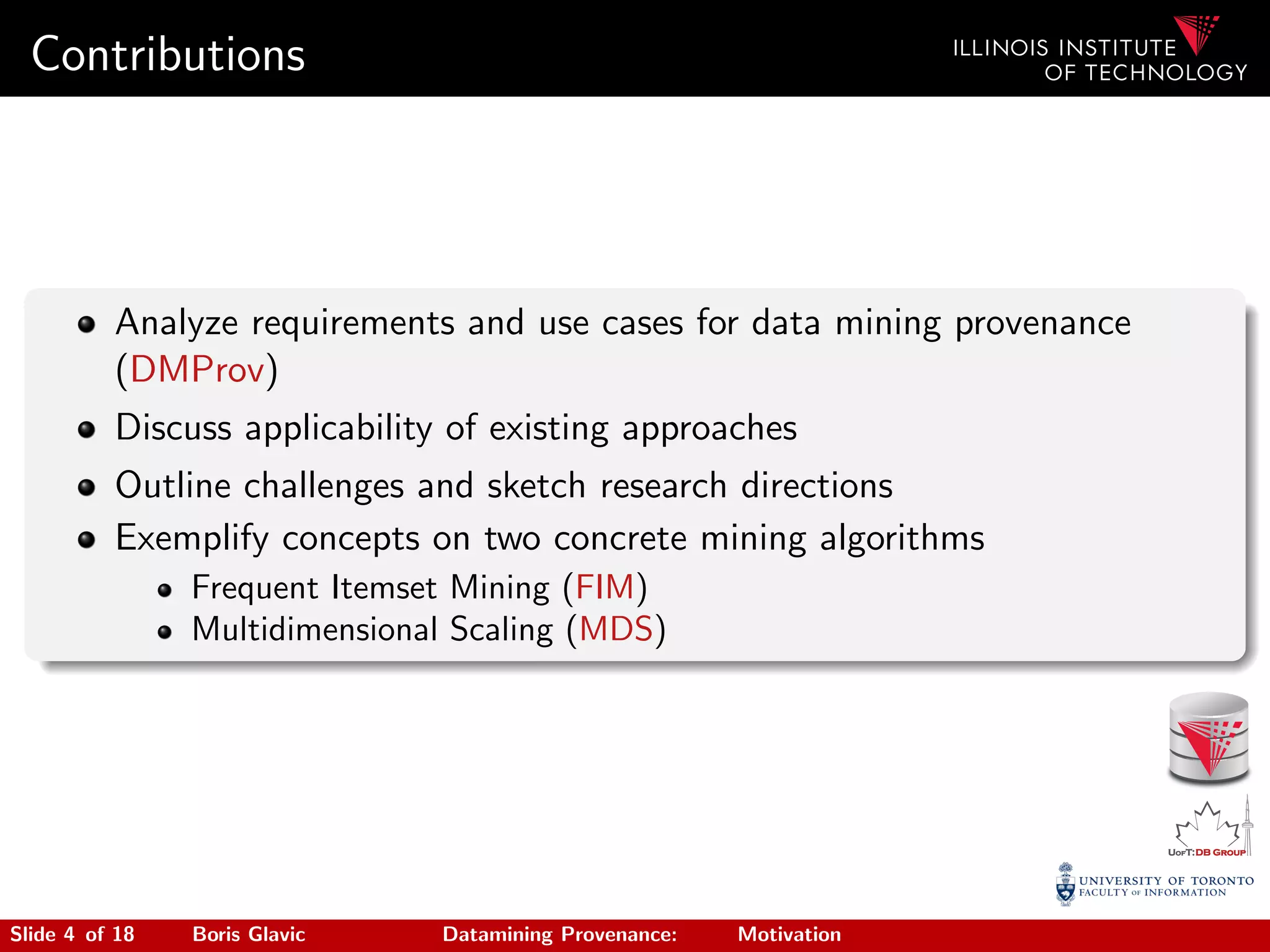
Analyze requirements and use cases for data mining provenance
(DMProv)
Discuss applicability of existing approaches
Outline challenges and sketch research directions
Exemplify concepts on two concrete mining algorithms
Frequent Itemset Mining (FIM)
Multidimensional Scaling (MDS)
Slide 4 of 18 Boris Glavic Datamining Provenance: Motivation
Outline
1 Motivation
2 Provenance for Data Mining
3 Frequent Itemset Provenance
4 Multidimensional Scaling Provenance
5 Conclusions
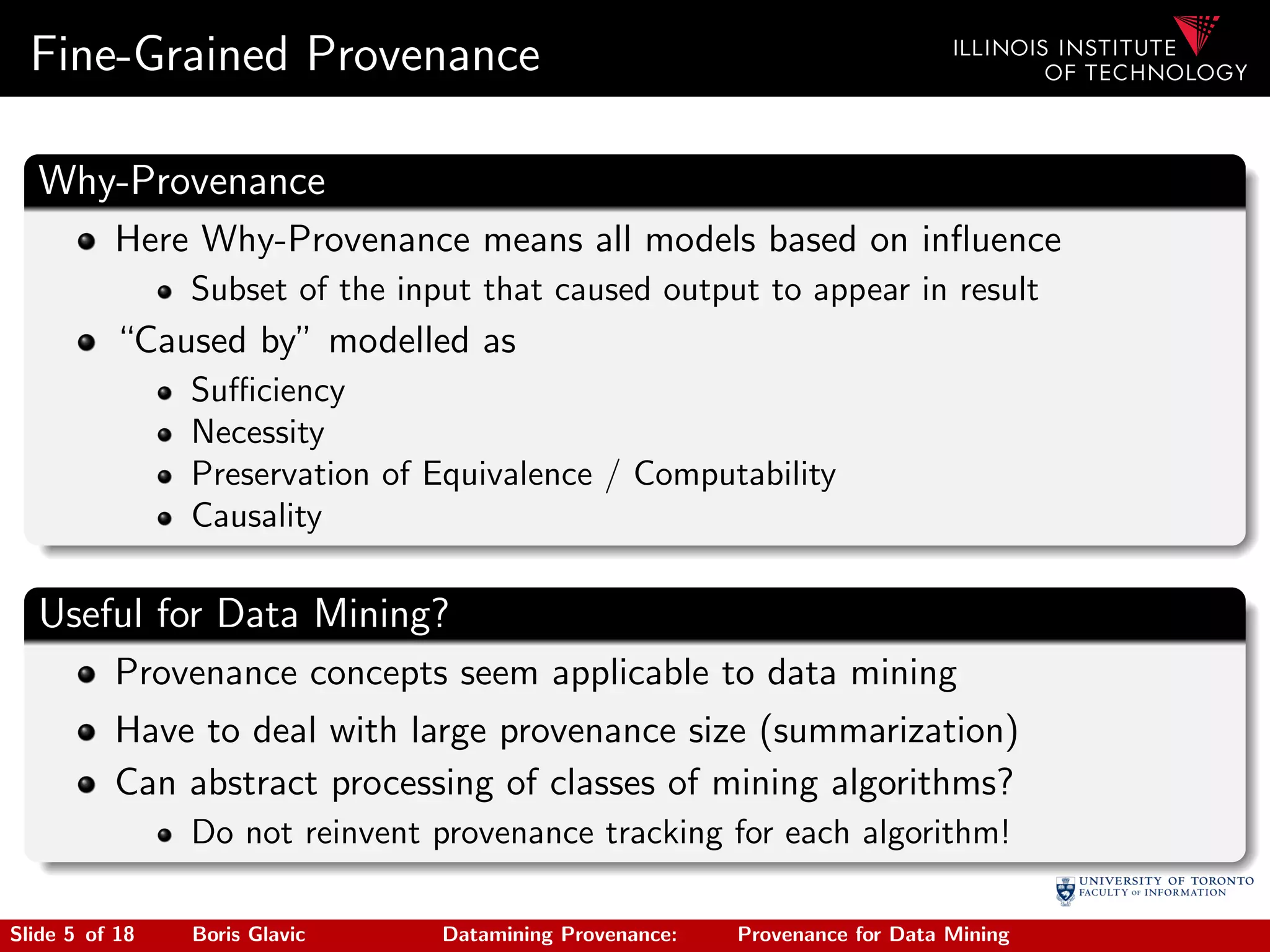
Fine-Grained Provenance
Why-Provenance
Here Why-Provenance means all models based on influence
Subset of the input that caused output to appear in result
“Caused by” modelled as
Sufficiency
Necessity
Preservation of Equivalence / Computability
Causality
Useful for Data Mining?
Provenance concepts seem applicable to data mining
Have to deal with large provenance size (summarization)
Can abstract processing of classes of mining algorithms?
Do not reinvent provenance tracking for each algorithm!
Slide 5 of 18 Boris Glavic Datamining Provenance: Provenance for Data Mining
Fine-Grained Provenance
Tracing Through Preprocessing Steps
Track back data mining results to inputs of preprocessing
ETL tools are used for preprocessing
⇒ can use database or workflow provenance approaches?
Slide 5 of 18 Boris Glavic Datamining Provenance: Provenance for Data Mining
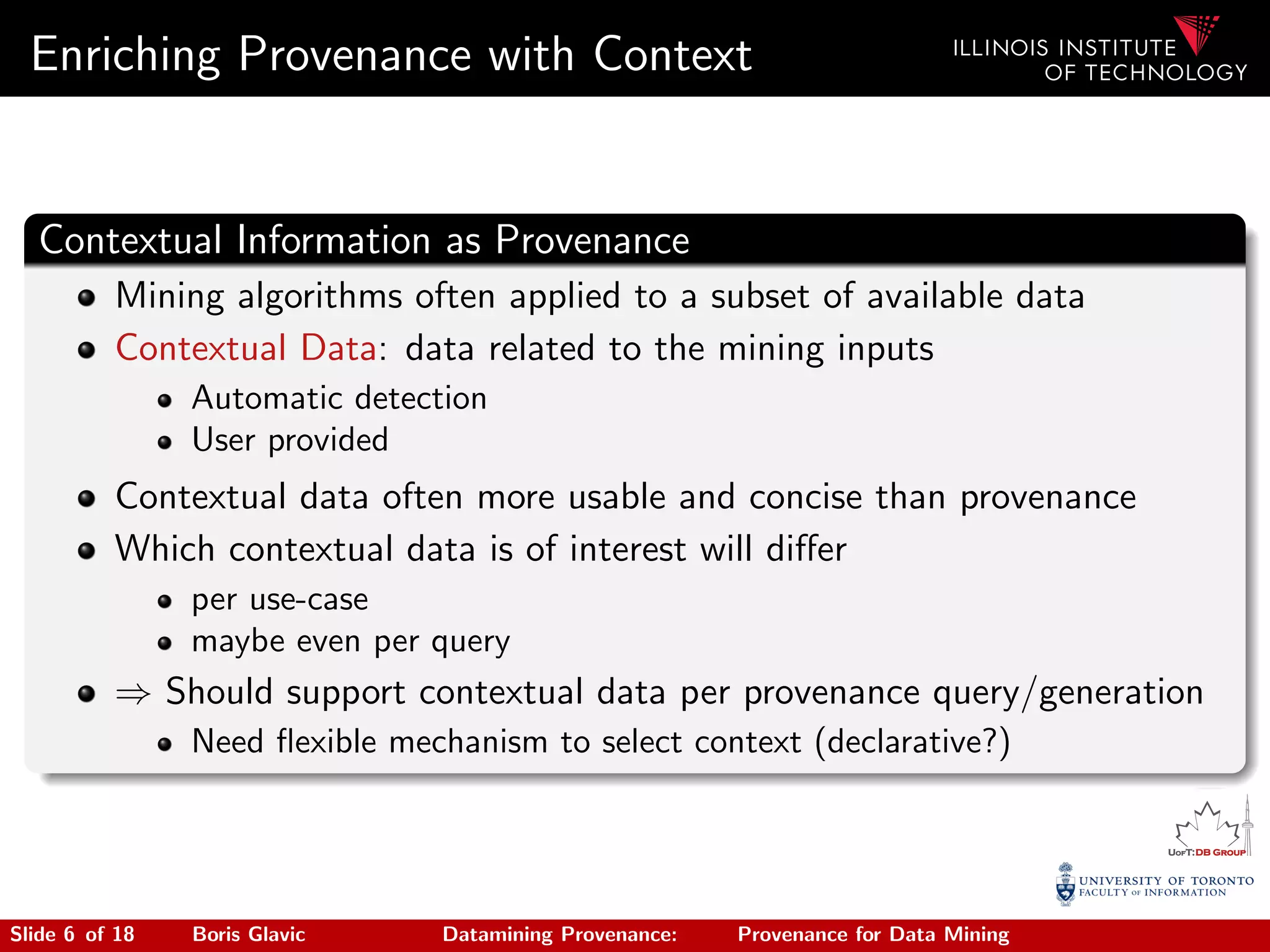
Enriching Provenance with Context
Contextual Information as Provenance
Mining algorithms often applied to a subset of available data
Contextual Data: data related to the mining inputs
Automatic detection
User provided
Contextual data often more usable and concise than provenance
Which contextual data is of interest will differ
per use-case
maybe even per query
⇒ Should support contextual data per provenance query/generation
Need flexible mechanism to select context (declarative?)
Slide 6 of 18 Boris Glavic Datamining Provenance: Provenance for Data Mining
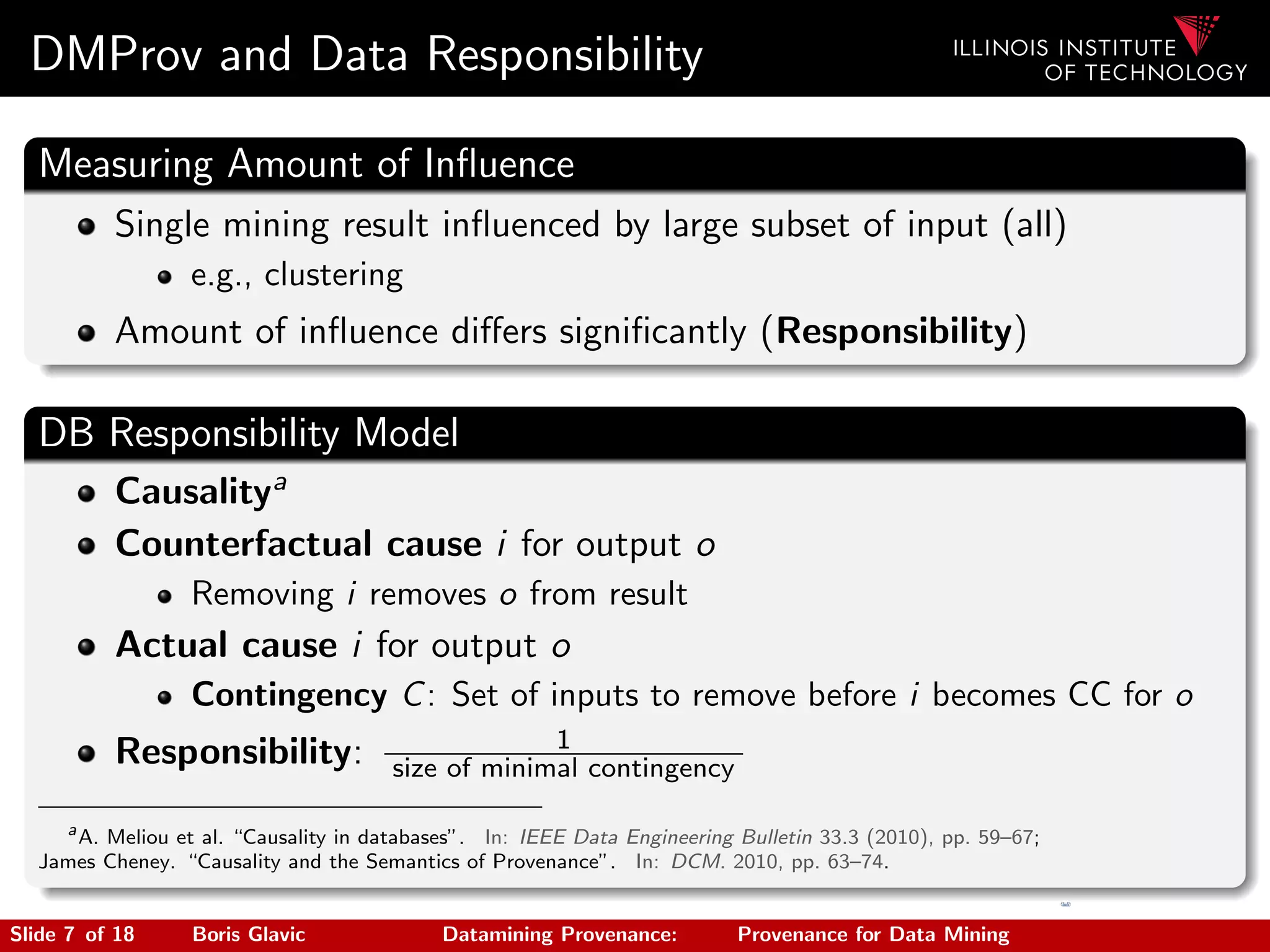
DMProv and Data Responsibility
Measuring Amount of Influence
Single mining result influenced by large subset of input (all)
e.g., clustering
Amount of influence differs significantly (Responsibility)
DB Responsibility Model
Causalitya
Counterfactual cause i for output o
Removing i removes o from result
Actual cause i for output o
Contingency C: Set of inputs to remove before i becomes CC for o
Responsibility: 1
size of minimal contingency
a
A. Meliou et al. “Causality in databases”. In: IEEE Data Engineering Bulletin 33.3 (2010), pp. 59–67;
James Cheney. “Causality and the Semantics of Provenance”. In: DCM. 2010, pp. 63–74.
Slide 7 of 18 Boris Glavic Datamining Provenance: Provenance for Data Mining
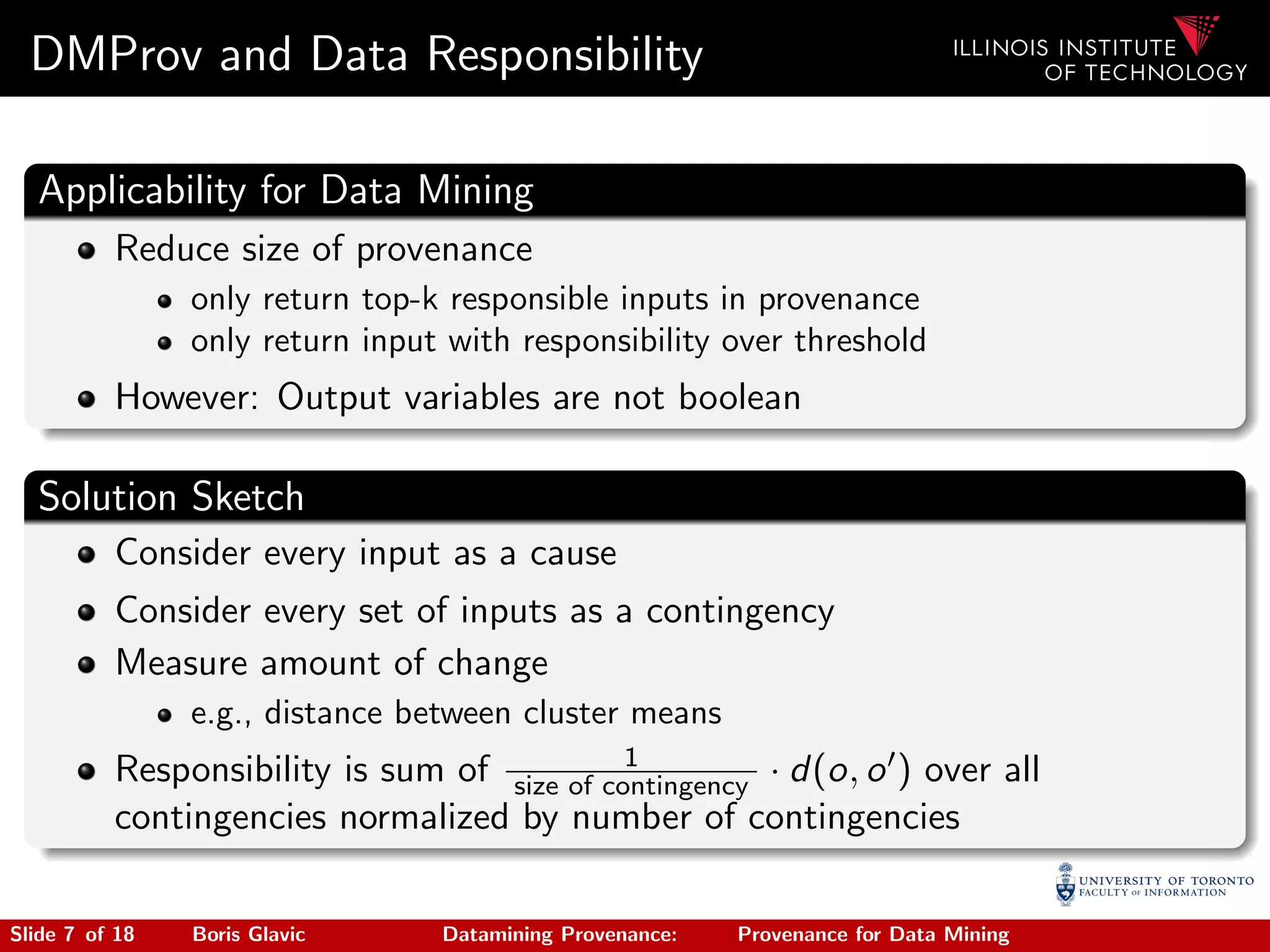
DMProv and Data Responsibility
Applicability for Data Mining
Reduce size of provenance
only return top-k responsible inputs in provenance
only return input with responsibility over threshold
However: Output variables are not boolean
Solution Sketch
Consider every input as a cause
Consider every set of inputs as a contingency
Measure amount of change
e.g., distance between cluster means
Responsibility is sum of 1
size of contingency · d(o, o ) over all
contingencies normalized by number of contingencies
Slide 7 of 18 Boris Glavic Datamining Provenance: Provenance for Data Mining
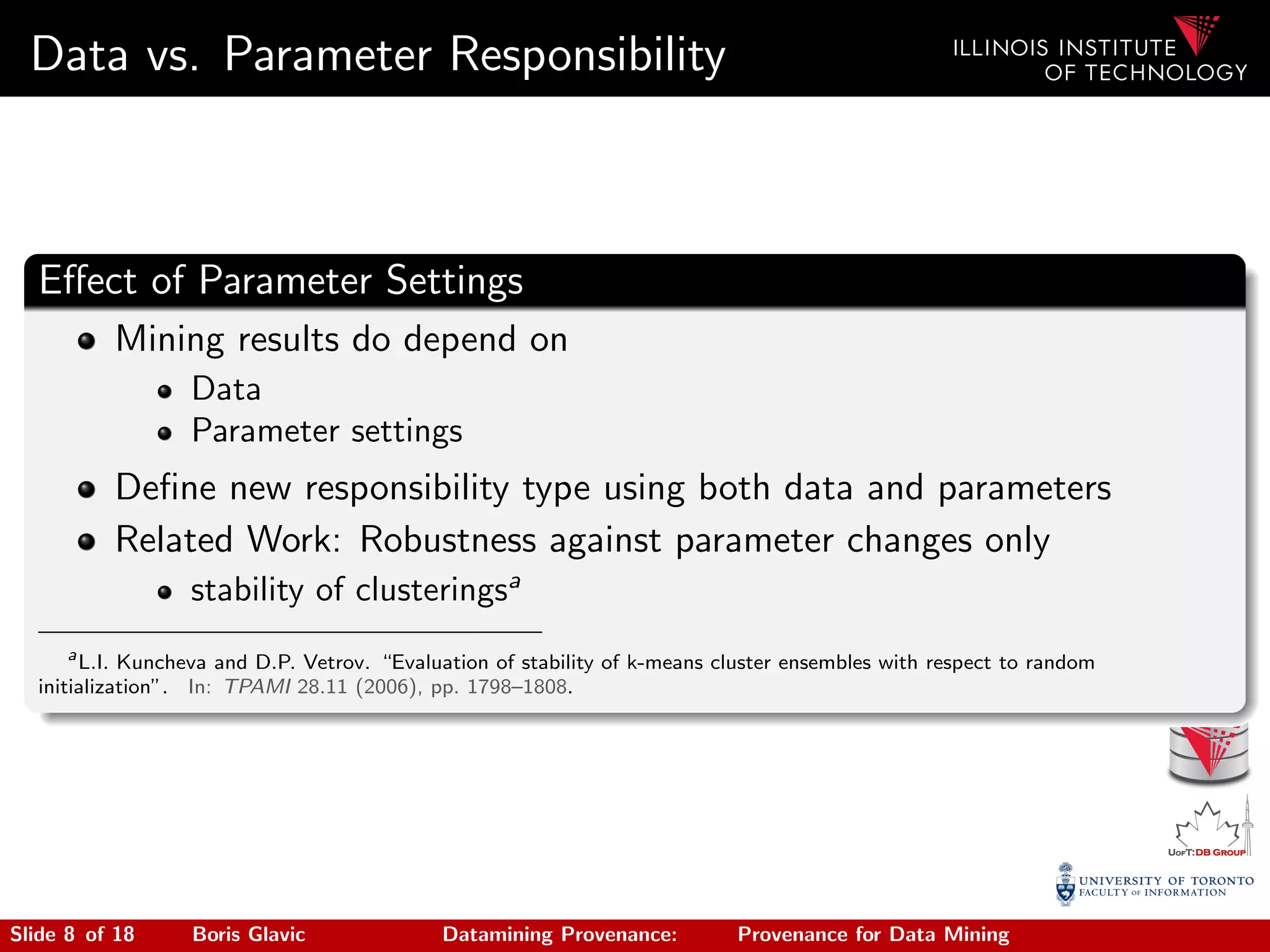
Data vs. Parameter Responsibility
Effect of Parameter Settings
Mining results do depend on
Data
Parameter settings
Define new responsibility type using both data and parameters
Related Work: Robustness against parameter changes only
stability of clusteringsa
a
L.I. Kuncheva and D.P. Vetrov. “Evaluation of stability of k-means cluster ensembles with respect to random
initialization”. In: TPAMI 28.11 (2006), pp. 1798–1808.
Slide 8 of 18 Boris Glavic Datamining Provenance: Provenance for Data Mining
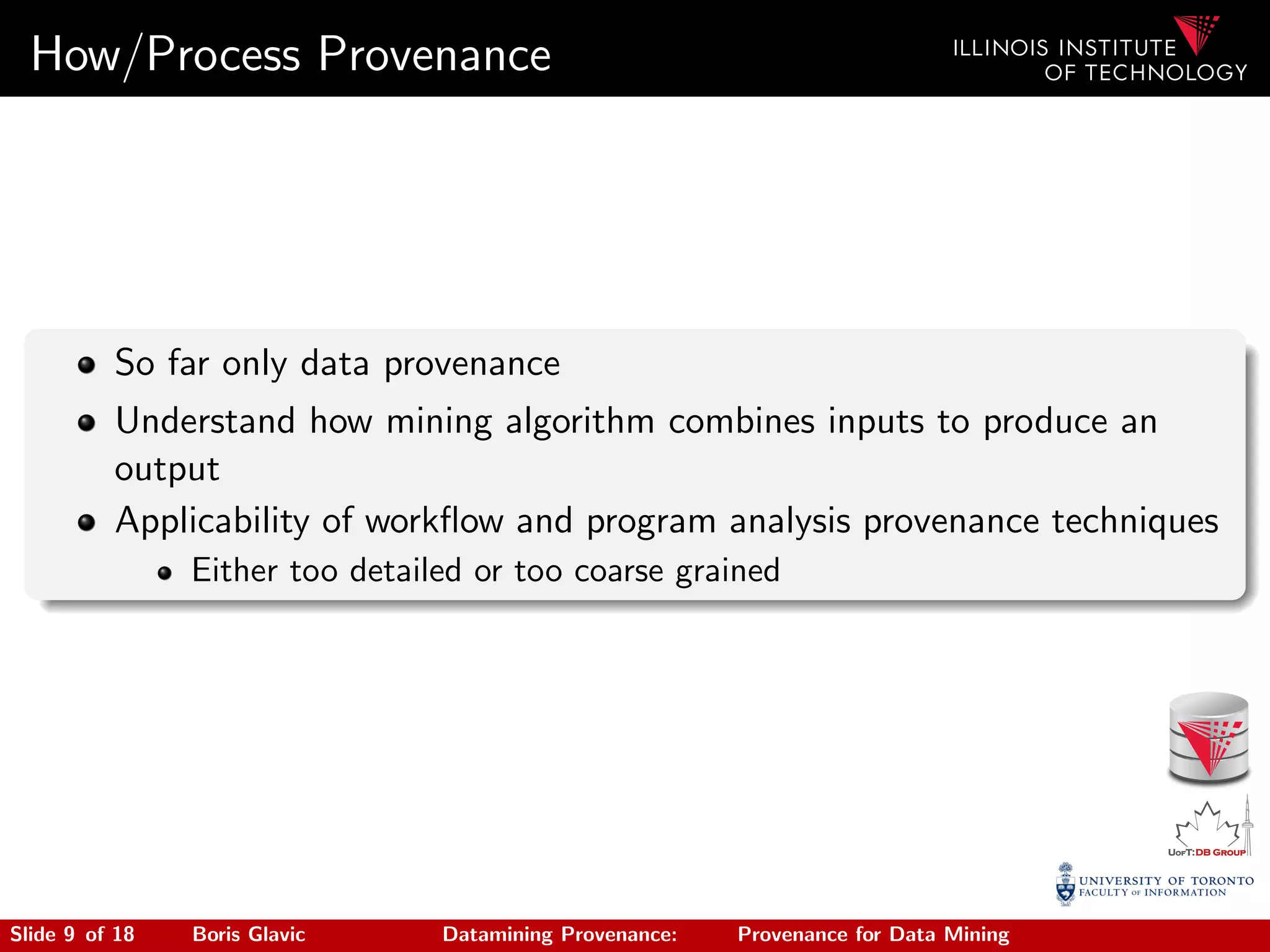
How/Process Provenance
So far only data provenance
Understand how mining algorithm combines inputs to produce an
output
Applicability of workflow and program analysis provenance techniques
Either too detailed or too coarse grained
Slide 9 of 18 Boris Glavic Datamining Provenance: Provenance for Data Mining
Outline
1 Motivation
2 Provenance for Data Mining
3 Frequent Itemset Provenance
4 Multidimensional Scaling Provenance
5 Conclusions
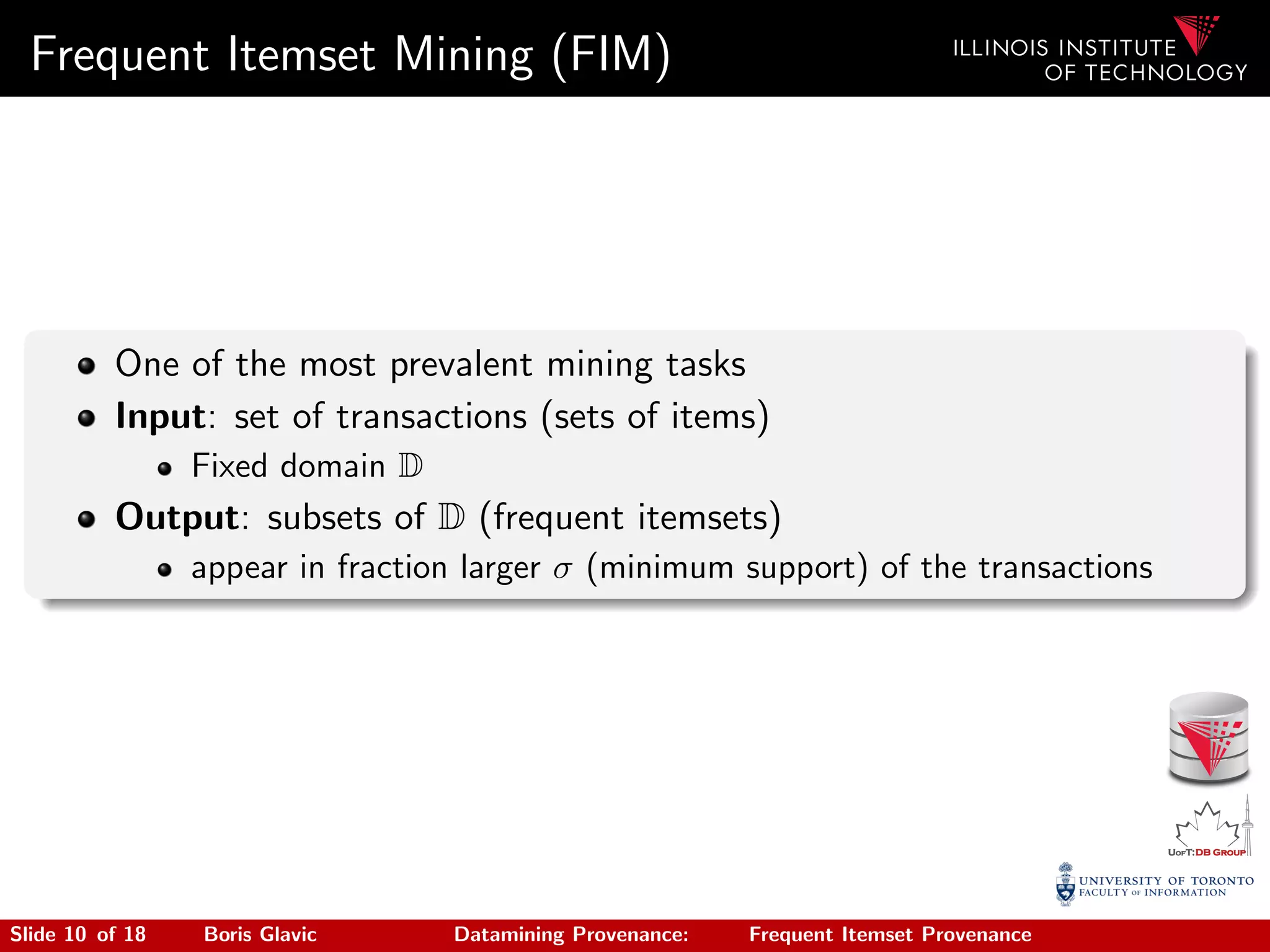
Frequent Itemset Mining (FIM)
One of the most prevalent mining tasks
Input: set of transactions (sets of items)
Fixed domain D
Output: subsets of D (frequent itemsets)
appear in fraction larger σ (minimum support) of the transactions
Slide 10 of 18 Boris Glavic Datamining Provenance: Frequent Itemset Provenance
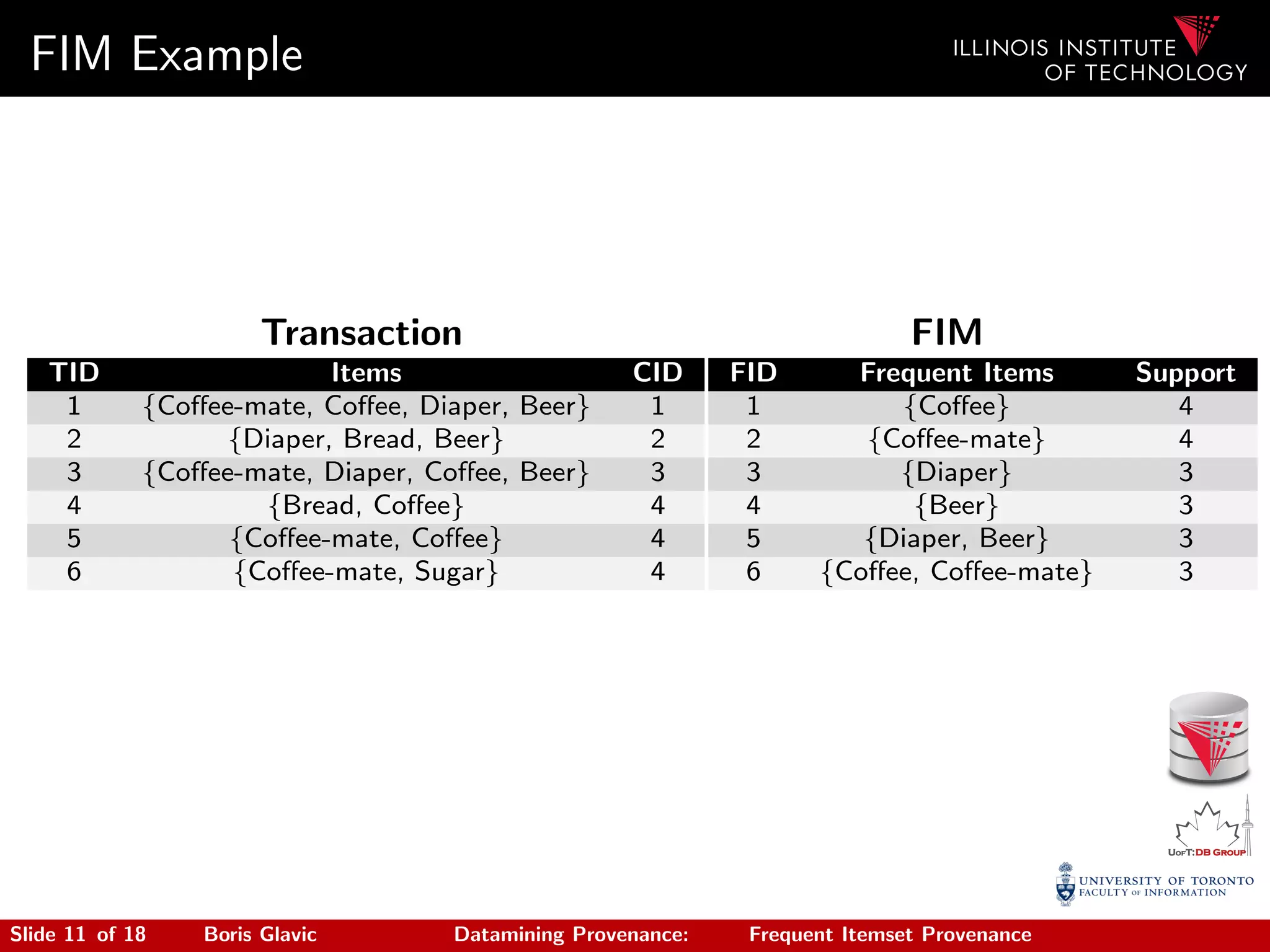
FIM Example
Transaction
TID Items CID
1 {Coffee-mate, Coffee, Diaper, Beer} 1
2 {Diaper, Bread, Beer} 2
3 {Coffee-mate, Diaper, Coffee, Beer} 3
4 {Bread, Coffee} 4
5 {Coffee-mate, Coffee} 4
6 {Coffee-mate, Sugar} 4
FIM
FID Frequent Items Support
1 {Coffee} 4
2 {Coffee-mate} 4
3 {Diaper} 3
4 {Beer} 3
5 {Diaper, Beer} 3
6 {Coffee, Coffee-mate} 3
Slide 11 of 18 Boris Glavic Datamining Provenance: Frequent Itemset Provenance
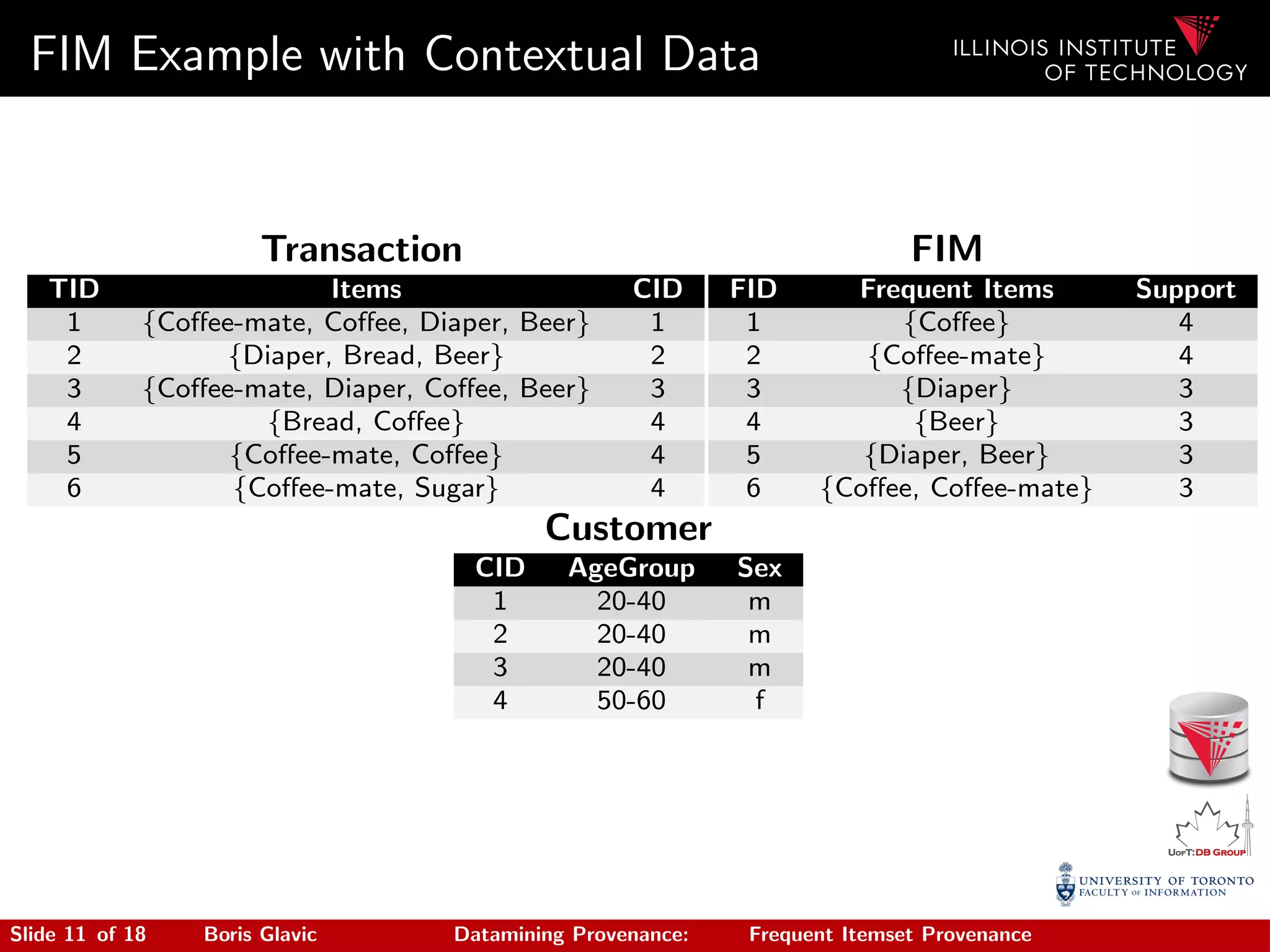
FIM Example with Contextual Data
Transaction
TID Items CID
1 {Coffee-mate, Coffee, Diaper, Beer} 1
2 {Diaper, Bread, Beer} 2
3 {Coffee-mate, Diaper, Coffee, Beer} 3
4 {Bread, Coffee} 4
5 {Coffee-mate, Coffee} 4
6 {Coffee-mate, Sugar} 4
FIM
FID Frequent Items Support
1 {Coffee} 4
2 {Coffee-mate} 4
3 {Diaper} 3
4 {Beer} 3
5 {Diaper, Beer} 3
6 {Coffee, Coffee-mate} 3
Customer
CID AgeGroup Sex
1 20-40 m
2 20-40 m
3 20-40 m
4 50-60 f
Slide 11 of 18 Boris Glavic Datamining Provenance: Frequent Itemset Provenance
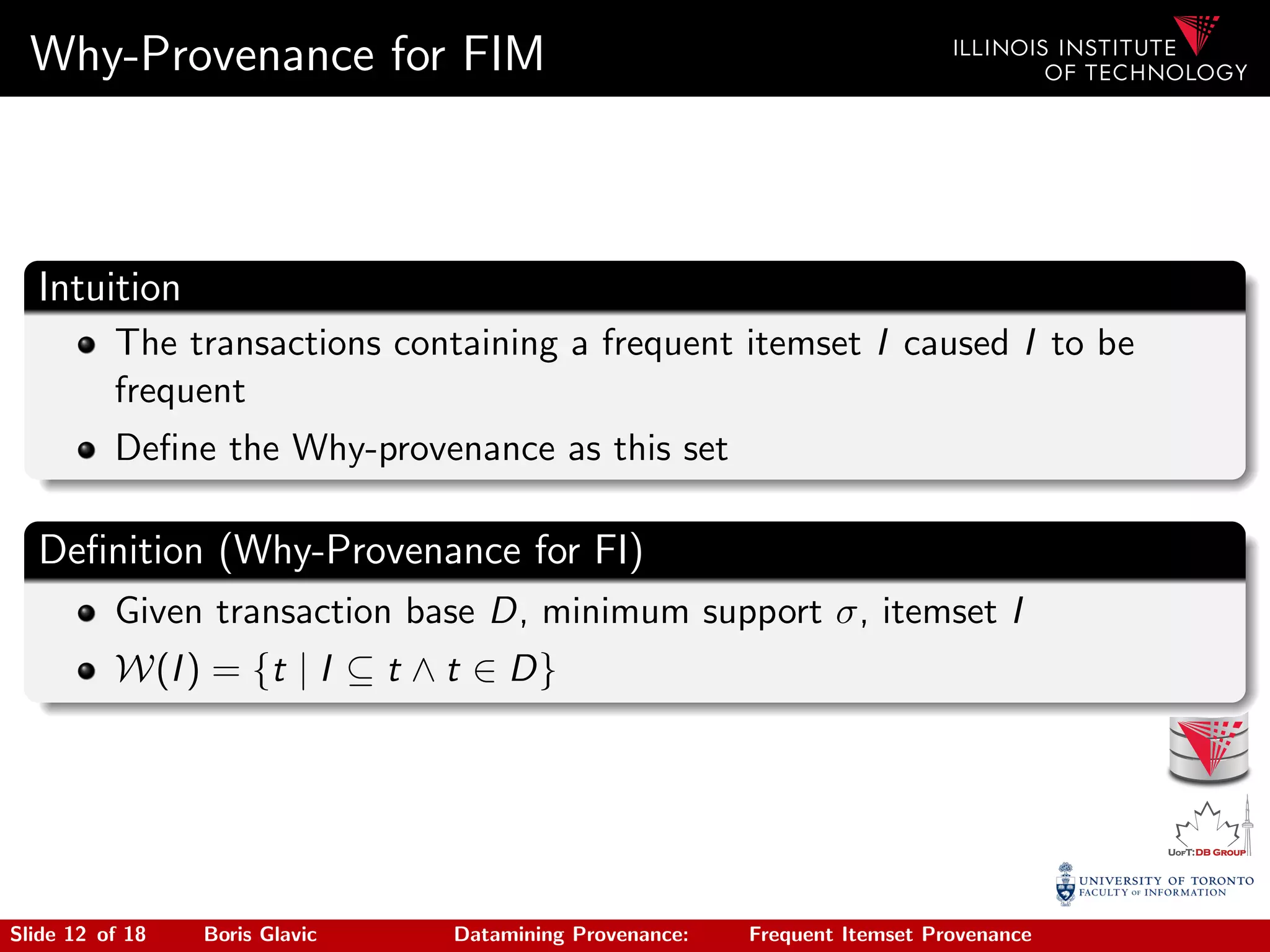
Why-Provenance for FIM
Intuition
The transactions containing a frequent itemset I caused I to be
frequent
Define the Why-provenance as this set
Definition (Why-Provenance for FI)
Given transaction base D, minimum support σ, itemset I
W(I) = {t | I ⊆ t ∧ t ∈ D}
Slide 12 of 18 Boris Glavic Datamining Provenance: Frequent Itemset Provenance
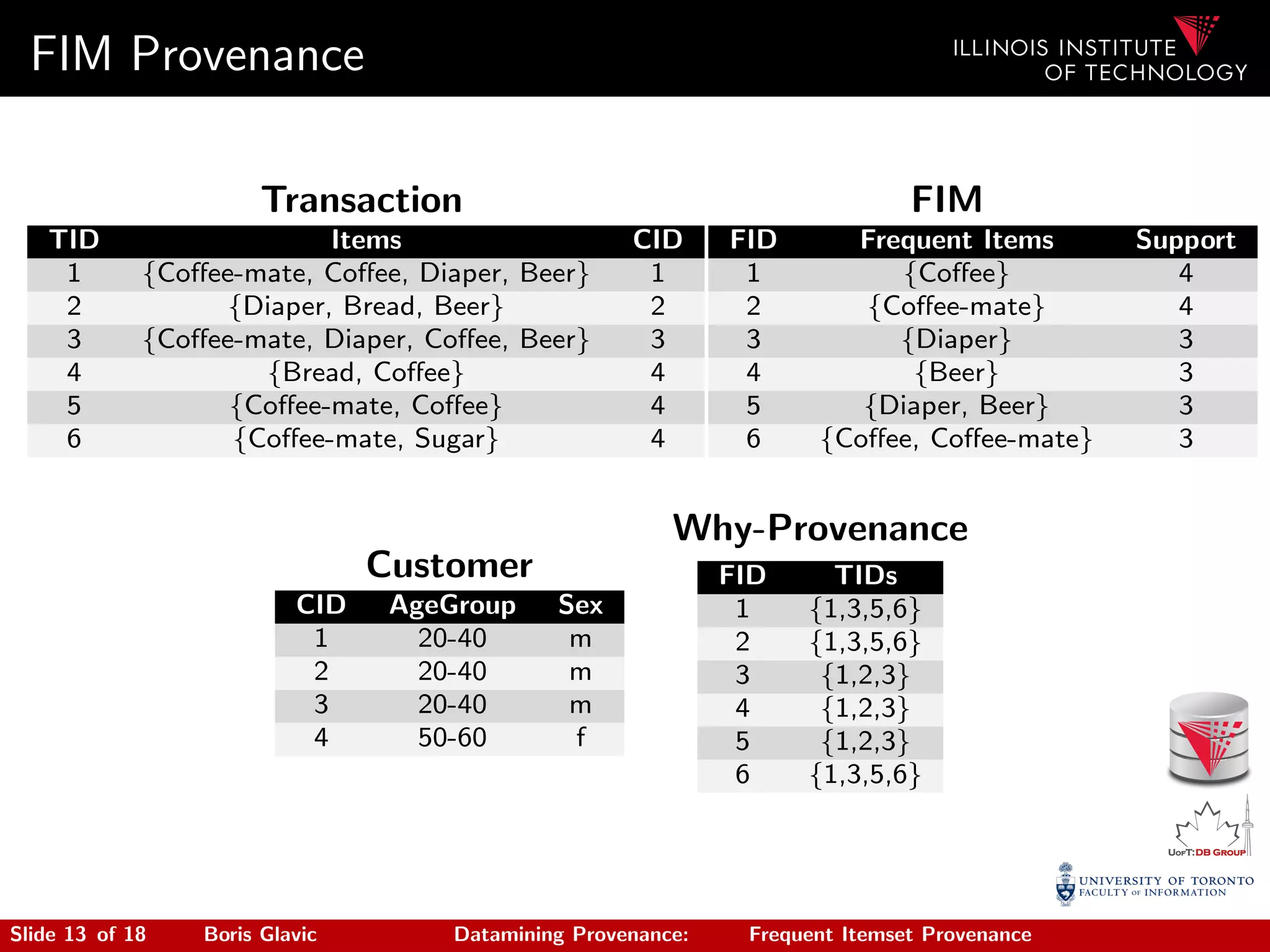
FIM Provenance
Transaction
TID Items CID
1 {Coffee-mate, Coffee, Diaper, Beer} 1
2 {Diaper, Bread, Beer} 2
3 {Coffee-mate, Diaper, Coffee, Beer} 3
4 {Bread, Coffee} 4
5 {Coffee-mate, Coffee} 4
6 {Coffee-mate, Sugar} 4
FIM
FID Frequent Items Support
1 {Coffee} 4
2 {Coffee-mate} 4
3 {Diaper} 3
4 {Beer} 3
5 {Diaper, Beer} 3
6 {Coffee, Coffee-mate} 3
Customer
CID AgeGroup Sex
1 20-40 m
2 20-40 m
3 20-40 m
4 50-60 f
Why-Provenance
FID TIDs
1 {1,3,5,6}
2 {1,3,5,6}
3 {1,2,3}
4 {1,2,3}
5 {1,2,3}
6 {1,3,5,6}
Slide 13 of 18 Boris Glavic Datamining Provenance: Frequent Itemset Provenance
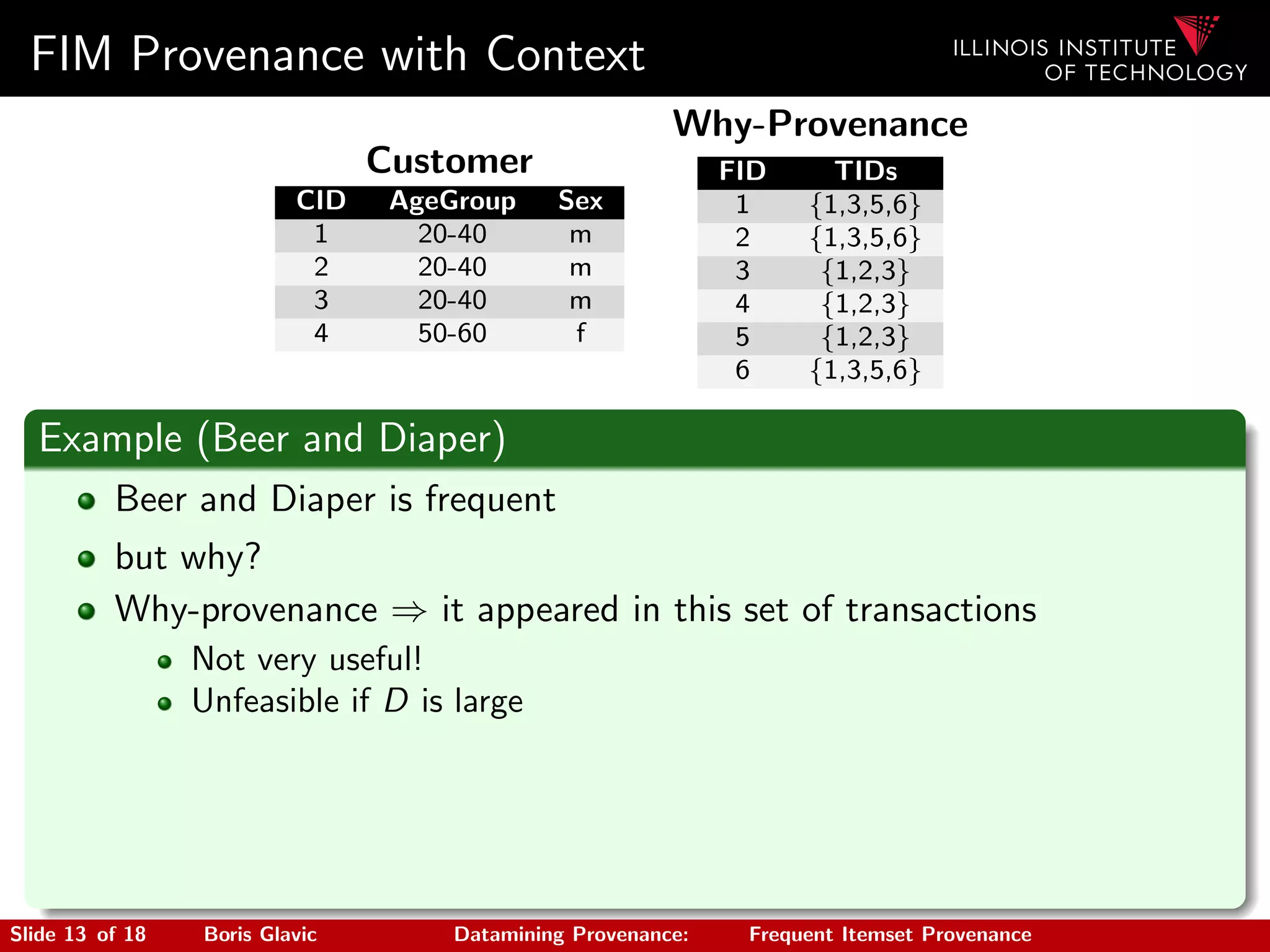
FIM Provenance with Context
Customer
CID AgeGroup Sex
1 20-40 m
2 20-40 m
3 20-40 m
4 50-60 f
Why-Provenance
FID TIDs
1 {1,3,5,6}
2 {1,3,5,6}
3 {1,2,3}
4 {1,2,3}
5 {1,2,3}
6 {1,3,5,6}
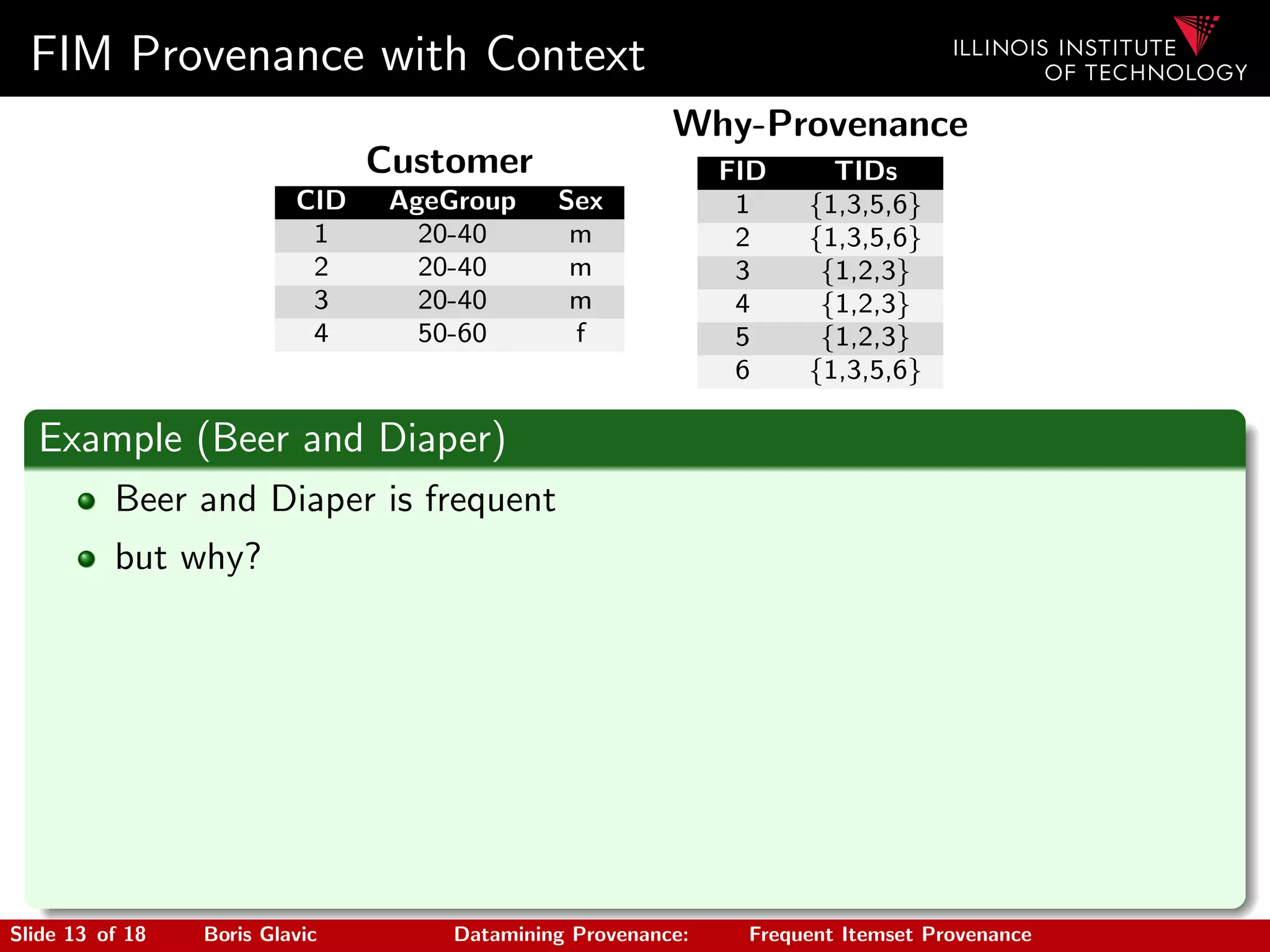
Example (Beer and Diaper)
Beer and Diaper is frequent
but why?
Slide 13 of 18 Boris Glavic Datamining Provenance: Frequent Itemset Provenance
FIM Provenance with Context
Customer
CID AgeGroup Sex
1 20-40 m
2 20-40 m
3 20-40 m
4 50-60 f
Why-Provenance
FID TIDs
1 {1,3,5,6}
2 {1,3,5,6}
3 {1,2,3}
4 {1,2,3}
5 {1,2,3}
6 {1,3,5,6}
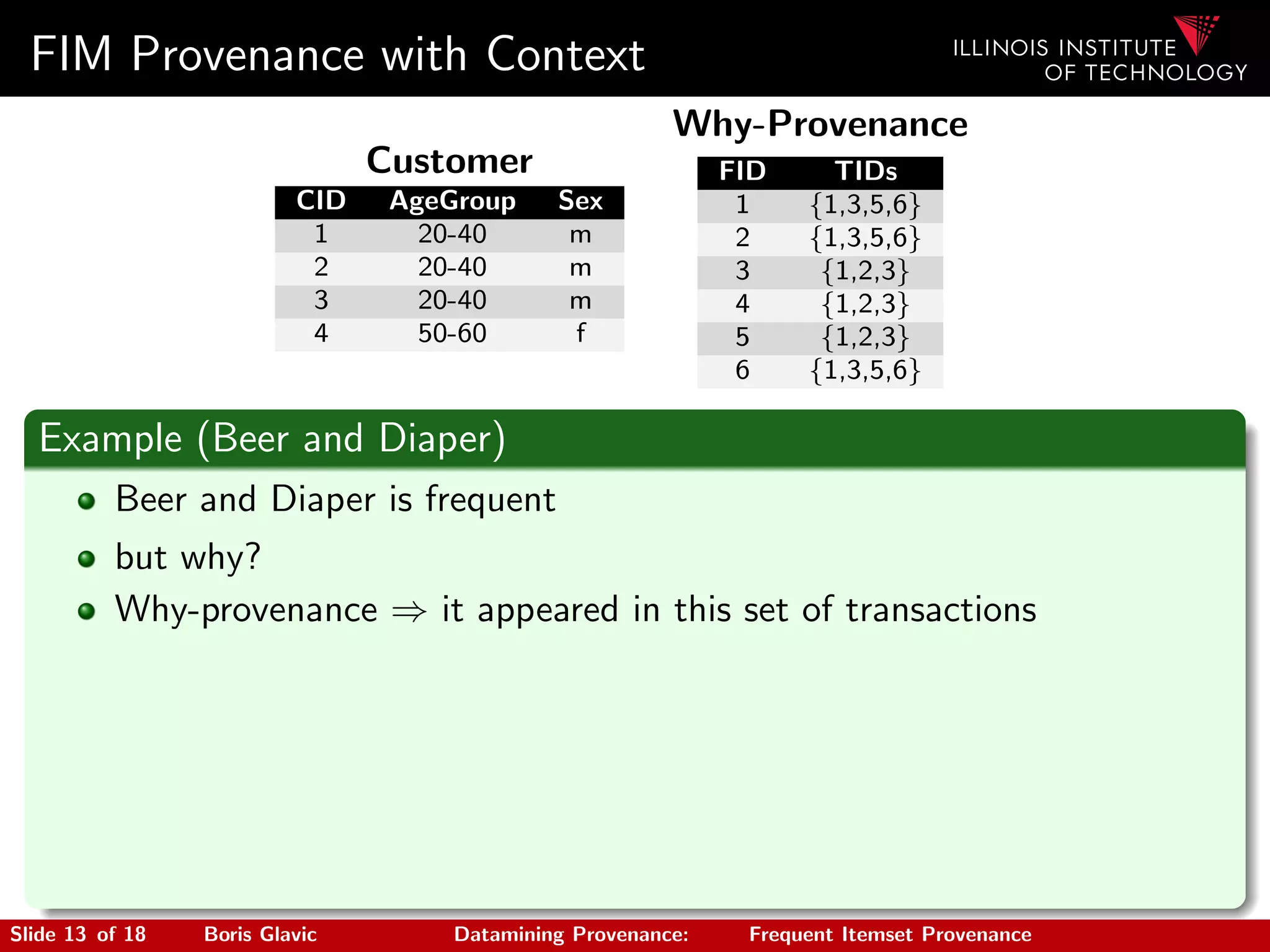
Example (Beer and Diaper)
Beer and Diaper is frequent
but why?
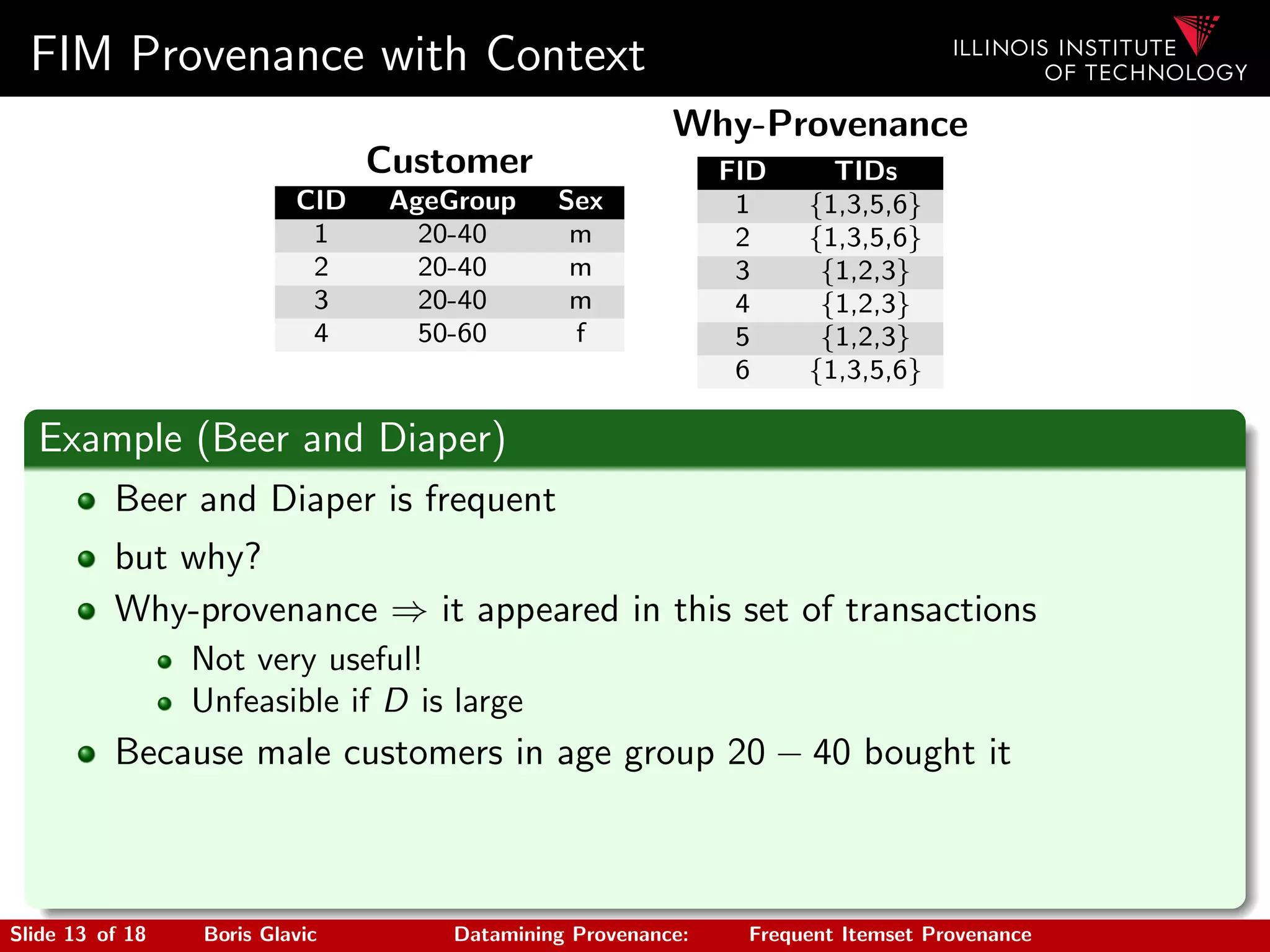
Why-provenance ⇒ it appeared in this set of transactions
Slide 13 of 18 Boris Glavic Datamining Provenance: Frequent Itemset Provenance
FIM Provenance with Context
Customer
CID AgeGroup Sex
1 20-40 m
2 20-40 m
3 20-40 m
4 50-60 f
Why-Provenance
FID TIDs
1 {1,3,5,6}
2 {1,3,5,6}
3 {1,2,3}
4 {1,2,3}
5 {1,2,3}
6 {1,3,5,6}
Example (Beer and Diaper)
Beer and Diaper is frequent
but why?
Why-provenance ⇒ it appeared in this set of transactions
Not very useful!
Unfeasible if D is large
Slide 13 of 18 Boris Glavic Datamining Provenance: Frequent Itemset Provenance
FIM Provenance with Context
Customer
CID AgeGroup Sex
1 20-40 m
2 20-40 m
3 20-40 m
4 50-60 f
Why-Provenance
FID TIDs
1 {1,3,5,6}
2 {1,3,5,6}
3 {1,2,3}
4 {1,2,3}
5 {1,2,3}
6 {1,3,5,6}
Example (Beer and Diaper)
Beer and Diaper is frequent
but why?
Why-provenance ⇒ it appeared in this set of transactions
Not very useful!
Unfeasible if D is large
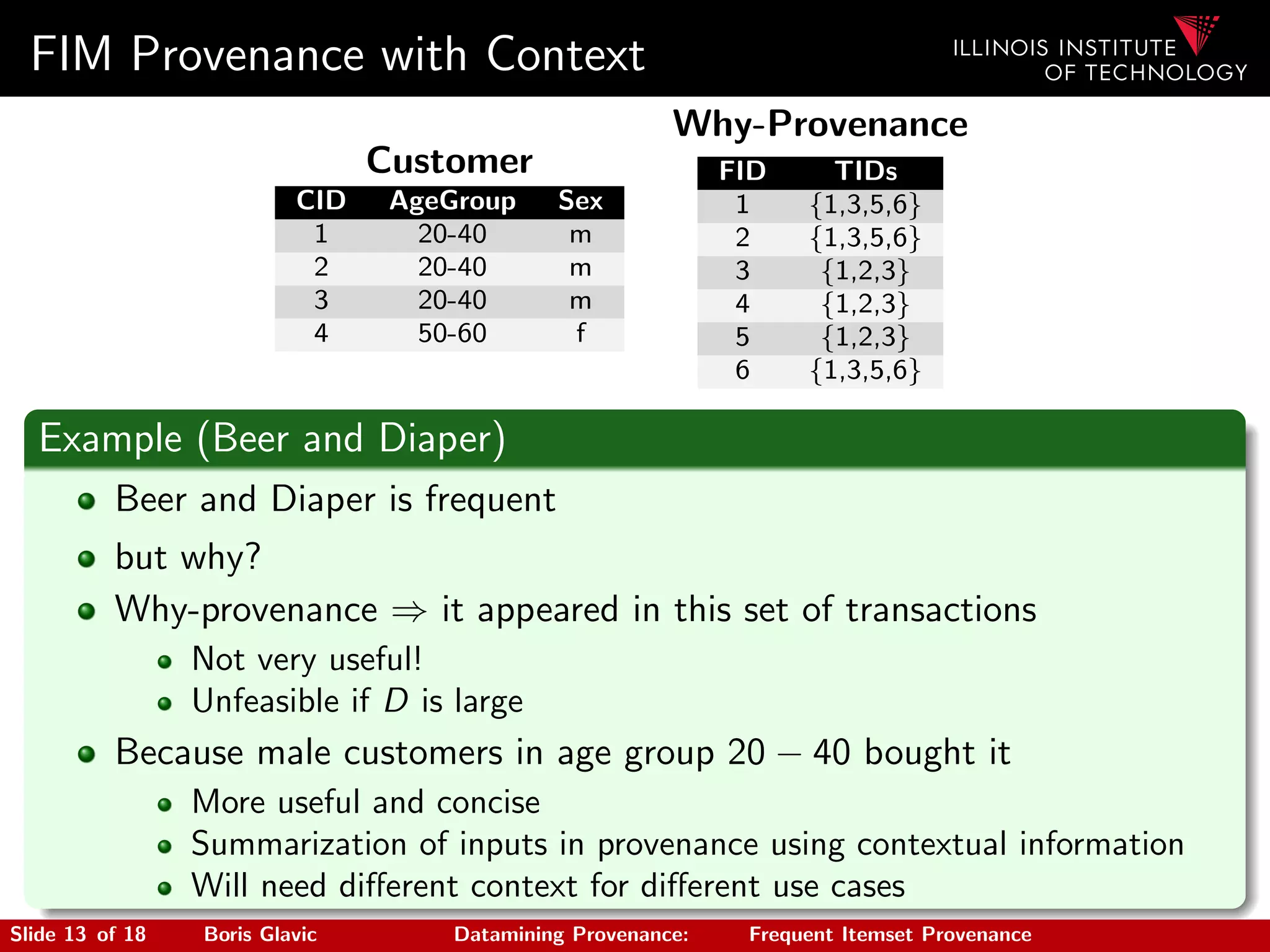
Because male customers in age group 20 − 40 bought it
Slide 13 of 18 Boris Glavic Datamining Provenance: Frequent Itemset Provenance
FIM Provenance with Context
Customer
CID AgeGroup Sex
1 20-40 m
2 20-40 m
3 20-40 m
4 50-60 f
Why-Provenance
FID TIDs
1 {1,3,5,6}
2 {1,3,5,6}
3 {1,2,3}
4 {1,2,3}
5 {1,2,3}
6 {1,3,5,6}
Example (Beer and Diaper)
Beer and Diaper is frequent
but why?
Why-provenance ⇒ it appeared in this set of transactions
Not very useful!
Unfeasible if D is large
Because male customers in age group 20 − 40 bought it
More useful and concise
Summarization of inputs in provenance using contextual information
Will need different context for different use cases
Slide 13 of 18 Boris Glavic Datamining Provenance: Frequent Itemset Provenance
Preliminary Results
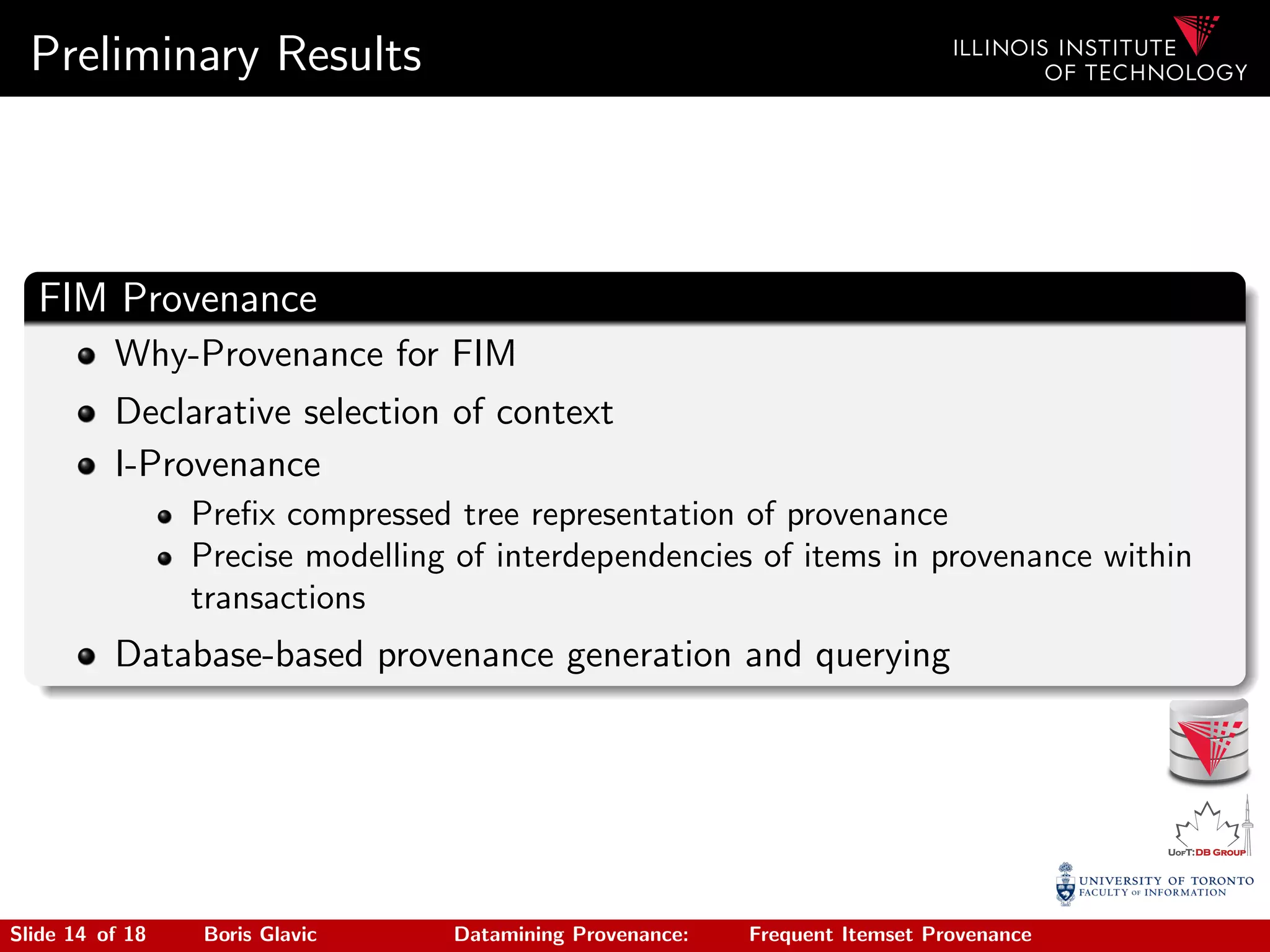
FIM Provenance
Why-Provenance for FIM
Declarative selection of context
I-Provenance
Prefix compressed tree representation of provenance
Precise modelling of interdependencies of items in provenance within
transactions
Database-based provenance generation and querying
Slide 14 of 18 Boris Glavic Datamining Provenance: Frequent Itemset Provenance
Outline
1 Motivation
2 Provenance for Data Mining
3 Frequent Itemset Provenance
4 Multidimensional Scaling Provenance
5 Conclusions
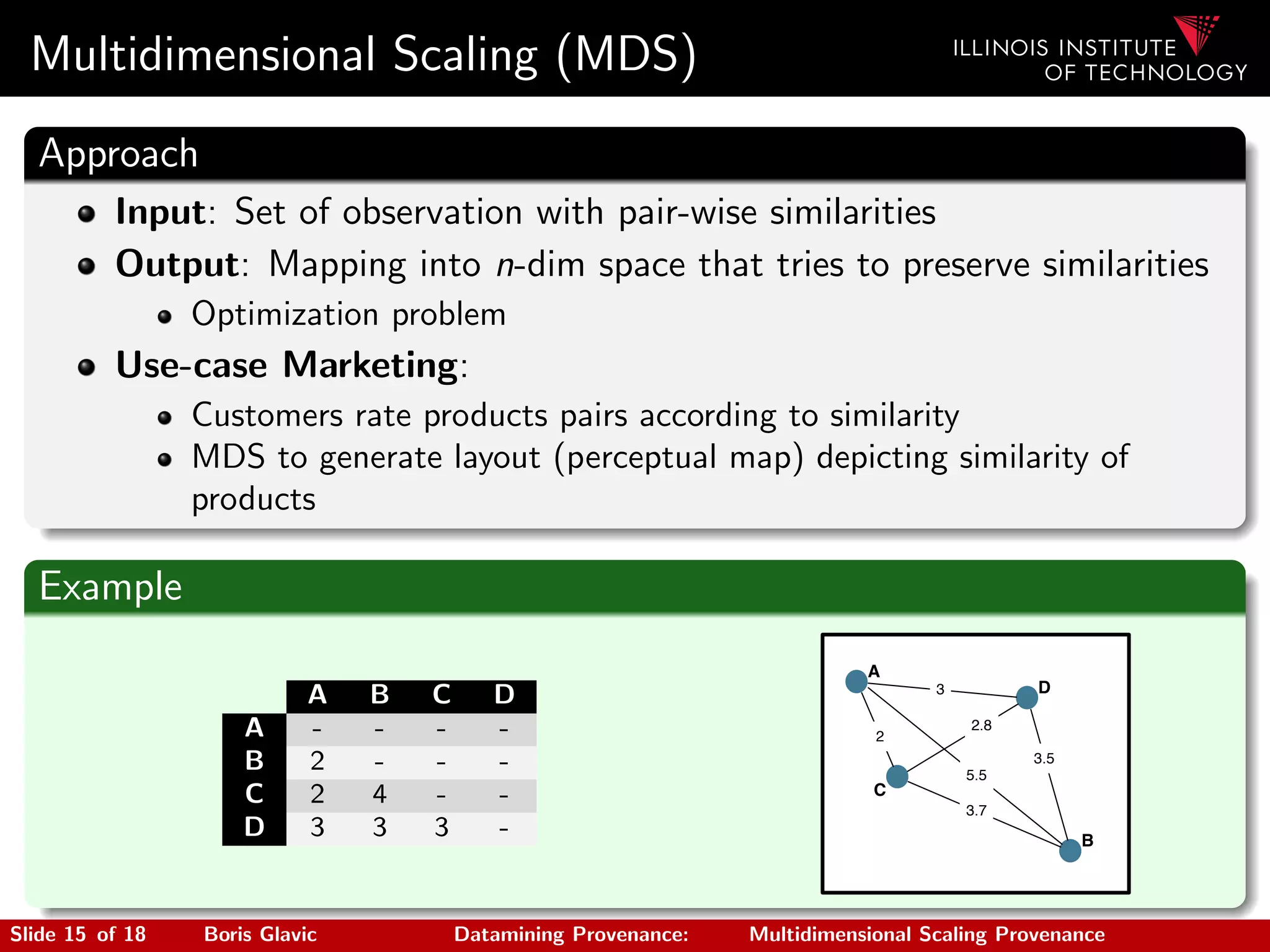
Multidimensional Scaling (MDS)
Approach
Input: Set of observation with pair-wise similarities
Output: Mapping into n-dim space that tries to preserve similarities
Optimization problem
Use-case Marketing:
Customers rate products pairs according to similarity
MDS to generate layout (perceptual map) depicting similarity of
products
Example
A B C D
A - - - -
B 2 - - -
C 2 4 - -
D 3 3 3 -
A
C
D
B
2
3
5.5
3.5
3.7
2.8
Slide 15 of 18 Boris Glavic Datamining Provenance: Multidimensional Scaling Provenance
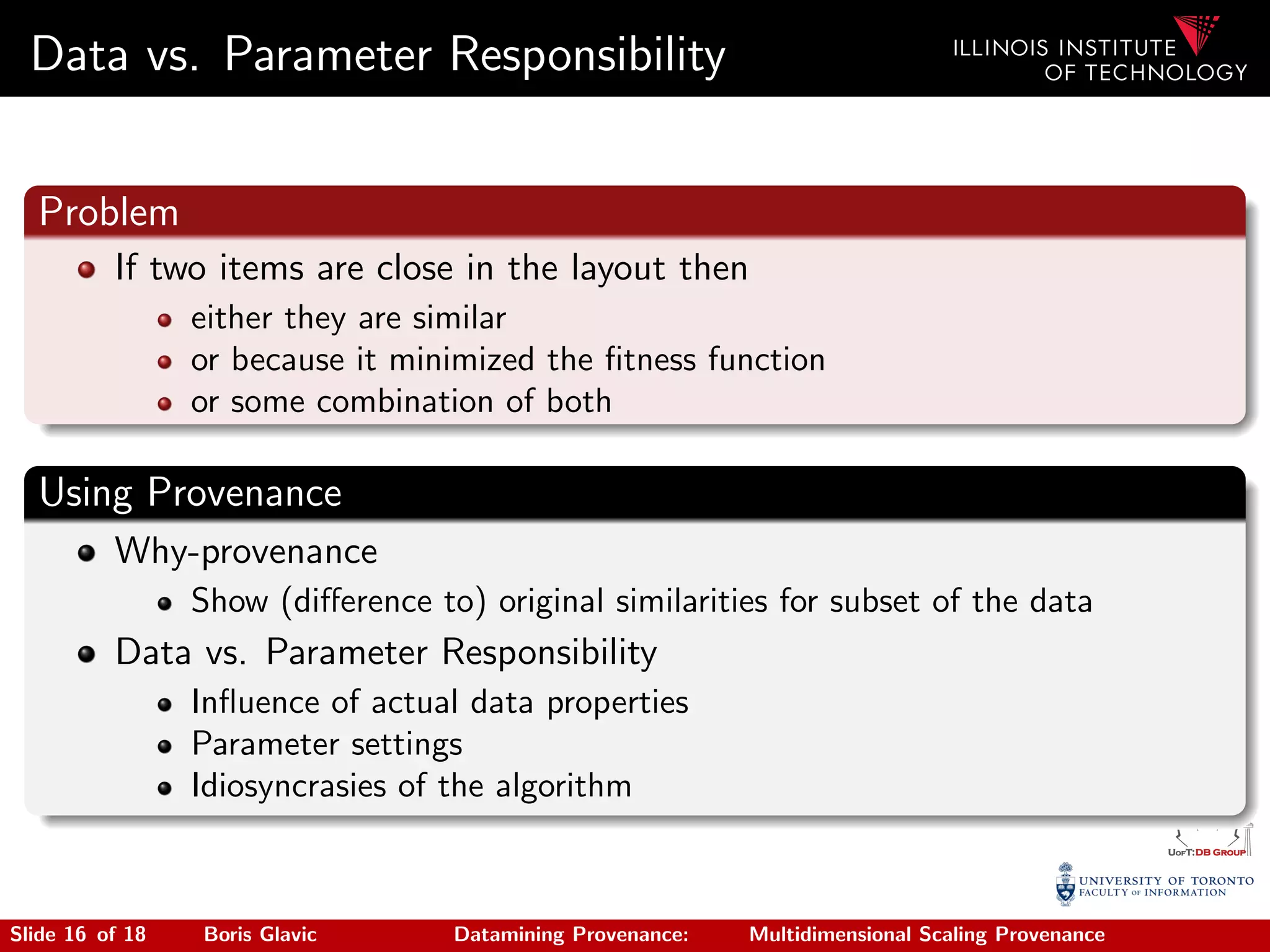
Data vs. Parameter Responsibility
Problem
If two items are close in the layout then
either they are similar
or because it minimized the fitness function
or some combination of both
Using Provenance
Why-provenance
Show (difference to) original similarities for subset of the data
Data vs. Parameter Responsibility
Influence of actual data properties
Parameter settings
Idiosyncrasies of the algorithm
Slide 16 of 18 Boris Glavic Datamining Provenance: Multidimensional Scaling Provenance
Outline
1 Motivation
2 Provenance for Data Mining
3 Frequent Itemset Provenance
4 Multidimensional Scaling Provenance
5 Conclusions
Challenges
Why-Provenance
Common model that generalizes processing of large classes of mining
algorithms
Dealing with large (potentially overlapping) provenance
Context and Preprocessing
Dynamic handling of contextual data
Tracing through preprocessing steps
Responsibility
Computational complexity
How to model parameter vs. data responsibility?
Slide 17 of 18 Boris Glavic Datamining Provenance: Conclusions
Conclusions
Take Away Messages
Data Mining is interesting and challenging application domain for
provenance
No previous work
Future Work
Extend preliminary results on FIM
Clustering (responsibility)
MDS (parameter vs. data responsibility)
Slide 18 of 18 Boris Glavic Datamining Provenance: Conclusions
Questions?
This is a vision paper
so let’s discuss!
Provenance for Data Mining

TaPP 2013 - Provenance for Data Mining

  • 1.
    Provenance for DataMining Boris Glavic1 Javed Siddique2 Periklis Andritsos3 Ren´ee J. Miller2 Illinois Institute of Technology1 DBGroup University of Toronto2 Miller Lab University of Toronto3 iSchool TaPP 2013, June 18, 2013
  • 2.
    Outline 1 Motivation 2 Provenancefor Data Mining 3 Frequent Itemset Provenance 4 Multidimensional Scaling Provenance 5 Conclusions
  • 3.
    Data Mining /KDD Goals Extract useful information from data Approach 1 Preprocessing Cleaning Feature Extraction . . . 2 Apply algorithms to extract information Clustering, Frequent Itemset Mining, Classification, . . . Most approaches: Reduce size/Summarize data Slide 1 of 18 Boris Glavic Datamining Provenance: Motivation
  • 4.
    Provenance for DataMining? Dilemmas Purpose of data mining necessitates summarization “Needle in the haystack” Loss of information Makes interpreting “raw” results harder User point of view: DM algorithm is black box Slide 2 of 18 Boris Glavic Datamining Provenance: Motivation
  • 5.
    Provenance for DataMining? How to solve Dilemmas? Selective access to input data result is based on Inputs to mining algorithm Inputs to preprocessing Contextual information Understand importance of inputs for results Input data Parameter settings Understand how data mining algorithm generates result from inputs Understand missing results Slide 2 of 18 Boris Glavic Datamining Provenance: Motivation
  • 6.
    Provenance for DataMining? How to solve Dilemmas? Selective access to input data result is based on (Data Provenance+) Inputs to mining algorithm Inputs to preprocessing Contextual information Understand importance of inputs for results (Responsibility) Input data Parameter settings Understand how data mining algorithm generates result from inputs (Process provenance) Understand missing results (Missing answers) Slide 2 of 18 Boris Glavic Datamining Provenance: Motivation
  • 7.
    Related Work Provenance Database provenance,Workflow provenance, Missing answers, Responsibility, . . . Data Mining Enriching mining results with additional information Contextual information for frequent itemsetsa Visualization techniquesb Determining effect of parameter settings/inputs on result e.g., K-means cluster stability based on parameter settingsc a Q. Mei et al. “Generating semantic annotations for frequent patterns with context analysis”. In: SIGKDD. 2006, pp. 337–346. b D.A. Keim and H.P. Kriegel. “Visualization techniques for mining large databases: A comparison”. In: TKDE 8.6 (1996), pp. 923–938. c L.I. Kuncheva and D.P. Vetrov. “Evaluation of stability of k-means cluster ensembles with respect to random initialization”. In: TPAMI 28.11 (2006), pp. 1798–1808. Slide 3 of 18 Boris Glavic Datamining Provenance: Motivation
  • 8.
    Contributions Analyze requirements anduse cases for data mining provenance (DMProv) Discuss applicability of existing approaches Outline challenges and sketch research directions Exemplify concepts on two concrete mining algorithms Frequent Itemset Mining (FIM) Multidimensional Scaling (MDS) Slide 4 of 18 Boris Glavic Datamining Provenance: Motivation
  • 9.
    Outline 1 Motivation 2 Provenancefor Data Mining 3 Frequent Itemset Provenance 4 Multidimensional Scaling Provenance 5 Conclusions
  • 10.
    Fine-Grained Provenance Why-Provenance Here Why-Provenancemeans all models based on influence Subset of the input that caused output to appear in result “Caused by” modelled as Sufficiency Necessity Preservation of Equivalence / Computability Causality Useful for Data Mining? Provenance concepts seem applicable to data mining Have to deal with large provenance size (summarization) Can abstract processing of classes of mining algorithms? Do not reinvent provenance tracking for each algorithm! Slide 5 of 18 Boris Glavic Datamining Provenance: Provenance for Data Mining
  • 11.
    Fine-Grained Provenance Tracing ThroughPreprocessing Steps Track back data mining results to inputs of preprocessing ETL tools are used for preprocessing ⇒ can use database or workflow provenance approaches? Slide 5 of 18 Boris Glavic Datamining Provenance: Provenance for Data Mining
  • 12.
    Enriching Provenance withContext Contextual Information as Provenance Mining algorithms often applied to a subset of available data Contextual Data: data related to the mining inputs Automatic detection User provided Contextual data often more usable and concise than provenance Which contextual data is of interest will differ per use-case maybe even per query ⇒ Should support contextual data per provenance query/generation Need flexible mechanism to select context (declarative?) Slide 6 of 18 Boris Glavic Datamining Provenance: Provenance for Data Mining
  • 13.
    DMProv and DataResponsibility Measuring Amount of Influence Single mining result influenced by large subset of input (all) e.g., clustering Amount of influence differs significantly (Responsibility) DB Responsibility Model Causalitya Counterfactual cause i for output o Removing i removes o from result Actual cause i for output o Contingency C: Set of inputs to remove before i becomes CC for o Responsibility: 1 size of minimal contingency a A. Meliou et al. “Causality in databases”. In: IEEE Data Engineering Bulletin 33.3 (2010), pp. 59–67; James Cheney. “Causality and the Semantics of Provenance”. In: DCM. 2010, pp. 63–74. Slide 7 of 18 Boris Glavic Datamining Provenance: Provenance for Data Mining
  • 14.
    DMProv and DataResponsibility Applicability for Data Mining Reduce size of provenance only return top-k responsible inputs in provenance only return input with responsibility over threshold However: Output variables are not boolean Solution Sketch Consider every input as a cause Consider every set of inputs as a contingency Measure amount of change e.g., distance between cluster means Responsibility is sum of 1 size of contingency · d(o, o ) over all contingencies normalized by number of contingencies Slide 7 of 18 Boris Glavic Datamining Provenance: Provenance for Data Mining
  • 15.
    Data vs. ParameterResponsibility Effect of Parameter Settings Mining results do depend on Data Parameter settings Define new responsibility type using both data and parameters Related Work: Robustness against parameter changes only stability of clusteringsa a L.I. Kuncheva and D.P. Vetrov. “Evaluation of stability of k-means cluster ensembles with respect to random initialization”. In: TPAMI 28.11 (2006), pp. 1798–1808. Slide 8 of 18 Boris Glavic Datamining Provenance: Provenance for Data Mining
  • 16.
    How/Process Provenance So faronly data provenance Understand how mining algorithm combines inputs to produce an output Applicability of workflow and program analysis provenance techniques Either too detailed or too coarse grained Slide 9 of 18 Boris Glavic Datamining Provenance: Provenance for Data Mining
  • 17.
    Outline 1 Motivation 2 Provenancefor Data Mining 3 Frequent Itemset Provenance 4 Multidimensional Scaling Provenance 5 Conclusions
  • 18.
    Frequent Itemset Mining(FIM) One of the most prevalent mining tasks Input: set of transactions (sets of items) Fixed domain D Output: subsets of D (frequent itemsets) appear in fraction larger σ (minimum support) of the transactions Slide 10 of 18 Boris Glavic Datamining Provenance: Frequent Itemset Provenance
  • 19.
    FIM Example Transaction TID ItemsCID 1 {Coffee-mate, Coffee, Diaper, Beer} 1 2 {Diaper, Bread, Beer} 2 3 {Coffee-mate, Diaper, Coffee, Beer} 3 4 {Bread, Coffee} 4 5 {Coffee-mate, Coffee} 4 6 {Coffee-mate, Sugar} 4 FIM FID Frequent Items Support 1 {Coffee} 4 2 {Coffee-mate} 4 3 {Diaper} 3 4 {Beer} 3 5 {Diaper, Beer} 3 6 {Coffee, Coffee-mate} 3 Slide 11 of 18 Boris Glavic Datamining Provenance: Frequent Itemset Provenance
  • 20.
    FIM Example withContextual Data Transaction TID Items CID 1 {Coffee-mate, Coffee, Diaper, Beer} 1 2 {Diaper, Bread, Beer} 2 3 {Coffee-mate, Diaper, Coffee, Beer} 3 4 {Bread, Coffee} 4 5 {Coffee-mate, Coffee} 4 6 {Coffee-mate, Sugar} 4 FIM FID Frequent Items Support 1 {Coffee} 4 2 {Coffee-mate} 4 3 {Diaper} 3 4 {Beer} 3 5 {Diaper, Beer} 3 6 {Coffee, Coffee-mate} 3 Customer CID AgeGroup Sex 1 20-40 m 2 20-40 m 3 20-40 m 4 50-60 f Slide 11 of 18 Boris Glavic Datamining Provenance: Frequent Itemset Provenance
  • 21.
    Why-Provenance for FIM Intuition Thetransactions containing a frequent itemset I caused I to be frequent Define the Why-provenance as this set Definition (Why-Provenance for FI) Given transaction base D, minimum support σ, itemset I W(I) = {t | I ⊆ t ∧ t ∈ D} Slide 12 of 18 Boris Glavic Datamining Provenance: Frequent Itemset Provenance
  • 22.
    FIM Provenance Transaction TID ItemsCID 1 {Coffee-mate, Coffee, Diaper, Beer} 1 2 {Diaper, Bread, Beer} 2 3 {Coffee-mate, Diaper, Coffee, Beer} 3 4 {Bread, Coffee} 4 5 {Coffee-mate, Coffee} 4 6 {Coffee-mate, Sugar} 4 FIM FID Frequent Items Support 1 {Coffee} 4 2 {Coffee-mate} 4 3 {Diaper} 3 4 {Beer} 3 5 {Diaper, Beer} 3 6 {Coffee, Coffee-mate} 3 Customer CID AgeGroup Sex 1 20-40 m 2 20-40 m 3 20-40 m 4 50-60 f Why-Provenance FID TIDs 1 {1,3,5,6} 2 {1,3,5,6} 3 {1,2,3} 4 {1,2,3} 5 {1,2,3} 6 {1,3,5,6} Slide 13 of 18 Boris Glavic Datamining Provenance: Frequent Itemset Provenance
  • 23.
    FIM Provenance withContext Customer CID AgeGroup Sex 1 20-40 m 2 20-40 m 3 20-40 m 4 50-60 f Why-Provenance FID TIDs 1 {1,3,5,6} 2 {1,3,5,6} 3 {1,2,3} 4 {1,2,3} 5 {1,2,3} 6 {1,3,5,6} Example (Beer and Diaper) Beer and Diaper is frequent but why? Slide 13 of 18 Boris Glavic Datamining Provenance: Frequent Itemset Provenance
  • 24.
    FIM Provenance withContext Customer CID AgeGroup Sex 1 20-40 m 2 20-40 m 3 20-40 m 4 50-60 f Why-Provenance FID TIDs 1 {1,3,5,6} 2 {1,3,5,6} 3 {1,2,3} 4 {1,2,3} 5 {1,2,3} 6 {1,3,5,6} Example (Beer and Diaper) Beer and Diaper is frequent but why? Why-provenance ⇒ it appeared in this set of transactions Slide 13 of 18 Boris Glavic Datamining Provenance: Frequent Itemset Provenance
  • 25.
    FIM Provenance withContext Customer CID AgeGroup Sex 1 20-40 m 2 20-40 m 3 20-40 m 4 50-60 f Why-Provenance FID TIDs 1 {1,3,5,6} 2 {1,3,5,6} 3 {1,2,3} 4 {1,2,3} 5 {1,2,3} 6 {1,3,5,6} Example (Beer and Diaper) Beer and Diaper is frequent but why? Why-provenance ⇒ it appeared in this set of transactions Not very useful! Unfeasible if D is large Slide 13 of 18 Boris Glavic Datamining Provenance: Frequent Itemset Provenance
  • 26.
    FIM Provenance withContext Customer CID AgeGroup Sex 1 20-40 m 2 20-40 m 3 20-40 m 4 50-60 f Why-Provenance FID TIDs 1 {1,3,5,6} 2 {1,3,5,6} 3 {1,2,3} 4 {1,2,3} 5 {1,2,3} 6 {1,3,5,6} Example (Beer and Diaper) Beer and Diaper is frequent but why? Why-provenance ⇒ it appeared in this set of transactions Not very useful! Unfeasible if D is large Because male customers in age group 20 − 40 bought it Slide 13 of 18 Boris Glavic Datamining Provenance: Frequent Itemset Provenance
  • 27.
    FIM Provenance withContext Customer CID AgeGroup Sex 1 20-40 m 2 20-40 m 3 20-40 m 4 50-60 f Why-Provenance FID TIDs 1 {1,3,5,6} 2 {1,3,5,6} 3 {1,2,3} 4 {1,2,3} 5 {1,2,3} 6 {1,3,5,6} Example (Beer and Diaper) Beer and Diaper is frequent but why? Why-provenance ⇒ it appeared in this set of transactions Not very useful! Unfeasible if D is large Because male customers in age group 20 − 40 bought it More useful and concise Summarization of inputs in provenance using contextual information Will need different context for different use cases Slide 13 of 18 Boris Glavic Datamining Provenance: Frequent Itemset Provenance
  • 28.
    Preliminary Results FIM Provenance Why-Provenancefor FIM Declarative selection of context I-Provenance Prefix compressed tree representation of provenance Precise modelling of interdependencies of items in provenance within transactions Database-based provenance generation and querying Slide 14 of 18 Boris Glavic Datamining Provenance: Frequent Itemset Provenance
  • 29.
    Outline 1 Motivation 2 Provenancefor Data Mining 3 Frequent Itemset Provenance 4 Multidimensional Scaling Provenance 5 Conclusions
  • 30.
    Multidimensional Scaling (MDS) Approach Input:Set of observation with pair-wise similarities Output: Mapping into n-dim space that tries to preserve similarities Optimization problem Use-case Marketing: Customers rate products pairs according to similarity MDS to generate layout (perceptual map) depicting similarity of products Example A B C D A - - - - B 2 - - - C 2 4 - - D 3 3 3 - A C D B 2 3 5.5 3.5 3.7 2.8 Slide 15 of 18 Boris Glavic Datamining Provenance: Multidimensional Scaling Provenance
  • 31.
    Data vs. ParameterResponsibility Problem If two items are close in the layout then either they are similar or because it minimized the fitness function or some combination of both Using Provenance Why-provenance Show (difference to) original similarities for subset of the data Data vs. Parameter Responsibility Influence of actual data properties Parameter settings Idiosyncrasies of the algorithm Slide 16 of 18 Boris Glavic Datamining Provenance: Multidimensional Scaling Provenance
  • 32.
    Outline 1 Motivation 2 Provenancefor Data Mining 3 Frequent Itemset Provenance 4 Multidimensional Scaling Provenance 5 Conclusions
  • 33.
    Challenges Why-Provenance Common model thatgeneralizes processing of large classes of mining algorithms Dealing with large (potentially overlapping) provenance Context and Preprocessing Dynamic handling of contextual data Tracing through preprocessing steps Responsibility Computational complexity How to model parameter vs. data responsibility? Slide 17 of 18 Boris Glavic Datamining Provenance: Conclusions
  • 34.
    Conclusions Take Away Messages DataMining is interesting and challenging application domain for provenance No previous work Future Work Extend preliminary results on FIM Clustering (responsibility) MDS (parameter vs. data responsibility) Slide 18 of 18 Boris Glavic Datamining Provenance: Conclusions
  • 35.
    Questions? This is avision paper so let’s discuss! Provenance for Data Mining