TAMIL
            Through English / Hindi
                           Volume I
 with my novel scientific way of making ‘your own’ Tamil sentences.
              This book walks you holding your finger


Complete in Tamil, Transliteration and Devanagari Scaripts.
     If you know Tamil, you may learn Hindi with it.


                     Tamil Level I


                      Ratnakar Narale
                     ர னாக          நராேல


        PUSTAK BHARATI - BOOKS INDIA


                        books-india.com
Learn Tamil Through English / Hindi

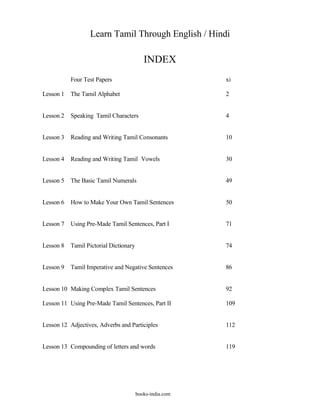
                                           INDEX
           Four Test Papers                               xi

Lesson 1   The Tamil Alphabet                             2


Lesson 2   Speaking Tamil Characters                      4


Lesson 3   Reading and Writing Tamil Consonants           10


Lesson 4   Reading and Writing Tamil Vowels               30


Lesson 5   The Basic Tamil Numerals                       49


Lesson 6   How to Make Your Own Tamil Sentences           50


Lesson 7   Using Pre-Made Tamil Sentences, Part I         71


Lesson 8   Tamil Pictorial Dictionary                     74


Lesson 9   Tamil Imperative and Negative Sentences        86


Lesson 10 Making Complex Tamil Sentences                  92

Lesson 11 Using Pre-Made Tamil Sentences, Part II         109


Lesson 12 Adjectives, Adverbs and Participles             112


Lesson 13 Compounding of letters and words                119


                                        books-india.com
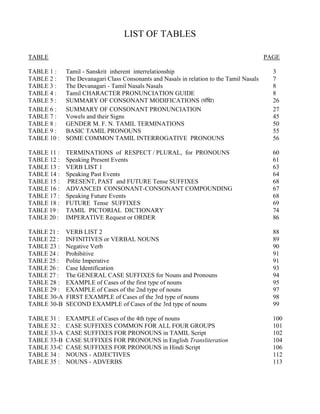
LIST OF TABLES

TABLE                                                                                     PAGE

TABLE 1 :    Tamil - Sanskrit inherent interrelationship                                    3
TABLE 2 :    The Devanagari Class Consonants and Nasals in relation to the Tamil Nasals     7
TABLE 3 :    The Devanagari - Tamil Nasals Nasals                                           8
TABLE 4 :    Tamil CHARACTER PRONUNCIATION GUIDE                                            8
TABLE 5 :    SUMMARY OF CONSONANT MODIFICATIONS (sa>iZa)                                    26
TABLE 6 :    SUMMARY OF CONSONANT PRONUNCIATION                                             27
TABLE 7 :    Vowels and their Signs                                                         45
TABLE 8 :    GENDER M. F. N. TAMIL TERMINATIONS                                             50
TABLE 9 :    BASIC TAMIL PRONOUNS                                                           55
TABLE 10 :   SOME COMMON TAMIL INTERROGATIVE PRONOUNS                                       56

TABLE 11 :   TERMINATIONS of RESPECT / PLURAL, for PRONOUNS                                 60
TABLE 12 :   Speaking Present Events                                                        61
TABLE 13 :   VERB LIST 1                                                                    63
TABLE 14 :   Speaking Past Events                                                           64
TABLE 15 :    PRESENT, PAST and FUTURE Tense SUFFIXES                                       68
TABLE 16 :   ADVANCED CONSONANT-CONSONANT COMPOUNDING                                       67
TABLE 17 :   Speaking Future Events                                                         68
TABLE 18 :   FUTURE Tense SUFFIXES                                                          69
TABLE 19 :   TAMIL PICTORIAL DICTIONARY                                                     74
TABLE 20 :   IMPERATIVE Request or ORDER                                                    86

TABLE 21 :   VERB LIST 2                                                                    88
TABLE 22 :   INFINITIVES or VERBAL NOUNS                                                    89
TABLE 23 :   Negative Verb                                                                  90
TABLE 24 :   Prohibitive                                                                    91
TABLE 25 :   Polite Imperative                                                              91
TABLE 26 :   Case Identification                                                            93
TABLE 27 :   The GENERAL CASE SUFFIXES for Nouns and Pronouns                               94
TABLE 28 :   EXAMPLE of Cases of the first type of nouns                                    95
TABLE 29 :   EXAMPLE of Cases of the 2nd type of nouns                                      97
TABLE 30-A   FIRST EXAMPLE of Cases of the 3rd type of nouns                                98
TABLE 30-B   SECOND EXAMPLE of Cases of the 3rd type of nouns                               99

TABLE 31 :   EXAMPLE of Cases of the 4th type of nouns                                      100
TABLE 32 :   CASE SUFFIXES COMMON FOR ALL FOUR GROUPS                                       101
TABLE 33-A   CASE SUFFIXES FOR PRONOUNS in TAMIL Script                                     102
TABLE 33-B   CASE SUFFIXES FOR PRONOUNS in English Transliteration                          104
TABLE 33-C   CASE SUFFIXES FOR PRONOUNS in Hindi Script                                     106
TABLE 34 :   NOUNS - ADJECTIVES                                                             112
TABLE 35 :   NOUNS - ADVERBS                                                                113


                                       books-india.com
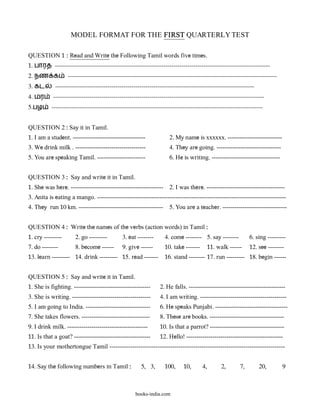
MODEL FORMAT FOR THE FIRST QUARTERLY TEST

QUESTION 1 : Read and Write the Following Tamil words five times.
1. பாரத -----------------------------------------------------------------------------------------------------------
2. நண க            --------------------------------------------------------------------------------------------------------
3. கட       ---------------------------------------------------------------------------------------------------
4. மர      ---------------------------------------------------------------------------------------------------------
5.பழ       ---------------------------------------------------------------------------------------------------------


QUESTION 2 : Say it in Tamil.
1. I am a student. ------------------------------------              2. My name is xxxxxx. ---------------------------
3. We drink milk . -----------------------------------               4. They are going. --------------------------------
5. You are speaking Tamil. ------------------------                  6. He is writing. ----------------------------------


QUESTION 3 : Say and write it in Tamil.
1. She was here. ---------------------------------------------- 2. I was there. ---------------------------------------
3. Anita is eating a mango. ----------------------------------------------------------------------------------------------
4. They run 10 km. ------------------------------------------ 5. You are a teacher. --------------------------------


QUESTION 4 : Write the names of the verbs (action words) in Tamil :
1. cry ---------      2. go ---------         3. eat --------      4. come -------- 5. say --------           6. sing ---------
7. do --------        8. become ------        9. give ------       10. take -------        11. walk ------    12. see --------
13. learn --------- 14. drink --------- 15. read -------           16. stand -------- 17. run --------- 18. begin ------


QUESTION 5 : Say and write it in Tamil.
1. She is fighting. --------------------------------------       2. He falls. ------------------------------------------------
3. She is writing. ---------------------------------------       4. I am writing. -------------------------------------------
5. I am going to India. --------------------------------         6. He speaks Punjabi. ------------------------------------
7. She takes flowers. ----------------------------------         8. These are books. -------------------------------------
9. I drink milk. ----------------------------------------        10. Is that a parrot? -------------------------------------
11. Is that a goat? --------------------------------------       12. Hello! ------------------------------------------------
13. Is your mothertongue Tamil ------------------------------------------------------------------------------------


14. Say the following numbers in Tamil :               5, 3,       100,     10,       4,         2,      7,       20,         9


                                                    books-india.com
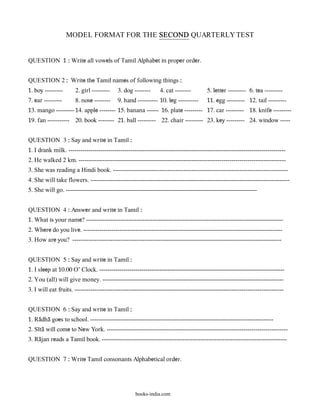
MODEL FORMAT FOR THE SECOND QUARTERLY TEST


QUESTION 1 : Write all vowels of Tamil Alphabet in proper order.


QUESTION 2 : Write the Tamil names of following things :
1. boy ---------       2. girl ---------    3. dog --------     4. cat --------         5. letter --------- 6. tea ---------
7. ear ---------       8. nose --------     9. hand ---------- 10. leg ----------       11. egg --------- 12. tail ---------
13. mango --------- 14. apple -------- 15. banana ------ 16. plate --------- 17. car --------- 18. knife ---------
19. fan ----------- 20. book -------- 21. ball --------- 22. chair --------- 23. key --------- 24. window -----


QUESTION 3 : Say and write in Tamil :
1. I drank milk. ------------------------------------------------------------------------------------------------------------
2. He walked 2 km. -------------------------------------------------------------------------------------------------------
3. She was reading a Hindi book. ---------------------------------------------------------------------------------------
4. She will take flowers. ---------------------------------------------------------------------------------------------------
5. She will go. -----------------------------------------------------------------------------------------------


QUESTION 4 : Answer and write in Tamil :
1. What is your name? --------------------------------------------------------------------------------------------------
2. Where do you live. ---------------------------------------------------------------------------------------------------
3. How are you? --------------------------------------------------------------------------------------------------------


QUESTION 5 : Say and write in Tamil :
1. I sleep at 10.00 O’ Clock. --------------------------------------------------------------------------------------------
2. You (all) will give money. ------------------------------------------------------------------------------------------
3. I will eat fruits. --------------------------------------------------------------------------------------------------------


QUESTION 6 : Say and write in Tamil :
1. Ra@dha@ goes to school. -------------------------------------------------------------------------------------------
2. S&ta@ will come to New York. ------------------------------------------------------------------------------------------
3. Ra@jan reads a Tamil book. --------------------------------------------------------------------------------------------


QUESTION 7 : Write Tamil consonants Alphabetical order.


                                                    books-india.com
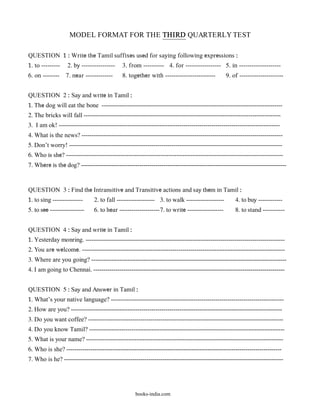
MODEL FORMAT FOR THE THIRD QUARTERLY TEST

QUESTION 1 : Write the Tamil suffixes used for saying following expressions :
1. to ---------    2. by ----------------    3. from ---------- 4. for ----------------- 5. in --------------------
6. on --------    7. near -------------      8. together with ------------------------         9. of ---------------------


QUESTION 2 : Say and write in Tamil :
1. The dog will eat the bone ------------------------------------------------------------------------------------------
2. The bricks will fall --------------------------------------------------------------------------------------------------
3. I am ok! --------------------------------------------------------------------------------------------------------------
4. What is the news? ----------------------------------------------------------------------------------------------------
5. Don’t worry! ----------------------------------------------------------------------------------------------------------
6. Who is she? ------------------------------------------------------------------------------------------------------------
7. Where is the dog? ------------------------------------------------------------------------------------------------------


QUESTION 3 : Find the Intransitive and Transitive actions and say them in Tamil :
1. to sing ---------------     2. to fall ------------------- 3. to walk -------------------        4. to buy ------------
5. to see -----------------    6. to hear --------------------7. to write ------------------        8. to stand -----------


QUESTION 4 : Say and write in Tamil :
1. Yesterday monring. ---------------------------------------------------------------------------------------------------
2. You are welcome. -----------------------------------------------------------------------------------------------------
3. Where are you going? -------------------------------------------------------------------------------------------------
4. I am going to Chennai. -----------------------------------------------------------------------------------------------


QUESTION 5 : Say and Answer in Tamil :
1. What’s your native language? --------------------------------------------------------------------------------------
2. How are you? ---------------------------------------------------------------------------------------------------------
3. Do you want coffee? -------------------------------------------------------------------------------------------------
4. Do you know Tamil? -------------------------------------------------------------------------------------------------
5. What is your name? --------------------------------------------------------------------------------------------------
6. Who is she? -----------------------------------------------------------------------------------------------------------
7. Who is he? -------------------------------------------------------------------------------------------------------------


                                                   books-india.com
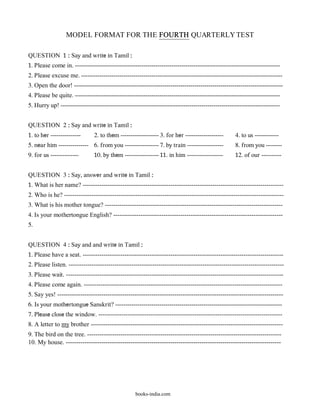
MODEL FORMAT FOR THE FOURTH QUARTERLY TEST

QUESTION 1 : Say and write in Tamil :
1. Please come in. ------------------------------------------------------------------------------------------------------
2. Please excuse me. ----------------------------------------------------------------------------------------------------
3. Open the door! --------------------------------------------------------------------------------------------------------
4. Please be quite. ------------------------------------------------------------------------------------------------------
5. Hurry up! -------------------------------------------------------------------------------------------------------------


QUESTION 2 : Say and write in Tamil :
1. to her ---------------      2. to them ------------------- 3. for her -------------------        4. to us ------------
5. near him --------------- 6. from you ----------------- 7. by train ------------------            8. from you --------
9. for us --------------       10. by them ----------------- 11. in him ------------------          12. of our ----------


QUESTION 3 : Say, answer and write in Tamil :
1. What is her name? ------------------------------------------------------------------------------------------------
2. Who is he? ---------------------------------------------------------------------------------------------------------
3. What is his mother tongue? -------------------------------------------------------------------------------------
4. Is your mothertongue English? ---------------------------------------------------------------------------------
5.


QUESTION 4 : Say and and write in Tamil :
1. Please have a seat. ------------------------------------------------------------------------------------------------
2. Please listen. -------------------------------------------------------------------------------------------------------
3. Please wait. --------------------------------------------------------------------------------------------------------
4. Please come again. -----------------------------------------------------------------------------------------------
5. Say yes! ------------------------------------------------------------------------------------------------------------
6. Is your mothertongue Sanskrit? -----------------------------------------------------------------------------------
7. Please close the window. ----------------------------------------------------------------------------------------
8. A letter to my brother --------------------------------------------------------------------------------------------
9. The bird on the tree. ---------------------------------------------------------------------------------------------
10. My house. -------------------------------------------------------------------------------------------------------


                                                   books-india.com
LESSON 1
                                              THE TAMIL ALPHABET


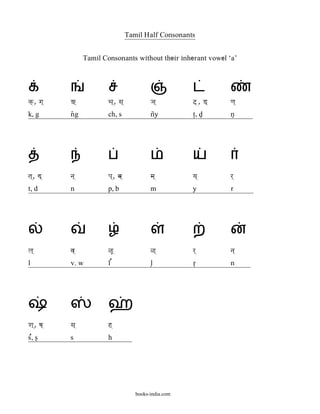
Tamil Vowels :
அ          ஆ       இ        ஈ            உ      ஊ          எ       ஏ       ஐ               ஒ          ஓ              ஔ     `
A          Aa      }        }|           q      Q          ]       ]â      ]e              Aae        Aae~           AaE   ASa`
a          a@      i        &            u      u@         e       e@      ai              o          o@             au    akh
 In this row of 12 vowels, vowel number 2, 4, 6, 8 and 11 are extended sounds of the short vowel number 1, 3, 5, 7 and 10.


Tamil Full Consonants :

க                  ங                 ச                     ஞ                    ட                ண
k, ga              G                 ca, sa                Øa                   @, D             Na
ka, ga             n[ga              cha, sa               n~ya                 t>a, d<a         n<a             .


த                  ந                 ப                     ம                    ய                ர
ta, d              na                pa, ba                ma                   ya               r
ta, da             na                pa, ba                ma                   ya               ra              .


ல                  வ                 ழ                     ள                    ற                ன
La                 va                <[                    <                    r`               na
la                 va. wa            la}                   l<a                  ra               na              .


ஷ                  ஸ                 ஹ                                          ஜ
oa, Pa             sa                h                     xa                   ja               OaRI
s{a, s<a           sa                ha                    ks<ha                ja               shr&        .


                                                     books-india.com
Tamil Half Consonants


                 Tamil Consonants without their inherant vowel ‘a’


k‘, ga`    G`            ca`, sa`            Øa`         @` , D`   Na`
k, g       n[g           ch, s               n~y         t>, d<    n<    .


ta`, d`    na`           pa`, ba`            ma`         ya`       r`
t, d       n             p, b                m           y         r     .


La`        va`           <[`                 <`          r`        na`
l          v. w          l}                  l<          r<        n     .


oa`, Pa`   sa`           h`
s{, s<     s             h


                                       books-india.com
Tamil and Devanagari Sanskrit Alphabet Charts
                                                Side by Side Comparison

 TABLE 1 : Tamil - Sanskrit inherent interrelationship
                                                Tamil Vs Devanagari Sanskrit
                                                                   VOWELS
   Tamil
                A    அ       a          Aa      ஆ       a@        } இ i }| ஈ                            &             q       உ    u            Q      ஊ            u@
   Devnagari    A                       Aa                        }                           }|                      q                         Q

   Tamil
                ]    எ   e ]â         ஏ    e@ ]e    ஐ            ai       Aae       ஒ        o Aae~ ஓ o@              AaE ஔ au ASa` ` akh
   Devnagari    ]                ]â              ]e        Aae       Aae~                                             AaE                             Ah`       :
                                                 Tamil Vs Devanagari Sanskrit
                                                     CONSONANTS
   Tamil
                k    க   k                G     ங n[g ca ச ch Øa ஞ                                           n~y          @        ட   t>       Na     ண            n<
   Devnagari    k Sa ga za                G                       ca C ja Ja                  Øa                          @ # D $               Na
   Tamil
                ta   த   t                na    ந   n             pa      ப     p             ma    ம   m                 ya       ய    y       r     ர     r
   Devnagari    ta Ya d Za                na                      pa f ba Ba                  ma                          ya                    r
   Tamil
                La   ல       l            va    வ   v             <       ள         l<        <[    ழ   l}                r    ற       r        na`    ன        n
   Devnagari    La                        va                      < *
   Tamil                                                                                                                                        These five are
                oa, Pa   ஷ            sh sa     ஸ            s        h   ஹ              h     xa                  ks<h       ja   ஜ        j   adopted
                                                                                                                                                Granthaksharam
   Devnagari    oa, Pa                     sa                         h                        xa                             ja                characters
                                                                                                                                                 $---
                                                                                .

NOTES : (i) Quite contrary to the common belief that Tamil language is totally independent and
unrelated to Sanskrit, the above vowel consonant tables (as well as the following lessons and rules on
Sandhi, Samasa etc. in Tamil grammar) clearly exhibit that the relationship between these two ancient
languages is beyond just a coincidence. These two languages may have been developed separately, but
their millenniums of common inheritance on the Indian subcontinent clearly reveals their common
imprint. One language may or may not have come from or influenced the other, but there is a common
thread for sure.
* (ii) Some Hindi speaking people may think that letter < is not a Devanagri or Sanskrit character. Even
though it did not reach Hindi, the Sanskrit has it. Letter < appears in the very first verse of the Rigveda
(Aignaima<e pauraeihta). You can also hear their sounds in Tamil, Telugu, Kannad, Malyalam, Marathi and
Gujrati languages. Same is true for the letters ]â and Aaâ. In Hindi, vowels ]e and Aae are used in their
place. See the language charts in the Appendix.


                                                             books-india.com
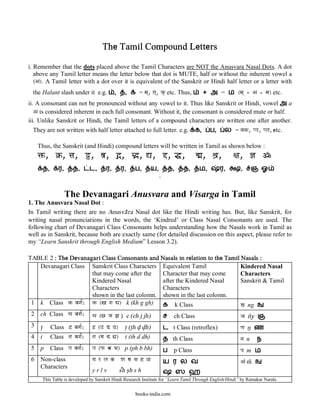
The Tamil Compound Letters

i. Remember that the dots placed above the Tamil Characters are NOT the Anusvara Nasal Dots. A dot
   above any Tamil letter means the letter below that dot is MUTE, half or without the inherent vowel a
   (A). A Tamil letter with a dot over it is equivalent of the Sanskrit or Hindi half letter or a letter with
 the Halant slash under it e.g.               ,      ,      = ma`, ta`, k‘ etc. Thus,         + அ = ம (ma` + A = ma) etc.
ii. A consonant can not be pronounced without any vowel to it. Thus like Sanskrit or Hindi, vowel அ a
   A is considered inherent in each full consonant. Without it, the consonant is considered mute or half.
iii. Unlike Sanskrit or Hindi, the Tamil letters of a compound characters are written one after another.
 They are not written with half letter attached to full letter. e.g.                     க,     ப,    ல = Kk, ppa, pLa, etc.

   Thus, the Sanskrit (and Hindi) compound letters will be written in Tamil as shown below :
   F, Û, Ta, £, %a, §, ®, ^, ª, &,                                                       ¯, OaR,          xa, Xa Œ
        த,      ர,     த,      ட,       ர,        ர,      ப,     ய,           த,   த,     ம,         ர,      ,      ஞ ஓ
                                                                      .


                     The Devanagari Anusvara and Visarga in Tamil
1. The Anusvara Nasal Dot :
In Tamil writing there are no Anusva@ra Nasal dot like the Hindi writing has. But, like Sanskrit, for
writing nasal pronunciations in the words, the ‘Kindred’ or Class Nasal Consonants are used. The
following chart of Devanagari Class Consonants helps understanding how the Nasals work in Tamil as
well as in Sanskrit, because both are exactly same (for detailed discussion on this aspect, please refer to
my “Learn Sanskrit through English Medium” Lesson 3.2).

TABLE 2 : The Devanagari Class Consonants and Nasals in relation to the Tamil Nasals :
   Devanagari Class Sanskrit Class Characters Equivalent Tamil                Kindered Nasal
                     that may come after the   Character that may come        Characters
                     Kindered Nasal            after the Kindered Nasal       Sanskrit & Tamil
                     Characters                Characters
                     shown in the last colomn. shown in the last colomn.
 1 k Class k vaga|: k (Sa ga za) k (kh g gh)   க k Class                      G ng ங
 2 ch Class ca vaga|:            ca (C ja Ja ) c (ch j jh)                ச ch Class                         Øa n~y ஞ
 3 t>        Class @ vaga|:      @ (# D $)    t> (t>h d< d<h)             ட t Class (retroflex)              Na n< ண
 4 t         Class ta vaga|:     ta (Ya d Za) t (th d dh)                 த th Class                         na n    ந
 5 p         Class pa vaga|:     pa (f ba Ba) p (ph b bh)                 ப    p Class                       pa m ம
 6 Non-class                     ya r La va       oa Pa sa h <            ய ர ல வ                            A> m~ ங
   Characters
                                 yrlv             s{h s<h s h             ஷ ஸ ஹ
        This Table is developed by Sanskrit Hindi Research Institute for “Learn Tamil Through English/Hindi” by Ratnakar Narale.


                                                          books-india.com
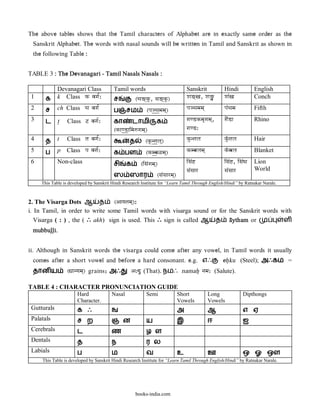
The above tables shows that the Tamil characters of Alphabet are in exactly same order as the
 Sanskrit Alphabet. The words with nasal sounds will be written in Tamil and Sanskrit as shown in
 the following Table :


TABLE 3 : The Devanagari - Tamil Nasals Nasals :

             Devanagari Class            Tamil words                                 Sanskrit          Hindi           English
 1     க     k Class k vaga|:            ச            (caG`kÖ, saG`kÖ)               oaG`Sa, oaGÏ      oa>Sa           Conch
 2     ச     ch Class ca vaga|           ப      சம         (paØcamama`)              paØcamama`        pa>cama         Fifth
 3     ட t>       Class @ vaga|:         கா      டாமி             க                  gaNDkmagama`,    gae>Da          Rhino
                                         (kaNDaimawgama`)                            gaND:
 4     த     t    Class ta vaga|:                 த        (k”ntaLa`)                kÖntaLa           kÖtaLa
                                                                                                         ä             Hair
 5     ப     p   Class pa vaga|:         க பள              (kmba<ma`)                kmbaLama`         käbaLa          Blanket
 6           Non-class                   சி     க       (isa>gama`)                  isa>h             isa>h, isa>za   Lion
                                                                                     sa>saar           sa>saar         World
                                         ஸ ஸார                    (sa>saarma`)
     This Table is developed by Sanskrit Hindi Research Institute for “Learn Tamil Through English/Hindi” by Ratnakar Narale.


2. The Visarga Dots ஆ த           (Aayatama`):
i. In Tamil, in order to write some Tamil words with visarga sound or for the Sanskrit words with
   Visarga ( : ) , the ( ஃ akh) sign is used. This ஃ sign is called ஆ த a@ytham or            ள
 mubbul<l<i.


ii. Although in Sanskrit words the visarga could come after any vowel, in Tamil words it usually
 comes after a short vowel and before a hard consonant. e.g. எஃ                                        eh<ku (Steel); அஃகம =
 தான ய            (Zaanyama`) grains; அஃ          A:du (That). நமஃ namah< nama: (Salute).

TABLE 4 : CHARACTER PRONUNCIATION GUIDE
                       Hard             Nasal              Semi                  Short            Long           Dipthongs
                       Character.                                                Vowels           Vowels
 Gutturals             க ஃ              ங                                        அ                ஆ              எ ஏ
 Palatals              ச ற              ஞ ன                ய                     இ                ஈ              ஐ
 Cerebrals             ட                ண                  ழ ள
 Dentals               த                ந                  ர ல
 Labials               ப                ம                  வ                     உ                ஊ              ஒ ஓ ஔ
     This Table is developed by Sanskrit Hindi Research Institute for “Learn Tamil Through English/Hindi” by Ratnakar Narale.


                                                      books-india.com
BEFORE YOU BEGIN, PLEASE KNOW THIS
1. The Tamil alphabet is derived from the ancient Indian inscriptional Brahmi script and was
   known as Brahmi-Tamil script.

2. Like Sanskrit (unlike Hindi and English), the Tamil vowel letter shapes (அ, ஆ, இ,
   ஈ...ஔ ) can come only at the beginning of a word. They never come in the middle or at
   the end of a word. In the middle or end they are used only in their sign (maa%aa) forms attached
   to the right, left, up or below a consonant.

3. In Tamil there are 12 vowels and 18 Consonants. Like Sanskrit or Hindi (unlike English), in
   Tamil there are no Capital letters.

4. Tamil short vowels are pronounced more abruptly than the corresponding Hindi or English
   sounds.

5. When there are short and long vowels within a word, the long ones are pronounced more
   distinctly.

6. While learning the 18 consonants by heart, the first 10 consonants are repeated in five pairs
   of two consonants each, then the rest eight consonants are said singly or in pairs of two.

7. The long Tamil vowels like (]â, Aaâ) have a drawing pronunciation (like Punjabi ], }| in Aae]!
   Baa}|!). They can not be exactly rendered in Hindi or English.

8. Please remember that English equivalent pronunciations of Tamil characters are rarely exact.
    If you can read Sanskrit/Hindi, you can write, read and express them quite exactly.


9. Each letter of the alphabet can be named by adding (suffixing) கர           krma` karam to short
   letters, கார    karma` kaaram to long letters and prefixing இ } i to the mute Tamil letters.
   e.g. அ A a = Akr a-kar; ஆ Aa aa = Aakar, க k‘ k = }k‘ ik etc.


10. Tamil is spoken by over 80 million people in the world. Tamil is spoken by people in
   almost every country in the world.


  NOW YOU ARE READY TO LEARN : READING AND WRITING THE TAMIL SCRIPT.


                                        books-india.com
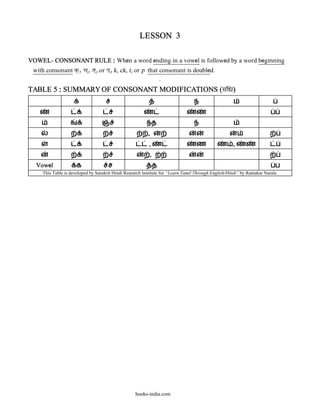
LESSON 3

VOWEL- CONSONANT RULE : When a word ending in a vowel is followed by a word beginning
 with consonant k‘, ca`, ta`, or pa`, k, ck, t, or p that consonant is doubled.
                                                                   .

TABLE 5 : SUMMARY OF CONSONANT MODIFICATIONS (sa>iZa)


                                                               த
                                                          ,
                                                           ,                       ண                  ,
                                                           ,
  Vowel               க               ச                        த                                                           ப
     This Table is developed by Sanskrit Hindi Research Institute for “Learn Tamil Through English/Hindi” by Ratnakar Narale.


                                                    books-india.com
CHART OF ALPHABET WITH VOWEL SIGNS


a   a@   i    &        u      u@        e     eâ   ai   o     oâ    au
A   Aa   }    }|       q      Q         ]     ]â   ]e   Aae   Aaâ   AaE
அ   ஆ    இ    ஈ        உ      ஊ         எ     ஏ    ஐ    ஒ     ஓ     ஔ
    ◌ா   ◌ி   ◌ீ       ◌ு     ◌ூ        ெ◌    ே◌   ை◌   ெ◌ா   ே◌ா   ெ◌ௗ
k   ka   ik   kI       kÖ     k”        k’    kâ   k“   kae   kaâ   kaE
க   கா   கி   கீ                        ெக    ேக   ைக   ெகா   ேகா   ெகௗ


ங   ஙா   ங    ங                         ெங    ேங   ைங   ெஙௗ   ேஙா   ெஙௗ


ச   சா   சி   சீ                        ெச    ேச   ைக   ெசா   ேசா   ெசௗ


ஞ   ஞா   ஞ    ஞ                         ெஞ    ேஞ   ைஞ ெஞா     ேஞா   ெஞௗ


ட   டா                                  ெட    ேட   ைட   ெடா   ேனா   ெனௗ


ண   ணா   ண    ண                         ெண ேண ைண ெணா          ேணா   ெணௗ


த   தா   ன    ன                         ென    ேன   ைன ெனா     ேனா   ெனௗ


ப   பா   ப    ப                         ெப    ேப   ைப   ெபா   ேபா   ெபௗ


ம   மா   மி   ம                         ெம    ேம   ைம   ெமா   ேமா   ெமௗ


ய   யா   ய    ய                         ெய    ேய   ைய   ெயா   ேயா   ெயௗ


ர   ரா                                  ெர    ேர   ைர   ெரா   ேரா   ெரௗ


ல   லா   லி   ல                         ெல    ேல   ைல ெலா     ேலா   ெலௗ


வ   வா   வ    வ                         ெவ    ேவ   ைவ ெவா     ேவா   ெவௗ


ள   ளா   ள    ள                         ெள    ேள   ைள   ெளா   ேளா   ெளௗ


ற   றா   றி   ற                         ெற    ேற   ைற   ெறா   ேறா   ெறௗ


ன   னா   ன    ன                         ென    ேன   ைன ெனா     ேனா   ெனௗ


                            books-india.com
BEFORE YOU PROCEED FURTHER, PLEASE KNOW THIS
.


1. Like Sanskrit and Hindi, the அ, இ, உ A, }, q are Basic or Simple Vowels. The rest nine vowels
    ஆ, ஈ, ஊ, எ, ஏ, ஐ, ஒ, ஓ, ஔ Aa, }|, Q, ], ]â, ]e, Aae, Aaâ, AaE are Compound Vowels,
    composed of the Basic three vowels. e.g. ஆ = அ + அ; ஈ = இ + இ; ஊ = உ + உ;
    எ = அ + இ; ஏ = அ + ஈ; ஐ = அ + அ + இ; ஒ = அ + உ; ஓ = அ + ஊ;
    ஔ = அ + அ + உ. Aa = A + A; }| = } + }; Q = q + q; ] = A + }; ]â = A + }|; ]e =
    A + A + }; Aae = A + q; Aaâ = A + Q; AaE = A + A + q.

2. Like Sanskrit, and unlike Hindi and English, the last consonant (with vowel A a), is pronounced with
    full stress (long). e.g. Tamil : பக (pak, bak depart); Sanskrit : bak (baka Stork); Hindi : bak (bak
    pronounced as bak‘ Stork); English : Buck (bak‘ buk Dollar).

3. While learning the 18 consonants by heart, the first 10 consonants are repeated in five pairs of two
   consonants each, then the rest eight consonants are said singly or in pairs of two.

4. When there are short and long vowels within a word, the long ones are pronounced more distinctly.

5. Within the above mentioned five pairs, each initial consonant is followed by its corresponding
    (devanagri) nasal consonant e.g. கங, சஞ, டண, தந, பம                     kG, caØa, @Na, tana, pama;

6. The next four consonants form two pairs like the Devanagari Alphabet. ய ர, ல வ ya r, La va; y
   r, l v

7. No Tamil word begins with the last four consonants ழ, ள, ற, ன.

8. A Tamil mute or half consonant (with the dot over it) is named by prefixing இ i } sound to that
    consonant. e.g. க ங ச ... ம ர              = k G ca ... ma r ka, nga, cha ... ma, ra etc.;
                              ச ...          etc. = }k‘ }G` }ca` ... }ma` }r` ik, ing, ich ... im, ir etc.;

9. Like Sanskrit and Hindi, when Tamil consonants are doubled they are pronounced more distinctly
    and strongly than they are done in English. e.g. Tamil : ப டண                       (pa£Nama`   pat>t>anam City).
    Sanskrit : pa£nama` (pat>t>anam City); Hindi : pa£na ( pat>t>an City); English : butter (ba@r).

10. When a word begins with vowel எ (e ]) or ஏ (eâ ]â), these vowels are sounded like ேய (yae ye), as
    in Hindi, vowel ] (e) is sounded like yae (ye). e.g. Tamil : எ         ன (yenna, yae² What?) ஏ              (yen
    yaena` Why?); Hindi ga], gayae ( gae, gaye Gone); Sanskrit : yaena (yena By whom).
    NOW YOU ARE READY TO LEARN READING, WRITING and SPEAKING TAMIL.


                                              books-india.com
A PRELIMINARY VOCABULARY OF KEY TAMIL WORDS
       EXERCISE : Read, write, understand and remember as many Tamil words possible.

English (ih>dI)              Devnagari               Tamil           Transliteration
I (maE>)                     naana`                  நா              na@n
We (all) (hma                naama`                  நா              na@m
We (all - you)               na>aga<`                நா      க       na@ngal<
You (taU)                    naI                     ந               n&
You (Aapa)                   naIr`                   ந               n&r
You (all)                    naI>ga<`                ந    கங         ningal<
He (that boy)                Avana`                  அவ              avan
He/she (Respect.able that)   Avar`                   அவ              avar
He (this boy)                }vana`                  இவ              ivan
He/she (Respectable. this)   }var`                   இவ              ivar
She (that girl)              Ava<`                   அவ              aval<
She (this girl)              }va<`                   இவ              ival<
Those people                 Avaga|<`                அவ க            avargal<
These people                 }vaga|<`                இவ க            ivargal<
It, this thing               }du                     இ               idu
That thing                   Adu                     அ               adu
These things                 }vaE                    இைவ             ivai
Those things                 AvaE                    அைவ             avai
All                          ]LLaama`                எ    லா         ella@m
Each                         Aaevvaaewvawma`         ஓ    வ      வ   ovvaruvarum
What?                        ]²                      எ    ன          enna
Which?                       ]du                     எ               edu
Who?                         yaar`                   யா              ya@r
How many?                    ]Tanae                  எ தென           ettane
How, in what manner?         ]ppaiD                  எ ப             eppadi
How much?                    ]vva<vau                எ    வள         evval<avu
When?                        ]ppaae                  எ ேபா           eppo
In this manner               }ppaiD                  இ ப             ippad<i
What for?                    ]dr`kah                 எத காக          ippad<i
Where?                       ]>gae                   எ    ேக         enge
Now                          }ppa                    இ ப             ippa
My                           ]na`                    எ               en
Name                         paeyar`                 ெபய             peyar


                                               books-india.com
LESSON 5


                                   THE BASIC TAMIL NUMERALS


0        ய           saunyama`     sunyam
1 ஒ                  Aaenw         onru           ì         One book. ஒ           தக
2 இர                 }rNDu         irand<u        ì     ì       Two books. இர              தக   க
3                    maUnw         mu@nru         ì     ì       ì       Three books.                தக   க
4 நா                 naangau       na@ngu         ì     ì       ì       ì
5 ஐ                  ]endu         aindu          ì     ì       ì       ì    ì
6 ஆ                  Aaw           a@ru           ì     ì       ì       ì    ì     ì
7 ஏ                  ]<u           el<u           ì     ì       ì       ì    ì     ì       ì
8 எ                  ]@`@u         et>t>u         ì     ì       ì       ì    ì     ì       ì    ì
9 ஒ      ப           Aaenbadu onbadu ì                  ì       ì       ì    ì     ì       ì    ì        ì
10 ப         paTau         pattu          ì       ì     ì       ì       ì    ì     ì       ì    ì        ì


EXERCISE : Numerals
(1) Read the numbers in Tamil :
    1 7 9 4 0 3 2 8 5 6


(2) Read the following Tamil numerals :
                     எ              ஏ         ப         ஒ           ஆ        ஒ    ப        நா            ய
    இர               ஐ


(3) Read and Write the following Tamil numerals :
    நா           ஒ             ப              ய       இர                ஐ     எ        ஒ        ப        ஏ
                ஆ


                                                      books-india.com
LESSON 6


          HOW TO MAKE YOUR OWN TAMIL SENTENCES
                     This is the Most Important Chapter in Learning Tamil Properly

PLEASE BE REMINDED OF THE FOLLOWING BEFORE YOU BEGIN
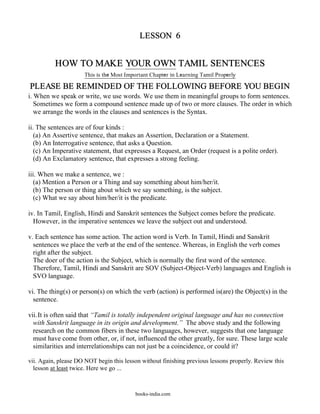
i. When we speak or write, we use words. We use them in meaningful groups to form sentences.
   Sometimes we form a compound sentence made up of two or more clauses. The order in which
   we arrange the words in the clauses and sentences is the Syntax.

ii. The sentences are of four kinds :
   (a) An Assertive sentence, that makes an Assertion, Declaration or a Statement.
   (b) An Interrogative sentence, that asks a Question.
   (c) An Imperative statement, that expresses a Request, an Order (request is a polite order).
   (d) An Exclamatory sentence, that expresses a strong feeling.

iii. When we make a sentence, we :
   (a) Mention a Person or a Thing and say something about him/her/it.
   (b) The person or thing about which we say something, is the subject.
   (c) What we say about him/her/it is the predicate.

iv. In Tamil, English, Hindi and Sanskrit sentences the Subject comes before the predicate.
  However, in the imperative sentences we leave the subject out and understood.

v. Each sentence has some action. The action word is Verb. In Tamil, Hindi and Sanskrit
  sentences we place the verb at the end of the sentence. Whereas, in English the verb comes
  right after the subject.
  The doer of the action is the Subject, which is normally the first word of the sentence.
  Therefore, Tamil, Hindi and Sanskrit are SOV (Subject-Object-Verb) languages and English is
  SVO language.

vi. The thing(s) or person(s) on which the verb (action) is performed is(are) the Object(s) in the
  sentence.

vii. It is often said that “Tamil is totally independent original language and has no connection
  with Sanskrit language in its origin and development.” The above study and the following
  research on the common fibers in these two languages, however, suggests that one language
  must have come from other, or, if not, influenced the other greatly, for sure. These large scale
  similarities and interrelationships can not just be a coincidence, or could it?

vii. Again, please DO NOT begin this lesson without finishing previous lessons properly. Review this
  lesson at least twice. Here we go ...


                                         books-india.com
6.1 TAMIL NOUNS

              i. MASCULINE, FEMININE and NEUTER TAMIL GENDER

      Like Sanskrit, the Tamil nouns are Masculine, Feminine or Neuter Gender. But, the gender
classification is much more systematic in Tamil, than in Sanskrit. In Hindi is it is most erratic.
      The Tamil (i) Masculine Nouns include all rational beings (actual and imaginary) such as
gods, men and personified males such as the actors in the Panchatantra fables and the Fables of
Aesop. Similarly, the (iii) Feminine category includes all goddesses, women and personified
females such as the actresses in the fables. The third class then consists of (iii) everything else,
which includes inanimate objects and living things such as stones, trees, animals, insects, birds,
etc. regardless of their actually being male of female. Again, like Sanskrit, the Tamil verb agrees
with its subject.

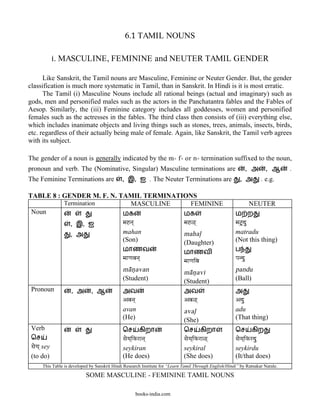
The gender of a noun is generally indicated by the m f or n termination suffixed to the noun,
pronoun and verb. The (Nominative, Singular) Masculine terminations are                                          , அ     , ஆ      .
The Feminine Terminations are                  , இ, ஐ . The Neuter Terminations are                          , அ       . e.g.

TABLE 8 : GENDER M. F. N. TAMIL TERMINATIONS
          Termination       MASCULINE     FEMININE                                                               NEUTER
 Noun                      மக            மக                                                              ம ற
                     , இ, ஐ                     mahna`                         mah<`                     ma@¼du
                     , அ                        mahan                          mahal>                    matradu
                                                (Son)                          (Daughter)                (Not this thing)
                                                மாணவ                           மாணவ                      ப
                                                maaNavana`                     maaNaiva                  pandu
                                                ma@n<avan                      ma@n<avi                  pandu
                                                (Student)                      (Student)                 (Ball)
 Pronoun             , அ       , ஆ              அவ                             அவ                        அ
                                                Avana`                         Ava<`                     Adu
                                                avan                           aval<                     adu
                                                (He)                           (She)                     (That thing)
 Verb                                           ெச       கிறா                  ெச         கிறா           ெச       கிற
 ெச                                             saeya`ikrana`                  saeya`ikra<`              saeya`ikrdu
 saeya` sey                                     seykiran                       seykiral                  seykirdu
 (to do)                                        (He does)                      (She does)                (It/that does)
       This Table is developed by Sanskrit Hindi Research Institute for “Learn Tamil Through English/Hindi” by Ratnakar Narale.

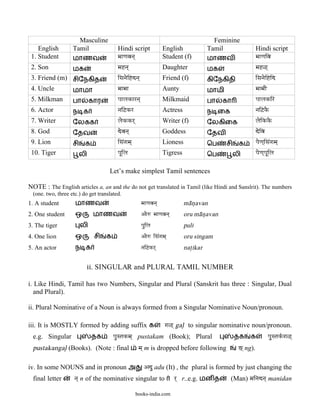
                             SOME MASCULINE - FEMININE TAMIL NOUNS

                                                       books-india.com
Masculine                                                             Feminine
    English         Tamil                Hindi script                English              Tamil                  Hindi script
 1. Student         மாணவ                 maaNavana`                  Student (f)          மாணவ                   maaNaiva
 2. Son             மக                   mahna`                      Daughter             மக                     mah<`
 3. Friend (m) சிேநகித                   isanaeihdna`                Friend (f)           கிேநகிதி               isanaeihid
 4. Uncle      மாமா                      maamaa                      Aunty                மாமி                   maamaI
 5. Milkman         பா        கார        paaLakarna`                 Milkmaid             பா   கா                paaLakir
 6. Actor           ந க                  nai@kr                      Actress              ந ைக                   nai@k“
 7. Writer          ேலகக                 Laekkr``                    Writer (f)           ேலகிைக                 Laeikk“
 8. God             ேதவ                  devana`                     Goddess              ேதவ                    deiva
 9. Lion            சி    க              isa>gama`                   Lioness              ெப     சி    க         paeNa`isa>gama`
 10. Tiger               லி              paUiLa                      Tigress              ெப          லி         paeNa`paUiLa

                                     Let’s make simplest Tamil sentences

NOTE : The English articles a, an and the do not get translated in Tamil (like Hindi and Sanslrit). The numbers
  (one. two, three etc.) do get translated.
1. A student         மாணவ                               maaNavana`             ma@n<avan
2. One student       ஒ         மாணவ                     Aaew maaNavana`        oru ma@n<avan
3. The tiger             லி                             pauiLa                 puli
4. One lion          ஒ         சி   க                   Aaew isa>gama`         oru singam
5. An actor          ந க                                nai@kr`                nat>ikar


                          ii. SINGULAR and PLURAL TAMIL NUMBER

i. Like Hindi, Tamil has two Numbers, Singular and Plural (Sanskrit has three : Singular, Dual
   and Plural).

ii. Plural Nominative of a Noun is always formed from a Singular Nominative Noun/pronoun.

iii. It is MOSTLY formed by adding suffix க                          ga<` gal< to singular nominative noun/pronoun.
  e.g. Singular               தக        paustakma` pustakam (Book); Plural                            தக    க             paustakäga<`
  pustakangal< (Books). (Note : final                 ma` m is dropped before following                G` ng).

iv. In some NOUNS and in pronoun அ                       Adu adu (It) , the plural is formed by just changing the
  final letter       na` n of the nominative singular to                  r` r..e.g. மன த         (Man) mainadna` manidan

                                                     books-india.com
to மன த        (Men) mainadr` maindar

v.. Like Hindi and sometimes Sanskrit too, the Honorific Expressions also mean pluralization
  and vice versa (see previous section). e.g.
  (a) The Second Person short pronoun ந naIr` n&r (You, tauma, Aapa), though plural in nature, it
   is used commonly as an honorific singular, The non-honorific singular being naI n& (You tauma,
   taU). The second person long pronoun ந க           naI>ga<` ningal< is (full form of ந naIr` n&r) is
   actually a plural form (Aaapa Laaega), but is often used as honorific singular pronoun (Aaapa),
   more respectful than ந naIr` n&r (tauma)
 (b) The Third Person plural short pronoun அவ                           Avar` avar (They vae) is more often used as
   honorific singular, to imply more respect than the Third Person Singular Pronoun அவ
   Avana` avan (He vah) or அவ                    Ava<` aval< (She vah). The Third Person plural long pronoun
   அவ க           Avar`ga<` avargal< (They vae) is (full form of அவ Avar` avar) is actually a plural
   form (vae Laaega, vae OaRImaana`), but is often used as honorific singular pronoun (vae), more respectful
   than அவ        Avar` avar.

vi. Like Sanskrit, the Tamil Subject agrees with predicate in person, number, case and gender.

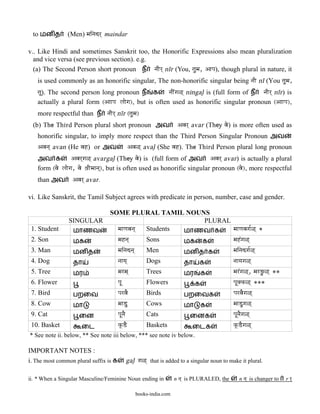
                                 SOME PLURAL TAMIL NOUNS
                SINGULAR                                  PLURAL
 1. Student       மாணவ             maaNavana` Students மாணவ க    maaNavaga|<` *
 2. Son           மக                    mahna`            Sons            மக       க            mah>ga<`
 3. Man           மன த                  mainadna`         Men             மன த க                mainadga|<`
 4. Dog           தா                    naaya`            Dogs            தா     க              naayaga<`
 5. Tree          மர                    marma`            Trees           மர       க            mar>ga<`, marGÐ<` **
 6. Flower                              paU               Flowers              க                paUKk<` ***
 7. Bird          பறைவ                  parvaE            Birds           பறைவக                 parvaEga<`
 8. Cow           மா                    maaDu             Cows            மா       க            maaDuga<`
 9. Cat              ைன                 paUnaE            Cats               ைனக                paUnaEga<`
 10. Basket          ைட              k”DE      Baskets            ைடக                           k”DEga<``
* See note ii. below, ** See note iii below, *** see note iv below.

IMPORTANT NOTES :
i. The most common plural suffix is க            gal< ga<` that is added to a singular noun to make it plural.

ii. * When a Singular Masculine/Feminine Noun ending in                n na` is PLURALED, the      n na` is changer to   r r`

                                                     books-india.com
before attaching the plural suffix க        gal< ga<` to it.

iii. ** When a word ending in             m ma` is followed by a word beginning with க k k, the                             m ma`
 is changed to         ng G`

iv. *** When a word ending in a vowel is followed by a word beginning with க, ச, த, ப k,
 ch, ta or pa, k, ca, ta or pa, the க, ச, த, ப is (many times) doubled.

        Now let’s make more simple Tamil constructions with the basics we learned so far
1. The students                மாணவ க                                   maaNavah|<`                ma@n<avarhal<
2. Two students                இர             மாணவ க                    }rNDu maaNavah|<`          iran<d<u ma@n<avarhal<
3. Three cats                                 ைனக                       maUnw paUnaEga<`           munru pu@naigal<<
4. Four baskets                நா              ைடக                      naangau k”DEga<`           na@ngu ku@d<aigal<
5. Five actors                 ஐ         ந க க                          ]endu nai@kh|<`            aindu nat>ikarhal<
6. Six birds                   ஆ         பறைவக                          Aaw parvaEga<`             a@ru paravaigal<
7. Seven Trees                 ஏ     மர       க                         ]<u marGÐ<`                el<u maran[gal<<
8. Eight cows                  எ         ப        க                     ]@`@u pasauKk<`            et>t>u pasukkal<
9. Nine flowers                ஒ     ப            க                     Aaenbadu paUKk<`           Onbadu kpu@kkal<
10. Ten men                    ப         மன த க                         paTau mainadh|<`           pattu manidarhal<
11. Eleven boys                பதிெனா                 ைபய         க     paidnaaenw paEya>ga<`      padinonru paiyan[gal<
12. Twelve girls               ப     னர           ெப          க         pai²rNDu paeNa`h<`         panniran<d<u pen<gal<
13. Thirteen horses            பதி                     திைரக            paidnmaUnw kÖidrEga<` padinmunru kudiraigal<<
14. Fourteen houses            பதினா              வ       க           paidnaangau vaIDuga<`       padina@ngu v&d<ugal<
15. Fifteen fish               பதிைன              ம       க             paidnaEendu maIna`h<`      padinaindu m&nhal<
16. Sixteen foxes              பதினா          ந க                       paidnaaw nairga<`          padina@ru narigal<
17. Seventeen saints           பதிேன           சா         க             paidnae<u saaduKk<`        padinel<u sa@dukkal<
18. Eighteen days              பதிென              ந க                   paidnae@`@u na@`h<`        padinet>t>u nat>hal<
19. Nineteen daughters         ப ெதா          ப       மக      க            paTaaenbadu mahn`h<`      pattonbadu mahat>hal<
20. Twenty women               இ     ப       ெப       க                 }wbadu paeNa`h<`           irubadu pen<hal<
                    Now let’s make our own simple Tamil sentences using Pronouns

                                   6.2 THE BASIC TAMIL PRONOUNS

                         i. MASCULINE, FEMININE and NEUTER GENDER


                                                  books-india.com
TABLE 9 : BASIC TAMIL PRONOUNS
    Pronoun              Tamil                          Devnagari               Transliteration Oblique Case/
                                                                                                Possessive case *
 1     I maE> (M.F.)                                    naana`                                  ]na`     எ
                                       நா                                       na@n
 2     We (hma) (M.F.)                                  na>aga<`                                 ]>ga<`           எ   க
                                       நா   க                                   nan[gal<

 3     You (taU) (M.F.)                                 naI                                      qna`         உ
                                       ந                                        n&
 4     You (Aapa) (M.F.)                                naIr`                                    qma`         உ
                                       ந                                        n&r
 5     You (all Aapa Laaega) (M.F.)                     naI>ga<`                                 q>ga<`           உ   க
                                       ந    க                                   n&ngal<

 6     He (that boy) (M)                                Avana`                                   Avana`
                                       அவ
 7     He/she (Resp. That) (M.F.)                       Avar`                                    Avar`
                                       அவ
 8     He (this boy) (M.)                               }vana`                                   }vana`
                                       இவ
 9     He/she (Resp., This) (M.F.)                      }var`                                    }var`
                                       இவ
 10    She (that girl) (F.)                             Ava<`                                    Ava<`
                                       அவ
 11    She (this girl) (F.)                             }va<`                                    }va<`
                                       இவ
 12    Those people (M.F.)                              Avaga|<`                                 Avaga|<`
                                       அவ க
 13    These people (M.F.)                              }vaga|<`                                 }vaga|<`
                                       இவ க
 14    It, this thing (N.)                              }du                                      }du
                                       இ
 15    That thing (N.)                                  Adu                                      Adu
                                       அ
 16    These things (N.)                                }vaE, }vaEga<`                           }vaE, }vaEga<`
                                       இைவ
 17    Those things (N.)                              AvaE, AvaEga<`                 AvaE, AvaEga<`
                                    அைவ
 * Oblique case (inflectional base) is used as possesive pronoun such as my, our, your, his, her, their etc.


                Let’s make simple Tamil constructions using common Personal Ponouns
1. That student           அவ          மாணவ                         Avana` maaNavana`         avan ma@n<avarhal<
2. Those students         அவ க         மாணவ க                      Avah|<` maaNavah|<`       avarhal< ma@n<avargal<
3. This is a cat          இ           ைன                           }du paUnaE                idu pu@nai<<
3a. This cat              இ த         ைன                           }nd paUnaE                inda pu@nai<<
4. These baskets          இைவ          ைடக                         }vaE k”DEga<`             ivai ku@d<aigal<
5. He is an actor         அவ          ந க                          Avana` nai@gar`           aavan nat>igar
6. Those are birds        அைவ பறைவக                                AvaE parvaEga<`           avai paravaigal<
7. Those Trees            அைவ மர            க                      AvaE marGÐ<`              avai maran[gal<<
8. That cow               அ       ப                                Adu pasau                 adu pasu


                                                books-india.com
9. My dog               எ       நா                             ]na` naaya`                     en na@y *
10. These men           இவ க             மன த க                }var`h<` mainadh|<`             ivarhal< manidarhal<
 * NOTE Oblique cases (the inflectional base) shown in the right column of the above table is also used
 for Possesive Pronouns, such as : my, our, your, his, her, it’s, their, etc.

                              TAMIL INTERROGATIVE PRONOUNS

TABLE 10 : COMMON TAMIL INTERROGATIVE PRONOUNS
    Pronoun                     Tamil                                                Devnagari             Transliteration
 1    What? (Kyaa?)                                                                  ]²?
                                                    எ     ன                                                enna
 2    Who? which person (kaEna?) (M.F; Sg. Pl.)                                      yaar`?
                                                    யா                                                     ya@r
      Which persons? (kaEnasae Laaega?) (M.F.)                                       ]vah|<`
                                                    எவ க
 3    Who? which man (kaEna?) (M.)                                                   ]vana`?
                                                    எவ                                                     evan
 4    Who? which woman (kaEna?U) (F.)                                                ]va<`?
                                                    எவ                                                     eval<
 5    Who? with respect (kaEna?) (M.F.)                                              ]var`?
                                                    எவ                                                     evar
 6    Who all? (kaEna Laaeega?) (M.F.)                                               ]var`h<`?
                                                    எவ க                                                   evarhal<
 7    Which thing? (kaEnasaI caIj[a?) (N)                                            ]du?
                                                    எ                                                      edu
      Which things? (kaEnasae?) (N)                                                  ]vaE, ]vaEga<`
                                                    எைவ, எைவக
 8    Which one? of many (kaEnasaa ]k?)                                              ]nd
                                                    எ த                                                    end
 9    Where? (kha{?)                                                                 ]>gae?
                                                    எ    ேக                                                enge
 10   Why? (Kyaae>?)                                                                 ]na`?
                                                    ஏ                                                      en
 11   When? (kba?)                                                                   ]ppaae?
                                                    எ ேபா                                                  eppo
 12   What for? why (iksa iLayae? Kyaae>?)                                           ]dnaaLa`?
                                                    எதனா                                                   edna@l
 13   How much? (iktanaa?)                                                           }]vva<vau?
                                                    எ    வள                                                evval<vu
 14   How? (k“sae?)                                                                  ]ppaiD
                                                    எ ப , எைக                                              eppad<i
      .
 1    Here (yaha{)                                                                   }>kÖ
                                                    இ                                                      in[ku
 2    There (vaha{)                                                                  A>kÖ
                                                    அ                                                      an[ku
 3    Somebody (kae}|)                                                               yaarae
                                                    யாேரா                                                  yaro
 4    All (saba)                                                                     ]LLaawma`
                                                    எ    லா                                                ellarum
 5    Now (Aba)                                                                      }ppaae<udu
                                                    இ ெபா                                                  ippol{udu
 6    When?                                                                          ]ppaae<udu
                                                    எ ெபா                                                  eppol{udu


                   Let’s make simple Tamil constructions using Interrogative Pronouns

          REMEMBER : TAMIL SYNTAX IS SAME AS HINDI SYNTAX (but not like English),

                                                 books-india.com
In Tamil is, are (hE, hE>) need not get translated, like Sanskrit.
                  A Tamil sentence can be translated word for word in Hindi and vice versa.

 VOCAB : Name = ேப                  per paer`, Place (gaa{va/sYaana) = ஊ u@r Qr`, Mother tongue (maataBaaPaa) =
 தா      ெமாழி ta@ymol<i taaya`maaei<`,
                Is not, Not, No = இ            ைல illai }LLaE.
1. Which student? எ த மாணவ                              ]nd maaNavana` enda ma@n<van
1a. Who is the student? யா              மாணவ                 yaar` maaNavana` ya@r ma@n<van
2. Which students? எ த மாணவ க                             ]nd maaNavah|<` enda ma@n<avargal<
3. Which book? எ                  தக         ]du pauTahma`? edu puttaham
4. Which one? This one. எ த? இ                        . ]nd? }du end? idu.
5. What is your name? உ              க ேப         எ      ன q>ga paer` ]²? (Aapaka naama Kyaa hE?) un[g per enna
6. My name is Ratnakar எ                ேப        ர னாகர               ]na` paer` rtnaakrna` en per Ratna@kar<an
7. What is your place name (Where do you live?)? உ                              க ஊ             ேப        எ      ன q>ga Qr` paer` ]²?
 (Aapak’ gaa{va ka naama Kyaa hE?) un[g u@r per enna
8. My place name is Toronto (I live in Toronto). எ                       ஊ       ேப        ெடாரா              ெடா ]na`             Qr`   paer`
 @aera>@ae. (maere gaa{va ka naama @aera>@ae hE = maE> @aera>@ae mae> rhtaa hU{) en u@r per Toronto.
9. Who is she? அவ               யா       Ava<` yaar` (vah kaEna hE?) aval< ya@r
10. Who is he? அவ                யா        Avana` yaar` (vah kaEna hE?) avan ya@r
11. Who is that (respectable) person? அவ                     யா       Avar` yaar` (vae kaEna hE>?) avar ya@r
12. I am Indian. நா            இ திய             naana` }indyana` na@n Indian
13. She is not Telgu. அவ                ெத                 இ      ைல Ava<` taeLau>gau }LLaE aval< Telungu illai
14. We are Indians. நா           க      இ திய க                naa>ga<` }indyaga|<` na@ngal< Indiyargal<
15. My mother tongue is Hindi. எ                  தா      ெமாழி இ தி ]na` taaya`maaei<[ }ind en ta@ymol<i Indi
16. What is your mother tongue? உ                 க தா         ெமாழி எ             ன q>ga taaya`maaei<[ ]²? un[g ta@ymol<i enna
17. My mother tongue is Tamil. எ                  தா       ெமாள தமி                 ]na` taaya`maaei< taima<[ en ta@ymol<i Tamil{
18. Is he* a student?                                           அவ         ணவனா ? Avana` maaNavanaa? avan ma@n<vana@?

 * NOTE : Suffix அ a@ Aa is attached to a noun to ask a question (the question that does not begin
   with any Interrogative adjective such as, what?, which? when? etc). The Suffix அ a@ Aa can be
   attached to any word in a sentence to make a question pointing to that word.


EXERCISE : Translate, Say and Write it in Tamil                           Answers are given in small font for your help, if you need.

 VOCAB : Boy = ைபய                          paiyan paEyana`, Girl/Woman = ெப                         pen< paeNa`, Man = மன த


                                                        books-india.com
manidan mainadna`, Friend (m) = சிேநகித               isanaeihdna` sinehidan
1. Which boy?                                      எ த      ைபய          ]nd paEyana`? enda paiyan
2. Which girl?                                     எ த      ெப        ]nd paeNa`? enda pen<<
3. Which man?                                      எ த      மன த             ]nd mainadna`?    enda manidan
4. Which woman?                                    எ த      ெப        ]nd paeNa`? enda pen<<
5. What is her name? (}saka naama Kyaa hE?)        இவ       ேப      எ        ன }va<` paer` ]²? ival< per enna

6. Her name is Radha.                              இவ       ேப      ரஈதா }va<` paer` rada ival< per Ra@da@<
7. Where does she live? (her place name)?          இவ       ஊ       ேப        எ    ன }va<` Qr` paer` ]²? ival< u@r per enna
8. She lives in Madurai.                           இவ       ஊ       ேப        ம    ைர }va<` Qr` paer` madurE ival< u@r per Madurai
9. Who is he?                                      அவ        யா     Avana` yaar` avan ya@r

10. He is my friend, Mr. Singh.               அவ    எ     சிேனகித       மி     டர ஸி     க Avana` ]na` isanaeihdna` imas@r isa>ga. avan en sinehidan Mr. Singh

11. Is he* Telgu?                                  அவ        ெத          கா? Avana` taeLau>gaa? avan Telunga?
12. No. He is not Telgu.                      இ    ைல அவ            ெத                 இ      ைல }LLaE. Avana` taeLau>gau }LLaE illai. avan Telungu illai
13. What is his mother tongue?                     அவ      தா     ெமாழி எ            ன Avar` taaya`maaei<[ ]²? avar ta@ymol}i enna
14. His mother tongue is Punjabi.                  அவ      தா     ெமாள ப              சாப Avana` taaya`maaei< pa>jaabaI. avan ta@ymol<i Panja@b&


EXERCISE : Translate in English or Hindi                 Answers are given in small font for your help, if you need.

1. உ     க ேப        எ    ன q>ga paer` ]²? un[g per enna                                                                 What is your name?

2. எ      ேப     ர    க      ]na` paer` r>gana` en per Ran[gan<                                                          My name is Rangan.

3. உ     க ஊ         ேப     எ    ன q>ga Qr` paer` ]²? un[g u@r per enna                                                  Where do you live?

4. அவ        ேப      எ     ன Ava<` paer` ]²? ival< per enna                                                              What is her (that girl’s) name?

5. அவ        யா      Ava<` yaar` aval< ya@r                                                                              Who is she (that girl)?

6. இவ        ஊ       ேப     எ     ன }vana` Qr` paer` ]²? ivan u@r per enna                                               Where does he live?

7. இவ        ஊ       ேப     ம      ைர }vana` Qr` paer` madurE ivan u@r per Madurai                                       He lives in Madurai

8. அவ         மாணவனா ? Avana` maaNavanaa? avan ma@n<vana@?                                                               Is he* a student?

8a. அவ       மாணவளா ? Ava<` maaNava<a? aval< ma@n<vl<a@?                                                                 Is she* a student?


                          THE ‘YES/NO’ TYPE OF QUESTIONS
i. ‘Yes / No’ type of questions in Tamil are expressed with the use of the ‘question marker’ ஆ a@ Aa.
ii. This question marker may be attached to any word of the a sentence, other than to the adjective of the
   noun. However, the interrogative suffix is attached usually to the last word.

EXAMPLES :
   1. Is it a goat? இ      ஆ      வா idu a@d<uva@ }du AaDuvaa? இ                     வா ஆ                    iduva@ a@d<u }duvaa AaDu?
   2. Is that a parrot? அ       கிள யா adu lil>iya@ Adu iki<yaa? அ                            வா கிள aduva@ kil>i Aduvaa iki<?
   3. Is that a boy? அவ           ைபயனா avan paiyana@ Adu paEyanaa? அ                                  வா ைபய                          avana@ piyan
     Avanaa paEyana`?
   4. Is it a book? இ           தகமா idu puttahama@ }du pauTahmaa? இ                            வா               தக            iduva@ puttaham

                                               books-india.com
}duvaa pauTahma`?
   5. Is that a Dollar? அ      டாலரா adu d<a@lara@ Adu DaLara? அ          வா டால          aduva@ d<a@lar Aduvaa
     DaLar`?
   6. Is she Indian? அவ        இ தியனா aval> indiana@@ Ava<` }indyanaa? அவளா இ திய                         aval>a@
     indian Ava<a }indyana`?
   7. Is your mothertongue Tamil? உ           தா    ெமாழி தமிழா un ta@ymol}i tamil}a@ qna` taaya`maaei<[
     taima<[a?
   8. How many pairs of gloves are these? (எ தென ettane ]Tanae = How many? ேஜா                       jod<& jaaeDI
     = Pair; அ தேகாச            atthakosham AtYakaeoama` = Glove) இ         எ தென ேஜா
     அ தேகாச             idu ettane jod<i athakosham }du ]Tanae jaaeDI AYakaeoama`?
   9. Is she your wife? (உ           ைடய ummud<aiya qmmauDEya = Wife) அவ                 உ         ைடய
     மைனவ யா aval> ummud<aiya maneviya@ Ava<` qmmauDEya manaeivayaa?
   10. Howmanieth Prime Mininster is Mr. Manmohan Singh? (தி                thiru itaw = Mister;
     எ தனாவ              ettana@vadu ]Tanaavadu = Howmanieth; ப ரதம ம தி              piradan mandiri ipardma
     maindir = Prime Minister) தி      மநெமாஹ               ஸி      க எ தனாவ               ப ரதம ம தி
     thiru Manmohan Singh ettana@vadu piradan mandiri itaw manamaaehna isa>ga ]Tanaavadu ipardma maindir?
     NOTE : This was not a Yes/No type of question, therefore அ suffix is not used.


                           iii. THE POLITE / FORMAL SPEECH

i. The Honorific Suffix க G ng is added to the last word of the sentence to show politeness
   or respect by the speaker to the listner.

 NOTE : If the word ends in             na` n or    ma` m, the last      na` n or     ma` m is dropped before
 attaching        க G ng
 e.g. (i) ந (You = taU ) +       க =ந       க (You Sir/Madam - Aapa) naI + G = naIG n& + n[g = n&n[g
     (ii) வண க            (Hi namastae) vaNaKkma` van<akkam = (Respect) வண க க (Hello namastae
 jaI) vaNaKkG van<akkan[g
ii. In Tamil, somewhat like Hindi (Aapa = you = with respect as well as plural), the expression
 of respect by adding the Honorific Suffix suffix                     க G     n[g     to a noun also means
 expression of plurality of that noun.
 e.g. (i) ஆசி ய            (Teacher) +        க = ஆசி ய            க (Teacher Sir or Teachers gauwjaI)
 Aaisairyana` + G = AaisairyaG a@siriyan + n[g = a@siriyan[g

                                             books-india.com
(ii) மாணவ                (Student) maaNavana` ma@n<vana` + G n[g = மாணவ க (+ respect or Students
 Ca%a) maaNavaGÐ ma@n<van[g
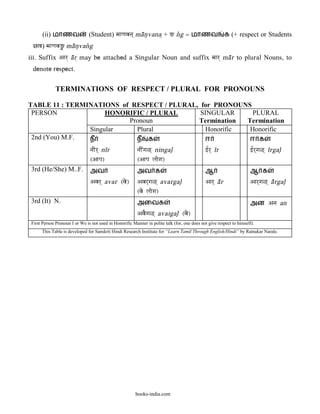
iii. Suffix Aar` a@r` may be attached a Singular Noun and suffix maar` ma@r to plural Nouns, to
 denote respect.

              TERMINATIONS OF RESPECT / PLURAL FOR PRONOUNS

TABLE 11 : TERMINATIONS of RESPECT / PLURAL, for PRONOUNS
 PERSON              HONORIFIC / PLURAL      SINGULAR     PLURAL
                          Pronoun           Termination Termination
                Singular    Plural            Honorific  Honorific
 2nd (You) M.F. ந           ந க               ஈ          ஈ க
                                naIr` n&r                 naI>ga<` ningal<                    }|r` &r                 }|r`ga<` &rgal<
                                (Aapa)                    (Aapa Laaega)
 3rd (He/She) M..F.             அவ                        அவ க                                ஆ                       ஆ க
                                Avar` avar (vae)          Avar`ga<` avargal<                  Aar` a@r                Aar`ga<` a@rgal<
                                                          (vae Laaega)
 3rd (It) N.                                              அைவக                                                        அன Ana an
                                                          AvaEga<` avaigal< (vae)
 First Person Pronoun I or We is not used in Honorific Manner in polite talk (for, one does not give respect to himself).
      This Table is developed for Sanskrit Hindi Research Institute for “Learn Tamil Through English/Hindi” by Ratnakar Narale.


                                                         books-india.com
IV. MAKING OUR OWN TAMIL SENTENCES WITH ACTION WORDS
                                          1. Speaking PRESENT events


1. I am learning Tamil / I learn Tamil. நா           தமி க கிேற                   na@n tamil{ kalkiren (kal + kiru +
  eân = kal + kir + eân = kalkiren) naana` taima<` kLa`ikrena` (kLa` + ikw + ]âna` = kLa` + ikr` + ]âna` = kLa`ikrena`
  நா       தமி        க கிேற            na@n tamil{ karkiren (kar + kiru + eân = kar + kir + eân = karkiren) naana` taima<`
  kr`ikrena` (kr` + ikw + ]âna` = kr` + ikr` + ]âna` = kr`ikrena`
NOTES : (i) Again like Sanskrit, the verb “is” (இ     }w iru, Sanskrit Aista, Hindi hE) is actually not written. (ii)
 Having understood the breakdown in the above example clearly, other Pronouns in other two Tenses of any
 Verb can easily be figured out in same style, by attaching the Past or Future Tense Suffix to any chosen verb.
 (iii) Notice the rhyming between the pronoun and its verb.
2. I drink milk. நா        பா               கிேற             naana` paaLa` kÖiDiKkrena` na@n pa@l kud<ikkiren (kÖiD kud<i = drink)
3. She is reading a book. அவ                     தக          ப கிறா                  Ava<` pauTahma` paiDikra<` aval< putthaham
  pad<ikira@l<. (paiD pad<i = Read)
4. He walks 10 km. அவ                   10 k.m. நட கிறா                           Avana` 10 k.m. naDiKkrana` avan 10 km.
  nad<akkira@n     (naD nad<a = Walk)
5. You are sleeping. ந                கிறா         naI taU>gauikraya` n& tu@n[gukira@y.             (taU>gau tu@ngu = Sleep)
6. They are. அவ க             இ        கிறா க            Avaga|<` }wiKkraga|<` avargal< irukkira@rgal<. (}w iru = Be)
7. He/she goes. அவ          ேபாகிறா           Avar` paaeikrar` avar pokira@r.                (paae po = Go)
8. You (all) are giving money. ந             க         பண              இ       கிற க                naI>ga<` paNama` }DuikrIga|<` ningal<
  pan<am idukir&rgal< (}|, }Du &, idu = Give)
9. She takes flowers. அவ                       க        எ          த         ெகா                 கிறா               Ava<` paUKk<` ]DuTak‘
  kae<`<uikra<` aval< pu@kkal< kol<l<ukira@l< (kae<` kol< = Take)
10. I worship. நா        ெதா       கிேற          naana` dae<uikrena` na@n dol{ukiren. (dae<[ dol{ = Worship)

EXERCISE : Translate in Tamil          (answers are given for your help, if you need)
2. I eat.                                              நா      உ       கிேற         naana` qNa`ikrena` na@n un<kiren   (qNa` un< = Eat)
3. She is fighting.                         அவ         ெபா      கிறா        Ava<` paaewikra<` aval< porulira@l<.    (paaew poru = Fight)
4. He falls.                                     அவ         வ      கிறா         Avana` iva<uikrana` avan vil{ukira@n (iva<u         vil{u = Fall)
5. You do / you are doing.                                        ந ெச       கிறா         naI saeya`ikraya` n& seykira@y. (saeya`   sey = Do)
6. They die.                      அவ க         ம கிரா க            Avaga|<` mairikraga|<` avargal< marikira@rgal<.     (mair mari = Die)
7. He speaks.                                 அவ       ேப கிறா           Avar` paesauikrar` avar pesukira@r.       (paesau pesu = Speak)
8. You are running.               ந   க     ஒ      கிற க        naI>ga<` AaeDuikrIga|<` n&ngal< od<ukir&rgal<   (AaeDu od<u = Run)
9. She is writing.                        அவ       எ        கிறா        Ava<` ]<[duikra<` aval< el{udukira@l< (]<udu
                                                                                 u                                           el{udu = Write)
10. I trust.                                     நா             கிேற         naana` na>bauikrena` na@n nambukiren. (na>bau   nambu = Trust)

                                                   books-india.com
COMMON TAMIL VERBS, Part I
TABLE 13 : VERB LIST 1
1) Bathe       ள         kÖi<      kul<i                 29) Keep     கா     ka         ka@
2) Be         இ          }w        iru                   30) Know     அறி    Air        ari
3) Become     ஆ          Aa        a@                    31) Laugh    சி     isair      siri
4) Begin      ஆர ப       Aar>iba a@rambi                 32) Learn    ப      paiD       pad<i
5) Break      உைட        qDE       ud<ai                 33) Leave    வ      ivaDu      vid<u
6) Buy        உைர        qrE       urai                  34) Like     வ      ivaw>bau   virumbu
7) Come       வா, வ      vaa, vaw va@, varu              35) Perish   அழி    Ai<        al<i
8) Cry        அ          A<u       al<u                  36) Put      ேபா    paaeDu     pod<u
9) Desire     இ ைச       }ccaE     ichchai               37) Rain     மைழ    ma<[E      mal}ai
10) Die       சா         saavau    sa@vu                 38) Read     ப      paiD       pad<i
11) Dislike   ெவ         vaew      veru                  39) Run      ஒ      AaeDu      od<u
12) Do        ெச         saeya`    sey                   40) Say      ெகா    saaeLa`    sol
13) Drink                kÖiD      kud<i                 41) See      கா     kaNa`      ka@n<
14) Eat       உ          qNa`      un<                   42) Sell     வ      ivaLa`     vil
15) Eat       சா ப       saaippaDu sa@ppid<u             43) Sing     பா     paaDu      pa@d<u
16) Enter                paukÖ     puku                  44) Sit      உ கா   qD`kaw ud<ka@ru
17) Exist, be ஆ          Aagau     a@gu                  45) Sleep    உற     qr>gau     uran[gu
18) Exist     உ          qw        uru                   46) Sleep           taUr>gau   thuran[gu
19) Fall      வ          iva<u     vil<u                 47) Speak    ேப     paesau     pesu
20) Fight     ெபா        paaew     poru                  48) Stand    நி     inaLa`     nil
21) Get       வா         vaa>gau   va@n[gu               49) Steal    தி     iYawDu     thirud<u
22) Give      இ          }Du       id<u                  50) Stop     நி     inawd`du niruddu
23) Give      ெகா        kaeDu     kod<u                 51) Suffer   ப      paDu       pad<u
24) Give      தா         da        da@                   52) Take     ெகா    saaeLa`    sol
25) Give      அள         Ai<       al<i                  53) Talk     எ      ]Du        ed<u
26) Go        ேபா        paae      po                    54) Walk     நட     naD        nad
27) Grow      வள         va<w      val<ru                55) Wash     க      k<uvau     kal<uvu
28) Hear      ேக         k’<`      kel<                  56) Wear     உ      qDuTau     ud<uddu


                                          2. Speaking PAST events

                                             books-india.com
NOTE : Like Sanskrit (LaG` Past tense), Tamil language also generally treats Past habitual and Past
continuous tenses as a Simple Past Tense. The specific construction is explained later.
1. I was learning Tamil / I learned Tamil. நா          தமி க ேற              na@n tamil{ karren naana` taima<` kre|na`
  (kLa` + d` + ]âna` = kr` + r + ]âna` = kre|na` kal + d + eân = kar + r + eân = karren)
NOTE : As said before, when a word ending in                                 La` l is followed by a word beginning with                               ta` t,
  the final            La` l becomes          r` r. and the             ta` t also becomes                    r` r. (See the useful Tables 5 and 16)

2. I drank milk. நா             பா                  ேத            naana` paaLa` kÖiDTaena` na@n pa@l kud<itten (kÖiD kud<i = drink)
3. She was reading a book. அவ                                தக          ப           தா           Ava<` pauTahma` paiDTaa<` aval< putthaham
  pad<itta@l<. (paiD pad<i = Read)
4. He walked 10 km. அவ                        ப             k.m. நட தா                        Avana` paTau k.m. naDndana` avan pattu km.
  nad<anda@n           (naD nad<a = Walk)
5. You were sleeping. ந                   கிநா          naI tau>iganaaya` n& tun[gina@y.              (tau>gau tungu = Sleep) (tau>gau + }nau + Aaya`
  = tau>ga` + }na` + Aaya` = tau>iganaaya` tun[gu + inu + a@y = tun[g + in + a@y = tun[gina@y; see Table 15 below)

TABLE 15 : PRESENT, PAST and FUTURE Tense SUFFIXES
 TENSES                            VERBS ENDING IN
   ^             }, ]e, ya`                Na`, na`                                                                                           Other
         Aa ஆ                  q உ                  r`, <[                                                            La`, <`
                     a@        i, ai, y                     u                      n<, n              r, l{               l, l<
 Present        கி            கி              i. Verbs ending in             கி                 கி               கி                   கி        , கி
                                                  two short syllables
               iKkw         iKkw                                             ikw kiru           ikw kiru         ikw kiru           iKkw, ikw
                                                  கி
               kkiru        kkiru                                                                                                   kkiru,kiru
                                              iKkw kkiru
                                              ii. Other verbs
                                              கி
                                              ikw kiru
 Past                                         i. Verbs ending in               ,      ,                            ,         ,
                                                  two short syllables.
               nd` nd       nd` nd                                           d``, @`, r`        nd`              d`, naR`, N@`      nd`
                                                       nd` nd
                                                                             d, t><, r          nd               nd, nr, n<t>       nd
                                              ii. Other.
                                                                                     *                                   **
                                              இ         }na` nd
 Future           pa` p     i. Intransitive   i. Intransitive                      pa` p        உ +                                       ,       +
                                                                                                                        va` v
                 ***           pa` p               pa` p                                        q + va`                             va`, w + va`
                            ii. Transitive    ii. Transitive                                    u+v                                 v, ru + v
                                 va` v             va` v
 *      A word ending in        n< Na` if followed by த d d`, the த d d` changes to                    t> @` See Tables 5, 16
 **        +         =        La` + d` = naR l + d = nr ;         +      =                 <` + d` = N@` l< + d = n<t> See Tables 5, 16
 *** When a word ending in any vowl is followed by consonant k‘, ca`, ta`, or pa`, k, ck, t, or p that consonant is doubled.


                                                            books-india.com
6. They were. அவ க            இ        தா க                Avaga|<` }wndaga|<` avargal< irunda@rgal<. (}w iru = Be)
7. He/she went. அவ         ேபாந        Avar` paaenaar` avar pona@r.               (paae po = Go)
8. You (all) are giving money. ந              க        பண            ெகா              த க               naI>ga<` paNama` kaeDutaIga|<` ningal<
  pan<am kod<ut&rgal< (}|, }Du &, idu = Give)
9. She took flowers. அவ                   க       எ                 Ava<` paUKk<` ]DuTauk‘ aval< pu@kkal< ed{uttuk (]Du ed<u
  = Take) See Table 16
10. I worshipped. நா        ெதா       ேத           naana` dae<[dena` na@n dol{den.             (dae<u dol{u = Worship)

EXERCISE : Translate in Tamil         (answers are given for your help, if you need)
2. I ate.                                                          நா        உ      ேட         naana` qNDena` na@n un<den
                                                                                                                       <      (qNa` un< = Eat)
3. She was fighting.                          அவ           ெபா வ நா            Ava<` paaer`ivanaa<` aval< porvina@l<.   (paaew poru = Fight)
4. He fell.                                           அவ       வ          தா        Avana` iva<undana` avan vil<unda@n (iva<u     vil<u = Fall)
5. You did / you were doing.                                             ந ெச தா               naI saeya`daya` n& seyda@y.   (saeya` sey = Do)
6. They died.                        அவ க          ம       தா க         Avaga|<` mairndaga|<` avargal< marinda@rgal<.        (mair mari = Die)
7. He spoke.                                           அவ       ேபசிநா           Avar` paeisanaar` avar pesina@r.    (paesau pesu = Speak)
8. You were running.                  ந   க       ஒ    கிறி க           naI>ga<` AaeDuigairga|<` n&ngal< odugirirgal<   (AaeDu od<u = Run)
9. She was writing.                           அவ       எ     திநா        Ava<` ]<uidnaa<` aval< el<udina@l< (]<udu           el<udu = Write)
10. I trusted.                                    நா           ப ேன          naana` na>ibanaena` na@n nambinen.   (na>bau nambu = Trust)

EXAMPLES :
NOTE : Like Sanskrit (La@` Future tense), Tamil language also generally treats most of the future actions
 as Simple Future Tense, unless specifically required. Such specific actions will be explained later.

1. I will learn Tamil. நா       தமி க ேப            naana` taima<[ kpae|na` (kLa` + pa` + ]âna` = kr` + pa + ]âna` =
  kpae|na` kal + pa + eân = kar + p + eân = karpen)
NOTE : As said before, when a word ending in                        La` l is followed by a word beginning with                              pa` p,
  the final      La` l becomes         r` r. (See the useful Tables 5 and 16)

2. I will drink milk. நா         பா                    ேப           naana` paaLa` kÖiDppaena` na@n pa@l kud<ippen (kÖiD kud<i =
  drink)
3. She will read a book. அவ                        தக          ப          பா           Ava<` pauTahma` paiDppaa<` aval< putthaham
  pad<ippa@l<. (paiD pad<i = Read)
4. He will walk 10 km. அவ                 ப            k.m. நட பா                      Avana` paTau k.m. naDppaana` avan pattu km.
  nad<appa@n     (naD nad<a = Walk)
5. You were sleeping. ந               வா           naI taU>gauvaaya` n& tu@n[guva@y.


                                                   books-india.com
TABLE 18 : FUTURE Tense SUFFIXES
 TENSES                                                           VERBS ENDING IN
     ^          Aa          }, ]e, ya`                 q              Na`, na`                                                                       Other
                                                                               r`, <[                               La`, <`
 Future         pa` p     i. Intransitive      i. Intransitive              pa` p          உ +                                                   ,         +
                                                                                                                      va` v
 Tense           *           pa` p                 pa` p                                   q + va`                                             va`, w + va`
                          ii. Transitive       ii. Transitive                              u+v                                                 v, ru + v
                              va` v                 va` v
 * When a word ending in any vowl is followed by consonant k‘, ca`, ta`, or pa`, k, ck, t, or p that consonant is Doubled.


6. They will. அவ க               இ             பா க             Avaga|<` }wppaaga|<` avargal< iruppa@rgal<. (}w iru = Be)
7. He/she will go. அவ             ேபாவா              Avar` paaevaar` avar pova@r.               (paae po = Go)
8. You (all) will give money. ந                க           பண             இ       வா க                naI>ga<` paNama` }Duvaaga|<` ningal< pan<am
  iduva@rgal<       (}|, }Du &, idu = Give)
9. She will take flowers. அவ                          க             எ               ெகா          வா            Ava<` paUKkae<vaa<` ]DuTauk‘ aval<
  pu@kkal< ed{uttukol<va@l< (]Du ed<u = Take) See Table 16
10. I will worship. நா            ெதா          ேவ              naana` dae<[vaena` na@n dol{ven.           (dae<u dol{u = Worship)

EXERCISE : Translate in Tamil                                                                (answers are given for your help, if you need)
2. I will eat.                                                             நா       உ       ேப         naana` qNpaena` na@n un<pen    (qNa` un< = Eat)
3. She will fight.                                   அவ             ெபா     வா        Ava<` paaewvaa<` aval< poruva@l<.    (paaew poru = Fight)
4. He will fall.                                            அவ          வ       வா        Avana` iva<uvaana` avan vil<uva@n (iva<u       vil<u = Fall)
5. You will do.                                                                  ந ெச வா                naI saeya`vaaya` n& seyva@y. (saeya`   sey = Do)
6. They will die.                          அவ க            ம        பா க       Avaga|<` mairppaaga|<` avargal< marppa@rgal<.        (mair mari = Die)
7. He will speak.                                               அவ        ேப வா          Avar` paesauvaar` avar pesuva@r.           (paesau pesu = Speak)
8. You (all) will run.                     ந   க     ஒ         வ க        naI>ga<` AaeDvaIga|<` n&n[gal< oduv&rgal<
                                                                                       u                               (}|, AaeDu od<u = Run)
9. She will write.                                 அவ           எ       வா        Ava<` ]<uduvaa<` aval< el{uduva@l<      (]<udu el{udu = Write)
10. I will trust.                                           நா               ேவ        naana` na>bauvaena` na@n nambuven. (na>bau    nambu = Trust)


EXAMPLES : Third Person Neuter Gender Future Tense


REMEMBER :
(i) For Third Person Singular as well as Plural, Neuter Subjects, the Future Tense suffixe is உ                                                                or
           qma`, KkÖma` um, kkum (see Table 14). Same suffix for singular and pluraal both.
(ii) The verbs that take கி              ikw kiru in Present tense, take உ                             qma` um in Furure tense


                                                            books-india.com
(iii) The verbs that take    கி        iKkw kkiru in Present tense, take               KkÖma` kkum in Furure tense


1. I will eat.                    நா      உ       ேப        naana` qNpaena` na@n un<pen (qNa` un< = Eat)
2. The dog will eat bone.         நா      எ            உ           naaya` ]Laumbau qNauma` na@y elumbu un<um
                                                              (]Laumbau, AisYa elumbu, asthi = Bone)
3. He will fall.                  அவ          வ    வா         Avana` iva<uvaana` avan vil{uva@n (iva<u vil{u = Fall)
4. The bricks will fall.          பா க        வ            paaKk<` iva<uma` pa@kkal< vil<um
                                                                                     (paaKkLa` pakkal = Brick)
5. I walk.                        நா      நட கிேற             naana` naDiKkrena` na@n nad<kkiren (naD nad< = Walk)
6. The elephant will walk.        யாைன நட                    yaanaE naDKkÖma` ya@nai nad<akkum
                                                                                        (yaanaE ya@nai = Elephant)


                                                  LESSON 7
                 USING PRE-MADE TAMIL SENTENCES, Part I

                 PLEASE BE AWARE OF THIS, BEFORE YOU BEGIN
i. When you are able make your own sentences, your power is infinite. And, you know why each
   sentence is made this way. Only pre-made sentences is not the right way to learn Tamil.

ii. If you learn Tamil (or any language) through the common practice of learning through pre-
   made sentences, you are learning blindly, without knowing why the sentence is made this way.
   It’s a lame job. HOWEVER, if you first learn how to make your own sentences and then look
   at pre-made phrases and sentences, you polish your learning.

iii. Therefore, please finish Lesson 6 properly, with confidence, before taking up this lesson.

iv. So far we have learned how to make our own sentences in Simple Present, Past and Future
  tenses of the VERBS. Thus in this lesson we will limit our scope to what we have learned so
  far.

v. In the next lesson we will learn how to use such English prepositions of the NOUNS such as :
  to, with, by, for, from, in, on, at ...etc. in Tamil sentences and make a better speech. In the
  following lesson we will first use these affixes again to make OWR OWN sentences, and then
  study more pre-made sentences.

vi. In this lesson we will increase our VOCABLARY with the use of a Picture Dictionary of
  Nouns. We will use this knowledge in the next lesson.


                                               books-india.com
vii. Those who know Hindi, please remember that Hindi uses nae ne suffix for Transitive actions
  of any Perfect tense. But THERE IS NO nae ne suffix (or equivalent) IN TAMIL. e.g. Hindi maEnae
  Saayaa will be in Tamil simply maE> Saayaa (naana` qNDena`).

viii. Make sure you have mastered TABLES 13 and 15. Mastering these is the key to make your own
  sentences in three tenses.

ix. With this book, even though you can learn Tamil without learning the Tamil script, I highly
  recommend that you learn Tamil through Tamil Script only. Please use the English and Hindi
  script for help and verification purpose only.

                          PRE-MADE ENGLISH-TAMIL SENTENCES
                                        Part I

NOTE : At this stage you may not understand every part of all sentences given below, but as we make
 more of our own sentences in the following chapters, you will see them clearly if you revise this again.
1. Hi! Hello! namastae = வண க            vaNaKkma` van<akkam.
2. How are you? Aapa k“sae hE>? = எ ப            இ        கிற க           ]ppaiD }wiKkrIga|<` eppadi irukkir&rgal<.
3. How are you? Kyaa haLa hE? = நலமா naLamaa? nalma@.
4. Good morning! Goodnight! namastae = வண க                     vaNaKkma` van<akkam.
5. I am ok! maE> @Ik hU{! = ந    லா ய            ேக           naLLaa iyawKk’na` nalla@ yirukken
6. Thanks! Zanyavaad, oauiÛyaa = ந     றி nanair nanri.
7. Would you like to have tea? caaya paI]{gae? = ேதந                      கிற       களா taenaIr kÖiDiKkrI>ga<a? thenir
    kud<ikkir&n[gal<a@     (ேதந      taenaIr then&r = Tea)
8. Certainly! For sure! Avaoya, baeoak = நி கயமா                  inaccayamaaya` nichchama@y (sa>. inaocayamaaya`, inaocayama`)
9. That’s all basa #Ik hE = ேபா            paaeduma` podum.
10. No nahI> = இ         ைல }LLaE illai.
11. Yes ha{ = அ , ஆமா , ஒ                    Aama`, Aamaama`, Aaema` a@m, a@ma@m, om. (ra>. Aama`)
12. Truly saca = உ          ைமயா        , உ      ளப        qNmaEyaaya`, q<`<paiD un<maiya@y, ul<l<apad<i.
13. What is the news Kyaa Sabar hE? = எ          ன சமாசார                ]² samaacaarma` enna sama@cha@ram
14. Don’t worry kae}| baata nahI> = பரவா-ய             ைல parvaa }LLaE parva@ illai
15. Please! ×payaa = ப       தியா iparIitayaa pir&thiya@. (sa>. paRItyaa), தய        ெக           dyavausaeyadu dayavuseudu
16. Please listen jara sauinayae = அைத        ேக           க       }dEk‘ k’<u>ga<` idaik kel<un[gal<. (ேக          = Listen)
17. Excuse me! xamaa kIijayae = ம        ன         க       mai²-yau>ga<` manni-yun[gal<.
18. What is this yah Kyaa hE = இ         எ     ன }du ]² idu enna.
  What happened? Kyaa huAa = எ           ன ஆய                   ]² Aaiya@¼ø enna a@yit>ru. NOTE : When two ற rr

                                                 books-india.com
LESSON 9
                             Making Complex Tamil Sentences
     We have seen how to Make our Own Basic Tamil sentences in all three tenses (lesson 6). We have
   seen interesting tables, basic Tamil verbs (Tables 13 & 21) and a Pictorial Tamil Dictionary (Table
   19. We also briefly saw how to make imperatives, interrogatives and negative expressions, which we
   will use extensively in the following lessons.
     Let’s now see how to make a bit complex Tamil sentences with the use of several ‘Postpositions’
   (case suffixes). Similar to the tenses (Lesson 6), this is another very important chapter. Please make
   sure you understand its every word properly. Again, do not start this lesson without finishing
   previous lessons well. Review this lesson at least twice. So we begin ...

             BEFORE GOING AHEAD PLEASE UNDERSTAND THE FOLLOWING

i. As we learned before (Lesson 6.1), the Tamil nouns are divided into three genders. (i) all human male
    noun words are Masculine Gender, (ii) the human female noun words are Female Gender, and (iii)
    all other words are Neuter Gender.

ii. Masculine and Feminine noun words are together called the Rational Nouns. The Neuter noun words
    are called Irrational nouns.

iii. In grammatical mumbo-jumbo, the ‘form’ taken by a noun (or pronoun) to show its ‘relationship’ in
     the sentence is called the ‘case’ of that word. Big deal.

iv. The noun (or pronoun) itself (singular or plural), without any modification and without attaching any
    suffix to it, is called the ‘Nominative’ case of that noun. This case is reserved for the doer (‘subject’)
    of the action (verb) in sentence.

v. In addition to this Nominative relationship, there are seven more relationships or ‘cases’ of the nouns
    and pronouns. As said in previous point, the Nominative nouns do not require any modification, it
    means the other cases do need some kind of modification before attaching the case suffix to them.
    This modified form of any noun (or pronoun) is called the ‘Oblique’ case or the ‘Inflectional Base’
    of that noun.

vi. The addition of any of the eight case suffixes to the oblique/inflectional base of a noun is called
    Declension of that noun.

vi. The Plural Nominative is always formed by attaching the ‘Plural’ Tamil suffix to the Singular
   Nominative. Most common plural suffix is க kal< k<` The plural Inflectional base of a noun (but
   may not be of some pronoun) is always same as its Plural Nominative.

vii. All Tamil noun end only in one of the six vowels (ஆ, இ, ஈ, உ, ஊ, ஐ) or in one of the eight
 consonants (      ,     ,    ,    ,    ,    ,     ,     ). Tamil nouns do not end in any other Tamil


                                            books-india.com
character.

viii. Depending on which letter the noun ends, all Tamil nouns are divided into FOUR GROUPS, for the
  purpose of attaching corresponding case suffixes (i.e. declension). The four groups are as follows :

  (a) The First Group : masculine nouns ending in               n na`.
  (b) The Second Group : (neuter) nouns ending in அ                 am Ama`.
  (c) The Third Group : nouns ending in   or                du or ru Du or w`
  (d) The Fourth Group : the remaining nouns.

ix. For the benefit of those who need a review, or have forgotten or have not learned the English
    Case prepositions (Hindi kark, Sanskrit ivaBaiF), below is a Table designed to help you with the
    basics of this lesson.


TABLE 26 : Case Identification
Case English       Hindi                English          Details
No. Inflection     Name                 prepositions
 1   Nominative ktaa|                   -                the Doer of the action (the subject)
 2   Accusative    kma|                 to               the direct Object of the action (indirect obj. : Dative case)
 3   Instrumental krNa                  with/by          the Instrument or Means with/by which the action is done
 4   Dative        sa>paRdana           to/for           the object To or For which the indirect action is done.
 5   Ablative      Apaadana             from             the place From where the action starts
 6   Possessive    AiZakrNa             of               the Relationship of the the object in the sentence
 7   Locative      samba>Za             in/on/at/with    the Location of the object.
 8   Vocative      sa>baaeZana          Oh!              the Address or a Call
NOTE : These suffixes are actually pre-positions in English, but they are post-positions in Tamil, like Sanskrit.


x The case suffixes are Pre-positions in English, but they are Post-positions in Tamil (similar to Hindi
  and Sanskrit). In other words, in English these word particles come before the NOUN (e.g. To
  home), but in Tamil (Hindi and Sanskrit) they come after the Noun (e.g. Home to zar kae)


xi. Any of these eight Case Suffixes are attached ONLY to nouns or pronouns. They are NEVER
  attached to the verbs. The verbs take only the Tense Suffixes. The tense suffixes are never attached
  to the nouns or pronouns. The ADVERBS take NO suffixes of any kind. Tamil Adjectives are also
  indeclinable and are placed (without any suffix) before the noun. Only the noun takes suffix.


                                                  books-india.com
LESSON 10
           USING PRE-MADE TAMIL SENTENCES, Part II

                  PLEASE THINK THIS, BEFORE YOU BEGIN

i. When you learn to make your own sentences, you know what you are doing. You know how
   each word form is made and why the word is written that way. You will recognize this reality
   when you try to learn Tamil through the pre-made sentences. If you learn Tamil through only
   pre-made sentences, as usually done, you will be stabbing in the dark. You should use the pre-
   made sentences only to improve your learning by studying them in the light of what you have
   learned.

ii. If you know Sanskrit grammar, you may have figured out from the previous lessons that
   Tamil grammar is based on similar style like Sanskrit, even though it is not as vast as Sanskrit.
   If you want to see or learn Sanskrit grammar to any depth, you may like to use my “Learn
   Sanskrit through English Medium.”

iii. If you know Hindi, you must have discovered by now that Tamil grammar is much more
   deep, logical and systematic than the Hindi Grammar you learned in schools. In Hindi
   grammar, the gender is single most important aspect but it is very arbitrary with no fixed rules,
   the use of cases is mixed up and the tenses are violated too often. If you want to learn Hindi in
   a systematic manner, you may like to use my book “Learn Hindi through English Medium,”
   with properly laid out rules, noble truths, grammar dissection and unique tables.

iii. If you studied in English schools, you may have guessed that the English Grammar is too
   brief, simple, cut and dry, as compared to the Tamil grammar. It is systematic like Tamil.

iv. The present book (Volume I) deals only with the very bsic primary level of the vast Tamil
  grammar. For the use of Tamil Grammar at next level, and for the use of a fully transliterated
  English-Tamil Dictionary, please see Volume II of this book.

v. Again, make sure you have studied and understood previous chapters properly, before going
  ahead with this and the next lessons.

vi. The answers to the questions are provided in this book for your ‘help’ only. Please first see if
  you can answer the questions by yourself, theu look at the answers just to verify your answers.

vii. In each exercise, the English transliteration and Hindi is given for your assistance only.
  Please learn through the Tamil script. Use English and Hindi only wher you are in doubt.


                   PRE-MADE ENGLISH-TAMIL SENTENCES
                                        books-india.com
Part II
NOTE : You may not understand every part of all these sentences, but as we make more of our own
 sentences in the following chapters, you will see these sentences more clearly if you revise this over.

1. Excuse me, What time is the train for Mumbai?                              ம     ன      க         ப பாய ேபா                  வ           எ ெபா
  வ          mannikkavum! bamba@y pohum van<d<& eppol}udu varum mai²Kkvauma`! bambaaya paaehuma` vaiND ]ppaae<[udu vawma`?
2. Fifty Dollars ninety cents.               ஐ           டால        ேதா                  ேச           aimbudu da@lar ton<n<u@ru sent ]embaudu DaLar` taaeNNaUw
  sae>@`
3. How far is Washington from here?                          வாஷி        கட         இ     கி           எ     வள            ர      Washingt>on in[girundu
  evval>avu du@ram vaaioa>ga@na }>igawndu ]vva<vau dUrma`?
4. About five hundred k.m. மா                      ஐ             கிேலாமட           suma@r ainnu@ru kilom&t>ar saumaar` ]²Uw ikLaaeima@r`
5. Where is it? இ எ ேக இ                          கிற        idu en[ge irukkirdu }du ]>gae }wiKkrdu?
6. Please give me ten tickets.                    என            ப             ேகடக             ெகா       க enakku pattut>t>iket>hal> kod<un[g          ]naKkÖ
  paTaui£Kk’@h<` kaeDu>ga
7. Who is there? (kaEna hE?) யா இ கிற ya@r irukkir&r yaar` }wiKkrIr`?
8. Who is he? அ யா adu ya@r Adu yaar`?
9. Does he know you? அவ            உ ைன ேத                  மா avanukku unnai teriyuma@ AvanauKkÖ q²E taeiryaumaa?
10. When did you (all) come? ந க எ ேபா வ த க nin[gal> eppodu vand&rgal> naI>ga<` ]ppaaedu va>dIga|<`?
11. What does she do? அவ எ ன ெச கிரா ya@r aval> enna seygira@l> Ava<` ]² saeya`igara<`?
12. What happened to you? உன           எ ன ஆய                  unakku enna a@yit>ru qnakku ]² Aaiya@¼ø
13. Come later! ப ற வா piragu va@ ipargau vaa
14. Have a seat. அம       க   amarun[gal> Amaw>ga<`
15. Please give me the newspaper. என             ெசய தி ஏ          ெகா       enakku saydi ed<u kod<u ]naKkÖ saeya`id ]âDu kaeDu
16. Please call the doctor. டா டைர            ப     da@kt>araikku@ppid<u DaâK@rEKk”ippaDu
17. What can I do for you (AapakI maE> Kyaa saevaa kr saktaa hU{)? உ க                        நா       எ ன ேசைவ ெச                                         ய
  un[gal>ukku na@n enna sevai seyya q{ga<uKkÖ naana` ]² saevaE saeyya?

                                              1. Compounding of Characters
                                                                          sa>iZa
                            PLEASE READ THIS BEFORE YOU BEGIN THE LESSON

i. This lesson is a brief Tamil version of a the rules outlined in a couple chapters from my book
   “learn Sanskrit through English medium,” for the topics formulated in this lesson are parallel
   in these two languages.

ii. Sanskrit sandhi is a mathematical addition of two characters, vowels or consonants. Sanskrit
   samasa is the linking of two words with a logical definition. The sandhi (       ku@t<t<u k”@`@)
                                                                                                  u
  and samasa (ப       pat>t>u pa@`@) are both present in Tamil. Of course, from Sanskrit they have
                                   u
  come into Hindi as well, directly and sometimes indirectly.

  In Sanskrit, the samasa is a huge and one of the most beautiful linguistic aspects. However, in

                                                                books-india.com
Tamil, only the tatpauPasamaasa: aspect is used.

iii. This lesson is presented here in the form of sandhi and samasa rules. You will remember that
   most of the sandhi rules are appropriately exemplified elsewhere in the earlier lessons of this
   book and are summarized in Tables 5, 6 and 16.

iv. The sandhi rules can be further subdivided in to three categories of vowel-vowel sandhi,
  consonant-vowel sandhi and consonant-consonant sandhi.

v. Although the visarga (ஆ த a@ytham Aaya`tama`) is part of Tamil language, the interesting
  technique of the Sanskrit visarga sandhi has not come into in Tamil. It remains the most
  unique aspect of the Sanskrit language.

vi. The following collection of rules also serves as a reference checklist of all the rules you need
  to know for the basic study of the Tamil language.

                                    TAMIL SANDHI RULES

1. (a) Like Sanskrit, the அ, இ, உ A, }, q are Basic or Simple Vowels.
   (b) The rest nine vowels ஆ, ஈ, ஊ, எ, ஏ, ஐ, ஒ, ஓ, ஔ Aa, }|, Q, ], ]â, ]e, Aae, Aaâ, AaE are
   Compound Vowels, composed of the three Simple vowels. e.g.
   ஆ = அ + அ; ஈ = இ + இ; ஊ = உ + உ; எ = அ + இ; ஏ = அ + ஈ; ஐ = அ
   + அ + இ; ஒ = அ + உ; ஓ = அ + ஊ; ஔ = அ + அ + உ
   Aa = A + A; }| = } + }; Q = q + q; ] = A + }; ]â = A + }|; ]e = A + A + }; Aae = A + q;
   Aaâ = A + Q; AaE = A + A + q

                                   2. Compounding of Words
                                                    samaasa
i. In Tamil (tatpauwPa) Samasa, compound words are formed by (sandhi) linking two nouns with a third
   noun, observing the above given sandhi rules.

ii. Like Sanskrit samasa, the words to be joined must be first put in their Nominative Singular forms
   before joining them. And like the Sanskrit tatpurusha samasa, the first word qualifies the second word,
   but the last word stands for the compound word. e.g. Heartache உ ள ேநா

 உ ள -ேநா ul>l>am-novu qÞ<ma`-naaevau Heartache = உ ள                  heart + ேநா        ache. உ ள
 Heart is the qualifier of the ache. Heart is the secondary word. Heart is the adjective of the word ache.
 ேநா       Ache is the primary word. Ache stands for the word heartache. i.e. Ache represents the
 compound word and takes the gender and number suffixes. Secondary word can easily be replaced
 with any other suitable noun or adjective, like தைல-ேநா headache, இைர                      ட -ேநா
 stomachache, etc.

                                            books-india.com

Tamil book

  • 1.
    TAMIL Through English / Hindi Volume I with my novel scientific way of making ‘your own’ Tamil sentences. This book walks you holding your finger Complete in Tamil, Transliteration and Devanagari Scaripts. If you know Tamil, you may learn Hindi with it. Tamil Level I Ratnakar Narale ர னாக நராேல PUSTAK BHARATI - BOOKS INDIA books-india.com
  • 2.
    Learn Tamil ThroughEnglish / Hindi INDEX Four Test Papers xi Lesson 1 The Tamil Alphabet 2 Lesson 2 Speaking Tamil Characters 4 Lesson 3 Reading and Writing Tamil Consonants 10 Lesson 4 Reading and Writing Tamil Vowels 30 Lesson 5 The Basic Tamil Numerals 49 Lesson 6 How to Make Your Own Tamil Sentences 50 Lesson 7 Using Pre-Made Tamil Sentences, Part I 71 Lesson 8 Tamil Pictorial Dictionary 74 Lesson 9 Tamil Imperative and Negative Sentences 86 Lesson 10 Making Complex Tamil Sentences 92 Lesson 11 Using Pre-Made Tamil Sentences, Part II 109 Lesson 12 Adjectives, Adverbs and Participles 112 Lesson 13 Compounding of letters and words 119 books-india.com
  • 3.
    LIST OF TABLES TABLE PAGE TABLE 1 : Tamil - Sanskrit inherent interrelationship 3 TABLE 2 : The Devanagari Class Consonants and Nasals in relation to the Tamil Nasals 7 TABLE 3 : The Devanagari - Tamil Nasals Nasals 8 TABLE 4 : Tamil CHARACTER PRONUNCIATION GUIDE 8 TABLE 5 : SUMMARY OF CONSONANT MODIFICATIONS (sa>iZa) 26 TABLE 6 : SUMMARY OF CONSONANT PRONUNCIATION 27 TABLE 7 : Vowels and their Signs 45 TABLE 8 : GENDER M. F. N. TAMIL TERMINATIONS 50 TABLE 9 : BASIC TAMIL PRONOUNS 55 TABLE 10 : SOME COMMON TAMIL INTERROGATIVE PRONOUNS 56 TABLE 11 : TERMINATIONS of RESPECT / PLURAL, for PRONOUNS 60 TABLE 12 : Speaking Present Events 61 TABLE 13 : VERB LIST 1 63 TABLE 14 : Speaking Past Events 64 TABLE 15 : PRESENT, PAST and FUTURE Tense SUFFIXES 68 TABLE 16 : ADVANCED CONSONANT-CONSONANT COMPOUNDING 67 TABLE 17 : Speaking Future Events 68 TABLE 18 : FUTURE Tense SUFFIXES 69 TABLE 19 : TAMIL PICTORIAL DICTIONARY 74 TABLE 20 : IMPERATIVE Request or ORDER 86 TABLE 21 : VERB LIST 2 88 TABLE 22 : INFINITIVES or VERBAL NOUNS 89 TABLE 23 : Negative Verb 90 TABLE 24 : Prohibitive 91 TABLE 25 : Polite Imperative 91 TABLE 26 : Case Identification 93 TABLE 27 : The GENERAL CASE SUFFIXES for Nouns and Pronouns 94 TABLE 28 : EXAMPLE of Cases of the first type of nouns 95 TABLE 29 : EXAMPLE of Cases of the 2nd type of nouns 97 TABLE 30-A FIRST EXAMPLE of Cases of the 3rd type of nouns 98 TABLE 30-B SECOND EXAMPLE of Cases of the 3rd type of nouns 99 TABLE 31 : EXAMPLE of Cases of the 4th type of nouns 100 TABLE 32 : CASE SUFFIXES COMMON FOR ALL FOUR GROUPS 101 TABLE 33-A CASE SUFFIXES FOR PRONOUNS in TAMIL Script 102 TABLE 33-B CASE SUFFIXES FOR PRONOUNS in English Transliteration 104 TABLE 33-C CASE SUFFIXES FOR PRONOUNS in Hindi Script 106 TABLE 34 : NOUNS - ADJECTIVES 112 TABLE 35 : NOUNS - ADVERBS 113 books-india.com
  • 4.
    MODEL FORMAT FORTHE FIRST QUARTERLY TEST QUESTION 1 : Read and Write the Following Tamil words five times. 1. பாரத ----------------------------------------------------------------------------------------------------------- 2. நண க -------------------------------------------------------------------------------------------------------- 3. கட --------------------------------------------------------------------------------------------------- 4. மர --------------------------------------------------------------------------------------------------------- 5.பழ --------------------------------------------------------------------------------------------------------- QUESTION 2 : Say it in Tamil. 1. I am a student. ------------------------------------ 2. My name is xxxxxx. --------------------------- 3. We drink milk . ----------------------------------- 4. They are going. -------------------------------- 5. You are speaking Tamil. ------------------------ 6. He is writing. ---------------------------------- QUESTION 3 : Say and write it in Tamil. 1. She was here. ---------------------------------------------- 2. I was there. --------------------------------------- 3. Anita is eating a mango. ---------------------------------------------------------------------------------------------- 4. They run 10 km. ------------------------------------------ 5. You are a teacher. -------------------------------- QUESTION 4 : Write the names of the verbs (action words) in Tamil : 1. cry --------- 2. go --------- 3. eat -------- 4. come -------- 5. say -------- 6. sing --------- 7. do -------- 8. become ------ 9. give ------ 10. take ------- 11. walk ------ 12. see -------- 13. learn --------- 14. drink --------- 15. read ------- 16. stand -------- 17. run --------- 18. begin ------ QUESTION 5 : Say and write it in Tamil. 1. She is fighting. -------------------------------------- 2. He falls. ------------------------------------------------ 3. She is writing. --------------------------------------- 4. I am writing. ------------------------------------------- 5. I am going to India. -------------------------------- 6. He speaks Punjabi. ------------------------------------ 7. She takes flowers. ---------------------------------- 8. These are books. ------------------------------------- 9. I drink milk. ---------------------------------------- 10. Is that a parrot? ------------------------------------- 11. Is that a goat? -------------------------------------- 12. Hello! ------------------------------------------------ 13. Is your mothertongue Tamil ------------------------------------------------------------------------------------ 14. Say the following numbers in Tamil : 5, 3, 100, 10, 4, 2, 7, 20, 9 books-india.com
  • 5.
    MODEL FORMAT FORTHE SECOND QUARTERLY TEST QUESTION 1 : Write all vowels of Tamil Alphabet in proper order. QUESTION 2 : Write the Tamil names of following things : 1. boy --------- 2. girl --------- 3. dog -------- 4. cat -------- 5. letter --------- 6. tea --------- 7. ear --------- 8. nose -------- 9. hand ---------- 10. leg ---------- 11. egg --------- 12. tail --------- 13. mango --------- 14. apple -------- 15. banana ------ 16. plate --------- 17. car --------- 18. knife --------- 19. fan ----------- 20. book -------- 21. ball --------- 22. chair --------- 23. key --------- 24. window ----- QUESTION 3 : Say and write in Tamil : 1. I drank milk. ------------------------------------------------------------------------------------------------------------ 2. He walked 2 km. ------------------------------------------------------------------------------------------------------- 3. She was reading a Hindi book. --------------------------------------------------------------------------------------- 4. She will take flowers. --------------------------------------------------------------------------------------------------- 5. She will go. ----------------------------------------------------------------------------------------------- QUESTION 4 : Answer and write in Tamil : 1. What is your name? -------------------------------------------------------------------------------------------------- 2. Where do you live. --------------------------------------------------------------------------------------------------- 3. How are you? -------------------------------------------------------------------------------------------------------- QUESTION 5 : Say and write in Tamil : 1. I sleep at 10.00 O’ Clock. -------------------------------------------------------------------------------------------- 2. You (all) will give money. ------------------------------------------------------------------------------------------ 3. I will eat fruits. -------------------------------------------------------------------------------------------------------- QUESTION 6 : Say and write in Tamil : 1. Ra@dha@ goes to school. ------------------------------------------------------------------------------------------- 2. S&ta@ will come to New York. ------------------------------------------------------------------------------------------ 3. Ra@jan reads a Tamil book. -------------------------------------------------------------------------------------------- QUESTION 7 : Write Tamil consonants Alphabetical order. books-india.com
  • 6.
    MODEL FORMAT FORTHE THIRD QUARTERLY TEST QUESTION 1 : Write the Tamil suffixes used for saying following expressions : 1. to --------- 2. by ---------------- 3. from ---------- 4. for ----------------- 5. in -------------------- 6. on -------- 7. near ------------- 8. together with ------------------------ 9. of --------------------- QUESTION 2 : Say and write in Tamil : 1. The dog will eat the bone ------------------------------------------------------------------------------------------ 2. The bricks will fall -------------------------------------------------------------------------------------------------- 3. I am ok! -------------------------------------------------------------------------------------------------------------- 4. What is the news? ---------------------------------------------------------------------------------------------------- 5. Don’t worry! ---------------------------------------------------------------------------------------------------------- 6. Who is she? ------------------------------------------------------------------------------------------------------------ 7. Where is the dog? ------------------------------------------------------------------------------------------------------ QUESTION 3 : Find the Intransitive and Transitive actions and say them in Tamil : 1. to sing --------------- 2. to fall ------------------- 3. to walk ------------------- 4. to buy ------------ 5. to see ----------------- 6. to hear --------------------7. to write ------------------ 8. to stand ----------- QUESTION 4 : Say and write in Tamil : 1. Yesterday monring. --------------------------------------------------------------------------------------------------- 2. You are welcome. ----------------------------------------------------------------------------------------------------- 3. Where are you going? ------------------------------------------------------------------------------------------------- 4. I am going to Chennai. ----------------------------------------------------------------------------------------------- QUESTION 5 : Say and Answer in Tamil : 1. What’s your native language? -------------------------------------------------------------------------------------- 2. How are you? --------------------------------------------------------------------------------------------------------- 3. Do you want coffee? ------------------------------------------------------------------------------------------------- 4. Do you know Tamil? ------------------------------------------------------------------------------------------------- 5. What is your name? -------------------------------------------------------------------------------------------------- 6. Who is she? ----------------------------------------------------------------------------------------------------------- 7. Who is he? ------------------------------------------------------------------------------------------------------------- books-india.com
  • 7.
    MODEL FORMAT FORTHE FOURTH QUARTERLY TEST QUESTION 1 : Say and write in Tamil : 1. Please come in. ------------------------------------------------------------------------------------------------------ 2. Please excuse me. ---------------------------------------------------------------------------------------------------- 3. Open the door! -------------------------------------------------------------------------------------------------------- 4. Please be quite. ------------------------------------------------------------------------------------------------------ 5. Hurry up! ------------------------------------------------------------------------------------------------------------- QUESTION 2 : Say and write in Tamil : 1. to her --------------- 2. to them ------------------- 3. for her ------------------- 4. to us ------------ 5. near him --------------- 6. from you ----------------- 7. by train ------------------ 8. from you -------- 9. for us -------------- 10. by them ----------------- 11. in him ------------------ 12. of our ---------- QUESTION 3 : Say, answer and write in Tamil : 1. What is her name? ------------------------------------------------------------------------------------------------ 2. Who is he? --------------------------------------------------------------------------------------------------------- 3. What is his mother tongue? ------------------------------------------------------------------------------------- 4. Is your mothertongue English? --------------------------------------------------------------------------------- 5. QUESTION 4 : Say and and write in Tamil : 1. Please have a seat. ------------------------------------------------------------------------------------------------ 2. Please listen. ------------------------------------------------------------------------------------------------------- 3. Please wait. -------------------------------------------------------------------------------------------------------- 4. Please come again. ----------------------------------------------------------------------------------------------- 5. Say yes! ------------------------------------------------------------------------------------------------------------ 6. Is your mothertongue Sanskrit? ----------------------------------------------------------------------------------- 7. Please close the window. ---------------------------------------------------------------------------------------- 8. A letter to my brother -------------------------------------------------------------------------------------------- 9. The bird on the tree. --------------------------------------------------------------------------------------------- 10. My house. ------------------------------------------------------------------------------------------------------- books-india.com
  • 8.
    LESSON 1 THE TAMIL ALPHABET Tamil Vowels : அ ஆ இ ஈ உ ஊ எ ஏ ஐ ஒ ஓ ஔ ` A Aa } }| q Q ] ]â ]e Aae Aae~ AaE ASa` a a@ i & u u@ e e@ ai o o@ au akh In this row of 12 vowels, vowel number 2, 4, 6, 8 and 11 are extended sounds of the short vowel number 1, 3, 5, 7 and 10. Tamil Full Consonants : க ங ச ஞ ட ண k, ga G ca, sa Øa @, D Na ka, ga n[ga cha, sa n~ya t>a, d<a n<a . த ந ப ம ய ர ta, d na pa, ba ma ya r ta, da na pa, ba ma ya ra . ல வ ழ ள ற ன La va <[ < r` na la va. wa la} l<a ra na . ஷ ஸ ஹ ஜ oa, Pa sa h xa ja OaRI s{a, s<a sa ha ks<ha ja shr& . books-india.com
  • 9.
    Tamil Half Consonants Tamil Consonants without their inherant vowel ‘a’ k‘, ga` G` ca`, sa` Øa` @` , D` Na` k, g n[g ch, s n~y t>, d< n< . ta`, d` na` pa`, ba` ma` ya` r` t, d n p, b m y r . La` va` <[` <` r` na` l v. w l} l< r< n . oa`, Pa` sa` h` s{, s< s h books-india.com
  • 10.
    Tamil and DevanagariSanskrit Alphabet Charts Side by Side Comparison TABLE 1 : Tamil - Sanskrit inherent interrelationship Tamil Vs Devanagari Sanskrit VOWELS Tamil A அ a Aa ஆ a@ } இ i }| ஈ & q உ u Q ஊ u@ Devnagari A Aa } }| q Q Tamil ] எ e ]â ஏ e@ ]e ஐ ai Aae ஒ o Aae~ ஓ o@ AaE ஔ au ASa` ` akh Devnagari ] ]â ]e Aae Aae~ AaE Ah` : Tamil Vs Devanagari Sanskrit CONSONANTS Tamil k க k G ங n[g ca ச ch Øa ஞ n~y @ ட t> Na ண n< Devnagari k Sa ga za G ca C ja Ja Øa @ # D $ Na Tamil ta த t na ந n pa ப p ma ம m ya ய y r ர r Devnagari ta Ya d Za na pa f ba Ba ma ya r Tamil La ல l va வ v < ள l< <[ ழ l} r ற r na` ன n Devnagari La va < * Tamil These five are oa, Pa ஷ sh sa ஸ s h ஹ h xa ks<h ja ஜ j adopted Granthaksharam Devnagari oa, Pa sa h xa ja characters $--- . NOTES : (i) Quite contrary to the common belief that Tamil language is totally independent and unrelated to Sanskrit, the above vowel consonant tables (as well as the following lessons and rules on Sandhi, Samasa etc. in Tamil grammar) clearly exhibit that the relationship between these two ancient languages is beyond just a coincidence. These two languages may have been developed separately, but their millenniums of common inheritance on the Indian subcontinent clearly reveals their common imprint. One language may or may not have come from or influenced the other, but there is a common thread for sure. * (ii) Some Hindi speaking people may think that letter < is not a Devanagri or Sanskrit character. Even though it did not reach Hindi, the Sanskrit has it. Letter < appears in the very first verse of the Rigveda (Aignaima<e pauraeihta). You can also hear their sounds in Tamil, Telugu, Kannad, Malyalam, Marathi and Gujrati languages. Same is true for the letters ]â and Aaâ. In Hindi, vowels ]e and Aae are used in their place. See the language charts in the Appendix. books-india.com
  • 11.
    The Tamil CompoundLetters i. Remember that the dots placed above the Tamil Characters are NOT the Anusvara Nasal Dots. A dot above any Tamil letter means the letter below that dot is MUTE, half or without the inherent vowel a (A). A Tamil letter with a dot over it is equivalent of the Sanskrit or Hindi half letter or a letter with the Halant slash under it e.g. , , = ma`, ta`, k‘ etc. Thus, + அ = ம (ma` + A = ma) etc. ii. A consonant can not be pronounced without any vowel to it. Thus like Sanskrit or Hindi, vowel அ a A is considered inherent in each full consonant. Without it, the consonant is considered mute or half. iii. Unlike Sanskrit or Hindi, the Tamil letters of a compound characters are written one after another. They are not written with half letter attached to full letter. e.g. க, ப, ல = Kk, ppa, pLa, etc. Thus, the Sanskrit (and Hindi) compound letters will be written in Tamil as shown below : F, Û, Ta, £, %a, §, ®, ^, ª, &, ¯, OaR, xa, Xa Œ த, ர, த, ட, ர, ர, ப, ய, த, த, ம, ர, , ஞ ஓ . The Devanagari Anusvara and Visarga in Tamil 1. The Anusvara Nasal Dot : In Tamil writing there are no Anusva@ra Nasal dot like the Hindi writing has. But, like Sanskrit, for writing nasal pronunciations in the words, the ‘Kindred’ or Class Nasal Consonants are used. The following chart of Devanagari Class Consonants helps understanding how the Nasals work in Tamil as well as in Sanskrit, because both are exactly same (for detailed discussion on this aspect, please refer to my “Learn Sanskrit through English Medium” Lesson 3.2). TABLE 2 : The Devanagari Class Consonants and Nasals in relation to the Tamil Nasals : Devanagari Class Sanskrit Class Characters Equivalent Tamil Kindered Nasal that may come after the Character that may come Characters Kindered Nasal after the Kindered Nasal Sanskrit & Tamil Characters Characters shown in the last colomn. shown in the last colomn. 1 k Class k vaga|: k (Sa ga za) k (kh g gh) க k Class G ng ங 2 ch Class ca vaga|: ca (C ja Ja ) c (ch j jh) ச ch Class Øa n~y ஞ 3 t> Class @ vaga|: @ (# D $) t> (t>h d< d<h) ட t Class (retroflex) Na n< ண 4 t Class ta vaga|: ta (Ya d Za) t (th d dh) த th Class na n ந 5 p Class pa vaga|: pa (f ba Ba) p (ph b bh) ப p Class pa m ம 6 Non-class ya r La va oa Pa sa h < ய ர ல வ A> m~ ங Characters yrlv s{h s<h s h ஷ ஸ ஹ This Table is developed by Sanskrit Hindi Research Institute for “Learn Tamil Through English/Hindi” by Ratnakar Narale. books-india.com
  • 12.
    The above tablesshows that the Tamil characters of Alphabet are in exactly same order as the Sanskrit Alphabet. The words with nasal sounds will be written in Tamil and Sanskrit as shown in the following Table : TABLE 3 : The Devanagari - Tamil Nasals Nasals : Devanagari Class Tamil words Sanskrit Hindi English 1 க k Class k vaga|: ச (caG`kÖ, saG`kÖ) oaG`Sa, oaGÏ oa>Sa Conch 2 ச ch Class ca vaga| ப சம (paØcamama`) paØcamama` pa>cama Fifth 3 ட t> Class @ vaga|: கா டாமி க gaNDkmagama`, gae>Da Rhino (kaNDaimawgama`) gaND: 4 த t Class ta vaga|: த (k”ntaLa`) kÖntaLa kÖtaLa ä Hair 5 ப p Class pa vaga|: க பள (kmba<ma`) kmbaLama` käbaLa Blanket 6 Non-class சி க (isa>gama`) isa>h isa>h, isa>za Lion sa>saar sa>saar World ஸ ஸார (sa>saarma`) This Table is developed by Sanskrit Hindi Research Institute for “Learn Tamil Through English/Hindi” by Ratnakar Narale. 2. The Visarga Dots ஆ த (Aayatama`): i. In Tamil, in order to write some Tamil words with visarga sound or for the Sanskrit words with Visarga ( : ) , the ( ஃ akh) sign is used. This ஃ sign is called ஆ த a@ytham or ள mubbul<l<i. ii. Although in Sanskrit words the visarga could come after any vowel, in Tamil words it usually comes after a short vowel and before a hard consonant. e.g. எஃ eh<ku (Steel); அஃகம = தான ய (Zaanyama`) grains; அஃ A:du (That). நமஃ namah< nama: (Salute). TABLE 4 : CHARACTER PRONUNCIATION GUIDE Hard Nasal Semi Short Long Dipthongs Character. Vowels Vowels Gutturals க ஃ ங அ ஆ எ ஏ Palatals ச ற ஞ ன ய இ ஈ ஐ Cerebrals ட ண ழ ள Dentals த ந ர ல Labials ப ம வ உ ஊ ஒ ஓ ஔ This Table is developed by Sanskrit Hindi Research Institute for “Learn Tamil Through English/Hindi” by Ratnakar Narale. books-india.com
  • 13.
    BEFORE YOU BEGIN,PLEASE KNOW THIS 1. The Tamil alphabet is derived from the ancient Indian inscriptional Brahmi script and was known as Brahmi-Tamil script. 2. Like Sanskrit (unlike Hindi and English), the Tamil vowel letter shapes (அ, ஆ, இ, ஈ...ஔ ) can come only at the beginning of a word. They never come in the middle or at the end of a word. In the middle or end they are used only in their sign (maa%aa) forms attached to the right, left, up or below a consonant. 3. In Tamil there are 12 vowels and 18 Consonants. Like Sanskrit or Hindi (unlike English), in Tamil there are no Capital letters. 4. Tamil short vowels are pronounced more abruptly than the corresponding Hindi or English sounds. 5. When there are short and long vowels within a word, the long ones are pronounced more distinctly. 6. While learning the 18 consonants by heart, the first 10 consonants are repeated in five pairs of two consonants each, then the rest eight consonants are said singly or in pairs of two. 7. The long Tamil vowels like (]â, Aaâ) have a drawing pronunciation (like Punjabi ], }| in Aae]! Baa}|!). They can not be exactly rendered in Hindi or English. 8. Please remember that English equivalent pronunciations of Tamil characters are rarely exact. If you can read Sanskrit/Hindi, you can write, read and express them quite exactly. 9. Each letter of the alphabet can be named by adding (suffixing) கர krma` karam to short letters, கார karma` kaaram to long letters and prefixing இ } i to the mute Tamil letters. e.g. அ A a = Akr a-kar; ஆ Aa aa = Aakar, க k‘ k = }k‘ ik etc. 10. Tamil is spoken by over 80 million people in the world. Tamil is spoken by people in almost every country in the world. NOW YOU ARE READY TO LEARN : READING AND WRITING THE TAMIL SCRIPT. books-india.com
  • 14.
    LESSON 3 VOWEL- CONSONANTRULE : When a word ending in a vowel is followed by a word beginning with consonant k‘, ca`, ta`, or pa`, k, ck, t, or p that consonant is doubled. . TABLE 5 : SUMMARY OF CONSONANT MODIFICATIONS (sa>iZa) த , , ண , , Vowel க ச த ப This Table is developed by Sanskrit Hindi Research Institute for “Learn Tamil Through English/Hindi” by Ratnakar Narale. books-india.com
  • 15.
    CHART OF ALPHABETWITH VOWEL SIGNS a a@ i & u u@ e eâ ai o oâ au A Aa } }| q Q ] ]â ]e Aae Aaâ AaE அ ஆ இ ஈ உ ஊ எ ஏ ஐ ஒ ஓ ஔ ◌ா ◌ி ◌ீ ◌ு ◌ூ ெ◌ ே◌ ை◌ ெ◌ா ே◌ா ெ◌ௗ k ka ik kI kÖ k” k’ kâ k“ kae kaâ kaE க கா கி கீ ெக ேக ைக ெகா ேகா ெகௗ ங ஙா ங ங ெங ேங ைங ெஙௗ ேஙா ெஙௗ ச சா சி சீ ெச ேச ைக ெசா ேசா ெசௗ ஞ ஞா ஞ ஞ ெஞ ேஞ ைஞ ெஞா ேஞா ெஞௗ ட டா ெட ேட ைட ெடா ேனா ெனௗ ண ணா ண ண ெண ேண ைண ெணா ேணா ெணௗ த தா ன ன ென ேன ைன ெனா ேனா ெனௗ ப பா ப ப ெப ேப ைப ெபா ேபா ெபௗ ம மா மி ம ெம ேம ைம ெமா ேமா ெமௗ ய யா ய ய ெய ேய ைய ெயா ேயா ெயௗ ர ரா ெர ேர ைர ெரா ேரா ெரௗ ல லா லி ல ெல ேல ைல ெலா ேலா ெலௗ வ வா வ வ ெவ ேவ ைவ ெவா ேவா ெவௗ ள ளா ள ள ெள ேள ைள ெளா ேளா ெளௗ ற றா றி ற ெற ேற ைற ெறா ேறா ெறௗ ன னா ன ன ென ேன ைன ெனா ேனா ெனௗ books-india.com
  • 16.
    BEFORE YOU PROCEEDFURTHER, PLEASE KNOW THIS . 1. Like Sanskrit and Hindi, the அ, இ, உ A, }, q are Basic or Simple Vowels. The rest nine vowels ஆ, ஈ, ஊ, எ, ஏ, ஐ, ஒ, ஓ, ஔ Aa, }|, Q, ], ]â, ]e, Aae, Aaâ, AaE are Compound Vowels, composed of the Basic three vowels. e.g. ஆ = அ + அ; ஈ = இ + இ; ஊ = உ + உ; எ = அ + இ; ஏ = அ + ஈ; ஐ = அ + அ + இ; ஒ = அ + உ; ஓ = அ + ஊ; ஔ = அ + அ + உ. Aa = A + A; }| = } + }; Q = q + q; ] = A + }; ]â = A + }|; ]e = A + A + }; Aae = A + q; Aaâ = A + Q; AaE = A + A + q. 2. Like Sanskrit, and unlike Hindi and English, the last consonant (with vowel A a), is pronounced with full stress (long). e.g. Tamil : பக (pak, bak depart); Sanskrit : bak (baka Stork); Hindi : bak (bak pronounced as bak‘ Stork); English : Buck (bak‘ buk Dollar). 3. While learning the 18 consonants by heart, the first 10 consonants are repeated in five pairs of two consonants each, then the rest eight consonants are said singly or in pairs of two. 4. When there are short and long vowels within a word, the long ones are pronounced more distinctly. 5. Within the above mentioned five pairs, each initial consonant is followed by its corresponding (devanagri) nasal consonant e.g. கங, சஞ, டண, தந, பம kG, caØa, @Na, tana, pama; 6. The next four consonants form two pairs like the Devanagari Alphabet. ய ர, ல வ ya r, La va; y r, l v 7. No Tamil word begins with the last four consonants ழ, ள, ற, ன. 8. A Tamil mute or half consonant (with the dot over it) is named by prefixing இ i } sound to that consonant. e.g. க ங ச ... ம ர = k G ca ... ma r ka, nga, cha ... ma, ra etc.; ச ... etc. = }k‘ }G` }ca` ... }ma` }r` ik, ing, ich ... im, ir etc.; 9. Like Sanskrit and Hindi, when Tamil consonants are doubled they are pronounced more distinctly and strongly than they are done in English. e.g. Tamil : ப டண (pa£Nama` pat>t>anam City). Sanskrit : pa£nama` (pat>t>anam City); Hindi : pa£na ( pat>t>an City); English : butter (ba@r). 10. When a word begins with vowel எ (e ]) or ஏ (eâ ]â), these vowels are sounded like ேய (yae ye), as in Hindi, vowel ] (e) is sounded like yae (ye). e.g. Tamil : எ ன (yenna, yae² What?) ஏ (yen yaena` Why?); Hindi ga], gayae ( gae, gaye Gone); Sanskrit : yaena (yena By whom). NOW YOU ARE READY TO LEARN READING, WRITING and SPEAKING TAMIL. books-india.com
  • 17.
    A PRELIMINARY VOCABULARYOF KEY TAMIL WORDS EXERCISE : Read, write, understand and remember as many Tamil words possible. English (ih>dI) Devnagari Tamil Transliteration I (maE>) naana` நா na@n We (all) (hma naama` நா na@m We (all - you) na>aga<` நா க na@ngal< You (taU) naI ந n& You (Aapa) naIr` ந n&r You (all) naI>ga<` ந கங ningal< He (that boy) Avana` அவ avan He/she (Respect.able that) Avar` அவ avar He (this boy) }vana` இவ ivan He/she (Respectable. this) }var` இவ ivar She (that girl) Ava<` அவ aval< She (this girl) }va<` இவ ival< Those people Avaga|<` அவ க avargal< These people }vaga|<` இவ க ivargal< It, this thing }du இ idu That thing Adu அ adu These things }vaE இைவ ivai Those things AvaE அைவ avai All ]LLaama` எ லா ella@m Each Aaevvaaewvawma` ஓ வ வ ovvaruvarum What? ]² எ ன enna Which? ]du எ edu Who? yaar` யா ya@r How many? ]Tanae எ தென ettane How, in what manner? ]ppaiD எ ப eppadi How much? ]vva<vau எ வள evval<avu When? ]ppaae எ ேபா eppo In this manner }ppaiD இ ப ippad<i What for? ]dr`kah எத காக ippad<i Where? ]>gae எ ேக enge Now }ppa இ ப ippa My ]na` எ en Name paeyar` ெபய peyar books-india.com
  • 18.
    LESSON 5 THE BASIC TAMIL NUMERALS 0 ய saunyama` sunyam 1 ஒ Aaenw onru ì One book. ஒ தக 2 இர }rNDu irand<u ì ì Two books. இர தக க 3 maUnw mu@nru ì ì ì Three books. தக க 4 நா naangau na@ngu ì ì ì ì 5 ஐ ]endu aindu ì ì ì ì ì 6 ஆ Aaw a@ru ì ì ì ì ì ì 7 ஏ ]<u el<u ì ì ì ì ì ì ì 8 எ ]@`@u et>t>u ì ì ì ì ì ì ì ì 9 ஒ ப Aaenbadu onbadu ì ì ì ì ì ì ì ì ì 10 ப paTau pattu ì ì ì ì ì ì ì ì ì ì EXERCISE : Numerals (1) Read the numbers in Tamil : 1 7 9 4 0 3 2 8 5 6 (2) Read the following Tamil numerals : எ ஏ ப ஒ ஆ ஒ ப நா ய இர ஐ (3) Read and Write the following Tamil numerals : நா ஒ ப ய இர ஐ எ ஒ ப ஏ ஆ books-india.com
  • 19.
    LESSON 6 HOW TO MAKE YOUR OWN TAMIL SENTENCES This is the Most Important Chapter in Learning Tamil Properly PLEASE BE REMINDED OF THE FOLLOWING BEFORE YOU BEGIN i. When we speak or write, we use words. We use them in meaningful groups to form sentences. Sometimes we form a compound sentence made up of two or more clauses. The order in which we arrange the words in the clauses and sentences is the Syntax. ii. The sentences are of four kinds : (a) An Assertive sentence, that makes an Assertion, Declaration or a Statement. (b) An Interrogative sentence, that asks a Question. (c) An Imperative statement, that expresses a Request, an Order (request is a polite order). (d) An Exclamatory sentence, that expresses a strong feeling. iii. When we make a sentence, we : (a) Mention a Person or a Thing and say something about him/her/it. (b) The person or thing about which we say something, is the subject. (c) What we say about him/her/it is the predicate. iv. In Tamil, English, Hindi and Sanskrit sentences the Subject comes before the predicate. However, in the imperative sentences we leave the subject out and understood. v. Each sentence has some action. The action word is Verb. In Tamil, Hindi and Sanskrit sentences we place the verb at the end of the sentence. Whereas, in English the verb comes right after the subject. The doer of the action is the Subject, which is normally the first word of the sentence. Therefore, Tamil, Hindi and Sanskrit are SOV (Subject-Object-Verb) languages and English is SVO language. vi. The thing(s) or person(s) on which the verb (action) is performed is(are) the Object(s) in the sentence. vii. It is often said that “Tamil is totally independent original language and has no connection with Sanskrit language in its origin and development.” The above study and the following research on the common fibers in these two languages, however, suggests that one language must have come from other, or, if not, influenced the other greatly, for sure. These large scale similarities and interrelationships can not just be a coincidence, or could it? vii. Again, please DO NOT begin this lesson without finishing previous lessons properly. Review this lesson at least twice. Here we go ... books-india.com
  • 20.
    6.1 TAMIL NOUNS i. MASCULINE, FEMININE and NEUTER TAMIL GENDER Like Sanskrit, the Tamil nouns are Masculine, Feminine or Neuter Gender. But, the gender classification is much more systematic in Tamil, than in Sanskrit. In Hindi is it is most erratic. The Tamil (i) Masculine Nouns include all rational beings (actual and imaginary) such as gods, men and personified males such as the actors in the Panchatantra fables and the Fables of Aesop. Similarly, the (iii) Feminine category includes all goddesses, women and personified females such as the actresses in the fables. The third class then consists of (iii) everything else, which includes inanimate objects and living things such as stones, trees, animals, insects, birds, etc. regardless of their actually being male of female. Again, like Sanskrit, the Tamil verb agrees with its subject. The gender of a noun is generally indicated by the m f or n termination suffixed to the noun, pronoun and verb. The (Nominative, Singular) Masculine terminations are , அ , ஆ . The Feminine Terminations are , இ, ஐ . The Neuter Terminations are , அ . e.g. TABLE 8 : GENDER M. F. N. TAMIL TERMINATIONS Termination MASCULINE FEMININE NEUTER Noun மக மக ம ற , இ, ஐ mahna` mah<` ma@¼du , அ mahan mahal> matradu (Son) (Daughter) (Not this thing) மாணவ மாணவ ப maaNavana` maaNaiva pandu ma@n<avan ma@n<avi pandu (Student) (Student) (Ball) Pronoun , அ , ஆ அவ அவ அ Avana` Ava<` Adu avan aval< adu (He) (She) (That thing) Verb ெச கிறா ெச கிறா ெச கிற ெச saeya`ikrana` saeya`ikra<` saeya`ikrdu saeya` sey seykiran seykiral seykirdu (to do) (He does) (She does) (It/that does) This Table is developed by Sanskrit Hindi Research Institute for “Learn Tamil Through English/Hindi” by Ratnakar Narale. SOME MASCULINE - FEMININE TAMIL NOUNS books-india.com
  • 21.
    Masculine Feminine English Tamil Hindi script English Tamil Hindi script 1. Student மாணவ maaNavana` Student (f) மாணவ maaNaiva 2. Son மக mahna` Daughter மக mah<` 3. Friend (m) சிேநகித isanaeihdna` Friend (f) கிேநகிதி isanaeihid 4. Uncle மாமா maamaa Aunty மாமி maamaI 5. Milkman பா கார paaLakarna` Milkmaid பா கா paaLakir 6. Actor ந க nai@kr Actress ந ைக nai@k“ 7. Writer ேலகக Laekkr`` Writer (f) ேலகிைக Laeikk“ 8. God ேதவ devana` Goddess ேதவ deiva 9. Lion சி க isa>gama` Lioness ெப சி க paeNa`isa>gama` 10. Tiger லி paUiLa Tigress ெப லி paeNa`paUiLa Let’s make simplest Tamil sentences NOTE : The English articles a, an and the do not get translated in Tamil (like Hindi and Sanslrit). The numbers (one. two, three etc.) do get translated. 1. A student மாணவ maaNavana` ma@n<avan 2. One student ஒ மாணவ Aaew maaNavana` oru ma@n<avan 3. The tiger லி pauiLa puli 4. One lion ஒ சி க Aaew isa>gama` oru singam 5. An actor ந க nai@kr` nat>ikar ii. SINGULAR and PLURAL TAMIL NUMBER i. Like Hindi, Tamil has two Numbers, Singular and Plural (Sanskrit has three : Singular, Dual and Plural). ii. Plural Nominative of a Noun is always formed from a Singular Nominative Noun/pronoun. iii. It is MOSTLY formed by adding suffix க ga<` gal< to singular nominative noun/pronoun. e.g. Singular தக paustakma` pustakam (Book); Plural தக க paustakäga<` pustakangal< (Books). (Note : final ma` m is dropped before following G` ng). iv. In some NOUNS and in pronoun அ Adu adu (It) , the plural is formed by just changing the final letter na` n of the nominative singular to r` r..e.g. மன த (Man) mainadna` manidan books-india.com
  • 22.
    to மன த (Men) mainadr` maindar v.. Like Hindi and sometimes Sanskrit too, the Honorific Expressions also mean pluralization and vice versa (see previous section). e.g. (a) The Second Person short pronoun ந naIr` n&r (You, tauma, Aapa), though plural in nature, it is used commonly as an honorific singular, The non-honorific singular being naI n& (You tauma, taU). The second person long pronoun ந க naI>ga<` ningal< is (full form of ந naIr` n&r) is actually a plural form (Aaapa Laaega), but is often used as honorific singular pronoun (Aaapa), more respectful than ந naIr` n&r (tauma) (b) The Third Person plural short pronoun அவ Avar` avar (They vae) is more often used as honorific singular, to imply more respect than the Third Person Singular Pronoun அவ Avana` avan (He vah) or அவ Ava<` aval< (She vah). The Third Person plural long pronoun அவ க Avar`ga<` avargal< (They vae) is (full form of அவ Avar` avar) is actually a plural form (vae Laaega, vae OaRImaana`), but is often used as honorific singular pronoun (vae), more respectful than அவ Avar` avar. vi. Like Sanskrit, the Tamil Subject agrees with predicate in person, number, case and gender. SOME PLURAL TAMIL NOUNS SINGULAR PLURAL 1. Student மாணவ maaNavana` Students மாணவ க maaNavaga|<` * 2. Son மக mahna` Sons மக க mah>ga<` 3. Man மன த mainadna` Men மன த க mainadga|<` 4. Dog தா naaya` Dogs தா க naayaga<` 5. Tree மர marma` Trees மர க mar>ga<`, marGÐ<` ** 6. Flower paU Flowers க paUKk<` *** 7. Bird பறைவ parvaE Birds பறைவக parvaEga<` 8. Cow மா maaDu Cows மா க maaDuga<` 9. Cat ைன paUnaE Cats ைனக paUnaEga<` 10. Basket ைட k”DE Baskets ைடக k”DEga<`` * See note ii. below, ** See note iii below, *** see note iv below. IMPORTANT NOTES : i. The most common plural suffix is க gal< ga<` that is added to a singular noun to make it plural. ii. * When a Singular Masculine/Feminine Noun ending in n na` is PLURALED, the n na` is changer to r r` books-india.com
  • 23.
    before attaching theplural suffix க gal< ga<` to it. iii. ** When a word ending in m ma` is followed by a word beginning with க k k, the m ma` is changed to ng G` iv. *** When a word ending in a vowel is followed by a word beginning with க, ச, த, ப k, ch, ta or pa, k, ca, ta or pa, the க, ச, த, ப is (many times) doubled. Now let’s make more simple Tamil constructions with the basics we learned so far 1. The students மாணவ க maaNavah|<` ma@n<avarhal< 2. Two students இர மாணவ க }rNDu maaNavah|<` iran<d<u ma@n<avarhal< 3. Three cats ைனக maUnw paUnaEga<` munru pu@naigal<< 4. Four baskets நா ைடக naangau k”DEga<` na@ngu ku@d<aigal< 5. Five actors ஐ ந க க ]endu nai@kh|<` aindu nat>ikarhal< 6. Six birds ஆ பறைவக Aaw parvaEga<` a@ru paravaigal< 7. Seven Trees ஏ மர க ]<u marGÐ<` el<u maran[gal<< 8. Eight cows எ ப க ]@`@u pasauKk<` et>t>u pasukkal< 9. Nine flowers ஒ ப க Aaenbadu paUKk<` Onbadu kpu@kkal< 10. Ten men ப மன த க paTau mainadh|<` pattu manidarhal< 11. Eleven boys பதிெனா ைபய க paidnaaenw paEya>ga<` padinonru paiyan[gal< 12. Twelve girls ப னர ெப க pai²rNDu paeNa`h<` panniran<d<u pen<gal< 13. Thirteen horses பதி திைரக paidnmaUnw kÖidrEga<` padinmunru kudiraigal<< 14. Fourteen houses பதினா வ க paidnaangau vaIDuga<` padina@ngu v&d<ugal< 15. Fifteen fish பதிைன ம க paidnaEendu maIna`h<` padinaindu m&nhal< 16. Sixteen foxes பதினா ந க paidnaaw nairga<` padina@ru narigal< 17. Seventeen saints பதிேன சா க paidnae<u saaduKk<` padinel<u sa@dukkal< 18. Eighteen days பதிென ந க paidnae@`@u na@`h<` padinet>t>u nat>hal< 19. Nineteen daughters ப ெதா ப மக க paTaaenbadu mahn`h<` pattonbadu mahat>hal< 20. Twenty women இ ப ெப க }wbadu paeNa`h<` irubadu pen<hal< Now let’s make our own simple Tamil sentences using Pronouns 6.2 THE BASIC TAMIL PRONOUNS i. MASCULINE, FEMININE and NEUTER GENDER books-india.com
  • 24.
    TABLE 9 :BASIC TAMIL PRONOUNS Pronoun Tamil Devnagari Transliteration Oblique Case/ Possessive case * 1 I maE> (M.F.) naana` ]na` எ நா na@n 2 We (hma) (M.F.) na>aga<` ]>ga<` எ க நா க nan[gal< 3 You (taU) (M.F.) naI qna` உ ந n& 4 You (Aapa) (M.F.) naIr` qma` உ ந n&r 5 You (all Aapa Laaega) (M.F.) naI>ga<` q>ga<` உ க ந க n&ngal< 6 He (that boy) (M) Avana` Avana` அவ 7 He/she (Resp. That) (M.F.) Avar` Avar` அவ 8 He (this boy) (M.) }vana` }vana` இவ 9 He/she (Resp., This) (M.F.) }var` }var` இவ 10 She (that girl) (F.) Ava<` Ava<` அவ 11 She (this girl) (F.) }va<` }va<` இவ 12 Those people (M.F.) Avaga|<` Avaga|<` அவ க 13 These people (M.F.) }vaga|<` }vaga|<` இவ க 14 It, this thing (N.) }du }du இ 15 That thing (N.) Adu Adu அ 16 These things (N.) }vaE, }vaEga<` }vaE, }vaEga<` இைவ 17 Those things (N.) AvaE, AvaEga<` AvaE, AvaEga<` அைவ * Oblique case (inflectional base) is used as possesive pronoun such as my, our, your, his, her, their etc. Let’s make simple Tamil constructions using common Personal Ponouns 1. That student அவ மாணவ Avana` maaNavana` avan ma@n<avarhal< 2. Those students அவ க மாணவ க Avah|<` maaNavah|<` avarhal< ma@n<avargal< 3. This is a cat இ ைன }du paUnaE idu pu@nai<< 3a. This cat இ த ைன }nd paUnaE inda pu@nai<< 4. These baskets இைவ ைடக }vaE k”DEga<` ivai ku@d<aigal< 5. He is an actor அவ ந க Avana` nai@gar` aavan nat>igar 6. Those are birds அைவ பறைவக AvaE parvaEga<` avai paravaigal< 7. Those Trees அைவ மர க AvaE marGÐ<` avai maran[gal<< 8. That cow அ ப Adu pasau adu pasu books-india.com
  • 25.
    9. My dog எ நா ]na` naaya` en na@y * 10. These men இவ க மன த க }var`h<` mainadh|<` ivarhal< manidarhal< * NOTE Oblique cases (the inflectional base) shown in the right column of the above table is also used for Possesive Pronouns, such as : my, our, your, his, her, it’s, their, etc. TAMIL INTERROGATIVE PRONOUNS TABLE 10 : COMMON TAMIL INTERROGATIVE PRONOUNS Pronoun Tamil Devnagari Transliteration 1 What? (Kyaa?) ]²? எ ன enna 2 Who? which person (kaEna?) (M.F; Sg. Pl.) yaar`? யா ya@r Which persons? (kaEnasae Laaega?) (M.F.) ]vah|<` எவ க 3 Who? which man (kaEna?) (M.) ]vana`? எவ evan 4 Who? which woman (kaEna?U) (F.) ]va<`? எவ eval< 5 Who? with respect (kaEna?) (M.F.) ]var`? எவ evar 6 Who all? (kaEna Laaeega?) (M.F.) ]var`h<`? எவ க evarhal< 7 Which thing? (kaEnasaI caIj[a?) (N) ]du? எ edu Which things? (kaEnasae?) (N) ]vaE, ]vaEga<` எைவ, எைவக 8 Which one? of many (kaEnasaa ]k?) ]nd எ த end 9 Where? (kha{?) ]>gae? எ ேக enge 10 Why? (Kyaae>?) ]na`? ஏ en 11 When? (kba?) ]ppaae? எ ேபா eppo 12 What for? why (iksa iLayae? Kyaae>?) ]dnaaLa`? எதனா edna@l 13 How much? (iktanaa?) }]vva<vau? எ வள evval<vu 14 How? (k“sae?) ]ppaiD எ ப , எைக eppad<i . 1 Here (yaha{) }>kÖ இ in[ku 2 There (vaha{) A>kÖ அ an[ku 3 Somebody (kae}|) yaarae யாேரா yaro 4 All (saba) ]LLaawma` எ லா ellarum 5 Now (Aba) }ppaae<udu இ ெபா ippol{udu 6 When? ]ppaae<udu எ ெபா eppol{udu Let’s make simple Tamil constructions using Interrogative Pronouns REMEMBER : TAMIL SYNTAX IS SAME AS HINDI SYNTAX (but not like English), books-india.com
  • 26.
    In Tamil is,are (hE, hE>) need not get translated, like Sanskrit. A Tamil sentence can be translated word for word in Hindi and vice versa. VOCAB : Name = ேப per paer`, Place (gaa{va/sYaana) = ஊ u@r Qr`, Mother tongue (maataBaaPaa) = தா ெமாழி ta@ymol<i taaya`maaei<`, Is not, Not, No = இ ைல illai }LLaE. 1. Which student? எ த மாணவ ]nd maaNavana` enda ma@n<van 1a. Who is the student? யா மாணவ yaar` maaNavana` ya@r ma@n<van 2. Which students? எ த மாணவ க ]nd maaNavah|<` enda ma@n<avargal< 3. Which book? எ தக ]du pauTahma`? edu puttaham 4. Which one? This one. எ த? இ . ]nd? }du end? idu. 5. What is your name? உ க ேப எ ன q>ga paer` ]²? (Aapaka naama Kyaa hE?) un[g per enna 6. My name is Ratnakar எ ேப ர னாகர ]na` paer` rtnaakrna` en per Ratna@kar<an 7. What is your place name (Where do you live?)? உ க ஊ ேப எ ன q>ga Qr` paer` ]²? (Aapak’ gaa{va ka naama Kyaa hE?) un[g u@r per enna 8. My place name is Toronto (I live in Toronto). எ ஊ ேப ெடாரா ெடா ]na` Qr` paer` @aera>@ae. (maere gaa{va ka naama @aera>@ae hE = maE> @aera>@ae mae> rhtaa hU{) en u@r per Toronto. 9. Who is she? அவ யா Ava<` yaar` (vah kaEna hE?) aval< ya@r 10. Who is he? அவ யா Avana` yaar` (vah kaEna hE?) avan ya@r 11. Who is that (respectable) person? அவ யா Avar` yaar` (vae kaEna hE>?) avar ya@r 12. I am Indian. நா இ திய naana` }indyana` na@n Indian 13. She is not Telgu. அவ ெத இ ைல Ava<` taeLau>gau }LLaE aval< Telungu illai 14. We are Indians. நா க இ திய க naa>ga<` }indyaga|<` na@ngal< Indiyargal< 15. My mother tongue is Hindi. எ தா ெமாழி இ தி ]na` taaya`maaei<[ }ind en ta@ymol<i Indi 16. What is your mother tongue? உ க தா ெமாழி எ ன q>ga taaya`maaei<[ ]²? un[g ta@ymol<i enna 17. My mother tongue is Tamil. எ தா ெமாள தமி ]na` taaya`maaei< taima<[ en ta@ymol<i Tamil{ 18. Is he* a student? அவ ணவனா ? Avana` maaNavanaa? avan ma@n<vana@? * NOTE : Suffix அ a@ Aa is attached to a noun to ask a question (the question that does not begin with any Interrogative adjective such as, what?, which? when? etc). The Suffix அ a@ Aa can be attached to any word in a sentence to make a question pointing to that word. EXERCISE : Translate, Say and Write it in Tamil Answers are given in small font for your help, if you need. VOCAB : Boy = ைபய paiyan paEyana`, Girl/Woman = ெப pen< paeNa`, Man = மன த books-india.com
  • 27.
    manidan mainadna`, Friend(m) = சிேநகித isanaeihdna` sinehidan 1. Which boy? எ த ைபய ]nd paEyana`? enda paiyan 2. Which girl? எ த ெப ]nd paeNa`? enda pen<< 3. Which man? எ த மன த ]nd mainadna`? enda manidan 4. Which woman? எ த ெப ]nd paeNa`? enda pen<< 5. What is her name? (}saka naama Kyaa hE?) இவ ேப எ ன }va<` paer` ]²? ival< per enna 6. Her name is Radha. இவ ேப ரஈதா }va<` paer` rada ival< per Ra@da@< 7. Where does she live? (her place name)? இவ ஊ ேப எ ன }va<` Qr` paer` ]²? ival< u@r per enna 8. She lives in Madurai. இவ ஊ ேப ம ைர }va<` Qr` paer` madurE ival< u@r per Madurai 9. Who is he? அவ யா Avana` yaar` avan ya@r 10. He is my friend, Mr. Singh. அவ எ சிேனகித மி டர ஸி க Avana` ]na` isanaeihdna` imas@r isa>ga. avan en sinehidan Mr. Singh 11. Is he* Telgu? அவ ெத கா? Avana` taeLau>gaa? avan Telunga? 12. No. He is not Telgu. இ ைல அவ ெத இ ைல }LLaE. Avana` taeLau>gau }LLaE illai. avan Telungu illai 13. What is his mother tongue? அவ தா ெமாழி எ ன Avar` taaya`maaei<[ ]²? avar ta@ymol}i enna 14. His mother tongue is Punjabi. அவ தா ெமாள ப சாப Avana` taaya`maaei< pa>jaabaI. avan ta@ymol<i Panja@b& EXERCISE : Translate in English or Hindi Answers are given in small font for your help, if you need. 1. உ க ேப எ ன q>ga paer` ]²? un[g per enna What is your name? 2. எ ேப ர க ]na` paer` r>gana` en per Ran[gan< My name is Rangan. 3. உ க ஊ ேப எ ன q>ga Qr` paer` ]²? un[g u@r per enna Where do you live? 4. அவ ேப எ ன Ava<` paer` ]²? ival< per enna What is her (that girl’s) name? 5. அவ யா Ava<` yaar` aval< ya@r Who is she (that girl)? 6. இவ ஊ ேப எ ன }vana` Qr` paer` ]²? ivan u@r per enna Where does he live? 7. இவ ஊ ேப ம ைர }vana` Qr` paer` madurE ivan u@r per Madurai He lives in Madurai 8. அவ மாணவனா ? Avana` maaNavanaa? avan ma@n<vana@? Is he* a student? 8a. அவ மாணவளா ? Ava<` maaNava<a? aval< ma@n<vl<a@? Is she* a student? THE ‘YES/NO’ TYPE OF QUESTIONS i. ‘Yes / No’ type of questions in Tamil are expressed with the use of the ‘question marker’ ஆ a@ Aa. ii. This question marker may be attached to any word of the a sentence, other than to the adjective of the noun. However, the interrogative suffix is attached usually to the last word. EXAMPLES : 1. Is it a goat? இ ஆ வா idu a@d<uva@ }du AaDuvaa? இ வா ஆ iduva@ a@d<u }duvaa AaDu? 2. Is that a parrot? அ கிள யா adu lil>iya@ Adu iki<yaa? அ வா கிள aduva@ kil>i Aduvaa iki<? 3. Is that a boy? அவ ைபயனா avan paiyana@ Adu paEyanaa? அ வா ைபய avana@ piyan Avanaa paEyana`? 4. Is it a book? இ தகமா idu puttahama@ }du pauTahmaa? இ வா தக iduva@ puttaham books-india.com
  • 28.
    }duvaa pauTahma`? 5. Is that a Dollar? அ டாலரா adu d<a@lara@ Adu DaLara? அ வா டால aduva@ d<a@lar Aduvaa DaLar`? 6. Is she Indian? அவ இ தியனா aval> indiana@@ Ava<` }indyanaa? அவளா இ திய aval>a@ indian Ava<a }indyana`? 7. Is your mothertongue Tamil? உ தா ெமாழி தமிழா un ta@ymol}i tamil}a@ qna` taaya`maaei<[ taima<[a? 8. How many pairs of gloves are these? (எ தென ettane ]Tanae = How many? ேஜா jod<& jaaeDI = Pair; அ தேகாச atthakosham AtYakaeoama` = Glove) இ எ தென ேஜா அ தேகாச idu ettane jod<i athakosham }du ]Tanae jaaeDI AYakaeoama`? 9. Is she your wife? (உ ைடய ummud<aiya qmmauDEya = Wife) அவ உ ைடய மைனவ யா aval> ummud<aiya maneviya@ Ava<` qmmauDEya manaeivayaa? 10. Howmanieth Prime Mininster is Mr. Manmohan Singh? (தி thiru itaw = Mister; எ தனாவ ettana@vadu ]Tanaavadu = Howmanieth; ப ரதம ம தி piradan mandiri ipardma maindir = Prime Minister) தி மநெமாஹ ஸி க எ தனாவ ப ரதம ம தி thiru Manmohan Singh ettana@vadu piradan mandiri itaw manamaaehna isa>ga ]Tanaavadu ipardma maindir? NOTE : This was not a Yes/No type of question, therefore அ suffix is not used. iii. THE POLITE / FORMAL SPEECH i. The Honorific Suffix க G ng is added to the last word of the sentence to show politeness or respect by the speaker to the listner. NOTE : If the word ends in na` n or ma` m, the last na` n or ma` m is dropped before attaching க G ng e.g. (i) ந (You = taU ) + க =ந க (You Sir/Madam - Aapa) naI + G = naIG n& + n[g = n&n[g (ii) வண க (Hi namastae) vaNaKkma` van<akkam = (Respect) வண க க (Hello namastae jaI) vaNaKkG van<akkan[g ii. In Tamil, somewhat like Hindi (Aapa = you = with respect as well as plural), the expression of respect by adding the Honorific Suffix suffix க G n[g to a noun also means expression of plurality of that noun. e.g. (i) ஆசி ய (Teacher) + க = ஆசி ய க (Teacher Sir or Teachers gauwjaI) Aaisairyana` + G = AaisairyaG a@siriyan + n[g = a@siriyan[g books-india.com
  • 29.
    (ii) மாணவ (Student) maaNavana` ma@n<vana` + G n[g = மாணவ க (+ respect or Students Ca%a) maaNavaGÐ ma@n<van[g iii. Suffix Aar` a@r` may be attached a Singular Noun and suffix maar` ma@r to plural Nouns, to denote respect. TERMINATIONS OF RESPECT / PLURAL FOR PRONOUNS TABLE 11 : TERMINATIONS of RESPECT / PLURAL, for PRONOUNS PERSON HONORIFIC / PLURAL SINGULAR PLURAL Pronoun Termination Termination Singular Plural Honorific Honorific 2nd (You) M.F. ந ந க ஈ ஈ க naIr` n&r naI>ga<` ningal< }|r` &r }|r`ga<` &rgal< (Aapa) (Aapa Laaega) 3rd (He/She) M..F. அவ அவ க ஆ ஆ க Avar` avar (vae) Avar`ga<` avargal< Aar` a@r Aar`ga<` a@rgal< (vae Laaega) 3rd (It) N. அைவக அன Ana an AvaEga<` avaigal< (vae) First Person Pronoun I or We is not used in Honorific Manner in polite talk (for, one does not give respect to himself). This Table is developed for Sanskrit Hindi Research Institute for “Learn Tamil Through English/Hindi” by Ratnakar Narale. books-india.com
  • 30.
    IV. MAKING OUROWN TAMIL SENTENCES WITH ACTION WORDS 1. Speaking PRESENT events 1. I am learning Tamil / I learn Tamil. நா தமி க கிேற na@n tamil{ kalkiren (kal + kiru + eân = kal + kir + eân = kalkiren) naana` taima<` kLa`ikrena` (kLa` + ikw + ]âna` = kLa` + ikr` + ]âna` = kLa`ikrena` நா தமி க கிேற na@n tamil{ karkiren (kar + kiru + eân = kar + kir + eân = karkiren) naana` taima<` kr`ikrena` (kr` + ikw + ]âna` = kr` + ikr` + ]âna` = kr`ikrena` NOTES : (i) Again like Sanskrit, the verb “is” (இ }w iru, Sanskrit Aista, Hindi hE) is actually not written. (ii) Having understood the breakdown in the above example clearly, other Pronouns in other two Tenses of any Verb can easily be figured out in same style, by attaching the Past or Future Tense Suffix to any chosen verb. (iii) Notice the rhyming between the pronoun and its verb. 2. I drink milk. நா பா கிேற naana` paaLa` kÖiDiKkrena` na@n pa@l kud<ikkiren (kÖiD kud<i = drink) 3. She is reading a book. அவ தக ப கிறா Ava<` pauTahma` paiDikra<` aval< putthaham pad<ikira@l<. (paiD pad<i = Read) 4. He walks 10 km. அவ 10 k.m. நட கிறா Avana` 10 k.m. naDiKkrana` avan 10 km. nad<akkira@n (naD nad<a = Walk) 5. You are sleeping. ந கிறா naI taU>gauikraya` n& tu@n[gukira@y. (taU>gau tu@ngu = Sleep) 6. They are. அவ க இ கிறா க Avaga|<` }wiKkraga|<` avargal< irukkira@rgal<. (}w iru = Be) 7. He/she goes. அவ ேபாகிறா Avar` paaeikrar` avar pokira@r. (paae po = Go) 8. You (all) are giving money. ந க பண இ கிற க naI>ga<` paNama` }DuikrIga|<` ningal< pan<am idukir&rgal< (}|, }Du &, idu = Give) 9. She takes flowers. அவ க எ த ெகா கிறா Ava<` paUKk<` ]DuTak‘ kae<`<uikra<` aval< pu@kkal< kol<l<ukira@l< (kae<` kol< = Take) 10. I worship. நா ெதா கிேற naana` dae<uikrena` na@n dol{ukiren. (dae<[ dol{ = Worship) EXERCISE : Translate in Tamil (answers are given for your help, if you need) 2. I eat. நா உ கிேற naana` qNa`ikrena` na@n un<kiren (qNa` un< = Eat) 3. She is fighting. அவ ெபா கிறா Ava<` paaewikra<` aval< porulira@l<. (paaew poru = Fight) 4. He falls. அவ வ கிறா Avana` iva<uikrana` avan vil{ukira@n (iva<u vil{u = Fall) 5. You do / you are doing. ந ெச கிறா naI saeya`ikraya` n& seykira@y. (saeya` sey = Do) 6. They die. அவ க ம கிரா க Avaga|<` mairikraga|<` avargal< marikira@rgal<. (mair mari = Die) 7. He speaks. அவ ேப கிறா Avar` paesauikrar` avar pesukira@r. (paesau pesu = Speak) 8. You are running. ந க ஒ கிற க naI>ga<` AaeDuikrIga|<` n&ngal< od<ukir&rgal< (AaeDu od<u = Run) 9. She is writing. அவ எ கிறா Ava<` ]<[duikra<` aval< el{udukira@l< (]<udu u el{udu = Write) 10. I trust. நா கிேற naana` na>bauikrena` na@n nambukiren. (na>bau nambu = Trust) books-india.com
  • 31.
    COMMON TAMIL VERBS,Part I TABLE 13 : VERB LIST 1 1) Bathe ள kÖi< kul<i 29) Keep கா ka ka@ 2) Be இ }w iru 30) Know அறி Air ari 3) Become ஆ Aa a@ 31) Laugh சி isair siri 4) Begin ஆர ப Aar>iba a@rambi 32) Learn ப paiD pad<i 5) Break உைட qDE ud<ai 33) Leave வ ivaDu vid<u 6) Buy உைர qrE urai 34) Like வ ivaw>bau virumbu 7) Come வா, வ vaa, vaw va@, varu 35) Perish அழி Ai< al<i 8) Cry அ A<u al<u 36) Put ேபா paaeDu pod<u 9) Desire இ ைச }ccaE ichchai 37) Rain மைழ ma<[E mal}ai 10) Die சா saavau sa@vu 38) Read ப paiD pad<i 11) Dislike ெவ vaew veru 39) Run ஒ AaeDu od<u 12) Do ெச saeya` sey 40) Say ெகா saaeLa` sol 13) Drink kÖiD kud<i 41) See கா kaNa` ka@n< 14) Eat உ qNa` un< 42) Sell வ ivaLa` vil 15) Eat சா ப saaippaDu sa@ppid<u 43) Sing பா paaDu pa@d<u 16) Enter paukÖ puku 44) Sit உ கா qD`kaw ud<ka@ru 17) Exist, be ஆ Aagau a@gu 45) Sleep உற qr>gau uran[gu 18) Exist உ qw uru 46) Sleep taUr>gau thuran[gu 19) Fall வ iva<u vil<u 47) Speak ேப paesau pesu 20) Fight ெபா paaew poru 48) Stand நி inaLa` nil 21) Get வா vaa>gau va@n[gu 49) Steal தி iYawDu thirud<u 22) Give இ }Du id<u 50) Stop நி inawd`du niruddu 23) Give ெகா kaeDu kod<u 51) Suffer ப paDu pad<u 24) Give தா da da@ 52) Take ெகா saaeLa` sol 25) Give அள Ai< al<i 53) Talk எ ]Du ed<u 26) Go ேபா paae po 54) Walk நட naD nad 27) Grow வள va<w val<ru 55) Wash க k<uvau kal<uvu 28) Hear ேக k’<` kel< 56) Wear உ qDuTau ud<uddu 2. Speaking PAST events books-india.com
  • 32.
    NOTE : LikeSanskrit (LaG` Past tense), Tamil language also generally treats Past habitual and Past continuous tenses as a Simple Past Tense. The specific construction is explained later. 1. I was learning Tamil / I learned Tamil. நா தமி க ேற na@n tamil{ karren naana` taima<` kre|na` (kLa` + d` + ]âna` = kr` + r + ]âna` = kre|na` kal + d + eân = kar + r + eân = karren) NOTE : As said before, when a word ending in La` l is followed by a word beginning with ta` t, the final La` l becomes r` r. and the ta` t also becomes r` r. (See the useful Tables 5 and 16) 2. I drank milk. நா பா ேத naana` paaLa` kÖiDTaena` na@n pa@l kud<itten (kÖiD kud<i = drink) 3. She was reading a book. அவ தக ப தா Ava<` pauTahma` paiDTaa<` aval< putthaham pad<itta@l<. (paiD pad<i = Read) 4. He walked 10 km. அவ ப k.m. நட தா Avana` paTau k.m. naDndana` avan pattu km. nad<anda@n (naD nad<a = Walk) 5. You were sleeping. ந கிநா naI tau>iganaaya` n& tun[gina@y. (tau>gau tungu = Sleep) (tau>gau + }nau + Aaya` = tau>ga` + }na` + Aaya` = tau>iganaaya` tun[gu + inu + a@y = tun[g + in + a@y = tun[gina@y; see Table 15 below) TABLE 15 : PRESENT, PAST and FUTURE Tense SUFFIXES TENSES VERBS ENDING IN ^ }, ]e, ya` Na`, na` Other Aa ஆ q உ r`, <[ La`, <` a@ i, ai, y u n<, n r, l{ l, l< Present கி கி i. Verbs ending in கி கி கி கி , கி two short syllables iKkw iKkw ikw kiru ikw kiru ikw kiru iKkw, ikw கி kkiru kkiru kkiru,kiru iKkw kkiru ii. Other verbs கி ikw kiru Past i. Verbs ending in , , , , two short syllables. nd` nd nd` nd d``, @`, r` nd` d`, naR`, N@` nd` nd` nd d, t><, r nd nd, nr, n<t> nd ii. Other. * ** இ }na` nd Future pa` p i. Intransitive i. Intransitive pa` p உ + , + va` v *** pa` p pa` p q + va` va`, w + va` ii. Transitive ii. Transitive u+v v, ru + v va` v va` v * A word ending in n< Na` if followed by த d d`, the த d d` changes to t> @` See Tables 5, 16 ** + = La` + d` = naR l + d = nr ; + = <` + d` = N@` l< + d = n<t> See Tables 5, 16 *** When a word ending in any vowl is followed by consonant k‘, ca`, ta`, or pa`, k, ck, t, or p that consonant is doubled. books-india.com
  • 33.
    6. They were.அவ க இ தா க Avaga|<` }wndaga|<` avargal< irunda@rgal<. (}w iru = Be) 7. He/she went. அவ ேபாந Avar` paaenaar` avar pona@r. (paae po = Go) 8. You (all) are giving money. ந க பண ெகா த க naI>ga<` paNama` kaeDutaIga|<` ningal< pan<am kod<ut&rgal< (}|, }Du &, idu = Give) 9. She took flowers. அவ க எ Ava<` paUKk<` ]DuTauk‘ aval< pu@kkal< ed{uttuk (]Du ed<u = Take) See Table 16 10. I worshipped. நா ெதா ேத naana` dae<[dena` na@n dol{den. (dae<u dol{u = Worship) EXERCISE : Translate in Tamil (answers are given for your help, if you need) 2. I ate. நா உ ேட naana` qNDena` na@n un<den < (qNa` un< = Eat) 3. She was fighting. அவ ெபா வ நா Ava<` paaer`ivanaa<` aval< porvina@l<. (paaew poru = Fight) 4. He fell. அவ வ தா Avana` iva<undana` avan vil<unda@n (iva<u vil<u = Fall) 5. You did / you were doing. ந ெச தா naI saeya`daya` n& seyda@y. (saeya` sey = Do) 6. They died. அவ க ம தா க Avaga|<` mairndaga|<` avargal< marinda@rgal<. (mair mari = Die) 7. He spoke. அவ ேபசிநா Avar` paeisanaar` avar pesina@r. (paesau pesu = Speak) 8. You were running. ந க ஒ கிறி க naI>ga<` AaeDuigairga|<` n&ngal< odugirirgal< (AaeDu od<u = Run) 9. She was writing. அவ எ திநா Ava<` ]<uidnaa<` aval< el<udina@l< (]<udu el<udu = Write) 10. I trusted. நா ப ேன naana` na>ibanaena` na@n nambinen. (na>bau nambu = Trust) EXAMPLES : NOTE : Like Sanskrit (La@` Future tense), Tamil language also generally treats most of the future actions as Simple Future Tense, unless specifically required. Such specific actions will be explained later. 1. I will learn Tamil. நா தமி க ேப naana` taima<[ kpae|na` (kLa` + pa` + ]âna` = kr` + pa + ]âna` = kpae|na` kal + pa + eân = kar + p + eân = karpen) NOTE : As said before, when a word ending in La` l is followed by a word beginning with pa` p, the final La` l becomes r` r. (See the useful Tables 5 and 16) 2. I will drink milk. நா பா ேப naana` paaLa` kÖiDppaena` na@n pa@l kud<ippen (kÖiD kud<i = drink) 3. She will read a book. அவ தக ப பா Ava<` pauTahma` paiDppaa<` aval< putthaham pad<ippa@l<. (paiD pad<i = Read) 4. He will walk 10 km. அவ ப k.m. நட பா Avana` paTau k.m. naDppaana` avan pattu km. nad<appa@n (naD nad<a = Walk) 5. You were sleeping. ந வா naI taU>gauvaaya` n& tu@n[guva@y. books-india.com
  • 34.
    TABLE 18 :FUTURE Tense SUFFIXES TENSES VERBS ENDING IN ^ Aa }, ]e, ya` q Na`, na` Other r`, <[ La`, <` Future pa` p i. Intransitive i. Intransitive pa` p உ + , + va` v Tense * pa` p pa` p q + va` va`, w + va` ii. Transitive ii. Transitive u+v v, ru + v va` v va` v * When a word ending in any vowl is followed by consonant k‘, ca`, ta`, or pa`, k, ck, t, or p that consonant is Doubled. 6. They will. அவ க இ பா க Avaga|<` }wppaaga|<` avargal< iruppa@rgal<. (}w iru = Be) 7. He/she will go. அவ ேபாவா Avar` paaevaar` avar pova@r. (paae po = Go) 8. You (all) will give money. ந க பண இ வா க naI>ga<` paNama` }Duvaaga|<` ningal< pan<am iduva@rgal< (}|, }Du &, idu = Give) 9. She will take flowers. அவ க எ ெகா வா Ava<` paUKkae<vaa<` ]DuTauk‘ aval< pu@kkal< ed{uttukol<va@l< (]Du ed<u = Take) See Table 16 10. I will worship. நா ெதா ேவ naana` dae<[vaena` na@n dol{ven. (dae<u dol{u = Worship) EXERCISE : Translate in Tamil (answers are given for your help, if you need) 2. I will eat. நா உ ேப naana` qNpaena` na@n un<pen (qNa` un< = Eat) 3. She will fight. அவ ெபா வா Ava<` paaewvaa<` aval< poruva@l<. (paaew poru = Fight) 4. He will fall. அவ வ வா Avana` iva<uvaana` avan vil<uva@n (iva<u vil<u = Fall) 5. You will do. ந ெச வா naI saeya`vaaya` n& seyva@y. (saeya` sey = Do) 6. They will die. அவ க ம பா க Avaga|<` mairppaaga|<` avargal< marppa@rgal<. (mair mari = Die) 7. He will speak. அவ ேப வா Avar` paesauvaar` avar pesuva@r. (paesau pesu = Speak) 8. You (all) will run. ந க ஒ வ க naI>ga<` AaeDvaIga|<` n&n[gal< oduv&rgal< u (}|, AaeDu od<u = Run) 9. She will write. அவ எ வா Ava<` ]<uduvaa<` aval< el{uduva@l< (]<udu el{udu = Write) 10. I will trust. நா ேவ naana` na>bauvaena` na@n nambuven. (na>bau nambu = Trust) EXAMPLES : Third Person Neuter Gender Future Tense REMEMBER : (i) For Third Person Singular as well as Plural, Neuter Subjects, the Future Tense suffixe is உ or qma`, KkÖma` um, kkum (see Table 14). Same suffix for singular and pluraal both. (ii) The verbs that take கி ikw kiru in Present tense, take உ qma` um in Furure tense books-india.com
  • 35.
    (iii) The verbsthat take கி iKkw kkiru in Present tense, take KkÖma` kkum in Furure tense 1. I will eat. நா உ ேப naana` qNpaena` na@n un<pen (qNa` un< = Eat) 2. The dog will eat bone. நா எ உ naaya` ]Laumbau qNauma` na@y elumbu un<um (]Laumbau, AisYa elumbu, asthi = Bone) 3. He will fall. அவ வ வா Avana` iva<uvaana` avan vil{uva@n (iva<u vil{u = Fall) 4. The bricks will fall. பா க வ paaKk<` iva<uma` pa@kkal< vil<um (paaKkLa` pakkal = Brick) 5. I walk. நா நட கிேற naana` naDiKkrena` na@n nad<kkiren (naD nad< = Walk) 6. The elephant will walk. யாைன நட yaanaE naDKkÖma` ya@nai nad<akkum (yaanaE ya@nai = Elephant) LESSON 7 USING PRE-MADE TAMIL SENTENCES, Part I PLEASE BE AWARE OF THIS, BEFORE YOU BEGIN i. When you are able make your own sentences, your power is infinite. And, you know why each sentence is made this way. Only pre-made sentences is not the right way to learn Tamil. ii. If you learn Tamil (or any language) through the common practice of learning through pre- made sentences, you are learning blindly, without knowing why the sentence is made this way. It’s a lame job. HOWEVER, if you first learn how to make your own sentences and then look at pre-made phrases and sentences, you polish your learning. iii. Therefore, please finish Lesson 6 properly, with confidence, before taking up this lesson. iv. So far we have learned how to make our own sentences in Simple Present, Past and Future tenses of the VERBS. Thus in this lesson we will limit our scope to what we have learned so far. v. In the next lesson we will learn how to use such English prepositions of the NOUNS such as : to, with, by, for, from, in, on, at ...etc. in Tamil sentences and make a better speech. In the following lesson we will first use these affixes again to make OWR OWN sentences, and then study more pre-made sentences. vi. In this lesson we will increase our VOCABLARY with the use of a Picture Dictionary of Nouns. We will use this knowledge in the next lesson. books-india.com
  • 36.
    vii. Those whoknow Hindi, please remember that Hindi uses nae ne suffix for Transitive actions of any Perfect tense. But THERE IS NO nae ne suffix (or equivalent) IN TAMIL. e.g. Hindi maEnae Saayaa will be in Tamil simply maE> Saayaa (naana` qNDena`). viii. Make sure you have mastered TABLES 13 and 15. Mastering these is the key to make your own sentences in three tenses. ix. With this book, even though you can learn Tamil without learning the Tamil script, I highly recommend that you learn Tamil through Tamil Script only. Please use the English and Hindi script for help and verification purpose only. PRE-MADE ENGLISH-TAMIL SENTENCES Part I NOTE : At this stage you may not understand every part of all sentences given below, but as we make more of our own sentences in the following chapters, you will see them clearly if you revise this again. 1. Hi! Hello! namastae = வண க vaNaKkma` van<akkam. 2. How are you? Aapa k“sae hE>? = எ ப இ கிற க ]ppaiD }wiKkrIga|<` eppadi irukkir&rgal<. 3. How are you? Kyaa haLa hE? = நலமா naLamaa? nalma@. 4. Good morning! Goodnight! namastae = வண க vaNaKkma` van<akkam. 5. I am ok! maE> @Ik hU{! = ந லா ய ேக naLLaa iyawKk’na` nalla@ yirukken 6. Thanks! Zanyavaad, oauiÛyaa = ந றி nanair nanri. 7. Would you like to have tea? caaya paI]{gae? = ேதந கிற களா taenaIr kÖiDiKkrI>ga<a? thenir kud<ikkir&n[gal<a@ (ேதந taenaIr then&r = Tea) 8. Certainly! For sure! Avaoya, baeoak = நி கயமா inaccayamaaya` nichchama@y (sa>. inaocayamaaya`, inaocayama`) 9. That’s all basa #Ik hE = ேபா paaeduma` podum. 10. No nahI> = இ ைல }LLaE illai. 11. Yes ha{ = அ , ஆமா , ஒ Aama`, Aamaama`, Aaema` a@m, a@ma@m, om. (ra>. Aama`) 12. Truly saca = உ ைமயா , உ ளப qNmaEyaaya`, q<`<paiD un<maiya@y, ul<l<apad<i. 13. What is the news Kyaa Sabar hE? = எ ன சமாசார ]² samaacaarma` enna sama@cha@ram 14. Don’t worry kae}| baata nahI> = பரவா-ய ைல parvaa }LLaE parva@ illai 15. Please! ×payaa = ப தியா iparIitayaa pir&thiya@. (sa>. paRItyaa), தய ெக dyavausaeyadu dayavuseudu 16. Please listen jara sauinayae = அைத ேக க }dEk‘ k’<u>ga<` idaik kel<un[gal<. (ேக = Listen) 17. Excuse me! xamaa kIijayae = ம ன க mai²-yau>ga<` manni-yun[gal<. 18. What is this yah Kyaa hE = இ எ ன }du ]² idu enna. What happened? Kyaa huAa = எ ன ஆய ]² Aaiya@¼ø enna a@yit>ru. NOTE : When two ற rr books-india.com
  • 37.
    LESSON 9 Making Complex Tamil Sentences We have seen how to Make our Own Basic Tamil sentences in all three tenses (lesson 6). We have seen interesting tables, basic Tamil verbs (Tables 13 & 21) and a Pictorial Tamil Dictionary (Table 19. We also briefly saw how to make imperatives, interrogatives and negative expressions, which we will use extensively in the following lessons. Let’s now see how to make a bit complex Tamil sentences with the use of several ‘Postpositions’ (case suffixes). Similar to the tenses (Lesson 6), this is another very important chapter. Please make sure you understand its every word properly. Again, do not start this lesson without finishing previous lessons well. Review this lesson at least twice. So we begin ... BEFORE GOING AHEAD PLEASE UNDERSTAND THE FOLLOWING i. As we learned before (Lesson 6.1), the Tamil nouns are divided into three genders. (i) all human male noun words are Masculine Gender, (ii) the human female noun words are Female Gender, and (iii) all other words are Neuter Gender. ii. Masculine and Feminine noun words are together called the Rational Nouns. The Neuter noun words are called Irrational nouns. iii. In grammatical mumbo-jumbo, the ‘form’ taken by a noun (or pronoun) to show its ‘relationship’ in the sentence is called the ‘case’ of that word. Big deal. iv. The noun (or pronoun) itself (singular or plural), without any modification and without attaching any suffix to it, is called the ‘Nominative’ case of that noun. This case is reserved for the doer (‘subject’) of the action (verb) in sentence. v. In addition to this Nominative relationship, there are seven more relationships or ‘cases’ of the nouns and pronouns. As said in previous point, the Nominative nouns do not require any modification, it means the other cases do need some kind of modification before attaching the case suffix to them. This modified form of any noun (or pronoun) is called the ‘Oblique’ case or the ‘Inflectional Base’ of that noun. vi. The addition of any of the eight case suffixes to the oblique/inflectional base of a noun is called Declension of that noun. vi. The Plural Nominative is always formed by attaching the ‘Plural’ Tamil suffix to the Singular Nominative. Most common plural suffix is க kal< k<` The plural Inflectional base of a noun (but may not be of some pronoun) is always same as its Plural Nominative. vii. All Tamil noun end only in one of the six vowels (ஆ, இ, ஈ, உ, ஊ, ஐ) or in one of the eight consonants ( , , , , , , , ). Tamil nouns do not end in any other Tamil books-india.com
  • 38.
    character. viii. Depending onwhich letter the noun ends, all Tamil nouns are divided into FOUR GROUPS, for the purpose of attaching corresponding case suffixes (i.e. declension). The four groups are as follows : (a) The First Group : masculine nouns ending in n na`. (b) The Second Group : (neuter) nouns ending in அ am Ama`. (c) The Third Group : nouns ending in or du or ru Du or w` (d) The Fourth Group : the remaining nouns. ix. For the benefit of those who need a review, or have forgotten or have not learned the English Case prepositions (Hindi kark, Sanskrit ivaBaiF), below is a Table designed to help you with the basics of this lesson. TABLE 26 : Case Identification Case English Hindi English Details No. Inflection Name prepositions 1 Nominative ktaa| - the Doer of the action (the subject) 2 Accusative kma| to the direct Object of the action (indirect obj. : Dative case) 3 Instrumental krNa with/by the Instrument or Means with/by which the action is done 4 Dative sa>paRdana to/for the object To or For which the indirect action is done. 5 Ablative Apaadana from the place From where the action starts 6 Possessive AiZakrNa of the Relationship of the the object in the sentence 7 Locative samba>Za in/on/at/with the Location of the object. 8 Vocative sa>baaeZana Oh! the Address or a Call NOTE : These suffixes are actually pre-positions in English, but they are post-positions in Tamil, like Sanskrit. x The case suffixes are Pre-positions in English, but they are Post-positions in Tamil (similar to Hindi and Sanskrit). In other words, in English these word particles come before the NOUN (e.g. To home), but in Tamil (Hindi and Sanskrit) they come after the Noun (e.g. Home to zar kae) xi. Any of these eight Case Suffixes are attached ONLY to nouns or pronouns. They are NEVER attached to the verbs. The verbs take only the Tense Suffixes. The tense suffixes are never attached to the nouns or pronouns. The ADVERBS take NO suffixes of any kind. Tamil Adjectives are also indeclinable and are placed (without any suffix) before the noun. Only the noun takes suffix. books-india.com
  • 39.
    LESSON 10 USING PRE-MADE TAMIL SENTENCES, Part II PLEASE THINK THIS, BEFORE YOU BEGIN i. When you learn to make your own sentences, you know what you are doing. You know how each word form is made and why the word is written that way. You will recognize this reality when you try to learn Tamil through the pre-made sentences. If you learn Tamil through only pre-made sentences, as usually done, you will be stabbing in the dark. You should use the pre- made sentences only to improve your learning by studying them in the light of what you have learned. ii. If you know Sanskrit grammar, you may have figured out from the previous lessons that Tamil grammar is based on similar style like Sanskrit, even though it is not as vast as Sanskrit. If you want to see or learn Sanskrit grammar to any depth, you may like to use my “Learn Sanskrit through English Medium.” iii. If you know Hindi, you must have discovered by now that Tamil grammar is much more deep, logical and systematic than the Hindi Grammar you learned in schools. In Hindi grammar, the gender is single most important aspect but it is very arbitrary with no fixed rules, the use of cases is mixed up and the tenses are violated too often. If you want to learn Hindi in a systematic manner, you may like to use my book “Learn Hindi through English Medium,” with properly laid out rules, noble truths, grammar dissection and unique tables. iii. If you studied in English schools, you may have guessed that the English Grammar is too brief, simple, cut and dry, as compared to the Tamil grammar. It is systematic like Tamil. iv. The present book (Volume I) deals only with the very bsic primary level of the vast Tamil grammar. For the use of Tamil Grammar at next level, and for the use of a fully transliterated English-Tamil Dictionary, please see Volume II of this book. v. Again, make sure you have studied and understood previous chapters properly, before going ahead with this and the next lessons. vi. The answers to the questions are provided in this book for your ‘help’ only. Please first see if you can answer the questions by yourself, theu look at the answers just to verify your answers. vii. In each exercise, the English transliteration and Hindi is given for your assistance only. Please learn through the Tamil script. Use English and Hindi only wher you are in doubt. PRE-MADE ENGLISH-TAMIL SENTENCES books-india.com
  • 40.
    Part II NOTE :You may not understand every part of all these sentences, but as we make more of our own sentences in the following chapters, you will see these sentences more clearly if you revise this over. 1. Excuse me, What time is the train for Mumbai? ம ன க ப பாய ேபா வ எ ெபா வ mannikkavum! bamba@y pohum van<d<& eppol}udu varum mai²Kkvauma`! bambaaya paaehuma` vaiND ]ppaae<[udu vawma`? 2. Fifty Dollars ninety cents. ஐ டால ேதா ேச aimbudu da@lar ton<n<u@ru sent ]embaudu DaLar` taaeNNaUw sae>@` 3. How far is Washington from here? வாஷி கட இ கி எ வள ர Washingt>on in[girundu evval>avu du@ram vaaioa>ga@na }>igawndu ]vva<vau dUrma`? 4. About five hundred k.m. மா ஐ கிேலாமட suma@r ainnu@ru kilom&t>ar saumaar` ]²Uw ikLaaeima@r` 5. Where is it? இ எ ேக இ கிற idu en[ge irukkirdu }du ]>gae }wiKkrdu? 6. Please give me ten tickets. என ப ேகடக ெகா க enakku pattut>t>iket>hal> kod<un[g ]naKkÖ paTaui£Kk’@h<` kaeDu>ga 7. Who is there? (kaEna hE?) யா இ கிற ya@r irukkir&r yaar` }wiKkrIr`? 8. Who is he? அ யா adu ya@r Adu yaar`? 9. Does he know you? அவ உ ைன ேத மா avanukku unnai teriyuma@ AvanauKkÖ q²E taeiryaumaa? 10. When did you (all) come? ந க எ ேபா வ த க nin[gal> eppodu vand&rgal> naI>ga<` ]ppaaedu va>dIga|<`? 11. What does she do? அவ எ ன ெச கிரா ya@r aval> enna seygira@l> Ava<` ]² saeya`igara<`? 12. What happened to you? உன எ ன ஆய unakku enna a@yit>ru qnakku ]² Aaiya@¼ø 13. Come later! ப ற வா piragu va@ ipargau vaa 14. Have a seat. அம க amarun[gal> Amaw>ga<` 15. Please give me the newspaper. என ெசய தி ஏ ெகா enakku saydi ed<u kod<u ]naKkÖ saeya`id ]âDu kaeDu 16. Please call the doctor. டா டைர ப da@kt>araikku@ppid<u DaâK@rEKk”ippaDu 17. What can I do for you (AapakI maE> Kyaa saevaa kr saktaa hU{)? உ க நா எ ன ேசைவ ெச ய un[gal>ukku na@n enna sevai seyya q{ga<uKkÖ naana` ]² saevaE saeyya? 1. Compounding of Characters sa>iZa PLEASE READ THIS BEFORE YOU BEGIN THE LESSON i. This lesson is a brief Tamil version of a the rules outlined in a couple chapters from my book “learn Sanskrit through English medium,” for the topics formulated in this lesson are parallel in these two languages. ii. Sanskrit sandhi is a mathematical addition of two characters, vowels or consonants. Sanskrit samasa is the linking of two words with a logical definition. The sandhi ( ku@t<t<u k”@`@) u and samasa (ப pat>t>u pa@`@) are both present in Tamil. Of course, from Sanskrit they have u come into Hindi as well, directly and sometimes indirectly. In Sanskrit, the samasa is a huge and one of the most beautiful linguistic aspects. However, in books-india.com
  • 41.
    Tamil, only thetatpauPasamaasa: aspect is used. iii. This lesson is presented here in the form of sandhi and samasa rules. You will remember that most of the sandhi rules are appropriately exemplified elsewhere in the earlier lessons of this book and are summarized in Tables 5, 6 and 16. iv. The sandhi rules can be further subdivided in to three categories of vowel-vowel sandhi, consonant-vowel sandhi and consonant-consonant sandhi. v. Although the visarga (ஆ த a@ytham Aaya`tama`) is part of Tamil language, the interesting technique of the Sanskrit visarga sandhi has not come into in Tamil. It remains the most unique aspect of the Sanskrit language. vi. The following collection of rules also serves as a reference checklist of all the rules you need to know for the basic study of the Tamil language. TAMIL SANDHI RULES 1. (a) Like Sanskrit, the அ, இ, உ A, }, q are Basic or Simple Vowels. (b) The rest nine vowels ஆ, ஈ, ஊ, எ, ஏ, ஐ, ஒ, ஓ, ஔ Aa, }|, Q, ], ]â, ]e, Aae, Aaâ, AaE are Compound Vowels, composed of the three Simple vowels. e.g. ஆ = அ + அ; ஈ = இ + இ; ஊ = உ + உ; எ = அ + இ; ஏ = அ + ஈ; ஐ = அ + அ + இ; ஒ = அ + உ; ஓ = அ + ஊ; ஔ = அ + அ + உ Aa = A + A; }| = } + }; Q = q + q; ] = A + }; ]â = A + }|; ]e = A + A + }; Aae = A + q; Aaâ = A + Q; AaE = A + A + q 2. Compounding of Words samaasa i. In Tamil (tatpauwPa) Samasa, compound words are formed by (sandhi) linking two nouns with a third noun, observing the above given sandhi rules. ii. Like Sanskrit samasa, the words to be joined must be first put in their Nominative Singular forms before joining them. And like the Sanskrit tatpurusha samasa, the first word qualifies the second word, but the last word stands for the compound word. e.g. Heartache உ ள ேநா உ ள -ேநா ul>l>am-novu qÞ<ma`-naaevau Heartache = உ ள heart + ேநா ache. உ ள Heart is the qualifier of the ache. Heart is the secondary word. Heart is the adjective of the word ache. ேநா Ache is the primary word. Ache stands for the word heartache. i.e. Ache represents the compound word and takes the gender and number suffixes. Secondary word can easily be replaced with any other suitable noun or adjective, like தைல-ேநா headache, இைர ட -ேநா stomachache, etc. books-india.com