Top Taliban leader Sher
Mohammad Abbas Stanikzai
was educated at the Indian
Military Academy.
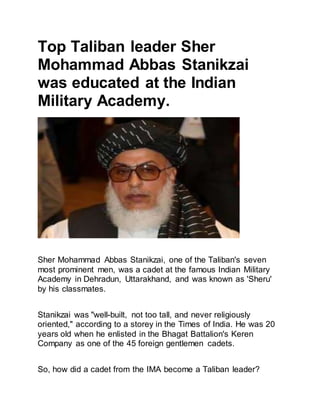
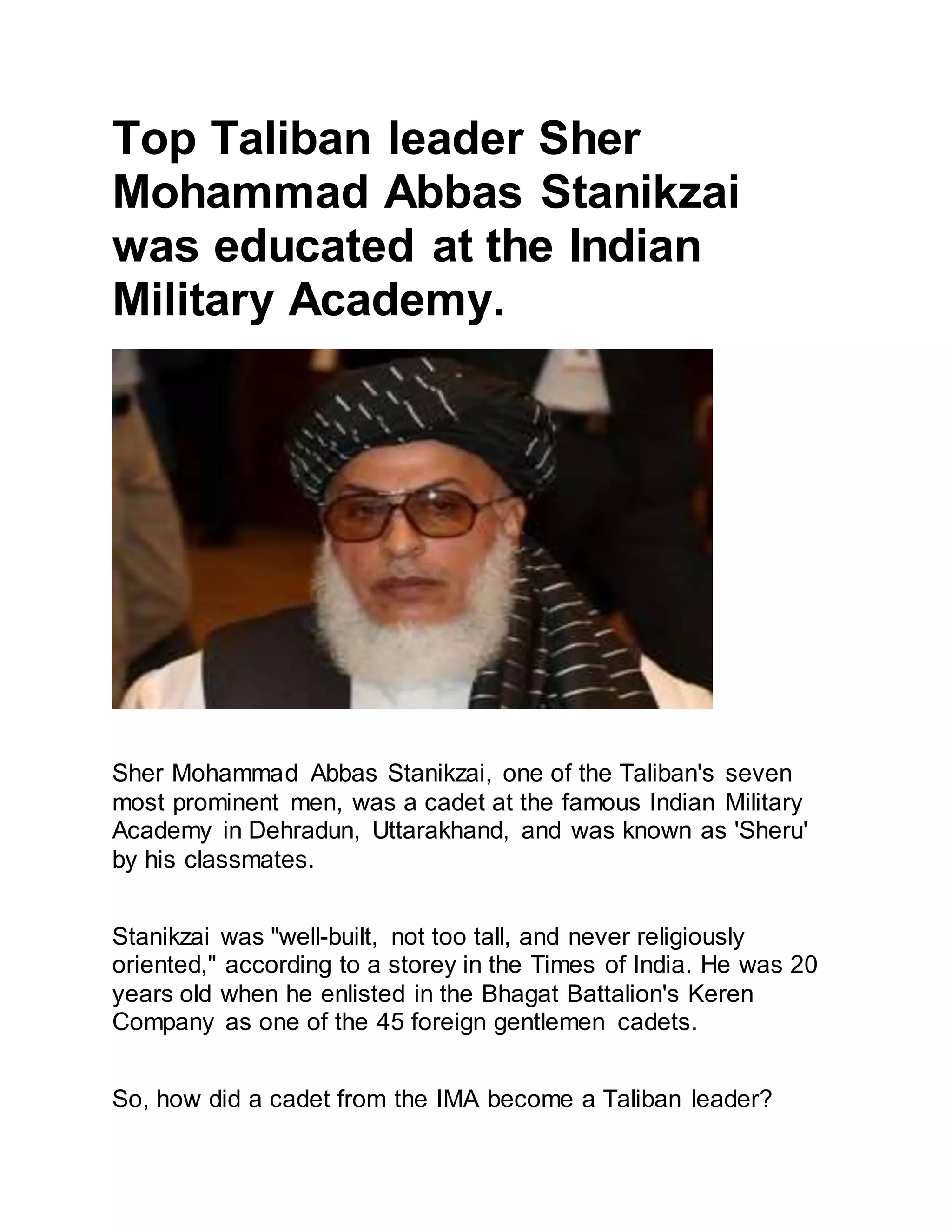
Sher Mohammad Abbas Stanikzai, one of the Taliban's seven
most prominent men, was a cadet at the famous Indian Military
Academy in Dehradun, Uttarakhand, and was known as 'Sheru'
by his classmates.
Stanikzai was "well-built, not too tall, and never religiously
oriented," according to a storey in the Times of India. He was 20
years old when he enlisted in the Bhagat Battalion's Keren
Company as one of the 45 foreign gentlemen cadets.
So, how did a cadet from the IMA become a Taliban leader?
Years in the beginning
Stanikzai is a Pashtun who was born in the Baraki Barak area of
Afghanistan's Logar province in 1963.
He went on to study at the Indian Military Academy in Dehradun
after earning his master's degree in political science, where he
was involved in teaching Afghan army leaders in the 1970s.
His IMA classmate, Major General DA Chaturvedi (retired), was
described in the Times of India as saying, "He was a kind young
man who appeared to be a year older than the other cadets at the
institution. He maintained his edgy moustache. At the time, he
didn't have any extremist ideas. He was a typical Afghan cadet
who appeared to be having a good time here."
Another student, Colonel Kesar Singh Shekhawat (retd), added:
"He reminded me of the kid down the street. One vacation to
Rishikesh, where we swam in the Ganga, comes to mind. There's
a photo of him in his swimming trunks from a trip to Rishikesh to
dip in the Ganga "...
"Even if he smoked a cigarette, he'd do it away from our gaze,"
added a third batch member.
Years of Taliban rule
After serving in the Afghan army and participating in the Soviet-
Afghan conflict, he quit the fighting forces and joined the Taliban
in 1996.
According to a New York Times report, an old acquaintance
admitted that when he first joined the group, he didn't exactly fit
in. Furthermore, he and his wife would frequently dine out in
Quetta, Pakistan, which became a source of gossip among the
fighters.
Stanza served as deputy minister of foreign affairs under Wakil
Ahmed Muttawakil and later deputy minister of health during the
Taliban's leadership in Afghanistan from 1996 to 2001.
As acting foreign minister in 1996, Stanikzai travelled to
Washington, DC to petition Bill Clinton's government to provide
diplomatic recognition to Taliban-ruled Afghanistan.
In the years that followed, he became the Taliban's most
prominent negotiator. His command of the English language and
combat experience came in handy
.However, in 1998, he drew afoul of the Taliban leadership,
possibly as a result of misuse of power and a sloppy attitude
toward alcohol.
But, thanks to his ties to Pakistani military intelligence, which
exerted control over the Taliban, he was able to re-enter the fray.
He headed the Taliban's political office in Doha, where its senior
commanders were stationed, after it opened in 2012, and led
negotiations on the group's behalf until Abdul Ghani Baradar, the
group's co-founder and expected next leader, returned in 2019.
Stanikzai, on the other hand, is still a major negotiator.
In meetings with Afghan government authorities, he also served
as a deputy negotiator for Abdul Hakim Haqqani, the Taliban's
chief negotiator.
When the Taliban sat down to talk peace with the Afghan
government in September 2020, Stanikzai was first named to lead
the negotiating team, but just days later, it was reported that he
would serve as Abdul Hakim's deputy.
"If there's one word to define Stanikzai, it's survivor," Andrew
Watkins, a senior Afghan analyst for the International Crisis
Group, a Washington-based think tank, told the Washington Post.
According to Watkins, Stanikzai has never been a significant
mover within the movement, but he's always managed to maintain
just enough influence to be alive and active in the shadows of the
upper echelons.
Stanikzai is currently one of the organization's seven most
powerful men, who are striving to recast themselves in a more
moderate manner.
Is there a chance for India?
Several of Stanikzai's IMA classmates believe his stay at the
Dehradun facility will prove to be a valuable asset to the country.
They feel that India can leverage his history and background to
negotiate with the Taliban at the table.
This would be advantageous to New Delhi since it would provide
some confidence that the Taliban-controlled areas would not be
used against India.
It remains to be seen whether India is able to reach an agreement
with the group, as policy demands that conversations take place
only with genuine countries. If it does, though, it will only benefit
India.

Taliban leader from I M A

  • 1.
    Top Taliban leaderSher Mohammad Abbas Stanikzai was educated at the Indian Military Academy. Sher Mohammad Abbas Stanikzai, one of the Taliban's seven most prominent men, was a cadet at the famous Indian Military Academy in Dehradun, Uttarakhand, and was known as 'Sheru' by his classmates. Stanikzai was "well-built, not too tall, and never religiously oriented," according to a storey in the Times of India. He was 20 years old when he enlisted in the Bhagat Battalion's Keren Company as one of the 45 foreign gentlemen cadets. So, how did a cadet from the IMA become a Taliban leader?
  • 2.
    Years in thebeginning Stanikzai is a Pashtun who was born in the Baraki Barak area of Afghanistan's Logar province in 1963. He went on to study at the Indian Military Academy in Dehradun after earning his master's degree in political science, where he was involved in teaching Afghan army leaders in the 1970s. His IMA classmate, Major General DA Chaturvedi (retired), was described in the Times of India as saying, "He was a kind young man who appeared to be a year older than the other cadets at the institution. He maintained his edgy moustache. At the time, he didn't have any extremist ideas. He was a typical Afghan cadet who appeared to be having a good time here." Another student, Colonel Kesar Singh Shekhawat (retd), added: "He reminded me of the kid down the street. One vacation to Rishikesh, where we swam in the Ganga, comes to mind. There's a photo of him in his swimming trunks from a trip to Rishikesh to dip in the Ganga "... "Even if he smoked a cigarette, he'd do it away from our gaze," added a third batch member. Years of Taliban rule After serving in the Afghan army and participating in the Soviet- Afghan conflict, he quit the fighting forces and joined the Taliban in 1996.
  • 3.
    According to aNew York Times report, an old acquaintance admitted that when he first joined the group, he didn't exactly fit in. Furthermore, he and his wife would frequently dine out in Quetta, Pakistan, which became a source of gossip among the fighters. Stanza served as deputy minister of foreign affairs under Wakil Ahmed Muttawakil and later deputy minister of health during the Taliban's leadership in Afghanistan from 1996 to 2001. As acting foreign minister in 1996, Stanikzai travelled to Washington, DC to petition Bill Clinton's government to provide diplomatic recognition to Taliban-ruled Afghanistan. In the years that followed, he became the Taliban's most prominent negotiator. His command of the English language and combat experience came in handy .However, in 1998, he drew afoul of the Taliban leadership, possibly as a result of misuse of power and a sloppy attitude toward alcohol. But, thanks to his ties to Pakistani military intelligence, which exerted control over the Taliban, he was able to re-enter the fray. He headed the Taliban's political office in Doha, where its senior commanders were stationed, after it opened in 2012, and led negotiations on the group's behalf until Abdul Ghani Baradar, the
  • 4.
    group's co-founder andexpected next leader, returned in 2019. Stanikzai, on the other hand, is still a major negotiator. In meetings with Afghan government authorities, he also served as a deputy negotiator for Abdul Hakim Haqqani, the Taliban's chief negotiator. When the Taliban sat down to talk peace with the Afghan government in September 2020, Stanikzai was first named to lead the negotiating team, but just days later, it was reported that he would serve as Abdul Hakim's deputy. "If there's one word to define Stanikzai, it's survivor," Andrew Watkins, a senior Afghan analyst for the International Crisis Group, a Washington-based think tank, told the Washington Post. According to Watkins, Stanikzai has never been a significant mover within the movement, but he's always managed to maintain just enough influence to be alive and active in the shadows of the upper echelons. Stanikzai is currently one of the organization's seven most powerful men, who are striving to recast themselves in a more moderate manner. Is there a chance for India? Several of Stanikzai's IMA classmates believe his stay at the Dehradun facility will prove to be a valuable asset to the country.
  • 5.
    They feel thatIndia can leverage his history and background to negotiate with the Taliban at the table. This would be advantageous to New Delhi since it would provide some confidence that the Taliban-controlled areas would not be used against India. It remains to be seen whether India is able to reach an agreement with the group, as policy demands that conversations take place only with genuine countries. If it does, though, it will only benefit India.