Tactics for Testing DevOps
Infrastructure Code
Given by Derek C. Ashmore
STAREAST 2023
May 3, 2023
©2022 Derek C. Ashmore, All Rights Reserved 1
Who am I?
• Professional Geek
since 1987
• AWS since 2010
• Azure since 2017
• Specialties
• Application
Transformation
• Infrastructure
Automation
• Yes – I still code!
©2022 Derek C. Ashmore, All Rights Reserved 2
Discussion Resources
• This slide deck
– https://www.slideshare.net/derekashmore/presentations
• Slide deck has hyper-links!
– Don’t bother writing down URLs
• Put questions in the chat – we’ll address them at the end
©2022 Derek C. Ashmore, All Rights Reserved 3
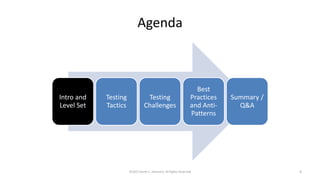
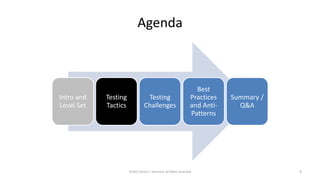
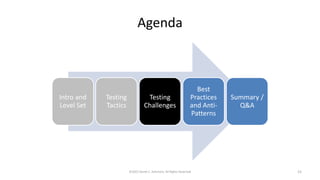
Agenda
Intro and
Level Set
Testing
Tactics
Testing
Challenges
Best
Practices
and Anti-
Patterns
Summary /
Q&A
©2022 Derek C. Ashmore, All Rights Reserved 4
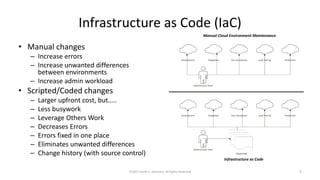
Infrastructure as Code (IaC)
• Manual changes
– Increase errors
– Increase unwanted differences
between environments
– Increase admin workload
• Scripted/Coded changes
– Larger upfront cost, but…..
– Less busywork
– Leverage Others Work
– Decreases Errors
– Errors fixed in one place
– Eliminates unwanted differences
– Change history (with source control)
©2022 Derek C. Ashmore, All Rights Reserved 5
Infrastructure Code Categories
➢Network / non-application specific infrastructure
▪ Virtual Networks/VPCs and subnets
▪ Route tables, Network peering
▪ Security groups / NSGs
➢Application infrastructure
▪ Relational databases
▪ Serverless constructs
➢Security privileges and policies
▪ IAM Roles and privilege grants
➢Virtual machine image production
▪ Produce machine images for teams to use
©2022 Derek C. Ashmore, All Rights Reserved 6
Infrastructure Code Testing
➢IaC is code!
▪ Housed in source control
▪ Often changed and released
▪ Needs testing like any other code
➢IaC change can have negative impact
▪ Environment outages
▪ End-user internet connectivity outage
▪ Application outages
▪ Testing team delayed for four days
➢Testing IaC can minimize negative impact
©2022 Derek C. Ashmore, All Rights Reserved 7
Infrastructure Code Testing Differences
➢IaC != Application Code
▪ IaC requires external resources (e.g. Cloud) to run
▪ In-process unit testing often not possible
➢Limited localized (in-process) testing
▪ Generally limited to syntax checks
▪ Terraform validation
▪ Ansible Dry Runs
▪ IDE syntax checks
➢Most testing is “integration” testing
©2022 Derek C. Ashmore, All Rights Reserved 8
Agenda
Intro and
Level Set
Testing
Tactics
Testing
Challenges
Best
Practices
and Anti-
Patterns
Summary /
Q&A
©2022 Derek C. Ashmore, All Rights Reserved 9
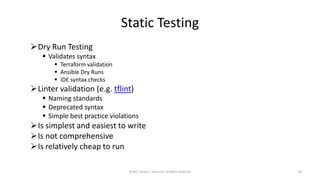
Static Testing
➢Dry Run Testing
▪ Validates syntax
▪ Terraform validation
▪ Ansible Dry Runs
▪ IDE syntax checks
➢Linter validation (e.g. tflint)
▪ Naming standards
▪ Deprecated syntax
▪ Simple best practice violations
➢Is simplest and easiest to write
➢Is not comprehensive
➢Is relatively cheap to run
©2022 Derek C. Ashmore, All Rights Reserved 10
Static Testing Getting Started
➢Start here – quickest way to get testing benefits
➢Execute Dry Runs and Linter Validation on change check-in
▪ Prevent merges with invalid syntax
▪ Prevent merges violating defined standards checks
➢Automation is your friend
▪ No need to manually spend time with this
➢This can be implemented in a DRY fashion
▪ Easy to write once and configure/activate for multiple repos
➢Will catch some percentage of errors
➢Is relatively cheap to run
©2022 Derek C. Ashmore, All Rights Reserved 11
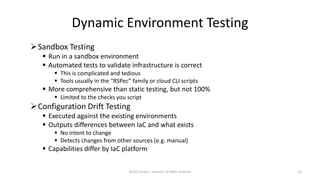
Dynamic Environment Testing
➢Sandbox Testing
▪ Run in a sandbox environment
▪ Automated tests to validate infrastructure is correct
▪ This is complicated and tedious
▪ Tools usually in the “RSPec” family or cloud CLI scripts
▪ More comprehensive than static testing, but not 100%
▪ Limited to the checks you script
➢Configuration Drift Testing
▪ Executed against the existing environments
▪ Outputs differences between IaC and what exists
▪ No intent to change
▪ Detects changes from other sources (e.g. manual)
▪ Capabilities differ by IaC platform
©2022 Derek C. Ashmore, All Rights Reserved 12
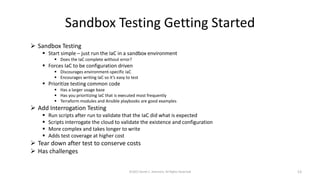
Sandbox Testing Getting Started
➢ Sandbox Testing
▪ Start simple – just run the IaC in a sandbox environment
▪ Does the IaC complete without error?
▪ Forces IaC to be configuration driven
▪ Discourages environment-specific IaC
▪ Encourages writing IaC so it’s easy to test
▪ Prioritize testing common code
▪ Has a larger usage base
▪ Has you prioritizing IaC that is executed most frequently
▪ Terraform modules and Ansible playbooks are good examples
➢ Add Interrogation Testing
▪ Run scripts after run to validate that the IaC did what is expected
▪ Scripts interrogate the cloud to validate the existence and configuration
▪ More complex and takes longer to write
▪ Adds test coverage at higher cost
➢ Tear down after test to conserve costs
➢ Has challenges
©2022 Derek C. Ashmore, All Rights Reserved 13
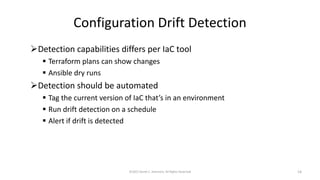
Configuration Drift Detection
➢Detection capabilities differs per IaC tool
▪ Terraform plans can show changes
▪ Ansible dry runs
➢Detection should be automated
▪ Tag the current version of IaC that’s in an environment
▪ Run drift detection on a schedule
▪ Alert if drift is detected
©2022 Derek C. Ashmore, All Rights Reserved 14
Agenda
Intro and
Level Set
Testing
Tactics
Testing
Challenges
Best
Practices
and Anti-
Patterns
Summary /
Q&A
©2022 Derek C. Ashmore, All Rights Reserved 15
Infrastructure Code Testing Challenges
➢Friction
➢Dependencies
➢Testing costs
➢Manual intervention requirements
➢Shifting Sand Problem
©2022 Derek C. Ashmore, All Rights Reserved 16
IaC Testing Friction
➢Larger effort to write tests
▪ Tooling varies widely
▪ RSpec style testing [awspec (AWS), inspec
(Azure), etc.]
▪ Terratest
▪ Tooling requires additional expertise
▪ Ruby for Rspec
▪ GoLang for Terratest
➢Hard to make comprehensive
▪ Sheer number of conditions and
attributes to check
©2022 Derek C. Ashmore, All Rights Reserved 17
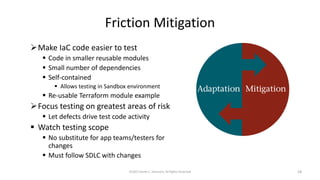
Friction Mitigation
➢Make IaC code easier to test
▪ Code in smaller reusable modules
▪ Small number of dependencies
▪ Self-contained
▪ Allows testing in Sandbox environment
▪ Re-usable Terraform module example
➢Focus testing on greatest areas of risk
▪ Let defects drive test code activity
▪ Watch testing scope
▪ No substitute for app teams/testers for
changes
▪ Must follow SDLC with changes
©2022 Derek C. Ashmore, All Rights Reserved 18
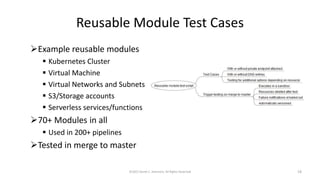
Reusable Module Test Cases
➢Example reusable modules
▪ Kubernetes Cluster
▪ Virtual Machine
▪ Virtual Networks and Subnets
▪ S3/Storage accounts
▪ Serverless services/functions
➢70+ Modules in all
▪ Used in 200+ pipelines
➢Tested in merge to master
©2022 Derek C. Ashmore, All Rights Reserved 19
IaC Testing Dependencies
➢Dependencies are the heaviest type of friction
▪ Examples include
▪ Active Directory
▪ DNS services
▪ Virtual networking
▪ Labor costs money, but most of it is up front
▪ Don’t strive for 100% coverage
▪ Spend testing labor time wisely
▪ Limit testing to our code, not infrastructure tech stack functionality
➢The cost for not testing doesn’t save money
▪ The business impact for deployed defects usually greater than testing runtime
costs
©2022 Derek C. Ashmore, All Rights Reserved 20
IaC Testing Costs
➢All tests for IaC cost money
▪ Test in small, disposable units
▪ We always test in a Sandbox
▪ All resources deallocated after each test
▪ Labor costs money, but most of it is up front
▪ Don’t strive for 100% coverage
▪ Spend testing labor time wisely
▪ Limit testing to our code, not infrastructure tech stack functionality
➢The cost for not testing doesn’t save money
▪ The business impact for deployed defects usually greater than testing runtime
costs
©2022 Derek C. Ashmore, All Rights Reserved 21
Manual Intervention Requirements
➢Some companies require manual intervention
▪ Often dictated by company policy
▪ Examples include
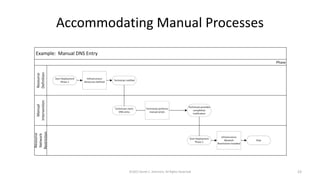
▪ Requiring DNS entries to be manually entered
▪ Separate group allocates security privileges
▪ Cloud functionality changes for Azure storage groups
▪ On-premises connectivity
➢IaC depending on manual intervention cannot have automation tests
▪ Localize the manual intervention requirements
©2022 Derek C. Ashmore, All Rights Reserved 22
Accommodating Manual Processes
©2022 Derek C. Ashmore, All Rights Reserved 23
Shifting Sand Problem
➢Changes occur outside of IaC
▪ Common Sources
▪ Automatic dependency updates
▪ Cloud backend updates
▪ Right-hand/Left-hand issues
▪ Managing cloud assets from multiple
sources
➢Makes IaC Code not Repeatable!
▪ Causes to break in future runs
▪ Recipe for unplanned work!
➢Further reading
©2022 Derek C. Ashmore, All Rights Reserved 24
Avoid Automatic Updates!
➢Perceived as a “convenience”
▪ Avoids upgrade work
▪ Causes unplanned work
➢Examples include
▪ “Latest” dependencies
▪ Terraform cloud provider version
▪ Common IaC Code version
▪ VM automatic updates
▪ Security updates not avoidable!
➢Convert “unplanned” work to
“planned” work
©2022 Derek C. Ashmore, All Rights Reserved 25
Early Detection Strategy
➢Scheduled testing in a sandbox
environment
▪ Detect/fix shifting sand problems before
users do!
➢Addresses
▪ Required automatic updates
▪ Cloud back-end changes
▪ Uncontrollable actions by other groups
➢Disadvantages
▪ Work is still unplanned
▪ Scheduled testing costs
▪ Labor to set up testing costs
©2022 Derek C. Ashmore, All Rights Reserved 26
Agenda
Intro and
Level Set
Testing
Tactics
Testing
Challenges
Best
Practices
and Anti-
Patterns
Summary /
Q&A
©2022 Derek C. Ashmore, All Rights Reserved 27
Infrastructure Code Testing Best Practices
➢Don't expect perfection
▪ IaC output is much more complex than most application code
➢Concentrate Automated Testing for reused modules
▪ Tests cover the most widely used infrastructure code
▪ Defects for widely used modules will have the most negative impact
▪ Example: Some common modules get used by dozens of pipelines
▪ Completely self-contained
▪ Test create all dependencies the reused code needs
▪ Easier because of smaller blast radius
▪ Less for the test to set up in the sandbox
▪ Easy to make completely disposable
▪ Use sandbox environment
▪ Drop after test (save $)
▪ Coding mistakes have less impact
©2022 Derek C. Ashmore, All Rights Reserved 28
Infrastructure Code Testing Best Practices (con’t)
➢Let defects guide automated test writing
▪ Focuses test writing labor on the most important
➢Watch the blast radius
▪ Blast radius correlates with test code complexity
➢Make IaC more easily testable
▪ Keep small and targeted
▪ Reduce dependencies
©2022 Derek C. Ashmore, All Rights Reserved 29
Infrastructure Code Testing Anti-Patterns
➢No testing in Sandbox
▪ Need a place to test/edit without affecting others
▪ Environment must be disposable
➢Inadequate testing in lower environments
➢No substitute for real world contact with others
➢Automated testing of IaC is not comprehensive
©2022 Derek C. Ashmore, All Rights Reserved 30
Summary
➢Infrastructure code must have automated tests too
▪ Infrastructure code has defects too
▪ Defects can cause outages
▪ Untested code cannot be trusted
➢Automated testing needs to be funded
▪ You will get a positive ROI
▪ You don’t need to be perfect
▪ Don’t let perfection prevent progress!
➢Discipline is Key
▪ Changes starting out will take longer
▪ Will be faster after developers are up to speed
©2022 Derek C. Ashmore, All Rights Reserved 31
Thank you!
• Derek Ashmore:
– Blog: www.derekashmore.com
– LinkedIn: www.linkedin.com/in/derekashmore
• Connect Invites from attendees welcome
– Twitter: https://twitter.com/Derek_Ashmore
– GitHub: https://github.com/Derek-Ashmore
– Book: http://dvtpress.com/
• Please fill out the evaluation form!
©2022 Derek C. Ashmore, All Rights Reserved 32

Tactics for Testing DevOps Infrastructure Code

  • 1.
    Tactics for TestingDevOps Infrastructure Code Given by Derek C. Ashmore STAREAST 2023 May 3, 2023 ©2022 Derek C. Ashmore, All Rights Reserved 1
  • 2.
    Who am I? •Professional Geek since 1987 • AWS since 2010 • Azure since 2017 • Specialties • Application Transformation • Infrastructure Automation • Yes – I still code! ©2022 Derek C. Ashmore, All Rights Reserved 2
  • 3.
    Discussion Resources • Thisslide deck – https://www.slideshare.net/derekashmore/presentations • Slide deck has hyper-links! – Don’t bother writing down URLs • Put questions in the chat – we’ll address them at the end ©2022 Derek C. Ashmore, All Rights Reserved 3
  • 4.
    Agenda Intro and Level Set Testing Tactics Testing Challenges Best Practices andAnti- Patterns Summary / Q&A ©2022 Derek C. Ashmore, All Rights Reserved 4
  • 5.
    Infrastructure as Code(IaC) • Manual changes – Increase errors – Increase unwanted differences between environments – Increase admin workload • Scripted/Coded changes – Larger upfront cost, but….. – Less busywork – Leverage Others Work – Decreases Errors – Errors fixed in one place – Eliminates unwanted differences – Change history (with source control) ©2022 Derek C. Ashmore, All Rights Reserved 5
  • 6.
    Infrastructure Code Categories ➢Network/ non-application specific infrastructure ▪ Virtual Networks/VPCs and subnets ▪ Route tables, Network peering ▪ Security groups / NSGs ➢Application infrastructure ▪ Relational databases ▪ Serverless constructs ➢Security privileges and policies ▪ IAM Roles and privilege grants ➢Virtual machine image production ▪ Produce machine images for teams to use ©2022 Derek C. Ashmore, All Rights Reserved 6
  • 7.
    Infrastructure Code Testing ➢IaCis code! ▪ Housed in source control ▪ Often changed and released ▪ Needs testing like any other code ➢IaC change can have negative impact ▪ Environment outages ▪ End-user internet connectivity outage ▪ Application outages ▪ Testing team delayed for four days ➢Testing IaC can minimize negative impact ©2022 Derek C. Ashmore, All Rights Reserved 7
  • 8.
    Infrastructure Code TestingDifferences ➢IaC != Application Code ▪ IaC requires external resources (e.g. Cloud) to run ▪ In-process unit testing often not possible ➢Limited localized (in-process) testing ▪ Generally limited to syntax checks ▪ Terraform validation ▪ Ansible Dry Runs ▪ IDE syntax checks ➢Most testing is “integration” testing ©2022 Derek C. Ashmore, All Rights Reserved 8
  • 9.
    Agenda Intro and Level Set Testing Tactics Testing Challenges Best Practices andAnti- Patterns Summary / Q&A ©2022 Derek C. Ashmore, All Rights Reserved 9
  • 10.
    Static Testing ➢Dry RunTesting ▪ Validates syntax ▪ Terraform validation ▪ Ansible Dry Runs ▪ IDE syntax checks ➢Linter validation (e.g. tflint) ▪ Naming standards ▪ Deprecated syntax ▪ Simple best practice violations ➢Is simplest and easiest to write ➢Is not comprehensive ➢Is relatively cheap to run ©2022 Derek C. Ashmore, All Rights Reserved 10
  • 11.
    Static Testing GettingStarted ➢Start here – quickest way to get testing benefits ➢Execute Dry Runs and Linter Validation on change check-in ▪ Prevent merges with invalid syntax ▪ Prevent merges violating defined standards checks ➢Automation is your friend ▪ No need to manually spend time with this ➢This can be implemented in a DRY fashion ▪ Easy to write once and configure/activate for multiple repos ➢Will catch some percentage of errors ➢Is relatively cheap to run ©2022 Derek C. Ashmore, All Rights Reserved 11
  • 12.
    Dynamic Environment Testing ➢SandboxTesting ▪ Run in a sandbox environment ▪ Automated tests to validate infrastructure is correct ▪ This is complicated and tedious ▪ Tools usually in the “RSPec” family or cloud CLI scripts ▪ More comprehensive than static testing, but not 100% ▪ Limited to the checks you script ➢Configuration Drift Testing ▪ Executed against the existing environments ▪ Outputs differences between IaC and what exists ▪ No intent to change ▪ Detects changes from other sources (e.g. manual) ▪ Capabilities differ by IaC platform ©2022 Derek C. Ashmore, All Rights Reserved 12
  • 13.
    Sandbox Testing GettingStarted ➢ Sandbox Testing ▪ Start simple – just run the IaC in a sandbox environment ▪ Does the IaC complete without error? ▪ Forces IaC to be configuration driven ▪ Discourages environment-specific IaC ▪ Encourages writing IaC so it’s easy to test ▪ Prioritize testing common code ▪ Has a larger usage base ▪ Has you prioritizing IaC that is executed most frequently ▪ Terraform modules and Ansible playbooks are good examples ➢ Add Interrogation Testing ▪ Run scripts after run to validate that the IaC did what is expected ▪ Scripts interrogate the cloud to validate the existence and configuration ▪ More complex and takes longer to write ▪ Adds test coverage at higher cost ➢ Tear down after test to conserve costs ➢ Has challenges ©2022 Derek C. Ashmore, All Rights Reserved 13
  • 14.
    Configuration Drift Detection ➢Detectioncapabilities differs per IaC tool ▪ Terraform plans can show changes ▪ Ansible dry runs ➢Detection should be automated ▪ Tag the current version of IaC that’s in an environment ▪ Run drift detection on a schedule ▪ Alert if drift is detected ©2022 Derek C. Ashmore, All Rights Reserved 14
  • 15.
    Agenda Intro and Level Set Testing Tactics Testing Challenges Best Practices andAnti- Patterns Summary / Q&A ©2022 Derek C. Ashmore, All Rights Reserved 15
  • 16.
    Infrastructure Code TestingChallenges ➢Friction ➢Dependencies ➢Testing costs ➢Manual intervention requirements ➢Shifting Sand Problem ©2022 Derek C. Ashmore, All Rights Reserved 16
  • 17.
    IaC Testing Friction ➢Largereffort to write tests ▪ Tooling varies widely ▪ RSpec style testing [awspec (AWS), inspec (Azure), etc.] ▪ Terratest ▪ Tooling requires additional expertise ▪ Ruby for Rspec ▪ GoLang for Terratest ➢Hard to make comprehensive ▪ Sheer number of conditions and attributes to check ©2022 Derek C. Ashmore, All Rights Reserved 17
  • 18.
    Friction Mitigation ➢Make IaCcode easier to test ▪ Code in smaller reusable modules ▪ Small number of dependencies ▪ Self-contained ▪ Allows testing in Sandbox environment ▪ Re-usable Terraform module example ➢Focus testing on greatest areas of risk ▪ Let defects drive test code activity ▪ Watch testing scope ▪ No substitute for app teams/testers for changes ▪ Must follow SDLC with changes ©2022 Derek C. Ashmore, All Rights Reserved 18
  • 19.
    Reusable Module TestCases ➢Example reusable modules ▪ Kubernetes Cluster ▪ Virtual Machine ▪ Virtual Networks and Subnets ▪ S3/Storage accounts ▪ Serverless services/functions ➢70+ Modules in all ▪ Used in 200+ pipelines ➢Tested in merge to master ©2022 Derek C. Ashmore, All Rights Reserved 19
  • 20.
    IaC Testing Dependencies ➢Dependenciesare the heaviest type of friction ▪ Examples include ▪ Active Directory ▪ DNS services ▪ Virtual networking ▪ Labor costs money, but most of it is up front ▪ Don’t strive for 100% coverage ▪ Spend testing labor time wisely ▪ Limit testing to our code, not infrastructure tech stack functionality ➢The cost for not testing doesn’t save money ▪ The business impact for deployed defects usually greater than testing runtime costs ©2022 Derek C. Ashmore, All Rights Reserved 20
  • 21.
    IaC Testing Costs ➢Alltests for IaC cost money ▪ Test in small, disposable units ▪ We always test in a Sandbox ▪ All resources deallocated after each test ▪ Labor costs money, but most of it is up front ▪ Don’t strive for 100% coverage ▪ Spend testing labor time wisely ▪ Limit testing to our code, not infrastructure tech stack functionality ➢The cost for not testing doesn’t save money ▪ The business impact for deployed defects usually greater than testing runtime costs ©2022 Derek C. Ashmore, All Rights Reserved 21
  • 22.
    Manual Intervention Requirements ➢Somecompanies require manual intervention ▪ Often dictated by company policy ▪ Examples include ▪ Requiring DNS entries to be manually entered ▪ Separate group allocates security privileges ▪ Cloud functionality changes for Azure storage groups ▪ On-premises connectivity ➢IaC depending on manual intervention cannot have automation tests ▪ Localize the manual intervention requirements ©2022 Derek C. Ashmore, All Rights Reserved 22
  • 23.
    Accommodating Manual Processes ©2022Derek C. Ashmore, All Rights Reserved 23
  • 24.
    Shifting Sand Problem ➢Changesoccur outside of IaC ▪ Common Sources ▪ Automatic dependency updates ▪ Cloud backend updates ▪ Right-hand/Left-hand issues ▪ Managing cloud assets from multiple sources ➢Makes IaC Code not Repeatable! ▪ Causes to break in future runs ▪ Recipe for unplanned work! ➢Further reading ©2022 Derek C. Ashmore, All Rights Reserved 24
  • 25.
    Avoid Automatic Updates! ➢Perceivedas a “convenience” ▪ Avoids upgrade work ▪ Causes unplanned work ➢Examples include ▪ “Latest” dependencies ▪ Terraform cloud provider version ▪ Common IaC Code version ▪ VM automatic updates ▪ Security updates not avoidable! ➢Convert “unplanned” work to “planned” work ©2022 Derek C. Ashmore, All Rights Reserved 25
  • 26.
    Early Detection Strategy ➢Scheduledtesting in a sandbox environment ▪ Detect/fix shifting sand problems before users do! ➢Addresses ▪ Required automatic updates ▪ Cloud back-end changes ▪ Uncontrollable actions by other groups ➢Disadvantages ▪ Work is still unplanned ▪ Scheduled testing costs ▪ Labor to set up testing costs ©2022 Derek C. Ashmore, All Rights Reserved 26
  • 27.
    Agenda Intro and Level Set Testing Tactics Testing Challenges Best Practices andAnti- Patterns Summary / Q&A ©2022 Derek C. Ashmore, All Rights Reserved 27
  • 28.
    Infrastructure Code TestingBest Practices ➢Don't expect perfection ▪ IaC output is much more complex than most application code ➢Concentrate Automated Testing for reused modules ▪ Tests cover the most widely used infrastructure code ▪ Defects for widely used modules will have the most negative impact ▪ Example: Some common modules get used by dozens of pipelines ▪ Completely self-contained ▪ Test create all dependencies the reused code needs ▪ Easier because of smaller blast radius ▪ Less for the test to set up in the sandbox ▪ Easy to make completely disposable ▪ Use sandbox environment ▪ Drop after test (save $) ▪ Coding mistakes have less impact ©2022 Derek C. Ashmore, All Rights Reserved 28
  • 29.
    Infrastructure Code TestingBest Practices (con’t) ➢Let defects guide automated test writing ▪ Focuses test writing labor on the most important ➢Watch the blast radius ▪ Blast radius correlates with test code complexity ➢Make IaC more easily testable ▪ Keep small and targeted ▪ Reduce dependencies ©2022 Derek C. Ashmore, All Rights Reserved 29
  • 30.
    Infrastructure Code TestingAnti-Patterns ➢No testing in Sandbox ▪ Need a place to test/edit without affecting others ▪ Environment must be disposable ➢Inadequate testing in lower environments ➢No substitute for real world contact with others ➢Automated testing of IaC is not comprehensive ©2022 Derek C. Ashmore, All Rights Reserved 30
  • 31.
    Summary ➢Infrastructure code musthave automated tests too ▪ Infrastructure code has defects too ▪ Defects can cause outages ▪ Untested code cannot be trusted ➢Automated testing needs to be funded ▪ You will get a positive ROI ▪ You don’t need to be perfect ▪ Don’t let perfection prevent progress! ➢Discipline is Key ▪ Changes starting out will take longer ▪ Will be faster after developers are up to speed ©2022 Derek C. Ashmore, All Rights Reserved 31
  • 32.
    Thank you! • DerekAshmore: – Blog: www.derekashmore.com – LinkedIn: www.linkedin.com/in/derekashmore • Connect Invites from attendees welcome – Twitter: https://twitter.com/Derek_Ashmore – GitHub: https://github.com/Derek-Ashmore – Book: http://dvtpress.com/ • Please fill out the evaluation form! ©2022 Derek C. Ashmore, All Rights Reserved 32