Delivering M&E commitments under IFAD IX

Marzia Perilli, M&E Consultant, Statistics and Studies for Development Division, SKM
  Thomas Elhaut, Director, Statistics and Studies for Development Division, SKM
IFAD IX Key Commitments (1)
  Raise the level of compliance with the
requirement for projects to have a baseline
   survey by the end of their first year of
              implementation

               How?
              RIMS +
     Management to do more (J.Linn)
IFAD IX Key Commitments (2)
Present an information paper to the EB on the
methodologies IFAD will employ in carrying out
impact assessments and in measuring the new
impact-level indicators introduced in the RMF
                  2013-2015


                  How?
How?
Issues Paper and EB Information paper
• Poverty definition
• Methods and issues
• Work system                                Project M&E
• Adequate funding
                                          IFPRI Methodology
New impact-level indicators
• Household asset ownership index
• Level of child malnutrition
• Length of hungry season
              &
• 90 million people reached (Project M&E)
• 80 million people moved out of poverty (IFPRI Methodology)
IFAD IX Key Commitments (3)
 Actively pursue partnerships with institutions
 specialized in impact evaluation, and mobilize
resources to develop adequate internal capacity
  to conduct/manage impact evaluation work.


                   How?
How?
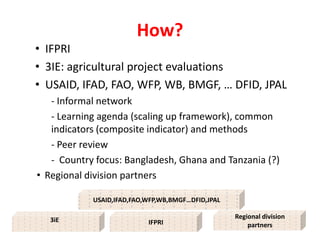
• IFPRI
• 3IE: agricultural project evaluations
• USAID, IFAD, FAO, WFP, WB, BMGF, … DFID, JPAL
   - Informal network
   - Learning agenda (scaling up framework), common
   indicators (composite indicator) and methods
   - Peer review
   - Country focus: Bangladesh, Ghana and Tanzania (?)
• Regional division partners

                             IFPRI
            USAID,IFAD,FAO,WFP,WB,BMGF…DFID,JPAL

   3iE                                             Regional division
                           IFPRI                       partners
IFAD IX Key Commitments (4)
Conduct, synthesize and report on approximately
     30 impact surveys over the IFAD9 period.
   3 to 6 of these will use RCTs or other similarly
rigorous methodology, depending on cost-sharing
   opportunities, and interest and availability of
  institutions specialized in impact evaluation to
                 support this work.


                    How?
How?
• Mixed methods (quantitative + qualitative)

• By project type               1
                                    IFAD Project Types
                                    Agricultural Development
                                2   Irrigation
                                3   Livestock

• ASAP (ECD)                    4
                                5
                                    Rural Development
                                    Credit and Financial Services
                                6   Fisheries
                                7   Marketing/Storage/Processing
                                8   Research/Extension/Training
IFAD IX Key Commitments (5)
    National monitoring and evaluation systems
Strengthen national M&E systems by enhancing the
      capacity of project management staff and
implementing partners, particularly at start-up and
      early project implementation through the
   systematic engagement of M&E experts during
           design and supervision missions.


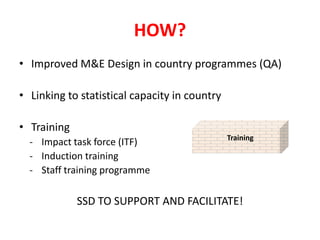
                    HOW?
HOW?
• Improved M&E Design in country programmes (QA)

• Linking to statistical capacity in country

• Training
                                               Training
  - Impact task force (ITF)
  - Induction training
  - Staff training programme

             SSD TO SUPPORT AND FACILITATE!
Six “theory of change” pitfalls to
                     avoid
             Stanford Social Innovation Review
“Learning organizations carefully specify their assumptions, regularly reflect
on whether those assumptions are bearing out, and consider what new
assumptions they might test to further improve impact.

One simple but powerful mechanism to accomplish this is to create a “learning
agenda”—a simple list of assumptions and hypotheses that your organization
can test at some frequency.

A learning agenda can help ensure that your organization’s theory of change is
constantly revisited”


http://www.ssireview.org/blog/entry/six_theory_of_change_pitfalls_to_avoid
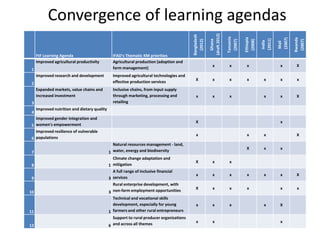
Convergence of learning agendas


                                                                                                       (draft 2012)
                                                                                          Bangladesh


                                                                                                                      Tanzania


                                                                                                                                 Ethiopia


                                                                                                                                                              Rwanda
                                                                                                                                                     (2007)
                                                                                                                                            (2011)
                                                                                                         Ghana
                                                                                            (2012)


                                                                                                                       (2007)


                                                                                                                                  (2008)


                                                                                                                                                               (2007)
                                                                                                                                             India


                                                                                                                                                     Mali
     FtF Learning Agenda                        IFAD's Thematic KM priorities
     Improved agricultural productivity         Agricultural production (adoption and
                                                                                                          x            x          x                   x        X
1                                               farm management)
     Improved research and development          Improved agricultural technologies and
                                                                                            X             x            x          x          x        x        x
2                                               effective production services
     Expanded markets, value chains and         Inclusive chains, from input supply
     increased investment                       through marketing, processing and           x             x            x                     x        x        X
3                                               retailing
     Improved nutrition and dietary quality
4
  Improved gender integration and
                                                                                            X                                                         x
5 women's empowerment
  Improved resilience of vulnerable
                                                                                            x                                     x          x                 X
6 populations
                                                Natural resources management - land,
                                                                                                                                  X          x        x
7                                             1 water, energy and biodiversity
                                                Climate change adaptation and
                                                                                            X             x            x
8                                             1 mitigation
                                                A full range of inclusive financial
                                                                                            x             x            x          x          x        x        X
9                                             3 services
                                                Rural enterprise development, with
                                                                                            X             x            x          x                   x        x
10                                            3 non-farm employment opportunities
                                                Technical and vocational skills
                                                development, especially for young           x             x            x                     x        X
11                                            1 farmers and other rural entrepreneurs
                                                Support to rural producer organizations
                                                                                            x             x                                           x
12                                            6 and across all themes

T elhaut delivering m&e commitments under ifad ix

  • 1.
    Delivering M&E commitmentsunder IFAD IX Marzia Perilli, M&E Consultant, Statistics and Studies for Development Division, SKM Thomas Elhaut, Director, Statistics and Studies for Development Division, SKM
  • 2.
    IFAD IX KeyCommitments (1) Raise the level of compliance with the requirement for projects to have a baseline survey by the end of their first year of implementation How? RIMS + Management to do more (J.Linn)
  • 3.
    IFAD IX KeyCommitments (2) Present an information paper to the EB on the methodologies IFAD will employ in carrying out impact assessments and in measuring the new impact-level indicators introduced in the RMF 2013-2015 How?
  • 4.
    How? Issues Paper andEB Information paper • Poverty definition • Methods and issues • Work system Project M&E • Adequate funding IFPRI Methodology New impact-level indicators • Household asset ownership index • Level of child malnutrition • Length of hungry season & • 90 million people reached (Project M&E) • 80 million people moved out of poverty (IFPRI Methodology)
  • 5.
    IFAD IX KeyCommitments (3) Actively pursue partnerships with institutions specialized in impact evaluation, and mobilize resources to develop adequate internal capacity to conduct/manage impact evaluation work. How?
  • 6.
    How? • IFPRI • 3IE:agricultural project evaluations • USAID, IFAD, FAO, WFP, WB, BMGF, … DFID, JPAL - Informal network - Learning agenda (scaling up framework), common indicators (composite indicator) and methods - Peer review - Country focus: Bangladesh, Ghana and Tanzania (?) • Regional division partners IFPRI USAID,IFAD,FAO,WFP,WB,BMGF…DFID,JPAL 3iE Regional division IFPRI partners
  • 7.
    IFAD IX KeyCommitments (4) Conduct, synthesize and report on approximately 30 impact surveys over the IFAD9 period. 3 to 6 of these will use RCTs or other similarly rigorous methodology, depending on cost-sharing opportunities, and interest and availability of institutions specialized in impact evaluation to support this work. How?
  • 8.
    How? • Mixed methods(quantitative + qualitative) • By project type 1 IFAD Project Types Agricultural Development 2 Irrigation 3 Livestock • ASAP (ECD) 4 5 Rural Development Credit and Financial Services 6 Fisheries 7 Marketing/Storage/Processing 8 Research/Extension/Training
  • 9.
    IFAD IX KeyCommitments (5) National monitoring and evaluation systems Strengthen national M&E systems by enhancing the capacity of project management staff and implementing partners, particularly at start-up and early project implementation through the systematic engagement of M&E experts during design and supervision missions. HOW?
  • 10.
    HOW? • Improved M&EDesign in country programmes (QA) • Linking to statistical capacity in country • Training Training - Impact task force (ITF) - Induction training - Staff training programme SSD TO SUPPORT AND FACILITATE!
  • 11.
    Six “theory ofchange” pitfalls to avoid Stanford Social Innovation Review “Learning organizations carefully specify their assumptions, regularly reflect on whether those assumptions are bearing out, and consider what new assumptions they might test to further improve impact. One simple but powerful mechanism to accomplish this is to create a “learning agenda”—a simple list of assumptions and hypotheses that your organization can test at some frequency. A learning agenda can help ensure that your organization’s theory of change is constantly revisited” http://www.ssireview.org/blog/entry/six_theory_of_change_pitfalls_to_avoid
  • 12.
    Convergence of learningagendas (draft 2012) Bangladesh Tanzania Ethiopia Rwanda (2007) (2011) Ghana (2012) (2007) (2008) (2007) India Mali FtF Learning Agenda IFAD's Thematic KM priorities Improved agricultural productivity Agricultural production (adoption and x x x x X 1 farm management) Improved research and development Improved agricultural technologies and X x x x x x x 2 effective production services Expanded markets, value chains and Inclusive chains, from input supply increased investment through marketing, processing and x x x x x X 3 retailing Improved nutrition and dietary quality 4 Improved gender integration and X x 5 women's empowerment Improved resilience of vulnerable x x x X 6 populations Natural resources management - land, X x x 7 1 water, energy and biodiversity Climate change adaptation and X x x 8 1 mitigation A full range of inclusive financial x x x x x x X 9 3 services Rural enterprise development, with X x x x x x 10 3 non-farm employment opportunities Technical and vocational skills development, especially for young x x x x X 11 1 farmers and other rural entrepreneurs Support to rural producer organizations x x x 12 6 and across all themes