Systems Engineering
Laboratory
System
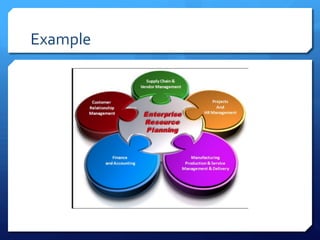
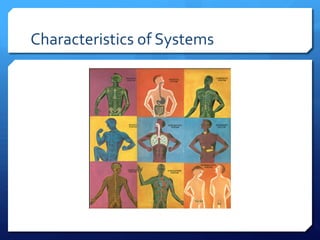
Ê A system is a group of ininteracting, interrelated or
interdependentcomponents that form a complex and unified
whole.
Ê A system’s components can be physical objects that you can
touch, such as the various parts that make up a car.
Ê The components can also be intangible, such as processes;
relationships; company policies; information flows;
interpersonal interactions; and internal statesof mind such as
feelings, values and beliefs.
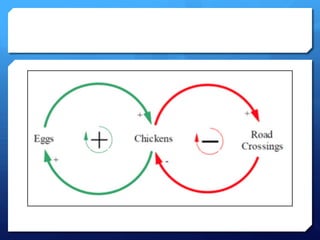
Example
Characteristics of Systems
Ê A SYSTEM’S PARTS MUST ALL BE PRESENT FOR THE
SYSTEMTO CARRY OUT ITS PURPOSE OPTIMALLY
Ê If you can take out components away from something without
affecting its functioning and its relationships, then you just have
a collections, not a system.
Ê Similarly if you add componentsto a collection without affecting
its functioning and relationships, it’s still just a collection.
Characteristics of Systems
Ê A SYSTEM’S PARTS MUST BE ARRANGED IN A SPECIFIC
WAY FORTHE SYSTEMTO CARRY OUT ITS PURPOSE.
Ê If the components of a collection can be combined in any
random order, then they do not make up a system.
Ê However in a systems such as a company, imagine what would
happenif the parts shifted around randomly-if, for instance, the
accountant specialists suddenly decided to work on the
production line and the production specialists decided to write
marketing copy.
Characteristics of Systems
Ê SYSTEMS HAVE SPECIFIC PURPOSESWITHIN LARGER
SYSTEMS
Ê All systems have specific purpose in relationshio to the larger
system in which they’re embedded.
Ê Because each system has its own purpose, each is a discrete
entity and has a kind of integrity that holds it together. In other
words, you can’t force two or more systems together and get a
new, single, larger system. Nor can you subdivide a system and
automatically end up with two smaller identical, functioning
systems.
Characteristics of Systems
Ê SYSTEMS MAINTAINTHEIR STABILITYTHROUGH
FLUCTUATIONS AND ADJUSTMENTS
Ê Left to themselves, systems seek to maintain their stability.
Ê Systems achieve this stability through the interactions,
feedback, and adjustments that continually circulate among the
system parts, and between the system and its enviroment
Characteristics of Systems
Ê SYSTEMS HAVE FEEDBACK
Ê Feedback isthe transmission and return of information.
Ê The most important feature of feedback is that it provides the
catalyst for change in behavior.
Ê A system has feedback within itself. But because all systems are
part of larger systems, a system also has a feedback between itself
and external systems.
Ê Feedback is not necessarily transmitted and returnedthrough the
same system component or even through the same system
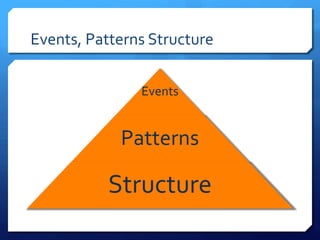
Events, Patterns Structure
Ê Systems are built on structures that leave evidence of their
presence, like fingerprints or tire marks, even if you can’t see
them.
Ê Structure is the overall way in which the system components
are interrelated
Ê The importance of understanding a system’s structure
explains all the events and trends that we see happening in
the worl around us.
Events, Patterns Structure
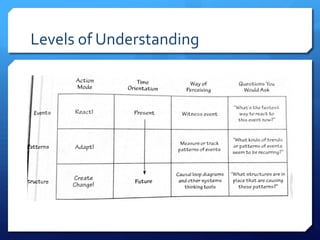
Events
Patterns
Structure
Events
Ê We live in an event-focused society.
Ê A fire breaks out in the neighborhood.
Ê A project misses a deadline.
Ê A machine Breaksdown
Ê We tend to focus on events rather than think about their
causes or how they fit into larger patterns .
Patterns
Ê Whereas events are like a snapshot, a picture of a single
moment in time patterns let us understad reality at a deeper
level.
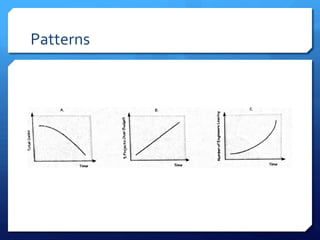
Ê Patterns are trends, or change in events over time.
Ê Detecting a pattern helps you put the most recent event in
the context of the other, similar events.The spotlight is then
taken off the specific event, and you can focus on exploring
how the series of events are related and begin thinking about
what caused them.
Patterns
Structure
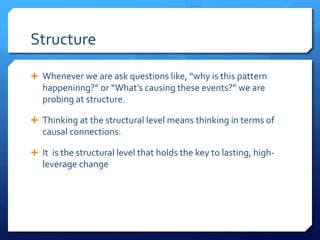
Ê Whenever we are ask questions like, “why is this pattern
happeninng?” or “What’s causing these events?” we are
probing at structure.
Ê Thinking at the structural level means thinking in terms of
causal connections.
Ê It is the structural level that holds the key to lasting, high-
leverage change
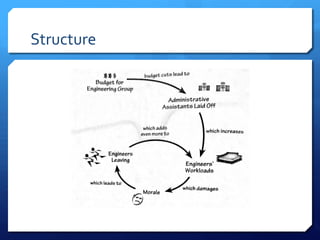
Structure
Levels of Understanding
Activity 1
Ê Think about three different systems and describe them, you
must list:
Ê Description
Ê Components
Ê Intangible Components
Ê Larger System
Activity 2
Ê 1. Identify a chronic problem or on going issue that you
wrestle with your daily life (for example, “Sales do well for a
while, then drop, then pick up again” or “Every year more and
more people get laid off”.
Ê 2. Try drawing a graph of what seems to be happening. (Tip:
Ask yourself, Is the pattern going up? Going down?,
Oscillating over time? Going up or down and then leveling
off?)
Ê 3. Looking at your graph, what do you see?
Activity 3
Ê For each System you have descibed before design a diagram
that explain clearly al connections and relations between
elements that justify it as systems.

systems_descriptions.pdf

  • 1.
  • 2.
    System Ê A systemis a group of ininteracting, interrelated or interdependentcomponents that form a complex and unified whole. Ê A system’s components can be physical objects that you can touch, such as the various parts that make up a car. Ê The components can also be intangible, such as processes; relationships; company policies; information flows; interpersonal interactions; and internal statesof mind such as feelings, values and beliefs.
  • 3.
  • 4.
    Characteristics of Systems ÊA SYSTEM’S PARTS MUST ALL BE PRESENT FOR THE SYSTEMTO CARRY OUT ITS PURPOSE OPTIMALLY Ê If you can take out components away from something without affecting its functioning and its relationships, then you just have a collections, not a system. Ê Similarly if you add componentsto a collection without affecting its functioning and relationships, it’s still just a collection.
  • 5.
    Characteristics of Systems ÊA SYSTEM’S PARTS MUST BE ARRANGED IN A SPECIFIC WAY FORTHE SYSTEMTO CARRY OUT ITS PURPOSE. Ê If the components of a collection can be combined in any random order, then they do not make up a system. Ê However in a systems such as a company, imagine what would happenif the parts shifted around randomly-if, for instance, the accountant specialists suddenly decided to work on the production line and the production specialists decided to write marketing copy.
  • 6.
  • 7.
    Characteristics of Systems ÊSYSTEMS HAVE SPECIFIC PURPOSESWITHIN LARGER SYSTEMS Ê All systems have specific purpose in relationshio to the larger system in which they’re embedded. Ê Because each system has its own purpose, each is a discrete entity and has a kind of integrity that holds it together. In other words, you can’t force two or more systems together and get a new, single, larger system. Nor can you subdivide a system and automatically end up with two smaller identical, functioning systems.
  • 8.
    Characteristics of Systems ÊSYSTEMS MAINTAINTHEIR STABILITYTHROUGH FLUCTUATIONS AND ADJUSTMENTS Ê Left to themselves, systems seek to maintain their stability. Ê Systems achieve this stability through the interactions, feedback, and adjustments that continually circulate among the system parts, and between the system and its enviroment
  • 10.
    Characteristics of Systems ÊSYSTEMS HAVE FEEDBACK Ê Feedback isthe transmission and return of information. Ê The most important feature of feedback is that it provides the catalyst for change in behavior. Ê A system has feedback within itself. But because all systems are part of larger systems, a system also has a feedback between itself and external systems. Ê Feedback is not necessarily transmitted and returnedthrough the same system component or even through the same system
  • 12.
    Events, Patterns Structure ÊSystems are built on structures that leave evidence of their presence, like fingerprints or tire marks, even if you can’t see them. Ê Structure is the overall way in which the system components are interrelated Ê The importance of understanding a system’s structure explains all the events and trends that we see happening in the worl around us.
  • 13.
  • 14.
    Events Ê We livein an event-focused society. Ê A fire breaks out in the neighborhood. Ê A project misses a deadline. Ê A machine Breaksdown Ê We tend to focus on events rather than think about their causes or how they fit into larger patterns .
  • 15.
    Patterns Ê Whereas eventsare like a snapshot, a picture of a single moment in time patterns let us understad reality at a deeper level. Ê Patterns are trends, or change in events over time. Ê Detecting a pattern helps you put the most recent event in the context of the other, similar events.The spotlight is then taken off the specific event, and you can focus on exploring how the series of events are related and begin thinking about what caused them.
  • 16.
  • 17.
    Structure Ê Whenever weare ask questions like, “why is this pattern happeninng?” or “What’s causing these events?” we are probing at structure. Ê Thinking at the structural level means thinking in terms of causal connections. Ê It is the structural level that holds the key to lasting, high- leverage change
  • 18.
  • 19.
  • 20.
    Activity 1 Ê Thinkabout three different systems and describe them, you must list: Ê Description Ê Components Ê Intangible Components Ê Larger System
  • 21.
    Activity 2 Ê 1.Identify a chronic problem or on going issue that you wrestle with your daily life (for example, “Sales do well for a while, then drop, then pick up again” or “Every year more and more people get laid off”. Ê 2. Try drawing a graph of what seems to be happening. (Tip: Ask yourself, Is the pattern going up? Going down?, Oscillating over time? Going up or down and then leveling off?) Ê 3. Looking at your graph, what do you see?
  • 22.
    Activity 3 Ê Foreach System you have descibed before design a diagram that explain clearly al connections and relations between elements that justify it as systems.