Sairaj Sajjath
Samsuddin Faisal Mahmood and
Dr. Dennis W. Smith, Jr.
August 20, 2013
Synthesis and characterization of poly
(acrylonitrile-co-N-vinylimidazole-co-
styrene) (AN-VIM-Sty) terpolymer
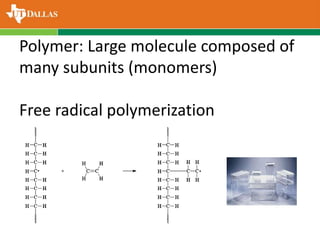
Polymer: Large molecule composed of
many subunits (monomers)
Free radical polymerization
AN-VIM copolymer
AN VIM
Scheme 1. The synthesis of Poly(acrylonitrile-1-vinylimazole) with AIBN as the initiator
and in a DMF solvent system1.
Monomer feed ratio (mol),
AN:VIM = 82:18
Tg = 114°C
Mn = 34,000 Da
Thermal degradation temp = 310°C
Char. Yield = 55%
Melt processable
Deng, W., Lobovsky, A., Iacono, S. T., Wu, T., Tomar, N., Budy, S. M., Long, T., Hoffman, W. P., Smith Jr, D. W.; Polymer.
52 (2011), 622-628.
Deng, W., Lobovsky, A., Iacono, S. T., Wu, T., Tomar, N., Budy, S. M., Long, T., Hoffman, W. P., Smith Jr, D. W.; Polymer.
52 (2011), 622-628.
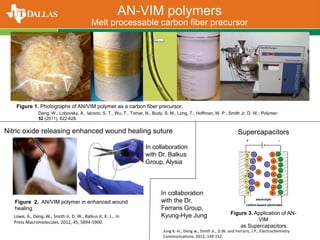
Figure 2. AN/VIM polymer in enhanced wound
healing.
Figure 3. Application of AN-
VIM
as Supercapacitors.
Figure 1. Photographs of AN/VIM polymer as a carbon fiber precursor.
Melt processable carbon fiber precursor
Nitric oxide releasing enhanced wound healing suture Supercapacitors
AN-VIM polymers
In collaboration
with Dr. Balkus
Group, Alysia
In collaboration
with the Dr.
Ferraris Group,
Kyung-Hye Jung
Jung K.-H., Deng w., Smith Jr., D.W. and Ferraris, J.P., Electrochemistry
Communications, 2012, 149-152.
Lowe, A., Deng, W., Smith Jr, D. W., Balkus Jr, K. J., In
Press Macromolecules. 2012, 45, 5894-5900.
Styrene
Popular feedstock for rubber
Widely used in polymer composites
Economical; clear
Acrylonitrile-styrene (SAN) copolymer
+ Combines properties of acrylonitrile and styrene
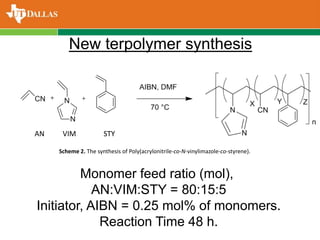
New terpolymer synthesis
Scheme 2. The synthesis of Poly(acrylonitrile-co-N-vinylimazole-co-styrene).
Monomer feed ratio (mol),
AN:VIM:STY = 80:15:5
Initiator, AIBN = 0.25 mol% of monomers.
Reaction Time 48 h.
AN VIM STY
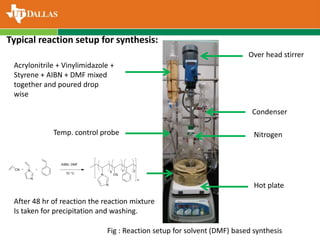
Acrylonitrile + Vinylimidazole +
Styrene + AIBN + DMF mixed
together and poured drop
wise
Over head stirrer
Condenser
Nitrogen
Hot plate
Temp. control probe
Typical reaction setup for synthesis:
Fig : Reaction setup for solvent (DMF) based synthesis
After 48 hr of reaction the reaction mixture
Is taken for precipitation and washing.
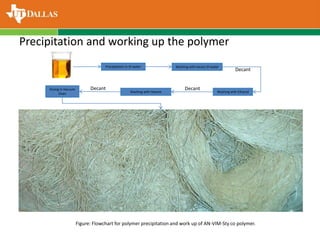
Precipitation and working up the polymer
Precipitation in DI water Washing with excess DI water
Decant
Washing with Ethanol
Decant
Washing with Hexane
DecantDrying in Vacuum
Oven
Figure: Flowchart for polymer precipitation and work up of AN-VIM-Sty co polymer.
1 3, 4,5,6,2
7 8,9
10, 11, 12
H2O
DMSO-d6
Molar Feed Ration: AN:VIM:STY = 80:15:5
Polymer composition by NMR: AN:VIM:STY = 80.5:14.5:5.0
NMR Spectrum of acrylonitrile-co-N-vinylimidazole-co-styrene terpolymer.
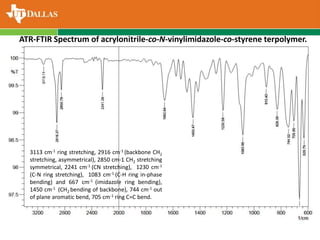
3113 cm-1 ring stretching, 2916 cm-1 (backbone CH2
stretching, asymmetrical), 2850 cm-1 CH2 stretching
symmetrical, 2241 cm-1 (CN stretching), 1230 cm-1
(C-N ring stretching), 1083 cm-1 (C-H ring in-phase
bending) and 667 cm-1 (imidazole ring bending),
1450 cm-1 (CH2 bending of backbone), 744 cm-1 out
of plane aromatic bend, 705 cm-1 ring C=C bend.
ATR-FTIR Spectrum of acrylonitrile-co-N-vinylimidazole-co-styrene terpolymer.
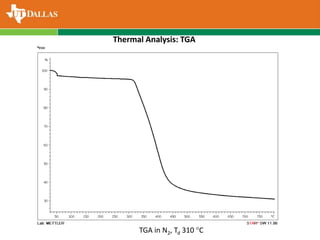
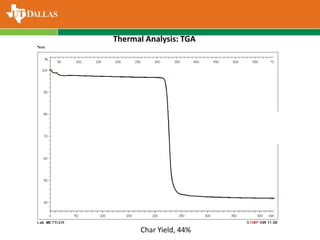
TGA in N2, Td 310 C
Thermal Analysis: TGA
TGA in Air
Char Yield, 44%
00
Thermal Analysis: TGA
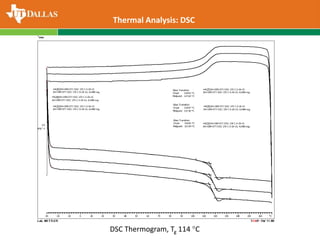
Thermal Analysis: DSC
DSC Thermogram, Tg 114 C
Scheme 2. The synthesis of Poly(acrylonitrile-co-N-vinylimazole-co-styrene).
Monomer feed ratio (mol),
AN:VIM:Sty = 80:15:5
Tg = 114°C
Thermal degradation temp = 310°C
Char. Yield = 44%
Melt processable
AN-VIM-Sty Terpolymer
Alan G. MacDiarmid NanoTech Institute
Dr. Dennis W. Smith, Jr.
Samsuddin Faisal Mahmood
All the group members
Welch Foundation and CEHMS.
Acknowledgements

Synhesis and characterization of AN-VIM-STY

  • 1.
    Sairaj Sajjath Samsuddin FaisalMahmood and Dr. Dennis W. Smith, Jr. August 20, 2013 Synthesis and characterization of poly (acrylonitrile-co-N-vinylimidazole-co- styrene) (AN-VIM-Sty) terpolymer
  • 2.
    Polymer: Large moleculecomposed of many subunits (monomers) Free radical polymerization
  • 3.
    AN-VIM copolymer AN VIM Scheme1. The synthesis of Poly(acrylonitrile-1-vinylimazole) with AIBN as the initiator and in a DMF solvent system1. Monomer feed ratio (mol), AN:VIM = 82:18 Tg = 114°C Mn = 34,000 Da Thermal degradation temp = 310°C Char. Yield = 55% Melt processable Deng, W., Lobovsky, A., Iacono, S. T., Wu, T., Tomar, N., Budy, S. M., Long, T., Hoffman, W. P., Smith Jr, D. W.; Polymer. 52 (2011), 622-628.
  • 4.
    Deng, W., Lobovsky,A., Iacono, S. T., Wu, T., Tomar, N., Budy, S. M., Long, T., Hoffman, W. P., Smith Jr, D. W.; Polymer. 52 (2011), 622-628. Figure 2. AN/VIM polymer in enhanced wound healing. Figure 3. Application of AN- VIM as Supercapacitors. Figure 1. Photographs of AN/VIM polymer as a carbon fiber precursor. Melt processable carbon fiber precursor Nitric oxide releasing enhanced wound healing suture Supercapacitors AN-VIM polymers In collaboration with Dr. Balkus Group, Alysia In collaboration with the Dr. Ferraris Group, Kyung-Hye Jung Jung K.-H., Deng w., Smith Jr., D.W. and Ferraris, J.P., Electrochemistry Communications, 2012, 149-152. Lowe, A., Deng, W., Smith Jr, D. W., Balkus Jr, K. J., In Press Macromolecules. 2012, 45, 5894-5900.
  • 5.
    Styrene Popular feedstock forrubber Widely used in polymer composites Economical; clear Acrylonitrile-styrene (SAN) copolymer + Combines properties of acrylonitrile and styrene
  • 6.
    New terpolymer synthesis Scheme2. The synthesis of Poly(acrylonitrile-co-N-vinylimazole-co-styrene). Monomer feed ratio (mol), AN:VIM:STY = 80:15:5 Initiator, AIBN = 0.25 mol% of monomers. Reaction Time 48 h. AN VIM STY
  • 7.
    Acrylonitrile + Vinylimidazole+ Styrene + AIBN + DMF mixed together and poured drop wise Over head stirrer Condenser Nitrogen Hot plate Temp. control probe Typical reaction setup for synthesis: Fig : Reaction setup for solvent (DMF) based synthesis After 48 hr of reaction the reaction mixture Is taken for precipitation and washing.
  • 8.
    Precipitation and workingup the polymer Precipitation in DI water Washing with excess DI water Decant Washing with Ethanol Decant Washing with Hexane DecantDrying in Vacuum Oven Figure: Flowchart for polymer precipitation and work up of AN-VIM-Sty co polymer.
  • 9.
    1 3, 4,5,6,2 78,9 10, 11, 12 H2O DMSO-d6 Molar Feed Ration: AN:VIM:STY = 80:15:5 Polymer composition by NMR: AN:VIM:STY = 80.5:14.5:5.0 NMR Spectrum of acrylonitrile-co-N-vinylimidazole-co-styrene terpolymer.
  • 10.
    3113 cm-1 ringstretching, 2916 cm-1 (backbone CH2 stretching, asymmetrical), 2850 cm-1 CH2 stretching symmetrical, 2241 cm-1 (CN stretching), 1230 cm-1 (C-N ring stretching), 1083 cm-1 (C-H ring in-phase bending) and 667 cm-1 (imidazole ring bending), 1450 cm-1 (CH2 bending of backbone), 744 cm-1 out of plane aromatic bend, 705 cm-1 ring C=C bend. ATR-FTIR Spectrum of acrylonitrile-co-N-vinylimidazole-co-styrene terpolymer.
  • 11.
    TGA in N2,Td 310 C Thermal Analysis: TGA
  • 12.
  • 13.
  • 14.
    Thermal Analysis: DSC DSCThermogram, Tg 114 C
  • 15.
    Scheme 2. Thesynthesis of Poly(acrylonitrile-co-N-vinylimazole-co-styrene). Monomer feed ratio (mol), AN:VIM:Sty = 80:15:5 Tg = 114°C Thermal degradation temp = 310°C Char. Yield = 44% Melt processable AN-VIM-Sty Terpolymer
  • 16.
    Alan G. MacDiarmidNanoTech Institute Dr. Dennis W. Smith, Jr. Samsuddin Faisal Mahmood All the group members Welch Foundation and CEHMS. Acknowledgements

Editor's Notes

  • #3 Method of polymerization by addition of free radicals (atom, molecule, ion w/ unpaired valence electrons) as building blocks
  • #6 Cheap, rigid, clear Reduce cost of AN/VIM production Create melt-processable SAN copolymers
  • #7 6
  • #11 Attenuated reflectance Fourier transform infrared spectrometry Purely surface technique