Key Features and Benefits
•	 2048 × 70 back-illuminated sensor
Enable optimum spectral resolution
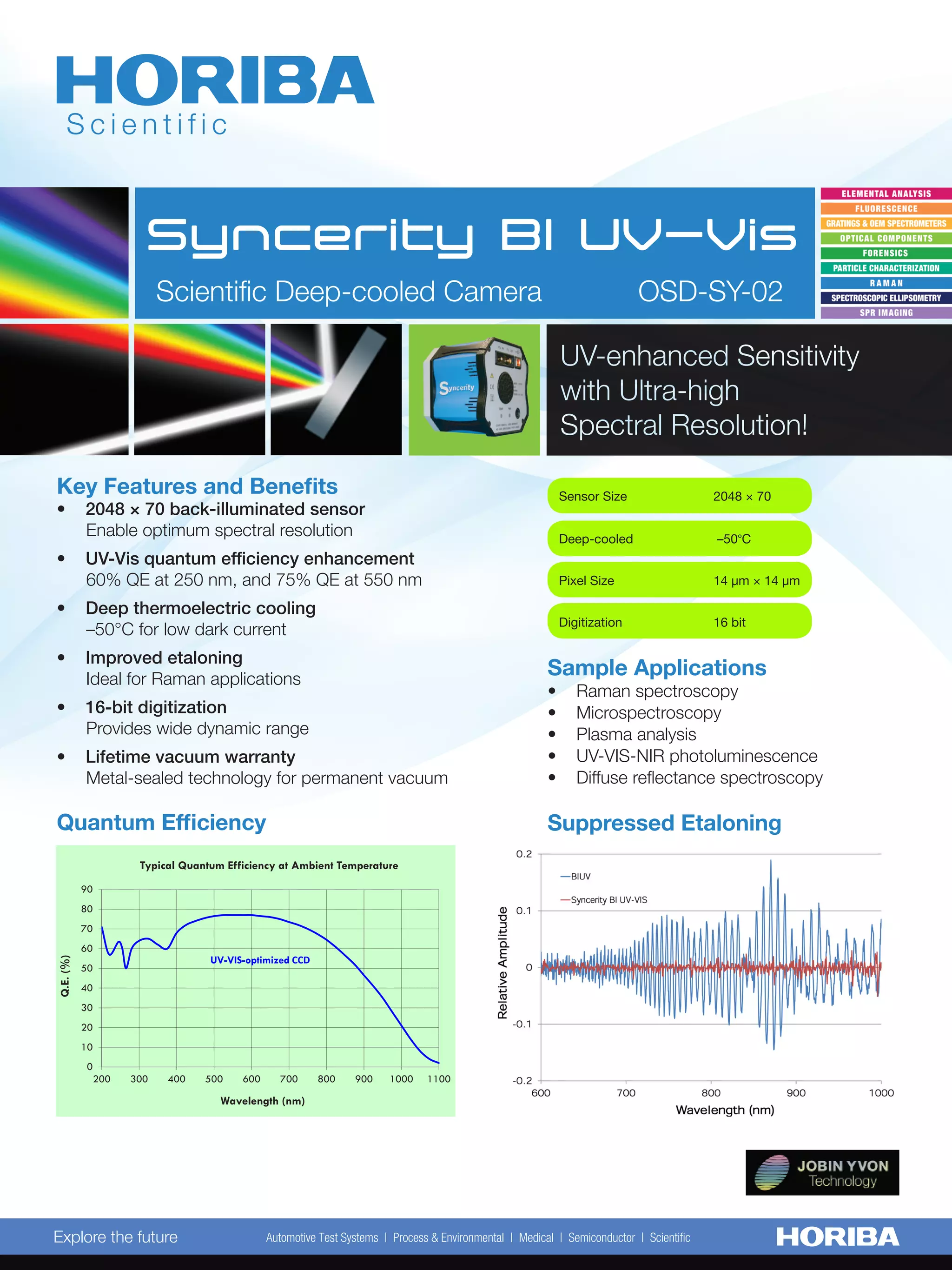
•	 UV-Vis quantum efficiency enhancement
60% QE at 250 nm, and 75% QE at 550 nm
•	 Deep thermoelectric cooling
–50°C for low dark current
•	 Improved etaloning
Ideal for Raman applications
•	 16-bit digitization
Provides wide dynamic range
•	 Lifetime vacuum warranty
Metal-sealed technology for permanent vacuum
Quantum Efficiency
Sample Applications
•	 Raman spectroscopy
•	 Microspectroscopy
•	 Plasma analysis
•	 UV-VIS-NIR photoluminescence
•	 Diffuse reflectance spectroscopy
Suppressed Etaloning
UV-enhanced Sensitivity
with Ultra-high
Spectral Resolution!
Scientific Deep-cooled Camera OSD-SY-02
0
10
20
30
40
50
60
70
80
90
200 300 400 500 600 700 800 900 1000 1100
Q.E.(%)
Wavelength (nm)
Typical Quantum Efficiency at Ambient Temperature
UV-VIS-optimized CCD
Syncerity BI UV-Vis
Sensor Size	 2048 × 70
Deep-cooled	 –50°C
Pixel Size		 14 µm × 14 µm
Digitization	 16 bit
CCD Sensor Format 2048 × 70
Quantum efficiency at 20°C 63% at 245 nm; 64% at 300 nm; 68% at 400 nm
76% at 500 nm; 77% at 700 nm; 64% at 800 nm
Pixel size 14 μm × 14 μm
Image area 28.7 mm × 0.98 mm, 100% fill factor
Deep thermoelectric cooling –50°C at +25°C ambient (–60°C at +25°C ambient on request)
Yields low dark current suitable for most OEM and some research
applications
Single pixel well capacity 50 000 e¯/pixel (minimum); 60 000 e¯/pixel (typical)
Serial register full well capacity 250 000 e¯/pixel (minimum)
500 000 e¯/pixel (typical output register saturation)
Scan rates 45 kHz and 500 kHz
Readout noise (at 45 kHz and at –50°C)*1
Readout noise (at 500 kHz and at –50°C)*1
9 e–
(typical) to 12 e¯ (maximum)
20 e–
(typical) to 25 e¯ (maximum)
Maximum spectral rate 20 Hz at 45 kHz scan rate
189 Hz at 500 kHz scan rate
Digitization 16-bit ADC
Dynamic range (typical for single pixel)*2
55 500:1
Non-linearity (measured on each camera) <0.15% (typical) at 45 kHz (0.4% maximum)
<0.20% (typical) at 500 kHz (1% maximum)
Dark current at –50°C*3
(Note that pixel size = 14 μm)
0.05 e–
/pixel/s (typical)
Software-adjustable gains 2, 4, and 10 e–
/count at –50°C
Environmental conditions •	 Operating temperature 0°C to 40°C ambient
•	 Relative rumidity <70% (non-condensing)
•	 Storage temperature –25°C to 50°C
Weight 1.769 kg (3.90 lb)
Dimensions See mechanical drawings
Power requirements
AC/DC power supply (provided)
Recommendation for OEM supplying
camera to power directly:
90–264 VAC, 47–63 Hz
• Pin: +9 V, ± 5%, 6.44 A maximum
• Regulation: +8.55 Vmin
, +9 Vtyp, +9.45 Vmax
• Ripple & Noise: 200 mVpp
maximum
Minimum computer requirements • 3.0 GHz single core or 2.4 GHz multi-core processor
• 2 GB RAM
• 32-bit or 64-bit compatible
• 500 MB free hard disk space (additional disk space may be required
depending on data-storage needs)
• USB 2.0 High-speed host controller capable of sustained rate of 40
MB/s
• Windows®
(XP, Vista and 7)
Rev.D;Thisdocumentisnotcontractuallybindingunderanycircumstances-PrintedinUSA-©HORIBAScientific12/2014
Syncerity™ BI UV-Vis Specifications
1.	 Entire system noise measured for a single pixel
2.	 Dynamic range is defined as Full Well/Readout Noise, measured at 45 kHz
3.	 Averaged over CCD area, but excluding any regions of blemishes.
USA:	 +1 732 494 8660	 France:	+33 (0)1 69 74 72 00	Germany:	+49 (0)89 4623 17-0
UK:	 +44 (0)20 8204 8142	 Italy:	 +39 2 5760 3050	 Japan:	 +81 (0)3 6206 4721
China:	+86 (0)21 6289 6060	 Brazil:	 +55 (0)11 5545 1500	Other:	+1 732 494 8660
info.sci@horiba.com www.horiba.com/scientific
Your partner for Spectroscopy Solutions
Spectrometers, Monochromators
Scientific Cameras, Software and
Custom Solutions

Syncerity bi uv-vis_spec_sheet_rev_d

  • 1.
    Key Features andBenefits • 2048 × 70 back-illuminated sensor Enable optimum spectral resolution • UV-Vis quantum efficiency enhancement 60% QE at 250 nm, and 75% QE at 550 nm • Deep thermoelectric cooling –50°C for low dark current • Improved etaloning Ideal for Raman applications • 16-bit digitization Provides wide dynamic range • Lifetime vacuum warranty Metal-sealed technology for permanent vacuum Quantum Efficiency Sample Applications • Raman spectroscopy • Microspectroscopy • Plasma analysis • UV-VIS-NIR photoluminescence • Diffuse reflectance spectroscopy Suppressed Etaloning UV-enhanced Sensitivity with Ultra-high Spectral Resolution! Scientific Deep-cooled Camera OSD-SY-02 0 10 20 30 40 50 60 70 80 90 200 300 400 500 600 700 800 900 1000 1100 Q.E.(%) Wavelength (nm) Typical Quantum Efficiency at Ambient Temperature UV-VIS-optimized CCD Syncerity BI UV-Vis Sensor Size 2048 × 70 Deep-cooled –50°C Pixel Size 14 µm × 14 µm Digitization 16 bit
  • 2.
    CCD Sensor Format2048 × 70 Quantum efficiency at 20°C 63% at 245 nm; 64% at 300 nm; 68% at 400 nm 76% at 500 nm; 77% at 700 nm; 64% at 800 nm Pixel size 14 μm × 14 μm Image area 28.7 mm × 0.98 mm, 100% fill factor Deep thermoelectric cooling –50°C at +25°C ambient (–60°C at +25°C ambient on request) Yields low dark current suitable for most OEM and some research applications Single pixel well capacity 50 000 e¯/pixel (minimum); 60 000 e¯/pixel (typical) Serial register full well capacity 250 000 e¯/pixel (minimum) 500 000 e¯/pixel (typical output register saturation) Scan rates 45 kHz and 500 kHz Readout noise (at 45 kHz and at –50°C)*1 Readout noise (at 500 kHz and at –50°C)*1 9 e– (typical) to 12 e¯ (maximum) 20 e– (typical) to 25 e¯ (maximum) Maximum spectral rate 20 Hz at 45 kHz scan rate 189 Hz at 500 kHz scan rate Digitization 16-bit ADC Dynamic range (typical for single pixel)*2 55 500:1 Non-linearity (measured on each camera) <0.15% (typical) at 45 kHz (0.4% maximum) <0.20% (typical) at 500 kHz (1% maximum) Dark current at –50°C*3 (Note that pixel size = 14 μm) 0.05 e– /pixel/s (typical) Software-adjustable gains 2, 4, and 10 e– /count at –50°C Environmental conditions • Operating temperature 0°C to 40°C ambient • Relative rumidity <70% (non-condensing) • Storage temperature –25°C to 50°C Weight 1.769 kg (3.90 lb) Dimensions See mechanical drawings Power requirements AC/DC power supply (provided) Recommendation for OEM supplying camera to power directly: 90–264 VAC, 47–63 Hz • Pin: +9 V, ± 5%, 6.44 A maximum • Regulation: +8.55 Vmin , +9 Vtyp, +9.45 Vmax • Ripple & Noise: 200 mVpp maximum Minimum computer requirements • 3.0 GHz single core or 2.4 GHz multi-core processor • 2 GB RAM • 32-bit or 64-bit compatible • 500 MB free hard disk space (additional disk space may be required depending on data-storage needs) • USB 2.0 High-speed host controller capable of sustained rate of 40 MB/s • Windows® (XP, Vista and 7) Rev.D;Thisdocumentisnotcontractuallybindingunderanycircumstances-PrintedinUSA-©HORIBAScientific12/2014 Syncerity™ BI UV-Vis Specifications 1. Entire system noise measured for a single pixel 2. Dynamic range is defined as Full Well/Readout Noise, measured at 45 kHz 3. Averaged over CCD area, but excluding any regions of blemishes. USA: +1 732 494 8660 France: +33 (0)1 69 74 72 00 Germany: +49 (0)89 4623 17-0 UK: +44 (0)20 8204 8142 Italy: +39 2 5760 3050 Japan: +81 (0)3 6206 4721 China: +86 (0)21 6289 6060 Brazil: +55 (0)11 5545 1500 Other: +1 732 494 8660 info.sci@horiba.com www.horiba.com/scientific Your partner for Spectroscopy Solutions Spectrometers, Monochromators Scientific Cameras, Software and Custom Solutions