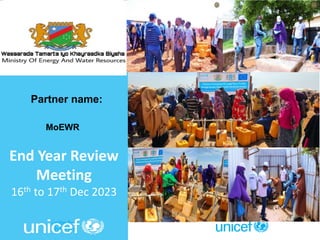
End Year Review
Meeting
16th to 17th Dec 2023
Partner name:
MoEWR
Context Analytic Statement
In 2023 large parts of the country are experiencing
critical water shortages including the Southwest
state being the worst hit areas of drought, the
current water shortage in beginning of 2023 is likely
to deepen humanitarian crisis in the coming months
particularly in areas facing critical water shortages
where their main sources (shallow wells and water
catchments ) are dried-up resulting a sharp increase
in water prices all most all towns in southwest state
specially Baidoa district where most of IDPs were
located
Highlight of Major Achievements
January- December 2023
• Provision of temporary access to safe water by
vouchers for 166,944 emergency affected
people in Bay and Lower Shabelle for 90 days
• Access to sustainable water supply was
improved through rehabilitation of water
points for 168,250 persons in vulnerable
settlements across the state.
• Improved access to sanitation facilities for
14,464 persons in IDP camps leading to
reduction in open defecation
Highlight of Major Achievements
January- December 2023
• The knowledge of affected people is improved with
key hygiene messages through hygiene promotion
sessions and reached 28,756 people
• 116,297 people is reached with safe water through
chlorination of water sources.
• The incidence and prevalence of AWD/cholera
were reduced among vulnerable and/or affected
people through face-to-face hygiene promotion
and provision of hygiene kits
Programme Performance 2023
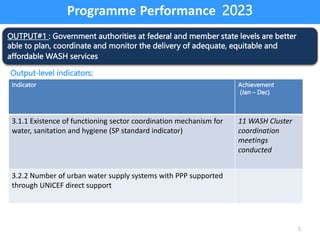
OUTPUT#1 : Government authorities at federal and member state levels are better
able to plan, coordinate and monitor the delivery of adequate, equitable and
affordable WASH services
5
Output-level indicators:
Indicator Achievement
(Jan – Dec)
3.1.1 Existence of functioning sector coordination mechanism for
water, sanitation and hygiene (SP standard indicator)
11 WASH Cluster
coordination
meetings
conducted
3.2.2 Number of urban water supply systems with PPP supported
through UNICEF direct support
Programme Performance 2023
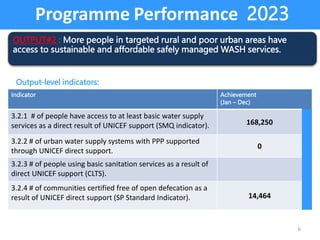
OUTPUT#2 : More people in targeted rural and poor urban areas have
access to sustainable and affordable safely managed WASH services.
6
Output-level indicators:
Indicator Achievement
(Jan – Dec)
3.2.1 # of people have access to at least basic water supply
services as a direct result of UNICEF support (SMQ indicator). 168,250
3.2.2 # of urban water supply systems with PPP supported
through UNICEF direct support.
0
3.2.3 # of people using basic sanitation services as a result of
direct UNICEF support (CLTS).
3.2.4 # of communities certified free of open defecation as a
result of UNICEF direct support (SP Standard Indicator). 14,464
Programme Performance 2023
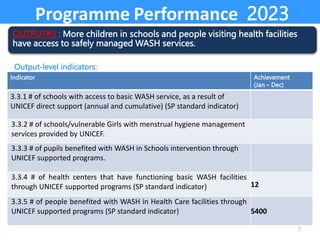
OUTPUT#3 : More children in schools and people visiting health facilities
have access to safely managed WASH services.
7
Output-level indicators:
Indicator Achievement
(Jan – Dec)
3.3.1 # of schools with access to basic WASH service, as a result of
UNICEF direct support (annual and cumulative) (SP standard indicator)
3.3.2 # of schools/vulnerable Girls with menstrual hygiene management
services provided by UNICEF.
3.3.3 # of pupils benefited with WASH in Schools intervention through
UNICEF supported programs.
3.3.4 # of health centers that have functioning basic WASH facilities
through UNICEF supported programs (SP standard indicator) 12
3.3.5 # of people benefited with WASH in Health Care facilities through
UNICEF supported programs (SP standard indicator) 5400
Programme Performance 2023
OUTPUT#4 : Children and their families access timely, sufficient and safe
WASH services in humanitarian situations.
8
Output-level indicators:
Indicator Achievement
(Jan – Dec)
3.4.1 # of population in humanitarian situations reached with temporary safe
water (Water Trucking).
166,944
3.4.2 # of humanitarian water supply systems (Rehab, Upgrade, Extension)
supported through UNICEF direct support.
45 strategic boreholes,
47 high yield shallow
wells upgraded
3.4.3 # of population in humanitarian situations reached with safe water
(Rehab, Upgrade, Extension). 168,250 people
3.4.4 # of population in humanitarian situations who received hygiene kits. 24894 people
3.4.5 Existence of functioning cluster coordination mechanism for water,
sanitation and hygiene in humanitarian situations. (SP Standard Indicator)
• State WASH
cluster
coordination
• Regional WASH
cluster
coordination
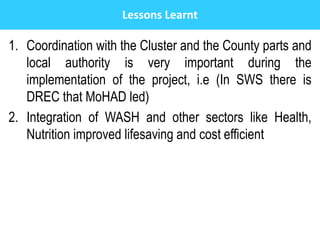
Lessons Learnt
1. Coordination with the Cluster and the County parts and
local authority is very important during the
implementation of the project, i.e (In SWS there is
DREC that MoHAD led)
2. Integration of WASH and other sectors like Health,
Nutrition improved lifesaving and cost efficient
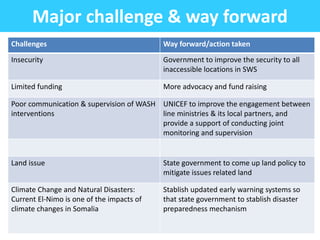
Major challenge & way forward
Challenges Way forward/action taken
Insecurity Government to improve the security to all
inaccessible locations in SWS
Limited funding More advocacy and fund raising
Poor communication & supervision of WASH
interventions
UNICEF to improve the engagement between
line ministries & its local partners, and
provide a support of conducting joint
monitoring and supervision
Land issue State government to come up land policy to
mitigate issues related land
Climate Change and Natural Disasters:
Current El-Nimo is one of the impacts of
climate changes in Somalia
Stablish updated early warning systems so
that state government to stablish disaster
preparedness mechanism
Recommendations for 2024 rolling work plan
• Develop and implement a contingency plan for rapid response
to emergencies, such as natural disasters or disease
outbreaks, ensuring WASH services can be quickly deployed to
affected communities.
• Procurement of local available of WASH supplies, especially
Hygiene kits to deliver to emergency affected communities on
time.
• Data and Monitoring (NW will strengthen data collection and
monitoring systems to track progress, identify challenges, and
measure the impact of WASH interventions
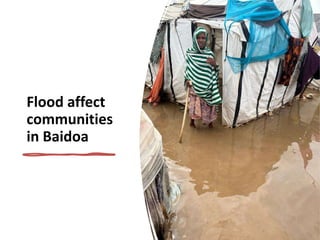
Flood affect
communities
in Baidoa
Heavy equipment
loader
transporting flood
affected
communities in
Baidoa
14
Thank you

SWS-End Year Review presentation 2023.pptx

  • 1.
    End Year Review Meeting 16thto 17th Dec 2023 Partner name: MoEWR
  • 2.
    Context Analytic Statement In2023 large parts of the country are experiencing critical water shortages including the Southwest state being the worst hit areas of drought, the current water shortage in beginning of 2023 is likely to deepen humanitarian crisis in the coming months particularly in areas facing critical water shortages where their main sources (shallow wells and water catchments ) are dried-up resulting a sharp increase in water prices all most all towns in southwest state specially Baidoa district where most of IDPs were located
  • 3.
    Highlight of MajorAchievements January- December 2023 • Provision of temporary access to safe water by vouchers for 166,944 emergency affected people in Bay and Lower Shabelle for 90 days • Access to sustainable water supply was improved through rehabilitation of water points for 168,250 persons in vulnerable settlements across the state. • Improved access to sanitation facilities for 14,464 persons in IDP camps leading to reduction in open defecation
  • 4.
    Highlight of MajorAchievements January- December 2023 • The knowledge of affected people is improved with key hygiene messages through hygiene promotion sessions and reached 28,756 people • 116,297 people is reached with safe water through chlorination of water sources. • The incidence and prevalence of AWD/cholera were reduced among vulnerable and/or affected people through face-to-face hygiene promotion and provision of hygiene kits
  • 5.
    Programme Performance 2023 OUTPUT#1: Government authorities at federal and member state levels are better able to plan, coordinate and monitor the delivery of adequate, equitable and affordable WASH services 5 Output-level indicators: Indicator Achievement (Jan – Dec) 3.1.1 Existence of functioning sector coordination mechanism for water, sanitation and hygiene (SP standard indicator) 11 WASH Cluster coordination meetings conducted 3.2.2 Number of urban water supply systems with PPP supported through UNICEF direct support
  • 6.
    Programme Performance 2023 OUTPUT#2: More people in targeted rural and poor urban areas have access to sustainable and affordable safely managed WASH services. 6 Output-level indicators: Indicator Achievement (Jan – Dec) 3.2.1 # of people have access to at least basic water supply services as a direct result of UNICEF support (SMQ indicator). 168,250 3.2.2 # of urban water supply systems with PPP supported through UNICEF direct support. 0 3.2.3 # of people using basic sanitation services as a result of direct UNICEF support (CLTS). 3.2.4 # of communities certified free of open defecation as a result of UNICEF direct support (SP Standard Indicator). 14,464
  • 7.
    Programme Performance 2023 OUTPUT#3: More children in schools and people visiting health facilities have access to safely managed WASH services. 7 Output-level indicators: Indicator Achievement (Jan – Dec) 3.3.1 # of schools with access to basic WASH service, as a result of UNICEF direct support (annual and cumulative) (SP standard indicator) 3.3.2 # of schools/vulnerable Girls with menstrual hygiene management services provided by UNICEF. 3.3.3 # of pupils benefited with WASH in Schools intervention through UNICEF supported programs. 3.3.4 # of health centers that have functioning basic WASH facilities through UNICEF supported programs (SP standard indicator) 12 3.3.5 # of people benefited with WASH in Health Care facilities through UNICEF supported programs (SP standard indicator) 5400
  • 8.
    Programme Performance 2023 OUTPUT#4: Children and their families access timely, sufficient and safe WASH services in humanitarian situations. 8 Output-level indicators: Indicator Achievement (Jan – Dec) 3.4.1 # of population in humanitarian situations reached with temporary safe water (Water Trucking). 166,944 3.4.2 # of humanitarian water supply systems (Rehab, Upgrade, Extension) supported through UNICEF direct support. 45 strategic boreholes, 47 high yield shallow wells upgraded 3.4.3 # of population in humanitarian situations reached with safe water (Rehab, Upgrade, Extension). 168,250 people 3.4.4 # of population in humanitarian situations who received hygiene kits. 24894 people 3.4.5 Existence of functioning cluster coordination mechanism for water, sanitation and hygiene in humanitarian situations. (SP Standard Indicator) • State WASH cluster coordination • Regional WASH cluster coordination
  • 9.
    Lessons Learnt 1. Coordinationwith the Cluster and the County parts and local authority is very important during the implementation of the project, i.e (In SWS there is DREC that MoHAD led) 2. Integration of WASH and other sectors like Health, Nutrition improved lifesaving and cost efficient
  • 10.
    Major challenge &way forward Challenges Way forward/action taken Insecurity Government to improve the security to all inaccessible locations in SWS Limited funding More advocacy and fund raising Poor communication & supervision of WASH interventions UNICEF to improve the engagement between line ministries & its local partners, and provide a support of conducting joint monitoring and supervision Land issue State government to come up land policy to mitigate issues related land Climate Change and Natural Disasters: Current El-Nimo is one of the impacts of climate changes in Somalia Stablish updated early warning systems so that state government to stablish disaster preparedness mechanism
  • 11.
    Recommendations for 2024rolling work plan • Develop and implement a contingency plan for rapid response to emergencies, such as natural disasters or disease outbreaks, ensuring WASH services can be quickly deployed to affected communities. • Procurement of local available of WASH supplies, especially Hygiene kits to deliver to emergency affected communities on time. • Data and Monitoring (NW will strengthen data collection and monitoring systems to track progress, identify challenges, and measure the impact of WASH interventions
  • 12.
  • 13.
  • 14.

Editor's Notes

  • #9 In indicator 3.4.2 the hygiene kits distributed is still on track but there missing data that have not yet reached our disposal since the end year review meeting came earlier than expected
  • #12 Strengthening UNICEF programs in integrating WASH with Health, Nutrition and Education; this enhance reduction of malnutrition, reduce water born diseases and reduce school drop outs.