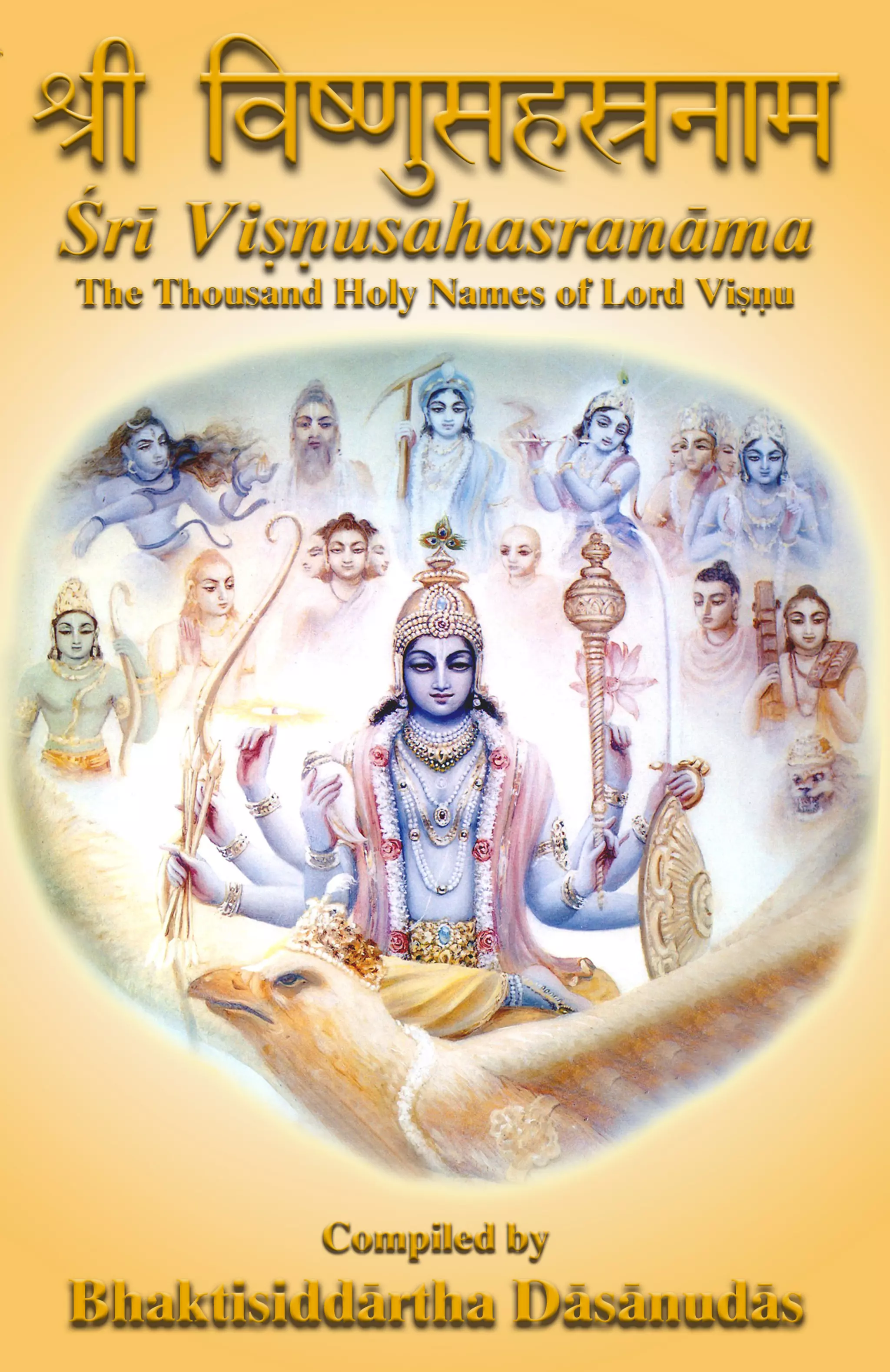
é[q ivZ<auSahóNaaMa
Çré Viñëusahasranäma
The Thousand Holy Names of Lord Viñëu

— With the —
Expanded Translation of

Çréla Baladeva Vidyabhüñaëa
— Compiled by —

Bhaktisiddhärtha Däsänudäs
— Published by —

Harinam Arts Press
Email: bhaktisiddhartha@hotmail.com

ISBN 0-9703586-0-1
This book is sacred material; no claim of copyright made.
Feel free to use any of it in your spiritual service.
Çré Viñëusahasranäma

— Books and Recordings by —

Bhaktisiddhärtha Däsänudäs
— Published by —

Harinam Arts
Harinam Book/CDs
Çré Viñëusahasranäma
Çré Kåñëa-sahasranäma
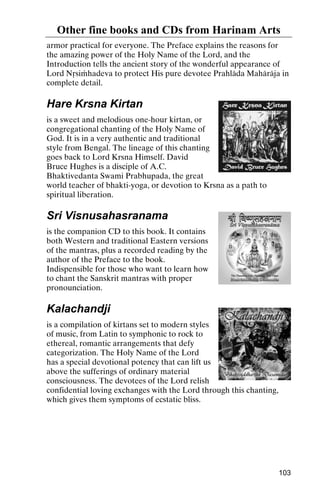
Çré Nåsiàha-sahasranäma
Çré Bala-Kåñëa-sahasranäma
Çré Rädhä-Kåñëa-sahasranäma
Çré Gopäla-sahasranäma
Çré Caitanya-sahasranäma
Çrématé Rädhä-sahasranäma

Philosophy Books
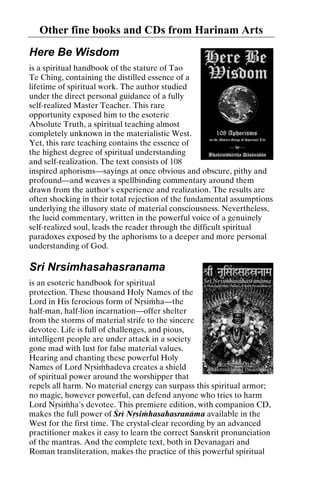
Here Be Wisdom
Theistic Vedänta
The Quinity
Harinam CDs:
RagaJazz
Kälachandjé
Vipralambha
Hare Kåñëa Kértan

Buy Harinam Arts Editions at our online store:
www.esoteric-teaching.org
And through these fine retailers:
Amazon.com

To the Reader:
Thank you for purchasing this fine edition from Harinam Arts.
Please treat sacred books and paraphernalia with care and respect.
For example, do not place this book on the floor.
Thank you very much.

ii
é[q ivZ<auSahóNaaMa
Çré Viñëusahasranäma
The Thousand Holy Names of Lord Viñëu

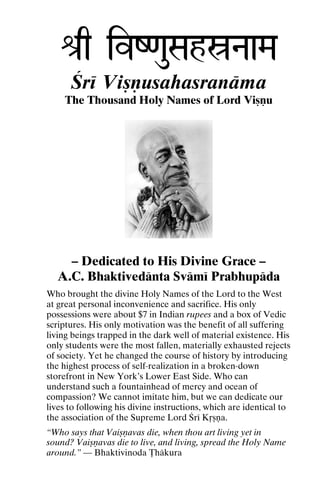
– Dedicated to His Divine Grace –
A.C. Bhaktivedänta Svämé Prabhupäda
Who brought the divine Holy Names of the Lord to the West
at great personal inconvenience and sacrifice. His only
possessions were about $7 in Indian rupees and a box of Vedic
scriptures. His only motivation was the benefit of all suffering
living beings trapped in the dark well of material existence. His
only students were the most fallen, materially exhausted rejects
of society. Yet he changed the course of history by introducing
the highest process of self-realization in a broken-down
storefront in New York’s Lower East Side. Who can
understand such a fountainhead of mercy and ocean of
compassion? We cannot imitate him, but we can dedicate our
lives to following his divine instructions, which are identical to
the association of the Supreme Lord Çré Kåñëa.
“Who says that Vaiñëavas die, when thou art living yet in
sound? Vaiñëavas die to live, and living, spread the Holy Name
around.” — Bhaktivinoda Öhäkura
Çré Viñëusahasranäma

— Contents —
How to Use This Book ................................................... iii
Foreword by B.A. Paramädvaité Svämé ........................ iv
Preface ................................................................................1
Introduction......................................................................13

Çré Viñëusahasranäma
Maìgaläcaraëam: Auspicious Invocation .........27
Prologue..................................................................31
The Thousand Names of Lord Viñëu ..................36
Phala Çruti .............................................................91

ii
é[q ivZ<auSahóNaaMa
Çré Viñëusahasranäma
The Thousand Holy Names of Lord Viñëu

How to Use This Book

T

HIS book is intended to supplement, explain and support the
recorded material on the CD. The best way to start is to put the
CD in your player, sit back and relax, and let the transcendental
sound of the mantra penetrate your consciousness.
It is best to hear the mantras with concentration, but it is also all right
to play them in the background while doing other things. When you
start to become familiar with the sound, try reading along with the
recorded mantras, starting on page 27 (or page 31 for the traditional
version).
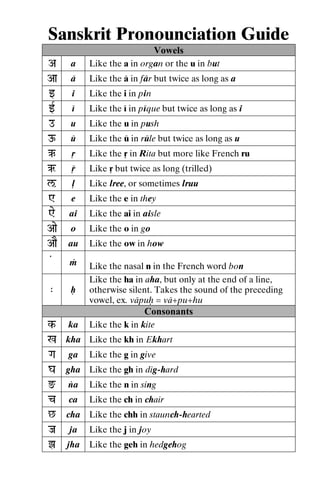
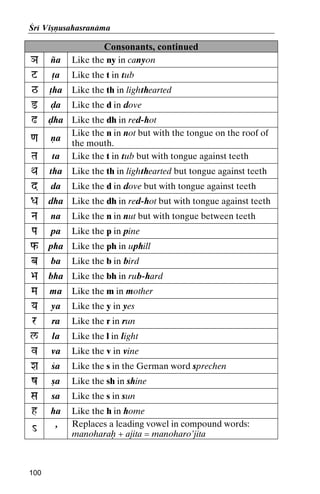
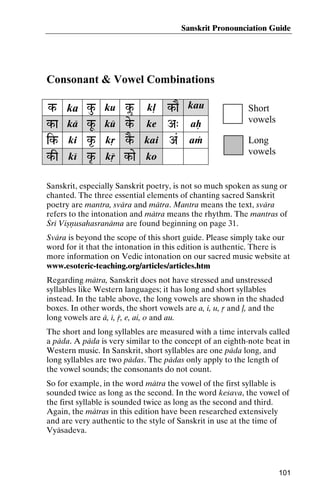
There is a foldout Sanskrit Pronunciation Guide at the end of the
book. After some time reading, you might want to attempt chanting
along with the recording.

Those who are already students of Sanskrit may be tempted to
immediately chant the mantras. Be patient. It is better to hear before
chanting to assimilate the complex and subtle rhythms of the çlokas.
Listen first, and then chant along with the recording for a while
before you go solo.
When you are comfortable with
hearing and chanting the mantras and
start wondering about all the
wonderful changes in your life and
consciousness, read the rest of the
book to find out what’s going on.
Hare Kåñëa,
Bhaktisiddhärtha Däsänudäs
www.esoteric-teaching.org
email: bhaktisiddhartha@hotmail.com

photo: Michael Dierdorff
é[q ivZ<auSahóNaaMa
Çré Viñëusahasranäma
The Thousand Holy Names of Lord Viñëu

Preface

T

HIS temporary material existence is full of suffering.
Everyone in this world is suffering from the problems of
material life. There is no exception. The root cause of the
suffering of material existence is constant transmigration of the
soul from one body to another.
Even if one does not accept the truth of reincarnation, still it is
a fact that we take birth in an infant body, then transmigrate
from a baby body to the body of a child, to an adolescent body,
then to an adult body, to a middle-aged body, and at last to the
body of an old man or woman. Finally the present body is
subjected to death. Yet through all these transformations or
transmigrations, the identity of the living entity remains the
same. So transmigration of the soul to different bodies happens
even within this life. Everyone experiences that these changes
of body are causes of suffering to the embodied living entity.
We do not want to suffer, nor do we want to transmigrate to
different material bodies. We do not want our consciousness or
activities to change, our relationships to end or our bodies to
die. By nature we are free, eternal, blissful spiritual beings. We
naturally desire to have an eternal existence in a perfect body
full of knowledge and pleasure. We want to expand our
activities and enjoyment unlimitedly in an atmosphere of
freedom, understanding and love. This is our real spiritual
nature.
Çré Viñëusahasranäma

But at present our eternal spiritual nature is covered by a
temporary material body. By the laws of nature we are not
free, for the type of body we inhabit and its stage of bodily
existence condition our experience in every way. In material
existence, our bodily condition totally determines our range of
action, thought and consciousness.
Like every material phenomenon, the body goes through the
stages of creation, gestation, birth, growth, production of
byproducts, deterioration and death. One may have performed
good works and consequently find oneself in a relatively
comfortable material condition, or one may be in an
unfortunate condition due to impious activities. But no matter
what kind of karma one may have created for oneself, the
universal sufferings of birth, old age, disease and death are as
inevitable as they are abominable.
This conditional life of suffering in material existence—the
involuntary repetition of birth, old age, disease and death—is
called saàsära. Saàsära is uncontrollable, like a blazing forest
fire. A forest fire ignites automatically by lightning, and to
extinguish it is beyond human power. The raging forest fire can
be extinguished only by another natural force, when there is an
ample downpour of rainwater. We are helpless before the
powerful manifestations of material nature like forest fires and
rainstorms. No one can stop them.
Similarly we are helpless to stop the suffering of saàsära,
unless we are fortunate enough to receive the mercy of God in
the form of His Holy Names. Saàsära-dävänala-léòha-lokaträëäya käruëya-ghanäghanatvam. Like the cooling downpour
of rain from a storm cloud, hearing the Holy Names of the
Lord from the self-realized spiritual master and chanting them
offenselessly extinguishes the blazing fire of saàsära by
eliminating the root cause of material suffering.
This book and companion CD of Çré Viñëusahasranäma
contain these Holy Names, which are the remedy for the
suffering of materially conditioned existence. Çré means
beautiful on account of being full of spiritual qualities; Viñëu is
the Sanskrit Name of God, the omnipotent, omnipresent
Creator and Master of the universe; and sahasra-näma means a
2
Preface

thousand Names. So Çré Viñëusahasranäma means “A
thousand spiritually beautiful Names of God.” Actually God is
unlimited, and therefore He has an infinite number of Holy
Names. These thousand Names are just the most prominent
and beneficial of His Holy Names. They are so powerful that
anyone who simply hears or chants them regularly, with faith,
becomes relieved of all material suffering.
How is this possible? By the power of transcendental sound.
Any terminology indicating God or the Supreme is not an
ordinary sound vibration of this material world. Viñëu or God
is the Supreme Absolute Truth. The unique quality of the
Absolute is that everything connected to Him, such as His
Names, forms, abode, pastimes, associates, and the narration of
His glories, is also on the same absolute platform.

oà pürëam adaù pürëam idaà pürëät pürëam udacyate
pürnäsya pürëam ädäya pürëam evävaçiñyate
“May we invoke auspiciousness by offering our respectful
obeisances unto the Supreme Lord. The Personality of
Godhead is perfect and complete, and because He is
completely perfect, all emanations from Him, such as this
phenomenal world, are perfectly equipped as complete wholes.
Whatever is produced of the Complete Whole is also complete
in itself. Because He is the Complete Whole, even though so
many complete units emanate from Him, He remains the
complete balance.” [Çré Éñopaniñad, Invocation]
Since He is absolute, His Holy Names are also absolute.
Therefore the Holy Names of Viñëu or Kåñëa are identical in
spiritual quality and potency with Kåñëa (God) Himself. Like
Him, they are complete and perfect. Since Kåñëa and His Holy
Names are identical in properties and power, His Holy Names
are eternally pure and immune to all material contamination.
More than that, they embody the purifying and enlightening
power of Godhead in the form of transcendental sound. The
Lord is personally present in the transcendental sound of His
Holy Names. The association of the Supreme Lord is
indescribably blissful; it bestows spiritual opulence and
causeless knowledge of the Absolute Truth. Therefore we can

3
Çré Viñëusahasranäma

be relieved of all material difficulties simply by chanting these
beautiful Holy Names of the Lord.
Unfortunately, otherwise intelligent people who are
bewildered by the complex combination of anxieties and
suffering in material existence often find it difficult to
appreciate the simple process of chanting the Holy Names,
which is free from all anxiety. They cannot comprehend that
there can be a class of absolute nomenclature beyond limited,
relative knowledge and temporary conditional existence.
Any name that represents a temporary object of this material
world may be subjected to critical arguments, inductive
speculation and experimental verification. Thus all relative
conclusions created by material mental speculation are subject
to uncertainty. But in the absolute world a person and his
name, the fame and the famous, the actor and the act are
identical. Similarly the qualities, pastimes, abode, associates,
Names and everything else pertaining to the Absolute
Supreme Personality of Godhead are also spiritual and
absolute in quality. This is transcendental knowledge beyond
all uncertain processes of inductive speculation. And since this
absolute knowledge is received through the descending process
of paramparä, or disciplic succession from the Lord Himself,
there is no uncertainty or speculation. This is the eternal,
unchanging Absolute Truth.
Actually, the Holy Name is the Supreme Personality of
Godhead Himself, manifesting as a transcendental vibration.
The Holy Name is completely different from material sound:
golokera prema-dhana, hari-näma-saìkértana. “The
transcendental vibration of chanting the Holy Names descends
from the spiritual abode of Kåñëa.” Materialists who are
addicted to experimental knowledge and so-called ‘scientific
method’ have difficulty placing their faith in the chanting of the
Holy Names. Nevertheless it is a fact that one can be freed
from all material suffering simply by chanting the Holy Names
without offense. Let anyone who doubts this assertion subject
it to their experimental verification by chanting regularly
according to the prescribed process and carefully observing the
result.

4
Preface

The spiritual world is called Vaikuëöha, which means “without
anxiety.” In material consciousness everything is uncertain and
temporary, and therefore everyone is full of anxiety (sakuëöha). In the spiritual world Vaikuëöha, everything is known
and certain by the causeless mercy of the Lord. Birth, old age,
disease and death are nonexistent there, and therefore
everyone there is free from all anxiety. Chanting the Holy
Names gives us the opportunity to transfer our existence to the
Vaikuëöha world, where we can exist eternally without any
suffering. This occurs as soon as we change from the material
conditioned platform of consciousness to blissful Vaikuëöha
consciousness through chanting the Holy Names.
Unfortunate people in material consciousness are not very
enthusiastic to chant the Holy Names of the Lord, just as a
patient suffering from jaundice does not relish the taste of
sugar candy, even though sugar candy is the specific medicine
for jaundice. Nevertheless, chanting the Holy Name of the
Lord is the only effective remedy for ending the material
suffering of the conditioned soul. Although chanting the Holy
Name of the Lord may not be very palatable for people
suffering from the disease of material existence, anyone who
wants to be cured of the material disease must do it with great
care and attention.
Even among people who accept the spiritual path, there are
many who are frustrated by pursuing processes of selfrealization that are impractical in this fallen, contaminated age.
In the present age the vibration of the Holy Names of the Lord
is the only yoga process that can actually help one attain a
transcendental position, beyond all material contamination.

harer näma harer näma harer nämaiva kevalam
kalau nästyeva nästyeva nästyeva gatir anyathä
“Chant the Holy Name [in the neophyte stage], chant the Holy
Name [in the clearing stage], certainly you must chant the Holy
Name [in the liberated stage of life] constantly. In the Age of
Kali there is no other way [by the austere yoga practices
recommended for the Satya-yuga], no other way [by the
elaborate Vedic sacrifices recommended for the Treta-yuga],
no other way [by the opulent Deity worship recommended for
5
Çré Viñëusahasranäma

the Dvärapa-yuga] to attain the ultimate destination [of the
personal association of the Lord].”
[Båhan-näradéya Puräëa]
For progress in spiritual life, the Vedic scriptures recommend
austerity and meditation in Satya-yuga, sacrifice for the
satisfaction of Lord Viñëu in Treta-yuga and gorgeous worship
of the Lord in the temple in Dväpara-yuga, but in the Age of
Kali one can achieve spiritual progress only by chanting the
Holy Name of the Lord. This is confirmed in many scriptures.
For example, in Çrémad-Bhägavatam (12.3.51) it is said,

kaler doña-nidhe räjann asti hy eko mahän guëaù
kértanäd eva kåñëasya mukta-saìgaù paraà vrajet
“In the Age of Kali there are many faults, for people are
subjected to many miserable conditions, yet in this age there is
one great benediction: simply by chanting the Hare Kåñëa
mahä-mantra one can be freed from all material contamination
and thus be elevated to the spiritual world.”
The Närada-païcarätra also praises the Hare Kåñëa mahämantra as follows:

trayo vedaù ñaò-aìgäni chandäàsi vividhäù suräù
sarvaà añöäkñaräntaùsthaà yac cänyad api väì-mayam
sarva-vedänta-särärthah saàsärärëava-täraëaù
“The essence of all Vedic knowledge—comprehending the
three kinds of Vedic activity [karma-käëòa, jïäna-käëòa and
upasäna-käëòa], the chandas, or Vedic hymns, and the
processes for satisfying the demigods—is included in the eight
syllables Hare Kåñëa, Hare Kåñëa. This is the reality of all
Vedänta. The chanting of the Holy Name is the only means to
cross the ocean of nescience.”
Similarly, the Kali-santaraëa Upaniñad states,

hare kåñëa hare kåñëa kåñëa kåñëa hare hare
hare räma hare räma räma räma hare hare
iti ñoòaçakaà nämnäà kali-kalmaña-näçanam
nätaù parataropäyaù sarva-vedeñu dåçyate

6
Preface

“Hare Kåñëa, Hare Kåñëa, Kåñëa Kåñëa, Hare Hare; Hare
Räma, Hare Räma, Räma Räma, Hare Hare—these sixteen
names composed of thirty-two syllables are the only means to
counteract the evil effects of Kali-yuga. In all the Vedas it is
seen that to cross the ocean of nescience there is no alternative
to the chanting of the Holy Name.”
Çré Mädhväcärya, in his commentary upon the Muëòaka
Upaniñad, quotes the following çloka from the Näräyaëa
Saàhitä:

dväparéyair janair viñëuù païcarätrais tu kevalaiù
kalau tu näma-mätreëa püjyate bhagavän hariù
“In the Dväpara-yuga one could satisfy Kåñëa or Viñëu only by
worshiping Him gorgeously according to the païcarätriké
[Deity worship] system, but in the Age of Kali one can worship
and satisfy the Supreme Personality of Godhead Hari only by
chanting His Holy Name.”
Since the Holy Name can deliver the conditioned soul from all
material suffering, it is called sarva-mantra-sära, the essence of
all Vedic hymns. However, one should receive the Holy Name
from the pure devotee who is fully engaged in the loving
devotional service of the Lord. One who has a merely
academic interest in religion, or who poses as a great spiritual
teacher merely for the sake of transient name, fame, profit and
cheap adoration from the innocent public, cannot impart the
real thing.
The Holy Name is most effective when heard from a selfrealized teacher situated in the paramparä (disciplic
succession) from Kåñëa Himself:

evaà paramparä-präptam imaà räjarñayo viduù
“This supreme science was thus received through the chain of
disciplic succession, and the saintly kings understood it in that
way.” [Bhagavad-gétä 4.2]
A self-realized spiritual master is not an ordinary human being,
but is fully qualified to act as the representative of the Supreme
Personality of Godhead. How to approach such a spiritual
master is also described:
7
Çré Viñëusahasranäma

tad viddhi praëipätena paripraçnena sevayä
upadekñyanti te jïänaà jïäninas tattva-darçinaù
“Just try to learn the truth by approaching a spiritual master.
Inquire from him submissively and render service unto him.
The self-realized soul can impart knowledge unto you because
he has seen the truth.” [Bhagavad-gétä 4.34]
One should fully accept all these merciful scriptural
instructions of the Lord as one’s purpose in life to quickly
perfect one’s self-realization and put an end to all misery.
Hearing and chanting the Holy Names of the Lord is the only
effective medicine for the disease of material suffering.
Anyone in material conditioned existence can cleanse their
consciousness from all material contamination and find relief
from all misconceptions by this simple process (ceto-darpaëamärjanam). Avidyä or ignorance is simply a misconception
about one's actual spiritual identity. This misconception
provides the foundation for ahaìkära, or false ego within the
heart.
The real cause of all our suffering is the contamination of
material identification within the heart. If we cleanse our heart,
if we cleanse our consciousness of this false identification with
temporary material designations, the material disease can no
longer affect us. This is actual self-realization. The chanting of
the Holy Names of the Lord quickly cleanses the consciousness
and heart from all misconceptions, and the ever-fresh taste of
transcendental nectar arises spontaneously within the mind. It
is both easy and beneficial. By chanting the nectarean Holy
Names, one is immediately freed from the blazing fire of
material existence by the blissful personal association of the
Lord.

For those who are already Vaiñëavas
This edition and companion CD are designed both for new
practitioners, and for those who are already devotees of Kåñëa
and want to add chanting Çré Viñëusahasranäma to their
personal spiritual practice. Why would anyone who is an
initiated disciple of a Vaiñëava spiritual master and already
chanting the hare kåñëa mahä-mantra also want to chant Çré
8
Preface

Viñëusahasranäma? The answer is that although Çré
Viñëusahasranäma is also composed entirely of the Holy
Names of the Lord, the result of chanting it is different from
the result of chanting the hare kåñëa mahä-mantra.
It is well known among Vaiñëavas that chanting the hare kåñëa
mahä-mantra provides no material result whatsoever, but leads
to the awakening of pure love of Godhead. This is wonderful
and provides the highest benediction to the entire world.
However, while developing spiritual qualifications during the
neophyte stage of devotional service, devotees often
experience material difficulty. Çré Viñëusahasranäma provides
an authorized Vedic spiritual method for relieving such
impediments.
Anyone who is chanting the Holy Name with offenses will
certainly encounter obstacles in their devotional service. These
compose one class of hindrances on the path of spiritual
enlightenment. The scriptures say that the cure for this class of
obstacles is simply to continue the chanting process according
to the instructions of one’s spiritual master and rely on the
purifying power of the Holy Name.
But we often find that kåñëa-bhaktas have material difficulties
in their lives from unfinished material karma, unrelated to
offenses in their spiritual practices. These problems are
difficult to address without descending to the material
platform, which is distasteful to devotees whose self-realization
practice has given them a taste for the purity of spiritual
energy. Çré Viñëusahasranäma provides a unique spiritual
remedy for this class of material obstacles. Consider this
passage from the phala çruti, the section of Çré
Viñëusahasranäma that narrates the results of chanting it:
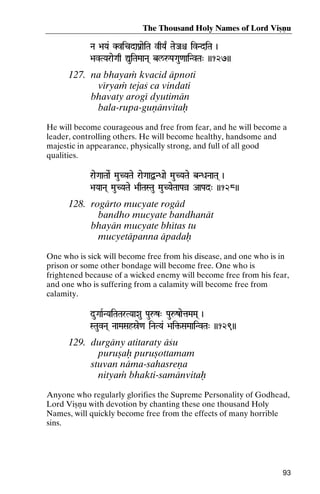
Anyone who hears and chants these thousand Holy Names
of Lord Viñëu will not suffer in an inauspicious condition
of life, either in this life or in the next. By chanting these
thousand Holy Names of Lord Viñëu a brähmaëa will
become learned in all Vedic scriptures, a kñatriya will
become victorious over all his enemies, a vaiçya will
become wealthy, and a çüdra will become happy. By
chanting these thousand Holy Names of Lord Viñëu, one
who desires religious merit will attain great pious credit,
9
Çré Viñëusahasranäma
one who desires wealth will become wealthy, one who
desires opulent arrangements for sense gratification will
attain them, and one who desires to father a great dynasty
will also attain his aim.
… One who chants the thousand Holy Names of Lord
Viñëu very nicely will attain unlimited fame and become
the most prominent of all his kinsmen. He will attain
everlasting opulence, and he will also attain the supreme
auspiciousness. He will become courageous and free from
fear, and he will become a leader, controlling others. He
will become healthy, handsome and majestic in
appearance, physically strong, and full of all good
qualities. One who is sick will become free from his
disease, and one who is in prison or some other bondage
will become free. One who is frightened because of a
wicked enemy will become free from his fear, and one who
is suffering from a calamity will become free from
calamity.
Anyone who regularly glorifies the Supreme Personality of
Godhead, Lord Viñëu with devotion by chanting these
thousand Holy Names will quickly become free from the
horrible karmic effects of many sins. He takes shelter of
Lord Väsudeva and becomes very attached to Him. He
becomes purified of all sins, and he attains the association
of Lord Kåñëa, the Supreme Personality of Godhead. No
actually inauspicious condition is ever imposed on the
devotees of Lord Väsudeva, and therefore they do not fear
having to take birth in this world to again suffer the
miserable conditions of old age, disease and death.
One who carefully studies these prayers with great faith
and devotion to Lord Kåñëa becomes full of the happiness
attained by spiritual realization. He becomes tolerant of
the temporary happiness and distress of material existence.
He attains the opulence of renunciation, patient control of
the senses, and constant meditation on Kåñëa. Because of
this spiritual opulence he attains great fame. The devotees
of the Supreme Personality of Godhead Lord Kåñëa who
perform the devotional service of chanting these one
thousand Holy Names of the Lord become free from
anger, envy, greed, and all wicked thoughts… One who
desires to attain actual happiness and auspiciousness
should regularly hear and chant this prayer glorifying the

10
Preface
Supreme Personality of Godhead, composed by the sage
Vyäsa.

It is my personal observation that chanting Çré
Viñëusahasranäma actually does provide the benefits indicated
above. In my practice and experience of over twenty years, this
potent mantra has helped me overcome debilitating physical
illness, mental agitation, political problems, betrayal, poverty
and many other material difficulties. Reciting and studying this
divine narration, composed entirely of the Holy Names of the
Lord, also contributes to knowledge of Lord Çré Kåñëa’s
opulence and transcendental qualities, guards against spiritual
falldown due to material difficulty, and provides a subtle kind
of mental satisfaction and confidence.
This does not indicate any incompleteness or insufficiency in
the hare kåñëa mahä-mantra, but it does underscore the
scientific truth, verifiable by experience, that each Vedic
mantra has a specific purpose and is best employed for that
result alone. For one who is completely self-realized and has
transcended all connection to material consciousness, the
elevated love of Godhead provided by chanting the hare kåñëa
mahä-mantra will certainly supply all his needs. But for those
of us still in the neophyte stage of karma-miçra bhakti who
maintain some dependence upon the material energy, the
benedictions obtained by chanting Çré Viñëusahasranäma are a
necessary and desirable help in building a strong foundation to
prepare for the higher stages of realization.
There is a precedent for chanting viñëu-mantras that
supplement the hare kåñëa mahä-mantra in the pastimes of
Lord Caitanya. When Lord Çré Caitanya Mahäprabhu returned
from Gayä after Çré Éçvara Puré initiated him, He was
completely transformed into a God-intoxicated personality.
His students of grammar were very confused. Instead of
teaching grammar in the ordinary way, Lord Caitanya
explained that every Sanskrit word and letter indicates Kåñëa,
the Supreme Personality of Godhead. Caitanya Mahäprabhu’s
direct disciple Çréla Jéva Gosvämé later developed this form of
grammar in a book called Hari-nämämåta-vyäkaraëa, “The
Grammar of the Nectar and Name of Çré Hari.” This book is

11
Çré Viñëusahasranäma

still used in Vaiñëava schools and temples to teach Sanskrit
grammar.
But Lord Caitanya's students thought that their teacher had
become mad, so they rubbed His head with Viñëu oil to cool
His brain. This did not affect Lord Caitanya’s ecstasy. Finally
they asked Him, “You say that everything means Kåñëa and we
should ultimately always be chanting the Names of Kåñëa. Just
how should we do this?” Then Lord Caitanya began to sing the
Names of Kåñëa and clap His hands, and in this way He
commenced His harinäma-saìkértana movement. The Holy
Names He sang were:

hari haraye namaù kåñëa yädaväya namaù
yädaväya mädhaväya keñaväya namaù
Çréla Baladeva Vidyäbhüñaëa’s version of Çré
Viñëusahasranäma follows in the same spirit, for every Name
of Viñëu is interpreted to indicate Kåñëa. The point is that
ultimately there is no difference in quality between Çré
Viñëusahasranäma and the hare kåñëa mahä-mantra. They are
both on the transcendental platform because they address
Kåñëa, the Supreme Personality of Godhead.
I therefore encourage all devotees of God everywhere to take
advantage of the benedictions available by chanting Çré
Viñëusahasranäma to end all material difficulties and make
their lives perfect. It is a fact that the spiritual power of the
Holy Name of the Lord resolves all problems. Please use this
mahä-mantra to immerse yourself in näma-bhäjan (worship of
the Holy Name of the Lord) and experience this powerful
benediction for yourself.
oà tat sat
Bhaktisiddhärtha Däsänudäs
Roswell, Georgia
March 14, 2000
Ménä Saìkränté

12
é[q ivZ<auSahóNaaMa
Çré Viñëusahasranäma
The Thousand Holy Names of Lord Viñëu

Introduction

Ç

RÉ Viñëusahasranäma, or the Beautiful Thousand Holy
Names of Lord Viñëu, is a vital part of the theistic Vedic
tradition. Its recitation is also one of the pillars of daily
spiritual practice of the Vaiñëavas, especially in the Çré
sampradäya of South India. However, Çré Viñëusahasranäma is
revered by all bona fide Vaiñëava disciplic successions as a
mahä-mantra, a great Vedic hymn capable of bestowing the
highest benedictions upon the living entities.
We find the origin of Çré Viñëusahasranäma in the Vedic
literature as a section of Mahäbhärata, the epic history of the
incarnation of Lord Çré Kåñëa and His pastimes with His
intimate associates, the Päëòava kings of the Yadu dynasty.
The divine sage Vyäsa, who the Vedic literature states is also
an incarnation of Viñëu or God, composed Mahäbhärata. Çré
Viñëusahasranäma is only one of many sections of deep
spiritual import in Mahäbhärata, which also includes the
famous and beloved Bhagavad-gétä. Mahäbhärata is therefore
sometimes called “The Fifth Veda” because its narrative
presents spiritual truths of fundamental importance to all
followers of sanatana-dharma, the spiritual path of Vedic
civilization.

The Gauòiya disciplic succession
This edition of Çré Viñëusahasranäma is based on the Sanskrit
manuscript and exegetical translation of Çréla Baladeva
Vidyäbhüñaëa, a great spiritual master of the Gauòiya lineage.
Çré Viñëusahasranäma

Lord Çré Caitanya Mahäprabhu, the originator of this lineage,
is none other than Kåñëa Himself incarnating in the mood of
His greatest devotee Çrématé Rädhäräëé: çré kåñëa caitanya
rädhä-kåñëa nähi anya. Çréla Svarüpa Dämodara Gosvämé, the
most confidential servant of Çré Caitanya Mahäprabhu, was the
spiritual master of Çréla Rupa Gosvämé. Çréla Raghunätha däsa
Gosvämé is the direct disciple of Çréla Rupa Gosvämé, and his
disciple is Çréla Kåñëadäsa Kaviräja Gosvämé, the author of Çré
Caitanya-caritämåta.
Çréla Kåñëadäsa Kaviräja Gosvämé accepted Çréla Narottama
däsa Öhäkura as his personal disciple. Narottama däsa Öhäkura
was the spiritual master of Çréla Viçvanätha Cakravarté
Öhäkura, who accepted Çréla Baladeva Vidyäbhüñaëa, the
original author of this version of Çré Viñëusahasranäma, as his
disciple. Viçvanätha Cakravarté Öhäkura also accepted Çréla
Jagannätha däsa Bäbäjé, the spiritual master of Çréla
Bhaktivinoda Öhäkura. Bhaktivinoda Öhäkura’s disciple was
Çréla Gaurakiçora däsa Bäbäjé, the spiritual master of Çréla
Bhaktisiddhänta Sarasvaté Gosvämé. Çréla Bhaktisiddhänta
Sarasvaté Gosvämé accepted as his direct disciple His Divine
Grace A.C. Bhaktivedänta Svämé Prabhupäda, the spiritual
master of the compiler of this edition. This edition of Çré
Viñëusahasranäma is therefore presented strictly in accordance
with the siddhänta or spiritual conclusion of the Gauòiya
Vaiñëava sampradäya.

Çréla Baladeva Vidyäbhüñaëa
Çréla Baladeva Vidyäbhüñaëa appeared in a village near the
city of Remunä, Orissa, in the late 1600s. Even though he was
born the son a vaiçya (farmer), in his youth he still received a
very thorough education in Sanskrit, rhetoric, logic and
scripture. In his youth he accepted sannyäsa in the Madhva
sampradäya, and staying in Jagannätha Puré, he quickly
became prominent in intellectual circles. His study of Çréla Jéva
Gosvämé's Sandarbhas made him a follower of Çré Caitanya
Mahäprabhu. He made a pilgrimage to the sacred sites of
Navadvépa, and spent the remainder of his life in Vrëdävana,
studying Çrémad-Bhägavatam and other Vaiñëava scriptures

14
Introduction

under the guidance of his spiritual master, Çréla Viçvanätha
Cakravarté Öhäkura.
In 1706 Çréla Viçvanätha Cakravarté Öhäkura sent him to Galta
(near Jaipur, India) to prove the authenticity of Çré Caitanya
Mahäprabhu's movement. The Rämänandés (a local branch of
the Çré Vaiñëava sampradäya) argued that the Gauòiya
Vaiñëavas, having no commentary on Vedänta-sütra, were not
a bona-fide disiplic lineage and therefore had no right to
worship Govindajé or any of the other Deities of Vrëdävana.
By the grace of the Govindajé Deity, Çréla Baladeva
Vidyäbhüñaëa swiftly compiled a wonderful commentary on
Vedänta, Govinda-bhäsya.
Çréla Baladeva Vidyäbhüñaëa was a prolific and influential
author of works in the Vedic tradition. His most important
works are: Govinda-bhäsya, Siddhänta-ratna, Vedäntasyamantaka, Prameya-ratnavälé, Siddhänta-darpaëa, Aisvaryakadämbiné, Sahitya-kaumudé, Chandaù-kaustubha, Kavyakaustubha, Bhagavad-gétä-bhäsya, Vaiñëav-änändiné téka (a
commentary on Çrémad-Bhägavatam), as well as commenatries
on Tattva-sandarbha, Stäva-mälä, Gopala-tapani Upaniñad,
Viñëusahasranäma, Laghu-bhagavatämåta, Naöaka-candrika,
and Çyämänända-ñäöaka.

Why Çré Viñëusahasranäma was Narrated
Many Vaiñëava devotees and other people throughout the
world accept Bhagavad-gétä as the finest example of spiritual
instruction. Bhagavad-gétä is, of course, a section of
Mahäbhärata. Çré Viñëusahasranäma is part of the same
work—Mahäbhärata—written by the same author: Çréla
Vyäsadeva. To really understand the exalted purpose and deep
meaning of Çré Viñëusahasranäma, it is instructive to consider
the context in which it is narrated in Mahäbhärata.
After the great Battle of Kurukñetra, King Yudhiñöhéra, the
eldest of the five Paëòava brothers, was in great anxiety. As a
sensitive and compassionate devotee, he was distraught at the
tremendous death and suffering caused by the war, which was
fought in part to protect his claim to the throne of the Kuru
dynasty. Çré Bhéçma was lying on his deathbed of arrows.
15
Çré Viñëusahasranäma

Yudhiñöhéra’s dear grandfather was dying. With Bhéçma’s
passing, his spiritual wisdom, distilled from the experiences of
his long life of virtue, righteousness and devotion, would soon
be lost. Yudhiñöhéra, now emperor of a vast empire, would be
bereft of his guidance.
Vyäsadeva the incarnation of God as a great sage, and Çré
Kåñëa the Supreme Personality of Godhead both advised
Yudhiñöhéra, himself an epitome of righteousness and virtue, to
approach Bhéçma and seek his advice on all subjects on which
he had any doubts. Yudhiñöhéra, with characteristic humility,
did as Kåñëa advised, and a series of intense and poignant
dialogs between him and Bhéçma ensued, witnessed by Lord
Çré Kåñëa and by many other great personalities including
Vyäsadeva and Lord Çiva.
In one of these conversations, Yudhiñöhéra asked Bhéçma for
the easiest and best means by which mankind can attain lasting
happiness, peace of mind, and relief from all bondage and
sorrow. Driven by his conscientious, responsible approach to
his duty of ruling over his kingdom, Yudhiñöhéra was, in effect,
asking Bhéçma to help him establish a state policy for
management of religious affairs that would maximize the
spiritual benefit for the citizens. In response Bhéçma imparted
Çré Viñëusahasranäma with the eternal spiritual welfare of the
general population in mind.
The commentaries of the great äcäryas on Çré
Viñëusahasranäma (over forty of them are extant) generally
identify six reasons for its greatness:
1. Çré Viñëusahasranäma is the essence of Mahäbhärata.
2. Great sages such as Närada, the Alwars, and composers
such as Tyägaräja have made repeated references to Çré
Viñëusahasranäma in their devotional works.
3. Çréla Vedavyäsa—who composed Çré
Viñëusahasranäma, included it in Mahäbhärata and
thus preserved it for the benefit of the whole world—
was celebrated as the foremost knower of the Vedas,
and respected as an incarnation of Viñëu (vyäsäya viñëu
rupäya vyäsa rupäya viñëave namo).
16
Introduction

4. The conclusive opinion of Bhéçma was that chanting the
Holy Name of the Lord is the best and easiest of all
dharmas or spiritual practices, and the most reliable
means to attain relief from all material bondage. Çré
Viñëusahasranäma is composed entirely of these Holy
Names.
5. It is widely accepted in Vedic society that chanting Çré
Viñëusahasranäma indeed gives relief from all sorrows
and bestows happiness and peace of mind.
6. Çré Viñëusahasranäma is in perfect conformity with the
teachings of Bhagavad-gétä, Çrémad Bhägavatam,
Caitanya-caritämåta and all other Vedic literature.
These reasons for the prominence of Çré Viñëusahasranäma
become all the more understandable when we consider the
great personalities involved in its revelation. An extraordinary
person's advice was being sought. An extraordinary person was
seeking the advice, and he was doing so at the request of most
extraordinary persons.
Bhéçma was the son of the Mother Gaìgä, who purifies even
the great souls. He was a great king sanctified by his
unswerving devotion to Lord Kåñëa, who had controlled and
conquered all his senses. Yudhiñöhéra was the son of dharma
personified, and himself a great practitioner of justice,
righteousness, truthfulness, honesty and integrity. Vyäsa is the
knower of all Vedas and the wisdom incarnation of the Lord.
Lord Kåñëa is the Supreme Personality of Godhead Himself.
The result was no less than the revelation of the easiest and
best means to achieve happiness and peace of mind to
Yudhiñöhéra by Bhéçma. Certainly, no other justification is
needed to recognize the greatness of the benediction imparted
to the human race through the revelation of Çré
Viñëusahasranäma.
But there is more. In kali-yuga the present historical age, the
traditional Vedic self-realization processes of meditation, yoga
practice, agnihotra-yajïa and Deity worship are difficult or
impossible to perform properly. This leaves the vast majority

17
Çré Viñëusahasranäma

of people without any access to a bona fide process of spiritual
advancement for ultimate liberation from material suffering.
That the average person would be disqualified from selfrealization because of the inebrieties of kali-yuga was as
intolerable to the compassionate Yudhiñöhéra as it was to
Bhéçma, Vyäsa and Lord Kåñëa. Yudhiñöhéra wanted a definite
solution to this serious problem that he could pass down to the
successors of his dynasty to benefit future generations of the
citizens. Bhéçma understood this, and gave Yudhiñöhéra the
process that was to become the yuga-dharma in kali-yuga:
näma-saìkértana or the congregational chanting of the Holy
Names of the Lord. In the Padma Puräëa Lord Çiva is quoted
as saying to Pärvaté,

ärädhanänäà sarveñäà viñëor ärädhanaà param
“Worshiping Lord Viñëu is the supreme process of worship.”
And the authorized process for worshiping Lord Viñëu in kaliyuga is chanting His Holy Names:

yajnaiù saìkértana-prayair yajanti hi sumedhañaù
“In kali-yuga, those who are intelligent perform the saìkértanayajïa, the sacrifice of congregational chanting of the Holy
Names of the Lord.” [Çrémad-Bhägavatam 11.5.32]
And in the Caitanya-caritämåta, in the section describing the
reasons for the incarnation of Kåñëa as Lord Çré Caitanya
Mahäprabhu, we find the following statement by Lord Kåñëa
Himself:

yuga-dharma pravartäimu näma-saìkértana
cäri bhäva-bhakti diyä näcämu bhuvana
Lord Kåñëa declared: “I shall personally inaugurate the
religion of the age: näma-saìkértana, the congregational
chanting of the Holy Name. I shall make the world dance in
ecstasy, realizing the four mellows of loving devotional
service.” [Adi-lila 3.19]

18
Introduction

Kåñëa is the Supreme Personality of Godhead
Çréla Baladeva Vidyäbhüñaëa’s object in compiling an
expanded translation of Çré Viñëusahasranäma was to show
that one can understand every Name of Viñëu also to be a
Name of Çré Kåñëa. According to some Vaiñëavas who are
devotees of Viñëu or Näåäyaëa, Kåñëa is an incarnation of
Viñëu. Indeed this is true, since Kåñëa, in His later pastimes in
Mathurä and Dvärakä acted as the yuga-avatära for the
dväpara-yuga, a function of Viñëu. However, in His youthful
pastimes in Våndävana, Kåñëa also revealed the most
confidential transcendental form, character and pastimes of the
original Supreme Personality of Godhead, the source of even
Lord Viñëu. This is confirmed in Çrémad Bhägavatam:

ete cäàça-kaläù puàsaù kåñëas tu bhagavän svayam
indräri-vyäkulaà lokaà måòayanti yuge yuge
“All the lists of the incarnations of Godhead submitted
herewith are either plenary expansions or parts of the plenary
expansions of the Supreme Godhead, but Kåñëa is the
Supreme Personality of Godhead Himself.” [Çrémad
Bhägavatam 1.3.28]
In the Brahmä-saàhétä it is stated:

éçvaraù paramaù kåñëaù sac-cid-änanda-vigrahaù
anädir ädir govindaù sarva-käraëa-käraëam
“There are many personalities possessing the qualities of
Bhagavän, but Kåñëa is the Supreme because none can excel
Him. He is the Supreme Person, and His body is eternal, full of
knowledge and bliss. He is the primeval Lord Govinda and the
cause of all causes.”
[Brahmä-saàhétä 5.1]
And Kåñëa Himself declares in Bhagavad-gétä:

mattaù parataraà nänyat kiïcid asti dhanaïjaya
mayi sarvam idaà protaà sütre maëi-gaëä iva
“O conqueror of wealth [Arjuna], there is no Truth superior to
Me. Everything rests upon Me, as pearls are strung on a
thread.” [Bhagavad-gétä 7.7]
19
Çré Viñëusahasranäma

Çréla Prabhupäda explains this point elaborately in his
summary study of the Tenth Canto of Çrémad Bhägavatam: “In
order to convince Brahmä that all those cows, calves and boys
were not the original ones, the cows, calves, and boys who were
playing with Kåñëa transformed into Viñëu forms. Actually, the
original ones were sleeping under the spell of Brahmä's mystic
power, but the present ones, seen by Brahmä, were all
immediate expansions of Kåñëa, or Viñëu. Viñëu is the
expansion of Kåñëa, so the Viñëu forms appeared before
Brahmä. All the Viñëu forms were of bluish color and dressed
in yellow garments; all of Them had four hands decorated with
club, disc, lotus flower and conchshell. On Their heads were
glittering golden-jeweled helmets; They were bedecked with
pearls and earrings and garlanded with beautiful flowers. On
Their chests was the mark of Çrévatsa; Their arms were
decorated with armlets and other jewelry. Their necks were
smooth just like a conchshell, Their legs were decorated with
bells, Their waists decorated with golden bells, and Their
fingers decorated with jeweled rings. Brahmä also saw that
upon the whole body of Lord Viñëu, fresh tuläsé buds were
thrown, beginning from His lotus feet up to the top of the
head. Another significant feature of the Viñëu forms was that
all of Them were looking transcendentally beautiful. Their
smiling resembled the moonshine, and Their glancing
resembled the early rising of the sun.”
[Kåñëa, The Supreme Personality of Godhead, Chapter 13]
That so many Viñëu forms expanded from Lord Kåñëa is a
clear proof that Kåñëa is the ultimate Supreme personality of
Godhead and the source even of Lord Viñëu. Çréla Baladeva
Vidyäbhüñaëa wrote his translation of Çré Viñëusahasranäma
from the understanding that Lord Çré Kåñëa is the Supreme
Personality of Godhead, as accepted by both the author Çréla
Vyäsadeva and the narrator Çré Bhéçma. Thus he has expanded
upon the literal Sanskrit meanings of the Names to indicate
their relation to Kåñëa’s incarnations, qualities and pastimes.
He also compiled commentaries drawn from the Vedic
literature to support these expansions, which we have not
included herein. The philosophically inclined reader interested
in an English translation of Baladeva’s complete commentary

20
Introduction

may consult my Godbrother Kuçakratha däsa’s excellent work
on the subject published by The Krishna Institute.∗

Avoiding Offenses to the Holy Name
The bliss of the Holy Name is the highest benediction. The
limited happiness of wealth, sense enjoyment, piety or even
liberation cannot compare with it. Anything one may desire is
obtainable from the Holy Name, for there is no difference
between the Holy Name and Kåñëa Himself. All the Vedic
scriptures confirm this. Real happiness, peace, and relief from
all difficulties are easily obtainable by näma-bhajan, and this
result is eternal.
If this is so, then why do we need to chant again and again?
There is no imperfection or fault in the Holy Name, and His
purifying effect is certain and immediate. But like intoxicated
elephants, after we bathe our minds and hearts by chanting, we
again smear them with the mud of our attachments and desires.
As conditioned souls we have a tendency to fall down into
material consciousness. We must not only learn the art of
chanting nicely, but also of clearing the mentality that
habitually contaminates the eternal bliss that is its natural
result.
Avoiding näma-aparäha or offenses to the Holy Name is the
only way to retain the eternal benedictions of chanting. Çréla
Jéva Gosvämé, one of the founders of our disciplic lineage,
instructs that we should chant the Holy Name of the Lord
continuously and loudly, and it should be performed
offenselessly, as recommended in the Padma Puräëa.
One can be delivered from the effects of all sins by
surrendering himself unto the Lord. One can be delivered from
all offenses at the feet of the Lord by taking shelter of His Holy
Name. But one cannot be delivered if one commits an offense
at the feet of the Holy Name of the Lord, for chanting the Holy

∗

Contact The Krishna Institute, 16717 NW 173rd Terrace, Alachua, FL 32615
USA. Phone: +1 (904) 462-1843 Email: douggreenbrg@earthlink.net
Web: http://seva.iskcon.net/bhakti/kusakrat/instilst.htm
21
Çré Viñëusahasranäma

Name is itself the process of deliverance. Ten such offenses are
mentioned in the Padma Puräëa.
The first offense is to vilify the great devotees who have
preached about the glories of the Lord. Blasphemy of the pure
devotees is the most serious of the offenses that deprive us of
the benefit of chanting. The self-realized pure devotee is not an
ordinary human being, but is an authorized representative of
the Supreme Lord Çré Kåñëa. As such, he has the power to
award pure devotional service to Kåñëa, which is the key to
spiritual liberation and eternal happiness. One should not
regard the pure devotee with a critical or envious attitude,
since this can place formidable obstacles in one’s path of
spiritual advancement. It is better not to become too familiar
with the pure devotee, but to maintain some formality of
respect with him. This will help prevent us from committing
offenses by cultivating a service attitude.
The second offense is to see the Holy Names of the Lord in
terms of worldly distinction. The Lord is the proprietor of all
the universes, and therefore He may be known in different
places by different Names, but that does not in any way qualify
the fullness of the Lord. Any nomenclature that is meant for
the Supreme Lord is as holy as the others because it is meant
for the Lord. All the transcendental Holy Names are as
powerful as the Lord, and there is no bar for anyone in any
part of the creation to chant and glorify the Lord by the
particular Holy Names of the Lord as they are locally
understood. All of His Holy Names are absolute and allauspicious, and one should not distinguish among different
Holy Names of the Lord as one does with material objects and
their names.
The third offense is to neglect the orders of the authorized
äcäryas or spiritual masters. There are many authorized
spiritual masters in the disciplic lineage or paramparä, and all
of them have given wonderful instructions capable of saving
the entire world. If we follow these instructions we will be
benefited, even if we do not understand them. For example,
the Vaiñëava spiritual masters are unanimous in their
glorification of worship of the holy tuläsé plant as a means to
achieve pure devotional service. It does not matter if one
22
Introduction

cannot understand how offering prayers and water to a plant
can bestow spiritual advancement. If we follow the instruction
without argument, we will gain the benefit. When we become
spiritually qualified, Kåñëa will reveal the purpose of all
devotional instructions and practices from within our hearts.
Our duty is to follow in the footsteps of the great souls in
Kåñëa consciousness.
The fourth offense is to vilify the scriptures or Vedic
knowledge. Although there are many statements in the
scriptures that are difficult for us to comprehend, we should
not adopt a critical attitude because these are not ordinary
books. The Çrémad-Bhägavatam tells us that the Vedas are
originally manifested from the breathing of the Supreme Lord
Näräyaëa. And in Bhagavad-gétä, Kåñëa declares that He alone
is the true knower of the deep import of the Vedas. The Vedic
literature is extremely elevated and pure. Its purpose is the
salvation of all living entities from the suffering of material
existence. Thus it is meant for our eternal benefit, and we
should be careful not to underestimate its value.
The fifth offense is to define the Holy Name of the Lord in
terms of one's mundane calculation. The Holy Name of the
Lord is identical with the Lord Himself, therefore one should
understand the Holy Name to be nondifferent from Him. We
have discussed this point elaborately with evidence from the
Vedic scriptures in the Preface of this work. Nevertheless, in
the beginning stage of devotion, it is often difficult to see how
this is so. The best policy is to accept provisionally that the
Holy Name of the Lord is identical with Him, on the strength
of the word of the great souls who have passed this truth down
to us, and trust that when we are sufficiently purified we will be
able to realize it for ourselves.
The sixth offense is to interpret the Holy Name. The Lord is
not imaginary, nor is His Holy Name. There are persons with a
poor fund of knowledge who think the Lord to be an
imagination of the worshiper and therefore think His Holy
Name to be imaginary. Such a chanter of the Name of the Lord
cannot achieve the desired success in the matter of chanting
the Holy Name. There is no material significance or hidden
meaning to the Holy Names of the Lord. To speculate
23
Çré Viñëusahasranäma

otherwise is offensive. The real truth about the Holy Name of
the Lord is extensively discussed in the authorized Vedic
scriptures. No other interpretation is needed.
The seventh offense is to commit sins intentionally on the
strength of the Holy Name. In the scriptures it is said that one
can be liberated from the effects of all sinful actions simply by
chanting the Holy Name of the Lord. One who takes
advantage of this transcendental purification, yet continues to
commit sins on the expectation of neutralizing their effects by
chanting the Holy Name of the Lord, is the greatest offender at
the feet of the Holy Name. Such an offender cannot purify
himself by any other method of purification. In other words,
one may be sinful before chanting the Holy Name of the Lord,
but after taking shelter in the Holy Name of the Lord and
becoming immune, one should strictly restrain from
committing further sinful acts with a hope that chanting the
Holy Name will give him protection.
The eighth offense is to consider the Holy Name of the Lord
and His chanting method to be equal to some material
auspicious activity. There are various kinds of good works for
material benefits recommended in the scriptures, but the Holy
Name and His chanting are not merely auspicious holy
services. Undoubtedly the Holy Name is holy service, but He
should never be utilized for such selfish purposes. Since the
Holy Name and the Lord are one and the same, one should not
try to bring the Holy Name into the service of mankind. The
point here is that the Supreme Lord is the Supreme Enjoyer.
He is no one's servant or order supplier. Since the Holy Name
of the Lord is identical with the Lord, one should not try to
utilize the Holy Name for one's material benefit. The real
purpose of chanting the Holy Name is to attain pure devotional
service to the Lord.
The ninth offense is to instruct those who are not interested in
chanting the Holy Name of the Lord about the transcendental
nature of the Holy Name. If such instruction is imparted to an
unwilling audience, this act is considered to be an offense at
the feet of the Holy Name. The reason for this is that by
forcing the issue, one has created a bad impression in the
minds of the audience about the Holy Name. This impediment
24
Introduction

will delay their acceptance of the chanting process and can lead
to offenses against devotees. Since the Holy Name is meant for
the spiritual benefit of the living entities, preaching the glories
of the Holy Name to an unwilling audience goes against the
Lord’s actual purpose for manifesting the Holy Name in
human society.
The tenth offense is to become uninterested in or inattentive to
the Holy Name of the Lord, neglecting one’s chanting even
after understanding the wonderful transcendental nature of the
Holy Name. The effect of chanting the Holy Name of the Lord
is liberation from the conception of false egoism. False egoism
is thinking oneself to be the enjoyer of the world and thinking
everything in the world to be meant for one's enjoyment. The
whole materialistic world is moving under the false egoism of
“I” and “mine,” but the factual effect of chanting the Holy
Name is to become free from such misconceptions. If one
begins the chanting process but then stops due to a mundane
conception of life, this is an offense. One should maintain
chanting and hearing the Holy Name of the Lord continuously,
until the process of purification is complete.
The best protection against committing offenses to the Holy
Name of the Lord is to have firm faith in the instructions of the
scriptures and of one’s personal spiritual master. One should
continue the regular daily chanting of the Holy Names of the
Lord with patience, diligence and enthusiasm. It is wonderful if
one can accept initiation from a bona fide spiritual master in
the disciplic succession from Kåñëa Himself. If possible one
should give up all material activities and join the mission of
Lord Caitanya. Lord Caitanya’s process, harinäma-saìkétana, is
to chant and hear the Holy Name, topics related to the glories
of the Lord and His Holy Name, literature such as Bhagavadgétä, Çrémad-Bhägavatam and Caitanya-caritämrta, and nice
songs glorifying pure devotional service continuously in the
association of like-minded devotees, until the self-effulgent
glory of the Holy Name becomes self-manifest in one’s
consciousness.
At that point, all the elaborate philosophical instructions of the
scriptures that we have summarized herein are reduced to a
simple matter of experience, and the glories of the Holy Name
25
Çré Viñëusahasranäma

of the Lord become self-evident. One who has tasted the full
nectar of the Holy Name automatically avoids the ten offenses
to the Holy Name, and his path to complete spiritual
enlightenment becomes straight and clear.
It is our fond hope that the readers of this volume will apply
these truths and instructions to make their own lives perfect in
spiritual realization. Certainly, anyone who chants the Holy
Name of the Lord even once is a great soul worthy of all
respect and praise.

yan-nämadheya-çravaëänukértanäd
yat-prahvaëäd yat-smaraëäd api kvacit
çvädo 'pi sadyaù savanäya kalpate
kutaù punas te bhagavan nu darñanät
“To say nothing of the spiritual advancement of persons who
see the Supreme Person face-to-face, even a person born in a
family of dog-eaters immediately becomes eligible to perform
Vedic sacrifices if he once utters the Holy Name of the
Supreme Personality of Godhead or chants about Him, hears
about His pastimes, offers Him obeisances or even remembers
Him.” [Çrémad-Bhägavatam 3.33.6]
Once begun, the process of hearing and chanting inevitably
continues, clearing the mirror of the mind of all misconceptions
until the chanter attains the perfection of spiritual realization.
Long before achieving that exalted destination, all material
pangs will have been erased by the potent purifying action of
the Holy Name. We wish the reader all good fortune on this
most auspicious progressive journey to the most wonderful
state of Kåñëa consciousness.

26
Ma®l/acr<aMa(
Maìgaläcaraëam
Auspicious Invocation
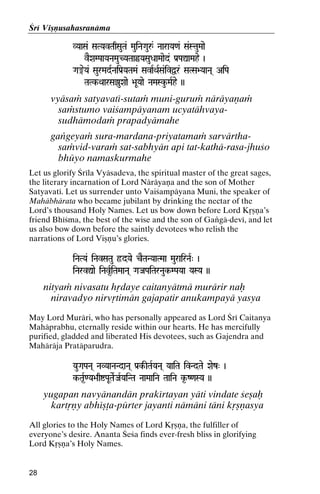
NaMa p ivZ<auPaadaYa k*-Z<aPa[eïaYa >aUTale/
aadaYa
é[qMaTae >ai¢-vedaNTaSviMaà( wiTa NaaiMaNae )
>ai¢-

NaMaSTae SaarSvTae deve GaaErva<aqPa[cir<ae

iNaivRXaezXaUNYavaidPaaêaTYadeXaTaair<ae ))

nama oà viñëu-pädäya kåñëa-preñöhäya bhü-tale
çrémate bhaktivedänta-svaminn iti nämine
namas te särasvate deve gaura-väëé-pracariëe
nirviçeña-çünyavädi-päçcätya-deça-täriëe
I offer my respectful obeisances unto His Divine Grace A.C.
Bhaktivedanta Swami Prabhupäda, who is very dear to Lord Kåñëa,
having taken shelter at His lotus feet. Respectful obeisances unto
you, O spiritual master, servant of Sarasvaté Gosvämé. You are kindly
preaching the message of Lord Caitanya and delivering the Western
countries, which are full of impersonalism and voidism.
ANaNTak-LYaa<aGau<aEk-vairiDaivR>auicdaNaNdgaNaae >aJaiTPa[Ya" )
ANaNTakcdaNaNdgaNaae

k*-Z<aiñXai¢-bRhuMaUiTaRrqìrae ivìEk-heTau" Sa k-raeTau Na" Xau>aMa( ))
Z<aiñXai¢k-

ananta-kalyäëa-guëaika-väridhir
vibhu-cid-änanda-ghano bhajat-priyaù
kåñëas tri-çaktir bahu-mürtir éçvaro
viçvaika-hetuù sa karotu naù çubham
Lord Çré Kåñëa, the all-powerful Supreme Person who appears in
many forms, is the original master of the universe. He is the master of
the three potencies (internal, external and marginal), whose eternal
form of great strength is full of transcendental knowledge and bliss. O
Lord, You are very dear to the devotees, and an ocean of auspicious
qualities. Please grant auspiciousness to us.
Çré Viñëusahasranäma
VYaaSa& SaTYavTaqSauTa& MauiNaGauå& NaaraYa<a& Sa&StauMaae

vEXaMPaaYaNaMauCYaTaaûYaSauDaaMaaed& Pa[PaÛaMahe )

Ga®eYa& SaurMadRNaiPa[YaTaMa& SavaRQaRSa&ivÜr& SaTSa>YaaNa( AiPa
aTaMa&
TaTk-QaarSa‡uXaae >aUYaae NaMaSku-MaRhe ))
TaTk-

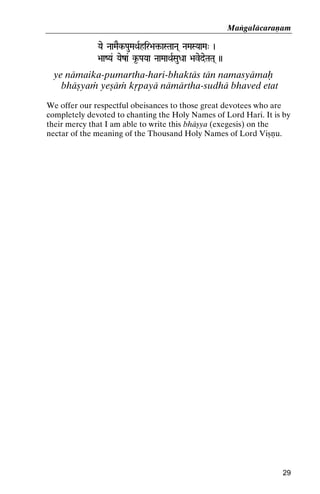
vyäsaà satyavaté-sutaà muni-guruà näräyaëaà
saàstumo vaiçampäyanam ucyatähvayasudhämodaà prapadyämahe
gaìgeyaà sura-mardana-priyatamaà sarvärthasaàvid-varaà sat-sabhyän api tat-kathä-rasa-jhuço
bhüyo namaskurmahe
Let us glorify Çréla Vyäsadeva, the spiritual master of the great sages,
the literary incarnation of Lord Näräyaëa and the son of Mother
Satyavaté. Let us surrender unto Vaiçampäyana Muni, the speaker of
Mahäbhärata who became jubilant by drinking the nectar of the
Lord’s thousand Holy Names. Let us bow down before Lord Kåñëa’s
friend Bhéçma, the best of the wise and the son of Gaìgä-devé, and let
us also bow down before the saintly devotees who relish the
narrations of Lord Viñëu’s glories.
iNaTYa& iNavSaTau ôdYae cETaNYaaTMaa MaurairNaR" )
iNarvÛae iNav*RiTaMaaNa( GaJaPaiTarNauk-MPaYaa YaSYa ))

nityaà nivasatu hådaye caitanyätmä murärir naù
niravadyo nirvåtimän gajapatir anukampayä yasya
May Lord Muräri, who has personally appeared as Lord Çré Caitanya
Mahäprabhu, eternally reside within our hearts. He has mercifully
purified, gladded and liberated His devotees, such as Gajendra and
Mahäräja Pratäparudra.
YauGaPaNa( NaVYaaNaNdaNa( Pa[k-ITaRYaNa( YaaiTa ivNdTae Xaez" )
k-Ta*R<Ya>aqíPaUTaeRJaRYaiNTa NaaMaaiNa TaaiNa k*-Z<aSYa ))

yugapan navyänandän prakértayan yäti vindate çeñaù
kartåëy abhéñöa-pürter jayanti nämäni täni kåñëasya
All glories to the Holy Names of Lord Kåñëa, the fulfiller of
everyone’s desire. Ananta Çeça finds ever-fresh bliss in glorifying
Lord Kåñëa’s Holy Names.

28
Maìgaläcaraëam
Yae NaaMaEk-PauMaQaRhir>a¢-aSTaaNa( NaMaSYaaMa" )
ir>a¢-

>aaZYa& Yaeza& k*-PaYaa NaaMaaQaRSauDaa >avedeTaTa( ))

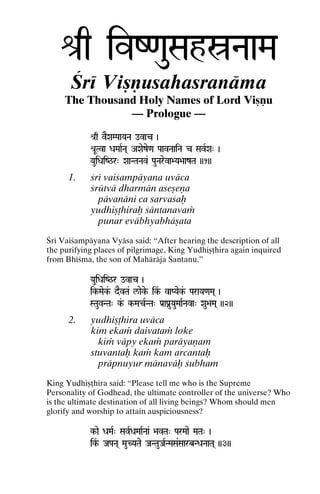
ye nämaika-pumartha-hari-bhaktäs tän namasyämaù
bhäñyaà yeñäà kåpayä nämärtha-sudhä bhaved etat
We offer our respectful obeisances to those great devotees who are
completely devoted to chanting the Holy Names of Lord Hari. It is by
their mercy that I am able to write this bhäñya (exegesis) on the
nectar of the meaning of the Thousand Holy Names of Lord Viñëu.

29
Çré Viñëusahasranäma

30
é[q ivZ<auSahóNaaMa
Çré Viñëusahasranäma
The Thousand Holy Names of Lord Viñëu
— Prologue —
é[q vEXaMPaaYaNa ovac )

é[UTva DaMaaRNa( AXaeze<a PaavNaaiNa c SavRXa" )
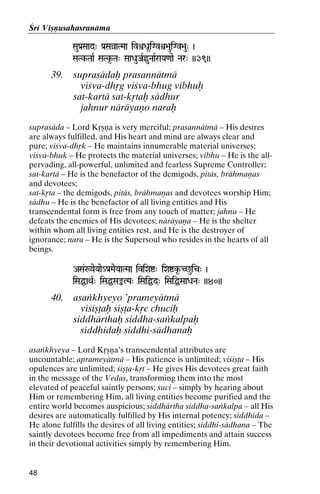
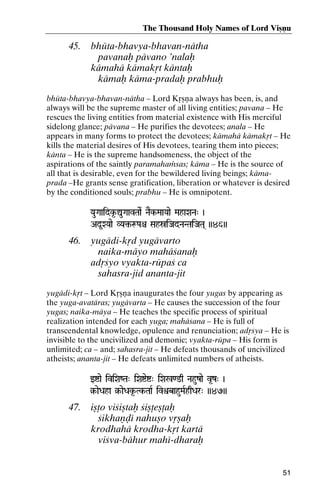
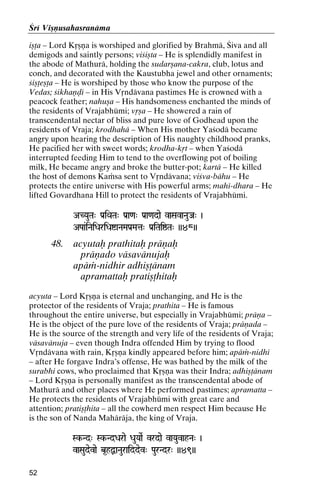
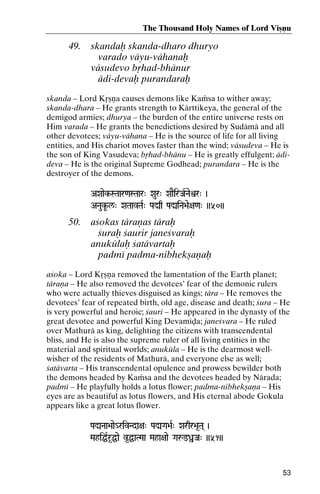
YauiDaiZ#=r" XaaNTaNav& PauNareva>Ya>aazTa ))1))

1.

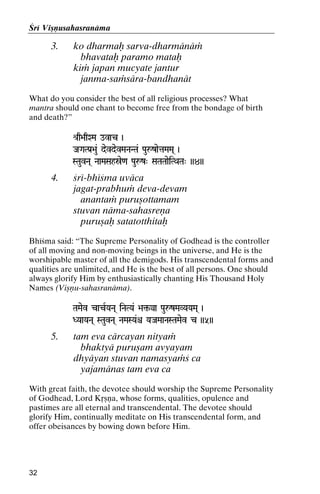
çré vaiçampäyana uväca
çrütvä dharmän açeñeëa
pävanäni ca sarvaçaù
yudhiñöhiraù çäntanavaà
punar eväbhyabhäñata

Çré Vaiçampäyana Vyäsa said: “After hearing the description of all
the purifying places of pilgrimage, King Yudhiñöhira again inquired
from Bhéçma, the son of Mahäräja Çantanu.”
YauiDaiZ#=r ovac )

ik-Maek&- dEvTa& l/aeke- ik&- vaPYaek&- ParaYa<aMa( )
ik-

STauvNTa" k&- k-MacRNTa" Pa[aPanuYauMaaRNava" Xau>aMa( ))2))
k-

2.

yudhiñöhira uväca
kim ekaà daivataà loke
kià väpy ekaà paräyaëam
stuvantaù kaà kam arcantaù
präpnuyur mänaväù çubham

King Yudhiñöhira said: “Please tell me who is the Supreme
Personality of Godhead, the ultimate controller of the universe? Who
is the ultimate destination of all living beings? Whom should men
glorify and worship to attain auspiciousness?
k-ae DaMaRR" SavRDaMaaRNaa& >avTa" ParMaae MaTa" )
DaMa

ik&- JaPaNa( MauCYaTae JaNTauJaRNMaSa&SaarbNDaNaaTa( ))3))
Çré Viñëusahasranäma

3.

ko dharmaù sarva-dharmänäà
bhavataù paramo mataù
kià japan mucyate jantur
janma-saàsära-bandhanät

What do you consider the best of all religious processes? What
mantra should one chant to become free from the bondage of birth
and death?”
é[q>aqXMa ovac )

JaGaTPa[>au& devdevMaNaNTa& PauåzaetaMaMa( )

STauvNa( NaaMaSahóe<a Pauåz" SaTaTaaeiTQaTa" ))4))

4.

çré-bhéçma uväca
jagat-prabhuà deva-devam
anantaà puruñottamam
stuvan näma-sahasreëa
puruñaù satatotthitaù

Bhéçma said: “The Supreme Personality of Godhead is the controller
of all moving and non-moving beings in the universe, and He is the
worshipable master of all the demigods. His transcendental forms and
qualities are unlimited, and He is the best of all persons. One should
always glorify Him by enthusiastically chanting His Thousand Holy
Names (Viñëu-sahasranäma).
TaMaev cacRYaNa( iNaTYa& >a¢-ya PauåzMaVYaYaMa( )
>a¢DYaaYaNa( STauvNa( NaMaSYa&ê YaJaMaaNaSTaMaev c ))5))
YaJaMaaNaSTaMae

5.

tam eva cärcayan nityaà
bhaktyä puruñam avyayam
dhyäyan stuvan namasyaàç ca
yajamänas tam eva ca

With great faith, the devotee should worship the Supreme Personality
of Godhead, Lord Kåñëa, whose forms, qualities, opulence and
pastimes are all eternal and transcendental. The devotee should
glorify Him, continually meditate on His transcendental form, and
offer obeisances by bowing down before Him.

32
The Thousand Holy Names of Lord Viñëu
ANaaidiNaDaNa& ivZ<au& SavRl/aek-MaheìrMa( )

laek-aDYaa+aMSTauvNa( iNaTYa& SavRdu"%aiTaGaae >aveTa( ))6))
%aiTaGaae

6.

anädi-nidhanaà viñëuà
sarva-loka-maheçvaram
lokädhyäkñam stuvan nityaà
sarva-duùkhätigo bhavet

Never was there a time when Lord Viñëu first came into existence,
and there is no time in the future when He shall cease to exist. He is
the supreme master of all planets, living entities and the demigods
who control the universe. He is the all-knowing, all pervading witness
who sees everything. One who regularly glorifies Him becomes free
from all material miseries, and in that liberated condition becomes
full of transcendental bliss.
b]ø<Ya& SavRDaMaRj& l/aek-aNaa& k-IiTaRvDaRNaMa( )
k-

laek-NaaQa& MahÙUTaMSavR>aUTa>avaeÙvMa( ))7))

7.

brahmaëyaà sarva-dharmajïaà
lokänäà kérti-vardhanam
loka-näthaà mahad-bhütam
sarva-bhüta-bhavodbhavam

Lord Viñëu is the protector and well-wisher of the brähmaëas, aware
of all principles of religion, the Lord who expands the glory of His
devotees, the supreme monarch of all planetary systems, the
embodiment of all opulence and the original Father of Brahmä, Çiva
and all living entities.
Wz Mae SavRDaMaaR<aa& DaMaaeR_iDak-TaMaae MaTa" )
iDak-

YaÙ¢-ya Pau<@rqk-a+a& STavErcRNa( Nar" Sada ))8))
YaÙ¢@rqk-

8.

eña me sarva-dharmäëäà
dharmo ’dhikatamo mataù
yad bhaktyä puëòarékäkñaà
stavair arcen naraù sadä

In my opinion, the best of all spiritual activities is to continuously and
devotedly worship lotus-eyed Lord Kåñëa by reciting prayers
glorifying Him and describing His Holy Names.

33
Çré Viñëusahasranäma
ParMa& Yaae MahtaeJa" ParMa& Yaae MahtaPa" )

ParMa& Yaae MahØ]ø ParMa& Ya" ParaYa<aMa( ))9))

9.

paramaà yo mahat-tejaù
paramaà yo mahat-tapaù
paramaà yo mahad brahma
paramaà yaù paräyaëam

Lord Kåñëa is the Supreme Personality of Godhead. He is supremely
powerful and splendid, and the sun and other luminaries derive their
splendor and heat from Him. He is partially manifest as the Brahman
effulgence. He is the ultimate shelter of all living entities.
Paiv}aa<aa& Paiv}a& Yaae Ma®l/aNaa& c Ma®l/Ma( )
dEvTaMdevTaaNaa& c >aUTaaNaa& Yaae_VYaYa" iPaTaa ))10))

10.

paviträëäà pavitraà yo
maìgalänäà ca maìgalam
daivatam devatänäà ca
bhütänäà yo ’vyayaù pitä

Lord Kåñëa is the most purifying of purifiers, and the power of the
Ganges and other places of pilgrimage to remove sinful reactions is
derived from Him. He is the most auspicious of all auspicious
personalities, and He gives to Gaëeça and others the power to
remove obstacles. He is the most worshipable person, superior to
Brahmä and all the demigods. He is the eternal, original Father of all
living entities.
YaTa" SavaRi<a >aUTaaiNa >avNTYaaidYauGaaGaMae )

YaiSMa&ê Pa[l/Ya& YaaiNTa PauNarev YauGa+aYae ))11))

11.

yataù sarväëi bhütäni
bhavanty ädi-yugägame
yasmiàç ca pralayaà yänti
punar eva yuga-kñaye

All living beings in the material world come from Lord Kåñëa at the
beginning of the creation. Lord Kåñëa maintains them while the
creation is manifest, and they enter into Him again when the creation
is destroyed.

34
The Thousand Holy Names of Lord Viñëu
TaSYa l/aek-Pa[DaaNaSYa JaGaàaQaSYa >aUPaTae )

ivZ<aaeNaaRMaSahó& Mae Xa*<au PaaPa>aYaaPahMa( ))12))

12.

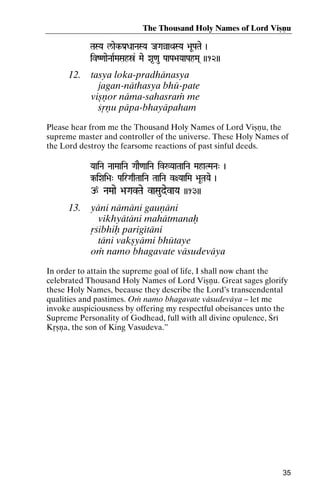
tasya loka-pradhänasya
jagan-näthasya bhü-pate
viñëor näma-sahasraà me
çåëu päpa-bhayäpaham

Please hear from me the Thousand Holy Names of Lord Viñëu, the
supreme master and controller of the universe. These Holy Names of
the Lord destroy the fearsome reactions of past sinful deeds.
YaaiNa NaaMaaiNa GaaE<aaiNa iv:YaaTaaiNa MahaTMaNa" )
NaaMaaiNa

‰iXai>a" PairGaqTaaiNa TaaiNa v+YaaiMa >aUTaYae )

p NaMaae >aGavTae vaSaudevaYa ))13))

13.

yäni nämäni gauëäni
vikhyätäni mahätmanaù
åçibhiù parigétäni
täni vakñyämi bhütaye
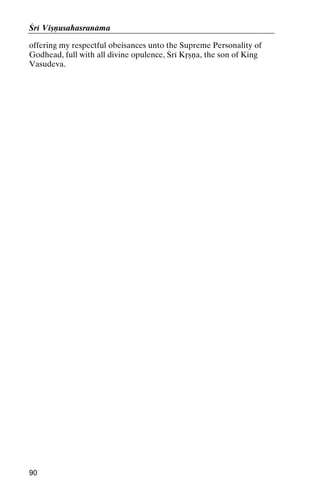
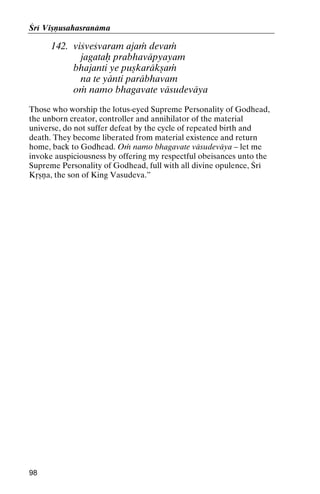
oà namo bhagavate väsudeväya

In order to attain the supreme goal of life, I shall now chant the
celebrated Thousand Holy Names of Lord Viñëu. Great sages glorify
these Holy Names, because they describe the Lord’s transcendental
qualities and pastimes. Oà namo bhagavate väsudeväya – let me
invoke auspiciousness by offering my respectful obeisances unto the
Supreme Personality of Godhead, full with all divine opulence, Çré
Kåñëa, the son of King Vasudeva.”

35
Çré Viñëusahasranäma

— The Thousand Holy Names of Lord Viñëu —
p ivì& ivZ<auvRzTk-arae >aUTa>aVYa>avTPa[>au" )
Tk-

>aUTak*-ÙUTa>a*Ùavae >aUTaaTMaa >aUTa>aavNa" ))14))

14.

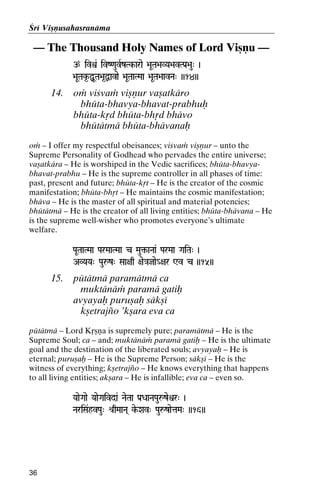
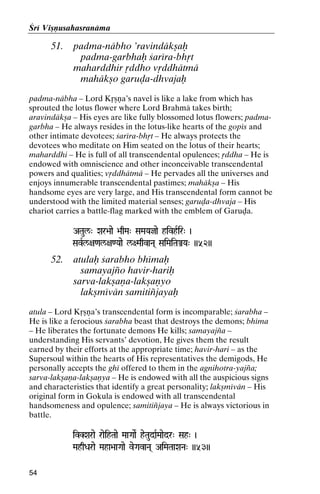
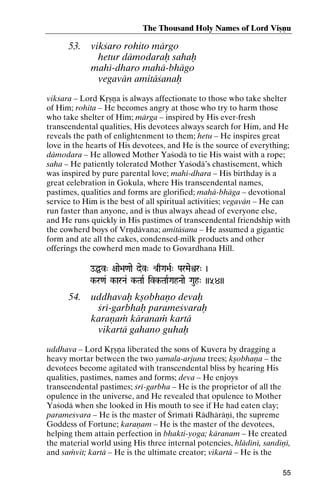
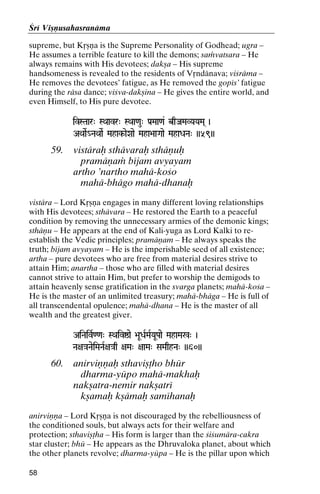
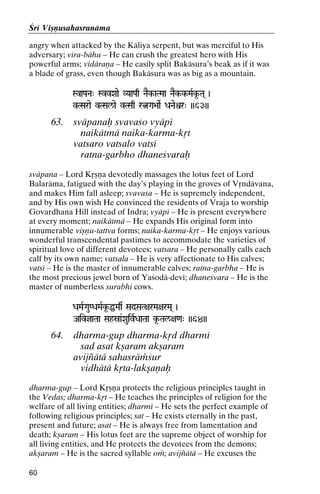
oà viçvaà viñëur vañatkäro
bhüta-bhavya-bhavat-prabhuù
bhüta-kåd bhüta-bhåd bhävo
bhütätmä bhüta-bhävanaù

oà – I offer my respectful obeisances; viçvaà viñëur – unto the
Supreme Personality of Godhead who pervades the entire universe;
vañatkära – He is worshiped in the Vedic sacrifices; bhüta-bhavyabhavat-prabhu – He is the supreme controller in all phases of time:
past, present and future; bhüta-kåt – He is the creator of the cosmic
manifestation; bhüta-bhåt – He maintains the cosmic manifestation;
bhäva – He is the master of all spiritual and material potencies;
bhütätmä – He is the creator of all living entities; bhüta-bhävana – He
is the supreme well-wisher who promotes everyone’s ultimate
welfare.
PaUTaaTMaa ParMaaTMaa c Mau¢-aNaa& ParMaa GaiTa" )

AVYaYa" Pauåz" Saa+aq +ae}ajae_+ar Wv c ))15))

15.

pütätmä paramätmä ca
muktänäà paramä gatiù
avyayaù puruñaù säkñé
kñetrajïo ’kñara eva ca

pütätmä – Lord Kåñëa is supremely pure; paramätmä – He is the
Supreme Soul; ca – and; muktänäà paramä gatiù – He is the ultimate
goal and the destination of the liberated souls; avyayaù – He is
eternal; puruñaù – He is the Supreme Person; säkñé – He is the
witness of everything; kñetrajïo – He knows everything that happens
to all living entities; akñara – He is infallible; eva ca – even so.
YaaeGaae YaaeGaivda& NaeTaa Pa[DaaNaPauåzeìr" )

NariSa&hvPau" é[qMaaNa( ke-Xav" PauåzaetaMa" ))16))

36
The Thousand Holy Names of Lord Viñëu

16.

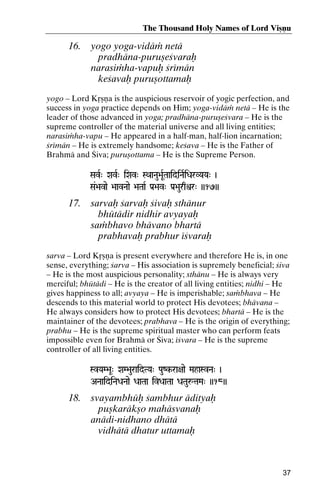
yogo yoga-vidäà netä
pradhäna-puruñeçvaraù
narasiàha-vapuù çrémän
keçavaù puruñottamaù

yogo – Lord Kåñëa is the auspicious reservoir of yogic perfection, and
success in yoga practice depends on Him; yoga-vidäà netä – He is the
leader of those advanced in yoga; pradhäna-puruñeçvara – He is the
supreme controller of the material universe and all living entities;
narasiàha-vapu – He appeared in a half-man, half-lion incarnation;
çrémän – He is extremely handsome; keçava – He is the Father of
Brahmä and Çiva; puruñottama – He is the Supreme Person.
SavR" XavR" iXav" SQaaNau>aURTaaidiNaRiDarVYaYa" )
aaidiNaR

Sa&>avae >aavNaae >aTaaR Pa[>av" Pa[>aurqìr" ))17))

17.

sarvaù çarvaù çivaù sthänur
bhütädir nidhir avyayaù
saàbhavo bhävano bhartä
prabhavaù prabhur éçvaraù

sarva – Lord Kåñëa is present everywhere and therefore He is, in one
sense, everything; çarva – His association is supremely beneficial; çiva
– He is the most auspicious personality; sthänu – He is always very
merciful; bhütädi – He is the creator of all living entities; nidhi – He
gives happiness to all; avyaya – He is imperishable; saàbhava – He
descends to this material world to protect His devotees; bhävana –
He always considers how to protect His devotees; bhartä – He is the
maintainer of the devotees; prabhava – He is the origin of everything;
prabhu – He is the supreme spiritual master who can perform feats
impossible even for Brahmä or Çiva; éçvara – He is the supreme
controller of all living entities.
SvYaM>aU" XaM>auraidTYa" PauZk-ra+aae MahaSvNa" )
kANaaidiNaDaNaae DaaTaa ivDaaTaa DaTauåtaMa" ))18))

18.

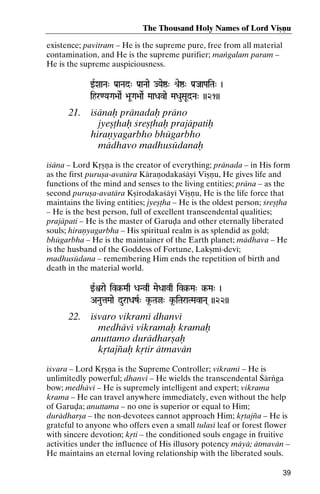
svayambhüù çambhur ädityaù
puñkaräkño mahäsvanaù
anädi-nidhano dhätä
vidhätä dhatur uttamaù

37
Çré Viñëusahasranäma
svayambhü – Lord Kåñëa is the self-effulgent Lord; çambhu – His
auspicious transcendental qualities bring great happiness to the
devotees; äditya – He appears in a splendid golden form among the
demigods; puñkaräkña – He is all-pervading; mahäsvana – He is the
supreme object of worship; anädi-nidhana – He was never born and
will never die; dhätä – He is the original creator, before Brahmä or
anyone else; vidhätä – He is the original author of all Vedic
injunctions; dhatur uttama – He is the Supreme Person.
APa[MaeYaae ôzqke-Xa" PaÚNaa>aae_MarPa[>au" )

ivìk-MaaR MaNauSTvía SQaivï" SQaivrae Da]uv" ))19))
ivìk-

19.

aprameyo håñékeçaù
padma-näbho ’mara-prabhuù
viçva-karmä manus tvañöä
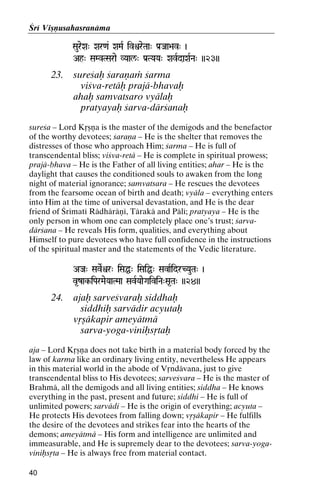
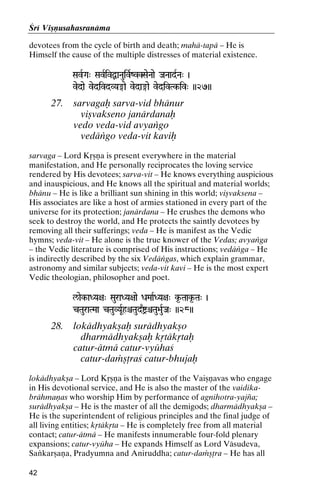
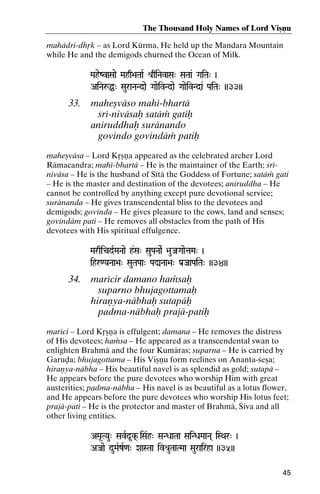
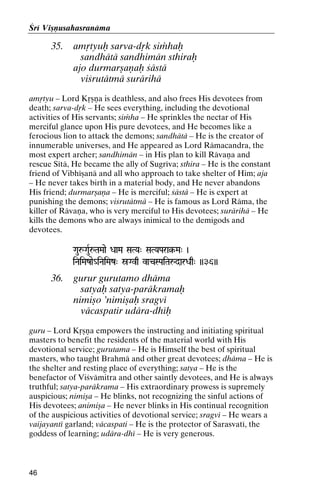
sthaviñöhaù sthaviro dhruvaù

aprameya – Lord Kåñëa is unlimited and cannot be measured by the
finite senses of Brahmä and the other demigods; håñékeça – He is the
master of the senses; padma-näbha – Lord Brahmä took birth from
His lotus navel; amara-prabhu – He is the master of the demigods
who gives them jurisdiction over the affairs of creation and
maintenance of the material universe; viçva-karmä – seated within
the hearts of Brahmä and the other demigods, He gives them the
ability to create and maintain the universe; manu – He knows
everything; tvañöä – His form is very handsome and splendid;
sthaviñöha – He creates innumerable universes by His inconceivable
potency; sthavira – He is ever-existing; dhruva – He is eternal.
AGa]aù" XaaìTa" k*-Z<aae l/aeihTaa+a" Pa[TadRNa" )
Pa[

Pa[>aUTaiñk-ku-ÖaMa Paiv}a& Ma®l&/ ParMa( ))20))
aiñk-

20.

agrähyaù çäçvataù kåñëo
lohitäkñaù pratardanaù
prabhütas trikakud-dhäma
pavitraà maìgalaà param

agrähya – Lord Kåñëa is the non-material cause of the material
manifestation; çäçvata – He is ever-existing; kåñëa – He has an
eternal, all-attractive form; lohitäkña – His handsome eyes are
reddish; pratardana – He removes the distresses in the hearts of His
devotees; prabhüta – He is the supreme monarch; trikakud-dhäma –
He resides in the spiritual world, which is three-fourths of the entire
38
The Thousand Holy Names of Lord Viñëu
existence; pavitram – He is the supreme pure, free from all material
contamination, and He is the supreme purifier; maìgalam param –
He is the supreme auspiciousness.
wRXaaNa" Pa[aNad" Pa[aNaae JYaeï" é[eï" Pa[JaaPaiTa" )
Pa[

ihr<YaGa>aaeR >aUGa>aaeR MaaDavae MaDauSaUdNa" ))21))

21.

éçänaù pränadaù präno
jyeñöhaù çreñöhaù prajäpatiù
hiraëyagarbho bhügarbho
mädhavo madhusüdanaù

éçäna – Lord Kåñëa is the creator of everything; pränada – in His form
as the first puruña-avatära Käraëodakaçäyé Viñëu, He gives life and
functions of the mind and senses to the living entities; präna – as the
second puruña-avatära Kñérodakaçäyé Viñëu, He is the life force that
maintains the living entities; jyeñöha – He is the oldest person; çreñöha
– He is the best person, full of excellent transcendental qualities;
prajäpati – He is the master of Garuòa and other eternally liberated
souls; hiraëyagarbha – His spiritual realm is as splendid as gold;
bhügarbha – He is the maintainer of the Earth planet; mädhava – He
is the husband of the Goddess of Fortune, Lakñmé-devé;
madhusüdana – remembering Him ends the repetition of birth and
death in the material world.
wRìrae iv§-Maq DaNvq MaeDaavq iv§-Ma" §-Ma" )
iv§iv§§-

ANautaMaae duraDazR" k*-Taj" k*-iTaraTMavaNa( ))22))

22.

éçvaro vikramé dhanvé
medhävé vikramaù kramaù
anuttamo durädharñaù
kåtajïaù kåtir ätmavän

éçvara – Lord Kåñëa is the Supreme Controller; vikramé – He is
unlimitedly powerful; dhanvé – He wields the transcendental Çärìga
bow; medhävé – He is supremely intelligent and expert; vikrama
krama – He can travel anywhere immediately, even without the help
of Garuòa; anuttama – no one is superior or equal to Him;
durädharña – the non-devotees cannot approach Him; kåtajïa – He is
grateful to anyone who offers even a small tulasé leaf or forest flower
with sincere devotion; kåti – the conditioned souls engage in fruitive
activities under the influence of His illusory potency mäyä; ätmavän –
He maintains an eternal loving relationship with the liberated souls.
39
Çré Viñëusahasranäma
SaureXa" Xar<a& XaMaR ivìreTaa" Pa[Jaa>av" )

Ah" SaMvTSarae VYaal/" Pa[TYaYa" XavRdaXaRNa" ))23))

23.

sureçaù çaraëaà çarma
viçva-retäù prajä-bhavaù
ahaù samvatsaro vyälaù
pratyayaù çarva-därçanaù

sureça – Lord Kåñëa is the master of the demigods and the benefactor
of the worthy devotees; çaraëa – He is the shelter that removes the
distresses of those who approach Him; çarma – He is full of
transcendental bliss; viçva-retä – He is complete in spiritual prowess;
prajä-bhava – He is the Father of all living entities; ahar – He is the
daylight that causes the conditioned souls to awaken from the long
night of material ignorance; samvatsara – He rescues the devotees
from the fearsome ocean of birth and death; vyäla – everything enters
into Him at the time of universal devastation, and He is the dear
friend of Çrématé Rädhäräëé, Tärakä and Pälé; pratyaya – He is the
only person in whom one can completely place one’s trust; çarvadärçana – He reveals His form, qualities, and everything about
Himself to pure devotees who have full confidence in the instructions
of the spiritual master and the statements of the Vedic literature.
AJa" SaveRìr" iSaÖ" iSaiÖ" SavaRidrCYauTa" )
v*zak-iParMaeYaaTMaa SavRYaaeGaiviNa"Sa*Ta" ))24))
ak-

24.

ajaù sarveçvaraù siddhaù
siddhiù sarvädir acyutaù
våñäkapir ameyätmä
sarva-yoga-viniùsåtaù

aja – Lord Kåñëa does not take birth in a material body forced by the
law of karma like an ordinary living entity, nevertheless He appears
in this material world in the abode of Våndävana, just to give
transcendental bliss to His devotees; sarveçvara – He is the master of
Brahmä, all the demigods and all living entities; siddha – He knows
everything in the past, present and future; siddhi – He is full of
unlimited powers; sarvädi – He is the origin of everything; acyuta –
He protects His devotees from falling down; våñäkapir – He fulfills
the desire of the devotees and strikes fear into the hearts of the
demons; ameyätmä – His form and intelligence are unlimited and
immeasurable, and He is supremely dear to the devotees; sarva-yogaviniùsåta – He is always free from material contact.
40
The Thousand Holy Names of Lord Viñëu
vSauvRSauMaNaa" SaTYa" SaMaaTMaa SaiMMaTa" SaMa" )

AMaaega" Pau<@rqk-a+aae v*zk-MaaR v*zak*-iTa" ))25))
@rqkk-

25.

vasur vasumanäù satyaù
samätmä sammitaù samaù
amoghaù puëòarékäkño
våñakarmä våñäkåtiù

vasu – Lord Kåñëa always resides in the hearts of the devotees who
relish hearing and chanting His glories; vasumanä – He meditates on
how to increase the transcendental opulences of the pure devotees
who consider Him their only wealth; satya – He never speaks a lie,
and is very dear to the truthful devotees; samätmä – He accepts the
role of being equal to devotees who approach Him in friendship;
sammita – He magnanimously presents Himself as equal to His
devotee; sama – He presents Himself as equal to the devotees related
to Him in friendship, parenthood and conjugal love to glorify them;
amogha – He grants His own supremely valuable devotional service
to those who become attached to Him; puëòarékäkña – He is always
manifest in the lotus-like hearts of the pure devotees; våñakarmä – He
fulfills the desires of His pure devotees; våñäkåti – His transcendental
form is supremely handsome.
åd]ae bhuiXara b>a]uivRìYaaeiNa" Xauicé[va" )

AMa*Ta" XaaìTa" SQaaNauvRraraehae MahaTaPaa" ))26))
MahaTaPaa"

26.

rudro bahu-çirä babhrur
viçva-yoniù çuci-çraväù
amåtaù çäçvataù sthänur
varäroho mahä-tapäù

rudra – Lord Kåñëa cures the disease of material existence afflicting
the conditioned souls; bahu-çirä – He appears as the thousandheaded Lord Anantadeva; babhru – He is the maintainer of the
universe; viçva-yoni – He is the creator of millions of universes; çuciçravä – He is supremely pure, and He cleanses whatever impurity
may contaminate the hearts of His genuine devotees; amåta – His
handsomeness is as sweet as nectar, and He rescues the devotees
from the cycle of repeated birth, old age and death; çäçvata – He is
deathless; sthänu – He eternally appears before the pure devotees
and grants them transcendental bliss; varäroha – He always remains
in His eternal abode, Goloka Våndävana, and He rescues His

41
Çré Viñëusahasranäma
devotees from the cycle of birth and death; mahä-tapä – He is
Himself the cause of the multiple distresses of material existence.
SavRGa" SavRivÙaNauivRZvKSaeNaae JaNaadRNa" )

vedae vedivdVYa®ae veeda®ae vedivTk-iv" ))27))
v
ivTk-

27.

sarvagaù sarva-vid bhänur
viñvakseno janärdanaù
vedo veda-vid avyaìgo
vedäìgo veda-vit kaviù

sarvaga – Lord Kåñëa is present everywhere in the material
manifestation, and He personally reciprocates the loving service
rendered by His devotees; sarva-vit – He knows everything auspicious
and inauspicious, and He knows all the spiritual and material worlds;
bhänu – He is like a brilliant sun shining in this world; viñvaksena –
His associates are like a host of armies stationed in every part of the
universe for its protection; janärdana – He crushes the demons who
seek to destroy the world, and He protects the saintly devotees by
removing all their sufferings; veda – He is manifest as the Vedic
hymns; veda-vit – He alone is the true knower of the Vedas; avyaìga
– the Vedic literature is comprised of His instructions; vedäìga – He
is indirectly described by the six Vedäìgas, which explain grammar,
astronomy and similar subjects; veda-vit kavi – He is the most expert
Vedic theologian, philosopher and poet.
l/aek-aDYa+a" SauraDYa+aae DaMaaRDYa+a" k*-Taak*-Ta" )
cTauraTMaa cTauVYaURhêTaud|íêTau>auRJa" ))28))
êTau

28.

lokädhyakñaù surädhyakño
dharmädhyakñaù kåtäkåtaù
catur-ätmä catur-vyühaç
catur-daàñöraç catur-bhujaù

lokädhyakña – Lord Kåñëa is the master of the Vaiñëavas who engage
in His devotional service, and He is also the master of the vaidikabrähmaëas who worship Him by performance of agnihotra-yajïa;
surädhyakña – He is the master of all the demigods; dharmädhyakña –
He is the superintendent of religious principles and the final judge of
all living entities; kåtäkåta – He is completely free from all material
contact; catur-ätmä – He manifests innumerable four-fold plenary
expansions; catur-vyüha – He expands Himself as Lord Väsudeva,
Saìkarñaëa, Pradyumna and Aniruddha; catur-daàñöra – He has all
42
The Thousand Holy Names of Lord Viñëu
the characteristics of an exalted personality; catur-bhuja – He
manifests as Lord Viñëu, who holds a conch, disk, club and lotus in
His four hands.
>a]aiJaZ<au>aaeRJaNa& >aae¢-aSaihZ<auJaRGadaidJa" )
GadaidJa"

ANagaae ivJaYaae JaeTaa ivìYaaeiNa" PauNavRSau" ))29))

29.

bhräjiñëur bhojanaà bhoktäsahiñëur jagad-ädijaù
anagho vijayo jetä
viçva-yoniù punar-vasuù

bhräjiñëu – Lord Kåñëa is effulgent; bhojana – He supplies the
necessities of life to all living entities; bhokta – He relishes the food
and other articles offered to Him with devotion, and He is the
protector of the gentle devotees; asahiñëu – He is intolerant of the
demons; sahiñëu – He tolerates the offenses accidentally committed
by His devotees; jagad-ädijaù – He is the Father of Lord Brahmä, the
first created entity in the universe; anagha – Although He appears in
the material world, He remains always pure, full of transcendental
bliss, and free from material contamination; vijaya – He is allvictorious; jetä – He can defeat any demon, demigod or living entity,
therefore He is the Supreme Person; viçva-yoni – He is the original
creator of all universes; punar-vasu – He appears again and again
within the creation to protect His devotees.
oPaeeNd]ae vaMaNa" Pa[a&XaurMaaega" XauicæiJaRTa" )
oPa
ATaqNd]" Sa°h" SaGaaeR Da*TaaTMaa iNaYaMaae YaMa" ))30))

30.

upendro vämanaù präàçur
amoghaù çucir ürjitaù
aténdraù saìgrahaù sargo
dhåtätmä niyamo yamaù

upendra – Lord Kåñëa appeared as Indra’s younger brother; vämana
– He appeared as a brahmacäré brähmaëa to help Indra defeat Bali
Mahäräja; präàçu – In the Vämana incarnation the Lord became so
tall He could step over the entire universe; amogha – His activities
are always successful; çuci – He is supremely pure; ürjita – He is so
powerful that He easily defeated Bali’s whole army; aténdra – His
strength in battle surpasses that of Indra; saìgraha – He accepts all
those who become devoted to Him; sarga – He created the demigods
and everything else; dhåtätmä – He enchants and delights the hearts
43
Çré Viñëusahasranäma
and minds of Indra and all the other devotees; niyama – He controls
the devotees; yama – He resides always in the devotees’ hearts and
minds.
veÛae vEÛ" SadaYaaeGaq ivrhae MaaDavae MaDau" )

ATaqiNd]Yaae MahaMaaYaae MahaeTSaahae Mahabl/" ))31))
Mahae

31.

vedyo vaidyaù sadä-yogé
viraho mädhavo madhuù
aténdriyo mahä-mäyo
mahotsäho mahä-balaù

vedya – Lord Kåñëa appeared as Kürma-avatära to deliver nectar to
the demigods and remove their poverty; vaidya – He also appeared as
Lord Dhanvantari, the original physician, who cures people’s diseases
simply by the expansion of His fame, and gave nectar to the
demigods; sadä-yogé – He always acts for the welfare of the
demigods; viraha – He killed the powerful demons eager to fight for
the nectar churned from the celestial Ocean of Milk; mädhava – He is
the husband of Lakñmi-devé, who appeared from the Ocean of Milk;
madhu – He enchanted Lakñmi-devé and all the pious demigods with
His handsomeness and charm; aténdriya – He disappeared from the
demigods along with the nectar, because He always remains invisible
to those without pure devotion to Him; mahä-mäya – He then
appeared in the attractive female form of Mohihé-mürti, bewildering
the demons and also Lord Çiva; mahotsäha – He acts to make the
demigods successful; mahä-bala – His great prowess can thwart or
bewilder anyone.
MahabuiÖMaRhavqYaaeR MahaXai¢-MaRhaÛuiTa" )
MahaXai¢-

AiNadeRXYavPau" é[qMaaNa( AMaeYaaTMaa Mahaid]Da*k( ))32))

32.

mahä-buddhir mahä-véryo
mahä-çaktir mahä-dyutiù
anirdeçya-vapuù çrémän
ameyätmä mahädri-dhåk

mahä-buddhi – Lord Kåñëa is supremely intelligent; mahä-vérya – He
is supremely powerful; mahä-çakti – He is the master of all
transcendental potencies; mahä-dyuti – He is supremely splendid;
anirdeçya-vapu – His transcendental form cannot be seen with
material eyesight; çrémän – He is supremely handsome; ameyätmä –
no living entity or demigod can measure His unlimited nature;
44
The Thousand Holy Names of Lord Viñëu
mahädri-dhåk – as Lord Kürma, He held up the Mandara Mountain
while He and the demigods churned the Ocean of Milk.
MaheZvaSaae Mahq>aTaaR é[qiNavaSa" SaTaa& GaiTa" )

AiNaåÖ" SauraNaNdae GaaeivNdae GaaeivNda& PaiTa" ))33))

33.

maheñväso mahé-bhartä
çré-niväsaù satäà gatiù
aniruddhaù suränando
govindo govindäà patiù

maheñväsa – Lord Kåñëa appeared as the celebrated archer Lord
Rämacandra; mahé-bhartä – He is the maintainer of the Earth; çréniväsa – He is the husband of Sétä the Goddess of Fortune; satäà gati
– He is the master and destination of the devotees; aniruddha – He
cannot be controlled by anything except pure devotional service;
suränanda – He gives transcendental bliss to the devotees and
demigods; govinda – He gives pleasure to the cows, land and senses;
govindäm pati – He removes all obstacles from the path of His
devotees with His spiritual effulgence.
MarqicdRMaNaae h&Sa" SauPaNaaeR >auJaGaaetaMa" )
ihr<YaNaa>a" SauTaPaa" PaÚNaa>a" Pa[JaaPaiTa" ))34))

34.

marécir damano haàsaù
suparno bhujagottamaù
hiraëya-näbhaù sutapäù
padma-näbhaù prajä-patiù

maréci – Lord Kåñëa is effulgent; damana – He removes the distress
of His devotees; haàsa – He appeared as a transcendental swan to
enlighten Brahmä and the four Kumäras; suparna – He is carried by
Garuòa; bhujagottama – His Viñëu form reclines on Ananta-çeña;
hiraëya-näbha – His beautiful navel is as splendid as gold; sutapä –
He appears before the pure devotees who worship Him with great
austerities; padma-näbha – His navel is as beautiful as a lotus flower,
and He appears before the pure devotees who worship His lotus feet;
prajä-pati – He is the protector and master of Brahmä, Çiva and all
other living entities.
AMa*TYau" SavRd*k( iSa&h" SaNDaaTaa SaiNDaMaaNa( iSQar" )
AJaae duMaRzR<a" XaaSTaa ivé[uTaaTMaa Saurairha ))35))
45
Çré Viñëusahasranäma

35.

amåtyuù sarva-dåk siàhaù
sandhätä sandhimän sthiraù
ajo durmarñaëaù çästä
viçrutätmä surärihä

amåtyu – Lord Kåñëa is deathless, and also frees His devotees from
death; sarva-dåk – He sees everything, including the devotional
activities of His servants; siàha – He sprinkles the nectar of His
merciful glance upon His pure devotees, and He becomes like a
ferocious lion to attack the demons; sandhätä – He is the creator of
innumerable universes, and He appeared as Lord Rämacandra, the
most expert archer; sandhimän – in His plan to kill Rävaëa and
rescue Sétä, He became the ally of Sugréva; sthira – He is the constant
friend of Vibhéñanä and all who approach to take shelter of Him; aja
– He never takes birth in a material body, and He never abandons
His friend; durmarñaëa – He is merciful; çästä – He is expert at
punishing the demons; viçrutätmä – He is famous as Lord Räma, the
killer of Rävaëa, who is very merciful to His devotees; surärihä – He
kills the demons who are always inimical to the demigods and
devotees.
GauåGauRåTaMaae DaaMa SaTYa" SaTYaPara§-Ma" )
SaTYaPara§-

iNaiMazae_iNaiMaz" óGvq vacSPaiTaådarDaq" ))36))
iNaiMaz"

36.

gurur gurutamo dhäma
satyaù satya-paräkramaù
nimiño ’nimiñaù sragvé
väcaspatir udära-dhéù

guru – Lord Kåñëa empowers the instructing and initiating spiritual
masters to benefit the residents of the material world with His
devotional service; gurutama – He is Himself the best of spiritual
masters, who taught Brahmä and other great devotees; dhäma – He is
the shelter and resting place of everything; satya – He is the
benefactor of Viçvämitra and other saintly devotees, and He is always
truthful; satya-paräkrama – His extraordinary prowess is supremely
auspicious; nimiña – He blinks, not recognizing the sinful actions of
His devotees; animiña – He never blinks in His continual recognition
of the auspicious activities of devotional service; sragvé – He wears a
vaijayanté garland; väcaspati – He is the protector of Sarasvaté, the
goddess of learning; udära-dhé – He is very generous.

46
The Thousand Holy Names of Lord Viñëu
AGa]<aqGa]aRMa<aq" é[qMaaNNYaaYaae NaeTaa SaMaqr<a" )

SahóMaUDaaR ivìaTMaa Sahóa+a" SahóPaaTa( ))37))

37.

agraëér grämaëéù çrémännyäyo netä saméraëaù
sahasra-mürdhä viçvätmä
sahasräkñaù sahasra-pät

agraëé – Lord Kåñëa appeared as Matsya-avatära and rescued the
Vedas, which were tied to His horn by the rope of Vasuki-näga;
grämaëé – Lord Matsya enjoyed pastimes on the waters of
devastation as He pulled Lord Manu and other sages in a golden
boat; çrémän-nyäya – Lord Matsya spoke the message of the Vedas
and protected them at the time of devastation; netä – He is the leader
of all living entities; saméraëa – He moves with consummate grace;
sahasra-mürdhä – He has uncountable thousands of heads; viçvätmä –
He is the Supreme Soul who pervades the entire universe; sahasräkña
– He has uncountable thousands of eyes; sahasra-pät – He has
uncountable thousands of feet.
AavtaRNaae iNav*taaTMaa Sa&v*Ta" SaMPa[TadRNa" )
Ah" SaMvTaRk-ae viöriNal/ae Dar<aqDar" ))38))

38.

ävarttano nivåttätmä
saàvåtaù sampratardanaù
ahaù samvartako vahnir
anilo dharaëé-dharaù

ävarttana – Lord Kåñëa causes the conditioned souls to experience
the cycle of birth and death; nivåttätmä – He is full of spiritual
opulences and resides in the eternal spiritual world, free from
material contact; saàvåta – He always remains invisible to the
conditioned souls who are very eager to experience the tiny
happiness of material existence; sampratardana – He causes distress
to the demons who are opposed to Him, even if they pose as scholars,
saintly persons or demigods; aha – He is the succession of days, and
He speaks very eloquently and sweetly; samvartaka – He is time
itself; vahnir – with a part of Himself He carries the weight of the
entire universe; anila – He is supremely independent, nevertheless at
intervals He descends to this material world for the welfare of the
conditioned souls; dharaëé-dhara – He is the maintainer of the Earth.

47
Çré Viñëusahasranäma
SauPa[Saad" Pa[SaàaTMaa ivìDa*iGvì>auiGv>au" )

SaTk-TaaR SaTk*-Ta" SaaDauJaRöuNaaRraYa<aae Nar" ))39))
SaTk-

39.

suprasädaù prasannätmä
viçva-dhåg viçva-bhug vibhuù
sat-kartä sat-kåtaù sädhur
jahnur näräyaëo naraù

suprasäda – Lord Kåñëa is very merciful; prasannätmä – His desires
are always fulfilled, and His heart and mind are always clear and
pure; viçva-dhåk – He maintains innumerable material universes;
viçva-bhuk – He protects the material universes; vibhu – He is the allpervading, all-powerful, unlimited and fearless Supreme Controller;
sat-kartä – He is the benefactor of the demigods, pitäs, brähmaëas
and devotees;
sat-kåta – the demigods, pitäs, brähmaëas and devotees worship Him;
sädhu – He is the benefactor of all living entities and His
transcendental form is free from any touch of matter; jahnu – He
defeats the enemies of His devotees; näräyaëa – He is the shelter
within whom all living entities rest, and He is the destroyer of
ignorance; nara – He is the Supersoul who resides in the hearts of all
beings.
ASa&:YaeYaae_Pa[MaeYaaTMaa iviXaí" iXaík*-C^uic" )

iSaÖaQaR" iSaÖSaªLPa" iSaiÖd" iSaiÖSaaDaNa" ))40))

40.

asaìkhyeyo ’prameyätmä
viçiñöaù çiñöa-kåc chuciù
siddhärthaù siddha-saìkalpaù
siddhidaù siddhi-sädhanaù

asaìkhyeya – Lord Kåñëa’s transcendental attributes are
uncountable; aprameyätmä – His patience is unlimited; viçiñöa – His
opulences are unlimited; çiñöa-kåt – He gives His devotees great faith
in the message of the Vedas, transforming them into the most
elevated of peaceful saintly persons; çuci – simply by hearing about
Him or remembering Him, all living entities become purified and the
entire world becomes auspicious; siddhärtha siddha-saìkalpa – all His
desires are automatically fulfilled by His internal potency; siddhida –
He alone fulfills the desires of all living entities; siddhi-sädhana – The
saintly devotees become free from all impediments and attain success
in their devotional activities simply by remembering Him.

48
The Thousand Holy Names of Lord Viñëu
v*zahq v*z>aae ivZ<auv**RzPavaR v*zaedr" )
v

vDaRNaae vDaRMaaNaê iviv¢-" é[uiTaSaaGar" ))41))
iviv¢-

41.

våñähé våñabho viñëur
våñaparvä våñodaraù
vardhano vardhamänaç ca
viviktaù çruti-sägaraù

våñähé – Lord Kåñëa’s transcendental qualities eclipse the glory of
Indra; våñabha – Lord Kåñëa illuminates and protects the entire world
by teaching the principles of devotional service; viñëu – He is allpervading, present in every atom of the cosmic manifestation;
våñaparvä – He is a jubilant festival for Indra and the best of the
yogés; våñodara – He protects Indra like a mother protects her child;
vardhana – He causes the prajäpatis to prosper; vardhamäna – He
considers even the smallest gift given by His pure devotee to be very
great; ca – and; vivikta – He remains always free from contact with
the modes of material nature although He is present everywhere
throughout the cosmic manifestation; çruti-sägara – He is the great
ocean into which all the rivers of Vedic knowledge converge.
Sau>auJaae duDaRrae vaGMaq MaheNd]ae vSaudae vSau" )

NaEk-æPaae b*hd]UPa" iXaiPaiví" Pa[k-azNa" ))42))

42.

subhujo durdharo vägmé
mahendro vasudo vasuù
naika-rüpo båhad-rüpaù
çipi-viñöaù prakäñanaù

subhuja – Lord Kåñëa grants fearlessness to the devotees and protects
the Vedas with His strong arms; durdhara – He cannot be defeated by
Madhu, Kaiöabha or any other demon; vägmé – He is supremely
eloquent and is the proper object of eloquent prayers; mahendra – He
is the supreme monarch who possesses all opulence; vasuda – He
defeats the demons, gives shelter to the living entities, and grants
nectarean ecstatic devotional emotions to the pure devotees; vasu –
He appears before those who understand His transcendental glories,
becoming their only wealth; naika-rüpa – He appears in many
different forms to satisfy the desires of His devotees; båhad-rüpa –
His transcendental form is greater than everything; çipi-viñöa – He
enters the waters of devastation and causes the inundation at the end
of the universe; prakäñana – He is the original cause of the cosmic

49
Çré Viñëusahasranäma
manifestation, and He rescued the Vedas from the demons Madhu
and Kaiöabha.
AaeJaSTaeJaae ÛuiTaDar" Pa[k-aXaaTMaaPa[TaaPaNa" )

‰Ö" SPaía+arae MaN}aêNd]a&Xau>aaRSk-raÛuiTa" ))43))
k-

43.

ojas tejo dyuti-dharaù
prakäçätmä-pratäpanaù
åddhaù spañöäkñaro mantraç
candräàçur bhäskarä-dyutiù

oja – Lord Kåñëa is supremely powerful; teja – He is the source of all
power; dyuti-dhara – He is handsomely effulgent; prakäçätmä – He
personally appears before His pure devotees; pratäpana – He gives
trouble to the demons; åddha – He is full of all transcendental
opulence; spañöäkñara – He teaches the message of the Vedas; mantra
– He reveals the truth of His confidential pastimes to His most
exalted and intimate devotees; candräàçu – He is as splendid as the
moon; bhäskarä-dyuti – He defeated the demons Madhu and
Kaiöabha with the supreme power of His effulgence.
AMa*Taa&XaUÙvae >aaNau" XaXaibNdu" Saureìr" )

AaEzDa& JaGaTa" SaeTau" SaTYaDaMaRPara§-Ma" ))44))
ara§-

44.

amåtäàçüdbhavo bhänuù
çaçabinduù sureçvaraù
auñadhaà jagataù setuù
satya-dharma-paräkramaù

amåtäàçüdbhava – Lord Kåñëa is the Father of the moon; bhänu –
He is very powerful and splendid; çaçabindu – He defeats the atheists;
sureçvara – He is the Supreme Personality of Godhead understood by
the theists; auñadham – pure devotional service to Him is the nectarmedicine that counteracts the poisonous snakebite of material
existence; jagata setu – He is the eternal enemy of all demons; satyadharma-paräkramaù – He defeats the speculative impersonalist
philosophers and establishes the actual truth of spiritual variety
within oneness.
>aUTa>aVYa>avàaQa PavNa" PaavNaae_Nal/" )

k-aMaha k-aMak*-Tk-aNTa" k-aMa" k-aMaPa[d" Pa[>au" ))45))
kTkkk-

50
The Thousand Holy Names of Lord Viñëu

45.

bhüta-bhavya-bhavan-nätha
pavanaù pävano ’nalaù
kämahä kämakåt käntaù
kämaù käma-pradaù prabhuù

bhüta-bhavya-bhavan-nätha – Lord Kåñëa always has been, is, and
always will be the supreme master of all living entities; pavana – He
rescues the living entities from material existence with His merciful
sidelong glance; pävana – He purifies the devotees; anala – He
appears in many forms to protect the devotees; kämahä kämakåt – He
kills the material desires of His devotees, tearing them into pieces;
känta – He is the supreme handsomeness, the object of the
aspirations of the saintly paramahaàsas; käma – He is the source of
all that is desirable, even for the bewildered living beings; kämaprada –He grants sense gratification, liberation or whatever is desired
by the conditioned souls; prabhu – He is omnipotent.
YauGaaidk*-ÛuGaavTaaeR NaEk-MaaYaae MahaXaNa" )

Ad*XYaae VYa¢-æPaê SahóiJadNaNTaiJaTa( ))46))
VYa¢-

46.

yugädi-kåd yugävarto
naika-mäyo mahäçanaù
adåçyo vyakta-rüpaç ca
sahasra-jid ananta-jit

yugädi-kåt – Lord Kåñëa inaugurates the four yugas by appearing as
the yuga-avatäras; yugävarta – He causes the succession of the four
yugas; naika-mäya – He teaches the specific process of spiritual
realization intended for each yuga; mahäçana – He is full of
transcendental knowledge, opulence and renunciation; adåçya – He is
invisible to the uncivilized and demonic; vyakta-rüpa – His form is
unlimited; ca – and; sahasra-jit – He defeats thousands of uncivilized
atheists; ananta-jit – He defeats unlimited numbers of atheists.
wíae iviXaZTa" iXaíeí" iXa%<@q Nahuzae v*z" )

§-aeDaha §-aeDak*-Tk-TaaR ivìbahuMaRhqDar" ))47))
§Tk-

47.

iñöo viçiñtaù çiñöeñöaù
çikhaëòé nahuño våñaù
krodhahä krodha-kåt kartä
viçva-bähur mahé-dharaù

51
Çré Viñëusahasranäma
iñöa – Lord Kåñëa is worshiped and glorified by Brahmä, Çiva and all
demigods and saintly persons; viçiñta – He is splendidly manifest in
the abode of Mathurä, holding the sudarñana-cakra, club, lotus and
conch, and decorated with the Kaustubha jewel and other ornaments;
çiñöeñöa – He is worshiped by those who know the purpose of the
Vedas; çikhaëòé – in His Våndävana pastimes He is crowned with a
peacock feather; nahuña – His handsomeness enchanted the minds of
the residents of Vrajabhümi; våña – He showered a rain of
transcendental nectar of bliss and pure love of Godhead upon the
residents of Vraja; krodhahä – When His mother Yaçodä became
angry upon hearing the description of His naughty childhood pranks,
He pacified her with sweet words; krodha-kåt – when Yaçodä
interrupted feeding Him to tend to the overflowing pot of boiling
milk, He became angry and broke the butter-pot; kartä – He killed
the host of demons Kaàsa sent to Våndävana; viçva-bähu – He
protects the entire universe with His powerful arms; mahé-dhara – He
lifted Govardhana Hill to protect the residents of Vrajabhümi.
ACYauTa" Pa[iQaTa" Pa[a<a" Pa[a<adae vaSavaNauJa" )
APaa&iNaiDariDaíaNaMaPa[Mata" Pa[iTaiïTa" ))48))
ata"

48.

acyutaù prathitaù präëaù
präëado väsavänujaù
apäà-nidhir adhiñöänam
apramattaù pratiñöhitaù

acyuta – Lord Kåñëa is eternal and unchanging, and He is the
protector of the residents of Vraja; prathita – He is famous
throughout the entire universe, but especially in Vrajabhümi; präëa –
He is the object of the pure love of the residents of Vraja; präëada –
He is the source of the strength and very life of the residents of Vraja;
väsavänuja – even though Indra offended Him by trying to flood
Våndävana with rain, Kåñëa kindly appeared before him; apäà-nidhi
– after He forgave Indra’s offense, He was bathed by the milk of the
surabhi cows, who proclaimed that Kåñëa was their Indra; adhiñöänam
– Lord Kåñëa is personally manifest as the transcendental abode of
Mathurä and other places where He performed pastimes; apramatta –
He protects the residents of Vrajabhümi with great care and
attention; pratiñöhita – all the cowherd men respect Him because He
is the son of Nanda Mahäräja, the king of Vraja.
Sk-Nd" Sk-NdDarae DauYaaeR vrdae vaYauvahNa" )
SkSk-

vaSaudevae b*hÙaNauraiddev" PaurNdr" ))49))
52
The Thousand Holy Names of Lord Viñëu

49.

skandaù skanda-dharo dhuryo
varado väyu-vähanaù
väsudevo båhad-bhänur
ädi-devaù purandaraù

skanda – Lord Kåñëa causes demons like Kaàsa to wither away;
skanda-dhara – He grants strength to Kärttikeya, the general of the
demigod armies; dhurya – the burden of the entire universe rests on
Him varada – He grants the benedictions desired by Sudämä and all
other devotees; väyu-vähana – He is the source of life for all living
entities, and His chariot moves faster than the wind; väsudeva – He is
the son of King Vasudeva; båhad-bhänu – He is greatly effulgent; ädideva – He is the original Supreme Godhead; purandara – He is the
destroyer of the demons.
AXaaek-STaar<aSTaar" Xaur" XaaEirJaRNaeìr" )

ANaukU-l/" XaTaavTaR" PaÚq PaÚiNa>ae+a<a" ))50))

50.

açokas täraëas täraù
çuraù çaurir janeçvaraù
anukülaù çatävartaù
padmé padma-nibhekñaëaù

açoka – Lord Kåñëa removed the lamentation of the Earth planet;
täraëa – He also removed the devotees’ fear of the demonic rulers
who were actually thieves disguised as kings; tära – He removes the
devotees’ fear of repeated birth, old age, disease and death; çura – He
is very powerful and heroic; çauri – He appeared in the dynasty of the
great devotee and powerful King Devaméòa; janeçvara – He ruled
over Mathurä as king, delighting the citizens with transcendental
bliss, and He is also the supreme ruler of all living entities in the
material and spiritual worlds; anuküla – He is the dearmost wellwisher of the residents of Mathurä, and everyone else as well;
çatävarta – His transcendental opulence and prowess bewilder both
the demons headed by Kaàsa and the devotees headed by Närada;
padmé – He playfully holds a lotus flower; padma-nibhekñaëa – His
eyes are as beautiful as lotus flowers, and His eternal abode Gokula
appears like a great lotus flower.
PaÚNaa>aae_rivNda+a" PaÚGa>aR" Xarqr>a*Ta( )

MahiÖRr*Öae v*ÖaTMaa Maha+aae Gaå@ßJa" ))51))

53
Çré Viñëusahasranäma

51.

padma-näbho ’ravindäkñaù
padma-garbhaù çaréra-bhåt
maharddhir åddho våddhätmä
mahäkño garuòa-dhvajaù

padma-näbha – Lord Kåñëa’s navel is like a lake from which has
sprouted the lotus flower where Lord Brahmä takes birth;
aravindäkña – His eyes are like fully blossomed lotus flowers; padmagarbha – He always resides in the lotus-like hearts of the gopés and
other intimate devotees; çaréra-bhåt – He always protects the
devotees who meditate on Him seated on the lotus of their hearts;
maharddhi – He is full of all transcendental opulences; åddha – He is
endowed with omniscience and other inconceivable transcendental
powers and qualities; våddhätmä – He pervades all the universes and
enjoys innumerable transcendental pastimes; mahäkña – His
handsome eyes are very large, and His transcendental form cannot be
understood with the limited material senses; garuòa-dhvaja – His
chariot carries a battle-flag marked with the emblem of Garuòa.
ATaul/" Xar>aae >aqMa" SaMaYajae hivhRir" )
SavRl/+a<al/+a<Yaae l/+MaqvaNa( SaiMaiTaÅYa" ))52))

52.

atulaù çarabho bhémaù
samayajïo havir-hariù
sarva-lakñaëa-lakñaëyo
lakñmévän samitiïjayaù

atula – Lord Kåñëa’s transcendental form is incomparable; çarabha –
He is like a ferocious çarabha beast that destroys the demons; bhéma
– He liberates the fortunate demons He kills; samayajïa –
understanding His servants’ devotion, He gives them the result
earned by their efforts at the appropriate time; havir-hari – as the
Supersoul within the hearts of His representatives the demigods, He
personally accepts the ghé offered to them in the agnihotra-yajïa;
sarva-lakñaëa-lakñaëya – He is endowed with all the auspicious signs
and characteristics that identify a great personality; lakñmévän – His
original form in Gokula is endowed with all transcendental
handsomeness and opulence; samitiïjaya – He is always victorious in
battle.
ivKXarae raeihTaae MaaGaaeR heTaudaRMaaedr" Sah" )
MahqDarae Maha>aaGaae veGavaNa( AiMaTaaXaNa" ))53))
54
The Thousand Holy Names of Lord Viñëu

53.

vikçaro rohito märgo
hetur dämodaraù sahaù
mahé-dharo mahä-bhägo
vegavän amitäçanaù

vikçara – Lord Kåñëa is always affectionate to those who take shelter
of Him; rohita – He becomes angry at those who try to harm those
who take shelter of Him; märga – inspired by His ever-fresh
transcendental qualities, His devotees always search for Him, and He
reveals the path of enlightenment to them; hetu – He inspires great
love in the hearts of His devotees, and He is the source of everything;
dämodara – He allowed Mother Yaçodä to tie His waist with a rope;
saha – He patiently tolerated Mother Yaçodä’s chastisement, which
was inspired by pure parental love; mahé-dhara – His birthday is a
great celebration in Gokula, where His transcendental names,
pastimes, qualities and forms are glorified; mahä-bhäga – devotional
service to Him is the best of all spiritual activities; vegavän – He can
run faster than anyone, and is thus always ahead of everyone else,
and He runs quickly in His pastimes of transcendental friendship with
the cowherd boys of Vrëdävana; amitäçana – He assumed a gigantic
form and ate all the cakes, condensed-milk products and other
offerings the cowherd men made to Govardhana Hill.
oÖv" +aae>a<aae dev" é[qGa>aR" ParMaeìr" )

k-r<a& k-arNa& k-TaaR ivk-TaaRGahNaae Gauh" ))54))
kk- ivk-

54.

uddhavaù kñobhaëo devaù
çré-garbhaù parameçvaraù
karaëaà käranaà kartä
vikartä gahano guhaù

uddhava – Lord Kåñëa liberated the sons of Kuvera by dragging a
heavy mortar between the two yamala-arjuna trees; kñobhaëa – the
devotees become agitated with transcendental bliss by hearing His
qualities, pastimes, names and forms; deva – He enjoys
transcendental pastimes; çré-garbha – He is the proprietor of all the
opulence in the universe, and He revealed that opulence to Mother
Yaçodä when she looked in His mouth to see if He had eaten clay;
parameçvara – He is the master of Çrématé Rädhäräëé, the supreme
Goddess of Fortune; karaëam – He is the master of the devotees,
helping them attain perfection in bhakti-yoga; käranam – He created
the material world using His three internal potencies, hlädiné, sandiëé,
and saàvit; kartä – He is the ultimate creator; vikartä – He is the
55
Çré Viñëusahasranäma
actual creator, situated in the heart of the secondary creator Brahmä;
gahana – His intelligence is very subtle and only the most wise can
understand His thoughts and intentions; guha – He desires to
perform confidential pastimes with the residents of Vrajabhümi.
VYavSaaYaae VYavSQaaNa" Sa&SQaaNa" SQaaNadae Da]uv" )
PariÖR" ParMaSPaí" Tauí" Pauí" Xau>ae+a<a" ))55))

55.

vyavasäyo vyavasthänaù
saàsthänaù sthänado dhruvaù
pararddhiù parama-spañöaù
tuñöaù puñöaù çubhekñaëaù

vyavasäya – the final conclusion of all Vedic literature is that Lord
Kåñëa is the Supreme Personality of Godhead; vyavasthäna – He is
endowed with innumerable eternal transcendental qualities;
saàsthäna – He is eternally youthful, and the entire cosmic
manifestation enters into Him at the time of annihilation; sthänada –
He gives His devotees the most desirable destination of eternal
residence in the spiritual world; dhruva – He even becomes the
submissive follower of His pure devotee; pararddhi – He is endowed
with all transcendental opulence; parama-spañöa – all Vedic literature
glorifies Him; tuñöa – He is always full of transcendental bliss; puñöa –
the devotees always try to please Him by offering fragrant incense,
palatable food and other pleasing substances; çubhekñaëa – His
merciful glance is the beginning of all auspiciousness.
raMaae ivraMaae ivrJaaeMaaGaaeR NaeYaae NaYaae_NaYa" )
vqr" Xai¢-MaTaa& é[eïae DaMaaeR DaMaRivdutaMa" ))56))
Xai¢-

56.

rämo virämo virajomärgo neyo nayo ’nayaù
véraù çaktimatäà çreñöho
dharmo dharmavid-uttamaù

räma – Lord Kåñëa delights the hearts of the yogés, and He enjoys
transcendental pastimes with Çrématé Rädhäräné and the gopés of
Våndävana; viräma – He is the ultimate boundary within which
everything exists; viraja-märga – the devotees attain Him by
following the supreme path of devotional service; neya – He is
submissive to the devotees who approach Him in friendship; naya –
He carries out the orders of His pure devotees; anaya – those who
56
The Thousand Holy Names of Lord Viñëu
ignore His orders cannot attain an auspicious destination; véra – He is
the unequalled hero who casually severed Çiçupäla’s head and killed
many other demons; çaktimatäm çreñöha – He is the best of all
powerful demigods and yogés; dharma – He is the sustainer of all
planets and all living entities; dharmavid-uttama – He is the
maintainer of Manu and all others who know the truth of spiritual
life.
vEku-<#=" Pauåz" Pa[aNa" Pa[a<ad" Pa[<av" Pa*Qau" )

ihr<YaGa>aR" Xa}auganae VYaaáae vaYaurDaaeKXaJa" ))57))

57.

vaikuëöhaù puruñaù pränaù
präëadaù praëavaù påthuù
hiraëya-garbhaù çatrughno
vyäpto väyur adhokçajaù

vaikuëöha – Lord Kåñëa appeared as the son of Vaikuëöha-devé, the
wife of Çubhra; puruña – He is the Supreme Person; präna – He is as
dear as life to the devotees; präëada – He purifies the devotees’
senses; praëava – He is eternally young, and He is worthy of the
respectful obeisances of all living entities; påthu – He generously
considers His devotees equal to Himself; hiraëya-garbha – He is
knowledge, He is the goal of knowledge, and He is approached by
cultivation of transcendental knowledge; çatrughna – He kills lust,
greed and all other enemies of His devotees; vyäpta – attracted by the
love of His devotees, He remains forever within their hearts; väyu –
He defeated Jaräsandha, the King of Magadha, many times;
adhokçaja – He is beyond the reach of blunt material senses, and He
killed the demon Çakaöäsura while resting beneath a cart.
‰Tau" SaudzRNa" k-al/" ParMaeïq PairGa]h" )
k-

oGa]" Sa&vTSarae d+aae ivé[aMaae ivìdi+aNa" ))58))

58.

åtuù sudarñanaù kälaù
parameñöhé parigrahaù
ugraù saàvatsaro dakño
viçrämo viçva-dakñinaù

åtu – Lord Kåñëa, who is endowed with all wonderful transcendental
qualities, enters the hearts of His pure devotees, who are full of love
for Him; sudarñana – He is supremely handsome; käla – He is the
time factor that destroys all material things; parameñöhé – He
removed the burden of the Earth; parigraha – the demigods are not
57
Çré Viñëusahasranäma
supreme, but Kåñëa is the Supreme Personality of Godhead; ugra –
He assumes a terrible feature to kill the demons; saàvatsara – He
always remains with His devotees; dakña – His supreme
handsomeness is revealed to the residents of Våndänava; viçräma –
He removes the devotees’ fatigue, as He removed the gopés’ fatigue
during the räsa dance; viçva-dakñina – He gives the entire world, and
even Himself, to His pure devotee.
ivSTaar" SQaavr" SQaa<au" Pa[Maa<a& bqJaMaVYaYaMa( )

AQaaeR_NaQaaeR Mahak-aeXaae Maha>aaGaae MahaDaNa" ))59))
Mahak-

59.

vistäraù sthävaraù sthäëuù
pramäëaà béjam avyayam
artho ’nartho mahä-koço
mahä-bhägo mahä-dhanaù

vistära – Lord Kåñëa engages in many different loving relationships
with His devotees; sthävara – He restored the Earth to a peaceful
condition by removing the unnecessary armies of the demonic kings;
sthäëu – He appears at the end of Kali-yuga as Lord Kalki to reestablish the Vedic principles; pramäëam – He always speaks the
truth; béjam avyayam – He is the imperishable seed of all existence;
artha – pure devotees who are free from material desires strive to
attain Him; anartha – those who are filled with material desires
cannot strive to attain Him, but prefer to worship the demigods to
attain heavenly sense gratification in the svarga planets; mahä-koça –
He is the master of an unlimited treasury; mahä-bhäga – He is full of
all transcendental opulence; mahä-dhana – He is the master of all
wealth and the greatest giver.
AiNaivR<<a" SQaivïae >aUDaRMaRYaUPaae MahaMa%" )

Na+a}aNaeiMaNaR+a}aq +aMa" +aaMa" SaMaqhNa" ))60))

60.

anirviëëaù sthaviñöho bhür
dharma-yüpo mahä-makhaù
nakñatra-nemir nakñatré
kñamaù kñämaù saméhanaù

anirviëëa – Lord Kåñëa is not discouraged by the rebelliousness of
the conditioned souls, but always acts for their welfare and
protection; sthaviñöha – His form is larger than the çiçumära-cakra
star cluster; bhü – He appears as the Dhruvaloka planet, about which
the other planets revolve; dharma-yüpa – He is the pillar upon which
58
The Thousand Holy Names of Lord Viñëu
all religious principles rest; mahä-makha – all the great Vedic
sacrifices are meant for His satisfaction; nakñatra-nemi – He causes
the motions of all the planets; nakñatré – He is the ruler of all stars
and planets; kñama – He controls the movement of the planets;
kñäma – He is situated within all planets; saméhana – pious and
intelligent persons aspire to attain Him.
Yaj wJYaae MaheJYaê §-Tau" Sa}a& SaTaa& GaiTa" )
wJYaae
§SavRdXas ivMau¢-aTMaa SavRjae jaNaMautaMaMa( ))61))

61.

yajïa ijyo mahejyaç ca
kratuù satraà satäà gatiù
sarva-darçé vimuktätmä
sarvajïo jïänam uttamam

yajïa – Lord Kåñëa appeared as the Yajïa-avatära, the son of
Prajäpati Ruci and Aküti-devé; ijya – He is the supreme object of
worship; mahejya – He should be worshiped with all grandeur and all
royal paraphernalia; ca – and; kratu – the ritualistic ceremonies
prescribed in the Vedas are intended for glorifying Him; satram – He
is the protector of the devotees, and they value Him as their only
wealth; satäm gati – only the pure devotees are able to attain His
association; sarva-darçé – He sees everything, and He pays special
attention to the activities of His devotees; vimuktätmä – He is free
from any material contact; sarvajïa – He knows everything; jïänam
uttamam – He is the supreme object of knowledge.
Sauv]Ta" SauMau%" SaU+Ma" Saugaaez" Sau%d" SauôTa( )
MaNaaehrae_iJaTa§-aeDaae vqrbahuivRdar<a" ))62))
iJaTa§-

62.

suvrataù sumukhaù sükñmaù
sughoñaù sukhadaù suhåt
manoharo ’jita-krodho
véra-bähur vidäraëaù

suvrata – Lord Kåñëa is pleased with the devotees who faithfully keep
their vows to serve Him; sumukha – His smiling face reveals His bliss;
sükñma – His spiritual form is eternal, full of knowledge and bliss;
sughoña – He charms and pleases the minds and hearts of all living
entities by expertly playing His flute; sukhada – He delights
everyone; suhåt – He is the well-wishing friend of the devotees;
manohara – the handsomeness of His three-fold bending form
captures the devotees’ minds; ajita-krodha – He did not become
59
Çré Viñëusahasranäma
angry when attacked by the Käliya serpent, but was merciful to His
adversary; véra-bähu – He can crush the greatest hero with His
powerful arms; vidäraëa – He easily split Bakäsura’s beak as if it was
a blade of grass, even though Bakäsura was as big as a mountain.
SvaPaNa" SvvXaae VYaaPaq NaEk-aTMaa NaEk-k-MaRk*-Ta( )

vTSarae vTSal/ae vTSaq rÒGa>aaeR DaNaeìr" ))63))

63.

sväpanaù svavaço vyäpé
naikätmä naika-karma-kåt
vatsaro vatsalo vatsé
ratna-garbho dhaneçvaraù

sväpana – Lord Kåñëa devotedly massages the lotus feet of Lord
Balaräma, fatigued with the day’s playing in the groves of Våndävana,
and makes Him fall asleep; svavaça – He is supremely independent,
and by His own wish He convinced the residents of Vraja to worship
Govardhana Hill instead of Indra; vyäpé – He is present everywhere
at every moment; naikätmä – He expands His original form into
innumerable viñëu-tattva forms; naika-karma-kåt – He enjoys various
wonderful transcendental pastimes to accommodate the varieties of
spiritual love of different devotees; vatsara – He personally calls each
calf by its own name; vatsala – He is very affectionate to His calves;
vatsé – He is the master of innumerable calves; ratna-garbha – He is
the most precious jewel born of Yaçodä-devé; dhaneçvara – He is the
master of numberless surabhi cows.
DaMaRGauPDaMaRk*-ÖMas SadSaT+arMa+arMa( )

AivjaTaa Sahóa&XauivRDaaTaa k*-Tal/+a<a" ))64))

64.

dharma-gup dharma-kåd dharmé
sad asat kñaram akñaram
avijïätä sahasräàçur
vidhätä kåta-lakñaëaù

dharma-gup – Lord Kåñëa protects the religious principles taught in
the Vedas; dharma-kåt – He teaches the principles of religion for the
welfare of all living entities; dharmé – He sets the perfect example of
following religious principles; sat – He exists eternally in the past,
present and future; asat – He is always free from lamentation and
death; kñaram – His lotus feet are the supreme object of worship for
all living entities, and He protects the devotees from the demons;
akñaram – He is the sacred syllable oà; avijïätä – He excuses the
60
The Thousand Holy Names of Lord Viñëu
offenses of those who take shelter of Him; sahasräàçu – He is
omniscient; vidhätä – He forgives the offenses of the surrendered
souls; kåta- lakñaëa – He reveals His original form to the most exalted
devotees.
Ga>aiSTaNaeiMa" SatvSQa" iSa&hae >aUTaMaheìr" )

Aaiddevae Mahadevae deveXaae dev>a*Óuå" ))65))

65.

gabhasti-nemiù sattva-sthaù
siàho bhüta-maheçvaraù
ädi-devo mahä-devo
deveço deva-bhåd guruù

gabhasti-nemi – Lord Kåñëa holds the effulgent sudarñana-cakra to
protect the devotees from the messengers of Yamaräja; sattvastha –
He remains always situated in the hearts of the pure devotees; siàha
– He appears like a ferocious lion to protect the devotees from any
Yamadüta who attempts to take them into custody; bhüta-maheçvara
– He is the absolute monarch who controls Yamaräja and his
followers; ädi-deva – He is the original spiritual master, the teacher of
Yamaräja and his followers; mahädeva – He relishes the pastimes
performed with His devotees, and He yearns to crush whoever would
harm His devotees; deveça – He relishes His pastimes of childhood
play with His cowherd-boy friends, and He forgives any offenses they
may commit in the course of playing; deva-bhåt guru – He is the
teacher and maintainer of Brahmä, Çiva and all the demigods.
otarae GaaePaiTaGaaeRáa jaNaGaMYa" PauraTaNa" )

Xarqr>aUTa>a*Ùae¢-a k-PaqNd]ae >aUirdi+a<a" ))66))
k-

66.

uttaro gopatir goptä
jïäna-gamyaù purätanaù
çaréra-bhüta-bhåd bhoktä
kapéndro bhüri-dakñiëaù

uttara – Lord Kåñëa is the best person because He possesses
unlimited wonderful potencies; gopati – Sürya the sun-god considers
Him to be his supreme master; goptä – He is the protector of all living
entities; jïäna-gamya – He is understood by spiritual enlightenment;
purätana – He expands Himself as paramätmä, the Supersoul in the
bodies of all conditioned souls, and He is the oldest person; çarérabhüta-bhåt – the transcendental abode of Våndävana is a
manifestation of His personal form; bhoktä – He eternally relishes
61
Çré Viñëusahasranäma
pastimes in that spiritual land of Våndävana; kapéndra – He is the
master of the monkeys of Våndävana who participate in His
childhood pastimes; bhüri-dakñiëa – on His birthday celebration He
gives abundant charity to the brähmaëas.
SaaeMaPaae_Ma*TaPa" SaaeMa" PauåiJaTPauåSataMa" )

ivNaYaae JaYa" SaTYaSaNDaae daXaahR" SaaTvTaa& PaiTa" ))67))

67.

somapo ’måtapaù somaù
purujit puru-sattamaù
vinayo jayaù satya-sandho
däçärhaù sätvatäà patiù

somapa – Lord Kåñëa protects the demigod Çiva; amåtapa – He
protects all the demigods; soma – He is very famous and handsome,
like a transcendental moon shining over Gokula; purujit – He is very
powerful and defeats all His enemies; puru-sattama – He is the best of
all living entities; vinaya – the members of the Yadu dynasty humbly
serve Him, and He reciprocates by humbly rendering similar service
to them; jaya – the affection the Yadus bear for Him has defeated
and controlled Him; satya-sandha – He promises to always protect
His devotees; däçärha – He appeared in the dynasty of King Daçärha,
and He is the most valuable thing in existence; sätvatäm pati – He is
the protector of the Yadus, and the Lord and master of the great
souls who preach the truth about Him for the benefit of the
conditioned souls.
Jaqvae ivNaiYaTaa Saa+aq Mauku-Ndae_iMaTaiv§-Ma" )
iMaTaiv§-

AM>aaeiNaiDarNaNTaaTMaa MahaediDaXaYaae_NTak-" ))68))
NTak-

68.

jévo vinayitä säkñé
mukundo ’mita-vikramaù
ambho-nidhir anantätmä
mahodadhi-çayo ’ntakaù

jéva – Lord Kåñëa gives life to the devotees distressed by His absence
by giving them His nectarean spiritual association; vinayitä – He
protects His devotees as if they were His own children; säkñé – He is
perfectly aware of how distressed they are by not being able to
associate with Him directly; mukunda – His smiling face is as
beautiful as a kunda flower; amita-vikrama – He uses His unlimited
prowess to protect His devotees; ambhonidhi – the Garbhodaka
ocean emanated from Him; anantätmä – He takes rest by reclining on
62
The Thousand Holy Names of Lord Viñëu
Lord Anantadeva as if on a couch; mahodadhi-çaya – He peacefully
reclines on Ananta-naga even when there is a great inundation at the
time of universal devastation; antaka – even during the destruction of
the universe, He is splendidly handsome.
AJaae MahahR" Sv>aaVYaae iJaTaaiMa}a" Pa[MaaedNa" )
Sv>aaVYaae

AaNaNdae NaNdNaae NaNd" SaTYaDaMaaR i}aiv§-Ma" ))69))
i}aiv§-

69.

ajo mahärhaù svabhävyo
jitämitraù pramodanaù
änando nandano nandaù
satya-dharmä tri-vikramaù

aja – Lord Kåñëa appears to take birth within this material world,
although He is unborn; mahärha – He is the supreme object of
worship; svabhävya – the devotees meditate on Him as the Supreme
Personality of Godhead; jitämitra – He easily defeats lust, anger and
all other enemies of His devotees; pramodana änanda nandana nanda
– He makes His pure devotees jubilant, their eyes filled with tears of
joy; satya-dharmä – His transcendental form is eternal; tri-vikrama –
He is the supreme goal described in the three Vedas.
MahizR" k-iPal/acaYaaeR k*-Tajae MaeidNaqPaiTa"
k-

i}aPadiñdXaaDYaa+aae MahaXa(" k*-TaaNTak*-Ta( ))70))
i}aPadiñdXaaDYaa+aae

70.

maharñiù kapiläcäryo
kåtajïo mediné-patiù
tri-padas tri-daçädhyäkño
mahä-çrìgaù kåtänta-kåt

maharñi – Lord Kåñëa is the greatest philosopher and scholar of
Vedic knowledge; kapila – He sometimes appears in a form with
reddish-brown complexion; äcärya – He is the original teacher of
pure spiritual knowledge; kåtajïa – He was fully aware of the pious
deeds performed by Mahäräja Bhagératha; mediné-pati – He is the
Lord and maintainer of the Earth planet; tri-pada – He is manifest as
the sacred syllable oà, consisting of the three letters a-u-à; tridaçädhyäkña – He is the friend of the demigods and He rescues them
in times of calamity; mahä-çrìga – He carries the Earth on His great
tusks in His incarnation as Lord Varäha; kåtänta-kåt – He was as
formidable as eternal time when He killed the demon Hiraëyäkña.

63
Çré Viñëusahasranäma
Mahavrahae GaaeivNd" SauXaeNa" k-Nak-a®dq )
k-Nak-

Gauùae Ga>aqrae GahNaae Gauáê§-GadaDar" ))71))
ê§-

71.

mahä-varäho govindaù
suçenaù kanakäìgadé
guhyo gabhéro gahano
guptaç cakra-gadädharaù

mahä-varäha – Lord Kåñëa manifested a form as a gigantic boar as
large as a mountain; govinda – He found the Earth at the bottom of
the rasätala ocean and rescued her; suçena – He is accompanied by a
splendid and invincible army; kanakäìgadé – He is decorated with
golden armlets, crown and ornaments; guhya – it is very difficult to
understand the truth about His eternal transcendental form; gabhéra
gahana – He is very difficult to approach or understand; gupta – He
protects His devotees with His transcendental potencies; cakragadädhara – He carries the sudarñana-cakra and the kaumodaké club.
veDa" Sv®ae_iJaTa" k*-Z<aae d*Da" SaªzRNaae_CYauTa"

vå<aae vaå<aae v*+a" PauXk-ra+aae MahaMaNaa" ))72))
k-

72.

vedhaù svaìgo ’jitaù kåñëo
dådhaù saìkarñano ’cyutaù
varuëo väruëo våkñaù
puçkaräkño mahä-manäù

vedha – Lord Kåñëa appointed the various demigods and gave them
their respective duties; svaìga – He is the original teacher of Vedic
knowledge; ajita – He is invincible; kåñëa – His complexion is dark
like a blue lotus flower; dådha – He is extremely powerful;
saìkarñana – He defeated the demon Hiraëyäkña; acyuta – He is
infallible; varuëa – only those He chooses can attain Him; väruëa –
He remains always near His devotees; våkña – He accepted the
goddess Bhümi as His wife; puçkaräkña – He entered the waters of
the Garbhodaka Ocean to rescue the Earth, and He sees everything;
mahä-manä – He grants liberation to His devotees.
>aGavaNa( >aGaha NaNdq vNaMaal/I hl/aYauDa" )

AaidTYaae JYaaeiTaraidTYa" SaihZ<auGaRiTaSataMa" ))73))
SaihZ<au

64
The Thousand Holy Names of Lord Viñëu

73.

bhagavän bhagahä nandé
vana-mälé haläyudhaù
ädityo jyotir-ädityaù
sahiñëur gati-sattamaù

bhagavän – Lord Kåñëa possesses all wealth, strength, fame,
knowledge, beauty and renunciation; bhagahä – He kills the sinful;
nandé – He is the dear son of Mahäräja Nanda; vana-mälé – He wears
a garland of forest flowers given to Him by His friends; haläyudha –
His immediate expansion is Lord Balaräma, who holds a club; äditya
– He also appeared as Lord Vämana, the son of Aditi; jyotir-äditya –
He is as splendid as the sun, His splendor is brighter than thousands
of demigods, and those who remember Him become like demigods;
sahiñëu – He is very tolerant, and forgives the offenses of those who
take shelter of Him; gati-sattama – He gives the most valuable
spiritual destination to those who take shelter of Him.
SauDaNva %<@ParXaudaRå<aae d]ivNaPa[d" )

idvSPa*k( SavRd*GVYaaSaae vacSPaiTarYaaeiNaJa" ))74))

74.

sudhanvä khaëòa-paraçur
däruëo dravina-pradaù
diva-spåk sarva-dåg vyäso
väcaspatir ayonijaù

sudhanvä – Lord Kåñëa appeared as Paraçuräma, carrying a splendid
bow; khaëòa-paraçu – Lord Paraçuräma also carried a sharp axe that
He used to kill the impious kñatriyas; däruëa – Paraçuräma was
merciless to the kñatriyas; dravina-prada – after killing all the
kñatriyas, Paraçuräma performed a sacrifice in which He gave the
entire world in charity to the brähmaëas; diva-spåk – He also
appeared as Çréla Vyäsadeva, the divine Vedic author who explained
the truth of the spiritual world; sarva-dåg vyäsa – Vyäsadeva divided
the one original Veda; väcaspati – He is the eloquent author of the
Puräëas and Mahäbhärata; ayonija – Sarasvaté, the goddess of
learning, personally appeared in His words.
i}aSaaMaa SaaMaGa" SaaMa iNavaR<a& >aezJa& i>azk( )

SaNNYaaSak*-C^Ma" XaaNTaae iNaïaXaaiNTaParaYa<a" ))75))
SaNNYaaSak*

65
Çré Viñëusahasranäma

75.

trisämä sämagaù säma
nirväëaà bheñajaà bhiñak
sannyäsa-kåc chamaù çänto
niñöhä-çänti-paräyaëaù

trisämä – Lord Kåñëa, in His appearance as Çréla Vyäsadeva, divided
the original Veda into three parts; sämaga – Çréla Vyäsadeva took
pleasure in singing the Vedic hymns; säma – He taught those hymns
to His disciples; nirväëam – He freed them from ignorance and
liberated them from material bondage; bheñajam – He administered
the medicine of pure devotional service to Kåñëa, which freed the
devotees from the disease of material existence; bhiñak – He is the
greatest physician; sannyäsa-kåt – in His appearance as Lord
Caitanya, He accepts the renounced order of life, sannyäsa; sama –
Lord Caitanya is equiposed; çänta – He is peaceful; niñöhä-çäntiparäyaëa – He is the abode of the highest peace and devotion, for He
silences the impersonalist non-devotee philosophers.
Xau>aa®" XaaiNTad" óía ku-Maud" ku-vle/XaYa" )

GaaeihTaae GaaePaiTaGaaeRáa v*Xa>aa+aae v*XaaiPa[[Ya" ))76))
aaiPa

76.

çubhäìgaù çäntidaù srañöä
kumudaù kuvaleçayaù
gohito gopatir goptä
våçabhäkño våçäpriyaù

çubhäìga – the handsome features of Lord Kåñëa’s transcendental
body charm the minds and hearts of the residents of Våndävana;
çäntida – His gentle smile pacifies their hearts and inspires great
feelings of love for Him; srañöä – He creates at every moment a
treasure-house of transcendental bliss, which becomes the property of
the residents of Våndävana; kumuda – He becomes happy enjoying
pastimes with His brother Balaräma in the forests of Våndävana;
kuvaleçaya – He enchanted the residents of Våndävana by causing
them to continually drink the nectar of the sound of His flute; gohita
– He is the well-wisher and benefactor of the cows; gopati – He is the
master and controller of the cows; goptä – He is the protector of the
cows; våçabhäkña – He killed the Ariñöäsura demon, who assumed the
form of a bull to attack the residents of Våndävana; våçäpriya – after
Ariñöäsura was killed, He carefully protected the cows and bulls of
Våndävana, which are very dear to Him.

66
The Thousand Holy Names of Lord Viñëu
AiNavTas iNav*taaTMaa Sa¿eáa +aeMak*-iC^v" )

é[qvTSav+aa" é[qvaSa"Jé[qPaiTa" é[qMaTaaMbr" ))77))

77.

anivarté nivåttätmä
saìkñeptä kñema-kåc chivaù
çrévatsa-vakñäù çréväsaùj
çrépatiù çrématämbaraù

anivarté – Lord Kåñëa bravely faced the Ariñöäsura demon and
rebuked the fleeing cowherd men, calling them cowards; nivåttätmä –
seeing that all the cowherd men had fled, He faced the demon alone;
saìkñeptä – He easily killed Ariñöäsura, grasping the demon’s horns
with His hand; kñema-kåt – by killing Ariñöäsura He returned the land
of Våndävana to an auspicious condition; siva – when the gopés heard
that Kåñëa had killed a demon in the form of a bull, they rejected His
association because He had become sinful. To satisfy the gopés, Kåñëa
then called all sacred rivers and bathed in them all at once to return
Himself to a pure and auspicious condition; çrévatsa-vakñä – His chest
is decorated with the mark of çrévatsa, the resting place of the
Goddess of Fortune; çréväsa – He is very attached to His residence in
the beautiful land of Vraja, at the foot of Govardhana Hill; çré-pati –
He protected the gopés from the wrath of Indra; çrématämbara – He is
the best of all eloquent orators and the best of the cowherd boys of
Vraja.
é[qd" é[qXa" é[qiNavaSa" é[qiNaiDa" é[qiv>aavNa"
é[qDar" é[qk-r" é[eYa" é[qMaaNl/aek-}aYaaé[Ya" ))78))
k-

78.

çrédaù çréçaù çréniväsaù
çrénidhiù çrévibhävanaù
çrédharaù çrékaraù çreyaù
çrémän lokatrayäçrayaù

çréda – Lord Kåñëa generously gives opulent gifts to His friends and
relatives; çréça – He is the controller of all opulence, nevertheless He
prevents His devotees from attaining material opulence that might
hinder their spiritual progress; çréniväsa – He always resides in the
land of Gokula, which is full of unparalleled spiritual opulence;
çrénidhi – all transcendental beauty and opulence are stored up in
Him, as jewels in a jewel-box; çrévibhävana – He manifests all beauty
and opulence; çrédhara – He is supremely handsome, and He
maintains the gopés of Våndävana and the Goddesses of Fortune;
çrékara – all spiritual opulence resides within His lotus hand; çreya –
67
Çré Viñëusahasranäma
He is very handsome and He always remains by the side of Çrématé
Rädhäräëé, His internal pleasure potency; çrémän – He is the master
of the Goddess of Fortune; lokatrayäçraya – He is the shelter of
Gokula Våndävana and all the three worlds.
Sv+a" Sv®" XaTaaNaNdae NaiNdJYaaeRiTaGaR<aeìr" )

iviJaTaaTMaa ivDaeYaaTMaa SaTk-IiTaRiX^àSa&XaYa" ))79))
SaTk-

79.

svakñaù svaìgaù çatänando
nandir jyotir-gaëeçvaraù
vijitätmä vidheyätmä
satkértiç chinna-saàçayaù

svakña – Lord Kåñëa is supremely charming, handsome and gentle;
svaìga – His transcendental form is full of all opulence; çatänanda –
He delights the 108 gopés; nandi – He relishes transcendental bliss by
enjoying pastimes in association with the gopés; jyoti-gaëeçvara – He
is the master of innumerable pure devotees who try to please Him by
performing various services; vijitätmä vidheyätmä – He remains
humble and submissive to His devotees; satkérti – His transcendental
good character is very famous; chinna-saàçaya – He removes His
devotees’ doubts.
odq<aR" SavRTaê+aurNaqXa" XaaìTa" iSQar"

>aUXaYaae >aUXa<aae >aUiTarXaaek-" Xaaek-NaaXaNa" ))80))

80.

udérëaù sarvataç-cakñur
anéçaù çäçvataù sthiraù
bhüçayo bhüçaëo bhütir
açokaù çoka-näçanaù

udérëa – Lord Kåñëa’s transcendental glories are chanted throughout
the Vedic literature; sarvataç-cakñus – He always affectionately
observes all His devotees; anéça – He is completely submissive to His
devotees; çäçvata sthira – He always remains with His devotees, never
leaving their association; bhüçaya – He takes a nap, resting in the
transcendental forest of Våndävana; bhüçaëa – He is nicely decorated
with flowers and other ornaments; bhüti – He fulfills the desires of
His devotees; açoka – when Akrüra was about to take Him to
Mathurä, He tried to console the lamenting gopés by assuring them
He would quickly return to Våndävana; açoka-näçana – He sent
Uddhava to Våndävana as His messenger, relieving the suffering of
Nanda, Yaçodä and the other vrajaväsés.
68
The Thousand Holy Names of Lord Viñëu
AicRZMaaNaicRTa" ku-M>aae ivXauÖaTMaa ivXaaeDaNa" )

AiNaåÖae_Pa[iTarQa" Pa[ÛuMNaae_iMaTaiv§-Ma" ))81))
iMaTaiv§-

81.

arciñmän arcitaù kumbho
viçuddhätmä viçodhanaù
aniruddho ’pratirathaù
pradyumno ’mita-vikramaù

arciñmän – Lord Kåñëa glowed with anger when He heard Kaàsa
insult His father Vasudeva; arcita – the florist Sudämä and the girl
Kubjä honored and worshiped Him; kumbha – enchanted by Kåñëa’s
handsomeness, Kubjä wanted to enjoy Him as her paramour, and she
lustily clutched the edge of His garments; viçuddhätmä – when Kåñëa
promised to visit her home He was not trying to deceive her;
viçodhana – He killed the elephant Kuvalayäpédä, purifying its sins
and granting it liberation; aniruddha – Kuvalayäpédä was unable to
stop Kåñëa from entering Kaàsa’s wrestling arena; apratiratha –
Kåñëa is always victorious in fighting; pradyumna amita-vikrama –
because His strength is unlimited, He easily defeated Cäëüra and the
other wrestlers.
k-al/NaeiMaiNaha vqr" XaaEir" XaUrJaNaeìr"
r"

i}al/aek-aTMaa i}al/aeke-Xa" ke-Xav" ke-iXaha hir" ))82))

82.

kälanemi-nihä véraù
çauriù çürajaneçvaraù
trilokätmä trilokeçaù
keçavaù keçi-hä hariù

kälanemi-nihä – Lord Kåñëa killed the demon Kaàsa, who He also
killed in his previous birth as the demon Kälanemi; véra – He dragged
the dead Kaàsa around the wrestling arena to display His prowess;
çauri – He is the son of Vasudeva; çürajaneçvara – He proved Himself
the best of heroes by killing Kaàsa; trilokätmä – He made the three
planetary systems jubilant; trilokeça – He is the controller of the three
worlds; keçava – He has handsome black hair, and He is the Father of
Brahmä, Çiva and all the demigods; keçihä – He killed the Keçi
demon; hari – He delights the minds of the cowherd residents of
Våndävana, the demigods and all other devotees.
k-aMadev k-aMaPaal/" k-aiMak-aNTa" k*-TaaGaMa"
kk-aiMak-

AiNadeRXYavPauivRZ<auvsrae_NaNTaae DaNaÅYa" ))83))
69
Çré Viñëusahasranäma

83.

kämadeva kämapälaù
kämikäntaù kåtägamaù
anirdeçya-vapur viñëur
véro ’nanto dhanaïjayaù

kämadeva – Lord Kåñëa looked very splendid and handsome after
killing the Keçi demon; kämapäla – by killing the demon He satisfied
the residents of Våndävana and the demigods; kämikänta – at the
time of killing Keçi, the thought of killing Kaàsa began to arise in
His mind; kåtägama – after killing Keçi, He returned to the village of
Våndävana accompanied by His friends; anirdeçya-vapu – it is
impossible to describe His ultimate personal feature simply by dry
philosophical speculation devoid of bhakti; viñëu – however, the
philosophical method will enable one to understand His impersonal
feature as the all-pervading Brahman effulgence; véra – He
eloquently expounds the perfect philosophy of spiritual life; ananta –
He remains far away from those who are impure at heart; dhanaïjaya
– after killing Kaàsa, He gave Kaàsa’s entire treasury to the pious
King Ugrasena.
b]ø<Yaae b]øk*-Ø]øa b]ø b]øivvDaRNa" )

b]øivØa]ø<aae b]aøq b]øjae b]aø<aiPa[Ya" ))84))

84.

brahmaëyo brahma-kåd brahmä
brahma brahma-vivardhanaù
brahma-vid brähmaëo brähmé
brahmajïo brähmaëa-priyaù

brahmaëya – Lord Kåñëa is the well-wisher and benefactor of
Gargamuni and the entire brähmaëa community; brahma-kåt – He
personally performs the austerities and spiritual practices enjoined
for the brähmaëas; brahmä – He is also the origin of those spiritual
duties; brahma – He is the unlimited Supreme Brahman, full of all
transcendental qualities, the maintainer of all living entities, and the
Supreme Absolute Truth knowable by the study of theistic
commentaries on Vedänta and hidden from the view of the atheists;
brahma-vivardhana – He encourages the brähmaëas in performance
of austerities for attaining spiritual realization; brahma-vit – He was
initiated by Gargamuni, setting the example of how to understand the
Supreme Brahman by chanting the Gäyatré mantra; brähmaëa – He
appeared as Lord Dattätreya and in many other forms to teach the
spiritual philosophy of the Vedas; brähmé – He is the supreme
controller of the entire cosmic manifestation; brahmajïa – He
70
The Thousand Holy Names of Lord Viñëu
learned the nature of the Absolute Truth by studying under His
spiritual master Sändépani Muni; brähmaëa-priya – He greatly
pleased His guru and became very dear to him by returning his dead
sons as His guru-dakñénä.
Maha§-Maae Mahak-MaaR MahaTaeJaae MahaerGa" )
Maha§Mahak-

Maha§-TauMaRhaYaJva MahaYajae Mahahiv" ))85))
Maha§-

85.

mahäkramo mahäkarmä
mahätejo mahoragaù
mahäkratur mahäyajvä
mahäyajïo mahähaviù

mahäkrama – Lord Kåñëa cleverly killed the demon Kälayavana by
kicking the sleeping King Mucukunda; mahäkarmä – His
transcendental activities, such as killing Kälayavana, are glorious,
praiseworthy, worshipable and wonderful; mahäteja – His
transcendental strength remains undefeated; mahoraga – He remains
eternally situated within the hearts of His pure devotees, although He
occasionally blesses them by appearing before them; mahäkratu – if
one offers even a tulasé leaf at Lord Kåñëa’s lotus feet with sincere
devotion, that religious activity is greater than performing
innumerable Vedic rituals, for Kåñëa becomes controlled by devotees
who worship Him in this way; mahäyajvä – His devotees are by far
the best performers of sacrifice; mahäyajïa – He personally prefers
the chanting of His holy names as the best of sacrifices; mahähavi –
He considers the offering of obeisances by bowing down with
devotion to be the best kind of offering oblations.
STaVYa" STaviPa[Ya" STaae}a& STauiTa" STaaeTaa r<aiPa[Ya" )

PaU<aR" PaUriYaTaa Pau<Ya" Pau<Yak-IiTaRrNaaMaYa" ))86))
Yak-

86.

stavyaù stava-priyaù stotraà
stutiù stotä raëa-priyaù
pürëaù pürayitä puëyaù
puëya-kértir anämayaù

stavya – Lord Kåñëa possesses unlimited auspicious transcendental
qualities, therefore we should continually glorify Him with eloquent
prayers and mantras; stava-priya – He becomes greatly pleased when
devotees sincerely describe His glories and chant His holy names;
stotram – He personally empowers His devotees, such as Dhruva and
others, to speak eloquent prayers; stuti – His devotees continually
71
Çré Viñëusahasranäma
glorify His transcendental pastimes and qualities; stotä – He is
inclined to praise the good qualities of His devotees; raëa-priya – He
relishes fighting when He has an opportunity to kill a demon; pürëa –
He can kill an unlimited number of demons single-handedly because
He possesses unlimited strength; pürayitä – His devotees sometimes
kill demons in this world; puëya – He purifies the universe by killing
the atheists; puëya-kérti – chanting His glories purifies all living
entities; anämaya – glorifying Him is the medicine that cures the
disease of repeated birth and death.
MaNaaeJavSTaqQaRk-rae vSaureTaa vSauPa[d" )
avSTaqQaR

vSauPa[dae vaSaudevae vSauvRSauMaNaa hiv" ))87))

87.

manojavas térthakaro
vasuretä vasupradaù
vasuprado väsudevo
vasur vasumanä haviù

manojava – Lord Kåñëa quickly rescues the surrendered devotees
from the distresses of repeated birth and death; térthakara – He
speaks Bhagavad-gétä and other Vedic literatures to teach the living
entities how to attain Him; vasuretä – He is the Father of the cosmic
manifestation; vasuprada – He protects the eight Vasus, and He gives
all opulence to His devotees; väsudeva – He is personally present
whenever and wherever there is discussion of the actual truth of
spiritual life; vasu – He always remains in His eternal spiritual abode;
vasumanä – He always remembers His devotee Bhéçma with great
satisfaction; havi – He appeared when Bhéçma called out for Him.
SaÓiTa" SaTk*-iTa" Sataa SaÙUiTa" SaTParaYa<a" )

XaUrSaeNaae Yadué[eí" SaiàvaSa" SauYaaMauNa" ))88))

88.

sadgatiù satkåtiù sattä
sadbhütiù sat-paräyaëaù
çüraseno yadu-çreñöaù
san-niväsaù suyämunaù

sadgati – Lord Kåñëa is attained only by pure devotees like
Bhéçmadeva; satkåti – at the time of His devotees’ death He helps
them out of friendship; sattä – He is very eager to visit His devotees,
like the Päëòavas and the residents of Vrajabhümi; sadbhüti – He is
willing to become the servant of His devotee, as He did for the
Päëòavas and Bali Mähäräja; sat-paräyaëa – He is full of love for His
72
The Thousand Holy Names of Lord Viñëu
devotees; çürasena – He is the leader of the invincible Yädava Army;
yadu-çreñöa – He is the most exalted personality in the Yadu dynasty;
san-niväsa – He resides in the splendid city of Dvärakä and other
spiritual abodes; suyämuna – He is wonderfully handsome as He
enjoys ecstatic pastimes in the forest of Båhadvana near the bank of
the Yamunä.
>aUTaavaSaae vaSaudev" SavaRSauiNal/Yaae_Nal/" )
aavaSaae
dPaRha dPaRdae_d*áae duDaRrae_QaaParaiJaTa" ))89))

89.

bhütäväso väsudevaù
sarväsu-nilayo ’nalaù
darpahä darpado ’dåpto
durdharo ’thäparäjitaù

bhütäväsa – all material elements and the entire cosmic manifestation
rest upon Lord Kåñëa, who appears before His devotees’ eyes and
upon their lotus hearts; väsudeva – He enjoys pastimes with the
members of the Yadu dynasty; sarväsu-nilaya – He is the life-breath
of the Yadus; anala – He fulfills all the desires of the Päëòavas and
Yadus; darpahä – He crushes the pride of the conditioned souls, as
He did to Duryodhana during King Yudhiñöhira’s räjasüya-yajïa;
darpada – He gives all honor to His devotees, as He did to King
Yudhiñöhira in the räjasüya-yajïa; adåpta – His powers and activities
are extraordinary and unprecedented, yet He remains very humble
and free from pride; durdhara – He was unsuccessful when the
Päëòavas sent Him as a messenger to dissuade ill-advised
Duryodhana from depriving them of their claim to the throne; athä –
therefore; aparäjita – no one can defeat Him, and the Kurus were
crushed when they tried to defeat Him.
ivìMaUiTaRMaRhaMaUiTaRdsáMaUiTaRrMaUiTaRMaaNa( )

ANaek-MaUiTaRrVYa¢-" XaTaMaUiTaR" XaTaaNaNa" ))90))
VYa¢-

90.

viçva-mürtir mahä-mürtir
dépta-mürtir amürtimän
aneka-mürtir avyaktaù
çata-mürtiù çatänanaù

viçva-mürti – the entire universe is one of Lord Kåñëa’s forms; mahämürti – nothing can compare with His transcendental form; déptamürti – His blazingly effulgent form is brighter than innumerable
stars; amürtimän – except for the universal form, all of His forms are
73
Çré Viñëusahasranäma
spiritual and eternal, without a trace of the material elements; anekamürti – He appears in many forms simultaneously, as He did by
expanding into 16,108 forms to please the queens of Dvärakä;
avyakta – when Närada saw that Kåñëa had expanded into 16,108
forms and was enjoying many different pastimes simultaneously, he
was bewildered; çata-mürti – He appears in innumerable forms, which
are all nectarean and auspicious;
çatänana – His handsome face is as sweet as nectar.
Wk-ae NaEk-" Sav" k-" ik&- YataTPadMaNautaMaMa( )
Wkk-

laek-bNDaul/aeRk-NaaQaae MaaDavae >a¢-vTSal/" ))91))
>a¢-

91.

eko naikaù savaù kaù kià
yat-tat-padam anuttamam
loka-bandhur loka-nätho
mädhavo bhakta-vatsalaù

eka – Lord Kåñëa is one individual person eternally; naika – although
to enjoy His pastimes, He appears in many viñëu-tattva forms; sava –
He is always different from the individual living entities; ka – He is
splendid and effulgent; kim – He is the supreme goal in the quest for
knowledge; yat-tat-padam anuttamam – He is the supreme shelter of
the living entities; loka-bandhu – He strongly binds the devotees with
the rope of pure love He bears for them; loka-nätha – He is the
master of all living entities; mädhava – He removed the illusions of
the conditioned souls by speaking Bhagavad-gétä; bhakta-vatsala – He
always desires His devotees’ welfare.
Sauv<aRv<aaeR heMaa®ae vra®êNdNaa®dq )

vqrha ivzMa" XaUNYaae Da*TaXaqrcl/êl/" ))92))

92.

suvarëa-varëo hemäìgo
varäìgaç candanäìgadé
vérahä viñamaù çünyo
dhåtaçér acalaç calaù

suvarëa-varëa hemäìga – Lord Kåñëa appears in Kali-yuga as Çré
Caitanya Mahäprabhu, and in His early years plays the role of a
brähmaëa householder with a golden complexion; varäìga – His
limbs are beautiful; candanäìgadé – His body, smeared with
sandlewood pulp, seems like molten gold; vérahä – He kills lust, greed
and all other enemies of His dvotees; viñama – no one is equal to or
greater than Him, who protects the devotees and kills the demons;
74
The Thousand Holy Names of Lord Viñëu
çünya – He is free from all material defects, and He made the entire
world unsafe for the demons and atheists; dhåtaçé – He grants all
auspiciousness to His devotees; acala – He was unmoving in His
determination to protect the Päëòavas from all danger; cala – He
broke His own promise not to take up any weapon in the Kurukñetra
war to keep the promise of His devotee Bhiñma.
AMaaNaqMaaNadae MaaNYaae l/aek-SvaMaq i}al/aek-Da*k( )
SauMaeDaa MaeDaJaae DaNYa" SaTYaMaeDaa DaraDar" ))93))

93.

amäné mänado mänyo
loka-svämé triloka-dhåk
sumedhä medhajo dhanyaù
satya-medhä dharädharaù

amäné – Lord Kåñëa is the controller of everything, and He makes
His devotees successful, yet He remains very humble at heart;
mänada – He desires to give all credit and honor to His devotees;
mänya – He crushes those who become His devotees’ enemy; lokasvämé – He is the controller of all the universes; triloka-dhåk – He is
the maintainer and protector of the three planetary systems; sumedhä
– although He is the master of everything and the most intelligent
person, He becomes controlled by His pure devotees, meditates on
their good qualities, and aspires to attain their association; medhaja –
He appears among His devotees to obtain their association; dhanya –
He considers Himself wealthy when He obtains the association of the
pure devotees who consider Him their only wealth; satya-medhä – He
exists eternally, although the cowherd people of Våndävana, unaware
that He is the Supreme, think of Him as their lover, son, friend or
relative; dharädhara – He lifted Govardhana Hill.
TaeJaaev*Xaae ÛuiTaDar" SavRXañ>a*TaaMbr" )

Pa[Ga]hae iNaGa]hae VYaGa]ae NaEk-Xa*®ae GadaGa]Ja" ))94))

94.

tejo-våço dyuti-dharaù
sarva-çastra-bhåtämbaraù
pragraho nigraho vyagro
naika-çåìgo gadägrajaù

tejo-våça – Lord Kåñëa protected the residents of Våndävan from
Indra’s devastating rainfall; dyuti-dhara – as He protected them, He
looked handsome and splendid; sarva-çastra-bhåtämbara – He killed
Jaräsandha, Çalva and many other demons wielding dangerous
75
Çré Viñëusahasranäma
weapons; pragraha – He accepted the role of Arjuna’s chariot driver
out of friendship; nigraha – He ordained the destruction of Arjuna’s
enemies merely by glancing at them; vyagra – He quickly
accomplished the destruction of Arjuna’s enemies; naika-çåìga – He
defeated ther Päëòavas’ enemies with many strategies; gadägraja –
He appeared as the elder brother of Gada.
cTauMaURiTaRêTaubaRhuêTauVYaURhêTauGaRiTa" )
cTauraTMaa cTau>aaRvêTauveRdivdek-PaaTa( ))95))

95.

caturmürtiç caturbähuç
caturvyühaç caturgatiù
caturätmä caturbhävaç
caturveda-vid ekapät

caturmürti – Lord Kåñëa appeared as the four sons of Dharma: Nara,
Näräyaëa, Hari and Kåñëa; caturbähu – Bhéma, Arjuna, Satyaki and
Uddhava were like His four strong arms; caturvyüha – He is the
Supreme Personality of Godhead described in the four Vedas;
caturgati – unto Him surrender the four kinds of faithful persons: the
distressed, those in need of money, the curious and those who want to
know the Absolute Truth; caturätmä – He grants the four blessings of
economic development, piety, sense gratification and liberation to the
people in general; caturbhäva – He also grants these four blessings to
the devotees in particular; caturveda-vit – He teaches the actual
message of the Vedas to the devotees; ekapät – the countless material
universes are but a tiny fragment of His actual opulence and power.
SaMaavtaaeR iNav*taaTMaa duJaRYaae duriTa§-Ma" )
iTa§-

dul/R>aae duGaRMaae duGaaeR duravaSaae durairha ))96))

96.

samävartto nivåttätmä
durjayo duratikramaù
durlabho durgamo durgo
duräväso durärihä

samävartta – Lord Kåñëa repeatedly creates the material universes;
nivåttätmä – He also repeatedly annihilates them; durjaya – He is
invincible and can be defeated only by pure devotional service;
duratikrama – no one can ignore His order; durlabha – He is attained
only by the most difficult-to-practice path of pure devotional service;
durgama – He is understood by the difficult study of the Upaniñads
and Vedänta-sutra; durga – He is glorified by the hymns of the Säma76
The Thousand Holy Names of Lord Viñëu
veda, which are difficult to sing; duräväsa – when one follows the
difficult path of surrendering to Him, He becomes willing to reside in
one’s heart; durärihä – although serving Him is difficult, He helps the
devotees by crushing their difficult-to-conquer enemies, with lust as
their general.
Xau>aa®ae l/aek-Saar®" SauTaNTauSTaNTauvDaRNa" )

wNd]k-MaaR Mahak-MaaR k*-Tak-MaaR k*-TaaGaMa" ))97))
MahakTak-

97.

çubhäìgo loka-säraìgaù
sutantus tantu-vardhanaù
indrakarmä mahäkarmä
kåtakarmä kåtägamaù

çubhäìga – Lord Kåñëa grants auspiciousness to, and fulfills the
desires of the sincere devotees who have firm faith in the instructions
of the spiritual master and the scriptures; loka-säraìga – He glorifies
the good qualities of the devotees; sutantu – His transcendental
attributes and pastimes are like a great net that traps the minds of the
devotees; tantu-vardhana – the net of His qualities grows ever larger
and more entangling as He appears in innumerable attractive forms
and transcendental pastimes; indrakarmä – He acts for the protection
and well-being of His servant Indra; mahäkarmä – after He killed the
demon Narakäsura, He returned the earrings of Aditi and other
articles the demon stole; kåtakarmä – He performs many wonderful
pastimes and heroic deeds, like wedding 16,000 princesses
simultaneously, defeating all the demigods and taking the pärijäta
tree from the heavenly planets by force, defeating Lord Çiva in the
battle with Bäëäsura, cutting off Bäëäsura’s thousand arms, rescuing
Uña and Aniruddha, and many more; kåtägama – after performing
these astonishing pastimes, He returned to His capital city of
Dvärakä.
oÖv" SauNdr" SauNdae rÒNaa>a" Saul/aecNa" )
AkR aeraJaSaNa" Xa*®q JaYaNTa" SavRivÂYaq ))98))

98.

uddhavaù sundaraù sundo
ratnanäbhaù sulocanaù
arko räjasanaù çåìgé
jayantaù sarva-vijjayé

uddhava – Lord Kåñëa became famous for His wonderful pastimes;
sundara – all the limbs of His transcendental form are exquisitely
77
Çré Viñëusahasranäma
beautiful; sunda – He delights the devotees who have taken shelter of
Him by showering His causeless mercy upon them; ratnanäbha – His
handsome reddish navel is like a glowing ruby; sulocana – His
handsome lotus eyes are reddish at the corners; arka – all the pure
devotees offer prayers glorifying Him; räjasana – He provides food
for all the living entities in the universe; çåìgé – in His original form as
a cowherd boy He carries a buffalo-horn bugle in His belt; jayanta –
He is victorious in the sports of arm-wrestling and verbal duels with
His cowherd friends; sarva-vijayé – He can defeat even omniscient
sages like Vasiñöha and Vämadeva in debate.
Sauv<aRibNdur+aae>Ya" SavRvaGaqìreìr" )

Mahah]dae MahaGaTaaeR Maha>aUTaae MahaiNaiDa" ))99))

99.

suvarëa-bindur akñobhyaù
sarva-väg éçvareçvaraù
mahährado mahägarto
mahäbhüto mahänidhiù

suvarëa-bindu – Lord Kåñëa’s transcendental form is handsome, and
His forehead is decorated with golden tilaka; akñobhya – He remains
unmoved by the artificial show of love of the cold-hearted; sarva-väk
– He is the most expert knower of the Vedas; éçvareçvara – He is the
master and controller of Brahmä, Çiva and all the demigods;
mahährada – He is like a great cooling lake that gives relief to all
those who yearn to be free of the burning suffering of repeated birth
and death; mahägarta – millions of universes rest in a timy pore of
His transcendental body; mahäbhüta – He emanated material sound,
touch, the other sense objects and features of the material universes;
mahänidhi – the devotees consider Him their great and only wealth.
ku-Maud" ku-Ndr" ku-Nd" PaJaRNYa" PavNaae_iNal/"

AMa*TaaXaae_Ma*TavPau" SavRj" SavRTaaeMau%" ))100))

100. kumudaù kundaraù kundaù
parjanyaù pavano ’nilaù
amåtäço ’måtavapuù
sarvajïaù sarvatomukhaù
kumuda – Lord Kåñëa wears a lotus garland; kundara – He gives the
treasures of Kuvera to those who hanker after them; kunda – He is
decorated with a jasmine garland; parjanya – He rains the nectar of
direct perception of His transcendental form in the hearts of His pure
78
The Thousand Holy Names of Lord Viñëu
devotees; pavana – He purifies the devotees’ hearts of the dirt of
previous sinful deeds; anila – after killing Kaàsa, He gave the entire
Earth in charity to King Ugrasena; amåtäça – He brings His devotees
to the eternal spiritual world, where life is like nectar; amåtavapu –
His transcendental form is eternal, and is not destroyed at the time of
universal annihilation; sarvajïa – He is aware of everything
experienced by His devotees and all other living entities;
sarvatomukha – His devotees see His smiling face everywhere.
Saul/>a" Sauv]Ta" iSaÖ" Xa}auiJaC^}auTaaPah" )

NYaGa]aeDaae@uMbrae_ìTQaSca<aUraNDa]iNaSaUdNa" ))101))
))101))

101. sulabhaù suvrataù siddhaù
çatrujic chatrutäpahaù
nyagrodhoòumbaro ’çvatthas
cäëürändhra-nisüdanaù
sulabha – Lord Kåñëa personally visited the homes of the brähmaëa
Çrutadeva and Bahuläçva, the King of Mithilä; suvrata – controlled by
the love of Çrutadeva and Bahuläçva, Kåñëa was unable to return to
Dvärakä, but stayed in Mithilä to satisfy His devotees; siddha – He
did not return to Dvärakä immediately, but stayed and gave audience
to Çrutadeva and Bahuläçva; çatrujit – He vanquished lust and other
enemies in Çrutadeva’s heart; çatrutäpaha – He distressed the political
enemies of King Bahuläçva; nyagrodha – He stops His devotees’
enemies and forces them into a hellish condition of life; uòumbara –
His eternal spiritual abode is far beyond the limited sphere of
material existence; açvattha – He is the supreme controller of all
universes; cäëürändhra-nisüdana – He killed the wrestler Cäëüra.
SahóaicR" SaáiJaû" SaáEDaa" SaávahNa" )

AMaUiTaRrNagaae_icNTYaae >aYak*-ÙYaNaazNa" ))102))

102. sahasrärciù sapta-jihvaù
saptaidhäù sapta-vähanaù
amürtir anagho ’cintyo
bhaya-kåd bhaya-näñanaù
sahasrärci – Lord Kåñëa is the original source of the sun’s effulgence;
sapta-jihva – the seven kinds of fire are His tongue; saptaidhä – in His
form as Lord Saìkarñaëa He burns the seven planetary systems to
ashes at the time of annihilation; sapta-vähana – in His form as Lord
Viñëu He maintains and protects the seven planetary systems; amürti
79
Çré Viñëusahasranäma
– His eternal spiritual form is non-different from His Self; anagha –
He is the supreme purity; acintya – He can be understood only by
studying His descriptions in the revealed scriptures, and He cannot
be known at all by the process of philosophical speculation; bhaya-kåt
– He curses the atheist and impersonalist speculators to take their
next birth in the bodies of jackals; bhaya-näñana – He removes the
fearful condition created by such speculators.
A<aub*RhTk*-Xa" SQaUl/ae Gau<a>a*Na( iNaGauR<aae MahaNa( )

ADa*Ta" SvDa*Ta" SvaSYa" Pa[aGv&Xaae v&XavDaRNa" ))103))

103. aëur båhat kåçaù sthülo
guëabhån nirguëo mahän
adhåtaù svadhåtaù sväsyaù
prägvaàço vaàçavardhanaù
aëu – Lord Kåñëa, appearing as the Supersoul in the hearts of the
living entities, is smaller than the smallest; båhat – He is also larger
than the largest, so this material universe appears insignificant in
comparison; kåça – He can become so tiny He can enter into a stone;
sthüla – He can become so large that millions of universes can fit in
the pores of His body; guëabhåt – He maintains the three material
modes of goodness, passion and ignorance; nirguëa – nevertheless He
always remains aloof from the material modes; mahän – He is the
Supreme Person, the proper object of everyone’s worship; adhåta –
He cannot be grasped or captured by anyone except His devotees;
svadhåta – He is always situated in His own transcendental glory;
sväsya – His face is more handsome than the moon or a lotus flower;
prägvaàça – the members of His family, such as Pradyumna, are
eternally liberated souls free from material illusion; vaàçavardhana –
He greatly expanded the glory of the Yadu dynasty.
>aar>aUTk-iQaTaae YaaeGaq YaaeGaqXa" SavRk-aMad" )
k-

Aaé[Ma" Sa*Ma<a" +aaMa" SauPa<aaeR vaYauvahNa" ))104))

104. bhärabhüt kathito yogé
yogéçaù sarvakämadaù
äçramaù såamaëaù kñämaù
suparëo väyuvähanaù
bhärabhüt – Lord Kåñëa maintains and protects His devotees; kathita
– the learned say that simply by His glance, touch or remembrance,
the whole world becomes auspicious; yogé – He maintains unlimited
80
The Thousand Holy Names of Lord Viñëu
millions of devotees simply by His wish; yogéça – He is the master of
the four Kumäras and all other yogés, and He grants the spiritual
attainments they aspire for; sarvakämada – He grants residence in the
heavenly planets to those who begin the path of yoga, but fall down
because of materialism, so they can enjoy the sense gratification they
desire; äçrama – after enjoying in the heavenly planets, He allows the
fallen yogés to take birth in a family of devotees who follow the
varëäçrama system, to give them a chance for further spiritual
advancement; såamaëa – He arranges that such fallen yogés again
become attracted to the principles of spiritual life; kñäma – He thus
helps the fallen yogés gradually attain spiritual perfection; suparëa –
He prefers the decoration of a tulasé leaf to many golden ornaments;
väyuvähana – He is carried by Garuòa, who flies faster than the wind.
DaNauDaRrae DaNauveRdae d<@ae dMaiYaTaadMa" )

AParaiJaTa" SavRSahae iNaYaNTaa iNaYaMaae YaMa" ))105))

105. dhanurdharo dhanurvedo
daëòo damayitädamaù
aparäjitaù sarvasaho
niyantä niyamo yamaù
dhanurdhara – Lord Kåñëa entered the svayamvara assembly of
Lakñmaëä-devé carrying a bow; dhanurveda – He is the most expert
archer; daëòa – with Arjuna’s help He easily subdued all the princes
who tried to prevent Him from taking Lakñmaëä’s hand; damayitä –
in another svayamvara He subdued seven very fierce bulls; adama –
He tamed the bulls no one else could tame; aparäjita – when Rukmé
and his army tried to defeat Him, they failed dramatically; sarvasaha
– He tolerated all the blasphemous insults spoken by His borther-inlaw Rukmé; niyantä – He soon retaliated by binding Rukmé with
ropes, and partly shaving his head, leaving patches of hair here and
there; niyama – He defeated Jambavän; yama – He won both
Jambavaté and the Syamantaka jewel.
SatvvaNa( Saaitvk-" SaTYa" SaTYaDaMaRParaYa<a" )
Saaitvk-

Ai>aPa[aYa" iPa[YaahaeR_hR" iPa[Yak*-TPa[qiTavDaRNa" ))106))

106. sattvavän sättvikaù satyaù
satyadharma-paräyaëaù
abhipräyaù priyärho ’rhaù
priyakåt prétivardhanaù
81
Çré Viñëusahasranäma
sattvavän – Lord Kåñëa is submissive to His wife Satyabhämä; sättvika
– His physical and intellectual strength is unsurpassed; satya – He is
the dear husband of Satyabhämä; satyadharma-paräyaëa – He is the
shelter of the truthful devotees, and the devoted husband of
Satyabhämä; abhipräya – the devotees attain Him by developing pure
love for Him; priyärha – He is the benefactor of the pure devotees,
who know His actual nature as an eternal person, who are full of love
for Him, and who disregard the petty opulence of material existence;
arha – He is worshiped by pure devotees who have given up
everything for His sake; priyakåt – He accepts those pure devotees as
His personal associates; prétivardhana – He is most pleased by the
devotees who approach Him out of love, and not to obtain some
petty material benediction.
ivhaYaSaGaiTaJYaaeRiTaSauRåichuRTa>auiGv>au" )

rivivRraecNa" SaUYaR" SaivTaa rivl/aecNa" ))107))

107. vihäyasagatir jyotir
surucir hutabhug-vibhuù
ravir virocanaù süryaù
savitä ravi-locanaù
vihäyasagati – Lord Kåñëa enables His devotees to enter the eternal
spiritual world; jyoti – the devotees who leave their bodies in a state
of spiritual consciousness attain His assciation in the spiritual realm;
suruci – by His mercy it is light in the daytime; hutabhug-vibhu – He
is like a splendid full moon that dissipates all the darkness in the
devotees’ hearts; ravi – by His mercy the sun moves in the north its
orbit; virocana – by His mercy the sun moves in its annual orbit; sürya
– by His mercy the sun travels in the wind; savitä – by His order the
sun-god Aditya directs the movement of the sun; ravi-locana – by His
mercy, the sun and moon travel in their orbits.
ANaNTaae huTa>auG>aae¢-a Sau%dae NaEk-dae_Ga]Ja" )
AiNaivR<<a" SadaMaazs l/aek-aiDaïaNaMaÙuTaMa( ))108))

108. ananto hutabhug-bhoktä
sukhado naikado ’grajaù
anirviëëaù sadämärñé
lokädhiñöhänam adbhutam
ananta – Lord Kåñëa’s mercy frees the devotees from the bondage of
repeated birth and death and allows them to enter the spiritual world;
82
The Thousand Holy Names of Lord Viñëu
hutabhug-bhoktä – He protects the devotees; sukhada – He gladdens
the devotees by freeing them from the subtle body of mind,
intelligence and false ego, which is the cause of repeated birth and
death, and granting them eternal spiritual forms to associate with
Him in the spiritual world; naikada – He showers His devotees with
innumerable benedictions, and even gives Himself to His devotees;
agraja – all beauty and opulence emanate from Him and cannot be
separated from Him at any time; anirviëëa sadämärñé – His devotees
endeavor with great earnestness to attain His lotus feet, and they are
never lazy in this regard; lokädhiñöhänam – He gives shelter to the
devotees who approach Him; adbhutam – He fills His devotees with
wonder by showing them His ever-fresh transcendental form,
qualities and pastimes.
SaNaaTSaNaaTaNaTaMa" k-iPal/" k-iParVYaYa" )
kk-

SviSTad" SviSTak*-TSviSTaSviSTa>auKSviSTadi+a<a" ))109))

109. sanät sanätanatamaù
kapilaù kapir avyayaù
svastidaù svastikåt svasti
svastibhuk svastidakñiëaù
sanät – Lord Kåñëa relishes the food, incense and other palatable
items His devotees offer to Him; sanätanatama – He eternally attracts
the eternally liberated souls by eternally manifesting His eternally
ever-fresh transcendental form; kapila – all the devotees’ desires
become satisfied in Him; kapi – He supplies the water and other
paraphernalia the devotees use to worship Him, and He gives the
transcendental happiness the devotees experience by serving Him;
avyaya – He eternally remains in the assembly of devotees and never
leaves them; svastida – He grants all auspiciousness to the devotees;
svastikåt – He removes all auspiciousness from the atheists and nondevotees; svasti – He is the supreme auspiciousness; svastibhuk – He
protects the auspiciousness of the devotees who continually
remember Him, and He enjoys the greatest auspiciousness as He
enjoys pastimes in the spiritual world; svastidakñiëa – He gives
entrance into His spiritual realm and many other auspicious gifts to
the devotees who perform the auspicious Vedic sacrifice of
devotional service to Him.
AraEd]" ku-<@l/I c§-I iv§-MYaUiJaRTaXaSaNa" )
c§- iv§-

XaBdaiTaGa" XaBdSah" iXaiXar" XavRrqk-r" ))110))
qk-

83
Çré Viñëusahasranäma

110. araudraù kuëòalé cakré
vikramy ürjita-çasanaù
çabdätigaù çabdasahaù
çiçiraù çarvarékaraù
araudra – Lord Kåñëa is full of transcendental bliss, therefore He
never becomes angry, but is always gentle and kind; kuëòalé – He is
decorated with shark-shaped earrings, a crown, necklaces and many
other ornaments; cakré – He is the general of a limitless army that can
never be defeated; vikramé – His measureless strength can destroy
any number of the most powerful demons; ürjita-çasana – neither
Brahmä, Çiva or any other demigod will transgress His orders;
çabdätiga – neither the thousand-headed Lord Anantadeva, nor
Sarasvaté-devé, the goddess of learning can fully describe His
unlimited glories; çabdasaha – He felt compassionate toward the
Päëòavas when He hard Draupadé’s appeal for protection from
Durväsä’s wrath; çiçira – He protected the Päëòavas from repeated
calamity; çarvarékara – He mercifully protected the Päëòavas by
taking a little vegetable from Draupadé’s pot in His hand.
A§U-r" PaeXal/ae d+aae di+a<a" +aiMa<aaMbr" )

ivÜtaMaae vqTa>aYa" Pau<Yaé[v<ak-ITaRNa" ))111))
<ak-

111. akrüraù peçalo dakño
dakñiëaù kñamiëämbaraù
vidvattamo vétabhayaù
puëya-çravaëa-kértanaù
akrüra – Lord Kåñëa did not use violence to stop Durväsä from
harming the Päëòavas because He always favors the brähmaëas;
peçala – He expertly protected the Päëòavas by stopping Durväsä’s
and his disciples’ hunger; dakña – He immediately appeared before
Draupadé as soon as He heard her appeal for protection; dakñiëa –
He expertly thwarted all the attempts of Duryodhana to harm the
Päëòavas; kñamiëämbara – He mercifully forgave Durväsä from the
offense he was about to commit to the Päëòavas; vidvattama – He
expertly protected His surrendered devotee Gajendra from an
impending catastrophe; vétabhaya – He removed all of Gajendra’s
fears; puëya-çravaëa-kértana – Gajendra and many others became
free from all sins simply by hearing and chanting His glories.

84
The Thousand Holy Names of Lord Viñëu
otaar<aae duZk*-iTaha Pau<Yaae du"SvPanNaaXaNa" )
iTaha

vqrha r+a<a" SaNTaae JaqvNa" PaYaRviSQaTa" ))112))

112. uttäraëo duñkåtihä
puëyo duùsvapna-näçanaù
vérahä rakñaëaù santo
jévanaù paryavasthitaù
uttäraëa – Lord Kåñëa rescued Gajendra by lifting him from the lake
where he was trapped by the crocodile; duñkåtihä – He killed the
crocodile to protect His devotee; puëya – He purifies everyone who
hears the story of Gajendra’s deliverance; duùsvapna-näçana – he
rescues everyone who remembers the story of Gajendra from bad
dreams; vérahä – He killed the strong crocodile; rakñaëa – He
delivered Gajendra from the prison of an elephant’s body by
touching him; santa – in this way He granted auspiciousness to
Gajendra; jévana – He freed the Gandharva Hühü from the crocodile
body that had been imposed on him by Devala Muni’s curse;
paryavasthita – after hearing Gajendra’s prayers, He became very
pleased and full of love for His devotee.
ANaNTaæPaae_NaNTaé[qiJaRTaMaNYau>aRYaaPah"

cTauróae Ga>aqraTMaaividXaae VYaaidXaae_idXa" ))113))

113. anantarüpo ’nantaçrér
jitamanyur bhayäpahaù
caturasro gabhérätmävidiço vyädiço ’diçaù
anantarüpa – when Brahmä stole Lord Kåñëa’s cowherd boy friends
and calves, He expanded Himself into innumerable forms just like
the stolen calves and boys; anantaçré – thus He manifested His
unlimited power and opulence; jitamanyu – even though Brahmä
created a disturbance by stealing Kåñëa’s devotees, Kåñëa
magnanimously did not become angry with him; bhayäpaha – when
Brahmä begged for forgiveness, Kåñëa removed all his fears;
caturasra – when Kåñëa expanded Himself into many forms to replace
His stolen friends, He immediately accepted each of the older gopés
as His mother; gabhérätmä – Kåñëa’s mind is so profound and
inscrutable that even after Lord Brahmä offered prayers and
apologies, he could not understand whether Kåñëa had accepted his
apology or not; avidiça – because Brahmä had interrupted Kåñëa’s
pastimes with His friends, He became displeased with Brahmä and
85
Çré Viñëusahasranäma
asked him to leave Gokula so the pastimes of Våndävana could
continue undisturbed; vyädiça – on many different occasions Kåñëa
delegated various responsibilities for the management of the universe
to Brahmä and gave him specific instructions; adiça – because He is
the Supreme Personality of Godhead and the ultimate controller of
everything, He does not have to follow anyone’s instructions.
ANaaid>aUR>auRvael/+Maq" Sauvqrae åicra®d" )
JaNaNaae_JaNaJaNMaaid>asMaae >aqMaPara§-Ma" ))114))
>aqMaPara§-

114. anädir bhür bhuvo-lakñméù
suvéro ruciräìgadaù
janano ’jana-janmädir
bhémo bhéma-paräkramaù
anädi – Lord Kåñëa is independent, and He does not need to follow
the instructions of Brahmä or anyone else; bhüù – He was merciful to
Brahmä and forgave his offenses; bhuvo-lakñmé – He is the
transcendental ornament of the land of Varjabhümi; suvéra – He is a
great hero, and fully competent to wrestle with Çrédämä and the other
cowherd boys as their equal; ruciräìgada – He embraces His friends
with His splendid transcendental arms; janana – in the springtime He
enjoys the räsa dance near the base of Govardhana Hill in the
company of Balaräma and the gopés; ajana-janmädi – He is free drom
the material defects of old age, disease, death and rebirth; bhéma –
He was ferocious and terrifying to Çaìkhacüòa, who committed an
offense to the gopés; bhéma-paräkrama – leaving Lord Balaräma to
protect the gopés, powerful Kåñëa chased and caught Çaìkhacüòa,
killed him and took the syamantaka jewel he wore in his crown.
AaDaariNal/Yaae DaaTaa PauZPahaSa" Pa[JaaGar" )

OßRGa" SaTPaQaacar" Pa[a<ad" Pa[<av" Pa<a" ))115))

115. ädhäranilayo dhätä
puñpahäsaù prajägaraù
ürdhvagaù satpathäcäraù
präëadaù praëavaù paëaù
ädhäranilaya – Lord Kåñëa is the shelter of the gopés, who are
beautiful, gentle, charming, expert in singing and dancing, witty and
virtuous. He attracted them to the forest of Våndävana to enjoy the
räsa dance on the full-moon night of the çarat season by playing His
transcendental flute; dhätä – alone with the gopés in the forest of
86
The Thousand Holy Names of Lord Viñëu
Våndävana, Kåñëa made them drink the nectar of His charming,
clever words, His sweet, gentle smiles and His merciful sidelong
glances; puñpahäsa – as He joked with the gopés, His smile was as
charming as a flower; prajägara – He stayed awake for an entire night
of Brahmä enjoying the pastimes of the räsa dance; ürdhvaga –
during the räsa dance with the beautiful and wonderfully qualified
gopés, Kåñëa was so splendidly handsome He made Kämadeva seem
like a fool; satpathäcära – the gopés love Him with pure hearts,
completely free from any material motive; präëada – Kåñëa, the life
of all that lives, gave everything, even Himself, to try to reward the
gopés, who had given up everything for His sake; praëava – in this
way He demonstrated that pure love for Him is the most
praiseworthy and valuable quality that anyone can attain; paëa –
Kåñëa, who knows the actual value of everything, gave the greatest
value to the gopés’ pure love for Him.
Pa[Maa<a& Pa[a<aiNal/Ya" Pa[a<a>a*TPa[aNaJaqvNa" )

Tatv& Tatvivdek-aTMaa JaNMaMa*TYauJaraiTaGa" ))116))

116. pramäëaà präëanilayaù
präëabhåt pränajévanaù
tattvaà tattvavid ekätmä
janma-måtyu-jarätigaù
pramäëam – by His regard for the gopés, Lord Kåñëa demonstrates
that pure love for Him is the supreme goal of life; präëanilaya –
plunged into the nectar of pure love for Kåñëa, the gopés appeared to
merge into Him, just as a when a bird enters its nest it appears to
merge into it, even though the bird actually keeps its individuality;
präëabhåt – Kåñëa maintained the lives of the gopés by giving them
the nectar of blissful personal exchanges with Him; pränajévana – He
is more dear than life to the gopés; tattva – His dealings with the gopés
were not at all material, but on the highest spiritual platform; tattvavit
– He eternally relishes these spiritual exchanges; ekätmä – He is the
only Supreme Personality of Godhead; janma-måtyu-jarätiga – He is
completely beyond the old age, disease, death, rebirth, hunger, thirst
and the other defects of material existence.
>aU>auRv"SvSTaåSTaar" Sa iPaTaa Pa[iPaTaaMah" )
Yajae YajPaiTaYaRJva Yaja®ae YajvahNa" ))117))
YajvahNa"

87
Çré Viñëusahasranäma

117. bhür-bhuvaù-svas-tarus täraù
sa pitä prapitämahaù
yajïo yajïapatir yajvä
yajïäìgo yajïavähanaù
bhür-bhuvaù-svas-taru – Lord Kåñëa is like a great tree that shades
and protects the upper, middle and lower planetary systems and
provides all necessities to all living entities, who are like birds that
have taken shelter of that tree; tära – that metaphorical tree of Kåñëa
is as splendidly beautiful as a pearl; sa – the fame of the metaphorical
tree of Kåñëa is spread everywhere; pitä – He is the Father of the
residents of the three planetary systems; prapitämaha – He is the
maintainer of the residents of the three planetary systems; yajïa – He
provides the ingredients the devotees use in His devotional service;
yajïapati – He is the protector of the process of devotional service;
yajvä – He forbids the living entities to follow the bogus so-called
spiritual paths concocted by the cheaters and speculators, and advises
them to take up His pure devotional service to the exclusion of
everything else; yajïäìga – He teaches the path of pure devotional
service; yajïavähana – He accepts as His devotees those who have
faith in the principles of bhakti-yoga.
Yaj>a*Ûjk*-Ûjq Yaj>auGYajSaaDaNa" )

YajaNTak*-ÛjGauùMaàMaàad Wv c ))118))

118. yajïabhåd yajïakåd yajïé
yajïabhug yajïasädhanaù
yajïäntakåd yajïaguhyam
annam annäda eva ca
yajïabhåt – Lord Kåñëa purifies any defects that may mar the
devotees’ service to Him, and He makes their service successful;
yajïakåt – He personally performs devotional service to teach its
importance to the conditioned souls; yajïé – He teaches how to
engage in devotional service; yajïbhuk – He is the enjoyer of the
fruits of devotional service; yajïasädhana – He benefits those who
engage in devotional service by giving them transcendental
knowledge; yajïäntakåt – He gives the transcendental result of
engaging in devotional service; yajïaguhyam – He is the ultimate
object of all Vedic sacrifices; anna – He manifests Himself as the
incense and other paraphernalia used in His worship; annäda – He
enjoys the articles offered to Him in devotional service; eva ca –
indeed, especially.
88
The Thousand Holy Names of Lord Viñëu
AaTMaYaaeiNa" SvYa&JaaTaae vE%aNa" SaaMaGaaYaNa" )

devk-INaNdNa" óía i+aTaqXa" PaaPaNaazNa" ))119))
k-

119. ätmayoniù svayaàjäto
vaikhänaù sämagäyanaù
devakénandanaù srañöä
kñitéçaù päpa-näñanaù
ätmayoni – Lord Kåñëa enjoys the company of His devotees;
svayaàjäta – He is never forced to appear in the material world, but
incarnates accompanied by His expansions and associates, only by
His own sweet will; vaikhäna – He kills the demons; sämagäyana –
the hymns of the Säma-veda chant His glories; devakénandana – He
appeared as the son of Devaké and then became the son of Yaçodä;
srañöä – He protected His mothers Devaké and Yaçodä from all
dangers; kñitéça – He destroyed the demonic kings who were a great
burden for the Earth; päpa-näñana – He removes the sins of those
fortunate souls who take to hearing and chanting His glories, and He
also removes the sins of the demons fortunate enough to be killed by
Him.
Xaª>a*Na( NaNdk-I c§-I Saa®RDaNva GadaDar" )
NaNdk- c§rQaa®PaaiNar+aae>Ya" SavRPa[hra<aYauDa" )

p NaMaae >aGavTae vaSaudevaYa ))120))

120. çaìkabhån nandaké cakré
särìgadhanvä gadädharaù
rathäìgapänir akñobhyaù
sarva-praharäëayudhaù
oà namo bhagavate väsudeväya
çaìkabhåt – Lord Kåñëa holds the Païcajanya conchshell; nandaké –
He holds the Nandaké sword, which is a manifestation of
transcendental knowledge; cakré – He holds the sudarçana-cakra, a
manifestation of the time potency; särìgadhanvä – He holds the
Çärìga bow; gadädhara – He holds the Kaumodaké club;
rathäìgapäni – He took up the chariot wheel as His weapon to
protect Bhéñma’s promise; akñobhya – He remains undisturbed, even
if rendered weaponless in a fight; sarva-praharäëayudha – He is the
Supreme Personality of Godhead, the Supersoul in the hearts of all
living entities, and all weapons derive their effectiveness from Him;
oà namo bhagavate väsudeväya – let me invoke auspiciousness by
89
Çré Viñëusahasranäma
offering my respectful obeisances unto the Supreme Personality of
Godhead, full with all divine opulence, Çré Kåñëa, the son of King
Vasudeva.

90
The Thousand Holy Names of Lord Viñëu

– Phala Çruti –
The Results of Chanting Çré Viñëusahasranäma
wTaqd&& k-ITaRNaqYaSYa ke-XavSYa MahaTMaNa" )
kNaaMNaa& Sahó& idVYaaNaaMaXaeze<a Pa[k-IiTaRTaMa( ))121))

121. itédaà kértanéyasya
keçavasya mahätmanaù
nämnäà sahasraà divyänäm
açeñeëa prakértitam
[Bhéçma continued:] “I have completed chanting the thousand
transcendental Holy Names of the glorious Supreme Personality of
Godhead, Viñëu, who is known as Keçava, the killer of the Keçé
demon.
Ya wd& Xa(YaaNa( iNaTYa" YaêaiPa Pairk-ITaRYaeTa( )
Pairk-

NaaXau>a& Pa[aPanuYaaiTk-iÄTSaae_Mau}aeh c MaaNav" ))122))
aaiTk-

122. ya idaà çrëuyän nityaù
yaç cäpi parikértayet
näçubhaà präpnuyät kiïcit
so ’mutreha ca mänavaù
Anyone who hears and chants these thousand Holy Names of Lord
Viñëu will not suffer in an inauspicious condition of life, either in this
life or in the next.
vedaNTaGaae b]aø<a" SYaaT+ai}aYaae ivJaYaq >aveTa(

vEXYaae DaNaSaMa*Ö" SYaaC^Ud]" Sau%MavaPanuYaaTa( ))123))

123. vedäntago brähmaëaù syät
kñatriyo vijayé bhavet
vaiçyo dhana-samåddhaù syäc
chüdraù sukham aväpnuyät
By chanting these thousand Holy Names of Lord Viñëu a brähmaëa
will become learned in all Vedic scriptures, a kñatriya will become
victorious over all his enemies, a vaiçya will become wealthy, and a
çüdra will become happy.

91
Çré Viñëusahasranäma
DaMaaRQas Pa[aPanuYaaÖMaRMaQaaRQas caQaRMavaPanuYaaTa( )

k-aMaaNavaPanuYaaTk-aMaq Pa[JaaQas Pa[aPanuYaaTPa[Jaa" ))124))
aaTk-

124. dharmärthé präpnuyäd dharmam
arthärthé cärtham aväpnuyät
kämän aväpnuyät kämé
prajärthé präpnuyät prajäù
By chanting these thousand Holy Names of Lord Viñëu, one who
desires religious merit will attain great pious credit, one who desires
wealth will become wealthy, one who desires opulent arrangements
for sense gratification will attain them, and one who desires to father
a great dynasty will also attain his aim.
>ai¢-MaaNa( Ya" SadaeTQaaYa XauicSTaÓTaMaaNaSa" )
>ai¢-

Sahó& vaSaudevSYa NaaMNaaMaeTaTPa[k-ITaRYaeTa( ))125))

125. bhaktimän yaù sadotthäya
çucis tad-gata-mänasaù
sahasraà väsudevasya
nämnäm etat prakértayet
A person who is a faithful follower of a bona-fide Vaiñëava spiritual
master should rise early in the morning every day, purify himself by
taking bath, fix his mind on the Supreme Personality of Godhead
Kåñëa, the son of Vasudeva [by applying tilaka with viñëu-mantra,
performing nyäsä, acamaëa etc.], and chant this series of His one
thousand Holy Names with great care and attention.
YaXa" Pa[aPanaeiTa ivPaul&/ jaiTaPa[aDaaNYaMaev c )

Acl/a& ié[YaMaaPanaeiTa é[eYa" Pa[aPanaeTYaNautaMaMa( ))126))

126. yaçaù präpnoti vipulaà
jïäti-prädhänyam eva ca
acaläà çriyam äpnoti
çreyaù präpnoty anuttamam
One who chants the thousand Holy Names of Lord Viñëu very nicely
will attain unlimited fame and become the most prominent of all his
kinsmen. He will attain everlasting opulence, and he will also attain
the supreme auspiciousness.

92
The Thousand Holy Names of Lord Viñëu
Na >aYa& KvicdaPanaeiTa vqYa| TaeJaê ivNdiTa )

>avTYaraeGaq ÛuiTaMaaNa( bl/åPaGau<aaiNvTa" ))127))

127. na bhayaà kvacid äpnoti
véryaà tejaç ca vindati
bhavaty arogé dyutimän
bala-rupa-guëänvitaù
He will become courageous and free from fear, and he will become a
leader, controlling others. He will become healthy, handsome and
majestic in appearance, physically strong, and full of all good
qualities.
raeGaaTaaeR MauCYaTae raeGaaØNDaae MauCYaTae bNDaNaaTa( )
YaTae
>aYaaNa( MauCYaTae >aqTaSTau MauCYaeTaaPaà AaPad" ))128))

128. rogärto mucyate rogäd
bandho mucyate bandhanät
bhayän mucyate bhétas tu
mucyetäpanna äpadaù
One who is sick will become free from his disease, and one who is in
prison or some other bondage will become free. One who is
frightened because of a wicked enemy will become free from his fear,
and one who is suffering from a calamity will become free from
calamity.
duGaaRNYaiTaTarTYaaXau Pauåz" PauåzaetaMaMa( )
STauvNa( NaaMaSahóe<a iNaTYa& >ai¢-SaMaaiNvTa" ))129))
>ai¢-

129. durgäny atitaraty äçu
puruñaù puruñottamam
stuvan näma-sahasreëa
nityaà bhakti-samänvitaù
Anyone who regularly glorifies the Supreme Personality of Godhead,
Lord Viñëu with devotion by chanting these one thousand Holy
Names, will quickly become free from the effects of many horrible
sins.

93
Çré Viñëusahasranäma
vaSaudevaé[Yaae MaTYaaeR vaSaudevParaYa<a" )

SavRPaaPaivXauÖaTMaa YaaiTa b]ø SaNaaTaNaMa( ))130))

130. väsudeväçrayo martyo
väsudeva-paräyaëaù
sarva-päpa-viçuddhätmä
yäti brahma sanätanam
He takes shelter of Lord Väsudeva and becomes very attached to
Him. He becomes purified of all sins, and he attains the association of
Lord Kåñëa, the Supreme Personality of Godhead.
Na vaSaudev>a¢-aNaaMaXau>a& ivÛTae KvicTa( )
>a¢JaNMaMa*TYauJaraVYaaiDa>aYa& NaEvaePaJaaYaTae ))131))

131. na väsudeva-bhaktänäm
açubhaà vidyate kvacit
janma-måtyu-jarä-vyädhibhayaà naivopajäyate
No actually inauspicious condition is ever imposed on the devotees of
Lord Väsudeva, and therefore they do not fear having to take birth in
this world again to suffer the miserable conditions of old age, disease
and death.
wMa& STavMaDaqYaaNa" é[Öa>ai¢-SaMaaiNvTa" )
a>ai¢-

YauJYaeTaaTMaaSau%+aaiNTaé[qDa*iTaSMa*iTak-IiTaRi>a" ))132))
Tak-

132. imaà stavam adhéyänaù
çraddhä-bhakti-samänvitaù
yujyetätmä-sukha-kñäntiçré-dhåti-småti-kértibhiù
One who carefully studies these prayers with great faith and devotion
to Lord Kåñëa becomes full of the happiness attained by spiritual
realization. He becomes tolerant of the temporary happiness and
distress of material existence. He attains the opulence of
renunciation, patient control of the senses, and constant meditation
on Kåñëa. Because of all this opulence he attains great fame.

94
The Thousand Holy Names of Lord Viñëu
Na §-aeDa& Na c MaaTSaYa| Na l/ae>aae NaaXau>aa MaiTa" )
§MaiTa"

>aviNTa k*-TaPau<Yaa<aa& >a¢-aNaa& PauåzaetaMae ))133))
>a¢-

133. na krodhaà na ca mätsaryaà
na lobho näçubhä matiù
bhavanti kåta-puëyäëäà
bhaktänäà puruñottame
The devotees of the Supreme Personality of Godhead Lord Kåñëa
who perform the devotional service of chanting these one thousand
Holy Names of the Lord become free from anger, anvy, greed, and all
wicked thoughts.
ÛaE" SacNd]akR Na+a}aa" %& idXaae >aUMaRhaediDa" )
vaSaudevSYa vqYaeR<a ivDa*TaaiNa MaNaaTMaNa" ))134))

134. dyauù sa-candrärka-nakñaträù
khaà diço bhür mahodadhiù
väsudevasya véryeëa
vidhåtäni manätmanaù
The entire expanse of outer space, the sun, moon, stars, planets,
ether, directions, the Earth, air and great oceans are all maintained
by the power of the Supreme Personality of Godhead, Lord
Väsudeva.
SaSauraSaurGaNDav| SaYa+aaerGara+aSaMa( )

JaGaÜXae vTaRTaed& k*-Z<aSYa SacracrMa( ))135))

135. sa-suräsura-gandharvaà
sa-yakñoraga-räkñasam
jagad vaçe vartatedaà
kåñëasya sa-caräcaram
The demigods, demons, Gandharvas, Yakñas, Uragas, Räkñasas and
all moving and nonmoving living entities within the universe are
under Lord Kåñëa’s control.
wiNd]Yaai<a MaNaae buiÖ" Satv& TaeJaae bl&/ Da*iTa" )

vaSaudevaTMak-aNYaahu" +ae}a& +ae}aj Wv c ))136))
aTMak-

95
Çré Viñëusahasranäma

136. indriyäëi mano buddhiù
sattvaà tejo balaà dhåtiù
väsudevätmakäny ähuù
kñetraà kñetrajïa eva ca
The wise say that the senses, mind, intelligence, life energy, influence,
strength, patience and material bodies of the conditioned souls, which
constitute their field of activities, and the living souls themselves are
all the property of Lord Väsudeva.
SavaRGaMaaNaaMaacar" Pa[QaMa& Pairk-LPaTae )
Pairk-

AacarPa[>avae DaMaaeR DaMaRSYa Pa[>aurCYauTa" ))137))

137. sarvägamänäm äcäraù
prathamaà parikalpate
äcära-prabhavo dharmo
dharmasya prabhur acyutaù
The infallible Supreme Personality of Godhead is the original author
of all codes of religion and religious duties found in all sacred
literature. He is the protector of all religious activities.
‰XaYa" iPaTarae deva Maha>aUTaaiNa DaaTav" )

Ja®MaaJaNGaMa& >aed& JaGaNa( NaaraYa<aaeÙvMa( ))138))
JaGaNa(

138. åçayaù pitaro devä
mahäbhütäni dhätavaù
jaìgamäjangamaà bhedaà
jagan näräyaëodbhavam
The sages, Pétas, demigods, material elements and minerals, and all
moving and nonmoving living entities within the universe are created
by Lord Näräyaëa.
YaaeGaae jaNa& TaQaa Saa&:Ya& ivÛa iXaLPaaid k-MaR c )
k-

veda" Xaañai<a ivjaNaMaeTaTSav| JaNaadRNaaTa( ))139))

139. yogo jïänaà tathä säìkhyaà
vidyä çilpädi karma ca
vedäù çästräëi vijïänam
etat sarvaà janärdanät
96
The Thousand Holy Names of Lord Viñëu
The añöaìga-yoga system, säìkya philosophy, which distinguishes
spirit from matter, the fourteen kinds of knowledge, arts, crafts,
architecture and similar arts, the four Vedas, supplementary Vedic
literature such as Mémäàsä-sütra and Yoga-sütra, transcendental
knowledge and the application of that knowledge in everyday life,
have all emanated from Lord Janärdana.
Wk-ae ivZ<auMaRhÙUTa& Pa*QaG>aUTaaNYaNaek-Xa" )
Wk}aqç/aek-aNa( VYaaPYa >aUTaaTMaa >au»e ivì>auGaVYaYa" ))140))

140. eko viñëur mahad bhütaà
påthag bhütäny anekaçaù
trél lokän vyäpya bhütätmä
bhuìkte viçva-bhug avyayaù
Lord Viñëu is the original cause of all causes. He is the chief living
entity, eternally an individual different from all other living entities.
He is present everywhere in all three planetary systems, and He is
beginningless and perfect. He accepts offerings made with love and
devotion, and He is the protector of the universe. He is unchanging
and eternally the same.
wMa& STav& >aGavTaae ivZ<aaeVYaaRSaeNa k-IiTaRTaMa( )
k-

Pa#e=Û wÀeTPauåza" é[eYa" Pa[aáu& Sau%aiNa c ))141))
aiNa

141. imaà stavaà bhagavato
viñëor vyäsena kértitam
paöhed ya iccet puruñäù
çreyaù präptuà sukhäni ca
One who desires to attain actual happiness and auspiciousness should
regularly hear and chant this prayer glorifying the Supreme
Personality of Godhead, composed by the sage Vyäsa.
ivìeìrMaJa& dev& JaGaTa" Pa[>avaPYaYaMa )

>aJaiNTa Yae PauZk-ra+a& Na Tae YaaiNTa Para>avMa( )
k-

p NaMaae >aGavTae vaSaudevaYa ))142))

97
Çré Viñëusahasranäma

142. viçveçvaram ajaà devaà
jagataù prabhaväpyayam
bhajanti ye puñkaräkñaà
na te yänti paräbhavam
oà namo bhagavate väsudeväya
Those who worship the lotus-eyed Supreme Personality of Godhead,
the unborn creator, controller and annihilator of the material
universe, do not suffer defeat by the cycle of repeated birth and
death. They become liberated from material existence and return
home, back to Godhead. Oà namo bhagavate väsudeväya – let me
invoke auspiciousness by offering my respectful obeisances unto the
Supreme Personality of Godhead, full with all divine opulence, Çré
Kåñëa, the son of King Vasudeva.”

98
Sanskrit Pronounciation Guide
Vowels
A

a

Like the a in organ or the u in but

Aa

ä

Like the ä in fär but twice as long as a

w

i

Like the i in pin

wR

é

Like the é in péque but twice as long as i

o

u

Like the u in push

O

ü

Like the ü in rüle but twice as long as u

‰

å

Like the å in Rita but more like French ru

Š

è

Like å but twice as long (trilled)

‹

ÿ

Like lree, or sometimes lruu

W

e

Like the e in they

We

ai

Like the ai in aisle

Aae

o

Like the o in go

AaE

au

Like the ow in how

&

à

Like the nasal n in the French word bon

"

ù

Like the ha in aha, but only at the end of a line,
otherwise silent. Takes the sound of the preceding
vowel, ex. väpuù = vä+pu+hu

Consonants
k-

ka

%

kha Like the kh in Ekhart

Like the k in kite

Ga

ga

Like the g in give

ga

gha

Like the gh in dig-hard

x

ìa

Like the n in sing

c

ca

Like the ch in chair

^

cha

Like the chh in staunch-hearted

Ja

ja

Like the j in joy

‡

jha

Like the geh in hedgehog
Çré Viñëusahasranäma

Consonants, continued
Ha

ïa

Like the ny in canyon

$=

öa

Like the t in tub

#

öha

Like the th in lighthearted

@

òa

Like the d in dove

!
Ta

òha Like the dh in red-hot
Like the n in not but with the tongue on the roof of
ëa
the mouth.
ta Like the t in tub but with tongue against teeth

Qa

tha

Like the th in lighthearted but tongue against teeth

d

da

Like the d in dove but with tongue against teeth

Da

dha Like the dh in red-hot but with tongue against teeth

Na

na

Like the n in nut but with tongue between teeth

Pa

pa

Like the p in pine

f-

pha Like the ph in uphill

b

ba

>a

bha Like the bh in rub-hard

Ma

ma

Like the m in mother

Ya

ya

Like the y in yes

r

ra

Like the r in run

l/

la

Like the l in light

v

va

Like the v in vine

Xa

ça

Like the s in the German word sprechen

z

ña

Like the sh in shine

Sa

sa

Like the s in sun

h

ha

_

’

Like the h in home
Replaces a leading vowel in compound words:
manoharaù + ajita = manoharo’jita

<a

100

Like the b in bird
Sanskrit Pronounciation Guide

Consonant & Vowel Combinations
k-

ka ku- ku œ

kÿ

k-aE kau

k-a kä kU- kü

ke-

ke

A"

aù

ik-

ki

k*- kå

kE-

kai

A&

aà

k-I

ké

k›- kè k-ae

ko

Short
vowels
Long
vowels

Sanskrit, especially Sanskrit poetry, is not so much spoken as sung or
chanted. The three essential elements of chanting sacred Sanskrit
poetry are mantra, svära and mätra. Mantra means the text, svära
refers to the intonation and mätra means the rhythm. The mantras of
Çré Viñëusahasranäma are found beginning on page 31.
Svära is beyond the scope of this short guide. Please simply take our
word for it that the intonation in this edition is authentic. There is
more information on Vedic intonation on our sacred music website at
www.esoteric-teaching.org/articles/articles.htm
Regarding mätra, Sanskrit does not have stressed and unstressed
syllables like Western languages; it has long and short syllables
instead. In the table above, the long vowels are shown in the shaded
boxes. In other words, the short vowels are a, i, u, å and ÿ, and the
long vowels are ä, é, è, e, ai, o and au.
The short and long syllables are measured with a time intervals called
a päda. A päda is very similar to the concept of an eighth-note beat in
Western music. In Sanskrit, short syllables are one päda long, and
long syllables are two pädas. The pädas only apply to the length of
the vowel sounds; the consonants do not count.
So for example, in the word mätra the vowel of the first syllable is
sounded twice as long as the second. In the word keçava, the vowel of
the first syllable is sounded twice as long as the second and third.
Again, the mätras in this edition have been researched extensively
and are very authentic to the style of Sanskrit in use at the time of
Vyäsadeva.

101
Other fine books and CDs from Harinam Arts
Here Be Wisdom
is a spiritual handbook of the stature of Tao
Te Ching, containing the distilled essence of a
lifetime of spiritual work. The author studied
under the direct personal guidance of a fully
self-realized Master Teacher. This rare
opportunity exposed him to the esoteric
Absolute Truth, a spiritual teaching almost
completely unknown in the materialistic West.
Yet, this rare teaching contains the essence of
the highest degree of spiritual understanding
and self-realization. The text consists of 108
inspired aphorisms—sayings at once obvious and obscure, pithy and
profound—and weaves a spellbinding commentary around them
drawn from the author's experience and realization. The results are
often shocking in their total rejection of the fundamental assumptions
underlying the illusory state of material consciousness. Nevertheless,
the lucid commentary, written in the powerful voice of a genuinely
self-realized soul, leads the reader through the difficult spiritual
paradoxes exposed by the aphorisms to a deeper and more personal
understanding of God.

Sri Nrsimhasahasranama
is an esoteric handbook for spiritual
protection. These thousand Holy Names of the
Lord in His ferocious form of Nåsiàha—the
half-man, half-lion incarnation—offer shelter
from the storms of material strife to the sincere
devotee. Life is full of challenges, and pious,
intelligent people are under attack in a society
gone mad with lust for false material values.
Hearing and chanting these powerful Holy
Names of Lord Nåsiàhadeva creates a shield
of spiritual power around the worshipper that
repels all harm. No material energy can surpass this spiritual armor;
no magic, however powerful, can defend anyone who tries to harm
Lord Nåsiàha's devotee. This premiere edition, with companion CD,
makes the full power of Çré Nåsiàhasahasranäma available in the
West for the first time. The crystal-clear recording by an advanced
practitioner makes it easy to learn the correct Sanskrit pronunciation
of the mantras. And the complete text, both in Devanagari and
Roman transliteration, makes the practice of this powerful spiritual
Other fine books and CDs from Harinam Arts
armor practical for everyone. The Preface explains the reasons for
the amazing power of the Holy Name of the Lord, and the
Introduction tells the ancient story of the wonderful appearance of
Lord Nåsiàhadeva to protect His pure devotee Prahläda Mahäräja in
complete detail.

Hare Krsna Kirtan
is a sweet and melodious one-hour kirtan, or
congregational chanting of the Holy Name of
God. It is in a very authentic and traditional
style from Bengal. The lineage of this chanting
goes back to Lord Krsna Himself. David
Bruce Hughes is a disciple of A.C.
Bhaktivedanta Swami Prabhupada, the great
world teacher of bhakti-yoga, or devotion to Krsna as a path to
spiritual liberation.

Sri Visnusahasranama
is the companion CD to this book. It contains
both Western and traditional Eastern versions
of the mantras, plus a recorded reading by the
author of the Preface to the book.
Indispensible for those who want to learn how
to chant the Sanskrit mantras with proper
pronounciation.

Kalachandji
is a compilation of kirtans set to modern styles
of music, from Latin to symphonic to rock to
ethereal, romantic arrangements that defy
categorization. The Holy Name of the Lord
has a special devotional potency that can lift us
above the sufferings of ordinary material
consciousness. The devotees of the Lord relish
confidential loving exchanges with the Lord through this chanting,
which gives them symptoms of ecstatic bliss.

103
Other fine books and CDs from Harinam Arts
RagaJazz
is a term I coined to describe the new musical
genre I have developed. RagaJazz extends the
complex tonal and rhythmic resources of the
raga system into the jazz improvisation space.
If jazz musicians have made so much
wonderful music with two or three scales and
time signatures, what will they do with 64 of
each? RagaJazz opens an exciting tonal and rhythmic frontier to jazz
exploration.

Vipralambha
is a Sanskrit word for conjugal romantic love in
separation. This CD is completely
instrumental, just flute, tamboura and drone.
The pieces are all full of very deep longing and
separation. This music was recorded during a
difficult time in my life. This spiritual
separation is actually a kind of ecstasy. It is
simultaneously bitter and sweet.

The Bhaktivedanta VedaBase
is the complete collected works of my spiritual
master, His Divine Grace A.C. Bhaktivedanta
Swami Prabhupada. With over 5,000,000 words
and 250 graphics, it is an online encyclopedia
of Vedic spiritual literature and tradition.

Buy Harinam Arts Editions at our online store:
www.esoteric-teaching.org
And through these fine retailers:
Amazon.com

104

Svsn

  • 2.
    é[q ivZ<auSahóNaaMa Çré Viñëusahasranäma TheThousand Holy Names of Lord Viñëu — With the — Expanded Translation of Çréla Baladeva Vidyabhüñaëa — Compiled by — Bhaktisiddhärtha Däsänudäs — Published by — Harinam Arts Press Email: bhaktisiddhartha@hotmail.com ISBN 0-9703586-0-1 This book is sacred material; no claim of copyright made. Feel free to use any of it in your spiritual service.
  • 3.
    Çré Viñëusahasranäma — Booksand Recordings by — Bhaktisiddhärtha Däsänudäs — Published by — Harinam Arts Harinam Book/CDs Çré Viñëusahasranäma Çré Kåñëa-sahasranäma Çré Nåsiàha-sahasranäma Çré Bala-Kåñëa-sahasranäma Çré Rädhä-Kåñëa-sahasranäma Çré Gopäla-sahasranäma Çré Caitanya-sahasranäma Çrématé Rädhä-sahasranäma Philosophy Books Here Be Wisdom Theistic Vedänta The Quinity Harinam CDs: RagaJazz Kälachandjé Vipralambha Hare Kåñëa Kértan Buy Harinam Arts Editions at our online store: www.esoteric-teaching.org And through these fine retailers: Amazon.com To the Reader: Thank you for purchasing this fine edition from Harinam Arts. Please treat sacred books and paraphernalia with care and respect. For example, do not place this book on the floor. Thank you very much. ii
  • 4.
    é[q ivZ<auSahóNaaMa Çré Viñëusahasranäma TheThousand Holy Names of Lord Viñëu – Dedicated to His Divine Grace – A.C. Bhaktivedänta Svämé Prabhupäda Who brought the divine Holy Names of the Lord to the West at great personal inconvenience and sacrifice. His only possessions were about $7 in Indian rupees and a box of Vedic scriptures. His only motivation was the benefit of all suffering living beings trapped in the dark well of material existence. His only students were the most fallen, materially exhausted rejects of society. Yet he changed the course of history by introducing the highest process of self-realization in a broken-down storefront in New York’s Lower East Side. Who can understand such a fountainhead of mercy and ocean of compassion? We cannot imitate him, but we can dedicate our lives to following his divine instructions, which are identical to the association of the Supreme Lord Çré Kåñëa. “Who says that Vaiñëavas die, when thou art living yet in sound? Vaiñëavas die to live, and living, spread the Holy Name around.” — Bhaktivinoda Öhäkura
  • 5.
    Çré Viñëusahasranäma — Contents— How to Use This Book ................................................... iii Foreword by B.A. Paramädvaité Svämé ........................ iv Preface ................................................................................1 Introduction......................................................................13 Çré Viñëusahasranäma Maìgaläcaraëam: Auspicious Invocation .........27 Prologue..................................................................31 The Thousand Names of Lord Viñëu ..................36 Phala Çruti .............................................................91 ii
  • 6.
    é[q ivZ<auSahóNaaMa Çré Viñëusahasranäma TheThousand Holy Names of Lord Viñëu How to Use This Book T HIS book is intended to supplement, explain and support the recorded material on the CD. The best way to start is to put the CD in your player, sit back and relax, and let the transcendental sound of the mantra penetrate your consciousness. It is best to hear the mantras with concentration, but it is also all right to play them in the background while doing other things. When you start to become familiar with the sound, try reading along with the recorded mantras, starting on page 27 (or page 31 for the traditional version). There is a foldout Sanskrit Pronunciation Guide at the end of the book. After some time reading, you might want to attempt chanting along with the recording. Those who are already students of Sanskrit may be tempted to immediately chant the mantras. Be patient. It is better to hear before chanting to assimilate the complex and subtle rhythms of the çlokas. Listen first, and then chant along with the recording for a while before you go solo. When you are comfortable with hearing and chanting the mantras and start wondering about all the wonderful changes in your life and consciousness, read the rest of the book to find out what’s going on. Hare Kåñëa, Bhaktisiddhärtha Däsänudäs www.esoteric-teaching.org email: bhaktisiddhartha@hotmail.com photo: Michael Dierdorff
  • 7.
    é[q ivZ<auSahóNaaMa Çré Viñëusahasranäma TheThousand Holy Names of Lord Viñëu Preface T HIS temporary material existence is full of suffering. Everyone in this world is suffering from the problems of material life. There is no exception. The root cause of the suffering of material existence is constant transmigration of the soul from one body to another. Even if one does not accept the truth of reincarnation, still it is a fact that we take birth in an infant body, then transmigrate from a baby body to the body of a child, to an adolescent body, then to an adult body, to a middle-aged body, and at last to the body of an old man or woman. Finally the present body is subjected to death. Yet through all these transformations or transmigrations, the identity of the living entity remains the same. So transmigration of the soul to different bodies happens even within this life. Everyone experiences that these changes of body are causes of suffering to the embodied living entity. We do not want to suffer, nor do we want to transmigrate to different material bodies. We do not want our consciousness or activities to change, our relationships to end or our bodies to die. By nature we are free, eternal, blissful spiritual beings. We naturally desire to have an eternal existence in a perfect body full of knowledge and pleasure. We want to expand our activities and enjoyment unlimitedly in an atmosphere of freedom, understanding and love. This is our real spiritual nature.
  • 8.
    Çré Viñëusahasranäma But atpresent our eternal spiritual nature is covered by a temporary material body. By the laws of nature we are not free, for the type of body we inhabit and its stage of bodily existence condition our experience in every way. In material existence, our bodily condition totally determines our range of action, thought and consciousness. Like every material phenomenon, the body goes through the stages of creation, gestation, birth, growth, production of byproducts, deterioration and death. One may have performed good works and consequently find oneself in a relatively comfortable material condition, or one may be in an unfortunate condition due to impious activities. But no matter what kind of karma one may have created for oneself, the universal sufferings of birth, old age, disease and death are as inevitable as they are abominable. This conditional life of suffering in material existence—the involuntary repetition of birth, old age, disease and death—is called saàsära. Saàsära is uncontrollable, like a blazing forest fire. A forest fire ignites automatically by lightning, and to extinguish it is beyond human power. The raging forest fire can be extinguished only by another natural force, when there is an ample downpour of rainwater. We are helpless before the powerful manifestations of material nature like forest fires and rainstorms. No one can stop them. Similarly we are helpless to stop the suffering of saàsära, unless we are fortunate enough to receive the mercy of God in the form of His Holy Names. Saàsära-dävänala-léòha-lokaträëäya käruëya-ghanäghanatvam. Like the cooling downpour of rain from a storm cloud, hearing the Holy Names of the Lord from the self-realized spiritual master and chanting them offenselessly extinguishes the blazing fire of saàsära by eliminating the root cause of material suffering. This book and companion CD of Çré Viñëusahasranäma contain these Holy Names, which are the remedy for the suffering of materially conditioned existence. Çré means beautiful on account of being full of spiritual qualities; Viñëu is the Sanskrit Name of God, the omnipotent, omnipresent Creator and Master of the universe; and sahasra-näma means a 2
  • 9.
    Preface thousand Names. SoÇré Viñëusahasranäma means “A thousand spiritually beautiful Names of God.” Actually God is unlimited, and therefore He has an infinite number of Holy Names. These thousand Names are just the most prominent and beneficial of His Holy Names. They are so powerful that anyone who simply hears or chants them regularly, with faith, becomes relieved of all material suffering. How is this possible? By the power of transcendental sound. Any terminology indicating God or the Supreme is not an ordinary sound vibration of this material world. Viñëu or God is the Supreme Absolute Truth. The unique quality of the Absolute is that everything connected to Him, such as His Names, forms, abode, pastimes, associates, and the narration of His glories, is also on the same absolute platform. oà pürëam adaù pürëam idaà pürëät pürëam udacyate pürnäsya pürëam ädäya pürëam evävaçiñyate “May we invoke auspiciousness by offering our respectful obeisances unto the Supreme Lord. The Personality of Godhead is perfect and complete, and because He is completely perfect, all emanations from Him, such as this phenomenal world, are perfectly equipped as complete wholes. Whatever is produced of the Complete Whole is also complete in itself. Because He is the Complete Whole, even though so many complete units emanate from Him, He remains the complete balance.” [Çré Éñopaniñad, Invocation] Since He is absolute, His Holy Names are also absolute. Therefore the Holy Names of Viñëu or Kåñëa are identical in spiritual quality and potency with Kåñëa (God) Himself. Like Him, they are complete and perfect. Since Kåñëa and His Holy Names are identical in properties and power, His Holy Names are eternally pure and immune to all material contamination. More than that, they embody the purifying and enlightening power of Godhead in the form of transcendental sound. The Lord is personally present in the transcendental sound of His Holy Names. The association of the Supreme Lord is indescribably blissful; it bestows spiritual opulence and causeless knowledge of the Absolute Truth. Therefore we can 3
  • 10.
    Çré Viñëusahasranäma be relievedof all material difficulties simply by chanting these beautiful Holy Names of the Lord. Unfortunately, otherwise intelligent people who are bewildered by the complex combination of anxieties and suffering in material existence often find it difficult to appreciate the simple process of chanting the Holy Names, which is free from all anxiety. They cannot comprehend that there can be a class of absolute nomenclature beyond limited, relative knowledge and temporary conditional existence. Any name that represents a temporary object of this material world may be subjected to critical arguments, inductive speculation and experimental verification. Thus all relative conclusions created by material mental speculation are subject to uncertainty. But in the absolute world a person and his name, the fame and the famous, the actor and the act are identical. Similarly the qualities, pastimes, abode, associates, Names and everything else pertaining to the Absolute Supreme Personality of Godhead are also spiritual and absolute in quality. This is transcendental knowledge beyond all uncertain processes of inductive speculation. And since this absolute knowledge is received through the descending process of paramparä, or disciplic succession from the Lord Himself, there is no uncertainty or speculation. This is the eternal, unchanging Absolute Truth. Actually, the Holy Name is the Supreme Personality of Godhead Himself, manifesting as a transcendental vibration. The Holy Name is completely different from material sound: golokera prema-dhana, hari-näma-saìkértana. “The transcendental vibration of chanting the Holy Names descends from the spiritual abode of Kåñëa.” Materialists who are addicted to experimental knowledge and so-called ‘scientific method’ have difficulty placing their faith in the chanting of the Holy Names. Nevertheless it is a fact that one can be freed from all material suffering simply by chanting the Holy Names without offense. Let anyone who doubts this assertion subject it to their experimental verification by chanting regularly according to the prescribed process and carefully observing the result. 4
  • 11.
    Preface The spiritual worldis called Vaikuëöha, which means “without anxiety.” In material consciousness everything is uncertain and temporary, and therefore everyone is full of anxiety (sakuëöha). In the spiritual world Vaikuëöha, everything is known and certain by the causeless mercy of the Lord. Birth, old age, disease and death are nonexistent there, and therefore everyone there is free from all anxiety. Chanting the Holy Names gives us the opportunity to transfer our existence to the Vaikuëöha world, where we can exist eternally without any suffering. This occurs as soon as we change from the material conditioned platform of consciousness to blissful Vaikuëöha consciousness through chanting the Holy Names. Unfortunate people in material consciousness are not very enthusiastic to chant the Holy Names of the Lord, just as a patient suffering from jaundice does not relish the taste of sugar candy, even though sugar candy is the specific medicine for jaundice. Nevertheless, chanting the Holy Name of the Lord is the only effective remedy for ending the material suffering of the conditioned soul. Although chanting the Holy Name of the Lord may not be very palatable for people suffering from the disease of material existence, anyone who wants to be cured of the material disease must do it with great care and attention. Even among people who accept the spiritual path, there are many who are frustrated by pursuing processes of selfrealization that are impractical in this fallen, contaminated age. In the present age the vibration of the Holy Names of the Lord is the only yoga process that can actually help one attain a transcendental position, beyond all material contamination. harer näma harer näma harer nämaiva kevalam kalau nästyeva nästyeva nästyeva gatir anyathä “Chant the Holy Name [in the neophyte stage], chant the Holy Name [in the clearing stage], certainly you must chant the Holy Name [in the liberated stage of life] constantly. In the Age of Kali there is no other way [by the austere yoga practices recommended for the Satya-yuga], no other way [by the elaborate Vedic sacrifices recommended for the Treta-yuga], no other way [by the opulent Deity worship recommended for 5
  • 12.
    Çré Viñëusahasranäma the Dvärapa-yuga]to attain the ultimate destination [of the personal association of the Lord].” [Båhan-näradéya Puräëa] For progress in spiritual life, the Vedic scriptures recommend austerity and meditation in Satya-yuga, sacrifice for the satisfaction of Lord Viñëu in Treta-yuga and gorgeous worship of the Lord in the temple in Dväpara-yuga, but in the Age of Kali one can achieve spiritual progress only by chanting the Holy Name of the Lord. This is confirmed in many scriptures. For example, in Çrémad-Bhägavatam (12.3.51) it is said, kaler doña-nidhe räjann asti hy eko mahän guëaù kértanäd eva kåñëasya mukta-saìgaù paraà vrajet “In the Age of Kali there are many faults, for people are subjected to many miserable conditions, yet in this age there is one great benediction: simply by chanting the Hare Kåñëa mahä-mantra one can be freed from all material contamination and thus be elevated to the spiritual world.” The Närada-païcarätra also praises the Hare Kåñëa mahämantra as follows: trayo vedaù ñaò-aìgäni chandäàsi vividhäù suräù sarvaà añöäkñaräntaùsthaà yac cänyad api väì-mayam sarva-vedänta-särärthah saàsärärëava-täraëaù “The essence of all Vedic knowledge—comprehending the three kinds of Vedic activity [karma-käëòa, jïäna-käëòa and upasäna-käëòa], the chandas, or Vedic hymns, and the processes for satisfying the demigods—is included in the eight syllables Hare Kåñëa, Hare Kåñëa. This is the reality of all Vedänta. The chanting of the Holy Name is the only means to cross the ocean of nescience.” Similarly, the Kali-santaraëa Upaniñad states, hare kåñëa hare kåñëa kåñëa kåñëa hare hare hare räma hare räma räma räma hare hare iti ñoòaçakaà nämnäà kali-kalmaña-näçanam nätaù parataropäyaù sarva-vedeñu dåçyate 6
  • 13.
    Preface “Hare Kåñëa, HareKåñëa, Kåñëa Kåñëa, Hare Hare; Hare Räma, Hare Räma, Räma Räma, Hare Hare—these sixteen names composed of thirty-two syllables are the only means to counteract the evil effects of Kali-yuga. In all the Vedas it is seen that to cross the ocean of nescience there is no alternative to the chanting of the Holy Name.” Çré Mädhväcärya, in his commentary upon the Muëòaka Upaniñad, quotes the following çloka from the Näräyaëa Saàhitä: dväparéyair janair viñëuù païcarätrais tu kevalaiù kalau tu näma-mätreëa püjyate bhagavän hariù “In the Dväpara-yuga one could satisfy Kåñëa or Viñëu only by worshiping Him gorgeously according to the païcarätriké [Deity worship] system, but in the Age of Kali one can worship and satisfy the Supreme Personality of Godhead Hari only by chanting His Holy Name.” Since the Holy Name can deliver the conditioned soul from all material suffering, it is called sarva-mantra-sära, the essence of all Vedic hymns. However, one should receive the Holy Name from the pure devotee who is fully engaged in the loving devotional service of the Lord. One who has a merely academic interest in religion, or who poses as a great spiritual teacher merely for the sake of transient name, fame, profit and cheap adoration from the innocent public, cannot impart the real thing. The Holy Name is most effective when heard from a selfrealized teacher situated in the paramparä (disciplic succession) from Kåñëa Himself: evaà paramparä-präptam imaà räjarñayo viduù “This supreme science was thus received through the chain of disciplic succession, and the saintly kings understood it in that way.” [Bhagavad-gétä 4.2] A self-realized spiritual master is not an ordinary human being, but is fully qualified to act as the representative of the Supreme Personality of Godhead. How to approach such a spiritual master is also described: 7
  • 14.
    Çré Viñëusahasranäma tad viddhipraëipätena paripraçnena sevayä upadekñyanti te jïänaà jïäninas tattva-darçinaù “Just try to learn the truth by approaching a spiritual master. Inquire from him submissively and render service unto him. The self-realized soul can impart knowledge unto you because he has seen the truth.” [Bhagavad-gétä 4.34] One should fully accept all these merciful scriptural instructions of the Lord as one’s purpose in life to quickly perfect one’s self-realization and put an end to all misery. Hearing and chanting the Holy Names of the Lord is the only effective medicine for the disease of material suffering. Anyone in material conditioned existence can cleanse their consciousness from all material contamination and find relief from all misconceptions by this simple process (ceto-darpaëamärjanam). Avidyä or ignorance is simply a misconception about one's actual spiritual identity. This misconception provides the foundation for ahaìkära, or false ego within the heart. The real cause of all our suffering is the contamination of material identification within the heart. If we cleanse our heart, if we cleanse our consciousness of this false identification with temporary material designations, the material disease can no longer affect us. This is actual self-realization. The chanting of the Holy Names of the Lord quickly cleanses the consciousness and heart from all misconceptions, and the ever-fresh taste of transcendental nectar arises spontaneously within the mind. It is both easy and beneficial. By chanting the nectarean Holy Names, one is immediately freed from the blazing fire of material existence by the blissful personal association of the Lord. For those who are already Vaiñëavas This edition and companion CD are designed both for new practitioners, and for those who are already devotees of Kåñëa and want to add chanting Çré Viñëusahasranäma to their personal spiritual practice. Why would anyone who is an initiated disciple of a Vaiñëava spiritual master and already chanting the hare kåñëa mahä-mantra also want to chant Çré 8
  • 15.
    Preface Viñëusahasranäma? The answeris that although Çré Viñëusahasranäma is also composed entirely of the Holy Names of the Lord, the result of chanting it is different from the result of chanting the hare kåñëa mahä-mantra. It is well known among Vaiñëavas that chanting the hare kåñëa mahä-mantra provides no material result whatsoever, but leads to the awakening of pure love of Godhead. This is wonderful and provides the highest benediction to the entire world. However, while developing spiritual qualifications during the neophyte stage of devotional service, devotees often experience material difficulty. Çré Viñëusahasranäma provides an authorized Vedic spiritual method for relieving such impediments. Anyone who is chanting the Holy Name with offenses will certainly encounter obstacles in their devotional service. These compose one class of hindrances on the path of spiritual enlightenment. The scriptures say that the cure for this class of obstacles is simply to continue the chanting process according to the instructions of one’s spiritual master and rely on the purifying power of the Holy Name. But we often find that kåñëa-bhaktas have material difficulties in their lives from unfinished material karma, unrelated to offenses in their spiritual practices. These problems are difficult to address without descending to the material platform, which is distasteful to devotees whose self-realization practice has given them a taste for the purity of spiritual energy. Çré Viñëusahasranäma provides a unique spiritual remedy for this class of material obstacles. Consider this passage from the phala çruti, the section of Çré Viñëusahasranäma that narrates the results of chanting it: Anyone who hears and chants these thousand Holy Names of Lord Viñëu will not suffer in an inauspicious condition of life, either in this life or in the next. By chanting these thousand Holy Names of Lord Viñëu a brähmaëa will become learned in all Vedic scriptures, a kñatriya will become victorious over all his enemies, a vaiçya will become wealthy, and a çüdra will become happy. By chanting these thousand Holy Names of Lord Viñëu, one who desires religious merit will attain great pious credit, 9
  • 16.
    Çré Viñëusahasranäma one whodesires wealth will become wealthy, one who desires opulent arrangements for sense gratification will attain them, and one who desires to father a great dynasty will also attain his aim. … One who chants the thousand Holy Names of Lord Viñëu very nicely will attain unlimited fame and become the most prominent of all his kinsmen. He will attain everlasting opulence, and he will also attain the supreme auspiciousness. He will become courageous and free from fear, and he will become a leader, controlling others. He will become healthy, handsome and majestic in appearance, physically strong, and full of all good qualities. One who is sick will become free from his disease, and one who is in prison or some other bondage will become free. One who is frightened because of a wicked enemy will become free from his fear, and one who is suffering from a calamity will become free from calamity. Anyone who regularly glorifies the Supreme Personality of Godhead, Lord Viñëu with devotion by chanting these thousand Holy Names will quickly become free from the horrible karmic effects of many sins. He takes shelter of Lord Väsudeva and becomes very attached to Him. He becomes purified of all sins, and he attains the association of Lord Kåñëa, the Supreme Personality of Godhead. No actually inauspicious condition is ever imposed on the devotees of Lord Väsudeva, and therefore they do not fear having to take birth in this world to again suffer the miserable conditions of old age, disease and death. One who carefully studies these prayers with great faith and devotion to Lord Kåñëa becomes full of the happiness attained by spiritual realization. He becomes tolerant of the temporary happiness and distress of material existence. He attains the opulence of renunciation, patient control of the senses, and constant meditation on Kåñëa. Because of this spiritual opulence he attains great fame. The devotees of the Supreme Personality of Godhead Lord Kåñëa who perform the devotional service of chanting these one thousand Holy Names of the Lord become free from anger, envy, greed, and all wicked thoughts… One who desires to attain actual happiness and auspiciousness should regularly hear and chant this prayer glorifying the 10
  • 17.
    Preface Supreme Personality ofGodhead, composed by the sage Vyäsa. It is my personal observation that chanting Çré Viñëusahasranäma actually does provide the benefits indicated above. In my practice and experience of over twenty years, this potent mantra has helped me overcome debilitating physical illness, mental agitation, political problems, betrayal, poverty and many other material difficulties. Reciting and studying this divine narration, composed entirely of the Holy Names of the Lord, also contributes to knowledge of Lord Çré Kåñëa’s opulence and transcendental qualities, guards against spiritual falldown due to material difficulty, and provides a subtle kind of mental satisfaction and confidence. This does not indicate any incompleteness or insufficiency in the hare kåñëa mahä-mantra, but it does underscore the scientific truth, verifiable by experience, that each Vedic mantra has a specific purpose and is best employed for that result alone. For one who is completely self-realized and has transcended all connection to material consciousness, the elevated love of Godhead provided by chanting the hare kåñëa mahä-mantra will certainly supply all his needs. But for those of us still in the neophyte stage of karma-miçra bhakti who maintain some dependence upon the material energy, the benedictions obtained by chanting Çré Viñëusahasranäma are a necessary and desirable help in building a strong foundation to prepare for the higher stages of realization. There is a precedent for chanting viñëu-mantras that supplement the hare kåñëa mahä-mantra in the pastimes of Lord Caitanya. When Lord Çré Caitanya Mahäprabhu returned from Gayä after Çré Éçvara Puré initiated him, He was completely transformed into a God-intoxicated personality. His students of grammar were very confused. Instead of teaching grammar in the ordinary way, Lord Caitanya explained that every Sanskrit word and letter indicates Kåñëa, the Supreme Personality of Godhead. Caitanya Mahäprabhu’s direct disciple Çréla Jéva Gosvämé later developed this form of grammar in a book called Hari-nämämåta-vyäkaraëa, “The Grammar of the Nectar and Name of Çré Hari.” This book is 11
  • 18.
    Çré Viñëusahasranäma still usedin Vaiñëava schools and temples to teach Sanskrit grammar. But Lord Caitanya's students thought that their teacher had become mad, so they rubbed His head with Viñëu oil to cool His brain. This did not affect Lord Caitanya’s ecstasy. Finally they asked Him, “You say that everything means Kåñëa and we should ultimately always be chanting the Names of Kåñëa. Just how should we do this?” Then Lord Caitanya began to sing the Names of Kåñëa and clap His hands, and in this way He commenced His harinäma-saìkértana movement. The Holy Names He sang were: hari haraye namaù kåñëa yädaväya namaù yädaväya mädhaväya keñaväya namaù Çréla Baladeva Vidyäbhüñaëa’s version of Çré Viñëusahasranäma follows in the same spirit, for every Name of Viñëu is interpreted to indicate Kåñëa. The point is that ultimately there is no difference in quality between Çré Viñëusahasranäma and the hare kåñëa mahä-mantra. They are both on the transcendental platform because they address Kåñëa, the Supreme Personality of Godhead. I therefore encourage all devotees of God everywhere to take advantage of the benedictions available by chanting Çré Viñëusahasranäma to end all material difficulties and make their lives perfect. It is a fact that the spiritual power of the Holy Name of the Lord resolves all problems. Please use this mahä-mantra to immerse yourself in näma-bhäjan (worship of the Holy Name of the Lord) and experience this powerful benediction for yourself. oà tat sat Bhaktisiddhärtha Däsänudäs Roswell, Georgia March 14, 2000 Ménä Saìkränté 12
  • 19.
    é[q ivZ<auSahóNaaMa Çré Viñëusahasranäma TheThousand Holy Names of Lord Viñëu Introduction Ç RÉ Viñëusahasranäma, or the Beautiful Thousand Holy Names of Lord Viñëu, is a vital part of the theistic Vedic tradition. Its recitation is also one of the pillars of daily spiritual practice of the Vaiñëavas, especially in the Çré sampradäya of South India. However, Çré Viñëusahasranäma is revered by all bona fide Vaiñëava disciplic successions as a mahä-mantra, a great Vedic hymn capable of bestowing the highest benedictions upon the living entities. We find the origin of Çré Viñëusahasranäma in the Vedic literature as a section of Mahäbhärata, the epic history of the incarnation of Lord Çré Kåñëa and His pastimes with His intimate associates, the Päëòava kings of the Yadu dynasty. The divine sage Vyäsa, who the Vedic literature states is also an incarnation of Viñëu or God, composed Mahäbhärata. Çré Viñëusahasranäma is only one of many sections of deep spiritual import in Mahäbhärata, which also includes the famous and beloved Bhagavad-gétä. Mahäbhärata is therefore sometimes called “The Fifth Veda” because its narrative presents spiritual truths of fundamental importance to all followers of sanatana-dharma, the spiritual path of Vedic civilization. The Gauòiya disciplic succession This edition of Çré Viñëusahasranäma is based on the Sanskrit manuscript and exegetical translation of Çréla Baladeva Vidyäbhüñaëa, a great spiritual master of the Gauòiya lineage.
  • 20.
    Çré Viñëusahasranäma Lord ÇréCaitanya Mahäprabhu, the originator of this lineage, is none other than Kåñëa Himself incarnating in the mood of His greatest devotee Çrématé Rädhäräëé: çré kåñëa caitanya rädhä-kåñëa nähi anya. Çréla Svarüpa Dämodara Gosvämé, the most confidential servant of Çré Caitanya Mahäprabhu, was the spiritual master of Çréla Rupa Gosvämé. Çréla Raghunätha däsa Gosvämé is the direct disciple of Çréla Rupa Gosvämé, and his disciple is Çréla Kåñëadäsa Kaviräja Gosvämé, the author of Çré Caitanya-caritämåta. Çréla Kåñëadäsa Kaviräja Gosvämé accepted Çréla Narottama däsa Öhäkura as his personal disciple. Narottama däsa Öhäkura was the spiritual master of Çréla Viçvanätha Cakravarté Öhäkura, who accepted Çréla Baladeva Vidyäbhüñaëa, the original author of this version of Çré Viñëusahasranäma, as his disciple. Viçvanätha Cakravarté Öhäkura also accepted Çréla Jagannätha däsa Bäbäjé, the spiritual master of Çréla Bhaktivinoda Öhäkura. Bhaktivinoda Öhäkura’s disciple was Çréla Gaurakiçora däsa Bäbäjé, the spiritual master of Çréla Bhaktisiddhänta Sarasvaté Gosvämé. Çréla Bhaktisiddhänta Sarasvaté Gosvämé accepted as his direct disciple His Divine Grace A.C. Bhaktivedänta Svämé Prabhupäda, the spiritual master of the compiler of this edition. This edition of Çré Viñëusahasranäma is therefore presented strictly in accordance with the siddhänta or spiritual conclusion of the Gauòiya Vaiñëava sampradäya. Çréla Baladeva Vidyäbhüñaëa Çréla Baladeva Vidyäbhüñaëa appeared in a village near the city of Remunä, Orissa, in the late 1600s. Even though he was born the son a vaiçya (farmer), in his youth he still received a very thorough education in Sanskrit, rhetoric, logic and scripture. In his youth he accepted sannyäsa in the Madhva sampradäya, and staying in Jagannätha Puré, he quickly became prominent in intellectual circles. His study of Çréla Jéva Gosvämé's Sandarbhas made him a follower of Çré Caitanya Mahäprabhu. He made a pilgrimage to the sacred sites of Navadvépa, and spent the remainder of his life in Vrëdävana, studying Çrémad-Bhägavatam and other Vaiñëava scriptures 14
  • 21.
    Introduction under the guidanceof his spiritual master, Çréla Viçvanätha Cakravarté Öhäkura. In 1706 Çréla Viçvanätha Cakravarté Öhäkura sent him to Galta (near Jaipur, India) to prove the authenticity of Çré Caitanya Mahäprabhu's movement. The Rämänandés (a local branch of the Çré Vaiñëava sampradäya) argued that the Gauòiya Vaiñëavas, having no commentary on Vedänta-sütra, were not a bona-fide disiplic lineage and therefore had no right to worship Govindajé or any of the other Deities of Vrëdävana. By the grace of the Govindajé Deity, Çréla Baladeva Vidyäbhüñaëa swiftly compiled a wonderful commentary on Vedänta, Govinda-bhäsya. Çréla Baladeva Vidyäbhüñaëa was a prolific and influential author of works in the Vedic tradition. His most important works are: Govinda-bhäsya, Siddhänta-ratna, Vedäntasyamantaka, Prameya-ratnavälé, Siddhänta-darpaëa, Aisvaryakadämbiné, Sahitya-kaumudé, Chandaù-kaustubha, Kavyakaustubha, Bhagavad-gétä-bhäsya, Vaiñëav-änändiné téka (a commentary on Çrémad-Bhägavatam), as well as commenatries on Tattva-sandarbha, Stäva-mälä, Gopala-tapani Upaniñad, Viñëusahasranäma, Laghu-bhagavatämåta, Naöaka-candrika, and Çyämänända-ñäöaka. Why Çré Viñëusahasranäma was Narrated Many Vaiñëava devotees and other people throughout the world accept Bhagavad-gétä as the finest example of spiritual instruction. Bhagavad-gétä is, of course, a section of Mahäbhärata. Çré Viñëusahasranäma is part of the same work—Mahäbhärata—written by the same author: Çréla Vyäsadeva. To really understand the exalted purpose and deep meaning of Çré Viñëusahasranäma, it is instructive to consider the context in which it is narrated in Mahäbhärata. After the great Battle of Kurukñetra, King Yudhiñöhéra, the eldest of the five Paëòava brothers, was in great anxiety. As a sensitive and compassionate devotee, he was distraught at the tremendous death and suffering caused by the war, which was fought in part to protect his claim to the throne of the Kuru dynasty. Çré Bhéçma was lying on his deathbed of arrows. 15
  • 22.
    Çré Viñëusahasranäma Yudhiñöhéra’s deargrandfather was dying. With Bhéçma’s passing, his spiritual wisdom, distilled from the experiences of his long life of virtue, righteousness and devotion, would soon be lost. Yudhiñöhéra, now emperor of a vast empire, would be bereft of his guidance. Vyäsadeva the incarnation of God as a great sage, and Çré Kåñëa the Supreme Personality of Godhead both advised Yudhiñöhéra, himself an epitome of righteousness and virtue, to approach Bhéçma and seek his advice on all subjects on which he had any doubts. Yudhiñöhéra, with characteristic humility, did as Kåñëa advised, and a series of intense and poignant dialogs between him and Bhéçma ensued, witnessed by Lord Çré Kåñëa and by many other great personalities including Vyäsadeva and Lord Çiva. In one of these conversations, Yudhiñöhéra asked Bhéçma for the easiest and best means by which mankind can attain lasting happiness, peace of mind, and relief from all bondage and sorrow. Driven by his conscientious, responsible approach to his duty of ruling over his kingdom, Yudhiñöhéra was, in effect, asking Bhéçma to help him establish a state policy for management of religious affairs that would maximize the spiritual benefit for the citizens. In response Bhéçma imparted Çré Viñëusahasranäma with the eternal spiritual welfare of the general population in mind. The commentaries of the great äcäryas on Çré Viñëusahasranäma (over forty of them are extant) generally identify six reasons for its greatness: 1. Çré Viñëusahasranäma is the essence of Mahäbhärata. 2. Great sages such as Närada, the Alwars, and composers such as Tyägaräja have made repeated references to Çré Viñëusahasranäma in their devotional works. 3. Çréla Vedavyäsa—who composed Çré Viñëusahasranäma, included it in Mahäbhärata and thus preserved it for the benefit of the whole world— was celebrated as the foremost knower of the Vedas, and respected as an incarnation of Viñëu (vyäsäya viñëu rupäya vyäsa rupäya viñëave namo). 16
  • 23.
    Introduction 4. The conclusiveopinion of Bhéçma was that chanting the Holy Name of the Lord is the best and easiest of all dharmas or spiritual practices, and the most reliable means to attain relief from all material bondage. Çré Viñëusahasranäma is composed entirely of these Holy Names. 5. It is widely accepted in Vedic society that chanting Çré Viñëusahasranäma indeed gives relief from all sorrows and bestows happiness and peace of mind. 6. Çré Viñëusahasranäma is in perfect conformity with the teachings of Bhagavad-gétä, Çrémad Bhägavatam, Caitanya-caritämåta and all other Vedic literature. These reasons for the prominence of Çré Viñëusahasranäma become all the more understandable when we consider the great personalities involved in its revelation. An extraordinary person's advice was being sought. An extraordinary person was seeking the advice, and he was doing so at the request of most extraordinary persons. Bhéçma was the son of the Mother Gaìgä, who purifies even the great souls. He was a great king sanctified by his unswerving devotion to Lord Kåñëa, who had controlled and conquered all his senses. Yudhiñöhéra was the son of dharma personified, and himself a great practitioner of justice, righteousness, truthfulness, honesty and integrity. Vyäsa is the knower of all Vedas and the wisdom incarnation of the Lord. Lord Kåñëa is the Supreme Personality of Godhead Himself. The result was no less than the revelation of the easiest and best means to achieve happiness and peace of mind to Yudhiñöhéra by Bhéçma. Certainly, no other justification is needed to recognize the greatness of the benediction imparted to the human race through the revelation of Çré Viñëusahasranäma. But there is more. In kali-yuga the present historical age, the traditional Vedic self-realization processes of meditation, yoga practice, agnihotra-yajïa and Deity worship are difficult or impossible to perform properly. This leaves the vast majority 17
  • 24.
    Çré Viñëusahasranäma of peoplewithout any access to a bona fide process of spiritual advancement for ultimate liberation from material suffering. That the average person would be disqualified from selfrealization because of the inebrieties of kali-yuga was as intolerable to the compassionate Yudhiñöhéra as it was to Bhéçma, Vyäsa and Lord Kåñëa. Yudhiñöhéra wanted a definite solution to this serious problem that he could pass down to the successors of his dynasty to benefit future generations of the citizens. Bhéçma understood this, and gave Yudhiñöhéra the process that was to become the yuga-dharma in kali-yuga: näma-saìkértana or the congregational chanting of the Holy Names of the Lord. In the Padma Puräëa Lord Çiva is quoted as saying to Pärvaté, ärädhanänäà sarveñäà viñëor ärädhanaà param “Worshiping Lord Viñëu is the supreme process of worship.” And the authorized process for worshiping Lord Viñëu in kaliyuga is chanting His Holy Names: yajnaiù saìkértana-prayair yajanti hi sumedhañaù “In kali-yuga, those who are intelligent perform the saìkértanayajïa, the sacrifice of congregational chanting of the Holy Names of the Lord.” [Çrémad-Bhägavatam 11.5.32] And in the Caitanya-caritämåta, in the section describing the reasons for the incarnation of Kåñëa as Lord Çré Caitanya Mahäprabhu, we find the following statement by Lord Kåñëa Himself: yuga-dharma pravartäimu näma-saìkértana cäri bhäva-bhakti diyä näcämu bhuvana Lord Kåñëa declared: “I shall personally inaugurate the religion of the age: näma-saìkértana, the congregational chanting of the Holy Name. I shall make the world dance in ecstasy, realizing the four mellows of loving devotional service.” [Adi-lila 3.19] 18
  • 25.
    Introduction Kåñëa is theSupreme Personality of Godhead Çréla Baladeva Vidyäbhüñaëa’s object in compiling an expanded translation of Çré Viñëusahasranäma was to show that one can understand every Name of Viñëu also to be a Name of Çré Kåñëa. According to some Vaiñëavas who are devotees of Viñëu or Näåäyaëa, Kåñëa is an incarnation of Viñëu. Indeed this is true, since Kåñëa, in His later pastimes in Mathurä and Dvärakä acted as the yuga-avatära for the dväpara-yuga, a function of Viñëu. However, in His youthful pastimes in Våndävana, Kåñëa also revealed the most confidential transcendental form, character and pastimes of the original Supreme Personality of Godhead, the source of even Lord Viñëu. This is confirmed in Çrémad Bhägavatam: ete cäàça-kaläù puàsaù kåñëas tu bhagavän svayam indräri-vyäkulaà lokaà måòayanti yuge yuge “All the lists of the incarnations of Godhead submitted herewith are either plenary expansions or parts of the plenary expansions of the Supreme Godhead, but Kåñëa is the Supreme Personality of Godhead Himself.” [Çrémad Bhägavatam 1.3.28] In the Brahmä-saàhétä it is stated: éçvaraù paramaù kåñëaù sac-cid-änanda-vigrahaù anädir ädir govindaù sarva-käraëa-käraëam “There are many personalities possessing the qualities of Bhagavän, but Kåñëa is the Supreme because none can excel Him. He is the Supreme Person, and His body is eternal, full of knowledge and bliss. He is the primeval Lord Govinda and the cause of all causes.” [Brahmä-saàhétä 5.1] And Kåñëa Himself declares in Bhagavad-gétä: mattaù parataraà nänyat kiïcid asti dhanaïjaya mayi sarvam idaà protaà sütre maëi-gaëä iva “O conqueror of wealth [Arjuna], there is no Truth superior to Me. Everything rests upon Me, as pearls are strung on a thread.” [Bhagavad-gétä 7.7] 19
  • 26.
    Çré Viñëusahasranäma Çréla Prabhupädaexplains this point elaborately in his summary study of the Tenth Canto of Çrémad Bhägavatam: “In order to convince Brahmä that all those cows, calves and boys were not the original ones, the cows, calves, and boys who were playing with Kåñëa transformed into Viñëu forms. Actually, the original ones were sleeping under the spell of Brahmä's mystic power, but the present ones, seen by Brahmä, were all immediate expansions of Kåñëa, or Viñëu. Viñëu is the expansion of Kåñëa, so the Viñëu forms appeared before Brahmä. All the Viñëu forms were of bluish color and dressed in yellow garments; all of Them had four hands decorated with club, disc, lotus flower and conchshell. On Their heads were glittering golden-jeweled helmets; They were bedecked with pearls and earrings and garlanded with beautiful flowers. On Their chests was the mark of Çrévatsa; Their arms were decorated with armlets and other jewelry. Their necks were smooth just like a conchshell, Their legs were decorated with bells, Their waists decorated with golden bells, and Their fingers decorated with jeweled rings. Brahmä also saw that upon the whole body of Lord Viñëu, fresh tuläsé buds were thrown, beginning from His lotus feet up to the top of the head. Another significant feature of the Viñëu forms was that all of Them were looking transcendentally beautiful. Their smiling resembled the moonshine, and Their glancing resembled the early rising of the sun.” [Kåñëa, The Supreme Personality of Godhead, Chapter 13] That so many Viñëu forms expanded from Lord Kåñëa is a clear proof that Kåñëa is the ultimate Supreme personality of Godhead and the source even of Lord Viñëu. Çréla Baladeva Vidyäbhüñaëa wrote his translation of Çré Viñëusahasranäma from the understanding that Lord Çré Kåñëa is the Supreme Personality of Godhead, as accepted by both the author Çréla Vyäsadeva and the narrator Çré Bhéçma. Thus he has expanded upon the literal Sanskrit meanings of the Names to indicate their relation to Kåñëa’s incarnations, qualities and pastimes. He also compiled commentaries drawn from the Vedic literature to support these expansions, which we have not included herein. The philosophically inclined reader interested in an English translation of Baladeva’s complete commentary 20
  • 27.
    Introduction may consult myGodbrother Kuçakratha däsa’s excellent work on the subject published by The Krishna Institute.∗ Avoiding Offenses to the Holy Name The bliss of the Holy Name is the highest benediction. The limited happiness of wealth, sense enjoyment, piety or even liberation cannot compare with it. Anything one may desire is obtainable from the Holy Name, for there is no difference between the Holy Name and Kåñëa Himself. All the Vedic scriptures confirm this. Real happiness, peace, and relief from all difficulties are easily obtainable by näma-bhajan, and this result is eternal. If this is so, then why do we need to chant again and again? There is no imperfection or fault in the Holy Name, and His purifying effect is certain and immediate. But like intoxicated elephants, after we bathe our minds and hearts by chanting, we again smear them with the mud of our attachments and desires. As conditioned souls we have a tendency to fall down into material consciousness. We must not only learn the art of chanting nicely, but also of clearing the mentality that habitually contaminates the eternal bliss that is its natural result. Avoiding näma-aparäha or offenses to the Holy Name is the only way to retain the eternal benedictions of chanting. Çréla Jéva Gosvämé, one of the founders of our disciplic lineage, instructs that we should chant the Holy Name of the Lord continuously and loudly, and it should be performed offenselessly, as recommended in the Padma Puräëa. One can be delivered from the effects of all sins by surrendering himself unto the Lord. One can be delivered from all offenses at the feet of the Lord by taking shelter of His Holy Name. But one cannot be delivered if one commits an offense at the feet of the Holy Name of the Lord, for chanting the Holy ∗ Contact The Krishna Institute, 16717 NW 173rd Terrace, Alachua, FL 32615 USA. Phone: +1 (904) 462-1843 Email: douggreenbrg@earthlink.net Web: http://seva.iskcon.net/bhakti/kusakrat/instilst.htm 21
  • 28.
    Çré Viñëusahasranäma Name isitself the process of deliverance. Ten such offenses are mentioned in the Padma Puräëa. The first offense is to vilify the great devotees who have preached about the glories of the Lord. Blasphemy of the pure devotees is the most serious of the offenses that deprive us of the benefit of chanting. The self-realized pure devotee is not an ordinary human being, but is an authorized representative of the Supreme Lord Çré Kåñëa. As such, he has the power to award pure devotional service to Kåñëa, which is the key to spiritual liberation and eternal happiness. One should not regard the pure devotee with a critical or envious attitude, since this can place formidable obstacles in one’s path of spiritual advancement. It is better not to become too familiar with the pure devotee, but to maintain some formality of respect with him. This will help prevent us from committing offenses by cultivating a service attitude. The second offense is to see the Holy Names of the Lord in terms of worldly distinction. The Lord is the proprietor of all the universes, and therefore He may be known in different places by different Names, but that does not in any way qualify the fullness of the Lord. Any nomenclature that is meant for the Supreme Lord is as holy as the others because it is meant for the Lord. All the transcendental Holy Names are as powerful as the Lord, and there is no bar for anyone in any part of the creation to chant and glorify the Lord by the particular Holy Names of the Lord as they are locally understood. All of His Holy Names are absolute and allauspicious, and one should not distinguish among different Holy Names of the Lord as one does with material objects and their names. The third offense is to neglect the orders of the authorized äcäryas or spiritual masters. There are many authorized spiritual masters in the disciplic lineage or paramparä, and all of them have given wonderful instructions capable of saving the entire world. If we follow these instructions we will be benefited, even if we do not understand them. For example, the Vaiñëava spiritual masters are unanimous in their glorification of worship of the holy tuläsé plant as a means to achieve pure devotional service. It does not matter if one 22
  • 29.
    Introduction cannot understand howoffering prayers and water to a plant can bestow spiritual advancement. If we follow the instruction without argument, we will gain the benefit. When we become spiritually qualified, Kåñëa will reveal the purpose of all devotional instructions and practices from within our hearts. Our duty is to follow in the footsteps of the great souls in Kåñëa consciousness. The fourth offense is to vilify the scriptures or Vedic knowledge. Although there are many statements in the scriptures that are difficult for us to comprehend, we should not adopt a critical attitude because these are not ordinary books. The Çrémad-Bhägavatam tells us that the Vedas are originally manifested from the breathing of the Supreme Lord Näräyaëa. And in Bhagavad-gétä, Kåñëa declares that He alone is the true knower of the deep import of the Vedas. The Vedic literature is extremely elevated and pure. Its purpose is the salvation of all living entities from the suffering of material existence. Thus it is meant for our eternal benefit, and we should be careful not to underestimate its value. The fifth offense is to define the Holy Name of the Lord in terms of one's mundane calculation. The Holy Name of the Lord is identical with the Lord Himself, therefore one should understand the Holy Name to be nondifferent from Him. We have discussed this point elaborately with evidence from the Vedic scriptures in the Preface of this work. Nevertheless, in the beginning stage of devotion, it is often difficult to see how this is so. The best policy is to accept provisionally that the Holy Name of the Lord is identical with Him, on the strength of the word of the great souls who have passed this truth down to us, and trust that when we are sufficiently purified we will be able to realize it for ourselves. The sixth offense is to interpret the Holy Name. The Lord is not imaginary, nor is His Holy Name. There are persons with a poor fund of knowledge who think the Lord to be an imagination of the worshiper and therefore think His Holy Name to be imaginary. Such a chanter of the Name of the Lord cannot achieve the desired success in the matter of chanting the Holy Name. There is no material significance or hidden meaning to the Holy Names of the Lord. To speculate 23
  • 30.
    Çré Viñëusahasranäma otherwise isoffensive. The real truth about the Holy Name of the Lord is extensively discussed in the authorized Vedic scriptures. No other interpretation is needed. The seventh offense is to commit sins intentionally on the strength of the Holy Name. In the scriptures it is said that one can be liberated from the effects of all sinful actions simply by chanting the Holy Name of the Lord. One who takes advantage of this transcendental purification, yet continues to commit sins on the expectation of neutralizing their effects by chanting the Holy Name of the Lord, is the greatest offender at the feet of the Holy Name. Such an offender cannot purify himself by any other method of purification. In other words, one may be sinful before chanting the Holy Name of the Lord, but after taking shelter in the Holy Name of the Lord and becoming immune, one should strictly restrain from committing further sinful acts with a hope that chanting the Holy Name will give him protection. The eighth offense is to consider the Holy Name of the Lord and His chanting method to be equal to some material auspicious activity. There are various kinds of good works for material benefits recommended in the scriptures, but the Holy Name and His chanting are not merely auspicious holy services. Undoubtedly the Holy Name is holy service, but He should never be utilized for such selfish purposes. Since the Holy Name and the Lord are one and the same, one should not try to bring the Holy Name into the service of mankind. The point here is that the Supreme Lord is the Supreme Enjoyer. He is no one's servant or order supplier. Since the Holy Name of the Lord is identical with the Lord, one should not try to utilize the Holy Name for one's material benefit. The real purpose of chanting the Holy Name is to attain pure devotional service to the Lord. The ninth offense is to instruct those who are not interested in chanting the Holy Name of the Lord about the transcendental nature of the Holy Name. If such instruction is imparted to an unwilling audience, this act is considered to be an offense at the feet of the Holy Name. The reason for this is that by forcing the issue, one has created a bad impression in the minds of the audience about the Holy Name. This impediment 24
  • 31.
    Introduction will delay theiracceptance of the chanting process and can lead to offenses against devotees. Since the Holy Name is meant for the spiritual benefit of the living entities, preaching the glories of the Holy Name to an unwilling audience goes against the Lord’s actual purpose for manifesting the Holy Name in human society. The tenth offense is to become uninterested in or inattentive to the Holy Name of the Lord, neglecting one’s chanting even after understanding the wonderful transcendental nature of the Holy Name. The effect of chanting the Holy Name of the Lord is liberation from the conception of false egoism. False egoism is thinking oneself to be the enjoyer of the world and thinking everything in the world to be meant for one's enjoyment. The whole materialistic world is moving under the false egoism of “I” and “mine,” but the factual effect of chanting the Holy Name is to become free from such misconceptions. If one begins the chanting process but then stops due to a mundane conception of life, this is an offense. One should maintain chanting and hearing the Holy Name of the Lord continuously, until the process of purification is complete. The best protection against committing offenses to the Holy Name of the Lord is to have firm faith in the instructions of the scriptures and of one’s personal spiritual master. One should continue the regular daily chanting of the Holy Names of the Lord with patience, diligence and enthusiasm. It is wonderful if one can accept initiation from a bona fide spiritual master in the disciplic succession from Kåñëa Himself. If possible one should give up all material activities and join the mission of Lord Caitanya. Lord Caitanya’s process, harinäma-saìkétana, is to chant and hear the Holy Name, topics related to the glories of the Lord and His Holy Name, literature such as Bhagavadgétä, Çrémad-Bhägavatam and Caitanya-caritämrta, and nice songs glorifying pure devotional service continuously in the association of like-minded devotees, until the self-effulgent glory of the Holy Name becomes self-manifest in one’s consciousness. At that point, all the elaborate philosophical instructions of the scriptures that we have summarized herein are reduced to a simple matter of experience, and the glories of the Holy Name 25
  • 32.
    Çré Viñëusahasranäma of theLord become self-evident. One who has tasted the full nectar of the Holy Name automatically avoids the ten offenses to the Holy Name, and his path to complete spiritual enlightenment becomes straight and clear. It is our fond hope that the readers of this volume will apply these truths and instructions to make their own lives perfect in spiritual realization. Certainly, anyone who chants the Holy Name of the Lord even once is a great soul worthy of all respect and praise. yan-nämadheya-çravaëänukértanäd yat-prahvaëäd yat-smaraëäd api kvacit çvädo 'pi sadyaù savanäya kalpate kutaù punas te bhagavan nu darñanät “To say nothing of the spiritual advancement of persons who see the Supreme Person face-to-face, even a person born in a family of dog-eaters immediately becomes eligible to perform Vedic sacrifices if he once utters the Holy Name of the Supreme Personality of Godhead or chants about Him, hears about His pastimes, offers Him obeisances or even remembers Him.” [Çrémad-Bhägavatam 3.33.6] Once begun, the process of hearing and chanting inevitably continues, clearing the mirror of the mind of all misconceptions until the chanter attains the perfection of spiritual realization. Long before achieving that exalted destination, all material pangs will have been erased by the potent purifying action of the Holy Name. We wish the reader all good fortune on this most auspicious progressive journey to the most wonderful state of Kåñëa consciousness. 26
  • 33.
    Ma®l/acr<aMa( Maìgaläcaraëam Auspicious Invocation NaMa pivZ<auPaadaYa k*-Z<aPa[eïaYa >aUTale/ aadaYa é[qMaTae >ai¢-vedaNTaSviMaà( wiTa NaaiMaNae ) >ai¢- NaMaSTae SaarSvTae deve GaaErva<aqPa[cir<ae iNaivRXaezXaUNYavaidPaaêaTYadeXaTaair<ae )) nama oà viñëu-pädäya kåñëa-preñöhäya bhü-tale çrémate bhaktivedänta-svaminn iti nämine namas te särasvate deve gaura-väëé-pracariëe nirviçeña-çünyavädi-päçcätya-deça-täriëe I offer my respectful obeisances unto His Divine Grace A.C. Bhaktivedanta Swami Prabhupäda, who is very dear to Lord Kåñëa, having taken shelter at His lotus feet. Respectful obeisances unto you, O spiritual master, servant of Sarasvaté Gosvämé. You are kindly preaching the message of Lord Caitanya and delivering the Western countries, which are full of impersonalism and voidism. ANaNTak-LYaa<aGau<aEk-vairiDaivR>auicdaNaNdgaNaae >aJaiTPa[Ya" ) ANaNTakcdaNaNdgaNaae k*-Z<aiñXai¢-bRhuMaUiTaRrqìrae ivìEk-heTau" Sa k-raeTau Na" Xau>aMa( )) Z<aiñXai¢k- ananta-kalyäëa-guëaika-väridhir vibhu-cid-änanda-ghano bhajat-priyaù kåñëas tri-çaktir bahu-mürtir éçvaro viçvaika-hetuù sa karotu naù çubham Lord Çré Kåñëa, the all-powerful Supreme Person who appears in many forms, is the original master of the universe. He is the master of the three potencies (internal, external and marginal), whose eternal form of great strength is full of transcendental knowledge and bliss. O Lord, You are very dear to the devotees, and an ocean of auspicious qualities. Please grant auspiciousness to us.
  • 34.
    Çré Viñëusahasranäma VYaaSa& SaTYavTaqSauTa&MauiNaGauå& NaaraYa<a& Sa&StauMaae vEXaMPaaYaNaMauCYaTaaûYaSauDaaMaaed& Pa[PaÛaMahe ) Ga®eYa& SaurMadRNaiPa[YaTaMa& SavaRQaRSa&ivÜr& SaTSa>YaaNa( AiPa aTaMa& TaTk-QaarSa‡uXaae >aUYaae NaMaSku-MaRhe )) TaTk- vyäsaà satyavaté-sutaà muni-guruà näräyaëaà saàstumo vaiçampäyanam ucyatähvayasudhämodaà prapadyämahe gaìgeyaà sura-mardana-priyatamaà sarvärthasaàvid-varaà sat-sabhyän api tat-kathä-rasa-jhuço bhüyo namaskurmahe Let us glorify Çréla Vyäsadeva, the spiritual master of the great sages, the literary incarnation of Lord Näräyaëa and the son of Mother Satyavaté. Let us surrender unto Vaiçampäyana Muni, the speaker of Mahäbhärata who became jubilant by drinking the nectar of the Lord’s thousand Holy Names. Let us bow down before Lord Kåñëa’s friend Bhéçma, the best of the wise and the son of Gaìgä-devé, and let us also bow down before the saintly devotees who relish the narrations of Lord Viñëu’s glories. iNaTYa& iNavSaTau ôdYae cETaNYaaTMaa MaurairNaR" ) iNarvÛae iNav*RiTaMaaNa( GaJaPaiTarNauk-MPaYaa YaSYa )) nityaà nivasatu hådaye caitanyätmä murärir naù niravadyo nirvåtimän gajapatir anukampayä yasya May Lord Muräri, who has personally appeared as Lord Çré Caitanya Mahäprabhu, eternally reside within our hearts. He has mercifully purified, gladded and liberated His devotees, such as Gajendra and Mahäräja Pratäparudra. YauGaPaNa( NaVYaaNaNdaNa( Pa[k-ITaRYaNa( YaaiTa ivNdTae Xaez" ) k-Ta*R<Ya>aqíPaUTaeRJaRYaiNTa NaaMaaiNa TaaiNa k*-Z<aSYa )) yugapan navyänandän prakértayan yäti vindate çeñaù kartåëy abhéñöa-pürter jayanti nämäni täni kåñëasya All glories to the Holy Names of Lord Kåñëa, the fulfiller of everyone’s desire. Ananta Çeça finds ever-fresh bliss in glorifying Lord Kåñëa’s Holy Names. 28
  • 35.
    Maìgaläcaraëam Yae NaaMaEk-PauMaQaRhir>a¢-aSTaaNa( NaMaSYaaMa") ir>a¢- >aaZYa& Yaeza& k*-PaYaa NaaMaaQaRSauDaa >avedeTaTa( )) ye nämaika-pumartha-hari-bhaktäs tän namasyämaù bhäñyaà yeñäà kåpayä nämärtha-sudhä bhaved etat We offer our respectful obeisances to those great devotees who are completely devoted to chanting the Holy Names of Lord Hari. It is by their mercy that I am able to write this bhäñya (exegesis) on the nectar of the meaning of the Thousand Holy Names of Lord Viñëu. 29
  • 36.
  • 37.
    é[q ivZ<auSahóNaaMa Çré Viñëusahasranäma TheThousand Holy Names of Lord Viñëu — Prologue — é[q vEXaMPaaYaNa ovac ) é[UTva DaMaaRNa( AXaeze<a PaavNaaiNa c SavRXa" ) YauiDaiZ#=r" XaaNTaNav& PauNareva>Ya>aazTa ))1)) 1. çré vaiçampäyana uväca çrütvä dharmän açeñeëa pävanäni ca sarvaçaù yudhiñöhiraù çäntanavaà punar eväbhyabhäñata Çré Vaiçampäyana Vyäsa said: “After hearing the description of all the purifying places of pilgrimage, King Yudhiñöhira again inquired from Bhéçma, the son of Mahäräja Çantanu.” YauiDaiZ#=r ovac ) ik-Maek&- dEvTa& l/aeke- ik&- vaPYaek&- ParaYa<aMa( ) ik- STauvNTa" k&- k-MacRNTa" Pa[aPanuYauMaaRNava" Xau>aMa( ))2)) k- 2. yudhiñöhira uväca kim ekaà daivataà loke kià väpy ekaà paräyaëam stuvantaù kaà kam arcantaù präpnuyur mänaväù çubham King Yudhiñöhira said: “Please tell me who is the Supreme Personality of Godhead, the ultimate controller of the universe? Who is the ultimate destination of all living beings? Whom should men glorify and worship to attain auspiciousness? k-ae DaMaRR" SavRDaMaaRNaa& >avTa" ParMaae MaTa" ) DaMa ik&- JaPaNa( MauCYaTae JaNTauJaRNMaSa&SaarbNDaNaaTa( ))3))
  • 38.
    Çré Viñëusahasranäma 3. ko dharmaùsarva-dharmänäà bhavataù paramo mataù kià japan mucyate jantur janma-saàsära-bandhanät What do you consider the best of all religious processes? What mantra should one chant to become free from the bondage of birth and death?” é[q>aqXMa ovac ) JaGaTPa[>au& devdevMaNaNTa& PauåzaetaMaMa( ) STauvNa( NaaMaSahóe<a Pauåz" SaTaTaaeiTQaTa" ))4)) 4. çré-bhéçma uväca jagat-prabhuà deva-devam anantaà puruñottamam stuvan näma-sahasreëa puruñaù satatotthitaù Bhéçma said: “The Supreme Personality of Godhead is the controller of all moving and non-moving beings in the universe, and He is the worshipable master of all the demigods. His transcendental forms and qualities are unlimited, and He is the best of all persons. One should always glorify Him by enthusiastically chanting His Thousand Holy Names (Viñëu-sahasranäma). TaMaev cacRYaNa( iNaTYa& >a¢-ya PauåzMaVYaYaMa( ) >a¢DYaaYaNa( STauvNa( NaMaSYa&ê YaJaMaaNaSTaMaev c ))5)) YaJaMaaNaSTaMae 5. tam eva cärcayan nityaà bhaktyä puruñam avyayam dhyäyan stuvan namasyaàç ca yajamänas tam eva ca With great faith, the devotee should worship the Supreme Personality of Godhead, Lord Kåñëa, whose forms, qualities, opulence and pastimes are all eternal and transcendental. The devotee should glorify Him, continually meditate on His transcendental form, and offer obeisances by bowing down before Him. 32
  • 39.
    The Thousand HolyNames of Lord Viñëu ANaaidiNaDaNa& ivZ<au& SavRl/aek-MaheìrMa( ) laek-aDYaa+aMSTauvNa( iNaTYa& SavRdu"%aiTaGaae >aveTa( ))6)) %aiTaGaae 6. anädi-nidhanaà viñëuà sarva-loka-maheçvaram lokädhyäkñam stuvan nityaà sarva-duùkhätigo bhavet Never was there a time when Lord Viñëu first came into existence, and there is no time in the future when He shall cease to exist. He is the supreme master of all planets, living entities and the demigods who control the universe. He is the all-knowing, all pervading witness who sees everything. One who regularly glorifies Him becomes free from all material miseries, and in that liberated condition becomes full of transcendental bliss. b]ø<Ya& SavRDaMaRj& l/aek-aNaa& k-IiTaRvDaRNaMa( ) k- laek-NaaQa& MahÙUTaMSavR>aUTa>avaeÙvMa( ))7)) 7. brahmaëyaà sarva-dharmajïaà lokänäà kérti-vardhanam loka-näthaà mahad-bhütam sarva-bhüta-bhavodbhavam Lord Viñëu is the protector and well-wisher of the brähmaëas, aware of all principles of religion, the Lord who expands the glory of His devotees, the supreme monarch of all planetary systems, the embodiment of all opulence and the original Father of Brahmä, Çiva and all living entities. Wz Mae SavRDaMaaR<aa& DaMaaeR_iDak-TaMaae MaTa" ) iDak- YaÙ¢-ya Pau<@rqk-a+a& STavErcRNa( Nar" Sada ))8)) YaÙ¢@rqk- 8. eña me sarva-dharmäëäà dharmo ’dhikatamo mataù yad bhaktyä puëòarékäkñaà stavair arcen naraù sadä In my opinion, the best of all spiritual activities is to continuously and devotedly worship lotus-eyed Lord Kåñëa by reciting prayers glorifying Him and describing His Holy Names. 33
  • 40.
    Çré Viñëusahasranäma ParMa& YaaeMahtaeJa" ParMa& Yaae MahtaPa" ) ParMa& Yaae MahØ]ø ParMa& Ya" ParaYa<aMa( ))9)) 9. paramaà yo mahat-tejaù paramaà yo mahat-tapaù paramaà yo mahad brahma paramaà yaù paräyaëam Lord Kåñëa is the Supreme Personality of Godhead. He is supremely powerful and splendid, and the sun and other luminaries derive their splendor and heat from Him. He is partially manifest as the Brahman effulgence. He is the ultimate shelter of all living entities. Paiv}aa<aa& Paiv}a& Yaae Ma®l/aNaa& c Ma®l/Ma( ) dEvTaMdevTaaNaa& c >aUTaaNaa& Yaae_VYaYa" iPaTaa ))10)) 10. paviträëäà pavitraà yo maìgalänäà ca maìgalam daivatam devatänäà ca bhütänäà yo ’vyayaù pitä Lord Kåñëa is the most purifying of purifiers, and the power of the Ganges and other places of pilgrimage to remove sinful reactions is derived from Him. He is the most auspicious of all auspicious personalities, and He gives to Gaëeça and others the power to remove obstacles. He is the most worshipable person, superior to Brahmä and all the demigods. He is the eternal, original Father of all living entities. YaTa" SavaRi<a >aUTaaiNa >avNTYaaidYauGaaGaMae ) YaiSMa&ê Pa[l/Ya& YaaiNTa PauNarev YauGa+aYae ))11)) 11. yataù sarväëi bhütäni bhavanty ädi-yugägame yasmiàç ca pralayaà yänti punar eva yuga-kñaye All living beings in the material world come from Lord Kåñëa at the beginning of the creation. Lord Kåñëa maintains them while the creation is manifest, and they enter into Him again when the creation is destroyed. 34
  • 41.
    The Thousand HolyNames of Lord Viñëu TaSYa l/aek-Pa[DaaNaSYa JaGaàaQaSYa >aUPaTae ) ivZ<aaeNaaRMaSahó& Mae Xa*<au PaaPa>aYaaPahMa( ))12)) 12. tasya loka-pradhänasya jagan-näthasya bhü-pate viñëor näma-sahasraà me çåëu päpa-bhayäpaham Please hear from me the Thousand Holy Names of Lord Viñëu, the supreme master and controller of the universe. These Holy Names of the Lord destroy the fearsome reactions of past sinful deeds. YaaiNa NaaMaaiNa GaaE<aaiNa iv:YaaTaaiNa MahaTMaNa" ) NaaMaaiNa ‰iXai>a" PairGaqTaaiNa TaaiNa v+YaaiMa >aUTaYae ) p NaMaae >aGavTae vaSaudevaYa ))13)) 13. yäni nämäni gauëäni vikhyätäni mahätmanaù åçibhiù parigétäni täni vakñyämi bhütaye oà namo bhagavate väsudeväya In order to attain the supreme goal of life, I shall now chant the celebrated Thousand Holy Names of Lord Viñëu. Great sages glorify these Holy Names, because they describe the Lord’s transcendental qualities and pastimes. Oà namo bhagavate väsudeväya – let me invoke auspiciousness by offering my respectful obeisances unto the Supreme Personality of Godhead, full with all divine opulence, Çré Kåñëa, the son of King Vasudeva.” 35
  • 42.
    Çré Viñëusahasranäma — TheThousand Holy Names of Lord Viñëu — p ivì& ivZ<auvRzTk-arae >aUTa>aVYa>avTPa[>au" ) Tk- >aUTak*-ÙUTa>a*Ùavae >aUTaaTMaa >aUTa>aavNa" ))14)) 14. oà viçvaà viñëur vañatkäro bhüta-bhavya-bhavat-prabhuù bhüta-kåd bhüta-bhåd bhävo bhütätmä bhüta-bhävanaù oà – I offer my respectful obeisances; viçvaà viñëur – unto the Supreme Personality of Godhead who pervades the entire universe; vañatkära – He is worshiped in the Vedic sacrifices; bhüta-bhavyabhavat-prabhu – He is the supreme controller in all phases of time: past, present and future; bhüta-kåt – He is the creator of the cosmic manifestation; bhüta-bhåt – He maintains the cosmic manifestation; bhäva – He is the master of all spiritual and material potencies; bhütätmä – He is the creator of all living entities; bhüta-bhävana – He is the supreme well-wisher who promotes everyone’s ultimate welfare. PaUTaaTMaa ParMaaTMaa c Mau¢-aNaa& ParMaa GaiTa" ) AVYaYa" Pauåz" Saa+aq +ae}ajae_+ar Wv c ))15)) 15. pütätmä paramätmä ca muktänäà paramä gatiù avyayaù puruñaù säkñé kñetrajïo ’kñara eva ca pütätmä – Lord Kåñëa is supremely pure; paramätmä – He is the Supreme Soul; ca – and; muktänäà paramä gatiù – He is the ultimate goal and the destination of the liberated souls; avyayaù – He is eternal; puruñaù – He is the Supreme Person; säkñé – He is the witness of everything; kñetrajïo – He knows everything that happens to all living entities; akñara – He is infallible; eva ca – even so. YaaeGaae YaaeGaivda& NaeTaa Pa[DaaNaPauåzeìr" ) NariSa&hvPau" é[qMaaNa( ke-Xav" PauåzaetaMa" ))16)) 36
  • 43.
    The Thousand HolyNames of Lord Viñëu 16. yogo yoga-vidäà netä pradhäna-puruñeçvaraù narasiàha-vapuù çrémän keçavaù puruñottamaù yogo – Lord Kåñëa is the auspicious reservoir of yogic perfection, and success in yoga practice depends on Him; yoga-vidäà netä – He is the leader of those advanced in yoga; pradhäna-puruñeçvara – He is the supreme controller of the material universe and all living entities; narasiàha-vapu – He appeared in a half-man, half-lion incarnation; çrémän – He is extremely handsome; keçava – He is the Father of Brahmä and Çiva; puruñottama – He is the Supreme Person. SavR" XavR" iXav" SQaaNau>aURTaaidiNaRiDarVYaYa" ) aaidiNaR Sa&>avae >aavNaae >aTaaR Pa[>av" Pa[>aurqìr" ))17)) 17. sarvaù çarvaù çivaù sthänur bhütädir nidhir avyayaù saàbhavo bhävano bhartä prabhavaù prabhur éçvaraù sarva – Lord Kåñëa is present everywhere and therefore He is, in one sense, everything; çarva – His association is supremely beneficial; çiva – He is the most auspicious personality; sthänu – He is always very merciful; bhütädi – He is the creator of all living entities; nidhi – He gives happiness to all; avyaya – He is imperishable; saàbhava – He descends to this material world to protect His devotees; bhävana – He always considers how to protect His devotees; bhartä – He is the maintainer of the devotees; prabhava – He is the origin of everything; prabhu – He is the supreme spiritual master who can perform feats impossible even for Brahmä or Çiva; éçvara – He is the supreme controller of all living entities. SvYaM>aU" XaM>auraidTYa" PauZk-ra+aae MahaSvNa" ) kANaaidiNaDaNaae DaaTaa ivDaaTaa DaTauåtaMa" ))18)) 18. svayambhüù çambhur ädityaù puñkaräkño mahäsvanaù anädi-nidhano dhätä vidhätä dhatur uttamaù 37
  • 44.
    Çré Viñëusahasranäma svayambhü –Lord Kåñëa is the self-effulgent Lord; çambhu – His auspicious transcendental qualities bring great happiness to the devotees; äditya – He appears in a splendid golden form among the demigods; puñkaräkña – He is all-pervading; mahäsvana – He is the supreme object of worship; anädi-nidhana – He was never born and will never die; dhätä – He is the original creator, before Brahmä or anyone else; vidhätä – He is the original author of all Vedic injunctions; dhatur uttama – He is the Supreme Person. APa[MaeYaae ôzqke-Xa" PaÚNaa>aae_MarPa[>au" ) ivìk-MaaR MaNauSTvía SQaivï" SQaivrae Da]uv" ))19)) ivìk- 19. aprameyo håñékeçaù padma-näbho ’mara-prabhuù viçva-karmä manus tvañöä sthaviñöhaù sthaviro dhruvaù aprameya – Lord Kåñëa is unlimited and cannot be measured by the finite senses of Brahmä and the other demigods; håñékeça – He is the master of the senses; padma-näbha – Lord Brahmä took birth from His lotus navel; amara-prabhu – He is the master of the demigods who gives them jurisdiction over the affairs of creation and maintenance of the material universe; viçva-karmä – seated within the hearts of Brahmä and the other demigods, He gives them the ability to create and maintain the universe; manu – He knows everything; tvañöä – His form is very handsome and splendid; sthaviñöha – He creates innumerable universes by His inconceivable potency; sthavira – He is ever-existing; dhruva – He is eternal. AGa]aù" XaaìTa" k*-Z<aae l/aeihTaa+a" Pa[TadRNa" ) Pa[ Pa[>aUTaiñk-ku-ÖaMa Paiv}a& Ma®l&/ ParMa( ))20)) aiñk- 20. agrähyaù çäçvataù kåñëo lohitäkñaù pratardanaù prabhütas trikakud-dhäma pavitraà maìgalaà param agrähya – Lord Kåñëa is the non-material cause of the material manifestation; çäçvata – He is ever-existing; kåñëa – He has an eternal, all-attractive form; lohitäkña – His handsome eyes are reddish; pratardana – He removes the distresses in the hearts of His devotees; prabhüta – He is the supreme monarch; trikakud-dhäma – He resides in the spiritual world, which is three-fourths of the entire 38
  • 45.
    The Thousand HolyNames of Lord Viñëu existence; pavitram – He is the supreme pure, free from all material contamination, and He is the supreme purifier; maìgalam param – He is the supreme auspiciousness. wRXaaNa" Pa[aNad" Pa[aNaae JYaeï" é[eï" Pa[JaaPaiTa" ) Pa[ ihr<YaGa>aaeR >aUGa>aaeR MaaDavae MaDauSaUdNa" ))21)) 21. éçänaù pränadaù präno jyeñöhaù çreñöhaù prajäpatiù hiraëyagarbho bhügarbho mädhavo madhusüdanaù éçäna – Lord Kåñëa is the creator of everything; pränada – in His form as the first puruña-avatära Käraëodakaçäyé Viñëu, He gives life and functions of the mind and senses to the living entities; präna – as the second puruña-avatära Kñérodakaçäyé Viñëu, He is the life force that maintains the living entities; jyeñöha – He is the oldest person; çreñöha – He is the best person, full of excellent transcendental qualities; prajäpati – He is the master of Garuòa and other eternally liberated souls; hiraëyagarbha – His spiritual realm is as splendid as gold; bhügarbha – He is the maintainer of the Earth planet; mädhava – He is the husband of the Goddess of Fortune, Lakñmé-devé; madhusüdana – remembering Him ends the repetition of birth and death in the material world. wRìrae iv§-Maq DaNvq MaeDaavq iv§-Ma" §-Ma" ) iv§iv§§- ANautaMaae duraDazR" k*-Taj" k*-iTaraTMavaNa( ))22)) 22. éçvaro vikramé dhanvé medhävé vikramaù kramaù anuttamo durädharñaù kåtajïaù kåtir ätmavän éçvara – Lord Kåñëa is the Supreme Controller; vikramé – He is unlimitedly powerful; dhanvé – He wields the transcendental Çärìga bow; medhävé – He is supremely intelligent and expert; vikrama krama – He can travel anywhere immediately, even without the help of Garuòa; anuttama – no one is superior or equal to Him; durädharña – the non-devotees cannot approach Him; kåtajïa – He is grateful to anyone who offers even a small tulasé leaf or forest flower with sincere devotion; kåti – the conditioned souls engage in fruitive activities under the influence of His illusory potency mäyä; ätmavän – He maintains an eternal loving relationship with the liberated souls. 39
  • 46.
    Çré Viñëusahasranäma SaureXa" Xar<a&XaMaR ivìreTaa" Pa[Jaa>av" ) Ah" SaMvTSarae VYaal/" Pa[TYaYa" XavRdaXaRNa" ))23)) 23. sureçaù çaraëaà çarma viçva-retäù prajä-bhavaù ahaù samvatsaro vyälaù pratyayaù çarva-därçanaù sureça – Lord Kåñëa is the master of the demigods and the benefactor of the worthy devotees; çaraëa – He is the shelter that removes the distresses of those who approach Him; çarma – He is full of transcendental bliss; viçva-retä – He is complete in spiritual prowess; prajä-bhava – He is the Father of all living entities; ahar – He is the daylight that causes the conditioned souls to awaken from the long night of material ignorance; samvatsara – He rescues the devotees from the fearsome ocean of birth and death; vyäla – everything enters into Him at the time of universal devastation, and He is the dear friend of Çrématé Rädhäräëé, Tärakä and Pälé; pratyaya – He is the only person in whom one can completely place one’s trust; çarvadärçana – He reveals His form, qualities, and everything about Himself to pure devotees who have full confidence in the instructions of the spiritual master and the statements of the Vedic literature. AJa" SaveRìr" iSaÖ" iSaiÖ" SavaRidrCYauTa" ) v*zak-iParMaeYaaTMaa SavRYaaeGaiviNa"Sa*Ta" ))24)) ak- 24. ajaù sarveçvaraù siddhaù siddhiù sarvädir acyutaù våñäkapir ameyätmä sarva-yoga-viniùsåtaù aja – Lord Kåñëa does not take birth in a material body forced by the law of karma like an ordinary living entity, nevertheless He appears in this material world in the abode of Våndävana, just to give transcendental bliss to His devotees; sarveçvara – He is the master of Brahmä, all the demigods and all living entities; siddha – He knows everything in the past, present and future; siddhi – He is full of unlimited powers; sarvädi – He is the origin of everything; acyuta – He protects His devotees from falling down; våñäkapir – He fulfills the desire of the devotees and strikes fear into the hearts of the demons; ameyätmä – His form and intelligence are unlimited and immeasurable, and He is supremely dear to the devotees; sarva-yogaviniùsåta – He is always free from material contact. 40
  • 47.
    The Thousand HolyNames of Lord Viñëu vSauvRSauMaNaa" SaTYa" SaMaaTMaa SaiMMaTa" SaMa" ) AMaaega" Pau<@rqk-a+aae v*zk-MaaR v*zak*-iTa" ))25)) @rqkk- 25. vasur vasumanäù satyaù samätmä sammitaù samaù amoghaù puëòarékäkño våñakarmä våñäkåtiù vasu – Lord Kåñëa always resides in the hearts of the devotees who relish hearing and chanting His glories; vasumanä – He meditates on how to increase the transcendental opulences of the pure devotees who consider Him their only wealth; satya – He never speaks a lie, and is very dear to the truthful devotees; samätmä – He accepts the role of being equal to devotees who approach Him in friendship; sammita – He magnanimously presents Himself as equal to His devotee; sama – He presents Himself as equal to the devotees related to Him in friendship, parenthood and conjugal love to glorify them; amogha – He grants His own supremely valuable devotional service to those who become attached to Him; puëòarékäkña – He is always manifest in the lotus-like hearts of the pure devotees; våñakarmä – He fulfills the desires of His pure devotees; våñäkåti – His transcendental form is supremely handsome. åd]ae bhuiXara b>a]uivRìYaaeiNa" Xauicé[va" ) AMa*Ta" XaaìTa" SQaaNauvRraraehae MahaTaPaa" ))26)) MahaTaPaa" 26. rudro bahu-çirä babhrur viçva-yoniù çuci-çraväù amåtaù çäçvataù sthänur varäroho mahä-tapäù rudra – Lord Kåñëa cures the disease of material existence afflicting the conditioned souls; bahu-çirä – He appears as the thousandheaded Lord Anantadeva; babhru – He is the maintainer of the universe; viçva-yoni – He is the creator of millions of universes; çuciçravä – He is supremely pure, and He cleanses whatever impurity may contaminate the hearts of His genuine devotees; amåta – His handsomeness is as sweet as nectar, and He rescues the devotees from the cycle of repeated birth, old age and death; çäçvata – He is deathless; sthänu – He eternally appears before the pure devotees and grants them transcendental bliss; varäroha – He always remains in His eternal abode, Goloka Våndävana, and He rescues His 41
  • 48.
    Çré Viñëusahasranäma devotees fromthe cycle of birth and death; mahä-tapä – He is Himself the cause of the multiple distresses of material existence. SavRGa" SavRivÙaNauivRZvKSaeNaae JaNaadRNa" ) vedae vedivdVYa®ae veeda®ae vedivTk-iv" ))27)) v ivTk- 27. sarvagaù sarva-vid bhänur viñvakseno janärdanaù vedo veda-vid avyaìgo vedäìgo veda-vit kaviù sarvaga – Lord Kåñëa is present everywhere in the material manifestation, and He personally reciprocates the loving service rendered by His devotees; sarva-vit – He knows everything auspicious and inauspicious, and He knows all the spiritual and material worlds; bhänu – He is like a brilliant sun shining in this world; viñvaksena – His associates are like a host of armies stationed in every part of the universe for its protection; janärdana – He crushes the demons who seek to destroy the world, and He protects the saintly devotees by removing all their sufferings; veda – He is manifest as the Vedic hymns; veda-vit – He alone is the true knower of the Vedas; avyaìga – the Vedic literature is comprised of His instructions; vedäìga – He is indirectly described by the six Vedäìgas, which explain grammar, astronomy and similar subjects; veda-vit kavi – He is the most expert Vedic theologian, philosopher and poet. l/aek-aDYa+a" SauraDYa+aae DaMaaRDYa+a" k*-Taak*-Ta" ) cTauraTMaa cTauVYaURhêTaud|íêTau>auRJa" ))28)) êTau 28. lokädhyakñaù surädhyakño dharmädhyakñaù kåtäkåtaù catur-ätmä catur-vyühaç catur-daàñöraç catur-bhujaù lokädhyakña – Lord Kåñëa is the master of the Vaiñëavas who engage in His devotional service, and He is also the master of the vaidikabrähmaëas who worship Him by performance of agnihotra-yajïa; surädhyakña – He is the master of all the demigods; dharmädhyakña – He is the superintendent of religious principles and the final judge of all living entities; kåtäkåta – He is completely free from all material contact; catur-ätmä – He manifests innumerable four-fold plenary expansions; catur-vyüha – He expands Himself as Lord Väsudeva, Saìkarñaëa, Pradyumna and Aniruddha; catur-daàñöra – He has all 42
  • 49.
    The Thousand HolyNames of Lord Viñëu the characteristics of an exalted personality; catur-bhuja – He manifests as Lord Viñëu, who holds a conch, disk, club and lotus in His four hands. >a]aiJaZ<au>aaeRJaNa& >aae¢-aSaihZ<auJaRGadaidJa" ) GadaidJa" ANagaae ivJaYaae JaeTaa ivìYaaeiNa" PauNavRSau" ))29)) 29. bhräjiñëur bhojanaà bhoktäsahiñëur jagad-ädijaù anagho vijayo jetä viçva-yoniù punar-vasuù bhräjiñëu – Lord Kåñëa is effulgent; bhojana – He supplies the necessities of life to all living entities; bhokta – He relishes the food and other articles offered to Him with devotion, and He is the protector of the gentle devotees; asahiñëu – He is intolerant of the demons; sahiñëu – He tolerates the offenses accidentally committed by His devotees; jagad-ädijaù – He is the Father of Lord Brahmä, the first created entity in the universe; anagha – Although He appears in the material world, He remains always pure, full of transcendental bliss, and free from material contamination; vijaya – He is allvictorious; jetä – He can defeat any demon, demigod or living entity, therefore He is the Supreme Person; viçva-yoni – He is the original creator of all universes; punar-vasu – He appears again and again within the creation to protect His devotees. oPaeeNd]ae vaMaNa" Pa[a&XaurMaaega" XauicæiJaRTa" ) oPa ATaqNd]" Sa°h" SaGaaeR Da*TaaTMaa iNaYaMaae YaMa" ))30)) 30. upendro vämanaù präàçur amoghaù çucir ürjitaù aténdraù saìgrahaù sargo dhåtätmä niyamo yamaù upendra – Lord Kåñëa appeared as Indra’s younger brother; vämana – He appeared as a brahmacäré brähmaëa to help Indra defeat Bali Mahäräja; präàçu – In the Vämana incarnation the Lord became so tall He could step over the entire universe; amogha – His activities are always successful; çuci – He is supremely pure; ürjita – He is so powerful that He easily defeated Bali’s whole army; aténdra – His strength in battle surpasses that of Indra; saìgraha – He accepts all those who become devoted to Him; sarga – He created the demigods and everything else; dhåtätmä – He enchants and delights the hearts 43
  • 50.
    Çré Viñëusahasranäma and mindsof Indra and all the other devotees; niyama – He controls the devotees; yama – He resides always in the devotees’ hearts and minds. veÛae vEÛ" SadaYaaeGaq ivrhae MaaDavae MaDau" ) ATaqiNd]Yaae MahaMaaYaae MahaeTSaahae Mahabl/" ))31)) Mahae 31. vedyo vaidyaù sadä-yogé viraho mädhavo madhuù aténdriyo mahä-mäyo mahotsäho mahä-balaù vedya – Lord Kåñëa appeared as Kürma-avatära to deliver nectar to the demigods and remove their poverty; vaidya – He also appeared as Lord Dhanvantari, the original physician, who cures people’s diseases simply by the expansion of His fame, and gave nectar to the demigods; sadä-yogé – He always acts for the welfare of the demigods; viraha – He killed the powerful demons eager to fight for the nectar churned from the celestial Ocean of Milk; mädhava – He is the husband of Lakñmi-devé, who appeared from the Ocean of Milk; madhu – He enchanted Lakñmi-devé and all the pious demigods with His handsomeness and charm; aténdriya – He disappeared from the demigods along with the nectar, because He always remains invisible to those without pure devotion to Him; mahä-mäya – He then appeared in the attractive female form of Mohihé-mürti, bewildering the demons and also Lord Çiva; mahotsäha – He acts to make the demigods successful; mahä-bala – His great prowess can thwart or bewilder anyone. MahabuiÖMaRhavqYaaeR MahaXai¢-MaRhaÛuiTa" ) MahaXai¢- AiNadeRXYavPau" é[qMaaNa( AMaeYaaTMaa Mahaid]Da*k( ))32)) 32. mahä-buddhir mahä-véryo mahä-çaktir mahä-dyutiù anirdeçya-vapuù çrémän ameyätmä mahädri-dhåk mahä-buddhi – Lord Kåñëa is supremely intelligent; mahä-vérya – He is supremely powerful; mahä-çakti – He is the master of all transcendental potencies; mahä-dyuti – He is supremely splendid; anirdeçya-vapu – His transcendental form cannot be seen with material eyesight; çrémän – He is supremely handsome; ameyätmä – no living entity or demigod can measure His unlimited nature; 44
  • 51.
    The Thousand HolyNames of Lord Viñëu mahädri-dhåk – as Lord Kürma, He held up the Mandara Mountain while He and the demigods churned the Ocean of Milk. MaheZvaSaae Mahq>aTaaR é[qiNavaSa" SaTaa& GaiTa" ) AiNaåÖ" SauraNaNdae GaaeivNdae GaaeivNda& PaiTa" ))33)) 33. maheñväso mahé-bhartä çré-niväsaù satäà gatiù aniruddhaù suränando govindo govindäà patiù maheñväsa – Lord Kåñëa appeared as the celebrated archer Lord Rämacandra; mahé-bhartä – He is the maintainer of the Earth; çréniväsa – He is the husband of Sétä the Goddess of Fortune; satäà gati – He is the master and destination of the devotees; aniruddha – He cannot be controlled by anything except pure devotional service; suränanda – He gives transcendental bliss to the devotees and demigods; govinda – He gives pleasure to the cows, land and senses; govindäm pati – He removes all obstacles from the path of His devotees with His spiritual effulgence. MarqicdRMaNaae h&Sa" SauPaNaaeR >auJaGaaetaMa" ) ihr<YaNaa>a" SauTaPaa" PaÚNaa>a" Pa[JaaPaiTa" ))34)) 34. marécir damano haàsaù suparno bhujagottamaù hiraëya-näbhaù sutapäù padma-näbhaù prajä-patiù maréci – Lord Kåñëa is effulgent; damana – He removes the distress of His devotees; haàsa – He appeared as a transcendental swan to enlighten Brahmä and the four Kumäras; suparna – He is carried by Garuòa; bhujagottama – His Viñëu form reclines on Ananta-çeña; hiraëya-näbha – His beautiful navel is as splendid as gold; sutapä – He appears before the pure devotees who worship Him with great austerities; padma-näbha – His navel is as beautiful as a lotus flower, and He appears before the pure devotees who worship His lotus feet; prajä-pati – He is the protector and master of Brahmä, Çiva and all other living entities. AMa*TYau" SavRd*k( iSa&h" SaNDaaTaa SaiNDaMaaNa( iSQar" ) AJaae duMaRzR<a" XaaSTaa ivé[uTaaTMaa Saurairha ))35)) 45
  • 52.
    Çré Viñëusahasranäma 35. amåtyuù sarva-dåksiàhaù sandhätä sandhimän sthiraù ajo durmarñaëaù çästä viçrutätmä surärihä amåtyu – Lord Kåñëa is deathless, and also frees His devotees from death; sarva-dåk – He sees everything, including the devotional activities of His servants; siàha – He sprinkles the nectar of His merciful glance upon His pure devotees, and He becomes like a ferocious lion to attack the demons; sandhätä – He is the creator of innumerable universes, and He appeared as Lord Rämacandra, the most expert archer; sandhimän – in His plan to kill Rävaëa and rescue Sétä, He became the ally of Sugréva; sthira – He is the constant friend of Vibhéñanä and all who approach to take shelter of Him; aja – He never takes birth in a material body, and He never abandons His friend; durmarñaëa – He is merciful; çästä – He is expert at punishing the demons; viçrutätmä – He is famous as Lord Räma, the killer of Rävaëa, who is very merciful to His devotees; surärihä – He kills the demons who are always inimical to the demigods and devotees. GauåGauRåTaMaae DaaMa SaTYa" SaTYaPara§-Ma" ) SaTYaPara§- iNaiMazae_iNaiMaz" óGvq vacSPaiTaådarDaq" ))36)) iNaiMaz" 36. gurur gurutamo dhäma satyaù satya-paräkramaù nimiño ’nimiñaù sragvé väcaspatir udära-dhéù guru – Lord Kåñëa empowers the instructing and initiating spiritual masters to benefit the residents of the material world with His devotional service; gurutama – He is Himself the best of spiritual masters, who taught Brahmä and other great devotees; dhäma – He is the shelter and resting place of everything; satya – He is the benefactor of Viçvämitra and other saintly devotees, and He is always truthful; satya-paräkrama – His extraordinary prowess is supremely auspicious; nimiña – He blinks, not recognizing the sinful actions of His devotees; animiña – He never blinks in His continual recognition of the auspicious activities of devotional service; sragvé – He wears a vaijayanté garland; väcaspati – He is the protector of Sarasvaté, the goddess of learning; udära-dhé – He is very generous. 46
  • 53.
    The Thousand HolyNames of Lord Viñëu AGa]<aqGa]aRMa<aq" é[qMaaNNYaaYaae NaeTaa SaMaqr<a" ) SahóMaUDaaR ivìaTMaa Sahóa+a" SahóPaaTa( ))37)) 37. agraëér grämaëéù çrémännyäyo netä saméraëaù sahasra-mürdhä viçvätmä sahasräkñaù sahasra-pät agraëé – Lord Kåñëa appeared as Matsya-avatära and rescued the Vedas, which were tied to His horn by the rope of Vasuki-näga; grämaëé – Lord Matsya enjoyed pastimes on the waters of devastation as He pulled Lord Manu and other sages in a golden boat; çrémän-nyäya – Lord Matsya spoke the message of the Vedas and protected them at the time of devastation; netä – He is the leader of all living entities; saméraëa – He moves with consummate grace; sahasra-mürdhä – He has uncountable thousands of heads; viçvätmä – He is the Supreme Soul who pervades the entire universe; sahasräkña – He has uncountable thousands of eyes; sahasra-pät – He has uncountable thousands of feet. AavtaRNaae iNav*taaTMaa Sa&v*Ta" SaMPa[TadRNa" ) Ah" SaMvTaRk-ae viöriNal/ae Dar<aqDar" ))38)) 38. ävarttano nivåttätmä saàvåtaù sampratardanaù ahaù samvartako vahnir anilo dharaëé-dharaù ävarttana – Lord Kåñëa causes the conditioned souls to experience the cycle of birth and death; nivåttätmä – He is full of spiritual opulences and resides in the eternal spiritual world, free from material contact; saàvåta – He always remains invisible to the conditioned souls who are very eager to experience the tiny happiness of material existence; sampratardana – He causes distress to the demons who are opposed to Him, even if they pose as scholars, saintly persons or demigods; aha – He is the succession of days, and He speaks very eloquently and sweetly; samvartaka – He is time itself; vahnir – with a part of Himself He carries the weight of the entire universe; anila – He is supremely independent, nevertheless at intervals He descends to this material world for the welfare of the conditioned souls; dharaëé-dhara – He is the maintainer of the Earth. 47
  • 54.
    Çré Viñëusahasranäma SauPa[Saad" Pa[SaàaTMaaivìDa*iGvì>auiGv>au" ) SaTk-TaaR SaTk*-Ta" SaaDauJaRöuNaaRraYa<aae Nar" ))39)) SaTk- 39. suprasädaù prasannätmä viçva-dhåg viçva-bhug vibhuù sat-kartä sat-kåtaù sädhur jahnur näräyaëo naraù suprasäda – Lord Kåñëa is very merciful; prasannätmä – His desires are always fulfilled, and His heart and mind are always clear and pure; viçva-dhåk – He maintains innumerable material universes; viçva-bhuk – He protects the material universes; vibhu – He is the allpervading, all-powerful, unlimited and fearless Supreme Controller; sat-kartä – He is the benefactor of the demigods, pitäs, brähmaëas and devotees; sat-kåta – the demigods, pitäs, brähmaëas and devotees worship Him; sädhu – He is the benefactor of all living entities and His transcendental form is free from any touch of matter; jahnu – He defeats the enemies of His devotees; näräyaëa – He is the shelter within whom all living entities rest, and He is the destroyer of ignorance; nara – He is the Supersoul who resides in the hearts of all beings. ASa&:YaeYaae_Pa[MaeYaaTMaa iviXaí" iXaík*-C^uic" ) iSaÖaQaR" iSaÖSaªLPa" iSaiÖd" iSaiÖSaaDaNa" ))40)) 40. asaìkhyeyo ’prameyätmä viçiñöaù çiñöa-kåc chuciù siddhärthaù siddha-saìkalpaù siddhidaù siddhi-sädhanaù asaìkhyeya – Lord Kåñëa’s transcendental attributes are uncountable; aprameyätmä – His patience is unlimited; viçiñöa – His opulences are unlimited; çiñöa-kåt – He gives His devotees great faith in the message of the Vedas, transforming them into the most elevated of peaceful saintly persons; çuci – simply by hearing about Him or remembering Him, all living entities become purified and the entire world becomes auspicious; siddhärtha siddha-saìkalpa – all His desires are automatically fulfilled by His internal potency; siddhida – He alone fulfills the desires of all living entities; siddhi-sädhana – The saintly devotees become free from all impediments and attain success in their devotional activities simply by remembering Him. 48
  • 55.
    The Thousand HolyNames of Lord Viñëu v*zahq v*z>aae ivZ<auv**RzPavaR v*zaedr" ) v vDaRNaae vDaRMaaNaê iviv¢-" é[uiTaSaaGar" ))41)) iviv¢- 41. våñähé våñabho viñëur våñaparvä våñodaraù vardhano vardhamänaç ca viviktaù çruti-sägaraù våñähé – Lord Kåñëa’s transcendental qualities eclipse the glory of Indra; våñabha – Lord Kåñëa illuminates and protects the entire world by teaching the principles of devotional service; viñëu – He is allpervading, present in every atom of the cosmic manifestation; våñaparvä – He is a jubilant festival for Indra and the best of the yogés; våñodara – He protects Indra like a mother protects her child; vardhana – He causes the prajäpatis to prosper; vardhamäna – He considers even the smallest gift given by His pure devotee to be very great; ca – and; vivikta – He remains always free from contact with the modes of material nature although He is present everywhere throughout the cosmic manifestation; çruti-sägara – He is the great ocean into which all the rivers of Vedic knowledge converge. Sau>auJaae duDaRrae vaGMaq MaheNd]ae vSaudae vSau" ) NaEk-æPaae b*hd]UPa" iXaiPaiví" Pa[k-azNa" ))42)) 42. subhujo durdharo vägmé mahendro vasudo vasuù naika-rüpo båhad-rüpaù çipi-viñöaù prakäñanaù subhuja – Lord Kåñëa grants fearlessness to the devotees and protects the Vedas with His strong arms; durdhara – He cannot be defeated by Madhu, Kaiöabha or any other demon; vägmé – He is supremely eloquent and is the proper object of eloquent prayers; mahendra – He is the supreme monarch who possesses all opulence; vasuda – He defeats the demons, gives shelter to the living entities, and grants nectarean ecstatic devotional emotions to the pure devotees; vasu – He appears before those who understand His transcendental glories, becoming their only wealth; naika-rüpa – He appears in many different forms to satisfy the desires of His devotees; båhad-rüpa – His transcendental form is greater than everything; çipi-viñöa – He enters the waters of devastation and causes the inundation at the end of the universe; prakäñana – He is the original cause of the cosmic 49
  • 56.
    Çré Viñëusahasranäma manifestation, andHe rescued the Vedas from the demons Madhu and Kaiöabha. AaeJaSTaeJaae ÛuiTaDar" Pa[k-aXaaTMaaPa[TaaPaNa" ) ‰Ö" SPaía+arae MaN}aêNd]a&Xau>aaRSk-raÛuiTa" ))43)) k- 43. ojas tejo dyuti-dharaù prakäçätmä-pratäpanaù åddhaù spañöäkñaro mantraç candräàçur bhäskarä-dyutiù oja – Lord Kåñëa is supremely powerful; teja – He is the source of all power; dyuti-dhara – He is handsomely effulgent; prakäçätmä – He personally appears before His pure devotees; pratäpana – He gives trouble to the demons; åddha – He is full of all transcendental opulence; spañöäkñara – He teaches the message of the Vedas; mantra – He reveals the truth of His confidential pastimes to His most exalted and intimate devotees; candräàçu – He is as splendid as the moon; bhäskarä-dyuti – He defeated the demons Madhu and Kaiöabha with the supreme power of His effulgence. AMa*Taa&XaUÙvae >aaNau" XaXaibNdu" Saureìr" ) AaEzDa& JaGaTa" SaeTau" SaTYaDaMaRPara§-Ma" ))44)) ara§- 44. amåtäàçüdbhavo bhänuù çaçabinduù sureçvaraù auñadhaà jagataù setuù satya-dharma-paräkramaù amåtäàçüdbhava – Lord Kåñëa is the Father of the moon; bhänu – He is very powerful and splendid; çaçabindu – He defeats the atheists; sureçvara – He is the Supreme Personality of Godhead understood by the theists; auñadham – pure devotional service to Him is the nectarmedicine that counteracts the poisonous snakebite of material existence; jagata setu – He is the eternal enemy of all demons; satyadharma-paräkramaù – He defeats the speculative impersonalist philosophers and establishes the actual truth of spiritual variety within oneness. >aUTa>aVYa>avàaQa PavNa" PaavNaae_Nal/" ) k-aMaha k-aMak*-Tk-aNTa" k-aMa" k-aMaPa[d" Pa[>au" ))45)) kTkkk- 50
  • 57.
    The Thousand HolyNames of Lord Viñëu 45. bhüta-bhavya-bhavan-nätha pavanaù pävano ’nalaù kämahä kämakåt käntaù kämaù käma-pradaù prabhuù bhüta-bhavya-bhavan-nätha – Lord Kåñëa always has been, is, and always will be the supreme master of all living entities; pavana – He rescues the living entities from material existence with His merciful sidelong glance; pävana – He purifies the devotees; anala – He appears in many forms to protect the devotees; kämahä kämakåt – He kills the material desires of His devotees, tearing them into pieces; känta – He is the supreme handsomeness, the object of the aspirations of the saintly paramahaàsas; käma – He is the source of all that is desirable, even for the bewildered living beings; kämaprada –He grants sense gratification, liberation or whatever is desired by the conditioned souls; prabhu – He is omnipotent. YauGaaidk*-ÛuGaavTaaeR NaEk-MaaYaae MahaXaNa" ) Ad*XYaae VYa¢-æPaê SahóiJadNaNTaiJaTa( ))46)) VYa¢- 46. yugädi-kåd yugävarto naika-mäyo mahäçanaù adåçyo vyakta-rüpaç ca sahasra-jid ananta-jit yugädi-kåt – Lord Kåñëa inaugurates the four yugas by appearing as the yuga-avatäras; yugävarta – He causes the succession of the four yugas; naika-mäya – He teaches the specific process of spiritual realization intended for each yuga; mahäçana – He is full of transcendental knowledge, opulence and renunciation; adåçya – He is invisible to the uncivilized and demonic; vyakta-rüpa – His form is unlimited; ca – and; sahasra-jit – He defeats thousands of uncivilized atheists; ananta-jit – He defeats unlimited numbers of atheists. wíae iviXaZTa" iXaíeí" iXa%<@q Nahuzae v*z" ) §-aeDaha §-aeDak*-Tk-TaaR ivìbahuMaRhqDar" ))47)) §Tk- 47. iñöo viçiñtaù çiñöeñöaù çikhaëòé nahuño våñaù krodhahä krodha-kåt kartä viçva-bähur mahé-dharaù 51
  • 58.
    Çré Viñëusahasranäma iñöa –Lord Kåñëa is worshiped and glorified by Brahmä, Çiva and all demigods and saintly persons; viçiñta – He is splendidly manifest in the abode of Mathurä, holding the sudarñana-cakra, club, lotus and conch, and decorated with the Kaustubha jewel and other ornaments; çiñöeñöa – He is worshiped by those who know the purpose of the Vedas; çikhaëòé – in His Våndävana pastimes He is crowned with a peacock feather; nahuña – His handsomeness enchanted the minds of the residents of Vrajabhümi; våña – He showered a rain of transcendental nectar of bliss and pure love of Godhead upon the residents of Vraja; krodhahä – When His mother Yaçodä became angry upon hearing the description of His naughty childhood pranks, He pacified her with sweet words; krodha-kåt – when Yaçodä interrupted feeding Him to tend to the overflowing pot of boiling milk, He became angry and broke the butter-pot; kartä – He killed the host of demons Kaàsa sent to Våndävana; viçva-bähu – He protects the entire universe with His powerful arms; mahé-dhara – He lifted Govardhana Hill to protect the residents of Vrajabhümi. ACYauTa" Pa[iQaTa" Pa[a<a" Pa[a<adae vaSavaNauJa" ) APaa&iNaiDariDaíaNaMaPa[Mata" Pa[iTaiïTa" ))48)) ata" 48. acyutaù prathitaù präëaù präëado väsavänujaù apäà-nidhir adhiñöänam apramattaù pratiñöhitaù acyuta – Lord Kåñëa is eternal and unchanging, and He is the protector of the residents of Vraja; prathita – He is famous throughout the entire universe, but especially in Vrajabhümi; präëa – He is the object of the pure love of the residents of Vraja; präëada – He is the source of the strength and very life of the residents of Vraja; väsavänuja – even though Indra offended Him by trying to flood Våndävana with rain, Kåñëa kindly appeared before him; apäà-nidhi – after He forgave Indra’s offense, He was bathed by the milk of the surabhi cows, who proclaimed that Kåñëa was their Indra; adhiñöänam – Lord Kåñëa is personally manifest as the transcendental abode of Mathurä and other places where He performed pastimes; apramatta – He protects the residents of Vrajabhümi with great care and attention; pratiñöhita – all the cowherd men respect Him because He is the son of Nanda Mahäräja, the king of Vraja. Sk-Nd" Sk-NdDarae DauYaaeR vrdae vaYauvahNa" ) SkSk- vaSaudevae b*hÙaNauraiddev" PaurNdr" ))49)) 52
  • 59.
    The Thousand HolyNames of Lord Viñëu 49. skandaù skanda-dharo dhuryo varado väyu-vähanaù väsudevo båhad-bhänur ädi-devaù purandaraù skanda – Lord Kåñëa causes demons like Kaàsa to wither away; skanda-dhara – He grants strength to Kärttikeya, the general of the demigod armies; dhurya – the burden of the entire universe rests on Him varada – He grants the benedictions desired by Sudämä and all other devotees; väyu-vähana – He is the source of life for all living entities, and His chariot moves faster than the wind; väsudeva – He is the son of King Vasudeva; båhad-bhänu – He is greatly effulgent; ädideva – He is the original Supreme Godhead; purandara – He is the destroyer of the demons. AXaaek-STaar<aSTaar" Xaur" XaaEirJaRNaeìr" ) ANaukU-l/" XaTaavTaR" PaÚq PaÚiNa>ae+a<a" ))50)) 50. açokas täraëas täraù çuraù çaurir janeçvaraù anukülaù çatävartaù padmé padma-nibhekñaëaù açoka – Lord Kåñëa removed the lamentation of the Earth planet; täraëa – He also removed the devotees’ fear of the demonic rulers who were actually thieves disguised as kings; tära – He removes the devotees’ fear of repeated birth, old age, disease and death; çura – He is very powerful and heroic; çauri – He appeared in the dynasty of the great devotee and powerful King Devaméòa; janeçvara – He ruled over Mathurä as king, delighting the citizens with transcendental bliss, and He is also the supreme ruler of all living entities in the material and spiritual worlds; anuküla – He is the dearmost wellwisher of the residents of Mathurä, and everyone else as well; çatävarta – His transcendental opulence and prowess bewilder both the demons headed by Kaàsa and the devotees headed by Närada; padmé – He playfully holds a lotus flower; padma-nibhekñaëa – His eyes are as beautiful as lotus flowers, and His eternal abode Gokula appears like a great lotus flower. PaÚNaa>aae_rivNda+a" PaÚGa>aR" Xarqr>a*Ta( ) MahiÖRr*Öae v*ÖaTMaa Maha+aae Gaå@ßJa" ))51)) 53
  • 60.
    Çré Viñëusahasranäma 51. padma-näbho ’ravindäkñaù padma-garbhaùçaréra-bhåt maharddhir åddho våddhätmä mahäkño garuòa-dhvajaù padma-näbha – Lord Kåñëa’s navel is like a lake from which has sprouted the lotus flower where Lord Brahmä takes birth; aravindäkña – His eyes are like fully blossomed lotus flowers; padmagarbha – He always resides in the lotus-like hearts of the gopés and other intimate devotees; çaréra-bhåt – He always protects the devotees who meditate on Him seated on the lotus of their hearts; maharddhi – He is full of all transcendental opulences; åddha – He is endowed with omniscience and other inconceivable transcendental powers and qualities; våddhätmä – He pervades all the universes and enjoys innumerable transcendental pastimes; mahäkña – His handsome eyes are very large, and His transcendental form cannot be understood with the limited material senses; garuòa-dhvaja – His chariot carries a battle-flag marked with the emblem of Garuòa. ATaul/" Xar>aae >aqMa" SaMaYajae hivhRir" ) SavRl/+a<al/+a<Yaae l/+MaqvaNa( SaiMaiTaÅYa" ))52)) 52. atulaù çarabho bhémaù samayajïo havir-hariù sarva-lakñaëa-lakñaëyo lakñmévän samitiïjayaù atula – Lord Kåñëa’s transcendental form is incomparable; çarabha – He is like a ferocious çarabha beast that destroys the demons; bhéma – He liberates the fortunate demons He kills; samayajïa – understanding His servants’ devotion, He gives them the result earned by their efforts at the appropriate time; havir-hari – as the Supersoul within the hearts of His representatives the demigods, He personally accepts the ghé offered to them in the agnihotra-yajïa; sarva-lakñaëa-lakñaëya – He is endowed with all the auspicious signs and characteristics that identify a great personality; lakñmévän – His original form in Gokula is endowed with all transcendental handsomeness and opulence; samitiïjaya – He is always victorious in battle. ivKXarae raeihTaae MaaGaaeR heTaudaRMaaedr" Sah" ) MahqDarae Maha>aaGaae veGavaNa( AiMaTaaXaNa" ))53)) 54
  • 61.
    The Thousand HolyNames of Lord Viñëu 53. vikçaro rohito märgo hetur dämodaraù sahaù mahé-dharo mahä-bhägo vegavän amitäçanaù vikçara – Lord Kåñëa is always affectionate to those who take shelter of Him; rohita – He becomes angry at those who try to harm those who take shelter of Him; märga – inspired by His ever-fresh transcendental qualities, His devotees always search for Him, and He reveals the path of enlightenment to them; hetu – He inspires great love in the hearts of His devotees, and He is the source of everything; dämodara – He allowed Mother Yaçodä to tie His waist with a rope; saha – He patiently tolerated Mother Yaçodä’s chastisement, which was inspired by pure parental love; mahé-dhara – His birthday is a great celebration in Gokula, where His transcendental names, pastimes, qualities and forms are glorified; mahä-bhäga – devotional service to Him is the best of all spiritual activities; vegavän – He can run faster than anyone, and is thus always ahead of everyone else, and He runs quickly in His pastimes of transcendental friendship with the cowherd boys of Vrëdävana; amitäçana – He assumed a gigantic form and ate all the cakes, condensed-milk products and other offerings the cowherd men made to Govardhana Hill. oÖv" +aae>a<aae dev" é[qGa>aR" ParMaeìr" ) k-r<a& k-arNa& k-TaaR ivk-TaaRGahNaae Gauh" ))54)) kk- ivk- 54. uddhavaù kñobhaëo devaù çré-garbhaù parameçvaraù karaëaà käranaà kartä vikartä gahano guhaù uddhava – Lord Kåñëa liberated the sons of Kuvera by dragging a heavy mortar between the two yamala-arjuna trees; kñobhaëa – the devotees become agitated with transcendental bliss by hearing His qualities, pastimes, names and forms; deva – He enjoys transcendental pastimes; çré-garbha – He is the proprietor of all the opulence in the universe, and He revealed that opulence to Mother Yaçodä when she looked in His mouth to see if He had eaten clay; parameçvara – He is the master of Çrématé Rädhäräëé, the supreme Goddess of Fortune; karaëam – He is the master of the devotees, helping them attain perfection in bhakti-yoga; käranam – He created the material world using His three internal potencies, hlädiné, sandiëé, and saàvit; kartä – He is the ultimate creator; vikartä – He is the 55
  • 62.
    Çré Viñëusahasranäma actual creator,situated in the heart of the secondary creator Brahmä; gahana – His intelligence is very subtle and only the most wise can understand His thoughts and intentions; guha – He desires to perform confidential pastimes with the residents of Vrajabhümi. VYavSaaYaae VYavSQaaNa" Sa&SQaaNa" SQaaNadae Da]uv" ) PariÖR" ParMaSPaí" Tauí" Pauí" Xau>ae+a<a" ))55)) 55. vyavasäyo vyavasthänaù saàsthänaù sthänado dhruvaù pararddhiù parama-spañöaù tuñöaù puñöaù çubhekñaëaù vyavasäya – the final conclusion of all Vedic literature is that Lord Kåñëa is the Supreme Personality of Godhead; vyavasthäna – He is endowed with innumerable eternal transcendental qualities; saàsthäna – He is eternally youthful, and the entire cosmic manifestation enters into Him at the time of annihilation; sthänada – He gives His devotees the most desirable destination of eternal residence in the spiritual world; dhruva – He even becomes the submissive follower of His pure devotee; pararddhi – He is endowed with all transcendental opulence; parama-spañöa – all Vedic literature glorifies Him; tuñöa – He is always full of transcendental bliss; puñöa – the devotees always try to please Him by offering fragrant incense, palatable food and other pleasing substances; çubhekñaëa – His merciful glance is the beginning of all auspiciousness. raMaae ivraMaae ivrJaaeMaaGaaeR NaeYaae NaYaae_NaYa" ) vqr" Xai¢-MaTaa& é[eïae DaMaaeR DaMaRivdutaMa" ))56)) Xai¢- 56. rämo virämo virajomärgo neyo nayo ’nayaù véraù çaktimatäà çreñöho dharmo dharmavid-uttamaù räma – Lord Kåñëa delights the hearts of the yogés, and He enjoys transcendental pastimes with Çrématé Rädhäräné and the gopés of Våndävana; viräma – He is the ultimate boundary within which everything exists; viraja-märga – the devotees attain Him by following the supreme path of devotional service; neya – He is submissive to the devotees who approach Him in friendship; naya – He carries out the orders of His pure devotees; anaya – those who 56
  • 63.
    The Thousand HolyNames of Lord Viñëu ignore His orders cannot attain an auspicious destination; véra – He is the unequalled hero who casually severed Çiçupäla’s head and killed many other demons; çaktimatäm çreñöha – He is the best of all powerful demigods and yogés; dharma – He is the sustainer of all planets and all living entities; dharmavid-uttama – He is the maintainer of Manu and all others who know the truth of spiritual life. vEku-<#=" Pauåz" Pa[aNa" Pa[a<ad" Pa[<av" Pa*Qau" ) ihr<YaGa>aR" Xa}auganae VYaaáae vaYaurDaaeKXaJa" ))57)) 57. vaikuëöhaù puruñaù pränaù präëadaù praëavaù påthuù hiraëya-garbhaù çatrughno vyäpto väyur adhokçajaù vaikuëöha – Lord Kåñëa appeared as the son of Vaikuëöha-devé, the wife of Çubhra; puruña – He is the Supreme Person; präna – He is as dear as life to the devotees; präëada – He purifies the devotees’ senses; praëava – He is eternally young, and He is worthy of the respectful obeisances of all living entities; påthu – He generously considers His devotees equal to Himself; hiraëya-garbha – He is knowledge, He is the goal of knowledge, and He is approached by cultivation of transcendental knowledge; çatrughna – He kills lust, greed and all other enemies of His devotees; vyäpta – attracted by the love of His devotees, He remains forever within their hearts; väyu – He defeated Jaräsandha, the King of Magadha, many times; adhokçaja – He is beyond the reach of blunt material senses, and He killed the demon Çakaöäsura while resting beneath a cart. ‰Tau" SaudzRNa" k-al/" ParMaeïq PairGa]h" ) k- oGa]" Sa&vTSarae d+aae ivé[aMaae ivìdi+aNa" ))58)) 58. åtuù sudarñanaù kälaù parameñöhé parigrahaù ugraù saàvatsaro dakño viçrämo viçva-dakñinaù åtu – Lord Kåñëa, who is endowed with all wonderful transcendental qualities, enters the hearts of His pure devotees, who are full of love for Him; sudarñana – He is supremely handsome; käla – He is the time factor that destroys all material things; parameñöhé – He removed the burden of the Earth; parigraha – the demigods are not 57
  • 64.
    Çré Viñëusahasranäma supreme, butKåñëa is the Supreme Personality of Godhead; ugra – He assumes a terrible feature to kill the demons; saàvatsara – He always remains with His devotees; dakña – His supreme handsomeness is revealed to the residents of Våndänava; viçräma – He removes the devotees’ fatigue, as He removed the gopés’ fatigue during the räsa dance; viçva-dakñina – He gives the entire world, and even Himself, to His pure devotee. ivSTaar" SQaavr" SQaa<au" Pa[Maa<a& bqJaMaVYaYaMa( ) AQaaeR_NaQaaeR Mahak-aeXaae Maha>aaGaae MahaDaNa" ))59)) Mahak- 59. vistäraù sthävaraù sthäëuù pramäëaà béjam avyayam artho ’nartho mahä-koço mahä-bhägo mahä-dhanaù vistära – Lord Kåñëa engages in many different loving relationships with His devotees; sthävara – He restored the Earth to a peaceful condition by removing the unnecessary armies of the demonic kings; sthäëu – He appears at the end of Kali-yuga as Lord Kalki to reestablish the Vedic principles; pramäëam – He always speaks the truth; béjam avyayam – He is the imperishable seed of all existence; artha – pure devotees who are free from material desires strive to attain Him; anartha – those who are filled with material desires cannot strive to attain Him, but prefer to worship the demigods to attain heavenly sense gratification in the svarga planets; mahä-koça – He is the master of an unlimited treasury; mahä-bhäga – He is full of all transcendental opulence; mahä-dhana – He is the master of all wealth and the greatest giver. AiNaivR<<a" SQaivïae >aUDaRMaRYaUPaae MahaMa%" ) Na+a}aNaeiMaNaR+a}aq +aMa" +aaMa" SaMaqhNa" ))60)) 60. anirviëëaù sthaviñöho bhür dharma-yüpo mahä-makhaù nakñatra-nemir nakñatré kñamaù kñämaù saméhanaù anirviëëa – Lord Kåñëa is not discouraged by the rebelliousness of the conditioned souls, but always acts for their welfare and protection; sthaviñöha – His form is larger than the çiçumära-cakra star cluster; bhü – He appears as the Dhruvaloka planet, about which the other planets revolve; dharma-yüpa – He is the pillar upon which 58
  • 65.
    The Thousand HolyNames of Lord Viñëu all religious principles rest; mahä-makha – all the great Vedic sacrifices are meant for His satisfaction; nakñatra-nemi – He causes the motions of all the planets; nakñatré – He is the ruler of all stars and planets; kñama – He controls the movement of the planets; kñäma – He is situated within all planets; saméhana – pious and intelligent persons aspire to attain Him. Yaj wJYaae MaheJYaê §-Tau" Sa}a& SaTaa& GaiTa" ) wJYaae §SavRdXas ivMau¢-aTMaa SavRjae jaNaMautaMaMa( ))61)) 61. yajïa ijyo mahejyaç ca kratuù satraà satäà gatiù sarva-darçé vimuktätmä sarvajïo jïänam uttamam yajïa – Lord Kåñëa appeared as the Yajïa-avatära, the son of Prajäpati Ruci and Aküti-devé; ijya – He is the supreme object of worship; mahejya – He should be worshiped with all grandeur and all royal paraphernalia; ca – and; kratu – the ritualistic ceremonies prescribed in the Vedas are intended for glorifying Him; satram – He is the protector of the devotees, and they value Him as their only wealth; satäm gati – only the pure devotees are able to attain His association; sarva-darçé – He sees everything, and He pays special attention to the activities of His devotees; vimuktätmä – He is free from any material contact; sarvajïa – He knows everything; jïänam uttamam – He is the supreme object of knowledge. Sauv]Ta" SauMau%" SaU+Ma" Saugaaez" Sau%d" SauôTa( ) MaNaaehrae_iJaTa§-aeDaae vqrbahuivRdar<a" ))62)) iJaTa§- 62. suvrataù sumukhaù sükñmaù sughoñaù sukhadaù suhåt manoharo ’jita-krodho véra-bähur vidäraëaù suvrata – Lord Kåñëa is pleased with the devotees who faithfully keep their vows to serve Him; sumukha – His smiling face reveals His bliss; sükñma – His spiritual form is eternal, full of knowledge and bliss; sughoña – He charms and pleases the minds and hearts of all living entities by expertly playing His flute; sukhada – He delights everyone; suhåt – He is the well-wishing friend of the devotees; manohara – the handsomeness of His three-fold bending form captures the devotees’ minds; ajita-krodha – He did not become 59
  • 66.
    Çré Viñëusahasranäma angry whenattacked by the Käliya serpent, but was merciful to His adversary; véra-bähu – He can crush the greatest hero with His powerful arms; vidäraëa – He easily split Bakäsura’s beak as if it was a blade of grass, even though Bakäsura was as big as a mountain. SvaPaNa" SvvXaae VYaaPaq NaEk-aTMaa NaEk-k-MaRk*-Ta( ) vTSarae vTSal/ae vTSaq rÒGa>aaeR DaNaeìr" ))63)) 63. sväpanaù svavaço vyäpé naikätmä naika-karma-kåt vatsaro vatsalo vatsé ratna-garbho dhaneçvaraù sväpana – Lord Kåñëa devotedly massages the lotus feet of Lord Balaräma, fatigued with the day’s playing in the groves of Våndävana, and makes Him fall asleep; svavaça – He is supremely independent, and by His own wish He convinced the residents of Vraja to worship Govardhana Hill instead of Indra; vyäpé – He is present everywhere at every moment; naikätmä – He expands His original form into innumerable viñëu-tattva forms; naika-karma-kåt – He enjoys various wonderful transcendental pastimes to accommodate the varieties of spiritual love of different devotees; vatsara – He personally calls each calf by its own name; vatsala – He is very affectionate to His calves; vatsé – He is the master of innumerable calves; ratna-garbha – He is the most precious jewel born of Yaçodä-devé; dhaneçvara – He is the master of numberless surabhi cows. DaMaRGauPDaMaRk*-ÖMas SadSaT+arMa+arMa( ) AivjaTaa Sahóa&XauivRDaaTaa k*-Tal/+a<a" ))64)) 64. dharma-gup dharma-kåd dharmé sad asat kñaram akñaram avijïätä sahasräàçur vidhätä kåta-lakñaëaù dharma-gup – Lord Kåñëa protects the religious principles taught in the Vedas; dharma-kåt – He teaches the principles of religion for the welfare of all living entities; dharmé – He sets the perfect example of following religious principles; sat – He exists eternally in the past, present and future; asat – He is always free from lamentation and death; kñaram – His lotus feet are the supreme object of worship for all living entities, and He protects the devotees from the demons; akñaram – He is the sacred syllable oà; avijïätä – He excuses the 60
  • 67.
    The Thousand HolyNames of Lord Viñëu offenses of those who take shelter of Him; sahasräàçu – He is omniscient; vidhätä – He forgives the offenses of the surrendered souls; kåta- lakñaëa – He reveals His original form to the most exalted devotees. Ga>aiSTaNaeiMa" SatvSQa" iSa&hae >aUTaMaheìr" ) Aaiddevae Mahadevae deveXaae dev>a*Óuå" ))65)) 65. gabhasti-nemiù sattva-sthaù siàho bhüta-maheçvaraù ädi-devo mahä-devo deveço deva-bhåd guruù gabhasti-nemi – Lord Kåñëa holds the effulgent sudarñana-cakra to protect the devotees from the messengers of Yamaräja; sattvastha – He remains always situated in the hearts of the pure devotees; siàha – He appears like a ferocious lion to protect the devotees from any Yamadüta who attempts to take them into custody; bhüta-maheçvara – He is the absolute monarch who controls Yamaräja and his followers; ädi-deva – He is the original spiritual master, the teacher of Yamaräja and his followers; mahädeva – He relishes the pastimes performed with His devotees, and He yearns to crush whoever would harm His devotees; deveça – He relishes His pastimes of childhood play with His cowherd-boy friends, and He forgives any offenses they may commit in the course of playing; deva-bhåt guru – He is the teacher and maintainer of Brahmä, Çiva and all the demigods. otarae GaaePaiTaGaaeRáa jaNaGaMYa" PauraTaNa" ) Xarqr>aUTa>a*Ùae¢-a k-PaqNd]ae >aUirdi+a<a" ))66)) k- 66. uttaro gopatir goptä jïäna-gamyaù purätanaù çaréra-bhüta-bhåd bhoktä kapéndro bhüri-dakñiëaù uttara – Lord Kåñëa is the best person because He possesses unlimited wonderful potencies; gopati – Sürya the sun-god considers Him to be his supreme master; goptä – He is the protector of all living entities; jïäna-gamya – He is understood by spiritual enlightenment; purätana – He expands Himself as paramätmä, the Supersoul in the bodies of all conditioned souls, and He is the oldest person; çarérabhüta-bhåt – the transcendental abode of Våndävana is a manifestation of His personal form; bhoktä – He eternally relishes 61
  • 68.
    Çré Viñëusahasranäma pastimes inthat spiritual land of Våndävana; kapéndra – He is the master of the monkeys of Våndävana who participate in His childhood pastimes; bhüri-dakñiëa – on His birthday celebration He gives abundant charity to the brähmaëas. SaaeMaPaae_Ma*TaPa" SaaeMa" PauåiJaTPauåSataMa" ) ivNaYaae JaYa" SaTYaSaNDaae daXaahR" SaaTvTaa& PaiTa" ))67)) 67. somapo ’måtapaù somaù purujit puru-sattamaù vinayo jayaù satya-sandho däçärhaù sätvatäà patiù somapa – Lord Kåñëa protects the demigod Çiva; amåtapa – He protects all the demigods; soma – He is very famous and handsome, like a transcendental moon shining over Gokula; purujit – He is very powerful and defeats all His enemies; puru-sattama – He is the best of all living entities; vinaya – the members of the Yadu dynasty humbly serve Him, and He reciprocates by humbly rendering similar service to them; jaya – the affection the Yadus bear for Him has defeated and controlled Him; satya-sandha – He promises to always protect His devotees; däçärha – He appeared in the dynasty of King Daçärha, and He is the most valuable thing in existence; sätvatäm pati – He is the protector of the Yadus, and the Lord and master of the great souls who preach the truth about Him for the benefit of the conditioned souls. Jaqvae ivNaiYaTaa Saa+aq Mauku-Ndae_iMaTaiv§-Ma" ) iMaTaiv§- AM>aaeiNaiDarNaNTaaTMaa MahaediDaXaYaae_NTak-" ))68)) NTak- 68. jévo vinayitä säkñé mukundo ’mita-vikramaù ambho-nidhir anantätmä mahodadhi-çayo ’ntakaù jéva – Lord Kåñëa gives life to the devotees distressed by His absence by giving them His nectarean spiritual association; vinayitä – He protects His devotees as if they were His own children; säkñé – He is perfectly aware of how distressed they are by not being able to associate with Him directly; mukunda – His smiling face is as beautiful as a kunda flower; amita-vikrama – He uses His unlimited prowess to protect His devotees; ambhonidhi – the Garbhodaka ocean emanated from Him; anantätmä – He takes rest by reclining on 62
  • 69.
    The Thousand HolyNames of Lord Viñëu Lord Anantadeva as if on a couch; mahodadhi-çaya – He peacefully reclines on Ananta-naga even when there is a great inundation at the time of universal devastation; antaka – even during the destruction of the universe, He is splendidly handsome. AJaae MahahR" Sv>aaVYaae iJaTaaiMa}a" Pa[MaaedNa" ) Sv>aaVYaae AaNaNdae NaNdNaae NaNd" SaTYaDaMaaR i}aiv§-Ma" ))69)) i}aiv§- 69. ajo mahärhaù svabhävyo jitämitraù pramodanaù änando nandano nandaù satya-dharmä tri-vikramaù aja – Lord Kåñëa appears to take birth within this material world, although He is unborn; mahärha – He is the supreme object of worship; svabhävya – the devotees meditate on Him as the Supreme Personality of Godhead; jitämitra – He easily defeats lust, anger and all other enemies of His devotees; pramodana änanda nandana nanda – He makes His pure devotees jubilant, their eyes filled with tears of joy; satya-dharmä – His transcendental form is eternal; tri-vikrama – He is the supreme goal described in the three Vedas. MahizR" k-iPal/acaYaaeR k*-Tajae MaeidNaqPaiTa" k- i}aPadiñdXaaDYaa+aae MahaXa(" k*-TaaNTak*-Ta( ))70)) i}aPadiñdXaaDYaa+aae 70. maharñiù kapiläcäryo kåtajïo mediné-patiù tri-padas tri-daçädhyäkño mahä-çrìgaù kåtänta-kåt maharñi – Lord Kåñëa is the greatest philosopher and scholar of Vedic knowledge; kapila – He sometimes appears in a form with reddish-brown complexion; äcärya – He is the original teacher of pure spiritual knowledge; kåtajïa – He was fully aware of the pious deeds performed by Mahäräja Bhagératha; mediné-pati – He is the Lord and maintainer of the Earth planet; tri-pada – He is manifest as the sacred syllable oà, consisting of the three letters a-u-à; tridaçädhyäkña – He is the friend of the demigods and He rescues them in times of calamity; mahä-çrìga – He carries the Earth on His great tusks in His incarnation as Lord Varäha; kåtänta-kåt – He was as formidable as eternal time when He killed the demon Hiraëyäkña. 63
  • 70.
    Çré Viñëusahasranäma Mahavrahae GaaeivNd"SauXaeNa" k-Nak-a®dq ) k-Nak- Gauùae Ga>aqrae GahNaae Gauáê§-GadaDar" ))71)) ê§- 71. mahä-varäho govindaù suçenaù kanakäìgadé guhyo gabhéro gahano guptaç cakra-gadädharaù mahä-varäha – Lord Kåñëa manifested a form as a gigantic boar as large as a mountain; govinda – He found the Earth at the bottom of the rasätala ocean and rescued her; suçena – He is accompanied by a splendid and invincible army; kanakäìgadé – He is decorated with golden armlets, crown and ornaments; guhya – it is very difficult to understand the truth about His eternal transcendental form; gabhéra gahana – He is very difficult to approach or understand; gupta – He protects His devotees with His transcendental potencies; cakragadädhara – He carries the sudarñana-cakra and the kaumodaké club. veDa" Sv®ae_iJaTa" k*-Z<aae d*Da" SaªzRNaae_CYauTa" vå<aae vaå<aae v*+a" PauXk-ra+aae MahaMaNaa" ))72)) k- 72. vedhaù svaìgo ’jitaù kåñëo dådhaù saìkarñano ’cyutaù varuëo väruëo våkñaù puçkaräkño mahä-manäù vedha – Lord Kåñëa appointed the various demigods and gave them their respective duties; svaìga – He is the original teacher of Vedic knowledge; ajita – He is invincible; kåñëa – His complexion is dark like a blue lotus flower; dådha – He is extremely powerful; saìkarñana – He defeated the demon Hiraëyäkña; acyuta – He is infallible; varuëa – only those He chooses can attain Him; väruëa – He remains always near His devotees; våkña – He accepted the goddess Bhümi as His wife; puçkaräkña – He entered the waters of the Garbhodaka Ocean to rescue the Earth, and He sees everything; mahä-manä – He grants liberation to His devotees. >aGavaNa( >aGaha NaNdq vNaMaal/I hl/aYauDa" ) AaidTYaae JYaaeiTaraidTYa" SaihZ<auGaRiTaSataMa" ))73)) SaihZ<au 64
  • 71.
    The Thousand HolyNames of Lord Viñëu 73. bhagavän bhagahä nandé vana-mälé haläyudhaù ädityo jyotir-ädityaù sahiñëur gati-sattamaù bhagavän – Lord Kåñëa possesses all wealth, strength, fame, knowledge, beauty and renunciation; bhagahä – He kills the sinful; nandé – He is the dear son of Mahäräja Nanda; vana-mälé – He wears a garland of forest flowers given to Him by His friends; haläyudha – His immediate expansion is Lord Balaräma, who holds a club; äditya – He also appeared as Lord Vämana, the son of Aditi; jyotir-äditya – He is as splendid as the sun, His splendor is brighter than thousands of demigods, and those who remember Him become like demigods; sahiñëu – He is very tolerant, and forgives the offenses of those who take shelter of Him; gati-sattama – He gives the most valuable spiritual destination to those who take shelter of Him. SauDaNva %<@ParXaudaRå<aae d]ivNaPa[d" ) idvSPa*k( SavRd*GVYaaSaae vacSPaiTarYaaeiNaJa" ))74)) 74. sudhanvä khaëòa-paraçur däruëo dravina-pradaù diva-spåk sarva-dåg vyäso väcaspatir ayonijaù sudhanvä – Lord Kåñëa appeared as Paraçuräma, carrying a splendid bow; khaëòa-paraçu – Lord Paraçuräma also carried a sharp axe that He used to kill the impious kñatriyas; däruëa – Paraçuräma was merciless to the kñatriyas; dravina-prada – after killing all the kñatriyas, Paraçuräma performed a sacrifice in which He gave the entire world in charity to the brähmaëas; diva-spåk – He also appeared as Çréla Vyäsadeva, the divine Vedic author who explained the truth of the spiritual world; sarva-dåg vyäsa – Vyäsadeva divided the one original Veda; väcaspati – He is the eloquent author of the Puräëas and Mahäbhärata; ayonija – Sarasvaté, the goddess of learning, personally appeared in His words. i}aSaaMaa SaaMaGa" SaaMa iNavaR<a& >aezJa& i>azk( ) SaNNYaaSak*-C^Ma" XaaNTaae iNaïaXaaiNTaParaYa<a" ))75)) SaNNYaaSak* 65
  • 72.
    Çré Viñëusahasranäma 75. trisämä sämagaùsäma nirväëaà bheñajaà bhiñak sannyäsa-kåc chamaù çänto niñöhä-çänti-paräyaëaù trisämä – Lord Kåñëa, in His appearance as Çréla Vyäsadeva, divided the original Veda into three parts; sämaga – Çréla Vyäsadeva took pleasure in singing the Vedic hymns; säma – He taught those hymns to His disciples; nirväëam – He freed them from ignorance and liberated them from material bondage; bheñajam – He administered the medicine of pure devotional service to Kåñëa, which freed the devotees from the disease of material existence; bhiñak – He is the greatest physician; sannyäsa-kåt – in His appearance as Lord Caitanya, He accepts the renounced order of life, sannyäsa; sama – Lord Caitanya is equiposed; çänta – He is peaceful; niñöhä-çäntiparäyaëa – He is the abode of the highest peace and devotion, for He silences the impersonalist non-devotee philosophers. Xau>aa®" XaaiNTad" óía ku-Maud" ku-vle/XaYa" ) GaaeihTaae GaaePaiTaGaaeRáa v*Xa>aa+aae v*XaaiPa[[Ya" ))76)) aaiPa 76. çubhäìgaù çäntidaù srañöä kumudaù kuvaleçayaù gohito gopatir goptä våçabhäkño våçäpriyaù çubhäìga – the handsome features of Lord Kåñëa’s transcendental body charm the minds and hearts of the residents of Våndävana; çäntida – His gentle smile pacifies their hearts and inspires great feelings of love for Him; srañöä – He creates at every moment a treasure-house of transcendental bliss, which becomes the property of the residents of Våndävana; kumuda – He becomes happy enjoying pastimes with His brother Balaräma in the forests of Våndävana; kuvaleçaya – He enchanted the residents of Våndävana by causing them to continually drink the nectar of the sound of His flute; gohita – He is the well-wisher and benefactor of the cows; gopati – He is the master and controller of the cows; goptä – He is the protector of the cows; våçabhäkña – He killed the Ariñöäsura demon, who assumed the form of a bull to attack the residents of Våndävana; våçäpriya – after Ariñöäsura was killed, He carefully protected the cows and bulls of Våndävana, which are very dear to Him. 66
  • 73.
    The Thousand HolyNames of Lord Viñëu AiNavTas iNav*taaTMaa Sa¿eáa +aeMak*-iC^v" ) é[qvTSav+aa" é[qvaSa"Jé[qPaiTa" é[qMaTaaMbr" ))77)) 77. anivarté nivåttätmä saìkñeptä kñema-kåc chivaù çrévatsa-vakñäù çréväsaùj çrépatiù çrématämbaraù anivarté – Lord Kåñëa bravely faced the Ariñöäsura demon and rebuked the fleeing cowherd men, calling them cowards; nivåttätmä – seeing that all the cowherd men had fled, He faced the demon alone; saìkñeptä – He easily killed Ariñöäsura, grasping the demon’s horns with His hand; kñema-kåt – by killing Ariñöäsura He returned the land of Våndävana to an auspicious condition; siva – when the gopés heard that Kåñëa had killed a demon in the form of a bull, they rejected His association because He had become sinful. To satisfy the gopés, Kåñëa then called all sacred rivers and bathed in them all at once to return Himself to a pure and auspicious condition; çrévatsa-vakñä – His chest is decorated with the mark of çrévatsa, the resting place of the Goddess of Fortune; çréväsa – He is very attached to His residence in the beautiful land of Vraja, at the foot of Govardhana Hill; çré-pati – He protected the gopés from the wrath of Indra; çrématämbara – He is the best of all eloquent orators and the best of the cowherd boys of Vraja. é[qd" é[qXa" é[qiNavaSa" é[qiNaiDa" é[qiv>aavNa" é[qDar" é[qk-r" é[eYa" é[qMaaNl/aek-}aYaaé[Ya" ))78)) k- 78. çrédaù çréçaù çréniväsaù çrénidhiù çrévibhävanaù çrédharaù çrékaraù çreyaù çrémän lokatrayäçrayaù çréda – Lord Kåñëa generously gives opulent gifts to His friends and relatives; çréça – He is the controller of all opulence, nevertheless He prevents His devotees from attaining material opulence that might hinder their spiritual progress; çréniväsa – He always resides in the land of Gokula, which is full of unparalleled spiritual opulence; çrénidhi – all transcendental beauty and opulence are stored up in Him, as jewels in a jewel-box; çrévibhävana – He manifests all beauty and opulence; çrédhara – He is supremely handsome, and He maintains the gopés of Våndävana and the Goddesses of Fortune; çrékara – all spiritual opulence resides within His lotus hand; çreya – 67
  • 74.
    Çré Viñëusahasranäma He isvery handsome and He always remains by the side of Çrématé Rädhäräëé, His internal pleasure potency; çrémän – He is the master of the Goddess of Fortune; lokatrayäçraya – He is the shelter of Gokula Våndävana and all the three worlds. Sv+a" Sv®" XaTaaNaNdae NaiNdJYaaeRiTaGaR<aeìr" ) iviJaTaaTMaa ivDaeYaaTMaa SaTk-IiTaRiX^àSa&XaYa" ))79)) SaTk- 79. svakñaù svaìgaù çatänando nandir jyotir-gaëeçvaraù vijitätmä vidheyätmä satkértiç chinna-saàçayaù svakña – Lord Kåñëa is supremely charming, handsome and gentle; svaìga – His transcendental form is full of all opulence; çatänanda – He delights the 108 gopés; nandi – He relishes transcendental bliss by enjoying pastimes in association with the gopés; jyoti-gaëeçvara – He is the master of innumerable pure devotees who try to please Him by performing various services; vijitätmä vidheyätmä – He remains humble and submissive to His devotees; satkérti – His transcendental good character is very famous; chinna-saàçaya – He removes His devotees’ doubts. odq<aR" SavRTaê+aurNaqXa" XaaìTa" iSQar" >aUXaYaae >aUXa<aae >aUiTarXaaek-" Xaaek-NaaXaNa" ))80)) 80. udérëaù sarvataç-cakñur anéçaù çäçvataù sthiraù bhüçayo bhüçaëo bhütir açokaù çoka-näçanaù udérëa – Lord Kåñëa’s transcendental glories are chanted throughout the Vedic literature; sarvataç-cakñus – He always affectionately observes all His devotees; anéça – He is completely submissive to His devotees; çäçvata sthira – He always remains with His devotees, never leaving their association; bhüçaya – He takes a nap, resting in the transcendental forest of Våndävana; bhüçaëa – He is nicely decorated with flowers and other ornaments; bhüti – He fulfills the desires of His devotees; açoka – when Akrüra was about to take Him to Mathurä, He tried to console the lamenting gopés by assuring them He would quickly return to Våndävana; açoka-näçana – He sent Uddhava to Våndävana as His messenger, relieving the suffering of Nanda, Yaçodä and the other vrajaväsés. 68
  • 75.
    The Thousand HolyNames of Lord Viñëu AicRZMaaNaicRTa" ku-M>aae ivXauÖaTMaa ivXaaeDaNa" ) AiNaåÖae_Pa[iTarQa" Pa[ÛuMNaae_iMaTaiv§-Ma" ))81)) iMaTaiv§- 81. arciñmän arcitaù kumbho viçuddhätmä viçodhanaù aniruddho ’pratirathaù pradyumno ’mita-vikramaù arciñmän – Lord Kåñëa glowed with anger when He heard Kaàsa insult His father Vasudeva; arcita – the florist Sudämä and the girl Kubjä honored and worshiped Him; kumbha – enchanted by Kåñëa’s handsomeness, Kubjä wanted to enjoy Him as her paramour, and she lustily clutched the edge of His garments; viçuddhätmä – when Kåñëa promised to visit her home He was not trying to deceive her; viçodhana – He killed the elephant Kuvalayäpédä, purifying its sins and granting it liberation; aniruddha – Kuvalayäpédä was unable to stop Kåñëa from entering Kaàsa’s wrestling arena; apratiratha – Kåñëa is always victorious in fighting; pradyumna amita-vikrama – because His strength is unlimited, He easily defeated Cäëüra and the other wrestlers. k-al/NaeiMaiNaha vqr" XaaEir" XaUrJaNaeìr" r" i}al/aek-aTMaa i}al/aeke-Xa" ke-Xav" ke-iXaha hir" ))82)) 82. kälanemi-nihä véraù çauriù çürajaneçvaraù trilokätmä trilokeçaù keçavaù keçi-hä hariù kälanemi-nihä – Lord Kåñëa killed the demon Kaàsa, who He also killed in his previous birth as the demon Kälanemi; véra – He dragged the dead Kaàsa around the wrestling arena to display His prowess; çauri – He is the son of Vasudeva; çürajaneçvara – He proved Himself the best of heroes by killing Kaàsa; trilokätmä – He made the three planetary systems jubilant; trilokeça – He is the controller of the three worlds; keçava – He has handsome black hair, and He is the Father of Brahmä, Çiva and all the demigods; keçihä – He killed the Keçi demon; hari – He delights the minds of the cowherd residents of Våndävana, the demigods and all other devotees. k-aMadev k-aMaPaal/" k-aiMak-aNTa" k*-TaaGaMa" kk-aiMak- AiNadeRXYavPauivRZ<auvsrae_NaNTaae DaNaÅYa" ))83)) 69
  • 76.
    Çré Viñëusahasranäma 83. kämadeva kämapälaù kämikäntaùkåtägamaù anirdeçya-vapur viñëur véro ’nanto dhanaïjayaù kämadeva – Lord Kåñëa looked very splendid and handsome after killing the Keçi demon; kämapäla – by killing the demon He satisfied the residents of Våndävana and the demigods; kämikänta – at the time of killing Keçi, the thought of killing Kaàsa began to arise in His mind; kåtägama – after killing Keçi, He returned to the village of Våndävana accompanied by His friends; anirdeçya-vapu – it is impossible to describe His ultimate personal feature simply by dry philosophical speculation devoid of bhakti; viñëu – however, the philosophical method will enable one to understand His impersonal feature as the all-pervading Brahman effulgence; véra – He eloquently expounds the perfect philosophy of spiritual life; ananta – He remains far away from those who are impure at heart; dhanaïjaya – after killing Kaàsa, He gave Kaàsa’s entire treasury to the pious King Ugrasena. b]ø<Yaae b]øk*-Ø]øa b]ø b]øivvDaRNa" ) b]øivØa]ø<aae b]aøq b]øjae b]aø<aiPa[Ya" ))84)) 84. brahmaëyo brahma-kåd brahmä brahma brahma-vivardhanaù brahma-vid brähmaëo brähmé brahmajïo brähmaëa-priyaù brahmaëya – Lord Kåñëa is the well-wisher and benefactor of Gargamuni and the entire brähmaëa community; brahma-kåt – He personally performs the austerities and spiritual practices enjoined for the brähmaëas; brahmä – He is also the origin of those spiritual duties; brahma – He is the unlimited Supreme Brahman, full of all transcendental qualities, the maintainer of all living entities, and the Supreme Absolute Truth knowable by the study of theistic commentaries on Vedänta and hidden from the view of the atheists; brahma-vivardhana – He encourages the brähmaëas in performance of austerities for attaining spiritual realization; brahma-vit – He was initiated by Gargamuni, setting the example of how to understand the Supreme Brahman by chanting the Gäyatré mantra; brähmaëa – He appeared as Lord Dattätreya and in many other forms to teach the spiritual philosophy of the Vedas; brähmé – He is the supreme controller of the entire cosmic manifestation; brahmajïa – He 70
  • 77.
    The Thousand HolyNames of Lord Viñëu learned the nature of the Absolute Truth by studying under His spiritual master Sändépani Muni; brähmaëa-priya – He greatly pleased His guru and became very dear to him by returning his dead sons as His guru-dakñénä. Maha§-Maae Mahak-MaaR MahaTaeJaae MahaerGa" ) Maha§Mahak- Maha§-TauMaRhaYaJva MahaYajae Mahahiv" ))85)) Maha§- 85. mahäkramo mahäkarmä mahätejo mahoragaù mahäkratur mahäyajvä mahäyajïo mahähaviù mahäkrama – Lord Kåñëa cleverly killed the demon Kälayavana by kicking the sleeping King Mucukunda; mahäkarmä – His transcendental activities, such as killing Kälayavana, are glorious, praiseworthy, worshipable and wonderful; mahäteja – His transcendental strength remains undefeated; mahoraga – He remains eternally situated within the hearts of His pure devotees, although He occasionally blesses them by appearing before them; mahäkratu – if one offers even a tulasé leaf at Lord Kåñëa’s lotus feet with sincere devotion, that religious activity is greater than performing innumerable Vedic rituals, for Kåñëa becomes controlled by devotees who worship Him in this way; mahäyajvä – His devotees are by far the best performers of sacrifice; mahäyajïa – He personally prefers the chanting of His holy names as the best of sacrifices; mahähavi – He considers the offering of obeisances by bowing down with devotion to be the best kind of offering oblations. STaVYa" STaviPa[Ya" STaae}a& STauiTa" STaaeTaa r<aiPa[Ya" ) PaU<aR" PaUriYaTaa Pau<Ya" Pau<Yak-IiTaRrNaaMaYa" ))86)) Yak- 86. stavyaù stava-priyaù stotraà stutiù stotä raëa-priyaù pürëaù pürayitä puëyaù puëya-kértir anämayaù stavya – Lord Kåñëa possesses unlimited auspicious transcendental qualities, therefore we should continually glorify Him with eloquent prayers and mantras; stava-priya – He becomes greatly pleased when devotees sincerely describe His glories and chant His holy names; stotram – He personally empowers His devotees, such as Dhruva and others, to speak eloquent prayers; stuti – His devotees continually 71
  • 78.
    Çré Viñëusahasranäma glorify Histranscendental pastimes and qualities; stotä – He is inclined to praise the good qualities of His devotees; raëa-priya – He relishes fighting when He has an opportunity to kill a demon; pürëa – He can kill an unlimited number of demons single-handedly because He possesses unlimited strength; pürayitä – His devotees sometimes kill demons in this world; puëya – He purifies the universe by killing the atheists; puëya-kérti – chanting His glories purifies all living entities; anämaya – glorifying Him is the medicine that cures the disease of repeated birth and death. MaNaaeJavSTaqQaRk-rae vSaureTaa vSauPa[d" ) avSTaqQaR vSauPa[dae vaSaudevae vSauvRSauMaNaa hiv" ))87)) 87. manojavas térthakaro vasuretä vasupradaù vasuprado väsudevo vasur vasumanä haviù manojava – Lord Kåñëa quickly rescues the surrendered devotees from the distresses of repeated birth and death; térthakara – He speaks Bhagavad-gétä and other Vedic literatures to teach the living entities how to attain Him; vasuretä – He is the Father of the cosmic manifestation; vasuprada – He protects the eight Vasus, and He gives all opulence to His devotees; väsudeva – He is personally present whenever and wherever there is discussion of the actual truth of spiritual life; vasu – He always remains in His eternal spiritual abode; vasumanä – He always remembers His devotee Bhéçma with great satisfaction; havi – He appeared when Bhéçma called out for Him. SaÓiTa" SaTk*-iTa" Sataa SaÙUiTa" SaTParaYa<a" ) XaUrSaeNaae Yadué[eí" SaiàvaSa" SauYaaMauNa" ))88)) 88. sadgatiù satkåtiù sattä sadbhütiù sat-paräyaëaù çüraseno yadu-çreñöaù san-niväsaù suyämunaù sadgati – Lord Kåñëa is attained only by pure devotees like Bhéçmadeva; satkåti – at the time of His devotees’ death He helps them out of friendship; sattä – He is very eager to visit His devotees, like the Päëòavas and the residents of Vrajabhümi; sadbhüti – He is willing to become the servant of His devotee, as He did for the Päëòavas and Bali Mähäräja; sat-paräyaëa – He is full of love for His 72
  • 79.
    The Thousand HolyNames of Lord Viñëu devotees; çürasena – He is the leader of the invincible Yädava Army; yadu-çreñöa – He is the most exalted personality in the Yadu dynasty; san-niväsa – He resides in the splendid city of Dvärakä and other spiritual abodes; suyämuna – He is wonderfully handsome as He enjoys ecstatic pastimes in the forest of Båhadvana near the bank of the Yamunä. >aUTaavaSaae vaSaudev" SavaRSauiNal/Yaae_Nal/" ) aavaSaae dPaRha dPaRdae_d*áae duDaRrae_QaaParaiJaTa" ))89)) 89. bhütäväso väsudevaù sarväsu-nilayo ’nalaù darpahä darpado ’dåpto durdharo ’thäparäjitaù bhütäväsa – all material elements and the entire cosmic manifestation rest upon Lord Kåñëa, who appears before His devotees’ eyes and upon their lotus hearts; väsudeva – He enjoys pastimes with the members of the Yadu dynasty; sarväsu-nilaya – He is the life-breath of the Yadus; anala – He fulfills all the desires of the Päëòavas and Yadus; darpahä – He crushes the pride of the conditioned souls, as He did to Duryodhana during King Yudhiñöhira’s räjasüya-yajïa; darpada – He gives all honor to His devotees, as He did to King Yudhiñöhira in the räjasüya-yajïa; adåpta – His powers and activities are extraordinary and unprecedented, yet He remains very humble and free from pride; durdhara – He was unsuccessful when the Päëòavas sent Him as a messenger to dissuade ill-advised Duryodhana from depriving them of their claim to the throne; athä – therefore; aparäjita – no one can defeat Him, and the Kurus were crushed when they tried to defeat Him. ivìMaUiTaRMaRhaMaUiTaRdsáMaUiTaRrMaUiTaRMaaNa( ) ANaek-MaUiTaRrVYa¢-" XaTaMaUiTaR" XaTaaNaNa" ))90)) VYa¢- 90. viçva-mürtir mahä-mürtir dépta-mürtir amürtimän aneka-mürtir avyaktaù çata-mürtiù çatänanaù viçva-mürti – the entire universe is one of Lord Kåñëa’s forms; mahämürti – nothing can compare with His transcendental form; déptamürti – His blazingly effulgent form is brighter than innumerable stars; amürtimän – except for the universal form, all of His forms are 73
  • 80.
    Çré Viñëusahasranäma spiritual andeternal, without a trace of the material elements; anekamürti – He appears in many forms simultaneously, as He did by expanding into 16,108 forms to please the queens of Dvärakä; avyakta – when Närada saw that Kåñëa had expanded into 16,108 forms and was enjoying many different pastimes simultaneously, he was bewildered; çata-mürti – He appears in innumerable forms, which are all nectarean and auspicious; çatänana – His handsome face is as sweet as nectar. Wk-ae NaEk-" Sav" k-" ik&- YataTPadMaNautaMaMa( ) Wkk- laek-bNDaul/aeRk-NaaQaae MaaDavae >a¢-vTSal/" ))91)) >a¢- 91. eko naikaù savaù kaù kià yat-tat-padam anuttamam loka-bandhur loka-nätho mädhavo bhakta-vatsalaù eka – Lord Kåñëa is one individual person eternally; naika – although to enjoy His pastimes, He appears in many viñëu-tattva forms; sava – He is always different from the individual living entities; ka – He is splendid and effulgent; kim – He is the supreme goal in the quest for knowledge; yat-tat-padam anuttamam – He is the supreme shelter of the living entities; loka-bandhu – He strongly binds the devotees with the rope of pure love He bears for them; loka-nätha – He is the master of all living entities; mädhava – He removed the illusions of the conditioned souls by speaking Bhagavad-gétä; bhakta-vatsala – He always desires His devotees’ welfare. Sauv<aRv<aaeR heMaa®ae vra®êNdNaa®dq ) vqrha ivzMa" XaUNYaae Da*TaXaqrcl/êl/" ))92)) 92. suvarëa-varëo hemäìgo varäìgaç candanäìgadé vérahä viñamaù çünyo dhåtaçér acalaç calaù suvarëa-varëa hemäìga – Lord Kåñëa appears in Kali-yuga as Çré Caitanya Mahäprabhu, and in His early years plays the role of a brähmaëa householder with a golden complexion; varäìga – His limbs are beautiful; candanäìgadé – His body, smeared with sandlewood pulp, seems like molten gold; vérahä – He kills lust, greed and all other enemies of His dvotees; viñama – no one is equal to or greater than Him, who protects the devotees and kills the demons; 74
  • 81.
    The Thousand HolyNames of Lord Viñëu çünya – He is free from all material defects, and He made the entire world unsafe for the demons and atheists; dhåtaçé – He grants all auspiciousness to His devotees; acala – He was unmoving in His determination to protect the Päëòavas from all danger; cala – He broke His own promise not to take up any weapon in the Kurukñetra war to keep the promise of His devotee Bhiñma. AMaaNaqMaaNadae MaaNYaae l/aek-SvaMaq i}al/aek-Da*k( ) SauMaeDaa MaeDaJaae DaNYa" SaTYaMaeDaa DaraDar" ))93)) 93. amäné mänado mänyo loka-svämé triloka-dhåk sumedhä medhajo dhanyaù satya-medhä dharädharaù amäné – Lord Kåñëa is the controller of everything, and He makes His devotees successful, yet He remains very humble at heart; mänada – He desires to give all credit and honor to His devotees; mänya – He crushes those who become His devotees’ enemy; lokasvämé – He is the controller of all the universes; triloka-dhåk – He is the maintainer and protector of the three planetary systems; sumedhä – although He is the master of everything and the most intelligent person, He becomes controlled by His pure devotees, meditates on their good qualities, and aspires to attain their association; medhaja – He appears among His devotees to obtain their association; dhanya – He considers Himself wealthy when He obtains the association of the pure devotees who consider Him their only wealth; satya-medhä – He exists eternally, although the cowherd people of Våndävana, unaware that He is the Supreme, think of Him as their lover, son, friend or relative; dharädhara – He lifted Govardhana Hill. TaeJaaev*Xaae ÛuiTaDar" SavRXañ>a*TaaMbr" ) Pa[Ga]hae iNaGa]hae VYaGa]ae NaEk-Xa*®ae GadaGa]Ja" ))94)) 94. tejo-våço dyuti-dharaù sarva-çastra-bhåtämbaraù pragraho nigraho vyagro naika-çåìgo gadägrajaù tejo-våça – Lord Kåñëa protected the residents of Våndävan from Indra’s devastating rainfall; dyuti-dhara – as He protected them, He looked handsome and splendid; sarva-çastra-bhåtämbara – He killed Jaräsandha, Çalva and many other demons wielding dangerous 75
  • 82.
    Çré Viñëusahasranäma weapons; pragraha– He accepted the role of Arjuna’s chariot driver out of friendship; nigraha – He ordained the destruction of Arjuna’s enemies merely by glancing at them; vyagra – He quickly accomplished the destruction of Arjuna’s enemies; naika-çåìga – He defeated ther Päëòavas’ enemies with many strategies; gadägraja – He appeared as the elder brother of Gada. cTauMaURiTaRêTaubaRhuêTauVYaURhêTauGaRiTa" ) cTauraTMaa cTau>aaRvêTauveRdivdek-PaaTa( ))95)) 95. caturmürtiç caturbähuç caturvyühaç caturgatiù caturätmä caturbhävaç caturveda-vid ekapät caturmürti – Lord Kåñëa appeared as the four sons of Dharma: Nara, Näräyaëa, Hari and Kåñëa; caturbähu – Bhéma, Arjuna, Satyaki and Uddhava were like His four strong arms; caturvyüha – He is the Supreme Personality of Godhead described in the four Vedas; caturgati – unto Him surrender the four kinds of faithful persons: the distressed, those in need of money, the curious and those who want to know the Absolute Truth; caturätmä – He grants the four blessings of economic development, piety, sense gratification and liberation to the people in general; caturbhäva – He also grants these four blessings to the devotees in particular; caturveda-vit – He teaches the actual message of the Vedas to the devotees; ekapät – the countless material universes are but a tiny fragment of His actual opulence and power. SaMaavtaaeR iNav*taaTMaa duJaRYaae duriTa§-Ma" ) iTa§- dul/R>aae duGaRMaae duGaaeR duravaSaae durairha ))96)) 96. samävartto nivåttätmä durjayo duratikramaù durlabho durgamo durgo duräväso durärihä samävartta – Lord Kåñëa repeatedly creates the material universes; nivåttätmä – He also repeatedly annihilates them; durjaya – He is invincible and can be defeated only by pure devotional service; duratikrama – no one can ignore His order; durlabha – He is attained only by the most difficult-to-practice path of pure devotional service; durgama – He is understood by the difficult study of the Upaniñads and Vedänta-sutra; durga – He is glorified by the hymns of the Säma76
  • 83.
    The Thousand HolyNames of Lord Viñëu veda, which are difficult to sing; duräväsa – when one follows the difficult path of surrendering to Him, He becomes willing to reside in one’s heart; durärihä – although serving Him is difficult, He helps the devotees by crushing their difficult-to-conquer enemies, with lust as their general. Xau>aa®ae l/aek-Saar®" SauTaNTauSTaNTauvDaRNa" ) wNd]k-MaaR Mahak-MaaR k*-Tak-MaaR k*-TaaGaMa" ))97)) MahakTak- 97. çubhäìgo loka-säraìgaù sutantus tantu-vardhanaù indrakarmä mahäkarmä kåtakarmä kåtägamaù çubhäìga – Lord Kåñëa grants auspiciousness to, and fulfills the desires of the sincere devotees who have firm faith in the instructions of the spiritual master and the scriptures; loka-säraìga – He glorifies the good qualities of the devotees; sutantu – His transcendental attributes and pastimes are like a great net that traps the minds of the devotees; tantu-vardhana – the net of His qualities grows ever larger and more entangling as He appears in innumerable attractive forms and transcendental pastimes; indrakarmä – He acts for the protection and well-being of His servant Indra; mahäkarmä – after He killed the demon Narakäsura, He returned the earrings of Aditi and other articles the demon stole; kåtakarmä – He performs many wonderful pastimes and heroic deeds, like wedding 16,000 princesses simultaneously, defeating all the demigods and taking the pärijäta tree from the heavenly planets by force, defeating Lord Çiva in the battle with Bäëäsura, cutting off Bäëäsura’s thousand arms, rescuing Uña and Aniruddha, and many more; kåtägama – after performing these astonishing pastimes, He returned to His capital city of Dvärakä. oÖv" SauNdr" SauNdae rÒNaa>a" Saul/aecNa" ) AkR aeraJaSaNa" Xa*®q JaYaNTa" SavRivÂYaq ))98)) 98. uddhavaù sundaraù sundo ratnanäbhaù sulocanaù arko räjasanaù çåìgé jayantaù sarva-vijjayé uddhava – Lord Kåñëa became famous for His wonderful pastimes; sundara – all the limbs of His transcendental form are exquisitely 77
  • 84.
    Çré Viñëusahasranäma beautiful; sunda– He delights the devotees who have taken shelter of Him by showering His causeless mercy upon them; ratnanäbha – His handsome reddish navel is like a glowing ruby; sulocana – His handsome lotus eyes are reddish at the corners; arka – all the pure devotees offer prayers glorifying Him; räjasana – He provides food for all the living entities in the universe; çåìgé – in His original form as a cowherd boy He carries a buffalo-horn bugle in His belt; jayanta – He is victorious in the sports of arm-wrestling and verbal duels with His cowherd friends; sarva-vijayé – He can defeat even omniscient sages like Vasiñöha and Vämadeva in debate. Sauv<aRibNdur+aae>Ya" SavRvaGaqìreìr" ) Mahah]dae MahaGaTaaeR Maha>aUTaae MahaiNaiDa" ))99)) 99. suvarëa-bindur akñobhyaù sarva-väg éçvareçvaraù mahährado mahägarto mahäbhüto mahänidhiù suvarëa-bindu – Lord Kåñëa’s transcendental form is handsome, and His forehead is decorated with golden tilaka; akñobhya – He remains unmoved by the artificial show of love of the cold-hearted; sarva-väk – He is the most expert knower of the Vedas; éçvareçvara – He is the master and controller of Brahmä, Çiva and all the demigods; mahährada – He is like a great cooling lake that gives relief to all those who yearn to be free of the burning suffering of repeated birth and death; mahägarta – millions of universes rest in a timy pore of His transcendental body; mahäbhüta – He emanated material sound, touch, the other sense objects and features of the material universes; mahänidhi – the devotees consider Him their great and only wealth. ku-Maud" ku-Ndr" ku-Nd" PaJaRNYa" PavNaae_iNal/" AMa*TaaXaae_Ma*TavPau" SavRj" SavRTaaeMau%" ))100)) 100. kumudaù kundaraù kundaù parjanyaù pavano ’nilaù amåtäço ’måtavapuù sarvajïaù sarvatomukhaù kumuda – Lord Kåñëa wears a lotus garland; kundara – He gives the treasures of Kuvera to those who hanker after them; kunda – He is decorated with a jasmine garland; parjanya – He rains the nectar of direct perception of His transcendental form in the hearts of His pure 78
  • 85.
    The Thousand HolyNames of Lord Viñëu devotees; pavana – He purifies the devotees’ hearts of the dirt of previous sinful deeds; anila – after killing Kaàsa, He gave the entire Earth in charity to King Ugrasena; amåtäça – He brings His devotees to the eternal spiritual world, where life is like nectar; amåtavapu – His transcendental form is eternal, and is not destroyed at the time of universal annihilation; sarvajïa – He is aware of everything experienced by His devotees and all other living entities; sarvatomukha – His devotees see His smiling face everywhere. Saul/>a" Sauv]Ta" iSaÖ" Xa}auiJaC^}auTaaPah" ) NYaGa]aeDaae@uMbrae_ìTQaSca<aUraNDa]iNaSaUdNa" ))101)) ))101)) 101. sulabhaù suvrataù siddhaù çatrujic chatrutäpahaù nyagrodhoòumbaro ’çvatthas cäëürändhra-nisüdanaù sulabha – Lord Kåñëa personally visited the homes of the brähmaëa Çrutadeva and Bahuläçva, the King of Mithilä; suvrata – controlled by the love of Çrutadeva and Bahuläçva, Kåñëa was unable to return to Dvärakä, but stayed in Mithilä to satisfy His devotees; siddha – He did not return to Dvärakä immediately, but stayed and gave audience to Çrutadeva and Bahuläçva; çatrujit – He vanquished lust and other enemies in Çrutadeva’s heart; çatrutäpaha – He distressed the political enemies of King Bahuläçva; nyagrodha – He stops His devotees’ enemies and forces them into a hellish condition of life; uòumbara – His eternal spiritual abode is far beyond the limited sphere of material existence; açvattha – He is the supreme controller of all universes; cäëürändhra-nisüdana – He killed the wrestler Cäëüra. SahóaicR" SaáiJaû" SaáEDaa" SaávahNa" ) AMaUiTaRrNagaae_icNTYaae >aYak*-ÙYaNaazNa" ))102)) 102. sahasrärciù sapta-jihvaù saptaidhäù sapta-vähanaù amürtir anagho ’cintyo bhaya-kåd bhaya-näñanaù sahasrärci – Lord Kåñëa is the original source of the sun’s effulgence; sapta-jihva – the seven kinds of fire are His tongue; saptaidhä – in His form as Lord Saìkarñaëa He burns the seven planetary systems to ashes at the time of annihilation; sapta-vähana – in His form as Lord Viñëu He maintains and protects the seven planetary systems; amürti 79
  • 86.
    Çré Viñëusahasranäma – Hiseternal spiritual form is non-different from His Self; anagha – He is the supreme purity; acintya – He can be understood only by studying His descriptions in the revealed scriptures, and He cannot be known at all by the process of philosophical speculation; bhaya-kåt – He curses the atheist and impersonalist speculators to take their next birth in the bodies of jackals; bhaya-näñana – He removes the fearful condition created by such speculators. A<aub*RhTk*-Xa" SQaUl/ae Gau<a>a*Na( iNaGauR<aae MahaNa( ) ADa*Ta" SvDa*Ta" SvaSYa" Pa[aGv&Xaae v&XavDaRNa" ))103)) 103. aëur båhat kåçaù sthülo guëabhån nirguëo mahän adhåtaù svadhåtaù sväsyaù prägvaàço vaàçavardhanaù aëu – Lord Kåñëa, appearing as the Supersoul in the hearts of the living entities, is smaller than the smallest; båhat – He is also larger than the largest, so this material universe appears insignificant in comparison; kåça – He can become so tiny He can enter into a stone; sthüla – He can become so large that millions of universes can fit in the pores of His body; guëabhåt – He maintains the three material modes of goodness, passion and ignorance; nirguëa – nevertheless He always remains aloof from the material modes; mahän – He is the Supreme Person, the proper object of everyone’s worship; adhåta – He cannot be grasped or captured by anyone except His devotees; svadhåta – He is always situated in His own transcendental glory; sväsya – His face is more handsome than the moon or a lotus flower; prägvaàça – the members of His family, such as Pradyumna, are eternally liberated souls free from material illusion; vaàçavardhana – He greatly expanded the glory of the Yadu dynasty. >aar>aUTk-iQaTaae YaaeGaq YaaeGaqXa" SavRk-aMad" ) k- Aaé[Ma" Sa*Ma<a" +aaMa" SauPa<aaeR vaYauvahNa" ))104)) 104. bhärabhüt kathito yogé yogéçaù sarvakämadaù äçramaù såamaëaù kñämaù suparëo väyuvähanaù bhärabhüt – Lord Kåñëa maintains and protects His devotees; kathita – the learned say that simply by His glance, touch or remembrance, the whole world becomes auspicious; yogé – He maintains unlimited 80
  • 87.
    The Thousand HolyNames of Lord Viñëu millions of devotees simply by His wish; yogéça – He is the master of the four Kumäras and all other yogés, and He grants the spiritual attainments they aspire for; sarvakämada – He grants residence in the heavenly planets to those who begin the path of yoga, but fall down because of materialism, so they can enjoy the sense gratification they desire; äçrama – after enjoying in the heavenly planets, He allows the fallen yogés to take birth in a family of devotees who follow the varëäçrama system, to give them a chance for further spiritual advancement; såamaëa – He arranges that such fallen yogés again become attracted to the principles of spiritual life; kñäma – He thus helps the fallen yogés gradually attain spiritual perfection; suparëa – He prefers the decoration of a tulasé leaf to many golden ornaments; väyuvähana – He is carried by Garuòa, who flies faster than the wind. DaNauDaRrae DaNauveRdae d<@ae dMaiYaTaadMa" ) AParaiJaTa" SavRSahae iNaYaNTaa iNaYaMaae YaMa" ))105)) 105. dhanurdharo dhanurvedo daëòo damayitädamaù aparäjitaù sarvasaho niyantä niyamo yamaù dhanurdhara – Lord Kåñëa entered the svayamvara assembly of Lakñmaëä-devé carrying a bow; dhanurveda – He is the most expert archer; daëòa – with Arjuna’s help He easily subdued all the princes who tried to prevent Him from taking Lakñmaëä’s hand; damayitä – in another svayamvara He subdued seven very fierce bulls; adama – He tamed the bulls no one else could tame; aparäjita – when Rukmé and his army tried to defeat Him, they failed dramatically; sarvasaha – He tolerated all the blasphemous insults spoken by His borther-inlaw Rukmé; niyantä – He soon retaliated by binding Rukmé with ropes, and partly shaving his head, leaving patches of hair here and there; niyama – He defeated Jambavän; yama – He won both Jambavaté and the Syamantaka jewel. SatvvaNa( Saaitvk-" SaTYa" SaTYaDaMaRParaYa<a" ) Saaitvk- Ai>aPa[aYa" iPa[YaahaeR_hR" iPa[Yak*-TPa[qiTavDaRNa" ))106)) 106. sattvavän sättvikaù satyaù satyadharma-paräyaëaù abhipräyaù priyärho ’rhaù priyakåt prétivardhanaù 81
  • 88.
    Çré Viñëusahasranäma sattvavän –Lord Kåñëa is submissive to His wife Satyabhämä; sättvika – His physical and intellectual strength is unsurpassed; satya – He is the dear husband of Satyabhämä; satyadharma-paräyaëa – He is the shelter of the truthful devotees, and the devoted husband of Satyabhämä; abhipräya – the devotees attain Him by developing pure love for Him; priyärha – He is the benefactor of the pure devotees, who know His actual nature as an eternal person, who are full of love for Him, and who disregard the petty opulence of material existence; arha – He is worshiped by pure devotees who have given up everything for His sake; priyakåt – He accepts those pure devotees as His personal associates; prétivardhana – He is most pleased by the devotees who approach Him out of love, and not to obtain some petty material benediction. ivhaYaSaGaiTaJYaaeRiTaSauRåichuRTa>auiGv>au" ) rivivRraecNa" SaUYaR" SaivTaa rivl/aecNa" ))107)) 107. vihäyasagatir jyotir surucir hutabhug-vibhuù ravir virocanaù süryaù savitä ravi-locanaù vihäyasagati – Lord Kåñëa enables His devotees to enter the eternal spiritual world; jyoti – the devotees who leave their bodies in a state of spiritual consciousness attain His assciation in the spiritual realm; suruci – by His mercy it is light in the daytime; hutabhug-vibhu – He is like a splendid full moon that dissipates all the darkness in the devotees’ hearts; ravi – by His mercy the sun moves in the north its orbit; virocana – by His mercy the sun moves in its annual orbit; sürya – by His mercy the sun travels in the wind; savitä – by His order the sun-god Aditya directs the movement of the sun; ravi-locana – by His mercy, the sun and moon travel in their orbits. ANaNTaae huTa>auG>aae¢-a Sau%dae NaEk-dae_Ga]Ja" ) AiNaivR<<a" SadaMaazs l/aek-aiDaïaNaMaÙuTaMa( ))108)) 108. ananto hutabhug-bhoktä sukhado naikado ’grajaù anirviëëaù sadämärñé lokädhiñöhänam adbhutam ananta – Lord Kåñëa’s mercy frees the devotees from the bondage of repeated birth and death and allows them to enter the spiritual world; 82
  • 89.
    The Thousand HolyNames of Lord Viñëu hutabhug-bhoktä – He protects the devotees; sukhada – He gladdens the devotees by freeing them from the subtle body of mind, intelligence and false ego, which is the cause of repeated birth and death, and granting them eternal spiritual forms to associate with Him in the spiritual world; naikada – He showers His devotees with innumerable benedictions, and even gives Himself to His devotees; agraja – all beauty and opulence emanate from Him and cannot be separated from Him at any time; anirviëëa sadämärñé – His devotees endeavor with great earnestness to attain His lotus feet, and they are never lazy in this regard; lokädhiñöhänam – He gives shelter to the devotees who approach Him; adbhutam – He fills His devotees with wonder by showing them His ever-fresh transcendental form, qualities and pastimes. SaNaaTSaNaaTaNaTaMa" k-iPal/" k-iParVYaYa" ) kk- SviSTad" SviSTak*-TSviSTaSviSTa>auKSviSTadi+a<a" ))109)) 109. sanät sanätanatamaù kapilaù kapir avyayaù svastidaù svastikåt svasti svastibhuk svastidakñiëaù sanät – Lord Kåñëa relishes the food, incense and other palatable items His devotees offer to Him; sanätanatama – He eternally attracts the eternally liberated souls by eternally manifesting His eternally ever-fresh transcendental form; kapila – all the devotees’ desires become satisfied in Him; kapi – He supplies the water and other paraphernalia the devotees use to worship Him, and He gives the transcendental happiness the devotees experience by serving Him; avyaya – He eternally remains in the assembly of devotees and never leaves them; svastida – He grants all auspiciousness to the devotees; svastikåt – He removes all auspiciousness from the atheists and nondevotees; svasti – He is the supreme auspiciousness; svastibhuk – He protects the auspiciousness of the devotees who continually remember Him, and He enjoys the greatest auspiciousness as He enjoys pastimes in the spiritual world; svastidakñiëa – He gives entrance into His spiritual realm and many other auspicious gifts to the devotees who perform the auspicious Vedic sacrifice of devotional service to Him. AraEd]" ku-<@l/I c§-I iv§-MYaUiJaRTaXaSaNa" ) c§- iv§- XaBdaiTaGa" XaBdSah" iXaiXar" XavRrqk-r" ))110)) qk- 83
  • 90.
    Çré Viñëusahasranäma 110. araudraùkuëòalé cakré vikramy ürjita-çasanaù çabdätigaù çabdasahaù çiçiraù çarvarékaraù araudra – Lord Kåñëa is full of transcendental bliss, therefore He never becomes angry, but is always gentle and kind; kuëòalé – He is decorated with shark-shaped earrings, a crown, necklaces and many other ornaments; cakré – He is the general of a limitless army that can never be defeated; vikramé – His measureless strength can destroy any number of the most powerful demons; ürjita-çasana – neither Brahmä, Çiva or any other demigod will transgress His orders; çabdätiga – neither the thousand-headed Lord Anantadeva, nor Sarasvaté-devé, the goddess of learning can fully describe His unlimited glories; çabdasaha – He felt compassionate toward the Päëòavas when He hard Draupadé’s appeal for protection from Durväsä’s wrath; çiçira – He protected the Päëòavas from repeated calamity; çarvarékara – He mercifully protected the Päëòavas by taking a little vegetable from Draupadé’s pot in His hand. A§U-r" PaeXal/ae d+aae di+a<a" +aiMa<aaMbr" ) ivÜtaMaae vqTa>aYa" Pau<Yaé[v<ak-ITaRNa" ))111)) <ak- 111. akrüraù peçalo dakño dakñiëaù kñamiëämbaraù vidvattamo vétabhayaù puëya-çravaëa-kértanaù akrüra – Lord Kåñëa did not use violence to stop Durväsä from harming the Päëòavas because He always favors the brähmaëas; peçala – He expertly protected the Päëòavas by stopping Durväsä’s and his disciples’ hunger; dakña – He immediately appeared before Draupadé as soon as He heard her appeal for protection; dakñiëa – He expertly thwarted all the attempts of Duryodhana to harm the Päëòavas; kñamiëämbara – He mercifully forgave Durväsä from the offense he was about to commit to the Päëòavas; vidvattama – He expertly protected His surrendered devotee Gajendra from an impending catastrophe; vétabhaya – He removed all of Gajendra’s fears; puëya-çravaëa-kértana – Gajendra and many others became free from all sins simply by hearing and chanting His glories. 84
  • 91.
    The Thousand HolyNames of Lord Viñëu otaar<aae duZk*-iTaha Pau<Yaae du"SvPanNaaXaNa" ) iTaha vqrha r+a<a" SaNTaae JaqvNa" PaYaRviSQaTa" ))112)) 112. uttäraëo duñkåtihä puëyo duùsvapna-näçanaù vérahä rakñaëaù santo jévanaù paryavasthitaù uttäraëa – Lord Kåñëa rescued Gajendra by lifting him from the lake where he was trapped by the crocodile; duñkåtihä – He killed the crocodile to protect His devotee; puëya – He purifies everyone who hears the story of Gajendra’s deliverance; duùsvapna-näçana – he rescues everyone who remembers the story of Gajendra from bad dreams; vérahä – He killed the strong crocodile; rakñaëa – He delivered Gajendra from the prison of an elephant’s body by touching him; santa – in this way He granted auspiciousness to Gajendra; jévana – He freed the Gandharva Hühü from the crocodile body that had been imposed on him by Devala Muni’s curse; paryavasthita – after hearing Gajendra’s prayers, He became very pleased and full of love for His devotee. ANaNTaæPaae_NaNTaé[qiJaRTaMaNYau>aRYaaPah" cTauróae Ga>aqraTMaaividXaae VYaaidXaae_idXa" ))113)) 113. anantarüpo ’nantaçrér jitamanyur bhayäpahaù caturasro gabhérätmävidiço vyädiço ’diçaù anantarüpa – when Brahmä stole Lord Kåñëa’s cowherd boy friends and calves, He expanded Himself into innumerable forms just like the stolen calves and boys; anantaçré – thus He manifested His unlimited power and opulence; jitamanyu – even though Brahmä created a disturbance by stealing Kåñëa’s devotees, Kåñëa magnanimously did not become angry with him; bhayäpaha – when Brahmä begged for forgiveness, Kåñëa removed all his fears; caturasra – when Kåñëa expanded Himself into many forms to replace His stolen friends, He immediately accepted each of the older gopés as His mother; gabhérätmä – Kåñëa’s mind is so profound and inscrutable that even after Lord Brahmä offered prayers and apologies, he could not understand whether Kåñëa had accepted his apology or not; avidiça – because Brahmä had interrupted Kåñëa’s pastimes with His friends, He became displeased with Brahmä and 85
  • 92.
    Çré Viñëusahasranäma asked himto leave Gokula so the pastimes of Våndävana could continue undisturbed; vyädiça – on many different occasions Kåñëa delegated various responsibilities for the management of the universe to Brahmä and gave him specific instructions; adiça – because He is the Supreme Personality of Godhead and the ultimate controller of everything, He does not have to follow anyone’s instructions. ANaaid>aUR>auRvael/+Maq" Sauvqrae åicra®d" ) JaNaNaae_JaNaJaNMaaid>asMaae >aqMaPara§-Ma" ))114)) >aqMaPara§- 114. anädir bhür bhuvo-lakñméù suvéro ruciräìgadaù janano ’jana-janmädir bhémo bhéma-paräkramaù anädi – Lord Kåñëa is independent, and He does not need to follow the instructions of Brahmä or anyone else; bhüù – He was merciful to Brahmä and forgave his offenses; bhuvo-lakñmé – He is the transcendental ornament of the land of Varjabhümi; suvéra – He is a great hero, and fully competent to wrestle with Çrédämä and the other cowherd boys as their equal; ruciräìgada – He embraces His friends with His splendid transcendental arms; janana – in the springtime He enjoys the räsa dance near the base of Govardhana Hill in the company of Balaräma and the gopés; ajana-janmädi – He is free drom the material defects of old age, disease, death and rebirth; bhéma – He was ferocious and terrifying to Çaìkhacüòa, who committed an offense to the gopés; bhéma-paräkrama – leaving Lord Balaräma to protect the gopés, powerful Kåñëa chased and caught Çaìkhacüòa, killed him and took the syamantaka jewel he wore in his crown. AaDaariNal/Yaae DaaTaa PauZPahaSa" Pa[JaaGar" ) OßRGa" SaTPaQaacar" Pa[a<ad" Pa[<av" Pa<a" ))115)) 115. ädhäranilayo dhätä puñpahäsaù prajägaraù ürdhvagaù satpathäcäraù präëadaù praëavaù paëaù ädhäranilaya – Lord Kåñëa is the shelter of the gopés, who are beautiful, gentle, charming, expert in singing and dancing, witty and virtuous. He attracted them to the forest of Våndävana to enjoy the räsa dance on the full-moon night of the çarat season by playing His transcendental flute; dhätä – alone with the gopés in the forest of 86
  • 93.
    The Thousand HolyNames of Lord Viñëu Våndävana, Kåñëa made them drink the nectar of His charming, clever words, His sweet, gentle smiles and His merciful sidelong glances; puñpahäsa – as He joked with the gopés, His smile was as charming as a flower; prajägara – He stayed awake for an entire night of Brahmä enjoying the pastimes of the räsa dance; ürdhvaga – during the räsa dance with the beautiful and wonderfully qualified gopés, Kåñëa was so splendidly handsome He made Kämadeva seem like a fool; satpathäcära – the gopés love Him with pure hearts, completely free from any material motive; präëada – Kåñëa, the life of all that lives, gave everything, even Himself, to try to reward the gopés, who had given up everything for His sake; praëava – in this way He demonstrated that pure love for Him is the most praiseworthy and valuable quality that anyone can attain; paëa – Kåñëa, who knows the actual value of everything, gave the greatest value to the gopés’ pure love for Him. Pa[Maa<a& Pa[a<aiNal/Ya" Pa[a<a>a*TPa[aNaJaqvNa" ) Tatv& Tatvivdek-aTMaa JaNMaMa*TYauJaraiTaGa" ))116)) 116. pramäëaà präëanilayaù präëabhåt pränajévanaù tattvaà tattvavid ekätmä janma-måtyu-jarätigaù pramäëam – by His regard for the gopés, Lord Kåñëa demonstrates that pure love for Him is the supreme goal of life; präëanilaya – plunged into the nectar of pure love for Kåñëa, the gopés appeared to merge into Him, just as a when a bird enters its nest it appears to merge into it, even though the bird actually keeps its individuality; präëabhåt – Kåñëa maintained the lives of the gopés by giving them the nectar of blissful personal exchanges with Him; pränajévana – He is more dear than life to the gopés; tattva – His dealings with the gopés were not at all material, but on the highest spiritual platform; tattvavit – He eternally relishes these spiritual exchanges; ekätmä – He is the only Supreme Personality of Godhead; janma-måtyu-jarätiga – He is completely beyond the old age, disease, death, rebirth, hunger, thirst and the other defects of material existence. >aU>auRv"SvSTaåSTaar" Sa iPaTaa Pa[iPaTaaMah" ) Yajae YajPaiTaYaRJva Yaja®ae YajvahNa" ))117)) YajvahNa" 87
  • 94.
    Çré Viñëusahasranäma 117. bhür-bhuvaù-svas-tarustäraù sa pitä prapitämahaù yajïo yajïapatir yajvä yajïäìgo yajïavähanaù bhür-bhuvaù-svas-taru – Lord Kåñëa is like a great tree that shades and protects the upper, middle and lower planetary systems and provides all necessities to all living entities, who are like birds that have taken shelter of that tree; tära – that metaphorical tree of Kåñëa is as splendidly beautiful as a pearl; sa – the fame of the metaphorical tree of Kåñëa is spread everywhere; pitä – He is the Father of the residents of the three planetary systems; prapitämaha – He is the maintainer of the residents of the three planetary systems; yajïa – He provides the ingredients the devotees use in His devotional service; yajïapati – He is the protector of the process of devotional service; yajvä – He forbids the living entities to follow the bogus so-called spiritual paths concocted by the cheaters and speculators, and advises them to take up His pure devotional service to the exclusion of everything else; yajïäìga – He teaches the path of pure devotional service; yajïavähana – He accepts as His devotees those who have faith in the principles of bhakti-yoga. Yaj>a*Ûjk*-Ûjq Yaj>auGYajSaaDaNa" ) YajaNTak*-ÛjGauùMaàMaàad Wv c ))118)) 118. yajïabhåd yajïakåd yajïé yajïabhug yajïasädhanaù yajïäntakåd yajïaguhyam annam annäda eva ca yajïabhåt – Lord Kåñëa purifies any defects that may mar the devotees’ service to Him, and He makes their service successful; yajïakåt – He personally performs devotional service to teach its importance to the conditioned souls; yajïé – He teaches how to engage in devotional service; yajïbhuk – He is the enjoyer of the fruits of devotional service; yajïasädhana – He benefits those who engage in devotional service by giving them transcendental knowledge; yajïäntakåt – He gives the transcendental result of engaging in devotional service; yajïaguhyam – He is the ultimate object of all Vedic sacrifices; anna – He manifests Himself as the incense and other paraphernalia used in His worship; annäda – He enjoys the articles offered to Him in devotional service; eva ca – indeed, especially. 88
  • 95.
    The Thousand HolyNames of Lord Viñëu AaTMaYaaeiNa" SvYa&JaaTaae vE%aNa" SaaMaGaaYaNa" ) devk-INaNdNa" óía i+aTaqXa" PaaPaNaazNa" ))119)) k- 119. ätmayoniù svayaàjäto vaikhänaù sämagäyanaù devakénandanaù srañöä kñitéçaù päpa-näñanaù ätmayoni – Lord Kåñëa enjoys the company of His devotees; svayaàjäta – He is never forced to appear in the material world, but incarnates accompanied by His expansions and associates, only by His own sweet will; vaikhäna – He kills the demons; sämagäyana – the hymns of the Säma-veda chant His glories; devakénandana – He appeared as the son of Devaké and then became the son of Yaçodä; srañöä – He protected His mothers Devaké and Yaçodä from all dangers; kñitéça – He destroyed the demonic kings who were a great burden for the Earth; päpa-näñana – He removes the sins of those fortunate souls who take to hearing and chanting His glories, and He also removes the sins of the demons fortunate enough to be killed by Him. Xaª>a*Na( NaNdk-I c§-I Saa®RDaNva GadaDar" ) NaNdk- c§rQaa®PaaiNar+aae>Ya" SavRPa[hra<aYauDa" ) p NaMaae >aGavTae vaSaudevaYa ))120)) 120. çaìkabhån nandaké cakré särìgadhanvä gadädharaù rathäìgapänir akñobhyaù sarva-praharäëayudhaù oà namo bhagavate väsudeväya çaìkabhåt – Lord Kåñëa holds the Païcajanya conchshell; nandaké – He holds the Nandaké sword, which is a manifestation of transcendental knowledge; cakré – He holds the sudarçana-cakra, a manifestation of the time potency; särìgadhanvä – He holds the Çärìga bow; gadädhara – He holds the Kaumodaké club; rathäìgapäni – He took up the chariot wheel as His weapon to protect Bhéñma’s promise; akñobhya – He remains undisturbed, even if rendered weaponless in a fight; sarva-praharäëayudha – He is the Supreme Personality of Godhead, the Supersoul in the hearts of all living entities, and all weapons derive their effectiveness from Him; oà namo bhagavate väsudeväya – let me invoke auspiciousness by 89
  • 96.
    Çré Viñëusahasranäma offering myrespectful obeisances unto the Supreme Personality of Godhead, full with all divine opulence, Çré Kåñëa, the son of King Vasudeva. 90
  • 97.
    The Thousand HolyNames of Lord Viñëu – Phala Çruti – The Results of Chanting Çré Viñëusahasranäma wTaqd&& k-ITaRNaqYaSYa ke-XavSYa MahaTMaNa" ) kNaaMNaa& Sahó& idVYaaNaaMaXaeze<a Pa[k-IiTaRTaMa( ))121)) 121. itédaà kértanéyasya keçavasya mahätmanaù nämnäà sahasraà divyänäm açeñeëa prakértitam [Bhéçma continued:] “I have completed chanting the thousand transcendental Holy Names of the glorious Supreme Personality of Godhead, Viñëu, who is known as Keçava, the killer of the Keçé demon. Ya wd& Xa(YaaNa( iNaTYa" YaêaiPa Pairk-ITaRYaeTa( ) Pairk- NaaXau>a& Pa[aPanuYaaiTk-iÄTSaae_Mau}aeh c MaaNav" ))122)) aaiTk- 122. ya idaà çrëuyän nityaù yaç cäpi parikértayet näçubhaà präpnuyät kiïcit so ’mutreha ca mänavaù Anyone who hears and chants these thousand Holy Names of Lord Viñëu will not suffer in an inauspicious condition of life, either in this life or in the next. vedaNTaGaae b]aø<a" SYaaT+ai}aYaae ivJaYaq >aveTa( vEXYaae DaNaSaMa*Ö" SYaaC^Ud]" Sau%MavaPanuYaaTa( ))123)) 123. vedäntago brähmaëaù syät kñatriyo vijayé bhavet vaiçyo dhana-samåddhaù syäc chüdraù sukham aväpnuyät By chanting these thousand Holy Names of Lord Viñëu a brähmaëa will become learned in all Vedic scriptures, a kñatriya will become victorious over all his enemies, a vaiçya will become wealthy, and a çüdra will become happy. 91
  • 98.
    Çré Viñëusahasranäma DaMaaRQas Pa[aPanuYaaÖMaRMaQaaRQascaQaRMavaPanuYaaTa( ) k-aMaaNavaPanuYaaTk-aMaq Pa[JaaQas Pa[aPanuYaaTPa[Jaa" ))124)) aaTk- 124. dharmärthé präpnuyäd dharmam arthärthé cärtham aväpnuyät kämän aväpnuyät kämé prajärthé präpnuyät prajäù By chanting these thousand Holy Names of Lord Viñëu, one who desires religious merit will attain great pious credit, one who desires wealth will become wealthy, one who desires opulent arrangements for sense gratification will attain them, and one who desires to father a great dynasty will also attain his aim. >ai¢-MaaNa( Ya" SadaeTQaaYa XauicSTaÓTaMaaNaSa" ) >ai¢- Sahó& vaSaudevSYa NaaMNaaMaeTaTPa[k-ITaRYaeTa( ))125)) 125. bhaktimän yaù sadotthäya çucis tad-gata-mänasaù sahasraà väsudevasya nämnäm etat prakértayet A person who is a faithful follower of a bona-fide Vaiñëava spiritual master should rise early in the morning every day, purify himself by taking bath, fix his mind on the Supreme Personality of Godhead Kåñëa, the son of Vasudeva [by applying tilaka with viñëu-mantra, performing nyäsä, acamaëa etc.], and chant this series of His one thousand Holy Names with great care and attention. YaXa" Pa[aPanaeiTa ivPaul&/ jaiTaPa[aDaaNYaMaev c ) Acl/a& ié[YaMaaPanaeiTa é[eYa" Pa[aPanaeTYaNautaMaMa( ))126)) 126. yaçaù präpnoti vipulaà jïäti-prädhänyam eva ca acaläà çriyam äpnoti çreyaù präpnoty anuttamam One who chants the thousand Holy Names of Lord Viñëu very nicely will attain unlimited fame and become the most prominent of all his kinsmen. He will attain everlasting opulence, and he will also attain the supreme auspiciousness. 92
  • 99.
    The Thousand HolyNames of Lord Viñëu Na >aYa& KvicdaPanaeiTa vqYa| TaeJaê ivNdiTa ) >avTYaraeGaq ÛuiTaMaaNa( bl/åPaGau<aaiNvTa" ))127)) 127. na bhayaà kvacid äpnoti véryaà tejaç ca vindati bhavaty arogé dyutimän bala-rupa-guëänvitaù He will become courageous and free from fear, and he will become a leader, controlling others. He will become healthy, handsome and majestic in appearance, physically strong, and full of all good qualities. raeGaaTaaeR MauCYaTae raeGaaØNDaae MauCYaTae bNDaNaaTa( ) YaTae >aYaaNa( MauCYaTae >aqTaSTau MauCYaeTaaPaà AaPad" ))128)) 128. rogärto mucyate rogäd bandho mucyate bandhanät bhayän mucyate bhétas tu mucyetäpanna äpadaù One who is sick will become free from his disease, and one who is in prison or some other bondage will become free. One who is frightened because of a wicked enemy will become free from his fear, and one who is suffering from a calamity will become free from calamity. duGaaRNYaiTaTarTYaaXau Pauåz" PauåzaetaMaMa( ) STauvNa( NaaMaSahóe<a iNaTYa& >ai¢-SaMaaiNvTa" ))129)) >ai¢- 129. durgäny atitaraty äçu puruñaù puruñottamam stuvan näma-sahasreëa nityaà bhakti-samänvitaù Anyone who regularly glorifies the Supreme Personality of Godhead, Lord Viñëu with devotion by chanting these one thousand Holy Names, will quickly become free from the effects of many horrible sins. 93
  • 100.
    Çré Viñëusahasranäma vaSaudevaé[Yaae MaTYaaeRvaSaudevParaYa<a" ) SavRPaaPaivXauÖaTMaa YaaiTa b]ø SaNaaTaNaMa( ))130)) 130. väsudeväçrayo martyo väsudeva-paräyaëaù sarva-päpa-viçuddhätmä yäti brahma sanätanam He takes shelter of Lord Väsudeva and becomes very attached to Him. He becomes purified of all sins, and he attains the association of Lord Kåñëa, the Supreme Personality of Godhead. Na vaSaudev>a¢-aNaaMaXau>a& ivÛTae KvicTa( ) >a¢JaNMaMa*TYauJaraVYaaiDa>aYa& NaEvaePaJaaYaTae ))131)) 131. na väsudeva-bhaktänäm açubhaà vidyate kvacit janma-måtyu-jarä-vyädhibhayaà naivopajäyate No actually inauspicious condition is ever imposed on the devotees of Lord Väsudeva, and therefore they do not fear having to take birth in this world again to suffer the miserable conditions of old age, disease and death. wMa& STavMaDaqYaaNa" é[Öa>ai¢-SaMaaiNvTa" ) a>ai¢- YauJYaeTaaTMaaSau%+aaiNTaé[qDa*iTaSMa*iTak-IiTaRi>a" ))132)) Tak- 132. imaà stavam adhéyänaù çraddhä-bhakti-samänvitaù yujyetätmä-sukha-kñäntiçré-dhåti-småti-kértibhiù One who carefully studies these prayers with great faith and devotion to Lord Kåñëa becomes full of the happiness attained by spiritual realization. He becomes tolerant of the temporary happiness and distress of material existence. He attains the opulence of renunciation, patient control of the senses, and constant meditation on Kåñëa. Because of all this opulence he attains great fame. 94
  • 101.
    The Thousand HolyNames of Lord Viñëu Na §-aeDa& Na c MaaTSaYa| Na l/ae>aae NaaXau>aa MaiTa" ) §MaiTa" >aviNTa k*-TaPau<Yaa<aa& >a¢-aNaa& PauåzaetaMae ))133)) >a¢- 133. na krodhaà na ca mätsaryaà na lobho näçubhä matiù bhavanti kåta-puëyäëäà bhaktänäà puruñottame The devotees of the Supreme Personality of Godhead Lord Kåñëa who perform the devotional service of chanting these one thousand Holy Names of the Lord become free from anger, anvy, greed, and all wicked thoughts. ÛaE" SacNd]akR Na+a}aa" %& idXaae >aUMaRhaediDa" ) vaSaudevSYa vqYaeR<a ivDa*TaaiNa MaNaaTMaNa" ))134)) 134. dyauù sa-candrärka-nakñaträù khaà diço bhür mahodadhiù väsudevasya véryeëa vidhåtäni manätmanaù The entire expanse of outer space, the sun, moon, stars, planets, ether, directions, the Earth, air and great oceans are all maintained by the power of the Supreme Personality of Godhead, Lord Väsudeva. SaSauraSaurGaNDav| SaYa+aaerGara+aSaMa( ) JaGaÜXae vTaRTaed& k*-Z<aSYa SacracrMa( ))135)) 135. sa-suräsura-gandharvaà sa-yakñoraga-räkñasam jagad vaçe vartatedaà kåñëasya sa-caräcaram The demigods, demons, Gandharvas, Yakñas, Uragas, Räkñasas and all moving and nonmoving living entities within the universe are under Lord Kåñëa’s control. wiNd]Yaai<a MaNaae buiÖ" Satv& TaeJaae bl&/ Da*iTa" ) vaSaudevaTMak-aNYaahu" +ae}a& +ae}aj Wv c ))136)) aTMak- 95
  • 102.
    Çré Viñëusahasranäma 136. indriyäëimano buddhiù sattvaà tejo balaà dhåtiù väsudevätmakäny ähuù kñetraà kñetrajïa eva ca The wise say that the senses, mind, intelligence, life energy, influence, strength, patience and material bodies of the conditioned souls, which constitute their field of activities, and the living souls themselves are all the property of Lord Väsudeva. SavaRGaMaaNaaMaacar" Pa[QaMa& Pairk-LPaTae ) Pairk- AacarPa[>avae DaMaaeR DaMaRSYa Pa[>aurCYauTa" ))137)) 137. sarvägamänäm äcäraù prathamaà parikalpate äcära-prabhavo dharmo dharmasya prabhur acyutaù The infallible Supreme Personality of Godhead is the original author of all codes of religion and religious duties found in all sacred literature. He is the protector of all religious activities. ‰XaYa" iPaTarae deva Maha>aUTaaiNa DaaTav" ) Ja®MaaJaNGaMa& >aed& JaGaNa( NaaraYa<aaeÙvMa( ))138)) JaGaNa( 138. åçayaù pitaro devä mahäbhütäni dhätavaù jaìgamäjangamaà bhedaà jagan näräyaëodbhavam The sages, Pétas, demigods, material elements and minerals, and all moving and nonmoving living entities within the universe are created by Lord Näräyaëa. YaaeGaae jaNa& TaQaa Saa&:Ya& ivÛa iXaLPaaid k-MaR c ) k- veda" Xaañai<a ivjaNaMaeTaTSav| JaNaadRNaaTa( ))139)) 139. yogo jïänaà tathä säìkhyaà vidyä çilpädi karma ca vedäù çästräëi vijïänam etat sarvaà janärdanät 96
  • 103.
    The Thousand HolyNames of Lord Viñëu The añöaìga-yoga system, säìkya philosophy, which distinguishes spirit from matter, the fourteen kinds of knowledge, arts, crafts, architecture and similar arts, the four Vedas, supplementary Vedic literature such as Mémäàsä-sütra and Yoga-sütra, transcendental knowledge and the application of that knowledge in everyday life, have all emanated from Lord Janärdana. Wk-ae ivZ<auMaRhÙUTa& Pa*QaG>aUTaaNYaNaek-Xa" ) Wk}aqç/aek-aNa( VYaaPYa >aUTaaTMaa >au»e ivì>auGaVYaYa" ))140)) 140. eko viñëur mahad bhütaà påthag bhütäny anekaçaù trél lokän vyäpya bhütätmä bhuìkte viçva-bhug avyayaù Lord Viñëu is the original cause of all causes. He is the chief living entity, eternally an individual different from all other living entities. He is present everywhere in all three planetary systems, and He is beginningless and perfect. He accepts offerings made with love and devotion, and He is the protector of the universe. He is unchanging and eternally the same. wMa& STav& >aGavTaae ivZ<aaeVYaaRSaeNa k-IiTaRTaMa( ) k- Pa#e=Û wÀeTPauåza" é[eYa" Pa[aáu& Sau%aiNa c ))141)) aiNa 141. imaà stavaà bhagavato viñëor vyäsena kértitam paöhed ya iccet puruñäù çreyaù präptuà sukhäni ca One who desires to attain actual happiness and auspiciousness should regularly hear and chant this prayer glorifying the Supreme Personality of Godhead, composed by the sage Vyäsa. ivìeìrMaJa& dev& JaGaTa" Pa[>avaPYaYaMa ) >aJaiNTa Yae PauZk-ra+a& Na Tae YaaiNTa Para>avMa( ) k- p NaMaae >aGavTae vaSaudevaYa ))142)) 97
  • 104.
    Çré Viñëusahasranäma 142. viçveçvaramajaà devaà jagataù prabhaväpyayam bhajanti ye puñkaräkñaà na te yänti paräbhavam oà namo bhagavate väsudeväya Those who worship the lotus-eyed Supreme Personality of Godhead, the unborn creator, controller and annihilator of the material universe, do not suffer defeat by the cycle of repeated birth and death. They become liberated from material existence and return home, back to Godhead. Oà namo bhagavate väsudeväya – let me invoke auspiciousness by offering my respectful obeisances unto the Supreme Personality of Godhead, full with all divine opulence, Çré Kåñëa, the son of King Vasudeva.” 98
  • 105.
    Sanskrit Pronounciation Guide Vowels A a Likethe a in organ or the u in but Aa ä Like the ä in fär but twice as long as a w i Like the i in pin wR é Like the é in péque but twice as long as i o u Like the u in push O ü Like the ü in rüle but twice as long as u ‰ å Like the å in Rita but more like French ru Š è Like å but twice as long (trilled) ‹ ÿ Like lree, or sometimes lruu W e Like the e in they We ai Like the ai in aisle Aae o Like the o in go AaE au Like the ow in how & à Like the nasal n in the French word bon " ù Like the ha in aha, but only at the end of a line, otherwise silent. Takes the sound of the preceding vowel, ex. väpuù = vä+pu+hu Consonants k- ka % kha Like the kh in Ekhart Like the k in kite Ga ga Like the g in give ga gha Like the gh in dig-hard x ìa Like the n in sing c ca Like the ch in chair ^ cha Like the chh in staunch-hearted Ja ja Like the j in joy ‡ jha Like the geh in hedgehog
  • 106.
    Çré Viñëusahasranäma Consonants, continued Ha ïa Likethe ny in canyon $= öa Like the t in tub # öha Like the th in lighthearted @ òa Like the d in dove ! Ta òha Like the dh in red-hot Like the n in not but with the tongue on the roof of ëa the mouth. ta Like the t in tub but with tongue against teeth Qa tha Like the th in lighthearted but tongue against teeth d da Like the d in dove but with tongue against teeth Da dha Like the dh in red-hot but with tongue against teeth Na na Like the n in nut but with tongue between teeth Pa pa Like the p in pine f- pha Like the ph in uphill b ba >a bha Like the bh in rub-hard Ma ma Like the m in mother Ya ya Like the y in yes r ra Like the r in run l/ la Like the l in light v va Like the v in vine Xa ça Like the s in the German word sprechen z ña Like the sh in shine Sa sa Like the s in sun h ha _ ’ Like the h in home Replaces a leading vowel in compound words: manoharaù + ajita = manoharo’jita <a 100 Like the b in bird
  • 107.
    Sanskrit Pronounciation Guide Consonant& Vowel Combinations k- ka ku- ku œ kÿ k-aE kau k-a kä kU- kü ke- ke A" aù ik- ki k*- kå kE- kai A& aà k-I ké k›- kè k-ae ko Short vowels Long vowels Sanskrit, especially Sanskrit poetry, is not so much spoken as sung or chanted. The three essential elements of chanting sacred Sanskrit poetry are mantra, svära and mätra. Mantra means the text, svära refers to the intonation and mätra means the rhythm. The mantras of Çré Viñëusahasranäma are found beginning on page 31. Svära is beyond the scope of this short guide. Please simply take our word for it that the intonation in this edition is authentic. There is more information on Vedic intonation on our sacred music website at www.esoteric-teaching.org/articles/articles.htm Regarding mätra, Sanskrit does not have stressed and unstressed syllables like Western languages; it has long and short syllables instead. In the table above, the long vowels are shown in the shaded boxes. In other words, the short vowels are a, i, u, å and ÿ, and the long vowels are ä, é, è, e, ai, o and au. The short and long syllables are measured with a time intervals called a päda. A päda is very similar to the concept of an eighth-note beat in Western music. In Sanskrit, short syllables are one päda long, and long syllables are two pädas. The pädas only apply to the length of the vowel sounds; the consonants do not count. So for example, in the word mätra the vowel of the first syllable is sounded twice as long as the second. In the word keçava, the vowel of the first syllable is sounded twice as long as the second and third. Again, the mätras in this edition have been researched extensively and are very authentic to the style of Sanskrit in use at the time of Vyäsadeva. 101
  • 108.
    Other fine booksand CDs from Harinam Arts Here Be Wisdom is a spiritual handbook of the stature of Tao Te Ching, containing the distilled essence of a lifetime of spiritual work. The author studied under the direct personal guidance of a fully self-realized Master Teacher. This rare opportunity exposed him to the esoteric Absolute Truth, a spiritual teaching almost completely unknown in the materialistic West. Yet, this rare teaching contains the essence of the highest degree of spiritual understanding and self-realization. The text consists of 108 inspired aphorisms—sayings at once obvious and obscure, pithy and profound—and weaves a spellbinding commentary around them drawn from the author's experience and realization. The results are often shocking in their total rejection of the fundamental assumptions underlying the illusory state of material consciousness. Nevertheless, the lucid commentary, written in the powerful voice of a genuinely self-realized soul, leads the reader through the difficult spiritual paradoxes exposed by the aphorisms to a deeper and more personal understanding of God. Sri Nrsimhasahasranama is an esoteric handbook for spiritual protection. These thousand Holy Names of the Lord in His ferocious form of Nåsiàha—the half-man, half-lion incarnation—offer shelter from the storms of material strife to the sincere devotee. Life is full of challenges, and pious, intelligent people are under attack in a society gone mad with lust for false material values. Hearing and chanting these powerful Holy Names of Lord Nåsiàhadeva creates a shield of spiritual power around the worshipper that repels all harm. No material energy can surpass this spiritual armor; no magic, however powerful, can defend anyone who tries to harm Lord Nåsiàha's devotee. This premiere edition, with companion CD, makes the full power of Çré Nåsiàhasahasranäma available in the West for the first time. The crystal-clear recording by an advanced practitioner makes it easy to learn the correct Sanskrit pronunciation of the mantras. And the complete text, both in Devanagari and Roman transliteration, makes the practice of this powerful spiritual
  • 109.
    Other fine booksand CDs from Harinam Arts armor practical for everyone. The Preface explains the reasons for the amazing power of the Holy Name of the Lord, and the Introduction tells the ancient story of the wonderful appearance of Lord Nåsiàhadeva to protect His pure devotee Prahläda Mahäräja in complete detail. Hare Krsna Kirtan is a sweet and melodious one-hour kirtan, or congregational chanting of the Holy Name of God. It is in a very authentic and traditional style from Bengal. The lineage of this chanting goes back to Lord Krsna Himself. David Bruce Hughes is a disciple of A.C. Bhaktivedanta Swami Prabhupada, the great world teacher of bhakti-yoga, or devotion to Krsna as a path to spiritual liberation. Sri Visnusahasranama is the companion CD to this book. It contains both Western and traditional Eastern versions of the mantras, plus a recorded reading by the author of the Preface to the book. Indispensible for those who want to learn how to chant the Sanskrit mantras with proper pronounciation. Kalachandji is a compilation of kirtans set to modern styles of music, from Latin to symphonic to rock to ethereal, romantic arrangements that defy categorization. The Holy Name of the Lord has a special devotional potency that can lift us above the sufferings of ordinary material consciousness. The devotees of the Lord relish confidential loving exchanges with the Lord through this chanting, which gives them symptoms of ecstatic bliss. 103
  • 110.
    Other fine booksand CDs from Harinam Arts RagaJazz is a term I coined to describe the new musical genre I have developed. RagaJazz extends the complex tonal and rhythmic resources of the raga system into the jazz improvisation space. If jazz musicians have made so much wonderful music with two or three scales and time signatures, what will they do with 64 of each? RagaJazz opens an exciting tonal and rhythmic frontier to jazz exploration. Vipralambha is a Sanskrit word for conjugal romantic love in separation. This CD is completely instrumental, just flute, tamboura and drone. The pieces are all full of very deep longing and separation. This music was recorded during a difficult time in my life. This spiritual separation is actually a kind of ecstasy. It is simultaneously bitter and sweet. The Bhaktivedanta VedaBase is the complete collected works of my spiritual master, His Divine Grace A.C. Bhaktivedanta Swami Prabhupada. With over 5,000,000 words and 250 graphics, it is an online encyclopedia of Vedic spiritual literature and tradition. Buy Harinam Arts Editions at our online store: www.esoteric-teaching.org And through these fine retailers: Amazon.com 104