Download the full version and explore a variety of ebooks
or textbooks at https://ebookultra.com
Sustainable Program Management 1st Edition Gregory
T Haugan
_____ Follow the link below to get your download now _____
https://ebookultra.com/download/sustainable-program-
management-1st-edition-gregory-t-haugan/
Access ebookultra.com now to download high-quality
ebooks or textbooks
We have selected some products that you may be interested in
Click the link to download now or visit ebookultra.com
for more options!.
Ruby best practices 1st ed Edition Gregory T Brown
https://ebookultra.com/download/ruby-best-practices-1st-ed-edition-
gregory-t-brown/
Implementing Program Management Templates and Forms
Aligned with the Standard for Program Management Second
Edition 2008 Ginger Levin
https://ebookultra.com/download/implementing-program-management-
templates-and-forms-aligned-with-the-standard-for-program-management-
second-edition-2008-ginger-levin/
Program Management Complexity A Competency Model Ginger
Levin
https://ebookultra.com/download/program-management-complexity-a-
competency-model-ginger-levin/
Sustainable Strategic Management Second Edition Jean
Garner Stead
https://ebookultra.com/download/sustainable-strategic-management-
second-edition-jean-garner-stead/
Handbook of Sustainable Weed Management 1st Edition
Harinder P. Singh (Editor)
https://ebookultra.com/download/handbook-of-sustainable-weed-
management-1st-edition-harinder-p-singh-editor/
Remote sensing for sustainable forest management 1st
Edition Steven E. Franklin
https://ebookultra.com/download/remote-sensing-for-sustainable-forest-
management-1st-edition-steven-e-franklin/
Program Management Leadership Creating Successful Team
Dynamics 1st Edition Mark C. Bojeun
https://ebookultra.com/download/program-management-leadership-
creating-successful-team-dynamics-1st-edition-mark-c-bojeun/
Battery Management Systems Equivalent Circuit Methods 2
1st Edition Gregory L. Plett
https://ebookultra.com/download/battery-management-systems-equivalent-
circuit-methods-2-1st-edition-gregory-l-plett/
Chronic Pain Management Guidelines for Multidisciplinary
Program Development 1st Edition Michael E. Schatman
https://ebookultra.com/download/chronic-pain-management-guidelines-
for-multidisciplinary-program-development-1st-edition-michael-e-
schatman/
Sustainable Program Management 1st Edition Gregory T
Haugan Digital Instant Download
Author(s): Gregory THaugan
ISBN(s): 9781466575172, 1466575174
Edition: 1
File Details: PDF, 18.35 MB
Year: 2013
Language: english
Sustainable
Program
Management
Gregory T. Haugan
Sustainable
Program
Management
Best Practices and Advances
in Program Management Series
Series Editor
Ginger Levin
PUBLISHED TITLES
Sustainable Program Management
Gregory T. Haugan
Leading Virtual Project Teams: Adapting Leadership Theories
and Communications Techniques to 21st Century Organizations
Margaret R. Lee
Applying Guiding Principles of Effective Program Delivery
Kerry R. Wills
Construction Program Management
Joseph Delaney
Implementing Program Management: Templates and Forms Aligned
with the Standard for Program Management,
Third Edition (2013) and Other Best Practices
Ginger Levin and Allen R. Green
Program Management: A Life Cycle Approach
Ginger Levin
FORTHCOMING TITLES
Successful Program Management:
Complexity Theory, Communication, and Leadership
Wanda Curlee and Robert Lee Gordon
From Projects to Programs: A Project Manager’s Journey
Samir Penkar
Program Management Leadership: Creating Successful Team Dynamics
Mark C. Bojeun
The Essential Program Management Office
Gary Hamilton
Sustainable
Program
Management
Gregory T. Haugan
CRC Press
Taylor & Francis Group
6000 Broken Sound Parkway NW, Suite 300
Boca Raton, FL 33487-2742
© 2014 by Taylor & Francis Group, LLC
CRC Press is an imprint of Taylor & Francis Group, an Informa business
No claim to original U.S. Government works
Version Date: 20130729
International Standard Book Number-13: 978-1-4665-7517-2 (eBook - PDF)
This book contains information obtained from authentic and highly regarded sources. Reasonable efforts
have been made to publish reliable data and information, but the author and publisher cannot assume
responsibility for the validity of all materials or the consequences of their use. The authors and publishers
have attempted to trace the copyright holders of all material reproduced in this publication and apologize to
copyright holders if permission to publish in this form has not been obtained. If any copyright material has
not been acknowledged please write and let us know so we may rectify in any future reprint.
Except as permitted under U.S. Copyright Law, no part of this book may be reprinted, reproduced, transmit-
ted, or utilized in any form by any electronic, mechanical, or other means, now known or hereafter invented,
including photocopying, microfilming, and recording, or in any information storage or retrieval system,
without written permission from the publishers.
For permission to photocopy or use material electronically from this work, please access www.copyright.
com (http://www.copyright.com/) or contact the Copyright Clearance Center, Inc. (CCC), 222 Rosewood
Drive, Danvers, MA 01923, 978-750-8400. CCC is a not-for-profit organization that provides licenses and
registration for a variety of users. For organizations that have been granted a photocopy license by the CCC,
a separate system of payment has been arranged.
Trademark Notice: Product or corporate names may be trademarks or registered trademarks, and are used
only for identification and explanation without intent to infringe.
Visit the Taylor & Francis Web site at
http://www.taylorandfrancis.com
and the CRC Press Web site at
http://www.crcpress.com
v
© 2010 Taylor & Francis Group, LLC
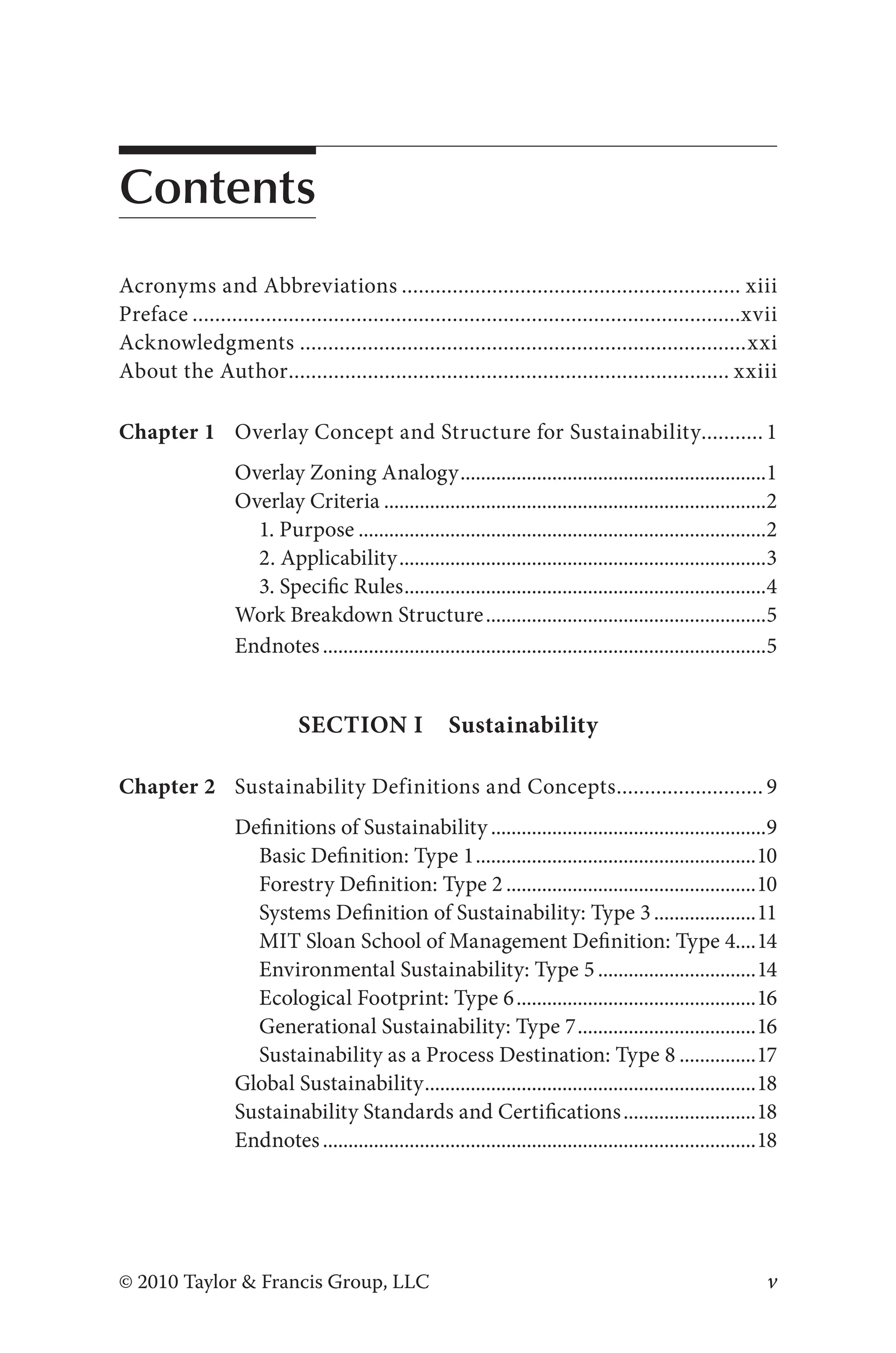
Contents
Acronyms and Abbreviations............................................................. xiii
Preface..................................................................................................xvii
Acknowledgments................................................................................xxi
About the Author............................................................................... xxiii
Chapter 1 Overlay Concept and Structure for Sustainability............ 1
Overlay Zoning Analogy.............................................................1
Overlay Criteria............................................................................2
1. Purpose.................................................................................2
2. Applicability.........................................................................3
3. Specific Rules........................................................................4
Work Breakdown Structure........................................................5
Endnotes........................................................................................5
Section I Sustainability
Chapter 2 Sustainability Definitions and Concepts........................... 9
Definitions of Sustainability.......................................................9
Basic Definition: Type 1........................................................10
Forestry Definition: Type 2..................................................10
Systems Definition of Sustainability: Type 3.....................11
MIT Sloan School of Management Definition: Type 4....14
Environmental Sustainability: Type 5................................14
Ecological Footprint: Type 6................................................16
Generational Sustainability: Type 7....................................16
Sustainability as a Process Destination: Type 8................17
Global Sustainability..................................................................18
Sustainability Standards and Certifications...........................18
Endnotes......................................................................................18
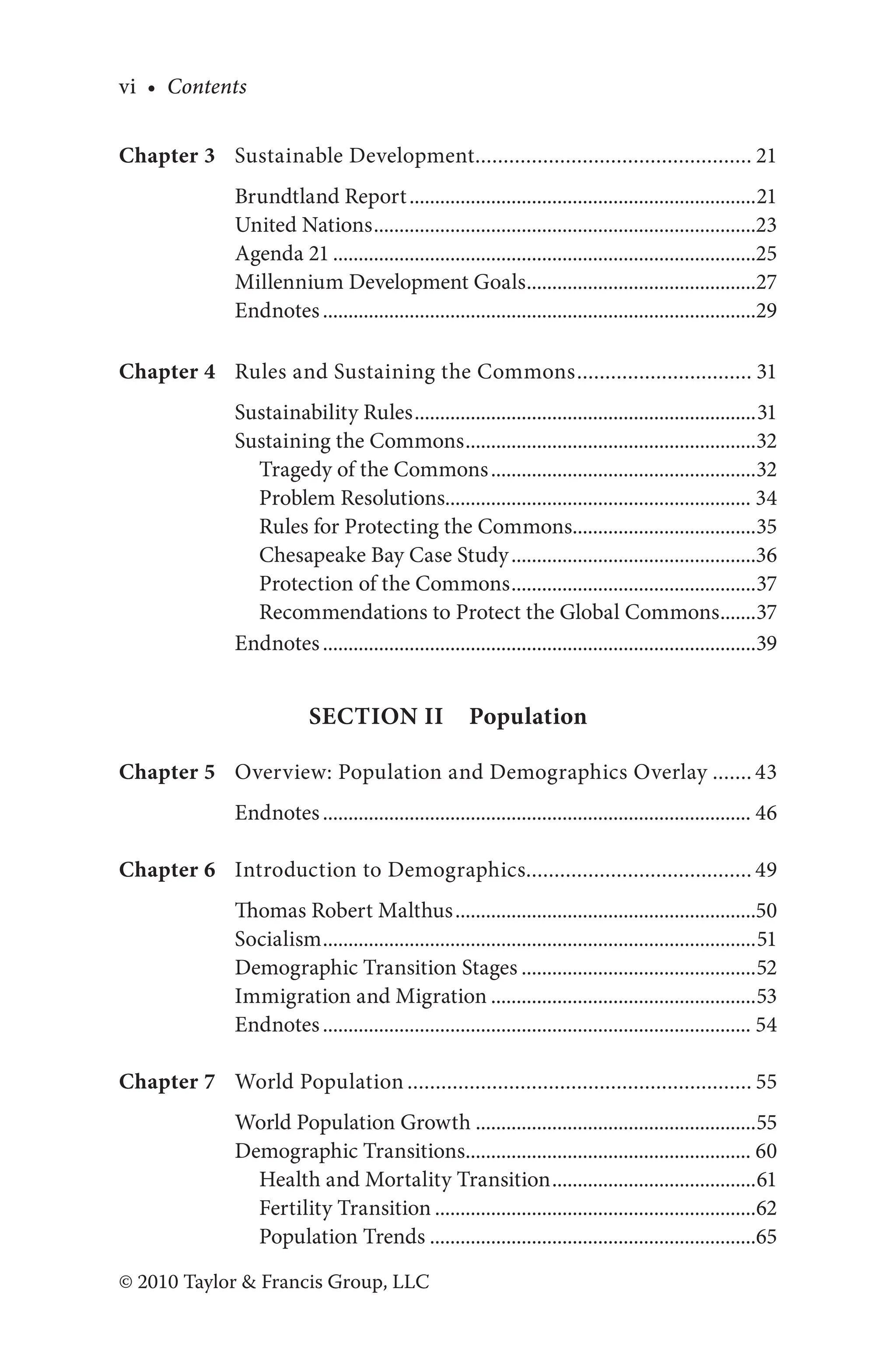
vi • Contents
© 2010 Taylor & Francis Group, LLC
Chapter 3 Sustainable Development.................................................. 21
Brundtland Report.....................................................................21
United Nations............................................................................23
Agenda 21....................................................................................25
Millennium Development Goals..............................................27
Endnotes......................................................................................29
Chapter 4 Rules and Sustaining the Commons................................ 31
Sustainability Rules....................................................................31
Sustaining the Commons..........................................................32
Tragedy of the Commons.....................................................32
Problem Resolutions............................................................. 34
Rules for Protecting the Commons.....................................35
Chesapeake Bay Case Study.................................................36
Protection of the Commons.................................................37
Recommendations to Protect the Global Commons........37
Endnotes......................................................................................39
Section II Population
Chapter 5 Overview: Population and Demographics Overlay........ 43
Endnotes..................................................................................... 46
Chapter 6 Introduction to Demographics........................................ 49
Thomas Robert Malthus............................................................50
Socialism......................................................................................51
Demographic Transition Stages...............................................52
Immigration and Migration.....................................................53
Endnotes..................................................................................... 54
Chapter 7 World Population.............................................................. 55
World Population Growth........................................................55
Demographic Transitions......................................................... 60
Health and Mortality Transition.........................................61
Fertility Transition................................................................62
Population Trends.................................................................65
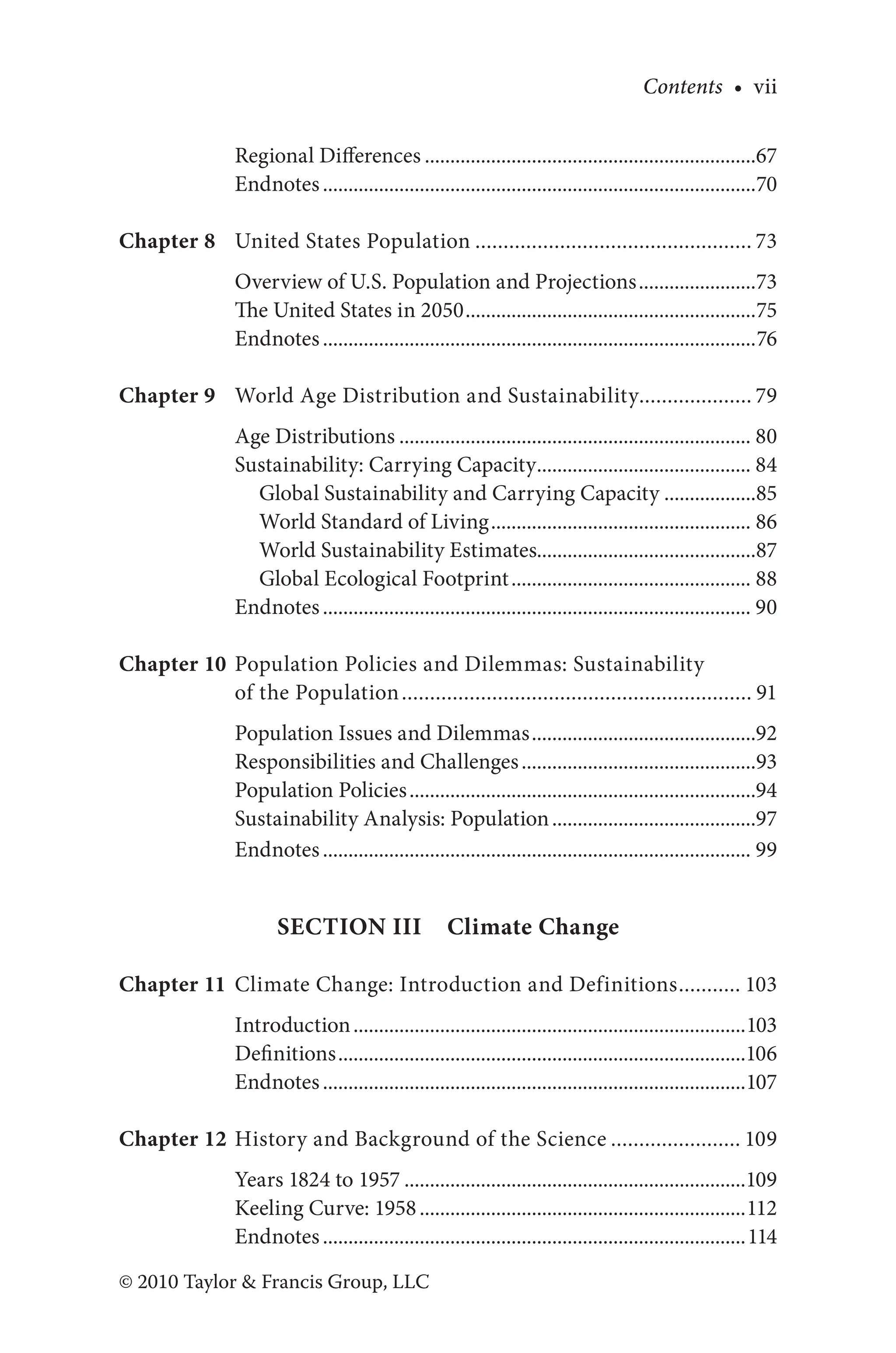
Contents • vii
© 2010 Taylor & Francis Group, LLC
Regional Differences..................................................................67
Endnotes......................................................................................70
Chapter 8 United States Population.................................................. 73
Overview of U.S. Population and Projections........................73
The United States in 2050..........................................................75
Endnotes......................................................................................76
Chapter 9 World Age Distribution and Sustainability.................... 79
Age Distributions...................................................................... 80
Sustainability: Carrying Capacity........................................... 84
Global Sustainability and Carrying Capacity...................85
World Standard of Living.................................................... 86
World Sustainability Estimates...........................................87
Global Ecological Footprint................................................ 88
Endnotes..................................................................................... 90
Chapter 10 Population Policies and Dilemmas: Sustainability
of the Population............................................................... 91
Population Issues and Dilemmas.............................................92
Responsibilities and Challenges...............................................93
Population Policies.....................................................................94
Sustainability Analysis: Population.........................................97
Endnotes..................................................................................... 99
Section III  Climate Change
Chapter 11 Climate Change: Introduction and Definitions............ 103
Introduction..............................................................................103
Definitions.................................................................................106
Endnotes....................................................................................107
Chapter 12 History and Background of the Science........................ 109
Years 1824 to 1957....................................................................109
Keeling Curve: 1958.................................................................112
Endnotes....................................................................................114
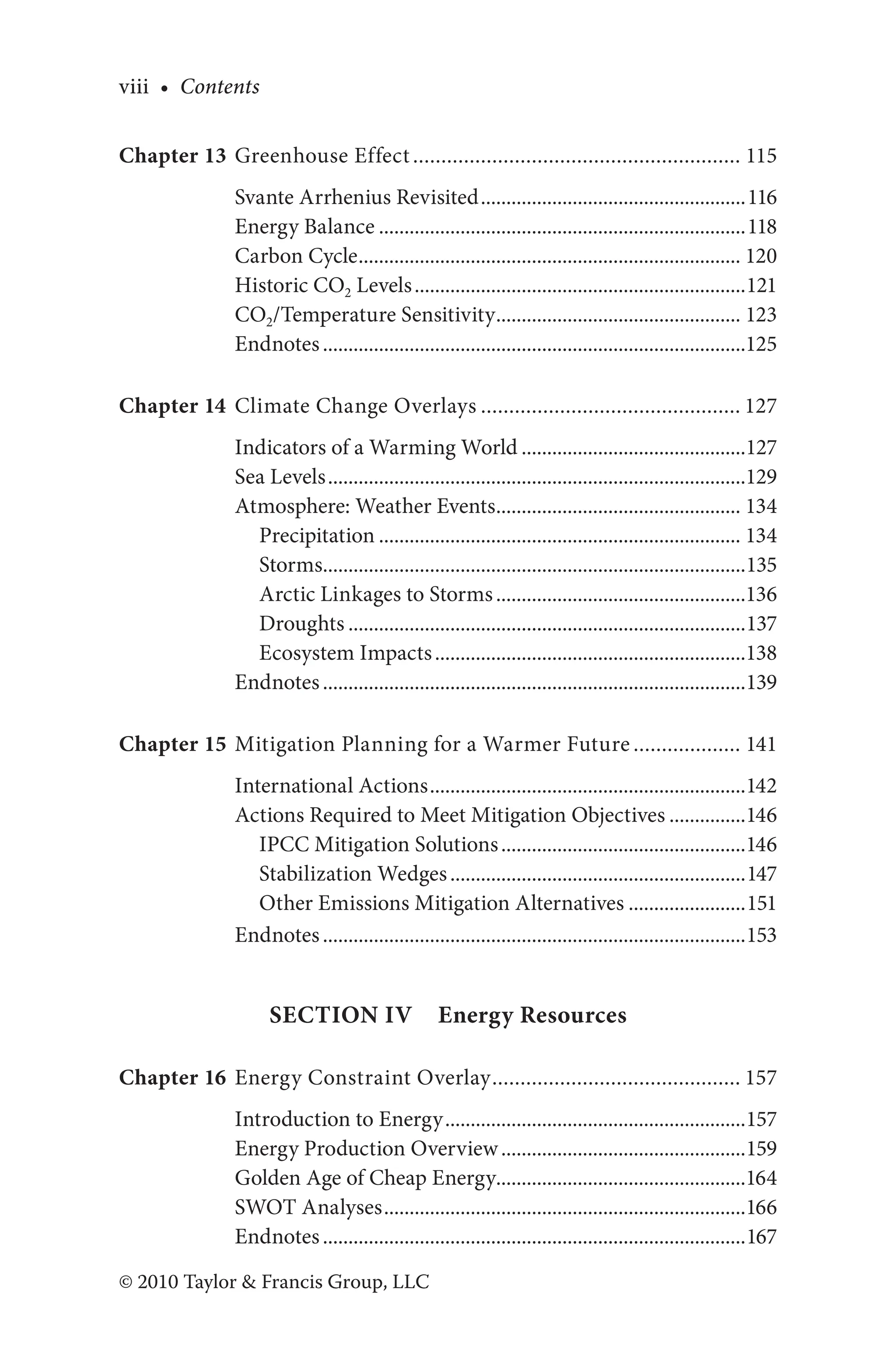
viii • Contents
© 2010 Taylor & Francis Group, LLC
Chapter 13 Greenhouse Effect........................................................... 115
Svante Arrhenius Revisited.....................................................116
Energy Balance.........................................................................118
Carbon Cycle............................................................................ 120
Historic CO2 Levels..................................................................121
CO2/Temperature Sensitivity................................................. 123
Endnotes....................................................................................125
Chapter 14 Climate Change Overlays............................................... 127
Indicators of a Warming World.............................................127
Sea Levels...................................................................................129
Atmosphere: Weather Events................................................. 134
Precipitation........................................................................ 134
Storms....................................................................................135
Arctic Linkages to Storms..................................................136
Droughts...............................................................................137
Ecosystem Impacts..............................................................138
Endnotes....................................................................................139
Chapter 15 Mitigation Planning for a Warmer Future.................... 141
International Actions...............................................................142
Actions Required to Meet Mitigation Objectives................146
IPCC Mitigation Solutions.................................................146
Stabilization Wedges...........................................................147
Other Emissions Mitigation Alternatives........................151
Endnotes....................................................................................153
Section IV Energy Resources
Chapter 16 Energy Constraint Overlay............................................. 157
Introduction to Energy............................................................157
Energy Production Overview.................................................159
Golden Age of Cheap Energy.................................................164
SWOT Analyses........................................................................166
Endnotes....................................................................................167
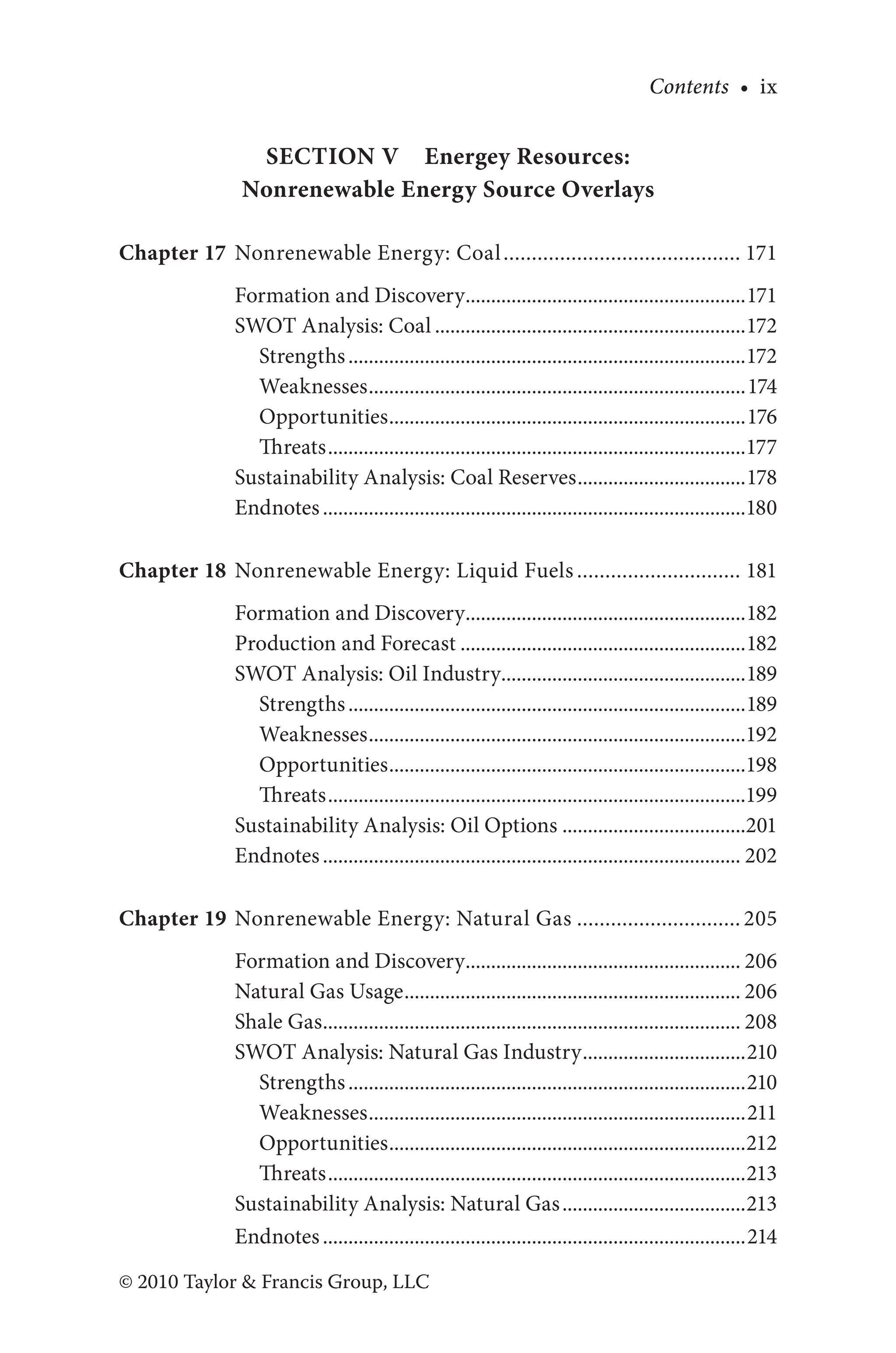
Contents • ix
© 2010 Taylor & Francis Group, LLC
Section V Energey Resources:
Nonrenewable Energy Source Overlays
Chapter 17 Nonrenewable Energy: Coal........................................... 171
Formation and Discovery........................................................171
SWOT Analysis: Coal..............................................................172
Strengths...............................................................................172
Weaknesses...........................................................................174
Opportunities.......................................................................176
Threats...................................................................................177
Sustainability Analysis: Coal Reserves..................................178
Endnotes....................................................................................180
Chapter 18 Nonrenewable Energy: Liquid Fuels.............................. 181
Formation and Discovery........................................................182
Production and Forecast.........................................................182
SWOT Analysis: Oil Industry.................................................189
Strengths...............................................................................189
Weaknesses...........................................................................192
Opportunities.......................................................................198
Threats...................................................................................199
Sustainability Analysis: Oil Options.....................................201
Endnotes................................................................................... 202
Chapter 19 Nonrenewable Energy: Natural Gas.............................. 205
Formation and Discovery....................................................... 206
Natural Gas Usage................................................................... 206
Shale Gas................................................................................... 208
SWOT Analysis: Natural Gas Industry.................................210
Strengths...............................................................................210
Weaknesses...........................................................................211
Opportunities.......................................................................212
Threats...................................................................................213
Sustainability Analysis: Natural Gas.....................................213
Endnotes....................................................................................214
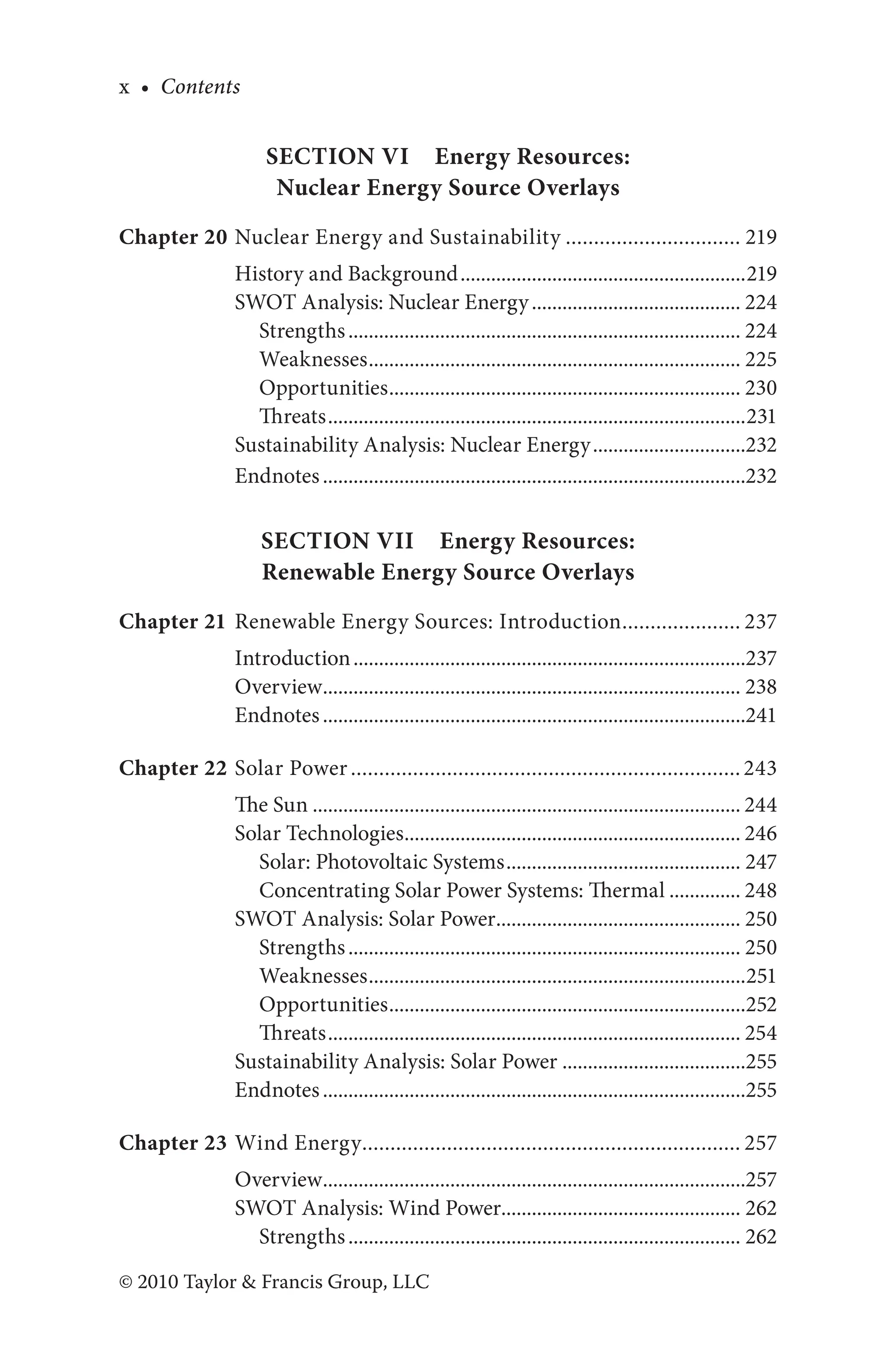
x • Contents
© 2010 Taylor & Francis Group, LLC
Section VI Energy Resources:
Nuclear Energy Source Overlays
Chapter 20 Nuclear Energy and Sustainability................................ 219
History and Background.........................................................219
SWOT Analysis: Nuclear Energy.......................................... 224
Strengths.............................................................................. 224
Weaknesses.......................................................................... 225
Opportunities...................................................................... 230
Threats...................................................................................231
Sustainability Analysis: Nuclear Energy...............................232
Endnotes....................................................................................232
Section VII Energy Resources:
Renewable Energy Source Overlays
Chapter 21 Renewable Energy Sources: Introduction...................... 237
Introduction..............................................................................237
Overview................................................................................... 238
Endnotes....................................................................................241
Chapter 22 Solar Power...................................................................... 243
The Sun..................................................................................... 244
Solar Technologies................................................................... 246
Solar: Photovoltaic Systems............................................... 247
Concentrating Solar Power Systems: Thermal............... 248
SWOT Analysis: Solar Power................................................. 250
Strengths.............................................................................. 250
Weaknesses...........................................................................251
Opportunities.......................................................................252
Threats.................................................................................. 254
Sustainability Analysis: Solar Power.....................................255
Endnotes....................................................................................255
Chapter 23 Wind Energy.................................................................... 257
Overview....................................................................................257
SWOT Analysis: Wind Power................................................ 262
Strengths.............................................................................. 262
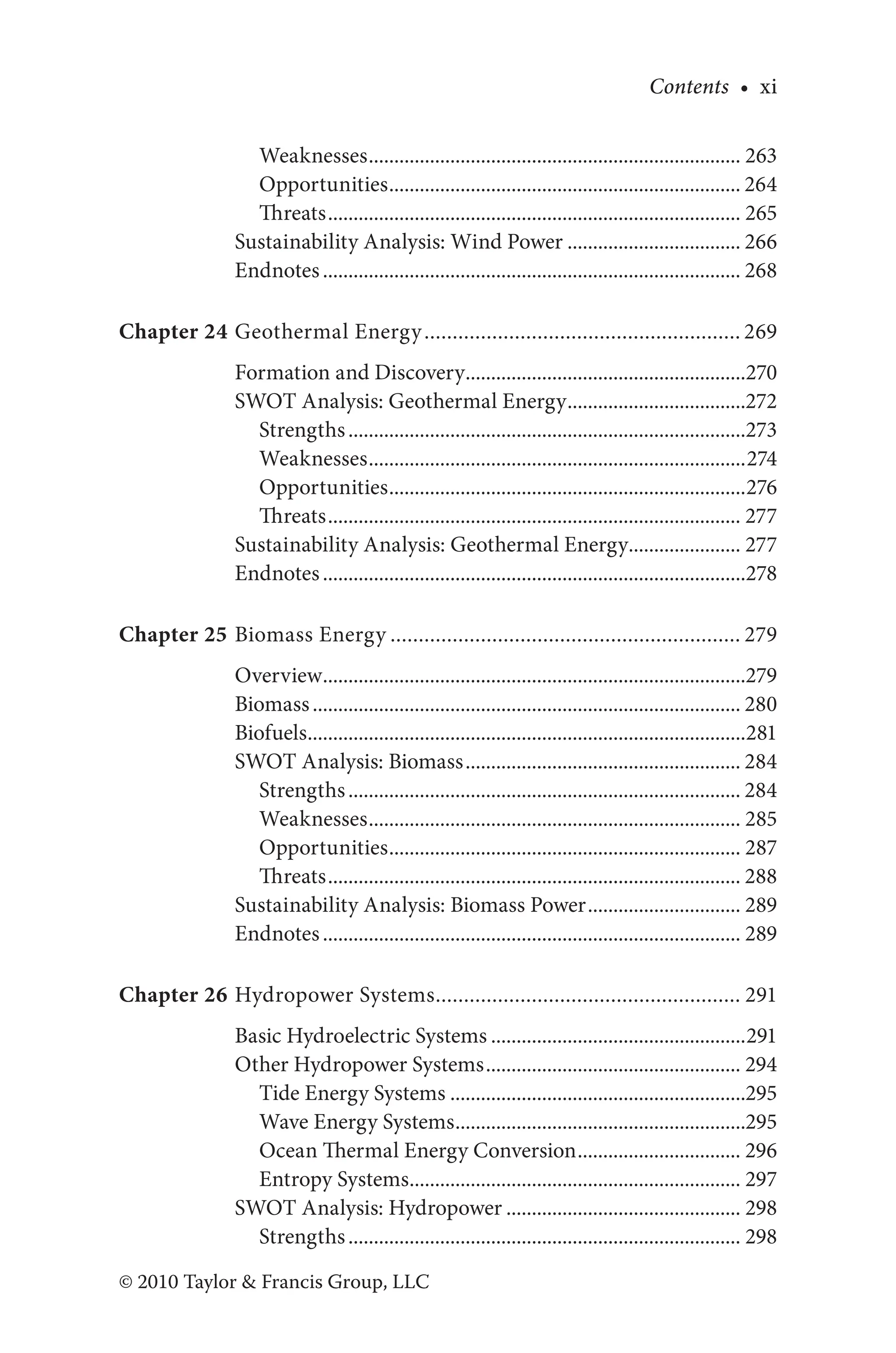
Contents • xi
© 2010 Taylor & Francis Group, LLC
Weaknesses.......................................................................... 263
Opportunities...................................................................... 264
Threats.................................................................................. 265
Sustainability Analysis: Wind Power................................... 266
Endnotes................................................................................... 268
Chapter 24 Geothermal Energy......................................................... 269
Formation and Discovery........................................................270
SWOT Analysis: Geothermal Energy....................................272
Strengths...............................................................................273
Weaknesses...........................................................................274
Opportunities.......................................................................276
Threats.................................................................................. 277
Sustainability Analysis: Geothermal Energy....................... 277
Endnotes....................................................................................278
Chapter 25 Biomass Energy............................................................... 279
Overview....................................................................................279
Biomass..................................................................................... 280
Biofuels.......................................................................................281
SWOT Analysis: Biomass....................................................... 284
Strengths.............................................................................. 284
Weaknesses.......................................................................... 285
Opportunities...................................................................... 287
Threats.................................................................................. 288
Sustainability Analysis: Biomass Power............................... 289
Endnotes................................................................................... 289
Chapter 26 Hydropower Systems....................................................... 291
Basic Hydroelectric Systems...................................................291
Other Hydropower Systems................................................... 294
Tide Energy Systems...........................................................295
Wave Energy Systems..........................................................295
Ocean Thermal Energy Conversion................................. 296
Entropy Systems.................................................................. 297
SWOT Analysis: Hydropower............................................... 298
Strengths.............................................................................. 298
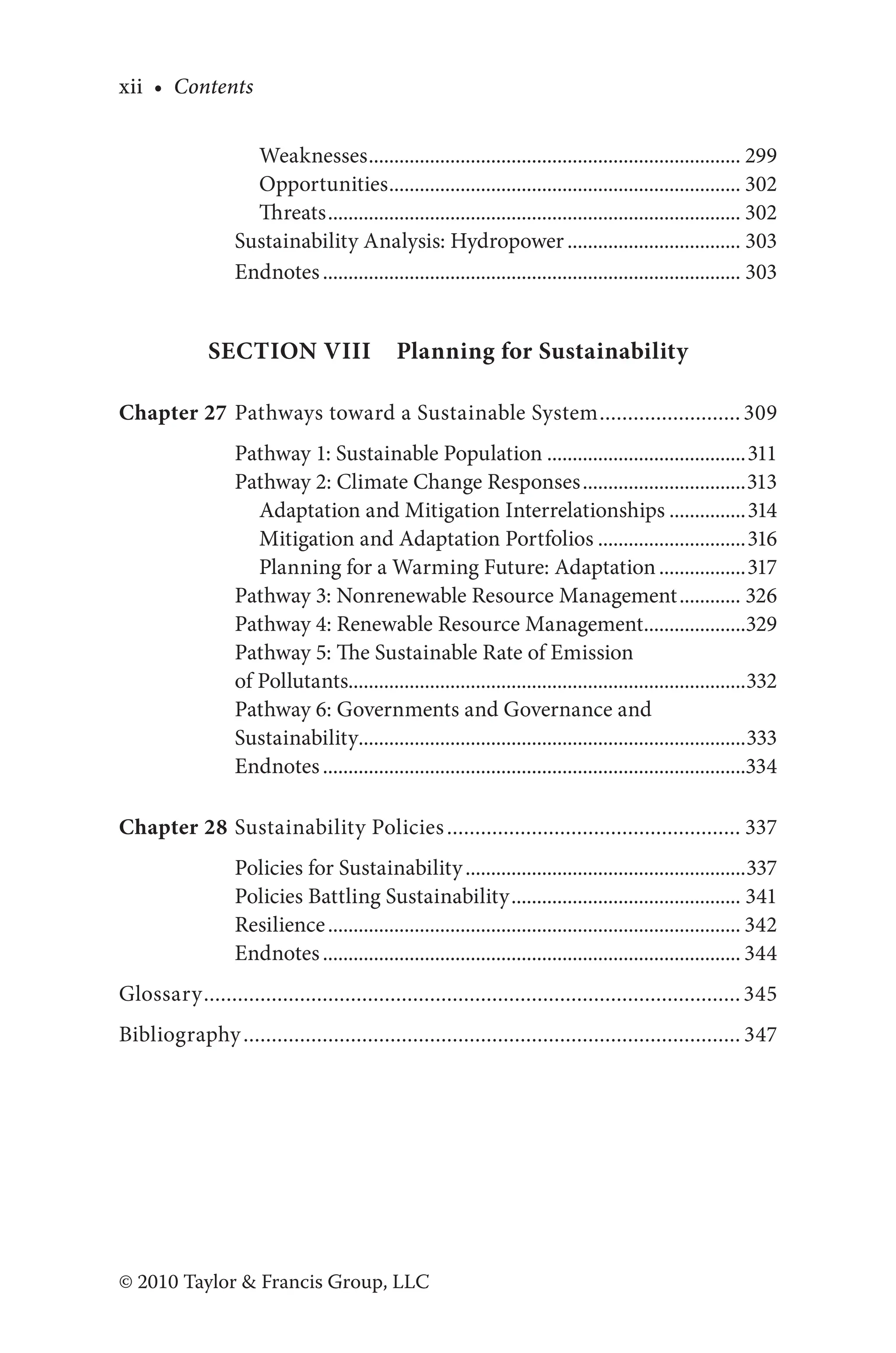
xii • Contents
© 2010 Taylor & Francis Group, LLC
Weaknesses.......................................................................... 299
Opportunities...................................................................... 302
Threats.................................................................................. 302
Sustainability Analysis: Hydropower................................... 303
Endnotes................................................................................... 303
Section VIII  Planning for Sustainability
Chapter 27 Pathways toward a Sustainable System..........................309
Pathway 1: Sustainable Population........................................311
Pathway 2: Climate Change Responses.................................313
Adaptation and Mitigation Interrelationships................314
Mitigation and Adaptation Portfolios..............................316
Planning for a Warming Future: Adaptation..................317
Pathway 3: Nonrenewable Resource Management............. 326
Pathway 4: Renewable Resource Management.....................329
Pathway 5: The Sustainable Rate of Emission
of Pollutants..............................................................................332
Pathway 6: Governments and Governance and
Sustainability.............................................................................333
Endnotes....................................................................................334
Chapter 28 Sustainability Policies..................................................... 337
Policies for Sustainability........................................................337
Policies Battling Sustainability.............................................. 341
Resilience.................................................................................. 342
Endnotes................................................................................... 344
Glossary................................................................................................345
Bibliography......................................................................................... 347
xiii
© 2010 Taylor & Francis Group, LLC
Acronyms and Abbreviations
ABWR: advanced breeder water reactor
AFC: alkaline fuel cell
ANWR: Arctic National Wildlife Refuge
BAU: business as usual
BIO: Biotechnology Industry Organization
BPA: Biomass Power Association
BtCO2: billion tons of carbon dioxide
BTL: biomass-to-liquids
BWR: breeder water reactor
CAA: Clean Air Act
CAFÉ: corporate average fuel economy
CAIR: Clean Air Interstate Rule
CBO: Congressional Budget Office
CCGT: combined cycle gas turbine
CCL: Citizens Climate Lobby
CCP: critical control points
CCS: carbon capture and storage
CDLE: capacitor double layer expansion
CH4: methane
CHP: combined heat and power
CHP: co-generator heat and power
CNG: compressed natural gas
CO2: carbon dioxide
CPR: common pool resources
CRS: Congressional Research Service
CTL: coal to liquids
CWA: Clean Water Act
DBT: design basis threat
DMFC: direct-methanol fuel cell
DOE: Department of Energy
DRB: demonstrated reserve base (coal)
E10: fuel containing 10% ethanol and 90% gasoline by volume
E85: fuel containing a blend of 70% to 85% ethanol and 30% to 15% gaso-
line by volume
xiv • Acronyms and Abbreviations
© 2010 Taylor & Francis Group, LLC
EGS: engineered geothermal system
EGS: enhanced geothermal system
EIA: U.S. Energy Information Agency
EOR: enhanced oil recovery
EPA: U.S. Environmental Protection Agency
EPIA: European Photovoltaic Industry Association
EU: European Union
FCV: fuel cell vehicles
FEMP: Federal Energy Management Program
FERC: Federal Energy Regulatory Commission
FFV: flex-fuel vehicle
FGD: flue gas desulfurization
GDP: gross domestic product
GHG: greenhouse gas
GIF: Generation IV International Forum (nuclear energy)
gigaton: billion tons
GRACE: Gravity Recovery and Climate Experiment (German and NASA
Satellite)
GRI: Gas Research Institute (Illinois Institute of Technology)
GTL: gas-to-liquid
GW: gigawatt
HDNGV: heavy-duty natural gas vehicle
HEV: hybrid electric vehicle
IAEA: International Atomic Energy Agency
IEA: International Energy Agency
IFR: integral fast reactor
IGCC: integrated gasification combined cycle
INPRO: International Project on Innovative Nuclear Reactors and Fuel
Cycles
IPCC: Intergovernmental Panel on Climate Change
ITC: investment tax credit
K: Kelvin; temperature scale that has absolute zero as the base, Centigrade
degrees
kW: kilowatt, one thousand watts
kWh: kilowatt hour
LCFS: low-carbon fuel standard
LED: light-emitting diode
LEU: low-enriched uranium
LNG: liquefied natural gas
Exploring the Variety of Random
Documents with Different Content
“Oh, she was only a child,” said Clark, carelessly; “a plucky child,
too, by the bye, and as good at hiding as an old Shawnee warrior.
But we didn’t travel long together. She brought me certain
propositions from—well, never mind who, sir; that’s my affair—and
when we had talked over the business, I packed her off to her
adopted father. I may see her again, if this expedition succeeds, but
I doubt if I should know her again. So much for your sneer,
youngster.”
The boy adjutant laughed again, and said:
“So you’ll see her again, if the expedition succeeds, sir? Then I
suppose we’re going to St. Vincent’s?”
Clark, who was again looking out ahead, put down the glass, and
turned abruptly on his small adjutant, laying his hand heavily on his
shoulder with a grim smile, as he said:
“Look here, young man, you’re a smart lad, but not so smart as you
think. This expedition is going—where I choose. Do you quite
comprehend? You’re as curious, sir, by Jove, as if you were a
woman. Ask me no questions, if you don’t want to be put under
arrest. I dare say the whole lot of you would like to know my
intentions; but you will have to find me out of my wits first. Now, sir,
take the canoe, and pay your morning visit to the fleet. Bring me
back a report of the condition of the arms and ammunition, by the
time we reach Arbuckle’s Station, and be quick.”
It was evident that the commander was somewhat irritated with his
staff officer for presuming to question him, and the lad turned away
very promptly, for the colonel was universally dreaded when he
looked angry, which was not often.
Adjutant Frank descended to the deck, and jumped overboard into a
canoe towing alongside, with which he proceeded to visit the other
boats of the fleet; while Clark, left alone, paced the roof of the little
cabin in silence.
In a short time the river began to grow much broader, the current
slower, and the monotonous waste of forest on either bank was
broken in places by clearings. At last they saw before them a lofty
point, nearly bare of timber, jutting out on the right, and beheld the
straight brown banks of the broad Ohio, barring their further
progress in a straight line. The Kanawha became merged in the
Ohio.
On the point to the north, known as Point Pleasant, stood a
straggling collection of log-houses, inclosed with a palisade, and
bearing the usual appurtenances of a frontier fort, including a pine-
tree flag. As the people on the bateau caught sight of the fort, they
gave three ringing cheers, responded to by the instant rushing out
of a crowd of people from the houses, running pell-mell to see what
was coming.
Half an hour after, they were passing in front of the fort, when a
boat, containing a military officer and a dozen rowers, pulled out to
intercept them, and Captain Leander Arbuckle, commandant and
principal owner of the settlement, boarded Clark’s boat, and saluted
the colonel as if he knew him well.
“Whither bound, colonel?” he asked.
“Down the river to defend Kentucky,” said Clark. “Secret orders.”
“Well, sir,” said the captain, eagerly, “then I can put you in the way
to checkmate an Indian raid, if you will join me. Only the day before
yesterday I beat off a great war-party of two hundred and fifty men
of the Six Nations. They crossed the river here, and have gone on
for the settlements on the Greenbrier river, so as to take your friends
in Kentucky in the rear. Now, colonel, if you will join me, we can
overtake these fellows and utterly exterminate them. Will you?”
“No, sir,” said Clark, gravely; “I can not do it. My orders, if obeyed,
will punish these fellows better than by following them. The settlers
must take care of themselves.”
Captain Arbuckle drew himself up stiffly.
“Am I to understand that you refuse to help me save our imperiled
fellow-citizens, colonel?”
“You are, sir,” said Clark, firmly. “If you want to follow a will-o’-the-
wisp, you must do it alone. I must do my duty, which forbids me to
stop a single hour on my way.”
Arbuckle looked perplexed and vexed.
“But where, then, are you going?”
“Where my orders take me, sir; and that is a secret.”
Arbuckle looked angry. He lifted his hat with very stiff courtesy, and
said, as he turned away:
“Then I have the honor to bid you farewell, Colonel Clark, and to
wish you better manners.”
“And I, sir,” said Clark, with equal bantering, “shall have the honor to
demand an apology for those words, when I have done my duty.”
Arbuckle wheeled round haughtily.
“Prove me wrong, sir, and I’ll give you any satisfaction you wish.
Good-morning, sir.”
A moment after, captain and colonel parted, like two peppery
Southerners, as they were, ready to cut each other’s throats on a
point of etiquette.[1]
CHAPTER X.
A FRONTIER CAMP.
The site of the present city of Louisville was but a desolate
wilderness a hundred years ago; when forest and prairie divided the
banks of the river, and the game roamed, unfrightened by white or
red. Here, late in the month of June, 1778, a considerable camp was
pitched, the rows of fires and tethered horses announcing the
presence of several hundred men, while the woodland costume of
the occupants proclaimed them to be unmitigated backwoods
settlers and hunters.
A large, powerful man, black-haired and bearded, with tremendous
shoulders, stood by the banks of the Ohio, in company with Boone
and Kenton, all three watching the stream above them, where the
outlines of Clark’s bateaux were readily discernible, coming down the
river. Below them could be heard the roaring noise of those steep
and dangerous rapids, now known as Louisville Falls; and at this
point had Clark ordered a concentration of all the forces raised to
defend Kentucky.
The big man was the renowned Captain Harrod, of Harrodsburg,
whose company was one of those designed for the secret
expedition, whose purpose was as yet unknown to all but the leader.
“I’m thinkin’ we’ll know all about the colonel’s plans middlin’ quick,
when he comes in,” remarked Kenton, as he leaned on his rifle. “The
boys are in fur a scrimmage, but they won’t go unless they know
whar they’re goin’ to.”
“You may bet your boots on that,” said Harrod, dryly. “I hain’t no
objections to tacklin’ Old Nick, ef I know whar I’m goin’; but I ain’t
to be fooled with secret orders by no George Clark, when I c’u’d turn
him over my knee and spank him.”
Daniel Boone turned his quiet blue eyes on Harrod, saying:
“Ain’t you a little hard on Colonel Clark, Billy? He ain’t asked you to
go on a wild-goose chase yet. I know you’re a good man of your
hands, Billy, but Clark’s no boy. Wait till he tells us where we are to
go, before you get mad. He holds the State commission, remember,
to order us all.”
Harrod shook his head sulkily.
“He’s a good sodger, Dan’l, no discount on that; but I don’t like
these hyar secret orders. Why don’t he come out and tell us whar
he’s goin’ like a man?”
“Because there are spies round, Billy,” said Boone, boldly. “Who
knows but what the British General at Detroit would hear all about
his doings, if he divided the secret with a lot of fellows like them?”
indicating the camp with a scornful gesture; “so full of whisky—when
they can get it, that a child might suck them dry.”
“There are reason in cunnel’s words, Billy,” said Kenton, quietly.
“Leastwise there ain’t no use talkin’, till Cunnel Clark comes. See, the
head boat’s landin’ on Corn Island, and I guess we’ll hev to foller
them into camp there.”
In fact, at this moment, Clark’s boats put in to an island that lay in
the center of the river, and proceeded to disembark their crews, in
sight of the Kentuckians.
Shortly after, a bark canoe shot out from the island, crossed the
shallow belt of water that separated it from the south bank, and
landed the same little officer already referred to as Adjutant Frank.
This smart little officer came strutting up to Big Bill Harrod, with a
slender rapier clanking at his heels, and asked:
“Where shall I find Captain Bowman, the commandant, sir?”
Harrod looked down, half-contemptuously, at this tiny officer, whose
head about reached his breast, and answered with a question:
“And what the Old Nick do you want of Joe Bowman, bubby? He
ain’t used to suckin’ ’lasses candy.”
The little officer laughed merrily, without seeming in the least
abashed.
“I see, you’re not Bowman, my man, for I was told he was a
gentleman. Captain Kenton, where is Bowman?”
Kenton started.
“Why, how the Old Scratch do you know my name, sonny? I
disremember ever seeing you before.”
“I am Colonel Clark’s adjutant, gentlemen,” said Frank, pulling up
with considerable dignity, notwithstanding his small size. “If you’ve
no civil answer to give me, I’ll go elsewhere! I carry orders!”
“Captain Bowman is down in camp, with Captain Dillard, sir,” said
Daniel Boone, suddenly stepping forward and saluting the other with
respect. “Don’t mind these rough fellows, adjutant; it’s their
Kentucky way, and they mean no harm. I’ll go to the camp with
you.”
“Hold on,” said Harrod, gruffly. “That younker said something about
my not bein’ a gentleman. I ain’t goin’ to be talked to that way by
none of George Clark’s whipper-snappers.”
In a moment the little officer had wheeled sharp round, and
marched up to the huge borderer.
“Well, sir,” he said, defiantly, “I said you were no gentleman, to
answer a civil question as you did. I repeat it. Now then, name your
time and place, and I’ll fight you!”
For a moment the giant looked down at the slender form of this
incarnation of pluck, pure and simple, as if he was puzzled. At last
he burst into a roar of laughter, for he was a good-natured fellow
after all, and said:
“I guess you’re right, arter all, little bantam. I durstn’t fight ye, that I
know, for I couldn’t see to hit ye, ef ye stood edgewise. Let’s shake
hands. I’m Bill Harrod of Harrodsburg, and by Gosh, I’m sorry I riled
ye. Put it there.”
He held out a broad and horny palm, into which Frank insinuated his
own diminutive hand, enduring a painful squeeze with great
fortitude. Then all four, in perfect harmony, proceeded to the camp,
where the senior captain, Joseph Bowman of Virginia, welcomed the
little adjutant with great courtesy, and received the latter’s message.
“Colonel Clark’s compliments, gentlemen, and he has gone into
camp on Corn Island. The river is fordable here, and he wishes you
to bring over your companies and camp with him, when he will
announce the object of the expedition, and call for volunteers.”
The news was spread from mouth to mouth with wonderful rapidity,
the half-disciplined frontiersmen crowding round their commanders
to hear the message, in a manner that would have caused a
martinet to despair of their military character.
Nevertheless, Bowman issued the order, like an old officer.
“Git ready to move camp, boys; and look sharp.”
Inside of ten minutes, three companies of mounted riflemen stood
by their horses’ heads, silent and obedient, and when Bowman rode
into the ford, there was not a single straggler left behind.
The little adjutant crossed in his canoe, and on the further bank they
found three more companies, drawn up in front of their camp, all
silent and orderly, and anxiously expecting the news, about to be
promulgated, of the destination of the expedition.
Colonel Clark was the only mounted man on the island, and he rode
up, and greeted his allies with great courtesy.
“You will go into camp at the other end of the island, captain,” he
said, to Bowman. “There are too many of the enemy’s Indians
about, to trust a camp on shore to their annoyances. Go into camp,
dismount your men, and be ready for dress parade at sunset. I will
then announce the orders.”
There was an evident disposition, among the rough borderers of
Harrod’s and Dillard’s companies, to grumble at this order, but Clark
checked it in a manner that showed his knowledge of frontier
nature. Riding down the column, he called out:
“What, gentlemen, have we a lot of curious old women in the ranks?
If so, please to ride home. I want nothing but brave men, where I
am going. For shame! Don’t you know me well enough to know that
George Clark has a meaning for whatever he says? Forward,
gentlemen, and obey orders like men!”
In a moment a dead silence fell on the three companies, and the
camp was formed with marvelous expedition and order.
An hour after that, at the call of the bugle, six hundred men were
under arms in a hollow square, and the backwoods leader addressed
them, amid intense anxiety from all to hear the news.
CHAPTER XI.
THE SECRET DISCLOSED.
“Gentlemen of Kentucky and Virginia,” began the colonel, “for six
long years have we striven on the dark and bloody ground to keep a
foothold on the inheritance we are earning for our children. For
three years of that time, our whole land has been fighting against
fearful odds on the side of the unnatural mother country. Not
content with hiring Hessians to come over and murder us, they have
bribed the savages to fire our houses and scalp women and children,
from Cherry Valley to Harrodsburg.”
Here there was a growl of assent, “That’s so.” “Cuss ’em.” “We’ll get
square, some day.”
“Soldiers,” continued Clark, addressing them by the title he knew
they were most proud of, “the time has come when we must turn
the tables on the British. Saratoga has shown them that we can beat
their best troops, and all along the Atlantic States they are running
like whipped hounds!”
A tremendous yell greeted the reference.
“Now,” cried the colonel, “since we are safe on the east, let us turn
to the west. The Indians have tormented us long enough. We chase
them, and ’tis like attacking a swarm of wasps. We can not catch
them. Well, boys, what do you do when the wasps get too
troublesome?”
He paused, as if to await a reply. There was an awkward silence for
near a minute. Then Daniel Boone, who stood near Clark, and out of
the ranks, observed in his clear, quiet tones:
“We hunt for the nest, and burn it up, some night, colonel.”
“Right, old comrade!” exclaimed the young leader, amid a whispered
chorus of excited comments; “we find the nest, and burn it up. Well,
gentlemen, these wasps come not from one nest, but three: and
their names are Detroit, St. Vincent’s,[2]
and Kaskaskia. Detroit is a
fortified town, beyond our reach. St. Vincent’s is too strong for us as
yet. Kaskaskia, the furthest of all, is the most dangerous to
Kentucky. Secure in their distance from us, the British think they
need fear nothing. Gentlemen, I have orders from Governor Henry of
Virginia to take Kaskaskia and save Kentucky forever. Who will
volunteer to go with me, and strangle the snake in his den?”
There was a deep silence following this speech, at the end of which
Captain Harrod stepped forward and made a characteristic speech:
“Colonel George Rogers Clark, Esquire: Sir, I’ve be’n a-grumblin’ a
long time about these hyar secret orders, and, I reckon, be’n makin’
a darned jackmule of myself about it. Colonel, I take it all back, and
damme, sir, I’ll lift the ha’r off any feller as says you ain’t a full team
and two mules to spar’, with a yaller dawg hitched under the tail-
board. I’m with you, colonel, while thar’s a drop of blood in my body,
and these hyar Harrodsburg hu’sters, they travel with me, you kin
bet all the clothes you ever owned. Thar!”
A rousing cheer from Harrod’s company applauded the speech, and
it was followed by equally warm indorsement from every captain and
company, with one exception.
This was captain Dillard, whose company was raised near Harrod’s,
and entertained considerable jealousy of the others.
Captain Dillard, when questioned point-blank by Clark, before the
rest, replied:
“Waal, colonel, ef I’d knowed you war a-goin’ on any sich a wild-
goose chase as this hyar, I wouldn’t have pledged my credit to the
boys, and asked ’em to come. You’re a-goin’ a long way, and it’s
more than likely you’ll git beat. Ef so, whar are ye? Worse off than
ever, a thousand miles from hum, and no one to help ye?”
The cautious captain’s words were not without their effect in
damping the men’s spirits, and it was with great adroitness that
Clark replied, in closing the discussion:
“That’s all provided for, captain. We have bateaux enough to carry us
all down the Mississippi to New Orleans, where the Spanish and
French will be only too glad to pay us like princes to fight the
Indians for them. But we shall not get beat. We shall take them by
surprise, kill the British soldiers, save Kentucky, and come home
worth two hundred and fifty acres of land apiece. Governor Henry
has promised it to us, and I have the patent in my pocket. Now,
gentlemen, since you’re all agreed to follow me, disperse to your
quarters. Captain Bowman, you are officer of the day. Secure all the
boats, and place sentries at the ford. Let no man cross without my
orders. I wish to see the captains in my cabin at once. Adjutant,
dismiss the parade.”
As stiffly and formally as if nothing had happened, he signified by his
manner that discussion was over. The officers returned to their
companies; the little adjutant called up the sergeants and received
reports; and finally parade was dismissed, with a ceremony rarely
seen among the rough frontiersmen.
Guards were set around the boat and at the fort, and the whole
camp was soon a buzz of conflicting voices on the prospects of the
famous expedition to Kaskaskia. Some of Dillard’s men were
disposed to gloomy prophecies, influenced by their captain, but the
greater part were light-hearted, reckless hunters, to whom the idea
of a distant and dangerous expedition acted as a charm.
These laughed at the croakers, and prognosticated great things of
the expedition, as they devoured their rations, which the foresight of
Clark had collected at the falls in large quantities. None knew better
than Clark the road through the stomach to a soldier’s heart, and
none appreciated it better.
At last all was quiet, and the fires dying away, the camp was buried
in profound slumber.
Two hours after midnight Colonel Clark was awakened by a touch on
his shoulder. Starting up, he saw the little adjutant before him, who
spoke at once.
“Colonel, the whole of Dillard’s men, with their first lieutenant, have
deserted, and forded the river on the way home.”
In a moment Clark was on his feet, broad awake.
“Have they taken their horses? Has any one else gone? Have the
sentries at the ford played us false?”
“Not one, sir. The scoundrels crossed higher up, leaving their horses
in camp. Dillard remains here. I only found it out five minutes ago,
while making my rounds.”
Clark laid his hand on the boy’s shoulder.
“Frank, you’re little, but you’re worth ten giants. Call the bugler and
sound to arms. I’ll send you after them, lad.”
The leader walked quickly out to the parade-ground, and inside of
five minutes the bugle sounded and the men came filing out of their
bivouacs in silence, forming with a celerity and order that veteran
soldiers could not have excelled. They were all well used to night
alarms, and expected an Indian attack at least.
When the colonel, in a few brief, nervous words, informed them of
the cowardly treachery of their comrades, and called for a party to
pursue them, there was a roar of indignation. Every man in camp
clamored to go after the “durned ornary skunks,” as they called
them, and Clark hastily selected the first score who presented
themselves, mounted them on the horses of the deserters, and sent
them off with Captain Harrod and the little adjutant, with orders to
shoot all who resisted.
Away went the capturing party at full speed across the ford, and the
rest of the night was spent in excited discussion, for all were too
angry to sleep.
About an hour before noon Harrod’s party returned with seven or
eight of the captured deserters, reporting the rest as scattered to
the four winds, and the rest of the day was spent in selecting the
companies to go to Kaskaskia, while the rest were detailed to go to
Kentucky and defend the frontiers during the absence of their
comrades.
Then on the next day, the 24th June, 1778, ten bateaux, carrying
four strong companies of hardy rangers, dropped down the rapids of
the Ohio, and set off on their dangerous expedition to the unknown
wilds of the Illinois country; while, as if to appall them with the
terrors of superstition, the sun passed into a total eclipse, and
darkness covered the heavens at the instant they entered the
passage.[3]
There let us leave them, on their venturesome way, and
turn to the great post which they were trying to reach.
CHAPTER XII.
KASKASKIA.
The Fourth of July is generally a hot day. The Fourth of July, 1778,
was a particularly hot day around the town of Kaskaskia, as it
basked in the sun on the banks of two rivers, the tin roofs of its
quaint old houses shining like mirrors. Kaskaskia, a hundred years
ago, was like Quebec to-day, a quaint, rambling town of steep,
narrow streets, nominally English, actually French in language and
sentiment. Founded two years before Philadelphia, it was at that
time the emporium of Indian trade, and far ahead of the infant St.
Louis, eighty miles further up.
What changes a century makes! To-day Kaskaskia is a decayed
village, and St. Louis a city of palaces.
On a rounded bluff opposite the town stood a handsome stone fort,
with rows of bright brass guns trained on the place, and that so
closely as to obviate the necessity of walls around the houses.
Kaskaskia was safe from the Indians for two reasons.
First, the fort frightened the thievish ones; second, the place was full
of trappers and traders who had intermarried with every tribe in the
West. This last point is the grand secret of the control which the
French have always exercised over the Indians. At the present day it
turns into friends and allies thousands of the same race in the
Hudson’s Bay Territories, that are relentless foes to white men in the
American Territories.
In Kaskaskia, on that sultry Fourth, a hundred years ago, trader and
Indian could be seen side by side in every shady place, smoking over
bargains in furs like old friends.
The blazing sun at last dipped behind the western prairies, and a
gentle breeze came sighing up the Mississippi, when Monsieur
Rocheblave, the French-English Governor, who was sitting by the
open window of the government house at the top of the hill,
suddenly spoke to his wife.
“Coralie, ma chere, I do believe I see Mademoiselle Roland, and that
she is coming hither. Yes, it is she indeed.”
Madame Rocheblave, who was lying on a sofa fanning herself
languidly, bleated out, with a whining, querulous tone:
“Rubie? What can the girl want? I declare I wish my cousin Roland
had done any thing in the world rather than leave that wild creature
in the way he did, half the time for me to take care of, the other half
to that ugly Indian they call the Grand Door of the Wabash. I wish
he’d keep her altogether. She has lost all the manner of society, and
tells the truth so quick and plain that she lacerates my feelings.”
M. Rocheblave had risen to look out of the window better.
“For all that, my angel,” he said, soothingly, “we must remember
that mademoiselle your cousin is a very important person. She
represents the union between us and the tribes, a link carefully
forged by her illustrious father, at his own cost, which must be
maintained. Therefore, Coralie, be polite to mademoiselle, who is
about to become our guest. It is a great privilege you and I enjoy, to
entertain a princess.”
“A princess!” said madame, ill-temperedly. “I’ve had enough of these
wild princesses. What does she come for? It’s not time for her visit
for two months yet.”
“I suppose that the visit portends something to us,” said the
Governor. “At all events, I shall not be wanting in respect to our
illustrious guest.”
And the Governor hastily arranged his costume, and left the room,
to greet the approaching personage.
At the principal gate of the “palace,” as it was styled, he paused, to
watch the progress of a cavalcade, coming up the street.
At the head rode, on a very handsome dappled mustang, our little
friend Ruby Roland, dressed in gorgeous velvets and brocades,
heavily laced with gold, and loaded with jewelry. All the finery that
the wealth of a tribe could lavish on her, was displayed on her trim
figure, and she rode her spirited little horse like a man, with all a
man’s ease and dexterity.
She carried no arms, but this was compensated for by her escort,
consisting of twelve grim-looking chiefs, armed to the teeth.
The Governor bowed very low to this strangely-situated girl, at once
perfect lady and Indian princess, and himself assisted her to
dismount from her horse, while a score of obedient servants came
running out to perform the same service to her escort.
For every one in the town knew by this time that a great embassy
was come from “La Grande Porte.” The chiefs with Ruby were
recognized as being the heads of twelve independent tribes, united
under the great confederacy of the Wabash, and such chiefs always
expected deferential treatment.
The Governor embraced his cousin by marriage in the most courtly
French style, and shook hands with all the chiefs in turn, welcoming
them with a string of French and Indian compliments together, and
ushering them into the drawing-room.
Here Madame la Gouverneuse, who had recovered her outward
equanimity, whatever her inward feelings, embraced Ruby with a
cordiality that would have deceived any male beholder, and which
the quick-witted girl herself penetrated in an instant.
Then, after a sumptuous feast on the most unsubstantial of French
pastry and ice cream, articles devoured with intense relish by the
wild sons of the prairie, the Governor opened negotiations by a
delicate hint that business was in order.
Ruby at once became spokeswoman for her party, and proceeded to
explain the object of her visit in a speech which excited general
grunts of approbation from her stoical attendants.
“We have come,” said the girl, in the metaphorical Indian style,
“from the banks of the great river to the east, to the father of all
waters. We are few as a flock of antelopes, but behind us are our
brothers, like the buffalo, without number. From the great fresh sea
on the north, by the country of the Michigans, to the great river
Ohio, that never fails, we are one house, and that house has one
door, who is our Red Father. The Grand Door has opened to let us
forth, to bring great words to our French father. Tabac has spoken,
and if our French Father listen to his words it is well. If not, we will
go back, and the door will be shut.”
“The French Father is dead,” said Rocheblave, cautiously. “He can
not hear my red brethren’s words. We have an English father now,
who gives us blankets and guns. Let the chiefs talk to him.”
Rocheblave, though of French parents, was entirely devoted to the
English government, and he hoped by speaking as he did, to check
the proposition he felt, rather than saw, was coming.
Ruby proceeded with simple directness to her mission.
“The Great Spirit has sent a bird to his children,” she said, “to speak
with a straight tongue and tell us the truth. He tells us that the
French Father is not dead. He has been asleep for many years, but
now is awake. He calls to his red-children to arouse and drive out
the fork-tongued English who have stolen his lands, and hired the
red-men to make war on the Big-Knives (Americans). The French
Father has made friends with the Big-Knives, and has declared war
against the English. My father is French and ought to love his French
Father. The Grand Door is open, and if the Governor of Kaskaskia is
wise, he will enter into our house, and forsake the fork-tongues
forever, as we have. I have spoken.”
The Governor was astounded. This was the first intelligence he had
received of the American alliance with France, so lately concluded.
He could hardly credit it. Therefore, he said:
“Is my daughter sure that the bird spoke true? There are lying birds
about, sent by the rebellious Big-Knives. Let my red brothers beware
of such.”
“The bird spoke true,” said Ruby, firmly. “The tribes of the Wabash
are ashamed to have served the English. Henceforth they befriend
the Big-Knives, as their French Father wishes them. I have spoken.”
And the twelve chiefs grunted an emphatic assent.
Rocheblave was puzzled, and temporized. He said:
“This is a grave matter. I must consult the old men and warriors. I
will give an answer to the Grand Door at noon to-morrow. Is it
good?”
“It is not good,” said Ruby, rising. “To-morrow we will come, but the
Grand Door will be shut. The Governor of Kaskaskia must knock ere
it be opened.”
So saying, she swept from the room, followed by her dusky escort,
leaving Rocheblave astonished, while madame whined:
“Mon Dieu! Why did my cousin Roland make such a fool of himself?
I told you she was a barbarian.”
CHAPTER XIII.
THE FORT.
The night closed in over Kaskaskia, cool and pleasant after the sultry
day. There was no moon, but the stars were uncommonly brilliant,
and there was no difficulty in traveling. The Governor of Kaskaskia, a
few days before, had been exercising the militia of the neighboring
country, with considerable force of Indian allies; for some vague
rumors had reached him of a possible raid by the rebel Virginians. All
along the banks of the Mississippi scouts and spies were stationed
with swift horses, to give notice of any force ascending the river.
But, as the days wore on, and no one came, the vigilance of the
townspeople had slacked.
Guard was mounted regularly at the fort, and there were several
hundred militia in the town; but the parades were more formal than
useful, and twenty men were judged sufficient for the defense of the
fort.
Governor Rocheblave retired to rest that night, somewhat disturbed
in mind. The message from old Tabac had puzzled and annoyed him,
but he was too confident of his own ability to manage the Indians to
fear for the issue of next day’s conference.
He sat up till ten o’clock, preparing an artful speech, to be followed
by munificent presents, and finally went to bed hopeful of success.
Meanwhile, Ruby and her red friends were hospitably quartered in
an empty building near the “palace,” and to all appearance were
settled for the night, when the rest of the townspeople were asleep.
About three-quarters of a mile above the town, on the opposite side
of the river Kaskaskia, stood the farm-house of Monsieur Picard, a
worthy market-gardener, who supplied the town with vegetables;
and around this house, about an hour after dark, events were taking
place which would have alarmed the Governor considerably, had he
known them.
Monsieur Picard and his family, in their night-clothes, and all pale
with terror, were surrounded by a crowd of rough-looking men, who
were questioning them about the town, in English.
“Mon Dieu, messieurs,” said the unhappy gardener, “eef you vill not
keel me, I vill tell all I know. Monsieur Rocheblave, de Gouverneur,
he have two, t’ree, twenty t’ousand soldier dere, and he march and
make parade, eh, mon Dieu, how I know vat it mean—I be not
soldat, I do not know, but dey say de Americains dey come to cut
our t’roats, comme les Indiens, and M. Rocheblave he say dat he
extair-r-rminate dem for King Shorge!”
“How many men are in the fort?” inquired one man, less savage in
aspect than the rest, and in good French.
“Not many, monsieur, not many. There is only the company of
Capitaine Ledoux to mount guard there,” said Picard, glibly.
“Good!” said the other. “Where’s Adjutant Frank?”
It was Clark who spoke. There was a short silence.
Then Captain Harrod answered.
“I thought you knew, colonel. The little cuss found a hoss yesterday,
and rid off into the perrary, all alone, this arternoon. He said as how
he war a-goin’ on a scout on his own hook.”
Clark seemed disturbed.
“I know, captain, I know; but I thought he had come back. The boy
promised to be with us by dark. Has any one seen him since?”
There was no answer, and Clark groaned aloud.
“The rash lad! He must have lost his way. If there were any Indians
about, I should judge him a prisoner; and if he has been taken into
Kaskaskia, the town will be alarmed, and we shall have hard work!”
It was seldom the cautious leader allowed his feelings to be publicly
noticed, and it was evident he was deeply stirred by the fate of the
little adjutant, who had become a wonderful favorite with all the
command during the weary secret march over the prairies of Illinois.
He turned sternly on Picard, saying:
“Now, sir, tell me quick, and tell me truly, as you value your life, has
the Governor of Kaskaskia any notion we are here?”
“My God! monsieur, how can he? Should I be where I am, if that
were the case? I will tell the truth, monsieur. The Governor expects
you to come up the river, and men are there, on the watch.”
“Then we waste time here,” said the leader, abruptly. “Major
Bowman, take your own company, with Harrod’s and Helm’s. Cross
in this man’s boat, and march on the town as I told you. When you
hear a gun from the fort, rush in with a shout, take the place, and
disarm every one. You know the orders. Captain Montgomery’s
company will follow me. Place a guard over this house, and shoot
any one who tries to come out. Get in there!”
He signified his orders to the terrified Picards, who hurried into the
house, expecting nothing less than instant death. The ignorant
French were full of superstitious terrors about the Americans, whom
they had been taught to regard as merciless savages; and Clark’s
seeming brutality only confirmed the impression.
Then there was a hurried embarkation by the riverside.
Honest Picard never dreamed that his flat-boat, which had conveyed
so many loads of cabbage to Kaskaskia, would come one July night,
to be a transport for ferocious enemies. But it was even so, now.
Loaded down to the water’s edge with wild-looking backwoodsmen,
it served as a ferry for the three companies destined to attack the
town, and, in less than an hour after, the whole body was on its
silent way to Kaskaskia.
At the moment of starting, Clark led the remaining company down
the river toward the fort, only about a half-mile below. The men
proceeded in Indian file, stealing along like ghosts; and a person a
hundred yards off could have suspected nothing.
In a short time the gray bastions of the fort loomed up before them,
standing at the edge of a high bank, down which one of its outworks
stretched to the water’s edge.
The leader stayed his men with a signal and stole forward himself to
reconnoiter, when the sound of voices in gay conversation struck his
ear; and, the moment after, a little postern door low down by the
water, opened, and two men came out and advanced toward the
Americans as if careless of danger.
Without an order given, every one of the invaders sunk down to the
earth in an instant and vanished from view, leaving Clark alone in
the middle of the open glacis.
The commander did not drop. He knew that he had been seen, for
the two men halted and seemed undecided whether to advance or
not.
Suddenly one of them called out in French:
“Qui vive? (Who goes there?) Is it thou, Picard?”
Clark started violently. It was the voice of the missing adjutant. With
admirable presence of mind he imitated the voice and rustic accent
of the gardener, answering:
“It is I, indeed. Has the doctor gone back yet? My wife is sick.”
“The doctor went back at sunset,” answered Frank, “but here is
Poirier, the hospital steward. He and I were coming over to break a
bottle with thee, Picard; but, since thy wife is sick, Poirier shall do
what he can.”
“Come on then, in God’s name,” said Clark, turning away to aid the
stratagem. “You have a lancet to let blood, without doubt. Hasten,
ere it be too late. She has fits.”
“Come on, Poirier,” cried the little adjutant; and the hospital steward,
completely deceived, hurried along after Clark, until in the midst of
the crouching borderers.
In another moment he was surrounded, and a dozen knives
brandished at his throat, with a sternly whispered command to keep
silence, if he valued his life.
The poor fellow was so overcome with terror that he dropped
senseless in the road, and the little adjutant hurriedly said:
“Into the fort, colonel, like lightning. The garrison sleep. I’ll tell you
how I fooled them when we’re safe. Not a moment is to be lost. I’ll
show the way.”
With the rapid, stealthy rush of so many tigers, Montgomery’s
company followed the flying figure to the fort, swarmed in at the
postern, took the sentries on the ramparts without firing a shot, and
in ten minutes were in full possession.
Then, with his own hand, Clark fired a six-pound shot over the town,
a signal answered by loud yells from the opposite side of the river,
as Bowman’s men rushed in like a tempest through the deserted
streets.
Welcome to our website – the ideal destination for book lovers and
knowledge seekers. With a mission to inspire endlessly, we offer a
vast collection of books, ranging from classic literary works to
specialized publications, self-development books, and children's
literature. Each book is a new journey of discovery, expanding
knowledge and enriching the soul of the reade
Our website is not just a platform for buying books, but a bridge
connecting readers to the timeless values of culture and wisdom. With
an elegant, user-friendly interface and an intelligent search system,
we are committed to providing a quick and convenient shopping
experience. Additionally, our special promotions and home delivery
services ensure that you save time and fully enjoy the joy of reading.
Let us accompany you on the journey of exploring knowledge and
personal growth!
ebookultra.com


Sustainable Program Management 1st Edition Gregory T Haugan

  • 1.
    Download the fullversion and explore a variety of ebooks or textbooks at https://ebookultra.com Sustainable Program Management 1st Edition Gregory T Haugan _____ Follow the link below to get your download now _____ https://ebookultra.com/download/sustainable-program- management-1st-edition-gregory-t-haugan/ Access ebookultra.com now to download high-quality ebooks or textbooks
  • 2.
    We have selectedsome products that you may be interested in Click the link to download now or visit ebookultra.com for more options!. Ruby best practices 1st ed Edition Gregory T Brown https://ebookultra.com/download/ruby-best-practices-1st-ed-edition- gregory-t-brown/ Implementing Program Management Templates and Forms Aligned with the Standard for Program Management Second Edition 2008 Ginger Levin https://ebookultra.com/download/implementing-program-management- templates-and-forms-aligned-with-the-standard-for-program-management- second-edition-2008-ginger-levin/ Program Management Complexity A Competency Model Ginger Levin https://ebookultra.com/download/program-management-complexity-a- competency-model-ginger-levin/ Sustainable Strategic Management Second Edition Jean Garner Stead https://ebookultra.com/download/sustainable-strategic-management- second-edition-jean-garner-stead/
  • 3.
    Handbook of SustainableWeed Management 1st Edition Harinder P. Singh (Editor) https://ebookultra.com/download/handbook-of-sustainable-weed- management-1st-edition-harinder-p-singh-editor/ Remote sensing for sustainable forest management 1st Edition Steven E. Franklin https://ebookultra.com/download/remote-sensing-for-sustainable-forest- management-1st-edition-steven-e-franklin/ Program Management Leadership Creating Successful Team Dynamics 1st Edition Mark C. Bojeun https://ebookultra.com/download/program-management-leadership- creating-successful-team-dynamics-1st-edition-mark-c-bojeun/ Battery Management Systems Equivalent Circuit Methods 2 1st Edition Gregory L. Plett https://ebookultra.com/download/battery-management-systems-equivalent- circuit-methods-2-1st-edition-gregory-l-plett/ Chronic Pain Management Guidelines for Multidisciplinary Program Development 1st Edition Michael E. Schatman https://ebookultra.com/download/chronic-pain-management-guidelines- for-multidisciplinary-program-development-1st-edition-michael-e- schatman/
  • 5.
    Sustainable Program Management1st Edition Gregory T Haugan Digital Instant Download Author(s): Gregory THaugan ISBN(s): 9781466575172, 1466575174 Edition: 1 File Details: PDF, 18.35 MB Year: 2013 Language: english
  • 6.
  • 7.
  • 8.
    Best Practices andAdvances in Program Management Series Series Editor Ginger Levin PUBLISHED TITLES Sustainable Program Management Gregory T. Haugan Leading Virtual Project Teams: Adapting Leadership Theories and Communications Techniques to 21st Century Organizations Margaret R. Lee Applying Guiding Principles of Effective Program Delivery Kerry R. Wills Construction Program Management Joseph Delaney Implementing Program Management: Templates and Forms Aligned with the Standard for Program Management, Third Edition (2013) and Other Best Practices Ginger Levin and Allen R. Green Program Management: A Life Cycle Approach Ginger Levin FORTHCOMING TITLES Successful Program Management: Complexity Theory, Communication, and Leadership Wanda Curlee and Robert Lee Gordon From Projects to Programs: A Project Manager’s Journey Samir Penkar Program Management Leadership: Creating Successful Team Dynamics Mark C. Bojeun The Essential Program Management Office Gary Hamilton
  • 9.
  • 10.
    CRC Press Taylor &Francis Group 6000 Broken Sound Parkway NW, Suite 300 Boca Raton, FL 33487-2742 © 2014 by Taylor & Francis Group, LLC CRC Press is an imprint of Taylor & Francis Group, an Informa business No claim to original U.S. Government works Version Date: 20130729 International Standard Book Number-13: 978-1-4665-7517-2 (eBook - PDF) This book contains information obtained from authentic and highly regarded sources. Reasonable efforts have been made to publish reliable data and information, but the author and publisher cannot assume responsibility for the validity of all materials or the consequences of their use. The authors and publishers have attempted to trace the copyright holders of all material reproduced in this publication and apologize to copyright holders if permission to publish in this form has not been obtained. If any copyright material has not been acknowledged please write and let us know so we may rectify in any future reprint. Except as permitted under U.S. Copyright Law, no part of this book may be reprinted, reproduced, transmit- ted, or utilized in any form by any electronic, mechanical, or other means, now known or hereafter invented, including photocopying, microfilming, and recording, or in any information storage or retrieval system, without written permission from the publishers. For permission to photocopy or use material electronically from this work, please access www.copyright. com (http://www.copyright.com/) or contact the Copyright Clearance Center, Inc. (CCC), 222 Rosewood Drive, Danvers, MA 01923, 978-750-8400. CCC is a not-for-profit organization that provides licenses and registration for a variety of users. For organizations that have been granted a photocopy license by the CCC, a separate system of payment has been arranged. Trademark Notice: Product or corporate names may be trademarks or registered trademarks, and are used only for identification and explanation without intent to infringe. Visit the Taylor & Francis Web site at http://www.taylorandfrancis.com and the CRC Press Web site at http://www.crcpress.com
  • 11.
    v © 2010 Taylor& Francis Group, LLC Contents Acronyms and Abbreviations............................................................. xiii Preface..................................................................................................xvii Acknowledgments................................................................................xxi About the Author............................................................................... xxiii Chapter 1 Overlay Concept and Structure for Sustainability............ 1 Overlay Zoning Analogy.............................................................1 Overlay Criteria............................................................................2 1. Purpose.................................................................................2 2. Applicability.........................................................................3 3. Specific Rules........................................................................4 Work Breakdown Structure........................................................5 Endnotes........................................................................................5 Section I Sustainability Chapter 2 Sustainability Definitions and Concepts........................... 9 Definitions of Sustainability.......................................................9 Basic Definition: Type 1........................................................10 Forestry Definition: Type 2..................................................10 Systems Definition of Sustainability: Type 3.....................11 MIT Sloan School of Management Definition: Type 4....14 Environmental Sustainability: Type 5................................14 Ecological Footprint: Type 6................................................16 Generational Sustainability: Type 7....................................16 Sustainability as a Process Destination: Type 8................17 Global Sustainability..................................................................18 Sustainability Standards and Certifications...........................18 Endnotes......................................................................................18
  • 12.
    vi • Contents ©2010 Taylor & Francis Group, LLC Chapter 3 Sustainable Development.................................................. 21 Brundtland Report.....................................................................21 United Nations............................................................................23 Agenda 21....................................................................................25 Millennium Development Goals..............................................27 Endnotes......................................................................................29 Chapter 4 Rules and Sustaining the Commons................................ 31 Sustainability Rules....................................................................31 Sustaining the Commons..........................................................32 Tragedy of the Commons.....................................................32 Problem Resolutions............................................................. 34 Rules for Protecting the Commons.....................................35 Chesapeake Bay Case Study.................................................36 Protection of the Commons.................................................37 Recommendations to Protect the Global Commons........37 Endnotes......................................................................................39 Section II Population Chapter 5 Overview: Population and Demographics Overlay........ 43 Endnotes..................................................................................... 46 Chapter 6 Introduction to Demographics........................................ 49 Thomas Robert Malthus............................................................50 Socialism......................................................................................51 Demographic Transition Stages...............................................52 Immigration and Migration.....................................................53 Endnotes..................................................................................... 54 Chapter 7 World Population.............................................................. 55 World Population Growth........................................................55 Demographic Transitions......................................................... 60 Health and Mortality Transition.........................................61 Fertility Transition................................................................62 Population Trends.................................................................65
  • 13.
    Contents • vii ©2010 Taylor & Francis Group, LLC Regional Differences..................................................................67 Endnotes......................................................................................70 Chapter 8 United States Population.................................................. 73 Overview of U.S. Population and Projections........................73 The United States in 2050..........................................................75 Endnotes......................................................................................76 Chapter 9 World Age Distribution and Sustainability.................... 79 Age Distributions...................................................................... 80 Sustainability: Carrying Capacity........................................... 84 Global Sustainability and Carrying Capacity...................85 World Standard of Living.................................................... 86 World Sustainability Estimates...........................................87 Global Ecological Footprint................................................ 88 Endnotes..................................................................................... 90 Chapter 10 Population Policies and Dilemmas: Sustainability of the Population............................................................... 91 Population Issues and Dilemmas.............................................92 Responsibilities and Challenges...............................................93 Population Policies.....................................................................94 Sustainability Analysis: Population.........................................97 Endnotes..................................................................................... 99 Section III  Climate Change Chapter 11 Climate Change: Introduction and Definitions............ 103 Introduction..............................................................................103 Definitions.................................................................................106 Endnotes....................................................................................107 Chapter 12 History and Background of the Science........................ 109 Years 1824 to 1957....................................................................109 Keeling Curve: 1958.................................................................112 Endnotes....................................................................................114
  • 14.
    viii • Contents ©2010 Taylor & Francis Group, LLC Chapter 13 Greenhouse Effect........................................................... 115 Svante Arrhenius Revisited.....................................................116 Energy Balance.........................................................................118 Carbon Cycle............................................................................ 120 Historic CO2 Levels..................................................................121 CO2/Temperature Sensitivity................................................. 123 Endnotes....................................................................................125 Chapter 14 Climate Change Overlays............................................... 127 Indicators of a Warming World.............................................127 Sea Levels...................................................................................129 Atmosphere: Weather Events................................................. 134 Precipitation........................................................................ 134 Storms....................................................................................135 Arctic Linkages to Storms..................................................136 Droughts...............................................................................137 Ecosystem Impacts..............................................................138 Endnotes....................................................................................139 Chapter 15 Mitigation Planning for a Warmer Future.................... 141 International Actions...............................................................142 Actions Required to Meet Mitigation Objectives................146 IPCC Mitigation Solutions.................................................146 Stabilization Wedges...........................................................147 Other Emissions Mitigation Alternatives........................151 Endnotes....................................................................................153 Section IV Energy Resources Chapter 16 Energy Constraint Overlay............................................. 157 Introduction to Energy............................................................157 Energy Production Overview.................................................159 Golden Age of Cheap Energy.................................................164 SWOT Analyses........................................................................166 Endnotes....................................................................................167
  • 15.
    Contents • ix ©2010 Taylor & Francis Group, LLC Section V Energey Resources: Nonrenewable Energy Source Overlays Chapter 17 Nonrenewable Energy: Coal........................................... 171 Formation and Discovery........................................................171 SWOT Analysis: Coal..............................................................172 Strengths...............................................................................172 Weaknesses...........................................................................174 Opportunities.......................................................................176 Threats...................................................................................177 Sustainability Analysis: Coal Reserves..................................178 Endnotes....................................................................................180 Chapter 18 Nonrenewable Energy: Liquid Fuels.............................. 181 Formation and Discovery........................................................182 Production and Forecast.........................................................182 SWOT Analysis: Oil Industry.................................................189 Strengths...............................................................................189 Weaknesses...........................................................................192 Opportunities.......................................................................198 Threats...................................................................................199 Sustainability Analysis: Oil Options.....................................201 Endnotes................................................................................... 202 Chapter 19 Nonrenewable Energy: Natural Gas.............................. 205 Formation and Discovery....................................................... 206 Natural Gas Usage................................................................... 206 Shale Gas................................................................................... 208 SWOT Analysis: Natural Gas Industry.................................210 Strengths...............................................................................210 Weaknesses...........................................................................211 Opportunities.......................................................................212 Threats...................................................................................213 Sustainability Analysis: Natural Gas.....................................213 Endnotes....................................................................................214
  • 16.
    x • Contents ©2010 Taylor & Francis Group, LLC Section VI Energy Resources: Nuclear Energy Source Overlays Chapter 20 Nuclear Energy and Sustainability................................ 219 History and Background.........................................................219 SWOT Analysis: Nuclear Energy.......................................... 224 Strengths.............................................................................. 224 Weaknesses.......................................................................... 225 Opportunities...................................................................... 230 Threats...................................................................................231 Sustainability Analysis: Nuclear Energy...............................232 Endnotes....................................................................................232 Section VII Energy Resources: Renewable Energy Source Overlays Chapter 21 Renewable Energy Sources: Introduction...................... 237 Introduction..............................................................................237 Overview................................................................................... 238 Endnotes....................................................................................241 Chapter 22 Solar Power...................................................................... 243 The Sun..................................................................................... 244 Solar Technologies................................................................... 246 Solar: Photovoltaic Systems............................................... 247 Concentrating Solar Power Systems: Thermal............... 248 SWOT Analysis: Solar Power................................................. 250 Strengths.............................................................................. 250 Weaknesses...........................................................................251 Opportunities.......................................................................252 Threats.................................................................................. 254 Sustainability Analysis: Solar Power.....................................255 Endnotes....................................................................................255 Chapter 23 Wind Energy.................................................................... 257 Overview....................................................................................257 SWOT Analysis: Wind Power................................................ 262 Strengths.............................................................................. 262
  • 17.
    Contents • xi ©2010 Taylor & Francis Group, LLC Weaknesses.......................................................................... 263 Opportunities...................................................................... 264 Threats.................................................................................. 265 Sustainability Analysis: Wind Power................................... 266 Endnotes................................................................................... 268 Chapter 24 Geothermal Energy......................................................... 269 Formation and Discovery........................................................270 SWOT Analysis: Geothermal Energy....................................272 Strengths...............................................................................273 Weaknesses...........................................................................274 Opportunities.......................................................................276 Threats.................................................................................. 277 Sustainability Analysis: Geothermal Energy....................... 277 Endnotes....................................................................................278 Chapter 25 Biomass Energy............................................................... 279 Overview....................................................................................279 Biomass..................................................................................... 280 Biofuels.......................................................................................281 SWOT Analysis: Biomass....................................................... 284 Strengths.............................................................................. 284 Weaknesses.......................................................................... 285 Opportunities...................................................................... 287 Threats.................................................................................. 288 Sustainability Analysis: Biomass Power............................... 289 Endnotes................................................................................... 289 Chapter 26 Hydropower Systems....................................................... 291 Basic Hydroelectric Systems...................................................291 Other Hydropower Systems................................................... 294 Tide Energy Systems...........................................................295 Wave Energy Systems..........................................................295 Ocean Thermal Energy Conversion................................. 296 Entropy Systems.................................................................. 297 SWOT Analysis: Hydropower............................................... 298 Strengths.............................................................................. 298
  • 18.
    xii • Contents ©2010 Taylor & Francis Group, LLC Weaknesses.......................................................................... 299 Opportunities...................................................................... 302 Threats.................................................................................. 302 Sustainability Analysis: Hydropower................................... 303 Endnotes................................................................................... 303 Section VIII  Planning for Sustainability Chapter 27 Pathways toward a Sustainable System..........................309 Pathway 1: Sustainable Population........................................311 Pathway 2: Climate Change Responses.................................313 Adaptation and Mitigation Interrelationships................314 Mitigation and Adaptation Portfolios..............................316 Planning for a Warming Future: Adaptation..................317 Pathway 3: Nonrenewable Resource Management............. 326 Pathway 4: Renewable Resource Management.....................329 Pathway 5: The Sustainable Rate of Emission of Pollutants..............................................................................332 Pathway 6: Governments and Governance and Sustainability.............................................................................333 Endnotes....................................................................................334 Chapter 28 Sustainability Policies..................................................... 337 Policies for Sustainability........................................................337 Policies Battling Sustainability.............................................. 341 Resilience.................................................................................. 342 Endnotes................................................................................... 344 Glossary................................................................................................345 Bibliography......................................................................................... 347
  • 19.
    xiii © 2010 Taylor& Francis Group, LLC Acronyms and Abbreviations ABWR: advanced breeder water reactor AFC: alkaline fuel cell ANWR: Arctic National Wildlife Refuge BAU: business as usual BIO: Biotechnology Industry Organization BPA: Biomass Power Association BtCO2: billion tons of carbon dioxide BTL: biomass-to-liquids BWR: breeder water reactor CAA: Clean Air Act CAFÉ: corporate average fuel economy CAIR: Clean Air Interstate Rule CBO: Congressional Budget Office CCGT: combined cycle gas turbine CCL: Citizens Climate Lobby CCP: critical control points CCS: carbon capture and storage CDLE: capacitor double layer expansion CH4: methane CHP: combined heat and power CHP: co-generator heat and power CNG: compressed natural gas CO2: carbon dioxide CPR: common pool resources CRS: Congressional Research Service CTL: coal to liquids CWA: Clean Water Act DBT: design basis threat DMFC: direct-methanol fuel cell DOE: Department of Energy DRB: demonstrated reserve base (coal) E10: fuel containing 10% ethanol and 90% gasoline by volume E85: fuel containing a blend of 70% to 85% ethanol and 30% to 15% gaso- line by volume
  • 20.
    xiv • Acronymsand Abbreviations © 2010 Taylor & Francis Group, LLC EGS: engineered geothermal system EGS: enhanced geothermal system EIA: U.S. Energy Information Agency EOR: enhanced oil recovery EPA: U.S. Environmental Protection Agency EPIA: European Photovoltaic Industry Association EU: European Union FCV: fuel cell vehicles FEMP: Federal Energy Management Program FERC: Federal Energy Regulatory Commission FFV: flex-fuel vehicle FGD: flue gas desulfurization GDP: gross domestic product GHG: greenhouse gas GIF: Generation IV International Forum (nuclear energy) gigaton: billion tons GRACE: Gravity Recovery and Climate Experiment (German and NASA Satellite) GRI: Gas Research Institute (Illinois Institute of Technology) GTL: gas-to-liquid GW: gigawatt HDNGV: heavy-duty natural gas vehicle HEV: hybrid electric vehicle IAEA: International Atomic Energy Agency IEA: International Energy Agency IFR: integral fast reactor IGCC: integrated gasification combined cycle INPRO: International Project on Innovative Nuclear Reactors and Fuel Cycles IPCC: Intergovernmental Panel on Climate Change ITC: investment tax credit K: Kelvin; temperature scale that has absolute zero as the base, Centigrade degrees kW: kilowatt, one thousand watts kWh: kilowatt hour LCFS: low-carbon fuel standard LED: light-emitting diode LEU: low-enriched uranium LNG: liquefied natural gas
  • 21.
    Exploring the Varietyof Random Documents with Different Content
  • 22.
    “Oh, she wasonly a child,” said Clark, carelessly; “a plucky child, too, by the bye, and as good at hiding as an old Shawnee warrior. But we didn’t travel long together. She brought me certain propositions from—well, never mind who, sir; that’s my affair—and when we had talked over the business, I packed her off to her adopted father. I may see her again, if this expedition succeeds, but I doubt if I should know her again. So much for your sneer, youngster.” The boy adjutant laughed again, and said: “So you’ll see her again, if the expedition succeeds, sir? Then I suppose we’re going to St. Vincent’s?” Clark, who was again looking out ahead, put down the glass, and turned abruptly on his small adjutant, laying his hand heavily on his shoulder with a grim smile, as he said: “Look here, young man, you’re a smart lad, but not so smart as you think. This expedition is going—where I choose. Do you quite comprehend? You’re as curious, sir, by Jove, as if you were a woman. Ask me no questions, if you don’t want to be put under arrest. I dare say the whole lot of you would like to know my intentions; but you will have to find me out of my wits first. Now, sir, take the canoe, and pay your morning visit to the fleet. Bring me back a report of the condition of the arms and ammunition, by the time we reach Arbuckle’s Station, and be quick.” It was evident that the commander was somewhat irritated with his staff officer for presuming to question him, and the lad turned away very promptly, for the colonel was universally dreaded when he looked angry, which was not often. Adjutant Frank descended to the deck, and jumped overboard into a canoe towing alongside, with which he proceeded to visit the other boats of the fleet; while Clark, left alone, paced the roof of the little cabin in silence. In a short time the river began to grow much broader, the current slower, and the monotonous waste of forest on either bank was
  • 23.
    broken in placesby clearings. At last they saw before them a lofty point, nearly bare of timber, jutting out on the right, and beheld the straight brown banks of the broad Ohio, barring their further progress in a straight line. The Kanawha became merged in the Ohio. On the point to the north, known as Point Pleasant, stood a straggling collection of log-houses, inclosed with a palisade, and bearing the usual appurtenances of a frontier fort, including a pine- tree flag. As the people on the bateau caught sight of the fort, they gave three ringing cheers, responded to by the instant rushing out of a crowd of people from the houses, running pell-mell to see what was coming. Half an hour after, they were passing in front of the fort, when a boat, containing a military officer and a dozen rowers, pulled out to intercept them, and Captain Leander Arbuckle, commandant and principal owner of the settlement, boarded Clark’s boat, and saluted the colonel as if he knew him well. “Whither bound, colonel?” he asked. “Down the river to defend Kentucky,” said Clark. “Secret orders.” “Well, sir,” said the captain, eagerly, “then I can put you in the way to checkmate an Indian raid, if you will join me. Only the day before yesterday I beat off a great war-party of two hundred and fifty men of the Six Nations. They crossed the river here, and have gone on for the settlements on the Greenbrier river, so as to take your friends in Kentucky in the rear. Now, colonel, if you will join me, we can overtake these fellows and utterly exterminate them. Will you?” “No, sir,” said Clark, gravely; “I can not do it. My orders, if obeyed, will punish these fellows better than by following them. The settlers must take care of themselves.” Captain Arbuckle drew himself up stiffly. “Am I to understand that you refuse to help me save our imperiled fellow-citizens, colonel?”
  • 24.
    “You are, sir,”said Clark, firmly. “If you want to follow a will-o’-the- wisp, you must do it alone. I must do my duty, which forbids me to stop a single hour on my way.” Arbuckle looked perplexed and vexed. “But where, then, are you going?” “Where my orders take me, sir; and that is a secret.” Arbuckle looked angry. He lifted his hat with very stiff courtesy, and said, as he turned away: “Then I have the honor to bid you farewell, Colonel Clark, and to wish you better manners.” “And I, sir,” said Clark, with equal bantering, “shall have the honor to demand an apology for those words, when I have done my duty.” Arbuckle wheeled round haughtily. “Prove me wrong, sir, and I’ll give you any satisfaction you wish. Good-morning, sir.” A moment after, captain and colonel parted, like two peppery Southerners, as they were, ready to cut each other’s throats on a point of etiquette.[1]
  • 26.
    CHAPTER X. A FRONTIERCAMP. The site of the present city of Louisville was but a desolate wilderness a hundred years ago; when forest and prairie divided the banks of the river, and the game roamed, unfrightened by white or red. Here, late in the month of June, 1778, a considerable camp was pitched, the rows of fires and tethered horses announcing the presence of several hundred men, while the woodland costume of the occupants proclaimed them to be unmitigated backwoods settlers and hunters. A large, powerful man, black-haired and bearded, with tremendous shoulders, stood by the banks of the Ohio, in company with Boone and Kenton, all three watching the stream above them, where the outlines of Clark’s bateaux were readily discernible, coming down the river. Below them could be heard the roaring noise of those steep and dangerous rapids, now known as Louisville Falls; and at this point had Clark ordered a concentration of all the forces raised to defend Kentucky. The big man was the renowned Captain Harrod, of Harrodsburg, whose company was one of those designed for the secret expedition, whose purpose was as yet unknown to all but the leader. “I’m thinkin’ we’ll know all about the colonel’s plans middlin’ quick, when he comes in,” remarked Kenton, as he leaned on his rifle. “The boys are in fur a scrimmage, but they won’t go unless they know whar they’re goin’ to.” “You may bet your boots on that,” said Harrod, dryly. “I hain’t no objections to tacklin’ Old Nick, ef I know whar I’m goin’; but I ain’t to be fooled with secret orders by no George Clark, when I c’u’d turn him over my knee and spank him.”
  • 27.
    Daniel Boone turnedhis quiet blue eyes on Harrod, saying: “Ain’t you a little hard on Colonel Clark, Billy? He ain’t asked you to go on a wild-goose chase yet. I know you’re a good man of your hands, Billy, but Clark’s no boy. Wait till he tells us where we are to go, before you get mad. He holds the State commission, remember, to order us all.” Harrod shook his head sulkily. “He’s a good sodger, Dan’l, no discount on that; but I don’t like these hyar secret orders. Why don’t he come out and tell us whar he’s goin’ like a man?” “Because there are spies round, Billy,” said Boone, boldly. “Who knows but what the British General at Detroit would hear all about his doings, if he divided the secret with a lot of fellows like them?” indicating the camp with a scornful gesture; “so full of whisky—when they can get it, that a child might suck them dry.” “There are reason in cunnel’s words, Billy,” said Kenton, quietly. “Leastwise there ain’t no use talkin’, till Cunnel Clark comes. See, the head boat’s landin’ on Corn Island, and I guess we’ll hev to foller them into camp there.” In fact, at this moment, Clark’s boats put in to an island that lay in the center of the river, and proceeded to disembark their crews, in sight of the Kentuckians. Shortly after, a bark canoe shot out from the island, crossed the shallow belt of water that separated it from the south bank, and landed the same little officer already referred to as Adjutant Frank. This smart little officer came strutting up to Big Bill Harrod, with a slender rapier clanking at his heels, and asked: “Where shall I find Captain Bowman, the commandant, sir?” Harrod looked down, half-contemptuously, at this tiny officer, whose head about reached his breast, and answered with a question:
  • 28.
    “And what theOld Nick do you want of Joe Bowman, bubby? He ain’t used to suckin’ ’lasses candy.” The little officer laughed merrily, without seeming in the least abashed. “I see, you’re not Bowman, my man, for I was told he was a gentleman. Captain Kenton, where is Bowman?” Kenton started. “Why, how the Old Scratch do you know my name, sonny? I disremember ever seeing you before.” “I am Colonel Clark’s adjutant, gentlemen,” said Frank, pulling up with considerable dignity, notwithstanding his small size. “If you’ve no civil answer to give me, I’ll go elsewhere! I carry orders!” “Captain Bowman is down in camp, with Captain Dillard, sir,” said Daniel Boone, suddenly stepping forward and saluting the other with respect. “Don’t mind these rough fellows, adjutant; it’s their Kentucky way, and they mean no harm. I’ll go to the camp with you.” “Hold on,” said Harrod, gruffly. “That younker said something about my not bein’ a gentleman. I ain’t goin’ to be talked to that way by none of George Clark’s whipper-snappers.” In a moment the little officer had wheeled sharp round, and marched up to the huge borderer. “Well, sir,” he said, defiantly, “I said you were no gentleman, to answer a civil question as you did. I repeat it. Now then, name your time and place, and I’ll fight you!” For a moment the giant looked down at the slender form of this incarnation of pluck, pure and simple, as if he was puzzled. At last he burst into a roar of laughter, for he was a good-natured fellow after all, and said: “I guess you’re right, arter all, little bantam. I durstn’t fight ye, that I know, for I couldn’t see to hit ye, ef ye stood edgewise. Let’s shake
  • 29.
    hands. I’m BillHarrod of Harrodsburg, and by Gosh, I’m sorry I riled ye. Put it there.” He held out a broad and horny palm, into which Frank insinuated his own diminutive hand, enduring a painful squeeze with great fortitude. Then all four, in perfect harmony, proceeded to the camp, where the senior captain, Joseph Bowman of Virginia, welcomed the little adjutant with great courtesy, and received the latter’s message. “Colonel Clark’s compliments, gentlemen, and he has gone into camp on Corn Island. The river is fordable here, and he wishes you to bring over your companies and camp with him, when he will announce the object of the expedition, and call for volunteers.” The news was spread from mouth to mouth with wonderful rapidity, the half-disciplined frontiersmen crowding round their commanders to hear the message, in a manner that would have caused a martinet to despair of their military character. Nevertheless, Bowman issued the order, like an old officer. “Git ready to move camp, boys; and look sharp.” Inside of ten minutes, three companies of mounted riflemen stood by their horses’ heads, silent and obedient, and when Bowman rode into the ford, there was not a single straggler left behind. The little adjutant crossed in his canoe, and on the further bank they found three more companies, drawn up in front of their camp, all silent and orderly, and anxiously expecting the news, about to be promulgated, of the destination of the expedition. Colonel Clark was the only mounted man on the island, and he rode up, and greeted his allies with great courtesy. “You will go into camp at the other end of the island, captain,” he said, to Bowman. “There are too many of the enemy’s Indians about, to trust a camp on shore to their annoyances. Go into camp, dismount your men, and be ready for dress parade at sunset. I will then announce the orders.”
  • 30.
    There was anevident disposition, among the rough borderers of Harrod’s and Dillard’s companies, to grumble at this order, but Clark checked it in a manner that showed his knowledge of frontier nature. Riding down the column, he called out: “What, gentlemen, have we a lot of curious old women in the ranks? If so, please to ride home. I want nothing but brave men, where I am going. For shame! Don’t you know me well enough to know that George Clark has a meaning for whatever he says? Forward, gentlemen, and obey orders like men!” In a moment a dead silence fell on the three companies, and the camp was formed with marvelous expedition and order. An hour after that, at the call of the bugle, six hundred men were under arms in a hollow square, and the backwoods leader addressed them, amid intense anxiety from all to hear the news.
  • 32.
    CHAPTER XI. THE SECRETDISCLOSED. “Gentlemen of Kentucky and Virginia,” began the colonel, “for six long years have we striven on the dark and bloody ground to keep a foothold on the inheritance we are earning for our children. For three years of that time, our whole land has been fighting against fearful odds on the side of the unnatural mother country. Not content with hiring Hessians to come over and murder us, they have bribed the savages to fire our houses and scalp women and children, from Cherry Valley to Harrodsburg.” Here there was a growl of assent, “That’s so.” “Cuss ’em.” “We’ll get square, some day.” “Soldiers,” continued Clark, addressing them by the title he knew they were most proud of, “the time has come when we must turn the tables on the British. Saratoga has shown them that we can beat their best troops, and all along the Atlantic States they are running like whipped hounds!” A tremendous yell greeted the reference. “Now,” cried the colonel, “since we are safe on the east, let us turn to the west. The Indians have tormented us long enough. We chase them, and ’tis like attacking a swarm of wasps. We can not catch them. Well, boys, what do you do when the wasps get too troublesome?” He paused, as if to await a reply. There was an awkward silence for near a minute. Then Daniel Boone, who stood near Clark, and out of the ranks, observed in his clear, quiet tones: “We hunt for the nest, and burn it up, some night, colonel.”
  • 33.
    “Right, old comrade!”exclaimed the young leader, amid a whispered chorus of excited comments; “we find the nest, and burn it up. Well, gentlemen, these wasps come not from one nest, but three: and their names are Detroit, St. Vincent’s,[2] and Kaskaskia. Detroit is a fortified town, beyond our reach. St. Vincent’s is too strong for us as yet. Kaskaskia, the furthest of all, is the most dangerous to Kentucky. Secure in their distance from us, the British think they need fear nothing. Gentlemen, I have orders from Governor Henry of Virginia to take Kaskaskia and save Kentucky forever. Who will volunteer to go with me, and strangle the snake in his den?” There was a deep silence following this speech, at the end of which Captain Harrod stepped forward and made a characteristic speech: “Colonel George Rogers Clark, Esquire: Sir, I’ve be’n a-grumblin’ a long time about these hyar secret orders, and, I reckon, be’n makin’ a darned jackmule of myself about it. Colonel, I take it all back, and damme, sir, I’ll lift the ha’r off any feller as says you ain’t a full team and two mules to spar’, with a yaller dawg hitched under the tail- board. I’m with you, colonel, while thar’s a drop of blood in my body, and these hyar Harrodsburg hu’sters, they travel with me, you kin bet all the clothes you ever owned. Thar!” A rousing cheer from Harrod’s company applauded the speech, and it was followed by equally warm indorsement from every captain and company, with one exception. This was captain Dillard, whose company was raised near Harrod’s, and entertained considerable jealousy of the others. Captain Dillard, when questioned point-blank by Clark, before the rest, replied: “Waal, colonel, ef I’d knowed you war a-goin’ on any sich a wild- goose chase as this hyar, I wouldn’t have pledged my credit to the boys, and asked ’em to come. You’re a-goin’ a long way, and it’s more than likely you’ll git beat. Ef so, whar are ye? Worse off than ever, a thousand miles from hum, and no one to help ye?”
  • 34.
    The cautious captain’swords were not without their effect in damping the men’s spirits, and it was with great adroitness that Clark replied, in closing the discussion: “That’s all provided for, captain. We have bateaux enough to carry us all down the Mississippi to New Orleans, where the Spanish and French will be only too glad to pay us like princes to fight the Indians for them. But we shall not get beat. We shall take them by surprise, kill the British soldiers, save Kentucky, and come home worth two hundred and fifty acres of land apiece. Governor Henry has promised it to us, and I have the patent in my pocket. Now, gentlemen, since you’re all agreed to follow me, disperse to your quarters. Captain Bowman, you are officer of the day. Secure all the boats, and place sentries at the ford. Let no man cross without my orders. I wish to see the captains in my cabin at once. Adjutant, dismiss the parade.” As stiffly and formally as if nothing had happened, he signified by his manner that discussion was over. The officers returned to their companies; the little adjutant called up the sergeants and received reports; and finally parade was dismissed, with a ceremony rarely seen among the rough frontiersmen. Guards were set around the boat and at the fort, and the whole camp was soon a buzz of conflicting voices on the prospects of the famous expedition to Kaskaskia. Some of Dillard’s men were disposed to gloomy prophecies, influenced by their captain, but the greater part were light-hearted, reckless hunters, to whom the idea of a distant and dangerous expedition acted as a charm. These laughed at the croakers, and prognosticated great things of the expedition, as they devoured their rations, which the foresight of Clark had collected at the falls in large quantities. None knew better than Clark the road through the stomach to a soldier’s heart, and none appreciated it better. At last all was quiet, and the fires dying away, the camp was buried in profound slumber.
  • 35.
    Two hours aftermidnight Colonel Clark was awakened by a touch on his shoulder. Starting up, he saw the little adjutant before him, who spoke at once. “Colonel, the whole of Dillard’s men, with their first lieutenant, have deserted, and forded the river on the way home.” In a moment Clark was on his feet, broad awake. “Have they taken their horses? Has any one else gone? Have the sentries at the ford played us false?” “Not one, sir. The scoundrels crossed higher up, leaving their horses in camp. Dillard remains here. I only found it out five minutes ago, while making my rounds.” Clark laid his hand on the boy’s shoulder. “Frank, you’re little, but you’re worth ten giants. Call the bugler and sound to arms. I’ll send you after them, lad.” The leader walked quickly out to the parade-ground, and inside of five minutes the bugle sounded and the men came filing out of their bivouacs in silence, forming with a celerity and order that veteran soldiers could not have excelled. They were all well used to night alarms, and expected an Indian attack at least. When the colonel, in a few brief, nervous words, informed them of the cowardly treachery of their comrades, and called for a party to pursue them, there was a roar of indignation. Every man in camp clamored to go after the “durned ornary skunks,” as they called them, and Clark hastily selected the first score who presented themselves, mounted them on the horses of the deserters, and sent them off with Captain Harrod and the little adjutant, with orders to shoot all who resisted. Away went the capturing party at full speed across the ford, and the rest of the night was spent in excited discussion, for all were too angry to sleep.
  • 36.
    About an hourbefore noon Harrod’s party returned with seven or eight of the captured deserters, reporting the rest as scattered to the four winds, and the rest of the day was spent in selecting the companies to go to Kaskaskia, while the rest were detailed to go to Kentucky and defend the frontiers during the absence of their comrades. Then on the next day, the 24th June, 1778, ten bateaux, carrying four strong companies of hardy rangers, dropped down the rapids of the Ohio, and set off on their dangerous expedition to the unknown wilds of the Illinois country; while, as if to appall them with the terrors of superstition, the sun passed into a total eclipse, and darkness covered the heavens at the instant they entered the passage.[3] There let us leave them, on their venturesome way, and turn to the great post which they were trying to reach.
  • 38.
    CHAPTER XII. KASKASKIA. The Fourthof July is generally a hot day. The Fourth of July, 1778, was a particularly hot day around the town of Kaskaskia, as it basked in the sun on the banks of two rivers, the tin roofs of its quaint old houses shining like mirrors. Kaskaskia, a hundred years ago, was like Quebec to-day, a quaint, rambling town of steep, narrow streets, nominally English, actually French in language and sentiment. Founded two years before Philadelphia, it was at that time the emporium of Indian trade, and far ahead of the infant St. Louis, eighty miles further up. What changes a century makes! To-day Kaskaskia is a decayed village, and St. Louis a city of palaces. On a rounded bluff opposite the town stood a handsome stone fort, with rows of bright brass guns trained on the place, and that so closely as to obviate the necessity of walls around the houses. Kaskaskia was safe from the Indians for two reasons. First, the fort frightened the thievish ones; second, the place was full of trappers and traders who had intermarried with every tribe in the West. This last point is the grand secret of the control which the French have always exercised over the Indians. At the present day it turns into friends and allies thousands of the same race in the Hudson’s Bay Territories, that are relentless foes to white men in the American Territories. In Kaskaskia, on that sultry Fourth, a hundred years ago, trader and Indian could be seen side by side in every shady place, smoking over bargains in furs like old friends.
  • 39.
    The blazing sunat last dipped behind the western prairies, and a gentle breeze came sighing up the Mississippi, when Monsieur Rocheblave, the French-English Governor, who was sitting by the open window of the government house at the top of the hill, suddenly spoke to his wife. “Coralie, ma chere, I do believe I see Mademoiselle Roland, and that she is coming hither. Yes, it is she indeed.” Madame Rocheblave, who was lying on a sofa fanning herself languidly, bleated out, with a whining, querulous tone: “Rubie? What can the girl want? I declare I wish my cousin Roland had done any thing in the world rather than leave that wild creature in the way he did, half the time for me to take care of, the other half to that ugly Indian they call the Grand Door of the Wabash. I wish he’d keep her altogether. She has lost all the manner of society, and tells the truth so quick and plain that she lacerates my feelings.” M. Rocheblave had risen to look out of the window better. “For all that, my angel,” he said, soothingly, “we must remember that mademoiselle your cousin is a very important person. She represents the union between us and the tribes, a link carefully forged by her illustrious father, at his own cost, which must be maintained. Therefore, Coralie, be polite to mademoiselle, who is about to become our guest. It is a great privilege you and I enjoy, to entertain a princess.” “A princess!” said madame, ill-temperedly. “I’ve had enough of these wild princesses. What does she come for? It’s not time for her visit for two months yet.” “I suppose that the visit portends something to us,” said the Governor. “At all events, I shall not be wanting in respect to our illustrious guest.” And the Governor hastily arranged his costume, and left the room, to greet the approaching personage.
  • 40.
    At the principalgate of the “palace,” as it was styled, he paused, to watch the progress of a cavalcade, coming up the street. At the head rode, on a very handsome dappled mustang, our little friend Ruby Roland, dressed in gorgeous velvets and brocades, heavily laced with gold, and loaded with jewelry. All the finery that the wealth of a tribe could lavish on her, was displayed on her trim figure, and she rode her spirited little horse like a man, with all a man’s ease and dexterity. She carried no arms, but this was compensated for by her escort, consisting of twelve grim-looking chiefs, armed to the teeth. The Governor bowed very low to this strangely-situated girl, at once perfect lady and Indian princess, and himself assisted her to dismount from her horse, while a score of obedient servants came running out to perform the same service to her escort. For every one in the town knew by this time that a great embassy was come from “La Grande Porte.” The chiefs with Ruby were recognized as being the heads of twelve independent tribes, united under the great confederacy of the Wabash, and such chiefs always expected deferential treatment. The Governor embraced his cousin by marriage in the most courtly French style, and shook hands with all the chiefs in turn, welcoming them with a string of French and Indian compliments together, and ushering them into the drawing-room. Here Madame la Gouverneuse, who had recovered her outward equanimity, whatever her inward feelings, embraced Ruby with a cordiality that would have deceived any male beholder, and which the quick-witted girl herself penetrated in an instant. Then, after a sumptuous feast on the most unsubstantial of French pastry and ice cream, articles devoured with intense relish by the wild sons of the prairie, the Governor opened negotiations by a delicate hint that business was in order.
  • 41.
    Ruby at oncebecame spokeswoman for her party, and proceeded to explain the object of her visit in a speech which excited general grunts of approbation from her stoical attendants. “We have come,” said the girl, in the metaphorical Indian style, “from the banks of the great river to the east, to the father of all waters. We are few as a flock of antelopes, but behind us are our brothers, like the buffalo, without number. From the great fresh sea on the north, by the country of the Michigans, to the great river Ohio, that never fails, we are one house, and that house has one door, who is our Red Father. The Grand Door has opened to let us forth, to bring great words to our French father. Tabac has spoken, and if our French Father listen to his words it is well. If not, we will go back, and the door will be shut.” “The French Father is dead,” said Rocheblave, cautiously. “He can not hear my red brethren’s words. We have an English father now, who gives us blankets and guns. Let the chiefs talk to him.” Rocheblave, though of French parents, was entirely devoted to the English government, and he hoped by speaking as he did, to check the proposition he felt, rather than saw, was coming. Ruby proceeded with simple directness to her mission. “The Great Spirit has sent a bird to his children,” she said, “to speak with a straight tongue and tell us the truth. He tells us that the French Father is not dead. He has been asleep for many years, but now is awake. He calls to his red-children to arouse and drive out the fork-tongued English who have stolen his lands, and hired the red-men to make war on the Big-Knives (Americans). The French Father has made friends with the Big-Knives, and has declared war against the English. My father is French and ought to love his French Father. The Grand Door is open, and if the Governor of Kaskaskia is wise, he will enter into our house, and forsake the fork-tongues forever, as we have. I have spoken.” The Governor was astounded. This was the first intelligence he had received of the American alliance with France, so lately concluded.
  • 42.
    He could hardlycredit it. Therefore, he said: “Is my daughter sure that the bird spoke true? There are lying birds about, sent by the rebellious Big-Knives. Let my red brothers beware of such.” “The bird spoke true,” said Ruby, firmly. “The tribes of the Wabash are ashamed to have served the English. Henceforth they befriend the Big-Knives, as their French Father wishes them. I have spoken.” And the twelve chiefs grunted an emphatic assent. Rocheblave was puzzled, and temporized. He said: “This is a grave matter. I must consult the old men and warriors. I will give an answer to the Grand Door at noon to-morrow. Is it good?” “It is not good,” said Ruby, rising. “To-morrow we will come, but the Grand Door will be shut. The Governor of Kaskaskia must knock ere it be opened.” So saying, she swept from the room, followed by her dusky escort, leaving Rocheblave astonished, while madame whined: “Mon Dieu! Why did my cousin Roland make such a fool of himself? I told you she was a barbarian.”
  • 44.
    CHAPTER XIII. THE FORT. Thenight closed in over Kaskaskia, cool and pleasant after the sultry day. There was no moon, but the stars were uncommonly brilliant, and there was no difficulty in traveling. The Governor of Kaskaskia, a few days before, had been exercising the militia of the neighboring country, with considerable force of Indian allies; for some vague rumors had reached him of a possible raid by the rebel Virginians. All along the banks of the Mississippi scouts and spies were stationed with swift horses, to give notice of any force ascending the river. But, as the days wore on, and no one came, the vigilance of the townspeople had slacked. Guard was mounted regularly at the fort, and there were several hundred militia in the town; but the parades were more formal than useful, and twenty men were judged sufficient for the defense of the fort. Governor Rocheblave retired to rest that night, somewhat disturbed in mind. The message from old Tabac had puzzled and annoyed him, but he was too confident of his own ability to manage the Indians to fear for the issue of next day’s conference. He sat up till ten o’clock, preparing an artful speech, to be followed by munificent presents, and finally went to bed hopeful of success. Meanwhile, Ruby and her red friends were hospitably quartered in an empty building near the “palace,” and to all appearance were settled for the night, when the rest of the townspeople were asleep. About three-quarters of a mile above the town, on the opposite side of the river Kaskaskia, stood the farm-house of Monsieur Picard, a worthy market-gardener, who supplied the town with vegetables;
  • 45.
    and around thishouse, about an hour after dark, events were taking place which would have alarmed the Governor considerably, had he known them. Monsieur Picard and his family, in their night-clothes, and all pale with terror, were surrounded by a crowd of rough-looking men, who were questioning them about the town, in English. “Mon Dieu, messieurs,” said the unhappy gardener, “eef you vill not keel me, I vill tell all I know. Monsieur Rocheblave, de Gouverneur, he have two, t’ree, twenty t’ousand soldier dere, and he march and make parade, eh, mon Dieu, how I know vat it mean—I be not soldat, I do not know, but dey say de Americains dey come to cut our t’roats, comme les Indiens, and M. Rocheblave he say dat he extair-r-rminate dem for King Shorge!” “How many men are in the fort?” inquired one man, less savage in aspect than the rest, and in good French. “Not many, monsieur, not many. There is only the company of Capitaine Ledoux to mount guard there,” said Picard, glibly. “Good!” said the other. “Where’s Adjutant Frank?” It was Clark who spoke. There was a short silence. Then Captain Harrod answered. “I thought you knew, colonel. The little cuss found a hoss yesterday, and rid off into the perrary, all alone, this arternoon. He said as how he war a-goin’ on a scout on his own hook.” Clark seemed disturbed. “I know, captain, I know; but I thought he had come back. The boy promised to be with us by dark. Has any one seen him since?” There was no answer, and Clark groaned aloud. “The rash lad! He must have lost his way. If there were any Indians about, I should judge him a prisoner; and if he has been taken into Kaskaskia, the town will be alarmed, and we shall have hard work!”
  • 46.
    It was seldomthe cautious leader allowed his feelings to be publicly noticed, and it was evident he was deeply stirred by the fate of the little adjutant, who had become a wonderful favorite with all the command during the weary secret march over the prairies of Illinois. He turned sternly on Picard, saying: “Now, sir, tell me quick, and tell me truly, as you value your life, has the Governor of Kaskaskia any notion we are here?” “My God! monsieur, how can he? Should I be where I am, if that were the case? I will tell the truth, monsieur. The Governor expects you to come up the river, and men are there, on the watch.” “Then we waste time here,” said the leader, abruptly. “Major Bowman, take your own company, with Harrod’s and Helm’s. Cross in this man’s boat, and march on the town as I told you. When you hear a gun from the fort, rush in with a shout, take the place, and disarm every one. You know the orders. Captain Montgomery’s company will follow me. Place a guard over this house, and shoot any one who tries to come out. Get in there!” He signified his orders to the terrified Picards, who hurried into the house, expecting nothing less than instant death. The ignorant French were full of superstitious terrors about the Americans, whom they had been taught to regard as merciless savages; and Clark’s seeming brutality only confirmed the impression. Then there was a hurried embarkation by the riverside. Honest Picard never dreamed that his flat-boat, which had conveyed so many loads of cabbage to Kaskaskia, would come one July night, to be a transport for ferocious enemies. But it was even so, now. Loaded down to the water’s edge with wild-looking backwoodsmen, it served as a ferry for the three companies destined to attack the town, and, in less than an hour after, the whole body was on its silent way to Kaskaskia. At the moment of starting, Clark led the remaining company down the river toward the fort, only about a half-mile below. The men
  • 47.
    proceeded in Indianfile, stealing along like ghosts; and a person a hundred yards off could have suspected nothing. In a short time the gray bastions of the fort loomed up before them, standing at the edge of a high bank, down which one of its outworks stretched to the water’s edge. The leader stayed his men with a signal and stole forward himself to reconnoiter, when the sound of voices in gay conversation struck his ear; and, the moment after, a little postern door low down by the water, opened, and two men came out and advanced toward the Americans as if careless of danger. Without an order given, every one of the invaders sunk down to the earth in an instant and vanished from view, leaving Clark alone in the middle of the open glacis. The commander did not drop. He knew that he had been seen, for the two men halted and seemed undecided whether to advance or not. Suddenly one of them called out in French: “Qui vive? (Who goes there?) Is it thou, Picard?” Clark started violently. It was the voice of the missing adjutant. With admirable presence of mind he imitated the voice and rustic accent of the gardener, answering: “It is I, indeed. Has the doctor gone back yet? My wife is sick.” “The doctor went back at sunset,” answered Frank, “but here is Poirier, the hospital steward. He and I were coming over to break a bottle with thee, Picard; but, since thy wife is sick, Poirier shall do what he can.” “Come on then, in God’s name,” said Clark, turning away to aid the stratagem. “You have a lancet to let blood, without doubt. Hasten, ere it be too late. She has fits.” “Come on, Poirier,” cried the little adjutant; and the hospital steward, completely deceived, hurried along after Clark, until in the midst of
  • 48.
    the crouching borderers. Inanother moment he was surrounded, and a dozen knives brandished at his throat, with a sternly whispered command to keep silence, if he valued his life. The poor fellow was so overcome with terror that he dropped senseless in the road, and the little adjutant hurriedly said: “Into the fort, colonel, like lightning. The garrison sleep. I’ll tell you how I fooled them when we’re safe. Not a moment is to be lost. I’ll show the way.” With the rapid, stealthy rush of so many tigers, Montgomery’s company followed the flying figure to the fort, swarmed in at the postern, took the sentries on the ramparts without firing a shot, and in ten minutes were in full possession. Then, with his own hand, Clark fired a six-pound shot over the town, a signal answered by loud yells from the opposite side of the river, as Bowman’s men rushed in like a tempest through the deserted streets.
  • 49.
    Welcome to ourwebsite – the ideal destination for book lovers and knowledge seekers. With a mission to inspire endlessly, we offer a vast collection of books, ranging from classic literary works to specialized publications, self-development books, and children's literature. Each book is a new journey of discovery, expanding knowledge and enriching the soul of the reade Our website is not just a platform for buying books, but a bridge connecting readers to the timeless values of culture and wisdom. With an elegant, user-friendly interface and an intelligent search system, we are committed to providing a quick and convenient shopping experience. Additionally, our special promotions and home delivery services ensure that you save time and fully enjoy the joy of reading. Let us accompany you on the journey of exploring knowledge and personal growth! ebookultra.com