!
!
!
!
!
!
!
!
!
!
!
Reported !
By!
Brian Kambasha FdSc, ICOIB, FRISC, RIBA!
!
!
!
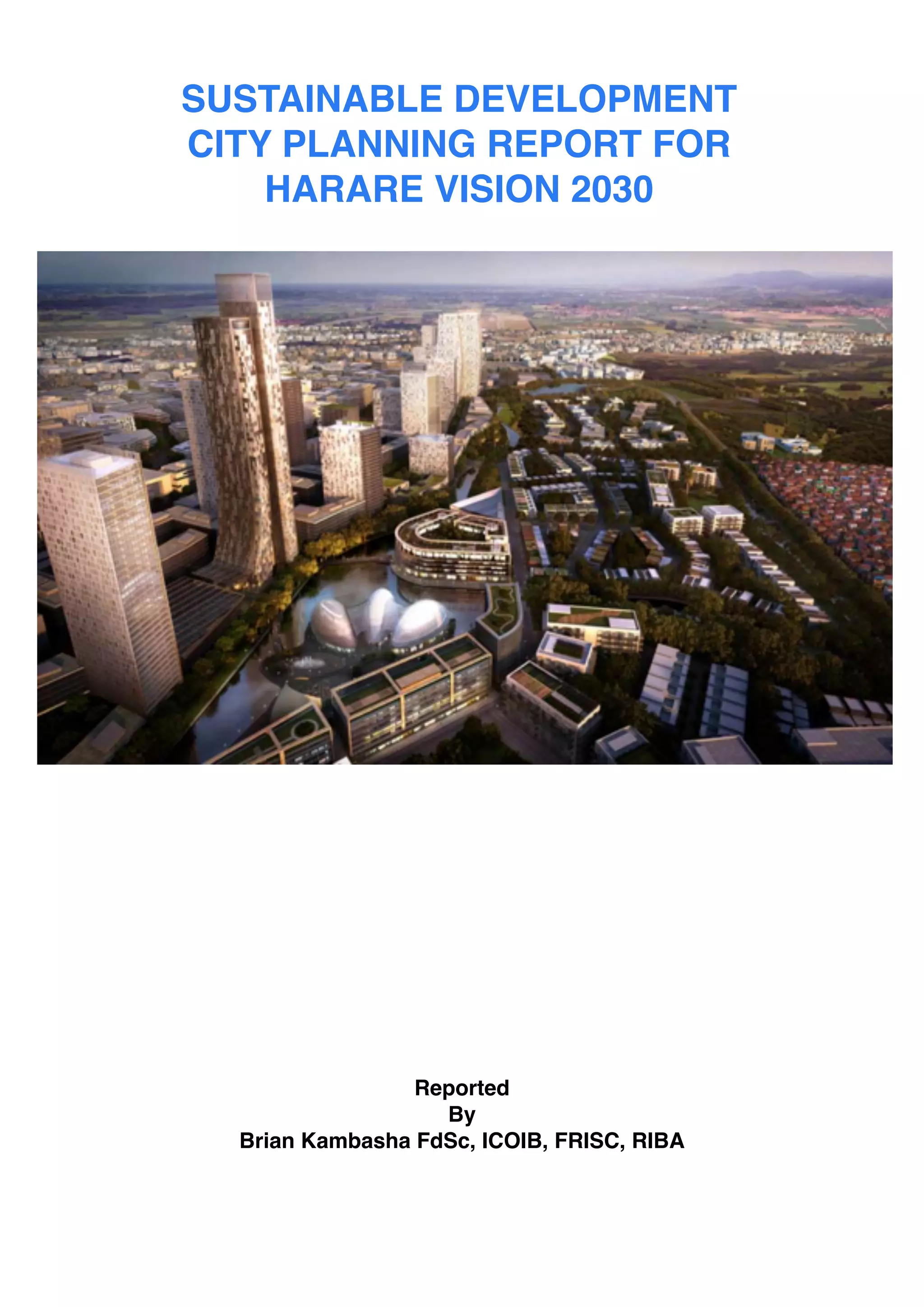
SUSTAINABLE DEVELOPMENT
CITY PLANNING REPORT FOR!
HARARE VISION 2030
!
Objective
!
To develop knowledge and skills among our citizens, planners, urban professionals in
the public and private sector, in order to integrate sustainable energy issues in spatial
planning and integrate a effective spatial perspective in local and regional energy and
sustainability strategies.
!
Introduction
!
Currently, we are witnesses of large scale high-speed urban changes. These new
conditions require changing the planning culture and international cooperation among
planners. Nowadays the integrated and multi-disciplinary urban planning is seen as
the most important tools to achieve a socially, economically and environmentally
sustainable, low-carbon society. Consequently planners have to shape organisational
processes, work out planning strategies and controls, and identify key implementation
actions. In this connection it is useful to turn to the international for best practice in
urban sustainability, in designing and implementing projects.
!
A greatest interest is the experience of urban planning in the countries which even in
spite of rapidly changing conditions and crises that affect the world on a global scale,
the planning system helps to create a sustainable urban development. These countries
include Zimbabwe, where planning has a strong tradition. Swedish policy to promote
best practice and new technology through conscious, goal-oriented, integrated urban
development has resulted in a number of interesting projects in terms of considering
them as responds to the challenges of modern urban development. These new
concepts and approach by Scandinavia planning system have been widely used across
the world in modern times. For example, the Sustainable Cities concept (now named
as SymbioCity concept) is currently being applied in a number of urban development
projects in China. The planning concept has also been the inspiration for other urban
development projects around the world, such as Buffalo City in South Africa, Toronto
Waterfront in Canada, and Pune in India. The Sustainable Cities concept has also
been used in Europe, for instance in Narbonne in France, Cork South Docklands in
Ireland, and London Olympic Village in the UK. The purpose of this article is to
reveal features and current trends of the Zimbabwean planning system and the results
of its operations in recent decades.
!
!
2. From model master plan to “municipal planning monopoly”
The Zimbabwean planning system has a long tradition of comprehensive planning
which formed a rich experience of various planning methods and techniques. Current
planning system was launched and developed in the period of 1960-1970s years,
when the era of planning was based on the master plan concept which has now ended.
Generally master plans were the planner’s illustrated vision of the future and often
consisted of static pictures. This was a reason why the municipalities had little use of
master plans in practice. Municipal planning guidelines became the new planning
instrument which in practice replaced the former master plan for cities and towns in
1970-1990s.
During the course of time planning system continues to change subject to new
requirements, new planning methods have started to be used. A system has been
developed today, there is a so–called municipal planning monopoly in Sweden; the
planning system is basically designed for the municipalities. All municipalities must
have a comprehensive plan that covers the entire municipality. This plan shall
indicate the main ways in which land and water areas are to be utilised and how
development should take place. The comprehensive plan is not binding on either
authorities or individuals.Also there is a detailed comprehensive plan that has the
same status as a comprehensive plan but only covers a part of a municipality. The
comprehensive plan must be considered by the municipal council at least once during
each term of office (5 years).
!
The control of land use and development within municipality takes place through the
detailed development plan, which is the implementation instrument of the
municipality. It is legally binding and gives, among other things, the municipality the
right to expropriate land for public use. The detailed development plan has to set an
implementation period of a minimum of 5 years and a maximum of 15 years. During
the implementation period, the rights, that the plan accords, are economically
protected. After the end of the implementation period the municipality can change the
plan so that unused rights expire, without compensation. However, investments that
have been made during the implementation period are protected.
The detailed development plan also has to show public places for streets, roads,
squares and parks. The municipality can also set requirements for the execution of the
buildings. In certain cases matters such as colour and materials are also stated.

Special area regulations are another planning instrument which is used within limited
areas to guarantee compliance with certain comprehensive plan goals. A property
regulation plan is used to facilitate implementation of the detailed development plan.
So there are basically two planning instruments which the municipalities use for the
planning tasks, namely the comprehensive plan and the detailed development plan.
!
!
3. Proposed Legal framework of planning
!
The Planning and Building Act and the Environmental Code form the legal basis of
urban planning in Zimbabwe. The past 10-15 years have meant great changes to the
values and preconditions of the Zimbabwean. The Planning and Building Act
regulates the planning process. Measures on the land or to buildings that demand
permission have to be tried in accordance with the rules contained in the Planning &
Building Act. This applies to all new development, most cases of reconstruction, the
change of use of land and buildings, demolition, etc. The municipalities are
responsible for examining the case and assessing whether the measures are in
accordance with different plans. Significant improvements to the Act should include:
planning permission within ten weeks, attention to climate and environment change,
better controls of construction, payment to be automated directly on a planning portal
website. The process of producing a new detailed development plan will now be
simpler and shorter since the construction plan requirement is to be dropped. The
provisions of the new Planning and Building Act are simpler and clearer, better
enabling easier and more uniform application of the law. The process of exhibiting
detailed development plans will be simplified and known as a “review”. It will be
compulsory to notify property owners when someone other than the property owner
applies for planning permission or provisional approval. The county administrative
boards will, at their own initiative, present overall documentation concerning central
government interests once per term of office. This will help the municipalities when
they review how up-to-date the comprehensive plans are. Under the new Act
municipalities are to take account of environmental and climate aspects in they’re
planning work. This means both reduced climate impact and adaptation to climate
change. In they’re planning, municipalities are to take account of the environmental
quality objectives, regional climate and energy strategies, county plans for transport
infrastructure and transport policy objectives.
The Environmental Management Act [Chapter20:27] constitutes an “umbrella” for
the Planning and Building Act as well as other special laws that have an impact on
the physical environment. The aim of the Environmental Management Act is to
promote sustainable development, quality of land, water, air or other aspects of the
environment.
!
So, Environmental Management Act contributes to the comprehensive plan specific
requirements regarding national interests and environmental quality standards. I am
going to explain its action in the planning process as an example of the City Plan of
Harare. Current municipal planning monopoly means that the City of Harare has the
exclusive right to draw up and adopt detailed development plans within its boundary.
However, the government may overrule a municipality’s decision if certain aspects
have not been considered in the planning process, for instance with regard to national
interests and environmental quality standards. According to the Environmental
Policy, national interests are interests of national importance that municipalities must
take into account in they’re planning. Therefore the City Plan deals with national
interests under each focus area and urban development strategy. The city also has to
show how the City Plan meets the environmental quality standards set by the
government regarding issues such as air quality.
!
!
!
4. A new city planning process: the City Plan for Harare
!
The municipalities of Harare should now preparing the comprehensive plans,
increasingly they evolving to become municipal development programs, a real
strategic navigation tool than a traditional land use plan. The new comprehensive
plan of Harare illustrates new approaches and current trends in Zimbabwe’s planning.
A major challenge for urban planning in Harare is to embrace the city’s metropolitan
dynamism while also meeting demand for a long-term plan.
!
4.1 Vision 2030
!
The City Plan will show how Harare will meet its Vision 2030 goals and provide
guidance regarding the city’s intentions and objectives for sustainable development.

The project named “Vision Harare 2030” will started in 2015. All of the city’s
departments, administrations and companies, along with several external partners
will part in formulating a long term, complete vision for Harare’s development and
sustainable growth.
The vision presents coherent themes for the city’s development, as well as a number
of essential characteristics that show what it will be like to live in, work in and visit
Harare in the year 2030. There are three themes that are the long-term target status of
the comprehensive plan, so Harare will be versatile and memorable; innovative and
growing. Third theme is “Citizens Harare”.
The vision aims to create an innovative city, more versatile and full of experience
through different development projects spread across the city. To make Harare a
world class region, several transformations of the city have already begun.


4.2 Four strategies for sustainable growth
!
Planning strategies presented in the comprehensive plan have four components which
together are about creating a denser and more interconnected Harare, investing in
attractive strategic nodes, connecting the different parts of the city and to promote an
attractive, vibrant and safe urban environment across the whole of the city.
!
Strategy 1 – Continue to strengthen central Harare
!
The planning for the development of the central parts of Harare continues with a
series of urban areas near the downtown. A dense and diverse city in these parts of the
region promotes city’s competitiveness, provides opportunities for sustainable travel
and connects areas that were previously separate
!
Strategy 2 – Focus on strategic nodes
!
The City Plan identifies a number of nodes outside the city centre which have more
or less tangible development potential. The comprehensive plan talks about certain
number of the identified priority areas. The centre of gravity means areas in the
suburbs that have good potential to develop into diverse and dense urban
environments with great mix of housing, parks, activities and services. All priority
areas have different starting points and should therefore be developed on their own
merits. The common denominator is that the important nodes in public transport and
has good access to services. Another key factor is the development of parks and green
spaces, particularly considering that less valuable green areas may have to be
sacrificed to urban renewal.
These areas are extensive urban development with a total of approximately 10,000
new homes and 30,000 jobs created which will be combined with other strategic
infrastructure. The comprehensive planning program will also considered for this
strategically important area.
!
!
!
!
!
!
!
!
!
Strategy 3 – Connect City areas
!
!
!
!
!
!
!
!
!
!
!
!
!
Many areas in Harare are poorly integrated with its surroundings as for an individual
has to go to the city travelling from Northern to Eastern by public transport. The
physical barriers make it difficult for the opportunity to meet and get to work,
education and activities. The combination of parts of the city means better
infrastructure, focusing on public transport, cycling and walking as well as new
comprehensive settlement. That means even more attractive parks and meeting places
between neighbourhoods. The City Plan sets out a number of transport corridors
between nodes that should be improved in the short and the longer term
!
!
!
!
Strategy 4 – Create a vibrant urban environment
!
A safe and vibrant urban environment requires the progressive development of urban
settlements across the city to meet local needs. Supplementation Buildings should be
possible in many places in Cities, while the city's beauty and variety of character
traits are preserved. An increasingly dense urban environment based on the existence
of good public spaces. One important element in local development work is deriving
benefit from the growth taking place in Harare’s more expansive areas. This is
possibly particularly justified in certain socially disadvantaged districts in the outer
city.
!
!
4.3 A rolling urban development process!
!
A major challenge for urban planning in Harare is to embrace the city’s metropolitan
dynamism while also meeting demand for a long-term game plan. This City Plan is
seen as the first experience towards more rolling, flexible comprehensive planning in
Harare. According to the current planning system will be better able to manage the
needs of a rapidly growing population, a changing business atmosphere and the
interaction between the various regional stakeholders, not least with regard to
infrastructure improvements.
The aim of this City Plan is to act as a long-term urban development program that
provides support for priorities in the shorter term. The City Plan contains a large
number of areas link with development potential. However, flexible implementation
is important, with planning able to adapt to new conditions and changes in the world
around us. The City Plan is a comprehensive steering document for the committees
and companies in the City of Harare which are responsible for different aspects of the
city’s development. It needs to be linked to the city’s management and follow-up
system where the annual budget and Vision 2030 take precedence. The forms in
which this can be achieved should be developed. The starting point should be that
ongoing follow-up of the City Plan will provide the City Council with a wide-ranging
remit for making decisions on annual priorities for urban development within the
city’s budget. The illustration shows how the City Plan should be coordinated with
the city’s system for integrated management, follow-up of operations and financing.
!
!
5. Conclusions
!
The Planning system has important previous, current achievements and long-term
perspectives for good environment. Analysis showed that the Zimbabwe planning
system is less effective on operations in a rapidly changing environment of today.
First, the legislation has to change to speed up the process of development and
simplify the administrative and planning procedures by introducing planning portal
website. Secondly, there is changing of the content of planning documents. On the
example of Harare new approaches for working out of the comprehensive plan are
identified in the article.
Against the background of the previously described development trends, the
following assessment of the Zimbabwean planning system in the aspect of an
adaptation of basic principles of this system for creating sustainable urban
development in Russia can be made:
1. The division of roles and responsibilities between local (municipal), regional and
national planning. Planning system should be characterised by close cooperation
between the governing bodies at different levels. Compared with Russia, there is a
"mirror" system of spatial planning in Sweden headed by the municipalities. They are
responsible for all types of urban planning, including the establishment of a
comprehensive plan. Also municipalities are the owners of all public facilities.
Residents are provided the current information on construction in their territory. In
order to improve the planning system in Russia, one of the most important goals
would be to design a transparent planning process that improves the ability to achieve
consensus.
2. Urban strategy based on the Sustainable Cities concept. That approach focuses
onhow urban governance, urban planning, education, public participation and other
coordinating
!
!
!
!
!
!
!
!
!
!
!
!
!
!
!

Sustainable development planning for Zimbabwe

  • 1.
    ! ! ! ! ! ! ! ! ! ! ! Reported ! By! Brian KambashaFdSc, ICOIB, FRISC, RIBA! ! ! ! SUSTAINABLE DEVELOPMENT CITY PLANNING REPORT FOR! HARARE VISION 2030
  • 2.
    ! Objective ! To develop knowledgeand skills among our citizens, planners, urban professionals in the public and private sector, in order to integrate sustainable energy issues in spatial planning and integrate a effective spatial perspective in local and regional energy and sustainability strategies. ! Introduction ! Currently, we are witnesses of large scale high-speed urban changes. These new conditions require changing the planning culture and international cooperation among planners. Nowadays the integrated and multi-disciplinary urban planning is seen as the most important tools to achieve a socially, economically and environmentally sustainable, low-carbon society. Consequently planners have to shape organisational processes, work out planning strategies and controls, and identify key implementation actions. In this connection it is useful to turn to the international for best practice in urban sustainability, in designing and implementing projects. ! A greatest interest is the experience of urban planning in the countries which even in spite of rapidly changing conditions and crises that affect the world on a global scale, the planning system helps to create a sustainable urban development. These countries include Zimbabwe, where planning has a strong tradition. Swedish policy to promote best practice and new technology through conscious, goal-oriented, integrated urban development has resulted in a number of interesting projects in terms of considering them as responds to the challenges of modern urban development. These new concepts and approach by Scandinavia planning system have been widely used across the world in modern times. For example, the Sustainable Cities concept (now named as SymbioCity concept) is currently being applied in a number of urban development projects in China. The planning concept has also been the inspiration for other urban development projects around the world, such as Buffalo City in South Africa, Toronto Waterfront in Canada, and Pune in India. The Sustainable Cities concept has also been used in Europe, for instance in Narbonne in France, Cork South Docklands in Ireland, and London Olympic Village in the UK. The purpose of this article is to reveal features and current trends of the Zimbabwean planning system and the results of its operations in recent decades. ! !
  • 3.
    2. From modelmaster plan to “municipal planning monopoly” The Zimbabwean planning system has a long tradition of comprehensive planning which formed a rich experience of various planning methods and techniques. Current planning system was launched and developed in the period of 1960-1970s years, when the era of planning was based on the master plan concept which has now ended. Generally master plans were the planner’s illustrated vision of the future and often consisted of static pictures. This was a reason why the municipalities had little use of master plans in practice. Municipal planning guidelines became the new planning instrument which in practice replaced the former master plan for cities and towns in 1970-1990s. During the course of time planning system continues to change subject to new requirements, new planning methods have started to be used. A system has been developed today, there is a so–called municipal planning monopoly in Sweden; the planning system is basically designed for the municipalities. All municipalities must have a comprehensive plan that covers the entire municipality. This plan shall indicate the main ways in which land and water areas are to be utilised and how development should take place. The comprehensive plan is not binding on either authorities or individuals.Also there is a detailed comprehensive plan that has the same status as a comprehensive plan but only covers a part of a municipality. The comprehensive plan must be considered by the municipal council at least once during each term of office (5 years). ! The control of land use and development within municipality takes place through the detailed development plan, which is the implementation instrument of the municipality. It is legally binding and gives, among other things, the municipality the right to expropriate land for public use. The detailed development plan has to set an implementation period of a minimum of 5 years and a maximum of 15 years. During the implementation period, the rights, that the plan accords, are economically protected. After the end of the implementation period the municipality can change the plan so that unused rights expire, without compensation. However, investments that have been made during the implementation period are protected. The detailed development plan also has to show public places for streets, roads, squares and parks. The municipality can also set requirements for the execution of the buildings. In certain cases matters such as colour and materials are also stated.
 Special area regulations are another planning instrument which is used within limited areas to guarantee compliance with certain comprehensive plan goals. A property regulation plan is used to facilitate implementation of the detailed development plan.
  • 4.
    So there arebasically two planning instruments which the municipalities use for the planning tasks, namely the comprehensive plan and the detailed development plan. ! ! 3. Proposed Legal framework of planning ! The Planning and Building Act and the Environmental Code form the legal basis of urban planning in Zimbabwe. The past 10-15 years have meant great changes to the values and preconditions of the Zimbabwean. The Planning and Building Act regulates the planning process. Measures on the land or to buildings that demand permission have to be tried in accordance with the rules contained in the Planning & Building Act. This applies to all new development, most cases of reconstruction, the change of use of land and buildings, demolition, etc. The municipalities are responsible for examining the case and assessing whether the measures are in accordance with different plans. Significant improvements to the Act should include: planning permission within ten weeks, attention to climate and environment change, better controls of construction, payment to be automated directly on a planning portal website. The process of producing a new detailed development plan will now be
  • 5.
    simpler and shortersince the construction plan requirement is to be dropped. The provisions of the new Planning and Building Act are simpler and clearer, better enabling easier and more uniform application of the law. The process of exhibiting detailed development plans will be simplified and known as a “review”. It will be compulsory to notify property owners when someone other than the property owner applies for planning permission or provisional approval. The county administrative boards will, at their own initiative, present overall documentation concerning central government interests once per term of office. This will help the municipalities when they review how up-to-date the comprehensive plans are. Under the new Act municipalities are to take account of environmental and climate aspects in they’re planning work. This means both reduced climate impact and adaptation to climate change. In they’re planning, municipalities are to take account of the environmental quality objectives, regional climate and energy strategies, county plans for transport infrastructure and transport policy objectives. The Environmental Management Act [Chapter20:27] constitutes an “umbrella” for the Planning and Building Act as well as other special laws that have an impact on the physical environment. The aim of the Environmental Management Act is to promote sustainable development, quality of land, water, air or other aspects of the environment. ! So, Environmental Management Act contributes to the comprehensive plan specific requirements regarding national interests and environmental quality standards. I am going to explain its action in the planning process as an example of the City Plan of Harare. Current municipal planning monopoly means that the City of Harare has the exclusive right to draw up and adopt detailed development plans within its boundary. However, the government may overrule a municipality’s decision if certain aspects have not been considered in the planning process, for instance with regard to national interests and environmental quality standards. According to the Environmental Policy, national interests are interests of national importance that municipalities must take into account in they’re planning. Therefore the City Plan deals with national interests under each focus area and urban development strategy. The city also has to show how the City Plan meets the environmental quality standards set by the government regarding issues such as air quality. ! ! !
  • 6.
    4. A newcity planning process: the City Plan for Harare ! The municipalities of Harare should now preparing the comprehensive plans, increasingly they evolving to become municipal development programs, a real strategic navigation tool than a traditional land use plan. The new comprehensive plan of Harare illustrates new approaches and current trends in Zimbabwe’s planning. A major challenge for urban planning in Harare is to embrace the city’s metropolitan dynamism while also meeting demand for a long-term plan. ! 4.1 Vision 2030 ! The City Plan will show how Harare will meet its Vision 2030 goals and provide guidance regarding the city’s intentions and objectives for sustainable development.
 The project named “Vision Harare 2030” will started in 2015. All of the city’s departments, administrations and companies, along with several external partners will part in formulating a long term, complete vision for Harare’s development and sustainable growth. The vision presents coherent themes for the city’s development, as well as a number of essential characteristics that show what it will be like to live in, work in and visit Harare in the year 2030. There are three themes that are the long-term target status of
  • 7.
    the comprehensive plan,so Harare will be versatile and memorable; innovative and growing. Third theme is “Citizens Harare”. The vision aims to create an innovative city, more versatile and full of experience through different development projects spread across the city. To make Harare a world class region, several transformations of the city have already begun. 
 4.2 Four strategies for sustainable growth ! Planning strategies presented in the comprehensive plan have four components which together are about creating a denser and more interconnected Harare, investing in attractive strategic nodes, connecting the different parts of the city and to promote an attractive, vibrant and safe urban environment across the whole of the city. ! Strategy 1 – Continue to strengthen central Harare ! The planning for the development of the central parts of Harare continues with a series of urban areas near the downtown. A dense and diverse city in these parts of the region promotes city’s competitiveness, provides opportunities for sustainable travel and connects areas that were previously separate !
  • 8.
    Strategy 2 –Focus on strategic nodes ! The City Plan identifies a number of nodes outside the city centre which have more or less tangible development potential. The comprehensive plan talks about certain number of the identified priority areas. The centre of gravity means areas in the suburbs that have good potential to develop into diverse and dense urban environments with great mix of housing, parks, activities and services. All priority areas have different starting points and should therefore be developed on their own merits. The common denominator is that the important nodes in public transport and has good access to services. Another key factor is the development of parks and green spaces, particularly considering that less valuable green areas may have to be sacrificed to urban renewal. These areas are extensive urban development with a total of approximately 10,000 new homes and 30,000 jobs created which will be combined with other strategic infrastructure. The comprehensive planning program will also considered for this strategically important area. ! ! ! ! ! ! ! ! !
  • 9.
    Strategy 3 –Connect City areas ! ! ! ! ! ! ! ! ! ! ! ! ! Many areas in Harare are poorly integrated with its surroundings as for an individual has to go to the city travelling from Northern to Eastern by public transport. The physical barriers make it difficult for the opportunity to meet and get to work, education and activities. The combination of parts of the city means better infrastructure, focusing on public transport, cycling and walking as well as new comprehensive settlement. That means even more attractive parks and meeting places between neighbourhoods. The City Plan sets out a number of transport corridors between nodes that should be improved in the short and the longer term ! ! ! ! Strategy 4 – Create a vibrant urban environment ! A safe and vibrant urban environment requires the progressive development of urban settlements across the city to meet local needs. Supplementation Buildings should be possible in many places in Cities, while the city's beauty and variety of character traits are preserved. An increasingly dense urban environment based on the existence of good public spaces. One important element in local development work is deriving benefit from the growth taking place in Harare’s more expansive areas. This is possibly particularly justified in certain socially disadvantaged districts in the outer city. ! !
  • 10.
    4.3 A rollingurban development process! ! A major challenge for urban planning in Harare is to embrace the city’s metropolitan dynamism while also meeting demand for a long-term game plan. This City Plan is seen as the first experience towards more rolling, flexible comprehensive planning in Harare. According to the current planning system will be better able to manage the needs of a rapidly growing population, a changing business atmosphere and the interaction between the various regional stakeholders, not least with regard to infrastructure improvements. The aim of this City Plan is to act as a long-term urban development program that provides support for priorities in the shorter term. The City Plan contains a large number of areas link with development potential. However, flexible implementation is important, with planning able to adapt to new conditions and changes in the world around us. The City Plan is a comprehensive steering document for the committees and companies in the City of Harare which are responsible for different aspects of the city’s development. It needs to be linked to the city’s management and follow-up system where the annual budget and Vision 2030 take precedence. The forms in which this can be achieved should be developed. The starting point should be that ongoing follow-up of the City Plan will provide the City Council with a wide-ranging remit for making decisions on annual priorities for urban development within the city’s budget. The illustration shows how the City Plan should be coordinated with the city’s system for integrated management, follow-up of operations and financing. ! ! 5. Conclusions ! The Planning system has important previous, current achievements and long-term perspectives for good environment. Analysis showed that the Zimbabwe planning system is less effective on operations in a rapidly changing environment of today. First, the legislation has to change to speed up the process of development and simplify the administrative and planning procedures by introducing planning portal website. Secondly, there is changing of the content of planning documents. On the example of Harare new approaches for working out of the comprehensive plan are identified in the article. Against the background of the previously described development trends, the following assessment of the Zimbabwean planning system in the aspect of an adaptation of basic principles of this system for creating sustainable urban development in Russia can be made:
  • 11.
    1. The divisionof roles and responsibilities between local (municipal), regional and national planning. Planning system should be characterised by close cooperation between the governing bodies at different levels. Compared with Russia, there is a "mirror" system of spatial planning in Sweden headed by the municipalities. They are responsible for all types of urban planning, including the establishment of a comprehensive plan. Also municipalities are the owners of all public facilities. Residents are provided the current information on construction in their territory. In order to improve the planning system in Russia, one of the most important goals would be to design a transparent planning process that improves the ability to achieve consensus. 2. Urban strategy based on the Sustainable Cities concept. That approach focuses onhow urban governance, urban planning, education, public participation and other coordinating ! ! ! ! ! ! ! ! ! ! ! ! ! ! !