To Gabriel Griffa and Mateo
Goretti, for their confidence.
To Carlos Lamarca and Fernando
van Peborgh, for their friendship.
SUSTAINABILITY 2.0
   Networking Enterprises and
Citizens to Face World Challenges
Visit our blog at: www.elviajedeodiseo.com/blog

This book is not the work of a single author, but the result of the
exhaustive and enthusiastic research, writing and editing carried out
by the entire Odiseo Team.

The Odiseo Team:
María Noel Álvarez
María Eugenia Baliño
Santiago Craig
Andresa Guareschi
Lívia Magalhães
Alejandra Procupet
Gabriela Ramos

Contributors:
Teresa Buscaglia
Luciana Malamud

Photographs:
Mária Antolini
Page 26: The Children At Risk Foundation/ CARF: www.carfweb.net
Page 30 and 133: Mark Achbar/ Big Picture Media Corporation
Page 111: Álvaro Ibáñez/ Microsiervos
Page 193: Mariana Vázquez                                               Drafting and editing of the original Spanish-language text of
                                                                        Sustainability 2.0 was completed in August 2007. This book is the
Cover Design:                                                           result of exhaustive research, but as in the case of all research, it can
Clara Lagos                                                             always be improved on and expanded.
                                                                        It is our aim, then, for this work to circulate among citizens, business
Interior Design:                                                        people, academics, organizations, universities and activists, so that it can
Mateos-Davenport design
                                                                        expand and grow through the collaboration of its readers.
English-Language Translator/Editor:                                     Because Sustainability 2.0 can only exist where there is interaction with
Dan Newland: dan.newland@gmail.com                                      others. You can participate, adding your knowledge to the Wiki version
                                                                        of this book, by visiting www.sostenibilidaddospuntocero.com/wiki/
©2008, Ernesto van Peborgh, Buenos Aires, Argentina                     ISBN XXXXXXXXXX
A Personal Journey
into the Future


                         I feel like a privileged observer of the times. I think I’ve reached
                         this privileged vantage point thanks in large measure to some
                         decisions I made in recent years, which ended up letting me
                         see the world from a different perspective.

                         The year 2004 was a very special year for me. In fact, it was
                         probably the most important one of my life. By then, I had
                         invested 20 years in the finance business. My success rate
                         was clear: I was so regularly churning out a 35% return on
                         institutional investors’ money that this ratio was pretty much
                         the mantra of my professional identity. I started my career
                         in finance at Citibank. I left that job to step up to the post of
                         Financial Director on the founding team of the Exxel Group.
                         When I Ieft Exxel, it was to form a partnership and create
                         my own investment firm called Argentine Venture Partners
                         (AVP). Up to then, the full thrust of my work and commitment
                         was only focused on one thing: creating economic value, with
                         no real thought of the far-reaching social and environmental
                         impact of what I did.
                         But as I say, in 2004, guided only by what might be called my
                         intuition, I decided to leave the world of high finance behind
                         and change course. So much so that it was as if I were driving


                     7
down the highway, turned on my blinker, pulled over into the               Glacier National Park to hoist the country’s flag, in honor
right lane, and got off at the next exit. I was a 44-year-old father       of Francisco P. Moreno, the famed Argentine explorer and
of three, with vast experience in private equity, a talent that            scientific expert, who had done the same thing 124 years before.
had flung open the doors of Harvard’s classrooms and of Wall                Like Rocca, Sopeña and Fonrouge on their Patagonian journeys
Street’s posh offices to me. My career steeped me in financial               before me, the whole adventure of making the same climb and
success. But I couldn’t help feeling a need to take a different            filming the documentary broadened my horizons. I felt that
path, to get involved in something that could bring another                the torch that those extraordinary men of such sound values
kind of value to my personal life and to society.                          had held so high was now in my hands, and it was my job to
                                                                           keep its flame from waning.
First Wave: The Value Revolution                                           When the film premiered at the Museum of Latin American Art
The first adventure on that heady new road —which, looking                  in Buenos Aires (MALBA), several business people expressed
back, bears little comparison to my past life— was the decision            a desire to promote a dialog among parents and children on
to make a film. I wanted to tell the story of Agostino Rocca,               issues emerging from Spirals. That made me stop and think:
José Luis Fonrouge and Germán Sopeña, a businessman, a                     If telling the story of these three men can spark a debate on
mountaineer and a journalist, whose common denominator                     human values, what would happen if we started telling the
was their fascination with Patagonia, that legendary and                   stories of other people who are changing the world?
largely unexplored territory that was soon to become my own                By then, I had already heard about some social entrepreneurs
passion as well.                                                           and the initiatives they were heading up. I knew about
Spirals of Stone was the result, a film documentary about                   the work of people like Swiss philanthropist and former
an expedition undertaken by a group of family members                      industrialist Stephan Schmidheiny, founder of the WBCSD
and friends in homage to those three men. The trio died in                 (World Business Council for Sustainable Development) and
a plane crash in 2001, when they were flying to Argentina’s                 the AVINA Foundation, who, through such enterprises, was


                                                                       8
providing support to social leaders and their organizations,         children are learning Baroque music and are making their
who were working to improve life in their communities.               own instruments, thanks to the work of Rubén Darío Suárez
It was then that I made the firm commitment to get to know            Arana. And I was also able to discover admirable people like
and understand those who were spearheading humanity’s                Rodrigo Baggio, a young man from Rio de Janeiro who, in
value revolution. But most of all, I wanted to know what             1995, founded CDI (Committee for the Democratization of
made them tick, what it was that inspired them to attempt            Information Sciences), a group that has been responsible for
to stimulate this change.                                            setting up 376 computing schools in Brazil, Colombia, Chile,
Motivated by the achievements of these people and by the             Mexico, Uruguay and Japan, and that in Brazil alone has helped
work in this same field carried out by Bill Drayton, creator          600,000 young people breach the “digital gap”.
of the Ashoka organization and the figure that I took as              I also met Bartolomé Silva, a Chilean social entrepreneur
my second reference point among social entrepreneurs, I              who uses his World Circus (Circo del Mundo) as a platform for
directed my second documentary: Faros, señales de cambio en          giving youngsters at risk a new chance. And Inés Sanguinetti,
América Latina (Beacons, Signs of Change in Latin America).          who invites youngsters with no material resources to learn
My aim was to spread the word regarding the work of many             to dance and express themselves, motivating them with the
individuals who are making a tireless effort in the struggle         echoes of applause.
against poverty and inequality.                                      Directing Beacons, which premiered at the close of the IDEA
Faros gave me a chance to tour Argentina’s most marginal             business colloquium in 2005, also allowed me to understand that
neighborhoods and to get to know Fabián Ferraro, founder             while what prevailed in business was competition, selfishness
of a civil association called Defensores del Chaco, which uses       and lack of motivation, on the “other side of the tracks”, in
sandlot soccer as a method of social inclusion for some 1500         the world of the so-called “excluded” members of society,
children and adolescents at risk. The making of this film also        there was beauty, motivation, cooperation and recognition of
took me to a jungle town in the Bolivian Amazon, where               achievements, especially those reached collectively.


                                                                 9
This led me to ask myself, then, which world I wanted to                   hoped for, I didn’t give up, because several major personalities
leave to my children, and to what extent it made sense to                  from the corporate world did indeed decide to accompany me
keep generating economic value without taking care of other,               and acted as consultants, providing me with invaluable guidance
indispensable aspects of preserving life. Was it possible to               in my search. I refer, among others, to Manuel Arango Arias,
change the world by transforming the values that motivated                 businessman and environmentalist, who is chairman and
Mankind’s actions? My recent experiences have taught me that               founder of the Mexican Foundation for Environmental Education
it is, that there are many people out there who are working for            and of the Xochitla Foundation; Reese Schonfeld, co-founder and
a new and better future. And little by little I began to want to           first president of the CNN news chain; Julio Saguier, chairman of
join in this collective effort that is taking shape.                       the media holding company, La Nación S.A. and of the Diario La
                                                                           Nación Foundation; businessman Ricardo Esteves, co-chairman
Second Wave: Sustainable Development                                       of the Iberoamérica Forum; and researcher, former Harvard
Anxious to tell the stories of social entrepreneurs to an ever-            professor and author of the bestseller, Underdevelopment Is a State
increasing number of people, I called on media owners to                   of Mind, Larry Harrison.
publish and broadcast the work of this silent movement that                At the same time, another unstoppable wave began to carry
was growing at two or three times the rate that the private                me on its crest like a surfer: awareness about sustainable
sector was — in what today we are calling the “the worldwide               development. Taking this second exit from my old highway, I
associative revolution”.                                                   got to know companies like Natura Cosméticos and Patagonia,
This obliged me to quickly change my perspective. I suddenly went          which were born with sustainability already in their DNA and
from the favela shantytowns of Brazil to the luxurious personal            were measuring their bottom line in economic, social and
museum of Carlos Slim, owner of Telmex and Televisa in Mexico              environmental terms. I had the opportunity to talk to Luiz
City and to the comfortable offices of Ricardo Salinas Pliego, owner        Seabra and Guilherme Leal, Natura’s founders, and thus find,
of TV Azteca. Although I wasn’t met with the enthusiasm I had              finally, the kind of people I had been looking for in the private


                                                                      10
sector. And as my knowledge of sustainable business practices             This conclusion arose, once again, from my own field of action:
began to grow, I stopped feeling like Don Quixote jousting                My collaborators and I had spent considerable time trying to
with windmills and started coming to grips with the idea that             figure out where and how to place Spirals of Stone and Beacons,
humanity was at the threshold of a change of cultural paradigm            as well as other content that we had created on the Internet. This
that would make history.                                                  research led us to discover YouTube when it was just getting
                                                                          started. And so it was that after a two-year search for a channel
Third Wave: Web 2.0                                                       through which to inform and commit individuals, organizations
The tipping point came for me in 2006. That was the year when             and businesses with regard to sustainable development,
something unusual that I had already begun to observe began               I concluded that the natural platform for this was the Web.
to have an increasing impact on companies, people, citizens               My initial enthusiasm with the Web 2.0 application was followed
and governments. It was only then that I came to the certainty            by a period of exhaustive research on and experimentation
that this future for which I was willing to work was a lot closer         with the tools it offered. Despite my admiration for the
than I had supposed. Perhaps it had even already arrived.                 fabulous disruptions it was causing, I had to admit that Web
At the beginning of that year, Grupo Gerdau and Jorge Paulo               2.0 wasn’t a revolution in itself, but a mere platform for a series
Lemann invited me to speak at a forum of 200 business people              of revolutions in thinking. Web 2.0 is still in an early stage
on education via correspondence. “Participation” was the key              and many of its applications remain confusing for the “digital
word that I pronounced that day during my presentation in                 immigrants” of my generation. Nevertheless, in another
Salvador, Bahia, Brazil, in referring to the relentless advance of        decade, the Net Gen —the generation of young people born
the new communications media and particularly of the Internet,            into the digital age— will have taken the reins in the world’s
which, in its role as a participative, collaborative and creative         enterprises and this wave will have enveloped us all.
application for communities, has revealed itself as the most              Once again, I opted not to just sit by and watch these changes
effective catalyst in the transformation of the cultural paradigm.        happen. I wouldn’t want to wake up tomorrow and see that


                                                                     11
everything has changed and that I’ve missed out on being part              line. If one member of a team drops out, the entire team is
of the transition.                                                         disqualified. The key is to put the interests of the group as a
                                                                           whole over and above those of the individual contestants, and
Prolog Epilog                                                              that sometimes means having to sacrifice food or water to revive
“The only way to cross the desert is to keep walking.” This                someone who has suffered dehydration, or having to cut back the
adage may sound a little trite, but I learned its meaning in the           pace in order to let a team member recover. And it is as moving
most extreme of practices. In another of my “past lives”, I took           to receive the solidarity of the rest of the team as it is to give it.
part in dozens of grueling races and marathons.                            The possibility of experiencing extreme perspectives —desert
I participated in my first Eco-Challenge in 2001. In eight days,            and mountain, individual and group interests, corporate
we raced across 350 km of pristine and desolate lands in New               empires and massive shantytowns— has permitted me to
Zealand. We climbed mountains and navigated raging rivers.                 incorporate what I have learned in these years and identify
When you walk 22 hours a day non-stop except to grab a few                 some values of my own from the new paradigm: confidence,
hours of sleep, you get in touch with the most intimate essence of         responsibility, collaboration and transparency.
human nature. You don’t feel the cold or the physical fatigue, only        The trust that social entrepreneurs and their organizations
the overwhelming need to eat, like some powerful animal reflex.             place in their projects and in the community as architects of
In 2004, my passion for challenges took me to the Atacama                  a change in values. The responsibility of many consumers
Desert. In six days, we ran seven marathons in the most                    and citizens, who are ever more committed to their times
extreme environment on earth. Withstanding temperatures                    and to the planet. The collaboration applied by the Net Gen
of 40°C by day and –6°C by night, we crossed that salt desert              in the Web when they collectively create new realities. The
through places where no human being had ever tread before.                 transparency revolution implemented by certain companies
These tests seek to underscore the virtues of teamwork. That’s             that have pioneered in sustainability, even before society
why the prime rule is that everybody has to make it to the finish           started to demand it.


                                                                      12
This is, in a nutshell, the story of the personal journey I began                                                                     i
                                                                         tain my perspective, on one side I see the business world with
in 2004, the year that I learned to know the desert, the year my         its economic power that draws strength from bottom-line
father died, and the year I began to have a new outlook on life.         results and growth. And on the other, I see a silent move-
That year too, I had another son, an event that moved me to              ment, but one that is growing at a dizzying rate, a movement
reassess the world I was building for him, and for my other              that, incredibly enough, has remained beyond the radar of
three children, and their children. In response, I found an un-          the media, governments and businesses alike. Its leaders are
precedented motivation spreading the word about sustainable              entrepreneurs that are concerned about life and about us, the
development. In the Net Gen, there is hope. And in Web 2.0,              members of the human species, the inhabitants of this single,
there is a space from which to start building enterprises, social        global village. These are people who, with responsibility and
organizations and citizens’ groups, based on this motivation             confidence as their powerful motivations, are attempting to
and on this hope.                                                        change the world and build a better future. In both of these
Over time, my vision began to capture the interest of journal-           sectors, among companies and social entrepreneurs, there
ists and communicators, who, motivated by their own personal             are young members of the Net Gen, with the multiple tools
journeys, expressed their almost natural empathy. And despite            of Web 2.0, the natural platform from which to transmit the
their having been brought up in related but still diverse disci-         sustainability paradigm.
plines —like psychology, history, philosophy and advertising—            We are living in the best and in the worst of times.
they came together to form the inter-disciplinary team that is           The road to a better future promises to be a long and winding
now known as Odiseo, a group that has promoted research to               one. But it also promises to be full of surprising discoveries,
affirm my hypotheses and of which this book is a mere sketch.             some of which we will try to share with you in the chapters you
As a result of the road undertaken, I feel today, as I stated            are about to read.
at the beginning of this prolog, like a privileged observer of
these times. Standing atop the peak that permits me to main-             Ernesto van Peborgh


                                                                    13
ACTIVISM AL_GORE    AMAZON    AN_INCONVENIENT_TRUTH    ANITA_RODDICK    AUTHENTICITY    BILL_DRAYTON
BIODIVERSITY   CITIZENS CIVIL_SOCIETY   CONSUMER CONSUMPTION DIVERSITY ECO-EFFICIENCY       ECOLOGY
EDUCATION      ENTERPRISE ETHICS ETHOS EXCLUSION FORESTATION GLOBAL_WARMING GRAMEEN_PHONE
GREENWASHING HUMAN_RIGHTS INCLUSION INTERFACE JOHN_ELKINGTON KNOWLEDGE LONG_TERM NETWORKS
NGO LUIZ_SEABRA MARKETS NATURA NEW_PARADIGM NIKE NO_LOGO ODED_GRAJEW PARTICIPATION PATAGONIA
PAUL_HAWKEN POVERTY RAY_ANDERSON RECYCLE RESOURCES RESPONSIBILITY RESPONSIBLE_CONSUMPTION
REUSE   SOCIETY    STAKEHOLDERS   STARBUCKS   STEPHAN_SCHMIDHEINY      SUSTAINABILITY   SUSTAINABLE_
DEVELOPMENT TOYOTA TRANSPARENCY TRIPLE_BOTTOM_LINE VALUES VIRTUAL          WAL-MART WATER WOMEN
YVON_CHOUINARD ACTIVISM AL_GORE AMAZON AN_INCONVENIENT_TRUTH ANITA_RODDICK AUTHENTICITY
BILL_DRAYTON BIODIVERSITY CITIZENS CIVIL_SOCIETY CONSUMER CONSUMPTION DIVERSITY ECO-EFFICIENCY
ECOLOGY EDUCATION ENTERPRISE ETHICS ETHOS EXCLUSION FORESTATION GLOBAL_WARMING GRAMEEN_PHONE
GREENWASHING HUMAN_RIGHTS INCLUSION INTERFACE JOHN_ELKINGTON KNOWLEDGE LONG_TERM NETWORKS
NGO LUIZ_SEABRA MARKETS NATURA NEW_PARADIGM NIKE NO_LOGO ODED_GRAJEW PARTICIPATION PATAGONIA
PAUL_HAWKEN POVERTY RAY_ANDERSON RECYCLE RESOURCES RESPONSIBILITY RESPONSIBLE_CONSUMPTION
REUSE SOCIETY STAKEHOLDERS STARBUCKS STEPHAN_SCHMIDHEINY SUSTAINABILITY SUSTAINABLE_DEVELOPMENT
TOYOTA TRANSPARENCY TRIPLE_BOTTOM_LINE VALUES VIRTUAL WAL-MART WATER WOMEN YVON_CHOUINARD
ACTIVISM AL_GORE    AMAZON    AN_INCONVENIENT_TRUTH    ANITA_RODDICK    AUTHENTICITY    BILL_DRAYTON
BIODIVERSITY   CITIZENS CIVIL_SOCIETY   CONSUMER CONSUMPTION DIVERSITY ECO-EFFICIENCY       ECOLOGY
EDUCATION      ENTERPRISE ETHICS ETHOS EXCLUSION FORESTATION GLOBAL_WARMING GRAMEEN_PHONE
GREENWASHING HUMAN_RIGHTS INCLUSION INTERFACE JOHN_ELKINGTON KNOWLEDGE LONG_TERM NET-
WORKS NGO LUIZ_SEABRA MARKETS NATURA NEW_PARADIGM NIKE NO_LOGO ODED_GRAJEW PARTICIPATION
PATAGONIA PAUL_HAWKEN POVERTY RAY_ANDERSON RECYCLE RESOURCES RESPONSIBILITY RESPONSIBLE_
Sustainable Development
A New Paradigm                                                                                                Chapter 1


At the end of 2006, the world premiere of An Inconvenient           Meanwhile the number of civil action organizations was
Truth established the issue of worldwide climate change as a        growing — and continues to grow at an ever-faster rate — due
reality —and not just as the obsession or paranoia of a few         to the ineffectiveness of government in the face of issues that
scientists and activists— by showcasing the fight waged by           call for urgent solutions: poverty, environmental protection,
former US Vice President and Nobel Peace Prize-winner Al            defense of human rights and the preservation of democracy.
Gore against global warming.
                                                                    It appears that the tipping point —the moment at which
That same year, Wal-Mart announced its commitment to                something unique and unusual changes the habitual, according
sustainability. It began a plan by which, within a three-           the definition by Malcolm Gladwell — is growing nearer all
year period, some of its lines would only offer products            the time. And that Mankind is converging on a new paradigm.
manufactured employing sustainable practices. Today, 60,000         A veritable “ethos” or starting point. And with it will come the
companies are modifying their production processes in order         sustainable development that urges us not to try to live beyond
to satisfy this chain-store giant that welcomes 100 million         our means, not to burn down our houses in order to keep warm,
shoppers a week.                                                    not to saw off the branch that we’re sitting on. The proposal of
A survey run by The Synergos Institute in several countries         this concept is, actually, pure common sense: the common sense
showed that 95% of all consumers believe that companies have        that impels us to turn off the lights when we leave home and to
an unpaid debt with their workers and their communities.            not leave the tap running while we brush our teeth.


                                                               17
Viability or Sustainability?


The terms “viability” and “sustainability” came to the fore in the        began to be defined more fully and as we conceive of it today.
popular vernacular along with the new electronic information
media that became the driving force behind widespread                     Until the beginning of the 1990s, the notion of “sustainability”
awareness of growing worldwide problems including                         had basically been applied to the environmental field. But over
overpopulation, lack of water, famine and environmental                   the course of that decade, its use began to extend to social,
degradation. In the academic world, however, these terms had              political and business issues. Little by little, such questions as
already been introduced in the book called The Limits of Growth           inequality in the distribution of wealth and diversity in terms
(Meadows and others, 1972), published by The Club of Rome.                of ethnicity, gender, nutrition, health, access to information
                                                                          and security began to be incorporated into the debate.
There is no clear consensus regarding the meaning of “viability”          Governments, business groups and a growing number of civil
or “sustainability”. Nevertheless, one of the first definitions             organizations became the driving forces behind a series of
of sustainable development was provided by the Brundtland                 global conferences whose aim was to create a framework of
Report put out by the United Nations World Commission for                 governance, through which to come to grips with a new form
Environment and Development, which was originally called                  of development that would bear in mind the environmental,
Our Common Future (1987). Chapter 1 of that Report gives                  economic, social and institutional needs of both present and
the following definition: “Sustainable development seeks to meet           future generations.
the needs and aspirations of the present without compromising the
ability to meet those of the future”.                                     The latest UN Earth Summit on Sustainable Development
                                                                          was held in Johannesburg, South Africa in 2002, where
But it was not until the Rio Earth Summit (Rio de Janeiro,                discussions surrounded strategies for promoting the principles
1992) that Mankind adopted a global perspective with regard to            of sustainability and ensuring their adoption by nations
global issues and that the concept of “sustainable development”           worldwide and in every region of the planet.


                                                                     18
Conditions for Environmental Sustainability


1 No renewable resource should be 2 No non-renewablearesource
  used at a faster rate than it can should be used at faster rate
                                                                        3 Noapollutant shouldthatproduced
                                                                          at rate faster than
                                                                                              be
                                                                                                  at which
  be generated.                       than that necessary to replace       it can be recycled, neutralized or
                                      it with a sustainably renewable      absorbed by the environment.
                                      resource.


                                                     19
The Three Waves of Sustainability
According to John Elkington


                         It was within the framework of the Cold War,                                         1961
                         the hippie movement and the May Revolt in
THE FIRST WAVE:          France that the first ecological organizations,                         Amnesty International, the World
                         such as Greenpeace, emerged. It was also                               Wildlife Fund (WWF) and the
The Green Revolution     during this period that the first environ-                              Organization for Economic
                         mentally aware companies –Patagonia and                                Cooperation and Development
                         Natura– came onto the market.                                          (OECD) are founded.


                                                                                1983                      1984              1986
                         The Berlin Wall comes down and democratic
THE SECOND WAVE:         systems take a foothold in Latin America.         The UN creates the           Bhopal          Chernobyl
                         The Exxon Valdez oil tanker spill makes
Market Economy           people start taking the ecological movement
                                                                           World Environment            Disaster        Disaster
                                                                                                                        (USSR).
                                                                           and Development              (India).
Comes to the Forefront   seriously. Marketing begins to adopt “green”      Commission.
                         messages on a massive scale.


                         Globalization bursts onto the scene, and anti-                  1999                      2000
THE THIRD WAVE:          globalization with it. The Internet grows at a
                         swift pace, bringing the birth of participative
Toward Responsible       media, and ad agencies begin to study on-line              Battle in Seattle      First World Social Forum
                                                                                    (USA).                 (Porto Alegre, Brazil).
Globalization            advertising. Companies like Shell and Nike                                        Publication of No Logo, by
                         face complaints regarding their production                                        Naomi Klein (who denounced
                         processes and must account for their actions                                      Nike’s use of slave labor).
                         before society.


                                                           20
1962                         1971                              1972                                   1973                              1975

Publication of Rachel        Greenpeace is born.      Publication of The Limits of Growth           Seveso Disaster (Italy).           The UN declares
Carson’s Silent Spring.                               by The Club of Rome.                          Watergate Case (USA).              International
                                                      The Stockholm Conference (first                                                   Women’s Day.
                                                      UN Environmental Summit).


      1987                     1988                  1989                          1992                        1995                          1997

The Montreal Protocol     John Elkington       Exxon Valdez Case         First Worldwide UN Earth       Shell Scandal (petroleum       The Kyoto Protocol
is signed.                launches his         (following the Alaska     Summit (Rio de Janeiro,        spills in Nigeria).            is signed.
The Brundtland Report     Green Consumer       oil spill).               Brazil).                       The Ethos Institute (Brazil)   NIKE Scandal.
is published.             Guide.               Fall of the Berlin Wall   The World Business Council     is created.                    The “Triple Bottom
                                               (unification of            for Sustainable Development                                   Line” concept is
                                               Germany).                 (WBCSD) is founded.                                           published.


      2002                     2003                  2004                          2005                         2006                         2007

World Sustainable         Third World Social   Tsunami (Indian           Hurricane Katrina (in the       Muhummad Yunus                Al Gore receives the
Development Summit        Forum (Porto         Ocean).                   states of Florida, Louisiana    receives the Nobel            Nobel Peace Prize
(Johannesburg, South      Alegre, Brazil).                               and Mississippi and in the      Peace Prize for the           for his contribution
Africa).                                                                 Bahamas).                       founding of the               to halting global
                                                                                                         Grameen Bank.                 warming.


                                                                            21
“Sustainable development is a dynamic process which
                                                                                         enables all people to realize their potential and to
                                                                                         improve their quality of life in ways which
                                                                                         simultaneously protect and enhance the Earth’s
In Search of the                                                                         life-support systems”.
Perfect Definition                                                                                                       Forum for the Future - OAS

                                                                                                                          es on and
                                                                                                 when the light bulb go
                                                                          “Sustainability comes                           everything is
                                                                                                   are all involved, that
                                                                          you start to see that we                          ”.
The ideas of most people regarding the meaning of the word                                         ur actions affect others
                                                                          interconnected, that yo                             Paul Hawken
“sustainability” are simple and on target: “Sustainability refers
to human survival and the avoidance of ecological disaster.”
Be that as it may, the language of sustainability becomes clear-
                                                                          “Sustainable development is a process of change in which the
er and more effective when we focus on what is unsustainable
                                                                          exploitation of resources, the direction of investments, the
instead of on the positive definition.
                                                                          orientation of technological development, and institutional
Farmers and ecologists, for example, would surely be in agree-
                                                                          change are all in harmony and enhance both current and
ment that soil erosion due to human activity is unsustainable,
even if they were to disagree about how to make soil use sus-             future potential to meet human needs and aspirations”.
tainable.                                                                          World Commission on Environment and Development – UN
Here are a few diverse, though not contradictory, defini-
tions regarding sustainable development and sustainability
in general:
                                                                     “In essence sustainable development is about five key principles: quality
                                                                     of life; fairness and equity; participation and partnership; care for our
                                                                     environment and respect for ecological constraints”.
                                                                                        Forum for the Future’s Sustainable Wealth London Project
    “Understanding is 50% of the solution. Every time we
    are about to make a decision, we should think of the             “It requires education
    people around us and ask ourselves if that decision                                     , more efficient use of
                                                                    of democracy, as we                              resources, more open
    is going to cause a problem for any of those people. If                              ll as society’s particip                         forms
                                                                    It also requires econo                        ation in decision-mak
                                                                                           mic growth, focused                          ing.
    that’s the case, change it or don’t do it”.                     opportunities”.                               on generating more
                                                                                                                                      equal
                             Bill Drayton, Founder of Ashoka
                                                                                                                         Stephan Schmidhein
                                                                                                                                             y


                                                                    22
The New Paradigm


The many nuances of the definitions show that many concepts             itself is at the center of everything and Man forms part of this,
are currently being articulated around sustainable development.        as one of its intelligent manifestations.
Intellectuals that are pushing a new intercultural philosophy          A change of cosmovision also implies a change of focus, in
based on an awareness of diversity and interdependency,                order to face the problems that 21st century society is suffering.
theorists who are for a systemic focus on science, social              This has emerged as an inescapable fact following the failure
leaders that promote the creation of subsistence communities           of States —self-proclaimed as the source of all of the basic
and economies, ecological militants and business people                necessities of their citizens— to provide solutions to such vital
with a long-term view oriented toward responsible resource             questions as scarcity of resources, environmental pollution,
management, all rally today around this new paradigm, that             health care, poverty and lack of quality of life, among many more.
is the incarnation of the need to integrate human beings into
their environment once more.                                           And so the old Welfare State went out with the 20th century,
                                                                       indeed leaving in its wake very serious conflicts in a variety
In the end, it is about producing a change in the cosmovision:         of fields, which, in order to find a solution, require the joint
from the anthropocentric vision that Mankind began to build            interaction of a broad spectrum of interests. As a result, the
in the Modern Era —centered exclusively on human and                   new sustainability paradigm has been enriched by a focus
individual interests and conceiving of the Earth as nothing            that underscores the value of association, interaction and
more than a raw materials warehouse that is at Man’s disposal          networking, above and beyond simple exchanges among
— to a biocentric cosmovision, which conceives of Nature as            individuals, sectors or corporations, which function as closed
a combination of interdependent organisms and in which life            special interest groups.


                                                                  23
The Direction and Sense
                                                of Change
                Modern
                                                There is no real consensus at present with regard to the
       ANTHROPOCENTRISM
                                                direction that the advance of change toward the new
              Focus: Man
                                                paradigm is taking. In his book, Blessed Unrest, ecologist
     Earth: Raw Materials Warehouse
                                                Paul Hawken analyzes this “largest movement on earth
                 Link:
                                                (…) that has gone largely ignored by politicians and the
                                                media” and that, according to him, is being organized, like
                                                Nature, “from the bottom up”. Hawken says that “in every
IRRE SPONSI BLE C ONS UMPT I ON                 city, town and culture, it is emerging to be an extraordinary
                                                and creative expression of people’s needs worldwide.”
                                                For his part, John Elkington, author of Cannibals with
                                                Forks, points out that the driving force behind sustainable
             Post-Modern                        development is a qualitative transformation the affects both
                                                supply and demand. Ray C. Anderson, Chairman and CEO
               BIOCENTRISM                      of Interface, Inc., a pioneer in the trend toward sustainable
                    Focus: Life                 development, in that same vein goes on to say: “When the
        Earth: Inter-dependent Organisms
                                                marketplace, the people, show their appreciation for these
                       Link:
                                                qualities and vote with their pocketbooks for early adopters,
                                                the people will be leading. The ‘good guys’ will win in the
                                                marketplace and the polling booth and the rest of the
           SU STA I NA BI LI T Y                politicians and business leaders will have to follow”.
                                                Regardless of agreement or not about what drives the change
                                                toward sustainability and the directions the movement is


                                           24
taking, the majority of voices worldwide agree as to the urgent          growth ad infinitum, which implies unlimited consumption
need to do something about Man’s relationship with Nature                of resources and the absence of social equality. They believe,
and to the need be successful in this effort, bearing in mind            however, in sustainability, and promote it, as anyone can see
the magnitude and seriousness of the risks involved. And in              by consulting their communications channels on the Web:
spite of the multiple definitions, variations and meanings that           Indymedia, Nodo 50 and Rebelión.org, among others.
simultaneously coexist, there can be no doubt that sustainability
has gained almost universal acceptance as a good thing. (Few
people indeed could find a defense for non-sustainability).
There are those, however, who disagree as to whether
development can be considered a possible road to sustainability.
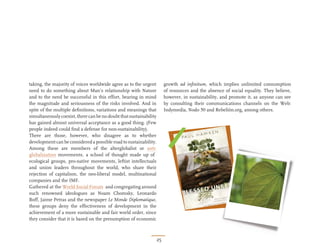
Among these are members of the alterglobalist or anti-
globalization movements, a school of thought made up of
ecological groups, pro-native movements, leftist intellectuals
and union leaders throughout the world, who share their
rejection of capitalism, the neo-liberal model, multinational
companies and the IMF.
Gathered at the World Social Forum and congregating around
such renowned ideologues as Noam Chomsky, Leonardo
Boff, Jaime Petras and the newspaper Le Monde Diplomatique,
these groups deny the effectiveness of development in the
achievement of a more sustainable and fair world order, since
they consider that it is based on the presumption of economic


                                                                    25
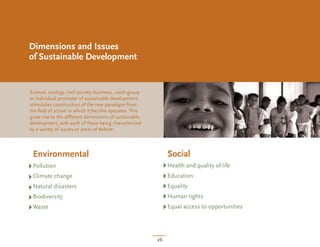
Dimensions and Issues
of Sustainable Development


Science, ecology, civil society, business...each group
or individual promoter of sustainable development
stimulates construction of the new paradigm from
the field of action in which it/he/she operates. This
gives rise to the different dimensions of sustainable
development, with each of these being characterized
by a variety of issues or areas of debate:


 Environmental                                                Social
 Pollution                                                    Health and quality of life
 Climate change                                               Education
 Natural disasters                                            Equality
 Biodiversity                                                 Human rights
 Waste                                                        Equal access to opportunities


                                                         26
Economic                               Institutional
Science, technology and society        Agents/institutions
Business and trade                     Governance and transparency
Energy                                 Participation and democracy
Efficient resource use                  Globalization /alterglobalism
Sustainability indicators              International cooperation


                                  27
Agents of Change


Within the framework of the new paradigm, which                        cases in which NGOs have demonstrated their influence:
underscores the value of association and cooperation, the work         • In 2000, Amnesty International reported the deaths of
of civil organizations —NGOs among them— has made a                    civilians and grave human rights violations committed by
considerable impact. Emerging from the urban middle class,             guards in production areas managed by Talisman Energy Inc.
which burgeoned with the economic expansion of the 1960s,              in Sudan. Following two years of protests, several pension
these began to operate in the 1980s and acquired a stellar role        funds withdrew their participation in the oil company, which
in the 1990s, substituting for a State that was reduced to its         was obliged to initiate its withdrawal from the country.
minimum expression and incapable of providing answers to               • After five years of reports regarding child slave labor in the
problems relating to health, education, poverty, human rights,         harvesting of cacao in the Ivory Coast —children as young as
environmental pollution, promotion of women’s development              10 were forced to work 12-hour shifts, were poorly fed and
and consumer rights, among other issues.                               were locked up at night— in 2005, Equal Exchange and other
In society, the action of many NGOs involves divulging                 NGOs managed to get Hershey, M&M, Nestlé and other major
information and generating awareness. In their role as a               chocolate manufacturers involved in the issue. They ended up
forum for citizen interaction combined with lodging demands            exercising responsible care practices and agreed to certify their
that governments and companies prevent, correct or mitigate            products as being “child slave labor-free”.
unsustainable conducts, the actions of these organizations             • The Canadian mining firm Meridian Gold in 2002 announced
transcend geographic and socio-economic boundaries. And                plans for open-sky gold-mining operations in the Andes range
with the coming of the communications revolution —especially           near Esquel, Chubut Province, Argentina. There were fears
the Internet— they have become so influential that it is often          that the acid drainage from the thousands of tons of rock that
enough for an NGO to threaten involvement in an issue for              would have to be moved and the use of thousands of liters of
government officials or business people to reconsider their             cyanide to process the ore would have a pernicious effect on
planned actions. The following are details of a few well-known         the ageless and pristine Alerces National Park. An NGO called


                                                                  28
Movimiento de Vecinos Autoconvocados por el No a la Mina (Self-                  • Social Sector
                                                                                                                                        s Hopkins
 Convened Movement of Neighbors against the Mine), managed                                                         untries by the John
                                                                                   Studies  carried out in 22 co r Project revealed that NGOs rep-
 to get the issue into the domestic and international media and                                           rofit Secto                              luded
                                                                                   Comparative Nonp -earning labor force in countries inc
 to organize a referendum in which 80% of the population                                        of the wage                             employment in
                                                                                   resent 5%                                    d 1995,
                                                                                                          at between 1990 an growth rate for the
 expressed its rejection of the mining project. As a consequence                   in the study and th          es faster than the
                                                                                                            tim                                   w work
 of such widespread repudiation, the government of Chubut                           that sector grew 2.5 Civil society organizations apply ne
                                                                                    economy as a      whole.                                     with
                                                                                                                             style in accordance s
 Province was forced to slap a prohibition on open-sky mineral                                            d a management                   anges ha
                                                                                     methodologies an                   rowths of these ch
 ore mining and on the use of cyanide in mining processes.                                               e of the outg                            sector
                                                                                     their mission. On              organized,  private, non-profit l
                                                                                     been th e emergence of an s, worldwide, economic, socia
                                                                                                            world-clas
                                                                                     that has become a
• The Power of the Intern                                                             and po litical force.
                                          et
   Just as printing beca                                                          • Networked Organizations
                         me                                                                                                             at underlies the
   Protestant ideas —pro a fundamental tool for the disseminatio                                                    d cooperation th
                            vo
  Roman Catholic Churc king the greatest revolution suffered by
                                                                           n of
                                                                                    The value    of association an                n rise to networks
                                                                                                                                                       of
                           h in its 2000 years of                          the                              nizations has give                          e
  is today supporting                                existence— the Intern          ac tion of these orga ns. These in turn network with on                    e,
  take advantage of ins
                        the capacity of civil so
                                                 ciety to interconnect, et          humanita     rian institutio               r in the bu  ilding of an activ
                         tant access to a wide                            grow,                          plement each othe munity, that is recognized
 financing and comm                                range of information               another and com                          m
                        unities, and to create                           ,                                g international co                        n’t wait
 NGOs have given bir
                         th —also through the
                                                 collectively.                       self-administratin cle for information and that does at are of
                                                                                     as a source and     vehi                                      s th
 that have paralyzed                               Internet— to campaig                                                        take up the issue
                       comp
 thanks to the Web, the anies that were not operating correctly.
                                                                            ns                             ditional media to
                                                                                      around for the tra                  ther, takes action.
                           volume of data regard                           And                               bers, but ra
porations is so huge                                 ing the actions of co            interest to its mem
                        that, according to an                              r-                                                                       l distances
into ever more soph                            aly
                       isticated use of marke sts, it will soon develop                                                          omic and cultura
                                                                                                           raphic, socio-econ raction within the sector
                                                t intelligence.                        So it is that geog                       inte
                                                                                                            vor of synergetic                         ty.
                                                                                       are spanned in fa ther the different sectors of socie
                                                                                                             ge
                                                                                       and of bridging to

                                                                            29
Civil Society versus Business


Within the first few pages of her book, No Logo: Taking Aim at
Brand Bullies, Canadian journalist Naomi Klein —a renowned
figure in the anti-globalization movement— states: “This
book is hinged on a simple hypothesis: that as more people
discover the brand-name secrets of the global logo web, their
outrage will fuel the next big political movement, a vast wave
of opposition squarely targeting transnational corporations,
particularly those with very high name-brand recognition.”

In recent years, the world has witnessed business scandals
and citizen boycotts that have swiftly taken shape through
the communications media. Their shockwaves have reached
the employees of the companies involved, who began to bring
pressure for changes toward more sustainable production
processes. In order to come to grips with these demands,
some firms decided to partially modify their processes, while
adopting corporate social responsibility policies, with the aim        According to political scientist Rajni Kothari, “sustainable
of “cleaning up” their images and repositioning themselves on          development demands, above all, an ethical change. It is not a
the market as “environmentally friendly” by adopting a “green”         matter of a technological fix or a new way of making financial
outward appearance (greenwashing). But when these policies             investments. It is a change oriented toward valuing Nature for
are not the result of the values that the company actually             what it is and not simply as a source of resources and to fuel
maintains, their positive impact is nil.                               the motor of economic development”.


                                                                  30
OLD PARADIGM                                                       NEW PARADIGM
                                                      ETHICAL CHANGE

            DISPENSABILITY OF OTHERS                                           RESPECT FOR DIVERSITY

            Focus: Man / Sector                                                Focus: Life / Cultures
            Link: Exchange                                                     Link: Interaction
            Instrument: Individual Project                                     Instrument: Common Strategies
            Objective: CONSUMPTION                                             Objective: SUSTAINABILITY


                         OLD VALUES                                                      NEW VALUES


It is Professor Kothari’s belief that the ecological crisis that the world is suffering is due to the fact that we have considered
Nature’s diversity dispensable. And by transferring the lack of respect for Nature to Man, we had virtually declared a major portion
of the human race dispensable as well, generating one of the fiercest socio-economic crises in history. Thus, in order to halt this
crisis, we need an ethical change based on the premise that all life is indispensable.


                                                                31
1   Companies start to notice that their customers and the
    markets are checking out their commitment to economic,
    social and environmental sustainability.

                                                                          ture is transformed: It is
                                          Little by little, corporate cul
                                    2     no longer just a question
                                          incorporating ethical issues
                                                                       of making money, but also
                                                                           and social values.
                                                                                                     of


        3    Feeling themselves suddenly in the
             to assume the fact that even though
                                                  public eye, companies have
                                                    they try and control news
             of their actions, these actions beco
                                                  me public knowledge anyway.
             This is the reason why they start ope
                                                   rating transparently.


                      4     The companies become aware of the importance of designing
                            new techniques and processes that reduce the economic,
                            social and environmental impact of their products.


                                          s among themselves,
    5   Companies form strategic alliance
        or between themselves and org
                                       anizations from other
                                          itionally considered
        sectors, even some that were trad
        enemies.
                                              6     Gradually, the way of conceiving corp
                                                    frames changes and a need emerges
                                                    and to plan on a long-term basis.
                                                                                          orate time
                                                                                         to think more


    7       The TBL (Triple Bottom Line) Agenda is
            incorporated into the companies’ strategic
            management (to control the economic, social
            and environmental impact of processes and
            products).
The Sustainable Company                                                                                                 Chapter 2


These points summarize the Seven Revolutions that could lead               and to process re-designing with a view to the long term.
companies to Sustainability as set forth by consultant John                At the same time, and by the hand of the World Business
Elkington in his book, Cannibals with Forks (1997). In it, he also         Council for Sustainable Development (WBCSD), new concepts
defined the concept that he coined as Triple Bottom Line (TBL),             that were applicable to business sustainability began to take
pointed to as the differentiating attribute of companies that              shape. These concepts stressed the need for companies to not
were categorically committed to sustainability: e.g., companies            only seek eco-efficiency, but also to properly think about (or
whose management systems take into account the impact of                   re-think) their relationship with society and the environment,
their processes and products on the economy, society and the               by incorporating practices encompassed within the concept of
environment. Subsequently, sustainable companies began to be               corporate social responsibility (CSR).
defined as those that were capable of reformulating their strategies        Defined by the WBCSD as“the decision of a company to contribute
by including three complementary parameters: economic growth,              to sustainable development by working with its employees, their
creation of social value and environmental conservation.                   families and the local community, as well as with society as a whole,
So it was that in the last five years of the 20th century, this             to improve the quality of life”, it placed the company in a key
new paradigm began to repeat itself throughout the productive              position within the architecture of the new paradigm. Within
sector: Businesses began to talk for the first time ever about              the neo-liberal model, which at the time was enjoying broad
incorporating such concepts as the creation of economic, social            acceptance in much of the world, change toward sustainability
and environmental value for their “stakeholders” (workers,                 required the action of companies, considered, as they were, to
shareholders, customers, civil and government organizations)               be the main driving force behind economic growth.


                                                                      33
Business in the 21st Century


                                                With the dawning of the new millennium, an ever-growing
                                                number of business people joined the debate and began to re-
1. Market Pressure                              think the place that their companies were occupying and the
                                                role they played in society and on Planet Earth. In this way, the
                                                concept of what constituted a sustainable company continued to
2. New Values                                   develop and be enriched, especially in ethical and social terms.
                                                Inwardly, a new corporate culture emerged, one that recognized
3. Transparency                                 the people that made up the company and the know-how that
                                                they generated (e.g., its human capital) as its main asset, since
                                                the competitiveness of the company depended on their capacity
4. Technology
                                                for action and innovation. Outwardly, companies started to
                                                recognize themselves as integral parts of the communities
5. Partnerships                                 where they operated and, as such, as jointly responsible for
                                                both the welfare and the problems of these societies, as well
6. Long-Term Vision                             as being participants in the definition of their values. Out of
                                                this emerged the incorporation of the environmental variable
                                                into corporate strategy, along with the creation of economic
7. TBL                                          and social value — or in other words, the Triple Bottom Line
                                                mentioned earlier.
                                                Information technologies and the development of the Internet
The 7 Revolutíons toward Sustainability,        facilitated both internal changes in companies and their
according to John Elkington                     communications with society. The Web provided a means


                                           34
of boosting the impact on consumers of the change toward              willing to change one of their habitual brand preferences if
sustainability. In many cases, consumers preferred to pay             they were to read a negative comment about it on the Internet,
a little more for “clean” products, that is to say, ones that,        adding that 41% of those surveyed had already done so . As
besides providing the manufacturers with a profit, were made           power brokers, the new electronic media are currently growing
in accordance with standards that protected the environment           by leaps and bounds. According to recent statements by
and created social value.                                             geopolitical expert Ignacio Ramonet, Chairman and Editor of
In this way, brands associated with sustainability began to           Le Monde Diplomatique, the Internet and bloggers are bent on
gain prestige, which in turn began to bolster the value of            becoming the “fifth power”: the citizen’s counterweight against
these companies’ shares. Similarly, investor interest in these        the dominion of major media groups over the news.
firms increased, since sustainability had become an almost             Internet is also a channel for the campaigns of NGOs like
indispensable attribute in convincing those who sought to             ATTAC, Clean Clothes Campaign, Free Burma, Friends of the
expand their capital by investing in a productive enterprise.         Earth and No Sweat!, which exercise the kind of supervision
But it was on the Web too that, with equal swiftness, voices          at which governments have shown themselves to still be
were raised up against the new paradigm, especially through           inefficient. Through this and other media, they demand that
campaigns and protests organized by some earlier-mentioned            the private sector be held accountable for the social, economic
NGOs, as well as through blogs which, now in their tenth              and environmental impact of its activities.
year, number more than 70 million and encompass some 4.2              Many times the results of these campaigns are highly successful
million active bloggers.                                              and achieve changes in the behavior of the productive sector.
Regarding the influence of growing consumer cyber-activism,            Proof of this is the business organization called PETA (People
Zed Digital, a firm specializing in marketing on the Internet,         for the Ethical Treatment of Animals), which managed to get
a few months back published a study in which it claimed that          the world’s two leading soft-drink makers, PepsiCo and The
44.1% of all bloggers in Spain had shown themselves to be             Coca Cola Company (TCCC), to sign a written commitment


                                                                 35
not to use animals in the testing of their products. And then
there is the alliance between Coca Cola and WWF International
(World Wildlife Fund International), by which the company
pledged investment of 20 million dollars in a program aimed
at three freshwater conservation objectives: 1) reduction of the
amount of water used to make their beverages; 2) recycling
of the water used in their manufacturing processes, and 3)
replenishing of water in the communities and in Nature in the
vicinity of its bottling plants.


                 In a survey, 44.1% of Spain’s
                 bloggers said they were willing
                 to change their product preferences
                 based on negative comments
                 on the Internet.


                                                                   36
Greenwashing or Real Change?
The term “greenwash” stems from the word “whitewash” (which means to gloss over or cover up
something) and is used pejoratively to describe certain marketing actions that some companies make
use of in seeking to somehow compensate for other actions that have “soiled” their brand image, due
to the negative impact of these actions on the environment.
A number of environmentalist organizations have concentrated their efforts on exposing and denouncing
“greenwashers”, to the point of actually creating rankings, such as America’s Ten Worst Greenwashers,
which, in 2002, was led by the makers of Kraft’s Post Selects cereals for promoting their product as
“natural” when they were, in fact, packaging “laboratory” cereals.
Actions like those of the companies included in this ranking are easily qualified as “greenwashing”.
Others are not so easy.

Wal-Mart, the world’s largest corporation, with revenues of 315 billion dollars and more than 11 billion in
profits for 2006, is frequently accused of non-sustainable conduct. In reaction to this, the chain recently
launched a line of organic clothing and, in the process, became the world’s largest buyer of organic
cotton. Simultaneously, Wal-Mart kicked off its Sustainability 360 plan, which projects annual
investments of 500 million dollars with the aim of achieving a level of sustainable products equal to
20% of all products offered by its stores in just three years’ time. Whether this is a real change of values
or another case of “greenwashing”, the fact that 100 million people a week are being invited to consume
responsible products, and more than 60,000 suppliers to manufacture them, makes the impact of do-
ing business in this way clearly predictable on a worldwide scale.
New Playing Rules


Within this context, characterized by a market with consumers        sustainable development; and Petrobras, now rated on the Dow
that not only have voice and vote, but also their own                Jones Sustainability Index, the most highly used parameter
communications media —which they use to demand that                  today in the classification of responsible companies, from an
companies change to more sustainable policies— the 100               economic, social and environmental standpoint.
New Global Challengers have flourished. This is a group of a          Running counter to this, the “conversion” or “re-conversion”
hundred companies from developing countries, identified in a          of companies “born and raised” according to the old paradigm
study by a Boston consulting group, which, besides providing         is not always easy. The change implies much more than
jobs to more than 4.6 million people and generating profits of        adopting a new set of values that substantially alter a company’s
more than 715 billion dollars a year, have managed to stand          culture and its way of doing business. It starts with assuming
out as leaders of the sustainable business movement. Major           the fact that the world has changed radically and that, as the
firms among them include: Cemex (Mexico), renowned for                consulting group SustainAbility recently stated, there are new
its work with neglected markets and its firm commitment to            playing rules that companies have to apply in order to achieve
the communities where its plants operate; Natura (Brazil),           sustainability without losing their competitive edge in the new
a cosmetics company whose trademark is strongly linked to            global scenarios.


                                                                38
1. Plan for the unexpected.
Flexibility in the value chain, in technological platforms and in labor policies
constitutes the new efficiency factor.

2. Find the True South.
Don’t underestimate the importance of the emerging economies.
There are regions where development is raging today at a dizzying pace.

3. Don’t wait for “the Big Guys” to take the initiative.
Today even the most powerful companies are exposed to scandal and crisis.
What is decisive is the capacity to create sustainable value.

4. Contribute to strengthening the Earth’s immune system.
Bring intelligence and creativity to the search for solutions to
environmental and social crises.

5.Think in terms of opportunities and innovation.
Change the focus of environmental and social issues: Consider them
major opportunities instead of risks.

6. Surpass yourself day after day.
The challenges are huge and demand a radical change of attitude.
Leaders must go out in search of new allies, models and solutions.

7. Be political.
You have to get involved and take positions in conflicts.


The 7 Rules of the Sustainability Game, according to John Elkington
Sustainability Standards

                                                                          Economic Indicators
The sustainable company is now a fact of life and it looks like
it is here to stay. But how do you go about rating a company’s
level of sustainability? Consultants and managers today apply
economic, social and environmental indicators that respond to
the Triple Bottom Line (TBL) concept. These are specific, usually
quantitative indices that evaluate the impact of each business
move, for the purpose of establishing its level of sustainability.
Although the list and number of the indicators are variable,
many are included in the majority of business platforms.

Usually, these companies will adopt a platform of indicators and
then gradually improve it in accordance with the circumstances            Productivity Ratio.
they must deal with. A good example of this kind of flexibility is         Wage and Benefit Level.
provided by the multinational, Hewlett-Packard (HP), which,
after being investigated in 2006 for secretly spying on its               Product Value/Environmental
executives to try and discover whether any of them had leaked             Impact Ratio (eco-efficiency).
information to the press, adopted privacy policies as one of the
ratios in its Annual Sustainability Report .                              Investment in Research,
                                                                          Development and Innovation.
                                                                          Total taxes or contributions to
                                                                          the Public Administration.


                                                                     40
Social Indicators                                Environmental Indicators


Safety and Hygiene in the Workplace.             Use of Renewable Energy Resources.
No Gender, Ethnic or Age Discrimination.         Use of Recyclable Materials.
Level of Training among Human Capital.           No Water, Air or Soil Pollution.
Satisfaction and Turnover Ratio.                 Auditing of Processes Applied by
Impact on Social Development in the Local        Suppliers and Transporters.
Community.                                       Respect for Biodiversity.
Capacity to Influence Stakeholders in the         Obedience of Environmental Laws.
Adoption of Like Values.


                                            41
Sustainability Report and                                                Business Associations
Social Balance Sheet                                                     Based on Values

The sustainability report is a tool through which companies              The communications revolution and new technologies,
disclose and measure the economic, social and environmental              coupled with constant public complaints being voiced by
impact of processes implemented over the course of a                     citizens and NGOs alike, alerted companies to the urgent
particular year or other period of time. Promoted by the GRI             need to get organized and to form associations, in order to
(Global Reporting Initiative), it reports profits, investment and         face a variety of problems of the new millennium.
other information on the company’s economic and financial                 Below are examples of three successful efforts to create
situation. Its aim is to detail the brand value or soundness             business associations based on sustainability values.
of the company, by explaining the level of risk minimization
achieved thanks to social, political or legal actions, and it may
include —although this is not a priority— aspects linked to
social responsibility.
The social balance sheet, on the other hand, is a goodwill
communication tool that focuses more on social issues
                                                                         The World Business Council for Sustainable Development
and contains data which are certified by only a handful of                (WBCSD) is a coalition of 180 international companies
organizations in the entire world.                                       that are united in their commitment to sustainable
                                                                         development, based on the three pillars of economic
                                                                         growth, ecological balance and social progress. Founded
                                                                         at the Rio de Janeiro worldwide Earth Summit in 1992,
                                                                         today its members represent 35 countries and 20 strategic
                                                                         areas of business. The mission of the WBCSD is to
                                                                         provide business leadership as a catalyst for change
                                                                         toward sustainable development.


                                                                    42
Business Case Studies


The Ethos Institute of Companies and Social                     Appendices 1, 2 and 3 of this book include case studies of com-
Responsibility is a Non-Government Organization                 panies that have begun the change toward sustainability, with
created in Brazil in 1998, whose mission is to mobilize,        detailed information about each of them.
sensitize and help companies manage their businesses
in a more socially responsible way, with the ultimate                        Appendix 1: Pioneer companies
                                                                                     Starbucks
goal being to contribute to the building of a more                                   The Whole Foods Market
sustainable and just society. The Institute’s more than                              Patagonia
1,000 members have combined annual billings equal                                    Natura
to 33% of the Brazilian GDP and they provide about                                   Ben & Jerry’s
one million jobs.
                                                                             Appendix 2: Companies that Changed
                                                                                     Toyota
                                                                                     General Electric
                                                                                     DuPont
                                                                                     Home Depot
Business for Social Responsibility (BSR) is an                                       Interface
                                                                                     Nike
international not for profit business organization with                               Wal-Mart
headquarters in San Francisco and offices in Europe
and China. It offers consulting services to 250 partner                      Appendix 3: Sustainable companies
companies and to another 1,000 businesses around                                     Nau
the world. Its mission is to contribute to the creation                              Grameen Telecom
                                                                                     Guayakí
of a fairer and more sustainable world, by working                                   American Apparel
together with companies to promote more responsible                                  Seventh Generation
practices, as well as innovation and cooperation.                                    Sambazon


                                                           43
The Ones that Made History                                                                                          Chapter 3
Benchmarks, Inspirers and Pioneers


ELKINGTON, The Father
                                                                           among his classmates to donate to the World Wildlife Fund
                                                                           (WWF). And in 1978 he had already joined two colleagues
“As we move into the third millennium, we are embarking                    —one of them Max Nicholson, co-founder of the WWF — in
on a global cultural revolution. Business, much more than                  creating a firm called Environmental Data Services.
governments or NGOs, will be in the driving seat.”
                                                 John Elkington            Dubbed by BusinessWeek magazine as “the dean of CSR (Cor-
                                                                           porate Social Responsibility)” for three decades, John Elking-
The “Father of Sustainable Development”: such is the role                  ton is the author and co-author of 40 papers and 17 books
that the specialized media attribute to John Elkington, the                that have sold millions of copies around the world. Most
British sociologist and social psychologist born in 1949, who              noteworthy among them, due to their status as “required
co-founded the first independent consulting firm devoted to                  reading”, are The Green Consumer Guide (1988) and Canni-
sustainability. Its name: SustainAbility.                                  bals with Forks (1997).
This firm —which Elkington himself presided over from 1995                  The Green Consumer Guide is a catalog of sustainable
to 2005— has offices in London, Zurich, Washington D.C. and                 products that includes information for consumers regarding
San Francisco, and counts such big names as Ford, Microsoft,               the manufacturers and stores that offer them. In this book,
Nike, Shell and Unilever (as well as other major multinationals            Elkington states that: “Every day, whether we are shopping for
worldwide) among its clients.                                              simple necessities or for luxury items, for fish fingers or fur
But Elkington’s link to sustainability dates back to his childhood.        coats, we are making choices that affect the environmental
He was only 11 years old when he collected contributions                   quality of the world we live in.”


                                                                      45
It was in Cannibals with Forks that the author introduced the            issues, imaginative, innovative and entrepreneurial, that’s
revolutionary concept of the Triple Bottom Line (TBL). This              what we’ve got to ignite —or re-ignite where we’ve lost it.”
refers to minimum levels of conduct surrounding three key                John Elkington published his latest book, The Power of
concerns —profitability, planet and people— and to the pos-               Unreasonable People: How Entrepreneurs Create Markets and
sibility of introducing sustainable capitalism. Elkington says           Change the World, in 2008, this time with co-author Pamela
that “in a world where the natural order of things is for corpo-         Hartigan.
rations to devour competing corporations...one emerging form
of ‘cannibalism with a fork’ —sustainable capitalism— would
certainly constitute real progress.” He further explains that the
fork represents the TBL of sustainability and its three prongs,
economic prosperity, environmental quality and social justice.
Despite the fact that he orients his arguments more toward
the environmental issue than toward economic and social con-
cerns, the author makes it clear that uniting these three dimen-
sions in a political agenda constitutes the main challenge to
business in the 21st century.

On his website at www.johnelkington.com, he states that we
are at the beginning of a new era, in which entrepreneurs are at
the head of sustainable development and that this makes them
true agents of social transformation. He adds: “So I think, not
just young people, but the youthful way of thinking about these


                                                                    46
SCHMIDHEINY, The Visionary                                               — some of them mortal.
                                                                         This was toward the end of the 1970s. Schmidheiny was sure
“Today there are 2.8 billion people —nearly half of Mankind—             that his father and predecessor at the head of the Group had
that live on less than 2 dollars a day.                                  been unaware of the noxious effects of asbestos when he
It is these people that we must include in a true and radical            decided to make use of it in the manufacturing of fiber-cement.
development process.”                                                    Far from hiding his head in the sand, however, Schmidheiny
                                            Stephan Schmidheiny          ordered an investigation to establish whether or not the claims
                                                                         were valid and once it was established that they indeed were,
The creation of social value is one of the goals most hard-              he accepted responsibility in the damage suits against the
sought by Stephan Schmidheiny, the Swiss philanthropist and              company and pushed the firm to develop new technology that
former industrialist who is as well known for his commitment             did not make use of asbestos in its processes.
to sustainable development as for his business successes.                Meanwhile, his success as a businessman was on the rise. The
Born in St. Gallen in 1947, he holds a law degree and is a               young Schmidheiny showed avid interest in environmental
member of a veritable industrial dynasty in the construction             issues and attended conferences on the subject. First he went
materials industry.                                                      to Stockholm, where he audited a major conference as an
Shortly after assuming management of his family’s holding                unregistered participant. But at the Rio Earth Summit in 1992,
company, he had to face a conflict directly involving Eternit, the        he established himself as a natural leader by convening other
manufacturer of fiber-cement blocks enriched with asbestos,               business people who actively participated in the event for the
and one of the most important companies in the Group. The                first time in history: Within the framework of the Summit,
conflict stemmed from claims by former employees of the                   he founded the World Business Council for Sustainable
company’s plants to the effect that after inhaling the asbestos          Development (WBCSD), which produced a groundbreaking
fibers, they had developed a wide variety of respiratory illnesses        report called Changing Course, in which the term eco-efficiency


                                                                    47
was mentioned for the first time as an essential element in the         Furthermore, he figures that his role, like that of other
successful development of companies in a world limited by              business people, is decisive in the development process that
dwindling resources.                                                   Mankind requires, and explains: “When I entered the business
Since then, through the management of his businesses,                  world, my intention was to create economic wealth. But at the
Schmidheiny has gradually evolved into what he himself has             same time, I managed to create value for society, especially
defined as a “committed stakeholder”, while developing new              for those who were neediest, and to safeguard the options of
forms of philanthropy. It was with this philosophy in mind             future generations in the best way possible. I don’t see these
that he established the AVINA Foundation in 1994. The                  objectives as incompatible or exclusive.”
organization originally provided support to Latin American
social entrepreneurs so that they could move forward with their
sustainable development-related projects. Currently, AVINA is
devoted to creating networks and alliances among social and
business leaders. It was based on these same premises that
he created the VIVA Trust in 2003, an organization to which
he donated all of his shares in his business conglomerate,
GrupoNueva, with the aim of guaranteeing economic support
to AVINA and other foundations committed to sustainable
development in Latin America.
Schmidheiny defines sustainable development as “not living
beyond our means; not burning down our house to keep warm
or sawing off the limb we’re sitting on; living on the interest
and not on the capital”.


                                                                  48
DRAYTON, The Prophet
                                                                              for the Advancement of Colored People), an organization for
“This is the most radical structural change I’ve ever seen.                   the defense of minority rights in the United States.
Once millions of people enjoy the freedom to generate a change                At Harvard University, where he graduated in 1970, he founded
every time they see a problem, who is going to stop them? If a                the Ashoka Table, a forum for dialog between students and
person is frustrated, there will be hundreds of others looking at that        leaders in government and industry. While studying Law
problem in that community and looking for a solution. One of                  at Yale, he created the Yale Legislative Services, an initiative
them is going to find it”.                                                     to allow university students to collaborate with American
                                                        Bill Drayton          lawmakers in developing legislation. By the time he graduated,
                                                                              he had managed to involve a third of the students at Yale Law
Bill Drayton is credited with coining the term “social                        in this project. Drayton worked for ten years as a consultant
entrepreneur” to describe individuals who combine the                         for McKinsey and Company. Under the Jimmy Carter
pragmatic methods of the business entrepreneur with the                       Administration (1977-1981) he was Assistant Administrator for
goals of the social reformer. Whether he is the author of the                 the Environmental Protection Agency (EPA). He also worked
term or not, no one can question the major role in the field of                for a short time on the White House staff.
sustainability of the founder and chairman of Ashoka, a not                   It was in 1980 that he launched Ashoka, an organization that
for profit association devoted to providing financial support to                he started up with initial capital of 50,000 dollars and that now
entrepreneurs around the world.                                               finances thousands of social entrepreneurs worldwide. In 2007,
Born in New York in 1943, Drayton was already heading up a                    the organization had funds of over 30 million dollars, having
series of social initiatives in his youth. While attending secondary          financed more than 1,600 enterprises in 60 countries. “Within
school, he founded the Asia Society and turned it into one of                 five years,” says this true fanatic of the transforming power
the most powerful student associations ever known. At about                   of entrepreneurs on the road to the sustainability paradigm,
that same time, he joined the NAACP (National Association                     “more than 50 percent of the Ashoka Fellows changed national


                                                                         49
policy in their respective countries. And nearly 90 percent saw          RODDICK, The Provocateur
independent organizations copying their innovations.”
                                                                         “For me, campaigning and good business
Bill Drayton maintains a frugal lifestyle and, for many years, he        is also about putting forward solutions, not just opposing destructive
carried out his work for Ashoka ad honorem. Besides chairing             practices or human rights abuses.”
Ashoka, Drayton is also currently active on the Board of Get                                                                  Anita Roddick
America Working!, a not for profit organization whose aim
is to create new jobs by generating structural changes in US             She once said her favorite quote was the one by Dorothy Sayers:
economic policy. He also cooperates with Youth Venture ,                 “Time and trouble will tame an advanced young woman, but
an association that seeks to create entrepreneurial awareness            an advanced old woman is uncontrollable by any earthly force.”
among youth, while imbuing young people with confidence in                Be that as it may, at age almost 65, Anita Roddick was still
their capacity to lead social change.                                    defining herself as “the new girl on the block”.
                                                                         Born in Littlehampton, England, the founder of The Body Shop
                                                                         first studied to be a teacher and then decided to see the world,
                                                                         before she met Scotsman Gordon Roddick, who in 1970 was to
                                                                         become her husband and the father of her daughters.
                                                                         In 1976, Gordon began a journey across the Americas on
                                                                         horseback, and in order to keep the wolf from the door, Anita
                                                                         decided to open a little cosmetics boutique. “I had no training
                                                                         or experience,” she once said, “and my only business acumen
                                                                         was Gordon’s advice to take sales of 300 pounds a week.” But it
                                                                         wasn’t just economic need that fostered the emergence of The


                                                                    50
Body Shop: “It upset me to find out that a large part of the price        Amazonian natives gathered in the rain forest. Although the
of cosmetics went into packaging that was as sophisticated as            subsequent trade relations turned out not to be as simple as
it was unnecessary. I was also upset by false advertising that           she had expected, they have lasted until the present day and
promised miracle remedies and had pictures of 16-year-old                have led to the development of medications based on jungle
girls promoting anti-aging products for women in their 50s ”.            plant species.
Anita’s personal experiences served as an inspiration for                The Body Shop similarly promoted campaigns in favor of fair
company values that became brand assets and included the                 trade with the Third World, like the one developed with the
rejection of animal testing, the use of natural ingredients,             Chepang indigenous people of India for its Ayurvedic line, or
recycling of containers and protection of the environment. Six           in Nicaragua with that country’s sesame seed oil producers.
months after opening her first shop, she opened a second one.
And when Gordon got back from his travels, he also joined                Striking out at costly marketing strategies, Anita Roddick
the firm and promoted its worldwide expansion. By 1984, the               maintained that “our growth has always depended on our
company had branches throughout Europe and was being                     reputation and word of mouth, not mass advertising.”
quoted on the Stock Exchange, turning the Roddicks into                  According to analysts, this way of thinking had a real impact,
multi-millionaires.                                                      since achieving what she did through reputation alone would
The couple used their success to promote sustainable devel-              have required investment of 96 million dollars a year using
opment and initiated a campaign whose slogan was: “what’s                traditional marketing strategies.
good for the community and the world, is good for business.”             In 2000, Anita published her autobiography entitled Business
Within this framework, The Body Shop developed its Green                 as Unusual, and in 2001, a collection of essays called Take
Pharmacy project in cooperation with native communities in               it Personally, in which she analyzed the myths regarding
the Amazon. Believing that it was necessary to help these tribes         globalization and the role of the World Trade Organization
preserve their culture, Anita began to market the seeds that the         (WTO). That same year, she launched her personal website


                                                                    51
ANDERSON, The Revolutionary
at www.anitaroddick.com. Later she created her own
communications company, Anita Roddick Publications, which                   “Global warming is coming like a runaway freight train.
in 2003 published its first two titles: Brave Hearts, Rebel Spirits:        Time is against us, given Humankind’s tendency to deny and
A Spiritual Activist’s Handbook and A Revolution in Kindness.              cling to the opiate of the status quo. Biodiversity is plummeting.
In March 2006, L’Oreal bought The Body Shop for 652.3                      Our human footprint is growing and the planet’s carrying capacity
million pounds sterling, a fact that stirred a certain amount              is shrinking, consumed by our unsustainable appetite for stuff.”
of controversy, since the acquiring firm had been accused                                                                       Ray C. Anderson
of animal testing for its products. Anita Roddick died in
September of 2007, just two years after retiring from business             It wasn’t until he was 60 years old that Ray C. Anderson began to
and donating her fortune to “just causes”.                                 see the world in a different light. The West Point, Georgia-born
                                                                           industrial engineer, founder and Chairman of Interface Inc., a
                                                                           leading carpet manufacturer headquartered in Atlanta, places
                                                                           the exact moment of that change in August of 1994. It was as he
                                                                           was preparing a speech regarding his vision on the environment
                                                                           for a group of business people from around the world. For
                                                                           some time, his clients had already been questioning him about
                                                                           what his firm was doing for the planet and the only thing the
                                                                           founder could think to say was: “We comply with the law.”
                                                                           As he was putting together his presentation, however,
                                                                           he suddenly realized that he didn’t really have any vision
                                                                           regarding the environment. And then a book appeared on his
                                                                           desk that was to radically change his way of doing business:


                                                                      52
Paul Hawken’s The Ecology of Commerce, a work that Anderson
himself has referred to as an “epiphany” and “a spear in my
chest that remains to this day”, and the catalyst that brought
him to the decision to devote his life to sustainability.

With this goal in mind, the businessman held a meeting with
the directors and executives of his company and announced
the firm’s new mission: to turn Interface into the world’s first
sustainable industrial company. The change implied a constant
effort to reduce the impact of the carpet-maker’s activities
on the environment. It also meant being willing not to take
anything out of the earth that couldn’t be renewed. This was a
true challenge for an industry that depended almost entirely on
petroleum for its livelihood.

The first step was to start research and development work in
order to find new production methods. The second was to
introduce ways of generating “green energy” such as solar
panels and wind and biomass energy. The third was to try
different types of recycled materials and experiment with new
raw materials for the firm’s products. The final step was to
reduce waste and greenhouse gas emissions.


                                                                  53
In 1999, Anderson published his book entitled Mid-Course                 GRAJEW, The Benchmark
Correction. Toward a Sustainable Enterprise: The Interface
Model. The book recounts the process from his discovery                  “We are all consumers and, as such, our wishes to support those
of sustainability to his declaration of activism for the                 products or services that come from companies working with
cause, and explains his company’s framework for doing                    the criteria of social responsibility can be made heard. Since the
business. In its pages, the businessman dares to confess: “I             immediate goal of corporations is profit, we must ensure that the
am a plunderer of the earth and a thief today, a legal thief.            companies with the highest profits are those that take into account
The perverse tax laws, by failing to correct the errant market           the future of the new generations.”
and force it to internalize those externalities such as the costs                                                              Oded Grajew
of global warming and pollution, are my accomplices in
crime. I am part of the endemic process that is going on at a            One of Oded Grajew’s most recent victories was having got
frighteningly accelerating rate worldwide to rob our children            the steelmakers of the states of Maranhao and Pará to sign a
and their children, and theirs, and theirs, of their futures”.           commitment to abolish slave labor in their production chain.
                                                                         No mean achievement for the world, or for this electronics
Anderson’s philosophy and actions have turned Interface into             engineer born in Tel-Aviv, who later became a naturalized
one of the companies that is most highly recognized for its              Brazilian citizen, a man who began his business career as a
commitment to the business movement toward sustainability                toy manufacturer and who didn’t rest until he had become a
and its founder is considered one of the world’s leading “green          benchmark figure in the world of corporate responsibility.
businessmen”.                                                            Grajew says that from the very outset of his career, he was always
Today, Anderson travels the world spreading the Interface ex-            concerned about what was happening to the Earth. In 1987, he
ample far and wide and promoting the benefits of sustainabil-             founded Pensamento Nacional das Bases Empresariais (National
ity. In 2006 alone, he gave more than 115 conferences.                   Thought for Business Bases), an organization initiated with


                                                                    54
the aim of changing the mindset of Brazilian business people.
In 1990, he created the Abrinq Foundation (originally linked
to the Brazilian Association of Abrinq Toy Manufacturers), an
NGO that works with UNICEF to improve the living conditions
of children in Latin America. The institution has 2,500 member
companies and its main fight is for the elimination of child
exploitation. But Grajew’s reputation as a referential figure in
the field of corporate social responsibility came with the creation
in 1998 of the Ethos Institute, a not for profit association whose
purpose is to promote an awareness of social responsibility
in the private sector. This organization, which Oded Grajew
has presided over since its founding, today has more than 887
corporate members —small, medium-size and large companies
from all economic sectors and regions of the country— whose
joint revenues total more than 110 billion dollars (about 30%
of Brazil’s Gross Domestic Product) and which jointly employ
more than 1.5 million workers. Additionally, the Ethos Institute
is a founding member of EMPRESA, a network of organizations
throughout the Americas that seek to promote CSR .
In 2000, after several failed attempts to get the topic of CSR onto
the agenda of the World Economic Fund that each year brings to-
gether the world’s most prominent business people and bankers


                                                                      55
CHOUINARD, The Explorer
for a meeting in Davos, Switzerland, Grajew decided to organize
the World Social Forum (WSF). With the support of such re-                “In many companies, the tail (finance) wags the dog (corporate
nowned social proponents as Francisco Whitaker (a member of               decisions). We strive to balance the funding of environmental
Brazil’s Conference of Bishops) and Bernard Cassen (Editor-in-            activities with the desire to continue in business for the next
Chief of Le Monde Diplomatique), the WSF burst onto the scene             hundred years.”
in January 2001 with its first meeting in Porto Alegre. Since                                                                Yvon Chouinard
then, it has established itself as a meeting of worldwide impor-
tance and is held each year in a different city, with thousands of        An enthusiastic mountain-climber, outstanding surfer,
individuals and social organizations taking part.                         fisherman and kayaker: that’s how Yvon Chouinard, who
The “people power” concept is the basis for Grajew’s strategy             became a businessman as the sort of natural outcome of these
to attain change among business people: “If you take adequate             fond interests, defines himself. Born in Maine, USA, in 1938,
measures, you are really going to benefit, but if you don’t, you           Yvon was already considered one of the best climbers in the
could end up in serious trouble”. Here, two basic principles              Americas by the time he was in his early twenties.
come into play: the desire to do the right thing and fear of the          It was in 1957 that he decided to manufacture his own line
company’s developing a bad name among consumers.                          of climbing equipment, as a means of financing his trips and
Toward the end of 2006, Oded Grajew acted as an advisor to                saving money. The first product that he launched on the market
Brazilian President Luiz Inácio ‘Lula’ da Silva, becoming a               was steel climbing stakes. The success of his sales led him to
driving force behind a series of social programs —like the so-            found his own firm called Chouinard Equipment for Alpinists
called “Zero Hunger” Plan— while promoting dialog between                 (CEA). At the end of the 1960s, together with his climbing and
the government and business. He is currently at the head of               business partner, Tom Frost, he redesigned the basic tools
the Ethos Institute, developing a powerful campaign to elimi-             (crampons and ice axes) for climbing sheer ice.
nate slave labor in companies throughout Latin America.CH-                However, in 1970 Chouinard discovered that the stakes his


                                                                     56
company was making were causing significant damage to the                    going up the stairs two steps at a time. We needed to be sur-
crevasses of Yosemite. In order to prevent this, he introduced tools        rounded by friends who could dress whatever way they wanted,
made of aluminum and created a style of mountaineering called               even barefoot. We needed to have flex time to surf the waves
“clean climbing”, a concept that revolutionized rock climbing. A            when they were good, or ski the powder after a big snowstorm,
year later, he married Malinda Pennoyer, an art student at the              or stay home and take care of a sick child”.
University of Fresno, and in 1972 , he founded Patagonia Inc.,
a company devoted to the designing and manufacturing of
outdoor clothing and accessories and considered to be a pioneer
in socially responsible policies, defense of the environment and
the creation of a sustainable enterprise model.

In 2005, Chouinard wrote a book entitled Let My People Go
Surfing, a sort of autobiography in which, besides recounting
his personal life, he also told the story of Patagonia, the com-
pany’s philosophy and founding principles, and formulated an
insightful reflection regarding the future of the Earth and the
current system for doing business. In the pages of this book,
Chouinard also explains that one of the fundamental concepts
with which he wished to imbue his company was that work
and pleasure go together: “There was one thing that I did not
want to change,” he writes. “Work had to be enjoyable on a
daily basis. We all had to come to work on the balls of our feet,


                                                                       57
Particularly noteworthy among Patagonia Inc.’s values is prod-            SEABRA, The Philosopher
uct quality, which in the firm’s view means durability, mini-
mal use of natural resources —including materials, energy                 “We are convinced that the spirit of the times, what is looming
and transport— multi-functionality, non-obsolescence and the              large on the horizon, are companies with that more human,
kind of beauty that comes from a thing’s being fully adapted to           more integrated side and that more holistic way of seeing their
its purpose, since bowing to fashion trends does not fit into the          relations and functions in society. Such companies will shine and
company’s set of values.                                                  be admired and, at the same time —let’s not forget this— will be
A prime concept in the company is transparency in dealing                 giving their shareholders greater earnings.”
with its employees and in its position within its business                                                                       Luiz Seabra
community, comprising its personnel, the members of society
where the firm operates, its suppliers and its clients. So in order        When he was 16 years old, Antonio Luiz Da Cunha Seabra
to mitigate any of the negative effects the company’s activities          stumbled onto an idea that turned into a revelation: “Man is
might have on the environment, its shareholders donate 1% of              part of everything and everything is part of Man.” From the
the firm’s gross revenues or 10% of its profits —whichever is               very first time that he heard this principle, first expressed by
the larger sum— to ecological activism.                                   the ancient neo-Platonic philosopher Plotinus, that notion of
                                                                          “being part of everything” never left him.
In Let My People Go Surfing, Chouinard is extremely critical of            Luiz Seabra is the founder of Natura, the largest cosmetics-
business, the US government system and consumer society and               maker in Brazil. Having earned a degree in Economic
concludes that: “Now, more than ever, we need to encourage                Sciences, he got his first job in cosmetics back in the 1960s,
civil democracy by speaking out, joining up, volunteering or              when he worked as the administrator of a small laboratory in
supporting these groups financially, so as to still have a voice           Sao Paulo. He spent three years learning the secrets of the
in democracy”.                                                            trade and, in 1969, decided to start his own company, Natura,


                                                                     58
which first opened as a tiny shop with an initial investment
of 9,000 dollars. The store offered beauty advice and product
recommendations, a fact that quickly contributed to the creation
of direct and personalized relations with the clientele. Based on
this experience, Seabra decided in 1974 to adopt a direct sales          Being at peace with our bodies and with our time changes our
system, and this became one of the keys to his success.                  hearts and our consciences”.
                                                                         It is Seabra’s view that, in the future, the key to success for any
En 1991, Natura started structuring its marketing campaign               business will be its capacity to generate an image of credibility on
around the concept of transparency. Its slogan was “Truth                the market and among consumers. Convinced as he is that the
in Cosmetics”. When the firm launched its campaign for its                world is going through a major change in which sustainability
Chronos anti-aging cream in 1992, it didn’t make use of models,          is a concept that is gaining greater acceptance every day among
but brought in real clients over the age of 30. Guillermo Leal,          business people, the creator of Natura maintains: “It is such a
President of Natura, said at the time: “We have a commitment             fragmented world that economic benefits are dissociated from
to our clients and we’re not going to lie by telling them that if        fundamental values. But we do not agree with that separation.
they buy our products they’ll look like Claudia Schiffer”.               We are living in a new era that is just dawning, in which the
Seabra explains that Natura’s mission is to get people to                human being is, to an ever greater degree, what makes sense of
feel better about themselves and, by extension, to make the              things. Although we coexist with technology, which frequently
world a better place to live. “For Natura Cosmeticos,” he says,          bewilders us, we are discovering that the human factor is
“sustainable development comes as second nature. It’s just               what gives life. The human factor is the only thing that can
like a person thinking of their skin. Cosmetics enable people            transform the planet into a better place. This type of vision is
to become more intimate with their own bodies. And once                  not the exclusive privilege of Natura. It is, in all reality, our way
that’s happened, people no longer have any desire to make war.           of seeing the world”.


                                                                    59
AMAZON     BLOGS    CELL_PHONES   CITIZEN_JOURNALISM   CLUETRAIN   COLLABORATION   COLLECTIVE_
INTELLIGENCE COMMUNITY CONNECTIVITY CONVERSATION CREATIVITY DEL.ICIO.US DIALOG DIGG DIGITAL
DYNAMISM E-COMMERCE ENTERPRISE ENTERTAINMENT FACEBOOK FLASHMOBS FLICKR FOLKSONOMY
FREE_SOFTWARE GOOGLE HYPERLINKS IDENTITY IM LANGUAGE LINUX MEDIA MYSPACE DIGITAL_NATIVES
NET_GEN NETWORKS ORKUT P2P PARTICIPATION PERSONALIZATION PROSUMERS RESOURCES RSS SETH_
GODIN SOCIETY SOCIAL_NETWORKS STAKEHOLDERS TAG TECHNOLOGY TIM_O’REILLY TOOLS TRANSPARENCY
US USER USER_GENERATED_CONTENT VIDEOS VIRAL_MARKETING VIRTUAL WEB_2.0 WIKI WIKIPEDIA WIRED
YOUTUBE AMAZON BLOGS CELL_PHONES CITIZEN_JOURNALISM CLUETRAIN COLLABORATION COLLECTIVE_
INTELLIGENCE COMMUNITY CONNECTIVITY CONVERSATION CREATIVITY DEL.ICIO.US DIALOG DIGG DIGITAL
DYNAMISM E-COMMERCE ENTERPRISE ENTERTAINMENT FACEBOOK FLASHMOBS FLICKR FOLKSONOMY
FREE_SOFTWARE GOOGLE HYPERLINKS IDENTITY IM LANGUAGE LINUX MEDIA MYSPACE DIGITAL_NATIVES
NET_GEN NETWORKS ORKUT P2P PARTICIPATION PERSONALIZATION PROSUMERS RESOURCES RSS SETH_
GODIN SOCIETY SOCIAL_NETWORKS STAKEHOLDERS TAG TECHNOLOGY TIM_O’REILLY TOOLS TRANSPARENCY
US USER USER_GENERATED_CONTENT VIDEOS VIRAL_MARKETING VIRTUAL WEB_2.0 WIKI WIKIPEDIA WIRED
YOUTUBE AMAZON BLOGS CELL_PHONES CITIZEN_JOURNALISM CLUETRAIN COLLABORATION COLLECTIVE_
INTELLIGENCE COMMUNITY CONNECTIVITY CONVERSATION CREATIVITY DEL.ICIO.US DIALOG DIGG DIGITAL
DYNAMISM E-COMMERCE ENTERPRISE ENTERTAINMENT FACEBOOK FLASHMOBS FLICKR FOLKSONOMY
FREE_SOFTWARE GOOGLE HYPERLINKS IDENTITY IM LANGUAGE LINUX MEDIA MYSPACE DIGITAL_NATIVES
NET_GEN NETWORKS ORKUT P2P PARTICIPATION PERSONALIZATION PROSUMERS RESOURCES RSS SETH_GODIN
SOCIETY SOCIAL_NETWORKS STAKEHOLDERS TAG TECHNOLOGY TIM_O’REILLY TOOLS TRANSPARENCY US USER
USER_GENERATED_CONTENT VIDEOS VIRAL_MARKETING VIRTUAL WEB_2.0 WIKI WIKIPEDIA WIRED YOUTUBE
INTELLIGENCE COMMUNITY CONNECTIVITY CONVERSATION CREATIVITY DEL.ICIO.US DIALOG DIGG DIGITAL
The Participative Media and Web 2.0
The Conversation Age                                                                                              Chapter 4


Digg is a news site that appeared in 2004 with the promise            or comments containing the code and will deal with whatever
to provide its users with complete editorial control over its         the consequences might be.” Sites like Digg reveal the existence
content. In 2007, its community demonstrated the strength             of a new generation of participative individuals that take pos-
with which it had adopted that power. Somebody uploaded an            session of information rather than passively receiving it. They
article that revealed the code for copying protected DVDs.            seize it, share it, recommend it and cooperate in the creation of
                                                                      contents. This is a new generation of individuals that make the
Since the publishing of this content failed to respect the            tools of Web 2.0 their own.
anti-piracy laws of several countries, Digg’s managers de-
cided to remove it from the site. But the site’s users quickly        This and other signals indicate that global society is in the early
began to upload the code again and vote on it, until the con-         stages of what might be referred to as a communications me-
troversial information was contained in multiple entries on           dia revolution that is as important as the one that Gutenberg’s
the main page. The news spread like wildfire through the               printing press fostered in 1448: the birth of the participative
blogosphere, reaching YouTube and such major print me-                media.
dia as the New York Times and El País. Finally, Digg’s Execu-
tive Director, Kevin Rose, surrendered and wrote: “You’ve             The era of the mass media, established in the 20th century,
made it clear. You’d rather see Digg go down fighting than             is in the throes of a terminal crisis. Well-known and dazzling
bow down to a bigger company.                                         technological advances are producing crucial changes in
                                                                      the way in which people connect with information and
We hear you, and effective immediately we won’t delete stories        communications.


                                                                 63
Web 2.0: A Series
of Disruptions

When Doc Searls, Rick Levine, Chris Locke and David                     If the authors of The Cluetrain Manifesto were somewhat ahead
Weinberger published their 95 theses in a book called The               of their time, history swiftly proved them right. At the end
Cluetrain Manifesto, back in 1999, there was no need for them           of the ‘90s there were thousands of portals on the Internet
to nail it on the door of Wittenberg Cathedral as Martin Luther         that employed the same mechanisms as traditional media:
had done with his 95 when he initiated a sweeping cultural              unidirectional messages for mass audiences. That is, until
reform in 1517.                                                         the dot com bubble burst in 2001, marking a turning point in
                                                                        the history of the Web. Many concluded that the scope of the
Immersed in the Web 1.0 paradigm —big static sites that                 Internet had been overestimated. The fact is that thousands
were attempting to capture mass audiences— this Manifesto               of portals disappeared and all that survived were the sites,
identified the trends that would lead to a participative Web and         software and proposals that conformed to what analyst Tim
told how these changes would affect the markets, consumers and          O’Reilly, in 2004, would refer to as the Web 2.0.
companies. “Markets are conversations,” stated these authors,           Web 2.0 implies understanding the Web as a dynamic platform
considered to be veritable gurus in the cyber-information field.         that is constantly changing and evolving. It allows people to
                                                                        use applications that are in a network, not on their computer
They said that the motivation for ever-increasing numbers of            desktops. It also permits them to connect from different
people to adopt the Internet on a massive scale was the need            support mechanisms, such as cell phones, and not just from
to get together with one another. First, then, they needed to           their PCs. It promotes intuitive relations between individuals
converse, and the tools that made this possible didn’t take long        and information and the appearance of content created by
to arrive on the scene and to be perfected.                             users and social networks.


                                                                   64
Be that as it may, Web 2.0 is not a revolution in itself, but a        • Facebook, a network of university students and other social
platform for a series of disruptions.                                  networks brought together people in communities surrounding
                                                                       common interests.
• Wikipedia, the on-line encyclopedia written by its users,            • Blogs, born as a simple publishing medium, also gave birth
surpassed Encyclopaedia Britannica in quantity and quality             to conversations without filters.
of articles and gave substance to the concept of collective            • YouTube, a site on which to upload and share videos, achieved
intelligence.                                                          a larger audience than the CNN news network.


                  Web 1.0                                                Web 2.0
                  Static Publication                                     Syndication of Contents
                  Mass Messages                                          Personalized Content
                  Passive and Isolated Audience                          Participative and Interconnected Users
                  News Sites                                             Blogs and Civil Journalism
                  Unidirectional Message                                 Conversations
                  Centralized Networks                                   Distributed Networks
                  PC Supported                                           Multiple Supports


                                                                  65
A Manifesto for a New Day
12 of the 95 Theses in the Renowned Cluetrain Manifesto


        1. Markets are
        conversations.                              4. There are no secrets.
                                                                             ows
                                                 The networked market kn
                                                                            about
                                                more than companies do
                                                      their own products.
                                                                            good
             2. The Internet is en
                                   abling       And whether the news is
        conversations amon                                                  ne.
                             g human beings        or bad, they tell everyo
        that were simply not
                              possible in the
                era of mass media.
                                                         5. In just a few more years,
                                                     the current homogenized “voice”
                                                    of business—the sound of mission
                             ersations are        statements and brochures—will see
    3. These networked conv                      as contrived and artificial as the lan
                                                                                         m
                               forms of
        enabling powerful new                        of the 18th century French court.
                                                                                       guage
                              knowledge
      social organization and
             exchange to emerge.
                                                     6. Companies need to lighten
                                                      up and take themselves less
                                                     seriously. They need to get a
                                                           sense of humor.
r does
                    se of humo
 7. G etting a sen          e jokes on
                                        the                        10. We are immune
             utting som
not mean p               ather, it req
                                       uires                         to advertising.
corporate   web site. R
                          le humility,                                Just forget it.
      big  values, a litt         uine
                     , and a gen
      s traight talk         w.
              point of vie          8. To speak with a hu
                                                          man
                                     voice, companies m
                                                          ust
                                      share the concerns of
                                       their communities.

                                                                                  make
                                                   11. Don’t worry, you can still
                                                                                   not
                                                   money. That is, as long as it’s
                                                                                    .
      9. There are two conversations                   the only thing on your mind
         going on. One inside the
      company. One with the market.

                                              12. We are waking up and linking
                                               to each other. We are watching.
                                                   But we are not waiting.
What is important about these changes is not what is tangible           has made it possible to share information in another way. This
– the Web 2.0 architecture – but the role of this technology as         was how sites like Flickr and del.icio.us were born. Based on
the facilitator in generating a series of cultural changes.             “folksonomy” instead of taxonomy (the art of classification),
                                                                        they additionally permit “social bookmarking” – a personalized
At the end of 2006, for its traditional Person of the
                                                                        system of flagging content that can be shared among users.
Year Award, TIME Magazine chose The Internet User.
In other words, “us”.
The blog, for example, is a publication tool that permits daily
updates, syndication, readers’ comments and links to other                              WE MEDIA
sites. The result of these different forms of interaction is the                        COMMUNITY

                                                                                                               Tags
                                                                                        BUSINESS 2.0
so-called “blogosphere”, currently made up of 70 million blogs                          NETGEN
(and counting) that generate a constant on-line conversation                            WEB 2.0
regarding a wide variety of topics.                                                     FOLKSONOMY
                                                                                        BLOGOSPHERE
Another technological innovation that has had an enormous                               MESSAGE
impact is RSS (Really Simple Syndication), which allows readers                         COMMUNICATION
                                                                                        PARTICIPATION
to subscribe to pages and notifies them when these pages                                 CHAT
change. But that’s not all. Thanks to a system of permalinks,                           COOPERATION
each entrance to a blog has its own permanent link, a detail                            INTERNET
                                                                                        PLANET
that becomes fundamental in making “conversation” between                               CARE
blogs possible. Web 2.0 is not merely more dynamic. It’s alive!                         RESOURCES
                                                                                        SUSTAINABLE
The introduction of a content classification method based on                             RELATIONS
tags or key words chosen by the user is another innovation that                         AFFINITIES


                                                                   68
Onward toward Web 3.0                                               The Architecture of Conversation
                                                                                      (BusinessWeek, April 2007)


                                                                                          Message
Regarding the Web 2.0 trends, specialists and detractors alike
agree that the groundwork for Web 3.0 has already been laid.
The accent in this transition would be away from the “Me                                 Experience
Media” (blogs and personal pages) toward a true conversation,
a deep-reaching We Media.

In ancient times, a rich oral culture developed. In those days,                         Conversation
men gathered and talked. Experience made sense when shared
with others.

The use of new technologies and the cultural changes that


                                                                        Communities
they are generating make the word “communication” start


                                                                                                                   Relations
to respond more and more to the etymology of its Latin root,
communicare, which means “to share and to make common”.
At some point between the Middle Ages and the Modern Era,
the word communication began to be used more in the sense
of “transmitting” than “sharing”. This meaning began gaining
ground until, in the 20th century, newspapers, radio and
television generalized this definition. People grew accustomed
to passively receiving messages. An example of this passivity is
                                                                                           Affinities
the image of an entire family sitting in front of the television
set. Just the opposite of what Web 2.0 proposes.


                                                               69
The Evolution of Traditional Media
   to Participative Media
                Advances in information technology have accompanied our           1971   Mobile Telephony
                changing habits. The mobile telephone was invented in 1971, but   1976   Apple Computer
                most homes still only had one telephone. In the 1980s,            1980   CNN
                CNN began to air news 24 hours a day and MTV invented a new       1981   MTV
                language for adolescents. The PC arrived on the scene             1982   IBM PC
                and the fantasy of having a computer in every home started        1992   Linux
                to become a reality.


                                                                                  1994   Yahoo
                                                                                  1995   Amazon.com
                In 1994, Yahoo became the icon of Internet access for
                                                                                         Hotmail.com
                millions of people. There began the era of e-mail, e-commerce
                                                                                         Craiglist
                and the chat. Major companies replicated the experiences
                                                                                         Wikis
                of the mass communications media on the Web, creating static
                                                                                  1996   ICQ
                sites for large, passive audiences.
                                                                                  1998   Google
Start session                                                                     1999   The Cluetrain Manifesto

                                                                                  2003   Ohmy News
                                                                                         Del.icio.us
                The Cluetrain Manifesto was published in 1999.                           Nike +
                When the dot com bubble burst in 2001, it marked the advance      2004   Vblog: Rocket Boom
                of user-generated content and participative media.                       Firefox
                A new era had begun: the era of Web 2.0.                          2005   Flickr (bombs over
                                                                                         London)
                                                                                         YouTube
                                                                                         Skype
Napster: first P2P software
       BlackBerry
2000   Microsoft employees begin blogging
2001   iPod
       Wikipedia
2002   Blogger
       Lastfm
       RSS

2006   Google buys YouTube
       News Corp buys MySpace
       Second Life
       Evolution of Dove: viral marketing
       Virtual Campaign for Chevy Tahoe
2007   Digg Users Revolt
       Facebook opens its Platform
       Twitter
The Network Generation                                                                                            Chapter 5


Erica is 16, an only child, who lives in Sao Paulo, Brazil.             most intimate friends, she constantly exchanges cell phone
She has a Mac in her room, a broadband connection and                   text messages. Julián is 17 and lives with his parents and three
an iPod that’s well stocked with music. Like her teen-aged              brothers in a working class neighborhood in Buenos Aires
friends, Erica never knew the world without Internet. For               Province, Argentina. As soon as he finished high school, he
her, information obtained from the mass media has a value               began working as a messenger in a telecommunications firm.
equivalent to amateur or alternative media. She listens to a            Since his passion is music, with his first pay, he went into
song by Britney Spears followed by one by a British Indie               Mercado Libre (an e-commerce site) and bought himself an
group without any prejudice whatsoever. She puts in very few            mp3 player so he can listen to his favorite groups while he
hours in front of the TV set, but never misses an episode of            travels from place to place. On the weekends, he rehearses
Lost, her favorite television series. She also watches Japanese         with a rock band, in which he is a percussionist. He and his
Anime, which she downloads using BitTorrent (a technology               buddies in the band opened a space in MySpace in which to
for sharing files). Much of the music on her iPod she bought             upload some of their songs and another one in Fotolog, where
through iTunes, but her friends also copied it. She only listens        they post pictures of their shows and announce the dates of
to the radio when she’s riding in the car with her parents and          their upcoming gigs.
she never reads print newspapers.                                       Every afternoon, before returning home from work, he spends
Erica spends the greatest part of her free time connected,              an hour at a cyber-café, where he can chat, visit his friends’
chatting with her friends. Many of them can be found in                 personal pages, post comments, watch funny videos on You
Orkut, a social network where she has posted her profile and             Tube and read the day’s news. On the train ride home, he
where her acquaintances leave her their comments. With her              exchanges text messages with his girlfriend on his cell phone.


                                                                   73
Getting to Know the Net Gen


Erica and Julián belong to the Net Gen, a generation of                  sending e-mail and why too they find the morning newspaper
networked individuals who learn, think, buy, believe and                 —the one actually printed on paper— an anachronism.
relate in ways that are different from those of their parents.           A study carried out in the United States in 2006 revealed that
While the previous generation grew up reading newspapers,                adolescents there spend 72 hours a week using electronic
listening to radio and watching television, they sit in front of         media – including the Internet, cell phones and videogames.
their computers, interacting and participating.                          The same study shows that 68% make use of social networks
With the tools that Web 2.0 has placed at their disposal, they           in order to connect with their friends.
create and give shape to new worlds. These tools are not neutral,
however. Thanks to them, the youth of this generation have               A Change of Habits
unprecedented power over the communications media at their
fingertips. What remains to be seen is whether they will use this             TV                             Internet
power to defend their right to exchange a code that facilitates
intellectual piracy —as in the case of Digg— or if they will make            Media Controlled               Provides Greater
the media their own in order to improve the society they live in.            by the Adult World             Control to Youth
According to the definition set down by Don Tapscott, who
provided the first detailed report on them in his book, Growing               Passive Observers              Interactive
up Digital, the young people of the Net Gen were born between                                               and Participative Users
1977 and 1996 and have entered or are about to enter the job
market. They are fast and can handle several tasks at a time:                Mass Sales Messages            Google AdSense
for example, watching TV, downloading music on the Internet
and doing their homework. They live in real time. That’s why                 Technology Implies Hierarchy Technology Gets
they chat or send each other IMs (instant messages) instead of                                            Distributed: Free Software


                                                                    74
“These millions of children are combining demographic                 on-line role-playing —as in World of Warcraft — is a favorite
             muscle and digital mastery to become                          pastime with the Net Gen. Here, participation generates an
               a force for social transformation”.                         internal system, among players, of reputation and parallel
                          Don Tapscott                                     communities. Contrary to what happened with videogames
                                                                           (like Pac-Man) in the generation before, the participants do not
Immersed in a logic of sharing and interaction, the Net Gen                become isolated, but must establish relationships with other
youth eliminate any mediators that might stand between them                individuals.
and the information. In fact, they were the first ones to adopt             These traits have led to talk of a coming generation of so-
and contribute to the creation of Wikipedia, the world’s largest           called Co-Prosumers —consumers and producers rolled into
encyclopedia, and also to adopt P2P (peer to peer) software, that          one— since the Net Gen tries to personalize everything. When
permits the exchange of files between computers via the Net.                they don’t like something, they change it. And this may mean
These young people’s unexpected use of the Internet forced                 anything from an open software code to the stamp on a t-shirt
ISPs (Internet Service Providers) to modify their structures:              that can be purchased on an e-commerce site. In point of fact,
The youngsters wanted to upload as fast as they downloaded.                the Web is already hosting sites that invite users to send in their
                                                                           own t-shirt designs and those most voted for are produced and
They were, in other words, as interested in publishing content             sold through the same platform.
on the Web as they were in downloading it. A well-documented
example of this creativity is found in Second Life, a virtual              Meanwhile, they are also experimenting with new ways of
world created totally by its users, in which 65% of its 3.6 million        taking real action in the world. Take, for example, the flashmob:
inhabitants are between the ages of 18 and 35.                             A flashmob is a group of people that agree by digital means to
Virtual worlds express the playful nature of the Net Gen. For              meet in a certain public place and do something apparently
this generation, almost everything must be entertaining. Mass              innocent, like having a pillow fight.


                                                                      75
76
A Neo-Renaissance?


Theorists use many names to define the same thing: The Y                with their families, their friends, their neighbors, their
Generation (the one after the X Generation), Millennials, MyPod        university classmates.
Generation (a reference to MySpace and iPod), and the earlier          Facebook, the network created in 2004 by Mark Zuckerberg,
mentioned Generation C (Gen C ), defined by the American                a 23-year-old entrepreneur, to link up Harvard students, is an
Press Association’s Media Center as “creating, producing               example of the strength of on-line communities. By February of
and participating in news in a connected, informed society.”           2007, this community had 25 million members (it is no longer
                                                                       just for university students) and was expanding its business
The Net Gen seeks to express itself through photos, texts,             model.
videos and music. And it has its own motivations for this. The
media and technological firms, meanwhile, are giving these
young people the tools they need, pushing the democratization                                    Control
of creativity. The BBC, for example, gives free on-line courses                                  Content
on how to film documentaries. Apple’s IMovie was one of the


                                                                            C
                                                                                                 Connected
first easy-to-use film-editing software tools. The latest advance
                                                                                                 Collaborative
is Jumpcut, a simple software tool that uses the Web as its
platform and enables users to create videos with photos and                                      Community
upload them from other sites, like Flickr or Facebook.                                           Communication
                                                                                                 Creativity
But the term Gen C also has other meanings. Tomi T. Ahonen                                       Credibility
and Alan Moore, co-authors of the book Communities Dominate                                      Consensus
Brands, define the motivation for forming communities as                                          Celebrity
being another key Net Gen trait. They want to be connected:


                                                                  77
Shared Secrets


On the Internet, the Net Gen shares everything with strangers                certain information that older people consider private. And their
—their performance in school, professional progress, political               opinions about and experiences in the companies where they
opinions, their desires, the items they consume and their fears.             work form part of that information.
They also publish their personal photos and tell the stories of their        The pre-Internet world was full of secrets. Information was highly
lives in blogs and photologs— a fact that tends to scare adults.             valued because it was scarce. As Chris Anderson – publisher of
It’s that the members of this new generation value their personal            Wired and author of The Long Tail – suggests, the secret appears
identity over their personal privacy. During the greater part of             to be dead. The proliferation of cell phones with cameras, e-mails
the history of Mankind, privacy was a “luxury” to which only the             that can be easily forwarded and digital documents that are ready
elite of society had access. People lived in villages, where it was          and waiting to be copied, are a sign that any attempt to keep a
difficult to keep secrets, since, generally speaking, everybody               secret is going to fail.
knew everybody else. In the 20th century, the concentration of               It’s not worth trying.The digital natives appreciate authenticity.
populations in major urban areas provided the possibility of                 Accustomed as they are to finding hoaxes on the Internet, they
greater intimacy – and anonymity. Thanks to our level of comfort             have quickly learned to distinguish between truth and falsehood.
and technology, we can now spend weeks on end in our houses                  They have a nose for detecting spam or hidden sales messages
with no need even to relate to our neighbors. Despite this fact, the         and they firmly reject them. Many viral marketing campaigns
need of human beings to interact with others has remained part               have failed for this very reason. Another key trait is the knowledge
of the very make-up of people. The community spirit, the desire              that the youth of this generation have regarding topics about
to be recognized by others, prevails, whether a person lives in a            which their parents are completely ignorant.
city of 10 million people or in a small rural community. From                According to Tapscott, in Finland, 5,000 students signed up
this point of view, it comes as no surprise that, with the adoption          to teach their teachers how to use computers. This is just one
of Web 2.0 tools, human beings have “come out” once more. The                example of the bottom-up logic that the Network Generation is
Net Gen values transparency. It believes that it is okay to share            ready and willing to apply in other areas, like the job world.


                                                                        78
Other Ways of Being a Net Gener
                                                                    10 Truths Inside Google
According to human resource researchers, these young people
who have grown up “opening windows” (in MS Windows or             1. Focus on the user. The rest will
Linux) don’t want to be closed up in office cubicles. They are        come on its own.
curious, have high self-esteem, are enterprising and aren’t
                                                                  2. Do one thing really well.
afraid to press for change in the business cultures where they
work. Their entry into the work force is producing a corporate    3. Fast is better than slow.
change that Harvard business professor, Andrew McAfee,
recently defined as Business 2.0.                                  4. Network democracy works.
Google, the eighth most admired company in the United States,
according to Forbes magazine, has already reacted to these        5. You don’t need to be at your desk
demands. It has 13,000 employees, most of them under the age         in order to receive or give an answer.
of 23, whom it permits to decide on their own work schedule
                                                                  6. You can make money without
and workplace (home or office), and whom it allows to spend           causing harm.
20% of their work day doing something that really excites
them. Google Earth and Orkut were results of this initiative.     7. There’s more information out there.
The Mozilla Foundation, creator of Firefox, the browser devel-
oped on the basis of free software that snatched 15% of the       8. The need for information goes
market from Microsoft, drew its inspiration from Net Gen mo-         beyond all limits.
tivations and put a new form of production into practice. Some
                                                                  9. You can be serious without
30% of the people that work for the foundation are not employ-       wearing a suit.
ees but contributors who don’t receive a single cent for their
contributions. As with the entire community that takes part       10. Good simply isn’t good enough.


                                                             79
in the free software movement, their motivation isn’t money                 College and University Presidents Climate Commitment, an
but the possibility of learning, being in contact with people of            agreement aimed at eliminating pollutant gas emissions from the
other cultures and creating a more useful software for others.              country’s educational institutions. At about the same time, MTV
Paul Saffo, the sociological guru who tracks the impact of                  launched a space called MTV Switch, containing information
technology on society, says,“(…)In a society that shows every-              on climate change oriented toward young people between the
thing in public, what becomes most valuable is the secret.”                 ages of 15 and 25. The site proposes small changes in consumer
This demonstrates that there is no consensus on what we can                 habits, with the aim of reducing the carbon footprint of each
expect from the Net Gen.                                                    individual on the earth.
According to the BBC, 2 billion people in the world today are               In 2006, Chilean students made use of text messages, MSN
under the age of 18. Within that vast group, there are adolescents          and other Internet tools to muster their peers in a strike. Once
that use their blogs to provide strategies to help others hide their        they had paralyzed activities in every school in the country, they
anorexia or bulimia, or to swap stories about their experiences             managed to get the government of President Michelle Bachelet
with drugs. And many suffer from a more silent addiction: They              to initiate changes in the country’s education policy.
are addicted to being connected.                                            Said María Jesús Sanhueza, one of the Chilean student leaders,
Be that as it may, most of them share genuine concern about                 “Our strike call is historic because it isn’t born of a political
the future of Mankind and the environment, and there is a                   party. It was born on the Internet and it is democratic, because
growing awareness among them regarding global warming.                      there are cyber-cafés everywhere. The weapon is the Net and in
Proof of these trends is that in June 2007, leaders from 284 col-           there, the good ol’ boy politicians don’t get what’s happening.
leges and universities in the United States launched the American           They just use it to look at naked chicks.”


                                                                       80
A Few Conclusions

The Net Gen…
• Wants freedom of choice

• Interacts

• Is open

• Is participative

• Likes to personalize

• Creates

• Joins together in communities

• Seeks entertainment in many
  of its activities

• Values speed and seeks innovation

• Teaches its elders to use new
  technology, in a bottom-up logic.
Networked People:                                                                                                Chapter 6
Making a Community
Make Sense

How many friends does a person have? How many professional              six people. However, in the 21st century, the tools of Web 2.0
contacts does one attain in a lifetime? Do we live in a small           allow these degrees of separation to be narrowed still further.
world? How does one generate a circle of friends? In order              For example, if a user publishes his/her profile in LinkedIn,
to try and respond to some of these questions, American                 a social network for professionals on the Internet, he/she can
psychologist Stanley Milgram carried out a unique experiment            link up immediately with a Harvard professor, send a message
in 1967: He selected a target addressee at random and then              and have an answer in a matter of hours. Presuming that each
chose different people in different states who didn’t know              individual knows —considering workmates, family members,
this person and who had to try to get a letter to that random           and MSN and e-mail contacts— about a hundred people, it is
addressee. The instructions were that they had to send the              enough for one member of the circle to link up with another
letter in question to a person that they knew and considered            one in order for the chain to project to infinity. One of the
that this person might have a greater possibility of knowing            first people to realize the potential of virtual communities was
the target addressee. The person receiving the letter must              communications mogul Rupert Murdoch, who, in July 2005,
do the same thing, and so on until the letter reached its final          acquired MySpace for 580 million dollars. This most highly
target destination. To the surprise of many, the letters reached        used of all portals by adolescents to make friends, listen to
the target after circulating through an average chain of only           music, upload photos and videos and organize social outings
five or six people. This permitted Milgram to maintain what              was the outgrowth of a new business model that Murdoch
was to become known as the “Theory of the Six Degrees of                was smart enough to see in time. By 2007, MySpace had 180
Separation,” which, simply stated, holds that every one of the          million registered users with 230,000 signing up daily. Their
earth’s inhabitants is connected by a distance of no more than          motivation: getting together with others on the Internet.


                                                                   83
The Power of the Networks


In May 2007, Forbes magazine published a special issue on “The            mass public. Friendster was one of the pioneers on the US
Power of the Networks”. But what were they referring to? What             market, although, within a very short time, MySpace would
are the much talked-about social networks within the Internet?            knock it out of the ranking.
In its report on adolescents and social networking sites, Pew
Internet & Life Project defined them as any “online place
where a user can create a profile and build a personal network
that connects him or her to other users”. Nevertheless, the
scope of the “networking” or “social networking” concept is,
indeed, much broader. For decades, this phenomenon has
been under study in the fields of social science, economy and
biology, in an attempt to elucidate how news is disseminated,
how an epidemic spreads or how a certain product becomes a
fashion trend.
One of the pioneering experiments in the development of
virtual communities was The Well. It emerged in the 1980s
among the first users of the major network that is the Internet.
Although, in time, its platform varied, it remained a closed
community in which outstanding thinkers participated, and
it will go down in history as the first attempt to generate a
conversation of relevance using the tools of the Web .
                    2002
But it wasn’t until 2002 that sites began to appear that promoted
the possibility of creating “an on line circle of friends” for the


                                                                     84
From the Real to the Virtual


Some virtual communities do nothing more than replicate on              get to know one of these innovative public figures.
the Web situations that have been taking place for decades in           “The new architecture of social networks is redefining the world we
the real world. An example of this trend is HomeExchange, a             live in,” writes Spain’s David de Ugarte in his book El poder de
site with a community of 16,000 people around the world who             las redes (The Power of the Networks).
are willing to exchange houses with each other.                         According to a study on participation on the Internet carried out
The idea emerged from a network of school teachers in Europe,           by the Forrester consulting fi rm, 51% of adolescents between
who, back in the 1950s, lent their houses to each other so as to        the ages of 12 and 17 participate in virtual social networks. The
have free lodging whenever they took trips across the continent.        percentage rises to 70% among young people between the ages
Ed Kushins took this idea and created a site on the Internet            of 18 and 21 (coinciding with college entry age). It maintains a
with the same name as the original network. The community               57% level in people between the ages of 22 and 26.
multiplied and today has members in 110 countries, although             For the Net Gen, these social networks are the most natural
the philosophy remains the same now as then: trust and respect          of places to hold conversations and communicate with their
for one another.                                                        peers. MIs (instant chat messages) and messages left on their
There is a place on the Internet where you can talk to Al Gore          personal pages, which they check daily, have displaced e-mail,
about global warming, with Jane Goodall about biodiversity              which today, for them, is a tool used almost exclusively to
and with Chris Anderson, the publisher of Wired, about new              communicate with the adult world.
business models. That place is called TED, an organization
that was founded in 1984 with the aim of annually bringing              Nevertheless, the number of adults participating in these
together people who have created technological, scientifi c              networks has also grown in recent years: According to
or philosophical innovations. The arrival on the scene of               the previously mentioned Forrester study, the so-called
Web 2.0 tools has allowed TED to go global. It is no longer             Generation X (whose ages range between 37 and 40) have a
necessary to travel to California to take in a conference or            29% participation.


                                                                   85
MySpace, The Community Everyone Is Talking About
Personal profiles, networks of friends, photos, videos, music...all of this has been offered to MySpace users since 2003.
One of the most interesting traits of this portal is that it allows musical groups to upload their songs on the Web free
of charge. Thanks to this practice, a number of bands have managed to get noticed and find success.
The down side? The company owns the rights for everything it publishes, even after the user removes the material and
quits the site. The British group, Arctic Monkeys, for example, almost lost the rights to its tunes, precisely because it
had been launched to stardom from MySpace.


Craigslist: Simple, Useful and with a Life of its Own
This simple idea, of austere design, is one of the reasons for the ostensible decline in print newspaper classified ad-
vertising. Created in 1995 by Craig Newmark, Craigslist was born with the mission of providing the San Francisco
community with a free space in which to advertise, and it has more than amply accomplished that mission: Today, you
use the list to offer or find anything from the service of a plumber to a roommate.
As for Craig Newmark, he has been invited to lecture on his business model in universities all over the world. What is
most surprising about Craigslist is that, despite the fact that the site has 5 million regular users and racks up around
a billion page-hits per week, Newmark doesn’t advertise. “The community isn’t interested,” he says. Revenues come
from paid job offerings and certain paying real estate advertisers. The rest is all completely free of charge.


                                                         86
Working Communities
and Talking Communities

Atina Chile is a virtual community that promotes citizen action.          Consumers also have communities of their own, where they
According to its creator, Chilean politician Fernando Flores,             monitor the ethical behavior of companies, as in the case of
virtual communities can be classified as “talking communities”             Do the Right Thing, or where they provide comments on
and “working communities”.                                                the traits and features of certain products or services. Trip
                                                                          Advisor, for example, is a community of travelers that share
In the first group, users enter to talk and make contacts (like
                                                                          advice and globetrotting experiences. Created in 2000, some 5
in MySpace), while in the second group, besides holding
                                                                          million opinions can now be found on the site regarding cities,
conversations, users aspire to generate changes in the real world.
                                                                          hotels, restaurants and excursions.
Atina Chile is an example of a “working community”. Its
members form a network of 38,000 citizens committed to the
environment, education and the transparency of democratic
processes. They have given workshops to teach students in
Chilean schools how to use Wikipedia, carried out actions
aimed at promoting the use of bicycles and promoted digital
literacy programs in certain areas of the country. What they
actually promote, in the end, is a new form of politics: politics 2.0.
But it is not only the ways of policy-making that change with
the advancement of these community tools. Wikipedia, for
example, is perhaps the best known “working community”
in the world. By means of member interaction, the “Wiki”
community pursues a clear objective: the creation of a complete,
pluralistic, free-access encyclopedia.


                                                                     87
The Potential of Social Networks


According to a study carried out by Communispace, analyzing            The analysts also point out that the most successful social net-
the participation of 26,539 people in 66 on-line communities,          works are those that reinforce previously existing communities
86% of the individuals who enroll in communities of 300 to             – for example, those that make up a company and its com-
500 members make comments, start conversations, swap ideas             munity of stakeholders. According to Tom Evslin, it’s not a
and photos, and take part in other activities as well.                 matter of “groups forming a network” but of “groups making
According to the analysts, the high rate of participation in           use of the network tool”.
groups of this size tends to show that small communities
achieve a higher level of social commitment among their
members, which goes to show that size (number of users)
isn’t always what matters when it comes to evaluating on-line
communities. This same report indicates that communities
that are brand-sponsored generate greater commitment
among their members: Brand-sponsored sites manage to get
71% of the people that visit them to register, while those that
aren’t under a trademark only manage to attain a 55% sign-up
success rate.
These observations coincide with those that John Fisher made
in a 2007 We Media conference, regarding his discovery that
the trend was toward leaving mass sites like MySpace, in order
to join others in generating communities built around specific
interests. What appears to be taking priority is transparency
and privacy and the balance between these two values.


                                                                  88
Centralized Network                           Decentralized Network                             Distributive Network


Graph conceived by Paul Baran to demonstrate the possibilities of a computer network. In all three cases, the same number
of nodes exist, but the difference is how they are linked up. David de Ugarte takes up this diagram once more in showing the
cultural changes that modifications in network architecture produce.
The Future of the Communities


The constant appearance on the market of innovative tools                   site, inserting applications from third-party companies. This
makes it possible to predict that, in the near future, there will be        signifies much more than simple personalization: It implies
a new architecture that will constitute a definitive incentive to            accepting, for example, elimination by users of Marketplace
participate in on-line communities. And virtual environments                (Facebook’s internal purchase/sale service) so as to replace it
like Second Life also make it possible to imagine a near future             with an Amazon application.
in which virtual conversation and interaction will be greatly
enriched experiences.                                                       Facebook’s opening is marking a trend that analysts say will
                                                                            become dominant: the transition from a Web 2.0 exchange
At the beginning of 2007, Facebook – a site similar to MySpace,             and interaction mode to a Web 3.0 characterized by shared
which, as mentioned earlier on, was founded as a gathering                  construction and creation.
place for North American students – decided to open up its
community’s platform.                                                       Although, by all appearances, the move could be economically
Facebook CEO Mark Zuckerberg announced: “Right now,                         damaging to the company, Facebook is betting, to the contrary,
social networks are closed platforms, and, today, we’re going               that this change will generate 150 million dollars in profits for
to end that.” What did this change imply?                                   the firm in the first year alone.
                                                                            All of the cases presented here only go to show that giving
Founded in 2004, by 2007 Facebook was registering more                      up the “I” to give way to “Us” and leaving aside rigidity tend
than 25 million active users, with a growth rate of 3% a week.              to generate a new shared identity and a new business model
Taking this latest step was tantamount to deciding to no longer             in which the flow of information and interaction multiply
be a simple virtual community, but rather, to transform itself              and the opportunities, at times, spring from the most
into a platform of the platform that allows users to modify the             unexpected places.


                                                                       90
What’s Happening?                     Who’s Participating? (US users only)                                Source: Forrester Research
                                        Youngsters                                             Younger       Older
                                        Adolescents Young Adults Generation Y   Generation X   Boomers      Boomers       Seniors
                                         12 to 17     18 to 21     22 to 26       27 to 40     41 to 50     51 to 61       62+

         Creators: Are publishing
           web pages and blogs,
        and uploading videos on
              sites like YouTube.


               Critics: Are writing
            commentary in blogs,
              classifying content
          and writing summaries.


             Compilers: Are using
        Really Simple Syndication
       (RSS), tagging information
          and organizing content.


           Participants: Are using
          social networking sites.


      Viewers: Are reading blogs,
    watching videos and listening
                     to podcasts.


    Inactive Users: Are connected
      but do not form part of the
                     social media.


                                                 91
From Traditional Advertising                                                                                       Chapter 7
to Conversation


At the 2007 Cannes Festival, Evolution, the viral video created          methods. “We are immune to advertising. Just forget it,” says
by the Ogilvy Toronto ad agency for Dove, received one of the            one of the proclamations of The Cluetrain Manifesto.
world’s most coveted advertising prizes. The 90-second, low-
budget short shows all of the tricks used in advertising to turn         Seth Godin, the renowned author of such books as All Marketers
a normal girl into the perfect face of a cosmetics commercial. It        Are Liars (2005), maintains that we are living in a world where
is estimated that 4 million people have seen the ad at YouTube           advertising is undergoing a transition from “interruption
and other Internet sites where videos are shared.                        marketing” to “two-way marketing”, in which the end goal of
                                                                         brand communication is no longer to “convince” the customer,
The new habits of interaction with communications media that             but to build relationships.
arrived with Web 2.0 had an immediate impact on advertising.
It appears that those who have already adopted tools that                That’s why marketing is seeking a way to hold a conversation
permit them to participate, express themselves and share                 with an interlocutor who is no longer seen as a customer, but as
knowledge are ever less vulnerable to traditional marketing              a stakeholder, and it is important to learn to listen to him/her.


                                                                    93
The First to Arrive on the Scene:
Good Moves and Mistakes

The experience of Microsoft in exploring these new forms                 It wasn’t long before Mike Torres, who is in charge of the soft-
of corporate communication is one of the most complete                   ware for MSN Spaces, a Microsoft development, began to use
examples of how a trademark that was hated by the world                  search engines to monitor the blogosphere, so as to rapidly de-
computing community was able to start building relations.                tect any negative commentary and answer it. “A lot of times
When Microsoft employee Joshua Allen started publishing                  when you do that, there’s a ‘Sorry - I didn’t know you were lis-
his personal blog in 2000, Bill Gates’ company’s image was               tening’ reply”, Torres said. “What happens is that if they know
at its lowest ebb, accused as the company was of wiping out              you‘re in the conversation, people get respectful. They may still
all competition and generating computer industry monopolies.             criticize you, but they don’t lie”.
“We were afraid to get put there and just talk with people (...)”
He just started posting because “I wanted to say that I am a             Thanks to these new communications channels, Microsoft
Microsoft person and you can talk with me”, Allen told Shel              managed to:
Israel and Robert Scoble, authors of Naked Conversations, the            • Humanize the company, since people began to get to know it
book that tells how blogs are changing how companies talk to             through its employees.
their customers . Allen was the first of Microsoft’s employees            • Create an impact on the morale of its contributors.
to publish a blog. Currently, 1,500 of the company’s employees           • Attract new talent.
are doing so.                                                            • Place the accent on its identity in its relationships.
These trends were underscored when the company created
Channel 9, the first corporate video blog, in which employees             Transparency and authenticity form part of the new rules
tell their audience —from their cubicles— who they are, talk             of Web 2.0. The Vichy brand of cosmetics was one of the
about their families and about the subjects that most excite             trademarks that put their foot in it because they failed to
them.                                                                    understand the code of ethics of the new media. An advertising


                                                                    94
I’m a great lover


                                                                            He’s a                        MARKETING
agency recommended that they create a blog with an invented               great lover
character playing its writer: namely, Claire, a pretty girl with
the looks of a model, who took part in the firm’s latest anti-
age product. Within a matter of hours, the blogosphere had
reacted negatively to the attempted deception. The company
was forced to make a public apology and pull the blog.
                                                                         PUBLIC RELATIONS
But they managed to reverse the situation. Vichy later launched
                                                                                          I’m a great lover
a new blog called Journal de ma peau (Diary of My Skin) with
                                                                                        I’m a great lover
the aim of listening to the company’s clients, a space in which                             I’m a great lover
real company employees and renowned women blog writers
contracted to contribute with complete editorial freedom, write
all of the entries. The French press has praised the initiative,
and so have the company’s clients.
                                                                           I understand
                                                                        that you’re a great              ADVERTISING
                                                                               lover


     These sketches show some of the differences between
     the advertising tools developed in the 20th century and
     current trends.
                                                                               BRANDING


                                                                   95
Interruption Marketing   Two-Way Marketing

One-Way Message          Two-Way Message

Passive Client           Interactive Client

Top-down Direction       Horizontal and Circular Direction
The Direction
Advertising is Taking

These early attempts bear witness to the efforts being made and      • Peer to Peer (P2P): Those who spread the words are the
the need to get the attention of the Net Gen. Because while it is    consumers themselves, who transmit the message to their
true that most young people still watch television, their habits     friends and acquaintances.
have changed and certain sales methods are now obsolete.             • Entertainment and Relevance: In most cases, the message
                                                                     is not a direct sales pitch, but rather, a topic of conversation
A report drafted in 2007 by Ipsos France among European              or a source of amusement linked to a brand identity. In other
youth suggests that while they continued to receive information      cases, the relevance of the product in itself incites consumers
about many products via traditional advertising media, they          to recommend it, making them, simultaneously, consumers
tended to put more trust in the recommendations of their             and marketers.
peers and admitted that their decisions were influenced by
“word of mouth”.                                                     According to a study carried out by the McKinsey consulting
                                                                     group, shared opinion regarding a product, brand or service
“Word of mouth”, P2P and “viral marketing” are some of the           accounts for two-thirds of all economic activity in the United
names given to these non-traditional forms of advertising, all       States. And this is reaffirmed if we take into account a study
of them experiences that tend to be supported by some sort           carried out in the last half of 2006 by Create with Context
of on line platform and that comply with at least one of the         and Yahoo, which revealed that 40% of all consumers in the
following requirements:                                              United States regularly publicize brands and products that
• Virulence: The message is disseminated among different             they purchase without receiving any kind of payment in return.
people in the manner of a virus, so that it is not necessary to      And which is the medium that is most often used to spread
“trap” the consumer’s interest with a commercial spot on a TV        both positive and negative opinions about these products?
program.                                                             Why, the Internet, of course.


                                                                97
Successful Campaigns


The previously mentioned viral campaign by Dove was right                Blake Ross, who today is only 20 years old, was still in high
on target, because it showed knowledge of how to take advan-             school when he created the blog that, in 2005, was generating
tage of the tools of Web 2.0. The video was easily uploadable            200,000 downloads a day. The case of Firefox is living proof
to YouTube, publishable in a blog or forwardable to friends.             that “word of mouth” works best among those who really ap-
In other words, it was easy to share, something that is of key           preciate a product.
importance to the Net Gen. But additionally, the trademark
created a parallel site (www.campaignforrealbeauty.ca) that
included a variety of channels for participation, where users
could fill out short surveys, personalize cards to send to ac-
quaintances and gain access to other videos and resources.
Another major factor was the relevance of the message: its
discussion of the meaning of real beauty was coherent with
Dove’s traditional campaigns. The brand thus generated a top-
ic of conversation that allowed people to take possession of the
message. For its part, Firefox, the Internet browser created un-
der the premises of free software, was launched in 2004 from
the blog called www.spreadfirefox.com and in just 99 days,
it was downloaded by 25 million people. Its users were such
fans that they raised 250,000 dollars to pay for the brand’s first
traditional ad, a double-page spread in the Sunday edition of
the New York Times, listing the names of all of the program-
mers who had contributed free of charge to its development.


                                                                    98
Learning to Speak a New Language: Some Definitions

Word of mouth (WOM): Wikipedia defines this as recommending a product, service or show in
a person to person and informal way. Current communications tools like e-mail, chat, blogs,
virtual communities and forums tend to imbue this old form of recommendation with new and
vigorous potential. Advertising professionals are analyzing how best to control and measure the
impact of WOM within the context of Web 2.0.
Peer-to-Peer (P2P): This is a reference to a computer network set up among peers, with no clients
and no fixed servers. Rather, it is made up of a series of network nodes . In 1999, Napster, the
first software to share music files between computers, made use of this model.

Beyond the development of similar types of software, P2P is, in the end, a philosophy, adopted
mainly by the Net Gen. In modern marketing language, P2P is about the attitude of the new con-
sumer, who is willing to share his/her opinion regarding the products they use with their peers,
and to be influenced by purchasing.
The Do’s and Don’ts                                                These are some general recommendations by WOMMA , an
                                                                   association of advertising professionals who are seeking to
of Word of Mouth Marketing                                         establish standards for new forms of communication.


D
DO!                                                                  Don’t!
                         ith tools like “tell a friend”, forums,   1. Invest resources in keeping brand campaign
                         back.                                     strategies secret.

                         to talk about, like Dove did: publish a   2. Pay somebody for word of mouth recommendations
message that can be shared, commented on and that generates        without admitting it publicly.
conversation.
                                                                   3. Create false identities to promote a product, the way
3. Form communities and connect people. Create product user        Vichy did in its first experience in the blogosphere.
groups and fan clubs. Support the groups that form around
products and services.                                             4. Publish comments solely as a means of manipulating
                                                                   the relevance of a product or blog.
4. Work with influential communities. Identify opinion-formers
and provide them with information about brand actions. Blog-       5. Carry out acts of vandalism to promote products/services.
writers are more sought-after all the time in this role.
                                                                   6. Send out SPAM.
5. Follow conversations in the virtual and real worlds between
product followers, detractors and neutral parties. Listen and
respond.

6. Take up transparent conversations. Create blogs and other           Seth Godin resumes the new playing rules like this:
tools to exchange information and openly take part in other            “The biggest mistake marketers make when they see the
blogs and conversations.                                               power of the consumer network is that they try to con-
                                                                       trol it, own it or manipulate it. This always fails because
7. Co-create. Include consumers in marketing and creative
actions. Let them see what’s going on in the company or with a         the network doesn’t care about you and can’t be bought.
product, so that they have access to first-hand information.            The smartest marketers aim to inspire, not to control.”


                                                               100
The Future of Corporate Sites
                                                   Peer to Peer conversations
                                                      and Word of Mouth


                          Social Networks                                             Tags


                        Rating sites                                                         Consumer-made
                                                                                             Videos


                                  Podcasts                                          Blogs


                                                          User forums

Another thesis of The Cluetrain Manifesto that took no time at all in manifesting itself is the one that predicted that the language
of 20th century business would seem as contrived and artificial as the language of the 18th century French court. Within this
new scenario, the static corporate sites created in the ‘90s have entered an identity and functionality crisis. Confronted with a
Web 2.0 in which spontaneous opinions regarding products multiply, brand sites offering pro-corporate content have become
progressively less than credible.
All indications are that the future of corporate sites will be a mutation toward becoming a source of information and
contents created not only by the company but by its stakeholders, which will include both positive and negative comments
regarding the firm’s products.


                                                               101
Collective Intelligence                                                                                           Chapter 8


In its July 2007 edition, National Geographic Magazine                   According to James Surowiecki, author of The Wisdom
published a cover story on “the intelligence of swarms” . On             of Crowds, any human group that patterns itself on the
observing the activities of ant colonies, beehives and schools           intelligence of the ants will grow ever more effective.
of fish, the biologists involved concluded that there is a type of
intelligence that is the product of the collective activity of large     Conditions for this happening include the following:
groups. It is the intelligence that explains why an ant alone is         • A diverse multitude. In this way, each individual contributes
less than smart, whereas an ant colony is capable of finding              different pieces of information.
the shortest route to its source of food, of assigning roles and         • It must be decentralized: Nobody must be in charge.
of defending their territory. This concept, which biologists call        • There must be some means of gathering opinions in order
“collective intelligence”, refers to a certain self-regulated social     to be able to arrive at a collective verdict.
structure capable of demonstrating intelligent behavior of its           • Individuals must be independent, in order for them to
own that renders it more efficient than its members are as                properly evaluate information.
individuals.


                                                                   103
The Power of Cooperation


The activists in Seattle in 1998 and the mobs in Paris in 2006     most reliable ones in first place. Thanks to this system, Google
used cell phones to quickly let each other know where the police   is today considered the market leader in browsers.
were. Like a school of fish in the ocean, they could scatter in
the face of danger and regroup a few hours later. Although the     Wikipedia – which, as mentioned earlier, is a free, on-line
difference between animals and human beings is that human          encyclopedia, written and edited by volunteers – is another
activists make the decision to act of their own free will.         example of collective intelligence turned into action. Hundreds
                                                                   of thousands of people in different places around the world
But what has this got to do with Web 2.0, the Net Gen and          contribute to its creation in one of the greatest collections of
on-line communities? In 2005, Web 2.0 guru Tim O’Reilly            human knowledge ever achieved.
observed that: “The central principle behind the success of the
giants born in the Web 1.0 era who have survived to lead the       For its part, Linux, the computer operative system that represents
Web 2.0 era appears to be this, that they have embraced the        Microsoft Windows’ only competition, was created under free
power of the web to harness collective intelligence”.              software standards: that is to say, using an open code voluntarily
                                                                   improved by thousands of programmers and users.
A paradigmatic example of this is Google. Its search engines
order results in accordance with the number of links between       Thomas C. Malone, of the Center for Collective Intelligence at
pages. The system understands the links as user votes and in       MIT (Massachusetts Institute of Technology), explains that,
that way ranks not only the most popular pages but also the        as discovered in the case of swarms, collective intelligence is


                                                               104
nothing new. But the new information technologies that link            The July 2007
computers all over the world are permitting an unprecedented           edition of National
deepening of this phenomenon.                                          Geographic
                                                                       compared certain
Mark Klein, of that same Center, is team leader for a project          human activities
aimed at taking advantage of the intelligence of hundreds of           with those
people worldwide in order to find solutions for global warming.         of swarms.

Although, as MIT’s Malone points out, collective intelligence
isn’t some magic process, nor can it be applied in all fields.

The hypothesis that seduces enthusiasts is that large groups of
people are more intelligent than a reduced elite. That remains
to be seen. In principle, however, collective intelligence appears
to function with a high degree of effectiveness in predictive
models: It’s like in the horse races, where it is presumed
that large groups of people, providing their best estimate for
a probable outcome, will generate, on average, more exact
responses than those offered by individuals.


                                                                 105
Wikis: From Tool to Action


Ward Cunningham will go down in history as the creator of         e-mails saying things like: “Oh my God, they write, you’ve got a
the software that permits collective intelligence to be turned    major security flaw!”.
into action: the wiki. He borrowed the word from the Hawaiian     Since its creation, Wikipedia has become a vast collection
language and it means “fast” and also “What I know is…”           of human knowledge, while generating widespread debate
In 1995, Cunningham created the first version of this simple       among teachers, academics and journalists alike. But above
software code, which made it possible to generate a web page      all, it is the most complete manifestation of what interaction
that could be modified by the members of a working team. What      among people can accomplish when bolstered by the Internet
Cunningham couldn’t predict was that the tool that he dreamed     and some simple tools.
up for collaboration among members of small groups would be
used on an open and mass worldwide scale.                         Wikipedia receives more hits than Hotmail, The New York
Back in 2000, Jimmy Wales, a former financial operator, was        Times and The Wall Street Journal put together, despite the
trying to create the first free encyclopedia on the Internet.      fact that it has only one full-time employee, backed by 285,866
Together, he and Larry Sanger created Nupedia , and called        contributors who have provided material more than ten times
on a group of academics to voluntarily write articles for it.     each. A study carried out by the scientific journal, Nature, in
But after two years, the specialists had only come up with 24     2005, revealed that Wikipedia had 4 errors to every three found
entries. So at the end of 2001, when he first heard about wikis,   in the traditional Encyclopaedia Britannica. Well, true, but the
Wales made the bold decision to create Wikipedia. One month       difference is that the Wikipedia errors have long since been
later, the virtual encyclopedia already contained a thousand      corrected, while Britannica’s had to wait a few years until the
articles. By 2005, it had 500,000 entries, and in 2007, it had    next issue came out. The key to the success of this collective
nearly 5 million in 14 languages.                                 initiative responds to a phenomenon of these times: a new
In an interview with Time Magazine, Wales confessed to being      incentives logic, what writer Lev Grosman defined in an article
tickled by warnings from well-intentioned people who send him     for Time Magazine as “intellectual altruism”.


                                                              106
Free Software: Innovation
      beyond Closed Doors

      Tools that release the full potential of collective intelligence
      stimulate the generation of new forms of organization.
      Companies, academic institutions and research groups can
      evolve, if they wish to, toward a 2.0-type organization, where
      innovation is from the gates outward and not limited to the
      elite that creates it.

      The free software movement demonstrates the scope of this
      trend. Linux, the free operative system created in 1992 by
      Linus Torvalds, when he was only 21 years old, progressively
      improved with the help of thousands of amateur and
      professional programmers. Currently, it is being used by
      literally millions of people and businesses.
      This is just one example of a movement that inspires and unites
      a global community of individuals who are willing to donate
      their time to learning and creating better software resources.
      SourceForge.net is a site that coordinates free software
      work. Around mid-2007, there were 15,000 such projects in
      production. It was also under this model that Mozilla Firefox
      and Apache were born – software codes that became everyday
      tools for individual users on the Internet.


107
Organizing the Chaos


“Tagging” is a labeling process used to classify on-line
content . A “tag” is a key word assigned by the user to any
given item (photo, article, video, a blog posting, etc.), which
permits each user to classify things according to their meaning
for that individual.
Each item tends to be associated with several tags at the same
time. For example, a song sung by Brazil’s Adriana Calcanhotto
on YouTube might be simultaneously tagged as “love”, “mpb”
and “tenderness”. An Internet posting about tagging might be
tagged with words like “web 2.0”, “tags” and “collective intel-
ligence” because these might be the best terms to describe the
content, depending on the criterion applied by the author.
                                                                      If taxonomy is the science of classification, folksonomy is clas-
The prime use of tagging is personal in nature: It serves as          sification in the 2.0 era, resulting from the interaction and in-
a means of finding content once more within the erratic pro-           telligence of the masses.
cess of surfing the Web. But David Weinberger, a Harvard re-           Thomas Vander Wal, founder of the Information Architecture
searcher and author of the book, Everything Is Miscellaneous:         Institute, coined this new word in 2004. The term is defi     ned
The Power of the New Digital Disorder, points out that tags also      by the following traits:
have a social dimension to them. The tags that one chooses on         a) Folksonomy is free classification, as chosen by the user.
sites like Flickr and del.icio.us, also facilitate better organiza-   b) Its aim is to be able to find information at a later time.
tion of information for other users. This is a process of social      c) It is developed within a free environment, which permits
classification of information that is known as “folksonomy”.           mutual sharing and construction of new categories.


                                                                  108
An image of the most popular tags on Flickr. The 2.0 sites incorporate a tag “cloud”,
       which consists of placing the tags most employed by users side by side
    in alphabetical order and placing the most popular ones of all in larger print.


                                       109
The Future of Collective
Intelligence

Scientists from a wide variety of disciplines are currently                   activity could do for research into new drugs, cures for disease,
studying just how to orient collective intelligence toward the                or alternative energy sources and atmospheric disaster control.
solution of Mankind’s major problems. And there are many                      “Could the collective intelligence of the life sciences community
too, who are thinking about and predicting the evolution of                   be harnessed to enable a more coordinated and comprehensive
the Web. Surowiecki and the swarm intelligence theorists,                     attack on the intractable diseases that have so far stymied the
for example, imagine its potential as a form of knowledge                     industry?” asked Don Tapscott, author of Wikinomics.
aggregation. But collective intelligence may also be thought                  For Tapscott, research carried out within the scope of the
of in terms of something that goes beyond the simple sum of                   so-called Human Genome Project (HGP) represented a
cooperative contributions.                                                    “before and after” regarding the topic . In the mid-90s, when
The aim of Web 2.0, which is considered a step in the evolution               laboratories everywhere were caught up in the feverish race
of the Internet, is to establish conversations. Fed by this dialog,           to patent DNA gene sequences, one group of pharmaceutical
collective intelligence is oriented toward generating a new                   companies made the historic decision to open itself up to
consensus and a new way of managing human knowledge.                          cooperation. Today, thanks to this fact, there is a major open
In the words of French biologist Joel de Rosnay: “Interaction,                databank containing gene sequences decoded by hundreds of
at first glance, isn’t interesting in itself. What is interesting              teams of scientists.
is the use of interaction for collective creation, what I call                But this was not always the case. In the mid-80s, public and
‘intercreativity’. In it, one is no longer connected to the Internet,         private organizations alike were privatizing human gene
but rather, connected through the Internet: It is the brains that             sequences hand over fist, so that just a few short years later,
are behind it and it is this mutual creativity that can – or not –            20% of the human genome was private property, including the
be expressed”.                                                                genes related to hepatitis C and diabetes. In 1995, the Merck
If we think about what Linux did for the software industry, it                Gene Index, an alliance among private companies, government
is only natural to ask ourselves what open and collaborative                  agents and civil organizations, announced the creation of the


                                                                        110
first public databank. Very soon, other pharmaceutical firms,            to volunteer at school, or mow the church lawn, or help in a
like Big Pharma, did the same. As Tapscott points out, beyond          political campaign”.
philanthropic motives, the companies finally figured out that            From this standpoint, collective intelligence, which caters to
the business lay in selling the drugs, not the raw materials –         these needs and seeks responses through responsible actions,
e.g., the DNA sequences.                                               constitutes a daily challenge.
Be that as it may, scientists still warn that: “Crowds tend to be
wise only if individual members act responsibly and make their
own decisions. A group won’t be smart if its members imitate
one another, slavishly follow fads, or wait for someone to tell
them what to do. When a group is being intelligent, whether
it’s made up of ants or attorneys, it relies on its members to do
their own part. For those of us who sometimes wonder if it’s
really worth recycling that extra bottle to lighten our impact on
the planet, the bottom line is that our actions matter, even if we
don’t see how,” as Peter Miller wrote in National Geographic.

The world is a complex place. Bees, Linux programmers and
Wikipedia editors appear to at least provide us with a guide
after which to model our actions. As biologist Thomas Seeley
points out: “A honeybee never sees the big picture any more
than you or I do. None of us knows what society as a whole
needs, but we look around and say, oh, they need someone


                                                                 111
We, The Media                                                                                                       Chapter 9


Argentine blogger Julián Gallo once compared the challenges               Phenomena like the drop in newspaper sales and the arrival
currently facing the communications media with the one stat-              of DVR technologies that allow people to watch TV without
ed by former Coca-Cola Director Roberto Goizueta, when he                 having to sit through the commercial breaks are just one
asked: “What’s our market share of the [customer’s] stomach?              part of the story. This chapter identifies the new languages,
Not Coca-Cola’s share of the U.S. cola market or the world                contents and habits that are catching audience attention to
soft-drink market, but of all the fluids everyone in the world             an ever greater degree. It also tells about actions taken by the
drinks on a given day.”                                                   traditional media to ward off the crises that these advancements
                                                                          are causing them.
Seen from this standpoint, PepsiCo wasn’t the only competi-
tion. The competition was tea, juice, beer, even water.Continu-
ing along this same line of logic, the traditional media consider
their competition to be rival newspapers, radios or TV chan-
nels, without taking into account what Gallo calls “the audi-
ence’s stomach”. In other words, what percentage of the time
people have available in which to be entertained and informed
do they devote to the traditional media, and how much to the
new constellation of languages, topics, information communi-
ties and creative formats found on the Internet?


                                                                    113
Citizen Journalists


In 2003, Ohmy News was the first example of something new                  That same year, the British newspaper, The Guardian, called on
that is gaining strength: citizen journalism. Since that year,            its readers to send in photos taken with their cell phones of UK
this daily news medium founded in South Korea by retired                  election scenes. The Blair Watch Project compiled amateurs’
traditional-media newsman Oh Yeon Ho has been receiving 2                 images of the then-Prime Minister and of the polls, which were
million hits per day. It is the most influential news site in that         then published in an account that the newspaper opened with
country, even though it doesn’t have an editorial department,             Flickr.
editors, war correspondents or prestigious columnists – just
33,000 citizen reporters that contribute their articles to it.            Shortly afterward, CNN inaugurated its CNN Exchange section
The daily has also inaugurated a rating system for the most               for the nascent citizen journalism. “Send us your story. Share
highly read stories on its front page, thus leaving it to the             your ideas. Make your mark,” the news network proposes.
readers to edit and decide the importance of each news item.              People of all ages are also producing their own news through
Furthermore, in something akin to leaving a tip in a bar or               blogs or sites like Crónicas Móviles , where videos recorded
café, Ohmy News readers are provided with a way to leave                  with cell phones register the day’s events in the cities where
small donations when they particularly like something that                they live – from protest marches by environmental activists to
they’ve read, and this device has actually led to an article’s            historic snow storms.
culling as much as 30,000 dollars in a single day. But this on-
line newspaper isn’t an isolated case.                                    Although not everyone is willing to become a citizen journalist,
                                                                          what is happening is a veritable new school of aesthetics for these
In 2005, the testimonial value of photos taken of the terrorist           times. The democratization of publishing tools is modifying
attack on the London Underground by ordinary people using                 the way in which stories get told, the way we are informed and
their cell phone cameras clearly outdistanced that of the                 the way we are entertained. And it is only just now that some
images taken by professional news photographers.                          of the signs of this are appearing on the horizon.


                                                                    114
115
From Passive Reader to
Interactive User

In referring to their publics, newspapers and magazines have             York Times now has My Times, a section in which readers do
always used the term “readers”. But this term has become                 their own editing of the prestigious daily and can choose to see
somewhat hazy in the Web 2.0 era, when many readers are                  only the sections that interest them, or to give priority to their
becoming the subjects of radical changes in habit.                       favorite columnists. This is a move by the paper to respond
Perhaps the most interesting innovation is the use of RSS’s –            to active readers who prefer to personalize their daily news
like Bloglines and Newsvine – that offer a way to give some              reading.
kind of order to the chaotic information on the Web. What                In April 2007, Wired magazine came out with its first
makes RSS technology important? Within the dynamic Web                   personalized cover: It invited its readers to publish their photos
context, RSS’s let users know when a page has been updated               in the publication’s website,Wired.com, and the first 5,000 to
and thus allow them to get their information sources into                do so were sent a copy of the magazine with their picture and
order in accordance with their own criteria. Within this new             their location on Google Maps on its cover.
information model, it is the “reader” who ranks the news by
order of importance, be it in a major newspaper or in a friend’s         The traditional model for the media was top down and inside
blog.                                                                    out. Based on that logic, CNN transmits worldwide news 24
As Paul Saffo, Director of the California-based Institute for            hours a day from its headquarters in Atlanta.
the Future, points out: “People no longer passively ‘consume’
media (and thus advertising, [their] main revenue source)”.              Nowadays, that model is complemented by a parallel one,
                                                                         generated by a variety of transmitters, creators and editors. The
It is because of this that traditional media have had to adapt           boundary line between audiences and communicators is, then,
to these trends. For instance, in its on-line edition, The New           becoming fuzzy.


                                                                   116
Blogger® We’re all writers


Digg® We’re all editors


Flickr® We’re all photographers

YouTube® We’re all film-makers


 User-Created Ads
 In 2006, the Chevy Tahoe ad campaign tossed the marketing rule book out the window. The company decided to cede control
 over advertising for the pickup truck brand by allowing 30,000 people to do their own home-grown Tahoe ads.
 Not all of the resulting commercial spots detailed the most positive features of the product and some people even
 published videos linking trucks to global warming or citing sex myths regarding people who buy big cars. But Chevy kept all
 of the ad spots on line, even the negative ones, and the campaign was a real success: In the first four weeks alone, the site
 specially created for this purpose received 630,000 hits and had a major impact on the traditional communications media.


                                                           117
The Magic Words:
                                                        User-Generated Content

                                                        Since the appearance of citizen journalism and other new
                                                        forms of expression, analysts have been predicting the coming
   Evolution of User-                                   of User-Generated Content. According to the 2006 Report
                                                        emerging from the Pew Internet & American Life Project, 35%
   Generated Content
                                                        of all users in the United States had created on-line content.
                                                        This included everything from writing a blog, publishing
                                                        a home video on the Internet, voting for content, creating
        They Lead                                       a tag or recommending a product, to actually designing
      They Moderate           Influential People
                                          Influyentes   services in this field.
     They Collaborate                                   The pathway leading to the creation of Internet contents may
    They Create/Produce                                 be described in four levels:
         They Write           Publishers/Editors
                                            Editores    1. CONSUMERS. Read and look at contents, then they vote on
        They Share                                      them, rank them and tag them.
                                                        2. PARTICIPANTS. Set up social networks with friends and
                                                        colleagues, actively follow information and subscribe to content.
They Weave Work-Related and
                                                        3. EDITORS. Write, film or take photos and later publish these
      Social Networks         Participants ticipantes
       They Interact                                    materials in different spaces on the Web.
                                                        4. INFLUENTIAL FIGURES. After taking part in all of these
                                                        activities, they become content moderators or leaders. A blogger
    They Comment/Vote                                   with a large number of readers is an example of this type of person.
         They Tag             Consumers           es    In 2005, Al Gore and Joel Hyatt created Current Tv , a cable
      They Read/View                                    television channel that encourages its viewers to contribute
Say Cheeeeeese!


their videos. When this channel first aired – a few months              Until a few years ago, photography was a hobby for some
before YouTube – the media industry had no idea that common            and a profession for others. Normal everyday people limited
folks might have the talent to create entertaining videos, or that     their shutterbug activities to taking snapshots of happy family
they might have the gumption to do so. But today, that channel         moments: birthdays, vacations, weddings and births. With the
is a real success, as is its on-line community.                        arrival on the scene of digital cameras, taking pictures became,
In 2006, the Google Internet giant acquired YouTube for                for some, an almost daily practice.
1.65 billion dollars. This is a site whose only economic value         Flickr, one of the most popular sites today, got that way thanks
is millions of ‘home-grown’ videos, published on the Net by            to a gallery of 5.5 million photos, of which 80% were made
ordinary, everyday people. This event clearly marked the rise          public on the decision of site users.
to a pedestal of User-Generated Content. But YouTube is just           Additionally, Flickr incorporated the earlier mentioned tagging
one of the places on the Internet where people watch videos            system that allows users to find photos on a variety of subjects,
(video on demand). According to the May 2007 Video Meatriz             taken by others using simple means. Contributors can also
Report put out by comScore, 75 % of all US Internet users              be located on a map, a fact that allows people who were on
for a given month saw an average of 158 minutes of on-line             vacation in the same place to share post card-type images.
videos, lasting an average of 90 seconds each. The big question
is, what did those videos show. The answer came when media
mega-corporations asked that their videos be removed from
YouTube. It was only then that it became clear that out of the
6,725 most popular videos on the site, only 621 (9%) were
made up of professional content protected by copyrights. In
other words, the share of professional content in YouTube is
negligible in comparison with the site’s free, amateur content.


                                                                 119
Why Participate?
Toward a New Incentive Logic

In 1943, psychologist Abraham Maslow ranked human moti-               them more deeply with the places where they live.
vations in the form that was to become known as Maslow’s              • Sense-making and understanding. This involves the Web as
Pyramid. At the base he placed basic needs like food, shelter,        a forum for discussion and making sense of the world among
health and safety, and at the very tip of the figure, self-esteem      peers.
and self-actualization. It was his theory that human beings de-       • To inform and be informed.
velop new motivations upon satisfying their basic needs.              • To create.
In her book, Community Building on the Web: Secret Strategies         • To entertain and be entertained. There are many types of
for Successful Online Communities (Peachpit Press, 2000), Amy         entertainment in Web 2.0. Paul Saffo concludes, in the article
Jo Kim used Maslow’s Pyramid to identify the objectives and           we quoted earlier, that: “In the end, much of what passes for
needs behind participation on the Internet.                           communications actually has a high entertainment component.
                                                                      The most powerful hybrid of communications and entertain-
According to Shayne Bowman and Chris Willis, authors of We            ment is ‘particitainment’: entertaining communications that
Media (2003), the motivations behind audience participation           connect us with some larger purpose or enterprise.”
are the following:                                                    And finally, there is Juan Freire, biologist and author of Nómada
• To gain status or build a reputation within a given community.      Blogs , who talks about “the long tail of talent”, placed in
This motivation is directly linked to Web 2.0.                        evidence by the Pew Internet & American Life Project Report
• To create connections with others who have similar interests,       published in 2006: 54% of all bloggers surveyed had never
online and off. To build relations and strengthen others              published anything before, yet a total of 12 million Americans
that already exist in the physical world, forming part of a           (8% of all Internet users) maintain blogs. Of all those surveyed,
phenomenon that sociologists define as “glocalization”: the            52% said that their motivation was “to creatively express
ability of the Internet to expand users’ social worlds by putting     themselves.” All indications are that within the new incentives
them in touch with people in far-off places, but also connecting      logic, creativity has been democratized.


                                                                120
Line Needs                Off Line (Maslow)                     On Line


                                                                System Access. Capacity to
Physiological and Basic    Food, Clothing, Health               maintain identity while partici-
Human Needs                                                     pating in on-line communities.


                           Protection against crime,            Protection against hackers and
Security                                                        personal attacks. The ability
                           war, attack. The need to live        to maintain diverse levels of
                           in a just society.                   privacy.

                                                                The need to act within an
Social                                                          environment with clear rules.
                           Giving and receiving love.
                                                                Belonging to a community and
                           The need to belong to a group.       its subgroups.

Self-esteem                                                     Contributing to the community
                           Respect for oneself. The need
                           to achieve the respect of others     and being recognized for these
                                                                contributions.
                           and to contribute to society.
Self-actualization         Personal development. The
                           need to be outstanding in the        Occupying a role in the com-
                           activities that one takes part in.   munity, developing new abilities
                                                                and finding new opportunities.


                                        121
A poster illustrating the digital world marketed today
    by eboy (www.hello.eboy.com/eboy/shop).
Toward the We Media

                                                                   The We Media is:
Trend research tends to show advancement toward a new media
language – a language that is fresher, more spontaneous, less
                                                                   • Cooperation
filtered.
                                                                   • Collective Intelligence
But all of this is just the tip of the iceberg in a process of
change that promises to make history: the transition from
                                                                   • Participation
mass media born in the 20th century to the We Media of the
new millennium. This is a new scenario in which the tools
                                                                   • Personalization
have been democratized and each person can make his or her
voice heard, participating in conversations on a one-to-one
                                                                   • A New Incentives Logic
basis with a newspaper editor, the CEO of a major company or
a political opinion-leader.
                                                                   • New Emerging Business Models

Every day, new 2.0 applications are turning up that provide
                                                                   • The Ability to Swap Roles
people with opportunities to express and empower themselves
as citizens and consumers.
                                                                   • Spontaneity and Creativity
And so the power of the media is becoming a tool for
democratization.
                                                                   • New Formats

                                                                   • Conversations

                                                                   • Community


                                                             123
ACTIVISM BILL_DRAYTON COLLECTIVE_INTELLIGENCE CONSUMER CONSUMPTION CYBER-ACTIVISM DIALOG
ECOLOGY   ENTERPRISE_2.0    FAIR_TRADE    GOOGLE     HYPER-HUMANISM       JOHN_ELKINGTON KNOWLEDGE
KNOWLEDGE_MANAGEMENT          NET_GEN NETWORKS           PARTICIPATION   PAUL_HAWKEN      RESPONSIBILITY
RESPONSIBLE_CONSUMPTION SOCIAL_NETWORKS SOCIETY STAKEHOLDERS SUSTAINABILITY                SUSTAINABLE_
DEVELOPMENT TECHNOLOGY TIPPING_POINT TOOLS TRANSPARENCY VALUES VIRTUAL WEB_2.0 ACTIVISM
BILL_DRAYTON COLLECTIVE_INTELLIGENCE CONSUMER CONSUMPTION CYBER-ACTIVISM DIALOG ECOLOGY
ENTERPRISE_2.0 FAIR_TRADE GOOGLE         HYPER-HUMANISM JOHN_ELKINGTON KNOWLEDGE KNOWLEDGE
_MANAGEMENT      NET_GEN NETWORKS         PARTICIPATION     PAUL_HAWKEN     RESPONSIBILITY RESPONSIBLE
_CONSUMPTION      SOCIAL_NETWORKS         SOCIETY    STAKEHOLDERS        SUSTAINABILITY    SUSTAINABLE_
DEVELOPMENT       TECHNOLOGY      TIPPING_POINT     TOOLS TRANSPARENCY VALUES         VIRTUAL WEB_2.0
ACTIVISM BILL_DRAYTON COLLECTIVE_INTELLIGENCE CONSUMER CONSUMPTION CYBER-ACTIVISM DIALOG
ECOLOGY ENTERPRISE_   2.0     FAIR_TRADE GOOGLE      HYPER-HUMANISM JOHN_ELKINGTON KNOWLEDGE
KNOWLEDGE_MANAGEMENT          NET_GEN NETWORKS           PARTICIPATION   PAUL_HAWKEN      RESPONSIBILITY
RESPONSIBLE_CONSUMPTION SOCIAL_NETWORKS SOCIETY STAKEHOLDERS SUSTAINABILITY SUSTAINABLE_
DEVELOPMENT TECHNOLOGY TIPPING_POINT TOOLS TRANSPARENCY VALUES VIRTUAL WEB_2.0 ACTIVISM
BILL_DRAYTON COLLECTIVE_INTELLIGENCE CONSUMER CONSUMPTION CYBER-ACTIVISM DIALOG ECOLOGY
ENTERPRISE_2.0 FAIR_TRADE GOOGLE         HYPER-HUMANISM JOHN_ELKINGTON KNOWLEDGE KNOWLEDGE_
MANAGEMENT NET_GEN NETWORKS              PARTICIPATION     PAUL_HAWKEN RESPONSIBILITY RESPONSIBLE_
CONSUMPTION SOCIAL_NETWORKS SOCIETY STAKEHOLDERS SUSTAINABILITY              SUSTAINABLE_DEVELOPMENT
TECHNOLOGY TIPPING_POINT TOOLS TRANSPARENCY VALUES VIRTUAL WEB_2.0 ACTIVISM BILL_DRAYTON
COLLECTIVE_INTELLIGENCE CONSUMER CONSUMPTION CYBER-ACTIVISM DIALOG ECOLOGY TRANSPARENCY
ENTERPRISE_2.0   FAIR_TRADE    GOOGLE       HYPER-HUMANISM       JOHN_ELKINGTON KNOWLEDGE        KNOWL
The Value Revolution
Consumer Power                                                                                                   Chapter 10


In his book, Blessed Unrest, writer and environmental advocate         It is within this movement – which, although it may appear
Paul Hawken explains how what he calls “the largest movement           ambitious, has already been influential in bringing down
in history” came into being. This is how the author refers to          governments, businesses and social leaders – that the consumer
the emergence of organizations that defend the rights of living        organizations are enrolled, working to ensure that purchasing
beings – human, animal and vegetable – and, subsequently,              decisions are backed up by an ethical and responsible attitude.
the environment. And he attributes very particular traits to           And it is here too that we find the producers’ associations that
that movement, which he derives from comparing social and              are advocating fair trade.
biological behaviors.                                                  In both cases – as well as in the cases of all the rest of the
Hawken theorizes that this movement is similar to “a                   organizations that Hawken analyzes – the impact of their
collection of small pieces, loosely joined, [that] forms, gathers,     campaigns and their institutional growth are closely and
and dissipates quickly”. It is joined by ideas, not by ideologies,     fundamentally allied with the participative communications
and it commits citizens to seeking solutions for certain needs.        media, and very especially with Web 2.0, the tools of which
It expresses the collective need to democratize public policies        have provided access to a source of power that multiplies by the
by changing the direction of decision-making, which, up to the         day and extends far beyond geographic, sectorial and cultural
present day, is imposed “from the top down”.                           boundaries.


                                                                 127
Toward Responsible
Consumption

Egged on by an economic and social system that places the            true revolution of consumers who have become an unstoppable
material at the top of the value scale, for several decades now,     force for change to be reckoned with has come with the advance
a certain sector of humanity has devoted its energy to non-stop      of the Internet.
consuming. The figures, in this sense, speak for themselves:          The aim of responsible consumer organizations is to promote
in the 20th century, the world’s 20 richest countries consumed       critical awareness in society with regard to not only the system,
more natural resources than Mankind had utilized in all the          but also to the social and economic impact of the products they
rest of its history. And by 2002, 15% of the world’s population      acquire. With this purpose in mind, they promote a reduction
was responsible for 56% of all of the world’s consumption.           in consumption levels and changes in habits, mainly connected
At the same time, and practically parallel to the spread of the      with how people buy and with the level of importance that
consumerist model, a social movement was taking shape                society gives to material goods. They urge their peers to question
that was built on opposite values and that promoted a kind of        themselves prior to each and every purchasing decision, to ask
consumption based on a commitment to social development              themselves under what social and environmental conditions
and environmental care: namely, ethical or responsible               the things they are buying have been manufactured. They urge
consumerism. The origins of this movement date back to 1962          people to justify their choices on the basis of two main criteria:
and the publication of a book called Silent Spring, written by       the history of the product and the conduct – ethical, social and
North American biologist Rachel Carson, who, herself, was to         environmental – of the company that makes it.
die of cancer due to industrial pollution, and who was the first      Therefore, the responsible consumer is one that chooses what he/
to question the notion of corporate domination and authority.        she buys not only on the basis of personal taste and convenience,
It was Carson who first said that many of the companies that          but also with a view to the common good. So it is that responsible
claimed to “create value” were, instead, creating “products that     consumption implies a change in the general scale of values and
destroy values”. Be that as it may, all indications are that the     in the priorities imposed by a dominant model.


                                                               128
When it Comes to Buying
In the view of Greenpeace, responsible consumers
are ones who:
• Regulate their consumption on the basis of
human values.
• Make aware purchasing decisions, asking themselves
where the products they acquire come from and where
they will end up.
• Know about self-gratification but also about self-limitation.
• Seek not only to satisfy their own needs, but also to show solidarity toward producers.
• Try for their consumption to contribute to preserving natural resources
so that future generations can also enjoy them.
• Are aware that buying is a political act with a human significance .


     The concept of responsible consumption encompasses three dimensions:
     ethics, because each purchasing decision is based on values; ecology, be-
     cause the final decision must be in line with the three R’s (reduce, reuse and
     recycle), and solidarity, because it also implies evaluating the labor condi-
     tions under which the product was manufactured, as well as the impact of
     making it on society.
On-Line Ethical
Consumer Communities

Day by day, the number of consumer organizations operating          organisation.org/ethical-company-organisation.htm
on the Web is growing at a truly surprising rate. The same          Operating out of its headquarters in the United Kingdom, this
is true of the numerous sites and blogs offering information        organization provides information on hundreds of companies
on sustainable products and companies from every region             and brands to help consumers choose wisely the products
on earth. Through their websites, responsible consumer              they buy and know where to acquire them. Each product or
communities provide detailed information on companies and           company is evaluated on the basis of 15 ethical indicators
products, and promote a variety of educational, informative         surrounding the social and environmental conditions under
and participative campaigns aimed at getting consumers,             which the products are manufactured.
business people and government officials alike to pledge their       • Consumo Responsable - www.consumoresponsable.com/
responsibility to the consumer movement.                            portada.htm
                                                                    The chief mission of this Spanish organization is to create
Among the best known of these organizations are the                 critical awareness regarding the neo-liberal consumption
following:                                                          system and to raise the level of consumer and governmental
• Co-op America - www.coopamerica.org                               interest in the promotion and practice of more ethical, fair and
Founded in the United States in 1982, the aim of this not for       solidarity-conscious consumerism.
profit association is to mobilize consumers and economic agents      There are also a number of websites devoted entirely to
in pursuit of a more socially and environmentally fair society.     recommending sustainable products and to making known the
By 2007, the organization had more than 65,000 individual           places where this type of items can be acquired, such as: www.
members and 2,500 associated companies. Consumers can find           responsibleconsumer.net and www.newamericandream.org,
information on the sustainability performances of hundreds of       two initiatives born of the blockbuster Green Consumer Guide,
companies worldwide on the association’s website.                   published by John Elkington in 1988, which today has a space
• Ethical Company Organisation (ECO) - www.ethical-company-         of its own on the Internet: www.greenconsumerguide.com.


                                                              130
Clean Clothes...Clean Businesses!
On July 17, 2007, after several years of effort, Spain’s Campaña Ropa
Limpia (Clean Clothes Campaign - CCC) managed to get the sha-
reholders of Inditex – an industrial group that is a worldwide lea-
der in the manufacturing and distribution of clothing and owner of
brand names like Zara and Massimo Dutti – to approve a new code
of conduct that includes such fair trade principles as guaranteeing
workers a proper wage.
The Clean Clothes Campaign was an outgrowth of a demonstration
organized in front of major department stores in The Netherlands
in 1989, to denounce worker exploitation in sweatshops in the Philippine Islands, where this same trademark was ma-
nufacturing its clothing. The protest initiative sparked broad-ranging repercussions worldwide and gathered strength
until it became an international crusade dubbed the Clean Clothes Campaign. Today the CCC exists in 11 countries
across Europe through coalitions of NGOs and labor unions that work independently in each country to improve
labor conditions in the textile industry. They focus on gathering signatures for petitions, organizing demonstrations
and generating communications media campaigns, as a means of mobilizing consumers and getting them to use
their power to demand that companies employ fair trade practices.


                                                      131
The Fair Trade Movement


The origin of fair trade dates back to the 1950s, when a group         not alone, since hundreds of free trade-oriented organizations
of importers and certain retailers in the Northern Hemisphere          exist today. Among the best known are: the International
decided to create a non-profit association with small producers         Federation for Alternative Trade (IFAT) , the Network of
in the South to help them fight against low prices and                  European Worldshops (NEWS) , and the European Fair Trade
middlemen that hindered their access to world markets.                 Association (EFTA) .
                                                                       The free trade movement operates fundamentally on
The fair trade concept grew in popularity at the end of the            three fronts: commercialization (the organization of trade
1990s and new organizations began to emerge throughout                 cooperatives and trade networks among producer countries in
Europe and the United States. The Fairtrade Labeling                   the developing world), dissemination and pressure (the drafting
Organizations International (FLO) was born in 1997, as a               of legislative initiatives and public awareness campaigns), and
vehicle for consolidating and arranging these initiatives in a         responsible consumption (educating consumers about how
more workable order, while redefining Free Trade Guarantee              products marketed are manufactured).
standards.
                                                                       In 2002, the FLO launched its International Fairtrade
Since then, this movement’s aim has been to achieve greater            Certification Mark, with the aim of generating more widespread
equity in international trade through dialog, transparency             consensus and so as to stimulate the adhesion of business
and respect, guaranteeing equitable relations between major            people everywhere to fair trade practices. So far, a score of
developed markets and low-income producers. But the FLO is             organizations have adopted the seal.


                                                                 132
The Fair Trade Seal
The Fair Trade Seal guarantees that producers have received reasonable com-
pensation and that workers have received fair pay; that working conditions
have not violated human rights or labor laws; that producers do no employ
forced or child labor; that there is labor union freedom and that there is no
discrimination; that community investments (education, health, housing) are
made, and that producers have been selected and treated with care, so as to
achieve high quality results.
Fair trade certification is currently applied to a broad spectrum of products
including coffee, rice, tea, fresh and dried fruits, vegetables, cacao, cotton,
honey, sugar, wine, herbs and spices, among others.


              133
The New Consumer


      Over the course of the 1990s, in line with the growth of the
      participative media and the responsible consumer and free
      trade movements, a new type of customer began to emerge, the
      most distinctive trait of whom was an awareness of the impact
      of his/her actions on the environment and society.
      A minority within the world population began to gather at
      the front doors of companies and say, “Enough! Down with
      pollution, down with destruction, down with slave labor, child
      exploitation, pauper’s wages, unfair rules and productive
      models that are non-sustainable in the long term.”

      Satellites, camcorders, blogs, Web 2.0 and cell phones all
      served to facilitate communications among these different
      groups and to the chagrined surprise of companies, different
      forms of interaction came into play and consumers grabbed
      control like never before, organizing themselves into a variety
      of movements.


134
Participation and Complaint Sites
• www.www.dotherightthing.com
Ryan Mickle and Rod Ebrahimi founded this site in 2006, as a forum for the publication of news and user com-
ments regarding a variety of brands and companies. Taking these comments into account, the site sorts firms
into a ranking that includes five social performance ratings: 1- Great Company, 2- Good Company, 3- Not so
Good, 4- Less than Good Company, and 5- Worst Company.

• www.climatecounts.org
This is a not for profit organization that seeks to bring consumers and companies together in the struggle
against climate change. It was founded by Stonyfield Farm Inc., a leading organic yoghurt-maker, in cooperation
with Clean Air-Cool Planet, a not for profit association that carries out research on and promotes solutions for
global warming. By the end of 2007, the Climate Counts site was providing users with profiles of 56 companies
worldwide and information on their actions with regard to the changing climate.

• www.knowmore.org/default.php
This is a not for profit association created by Bernard Dolan and Sage Francis, whose mission is to make a critical
and impartial examination of all aspects of companies on the market. Their goal is to create the world’s largest
free, reliable and independent database, carrying information to allow consumers to gain a deeper knowledge of
the history, values and actions of every company and, on the basis of this knowledge, to make more aware and
positive decisions as to the purchases they make. The site has a wiki format and all content is provided by users.
Points given in rating the companies, however, are only granted by site moderators, although these ratings can
be refuted by Web-surfers.


                                                     135
Green Marketing


Getting the attention of this brand new and growing market             development. In other words, in order for the consumer to be
segment, known to many as the “green consumer”, is one of              able to believe in the company’s good intentions, the company
the main challenges facing the communications departments              itself must first believe in its own good intentions.
of concerned companies today. In searching and developing              A report called “A Greenprint for Companies”, made public in
the resources and tools to attract this coveted group, business        2007 by Enterprise IG, a communications agency that forms
has generated, little by little, a new type of marketing: “green       part of the WPP Group, proposes four key requirements that all
marketing”.                                                            companies must comply with if they want their sustainability
Whenever green marketing is mentioned, people tend to                  policies and their business dealings to meet with success:
associate it only with ecology. But in point of fact, this concept     1. Ensure that “sustainable” policies and action plans are at the
also includes other aspects related to companies’ production           heart of the company’s business. Those who move soonest will
conditions, their social impact in the communities where they          gain the greatest competitive advantage.
operate and their values.                                              2. Find compelling ways to promote these aspects of the way
One of the main problems that green marketing must confront            the company operates as a business. This should become an
is consumer skepticism. Not infrequently – and sometimes with          increasingly important part of the company’s marketing and
just cause – consumers tend to be suspicious of the intentions         promotional strategy.
of and announcements made by companies, seeing their                   3. Be rigorous about ensuring that what the company claims is
strategies as having the ulterior motive of “greenwashing”             true. No greenwash! Those who aren’t will be found out, and it
their images.                                                          will be worse for their business than if they had done nothing
Specialists say that if a company wants to avoid being accused         at all.
of greenwashing and wishes to make its green marketing truly           4. Know that sustainability is about finding solutions that
effective, it is of vital importance that every area of the firm        are both environmentally and economically sound and also
adopt a philosophy and an active attitude in favor of sustainable      about the rediscovery of the social contribution businesses can


                                                                 136
make . These requirements could be summarized as meaning
that companies should be coherent, ethical and transparent.
Because they are not only facing consumers who are now
immune to traditional advertising, but also consumers who are
well informed and ever more discerning and responsible.
What is unquestionable is the fact that, whether based on
conviction or on simple business strategy, more companies
every day are deciding to implement this new type of marketing.
Campaigns like General Electric’s Ecomagination , Philips’s
Green Logo , and General Motors’s Live green, go yellow , are
just a few examples of this trend.
In 2006, Judy Hu, worldwide Executive Director of Advertising
and Branding at General Electric told Brandweek Magazine:
“Green is green, as in the color of money (…) It is about a
business opportunity, and we believe we can increase our
revenue behind these Ecomagination products and services”.


   According to the Ethical Consumers Report 2006, responsible consumer sales generated greater earnings in the
   UK in 2005 than cigarette and alcohol sales did. The study also shows that over the last six years, Britain’s green
   industry has tripled and continues to grow at a rate of over 10% a year.


                                                              137
Welcome to                                                                                                   Chapter 11
Enterprise 2.0


In the North American spring of 2006, Harvard Business              collaboration and simplifies the exchange of information
School Professor Andrew McAfee published an article called          among those working in a given company and with networks
Enterprise 2.0: The Dawn of Emergent Collaboration in the Sloan     formed by suppliers, clients and other stakeholders.
Management Review . In it, he defined the “Enterprise 2.0 ”
paradigm that would soon pass from the academic world               As McAfee points out, these Web 2.0 tools are producing a
to public knowledge, being quickly disseminated in the              radical change within corporations, since they tend to channel
blogosphere.                                                        collective intelligence and have an impact on innovation,
                                                                    productivity and flexibility in doing business.
According to McAfee’s definition, Enterprise 2.0 is the
implementation of the attributes and characteristics of Web          The main objective of a 2.0 business is to generate spa-
2.0 in business. It represents a new way of working within           ces in which people can realize their personal projects on
corporations, by which new technologies and business                 a collective basis: a distributive network that encourages
practices permit workers to surpass the limits imposed by the        new relations without being bound by centralized decision-
communications tools offered by the earlier model. Within this       making and in which those on the periphery are just as im-
new paradigm, there lies an enormous competitive edge for            portant as those in the middle.
companies that make use of social software, which facilitates


                                                              139
S.L.A.T.E.S.
McAfee supplements and, at the same time, explains his definition by means of the acronym SLATES,
which describes the functionalities that define an enterprise within the context of Web 2.0:

Search
People seek and find what they need for their job activity by searching the contents of corporate
Intranets. Finding what you are looking for is a key feature of this new kind of enterprise.
Links
The way to search is from one resource to another – from one link to another.
Authoring
Everyone can produce and generate traffic surrounding these contents, as long as what they come
up with is useful to others.
Tag
The experience of those using the information systems is enriched through tagging. It is not
machines, but users, who tag the contents in accordance with their own criteria.
Extensions
The recommendation system is a road to advancement in searching. If one member of a community
finds value in a content and this content, in turn, recommends the reading or searching of another,
it is probable that users will also be interested in the latter, since networks are one of the ways in
which knowledge is organized.
Signals
RSS technologies send signals to indicate that the contents that are of interest to the user have been
modified.


                                                   140
Communications:
Old and New Technologies

Despite the fact that any user can create and generate new         contents communicated to be generated on a shared basis
contents, e-mail and MSN don’t permit the information that         (collective creations) within the same working environment.
circulates to be seen by all members of the team. By nature,       Web 2.0, meanwhile, proposes a new meaning for community,
these applications, which McAfee calls “channels”, do not          in which everything is known and shared immediately,
permit information management nor do they guarantee                transparently and effectively.
universal access.
Intranets and Extranets, for their part, are internal              Enterprise 2.0, then, emerges as a response to the rigidity
communications spaces, with providers, clients and other           of current collaboration platforms. Be that as it may, not
stakeholders , and are generally administrated by a small          everything is about technology. What is important is to use
group that decides which information to publish and to whom        technological tools to generate an internal, receptive and
to divulge it. McAfee calls these spaces “platforms”.              participative culture within the company, one that permits
The channels and platforms do not allow all of the members         free and voluntary development of collective intelligence. The
of the team to gain access to the information (accessibility).     trick, in other words, is to turn working environments into
Nor do they make it possible for the information to circulate      comfortable and efficient places that provide for the circulation
transparently (visibility). Similarly, they do not permit the      of ideas and proper knowledge management.

  COMMUNICATIONS              1.0                                  COMMUNICATIONS                2.0
  Channels and Platforms                                           Accessibility, Visibility, Collective Creation

  e-Mail, MSN                                                      Social Software, Twitter

  De-Centralized Networks                                          Distributive Networks


                                                             141
From Enterprise 1.0
to Enterprise 2.0

Despite its coinciding with both current times and times                but also a change of course in the way communications and
to come, Enterprise 2.0 is still far from consolidating itself          business are done. In the words of Marshall McLuhan, one of
as the dominant paradigm for corporate communications                   the world’s greatest communications theorists: “The medium,
technology management. It still has to deal with a 1.0 culture          or process, of our time… is reshaping and restructuring patterns
that precedes it and that remains entrenched in its rigid style         of social interdependence and every aspect of our personal
and its stultifying bureaucracy.                                        life...Everything is changing: you, your family, your education,
The differences between Web 1.0 and Web 2.0 – explained in              your neighborhood, your job, your government, your relation
earlier chapters – do not only represent technological changes,         to ‘the others’. And they’re changing dramatically”.


                                      Enterprise       1.0                Enterprise      2.0
                                         Vertical Hierarchies             Horizontal Organization
                                                 Bureaucracy              Agility
                                             Scant Flexibility            High Flexibility
                                   Protection of Knowledge                Transparency
                                  Technologies managed by                 User-Managed Technologies
                                     technical departments:
                                      Users have no control
                                       Executive Level Down               Operative Level Up
                            Structured Information Systems                Emergent Information Systems
                                                  Centralized             Distributive


                                                                  142
Evolving from Web 2.0
to Enterprise 2.0

Transferring the concepts of Web 2.0 to business implies             becomes nothing more than the means to do it.
proposing the enterprise as a platform and assuming                  “Markets are conversations,” says the first thesis of The
collaboration as an end in itself and as a necessary condition       Cluetrain Manifesto, and in its tenth thesis, it adds: “As a
for such a business to operate. The aim, then, must be               result, markets are getting smarter, more informed, more
promoting rendezvous points and establishing networks in             organized. Participation in a networked market changes people
which the top priority is cooperation and sharing, as well as        fundamentally”.
agile information management based on the interaction of             Enterprise 2.0 promises, then, to be a flexible venue, a
independent individuals.                                             collaborative platform that is both transparent and simple. It
Within this new format of enterprises built to satisfy the           will be a meeting place in which relations can be established
need for interaction among people, those who begrudge                from the bottom up.
information, contacts, data, etc., are considered “poorer”
than others, while those who best display their “know-how”
are the most attractive members of the net. This is because
in Enterprise 2.0 value is linked to quality and quantity of
connections among members, above and beyond any relations
that the organization itself has.
So it is that, within the context of the globalized world, those
who enter the ranks of Enterprise 2.0 must be capable of
handling the tools that allow them to expand their contacts.
Although at first glance this may appear complicated,
the equation is really quite simple: If the members of an
organization feel the need to communicate, the technology


                                                               143
How to be a 2.0 Enterprise
There are certain changes that are indispensable when it comes to thinking and acting
under the tenets of this new paradigm and advancing toward the 2.0 model.

• Effective Mass Participation Models: Openness
In a multi-connected world, there is no longer any sense in “safeguarding and hiding” knowledge.
You have to open up to the community, become transparent and visible to everyone, while adopting
the language of sharing, in order to become part of a worldwide network full of potential partners and
consumers.

• Friendly and Simple Technology: Simplicity
Communications technologies and social software act as triggers in the generation of ideas and
interaction. That is why it is important for their use to be accessible and for them not to require any great
level of expertise or preparation. Furthermore, the tools and how they function should be the same for
all levels of hierarchy, so as to promote a participative model that is horizontal and less bureaucratic.

• A Dignified Framework for Relations among Members: Bonds
In order to build an enterprise based on shared knowledge and dialog, power must no longer be
uni-directional and relations among its members must be free-flowing. That is because Enterprise 2.0
signifies, above all, taking an ethical stance and its potential depends on people as individuals.

• Valuing Knowledge and Participation: Dynamism
Job promotion models based only on seniority or on other rigid formalities must be considered
obsolete. Explicit recognition must be reserved for those who demonstrate their motivation for learning
and participation. Everyone in the organization must be provided with the chance to present proposals
and be furnished with the material opportunities to bring those that prove positive to fruition.
To this end, technology must function solely as a facilitating medium.


                                            144
Technology for All


      IBM donated enormous quantities of software codes and set up
      teams to collaborate in the development of the Apache server and
      the Linux operating system, both of which are free, open-source
      tools. Not having to develop its own operating system allowed
      the company to chalk up savings of a billion dollars a year.
      Sun Microsystems in 2006 announced the disclosure of the
      codes for its famous Java platform. Director of Technology Tim
      Bray explained the move in the book, Wikinomics, saying: “Just
      as it’s true that a rising tide lifts all boats, we genuinely believe
      that radical sharing is a win-win for everyone. Expanding mar-
      kets create new opportunities”.

      Mozilla Corp is a firm that puts Enterprise 2.0 principles into
      practice: For every paid staff member, it has hundreds of unpaid
      contributors connected via the Internet, whose only incentive is
      to be able to include the experience in their resumes. The cor-
      poration’s Chairman, Mitchell Baker, revealed in his blog that
      somewhere between 30% and 40% of Firefox 2 was created by
      people who were not on the firm’s staff . In this same blog, the
      company posts ads seeking new contributors, and the page has
      a section in which the company shares information about corpo-
      rate management with the community as a whole.


145
Transparency and
the Dell Hell

Don Tapscott investigates changes introduced through the           3- Sharing
computing revolution. As of 2007, he had published 11 books,       4- Acting Globally
investigated 200 companies and interviewed 9,000 people            A clear example along these lines is the computer company
around the world, with the aim of understanding and then           Dell, which, thanks to a decision to open up and change
explaining the workings of this new form of economy – which        to the 2.0 model, managed to literally walk out of hell.
he dubs “Wikinomics”– and the Enterprise 2.0 phenomenon.           Jeff Jarvis, the number 70 blogger in terms of popularity out
Tapscott’s theories point to a relentless movement toward          of 70 million blogs that are out there on the Web, had a series
transparency, as a result of growing demand from those with        of problems with a Dell computer back in 2005, and since the
an interest in business and in swift technological change,         company’s technical service division failed to provide him with
particularly as deployed via the Internet, aimed at making it      the solutions he needed, he published a posting in his blog
easier for organizations to disclose information and harder for    under the title “Dell Hell”, in which he told the story of his
them to keep secrets.                                              frustrating experience with the firm. Following publication
Tapscott says that greater transparency will generate greater      of this posting from hell, Dell’s sales suffered a noticeable
corporate accountability and, thus, better corporate behavior.     reduction, and the company naturally rushed to solve Jarvis’s
Therefore, he suggests, rather than resisting this trend,          problem, swapping his defective computer for a brand new
companies should be adopting transparency and re-thinking          one in record time. But the wake-up call that the “Dell Hell”
their values. Tapscott metaphorically says it all when he quips:   fiasco signified for the company made Dell, from that point
“If you’re going to be naked, you’d better be buff.”               on, start to pay strict attention to the social and participative
The author sums up what Wikinomics is all about in four            media, actively monitoring blogs, contacting clients when they
points:                                                            reported problems of any kind, and taking into account both
1- Being Open.                                                     the positive and negative opinions of bloggers and participants
2- Peering                                                         in on-line forums.


                                                               146
As a result of this experience, Dell also launched IdeaStorm,
a site to which users can send their ideas regarding how to
improve the company’s products and services and vote for the
best ideas presented. The firm’s Chairman, Michael Dell, is the
creator of this space, the aim of which is to cooperate with Dell
clients by giving them a voice in the direction the company will
take in the future. By opening up, Dell not only managed to
walk out of hell, but also to change its image, by starting to
develop a line of products that responds directly to concrete
consumer demands.


                                                                147
Google: 2.0 + Sustainability


Google currently tops Fortune Magazine’s list of the                 Accountability, transparency, a good working environment
best companies to work for in the United States . The                and proper wages, among other considerations, are just
distinction is the result not only of staff pay levels, but also     some of the traits shared by Enterprise 2.0 and the firms that
of additional benefits offered to employees and the great             operate under Triple Bottom Line (TBL) logic, which seeks to
working environment generated by its flexible structure.              create environmental, social and economic value. Therefore,
Google’s organization demonstrates the essential traits              Enterprise 2.0 must necessarily take the road of sustainability
of Enterprise 2.0, and as such, a growing commitment to              and sustainable enterprises must orient their operations
environmental care.                                                  toward the 2.0 model.

In June 2007, Google Inc. presented its “strategy for helping
build a clean energy future ”. The plan foresees elimination
of all carbon dioxide emissions from the company in 2008,
increased energy savings and promotion of innovative
environmental measures.

Google is also promoting a series of projects linked to
sustainable development, such as the creation of electrical
hybrid automobiles, the purchasing of bicycles for its workers,
the granting of a 5,000-dollar bonus for any employee who
buys a alternative-energy car and the use of bio-diesel buses
to transport the more than 1,500 people who daily go to
work at the firm’s offices in Mountain View, California.


                                                               149
Enterprise 2.0, Net Gen
and Collective Intelligence


                                        • In 2006, some 120,000 people worldwide joined a project
                                        called Boeing World Design Team , an Internet forum that
                                        encouraged participation during the company’s development
                                        of its new Boeing 787 aircraft. The activities included
                                        conversations with the Boeing design team and extensive
                                        discussions regarding the preferences of the participants with
                                        regard to air travel and passenger planes. In the words of the
                                        company, “a group of flyers and aviation enthusiasts from
                                        across the world eager to share in the excitement of creating the
                                        passenger-friendly airplane of the future”. Those who built the
                                        technical excellence of the 787 know no national boundaries.


  • While Pepsi and Coca-Cola are still keeping their soft drink formulas under
  lock and key, other companies decided to make theirs public. The wikiHow.com
  site, for instance, makes available a recipe for OpenCola , an open-source
  beverage that invites users to modify its ingredients in order to create a new
  and better product.


                                            150
More and more, companies are opening up their innovation departments to a worldwide community, which actively
responds. More specifically, they are opening up to a digital generation accustomed to dialog and collaboration, people
who are willing to form part of a virtual talent network.


                                                                 • The LEGO firm, with its LEGO Factory , allows children
                                                                 and adults alike to design models (downloading free,
                                                                 easy-to-use software) and participate in competitions for a
                                                                 variety of prizes. Last year, the prize was 5% of the rights on
                                                                 each model sold through the site.


• Novartis is a pharmaceuticals firm that applies Wiki economy principles exactly
as defined by Tapscott. After investing millions of dollars researching the cause
of type 2 genetic diabetes, the company published all of its knowledge on the
subject on the Internet. In making this decision, Novartis hopes that the worldwide
scientific community will cooperate in accelerating the research process through
participative investigation.


                                                           151
When the World                                                                                                    Chapter 12
Began to Understand


In 1992, a group of scientific professionals known as the Union         is required, if vast human misery is to be avoided and our global
of Concerned Scientists (UCS) published a manifesto calling            home on this planet is not to be irretrievably mutilated”, they
attention to the state of the planet Earth. More than 1,700 of the     said, in terms that were as grave as they were pressing.
finest minds from around the world — including 104 Nobel
Prize-winners — signed the document. Its text warned: “If              This warning by the scientists wasn’t heeded. And it wasn’t
not checked, many of our current practices put at serious risk         the first.
the future that we wish for human society and the plant and            As mentioned in earlier chapters of this book, already two decades
animal kingdoms, and may so alter the living world that it will        before the scientists’ manifesto, the report called The Limits of
be unable to sustain life in the manner that we know”.                 Growth (Meadows and others, 1972) had warned of the earth’s
                                                                       incapacity to respond to the predicted pace of consumption. In
The manifesto urged governments, businesses and the world              1987, the Brundtland Report , put out by the United Nations
population to initiate a radical and urgent change in how the          World Commission for Environment and Development,
earth’s resources were managed, saying that this was the only          advocated some form of sustainable development.
alternative if the damage already in evidence was to be reverted.
“A great change in our stewardship of the earth and the life on it     Once again, Mankind failed to heed the call.


                                                                 153
Crisis in the Third Millennium


The same year that the scientists issued their warning, certain
business people weighed in on the sustainability issue at the
Earth Summit (Rio de Janeiro, 1992). Almost simultaneously,
the communications revolution was giving birth to the
participative media and to citizens’ organizations possessed by
the “blessed unrest” of defending the rights of all living things.
Little by little, and driven by the relentless communicative
power of the Internet, humanity began to react, no longer to the
early wake-up calls, but to the inexorable turn of events.
Be that as it may, the Third Millennium had to arrive before
awareness of the global emergency would acquire universal
dimensions.
The Internet explosion, globalization and anti-globalization,
the Social Forum and the advance of NGOs, the Indian Ocean
tsunami, hurricane Katrina on the southern coast of the United
States, droughts and flooding, the ever-expanding statistical
gap between developing and emerging nations, any and all
of these causes that came to the fore between the end of 2006
and the beginning of 2007 were sufficient reason for Mankind
to finally take stock of the global disaster facing the planet.
One straw too many finally broke the camel’s back.
And the world was suddenly tinted green.


                                                                     154
Critical Condemnation
in 35 mm Film

An Inconvenient Truth, a documentary film analyzing the issues            (directed by Edward Zwick and released in 2006) — films
surrounding global warming, premiered in October 2006. In this           that took on such pressing issues as inequality, persecution
film, former US Vice President and Nobel Peace Prize-winner               of human rights activists and the horror of child abuse.
Al Gore examines the scientific evidence regarding climate                All of these movies received noteworthy prizes – including
change and arrives at the conclusion that “if the vast majority          several Oscars – as well as the applause of the mass public.
of the world’s scientists are right, we have just ten years to avert
a major catastrophe that could send our entire planet into a
tail-spin of epic destruction involving extreme weather, floods,
droughts, epidemics and killer heat waves beyond anything we
have ever experienced.”
The film had a great impact worldwide and bolstered the
credibility of accusations from a variety of quarters that had
fed other documentaries like The Corporation, a creation of
Canadian directors Mark Achbar and Jennifer Abbot that came
out in 2003 and analyzed the pathological behavior of major
business groups, and Bowling for Columbine (2002), a searing
critique of the US arms culture, by American film director
Michael Moore.
Fictional feature films also rode the crest of this new wave. In a
few short years, such premieres included The Constant Gardener
(Fernando Meirelles, 2005), Babel (a 2006 picture by Mexican
film director Alejandro González Iñárritu) and Blood Diamond


                                                                   155
We’re All Environmentalists


In the face of governments’ failure to respond to the demands of          Hannah is, furthermore, a staunch activist, who has carried the
citizens and NGOs regarding the issues surrounding the climate            pros and cons of the bio-diesel debate to more than 10 million
change emergency, unlimited resource consumption and                      people worldwide, and generates weekly film shorts providing
situations of extreme poverty, several international celebrities          information or protests on environmental issues through her
decided to head up campaigns to save the planet.                          own video blog, “Daryl Hannah Love Life ”.
Actor Leonardo DiCaprio is one of the most active stars in the            Paltrow and her husband, Chris Martin, who is the leader of the
struggle to preserve the environment. He has been running                 musical group, Coldplay, are also noted fair trade activists.
his own foundation since 1998, is a member of the Board of                Unfurling slogans like “Stop CO2” and encouraged by the
Global Green USA and has been the producer and author of a                actions of Governor Arnold Schwarzenegger —who managed
number of ecological shorts and documentaries, such as Water              to push through a law providing that California must reduce
Planet and The 11th Hour. The actor has also opened an Internet           its greenhouse gas emissions by 25% before 2020— a number
forum where visitors are invited to propose advice on caring for          of celebrities are now backing the green cause. Among them
the planet, under the motto “we can all be environmentalists”.            are Julia Roberts, Susan Sarandon, George Clooney, Penelope
                                                                          Cruz, Forest Whitaker, Nicole Kidman and Kirsten Dunst, who
Cameron Díaz and Gwyneth Paltrow, for their part, lend their              demonstrate their support by traveling in eco-hybrid cars.
lovely faces to the Act Green organization. They also participat-
ed in the institutional video put out by the Environmental Media          There are those, too, who participate in campaigns like Oxfam,
Association (EMA) , an organization that, since 1989, has been            an organization that lends its cooperation to more than 500
mobilizing the entertainment industry in an effort to promote             development programs, is active in emergencies, promotes fair
environmental education. The list of award-winning stars who              trade and fosters social mobilization. Its member list includes
have lent their fame to the cause includes Pierce Brosnan, Daryl          such stars as Gael García Bernal, U2’s Bono, Antonio Banderas
Hannah, Alanis Morissette, Edward Norton and John Travolta.               and Scarlett Johansson.


                                                                    156
One of the true high points of this sort of activism was Live
Earth , a concert held in 2007 to spark worldwide awareness
regarding the dangers of global warming. The event, broadcast
live to more than 2 billion viewers around the world, took place
on seven continents and brought together more than a hundred
musicians. It was simultaneously telecast from such cities as
Johannesburg, London, Sydney and Shanghai, and included
performances by the Red Hot Chili Peppers, Maná, Black Eyed
Peas, Snoop Dogg, Lenny Kravitz, Bon Jovi, Shakira, Roger                Media that “Scan” and Replicate
Waters and Madonna, among many others. Before and after
the different performances — emceed by Alec Baldwin, Kevin               The traditional communications media couldn’t help
Bacon and other committed show business personalities — a                but echo this veritable “green revolution” that burst
campaign called SOS, Save Our Lives, was developed, including            onto the public scene between the end of 2006 and the
short documentary films and public interest announcements                 beginning of 2007.
on radio and TV.                                                         In April 2007, The New York Times Magazine published
                                                                         an 11-page article entitled “The Power of Green”, in which
                                                                         Thomas L. Friedman analyzed the geopolitical changes
                                                                         that new sustainable values were producing worldwide.
                                                                         Just a month later, Vanity Fair Magazine carried its
                                                                         second annual Green Issue7, the cover of which was
                                                                         specially illustrated with a photo of actor Leonardo
                                                                         DiCaprio posing on a frigid landscape in Iceland.


                                                                   157
The Advance of a Cultural
Change

As the UCS and a number of different reports have long since               •   The predominance of being over appearing to be, which
warned, substantial environmental damage is currently being                    facilitates choice.
done that will have an inevitable effect on present life forms. In         •   Authentic respect for oneself and transparency toward
the words of US evolutionary biologist Elisabet Sahtouris: “…                  those who surround one.
We not only pollute and destroy our vital ecosystems, including            •   An open attitude, as evidenced in relationships that facilitate
the air we breathe and the water we drink, but we also let 25,000              community participation and a sense of belonging.
children die of hunger and easily preventable disease every single         •   Creativity and innovation as predominant traits, both on
day (that is, 175,000 a week; over 9 million every year) without               the job and off.
even considering this important information!”.                             •   Access to new technologies, which contribute speed and
Both the damages caused by climate change and dwindling                        effectiveness, within the framework of a bottom-up logic.
resources, and those resulting from the unfair distribution
of wealth that hinders a dignified lifestyle for many, are the              Enterprise 2.0, which has culled many of its values from the
consequences of Man’s actions. Therefore, in order to put                  Net Gen and channels them into the corporate environment,
a stop to these damages, a new global paradigm is required.                provides new responses to the rigidity of old collaborative
While such a paradigm involves, especially, human productive               platforms and applies technological tools to generate a receptive
activities, it clearly goes beyond these, since it further implies         and participative internal culture in the company.
modification of behavioral patterns that include everything
from consumption to leisure activities.                                    Nevertheless, its most outstanding contribution to new values
The Net Gen is making an essential contribution to the values              has focused mainly on the circulation of ideas and knowledge
demanded by this new paradigm, since among the members                     management, as these relate to the principle of collaboration
of this generation, there is already a consensus regarding the             and the sharing and generating of collective intelligence on a
following premises:                                                        worldwide scale.


                                                                     158
Old paradigm values                              New paradigm values

Present                                          Future
Human Being                                      Life
Irresponsible Production and Consumption         Environmental, Economic and Social Accountability
Exchange                                         Interaction
Corporativism                                    Association
Welfare State                                    Welfare Society
Economic Growth                                  Sustainable Human Development
Exclusion                                        Equality
Appearances                                      Authenticity
Secrets                                          Transparency
Individualism                                    Participation
Competition                                      Collaboration
Old Technologies                                 Web 2.0
Top-Down Logic                                   Bottom-Up Logic
Individual Knowledge                             Collective Intelligence
Local Scope                                      Global Scope


                                           159
Epilog: The 2.0 Era Is Born


How do you put together a jigsaw puzzle when you don’t know            when he goes on to suggest that, as a first step toward this,
what the final design will look like? By seeking and finding the         “vivid images of sustainable futures must be painted”. Eve-
pieces that form the outer edges first.                                 ryone needs to work together to create the final draft of our
In this book, we’ve established an outer framework, laying out         common future.
some pieces without knowing what the final image will look              This is a vision in progress. And all indications are that,
like, but having an idea that the figure that starts to take shape,     within the next half-decade, the world is going to be a radically
following three years of research, is that of inexorable change.       different place. The trends we have described in this book are
These outer borders indicate that the sustainability tipping           the troubled waters that will generate the waves of substantial
point has arrived, that everything that was considered of vital        change to come.
importance 15 years ago has now, additionally, become urgent.          The first of these waves is the worldwide associative revolution
And thus, the jigsaw pieces that are accumulating within               “the largest movement in history”: the rise of millions
the framework and that remain mixed up and seemingly                   of organized citizens, who, based on new development
disconnected, all have, nonetheless, a common denominator:             technologies and new communications media, work and
their urgency.                                                         cooperate among themselves to find solutions to the most
There is no longer any time or resources available to humanity         urgent problems facing them.
to allow it to keep on indulging in irresponsible conduct with         The second wave is the one that companies like Natura,
regard to the planet and, indeed, to its own species. But just         Patagonia, Wal Mart and Home Depot are riding, companies
as in the case of a real jigsaw puzzle, the global transforma-         that have sealed a new kind of social pact with their customers,
tion requires organization and planning. So says Thomas N.             founded on the values of sustainable development. And this is
Gladwin when he states that “large-scale organizational trans-         a commitment that must not be underestimated, since once
formation toward sustainability is a long-term and multi-level         expressed, it places the company, its products, its strategy and
challenge, entailing a range of reinforcing roles and tasks” and       its profitability under the critical eye of investors, competitors


                                                                 161
and consumers alike, who will all question and analyze every      shape, a new global awareness aimed at placing the inter-
move they make, thus clearing the way for a whole new             ests of life and the species above those of the individual.
production and consumer logic.                                    Along with these waves, these driving forces behind new prac-
Playing a decisive role in strengthening these waves on whose     tices and values, a new capitalism is being born: conscious
crest ride citizens and consumers —the protagonists of that       capitalism.
“vivid image” of a sustainable future suggested by Gladwin—       In the midst of this urgency, amid these troubled waters,
are the tools of Web 2.0, which allow any person anywhere         humanity is finally understanding. And as Bill Drayton says,
to film, photograph or write about a business or a public          “Every time we are about to make a decision, we should think
institution and publish that information on the Web.              of the people around us and ask ourselves if that decision is
Blogs, social networks and free publication platforms like        going to cause a problem for any of those people. If that’s the
YouTube are transparent and collaborative and are the ones        case, change it or don’t do it”.
used by consumers and citizens alike to regulate the action       The building of this new world is already underway. The
of companies and governments. It is here where information        new generation of youngsters, the Net Gen, has entered the
circulates regarding forms of production and the social and       scene. This is a generation that was born immersed in a digital
environmental impact of the products on which purchasing          world, accustomed to taking action on reality, changing it to
decisions are later made. And here too is where information       respond to their own tastes and interests. It is a generation
is disseminated about government action, and on the basis of      that not only imagines a new model, but also knows how to
which votes will later be cast.                                   bring it into practice. What will happen in, say, ten years, when
The value revolution is up and running and the vehi-              these youngsters are in decisive positions in enterprises and
cle for its advancement and its fundamental tool is Web           civil society organizations, reorganizing them under their
2.0. Out of the signals issuing from enterprises and com-         new logic? What will happen when, rising from their role as
mon citizens via the net, a new cosmovision is taking             consumers, they exert power over the markets?


                                                            162
The questions multiply like the signals that point to a                 him around the fire: “In every life, there is a terrible fight, a
transformation toward Sustainability 2.0. Adapting no longer            fight between two wolves. One is all evil, fear, rage, envy, greed,
signifies a mere corporate decision: Now, what it means to               arrogance, self-pity, resentment and deceit. The other is all good,
companies is their possibility for surviving in the future.             happiness, serenity, humility, trust, generosity, truth, gentleness
Change, then, is no longer an option. It is a need.                     and compassion.”
And change implies redefining corporate culture and                      After a long silence, one of the children asked: “But Grandpa,
readapting productive processes, bearing in mind their social           which of the wolves will win?”
and environmental impact, while taking into account, too, their         The Cherokee elder looked at the child and said: “Whichever one
economic results and the values imposed by the Net Gen.                 you feed”.
In order to achieve change, organizations must retool for
operation in the world of Web 2.0, since this is the scenario
in which enterprises can interact with their consumers and
stakeholders alike, in an honest, open and transparent way.
Such are the pieces of the puzzle that, driven by the coming of
the new media, are beginning to occupy the space inside the
framework laid out on the table.
This is a time of change for humanity.
It is a time for decisions.
And as always, destiny is in our hands.
The native peoples of North America told a story that couldn’t
be better to summarize the magnitude of this new challenge:
A Cherokee elder told his grandchildren who were gathered with


                                                                  163
Business Case Studies


          Appendix 1
      Pioneer Companies
When they first emerged, sustainable business practices
were led by a handful of pioneer companies. They acted
in the face of the social and environmental emergency
and driven by the new role of consumers. Generally
speaking, these companies were —and still are in many
cases— managed by “visionaries” or individuals who
were “ahead of their time”. These were business people
who were aware of what was happening before anybody
else saw the signs of change. And even at the risk of
being considered eccentric, they turned deaf ears on
criticism and forged ahead to realize their vision.
Starbucks


A nice working environment and good long-term profitability             Based on these principles, Starbucks promotes numerous
are the values emphasized by Starbucks Coffee Company, the             actions and a variety of different programs related to sustainable
largest chain of coffee shops in the world , with 7,521 self-           development.
owned stores and 5,647 franchises in 39 countries, 140,000             But its pioneering role is embodied in its mission to ensure
employees and annual billings in2006 of nearly 7.77 billion dollars.   that those who grow and harvest the coffee it serves do their
                                                                       work under conditions of dignity and respect for labor laws.
Founded in Seattle, Washington, in 1971, Starbucks is a                For this purpose, Starbucks has formulated what it calls the
pioneer enterprise in the social responsibility practices that it      C.A.F.E. (Coffee and Farmer Equity) Practices, a series of
has applied from the very start, in a rigorous set of commercial       standards that involves coffee growing and processing
policy principles based on six main standards:                         and compliance with which guarantees a sustainable supply
1. Provide a great work environment and treat each other with          of the highest quality coffee.
respect and dignity.                                                   The C.A.F.E. Practices are directly related to Triple Bottom
2. Embrace diversity as an essential component in the way we           Line policies, since, among other rules, they include the
do business.                                                           following obligations:
3. Apply the highest standards of excellence to the purchasing,
roasting and fresh delivery of our coffee.
4. Develop enthusiastically satisfied customers all of the time.
5. Contribute positively to our communities and our
environment.
6.Recognize that profitability is essential
to our future success.
• To promote economic responsibility (by paying fair prices to
farmers and suppliers).
• To assume social responsibility (by ensuring safe, fair and
human working conditions and by complying with proper
wage and workday guidelines).
• To protect the environment (by controlling waste, protecting
quality, conserving water, making efficient use of energy,
preserving biodiversity and reducing agrochemical substances).

In order to obtain C.A.F.E. Certification, suppliers must submit
to an independent audit to evaluate to what extent they comply
with the requirements.

In 2006, more than 50% of all of the coffee the Starbucks
chain purchased (about 70,000 tons of it) came from C.A.F.E.
-certified suppliers.

The company’s goal is to get a greater number of suppliers each
year to comply with these good practice standards, which has
led the firm to carry out a variety of promotional and training
activities in the different coffee-growing regions of the world.


                                                               167
168
The Whole Foods
                                                                                                  Market


“A virtuous circle entwining the food chain, human beings and         panels to generate renewable energy . The company’s stores
Mother Earth”: That’s how The Whole Foods Market defines               promote the use of cleaning products with reduced toxicity
its business policy. The company is the largest chain of natural      levels and returnable containers, and the firm has a reduced-
and organic food shops in the United States. Founded in 1980          waste program consisting of giving customers five cents for
as a little natural products store in Austin, Texas, by 2007, it      every plastic bag they return. The firm also donates 5% of its
had grown into a chain of 196 stores distributed throughout           earnings to philanthropic causes and provides backing to a
the United States and Britain. Considered one of the world’s          variety of environmentalist organizations.
fastest-growing self-service stores, its earnings are expected to
rise to 10 billion dollars by 2010.                                   The Whole Foods Market’s vision embodies a change of values
                                                                      that is totally aligned with the tenets of sustainable enterprise,
Company spokespeople say that the three concepts that define           since its products are oriented toward customers who value
the firm’s policy —food chain, humanity and planet—                    creativity, diversity and freedom of choice and it works with
are linked in a close and delicate symbiosis that makes them          responsible suppliers that make use of processes and materials
interdependent. It is for this reason that, from the outset, the      that do not undermine the broad spectrum of the individual
company has applied a careful selection process for all of the        and planetary eco-system.
products it sells, maintaining a strong commitment to sustain-
able farming and small organic food producers.                        The self-service chain has also shown itself to be in the vanguard
                                                                      in terms of communications. It has six blogs on the Web, one
Currently, 100% of The Whole Foods Market’s energy needs              of which —The CEO’s Blog — is published and managed by
are covered via the purchasing of wind power credits, and five         John Mackey, company CEO, who personally responds to ques-
of its stores in California and New Jersey make use of solar          tions and comments from customers and the general public.


                                                                169
Patagonia


Patagonia Inc. was founded in Ventura, California, in 1972.        that made use of non-renewable raw materials with organic
Since then, it has garnered worldwide recognition for its          cotton: Since 1996, this is the only type of cloth used in its
corporate care policies in defense of the environment and for      clothing line. But it was also the first to use a type of polyester
the creation of a sustainable business model.                      made from recycled soft drink bottles in its clothing produc-
                                                                   tion process.
Devoted to the design and production of outdoor clothing and
outfitting (mountaineering, camping, skiing, snowboarding,          The company is a co-founder of an alliance called 1% For the
surfing, fishing and trekking gear), the firm markets products        Planet12, whose members donate 1% of their sales to environ-
through free-standing shops and on-line catalogs. Its 2006         mentalist groups worldwide. Since 1985, when this initiative
sales amounted to nearly 270 million dollars.                      began, Patagonia has given away more than 25 million dollars
                                                                   to ecological organizations.
Patagonia’s mission statement is: “Make the best product,
cause no unnecessary harm, and use business to inspire and         Furthermore, as part of its own environmental campaign, the
implement solutions to the environmental crisis.” Through          company gives one dollar more per day to any employee that
its foundation, the company has demonstrated conduct that          uses an alternative means of transport to get to work.
is clearly aligned with this mission and has thus never been       All waste products like glass, plastic and paper generated by
the target of accusations or campaigns by consumers or civil       the company are recycled for reuse. The firm’s restrooms have
society organizations.                                             a low-consumption water system, its lighting is 100% wind-
                                                                   powered, and all electrical appliances are consumption-efficient.
Patagonia was the first retail textile company to replace cloth     Additionally, for the past several years Patagonia has been


                                                                 170
taking part in a campaign to protect marine fauna and to halt
pollution of ocean waters.

The company’s labor policy promotes the development of a
pleasant working environment. Patagonia offers its employees
extra benefits, such as eight weeks of paid maternity and
paternity leave, complete medical insurance coverage, and
two-month exchange programs, with pay, for those who wish to
work in non-profit environmentalist organizations. In addition,
the company’s corporate headquarters organizes monthly
management and staff forums in order to provide a venue in
which to air opinions, proposals and demands regarding the
firm’s operations. Thanks to these attributes, in 2006, Patagonia
was ranked 15th among top employers, by the Great Place to
Work Institute of the United States.
Patagonia disseminates information about its operations and
actions through its website at www.patagonia.com and through
its advertising campaigns. It also has its own blog , where
company employees and customers can leave their comments
and upload items of interest.


                                                               171
Natura


By the dawn of the third millennium, the Natura cosmetics             personal hygiene and perfumes, with a catalog of more than
firm of Brazil was already taking shape as an emerging new             600 products, a list of 5,000 collaborators and a veritable army
paradigm model for business. As of its creation in 1969, the          of 617,000 consultants distributed throughout Brazil, Argentina,
company sought to create value, not only for its shareholders,        Chile, Peru, Mexico and France.
but also for its consultants — more than 500,000 of them              According to the firm’s last published annual report, it had
throughout the country — while protecting the environment.            earnings in 2006 of over 8.3 billion dollars, up 19.9% over 2005
                                                                      figures.
In 1974, its owners adopted a direct sales format, creating a         Like most cosmetics firms, Natura has been called into question
team of consultants in charge of putting together their own           by a variety of organizations for making use of animal testing
client portfolios and reselling the company’s products to them.       for its products. As a result, as of 1997, company management
Natura’s sales strategy proved highly successful and, as of 1994,      decided to reduce the use of this type of testing and since 2000,
permitted it to expand to other countries. In 2000, the company       the firm has been investing three million dollars a year to study
made hefty investments in infrastructure and training, which          alternative methods.
allowed them to build Espacio Natura, a major center for
cosmetics production, logistics, research and development.            Since its creation, Natura has been highly committed to
These investments also permitted the firm to launch its Ekos           sustainable development, embodying a corporate accountability
line, consisting of products including active ingredients from        model in line with environmental care and social responsibility.
Brazil’s bio-diversity and obtained by sustainable means.             Natura says that its business management style is founded on
                                                                      two basic pillars:
Today Natura leads the field in Latin America in cosmetics,            1. Ethical and transparent relationships with its stakeholders


                                                                    172
(collaborators, suppliers, communities, consultants, consumers,
 governments, shareholders and society).
2.Business goals that are compatible with sustainable
development.
Natura has such a long history of sustainable practices that it
has long since become a model for many young companies.
In the 1980s, it was the first Brazilian cosmetics company to
promote the use of product refills, making use of containers
that were more environmentally friendly. Since 1995, it
has been running a program in association with the Abrinq
Foundation called “Creer Para Ver” (Believe It to See It), the
aim of which is to finance programs that contribute to improv-
ing public school education.
In 2006, the company managed to lower its water consumption
by 7% and its power consumption by 1% per unit sold. In 2008,
it plans to eliminate the greenhouse gas emissions generated by         Life is a
its installations, so as to render the firm “carbon neutral”. Natura     chain of
publicizes its actions through its website at www.natura.net and        relationships.
through advertising campaigns in the major mass media.


                                                                  173
Ben & Jerry’s


Ben & Jerry’s is the famed ice cream maker that was the en-           dollars a year for the development of minority businesses
terprise of two friends that shared a certain sort of hippie          and another 5 million dollars annually to be distributed in
mystique: namely, Ben Cohen and Jerry Greenfi eld. The                 employee bonuses.
company that they founded with a 12,000-dollar investment
in a converted service station in Burlington, Vermont, in             Be that as it may, once the company had been acquired by
1978, today has more than 580 franchise stores worldwide.             Unilever, it began to be questioned by many consumers for
                                                                      selling out the ideals it had preached as of its origin.
In April 2000, the German-origin multinational giant Unilever         The fact is that by mid-2007, the only really concrete criticism
 — with interests in food, beverages, beauty and personal hy-         the company had received in this sense was for layoffs among
giene products and annual sales of 46 billion euros — bought          its workers.
Ben & Jerry’s and turned it into one of the group’s subsidiaries.
According to the last financial report that Ben & Jerry’s pub-         In 1998, Ben & Jerry’s drafted a mission statement built on
lished, corresponding to the year Unilever bought it, its an-         three premises:
nual profits were already in excess of 237 million dollars.            1. Product Mission: To make, distribute and sell the finest
                                                                      quality all natural ice cream and euphoric concoctions with
Starting in 1985, Cohen and Greenfield donated 7.5% of                 a continued commitment to incorporating wholesome,
their yearly pre-tax profits to the Ben & Jerry Foundation,            natural ingredients and promoting business practices that
for distribution among worthy philanthropic causes. One               respect the Earth and the Environment.
of the pre-conditions for sale of the firm to Unilever was             2. Social Mission: To operate the company in a way that
that the multinational would continue to donate the same              actively recognizes the central role that business plays in
percentage of profits to charitable causes, plus 5 million             society by initiating innovative ways to improve the quality


                                                                174
of life locally, nationally and internationally.
3. Economic Mission: To operate the Company on a sustainable
financial basis of profitable growth, increasing value for its
stakeholders and expanding opportunities for development
and career growth for its employees.

Ben & Jerry’s also formulated an environmental care
commitment, implementing four programs encompassing
the use of paper and packaging made of recyclable materials,
energy savings, application of sustainable farming principles,
and waste reduction and recycling.

The company additionally participated in the HIER initiative
for Climate-Neutral Products, developed by a consortium
of 38 Dutch NGOs, and including the WWF, Greenpeace,
Friends of the Earth and the International Red Cross.

Ben & Jerry’s history, mission and product information and
company news are communicated to the public through the
firm’s website at www.benjerry.com.


                                                             175
Appendix 2
   Companies that Changed
In these first years of the new millennium, many companies
have produced genuine transformations in their ways of
doing business. They have understood that, within the
framework of the new paradigm, reorientation of their
mission, direction and commitment is a priority, in keeping
with the demands of a human race that urgently wants and
needs to be sustainable. These firms —at times due to
decisions by their CEOs, shareholders or management, at
others, as a result of reports or demands that have forced
action to be taken— have ended up assuming the fact that
in a global world and in the era of participative media, the
consumer has the last word and it is no use trying to ignore it.
Toyota


A company that has made and continues to make major changes            mixes with the air to produce electric current to drive an electric
is Toyota Motors, one of the three largest car manufacturers           motor.
in the world, according to the Fortune Global 500 ranking for          In 2005, the Prius was named Car of the Year in Europe by a
2006 , and the eighth largest company on the face of the earth.        jury of expert journalists from 22 countries. According to the
                                                                       publication Consumer Reports, it was also the “green” car most
First founded in 1933, the Japanese firm started making the             often chosen in the United States in 2006, and the one preferred
first mass produced hybrid automobile in 1997: the Toyota               by such environmentally committed celebrities as Leonardo
Prius, which features a mixed electric and gasoline-powered            DiCaprio.
system that is computer operated. When the driver is stopped
at a traffic signal or is stuck in heavy traffic, the gasoline motor     The hybrid line’s success really shows in Toyota’s finances: In
shuts down automatically to save fuel and reduce pollution.            April 2007, the company reported an 11.7% increase in sales,
                                                                       driven by record figures for hybrid vehicle sales . In May 2007
When the car needs to move, the electric motor kicks in and            the firm sold more than 24,000 Prius model units, a 185%
the gasoline engine only starts up when the driver requires            increase on the same month in 2006, placing the company at
greater acceleration.                                                  the top of the automotive industry ranking.

Currently, Toyota is working on developing fuel cell automo-           Toyota also provides economic support to NGOs, schools and
biles. Fuel cells are a series of membranes in which hydrogen          universities, for the development of community programs.


                                                                     178
179
General Electric


General Electric (GE) is gleaning major benefits from its           documentary showing the consequences of secret experiments
investments in sustainability. The company recently reported       and toxic nuclear waste-handling carried out by the company
a 12 billion-dollar profit on sales of new products with a high     for 21 years in Hanford, Washington. The picture featured in-
component of ecological value and efficiency, launched in May       terviews with former GE employees and townspeople and dis-
2005 as part of its Ecomagination program, which promotes the      cussed the birth defects and health problems that people in
development of alternative energy and more environmentally         the area had suffered. The impact of the movie —which won
friendly technologies.                                             an Oscar in 1992 for Best Short Documentary Film— under-
                                                                   scored government-linked corruption and fraud scandals that
But in the case of this multinational, with industrial plants in   questioned GE’s participation in arms production and its de-
over a hundred countries and 316,000 employees worldwide,          signs for nuclear plants in different areas of the world.
the change toward cleaner production processes was born to         Finally, in 2001, the US Environmental Protection Agency
a large extent of lawsuits and complaints regarding environ-       (EPA), sanctioned GE for dumping PCB —a highly toxic
mental pollution that were undermining GE’s reputation and         organic compound —ordering the company to provide
its finances.                                                       several areas in the Hudson River Basin with drinking
                                                                   water . And as of 2007, GE has been forced to pay out nearly
In 1991, GE came under fire with the release in the United          500 million dollars in compensation to users and former
States of film-maker Debra Chasnoff’s “Deadly Deception:            employees who suffered the effects of pollution derived from
General Electric, Nuclear Weapons and Our Environment”, a          the asbestos used to insulate turbines built by the firm.


                                                               180
It was in response to these issues that GE was obliged to adapt
to the new rules implied by sustainability, in order to ensure
its own survival. And so it was that, in 2004, the company
launched Ecomagination, a program by which GE made four
major commitments for the years to come:
1- To increase the amount it invests in research and
development programs to find reduced pollution technologies
to 1.5 billion dollars (from 900 million in 2006).
2- To increase sustainable product sales, with a view to their
reaching 20 billion dollars in 2010.
3- To achieve a 1% reduction in total worldwide greenhouse
gas emissions by 2012 and to reduce their intensity by 30%
as of 2008.
4- To attain 30% improvement in energy efficiency by the
end of 2012.
In order to keep the public informed of its progress in complying
with the commitments it has assumed, GE maintains a
website devoted entirely to its sustainability program .


                                                                181
DuPont


This is another highly publicized case of a company that faced           only paid the fine, but also put up 6.25 million dollars more to
major legal action for polluting the environment. DuPont is a            finance environmental projects.
US-based multinational that is recognized for its development
of such materials as nylon, neoprene, Teflon, Lycra, Vespel,              In recent decades, DuPont has demonstrated an intense
Kevlar and cellophane, among others. It has operations in more           commitment to environmental sustainability, by developing
than 70 countries, 60,000 employees worldwide and earnings               bio-materials as alternatives to petroleum by-products and by
of 27.4 billion dollars in 2006 .                                        economically supporting more sustainable production options,
                                                                         like polymers manufactured on the basis of corn starch, a project
In 2005, a group of consulting scientists for the US Environ-            that is already providing the company with good results .
mental Protection Agency (EPA) determined that one of the
chemicals used in Teflon, perfluoroctanoic acid (PFOA or C8)               Each year, DuPont earmarks about 500 million dollars for
was a cancer-causing agent. When residents in an area sur-               environmental projects, and has set certain goals, among
rounding a DuPont production plant heard the results of the              which are the following:
scientific testing and found out that their water supply had been             • To reach zero-level for injuries, occupational illnesses
polluted with PFOA dumped by the company, they decided to                        and environmental accidents.
bring suit against the firm . The company denied that there                   • To achieve zero-level for waste and pollution
was any direct connection between Teflon and cancer, and to                       emissions.
demonstrate their point, they carried out a study among their                • To constantly improve production processes and
employees. The results of the study failed to provide conclusive                 practices.
evidence that PFOA was a carcinogen. But the court decided                   • To accept accountability and provide a response
to fine DuPont 10.25 million dollars anyway, for having kept                      through the commitment of company leaders and
its PFOA specifications secret for 20 years. The company not                      employees alike.


                                                                   182
Home Depot


Home Depot, the largest sales chain for construction materials        environmentalist organizations —which consider the criteria
and home improvement items in the United States, was one              that the company applies entirely too broad— these
of the first companies to heed the claims of environmentalists         products have expanded the list of 2,500 environmentally
that demonstrated in front of their places of business, and           friendly products that the company was already offering in
called on its suppliers —especially of furniture and other items      its 2,100 commercial outlets in the United States, Canada,
made of wood— to employ sustainability models in their use of         Mexico and China.
raw materials and production processes.                               Within the framework of its social insertion campaign, the
                                                                      firm has also created The Home Depot Foundation, an
In 2006, Home Depot took this strategy a step further, sending        organization through which it carries out actions aimed at
a note to its suppliers of 176,000 products, inviting them to         helping create a community that is more committed to caring
incorporate their articles into the chain store’s Eco Options         for the earth.
campaign, the aim of which was to green-sticker all products          Despite its apparently excellent reputation, until very recently
on sale in its stores that presented one or more of the following     this wasn’t enough to keep Home Depot from being the
traits: sustainable in terms of woodland management, energy           object of accusations and lawsuits by former employees
efficient, passes clean air standards, efficient in terms of water      charging racial and gender discrimination against minorities
conservation.                                                         and women. In this case, the demand for change toward
                                                                      sustainability came from the shareholders, who, alarmed by
In response to the Home Depot proposal, more than 60,000              such accusations, in 2006 called on Home Depot to provide
products —in addition to the obvious ones, like organic               detailed information identifying employees by gender,
gardening products or energy-saving light bulbs— swiftly              ethnicity and job descriptions, so as to be able to rectify any
developed sustainable profiles. Although debated by certain            discrimination detected.


                                                                183
Interface


Interface Inc. is one of the main carpet-making chains in the         The deadline was finally set for 2020. Nevertheless, the
world, with daily production reaching 450,000 kg of carpeting         benefits of the change, initiated in 1995, have gained strength
and synthetic materials and 2006 sales of nearly 1.08 billion         throughout the company ever since. In statements to the media,
dollars. Founded in 1973 in LaGrange, Georgia, USA, and               Anderson has said that, at present, Interface has advanced by
currently headquartered in Atlanta, the firm has more than 7,300       about 45% from where they were to where they want to be.
employees, at 26 factories and offices, in nearly 100 countries.
Founder and Chairman Ray C. Anderson has said in interviews           In the company’s 2006 Sustainability Report , management
that when he founded the company back in the ‘70s, he wasn’t          says that in the last ten years, the firm managed to reduce waste
worried about the environment, but limited his action to              by 70%, energy consumption by 45% and water use in its fac-
complying with standards imposed by the government in order           tories and offices by 80%. In that same period, it increased its
to keep out of trouble. It was only in 1994, as a consequence of      renewable energy use by 16% and increased from 0.5% to 20%
complaints by environmental organizations, that he decided to         its use of recyclable, biodegradable materials in the composi-
seriously look into the impact his company was having on the          tion of its products. Sales, for their part, have gone up by 49%.
environment and ordered his engineers to do a study.
The alarm that the results of the study set off in him and his        In 2006 , Interface kicked off its Mission Zero campaign,
reading of Paul Hawken’s bestseller, The Ecology of Commerce,         which foresees elimination by 2020 of any negative impact of
were the two factors that most influenced his decision to make         the company on the environment. With a view to this goal, the
radical changes in how he did business. He challenged his             company is promoting action on seven fronts:
collaborators to set a time frame in which to turn Interface into     1-The total elimination of waste in all areas of business.
a “restored company”.                                                 2- Benign emissions to replace toxic substances from products,


                                                                184
vehicles and installations.
3- Renewable energy for the operation of 100% of the company’s
factories and installations.
4- Closed circuit processes that make use of recovered and
biodegradable materials.
5- Efficient transport of personnel and products so as to prevent
waste and toxic emissions.
6- Generation of awareness in the shareholders and creation of
a culture aimed at improving the quality of life of employees,
their community and their surroundings.
7- Redesigning of the company’s way of doing business and
adoption of a new business model that promotes sustainable
development values.

Interface publishes news of its actions on its website at www.
interfacesustainability.com. Its sustainability programs have
saved the company over 336 million dollars since 1995. Its
strategy has become so successful that, in 2006, the firm
created a consulting division to market its methods among
other companies.


                                                               185
Nike


Nike is a multinational firm dealing in clothing, footwear and              Nike into the eye of the storm with publication of her book
sporting goods. It is the most important company of its kind in            entitled No Logo: Taking Aim at the Brand Bullies, in which she
the world. Founded in the United States in 1968, it currently              analyzed the impact of major corporations on world society.
controls 50% of the sports shoe market in that country. Based              And in 2004, the Canadian film documentary The Corporation,
in Beaverton, Oregon, the firm employs more than 26,000                     co-directed by Jennifer Abbott, Mark Achbar and Joel Bakan,
people and is present in at least 16 countries. In 2006, Nike              actually showed internal Nike documents revealing the
reported record billings of over 14.95 billion dollars.                    cost/benefit ratio of a piece of clothing manufactured in the
                                                                           Dominican Republic. Bottom line: an item that sold to the
In the 1990s, the Nike trademark began to be linked to labor               public for 60 dollars only provided the worker that made it with
exploitation. In 1993, the firm was severely criticized for the use         eight cents in pay.
of child labor in some of the factories that it owns or has under
contract in various countries in Asia and Latin America. The               A number of NGOs (Global Exchange and Nologo.org among
accusations became much harsher and wider-spread in 1997                   them) have also lodged successive and repeated complaints
with the release of the critical film, The Big One, by director             against NIKE, and even today, some, like Oxfam Australia ,
Michael Moore, in which Nike figured as one of the major                    continue to act as watchdogs on the sports clothing industry to
US-based multinationals that were using slave labor to make                make sure that it respects labor rights.
their products. The huge repercussions that the film wrought
caused Nike CEO Phil Knight to announce in 1998 that, as of                The damage caused by all of this was not merely to Nike’s
that moment, the company was banning the contracting of                    image. When the scandal about the conditions under which
anyone under 18 years of age.                                              its products were made first broke in 1993, Nike’s shares
Three years later, Canadian writer Naomi Klein again shoved                tumbled by more than 50 % . And the firm obviously felt


                                                                     186
the impact, since it decided to take action and since 2000, it
has implemented a series of social responsibility programs.
Thanks to these, it has managed to start sparking a recovery
in its share price.
At present, Nike has a program in place called Innovate for a
Better World, which pursues the following basic goals:
1- To improve conditions in contracted factories: Nike inspects
these shops periodically and, based on the results, decides
whether or not to renew its contracts. Furthermore, for the
first time ever, it has published the tools employed to audit
contractors on a website at www.nikeresponsibility.com.
2- To design a better world: The company has undertaken
actions aimed at eliminating PVC and the use of volatile
chemicals. Additionally, it has begun to make use of organic
cotton and of rubber with a lower level of toxic components.
The goal is for all of its products to contain at least 5% organic
cotton by 2010 — an amount that would represent 25% of the
entire world production of organic cotton.
3- To be climate neutral: The firm announced that by 2011, all
of the factories it owns will be climate neutral.
4- To free human potential through sports.


                                                                 187
Wal-Mart


Wal-Mart Stores Inc. is the world’s largest retail corporation.        After displaying products of this sort in its stores for years, in
It has 6,500 commercial establishments, nearly 2 million               2005, the company made a corporate-wide decision to accept
employees and in 2006, its total sales came to more than 315.42        the challenge of also incorporating them into items under its
billion dollars, producing earnings of over 11.23 billion dollars.     own brand name. As a trial experience, it placed 190,000 yoga
                                                                       outfits made using organic cotton on sale in its stores. Every
For years, the company has come under fire worldwide                    one of the outfits was sold within ten weeks. Bearing in mind
for its labor policies. On the Internet, there are numerous            the positive response of its customers, the retailer decided to
webpages and blogs like www.wakeupwalmart.com and www.                 extend the test to bath linen, bedclothes and baby clothes. As
waltmartwatch.com, where employees and ex-employees of the             a result, today Wal-Mart is the world’s largest buyer of organic
chain alike take the retailer to task, usually for non-compliance      cotton and is developing plans to encourage its customers to
with labor laws, low pay and lack of proper medical insurance.         demand more environmentally friendly products.
Wal-Mart is also accused of unfair competition, due to the fact
that its low prices and business policies have spelled the closure     In February 2006, under the leadership of CEO Lee Scott, Wal-
of small and medium-size stores in many locations where it has         Mart launched its Sustainability 360 plan. This plan includes
set up shop. This was the subject of a film documentary called          an annual investment of approximately 500 million dollars on
Wal-Mart: The High Cost of Low Price , released in November            innovation and technology, with the aim being to achieve the
2005. But running counter to this reputation, the company has          following objectives:
also garnered recognition for its efforts to reduce energy use,        • To reduce the greenhouse gas emissions at the company’s
to lower pollution and to promote the use of renewable raw                  establishments worldwide by 20%, within a period of no
materials.                                                                  more than seven years.
Wal-Mart has also been a pioneer in marketing organic products.        • To design and open more efficient stores that emit a 30%


                                                                 188
lower level of greenhouse gases within a period of no more
    than four years.
•   To reduce by 25% the company’s solid waste substances
    within the next three years.
•   To improve Wal-Mart brand product packaging within the
    next two years.
•   To increase the number of environmentally friendly
    products in the stock of the entire chain by 20% within a
    three-year period.

According to monitoring carried out by the Nielsen consulting
agency (BuzzMetrics Sustainability Monitor ), Wal-Mart is
the most highly mentioned company in blog commentaries
where the word “sustainability” appears. This only goes to
show that even a company as large and highly questioned
as Wal-Mart can go a long way toward turning around its
strategy and demonstrating more responsible behavior
without renouncing its money-earning goals. Through these
actions, Wal-Mart is educating millions of consumers and
suppliers, while generating a substantial change throughout
its entire value chain.


                                                             189
Appendix 3
                                                                Sustainable Companies
1- Long-term vision                                          Depending on which of the different international consulting
2- Respect for the diversity of Man and Nature               groups you ask — SustainAbility, Acre-Resources or ABC —
3- Eco-efficiency in processes and products                   the defining principles of sustainability number over 50. But
4- Transparency in management                                the ten that head this appendix are repeated on almost every
5- Participation in social construction                      list, since, given their importance and scope, they summarize
6- Cooperation with other business and civil organizations   the essence of the Triple Bottom Line.
7- Participation in multi-plural, multi-cultural,            Since the end of the 20th century and the beginning of
   multi-sectorial networks                                  the 21st, the world has witnessed the emergence of a new
8- Respect for human and labor rights                        generation of companies, conceived and founded in perfect
9- Education and learning for workers and the community      harmony with the principles of sustainable enterprise.
10- Inclusion, equity and equality in access                 They provide the best examples to explain what it means to
to opportunities                                             produce within the framework of the new paradigm.
Nau


Long-term vision, respect for the diversity of Man and Nature,
and participation in social construction are key values in the
organizational culture of Nau , an apparel firm founded in
2005 by a small group of upper-level executives from Patagonia
and Nike that decided to quit their jobs and develop a project
of their own.
Trained at companies that played a major role in changing the
industry, it was only natural for these partners to line up with
the values of the new paradigm. From the outset, they made
clear their belief that it was as important for companies to take
responsibility for producing positive social and environmental
changes as it was for them to turn a profit.

In keeping with this philosophy, in producing the clothing            alleviating environmental problems.
that Nau makes, they use only renewable natural fibers and             Company CEO, Chris Van Dyke, goes much further in
synthetics derived from recycled plastic. And the company             explaining the firm’s mission, saying that Nau challenges
focuses its strongest marketing strategy on Internet sales, not       the very nature of capitalism and “represents a new form
only as a means of cutting costs as compared with traditional         of activism: entrepreneurial activism”. In backing up this
sales methods, but also because it implies major savings in the       statement, he says that it is tied to a belief shared by all of the
consumption of energy and non-renewable resources. The                founding partners of Nau: “We believed every single operational
company additionally donates 5% of its profits — estimated             element in our business was an opportunity to turn traditional
at 11 million dollars for 2007 — to non-profit organizations           business notions inside out, integrating environmental, social,
engaged in programs supporting humanitarian causes or                 and economic factors”.


                                                                192
Grameen Telecom


Respect for human and labor rights, cooperation with other           Since the program began, community telephones have been
business and civil organizations, defense of inclusion and           installed in 40,000 villages, allowing some 50 million peasant
equity and participation in networks are the central points that     farmers to be in communication with other parts of the country
best define the project of Iqbal Quadir, a young businessman          and the world. The phones are used, among other things, to
who grew up in rural Bangladesh.                                     exchange health information and product prices.

Convinced that “connectivity is productivity”, Iqbal proved          “The program is not only socially beneficial, but has also turned
himself early on to be anxious to assume the new challenges that     out to be profitable, and has produced increased economic
the sustainability paradigm represented for the entrepreneurs        activity in Bangladesh, stimulating trade and creating new
of his generation. In 1997, eagerness to demonstrate leadership      sources of income,” says Quadir. He adds that: “The economic
drove him to seek a solution for the telecommunications              impact is also important for the person who manages the
problem in his country, where citizens were relegated to the         telephone service. Rural operators are usually women, who,
waiting list for more than ten years before they could obtain        thanks to their work, can contribute about another 25% to the
a telephone, for which they had to pay 450 dollars, one of the       income of their homes.”
highest costs in the world.

Combining the latest in wireless digital technology with the
experience of the Grameen Bank in granting micro-loans to
impoverished people, Quadir created Grameen Telecom and
launched a program called Village Phone, with the aim of
providing increased access to telecommunications for low-
income populations in non-urban areas, via mobile telephone
terminals managed by rural operators — preferably women.


                                                               193
Guayakí


The distinguishing value traits at Guayakí include eco-
efficiency, management transparency, and education and
learning for workers and the community. This company,
founded by Argentine Alex Pryor and Californian David Karr,
grows and processes organic yerba mate (a green tea that is a
traditional beverage in several Southern Cone countries) and
manufactures by-products.
The project dates back to their college days at Cal Poly (California
Polytechnic State University), when mate-drinker Alex imbued
his friend David and other schoolmates with an acquired taste
for this green herbal tea (traditionally drunk from a mate gourd
through a metal strainer straw called a bombilla), where Alex
had gone to get his degree in nutrition sciences.
On observing the degree of acceptance that the drink — as
popular in his country as it was exotic elsewhere — Alex took
a long look at three equally significant facts: the growing value
being assigned to the beneficial natural properties of this green
herbal tea, criticism about the destruction of the rainforests
that are the tea’s natural habitat, and repudiation for the harsh
conditions in which the inhabitants of the rainforest areas live.
Based on these observations, Pryor and his friend David Karr
began to plan the start-up for an organic yerba mate-producing


                                                                   194
Argentina, Brazil and Paraguay — home to the Aché Guayakí
                                                                  (Gwy-uh-KEE) people and a place where the yerba mate grows.
                                                                  The company, which was finally launched in 1996, takes
                                                                  its name from this native people. In the beginning, the two
                                                                  partners worked from dawn to dusk every day, centralizing
                                                                  their operations in a trailer that Alex set up on the site of the
                                                                  first organic plantation. Over time, they were joined by friends
                                                                  and family members, giving birth to a joint enterprise involving
                                                                  new partners and collaborators.
                                                                  By 2007, Guayakí was marketing yerba in teabags and as a
                                                                  packaged drink, as well as selling the traditional mate gourds,
                                                                  bombillas and other accessories.
                                                                  All of the yerba used in their products is produced in a very
                                                                  special way: grown in the shade of the trees of the native forest,
                                                                  without carrying out any unnecessary land clearing, just as
                                                                  these plants were traditionally cultivated by native tribes.
company. The idea would be for a company that cultivated the      Their workers belong to the Aché Guayakí nation of Paraguay.
crop on plantations where the jungle was not cleared, using       Besides offering this indigenous people good jobs with decent
no chemicals and, at the same time, promoting sustainable         pay, the company has signed an agreement with Margarita,
forestry use and the welfare of native communities living in      chief of the Aché tribe, and they are now working together on
the production area. This area would be located in the sub-       a reforestation project aimed at giving the community back a
tropical forests found in the contiguous border areas between     sustainable forest habitat.


                                                            195
American Apparel


American Apparel operates out of Los Angeles, where its               to slave labor. And it looks like they like us...” Currently,
industrial plant cuts and sews all of the natural cotton clothing     American Apparel has more than 130 stores worldwide, with
that the firm makes. From the outset, the firm decided that it          nearly 4,500 employees in the United States alone. In 2005,
would distance itself entirely from the “sweatshop” mentality         company earnings came to over 250 million dollars.
of the trade. So it is that, contrary to the trend in much of the
textile industry in the United States, in which textile firms          In its webpage, Charney states: “We’re not going to exploit
contract shops in foreign countries where they can get the            the poor or make things here or there because it’s cheaper.
cheapest possible labor, this company decided to offer its            We’re going to make sure the business model is sustainable.”
workers good working conditions, much better than average             This is why the company has taken action to eliminate labor
pay, medical benefits, paid lunches and vacation, free English         exploitation, while committing to environmental care, by
classes and travel expenses.                                          developing sustainable products and practices.
Against all predictions by the traditional industry, American
Apparel’s strategy has provided excellent results: Today it is        One of the company’s main initiatives is its line of clothing
considered one of the ten fastest-growing companies in the US         made of organic cotton, which is available in all of its stores.
textile industry. Between 2000 and 2004, its sales increased by       The firm indicates that its long-term plan is to gradually
900%, in contrast with the 40% and 76% growth registered by           continue to integrate organic cotton into its production line
its closest competitors (The Gap and H&M respectively).               until every American Apparel product contains a certain
Dov Charney, founder and, since 1997, CEO, explains the               percentage of this fiber.
trademark’s success as a response to market preference: “The          Other areas on which the company is focusing its actions
goal is to make clothing people like without having to resort         include: waste reduction, efficient water and power use,


                                                                196
utilization of renewable energy and research into more
sustainable materials for the firm’s products and services.

Under the leadership of the company’s flamboyant CEO Dov
Charney, American Apparel develops its ad campaigns around
a young and provocative aesthetic with a high level of social
content. Another hallmark of the firm’s promotional strategy is
advertisements that make use of ordinary people off the street
instead of professional agency models. Many of its ads are
made using company employees. Even Charney himself has
appeared in several of them.

American Apparel has been criticized in conservative sectors
for frequently using images in its campaigns that show
people in underwear or semi-nude in poses or situations
with sexual overtones.
American Apparel makes use of its website at www.ameri-
canapparelorganics.com to disseminate its environmental
care actions and to detail the company’s general philosophy
and campaigns.


                                                             197
Seventh Generation


Seventh Generation is a leader in the manufacturing of              Everything that Seventh Generation manufactures is made
sustainable home cleaning products. Based in Burlington,            using non-toxic and environmentally innocuous materials.
Vermont, its activities include the design and formulation of       Far from undermining its earnings, the company’s use of
its own products, as well as supplier supervision, transport,       non-polluting raw materials is responsible for its exponential
marketing and consumer education.                                   growth: From 2001 to 2005, its profitability increased by more
                                                                    than 140%, while its share price value rose 300%. With a staff
The name of the company is derived from a message put out           of just over 50 employees, the company’s 2005 sales came to
by members of the Gayaneshakgowa Tribe during a meeting             100 million dollars.
of the Confederation of Six Iroquois Nations, a meeting of
Native Americans in the United States, that stated: “In each of     Seventh Generation was conceived as a sustainable enterprise
our daily deliberations, we should consider the impact of our       from start to finish. It is strongly committed to community and
decisions on the next seven generations.”                           environmental responsibility and is oriented toward producing
                                                                    a positive change in society.
With this vision in mind, the company has created 100%
recycled paper towels, napkins and hankies; biodegradable,          The company’s mission statement says: “We create household
non-toxic and phosphate-free detergents and cleaners; garbage       and personal care products that are effective and safe for the
bags made of 65% to 100% recycled plastic; chlorine-free            air, the surfaces, the fabrics, the pets, and the people within
diapers and 100% organic cotton tampons.                            your living home”.


                                                              198
The last corporate responsibility report put out by the company
(2005) indicated that Seventh Generation had attained major
improvements both in its products and in its packaging
systems.

The company communicates its actions to the public via its
website at www.seventhgeneration.com and through its blog,
where consumers can publish their comments on the firm, its
products and the actions it carries out. They can also interact
with CEO Jeffrey Hollender, who periodically writes articles
and provides opinions on the site. Hollender is, additionally,
the author of Naturally Clean, where he explains the advantages
of non-toxic versus traditional cleaning and the finer points of
the products that his company makes.


                                                              199
Sambazon


Based in California (USA) Sambazon Inc. is a company whose          The firm was created under a sustainable business model that
main activity is the harvesting and processing of the açai fruit,   promotes, among other values, fair pay for small Brazilian
a drupe that grows on a specific type of palm that is native         farmers who harvest the açai fruit. Some 1,500 low-income
to Brazil’s Amazonian region. This berry-like drupe is rich         families, living in Brazil’s Pantanales del Varzea region in
in anti-oxidants, essential fatty acids, amino acids, fiber and      the Amazon Basin, live almost exclusively on the açai trade.
vitamin E. It is used to make a mild pulp used in beverages, ice    The indigenous people are currently organized into four
creams, supplements and other products.                             cooperatives that sell the açai drupes that they harvest to
                                                                    Sambazon at a price in accordance with their market value in
Brothers Ryan and Jeremy Black founded the company in               the United States.
2001, after they discovered the fruit on one of their surfing
excursions to Brazil in 1999.

When the Black brothers founded Sambazon, the açai fruit
was unknown in the United States. Today, ten companies
are marketing it in different forms: Coca-Cola, PepsiCo and
Anheuser-Busch are just some of the major trademarks that
have incorporated açai into their beverage flavors, while Procter
& Gamble is marketing a line of shampoos and conditioners
that contain the fruit.
By 2007 Sambazon had 100 employees and over 700
establishments that were marketing its 26 products. The
company reported 2006 sales of 12 million dollars.


                                                                200
Additionally, the company works jointly with the NGO,
FASE-PA , which provides technical aid to the cooperatives
and controls operations between them and Sambazon, so as
to guarantee fair purchasing prices. In its açai production,
Sambazon promotes sustainable agro-forestry use, which
replaces logging and provides an economic alternative with
good income levels and opportunities for advancement to
local farmers.

Sambazon communicates its actions through ad campaigns
and through its website at www.sambazon.com. It also has its
own blog, where “a healthier planet and healthier people” is the
issue that tops the list of the company’s p      y
                                          priority interests.


                                                               201
Table of Contents
A Personal Journey into the Future                           7
Sustainable Development
Chapter 1: A New Paradigm                                    17
Chapter 2: The Sustainable Company                           33
Chapter 3: The Ones that Made History:                       45
Benchmarks, Inspirers and Pioneers
The Participative Media and Web 2.0
Chapter 4: The Conversation Age                              63
Chapter 5: The Network Generation                            73
Chapter 6: Networked People: Making a Community Make Sense   83
Chapter 7: From Traditional Advertising to Conversation      93
Chapter 8: Collective Intelligence                           103
Chapter 9: We, The Media                                     113
The Value Revolution
Chapter 10: Consumer Power                                   127
Chapter 11: Welcome to Enterprise 2.0                        139
Chapter 12: When the World Began to Understand               153
Epilog: The 2.0 Era Is Born                                  161
Business Case Studies
Appendix 1: Pioneer Companies                                165
Appendix 2: Companies that Changed                           177
Appendix 3: Sustainable Companies                            191
Footnotes                                                    205
Bibliography                                                 213


                                                       203
Bibliography


AHONEN, TOMI T. and MOORE, ALAN, Communities Dominate Brands,                         Networks. W.W. Norton and Co., New York, 2002.
Business and Marketing Challenges for the 21st Century. Futuretext Limited,
London, 2005.                                                                         CAIRNCROSS, FRANCES, Costing the earth : the challenge for governments, the
                                                                                      opportunities for business. Harvard Business School Press, Boston, 1992.
ANDERSON, CHRIS, The Long Tail: Why the Future of Business Is Selling Less
of More. Hyperion, cop, New York, 2006.                                               CARSON, RACHEL, Silent Spring. Mariner Books, Boston, 2002.

ANDERSON, RAY C., Mid-Course Correction. Toward a Sustainable Enterprise:             CHOUINARD, YVON, Let My People Go Surfing: The Education of a Reluctant
The Interface Model. Chelsea Green Publishing Company, Vermont, 1998.                 Businessman. Viking Penguin, USA, 2006.

AUSTIN, JAMES E., The Collaboration Challenge: How Nonprofits and Busi-                DE SOTO, HERNANDO, The Mystery of Capital: Why Capitalism Triumphs in
nesses Succeed Through Strategic Alliances. Jossey-Bass, San Francisco, Cali-         the West and Fails Everywhere Else. Basic Books, New York, 2003.
fornia, 2000.
                                                                                      DE UGARTE, DAVID, El poder de las redes. Digital edition available at www.
BORNSTEIN, DAVID, How to Change the World: Social Entrepreneurs and the               deugarte.com.
Power of New Ideas. Oxford University Press, USA, 2007.
                                                                                      DIAMOND, JARED, Collapse: How Societies Choose to Fail or Succeed. Viking
BOWMAN, SHAYNE and WILLIS, CHRIS, We Media. How Audiences Are                         Books, New York, 2005.
Shaping the Future of News and Information. The Media Center, 2003. Digital
edition available at http://www.hypergene.net/wemedia/                                DUBOS, RENE and WARD, BARBARA, Only One Earth. Penguin Books Ltd,
                                                                                      USA, 1972.
BRAUNGART, MICHAEL and MCDONOUGH, WILLIAM, Cradle to Cradle.
McGraw-Hill. Madrid, 2005.                                                            ELKINGTON, JOHN, The Chrysalis Economy: How Citizen CEOs and Corpora-
                                                                                      tions Can Fuse Values and Value Creation. Capstone Publishing, Oxford, 2001.
BRUNDTLAND, UNITED NATIONS WORLD COMISSION FOR ENVIRON-
MENT AND DEVELOPMENT, Our Common Future: Report of the World Com-                     ELKINGTON, JOHN, Cannibals with Forks: The Triple Bottom Line of 21st Cen-
mission on Environment and Development. Digital edition available at http://          tury Business. Capstone Publishing, Oxford, 1997.
ringofpeace.org/environment/brundtland.html.
                                                                                      ELKINGTON, JOHN and HAILES, JULIA, The green consumer guide: From
BUCHANAN, MARK, Nexus: Small Worlds and the Groundbreaking Theory of                  shampoo to champagne High-street shopping for a better environment. Gollancz,
                                                                                      London, 1988


                                                                                213
GATES, JEFFREY, The Ownership Solution: Toward a Shared Capitalism for the          Changing the Way Businesses Talk with Consumers. John Wiley & Sons, New
Twenty-First Century. Addison-Wesley, Boston, 1998.                                 York, 2006.

GILLMOR, DAN, We The Media. O’Reilly, California, 2004.                             KIM, AMY JO, Community Building on the Web: Secret Strategies for Successful
                                                                                    Online Communities. Peachpit Press, Berkeley, California, 2000.
GLADWELL, MALCOLM, The Tipping Point: How Little Things Can Make a Big
Difference. Little, Brown and Company, Boston, 2000.                                KLEIN, NAOMI, No Logo: Taking Aim at the Brand Bullies. Knopf Canada, 2000

GODIN, SETH, All Marketers Are Liars: The Power of Telling Authentic Stories in     LAURA, GUILLERMO and STURZENEGGER, ADOLFO, Abundancia de lo in-
a Low Trust World. Penguin Group, USA, 2005                                         dispensable. Pearson Prentice Hall, Buenos Aires, 2004.

HARRISON, LAWRENCE E. AND HUNTINGTON, SAMUEL P., Culture Mat-                       LEADBEATER, CHARLES, We Think: Why Mass Creativity is the Next Big Thing.
ters: How Values Shape Human Progress. Basic Books, New York, 2000.                 Digital edition available at http://www.wethinkthebook.net/

HAWKEN, PAUL, The Ecology of Commerce, A Declaration of Sustainability.             LOCKE, CHRISTOPHER, LEVINE, RICK and OTHERS, The Cluetrain Mani-
HarperCollins, New York, 1993.                                                      festo: The End of Business As Usual. Perseus Books Group, Cambridge, 2000.

HAWKEN, PAUL, Blessed Unrest: How the Largest Movement in the World Came            LOMBORG, BJÖRN, The Skeptical Environmentalist: Measuring the Real State
into Being and Why No One Saw It Coming. Viking Press, New York, 2007.              of the World. Cambridge University Press, 2001.

HAWKEN, PAUL and LOVINS, AMORY, Natural Capitalism. Little, Brown &                 LOVELOCK, JAMES, Gaia: A New Look at Life on Earth. Oxford University
Company, Boston, 1999.                                                              Press, USA, 2000.

HEATH, JOSEPH and POTTER, ANDREW, The Rebel Sell. Harper Collins,                   MEADOWS, DONELLA and DENNIS – RANDERS, JORGEN, The Limits to
Canada, 2005.                                                                       Growth. Universe Books, 1974.

HOLLENDER, JEFFREY and OTHERS, Naturally Clean: The Seventh Genera-                 PRAHALAD, C. K,. The Fortune at the Bottom of the Pyramid. Wharton School
tion Guide to Safe & Healthy, Non-Toxic Cleaning. New Society Publishers, Ga-       Publishing, Pennsylvania, 2006
briola Island BC, Canada, 2005.
                                                                                    REDCLIFT, MICHAEL, Sustainable Development: Exploring the Contradictions.
ISRAEL, SHEL and SCOBLE, ROBERT, Naked Conversations. How Blogs are                 Routledge, London, 1987.


                                                                              214
RHEINGOLD, HOWARD, Virtual Reality: The Revolutionary Technology of               SESSIONS, GEORGE, Deep Ecology for the 21st Century. Shambala, Boston, 1995.
Computer-Generated Artificial Worlds - and How It Promises to Transform
Society. Simon & Schuster, USA, 1992.                                             SUROWIECKI, JAMES, The Wisdom of Crowds. Anchor, New York, 2005.

RODDICK, ANITA, Take It Personally: How to Make Conscious Choices to              SUSTAINABILITY CONSULTING, Raising Our Game: Can We Sustain Glo-
Change the World. Red Wheel/Weiser, London, 2001.                                 balization? Digital edition available at http://www.sustainability.com.

RODDICK, ANITA, Business as Unusual. Anita Roddick Publishing, London, 2005.      TAPSCOTT, DON, Growing up Digital, the Rise of the Net Generation.
                                                                                  McGraw-Hill, New York, 1998.
SAVITZ, ANDREW W. and WEBER, KARL, The Triple Bottom Line - How To-
day’s Best-Run Companies are Achieving Economic, Social and Environmental         TAPSCOTT, DON and WILLIAMS, ANTHONY D., Wikinomics, How Mass
Success – and How You Can Too. Basic Books, New York, 2006.                       Collaboration Changes Everything. Portfolio, New York, 2006.

SCARCE, RIK, Eco-Warriors: Understanding the Radical Environmental Move-          TAPSCOTT, DON and TICOLL, D., The Naked Corporation. Free Press, New
ment. Noble Press, Chicago, 1990.                                                 York, 2003.

SCHMIDHEINY, STEPHAN and WBCSD, Changing Course: A Global Business                TURNER, MARTYN and O’CONNELL, BRIAN, The Whole World’s Watching:
Perspective on Development and the Environment. The MIT Press, USA, 1992.         Decarbonizing the Economy and Saving the World. John Wiley & Sons, New
                                                                                  York, 2001.
SCHMIDHEINY, STEPHAN and ZORRAQUÍN, FEDERICO J. L., Financing
Change: The Financial Community, Eco-efficiency, and Sustainable Develop-          WATTS DUNCAN J., Six Degrees: The Science of a Connected Age. W.W. Norton
ment. The MIT Press, USA, 1998.                                                   & Company, New York, 2004.

SCHMIDHEINY, STEPHAN; HOLLIDAY, CHARLES O. (Jr.) and WATTS,                       WEINBERGER, DAVID, Everything Is Miscellaneous: The Power of the New
SIR PHILIP, Walking the Talk: The Business Case for Sustainable                   Digital Disorder. Times Books, New York, 2007.
Development, KCMG, 2002.
                                                                                  WILLARD, BOB, The Sustainability Advantage – Seven Business Case Benefits of a
SCHUMACHER, E.F., Small Is Beautiful: Economics as if People Mattered.            Triple Bottom Line. New Society Publishers, Gabriola Island BC, Canada, 2002.
Harper Perennial, USA, 1989.


                                                                            215
Acknowledgements


Ernesto van Peborgh and the Odiseo Team wish to thank
Greenpeace Argentina (www.greenpeace.org.ar), Casa de
Oshawa (organic food store, Ciudad de la Paz 421, Buenos
Aires, Argentina), Fábrica de Bananas (an independent
design store, www.fabricadebananas.com.ar ) and the 1940
Restaurant (Dorrego 1940, Buenos Aires, Argentina), for
their cooperation in providing locations for photo shoots.
At the end of 2006, the world premiere of Al Gore’s motion picture, An Inconvenient
Truth, established the issue of global warming as a world reality — and not just as
the obsession of a few scientists and activists. Recent unprecedented hurricanes,
flooding and other catastrophes have confirmed the picture’s premises.
That same year, the Wal-Mart chain announced its commitment to sustainability,
eliciting a vow from its 60,000 suppliers to adjust their production processes and
conduct.
These changes were preceded and accompanied by the dizzying growth of civil
organizations around the world that are working to find solutions to the most urgent
problems surrounding poverty, the environment and the defense of life in all of its
forms.
It appears that Mankind is beginning to get the message and getting the message
is the first step toward giving up irresponsible behavior toward the planet and toward
the human race itself.
Be that as it may, understanding the problem needs to give way to action, not merely
with regard to the global emergency, but also to the advancement of a generation
that is not simply awaiting change, but is attempting to produce it from a position of
pure pragmatism: the Net Gen, youth born into the digital age, youngsters who believe
in participation, cooperation and transparency as the starting points for change toward
a new cultural paradigm.
In this book, Ernesto van Peborgh explains how the Net Gen, with Web 2.0 as its
natural communications tool, and social organizations, as agents of a fledgling
"worldwide associative revolution", are flowing and bolstering one another around
sustainable development values, in order to remold the behavior of companies and of
society as a whole. He demonstrates how Sustainability 2.0 is emerging from this
three-way convergence and providing an historically unique opportunity — perhaps
the last one — to build a feasible future for humanity.

Sustainability thebook

  • 2.
    To Gabriel Griffaand Mateo Goretti, for their confidence. To Carlos Lamarca and Fernando van Peborgh, for their friendship.
  • 3.
    SUSTAINABILITY 2.0 Networking Enterprises and Citizens to Face World Challenges
  • 4.
    Visit our blogat: www.elviajedeodiseo.com/blog This book is not the work of a single author, but the result of the exhaustive and enthusiastic research, writing and editing carried out by the entire Odiseo Team. The Odiseo Team: María Noel Álvarez María Eugenia Baliño Santiago Craig Andresa Guareschi Lívia Magalhães Alejandra Procupet Gabriela Ramos Contributors: Teresa Buscaglia Luciana Malamud Photographs: Mária Antolini Page 26: The Children At Risk Foundation/ CARF: www.carfweb.net Page 30 and 133: Mark Achbar/ Big Picture Media Corporation Page 111: Álvaro Ibáñez/ Microsiervos Page 193: Mariana Vázquez Drafting and editing of the original Spanish-language text of Sustainability 2.0 was completed in August 2007. This book is the Cover Design: result of exhaustive research, but as in the case of all research, it can Clara Lagos always be improved on and expanded. It is our aim, then, for this work to circulate among citizens, business Interior Design: people, academics, organizations, universities and activists, so that it can Mateos-Davenport design expand and grow through the collaboration of its readers. English-Language Translator/Editor: Because Sustainability 2.0 can only exist where there is interaction with Dan Newland: dan.newland@gmail.com others. You can participate, adding your knowledge to the Wiki version of this book, by visiting www.sostenibilidaddospuntocero.com/wiki/ ©2008, Ernesto van Peborgh, Buenos Aires, Argentina ISBN XXXXXXXXXX
  • 5.
    A Personal Journey intothe Future I feel like a privileged observer of the times. I think I’ve reached this privileged vantage point thanks in large measure to some decisions I made in recent years, which ended up letting me see the world from a different perspective. The year 2004 was a very special year for me. In fact, it was probably the most important one of my life. By then, I had invested 20 years in the finance business. My success rate was clear: I was so regularly churning out a 35% return on institutional investors’ money that this ratio was pretty much the mantra of my professional identity. I started my career in finance at Citibank. I left that job to step up to the post of Financial Director on the founding team of the Exxel Group. When I Ieft Exxel, it was to form a partnership and create my own investment firm called Argentine Venture Partners (AVP). Up to then, the full thrust of my work and commitment was only focused on one thing: creating economic value, with no real thought of the far-reaching social and environmental impact of what I did. But as I say, in 2004, guided only by what might be called my intuition, I decided to leave the world of high finance behind and change course. So much so that it was as if I were driving 7
  • 6.
    down the highway,turned on my blinker, pulled over into the Glacier National Park to hoist the country’s flag, in honor right lane, and got off at the next exit. I was a 44-year-old father of Francisco P. Moreno, the famed Argentine explorer and of three, with vast experience in private equity, a talent that scientific expert, who had done the same thing 124 years before. had flung open the doors of Harvard’s classrooms and of Wall Like Rocca, Sopeña and Fonrouge on their Patagonian journeys Street’s posh offices to me. My career steeped me in financial before me, the whole adventure of making the same climb and success. But I couldn’t help feeling a need to take a different filming the documentary broadened my horizons. I felt that path, to get involved in something that could bring another the torch that those extraordinary men of such sound values kind of value to my personal life and to society. had held so high was now in my hands, and it was my job to keep its flame from waning. First Wave: The Value Revolution When the film premiered at the Museum of Latin American Art The first adventure on that heady new road —which, looking in Buenos Aires (MALBA), several business people expressed back, bears little comparison to my past life— was the decision a desire to promote a dialog among parents and children on to make a film. I wanted to tell the story of Agostino Rocca, issues emerging from Spirals. That made me stop and think: José Luis Fonrouge and Germán Sopeña, a businessman, a If telling the story of these three men can spark a debate on mountaineer and a journalist, whose common denominator human values, what would happen if we started telling the was their fascination with Patagonia, that legendary and stories of other people who are changing the world? largely unexplored territory that was soon to become my own By then, I had already heard about some social entrepreneurs passion as well. and the initiatives they were heading up. I knew about Spirals of Stone was the result, a film documentary about the work of people like Swiss philanthropist and former an expedition undertaken by a group of family members industrialist Stephan Schmidheiny, founder of the WBCSD and friends in homage to those three men. The trio died in (World Business Council for Sustainable Development) and a plane crash in 2001, when they were flying to Argentina’s the AVINA Foundation, who, through such enterprises, was 8
  • 7.
    providing support tosocial leaders and their organizations, children are learning Baroque music and are making their who were working to improve life in their communities. own instruments, thanks to the work of Rubén Darío Suárez It was then that I made the firm commitment to get to know Arana. And I was also able to discover admirable people like and understand those who were spearheading humanity’s Rodrigo Baggio, a young man from Rio de Janeiro who, in value revolution. But most of all, I wanted to know what 1995, founded CDI (Committee for the Democratization of made them tick, what it was that inspired them to attempt Information Sciences), a group that has been responsible for to stimulate this change. setting up 376 computing schools in Brazil, Colombia, Chile, Motivated by the achievements of these people and by the Mexico, Uruguay and Japan, and that in Brazil alone has helped work in this same field carried out by Bill Drayton, creator 600,000 young people breach the “digital gap”. of the Ashoka organization and the figure that I took as I also met Bartolomé Silva, a Chilean social entrepreneur my second reference point among social entrepreneurs, I who uses his World Circus (Circo del Mundo) as a platform for directed my second documentary: Faros, señales de cambio en giving youngsters at risk a new chance. And Inés Sanguinetti, América Latina (Beacons, Signs of Change in Latin America). who invites youngsters with no material resources to learn My aim was to spread the word regarding the work of many to dance and express themselves, motivating them with the individuals who are making a tireless effort in the struggle echoes of applause. against poverty and inequality. Directing Beacons, which premiered at the close of the IDEA Faros gave me a chance to tour Argentina’s most marginal business colloquium in 2005, also allowed me to understand that neighborhoods and to get to know Fabián Ferraro, founder while what prevailed in business was competition, selfishness of a civil association called Defensores del Chaco, which uses and lack of motivation, on the “other side of the tracks”, in sandlot soccer as a method of social inclusion for some 1500 the world of the so-called “excluded” members of society, children and adolescents at risk. The making of this film also there was beauty, motivation, cooperation and recognition of took me to a jungle town in the Bolivian Amazon, where achievements, especially those reached collectively. 9
  • 8.
    This led meto ask myself, then, which world I wanted to hoped for, I didn’t give up, because several major personalities leave to my children, and to what extent it made sense to from the corporate world did indeed decide to accompany me keep generating economic value without taking care of other, and acted as consultants, providing me with invaluable guidance indispensable aspects of preserving life. Was it possible to in my search. I refer, among others, to Manuel Arango Arias, change the world by transforming the values that motivated businessman and environmentalist, who is chairman and Mankind’s actions? My recent experiences have taught me that founder of the Mexican Foundation for Environmental Education it is, that there are many people out there who are working for and of the Xochitla Foundation; Reese Schonfeld, co-founder and a new and better future. And little by little I began to want to first president of the CNN news chain; Julio Saguier, chairman of join in this collective effort that is taking shape. the media holding company, La Nación S.A. and of the Diario La Nación Foundation; businessman Ricardo Esteves, co-chairman Second Wave: Sustainable Development of the Iberoamérica Forum; and researcher, former Harvard Anxious to tell the stories of social entrepreneurs to an ever- professor and author of the bestseller, Underdevelopment Is a State increasing number of people, I called on media owners to of Mind, Larry Harrison. publish and broadcast the work of this silent movement that At the same time, another unstoppable wave began to carry was growing at two or three times the rate that the private me on its crest like a surfer: awareness about sustainable sector was — in what today we are calling the “the worldwide development. Taking this second exit from my old highway, I associative revolution”. got to know companies like Natura Cosméticos and Patagonia, This obliged me to quickly change my perspective. I suddenly went which were born with sustainability already in their DNA and from the favela shantytowns of Brazil to the luxurious personal were measuring their bottom line in economic, social and museum of Carlos Slim, owner of Telmex and Televisa in Mexico environmental terms. I had the opportunity to talk to Luiz City and to the comfortable offices of Ricardo Salinas Pliego, owner Seabra and Guilherme Leal, Natura’s founders, and thus find, of TV Azteca. Although I wasn’t met with the enthusiasm I had finally, the kind of people I had been looking for in the private 10
  • 9.
    sector. And asmy knowledge of sustainable business practices This conclusion arose, once again, from my own field of action: began to grow, I stopped feeling like Don Quixote jousting My collaborators and I had spent considerable time trying to with windmills and started coming to grips with the idea that figure out where and how to place Spirals of Stone and Beacons, humanity was at the threshold of a change of cultural paradigm as well as other content that we had created on the Internet. This that would make history. research led us to discover YouTube when it was just getting started. And so it was that after a two-year search for a channel Third Wave: Web 2.0 through which to inform and commit individuals, organizations The tipping point came for me in 2006. That was the year when and businesses with regard to sustainable development, something unusual that I had already begun to observe began I concluded that the natural platform for this was the Web. to have an increasing impact on companies, people, citizens My initial enthusiasm with the Web 2.0 application was followed and governments. It was only then that I came to the certainty by a period of exhaustive research on and experimentation that this future for which I was willing to work was a lot closer with the tools it offered. Despite my admiration for the than I had supposed. Perhaps it had even already arrived. fabulous disruptions it was causing, I had to admit that Web At the beginning of that year, Grupo Gerdau and Jorge Paulo 2.0 wasn’t a revolution in itself, but a mere platform for a series Lemann invited me to speak at a forum of 200 business people of revolutions in thinking. Web 2.0 is still in an early stage on education via correspondence. “Participation” was the key and many of its applications remain confusing for the “digital word that I pronounced that day during my presentation in immigrants” of my generation. Nevertheless, in another Salvador, Bahia, Brazil, in referring to the relentless advance of decade, the Net Gen —the generation of young people born the new communications media and particularly of the Internet, into the digital age— will have taken the reins in the world’s which, in its role as a participative, collaborative and creative enterprises and this wave will have enveloped us all. application for communities, has revealed itself as the most Once again, I opted not to just sit by and watch these changes effective catalyst in the transformation of the cultural paradigm. happen. I wouldn’t want to wake up tomorrow and see that 11
  • 10.
    everything has changedand that I’ve missed out on being part line. If one member of a team drops out, the entire team is of the transition. disqualified. The key is to put the interests of the group as a whole over and above those of the individual contestants, and Prolog Epilog that sometimes means having to sacrifice food or water to revive “The only way to cross the desert is to keep walking.” This someone who has suffered dehydration, or having to cut back the adage may sound a little trite, but I learned its meaning in the pace in order to let a team member recover. And it is as moving most extreme of practices. In another of my “past lives”, I took to receive the solidarity of the rest of the team as it is to give it. part in dozens of grueling races and marathons. The possibility of experiencing extreme perspectives —desert I participated in my first Eco-Challenge in 2001. In eight days, and mountain, individual and group interests, corporate we raced across 350 km of pristine and desolate lands in New empires and massive shantytowns— has permitted me to Zealand. We climbed mountains and navigated raging rivers. incorporate what I have learned in these years and identify When you walk 22 hours a day non-stop except to grab a few some values of my own from the new paradigm: confidence, hours of sleep, you get in touch with the most intimate essence of responsibility, collaboration and transparency. human nature. You don’t feel the cold or the physical fatigue, only The trust that social entrepreneurs and their organizations the overwhelming need to eat, like some powerful animal reflex. place in their projects and in the community as architects of In 2004, my passion for challenges took me to the Atacama a change in values. The responsibility of many consumers Desert. In six days, we ran seven marathons in the most and citizens, who are ever more committed to their times extreme environment on earth. Withstanding temperatures and to the planet. The collaboration applied by the Net Gen of 40°C by day and –6°C by night, we crossed that salt desert in the Web when they collectively create new realities. The through places where no human being had ever tread before. transparency revolution implemented by certain companies These tests seek to underscore the virtues of teamwork. That’s that have pioneered in sustainability, even before society why the prime rule is that everybody has to make it to the finish started to demand it. 12
  • 11.
    This is, ina nutshell, the story of the personal journey I began i tain my perspective, on one side I see the business world with in 2004, the year that I learned to know the desert, the year my its economic power that draws strength from bottom-line father died, and the year I began to have a new outlook on life. results and growth. And on the other, I see a silent move- That year too, I had another son, an event that moved me to ment, but one that is growing at a dizzying rate, a movement reassess the world I was building for him, and for my other that, incredibly enough, has remained beyond the radar of three children, and their children. In response, I found an un- the media, governments and businesses alike. Its leaders are precedented motivation spreading the word about sustainable entrepreneurs that are concerned about life and about us, the development. In the Net Gen, there is hope. And in Web 2.0, members of the human species, the inhabitants of this single, there is a space from which to start building enterprises, social global village. These are people who, with responsibility and organizations and citizens’ groups, based on this motivation confidence as their powerful motivations, are attempting to and on this hope. change the world and build a better future. In both of these Over time, my vision began to capture the interest of journal- sectors, among companies and social entrepreneurs, there ists and communicators, who, motivated by their own personal are young members of the Net Gen, with the multiple tools journeys, expressed their almost natural empathy. And despite of Web 2.0, the natural platform from which to transmit the their having been brought up in related but still diverse disci- sustainability paradigm. plines —like psychology, history, philosophy and advertising— We are living in the best and in the worst of times. they came together to form the inter-disciplinary team that is The road to a better future promises to be a long and winding now known as Odiseo, a group that has promoted research to one. But it also promises to be full of surprising discoveries, affirm my hypotheses and of which this book is a mere sketch. some of which we will try to share with you in the chapters you As a result of the road undertaken, I feel today, as I stated are about to read. at the beginning of this prolog, like a privileged observer of these times. Standing atop the peak that permits me to main- Ernesto van Peborgh 13
  • 12.
    ACTIVISM AL_GORE AMAZON AN_INCONVENIENT_TRUTH ANITA_RODDICK AUTHENTICITY BILL_DRAYTON BIODIVERSITY CITIZENS CIVIL_SOCIETY CONSUMER CONSUMPTION DIVERSITY ECO-EFFICIENCY ECOLOGY EDUCATION ENTERPRISE ETHICS ETHOS EXCLUSION FORESTATION GLOBAL_WARMING GRAMEEN_PHONE GREENWASHING HUMAN_RIGHTS INCLUSION INTERFACE JOHN_ELKINGTON KNOWLEDGE LONG_TERM NETWORKS NGO LUIZ_SEABRA MARKETS NATURA NEW_PARADIGM NIKE NO_LOGO ODED_GRAJEW PARTICIPATION PATAGONIA PAUL_HAWKEN POVERTY RAY_ANDERSON RECYCLE RESOURCES RESPONSIBILITY RESPONSIBLE_CONSUMPTION REUSE SOCIETY STAKEHOLDERS STARBUCKS STEPHAN_SCHMIDHEINY SUSTAINABILITY SUSTAINABLE_ DEVELOPMENT TOYOTA TRANSPARENCY TRIPLE_BOTTOM_LINE VALUES VIRTUAL WAL-MART WATER WOMEN YVON_CHOUINARD ACTIVISM AL_GORE AMAZON AN_INCONVENIENT_TRUTH ANITA_RODDICK AUTHENTICITY BILL_DRAYTON BIODIVERSITY CITIZENS CIVIL_SOCIETY CONSUMER CONSUMPTION DIVERSITY ECO-EFFICIENCY ECOLOGY EDUCATION ENTERPRISE ETHICS ETHOS EXCLUSION FORESTATION GLOBAL_WARMING GRAMEEN_PHONE GREENWASHING HUMAN_RIGHTS INCLUSION INTERFACE JOHN_ELKINGTON KNOWLEDGE LONG_TERM NETWORKS NGO LUIZ_SEABRA MARKETS NATURA NEW_PARADIGM NIKE NO_LOGO ODED_GRAJEW PARTICIPATION PATAGONIA PAUL_HAWKEN POVERTY RAY_ANDERSON RECYCLE RESOURCES RESPONSIBILITY RESPONSIBLE_CONSUMPTION REUSE SOCIETY STAKEHOLDERS STARBUCKS STEPHAN_SCHMIDHEINY SUSTAINABILITY SUSTAINABLE_DEVELOPMENT TOYOTA TRANSPARENCY TRIPLE_BOTTOM_LINE VALUES VIRTUAL WAL-MART WATER WOMEN YVON_CHOUINARD ACTIVISM AL_GORE AMAZON AN_INCONVENIENT_TRUTH ANITA_RODDICK AUTHENTICITY BILL_DRAYTON BIODIVERSITY CITIZENS CIVIL_SOCIETY CONSUMER CONSUMPTION DIVERSITY ECO-EFFICIENCY ECOLOGY EDUCATION ENTERPRISE ETHICS ETHOS EXCLUSION FORESTATION GLOBAL_WARMING GRAMEEN_PHONE GREENWASHING HUMAN_RIGHTS INCLUSION INTERFACE JOHN_ELKINGTON KNOWLEDGE LONG_TERM NET- WORKS NGO LUIZ_SEABRA MARKETS NATURA NEW_PARADIGM NIKE NO_LOGO ODED_GRAJEW PARTICIPATION PATAGONIA PAUL_HAWKEN POVERTY RAY_ANDERSON RECYCLE RESOURCES RESPONSIBILITY RESPONSIBLE_
  • 13.
  • 15.
    A New Paradigm Chapter 1 At the end of 2006, the world premiere of An Inconvenient Meanwhile the number of civil action organizations was Truth established the issue of worldwide climate change as a growing — and continues to grow at an ever-faster rate — due reality —and not just as the obsession or paranoia of a few to the ineffectiveness of government in the face of issues that scientists and activists— by showcasing the fight waged by call for urgent solutions: poverty, environmental protection, former US Vice President and Nobel Peace Prize-winner Al defense of human rights and the preservation of democracy. Gore against global warming. It appears that the tipping point —the moment at which That same year, Wal-Mart announced its commitment to something unique and unusual changes the habitual, according sustainability. It began a plan by which, within a three- the definition by Malcolm Gladwell — is growing nearer all year period, some of its lines would only offer products the time. And that Mankind is converging on a new paradigm. manufactured employing sustainable practices. Today, 60,000 A veritable “ethos” or starting point. And with it will come the companies are modifying their production processes in order sustainable development that urges us not to try to live beyond to satisfy this chain-store giant that welcomes 100 million our means, not to burn down our houses in order to keep warm, shoppers a week. not to saw off the branch that we’re sitting on. The proposal of A survey run by The Synergos Institute in several countries this concept is, actually, pure common sense: the common sense showed that 95% of all consumers believe that companies have that impels us to turn off the lights when we leave home and to an unpaid debt with their workers and their communities. not leave the tap running while we brush our teeth. 17
  • 16.
    Viability or Sustainability? Theterms “viability” and “sustainability” came to the fore in the began to be defined more fully and as we conceive of it today. popular vernacular along with the new electronic information media that became the driving force behind widespread Until the beginning of the 1990s, the notion of “sustainability” awareness of growing worldwide problems including had basically been applied to the environmental field. But over overpopulation, lack of water, famine and environmental the course of that decade, its use began to extend to social, degradation. In the academic world, however, these terms had political and business issues. Little by little, such questions as already been introduced in the book called The Limits of Growth inequality in the distribution of wealth and diversity in terms (Meadows and others, 1972), published by The Club of Rome. of ethnicity, gender, nutrition, health, access to information and security began to be incorporated into the debate. There is no clear consensus regarding the meaning of “viability” Governments, business groups and a growing number of civil or “sustainability”. Nevertheless, one of the first definitions organizations became the driving forces behind a series of of sustainable development was provided by the Brundtland global conferences whose aim was to create a framework of Report put out by the United Nations World Commission for governance, through which to come to grips with a new form Environment and Development, which was originally called of development that would bear in mind the environmental, Our Common Future (1987). Chapter 1 of that Report gives economic, social and institutional needs of both present and the following definition: “Sustainable development seeks to meet future generations. the needs and aspirations of the present without compromising the ability to meet those of the future”. The latest UN Earth Summit on Sustainable Development was held in Johannesburg, South Africa in 2002, where But it was not until the Rio Earth Summit (Rio de Janeiro, discussions surrounded strategies for promoting the principles 1992) that Mankind adopted a global perspective with regard to of sustainability and ensuring their adoption by nations global issues and that the concept of “sustainable development” worldwide and in every region of the planet. 18
  • 17.
    Conditions for EnvironmentalSustainability 1 No renewable resource should be 2 No non-renewablearesource used at a faster rate than it can should be used at faster rate 3 Noapollutant shouldthatproduced at rate faster than be at which be generated. than that necessary to replace it can be recycled, neutralized or it with a sustainably renewable absorbed by the environment. resource. 19
  • 18.
    The Three Wavesof Sustainability According to John Elkington It was within the framework of the Cold War, 1961 the hippie movement and the May Revolt in THE FIRST WAVE: France that the first ecological organizations, Amnesty International, the World such as Greenpeace, emerged. It was also Wildlife Fund (WWF) and the The Green Revolution during this period that the first environ- Organization for Economic mentally aware companies –Patagonia and Cooperation and Development Natura– came onto the market. (OECD) are founded. 1983 1984 1986 The Berlin Wall comes down and democratic THE SECOND WAVE: systems take a foothold in Latin America. The UN creates the Bhopal Chernobyl The Exxon Valdez oil tanker spill makes Market Economy people start taking the ecological movement World Environment Disaster Disaster (USSR). and Development (India). Comes to the Forefront seriously. Marketing begins to adopt “green” Commission. messages on a massive scale. Globalization bursts onto the scene, and anti- 1999 2000 THE THIRD WAVE: globalization with it. The Internet grows at a swift pace, bringing the birth of participative Toward Responsible media, and ad agencies begin to study on-line Battle in Seattle First World Social Forum (USA). (Porto Alegre, Brazil). Globalization advertising. Companies like Shell and Nike Publication of No Logo, by face complaints regarding their production Naomi Klein (who denounced processes and must account for their actions Nike’s use of slave labor). before society. 20
  • 19.
    1962 1971 1972 1973 1975 Publication of Rachel Greenpeace is born. Publication of The Limits of Growth Seveso Disaster (Italy). The UN declares Carson’s Silent Spring. by The Club of Rome. Watergate Case (USA). International The Stockholm Conference (first Women’s Day. UN Environmental Summit). 1987 1988 1989 1992 1995 1997 The Montreal Protocol John Elkington Exxon Valdez Case First Worldwide UN Earth Shell Scandal (petroleum The Kyoto Protocol is signed. launches his (following the Alaska Summit (Rio de Janeiro, spills in Nigeria). is signed. The Brundtland Report Green Consumer oil spill). Brazil). The Ethos Institute (Brazil) NIKE Scandal. is published. Guide. Fall of the Berlin Wall The World Business Council is created. The “Triple Bottom (unification of for Sustainable Development Line” concept is Germany). (WBCSD) is founded. published. 2002 2003 2004 2005 2006 2007 World Sustainable Third World Social Tsunami (Indian Hurricane Katrina (in the Muhummad Yunus Al Gore receives the Development Summit Forum (Porto Ocean). states of Florida, Louisiana receives the Nobel Nobel Peace Prize (Johannesburg, South Alegre, Brazil). and Mississippi and in the Peace Prize for the for his contribution Africa). Bahamas). founding of the to halting global Grameen Bank. warming. 21
  • 20.
    “Sustainable development isa dynamic process which enables all people to realize their potential and to improve their quality of life in ways which simultaneously protect and enhance the Earth’s In Search of the life-support systems”. Perfect Definition Forum for the Future - OAS es on and when the light bulb go “Sustainability comes everything is are all involved, that you start to see that we ”. The ideas of most people regarding the meaning of the word ur actions affect others interconnected, that yo Paul Hawken “sustainability” are simple and on target: “Sustainability refers to human survival and the avoidance of ecological disaster.” Be that as it may, the language of sustainability becomes clear- “Sustainable development is a process of change in which the er and more effective when we focus on what is unsustainable exploitation of resources, the direction of investments, the instead of on the positive definition. orientation of technological development, and institutional Farmers and ecologists, for example, would surely be in agree- change are all in harmony and enhance both current and ment that soil erosion due to human activity is unsustainable, even if they were to disagree about how to make soil use sus- future potential to meet human needs and aspirations”. tainable. World Commission on Environment and Development – UN Here are a few diverse, though not contradictory, defini- tions regarding sustainable development and sustainability in general: “In essence sustainable development is about five key principles: quality of life; fairness and equity; participation and partnership; care for our environment and respect for ecological constraints”. Forum for the Future’s Sustainable Wealth London Project “Understanding is 50% of the solution. Every time we are about to make a decision, we should think of the “It requires education people around us and ask ourselves if that decision , more efficient use of of democracy, as we resources, more open is going to cause a problem for any of those people. If ll as society’s particip forms It also requires econo ation in decision-mak mic growth, focused ing. that’s the case, change it or don’t do it”. opportunities”. on generating more equal Bill Drayton, Founder of Ashoka Stephan Schmidhein y 22
  • 21.
    The New Paradigm Themany nuances of the definitions show that many concepts itself is at the center of everything and Man forms part of this, are currently being articulated around sustainable development. as one of its intelligent manifestations. Intellectuals that are pushing a new intercultural philosophy A change of cosmovision also implies a change of focus, in based on an awareness of diversity and interdependency, order to face the problems that 21st century society is suffering. theorists who are for a systemic focus on science, social This has emerged as an inescapable fact following the failure leaders that promote the creation of subsistence communities of States —self-proclaimed as the source of all of the basic and economies, ecological militants and business people necessities of their citizens— to provide solutions to such vital with a long-term view oriented toward responsible resource questions as scarcity of resources, environmental pollution, management, all rally today around this new paradigm, that health care, poverty and lack of quality of life, among many more. is the incarnation of the need to integrate human beings into their environment once more. And so the old Welfare State went out with the 20th century, indeed leaving in its wake very serious conflicts in a variety In the end, it is about producing a change in the cosmovision: of fields, which, in order to find a solution, require the joint from the anthropocentric vision that Mankind began to build interaction of a broad spectrum of interests. As a result, the in the Modern Era —centered exclusively on human and new sustainability paradigm has been enriched by a focus individual interests and conceiving of the Earth as nothing that underscores the value of association, interaction and more than a raw materials warehouse that is at Man’s disposal networking, above and beyond simple exchanges among — to a biocentric cosmovision, which conceives of Nature as individuals, sectors or corporations, which function as closed a combination of interdependent organisms and in which life special interest groups. 23
  • 22.
    The Direction andSense of Change Modern There is no real consensus at present with regard to the ANTHROPOCENTRISM direction that the advance of change toward the new Focus: Man paradigm is taking. In his book, Blessed Unrest, ecologist Earth: Raw Materials Warehouse Paul Hawken analyzes this “largest movement on earth Link: (…) that has gone largely ignored by politicians and the media” and that, according to him, is being organized, like Nature, “from the bottom up”. Hawken says that “in every IRRE SPONSI BLE C ONS UMPT I ON city, town and culture, it is emerging to be an extraordinary and creative expression of people’s needs worldwide.” For his part, John Elkington, author of Cannibals with Forks, points out that the driving force behind sustainable Post-Modern development is a qualitative transformation the affects both supply and demand. Ray C. Anderson, Chairman and CEO BIOCENTRISM of Interface, Inc., a pioneer in the trend toward sustainable Focus: Life development, in that same vein goes on to say: “When the Earth: Inter-dependent Organisms marketplace, the people, show their appreciation for these Link: qualities and vote with their pocketbooks for early adopters, the people will be leading. The ‘good guys’ will win in the marketplace and the polling booth and the rest of the SU STA I NA BI LI T Y politicians and business leaders will have to follow”. Regardless of agreement or not about what drives the change toward sustainability and the directions the movement is 24
  • 23.
    taking, the majorityof voices worldwide agree as to the urgent growth ad infinitum, which implies unlimited consumption need to do something about Man’s relationship with Nature of resources and the absence of social equality. They believe, and to the need be successful in this effort, bearing in mind however, in sustainability, and promote it, as anyone can see the magnitude and seriousness of the risks involved. And in by consulting their communications channels on the Web: spite of the multiple definitions, variations and meanings that Indymedia, Nodo 50 and Rebelión.org, among others. simultaneously coexist, there can be no doubt that sustainability has gained almost universal acceptance as a good thing. (Few people indeed could find a defense for non-sustainability). There are those, however, who disagree as to whether development can be considered a possible road to sustainability. Among these are members of the alterglobalist or anti- globalization movements, a school of thought made up of ecological groups, pro-native movements, leftist intellectuals and union leaders throughout the world, who share their rejection of capitalism, the neo-liberal model, multinational companies and the IMF. Gathered at the World Social Forum and congregating around such renowned ideologues as Noam Chomsky, Leonardo Boff, Jaime Petras and the newspaper Le Monde Diplomatique, these groups deny the effectiveness of development in the achievement of a more sustainable and fair world order, since they consider that it is based on the presumption of economic 25
  • 24.
    Dimensions and Issues ofSustainable Development Science, ecology, civil society, business...each group or individual promoter of sustainable development stimulates construction of the new paradigm from the field of action in which it/he/she operates. This gives rise to the different dimensions of sustainable development, with each of these being characterized by a variety of issues or areas of debate: Environmental Social Pollution Health and quality of life Climate change Education Natural disasters Equality Biodiversity Human rights Waste Equal access to opportunities 26
  • 25.
    Economic Institutional Science, technology and society Agents/institutions Business and trade Governance and transparency Energy Participation and democracy Efficient resource use Globalization /alterglobalism Sustainability indicators International cooperation 27
  • 26.
    Agents of Change Withinthe framework of the new paradigm, which cases in which NGOs have demonstrated their influence: underscores the value of association and cooperation, the work • In 2000, Amnesty International reported the deaths of of civil organizations —NGOs among them— has made a civilians and grave human rights violations committed by considerable impact. Emerging from the urban middle class, guards in production areas managed by Talisman Energy Inc. which burgeoned with the economic expansion of the 1960s, in Sudan. Following two years of protests, several pension these began to operate in the 1980s and acquired a stellar role funds withdrew their participation in the oil company, which in the 1990s, substituting for a State that was reduced to its was obliged to initiate its withdrawal from the country. minimum expression and incapable of providing answers to • After five years of reports regarding child slave labor in the problems relating to health, education, poverty, human rights, harvesting of cacao in the Ivory Coast —children as young as environmental pollution, promotion of women’s development 10 were forced to work 12-hour shifts, were poorly fed and and consumer rights, among other issues. were locked up at night— in 2005, Equal Exchange and other In society, the action of many NGOs involves divulging NGOs managed to get Hershey, M&M, Nestlé and other major information and generating awareness. In their role as a chocolate manufacturers involved in the issue. They ended up forum for citizen interaction combined with lodging demands exercising responsible care practices and agreed to certify their that governments and companies prevent, correct or mitigate products as being “child slave labor-free”. unsustainable conducts, the actions of these organizations • The Canadian mining firm Meridian Gold in 2002 announced transcend geographic and socio-economic boundaries. And plans for open-sky gold-mining operations in the Andes range with the coming of the communications revolution —especially near Esquel, Chubut Province, Argentina. There were fears the Internet— they have become so influential that it is often that the acid drainage from the thousands of tons of rock that enough for an NGO to threaten involvement in an issue for would have to be moved and the use of thousands of liters of government officials or business people to reconsider their cyanide to process the ore would have a pernicious effect on planned actions. The following are details of a few well-known the ageless and pristine Alerces National Park. An NGO called 28
  • 27.
    Movimiento de VecinosAutoconvocados por el No a la Mina (Self- • Social Sector s Hopkins Convened Movement of Neighbors against the Mine), managed untries by the John Studies carried out in 22 co r Project revealed that NGOs rep- to get the issue into the domestic and international media and rofit Secto luded Comparative Nonp -earning labor force in countries inc to organize a referendum in which 80% of the population of the wage employment in resent 5% d 1995, at between 1990 an growth rate for the expressed its rejection of the mining project. As a consequence in the study and th es faster than the tim w work of such widespread repudiation, the government of Chubut that sector grew 2.5 Civil society organizations apply ne economy as a whole. with style in accordance s Province was forced to slap a prohibition on open-sky mineral d a management anges ha methodologies an rowths of these ch ore mining and on the use of cyanide in mining processes. e of the outg sector their mission. On organized, private, non-profit l been th e emergence of an s, worldwide, economic, socia world-clas that has become a • The Power of the Intern and po litical force. et Just as printing beca • Networked Organizations me at underlies the Protestant ideas —pro a fundamental tool for the disseminatio d cooperation th vo Roman Catholic Churc king the greatest revolution suffered by n of The value of association an n rise to networks of h in its 2000 years of the nizations has give e is today supporting existence— the Intern ac tion of these orga ns. These in turn network with on e, take advantage of ins the capacity of civil so ciety to interconnect, et humanita rian institutio r in the bu ilding of an activ tant access to a wide grow, plement each othe munity, that is recognized financing and comm range of information another and com m unities, and to create , g international co n’t wait NGOs have given bir th —also through the collectively. self-administratin cle for information and that does at are of as a source and vehi s th that have paralyzed Internet— to campaig take up the issue comp thanks to the Web, the anies that were not operating correctly. ns ditional media to around for the tra ther, takes action. volume of data regard And bers, but ra porations is so huge ing the actions of co interest to its mem that, according to an r- l distances into ever more soph aly isticated use of marke sts, it will soon develop omic and cultura raphic, socio-econ raction within the sector t intelligence. So it is that geog inte vor of synergetic ty. are spanned in fa ther the different sectors of socie ge and of bridging to 29
  • 28.
    Civil Society versusBusiness Within the first few pages of her book, No Logo: Taking Aim at Brand Bullies, Canadian journalist Naomi Klein —a renowned figure in the anti-globalization movement— states: “This book is hinged on a simple hypothesis: that as more people discover the brand-name secrets of the global logo web, their outrage will fuel the next big political movement, a vast wave of opposition squarely targeting transnational corporations, particularly those with very high name-brand recognition.” In recent years, the world has witnessed business scandals and citizen boycotts that have swiftly taken shape through the communications media. Their shockwaves have reached the employees of the companies involved, who began to bring pressure for changes toward more sustainable production processes. In order to come to grips with these demands, some firms decided to partially modify their processes, while adopting corporate social responsibility policies, with the aim According to political scientist Rajni Kothari, “sustainable of “cleaning up” their images and repositioning themselves on development demands, above all, an ethical change. It is not a the market as “environmentally friendly” by adopting a “green” matter of a technological fix or a new way of making financial outward appearance (greenwashing). But when these policies investments. It is a change oriented toward valuing Nature for are not the result of the values that the company actually what it is and not simply as a source of resources and to fuel maintains, their positive impact is nil. the motor of economic development”. 30
  • 29.
    OLD PARADIGM NEW PARADIGM ETHICAL CHANGE DISPENSABILITY OF OTHERS RESPECT FOR DIVERSITY Focus: Man / Sector Focus: Life / Cultures Link: Exchange Link: Interaction Instrument: Individual Project Instrument: Common Strategies Objective: CONSUMPTION Objective: SUSTAINABILITY OLD VALUES NEW VALUES It is Professor Kothari’s belief that the ecological crisis that the world is suffering is due to the fact that we have considered Nature’s diversity dispensable. And by transferring the lack of respect for Nature to Man, we had virtually declared a major portion of the human race dispensable as well, generating one of the fiercest socio-economic crises in history. Thus, in order to halt this crisis, we need an ethical change based on the premise that all life is indispensable. 31
  • 30.
    1 Companies start to notice that their customers and the markets are checking out their commitment to economic, social and environmental sustainability. ture is transformed: It is Little by little, corporate cul 2 no longer just a question incorporating ethical issues of making money, but also and social values. of 3 Feeling themselves suddenly in the to assume the fact that even though public eye, companies have they try and control news of their actions, these actions beco me public knowledge anyway. This is the reason why they start ope rating transparently. 4 The companies become aware of the importance of designing new techniques and processes that reduce the economic, social and environmental impact of their products. s among themselves, 5 Companies form strategic alliance or between themselves and org anizations from other itionally considered sectors, even some that were trad enemies. 6 Gradually, the way of conceiving corp frames changes and a need emerges and to plan on a long-term basis. orate time to think more 7 The TBL (Triple Bottom Line) Agenda is incorporated into the companies’ strategic management (to control the economic, social and environmental impact of processes and products).
  • 31.
    The Sustainable Company Chapter 2 These points summarize the Seven Revolutions that could lead and to process re-designing with a view to the long term. companies to Sustainability as set forth by consultant John At the same time, and by the hand of the World Business Elkington in his book, Cannibals with Forks (1997). In it, he also Council for Sustainable Development (WBCSD), new concepts defined the concept that he coined as Triple Bottom Line (TBL), that were applicable to business sustainability began to take pointed to as the differentiating attribute of companies that shape. These concepts stressed the need for companies to not were categorically committed to sustainability: e.g., companies only seek eco-efficiency, but also to properly think about (or whose management systems take into account the impact of re-think) their relationship with society and the environment, their processes and products on the economy, society and the by incorporating practices encompassed within the concept of environment. Subsequently, sustainable companies began to be corporate social responsibility (CSR). defined as those that were capable of reformulating their strategies Defined by the WBCSD as“the decision of a company to contribute by including three complementary parameters: economic growth, to sustainable development by working with its employees, their creation of social value and environmental conservation. families and the local community, as well as with society as a whole, So it was that in the last five years of the 20th century, this to improve the quality of life”, it placed the company in a key new paradigm began to repeat itself throughout the productive position within the architecture of the new paradigm. Within sector: Businesses began to talk for the first time ever about the neo-liberal model, which at the time was enjoying broad incorporating such concepts as the creation of economic, social acceptance in much of the world, change toward sustainability and environmental value for their “stakeholders” (workers, required the action of companies, considered, as they were, to shareholders, customers, civil and government organizations) be the main driving force behind economic growth. 33
  • 32.
    Business in the21st Century With the dawning of the new millennium, an ever-growing number of business people joined the debate and began to re- 1. Market Pressure think the place that their companies were occupying and the role they played in society and on Planet Earth. In this way, the concept of what constituted a sustainable company continued to 2. New Values develop and be enriched, especially in ethical and social terms. Inwardly, a new corporate culture emerged, one that recognized 3. Transparency the people that made up the company and the know-how that they generated (e.g., its human capital) as its main asset, since the competitiveness of the company depended on their capacity 4. Technology for action and innovation. Outwardly, companies started to recognize themselves as integral parts of the communities 5. Partnerships where they operated and, as such, as jointly responsible for both the welfare and the problems of these societies, as well 6. Long-Term Vision as being participants in the definition of their values. Out of this emerged the incorporation of the environmental variable into corporate strategy, along with the creation of economic 7. TBL and social value — or in other words, the Triple Bottom Line mentioned earlier. Information technologies and the development of the Internet The 7 Revolutíons toward Sustainability, facilitated both internal changes in companies and their according to John Elkington communications with society. The Web provided a means 34
  • 33.
    of boosting theimpact on consumers of the change toward willing to change one of their habitual brand preferences if sustainability. In many cases, consumers preferred to pay they were to read a negative comment about it on the Internet, a little more for “clean” products, that is to say, ones that, adding that 41% of those surveyed had already done so . As besides providing the manufacturers with a profit, were made power brokers, the new electronic media are currently growing in accordance with standards that protected the environment by leaps and bounds. According to recent statements by and created social value. geopolitical expert Ignacio Ramonet, Chairman and Editor of In this way, brands associated with sustainability began to Le Monde Diplomatique, the Internet and bloggers are bent on gain prestige, which in turn began to bolster the value of becoming the “fifth power”: the citizen’s counterweight against these companies’ shares. Similarly, investor interest in these the dominion of major media groups over the news. firms increased, since sustainability had become an almost Internet is also a channel for the campaigns of NGOs like indispensable attribute in convincing those who sought to ATTAC, Clean Clothes Campaign, Free Burma, Friends of the expand their capital by investing in a productive enterprise. Earth and No Sweat!, which exercise the kind of supervision But it was on the Web too that, with equal swiftness, voices at which governments have shown themselves to still be were raised up against the new paradigm, especially through inefficient. Through this and other media, they demand that campaigns and protests organized by some earlier-mentioned the private sector be held accountable for the social, economic NGOs, as well as through blogs which, now in their tenth and environmental impact of its activities. year, number more than 70 million and encompass some 4.2 Many times the results of these campaigns are highly successful million active bloggers. and achieve changes in the behavior of the productive sector. Regarding the influence of growing consumer cyber-activism, Proof of this is the business organization called PETA (People Zed Digital, a firm specializing in marketing on the Internet, for the Ethical Treatment of Animals), which managed to get a few months back published a study in which it claimed that the world’s two leading soft-drink makers, PepsiCo and The 44.1% of all bloggers in Spain had shown themselves to be Coca Cola Company (TCCC), to sign a written commitment 35
  • 34.
    not to useanimals in the testing of their products. And then there is the alliance between Coca Cola and WWF International (World Wildlife Fund International), by which the company pledged investment of 20 million dollars in a program aimed at three freshwater conservation objectives: 1) reduction of the amount of water used to make their beverages; 2) recycling of the water used in their manufacturing processes, and 3) replenishing of water in the communities and in Nature in the vicinity of its bottling plants. In a survey, 44.1% of Spain’s bloggers said they were willing to change their product preferences based on negative comments on the Internet. 36
  • 35.
    Greenwashing or RealChange? The term “greenwash” stems from the word “whitewash” (which means to gloss over or cover up something) and is used pejoratively to describe certain marketing actions that some companies make use of in seeking to somehow compensate for other actions that have “soiled” their brand image, due to the negative impact of these actions on the environment. A number of environmentalist organizations have concentrated their efforts on exposing and denouncing “greenwashers”, to the point of actually creating rankings, such as America’s Ten Worst Greenwashers, which, in 2002, was led by the makers of Kraft’s Post Selects cereals for promoting their product as “natural” when they were, in fact, packaging “laboratory” cereals. Actions like those of the companies included in this ranking are easily qualified as “greenwashing”. Others are not so easy. Wal-Mart, the world’s largest corporation, with revenues of 315 billion dollars and more than 11 billion in profits for 2006, is frequently accused of non-sustainable conduct. In reaction to this, the chain recently launched a line of organic clothing and, in the process, became the world’s largest buyer of organic cotton. Simultaneously, Wal-Mart kicked off its Sustainability 360 plan, which projects annual investments of 500 million dollars with the aim of achieving a level of sustainable products equal to 20% of all products offered by its stores in just three years’ time. Whether this is a real change of values or another case of “greenwashing”, the fact that 100 million people a week are being invited to consume responsible products, and more than 60,000 suppliers to manufacture them, makes the impact of do- ing business in this way clearly predictable on a worldwide scale.
  • 36.
    New Playing Rules Withinthis context, characterized by a market with consumers sustainable development; and Petrobras, now rated on the Dow that not only have voice and vote, but also their own Jones Sustainability Index, the most highly used parameter communications media —which they use to demand that today in the classification of responsible companies, from an companies change to more sustainable policies— the 100 economic, social and environmental standpoint. New Global Challengers have flourished. This is a group of a Running counter to this, the “conversion” or “re-conversion” hundred companies from developing countries, identified in a of companies “born and raised” according to the old paradigm study by a Boston consulting group, which, besides providing is not always easy. The change implies much more than jobs to more than 4.6 million people and generating profits of adopting a new set of values that substantially alter a company’s more than 715 billion dollars a year, have managed to stand culture and its way of doing business. It starts with assuming out as leaders of the sustainable business movement. Major the fact that the world has changed radically and that, as the firms among them include: Cemex (Mexico), renowned for consulting group SustainAbility recently stated, there are new its work with neglected markets and its firm commitment to playing rules that companies have to apply in order to achieve the communities where its plants operate; Natura (Brazil), sustainability without losing their competitive edge in the new a cosmetics company whose trademark is strongly linked to global scenarios. 38
  • 37.
    1. Plan forthe unexpected. Flexibility in the value chain, in technological platforms and in labor policies constitutes the new efficiency factor. 2. Find the True South. Don’t underestimate the importance of the emerging economies. There are regions where development is raging today at a dizzying pace. 3. Don’t wait for “the Big Guys” to take the initiative. Today even the most powerful companies are exposed to scandal and crisis. What is decisive is the capacity to create sustainable value. 4. Contribute to strengthening the Earth’s immune system. Bring intelligence and creativity to the search for solutions to environmental and social crises. 5.Think in terms of opportunities and innovation. Change the focus of environmental and social issues: Consider them major opportunities instead of risks. 6. Surpass yourself day after day. The challenges are huge and demand a radical change of attitude. Leaders must go out in search of new allies, models and solutions. 7. Be political. You have to get involved and take positions in conflicts. The 7 Rules of the Sustainability Game, according to John Elkington
  • 38.
    Sustainability Standards Economic Indicators The sustainable company is now a fact of life and it looks like it is here to stay. But how do you go about rating a company’s level of sustainability? Consultants and managers today apply economic, social and environmental indicators that respond to the Triple Bottom Line (TBL) concept. These are specific, usually quantitative indices that evaluate the impact of each business move, for the purpose of establishing its level of sustainability. Although the list and number of the indicators are variable, many are included in the majority of business platforms. Usually, these companies will adopt a platform of indicators and then gradually improve it in accordance with the circumstances Productivity Ratio. they must deal with. A good example of this kind of flexibility is Wage and Benefit Level. provided by the multinational, Hewlett-Packard (HP), which, after being investigated in 2006 for secretly spying on its Product Value/Environmental executives to try and discover whether any of them had leaked Impact Ratio (eco-efficiency). information to the press, adopted privacy policies as one of the ratios in its Annual Sustainability Report . Investment in Research, Development and Innovation. Total taxes or contributions to the Public Administration. 40
  • 39.
    Social Indicators Environmental Indicators Safety and Hygiene in the Workplace. Use of Renewable Energy Resources. No Gender, Ethnic or Age Discrimination. Use of Recyclable Materials. Level of Training among Human Capital. No Water, Air or Soil Pollution. Satisfaction and Turnover Ratio. Auditing of Processes Applied by Impact on Social Development in the Local Suppliers and Transporters. Community. Respect for Biodiversity. Capacity to Influence Stakeholders in the Obedience of Environmental Laws. Adoption of Like Values. 41
  • 40.
    Sustainability Report and Business Associations Social Balance Sheet Based on Values The sustainability report is a tool through which companies The communications revolution and new technologies, disclose and measure the economic, social and environmental coupled with constant public complaints being voiced by impact of processes implemented over the course of a citizens and NGOs alike, alerted companies to the urgent particular year or other period of time. Promoted by the GRI need to get organized and to form associations, in order to (Global Reporting Initiative), it reports profits, investment and face a variety of problems of the new millennium. other information on the company’s economic and financial Below are examples of three successful efforts to create situation. Its aim is to detail the brand value or soundness business associations based on sustainability values. of the company, by explaining the level of risk minimization achieved thanks to social, political or legal actions, and it may include —although this is not a priority— aspects linked to social responsibility. The social balance sheet, on the other hand, is a goodwill communication tool that focuses more on social issues The World Business Council for Sustainable Development and contains data which are certified by only a handful of (WBCSD) is a coalition of 180 international companies organizations in the entire world. that are united in their commitment to sustainable development, based on the three pillars of economic growth, ecological balance and social progress. Founded at the Rio de Janeiro worldwide Earth Summit in 1992, today its members represent 35 countries and 20 strategic areas of business. The mission of the WBCSD is to provide business leadership as a catalyst for change toward sustainable development. 42
  • 41.
    Business Case Studies TheEthos Institute of Companies and Social Appendices 1, 2 and 3 of this book include case studies of com- Responsibility is a Non-Government Organization panies that have begun the change toward sustainability, with created in Brazil in 1998, whose mission is to mobilize, detailed information about each of them. sensitize and help companies manage their businesses in a more socially responsible way, with the ultimate Appendix 1: Pioneer companies Starbucks goal being to contribute to the building of a more The Whole Foods Market sustainable and just society. The Institute’s more than Patagonia 1,000 members have combined annual billings equal Natura to 33% of the Brazilian GDP and they provide about Ben & Jerry’s one million jobs. Appendix 2: Companies that Changed Toyota General Electric DuPont Home Depot Business for Social Responsibility (BSR) is an Interface Nike international not for profit business organization with Wal-Mart headquarters in San Francisco and offices in Europe and China. It offers consulting services to 250 partner Appendix 3: Sustainable companies companies and to another 1,000 businesses around Nau the world. Its mission is to contribute to the creation Grameen Telecom Guayakí of a fairer and more sustainable world, by working American Apparel together with companies to promote more responsible Seventh Generation practices, as well as innovation and cooperation. Sambazon 43
  • 43.
    The Ones thatMade History Chapter 3 Benchmarks, Inspirers and Pioneers ELKINGTON, The Father among his classmates to donate to the World Wildlife Fund (WWF). And in 1978 he had already joined two colleagues “As we move into the third millennium, we are embarking —one of them Max Nicholson, co-founder of the WWF — in on a global cultural revolution. Business, much more than creating a firm called Environmental Data Services. governments or NGOs, will be in the driving seat.” John Elkington Dubbed by BusinessWeek magazine as “the dean of CSR (Cor- porate Social Responsibility)” for three decades, John Elking- The “Father of Sustainable Development”: such is the role ton is the author and co-author of 40 papers and 17 books that the specialized media attribute to John Elkington, the that have sold millions of copies around the world. Most British sociologist and social psychologist born in 1949, who noteworthy among them, due to their status as “required co-founded the first independent consulting firm devoted to reading”, are The Green Consumer Guide (1988) and Canni- sustainability. Its name: SustainAbility. bals with Forks (1997). This firm —which Elkington himself presided over from 1995 The Green Consumer Guide is a catalog of sustainable to 2005— has offices in London, Zurich, Washington D.C. and products that includes information for consumers regarding San Francisco, and counts such big names as Ford, Microsoft, the manufacturers and stores that offer them. In this book, Nike, Shell and Unilever (as well as other major multinationals Elkington states that: “Every day, whether we are shopping for worldwide) among its clients. simple necessities or for luxury items, for fish fingers or fur But Elkington’s link to sustainability dates back to his childhood. coats, we are making choices that affect the environmental He was only 11 years old when he collected contributions quality of the world we live in.” 45
  • 44.
    It was inCannibals with Forks that the author introduced the issues, imaginative, innovative and entrepreneurial, that’s revolutionary concept of the Triple Bottom Line (TBL). This what we’ve got to ignite —or re-ignite where we’ve lost it.” refers to minimum levels of conduct surrounding three key John Elkington published his latest book, The Power of concerns —profitability, planet and people— and to the pos- Unreasonable People: How Entrepreneurs Create Markets and sibility of introducing sustainable capitalism. Elkington says Change the World, in 2008, this time with co-author Pamela that “in a world where the natural order of things is for corpo- Hartigan. rations to devour competing corporations...one emerging form of ‘cannibalism with a fork’ —sustainable capitalism— would certainly constitute real progress.” He further explains that the fork represents the TBL of sustainability and its three prongs, economic prosperity, environmental quality and social justice. Despite the fact that he orients his arguments more toward the environmental issue than toward economic and social con- cerns, the author makes it clear that uniting these three dimen- sions in a political agenda constitutes the main challenge to business in the 21st century. On his website at www.johnelkington.com, he states that we are at the beginning of a new era, in which entrepreneurs are at the head of sustainable development and that this makes them true agents of social transformation. He adds: “So I think, not just young people, but the youthful way of thinking about these 46
  • 45.
    SCHMIDHEINY, The Visionary — some of them mortal. This was toward the end of the 1970s. Schmidheiny was sure “Today there are 2.8 billion people —nearly half of Mankind— that his father and predecessor at the head of the Group had that live on less than 2 dollars a day. been unaware of the noxious effects of asbestos when he It is these people that we must include in a true and radical decided to make use of it in the manufacturing of fiber-cement. development process.” Far from hiding his head in the sand, however, Schmidheiny Stephan Schmidheiny ordered an investigation to establish whether or not the claims were valid and once it was established that they indeed were, The creation of social value is one of the goals most hard- he accepted responsibility in the damage suits against the sought by Stephan Schmidheiny, the Swiss philanthropist and company and pushed the firm to develop new technology that former industrialist who is as well known for his commitment did not make use of asbestos in its processes. to sustainable development as for his business successes. Meanwhile, his success as a businessman was on the rise. The Born in St. Gallen in 1947, he holds a law degree and is a young Schmidheiny showed avid interest in environmental member of a veritable industrial dynasty in the construction issues and attended conferences on the subject. First he went materials industry. to Stockholm, where he audited a major conference as an Shortly after assuming management of his family’s holding unregistered participant. But at the Rio Earth Summit in 1992, company, he had to face a conflict directly involving Eternit, the he established himself as a natural leader by convening other manufacturer of fiber-cement blocks enriched with asbestos, business people who actively participated in the event for the and one of the most important companies in the Group. The first time in history: Within the framework of the Summit, conflict stemmed from claims by former employees of the he founded the World Business Council for Sustainable company’s plants to the effect that after inhaling the asbestos Development (WBCSD), which produced a groundbreaking fibers, they had developed a wide variety of respiratory illnesses report called Changing Course, in which the term eco-efficiency 47
  • 46.
    was mentioned forthe first time as an essential element in the Furthermore, he figures that his role, like that of other successful development of companies in a world limited by business people, is decisive in the development process that dwindling resources. Mankind requires, and explains: “When I entered the business Since then, through the management of his businesses, world, my intention was to create economic wealth. But at the Schmidheiny has gradually evolved into what he himself has same time, I managed to create value for society, especially defined as a “committed stakeholder”, while developing new for those who were neediest, and to safeguard the options of forms of philanthropy. It was with this philosophy in mind future generations in the best way possible. I don’t see these that he established the AVINA Foundation in 1994. The objectives as incompatible or exclusive.” organization originally provided support to Latin American social entrepreneurs so that they could move forward with their sustainable development-related projects. Currently, AVINA is devoted to creating networks and alliances among social and business leaders. It was based on these same premises that he created the VIVA Trust in 2003, an organization to which he donated all of his shares in his business conglomerate, GrupoNueva, with the aim of guaranteeing economic support to AVINA and other foundations committed to sustainable development in Latin America. Schmidheiny defines sustainable development as “not living beyond our means; not burning down our house to keep warm or sawing off the limb we’re sitting on; living on the interest and not on the capital”. 48
  • 47.
    DRAYTON, The Prophet for the Advancement of Colored People), an organization for “This is the most radical structural change I’ve ever seen. the defense of minority rights in the United States. Once millions of people enjoy the freedom to generate a change At Harvard University, where he graduated in 1970, he founded every time they see a problem, who is going to stop them? If a the Ashoka Table, a forum for dialog between students and person is frustrated, there will be hundreds of others looking at that leaders in government and industry. While studying Law problem in that community and looking for a solution. One of at Yale, he created the Yale Legislative Services, an initiative them is going to find it”. to allow university students to collaborate with American Bill Drayton lawmakers in developing legislation. By the time he graduated, he had managed to involve a third of the students at Yale Law Bill Drayton is credited with coining the term “social in this project. Drayton worked for ten years as a consultant entrepreneur” to describe individuals who combine the for McKinsey and Company. Under the Jimmy Carter pragmatic methods of the business entrepreneur with the Administration (1977-1981) he was Assistant Administrator for goals of the social reformer. Whether he is the author of the the Environmental Protection Agency (EPA). He also worked term or not, no one can question the major role in the field of for a short time on the White House staff. sustainability of the founder and chairman of Ashoka, a not It was in 1980 that he launched Ashoka, an organization that for profit association devoted to providing financial support to he started up with initial capital of 50,000 dollars and that now entrepreneurs around the world. finances thousands of social entrepreneurs worldwide. In 2007, Born in New York in 1943, Drayton was already heading up a the organization had funds of over 30 million dollars, having series of social initiatives in his youth. While attending secondary financed more than 1,600 enterprises in 60 countries. “Within school, he founded the Asia Society and turned it into one of five years,” says this true fanatic of the transforming power the most powerful student associations ever known. At about of entrepreneurs on the road to the sustainability paradigm, that same time, he joined the NAACP (National Association “more than 50 percent of the Ashoka Fellows changed national 49
  • 48.
    policy in theirrespective countries. And nearly 90 percent saw RODDICK, The Provocateur independent organizations copying their innovations.” “For me, campaigning and good business Bill Drayton maintains a frugal lifestyle and, for many years, he is also about putting forward solutions, not just opposing destructive carried out his work for Ashoka ad honorem. Besides chairing practices or human rights abuses.” Ashoka, Drayton is also currently active on the Board of Get Anita Roddick America Working!, a not for profit organization whose aim is to create new jobs by generating structural changes in US She once said her favorite quote was the one by Dorothy Sayers: economic policy. He also cooperates with Youth Venture , “Time and trouble will tame an advanced young woman, but an association that seeks to create entrepreneurial awareness an advanced old woman is uncontrollable by any earthly force.” among youth, while imbuing young people with confidence in Be that as it may, at age almost 65, Anita Roddick was still their capacity to lead social change. defining herself as “the new girl on the block”. Born in Littlehampton, England, the founder of The Body Shop first studied to be a teacher and then decided to see the world, before she met Scotsman Gordon Roddick, who in 1970 was to become her husband and the father of her daughters. In 1976, Gordon began a journey across the Americas on horseback, and in order to keep the wolf from the door, Anita decided to open a little cosmetics boutique. “I had no training or experience,” she once said, “and my only business acumen was Gordon’s advice to take sales of 300 pounds a week.” But it wasn’t just economic need that fostered the emergence of The 50
  • 49.
    Body Shop: “Itupset me to find out that a large part of the price Amazonian natives gathered in the rain forest. Although the of cosmetics went into packaging that was as sophisticated as subsequent trade relations turned out not to be as simple as it was unnecessary. I was also upset by false advertising that she had expected, they have lasted until the present day and promised miracle remedies and had pictures of 16-year-old have led to the development of medications based on jungle girls promoting anti-aging products for women in their 50s ”. plant species. Anita’s personal experiences served as an inspiration for The Body Shop similarly promoted campaigns in favor of fair company values that became brand assets and included the trade with the Third World, like the one developed with the rejection of animal testing, the use of natural ingredients, Chepang indigenous people of India for its Ayurvedic line, or recycling of containers and protection of the environment. Six in Nicaragua with that country’s sesame seed oil producers. months after opening her first shop, she opened a second one. And when Gordon got back from his travels, he also joined Striking out at costly marketing strategies, Anita Roddick the firm and promoted its worldwide expansion. By 1984, the maintained that “our growth has always depended on our company had branches throughout Europe and was being reputation and word of mouth, not mass advertising.” quoted on the Stock Exchange, turning the Roddicks into According to analysts, this way of thinking had a real impact, multi-millionaires. since achieving what she did through reputation alone would The couple used their success to promote sustainable devel- have required investment of 96 million dollars a year using opment and initiated a campaign whose slogan was: “what’s traditional marketing strategies. good for the community and the world, is good for business.” In 2000, Anita published her autobiography entitled Business Within this framework, The Body Shop developed its Green as Unusual, and in 2001, a collection of essays called Take Pharmacy project in cooperation with native communities in it Personally, in which she analyzed the myths regarding the Amazon. Believing that it was necessary to help these tribes globalization and the role of the World Trade Organization preserve their culture, Anita began to market the seeds that the (WTO). That same year, she launched her personal website 51
  • 50.
    ANDERSON, The Revolutionary atwww.anitaroddick.com. Later she created her own communications company, Anita Roddick Publications, which “Global warming is coming like a runaway freight train. in 2003 published its first two titles: Brave Hearts, Rebel Spirits: Time is against us, given Humankind’s tendency to deny and A Spiritual Activist’s Handbook and A Revolution in Kindness. cling to the opiate of the status quo. Biodiversity is plummeting. In March 2006, L’Oreal bought The Body Shop for 652.3 Our human footprint is growing and the planet’s carrying capacity million pounds sterling, a fact that stirred a certain amount is shrinking, consumed by our unsustainable appetite for stuff.” of controversy, since the acquiring firm had been accused Ray C. Anderson of animal testing for its products. Anita Roddick died in September of 2007, just two years after retiring from business It wasn’t until he was 60 years old that Ray C. Anderson began to and donating her fortune to “just causes”. see the world in a different light. The West Point, Georgia-born industrial engineer, founder and Chairman of Interface Inc., a leading carpet manufacturer headquartered in Atlanta, places the exact moment of that change in August of 1994. It was as he was preparing a speech regarding his vision on the environment for a group of business people from around the world. For some time, his clients had already been questioning him about what his firm was doing for the planet and the only thing the founder could think to say was: “We comply with the law.” As he was putting together his presentation, however, he suddenly realized that he didn’t really have any vision regarding the environment. And then a book appeared on his desk that was to radically change his way of doing business: 52
  • 51.
    Paul Hawken’s TheEcology of Commerce, a work that Anderson himself has referred to as an “epiphany” and “a spear in my chest that remains to this day”, and the catalyst that brought him to the decision to devote his life to sustainability. With this goal in mind, the businessman held a meeting with the directors and executives of his company and announced the firm’s new mission: to turn Interface into the world’s first sustainable industrial company. The change implied a constant effort to reduce the impact of the carpet-maker’s activities on the environment. It also meant being willing not to take anything out of the earth that couldn’t be renewed. This was a true challenge for an industry that depended almost entirely on petroleum for its livelihood. The first step was to start research and development work in order to find new production methods. The second was to introduce ways of generating “green energy” such as solar panels and wind and biomass energy. The third was to try different types of recycled materials and experiment with new raw materials for the firm’s products. The final step was to reduce waste and greenhouse gas emissions. 53
  • 52.
    In 1999, Andersonpublished his book entitled Mid-Course GRAJEW, The Benchmark Correction. Toward a Sustainable Enterprise: The Interface Model. The book recounts the process from his discovery “We are all consumers and, as such, our wishes to support those of sustainability to his declaration of activism for the products or services that come from companies working with cause, and explains his company’s framework for doing the criteria of social responsibility can be made heard. Since the business. In its pages, the businessman dares to confess: “I immediate goal of corporations is profit, we must ensure that the am a plunderer of the earth and a thief today, a legal thief. companies with the highest profits are those that take into account The perverse tax laws, by failing to correct the errant market the future of the new generations.” and force it to internalize those externalities such as the costs Oded Grajew of global warming and pollution, are my accomplices in crime. I am part of the endemic process that is going on at a One of Oded Grajew’s most recent victories was having got frighteningly accelerating rate worldwide to rob our children the steelmakers of the states of Maranhao and Pará to sign a and their children, and theirs, and theirs, of their futures”. commitment to abolish slave labor in their production chain. No mean achievement for the world, or for this electronics Anderson’s philosophy and actions have turned Interface into engineer born in Tel-Aviv, who later became a naturalized one of the companies that is most highly recognized for its Brazilian citizen, a man who began his business career as a commitment to the business movement toward sustainability toy manufacturer and who didn’t rest until he had become a and its founder is considered one of the world’s leading “green benchmark figure in the world of corporate responsibility. businessmen”. Grajew says that from the very outset of his career, he was always Today, Anderson travels the world spreading the Interface ex- concerned about what was happening to the Earth. In 1987, he ample far and wide and promoting the benefits of sustainabil- founded Pensamento Nacional das Bases Empresariais (National ity. In 2006 alone, he gave more than 115 conferences. Thought for Business Bases), an organization initiated with 54
  • 53.
    the aim ofchanging the mindset of Brazilian business people. In 1990, he created the Abrinq Foundation (originally linked to the Brazilian Association of Abrinq Toy Manufacturers), an NGO that works with UNICEF to improve the living conditions of children in Latin America. The institution has 2,500 member companies and its main fight is for the elimination of child exploitation. But Grajew’s reputation as a referential figure in the field of corporate social responsibility came with the creation in 1998 of the Ethos Institute, a not for profit association whose purpose is to promote an awareness of social responsibility in the private sector. This organization, which Oded Grajew has presided over since its founding, today has more than 887 corporate members —small, medium-size and large companies from all economic sectors and regions of the country— whose joint revenues total more than 110 billion dollars (about 30% of Brazil’s Gross Domestic Product) and which jointly employ more than 1.5 million workers. Additionally, the Ethos Institute is a founding member of EMPRESA, a network of organizations throughout the Americas that seek to promote CSR . In 2000, after several failed attempts to get the topic of CSR onto the agenda of the World Economic Fund that each year brings to- gether the world’s most prominent business people and bankers 55
  • 54.
    CHOUINARD, The Explorer fora meeting in Davos, Switzerland, Grajew decided to organize the World Social Forum (WSF). With the support of such re- “In many companies, the tail (finance) wags the dog (corporate nowned social proponents as Francisco Whitaker (a member of decisions). We strive to balance the funding of environmental Brazil’s Conference of Bishops) and Bernard Cassen (Editor-in- activities with the desire to continue in business for the next Chief of Le Monde Diplomatique), the WSF burst onto the scene hundred years.” in January 2001 with its first meeting in Porto Alegre. Since Yvon Chouinard then, it has established itself as a meeting of worldwide impor- tance and is held each year in a different city, with thousands of An enthusiastic mountain-climber, outstanding surfer, individuals and social organizations taking part. fisherman and kayaker: that’s how Yvon Chouinard, who The “people power” concept is the basis for Grajew’s strategy became a businessman as the sort of natural outcome of these to attain change among business people: “If you take adequate fond interests, defines himself. Born in Maine, USA, in 1938, measures, you are really going to benefit, but if you don’t, you Yvon was already considered one of the best climbers in the could end up in serious trouble”. Here, two basic principles Americas by the time he was in his early twenties. come into play: the desire to do the right thing and fear of the It was in 1957 that he decided to manufacture his own line company’s developing a bad name among consumers. of climbing equipment, as a means of financing his trips and Toward the end of 2006, Oded Grajew acted as an advisor to saving money. The first product that he launched on the market Brazilian President Luiz Inácio ‘Lula’ da Silva, becoming a was steel climbing stakes. The success of his sales led him to driving force behind a series of social programs —like the so- found his own firm called Chouinard Equipment for Alpinists called “Zero Hunger” Plan— while promoting dialog between (CEA). At the end of the 1960s, together with his climbing and the government and business. He is currently at the head of business partner, Tom Frost, he redesigned the basic tools the Ethos Institute, developing a powerful campaign to elimi- (crampons and ice axes) for climbing sheer ice. nate slave labor in companies throughout Latin America.CH- However, in 1970 Chouinard discovered that the stakes his 56
  • 55.
    company was makingwere causing significant damage to the going up the stairs two steps at a time. We needed to be sur- crevasses of Yosemite. In order to prevent this, he introduced tools rounded by friends who could dress whatever way they wanted, made of aluminum and created a style of mountaineering called even barefoot. We needed to have flex time to surf the waves “clean climbing”, a concept that revolutionized rock climbing. A when they were good, or ski the powder after a big snowstorm, year later, he married Malinda Pennoyer, an art student at the or stay home and take care of a sick child”. University of Fresno, and in 1972 , he founded Patagonia Inc., a company devoted to the designing and manufacturing of outdoor clothing and accessories and considered to be a pioneer in socially responsible policies, defense of the environment and the creation of a sustainable enterprise model. In 2005, Chouinard wrote a book entitled Let My People Go Surfing, a sort of autobiography in which, besides recounting his personal life, he also told the story of Patagonia, the com- pany’s philosophy and founding principles, and formulated an insightful reflection regarding the future of the Earth and the current system for doing business. In the pages of this book, Chouinard also explains that one of the fundamental concepts with which he wished to imbue his company was that work and pleasure go together: “There was one thing that I did not want to change,” he writes. “Work had to be enjoyable on a daily basis. We all had to come to work on the balls of our feet, 57
  • 56.
    Particularly noteworthy amongPatagonia Inc.’s values is prod- SEABRA, The Philosopher uct quality, which in the firm’s view means durability, mini- mal use of natural resources —including materials, energy “We are convinced that the spirit of the times, what is looming and transport— multi-functionality, non-obsolescence and the large on the horizon, are companies with that more human, kind of beauty that comes from a thing’s being fully adapted to more integrated side and that more holistic way of seeing their its purpose, since bowing to fashion trends does not fit into the relations and functions in society. Such companies will shine and company’s set of values. be admired and, at the same time —let’s not forget this— will be A prime concept in the company is transparency in dealing giving their shareholders greater earnings.” with its employees and in its position within its business Luiz Seabra community, comprising its personnel, the members of society where the firm operates, its suppliers and its clients. So in order When he was 16 years old, Antonio Luiz Da Cunha Seabra to mitigate any of the negative effects the company’s activities stumbled onto an idea that turned into a revelation: “Man is might have on the environment, its shareholders donate 1% of part of everything and everything is part of Man.” From the the firm’s gross revenues or 10% of its profits —whichever is very first time that he heard this principle, first expressed by the larger sum— to ecological activism. the ancient neo-Platonic philosopher Plotinus, that notion of “being part of everything” never left him. In Let My People Go Surfing, Chouinard is extremely critical of Luiz Seabra is the founder of Natura, the largest cosmetics- business, the US government system and consumer society and maker in Brazil. Having earned a degree in Economic concludes that: “Now, more than ever, we need to encourage Sciences, he got his first job in cosmetics back in the 1960s, civil democracy by speaking out, joining up, volunteering or when he worked as the administrator of a small laboratory in supporting these groups financially, so as to still have a voice Sao Paulo. He spent three years learning the secrets of the in democracy”. trade and, in 1969, decided to start his own company, Natura, 58
  • 57.
    which first openedas a tiny shop with an initial investment of 9,000 dollars. The store offered beauty advice and product recommendations, a fact that quickly contributed to the creation of direct and personalized relations with the clientele. Based on this experience, Seabra decided in 1974 to adopt a direct sales Being at peace with our bodies and with our time changes our system, and this became one of the keys to his success. hearts and our consciences”. It is Seabra’s view that, in the future, the key to success for any En 1991, Natura started structuring its marketing campaign business will be its capacity to generate an image of credibility on around the concept of transparency. Its slogan was “Truth the market and among consumers. Convinced as he is that the in Cosmetics”. When the firm launched its campaign for its world is going through a major change in which sustainability Chronos anti-aging cream in 1992, it didn’t make use of models, is a concept that is gaining greater acceptance every day among but brought in real clients over the age of 30. Guillermo Leal, business people, the creator of Natura maintains: “It is such a President of Natura, said at the time: “We have a commitment fragmented world that economic benefits are dissociated from to our clients and we’re not going to lie by telling them that if fundamental values. But we do not agree with that separation. they buy our products they’ll look like Claudia Schiffer”. We are living in a new era that is just dawning, in which the Seabra explains that Natura’s mission is to get people to human being is, to an ever greater degree, what makes sense of feel better about themselves and, by extension, to make the things. Although we coexist with technology, which frequently world a better place to live. “For Natura Cosmeticos,” he says, bewilders us, we are discovering that the human factor is “sustainable development comes as second nature. It’s just what gives life. The human factor is the only thing that can like a person thinking of their skin. Cosmetics enable people transform the planet into a better place. This type of vision is to become more intimate with their own bodies. And once not the exclusive privilege of Natura. It is, in all reality, our way that’s happened, people no longer have any desire to make war. of seeing the world”. 59
  • 58.
    AMAZON BLOGS CELL_PHONES CITIZEN_JOURNALISM CLUETRAIN COLLABORATION COLLECTIVE_ INTELLIGENCE COMMUNITY CONNECTIVITY CONVERSATION CREATIVITY DEL.ICIO.US DIALOG DIGG DIGITAL DYNAMISM E-COMMERCE ENTERPRISE ENTERTAINMENT FACEBOOK FLASHMOBS FLICKR FOLKSONOMY FREE_SOFTWARE GOOGLE HYPERLINKS IDENTITY IM LANGUAGE LINUX MEDIA MYSPACE DIGITAL_NATIVES NET_GEN NETWORKS ORKUT P2P PARTICIPATION PERSONALIZATION PROSUMERS RESOURCES RSS SETH_ GODIN SOCIETY SOCIAL_NETWORKS STAKEHOLDERS TAG TECHNOLOGY TIM_O’REILLY TOOLS TRANSPARENCY US USER USER_GENERATED_CONTENT VIDEOS VIRAL_MARKETING VIRTUAL WEB_2.0 WIKI WIKIPEDIA WIRED YOUTUBE AMAZON BLOGS CELL_PHONES CITIZEN_JOURNALISM CLUETRAIN COLLABORATION COLLECTIVE_ INTELLIGENCE COMMUNITY CONNECTIVITY CONVERSATION CREATIVITY DEL.ICIO.US DIALOG DIGG DIGITAL DYNAMISM E-COMMERCE ENTERPRISE ENTERTAINMENT FACEBOOK FLASHMOBS FLICKR FOLKSONOMY FREE_SOFTWARE GOOGLE HYPERLINKS IDENTITY IM LANGUAGE LINUX MEDIA MYSPACE DIGITAL_NATIVES NET_GEN NETWORKS ORKUT P2P PARTICIPATION PERSONALIZATION PROSUMERS RESOURCES RSS SETH_ GODIN SOCIETY SOCIAL_NETWORKS STAKEHOLDERS TAG TECHNOLOGY TIM_O’REILLY TOOLS TRANSPARENCY US USER USER_GENERATED_CONTENT VIDEOS VIRAL_MARKETING VIRTUAL WEB_2.0 WIKI WIKIPEDIA WIRED YOUTUBE AMAZON BLOGS CELL_PHONES CITIZEN_JOURNALISM CLUETRAIN COLLABORATION COLLECTIVE_ INTELLIGENCE COMMUNITY CONNECTIVITY CONVERSATION CREATIVITY DEL.ICIO.US DIALOG DIGG DIGITAL DYNAMISM E-COMMERCE ENTERPRISE ENTERTAINMENT FACEBOOK FLASHMOBS FLICKR FOLKSONOMY FREE_SOFTWARE GOOGLE HYPERLINKS IDENTITY IM LANGUAGE LINUX MEDIA MYSPACE DIGITAL_NATIVES NET_GEN NETWORKS ORKUT P2P PARTICIPATION PERSONALIZATION PROSUMERS RESOURCES RSS SETH_GODIN SOCIETY SOCIAL_NETWORKS STAKEHOLDERS TAG TECHNOLOGY TIM_O’REILLY TOOLS TRANSPARENCY US USER USER_GENERATED_CONTENT VIDEOS VIRAL_MARKETING VIRTUAL WEB_2.0 WIKI WIKIPEDIA WIRED YOUTUBE INTELLIGENCE COMMUNITY CONNECTIVITY CONVERSATION CREATIVITY DEL.ICIO.US DIALOG DIGG DIGITAL
  • 59.
  • 61.
    The Conversation Age Chapter 4 Digg is a news site that appeared in 2004 with the promise or comments containing the code and will deal with whatever to provide its users with complete editorial control over its the consequences might be.” Sites like Digg reveal the existence content. In 2007, its community demonstrated the strength of a new generation of participative individuals that take pos- with which it had adopted that power. Somebody uploaded an session of information rather than passively receiving it. They article that revealed the code for copying protected DVDs. seize it, share it, recommend it and cooperate in the creation of contents. This is a new generation of individuals that make the Since the publishing of this content failed to respect the tools of Web 2.0 their own. anti-piracy laws of several countries, Digg’s managers de- cided to remove it from the site. But the site’s users quickly This and other signals indicate that global society is in the early began to upload the code again and vote on it, until the con- stages of what might be referred to as a communications me- troversial information was contained in multiple entries on dia revolution that is as important as the one that Gutenberg’s the main page. The news spread like wildfire through the printing press fostered in 1448: the birth of the participative blogosphere, reaching YouTube and such major print me- media. dia as the New York Times and El País. Finally, Digg’s Execu- tive Director, Kevin Rose, surrendered and wrote: “You’ve The era of the mass media, established in the 20th century, made it clear. You’d rather see Digg go down fighting than is in the throes of a terminal crisis. Well-known and dazzling bow down to a bigger company. technological advances are producing crucial changes in the way in which people connect with information and We hear you, and effective immediately we won’t delete stories communications. 63
  • 62.
    Web 2.0: ASeries of Disruptions When Doc Searls, Rick Levine, Chris Locke and David If the authors of The Cluetrain Manifesto were somewhat ahead Weinberger published their 95 theses in a book called The of their time, history swiftly proved them right. At the end Cluetrain Manifesto, back in 1999, there was no need for them of the ‘90s there were thousands of portals on the Internet to nail it on the door of Wittenberg Cathedral as Martin Luther that employed the same mechanisms as traditional media: had done with his 95 when he initiated a sweeping cultural unidirectional messages for mass audiences. That is, until reform in 1517. the dot com bubble burst in 2001, marking a turning point in the history of the Web. Many concluded that the scope of the Immersed in the Web 1.0 paradigm —big static sites that Internet had been overestimated. The fact is that thousands were attempting to capture mass audiences— this Manifesto of portals disappeared and all that survived were the sites, identified the trends that would lead to a participative Web and software and proposals that conformed to what analyst Tim told how these changes would affect the markets, consumers and O’Reilly, in 2004, would refer to as the Web 2.0. companies. “Markets are conversations,” stated these authors, Web 2.0 implies understanding the Web as a dynamic platform considered to be veritable gurus in the cyber-information field. that is constantly changing and evolving. It allows people to use applications that are in a network, not on their computer They said that the motivation for ever-increasing numbers of desktops. It also permits them to connect from different people to adopt the Internet on a massive scale was the need support mechanisms, such as cell phones, and not just from to get together with one another. First, then, they needed to their PCs. It promotes intuitive relations between individuals converse, and the tools that made this possible didn’t take long and information and the appearance of content created by to arrive on the scene and to be perfected. users and social networks. 64
  • 63.
    Be that asit may, Web 2.0 is not a revolution in itself, but a • Facebook, a network of university students and other social platform for a series of disruptions. networks brought together people in communities surrounding common interests. • Wikipedia, the on-line encyclopedia written by its users, • Blogs, born as a simple publishing medium, also gave birth surpassed Encyclopaedia Britannica in quantity and quality to conversations without filters. of articles and gave substance to the concept of collective • YouTube, a site on which to upload and share videos, achieved intelligence. a larger audience than the CNN news network. Web 1.0 Web 2.0 Static Publication Syndication of Contents Mass Messages Personalized Content Passive and Isolated Audience Participative and Interconnected Users News Sites Blogs and Civil Journalism Unidirectional Message Conversations Centralized Networks Distributed Networks PC Supported Multiple Supports 65
  • 64.
    A Manifesto fora New Day 12 of the 95 Theses in the Renowned Cluetrain Manifesto 1. Markets are conversations. 4. There are no secrets. ows The networked market kn about more than companies do their own products. good 2. The Internet is en abling And whether the news is conversations amon ne. g human beings or bad, they tell everyo that were simply not possible in the era of mass media. 5. In just a few more years, the current homogenized “voice” of business—the sound of mission ersations are statements and brochures—will see 3. These networked conv as contrived and artificial as the lan m forms of enabling powerful new of the 18th century French court. guage knowledge social organization and exchange to emerge. 6. Companies need to lighten up and take themselves less seriously. They need to get a sense of humor.
  • 65.
    r does se of humo 7. G etting a sen e jokes on the 10. We are immune utting som not mean p ather, it req uires to advertising. corporate web site. R le humility, Just forget it. big values, a litt uine , and a gen s traight talk w. point of vie 8. To speak with a hu man voice, companies m ust share the concerns of their communities. make 11. Don’t worry, you can still not money. That is, as long as it’s . 9. There are two conversations the only thing on your mind going on. One inside the company. One with the market. 12. We are waking up and linking to each other. We are watching. But we are not waiting.
  • 66.
    What is importantabout these changes is not what is tangible has made it possible to share information in another way. This – the Web 2.0 architecture – but the role of this technology as was how sites like Flickr and del.icio.us were born. Based on the facilitator in generating a series of cultural changes. “folksonomy” instead of taxonomy (the art of classification), they additionally permit “social bookmarking” – a personalized At the end of 2006, for its traditional Person of the system of flagging content that can be shared among users. Year Award, TIME Magazine chose The Internet User. In other words, “us”. The blog, for example, is a publication tool that permits daily updates, syndication, readers’ comments and links to other WE MEDIA sites. The result of these different forms of interaction is the COMMUNITY Tags BUSINESS 2.0 so-called “blogosphere”, currently made up of 70 million blogs NETGEN (and counting) that generate a constant on-line conversation WEB 2.0 regarding a wide variety of topics. FOLKSONOMY BLOGOSPHERE Another technological innovation that has had an enormous MESSAGE impact is RSS (Really Simple Syndication), which allows readers COMMUNICATION PARTICIPATION to subscribe to pages and notifies them when these pages CHAT change. But that’s not all. Thanks to a system of permalinks, COOPERATION each entrance to a blog has its own permanent link, a detail INTERNET PLANET that becomes fundamental in making “conversation” between CARE blogs possible. Web 2.0 is not merely more dynamic. It’s alive! RESOURCES SUSTAINABLE The introduction of a content classification method based on RELATIONS tags or key words chosen by the user is another innovation that AFFINITIES 68
  • 67.
    Onward toward Web3.0 The Architecture of Conversation (BusinessWeek, April 2007) Message Regarding the Web 2.0 trends, specialists and detractors alike agree that the groundwork for Web 3.0 has already been laid. The accent in this transition would be away from the “Me Experience Media” (blogs and personal pages) toward a true conversation, a deep-reaching We Media. In ancient times, a rich oral culture developed. In those days, Conversation men gathered and talked. Experience made sense when shared with others. The use of new technologies and the cultural changes that Communities they are generating make the word “communication” start Relations to respond more and more to the etymology of its Latin root, communicare, which means “to share and to make common”. At some point between the Middle Ages and the Modern Era, the word communication began to be used more in the sense of “transmitting” than “sharing”. This meaning began gaining ground until, in the 20th century, newspapers, radio and television generalized this definition. People grew accustomed to passively receiving messages. An example of this passivity is Affinities the image of an entire family sitting in front of the television set. Just the opposite of what Web 2.0 proposes. 69
  • 68.
    The Evolution ofTraditional Media to Participative Media Advances in information technology have accompanied our 1971 Mobile Telephony changing habits. The mobile telephone was invented in 1971, but 1976 Apple Computer most homes still only had one telephone. In the 1980s, 1980 CNN CNN began to air news 24 hours a day and MTV invented a new 1981 MTV language for adolescents. The PC arrived on the scene 1982 IBM PC and the fantasy of having a computer in every home started 1992 Linux to become a reality. 1994 Yahoo 1995 Amazon.com In 1994, Yahoo became the icon of Internet access for Hotmail.com millions of people. There began the era of e-mail, e-commerce Craiglist and the chat. Major companies replicated the experiences Wikis of the mass communications media on the Web, creating static 1996 ICQ sites for large, passive audiences. 1998 Google Start session 1999 The Cluetrain Manifesto 2003 Ohmy News Del.icio.us The Cluetrain Manifesto was published in 1999. Nike + When the dot com bubble burst in 2001, it marked the advance 2004 Vblog: Rocket Boom of user-generated content and participative media. Firefox A new era had begun: the era of Web 2.0. 2005 Flickr (bombs over London) YouTube Skype
  • 69.
    Napster: first P2Psoftware BlackBerry 2000 Microsoft employees begin blogging 2001 iPod Wikipedia 2002 Blogger Lastfm RSS 2006 Google buys YouTube News Corp buys MySpace Second Life Evolution of Dove: viral marketing Virtual Campaign for Chevy Tahoe 2007 Digg Users Revolt Facebook opens its Platform Twitter
  • 71.
    The Network Generation Chapter 5 Erica is 16, an only child, who lives in Sao Paulo, Brazil. most intimate friends, she constantly exchanges cell phone She has a Mac in her room, a broadband connection and text messages. Julián is 17 and lives with his parents and three an iPod that’s well stocked with music. Like her teen-aged brothers in a working class neighborhood in Buenos Aires friends, Erica never knew the world without Internet. For Province, Argentina. As soon as he finished high school, he her, information obtained from the mass media has a value began working as a messenger in a telecommunications firm. equivalent to amateur or alternative media. She listens to a Since his passion is music, with his first pay, he went into song by Britney Spears followed by one by a British Indie Mercado Libre (an e-commerce site) and bought himself an group without any prejudice whatsoever. She puts in very few mp3 player so he can listen to his favorite groups while he hours in front of the TV set, but never misses an episode of travels from place to place. On the weekends, he rehearses Lost, her favorite television series. She also watches Japanese with a rock band, in which he is a percussionist. He and his Anime, which she downloads using BitTorrent (a technology buddies in the band opened a space in MySpace in which to for sharing files). Much of the music on her iPod she bought upload some of their songs and another one in Fotolog, where through iTunes, but her friends also copied it. She only listens they post pictures of their shows and announce the dates of to the radio when she’s riding in the car with her parents and their upcoming gigs. she never reads print newspapers. Every afternoon, before returning home from work, he spends Erica spends the greatest part of her free time connected, an hour at a cyber-café, where he can chat, visit his friends’ chatting with her friends. Many of them can be found in personal pages, post comments, watch funny videos on You Orkut, a social network where she has posted her profile and Tube and read the day’s news. On the train ride home, he where her acquaintances leave her their comments. With her exchanges text messages with his girlfriend on his cell phone. 73
  • 72.
    Getting to Knowthe Net Gen Erica and Julián belong to the Net Gen, a generation of sending e-mail and why too they find the morning newspaper networked individuals who learn, think, buy, believe and —the one actually printed on paper— an anachronism. relate in ways that are different from those of their parents. A study carried out in the United States in 2006 revealed that While the previous generation grew up reading newspapers, adolescents there spend 72 hours a week using electronic listening to radio and watching television, they sit in front of media – including the Internet, cell phones and videogames. their computers, interacting and participating. The same study shows that 68% make use of social networks With the tools that Web 2.0 has placed at their disposal, they in order to connect with their friends. create and give shape to new worlds. These tools are not neutral, however. Thanks to them, the youth of this generation have A Change of Habits unprecedented power over the communications media at their fingertips. What remains to be seen is whether they will use this TV Internet power to defend their right to exchange a code that facilitates intellectual piracy —as in the case of Digg— or if they will make Media Controlled Provides Greater the media their own in order to improve the society they live in. by the Adult World Control to Youth According to the definition set down by Don Tapscott, who provided the first detailed report on them in his book, Growing Passive Observers Interactive up Digital, the young people of the Net Gen were born between and Participative Users 1977 and 1996 and have entered or are about to enter the job market. They are fast and can handle several tasks at a time: Mass Sales Messages Google AdSense for example, watching TV, downloading music on the Internet and doing their homework. They live in real time. That’s why Technology Implies Hierarchy Technology Gets they chat or send each other IMs (instant messages) instead of Distributed: Free Software 74
  • 73.
    “These millions ofchildren are combining demographic on-line role-playing —as in World of Warcraft — is a favorite muscle and digital mastery to become pastime with the Net Gen. Here, participation generates an a force for social transformation”. internal system, among players, of reputation and parallel Don Tapscott communities. Contrary to what happened with videogames (like Pac-Man) in the generation before, the participants do not Immersed in a logic of sharing and interaction, the Net Gen become isolated, but must establish relationships with other youth eliminate any mediators that might stand between them individuals. and the information. In fact, they were the first ones to adopt These traits have led to talk of a coming generation of so- and contribute to the creation of Wikipedia, the world’s largest called Co-Prosumers —consumers and producers rolled into encyclopedia, and also to adopt P2P (peer to peer) software, that one— since the Net Gen tries to personalize everything. When permits the exchange of files between computers via the Net. they don’t like something, they change it. And this may mean These young people’s unexpected use of the Internet forced anything from an open software code to the stamp on a t-shirt ISPs (Internet Service Providers) to modify their structures: that can be purchased on an e-commerce site. In point of fact, The youngsters wanted to upload as fast as they downloaded. the Web is already hosting sites that invite users to send in their own t-shirt designs and those most voted for are produced and They were, in other words, as interested in publishing content sold through the same platform. on the Web as they were in downloading it. A well-documented example of this creativity is found in Second Life, a virtual Meanwhile, they are also experimenting with new ways of world created totally by its users, in which 65% of its 3.6 million taking real action in the world. Take, for example, the flashmob: inhabitants are between the ages of 18 and 35. A flashmob is a group of people that agree by digital means to Virtual worlds express the playful nature of the Net Gen. For meet in a certain public place and do something apparently this generation, almost everything must be entertaining. Mass innocent, like having a pillow fight. 75
  • 74.
  • 75.
    A Neo-Renaissance? Theorists usemany names to define the same thing: The Y with their families, their friends, their neighbors, their Generation (the one after the X Generation), Millennials, MyPod university classmates. Generation (a reference to MySpace and iPod), and the earlier Facebook, the network created in 2004 by Mark Zuckerberg, mentioned Generation C (Gen C ), defined by the American a 23-year-old entrepreneur, to link up Harvard students, is an Press Association’s Media Center as “creating, producing example of the strength of on-line communities. By February of and participating in news in a connected, informed society.” 2007, this community had 25 million members (it is no longer just for university students) and was expanding its business The Net Gen seeks to express itself through photos, texts, model. videos and music. And it has its own motivations for this. The media and technological firms, meanwhile, are giving these young people the tools they need, pushing the democratization Control of creativity. The BBC, for example, gives free on-line courses Content on how to film documentaries. Apple’s IMovie was one of the C Connected first easy-to-use film-editing software tools. The latest advance Collaborative is Jumpcut, a simple software tool that uses the Web as its platform and enables users to create videos with photos and Community upload them from other sites, like Flickr or Facebook. Communication Creativity But the term Gen C also has other meanings. Tomi T. Ahonen Credibility and Alan Moore, co-authors of the book Communities Dominate Consensus Brands, define the motivation for forming communities as Celebrity being another key Net Gen trait. They want to be connected: 77
  • 76.
    Shared Secrets On theInternet, the Net Gen shares everything with strangers certain information that older people consider private. And their —their performance in school, professional progress, political opinions about and experiences in the companies where they opinions, their desires, the items they consume and their fears. work form part of that information. They also publish their personal photos and tell the stories of their The pre-Internet world was full of secrets. Information was highly lives in blogs and photologs— a fact that tends to scare adults. valued because it was scarce. As Chris Anderson – publisher of It’s that the members of this new generation value their personal Wired and author of The Long Tail – suggests, the secret appears identity over their personal privacy. During the greater part of to be dead. The proliferation of cell phones with cameras, e-mails the history of Mankind, privacy was a “luxury” to which only the that can be easily forwarded and digital documents that are ready elite of society had access. People lived in villages, where it was and waiting to be copied, are a sign that any attempt to keep a difficult to keep secrets, since, generally speaking, everybody secret is going to fail. knew everybody else. In the 20th century, the concentration of It’s not worth trying.The digital natives appreciate authenticity. populations in major urban areas provided the possibility of Accustomed as they are to finding hoaxes on the Internet, they greater intimacy – and anonymity. Thanks to our level of comfort have quickly learned to distinguish between truth and falsehood. and technology, we can now spend weeks on end in our houses They have a nose for detecting spam or hidden sales messages with no need even to relate to our neighbors. Despite this fact, the and they firmly reject them. Many viral marketing campaigns need of human beings to interact with others has remained part have failed for this very reason. Another key trait is the knowledge of the very make-up of people. The community spirit, the desire that the youth of this generation have regarding topics about to be recognized by others, prevails, whether a person lives in a which their parents are completely ignorant. city of 10 million people or in a small rural community. From According to Tapscott, in Finland, 5,000 students signed up this point of view, it comes as no surprise that, with the adoption to teach their teachers how to use computers. This is just one of Web 2.0 tools, human beings have “come out” once more. The example of the bottom-up logic that the Network Generation is Net Gen values transparency. It believes that it is okay to share ready and willing to apply in other areas, like the job world. 78
  • 77.
    Other Ways ofBeing a Net Gener 10 Truths Inside Google According to human resource researchers, these young people who have grown up “opening windows” (in MS Windows or 1. Focus on the user. The rest will Linux) don’t want to be closed up in office cubicles. They are come on its own. curious, have high self-esteem, are enterprising and aren’t 2. Do one thing really well. afraid to press for change in the business cultures where they work. Their entry into the work force is producing a corporate 3. Fast is better than slow. change that Harvard business professor, Andrew McAfee, recently defined as Business 2.0. 4. Network democracy works. Google, the eighth most admired company in the United States, according to Forbes magazine, has already reacted to these 5. You don’t need to be at your desk demands. It has 13,000 employees, most of them under the age in order to receive or give an answer. of 23, whom it permits to decide on their own work schedule 6. You can make money without and workplace (home or office), and whom it allows to spend causing harm. 20% of their work day doing something that really excites them. Google Earth and Orkut were results of this initiative. 7. There’s more information out there. The Mozilla Foundation, creator of Firefox, the browser devel- oped on the basis of free software that snatched 15% of the 8. The need for information goes market from Microsoft, drew its inspiration from Net Gen mo- beyond all limits. tivations and put a new form of production into practice. Some 9. You can be serious without 30% of the people that work for the foundation are not employ- wearing a suit. ees but contributors who don’t receive a single cent for their contributions. As with the entire community that takes part 10. Good simply isn’t good enough. 79
  • 78.
    in the freesoftware movement, their motivation isn’t money College and University Presidents Climate Commitment, an but the possibility of learning, being in contact with people of agreement aimed at eliminating pollutant gas emissions from the other cultures and creating a more useful software for others. country’s educational institutions. At about the same time, MTV Paul Saffo, the sociological guru who tracks the impact of launched a space called MTV Switch, containing information technology on society, says,“(…)In a society that shows every- on climate change oriented toward young people between the thing in public, what becomes most valuable is the secret.” ages of 15 and 25. The site proposes small changes in consumer This demonstrates that there is no consensus on what we can habits, with the aim of reducing the carbon footprint of each expect from the Net Gen. individual on the earth. According to the BBC, 2 billion people in the world today are In 2006, Chilean students made use of text messages, MSN under the age of 18. Within that vast group, there are adolescents and other Internet tools to muster their peers in a strike. Once that use their blogs to provide strategies to help others hide their they had paralyzed activities in every school in the country, they anorexia or bulimia, or to swap stories about their experiences managed to get the government of President Michelle Bachelet with drugs. And many suffer from a more silent addiction: They to initiate changes in the country’s education policy. are addicted to being connected. Said María Jesús Sanhueza, one of the Chilean student leaders, Be that as it may, most of them share genuine concern about “Our strike call is historic because it isn’t born of a political the future of Mankind and the environment, and there is a party. It was born on the Internet and it is democratic, because growing awareness among them regarding global warming. there are cyber-cafés everywhere. The weapon is the Net and in Proof of these trends is that in June 2007, leaders from 284 col- there, the good ol’ boy politicians don’t get what’s happening. leges and universities in the United States launched the American They just use it to look at naked chicks.” 80
  • 79.
    A Few Conclusions TheNet Gen… • Wants freedom of choice • Interacts • Is open • Is participative • Likes to personalize • Creates • Joins together in communities • Seeks entertainment in many of its activities • Values speed and seeks innovation • Teaches its elders to use new technology, in a bottom-up logic.
  • 81.
    Networked People: Chapter 6 Making a Community Make Sense How many friends does a person have? How many professional six people. However, in the 21st century, the tools of Web 2.0 contacts does one attain in a lifetime? Do we live in a small allow these degrees of separation to be narrowed still further. world? How does one generate a circle of friends? In order For example, if a user publishes his/her profile in LinkedIn, to try and respond to some of these questions, American a social network for professionals on the Internet, he/she can psychologist Stanley Milgram carried out a unique experiment link up immediately with a Harvard professor, send a message in 1967: He selected a target addressee at random and then and have an answer in a matter of hours. Presuming that each chose different people in different states who didn’t know individual knows —considering workmates, family members, this person and who had to try to get a letter to that random and MSN and e-mail contacts— about a hundred people, it is addressee. The instructions were that they had to send the enough for one member of the circle to link up with another letter in question to a person that they knew and considered one in order for the chain to project to infinity. One of the that this person might have a greater possibility of knowing first people to realize the potential of virtual communities was the target addressee. The person receiving the letter must communications mogul Rupert Murdoch, who, in July 2005, do the same thing, and so on until the letter reached its final acquired MySpace for 580 million dollars. This most highly target destination. To the surprise of many, the letters reached used of all portals by adolescents to make friends, listen to the target after circulating through an average chain of only music, upload photos and videos and organize social outings five or six people. This permitted Milgram to maintain what was the outgrowth of a new business model that Murdoch was to become known as the “Theory of the Six Degrees of was smart enough to see in time. By 2007, MySpace had 180 Separation,” which, simply stated, holds that every one of the million registered users with 230,000 signing up daily. Their earth’s inhabitants is connected by a distance of no more than motivation: getting together with others on the Internet. 83
  • 82.
    The Power ofthe Networks In May 2007, Forbes magazine published a special issue on “The mass public. Friendster was one of the pioneers on the US Power of the Networks”. But what were they referring to? What market, although, within a very short time, MySpace would are the much talked-about social networks within the Internet? knock it out of the ranking. In its report on adolescents and social networking sites, Pew Internet & Life Project defined them as any “online place where a user can create a profile and build a personal network that connects him or her to other users”. Nevertheless, the scope of the “networking” or “social networking” concept is, indeed, much broader. For decades, this phenomenon has been under study in the fields of social science, economy and biology, in an attempt to elucidate how news is disseminated, how an epidemic spreads or how a certain product becomes a fashion trend. One of the pioneering experiments in the development of virtual communities was The Well. It emerged in the 1980s among the first users of the major network that is the Internet. Although, in time, its platform varied, it remained a closed community in which outstanding thinkers participated, and it will go down in history as the first attempt to generate a conversation of relevance using the tools of the Web . 2002 But it wasn’t until 2002 that sites began to appear that promoted the possibility of creating “an on line circle of friends” for the 84
  • 83.
    From the Realto the Virtual Some virtual communities do nothing more than replicate on get to know one of these innovative public figures. the Web situations that have been taking place for decades in “The new architecture of social networks is redefining the world we the real world. An example of this trend is HomeExchange, a live in,” writes Spain’s David de Ugarte in his book El poder de site with a community of 16,000 people around the world who las redes (The Power of the Networks). are willing to exchange houses with each other. According to a study on participation on the Internet carried out The idea emerged from a network of school teachers in Europe, by the Forrester consulting fi rm, 51% of adolescents between who, back in the 1950s, lent their houses to each other so as to the ages of 12 and 17 participate in virtual social networks. The have free lodging whenever they took trips across the continent. percentage rises to 70% among young people between the ages Ed Kushins took this idea and created a site on the Internet of 18 and 21 (coinciding with college entry age). It maintains a with the same name as the original network. The community 57% level in people between the ages of 22 and 26. multiplied and today has members in 110 countries, although For the Net Gen, these social networks are the most natural the philosophy remains the same now as then: trust and respect of places to hold conversations and communicate with their for one another. peers. MIs (instant chat messages) and messages left on their There is a place on the Internet where you can talk to Al Gore personal pages, which they check daily, have displaced e-mail, about global warming, with Jane Goodall about biodiversity which today, for them, is a tool used almost exclusively to and with Chris Anderson, the publisher of Wired, about new communicate with the adult world. business models. That place is called TED, an organization that was founded in 1984 with the aim of annually bringing Nevertheless, the number of adults participating in these together people who have created technological, scientifi c networks has also grown in recent years: According to or philosophical innovations. The arrival on the scene of the previously mentioned Forrester study, the so-called Web 2.0 tools has allowed TED to go global. It is no longer Generation X (whose ages range between 37 and 40) have a necessary to travel to California to take in a conference or 29% participation. 85
  • 84.
    MySpace, The CommunityEveryone Is Talking About Personal profiles, networks of friends, photos, videos, music...all of this has been offered to MySpace users since 2003. One of the most interesting traits of this portal is that it allows musical groups to upload their songs on the Web free of charge. Thanks to this practice, a number of bands have managed to get noticed and find success. The down side? The company owns the rights for everything it publishes, even after the user removes the material and quits the site. The British group, Arctic Monkeys, for example, almost lost the rights to its tunes, precisely because it had been launched to stardom from MySpace. Craigslist: Simple, Useful and with a Life of its Own This simple idea, of austere design, is one of the reasons for the ostensible decline in print newspaper classified ad- vertising. Created in 1995 by Craig Newmark, Craigslist was born with the mission of providing the San Francisco community with a free space in which to advertise, and it has more than amply accomplished that mission: Today, you use the list to offer or find anything from the service of a plumber to a roommate. As for Craig Newmark, he has been invited to lecture on his business model in universities all over the world. What is most surprising about Craigslist is that, despite the fact that the site has 5 million regular users and racks up around a billion page-hits per week, Newmark doesn’t advertise. “The community isn’t interested,” he says. Revenues come from paid job offerings and certain paying real estate advertisers. The rest is all completely free of charge. 86
  • 85.
    Working Communities and TalkingCommunities Atina Chile is a virtual community that promotes citizen action. Consumers also have communities of their own, where they According to its creator, Chilean politician Fernando Flores, monitor the ethical behavior of companies, as in the case of virtual communities can be classified as “talking communities” Do the Right Thing, or where they provide comments on and “working communities”. the traits and features of certain products or services. Trip Advisor, for example, is a community of travelers that share In the first group, users enter to talk and make contacts (like advice and globetrotting experiences. Created in 2000, some 5 in MySpace), while in the second group, besides holding million opinions can now be found on the site regarding cities, conversations, users aspire to generate changes in the real world. hotels, restaurants and excursions. Atina Chile is an example of a “working community”. Its members form a network of 38,000 citizens committed to the environment, education and the transparency of democratic processes. They have given workshops to teach students in Chilean schools how to use Wikipedia, carried out actions aimed at promoting the use of bicycles and promoted digital literacy programs in certain areas of the country. What they actually promote, in the end, is a new form of politics: politics 2.0. But it is not only the ways of policy-making that change with the advancement of these community tools. Wikipedia, for example, is perhaps the best known “working community” in the world. By means of member interaction, the “Wiki” community pursues a clear objective: the creation of a complete, pluralistic, free-access encyclopedia. 87
  • 86.
    The Potential ofSocial Networks According to a study carried out by Communispace, analyzing The analysts also point out that the most successful social net- the participation of 26,539 people in 66 on-line communities, works are those that reinforce previously existing communities 86% of the individuals who enroll in communities of 300 to – for example, those that make up a company and its com- 500 members make comments, start conversations, swap ideas munity of stakeholders. According to Tom Evslin, it’s not a and photos, and take part in other activities as well. matter of “groups forming a network” but of “groups making According to the analysts, the high rate of participation in use of the network tool”. groups of this size tends to show that small communities achieve a higher level of social commitment among their members, which goes to show that size (number of users) isn’t always what matters when it comes to evaluating on-line communities. This same report indicates that communities that are brand-sponsored generate greater commitment among their members: Brand-sponsored sites manage to get 71% of the people that visit them to register, while those that aren’t under a trademark only manage to attain a 55% sign-up success rate. These observations coincide with those that John Fisher made in a 2007 We Media conference, regarding his discovery that the trend was toward leaving mass sites like MySpace, in order to join others in generating communities built around specific interests. What appears to be taking priority is transparency and privacy and the balance between these two values. 88
  • 87.
    Centralized Network Decentralized Network Distributive Network Graph conceived by Paul Baran to demonstrate the possibilities of a computer network. In all three cases, the same number of nodes exist, but the difference is how they are linked up. David de Ugarte takes up this diagram once more in showing the cultural changes that modifications in network architecture produce.
  • 88.
    The Future ofthe Communities The constant appearance on the market of innovative tools site, inserting applications from third-party companies. This makes it possible to predict that, in the near future, there will be signifies much more than simple personalization: It implies a new architecture that will constitute a definitive incentive to accepting, for example, elimination by users of Marketplace participate in on-line communities. And virtual environments (Facebook’s internal purchase/sale service) so as to replace it like Second Life also make it possible to imagine a near future with an Amazon application. in which virtual conversation and interaction will be greatly enriched experiences. Facebook’s opening is marking a trend that analysts say will become dominant: the transition from a Web 2.0 exchange At the beginning of 2007, Facebook – a site similar to MySpace, and interaction mode to a Web 3.0 characterized by shared which, as mentioned earlier on, was founded as a gathering construction and creation. place for North American students – decided to open up its community’s platform. Although, by all appearances, the move could be economically Facebook CEO Mark Zuckerberg announced: “Right now, damaging to the company, Facebook is betting, to the contrary, social networks are closed platforms, and, today, we’re going that this change will generate 150 million dollars in profits for to end that.” What did this change imply? the firm in the first year alone. All of the cases presented here only go to show that giving Founded in 2004, by 2007 Facebook was registering more up the “I” to give way to “Us” and leaving aside rigidity tend than 25 million active users, with a growth rate of 3% a week. to generate a new shared identity and a new business model Taking this latest step was tantamount to deciding to no longer in which the flow of information and interaction multiply be a simple virtual community, but rather, to transform itself and the opportunities, at times, spring from the most into a platform of the platform that allows users to modify the unexpected places. 90
  • 89.
    What’s Happening? Who’s Participating? (US users only) Source: Forrester Research Youngsters Younger Older Adolescents Young Adults Generation Y Generation X Boomers Boomers Seniors 12 to 17 18 to 21 22 to 26 27 to 40 41 to 50 51 to 61 62+ Creators: Are publishing web pages and blogs, and uploading videos on sites like YouTube. Critics: Are writing commentary in blogs, classifying content and writing summaries. Compilers: Are using Really Simple Syndication (RSS), tagging information and organizing content. Participants: Are using social networking sites. Viewers: Are reading blogs, watching videos and listening to podcasts. Inactive Users: Are connected but do not form part of the social media. 91
  • 91.
    From Traditional Advertising Chapter 7 to Conversation At the 2007 Cannes Festival, Evolution, the viral video created methods. “We are immune to advertising. Just forget it,” says by the Ogilvy Toronto ad agency for Dove, received one of the one of the proclamations of The Cluetrain Manifesto. world’s most coveted advertising prizes. The 90-second, low- budget short shows all of the tricks used in advertising to turn Seth Godin, the renowned author of such books as All Marketers a normal girl into the perfect face of a cosmetics commercial. It Are Liars (2005), maintains that we are living in a world where is estimated that 4 million people have seen the ad at YouTube advertising is undergoing a transition from “interruption and other Internet sites where videos are shared. marketing” to “two-way marketing”, in which the end goal of brand communication is no longer to “convince” the customer, The new habits of interaction with communications media that but to build relationships. arrived with Web 2.0 had an immediate impact on advertising. It appears that those who have already adopted tools that That’s why marketing is seeking a way to hold a conversation permit them to participate, express themselves and share with an interlocutor who is no longer seen as a customer, but as knowledge are ever less vulnerable to traditional marketing a stakeholder, and it is important to learn to listen to him/her. 93
  • 92.
    The First toArrive on the Scene: Good Moves and Mistakes The experience of Microsoft in exploring these new forms It wasn’t long before Mike Torres, who is in charge of the soft- of corporate communication is one of the most complete ware for MSN Spaces, a Microsoft development, began to use examples of how a trademark that was hated by the world search engines to monitor the blogosphere, so as to rapidly de- computing community was able to start building relations. tect any negative commentary and answer it. “A lot of times When Microsoft employee Joshua Allen started publishing when you do that, there’s a ‘Sorry - I didn’t know you were lis- his personal blog in 2000, Bill Gates’ company’s image was tening’ reply”, Torres said. “What happens is that if they know at its lowest ebb, accused as the company was of wiping out you‘re in the conversation, people get respectful. They may still all competition and generating computer industry monopolies. criticize you, but they don’t lie”. “We were afraid to get put there and just talk with people (...)” He just started posting because “I wanted to say that I am a Thanks to these new communications channels, Microsoft Microsoft person and you can talk with me”, Allen told Shel managed to: Israel and Robert Scoble, authors of Naked Conversations, the • Humanize the company, since people began to get to know it book that tells how blogs are changing how companies talk to through its employees. their customers . Allen was the first of Microsoft’s employees • Create an impact on the morale of its contributors. to publish a blog. Currently, 1,500 of the company’s employees • Attract new talent. are doing so. • Place the accent on its identity in its relationships. These trends were underscored when the company created Channel 9, the first corporate video blog, in which employees Transparency and authenticity form part of the new rules tell their audience —from their cubicles— who they are, talk of Web 2.0. The Vichy brand of cosmetics was one of the about their families and about the subjects that most excite trademarks that put their foot in it because they failed to them. understand the code of ethics of the new media. An advertising 94
  • 93.
    I’m a greatlover He’s a MARKETING agency recommended that they create a blog with an invented great lover character playing its writer: namely, Claire, a pretty girl with the looks of a model, who took part in the firm’s latest anti- age product. Within a matter of hours, the blogosphere had reacted negatively to the attempted deception. The company was forced to make a public apology and pull the blog. PUBLIC RELATIONS But they managed to reverse the situation. Vichy later launched I’m a great lover a new blog called Journal de ma peau (Diary of My Skin) with I’m a great lover the aim of listening to the company’s clients, a space in which I’m a great lover real company employees and renowned women blog writers contracted to contribute with complete editorial freedom, write all of the entries. The French press has praised the initiative, and so have the company’s clients. I understand that you’re a great ADVERTISING lover These sketches show some of the differences between the advertising tools developed in the 20th century and current trends. BRANDING 95
  • 94.
    Interruption Marketing Two-Way Marketing One-Way Message Two-Way Message Passive Client Interactive Client Top-down Direction Horizontal and Circular Direction
  • 95.
    The Direction Advertising isTaking These early attempts bear witness to the efforts being made and • Peer to Peer (P2P): Those who spread the words are the the need to get the attention of the Net Gen. Because while it is consumers themselves, who transmit the message to their true that most young people still watch television, their habits friends and acquaintances. have changed and certain sales methods are now obsolete. • Entertainment and Relevance: In most cases, the message is not a direct sales pitch, but rather, a topic of conversation A report drafted in 2007 by Ipsos France among European or a source of amusement linked to a brand identity. In other youth suggests that while they continued to receive information cases, the relevance of the product in itself incites consumers about many products via traditional advertising media, they to recommend it, making them, simultaneously, consumers tended to put more trust in the recommendations of their and marketers. peers and admitted that their decisions were influenced by “word of mouth”. According to a study carried out by the McKinsey consulting group, shared opinion regarding a product, brand or service “Word of mouth”, P2P and “viral marketing” are some of the accounts for two-thirds of all economic activity in the United names given to these non-traditional forms of advertising, all States. And this is reaffirmed if we take into account a study of them experiences that tend to be supported by some sort carried out in the last half of 2006 by Create with Context of on line platform and that comply with at least one of the and Yahoo, which revealed that 40% of all consumers in the following requirements: United States regularly publicize brands and products that • Virulence: The message is disseminated among different they purchase without receiving any kind of payment in return. people in the manner of a virus, so that it is not necessary to And which is the medium that is most often used to spread “trap” the consumer’s interest with a commercial spot on a TV both positive and negative opinions about these products? program. Why, the Internet, of course. 97
  • 96.
    Successful Campaigns The previouslymentioned viral campaign by Dove was right Blake Ross, who today is only 20 years old, was still in high on target, because it showed knowledge of how to take advan- school when he created the blog that, in 2005, was generating tage of the tools of Web 2.0. The video was easily uploadable 200,000 downloads a day. The case of Firefox is living proof to YouTube, publishable in a blog or forwardable to friends. that “word of mouth” works best among those who really ap- In other words, it was easy to share, something that is of key preciate a product. importance to the Net Gen. But additionally, the trademark created a parallel site (www.campaignforrealbeauty.ca) that included a variety of channels for participation, where users could fill out short surveys, personalize cards to send to ac- quaintances and gain access to other videos and resources. Another major factor was the relevance of the message: its discussion of the meaning of real beauty was coherent with Dove’s traditional campaigns. The brand thus generated a top- ic of conversation that allowed people to take possession of the message. For its part, Firefox, the Internet browser created un- der the premises of free software, was launched in 2004 from the blog called www.spreadfirefox.com and in just 99 days, it was downloaded by 25 million people. Its users were such fans that they raised 250,000 dollars to pay for the brand’s first traditional ad, a double-page spread in the Sunday edition of the New York Times, listing the names of all of the program- mers who had contributed free of charge to its development. 98
  • 97.
    Learning to Speaka New Language: Some Definitions Word of mouth (WOM): Wikipedia defines this as recommending a product, service or show in a person to person and informal way. Current communications tools like e-mail, chat, blogs, virtual communities and forums tend to imbue this old form of recommendation with new and vigorous potential. Advertising professionals are analyzing how best to control and measure the impact of WOM within the context of Web 2.0. Peer-to-Peer (P2P): This is a reference to a computer network set up among peers, with no clients and no fixed servers. Rather, it is made up of a series of network nodes . In 1999, Napster, the first software to share music files between computers, made use of this model. Beyond the development of similar types of software, P2P is, in the end, a philosophy, adopted mainly by the Net Gen. In modern marketing language, P2P is about the attitude of the new con- sumer, who is willing to share his/her opinion regarding the products they use with their peers, and to be influenced by purchasing.
  • 98.
    The Do’s andDon’ts These are some general recommendations by WOMMA , an association of advertising professionals who are seeking to of Word of Mouth Marketing establish standards for new forms of communication. D DO! Don’t! ith tools like “tell a friend”, forums, 1. Invest resources in keeping brand campaign back. strategies secret. to talk about, like Dove did: publish a 2. Pay somebody for word of mouth recommendations message that can be shared, commented on and that generates without admitting it publicly. conversation. 3. Create false identities to promote a product, the way 3. Form communities and connect people. Create product user Vichy did in its first experience in the blogosphere. groups and fan clubs. Support the groups that form around products and services. 4. Publish comments solely as a means of manipulating the relevance of a product or blog. 4. Work with influential communities. Identify opinion-formers and provide them with information about brand actions. Blog- 5. Carry out acts of vandalism to promote products/services. writers are more sought-after all the time in this role. 6. Send out SPAM. 5. Follow conversations in the virtual and real worlds between product followers, detractors and neutral parties. Listen and respond. 6. Take up transparent conversations. Create blogs and other Seth Godin resumes the new playing rules like this: tools to exchange information and openly take part in other “The biggest mistake marketers make when they see the blogs and conversations. power of the consumer network is that they try to con- trol it, own it or manipulate it. This always fails because 7. Co-create. Include consumers in marketing and creative actions. Let them see what’s going on in the company or with a the network doesn’t care about you and can’t be bought. product, so that they have access to first-hand information. The smartest marketers aim to inspire, not to control.” 100
  • 99.
    The Future ofCorporate Sites Peer to Peer conversations and Word of Mouth Social Networks Tags Rating sites Consumer-made Videos Podcasts Blogs User forums Another thesis of The Cluetrain Manifesto that took no time at all in manifesting itself is the one that predicted that the language of 20th century business would seem as contrived and artificial as the language of the 18th century French court. Within this new scenario, the static corporate sites created in the ‘90s have entered an identity and functionality crisis. Confronted with a Web 2.0 in which spontaneous opinions regarding products multiply, brand sites offering pro-corporate content have become progressively less than credible. All indications are that the future of corporate sites will be a mutation toward becoming a source of information and contents created not only by the company but by its stakeholders, which will include both positive and negative comments regarding the firm’s products. 101
  • 101.
    Collective Intelligence Chapter 8 In its July 2007 edition, National Geographic Magazine According to James Surowiecki, author of The Wisdom published a cover story on “the intelligence of swarms” . On of Crowds, any human group that patterns itself on the observing the activities of ant colonies, beehives and schools intelligence of the ants will grow ever more effective. of fish, the biologists involved concluded that there is a type of intelligence that is the product of the collective activity of large Conditions for this happening include the following: groups. It is the intelligence that explains why an ant alone is • A diverse multitude. In this way, each individual contributes less than smart, whereas an ant colony is capable of finding different pieces of information. the shortest route to its source of food, of assigning roles and • It must be decentralized: Nobody must be in charge. of defending their territory. This concept, which biologists call • There must be some means of gathering opinions in order “collective intelligence”, refers to a certain self-regulated social to be able to arrive at a collective verdict. structure capable of demonstrating intelligent behavior of its • Individuals must be independent, in order for them to own that renders it more efficient than its members are as properly evaluate information. individuals. 103
  • 102.
    The Power ofCooperation The activists in Seattle in 1998 and the mobs in Paris in 2006 most reliable ones in first place. Thanks to this system, Google used cell phones to quickly let each other know where the police is today considered the market leader in browsers. were. Like a school of fish in the ocean, they could scatter in the face of danger and regroup a few hours later. Although the Wikipedia – which, as mentioned earlier, is a free, on-line difference between animals and human beings is that human encyclopedia, written and edited by volunteers – is another activists make the decision to act of their own free will. example of collective intelligence turned into action. Hundreds of thousands of people in different places around the world But what has this got to do with Web 2.0, the Net Gen and contribute to its creation in one of the greatest collections of on-line communities? In 2005, Web 2.0 guru Tim O’Reilly human knowledge ever achieved. observed that: “The central principle behind the success of the giants born in the Web 1.0 era who have survived to lead the For its part, Linux, the computer operative system that represents Web 2.0 era appears to be this, that they have embraced the Microsoft Windows’ only competition, was created under free power of the web to harness collective intelligence”. software standards: that is to say, using an open code voluntarily improved by thousands of programmers and users. A paradigmatic example of this is Google. Its search engines order results in accordance with the number of links between Thomas C. Malone, of the Center for Collective Intelligence at pages. The system understands the links as user votes and in MIT (Massachusetts Institute of Technology), explains that, that way ranks not only the most popular pages but also the as discovered in the case of swarms, collective intelligence is 104
  • 103.
    nothing new. Butthe new information technologies that link The July 2007 computers all over the world are permitting an unprecedented edition of National deepening of this phenomenon. Geographic compared certain Mark Klein, of that same Center, is team leader for a project human activities aimed at taking advantage of the intelligence of hundreds of with those people worldwide in order to find solutions for global warming. of swarms. Although, as MIT’s Malone points out, collective intelligence isn’t some magic process, nor can it be applied in all fields. The hypothesis that seduces enthusiasts is that large groups of people are more intelligent than a reduced elite. That remains to be seen. In principle, however, collective intelligence appears to function with a high degree of effectiveness in predictive models: It’s like in the horse races, where it is presumed that large groups of people, providing their best estimate for a probable outcome, will generate, on average, more exact responses than those offered by individuals. 105
  • 104.
    Wikis: From Toolto Action Ward Cunningham will go down in history as the creator of e-mails saying things like: “Oh my God, they write, you’ve got a the software that permits collective intelligence to be turned major security flaw!”. into action: the wiki. He borrowed the word from the Hawaiian Since its creation, Wikipedia has become a vast collection language and it means “fast” and also “What I know is…” of human knowledge, while generating widespread debate In 1995, Cunningham created the first version of this simple among teachers, academics and journalists alike. But above software code, which made it possible to generate a web page all, it is the most complete manifestation of what interaction that could be modified by the members of a working team. What among people can accomplish when bolstered by the Internet Cunningham couldn’t predict was that the tool that he dreamed and some simple tools. up for collaboration among members of small groups would be used on an open and mass worldwide scale. Wikipedia receives more hits than Hotmail, The New York Back in 2000, Jimmy Wales, a former financial operator, was Times and The Wall Street Journal put together, despite the trying to create the first free encyclopedia on the Internet. fact that it has only one full-time employee, backed by 285,866 Together, he and Larry Sanger created Nupedia , and called contributors who have provided material more than ten times on a group of academics to voluntarily write articles for it. each. A study carried out by the scientific journal, Nature, in But after two years, the specialists had only come up with 24 2005, revealed that Wikipedia had 4 errors to every three found entries. So at the end of 2001, when he first heard about wikis, in the traditional Encyclopaedia Britannica. Well, true, but the Wales made the bold decision to create Wikipedia. One month difference is that the Wikipedia errors have long since been later, the virtual encyclopedia already contained a thousand corrected, while Britannica’s had to wait a few years until the articles. By 2005, it had 500,000 entries, and in 2007, it had next issue came out. The key to the success of this collective nearly 5 million in 14 languages. initiative responds to a phenomenon of these times: a new In an interview with Time Magazine, Wales confessed to being incentives logic, what writer Lev Grosman defined in an article tickled by warnings from well-intentioned people who send him for Time Magazine as “intellectual altruism”. 106
  • 105.
    Free Software: Innovation beyond Closed Doors Tools that release the full potential of collective intelligence stimulate the generation of new forms of organization. Companies, academic institutions and research groups can evolve, if they wish to, toward a 2.0-type organization, where innovation is from the gates outward and not limited to the elite that creates it. The free software movement demonstrates the scope of this trend. Linux, the free operative system created in 1992 by Linus Torvalds, when he was only 21 years old, progressively improved with the help of thousands of amateur and professional programmers. Currently, it is being used by literally millions of people and businesses. This is just one example of a movement that inspires and unites a global community of individuals who are willing to donate their time to learning and creating better software resources. SourceForge.net is a site that coordinates free software work. Around mid-2007, there were 15,000 such projects in production. It was also under this model that Mozilla Firefox and Apache were born – software codes that became everyday tools for individual users on the Internet. 107
  • 106.
    Organizing the Chaos “Tagging”is a labeling process used to classify on-line content . A “tag” is a key word assigned by the user to any given item (photo, article, video, a blog posting, etc.), which permits each user to classify things according to their meaning for that individual. Each item tends to be associated with several tags at the same time. For example, a song sung by Brazil’s Adriana Calcanhotto on YouTube might be simultaneously tagged as “love”, “mpb” and “tenderness”. An Internet posting about tagging might be tagged with words like “web 2.0”, “tags” and “collective intel- ligence” because these might be the best terms to describe the content, depending on the criterion applied by the author. If taxonomy is the science of classification, folksonomy is clas- The prime use of tagging is personal in nature: It serves as sification in the 2.0 era, resulting from the interaction and in- a means of finding content once more within the erratic pro- telligence of the masses. cess of surfing the Web. But David Weinberger, a Harvard re- Thomas Vander Wal, founder of the Information Architecture searcher and author of the book, Everything Is Miscellaneous: Institute, coined this new word in 2004. The term is defi ned The Power of the New Digital Disorder, points out that tags also by the following traits: have a social dimension to them. The tags that one chooses on a) Folksonomy is free classification, as chosen by the user. sites like Flickr and del.icio.us, also facilitate better organiza- b) Its aim is to be able to find information at a later time. tion of information for other users. This is a process of social c) It is developed within a free environment, which permits classification of information that is known as “folksonomy”. mutual sharing and construction of new categories. 108
  • 107.
    An image ofthe most popular tags on Flickr. The 2.0 sites incorporate a tag “cloud”, which consists of placing the tags most employed by users side by side in alphabetical order and placing the most popular ones of all in larger print. 109
  • 108.
    The Future ofCollective Intelligence Scientists from a wide variety of disciplines are currently activity could do for research into new drugs, cures for disease, studying just how to orient collective intelligence toward the or alternative energy sources and atmospheric disaster control. solution of Mankind’s major problems. And there are many “Could the collective intelligence of the life sciences community too, who are thinking about and predicting the evolution of be harnessed to enable a more coordinated and comprehensive the Web. Surowiecki and the swarm intelligence theorists, attack on the intractable diseases that have so far stymied the for example, imagine its potential as a form of knowledge industry?” asked Don Tapscott, author of Wikinomics. aggregation. But collective intelligence may also be thought For Tapscott, research carried out within the scope of the of in terms of something that goes beyond the simple sum of so-called Human Genome Project (HGP) represented a cooperative contributions. “before and after” regarding the topic . In the mid-90s, when The aim of Web 2.0, which is considered a step in the evolution laboratories everywhere were caught up in the feverish race of the Internet, is to establish conversations. Fed by this dialog, to patent DNA gene sequences, one group of pharmaceutical collective intelligence is oriented toward generating a new companies made the historic decision to open itself up to consensus and a new way of managing human knowledge. cooperation. Today, thanks to this fact, there is a major open In the words of French biologist Joel de Rosnay: “Interaction, databank containing gene sequences decoded by hundreds of at first glance, isn’t interesting in itself. What is interesting teams of scientists. is the use of interaction for collective creation, what I call But this was not always the case. In the mid-80s, public and ‘intercreativity’. In it, one is no longer connected to the Internet, private organizations alike were privatizing human gene but rather, connected through the Internet: It is the brains that sequences hand over fist, so that just a few short years later, are behind it and it is this mutual creativity that can – or not – 20% of the human genome was private property, including the be expressed”. genes related to hepatitis C and diabetes. In 1995, the Merck If we think about what Linux did for the software industry, it Gene Index, an alliance among private companies, government is only natural to ask ourselves what open and collaborative agents and civil organizations, announced the creation of the 110
  • 109.
    first public databank.Very soon, other pharmaceutical firms, to volunteer at school, or mow the church lawn, or help in a like Big Pharma, did the same. As Tapscott points out, beyond political campaign”. philanthropic motives, the companies finally figured out that From this standpoint, collective intelligence, which caters to the business lay in selling the drugs, not the raw materials – these needs and seeks responses through responsible actions, e.g., the DNA sequences. constitutes a daily challenge. Be that as it may, scientists still warn that: “Crowds tend to be wise only if individual members act responsibly and make their own decisions. A group won’t be smart if its members imitate one another, slavishly follow fads, or wait for someone to tell them what to do. When a group is being intelligent, whether it’s made up of ants or attorneys, it relies on its members to do their own part. For those of us who sometimes wonder if it’s really worth recycling that extra bottle to lighten our impact on the planet, the bottom line is that our actions matter, even if we don’t see how,” as Peter Miller wrote in National Geographic. The world is a complex place. Bees, Linux programmers and Wikipedia editors appear to at least provide us with a guide after which to model our actions. As biologist Thomas Seeley points out: “A honeybee never sees the big picture any more than you or I do. None of us knows what society as a whole needs, but we look around and say, oh, they need someone 111
  • 111.
    We, The Media Chapter 9 Argentine blogger Julián Gallo once compared the challenges Phenomena like the drop in newspaper sales and the arrival currently facing the communications media with the one stat- of DVR technologies that allow people to watch TV without ed by former Coca-Cola Director Roberto Goizueta, when he having to sit through the commercial breaks are just one asked: “What’s our market share of the [customer’s] stomach? part of the story. This chapter identifies the new languages, Not Coca-Cola’s share of the U.S. cola market or the world contents and habits that are catching audience attention to soft-drink market, but of all the fluids everyone in the world an ever greater degree. It also tells about actions taken by the drinks on a given day.” traditional media to ward off the crises that these advancements are causing them. Seen from this standpoint, PepsiCo wasn’t the only competi- tion. The competition was tea, juice, beer, even water.Continu- ing along this same line of logic, the traditional media consider their competition to be rival newspapers, radios or TV chan- nels, without taking into account what Gallo calls “the audi- ence’s stomach”. In other words, what percentage of the time people have available in which to be entertained and informed do they devote to the traditional media, and how much to the new constellation of languages, topics, information communi- ties and creative formats found on the Internet? 113
  • 112.
    Citizen Journalists In 2003,Ohmy News was the first example of something new That same year, the British newspaper, The Guardian, called on that is gaining strength: citizen journalism. Since that year, its readers to send in photos taken with their cell phones of UK this daily news medium founded in South Korea by retired election scenes. The Blair Watch Project compiled amateurs’ traditional-media newsman Oh Yeon Ho has been receiving 2 images of the then-Prime Minister and of the polls, which were million hits per day. It is the most influential news site in that then published in an account that the newspaper opened with country, even though it doesn’t have an editorial department, Flickr. editors, war correspondents or prestigious columnists – just 33,000 citizen reporters that contribute their articles to it. Shortly afterward, CNN inaugurated its CNN Exchange section The daily has also inaugurated a rating system for the most for the nascent citizen journalism. “Send us your story. Share highly read stories on its front page, thus leaving it to the your ideas. Make your mark,” the news network proposes. readers to edit and decide the importance of each news item. People of all ages are also producing their own news through Furthermore, in something akin to leaving a tip in a bar or blogs or sites like Crónicas Móviles , where videos recorded café, Ohmy News readers are provided with a way to leave with cell phones register the day’s events in the cities where small donations when they particularly like something that they live – from protest marches by environmental activists to they’ve read, and this device has actually led to an article’s historic snow storms. culling as much as 30,000 dollars in a single day. But this on- line newspaper isn’t an isolated case. Although not everyone is willing to become a citizen journalist, what is happening is a veritable new school of aesthetics for these In 2005, the testimonial value of photos taken of the terrorist times. The democratization of publishing tools is modifying attack on the London Underground by ordinary people using the way in which stories get told, the way we are informed and their cell phone cameras clearly outdistanced that of the the way we are entertained. And it is only just now that some images taken by professional news photographers. of the signs of this are appearing on the horizon. 114
  • 113.
  • 114.
    From Passive Readerto Interactive User In referring to their publics, newspapers and magazines have York Times now has My Times, a section in which readers do always used the term “readers”. But this term has become their own editing of the prestigious daily and can choose to see somewhat hazy in the Web 2.0 era, when many readers are only the sections that interest them, or to give priority to their becoming the subjects of radical changes in habit. favorite columnists. This is a move by the paper to respond Perhaps the most interesting innovation is the use of RSS’s – to active readers who prefer to personalize their daily news like Bloglines and Newsvine – that offer a way to give some reading. kind of order to the chaotic information on the Web. What In April 2007, Wired magazine came out with its first makes RSS technology important? Within the dynamic Web personalized cover: It invited its readers to publish their photos context, RSS’s let users know when a page has been updated in the publication’s website,Wired.com, and the first 5,000 to and thus allow them to get their information sources into do so were sent a copy of the magazine with their picture and order in accordance with their own criteria. Within this new their location on Google Maps on its cover. information model, it is the “reader” who ranks the news by order of importance, be it in a major newspaper or in a friend’s The traditional model for the media was top down and inside blog. out. Based on that logic, CNN transmits worldwide news 24 As Paul Saffo, Director of the California-based Institute for hours a day from its headquarters in Atlanta. the Future, points out: “People no longer passively ‘consume’ media (and thus advertising, [their] main revenue source)”. Nowadays, that model is complemented by a parallel one, generated by a variety of transmitters, creators and editors. The It is because of this that traditional media have had to adapt boundary line between audiences and communicators is, then, to these trends. For instance, in its on-line edition, The New becoming fuzzy. 116
  • 115.
    Blogger® We’re allwriters Digg® We’re all editors Flickr® We’re all photographers YouTube® We’re all film-makers User-Created Ads In 2006, the Chevy Tahoe ad campaign tossed the marketing rule book out the window. The company decided to cede control over advertising for the pickup truck brand by allowing 30,000 people to do their own home-grown Tahoe ads. Not all of the resulting commercial spots detailed the most positive features of the product and some people even published videos linking trucks to global warming or citing sex myths regarding people who buy big cars. But Chevy kept all of the ad spots on line, even the negative ones, and the campaign was a real success: In the first four weeks alone, the site specially created for this purpose received 630,000 hits and had a major impact on the traditional communications media. 117
  • 116.
    The Magic Words: User-Generated Content Since the appearance of citizen journalism and other new forms of expression, analysts have been predicting the coming Evolution of User- of User-Generated Content. According to the 2006 Report emerging from the Pew Internet & American Life Project, 35% Generated Content of all users in the United States had created on-line content. This included everything from writing a blog, publishing a home video on the Internet, voting for content, creating They Lead a tag or recommending a product, to actually designing They Moderate Influential People Influyentes services in this field. They Collaborate The pathway leading to the creation of Internet contents may They Create/Produce be described in four levels: They Write Publishers/Editors Editores 1. CONSUMERS. Read and look at contents, then they vote on They Share them, rank them and tag them. 2. PARTICIPANTS. Set up social networks with friends and colleagues, actively follow information and subscribe to content. They Weave Work-Related and 3. EDITORS. Write, film or take photos and later publish these Social Networks Participants ticipantes They Interact materials in different spaces on the Web. 4. INFLUENTIAL FIGURES. After taking part in all of these activities, they become content moderators or leaders. A blogger They Comment/Vote with a large number of readers is an example of this type of person. They Tag Consumers es In 2005, Al Gore and Joel Hyatt created Current Tv , a cable They Read/View television channel that encourages its viewers to contribute
  • 117.
    Say Cheeeeeese! their videos.When this channel first aired – a few months Until a few years ago, photography was a hobby for some before YouTube – the media industry had no idea that common and a profession for others. Normal everyday people limited folks might have the talent to create entertaining videos, or that their shutterbug activities to taking snapshots of happy family they might have the gumption to do so. But today, that channel moments: birthdays, vacations, weddings and births. With the is a real success, as is its on-line community. arrival on the scene of digital cameras, taking pictures became, In 2006, the Google Internet giant acquired YouTube for for some, an almost daily practice. 1.65 billion dollars. This is a site whose only economic value Flickr, one of the most popular sites today, got that way thanks is millions of ‘home-grown’ videos, published on the Net by to a gallery of 5.5 million photos, of which 80% were made ordinary, everyday people. This event clearly marked the rise public on the decision of site users. to a pedestal of User-Generated Content. But YouTube is just Additionally, Flickr incorporated the earlier mentioned tagging one of the places on the Internet where people watch videos system that allows users to find photos on a variety of subjects, (video on demand). According to the May 2007 Video Meatriz taken by others using simple means. Contributors can also Report put out by comScore, 75 % of all US Internet users be located on a map, a fact that allows people who were on for a given month saw an average of 158 minutes of on-line vacation in the same place to share post card-type images. videos, lasting an average of 90 seconds each. The big question is, what did those videos show. The answer came when media mega-corporations asked that their videos be removed from YouTube. It was only then that it became clear that out of the 6,725 most popular videos on the site, only 621 (9%) were made up of professional content protected by copyrights. In other words, the share of professional content in YouTube is negligible in comparison with the site’s free, amateur content. 119
  • 118.
    Why Participate? Toward aNew Incentive Logic In 1943, psychologist Abraham Maslow ranked human moti- them more deeply with the places where they live. vations in the form that was to become known as Maslow’s • Sense-making and understanding. This involves the Web as Pyramid. At the base he placed basic needs like food, shelter, a forum for discussion and making sense of the world among health and safety, and at the very tip of the figure, self-esteem peers. and self-actualization. It was his theory that human beings de- • To inform and be informed. velop new motivations upon satisfying their basic needs. • To create. In her book, Community Building on the Web: Secret Strategies • To entertain and be entertained. There are many types of for Successful Online Communities (Peachpit Press, 2000), Amy entertainment in Web 2.0. Paul Saffo concludes, in the article Jo Kim used Maslow’s Pyramid to identify the objectives and we quoted earlier, that: “In the end, much of what passes for needs behind participation on the Internet. communications actually has a high entertainment component. The most powerful hybrid of communications and entertain- According to Shayne Bowman and Chris Willis, authors of We ment is ‘particitainment’: entertaining communications that Media (2003), the motivations behind audience participation connect us with some larger purpose or enterprise.” are the following: And finally, there is Juan Freire, biologist and author of Nómada • To gain status or build a reputation within a given community. Blogs , who talks about “the long tail of talent”, placed in This motivation is directly linked to Web 2.0. evidence by the Pew Internet & American Life Project Report • To create connections with others who have similar interests, published in 2006: 54% of all bloggers surveyed had never online and off. To build relations and strengthen others published anything before, yet a total of 12 million Americans that already exist in the physical world, forming part of a (8% of all Internet users) maintain blogs. Of all those surveyed, phenomenon that sociologists define as “glocalization”: the 52% said that their motivation was “to creatively express ability of the Internet to expand users’ social worlds by putting themselves.” All indications are that within the new incentives them in touch with people in far-off places, but also connecting logic, creativity has been democratized. 120
  • 119.
    Line Needs Off Line (Maslow) On Line System Access. Capacity to Physiological and Basic Food, Clothing, Health maintain identity while partici- Human Needs pating in on-line communities. Protection against crime, Protection against hackers and Security personal attacks. The ability war, attack. The need to live to maintain diverse levels of in a just society. privacy. The need to act within an Social environment with clear rules. Giving and receiving love. Belonging to a community and The need to belong to a group. its subgroups. Self-esteem Contributing to the community Respect for oneself. The need to achieve the respect of others and being recognized for these contributions. and to contribute to society. Self-actualization Personal development. The need to be outstanding in the Occupying a role in the com- activities that one takes part in. munity, developing new abilities and finding new opportunities. 121
  • 120.
    A poster illustratingthe digital world marketed today by eboy (www.hello.eboy.com/eboy/shop).
  • 121.
    Toward the WeMedia The We Media is: Trend research tends to show advancement toward a new media language – a language that is fresher, more spontaneous, less • Cooperation filtered. • Collective Intelligence But all of this is just the tip of the iceberg in a process of change that promises to make history: the transition from • Participation mass media born in the 20th century to the We Media of the new millennium. This is a new scenario in which the tools • Personalization have been democratized and each person can make his or her voice heard, participating in conversations on a one-to-one • A New Incentives Logic basis with a newspaper editor, the CEO of a major company or a political opinion-leader. • New Emerging Business Models Every day, new 2.0 applications are turning up that provide • The Ability to Swap Roles people with opportunities to express and empower themselves as citizens and consumers. • Spontaneity and Creativity And so the power of the media is becoming a tool for democratization. • New Formats • Conversations • Community 123
  • 122.
    ACTIVISM BILL_DRAYTON COLLECTIVE_INTELLIGENCECONSUMER CONSUMPTION CYBER-ACTIVISM DIALOG ECOLOGY ENTERPRISE_2.0 FAIR_TRADE GOOGLE HYPER-HUMANISM JOHN_ELKINGTON KNOWLEDGE KNOWLEDGE_MANAGEMENT NET_GEN NETWORKS PARTICIPATION PAUL_HAWKEN RESPONSIBILITY RESPONSIBLE_CONSUMPTION SOCIAL_NETWORKS SOCIETY STAKEHOLDERS SUSTAINABILITY SUSTAINABLE_ DEVELOPMENT TECHNOLOGY TIPPING_POINT TOOLS TRANSPARENCY VALUES VIRTUAL WEB_2.0 ACTIVISM BILL_DRAYTON COLLECTIVE_INTELLIGENCE CONSUMER CONSUMPTION CYBER-ACTIVISM DIALOG ECOLOGY ENTERPRISE_2.0 FAIR_TRADE GOOGLE HYPER-HUMANISM JOHN_ELKINGTON KNOWLEDGE KNOWLEDGE _MANAGEMENT NET_GEN NETWORKS PARTICIPATION PAUL_HAWKEN RESPONSIBILITY RESPONSIBLE _CONSUMPTION SOCIAL_NETWORKS SOCIETY STAKEHOLDERS SUSTAINABILITY SUSTAINABLE_ DEVELOPMENT TECHNOLOGY TIPPING_POINT TOOLS TRANSPARENCY VALUES VIRTUAL WEB_2.0 ACTIVISM BILL_DRAYTON COLLECTIVE_INTELLIGENCE CONSUMER CONSUMPTION CYBER-ACTIVISM DIALOG ECOLOGY ENTERPRISE_ 2.0 FAIR_TRADE GOOGLE HYPER-HUMANISM JOHN_ELKINGTON KNOWLEDGE KNOWLEDGE_MANAGEMENT NET_GEN NETWORKS PARTICIPATION PAUL_HAWKEN RESPONSIBILITY RESPONSIBLE_CONSUMPTION SOCIAL_NETWORKS SOCIETY STAKEHOLDERS SUSTAINABILITY SUSTAINABLE_ DEVELOPMENT TECHNOLOGY TIPPING_POINT TOOLS TRANSPARENCY VALUES VIRTUAL WEB_2.0 ACTIVISM BILL_DRAYTON COLLECTIVE_INTELLIGENCE CONSUMER CONSUMPTION CYBER-ACTIVISM DIALOG ECOLOGY ENTERPRISE_2.0 FAIR_TRADE GOOGLE HYPER-HUMANISM JOHN_ELKINGTON KNOWLEDGE KNOWLEDGE_ MANAGEMENT NET_GEN NETWORKS PARTICIPATION PAUL_HAWKEN RESPONSIBILITY RESPONSIBLE_ CONSUMPTION SOCIAL_NETWORKS SOCIETY STAKEHOLDERS SUSTAINABILITY SUSTAINABLE_DEVELOPMENT TECHNOLOGY TIPPING_POINT TOOLS TRANSPARENCY VALUES VIRTUAL WEB_2.0 ACTIVISM BILL_DRAYTON COLLECTIVE_INTELLIGENCE CONSUMER CONSUMPTION CYBER-ACTIVISM DIALOG ECOLOGY TRANSPARENCY ENTERPRISE_2.0 FAIR_TRADE GOOGLE HYPER-HUMANISM JOHN_ELKINGTON KNOWLEDGE KNOWL
  • 123.
  • 125.
    Consumer Power Chapter 10 In his book, Blessed Unrest, writer and environmental advocate It is within this movement – which, although it may appear Paul Hawken explains how what he calls “the largest movement ambitious, has already been influential in bringing down in history” came into being. This is how the author refers to governments, businesses and social leaders – that the consumer the emergence of organizations that defend the rights of living organizations are enrolled, working to ensure that purchasing beings – human, animal and vegetable – and, subsequently, decisions are backed up by an ethical and responsible attitude. the environment. And he attributes very particular traits to And it is here too that we find the producers’ associations that that movement, which he derives from comparing social and are advocating fair trade. biological behaviors. In both cases – as well as in the cases of all the rest of the Hawken theorizes that this movement is similar to “a organizations that Hawken analyzes – the impact of their collection of small pieces, loosely joined, [that] forms, gathers, campaigns and their institutional growth are closely and and dissipates quickly”. It is joined by ideas, not by ideologies, fundamentally allied with the participative communications and it commits citizens to seeking solutions for certain needs. media, and very especially with Web 2.0, the tools of which It expresses the collective need to democratize public policies have provided access to a source of power that multiplies by the by changing the direction of decision-making, which, up to the day and extends far beyond geographic, sectorial and cultural present day, is imposed “from the top down”. boundaries. 127
  • 126.
    Toward Responsible Consumption Egged onby an economic and social system that places the true revolution of consumers who have become an unstoppable material at the top of the value scale, for several decades now, force for change to be reckoned with has come with the advance a certain sector of humanity has devoted its energy to non-stop of the Internet. consuming. The figures, in this sense, speak for themselves: The aim of responsible consumer organizations is to promote in the 20th century, the world’s 20 richest countries consumed critical awareness in society with regard to not only the system, more natural resources than Mankind had utilized in all the but also to the social and economic impact of the products they rest of its history. And by 2002, 15% of the world’s population acquire. With this purpose in mind, they promote a reduction was responsible for 56% of all of the world’s consumption. in consumption levels and changes in habits, mainly connected At the same time, and practically parallel to the spread of the with how people buy and with the level of importance that consumerist model, a social movement was taking shape society gives to material goods. They urge their peers to question that was built on opposite values and that promoted a kind of themselves prior to each and every purchasing decision, to ask consumption based on a commitment to social development themselves under what social and environmental conditions and environmental care: namely, ethical or responsible the things they are buying have been manufactured. They urge consumerism. The origins of this movement date back to 1962 people to justify their choices on the basis of two main criteria: and the publication of a book called Silent Spring, written by the history of the product and the conduct – ethical, social and North American biologist Rachel Carson, who, herself, was to environmental – of the company that makes it. die of cancer due to industrial pollution, and who was the first Therefore, the responsible consumer is one that chooses what he/ to question the notion of corporate domination and authority. she buys not only on the basis of personal taste and convenience, It was Carson who first said that many of the companies that but also with a view to the common good. So it is that responsible claimed to “create value” were, instead, creating “products that consumption implies a change in the general scale of values and destroy values”. Be that as it may, all indications are that the in the priorities imposed by a dominant model. 128
  • 127.
    When it Comesto Buying In the view of Greenpeace, responsible consumers are ones who: • Regulate their consumption on the basis of human values. • Make aware purchasing decisions, asking themselves where the products they acquire come from and where they will end up. • Know about self-gratification but also about self-limitation. • Seek not only to satisfy their own needs, but also to show solidarity toward producers. • Try for their consumption to contribute to preserving natural resources so that future generations can also enjoy them. • Are aware that buying is a political act with a human significance . The concept of responsible consumption encompasses three dimensions: ethics, because each purchasing decision is based on values; ecology, be- cause the final decision must be in line with the three R’s (reduce, reuse and recycle), and solidarity, because it also implies evaluating the labor condi- tions under which the product was manufactured, as well as the impact of making it on society.
  • 128.
    On-Line Ethical Consumer Communities Dayby day, the number of consumer organizations operating organisation.org/ethical-company-organisation.htm on the Web is growing at a truly surprising rate. The same Operating out of its headquarters in the United Kingdom, this is true of the numerous sites and blogs offering information organization provides information on hundreds of companies on sustainable products and companies from every region and brands to help consumers choose wisely the products on earth. Through their websites, responsible consumer they buy and know where to acquire them. Each product or communities provide detailed information on companies and company is evaluated on the basis of 15 ethical indicators products, and promote a variety of educational, informative surrounding the social and environmental conditions under and participative campaigns aimed at getting consumers, which the products are manufactured. business people and government officials alike to pledge their • Consumo Responsable - www.consumoresponsable.com/ responsibility to the consumer movement. portada.htm The chief mission of this Spanish organization is to create Among the best known of these organizations are the critical awareness regarding the neo-liberal consumption following: system and to raise the level of consumer and governmental • Co-op America - www.coopamerica.org interest in the promotion and practice of more ethical, fair and Founded in the United States in 1982, the aim of this not for solidarity-conscious consumerism. profit association is to mobilize consumers and economic agents There are also a number of websites devoted entirely to in pursuit of a more socially and environmentally fair society. recommending sustainable products and to making known the By 2007, the organization had more than 65,000 individual places where this type of items can be acquired, such as: www. members and 2,500 associated companies. Consumers can find responsibleconsumer.net and www.newamericandream.org, information on the sustainability performances of hundreds of two initiatives born of the blockbuster Green Consumer Guide, companies worldwide on the association’s website. published by John Elkington in 1988, which today has a space • Ethical Company Organisation (ECO) - www.ethical-company- of its own on the Internet: www.greenconsumerguide.com. 130
  • 129.
    Clean Clothes...Clean Businesses! OnJuly 17, 2007, after several years of effort, Spain’s Campaña Ropa Limpia (Clean Clothes Campaign - CCC) managed to get the sha- reholders of Inditex – an industrial group that is a worldwide lea- der in the manufacturing and distribution of clothing and owner of brand names like Zara and Massimo Dutti – to approve a new code of conduct that includes such fair trade principles as guaranteeing workers a proper wage. The Clean Clothes Campaign was an outgrowth of a demonstration organized in front of major department stores in The Netherlands in 1989, to denounce worker exploitation in sweatshops in the Philippine Islands, where this same trademark was ma- nufacturing its clothing. The protest initiative sparked broad-ranging repercussions worldwide and gathered strength until it became an international crusade dubbed the Clean Clothes Campaign. Today the CCC exists in 11 countries across Europe through coalitions of NGOs and labor unions that work independently in each country to improve labor conditions in the textile industry. They focus on gathering signatures for petitions, organizing demonstrations and generating communications media campaigns, as a means of mobilizing consumers and getting them to use their power to demand that companies employ fair trade practices. 131
  • 130.
    The Fair TradeMovement The origin of fair trade dates back to the 1950s, when a group not alone, since hundreds of free trade-oriented organizations of importers and certain retailers in the Northern Hemisphere exist today. Among the best known are: the International decided to create a non-profit association with small producers Federation for Alternative Trade (IFAT) , the Network of in the South to help them fight against low prices and European Worldshops (NEWS) , and the European Fair Trade middlemen that hindered their access to world markets. Association (EFTA) . The free trade movement operates fundamentally on The fair trade concept grew in popularity at the end of the three fronts: commercialization (the organization of trade 1990s and new organizations began to emerge throughout cooperatives and trade networks among producer countries in Europe and the United States. The Fairtrade Labeling the developing world), dissemination and pressure (the drafting Organizations International (FLO) was born in 1997, as a of legislative initiatives and public awareness campaigns), and vehicle for consolidating and arranging these initiatives in a responsible consumption (educating consumers about how more workable order, while redefining Free Trade Guarantee products marketed are manufactured). standards. In 2002, the FLO launched its International Fairtrade Since then, this movement’s aim has been to achieve greater Certification Mark, with the aim of generating more widespread equity in international trade through dialog, transparency consensus and so as to stimulate the adhesion of business and respect, guaranteeing equitable relations between major people everywhere to fair trade practices. So far, a score of developed markets and low-income producers. But the FLO is organizations have adopted the seal. 132
  • 131.
    The Fair TradeSeal The Fair Trade Seal guarantees that producers have received reasonable com- pensation and that workers have received fair pay; that working conditions have not violated human rights or labor laws; that producers do no employ forced or child labor; that there is labor union freedom and that there is no discrimination; that community investments (education, health, housing) are made, and that producers have been selected and treated with care, so as to achieve high quality results. Fair trade certification is currently applied to a broad spectrum of products including coffee, rice, tea, fresh and dried fruits, vegetables, cacao, cotton, honey, sugar, wine, herbs and spices, among others. 133
  • 132.
    The New Consumer Over the course of the 1990s, in line with the growth of the participative media and the responsible consumer and free trade movements, a new type of customer began to emerge, the most distinctive trait of whom was an awareness of the impact of his/her actions on the environment and society. A minority within the world population began to gather at the front doors of companies and say, “Enough! Down with pollution, down with destruction, down with slave labor, child exploitation, pauper’s wages, unfair rules and productive models that are non-sustainable in the long term.” Satellites, camcorders, blogs, Web 2.0 and cell phones all served to facilitate communications among these different groups and to the chagrined surprise of companies, different forms of interaction came into play and consumers grabbed control like never before, organizing themselves into a variety of movements. 134
  • 133.
    Participation and ComplaintSites • www.www.dotherightthing.com Ryan Mickle and Rod Ebrahimi founded this site in 2006, as a forum for the publication of news and user com- ments regarding a variety of brands and companies. Taking these comments into account, the site sorts firms into a ranking that includes five social performance ratings: 1- Great Company, 2- Good Company, 3- Not so Good, 4- Less than Good Company, and 5- Worst Company. • www.climatecounts.org This is a not for profit organization that seeks to bring consumers and companies together in the struggle against climate change. It was founded by Stonyfield Farm Inc., a leading organic yoghurt-maker, in cooperation with Clean Air-Cool Planet, a not for profit association that carries out research on and promotes solutions for global warming. By the end of 2007, the Climate Counts site was providing users with profiles of 56 companies worldwide and information on their actions with regard to the changing climate. • www.knowmore.org/default.php This is a not for profit association created by Bernard Dolan and Sage Francis, whose mission is to make a critical and impartial examination of all aspects of companies on the market. Their goal is to create the world’s largest free, reliable and independent database, carrying information to allow consumers to gain a deeper knowledge of the history, values and actions of every company and, on the basis of this knowledge, to make more aware and positive decisions as to the purchases they make. The site has a wiki format and all content is provided by users. Points given in rating the companies, however, are only granted by site moderators, although these ratings can be refuted by Web-surfers. 135
  • 134.
    Green Marketing Getting theattention of this brand new and growing market development. In other words, in order for the consumer to be segment, known to many as the “green consumer”, is one of able to believe in the company’s good intentions, the company the main challenges facing the communications departments itself must first believe in its own good intentions. of concerned companies today. In searching and developing A report called “A Greenprint for Companies”, made public in the resources and tools to attract this coveted group, business 2007 by Enterprise IG, a communications agency that forms has generated, little by little, a new type of marketing: “green part of the WPP Group, proposes four key requirements that all marketing”. companies must comply with if they want their sustainability Whenever green marketing is mentioned, people tend to policies and their business dealings to meet with success: associate it only with ecology. But in point of fact, this concept 1. Ensure that “sustainable” policies and action plans are at the also includes other aspects related to companies’ production heart of the company’s business. Those who move soonest will conditions, their social impact in the communities where they gain the greatest competitive advantage. operate and their values. 2. Find compelling ways to promote these aspects of the way One of the main problems that green marketing must confront the company operates as a business. This should become an is consumer skepticism. Not infrequently – and sometimes with increasingly important part of the company’s marketing and just cause – consumers tend to be suspicious of the intentions promotional strategy. of and announcements made by companies, seeing their 3. Be rigorous about ensuring that what the company claims is strategies as having the ulterior motive of “greenwashing” true. No greenwash! Those who aren’t will be found out, and it their images. will be worse for their business than if they had done nothing Specialists say that if a company wants to avoid being accused at all. of greenwashing and wishes to make its green marketing truly 4. Know that sustainability is about finding solutions that effective, it is of vital importance that every area of the firm are both environmentally and economically sound and also adopt a philosophy and an active attitude in favor of sustainable about the rediscovery of the social contribution businesses can 136
  • 135.
    make . Theserequirements could be summarized as meaning that companies should be coherent, ethical and transparent. Because they are not only facing consumers who are now immune to traditional advertising, but also consumers who are well informed and ever more discerning and responsible. What is unquestionable is the fact that, whether based on conviction or on simple business strategy, more companies every day are deciding to implement this new type of marketing. Campaigns like General Electric’s Ecomagination , Philips’s Green Logo , and General Motors’s Live green, go yellow , are just a few examples of this trend. In 2006, Judy Hu, worldwide Executive Director of Advertising and Branding at General Electric told Brandweek Magazine: “Green is green, as in the color of money (…) It is about a business opportunity, and we believe we can increase our revenue behind these Ecomagination products and services”. According to the Ethical Consumers Report 2006, responsible consumer sales generated greater earnings in the UK in 2005 than cigarette and alcohol sales did. The study also shows that over the last six years, Britain’s green industry has tripled and continues to grow at a rate of over 10% a year. 137
  • 137.
    Welcome to Chapter 11 Enterprise 2.0 In the North American spring of 2006, Harvard Business collaboration and simplifies the exchange of information School Professor Andrew McAfee published an article called among those working in a given company and with networks Enterprise 2.0: The Dawn of Emergent Collaboration in the Sloan formed by suppliers, clients and other stakeholders. Management Review . In it, he defined the “Enterprise 2.0 ” paradigm that would soon pass from the academic world As McAfee points out, these Web 2.0 tools are producing a to public knowledge, being quickly disseminated in the radical change within corporations, since they tend to channel blogosphere. collective intelligence and have an impact on innovation, productivity and flexibility in doing business. According to McAfee’s definition, Enterprise 2.0 is the implementation of the attributes and characteristics of Web The main objective of a 2.0 business is to generate spa- 2.0 in business. It represents a new way of working within ces in which people can realize their personal projects on corporations, by which new technologies and business a collective basis: a distributive network that encourages practices permit workers to surpass the limits imposed by the new relations without being bound by centralized decision- communications tools offered by the earlier model. Within this making and in which those on the periphery are just as im- new paradigm, there lies an enormous competitive edge for portant as those in the middle. companies that make use of social software, which facilitates 139
  • 138.
    S.L.A.T.E.S. McAfee supplements and,at the same time, explains his definition by means of the acronym SLATES, which describes the functionalities that define an enterprise within the context of Web 2.0: Search People seek and find what they need for their job activity by searching the contents of corporate Intranets. Finding what you are looking for is a key feature of this new kind of enterprise. Links The way to search is from one resource to another – from one link to another. Authoring Everyone can produce and generate traffic surrounding these contents, as long as what they come up with is useful to others. Tag The experience of those using the information systems is enriched through tagging. It is not machines, but users, who tag the contents in accordance with their own criteria. Extensions The recommendation system is a road to advancement in searching. If one member of a community finds value in a content and this content, in turn, recommends the reading or searching of another, it is probable that users will also be interested in the latter, since networks are one of the ways in which knowledge is organized. Signals RSS technologies send signals to indicate that the contents that are of interest to the user have been modified. 140
  • 139.
    Communications: Old and NewTechnologies Despite the fact that any user can create and generate new contents communicated to be generated on a shared basis contents, e-mail and MSN don’t permit the information that (collective creations) within the same working environment. circulates to be seen by all members of the team. By nature, Web 2.0, meanwhile, proposes a new meaning for community, these applications, which McAfee calls “channels”, do not in which everything is known and shared immediately, permit information management nor do they guarantee transparently and effectively. universal access. Intranets and Extranets, for their part, are internal Enterprise 2.0, then, emerges as a response to the rigidity communications spaces, with providers, clients and other of current collaboration platforms. Be that as it may, not stakeholders , and are generally administrated by a small everything is about technology. What is important is to use group that decides which information to publish and to whom technological tools to generate an internal, receptive and to divulge it. McAfee calls these spaces “platforms”. participative culture within the company, one that permits The channels and platforms do not allow all of the members free and voluntary development of collective intelligence. The of the team to gain access to the information (accessibility). trick, in other words, is to turn working environments into Nor do they make it possible for the information to circulate comfortable and efficient places that provide for the circulation transparently (visibility). Similarly, they do not permit the of ideas and proper knowledge management. COMMUNICATIONS 1.0 COMMUNICATIONS 2.0 Channels and Platforms Accessibility, Visibility, Collective Creation e-Mail, MSN Social Software, Twitter De-Centralized Networks Distributive Networks 141
  • 140.
    From Enterprise 1.0 toEnterprise 2.0 Despite its coinciding with both current times and times but also a change of course in the way communications and to come, Enterprise 2.0 is still far from consolidating itself business are done. In the words of Marshall McLuhan, one of as the dominant paradigm for corporate communications the world’s greatest communications theorists: “The medium, technology management. It still has to deal with a 1.0 culture or process, of our time… is reshaping and restructuring patterns that precedes it and that remains entrenched in its rigid style of social interdependence and every aspect of our personal and its stultifying bureaucracy. life...Everything is changing: you, your family, your education, The differences between Web 1.0 and Web 2.0 – explained in your neighborhood, your job, your government, your relation earlier chapters – do not only represent technological changes, to ‘the others’. And they’re changing dramatically”. Enterprise 1.0 Enterprise 2.0 Vertical Hierarchies Horizontal Organization Bureaucracy Agility Scant Flexibility High Flexibility Protection of Knowledge Transparency Technologies managed by User-Managed Technologies technical departments: Users have no control Executive Level Down Operative Level Up Structured Information Systems Emergent Information Systems Centralized Distributive 142
  • 141.
    Evolving from Web2.0 to Enterprise 2.0 Transferring the concepts of Web 2.0 to business implies becomes nothing more than the means to do it. proposing the enterprise as a platform and assuming “Markets are conversations,” says the first thesis of The collaboration as an end in itself and as a necessary condition Cluetrain Manifesto, and in its tenth thesis, it adds: “As a for such a business to operate. The aim, then, must be result, markets are getting smarter, more informed, more promoting rendezvous points and establishing networks in organized. Participation in a networked market changes people which the top priority is cooperation and sharing, as well as fundamentally”. agile information management based on the interaction of Enterprise 2.0 promises, then, to be a flexible venue, a independent individuals. collaborative platform that is both transparent and simple. It Within this new format of enterprises built to satisfy the will be a meeting place in which relations can be established need for interaction among people, those who begrudge from the bottom up. information, contacts, data, etc., are considered “poorer” than others, while those who best display their “know-how” are the most attractive members of the net. This is because in Enterprise 2.0 value is linked to quality and quantity of connections among members, above and beyond any relations that the organization itself has. So it is that, within the context of the globalized world, those who enter the ranks of Enterprise 2.0 must be capable of handling the tools that allow them to expand their contacts. Although at first glance this may appear complicated, the equation is really quite simple: If the members of an organization feel the need to communicate, the technology 143
  • 142.
    How to bea 2.0 Enterprise There are certain changes that are indispensable when it comes to thinking and acting under the tenets of this new paradigm and advancing toward the 2.0 model. • Effective Mass Participation Models: Openness In a multi-connected world, there is no longer any sense in “safeguarding and hiding” knowledge. You have to open up to the community, become transparent and visible to everyone, while adopting the language of sharing, in order to become part of a worldwide network full of potential partners and consumers. • Friendly and Simple Technology: Simplicity Communications technologies and social software act as triggers in the generation of ideas and interaction. That is why it is important for their use to be accessible and for them not to require any great level of expertise or preparation. Furthermore, the tools and how they function should be the same for all levels of hierarchy, so as to promote a participative model that is horizontal and less bureaucratic. • A Dignified Framework for Relations among Members: Bonds In order to build an enterprise based on shared knowledge and dialog, power must no longer be uni-directional and relations among its members must be free-flowing. That is because Enterprise 2.0 signifies, above all, taking an ethical stance and its potential depends on people as individuals. • Valuing Knowledge and Participation: Dynamism Job promotion models based only on seniority or on other rigid formalities must be considered obsolete. Explicit recognition must be reserved for those who demonstrate their motivation for learning and participation. Everyone in the organization must be provided with the chance to present proposals and be furnished with the material opportunities to bring those that prove positive to fruition. To this end, technology must function solely as a facilitating medium. 144
  • 143.
    Technology for All IBM donated enormous quantities of software codes and set up teams to collaborate in the development of the Apache server and the Linux operating system, both of which are free, open-source tools. Not having to develop its own operating system allowed the company to chalk up savings of a billion dollars a year. Sun Microsystems in 2006 announced the disclosure of the codes for its famous Java platform. Director of Technology Tim Bray explained the move in the book, Wikinomics, saying: “Just as it’s true that a rising tide lifts all boats, we genuinely believe that radical sharing is a win-win for everyone. Expanding mar- kets create new opportunities”. Mozilla Corp is a firm that puts Enterprise 2.0 principles into practice: For every paid staff member, it has hundreds of unpaid contributors connected via the Internet, whose only incentive is to be able to include the experience in their resumes. The cor- poration’s Chairman, Mitchell Baker, revealed in his blog that somewhere between 30% and 40% of Firefox 2 was created by people who were not on the firm’s staff . In this same blog, the company posts ads seeking new contributors, and the page has a section in which the company shares information about corpo- rate management with the community as a whole. 145
  • 144.
    Transparency and the DellHell Don Tapscott investigates changes introduced through the 3- Sharing computing revolution. As of 2007, he had published 11 books, 4- Acting Globally investigated 200 companies and interviewed 9,000 people A clear example along these lines is the computer company around the world, with the aim of understanding and then Dell, which, thanks to a decision to open up and change explaining the workings of this new form of economy – which to the 2.0 model, managed to literally walk out of hell. he dubs “Wikinomics”– and the Enterprise 2.0 phenomenon. Jeff Jarvis, the number 70 blogger in terms of popularity out Tapscott’s theories point to a relentless movement toward of 70 million blogs that are out there on the Web, had a series transparency, as a result of growing demand from those with of problems with a Dell computer back in 2005, and since the an interest in business and in swift technological change, company’s technical service division failed to provide him with particularly as deployed via the Internet, aimed at making it the solutions he needed, he published a posting in his blog easier for organizations to disclose information and harder for under the title “Dell Hell”, in which he told the story of his them to keep secrets. frustrating experience with the firm. Following publication Tapscott says that greater transparency will generate greater of this posting from hell, Dell’s sales suffered a noticeable corporate accountability and, thus, better corporate behavior. reduction, and the company naturally rushed to solve Jarvis’s Therefore, he suggests, rather than resisting this trend, problem, swapping his defective computer for a brand new companies should be adopting transparency and re-thinking one in record time. But the wake-up call that the “Dell Hell” their values. Tapscott metaphorically says it all when he quips: fiasco signified for the company made Dell, from that point “If you’re going to be naked, you’d better be buff.” on, start to pay strict attention to the social and participative The author sums up what Wikinomics is all about in four media, actively monitoring blogs, contacting clients when they points: reported problems of any kind, and taking into account both 1- Being Open. the positive and negative opinions of bloggers and participants 2- Peering in on-line forums. 146
  • 145.
    As a resultof this experience, Dell also launched IdeaStorm, a site to which users can send their ideas regarding how to improve the company’s products and services and vote for the best ideas presented. The firm’s Chairman, Michael Dell, is the creator of this space, the aim of which is to cooperate with Dell clients by giving them a voice in the direction the company will take in the future. By opening up, Dell not only managed to walk out of hell, but also to change its image, by starting to develop a line of products that responds directly to concrete consumer demands. 147
  • 147.
    Google: 2.0 +Sustainability Google currently tops Fortune Magazine’s list of the Accountability, transparency, a good working environment best companies to work for in the United States . The and proper wages, among other considerations, are just distinction is the result not only of staff pay levels, but also some of the traits shared by Enterprise 2.0 and the firms that of additional benefits offered to employees and the great operate under Triple Bottom Line (TBL) logic, which seeks to working environment generated by its flexible structure. create environmental, social and economic value. Therefore, Google’s organization demonstrates the essential traits Enterprise 2.0 must necessarily take the road of sustainability of Enterprise 2.0, and as such, a growing commitment to and sustainable enterprises must orient their operations environmental care. toward the 2.0 model. In June 2007, Google Inc. presented its “strategy for helping build a clean energy future ”. The plan foresees elimination of all carbon dioxide emissions from the company in 2008, increased energy savings and promotion of innovative environmental measures. Google is also promoting a series of projects linked to sustainable development, such as the creation of electrical hybrid automobiles, the purchasing of bicycles for its workers, the granting of a 5,000-dollar bonus for any employee who buys a alternative-energy car and the use of bio-diesel buses to transport the more than 1,500 people who daily go to work at the firm’s offices in Mountain View, California. 149
  • 148.
    Enterprise 2.0, NetGen and Collective Intelligence • In 2006, some 120,000 people worldwide joined a project called Boeing World Design Team , an Internet forum that encouraged participation during the company’s development of its new Boeing 787 aircraft. The activities included conversations with the Boeing design team and extensive discussions regarding the preferences of the participants with regard to air travel and passenger planes. In the words of the company, “a group of flyers and aviation enthusiasts from across the world eager to share in the excitement of creating the passenger-friendly airplane of the future”. Those who built the technical excellence of the 787 know no national boundaries. • While Pepsi and Coca-Cola are still keeping their soft drink formulas under lock and key, other companies decided to make theirs public. The wikiHow.com site, for instance, makes available a recipe for OpenCola , an open-source beverage that invites users to modify its ingredients in order to create a new and better product. 150
  • 149.
    More and more,companies are opening up their innovation departments to a worldwide community, which actively responds. More specifically, they are opening up to a digital generation accustomed to dialog and collaboration, people who are willing to form part of a virtual talent network. • The LEGO firm, with its LEGO Factory , allows children and adults alike to design models (downloading free, easy-to-use software) and participate in competitions for a variety of prizes. Last year, the prize was 5% of the rights on each model sold through the site. • Novartis is a pharmaceuticals firm that applies Wiki economy principles exactly as defined by Tapscott. After investing millions of dollars researching the cause of type 2 genetic diabetes, the company published all of its knowledge on the subject on the Internet. In making this decision, Novartis hopes that the worldwide scientific community will cooperate in accelerating the research process through participative investigation. 151
  • 151.
    When the World Chapter 12 Began to Understand In 1992, a group of scientific professionals known as the Union is required, if vast human misery is to be avoided and our global of Concerned Scientists (UCS) published a manifesto calling home on this planet is not to be irretrievably mutilated”, they attention to the state of the planet Earth. More than 1,700 of the said, in terms that were as grave as they were pressing. finest minds from around the world — including 104 Nobel Prize-winners — signed the document. Its text warned: “If This warning by the scientists wasn’t heeded. And it wasn’t not checked, many of our current practices put at serious risk the first. the future that we wish for human society and the plant and As mentioned in earlier chapters of this book, already two decades animal kingdoms, and may so alter the living world that it will before the scientists’ manifesto, the report called The Limits of be unable to sustain life in the manner that we know”. Growth (Meadows and others, 1972) had warned of the earth’s incapacity to respond to the predicted pace of consumption. In The manifesto urged governments, businesses and the world 1987, the Brundtland Report , put out by the United Nations population to initiate a radical and urgent change in how the World Commission for Environment and Development, earth’s resources were managed, saying that this was the only advocated some form of sustainable development. alternative if the damage already in evidence was to be reverted. “A great change in our stewardship of the earth and the life on it Once again, Mankind failed to heed the call. 153
  • 152.
    Crisis in theThird Millennium The same year that the scientists issued their warning, certain business people weighed in on the sustainability issue at the Earth Summit (Rio de Janeiro, 1992). Almost simultaneously, the communications revolution was giving birth to the participative media and to citizens’ organizations possessed by the “blessed unrest” of defending the rights of all living things. Little by little, and driven by the relentless communicative power of the Internet, humanity began to react, no longer to the early wake-up calls, but to the inexorable turn of events. Be that as it may, the Third Millennium had to arrive before awareness of the global emergency would acquire universal dimensions. The Internet explosion, globalization and anti-globalization, the Social Forum and the advance of NGOs, the Indian Ocean tsunami, hurricane Katrina on the southern coast of the United States, droughts and flooding, the ever-expanding statistical gap between developing and emerging nations, any and all of these causes that came to the fore between the end of 2006 and the beginning of 2007 were sufficient reason for Mankind to finally take stock of the global disaster facing the planet. One straw too many finally broke the camel’s back. And the world was suddenly tinted green. 154
  • 153.
    Critical Condemnation in 35mm Film An Inconvenient Truth, a documentary film analyzing the issues (directed by Edward Zwick and released in 2006) — films surrounding global warming, premiered in October 2006. In this that took on such pressing issues as inequality, persecution film, former US Vice President and Nobel Peace Prize-winner of human rights activists and the horror of child abuse. Al Gore examines the scientific evidence regarding climate All of these movies received noteworthy prizes – including change and arrives at the conclusion that “if the vast majority several Oscars – as well as the applause of the mass public. of the world’s scientists are right, we have just ten years to avert a major catastrophe that could send our entire planet into a tail-spin of epic destruction involving extreme weather, floods, droughts, epidemics and killer heat waves beyond anything we have ever experienced.” The film had a great impact worldwide and bolstered the credibility of accusations from a variety of quarters that had fed other documentaries like The Corporation, a creation of Canadian directors Mark Achbar and Jennifer Abbot that came out in 2003 and analyzed the pathological behavior of major business groups, and Bowling for Columbine (2002), a searing critique of the US arms culture, by American film director Michael Moore. Fictional feature films also rode the crest of this new wave. In a few short years, such premieres included The Constant Gardener (Fernando Meirelles, 2005), Babel (a 2006 picture by Mexican film director Alejandro González Iñárritu) and Blood Diamond 155
  • 154.
    We’re All Environmentalists Inthe face of governments’ failure to respond to the demands of Hannah is, furthermore, a staunch activist, who has carried the citizens and NGOs regarding the issues surrounding the climate pros and cons of the bio-diesel debate to more than 10 million change emergency, unlimited resource consumption and people worldwide, and generates weekly film shorts providing situations of extreme poverty, several international celebrities information or protests on environmental issues through her decided to head up campaigns to save the planet. own video blog, “Daryl Hannah Love Life ”. Actor Leonardo DiCaprio is one of the most active stars in the Paltrow and her husband, Chris Martin, who is the leader of the struggle to preserve the environment. He has been running musical group, Coldplay, are also noted fair trade activists. his own foundation since 1998, is a member of the Board of Unfurling slogans like “Stop CO2” and encouraged by the Global Green USA and has been the producer and author of a actions of Governor Arnold Schwarzenegger —who managed number of ecological shorts and documentaries, such as Water to push through a law providing that California must reduce Planet and The 11th Hour. The actor has also opened an Internet its greenhouse gas emissions by 25% before 2020— a number forum where visitors are invited to propose advice on caring for of celebrities are now backing the green cause. Among them the planet, under the motto “we can all be environmentalists”. are Julia Roberts, Susan Sarandon, George Clooney, Penelope Cruz, Forest Whitaker, Nicole Kidman and Kirsten Dunst, who Cameron Díaz and Gwyneth Paltrow, for their part, lend their demonstrate their support by traveling in eco-hybrid cars. lovely faces to the Act Green organization. They also participat- ed in the institutional video put out by the Environmental Media There are those, too, who participate in campaigns like Oxfam, Association (EMA) , an organization that, since 1989, has been an organization that lends its cooperation to more than 500 mobilizing the entertainment industry in an effort to promote development programs, is active in emergencies, promotes fair environmental education. The list of award-winning stars who trade and fosters social mobilization. Its member list includes have lent their fame to the cause includes Pierce Brosnan, Daryl such stars as Gael García Bernal, U2’s Bono, Antonio Banderas Hannah, Alanis Morissette, Edward Norton and John Travolta. and Scarlett Johansson. 156
  • 155.
    One of thetrue high points of this sort of activism was Live Earth , a concert held in 2007 to spark worldwide awareness regarding the dangers of global warming. The event, broadcast live to more than 2 billion viewers around the world, took place on seven continents and brought together more than a hundred musicians. It was simultaneously telecast from such cities as Johannesburg, London, Sydney and Shanghai, and included performances by the Red Hot Chili Peppers, Maná, Black Eyed Peas, Snoop Dogg, Lenny Kravitz, Bon Jovi, Shakira, Roger Media that “Scan” and Replicate Waters and Madonna, among many others. Before and after the different performances — emceed by Alec Baldwin, Kevin The traditional communications media couldn’t help Bacon and other committed show business personalities — a but echo this veritable “green revolution” that burst campaign called SOS, Save Our Lives, was developed, including onto the public scene between the end of 2006 and the short documentary films and public interest announcements beginning of 2007. on radio and TV. In April 2007, The New York Times Magazine published an 11-page article entitled “The Power of Green”, in which Thomas L. Friedman analyzed the geopolitical changes that new sustainable values were producing worldwide. Just a month later, Vanity Fair Magazine carried its second annual Green Issue7, the cover of which was specially illustrated with a photo of actor Leonardo DiCaprio posing on a frigid landscape in Iceland. 157
  • 156.
    The Advance ofa Cultural Change As the UCS and a number of different reports have long since • The predominance of being over appearing to be, which warned, substantial environmental damage is currently being facilitates choice. done that will have an inevitable effect on present life forms. In • Authentic respect for oneself and transparency toward the words of US evolutionary biologist Elisabet Sahtouris: “… those who surround one. We not only pollute and destroy our vital ecosystems, including • An open attitude, as evidenced in relationships that facilitate the air we breathe and the water we drink, but we also let 25,000 community participation and a sense of belonging. children die of hunger and easily preventable disease every single • Creativity and innovation as predominant traits, both on day (that is, 175,000 a week; over 9 million every year) without the job and off. even considering this important information!”. • Access to new technologies, which contribute speed and Both the damages caused by climate change and dwindling effectiveness, within the framework of a bottom-up logic. resources, and those resulting from the unfair distribution of wealth that hinders a dignified lifestyle for many, are the Enterprise 2.0, which has culled many of its values from the consequences of Man’s actions. Therefore, in order to put Net Gen and channels them into the corporate environment, a stop to these damages, a new global paradigm is required. provides new responses to the rigidity of old collaborative While such a paradigm involves, especially, human productive platforms and applies technological tools to generate a receptive activities, it clearly goes beyond these, since it further implies and participative internal culture in the company. modification of behavioral patterns that include everything from consumption to leisure activities. Nevertheless, its most outstanding contribution to new values The Net Gen is making an essential contribution to the values has focused mainly on the circulation of ideas and knowledge demanded by this new paradigm, since among the members management, as these relate to the principle of collaboration of this generation, there is already a consensus regarding the and the sharing and generating of collective intelligence on a following premises: worldwide scale. 158
  • 157.
    Old paradigm values New paradigm values Present Future Human Being Life Irresponsible Production and Consumption Environmental, Economic and Social Accountability Exchange Interaction Corporativism Association Welfare State Welfare Society Economic Growth Sustainable Human Development Exclusion Equality Appearances Authenticity Secrets Transparency Individualism Participation Competition Collaboration Old Technologies Web 2.0 Top-Down Logic Bottom-Up Logic Individual Knowledge Collective Intelligence Local Scope Global Scope 159
  • 159.
    Epilog: The 2.0Era Is Born How do you put together a jigsaw puzzle when you don’t know when he goes on to suggest that, as a first step toward this, what the final design will look like? By seeking and finding the “vivid images of sustainable futures must be painted”. Eve- pieces that form the outer edges first. ryone needs to work together to create the final draft of our In this book, we’ve established an outer framework, laying out common future. some pieces without knowing what the final image will look This is a vision in progress. And all indications are that, like, but having an idea that the figure that starts to take shape, within the next half-decade, the world is going to be a radically following three years of research, is that of inexorable change. different place. The trends we have described in this book are These outer borders indicate that the sustainability tipping the troubled waters that will generate the waves of substantial point has arrived, that everything that was considered of vital change to come. importance 15 years ago has now, additionally, become urgent. The first of these waves is the worldwide associative revolution And thus, the jigsaw pieces that are accumulating within “the largest movement in history”: the rise of millions the framework and that remain mixed up and seemingly of organized citizens, who, based on new development disconnected, all have, nonetheless, a common denominator: technologies and new communications media, work and their urgency. cooperate among themselves to find solutions to the most There is no longer any time or resources available to humanity urgent problems facing them. to allow it to keep on indulging in irresponsible conduct with The second wave is the one that companies like Natura, regard to the planet and, indeed, to its own species. But just Patagonia, Wal Mart and Home Depot are riding, companies as in the case of a real jigsaw puzzle, the global transforma- that have sealed a new kind of social pact with their customers, tion requires organization and planning. So says Thomas N. founded on the values of sustainable development. And this is Gladwin when he states that “large-scale organizational trans- a commitment that must not be underestimated, since once formation toward sustainability is a long-term and multi-level expressed, it places the company, its products, its strategy and challenge, entailing a range of reinforcing roles and tasks” and its profitability under the critical eye of investors, competitors 161
  • 160.
    and consumers alike,who will all question and analyze every shape, a new global awareness aimed at placing the inter- move they make, thus clearing the way for a whole new ests of life and the species above those of the individual. production and consumer logic. Along with these waves, these driving forces behind new prac- Playing a decisive role in strengthening these waves on whose tices and values, a new capitalism is being born: conscious crest ride citizens and consumers —the protagonists of that capitalism. “vivid image” of a sustainable future suggested by Gladwin— In the midst of this urgency, amid these troubled waters, are the tools of Web 2.0, which allow any person anywhere humanity is finally understanding. And as Bill Drayton says, to film, photograph or write about a business or a public “Every time we are about to make a decision, we should think institution and publish that information on the Web. of the people around us and ask ourselves if that decision is Blogs, social networks and free publication platforms like going to cause a problem for any of those people. If that’s the YouTube are transparent and collaborative and are the ones case, change it or don’t do it”. used by consumers and citizens alike to regulate the action The building of this new world is already underway. The of companies and governments. It is here where information new generation of youngsters, the Net Gen, has entered the circulates regarding forms of production and the social and scene. This is a generation that was born immersed in a digital environmental impact of the products on which purchasing world, accustomed to taking action on reality, changing it to decisions are later made. And here too is where information respond to their own tastes and interests. It is a generation is disseminated about government action, and on the basis of that not only imagines a new model, but also knows how to which votes will later be cast. bring it into practice. What will happen in, say, ten years, when The value revolution is up and running and the vehi- these youngsters are in decisive positions in enterprises and cle for its advancement and its fundamental tool is Web civil society organizations, reorganizing them under their 2.0. Out of the signals issuing from enterprises and com- new logic? What will happen when, rising from their role as mon citizens via the net, a new cosmovision is taking consumers, they exert power over the markets? 162
  • 161.
    The questions multiplylike the signals that point to a him around the fire: “In every life, there is a terrible fight, a transformation toward Sustainability 2.0. Adapting no longer fight between two wolves. One is all evil, fear, rage, envy, greed, signifies a mere corporate decision: Now, what it means to arrogance, self-pity, resentment and deceit. The other is all good, companies is their possibility for surviving in the future. happiness, serenity, humility, trust, generosity, truth, gentleness Change, then, is no longer an option. It is a need. and compassion.” And change implies redefining corporate culture and After a long silence, one of the children asked: “But Grandpa, readapting productive processes, bearing in mind their social which of the wolves will win?” and environmental impact, while taking into account, too, their The Cherokee elder looked at the child and said: “Whichever one economic results and the values imposed by the Net Gen. you feed”. In order to achieve change, organizations must retool for operation in the world of Web 2.0, since this is the scenario in which enterprises can interact with their consumers and stakeholders alike, in an honest, open and transparent way. Such are the pieces of the puzzle that, driven by the coming of the new media, are beginning to occupy the space inside the framework laid out on the table. This is a time of change for humanity. It is a time for decisions. And as always, destiny is in our hands. The native peoples of North America told a story that couldn’t be better to summarize the magnitude of this new challenge: A Cherokee elder told his grandchildren who were gathered with 163
  • 163.
    Business Case Studies Appendix 1 Pioneer Companies When they first emerged, sustainable business practices were led by a handful of pioneer companies. They acted in the face of the social and environmental emergency and driven by the new role of consumers. Generally speaking, these companies were —and still are in many cases— managed by “visionaries” or individuals who were “ahead of their time”. These were business people who were aware of what was happening before anybody else saw the signs of change. And even at the risk of being considered eccentric, they turned deaf ears on criticism and forged ahead to realize their vision.
  • 164.
    Starbucks A nice workingenvironment and good long-term profitability Based on these principles, Starbucks promotes numerous are the values emphasized by Starbucks Coffee Company, the actions and a variety of different programs related to sustainable largest chain of coffee shops in the world , with 7,521 self- development. owned stores and 5,647 franchises in 39 countries, 140,000 But its pioneering role is embodied in its mission to ensure employees and annual billings in2006 of nearly 7.77 billion dollars. that those who grow and harvest the coffee it serves do their work under conditions of dignity and respect for labor laws. Founded in Seattle, Washington, in 1971, Starbucks is a For this purpose, Starbucks has formulated what it calls the pioneer enterprise in the social responsibility practices that it C.A.F.E. (Coffee and Farmer Equity) Practices, a series of has applied from the very start, in a rigorous set of commercial standards that involves coffee growing and processing policy principles based on six main standards: and compliance with which guarantees a sustainable supply 1. Provide a great work environment and treat each other with of the highest quality coffee. respect and dignity. The C.A.F.E. Practices are directly related to Triple Bottom 2. Embrace diversity as an essential component in the way we Line policies, since, among other rules, they include the do business. following obligations: 3. Apply the highest standards of excellence to the purchasing, roasting and fresh delivery of our coffee. 4. Develop enthusiastically satisfied customers all of the time. 5. Contribute positively to our communities and our environment. 6.Recognize that profitability is essential to our future success.
  • 165.
    • To promoteeconomic responsibility (by paying fair prices to farmers and suppliers). • To assume social responsibility (by ensuring safe, fair and human working conditions and by complying with proper wage and workday guidelines). • To protect the environment (by controlling waste, protecting quality, conserving water, making efficient use of energy, preserving biodiversity and reducing agrochemical substances). In order to obtain C.A.F.E. Certification, suppliers must submit to an independent audit to evaluate to what extent they comply with the requirements. In 2006, more than 50% of all of the coffee the Starbucks chain purchased (about 70,000 tons of it) came from C.A.F.E. -certified suppliers. The company’s goal is to get a greater number of suppliers each year to comply with these good practice standards, which has led the firm to carry out a variety of promotional and training activities in the different coffee-growing regions of the world. 167
  • 166.
  • 167.
    The Whole Foods Market “A virtuous circle entwining the food chain, human beings and panels to generate renewable energy . The company’s stores Mother Earth”: That’s how The Whole Foods Market defines promote the use of cleaning products with reduced toxicity its business policy. The company is the largest chain of natural levels and returnable containers, and the firm has a reduced- and organic food shops in the United States. Founded in 1980 waste program consisting of giving customers five cents for as a little natural products store in Austin, Texas, by 2007, it every plastic bag they return. The firm also donates 5% of its had grown into a chain of 196 stores distributed throughout earnings to philanthropic causes and provides backing to a the United States and Britain. Considered one of the world’s variety of environmentalist organizations. fastest-growing self-service stores, its earnings are expected to rise to 10 billion dollars by 2010. The Whole Foods Market’s vision embodies a change of values that is totally aligned with the tenets of sustainable enterprise, Company spokespeople say that the three concepts that define since its products are oriented toward customers who value the firm’s policy —food chain, humanity and planet— creativity, diversity and freedom of choice and it works with are linked in a close and delicate symbiosis that makes them responsible suppliers that make use of processes and materials interdependent. It is for this reason that, from the outset, the that do not undermine the broad spectrum of the individual company has applied a careful selection process for all of the and planetary eco-system. products it sells, maintaining a strong commitment to sustain- able farming and small organic food producers. The self-service chain has also shown itself to be in the vanguard in terms of communications. It has six blogs on the Web, one Currently, 100% of The Whole Foods Market’s energy needs of which —The CEO’s Blog — is published and managed by are covered via the purchasing of wind power credits, and five John Mackey, company CEO, who personally responds to ques- of its stores in California and New Jersey make use of solar tions and comments from customers and the general public. 169
  • 168.
    Patagonia Patagonia Inc. wasfounded in Ventura, California, in 1972. that made use of non-renewable raw materials with organic Since then, it has garnered worldwide recognition for its cotton: Since 1996, this is the only type of cloth used in its corporate care policies in defense of the environment and for clothing line. But it was also the first to use a type of polyester the creation of a sustainable business model. made from recycled soft drink bottles in its clothing produc- tion process. Devoted to the design and production of outdoor clothing and outfitting (mountaineering, camping, skiing, snowboarding, The company is a co-founder of an alliance called 1% For the surfing, fishing and trekking gear), the firm markets products Planet12, whose members donate 1% of their sales to environ- through free-standing shops and on-line catalogs. Its 2006 mentalist groups worldwide. Since 1985, when this initiative sales amounted to nearly 270 million dollars. began, Patagonia has given away more than 25 million dollars to ecological organizations. Patagonia’s mission statement is: “Make the best product, cause no unnecessary harm, and use business to inspire and Furthermore, as part of its own environmental campaign, the implement solutions to the environmental crisis.” Through company gives one dollar more per day to any employee that its foundation, the company has demonstrated conduct that uses an alternative means of transport to get to work. is clearly aligned with this mission and has thus never been All waste products like glass, plastic and paper generated by the target of accusations or campaigns by consumers or civil the company are recycled for reuse. The firm’s restrooms have society organizations. a low-consumption water system, its lighting is 100% wind- powered, and all electrical appliances are consumption-efficient. Patagonia was the first retail textile company to replace cloth Additionally, for the past several years Patagonia has been 170
  • 169.
    taking part ina campaign to protect marine fauna and to halt pollution of ocean waters. The company’s labor policy promotes the development of a pleasant working environment. Patagonia offers its employees extra benefits, such as eight weeks of paid maternity and paternity leave, complete medical insurance coverage, and two-month exchange programs, with pay, for those who wish to work in non-profit environmentalist organizations. In addition, the company’s corporate headquarters organizes monthly management and staff forums in order to provide a venue in which to air opinions, proposals and demands regarding the firm’s operations. Thanks to these attributes, in 2006, Patagonia was ranked 15th among top employers, by the Great Place to Work Institute of the United States. Patagonia disseminates information about its operations and actions through its website at www.patagonia.com and through its advertising campaigns. It also has its own blog , where company employees and customers can leave their comments and upload items of interest. 171
  • 170.
    Natura By the dawnof the third millennium, the Natura cosmetics personal hygiene and perfumes, with a catalog of more than firm of Brazil was already taking shape as an emerging new 600 products, a list of 5,000 collaborators and a veritable army paradigm model for business. As of its creation in 1969, the of 617,000 consultants distributed throughout Brazil, Argentina, company sought to create value, not only for its shareholders, Chile, Peru, Mexico and France. but also for its consultants — more than 500,000 of them According to the firm’s last published annual report, it had throughout the country — while protecting the environment. earnings in 2006 of over 8.3 billion dollars, up 19.9% over 2005 figures. In 1974, its owners adopted a direct sales format, creating a Like most cosmetics firms, Natura has been called into question team of consultants in charge of putting together their own by a variety of organizations for making use of animal testing client portfolios and reselling the company’s products to them. for its products. As a result, as of 1997, company management Natura’s sales strategy proved highly successful and, as of 1994, decided to reduce the use of this type of testing and since 2000, permitted it to expand to other countries. In 2000, the company the firm has been investing three million dollars a year to study made hefty investments in infrastructure and training, which alternative methods. allowed them to build Espacio Natura, a major center for cosmetics production, logistics, research and development. Since its creation, Natura has been highly committed to These investments also permitted the firm to launch its Ekos sustainable development, embodying a corporate accountability line, consisting of products including active ingredients from model in line with environmental care and social responsibility. Brazil’s bio-diversity and obtained by sustainable means. Natura says that its business management style is founded on two basic pillars: Today Natura leads the field in Latin America in cosmetics, 1. Ethical and transparent relationships with its stakeholders 172
  • 171.
    (collaborators, suppliers, communities,consultants, consumers, governments, shareholders and society). 2.Business goals that are compatible with sustainable development. Natura has such a long history of sustainable practices that it has long since become a model for many young companies. In the 1980s, it was the first Brazilian cosmetics company to promote the use of product refills, making use of containers that were more environmentally friendly. Since 1995, it has been running a program in association with the Abrinq Foundation called “Creer Para Ver” (Believe It to See It), the aim of which is to finance programs that contribute to improv- ing public school education. In 2006, the company managed to lower its water consumption by 7% and its power consumption by 1% per unit sold. In 2008, it plans to eliminate the greenhouse gas emissions generated by Life is a its installations, so as to render the firm “carbon neutral”. Natura chain of publicizes its actions through its website at www.natura.net and relationships. through advertising campaigns in the major mass media. 173
  • 172.
    Ben & Jerry’s Ben& Jerry’s is the famed ice cream maker that was the en- dollars a year for the development of minority businesses terprise of two friends that shared a certain sort of hippie and another 5 million dollars annually to be distributed in mystique: namely, Ben Cohen and Jerry Greenfi eld. The employee bonuses. company that they founded with a 12,000-dollar investment in a converted service station in Burlington, Vermont, in Be that as it may, once the company had been acquired by 1978, today has more than 580 franchise stores worldwide. Unilever, it began to be questioned by many consumers for selling out the ideals it had preached as of its origin. In April 2000, the German-origin multinational giant Unilever The fact is that by mid-2007, the only really concrete criticism — with interests in food, beverages, beauty and personal hy- the company had received in this sense was for layoffs among giene products and annual sales of 46 billion euros — bought its workers. Ben & Jerry’s and turned it into one of the group’s subsidiaries. According to the last financial report that Ben & Jerry’s pub- In 1998, Ben & Jerry’s drafted a mission statement built on lished, corresponding to the year Unilever bought it, its an- three premises: nual profits were already in excess of 237 million dollars. 1. Product Mission: To make, distribute and sell the finest quality all natural ice cream and euphoric concoctions with Starting in 1985, Cohen and Greenfield donated 7.5% of a continued commitment to incorporating wholesome, their yearly pre-tax profits to the Ben & Jerry Foundation, natural ingredients and promoting business practices that for distribution among worthy philanthropic causes. One respect the Earth and the Environment. of the pre-conditions for sale of the firm to Unilever was 2. Social Mission: To operate the company in a way that that the multinational would continue to donate the same actively recognizes the central role that business plays in percentage of profits to charitable causes, plus 5 million society by initiating innovative ways to improve the quality 174
  • 173.
    of life locally,nationally and internationally. 3. Economic Mission: To operate the Company on a sustainable financial basis of profitable growth, increasing value for its stakeholders and expanding opportunities for development and career growth for its employees. Ben & Jerry’s also formulated an environmental care commitment, implementing four programs encompassing the use of paper and packaging made of recyclable materials, energy savings, application of sustainable farming principles, and waste reduction and recycling. The company additionally participated in the HIER initiative for Climate-Neutral Products, developed by a consortium of 38 Dutch NGOs, and including the WWF, Greenpeace, Friends of the Earth and the International Red Cross. Ben & Jerry’s history, mission and product information and company news are communicated to the public through the firm’s website at www.benjerry.com. 175
  • 175.
    Appendix 2 Companies that Changed In these first years of the new millennium, many companies have produced genuine transformations in their ways of doing business. They have understood that, within the framework of the new paradigm, reorientation of their mission, direction and commitment is a priority, in keeping with the demands of a human race that urgently wants and needs to be sustainable. These firms —at times due to decisions by their CEOs, shareholders or management, at others, as a result of reports or demands that have forced action to be taken— have ended up assuming the fact that in a global world and in the era of participative media, the consumer has the last word and it is no use trying to ignore it.
  • 176.
    Toyota A company thathas made and continues to make major changes mixes with the air to produce electric current to drive an electric is Toyota Motors, one of the three largest car manufacturers motor. in the world, according to the Fortune Global 500 ranking for In 2005, the Prius was named Car of the Year in Europe by a 2006 , and the eighth largest company on the face of the earth. jury of expert journalists from 22 countries. According to the publication Consumer Reports, it was also the “green” car most First founded in 1933, the Japanese firm started making the often chosen in the United States in 2006, and the one preferred first mass produced hybrid automobile in 1997: the Toyota by such environmentally committed celebrities as Leonardo Prius, which features a mixed electric and gasoline-powered DiCaprio. system that is computer operated. When the driver is stopped at a traffic signal or is stuck in heavy traffic, the gasoline motor The hybrid line’s success really shows in Toyota’s finances: In shuts down automatically to save fuel and reduce pollution. April 2007, the company reported an 11.7% increase in sales, driven by record figures for hybrid vehicle sales . In May 2007 When the car needs to move, the electric motor kicks in and the firm sold more than 24,000 Prius model units, a 185% the gasoline engine only starts up when the driver requires increase on the same month in 2006, placing the company at greater acceleration. the top of the automotive industry ranking. Currently, Toyota is working on developing fuel cell automo- Toyota also provides economic support to NGOs, schools and biles. Fuel cells are a series of membranes in which hydrogen universities, for the development of community programs. 178
  • 177.
  • 178.
    General Electric General Electric(GE) is gleaning major benefits from its documentary showing the consequences of secret experiments investments in sustainability. The company recently reported and toxic nuclear waste-handling carried out by the company a 12 billion-dollar profit on sales of new products with a high for 21 years in Hanford, Washington. The picture featured in- component of ecological value and efficiency, launched in May terviews with former GE employees and townspeople and dis- 2005 as part of its Ecomagination program, which promotes the cussed the birth defects and health problems that people in development of alternative energy and more environmentally the area had suffered. The impact of the movie —which won friendly technologies. an Oscar in 1992 for Best Short Documentary Film— under- scored government-linked corruption and fraud scandals that But in the case of this multinational, with industrial plants in questioned GE’s participation in arms production and its de- over a hundred countries and 316,000 employees worldwide, signs for nuclear plants in different areas of the world. the change toward cleaner production processes was born to Finally, in 2001, the US Environmental Protection Agency a large extent of lawsuits and complaints regarding environ- (EPA), sanctioned GE for dumping PCB —a highly toxic mental pollution that were undermining GE’s reputation and organic compound —ordering the company to provide its finances. several areas in the Hudson River Basin with drinking water . And as of 2007, GE has been forced to pay out nearly In 1991, GE came under fire with the release in the United 500 million dollars in compensation to users and former States of film-maker Debra Chasnoff’s “Deadly Deception: employees who suffered the effects of pollution derived from General Electric, Nuclear Weapons and Our Environment”, a the asbestos used to insulate turbines built by the firm. 180
  • 179.
    It was inresponse to these issues that GE was obliged to adapt to the new rules implied by sustainability, in order to ensure its own survival. And so it was that, in 2004, the company launched Ecomagination, a program by which GE made four major commitments for the years to come: 1- To increase the amount it invests in research and development programs to find reduced pollution technologies to 1.5 billion dollars (from 900 million in 2006). 2- To increase sustainable product sales, with a view to their reaching 20 billion dollars in 2010. 3- To achieve a 1% reduction in total worldwide greenhouse gas emissions by 2012 and to reduce their intensity by 30% as of 2008. 4- To attain 30% improvement in energy efficiency by the end of 2012. In order to keep the public informed of its progress in complying with the commitments it has assumed, GE maintains a website devoted entirely to its sustainability program . 181
  • 180.
    DuPont This is anotherhighly publicized case of a company that faced only paid the fine, but also put up 6.25 million dollars more to major legal action for polluting the environment. DuPont is a finance environmental projects. US-based multinational that is recognized for its development of such materials as nylon, neoprene, Teflon, Lycra, Vespel, In recent decades, DuPont has demonstrated an intense Kevlar and cellophane, among others. It has operations in more commitment to environmental sustainability, by developing than 70 countries, 60,000 employees worldwide and earnings bio-materials as alternatives to petroleum by-products and by of 27.4 billion dollars in 2006 . economically supporting more sustainable production options, like polymers manufactured on the basis of corn starch, a project In 2005, a group of consulting scientists for the US Environ- that is already providing the company with good results . mental Protection Agency (EPA) determined that one of the chemicals used in Teflon, perfluoroctanoic acid (PFOA or C8) Each year, DuPont earmarks about 500 million dollars for was a cancer-causing agent. When residents in an area sur- environmental projects, and has set certain goals, among rounding a DuPont production plant heard the results of the which are the following: scientific testing and found out that their water supply had been • To reach zero-level for injuries, occupational illnesses polluted with PFOA dumped by the company, they decided to and environmental accidents. bring suit against the firm . The company denied that there • To achieve zero-level for waste and pollution was any direct connection between Teflon and cancer, and to emissions. demonstrate their point, they carried out a study among their • To constantly improve production processes and employees. The results of the study failed to provide conclusive practices. evidence that PFOA was a carcinogen. But the court decided • To accept accountability and provide a response to fine DuPont 10.25 million dollars anyway, for having kept through the commitment of company leaders and its PFOA specifications secret for 20 years. The company not employees alike. 182
  • 181.
    Home Depot Home Depot,the largest sales chain for construction materials environmentalist organizations —which consider the criteria and home improvement items in the United States, was one that the company applies entirely too broad— these of the first companies to heed the claims of environmentalists products have expanded the list of 2,500 environmentally that demonstrated in front of their places of business, and friendly products that the company was already offering in called on its suppliers —especially of furniture and other items its 2,100 commercial outlets in the United States, Canada, made of wood— to employ sustainability models in their use of Mexico and China. raw materials and production processes. Within the framework of its social insertion campaign, the firm has also created The Home Depot Foundation, an In 2006, Home Depot took this strategy a step further, sending organization through which it carries out actions aimed at a note to its suppliers of 176,000 products, inviting them to helping create a community that is more committed to caring incorporate their articles into the chain store’s Eco Options for the earth. campaign, the aim of which was to green-sticker all products Despite its apparently excellent reputation, until very recently on sale in its stores that presented one or more of the following this wasn’t enough to keep Home Depot from being the traits: sustainable in terms of woodland management, energy object of accusations and lawsuits by former employees efficient, passes clean air standards, efficient in terms of water charging racial and gender discrimination against minorities conservation. and women. In this case, the demand for change toward sustainability came from the shareholders, who, alarmed by In response to the Home Depot proposal, more than 60,000 such accusations, in 2006 called on Home Depot to provide products —in addition to the obvious ones, like organic detailed information identifying employees by gender, gardening products or energy-saving light bulbs— swiftly ethnicity and job descriptions, so as to be able to rectify any developed sustainable profiles. Although debated by certain discrimination detected. 183
  • 182.
    Interface Interface Inc. isone of the main carpet-making chains in the The deadline was finally set for 2020. Nevertheless, the world, with daily production reaching 450,000 kg of carpeting benefits of the change, initiated in 1995, have gained strength and synthetic materials and 2006 sales of nearly 1.08 billion throughout the company ever since. In statements to the media, dollars. Founded in 1973 in LaGrange, Georgia, USA, and Anderson has said that, at present, Interface has advanced by currently headquartered in Atlanta, the firm has more than 7,300 about 45% from where they were to where they want to be. employees, at 26 factories and offices, in nearly 100 countries. Founder and Chairman Ray C. Anderson has said in interviews In the company’s 2006 Sustainability Report , management that when he founded the company back in the ‘70s, he wasn’t says that in the last ten years, the firm managed to reduce waste worried about the environment, but limited his action to by 70%, energy consumption by 45% and water use in its fac- complying with standards imposed by the government in order tories and offices by 80%. In that same period, it increased its to keep out of trouble. It was only in 1994, as a consequence of renewable energy use by 16% and increased from 0.5% to 20% complaints by environmental organizations, that he decided to its use of recyclable, biodegradable materials in the composi- seriously look into the impact his company was having on the tion of its products. Sales, for their part, have gone up by 49%. environment and ordered his engineers to do a study. The alarm that the results of the study set off in him and his In 2006 , Interface kicked off its Mission Zero campaign, reading of Paul Hawken’s bestseller, The Ecology of Commerce, which foresees elimination by 2020 of any negative impact of were the two factors that most influenced his decision to make the company on the environment. With a view to this goal, the radical changes in how he did business. He challenged his company is promoting action on seven fronts: collaborators to set a time frame in which to turn Interface into 1-The total elimination of waste in all areas of business. a “restored company”. 2- Benign emissions to replace toxic substances from products, 184
  • 183.
    vehicles and installations. 3-Renewable energy for the operation of 100% of the company’s factories and installations. 4- Closed circuit processes that make use of recovered and biodegradable materials. 5- Efficient transport of personnel and products so as to prevent waste and toxic emissions. 6- Generation of awareness in the shareholders and creation of a culture aimed at improving the quality of life of employees, their community and their surroundings. 7- Redesigning of the company’s way of doing business and adoption of a new business model that promotes sustainable development values. Interface publishes news of its actions on its website at www. interfacesustainability.com. Its sustainability programs have saved the company over 336 million dollars since 1995. Its strategy has become so successful that, in 2006, the firm created a consulting division to market its methods among other companies. 185
  • 184.
    Nike Nike is amultinational firm dealing in clothing, footwear and Nike into the eye of the storm with publication of her book sporting goods. It is the most important company of its kind in entitled No Logo: Taking Aim at the Brand Bullies, in which she the world. Founded in the United States in 1968, it currently analyzed the impact of major corporations on world society. controls 50% of the sports shoe market in that country. Based And in 2004, the Canadian film documentary The Corporation, in Beaverton, Oregon, the firm employs more than 26,000 co-directed by Jennifer Abbott, Mark Achbar and Joel Bakan, people and is present in at least 16 countries. In 2006, Nike actually showed internal Nike documents revealing the reported record billings of over 14.95 billion dollars. cost/benefit ratio of a piece of clothing manufactured in the Dominican Republic. Bottom line: an item that sold to the In the 1990s, the Nike trademark began to be linked to labor public for 60 dollars only provided the worker that made it with exploitation. In 1993, the firm was severely criticized for the use eight cents in pay. of child labor in some of the factories that it owns or has under contract in various countries in Asia and Latin America. The A number of NGOs (Global Exchange and Nologo.org among accusations became much harsher and wider-spread in 1997 them) have also lodged successive and repeated complaints with the release of the critical film, The Big One, by director against NIKE, and even today, some, like Oxfam Australia , Michael Moore, in which Nike figured as one of the major continue to act as watchdogs on the sports clothing industry to US-based multinationals that were using slave labor to make make sure that it respects labor rights. their products. The huge repercussions that the film wrought caused Nike CEO Phil Knight to announce in 1998 that, as of The damage caused by all of this was not merely to Nike’s that moment, the company was banning the contracting of image. When the scandal about the conditions under which anyone under 18 years of age. its products were made first broke in 1993, Nike’s shares Three years later, Canadian writer Naomi Klein again shoved tumbled by more than 50 % . And the firm obviously felt 186
  • 185.
    the impact, sinceit decided to take action and since 2000, it has implemented a series of social responsibility programs. Thanks to these, it has managed to start sparking a recovery in its share price. At present, Nike has a program in place called Innovate for a Better World, which pursues the following basic goals: 1- To improve conditions in contracted factories: Nike inspects these shops periodically and, based on the results, decides whether or not to renew its contracts. Furthermore, for the first time ever, it has published the tools employed to audit contractors on a website at www.nikeresponsibility.com. 2- To design a better world: The company has undertaken actions aimed at eliminating PVC and the use of volatile chemicals. Additionally, it has begun to make use of organic cotton and of rubber with a lower level of toxic components. The goal is for all of its products to contain at least 5% organic cotton by 2010 — an amount that would represent 25% of the entire world production of organic cotton. 3- To be climate neutral: The firm announced that by 2011, all of the factories it owns will be climate neutral. 4- To free human potential through sports. 187
  • 186.
    Wal-Mart Wal-Mart Stores Inc.is the world’s largest retail corporation. After displaying products of this sort in its stores for years, in It has 6,500 commercial establishments, nearly 2 million 2005, the company made a corporate-wide decision to accept employees and in 2006, its total sales came to more than 315.42 the challenge of also incorporating them into items under its billion dollars, producing earnings of over 11.23 billion dollars. own brand name. As a trial experience, it placed 190,000 yoga outfits made using organic cotton on sale in its stores. Every For years, the company has come under fire worldwide one of the outfits was sold within ten weeks. Bearing in mind for its labor policies. On the Internet, there are numerous the positive response of its customers, the retailer decided to webpages and blogs like www.wakeupwalmart.com and www. extend the test to bath linen, bedclothes and baby clothes. As waltmartwatch.com, where employees and ex-employees of the a result, today Wal-Mart is the world’s largest buyer of organic chain alike take the retailer to task, usually for non-compliance cotton and is developing plans to encourage its customers to with labor laws, low pay and lack of proper medical insurance. demand more environmentally friendly products. Wal-Mart is also accused of unfair competition, due to the fact that its low prices and business policies have spelled the closure In February 2006, under the leadership of CEO Lee Scott, Wal- of small and medium-size stores in many locations where it has Mart launched its Sustainability 360 plan. This plan includes set up shop. This was the subject of a film documentary called an annual investment of approximately 500 million dollars on Wal-Mart: The High Cost of Low Price , released in November innovation and technology, with the aim being to achieve the 2005. But running counter to this reputation, the company has following objectives: also garnered recognition for its efforts to reduce energy use, • To reduce the greenhouse gas emissions at the company’s to lower pollution and to promote the use of renewable raw establishments worldwide by 20%, within a period of no materials. more than seven years. Wal-Mart has also been a pioneer in marketing organic products. • To design and open more efficient stores that emit a 30% 188
  • 187.
    lower level ofgreenhouse gases within a period of no more than four years. • To reduce by 25% the company’s solid waste substances within the next three years. • To improve Wal-Mart brand product packaging within the next two years. • To increase the number of environmentally friendly products in the stock of the entire chain by 20% within a three-year period. According to monitoring carried out by the Nielsen consulting agency (BuzzMetrics Sustainability Monitor ), Wal-Mart is the most highly mentioned company in blog commentaries where the word “sustainability” appears. This only goes to show that even a company as large and highly questioned as Wal-Mart can go a long way toward turning around its strategy and demonstrating more responsible behavior without renouncing its money-earning goals. Through these actions, Wal-Mart is educating millions of consumers and suppliers, while generating a substantial change throughout its entire value chain. 189
  • 189.
    Appendix 3 Sustainable Companies 1- Long-term vision Depending on which of the different international consulting 2- Respect for the diversity of Man and Nature groups you ask — SustainAbility, Acre-Resources or ABC — 3- Eco-efficiency in processes and products the defining principles of sustainability number over 50. But 4- Transparency in management the ten that head this appendix are repeated on almost every 5- Participation in social construction list, since, given their importance and scope, they summarize 6- Cooperation with other business and civil organizations the essence of the Triple Bottom Line. 7- Participation in multi-plural, multi-cultural, Since the end of the 20th century and the beginning of multi-sectorial networks the 21st, the world has witnessed the emergence of a new 8- Respect for human and labor rights generation of companies, conceived and founded in perfect 9- Education and learning for workers and the community harmony with the principles of sustainable enterprise. 10- Inclusion, equity and equality in access They provide the best examples to explain what it means to to opportunities produce within the framework of the new paradigm.
  • 190.
    Nau Long-term vision, respectfor the diversity of Man and Nature, and participation in social construction are key values in the organizational culture of Nau , an apparel firm founded in 2005 by a small group of upper-level executives from Patagonia and Nike that decided to quit their jobs and develop a project of their own. Trained at companies that played a major role in changing the industry, it was only natural for these partners to line up with the values of the new paradigm. From the outset, they made clear their belief that it was as important for companies to take responsibility for producing positive social and environmental changes as it was for them to turn a profit. In keeping with this philosophy, in producing the clothing alleviating environmental problems. that Nau makes, they use only renewable natural fibers and Company CEO, Chris Van Dyke, goes much further in synthetics derived from recycled plastic. And the company explaining the firm’s mission, saying that Nau challenges focuses its strongest marketing strategy on Internet sales, not the very nature of capitalism and “represents a new form only as a means of cutting costs as compared with traditional of activism: entrepreneurial activism”. In backing up this sales methods, but also because it implies major savings in the statement, he says that it is tied to a belief shared by all of the consumption of energy and non-renewable resources. The founding partners of Nau: “We believed every single operational company additionally donates 5% of its profits — estimated element in our business was an opportunity to turn traditional at 11 million dollars for 2007 — to non-profit organizations business notions inside out, integrating environmental, social, engaged in programs supporting humanitarian causes or and economic factors”. 192
  • 191.
    Grameen Telecom Respect forhuman and labor rights, cooperation with other Since the program began, community telephones have been business and civil organizations, defense of inclusion and installed in 40,000 villages, allowing some 50 million peasant equity and participation in networks are the central points that farmers to be in communication with other parts of the country best define the project of Iqbal Quadir, a young businessman and the world. The phones are used, among other things, to who grew up in rural Bangladesh. exchange health information and product prices. Convinced that “connectivity is productivity”, Iqbal proved “The program is not only socially beneficial, but has also turned himself early on to be anxious to assume the new challenges that out to be profitable, and has produced increased economic the sustainability paradigm represented for the entrepreneurs activity in Bangladesh, stimulating trade and creating new of his generation. In 1997, eagerness to demonstrate leadership sources of income,” says Quadir. He adds that: “The economic drove him to seek a solution for the telecommunications impact is also important for the person who manages the problem in his country, where citizens were relegated to the telephone service. Rural operators are usually women, who, waiting list for more than ten years before they could obtain thanks to their work, can contribute about another 25% to the a telephone, for which they had to pay 450 dollars, one of the income of their homes.” highest costs in the world. Combining the latest in wireless digital technology with the experience of the Grameen Bank in granting micro-loans to impoverished people, Quadir created Grameen Telecom and launched a program called Village Phone, with the aim of providing increased access to telecommunications for low- income populations in non-urban areas, via mobile telephone terminals managed by rural operators — preferably women. 193
  • 192.
    Guayakí The distinguishing valuetraits at Guayakí include eco- efficiency, management transparency, and education and learning for workers and the community. This company, founded by Argentine Alex Pryor and Californian David Karr, grows and processes organic yerba mate (a green tea that is a traditional beverage in several Southern Cone countries) and manufactures by-products. The project dates back to their college days at Cal Poly (California Polytechnic State University), when mate-drinker Alex imbued his friend David and other schoolmates with an acquired taste for this green herbal tea (traditionally drunk from a mate gourd through a metal strainer straw called a bombilla), where Alex had gone to get his degree in nutrition sciences. On observing the degree of acceptance that the drink — as popular in his country as it was exotic elsewhere — Alex took a long look at three equally significant facts: the growing value being assigned to the beneficial natural properties of this green herbal tea, criticism about the destruction of the rainforests that are the tea’s natural habitat, and repudiation for the harsh conditions in which the inhabitants of the rainforest areas live. Based on these observations, Pryor and his friend David Karr began to plan the start-up for an organic yerba mate-producing 194
  • 193.
    Argentina, Brazil andParaguay — home to the Aché Guayakí (Gwy-uh-KEE) people and a place where the yerba mate grows. The company, which was finally launched in 1996, takes its name from this native people. In the beginning, the two partners worked from dawn to dusk every day, centralizing their operations in a trailer that Alex set up on the site of the first organic plantation. Over time, they were joined by friends and family members, giving birth to a joint enterprise involving new partners and collaborators. By 2007, Guayakí was marketing yerba in teabags and as a packaged drink, as well as selling the traditional mate gourds, bombillas and other accessories. All of the yerba used in their products is produced in a very special way: grown in the shade of the trees of the native forest, without carrying out any unnecessary land clearing, just as these plants were traditionally cultivated by native tribes. company. The idea would be for a company that cultivated the Their workers belong to the Aché Guayakí nation of Paraguay. crop on plantations where the jungle was not cleared, using Besides offering this indigenous people good jobs with decent no chemicals and, at the same time, promoting sustainable pay, the company has signed an agreement with Margarita, forestry use and the welfare of native communities living in chief of the Aché tribe, and they are now working together on the production area. This area would be located in the sub- a reforestation project aimed at giving the community back a tropical forests found in the contiguous border areas between sustainable forest habitat. 195
  • 194.
    American Apparel American Appareloperates out of Los Angeles, where its to slave labor. And it looks like they like us...” Currently, industrial plant cuts and sews all of the natural cotton clothing American Apparel has more than 130 stores worldwide, with that the firm makes. From the outset, the firm decided that it nearly 4,500 employees in the United States alone. In 2005, would distance itself entirely from the “sweatshop” mentality company earnings came to over 250 million dollars. of the trade. So it is that, contrary to the trend in much of the textile industry in the United States, in which textile firms In its webpage, Charney states: “We’re not going to exploit contract shops in foreign countries where they can get the the poor or make things here or there because it’s cheaper. cheapest possible labor, this company decided to offer its We’re going to make sure the business model is sustainable.” workers good working conditions, much better than average This is why the company has taken action to eliminate labor pay, medical benefits, paid lunches and vacation, free English exploitation, while committing to environmental care, by classes and travel expenses. developing sustainable products and practices. Against all predictions by the traditional industry, American Apparel’s strategy has provided excellent results: Today it is One of the company’s main initiatives is its line of clothing considered one of the ten fastest-growing companies in the US made of organic cotton, which is available in all of its stores. textile industry. Between 2000 and 2004, its sales increased by The firm indicates that its long-term plan is to gradually 900%, in contrast with the 40% and 76% growth registered by continue to integrate organic cotton into its production line its closest competitors (The Gap and H&M respectively). until every American Apparel product contains a certain Dov Charney, founder and, since 1997, CEO, explains the percentage of this fiber. trademark’s success as a response to market preference: “The Other areas on which the company is focusing its actions goal is to make clothing people like without having to resort include: waste reduction, efficient water and power use, 196
  • 195.
    utilization of renewableenergy and research into more sustainable materials for the firm’s products and services. Under the leadership of the company’s flamboyant CEO Dov Charney, American Apparel develops its ad campaigns around a young and provocative aesthetic with a high level of social content. Another hallmark of the firm’s promotional strategy is advertisements that make use of ordinary people off the street instead of professional agency models. Many of its ads are made using company employees. Even Charney himself has appeared in several of them. American Apparel has been criticized in conservative sectors for frequently using images in its campaigns that show people in underwear or semi-nude in poses or situations with sexual overtones. American Apparel makes use of its website at www.ameri- canapparelorganics.com to disseminate its environmental care actions and to detail the company’s general philosophy and campaigns. 197
  • 196.
    Seventh Generation Seventh Generationis a leader in the manufacturing of Everything that Seventh Generation manufactures is made sustainable home cleaning products. Based in Burlington, using non-toxic and environmentally innocuous materials. Vermont, its activities include the design and formulation of Far from undermining its earnings, the company’s use of its own products, as well as supplier supervision, transport, non-polluting raw materials is responsible for its exponential marketing and consumer education. growth: From 2001 to 2005, its profitability increased by more than 140%, while its share price value rose 300%. With a staff The name of the company is derived from a message put out of just over 50 employees, the company’s 2005 sales came to by members of the Gayaneshakgowa Tribe during a meeting 100 million dollars. of the Confederation of Six Iroquois Nations, a meeting of Native Americans in the United States, that stated: “In each of Seventh Generation was conceived as a sustainable enterprise our daily deliberations, we should consider the impact of our from start to finish. It is strongly committed to community and decisions on the next seven generations.” environmental responsibility and is oriented toward producing a positive change in society. With this vision in mind, the company has created 100% recycled paper towels, napkins and hankies; biodegradable, The company’s mission statement says: “We create household non-toxic and phosphate-free detergents and cleaners; garbage and personal care products that are effective and safe for the bags made of 65% to 100% recycled plastic; chlorine-free air, the surfaces, the fabrics, the pets, and the people within diapers and 100% organic cotton tampons. your living home”. 198
  • 197.
    The last corporateresponsibility report put out by the company (2005) indicated that Seventh Generation had attained major improvements both in its products and in its packaging systems. The company communicates its actions to the public via its website at www.seventhgeneration.com and through its blog, where consumers can publish their comments on the firm, its products and the actions it carries out. They can also interact with CEO Jeffrey Hollender, who periodically writes articles and provides opinions on the site. Hollender is, additionally, the author of Naturally Clean, where he explains the advantages of non-toxic versus traditional cleaning and the finer points of the products that his company makes. 199
  • 198.
    Sambazon Based in California(USA) Sambazon Inc. is a company whose The firm was created under a sustainable business model that main activity is the harvesting and processing of the açai fruit, promotes, among other values, fair pay for small Brazilian a drupe that grows on a specific type of palm that is native farmers who harvest the açai fruit. Some 1,500 low-income to Brazil’s Amazonian region. This berry-like drupe is rich families, living in Brazil’s Pantanales del Varzea region in in anti-oxidants, essential fatty acids, amino acids, fiber and the Amazon Basin, live almost exclusively on the açai trade. vitamin E. It is used to make a mild pulp used in beverages, ice The indigenous people are currently organized into four creams, supplements and other products. cooperatives that sell the açai drupes that they harvest to Sambazon at a price in accordance with their market value in Brothers Ryan and Jeremy Black founded the company in the United States. 2001, after they discovered the fruit on one of their surfing excursions to Brazil in 1999. When the Black brothers founded Sambazon, the açai fruit was unknown in the United States. Today, ten companies are marketing it in different forms: Coca-Cola, PepsiCo and Anheuser-Busch are just some of the major trademarks that have incorporated açai into their beverage flavors, while Procter & Gamble is marketing a line of shampoos and conditioners that contain the fruit. By 2007 Sambazon had 100 employees and over 700 establishments that were marketing its 26 products. The company reported 2006 sales of 12 million dollars. 200
  • 199.
    Additionally, the companyworks jointly with the NGO, FASE-PA , which provides technical aid to the cooperatives and controls operations between them and Sambazon, so as to guarantee fair purchasing prices. In its açai production, Sambazon promotes sustainable agro-forestry use, which replaces logging and provides an economic alternative with good income levels and opportunities for advancement to local farmers. Sambazon communicates its actions through ad campaigns and through its website at www.sambazon.com. It also has its own blog, where “a healthier planet and healthier people” is the issue that tops the list of the company’s p y priority interests. 201
  • 200.
    Table of Contents APersonal Journey into the Future 7 Sustainable Development Chapter 1: A New Paradigm 17 Chapter 2: The Sustainable Company 33 Chapter 3: The Ones that Made History: 45 Benchmarks, Inspirers and Pioneers The Participative Media and Web 2.0 Chapter 4: The Conversation Age 63 Chapter 5: The Network Generation 73 Chapter 6: Networked People: Making a Community Make Sense 83 Chapter 7: From Traditional Advertising to Conversation 93 Chapter 8: Collective Intelligence 103 Chapter 9: We, The Media 113 The Value Revolution Chapter 10: Consumer Power 127 Chapter 11: Welcome to Enterprise 2.0 139 Chapter 12: When the World Began to Understand 153 Epilog: The 2.0 Era Is Born 161 Business Case Studies Appendix 1: Pioneer Companies 165 Appendix 2: Companies that Changed 177 Appendix 3: Sustainable Companies 191 Footnotes 205 Bibliography 213 203
  • 201.
    Bibliography AHONEN, TOMI T.and MOORE, ALAN, Communities Dominate Brands, Networks. W.W. Norton and Co., New York, 2002. Business and Marketing Challenges for the 21st Century. Futuretext Limited, London, 2005. CAIRNCROSS, FRANCES, Costing the earth : the challenge for governments, the opportunities for business. Harvard Business School Press, Boston, 1992. ANDERSON, CHRIS, The Long Tail: Why the Future of Business Is Selling Less of More. Hyperion, cop, New York, 2006. CARSON, RACHEL, Silent Spring. Mariner Books, Boston, 2002. ANDERSON, RAY C., Mid-Course Correction. Toward a Sustainable Enterprise: CHOUINARD, YVON, Let My People Go Surfing: The Education of a Reluctant The Interface Model. Chelsea Green Publishing Company, Vermont, 1998. Businessman. Viking Penguin, USA, 2006. AUSTIN, JAMES E., The Collaboration Challenge: How Nonprofits and Busi- DE SOTO, HERNANDO, The Mystery of Capital: Why Capitalism Triumphs in nesses Succeed Through Strategic Alliances. Jossey-Bass, San Francisco, Cali- the West and Fails Everywhere Else. Basic Books, New York, 2003. fornia, 2000. DE UGARTE, DAVID, El poder de las redes. Digital edition available at www. BORNSTEIN, DAVID, How to Change the World: Social Entrepreneurs and the deugarte.com. Power of New Ideas. Oxford University Press, USA, 2007. DIAMOND, JARED, Collapse: How Societies Choose to Fail or Succeed. Viking BOWMAN, SHAYNE and WILLIS, CHRIS, We Media. How Audiences Are Books, New York, 2005. Shaping the Future of News and Information. The Media Center, 2003. Digital edition available at http://www.hypergene.net/wemedia/ DUBOS, RENE and WARD, BARBARA, Only One Earth. Penguin Books Ltd, USA, 1972. BRAUNGART, MICHAEL and MCDONOUGH, WILLIAM, Cradle to Cradle. McGraw-Hill. Madrid, 2005. ELKINGTON, JOHN, The Chrysalis Economy: How Citizen CEOs and Corpora- tions Can Fuse Values and Value Creation. Capstone Publishing, Oxford, 2001. BRUNDTLAND, UNITED NATIONS WORLD COMISSION FOR ENVIRON- MENT AND DEVELOPMENT, Our Common Future: Report of the World Com- ELKINGTON, JOHN, Cannibals with Forks: The Triple Bottom Line of 21st Cen- mission on Environment and Development. Digital edition available at http:// tury Business. Capstone Publishing, Oxford, 1997. ringofpeace.org/environment/brundtland.html. ELKINGTON, JOHN and HAILES, JULIA, The green consumer guide: From BUCHANAN, MARK, Nexus: Small Worlds and the Groundbreaking Theory of shampoo to champagne High-street shopping for a better environment. Gollancz, London, 1988 213
  • 202.
    GATES, JEFFREY, TheOwnership Solution: Toward a Shared Capitalism for the Changing the Way Businesses Talk with Consumers. John Wiley & Sons, New Twenty-First Century. Addison-Wesley, Boston, 1998. York, 2006. GILLMOR, DAN, We The Media. O’Reilly, California, 2004. KIM, AMY JO, Community Building on the Web: Secret Strategies for Successful Online Communities. Peachpit Press, Berkeley, California, 2000. GLADWELL, MALCOLM, The Tipping Point: How Little Things Can Make a Big Difference. Little, Brown and Company, Boston, 2000. KLEIN, NAOMI, No Logo: Taking Aim at the Brand Bullies. Knopf Canada, 2000 GODIN, SETH, All Marketers Are Liars: The Power of Telling Authentic Stories in LAURA, GUILLERMO and STURZENEGGER, ADOLFO, Abundancia de lo in- a Low Trust World. Penguin Group, USA, 2005 dispensable. Pearson Prentice Hall, Buenos Aires, 2004. HARRISON, LAWRENCE E. AND HUNTINGTON, SAMUEL P., Culture Mat- LEADBEATER, CHARLES, We Think: Why Mass Creativity is the Next Big Thing. ters: How Values Shape Human Progress. Basic Books, New York, 2000. Digital edition available at http://www.wethinkthebook.net/ HAWKEN, PAUL, The Ecology of Commerce, A Declaration of Sustainability. LOCKE, CHRISTOPHER, LEVINE, RICK and OTHERS, The Cluetrain Mani- HarperCollins, New York, 1993. festo: The End of Business As Usual. Perseus Books Group, Cambridge, 2000. HAWKEN, PAUL, Blessed Unrest: How the Largest Movement in the World Came LOMBORG, BJÖRN, The Skeptical Environmentalist: Measuring the Real State into Being and Why No One Saw It Coming. Viking Press, New York, 2007. of the World. Cambridge University Press, 2001. HAWKEN, PAUL and LOVINS, AMORY, Natural Capitalism. Little, Brown & LOVELOCK, JAMES, Gaia: A New Look at Life on Earth. Oxford University Company, Boston, 1999. Press, USA, 2000. HEATH, JOSEPH and POTTER, ANDREW, The Rebel Sell. Harper Collins, MEADOWS, DONELLA and DENNIS – RANDERS, JORGEN, The Limits to Canada, 2005. Growth. Universe Books, 1974. HOLLENDER, JEFFREY and OTHERS, Naturally Clean: The Seventh Genera- PRAHALAD, C. K,. The Fortune at the Bottom of the Pyramid. Wharton School tion Guide to Safe & Healthy, Non-Toxic Cleaning. New Society Publishers, Ga- Publishing, Pennsylvania, 2006 briola Island BC, Canada, 2005. REDCLIFT, MICHAEL, Sustainable Development: Exploring the Contradictions. ISRAEL, SHEL and SCOBLE, ROBERT, Naked Conversations. How Blogs are Routledge, London, 1987. 214
  • 203.
    RHEINGOLD, HOWARD, VirtualReality: The Revolutionary Technology of SESSIONS, GEORGE, Deep Ecology for the 21st Century. Shambala, Boston, 1995. Computer-Generated Artificial Worlds - and How It Promises to Transform Society. Simon & Schuster, USA, 1992. SUROWIECKI, JAMES, The Wisdom of Crowds. Anchor, New York, 2005. RODDICK, ANITA, Take It Personally: How to Make Conscious Choices to SUSTAINABILITY CONSULTING, Raising Our Game: Can We Sustain Glo- Change the World. Red Wheel/Weiser, London, 2001. balization? Digital edition available at http://www.sustainability.com. RODDICK, ANITA, Business as Unusual. Anita Roddick Publishing, London, 2005. TAPSCOTT, DON, Growing up Digital, the Rise of the Net Generation. McGraw-Hill, New York, 1998. SAVITZ, ANDREW W. and WEBER, KARL, The Triple Bottom Line - How To- day’s Best-Run Companies are Achieving Economic, Social and Environmental TAPSCOTT, DON and WILLIAMS, ANTHONY D., Wikinomics, How Mass Success – and How You Can Too. Basic Books, New York, 2006. Collaboration Changes Everything. Portfolio, New York, 2006. SCARCE, RIK, Eco-Warriors: Understanding the Radical Environmental Move- TAPSCOTT, DON and TICOLL, D., The Naked Corporation. Free Press, New ment. Noble Press, Chicago, 1990. York, 2003. SCHMIDHEINY, STEPHAN and WBCSD, Changing Course: A Global Business TURNER, MARTYN and O’CONNELL, BRIAN, The Whole World’s Watching: Perspective on Development and the Environment. The MIT Press, USA, 1992. Decarbonizing the Economy and Saving the World. John Wiley & Sons, New York, 2001. SCHMIDHEINY, STEPHAN and ZORRAQUÍN, FEDERICO J. L., Financing Change: The Financial Community, Eco-efficiency, and Sustainable Develop- WATTS DUNCAN J., Six Degrees: The Science of a Connected Age. W.W. Norton ment. The MIT Press, USA, 1998. & Company, New York, 2004. SCHMIDHEINY, STEPHAN; HOLLIDAY, CHARLES O. (Jr.) and WATTS, WEINBERGER, DAVID, Everything Is Miscellaneous: The Power of the New SIR PHILIP, Walking the Talk: The Business Case for Sustainable Digital Disorder. Times Books, New York, 2007. Development, KCMG, 2002. WILLARD, BOB, The Sustainability Advantage – Seven Business Case Benefits of a SCHUMACHER, E.F., Small Is Beautiful: Economics as if People Mattered. Triple Bottom Line. New Society Publishers, Gabriola Island BC, Canada, 2002. Harper Perennial, USA, 1989. 215
  • 204.
    Acknowledgements Ernesto van Peborghand the Odiseo Team wish to thank Greenpeace Argentina (www.greenpeace.org.ar), Casa de Oshawa (organic food store, Ciudad de la Paz 421, Buenos Aires, Argentina), Fábrica de Bananas (an independent design store, www.fabricadebananas.com.ar ) and the 1940 Restaurant (Dorrego 1940, Buenos Aires, Argentina), for their cooperation in providing locations for photo shoots.
  • 205.
    At the endof 2006, the world premiere of Al Gore’s motion picture, An Inconvenient Truth, established the issue of global warming as a world reality — and not just as the obsession of a few scientists and activists. Recent unprecedented hurricanes, flooding and other catastrophes have confirmed the picture’s premises. That same year, the Wal-Mart chain announced its commitment to sustainability, eliciting a vow from its 60,000 suppliers to adjust their production processes and conduct. These changes were preceded and accompanied by the dizzying growth of civil organizations around the world that are working to find solutions to the most urgent problems surrounding poverty, the environment and the defense of life in all of its forms. It appears that Mankind is beginning to get the message and getting the message is the first step toward giving up irresponsible behavior toward the planet and toward the human race itself. Be that as it may, understanding the problem needs to give way to action, not merely with regard to the global emergency, but also to the advancement of a generation that is not simply awaiting change, but is attempting to produce it from a position of pure pragmatism: the Net Gen, youth born into the digital age, youngsters who believe in participation, cooperation and transparency as the starting points for change toward a new cultural paradigm. In this book, Ernesto van Peborgh explains how the Net Gen, with Web 2.0 as its natural communications tool, and social organizations, as agents of a fledgling "worldwide associative revolution", are flowing and bolstering one another around sustainable development values, in order to remold the behavior of companies and of society as a whole. He demonstrates how Sustainability 2.0 is emerging from this three-way convergence and providing an historically unique opportunity — perhaps the last one — to build a feasible future for humanity.