SURFACTANTS
BY : PRANAV DALVI
RUDRANSHI
OM PATIL
SURFACTANTS
 Surface-active agents
 Amphiphilic in water
 Reduces surface tension of water
 e.g. :stearic acid CH3-(CH2)16-COOH
GIBBS ADSORPTION EQUATION
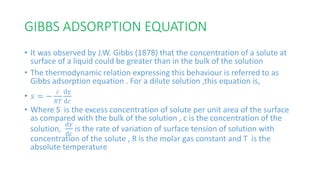
• It was observed by J.W. Gibbs (1878) that the concentration of a solute at
surface of a liquid could be greater than in the bulk of the solution
• The thermodynamic relation expressing this behaviour is referred to as
Gibbs adsorption equation . For a dilute solution ,this equation is,
• 𝑠 = −
𝑐
𝑅𝑇
ⅆ𝛾
ⅆ𝑐
• Where S is the excess concentration of solute per unit area of the surface
as compared with the bulk of the solution , c is the concentration of the
solution,
ⅆ𝛾
ⅆ𝑐
is the rate of variation of surface tension of solution with
concentration of the solute , R is the molar gas constant and T is the
absolute temperature
STRUCTURE OF SURFACTANTS AND CMC
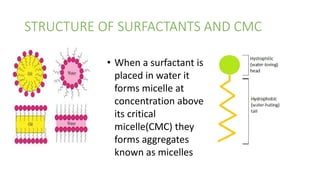
• When a surfactant is
placed in water it
forms micelle at
concentration above
its critical
micelle(CMC) they
forms aggregates
known as micelles
THANK YOU

SURFACTANTS.pptx

  • 1.
    SURFACTANTS BY : PRANAVDALVI RUDRANSHI OM PATIL
  • 2.
    SURFACTANTS  Surface-active agents Amphiphilic in water  Reduces surface tension of water  e.g. :stearic acid CH3-(CH2)16-COOH
  • 3.
    GIBBS ADSORPTION EQUATION •It was observed by J.W. Gibbs (1878) that the concentration of a solute at surface of a liquid could be greater than in the bulk of the solution • The thermodynamic relation expressing this behaviour is referred to as Gibbs adsorption equation . For a dilute solution ,this equation is, • 𝑠 = − 𝑐 𝑅𝑇 ⅆ𝛾 ⅆ𝑐 • Where S is the excess concentration of solute per unit area of the surface as compared with the bulk of the solution , c is the concentration of the solution, ⅆ𝛾 ⅆ𝑐 is the rate of variation of surface tension of solution with concentration of the solute , R is the molar gas constant and T is the absolute temperature
  • 4.
    STRUCTURE OF SURFACTANTSAND CMC • When a surfactant is placed in water it forms micelle at concentration above its critical micelle(CMC) they forms aggregates known as micelles
  • 5.