TATA MOTORS
Supply chain and
operations management
This Photo by Unknown Author is licensed under CC BY-SA-NC
Corporate strategy
• Focus on New Product Development:
Innovation-driven approach to introduce new
models and technologies.
• Expanding International Business: Strategic
global expansion to tap into emerging markets.
• Mitigating Cyclicality: Diversifying product lines
to balance market fluctuations.
• Customer Focus: Enhancing customer satisfaction
through personalized services and products.
• Organization Efficiency & Cost Management:
Streamlining operations to reduce costs and
improve efficiency.
Operational
Strategy
Sustainability & Innovation: Commitment to achieving
net zero GHG emissions by 2040 for PV and 2045 for CV.
Profitable Growth: Aiming for debt-free status in India
by FY25; expanding non-vehicular businesses.
Market Leadership: Dominance in the EV segment
and continued growth in emerging markets.
Operational Efficiency: Building supply chain
resilience, integrating AI/ML, and managing costs.
Customer-Centric Approach: Innovating products and
services with a focus on safety, reliability, and brand
strength.
Supply Chain
•Supplier Management
Tiered supplier system with quality improvement programs
•Manufacturing
Multiple global plants utilizing JIT and traditional approaches
•Inventory Management
Hybrid make-to-stock/make-to-order with advanced forecasting
•Global Operations
Presence in 175+ countries, balancing local and global sourcing
•Technology and Innovation
Implementing blockchain, IoT, and 3D printing solutions
•Sustainability
Focus on greening supply chain and reducing carbon footprint
•Risk Management
Strategies to mitigate disruptions and maintain alternative sources
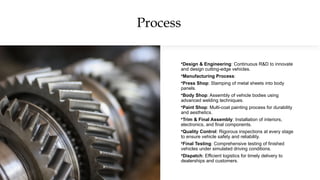
Process
•Design & Engineering: Continuous R&D to innovate
and design cutting-edge vehicles.
•Manufacturing Process:
•Press Shop: Stamping of metal sheets into body
panels.
•Body Shop: Assembly of vehicle bodies using
advanced welding techniques.
•Paint Shop: Multi-coat painting process for durability
and aesthetics.
•Trim & Final Assembly: Installation of interiors,
electronics, and final components.
•Quality Control: Rigorous inspections at every stage
to ensure vehicle safety and reliability.
•Final Testing: Comprehensive testing of finished
vehicles under simulated driving conditions.
•Dispatch: Efficient logistics for timely delivery to
dealerships and customers.
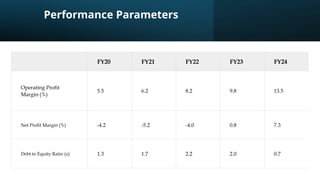
Performance Parameters
FY20 FY21 FY22 FY23 FY24
Operating Profit
Margin (%)
5.5 6.2 8.2 9.8 13.5
Net Profit Margin (%) -4.2 -5.2 -4.0 0.8 7.3
Debt to Equity Ratio (x) 1.3 1.7 2.2 2.0 0.7
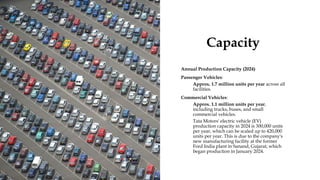
Capacity
Annual Production Capacity (2024)
Passenger Vehicles:
Approx. 1.7 million units per year across all
facilities.
Commercial Vehicles:
Approx. 1.1 million units per year,
including trucks, buses, and small
commercial vehicles.
Tata Motors' electric vehicle (EV)
production capacity in 2024 is 300,000 units
per year, which can be scaled up to 420,000
units per year. This is due to the company's
new manufacturing facility at the former
Ford India plant in Sanand, Gujarat, which
began production in January 2024.

Suppy chain management ppt for optimizing operations

  • 1.
    TATA MOTORS Supply chainand operations management This Photo by Unknown Author is licensed under CC BY-SA-NC
  • 2.
    Corporate strategy • Focuson New Product Development: Innovation-driven approach to introduce new models and technologies. • Expanding International Business: Strategic global expansion to tap into emerging markets. • Mitigating Cyclicality: Diversifying product lines to balance market fluctuations. • Customer Focus: Enhancing customer satisfaction through personalized services and products. • Organization Efficiency & Cost Management: Streamlining operations to reduce costs and improve efficiency.
  • 3.
    Operational Strategy Sustainability & Innovation:Commitment to achieving net zero GHG emissions by 2040 for PV and 2045 for CV. Profitable Growth: Aiming for debt-free status in India by FY25; expanding non-vehicular businesses. Market Leadership: Dominance in the EV segment and continued growth in emerging markets. Operational Efficiency: Building supply chain resilience, integrating AI/ML, and managing costs. Customer-Centric Approach: Innovating products and services with a focus on safety, reliability, and brand strength.
  • 4.
    Supply Chain •Supplier Management Tieredsupplier system with quality improvement programs •Manufacturing Multiple global plants utilizing JIT and traditional approaches •Inventory Management Hybrid make-to-stock/make-to-order with advanced forecasting •Global Operations Presence in 175+ countries, balancing local and global sourcing •Technology and Innovation Implementing blockchain, IoT, and 3D printing solutions •Sustainability Focus on greening supply chain and reducing carbon footprint •Risk Management Strategies to mitigate disruptions and maintain alternative sources
  • 5.
    Process •Design & Engineering:Continuous R&D to innovate and design cutting-edge vehicles. •Manufacturing Process: •Press Shop: Stamping of metal sheets into body panels. •Body Shop: Assembly of vehicle bodies using advanced welding techniques. •Paint Shop: Multi-coat painting process for durability and aesthetics. •Trim & Final Assembly: Installation of interiors, electronics, and final components. •Quality Control: Rigorous inspections at every stage to ensure vehicle safety and reliability. •Final Testing: Comprehensive testing of finished vehicles under simulated driving conditions. •Dispatch: Efficient logistics for timely delivery to dealerships and customers.
  • 6.
    Performance Parameters FY20 FY21FY22 FY23 FY24 Operating Profit Margin (%) 5.5 6.2 8.2 9.8 13.5 Net Profit Margin (%) -4.2 -5.2 -4.0 0.8 7.3 Debt to Equity Ratio (x) 1.3 1.7 2.2 2.0 0.7
  • 7.
    Capacity Annual Production Capacity(2024) Passenger Vehicles: Approx. 1.7 million units per year across all facilities. Commercial Vehicles: Approx. 1.1 million units per year, including trucks, buses, and small commercial vehicles. Tata Motors' electric vehicle (EV) production capacity in 2024 is 300,000 units per year, which can be scaled up to 420,000 units per year. This is due to the company's new manufacturing facility at the former Ford India plant in Sanand, Gujarat, which began production in January 2024.