CHAPTER 2
CUSTOMER SERVICE AND SATISFACTION
COPYRIGHT © 2020 MCGRAW-HILL.ALL RIGHTS RESERVED. NO REPRODUCTION OR DISTRIBUTION WITHOUTTHE PRIORWRITTEN CONSENT OF MCGRAW-HILL.
INTRODUCTION
 Are customer service and customer satisfaction the same thing?
 No! Customer service is created by logistics activities and is a
component of customer satisfaction. Customer satisfaction is a
more expansive term encompassing all aspects of the customer
interface.
 Customer satisfaction is directly related to the marketing
concept, which consists of customer satisfaction integrated
effort, and long-term profitability.
COPYRIGHT © 2020 MCGRAW-HILL.ALL RIGHTS RESERVED. NO REPRODUCTION OR DISTRIBUTION WITHOUTTHE PRIORWRITTEN CONSENT OF MCGRAW-HILL. 2
DEFINITION OF CUSTOMER SERVICE
CUSTOMER SERVICE
 Activities between the buyer and seller that enhance or facilitate the sale
or use of the seller’s products or services [http://www.cscmp.org].
 Customer service is the act of taking care of the customer’s needs by
providing and delivering professional, helpful, high-quality service and
assistance before, during, and after the customer’s requirements are met
[https://study.com/academy/lesson/what-is -customer-service-definition-
types-role-in-marketing.html].
COPYRIGHT © 2020 MCGRAW-HILL.ALL RIGHTS RESERVED. NO REPRODUCTION OR DISTRIBUTION WITHOUTTHE PRIORWRITTEN CONSENT OF MCGRAW-HILL. 3
CUSTOMER SERVICE AND MARKETING EXCHANGES
 Pre-transaction elements: all service aspects that must be
completed prior to any transaction taking place
 Transaction elements: service aspects that occur during
the transaction
 Post-transaction elements: all service aspects that must
occur after a transaction or sales has occurred
COPYRIGHT © 2020 MCGRAW-HILL.ALL RIGHTS RESERVED. NO REPRODUCTION OR DISTRIBUTION WITHOUTTHE PRIORWRITTEN CONSENT OF MCGRAW-HILL. 4
ELEMENTS OF CUSTOMER SERVICE
COPYRIGHT © 2020 MCGRAW-HILL.ALL RIGHTS RESERVED. NO REPRODUCTION OR DISTRIBUTION WITHOUTTHE PRIORWRITTEN CONSENT OF MCGRAW-HILL. 5
THREE COMPONENTS OF CUSTOMER SATISFACTION
 Activity or process: activities and processes that must be managed
such as product delivery, reverse logistics, order processing, sourcing
and procurement
 Performance measures: metrics that measure specific aspects of
customer satisfaction (e.g., market share percentage, on-time delivery,
net profit margins)
 Corporate philosophy: incorporates the first two perspectives and is
a philosophy that treats customer satisfaction as an integral part of a
firm’s total supply chain activities
COPYRIGHT © 2020 MCGRAW-HILL.ALL RIGHTS RESERVED. NO REPRODUCTION OR DISTRIBUTION WITHOUTTHE PRIORWRITTEN CONSENT OF MCGRAW-HILL. 6
DEFINITION OF CUSTOMER SATISFACTION
CUSTOMER SATISFACTION
 Customer satisfaction measures how well the expectations of a customer concerning
a product or service provided by your company have been met [https://study.com
/academy/lesson/what-is-customer-satisfaction-definition-examples-quiz.html].
 The degree of satisfaction provided by the goods or services of a company as
measured by the number of repeat customers [http://www.businessdictionary.com
/definition/customer-satisfaction.html].
 Customer satisfaction indicates the fulfillment that customers derive from doing
business with a firm. In other words, it’s how happy the customers are with their
transaction and overall experience with the company
[https://www.myaccountingcourse.com /accounting-dictionary/customer-satisfaction].
COPYRIGHT © 2020 MCGRAW-HILL.ALL RIGHTS RESERVED. NO REPRODUCTION OR DISTRIBUTION WITHOUTTHE PRIORWRITTEN CONSENT OF MCGRAW-HILL. 7
THE IMPORTANCE OF CONSISTENCY
 Customers require consistent service and quality
 Customers can plan when service is consistent; it is more
difficult to plan when service is inconsistent
 A major objective of supply chain management is to provide
certainty to customers
 While consistency and speed are essential to achieving
customer satisfaction, consistency is much more important
than speed
COPYRIGHT © 2020 MCGRAW-HILL.ALL RIGHTS RESERVED. NO REPRODUCTION OR DISTRIBUTION WITHOUTTHE PRIORWRITTEN CONSENT OF MCGRAW-HILL. 8
CUSTOMER SATISFACTION AND THE SCOR MODEL
PLAN—DEMAND/SUPPLY PLANNING AND MANAGEMENT
 Balance human and physical resources of the organization and supply
chain with customer service requirements and establish/communicate
customer satisfaction plans and strategies for the whole supply chain.
 Manage business rules, supply chain performance, data collection,
inventory, capital assets, transportation, planning configuration, and
regulatory requirements and compliance that have a direct influence on
the delivery of various service components to customers.
 Align customer service and satisfaction strategies with the overall
financial plan of the organization.
COPYRIGHT © 2020 MCGRAW-HILL.ALL RIGHTS RESERVED. NO REPRODUCTION OR DISTRIBUTION WITHOUTTHE PRIORWRITTEN CONSENT OF MCGRAW-HILL. 9
CUSTOMER SATISFACTION AND THE SCOR MODEL
SOURCE—SOURCING STOCKED, MAKE-TO-ORDER,AND ENGINEER-TO-ORDER PRODUCT
 Schedule deliveries; receive, verify, and transfer product; and authorize
supplier payments to optimize service levels.
 Identify and select supply sources that are capable of providing
consistently high levels of customer service.
 Manage business rules, assess supplier performance, and maintain data on
customer service and satisfaction attributes.
 Manage inventory, capital assets, incoming product, supplier network,
import/export requirements, and supplier agreements that have a direct
influence on the delivery of various service components to customers.
COPYRIGHT © 2020 MCGRAW-HILL.ALL RIGHTS RESERVED. NO REPRODUCTION OR DISTRIBUTION WITHOUTTHE PRIORWRITTEN CONSENT OF MCGRAW-HILL. 10
CUSTOMER SATISFACTION AND THE SCOR MODEL
MAKE—MAKE-TO-STOCK, MAKE-TO-ORDER,AND ENGINEER-TO-ORDER PRODUCTION
 Schedule production activities, issue product, produce and test,
package, stage product, and release product to deliver so that
customer service requirements are met.
 Manage rules, performance, data, in-process products (WIP),
equipment and facilities, transportation, production network,
and regulatory compliance for production that have a direct
influence on the delivery of various service components to
customers.
COPYRIGHT © 2020 MCGRAW-HILL.ALL RIGHTS RESERVED. NO REPRODUCTION OR DISTRIBUTION WITHOUTTHE PRIORWRITTEN CONSENT OF MCGRAW-HILL. 11
CUSTOMER SATISFACTION AND THE SCOR MODEL
DELIVER—ORDER,WAREHOUSE,TRANSPORTATION,AND INSTALLATION MANAGEMENT
 Carry out all order management steps from processing customer inquiries and
quotes to routing shipments and selecting carriers.
 Optimize warehouse management from receiving and picking product to load and
ship product.
 Receive and verify product at customer site and install, if necessary.
 Invoice customer accurately and in a timely fashion.
 Manage DELIVER business rules, performance, information, finished product
inventories, capital assets, transportation, product life cycle, and import/export
requirements that have a direct influence on the delivery of various service
components to customers.
COPYRIGHT © 2020 MCGRAW-HILL.ALL RIGHTS RESERVED. NO REPRODUCTION OR DISTRIBUTION WITHOUTTHE PRIORWRITTEN CONSENT OF MCGRAW-HILL. 12
CUSTOMER SATISFACTION AND THE SCOR MODEL
RETURN—RETURN OF RAW MATERIALS AND RECEIPT OF RETURNS OF FINISHED GOODS
 All Return Defective Product steps from source—identify product condition, disposition of product, request
product return authorization, schedule product shipment, and return defective product—and deliver—
authorized product return, schedule return receipts, receive product, and transfer effective product; this
should be a transparent process, one that is understood by and visible to all customers.
 All Return Maintenance, Repair, and Overhaul product steps from source—identify product condition,
disposition of product, request product return authorization, schedule product shipment, and return MRO
product—and deliver—authorize product return, schedule return receipt, receive product, and transfer MRO
product.
 All Return Excess Product steps from source—identify product condition, disposition of product, request
product return authorization, schedule product shipment, and return excess product—and deliver—authorize
product return, schedule return receipt, receive product, and transfer excess product; to be completed in a
timely manner.
 Manage Return business rules, performance, data collection, return inventory, capital assets, transportation,
network configuration, and regulatory requirements and compliance that have a direct influence on the
delivery of various service components to customers.
COPYRIGHT © 2020 MCGRAW-HILL.ALL RIGHTS RESERVED. NO REPRODUCTION OR DISTRIBUTION WITHOUTTHE PRIORWRITTEN CONSENT OF MCGRAW-HILL. 13
MEASURES AND METRICS
 The management adage is correct: You can’t manage what
you don’t measure.
 Companies must have defined metrics in order to determine if
service and satisfaction goals and objectives are being met.
 The most important metrics are referred to as key
performance indicators (KPIs). There are usually less than 20
KPIs that are important.
COPYRIGHT © 2020 MCGRAW-HILL.ALL RIGHTS RESERVED. NO REPRODUCTION OR DISTRIBUTION WITHOUTTHE PRIORWRITTEN CONSENT OF MCGRAW-HILL. 14
THE PERFECT ORDER
 The optimization of customer satisfaction through supply chain
management is referred to as the perfect order
 A perfect order meets all of the following conditions:
 At the right time (100% on-time delivery)
 In the right quantity (100% fill rate)
 In the right condition and packaging (100% quality related to
fulfillment)
 With the right documentation (increasingly electronic)
COPYRIGHT © 2020 MCGRAW-HILL.ALL RIGHTS RESERVED. NO REPRODUCTION OR DISTRIBUTION WITHOUTTHE PRIORWRITTEN CONSENT OF MCGRAW-HILL. 15
STRATEGIC PROFIT MODEL
 Developed by the DuPont Company
 Return on net worth (RONW) is the most important
financial factor and is a measure of the return on
shareholders’ investment plus retained earnings
 RONW is impacted by three major factors:
 Net profit
 Asset turnover
 Financial leverage
COPYRIGHT © 2020 MCGRAW-HILL.ALL RIGHTS RESERVED. NO REPRODUCTION OR DISTRIBUTION WITHOUTTHE PRIORWRITTEN CONSENT OF MCGRAW-HILL. 16
STRATEGIC PROFIT MODEL
COPYRIGHT © 2020 MCGRAW-HILL.ALL RIGHTS RESERVED. NO REPRODUCTION OR DISTRIBUTION WITHOUTTHE PRIORWRITTEN CONSENT OF MCGRAW-HILL. 17
BALANCED SCORECARD
 The Balanced Scorecard consists of four components, only one of which is
financial:
 Financial performance: traditional financial measures such as ROI, ROA, cost
reduction, asset utilization, and productivity levels
 Internal business process: focuses on company metrics such as waste reduction,
product quality, and order cycle time variability
 Customer service: measures that focus on customer requirements and
satisfaction such as order response time, customer retention, customer
profitability, and customer satisfaction ratings
 Education and learning: measures concerned with employees, systems and
procedures
COPYRIGHT © 2020 MCGRAW-HILL.ALL RIGHTS RESERVED. NO REPRODUCTION OR DISTRIBUTION WITHOUTTHE PRIORWRITTEN CONSENT OF MCGRAW-HILL. 18
WHY DO COMPANIES LOSE CUSTOMERS?
 The Disconnect:
 Customers say it is primarily due to poor customer service
 Companies say it is primarily due to price and not being the
lowest-cost provider
 Knowing which one is correct depends on the company
having the right data!
COPYRIGHT © 2020 MCGRAW-HILL.ALL RIGHTS RESERVED. NO REPRODUCTION OR DISTRIBUTION WITHOUTTHE PRIORWRITTEN CONSENT OF MCGRAW-HILL. 19
DATAVERSUS INFORMATION
Non-Metric Data
 Nominal
 Ordinal
Metric Data
 Interval
 Ratio
Information is data that are useful
COPYRIGHT © 2020 MCGRAW-HILL.ALL RIGHTS RESERVED. NO REPRODUCTION OR DISTRIBUTION WITHOUTTHE PRIORWRITTEN CONSENT OF MCGRAW-HILL. 20
PRODUCT STOCK-OUTS
 Most of the time when a customer experiences a
product stock-out, it is due to a customer service failure
 Collaborative planning, forecasting and replenishment
(CPFR) software is used by companies to optimize
customer service
 Knowing how customers will behave when experiencing
a product stock-out is important
COPYRIGHT © 2020 MCGRAW-HILL.ALL RIGHTS RESERVED. NO REPRODUCTION OR DISTRIBUTION WITHOUTTHE PRIORWRITTEN CONSENT OF MCGRAW-HILL. 21
COST-SERVICE TRADE-OFFS
 Activity-based costing can be useful in in capturing the actual costs
related to serving customers
 Cost-service trade-offs can be of two types: within cost centers; and
between cost centers
 Steps in implementing cost-service trade-offs:
 Establish distinct supply chain activity cost centers
 Allocate costs to those centers
 Analyze cost and service variations from alternative volume projections
and/or structural alternatives
COPYRIGHT © 2020 MCGRAW-HILL.ALL RIGHTS RESERVED. NO REPRODUCTION OR DISTRIBUTION WITHOUTTHE PRIORWRITTEN CONSENT OF MCGRAW-HILL. 22
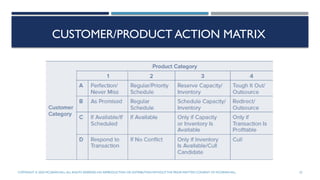
CUSTOMER/PRODUCT ACTION MATRIX
COPYRIGHT © 2020 MCGRAW-HILL.ALL RIGHTS RESERVED. NO REPRODUCTION OR DISTRIBUTION WITHOUTTHE PRIORWRITTEN CONSENT OF MCGRAW-HILL. 23
GAP ANALYSIS IN CUSTOMER SATISFACTION
 Exceeding the service requirements of customers can result in mis-
allocating resources on the wrong things and lower the ROI
associated with various satisfaction strategies.
 Underperforming on customer service requirements results in
unhappy customers and can provide competitors with an
opportunity to take those customers away from your firm.
 Matching customer requirements is the optimal approach to
satisfying customers.
COPYRIGHT © 2020 MCGRAW-HILL.ALL RIGHTS RESERVED. NO REPRODUCTION OR DISTRIBUTION WITHOUTTHE PRIORWRITTEN CONSENT OF MCGRAW-HILL. 24
CUSTOMER RELATIONSHIP MANAGEMENT (CRM)
 CRM is an approach to managing customer relationships and
serving customers using various types of information systems
technology.
 CRM can be applied to organizations of any size or type.
COPYRIGHT © 2020 MCGRAW-HILL.ALL RIGHTS RESERVED. NO REPRODUCTION OR DISTRIBUTION WITHOUTTHE PRIORWRITTEN CONSENT OF MCGRAW-HILL. 25

supply chain management chapter Chapter02.pptx

  • 1.
    CHAPTER 2 CUSTOMER SERVICEAND SATISFACTION COPYRIGHT © 2020 MCGRAW-HILL.ALL RIGHTS RESERVED. NO REPRODUCTION OR DISTRIBUTION WITHOUTTHE PRIORWRITTEN CONSENT OF MCGRAW-HILL.
  • 2.
    INTRODUCTION  Are customerservice and customer satisfaction the same thing?  No! Customer service is created by logistics activities and is a component of customer satisfaction. Customer satisfaction is a more expansive term encompassing all aspects of the customer interface.  Customer satisfaction is directly related to the marketing concept, which consists of customer satisfaction integrated effort, and long-term profitability. COPYRIGHT © 2020 MCGRAW-HILL.ALL RIGHTS RESERVED. NO REPRODUCTION OR DISTRIBUTION WITHOUTTHE PRIORWRITTEN CONSENT OF MCGRAW-HILL. 2
  • 3.
    DEFINITION OF CUSTOMERSERVICE CUSTOMER SERVICE  Activities between the buyer and seller that enhance or facilitate the sale or use of the seller’s products or services [http://www.cscmp.org].  Customer service is the act of taking care of the customer’s needs by providing and delivering professional, helpful, high-quality service and assistance before, during, and after the customer’s requirements are met [https://study.com/academy/lesson/what-is -customer-service-definition- types-role-in-marketing.html]. COPYRIGHT © 2020 MCGRAW-HILL.ALL RIGHTS RESERVED. NO REPRODUCTION OR DISTRIBUTION WITHOUTTHE PRIORWRITTEN CONSENT OF MCGRAW-HILL. 3
  • 4.
    CUSTOMER SERVICE ANDMARKETING EXCHANGES  Pre-transaction elements: all service aspects that must be completed prior to any transaction taking place  Transaction elements: service aspects that occur during the transaction  Post-transaction elements: all service aspects that must occur after a transaction or sales has occurred COPYRIGHT © 2020 MCGRAW-HILL.ALL RIGHTS RESERVED. NO REPRODUCTION OR DISTRIBUTION WITHOUTTHE PRIORWRITTEN CONSENT OF MCGRAW-HILL. 4
  • 5.
    ELEMENTS OF CUSTOMERSERVICE COPYRIGHT © 2020 MCGRAW-HILL.ALL RIGHTS RESERVED. NO REPRODUCTION OR DISTRIBUTION WITHOUTTHE PRIORWRITTEN CONSENT OF MCGRAW-HILL. 5
  • 6.
    THREE COMPONENTS OFCUSTOMER SATISFACTION  Activity or process: activities and processes that must be managed such as product delivery, reverse logistics, order processing, sourcing and procurement  Performance measures: metrics that measure specific aspects of customer satisfaction (e.g., market share percentage, on-time delivery, net profit margins)  Corporate philosophy: incorporates the first two perspectives and is a philosophy that treats customer satisfaction as an integral part of a firm’s total supply chain activities COPYRIGHT © 2020 MCGRAW-HILL.ALL RIGHTS RESERVED. NO REPRODUCTION OR DISTRIBUTION WITHOUTTHE PRIORWRITTEN CONSENT OF MCGRAW-HILL. 6
  • 7.
    DEFINITION OF CUSTOMERSATISFACTION CUSTOMER SATISFACTION  Customer satisfaction measures how well the expectations of a customer concerning a product or service provided by your company have been met [https://study.com /academy/lesson/what-is-customer-satisfaction-definition-examples-quiz.html].  The degree of satisfaction provided by the goods or services of a company as measured by the number of repeat customers [http://www.businessdictionary.com /definition/customer-satisfaction.html].  Customer satisfaction indicates the fulfillment that customers derive from doing business with a firm. In other words, it’s how happy the customers are with their transaction and overall experience with the company [https://www.myaccountingcourse.com /accounting-dictionary/customer-satisfaction]. COPYRIGHT © 2020 MCGRAW-HILL.ALL RIGHTS RESERVED. NO REPRODUCTION OR DISTRIBUTION WITHOUTTHE PRIORWRITTEN CONSENT OF MCGRAW-HILL. 7
  • 8.
    THE IMPORTANCE OFCONSISTENCY  Customers require consistent service and quality  Customers can plan when service is consistent; it is more difficult to plan when service is inconsistent  A major objective of supply chain management is to provide certainty to customers  While consistency and speed are essential to achieving customer satisfaction, consistency is much more important than speed COPYRIGHT © 2020 MCGRAW-HILL.ALL RIGHTS RESERVED. NO REPRODUCTION OR DISTRIBUTION WITHOUTTHE PRIORWRITTEN CONSENT OF MCGRAW-HILL. 8
  • 9.
    CUSTOMER SATISFACTION ANDTHE SCOR MODEL PLAN—DEMAND/SUPPLY PLANNING AND MANAGEMENT  Balance human and physical resources of the organization and supply chain with customer service requirements and establish/communicate customer satisfaction plans and strategies for the whole supply chain.  Manage business rules, supply chain performance, data collection, inventory, capital assets, transportation, planning configuration, and regulatory requirements and compliance that have a direct influence on the delivery of various service components to customers.  Align customer service and satisfaction strategies with the overall financial plan of the organization. COPYRIGHT © 2020 MCGRAW-HILL.ALL RIGHTS RESERVED. NO REPRODUCTION OR DISTRIBUTION WITHOUTTHE PRIORWRITTEN CONSENT OF MCGRAW-HILL. 9
  • 10.
    CUSTOMER SATISFACTION ANDTHE SCOR MODEL SOURCE—SOURCING STOCKED, MAKE-TO-ORDER,AND ENGINEER-TO-ORDER PRODUCT  Schedule deliveries; receive, verify, and transfer product; and authorize supplier payments to optimize service levels.  Identify and select supply sources that are capable of providing consistently high levels of customer service.  Manage business rules, assess supplier performance, and maintain data on customer service and satisfaction attributes.  Manage inventory, capital assets, incoming product, supplier network, import/export requirements, and supplier agreements that have a direct influence on the delivery of various service components to customers. COPYRIGHT © 2020 MCGRAW-HILL.ALL RIGHTS RESERVED. NO REPRODUCTION OR DISTRIBUTION WITHOUTTHE PRIORWRITTEN CONSENT OF MCGRAW-HILL. 10
  • 11.
    CUSTOMER SATISFACTION ANDTHE SCOR MODEL MAKE—MAKE-TO-STOCK, MAKE-TO-ORDER,AND ENGINEER-TO-ORDER PRODUCTION  Schedule production activities, issue product, produce and test, package, stage product, and release product to deliver so that customer service requirements are met.  Manage rules, performance, data, in-process products (WIP), equipment and facilities, transportation, production network, and regulatory compliance for production that have a direct influence on the delivery of various service components to customers. COPYRIGHT © 2020 MCGRAW-HILL.ALL RIGHTS RESERVED. NO REPRODUCTION OR DISTRIBUTION WITHOUTTHE PRIORWRITTEN CONSENT OF MCGRAW-HILL. 11
  • 12.
    CUSTOMER SATISFACTION ANDTHE SCOR MODEL DELIVER—ORDER,WAREHOUSE,TRANSPORTATION,AND INSTALLATION MANAGEMENT  Carry out all order management steps from processing customer inquiries and quotes to routing shipments and selecting carriers.  Optimize warehouse management from receiving and picking product to load and ship product.  Receive and verify product at customer site and install, if necessary.  Invoice customer accurately and in a timely fashion.  Manage DELIVER business rules, performance, information, finished product inventories, capital assets, transportation, product life cycle, and import/export requirements that have a direct influence on the delivery of various service components to customers. COPYRIGHT © 2020 MCGRAW-HILL.ALL RIGHTS RESERVED. NO REPRODUCTION OR DISTRIBUTION WITHOUTTHE PRIORWRITTEN CONSENT OF MCGRAW-HILL. 12
  • 13.
    CUSTOMER SATISFACTION ANDTHE SCOR MODEL RETURN—RETURN OF RAW MATERIALS AND RECEIPT OF RETURNS OF FINISHED GOODS  All Return Defective Product steps from source—identify product condition, disposition of product, request product return authorization, schedule product shipment, and return defective product—and deliver— authorized product return, schedule return receipts, receive product, and transfer effective product; this should be a transparent process, one that is understood by and visible to all customers.  All Return Maintenance, Repair, and Overhaul product steps from source—identify product condition, disposition of product, request product return authorization, schedule product shipment, and return MRO product—and deliver—authorize product return, schedule return receipt, receive product, and transfer MRO product.  All Return Excess Product steps from source—identify product condition, disposition of product, request product return authorization, schedule product shipment, and return excess product—and deliver—authorize product return, schedule return receipt, receive product, and transfer excess product; to be completed in a timely manner.  Manage Return business rules, performance, data collection, return inventory, capital assets, transportation, network configuration, and regulatory requirements and compliance that have a direct influence on the delivery of various service components to customers. COPYRIGHT © 2020 MCGRAW-HILL.ALL RIGHTS RESERVED. NO REPRODUCTION OR DISTRIBUTION WITHOUTTHE PRIORWRITTEN CONSENT OF MCGRAW-HILL. 13
  • 14.
    MEASURES AND METRICS The management adage is correct: You can’t manage what you don’t measure.  Companies must have defined metrics in order to determine if service and satisfaction goals and objectives are being met.  The most important metrics are referred to as key performance indicators (KPIs). There are usually less than 20 KPIs that are important. COPYRIGHT © 2020 MCGRAW-HILL.ALL RIGHTS RESERVED. NO REPRODUCTION OR DISTRIBUTION WITHOUTTHE PRIORWRITTEN CONSENT OF MCGRAW-HILL. 14
  • 15.
    THE PERFECT ORDER The optimization of customer satisfaction through supply chain management is referred to as the perfect order  A perfect order meets all of the following conditions:  At the right time (100% on-time delivery)  In the right quantity (100% fill rate)  In the right condition and packaging (100% quality related to fulfillment)  With the right documentation (increasingly electronic) COPYRIGHT © 2020 MCGRAW-HILL.ALL RIGHTS RESERVED. NO REPRODUCTION OR DISTRIBUTION WITHOUTTHE PRIORWRITTEN CONSENT OF MCGRAW-HILL. 15
  • 16.
    STRATEGIC PROFIT MODEL Developed by the DuPont Company  Return on net worth (RONW) is the most important financial factor and is a measure of the return on shareholders’ investment plus retained earnings  RONW is impacted by three major factors:  Net profit  Asset turnover  Financial leverage COPYRIGHT © 2020 MCGRAW-HILL.ALL RIGHTS RESERVED. NO REPRODUCTION OR DISTRIBUTION WITHOUTTHE PRIORWRITTEN CONSENT OF MCGRAW-HILL. 16
  • 17.
    STRATEGIC PROFIT MODEL COPYRIGHT© 2020 MCGRAW-HILL.ALL RIGHTS RESERVED. NO REPRODUCTION OR DISTRIBUTION WITHOUTTHE PRIORWRITTEN CONSENT OF MCGRAW-HILL. 17
  • 18.
    BALANCED SCORECARD  TheBalanced Scorecard consists of four components, only one of which is financial:  Financial performance: traditional financial measures such as ROI, ROA, cost reduction, asset utilization, and productivity levels  Internal business process: focuses on company metrics such as waste reduction, product quality, and order cycle time variability  Customer service: measures that focus on customer requirements and satisfaction such as order response time, customer retention, customer profitability, and customer satisfaction ratings  Education and learning: measures concerned with employees, systems and procedures COPYRIGHT © 2020 MCGRAW-HILL.ALL RIGHTS RESERVED. NO REPRODUCTION OR DISTRIBUTION WITHOUTTHE PRIORWRITTEN CONSENT OF MCGRAW-HILL. 18
  • 19.
    WHY DO COMPANIESLOSE CUSTOMERS?  The Disconnect:  Customers say it is primarily due to poor customer service  Companies say it is primarily due to price and not being the lowest-cost provider  Knowing which one is correct depends on the company having the right data! COPYRIGHT © 2020 MCGRAW-HILL.ALL RIGHTS RESERVED. NO REPRODUCTION OR DISTRIBUTION WITHOUTTHE PRIORWRITTEN CONSENT OF MCGRAW-HILL. 19
  • 20.
    DATAVERSUS INFORMATION Non-Metric Data Nominal  Ordinal Metric Data  Interval  Ratio Information is data that are useful COPYRIGHT © 2020 MCGRAW-HILL.ALL RIGHTS RESERVED. NO REPRODUCTION OR DISTRIBUTION WITHOUTTHE PRIORWRITTEN CONSENT OF MCGRAW-HILL. 20
  • 21.
    PRODUCT STOCK-OUTS  Mostof the time when a customer experiences a product stock-out, it is due to a customer service failure  Collaborative planning, forecasting and replenishment (CPFR) software is used by companies to optimize customer service  Knowing how customers will behave when experiencing a product stock-out is important COPYRIGHT © 2020 MCGRAW-HILL.ALL RIGHTS RESERVED. NO REPRODUCTION OR DISTRIBUTION WITHOUTTHE PRIORWRITTEN CONSENT OF MCGRAW-HILL. 21
  • 22.
    COST-SERVICE TRADE-OFFS  Activity-basedcosting can be useful in in capturing the actual costs related to serving customers  Cost-service trade-offs can be of two types: within cost centers; and between cost centers  Steps in implementing cost-service trade-offs:  Establish distinct supply chain activity cost centers  Allocate costs to those centers  Analyze cost and service variations from alternative volume projections and/or structural alternatives COPYRIGHT © 2020 MCGRAW-HILL.ALL RIGHTS RESERVED. NO REPRODUCTION OR DISTRIBUTION WITHOUTTHE PRIORWRITTEN CONSENT OF MCGRAW-HILL. 22
  • 23.
    CUSTOMER/PRODUCT ACTION MATRIX COPYRIGHT© 2020 MCGRAW-HILL.ALL RIGHTS RESERVED. NO REPRODUCTION OR DISTRIBUTION WITHOUTTHE PRIORWRITTEN CONSENT OF MCGRAW-HILL. 23
  • 24.
    GAP ANALYSIS INCUSTOMER SATISFACTION  Exceeding the service requirements of customers can result in mis- allocating resources on the wrong things and lower the ROI associated with various satisfaction strategies.  Underperforming on customer service requirements results in unhappy customers and can provide competitors with an opportunity to take those customers away from your firm.  Matching customer requirements is the optimal approach to satisfying customers. COPYRIGHT © 2020 MCGRAW-HILL.ALL RIGHTS RESERVED. NO REPRODUCTION OR DISTRIBUTION WITHOUTTHE PRIORWRITTEN CONSENT OF MCGRAW-HILL. 24
  • 25.
    CUSTOMER RELATIONSHIP MANAGEMENT(CRM)  CRM is an approach to managing customer relationships and serving customers using various types of information systems technology.  CRM can be applied to organizations of any size or type. COPYRIGHT © 2020 MCGRAW-HILL.ALL RIGHTS RESERVED. NO REPRODUCTION OR DISTRIBUTION WITHOUTTHE PRIORWRITTEN CONSENT OF MCGRAW-HILL. 25