Supervisory Management 9thEdition Mosley
Solutions Manual download
https://testbankdeal.com/product/supervisory-management-9th-
edition-mosley-solutions-manual/
Visit testbankdeal.com today to download the complete set of
test bank or solution manual
2.
We have selectedsome products that you may be interested in
Click the link to download now or visit testbankdeal.com
for more options!.
Supervisory Management 9th Edition Mosley Test Bank
https://testbankdeal.com/product/supervisory-management-9th-edition-
mosley-test-bank/
Management 9th Edition Daft Solutions Manual
https://testbankdeal.com/product/management-9th-edition-daft-
solutions-manual/
Management 9th Edition Kinicki Solutions Manual
https://testbankdeal.com/product/management-9th-edition-kinicki-
solutions-manual/
Andersons Business Law and the Legal Environment
Comprehensive Volume 22nd Edition Twomey Solutions Manual
https://testbankdeal.com/product/andersons-business-law-and-the-legal-
environment-comprehensive-volume-22nd-edition-twomey-solutions-manual/
3.
Fundamentals of PhysicsExtended 10th Edition Halliday
Test Bank
https://testbankdeal.com/product/fundamentals-of-physics-
extended-10th-edition-halliday-test-bank/
System Dynamics 3rd Edition Palm Solutions Manual
https://testbankdeal.com/product/system-dynamics-3rd-edition-palm-
solutions-manual/
Calculus Early Transcendental Functions 6th Edition Larson
Solutions Manual
https://testbankdeal.com/product/calculus-early-transcendental-
functions-6th-edition-larson-solutions-manual/
Research Design and Methods A Process Approach 10th
Edition Bordens Solutions Manual
https://testbankdeal.com/product/research-design-and-methods-a-
process-approach-10th-edition-bordens-solutions-manual/
Foodservice Management Principles and Practices 12th
Edition Payne Test Bank
https://testbankdeal.com/product/foodservice-management-principles-
and-practices-12th-edition-payne-test-bank/
4.
Dental Materials 2ndEdition Hatrick Test Bank
https://testbankdeal.com/product/dental-materials-2nd-edition-hatrick-
test-bank/
5.
1
Chapter 8
Leadership
After readingand studying this chapter, the student should
be able to:
Describe factors that affect the leadership style
used.
Discuss and explain two frequently used
leadership models.
Determine which leadership style is most
appropriate in different situations.
Contrast heroic supervisors with developmental
supervisors.
Contrast transformational leadership with
transactional leadership.
Discuss and explain the benefits and side effects of
adaptive leadership.
Discuss how to inspire self-confidence, develop
people, and increase productivity.
Explain why emotional intelligence is so important
for effective leadership.
Brief Outline
Leadership: What Is It All About?
Factors Affecting Leadership Style
Two Leadership Models
Tannenbaum and Schmidt’s
Leadership Continuum
Is One Leadership Style Best?
Developmental Leadership
Heroic Managers
Developmental Managers
Transformational and
Transactional Leadership
Transformational Leadership
Transactional Leadership
Adaptive Leadership
Servant Leadership
The Paradox of Servant Leadership
Characteristics of Servant
Leadership
Core Leadership Functions
Emotional Intelligence
The Influence of Emotional
Intelligence at Roadway Express—A
Trucking Company
Learning Objectives
club-like haft isformed of some endogenous wood, and has evidently
been chopped into shape by means of stone tools.
20.
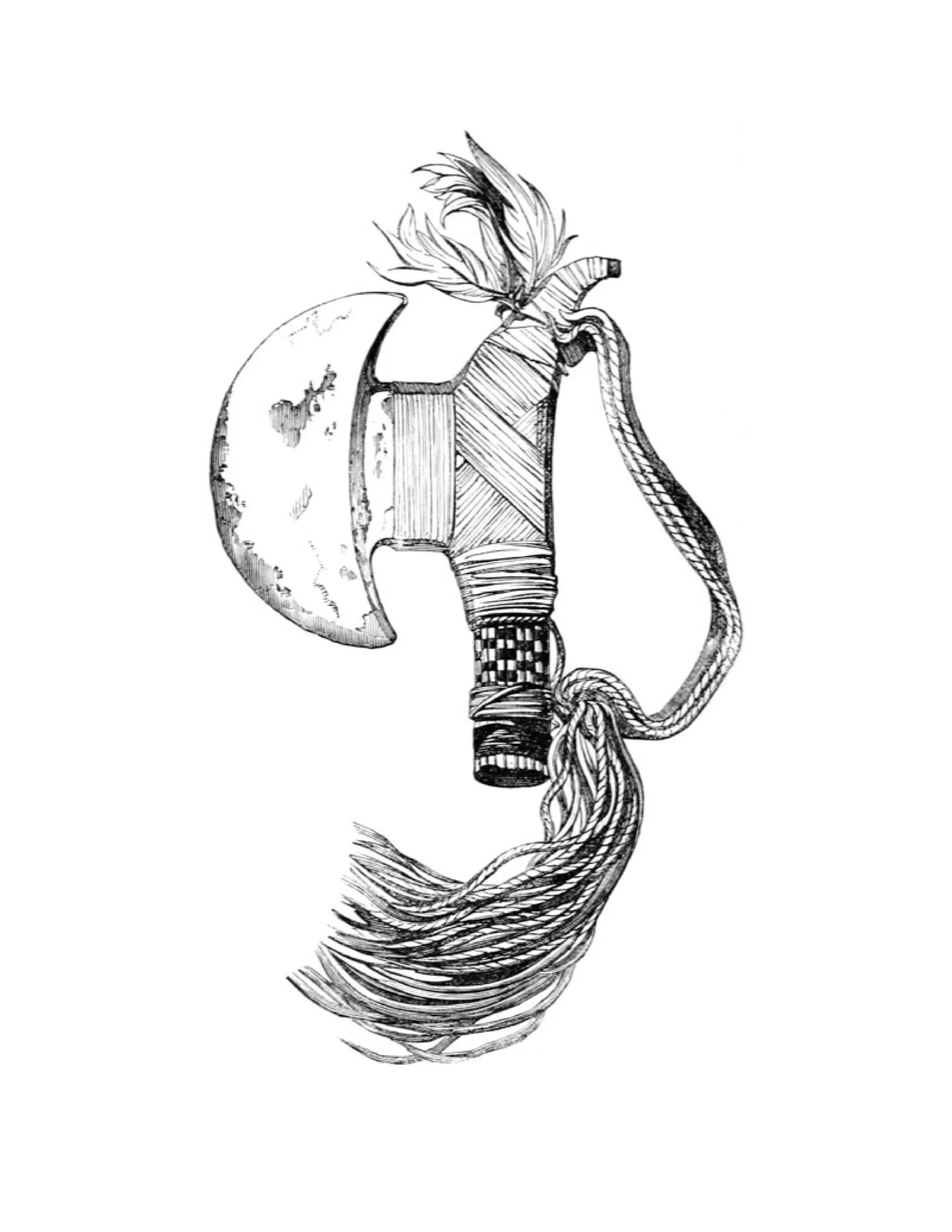
Fig. 95.—War-axe—Gaveoë Indians,Brazil.
In these instances Clavigero’s [525] remark with regard to the copper
{156} or bronze axes of the Mexicans holds good; they are like “those
of modern times, except that we put the handle in an eye of the axe
while they put the axe in an eye of the handle.” A similarly hafted
hatchet with the blade ground is in use among the Botocudo Indians.
In the Island of New Hanover [526] the axe blade is inserted about the
middle of the club-like haft. Some hatchets from the Admiralty
Islands [527] are curiously like those from the Swiss {157} Lake-
dwellings. Excessively long hafts in which the blades are let into a
socket are occasionally in use among the Chamacocos [528] of south-
east Bolivia.
Many stone and metallic axes in use among other modern savages
are hafted in much the same manner by insertion in a socket. In
some instances it would appear as if the hole for receiving the stone
did not extend through the haft, but was merely a shallow depression
—even a notch. Such seems to be the case with a war-axe of the
Gaveoë Indians of Brazil in the British Museum, figured in the
Proceedings of the Society of Antiquaries, [529] and here, by
permission, reproduced, as Fig. 95. Some of their axes have longer
hafts. In the Over Yssel Museum is a Brazilian stone axe with a blade
of this kind, which is said to have been used in an insurrection at
Deventer [530] in 1787.
Fig. 96.—Axe of Montezuma II.
21.
The “securis lapideain sacrificiis Indorum usitata,” engraved by
Aldrovandus, [531] seems to have the blade inserted in a socket
without being tied, but in most axes of the same kind the blade is
secured in its place by a plaited binding artistically interlaced. The
stone axe said to be that of Montezuma II., preserved in the Ambras
Museum at Vienna, is a good example of the kind. [532] I have
engraved it as Fig. 96, from a sketch I made in 1866.
In some cases the whole handle is covered with the binding. Two
such in the Dresden Historical Museum are engraved by Klemm. [533]
Others have been figured by Prof. Giglioli. [534]
Some of the war-axes (called taawisch or tsuskiah) in use among
the natives of Nootka Sound [535] are mounted in this manner, but the
socket end of the shaft is carved into the form of a grotesque human
head, in the mouth of which the stone blade is {158} secured with
cement, as in Fig. 97. In another instance the handle is carved into
the form of a bird [536] and inlaid with mother-of-pearl, or, more
properly speaking, shell of haliotis. The blade of basalt projects from
the breast of the bird, the tail of which forms the handle. In some the
blade goes right through the handle, so as to project equally on both
sides of it, and is sharpened at both ends.
22.
Fig. 97.—Axe—Nootka Sound.
Thesocket in all these handles is usually at some little distance
from their end, but even with this precaution, the wedge-like form of
the celt must have rendered them very liable to split. It was probably
with a view of avoiding this, that the intermediate socket of stag’s
horn, so common in the Lake-dwellings of Switzerland, was adopted.
The stone was firmly bedded in the horn, the end of which was
usually worked into a square form, but slightly tapering, and with a
shoulder all round to prevent its being driven into the wood. In the
annexed woodcut (Fig. 98) is shown one of these sockets with the
hatchet inserted. It was found at Concise, in the Lake of Neuchâtel.
An analogous system for preventing the stone blade from splitting the
23.
Fig. 98.—Axe instag’s-
horn socket—Concise.
1
⁄2
haft was adopted in Burma, Cambodia, {159}
and Eastern India, but the shoulders were
there cut in the stone-blades themselves. One
of the Swiss instruments in its complete form is
shown in Fig. 99, which I have copied from
Keller. [537] It was found at Robenhausen, and
the club-like handle is of ash. Several other
specimens are engraved by the same author
and Professor Desor, [538] and by other more
recent writers.
In some instances the stone was inserted
lengthways [539] into the end of a tine of a
stag’s horn at the part where it had been
severed from the antler, so as to form a sort of
chisel. [540] In other cases the socket was
worked through the tine, and the stone blade
fixed in it after the manner of an axe, though
the handle was too short for the tool to be
used for chopping. Some wooden handles [541] are also but a few
inches long, so that the celts mounted in them must have been used
for cutting by drawing them along the object to be cut.
Fig. 99.—Axe—Robenhausen. 1
⁄1
24.
Such stag’s-horn socketshave occurred, though rarely, in France.
M. Perrault found some in his researches in the Camp de Chassey,
{160} (Saône et Loire). [542] Some seem to have been found at
Vauvray, [543] in making the railway from Paris to Rouen. Others were
discovered in company with arrow-heads, celts, and trimmed flakes of
flint, in the Dolmen, [544] or Allée couverte, of Argenteuil (Seine et
Oise). These are now in the Musée de St. Germain. Others were
found in a cavern on Mont Sargel (Aveyron). [545] They occasionally
occur in Germany. One from Dienheim is in the Central Museum at
Mayence.
Discoveries of these stag’s-horn sockets for stone tools in England
seem to be extremely rare. Mr. Albert Way describes one, of which a
woodcut is given in the Archæological Journal. [546] It is formed of the
horn of the red deer (which is erroneously described as being extinct),
and is said to have been found with human remains and pottery of an
early character at Cockshott Hill, in Wychwood Forest, Oxfordshire. It
seems better adapted for mounting a small celt as a chisel, like that of
bronze found in a barrow at Everley, [547] than for forming part of a
hatchet. Mr. Way [548] cites several cases of the discovery of these
stag’s-horn sockets in France and elsewhere on the continent of
Europe. I may add, by way of caution, that numerous forgeries of
them have been produced at Amiens. In some of the genuine
specimens from the peat of the valley of the Somme, [549] the stone
was fixed in a socket bored in one end of the piece of stag’s horn, and
the shaft was inserted in another hole bored through the horn. M.
Boucher de Perthes describes the handle of one as made of a branch
of oak, burnt at each end.
An example of this method of mounting is given in Fig. 99A. The
original was found at Penhouet, Saint Nazaire sur Loire, [550] in 1877.
The length of the haft is 19 1
⁄2 inches. A fine socket with the blade
still in it, but without the shaft, has been figured by the Baron Joseph
de Baye. [551] It was found in La Marne, in which department funereal
25.
grottoes have beendiscovered, at the entrances of which similar
hafted axes were sculptured.
Fig. 99A.—Penhouet. 1
⁄6
The socket discovered by the late Lord Londesborough in a barrow,
near Scarborough, [552] appears to have been a hammer, {161}
although he describes it as a piece of deer horn, perforated at the
end, and drilled through, and imagined it to have been the handle for
one of the celts found with it, “much in the manner of that in the
museum of M. de Courvale, at his Castle of Pinon, in France,” of which
he sent a drawing to the Archæological Association. A stag’s-horn
socket, with a transverse hole for the haft, and a circular socket bored
in the end, from which the main body of the horn was cut off, was
found in the Thames, near Kew, and is in the possession of Mr.
Thomas Layton, F.S.A. In the circular socket was a portion of a tine of
stag’s horn, so that it seems rather to have been intended for
mounting such tines for use as picks, than for hafting celts.
26.
Fig. 99B.—New Guinea.
Acelt, mounted in a socket of stag’s horn, bored through to receive
the wooden shaft, found in the Lake-dwellings at Concise, and in the
collection of Dr. Clément, has been engraved by Desor; [553] and
another, found near Aerschot, [554] in Belgium, by Le Hon. A hatchet,
mounted in a socket of this kind, is figured by Dupont [555] {162} and
Van Overloop. [556] Some of the stag’s-horn sockets are ornamented
by having patterns engraved upon them. [557]
In New Guinea and Celebes a plan has been adopted of inserting
the stone blade into the end of a tapering piece of wood, which is
securely bound round to prevent its splitting. The small end of this fits
in a hole in the club-like haft. An example is shown in Fig. 99B, [558]
obligingly lent by the Society of Antiquaries of Scotland. By turning
round the pivot an axe is converted into an adze. In some New
Guinea and New Caledonia adzes and axes the blade is let into a
socket at a nearly right angle to the haft, and either forming part of it
or attached to it. Such an adze is shown in Fig. 99C, kindly lent by the
same Society. A similar method of hafting is in use in the
Entrecasteaux Islands. [559]
27.
Fig. 99C.—New GuineaAdze.
Some ingenious suggestions as to the probable method of
mounting stone implements in ancient times have been made by the
Vicomte Lepic. [560] With a polished Danish flint hatchet 8 inches long,
hafted in part of the root of an oak, an oak-tree 8 inches in diameter
was cut down without injury to the blade.
Another method of hafting, adopted by the Swiss Lake-dwellers for
their stone hatchets, is described by Dr. Keller, [561] from whose work
I have copied the annexed woodcut, Fig. 100. {163}
The haft was usually formed of a stem of hazel, “with a root
running from it at right angles. A cleft was then made in this shorter
part, forming a kind of beak in which the celt was fixed with cord and
asphalte.” A woodcut of a handle of the same character, found near
Schraplau, in company with its stone blade, is given by Klemm, [562]
and is here reproduced as Fig. 101. A handle of much the same kind,
consisting of a shaft with a branch at right angles to it, in which was
fixed a flint axe, was found with a skeleton and a wooden shield in a
28.
tumulus near LangEichstätt, in Saxony, [563] and has been engraved
by Lindenschmit. Another is said to have been found at Winterswyk.
Fig. 100.—Axe—Robenhausen. Fig. 101.—Schraplau.
The discovery in the district between the Weser and the Elbe of
several stone hatchets mounted in hafts of wood, stag’s-horn, and
bone, has been recorded by Mr. A. Poppe, [564] but the authenticity of
the hafting seems to me open to question. The compound haft of a
stone axe, said to have been found at Berlin, [565] is also not above all
suspicion. The handles of bronze palstaves, found in the salt mines
near Salzburg, Austria, are forked in the same manner as Figs. 100
and 101. One of them, formerly in the Klemm Collection, is now in the
British Museum.
30.
Fig. 102.—Adze—New Caledonia.
Thesame system of hafting has been in use among the savages in
recent times, as will be seen from the annexed figure of a stone adze
from New Caledonia, [566] Fig. 102, lent to me by the late Mr. Henry
Christy. Another is engraved in the Proceedings of the Society of {164}
Antiquaries of Scotland. [567] Several other varieties of New
Caledonian and Fiji handles have been engraved by M. Chantre. [568]
In some countries, probably in consequence of the difficulty of
procuring forked boughs of trees of the proper kind, the wood which
forms the socket for the blade is bound on at the desired angle to the
end of the wooden handle. An adze of stone from the Caroline
Islands, thus mounted, is engraved in the Comptes Rendus; [569] and
a {165} handle of this kind from North America, but with a small iron
blade, is figured by Klemm. [570]
32.
Fig. 103.—Adze—Clalam Indians.
Weare left in a great degree to conjecture as to the other methods
of mounting stone hatchets and adzes on handles in prehistoric times;
but doubtless some besides those already mentioned were practised.
A very common method among existing savages is to bind the blade
of stone on to the face of a branch at the end of the handle, which in
some cases projects upwards, and in others downwards, and is
inclined at an angle more or less perpendicular to the handle.
Figs. 103 and 104 are kindly lent me by the Society of Antiquaries
of Scotland. [571] The short-handled adze, Fig. 103, is one {166} used
by the Schlalum or Clalam Indians, of the Pacific Coast, to the south
of the Straits of De Fuca and on Puget’s Sound, to hollow out their
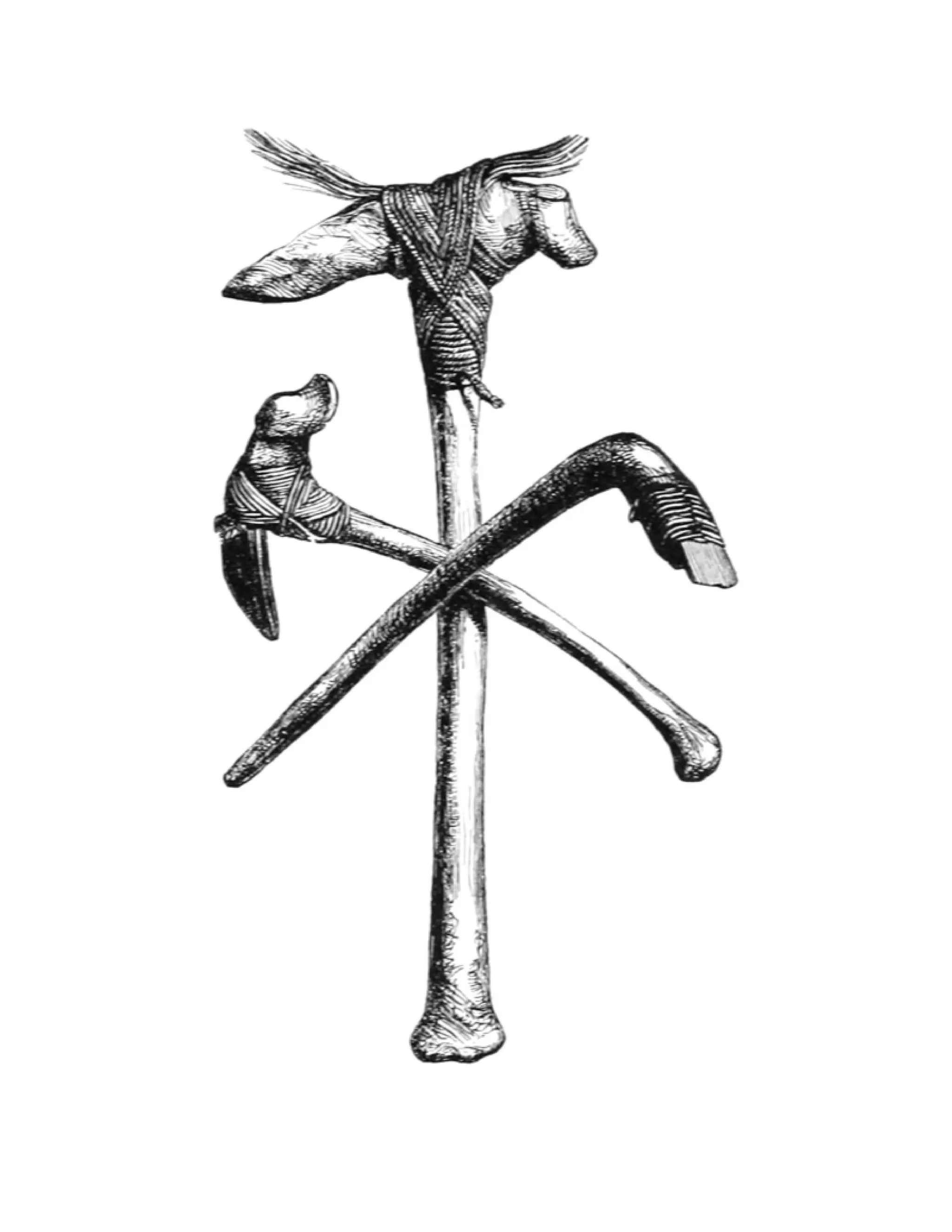
canoes. The group, Fig. 104, exhibits various methods of attachment
of stone adzes to their handles employed by the South-Sea Islanders.
34.
Fig. 104.—South-Sea IslandAxes.
The Australians occasionally mounted their tomahawks in much the
same manner as that shown in the central figure. An example has
been engraved by the Rev. J. G. Wood. [572] The right-hand figure
probably represents an adze from the Savage Islands. Some Brazilian
and Aleutian Island adzes are mounted in much the same fashion.
The jade adzes of the New Zealanders are hafted in a somewhat
similar manner; but the hafts are often beautifully carved and inlaid. A
fine example is in the Blackmore Museum, and a handle in the Christy
Collection. I have also a haft with the original {167} jade blade, but
the binding has been taken off. One of them is engraved by the Rev.
J. G. Wood. [573] The axe to the left, in Fig. 104, as well as that in the
centre, is from Tahiti. The axes from Mangaia, so common in
collections, exhibit great skill in the mounting and in the carving of
the handles. Some have been engraved by the Rev. J. G. Wood. [574]
A ceremonial stone adze with a very remarkable carved haft from New
Ireland [575] has been figured by Professor Giglioli.
In some instances the ligaments for attaching the stone blade
against the end of the handle pass through a hole towards its end. A
North American adze in the Ethnological Museum, at Copenhagen, is
thus mounted, the cord being apparently of gut.
A similar method of mounting their adzes, by binding them against
the haft, was in use among the Egyptians. [576] Although it is
extremely probable that some of the ancient stone adzes of other
countries may have been mounted in this manner, there have not, so
far as I am aware, been any of the handles of this class discovered. I
have, however, two Swiss celts of Lydian stone, and of rectangular
section, found at Nussdorf and Sipplingen, in the Ueberlinger See, and
on the flatter of the two faces of each, there is a slight hollow worn
away apparently by friction, which was, I think, due to their having
been attached against a handle in this manner. The blade in which the
depression is most evident has lost its edge, seemingly from its
35.
having been brokenin use. I have not up to the present time found
any similarly worn surfaces upon British celts.
Another method of hafting adopted by various savage tribes is that
of winding a flexible branch of wood round the stone, and securing
the two ends of the branch by binding them together in such a
manner as tightly to embrace the blade. A stone axe from Northern
Australia thus hafted, is figured in the Archæologia, [577] whence I
have borrowed the cut, Fig. 105. Another used by natives on the
Murray river [578] has been figured by the Society of Antiquaries of
Scotland. This method of hafting has been mentioned by White, [579]
who describes the binding as being effected by strips {168} of bark,
and in his figure shows the two ends of the stick more firmly bound
together.
Fig. 105.—Axe—Northern Australia.
Another example has been engraved by the Rev. J. G. Wood. [580]
This mode is very similar to that in common use among blacksmiths
for their chisels and swages, which are held by means of a withy
twisted round them, and secured in its place by a ring.
It seems extremely probable that so simple a method may have
been in use in early times in this country, though we have no direct
evidence as to the fact. A “fancy sketch” of a celt in a withy handle
will be found in the Archæologia. [581] It resembles in a singular
36.
manner the actualimplements employed by the Ojibway Indians, [582]
of which there is a specimen in the Christy Collection, engraved by the
Rev. J. G. Wood. [583] Some of the other North American tribes [584]
mounted their hatchets in much the same manner. A hatchet thus
hafted is engraved by Schoolcraft. [585]
In some instances a groove of greater or less depth has been
worked round the axes mounted in this manner, though undoubtedly
British examples are scarce. An axe-hammer of diorite (13 inches),
found near Newburgh, [586] Aberdeenshire, has a groove round it
instead of the usual haft-hole. The blade engraved in the
Archæological Journal [587] and found near Coldstream,
Northumberland, is probably of Carib origin, like others which have
also been supposed to have been British. Another from the Liverpool
{169} Docks is mentioned by Mr. H. Ecroyd Smith. [588] In the British
Museum are two such axes, and some other stone implements, found
near Alexandria, but which probably are Carib, as would also seem to
be those in the Museum of Douai, [589] on which are sculptured
representations of the human face.
Stone axe-heads with a groove round their middle, for receiving a
handle, have been found in Denmark, [590] but are of rare occurrence.
The form has been found in the salt-mines of Koulpe, [591] Caucasus,
and in Russian Armenia. The large stone mauls found so commonly in
the neighbourhood of ancient copper-mines, in this and many other
countries in both hemispheres, were hafted much in the same manner
as the Australian axe.
In other cases axe-heads are mounted by being fixed in a cleft stick
for a handle, the stick being then lashed round so as to secure the
stone and retain it in its place. This method was employed by some of
the North American Indians, [592] and the aborigines in the colony of
Victoria. [593] In the Blackmore Museum is a stone axe thus mounted,
from British Guiana. There is a small hole through the butt which is
carved into a series of small spikes. Others from Guiana [594] have
notches at the sides to receive a cord which bound the haft in a
37.
groove running alongthe butt-end. The same form has been found in
Surinam. [595] An Egyptian [596] stone hammer is mounted in much
the same way. The notches practically produce lugs at the butt-end of
the blade. I have an iron hatchet, edged with steel, brought home by
the late Mr. David Forbes, F.R.S., from among the Aymara Indians of
Bolivia, which is mounted in a stick cleft at the end. The blade is
-shaped at the butt, and is tied in such a manner, by means of a
strip of leather, that the arms of the T rest on two of the coils, so as
to prevent its falling out, while other two coils pass over the butt and
prevent its being driven back, and the whole binds the two sides of
the cleft stick together so as tightly to grasp the blade and prevent
lateral or endways motion. The ancient Egyptian bronze hatchets
were merely placed in a groove and bound to the handle by the lugs,
and sometimes by the cord being passed through holes in the blade.
The same shape is {170} found in flint hatchets ascribed by Professor
Flinders Petrie [597] to the twelfth dynasty. What may be a stone
hatchet mounted occurs in a painting at Medum. [598]
Fig. 106.—Hatchet—Western Australia.
Another Australian method of mounting implies the possession of
some resinous material susceptible of being softened by heat, and
again becoming hard and tough when cold. This mode is exhibited in
Fig. 106, which represents a rude instrument from Western Australia,
now in my collection, engraved in the Archæologia. [599] It is
38.
hammer-like at oneend, axe-like at the other, and is formed of either
one or two roughly chipped pieces of basalt-like stone entirely
unground, and secured in a mass of resinous gum, in which the
handle is inserted. In most implements of this kind there appear to be
two separate stones used to form the double blade, and these are
sometimes of different kinds of rock. It would seem that the shaft,
either cleft or uncleft, passed between them, and that the stones,
when bound with string to hold them in their places, were further
secured with a mass of the gum of the Xanthorrhæa or grass-
tree. [600]
Such a method of hafting cannot, I think, have been in general use
in this country, for want of the necessary cementing material, though,
from discoveries made in Scandinavia, it would appear that a resinous
pitch was in common use for fixing bronze implements to their
handles; so that the practice may also have applied to those of stone.
In the Swiss Lake-dwellings, bitumen was used as a cement for
attaching stone to wood. In the case of the axes of the Indians on the
River Napo, [601] Ecuador, the binding of {171} the blades, which are
formed with lugs like those of Guiana, is covered with a thick coating
formed of bees-wax and mastic.
Besides those that were hafted as axes or adzes, it seems probable
that not a few of the implements known as celts may have been for
use in the hand as cutting tools, either mounted in short handles or
unmounted. There can be but little doubt that the tools, Fig. 83 and
83A, were thus used in the hand, as also the implement with a
depression on each face (Fig. 87), and that with the notches at the
side (Fig. 89); and they can hardly have been unique of their kind.
Dr. Lukis, [602] indeed, at one time expressed an opinion that the
stone celt was not intended to be secured “in a handle, but was held
in the hand and applied to particular uses which are not now evident,
but to which neither the hammer nor the hatchet were applicable.”
But in the face of the fact that numerous handles have since been
39.
found, such anopinion is no longer tenable except in a very limited
sense.
Among modern savages we have instances of similar tools being
used in the hand without the intervention of any haft, giving a form
much like that of Fig. 83A, though among the Australians the butt-end
is sometimes enveloped in a mass of resinous matter, so as to form a
knob which fits the hand. According to Prinz Neuwied, [603] the
Botocudos used their stone blades both unmounted in the hand and
hafted as hatchets. The South Australians [604] and Tasmanians [605]
likewise use celts in a similar manner.
There are cases in which the hatchet and haft have been formed
from one piece of stone. Such a one, of chloritic stone, found in a
mound in Tennessee, [606] is in outline like Fig. 92, and has a small
loop for suspension at the end of the handle. Mr. Cursiter, of Kirkwall,
has an instrument of the same kind from Orkney, formed of hard
slate. In extreme length it measures 9 3
⁄4 inches. It cannot, however,
be assigned to a very early date. For a comparison of celts from
different countries Westropp’s “Prehistoric Phases” [607] may be
consulted.
With regard to the uses to which these instruments were applied,
they must have been still more varied than the methods of mounting,
which, as we have seen, adapted them for the purposes of hatchets
and adzes; while, mounted in other ways, or {172} unmounted, they
may have served as wedges, chisels, and knives. The purposes which
similar instruments serve among modern savages must be much the
same as those for which the stone celts found in this country were
employed by our barbarian predecessors. An admirable summary of
the uses to which stone hatchets—the “Toki” of the Maori—are, or
were applied in New Zealand, has been given by Dr. W. Lauder
Lindsay. [608] They were used chiefly for cutting down timber, and for
scooping canoes [609] out of the trunks of forest trees; for dressing
posts for huts; for grubbing up roots, and killing animals for food; for
preparing firewood; for scraping the flesh from the bones when
40.
eating, and forvarious other purposes in the domestic arts. But they
were also employed in times of war, as weapons of offence and
defence, as a supplementary kind of tomahawk.
For all these purposes stone celts must also have been employed in
Britain, and some may even have been used in agriculture. We can
add to the list at least one other service to which they were applied,
that of mining in the chalk in pursuit of flint, as the raw material from
which similar instruments might be fashioned.
41.
CHAPTER VII.
PICKS, CHISELS,GOUGES, ETC.
I now come to several forms of implements which, though ap
prox
i
ma
‐
ting close
ly to those to which the name of celts has been applied, may
perhaps be regarded with some degree of cer
tain
ty as forming a
separate class of tools. Among these, the long narrow form to which,
for want of a better name, that of “Picks” has been given, may be first
described. It is, however, hard to draw a line between them and
chisels.
42.
Fig. 107.—Great Easton.1⁄2 Fig. 108.—Bury St. Edmunds. 1⁄2
An idea of the prevailing form will be gathered from Fig. 107, which represents a
specimen in my own collection found at Great Easton, near Dunmow, Essex, and
given me by Colonel A. J. Copeland, F.S.A. Its surfaces are partially ground,
especially towards the upper end, which appears to have been pointed, though now
somewhat broken. The lower end is chipped to a rounded outline, but this end is
not ground, and the outer or more convex face of the implement, in one part shows
the original crust of the flint.
In the Fitch Collection is a finer and more symmetrical specimen of the same kind
from North Walsham. It is 7 1
⁄2 inches long, rather more than 1 inch wide, and 7
⁄8
43.
inch thick. Itis polished nearly all over, both faces are ridged, so that it is almost
rhomboidal in section, though the angles are rounded; one face is curved
lengthways much more than the other, which is nearly straight. At one end it is
ground to a semicircular edge, but at the other it is merely chipped, and still shows
part of the original crust of the flint. Another implement of this character, but 11 1
⁄2
inches long, and 2 7
⁄8 inches wide in the broadest part, was found at
Melbourn, [610] Cambridgeshire, and was in the collection of the late Lord
Braybrooke. {174}
I have seen another nearly 6 inches long, but little polished, and almost oval in
section, which was found at Melton, near Woodbridge, Suffolk. This also is blunt at
one end, and ground to a semicircular edge at the other. A fragment of a tool of this
class, found near Maidenhead, is in the Geological Museum in Jermyn Street.
Another, more roughly chipped out and but partially polished, was found on Mount
Harry, near Lewes, and is preserved in the Museum in that town. It is narrow at one
end, where it is ground to a sharp edge.
The late Mr. H. Durden, of Blandford, had another, found on Iwerne Minster
Down, Dorset, 5 1
⁄2 inches long and 1 1
⁄4 inches broad, more celt-like in type. One
face is more convex than the other; the sides are sharp, and one end is squarer
than the other, which comes to a rounded point.
In my own collection is one of oval section (5 inches), polished nearly all over,
from Burwell Fen, Cambridge; another (4 3
⁄8 inches), much polished on the surface,
is from the Thames at Twickenham. A third, from Quy Fen, Cambridge (4 7
⁄8
inches), is rather broader in its proportions, and of pointed oval section. A fourth,
from Bottisham Fen (4 3
⁄4 inches), has a narrow segmental edge, and is rounded at
the butt, where it is slightly battered. These may perhaps be regarded as chisels.
In the Greenwell Collection is what appears to be a fragment of a chisel, still
about 4 inches long, found at Northdale, Bridlington. The same form of implement is
found in France. I have a fragment of one which was found by M. Dimpre, of
Abbeville, in the old encampment known as the Camp de César, near Pontrémy.
In the case of some very similar implements of flint from Scandinavia it is the
broad end that is usually sharp, though some are entirely unground.
Occasionally these implements occur in this country in the same unpolished
condition, like Fig. 108, from the neighbourhood of Bury St. Edmunds. This also
presents on the more highly ridged face the same curvature in the direction of its
length as is to be observed on the polished specimens, and the pointed end seems
the sharper and the better adapted for use.
I have a fine unground specimen (6 inches) from Feltwell, Norfolk, and another
(4 1
⁄2 inches) from Chart Farm, Ightham, Kent, given to me by Mr. B. Harrison.
Unfortunately there are no indications by which to judge of the method of hafting
such instruments. It appears probable, however, that the broader end may have
been attached at the end of a handle, like those in Fig. 104, and that the tool was a
sort of narrow adze or pick, adapted for working out cavities in wood, or it may be
for {175} grubbing in the ground. Some rough instruments of this character are
44.
found in Ireland,[611] but are usually more clumsy in their proportions than the
English specimens that I have figured. They are often of a sub-triangular section,
and pointed at one or both ends, though rarely ground. I have, however, a tapering
pointed tool of black chert, and belonging to the same class of implements, found in
Lough Neagh. [612] It appears adapted for boring holes in leather or other soft
substances.
Fig. 109.—Burwell. Fig. 110.—Near Bridlington. 1⁄2
A very remarkable implement belonging to the same group is shown in Fig. 109.
It was found in the Fen country near Burwell, Cambridge, and was given me by the
late Mr. J. W. Flower, F.G.S. At the broad end it is much like the instruments just
described. A portion of both faces has been polished, the sides have been rounded
by grinding, and though it has been chipped to an edge at the broad end, this also
has been rendered blunt in the same manner, possibly with the view of preventing it
from cutting the ligaments by which it was attached to a handle. The narrow end is
45.
ground to achisel edge, which is at right angles to that of the broad end. In form
and character this chisel end is exactly like that of a narrow “cold chisel” of steel, in
use by engineers. Whether it was used as a narrow adze or axe, or after the
manner of a chisel, it is difficult to say.
Fig. 110 is still more chisel-like in character. It is of flint weathered white, but
stained in places by iron-mould, from having been brought {176} in contact with
modern agricultural implements, while lying on the surface of the ground. It was
found at Charleston, near Bridlington. It is unground except at the edge, where it is
very sharp, and at one or two places along the sides, where slight projections have
been removed or rounded off by grinding. The butt-end is truncated, but is not at all
battered, so that if a hammer or mallet was used with it, without the intervention of
a socket or handle, it was probably of wood. I have another specimen of rather
smaller size from the same locality. It is, however, of porphyritic greenstone, and the
butt-end, instead of being truncated, has been chipped to a comparatively sharp
edge, which has subsequently been partially rounded by grinding. If used as a chisel
at all, this implement must have been inserted in a socket.
Mr. H. Durden had a chisel of the same character found at Hod Hill, Dorset, 5 1
⁄2
inches long, and 1 3
⁄8 inches broad, with the sides ground straight.
The Greenwell Collection contains a flint chisel of this form 5 inches long and 1
⁄2
inch broad, found near Icklingham, Suffolk. It is ground at the sides as well as at
the edge. Another, 4 3
⁄4 inches long, in the same collection, was found at North
Stow, Suffolk. There is also a small chisel of hone-stone, 2 7
⁄8 inches long, found at
Rudstone, near Bridlington, and another 3 3
⁄4 inches long, of subquadrate section,
found in a barrow at Cowlam, [613] Yorkshire.
The form occurs in France. A beautiful chisel (7 inches), polished all over, and
brought to a narrow edge at either end, was found in the Camp de Catenoy
(Oise). [614] It is nearly round in section. Another, of dark jade-like material (4
inches), polished all over, was obtained from a dolmen at Pornic [615] (Loire
Inférieure).
There are occasionally found some small chisels apparently intended for holding
in the hand, as if for carving wood. One of these, from Dalton, on the Yorkshire
Wolds, and in the collection of Messrs. Mortimer, is shown in Fig. 111. It is of grey
flint, slightly curved longitudinally, nearly semicircular in section, with the side
angles rounded, the butt truncated, but all its sharp angles worn or ground away,
and with a circular edge slightly gouge-like in character. It has been ground
transversely or obliquely on both faces, but the striæ from the grinding are at the
edge longitudinal. I have a nearly similar tool from West Stow, Suffolk (5 1
⁄4
inches), and one from the neighbourhood of Bridlington, Yorkshire, but the butt-end
is broken.
Another flint chisel, from the same neighbourhood, 3 1
⁄2 inches long and 7
⁄8 inch
wide, in my collection, presents the peculiarity of having the butt-end ground to a
sharp narrow semicircular edge, the principal edge at the other end being broader
and less curved. There can be {177} little doubt of this having been merely a hand
46.
Fig. 111.—Dalton,
Yorkshire. 1⁄2
Fig.112.—
Helperthorpe.
1⁄2
tool. A portion of the edge at the narrow end is worn away as if
by scraping bone or something equally hard. This wearing away
does not extend to the end of the tool. Another specimen from
Yorkshire is in the Blackmore Museum. [616]
A chisel from Suffolk, [617] ground at both ends, has been
figured.
The implement shown in Fig. 112 appears to belong to this
same class of tools, though closely resembling some of those
which will hereafter be described as “arrow-flakers,” from which
it differs only in not showing any signs of being worn away at
the ends. It is of flint neatly chipped, and was found at
Helperthorpe, Yorkshire. I have another of the same form, but a
trifle longer, found by Mr. W. Whitaker, F.R.S., near Baldock,
Herts. Neither of them shows any traces of grinding.
A similar chisel of flint, square at the
edge, and found near Londinières [618]
(Seine Inférieure), is engraved by the Abbé
Cochet.
Implements, which can without
hesitation be classed as chisels, are rare in
Ireland, though long narrow celts
approximating to the chisel form are not uncommon. These are
usually of clay-slate, or of some metamorphic rock. I have,
however, specimens of oval section not more than an inch wide,
and as much as 5 inches long, with narrow straight edges,
which seem to be undoubtedly chisels. I do not remember to
have seen a specimen in flint, those described by Sir W.
Wilde [619] being more celt-like in character.
Narrow chisels, occasionally 10 and 12 inches long, and
usually square in section, and either polished all over or merely
ground at the edge, are of common occurrence in Denmark and
Sweden. [620] They are sometimes, but more rarely, oval in
section.
In Germany and Switzerland the form is scarce, but one from
the Sigmaringen district is engraved by Lindenschmit, [621] and
a Swiss specimen, in serpentine, by Perrin. [622]
Some of the small celts found in the Swiss lakes appear to have been rather
chisels than hatchets or adzes, as they were mounted in sockets [623] bored axially
in hafts of stag’s horn. In some instances the hole was bored transversely through
the piece of horn, but even then, the tools are so small that they must have been
used rather as knives or drawing chisels than as hatchets. Chisels made of bone are
abundant in the Swiss Lake-settlements. They are also plentiful in some of the
caverns in the French Pyrenees, which have been inhabited in Neolithic times.
Several have also occurred in the Gibraltar caves. {178}
47.
Fig. 113.—New
Zealand Chisel.
1⁄2
Amongthe Maories of New Zealand small hand-chisels of jade are used for
carving wood and for other purposes. They are sometimes attached to their handles
by a curiously intertwined cord, [624] and sometimes by a more simple binding. For
the sketch of that shown in Fig. 113, I am indebted to the late Mr. Gay. The original
is in the British Museum. [625] It will be observed that the end of the handle, which
has been battered in use, is tied round with a strip of bark to prevent its splitting.
The blade seems to rest against a shoulder in the handle, to which it is firmly bound
by a cord of vegetable fibre. A stone chisel from S. E. Bolivia [626] is mounted in the
48.
same fashion, butthe blade is shorter. The stone chisels in use in ancient times in
Britain were, when hafted at all, probably mounted in a somewhat analogous
manner.
Considering the great numbers of gouges or hollow chisels of flint
which have been found in Denmark and Sweden, their extreme rarity
in Britain is remarkable. It seems possible that the celts with an
almost semicircular edge, some of which, when the two faces of the
blade are not equally convex, are of a gouge-like character, may have
answered the same purpose as gouges. It is to be observed that this
class of celts is scarce in Denmark, where gouges are abundant; but
possibly the ancient inhabitants of that country may have been more
of a canoe-forming race than those of Britain, so that, in
consequence, implements for hollowing out the trunks of trees were
in greater demand among them. The best-formed gouges discovered
in England, have, so far as I am aware, been found in the Fen
country, where it is probable that canoes would be in constant use.
Two such, found in Burwell Fen, are preserved in the Museum of the Cambridge
Antiquarian Society, one of which is shown in Fig. 114. The other is rather smaller,
being 5 1
⁄4 inches long and 1 7
⁄8 inches broad. They are entirely unpolished, with
the sides nearly straight and sharp, and one face more convex than the other. At the
butt-end they are truncated, or show the natural crust of the flint. The cutting edge
at {179} the other end is approximately at right angles to the blade, and is chipped
hollow, so that the edge is like that of a carpenter’s gouge.
In Fig. 114A, is shown a fine gouge of white flint in my own collection. It was
found in 1871 on the Westleton Walks, Suffolk, and was ceded to me by Mr. F.
Spalding. It has been most skilfully and symmetrically chipped out, but both the
surface and the edge are left entirely unground. What may be termed the front face
is flatter than in the specimens last described. The cutting edge is more rounded.
49.
Fig. 114.—Burwell. 1⁄2Fig. 114A.—Westleton Walks. 1⁄2
The next specimen, Fig. 115, is less decidedly gouge-like in character. It is of grey
flint, and was in the collection of the late Mr. Caldecott, of Mead Street, having been
found at Eastbourne, Sussex. The sides are sharp, but rounded towards the butt,
which is also round. A large flake has been taken lengthways off the hollow face,
and it may be mainly to this circumstance rather than to original design, that the
gouge-like character of the implement is due.
Most of the Danish gouges have a rectangular section at the middle of the blade,
and the butt-end is usually truncated, and sometimes {180} shows marks of having
50.
Welcome to ourwebsite – the perfect destination for book lovers and
knowledge seekers. We believe that every book holds a new world,
offering opportunities for learning, discovery, and personal growth.
That’s why we are dedicated to bringing you a diverse collection of
books, ranging from classic literature and specialized publications to
self-development guides and children's books.
More than just a book-buying platform, we strive to be a bridge
connecting you with timeless cultural and intellectual values. With an
elegant, user-friendly interface and a smart search system, you can
quickly find the books that best suit your interests. Additionally,
our special promotions and home delivery services help you save time
and fully enjoy the joy of reading.
Join us on a journey of knowledge exploration, passion nurturing, and
personal growth every day!
testbankdeal.com














![Fig. 95.—War-axe—Gaveoë Indians, Brazil.
In these instances Clavigero’s [525] remark with regard to the copper
{156} or bronze axes of the Mexicans holds good; they are like “those
of modern times, except that we put the handle in an eye of the axe
while they put the axe in an eye of the handle.” A similarly hafted
hatchet with the blade ground is in use among the Botocudo Indians.
In the Island of New Hanover [526] the axe blade is inserted about the
middle of the club-like haft. Some hatchets from the Admiralty
Islands [527] are curiously like those from the Swiss {157} Lake-
dwellings. Excessively long hafts in which the blades are let into a
socket are occasionally in use among the Chamacocos [528] of south-
east Bolivia.
Many stone and metallic axes in use among other modern savages
are hafted in much the same manner by insertion in a socket. In
some instances it would appear as if the hole for receiving the stone
did not extend through the haft, but was merely a shallow depression
—even a notch. Such seems to be the case with a war-axe of the
Gaveoë Indians of Brazil in the British Museum, figured in the
Proceedings of the Society of Antiquaries, [529] and here, by
permission, reproduced, as Fig. 95. Some of their axes have longer
hafts. In the Over Yssel Museum is a Brazilian stone axe with a blade
of this kind, which is said to have been used in an insurrection at
Deventer [530] in 1787.
Fig. 96.—Axe of Montezuma II.](https://image.slidesharecdn.com/20175-250706051949-4ea7779b/75/Supervisory-Management-9th-Edition-Mosley-Solutions-Manual-20-2048.jpg)
![The “securis lapidea in sacrificiis Indorum usitata,” engraved by
Aldrovandus, [531] seems to have the blade inserted in a socket
without being tied, but in most axes of the same kind the blade is
secured in its place by a plaited binding artistically interlaced. The
stone axe said to be that of Montezuma II., preserved in the Ambras
Museum at Vienna, is a good example of the kind. [532] I have
engraved it as Fig. 96, from a sketch I made in 1866.
In some cases the whole handle is covered with the binding. Two
such in the Dresden Historical Museum are engraved by Klemm. [533]
Others have been figured by Prof. Giglioli. [534]
Some of the war-axes (called taawisch or tsuskiah) in use among
the natives of Nootka Sound [535] are mounted in this manner, but the
socket end of the shaft is carved into the form of a grotesque human
head, in the mouth of which the stone blade is {158} secured with
cement, as in Fig. 97. In another instance the handle is carved into
the form of a bird [536] and inlaid with mother-of-pearl, or, more
properly speaking, shell of haliotis. The blade of basalt projects from
the breast of the bird, the tail of which forms the handle. In some the
blade goes right through the handle, so as to project equally on both
sides of it, and is sharpened at both ends.](https://image.slidesharecdn.com/20175-250706051949-4ea7779b/75/Supervisory-Management-9th-Edition-Mosley-Solutions-Manual-21-2048.jpg)

![Fig. 98.—Axe in stag’s-
horn socket—Concise.
1
⁄2
haft was adopted in Burma, Cambodia, {159}
and Eastern India, but the shoulders were
there cut in the stone-blades themselves. One
of the Swiss instruments in its complete form is
shown in Fig. 99, which I have copied from
Keller. [537] It was found at Robenhausen, and
the club-like handle is of ash. Several other
specimens are engraved by the same author
and Professor Desor, [538] and by other more
recent writers.
In some instances the stone was inserted
lengthways [539] into the end of a tine of a
stag’s horn at the part where it had been
severed from the antler, so as to form a sort of
chisel. [540] In other cases the socket was
worked through the tine, and the stone blade
fixed in it after the manner of an axe, though
the handle was too short for the tool to be
used for chopping. Some wooden handles [541] are also but a few
inches long, so that the celts mounted in them must have been used
for cutting by drawing them along the object to be cut.
Fig. 99.—Axe—Robenhausen. 1
⁄1](https://image.slidesharecdn.com/20175-250706051949-4ea7779b/75/Supervisory-Management-9th-Edition-Mosley-Solutions-Manual-23-2048.jpg)
![Such stag’s-horn sockets have occurred, though rarely, in France.
M. Perrault found some in his researches in the Camp de Chassey,
{160} (Saône et Loire). [542] Some seem to have been found at
Vauvray, [543] in making the railway from Paris to Rouen. Others were
discovered in company with arrow-heads, celts, and trimmed flakes of
flint, in the Dolmen, [544] or Allée couverte, of Argenteuil (Seine et
Oise). These are now in the Musée de St. Germain. Others were
found in a cavern on Mont Sargel (Aveyron). [545] They occasionally
occur in Germany. One from Dienheim is in the Central Museum at
Mayence.
Discoveries of these stag’s-horn sockets for stone tools in England
seem to be extremely rare. Mr. Albert Way describes one, of which a
woodcut is given in the Archæological Journal. [546] It is formed of the
horn of the red deer (which is erroneously described as being extinct),
and is said to have been found with human remains and pottery of an
early character at Cockshott Hill, in Wychwood Forest, Oxfordshire. It
seems better adapted for mounting a small celt as a chisel, like that of
bronze found in a barrow at Everley, [547] than for forming part of a
hatchet. Mr. Way [548] cites several cases of the discovery of these
stag’s-horn sockets in France and elsewhere on the continent of
Europe. I may add, by way of caution, that numerous forgeries of
them have been produced at Amiens. In some of the genuine
specimens from the peat of the valley of the Somme, [549] the stone
was fixed in a socket bored in one end of the piece of stag’s horn, and
the shaft was inserted in another hole bored through the horn. M.
Boucher de Perthes describes the handle of one as made of a branch
of oak, burnt at each end.
An example of this method of mounting is given in Fig. 99A. The
original was found at Penhouet, Saint Nazaire sur Loire, [550] in 1877.
The length of the haft is 19 1
⁄2 inches. A fine socket with the blade
still in it, but without the shaft, has been figured by the Baron Joseph
de Baye. [551] It was found in La Marne, in which department funereal](https://image.slidesharecdn.com/20175-250706051949-4ea7779b/75/Supervisory-Management-9th-Edition-Mosley-Solutions-Manual-24-2048.jpg)
![grottoes have been discovered, at the entrances of which similar
hafted axes were sculptured.
Fig. 99A.—Penhouet. 1
⁄6
The socket discovered by the late Lord Londesborough in a barrow,
near Scarborough, [552] appears to have been a hammer, {161}
although he describes it as a piece of deer horn, perforated at the
end, and drilled through, and imagined it to have been the handle for
one of the celts found with it, “much in the manner of that in the
museum of M. de Courvale, at his Castle of Pinon, in France,” of which
he sent a drawing to the Archæological Association. A stag’s-horn
socket, with a transverse hole for the haft, and a circular socket bored
in the end, from which the main body of the horn was cut off, was
found in the Thames, near Kew, and is in the possession of Mr.
Thomas Layton, F.S.A. In the circular socket was a portion of a tine of
stag’s horn, so that it seems rather to have been intended for
mounting such tines for use as picks, than for hafting celts.](https://image.slidesharecdn.com/20175-250706051949-4ea7779b/75/Supervisory-Management-9th-Edition-Mosley-Solutions-Manual-25-2048.jpg)
![Fig. 99B.—New Guinea.
A celt, mounted in a socket of stag’s horn, bored through to receive
the wooden shaft, found in the Lake-dwellings at Concise, and in the
collection of Dr. Clément, has been engraved by Desor; [553] and
another, found near Aerschot, [554] in Belgium, by Le Hon. A hatchet,
mounted in a socket of this kind, is figured by Dupont [555] {162} and
Van Overloop. [556] Some of the stag’s-horn sockets are ornamented
by having patterns engraved upon them. [557]
In New Guinea and Celebes a plan has been adopted of inserting
the stone blade into the end of a tapering piece of wood, which is
securely bound round to prevent its splitting. The small end of this fits
in a hole in the club-like haft. An example is shown in Fig. 99B, [558]
obligingly lent by the Society of Antiquaries of Scotland. By turning
round the pivot an axe is converted into an adze. In some New
Guinea and New Caledonia adzes and axes the blade is let into a
socket at a nearly right angle to the haft, and either forming part of it
or attached to it. Such an adze is shown in Fig. 99C, kindly lent by the
same Society. A similar method of hafting is in use in the
Entrecasteaux Islands. [559]](https://image.slidesharecdn.com/20175-250706051949-4ea7779b/75/Supervisory-Management-9th-Edition-Mosley-Solutions-Manual-26-2048.jpg)
![Fig. 99C.—New Guinea Adze.
Some ingenious suggestions as to the probable method of
mounting stone implements in ancient times have been made by the
Vicomte Lepic. [560] With a polished Danish flint hatchet 8 inches long,
hafted in part of the root of an oak, an oak-tree 8 inches in diameter
was cut down without injury to the blade.
Another method of hafting, adopted by the Swiss Lake-dwellers for
their stone hatchets, is described by Dr. Keller, [561] from whose work
I have copied the annexed woodcut, Fig. 100. {163}
The haft was usually formed of a stem of hazel, “with a root
running from it at right angles. A cleft was then made in this shorter
part, forming a kind of beak in which the celt was fixed with cord and
asphalte.” A woodcut of a handle of the same character, found near
Schraplau, in company with its stone blade, is given by Klemm, [562]
and is here reproduced as Fig. 101. A handle of much the same kind,
consisting of a shaft with a branch at right angles to it, in which was
fixed a flint axe, was found with a skeleton and a wooden shield in a](https://image.slidesharecdn.com/20175-250706051949-4ea7779b/75/Supervisory-Management-9th-Edition-Mosley-Solutions-Manual-27-2048.jpg)
![tumulus near Lang Eichstätt, in Saxony, [563] and has been engraved
by Lindenschmit. Another is said to have been found at Winterswyk.
Fig. 100.—Axe—Robenhausen. Fig. 101.—Schraplau.
The discovery in the district between the Weser and the Elbe of
several stone hatchets mounted in hafts of wood, stag’s-horn, and
bone, has been recorded by Mr. A. Poppe, [564] but the authenticity of
the hafting seems to me open to question. The compound haft of a
stone axe, said to have been found at Berlin, [565] is also not above all
suspicion. The handles of bronze palstaves, found in the salt mines
near Salzburg, Austria, are forked in the same manner as Figs. 100
and 101. One of them, formerly in the Klemm Collection, is now in the
British Museum.](https://image.slidesharecdn.com/20175-250706051949-4ea7779b/75/Supervisory-Management-9th-Edition-Mosley-Solutions-Manual-28-2048.jpg)

![Fig. 102.—Adze—New Caledonia.
The same system of hafting has been in use among the savages in
recent times, as will be seen from the annexed figure of a stone adze
from New Caledonia, [566] Fig. 102, lent to me by the late Mr. Henry
Christy. Another is engraved in the Proceedings of the Society of {164}
Antiquaries of Scotland. [567] Several other varieties of New
Caledonian and Fiji handles have been engraved by M. Chantre. [568]
In some countries, probably in consequence of the difficulty of
procuring forked boughs of trees of the proper kind, the wood which
forms the socket for the blade is bound on at the desired angle to the
end of the wooden handle. An adze of stone from the Caroline
Islands, thus mounted, is engraved in the Comptes Rendus; [569] and
a {165} handle of this kind from North America, but with a small iron
blade, is figured by Klemm. [570]](https://image.slidesharecdn.com/20175-250706051949-4ea7779b/75/Supervisory-Management-9th-Edition-Mosley-Solutions-Manual-30-2048.jpg)

![Fig. 103.—Adze—Clalam Indians.
We are left in a great degree to conjecture as to the other methods
of mounting stone hatchets and adzes on handles in prehistoric times;
but doubtless some besides those already mentioned were practised.
A very common method among existing savages is to bind the blade
of stone on to the face of a branch at the end of the handle, which in
some cases projects upwards, and in others downwards, and is
inclined at an angle more or less perpendicular to the handle.
Figs. 103 and 104 are kindly lent me by the Society of Antiquaries
of Scotland. [571] The short-handled adze, Fig. 103, is one {166} used
by the Schlalum or Clalam Indians, of the Pacific Coast, to the south
of the Straits of De Fuca and on Puget’s Sound, to hollow out their
canoes. The group, Fig. 104, exhibits various methods of attachment
of stone adzes to their handles employed by the South-Sea Islanders.](https://image.slidesharecdn.com/20175-250706051949-4ea7779b/75/Supervisory-Management-9th-Edition-Mosley-Solutions-Manual-32-2048.jpg)
![Fig. 104.—South-Sea Island Axes.
The Australians occasionally mounted their tomahawks in much the
same manner as that shown in the central figure. An example has
been engraved by the Rev. J. G. Wood. [572] The right-hand figure
probably represents an adze from the Savage Islands. Some Brazilian
and Aleutian Island adzes are mounted in much the same fashion.
The jade adzes of the New Zealanders are hafted in a somewhat
similar manner; but the hafts are often beautifully carved and inlaid. A
fine example is in the Blackmore Museum, and a handle in the Christy
Collection. I have also a haft with the original {167} jade blade, but
the binding has been taken off. One of them is engraved by the Rev.
J. G. Wood. [573] The axe to the left, in Fig. 104, as well as that in the
centre, is from Tahiti. The axes from Mangaia, so common in
collections, exhibit great skill in the mounting and in the carving of
the handles. Some have been engraved by the Rev. J. G. Wood. [574]
A ceremonial stone adze with a very remarkable carved haft from New
Ireland [575] has been figured by Professor Giglioli.
In some instances the ligaments for attaching the stone blade
against the end of the handle pass through a hole towards its end. A
North American adze in the Ethnological Museum, at Copenhagen, is
thus mounted, the cord being apparently of gut.
A similar method of mounting their adzes, by binding them against
the haft, was in use among the Egyptians. [576] Although it is
extremely probable that some of the ancient stone adzes of other
countries may have been mounted in this manner, there have not, so
far as I am aware, been any of the handles of this class discovered. I
have, however, two Swiss celts of Lydian stone, and of rectangular
section, found at Nussdorf and Sipplingen, in the Ueberlinger See, and
on the flatter of the two faces of each, there is a slight hollow worn
away apparently by friction, which was, I think, due to their having
been attached against a handle in this manner. The blade in which the
depression is most evident has lost its edge, seemingly from its](https://image.slidesharecdn.com/20175-250706051949-4ea7779b/75/Supervisory-Management-9th-Edition-Mosley-Solutions-Manual-34-2048.jpg)
![having been broken in use. I have not up to the present time found
any similarly worn surfaces upon British celts.
Another method of hafting adopted by various savage tribes is that
of winding a flexible branch of wood round the stone, and securing
the two ends of the branch by binding them together in such a
manner as tightly to embrace the blade. A stone axe from Northern
Australia thus hafted, is figured in the Archæologia, [577] whence I
have borrowed the cut, Fig. 105. Another used by natives on the
Murray river [578] has been figured by the Society of Antiquaries of
Scotland. This method of hafting has been mentioned by White, [579]
who describes the binding as being effected by strips {168} of bark,
and in his figure shows the two ends of the stick more firmly bound
together.
Fig. 105.—Axe—Northern Australia.
Another example has been engraved by the Rev. J. G. Wood. [580]
This mode is very similar to that in common use among blacksmiths
for their chisels and swages, which are held by means of a withy
twisted round them, and secured in its place by a ring.
It seems extremely probable that so simple a method may have
been in use in early times in this country, though we have no direct
evidence as to the fact. A “fancy sketch” of a celt in a withy handle
will be found in the Archæologia. [581] It resembles in a singular](https://image.slidesharecdn.com/20175-250706051949-4ea7779b/75/Supervisory-Management-9th-Edition-Mosley-Solutions-Manual-35-2048.jpg)
![manner the actual implements employed by the Ojibway Indians, [582]
of which there is a specimen in the Christy Collection, engraved by the
Rev. J. G. Wood. [583] Some of the other North American tribes [584]
mounted their hatchets in much the same manner. A hatchet thus
hafted is engraved by Schoolcraft. [585]
In some instances a groove of greater or less depth has been
worked round the axes mounted in this manner, though undoubtedly
British examples are scarce. An axe-hammer of diorite (13 inches),
found near Newburgh, [586] Aberdeenshire, has a groove round it
instead of the usual haft-hole. The blade engraved in the
Archæological Journal [587] and found near Coldstream,
Northumberland, is probably of Carib origin, like others which have
also been supposed to have been British. Another from the Liverpool
{169} Docks is mentioned by Mr. H. Ecroyd Smith. [588] In the British
Museum are two such axes, and some other stone implements, found
near Alexandria, but which probably are Carib, as would also seem to
be those in the Museum of Douai, [589] on which are sculptured
representations of the human face.
Stone axe-heads with a groove round their middle, for receiving a
handle, have been found in Denmark, [590] but are of rare occurrence.
The form has been found in the salt-mines of Koulpe, [591] Caucasus,
and in Russian Armenia. The large stone mauls found so commonly in
the neighbourhood of ancient copper-mines, in this and many other
countries in both hemispheres, were hafted much in the same manner
as the Australian axe.
In other cases axe-heads are mounted by being fixed in a cleft stick
for a handle, the stick being then lashed round so as to secure the
stone and retain it in its place. This method was employed by some of
the North American Indians, [592] and the aborigines in the colony of
Victoria. [593] In the Blackmore Museum is a stone axe thus mounted,
from British Guiana. There is a small hole through the butt which is
carved into a series of small spikes. Others from Guiana [594] have
notches at the sides to receive a cord which bound the haft in a](https://image.slidesharecdn.com/20175-250706051949-4ea7779b/75/Supervisory-Management-9th-Edition-Mosley-Solutions-Manual-36-2048.jpg)
![groove running along the butt-end. The same form has been found in
Surinam. [595] An Egyptian [596] stone hammer is mounted in much
the same way. The notches practically produce lugs at the butt-end of
the blade. I have an iron hatchet, edged with steel, brought home by
the late Mr. David Forbes, F.R.S., from among the Aymara Indians of
Bolivia, which is mounted in a stick cleft at the end. The blade is
-shaped at the butt, and is tied in such a manner, by means of a
strip of leather, that the arms of the T rest on two of the coils, so as
to prevent its falling out, while other two coils pass over the butt and
prevent its being driven back, and the whole binds the two sides of
the cleft stick together so as tightly to grasp the blade and prevent
lateral or endways motion. The ancient Egyptian bronze hatchets
were merely placed in a groove and bound to the handle by the lugs,
and sometimes by the cord being passed through holes in the blade.
The same shape is {170} found in flint hatchets ascribed by Professor
Flinders Petrie [597] to the twelfth dynasty. What may be a stone
hatchet mounted occurs in a painting at Medum. [598]
Fig. 106.—Hatchet—Western Australia.
Another Australian method of mounting implies the possession of
some resinous material susceptible of being softened by heat, and
again becoming hard and tough when cold. This mode is exhibited in
Fig. 106, which represents a rude instrument from Western Australia,
now in my collection, engraved in the Archæologia. [599] It is](https://image.slidesharecdn.com/20175-250706051949-4ea7779b/75/Supervisory-Management-9th-Edition-Mosley-Solutions-Manual-37-2048.jpg)
![hammer-like at one end, axe-like at the other, and is formed of either
one or two roughly chipped pieces of basalt-like stone entirely
unground, and secured in a mass of resinous gum, in which the
handle is inserted. In most implements of this kind there appear to be
two separate stones used to form the double blade, and these are
sometimes of different kinds of rock. It would seem that the shaft,
either cleft or uncleft, passed between them, and that the stones,
when bound with string to hold them in their places, were further
secured with a mass of the gum of the Xanthorrhæa or grass-
tree. [600]
Such a method of hafting cannot, I think, have been in general use
in this country, for want of the necessary cementing material, though,
from discoveries made in Scandinavia, it would appear that a resinous
pitch was in common use for fixing bronze implements to their
handles; so that the practice may also have applied to those of stone.
In the Swiss Lake-dwellings, bitumen was used as a cement for
attaching stone to wood. In the case of the axes of the Indians on the
River Napo, [601] Ecuador, the binding of {171} the blades, which are
formed with lugs like those of Guiana, is covered with a thick coating
formed of bees-wax and mastic.
Besides those that were hafted as axes or adzes, it seems probable
that not a few of the implements known as celts may have been for
use in the hand as cutting tools, either mounted in short handles or
unmounted. There can be but little doubt that the tools, Fig. 83 and
83A, were thus used in the hand, as also the implement with a
depression on each face (Fig. 87), and that with the notches at the
side (Fig. 89); and they can hardly have been unique of their kind.
Dr. Lukis, [602] indeed, at one time expressed an opinion that the
stone celt was not intended to be secured “in a handle, but was held
in the hand and applied to particular uses which are not now evident,
but to which neither the hammer nor the hatchet were applicable.”
But in the face of the fact that numerous handles have since been](https://image.slidesharecdn.com/20175-250706051949-4ea7779b/75/Supervisory-Management-9th-Edition-Mosley-Solutions-Manual-38-2048.jpg)
![found, such an opinion is no longer tenable except in a very limited
sense.
Among modern savages we have instances of similar tools being
used in the hand without the intervention of any haft, giving a form
much like that of Fig. 83A, though among the Australians the butt-end
is sometimes enveloped in a mass of resinous matter, so as to form a
knob which fits the hand. According to Prinz Neuwied, [603] the
Botocudos used their stone blades both unmounted in the hand and
hafted as hatchets. The South Australians [604] and Tasmanians [605]
likewise use celts in a similar manner.
There are cases in which the hatchet and haft have been formed
from one piece of stone. Such a one, of chloritic stone, found in a
mound in Tennessee, [606] is in outline like Fig. 92, and has a small
loop for suspension at the end of the handle. Mr. Cursiter, of Kirkwall,
has an instrument of the same kind from Orkney, formed of hard
slate. In extreme length it measures 9 3
⁄4 inches. It cannot, however,
be assigned to a very early date. For a comparison of celts from
different countries Westropp’s “Prehistoric Phases” [607] may be
consulted.
With regard to the uses to which these instruments were applied,
they must have been still more varied than the methods of mounting,
which, as we have seen, adapted them for the purposes of hatchets
and adzes; while, mounted in other ways, or {172} unmounted, they
may have served as wedges, chisels, and knives. The purposes which
similar instruments serve among modern savages must be much the
same as those for which the stone celts found in this country were
employed by our barbarian predecessors. An admirable summary of
the uses to which stone hatchets—the “Toki” of the Maori—are, or
were applied in New Zealand, has been given by Dr. W. Lauder
Lindsay. [608] They were used chiefly for cutting down timber, and for
scooping canoes [609] out of the trunks of forest trees; for dressing
posts for huts; for grubbing up roots, and killing animals for food; for
preparing firewood; for scraping the flesh from the bones when](https://image.slidesharecdn.com/20175-250706051949-4ea7779b/75/Supervisory-Management-9th-Edition-Mosley-Solutions-Manual-39-2048.jpg)


![inch thick. It is polished nearly all over, both faces are ridged, so that it is almost
rhomboidal in section, though the angles are rounded; one face is curved
lengthways much more than the other, which is nearly straight. At one end it is
ground to a semicircular edge, but at the other it is merely chipped, and still shows
part of the original crust of the flint. Another implement of this character, but 11 1
⁄2
inches long, and 2 7
⁄8 inches wide in the broadest part, was found at
Melbourn, [610] Cambridgeshire, and was in the collection of the late Lord
Braybrooke. {174}
I have seen another nearly 6 inches long, but little polished, and almost oval in
section, which was found at Melton, near Woodbridge, Suffolk. This also is blunt at
one end, and ground to a semicircular edge at the other. A fragment of a tool of this
class, found near Maidenhead, is in the Geological Museum in Jermyn Street.
Another, more roughly chipped out and but partially polished, was found on Mount
Harry, near Lewes, and is preserved in the Museum in that town. It is narrow at one
end, where it is ground to a sharp edge.
The late Mr. H. Durden, of Blandford, had another, found on Iwerne Minster
Down, Dorset, 5 1
⁄2 inches long and 1 1
⁄4 inches broad, more celt-like in type. One
face is more convex than the other; the sides are sharp, and one end is squarer
than the other, which comes to a rounded point.
In my own collection is one of oval section (5 inches), polished nearly all over,
from Burwell Fen, Cambridge; another (4 3
⁄8 inches), much polished on the surface,
is from the Thames at Twickenham. A third, from Quy Fen, Cambridge (4 7
⁄8
inches), is rather broader in its proportions, and of pointed oval section. A fourth,
from Bottisham Fen (4 3
⁄4 inches), has a narrow segmental edge, and is rounded at
the butt, where it is slightly battered. These may perhaps be regarded as chisels.
In the Greenwell Collection is what appears to be a fragment of a chisel, still
about 4 inches long, found at Northdale, Bridlington. The same form of implement is
found in France. I have a fragment of one which was found by M. Dimpre, of
Abbeville, in the old encampment known as the Camp de César, near Pontrémy.
In the case of some very similar implements of flint from Scandinavia it is the
broad end that is usually sharp, though some are entirely unground.
Occasionally these implements occur in this country in the same unpolished
condition, like Fig. 108, from the neighbourhood of Bury St. Edmunds. This also
presents on the more highly ridged face the same curvature in the direction of its
length as is to be observed on the polished specimens, and the pointed end seems
the sharper and the better adapted for use.
I have a fine unground specimen (6 inches) from Feltwell, Norfolk, and another
(4 1
⁄2 inches) from Chart Farm, Ightham, Kent, given to me by Mr. B. Harrison.
Unfortunately there are no indications by which to judge of the method of hafting
such instruments. It appears probable, however, that the broader end may have
been attached at the end of a handle, like those in Fig. 104, and that the tool was a
sort of narrow adze or pick, adapted for working out cavities in wood, or it may be
for {175} grubbing in the ground. Some rough instruments of this character are](https://image.slidesharecdn.com/20175-250706051949-4ea7779b/75/Supervisory-Management-9th-Edition-Mosley-Solutions-Manual-43-2048.jpg)
![found in Ireland, [611] but are usually more clumsy in their proportions than the
English specimens that I have figured. They are often of a sub-triangular section,
and pointed at one or both ends, though rarely ground. I have, however, a tapering
pointed tool of black chert, and belonging to the same class of implements, found in
Lough Neagh. [612] It appears adapted for boring holes in leather or other soft
substances.
Fig. 109.—Burwell. Fig. 110.—Near Bridlington. 1⁄2
A very remarkable implement belonging to the same group is shown in Fig. 109.
It was found in the Fen country near Burwell, Cambridge, and was given me by the
late Mr. J. W. Flower, F.G.S. At the broad end it is much like the instruments just
described. A portion of both faces has been polished, the sides have been rounded
by grinding, and though it has been chipped to an edge at the broad end, this also
has been rendered blunt in the same manner, possibly with the view of preventing it
from cutting the ligaments by which it was attached to a handle. The narrow end is](https://image.slidesharecdn.com/20175-250706051949-4ea7779b/75/Supervisory-Management-9th-Edition-Mosley-Solutions-Manual-44-2048.jpg)
![ground to a chisel edge, which is at right angles to that of the broad end. In form
and character this chisel end is exactly like that of a narrow “cold chisel” of steel, in
use by engineers. Whether it was used as a narrow adze or axe, or after the
manner of a chisel, it is difficult to say.
Fig. 110 is still more chisel-like in character. It is of flint weathered white, but
stained in places by iron-mould, from having been brought {176} in contact with
modern agricultural implements, while lying on the surface of the ground. It was
found at Charleston, near Bridlington. It is unground except at the edge, where it is
very sharp, and at one or two places along the sides, where slight projections have
been removed or rounded off by grinding. The butt-end is truncated, but is not at all
battered, so that if a hammer or mallet was used with it, without the intervention of
a socket or handle, it was probably of wood. I have another specimen of rather
smaller size from the same locality. It is, however, of porphyritic greenstone, and the
butt-end, instead of being truncated, has been chipped to a comparatively sharp
edge, which has subsequently been partially rounded by grinding. If used as a chisel
at all, this implement must have been inserted in a socket.
Mr. H. Durden had a chisel of the same character found at Hod Hill, Dorset, 5 1
⁄2
inches long, and 1 3
⁄8 inches broad, with the sides ground straight.
The Greenwell Collection contains a flint chisel of this form 5 inches long and 1
⁄2
inch broad, found near Icklingham, Suffolk. It is ground at the sides as well as at
the edge. Another, 4 3
⁄4 inches long, in the same collection, was found at North
Stow, Suffolk. There is also a small chisel of hone-stone, 2 7
⁄8 inches long, found at
Rudstone, near Bridlington, and another 3 3
⁄4 inches long, of subquadrate section,
found in a barrow at Cowlam, [613] Yorkshire.
The form occurs in France. A beautiful chisel (7 inches), polished all over, and
brought to a narrow edge at either end, was found in the Camp de Catenoy
(Oise). [614] It is nearly round in section. Another, of dark jade-like material (4
inches), polished all over, was obtained from a dolmen at Pornic [615] (Loire
Inférieure).
There are occasionally found some small chisels apparently intended for holding
in the hand, as if for carving wood. One of these, from Dalton, on the Yorkshire
Wolds, and in the collection of Messrs. Mortimer, is shown in Fig. 111. It is of grey
flint, slightly curved longitudinally, nearly semicircular in section, with the side
angles rounded, the butt truncated, but all its sharp angles worn or ground away,
and with a circular edge slightly gouge-like in character. It has been ground
transversely or obliquely on both faces, but the striæ from the grinding are at the
edge longitudinal. I have a nearly similar tool from West Stow, Suffolk (5 1
⁄4
inches), and one from the neighbourhood of Bridlington, Yorkshire, but the butt-end
is broken.
Another flint chisel, from the same neighbourhood, 3 1
⁄2 inches long and 7
⁄8 inch
wide, in my collection, presents the peculiarity of having the butt-end ground to a
sharp narrow semicircular edge, the principal edge at the other end being broader
and less curved. There can be {177} little doubt of this having been merely a hand](https://image.slidesharecdn.com/20175-250706051949-4ea7779b/75/Supervisory-Management-9th-Edition-Mosley-Solutions-Manual-45-2048.jpg)
![Fig. 111.—Dalton,
Yorkshire. 1⁄2
Fig. 112.—
Helperthorpe.
1⁄2
tool. A portion of the edge at the narrow end is worn away as if
by scraping bone or something equally hard. This wearing away
does not extend to the end of the tool. Another specimen from
Yorkshire is in the Blackmore Museum. [616]
A chisel from Suffolk, [617] ground at both ends, has been
figured.
The implement shown in Fig. 112 appears to belong to this
same class of tools, though closely resembling some of those
which will hereafter be described as “arrow-flakers,” from which
it differs only in not showing any signs of being worn away at
the ends. It is of flint neatly chipped, and was found at
Helperthorpe, Yorkshire. I have another of the same form, but a
trifle longer, found by Mr. W. Whitaker, F.R.S., near Baldock,
Herts. Neither of them shows any traces of grinding.
A similar chisel of flint, square at the
edge, and found near Londinières [618]
(Seine Inférieure), is engraved by the Abbé
Cochet.
Implements, which can without
hesitation be classed as chisels, are rare in
Ireland, though long narrow celts
approximating to the chisel form are not uncommon. These are
usually of clay-slate, or of some metamorphic rock. I have,
however, specimens of oval section not more than an inch wide,
and as much as 5 inches long, with narrow straight edges,
which seem to be undoubtedly chisels. I do not remember to
have seen a specimen in flint, those described by Sir W.
Wilde [619] being more celt-like in character.
Narrow chisels, occasionally 10 and 12 inches long, and
usually square in section, and either polished all over or merely
ground at the edge, are of common occurrence in Denmark and
Sweden. [620] They are sometimes, but more rarely, oval in
section.
In Germany and Switzerland the form is scarce, but one from
the Sigmaringen district is engraved by Lindenschmit, [621] and
a Swiss specimen, in serpentine, by Perrin. [622]
Some of the small celts found in the Swiss lakes appear to have been rather
chisels than hatchets or adzes, as they were mounted in sockets [623] bored axially
in hafts of stag’s horn. In some instances the hole was bored transversely through
the piece of horn, but even then, the tools are so small that they must have been
used rather as knives or drawing chisels than as hatchets. Chisels made of bone are
abundant in the Swiss Lake-settlements. They are also plentiful in some of the
caverns in the French Pyrenees, which have been inhabited in Neolithic times.
Several have also occurred in the Gibraltar caves. {178}](https://image.slidesharecdn.com/20175-250706051949-4ea7779b/75/Supervisory-Management-9th-Edition-Mosley-Solutions-Manual-46-2048.jpg)
![Fig. 113.—New
Zealand Chisel.
1⁄2
Among the Maories of New Zealand small hand-chisels of jade are used for
carving wood and for other purposes. They are sometimes attached to their handles
by a curiously intertwined cord, [624] and sometimes by a more simple binding. For
the sketch of that shown in Fig. 113, I am indebted to the late Mr. Gay. The original
is in the British Museum. [625] It will be observed that the end of the handle, which
has been battered in use, is tied round with a strip of bark to prevent its splitting.
The blade seems to rest against a shoulder in the handle, to which it is firmly bound
by a cord of vegetable fibre. A stone chisel from S. E. Bolivia [626] is mounted in the](https://image.slidesharecdn.com/20175-250706051949-4ea7779b/75/Supervisory-Management-9th-Edition-Mosley-Solutions-Manual-47-2048.jpg)


