Success @ Work
how to be a peak performer at your job
Success @ Work
When it comes right down to it, everyone wants to be
successful at work.
At times, though, we may display attitudes or actions that
keep us from maximizing our potential. We may not even be
aware that we are doing this.
Today we’ll explore attitude and action choices that you may
face in the workplace and share the thoughts of some famous
people regarding the topics we touch on.
Success @ Work
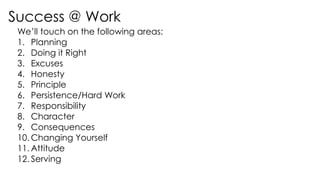
We’ll touch on the following areas:
1. Planning
2. Doing it Right
3. Excuses
4. Honesty
5. Principle
6. Persistence/Hard Work
7. Responsibility
8. Character
9. Consequences
10. Changing Yourself
11. Attitude
12. Serving
Success @ Work
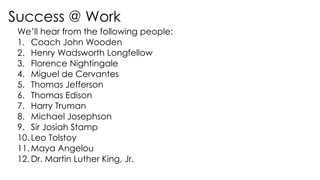
We’ll hear from the following people:
1. Coach John Wooden
2. Henry Wadsworth Longfellow
3. Florence Nightingale
4. Miguel de Cervantes
5. Thomas Jefferson
6. Thomas Edison
7. Harry Truman
8. Michael Josephson
9. Sir Josiah Stamp
10. Leo Tolstoy
11. Maya Angelou
12. Dr. Martin Luther King, Jr.
Success @ Work
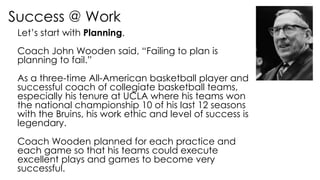
Let’s start with Planning.
Coach John Wooden said, “Failing to plan is
planning to fail.”
As a three-time All-American basketball player and
successful coach of collegiate basketball teams,
especially his tenure at UCLA where his teams won
the national championship 10 of his last 12 seasons
with the Bruins, his work ethic and level of success is
legendary.
Coach Wooden planned for each practice and
each game so that his teams could execute
excellent plays and games to become very
successful.
Success @ Work
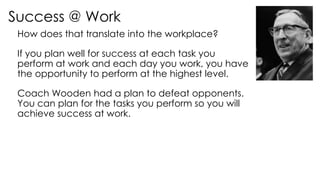
How does that translate into the workplace?
If you plan well for success at each task you
perform at work and each day you work, you have
the opportunity to perform at the highest level.
Coach Wooden had a plan to defeat opponents.
You can plan for the tasks you perform so you will
achieve success at work.
Success @ Work
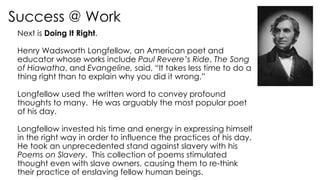
Next is Doing It Right.
Henry Wadsworth Longfellow, an American poet and
educator whose works include Paul Revere’s Ride, The Song
of Hiawatha, and Evangeline, said, “It takes less time to do a
thing right than to explain why you did it wrong.”
Longfellow used the written word to convey profound
thoughts to many. He was arguably the most popular poet
of his day.
Longfellow invested his time and energy in expressing himself
in the right way in order to influence the practices of his day.
He took an unprecedented stand against slavery with his
Poems on Slavery. This collection of poems stimulated
thought even with slave owners, causing them to re-think
their practice of enslaving fellow human beings.
Success @ Work
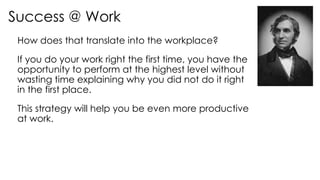
How does that translate into the workplace?
If you do your work right the first time, you have the
opportunity to perform at the highest level without
wasting time explaining why you did not do it right
in the first place.
This strategy will help you be even more productive
at work.
Success @ Work
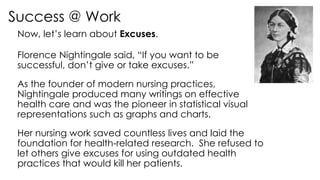
Now, let’s learn about Excuses.
Florence Nightingale said, “If you want to be
successful, don’t give or take excuses.”
As the founder of modern nursing practices,
Nightingale produced many writings on effective
health care and was the pioneer in statistical visual
representations such as graphs and charts.
Her nursing work saved countless lives and laid the
foundation for health-related research. She refused to
let others give excuses for using outdated health
practices that would kill her patients.
Success @ Work
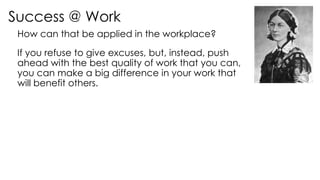
How can that be applied in the workplace?
If you refuse to give excuses, but, instead, push
ahead with the best quality of work that you can,
you can make a big difference in your work that
will benefit others.
Success @ Work
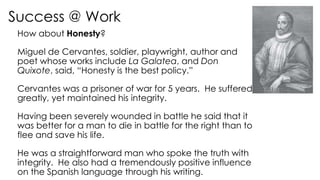
How about Honesty?
Miguel de Cervantes, soldier, playwright, author and
poet whose works include La Galatea, and Don
Quixote, said, “Honesty is the best policy.”
Cervantes was a prisoner of war for 5 years. He suffered
greatly, yet maintained his integrity.
Having been severely wounded in battle he said that it
was better for a man to die in battle for the right than to
flee and save his life.
He was a straightforward man who spoke the truth with
integrity. He also had a tremendously positive influence
on the Spanish language through his writing.
Success @ Work
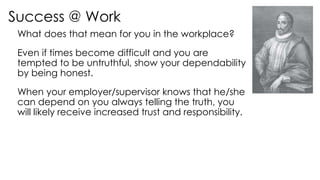
What does that mean for you in the workplace?
Even if times become difficult and you are
tempted to be untruthful, show your dependability
by being honest.
When your employer/supervisor knows that he/she
can depend on you always telling the truth, you
will likely receive increased trust and responsibility.
Success @ Work
Principle is our next area to consider.
“In matters of style, swim with the current; in
matters of principle, stand like a rock,” said
Thomas Jefferson
This means you can go along with the way that
others present themselves in dress, actions, and
speech until it compromises your beliefs. Stand
tall and don’t compromise.
Success @ Work
What does this mean in the workplace?
When others ask you to go against your beliefs and
lie, cheat, steal, or do less than your best, stand up
for what is right and don’t give in.
Be a person of principle.
Success @ Work
Sometimes work is easy. Other times is isn’t. What,
though, will make your work successful? Persistence, or
Hard Work.
Thomas Edison, the inventor of the commercially
available light bulb, the record player, and the motion
picture camera, among other things, said, “Success is
10 percent inspiration and 90 percent perspiration.”
When he was trying to redesign the incandescent light
bulb to make it commercially viable and longer lasting,
Edison refused to give up even after 1,000 failed
attempts. In an interview, a reporter asked him if he
felt like a failure. He responded, “Absolutely not. I
have already found 1,000 ways not to make a light
bulb better.”
Success @ Work
How does that translate into the workplace?
Sometimes you just have to gut it out, keep working
hard, and never give up.
If Edison had given up, we might still be using
candles, lanterns, and gas lamps, to light our
homes, only be able to listen to live music, not
recorded music, and be unable to go to the
movies.
Success @ Work
Taking Responsibility can be tough – definitely not
something for the weak of heart.
President Harry Truman had a sign on his desk that
read, “The buck stops here.”
President Truman was taking responsibility for his actions
as well as the actions of his subordinates. He refused to
pass the buck to (or blame) anyone else.
Truman made the decision to drop the atomic bombs
on Hiroshima and Nagasaki as well as the bombing
raids on Tokyo which ended WWII in the Pacific.
Later in life, Truman wrote, "I knew what I was doing
when I stopped the war ... I have no regrets and, under
the same circumstances, I would do it again."
Success @ Work
How does taking responsibility translate into
the workplace?
If you take responsibility for your actions, you
will be more trusted by others. In addition, if
you don’t try to blame others for your
shortcomings, you have the opportunity to
perform your work at the highest level.
Success @ Work
What is Character?
According to Michael Josephson, founder of the Joseph
and Edna Josephson Institute for Ethics, “Character is
doing the right thing even when it costs more than you
want to pay.”
What does that mean. Let’s say on Tuesday you
agreed to work an extra shift on Friday evening. On
Friday morning, your buddy calls you and lets you know
that the latest version of your favorite movie is coming
out in theaters that night. You have already made the
commitment to work. If you have character, you will
thank your friend for the information and show up for
your work shift as promised.
Success @ Work
Your friend will understand that you can be counted
on. With you, a promise is a promise. That can only
strengthen your friendship.
Your employer will appreciate your sticking by your
word. You will feel good in knowing that you are
dependable. Dependable people typically have
more work opportunities than those who are
unreliable.
Success @ Work
Consequences can be positive or negative based
on our choices.
Sir Josiah Stamp said, “It is easy to dodge our
responsibilities, but we cannot dodge the
consequences of dodging our responsibilities.”
What does that mean? If you are given a
responsibility at work, you might choose to avoid
that responsibility. That’s pretty easy. The hard truth
is that you may have a negative consequence that
you cannot avoid because you did not complete
your assigned responsibility.
Success @ Work
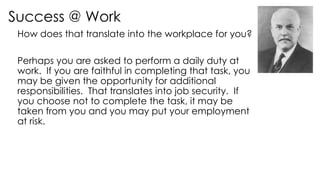
How does that translate into the workplace for you?
Perhaps you are asked to perform a daily duty at
work. If you are faithful in completing that task, you
may be given the opportunity for additional
responsibilities. That translates into job security. If
you choose not to complete the task, it may be
taken from you and you may put your employment
at risk.
Success @ Work
Changing Yourself.
Leo Tolstoy said, “Everyone thinks of changing
humanity and nobody thinks of changing
himself.”
The focus of this quote is to have each of us look
at our words and our actions to make a change
for the better of all humanity.
We cannot change the actions of others to
make the world a better place. We can,
however, change ourselves.
Success @ Work
What does that mean in the workplace?
Perhaps you are late for work frequently. You
could complain about your boss, the hours that
you are scheduled, and several other factors that
you blame for your tardiness. Better, though,
would be for you to take responsibility for your
actions and get to work early from now on. Lead
the way for others to follow. That will not only
improve you, it will make where you work a better
place.
Success @ Work
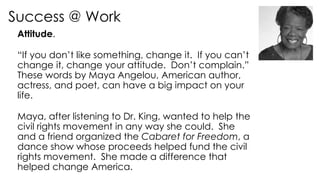
Attitude.
“If you don’t like something, change it. If you can’t
change it, change your attitude. Don’t complain.”
These words by Maya Angelou, American author,
actress, and poet, can have a big impact on your
life.
Maya, after listening to Dr. King, wanted to help the
civil rights movement in any way she could. She
and a friend organized the Cabaret for Freedom, a
dance show whose proceeds helped fund the civil
rights movement. She made a difference that
helped change America.
Success @ Work
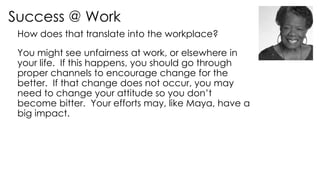
How does that translate into the workplace?
You might see unfairness at work, or elsewhere in
your life. If this happens, you should go through
proper channels to encourage change for the
better. If that change does not occur, you may
need to change your attitude so you don’t
become bitter. Your efforts may, like Maya, have a
big impact.
Success @ Work
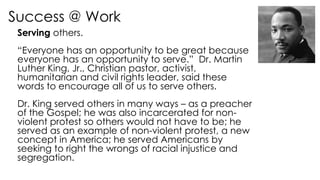
Serving others.
“Everyone has an opportunity to be great because
everyone has an opportunity to serve.” Dr. Martin
Luther King, Jr., Christian pastor, activist,
humanitarian and civil rights leader, said these
words to encourage all of us to serve others.
Dr. King served others in many ways – as a preacher
of the Gospel; he was also incarcerated for non-
violent protest so others would not have to be; he
served as an example of non-violent protest, a new
concept in America; he served Americans by
seeking to right the wrongs of racial injustice and
segregation.
Success @ Work
How does this apply to you in the workplace?
You can serve others in many ways both at work
and away from work. Think of the needs of others;
walk in their shoes; make a positive difference.
You will be surprised at the positive changes you
are able to achieve. You can do great things.
Success @ Work
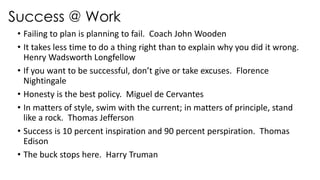
• Failing to plan is planning to fail. Coach John Wooden
• It takes less time to do a thing right than to explain why you did it wrong.
Henry Wadsworth Longfellow
• If you want to be successful, don’t give or take excuses. Florence
Nightingale
• Honesty is the best policy. Miguel de Cervantes
• In matters of style, swim with the current; in matters of principle, stand
like a rock. Thomas Jefferson
• Success is 10 percent inspiration and 90 percent perspiration. Thomas
Edison
• The buck stops here. Harry Truman
Success @ Work
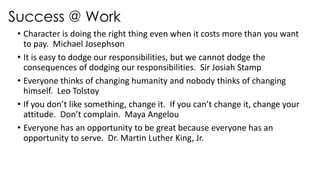
• Character is doing the right thing even when it costs more than you want
to pay. Michael Josephson
• It is easy to dodge our responsibilities, but we cannot dodge the
consequences of dodging our responsibilities. Sir Josiah Stamp
• Everyone thinks of changing humanity and nobody thinks of changing
himself. Leo Tolstoy
• If you don’t like something, change it. If you can’t change it, change your
attitude. Don’t complain. Maya Angelou
• Everyone has an opportunity to be great because everyone has an
opportunity to serve. Dr. Martin Luther King, Jr.
Success @ Work
how to be a peak performer at your job

Success at Work revised

  • 1.
    Success @ Work howto be a peak performer at your job
  • 2.
    Success @ Work Whenit comes right down to it, everyone wants to be successful at work. At times, though, we may display attitudes or actions that keep us from maximizing our potential. We may not even be aware that we are doing this. Today we’ll explore attitude and action choices that you may face in the workplace and share the thoughts of some famous people regarding the topics we touch on.
  • 3.
    Success @ Work We’lltouch on the following areas: 1. Planning 2. Doing it Right 3. Excuses 4. Honesty 5. Principle 6. Persistence/Hard Work 7. Responsibility 8. Character 9. Consequences 10. Changing Yourself 11. Attitude 12. Serving
  • 4.
    Success @ Work We’llhear from the following people: 1. Coach John Wooden 2. Henry Wadsworth Longfellow 3. Florence Nightingale 4. Miguel de Cervantes 5. Thomas Jefferson 6. Thomas Edison 7. Harry Truman 8. Michael Josephson 9. Sir Josiah Stamp 10. Leo Tolstoy 11. Maya Angelou 12. Dr. Martin Luther King, Jr.
  • 5.
    Success @ Work Let’sstart with Planning. Coach John Wooden said, “Failing to plan is planning to fail.” As a three-time All-American basketball player and successful coach of collegiate basketball teams, especially his tenure at UCLA where his teams won the national championship 10 of his last 12 seasons with the Bruins, his work ethic and level of success is legendary. Coach Wooden planned for each practice and each game so that his teams could execute excellent plays and games to become very successful.
  • 6.
    Success @ Work Howdoes that translate into the workplace? If you plan well for success at each task you perform at work and each day you work, you have the opportunity to perform at the highest level. Coach Wooden had a plan to defeat opponents. You can plan for the tasks you perform so you will achieve success at work.
  • 7.
    Success @ Work Nextis Doing It Right. Henry Wadsworth Longfellow, an American poet and educator whose works include Paul Revere’s Ride, The Song of Hiawatha, and Evangeline, said, “It takes less time to do a thing right than to explain why you did it wrong.” Longfellow used the written word to convey profound thoughts to many. He was arguably the most popular poet of his day. Longfellow invested his time and energy in expressing himself in the right way in order to influence the practices of his day. He took an unprecedented stand against slavery with his Poems on Slavery. This collection of poems stimulated thought even with slave owners, causing them to re-think their practice of enslaving fellow human beings.
  • 8.
    Success @ Work Howdoes that translate into the workplace? If you do your work right the first time, you have the opportunity to perform at the highest level without wasting time explaining why you did not do it right in the first place. This strategy will help you be even more productive at work.
  • 9.
    Success @ Work Now,let’s learn about Excuses. Florence Nightingale said, “If you want to be successful, don’t give or take excuses.” As the founder of modern nursing practices, Nightingale produced many writings on effective health care and was the pioneer in statistical visual representations such as graphs and charts. Her nursing work saved countless lives and laid the foundation for health-related research. She refused to let others give excuses for using outdated health practices that would kill her patients.
  • 10.
    Success @ Work Howcan that be applied in the workplace? If you refuse to give excuses, but, instead, push ahead with the best quality of work that you can, you can make a big difference in your work that will benefit others.
  • 11.
    Success @ Work Howabout Honesty? Miguel de Cervantes, soldier, playwright, author and poet whose works include La Galatea, and Don Quixote, said, “Honesty is the best policy.” Cervantes was a prisoner of war for 5 years. He suffered greatly, yet maintained his integrity. Having been severely wounded in battle he said that it was better for a man to die in battle for the right than to flee and save his life. He was a straightforward man who spoke the truth with integrity. He also had a tremendously positive influence on the Spanish language through his writing.
  • 12.
    Success @ Work Whatdoes that mean for you in the workplace? Even if times become difficult and you are tempted to be untruthful, show your dependability by being honest. When your employer/supervisor knows that he/she can depend on you always telling the truth, you will likely receive increased trust and responsibility.
  • 13.
    Success @ Work Principleis our next area to consider. “In matters of style, swim with the current; in matters of principle, stand like a rock,” said Thomas Jefferson This means you can go along with the way that others present themselves in dress, actions, and speech until it compromises your beliefs. Stand tall and don’t compromise.
  • 14.
    Success @ Work Whatdoes this mean in the workplace? When others ask you to go against your beliefs and lie, cheat, steal, or do less than your best, stand up for what is right and don’t give in. Be a person of principle.
  • 15.
    Success @ Work Sometimeswork is easy. Other times is isn’t. What, though, will make your work successful? Persistence, or Hard Work. Thomas Edison, the inventor of the commercially available light bulb, the record player, and the motion picture camera, among other things, said, “Success is 10 percent inspiration and 90 percent perspiration.” When he was trying to redesign the incandescent light bulb to make it commercially viable and longer lasting, Edison refused to give up even after 1,000 failed attempts. In an interview, a reporter asked him if he felt like a failure. He responded, “Absolutely not. I have already found 1,000 ways not to make a light bulb better.”
  • 16.
    Success @ Work Howdoes that translate into the workplace? Sometimes you just have to gut it out, keep working hard, and never give up. If Edison had given up, we might still be using candles, lanterns, and gas lamps, to light our homes, only be able to listen to live music, not recorded music, and be unable to go to the movies.
  • 17.
    Success @ Work TakingResponsibility can be tough – definitely not something for the weak of heart. President Harry Truman had a sign on his desk that read, “The buck stops here.” President Truman was taking responsibility for his actions as well as the actions of his subordinates. He refused to pass the buck to (or blame) anyone else. Truman made the decision to drop the atomic bombs on Hiroshima and Nagasaki as well as the bombing raids on Tokyo which ended WWII in the Pacific. Later in life, Truman wrote, "I knew what I was doing when I stopped the war ... I have no regrets and, under the same circumstances, I would do it again."
  • 18.
    Success @ Work Howdoes taking responsibility translate into the workplace? If you take responsibility for your actions, you will be more trusted by others. In addition, if you don’t try to blame others for your shortcomings, you have the opportunity to perform your work at the highest level.
  • 19.
    Success @ Work Whatis Character? According to Michael Josephson, founder of the Joseph and Edna Josephson Institute for Ethics, “Character is doing the right thing even when it costs more than you want to pay.” What does that mean. Let’s say on Tuesday you agreed to work an extra shift on Friday evening. On Friday morning, your buddy calls you and lets you know that the latest version of your favorite movie is coming out in theaters that night. You have already made the commitment to work. If you have character, you will thank your friend for the information and show up for your work shift as promised.
  • 20.
    Success @ Work Yourfriend will understand that you can be counted on. With you, a promise is a promise. That can only strengthen your friendship. Your employer will appreciate your sticking by your word. You will feel good in knowing that you are dependable. Dependable people typically have more work opportunities than those who are unreliable.
  • 21.
    Success @ Work Consequencescan be positive or negative based on our choices. Sir Josiah Stamp said, “It is easy to dodge our responsibilities, but we cannot dodge the consequences of dodging our responsibilities.” What does that mean? If you are given a responsibility at work, you might choose to avoid that responsibility. That’s pretty easy. The hard truth is that you may have a negative consequence that you cannot avoid because you did not complete your assigned responsibility.
  • 22.
    Success @ Work Howdoes that translate into the workplace for you? Perhaps you are asked to perform a daily duty at work. If you are faithful in completing that task, you may be given the opportunity for additional responsibilities. That translates into job security. If you choose not to complete the task, it may be taken from you and you may put your employment at risk.
  • 23.
    Success @ Work ChangingYourself. Leo Tolstoy said, “Everyone thinks of changing humanity and nobody thinks of changing himself.” The focus of this quote is to have each of us look at our words and our actions to make a change for the better of all humanity. We cannot change the actions of others to make the world a better place. We can, however, change ourselves.
  • 24.
    Success @ Work Whatdoes that mean in the workplace? Perhaps you are late for work frequently. You could complain about your boss, the hours that you are scheduled, and several other factors that you blame for your tardiness. Better, though, would be for you to take responsibility for your actions and get to work early from now on. Lead the way for others to follow. That will not only improve you, it will make where you work a better place.
  • 25.
    Success @ Work Attitude. “Ifyou don’t like something, change it. If you can’t change it, change your attitude. Don’t complain.” These words by Maya Angelou, American author, actress, and poet, can have a big impact on your life. Maya, after listening to Dr. King, wanted to help the civil rights movement in any way she could. She and a friend organized the Cabaret for Freedom, a dance show whose proceeds helped fund the civil rights movement. She made a difference that helped change America.
  • 26.
    Success @ Work Howdoes that translate into the workplace? You might see unfairness at work, or elsewhere in your life. If this happens, you should go through proper channels to encourage change for the better. If that change does not occur, you may need to change your attitude so you don’t become bitter. Your efforts may, like Maya, have a big impact.
  • 27.
    Success @ Work Servingothers. “Everyone has an opportunity to be great because everyone has an opportunity to serve.” Dr. Martin Luther King, Jr., Christian pastor, activist, humanitarian and civil rights leader, said these words to encourage all of us to serve others. Dr. King served others in many ways – as a preacher of the Gospel; he was also incarcerated for non- violent protest so others would not have to be; he served as an example of non-violent protest, a new concept in America; he served Americans by seeking to right the wrongs of racial injustice and segregation.
  • 28.
    Success @ Work Howdoes this apply to you in the workplace? You can serve others in many ways both at work and away from work. Think of the needs of others; walk in their shoes; make a positive difference. You will be surprised at the positive changes you are able to achieve. You can do great things.
  • 29.
    Success @ Work •Failing to plan is planning to fail. Coach John Wooden • It takes less time to do a thing right than to explain why you did it wrong. Henry Wadsworth Longfellow • If you want to be successful, don’t give or take excuses. Florence Nightingale • Honesty is the best policy. Miguel de Cervantes • In matters of style, swim with the current; in matters of principle, stand like a rock. Thomas Jefferson • Success is 10 percent inspiration and 90 percent perspiration. Thomas Edison • The buck stops here. Harry Truman
  • 30.
    Success @ Work •Character is doing the right thing even when it costs more than you want to pay. Michael Josephson • It is easy to dodge our responsibilities, but we cannot dodge the consequences of dodging our responsibilities. Sir Josiah Stamp • Everyone thinks of changing humanity and nobody thinks of changing himself. Leo Tolstoy • If you don’t like something, change it. If you can’t change it, change your attitude. Don’t complain. Maya Angelou • Everyone has an opportunity to be great because everyone has an opportunity to serve. Dr. Martin Luther King, Jr.
  • 31.
    Success @ Work howto be a peak performer at your job