This document discusses subject-verb agreement in English grammar. It provides examples of singular and plural subjects and verbs. Key points covered include:
- Verbs must agree with their subject in number - singular verbs with singular subjects and plural verbs with plural subjects.
- There are irregular verbs like "be", "have", and "do" that have unique plural forms.
- Verbs take an "s" ending with singular subjects not ending in "s" and drop the "s" ending with plural subjects.
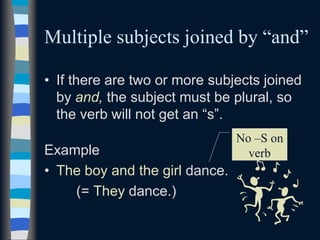
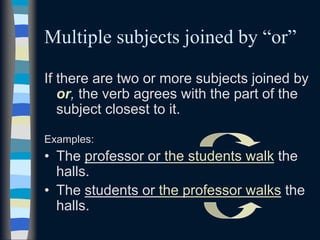
- Subjects joined by "and" or indefinite pronouns like "everyone" are usually plural, while those joined by "or" can be either.