LESSON 2
CONTENTS OF ELEMENTARY SCIENCE
IN A SPIRAL PROGRESSION
CONTENTS OF
ELEMENTARY SCIENCE IN
A SPIRALPROGRESSION
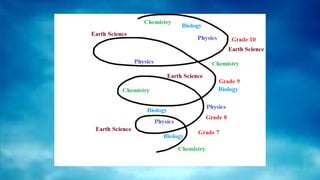
Science in a spiral curriculum design is one
in which "key concepts are presented
repeatedly throughout the curriculum but
with deepening layers of complexity." The
learner tries to spiral upwards learning as
the new knowledge is introduced as well
as the new process skills are developed.
THE CONTENT OF SCIENCE IN THE K TO 12
CURRICULUM IS MADE UP OF THE FOUR MAJOR
FIELDS OR DISCIPLINES
THE CONTENT OF SCIENCE IN THE K TO 12
CURRICULUM IS MADE UP OF THE FOUR MAJOR
FIELDS OR DISCIPLINES
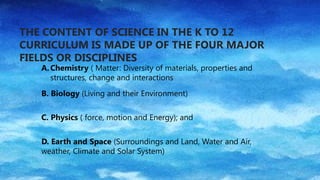
A. Chemistry ( Matter: Diversity of materials, properties and
structures, change and interactions
B. Biology (Living and their Environment)
C. Physics ( force, motion and Energy); and
D. Earth and Space (Surroundings and Land, Water and Air,
weather, Climate and Solar System)
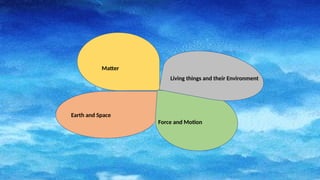
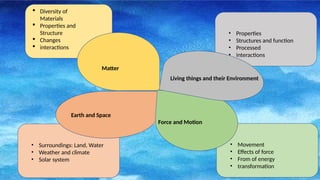
Matter
Earth and Space
Force and Motion
Living things and their Environment
• Movement
• Effects of force
• From of energy
• transformation
• Properties
• Structures and function
• Processed
• interactions
• Surroundings: Land, Water
• Weather and climate
• Solar system
 Diversity of
Materials
 Properties and
Structure
 Changes
 interactions
Matter
Earth and Space
Force and Motion
Living things and their Environment
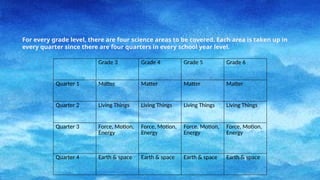
Grade 3 Grade 4 Grade 5 Grade 6
Quarter 1 Matter Matter Matter Matter
Quarter 2 Living Things Living Things Living Things Living Things
Quarter 3 Force, Motion,
Energy
Force, Motion,
Energy
Force, Motion,
Energy
Force, Motion,
Energy
Quarter 4 Earth & space Earth & space Earth & space Earth & space
For every grade level, there are four science areas to be covered. Each area is taken up in
every quarter since there are four quarters in every school year level.
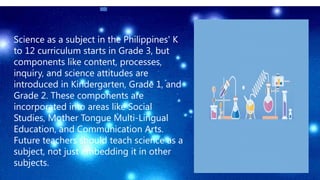
Science as a subject in the Philippines' K
to 12 curriculum starts in Grade 3, but
components like content, processes,
inquiry, and science attitudes are
introduced in Kindergarten, Grade 1, and
Grade 2. These components are
incorporated into areas like Social
Studies, Mother Tongue Multi-Lingual
Education, and Communication Arts.
Future teachers should teach science as a
subject, not just embedding it in other
subjects.
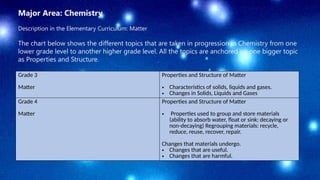
Grade 3
Matter
Properties and Structure of Matter
• Characteristics of solids, liquids and gases.
• Changes in Solids, Liquids and Gases
Grade 4
Matter
Properties and Structure of Matter
• Properties used to group and store materials
(ability to absorb water, float or sink; decaying or
non-decaying) Regrouping materials: recycle,
reduce, reuse, recover, repair.
Changes that materials undergo.
• Changes that are useful.
• Changes that are harmful.
Major Area: Chemistry
Description in the Elementary Curriculum: Matter
The chart below shows the different topics that are taken in progression in Chemistry from one
lower grade level to another higher grade level. All the topics are anchored on one bigger topic
as Properties and Structure.
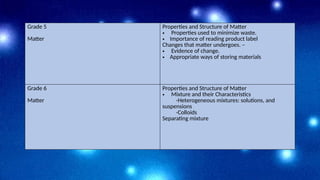
Grade 5
Matter
Properties and Structure of Matter
• Properties used to minimize waste.
• Importance of reading product label
Changes that matter undergoes. –
• Evidence of change.
• Appropriate ways of storing materials
Grade 6
Matter
Properties and Structure of Matter
• Mixture and their Characteristics
-Heterogeneous mixtures: solutions, and
suspensions
-Colloids
Separating mixture
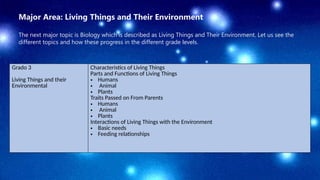
Major Area: Living Things and Their Environment
The next major topic is Biology which is described as Living Things and Their Environment. Let us see the
different topics and how these progress in the different grade levels.
Grado 3
Living Things and their
Environmental
Characteristics of Living Things
Parts and Functions of Living Things
• Humans
• Animal
• Plants
Traits Passed on From Parents
• Humans
• Animal
• Plants
Interactions of Living Things with the Environment
• Basic needs
• Feeding relationships
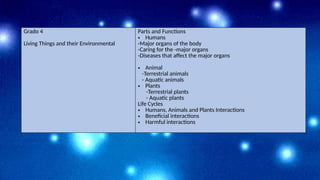
Grado 4
Living Things and their Environmental
Parts and Functions
• Humans
-Major organs of the body
-Caring for the -major organs
-Diseases that affect the major organs
• Animal
-Terrestrial animals
- Aquatic animals
• Plants
-Terrestrial plants
- Aquatic plants
Life Cycles
• Humans, Animals and Plants Interactions
• Beneficial interactions
• Harmful interactions
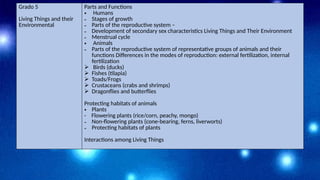
Grado 5
Living Things and their
Environmental
Parts and Functions
• Humans
- Stages of growth
- Parts of the reproductive system –
- Development of secondary sex characteristics Living Things and Their Environment
- Menstrual cycle
• Animals
- Parts of the reproductive system of representative groups of animals and their
functions Differences in the modes of reproduction: external fertilization, internal
fertilization
 Birds (ducks)
 Fishes (tilapia)
 Toads/Frogs
 Crustaceans (crabs and shrimps)
 Dragonflies and butterflies
Protecting habitats of animals
• Plants
- Flowering plants (rice/corn, peachy, mongo)
- Non-flowering plants (cone-bearing, ferns, liverworts)
- Protecting habitats of plants
Interactions among Living Things
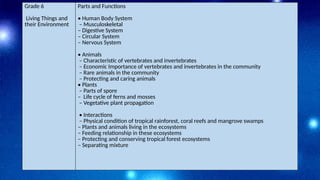
Grade 6
Living Things and
their Environment
Parts and Functions
• Human Body System
– Musculoskeletal
– Digestive System
– Circular System
– Nervous System
• Animals
– Characteristic of vertebrates and invertebrates
– Economic Importance of vertebrates and invertebrates in the community
– Rare animals in the community
– Protecting and caring animals
• Plants
– Parts of spore
– Life cycle of ferns and mosses
– Vegetative plant propagation
• Interactions
– Physical condition of tropical rainforest, coral reefs and mangrove swamps
– Plants and animals living in the ecosystems
– Feeding relationship in these ecosystems
– Protecting and conserving tropical forest ecosystems
– Separating mixture
THANK YOU!!!

LESSON 2( this presentation was areport.pptx

  • 1.
    LESSON 2 CONTENTS OFELEMENTARY SCIENCE IN A SPIRAL PROGRESSION
  • 2.
    CONTENTS OF ELEMENTARY SCIENCEIN A SPIRALPROGRESSION Science in a spiral curriculum design is one in which "key concepts are presented repeatedly throughout the curriculum but with deepening layers of complexity." The learner tries to spiral upwards learning as the new knowledge is introduced as well as the new process skills are developed.
  • 4.
    THE CONTENT OFSCIENCE IN THE K TO 12 CURRICULUM IS MADE UP OF THE FOUR MAJOR FIELDS OR DISCIPLINES
  • 5.
    THE CONTENT OFSCIENCE IN THE K TO 12 CURRICULUM IS MADE UP OF THE FOUR MAJOR FIELDS OR DISCIPLINES A. Chemistry ( Matter: Diversity of materials, properties and structures, change and interactions B. Biology (Living and their Environment) C. Physics ( force, motion and Energy); and D. Earth and Space (Surroundings and Land, Water and Air, weather, Climate and Solar System)
  • 6.
    Matter Earth and Space Forceand Motion Living things and their Environment
  • 7.
    • Movement • Effectsof force • From of energy • transformation • Properties • Structures and function • Processed • interactions • Surroundings: Land, Water • Weather and climate • Solar system  Diversity of Materials  Properties and Structure  Changes  interactions Matter Earth and Space Force and Motion Living things and their Environment
  • 8.
    Grade 3 Grade4 Grade 5 Grade 6 Quarter 1 Matter Matter Matter Matter Quarter 2 Living Things Living Things Living Things Living Things Quarter 3 Force, Motion, Energy Force, Motion, Energy Force, Motion, Energy Force, Motion, Energy Quarter 4 Earth & space Earth & space Earth & space Earth & space For every grade level, there are four science areas to be covered. Each area is taken up in every quarter since there are four quarters in every school year level.
  • 9.
    Science as asubject in the Philippines' K to 12 curriculum starts in Grade 3, but components like content, processes, inquiry, and science attitudes are introduced in Kindergarten, Grade 1, and Grade 2. These components are incorporated into areas like Social Studies, Mother Tongue Multi-Lingual Education, and Communication Arts. Future teachers should teach science as a subject, not just embedding it in other subjects.
  • 10.
    Grade 3 Matter Properties andStructure of Matter • Characteristics of solids, liquids and gases. • Changes in Solids, Liquids and Gases Grade 4 Matter Properties and Structure of Matter • Properties used to group and store materials (ability to absorb water, float or sink; decaying or non-decaying) Regrouping materials: recycle, reduce, reuse, recover, repair. Changes that materials undergo. • Changes that are useful. • Changes that are harmful. Major Area: Chemistry Description in the Elementary Curriculum: Matter The chart below shows the different topics that are taken in progression in Chemistry from one lower grade level to another higher grade level. All the topics are anchored on one bigger topic as Properties and Structure.
  • 11.
    Grade 5 Matter Properties andStructure of Matter • Properties used to minimize waste. • Importance of reading product label Changes that matter undergoes. – • Evidence of change. • Appropriate ways of storing materials Grade 6 Matter Properties and Structure of Matter • Mixture and their Characteristics -Heterogeneous mixtures: solutions, and suspensions -Colloids Separating mixture
  • 12.
    Major Area: LivingThings and Their Environment The next major topic is Biology which is described as Living Things and Their Environment. Let us see the different topics and how these progress in the different grade levels. Grado 3 Living Things and their Environmental Characteristics of Living Things Parts and Functions of Living Things • Humans • Animal • Plants Traits Passed on From Parents • Humans • Animal • Plants Interactions of Living Things with the Environment • Basic needs • Feeding relationships
  • 13.
    Grado 4 Living Thingsand their Environmental Parts and Functions • Humans -Major organs of the body -Caring for the -major organs -Diseases that affect the major organs • Animal -Terrestrial animals - Aquatic animals • Plants -Terrestrial plants - Aquatic plants Life Cycles • Humans, Animals and Plants Interactions • Beneficial interactions • Harmful interactions
  • 14.
    Grado 5 Living Thingsand their Environmental Parts and Functions • Humans - Stages of growth - Parts of the reproductive system – - Development of secondary sex characteristics Living Things and Their Environment - Menstrual cycle • Animals - Parts of the reproductive system of representative groups of animals and their functions Differences in the modes of reproduction: external fertilization, internal fertilization  Birds (ducks)  Fishes (tilapia)  Toads/Frogs  Crustaceans (crabs and shrimps)  Dragonflies and butterflies Protecting habitats of animals • Plants - Flowering plants (rice/corn, peachy, mongo) - Non-flowering plants (cone-bearing, ferns, liverworts) - Protecting habitats of plants Interactions among Living Things
  • 15.
    Grade 6 Living Thingsand their Environment Parts and Functions • Human Body System – Musculoskeletal – Digestive System – Circular System – Nervous System • Animals – Characteristic of vertebrates and invertebrates – Economic Importance of vertebrates and invertebrates in the community – Rare animals in the community – Protecting and caring animals • Plants – Parts of spore – Life cycle of ferns and mosses – Vegetative plant propagation • Interactions – Physical condition of tropical rainforest, coral reefs and mangrove swamps – Plants and animals living in the ecosystems – Feeding relationship in these ecosystems – Protecting and conserving tropical forest ecosystems – Separating mixture
  • 16.