Study on Criteria of Essential Facilities
In an Alternative Workplace
using Factor Analysis
Fauzan Alfi Agirachman
School of Architecture, Planning and Policy Development
Institut Teknologi Bandung
Presented in 3rd ICIAP – Universitas Gadjah Mada, Yogyakarta
August 11th – 12th 2016
ALTERNATIVE WORKPLACE?
What’s happened with a conventional one?
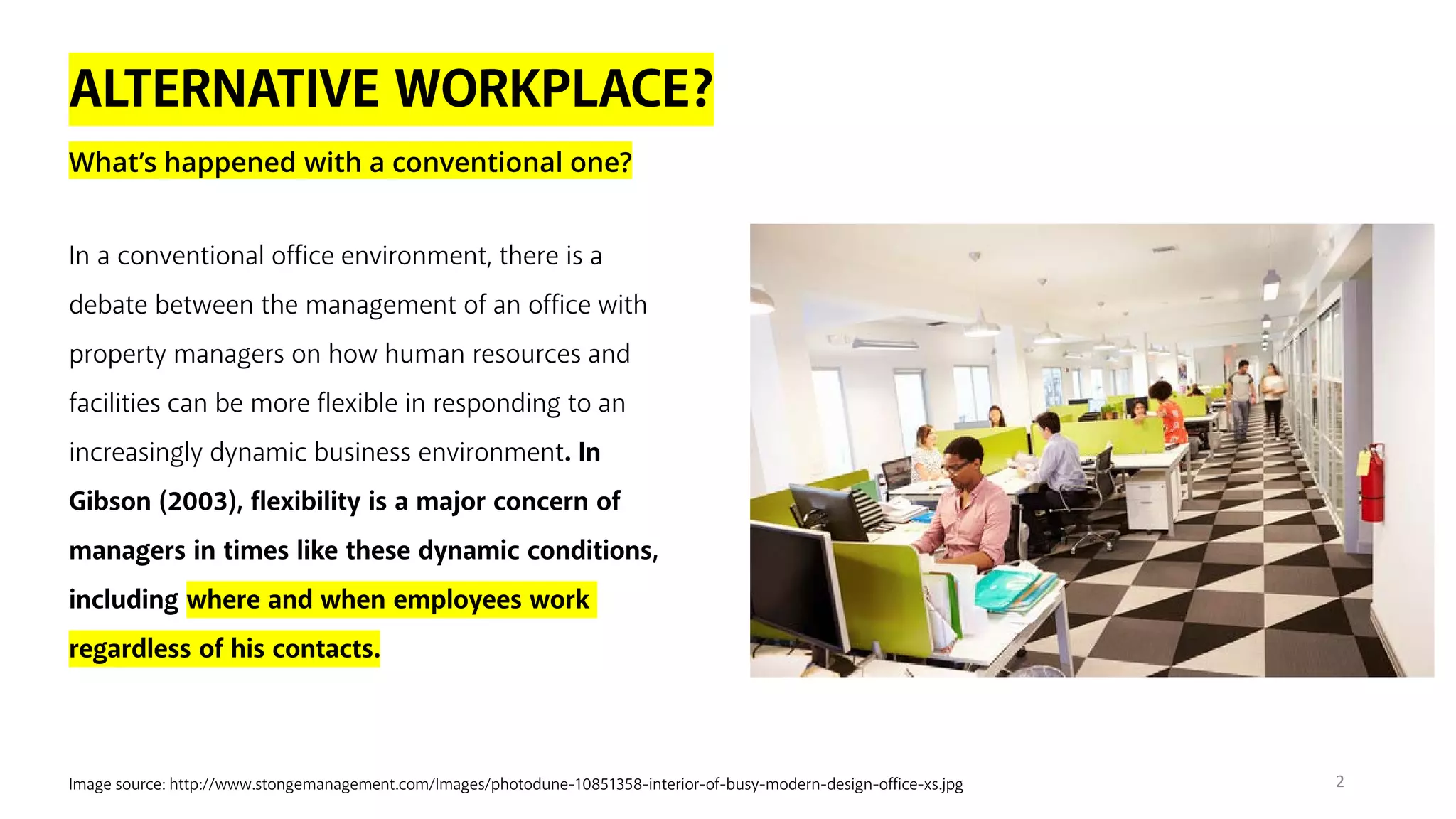
Image source: http://www.stongemanagement.com/Images/photodune-10851358-interior-of-busy-modern-design-office-xs.jpg
In a conventional office environment, there is a
debate between the management of an office with
property managers on how human resources and
facilities can be more flexible in responding to an
increasingly dynamic business environment. In
Gibson (2003), flexibility is a major concern of
managers in times like these dynamic conditions,
including where and when employees work
regardless of his contacts.
2
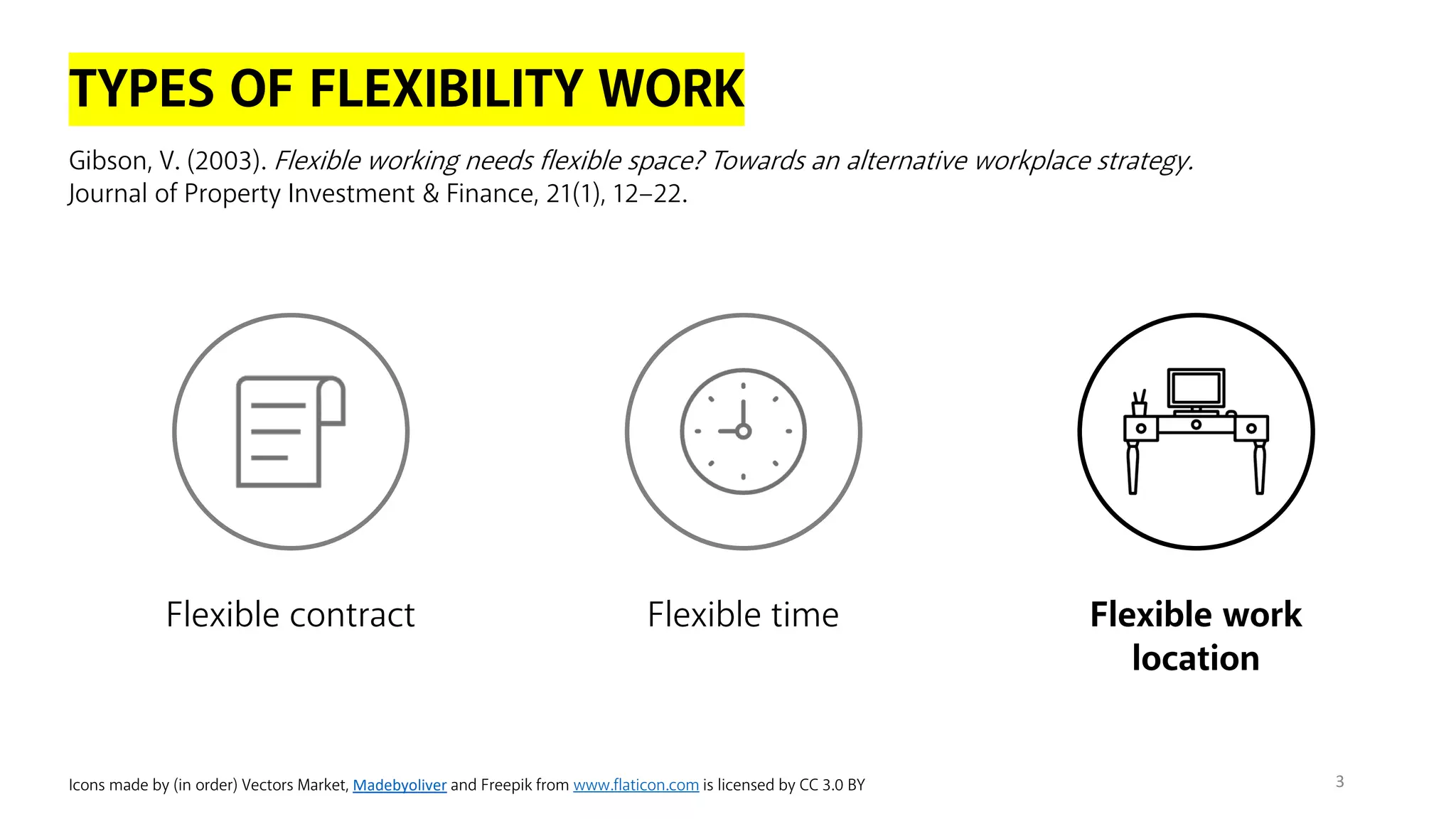
TYPES OF FLEXIBILITY WORK
Gibson, V. (2003). Flexible working needs flexible space? Towards an alternative workplace strategy.
Journal of Property Investment & Finance, 21(1), 12–22.
Icons made by (in order) Vectors Market, Madebyoliver and Freepik from www.flaticon.com is licensed by CC 3.0 BY
Flexible contract Flexible time Flexible work
location
3
ALTERNATIVE WORKPLACE
What is it?
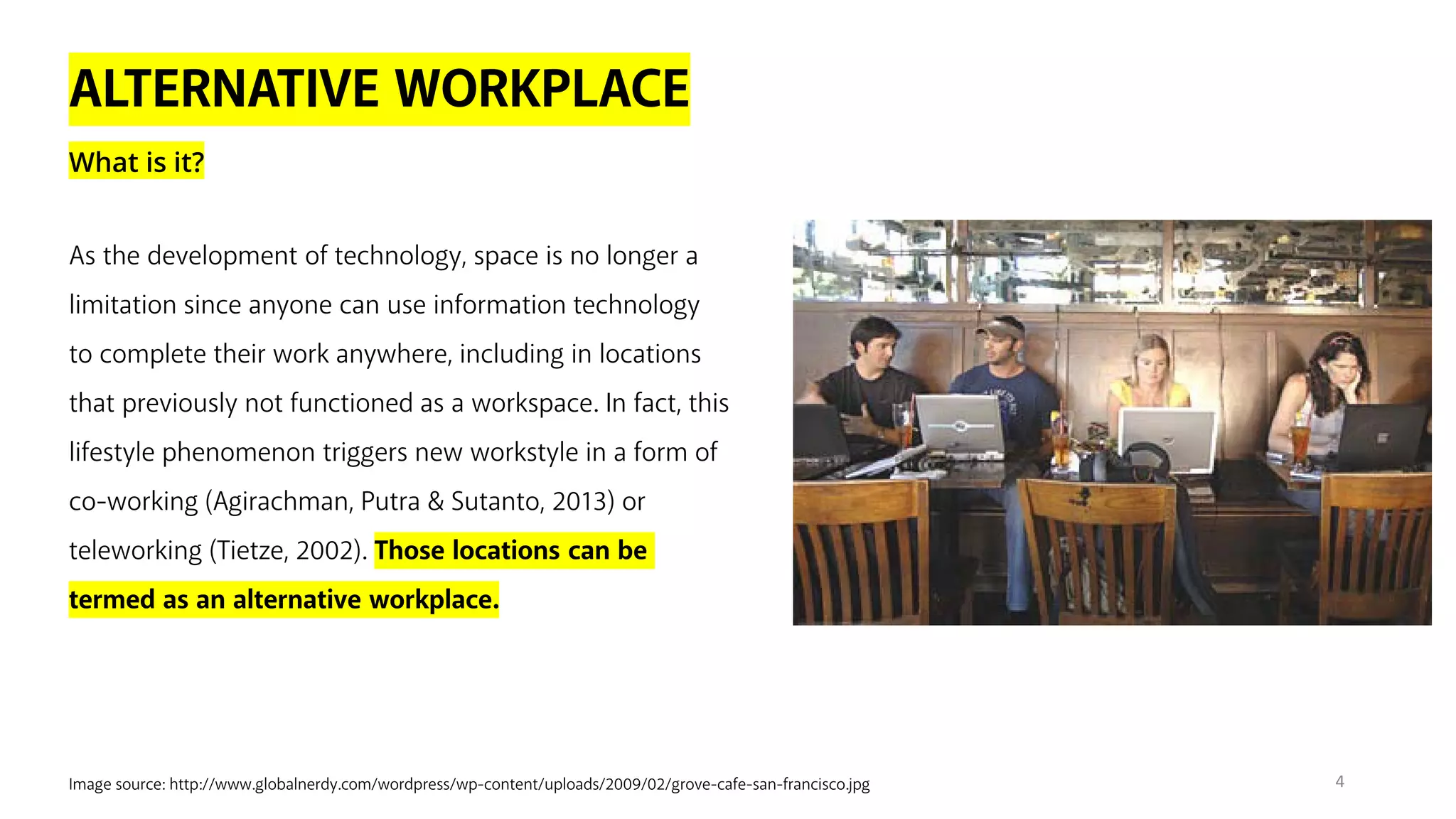
Image source: http://www.globalnerdy.com/wordpress/wp-content/uploads/2009/02/grove-cafe-san-francisco.jpg
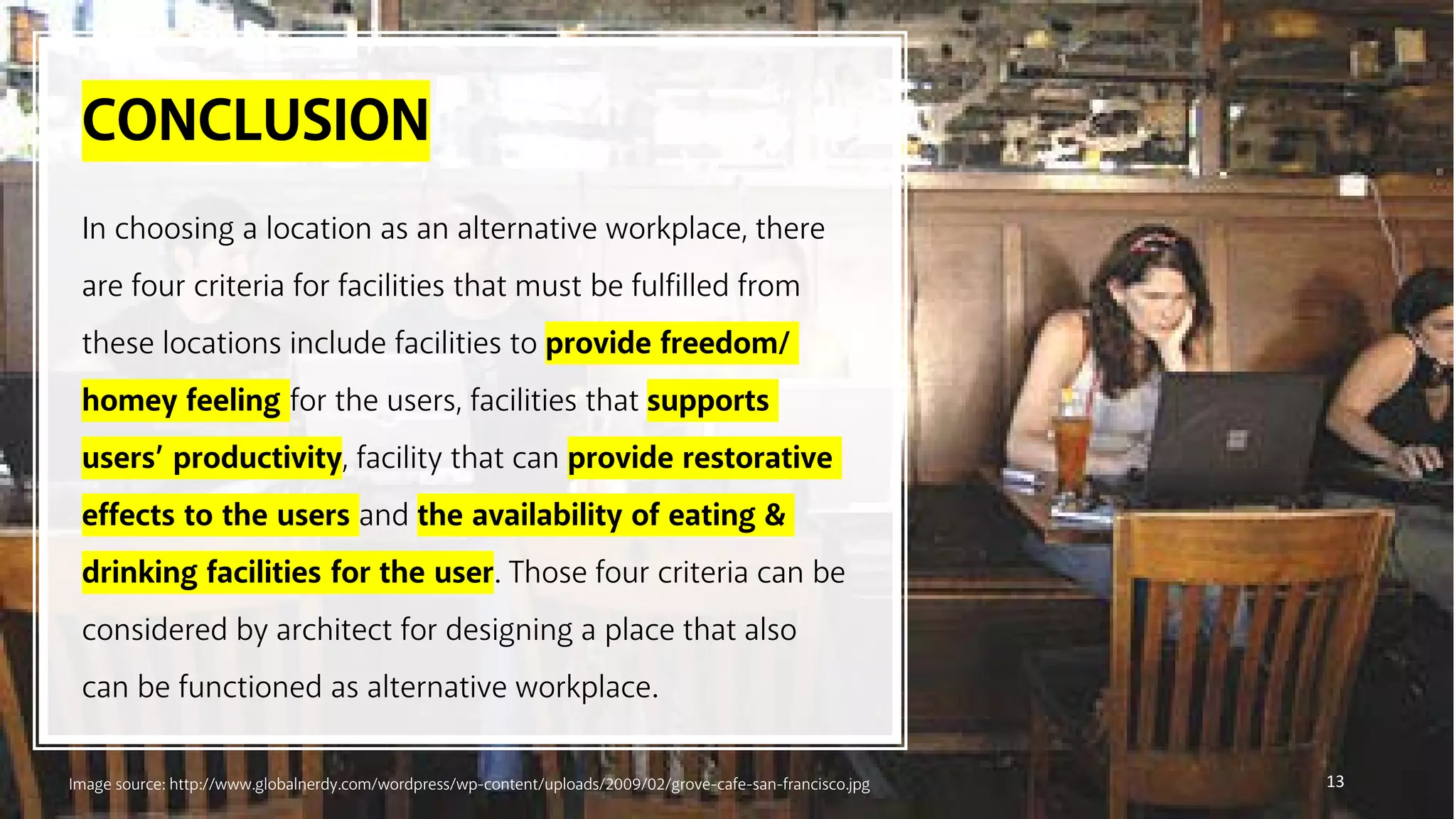
As the development of technology, space is no longer a
limitation since anyone can use information technology
to complete their work anywhere, including in locations
that previously not functioned as a workspace. In fact, this
lifestyle phenomenon triggers new workstyle in a form of
co-working (Agirachman, Putra & Sutanto, 2013) or
teleworking (Tietze, 2002). Those locations can be
termed as an alternative workplace.
4
ALTERNATIVE WORKPLACE
What’s the criteria to design one?
Image source: http://www.globalnerdy.com/wordpress/wp-content/uploads/2009/02/grove-cafe-san-francisco.jpg
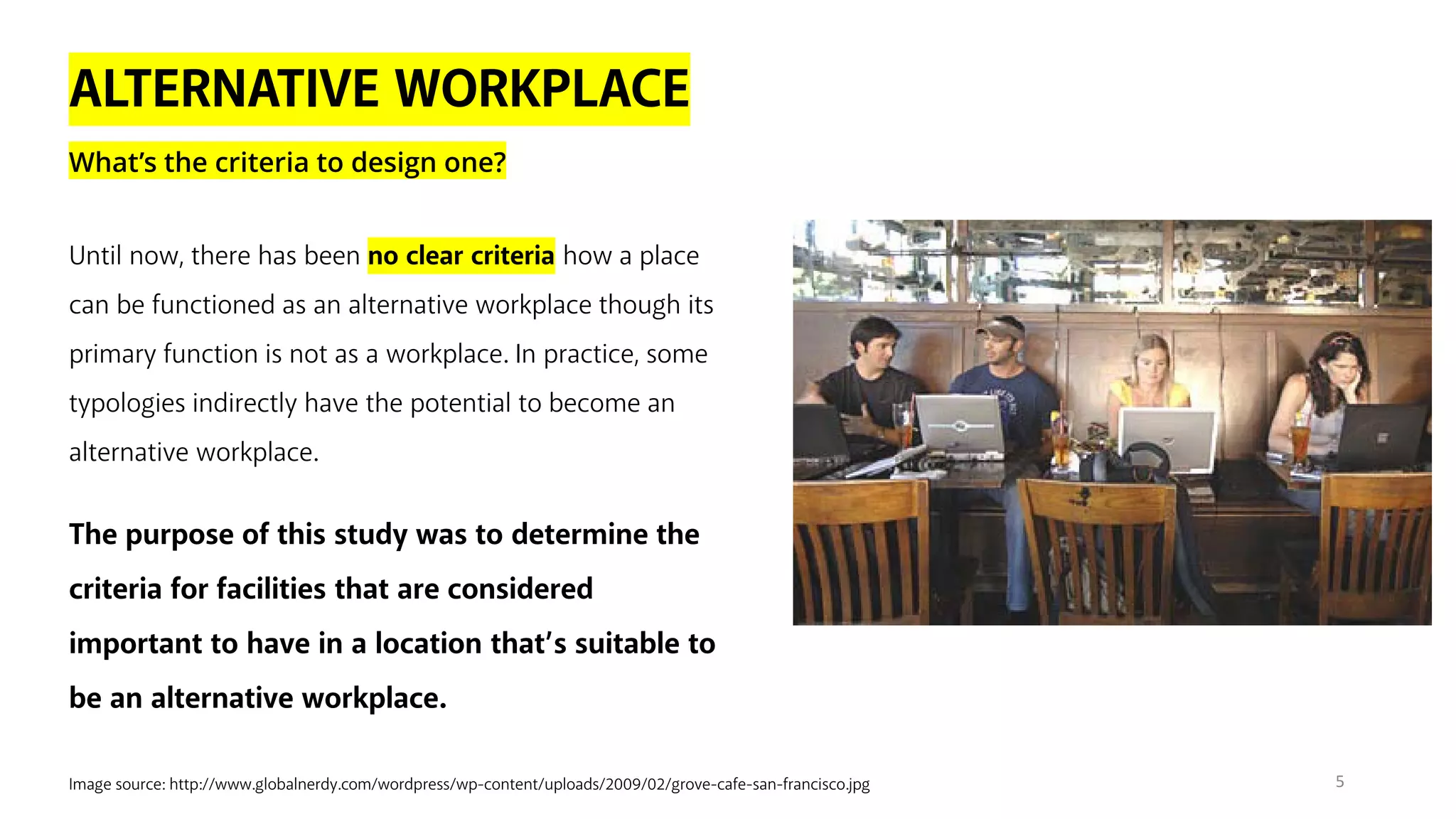
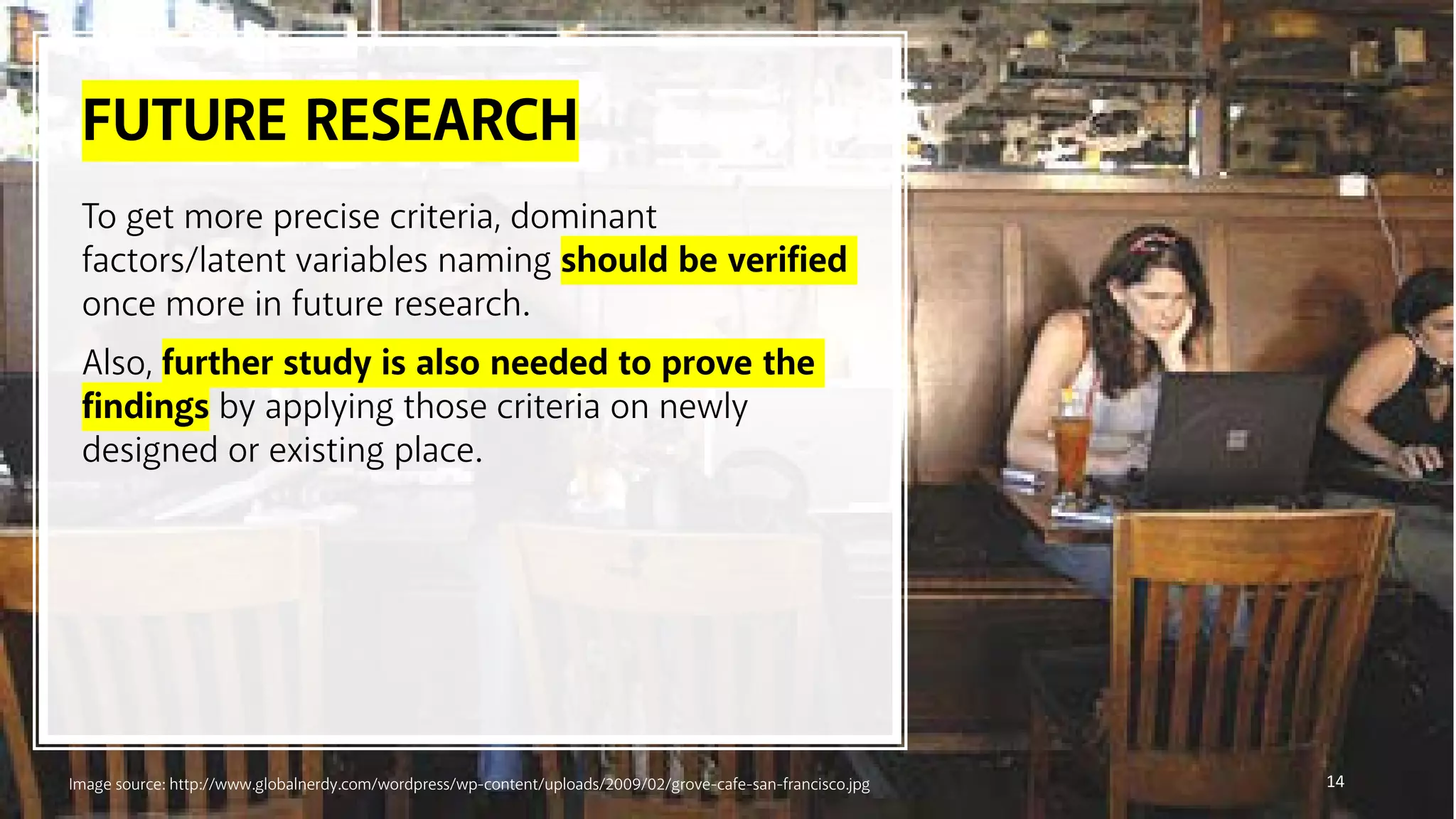
Until now, there has been no clear criteria how a place
can be functioned as an alternative workplace though its
primary function is not as a workplace. In practice, some
typologies indirectly have the potential to become an
alternative workplace.
The purpose of this study was to determine the
criteria for facilities that are considered
important to have in a location that’s suitable to
be an alternative workplace.
5
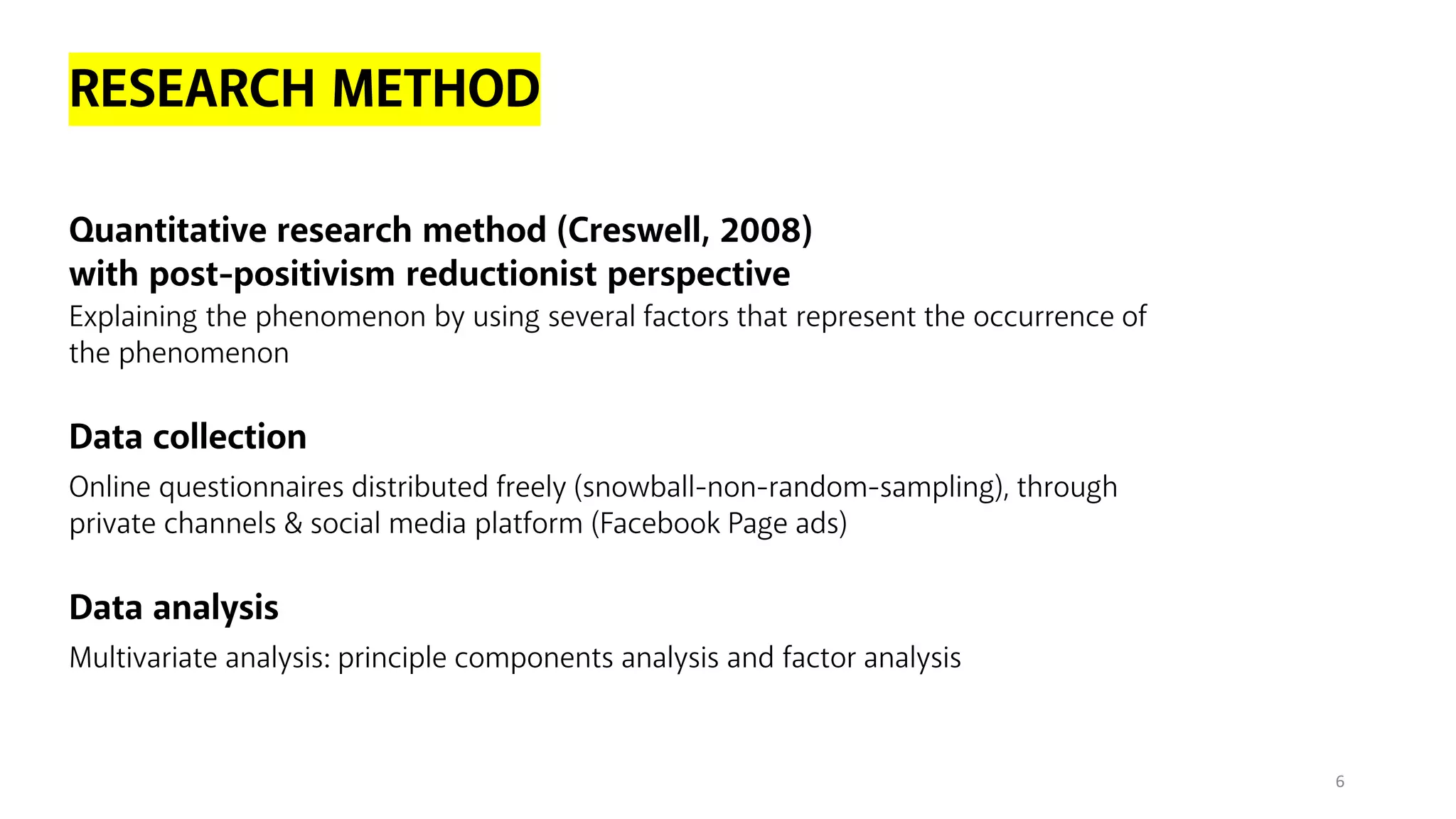
RESEARCH METHOD
Quantitative research method (Creswell, 2008)
with post-positivism reductionist perspective
Explaining the phenomenon by using several factors that represent the occurrence of
the phenomenon
Data collection
Online questionnaires distributed freely (snowball-non-random-sampling), through
private channels & social media platform (Facebook Page ads)
Data analysis
Multivariate analysis: principle components analysis and factor analysis
6
WHY USING PRINCIPLE COMPONENT ANALYSIS
& FACTOR ANALYSIS?
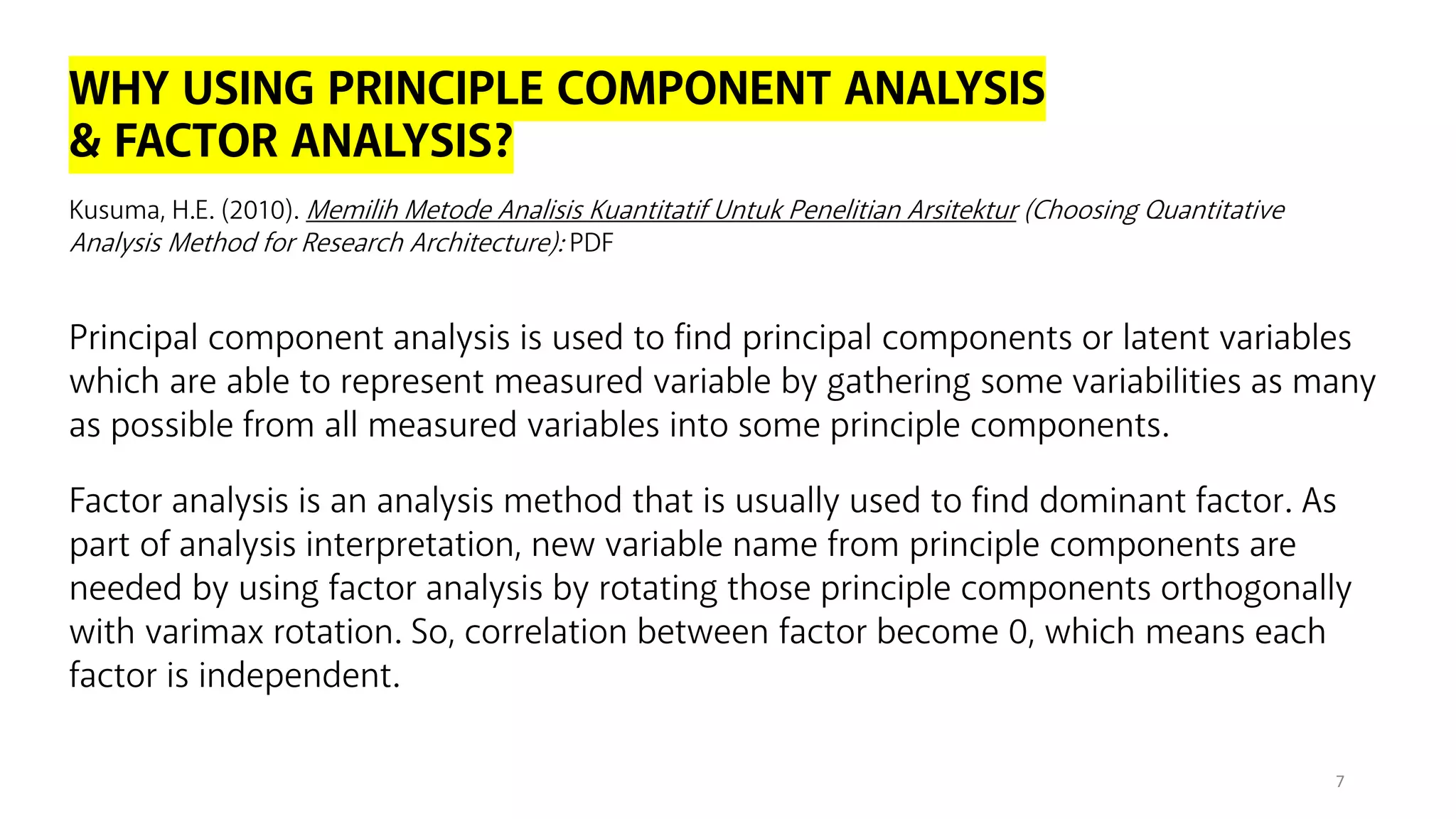
Principal component analysis is used to find principal components or latent variables
which are able to represent measured variable by gathering some variabilities as many
as possible from all measured variables into some principle components.
7
Kusuma, H.E. (2010). Memilih Metode Analisis Kuantitatif Untuk Penelitian Arsitektur (Choosing Quantitative
Analysis Method for Research Architecture): PDF
Factor analysis is an analysis method that is usually used to find dominant factor. As
part of analysis interpretation, new variable name from principle components are
needed by using factor analysis by rotating those principle components orthogonally
with varimax rotation. So, correlation between factor become 0, which means each
factor is independent.
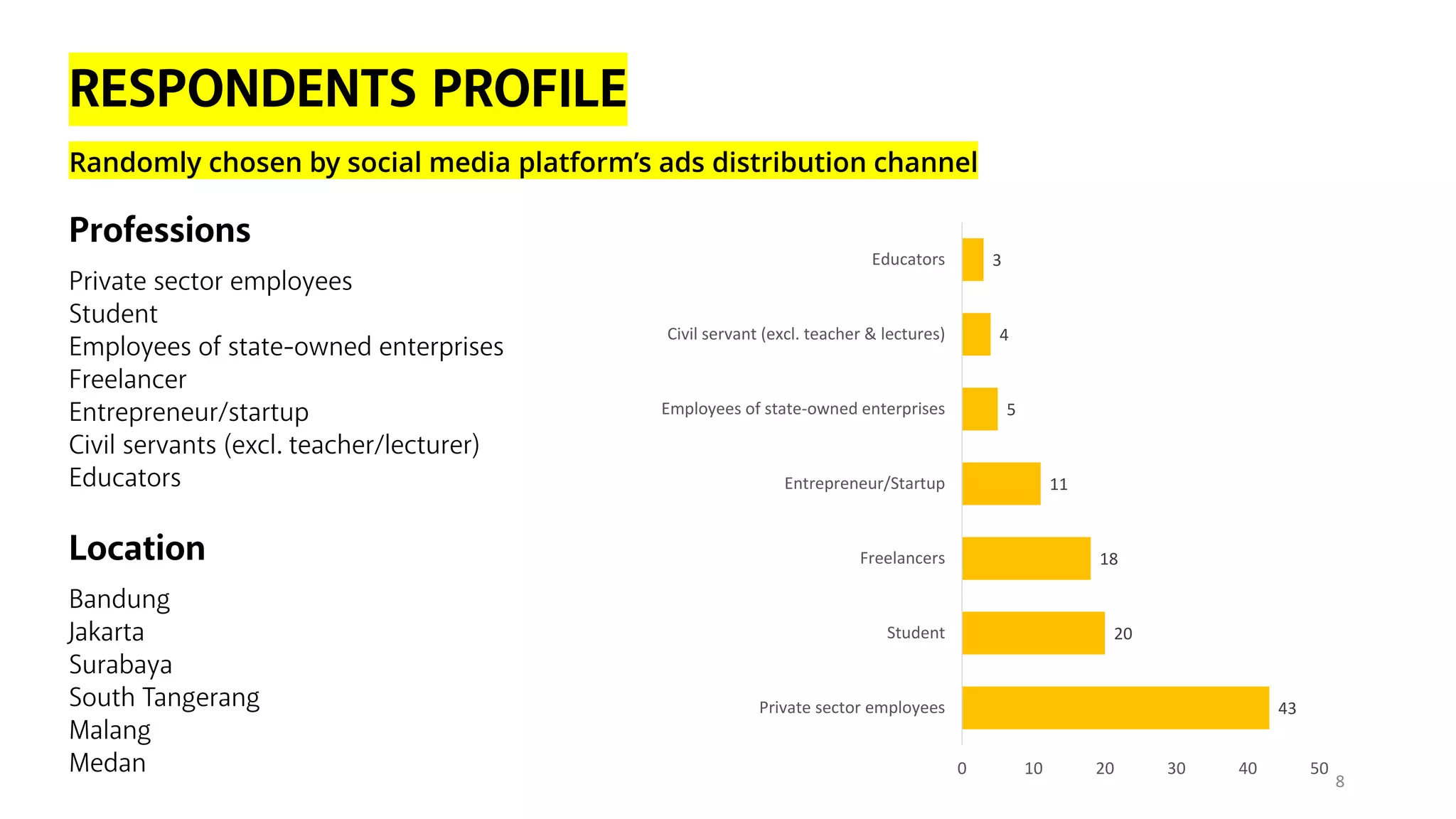
RESPONDENTS PROFILE
Professions
Private sector employees
Student
Employees of state-owned enterprises
Freelancer
Entrepreneur/startup
Civil servants (excl. teacher/lecturer)
Educators
43
20
18
11
5
4
3
0 10 20 30 40 50
Private sector employees
Student
Freelancers
Entrepreneur/Startup
Employees of state-owned enterprises
Civil servant (excl. teacher & lectures)
Educators
Location
Bandung
Jakarta
Surabaya
South Tangerang
Malang
Medan
Randomly chosen by social media platform’s ads distribution channel
8
DATA ANALYSIS
Principle component analysis
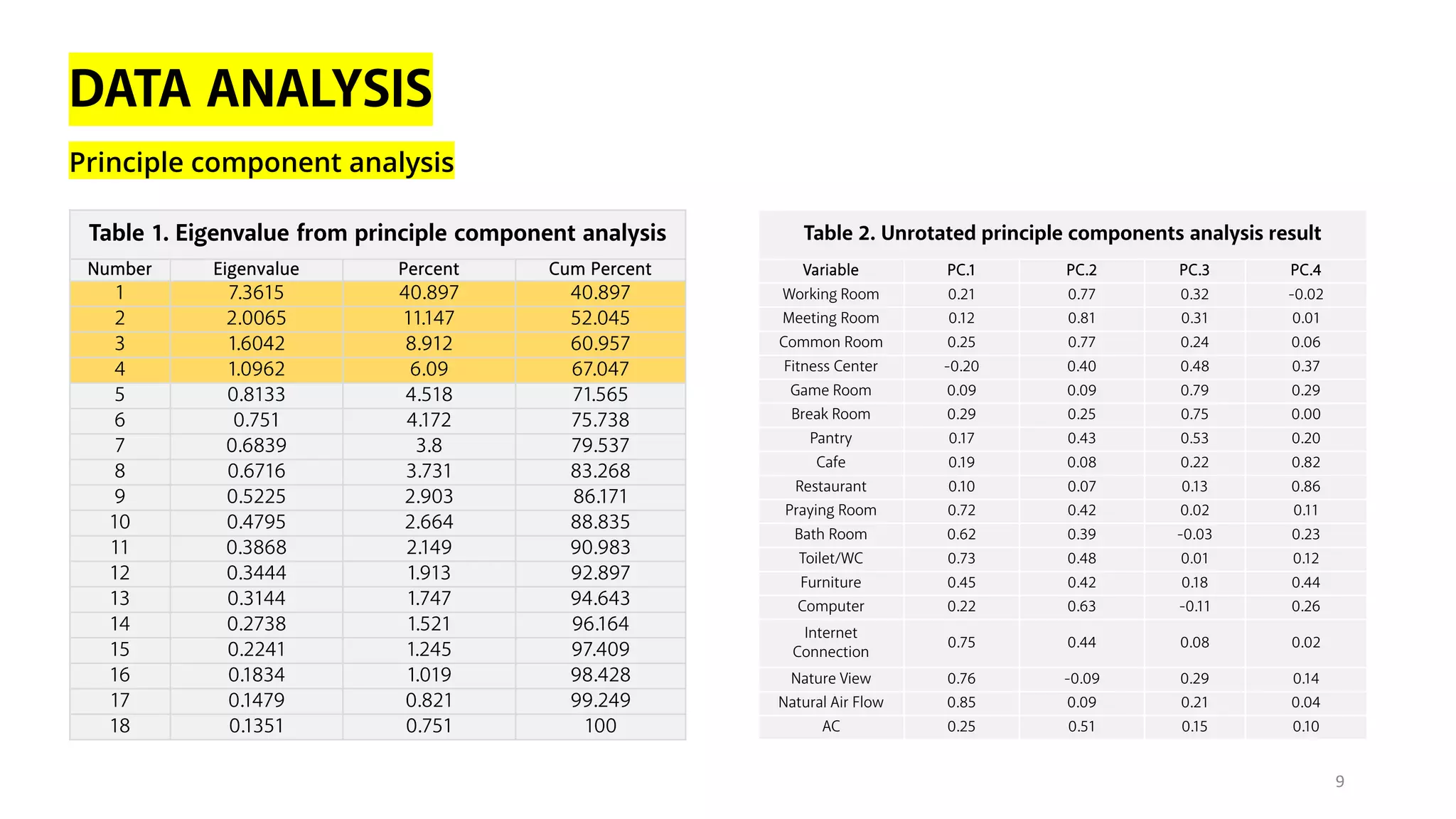
Table 1. Eigenvalue from principle component analysis
Number Eigenvalue Percent Cum Percent
1 7.3615 40.897 40.897
2 2.0065 11.147 52.045
3 1.6042 8.912 60.957
4 1.0962 6.09 67.047
5 0.8133 4.518 71.565
6 0.751 4.172 75.738
7 0.6839 3.8 79.537
8 0.6716 3.731 83.268
9 0.5225 2.903 86.171
10 0.4795 2.664 88.835
11 0.3868 2.149 90.983
12 0.3444 1.913 92.897
13 0.3144 1.747 94.643
14 0.2738 1.521 96.164
15 0.2241 1.245 97.409
16 0.1834 1.019 98.428
17 0.1479 0.821 99.249
18 0.1351 0.751 100
Table 2. Unrotated principle components analysis result
Variable PC.1 PC.2 PC.3 PC.4
Working Room 0.21 0.77 0.32 -0.02
Meeting Room 0.12 0.81 0.31 0.01
Common Room 0.25 0.77 0.24 0.06
Fitness Center -0.20 0.40 0.48 0.37
Game Room 0.09 0.09 0.79 0.29
Break Room 0.29 0.25 0.75 0.00
Pantry 0.17 0.43 0.53 0.20
Cafe 0.19 0.08 0.22 0.82
Restaurant 0.10 0.07 0.13 0.86
Praying Room 0.72 0.42 0.02 0.11
Bath Room 0.62 0.39 -0.03 0.23
Toilet/WC 0.73 0.48 0.01 0.12
Furniture 0.45 0.42 0.18 0.44
Computer 0.22 0.63 -0.11 0.26
Internet
Connection
0.75 0.44 0.08 0.02
Nature View 0.76 -0.09 0.29 0.14
Natural Air Flow 0.85 0.09 0.21 0.04
AC 0.25 0.51 0.15 0.10
9
DATA ANALYSIS
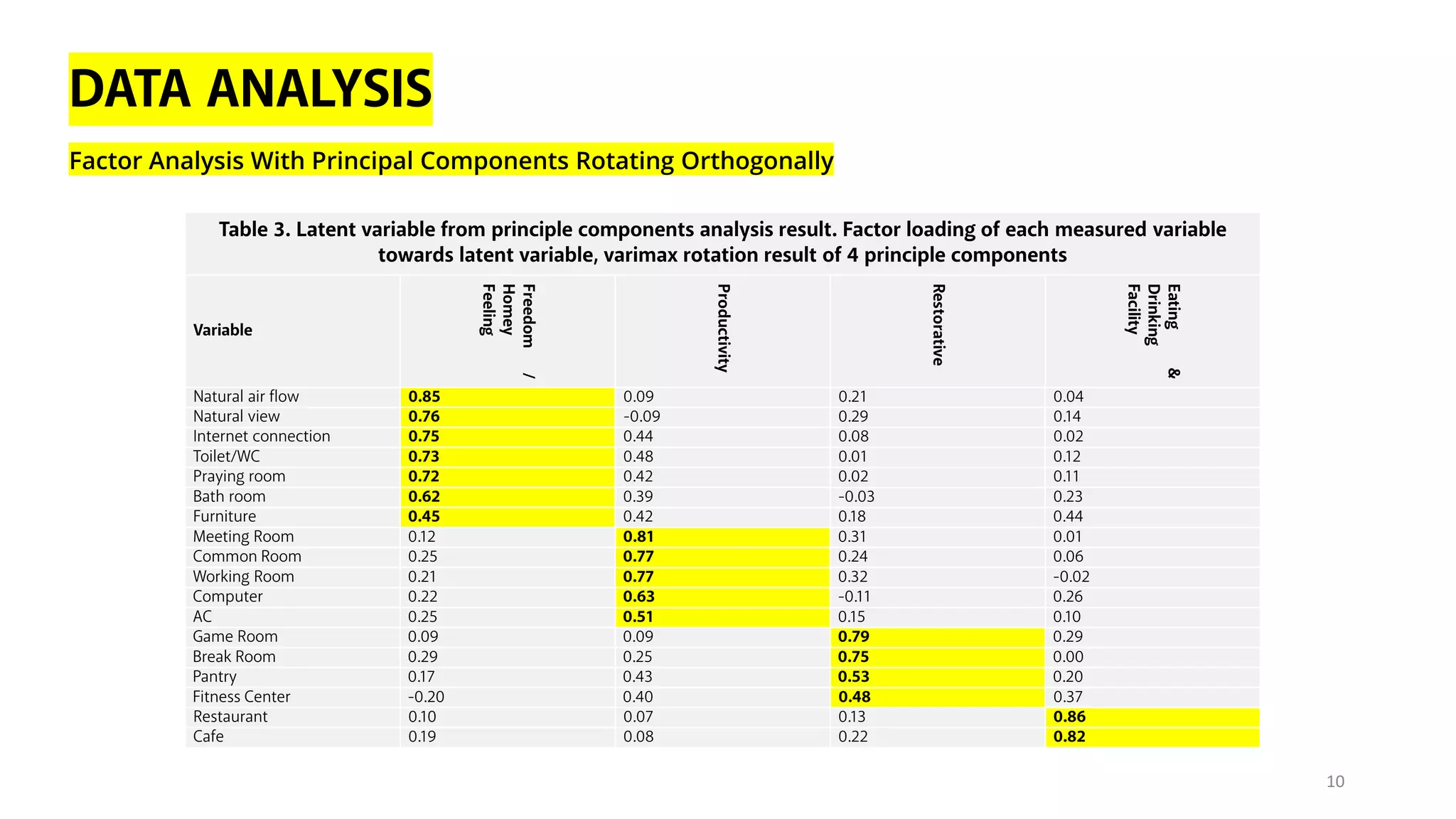
Factor Analysis With Principal Components Rotating Orthogonally
Table 3. Latent variable from principle components analysis result. Factor loading of each measured variable
towards latent variable, varimax rotation result of 4 principle components
Variable
Freedom/
Homey
Feeling
Productivity
Restorative
Eating&
Drinking
Facility
Natural air flow 0.85 0.09 0.21 0.04
Natural view 0.76 -0.09 0.29 0.14
Internet connection 0.75 0.44 0.08 0.02
Toilet/WC 0.73 0.48 0.01 0.12
Praying room 0.72 0.42 0.02 0.11
Bath room 0.62 0.39 -0.03 0.23
Furniture 0.45 0.42 0.18 0.44
Meeting Room 0.12 0.81 0.31 0.01
Common Room 0.25 0.77 0.24 0.06
Working Room 0.21 0.77 0.32 -0.02
Computer 0.22 0.63 -0.11 0.26
AC 0.25 0.51 0.15 0.10
Game Room 0.09 0.09 0.79 0.29
Break Room 0.29 0.25 0.75 0.00
Pantry 0.17 0.43 0.53 0.20
Fitness Center -0.20 0.40 0.48 0.37
Restaurant 0.10 0.07 0.13 0.86
Cafe 0.19 0.08 0.22 0.82
10
RESULT
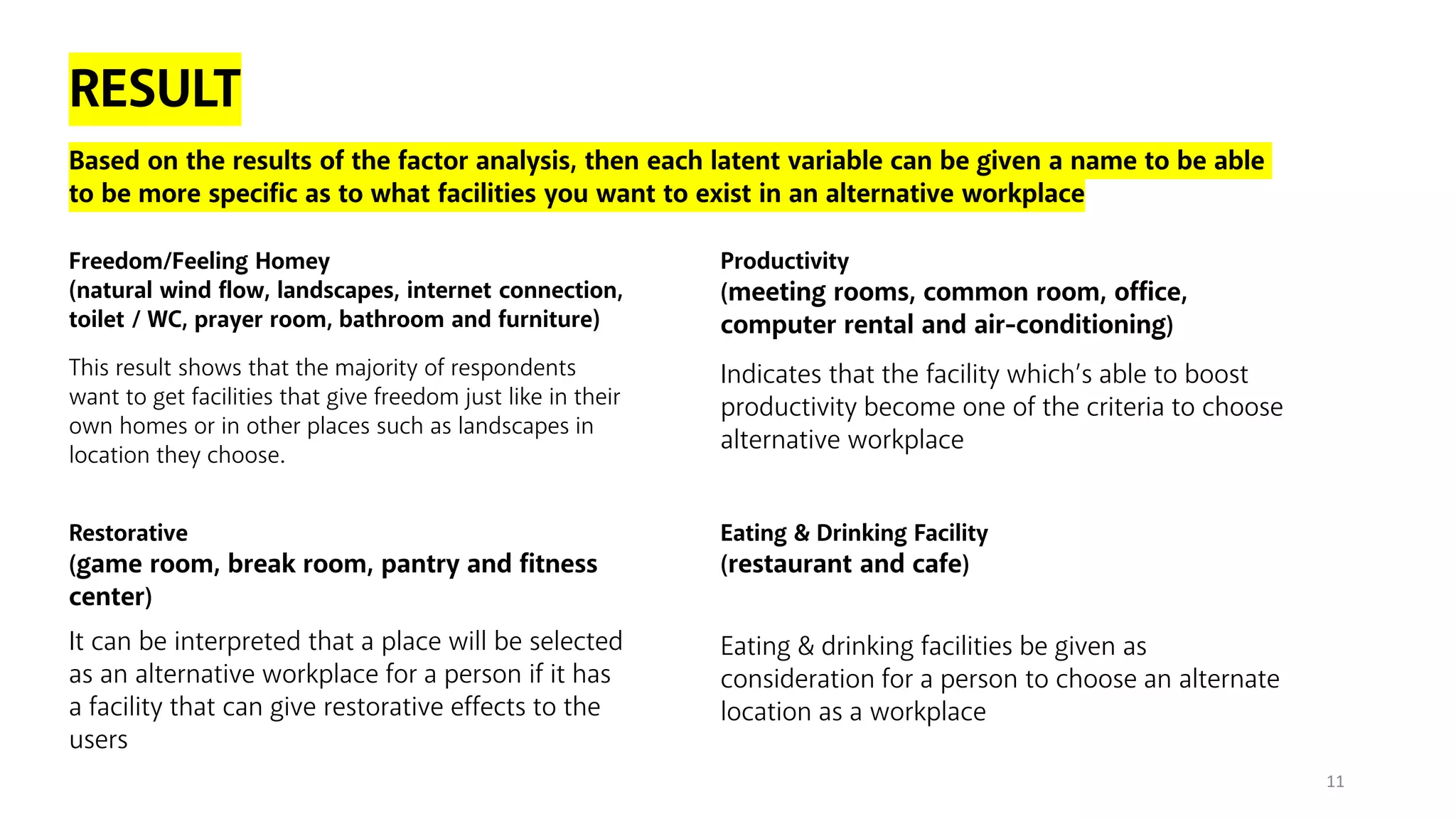
Based on the results of the factor analysis, then each latent variable can be given a name to be able
to be more specific as to what facilities you want to exist in an alternative workplace
Freedom/Feeling Homey
(natural wind flow, landscapes, internet connection,
toilet / WC, prayer room, bathroom and furniture)
This result shows that the majority of respondents
want to get facilities that give freedom just like in their
own homes or in other places such as landscapes in
location they choose.
Productivity
(meeting rooms, common room, office,
computer rental and air-conditioning)
Indicates that the facility which’s able to boost
productivity become one of the criteria to choose
alternative workplace
Restorative
(game room, break room, pantry and fitness
center)
It can be interpreted that a place will be selected
as an alternative workplace for a person if it has
a facility that can give restorative effects to the
users
Eating & Drinking Facility
(restaurant and cafe)
Eating & drinking facilities be given as
consideration for a person to choose an alternate
location as a workplace
11
DISCUSSION
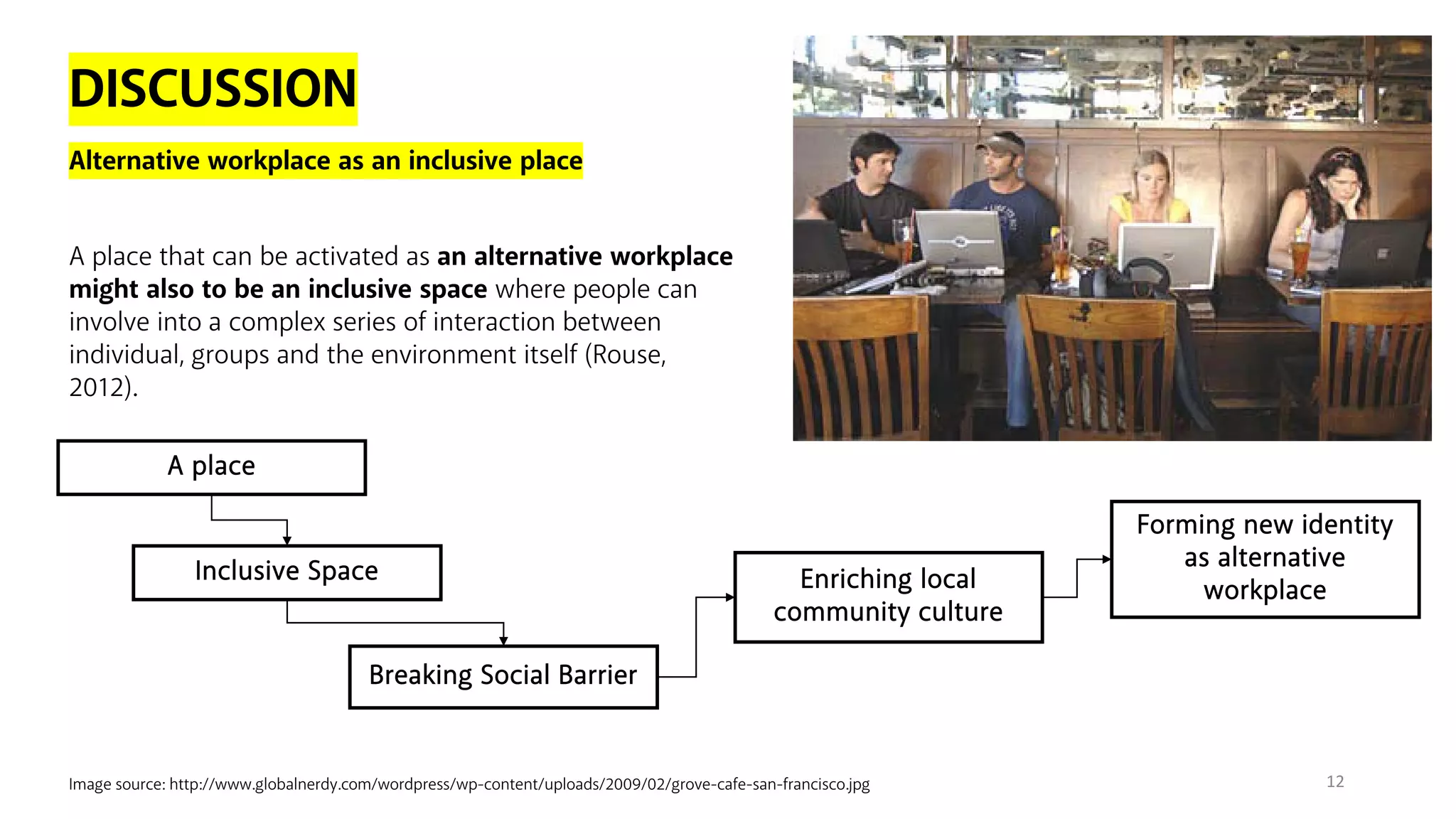
Alternative workplace as an inclusive place
A place that can be activated as an alternative workplace
might also to be an inclusive space where people can
involve into a complex series of interaction between
individual, groups and the environment itself (Rouse,
2012).
Image source: http://www.globalnerdy.com/wordpress/wp-content/uploads/2009/02/grove-cafe-san-francisco.jpg
A place
Inclusive Space
Breaking Social Barrier
Enriching local
community culture
Forming new identity
as alternative
workplace
12
CONCLUSION
13
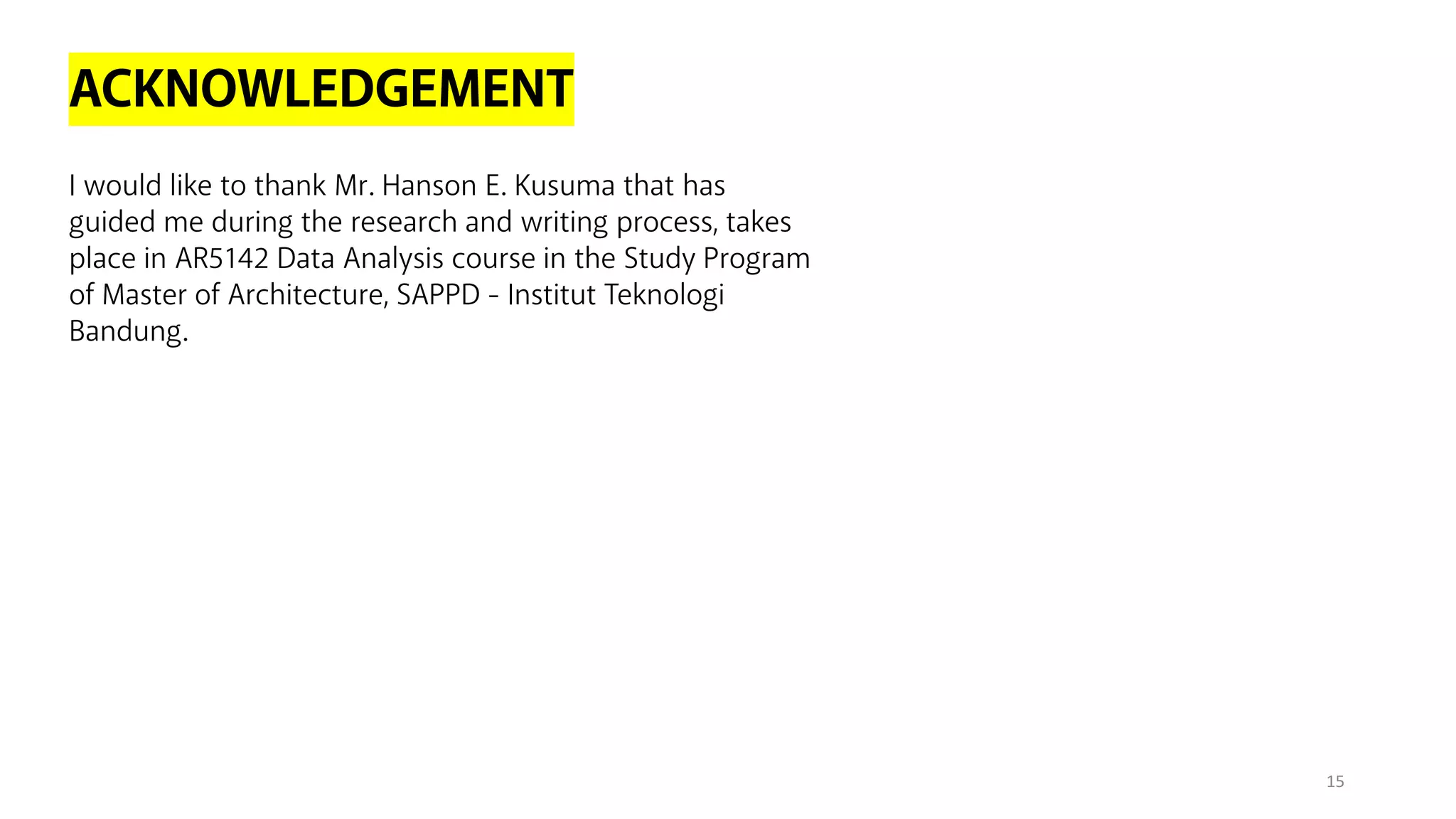
In choosing a location as an alternative workplace, there
are four criteria for facilities that must be fulfilled from
these locations include facilities to provide freedom/
homey feeling for the users, facilities that supports
users’ productivity, facility that can provide restorative
effects to the users and the availability of eating &
drinking facilities for the user. Those four criteria can be
considered by architect for designing a place that also
can be functioned as alternative workplace.
Image source: http://www.globalnerdy.com/wordpress/wp-content/uploads/2009/02/grove-cafe-san-francisco.jpg
FUTURE RESEARCH
14
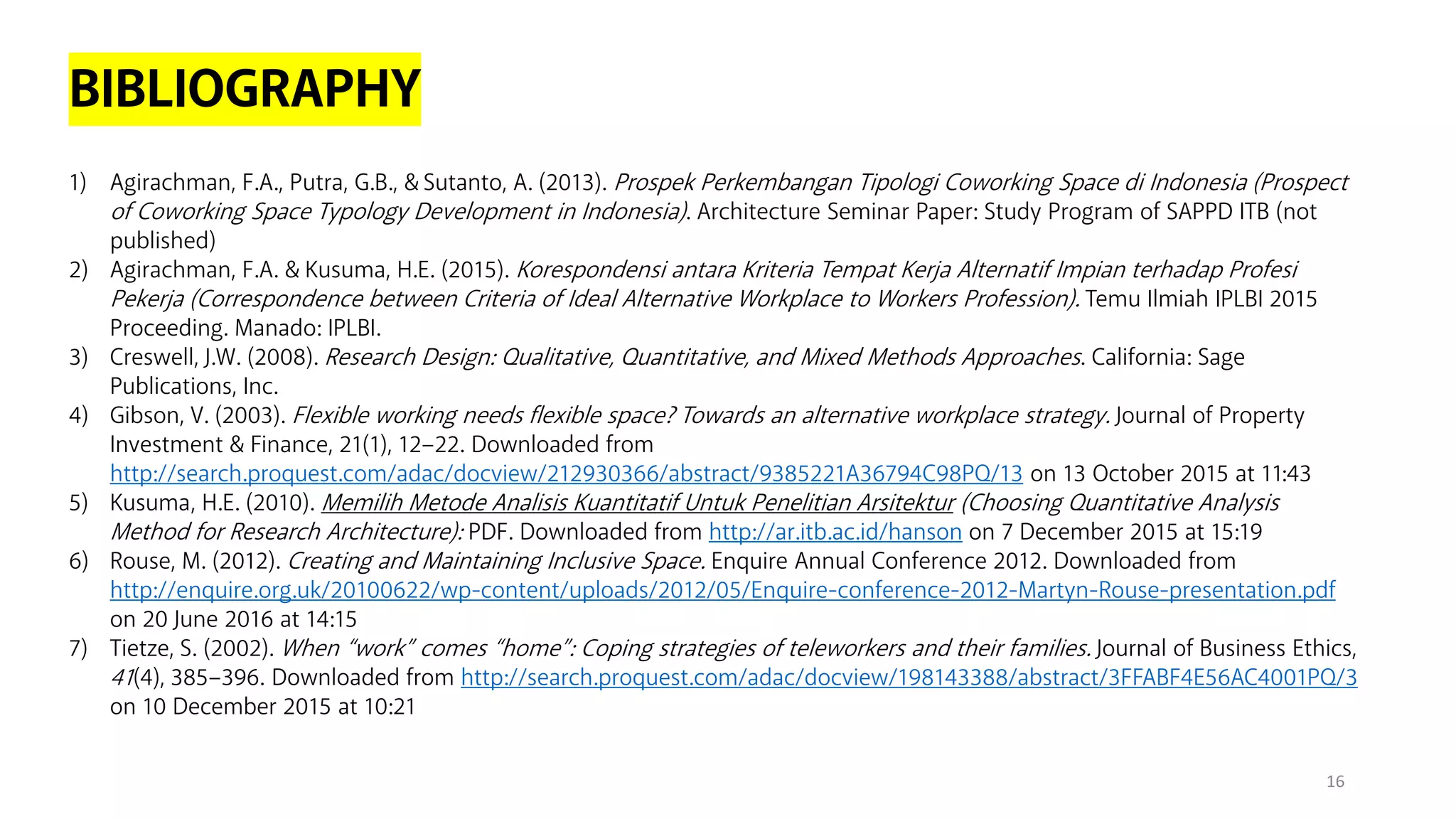
To get more precise criteria, dominant
factors/latent variables naming should be verified
once more in future research.
Also, further study is also needed to prove the
findings by applying those criteria on newly
designed or existing place.
Image source: http://www.globalnerdy.com/wordpress/wp-content/uploads/2009/02/grove-cafe-san-francisco.jpg
ACKNOWLEDGEMENT
I would like to thank Mr. Hanson E. Kusuma that has
guided me during the research and writing process, takes
place in AR5142 Data Analysis course in the Study Program
of Master of Architecture, SAPPD - Institut Teknologi
Bandung.
15
BIBLIOGRAPHY
1) Agirachman, F.A., Putra, G.B., & Sutanto, A. (2013). Prospek Perkembangan Tipologi Coworking Space di Indonesia (Prospect
of Coworking Space Typology Development in Indonesia). Architecture Seminar Paper: Study Program of SAPPD ITB (not
published)
2) Agirachman, F.A. & Kusuma, H.E. (2015). Korespondensi antara Kriteria Tempat Kerja Alternatif Impian terhadap Profesi
Pekerja (Correspondence between Criteria of Ideal Alternative Workplace to Workers Profession). Temu Ilmiah IPLBI 2015
Proceeding. Manado: IPLBI.
3) Creswell, J.W. (2008). Research Design: Qualitative, Quantitative, and Mixed Methods Approaches. California: Sage
Publications, Inc.
4) Gibson, V. (2003). Flexible working needs flexible space? Towards an alternative workplace strategy. Journal of Property
Investment & Finance, 21(1), 12–22. Downloaded from
http://search.proquest.com/adac/docview/212930366/abstract/9385221A36794C98PQ/13 on 13 October 2015 at 11:43
5) Kusuma, H.E. (2010). Memilih Metode Analisis Kuantitatif Untuk Penelitian Arsitektur (Choosing Quantitative Analysis
Method for Research Architecture): PDF. Downloaded from http://ar.itb.ac.id/hanson on 7 December 2015 at 15:19
6) Rouse, M. (2012). Creating and Maintaining Inclusive Space. Enquire Annual Conference 2012. Downloaded from
http://enquire.org.uk/20100622/wp-content/uploads/2012/05/Enquire-conference-2012-Martyn-Rouse-presentation.pdf
on 20 June 2016 at 14:15
7) Tietze, S. (2002). When “work” comes “home”: Coping strategies of teleworkers and their families. Journal of Business Ethics,
41(4), 385–396. Downloaded from http://search.proquest.com/adac/docview/198143388/abstract/3FFABF4E56AC4001PQ/3
on 10 December 2015 at 10:21
16

Study on Criteria of Essential Facilities In an Alternative Workplace using Factor Analysis

  • 1.
    Study on Criteriaof Essential Facilities In an Alternative Workplace using Factor Analysis Fauzan Alfi Agirachman School of Architecture, Planning and Policy Development Institut Teknologi Bandung Presented in 3rd ICIAP – Universitas Gadjah Mada, Yogyakarta August 11th – 12th 2016
  • 2.
    ALTERNATIVE WORKPLACE? What’s happenedwith a conventional one? Image source: http://www.stongemanagement.com/Images/photodune-10851358-interior-of-busy-modern-design-office-xs.jpg In a conventional office environment, there is a debate between the management of an office with property managers on how human resources and facilities can be more flexible in responding to an increasingly dynamic business environment. In Gibson (2003), flexibility is a major concern of managers in times like these dynamic conditions, including where and when employees work regardless of his contacts. 2
  • 3.
    TYPES OF FLEXIBILITYWORK Gibson, V. (2003). Flexible working needs flexible space? Towards an alternative workplace strategy. Journal of Property Investment & Finance, 21(1), 12–22. Icons made by (in order) Vectors Market, Madebyoliver and Freepik from www.flaticon.com is licensed by CC 3.0 BY Flexible contract Flexible time Flexible work location 3
  • 4.
    ALTERNATIVE WORKPLACE What isit? Image source: http://www.globalnerdy.com/wordpress/wp-content/uploads/2009/02/grove-cafe-san-francisco.jpg As the development of technology, space is no longer a limitation since anyone can use information technology to complete their work anywhere, including in locations that previously not functioned as a workspace. In fact, this lifestyle phenomenon triggers new workstyle in a form of co-working (Agirachman, Putra & Sutanto, 2013) or teleworking (Tietze, 2002). Those locations can be termed as an alternative workplace. 4
  • 5.
    ALTERNATIVE WORKPLACE What’s thecriteria to design one? Image source: http://www.globalnerdy.com/wordpress/wp-content/uploads/2009/02/grove-cafe-san-francisco.jpg Until now, there has been no clear criteria how a place can be functioned as an alternative workplace though its primary function is not as a workplace. In practice, some typologies indirectly have the potential to become an alternative workplace. The purpose of this study was to determine the criteria for facilities that are considered important to have in a location that’s suitable to be an alternative workplace. 5
  • 6.
    RESEARCH METHOD Quantitative researchmethod (Creswell, 2008) with post-positivism reductionist perspective Explaining the phenomenon by using several factors that represent the occurrence of the phenomenon Data collection Online questionnaires distributed freely (snowball-non-random-sampling), through private channels & social media platform (Facebook Page ads) Data analysis Multivariate analysis: principle components analysis and factor analysis 6
  • 7.
    WHY USING PRINCIPLECOMPONENT ANALYSIS & FACTOR ANALYSIS? Principal component analysis is used to find principal components or latent variables which are able to represent measured variable by gathering some variabilities as many as possible from all measured variables into some principle components. 7 Kusuma, H.E. (2010). Memilih Metode Analisis Kuantitatif Untuk Penelitian Arsitektur (Choosing Quantitative Analysis Method for Research Architecture): PDF Factor analysis is an analysis method that is usually used to find dominant factor. As part of analysis interpretation, new variable name from principle components are needed by using factor analysis by rotating those principle components orthogonally with varimax rotation. So, correlation between factor become 0, which means each factor is independent.
  • 8.
    RESPONDENTS PROFILE Professions Private sectoremployees Student Employees of state-owned enterprises Freelancer Entrepreneur/startup Civil servants (excl. teacher/lecturer) Educators 43 20 18 11 5 4 3 0 10 20 30 40 50 Private sector employees Student Freelancers Entrepreneur/Startup Employees of state-owned enterprises Civil servant (excl. teacher & lectures) Educators Location Bandung Jakarta Surabaya South Tangerang Malang Medan Randomly chosen by social media platform’s ads distribution channel 8
  • 9.
    DATA ANALYSIS Principle componentanalysis Table 1. Eigenvalue from principle component analysis Number Eigenvalue Percent Cum Percent 1 7.3615 40.897 40.897 2 2.0065 11.147 52.045 3 1.6042 8.912 60.957 4 1.0962 6.09 67.047 5 0.8133 4.518 71.565 6 0.751 4.172 75.738 7 0.6839 3.8 79.537 8 0.6716 3.731 83.268 9 0.5225 2.903 86.171 10 0.4795 2.664 88.835 11 0.3868 2.149 90.983 12 0.3444 1.913 92.897 13 0.3144 1.747 94.643 14 0.2738 1.521 96.164 15 0.2241 1.245 97.409 16 0.1834 1.019 98.428 17 0.1479 0.821 99.249 18 0.1351 0.751 100 Table 2. Unrotated principle components analysis result Variable PC.1 PC.2 PC.3 PC.4 Working Room 0.21 0.77 0.32 -0.02 Meeting Room 0.12 0.81 0.31 0.01 Common Room 0.25 0.77 0.24 0.06 Fitness Center -0.20 0.40 0.48 0.37 Game Room 0.09 0.09 0.79 0.29 Break Room 0.29 0.25 0.75 0.00 Pantry 0.17 0.43 0.53 0.20 Cafe 0.19 0.08 0.22 0.82 Restaurant 0.10 0.07 0.13 0.86 Praying Room 0.72 0.42 0.02 0.11 Bath Room 0.62 0.39 -0.03 0.23 Toilet/WC 0.73 0.48 0.01 0.12 Furniture 0.45 0.42 0.18 0.44 Computer 0.22 0.63 -0.11 0.26 Internet Connection 0.75 0.44 0.08 0.02 Nature View 0.76 -0.09 0.29 0.14 Natural Air Flow 0.85 0.09 0.21 0.04 AC 0.25 0.51 0.15 0.10 9
  • 10.
    DATA ANALYSIS Factor AnalysisWith Principal Components Rotating Orthogonally Table 3. Latent variable from principle components analysis result. Factor loading of each measured variable towards latent variable, varimax rotation result of 4 principle components Variable Freedom/ Homey Feeling Productivity Restorative Eating& Drinking Facility Natural air flow 0.85 0.09 0.21 0.04 Natural view 0.76 -0.09 0.29 0.14 Internet connection 0.75 0.44 0.08 0.02 Toilet/WC 0.73 0.48 0.01 0.12 Praying room 0.72 0.42 0.02 0.11 Bath room 0.62 0.39 -0.03 0.23 Furniture 0.45 0.42 0.18 0.44 Meeting Room 0.12 0.81 0.31 0.01 Common Room 0.25 0.77 0.24 0.06 Working Room 0.21 0.77 0.32 -0.02 Computer 0.22 0.63 -0.11 0.26 AC 0.25 0.51 0.15 0.10 Game Room 0.09 0.09 0.79 0.29 Break Room 0.29 0.25 0.75 0.00 Pantry 0.17 0.43 0.53 0.20 Fitness Center -0.20 0.40 0.48 0.37 Restaurant 0.10 0.07 0.13 0.86 Cafe 0.19 0.08 0.22 0.82 10
  • 11.
    RESULT Based on theresults of the factor analysis, then each latent variable can be given a name to be able to be more specific as to what facilities you want to exist in an alternative workplace Freedom/Feeling Homey (natural wind flow, landscapes, internet connection, toilet / WC, prayer room, bathroom and furniture) This result shows that the majority of respondents want to get facilities that give freedom just like in their own homes or in other places such as landscapes in location they choose. Productivity (meeting rooms, common room, office, computer rental and air-conditioning) Indicates that the facility which’s able to boost productivity become one of the criteria to choose alternative workplace Restorative (game room, break room, pantry and fitness center) It can be interpreted that a place will be selected as an alternative workplace for a person if it has a facility that can give restorative effects to the users Eating & Drinking Facility (restaurant and cafe) Eating & drinking facilities be given as consideration for a person to choose an alternate location as a workplace 11
  • 12.
    DISCUSSION Alternative workplace asan inclusive place A place that can be activated as an alternative workplace might also to be an inclusive space where people can involve into a complex series of interaction between individual, groups and the environment itself (Rouse, 2012). Image source: http://www.globalnerdy.com/wordpress/wp-content/uploads/2009/02/grove-cafe-san-francisco.jpg A place Inclusive Space Breaking Social Barrier Enriching local community culture Forming new identity as alternative workplace 12
  • 13.
    CONCLUSION 13 In choosing alocation as an alternative workplace, there are four criteria for facilities that must be fulfilled from these locations include facilities to provide freedom/ homey feeling for the users, facilities that supports users’ productivity, facility that can provide restorative effects to the users and the availability of eating & drinking facilities for the user. Those four criteria can be considered by architect for designing a place that also can be functioned as alternative workplace. Image source: http://www.globalnerdy.com/wordpress/wp-content/uploads/2009/02/grove-cafe-san-francisco.jpg
  • 14.
    FUTURE RESEARCH 14 To getmore precise criteria, dominant factors/latent variables naming should be verified once more in future research. Also, further study is also needed to prove the findings by applying those criteria on newly designed or existing place. Image source: http://www.globalnerdy.com/wordpress/wp-content/uploads/2009/02/grove-cafe-san-francisco.jpg
  • 15.
    ACKNOWLEDGEMENT I would liketo thank Mr. Hanson E. Kusuma that has guided me during the research and writing process, takes place in AR5142 Data Analysis course in the Study Program of Master of Architecture, SAPPD - Institut Teknologi Bandung. 15
  • 16.
    BIBLIOGRAPHY 1) Agirachman, F.A.,Putra, G.B., & Sutanto, A. (2013). Prospek Perkembangan Tipologi Coworking Space di Indonesia (Prospect of Coworking Space Typology Development in Indonesia). Architecture Seminar Paper: Study Program of SAPPD ITB (not published) 2) Agirachman, F.A. & Kusuma, H.E. (2015). Korespondensi antara Kriteria Tempat Kerja Alternatif Impian terhadap Profesi Pekerja (Correspondence between Criteria of Ideal Alternative Workplace to Workers Profession). Temu Ilmiah IPLBI 2015 Proceeding. Manado: IPLBI. 3) Creswell, J.W. (2008). Research Design: Qualitative, Quantitative, and Mixed Methods Approaches. California: Sage Publications, Inc. 4) Gibson, V. (2003). Flexible working needs flexible space? Towards an alternative workplace strategy. Journal of Property Investment & Finance, 21(1), 12–22. Downloaded from http://search.proquest.com/adac/docview/212930366/abstract/9385221A36794C98PQ/13 on 13 October 2015 at 11:43 5) Kusuma, H.E. (2010). Memilih Metode Analisis Kuantitatif Untuk Penelitian Arsitektur (Choosing Quantitative Analysis Method for Research Architecture): PDF. Downloaded from http://ar.itb.ac.id/hanson on 7 December 2015 at 15:19 6) Rouse, M. (2012). Creating and Maintaining Inclusive Space. Enquire Annual Conference 2012. Downloaded from http://enquire.org.uk/20100622/wp-content/uploads/2012/05/Enquire-conference-2012-Martyn-Rouse-presentation.pdf on 20 June 2016 at 14:15 7) Tietze, S. (2002). When “work” comes “home”: Coping strategies of teleworkers and their families. Journal of Business Ethics, 41(4), 385–396. Downloaded from http://search.proquest.com/adac/docview/198143388/abstract/3FFABF4E56AC4001PQ/3 on 10 December 2015 at 10:21 16