SreehariRaj Int. Journal of Engineering Research and Applications www.ijera.com
ISSN: 2248-9622, Vol. 5, Issue 8, (Part - 5) August 2015, pp.118-122
www.ijera.com 118|P a g e
Study of Concrete by Replacing Fine Aggregate by ETP Sludge of
TiO2
Sreehari Raj*, Sreelekshmi S**
*(P.G. Scholar, Department of Civil Engineering, Sree Buddha College of Engineering, Kerala, India)
** (Assistant Professor, Department of Civil Engineering, Sree Buddha College of Engineering, Kerala, India)
ABSTRACT
The rapid increase in construction activities leads to scarcity of conventional construction materials such as
cement, fine aggregate and coarse aggregate. Researches are being conducted for finding cheaper materials. In
India, there are many industries producing large amount of effluent treatment plant waste sludge which leads in
problems of disposal. The final destination of effluent treatment plant sludge affects the environment. So
alternative option is necessary for disposing effluent treatment sludge. In this study is subjected to the effective
reuse of effluent treatment plant sludge of TiO2 pigment generated from Kerala Minerals and Metals Ltd
(KMML). The aim of the thesis is to determine the strength parameters of concrete with the partial replacement
of fine aggregate by waste sludge from KMML. Reuse of ETP sludge in concrete is an effective option for the
problem of ultimate disposal up to greater extent. In this study the fine aggregate is replaced by the ETP sludge
of TiO2 with different percentages such as 5%, 10%, 15%, 20%, and 25% in M35 concrete mix. The various tests
such as compression, tensile and flexural strength are conducted.
Keywords- ETP Sludge, Effluent Treatment Plant, Partial Replacement
I. INTRODUCTION
The construction materials such as concrete,
bricks, hollow blocks, solid blocks, pavement blocks
and tiles are produced from various natural resources.
Now a days construction activities increases all over
the world. This sudden increase of these activities
causes the shortage of conventional construction
materials. It will mostly affect in the case of fine
aggregate. River sand is the mostly used fine
aggregate in the concrete for the construction
purposes. The fine aggregate is used in the concrete
for producing better workability and uniformity in
concrete.The demand of concrete is increases day by
day. It will cause the utilization of river sand in large
volume. It will cause the exploitation of natural
resources and affects the water table...etc. and also
cost of river sand increased in last few years due to
the administrative restrictions.In India there are many
industries which produce large amount of effluent
treatment plant sludge in every year which leads to
increasing problems in disposal and environmental
degradation due to continuous exploration and
depletion of natural resources. Since the land is
limited, another method should be used for the
disposal of industrial waste sludge. The pollution
control board and also various researchers are trying
to reduce the environmental degradation of the
industrial wastes by various researches including in
the field of concrete.
In this study focuses the replacement of fine
aggregate by ETP sludge of TiO2in M35 mix. The
fine aggregate is replaced by 5%, 10%, 15%, 20%,
and 25% with waste sludge. The various tests such as
compression, tensile and flexural strength are
conducted.
1.1 ETP Sludge of TiO2
Titanium dioxide (TiO2) is also called Titania,
which is a substance manufactured from selected
sand. KMML is India’s first and only manufacturer
of Rutile Grade Titanium dioxide by chloride
process. The chlorides of impurity metals are
removed from Titanium Tetra Chloride (TiCl4) by
various processes to complete the manufacture of
TiCl4. It is further purified by distillation to obtain
pure Titanium Tetra Chloride in the liquid form.
Titanium Tetra Chloride is vaporized, pre heated and
oxidized with oxygen in the Oxidation Plant to
produce raw Titanium Dioxide at a high temperature.
The raw Titanium Dioxide is then classified and
surface treated with various chemicals, filtered and
washed to remove the salts, sent to the dryer. The
Titanium Dioxide pigment in powder form which is
as an ingredients in the manufacture of paints. The
effluents generated due to the production of TiO2
contain the various chemicals and it is leads to the
problems of disposal and degrading the environment.
The chemical composition of ETP sludge was tested
at the research lab at KMML which is approved by
pollution control board of Kerala. The chemicals
contents of effluent treatment plant sludge of TiO2
are presented in table below.
RESEARCH ARTICLE OPEN ACCESS
SreehariRaj Int. Journal of Engineering Research and Applications www.ijera.com
ISSN: 2248-9622, Vol. 5, Issue 8, (Part - 5) August 2015, pp.118-122
www.ijera.com 119|P a g e
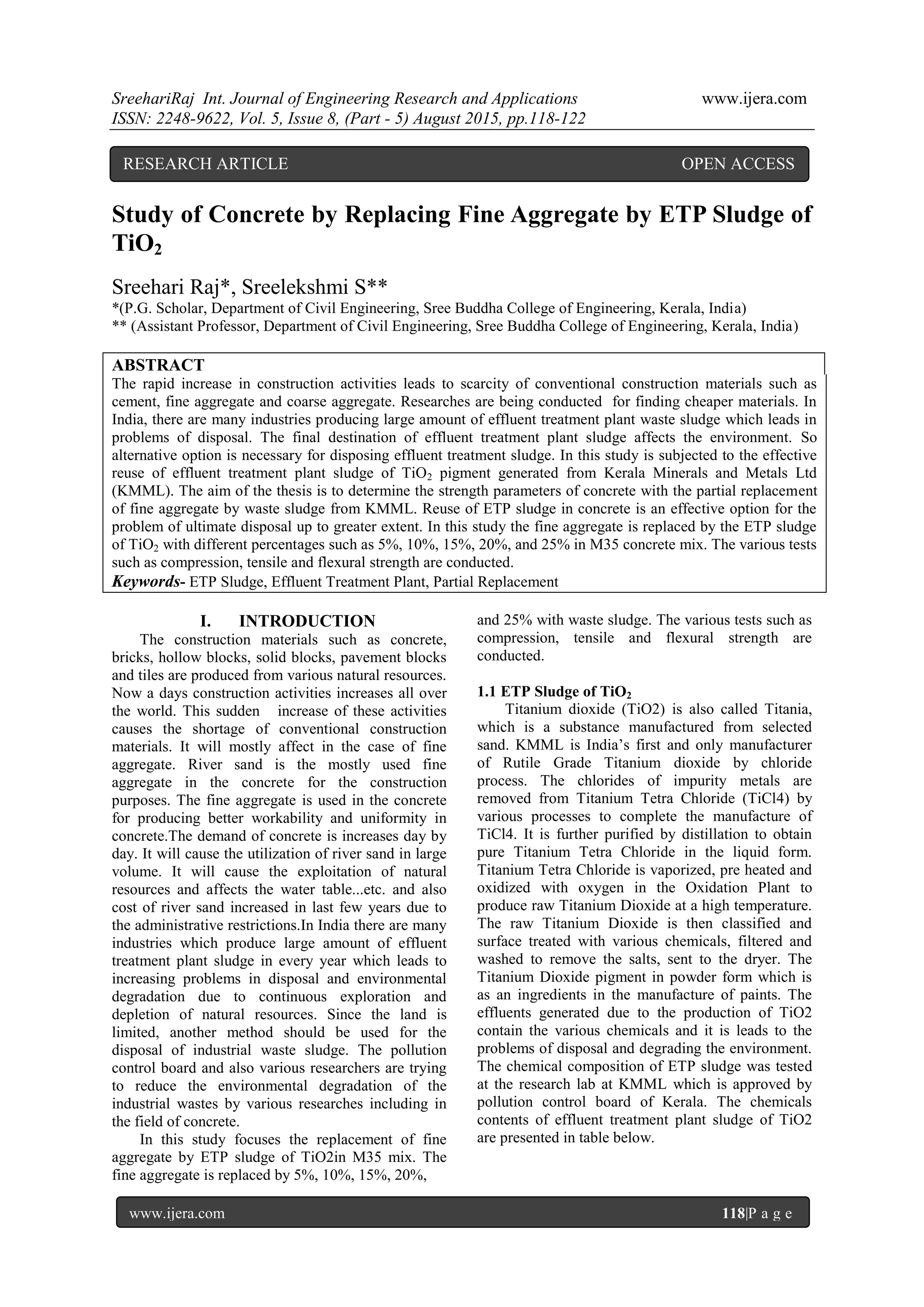
Fig 1. ETP Sludge of TiO2
Table 1.Chemical contents of ETP sludge of TiO2
No. Constituent Concentration (%)
1 TiO2 22.2
2 Carbon 33.5
3 Fe2O3 38.3
4 SiO2 0.87
5 Al2O3 1.6
6 V2O5 0.13
7 Cr2O3 0.1
8 Others 3.3
II. OBJECTIVES OF WORK
The ETP sludge from various industries are used
as the construction materials. The study is carried out
for finding the mechanical properties of concrete
which is replaced by the ETP sludge of TiO2.
1) To study the material properties of the materials
2) To study the strength parameters of the concrete
which is replaced the fine aggregate by the ETP
sludge.
2.1 Methodology
The Study was conducted in following steps,
1) Literature review
2) Inventory Survey
3) Experimental Investigation
4) Conclusion
III. MATERIALS USED
3.1 Cement
Cement can be defined as the bonding material
having cohesive & adhesive properties. Ordinary
Portland cement (OPC) confirming to IS 12269 (53
Grade) was used for the experimental work.
Laboratory tests were conducted on cement to
determine specific gravity, fineness, standard
consistency, initial setting time, final setting time and
compressive strength. Test results are mentioned on
table below.
Table 2. Properties of Cement
Particulars Values
Grade OPC 53
Specific gravity 3.15
Standard Consistency, % 31.25
Fineness, % 4
Initial setting time, min 90
Final setting time, min 270
3.2 Fine Aggregate
M sand was used as fine aggregate. Laboratory
tests were conducted to determine the different
physical properties as per IS 2386 (Part III)-1970.
Table 3.Properties of Fine aggregate
Sl. No. Test conducted Result
1 Specific gravity 2.61
2 Bulk density 1.836gm/cc
3 Void ratio 0.346
4 Porosity 0.257
5 Fineness modulus 4.949
3.3 Coarse Aggregate
The size of aggregate is 20mm is used for the
preparation of specimens. Laboratory tests were
conducted on coarse aggregates to determine the
different physical properties as per IS 2386. The
properties of coarse aggregate are shown in Table
below
Table 4. Properties of Coarse aggregate
Sl.
No.
Test conducted Result
1 Specific gravity 2.641
2 Bulk density 3.873gm/cc
3 Void ratio 3.385
4 Porosity 0.772%
5 Apparent specific gravity 2.666
6 Percentage of water absorbed 0.356%
7 Fineness modulus 5.883
3.4 Super Plasticizer
The super plasticizer used was Ceraplast 300 M
which is developed by Cere-chemPvt Ltd, Chennai. It
is compacted for blended cements, especially with
slag cement. Creaplast 300 is a new generation high
grade and high performance retarding super
plasticizers specially designed for concrete
replacement of cement up to 70-80 percentages by
slag.it provide the good workability and increase the
strength characteristics up to 25 percentages for
properly designed concrete mix.
SreehariRaj Int. Journal of Engineering Research and Applications www.ijera.com
ISSN: 2248-9622, Vol. 5, Issue 8, (Part - 5) August 2015, pp.118-122
www.ijera.com 120|P a g e
3.5 Water
Generally portable water should be used for the
construction purposes. This is to ensure that the water
is free from impurities such as suspended solids,
organic matter and dissolved salts, which may
adversely affect the properties of the concrete.
IV. MIX PROPORTION
The mix proportion for the M35 grade of
concrete was arrived through trial mixes. The mix
proportion for M35 grade of concrete is shown below
Table 5. Mix design
Mix Cement Fine
Aggregate
Coarse
Aggregate
Water
1 395.25 697 1107 158.1
V. RESULTS AND DISCUSSIONS
The fine aggregate in the concrete is replaced up
to a certain percentage by ETP sludge of Tio2 in the
concrete. The material properties and strength
parameters of replaced concrete is studied. Each test
result plotted in the figures and in the tables is the
mean value of results obtained by testing of three
specimens.
5.1 Workability
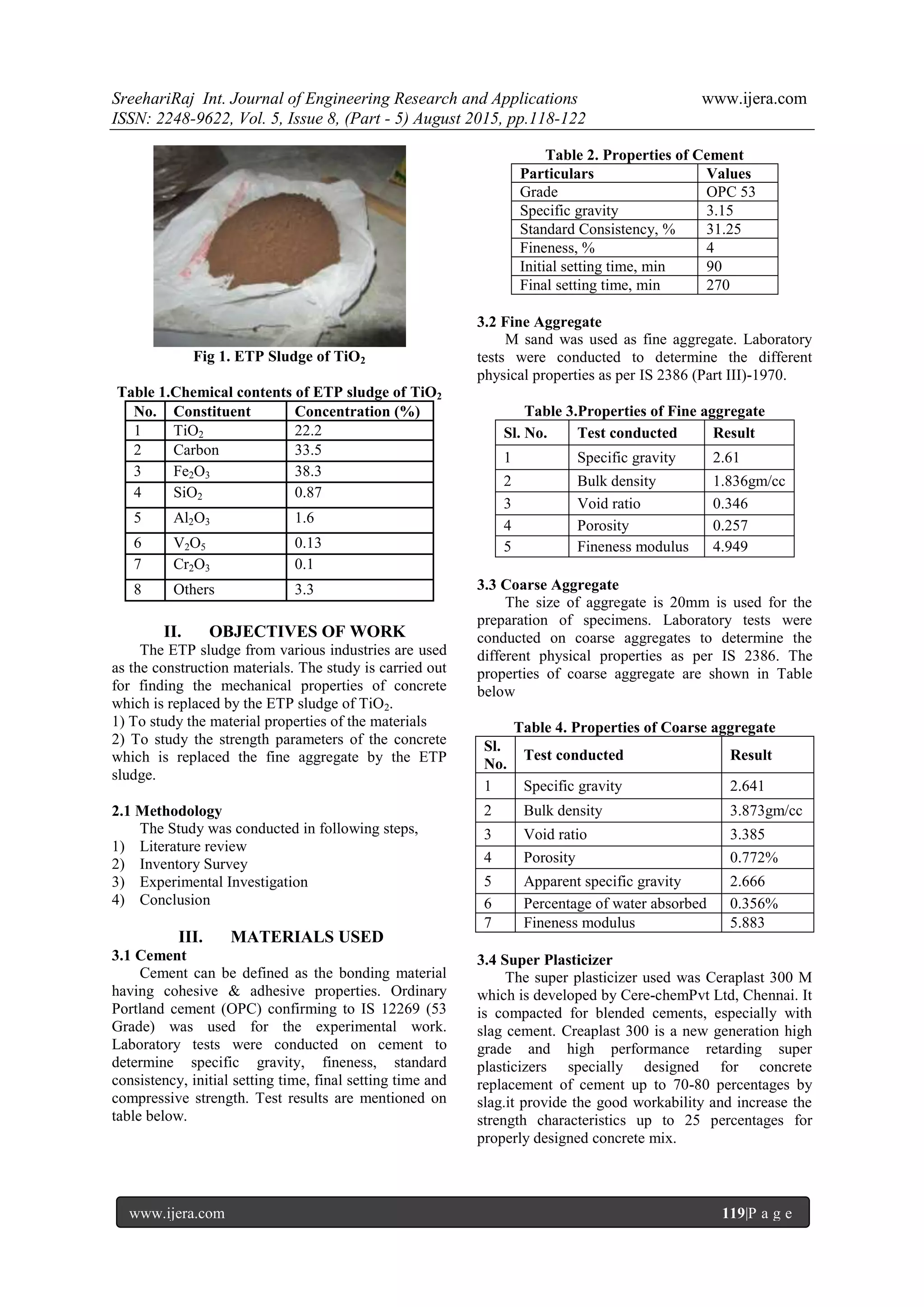
Compaction factor test is conducted for finding
the workability of the concrete. The workability of
various mixes was assessed as per the IS 1199:1959
specification. The values of compacting factor are in
Table and Figure given below. The workability of the
concrete is decreased with increasing the replacement
of fine aggregate. The water absorption rate of ETP
sludge is higher than the fine aggregate. Water
cement ratio is maintained and super plasticizer is
added for improving workability.
Table 6. Compacting factor values for different
mixes
Mix Compaction factor
M35 0.88
M35 + 5% 0.87
M35 + 10% 0.85
M35 + 15% 0.83
M35 + 20% 0.80
Fig 2.Variation of slump value
5.2 Compressive strength
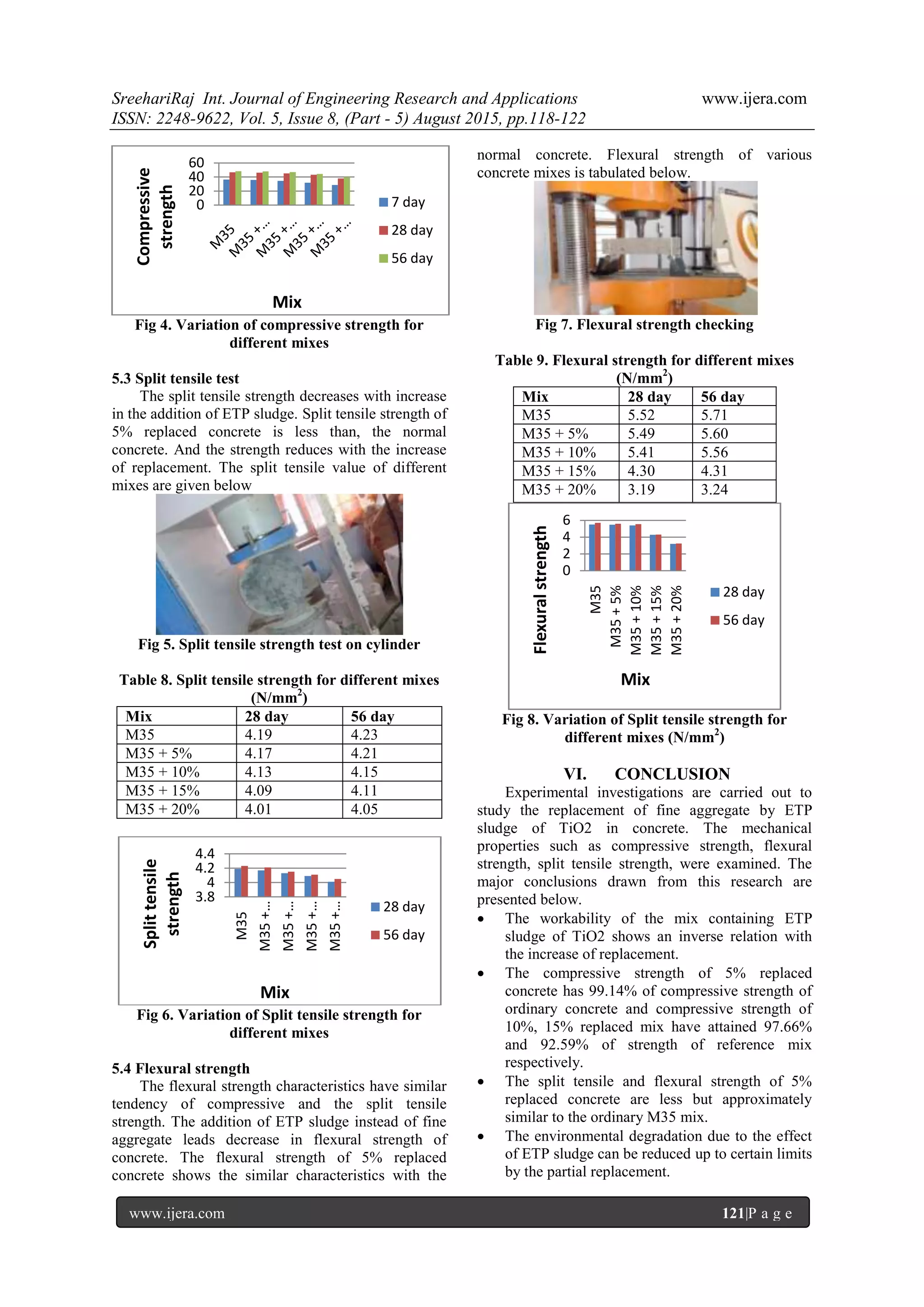
The results showed that the compressive strength
of the concrete is decreased when the addition of ETP
sludge increases in the concrete. In 5% replaced mix,
the compressive strength of the concrete is decreased
by 0.85% of normal concrete. The strength parameter
shows an inverse relation with the addition of
replacement of fine aggregate. However, the target
mean strength is achieved up to 10% of fine
aggregate replacement in the concrete as per the
Indian slandered code of mix design.
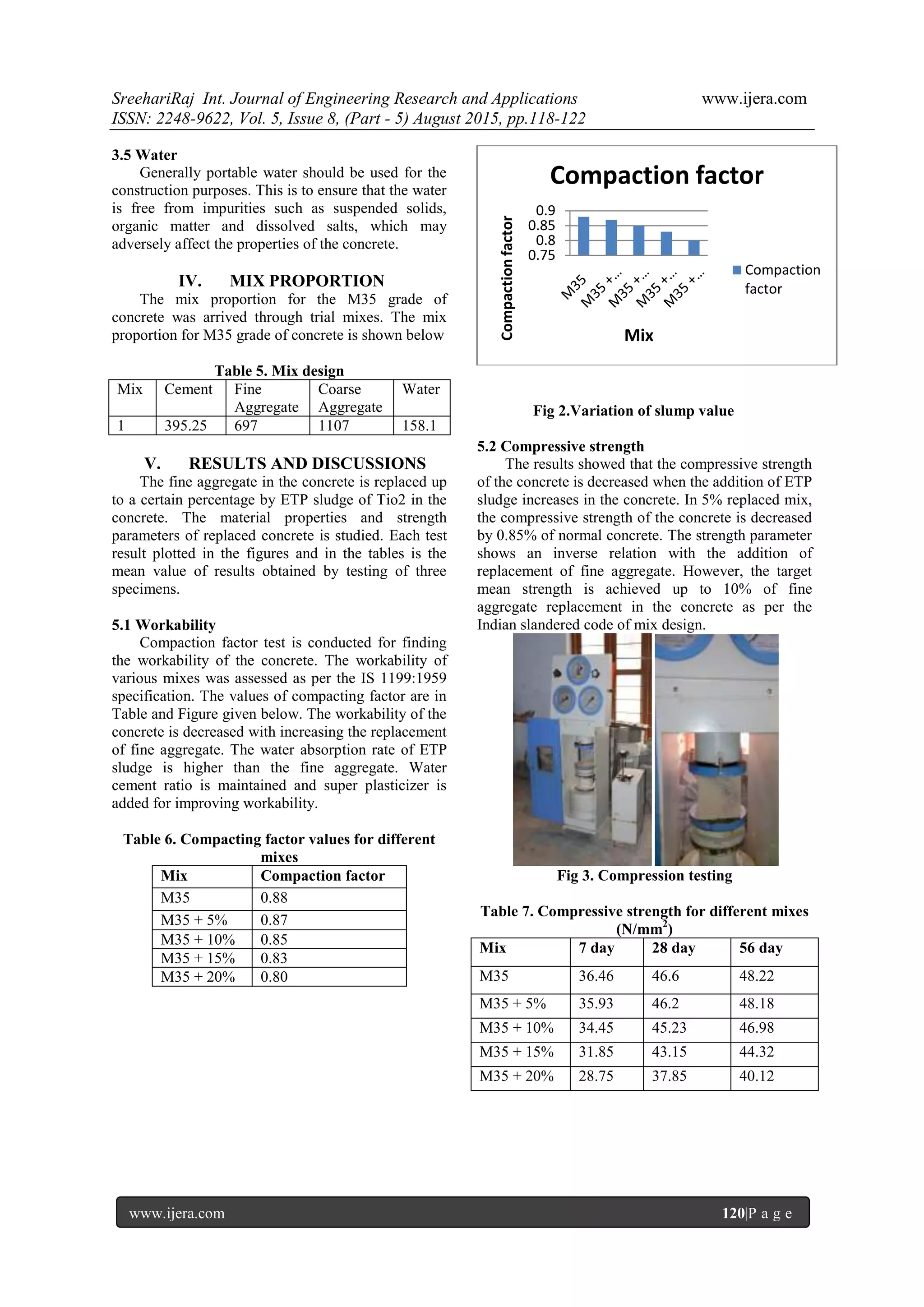
Fig 3. Compression testing
Table 7. Compressive strength for different mixes
(N/mm2
)
Mix 7 day 28 day 56 day
M35 36.46 46.6 48.22
M35 + 5% 35.93 46.2 48.18
M35 + 10% 34.45 45.23 46.98
M35 + 15% 31.85 43.15 44.32
M35 + 20% 28.75 37.85 40.12
0.75
0.8
0.85
0.9
Compactionfactor
Mix
Compaction factor
Compaction
factor
SreehariRaj Int. Journal of Engineering Research and Applications www.ijera.com
ISSN: 2248-9622, Vol. 5, Issue 8, (Part - 5) August 2015, pp.118-122
www.ijera.com 121|P a g e
Fig 4. Variation of compressive strength for
different mixes
5.3 Split tensile test
The split tensile strength decreases with increase
in the addition of ETP sludge. Split tensile strength of
5% replaced concrete is less than, the normal
concrete. And the strength reduces with the increase
of replacement. The split tensile value of different
mixes are given below
Fig 5. Split tensile strength test on cylinder
Table 8. Split tensile strength for different mixes
(N/mm2
)
Mix 28 day 56 day
M35 4.19 4.23
M35 + 5% 4.17 4.21
M35 + 10% 4.13 4.15
M35 + 15% 4.09 4.11
M35 + 20% 4.01 4.05
Fig 6. Variation of Split tensile strength for
different mixes
5.4 Flexural strength
The flexural strength characteristics have similar
tendency of compressive and the split tensile
strength. The addition of ETP sludge instead of fine
aggregate leads decrease in flexural strength of
concrete. The flexural strength of 5% replaced
concrete shows the similar characteristics with the
normal concrete. Flexural strength of various
concrete mixes is tabulated below.
Fig 7. Flexural strength checking
Table 9. Flexural strength for different mixes
(N/mm2
)
Mix 28 day 56 day
M35 5.52 5.71
M35 + 5% 5.49 5.60
M35 + 10% 5.41 5.56
M35 + 15% 4.30 4.31
M35 + 20% 3.19 3.24
Fig 8. Variation of Split tensile strength for
different mixes (N/mm2
)
VI. CONCLUSION
Experimental investigations are carried out to
study the replacement of fine aggregate by ETP
sludge of TiO2 in concrete. The mechanical
properties such as compressive strength, flexural
strength, split tensile strength, were examined. The
major conclusions drawn from this research are
presented below.
 The workability of the mix containing ETP
sludge of TiO2 shows an inverse relation with
the increase of replacement.
 The compressive strength of 5% replaced
concrete has 99.14% of compressive strength of
ordinary concrete and compressive strength of
10%, 15% replaced mix have attained 97.66%
and 92.59% of strength of reference mix
respectively.
 The split tensile and flexural strength of 5%
replaced concrete are less but approximately
similar to the ordinary M35 mix.
 The environmental degradation due to the effect
of ETP sludge can be reduced up to certain limits
by the partial replacement.
0
20
40
60
Compressive
strength
Mix
7 day
28 day
56 day
3.8
4
4.2
4.4
M35
M35+…
M35+…
M35+…
M35+…
Splittensile
strength
Mix
28 day
56 day
0
2
4
6
M35
M35+5%
M35+10%
M35+15%
M35+20%
Flexuralstrength
Mix
28 day
56 day
SreehariRaj Int. Journal of Engineering Research and Applications www.ijera.com
ISSN: 2248-9622, Vol. 5, Issue 8, (Part - 5) August 2015, pp.118-122
www.ijera.com 122|P a g e
 The increased cost of construction due to the
scarcity of fine aggregate can be reduced with
the ETP sludge up to some extent.
 Based on these studies, up to 15% replacement
of ETP sludge is possible in the concrete for
achieving the target mean strength as per Indian
slandered code of mix design. However 5% of
ETP sludge replacement is recommended based
on these studies for getting similar properties of
normal concrete.
Acknowledgements
The authors would like to acknowledge the Sree
Buddha college of Engineering, Kerala Minerals and
Metals Ltd and honorably thanks to our department
faculties and management, our beloved parents and
thank the almighty god who blessed us to overcome
all the obstacles.
REFERENCES
[1] M Ozaki, Y. Adachi, Y. Iwahori, and N.
Ishii, Characterization And Reuse Of Textile
Effluent Treatment Plant Waste Sludge In
Clay Bricks, Journal of the University of
Chemical Technology and Metallurgy, 41, 4,
2006, 473- 478112-116. 2006
[2] Abdullah shahbaz khan, Ram panth, Gagan
Krishna R.R, Suresh G. Pati,Structural
Performance of Concrete by Partial
Replacement ofCement with Hypo Sludge
(paper waste) , International Journal of
Emerging Technologies and Engineering
(IJETE) Volume 1 Issue 7, August 2014,
ISSN 2348 – 8050
[3] HemaPatel,SuneelPandey,Exploring the
Reuse Potential of Chemical Sludge from
Textile Wastewater Treatment Plants in
India-A Hazardous Waste,American Journal
of Environmental Sciences 5 (1): 106-110,
2009, ISSN 1553-345X © 2009 Science
Publications
[4] G. Shivanath, E. ArumugamAnd V.
Murugesan, Utilization Of Industrial
Effluent Treatment Plant (Etp) Sludge As
Partial Replacement For Cement In
Concrete,EM International Printed in India.
All rights reserved ,Jr. of Industrial
Pollution Control 27(1)(2011) pp 33-38
[5] Dhinesh.A, Karthikeyan.R, Dinesh.S,
Karthik.P.R .Karthik.S, Preliminary studies
of common effluent treatment waste sludge
in manufacturing of solid block, Scholars
Journal of Engineering and Technology
(SJET) Sch. J. Eng. Tech., 2014; 2(2A):161-
167
AUTHORS
Sreehari Raj,M.Tech (Structural
Engineering)Sree Buddha College of
EngineeringAlappuzha
Email:sreehariraj.05@gmail.com
SreelekshmiS, Assistant professor
Sree Buddha College of Engineering
Alappuzha
Email:sreelekshmi003@gmail.com

Study of Concrete by Replacing Fine Aggregate by ETP Sludge of TiO2

  • 1.
    SreehariRaj Int. Journalof Engineering Research and Applications www.ijera.com ISSN: 2248-9622, Vol. 5, Issue 8, (Part - 5) August 2015, pp.118-122 www.ijera.com 118|P a g e Study of Concrete by Replacing Fine Aggregate by ETP Sludge of TiO2 Sreehari Raj*, Sreelekshmi S** *(P.G. Scholar, Department of Civil Engineering, Sree Buddha College of Engineering, Kerala, India) ** (Assistant Professor, Department of Civil Engineering, Sree Buddha College of Engineering, Kerala, India) ABSTRACT The rapid increase in construction activities leads to scarcity of conventional construction materials such as cement, fine aggregate and coarse aggregate. Researches are being conducted for finding cheaper materials. In India, there are many industries producing large amount of effluent treatment plant waste sludge which leads in problems of disposal. The final destination of effluent treatment plant sludge affects the environment. So alternative option is necessary for disposing effluent treatment sludge. In this study is subjected to the effective reuse of effluent treatment plant sludge of TiO2 pigment generated from Kerala Minerals and Metals Ltd (KMML). The aim of the thesis is to determine the strength parameters of concrete with the partial replacement of fine aggregate by waste sludge from KMML. Reuse of ETP sludge in concrete is an effective option for the problem of ultimate disposal up to greater extent. In this study the fine aggregate is replaced by the ETP sludge of TiO2 with different percentages such as 5%, 10%, 15%, 20%, and 25% in M35 concrete mix. The various tests such as compression, tensile and flexural strength are conducted. Keywords- ETP Sludge, Effluent Treatment Plant, Partial Replacement I. INTRODUCTION The construction materials such as concrete, bricks, hollow blocks, solid blocks, pavement blocks and tiles are produced from various natural resources. Now a days construction activities increases all over the world. This sudden increase of these activities causes the shortage of conventional construction materials. It will mostly affect in the case of fine aggregate. River sand is the mostly used fine aggregate in the concrete for the construction purposes. The fine aggregate is used in the concrete for producing better workability and uniformity in concrete.The demand of concrete is increases day by day. It will cause the utilization of river sand in large volume. It will cause the exploitation of natural resources and affects the water table...etc. and also cost of river sand increased in last few years due to the administrative restrictions.In India there are many industries which produce large amount of effluent treatment plant sludge in every year which leads to increasing problems in disposal and environmental degradation due to continuous exploration and depletion of natural resources. Since the land is limited, another method should be used for the disposal of industrial waste sludge. The pollution control board and also various researchers are trying to reduce the environmental degradation of the industrial wastes by various researches including in the field of concrete. In this study focuses the replacement of fine aggregate by ETP sludge of TiO2in M35 mix. The fine aggregate is replaced by 5%, 10%, 15%, 20%, and 25% with waste sludge. The various tests such as compression, tensile and flexural strength are conducted. 1.1 ETP Sludge of TiO2 Titanium dioxide (TiO2) is also called Titania, which is a substance manufactured from selected sand. KMML is India’s first and only manufacturer of Rutile Grade Titanium dioxide by chloride process. The chlorides of impurity metals are removed from Titanium Tetra Chloride (TiCl4) by various processes to complete the manufacture of TiCl4. It is further purified by distillation to obtain pure Titanium Tetra Chloride in the liquid form. Titanium Tetra Chloride is vaporized, pre heated and oxidized with oxygen in the Oxidation Plant to produce raw Titanium Dioxide at a high temperature. The raw Titanium Dioxide is then classified and surface treated with various chemicals, filtered and washed to remove the salts, sent to the dryer. The Titanium Dioxide pigment in powder form which is as an ingredients in the manufacture of paints. The effluents generated due to the production of TiO2 contain the various chemicals and it is leads to the problems of disposal and degrading the environment. The chemical composition of ETP sludge was tested at the research lab at KMML which is approved by pollution control board of Kerala. The chemicals contents of effluent treatment plant sludge of TiO2 are presented in table below. RESEARCH ARTICLE OPEN ACCESS
  • 2.
    SreehariRaj Int. Journalof Engineering Research and Applications www.ijera.com ISSN: 2248-9622, Vol. 5, Issue 8, (Part - 5) August 2015, pp.118-122 www.ijera.com 119|P a g e Fig 1. ETP Sludge of TiO2 Table 1.Chemical contents of ETP sludge of TiO2 No. Constituent Concentration (%) 1 TiO2 22.2 2 Carbon 33.5 3 Fe2O3 38.3 4 SiO2 0.87 5 Al2O3 1.6 6 V2O5 0.13 7 Cr2O3 0.1 8 Others 3.3 II. OBJECTIVES OF WORK The ETP sludge from various industries are used as the construction materials. The study is carried out for finding the mechanical properties of concrete which is replaced by the ETP sludge of TiO2. 1) To study the material properties of the materials 2) To study the strength parameters of the concrete which is replaced the fine aggregate by the ETP sludge. 2.1 Methodology The Study was conducted in following steps, 1) Literature review 2) Inventory Survey 3) Experimental Investigation 4) Conclusion III. MATERIALS USED 3.1 Cement Cement can be defined as the bonding material having cohesive & adhesive properties. Ordinary Portland cement (OPC) confirming to IS 12269 (53 Grade) was used for the experimental work. Laboratory tests were conducted on cement to determine specific gravity, fineness, standard consistency, initial setting time, final setting time and compressive strength. Test results are mentioned on table below. Table 2. Properties of Cement Particulars Values Grade OPC 53 Specific gravity 3.15 Standard Consistency, % 31.25 Fineness, % 4 Initial setting time, min 90 Final setting time, min 270 3.2 Fine Aggregate M sand was used as fine aggregate. Laboratory tests were conducted to determine the different physical properties as per IS 2386 (Part III)-1970. Table 3.Properties of Fine aggregate Sl. No. Test conducted Result 1 Specific gravity 2.61 2 Bulk density 1.836gm/cc 3 Void ratio 0.346 4 Porosity 0.257 5 Fineness modulus 4.949 3.3 Coarse Aggregate The size of aggregate is 20mm is used for the preparation of specimens. Laboratory tests were conducted on coarse aggregates to determine the different physical properties as per IS 2386. The properties of coarse aggregate are shown in Table below Table 4. Properties of Coarse aggregate Sl. No. Test conducted Result 1 Specific gravity 2.641 2 Bulk density 3.873gm/cc 3 Void ratio 3.385 4 Porosity 0.772% 5 Apparent specific gravity 2.666 6 Percentage of water absorbed 0.356% 7 Fineness modulus 5.883 3.4 Super Plasticizer The super plasticizer used was Ceraplast 300 M which is developed by Cere-chemPvt Ltd, Chennai. It is compacted for blended cements, especially with slag cement. Creaplast 300 is a new generation high grade and high performance retarding super plasticizers specially designed for concrete replacement of cement up to 70-80 percentages by slag.it provide the good workability and increase the strength characteristics up to 25 percentages for properly designed concrete mix.
  • 3.
    SreehariRaj Int. Journalof Engineering Research and Applications www.ijera.com ISSN: 2248-9622, Vol. 5, Issue 8, (Part - 5) August 2015, pp.118-122 www.ijera.com 120|P a g e 3.5 Water Generally portable water should be used for the construction purposes. This is to ensure that the water is free from impurities such as suspended solids, organic matter and dissolved salts, which may adversely affect the properties of the concrete. IV. MIX PROPORTION The mix proportion for the M35 grade of concrete was arrived through trial mixes. The mix proportion for M35 grade of concrete is shown below Table 5. Mix design Mix Cement Fine Aggregate Coarse Aggregate Water 1 395.25 697 1107 158.1 V. RESULTS AND DISCUSSIONS The fine aggregate in the concrete is replaced up to a certain percentage by ETP sludge of Tio2 in the concrete. The material properties and strength parameters of replaced concrete is studied. Each test result plotted in the figures and in the tables is the mean value of results obtained by testing of three specimens. 5.1 Workability Compaction factor test is conducted for finding the workability of the concrete. The workability of various mixes was assessed as per the IS 1199:1959 specification. The values of compacting factor are in Table and Figure given below. The workability of the concrete is decreased with increasing the replacement of fine aggregate. The water absorption rate of ETP sludge is higher than the fine aggregate. Water cement ratio is maintained and super plasticizer is added for improving workability. Table 6. Compacting factor values for different mixes Mix Compaction factor M35 0.88 M35 + 5% 0.87 M35 + 10% 0.85 M35 + 15% 0.83 M35 + 20% 0.80 Fig 2.Variation of slump value 5.2 Compressive strength The results showed that the compressive strength of the concrete is decreased when the addition of ETP sludge increases in the concrete. In 5% replaced mix, the compressive strength of the concrete is decreased by 0.85% of normal concrete. The strength parameter shows an inverse relation with the addition of replacement of fine aggregate. However, the target mean strength is achieved up to 10% of fine aggregate replacement in the concrete as per the Indian slandered code of mix design. Fig 3. Compression testing Table 7. Compressive strength for different mixes (N/mm2 ) Mix 7 day 28 day 56 day M35 36.46 46.6 48.22 M35 + 5% 35.93 46.2 48.18 M35 + 10% 34.45 45.23 46.98 M35 + 15% 31.85 43.15 44.32 M35 + 20% 28.75 37.85 40.12 0.75 0.8 0.85 0.9 Compactionfactor Mix Compaction factor Compaction factor
  • 4.
    SreehariRaj Int. Journalof Engineering Research and Applications www.ijera.com ISSN: 2248-9622, Vol. 5, Issue 8, (Part - 5) August 2015, pp.118-122 www.ijera.com 121|P a g e Fig 4. Variation of compressive strength for different mixes 5.3 Split tensile test The split tensile strength decreases with increase in the addition of ETP sludge. Split tensile strength of 5% replaced concrete is less than, the normal concrete. And the strength reduces with the increase of replacement. The split tensile value of different mixes are given below Fig 5. Split tensile strength test on cylinder Table 8. Split tensile strength for different mixes (N/mm2 ) Mix 28 day 56 day M35 4.19 4.23 M35 + 5% 4.17 4.21 M35 + 10% 4.13 4.15 M35 + 15% 4.09 4.11 M35 + 20% 4.01 4.05 Fig 6. Variation of Split tensile strength for different mixes 5.4 Flexural strength The flexural strength characteristics have similar tendency of compressive and the split tensile strength. The addition of ETP sludge instead of fine aggregate leads decrease in flexural strength of concrete. The flexural strength of 5% replaced concrete shows the similar characteristics with the normal concrete. Flexural strength of various concrete mixes is tabulated below. Fig 7. Flexural strength checking Table 9. Flexural strength for different mixes (N/mm2 ) Mix 28 day 56 day M35 5.52 5.71 M35 + 5% 5.49 5.60 M35 + 10% 5.41 5.56 M35 + 15% 4.30 4.31 M35 + 20% 3.19 3.24 Fig 8. Variation of Split tensile strength for different mixes (N/mm2 ) VI. CONCLUSION Experimental investigations are carried out to study the replacement of fine aggregate by ETP sludge of TiO2 in concrete. The mechanical properties such as compressive strength, flexural strength, split tensile strength, were examined. The major conclusions drawn from this research are presented below.  The workability of the mix containing ETP sludge of TiO2 shows an inverse relation with the increase of replacement.  The compressive strength of 5% replaced concrete has 99.14% of compressive strength of ordinary concrete and compressive strength of 10%, 15% replaced mix have attained 97.66% and 92.59% of strength of reference mix respectively.  The split tensile and flexural strength of 5% replaced concrete are less but approximately similar to the ordinary M35 mix.  The environmental degradation due to the effect of ETP sludge can be reduced up to certain limits by the partial replacement. 0 20 40 60 Compressive strength Mix 7 day 28 day 56 day 3.8 4 4.2 4.4 M35 M35+… M35+… M35+… M35+… Splittensile strength Mix 28 day 56 day 0 2 4 6 M35 M35+5% M35+10% M35+15% M35+20% Flexuralstrength Mix 28 day 56 day
  • 5.
    SreehariRaj Int. Journalof Engineering Research and Applications www.ijera.com ISSN: 2248-9622, Vol. 5, Issue 8, (Part - 5) August 2015, pp.118-122 www.ijera.com 122|P a g e  The increased cost of construction due to the scarcity of fine aggregate can be reduced with the ETP sludge up to some extent.  Based on these studies, up to 15% replacement of ETP sludge is possible in the concrete for achieving the target mean strength as per Indian slandered code of mix design. However 5% of ETP sludge replacement is recommended based on these studies for getting similar properties of normal concrete. Acknowledgements The authors would like to acknowledge the Sree Buddha college of Engineering, Kerala Minerals and Metals Ltd and honorably thanks to our department faculties and management, our beloved parents and thank the almighty god who blessed us to overcome all the obstacles. REFERENCES [1] M Ozaki, Y. Adachi, Y. Iwahori, and N. Ishii, Characterization And Reuse Of Textile Effluent Treatment Plant Waste Sludge In Clay Bricks, Journal of the University of Chemical Technology and Metallurgy, 41, 4, 2006, 473- 478112-116. 2006 [2] Abdullah shahbaz khan, Ram panth, Gagan Krishna R.R, Suresh G. Pati,Structural Performance of Concrete by Partial Replacement ofCement with Hypo Sludge (paper waste) , International Journal of Emerging Technologies and Engineering (IJETE) Volume 1 Issue 7, August 2014, ISSN 2348 – 8050 [3] HemaPatel,SuneelPandey,Exploring the Reuse Potential of Chemical Sludge from Textile Wastewater Treatment Plants in India-A Hazardous Waste,American Journal of Environmental Sciences 5 (1): 106-110, 2009, ISSN 1553-345X © 2009 Science Publications [4] G. Shivanath, E. ArumugamAnd V. Murugesan, Utilization Of Industrial Effluent Treatment Plant (Etp) Sludge As Partial Replacement For Cement In Concrete,EM International Printed in India. All rights reserved ,Jr. of Industrial Pollution Control 27(1)(2011) pp 33-38 [5] Dhinesh.A, Karthikeyan.R, Dinesh.S, Karthik.P.R .Karthik.S, Preliminary studies of common effluent treatment waste sludge in manufacturing of solid block, Scholars Journal of Engineering and Technology (SJET) Sch. J. Eng. Tech., 2014; 2(2A):161- 167 AUTHORS Sreehari Raj,M.Tech (Structural Engineering)Sree Buddha College of EngineeringAlappuzha Email:sreehariraj.05@gmail.com SreelekshmiS, Assistant professor Sree Buddha College of Engineering Alappuzha Email:sreelekshmi003@gmail.com