Sundareshan S D et al. Int. Journal of Engineering Research and Applications www.ijera.com
ISSN: 2248-9622, Vol. 5, Issue 11, (Part - 4) November 2015, pp.73-81
www.ijera.com 73 | P a g e
A Literature Review on Lean Implementations – A
comprehensive summary
Sundareshan S D* Dr Swamy D R **, Dr T S Nanjundeswara Swamy**
Research scholar*, Professor ** JSS Academy of Technical Education, Bangalore
Abstract
The available research papers in area of Lean are studied to know the implementation level of different lean
tools, barrier and benefits of implementation are also considered in the review .The commonly used lean tools in
the various organization, most common barriers and benefits have been identified and listed in this paper. Most
common barrier are also components of quality of work life.
Keywords: Quality work life, Lean Manufacturing, Toyota production system,Kanban
I. Introduction
Lean manufacturing is an important tool used
across the industries in the recent scenario. At present
the industries are facing a higher level of competition
because of the globalization. In this context, to
remain and compete in the market, companies need to
deploy certain tools and techniques which are useful
to the uplift their performance and to respond rapidly
to the customer‘s needs. The fundamental concept of
lean manufacturing is to provide a quality product
while also ensuring that the product does not cost too
much to the customer.
In this paper an attempt has been made to
present a review of the literature to identify the
important and useful contributions to this Lean
concept.
Lean manufacturing utilizes a wide range of
tools and techniques; the choice of tools is based on
the requirement. Many parameters contribute success
of lean. Organizations which implemented lean
manufacturing have higher level of flexibility and
competitiveness. However, lean manufacturing
provides an environment that is highly conducive to
waste minimization.
II. Objectives of the Paper:
 To find the level of Lean implementation in
different sectors.
 To find out the tool used most and least under
Lean implementation.
 To examine the benefits and barriers of Lean
implementation in manufacturing.
 To evaluate the implementation of the Lean
manufacturing
III. Results and Discussions
The research papers related to Lean
manufacturing from various reputed journals have
been considered for the review. After doing thorough
study of the Lean implementation, (Annexure 1) the
results of the research papers considered for the
review. The considered review papers have been
grouped based on awareness about the Lean, lean
implementation, Barrier and benefits of Lean and
performance. There are quite a good number of
studies available in the body of literature focusing on
the awareness and Potential for implementation of
Lean tool in different sector. The one important such
study is discussed below.
Roba Salem et al, (2015) studied on the level of
recognition of lean concepts, principles, tools, and
techniques in different industrial sectors in Qatar, to
ass‘s lean awareness and to know the perception
about lean benefits and lean challenges. Data were
collected from 333 organizations from various
sectors like oil and gas, academic institutions and
service sectors through an on-line survey. Results
showed that industries in Qatar need to give more
credit to lean thinking in order to strategically
advance current efficiencies as well as cope with
competition at global level. Research also reveals that
there is a differences on the levels of awareness,
recognition and appreciation of lean concepts in
different industrial sectors.
Chaple (2014) investigate the enablers and barriers
in implementing the Lean principles and lean
diffusion in Indian manufacturing industries. Result
shows that the trend in lean manufacturing for
research now is focused on lean assessment.
Leanness attracts focus to answer specific questions
of different levels of managers responsible for lean
implementation to assess the lean implementation
level and to justify spending over lean
implementation. He worked on multiple criterion
decision-making (MCDM) for lean assessment to
assess lean performance holistically & popularity of
lean in India; but when it comes to success, its only
start of journey. Other than automobile and
RESEARCH ARTICLE OPEN ACCESS
Sundareshan S D et al. Int. Journal of Engineering Research and Applications www.ijera.com
ISSN: 2248-9622, Vol. 5, Issue 11, (Part - 4) November 2015, pp.73-81
www.ijera.com 74 | P a g e
electronics industry, others are having medium to low
diffusion of lean in India.
Pratik Chikhalikar (2015) study focused on the
implementation of the lean in the engine
manufacturing unit in India. Research identified the
important lean tools and time horizon to implement
the same. Study revealed that following factors
effects on lean implementation they are 7 Types of
waste, Lack of information transmission, Improper
inventory management, Bottleneck operation,
Material flow and transportation problem, JIT,
Kanban, Kaizen, TPM, 6 sigma, 5S, Single Minute
Exchange of Die.
Rakesh kumar and vikas kumar (2015) conducted
a study to establish the significance of Lean
Manufacturing elements related to Indian
manufacturing industry, study also list the benefits
gained-, major obstacles faced- and identifies the
adverse impact such as over cost cutting,
exceptionally low inventories, over dependence of
Lean guideline, physical and mental health, society,
product quality.
Sudipta Chowdhury (2015) conducted a study to
improve the productivity of the furniture
manufacturing industry in India. Various lean
strategies such as Single-Minute Exchange of Dies
(SMED), Gemba (The real place) and Short Interval
Control were implemented. Result revealed that
significant improvement in both monetary terms and
also in reduction of processing time of different lots.
Study also reveals that Overall Equipment
effectiveness increased in a higher multifactor
productivity of 2.26. It was realized through this
study that lean strategies can successfully be
implemented in furniture manufacturing industry.
Youssef Larteb et al (2015) study identified that
success parameters of lean implementation are top
management engagement, commitment, allocation of
time and resources for improvement projects, strong
management‘s leadership, and employee‘s
development program. Study used a structure
questionaries‘ it includes seven parameters of lean
implementation they are, personalized demarche, top
management commitment, allocation of resources,
strong communication, structural methodology,
multifunctional teams, and continuous performance
measurement.
Neha Verma et al( 2015) conducted a study to
identify waste related problems like cause of
equipment failure, bottleneck problems and rectify
them in lean manufacturing implementation in small
scale industries. Process was analyzed in concern
with rejection control, inventory control, waiting
time, set time and eliminating non value added time /
activities. In this study no new machines were
purchased nor were operators expected to work faster
or harder; only procedures and layouts were changed
to allow the product to flow more smoothly through
the manufacturing process.
Nordin Norani et al(2010) research identified the,
main reason for failure of implementation of Lean
manufacturing is due to the letdown in managing the
change process during a lean manufacturing
transformation, organizational change management.
Serve as the basis for further empirical research and
validation. Provide practitioners with a better
understanding of lean transition and unambiguous
guidance, and/or tools to minimize the resistance and
conflicts of implementing a lean manufacturing
system. In the present research 11 critical factors
were studied, and proposed framework of
organizational change is intended to provide
practitioners with a better understanding of the lean
transition and a clear guidance to minimize the
resistance and conflicts for the implementation of
lean and thus improves its chance of success.
Azharul Karim et al( 2013) conducted a research to
develop an effective methodology for implementing
lean manufacturing strategies and a leanness,
following are the methodology are adopted for the
present study they are Production and process
details, Lean team study, Performance variables.
VSM and MTM together and offered a new approach
to reduce lead time and to measure productivity
based on Lean principle and standardized processes.
George L. Hodge et al(2011) conducted a research
to identify lean tool for textile industries to eliminate
waste and non-value added activities in US to
enhance the customer satisfaction, Author identified
the following barriers for implementing lean
manufacturing they are resistance to change both
shop floor employees and management; shop floor
employees are reluctant to offer suggestions for
improvements; disconnect among marketing, sales,
product and development; shop floor personnel are
not native English speakers; so training needs to be
multilingual.
Richard lee Storch et al (1999) paper deals with,
lean ship production requires continuous and uniform
process flows, build strategies must be established
and followed which reflect the proper work
breakdown, especially block breakdown, even at the
expense of design convenience ( design for
manufacturing) .It involves integration and balance
between hull, outfit, and painting work; facilitation
of continuous and uniform work flows within
manufacturing levels; maximum use of group
Sundareshan S D et al. Int. Journal of Engineering Research and Applications www.ijera.com
ISSN: 2248-9622, Vol. 5, Issue 11, (Part - 4) November 2015, pp.73-81
www.ijera.com 75 | P a g e
technology advantages. Three metrics are proposed to
monitor lean process flows in ship production are:
work-in-process (WIP) inventory level; leveling
factor index; and throughput.
Giuliano Almeida Marodin et al (2015). Study
reveals, there are seven factors that affect the use of
LP practices in Manufacturing Cell (MC): (i) the
reason for adopting LP, (ii) the experience of the
company with LP, (iii) the need for involvement of
the supporting areas in some LP practices, (iv) the
interdependence of some practices, (v) the variety of
product models produced bin the MC, (vi) the
synergy between LP and MC attributes, and (vii) the
size of the equipment used in the MC. Qualifying
attributes for LP in MC are 1. Team work and
leadership (TWL), 2. CI-continuous improvement, 3.
MCT- Multi functionality and cross training. 4.
WAU-Worker‘s autonomy.5. STW-Standardized
work, 6. WHK Work place housekeeping, 7. PULL-
Pull production, 8.SPR-Smoothed production,
9.QST-Quick setups, 10.TPM, 11. LME-Lean
Performance Metrices, 12. VPC-Visual mgt of
production control, 13. VQC-Visual management of
production control. 14. EQA- Equipment
autonomation, 15. ONE-One piece flow, 16.VIS-
Visibility and information exchange. 17. LSS-Layout
size and shape.18. ODF-Organization by the
dominant flow.
Anna Dorota Rymaszewska (2013) The drive of
this research is to identify the lean manufacturing
implementation challenges in small and medium
enterprises (SMEs). By comparing the different
manufacturing environments as well as
organizational characteristics, the potential
challenges of lean adoption are outlined. ―Doing
more with less.‖ Compares between the two
industries of boat and furniture. Also considers
internal operations/ like Standardization, Material
replenishment, Work load leveling, QA, Visual
control, Reliable technology. Research identifies
Influencing factors as philosophy, know how,
Employee relations, communication, financing, value
creation, organizational learning, Hijunka and JIT,
and Internal implementation facilitating/ reinforcing
factors are communication, partner/suppliers,
quality. He adds, 1.The challenge of Long term
orientation, 2. The challenge of becoming a learning
organization, 3. The challenge of leveling out
workflow. 4. Supplier buyer relations and JIT. 5.
Employee empowerment and standardization of the
work procedures. The validity of the findings can be
improved by adding more empirical evidence.
Vinodh et al (2011). The purpose of this research is
to analyze lean manufacturing practices in different
industries and to identify the critical factors for its
success implementation. A Structural Equation
Modelling technique is used to build the
measurement and structural models. Later, statistical
estimates are used to validate the model that has been
built. For data collection a questionnaire was
prepared based on four enablers, namely management
responsibility leanness, manufacturing management
leanness, manufacturing strategy leanness, and
technology and workforce leanness. The current
study also calculated the R2 value, which also
indicates a good deal of influence yielded by
management responsibility leanness, manufacturing
leanness, manufacturing strategy leanness, and
technology and workforce leanness on organizational
performance. Finally totally committed management,
highly trained, motivated and empowered employees
working in a team. Internal integration of operations
with suppliers and customers. Promotion of creativity
and innovative culture. Streamlining of processes and
waste elimination are the important parameter for
lean implementation.
Dave et al(2015) study deals with Lean Construction
along with information and communication systems.
Study reveals that by adopting techniques such as
process modelling, lean principles and process
analysis techniques, the manufacturing industry
maintains a well performing process.- process
standardization across the industry will highly
effective and efficient.
Rakesh et al (2014) Study identified that though the
implementation of lean manufacturing can improve
the organizational performance, but still most of the
Indian industries currently use as improvement tool
instead of adopting this concept as a culture. If focus
on full scale as organizational culture it can produce
significant improvement overall performance. The
principal implications are, Batch production method
is replaced with one piece or single piece flow
method, Scheduling is done at one point from where
material is pulled throughout the value stream and
rate of flow depends on demand from customer,
There is lesser material in waiting for processing
between work stations; hence work in process (WIP)
inventory is reduced, Inspection becomes an integral
part of production activities hence product is not
waiting for quality approval from line inspector,
Reference for manufacturing is changed from
production and Supply to customer demand. Mainly
Top management issues for lean implementation is
also very important and top management policies and
attitude towards lean implementation need some
improvement in Indian industries. Research suggest
the seven major attributed barriers of LPI are
Management, Resource, Knowledge, Conflicts,
Employee morale, Financial, Past experience. Out of
this Top management is rated 3.9/5 and others are
Sundareshan S D et al. Int. Journal of Engineering Research and Applications www.ijera.com
ISSN: 2248-9622, Vol. 5, Issue 11, (Part - 4) November 2015, pp.73-81
www.ijera.com 76 | P a g e
less. Also suggests supposed to initiate the
awareness and participation of senior leadership team
to create learning culture within the organization and
develop effective communication to organize
transformation in the industry with the help of
effective implementation of Lean Manufacturing.
Giuliano Almeida Marodin et al(2014) conducted a
research to classify the risks that affect the lean
production implementation process and to
demonstrate how that classification can help to
identify the relationships between the risks.
Researcher used multiple sources of evidence for the
present study such as interviews, observations and
documents analysis. In this study risks that affect
LPI were grouped into three categories: management
of the process of LPI, top and middle management
support and shop floor involvement. Mainly
classification and relationship between risks were
given major importance. 14 risks were identified, the
collected data was analyzed using an exploratory
factor analysis (EFA). The limitations of this study
should also be emphasized. First, it did not include
external risks in LPI, but only internal ones. Second,
it does not deal with two risk management stages:
response and monitoring.
Rahul Sindhwani et al( 2015) study reveals that, LI
will improve the manufacturer and consumer relation
by meeting the latest demand of consumers. Typical
seven parameters like Overproduction, Processing
Waste/over processing, transportation,
Waiting/delays, Inventory waste, Motion waste,
defects are used. Follows tools and technique for
eliminating wastes were- Pull system/KANBAN,
VSM,5s, By applying the lean and agile principles of
one piece flow, pull system and value streaming the
production rate of the lower frame was increased.
The pull system utilized to understand that there is
need to increase the production rate. VSM was done
to identify the constraints and one piece flow to
achieve the required cycle time.
Ramune Ciarniene et al 2014 research reveals the
challenges and barriers to be faced and overcome
while implementing lean concept. Lean enterprise or
simply "Lean", is a practice, which regards the use of
resources for any work other than the creation of
value for the end customer, as waste, and thus a
target for elimination. Research depicts the following
three types of barriers they are the people issue, The
process issue, The sustainability issue. Study
suggested that first use the tools and techniques
instead of sufficient consideration to personally
related issues. Trust issue, human motivation and
commitment are the real constraints. Secondly clearly
understood by top management maintained properly,
thirdly, LI have to be incorporated into the
company‘s strategy. Concluded remarks- specific
value to the customer, VSM waste elimination, CI,
continuous flow and pull driven system.
Eida Nadirah Roslin et al( 2014) Studies suggests,
LM approach does not allow these organizations to
fully explore and exploit the system‘s effectiveness;
neither do they experience any massive
improvements when measured against L M success
standards. Up to so many days pick and choose
concept were used, The Obstacles of LMI Grouped in
to 3 levels, attitude of shop floor employees and
middle management, Inability of quantify benefits,
and Lack of top management/Senior management
commitment. Conceptual model of full blown
Implementation of LMS-Influence factors, Lean
Manufacturing and Organizational performance. Here
implementation difficulties, perceived barriers, work
culture, monetary restraints, knowledge and its
understanding at every level.
Nirav Patel et al (2015) LM can be considered as a
business strategy and it has been proved to be an
effective management philosophy for improving
business by eliminating non value added waste and
improving in process operations.VSM can be an
extremely powerful tool, combining material
processing steps with information flow as well as
other important related data. Parameters used were
Cost Rate, Material Cost, Duration (min), and
Predecessors, its inter relationship between them with
the money and time. Application of tools were
Process activity mapping, Demand amplification
mapping, quality filter, production variety funnel,
value adding time profile and related parameters.
VSM works in any of the sector such as hospitability,
manufacturing, service industry, automobile,
machining and casting, transportation etc.
Shams Rahman et al (2010) purpose of this research
is to examine the extent to which LM practices are
adopted by manufacturing organizations in Thailand
and their impact on firms‘ operational performance.
The operational performance is measured by four
parameters such as quick delivery compared to
competitors, unit cost of products relative to
competitors, overall productivity and customer
satisfaction. Results indicate that three constructs
play a vital role- JIT, Waste elimination, Flow
management. It identified 13 out of 21 practices as
the lean practices such as (1)Reducing production lot
size; (2) reducing setup time; (3) focusing on single
supplier;(4) implementing preventive maintenance
activities;(5) cycle time reduction;(6) reducing
inventory to expose manufacturing, distribution and
scheduling problems; (7) using new process
equipment or technologies;(8) using quick
changeover techniques;(9) continuous/one piece
Sundareshan S D et al. Int. Journal of Engineering Research and Applications www.ijera.com
ISSN: 2248-9622, Vol. 5, Issue 11, (Part - 4) November 2015, pp.73-81
www.ijera.com 77 | P a g e
flow; (10) using pull-based production
system/Kanban;(11) removing bottlenecks; (12)
using error proofing techniques/Pokayoke; and(13)
eliminate waste. Using multiple regression models
the effect of LP on operational performance were
investigated for both categories of firms – size and
ownership. Companies appear to be maintaining a
higher level of supply of materials and a higher level
of finished products to satisfy both internal and
external customers and are not totally becoming lean
in their operations.
Kashif Mahmood(2014) research aims to provide a
better understanding of LP approach in order to
enhance productivity, reduce cost and maximize
customer value while minimizing waste during the
production processes. "Productivity is a relationship
(usually a ratio or an index) between output (goods
and/or services) produced by a given organizational
system and quantities of input (resources) utilized by
the system to produce that output‖. The input are
usually classified as labor, capital, material
(inventory) and energy. Successful lean efforts are –
Quality, Cost, Flexibility, Delivery reliability,
Delivery time. Other factors that makes lean more
effective and related to strengthening the workforce‘s
welfare, driving force, motivation and influence.
Examples-Reduced stress, Increased competence,
Improved cooperation, Reduced Frustration,
Improved customer communication, Broader and
more developing tasks, Improved safety at the
workplace, Job Security. People must be ready to
change the whole organization, not only production
lines. Sales, Logistics, Marketing, Product
development departments will be affected by this
change and if one of them does not follow, Lean will
not sustain.
Natasa Vujica Herzog et al(2014) the results shows
that the developed variables can be important both
for understanding ‗lean‘ and measuring the degree of
lean implementation within existing manufacturing
systems. Research divided in to three phase 1.An
analysis of existing literature was made to determine
the major dimensions of LM manufacturing; 2.a
questionnaire was designed, pre-tested on experts and
pilot- The questionnaire contained 59 items, designed
according to the Likert scales, ranging from ‗strongly
disagree‘ to ‗strongly agree‘; 3.The resulting data
were examined through reliability and validity
analyses, and then analyze. Three different types of
validity are typically measured: content validity,
criterion related validity, and construct validity. JIT
ascribed to lean by four variable: the existence of on
time deliveries, cooperation of the suppliers, a
reduced number of parts and cleanliness inside the
plant. The other two variables employee cooperation
and team.
Gulshan Chauhan et al( 2012) research depicts
about, Elimination of waste, JIT, and CI. Driving
parameters towards LM are vertical information
system, integration of functions, decentralization,
multifunctional teams, Pull, JIT deliveries, zero
defects, CI and Elimination of waste. JIT is top
priority, then CI. He follows SPSS correlation
method to find the importance of implementation.
Naga Vamsi Kishna Jasti etal 2014 research
identifies the existing lean product development
frame work that is useful in implement LMS.
Researcher done validity and reliability analysis
using questionnaire survey. Respondents are from
Top and middle level management determined
through Cronbach‘s alpha value. The LPD
framework can be categorized under two broad areas,
namely: 1. researcher/academic-based; 2.
consultants/experts-based. The study has identified
40 elements from eight frameworks, which reflects
these are playing an important role in the
implementation of LPD frameworks.
Mohammad Said Obeidat et al (2014) research
identifies five types of waste are identified and
analyzed in the sewing line with the aid of VSM:
defects, inventory, overproduction, transportation,
and waiting time. Applied lean manufacturing
techniques include line balancing, layout redesign,
and quality at the source. Impacts of implemented
lean techniques on production are analyzed, and an
improved future-state value stream map is developed.
Results show approximately 96% reduction in
production wastes in addition to 43% reduction in
lead time. Here process measures must be defined
and the cost of processing must be quantified. Line
productivity is based on the number of line workers
and product cycle time. To increase workers‘
productivity, calculates Line target, work station
target and work efficiency will be done separately.
using this cost per hour calculates. Line balancing
concept is test for each line, redesign of the layout
will be done. LP without high investment in
machining, technology, or human training.
Wagner Cezar Lucato et al (2013) study explore
the Lean implementation performance- considered 51
industries of different sizes, from several industrial
segments, nationals and multinationals, utilization of
two concepts: the degree of leanness (DOL) of an
element of J4000 and DOL of a company, Also three
hypotheses were tested, trying to establish the
relationship among the DOL and firm ownership,
their size and respective industrial sector. Briefly
discuss the benefits and limitations of LI. Element
studied are Management/trust, People, Information,
supplier/organization/customer chain, product and
Sundareshan S D et al. Int. Journal of Engineering Research and Applications www.ijera.com
ISSN: 2248-9622, Vol. 5, Issue 11, (Part - 4) November 2015, pp.73-81
www.ijera.com 78 | P a g e
process flow. The validity of DOL measurement used
here should be verified by further research comparing
with it with similar LI measures that are already
there.
David D. Ciemnoczolowski et al (2013) research
suggests, In LM, milk run (MR) systems represent
route-based, cyclic material handling systems that are
used widely to enable frequent and consistent
deliveries of containerized parts on an as-needed
basis from a central storage area to multiple line
sided deposit points on the factory floor a central
storage area (the ‗supermarket‘) to multiple line-side
deposit points on the factory floor. Here Kanban with
simulation method followed to work on bottleneck
stages. If a single tugger does not meet the demand
on a particular route, an alternative solution that is
also found in practice is to add more tuggers to the
same route, which leads to the ‗chase method.‘ The
dynamic interaction between the tuggers serving the
same route, and their impact on WS starvation, would
also be a promising avenue for future research.
Sourabh Sharma(2014) main goal of study the
potential benefits and limitations of lean standards
and certification and analysis that whether the
standardization would be helpful in implementing
lean principles or not, so before starting the
surveying; Company should first know the opinion
from lean practitioners about how standardization
will help to eliminate major problems in
implementing the lean tools and their principles.
Through survey, they have a chance to quantify
various motives and objectives of individual industry
and lean professionals. The biggest problem in lean
implementation- Lack of implementations know-
how, Middle management resistance, Employee
resistance. Sources for survey distributions-Lean
organizations, Corporations, Online sources and other
sources( Industry magazines, authors, academics,
Personal contacts). Among group managers 50%,
24% staff,11% senior management, directors 8%.
Introducing lean standards more difficult, participants
from companies with less lean experience show
higher support for standardization, more experienced
companies are less supportive about standardization.
There is less consent on the benefits of Lean
certifications for individuals.
Pius Achanga et al (2005) research identified the
critical factors that constitute a successful
implementation of LM within manufacturing SMEs.
Leadership, management, finance organizational
culture and skills and expertise, amongst other
factors; strong leadership and management permeates
a vision and strategy for generating, while permitting
a flexible organizational structure. Good leadership
ultimately fosters effective skills and knowledge
enhancement amongst its workforce.
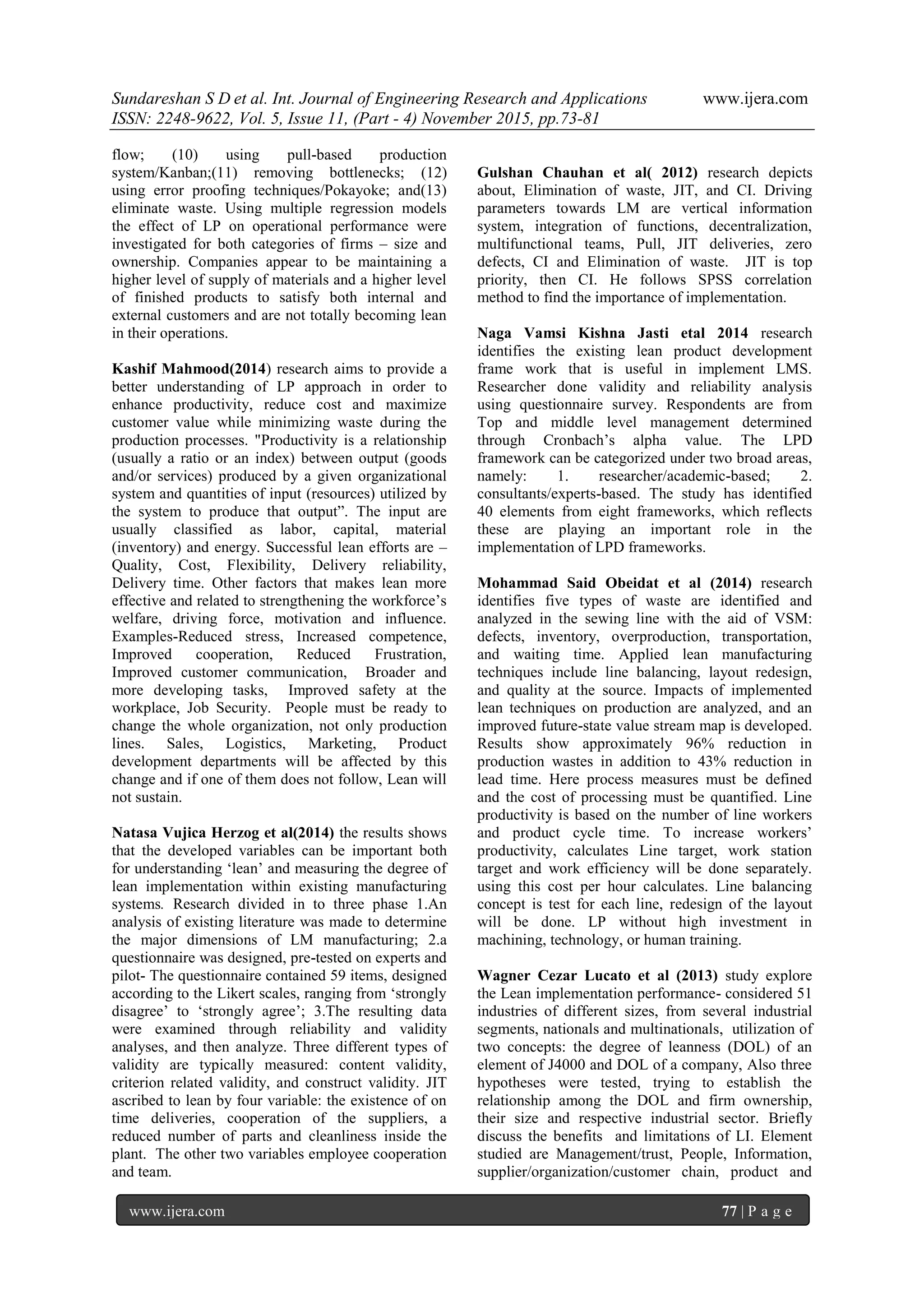
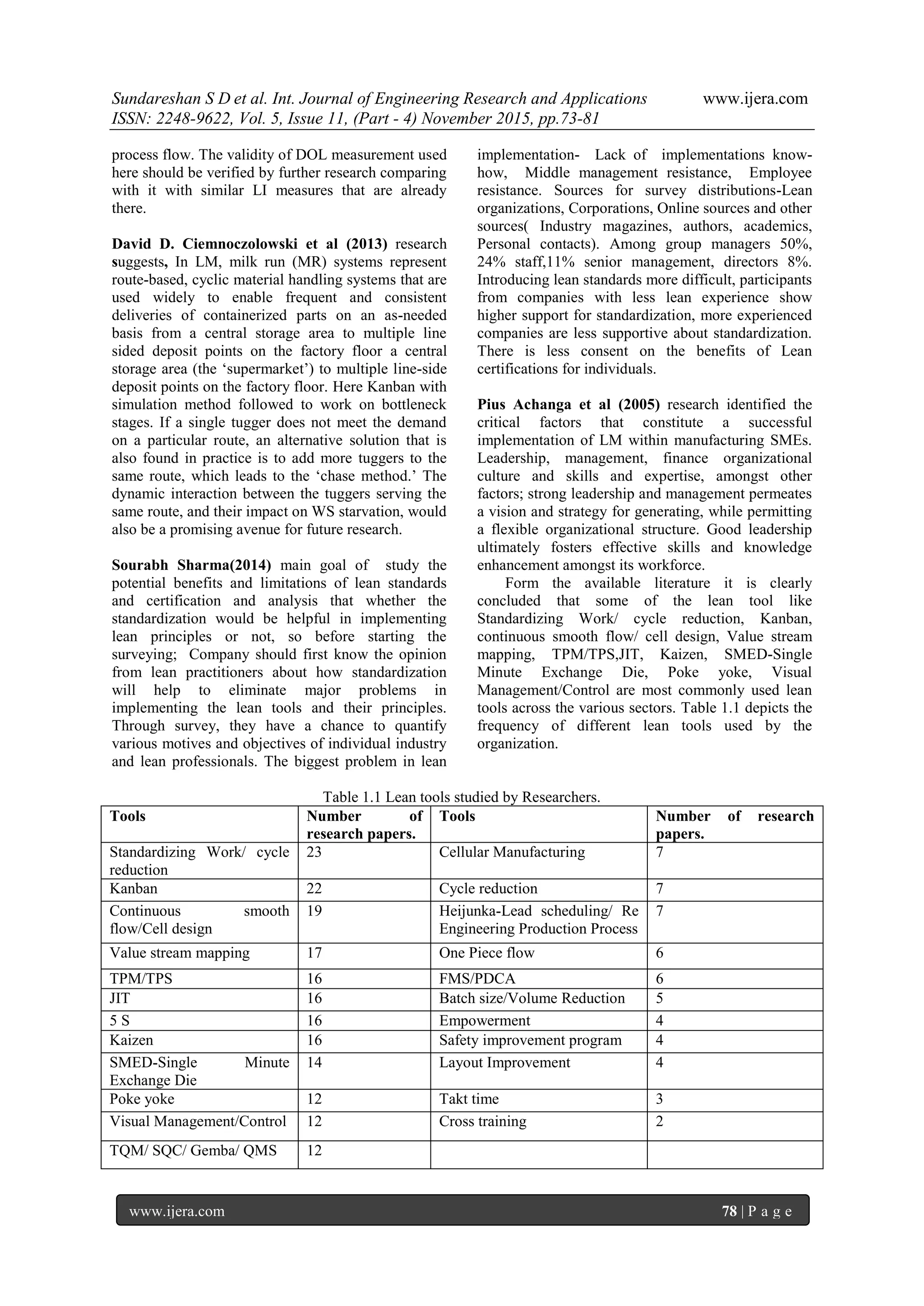
Form the available literature it is clearly
concluded that some of the lean tool like
Standardizing Work/ cycle reduction, Kanban,
continuous smooth flow/ cell design, Value stream
mapping, TPM/TPS,JIT, Kaizen, SMED-Single
Minute Exchange Die, Poke yoke, Visual
Management/Control are most commonly used lean
tools across the various sectors. Table 1.1 depicts the
frequency of different lean tools used by the
organization.
Table 1.1 Lean tools studied by Researchers.
Tools Number of
research papers.
Tools Number of research
papers.
Standardizing Work/ cycle
reduction
23 Cellular Manufacturing 7
Kanban 22 Cycle reduction 7
Continuous smooth
flow/Cell design
19 Heijunka-Lead scheduling/ Re
Engineering Production Process
7
Value stream mapping 17 One Piece flow 6
TPM/TPS 16 FMS/PDCA 6
JIT 16 Batch size/Volume Reduction 5
5 S 16 Empowerment 4
Kaizen 16 Safety improvement program 4
SMED-Single Minute
Exchange Die
14 Layout Improvement 4
Poke yoke 12 Takt time 3
Visual Management/Control 12 Cross training 2
TQM/ SQC/ Gemba/ QMS 12
Sundareshan S D et al. Int. Journal of Engineering Research and Applications www.ijera.com
ISSN: 2248-9622, Vol. 5, Issue 11, (Part - 4) November 2015, pp.73-81
www.ijera.com 79 | P a g e
Form the available literature it is clearly concluded that main benefits of lean implementation are Reduction of
waste, Inventory reduction, Productivity, cost related parameters, Effectiveness etc across the various sectors.
Table 1.2 depicts the frequency of benefits of lean implementation identified by the different researchers.
Table 1.2 Lean implementation Benefits.
Benefits Number of research
papers.
Benefits Number of
research papers.
Reduction of Waste 24 Improved flexibility 5
Inventory reduction 19 Travel distance (
Material movement)
3
Productivity 13 Lead time 3
Costs related parameter 11 Profit maximize 3
Effectiveness 11 Set Up time reduction 2
Improved Quality 10 Improved Cash Flow 2
Cycle time 9 Safety of working
conditions
1
W I P 6 Internal Promotion 1
Floor space 5 Efficiency 1
Form the available literature it is identified that some for the barriers for the implementation of lean tools are
Management Involvement, Employee involvement, communication, Lack of training, culture issues etc. Table
1.3 depicts the frequency of different barriers for lean implementation identified by the researchers
Table 1.3 Barriers for Lean implementation
Barriers Number of
research papers.
Barriers Number of research
papers.
Management involvement 22 Past Experience 7
Employee involvement 20 Resources utility 4
Communication 14 Knowledge 4
Lack of training 12 Budgets 4
Culture issue 10 Scared of failure 4
Lack of Know how 10 Conflicts 2
Financial 7 Improper Utilization of
potential capacity of workers
2
IV. CONCLUSION
Lean is applicable for all the type of the
organization irrespective of their size, lot of work has
been carried out in manufacturing sector that to in
different functional areas, the level of implementation
varies across the sectors and their size. It is evident
from the research paper studied that kanban,
continuous flow and TPS are the most commonly
used lean tools in the organization. The Reduction of
waste, Inventory reduction and Productivity
improvement are commonly cited benefits across the
lean implemented firms. Apart from these
management of employee involvement are the most
commonly cited barriers across the implemented
organization. These parameters are also component
of the quality of work life, so it can be concluded that
QWL needs to be studied across the lean
implemented firms in order to get higher light on the
issue also to reveal the linkage between QWL
dimensions with the lean implementation.
References
[1.] Salem, R., Musharavati, F., Hamouda, A.
M., & Al-Khalifa, K. N. (2015). An
empirical study on lean awareness and
potential for lean implementations in Qatar
industries. The International Journal of
Advanced Manufacturing Technology, 1-19.
[2.] Chaple, A. P., Narkhede, B. E., & Akarte,
M. M. Status of implementation of Lean
manufacturing principles in the context of
Indian industry: A Literature Review.
[3.] Chikhalikar, P., & Sharma, S. (2015).
IMPLEMENTATION OF LEAN
MANUFACTURING IN AN ENGINE
MANUFACTURING UNIT—A REVIEW.
International Journal of Mechanical
Engineering and Robotics Research, 4(1),
404.
[4.] Kumar, R., & Kumar, V. (2015). Lean
manufacturing in Indian context: A
Sundareshan S D et al. Int. Journal of Engineering Research and Applications www.ijera.com
ISSN: 2248-9622, Vol. 5, Issue 11, (Part - 4) November 2015, pp.73-81
www.ijera.com 80 | P a g e
survey. Management Science Letters, 5(4),
321-330.
[5.] Rendesi, I., Kovács, Z., Szegedi, Z., &
Vastag, G. Lean Implementations in
Hungary.
[6.] Chowdhury, S., Haque, K. A., & Sumon, M.
Implementation of Lean Strategies in a
Furniture Manufacturing Factory. IOSR
Journal of Mechanical and Civil
Engineering (IOSR-JMCE) e-ISSN: 2278-
1684,p-ISSN: 2320-334X, Volume 12, Issue
1 Ver. III (Jan- Feb. 2015), PP 45-50
[7.] Larteb, Y., Haddout, A., & Benhadou, M.
SUCCESSFUL LEAN
IMPLEMENTATION: THE SYSTEMATIC
AND SIMULTANEOUS
CONSIDERATION OF SOFT AND HARD
LEAN PRACTICES. International Journal
of Engineering Research and General
Science Volume 3, Issue 2, March-April,
2015
[8.] Jadhav, J. R., Mantha, S. S., & Rane, S. B.
(2014). Roadmap for Lean implementation
in Indian automotive component
manufacturing industry: comparative study
of UNIDO Model and ISM Model. Journal
of Industrial Engineering
International, 11(2), 179-198.
[9.] Guleria, A., Thakur, T., & Belokar, R. M.
APPLICATION OF VSM IN HAIR
DRYER MANUFACTURING
INDUSTRY: A CASE STUDY.
International Journal of Advanced
Technology in Engineering and Science
www.ijates.com, Volume No.02, Special
Issue No. 01, September 2014 ISSN
(online): 2348 – 7550
[10.] Verma, N., & Sharma, V. Lean Modelling–
A Case Study for the Indian SME., (IJTRE)
Volume 2, Issue 7, March-2015 ISSN: 2347-
4718.
[11.] Nordin, N., Deros, B. M., Wahab, D. A., &
Rahman, M. N. A. (2012). A framework for
organisational change management in lean
manufacturing implementation. International
Journal of Services and Operations
Management,12(1), 101-117.
[12.] Karim, A., & Arif-Uz-Zaman, K. (2013). A
methodology for effective implementation
of lean strategies and its performance
evaluation in manufacturing
organizations. Business Process
Management Journal, 19(1), 169-196.
[13.] Panwar, A., Nepal, B. P., Jain, R., &
Rathore, A. P. S. (2015). On the adoption of
lean manufacturing principles in process
industries. Production Planning &
Control, 26(7), 564-587.
[14.] Hodge, G. L., Goforth Ross, K., Joines, J.
A., & Thoney, K. (2011). Adapting lean
manufacturing principles to the textile
industry. Production Planning &
Control, 22(3), 237-247.
[15.] Storch, R. L. (1999). Improving flow to
achieve lean manufacturing in
shipbuilding. Production Planning &
Control, 10(2), 127-137.
[16.] Marodin, G. A., Saurin, T. A., Tortorella, G.
L., & Denicol, J. (2015). How context
factors influence lean production practices
in manufacturing cells. The International
Journal of Advanced Manufacturing
Technology, 1-11.
[17.] Dorota Rymaszewska, A. (2014). The
challenges of lean manufacturing
implementation in SMEs. Benchmarking:
An International Journal, 21(6), 987-1002.
[18.] Vinodh, S., & Joy, D. (2012). Structural
equation modelling of lean manufacturing
practices. International Journal of
Production Research, 50(6), 1598-1607.
[19.] Dave, B., & Appleby, C. (2015). Striving for
Continuous Process Improvement-A
Construction Case Study. In Proceedings of
the Indian Lean Construction Conference
(ILCC 2015). Institute for Lean
Construction Excellence.
[20.] Kumar, R., & Kumar, V. (2014). Barriers in
implementation of lean manufacturing
system in Indian industry: A
survey. International Journal of Latest
Trends in Engineering and
Technology, 4(2), 243-251.
[21.] Marodin, G. A., & Saurin, T. A. (2015).
Classification and relationships between
risks that affect lean production
implementation: a study in Southern Brazil.
Journal of Manufacturing Technology
Management, 26(1), 57-79.
[22.] Sindhwani, R., & Malhotra, V. (2015). Lean
and Agile Manufacturing System
Barriers. International Journal, 3(1), 110-
112.
[23.] Čiarnienė, R., & Vienažindienė, M. (2014).
How to facilitate implementation of lean
concept?. Mediterranean Journal of Social
Sciences, 5(13), 177.
[24.] Roslin, E. N., Shahadat, S. A. M., Dawal, S.
Z. M., & Mirmohammadsadeghi, S. (2014).
A Conceptual Model for Full-Blown
Implementation of Lean Manufacturing
System in Malaysian Automotive Industry.
In Proceedings of the 2014 International
Conference on Industrial Engineering and
Operations Management, Bali, Indonesia.
Sundareshan S D et al. Int. Journal of Engineering Research and Applications www.ijera.com
ISSN: 2248-9622, Vol. 5, Issue 11, (Part - 4) November 2015, pp.73-81
www.ijera.com 81 | P a g e
http://iieom. org/ieom2014/pdfs/292. pdf
(Accessed June 2 2014).
[25.] Patel, N., Chauhan, N., & Trivedi, M. P.
(2015). Benefits of Value Stream Mapping
as A Lean Tool Implementation
Manufacturing Industries: A Review.
International Journal for Innovative
Research in Science and Technology, 1(8),
53-57.
[26.] Rahman, S., Laosirihongthong, T., & Sohal,
A. S. (2010). Impact of lean strategy on
operational performance: a study of Thai
manufacturing companies.Journal of
manufacturing technology
management, 21(7), 839-852.
[27.] Mahmood, K. Productivity Improvement by
Implementing Lean Production Approach.
[28.] Herzog, N. V., & Tonchia, S. (2014). An
Instrument for Measuring the Degree of
Lean Implementation in
Manufacturing. Strojniški vestnik-Journal of
Mechanical Engineering, 60(12), 797-803.
[29.] Manzouri, M., Ab-Rahman, M. N., Zain, C.
R. C. M., & Jamsari, E. A. (2014).
Increasing Production and Eliminating
Waste through Lean Tools and Techniques
for Halal Food
Companies. Sustainability, 6(12), 9179-
9204.
[30.] Chauhan, G., & Singh, T. P. (2012).
Measuring parameters of lean manufacturing
realization. Measuring Business
Excellence, 16(3), 57-71.
[31.] Vamsi Kishna Jasti, N., & Kodali, R.
(2014). Validity and reliability of lean
product development frameworks in Indian
manufacturing industry. Measuring Business
Excellence, 18(4), 27-53.
[32.] Obeidat, M. S., Al-Aomar, R., & Pei, Z. J.
(2014). Lean Manufacturing Implementation
in the Sewing Industry. Journal of Enterprise
Transformation,4(2), 151-171.
[33.] Cezar Lucato, W., Araujo Calarge, F.,
Loureiro Junior, M., & Damasceno Calado,
R. (2014). Performance evaluation of lean
manufacturing implementation in
Brazil. International Journal of Productivity
and Performance Management, 63(5), 529-
549.
[34.] Ciemnoczolowski, D. D., & Bozer, Y. A.
(2013). Performance evaluation of small-
batch container delivery systems used in
lean manufacturing–Part 2: number of
Kanban and workstation
starvation. International Journal of
Production Research, 51(2), 568-581.
[35.] Sharma, S. Standardization and Certification
in Lean Manufacturing for Technology and
Product Development in Service Oriented
Industries.
[36.] Achanga, P., Shehab, E., Roy, R., & Nelder,
G. (2006). Critical success factors for lean
implementation within SMEs. Journal of
Manufacturing Technology
Management, 17(4), 460-471.

A Literature Review on Lean Implementations – A comprehensive summary

  • 1.
    Sundareshan S Det al. Int. Journal of Engineering Research and Applications www.ijera.com ISSN: 2248-9622, Vol. 5, Issue 11, (Part - 4) November 2015, pp.73-81 www.ijera.com 73 | P a g e A Literature Review on Lean Implementations – A comprehensive summary Sundareshan S D* Dr Swamy D R **, Dr T S Nanjundeswara Swamy** Research scholar*, Professor ** JSS Academy of Technical Education, Bangalore Abstract The available research papers in area of Lean are studied to know the implementation level of different lean tools, barrier and benefits of implementation are also considered in the review .The commonly used lean tools in the various organization, most common barriers and benefits have been identified and listed in this paper. Most common barrier are also components of quality of work life. Keywords: Quality work life, Lean Manufacturing, Toyota production system,Kanban I. Introduction Lean manufacturing is an important tool used across the industries in the recent scenario. At present the industries are facing a higher level of competition because of the globalization. In this context, to remain and compete in the market, companies need to deploy certain tools and techniques which are useful to the uplift their performance and to respond rapidly to the customer‘s needs. The fundamental concept of lean manufacturing is to provide a quality product while also ensuring that the product does not cost too much to the customer. In this paper an attempt has been made to present a review of the literature to identify the important and useful contributions to this Lean concept. Lean manufacturing utilizes a wide range of tools and techniques; the choice of tools is based on the requirement. Many parameters contribute success of lean. Organizations which implemented lean manufacturing have higher level of flexibility and competitiveness. However, lean manufacturing provides an environment that is highly conducive to waste minimization. II. Objectives of the Paper:  To find the level of Lean implementation in different sectors.  To find out the tool used most and least under Lean implementation.  To examine the benefits and barriers of Lean implementation in manufacturing.  To evaluate the implementation of the Lean manufacturing III. Results and Discussions The research papers related to Lean manufacturing from various reputed journals have been considered for the review. After doing thorough study of the Lean implementation, (Annexure 1) the results of the research papers considered for the review. The considered review papers have been grouped based on awareness about the Lean, lean implementation, Barrier and benefits of Lean and performance. There are quite a good number of studies available in the body of literature focusing on the awareness and Potential for implementation of Lean tool in different sector. The one important such study is discussed below. Roba Salem et al, (2015) studied on the level of recognition of lean concepts, principles, tools, and techniques in different industrial sectors in Qatar, to ass‘s lean awareness and to know the perception about lean benefits and lean challenges. Data were collected from 333 organizations from various sectors like oil and gas, academic institutions and service sectors through an on-line survey. Results showed that industries in Qatar need to give more credit to lean thinking in order to strategically advance current efficiencies as well as cope with competition at global level. Research also reveals that there is a differences on the levels of awareness, recognition and appreciation of lean concepts in different industrial sectors. Chaple (2014) investigate the enablers and barriers in implementing the Lean principles and lean diffusion in Indian manufacturing industries. Result shows that the trend in lean manufacturing for research now is focused on lean assessment. Leanness attracts focus to answer specific questions of different levels of managers responsible for lean implementation to assess the lean implementation level and to justify spending over lean implementation. He worked on multiple criterion decision-making (MCDM) for lean assessment to assess lean performance holistically & popularity of lean in India; but when it comes to success, its only start of journey. Other than automobile and RESEARCH ARTICLE OPEN ACCESS
  • 2.
    Sundareshan S Det al. Int. Journal of Engineering Research and Applications www.ijera.com ISSN: 2248-9622, Vol. 5, Issue 11, (Part - 4) November 2015, pp.73-81 www.ijera.com 74 | P a g e electronics industry, others are having medium to low diffusion of lean in India. Pratik Chikhalikar (2015) study focused on the implementation of the lean in the engine manufacturing unit in India. Research identified the important lean tools and time horizon to implement the same. Study revealed that following factors effects on lean implementation they are 7 Types of waste, Lack of information transmission, Improper inventory management, Bottleneck operation, Material flow and transportation problem, JIT, Kanban, Kaizen, TPM, 6 sigma, 5S, Single Minute Exchange of Die. Rakesh kumar and vikas kumar (2015) conducted a study to establish the significance of Lean Manufacturing elements related to Indian manufacturing industry, study also list the benefits gained-, major obstacles faced- and identifies the adverse impact such as over cost cutting, exceptionally low inventories, over dependence of Lean guideline, physical and mental health, society, product quality. Sudipta Chowdhury (2015) conducted a study to improve the productivity of the furniture manufacturing industry in India. Various lean strategies such as Single-Minute Exchange of Dies (SMED), Gemba (The real place) and Short Interval Control were implemented. Result revealed that significant improvement in both monetary terms and also in reduction of processing time of different lots. Study also reveals that Overall Equipment effectiveness increased in a higher multifactor productivity of 2.26. It was realized through this study that lean strategies can successfully be implemented in furniture manufacturing industry. Youssef Larteb et al (2015) study identified that success parameters of lean implementation are top management engagement, commitment, allocation of time and resources for improvement projects, strong management‘s leadership, and employee‘s development program. Study used a structure questionaries‘ it includes seven parameters of lean implementation they are, personalized demarche, top management commitment, allocation of resources, strong communication, structural methodology, multifunctional teams, and continuous performance measurement. Neha Verma et al( 2015) conducted a study to identify waste related problems like cause of equipment failure, bottleneck problems and rectify them in lean manufacturing implementation in small scale industries. Process was analyzed in concern with rejection control, inventory control, waiting time, set time and eliminating non value added time / activities. In this study no new machines were purchased nor were operators expected to work faster or harder; only procedures and layouts were changed to allow the product to flow more smoothly through the manufacturing process. Nordin Norani et al(2010) research identified the, main reason for failure of implementation of Lean manufacturing is due to the letdown in managing the change process during a lean manufacturing transformation, organizational change management. Serve as the basis for further empirical research and validation. Provide practitioners with a better understanding of lean transition and unambiguous guidance, and/or tools to minimize the resistance and conflicts of implementing a lean manufacturing system. In the present research 11 critical factors were studied, and proposed framework of organizational change is intended to provide practitioners with a better understanding of the lean transition and a clear guidance to minimize the resistance and conflicts for the implementation of lean and thus improves its chance of success. Azharul Karim et al( 2013) conducted a research to develop an effective methodology for implementing lean manufacturing strategies and a leanness, following are the methodology are adopted for the present study they are Production and process details, Lean team study, Performance variables. VSM and MTM together and offered a new approach to reduce lead time and to measure productivity based on Lean principle and standardized processes. George L. Hodge et al(2011) conducted a research to identify lean tool for textile industries to eliminate waste and non-value added activities in US to enhance the customer satisfaction, Author identified the following barriers for implementing lean manufacturing they are resistance to change both shop floor employees and management; shop floor employees are reluctant to offer suggestions for improvements; disconnect among marketing, sales, product and development; shop floor personnel are not native English speakers; so training needs to be multilingual. Richard lee Storch et al (1999) paper deals with, lean ship production requires continuous and uniform process flows, build strategies must be established and followed which reflect the proper work breakdown, especially block breakdown, even at the expense of design convenience ( design for manufacturing) .It involves integration and balance between hull, outfit, and painting work; facilitation of continuous and uniform work flows within manufacturing levels; maximum use of group
  • 3.
    Sundareshan S Det al. Int. Journal of Engineering Research and Applications www.ijera.com ISSN: 2248-9622, Vol. 5, Issue 11, (Part - 4) November 2015, pp.73-81 www.ijera.com 75 | P a g e technology advantages. Three metrics are proposed to monitor lean process flows in ship production are: work-in-process (WIP) inventory level; leveling factor index; and throughput. Giuliano Almeida Marodin et al (2015). Study reveals, there are seven factors that affect the use of LP practices in Manufacturing Cell (MC): (i) the reason for adopting LP, (ii) the experience of the company with LP, (iii) the need for involvement of the supporting areas in some LP practices, (iv) the interdependence of some practices, (v) the variety of product models produced bin the MC, (vi) the synergy between LP and MC attributes, and (vii) the size of the equipment used in the MC. Qualifying attributes for LP in MC are 1. Team work and leadership (TWL), 2. CI-continuous improvement, 3. MCT- Multi functionality and cross training. 4. WAU-Worker‘s autonomy.5. STW-Standardized work, 6. WHK Work place housekeeping, 7. PULL- Pull production, 8.SPR-Smoothed production, 9.QST-Quick setups, 10.TPM, 11. LME-Lean Performance Metrices, 12. VPC-Visual mgt of production control, 13. VQC-Visual management of production control. 14. EQA- Equipment autonomation, 15. ONE-One piece flow, 16.VIS- Visibility and information exchange. 17. LSS-Layout size and shape.18. ODF-Organization by the dominant flow. Anna Dorota Rymaszewska (2013) The drive of this research is to identify the lean manufacturing implementation challenges in small and medium enterprises (SMEs). By comparing the different manufacturing environments as well as organizational characteristics, the potential challenges of lean adoption are outlined. ―Doing more with less.‖ Compares between the two industries of boat and furniture. Also considers internal operations/ like Standardization, Material replenishment, Work load leveling, QA, Visual control, Reliable technology. Research identifies Influencing factors as philosophy, know how, Employee relations, communication, financing, value creation, organizational learning, Hijunka and JIT, and Internal implementation facilitating/ reinforcing factors are communication, partner/suppliers, quality. He adds, 1.The challenge of Long term orientation, 2. The challenge of becoming a learning organization, 3. The challenge of leveling out workflow. 4. Supplier buyer relations and JIT. 5. Employee empowerment and standardization of the work procedures. The validity of the findings can be improved by adding more empirical evidence. Vinodh et al (2011). The purpose of this research is to analyze lean manufacturing practices in different industries and to identify the critical factors for its success implementation. A Structural Equation Modelling technique is used to build the measurement and structural models. Later, statistical estimates are used to validate the model that has been built. For data collection a questionnaire was prepared based on four enablers, namely management responsibility leanness, manufacturing management leanness, manufacturing strategy leanness, and technology and workforce leanness. The current study also calculated the R2 value, which also indicates a good deal of influence yielded by management responsibility leanness, manufacturing leanness, manufacturing strategy leanness, and technology and workforce leanness on organizational performance. Finally totally committed management, highly trained, motivated and empowered employees working in a team. Internal integration of operations with suppliers and customers. Promotion of creativity and innovative culture. Streamlining of processes and waste elimination are the important parameter for lean implementation. Dave et al(2015) study deals with Lean Construction along with information and communication systems. Study reveals that by adopting techniques such as process modelling, lean principles and process analysis techniques, the manufacturing industry maintains a well performing process.- process standardization across the industry will highly effective and efficient. Rakesh et al (2014) Study identified that though the implementation of lean manufacturing can improve the organizational performance, but still most of the Indian industries currently use as improvement tool instead of adopting this concept as a culture. If focus on full scale as organizational culture it can produce significant improvement overall performance. The principal implications are, Batch production method is replaced with one piece or single piece flow method, Scheduling is done at one point from where material is pulled throughout the value stream and rate of flow depends on demand from customer, There is lesser material in waiting for processing between work stations; hence work in process (WIP) inventory is reduced, Inspection becomes an integral part of production activities hence product is not waiting for quality approval from line inspector, Reference for manufacturing is changed from production and Supply to customer demand. Mainly Top management issues for lean implementation is also very important and top management policies and attitude towards lean implementation need some improvement in Indian industries. Research suggest the seven major attributed barriers of LPI are Management, Resource, Knowledge, Conflicts, Employee morale, Financial, Past experience. Out of this Top management is rated 3.9/5 and others are
  • 4.
    Sundareshan S Det al. Int. Journal of Engineering Research and Applications www.ijera.com ISSN: 2248-9622, Vol. 5, Issue 11, (Part - 4) November 2015, pp.73-81 www.ijera.com 76 | P a g e less. Also suggests supposed to initiate the awareness and participation of senior leadership team to create learning culture within the organization and develop effective communication to organize transformation in the industry with the help of effective implementation of Lean Manufacturing. Giuliano Almeida Marodin et al(2014) conducted a research to classify the risks that affect the lean production implementation process and to demonstrate how that classification can help to identify the relationships between the risks. Researcher used multiple sources of evidence for the present study such as interviews, observations and documents analysis. In this study risks that affect LPI were grouped into three categories: management of the process of LPI, top and middle management support and shop floor involvement. Mainly classification and relationship between risks were given major importance. 14 risks were identified, the collected data was analyzed using an exploratory factor analysis (EFA). The limitations of this study should also be emphasized. First, it did not include external risks in LPI, but only internal ones. Second, it does not deal with two risk management stages: response and monitoring. Rahul Sindhwani et al( 2015) study reveals that, LI will improve the manufacturer and consumer relation by meeting the latest demand of consumers. Typical seven parameters like Overproduction, Processing Waste/over processing, transportation, Waiting/delays, Inventory waste, Motion waste, defects are used. Follows tools and technique for eliminating wastes were- Pull system/KANBAN, VSM,5s, By applying the lean and agile principles of one piece flow, pull system and value streaming the production rate of the lower frame was increased. The pull system utilized to understand that there is need to increase the production rate. VSM was done to identify the constraints and one piece flow to achieve the required cycle time. Ramune Ciarniene et al 2014 research reveals the challenges and barriers to be faced and overcome while implementing lean concept. Lean enterprise or simply "Lean", is a practice, which regards the use of resources for any work other than the creation of value for the end customer, as waste, and thus a target for elimination. Research depicts the following three types of barriers they are the people issue, The process issue, The sustainability issue. Study suggested that first use the tools and techniques instead of sufficient consideration to personally related issues. Trust issue, human motivation and commitment are the real constraints. Secondly clearly understood by top management maintained properly, thirdly, LI have to be incorporated into the company‘s strategy. Concluded remarks- specific value to the customer, VSM waste elimination, CI, continuous flow and pull driven system. Eida Nadirah Roslin et al( 2014) Studies suggests, LM approach does not allow these organizations to fully explore and exploit the system‘s effectiveness; neither do they experience any massive improvements when measured against L M success standards. Up to so many days pick and choose concept were used, The Obstacles of LMI Grouped in to 3 levels, attitude of shop floor employees and middle management, Inability of quantify benefits, and Lack of top management/Senior management commitment. Conceptual model of full blown Implementation of LMS-Influence factors, Lean Manufacturing and Organizational performance. Here implementation difficulties, perceived barriers, work culture, monetary restraints, knowledge and its understanding at every level. Nirav Patel et al (2015) LM can be considered as a business strategy and it has been proved to be an effective management philosophy for improving business by eliminating non value added waste and improving in process operations.VSM can be an extremely powerful tool, combining material processing steps with information flow as well as other important related data. Parameters used were Cost Rate, Material Cost, Duration (min), and Predecessors, its inter relationship between them with the money and time. Application of tools were Process activity mapping, Demand amplification mapping, quality filter, production variety funnel, value adding time profile and related parameters. VSM works in any of the sector such as hospitability, manufacturing, service industry, automobile, machining and casting, transportation etc. Shams Rahman et al (2010) purpose of this research is to examine the extent to which LM practices are adopted by manufacturing organizations in Thailand and their impact on firms‘ operational performance. The operational performance is measured by four parameters such as quick delivery compared to competitors, unit cost of products relative to competitors, overall productivity and customer satisfaction. Results indicate that three constructs play a vital role- JIT, Waste elimination, Flow management. It identified 13 out of 21 practices as the lean practices such as (1)Reducing production lot size; (2) reducing setup time; (3) focusing on single supplier;(4) implementing preventive maintenance activities;(5) cycle time reduction;(6) reducing inventory to expose manufacturing, distribution and scheduling problems; (7) using new process equipment or technologies;(8) using quick changeover techniques;(9) continuous/one piece
  • 5.
    Sundareshan S Det al. Int. Journal of Engineering Research and Applications www.ijera.com ISSN: 2248-9622, Vol. 5, Issue 11, (Part - 4) November 2015, pp.73-81 www.ijera.com 77 | P a g e flow; (10) using pull-based production system/Kanban;(11) removing bottlenecks; (12) using error proofing techniques/Pokayoke; and(13) eliminate waste. Using multiple regression models the effect of LP on operational performance were investigated for both categories of firms – size and ownership. Companies appear to be maintaining a higher level of supply of materials and a higher level of finished products to satisfy both internal and external customers and are not totally becoming lean in their operations. Kashif Mahmood(2014) research aims to provide a better understanding of LP approach in order to enhance productivity, reduce cost and maximize customer value while minimizing waste during the production processes. "Productivity is a relationship (usually a ratio or an index) between output (goods and/or services) produced by a given organizational system and quantities of input (resources) utilized by the system to produce that output‖. The input are usually classified as labor, capital, material (inventory) and energy. Successful lean efforts are – Quality, Cost, Flexibility, Delivery reliability, Delivery time. Other factors that makes lean more effective and related to strengthening the workforce‘s welfare, driving force, motivation and influence. Examples-Reduced stress, Increased competence, Improved cooperation, Reduced Frustration, Improved customer communication, Broader and more developing tasks, Improved safety at the workplace, Job Security. People must be ready to change the whole organization, not only production lines. Sales, Logistics, Marketing, Product development departments will be affected by this change and if one of them does not follow, Lean will not sustain. Natasa Vujica Herzog et al(2014) the results shows that the developed variables can be important both for understanding ‗lean‘ and measuring the degree of lean implementation within existing manufacturing systems. Research divided in to three phase 1.An analysis of existing literature was made to determine the major dimensions of LM manufacturing; 2.a questionnaire was designed, pre-tested on experts and pilot- The questionnaire contained 59 items, designed according to the Likert scales, ranging from ‗strongly disagree‘ to ‗strongly agree‘; 3.The resulting data were examined through reliability and validity analyses, and then analyze. Three different types of validity are typically measured: content validity, criterion related validity, and construct validity. JIT ascribed to lean by four variable: the existence of on time deliveries, cooperation of the suppliers, a reduced number of parts and cleanliness inside the plant. The other two variables employee cooperation and team. Gulshan Chauhan et al( 2012) research depicts about, Elimination of waste, JIT, and CI. Driving parameters towards LM are vertical information system, integration of functions, decentralization, multifunctional teams, Pull, JIT deliveries, zero defects, CI and Elimination of waste. JIT is top priority, then CI. He follows SPSS correlation method to find the importance of implementation. Naga Vamsi Kishna Jasti etal 2014 research identifies the existing lean product development frame work that is useful in implement LMS. Researcher done validity and reliability analysis using questionnaire survey. Respondents are from Top and middle level management determined through Cronbach‘s alpha value. The LPD framework can be categorized under two broad areas, namely: 1. researcher/academic-based; 2. consultants/experts-based. The study has identified 40 elements from eight frameworks, which reflects these are playing an important role in the implementation of LPD frameworks. Mohammad Said Obeidat et al (2014) research identifies five types of waste are identified and analyzed in the sewing line with the aid of VSM: defects, inventory, overproduction, transportation, and waiting time. Applied lean manufacturing techniques include line balancing, layout redesign, and quality at the source. Impacts of implemented lean techniques on production are analyzed, and an improved future-state value stream map is developed. Results show approximately 96% reduction in production wastes in addition to 43% reduction in lead time. Here process measures must be defined and the cost of processing must be quantified. Line productivity is based on the number of line workers and product cycle time. To increase workers‘ productivity, calculates Line target, work station target and work efficiency will be done separately. using this cost per hour calculates. Line balancing concept is test for each line, redesign of the layout will be done. LP without high investment in machining, technology, or human training. Wagner Cezar Lucato et al (2013) study explore the Lean implementation performance- considered 51 industries of different sizes, from several industrial segments, nationals and multinationals, utilization of two concepts: the degree of leanness (DOL) of an element of J4000 and DOL of a company, Also three hypotheses were tested, trying to establish the relationship among the DOL and firm ownership, their size and respective industrial sector. Briefly discuss the benefits and limitations of LI. Element studied are Management/trust, People, Information, supplier/organization/customer chain, product and
  • 6.
    Sundareshan S Det al. Int. Journal of Engineering Research and Applications www.ijera.com ISSN: 2248-9622, Vol. 5, Issue 11, (Part - 4) November 2015, pp.73-81 www.ijera.com 78 | P a g e process flow. The validity of DOL measurement used here should be verified by further research comparing with it with similar LI measures that are already there. David D. Ciemnoczolowski et al (2013) research suggests, In LM, milk run (MR) systems represent route-based, cyclic material handling systems that are used widely to enable frequent and consistent deliveries of containerized parts on an as-needed basis from a central storage area to multiple line sided deposit points on the factory floor a central storage area (the ‗supermarket‘) to multiple line-side deposit points on the factory floor. Here Kanban with simulation method followed to work on bottleneck stages. If a single tugger does not meet the demand on a particular route, an alternative solution that is also found in practice is to add more tuggers to the same route, which leads to the ‗chase method.‘ The dynamic interaction between the tuggers serving the same route, and their impact on WS starvation, would also be a promising avenue for future research. Sourabh Sharma(2014) main goal of study the potential benefits and limitations of lean standards and certification and analysis that whether the standardization would be helpful in implementing lean principles or not, so before starting the surveying; Company should first know the opinion from lean practitioners about how standardization will help to eliminate major problems in implementing the lean tools and their principles. Through survey, they have a chance to quantify various motives and objectives of individual industry and lean professionals. The biggest problem in lean implementation- Lack of implementations know- how, Middle management resistance, Employee resistance. Sources for survey distributions-Lean organizations, Corporations, Online sources and other sources( Industry magazines, authors, academics, Personal contacts). Among group managers 50%, 24% staff,11% senior management, directors 8%. Introducing lean standards more difficult, participants from companies with less lean experience show higher support for standardization, more experienced companies are less supportive about standardization. There is less consent on the benefits of Lean certifications for individuals. Pius Achanga et al (2005) research identified the critical factors that constitute a successful implementation of LM within manufacturing SMEs. Leadership, management, finance organizational culture and skills and expertise, amongst other factors; strong leadership and management permeates a vision and strategy for generating, while permitting a flexible organizational structure. Good leadership ultimately fosters effective skills and knowledge enhancement amongst its workforce. Form the available literature it is clearly concluded that some of the lean tool like Standardizing Work/ cycle reduction, Kanban, continuous smooth flow/ cell design, Value stream mapping, TPM/TPS,JIT, Kaizen, SMED-Single Minute Exchange Die, Poke yoke, Visual Management/Control are most commonly used lean tools across the various sectors. Table 1.1 depicts the frequency of different lean tools used by the organization. Table 1.1 Lean tools studied by Researchers. Tools Number of research papers. Tools Number of research papers. Standardizing Work/ cycle reduction 23 Cellular Manufacturing 7 Kanban 22 Cycle reduction 7 Continuous smooth flow/Cell design 19 Heijunka-Lead scheduling/ Re Engineering Production Process 7 Value stream mapping 17 One Piece flow 6 TPM/TPS 16 FMS/PDCA 6 JIT 16 Batch size/Volume Reduction 5 5 S 16 Empowerment 4 Kaizen 16 Safety improvement program 4 SMED-Single Minute Exchange Die 14 Layout Improvement 4 Poke yoke 12 Takt time 3 Visual Management/Control 12 Cross training 2 TQM/ SQC/ Gemba/ QMS 12
  • 7.
    Sundareshan S Det al. Int. Journal of Engineering Research and Applications www.ijera.com ISSN: 2248-9622, Vol. 5, Issue 11, (Part - 4) November 2015, pp.73-81 www.ijera.com 79 | P a g e Form the available literature it is clearly concluded that main benefits of lean implementation are Reduction of waste, Inventory reduction, Productivity, cost related parameters, Effectiveness etc across the various sectors. Table 1.2 depicts the frequency of benefits of lean implementation identified by the different researchers. Table 1.2 Lean implementation Benefits. Benefits Number of research papers. Benefits Number of research papers. Reduction of Waste 24 Improved flexibility 5 Inventory reduction 19 Travel distance ( Material movement) 3 Productivity 13 Lead time 3 Costs related parameter 11 Profit maximize 3 Effectiveness 11 Set Up time reduction 2 Improved Quality 10 Improved Cash Flow 2 Cycle time 9 Safety of working conditions 1 W I P 6 Internal Promotion 1 Floor space 5 Efficiency 1 Form the available literature it is identified that some for the barriers for the implementation of lean tools are Management Involvement, Employee involvement, communication, Lack of training, culture issues etc. Table 1.3 depicts the frequency of different barriers for lean implementation identified by the researchers Table 1.3 Barriers for Lean implementation Barriers Number of research papers. Barriers Number of research papers. Management involvement 22 Past Experience 7 Employee involvement 20 Resources utility 4 Communication 14 Knowledge 4 Lack of training 12 Budgets 4 Culture issue 10 Scared of failure 4 Lack of Know how 10 Conflicts 2 Financial 7 Improper Utilization of potential capacity of workers 2 IV. CONCLUSION Lean is applicable for all the type of the organization irrespective of their size, lot of work has been carried out in manufacturing sector that to in different functional areas, the level of implementation varies across the sectors and their size. It is evident from the research paper studied that kanban, continuous flow and TPS are the most commonly used lean tools in the organization. The Reduction of waste, Inventory reduction and Productivity improvement are commonly cited benefits across the lean implemented firms. Apart from these management of employee involvement are the most commonly cited barriers across the implemented organization. These parameters are also component of the quality of work life, so it can be concluded that QWL needs to be studied across the lean implemented firms in order to get higher light on the issue also to reveal the linkage between QWL dimensions with the lean implementation. References [1.] Salem, R., Musharavati, F., Hamouda, A. M., & Al-Khalifa, K. N. (2015). An empirical study on lean awareness and potential for lean implementations in Qatar industries. The International Journal of Advanced Manufacturing Technology, 1-19. [2.] Chaple, A. P., Narkhede, B. E., & Akarte, M. M. Status of implementation of Lean manufacturing principles in the context of Indian industry: A Literature Review. [3.] Chikhalikar, P., & Sharma, S. (2015). IMPLEMENTATION OF LEAN MANUFACTURING IN AN ENGINE MANUFACTURING UNIT—A REVIEW. International Journal of Mechanical Engineering and Robotics Research, 4(1), 404. [4.] Kumar, R., & Kumar, V. (2015). Lean manufacturing in Indian context: A
  • 8.
    Sundareshan S Det al. Int. Journal of Engineering Research and Applications www.ijera.com ISSN: 2248-9622, Vol. 5, Issue 11, (Part - 4) November 2015, pp.73-81 www.ijera.com 80 | P a g e survey. Management Science Letters, 5(4), 321-330. [5.] Rendesi, I., Kovács, Z., Szegedi, Z., & Vastag, G. Lean Implementations in Hungary. [6.] Chowdhury, S., Haque, K. A., & Sumon, M. Implementation of Lean Strategies in a Furniture Manufacturing Factory. IOSR Journal of Mechanical and Civil Engineering (IOSR-JMCE) e-ISSN: 2278- 1684,p-ISSN: 2320-334X, Volume 12, Issue 1 Ver. III (Jan- Feb. 2015), PP 45-50 [7.] Larteb, Y., Haddout, A., & Benhadou, M. SUCCESSFUL LEAN IMPLEMENTATION: THE SYSTEMATIC AND SIMULTANEOUS CONSIDERATION OF SOFT AND HARD LEAN PRACTICES. International Journal of Engineering Research and General Science Volume 3, Issue 2, March-April, 2015 [8.] Jadhav, J. R., Mantha, S. S., & Rane, S. B. (2014). Roadmap for Lean implementation in Indian automotive component manufacturing industry: comparative study of UNIDO Model and ISM Model. Journal of Industrial Engineering International, 11(2), 179-198. [9.] Guleria, A., Thakur, T., & Belokar, R. M. APPLICATION OF VSM IN HAIR DRYER MANUFACTURING INDUSTRY: A CASE STUDY. International Journal of Advanced Technology in Engineering and Science www.ijates.com, Volume No.02, Special Issue No. 01, September 2014 ISSN (online): 2348 – 7550 [10.] Verma, N., & Sharma, V. Lean Modelling– A Case Study for the Indian SME., (IJTRE) Volume 2, Issue 7, March-2015 ISSN: 2347- 4718. [11.] Nordin, N., Deros, B. M., Wahab, D. A., & Rahman, M. N. A. (2012). A framework for organisational change management in lean manufacturing implementation. International Journal of Services and Operations Management,12(1), 101-117. [12.] Karim, A., & Arif-Uz-Zaman, K. (2013). A methodology for effective implementation of lean strategies and its performance evaluation in manufacturing organizations. Business Process Management Journal, 19(1), 169-196. [13.] Panwar, A., Nepal, B. P., Jain, R., & Rathore, A. P. S. (2015). On the adoption of lean manufacturing principles in process industries. Production Planning & Control, 26(7), 564-587. [14.] Hodge, G. L., Goforth Ross, K., Joines, J. A., & Thoney, K. (2011). Adapting lean manufacturing principles to the textile industry. Production Planning & Control, 22(3), 237-247. [15.] Storch, R. L. (1999). Improving flow to achieve lean manufacturing in shipbuilding. Production Planning & Control, 10(2), 127-137. [16.] Marodin, G. A., Saurin, T. A., Tortorella, G. L., & Denicol, J. (2015). How context factors influence lean production practices in manufacturing cells. The International Journal of Advanced Manufacturing Technology, 1-11. [17.] Dorota Rymaszewska, A. (2014). The challenges of lean manufacturing implementation in SMEs. Benchmarking: An International Journal, 21(6), 987-1002. [18.] Vinodh, S., & Joy, D. (2012). Structural equation modelling of lean manufacturing practices. International Journal of Production Research, 50(6), 1598-1607. [19.] Dave, B., & Appleby, C. (2015). Striving for Continuous Process Improvement-A Construction Case Study. In Proceedings of the Indian Lean Construction Conference (ILCC 2015). Institute for Lean Construction Excellence. [20.] Kumar, R., & Kumar, V. (2014). Barriers in implementation of lean manufacturing system in Indian industry: A survey. International Journal of Latest Trends in Engineering and Technology, 4(2), 243-251. [21.] Marodin, G. A., & Saurin, T. A. (2015). Classification and relationships between risks that affect lean production implementation: a study in Southern Brazil. Journal of Manufacturing Technology Management, 26(1), 57-79. [22.] Sindhwani, R., & Malhotra, V. (2015). Lean and Agile Manufacturing System Barriers. International Journal, 3(1), 110- 112. [23.] Čiarnienė, R., & Vienažindienė, M. (2014). How to facilitate implementation of lean concept?. Mediterranean Journal of Social Sciences, 5(13), 177. [24.] Roslin, E. N., Shahadat, S. A. M., Dawal, S. Z. M., & Mirmohammadsadeghi, S. (2014). A Conceptual Model for Full-Blown Implementation of Lean Manufacturing System in Malaysian Automotive Industry. In Proceedings of the 2014 International Conference on Industrial Engineering and Operations Management, Bali, Indonesia.
  • 9.
    Sundareshan S Det al. Int. Journal of Engineering Research and Applications www.ijera.com ISSN: 2248-9622, Vol. 5, Issue 11, (Part - 4) November 2015, pp.73-81 www.ijera.com 81 | P a g e http://iieom. org/ieom2014/pdfs/292. pdf (Accessed June 2 2014). [25.] Patel, N., Chauhan, N., & Trivedi, M. P. (2015). Benefits of Value Stream Mapping as A Lean Tool Implementation Manufacturing Industries: A Review. International Journal for Innovative Research in Science and Technology, 1(8), 53-57. [26.] Rahman, S., Laosirihongthong, T., & Sohal, A. S. (2010). Impact of lean strategy on operational performance: a study of Thai manufacturing companies.Journal of manufacturing technology management, 21(7), 839-852. [27.] Mahmood, K. Productivity Improvement by Implementing Lean Production Approach. [28.] Herzog, N. V., & Tonchia, S. (2014). An Instrument for Measuring the Degree of Lean Implementation in Manufacturing. Strojniški vestnik-Journal of Mechanical Engineering, 60(12), 797-803. [29.] Manzouri, M., Ab-Rahman, M. N., Zain, C. R. C. M., & Jamsari, E. A. (2014). Increasing Production and Eliminating Waste through Lean Tools and Techniques for Halal Food Companies. Sustainability, 6(12), 9179- 9204. [30.] Chauhan, G., & Singh, T. P. (2012). Measuring parameters of lean manufacturing realization. Measuring Business Excellence, 16(3), 57-71. [31.] Vamsi Kishna Jasti, N., & Kodali, R. (2014). Validity and reliability of lean product development frameworks in Indian manufacturing industry. Measuring Business Excellence, 18(4), 27-53. [32.] Obeidat, M. S., Al-Aomar, R., & Pei, Z. J. (2014). Lean Manufacturing Implementation in the Sewing Industry. Journal of Enterprise Transformation,4(2), 151-171. [33.] Cezar Lucato, W., Araujo Calarge, F., Loureiro Junior, M., & Damasceno Calado, R. (2014). Performance evaluation of lean manufacturing implementation in Brazil. International Journal of Productivity and Performance Management, 63(5), 529- 549. [34.] Ciemnoczolowski, D. D., & Bozer, Y. A. (2013). Performance evaluation of small- batch container delivery systems used in lean manufacturing–Part 2: number of Kanban and workstation starvation. International Journal of Production Research, 51(2), 568-581. [35.] Sharma, S. Standardization and Certification in Lean Manufacturing for Technology and Product Development in Service Oriented Industries. [36.] Achanga, P., Shehab, E., Roy, R., & Nelder, G. (2006). Critical success factors for lean implementation within SMEs. Journal of Manufacturing Technology Management, 17(4), 460-471.