Cloud Computing
Implications for Digital
          Preservation


                   Stuart Wakefield
            Director, Office of GCIO
        Department of Internal Affairs
Topics for Today
• Overview of NZ public sector approach to cloud
    computing and current initiatives
•   Potential implications for digital preservation
•   Will current digital preservation approaches be viable
    for a could based service?
•   Should the archive also reside in the cloud?
•   Can you preserve an application context for a cloud
    based service that updates frequently?
•   What are the key policy & design considerations for
    adopting cloud to ensure a smooth transition in years
    to come?
NZ GOVERNMENT CLOUD
      OVERVIEW
The role of the Government CIO
•   Support & Implement Government (ICT) Policy
•   Leads ICT strategy for the public sector
•   Provides a single point of coordination internationally
•   Provides support and advice to agencies
•   Provide Enterprise Architecture (GEA-NZ) and ICT
    Roadmap
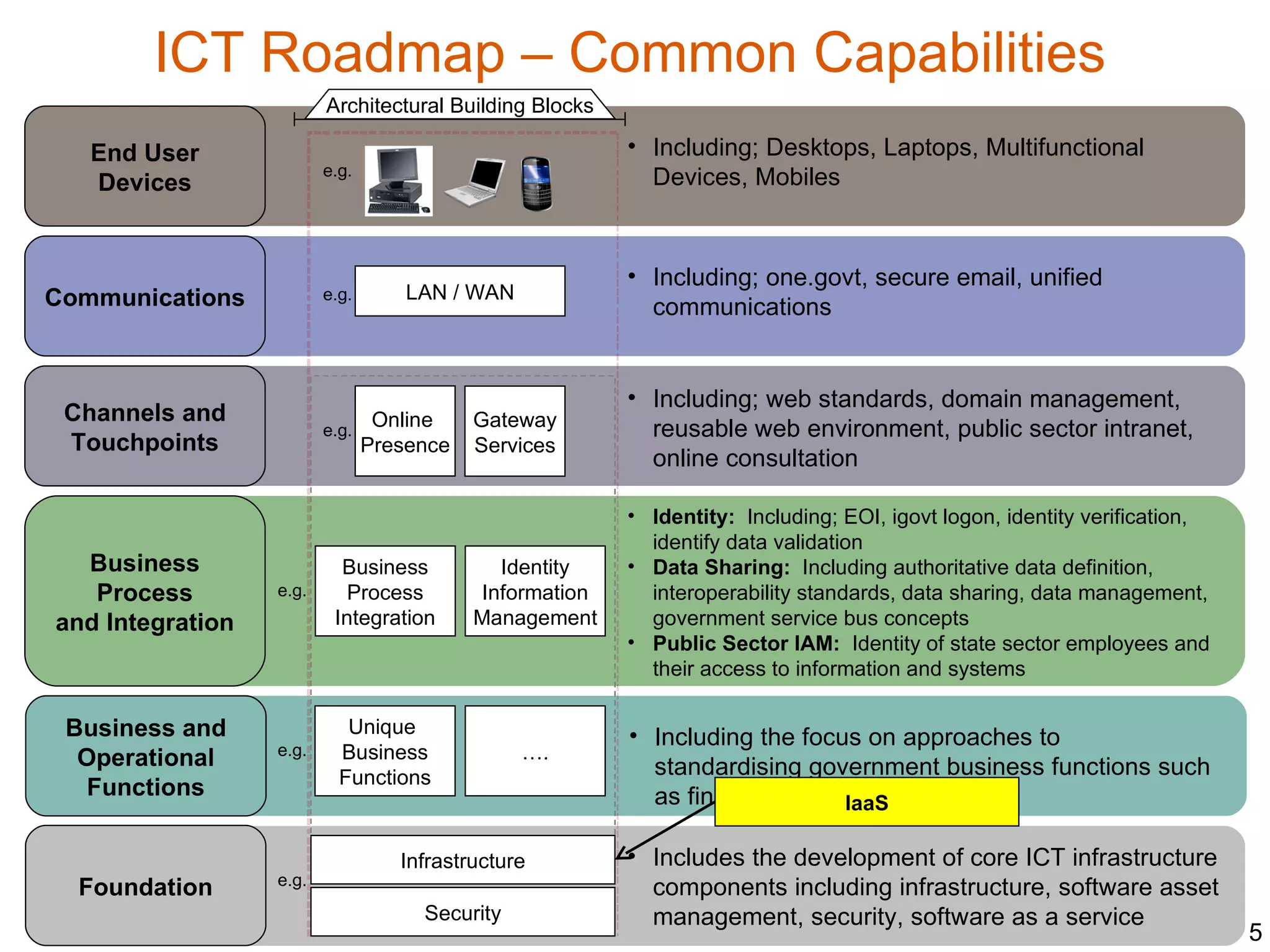
ICT Roadmap – Common Capabilities
                         Architectural Building Blocks

   End User                                              • Including; Desktops, Laptops, Multifunctional
                         e.g.                              Devices, Mobiles
   Devices


                                                         • Including; one.govt, secure email, unified
Communications           e.g.    LAN / WAN
                                                           communications


                                                         • Including; web standards, domain management,
 Channels and                  Online    Gateway
                         e.g.                              reusable web environment, public sector intranet,
 Touchpoints                  Presence   Services
                                                           online consultation

                                                         • Identity: Including; EOI, igovt logon, identity verification,
                                                           identify data validation
  Business                 Business         Identity     • Data Sharing: Including authoritative data definition,
   Process        e.g.      Process       Information      interoperability standards, data sharing, data management,
and Integration           Integration    Management        government service bus concepts
                                                         • Public Sector IAM: Identity of state sector employees and
                                                           their access to information and systems

 Business and               Unique                       • Including the focus on approaches to
                  e.g.     Business           ….
  Operational                                              standardising government business functions such
                           Functions
   Functions                                               as finance        IaaS

                                 Infrastructure          • Includes the development of core ICT infrastructure
                  e.g.
  Foundation                                               components including infrastructure, software asset
                                   Security                management, security, software as a service
                                                                                                                           5
IaaS for NZ Government
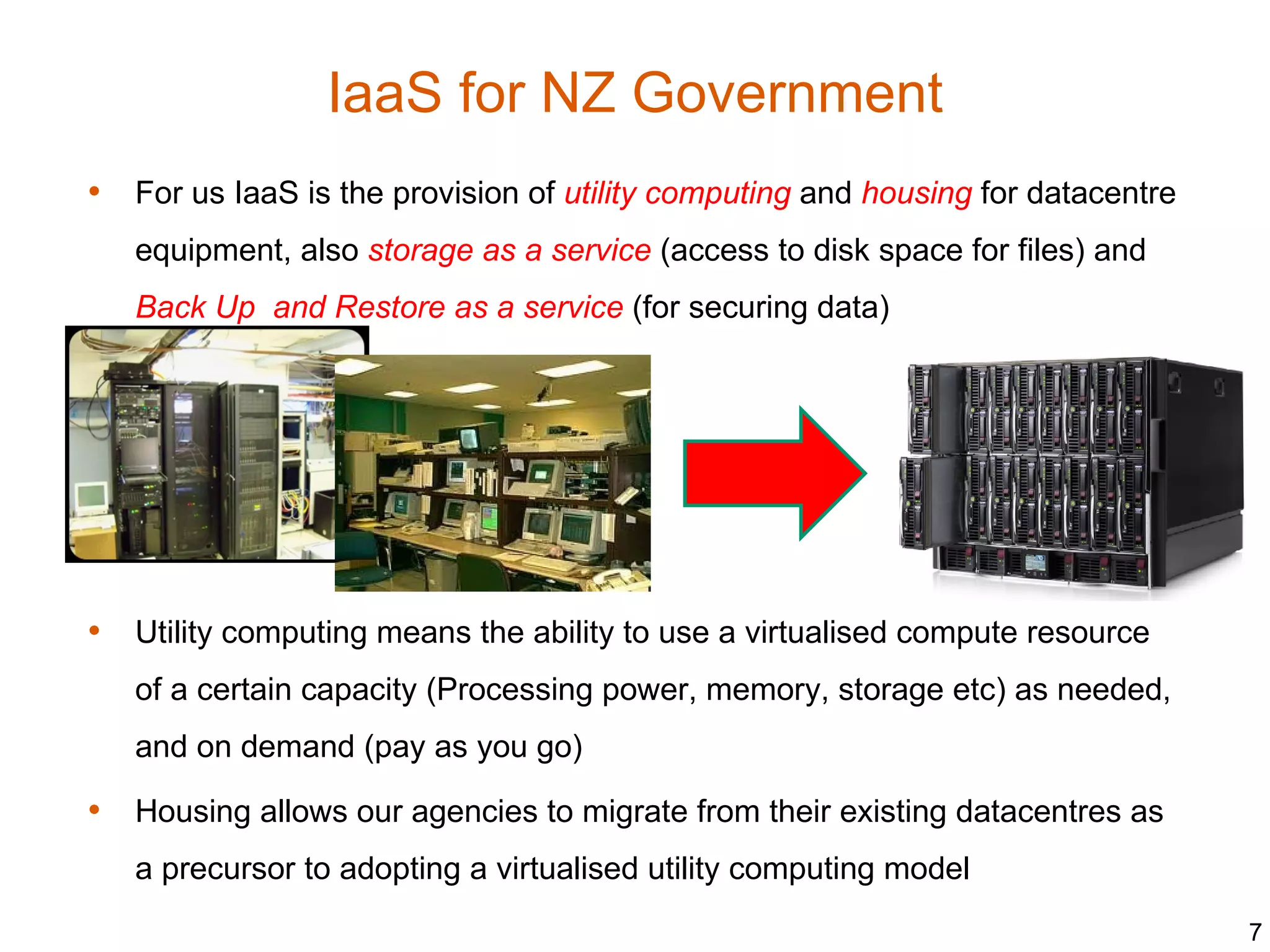
• For us IaaS is the provision of utility computing and housing for datacentre
   equipment, also storage as a service (access to disk space for files) and
   Back Up and Restore as a service (for securing data)


• Utility computing means the ability to use a virtualised compute resource
   of a certain capacity (Processing power, memory, storage etc) as needed,
   and on demand (pay as you go)

• Housing allows our agencies to migrate from their existing datacentres as
   a precursor to adopting a virtualised utility computing model
                                                                                 7
IaaS as a Foundation for Future Services


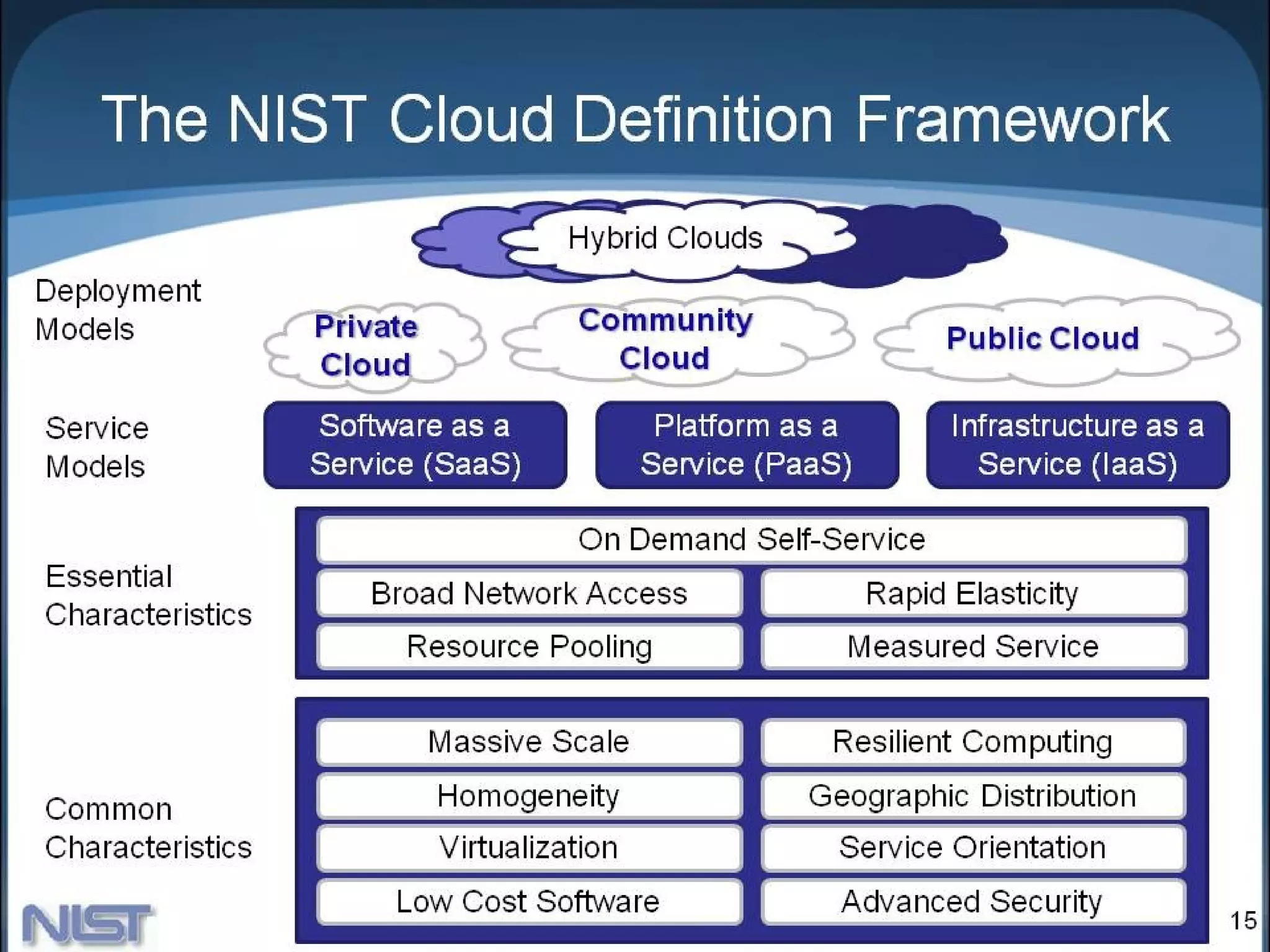
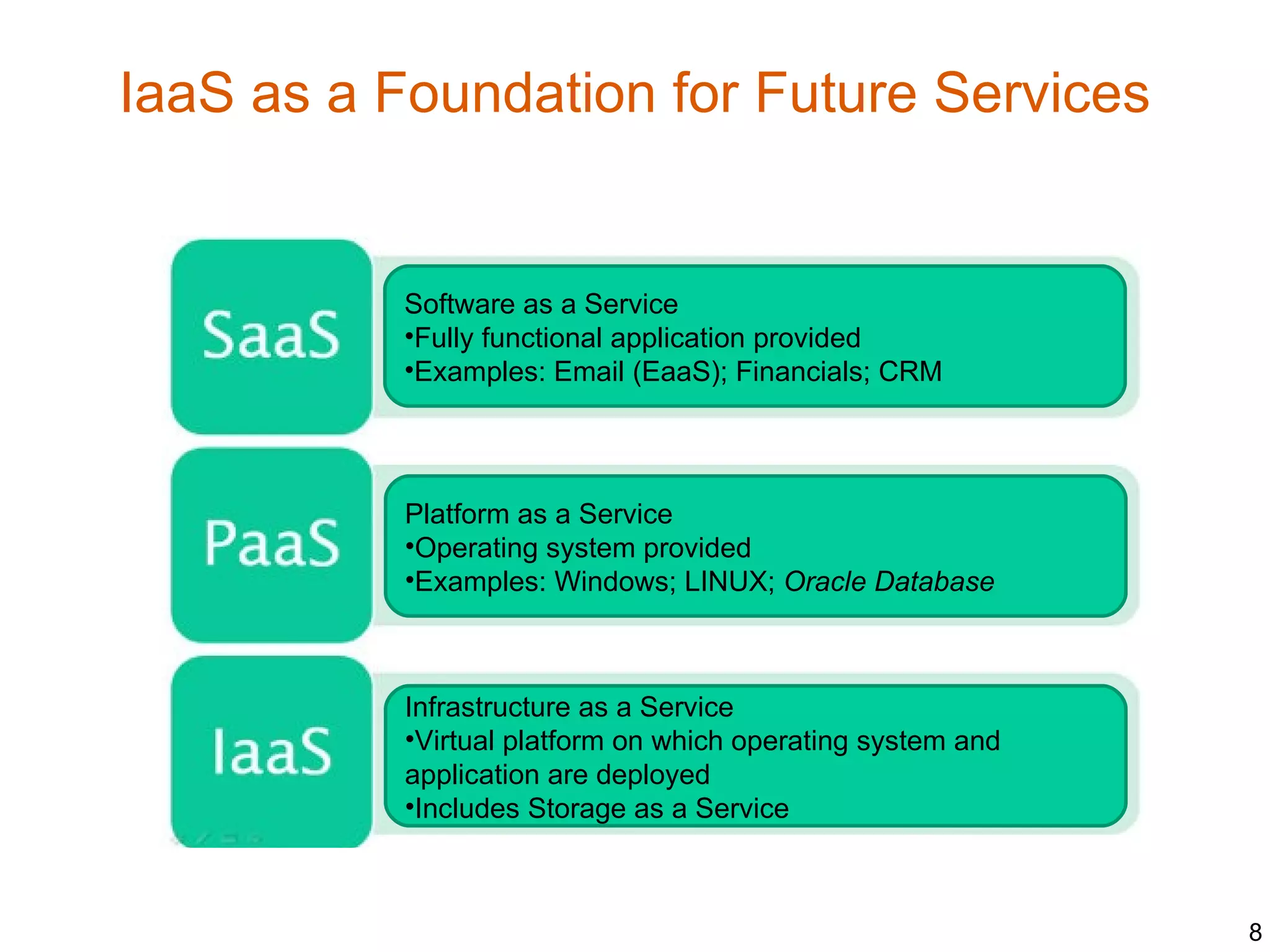
           Software as a Service
           •Fully functional application provided
           •Examples: Email (EaaS); Financials; CRM


           Platform as a Service
           •Operating system provided
           •Examples: Windows; LINUX; Oracle Database


           Infrastructure as a Service
           •Virtual platform on which operating system and
           application are deployed
           •Includes Storage as a Service


                                                             8
NZ Government Cloud Programme
1. Indicative Business Case for “Government Cloud” that will:
•    Identify opportunities where a cloud computing approach may add value
•    Assess the feasibility & market maturity of cloud computing at various
     points in the stack
•    Determine future roadmap and timeframes for cloud adoption (over and
     above Office Productivity)
•    Identify the range of potential solutions to address “resolvable challenges”


2. Detailed Business Case for “Office Productivity Services” that will:

•    Identify available and applicable service offerings
•    Assess these against agency need
•    Describe the commercial, financial, economic, strategic and management
     impacts of the available options
•    Determine an implementation plan (including procurement) and timeframe
NZ Government Cloud Programme
– Approach
• Programme draws expertise and is resourced from across
    government
•   Government CIO provides strategic direction and overall assurance
•   Consultative engagement with vendors to inform the business case
•   No pre-determined requirements on solutions
•   Open to exploring a range of options to address “resolvable
    challenges” to widespread adoption of cloud computing
IMPLICATIONS OF CLOUD
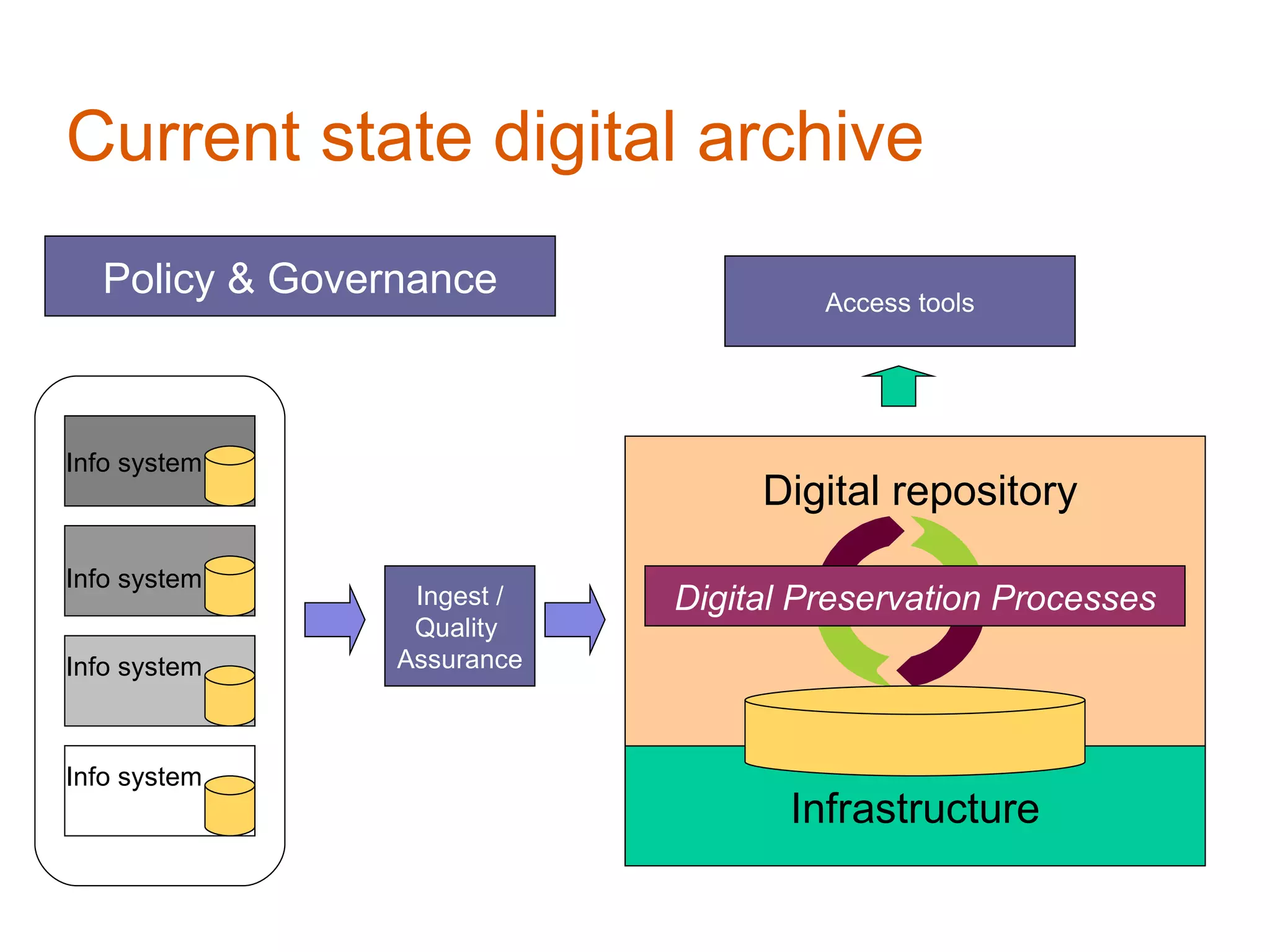
Current state digital archive
  Policy & Governance                Access tools


Info system
                                 Digital repository
Info system
                 Ingest /   Digital Preservation Processes
                 Quality
Info system     Assurance


Info system
                                   Infrastructure
Implications of Cloud Computing
• Cloud computing providers update and change their systems
  frequently to take advantage of new technology or offer competitive
  features
• Cloud computing abstracts users and organisations away from the
  underlying systems, data and infrastructure
• In any non-private cloud model the data is potentially hosted on a
  shared platform with other users or organisations
• At the end of the contract, or if the cloud provider ceases operations,
  the data and application may no longer be available

• DATA REPATRIATION is an essential consideration for any cloud
   computing deployment

• Does this offer an opportunity to “kill two birds with one stone?”
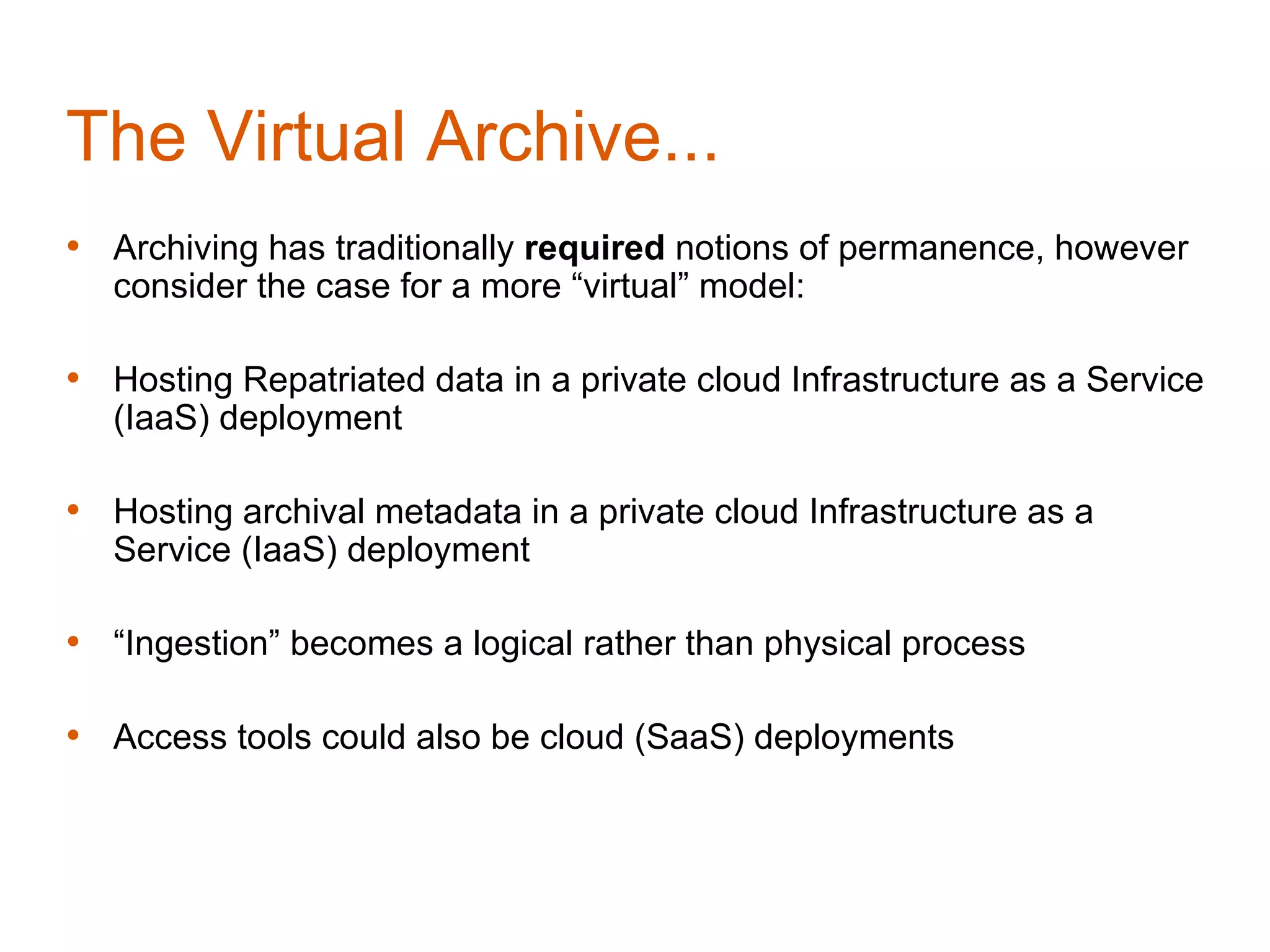
A future state digital archive ?
                         Policy & Governance

    Info system (Public Cloud)                 Access tools (SaaS)


   Info system (Comm. Cloud)


    Info system (Comm. Cloud)
                                              Digital repository

    Info system (Private Cloud)
            n
         tio


                    Digital Preservation Processes
      tria
    pa


               Infrastructure as a Service (IaaS)
  Re


                                   Ingest /
                                   Quality
                                  Assurance
The Virtual Archive...
• Archiving has traditionally required notions of permanence, however
   consider the case for a more “virtual” model:

• Hosting Repatriated data in a private cloud Infrastructure as a Service
   (IaaS) deployment

• Hosting archival metadata in a private cloud Infrastructure as a
   Service (IaaS) deployment

• “Ingestion” becomes a logical rather than physical process

• Access tools could also be cloud (SaaS) deployments
The role of the Data Warehouse
• Substantial resources have already been devoted to build enterprise data
   warehouses

• Repatriated cloud data could also be housed in a data warehousing
   construct

• Analytics, enterprise search, contextual analysis, and business
   intelligence all link to the data warehouse, giving insight to data

• With research and development investment in analytics orders of
   magnitude higher than for pure digital preservation systems, it seems
   likely that analytic capability will advance much more rapidly than digital
   preservation systems

• DP solutions may need to be developed to act upon enterprise data
   warehouse systems rather than operate on specialised digital archives of
   non-current information
APPLICATION CONTEXT
Preserving application context
• Office Productivity
     o   Sheer prevalence of common office productivity software with levels of “backward
         compatibility” provides current protection against digital obsolescence
     o   Is this sustainable into the future, when your cloud based office productivity system and
         your files may be updated to a new version without your consent or knowledge?
• Cloud Computing Systems
     o   How would application context be preserved where there was little/no control over
         frequent updates and little/no control over Intellectual Property crucial for the application
         context?
• Large-scale adoption of common cloud environments may allow scope
    for negotiation of context documentation as a requirement
     o   consistent migration planning
     o   better digital object attribute description
• Mandating common cloud environments provides consistency for digital
    preservation
•   Virtualisation offers some possibilities, but difficult to virtualise a snapshot
    of all the “moving parts” of a cloud based system
POLICY CONSIDERATIONS
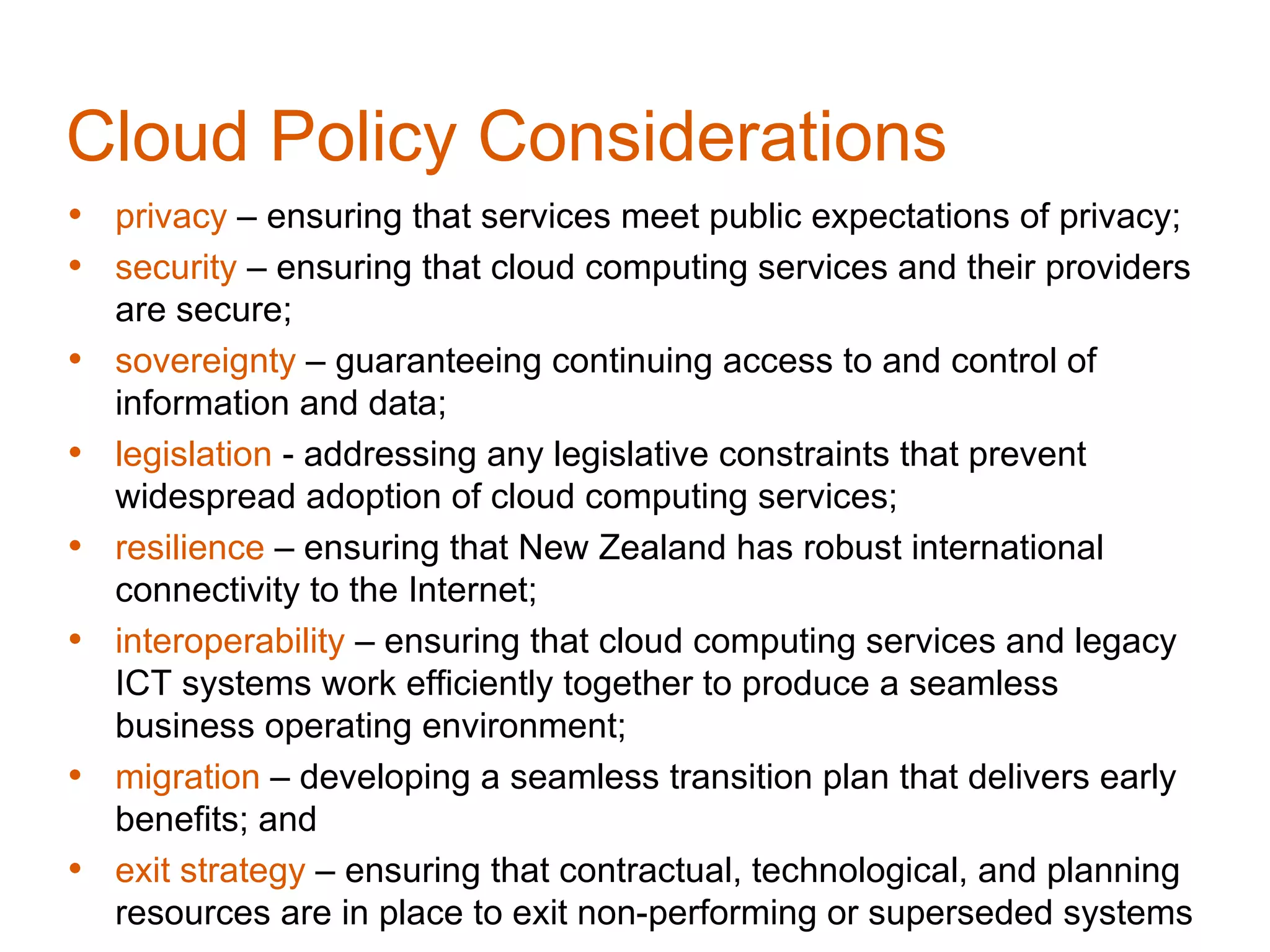
Cloud Policy Considerations
• privacy – ensuring that services meet public expectations of privacy;
• security – ensuring that cloud computing services and their providers
    are secure;
•   sovereignty – guaranteeing continuing access to and control of
    information and data;
•   legislation - addressing any legislative constraints that prevent
    widespread adoption of cloud computing services;
•   resilience – ensuring that New Zealand has robust international
    connectivity to the Internet;
•   interoperability – ensuring that cloud computing services and legacy
    ICT systems work efficiently together to produce a seamless
    business operating environment;
•   migration – developing a seamless transition plan that delivers early
    benefits; and
•   exit strategy – ensuring that contractual, technological, and planning
    resources are in place to exit non-performing or superseded systems
And most importantly...
• data repatriation– ensuring a regular
 backup (preferably a real time feed) of the
 data hosted by the cloud provider to a
 repository within your direct control
For more information

Government ICT Website

www.ict.govt.nz
My contact details:
stuart.wakefield@dia.govt.nz
04 495 6035

Stuart Wakefield Cloud Computing

  • 1.
    Cloud Computing Implications forDigital Preservation Stuart Wakefield Director, Office of GCIO Department of Internal Affairs
  • 2.
    Topics for Today •Overview of NZ public sector approach to cloud computing and current initiatives • Potential implications for digital preservation • Will current digital preservation approaches be viable for a could based service? • Should the archive also reside in the cloud? • Can you preserve an application context for a cloud based service that updates frequently? • What are the key policy & design considerations for adopting cloud to ensure a smooth transition in years to come?
  • 3.
  • 4.
    The role ofthe Government CIO • Support & Implement Government (ICT) Policy • Leads ICT strategy for the public sector • Provides a single point of coordination internationally • Provides support and advice to agencies • Provide Enterprise Architecture (GEA-NZ) and ICT Roadmap
  • 5.
    ICT Roadmap –Common Capabilities Architectural Building Blocks End User • Including; Desktops, Laptops, Multifunctional e.g. Devices, Mobiles Devices • Including; one.govt, secure email, unified Communications e.g. LAN / WAN communications • Including; web standards, domain management, Channels and Online Gateway e.g. reusable web environment, public sector intranet, Touchpoints Presence Services online consultation • Identity: Including; EOI, igovt logon, identity verification, identify data validation Business Business Identity • Data Sharing: Including authoritative data definition, Process e.g. Process Information interoperability standards, data sharing, data management, and Integration Integration Management government service bus concepts • Public Sector IAM: Identity of state sector employees and their access to information and systems Business and Unique • Including the focus on approaches to e.g. Business …. Operational standardising government business functions such Functions Functions as finance IaaS Infrastructure • Includes the development of core ICT infrastructure e.g. Foundation components including infrastructure, software asset Security management, security, software as a service 5
  • 7.
    IaaS for NZGovernment • For us IaaS is the provision of utility computing and housing for datacentre equipment, also storage as a service (access to disk space for files) and Back Up and Restore as a service (for securing data) • Utility computing means the ability to use a virtualised compute resource of a certain capacity (Processing power, memory, storage etc) as needed, and on demand (pay as you go) • Housing allows our agencies to migrate from their existing datacentres as a precursor to adopting a virtualised utility computing model 7
  • 8.
    IaaS as aFoundation for Future Services Software as a Service •Fully functional application provided •Examples: Email (EaaS); Financials; CRM Platform as a Service •Operating system provided •Examples: Windows; LINUX; Oracle Database Infrastructure as a Service •Virtual platform on which operating system and application are deployed •Includes Storage as a Service 8
  • 9.
    NZ Government CloudProgramme 1. Indicative Business Case for “Government Cloud” that will: • Identify opportunities where a cloud computing approach may add value • Assess the feasibility & market maturity of cloud computing at various points in the stack • Determine future roadmap and timeframes for cloud adoption (over and above Office Productivity) • Identify the range of potential solutions to address “resolvable challenges” 2. Detailed Business Case for “Office Productivity Services” that will: • Identify available and applicable service offerings • Assess these against agency need • Describe the commercial, financial, economic, strategic and management impacts of the available options • Determine an implementation plan (including procurement) and timeframe
  • 10.
    NZ Government CloudProgramme – Approach • Programme draws expertise and is resourced from across government • Government CIO provides strategic direction and overall assurance • Consultative engagement with vendors to inform the business case • No pre-determined requirements on solutions • Open to exploring a range of options to address “resolvable challenges” to widespread adoption of cloud computing
  • 11.
  • 12.
    Current state digitalarchive Policy & Governance Access tools Info system Digital repository Info system Ingest / Digital Preservation Processes Quality Info system Assurance Info system Infrastructure
  • 13.
    Implications of CloudComputing • Cloud computing providers update and change their systems frequently to take advantage of new technology or offer competitive features • Cloud computing abstracts users and organisations away from the underlying systems, data and infrastructure • In any non-private cloud model the data is potentially hosted on a shared platform with other users or organisations • At the end of the contract, or if the cloud provider ceases operations, the data and application may no longer be available • DATA REPATRIATION is an essential consideration for any cloud computing deployment • Does this offer an opportunity to “kill two birds with one stone?”
  • 14.
    A future statedigital archive ? Policy & Governance Info system (Public Cloud) Access tools (SaaS) Info system (Comm. Cloud) Info system (Comm. Cloud) Digital repository Info system (Private Cloud) n tio Digital Preservation Processes tria pa Infrastructure as a Service (IaaS) Re Ingest / Quality Assurance
  • 15.
    The Virtual Archive... •Archiving has traditionally required notions of permanence, however consider the case for a more “virtual” model: • Hosting Repatriated data in a private cloud Infrastructure as a Service (IaaS) deployment • Hosting archival metadata in a private cloud Infrastructure as a Service (IaaS) deployment • “Ingestion” becomes a logical rather than physical process • Access tools could also be cloud (SaaS) deployments
  • 16.
    The role ofthe Data Warehouse • Substantial resources have already been devoted to build enterprise data warehouses • Repatriated cloud data could also be housed in a data warehousing construct • Analytics, enterprise search, contextual analysis, and business intelligence all link to the data warehouse, giving insight to data • With research and development investment in analytics orders of magnitude higher than for pure digital preservation systems, it seems likely that analytic capability will advance much more rapidly than digital preservation systems • DP solutions may need to be developed to act upon enterprise data warehouse systems rather than operate on specialised digital archives of non-current information
  • 17.
  • 18.
    Preserving application context •Office Productivity o Sheer prevalence of common office productivity software with levels of “backward compatibility” provides current protection against digital obsolescence o Is this sustainable into the future, when your cloud based office productivity system and your files may be updated to a new version without your consent or knowledge? • Cloud Computing Systems o How would application context be preserved where there was little/no control over frequent updates and little/no control over Intellectual Property crucial for the application context? • Large-scale adoption of common cloud environments may allow scope for negotiation of context documentation as a requirement o consistent migration planning o better digital object attribute description • Mandating common cloud environments provides consistency for digital preservation • Virtualisation offers some possibilities, but difficult to virtualise a snapshot of all the “moving parts” of a cloud based system
  • 19.
  • 20.
    Cloud Policy Considerations •privacy – ensuring that services meet public expectations of privacy; • security – ensuring that cloud computing services and their providers are secure; • sovereignty – guaranteeing continuing access to and control of information and data; • legislation - addressing any legislative constraints that prevent widespread adoption of cloud computing services; • resilience – ensuring that New Zealand has robust international connectivity to the Internet; • interoperability – ensuring that cloud computing services and legacy ICT systems work efficiently together to produce a seamless business operating environment; • migration – developing a seamless transition plan that delivers early benefits; and • exit strategy – ensuring that contractual, technological, and planning resources are in place to exit non-performing or superseded systems
  • 21.
    And most importantly... •data repatriation– ensuring a regular backup (preferably a real time feed) of the data hosted by the cloud provider to a repository within your direct control
  • 22.
    For more information GovernmentICT Website www.ict.govt.nz My contact details: stuart.wakefield@dia.govt.nz 04 495 6035

Editor's Notes

  • #3 Cloud is a business model for Government ICT which moves from a capital intensive, complex-to-manage portfolio of ICT investments to paying for on-demand services.
  • #6 What sort of capabilities are on the roadmap? End User Devices - A new all-of-government contract to supply computers to state sector agencies will save more than $35 million over five years, Economic Development Minister Gerry Brownlee says. Communications – one.govt Channels and Touch Points – Public Sector Intranet, Shared Workspaces Business Process and Integration – iGovt Logon, Document Validation Service Business and Operational Functions – Basic Administration and Support Services Foundation – IaaS
  • #14 Archiving has traditionally placed great value on notions of permanence. However realistically, an ICT infrastructure is a temporary asset requiring constant replacements and upgrades, and a very large staff and technological resource for monitoring. Cloud services largely replace the need for this resource, allowing operations to focus on particular business needs. Cloud services typically provide their consumers with the most advanced back-end ICT technologies, giving customers the benefit of advances in areas such as security and data protection as they emerge, rather than requiring active management of background software services and waiting for infrastructure refresh cycles for owned assets. Hosting archival data in cloud infrastructure could allow resources to be focussed on addressing Digital Preservation policy concerns, and the development of specialised Digital Preservation tools and access tools.
  • #16 Archiving has traditionally placed great value on notions of permanence. However realistically, an ICT infrastructure is a temporary asset requiring constant replacements and upgrades, and a very large staff and technological resource for monitoring. Cloud services largely replace the need for this resource, allowing operations to focus on particular business needs. Cloud services typically provide their consumers with the most advanced back-end ICT technologies, giving customers the benefit of advances in areas such as security and data protection as they emerge, rather than requiring active management of background software services and waiting for infrastructure refresh cycles for owned assets. Hosting archival data in cloud infrastructure could allow resources to be focussed on addressing Digital Preservation policy concerns, and the development of specialised Digital Preservation tools and access tools.
  • #19 Prevalence of common office productivity software has already protected against digital obsolescence to a certain extent. The ubiquity of Microsoft Office, and its embedded, largely successful, backward compatibility capabilities, have shielded many users from the issues of digital preservation. While it is likely that today’s standardised office productivity suites will provide for medium-term preservation of business documents, this does not in itself meet Digital Preservation objectives. However there is further potential in standardising common operating environments. Mandating common operation environments for government is assessed as being likely to produce substantial operational efficiencies, and could also provide consistency for digital preservation planning and access purposes. Full operating environment virtualisation could provide further operational flexibility, and would pave the way for flexible end user device policies and practices, including Bring Your Own Device, low-cost consumerised thin client devices such as tablets, as well as continued use of fat client devices where necessary. These changes would bring some downstream opportunities for Digital Preservation, although they would also pose challenges: How would application context be preserved where there was little/no control over frequent updates and little/no control over Intellectual Property crucial for the application context? Common cloud environments would allow for consist migration planning Common cloud environments would allow for better digital object attribute description Large-scale adoption of common cloud environments may allow scope for negotiation of context documentation as a requirement