1
STRUCTURAL ENGINEERING II: TIMBER DESIGN
INTRODUCTION
The design process included various stages which are interconnected. It starts with the development of a
concept and ends with the detailing of structural parts and the formulation of specifications for construction.
In between, there is the identification of materials and load types, quantification of loads, structural
idealisations and modelling, structural analysis and numerical design.
This course is concerned with the development of skills to complete each of those stages, as a first
approximation to a more comprehensive knowledge and understanding of structural analysis and design.
COURSE CONTENTS
1. BASIS FOR DESIGN PAGE
1.1 ULS GENERAL CONSIDERATION 2
1.2 SLS GENERAL CONSIDERATION 2
1.3 BASIC VARIABLES 2
1.4 LOAD DURATION CASES 2
1.5 SERVICE CLASSES 3
1.6 MATERIAL PROPERTIES 3
1.7 LOAD DURATION AND MOISTURE INFLUECNE ON DEFORMATIONS 3
2. VERIFICATION OF STRENGTH BY THE PARTIAL FACTOR METHOD
2.1 DESIGN VALUE OF MATERIAL PROPERTY 6
2.2 MODIFICATION FACTOR FOR SERVICE CLASS 7
3. ULTIMATE LIMIT STATE
3.1 GENERAL 8
3.2 STRENGTH CLASS 9
3.3 DESIGN OF SECTIONS SUBJECT TO STRESS IN ONE DIRECTION 10
3.4 LOAD DURATION AND MOISTURE INFLUENCE ON STRENGTH
4. STABILITY OF MEMBERS
4.1 COLUMNS SUBJECT TO COMPRESSION AND OR BENDING
5. SERVICEABILITY: DEFLECTIONS CHECK
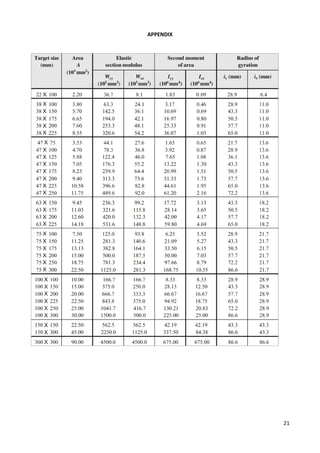
APPENDIX: SECTION PROPERTIES FOR RECTANGULAR SOLID TIMBER
READING LIST
[1] BS EN 1995-1-1: 2004+A2: 2014. Eurocode 4: Design of timber structures. BSI British Standards.
[2] Draycott T and Bullman P, 2009. Structural elements design manual- Working with Eurocodes. Elsevier.
[3] BS EN 338:2016. Structural timber — Strength classes. BSI British Standards.
[4] BS EN 1990: 2000+A1: 2005. Eurocode – basis for Structural design. BSI British Standards.
[5] Porteous J, Ross P, 2013. Designers’ guide to eurocode 5: Design of timber buildings EN 1995-1-1.
2
1. BASIS FOR DESIGN
The sections below are made of extracts of Eurocode 5: Design of timber structures and additional teaching
materials added to the reading list.
The design models for the different limit states shall, as appropriate, consider the following:
▪ different material properties (e.g., strength and stiffness).
▪ different time-dependent behaviour of the materials (duration of load, creep).
▪ different climatic conditions (temperature, moisture variations).
▪ different design situations (stages of construction, change of support conditions).
1.1 ULS General considerations
The analysis of structures shall be carried out using the following values for stiffness properties:
▪ for a first order linear elastic analysis of a structure, whose distribution of internal forces is not
affected by the stiffness distribution within the structure (e.g., all members have the same time-
dependent properties), mean values shall be used.
▪ for a first order linear elastic analysis of a structure, whose distribution of internal forces is affected
by the stiffness distribution within the structure (e.g., composite members containing materials
having different time-dependent properties), final mean values adjusted to the load component
causing the largest stress in relation to strength shall be used.
▪ for a second order linear elastic analysis of a structure, design values, not adjusted for duration of
load, shall be used.
1.2 SLS General considerations
The deformation of a structure which results from the effects of actions (such as axial and shear forces,
bending moments and joint slip) and from moisture shall remain within appropriate limits, having regard to
the possibility of damage to surfacing materials, ceilings, floors, partitions and finishes, and to the functional
needs as well as any appearance requirements.
1.3 Basic Variables
The deformation of a structure which results from the effects of actions (such as axial and shear forces,
Actions to be used in design may be obtained from the relevant parts of EN 1991.
Note 1: The relevant parts of EN 1991 for use in design include:
− EN 1991-1-1 Densities, self-weight and imposed loads
− EN 1991-1-3 Snow loads
− EN 1991-1-4 Wind actions
− EN 1991-1-5 Thermal actions
− EN 1991-1-6 Actions during execution
− EN 1991-1-7 Accidental actions
Duration of load and moisture content affect the strength and stiffness properties of timber and wood-based
elements and shall be taken into account in the design for mechanical resistance and serviceability.
1.4 Load-duration classes
The load-duration classes are characterised by the effect of a constant load acting for a certain period of time
in the life of the structure. For a variable action the appropriate class shall be determined on the basis of an
estimate of the typical variation of the load with time.
Actions shall be assigned to one of the load-duration classes given in Table 2.1 in [1] for strength and stiffness
calculations.
3
Load- duration classes (source [1]).
Examples of Load- duration assignment (source [1]).
1.5 Service classes
▪ Structures shall be assigned to one of the service classes given below:
NOTE 1: The service class system is mainly aimed at assigning strength values and for calculating deformations under
defined environmental conditions.
NOTE 2: Information on the assignment of structures to service classes given in (2)P, (3)P and (4)P may be given in the
National annex.
▪ Service class 1 is characterised by a moisture content in the materials corresponding to a
temperature of 20°C and the relative humidity of the surrounding air only exceeding 65 % for a
few weeks per year.
NOTE: In service class 1 the average moisture content in most softwoods will not exceed 12 %.
▪ Service class 2 is characterised by a moisture content in the materials corresponding to a
temperature of 20°C and the relative humidity of the surrounding air only exceeding 85 % for a few
weeks per year.
NOTE: In service class 2 the average moisture content in most softwoods will not exceed 20 %.
▪ Service class 3 is characterised by climatic conditions leading to higher moisture contents than in
service class 2.
4
1.6 Materials and product properties
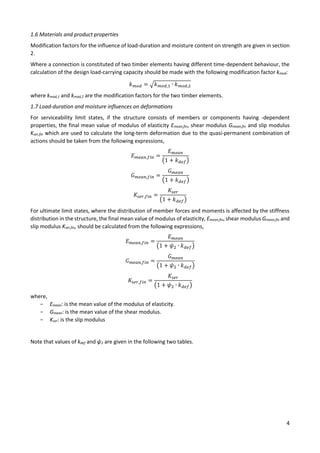
Modification factors for the influence of load-duration and moisture content on strength are given in section
2.
Where a connection is constituted of two timber elements having different time-dependent behaviour, the
calculation of the design load-carrying capacity should be made with the following modification factor kmod:
𝑘𝑚𝑜𝑑 = √𝑘𝑚𝑜𝑑,1 ∙ 𝑘𝑚𝑜𝑑,2
where kmod,1 and kmod,2 are the modification factors for the two timber elements.
1.7 Load-duration and moisture influences on deformations
For serviceability limit states, if the structure consists of members or components having -dependent
properties, the final mean value of modulus of elasticity Emean,fin, shear modulus Gmean,fin and slip modulus
Kser,fin which are used to calculate the long-term deformation due to the quasi-permanent combination of
actions should be taken from the following expressions,
𝐸𝑚𝑒𝑎𝑛,𝑓𝑖𝑛 =
𝐸𝑚𝑒𝑎𝑛
(1 + 𝑘𝑑𝑒𝑓)
𝐺𝑚𝑒𝑎𝑛,𝑓𝑖𝑛 =
𝐺𝑚𝑒𝑎𝑛
(1 + 𝑘𝑑𝑒𝑓)
𝐾𝑠𝑒𝑟,𝑓𝑖𝑛 =
𝐾𝑠𝑒𝑟
(1 + 𝑘𝑑𝑒𝑓)
For ultimate limit states, where the distribution of member forces and moments is affected by the stiffness
distribution in the structure, the final mean value of modulus of elasticity, Emean,fin, shear modulus Gmean,fin and
slip modulus Kser,fin, should be calculated from the following expressions,
𝐸𝑚𝑒𝑎𝑛,𝑓𝑖𝑛 =
𝐸𝑚𝑒𝑎𝑛
(1 + 𝜓2 ∙ 𝑘𝑑𝑒𝑓)
𝐺𝑚𝑒𝑎𝑛,𝑓𝑖𝑛 =
𝐺𝑚𝑒𝑎𝑛
(1 + 𝜓2 ∙ 𝑘𝑑𝑒𝑓)
𝐾𝑠𝑒𝑟,𝑓𝑖𝑛 =
𝐾𝑠𝑒𝑟
(1 + 𝜓2 ∙ 𝑘𝑑𝑒𝑓)
where,
− Emean: is the mean value of the modulus of elasticity.
− Gmean: is the mean value of the shear modulus.
− Kser: is the slip modulus
Note that values of kdef and ψ2 are given in the following two tables.
5
Recommended values of ψ factors for buildings (source [4]).
Recommended values of kdef (source [1])
6
2. VERIFICATION OF STRENGTH BY THE PARTIAL FACTOR METHOD
2.1 Design value of material property
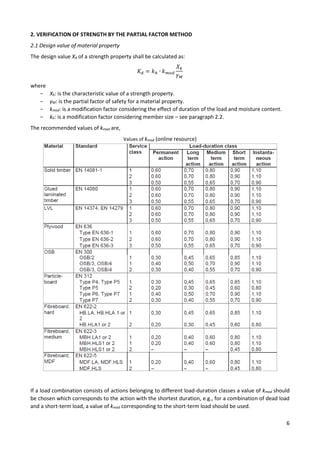
The design value Xd of a strength property shall be calculated as:
𝐾𝑑 = 𝑘ℎ ∙ 𝑘𝑚𝑜𝑑
𝑋𝑘
𝛾𝑀
where
− Xk: is the characteristic value of a strength property.
− γM: is the partial factor of safety for a material property.
− kmod: is a modification factor considering the effect of duration of the load and moisture content.
− kh: is a modification factor considering member size – see paragraph 2.2.
The recommended values of kmod are,
Values of kmod (online resource)
If a load combination consists of actions belonging to different load-duration classes a value of kmod should
be chosen which corresponds to the action with the shortest duration, e.g., for a combination of dead load
and a short-term load, a value of kmod corresponding to the short-term load should be used.
7
The recommended partial factors for material properties (γM) are,
Recommended partial factors of safety for material properties and resistances (source [1]).
2.2 Modification factors for service class
2.2.1 Solid timber
For rectangular solid timber with a characteristic timber density ρk ≤ 700 kg/m3
the reference depth in
bending or width (maximum cross-sectional dimension) in tension is 150 mm. For depths in bending or widths
in tension of solid timber less than 150 mm, the characteristic strength may be increased by the factor kh,
given by:
𝑘ℎ = 𝑚𝑖𝑛 {
150
ℎ
0.2
1.3
}
where h is the depth (mm) for bending members or width for tension members.
2.2.2 Glue laminated timber
For rectangular glued laminated timber, the reference depth in bending or width in tension is 600 mm. For
depths in bending or widths in tension of glued laminated timber less than 600 mm the characteristic strength
may be increased by the factor kh, given by:
𝑘ℎ = 𝑚𝑖𝑛 {
600
ℎ
0.1
1.1
}
where h is the depth (mm) for bending members or width for tension members.
2.2.3 Laminated veneer lumber (LVL)
For rectangular LVL with the grain of all veneers running essentially in one direction, the effect of member
size on bending and tensile strength shall be considered. The reference depth in bending is 300 mm;
otherwise, for depths in bending not equal to 300 mm the characteristic strength may be increased by the
factor kh, given by:
𝑘ℎ = 𝑚𝑖𝑛 {
300
ℎ
𝑠
1.2
}
where h is the depth (mm) for bending members or width for tension members and s is the size effect
exponent which could be assumed to be s= 0.10.
8
3. ULTIMATE LIMIT STATE
3.1 General
In this course we will focus on straight solid timber, glued laminated timber or wood-based structural
products of constant cross-section, whose grain runs essentially parallel to the length of the member as
indicated in Fig. 3.1. The member is assumed to be subjected to stresses in the direction of only one of its
principal axes.
Fig. 3.1 Member axes (source [1])
The grain is the longitudinal arrangement of wood fibres. The two basic categories of grain are straight grain
and cross grain. Straight grain runs parallel to the longitudinal axis of the piece. Cross grain deviates from the
longitudinal axis in two ways: spiral grain or diagonal grain. The amount of deviation is called the slope of the
grain1
.
Basic categories: cross grain (left) and straight grain (right) (online resource).
1
Hoadley, R. Bruce, 1980. Understanding Wood: A Craftsman's Guide to Wood Technology. Newtown, Conn.:
Taunton, 265.
9
3.2 Strength Class
A strength class system groups together grades and, species and sources with similar strength properties
thus making them interchangeable. This then permits an engineer to specify a chosen strength class and
use the characteristic strength values of that class in design calculations. The most common used strength
classes in Europe are printed in bold in the tables below.
Strength classes for softwood based on edgewise bending tests: strength, stiffness, and density values (source [3])
Strength classes for hardwood based on edgewise bending tests: strength, stiffness, and density values (source [3])
10
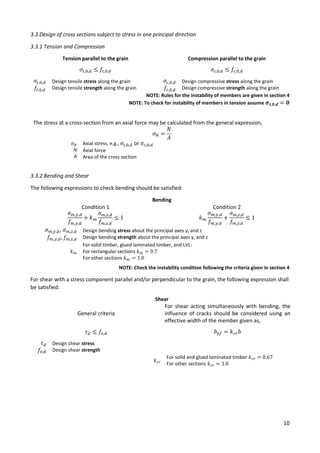
3.3 Design of cross sections subject to stress in one principal direction
3.3.1 Tension and Compression
Tension parallel to the grain Compression parallel to the grain
𝜎𝑡,0,𝑑 ≤ 𝑓𝑡,0,𝑑 𝜎𝑐,0,𝑑 ≤ 𝑓𝑐,0,𝑑
𝜎𝑡,0,𝑑
𝑓𝑡,0,𝑑
Design tensile stress along the grain
Design tensile strength along the grain
𝜎𝑐,0,𝑑
𝑓𝑐,0,𝑑
Design compressive stress along the grain
Design compressive strength along the grain
NOTE: Rules for the instability of members are given in section 4
NOTE: To check for instability of members in tension assume 𝝈𝒕,𝟎,𝒅 = 𝟎
The stress at a cross-section from an axial force may be calculated from the general expression,
𝜎𝑁 =
𝑁
𝐴
𝜎𝑁
N
A
Axial stress, e.g., 𝜎𝑡,0,𝑑 or 𝜎𝑐,0,𝑑
Axial force
Area of the cross section
3.3.2 Bending and Shear
The following expressions to check bending should be satisfied:
Bending
Condition 1 Condition 2
𝜎𝑚,𝑦,𝑑
𝑓𝑚,𝑦,𝑑
+ 𝑘𝑚
𝜎𝑚,𝑧,𝑑
𝑓𝑚,𝑧,𝑑
≤ 1 𝑘𝑚
𝜎𝑚,𝑦,𝑑
𝑓𝑚,𝑦,𝑑
+
𝜎𝑚,𝑧,𝑑
𝑓𝑚,𝑧,𝑑
≤ 1
𝜎𝑚,𝑦,𝑑, 𝜎𝑚,𝑧,𝑑
𝑓𝑚,𝑦,𝑑, 𝑓𝑚,𝑧,𝑑
Design bending stress about the principal axes y, and z
Design bending strength about the principal axes y, and z
𝑘𝑚
For solid timber, glued laminated timber, and LVL:
For rectangular sections 𝑘𝑚 = 0.7
For other sections 𝑘𝑚 = 1.0
NOTE: Check the instability condition following the criteria given in section 4
For shear with a stress component parallel and/or perpendicular to the grain, the following expression shall
be satisfied:
Shear
General criteria
For shear acting simultaneously with bending, the
influence of cracks should be considered using an
effective width of the member given as,
𝜏𝑑 ≤ 𝑓𝑣,𝑑 𝑏𝑒𝑓 = 𝑘𝑐𝑟𝑏
𝜏𝑑
𝑓𝑣,𝑑
Design shear stress
Design shear strength
𝑘𝑐𝑟
For solid and glued laminated timber 𝑘𝑐𝑟 = 0.67
For other sections 𝑘𝑐𝑟 = 1.0
11
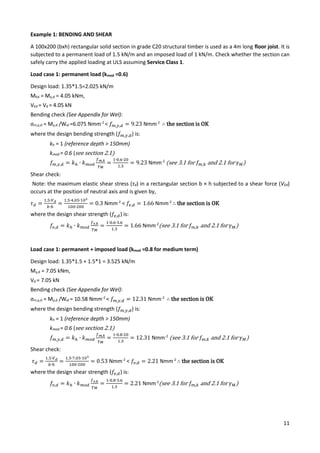
Example 1: BENDING AND SHEAR
A 100x200 (bxh) rectangular solid section in grade C20 structural timber is used as a 4m long floor joist. It is
subjected to a permanent load of 1.5 kN/m and an imposed load of 1 kN/m. Check whether the section can
safely carry the applied loading at ULS assuming Service Class 1.
Load case 1: permanent load (kmod =0.6)
Design load: 1.35*1.5=2.025 kN/m
MEd = My,d = 4.05 kNm,
VEd = Vd = 4.05 kN
Bending check (See Appendix for Wel):
σm,y,d = My,d /Wel =6.075 Nmm-2
< 𝑓𝑚,𝑦,𝑑 = 9.23 Nmm-2
∴ the section is OK
where the design bending strength (𝑓𝑚,𝑦,𝑑) is:
kh = 1 (reference depth > 150mm)
kmod = 0.6 (see section 2.1)
𝑓𝑚,𝑦,𝑑 = 𝑘ℎ ∙ 𝑘𝑚𝑜𝑑
𝑓𝑚,𝑘
𝛾𝑀
=
1∙0.6∙20
1.3
= 9.23 Nmm-2
(see 3.1 for 𝑓𝑚,𝑘 and 2.1 for 𝛾𝑀)
Shear check:
Note: the maximum elastic shear stress (τd) in a rectangular section b × h subjected to a shear force (VEd)
occurs at the position of neutral axis and is given by,
𝜏𝑑 =
1.5∙𝑉𝑑
𝑏∙ℎ
=
1.5∙4.05∙103
100∙200
= 0.3 Nmm-2
< 𝑓𝑣,𝑑 = 1.66 Nmm-2
∴ the section is OK
where the design shear strength (𝑓𝑣,𝑑) is:
𝑓𝑣,𝑑 = 𝑘ℎ ∙ 𝑘𝑚𝑜𝑑
𝑓𝑣,𝑘
𝛾𝑀
=
1∙0.6∙3.6
1.3
= 1.66 Nmm-2
(see 3.1 for 𝑓𝑚,𝑘 and 2.1 for 𝛾𝑀)
Load case 1: permanent + imposed load (kmod =0.8 for medium term)
Design load: 1.35*1.5 + 1.5*1 = 3.525 kN/m
My,d = 7.05 kNm,
Vd = 7.05 kN
Bending check (See Appendix for Wel):
σm,y,d = My,d /Wel = 10.58 Nmm-2
< 𝑓𝑚,𝑦,𝑑 = 12.31 Nmm-2
∴ the section is OK
where the design bending strength (𝑓𝑚,𝑦,𝑑) is:
kh = 1 (reference depth > 150mm)
kmod = 0.6 (see section 2.1)
𝑓𝑚,𝑦,𝑑 = 𝑘ℎ ∙ 𝑘𝑚𝑜𝑑
𝑓𝑚,𝑘
𝛾𝑀
=
1∙0.8∙20
1.3
= 12.31 Nmm-2
(see 3.1 for 𝑓𝑚,𝑘 and 2.1 for 𝛾𝑀)
Shear check:
𝜏𝑑 =
1.5∙𝑉𝑑
𝑏∙ℎ
=
1.5∙7.05∙103
100∙200
= 0.53 Nmm-2
< 𝑓𝑣,𝑑 = 2.21 Nmm-2
∴ the section is OK
where the design shear strength (𝑓𝑣,𝑑) is:
𝑓𝑣,𝑑 = 𝑘ℎ ∙ 𝑘𝑚𝑜𝑑
𝑓𝑣,𝑘
𝛾𝑀
=
1∙0.8∙3.6
1.3
= 2.21 Nmm-2
(see 3.1 for 𝑓𝑚,𝑘 and 2.1 for 𝛾𝑀)
12
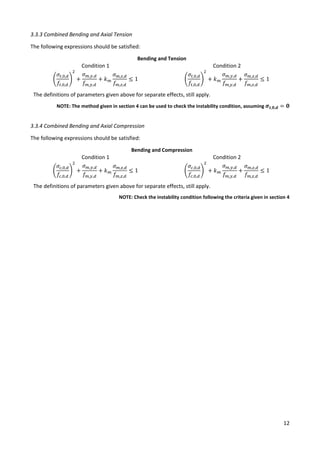
3.3.3 Combined Bending and Axial Tension
The following expressions should be satisfied:
Bending and Tension
Condition 1 Condition 2
(
𝜎𝑡,0,𝑑
𝑓𝑡,0,𝑑
)
2
+
𝜎𝑚,𝑦,𝑑
𝑓𝑚,𝑦,𝑑
+ 𝑘𝑚
𝜎𝑚,𝑧,𝑑
𝑓𝑚,𝑧,𝑑
≤ 1 (
𝜎𝑡,0,𝑑
𝑓𝑡,0,𝑑
)
2
+ 𝑘𝑚
𝜎𝑚,𝑦,𝑑
𝑓𝑚,𝑦,𝑑
+
𝜎𝑚,𝑧,𝑑
𝑓𝑚,𝑧,𝑑
≤ 1
The definitions of parameters given above for separate effects, still apply.
NOTE: The method given in section 4 can be used to check the instability condition, assuming 𝝈𝒕,𝟎,𝒅 = 𝟎
3.3.4 Combined Bending and Axial Compression
The following expressions should be satisfied:
Bending and Compression
Condition 1 Condition 2
(
𝜎𝑐,0,𝑑
𝑓𝑐,0,𝑑
)
2
+
𝜎𝑚,𝑦,𝑑
𝑓𝑚,𝑦,𝑑
+ 𝑘𝑚
𝜎𝑚,𝑧,𝑑
𝑓𝑚,𝑧,𝑑
≤ 1 (
𝜎𝑐,0,𝑑
𝑓𝑐,0,𝑑
)
2
+ 𝑘𝑚
𝜎𝑚,𝑦,𝑑
𝑓𝑚,𝑦,𝑑
+
𝜎𝑚,𝑧,𝑑
𝑓𝑚,𝑧,𝑑
≤ 1
The definitions of parameters given above for separate effects, still apply.
NOTE: Check the instability condition following the criteria given in section 4
13
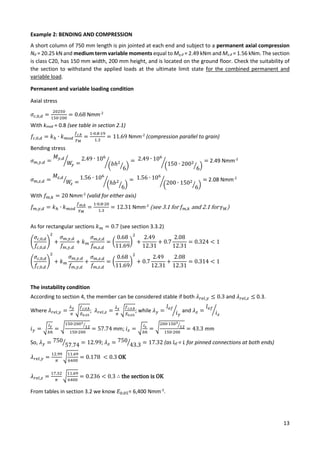
Example 2: BENDING AND COMPRESSION
A short column of 750 mm length is pin jointed at each end and subject to a permanent axial compression
Nd = 20.25 kN and medium term variable moments equal to My,d = 2.49 kNm and Mz,d = 1.56 kNm. The section
is class C20, has 150 mm width, 200 mm height, and is located on the ground floor. Check the suitability of
the section to withstand the applied loads at the ultimate limit state for the combined permanent and
variable load.
Permanent and variable loading condition
Axial stress
𝜎𝑐,0,𝑑 =
20250
150∙200
= 0.68 Nmm-2
With kmod = 0.8 (see table in section 2.1)
𝑓𝑐,0,𝑑 = 𝑘ℎ ∙ 𝑘𝑚𝑜𝑑
𝑓𝑐,𝑘
𝛾𝑀
=
1∙0.8∙19
1.3
= 11.69 Nmm-2
(compression parallel to grain)
Bending stress
𝜎𝑚,𝑦,𝑑 =
𝑀𝑦,𝑑
𝑊
𝑦 =
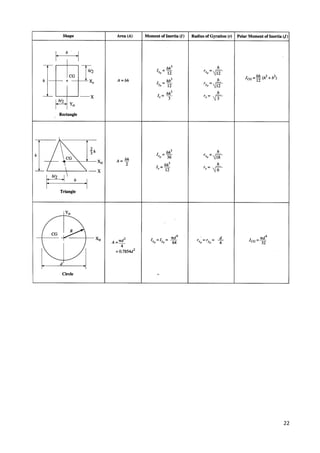
⁄ 2.49 ∙ 106
(𝑏ℎ2
6
⁄ )
⁄ = 2.49 ∙ 106
(150 ∙ 2002
6
⁄ )
⁄ = 2.49 Nmm-2
𝜎𝑚,𝑧,𝑑 =
𝑀𝑧,𝑑
𝑊
𝑧 =
⁄ 1.56 ∙ 106
(ℎ𝑏2
6
⁄ )
⁄ = 1.56 ∙ 106
(200 ∙ 1502
6
⁄ )
⁄ = 2.08 Nmm-2
With 𝑓𝑚,𝑘 = 20 Nmm-2
(valid for either axis)
𝑓𝑚,𝑦,𝑑 = 𝑘ℎ ∙ 𝑘𝑚𝑜𝑑
𝑓𝑚,𝑘
𝛾𝑀
=
1∙0.8∙20
1.3
= 12.31 Nmm-2
(see 3.1 for 𝑓𝑚,𝑘 and 2.1 for 𝛾𝑀)
As for rectangular sections 𝑘𝑚 = 0.7 (see section 3.3.2)
(
𝜎𝑐,0,𝑑
𝑓𝑐,0,𝑑
)
2
+
𝜎𝑚,𝑦,𝑑
𝑓𝑚,𝑦,𝑑
+ 𝑘𝑚
𝜎𝑚,𝑧,𝑑
𝑓𝑚,𝑧,𝑑
= (
0.68
11.69
)
2
+
2.49
12.31
+ 0.7
2.08
12.31
= 0.324 < 1
(
𝜎𝑐,0,𝑑
𝑓𝑐,0,𝑑
)
2
+ 𝑘𝑚
𝜎𝑚,𝑦,𝑑
𝑓𝑚,𝑦,𝑑
+
𝜎𝑚,𝑧,𝑑
𝑓𝑚,𝑧,𝑑
= (
0.68
11.69
)
2
+ 0.7
2.49
12.31
+
2.08
12.31
= 0.314 < 1
The instability condition
According to section 4, the member can be considered stable if both 𝜆𝑟𝑒𝑙,𝑦 ≤ 0.3 and 𝜆𝑟𝑒𝑙,𝑧 ≤ 0.3.
Where 𝜆𝑟𝑒𝑙,𝑦 =
𝜆𝑦
𝜋
√
𝑓𝑐,0,𝑘
𝐸0.05
; 𝜆𝑟𝑒𝑙,𝑧 =
𝜆𝑧
𝜋
√
𝑓𝑐,0,𝑘
𝐸0.05
; while 𝜆𝑦 =
𝑙𝑒𝑓
𝑖𝑦
⁄ and 𝜆𝑧 =
𝑙𝑒𝑓
𝑖𝑧
⁄
𝑖𝑦 = √
𝐼𝑦
𝑏ℎ
= √
150∙2003
12
⁄
150∙200
= 57.74 mm; 𝑖𝑧 = √
𝐼𝑧
𝑏ℎ
= √
200∙1503
12
⁄
150∙200
= 43.3 mm
So, 𝜆𝑦 = 750
57.74
⁄ = 12.99; 𝜆𝑧 = 750
43.3
⁄ = 17.32 (as lef = L for pinned connections at both ends)
𝜆𝑟𝑒𝑙,𝑦 =
12.99
𝜋
√
11.69
6400
= 0.178 < 0.3 OK
𝜆𝑟𝑒𝑙,𝑧 =
17.32
𝜋
√
11.69
6400
= 0.236 < 0.3 ∴ the section is OK
From tables in section 3.2 we know 𝐸0.05= 6,400 Nmm-2
.
I/y
14
4. STABILITY OF MEMBERS
4.1 Columns subject to either compression or combined compression and bending.
Relative slenderness ratios
About y-axis About z-axis
𝜆𝑟𝑒𝑙,𝑦 =
𝜆𝑦
𝜋
√
𝑓𝑐,0,𝑘
𝐸0.05
𝜆𝑟𝑒𝑙,𝑧 =
𝜆𝑧
𝜋
√
𝑓𝑐,0,𝑘
𝐸0.05
𝜆𝑦, 𝜆𝑟𝑒𝑙,𝑦
𝜆𝑧, 𝜆𝑟𝑒𝑙,𝑧
Slenderness ratios corresponding to bending about y-y i.e., deflection in the z-direction.
Slenderness ratios corresponding to bending about z-z i.e., deflection in the y-direction.
𝐸0.05 Fifth percentile value of the modulus of elasticity parallel to the grain
The member can be considered stable if both 𝜆𝑟𝑒𝑙,𝑦 ≤ 0.3 and 𝜆𝑟𝑒𝑙,𝑧 ≤ 0.3. In which case stress levels should
only satisfy the conditions given in Section 3. To define the value of 𝜆𝑦 or 𝜆𝑧 you may use the following
effective length values.
In all other cases the stresses, which will be increased due to deflection (second-order effects), should satisfy
the following:
Columns in compression or combined compression and bending
Condition 1 Condition 2
𝜎𝑐,0,𝑑
𝑘𝑐,𝑦 ∙ 𝑓𝑐,0,𝑑
+
𝜎𝑚,𝑦,𝑑
𝑓𝑚,𝑦,𝑑
+ 𝑘𝑚
𝜎𝑚,𝑧,𝑑
𝑓𝑚,𝑧,𝑑
≤ 1
𝜎𝑐,0,𝑑
𝑘𝑐,𝑧 ∙ 𝑓𝑐,0,𝑑
+ 𝑘𝑚
𝜎𝑚,𝑦,𝑑
𝑓𝑚,𝑦,𝑑
+
𝜎𝑚,𝑧,𝑑
𝑓𝑚,𝑧,𝑑
≤ 1
𝑘𝑐,𝑦 =
1
𝑘𝑦 + √𝑘𝑦
2
− 𝜆𝑟𝑒𝑙,𝑦
2 𝑘𝑦 = 0.5[1 + 𝛽𝑐(𝜆𝑟𝑒𝑙,𝑦 − 0.3) + 𝜆𝑟𝑒𝑙,𝑦
2
]
𝑘𝑐,𝑧 =
1
𝑘𝑧 + √𝑘𝑧
2 − 𝜆𝑟𝑒𝑙,𝑧
2 𝑘𝑧 = 0.5[1 + 𝛽𝑐(𝜆𝑟𝑒𝑙,𝑧 − 0.3) + 𝜆𝑟𝑒𝑙,𝑧
2
]
𝛽𝑐
For solid timber 𝛽𝑐 = 0.2
For glued laminated timber and LVL 𝛽𝑐 = 0.1
𝑘𝑚 As given in 3.3.2
15
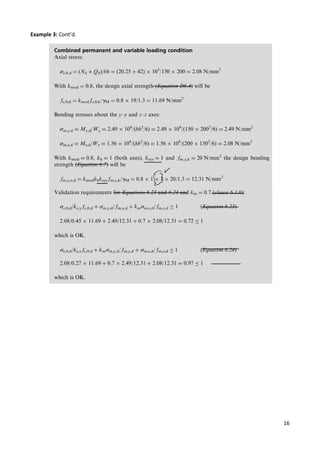
Example 3: AXIAL COMPRESSION AND BENDING ACTING ON A COLUMN (Adapted from [5]).
Note: Le = lef
16
Example 3: Cont’d.
17
4.2 Beams subject to either bending or combined bending and compression.
4.2.1 General
Relative slenderness and critical stress
Relative slenderness Critical bending stress
𝜆𝑟𝑒𝑙,𝑚 = √
𝑓𝑚,𝑘
𝜎𝑚,𝑐𝑟𝑖𝑡
𝜎𝑚,𝑐𝑟𝑖𝑡 =
𝑀𝑦,𝑐𝑟𝑖𝑡
𝑊
𝑦
=
𝜋
𝑙𝑒𝑓 ∙ 𝑊
𝑦
√𝐸0.05𝐼𝑧𝐺0.05𝐼𝑡𝑜𝑟
Critical bending stress according to classical theory of stability using 5-percentile stiffness values. For
softwood with solid rectangular cross-section:
𝜎𝑚,𝑐𝑟𝑖𝑡 =
0.78 ∙ 𝑏2
ℎ ∙ 𝑙𝑒𝑓
𝐸0.05
Where b and h are the width and depth of the beam, respectively.
𝐸0.05
𝐺0.05
Fifth percentile value of the modulus of elasticity parallel to the grain.
Fifth percentile value of shear modulus parallel to the grain.
𝐼𝑧
𝐼𝑡𝑜𝑟
Second moment of area about the weak axis z.
Torsional moment of inertia
𝑙𝑒𝑓
𝑊
𝑦
Effective length of beam depending on support conditions and load configurations – see table below.
Section modulus about the strong axis y.
Effective length as a ratio of the span (source [5])
18
Lateral torsional stability shall be verified both in the case where only a moment My exists about the strong
axis y and where a combination of moment My and compressive force Nc exist.
4.2.2 Bending acting alone.
In the case where only a moment My exists about the strong axis y, the stress should satisfy the following
condition:
𝜎𝑚,𝑑 ≤ 𝑘𝑐𝑟𝑖𝑡 ∙ 𝑓𝑚,𝑑
𝜎𝑚,𝑑
𝑓𝑚,𝑑
Design bending stress.
Design bending strength.
𝑘𝑐𝑟𝑖𝑡
Factor that considers the reduced bending strength due to lateral buckling.
=
{
1 𝑓𝑜𝑟 𝜆𝑟𝑒𝑙,𝑚 ≤ 0.75
1.56 − 0.75𝜆𝑟𝑒𝑙,𝑚 𝑓𝑜𝑟 0.75 ≤ 𝜆𝑟𝑒𝑙,𝑚 ≤ 1.4
1
𝜆𝑟𝑒𝑙,𝑚
2 𝑓𝑜𝑟 1.4 ≤ 𝜆𝑟𝑒𝑙,𝑚
𝜆𝑟𝑒𝑙,𝑚 Relative slenderness – see definition above.
The factor 𝑘𝑐𝑟𝑖𝑡 may be taken as 1.0 for a beam where lateral displacement of its compressive edge is
prevented throughout its length and where torsional rotation is prevented at its supports.
4.2.2.3 Combined bending and axial compression
Where My and compressive force Nc exist, the stress should satisfy the following condition:
(
𝜎𝑚,𝑑
𝑘𝑐𝑟𝑖𝑡 ∙ 𝑓𝑚,𝑑
)
2
+
𝜎𝑐,0,𝑑
𝑘𝑐,𝑧 ∙ 𝑓𝑐,0,𝑑
≤ 1
𝜎𝑚,𝑑
𝜎𝑐,0,𝑑
𝑓𝑚,𝑑
Design bending stress.
Design compressive stress parallel to the grain.
Design compressive strength parallel to the grain.
𝑘𝑐,𝑧 Given in section 4.1.
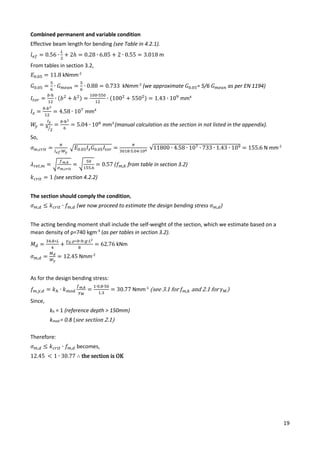
Example 4: LATERAL TORSIONAL STABILITY OF A BEAM
A 100 mm wide (b) by 550 mm deep (h) (strength class D50) solid timber beam, AB, supports another beam
CD at mid-span as shown in Figure 6.9. Beam CD provides lateral restraint to beam AB at C (mid span of beam
AB) and applies a vertical design load of 34.8 kN at the compression surface of the beam. Beam AB has an
effective span of 6.85 m (L) and is restrained torsionally and laterally against out-of-plane movement at the
end supports. The design load is combined permanent and medium-term variable loading, and the beam
functions in service class 1 conditions. Confirm that the bending strength of beam AB will be acceptable.
Fig 4.1 Configuration of beams: taken from [5]
19
Combined permanent and variable condition
Effective beam length for bending (see Table in 4.2.1).
𝑙𝑒𝑓 = 0.56 ∙
𝐿
2
+ 2ℎ = 0.28 ∙ 6.85 + 2 ∙ 0.55 = 3.018 m
From tables in section 3.2,
𝐸0.05 = 11.8 kNmm-2
𝐺0.05 =
5
6
∙ 𝐺𝑚𝑒𝑎𝑛 =
5
6
∙ 0.88 = 0.733 kNmm-2
(we approximate 𝐺0.05= 5/6 𝐺𝑚𝑒𝑎𝑛 as per EN 1194)
𝐼𝑡𝑜𝑟 =
𝑏∙ℎ
12
∙ (𝑏2
+ ℎ2) =
100∙550
12
∙ (1002
+ 5502) = 1.43 ∙ 109
mm4
𝐼𝑧 =
ℎ∙𝑏3
12
= 4.58 ∙ 107
mm4
𝑊
𝑦 =
𝐼𝑦
ℎ
2
⁄
=
𝑏∙ℎ2
6
= 5.04 ∙ 106
mm3
(manual calculation as the section in not listed in the appendix).
So,
𝜎𝑚,𝑐𝑟𝑖𝑡 =
𝜋
𝑙𝑒𝑓∙𝑊𝑦
√𝐸0.05𝐼𝑧𝐺0.05𝐼𝑡𝑜𝑟 =
𝜋
3018∙5.04∙106 √11800 ∙ 4.58 ∙ 107 ∙ 733 ∙ 1.43 ∙ 109 = 155.6 N mm-2
𝜆𝑟𝑒𝑙,𝑚 = √
𝑓𝑚,𝑘
𝜎𝑚,𝑐𝑟𝑖𝑡
= √
50
155.6
= 0.57 (𝑓𝑚,𝑘 from table in section 3.2)
𝑘𝑐𝑟𝑖𝑡 = 1 (see section 4.2.2)
The section should comply the condition,
𝜎𝑚,𝑑 ≤ 𝑘𝑐𝑟𝑖𝑡 ∙ 𝑓𝑚,𝑑 (we now proceed to estimate the design bending stress 𝜎𝑚,𝑑)
The acting bending moment shall include the self-weight of the section, which we estimate based on a
mean density of ρ=740 kgm-3
(as per tables in section 3.2).
𝑀𝑑 =
34.8∗𝐿
4
+
𝛾𝐺∙𝜌∗𝑏∙ℎ∙𝑔∙𝐿2
8
= 62.76 kNm
𝜎𝑚,𝑑 =
𝑀𝑑
𝑊𝑦
= 12.45 Nmm-2
As for the design bending stress:
𝑓𝑚,𝑦,𝑑 = 𝑘ℎ ∙ 𝑘𝑚𝑜𝑑
𝑓𝑚,𝑘
𝛾𝑀
=
1∙0.8∙50
1.3
= 30.77 Nmm-1
(see 3.1 for 𝑓𝑚,𝑘 and 2.1 for 𝛾𝑀)
Since,
kh = 1 (reference depth > 150mm)
kmod = 0.8 (see section 2.1)
Therefore:
𝜎𝑚,𝑑 ≤ 𝑘𝑐𝑟𝑖𝑡 ∙ 𝑓𝑚,𝑑 becomes,
12.45 < 1 ∙ 30.77 ∴ the section is OK
20
5. SERVICEABILITY: DEFLECTIONS CHECK
Deflections may be estimated with classical methods for linear-elastic materials in the case of pre-camber
or instantaneous deflections. Long-term deformation such as those induced by creeping could be done by
any validates non-linear approach, including experimental testing.
The net deflection should be taken as,
𝑤𝑛𝑒𝑡,𝑓𝑖𝑛 = 𝑤𝑖𝑛𝑠𝑡 + 𝑤𝑐𝑟𝑒𝑒𝑝 − 𝑤𝑐 = 𝑤𝑓𝑖𝑛 − 𝑤𝑐
𝑤𝑐
𝑤𝑖𝑛𝑠𝑡
𝑤𝑐𝑟𝑒𝑒𝑝
𝑤𝑓𝑖𝑛
𝑤𝑛𝑒𝑡,𝑓𝑖𝑛
Pre-camber deflection (if applied)
Instantaneous deflection
Creep deflection
Final deflection
Net final deflection
Fig. 5.1 illustrates the deflection components on a horizontal beam.
Fig. 5.1 Components of deflections (source [1])
The table below provides some examples of recommended values for each deflection component.
Examples of limiting values for deflection of beams (source [1]).
21
APPENDIX
22

Structural Analysis & Design - Timber Design Notes

  • 1.
    1 STRUCTURAL ENGINEERING II:TIMBER DESIGN INTRODUCTION The design process included various stages which are interconnected. It starts with the development of a concept and ends with the detailing of structural parts and the formulation of specifications for construction. In between, there is the identification of materials and load types, quantification of loads, structural idealisations and modelling, structural analysis and numerical design. This course is concerned with the development of skills to complete each of those stages, as a first approximation to a more comprehensive knowledge and understanding of structural analysis and design. COURSE CONTENTS 1. BASIS FOR DESIGN PAGE 1.1 ULS GENERAL CONSIDERATION 2 1.2 SLS GENERAL CONSIDERATION 2 1.3 BASIC VARIABLES 2 1.4 LOAD DURATION CASES 2 1.5 SERVICE CLASSES 3 1.6 MATERIAL PROPERTIES 3 1.7 LOAD DURATION AND MOISTURE INFLUECNE ON DEFORMATIONS 3 2. VERIFICATION OF STRENGTH BY THE PARTIAL FACTOR METHOD 2.1 DESIGN VALUE OF MATERIAL PROPERTY 6 2.2 MODIFICATION FACTOR FOR SERVICE CLASS 7 3. ULTIMATE LIMIT STATE 3.1 GENERAL 8 3.2 STRENGTH CLASS 9 3.3 DESIGN OF SECTIONS SUBJECT TO STRESS IN ONE DIRECTION 10 3.4 LOAD DURATION AND MOISTURE INFLUENCE ON STRENGTH 4. STABILITY OF MEMBERS 4.1 COLUMNS SUBJECT TO COMPRESSION AND OR BENDING 5. SERVICEABILITY: DEFLECTIONS CHECK APPENDIX: SECTION PROPERTIES FOR RECTANGULAR SOLID TIMBER READING LIST [1] BS EN 1995-1-1: 2004+A2: 2014. Eurocode 4: Design of timber structures. BSI British Standards. [2] Draycott T and Bullman P, 2009. Structural elements design manual- Working with Eurocodes. Elsevier. [3] BS EN 338:2016. Structural timber — Strength classes. BSI British Standards. [4] BS EN 1990: 2000+A1: 2005. Eurocode – basis for Structural design. BSI British Standards. [5] Porteous J, Ross P, 2013. Designers’ guide to eurocode 5: Design of timber buildings EN 1995-1-1.
  • 2.
    2 1. BASIS FORDESIGN The sections below are made of extracts of Eurocode 5: Design of timber structures and additional teaching materials added to the reading list. The design models for the different limit states shall, as appropriate, consider the following: ▪ different material properties (e.g., strength and stiffness). ▪ different time-dependent behaviour of the materials (duration of load, creep). ▪ different climatic conditions (temperature, moisture variations). ▪ different design situations (stages of construction, change of support conditions). 1.1 ULS General considerations The analysis of structures shall be carried out using the following values for stiffness properties: ▪ for a first order linear elastic analysis of a structure, whose distribution of internal forces is not affected by the stiffness distribution within the structure (e.g., all members have the same time- dependent properties), mean values shall be used. ▪ for a first order linear elastic analysis of a structure, whose distribution of internal forces is affected by the stiffness distribution within the structure (e.g., composite members containing materials having different time-dependent properties), final mean values adjusted to the load component causing the largest stress in relation to strength shall be used. ▪ for a second order linear elastic analysis of a structure, design values, not adjusted for duration of load, shall be used. 1.2 SLS General considerations The deformation of a structure which results from the effects of actions (such as axial and shear forces, bending moments and joint slip) and from moisture shall remain within appropriate limits, having regard to the possibility of damage to surfacing materials, ceilings, floors, partitions and finishes, and to the functional needs as well as any appearance requirements. 1.3 Basic Variables The deformation of a structure which results from the effects of actions (such as axial and shear forces, Actions to be used in design may be obtained from the relevant parts of EN 1991. Note 1: The relevant parts of EN 1991 for use in design include: − EN 1991-1-1 Densities, self-weight and imposed loads − EN 1991-1-3 Snow loads − EN 1991-1-4 Wind actions − EN 1991-1-5 Thermal actions − EN 1991-1-6 Actions during execution − EN 1991-1-7 Accidental actions Duration of load and moisture content affect the strength and stiffness properties of timber and wood-based elements and shall be taken into account in the design for mechanical resistance and serviceability. 1.4 Load-duration classes The load-duration classes are characterised by the effect of a constant load acting for a certain period of time in the life of the structure. For a variable action the appropriate class shall be determined on the basis of an estimate of the typical variation of the load with time. Actions shall be assigned to one of the load-duration classes given in Table 2.1 in [1] for strength and stiffness calculations.
  • 3.
    3 Load- duration classes(source [1]). Examples of Load- duration assignment (source [1]). 1.5 Service classes ▪ Structures shall be assigned to one of the service classes given below: NOTE 1: The service class system is mainly aimed at assigning strength values and for calculating deformations under defined environmental conditions. NOTE 2: Information on the assignment of structures to service classes given in (2)P, (3)P and (4)P may be given in the National annex. ▪ Service class 1 is characterised by a moisture content in the materials corresponding to a temperature of 20°C and the relative humidity of the surrounding air only exceeding 65 % for a few weeks per year. NOTE: In service class 1 the average moisture content in most softwoods will not exceed 12 %. ▪ Service class 2 is characterised by a moisture content in the materials corresponding to a temperature of 20°C and the relative humidity of the surrounding air only exceeding 85 % for a few weeks per year. NOTE: In service class 2 the average moisture content in most softwoods will not exceed 20 %. ▪ Service class 3 is characterised by climatic conditions leading to higher moisture contents than in service class 2.
  • 4.
    4 1.6 Materials andproduct properties Modification factors for the influence of load-duration and moisture content on strength are given in section 2. Where a connection is constituted of two timber elements having different time-dependent behaviour, the calculation of the design load-carrying capacity should be made with the following modification factor kmod: 𝑘𝑚𝑜𝑑 = √𝑘𝑚𝑜𝑑,1 ∙ 𝑘𝑚𝑜𝑑,2 where kmod,1 and kmod,2 are the modification factors for the two timber elements. 1.7 Load-duration and moisture influences on deformations For serviceability limit states, if the structure consists of members or components having -dependent properties, the final mean value of modulus of elasticity Emean,fin, shear modulus Gmean,fin and slip modulus Kser,fin which are used to calculate the long-term deformation due to the quasi-permanent combination of actions should be taken from the following expressions, 𝐸𝑚𝑒𝑎𝑛,𝑓𝑖𝑛 = 𝐸𝑚𝑒𝑎𝑛 (1 + 𝑘𝑑𝑒𝑓) 𝐺𝑚𝑒𝑎𝑛,𝑓𝑖𝑛 = 𝐺𝑚𝑒𝑎𝑛 (1 + 𝑘𝑑𝑒𝑓) 𝐾𝑠𝑒𝑟,𝑓𝑖𝑛 = 𝐾𝑠𝑒𝑟 (1 + 𝑘𝑑𝑒𝑓) For ultimate limit states, where the distribution of member forces and moments is affected by the stiffness distribution in the structure, the final mean value of modulus of elasticity, Emean,fin, shear modulus Gmean,fin and slip modulus Kser,fin, should be calculated from the following expressions, 𝐸𝑚𝑒𝑎𝑛,𝑓𝑖𝑛 = 𝐸𝑚𝑒𝑎𝑛 (1 + 𝜓2 ∙ 𝑘𝑑𝑒𝑓) 𝐺𝑚𝑒𝑎𝑛,𝑓𝑖𝑛 = 𝐺𝑚𝑒𝑎𝑛 (1 + 𝜓2 ∙ 𝑘𝑑𝑒𝑓) 𝐾𝑠𝑒𝑟,𝑓𝑖𝑛 = 𝐾𝑠𝑒𝑟 (1 + 𝜓2 ∙ 𝑘𝑑𝑒𝑓) where, − Emean: is the mean value of the modulus of elasticity. − Gmean: is the mean value of the shear modulus. − Kser: is the slip modulus Note that values of kdef and ψ2 are given in the following two tables.
  • 5.
    5 Recommended values ofψ factors for buildings (source [4]). Recommended values of kdef (source [1])
  • 6.
    6 2. VERIFICATION OFSTRENGTH BY THE PARTIAL FACTOR METHOD 2.1 Design value of material property The design value Xd of a strength property shall be calculated as: 𝐾𝑑 = 𝑘ℎ ∙ 𝑘𝑚𝑜𝑑 𝑋𝑘 𝛾𝑀 where − Xk: is the characteristic value of a strength property. − γM: is the partial factor of safety for a material property. − kmod: is a modification factor considering the effect of duration of the load and moisture content. − kh: is a modification factor considering member size – see paragraph 2.2. The recommended values of kmod are, Values of kmod (online resource) If a load combination consists of actions belonging to different load-duration classes a value of kmod should be chosen which corresponds to the action with the shortest duration, e.g., for a combination of dead load and a short-term load, a value of kmod corresponding to the short-term load should be used.
  • 7.
    7 The recommended partialfactors for material properties (γM) are, Recommended partial factors of safety for material properties and resistances (source [1]). 2.2 Modification factors for service class 2.2.1 Solid timber For rectangular solid timber with a characteristic timber density ρk ≤ 700 kg/m3 the reference depth in bending or width (maximum cross-sectional dimension) in tension is 150 mm. For depths in bending or widths in tension of solid timber less than 150 mm, the characteristic strength may be increased by the factor kh, given by: 𝑘ℎ = 𝑚𝑖𝑛 { 150 ℎ 0.2 1.3 } where h is the depth (mm) for bending members or width for tension members. 2.2.2 Glue laminated timber For rectangular glued laminated timber, the reference depth in bending or width in tension is 600 mm. For depths in bending or widths in tension of glued laminated timber less than 600 mm the characteristic strength may be increased by the factor kh, given by: 𝑘ℎ = 𝑚𝑖𝑛 { 600 ℎ 0.1 1.1 } where h is the depth (mm) for bending members or width for tension members. 2.2.3 Laminated veneer lumber (LVL) For rectangular LVL with the grain of all veneers running essentially in one direction, the effect of member size on bending and tensile strength shall be considered. The reference depth in bending is 300 mm; otherwise, for depths in bending not equal to 300 mm the characteristic strength may be increased by the factor kh, given by: 𝑘ℎ = 𝑚𝑖𝑛 { 300 ℎ 𝑠 1.2 } where h is the depth (mm) for bending members or width for tension members and s is the size effect exponent which could be assumed to be s= 0.10.
  • 8.
    8 3. ULTIMATE LIMITSTATE 3.1 General In this course we will focus on straight solid timber, glued laminated timber or wood-based structural products of constant cross-section, whose grain runs essentially parallel to the length of the member as indicated in Fig. 3.1. The member is assumed to be subjected to stresses in the direction of only one of its principal axes. Fig. 3.1 Member axes (source [1]) The grain is the longitudinal arrangement of wood fibres. The two basic categories of grain are straight grain and cross grain. Straight grain runs parallel to the longitudinal axis of the piece. Cross grain deviates from the longitudinal axis in two ways: spiral grain or diagonal grain. The amount of deviation is called the slope of the grain1 . Basic categories: cross grain (left) and straight grain (right) (online resource). 1 Hoadley, R. Bruce, 1980. Understanding Wood: A Craftsman's Guide to Wood Technology. Newtown, Conn.: Taunton, 265.
  • 9.
    9 3.2 Strength Class Astrength class system groups together grades and, species and sources with similar strength properties thus making them interchangeable. This then permits an engineer to specify a chosen strength class and use the characteristic strength values of that class in design calculations. The most common used strength classes in Europe are printed in bold in the tables below. Strength classes for softwood based on edgewise bending tests: strength, stiffness, and density values (source [3]) Strength classes for hardwood based on edgewise bending tests: strength, stiffness, and density values (source [3])
  • 10.
    10 3.3 Design ofcross sections subject to stress in one principal direction 3.3.1 Tension and Compression Tension parallel to the grain Compression parallel to the grain 𝜎𝑡,0,𝑑 ≤ 𝑓𝑡,0,𝑑 𝜎𝑐,0,𝑑 ≤ 𝑓𝑐,0,𝑑 𝜎𝑡,0,𝑑 𝑓𝑡,0,𝑑 Design tensile stress along the grain Design tensile strength along the grain 𝜎𝑐,0,𝑑 𝑓𝑐,0,𝑑 Design compressive stress along the grain Design compressive strength along the grain NOTE: Rules for the instability of members are given in section 4 NOTE: To check for instability of members in tension assume 𝝈𝒕,𝟎,𝒅 = 𝟎 The stress at a cross-section from an axial force may be calculated from the general expression, 𝜎𝑁 = 𝑁 𝐴 𝜎𝑁 N A Axial stress, e.g., 𝜎𝑡,0,𝑑 or 𝜎𝑐,0,𝑑 Axial force Area of the cross section 3.3.2 Bending and Shear The following expressions to check bending should be satisfied: Bending Condition 1 Condition 2 𝜎𝑚,𝑦,𝑑 𝑓𝑚,𝑦,𝑑 + 𝑘𝑚 𝜎𝑚,𝑧,𝑑 𝑓𝑚,𝑧,𝑑 ≤ 1 𝑘𝑚 𝜎𝑚,𝑦,𝑑 𝑓𝑚,𝑦,𝑑 + 𝜎𝑚,𝑧,𝑑 𝑓𝑚,𝑧,𝑑 ≤ 1 𝜎𝑚,𝑦,𝑑, 𝜎𝑚,𝑧,𝑑 𝑓𝑚,𝑦,𝑑, 𝑓𝑚,𝑧,𝑑 Design bending stress about the principal axes y, and z Design bending strength about the principal axes y, and z 𝑘𝑚 For solid timber, glued laminated timber, and LVL: For rectangular sections 𝑘𝑚 = 0.7 For other sections 𝑘𝑚 = 1.0 NOTE: Check the instability condition following the criteria given in section 4 For shear with a stress component parallel and/or perpendicular to the grain, the following expression shall be satisfied: Shear General criteria For shear acting simultaneously with bending, the influence of cracks should be considered using an effective width of the member given as, 𝜏𝑑 ≤ 𝑓𝑣,𝑑 𝑏𝑒𝑓 = 𝑘𝑐𝑟𝑏 𝜏𝑑 𝑓𝑣,𝑑 Design shear stress Design shear strength 𝑘𝑐𝑟 For solid and glued laminated timber 𝑘𝑐𝑟 = 0.67 For other sections 𝑘𝑐𝑟 = 1.0
  • 11.
    11 Example 1: BENDINGAND SHEAR A 100x200 (bxh) rectangular solid section in grade C20 structural timber is used as a 4m long floor joist. It is subjected to a permanent load of 1.5 kN/m and an imposed load of 1 kN/m. Check whether the section can safely carry the applied loading at ULS assuming Service Class 1. Load case 1: permanent load (kmod =0.6) Design load: 1.35*1.5=2.025 kN/m MEd = My,d = 4.05 kNm, VEd = Vd = 4.05 kN Bending check (See Appendix for Wel): σm,y,d = My,d /Wel =6.075 Nmm-2 < 𝑓𝑚,𝑦,𝑑 = 9.23 Nmm-2 ∴ the section is OK where the design bending strength (𝑓𝑚,𝑦,𝑑) is: kh = 1 (reference depth > 150mm) kmod = 0.6 (see section 2.1) 𝑓𝑚,𝑦,𝑑 = 𝑘ℎ ∙ 𝑘𝑚𝑜𝑑 𝑓𝑚,𝑘 𝛾𝑀 = 1∙0.6∙20 1.3 = 9.23 Nmm-2 (see 3.1 for 𝑓𝑚,𝑘 and 2.1 for 𝛾𝑀) Shear check: Note: the maximum elastic shear stress (τd) in a rectangular section b × h subjected to a shear force (VEd) occurs at the position of neutral axis and is given by, 𝜏𝑑 = 1.5∙𝑉𝑑 𝑏∙ℎ = 1.5∙4.05∙103 100∙200 = 0.3 Nmm-2 < 𝑓𝑣,𝑑 = 1.66 Nmm-2 ∴ the section is OK where the design shear strength (𝑓𝑣,𝑑) is: 𝑓𝑣,𝑑 = 𝑘ℎ ∙ 𝑘𝑚𝑜𝑑 𝑓𝑣,𝑘 𝛾𝑀 = 1∙0.6∙3.6 1.3 = 1.66 Nmm-2 (see 3.1 for 𝑓𝑚,𝑘 and 2.1 for 𝛾𝑀) Load case 1: permanent + imposed load (kmod =0.8 for medium term) Design load: 1.35*1.5 + 1.5*1 = 3.525 kN/m My,d = 7.05 kNm, Vd = 7.05 kN Bending check (See Appendix for Wel): σm,y,d = My,d /Wel = 10.58 Nmm-2 < 𝑓𝑚,𝑦,𝑑 = 12.31 Nmm-2 ∴ the section is OK where the design bending strength (𝑓𝑚,𝑦,𝑑) is: kh = 1 (reference depth > 150mm) kmod = 0.6 (see section 2.1) 𝑓𝑚,𝑦,𝑑 = 𝑘ℎ ∙ 𝑘𝑚𝑜𝑑 𝑓𝑚,𝑘 𝛾𝑀 = 1∙0.8∙20 1.3 = 12.31 Nmm-2 (see 3.1 for 𝑓𝑚,𝑘 and 2.1 for 𝛾𝑀) Shear check: 𝜏𝑑 = 1.5∙𝑉𝑑 𝑏∙ℎ = 1.5∙7.05∙103 100∙200 = 0.53 Nmm-2 < 𝑓𝑣,𝑑 = 2.21 Nmm-2 ∴ the section is OK where the design shear strength (𝑓𝑣,𝑑) is: 𝑓𝑣,𝑑 = 𝑘ℎ ∙ 𝑘𝑚𝑜𝑑 𝑓𝑣,𝑘 𝛾𝑀 = 1∙0.8∙3.6 1.3 = 2.21 Nmm-2 (see 3.1 for 𝑓𝑚,𝑘 and 2.1 for 𝛾𝑀)
  • 12.
    12 3.3.3 Combined Bendingand Axial Tension The following expressions should be satisfied: Bending and Tension Condition 1 Condition 2 ( 𝜎𝑡,0,𝑑 𝑓𝑡,0,𝑑 ) 2 + 𝜎𝑚,𝑦,𝑑 𝑓𝑚,𝑦,𝑑 + 𝑘𝑚 𝜎𝑚,𝑧,𝑑 𝑓𝑚,𝑧,𝑑 ≤ 1 ( 𝜎𝑡,0,𝑑 𝑓𝑡,0,𝑑 ) 2 + 𝑘𝑚 𝜎𝑚,𝑦,𝑑 𝑓𝑚,𝑦,𝑑 + 𝜎𝑚,𝑧,𝑑 𝑓𝑚,𝑧,𝑑 ≤ 1 The definitions of parameters given above for separate effects, still apply. NOTE: The method given in section 4 can be used to check the instability condition, assuming 𝝈𝒕,𝟎,𝒅 = 𝟎 3.3.4 Combined Bending and Axial Compression The following expressions should be satisfied: Bending and Compression Condition 1 Condition 2 ( 𝜎𝑐,0,𝑑 𝑓𝑐,0,𝑑 ) 2 + 𝜎𝑚,𝑦,𝑑 𝑓𝑚,𝑦,𝑑 + 𝑘𝑚 𝜎𝑚,𝑧,𝑑 𝑓𝑚,𝑧,𝑑 ≤ 1 ( 𝜎𝑐,0,𝑑 𝑓𝑐,0,𝑑 ) 2 + 𝑘𝑚 𝜎𝑚,𝑦,𝑑 𝑓𝑚,𝑦,𝑑 + 𝜎𝑚,𝑧,𝑑 𝑓𝑚,𝑧,𝑑 ≤ 1 The definitions of parameters given above for separate effects, still apply. NOTE: Check the instability condition following the criteria given in section 4
  • 13.
    13 Example 2: BENDINGAND COMPRESSION A short column of 750 mm length is pin jointed at each end and subject to a permanent axial compression Nd = 20.25 kN and medium term variable moments equal to My,d = 2.49 kNm and Mz,d = 1.56 kNm. The section is class C20, has 150 mm width, 200 mm height, and is located on the ground floor. Check the suitability of the section to withstand the applied loads at the ultimate limit state for the combined permanent and variable load. Permanent and variable loading condition Axial stress 𝜎𝑐,0,𝑑 = 20250 150∙200 = 0.68 Nmm-2 With kmod = 0.8 (see table in section 2.1) 𝑓𝑐,0,𝑑 = 𝑘ℎ ∙ 𝑘𝑚𝑜𝑑 𝑓𝑐,𝑘 𝛾𝑀 = 1∙0.8∙19 1.3 = 11.69 Nmm-2 (compression parallel to grain) Bending stress 𝜎𝑚,𝑦,𝑑 = 𝑀𝑦,𝑑 𝑊 𝑦 = ⁄ 2.49 ∙ 106 (𝑏ℎ2 6 ⁄ ) ⁄ = 2.49 ∙ 106 (150 ∙ 2002 6 ⁄ ) ⁄ = 2.49 Nmm-2 𝜎𝑚,𝑧,𝑑 = 𝑀𝑧,𝑑 𝑊 𝑧 = ⁄ 1.56 ∙ 106 (ℎ𝑏2 6 ⁄ ) ⁄ = 1.56 ∙ 106 (200 ∙ 1502 6 ⁄ ) ⁄ = 2.08 Nmm-2 With 𝑓𝑚,𝑘 = 20 Nmm-2 (valid for either axis) 𝑓𝑚,𝑦,𝑑 = 𝑘ℎ ∙ 𝑘𝑚𝑜𝑑 𝑓𝑚,𝑘 𝛾𝑀 = 1∙0.8∙20 1.3 = 12.31 Nmm-2 (see 3.1 for 𝑓𝑚,𝑘 and 2.1 for 𝛾𝑀) As for rectangular sections 𝑘𝑚 = 0.7 (see section 3.3.2) ( 𝜎𝑐,0,𝑑 𝑓𝑐,0,𝑑 ) 2 + 𝜎𝑚,𝑦,𝑑 𝑓𝑚,𝑦,𝑑 + 𝑘𝑚 𝜎𝑚,𝑧,𝑑 𝑓𝑚,𝑧,𝑑 = ( 0.68 11.69 ) 2 + 2.49 12.31 + 0.7 2.08 12.31 = 0.324 < 1 ( 𝜎𝑐,0,𝑑 𝑓𝑐,0,𝑑 ) 2 + 𝑘𝑚 𝜎𝑚,𝑦,𝑑 𝑓𝑚,𝑦,𝑑 + 𝜎𝑚,𝑧,𝑑 𝑓𝑚,𝑧,𝑑 = ( 0.68 11.69 ) 2 + 0.7 2.49 12.31 + 2.08 12.31 = 0.314 < 1 The instability condition According to section 4, the member can be considered stable if both 𝜆𝑟𝑒𝑙,𝑦 ≤ 0.3 and 𝜆𝑟𝑒𝑙,𝑧 ≤ 0.3. Where 𝜆𝑟𝑒𝑙,𝑦 = 𝜆𝑦 𝜋 √ 𝑓𝑐,0,𝑘 𝐸0.05 ; 𝜆𝑟𝑒𝑙,𝑧 = 𝜆𝑧 𝜋 √ 𝑓𝑐,0,𝑘 𝐸0.05 ; while 𝜆𝑦 = 𝑙𝑒𝑓 𝑖𝑦 ⁄ and 𝜆𝑧 = 𝑙𝑒𝑓 𝑖𝑧 ⁄ 𝑖𝑦 = √ 𝐼𝑦 𝑏ℎ = √ 150∙2003 12 ⁄ 150∙200 = 57.74 mm; 𝑖𝑧 = √ 𝐼𝑧 𝑏ℎ = √ 200∙1503 12 ⁄ 150∙200 = 43.3 mm So, 𝜆𝑦 = 750 57.74 ⁄ = 12.99; 𝜆𝑧 = 750 43.3 ⁄ = 17.32 (as lef = L for pinned connections at both ends) 𝜆𝑟𝑒𝑙,𝑦 = 12.99 𝜋 √ 11.69 6400 = 0.178 < 0.3 OK 𝜆𝑟𝑒𝑙,𝑧 = 17.32 𝜋 √ 11.69 6400 = 0.236 < 0.3 ∴ the section is OK From tables in section 3.2 we know 𝐸0.05= 6,400 Nmm-2 . I/y
  • 14.
    14 4. STABILITY OFMEMBERS 4.1 Columns subject to either compression or combined compression and bending. Relative slenderness ratios About y-axis About z-axis 𝜆𝑟𝑒𝑙,𝑦 = 𝜆𝑦 𝜋 √ 𝑓𝑐,0,𝑘 𝐸0.05 𝜆𝑟𝑒𝑙,𝑧 = 𝜆𝑧 𝜋 √ 𝑓𝑐,0,𝑘 𝐸0.05 𝜆𝑦, 𝜆𝑟𝑒𝑙,𝑦 𝜆𝑧, 𝜆𝑟𝑒𝑙,𝑧 Slenderness ratios corresponding to bending about y-y i.e., deflection in the z-direction. Slenderness ratios corresponding to bending about z-z i.e., deflection in the y-direction. 𝐸0.05 Fifth percentile value of the modulus of elasticity parallel to the grain The member can be considered stable if both 𝜆𝑟𝑒𝑙,𝑦 ≤ 0.3 and 𝜆𝑟𝑒𝑙,𝑧 ≤ 0.3. In which case stress levels should only satisfy the conditions given in Section 3. To define the value of 𝜆𝑦 or 𝜆𝑧 you may use the following effective length values. In all other cases the stresses, which will be increased due to deflection (second-order effects), should satisfy the following: Columns in compression or combined compression and bending Condition 1 Condition 2 𝜎𝑐,0,𝑑 𝑘𝑐,𝑦 ∙ 𝑓𝑐,0,𝑑 + 𝜎𝑚,𝑦,𝑑 𝑓𝑚,𝑦,𝑑 + 𝑘𝑚 𝜎𝑚,𝑧,𝑑 𝑓𝑚,𝑧,𝑑 ≤ 1 𝜎𝑐,0,𝑑 𝑘𝑐,𝑧 ∙ 𝑓𝑐,0,𝑑 + 𝑘𝑚 𝜎𝑚,𝑦,𝑑 𝑓𝑚,𝑦,𝑑 + 𝜎𝑚,𝑧,𝑑 𝑓𝑚,𝑧,𝑑 ≤ 1 𝑘𝑐,𝑦 = 1 𝑘𝑦 + √𝑘𝑦 2 − 𝜆𝑟𝑒𝑙,𝑦 2 𝑘𝑦 = 0.5[1 + 𝛽𝑐(𝜆𝑟𝑒𝑙,𝑦 − 0.3) + 𝜆𝑟𝑒𝑙,𝑦 2 ] 𝑘𝑐,𝑧 = 1 𝑘𝑧 + √𝑘𝑧 2 − 𝜆𝑟𝑒𝑙,𝑧 2 𝑘𝑧 = 0.5[1 + 𝛽𝑐(𝜆𝑟𝑒𝑙,𝑧 − 0.3) + 𝜆𝑟𝑒𝑙,𝑧 2 ] 𝛽𝑐 For solid timber 𝛽𝑐 = 0.2 For glued laminated timber and LVL 𝛽𝑐 = 0.1 𝑘𝑚 As given in 3.3.2
  • 15.
    15 Example 3: AXIALCOMPRESSION AND BENDING ACTING ON A COLUMN (Adapted from [5]). Note: Le = lef
  • 16.
  • 17.
    17 4.2 Beams subjectto either bending or combined bending and compression. 4.2.1 General Relative slenderness and critical stress Relative slenderness Critical bending stress 𝜆𝑟𝑒𝑙,𝑚 = √ 𝑓𝑚,𝑘 𝜎𝑚,𝑐𝑟𝑖𝑡 𝜎𝑚,𝑐𝑟𝑖𝑡 = 𝑀𝑦,𝑐𝑟𝑖𝑡 𝑊 𝑦 = 𝜋 𝑙𝑒𝑓 ∙ 𝑊 𝑦 √𝐸0.05𝐼𝑧𝐺0.05𝐼𝑡𝑜𝑟 Critical bending stress according to classical theory of stability using 5-percentile stiffness values. For softwood with solid rectangular cross-section: 𝜎𝑚,𝑐𝑟𝑖𝑡 = 0.78 ∙ 𝑏2 ℎ ∙ 𝑙𝑒𝑓 𝐸0.05 Where b and h are the width and depth of the beam, respectively. 𝐸0.05 𝐺0.05 Fifth percentile value of the modulus of elasticity parallel to the grain. Fifth percentile value of shear modulus parallel to the grain. 𝐼𝑧 𝐼𝑡𝑜𝑟 Second moment of area about the weak axis z. Torsional moment of inertia 𝑙𝑒𝑓 𝑊 𝑦 Effective length of beam depending on support conditions and load configurations – see table below. Section modulus about the strong axis y. Effective length as a ratio of the span (source [5])
  • 18.
    18 Lateral torsional stabilityshall be verified both in the case where only a moment My exists about the strong axis y and where a combination of moment My and compressive force Nc exist. 4.2.2 Bending acting alone. In the case where only a moment My exists about the strong axis y, the stress should satisfy the following condition: 𝜎𝑚,𝑑 ≤ 𝑘𝑐𝑟𝑖𝑡 ∙ 𝑓𝑚,𝑑 𝜎𝑚,𝑑 𝑓𝑚,𝑑 Design bending stress. Design bending strength. 𝑘𝑐𝑟𝑖𝑡 Factor that considers the reduced bending strength due to lateral buckling. = { 1 𝑓𝑜𝑟 𝜆𝑟𝑒𝑙,𝑚 ≤ 0.75 1.56 − 0.75𝜆𝑟𝑒𝑙,𝑚 𝑓𝑜𝑟 0.75 ≤ 𝜆𝑟𝑒𝑙,𝑚 ≤ 1.4 1 𝜆𝑟𝑒𝑙,𝑚 2 𝑓𝑜𝑟 1.4 ≤ 𝜆𝑟𝑒𝑙,𝑚 𝜆𝑟𝑒𝑙,𝑚 Relative slenderness – see definition above. The factor 𝑘𝑐𝑟𝑖𝑡 may be taken as 1.0 for a beam where lateral displacement of its compressive edge is prevented throughout its length and where torsional rotation is prevented at its supports. 4.2.2.3 Combined bending and axial compression Where My and compressive force Nc exist, the stress should satisfy the following condition: ( 𝜎𝑚,𝑑 𝑘𝑐𝑟𝑖𝑡 ∙ 𝑓𝑚,𝑑 ) 2 + 𝜎𝑐,0,𝑑 𝑘𝑐,𝑧 ∙ 𝑓𝑐,0,𝑑 ≤ 1 𝜎𝑚,𝑑 𝜎𝑐,0,𝑑 𝑓𝑚,𝑑 Design bending stress. Design compressive stress parallel to the grain. Design compressive strength parallel to the grain. 𝑘𝑐,𝑧 Given in section 4.1. Example 4: LATERAL TORSIONAL STABILITY OF A BEAM A 100 mm wide (b) by 550 mm deep (h) (strength class D50) solid timber beam, AB, supports another beam CD at mid-span as shown in Figure 6.9. Beam CD provides lateral restraint to beam AB at C (mid span of beam AB) and applies a vertical design load of 34.8 kN at the compression surface of the beam. Beam AB has an effective span of 6.85 m (L) and is restrained torsionally and laterally against out-of-plane movement at the end supports. The design load is combined permanent and medium-term variable loading, and the beam functions in service class 1 conditions. Confirm that the bending strength of beam AB will be acceptable. Fig 4.1 Configuration of beams: taken from [5]
  • 19.
    19 Combined permanent andvariable condition Effective beam length for bending (see Table in 4.2.1). 𝑙𝑒𝑓 = 0.56 ∙ 𝐿 2 + 2ℎ = 0.28 ∙ 6.85 + 2 ∙ 0.55 = 3.018 m From tables in section 3.2, 𝐸0.05 = 11.8 kNmm-2 𝐺0.05 = 5 6 ∙ 𝐺𝑚𝑒𝑎𝑛 = 5 6 ∙ 0.88 = 0.733 kNmm-2 (we approximate 𝐺0.05= 5/6 𝐺𝑚𝑒𝑎𝑛 as per EN 1194) 𝐼𝑡𝑜𝑟 = 𝑏∙ℎ 12 ∙ (𝑏2 + ℎ2) = 100∙550 12 ∙ (1002 + 5502) = 1.43 ∙ 109 mm4 𝐼𝑧 = ℎ∙𝑏3 12 = 4.58 ∙ 107 mm4 𝑊 𝑦 = 𝐼𝑦 ℎ 2 ⁄ = 𝑏∙ℎ2 6 = 5.04 ∙ 106 mm3 (manual calculation as the section in not listed in the appendix). So, 𝜎𝑚,𝑐𝑟𝑖𝑡 = 𝜋 𝑙𝑒𝑓∙𝑊𝑦 √𝐸0.05𝐼𝑧𝐺0.05𝐼𝑡𝑜𝑟 = 𝜋 3018∙5.04∙106 √11800 ∙ 4.58 ∙ 107 ∙ 733 ∙ 1.43 ∙ 109 = 155.6 N mm-2 𝜆𝑟𝑒𝑙,𝑚 = √ 𝑓𝑚,𝑘 𝜎𝑚,𝑐𝑟𝑖𝑡 = √ 50 155.6 = 0.57 (𝑓𝑚,𝑘 from table in section 3.2) 𝑘𝑐𝑟𝑖𝑡 = 1 (see section 4.2.2) The section should comply the condition, 𝜎𝑚,𝑑 ≤ 𝑘𝑐𝑟𝑖𝑡 ∙ 𝑓𝑚,𝑑 (we now proceed to estimate the design bending stress 𝜎𝑚,𝑑) The acting bending moment shall include the self-weight of the section, which we estimate based on a mean density of ρ=740 kgm-3 (as per tables in section 3.2). 𝑀𝑑 = 34.8∗𝐿 4 + 𝛾𝐺∙𝜌∗𝑏∙ℎ∙𝑔∙𝐿2 8 = 62.76 kNm 𝜎𝑚,𝑑 = 𝑀𝑑 𝑊𝑦 = 12.45 Nmm-2 As for the design bending stress: 𝑓𝑚,𝑦,𝑑 = 𝑘ℎ ∙ 𝑘𝑚𝑜𝑑 𝑓𝑚,𝑘 𝛾𝑀 = 1∙0.8∙50 1.3 = 30.77 Nmm-1 (see 3.1 for 𝑓𝑚,𝑘 and 2.1 for 𝛾𝑀) Since, kh = 1 (reference depth > 150mm) kmod = 0.8 (see section 2.1) Therefore: 𝜎𝑚,𝑑 ≤ 𝑘𝑐𝑟𝑖𝑡 ∙ 𝑓𝑚,𝑑 becomes, 12.45 < 1 ∙ 30.77 ∴ the section is OK
  • 20.
    20 5. SERVICEABILITY: DEFLECTIONSCHECK Deflections may be estimated with classical methods for linear-elastic materials in the case of pre-camber or instantaneous deflections. Long-term deformation such as those induced by creeping could be done by any validates non-linear approach, including experimental testing. The net deflection should be taken as, 𝑤𝑛𝑒𝑡,𝑓𝑖𝑛 = 𝑤𝑖𝑛𝑠𝑡 + 𝑤𝑐𝑟𝑒𝑒𝑝 − 𝑤𝑐 = 𝑤𝑓𝑖𝑛 − 𝑤𝑐 𝑤𝑐 𝑤𝑖𝑛𝑠𝑡 𝑤𝑐𝑟𝑒𝑒𝑝 𝑤𝑓𝑖𝑛 𝑤𝑛𝑒𝑡,𝑓𝑖𝑛 Pre-camber deflection (if applied) Instantaneous deflection Creep deflection Final deflection Net final deflection Fig. 5.1 illustrates the deflection components on a horizontal beam. Fig. 5.1 Components of deflections (source [1]) The table below provides some examples of recommended values for each deflection component. Examples of limiting values for deflection of beams (source [1]).
  • 21.
  • 22.