STROKE DAY, 29TH OCTOBER
2021
PROF. DR.MD. HASSANUZZAMAN
PROFESSOR & HEAD OF THE DEPARTMENT
NEUROLOGY DEPARTMENT
CMC
• As brain tissue and millions of neurons begin to
fade away, time could not be more precious.
• Our #Precioustime campaign aims to raise
awareness of stroke signs and the benefits of
timely access to emergency medical care.
Worldwide one person in
every two seconds suffers
from a stroke.
Every six seconds in the
world someone dies as a
result of stroke.
25% of the population
worldwide will suffer from a
stroke in their lifetime
It is of utmost importance
to recognize the earliest
signs of stroke to promptly
transfer the patient to a
neurologist or a neurology
ward for the initiation of
most effective treatment.
STROKE BURDEN
Direct Costs:
• Hospital & Doctor Bills
• Rehab services
• Medication
Indirect Costs:
• Unemployment of the
patients
• Time lost from
unemployment by family
members
Stroke Burden:
• Direct costs
• Indirect costs
• Quality of life
• Emotional breakdown
• Caregiver burnout
STROKE ADMISSIONS IN NEUROLOGY WARD, CMCH
2012 2013 2014 2015 2016 2017 2018 2019 2020
4040
3008
5178
5575
6015
7000
7447
7700
5150
0
2000
4000
6000
8000
10000
12000
1 2 3 4 5 6 7 8 9
Chart Title
Year Number of patients
BREAKING THE MYTHS RELATED TO STROKE
MYTH #1: YOU CAN’T DO ANYTHING TO PREVENT STROKE.
• Up to 80 percent of strokes are preventable.
• Smart lifestyle choices that reducestroke risk factors
such as high blood pressure, high cholesterol and
diabetes all loweryour risk of having a stroke.
MYTH #2: THERE IS NO TREATMENT FOR STROKE.
• Thereare some extremelyeffective treatments for stroke, and the
sooner you seek medical treatment the better theywork.
• Clot removal —using a device to enterthe blocked arteryand remove
the blocking blood clot —is now the proven standard of carefor
stroke, with the most profound benefits. Tissue plasminogen (tPA) is a
clot-dissolving drug that can break up a clot blocking blood flow to the
brain.
• Even if the effective treatment to removeclot removal is unavailable,
reduce the recurrence of further stroke, minimizing the effectsof
risk factors & rehabilitation is also part of management of stroke
patients
MYTH #3: STROKE ONLY AFFECTS THE ELDERLY.
• A stroke can happen at any age, even in
babies.
• In fact, the average age of stroke patients
hasbeen getting younger for more than a
decade.
• Nearly 25 percent of strokes occur in people
younger than age 65.
• Younger people may dismiss symptoms more
easily, however, thinking that they are too
young to have a stroke.
MYTH #4: STROKE RECOVERY OCCURS FOR JUST THE
FIRST FEW MONTHS FOLLOWING STROKE.
Recovery from stroke isa lifelong
process. Researchers continue to find
new and better treatments to help the
brain repair itself after stroke.
MYTH #5: IF STROKE SYMPTOMS GO AWAY, THERE’S
NOTHING TO WORRY ABOUT.
• Transientischemic attacks(TIAs), sometimes calledmini
strokes,exhibittemporarystrokesymptoms.
• Theyarewarningsigns beforeastroke,andyoushould
alwayscontactyourdoctorif youexperience slurredspeech,
suddenweaknessin anarmor leg orfacialdrooping.
• Payingattentionto warning signsthat goawaymayhelp
prevent anactualstroke.
PREVENTION OF STROKE
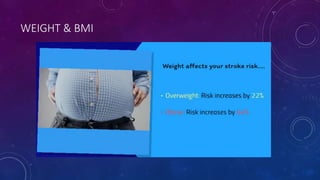
WEIGHT & BMI
SMOKING
• 20 cigarettes a day: 6 times more
likely to have a stroke.
• The risk of ischemic stroke in
younger patients have been
significantly Increased due to
smoking
Blood Pressure
ALCOHOL
Excessive alcohol consumption is
related to over 1 million strokes
each year, globally
DIABETES MELLITUS
• 1 out of 5 patients suffering
from stroke is diabetic
• People with diabetes have
poorer outcomes of stroke.
STROKE UNIT
All current guideline for management of stroke recommend that
all patient with Acute stroke should be ideally managed in a
stroke unit. Considering the importance of having a stroke unit in
at least all tertiary level hospitals in Bangladesh ,we have decided
to act on a stroke unit in Chattogram Medical College and
Hospital for better clinical outcome for stroke patients.
NEUROLOGY WARD PROFILE
Numbers
Allotted Beds: 30
Current Number of beds: 90
Beds in stroke unit: 12
Professor: 01
Associate Professor: 03
Assistant Professor: 06
Registrar: 01
Assistant registrar: 00
IMO: 00
Post graduate Students-
MD Phase A:
MD Phase B:
MD 3rd part:
HMO:
01
05
04
01
Stroke day. 29th October 2021

Stroke day. 29th October 2021

  • 1.
    STROKE DAY, 29THOCTOBER 2021 PROF. DR.MD. HASSANUZZAMAN PROFESSOR & HEAD OF THE DEPARTMENT NEUROLOGY DEPARTMENT CMC
  • 3.
    • As braintissue and millions of neurons begin to fade away, time could not be more precious. • Our #Precioustime campaign aims to raise awareness of stroke signs and the benefits of timely access to emergency medical care.
  • 5.
    Worldwide one personin every two seconds suffers from a stroke. Every six seconds in the world someone dies as a result of stroke.
  • 6.
    25% of thepopulation worldwide will suffer from a stroke in their lifetime
  • 7.
    It is ofutmost importance to recognize the earliest signs of stroke to promptly transfer the patient to a neurologist or a neurology ward for the initiation of most effective treatment.
  • 8.
    STROKE BURDEN Direct Costs: •Hospital & Doctor Bills • Rehab services • Medication Indirect Costs: • Unemployment of the patients • Time lost from unemployment by family members Stroke Burden: • Direct costs • Indirect costs • Quality of life • Emotional breakdown • Caregiver burnout
  • 9.
    STROKE ADMISSIONS INNEUROLOGY WARD, CMCH 2012 2013 2014 2015 2016 2017 2018 2019 2020 4040 3008 5178 5575 6015 7000 7447 7700 5150 0 2000 4000 6000 8000 10000 12000 1 2 3 4 5 6 7 8 9 Chart Title Year Number of patients
  • 10.
    BREAKING THE MYTHSRELATED TO STROKE
  • 11.
    MYTH #1: YOUCAN’T DO ANYTHING TO PREVENT STROKE. • Up to 80 percent of strokes are preventable. • Smart lifestyle choices that reducestroke risk factors such as high blood pressure, high cholesterol and diabetes all loweryour risk of having a stroke.
  • 12.
    MYTH #2: THEREIS NO TREATMENT FOR STROKE. • Thereare some extremelyeffective treatments for stroke, and the sooner you seek medical treatment the better theywork. • Clot removal —using a device to enterthe blocked arteryand remove the blocking blood clot —is now the proven standard of carefor stroke, with the most profound benefits. Tissue plasminogen (tPA) is a clot-dissolving drug that can break up a clot blocking blood flow to the brain. • Even if the effective treatment to removeclot removal is unavailable, reduce the recurrence of further stroke, minimizing the effectsof risk factors & rehabilitation is also part of management of stroke patients
  • 13.
    MYTH #3: STROKEONLY AFFECTS THE ELDERLY. • A stroke can happen at any age, even in babies. • In fact, the average age of stroke patients hasbeen getting younger for more than a decade. • Nearly 25 percent of strokes occur in people younger than age 65. • Younger people may dismiss symptoms more easily, however, thinking that they are too young to have a stroke.
  • 14.
    MYTH #4: STROKERECOVERY OCCURS FOR JUST THE FIRST FEW MONTHS FOLLOWING STROKE. Recovery from stroke isa lifelong process. Researchers continue to find new and better treatments to help the brain repair itself after stroke.
  • 15.
    MYTH #5: IFSTROKE SYMPTOMS GO AWAY, THERE’S NOTHING TO WORRY ABOUT. • Transientischemic attacks(TIAs), sometimes calledmini strokes,exhibittemporarystrokesymptoms. • Theyarewarningsigns beforeastroke,andyoushould alwayscontactyourdoctorif youexperience slurredspeech, suddenweaknessin anarmor leg orfacialdrooping. • Payingattentionto warning signsthat goawaymayhelp prevent anactualstroke.
  • 16.
  • 18.
  • 19.
    SMOKING • 20 cigarettesa day: 6 times more likely to have a stroke. • The risk of ischemic stroke in younger patients have been significantly Increased due to smoking
  • 20.
  • 21.
    ALCOHOL Excessive alcohol consumptionis related to over 1 million strokes each year, globally
  • 22.
    DIABETES MELLITUS • 1out of 5 patients suffering from stroke is diabetic • People with diabetes have poorer outcomes of stroke.
  • 34.
  • 35.
    All current guidelinefor management of stroke recommend that all patient with Acute stroke should be ideally managed in a stroke unit. Considering the importance of having a stroke unit in at least all tertiary level hospitals in Bangladesh ,we have decided to act on a stroke unit in Chattogram Medical College and Hospital for better clinical outcome for stroke patients.
  • 39.
    NEUROLOGY WARD PROFILE Numbers AllottedBeds: 30 Current Number of beds: 90 Beds in stroke unit: 12 Professor: 01 Associate Professor: 03 Assistant Professor: 06 Registrar: 01 Assistant registrar: 00 IMO: 00 Post graduate Students- MD Phase A: MD Phase B: MD 3rd part: HMO: 01 05 04 01