STRESS
STRESS
MANAGEMENT
MANAGEMENT
TRiO Workshop
TRiO Workshop
Fall 2011
Fall 2011
What is Stress?
What is Stress?
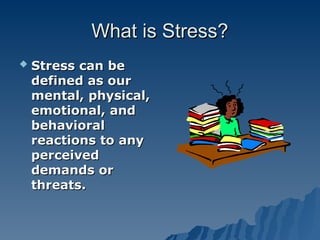
 Stress can be
Stress can be
defined as our
defined as our
mental, physical,
mental, physical,
emotional, and
emotional, and
behavioral
behavioral
reactions to any
reactions to any
perceived
perceived
demands or
demands or
threats.
threats.
The “Fight or Flight” Response
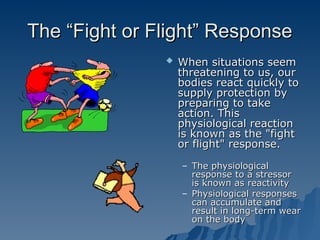
 When situations seem
When situations seem
threatening to us, our
bodies react quickly to
supply protection by
preparing to take
preparing to take
action. This
action. This
physiological reaction
is known as the "fight
or flight" response.
– The physiological
The physiological
response to a stressor
is known as reactivity
– Physiological responses
Physiological responses
can accumulate and
can accumulate and
result in long-term wear
on the body
on the body
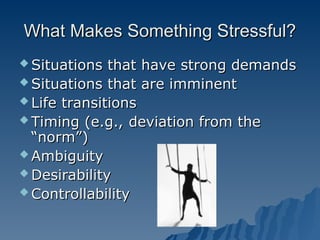
What Makes Something Stressful?
 Situations that have strong demands
Situations that have strong demands
 Situations that are imminent
Situations that are imminent
 Life transitions
Life transitions
 Timing (e.g., deviation from the
Timing (e.g., deviation from the
“norm”)
“norm”)
 Ambiguity
Ambiguity
 Desirability
Desirability
 Controllability
Controllability
Not All Stress is Bad…
 Distress
Distress is a continuous experience of feeling
is a continuous experience of feeling
overwhelmed, oppressed, and behind in our
responsibilities. It is the all encompassing sense
of being imposed upon by difficulties with no light
at the end of the tunnel.
– Examples of distress include financial difficulties, conflicts in
Examples of distress include financial difficulties, conflicts in
relationships, excessive obligations, managing a chronic
illness, or experiencing a trauma.
 Eustress
Eustress is the other form of stress that is
is the other form of stress that is
positive and beneficial. We may feel challenged,
but the sources of the stress are opportunities
that are meaningful to us. Eustress helps provide
us with energy and motivation to meet our
responsibilities and achieve our goals.
– Examples of eustress include graduating from college, getting
Examples of eustress include graduating from college, getting
married, receiving a promotion, or changing jobs.
Stress Response: Example
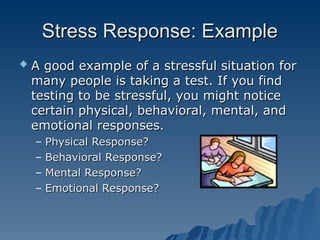
 A good example of a stressful situation for
A good example of a stressful situation for
many people is taking a test. If you find
testing to be stressful, you might notice
certain physical, behavioral, mental, and
emotional responses.
– Physical Response?
Physical Response?
– Behavioral Response?
Behavioral Response?
– Mental Response?
Mental Response?
– Emotional Response?
Emotional Response?
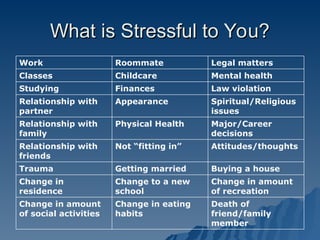
What is Stressful to You?
Work Roommate Legal matters
Classes Childcare Mental health
Studying Finances Law violation
Relationship with
partner
Appearance Spiritual/Religious
issues
Relationship with
family
Physical Health Major/Career
decisions
Relationship with
friends
Not “fitting in” Attitudes/thoughts
Trauma Getting married Buying a house
Change in
residence
Change to a new
school
Change in amount
of recreation
Change in amount
of social activities
Change in eating
habits
Death of
friend/family
member
Why Do We "Stress Out"?
 For two major
For two major
reasons:
reasons:
– We
We perceive
perceive a
a
situation as
situation as
dangerous, difficult,
or painful.
or painful.
– We don't believe we
We don't believe we
have the
have the resources
resources
to cope.
to cope.
Stress Warning Signals
 What are your "red
What are your "red
flags," or warning
flags," or warning
signs, that stress is
creeping into your
creeping into your
life? If we keep
life? If we keep
pushing ourselves,
pushing ourselves,
eventually something
inside of use will send
"red flags," or warning
signs that stress is
becoming a problem.
becoming a problem.
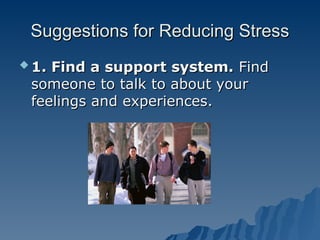
Suggestions for Reducing Stress
 1. Find a support system.
1. Find a support system. Find
Find
someone to talk to about your
feelings and experiences.
Suggestions for Reducing Stress
 2. Change your attitude.
2. Change your attitude. Find
Find
other ways to think about stressful
situations.
situations.
– "Life is 10% what happens to us, and
"Life is 10% what happens to us, and
90% how we react to it."
Suggestions for Reducing Stress
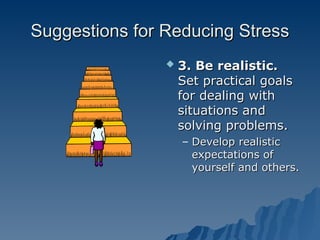
 3. Be realistic.
3. Be realistic.
Set practical goals
Set practical goals
for dealing with
for dealing with
situations and
situations and
solving problems.
solving problems.
– Develop realistic
Develop realistic
expectations of
expectations of
yourself and others.
Suggestions for Reducing Stress
 4. Get organized
4. Get organized
and take charge.
and take charge.
Being unorganized or
engaging in poor
engaging in poor
planning often leads
to frustration or crisis
situations, which most
always leads to feeling
stressed.
stressed.
– Plan your time, make a
Plan your time, make a
schedule, establish your
priorities.
priorities.
Suggestions for Reducing Stress
 5. Take breaks, give yourself "me
5. Take breaks, give yourself "me
time."
time." Learn that taking time to
Learn that taking time to
yourself for rejuvenation and
relaxation is just as important as
giving time to other activities.
– At minimum, take short breaks during
At minimum, take short breaks during
your busy day.
your busy day.
Suggestions for Reducing Stress
 6. Take good care of yourself.
6. Take good care of yourself. Eat
Eat
properly, get regular rest, keep a
routine. Allow yourself to do
something you enjoy each day.
– Paradoxically, the time we need to take
Paradoxically, the time we need to take
care of ourselves the most, when we are
stressed, is the time we do it the least.
Suggestions for Reducing Stress
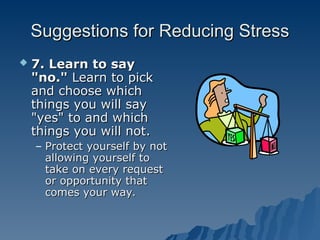
 7. Learn to say
7. Learn to say
"no."
"no." Learn to pick
Learn to pick
and choose which
and choose which
things you will say
things you will say
"yes" to and which
"yes" to and which
things you will not.
– Protect yourself by not
Protect yourself by not
allowing yourself to
take on every request
or opportunity that
or opportunity that
comes your way.
comes your way.
Suggestions for Reducing Stress
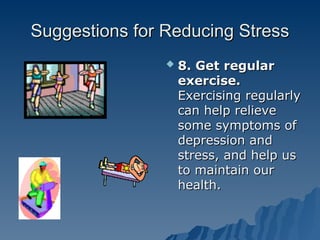
 8. Get regular
8. Get regular
exercise.
exercise.
Exercising regularly
can help relieve
can help relieve
some symptoms of
some symptoms of
depression and
depression and
stress, and help us
stress, and help us
to maintain our
to maintain our
health.
health.
Suggestions for Reducing Stress
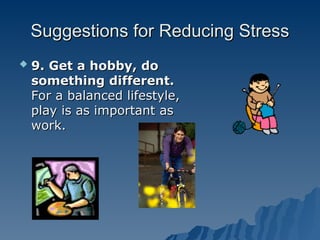
 9. Get a hobby, do
9. Get a hobby, do
something different.
For a balanced lifestyle,
play is as important as
work.
work.
Suggestions for Reducing Stress
 10. Slow down.
10. Slow down. Know your limits and cut
Know your limits and cut
down on the number of things you try to
do each day, particularly if you do not
have enough time for them or for yourself.
– Be realistic about what you can accomplish
Be realistic about what you can accomplish
effectively each day.
– Monitor your pace. Rushing through things
Monitor your pace. Rushing through things
can lead to mistakes or poor performance.
Take the time you need to do a good job.
 Poorly done tasks can lead to added stress.
Poorly done tasks can lead to added stress.
Suggestions for Reducing Stress
 11. Laugh, use
11. Laugh, use
humor.
humor. Do
Do
something fun and
something fun and
enjoyable such as
enjoyable such as
seeing a funny movie,
laughing with friends,
reading a humorous
reading a humorous
book, or going to a
book, or going to a
comedy show.
comedy show.
Suggestions for Reducing Stress
 12. Learn to relax.
12. Learn to relax. Develop a
Develop a
regular relaxation routine.
– Try yoga, meditation, or some simple
Try yoga, meditation, or some simple
quiet time.
quiet time.
Relaxation Exercises
 Many different kinds, but 2 are:
Many different kinds, but 2 are:
– Deep Breathing
Deep Breathing
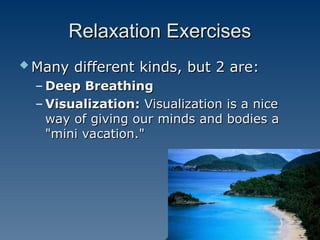
– Visualization:
Visualization: Visualization is a nice
Visualization is a nice
way of giving our minds and bodies a
"mini vacation."
"mini vacation."
Stress Management: Next Steps
 Try to change the way you appraise
Try to change the way you appraise
a situation to make it less stressful
 Remember stress is normal but
Remember stress is normal but
watch out for symptoms of stress
 Use coping skills/ways to reduce
Use coping skills/ways to reduce
stress
stress
 Practice relaxation techniques
Practice relaxation techniques
 Contact TRiO advisor for counseling
Contact TRiO advisor for counseling
at 662-4365
at 662-4365
THANK YOU!
THANK YOU!
Materials adapted from:
Price, P. (2002)
Price, P. (2002)
Sarafino, E.P. (2002)

STRESS-MANAGEMENT POWERPOINT PRESENTATION

  • 1.
  • 2.
    What is Stress? Whatis Stress?  Stress can be Stress can be defined as our defined as our mental, physical, mental, physical, emotional, and emotional, and behavioral behavioral reactions to any reactions to any perceived perceived demands or demands or threats. threats.
  • 3.
    The “Fight orFlight” Response The “Fight or Flight” Response  When situations seem When situations seem threatening to us, our threatening to us, our bodies react quickly to bodies react quickly to supply protection by supply protection by preparing to take preparing to take action. This action. This physiological reaction physiological reaction is known as the "fight is known as the "fight or flight" response. or flight" response. – The physiological The physiological response to a stressor response to a stressor is known as reactivity is known as reactivity – Physiological responses Physiological responses can accumulate and can accumulate and result in long-term wear result in long-term wear on the body on the body
  • 4.
    What Makes SomethingStressful? What Makes Something Stressful?  Situations that have strong demands Situations that have strong demands  Situations that are imminent Situations that are imminent  Life transitions Life transitions  Timing (e.g., deviation from the Timing (e.g., deviation from the “norm”) “norm”)  Ambiguity Ambiguity  Desirability Desirability  Controllability Controllability
  • 5.
    Not All Stressis Bad… Not All Stress is Bad…  Distress Distress is a continuous experience of feeling is a continuous experience of feeling overwhelmed, oppressed, and behind in our overwhelmed, oppressed, and behind in our responsibilities. It is the all encompassing sense responsibilities. It is the all encompassing sense of being imposed upon by difficulties with no light of being imposed upon by difficulties with no light at the end of the tunnel. at the end of the tunnel. – Examples of distress include financial difficulties, conflicts in Examples of distress include financial difficulties, conflicts in relationships, excessive obligations, managing a chronic relationships, excessive obligations, managing a chronic illness, or experiencing a trauma. illness, or experiencing a trauma.  Eustress Eustress is the other form of stress that is is the other form of stress that is positive and beneficial. We may feel challenged, positive and beneficial. We may feel challenged, but the sources of the stress are opportunities but the sources of the stress are opportunities that are meaningful to us. Eustress helps provide that are meaningful to us. Eustress helps provide us with energy and motivation to meet our us with energy and motivation to meet our responsibilities and achieve our goals. responsibilities and achieve our goals. – Examples of eustress include graduating from college, getting Examples of eustress include graduating from college, getting married, receiving a promotion, or changing jobs. married, receiving a promotion, or changing jobs.
  • 6.
    Stress Response: Example StressResponse: Example  A good example of a stressful situation for A good example of a stressful situation for many people is taking a test. If you find many people is taking a test. If you find testing to be stressful, you might notice testing to be stressful, you might notice certain physical, behavioral, mental, and certain physical, behavioral, mental, and emotional responses. emotional responses. – Physical Response? Physical Response? – Behavioral Response? Behavioral Response? – Mental Response? Mental Response? – Emotional Response? Emotional Response?
  • 7.
    What is Stressfulto You? What is Stressful to You? Work Roommate Legal matters Classes Childcare Mental health Studying Finances Law violation Relationship with partner Appearance Spiritual/Religious issues Relationship with family Physical Health Major/Career decisions Relationship with friends Not “fitting in” Attitudes/thoughts Trauma Getting married Buying a house Change in residence Change to a new school Change in amount of recreation Change in amount of social activities Change in eating habits Death of friend/family member
  • 8.
    Why Do We"Stress Out"? Why Do We "Stress Out"?  For two major For two major reasons: reasons: – We We perceive perceive a a situation as situation as dangerous, difficult, dangerous, difficult, or painful. or painful. – We don't believe we We don't believe we have the have the resources resources to cope. to cope.
  • 9.
    Stress Warning Signals StressWarning Signals  What are your "red What are your "red flags," or warning flags," or warning signs, that stress is signs, that stress is creeping into your creeping into your life? If we keep life? If we keep pushing ourselves, pushing ourselves, eventually something eventually something inside of use will send inside of use will send "red flags," or warning "red flags," or warning signs that stress is signs that stress is becoming a problem. becoming a problem.
  • 10.
    Suggestions for ReducingStress Suggestions for Reducing Stress  1. Find a support system. 1. Find a support system. Find Find someone to talk to about your someone to talk to about your feelings and experiences. feelings and experiences.
  • 11.
    Suggestions for ReducingStress Suggestions for Reducing Stress  2. Change your attitude. 2. Change your attitude. Find Find other ways to think about stressful other ways to think about stressful situations. situations. – "Life is 10% what happens to us, and "Life is 10% what happens to us, and 90% how we react to it." 90% how we react to it."
  • 12.
    Suggestions for ReducingStress Suggestions for Reducing Stress  3. Be realistic. 3. Be realistic. Set practical goals Set practical goals for dealing with for dealing with situations and situations and solving problems. solving problems. – Develop realistic Develop realistic expectations of expectations of yourself and others. yourself and others.
  • 13.
    Suggestions for ReducingStress Suggestions for Reducing Stress  4. Get organized 4. Get organized and take charge. and take charge. Being unorganized or Being unorganized or engaging in poor engaging in poor planning often leads planning often leads to frustration or crisis to frustration or crisis situations, which most situations, which most always leads to feeling always leads to feeling stressed. stressed. – Plan your time, make a Plan your time, make a schedule, establish your schedule, establish your priorities. priorities.
  • 14.
    Suggestions for ReducingStress Suggestions for Reducing Stress  5. Take breaks, give yourself "me 5. Take breaks, give yourself "me time." time." Learn that taking time to Learn that taking time to yourself for rejuvenation and yourself for rejuvenation and relaxation is just as important as relaxation is just as important as giving time to other activities. giving time to other activities. – At minimum, take short breaks during At minimum, take short breaks during your busy day. your busy day.
  • 15.
    Suggestions for ReducingStress Suggestions for Reducing Stress  6. Take good care of yourself. 6. Take good care of yourself. Eat Eat properly, get regular rest, keep a properly, get regular rest, keep a routine. Allow yourself to do routine. Allow yourself to do something you enjoy each day. something you enjoy each day. – Paradoxically, the time we need to take Paradoxically, the time we need to take care of ourselves the most, when we are care of ourselves the most, when we are stressed, is the time we do it the least. stressed, is the time we do it the least.
  • 16.
    Suggestions for ReducingStress Suggestions for Reducing Stress  7. Learn to say 7. Learn to say "no." "no." Learn to pick Learn to pick and choose which and choose which things you will say things you will say "yes" to and which "yes" to and which things you will not. things you will not. – Protect yourself by not Protect yourself by not allowing yourself to allowing yourself to take on every request take on every request or opportunity that or opportunity that comes your way. comes your way.
  • 17.
    Suggestions for ReducingStress Suggestions for Reducing Stress  8. Get regular 8. Get regular exercise. exercise. Exercising regularly Exercising regularly can help relieve can help relieve some symptoms of some symptoms of depression and depression and stress, and help us stress, and help us to maintain our to maintain our health. health.
  • 18.
    Suggestions for ReducingStress Suggestions for Reducing Stress  9. Get a hobby, do 9. Get a hobby, do something different. something different. For a balanced lifestyle, For a balanced lifestyle, play is as important as play is as important as work. work.
  • 19.
    Suggestions for ReducingStress Suggestions for Reducing Stress  10. Slow down. 10. Slow down. Know your limits and cut Know your limits and cut down on the number of things you try to down on the number of things you try to do each day, particularly if you do not do each day, particularly if you do not have enough time for them or for yourself. have enough time for them or for yourself. – Be realistic about what you can accomplish Be realistic about what you can accomplish effectively each day. effectively each day. – Monitor your pace. Rushing through things Monitor your pace. Rushing through things can lead to mistakes or poor performance. can lead to mistakes or poor performance. Take the time you need to do a good job. Take the time you need to do a good job.  Poorly done tasks can lead to added stress. Poorly done tasks can lead to added stress.
  • 20.
    Suggestions for ReducingStress Suggestions for Reducing Stress  11. Laugh, use 11. Laugh, use humor. humor. Do Do something fun and something fun and enjoyable such as enjoyable such as seeing a funny movie, seeing a funny movie, laughing with friends, laughing with friends, reading a humorous reading a humorous book, or going to a book, or going to a comedy show. comedy show.
  • 21.
    Suggestions for ReducingStress Suggestions for Reducing Stress  12. Learn to relax. 12. Learn to relax. Develop a Develop a regular relaxation routine. regular relaxation routine. – Try yoga, meditation, or some simple Try yoga, meditation, or some simple quiet time. quiet time.
  • 22.
    Relaxation Exercises Relaxation Exercises Many different kinds, but 2 are: Many different kinds, but 2 are: – Deep Breathing Deep Breathing – Visualization: Visualization: Visualization is a nice Visualization is a nice way of giving our minds and bodies a way of giving our minds and bodies a "mini vacation." "mini vacation."
  • 23.
    Stress Management: NextSteps Stress Management: Next Steps  Try to change the way you appraise Try to change the way you appraise a situation to make it less stressful a situation to make it less stressful  Remember stress is normal but Remember stress is normal but watch out for symptoms of stress watch out for symptoms of stress  Use coping skills/ways to reduce Use coping skills/ways to reduce stress stress  Practice relaxation techniques Practice relaxation techniques  Contact TRiO advisor for counseling Contact TRiO advisor for counseling at 662-4365 at 662-4365
  • 24.
    THANK YOU! THANK YOU! Materialsadapted from: Materials adapted from: Price, P. (2002) Price, P. (2002) Sarafino, E.P. (2002) Sarafino, E.P. (2002)

Editor's Notes

  • #2 We say we feel "burned out," stressed out, overwhelmed, angry, irritable, depressed, anxious, and on the verge of "losing it."
  • #3 In the days of the cavemen, the fight or flight response was key to their survival. When faced with a threatening tiger, for instance, a caveman had two main choices. He could fight the tiger or he could run away. Either way, his body had to prepare quickly to respond. The caveman's heart began to race, his breathing rate increased, his pupils dilated, his muscles became tense, and his mind processed information rapidly. This natural response to danger helped the cavemen to protect himself and to survive.
  • #6 This may not be a life and death situation, but many of us perceive this situation as somewhat threatening. Physically, your heart might race, your hands become clammy or sweaty, you shake, your breathing becomes rapid and shallow, your jaw tightens, and you might become light-headed.Behaviorally, you might stutter, look down, or avoid eye contact with the audience.Cognitively or mentally, your mind may go blank, or alternatively your thoughts might race wildly. You might have thoughts about making a mistake or looking ridiculous in front of your peers.Emotionally, you might feel very anxious or fearful.
  • #8 Our Perceptions = How Stressed We Feel We often identify specific events, people, or situations that seem to make us feel stressed. It's as if these things automatically cause us feel stressed out. In reality, it's how we perceive an event, the meaning we give to it, that leads us to feel stressed or not stressed about it. The interesting thing about stress is that it begins with our own perceptions of things! Have you ever noticed that some people can feel quite stressed out about a particular event while others don't seem to be bothered by it at all? For instance, if three of your friends all get a poor grade on a test, you might notice some different reactions. One friend may seem mildly annoyed for an hour or so. Another friend doesn't seem to be bothered at all. The third friend, however, might become quite alarmed by this poor grade. She can't get it off her mind, she vows to study three times as hard next time, she can't concentrate on her other work, and she might even find it difficult to fall asleep that evening. She might become increasingly concerned about all the grades she'll make this semester, and wonder whether her GPA will suffer. In a case such as this, a poor grade on a test means something different for each of your friends. The same situation has happened to all three, but each person feels more or less stressed about it because of what it means to him or her.
  • #10 Speak to friends, family, a teacher, a minister, or a counselor. Sometimes we just need to "vent" or get something "off our chest." Expressing our feelings can be relieving, we can feel supported by others, and it can help us work out our problems.
  • #11 Talk to yourself positively. Remember, "I can handle it, " "this will be over soon," or "I have handled difficult things before, and I can do it again." Also, practice acceptance. We need to learn to accept things we cannot change without trying to exert more control over them.
  • #12 Setting our expectations or goals high may seem like a useful way to push ourselves and get things done, but we may also set ourselves up for disappointment and continued stress. Find the courage to recognize your limits
  • #13 Do this regularly until it becomes a productive habit. Take responsibility for your life. Be proactive. Problem solve and look for solutions rather than worry.
  • #14 You might purposely schedule time in your day planner just for yourself so that you can recharge for all the other things you need to do. Learn your "red flags" for stress, and be willing to take time to do something about it.
  • #15 When we feel overwhelmed we tend to eat poorly, sleep less, stop exercising, and generally push ourselves harder. This can tax the immune system and cause us to become ill more easily. If we take good care of ourselves to begin with, we will be better prepared to manage stress and accomplish our tasks in the long run.
  • #16 It is okay to decline a request for a favor. Saying "no" does not mean you are bad, self-centered, or uncaring. Learn skills of assertiveness so that you can feel more confident and have effective ways of saying "no."
  • #17 Exercise can build confidence, self-esteem, and self-image. It is also a great way to take time for yourself, blow off steam, and release physical tension.
  • #18 Leisure activities and hobbies can be very enjoyable and inspiring, and they can offer an added sense of accomplishment to our lives. For ideas on new hobbies, browse through a bookstore or a crafts store, surf the internet, look up local organizations, see what classes or courses are available in your community or from a nearby college or university. Don't quickly dismiss new opportunities.
  • #21 Relaxation techniques are skills that need to be developed with patience and practice so that we can use them effectively during difficult times of stress later on.
  • #22 When we feel stressed, it is common for our rate of breathing to increase. We also tend to breath in a shallow manner, more highly in our chest. A deep breathing exercise allows us to take fuller, slower breaths that reflect a true relaxed state It involves using imagery to fully immerse ourselves in a pleasant scene, noticing the sights, sounds, smells, and tactile sensations.