Importance of streetscapes
•A key element to the success of a downtown is the provision of an attractive
• and inviting public realm. Improvements to the streetscape are essential for
• creating an environment of tree-lined, pedestrian-oriented walking streets and
• outdoor plazas with frequent gathering spaces, outdoor cafes and seating areas,
• and unique design elements. These elements will ensure that streets are inviting
• public spaces that will be used by the community, and that also set the stage for
• new investment along its edges.
Streetscapes refer to the visual image created by the buildings, signs,street furniture,
landscaping, spaces and other features along a street.
• In our automobile-dominated environments, these images are most often seen from a
moving vehicle.
• By unifying the treatment of one or more of these elements, a streetscape can have a
coherent image and one that makes a strong statement within a city.
• Sadly, many cities give scant attention to their streetscapes, resulting in a visually disjointed
experience as one moves along the street.
2.
Streetscape palette designprinciples
• Side walks
• Streetlights
• Landscaping
• Street Furniture
• Information signage
• Intersection treatments
• Public transit
• Constructability
• Control cost
• Public art
3.
Amenity zone
• Streetlights
• Planters
• Trees
• Benches
• Trash receptacles
• Signages
4.
Pedestrian zone
• Asafe a comfortable walking area adjacent to
the buildings free of constructions
• Transition zones
• Transition occurs between different street
typologies and different district
5.
Develop a promotional
kioskthat can be used to
highlight downtown
events and activities.
One or a number of information
kiosks could be created to
display information about
downtown events. The kiosks
should be placed at high pedestrian
use intersections and
on Festival Streets for special
events. Implement a streetscape
“Kit of Parts.”
Benches, signs, bollards,
planters, landscaping and
streetlights are examples of
streetscape elements that
could be used to further establish
the character of the City
Center and to encourage pedestrian
activity.
6.
Benches. Use benchesto enhance
the streetscape design
and provide places for pedestrians
to rest. Updated bench
designs should be added to
this plan as they become
available.
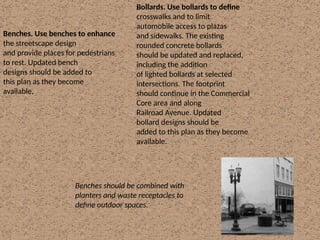
Benches should be combined with
planters and waste receptacles to
define outdoor spaces.
Bollards. Use bollards to define
crosswalks and to limit
automobile access to plazas
and sidewalks. The existing
rounded concrete bollards
should be updated and replaced,
including the addition
of lighted bollards at selected
intersections. The footprint
should continue in the Commercial
Core area and along
Railroad Avenue. Updated
bollard designs should be
added to this plan as they become
available.
7.
Planters. Ornamental plantings
shouldbe installed
throughout the City Center.
This includes freestanding
planters that are located in
plazas at key intersections, as
well as smaller containers that
may be installed as hanging
baskets on light poles. Updated
planter designs should
be added to this plan as they
become available.
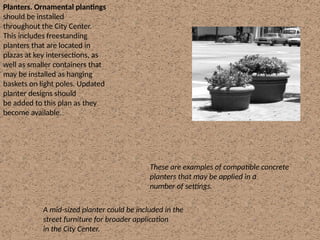
A mid-sized planter could be included in the
street furniture for broader application
in the City Center.
These are examples of compatible concrete
planters that may be applied in a
number of settings.
8.
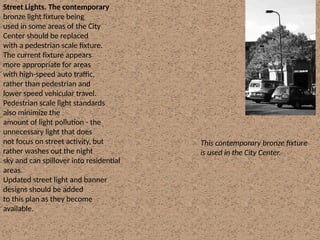
Street Lights. Thecontemporary
bronze light fixture being
used in some areas of the City
Center should be replaced
with a pedestrian scale fixture.
The current fixture appears
more appropriate for areas
with high-speed auto traffic,
rather than pedestrian and
lower speed vehicular travel.
Pedestrian scale light standards
also minimize the
amount of light pollution - the
unnecessary light that does
not focus on street activity, but
rather washes out the night
sky and can spillover into residential
areas.
Updated street light and banner
designs should be added
to this plan as they become
available.
This contemporary bronze fixture
is used in the City Center.
9.
Parking
Everyone who workswith downtowns
would place parking as a primary issue.
A viable parking system involves factors
beyond simple quantity calculations.
Physical organization, distribution,
pedestrian links, and screening are issues
that should be addressed.
Pedestrian Access
Poorly designed and maintained routes
of pedestrian access can significantly affect
both perceptions and physical accessiblity
of downtowns.
On-Street Parking On-street parking is discouraged on Rice Street and Little Canada RoadIRice Street, and local streets within
the commercial district.
Encourage "parkway like JJ development along Little Canada Road. Where on-street parking is allowed on local streets (as
opposed to collector or arterial streets), the City encourages recessed parking bays apart from driving lanes. All on-street
parking to be parallel parking.
Parallel parking space dimension to be 9 feet by 20 feet
Off-Street Parking
Vehicular Access The City encourages off-street parking areas that are interspersed with significant planting
areas. Off-street parking areas to be set back and screened at the perimeter to keep focus on the
buildings and pedestrian activity. Parking areas should be designed to provide minimum walking distance to shopping
entries.
Vehicular access
The City encourages layout and design that provides unity, easy identification and access of
the commercial areas from major roadways. 20 percent of all parking areas to be devoted to
open space. Entry points on Rice Street and Little Canada Road are to be easily seen and recognizable
and have a 30 foot sight triangle distance as per City requirements, and other applicable highway
department standards.