Digital Development
Information Technology
Strategy for Rural Communities
Greg Laudeman
Community Technology Specialist
“It’s Not the Technology that Matters…
It’s How You Use It!”
Identifying opportunities
Forming alliances
Developing technology leadership
Doing projects
Information Technology
Computing and Telecommunications
Similar to traditional utilities
Different from traditional utilities
Delivers connectivity and bandwidth
Functions depend on computers
Rapid technological change
Tools for decision-making and
coordination of activities
Digital Development: IT for ED
 Reduce costs and improve firm performance
 Provide access to global & niche markets
 Enable a more talented and productive
workforce
 Create new entrepreneurial opportunities
 Increase capital investment and public revenue
 Deliver public services more efficiently and
effectively
 Support skill development and education
 Differentiate your community
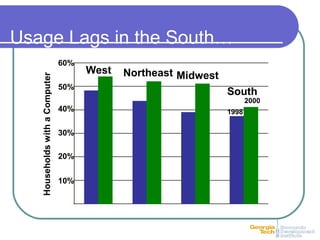
0
10
20
30
40
50
60
HouseholdswithaComputer
1998
2000
West Northeast Midwest
South
60%
50%
40%
30%
20%
10%
Usage Lags in the South…
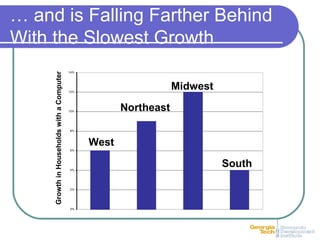
0%
2%
4%
6%
8%
10%
12%
14%
West
Northeast
Midwest
South
GrowthinHouseholdswithaComputer
… and is Falling Farther Behind
With the Slowest Growth
Digital Development
Community
Technology
Leadership
Technological
Facilities
Organizational
Capacities
Individual
Capabilities Overall
Community
Capacity to
Apply IT
Community Technology Leadership
Identify
Goals
Engage
Broadly
Do a
Project
Analyze
Design
Implement
Business and Civic Leaders Technology Leaders
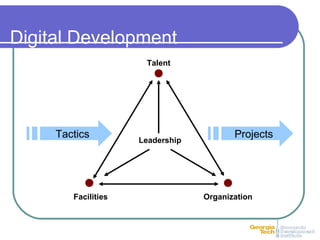
Facilities Organization
Talent
Digital Development
Leadership
Tactics Projects
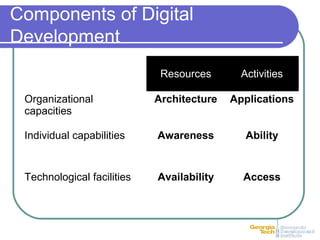
Components of Digital
Development
Resources Activities
Organizational
capacities
Architecture Applications
Individual capabilities Awareness Ability
Technological facilities Availability Access
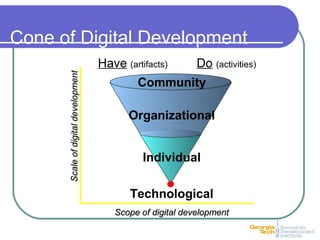
Technological
ScaleofdigitaldevelopmentScaleofdigitaldevelopment
Scope of digital developmentScope of digital development
Organizational
Have (artifacts) Do (activities)
Individual
Community
Cone of Digital Development
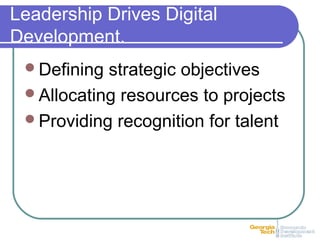
Leadership Drives Digital
Development.
Defining strategic objectives
Allocating resources to projects
Providing recognition for talent
DoesDoes
something.something.Somebody
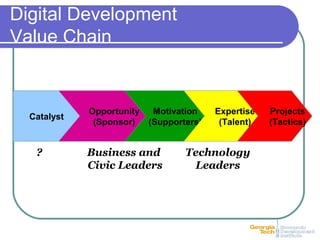
Digital Development
Value Chain
Technology
Leaders
Business and
Civic Leaders
?
Motivation
(Supporters)
Opportunity
(Sponsor)
Catalyst
Expertise
(Talent)
Projects
(Tactics)
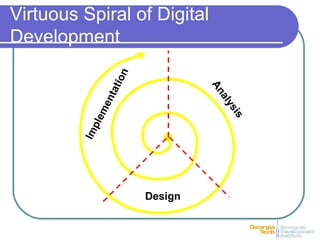
Analysis
Design
Implementation
Virtuous Spiral of Digital
Development
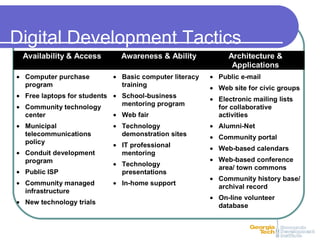
Digital Development Tactics
Availability & Access Awareness & Ability Architecture &
Applications
• Computer purchase
program
• Free laptops for students
• Community technology
center
• Municipal
telecommunications
policy
• Conduit development
program
• Public ISP
• Community managed
infrastructure
• New technology trials
• Basic computer literacy
training
• School-business
mentoring program
• Web fair
• Technology
demonstration sites
• IT professional
mentoring
• Technology
presentations
• In-home support
• Public e-mail
• Web site for civic groups
• Electronic mailing lists
for collaborative
activities
• Alumni-Net
• Community portal
• Web-based calendars
• Web-based conference
area/ town commons
• Community history base/
archival record
• On-line volunteer
database
Community Technology Leaders
Community – committed to improving
the local economy and quality of life
Technology – has expertise, experience,
or interest in IT
Leader – willing and able to spearhead
community projects
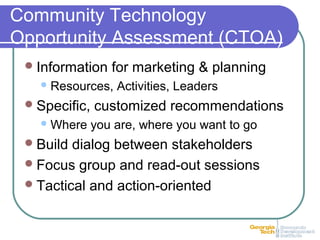
Community Technology
Opportunity Assessment (CTOA)
Information for marketing & planning
Resources, Activities, Leaders
Specific, customized recommendations
Where you are, where you want to go
Build dialog between stakeholders
Focus group and read-out sessions
Tactical and action-oriented
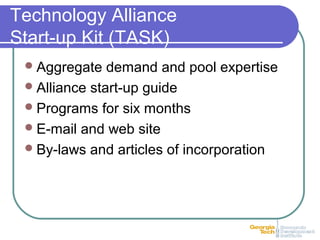
Technology Alliance
Start-up Kit (TASK)
Aggregate demand and pool expertise
Alliance start-up guide
Programs for six months
E-mail and web site
By-laws and articles of incorporation
Community Technology
Leadership Program (CTLP)
 Cross-train leadership and tech talent
 “Talk the talk & walk the walk”
 Six half-day sessions over six months
 Technology for Leaders
 Leadership for Techs: Analysis
 Leadership for Techs: Design
 Leadership for Techs: Implementation I
 Community Technology Leadership: Review
 Coaching for project tasks between sessions
Core Concepts of Digital
Development
Use what you have to get more
One size doesn’t fit all
Partnerships are vital
Define objectives clearly
Aggregate demand & pool expertise
Activate technologists to lead
Do projects that put IT to work
Greg Laudeman
Community Technology Specialist
greg.laudeman@edi.gatech.edu
706-272-2703
http://techsmart.edi.gatech.edu
Thank you!Thank you!
Questions?

IT Strategy for rural communities